Local

The Performant: Life is but a dream…

0

Bouffonery and W. Kamau Bell’s stand-up at Stagewerx

Theater history is full of stories of legendary shows that caused riots at their opening night, difficult to imagine in these more apathetic times. We go to the theatre to be entertained, more rarely to be provoked, and more rarely yet, to be stirred to an action greater than the act of merely applauding at the end.

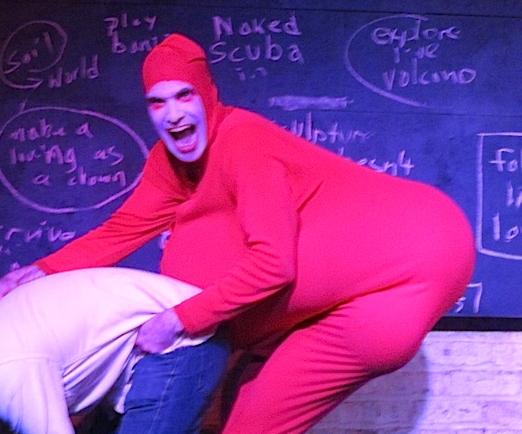
But the theater of Bouffon turns that theater-going complacency on its head. The entertainer in the room is not the curious creature onstage with exaggerated buttocks and an evil smile, but the squirming oddience stuck in the crosshairs of its merciless gaze.

When Eric Davis, a.k.a. the Red Bastard tumbles onto the stage, imitating the slightly baffled faces that gaze up at him in a brilliant, Tourettic flash, a slight tingle of danger vibrates around the room. A dawning awareness, there’s no place to hide. Even those of us who have cleverly ensconced ourselves in the back can tell we’re being scrutinized in the dim lighting of the anonymous warehouse space we’re crammed together in.

“As an audience, you have absolutely no presence,” the Bastard complains. Backs straighten. Chins raise. Challenge us will he? That wobbling, unitard-wearing freak stuffed suggestively with balloons and venom. Of course he will. That’s the whole point.

Red Bastard mocks us. He cajoles. He flirts. He leads the group in a series of physical exercises, dividing the room in two and forcing us to compete, exhorting us to GO BIG. He sticks his bulbous, balloon-stuffed bottom in the face of a pretty girl and makes her dig around for a five-dollar bill. What price dignity. He hocks a loogey onstage and calls it “art” — later he sits in it, “fucking art.” And just at the point where he could become just another one-trick provocateur, he softens the schtick and turns inward. Pressing the buttons of our emotional vulnerability as easily as he pushed our sense of outrage just moments before.

“The more you risk, the more you are rewarded,” he counsels. “If you can’t articulate your desires, you can’t achieve them.” Encouraging the crowd to shout out their deepest desires (“sail around the world,” “naked scuba,” “have a dog,” “fall in love”) he fills an invisible bag with them and pushes it up a “dream mountain” chanting “sissy fuss sissy fuss.”

“What’s difficult about falling in love?” he demands. What’s difficult, he insinuates, about achieving any of our dreams? What indeed.

The ultimate provocation comes when he urges a disgruntled worker bee to call her boss up and quit on the spot, which she gamely attempts but is foiled by the lack of cell phone reception in the room. “T-Mobile,” she explains, as we nod sympathetically. But the seed has been planted, and who knows what fruit it will bear later on.

Then, like the Buddha you kill on the road, Red Bastard sends us away, filled, if only for a moment, with the feeling we truly own our own destiny, a feeling worth every bit of humiliation it took for us to get there.

******

Speaking of owning our own destiny, and following our dreams, local comedian-making-good W. Kamau Bell performed a sold-out weekend at Stagewerx, his spiritual San Francisco home. The theme of much of the show spoke mainly to the heady weirdness of the nature of “celebrity”. Even the kind of ground-level celebrity of having a new television show (Chris Rock-produced Totally Biased on FX) comes with a set of unexpected side effects. Being forced onto The View, auditioning for a spot on The Howard Stern Show, moving to a non-gentrified part of Brooklyn from the Inner Sunset, it’s all fuel for the funny as life’s most awkward moments so frequently are. He’s still the same Kamau, and thank goodness. But the dream, and the comedy, has grown.

Behind the Chron’s paywall

24

I wish the Chronicle luck at its experiment with a “paywall.” Once upon a time, we used to call that a “subscription” — that is, you pay money and someone delivers to you something worthwhile to read. Since nobody much likes to pay to read anything any more, it’s considered risky and a bit radical for a newspaper to charge money for access to the work that it pays a staff a fair amount of money to produce.

Let’s do the nice thing here, shall we, and set aside the question of whether the journalism the Chron produces is of such high quality that people ought to pay a premium for it. I have my gripes with the Chron, and always have, but seriously: Having a local newspaper that tells you what’s going on in town — even if it doesn’t always do it well — is worth a dollar a day. Which is what the print version costs.

Writers need to get paid. Reporters are necessary to the function of democracy, and if they can’t make a living doing the job, it’s not going to get done. Since most young people aren’t used to paying to read anything these days, the only option has been selling (more and more) ads.

That’s actually a model the alternative press has followed for decades, and it’s worked fine. In the days before cable, that’s how TV worked, too — it comes in free, and you pay for it by watching (annoying) ads.

But it’s a problem on the web, where ads don’t bring in the revenue they once did in print, so everyone’s scrambling to find a way to pay the bills. If you’re Markos over at Daily Kos, you build a huge, huge community that loves what you’re doing, and keep the staff fairly modest, and sell enough ads and bring in enough donations to pay for it all. If you’re Nick Denton’s Gawker Media Empire, you keep costs very low by hiring very limited staff (certainly not a lot of reporters) and sell ads ads ads everywhere, including “sponored posts.”

But if you’re the San Francisco Chronicle, with 280-plus reporters who need health care, and lots of editors and executives, and the Hearst Corp. demanding impossible profits, you’re kind of SOL.

Thus: Paywall.

These things don’t tend to work very well. Sfgate had a paywall for “premium content” years ago, and it just sort of faded away. The Wall Street Journal and the Business Times pubs get away with it, because people who read biz pubs are used to paying for information. I’m not sure how many truly loyal Chron readers there are who are willing to pay to read Matier and Ross and Chuck Nevius on the web. Most of those people already pay for a print subscription.
The other problem is that it’s really unclear what the identities of the two sites, sfgate and sfchronicle, will be. They look different (sfgate looks like a newsy website, sfchronicle looks like a print newspaper), but where do you go every day for news? If you read sfgate, you’re missing stuff that only appears on sfchronicle, but if you read sfchronicle, you’re missing stuff that appears on sfgate. It’s not like you get a “premium” edition of the paper in one place; you have to check two sites to get your local news, not one.

For example, today you can get The Chron’s own Carolyn Lochhead on the same-sex marriage case at sfgate. If you pay extra, you can go to sfchronicle and get an AP story that’s not exclusive and will run in lots of papers.

Why does this make me want to pay?

So I don’t know; it’s going to take a lot of evolving to make this work. Again, I wish them luck; anyone who’s trying to find a way to keep paying a news staff deserves credit. But at this point, it seems like a pretty dubious plan.

Willie Brown and Ammiano’s pot bill

35

Assemblymember Tom Ammiano’s new medical marijuana bill seems pretty straightforward. Almost everyone in the medpot biz thinks there ought to be some sort of statewide regulations for a growing industry that operates in a mish-mash of local jurisdictions with no overall rules. If nothing else, consumer-protection policies ought to be in place. And, of course, the more the dispensaries accept, and follow, reasonable regs, the easier it is to win the mainstream political support necessary to get the feds off all of our backs and ultimately follow Colorado and Washington.

All good, right?

So Ammiano, who has been on this issue for years, is proposing that the state’s Department of Alcoholic Beverage Control — which for all its problems has experience regulating mind-altering substances — draft and oversee medpot rules.

But the industry that makes a lot of money off the legalization of medicinal weed is famously fractured — and the politics of Sacramento are often nasty. Add in former San Francisco Mayor Willie Brown — who has his fingers in all sorts of business opportunities these days — and the story turns downright weird.
Ammiano’s been talking about Califonria and pot for years. He proposed legalization before the other states did, but frankly, this current state Legislature’s never going to have that kind of courage.

But he continues on with the effort. Last year, he tried to put pot under the Department of Consumer Affairs, which clearly didn’t want it; his bill died in the state Senate.

Normally, when new regulations are proposed for an industry, the Legislature holds what’s called a Sunrise Hearing, to bring all the stakeholders into a room and talk about what issues ought to be addressed. So Ammiano a few months back asked for a hearing in the Senate Business, Professions, and Economic Development Committee. No problem, said the chair, Curren Price, a Los Angeles Democrat.

But in February, five days before the hearing was set, Curran called the whole thing off. Turns out that the Governor’s Office and the Attorney General’s Office wanted no part of it, so it was hard to round up the essential players. Also, Curran was running for an open LA City Council seat and probably didn’t want the publicity. As Ammiano said at the time, “What’s up with marijuana? You can’t even have a hearing?”

Even without a hearing, he’s moving a new bill, AB 473, which would create under ABC a Division of Medical Cannabis Regulation and Enforcement. The bill is modeled on a successful effort in Colorado that has kept the feds at bay. Washington is also putting marijuana regulation under its liquor control authority.
“We’ve had not one federal intervention,” in Colorado, Matt Cook, a consultant who help write the rules in that state, said.

But just as Ammiano was preparing to line up support for his measure, another bill mysteriously appeared, in the state Senate. A “spot bill” with no actual content, the measure was set as a medical marijuana regulation placeholder. The authors: Senate President Darrell Steinberg and San Francisco’s Mark Leno.

Now: Leno’s been a big supporter of medical pot for years — but the bill wasn’t his idea. “Darrell told me he was going to do something about marijuana regulations, and he asked me if I would join him,” Leno told us.

What Leno didn’t know: Steinberg had been approached and asked to carry a bill by Willie Brown. Brown contacted the Senate president, sources tell us, and said that Ammiano was the wrong person to carry pot legislation.

Why? Who knows. Brown wouldn’t return my calls. But I can tell you with absolute certainty that Brown has been looking for ways to discredit Ammiano since 1999, when the then-supervisor challenged the mayor’s re-election in a legendary write-in campaign that galvanized the city’s left and created the momentum for the complete rejection of Brown’s politics and endorsed candidates a year later, in the first district elections.

And yes: Willie Brown carries a grudge. So it’s possible that he would go out of his way to make sure that Ammiano didn’t get credit for leading the way on what will evenutally be a huge sea chance in how California handles pot.

Now: This sort of thing isn’t viewed very highly in the hallowed halls of the state Leg, where people take their bills — and their history on issues — very seriously. Ammiano was furious, and talked to Steinberg, who (properly) apologized for stepping on his toes. Leno told us he had no intention of undermining his San Francisco colleague, that he had immense respect for Ammiano and all of his efforts, and that he wouldn’t move forward with any bill that didn’t have Ammiano’s input and support.

But it raises the question: Why is Brown even involved in medical marijuana? The only answer I can come up with is that he’s making money off it. Not as a dispensary owner or a grower, but as, in effect, a lobbyist.

When I heard Brown was messing around with the industry, I called Steve DeAngelo, who runs Harborside Health Center, the $22 million a year dispensary in Oakland. DeAngelo’s a promient leader on medical marijuana issues, and has built a respected business that pays taxes to Oakland, provides quality product, and is in many ways a model for what a dispensary should look like.

We talked for a while about Ammiano’s bill, and DeAngelo said he wants to be sure there’s community consensus. “The most important thing is that whatever passes addresses the issues and has broad supoprt in the industry,” he said. He agreed that regulation is needed, but stopped short of endorsing Ammiano’s bill, saying “there still needs to be further discussion.”

Then I asked him if he knew why Brown was talking to the state Senate president, and he told me:

“Willie Brown has been a political advisor to Harborside.”

I asked him if Harborside was paying Brown for his advice. He refused to say.

Okay then. But Brown doesn’t have much of a history of working on this issue pro bono, and is not known for serving as a “political advisor” (or doing much of anything else in the way of work) for free.

What does Brown think about the Ammiano bill? “He thinks,” DeAngelo said, “that it’s important it have a broad base of support.”

Willie Brown is not popular with the voters of California. His history of questionable (at best) ethics was among the reasons the voters approved terms limits for the Legislature. Hardly anyone on the left trusts him. A medical marijuana regulatory bill that has his fingerprints isn’t going to do much for “consensus” or “broad-based support.”

So maybe the best thing Brown could do for his client is stay the hell out of Sacramento.

Rally and vigils for marriage equality in S.F. this week

The U.S. Supreme Court will hold back-to-back hearings this week as justices consider Prop 8 and the Defense of Marriage Act (DOMA), setting the stage for historic discussions concerning LGBT civil rights. Tonight, hundreds are expected to gather at Castro and Market streets for a 6:30 p.m. rally, followed by a march to City Hall. Prop 8, a state constitutional amendment banning same-sex marriage, passed in California with 52 percent of the vote in November of 2008. Challenges to the discriminatory law have been working through the court system ever since.

LGBT activists also plan to mark Tuesday and Wednesday evenings with vigils outside the California Supreme Court building. The vigils will coincide with about 150 events scheduled throughout the country, organized to demonstrate support for marriage equality.

Shortly after longtime gay rights activists Cleve Jones and David Mixner put out the call to local activists that the Supreme Court would be hearing arguments on Prop 8 and DOMA, Patrick Connors started helping to organize the rally, march and vigils in tandem with activists Greg Chasin, Billy Bradford, Aaron Baldwin and others, Connors said. Over the past several weeks, they’ve been posting fliers, Tweeting to get the word out and urging support for marriage equality as the historic twin hearings get underway in D.C. 

“We’re cautiously optimistic that there will be hundreds of people in the Castro” for the Monday night rally, Connors told the Guardian. About 200 have also signalled interest in attending the vigils March 26 and 27.

San Francisco has been at the epicenter in the battle for marriage equality. Just after Prop 8 passed, it was immediately challenged in parallel court proceedings by same-sex couples and the city of San Francisco, with City Attorney Dennis Herrera leading the charge with support from other California municipalities.

Connors and his husband, Robert Dekoch, were initially married in February of 2004, but their marriage was invalidated after the California Supreme Court held that city officials lacked the authority to issue marriage licenses to same-sex couples. Following a subsequent court victory that opened the gates for same-sex couples to be married in San Francisco City Hall once again, Connors and Dekoch returned and were re-married in August of 2008.

Although Prop. 8 passed the following November, banning same-sex marriage, “our marriage, along with 18,000 others, is recognized by the state of California,” Connors explained. Yet their marriage still isn’t recognized at the federal level, so “there’s the potential of what could happen” during out-of-state travel, he said.

In May of 2009, Connors was arrested along with some 200 protesters who took to the streets following a California Supreme Court decision upholding Prop 8. “A whole bunch of us sat in the middle of Van Ness,” he recounted, “And blocked traffic for hours until the paddy wagons came.”    

Does Mayor Lee support Airbnb dodging its $1.8 million tax debt to SF?

185

My story in this week’s Guardian about how Airbnb appears to be refusing to pay the hotel taxes it owes to the city has gotten a lot of attention. But I’m still getting stonewalled by representatives from the company and Mayor Ed Lee, who apparently refuses to take a public stand against corporate tax evasion, even when it means thousands of San Franciscans could get stuck with an unexpected tax bill.

How much money are we talking about? According to a study that Airbnb commissioned and publicized late last year, its hosts in San Francisco collect $12.7 million from their guests every year. That means that if the company was charging the 14 percent Transient Occupancy Tax – as the Tax Collector’s Office last year ruled that it must – it would be paying the city nearly $1.8 million annually.

But that doesn’t seem to be happening, although only Airbnb can say for sure, which is why its spokespeople have been dodging my questions for more than a week. As I reported, taxpayer privacy laws prevent city officials from disclosing how much individual businesses pay in local taxes, but we do know Airbnb doesn’t add the TOT to the online transactions it facilitates or specifically encourage its San Francisco hosts to collect the taxes (even though the tax codes make the hosts and Airbnb jointly responsible for this growing debt to city coffers). And with the company charging 6-12 percent per transaction, it’s a safe bet that it isn’t simply paying the taxes itself.

What makes this particular case of corporate tax dodging even more interesting is the fact that Mayor Lee has a close connection to this particular San Francisco-based corporation. Venture capitalist Ron Conway is a top investor in both Airbnb and Mayor Lee’s political campaigns, creating a potential conflict-of-interest in Room 200. Last year, Mayor Lee personally lobbied against the interpretation by the Tax Collector’s Office, and now he appears to be silently backing Airbnb’s resistance to paying its taxes.

Last week, when I was trying to get a comment for Lee spokesperson Francis Tsang on Airbnb’s apparent tax dodge, he replied, “It’s an incorrect assumption that Airbnb and hosts haven’t been paying any transient occupancy tax..” Of course, because of the taxpayer privacy laws, Tsang can’t actually support that statement and I responded by laying out the evidence that the city is getting stiffed by Airbnb.

Then, he and Airbnb simply stopped responding to my questions, even though I’ve made repeated inquiries and asked only whether Mayor Lee was willing to make a public statement calling for a major San Francisco corporation to meet its local tax obligations. And in the interests of fully transparency, I’ll close with the email that I sent to spokespersons for Airbnb and the Mayor’s Office on Wednesday as my story came out, along with their emails in case you want to push for answers yourself.

kim@airbnb.com, francis.tsang@sfgov.org, christine.falvey@sfgov.org.

Dear Airbnb and mayoral spokespeople,

Since I couldn’t get responsive answers from any of you about why Airbnb isn’t collecting the Transient Occupancy Tax from its guests, I wanted to forward the link to my story on the topic in our latest issue (http://www.sfbg.com/2013/03/19/airbnb-isnt-sharing) and to let you know that I will continue covering this issue in the Guardian and our sister newspapers until you address it publicly.

Because of privacy laws that limit the Tax Collector’s Office from addressing this directly, only Airbnb can say whether they’re paying any of the hotel taxes that the city last year conclusively ruled that they owe. As I reported in my story, that tax obligation is shared jointly by Airbnb and its hosts, who don’t appear to have been warned of this by the company, making this an issue of consumer protection as well as corporate greed.

Will the Mayor’s Office make a public statement opposing tax evasion? Will it stand up for San Franciscans who may be unwittingly stuck with the tax bill by Airbnb? Or will Mayor Lee stick up for a tax-dodging corporation funded by the same billionaire that funds his political campaigns? And how will people feel about San Franciscans and the city treasury paying for his political ambitions?

These are all questions that I plan to air and explore in the Guardian, and I think that our readers and the general public deserve answers to those questions. If there are reasons why Airbnb guests aren’t being charged the TOT, some other arrangement that has been made, or some other complex reasons why Airbnb feels it can’t comply with last year’s ruling by the Tax Collector’s Office, I’ll be happy to hear it and let you make your case to our readers. But I don’t think that continuing to stonewall me is going to be a viable strategy for any of you. I hope to hear from you soon.

The human price of Catholic conservatism

2

A new book by local historian William Issel explains the key role the Catholic Church played in funding and supporting progressive causes in 20th Century San Francisco, and Randy Shaw’s take on it is accurate: For a while, in the 1970s and 1980s, the Church funded a lot of the tenant advocacy and poverty work in this city. The other side of that is a piece of the debate over the new Pope that we’re not hearing much.

As John Paul II moved the Church to the right, he also shifted its focus — away from concerns with economic justice and towards issues like same-sex marraige and abortion (oh, and covering up sex crimes by priests). In the process, not only did vast numbers of Western Catholics start to lose faith in their church — the money and focus that used to help local activists fight for the poor went away.

The new Pope Francis I is known for his work on poverty — but not for his advocacy of progressive organizations that take that fight out of the pulpit and into the streets, where material good is done.

There’s a human cost to the conservatism of the Catholic Church, and it goes way beyond the altar.


San Francisco female priest and gay Catholics react to selection of Pope Francis

Victoria Rue, a female Roman Catholic Priest, leads a small community of renegade Catholic worshipers in San Francisco. Ordained by a trio of female Bishops on a boat on the St. Lawrence Seaway in 2005, she’s part of a growing international movement to dismantle the longstanding ban on female clergy and push the Catholic Church in a more liberal direction. Although Rue was excommunicated shortly after her ordination, she continues to consider herself a Catholic.

Contacted by the Guardian shortly after Pope Benedict stepped down last month, Rue said, “It’s just as much my church as [former Pope Benedict] Cardinal Ratzinger’s church.” She regarded his resignation as a welcome, if limited, opportunity to push the church in the direction of inclusivity.

But that’s a tall order to say the least; the Pope selection process is fundamentally flawed, Rue says, since “women are left out completely from the process.”

And while Rue said the selection of Pope Francis showed some sensitivity to the church’s changing constituency — “The fact that he is Argentinian is definitely a positive sign” — the newly chosen pope also pushed for legislation to ban gay marriage and gay adoption in Argentina. The church’s conservative values are entrenched: When it comes to LGBT rights, female priests, and contraception, the incoming Pope isn’t likely to budge.

“There is extremely limited hope for a new direction in the Church,” said Tom Piazza, a member of Sophia in Trinity, a San Francisco Roman Catholic church.

Piazza, who is in his 70s, says he grew up Catholic but felt alienated by the Church’s conservative tone — and local Catholics like him are increasingly at odds with the Roman Catholic Church. While it continues to champion conservative social mores, the majority of local Catholics now support gay marriage, according to a recent Field Poll.

The San Francisco Archdiocese is currently headed by Salvatore Cordileone, a major proponent of Prop 8. Cordileone served as the chairman of The United States Conference of Catholic Bishops’ subcommittee for the defense of marriage, and his appointment to the San Francisco Archdiocese was widely understood as an effort to rein in the city’s diverse Catholic community.

The  ideological rift between parishioners and the hierarchy is most apparent at Most Holy Redeemer Church, in the Castro — home to San Francisco’s active gay-Catholic community. The parishioners at Most Holy Redeemer routinely clash with conservative church leadership. Bishop Cordileone has even suggested that the Church’s gay couples refrain from taking communion.  

Father Brian Costello, the priest at Most Holy Redeemer, recently removed a picture of former Pope Benedict XVI from the Church after parishioners raised concerns about the Pope’s homophobic leanings. In a letter to the community, Costello expressed hope that with the selection of a new Pope, gay Catholics could work to “embrace the Pope and the Church, even when they don’t accept us.”

Jesuit Priest Donal Godfrey, author of Gays and Grays, a history of the gay Catholic community at Most Holy Redeemer, sees the ascension of Francis as a welcome opportunity to change the relationship between San Francisco’s Catholics and the church leadership.

“I want to get away from the dynamic of always getting put in our place. Instead of being smacked on the head and being told we are not good Catholics, we should create a space where we aren’t frightened to share our truths,” he told the Guardian.

At Sophia in Trinity, Rue echoes Godfrey’s concerns and hopes that the new Pope Francis will allow local Catholics to collaborate more closely in her community. “In the future, if a parish wants to work with a woman priest, maybe they won’t get their hand slapped by the Church hierarchy.”

The garbage rate hike

14

Yes, your garbage rates are going up. As much as 23 percent, maybe. That’s what Recology, the local trash monopoly, announced March 15.

The rate hike isn’t as bad as some people expected, nor is it as high as earlier predictions. More important, the way the company charges for the three bins we all use is going to change rather profoundly: No more free recycling and compost bins, but you can save money if you cut back on the amount of unrecyclable crap you shouldn’t buy anyway that’s headed to the landfill.

Here’s how it’s going to work:

Instead of paying $27.31 a month flat rate for garbage service, every household (and every apartment unit) will pay a $5 a month fee, plus $2 for every standard-sized green (compost) bin and recycling (blue) bin. Then there’s a $25.51 charge for a 32-gallon black (landfill) bin.

You can downsize to a 20-gallon black bin and upsize your recycling and compost to 64 gallons (that’s a LOT of compost for a city dweller; dude, quit throwing so much food away) and the monthly tab would be $26.94 — a little less than what you pay today.

The idea is that the city has mandated Recology to reach the level of zero waste — that is, 100 percent diversion away from landfill — by 2020, which means there won’t be any black bins any more, and an economic model based on charging for a service that won’t exist isn’t going to work.

Plus, the cost of fuel is going up, labor costs continue to increase, etc. We all know the story.

We also know that Recology never has to bid on the lucrative deal to collect waste in the city, and recently defeated a ballot measure that would have required competitive bidding. And unlike garbage companies in other cities (and other companies like Comcast and PG&E, that do business on city streets), Recology pays no franchise fee.

To make the whole garbage thing more complicated, a group from Yuba County is suing to overturn the deal that will allow Recology to haul San Francisco landfill waste 125 miles north to the Ostrum Road landfill in Wheatland. It’s really complicated, but essentially Recology did have to bid on that part of the deal (since the waste hauling takes place out of the city), won the bid against Waste Management, Inc., and is going to be loading about 400,000 tons of waste onto a rail line out to Wheatland.

This is, if the San Francisco Superior Court doesn’t toss the deal on the grounds that the Environmental Impact Report wasn’t adequate.

The Yuba Group Against Garbage petition for an injunction will be argued March 27 — and in the meantime, the group, along with some San Francisco advocates, is calling for the city to re-open the bidding process. YuGAG, obviously, doesn’t want the Ostrum Road Landfill to expand. The group’s lawyer, Brigit S. Barnes, sent out a statement March 20 outlining here case:

By failing to conduct any environmental review prior to its decision to enter into a Facilitation Agreement with Recology San Francisco, the City violated procedures clearly defined by CEQA, the terms for its own Request for Proposal, and the City’s own Administrative Code. Approving the project prior to completing a satisfactory CEQA review amounts to a failure to proceed in a manner required by law. The City’s subsequent attempt to fix the CEQA violation by terminating the 10-year agreement with Recology is ineffective because the statutorily mandated order of actions [first to certify the EIR document and then to consider the project, including any essential mitigations] is reversed.

Waste Management Inc., tried unsuccessfully to block the deal; WMI, which runs the landfill in Alameda County, wants the city’s trash to continue going there, which isn’t a perfect option either (and WMI is hardly a flawless company). So garbage is a mess. What else is new.

Yoga, church, and radical acceptance: An interview with the Grace Cathedral yoga team

1

Every Tuesday evening, hundreds of people flock to the Grace Cathedral Labyrinth to practice yoga with local teacher Darren Main. With Easter around the corner, SFBG talked to Main and the Rev. Jude Harmon, who manages the program, about how this unlikely class came to be, and why it works so well in San Francisco.

SFBG: Darren, how did you wind up teaching the class at Grace Cathedral?

Darren Main: My friend Jamie Lindsay, a yoga teacher who had been attending Grace Cathedral for years, started the class there. When he moved to New York in 2009, he asked me if I would take the class. I had long admired Grace Cathedral for both its architectural wonder as well as how it has been on the cutting edge of social justice and spiritual equality. Right from the start I could feel something magical happening. What started off as a small group of students has now grown to over 300 people each week.

SFBG: How does yoga fit in at the church?

Rev. Jude Harmon: Grace Cathedral, like the National Cathedral, was established with the founding vision “to be a house of prayer for all people.” We have hosted a wide variety of cultural events that span the spectrum of nearly every kind of diversity imaginable. We were at the forefront of civil rights, welcoming Martin Luther King Jr. to preach here, and we paved the way forward for the embrace of LGBT people in the sacramental life of the Church long before it became the norm at a national level. This yoga class is just a natural extension of our commitment to welcome all people, from every walk of life, and to support them in their spiritual growth.

SFBG: What’s it like to teach yoga at Grace?

DM: Teaching in a church, especially one the size of Grace Cathedral, is an amazing experience. You can’t help but feel something sacred by simply walking through the door. And there is something about being in such an iconic space. It’s like teaching in the Taj Mahal or the Great Pyramid. People come from all over the world just to see this building, walk its labyrinth, and admire the architecture and artwork. I am moved to tears sometimes when I think of how much this cathedral — and specifically doing yoga in this cathedral — represents the magic of San Francisco.

SFBG: Do you have to be a churchgoer to attend?

DM: Not at all. Yoga is a science, not a religion and so it requires no belief to be effective as a practice for quieting the mind, opening the heart, and balancing the body. In fact, many atheists find yoga extremely rewarding. Non-Christians attend the class for the community, the practice, and the beauty of the cathedral.

SFBG: Can yoga enhance one’s spiritual practice?

DM: Yes, because it helps us to more easily access the divine when we have a quiet mind, a balanced body and an open heart. Yoga can also be a way of exploring the same universal questions that religion explores, like Why are we here? and Who are we?

SFBG: Does the practice of yoga connect in any way to the practice of Christianity?

JH: Yes. Early Christians—known as monastics—went to live alone in the desert to train their bodies to perceive the Word of God that is spoken in nature. The ascetic practices they developed to help them are very similar to those employed by yogis. And like great yogis, these early Christian pioneers were sought after for their deep wisdom.

I remember the first time I saw the yoga students ascending Grace Cathedral’s Great Steps in droves on the dusk of a July evening. They seemed like angelic visitors from some Hyperion realm. But they weren’t carrying BCPs in their hands, or hymnals or even bibles—they were carrying yoga mats! While most of them wouldn’t dream of setting foot in a church for a traditional Eucharist, I felt my heart bond with them. At some very profound level, yogis and Episcopalians have this in common: an intuitive yearning for deep communion and real presence. At the heart of a yogic practice, just as at the heart of our Eucharistic practice, is the possibility of a self-integration that opens out our consciousness toward the world in compassion.

SFBG: Has the yoga class helped bring lapsed Christians back to church?

JH: I’ve heard a lot of people say that they’re surprised and delighted to see a priest [myself] practicing yoga with them, and that maybe religion, and Christianity in particular, isn’t ‘all bad after all’! The extent to which that translates into people coming to Sunday services is another question. I did issue an invitation to the yoga community to participate in Ash Wednesday services and I saw several of them there. I believe that we must continue to build relationship, and also to build content that is familiar and comfortable, meaningful and simple, and that appeals to both the congregation and the yoga community across contexts.

DM: Over the years, hundreds of students have told me that their experience at Yoga on the Labyrinth helped them let go of past religion-based trauma, and even recognize the beauty in Jesus’ message of compassion and forgiveness. While the yoga class may have brought them into the church, they eventually came to see that Grace Cathedral was not like traditional churches. It welcomes people of all stripes and backgrounds, and only wants people to find spiritual wellbeing on their own terms. Like yoga, Grace is about radical self-acceptance. This radical acceptance can be profoundly healing.

SFBG: What is the yoga class like?

DM: Given that the class is so diverse in terms of age, physical ability, and level of yoga practice, I focus on the more gentle and meditative side of yoga. The cathedral itself invites a more inward and contemplative experience as well, so it is really a perfect fit. Every week, I invite Bay Area musicians who have a transcendent quality to play at class. Artists include Sam Jackson (singing bowls), Kendra Faye (harp), Timothy Das (Native American flute and didgeridoo), and Amber Field, Christopher Love, and Mirabai (Indian chanting).

SFBG: Why do you think a class like this became so popular in San Francisco?

DM: San Francisco has always been known for being open-mined, and that quality makes people open to the unique experience of doing yoga in a church. That said, I would not be at all surprised if we see this idea spreading beyond the Bay Area over the next ten years or so.

SFBG: It’s Easter time. Will your classes this month connect at all with the holiday?

DM: I try to theme my classes around seasons, holidays, and current events and Easter is one of my favorite holidays. While the story of Jesus’ death and resurrection is unique to the Christian tradition, the underlying theme — which is about the endurance of hardship and the opportunity for transcendence and rebirth through that experience—is as universal and inevitable as the sunrise.

Karen Macklin is a writer and yoga teacher in San Francisco — her On the Om Front column appears biweekly here on sfbg.com

YOGA AND SPIRITUALITY LISTINGS

By Joanne Greenstein

Spring Equinox Celebration with Katherine Otis

Capture the spirit of the season of revitalization, rebirth, and renewal. Usher in spring with this

workshop designed to help you welcome new beginnings and set new intentions.

Sat/23, 2-4:30pm, $30-35. Bernal Yoga, 908 Cortland, SF. www.bernalyoga.com

Introduction to Yogic Philosophy with Karen Macklin

Wondering what your teachers are talking about in yoga class when they mention all of those obscure Sanskrit terms and philosophies? This exciting workshop with your On the Om Front columnist will cover many of the most popular philosophical concepts encountered in the yoga room today, and help you gain a better understanding of the roots and heart of this practice.

Sat/23, 1:30-4pm, $35. Yoga Garden, 286 Divisadero, SF. www.yogagardensf.com

Healing Sound Concert with WAH!

Searching for healing and balance? Lay back, relax, and listen as Wah’s voice and music bring you to a meditative space. Special effects and “blisslights” enhance the experience.

Sat/23, 8-10pm, $35-40. Urban Flow, 1543 Mission, SF. www.urbanflowyoga.com

Yoga and Hiking with Wesleigh Roeca

Take your yoga outside! Explore the city and your practice in an adventure integrating urban hiking with yoga, and break out of the confines of the studio walls.

Sun/24, 11:00am-1:15pm, $30-35. Aha Yoga, 1892 Union, SFwww.ahayogasf.com

Stillness & Silence: Renewing Our Spiritual Vision with Swami Ramananda & Integral

Let the power of silence at this ocean side setting provide the space for an inward journey. This three-day Yoga Institute retreat in Bolinas consists of hatha yoga, workshops, meditations, and a variety of evening programs.

April 4-7, $400 – $475. Commonweal Retreat Center, 451 Mesa Road, Bolinas. www.integralyogasf.org


Localized Appreesh: Swells

0

Localized Appreesh is our thank-you column to the musicians that make the Bay. To be considered, contact emilysavage@sfbg.com. 

When you grow up around surfers (I didn’t), you often hear talk of swells (or so I’m told). The swell conjures dreamy images of magical, mythical, perfectly curled waves and poses struck on glossy retro surfboards with the sunset soft and orangey behind it all. When you hear San Francisco trio, Swells, you might feel the same. 

The relatively new garage rock act may be based in the Mission, but up here (points to brain), the band is forever floating out at Ocean Beach, or likely some warmer coastal region. Check indie love story “Ships Set Sail,” with its bouncy drums, surf guitar riffs, and Strokes-like vocals, or reverby “Lost at Sea” for a peek into that state of mind. 

This week, Swells – made up of vocalist-bassist Ian Bruce, guitarist Diana Salier, drummer Rob Justesen – plays the Hemlock. But first, the band (which, full disclosure, is friendly with recent Localized Appreeshers Magic Fight) took our survey: 


Year and location of origin: October 2011, San Francisco.

Band name origin: Rob suggested Swells and everybody vetoed…then he brought it up again and we forgot that we’d vetoed. I think we were almost called Merchants or Polar Ghost. But Swells was a cool blend of our retro thing and beachiness. 

Band motto: “It’s not whatever, but fuck it.”  

Description of sound in 10 words or less: Chilled out garage rock with said retro and beachiness.

Instrumentation: Ian “Dad” Bruce – vocals, bass, soccer mom; Diana Salier – guitar player with mystique; Rob Justesen –  just plays drums.

Most recent release: We wrote a Christmas song called “Xmas Lights” and released it back in December. We’re planning to record some of our newer tunes this spring. 

 Best part about life as a Bay Area band: Lots of great venues to play in a small area. Also Karl the Fog

Worst part about life as a Bay Area band: Planning a West Coast tour is like doing figure eights across state lines — whereas Northwest bands can just straight shoot down to LA and back, and vice versa. 

First album ever purchased: Ian — Tom Petty Greatest Hits; Led Zeppelin II (on the same day); Diana — Green Day, NimrodRob — Outkast, Aquemini.

Most recent album purchased/downloaded: Ian — Mike Hurley, First SongsDiana — Beach Fossils, Clash the TruthRob– Local Natives, Hummingbird.

Favorite local eatery and dish: St. Francis! Ian — hog cakes; Diana — two egg breakfast+coffee; Rob — country breakfast.

Swells
With Torn ACLs, Sunrunner
Thu/21, 8:30pm, $6
Hemlock Tavern
1131 Polk, SF
www.hemlocktavern.com


Spare change, Larry?

Tensions flared over the America’s Cup last week as critics called for billionaire yacht owner Larry Ellison to cover the looming city deficit out of his own deep pockets.

It’s evidently a popular idea: A petition asking Ellison to pony up had collected 1,663 signatures as of Wednesday morning.

The language in the petition, started by former Sup. Aaron Peskin, cuts straight to the point: “Your net worth is $43 billion,” it states. “Covering the America’s Cup debt would be equivalent to a person who has $40,000 donating $13.95. Is that too much to ask?”

At a hearing March 13, Sup. John Avalos asked why the city’s General Fund was on the hook to help cover costs for the yachting event, despite earlier assurances that the city would be reimbursed for tournament-related expenses.

The prestigious international yacht race will be held on the San Francisco Bay starting in July. A host and venue agreement hashed out between the city and race organizers provided that the America’s Cup Organizing Committee, the tournament’s fundraising arm, would “endeavor” to solicit donations from private donors to reimburse the city for expenses incurred, originally pegged at $32 million. Total city costs are now estimated to hover around $22 million, but so far ACOC has sent less than $7 million in reimbursement, city agency representatives reported at the hearing.

The fundraising committee has mostly come up dry on the rest — and now Avalos is irked because the city agency that negotiated the deal appears to be “moving the buoys,” as he characterized it, by counting a projected tax revenue boost instead of actual reimbursement dollars as adequate compensation for city spending.

Mike Martin, tasked with leading the city’s involvement in the America’s Cup under the Office of Economic and Workforce Development, showed a slide at the hearing suggesting that ACOC’s “remaining fundraising need” was just $2.6 million, since a projected $13 million in increased tax revenues would bring the city to a break-even point. That projection was based on expected increases in sales, payroll and hotel taxes during the yachting event.

The presentation seemed to reframe the premise that the city would be made whole for tournament-related expenditures, as well as reap the benefits of a tax boost, in exchange for agreeing to host the sailing events. Yet Martin called this notion a “mischaracterization” in a phone interview.

“I don’t disagree that there are people who think that this is not what they understood to be the deal,” Martin said, clearly reacting to Avalos. But “this was part of the policy dialogue at all steps of the conversation.”

Reached by phone after the hearing, Avalos did not sound satisfied with the responses he’d heard. “It seems that the commitments that were made to the Board in 2010 … are not being taken seriously,” he said. “Now that they’re coming up short on fundraising efforts, they’re trying to say the General Fund should be subsidizing the cost of the race.”

Martin pointed to a report prepared by Budget and Legislative Analyst Harvey Rose in December of 2010, before the contract between the city and race organizers was finalized. The report included a break-even analysis that factored in tax revenues, and Martin stressed that this consideration had been part of the dialogue since the outset.

But that same report also contained a key recommendation: Rose advised the supervisors to amend the proposed agreement to “require that the America’s Cup Organizing Committee pay the City and County of San Francisco $32 million, or final estimated city costs.”

No such ironclad requirement was ever included; instead, the fine print in the final agreement wound up containing watered-down language: “The Authority and the City acknowledge and agree that they are not relying in any manner on any current or future commitment … or any statements, representation, or actions of, any … agent of [ACOC].”

Nick Magel, who works for Causes.com, told us that Peskin’s online petition calling on Ellison to cover the fundraising shortfall was gaining more momentum than most online campaigns taken up via the website. “The campaign is performing well, considering it’s less than a day old,” he said March 15. “The most impressive indicator is that over 95 percent of the signatories are from the Bay Area. Seems the campaign is striking a chord with local residents.”

Triggers

0

arts@sfbg.com

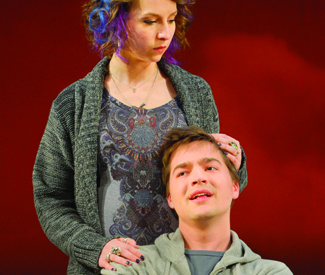
THEATER An average of 22 veterans a day committed suicide in the United States in 2010, according to a report last year by the U.S. Department of Veteran Affairs. Chris Kyle, however, was not likely to be one of them. The former Navy SEAL and author of a best-selling memoir had returned from military deployment in Iraq with a bounding enthusiasm for succeeding in civilian life, not least by helping other veterans with war-related trauma. Last month, on a shooting range in North Texas, a fellow vet apparently suffering from PTSD shot and killed Kyle, by then renowned as the U.S. military’s all-time deadliest sniper.

Irony like this defies fiction. But then that’s something George F. Walker understands. When the acclaimed Canadian playwright levels his pen at his primary target — he cruelly exploitative class system we inhabit back here on the “civilized” and oblivious home front —the result is dark and powerful comedy. A case in point is Dead Metaphor, his new play about a well-intentioned former army sniper facing a dismal job market and family pressures back home who goes to work for a right-wing candidate of the Michele Bachmann stripe. The world premiere comes to the Bay Area courtesy of an admirable production by American Conservatory Theater under the astute direction of Irene Lewis. As very serious as it is very funny, Dead Metaphor rings like the report from a not-so-distant battlefield.

Five months back from military duty, and despite hearing nothing good about the government’s job placement services, Dean Trusk (a winningly cheerful, subtly shaded George Hampe) finally puts himself before the local job counselor (a dryly comical, increasingly disconcerted Anthony Fusco). After all, Dean has to consider his pregnant ex-wife (a smart, scrappy Rebekah Brockman) now that he’s defied expectations by coming back home alive and she’s accordingly re-marrying him. He also has an increasingly erratic and absent-minded father (a charmingly earthy, alarmingly volcanic Tom Bloom) coming unhinged by an as yet undiagnosed disease, and his brave but reeling mother (a heartbreakingly genuine Sharon Lockwood) who is faced with the prospect of having to soon place him in an expensive managed care facility.

The job counselor is unsettled by Dean’s ingenuous highlighting of his “high-level kills” on the battlefield as testament to his employable “efficiency” but, finally disarmed by the young man’s honorable sincerity, gets him a position as a coffee-fetching assistant to his politician-wife—a coldly calculating true believer of the now-mainstream Far Right (played with just the right mixture of acumen, conviction and parodic excess by an excellent René Augesen). The job exposes a rather blasé Dean to some campaign shenanigans his wife quickly deciphers as illicit, leading to a crisis for the couple as his moral compass swings first away from such dirty work and then back toward a desperate deal that might save his family from destitution.

Cast on a rotating set that moves an assortment of indoor and outdoor furnishing into and out of focus (against scenic designer Christopher Barreca’s semi-circular panorama of cloud-flecked sky), the story is a merry-go-round of insiders and outsiders, wheeling and dealing, war and peace, loyalty and opportunity, and truth and appearances. Act one in particular carries real force in the shrewd balance it strikes between razor-sharp comic dialogue and all-too-believable situations. This force attenuates somewhat in act two’s increasingly far-fetched details and strident humor. Nevertheless, the story remains anchored to a clear-sighted purpose, manifested in an unnerving and thought-provoking ending. Moreover, every scene along the way is engaging and often a sheer delight, propelled by fine acting, consistently hilarious and caustic dialogue, unexpected pangs of heartache, and a devilishly intriguing plot.

There seems to be a new raft of war-related dramas on stages lately (Word for Word’s You Know When the Men Are Gone being among the more recent, as ACT itself gets ready to bring in the internationally acclaimed Scottish production, Black Watch), but few use humor so powerfully to indict the hypocrisy and self-destruction of a society committed to permanent war. When tragedy repeats itself this long, suggests Dead Metaphor, it can only be played as farce.

DEAD METAPHOR

Wed/20-Sat/23, 8pm (also Sat/23, 2pm); Sun/24, 2 and 7pm, $20-$95

Geary Theater

415 Geary, SF

www.act-sf.org


Stage listings

0

Stage listings are compiled by Guardian staff. Performance times may change; call venues to confirm. Reviewers are Robert Avila, Rita Felciano, and Nicole Gluckstern. Submit items for the listings at listings@sfbg.com. For further information on how to submit items for the listings, see Picks.

THEATER

OPENING

BAY AREA

The Coast of Utopia: Voyage & Shipwreck Ashby Stage, 1901 Ashby, Berk; www.shotgunplayers.org. $20-35. Shipwreck previews Fri/22-Sat/23 and March 29, 8pm; March 27-28, 7pm; Sun/24, 5pm. Opens March 30, 8pm. Runs Wed-Thu, 7pm; Fri-Sat, 8pm; Sun, 5pm. Through May 5. Voyage previews March 27, 7pm. Opens April 3, 3pm. Runs April 13, 20, 27, and May 4, 3pm. Shotgun Players perform the first two parts of Tom Stoppard’s revolutionary trilogy.

ONGOING

Assistance NOHspace, 2840 Mariposa, SF; www.opentabproductions.com. $20. Thu-Sat, 8pm; Sun, 6pm. Through March 30. Over the past three years, things we’ve come to expect from plucky OpenTab Productions — whose annual offerings deal in aggressively contemporary themes such as media spin, business fraud, and job (in)security — include tight ensemble acting, minimal tech, and snappy direction, and in all these regards, Assistance does not disappoint. A crew of desperate office drones whose lives basically revolve around the abuse dished out by their unseen employer, Daniel Weisinger (who may or may not resemble playwright Leslye Headland’s old boss, Harvey Weinstein), hold down their airless fort, fielding calls at 11 p.m. and shirking responsibility whenever possible. Though Headland doesn’t do much to make her emotionally and professionally stunted characters palatable, the capable cast and director Ben Euphrat do manage to wring something resembling humanity out of them. From Nick (Tristan Rholl,) the frustrated slacker supervisor, to Nora (Melissa Keith), the-new-girl-turned-cynical-old-hand, to Justin (Nathan Tucker), the unctuous winner of the title of "last man standing," to Jenny (Michelle Drexler) a pragmatic yet annoyingly bubbly Brit, what stands out in each performance are the perfectly captured quirky nuances and barely-concealed neuroses of people caught in the process of losing their souls. Nothing about Assistance is likely to change your view of the business world, but if you’ve yet to experience the frenetic fun of an OpenTab show, it’s a perfect primer to the madness behind their method. (Gluckstern)

The Chairs Exit on Taylor, 277 Taylor, SF; www.cuttingball.com. $20-45. Thu, 7:30pm; Fri-Sat, 8pm (also Sat, 2pm); Sun, 5pm. Extended through April 7. In Rob Melrose’s new translation of Eugene Ionesco’s The Chairs, an elderly couple sit in the austere parlor of their lonely lighthouse, chortling over a spate of private wordplay and reminiscing of sprightlier times, until their initially frantic and disjointed dialogue settles into a smooth flow, well-polished by decades of endearments and gentle bickering. Possibly the last two survivors of a not entirely explained apocalypse, the isolated nonagenarians (magnificently played by David Sinaiko and Tamar Cohn) nevertheless make it known that important guests are expected to arrive at any moment in order to hear a hired orator (Derek Fischer) deliver the Old Man’s "message," which he has spent a lifetime honing. As the doorbell begins to ring, a jarring squall, and invisible guests and dozens of mismatched chairs begin to crowd their peaceable empire in claustrophobia-inducing numbers, their companionable seclusion is shattered for good. Director Annie Elias manages to coax both gravitas and decorum out of this little-produced, yet influential absurdist relic, imbuing her protagonists with a depth of character that belies their farcical circumstances, while Theodore J.H. Hulsker’s murmuring sound design of crashing waves, angry winds, and the strident doorbell could almost be another character in the play, so thoroughly does it set the tone in ways that Ionesco might not have approved of, but is all the better for. (Gluckstern)

Dead Metaphor ACT’s Geary Theater, 415 Geary, SF; www.act-sf.org. $20-95. Wed/20-Sat/23, 8pm (also Sat/23, 2pm); Sun/24, 2 and 7pm. American Conservatory Theater performs George F. Walker’s dark comedy about postwar living.

Foodies! The Musical Shelton Theater, 533 Sutter, SF; www.foodiesthemusical.com. $30-34. Fri-Sat, 8pm. Open-ended. AWAT Productions presents Morris Bobrow’s musical comedy revue all about food.

The Great Big Also Z Space, 450 Florida, SF; www.zspace.org. $15-30. Thu/21-Sat/23, 8pm; Sun/24, 5pm. The Rift is coming, and when it does, you’ll have to decide for yourself, will you stay or will you go? But stay for what? Go where? These are just a couple of the big questions underlying Mugwumpin’s latest devised occurrence The Great Big Also, a tour de prophétie, on the conundrum that is survival. Split up from the outset, each audience member must undergo a sort of personal journey through the play, sequestered in a kind of labyrinth of inter-locking white walls (cunningly designed by Sean Riley) that lead equally nowhere, and subjected to the roving attentions of the eight ensemble members, who chatter amiably about their individual pasts and the history of their tenuous confederation — the New Settlers. Punctuated by bursts of exposition coming from above, and the cacophonous underpinnings of Theodore Hulsker’s dramatic sound design, their spirited discourse creates more questions than answers, and random snatches of eavesdropped-upon conversation gleaned from other rooms in the labyrinth only serves to muddle their objectives even more. As the tightly-knit, New Settler community becomes increasingly stretched and frayed, the physical walls of the set stretch too and eventually collapse, (once the audience is seated, somewhat more traditionally in a ring of folding chairs that encircle the wide parameter of the Z Space stage). Interesting resonances abound with FoolsFURY’s production of Doug Dorst’s futuristic Monster in the Dark and Banana Bag and Bodice’s neo-sci-fi melodrama The Sewers, yet Mugwumpin’s exploration of a possibly brave, possibly new world, manages to be both maddeningly cryptic and exuberantly profound all on its own. (Gluckstern)

God of Carnage Shelton Theater, 533 Sutter, SF; www.sheltontheater.org. $38. Thu-Sat, 8pm. Through March 30. Shelton Theater presents Yasmina Reza’s Tony-winning comedy about upper-middle-class parents clashing over an act of playground violence between their children.

Inevitable SF Playhouse, 533 Sutter, SF; www.sfplayhouse.org. $20. Thu/21-Sat/23, 8pm. SF Playhouse’s "Sandbox Series," enabling new and established playwrights to stage new works, kicks off its third season with Jordan Puckett’s drama about a woman trying to make sense of her life.

Just One More Game Exit Theatre, 156 Eddy, SF; www.tripleshotprodutions.org. $25. Thu-Sat, 8pm. Through March 30. With the rise of the programmer as pop culture hero, it was probably inevitable that we’d start writing plays about them too. In local playwright Dan Wilson’s Just One More Game our programmer protagonist is Kent (Christopher DeJong) whose mission is to find love, and his co-player is Marjorie (Linda-Ruth Cardozo), who wields her own geek credentials like a Mortal Kombat wrath hammer. Where Wilson’s comedy excels is in the witty gamer banter that defines much of their attraction and commonality — references to Zork, Oregon Trail, Dungeons and Dragons, and The Secret of Monkey Island abound, while a series of meticulous video game animations (also Wilson’s) lend colorful counterpoint to the action on the stage. DeJong plays his role of emotionally-inhibited loner with a degree of laconic detachment that unfortunately eliminates all traces of chemistry between him and Cardozo, who is especially good at capturing the cheerfully aggressive awkward of a woman accustomed to being "one of the boys" because there was nothing about "the girls" she could relate to. Both the comedy and pace flag by the time the first NPCs (non-player characters) enter the room, broadly clichéd parents yammering for grandchildren and obnoxious college buddies armed with too many baby photos, who conspire to stunt the growth of Kent and Marjorie’s relationship and wind up stunting the growth of the play. If the quest for love is a game, as the title suggests, it’s one that could use a little more back-end development, and a much greater degree of playfulness. (Gluckstern)

A Lady and a Woman Eureka Theatre, 215 Jackson, SF; www.therhino.org. $15-30. Wed/20-Sat/23, 8pm; Sun/24, 3pm. Life wasn’t easy in the South of the 1890s, particularly for single black women, but in Shirlene Holmes’ A Lady and a Woman the focus is emphatically on rising above circumstance. When itinerant hog-cutter Biddie Higgins (Dawn L. Troupe) swaggers into the village inn run by Miss Flora Devine (Velina Brown) and demands a room, sparks fly almost instantaneously, as the two pragmatic and independent women become drawn to the strength they see in the other. A healer and midwife as well as an innkeeper, Miss Flora has endured enough abuse at the hands of men in her life to make her grateful to be able to live without one around, while Biddie, the only daughter in a household of fourteen, has become accustomed to a life of manual labor and clandestine trysts with willing women, never sticking around one place long enough to run out of either, declaring "it’s been easier to live a hard life then a lie." Both Brown and Troupe embody their multi-dimensional characters with grace and backbone, never striking a false note as their tender courtship unfolds and they discover that the greatest strength of all is the ability to love freely. (Gluckstern)

The Lisbon Traviata New Conservatory Theatre Center, 25 Van Ness, SF; www.nctcsf.org. $25. Wed/20-Sat/23, 8pm; Sun/24, 2pm. New Conservatory Theatre Center performs Terrence McNally’s play, a mix of comedy and tragedy, about the relationship between two opera fanatics.

Sex and the City: LIVE! Rebel, 1760 Market, SF; trannyshack.com/sexandthecity. $25. Wed, 7 and 9pm. Open-ended. It seems a no-brainer. Not just the HBO series itself — that’s definitely missing some gray matter — but putting it onstage as a drag show. Mais naturellement! Why was Sex and the City not conceived of as a drag show in the first place? Making the sordid not exactly palatable but somehow, I don’t know, friendlier (and the canned a little cannier), Velvet Rage Productions mounts two verbatim episodes from the widely adored cable show, with Trannyshack’s Heklina in a smashing portrayal of SJP’s Carrie; D’Arcy Drollinger stealing much of the show as ever-randy Samantha (already more or less a gay man trapped in a woman’s body); Lady Bear as an endearingly out-to-lunch Miranda; and ever assured, quick-witted Trixxie Carr as pent-up Charlotte. There’s also a solid and enjoyable supporting cast courtesy of Cookie Dough, Jordan Wheeler, and Leigh Crow (as Mr. Big). That’s some heavyweight talent trodding the straining boards of bar Rebel’s tiny stage. The show’s still two-dimensional, even in 3D, but noticeably bigger than your 50" plasma flat panel. (Avila)

Steve Seabrook: Better Than You Marsh San Francisco, 1062 Valencia, SF; www.themarsh.org. $15-50. Fri, 8pm; Sat, 8:30pm, through March 30. Starting April 4, runs Thu, 8pm; Sat, 8:30pm. Extended through May 18.

Self-awareness, self-actualization, self-aggrandizement — for these things we turn to the professionals: the self-empowerment coaches, the self-help authors and motivational speakers. What’s the good of having a "self" unless someone shows you how to use it? Writer-performer Kurt Bodden’s Steve Seabrook wants to sell you on a better you, but his "Better Than You" weekend seminar (and tie-in book series, assorted CDs, and other paraphernalia) belies a certain divided loyalty in its own self-flattering title. The bitter fruit of the personal growth industry may sound overly ripe for the picking, but Bodden’s deftly executed "seminar" and its behind-the-scenes reveals, directed by Mark Kenward, explore the terrain with panache, cool wit, and shrewd characterization. As both writer and performer, Bodden keeps his Steve Seabrook just this side of overly sensational or maudlin, a believable figure, finally, whose all-too-ordinary life ends up something of a modest model of its own. (Avila)

The Voice: One Man’s Journey Into Sex Addition and Recovery Stage Werx Theater, 446 Valencia, SF; thevoice.brownpapertickets.com. $10-18. Fri-Sat, 8pm. Through April 6. Ticket sales for David Kleinberg’s autobiographical solo show benefit 12-step sex addiction recovery programs and other non-profits.

The Waiting Period Marsh San Francisco, 1062 Valencia, SF; www.themarsh.org. $25-50. Fri, 8pm; Sat, 5pm. Through March 30. Brian Copeland (comedian, TV and radio personality, and creator-performer of the long-running solo play Not a Genuine Black Man) returns to the Marsh with a new solo, this one based on more recent and messier events` in Copeland’s life. The play concerns an episode of severe depression in which he considered suicide, going so far as to purchase a handgun — the title coming from the legally mandatory 10-day period between purchasing and picking up the weapon, which leaves time for reflections and circumstances that ultimately prevent Copeland from pulling the trigger. A grim subject, but Copeland (with co-developer and director David Ford) ensures there’s plenty of humor as well as frank sentiment along the way. The actor peoples the opening scene in the gun store with a comically if somewhat stereotypically rugged representative of the Second Amendment, for instance, as well as an equally familiar "doood" dude at the service counter. Afterward, we follow Copeland, a just barely coping dad, home to the house recently abandoned by his wife, and through the ordinary routines that become unbearable to the clinically depressed. Copeland also recreates interviews he’s made with other survivors of suicidal depression. Telling someone about such things is vital to preventing their worst outcomes, says Copeland, and telling his own story is meant to encourage others. It’s a worthy aim but only a fitfully engaging piece, since as drama it remains thin, standing at perhaps too respectful a distance from the convoluted torment and alienation at its center. Note: review from an earlier run of the same production. (Avila)

BAY AREA

Dostoevsky’s The Grand Inquisitor Berkeley City Club, 2315 Durant, Berk; www.centralworks.org. $15-28. Thu-Sat, 8pm; Sun, 5pm. Through March 31. Central Works performs Gary Graves’ adaptation of the story-within-a-story from The Brothers Karamazov.

Fallaci Berkeley Repertory Theatre, 2015 Addison, Berk; www.berkeleyrep.org. $29-89. Tue, Thu-Sat, 8pm (also Sat, 2pm); Wed and Sun, 7pm (also Sun, 2pm). Through April 21. Berkeley Rep performs Pulitzer-winning journalist Lawrence Wright’s new play about Italian journalist Oriana Fallaci.

The Mountaintop Lucie Stern Theatre, 1305 Middlefield, Palo Alto; www.theatreworks.org. $23-75. Tue-Wed, 7:30pm; Thu-Sat, 8pm (also Sat, 2pm), through March 31. Starting April 3, runs Wed-Thu, 11am (also Thu, 8pm); Sat, 8pm; Sun, 2pm. Through April 7. TheatreWorks performs Katori Hall’s play that re-imagines the events on the night before Dr. Martin Luther King, Jr.’s assassination.

The Real Americans Marsh Berkeley, 2120 Allston, Berk; www.themarsh.org. $25-50. Fri, 8pm; Sat, 5pm. Through April 6. Dan Hoyle shifts his popular show about small-town America to the Marsh’s Berkeley outpost.

PERFORMANCE/DANCE

BATS Improv Bayfront Theater, Fort Mason Center, Marina at Laguna, SF; www.improv.org. $20. "Theatresports," Fri, 8pm. Through March 29. "Double Feature," Sat, 8pm. Through March 30.

"The Buddy Club Children’s Shows" Randall Museum Theater, 199 Museum Wy, SF; www.thebuddyclub.com. Sun/24, 11am-noon. $8 (under two years old, free). Comedy magician Robert Strong performs.

Caroline Lugo and Carolé Acuña’s Ballet Flamenco Peña Pachamama, 1630 Powell, SF; www.carolinalugo.com. Sun/24, 6:15pm. $15-19. Flamenco performance by the mother-daughter dance company, featuring live musicians.

"Mission Position Live" Cinecave, 1034 Valencia, SF; www.missionpositionlive.com. Thu, 8pm. Ongoing. $10. Stand-up comedy with rotating performers.

"New Works by Artists in Residence" CounterPULSE, 1310 Mission, SF; www.counterpulse.org. Thu-Sun, 8pm. Through March 31. $20-30. With richien (Rowena Richie and Jennifer Chien) performing Twindependent, and Sense Object (Miriam Wolodarksi) performing Of Limb and Language.

"Ninth Annual Conceptual Public Art Performance: Dance Anywhere" Various locations, SF; www.danceanywhere.org. Fri/22, noon. Free. This worldwide movement presents simultaneous performance art in over 45 countries; check the website for local events and to connect with other participants.

"ODC/Dance Downtown 2013" Yerba Buena Center for the Arts Theater, 700 Howard, SF; www.odcdance.org. Wed/20-Thu/21, 7:30pm; Fri/22-Sat/23, 8pm; Sun/24, 4pm. $20-75. The company celebrates its 42nd season with three world premieres from Brenda Way and KT Nelson.

"ODC Pilot 62: Kinetoscope…This Time With Pictures" ODC Theater, 3153 17th St, SF; www.odctheater.org. Fri/22-Sat/23, 8pm. $15. Rising dance film artists present dance films and live, multimedia performances.

"San Francisco Magic Parlor" Chancellor Hotel Union Square, 433 Powell, SF; www.sfmagicparlor.com. Thu-Sat, 8pm. Ongoing. $40. Magic vignettes with conjurer and storyteller Walt Anthony.

"Shen Wei Dance Arts: Undivided Divided" Yerba Buena Center for the Arts, 701 Mission, SF; www.ybca.org. Thu/21-Sat/23, 8pm (also Sat/23, 5pm); Sun/24, 2 and 5pm. $10-30. The choreographer for the 2008 Beijing Olympics opening ceremony, Shen Wei, also heads up China’s first contemporary dance company; this performance is an installation featuring 18 dancers and multimedia elements.

"Snow White and Her Merry Men" Davies Symphony Hall, 201 Van Ness, SF; www.sfgmc.org. Mon/25-Tue/26, 8pm. $15-75. The San Francisco Gay Men’s Chorus and Steve Silver’s Beach Blanket Babylon come together for this special joint concert.

"2013 Rhino Benefit Celebration" Eureka Theatre, 215 Jackson, SF; www.therhino.org. Sun/24, 7:30pm. $25. Theatre Rhinoceros celebrates 35 years of queer theater with this benefit bash, featuring Connie Champagne, Dave Dobrusky, Mike Finn, Casey Ley, Matthew Martin, and more.

Film listings

0

Film listings are edited by Cheryl Eddy. Reviewers are Kimberly Chun, Dennis Harvey, Lynn Rapoport, and Sara Maria Vizcarrondo. For rep house showtimes, see Rep Clock.

OPENING

Admission Paul Weitz directs Tina Fey in this comedy about a Princeton admissions officer who tracks down the son she gave up for adoption years before. (1:50) Marina.

The Croods DreamWorks’ latest animated tale is about prehistoric cave-people, with the requisite array of celebrity voices (Nicolas Cage, Emma Stone, Ryan Reynolds, etc.) (1:38) Balboa, Presidio.

Ginger and Rosa It’s the 1960s, nuclear war is a real possibility, and nuclear-family war is an absolute certainty, at least in the London house occupied by Ginger (Elle Fanning), her emotionally wounded mother (Mad Men‘s Christina Hendricks), and her narcissistic-intellectual father (Alessandro Nivola). In this downbeat coming-of-age tale from Sally Potter (1992’s Orlando), Ginger’s teenage rebellion quickly morphs into angst when her BFF Rosa (Beautiful Creatures‘ Alice Englert) wedges her sexed-up neediness between Ginger’s parents. Hendricks (playing the accordion — just like Joan!) and Annette Bening (as an American activist who encourages Ginger’s political-protest leanings) are strong, but Fanning’s powerhouse performance is the main focus — though even she’s occasionally overshadowed by her artificially scarlet hair. For an interview with writer-director Potter, visit www.sfbg.com/pixel_vision. (1:30) Albany, Embarcadero, Smith Rafael. (Eddy)

Hitler’s Children What’s in a name? A lot, when it’s Himmler, Goering, Hoess, or Goeth. Chanoch Ze’evi’s doc — comprised of interviews with direct descendants of high-ranking Nazis, all of whom condemn the actions of their relatives — unearths universally strong emotions and plenty of psychological baggage. Various coping mechanisms abound: Hermann Goering’s great-niece moved to rural New Mexico and casually remarks that both she and her brother voluntarily sterilized themselves, so there’d be "no more Goerings." Amon Goeth’s daughter recalls being kept in the dark about her father’s true role in the Holocaust — until she went to see Schindler’s List (1993), and realized he’d been a sadistic monster. The film’s most stirring sequence follows Rainer Hoess, look-alike grandson of Auschwitz commandant Rudolf, as he nervously journeys to the concentration camp-turned-museum for the first time. There, he encounters an elderly Auschwitz survivor who assures him, "You didn’t do it." But Hitler’s Children — which offers a unique, inspired angle on World War II — doesn’t allow itself a tidy last act. Hoess’ travel companion, a journalist who (like filmmaker Ze’evi) is a third-generation Holocaust survivor, remarks to the camera that he doesn’t believe there can be ever be closure to Hoess’ story, or by extension any of these stories — too much history, too much horror. (1:23) Yerba Buena Center for the Arts. (Eddy)

K-11 As her daughter’s middling On the Road adaptation cruises into theaters (see review, below), Jules Stewart’s directorial debut rolls out at the Roxie; it’s a high-camp-but-with-horrifying-rape-scenes drama set in a Los Angeles jail unit reserved for gay and transgender prisoners. The top bitch in the joint is Mousey (Kate del Castillo, one of several women-playing-men-playing-women), who struts around with Divine-style eyebrows, hurling threats ("You play with me, you get uglier") through her heavily-lined lips. There’s also a sadistic guard with a Hitler haircut (D.B. Sweeney) who controls the prisoners’ much-needed drug supply; a massive bully (Tommy "What Bike?" Lister); a sinewy hustler (Kevin Smith pal Jason Mewes); and a baby-voiced innocent who calls herself Butterfly (Portia Doubleday). Into this lurid set-up stumbles Raymond (Goran Visnijc), who is straight, but is also coked-out and maybe a murderer, so perhaps that’s why he lands there — it’s never really clear. Nothing’s really clear here, not least how a movie that’s so unpleasant most of the time manages also to be puzzlingly entertaining some of the time. Props go to del Castillo, I suppose, for attacking her role with nothing less than Nomi Malone levels of commitment. (1:30) Roxie. (Eddy)

The Manson Family See "The Devil’s Business." (1:35) Clay.

Olympus Has Fallen Gerard Butler, Morgan Freeman, and Aaron Eckhart (as the POTUS) star in this action thriller set amid White House intrigue. (2:00) Presidio.

On the Road Walter Salles (2004’s The Motorcycle Diaries) engages Diaries screenwriter Jose Rivera to adapt Jack Kerouac’s Beat classic; it’s translated to the screen in a streamlined version, albeit one rife with parties, drugs, jazz, danger, reckless driving, sex, philosophical conversations, soul-searching, and "kicks" galore. Brit Sam Riley (2007’s Control) plays Kerouac stand-in Sal Paradise, observing (and scribbling down) his gritty adventures as they unfold. Most of those adventures come courtesy of charismatic, freewheeling Dean Moriarty (Garrett Hedlund of 2010’s Tron: Legacy), who blows in and out of Sal’s life (and a lot of other people’s lives, too, including wives played by Kristen Stewart and Kirsten Dunst). Beautifully shot, with careful attention to period detail and reverential treatment of the Beat ethos, the film is an admirable effort but a little too shapeless, maybe simply due to the peripatetic nature of its iconic source material, to be completely satisfying. Among the performances, erstwhile teen dream Stewart is an uninhibited standout. (2:03) Embarcadero, Shattuck. (Eddy)

Somebody Up There Likes Me A textbook illustration of what’s so frequently right and wrong with Amerindie comedies today, Bob Byington’s feature starts out near-brilliantly in a familiar, heightened Napoleon Dynamite-type milieu of ostensibly normal people as self-absorbed, socially hapless satellites revolving around an existential hole at the center in the universe. The three main ones meet working at a suburban steakhouse: Emotionally nerve-deadened youth Max (Keith Poulson), the even more crassly insensitive Sal (Nick Offerman), and contrastly nice but still weird Lyla (Teeth‘s estimable Jess Weixler). All is well until the film starts skipping ahead five years at a time, growing more smugly misanthropic and pointless as time and some drastic shifts in fortune do nothing to change (or deepen) the characters. Still, the performers are intermittently hilarious throughout. (1:24) Roxie. (Harvey)

Spring Breakers See "The Devil’s Business." (1:34) Shattuck.

The We and the I See "Emotion in Motion." (1:43) Opera Plaza, Shattuck.

ONGOING

Amour Arriving in local theaters atop a tidal wave of critical hosannas, Amour now seeks to tempt popular acclaim — though actually liking this perfectly crafted, intensely depressing film (from Austrian director Michael Haneke) may be nigh impossible for most audience members. Eightysomething former music teachers Georges and Anne (the flawless Jean-Louis Trintignant and Emmanuelle Riva) are living out their days in their spacious Paris apartment, going to classical concerts and enjoying the comfort of their relationship. Early in the film, someone tries to break into their flat — and the rest of Amour unfolds with a series of invasions, with Anne’s declining health the most distressing, though there are also unwanted visits from the couple’s only daughter (an appropriately self-involved Isabelle Huppert), an inept nurse who disrespects Anne and curses out Georges, and even a rogue pigeon that wanders in more than once. As Anne fades into a hollow, twisted, babbling version of her former self, Georges also becomes hollow and twisted, taking care of her while grimly awaiting the inevitable. Of course, the movie’s called Amour, so there’s some tenderness involved. But if you seek heartwarming hope and last-act uplift, look anywhere but here. (2:07) Four Star, Smith Rafael. (Eddy)

Barbara The titular figure (Nina Hoss) looks the very picture of blonde Teutonic ice princess when she arrives — exiled from better prospects by some unspecified, politically ill-advised conduct — in at a rural 1980 East German hospital far from East Berlin’s relative glamour. She’s a pill, too, stiffly formal in dealings with curious locals and fellow staff including the disarmingly rumpled, gently amorous chief physician Andre (Ronald Zehrfeld). Yet her stern prowess as a pediatric doctor is softened by atypically protective behavior toward teen Stella (Jasna Fritzi Bauer), a frequent escapee from prison-like juvenile care facilities. Barbara has secrets, however, and her juggling personal, ethical, and Stasi-fearing priorities will force some uncomfortable choices. It is evidently the moment for German writer-director Christian Petzold to get international recognition after nearly 20 years of equally fine, terse, revealing work in both big-screen and broadcast media (much with Hoss as his prime on-screen collaborator). This intelligent, dispassionate, eventually moving character study isn’t necessarily his best. But it is a compelling introduction. (1:45) Opera Plaza, Shattuck. (Harvey)

Birth Story: Ina May Gaskin and the Farm Midwives When Ina May Gaskin had her first child, the hospital doctor used forceps (against her wishes) and her baby was sequestered for 24 hours immediately after birth. "When they brought her to me, I thought she was someone else’s," Gaskin recalls in Sara Lamm and Mary Wigmore’s documentary. Gaskin was understandably flummoxed that her first experience with the most natural act a female body can endure was as inhuman as the subject of an Eric Schlosser exposé. A few years later, she met Stephen Gaskin, a professor who became her second husband, and the man who’d go on to co-found the Farm, America’s largest intentional community, in 1971. On the Farm, women had children, and in those confines, far from the iron fist of insurance companies, Gaskin discovered midwifery as her calling. She recruited others, and dedicated herself to preserving an art that dwindles as the medical industry strives to treat women’s bodies like profit machines. Her message is intended for a larger audience than granola-eating moms-to-be: we’re losing touch with our bodies. Lamm and Wigmore bravely cram a handful of live births into the film; footage of a breech birth implies this doc could go on to be a useful teaching tool for others interested in midwifery. (1:33) New Parkway, Roxie. (Vizcarrondo)

The Call (1:34) 1000 Van Ness, Shattuck, SF Center.

Dead Man Down Pee. Yew. This Dead Man reeks, though surveying the cast list and judging from the big honking success of director Niels Arden Oplev’s previous film, 2009’s The Girl With the Dragon Tattoo, one would hope the stench wouldn’t be quite so crippling. Crime boss (Terrence Howard) is running panic-stricken after a series of spooky mail-art threats — and it isn’t long before we realize why: his most handy henchman Victor (Colin Farrell) is the one out to destroy him after the death of his wife and daughter. The wrinkle in the plot is the moody, beautiful, and scarred French girl Beatrice (Noomi Rapace) who lives across the way from Victor’s apartment with her deaf mom (Isabelle Huppert) and has plans to extract her own kind of vengeance. Despite Rapace’s brooding performance (Oplev obviously hopes she’ll pull a Lisbeth Salander and miraculously hack this mess — unsure about whether it’s a shoot-’em-up revenge exercise or a Rear Window-ish misfit love story — into something worthwhile) and cameos by actors like Dominic Cooper and F. Murray Abraham, they can’t compensate for the weak writing and muddled direction, the fact that Victor conveniently dithers instead of putting an end to his victim’s (and our) agony, and that the entire mis-en-scene with its Czechs, Albanians, et al, which reads like a Central European blood feud played out in Grand Central Station — just a few components as to why Dead Man stinks. (1:50) Metreon, 1000 Van Ness. (Chun)

Django Unchained Quentin Tarantino’s spaghetti western homage features a cameo by the original Django (Franco Nero, star of the 1966 film), and solid performances by a meticulously assembled cast, including Jamie Foxx as the titular former slave who becomes a badass bounty hunter under the tutelage of Dr. Schultz (Christoph Waltz). Waltz, who won an Oscar for playing the evil yet befuddlingly delightful Nazi Hans Landa in Tarantino’s 2009 Inglourious Basterds, is just as memorable (and here, you can feel good about liking him) as a quick-witted, quick-drawing wayward German dentist. There are no Nazis in Django, of course, but Tarantino’s taboo du jour (slavery) more than supplies motivation for the filmmaker’s favorite theme (revenge). Once Django joins forces with Schultz, the natural-born partners hatch a scheme to rescue Django’s still-enslaved wife, Broomhilda (Kerry Washington), whose German-language skills are as unlikely as they are convenient. Along the way (and it’s a long way; the movie runs 165 minutes), they encounter a cruel plantation owner (Leonardo DiCaprio), whose main passion is the offensive, shocking "sport" of "Mandingo fighting," and his right-hand man, played by Tarantino muse Samuel L. Jackson in a transcendently scandalous performance. And amid all the violence and racist language and Foxx vengeance-making, there are many moments of screaming hilarity, as when a character with the Old South 101 name of Big Daddy (Don Johnson) argues with the posse he’s rounded up over the proper construction of vigilante hoods. It’s a classic Tarantino moment: pausing the action so characters can blather on about something trivial before an epic scene of violence. Mr. Pink would approve. (2:45) Metreon. (Eddy)

Don’t Stop Believin’: Everyman’s Journey The director of 2003’s Imelda returns with this portrait of a way more sympathetic Filipino celebrity: Arnel Pineda, plucked from obscurity via YouTube after Journey’s Neil Schon spotted him singing with a Manila-based cover band. Don’t Stop Believin‘ follows Pineda, who openly admits past struggles with homelessness and addiction, from audition to 20,000-seat arena success as Journey’s charismatic new front man (he faces insta-success with an endearing combination of nervousness and fanboy thrill). He’s also up-front about feeling homesick, and the pressures that come with replacing one of the most famous voices in rock (Steve Perry doesn’t appear in the film, other than in vintage footage). Especially fun to see is how Pineda invigorates the rest of Journey; as the tour progresses, all involved — even the band’s veteran members, who’ve no doubt played "Open Arms" ten million times — radiate with excitement. (1:45) Sundance Kabuki. (Eddy)

Emperor This ponderously old-fashioned historical drama focuses on the negotiations around Japan’s surrender after the bombings of Hiroshima and Nagasaki. While many on the Allied side want the nation’s "Supreme Commander" Emperor Hirohito to pay for war crimes with his life, experts like bilingual Gen. Bonners Fellers (Matthew Fox) argue that the transition to peace can be achieved not by punishing but using this "living god" to wean the population off its ideological fanaticism. Fellers must ultimately sway gruff General MacArthur (Tommy Lee Jones) to the wisdom of this approach, while personally preoccupied with finding the onetime exchange-student love (Kaori Momoi) denied him by cultural divisions and escalating war rhetoric. Covering (albeit from the U.S. side) more or less the same events as Aleksandr Sokurov’s 2005 The Sun, Peter Webber’s movie is very different from that flawed effort, but also a lot worse. The corny Romeo and Juliet romance, the simplistic approach to explaining Japan’s "ancient warrior tradition" and anything else (via dialogue routinely as flat as "Things in Japan are not black and white!"), plus Alex Heffes’ bombastic old-school orchestral score, are all as banal as can be. Even the reliable Jones offers little more than conventional crustiness — as opposed to the inspired kind he does in Lincoln. (1:46) Embarcadero, Sundance Kabuki. (Harvey)

Escape from Planet Earth (1:35) Metreon.

A Fierce Green Fire: The Battle for a Living Planet San Franciscan Mark Kitchell (1990’s Berkeley in the Sixties) directs this thorough, gracefully-edited history of the environmental movement, beginning with the earliest stirrings of the Audubon Society and Aldo Leopold. Pretty much every major cause and group gets the vintage-footage, contemporary-interview treatment: the Sierra Club, Earth Day, Silent Spring, Love Canal, the pursuit of alternative energy, Greenpeace, Chico Mendes and the Amazon rainforests, the greenhouse effect and climate change, the pursuit of sustainable living, and so on. But if its scope is perhaps overly broad, A Fierce Green Fire still offers a valuable overview of a movement that’s remained determined for decades, even as governments and corporations do their best to stomp it out. Celebrity narrators Robert Redford, Ashley Judd, and Meryl Streep add additional heft to the message, though the raw material condensed here would be powerful enough without them. (1:50) Shattuck, Smith Rafael. (Eddy)

56 Up The world may be going to shit, but some things can be relied upon, like Michael Apted’s beloved series that’s traced the lives of 14 disparate Brits every seven years since original BBC documentary 7 Up in 1964. More happily still, this latest installment finds nearly all the participants shuffling toward the end of middle-age in more settled and contented form than ever before. There are exceptions: Jackie is surrounded by health and financial woes; special-needs librarian Lynn has been hit hard by the economic downturn; everybody’s favorite undiagnosed mental case, the formerly homeless Neil, is never going to fully comfortable in his own skin or in too close proximity to others. But for the most part, life is good. Back after 28 years is Peter, who’d quit being filmed when his anti-Thatcher comments provoked "malicious" responses, even if he’s returned mostly to promote his successful folk trio the Good Intentions. Particularly admirable and evidently fulfilling is the path that’s been taken by Symon, the only person of color here. Raised in government care, he and his wife have by now fostered 65 children — with near-infinite love and generosity, from all appearances. If you’re new to the Up series, you’ll be best off doing a Netflix retrospective as preparation for this chapter, starting with 28 Up. (2:24) Magick Lantern. (Harvey)

The Gatekeepers Coming hard on the heels of The Law in These Parts, which gave a dispassionate forum to the lawmakers who’ve shaped — some might say in pretzel form — the military legal system that’s been applied by Israelis to Palestinians for decades, Dror Moreh’s documentary provides another key insiders’ viewpoint on that endless occupation. His interviewees are six former heads of the Shin Bet, Israel’s secret service. Their top-secret decisions shaped the nation’s attempts to control terrorist sects and attacks, as seen in a nearly half-century parade of news clips showing violence and negotiation on both sides. Unlike the subjects of Law, who spoke a cool, often evasive legalese to avoid any awkward ethical issues, these men are at times frankly — and surprisingly — doubtful about the wisdom of some individual decisions, let alone about the seemingly ever-receding prospect of a diplomatic peace. They even advocate for a two-state solution, an idea the government they served no longer seems seriously interested in advancing. The Gatekeepers is an important document that offers recent history examined head-on by the hitherto generally close-mouthed people who were in a prime position to direct its course. (1:37) Embarcadero, Shattuck. (Harvey)

A Good Day to Die Hard A Good Day to Die Hard did me wrong. How did I miss the signs? Badass daddy rescues son. Perps cover up ’80s era misdeeds. They’re in Russia&ldots;Die Hard has become Taken. All it needs is someone to kidnap Bonnie Bedelia or deflower Jai Courtney and the transformation will be complete. What’s more, A Good Day is so obviously made for export it’s almost not trying to court the American audience for which the franchise is a staple. In a desperate reach for brand loyalty director John Moore (2001’s Behind Enemy Lines) has loaded the film with slight allusions to McClane’s past adventures. The McClanes shoot the ceiling and litter the floor with glass. John escapes a helicopter by leaping into a skyscraper window from the outside. John’s ringtone plays "Ode to Joy." The glib rejoinders are all there but they’re smeared by crap direction and odd pacing that gives ample time to military vehicles tumbling down the highway but absolutely no time for Bruce’s declarations of "I’m on VACATION!" Which may be just as well — it’s no "Yipee kay yay, motherfucker." When Willis says that in A Good Day, all the love’s gone out of it. I guess every romance has to end. (1:37) Metreon. (Vizcarrondo)

Happy People: A Year in the Taiga The ever-intrepid Werner Herzog, with co-director Dmitry Vasyukov, pursues his fascination with extreme landscapes by chronicling a year deep within the Siberian Taiga. True to form, he doesn’t spend much time in the 300-inhabitant town nestled amid "endless wilderness," accessible only by helicopter or boat (and only during the warmer seasons); instead, he seeks the most isolated environment possible, venturing into the frozen forest with fur trappers who augment their passed-down-over-generations job skills with the occasional modern assist (chainsaws and snowmobiles are key). Gorgeous cinematography and a curious, respectful tone elevate Happy People from mere ethnographic-film status, though that’s essentially what it is, as it records the men carving canoes, bear-proofing their cabins, interacting with their dogs, and generally being incredibly self-reliant amid some of the most rugged conditions imaginable. And since it’s Herzog, you know there’ll be a few gently bizarre moments, as when a politician’s summer campaign cruise brings a musical revue to town, or the director himself refers to "vodka — vicious as jet fuel" in his trademark droll voice over. (1:34) Magick Lantern, Roxie, Smith Rafael. (Eddy)

Identity Thief America is made up of asshole winners and nice guy losers — or at least that’s the thesis of Identity Thief, a comedy about a crying-clown credit card bandit (Melissa McCarthy) and the sweet sucker (Jason Bateman) she lures into her web of chaos. Bateman plays Sandy, a typical middle-class dude with a wife, two kids, and a third on the way. He’s always struggling to break even and just when it seems like his ship’s come in, Diana (McCarthy) jacks his identity — a crime that requires just five minutes in a dark room with Sandy’s social security number. Suddenly, his good name is contaminated with her prior arrests, drug-dealer entanglements, and mounting debt; it’s like the capitalist version of VD. But as the "kind of person who has no friends," Diana is as tragic as she is comic, providing McCarthy an acting opportunity no one saw coming when she was dispensing romantic advice on The Gilmore Girls. Director Seth Gordon (2011’s Horrible Bosses) treats this comedy like an action movie — as breakneck as slapstick gets — and he relies so heavily on discomfort humor that the film doesn’t just prompt laughs, it pokes you in the ribs until you laugh, man, LAUGH! While Identity Thief has a few complex moments about how defeating "sticking it to the man" can be (mostly because only middle men get hurt), it’s mostly as subtle as a pratfall and just as (un-)rewarding. (1:25) Metreon, 1000 Van Ness. (Vizcarrondo)

The Incredible Burt Wonderstone Steve Carell dips into the men-at-work comic genre so associated with Will Ferrell: he’s Burt Wonderstone, who starts out as a picked-on kid discovering his powers via a kit by Las Vegas magician Rance Holloway (Alan Arkin). The ensuing years have not been kind to Burt, a relatively decent guy struggling to shed the douchey buildup of ego, corn, and dated moves à la David Copperfield (ta-da, who magically appears), while working for benevolently threatening casino boss Doug Munny (James Gandolfini) with his childhood best friend Anton (Steve Buscemi, reviving the naifitude of The Big Lebowski‘s Donny) and side fox Jane (Olivia Wilde). The shot of adrenalin to the moribund heart of Burt and Anton’s act: Jim Carrey’s "Brain Rapist," who aims to ream his colleagues by cutting playing cards from his flesh and going to bed on fiery coals. How can the old-schoolers remain relevant? Hard work is key for Carell, who rolls out the straight-man sweetness that seem to make him a fit for romantic comedies — though his earnestness and need to be liked, as usual, err on the side of convention, while taking for granted the not-quite-there chemistry with, in this instance, Wilde. Fortunately whatever edge is lacking materializes whenever Carrey’s ridiculously ombré-tressed daredevil is on screen. Using his now-battered, still-malleable features to full effect, he’s a whole different ball of cheese, lampooning those who will go to any lengths — gouging, searing, and maiming — to entertain. (1:40) Marina, 1000 Van Ness, SF Center, Vogue. (Chun)

Jack the Giant Slayer (1:55) Metreon, 1000 Van Ness.

Life of Pi Several filmmakers including Alfonso Cuarón, Jean-Pierre Jeunet, and M. Night Shyamalan had a crack at Yann Martel’s "unfilmable" novel over the last decade, without success. That turns out to have been a very good thing, since Ang Lee and scenarist David Magee have made probably the best movie possible from the material — arguably even an improvement on it. Framed as the adult protagonist’s (Irrfan Khan) lengthy reminiscence to an interested writer (Rafe Spall) it chronicles his youthful experience accompanying his family and animals from their just shuttered zoo on a cargo ship voyage from India to Canada. But a storm capsizes the vessel, stranding teenaged Pi (Suraj Sharma) on a lifeboat with a mini menagerie — albeit one swiftly reduced by the food chain in action to one Richard Parker, a whimsically named Bengal tiger. This uneasy forced cohabitation between Hindu vegetarian and instinctual carnivore is an object lesson in survival as well as a fable about the existence of God, among other things. Shot in 3D, the movie has plenty of enchanted, original imagery, though its outstanding technical accomplishment may lie more in the application of CGI (rather than stereoscopic photography) to something reasonably intelligent for a change. First-time actor Sharma is a natural, while his costar gives the most remarkable performance by a wild animal this side of Joaquin Phoenix in The Master. It’s not a perfect film, but it’s a charmed, lovely experience. (2:00) 1000 Van Ness, SF Center, Sundance Kabuki. (Harvey)

Like Someone in Love A student apparently moonlighting as an escort, Akiko (Rin Takanashi) doesn’t seem to like her night job, and likes even less the fact that she’s forced into seeing a client while the doting, oblivious grandmother she’s been avoiding waits for her at the train station. But upon arriving at the apartment of the john, she finds sociology professor Takashi (Tadashi Okuno) courtly and distracted, uninterested in getting her in bed even when she climbs into it of her own volition. Their "date" extends into the next day, introducing him to the possessive, suspicious boyfriend she’s having problems with (Ryo Kase), who mistakes the prof for her grandfather. As with Abbas Kiarostami’s first feature to be shot outside his native Iran — the extraordinary European coproduction Certified Copy (2010) — this Japan set second lets its protagonists first play at being having different identities, then teases us with the notion that they are, in fact, those other people. It’s also another talk fest that might seem a little too nothing-happening, too idle-intellectual gamesmanship at a casual first glance, but could also grow increasingly fascinating and profound with repeat viewings. (1:49) Opera Plaza. (Harvey)

Lincoln Distinguished subject matter and an A+ production team (Steven Spielberg directing, Daniel Day-Lewis starring, Tony Kushner adapting Doris Kearns Goodwin, John Williams scoring every emotion juuust so) mean Lincoln delivers about what you’d expect: a compelling (if verbose), emotionally resonant (and somehow suspenseful) dramatization of President Lincoln’s push to get the 13th amendment passed before the start of his second term. America’s neck-deep in the Civil War, and Congress, though now without Southern representation, is profoundly divided on the issue of abolition. Spielberg recreates 1865 Washington as a vibrant, exciting place, albeit one filled with so many recognizable stars it’s almost distracting wondering who’ll pop up in the next scene: Jared Harris as Ulysses S. Grant! Joseph Gordon-Levitt as Robert Lincoln! Lena Dunham’s shirtless boyfriend on Girls (Adam Driver) as a soldier! Most notable among the huge cast are John Hawkes, Tim Blake Nelson, and a daffy James Spader as a trio of lobbyists; Sally Field as the troubled First Lady; and likely Oscar contenders Tommy Lee Jones (as winningly cranky Rep. Thaddeus Stevens) and Day-Lewis, who does a reliably great job of disappearing into his iconic role. (2:30) Metreon, New Parkway. (Eddy)

No Long before the Arab Spring, a people’s revolution went down in Chile when a 1988 referendum toppled the country’s dictator, Augusto Pinochet, thanks in part to an ad exec who dared to sell the dream to his countrymen and women — using the relentlessly upbeat, cheesy language of a Pepsi Generation. In No‘s dramatization of this true story, ad man Rene Saavedra (Gael Garcia Bernal) is approached by the opposition to Pinochet’s regime to help them on their campaign to encourage Chile’s people to vote "no" to eight more years under the brutal strongman. Rene’s well-aware of the horrors of the dictatorship; not only are the disappeared common knowledge, his activist ex (Antonia Zegers) has been beaten and jailed with seeming regularity. Going up against his boss (Alfredo Castro), who’s overseeing the Pinochet campaign, Rene takes the brilliant tact in the opposition’s TV programs of selling hope — sound familiar? — promising "Chile, happiness is coming!" amid corny mimes, dancers, and the like. Director-producer Pablo Larrain turns out to be just as genius, shooting with a grainy U-matic ’80s video camera to match his footage with 1988 archival imagery, including the original TV spots, in this invigorating spiritual kin of both 2012’s Argo and 1997’s Wag the Dog. (1:50) Embarcadero, Piedmont, Shattuck. (Chun)

Oz: The Great and Powerful Providing a backstory for the man behind the curtain, director Sam Raimi gives us a prequel of sorts to 1939’s The Wizard of Oz. Herein we follow the adventures of a Depression-era Kansas circus magician named Oscar (James Franco) — Oz to his friends — as he cons, philanders, bickers with his behind-the-scenes assistant Frank (Zach Braff), and eventually sails away in a twister, bound for a Technicolor land of massively proportioned flora, talking fauna, and witches ranging from dazzlingly good to treacherously wicked. From one of them, Theodora (Mila Kunis), he learns that his arrival — in Oz, just to clarify — has set in motion the fulfillment of a prophecy: that a great wizard, also named Oz, will bring about the downfall of a malevolent witch (Rachel Weisz), saving the kingdom and its cheery, goodhearted inhabitants. Unfortunately for this deserving populace, Oz spent his last pre-twister moments with the Baum Bros. Circus (the name a tribute to L. Frank Baum, writer of the Oz children’s books) demonstrating a banged-up moral compass and an undependable streak and proclaiming that he would rather be a great man than a good man. Unfortunately for the rest of us, this theme is revisited ad nauseam as Oz and the oppressively beneficent witch Glinda (Michelle Williams) — whose magic appears to consist mainly of nice soft things like bubbles and fog — stand around debating whether he’s the right man for the task. When the fog clears, though, the view is undeniably pretty. While en route to and from the Emerald City, Oz and his companions — among them a non-evil flying monkey (voiced by Braff) and a rather adorable china doll (Joey King) — wander through a deliriously arresting, Fantasia-esque landscape whose intricate, inventive construction helps distract from the plodding, saccharine rhetoric and unappealing story line. (2:07) Balboa, California, 1000 Van Ness, Presidio, SF Center, Sundance Kabuki. (Rapoport)

Quartet Every year there’s at least one: the adorable-old-cootfest, usually British, that proves harmless and reassuring and lightly tear/laughter producing enough to convince a certain demographic that it’s safe to go to the movies again. The last months have seen two, both starring Maggie Smith (who’s also queen of that audience’s home viewing via Downton Abbey). Last year’s The Best Exotic Marigold Hotel, in which Smith played a bitchy old spinster appalled to find herself in India, has already filled the slot. It was formulaic, cute, and sentimental, yes, but it also practiced more restraint than one expected. Now here’s Quartet, which is basically the same flower arrangement with quite a bit more dust on it. Smith plays a bitchy old spinster appalled to find herself forced into spending her twilight years at a home for the elderly. It’s not just any such home, however, but Beecham House, whose residents are retired professional musicians. Gingerly peeking out from her room after a few days’ retreat from public gaze, Smith’s Jean Horton — a famed English soprano — spies a roomful of codgers rolling their hips to Afropop in a dance class. "This is not a retirement home — this is a madhouse!" she pronounces. Oh, the shitty lines that lazy writers have long depended on Smith to make sparkle. Quartet is full of such bunk, adapted with loving fidelity, no doubt, from his own 1999 play by Ronald Harwood, who as a scenarist has done some good adaptations of other people’s work (2002’s The Pianist). But as a generator of original material for about a half-century, he’s mostly proven that it is possible to prosper that long while being in entirely the wrong half-century. Making his directorial debut: 75-year-old Dustin Hoffman, which ought to have yielded a more interesting final product. But with its workmanlike gloss and head-on take on the script’s very predictable beats, Quartet could as well have been directed by any BBC veteran of no particular distinction. (1:38) Albany, Four Star, Clay, Smith Rafael. (Harvey)

Side Effects Though on the surface Channing Tatum appears to be his current muse, Steven Soderbergh seems to have gotten his smart, topical groove back, the one that spurred him to kick off his feature filmmaking career with the on-point Sex, Lies, and Videotape (1989) and went missing with the fun, featherweight Ocean’s franchise. (Alas, he’s been making claims that Side Effects will be his last feature film.) Here, trendy designer antidepressants are the draw — mixed with the heady intoxicants of a murder mystery with a nice hard twist that would have intrigued either Hitchcock or Chabrol. As Side Effects opens, the waifish Emily Taylor (Rooney Mara), whose inside-trading hubby (Tatum) has just been released from prison, looks like a big-eyed little basket of nerves ready to combust — internally, it seems, when she drives her car into a wall. Therapist Jonathan Banks (Jude Law), who begins to treat her after her hospital stay, seems to care about her, but nevertheless reflexively prescribes the latest anti-anxiety med of the day, on the advice of her former doctor (Catherine Zeta-Jones). Where does his responsibility for Emily’s subsequent actions begin and end? Soderbergh and his very able cast fill out the issues admirably, with the urgency that was missing from the more clinical Contagion (2011) and the, ahem, meaty intelligence that was lacking in all but the more ingenious strip scenes of last year’s Magic Mike. (1:30) Metreon, 1000 Van Ness, Shattuck, Sundance Kabuki. (Chun)

Silver Linings Playbook After guiding two actors to Best Supporting Oscars in 2010’s The Fighter, director David O. Russell returns (adapting his script from Matthew Quick’s novel) with another darkly comedic film about a complicated family that will probably earn some gold of its own. Though he’s obviously not ready to face the outside world, Pat (Bradley Cooper) checks out of the state institution he’s been court-ordered to spend eight months in after displaying some serious anger-management issues. He moves home with his football-obsessed father (Robert De Niro) and worrywart mother (Jacki Weaver of 2010’s Animal Kingdom), where he plunges into a plan to win back his estranged wife. Cooper plays Pat as a man vibrating with troubled energy — always in danger of flying into a rage, even as he pursues his forced-upbeat "silver linings" philosophy. But the movie belongs to Jennifer Lawrence, who proves the chops she showcased (pre-Hunger Games megafame) in 2010’s Winter’s Bone were no fluke. As the damaged-but-determined Tiffany, she’s the left-field element that jolts Pat out of his crazytown funk; she’s also the only reason Playbook‘s dance-competition subplot doesn’t feel eye-rollingly clichéd. The film’s not perfect, but Lawrence’s layered performance — emotional, demanding, bitchy, tough-yet-secretly-tender — damn near is. (2:01) 1000 Van Ness, Piedmont, Presidio, SF Center, Shattuck, Sundance Kabuki. (Eddy)

Stoker None of the characters in Park Chan-wook’s English-language debut, Stoker, devour a full plate of still-squirming octopus. (For that, see Park’s international breakthrough, 2003’s Oldboy; chances are the meal won’t be duplicated in the Spike Lee remake due later this year.) But that’s not to say Stoker — with its Hitchcockian script by Wentworth Miller — isn’t full of unsettling, cringe-inducing moments, as the titular family (Nicole Kidman as Evelyn, the dotty mom; Mia Wasikowska as India, the moody high-schooler) faces the sudden death of husband-father Richard (Dermot Mulroney, glimpsed in flashbacks) and the equally suddenly arrival of sleek, sinister Uncle Charles (Matthew Goode). Lensed with an eerie elegance and an exquisite attention to creepy details, this tale of dysfunctional ties that bind leads to a rather insane conclusion; whether that bugs you or not depends on how willing you are to surrender to its madness. (1:38) California, Metreon, Piedmont. (Eddy)

21 and Over (1:33) Metreon, 1000 Van Ness.

Upside Down This sci-fi romance from Argentine-French director Juan Solanas is one of those movies that would look brilliant as a coffee-table photo book — nearly every shot is some striking mix of production design, CGI, color grading, and whatnot. Too bad, though, that it has to open its mouth and ruin everything. Jim Sturgess and Kirsten Dunst play star-crossed lovers who live on adjacent twin planets with their own opposing gravitational forces. Nonetheless, they somehow manage to groove on one another until the authorities — miscegenation between the prosperous residents of "Up Top" and the exploited peasants of "Down Below" being forbidden — interfere, resulting in a ten-year separation and one case of amnesia. But the course of true love cannot be stopped by evil energy conglomerates, at least in the movies. Sturgess’ breathless narration starts things off with "The universe…full of wonders!" and ends with "Our love would change the entire course of history," so you know Solanas has absolutely no cliché-detecting skills. He does have a great eye — but after a certain point, that isn’t enough to compensate for his awful dialogue, flat pacing, and disinterest in exploring any nuances of plot or character. Dunst is stuck playing a part that might as well simply be called the Girl; Sturgess is encouraged to overact, but his ham is prosciutto beside the thick-cut slabs of thespian pigmeat offered by Timothy Spall as the designated excruciating comic relief. If the fact that our lovers are called "Adam" and "Eden" doesn’t make you groan, you just might buy this ostentatiously gorgeous but gray-matter-challenged eye candy. If you think Tarsem is a genius and 1998’s What Dreams May Come one of the great movie romances, you will love, love, love Upside Down. (1:53) Opera Plaza. (Harvey)

War Witch They should give out second-place Oscars. Like, made of silver instead of gold. In that alternate-universe scenario, Canadian writer-director Kim Nguyen’s vivid, Democratic Republic of the Congo-shot drama might’ve picked up some hardware (beyond its many film-fest accolades) to go with its Best Foreign Language Film nomination. War Witch couldn’t stop the march of Amour, but it’s deeply moving in its own way — the story of Komona (played by first-time actor Rachel Mwanza), kidnapped from her village at 12 and forced to join the rebel army that roams the forests of her unnamed African country. Her first task: machine-gunning her own parents. Her ability to see ghosts (portrayed by actors in eerie body paint) elevates her to the status of "war witch," and she’s tasked with using her sixth sense to aid the rebel general’s attacks against the government army. But even this elevated position can’t quell the physical and spiritual unease of her situation; idyllic love with a fellow teenage soldier (Serge Kanyinda) proves all too brief, and as months pass, Komona remains haunted by her past. The end result is a brutal yet poetic film, elevated by Mwanza’s thoughtful performance. (1:30) Roxie. (Eddy)

Warm Bodies A decade and a half of torrid, tormented vampire-human entanglements has left us accustomed to rooting for romances involving the undead and the still-alive. Some might argue, however, that no amount of pop-cultural prepping could be sufficient to get us behind a human-zombie love story for the ages. Is guzzling human blood really measurably less gross than making a meal of someone’s brains and other body parts? Somehow, yes. Recognizing this perceptual hurdle, writer-director Jonathan Levine (2011’s 50/50, 2008’s The Wackness) secures our sympathies at the outset of Warm Bodies by situating us inside the surprisingly active brain of the film’s zombie protagonist. Zombies, it turns out, have internal monologues. R (Nicholas Hoult) can only remember the first letter of his former name, but as he shambles and shuffles and slumps his way through the terminals of a postapocalyptic airport overrun by his fellow corpses (as they’re called by the film’s human population), he fills us in as best he can on the global catastrophe that’s occurred and his own ensuing existential crisis. By the time he meets not-so-cute with Julie (Teresa Palmer), a young woman whose father (John Malkovich) is commander-in-chief of the human survivors living in a walled-off city center, we’ve learned that he collects vinyl, that he has a zombie best friend, and that he doesn’t want to be like this. We may still be flinching at the thought of his and Julie’s first kiss, but we’re also kind of rooting for him. The plot gapes in places, where a tenuous logic gets trampled and gives way, but Levine’s script, adapted from a novel by Isaac Marion, is full of funny riffs on the zombie condition, which Hoult invests with a comic sweetness as his character staggers toward the land of the living. (1:37) Metreon, New Parkway, 1000 Van Ness. (Rapoport)

Zero Dark Thirty The extent to which torture was actually used in the hunt for Osama Bin Ladin may never be known, though popular opinion will surely be shaped by this film, as it’s produced with the same kind of "realness" that made Kathryn Bigelow’s previous film, the Oscar-winning The Hurt Locker (2008), so potent. Zero Dark Thirty incorporates torture early in its chronology — which begins in 2003, after a brief opening that captures the terror of September 11, 2001 using only 911 phone calls — but the practice is discarded after 2008, a sea-change year marked by the sight of Obama on TV insisting that "America does not torture." (The "any more" goes unspoken.) Most of Zero Dark Thirty is set in Pakistan and/or "CIA black sites" in undisclosed locations; it’s a suspenseful procedural that manages to make well-documented events (the July 2005 London bombings; the September 2008 Islamabad Marriott Hotel bombing) seem shocking and unexpected. Even the raid on Bin Ladin’s HQ is nail-bitingly intense. The film immerses the viewer in the clandestine world, tossing out abbreviations ("KSM" for al-Qaeda bigwig Khalid Sheikh Mohammed) and jargon ("tradecraft") without pausing for a breath. It is thrilling, emotional, engrossing — the smartest, most tightly-constructed action film of the year. At the center of it all: a character allegedly based on a real person whose actual identity is kept top-secret by necessity. She’s interpreted here in the form of a steely CIA operative named Maya, played to likely Oscar-winning perfection by Jessica Chastain. No matter the film’s divisive subject matter, there’s no denying that this is a powerful performance. "Washington says she’s a killer," a character remarks after meeting this seemingly delicate creature, and he’s proven right long before Bin Ladin goes down. Some critics have argued that character is underdeveloped, but anyone who says that isn’t watching closely enough. Maya may not be given a traditional backstory, but there’s plenty of interior life there, and it comes through in quick, vulnerable flashes — leading up to the payoff of the film’s devastating final shot. (2:39) Metreon, 1000 Van Ness. (Eddy)


On the Cheap listings

0

Submit items for the listings at listings@sfbg.com. For further information on how to submit items for the listings, see Picks.

WEDNESDAY 20

1960’s Go-Go Groove Make-out Room, 3225 22nd St., SF. www.1960sgo-go.com. 7pm, free. Bust out those white go-go boots and learn some standard ’60s dance moves like the twist, jerk, pony, watusi, hully gully — even the tighten up! If you’re in need of some liquid courage before you shake it, head over to the Make-out Room at 6pm for some sweet happy hour deals.

THURSDAY 21

“Bold Local NightLife” California Academy of Sciences, 55 Music Concourse, SF. www.calacademy.org. 6-10pm, $12. Art and science converge as the Bold Italic website takes over this week’s Nightlife at the Academy of Sciences. Meet the local merchants, designers, artists, and producers from the ‘hoods we know and love. Folks from Misdirections Magic Shop, bakery co-op Arizmendi, wine delivery service Rewinery, and more will all have tables alongside the alligators, jellyfish, and penguins.

“Growing Pains, The Business of Cannabis in San Francisco” San Francisco Planning and Urban Research Association, 654 Mission, second floor, SF. www.visityerbabuena.org/events 6:30-7:30pm, free. RSVP suggested. SF Appeal editor Eve Batey and writers Heather Donahue and Chris Roberts will explore the state of marijuana in SF, and possible impacts of proposed cannabis legislative reforms. If you have a specific topic or question you would like addressed, email growingpains@sfappeal.com before tonight’s talk.

FRIDAY 22

“Dance Anywhere” Various locations throughout the Bay Area. www.danceanywhere.org. Noon, free. Why wait until tonight to get your groove on? In this global event — offshoots are taking place in major cities around the globe — participants are encouraged to stop whatever they’re doing when the clock strikes 12, and bust a move. Performances by professional dancers will take place at the SFMOMA, City Hall, and Yerba Buena Center.

“PhotographsPlus” Dogpatch Café and Art Gallery, 2295 Third St., SF. www.dogpatchcafe.com. Through May 10. Opening reception 6-8pm, free. This exhibit features local artist Shawn Ray Harris includes three distinct series of works created over the last 15 years. Endowed with a whimsical charm, Harris’ work offers a look into urban landscapes and the creatures that inhabit them.

“Game On” 1AM Gallery, 1000 Howard, SF. www.1amsf.com. Through April 20. Opening reception: 6:30-9:30pm, free. We need not remind you that nerds are the new cool kids. Instead, we’ll let the new show at street art-centric 1AM Gallery lend more evidence to prove the point. Its new group show highlights videogame characters rendered in vinyl doll and canvas by graf artists like Vogue TDK, Estria, and Mike “Bam” Tyau.

SATURDAY 23

Easter egg hunt for dogs Golden Gate Park, Marx Meadow, SF. www.waghotels.com. Noon-2pm, $15. Purchase tickets online. Help your pup sniff out some of the 2,000-plus plastic eggs containing treats and prizes at dog and cat resort, Wag Hotel’s fourth annual fundraiser benefiting local animal rescue organizations. Attendees will also enjoy complimentary hor d’oeuvres and beverages, have a chance to see how their doggie bud feels about the Easter Bunny.

Art Explosion spring open studio Art Explosion Studios, 2425 17th St., SF. www.artexplosionstudios.com. 7-11pm, free. Also Sun/24, noon-5pm. One of San Francisco’s largest art collectives will be holding its 13th annual spring open studio this weekend. Check out work from over 140 artist, painters, photographers, fashion designers, jewelers, and textile designers from around the city.

SUNDAY 24

Backyard Foraging book signing Omnivore Books, 3885A Cesar Chavez, SF. www.omnivorebooks.com. 3-4pm, free. You don’t need to trek into the forest to forage edible plants. Ideal for first-time foragers, Backyard Foraging: 65 Familiar Plants You Didn’t Know You Could Eat by Ellen Zachos features 70 edible weeds, flowers, mushrooms, and ornamental plants typically found in urban or suburban neighborhoods. Head over to Omnivore Books today to meet Zachos, listen to her speak about her book, and get a signed copy.

SF Mixtape Society exchange The Make-Out Room, 3225 22nd St., SF. www.sfmixtapesociety.com. 4-6pm, free. The San Francisco Mixtape Society is dedicated to the art of making and exchanging music mixes. Attendees are invited to assemble a mix according to the theme (this month is “anchors and sails”) in cassette, CD, or USB form. Come ready for newness: a magically random raffle will send you home with someone else’s mix at the end of the night. Record yours in cassette form and score yourself a free drink.

MONDAY 25

Izzies Awards Ceremony Z Space, 450 Florida, SF. www.zspace.org. 6-8pm, free. The Oscars may be over but award season has not come to a close just yet. The 27th Annual Izzies awards will take place tonight, honoring outstanding achievements in dance across the Bay Area. Hosting the ceremony is AileyCamp director David McCauley, and CounterPULSE executive and artistic director Jessica Robinson. After the ceremony, mingle with some dance big shots over dessert and coffee.

TUESDAY 26

French cinema class Alliance Française, 1345 Bush, SF. alliance-francaise-sf.weebly.com. 6:45pm, $5. To help non-French speakers discover French cinema, the Alliance Française of San Francisco is offering this weekly Tuesday night class, which includes a French film screening followed by a discussion. The class will take place in the Alliance Française’s intimate theatre where free wine, refreshments, popcorn (and English subtitles) will be provided.

“Remnants of San Francisco: Pieces of the Bygone City” St. Philip’s Catholic Church, 725 Diamond, SF. www.sanfranciscohistory.org. 7:30pm, $5. San Francisco’s architecture is decorative, meticulous, and often begs the question of passers-by: “what is the story here?” Get that tale tonight as historian Christopher Pollock will present before and after photos of significant architecture around the city, explaining the buildings’ significance and why they were built the way they were.


Home for brews

1

culture@sfbg.com

BEER My cab pulled up to an unassuming house on a quiet street in the Mission. An etched sign on the front porch bearing the words “Brewlab San Francisco” was my first greeting to the space. I entered, and after checking me in, a man in a green vintage Adidas tracksuit handed me a customized Mason jar and said, “Enjoy.” It was time for a tasting at Brewlab (www.brewlabsf.com).

This wasn’t my first time at the quickly growing hackerspace for homebrewers. What brings me back is not the brew found at its invite-only tasting events, but the community that produces those pints. It’s a community that is thriving with Brewlab as its hub.

The mission behind Brewlab is very simple: to create a space for home beer makers to gather together, share their creations, and get feedback from each other and beer enthusiasts. Brewlab will soon offer classes, and currently provides equipment-sharing opportunities for aspiring home brewers. It hosts tasting events and competitions where ale makers gain feedback on their work from their community.

“There wasn’t an organization supporting homebrewers at the time, so I decided to start one with my friend Emily Ford,” Sam Gilbert says via email. As Brewlab’s co-founder, he operates the organization with Matt Smith, who joined up when Ford left the group early on in its existence.

“At the time, I was really inspired by what ForageSF was doing for people making food at home, and so [I] wanted to try to do the same thing for home brewers,” Gilbert explains.

In a move that sprang from his interest in cooking, Gilbert started brewing about five years ago while living in Boston. Enticed by the complexities of hops and fermentation, he hasn’t looked back since: “There’s a lot of biology and chemistry to learn about, as well as equipment to build and maintain.” He came to San Francisco to work in the tech industry and started Brewlab soon after, in the spring of 2011.

“I quickly started craving that feeling of community you get from making stuff with like-minded people,” he says. “Home-brewing tends to attract people who are really passionate about the craft, but who also like to have fun. Drinking is built right into the hobby, after all.”

To say that Gilbert’s project has become a presence in the brewing community would be an understatement. Every time I’ve set foot in the Brewlab headquarters, I’ve been bowled over by the sense of friendliness and camaraderie — not to mention by the plain ol’ good times to be had there. People know my face, they know my name, they remember our last conversations — and I don’t even make beer. “There’s nothing like being in the middle of a growing community,” Gilbert writes, and surely he’s in a good position to judge.

“It’s been the most thrilling, exhausting, nerve-wracking, inspiring thing I’ve ever done,” he continues. “Brewlab sits at the intersection of what are probably San Francisco’s three favorite things: beer, tech, and local craftsmanship. So from a very early stage it felt like we had hit a nerve.”

Now in its second year of operation, Brewlab is working on ways to serve the homebrew community. From what I can see, the future is very exciting. At its last tasting event, sensors were placed at the bottom of each taster’s glass. They recorded how many times each beer was ordered. iPad stations in Brewlab’s garage allowed visitors to submit detailed feedback on the flavor profiles of the various pours.

In addition to its tasting events (which are now invite-only to deal with the unexpectedly high level of demand for these rad happenings) Brewlab is currently collaborating with nearly a dozen brewers to make a Belgian tripel that will age for six months in a wine barrel.

Perhaps most exciting of all, the group will be offering basic classes for people like me: wannabes who observe and admire the homebrewing craft but have no idea how to start making their own beer. The classes will be free to the public. No experience is necessary, and Brewlab’s equipment sharing program can help ease you into brewerdom on the cheap.

Throughout my conversations with Gilbert and Smith, it seemed clear that while they’re excited about expanding the Brewlab community and continuing to expand its programming, their primary goal is to nurture a small and strong community that stays true to the craft.

“So many awesome people have come through our doors, tasted our beers, and worked hard to support the organization at this point,” Gilbert writes. Thanks to Brewlab, it’s a good time to be a little guy in the brewing game in San Francisco.

Emotions in motion

0

arts@sfbg.com

FILM Imagine being trapped, No Exit–style, on a city bus — let’s say Muni’s dreaded “Double Deuce” Fillmore for the sake of creative visualization — in the midst of a dozen or so out-of-control teenagers hell-bent on humiliating and terrorizing their peers and, if you have an obvious human frailty, you as well. Sound like fun? Well, Michel Gondry’s The We and the I puts you there (dramatically speaking, at least) and is often surprisingly just that. To paraphrase Sartre, “Hell is other people … on the bus,” but thankfully we get to take the trip from the safety of cushy theater seats and comfy couches.

Arguably minor Gondry (unlike 2011’s abominable The Green Hornet, whose failure can only be described as major), it’s a nice little palate cleanser in anticipation of his upcoming, much-publicized “return to form,” the Audrey Tautou–starring Mood Indigo, a film that looks to be as visually lush and romantic as The We and the I is stripped down.

Almost all of the film takes place on the aforementioned city bus as it crawls around the mean streets of New York City’s Bronx borough, ostensibly to take home kids (all played by nonprofessional actors, all minorities) after their last day of school. One or two of them do disembark early, but most seem stuck on a fossil-fueled existential journey of the damned. At about the 70-minute mark it’s hard not to wonder if the disgruntled bus driver isn’t just tooling around in circles past the same storefronts à la Joel Barish’s mind trips in Gondry’s Eternal Sunshine of the Spotless Mind (2004) — just exactly how big is the Bronx anyway? “Drop out, get your GED, join the army. I don’t give a fuck,” the driver tells a confused girl. It’s clear that the kids suffer from this kind of general adult apathy, but most bear it with a hard-edged bravado that belies their vulnerability.

That particularly applies to the trio of bullies at the back of the bus, who treat both the kids and the adults with equal-opportunity disdain. They smash an arty boy’s acoustic guitar, hurl insults while sneaking smokes, and even shame a middle-aged guy with a cleft palette. But most of their ire is saved for Teresa (Teresa Lynn), a slightly chubby, obviously troubled girl who shows up wearing a laughably bad blonde wig after being MIA from school for weeks. Teresa becomes the emotional heart of the story after it’s revealed her relationships with several kids on the bus are more complicated than initially thought.

Those kids include a drama-queen sexpot with apparent self-harming issues, a refreshingly upfront couple of gay teens, and a gaggle of giggling girls who toss around a water bra like a football. (The girls, tellingly, are just as aggressive as the boys.) Geek and bully alike connect regularly through the preferred teen method of communication: social media, specifically in the form of a YouTube video of a local doofus named Elijah repeatedly falling on his ass. Some joys are universal.

Visually, The We and the I marks a departure for Gondry. While his films always have a low-fi, arts-and-crafts vibe full of DIY quirk, this one generally eschews his love of handmade ephemera. (A major exception is the boom box rejiggered to resemble a tiny bus, which tools around to Young MC’s “Bust A Move” during the opening credits.) There is a touch of fast-motion and papier-mâché goofiness, but mostly the whole thing is done in a straightforward, verité style.

The tone, however, is pure Gondry: dopey-funny and sophisticatedly unsophisticated. You get the sense that, unlike his tony New York–loving counterparts Wes Anderson and Noah Baumbach, Gondry is a true populist. The We and the I is certainly nothing if not populist. But it’s also about the individual — specifically who we are inside and outside of an often-grueling social system. Despite some hiccups, like an unnecessarily dark third-act revelation, it’s more or less successful in illuminating the joys, cruelties, and uncertainties of life, which remain viscerally real after the sun sets and we finally get off the bus, vulnerable as ever in our solitude. 

THE WE AND THE I opens Fri/22 in Bay Area theaters.

The real CPMC story

10

OPINION The recently announced terms for the development of California Pacific Medical Center’s hospitals at Cathedral Hill and St. Luke’s generated front-page and lead stories in the local news media. But nearly without exception, only part of the story was reported. Missing from most accounts of the terms of the new deal, which dramatically changed last year’s failed draft development agreement negotiated by Mayor Ed Lee, was the decisive role played by a community/labor coalition, San Franciscans for Healthcare, Housing, Jobs and Justice.

Key details of the agreement have yet to be finalized, and provisions of the terms announced on March 5th need to be improved. But the new agreement, in virtually all respects, is an improvement over the old one. And on the same day the terms of the new deal was announced one of the union members of the coalition, the National Union of Healthcare Workers signed a contact with CPMC that protected union organizing rights, job security at Cathedral Hill and full employer paid health care — issues that had been unresolved over the last few years. Still missing is an ageement between Sutter and its nurses, a critical component of labor peace.

The basic structure of the current terms mirror almost exactly the positions outlined by the SFHHJJ over the last year, including a requirement for labor peace with all unions at CPMC. This was no accident; it was the result of the efforts of the community/labor coalition. When the old deal was stalled at the Board of Supervisors in early 2013 and it was clear that the Mayors Office had no idea how to proceed, the members of the coalition came up with a framework to get discussions going again. The key ingredient was the involvement of a skilled an knowledgeable mediator, mutually respected by all parties and the participation of Sutter Corp. in Sacramento — the real party able to make actual binding corporate commitments, not the subsidiary the mayor had dealt with.

The second step was to agree to a framework of issues that would form the substance of negotiations — and the coalition’s own comprehensive set of positions served as that framework.

The next step was to get a critical mass of supervisors to agree to participate in the negotiations. Two Supervisors, David Chiu and David Campos, agreed to the coalition’s framework and the use of a third-party mediator. They added a third supervisor, Mark Farrell, to their group in order to assure buy-in from the full board.

Finally, the mediator had to be found and in that the coalition (and the rest of the city) simply were lucky that Lou Girardo was willing and able to provide his own special skills and credibility.

The SFHHJJ is not the first community/labor coalition in San Francisco history. Such coalitions were present in both the District 1 and District 5 supervisors races last year with mixed success, and in 2008 a community/labor coalition fought for revenue measures, again with mixed success but real unity. A new labor/community coalition has emerged to oppose Scott Wiener’s ill-advised weakening of our local California Environmental Policy Act procedures.

As the Democratic Party transforms itself into ever greater political irrelevancy by becoming the home of moderate Republicanism at all levels of government, community and labor co-operation seems to be growing over an increasing number of issues, showing a level of political vibrancy impossible to ignore.

Calvin Welch is a longtime community organizer in San Francisco and is a member of the SFHHJJ CPMC Negotiating Committee