Local

Election 2010: Wait is on for Labor-Dems

0

Labor Council executive director Tim Paulson isn’t quite ready to give up the ghost on this one, despite a reported 196 Republican seats already won in the House.  “We really don’t know what the final answers are… some things are going well, some things are going not as well.” Most of labor’s most pressing local races – Paulson cited Measure B and the District 6 and District 8 races as examples – have yet to be decided and may possibly not have a confirmed winner until tomorrow. Measure B is going down at the moment, by the way – 51.6 percent “no” votes, still not enough reported at this point to call the race.

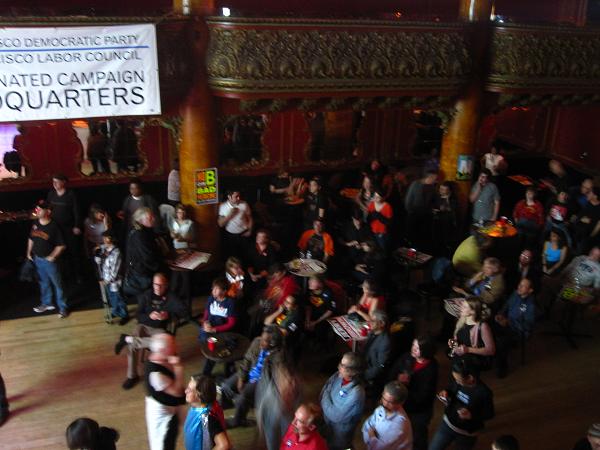
So for now, the Labor Council-Democrat Party party at the Great American Music Hall is contenting itself with crudites and tunes by young rock-women, The She’s. Fiona Ma made it up to congratulate everyone who got out the vote for the Dems – Jerry Brown, Pelosi, and Boxer have cinched their races — but Aaron Peskin of the DCCC hasn’t yet made an appearance. Maybe it’s just the dedication showing. “Aaron doesn’t know the polls closed awhile ago,” Paulson announces. 


Election 2010: Prop. 19 loses

4

Okay, I admit it: I thought Californians would come to their senses and vote in large numbers in favor of legalizing pot. And that’s how the polls looked — until Attorney General Eric Holder announced that he would continue to enforce federal law and bust Californians for marijuana offenses. At that point, the voters seemed to collectively sigh and say: Hell with it, if the feds are going to get us anyway, why bother? And that’s when the polls began to shift

The rest of the state props are a mixed bag — the proposal to get rid of the two-thirds vote on passing a budget went through, but so did the mandate that local fees get a two-thirds vote.

GOLDIES 2010: Amanda Curreri

0

Five minutes into talking with Amanda Curreri over a slice and coffee at Mission Pie, I’ve agreed to take part in a piece she’s working on as part of Shadowshop, the in-gallery artists’ marketplace Stephanie Syjuco is organizing for SFMOMA’s upcoming survey of work made in the past decade.

“It’s called Afghanistan Insert,” Curreri explains, speaking in the measured fashion of someone who carefully considers her words. “I’m trying to insert Afghanistan into SFMOMA and into San Francisco’s art community.”

Curreri’s commitment to getting the local arts scene to engage with what has become commonly dubbed by the mainstream news media as “the forgotten war” is not just politically motivated. It’s also personal. Her husband has been working in Afghanistan for the past five months as a security contractor, during which he has sent her snapshots of local graffiti. They are documents of his ground truth.

Curreri plans on physically inserting herself and her husband’s images into Shadowshop, much in the same way she holds one of his pictures in the portrait accompanying this feature. Indeed, the photo, this profile, Curreri’s new status within the local arts community as a Goldie winner, and the conversations this increased attention might encourage will all become part of the discourse surrounding Insert Afghanistan and contributing to its impact.

All this is consonant with Curreri’s view of herself as more of an instigator than an artist. “I’m trying to make art that crosses out of the art world,” she says, echoing Joseph Beuys’ notion of social sculpture. Her projects thrive on participation, using the exhibition space as a kind of social laboratory in which she arranges shared cultural touchstones and institutions — campfire songs, the judicial process, family recipes — as prompts for personal reflection and shared conversation on the “big subjects” that undergird them: history, politics, memory, and in the case of Afghanistan Insert, their intersection within a seemingly endless and fruitless foreign occupation thousands of miles away.

Engaging with Curreri’s art often entails an extended encounter with the artist herself (given how unexpectedly my interview at Mission Pie has turned out, the reverse seems true as well). The last conversation I had with Curreri was this past July, when she videotaped my extemporaneous responses to her off-camera questioning about the topic of last words. My interview was to be incorporated into her concurrent exhibit “Occupy the Empty,” for which she transformed Ping Pong Gallery via hand-sculpted “props” into a courtroom in which various associates, friends, and strangers, such as myself, volunteered their time and testimony.

As with Insert Afghanistan, the inspiration for “Occupy the Empty” was also personal: after participating in a court hearing concerning her late father, Curreri found out it had been held in the same Massachusetts courthouse in which Italian-American anarchists Sacco and Vanzetti were sentenced to death in the early 20th century. Curreri, also of Italian-American descent, saw the coincidence as a chance to connect to that history and, in the process, build a community around a larger discussion of remembrance. Curreri recalls one participant for whom the show served an almost therapeutic function.

“I want to create art that has an interpersonal function, in real-time,” she says. “I want my work to set a specific frame around our inherent connectivity.” 

www.amandacurreri.com

>>MORE GOLDIES 2010

Election 2010: The judicial race

0

After Michael Nava came in first in the June primary and looked as if he might oust sitting judge Rochard Ulmer, the local judiciary and much of the legal establishment came together and began raising a ton of money to try to crush this upstart. And it’s had an impact; in the early results, Nava is behind. But it’s going to be very close; by the end of the night, the 54-46 margin will get a lost closer. This one’s impossible to call.

Calls for justice

0

rebeccab@sfbg.com

Since the fatal shooting of Oscar Grant III on New Year’s Day in 2009, a photograph of the 22-year-old African American man from Hayward has become iconic. The picture shows Grant’s smiling face, and the black ski cap and a hooded sweatshirt he was wearing the day it was taken.

It has been copied onto posters and displayed like wallpaper in downtown Oakland cafes and along city blocks, manipulated with different hues and accents to produce scores of flyers, banners, hip-hop album jackets, T-shirts, and even masks. An expansive mural in Oakland displays Grant’s image on a larger-than-life scale, framed with roses.

The ubiquitous pictures of Grant, the victim of a shooting by police, are a constant reminder that his life was taken suddenly when BART cop Johannes Mehserle shot him in the back on the Fruitvale train platform. At the time, Grant was unarmed and physically restrained, having been arrested following reports of a fight.

Cell phone camera footage of the shooting went viral, and the case drew national attention. The defense argued that it was all a tragic accident, saying Mehserle had mistakenly drawn his firearm when he meant to draw his Taser.

Mehserle was convicted of involuntary manslaughter and his sentencing is expected Nov. 5. With all the attention surrounding the case, this final determination has taken on the proportions of a moment of truth.

Mehserle could be sent to prison for as long as 14 years, or merely be placed on probation. For many Grant supporters, it’s a question of whether the justice system will incarcerate a police officer for killing a young person of color, after so many other youths have been slain in police shootings that never went to trial. For Mehserle’s supporters, the outcome will signify something else entirely.


RIVAL NARRATIVES

Mehserle, a white Napa native in his late 20s who resigned from BART after the shooting, was tried on a murder charge. But a jury in Los Angeles (where the trial was moved because of the publicity here) found him guilty of involuntary manslaughter on July 8. Protesters, decrying the verdict as too lenient, converged in downtown Oakland for a street rally directly afterward that later gave way to bursts of rioting and looting.

The grassroots community leaders who urged supporters into the streets aren’t the only people now mobilizing around the sentencing. In the months following the verdict, the law enforcement community rallied in support of Mehserle, whose conviction for on-duty police conduct stood out as a rarity.

The former cop’s supporters have set up websites, hosted vigils, and arranged media interviews for Mehserle and his allies. A website called Justice4Johannes.com decries his conviction, denouncing the justice system as biased against police. “Do not let our officers fall victim to a spineless system,” the website urges, “who would rather protect criminals than protect our law enforcement officers who daily put their lives on the line for you!”

As the date of the sentencing approaches, each side has demonstrated that they are as active as ever. When the Giants played in AT&T Park in October, Mehserle’s father, Todd, made an appearance in McCovey Cove on a stately sailboat with “Free Johannes Mehserle” banners ruffling on its tall masts. But a smaller wooden ketch with activist Jared Aldrich at the helm, hoisted banners that read “Justice for Oscar Grant” and, on another occasion, “Jail Killer Cops.”

On Oct. 23, the International Longshore and Warehouse Union (ILWU) Local 10 shut down Bay Area ports, using a stop-work day to hold a rally at the Port of Oakland calling for the maximum sentence for Mehserle.

“The litany of police killings of innocent young black and Latino men has evoked a public outcry in California,” Jack Heyman, a co-organizer of the rally, wrote in an article in CounterPunch. “Yet when it comes to killer cops, especially around election time, with both the Democratic and Republican parties espousing law and order, the mainstream media either expunges or whitewashes the issue.”

Heyman told the Guardian that he had visited Oakland high school classes to speak about the issue and found that in some classes, every single student raised a hand when asked if they knew the name Oscar Grant. “They happen to be sensitive to the issue of police brutality,” he noted. “A number of them had had problems with police.”


PRISON OR PROBATION?

On Oct. 26, opposing briefs on the sentencing were filed in Los Angeles County Superior Court. Defense Attorney Michael Rains submitted a 126-page memo urging the judge to drop the gun-enhancement charge and place Mehserle on probation, which would keep him out of prison. Meanwhile, prosecutors with the Alameda County District Attorney filed a 20-page memo indicating that Mehserle should be sent to prison, but stopped short of advocating for the maximum sentence.

Rains’ motion goes into great detail, quoting from letters sent to the court in Mehserle’s defense, in which the former transit officer is said to be “a gentle giant.” It even goes so far as to suggest that Mehserle’s infant son (born New Year’s Day, 2009) could suffer psychological difficulties later in life if he is separated from his father.

Grant, too, was a father — his daughter, Tatiana, is six — but the prosecution’s motion doesn’t mention how she may be psychologically affected later in life by her loss. Grant supporters sent some 2,000 letters to the judge, according to a posting on civil rights attorney John Burris’ website, but none were referenced in the briefing.

The DA argues that Mehserle intentionally shot Grant, implying that the Taser argument was a fabrication. In the moments following the shooting, the document notes, Mehserle told his fellow officer that he thought Grant was going for a gun. “If the sentence in this case is to serve any purpose whatsoever,” it notes, “it must serve as punishment.”


INSIDE THE POLICE LOBBY

The Peace Officers Research Association of California (PORAC) covered the cost of Mehserle’s defense. The 85,000-member, politically powerful police organization maintains a legal defense fund for officers facing legal troubles.

Technically, Mehserle wasn’t entitled to the financial assistance. According to PORAC’s website, an officer who voluntarily resigns may be ineligible for benefits, and Mehserle quit shortly after the shooting. Still, PORAC stepped up and put itself on the hook for millions in legal fees to ensure he had the best possible defense. PORAC was a driver behind the Peace Officers’ Bill of Rights, which established a unique set of protections for law enforcement officers under investigation for misconduct.

PORAC president Ron Cottingham acknowledged that its decision to fund Mehserle’s defense was discretionary, but declined to say more. It’s possible that PORAC was interested in preventing Mehserle’s trial from setting a precedent for other cases involving officers who use deadly force against unarmed suspects.

PORAC also played a role in the BART civilian oversight structure that was ultimately approved by the California Legislature. The transit agency’s lack of civilian oversight became a flashpoint in the wake of the shooting, prompting Assemblymember Tom Ammiano to draft legislation that would have created an Office of Citizen Complaints (OCC) for BART patterned after the system in place in San Francisco. PORAC fought it and the effort was stymied.

“PORAC … will actively oppose your bill as it is written,” Jesse Sekhon, president of the BART Police Officers’ Association, wrote in a letter to Ammiano’s office. “They also said that they will have every law enforcement agency in the state oppose the bill.” Ammiano’s bill would have prevented police officers from serving in oversight roles and would have granted more power to the OCC.

The bill that went forward instead, Assembly Bill 1586, was crafted by BART, supported by PORAC, and introduced by Assemblymember Sandre Swanson (D-Oakland). Under this system, the oversight process begins with a police auditor selected by the BART Board of Directors, and a citizen board — which may include police officers.

According to Lynette Sweet, a member of the BART Board who spoke about the bill during a community meeting in Oakland in August 2009, PORAC opposed Ammiano’s bill because it would have allowed the state to direct municipalities throughout California to create civilian-oversight offices. “PORAC doesn’t want to see that happen. So we’ve now become the lesser of two evils for them,” she said.

On Oct. 29, BART held a dedication ceremony for the new police auditor office and honored Swanson for bringing the legislation forward. The transit agency has initiated a search to fill the civilian-oversight positions. But the rifts in the community over this shooting are far from healed.

On one side, a politically powerful and financially robust police lobby is actively influencing civilian-oversight legislation and spending top dollar trying to keep Mehserle out of prison. On the other, a grassroots community movement furious about police brutality against black and Latino youth is gaining momentum.

Only Judge Robert Perry knows what his own personal interpretation of justice is, and he alone will determine if or for how long Mehserle will spend time behind bars. If he is spared from prison, the community will be outraged. If he is incarcerated, Mehserle supporters will be outraged. But regardless of the decision, Mehserle’s life will go on.

Locals for hire

2

sarah@sfbg.com

It’s no secret that San Francisco’s construction industry is going through hard times, a situation that translates into lost opportunities for working class San Franciscans. But that bad situation is being made worse by contractors on local projects hiring workers from outside the city.

Recent studies reveal that under the city’s First Source program, which requires contractors to make “good faith efforts” to reach the goal of hiring 50 percent of their workers from within the city, San Francisco has failed to meet its goals on publicly funded projects.

Sup. John Avalos has introduced legislation that seeks to address this shortfall by requiring contractors to meet the city’s hiring goals or face fines. But some union leaders whose members don’t live in San Francisco are grumbling that the proposal is not workable.

Local unemployed workers are expressing support for the Avalos legislation, as they step up efforts to get UC San Francisco to commit to local hiring plans at its $1.5 billon Mission Bay hospital construction site, which lies a Muni T-Third ride away from some of the city’s most economically distressed neighborhoods.

And now everyone is anxiously wondering where Mayor Gavin Newsom will land on the legislation and on UCSF’s hiring goals in what may be his last weeks as chief executive of San Francisco.

As of press time, Newsom was running neck-to-neck with Abel Maldonaldo in the lieutenant governor’s race, leaving voters uncertain whether Newsom will be mayor in January or second-in-command statewide — a promotion that would land him a seat on the UC Board of Regents but shift his primary allegiance from the City and County of San Francisco to the entire state of California.

When Avalos stood outside City Hall last month and announced his proposal to mandate local hiring on publicly-funded construction projects, he was joined by Sups. Sophie Maxwell and David Campos, Board President David Chiu, community advocates, construction contractors, neighborhood leaders, and union members.

“My legislation will ensure that San Franciscans have a guaranteed shot to work on the city’s public works projects and that the local dollars invested in public infrastructure will be recycled back into San Francisco’s economy and local communities,” Avalos said.

Avalos’ legislation came in the wake of two reports confirming that local construction workers were having a hard time getting work. A report that Chinese Affirmative Action and Brightline Defense released in August estimated that only 24 percent of workers on publicly funded sites are local residents.

And a report released by L. Luster and Associates in mid-October, at the behest of the Redevelopment Agency and Office of Economic and Workforce Development, found that only 20 percent of workers hired at 29 publicly funded construction projects in the past year were local residents.

Avalos’ legislation would mandate assessment of liquidated damages against contractors and subcontractors who fail to meet minimum local hiring requirements and establish monitoring, enforcement, and administrative procedures in support of this policy. It would phase in these requirements over three years, starting at 30 percent the first year.

Avalos noted that his legislation was developed through a series of meetings with city agencies, the Mayor’s Office, labor and building trade unions, the environmental community, neighborhood advocates, contractors, local hiring advocates, and unemployed workers. And he vowed to keep the roundtable approach.

Patrick Mulligan, financial secretary of Carpenters Local 22, told the Guardian that his union, whose members are specific to San Francisco, generally supports local hiring. “But there are some general concerns with the legislation,” said Mulligan, who has lived his whole life in San Francisco and got his first job through a local hiring program. “We have standing contractual agreements with contractors, so whatever legislation gets passed, it will have to be meshed with the existing situation. If these were boom times, people might see it differently. But it’s hard times at the union hall.”

Mulligan also lamented the lack of process for the community to vet whether UC has a local hiring plan at construction projects that impact their neighborhood. “But contractors want the best workforce they can get. And in lean times, they can afford to be more selective and don’t necessarily want to include training time on the job,” he said. “But we feel that it’s inappropriate for contractors to bring their entire crew from outside of town.”

Michael Theriault, secretary-treasurer of the San Francisco Building and Construction Trades Council, told the Guardian that Avalos’ legislation was unworkable because construction workers cannot afford housing in San Francisco and too few qualified workers live in the city.

“We take workers from San Francisco into our apprenticeship program constantly, but they get to a certain point in their careers and find that the city builds well on the low-end and the high-end, but doesn’t build workforce housing. So they end up in Antioch, Vallejo, Fairfield, and Modesto, and commute back in,” Theriault said. “That problem has not been addressed by the city, and it’s at the root of why local hiring programs aren’t working.”

Newsom spokesperson Tony Winnicker said the mayor “supports stronger local hire requirements” even as he expressed concerns with Avalos’ proposal. “We’ll continue to work with the supervisors, the building trade unions and the community on legislation that achieves both realistic and legally enforceable local job guarantees for city projects,” he said.

Winnicker noted that the city already supports local hiring through CityBuild and the San Francisco Public Utilities Commission. “But we believe we can do better,” he added.

Avalos, whose legislation is scheduled for a Nov. 8 hearing of the board’s Land Use and Economic Development Committee, said he sees his proposal as a starting point. “We’ll see where it ends up,” Avalos told the Guardian. “We could pass legislation that wants 50 percent local hiring next year, and it would probably get vetoed and it wouldn’t be realistic. So we have to phase it in and make sure we are creating a system that is going to push the trades to be more inclusive of local residents.”

Meanwhile, unemployed workers — some in unions, others not — continue to protest the lack of a local hire plan at UCSF’s $1.5 billion Mission Bay hospital project, which is funded through debt financing, philanthropic gifts, and university reserves.

“We want to make sure folks get trained and everything that’s necessary, so there is no dispute,” Aboriginal Blacks United member Alex Prince said at an Oct. 27 protest at the Mission Bay site. The protest came one month after Newsom wrote to UCSF Chancellor Susan Desmond-Hellmann noting that the hospital was breaking ground “just as continuing high unemployment rates were devastating the city’s most distressed communities,including neighborhoods impacted by the Mission Bay expansion.”

“There are estimates that up to 40 percent of the members of our local construction trade unions are currently out-of-work,” Newsom wrote. “It would be helpful if you could share the commitments that UCSF has made on the issue of local hiring, particularly around employing residents of San Francisco’s most distressed communities in southeast San Francisco, and the results of those efforts to date.” Winnicker said UCSF has not yet responded.

Barbara French, UCSF’s vice chancellor for university relations, told the Guardian that UCSF is working to evaluate hiring needs for phase of the project, talking to the unions, and intends to make its findings public in December.

“We have had a voluntary local hiring policy since 1993,” French said, confirming that in the past 17 years, the university has reached a 12 percent local hire rate on average. “Sometimes it was 7 percent, sometimes it was 24 percent … Our [goal] is to reach a number that is beyond what we reached before but which is realistic.”

Recently French told community-based organizations that UCSF hadn’t signed a contract with the contractor at its Mission Bay hospital project, didn’t have the permits yet, and that the recent community celebrations didn’t mark the start of active construction at the site.

French said general hiring at Mission Bay will begin in December. “We don’t get any city funds at this site, so our commitment is voluntary. But we feel very strongly that we have to reach out,” she said.

Avalos acknowledged that UC is not under San Francisco’s jurisdiction and can’t be compelled to do more local hiring. “But we know that they are doing a critical amount of building and investing taxpayer dollars, and that this land use impacts the surrounding community. So it makes sense that we have local hire legislation and access to serious end-use jobs at the hospital.”

SF needs a local hire law

2

EDITORIAL A billion-dollar hospital project, built by a public agency using taxpayer dollars, just broke ground on the edge of District 10, the corner of the San Francisco with the highest unemployment rate and some of the city’s worst economic problems. That’s something job-hungry residents ought to be celebrating — more than 1,000 construction workers will be earning steady paychecks over the next few years.

And yet, when dignitaries including Rep. Nancy Pelosi showed up for the groundbreaking ceremony, they were met with protests. Bayview residents showed up to complain that very few of those jobs are going to the people who live in the project’s neighborhood. In fact, not that many jobs are likely to go to San Francisco residents. That’s because the University of California, San Francisco, which is building the hospital at Mission Bay, has no policy whatsoever requiring its contractors to hire local residents. As Sarah Phelan reports on page 11, San Francisco residents may turn out to make up fewer than 20 percent of the people who work on the project.

That’s a problem for a significant number of local construction projects financed and managed by government agencies. A recent study released by the San Francisco Redevelopment Agency Office of Economic and Workforce Development found that only 20 percent of the workers on public works job sites in the city were San Francisco residents.

Obviously, private construction companies can hire anyone they want — but when San Francisco tax dollars and San Francisco public land are involved, local residents ought to get a fair share of the work. That’s not just a political argument; it’s solid economics. Just as money spent at a locally owned independent business stays in town and does more for the local economy than money sent at big chains, local workers are more likely to spend their paychecks here in town.

Sup. John Avalos has introduced a bill that would set a 50 percent requirement for local hiring on projects paid for by the city. It’s a great idea, and needs strong support. There’s resistance from the building trade unions, which is no surprise — the unions want to keep the seniority system in place and give jobs to the members who have been unemployed the longest, no matter where they live. And a significant percentage of the membership of the building trade unions live out of town.

May of the residents of low-income areas like Bayview lack the specific skills for unionized trade jobs. But with so many longtime members out of work, the unions don’t want to add apprenticeship programs to train new workers for jobs that don’t exist.

But there has to be room for compromise here. The building trades leaders need to understand that San Francisco taxpayers have every right to demand that when they finance public works projects, some of that money will stay in town. And Avalos isn’t pushing for 100 percent local hire — nor is he trying to undermine the time-honored tradition of the union hiring hall.

The UC project is trickier. As a state agency, UC is exempt from local laws — and has a long history of defying San Francisco’s efforts to hold it accountable. The Bayview activists aren’t asking for 50 percent local hire — but they are demanding that the university adopt some sort of enforceable rules to ensure that some percentage of the jobs at the new hospital go to city residents. That’s more than reasonable.

San Francisco’s state legislative delegation ought to be in touch with the UCSF chancellor and send a clear message: This is a problem that needs to be resolved, now — and if it’s not, legislation setting local hire goals for all UC projects ought to be on next year’s agenda.

It’s a beautiful day

0

It was mayhem out at 30th and Mission last night, people pouring into the streets, shouting and shooting off fireworks and cars cruising along, slowly throught the crowd, big “Gigantes” banners hanging out the doors and windows. A beautiful night in San Francisco, people coming together to celebrate, G.W. Bush and Nolan Ryan looking dejected and rejected, that rare sense of victory in the air … and it’s a beautiful morning, good weather across most of the state, turnout heavy in my precinct, anyway, and that’s very bad news for Meg Whitman, whose only real hope is that Democrats don’t show up at the polls.


So maybe we’ll have more to celebrate tonight.


It’s hard to predict the outcome of the state and local elections based on the latest polls, since at least a third of the voters have already cast their ballots. If Whitman and Brown were tied a month ago, when absentee voting started, and Brown is up 5-10 points today, which poll reflects how the voting actually went over the past four weeks? If Prop. 19 was ahead three weeks ago and is behind now, did supporters lready vote for it?


But I think I can safely predict that one the statewide level, big money isn’t going to take the day: Whitman’s going to lose, Carly Fiorina’s going to lose and Prop.23 is going to lose. If the left turns out to vote. Polls are open until 8.

Guardian: Endorsements for small business in San Francisco

1

Alas, this year some of the small business groups and leaders in San Francisco, such as the Small Business Advocates and Scott Hauge at Small Business California, once again came out with endorsements that were virtually identical with those of the downtown/Chamber of Commerce/PG&E/landlord/real estate gang. (See Guardian blogs.) Their candidates were, and the big downtown money went to, Steve Moss in District l0, Theresa Sparks in District 6, and Scott Wiener in District 8 and they all backed the Sit-Lie Ordinance and took identical positions on all the other local props.
There are many small business people who do not subscribe to the downtown line and vote more independently. I decided this year to do a special blog and email blast on the endorsements of the Guardian, which are done from the perspective of an independent, locally owned and operated alternative newspaper. I think it’s also good for people to know that there are a lot of independents and progressives out there in the small business community who support such things as public power, a city health plan for workers, more progressive taxation, and foot patrols by police for the neighborhoods and not just kicking kids off the sidewalks. b3

To the small business community in San Francisco:

Here are our 2010 endorsements of state and San Francisco candidates and propositions from the San Francisco Bay Guardian, a locally owned and operated, independent alternative weekly newspaper in San Francisco. The Guardian is a newspaper that is of, by, and for small business. We always question candidates carefully on their small businesses record and policies and consider small business to be a crucial criterion for candidates and propositions in our endorsement process. In a major story on the Guardian in its pre-election Sunday edition (Oct. 31), the Chronicle reported that Guardian endorsements “are widely considered the most influential in this left-leaning town.” We have done endorsements in every election since our founding in 1966.

For us, this is a serious, intensive process of many months: we interview all the major local candidates, put up podcasts of interviews on our website at sfbg.com, do extensive independent checking on the candidates and issues and their background and record and do independent reporting on the campaign and issues. You may agree with us; you may not. But you can have faith in our one and only campaign promise: Our Clean Slate represents what we think is best for San Francisco and San Francisco small business.
b3


Provisional votes count

1

With the election just days away, what should you do if you were issued a vote-by-mail ballot, but can’t mail it and want to vote at the polls, instead?

According to the San Francisco Department of Elections, you have the right to cast a provisional ballot at your local polling place. (If you don’t know where your polling place is, click here to look it up.)

But what if you show up at your polling place, and your name isn’t on the official roster of registered voters for the precinct and your voting eligibility cannot be verified by the pollworker?
Again, you can cast a provisional ballot.

The same holds true for folks who moved to San Francisco, but forget to re-register to vote here. Or want to vote a party ballot that does not match their registration. Or are a first-time voter listed in the original roster with “ID Required” printed under your name but are unable to show acceptable identification, which includes a valid California state driver’s license, a California state identification mumber or the last four digits of your Social Security number.)

So, how do you actually cast a provisional vote?
A poll worker will hand you a a ballot and a provisional ballot envelope.
You’ll need to complete the voter’s section of the provisional envelope. (This involves filling in your name, date of birth, current address and previous address).
You’ll need to sign the declaration confirming that you are a resident of San Francisco and are eligible to vote in this election.
You’ll need to remember to sign your name at the bottom of the envelope.
You’ll need to mark your ballot cards for the candidates and measures you support.
You’ll need to insert your ballot cards into the provisional envelope, seal it and return it to the poll worker.
You’ll need to keep the six-digit number printed on your provisional voter receipt.

Ok, but how will you know if your provisional ballot was actually counted?
Call 1-866-325-9163 or visit the Department of Elections website   no sooner than 41 days after the election.

And to verify your provisional ballot on-line, you’ll need to provide the six-digit number printed on your provisional voter receipt.

Vote early, vote often!

Tony Serra weighs in on the election

10

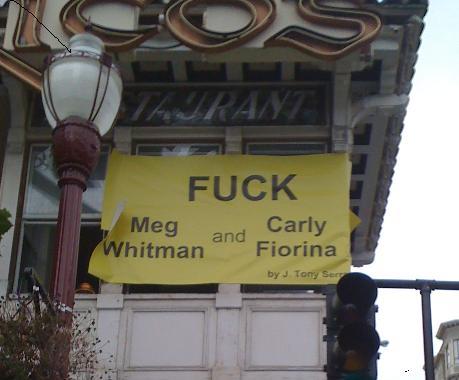
Tony Serra, the legendary local lawyer and one of my favorite members of the legal profession, sent us this photo with his commentary on the Nov. 2 election. It’s hanging from his office out at 506 Broadway.


I just talked to Serra, and he said he’s had great feedback. “Channel Five came out and did a story,” he said. “They managed to shoot it so the lightpost covered up the U and the C. They interviewed people on the street, and a lot of them were cheering me on.”


His critique of the GOP candidates doesn’t mean he’s a Jerry Brown supporter; Serra has sworn off electoral politics, which he told me is part of the corruption of capitalism. But he’s happy to go after Meg and Carly: “I’m not going to let those two motherfuckers buy the election.”


I told Serra he’s always been one of my heroes. Still is. 

Don’t nobody give a damn about us!

0

As Supervisor John Avalos’ proposal to mandate local hiring for publicly-funded construction projects heads for a committee hearing next week, local hiring protests continue to break out around UCSF’s Mission Bay groundbreaking celebrations for a $1.5 billion hospital project that the UC Board of Regent recently approved.

The problem, according to community advocates, revolves around UC’s apparent absence of a community hiring plan. Rumor has is that local residents will only get 12-13 percent of the construction jobs, even though the site is only a T-Third ride away from Bayview Hunters Point and other low-income communities where unemployment rates have risen steeply in the last four years.

Yesterday evening, I went to a university-community celebration where UCSF Chancellor Susan Desmond-Hellmann was in attendance. So, I asked her about UC’s local hiring plan. Desmond-Hellmann said I’d need to speak to UCSF’s Barbara French, who recently advised community-based organizations that construction at the site won’t start until December, and that the groundbreaking activities are happening now to take advantage of the weather.

So, while I’m waiting to hear back from French, check out a slideshow (see above) of the Oct. 27 local hiring protest at UC Mission Bay. There’s been coverage of how MC Hammer talked to the protesters Oct. 26, when the Secret Service got upset about the local-hiring demonstration outside the groundbreaking that House Speaker Nancy Pelosi attended. And how Hammer came back with a “we want jobs” message.

But there has been no coverage of how filmmaker Kevin Epps (who is responsible for Straight Outta Hunters Point and Black Rock) was on hand filming the Oct. 27 protest, or how UC’s Terry Rawlins dropped by, or how Terry Anders of the Anders & Anders Foundation) took part in the local hiring protest saying, “This is the first piñata we want to crack open,” or how  Mindy Kener, who is also with Anders & Anders, added, “We want all the candy to fall out.” Or how Aboriginal Blacks United’s Alex Prince, who led the protest to demand fair and equal access to high-paying union jobs on the UC Mission Bay project near the economically depressed Third Street corridor, was accompanied by Heaven, ABU’s cuter than cute mascot dog.

“We want to make sure folks get trained and everything that’s necessary, so there is no dispute,” Prince told me. “UC has not really been helpful. They just said they want to meet with us.”

Osiris Coalition member Greg Doxey, who helped negotiate labor’s community benefits agreement with Lennar in 2008, emphasized the importance of passing local hiring legislation that has some teeth.
“We’ve found that no matter how much dollars is committed for training, it doesn’t help if developer is not committed to doing any training,” Doxey said. “That’s why we are supporting Local SF, Sup. John Avalos’ legislation. We want some teeth. All we have right now is a good faith policy. Avalos’ legislation will give us teeth to set fines to be put in place.”

Charles Hopkins, another local resident, said all the community wants is its fair share.
“It’s sustainable for San Francisco to have local hire,” Hopkins said.

A group of unemployed Asian-American members of the iron unions also participated in the ABU rally where they held up signs saying “Show us the $$$”.

An employee of Cambridge, which along with San Francisco-based DPR, is one of the prime contractors at the site, did come out to talk to the protesters.
“If folks want to put their names on the list, they can,” the Cambridge employee, who declined to give his name, said. “But the unions have their own procedures, when it comes to who they dispatch, including seniority.”

Mindy Kener of the BVHP-based Anders and Anders Foundation said she’d like to see more women hired on local construction sites.“The women want to work and get off the welfare lines,, they need to work and it’ll make a big difference in our neighborhood if we put people to work who live on the T-Third line,” Kener said. “All we need is for UC to give the green light to put our neighborhood to work.”Carlos Rodriguez, a Local 261 member who has been out of work for two years, worries that workers are being forgotten while deal making is going on.“I see how unions talk to management, they forget about the laborers,” Rodriguez said.

A man on a bicycle stopped to see what was going on.
“It’s not going to work, when they can get illegal aliens to work for $6.50 an hour,” the man said, as he resumed his peddling.

Across the street, filmmaker Kevin Epps also indicated that he thought part of the local hire problem is rooted in racism.
“Deeply rooted, institutionalized racism,” Epps said. “We are talking about power, and power doesn’t give up without another power taking it away.”
Standing nearby was UC contract compliance manager Terry Rawlins, who clarified that UC isn’t currently hiring folks to work on the construction site.
But doesn’t the university have leverage?

“Not directly,” Rawlins said, “We try to establish goals, based on cooperation with unions, and without violating any bargaining agreements.”

But UCSF Director of Design and Construction J.Stuart Eckblad told the Guardian that he thought the workers were asking for the right thing.
“I’m all for maximizing the opportunities and participation of the local community,” Eckblad said.” The question is what is realistic, and there are issues of what is really available with labor and the trades.”

Joshua Arce of the Brightline Defense Project noted that folks have been distracted by Lennar’s shipyard project from the reality that there are 6,000 jobs coming on line, a stone’s throw from the Bayview, the Mission and Market Street.
“What is equitable?” Arce asked. “A good faith approach, a market-based approach or a mandatory approach? At the end of the day, it’s about equity, and no one would dispute that this situation is inequitable. Let’s just agree that it’s not equitable [to have no local hiring plan] on a big project like this in a community that is facing such high unemployment levels.”

“There are hundreds of good-paying, union jobs on this projects while we have people in our communities that are dying for lack of work,” ABU president James Richards told me. “We have qualified union workers standing outside the job site that are ready, willing, and able to work and if the community doesn’t work, no one works.Good faith efforts have never worked and now they want us to be fooled again. So, we are going to step it up, and we don’t give a damn about the unions, either. The person who fights for these jobs, deserves these jobs. So, let’s begin to tell the truth. Many of the folks in the labor unions don’t speak English, they are not from San Francisco, and most are not even from this country. Everyone is dancing around the truth. Everyone knows the truth, but they don’t speak it.”

But ABU’s tent looked inclusive at the protest, Arce noted, as he pointed  out the power of teaming up with all marginalized groups in San Francisco.

“I could go for that,” Richards said.  “We got blacks, Mexicans, Asians, whites, everybody in ABU. It’s ain’t no racist thing.  But let us work, too. “Why do we always have to get in last? Don’t nobody give a damn about us! 

Appetite: David Wondrich on Punch

0

When cocktail historian and Esquire columnist David Wondrich speaks about drink, you listen — or read, as the case may be. His latest book Punch, debuts Nov. 2, the first of its kind on the glories and history of the punch bowl. I had the privilege of speaking with Dave over the phone from his New York home. The question at hand: why punch? Or to quote from the book, what makes punch “necessary”?

Wondrich stands by his punch bowl. He tells me it’s “the greatest social beverage of all time,” that “now more than ever we need beverages that promote friendship.” He calls punch “more gentle than cocktails”, its preparation “easy and utterly pleasurable.” The punch bowl is communal, ideal for a group or festive gathering, less laborious than individual cocktails, and a hell of a lot more fun. As Dave states in the book’s preface: “most of punch’s stories are of warm fellowship, and conviviality, and high-spirited gatherings afloat on oceans of witty talk” — not to mention a few “battles and brawls.”

We’re not talking about “frat juice” here. We’re talking honest-to-God punch: boozy yet delicious, layered with citrus, raw sugar, and varying spirits. The book starts with a comprehensive history — who drank punch and where. Wondrich says the book started as a big chunk cut out of his first book Imbibe.

The convivial punch houses of antiquity that feature in Punch sound so appealing that I ask Dave if he envisions their return. “I certainly hope so,” he replies. Besides Rickhouse here in SF, some of his favorite bars for punch around the globe include Hix in London, Brooklyn’s Clover Club (which lies a dangerously close distance from his present location), and Manhattan’s Death & Co. He’s also a fan of Savoy Cocktail Night at SF’s own Alembic (hear, hear!)

Like most classic concoctions, the name of punch’s first mixologist has been lost to the sands of time — though there are countless early references to the drink. One of Wondrich’s strongest sources is Google Books, where he digs up old newspapers, pamphlets, and rare books before he cross references them in the libraries of New York and London. Another research source?  “I am trained as an academic so I have a lot of 1600s books,” he says. “I start with a lot of blank space and start to fill that in using every kind of source possible… I’ll track down the original source, and don’t settle for first mention.”

I asked if he’d ever write the book he wishes existed, a dream mentioned on page six of Punch, which is a detailed source on distilling, the drink’s origins, its history, and importance. He says it’s a project “too big for any one person to bite off, unless they have all the time in the world and know multiple languages.” Wondrich says he “could tackle parts of it.” He estimates that it would take at least three co-writers: someone fluent in Dutch, German, Chinese, and Indian.

What we’re more likely to see Wondrich write about next is how the American style of drinking — particularly our contributions in cocktails and spirits — went global. He’s already done “tons of research” for past presentations on the subject. Spots of particular interest for him include our country’s legendary World’s Fair cocktail showcases and the way the techniques they highlighted spread across the rest of the globe. 

Wondrich expects the section called Book II of his recently released Punch will be limited to “total mixology geeks.” But I found Book II a useful, necessary account of the ingredients, tools, and proper measurements needed for the drink, particularly his recommendations for spirits in the “Ingredients” chapter.

A good half of Punch is recipes, ranging from Milk Punch to American Fancy Punch. When asked which ones he makes the most, Wondrich named the bracing Chatham Artillery punch on page 248 (a Savannah original, a poorly-crafted version of which I’ve imbibed whilst walking down the city’s streets). Back in the day, a local paper described this punch thusly: “as a vanquisher of men its equal has never been found.” Dave says the recipe in this book (there’s yet another included in Imbibe!) “claims to be the original, and very well might be,” though when it comes to  traditional recipes “they get passed down like a game of telephone,” each iteration evolving from the last.

One of his biggest crowd-pleasers — which he says people consume in “shocking amounts” — is his own recipe of Royal Hibernian punch (p. 269):

Prepare an oleo-saccharum with the peel of three lemons and six ounces of white sugar. Add six ounces strained lemon juice and stir until the sugar has dissolved. Add to this 12 ounces Sandeman Rainwater Madeira, stir and pour the Madeira shrub into a clean 750-milliliter bottle. Add enough water to the bottle to fill it, seal and refrigerate. Fill another clean 750-milliliter bottle with filtered water and refrigerate that too.

To serve, pour the bottle of the shrub, the bottle of water, and one 750-milliliter bottle of Jameson 12 or Redbreast Irish whiskey into a gallon Punch bowl, add a 1 1/2 quart block of ice and grate nutmeg over the top.

Yield: 9 1/2 cups.


Subscribe to Virgina’s twice monthly newsletter, The Perfect Spot


Avalos: I have not buckled to anyone’s pressure over local hiring

1

Last week, Sup. John Avalos introduced Local SF legislation to require contractors to meet a local hiring goal of 50 percent. And as the Guardian reported at the time, Avalos’ legislation represents a major departure from the city’s First Source Program, which only requires contractors on publicly subsidized projects to show “good faith” efforts to meet 50 percent goal.  Avalos’ legislation came on the heels of a report from the city’s Office of Economic and Workforce Development that showed only a 20 percent local hire rate in 29 publicly funded projects, despite the existence of First Source.

“My legislation will ensure that San Franciscans have a guaranteed shot to work on the City’s public works projects and that the local dollars invested in public infrastructure be recycled back into San Francisco’s economy and local communities,” Avalos said last week, noting that his legislation was developed over a series of stakeholders meetings with reps from city agencies, the Mayor’s Office, labor and building trades, the environmental community, neighborhood advocates, contractors, local hiring advocates and unemployed workers. And he vowed to keep this roundtable approach going as his legislation moves forward.

So we were surprised to read a Weekly blog post today that claimed that Avalos had allegedly buckled to union pressure and watered down his local hire requirements. Especially since his legislation hasn’t even had its Nov. 8 hearing before the Board’s Land Use and Economic Development Committee…

Reached by phone Avalos clarified that he has not buckled to anyone’s pressure.
“I haven’t backed down on anything,” Avalos said. “And I have not made any amendments to my legislation. I did say when I introduced my legislation that this is a starting point and we’ll see where it ends up. We could pass legislation that wants 50 percent local hiring next year, and it would probably get vetoed and it wouldn’t be realistic. So, we have to phase it in and make sure we are creating a system that is going to push the trades to be more inclusive of local residents.”

Avalos noted that some trades and unions are already doing a good job of hiring San Francisco residents on public works projects, but reiterated that the city’s current policy only requires contractors to present paperwork to show they made a “good faith” effort—and that this approach has fallen far short of the city’s 50 percent local hire goal.

Avalos’ legislation–and his claims about First Source’s shortcomings–are  backed up by two recent studies.

The first report, released by Chinese for Affirmative Action and Brightline Defense Project this August, was titled “The Failure of Good Faith.” It showed that the city’s current policy only “yielded roughly 24 percent on employment opportunities” on public construction projects in San Francisco.

The second report, released by L. Luster & Associates on October 18, was titled “Labor Market Analysis San Francisco Construction Industry.” It confirmed that the construction workforce statewide has been in a “free-fall of job losses for the past four years.”

Noting that the Bay Area has not been as hard hit as other regions in California, the Luster report observed that the tri-county district of San Francisco, San Mateo and Marin counties, which had 45,100 construction jobs in August 2006, “lost nearly one-third of these jobs falling to 31,200 construction jobs by May 2010.”

“In San Francisco, unemployment in the construction sector has had a particularly negative impact on the city’s less educated residents,” the report stated. “For them, construction has provided access to higher paying jobs in a labor market that otherwise might provide them access mainly to positions paying lower end wages. Any local hire effort will be undertaken against the backdrop of this unprecedented construction job loss, and resulting unemployment among the existing San Francisco construction workers.”

One such group of unemployed workers—some of them in a union, others not—could be seen protesting yesterday outside the gates of the construction site on 16th Street in Mission Bay where UCSF has been celebrating the groundbreaking of its new Medical Center, a $1.5 billion project to be funded “through a combination of debt financing, philanthropic gifts and hospital reserves,” according to UC press releases.

But in an email to Joshua Arce of Brightline Defense, UCSF’s Barbara French noted that though UC is “actively working now to evaluate the workforce needs for every trade, for every phase of the project, and intend to make those public in December”, UC has not started construction on the project and won’t until December.
“ We haven’t signed the contract with the general contractor and we don’t yet have our permits,’ French wrote. “ The community may have believed that the celebrations this week truly marked the start of active construction. Not so. These were community celebrations held now in the hopes of getting good weather. “

Meanwhile, Avalos acknowledges that UC is not under the jurisdiction of San Francisco.
“But I know that they are doing a critical amount of building, and investing tax payer dollars there, so therefore the community should have some benefit from that, even though it’s complicated by this being the state’s money, so you could make the argument that all of California’s workers should have access,” Avalos told the Guardian. “But this land use impacts the surrounding community, so it makes sense that we have local hire legislation and access to serious end-use jobs at the hospital, which will include medical and support staff, building and janitorial maintenance and cafeteria related work.”

Avalos noted that the city is building infrastructure all around that project, including parks, Muni and light rail spruce-ups.
“There are huge surrounding investments,” Avalos said.

Either way, here’s hoping that by December, when folks begin to stress about providing for their families over the holiday season, all the workers in the following video clip will be able to put down their bullhorns and pick up decent-paying work, instead. And that this work will last for more than a couple of days.

Civil rights groups demand Secure-Comm documents from ICE

1

In a turnabout from the usual immigration-related situation (in which ICE demands documents from immigrants) civil rights groups in Washington, DC. Arlington, VA. Santa Clara, CA. and San Francisco are requesting the release of documents concerning opt-out procedures in Immigration and Customs Enforcement’s controversial “Secure Communities” program.

Signed by the Arlington Coalition Against “Secure Communities” (S-Comm) Program, Asian Law Caucus, Asian Law Alliance, Bernal Heights Neighborhood Center, Causa Justa: Just Cause (CJJC), Center for Employment Training- San Jose, Central American Resource Center, Chinese for Affirmative Action, Community Legal Services in East Palo Alto, Communities United Against Violence, DC Jobs with Justice, Empower DC, Immigrant Legal Resource Center, Instituto Familiar de la Raza, La Raza Centro Legal , National Lawyers Guild San Francisco Bay Area Chapter, Plymouth Congregational UCC Board of Social Action, Sacred Heart Community Services, San Francisco Day Labor Program Services, Immigrant Rights, and Education Network, Silicon Valley Alliance for Immigration Reform, Silicon Valley DeBug, Somos Mayfair, Steering Committee for Immigration Reform, JFI San Jose Tenants and Workers United and Young Workers United, the statement that these groups released today reads as follows:

”We are four municipalities that have formally requested to opt-out of the federal immigration enforcement, “Secure Communities” (i.e., “S-Comm”) program,” their press release stated. “We did so after participating in town hall meetings, debate, testimony, research, and democratic processes that culminated with representatives in Washington DC, Santa Clara, California, Arlington, Virginia, and San Francisco clearly voting to opt-out of sharing information with ICE. “

“We did so because we believe in preserving public safety for everyone in our diverse cities, and also because we reject a program that disguises a record number of deportations (392,862) as a safety initiative rather than a humanitarian and moral crisis.”

”To be clear, our counties never ‘opted-in’ to this dangerous ICE program in the first place. This program, which has been shrouded in secrecy, was imposed on our counties without the input of our local government, communities, local law enforcement and in the case of San Francisco against their explicit written requests. Now that Washington DC has formally opted out, we ask that ICE immediately and without further delay let our counties and any other counties requesting to do so out of S-Comm.”

”We are committed to moving ahead with the opt out process despite ICE now contradicting itself and claiming the program is compulsory. We support CCR, NDLON, and Cordozo Law School going to court today to demand release of what ICE has refused to divulge. The emergency injunction filed today does what should be automatic in any democracy, it seeks to make public information on S-Comm and our ability to opt-out by stopping the sharing of any fingerprints by these jurisdictions with ICE.. This necessary injunction comes at the beginnings of negotiations with ICE and local jurisdictions scheduled for Nov. 5 to Nov. 9.”

A Celtic violinist Jimi Hendrix?

0

“Can you tell me why they call you the Jimi Hendrix of the violin?” I’m chatting with Eileen Ivers, Bronx-born one-time house blue electric violinist for Riverdance. One must admit, it seems like a curious moniker. Over the phone, Ivers dissolves in laughter. 

“I wish I could,” she finally continues. “One wonderful gentleman from some paper put that. I’d love to think that in some way — he had such a love of blues and roots — I don’t know, I won’t even go there, but I feel so connected to the instrument.” Oh, plus she integrates into her concerts (one of which will be rocking Freight and Salvage Thu/4) liberal doses of jams, electric violin, wah-wah pedal, and, dare we say, soul? “I love to put that to an audience to open their minds — this instrument can rock out as well.” The pieces are beginning to come together…

Perhaps I’m fixating on the comparison because at first glance, there is very little to tie together the lives of Hendrix and Ivers, who was born to immigrant parents used to the hardship and poverty in their birthland of County Mayo, Ireland. “There’s no Gaelic word for immigration — just for exit,” Ivers tells me. “It shows culturally they never wanted to leave, but they had to in the mass exodus.” She talks like an Irish person, falling into discussions of my Gaelic name as those of her (our) ethnic persuasion are wont to do and converses with a hint of that sing-song lilt that is the mark of the Emerald Isle. 

Eileen Ivers and Immigrant Soul, sans Photoshop butchering. Photo by Luke Ratray

Ivers learned her craft through a man in the New York neighborhood she grew up who delighted in teaching the young people in the area how to play the tunes of their cultural legacy. Love of the instrument buoyed her through years at Iona College spent studying mathematics and into a career that’s seen her play with Celtic legends The Chieftains, the international touring company of Riverdance, over 40 symphonic orchestras, and on soundtracks for films like Gangs of New York (2002).

It was through the multitudinous nature of the city’s music scene that the influences audible in her new tracks like “Paddy in Zululand” came to the fore. That tune in particular features an Irish melody plucked out by Iver’s violin which emerges from a background of upbeat African percussion – testament to the connections that Ivers sees between the divergent cultures’ musical forms. 

Which isn’t a particularly unique thing in and of itself – the Bay Area’s Markus James performs similar transmutations with African string music and Americana blues (vocalist Tommy McDonnell of Ivers’ touring band, Immigrant Soul, was a member of the original Blues Brothers band with Dan Akroyd and John Goodman). What may be unique is the bubbling sense of happiness that is exuded from Ivers when she imparts her art upon a listening crowd – or jaded local journalist, who she gracefully includes in her comments regarding the musical resonance she finds in these cross-continent musical similarities. “It’s in our heart — you hear these grooves and it feels right,” she says.

Lost in the music, you might say. Just like Jimi, right?

Eileen Ivers and Immigrant Soul

Thu/4 8 p.m., $23.50-$22.50

Freight & Salvage

2020 Addison, SF

(510) 644-2020

www.thefreight.org


FEAST: Distilled genius

1

It’s a thrilling time in Bay Area spirits. The same players who’ve made us proud in years past continue to reinvent themselves, while newcomers add flavor — literally — to the scene. In visits to four local distilleries, I came away inspired by their inventiveness and skill. And while none of the spirits I tasted use extracts or flavorings (like many of their big-brand counterparts), they do manage to fit in countless pounds of local, unexpected fruits, even natural herbs.

Even more exciting to the small batch booze enthusiast? Most of the following distilleries open their tasting rooms by schedule or appointment so the tippling public can discover for itself the motto emblazoned on the bottles of Old World Spirits: “Good stuff needs no special effects.”

ST. GEORGE’S SPIRITS

At the mighty St. George, inventiveness reigns, with a rock star attitude to boot. The distillery’s small staff experiments broadly and distillers Lance Winters and Dave Smith drive this license into genius. A behind-the-scenes journey through their labs unveiled nothing short of a wonderland apothecary: test tubes and bottles of spirits flavored with herbs, fruits, vegetables, foie gras — even beef jerky. You may (rightly) love their eaux de vie, absinthe, agave spirits, rum, vodkas, and whiskeys, but have you heard they’re toying with a carrot brandy? Clear and vegetal, it showcases the essence of the orange vegetable with a delicate hand. We can only pray they’ll bottle this one.

I also sampled St. George’s bourbon aging in charred American white oak that was a few years away from being officially bottled. Only five months young and made from the required minimum amount of corn (it needs at least 51 percent to qualify as bourbon) plus barley, crystal malt, wheat, and rye, it’s full of malty, rich promise. The same holds true of its white dog (clear-white whiskey) made from the same grains — one we could possibly see sooner on the shelves.

St. George’s next single malt whiskey, Lot 9, has been aging five to 12 years in barrels blended with 17 woods, including used American bourbon oak, sherry refills, port refills, and French oak. If you’re lucky, you soon may be able to purchase (in limited quantities) a single malt-single barrel selection that has been aged eight years in bourbon barrels then finished for four years in French oak apple brandy barrels. It is a wonder of complexity compared to their regular whiskey releases.

Only the brave attempt to down the scorching fire that is St. George’s in house habanero vodka. Grown men confessed of crying or throwing up just sipping it — only a handful of people have downed a legitimate amount and have been permitted to sign the distillery’s bottle of the burn. But my name is on that bottle — no tears, no throwing up, just a raging habanero sizzle.

2601 Monarch, Alameda. (510) 769-1601. www.stgeorgesspirits.com


CHARBAY

On a winding road above St. Helena and under peaceful Spring Mountain pines, there’s more going on than this distillery’s impeccable line of vodkas. Thirteen generations have gone into this family business, founded in 1983 and run by Miles and Susan Karakasevic, their son Marko, and his wife Jenni. The distillery’s lineage is evident to the discerning tippler who sips their port, rums, pastis, brandy, grappa, wines — even their herbaceous tequila. Charbay’s father-son distilling duo traveled to Mexico to painstakingly learn traditional tequila-making technique, which they expertly riff on to make their distinct blends.

Don’t even get me started on Release II of Charbay whiskey! 110 proof, aged six years with a pilsner beer base, it’s a stratospheric $325, but one of the most exceptional things I’ve ever tasted. From its astounding complexity, I caught everything from hops to echoes of the pine trees surrounding the distillery. I also sampled an unreleased 12-year version of Release II: higher proof, rich, a stunner.

But there’s no rest for the Karakasevics. Future whiskeys are already aging in French oak barrels — the one I’m most thirsty for, a stout whiskey, won’t be ready until 2012. If early tastes are any indication, it’s already brilliantly complex with coffee, spice, and dark chocolate notes. Made with neighboring Bear Republic’s stout in copper alembic stills, it’ll age for two years to reach 90 proof and is expected to retail around $90 — part of a younger, more affordable line of whiskeys compared with the divine but costly Release II. The bold explorer spirit that propels Charbay to Mexico to make a fine tequila shines in their future whiskeys.


TEMPUS FUGIT SPIRITS

These importers have already made waves with their Swiss-produced Gran Classico Bitter, which I hailed for reinventing classic cocktails like the Negroni. They also import some of the best French and Swiss absinthes in existence. Absinthe historians and spirits experts Peter Schaf and John Troia are the masterminds behind Tempus Fugit — and owners of one of the finest vintage absinthe poster collections in the world. It was a thrill to check out these rare pieces while tasting the history and forward-thinking vision in their bitters and liqueurs.

Tempus Fugit’s modus operandi is reinventing classic recipes and distilling them locally. Petaluma-produced Liqueur de Violettes is next up for the duo, a taste along the lines of Creme de Violette and other violet liqueurs yet somehow unlike any of them. Made with less sugar, the liqueur is a more appropriate cocktail ingredient — it’s less cloying, more purely floral and light. Each time I sample it, its bouquet blossoms like a layered wine: a sophisticated, botanical aperitif.

Tempus Fugit future project (a two-man team, after all, only has four hands) is Crème de Cacao-Chouva, a chocolate liqueur that will change chocolate cocktails the way St. George’s Firelit transformed coffee liqueur. It’s dark, lightly sweet, lush and earthy. Tasting it, I envision a resurgence of my guilty pleasure cocktail, the Grasshopper, refined and grown up with Crème de Cacao-Chouva and creme de menthe. It came alive with soda water — an elevated egg cream soda materialized in my cocktail windshield.

Keep an eye on these guys. They have more spirits and bitters as exciting as the ones I’ve listed in the works. Their dizzying knowledge of the history and intricacies of forgotten or neglected spirits, along with refined taste, suggests revelatory possibilities for the future pours of Tempus Fugit.

(707) 789-9660, www.tempusfugitspirits.com


OLD WORLD SPIRITS

Just north of San Carlos in a nondescript smattering of office buildings, is Old World Spirits, which has been in production since 2009. Davorin Kuchan, its third-generation distiller from Croatia, says family plays an irreplaceable part in the operation, as is evident from the photos lining the walls of the distillery. The whole clan is involved — Kuchan’s young daughter even drew the girl peeking out from foliage that graces Old World’s playful absinthe label. The output of both Davorin and business partner Joseph Karakas is astounding for a two-person operation, with two absinthes, a gin, a black walnut liqueur, three eaux de vie/brandies, and more liquors slotted for future release.

Old World uses custom-made German stills and local fruits like the Indian blood peach, which Davorin calls the “heirloom tomato” of stone fruit. As with the best natural fruits, the Indian blood has cracks and flaws, its lower sugar content imparting a lush understatement of taste. Though he grew the peaches himself in Croatia, in California Davorin orders in from Placerville’s Goldbud Farms. The clear blood peach eau de vie impresses with notes of ripe, juicy fruit flesh and spicy skin. I found Old World’s eaux de vies well-balanced, both the pear-inflected Poire Williams and the three- to seven-months oak-aged O’Henry Peach. I sipped a raspberry eau di vie it has yet to release: clear and lightly floral, free of the cloying sugar common in raspberry liqueurs.

Watch for Old World’s sold out dark black walnut liqueur — another batch is out in two years. Kuchan’s Blade Gin stocks the shelves of many a Bay Area bar, journeying down a nontraditional, California-inspired gin route with whispers of ginger, citrus, cilantro, lemon verbena, and black cardamom. Two kinds of absinthe, a green (verte) and clear blanche/white (referred to as Bleue, as in Switzerland), take cues from classic absinthes but resound with Davorin’s interpretation of 20 percent more herbs than what enlivens a traditional absinthe. Old World’s next release: a Cognac-style double barrel brandy aged in French and American oak and finished in Kentucky bourbon casks, which they hope to release soon. My early taste straight from the barrel yielded an already rich, spicy brandy.

Thirsty yet? Visit Davorin and Joseph during their monthly Friday Flight nights. Davorin will turn on some fine French pop tunes as both pour spirits, transforming the distillery into a warm familial party.

121 Industrial, Belmont. (650) 622-9222. www.oldworldspirits.com 

You can also find these spirits at Cask (17 Third St., SF), John Walker & Co. (175 Sutter, SF), and K&L Wine Merchants (638 Fourth St., SF).


FEAST: 5 sardinerias

0

When it comes to sardines, you have to think outside the earthquake shelter. On the flavor-o-meter, the tinned food of last resort (served on tarps with Saltines and stale water) bears no resemblance to its wild, fresh self. Even a humble sardine doesn’t deserve to be jammed in like a sardine, oil slicked, and left to age in the farthest reaches of the cupboard.

As several San Francisco eateries are ably proving, sardines, when treated with respect, are a tasty addition to the dining table. And healthy. And sustainable (they’re on the Monterey Bay Aquarium’s Super Green list!) Everyone from Andrew Weil to the Italian grandmother we all wish we had proclaim the virtues of the pungent silver herring. And with good reason: its tiny, 25-calorie body is packed with essential fatty acids, iron, protein, and calcium.

Let’s face it, the good people of Sardinia didn’t get their beautiful skin and convivial personalities from eating schweinebraten on spätzle. They’re all high on EFAs. Sardine EFAs.

PESCE

Pesce was one of the first and finest restaurants to introduce San Franciscans to the joys of sardine cuisine. The casual Russian Hill restaurant offers small plates of fish, pasta, and vegetables (and please, can we call it cicchetti, as they do, instead of “Italian tapas”?) patterned on the cooking of Venice. Pesce serves its sardines (all from Monterey Bay) simply — grilled, on a bed of mixed greens and pickled vegetables with a wedge of lemon. The result is tart, briny, and clean. If you’re still on the fence about sardines, Pesce is the place that will convert you to a bona fide a-fishyanado.

2227 Polk, SF. (415) 928-8025. www.pescesf.com

RAGAZZA

In Provence, shmear means aoli. They put it on meat; they put it on vegetables; they put it on fries; they put it on fish. Heck, they probably put it on ice cream. At Ragazza, the new relative of Glen Park’s Gialina Pizzeria on Divis, the chefs splat a huge dollop of it on its sardines. Apart from the aoli, Ragazza takes an Italianesque approach, stuffing them with an earthy mixture of breadcrumbs, olive oil, garlic, oregano, and onion and baking them in the restaurant’s gas-fired Wood Stone oven. The result is a crispy exterior over sardines that almost melt away on the fork. Add some mixed greens and a robust Italian red and you can practically feel your arteries unclogging. Oh, Ragazza also has pizza.

311 Divisadero, SF. (415) 255-1133. www.ragazzasf.com

NOPA

There’s locavore, 100-mile radius locavore, and there’s ultra-loca, five-mile radius locavore. While most of the city’s sardine-serving restaurants get their sardines from Monterey Bay, Nopa gets its from our very own San Francisco Bay. This is great news because our local sardines nearly went extinct in the 1950s. And — sardine cognoscenti consider the Pacific sardine as flavorful as those on the Sardinian coast (take that, overpriced cans from Norway). Speaking of flavorful, Nopa serves the little San Franciscans baked in its wood-fire oven with fingerling potatoes and frisee. The only thing missing is an order of flatbread, a gems salad, wine, and the burnt honey crème brulee.

560 Divisadero, SF. (415) 864-8643. www.nopasf.com

BARBACCO ENO TRATTORIA

You have to give Barbacco credit. Unlike most of the restaurants that have rediscovered the sardine, Barbacco doesn’t seem to be operating on the principle that sardines are an after-5 p.m.-only food. Although not exactly in the let’s-have-herrings-for-breakfast! camp, Barbacco at least believes that noon is a perfectly reasonable time to start the jonesing. The bustling, suits-heavy Financial District eatery is the creator of what may be the city’s only sardine sandwich (if this isn’t true, we’d like to know). Barbacco also breaks the don’t-get-too-weird-with-sardines taboo, pairing its sardines with a hefty piece of seared calamari. Not most people’s first choicem perhaps, but the two get along swimmingly, especially when served on an Acme torpedo roll and slathered with arugula and Barbacco’s housemade “roasted tomatoe condimento.”

220 California, SF. (415) 955-1919. www.barbaccosf.com

FERRY PLAZA SEAFOOD

When you don’t want others dictating what you can and can’t have on your sardines, duck into Ferry Plaza Seafood. This celebrated purveyor of all things aquatic sells wild, locally caught sardines (and by this we mean our our SF as well as Monterey bay) when available. “We love sardines,” said one salty staffer. “Especially the local ones. They just glisten.” They recommend bringing out the glisten by brushing with olive oil, salt, and pepper; grilling a few minutes on each side; and dressing with lemon. Call first for availability, these guys swim in and out of supply.

One Ferry Building, #11B, SF. (415) 274-2561. www.ferryplazaseafood.com 


Local metal review: Slough Feg’s “The Animal Spirits”

0

All good heavy metal strives to challenge the listener, pushing buttons and boundaries. Some of its most successful incarnations make people downright uncomfortable, achieving escalating extremes of tempo, tuning, and tone.

Slough Feg is one of San Francisco’s most unique underground bands, an honorific that stems directly from its unique approach to the challenge of challenging. Eschewing thrash’s BPM arms race, death metal’s knuckle-dragging celebration of “brutality,” and black metal’s dissonant, low-fi navel-gazing, the quartet (now two decades or, if you prefer, five drummers old) manages to discomfit with an unlikely tool: melody. New album The Animal Spirits was released Tues/26 on Profound Lore Records.

http://www.youtube.com/watch?v=1SJCdqguiyk

Bursting with major-scale chord changes, Celtic-folk influences, and vocal lines that make the tautological adjective “sing-song” suddenly useful, the band’s music is resolutely unlike anything you’ve ever heard before. Some of the heavy metal staples are present – the acrobatic drumming and soaring, dual-guitar harmonies, for example – but that’s where the easy descriptions end.

The Animal Spirits‘ song titles evince an ecclesiastical theme, which is made immediately apparent in the music – album-opener “Trick the Vicar” rampages through two minutes of triplet-driven NWOBHM wordplay, all of it pertaining to clergy. “Out of the frying pan/into the Friar” is but one of many examples.

Though the lyrics are a bewildering mix of the high- and lowbrow, a strand of gleeful silliness is apparent throughout, even when Slough Feg tackles weighty historical subjects like Martin Luther (“The 95 Theses”), alchemy (“Materia Prima”), or trans-pacific feats of seamanship (“Kon-Tiki”). The Alan Parsons Project cover (“The Tell-Tale Heart”), conversely, is defiantly straight-faced. Closer “Tactical Air War” features a guest appearance by Bob Wright, vocalist in cult local metal band Brocas Helm.

No matter how frenzied the music around him becomes, drummer Harry Cantwell never seems to tire, and his versatility is a crucial complement to the band’s idiosyncratic arrangements. Bassist Adrian Maestas excels at the genre’s distinctive low-end gallop, though his forays up the fretboard are also a valuable addition to the sound. Guitarist Angelo Tringali is laden with responsibility, forming one half of the harmonic partnership that lies at the heart of the band’s music.

The complementary half is provided by guitarist-singer Mike Scalzi, who founded the band in his native Pennsylvania. Scalzi’s vaudevillian vocal delivery and incomparable songwriting approach are the defining elements of Slough Feg, and it is his desire to alienate people through melody that makes the band sound the way it does. A charismatic iconoclast, Scalzi has lately begun contributing to metal blog Invisible Oranges, promulgating his strong opinions with the help of a prose style he honed at his day job: teaching community college philosophy courses.

Check back in this space soon for an extensive interview with Scalzi, one of the few people in the world who can discuss Saint Vitus B-sides and use the word “ontology” correctly in a sentence, though, it must be said, not simultaneously.

Different walls

0

arts@sfbg.com

Palestinian perspectives are in. You know it when a major filmmaker like Julian Schnabel makes a big-budget film like Miral, based on the book by Palestinian journalist Rula Jebreal (which recently screened at the Mill Valley Film Festival in advance of a general release next year).

In many ways, though, it’s the rest of the country that’s catching up to places like the Bay Area, where Palestinian voices have long been a part of the cultural landscape. The Arab Film Festival, for instance, which just closed its 14th season, once again featured several films from and about Palestine. And this year the San Francisco International Film Festival gave us a look at Port of Memory, the latest work from Kamal Aljafari, one of the most interesting and sophisticated filmmakers to come from Palestine since Elia Suleiman.

In theater, San Francisco’s Golden Thread Productions just gave a staged reading of biographical work from youth in embattled Gaza called The Gaza Monologues. For years, Golden Thread has produced works incorporating the Palestinian perspective amid a mass culture overwhelmingly slanted toward the more powerful side in a basically colonial project. And currently Campo Santo and Intersection for the Arts bring the diasporic repercussions of Palestinian dispossession center stage in Habibi, a new play from a new Palestinian American theatrical voice, Sharif Abu-Hambeh.

Habibi makes its debut as the second offering in a trio of world premieres at Intersection by first-time playwrights (the first having been Chinaka Hodge’sMirrors in Every Corner). Directed by Omar Matwally, Abu-Hambeh’s play weaves together two distinct storylines that attempt to capture the inter-generational confusion and displacement experienced by assimilating Palestinian immigrants in the Bay Area. That confusion can regrettably transfer to the play itself, whose intentional deployment of ambiguity ends up, at least to some extent, being merely fuzzy rather than thought-provoking. But the ideas here are at times intriguingly subtle and the effort a promising one. Moreover, Matwally and Campo Santo give the play a strong production with various charms along the way.

At the center of this double helix of a narrative is young Palestinian American Tariq (a coolly vital and engaging Aleph Ayin). Tariq shares a small Mission District apartment and even — talk about family overload — a single bed with his loving but paternalistic father, Mohammed (a stern, sympathetic Paul Santiago). The deliberate and routine-loving Mohammed — who unlike his Americanized son speaks in accented English — is a museum guard with a strong work ethic that he’s trying, unsuccessfully, to instill in his slacker offspring. Tariq, for his part, has just happily shed his menial job at a local café and is in no hurry to find a new one. His absent mother (Nora El Samahy) apparently left them some time before, though she reappears at one point in his imagination.

This father and son dynamic, familial and almost too familiar, comes intercut with a public talk by a high-class museum curator (a sharp and funny El Samahy, dressed by costume designer Courtney Flores in esteem-grabbing Manhattan chic and sporting a very respectable English accent), who leads us through a slide lecture on the great art heists of the last century. Her talk, avid but meandering, is interrupted by simultaneously exasperating and guilt-producing phone calls from her terminally ill father, and a consequent tendency to wander into ruminations farther afield — summoned for us in pictures of dispossession that float by on the screen behind her (in video projections designed by Aubrey Millen).

Maybe these wayward ruminations aren’t so far afield after all, we come to suspect, as her theme of cultural theft warms up to its own complexities and encourages us to consider the nature of cultural transmission, loss, and hybridization in the life-and-death circumstances of exiled populations. This idea deepens as Tariq’s raucous and rebellious spirit extends to breaking into the curator’s monologue, and even smashing the fourth wall to confront us, her audience. Tariq also has a unique tendency to narrate his own actions, a self-conscious conceit that can be productive at times, especially of humor, and works as an indirect aside to the audience.

By the end, the two narratives come even closer together through a rash act of Tariq’s father that trades disastrously on the concept of family heirlooms, or the physical symbols of patrimony and place. The climax arrives too hastily, and its potential impact is muted. At the same time, the play’s departure from the more universal, shopworn gestures of “melting pot” tales verges on something rare and coruscating.

HABIBI

Thurs.–Sun., 8 p.m.; through Nov. 7; $15–$25

Intersection for the Arts

446 Valencia, SF

(415) 626-2787 

www.theintersection.org


Picks

0


WEDNESDAY 27

THEATER

West Side Story

West Side Story is back. Directed by Arthur Laurents, author of the original 1957 script, this rendition of the classic Romeo and Juliet story via 1950s New York City brings fresh life to the rivaling Jets and Sharks and Tony and Maria’s forbidden love. Musical favorites in Leonard Bernstein and Stephen Sondheim’s legendary score include “Tonight,” “America,” “Maria,” “I Feel Pretty,” and “Somewhere.” Jerome Robbins’ spirited dynamic choreography is as much a part of the magic as the story and music. See why West Side Story has captivated audiences for decades when its tour hits San Francisco. (Emmaly Wiederholt)

Through Nov. 28

Showtimes vary, $30–$99

Orpheum Theater

1192 Market, SF

1-888-SHN-1799

www.shnsf.com


THURSDAY 28

FILM

“Witches!”

This year’s Halloween-y new releases, Paranormal Activity 2 and Saw 3D (the seventh entry in that undying series), may not be enough to satisfy your need for horror. Luckily, SFMOMA administers a double dose, starting with 1973’s Season of the Witch, an early George Romero film, about a housewife who becomes enmeshed in witchcraft. The must-see, though, is 1977’s Suspiria, in which an American ballet student travels to Germany to attend a new school where sinister goings-on are as common as pointe shoes. Directed by Dario Argento, the film is a Technicolor nightmare and an essential addition to the season. Read on for more Halloween movie revivals, including an additional Suspiria screening. (Ryan Prendiville)

7 p.m., $5 (free with museum admission)

Phyllis Wattis Theater

San Francisco Museum of Modern Art

151 Third St., SF

(415) 357-4000

www.sfmoma.org

FILM

“French Cinema Now”

A week before presenting a run of Olivier Assayas’ 330-minute cine-event, Carlos, the San Francisco Film Society hosts its annual sampling of Gallic small wonders. “French Cinema Now” welcomes a few familiar faces (Isabelle Huppert in Copacabana, Catherine Deneuve in Hidden Diary, one of Guillaume Depardieu’s last performances in A Real Life), along with auteur turns from Bertrand Tavernier (The Princess of Montpensier) and Alain Cavalier (Irène). Closing night brings Certified Copy, in which Abbas Kiarostami, like Hou Hsiao-hsien before him, calls upon Juliette Binoche for his French twist. If early reviews are any indication, the Iranian filmmaker remains intimately concerned with epistemology in spite of the change in scenery. (Max Goldberg)

Through Nov. 3

Showtimes vary, $12.50

Embarcadero Center Cinema

One Embarcadero Center, Promenade Level, SF

www.sffs.org

DANCE

“Performing Diaspora: Devendra Sharma”

During last year’s Performing Diaspora, Devendra Sharma’s Mission Suhani proved to be a major hit. Inspired by the tradition of arranged marriages dowries, it put a light-hearted twist on what has become a controversial though deeply embedded cultural practice. Mission charmed with the wit of its dramatization of this tale about greed, betrayal, and sweet revenge. It is performed by Nautanki Theater, a company of amateurs and professionals residing in Fresno. Nautanki is a North Indian folkloric style, half musical theater, half dance that has migrated to the Central Valley and, clearly, seems to be thriving within the local Indian community. (Rita Felciano)

Thurs/28–Sat/30, 8 p.m.; Sun/31, 3 p.m.,

$19–$24

CounterPULSE, SF

1310 Mission, SF

1-800-838-3006

www.counterpulse.org


FRIDAY 29

MUSIC

Ray Parker Jr.

With an instantly recognizable tune and shout along opportunities galore (“Who ya gonna call?”), the “Ghostbusters” theme song likely brings back a flood of fun memories for anybody who grew up in the 1980s or is a fan of the hit movie and much-played music video. Written and performed by Ray Parker Jr., the tune has had a life of its own ever since it was unleashed on audiences more than 25 years ago. Spirits should be high at tonight’s concert as Parker is sure to resurrect his biggest hit, just in time for Halloween. Bustin’ makes me feel good! (Sean McCourt)

8 p.m., $59

Claremont Hotel, Club, and Spa

41 Tunnel Road, Berk.

(510) 843–3000

www.claremont-hotel.com

MUSIC

Acid King

I’m usually not a huge fan of weddings, but imagine this mythical union: L7 and Sleep joined in holy heavy matrimony, spitting out a bell-bottomed babe with a book titled Say You Love Satan in hand. Overlay this with indigo, fog, fuzz, a killer Hawkwind cover (the first song ever, it is said, to feature the word “parallelogram”), and dreamy female vocals dripping with distortion and demonic dew and doom. D-d-duhhh! This show is a no-brainer: formed back in 1993, Acid King is seminal SF stoner metal. Catch this rare local appearance on the heels of their Australian tour. C’mon, don’t be a plain ol’ square, be movin’ like a parallelogram. (Kat Renz)

With Thrones and Christian Mistress

9:30 p.m., $10

Hemlock Tavern

1131 Polk, SF

(415) 923-0923

www.hemlocktavern.com

THEATER

Failure 2 Communicate

Jaime has a traumatic brain injury limiting his impulse control. Loomis is autistic and particularly sensitive to touch. How they and other students navigate the high school environment is the premise of Valeria Fachman’s new play Failure 2 Communicate. At a high school for students with severe behavior disorders, emotional disturbances, and learning disabilities, teachers develop strong relationships with difficult students, eventually empowering the students to change their lives. This world premiere from Performers Under Stress — a local physical theater company committed to exploring challenging content — ultimately addresses disability and how we cope. (Wiederholt)

Through Nov. 14

Fri.–Sat., 8 p.m.; Sun, 2 p.m., $20

Garage Theater

975 Howard, SF

www.pustheatre.com

DANCE

Hubbard Street Dance Chicago

Why Hubbard Street Dance Chicago? First, fabulous performances; second, it’s a modern dance company that is not a one-choreographer deal; third, it boasts an international repertory we might never see otherwise (they were the first Twyla Tharp entrusted pieces to after she disbanded her own troupe). Further proof of reason No. 3: Spanish choreographer Nacho Duato just disbanded his own ensemble; Hubbard is bringing his baroque music box piece Arcangelo. When Dance Theater of the Netherlands visited last, it had been 22 years. Now Hubbard is bringing a Jirí Kylián work, 27’52”. What’s more, Hubbard promotes from within. The Bay Are premieres of Deep Down Dos and Blanco are the creations of Company dancer and choreographer in residence Alejandro Cerrudo.(Felciano)

Through Sat/30

8 p.m., $32–$68

Zellerbach Hall

Bancroft at Telegraph, UC Berkeley, Berk.

(510) 642-9988

www.calperformances.org

COMEDY

“SF Sketchfest Presents: The Return of Tony Clifton”

When was the last time you saw a real zombie? Rumor has it that Tony Clifton is Andy Kaufman returned from the dead. (Hey, Jesus did it.) Just make sure you don’t mention the late comedian to Clifton; he’s notoriously touchy about the subject. In any case, Clifton is touring with his “Katrina Kiss-My-Ass Orchestra” as community service after being charged with disorderly conduct in New Orleans. Not only do proceeds benefit Comic Relief, but at each show one lucky ticket holder “will get to spend one night at Dennis Hof’s Moonlight Bunny with Mr. Clifton paying for the hooker of the winner’s choice.” Whoever he is, he’s still classy. (Prendiville)

Through Sat/30

8 p.m., $30.50

Cobb’s Comedy Club

915 Columbus, SF

(415) 928-4320

www.cobbscomedyclub.com


SATURDAY 30

FILM/EVENT

Poltergeist

Everyone remembers Carol Anne (“They’re heeeere!”) and Tangina (“This house is clean!”), but Poltergeist diehards know the heart of the 1982 horror classic is JoBeth Williams’ Diane Freeling, the kind of mother who’d crawl up a rope into purgatory to save her youngest child. (She also smokes weed and has a pretty awesome swimming-pool scene alongside several grinning corpses.) Clear your building-houses-over-graveyards-schedule; this Mark Huestis-produced event features an onstage interview with Williams, plus an array of entertainments, from a Carol Anne look-alike contest to a Poltergeist-inspired (creepy clowns? Creepier trees? Maggot-y steaks? Dead parakeets?) fashion show. (Cheryl Eddy)

7:30 p.m. (also noon, with Williams Q&A; 9 p.m., film only), $6–$30

Castro Theatre

429 Castro, SF

(415) 621-6120

www.castrotheatre.com

FILM

“Eli Roth’s Midnight Movie Marathon”

Programmed by horror filmmaker Eli “Bear Jew” Roth, this SF Indiefest event offers nearly 24 hours of Halloween delights. Though drop-ins are welcome, this event is clearly structured to cater to true fiends who’ll sit tight for the whole dirty dozen, with dinner and breakfast breaks thoughtfully sprinkled throughout. Your descent into weak-kneed terror begins at noon with John Carpenter’s 1982 The Thing (highlight: blood-testing scene), and continues, in order, with Lucio Fulci’s 1979 Zombie (zombie vs. shark underwater fight); 1988’s The Vanishing (Dutch version, not Nancy Travis-starring remake); 1982’s Pieces (chainsaw-sploitation); 1973’s The Wicker Man (Nic Cage-free original); 1976 Spanish chiller Who Can Kill a Child?; in-a-row essentials Eraserhead (1977), Suspiria(1977), Cannibal Holocaust (1980), and The Evil Dead (1981); Miike Takashi’s delightfully violent Audition (1999); and 1973 giallo Torso. Brain-scrambling awesomeness. (Eddy)

Noon, free (donations to benefit CellSpace appreciated)

CellSpace

2050 Bryant, SF

www.sfindie.com


SUNDAY 31

“Matinees for Maniacs”

If you’re not too hung over from all the booze, hard drugs, or candy corn you gobbled down the night before, come check out this double-dip of spooky Disney classics on Halloween afternoon. First up is Something Wicked This Way Comes (1983), the Ray Bradbury-based tale of a demonic circus ringleader. (Haven’t thought about it for years, but in hindsight, it maaaaay just have something to do with my irrational fear of the circus.) Next up is Escape to Witch Mountain(1975). Unfortunately, or actually, perhaps very fortunately, this original version doesn’t star Dwayne “The Rock” Johnson or include a song by Miley Cyrus like the 2009 reboot does. (Landon Moblad)

2:30 p.m., $11

Castro Theatre

429 Castro

(415) 621-6120

www.thecastrotheatre.com


TUESDAY 2

MUSIC

Gary Numan

Gaining some initial recognition as the singer and leader of Tubeway Army with their single “Down In The Park,” Gary Numan’s success exploded with the release of his 1979 solo record The Pleasure Prinicipal, which featured the hit single “Cars.” Inspiring untold New Wave, industrial, and goth bands with his sound and look over the ensuing years, Numan has been enjoying a resurgence of late, and has found himself on stage with groups such as Nine Inch Nails as a special guest. Tonight he’ll be performing his debut album in its entirety; expect it to be delivered with an extra dose of seasoned edginess when this icon hits the stage. (McCourt)

8 p.m., $27.50

Fillmore

1805 Geary, SF

(415) 346-6000

www.thefillmore.com 

The Guardian listings deadline is two weeks prior to our Wednesday publication date. To submit an item for consideration, please include the title of the event, a brief description of the event, date and time, venue name, street address (listing cross streets only isn’t sufficient), city, telephone number readers can call for more information, telephone number for media, and admission costs. Send information to Listings, the Guardian Building, 135 Mississippi St., SF, CA 94107; fax to (415) 487-2506; or e-mail (paste press release into e-mail body — no text attachments, please) to listings@sfbg.com. We cannot guarantee the return of photos, but enclosing an SASE helps. Digital photos may be submitted in jpeg format; the image must be at least 240 dpi and four inches by six inches in size. We regret we cannot accept listings over the phone.


The. Rent. Is. Too. Damn. High!

3


As continued reports of unprecedented, record-breaking amounts of cash from corporate real estate developers and big landlords flood the Board of Supervisor races, the damaging impact of the Supreme Court’s Citizens United decision is becoming more and more clear. But even worse, Thomas J. Coates, a far-right extremist Republican real estate developer and landlord, is trying to buy the Board of Supervisors so that he can end rent control. Last week, Coates made the largest donation to supervisors races in the 150-year history of San Francisco.

Who is Coates? He spent more than $1 million on Proposition 98 in 2008 trying to repeal rent control statewide. He was the largest single contributor to that campaign, which was so extreme that even Gov. Schwarzenegger and former Republican Gov. Pete Wilson opposed it. Coates gave the maximum contribution allowed by law to George Bush and Dick Cheney’s campaign and funded GOP candidates across the country. Now he’s spending more than $200,000 to elect anti rent control San Francisco supervisors: Mark Ferrell in District 2, Theresa Sparks in District 6, Scott Wiener in District 8, and Steve Moss in District 10.

With this one donation, the stakes in this election for every San Franciscan — especially renters and progressives — became even higher. By spending his fortune here, Thomas Coates hopes to erode San Francisco’s strong rent control laws by electing supervisors who are less sympathetic to renters. Through influencing the election of the supervisors, he also influences the selection of the interim mayor (since the supervisors will choose the next mayor by a majority vote if Gavin Newsom is elected lieutenant governor), which would result in an anti rent control mayor.

To make matters worse, workers and their families are already on the defense fighting Jeff Adachi’s anti-labor ballot initiative proposal (Proposition B), which would make city workers pay huge increases in their health care coverage. Adachi is mischaracterizing his initiative as pension reform even though the bulk of the cuts will come from forcing low-wage workers to pay for their children’s health care.

Wall Street speculators crashed the stock market, causing workers’ pension funds to lose billions and wiping out retirement savings. The losses require local and state governments to spend more to keep the funds solvent. So who do Gov. Schwarzenegger, Republican gubernatorial candidate Meg Whitman, and Adachi blame? The victims: the workers.

Renters and city workers aren’t the only ones under attack. Newsom’s cynical sit/lie initiative (Proposition L) demonizes young homeless kids. Many of these youth are queers who ran away to San Francisco because it is a queer haven, and others are abused kids who left home because it wasn’t safe. If Prop. L passes, for 12 hours a day these kids will be criminalized if they sit or lie on the sidewalk.

All this in one of the most progressive cities in America? If we are under attack from conservatives in San Francisco on some of the most fundamental issues of our city, it’s no wonder the Tea Party is raging in the rest of the country.

Now more than ever we need labor, progressives, and renters to come together to fight back by voting Tuesday, Nov. 2. Harvey Milk once said, “Give ’em hope.” Show us that hope on Election Day by voting for progressive supervisors, rejecting Adachi’s so-called pension reform, and opposing the so-called sit/lie ordinance. Remember to vote and vote for Debra Walker in District 6, Rafael Mandelman in District 8, No on B, No on K, No on L, and Yes on J and N.

Gabriel Haaland is a local queer labor activist.


Stage

0


Stage listings are compiled by Guardian staff. Performance times may change; call venues to confirm. Reviewers are Robert Avila, Rita Felciano, and Nicole Gluckstern. Submit items for the listings at listings@sfbg.com. For further information on how to submit items for the listings, see Picks. For complete listings, see www.sfbg.com.


OPENING

Equus Boxcar Theatre Playhouse, 505 Natoma; 776-1747, www.boxcartheatre.org. $10-25. Opens Wed/27, 8pm. Runs Wed-Sat, 8pm. Through Nov 20. Boxcar Theatre kicks off its fifth season with Peter Shaffer’s drama, directed by Erin Gilley.

Failure to Communicate The Garage, 975 Howard; (800) 838-3006, www.brownpapertickets.com. Call for prices. Opens Fri/29, 8pm. Runs Fri-Sat 8pm; Sun, 2pm. Through Nov 14. Perfomers Under Stress opens its sixth season with the world premiere of a physical theater piece by Valerie Fachman.

The Unexpected Man EXIT Theatre, 156 Eddy; (800) 838-3006, www.brownpapertickets.com. $18-25. Opens Fri/29. Runs Fri-Sat, 8pm; Sun, 3pm. Through Nov 14. Spare Stage revives Yasmina Reza’s ironic comedy, starring Ken Ruta.

BAY AREA

Becoming Britney Center REPortory Company, Knight Stage 3 Theatre, 1601 Civic Drive, Walnut Creek; (925) 943-SHOW, www.centerREP.org. $25. Previews Thurs/28-Fri/29, 8:15pm. Opens Sat/30, 8:15pm. Runs Thurs-Sat, 8:15pm; Sun, 2:15pm. Through Nov 14.Center REPortory Company presents an original musical about a naïve pop star, written by Molly Bell and Daya Curley.

Palomino Aurora Theatre, 2081 Addison, Berk; (510) 843-4822, www.auroratheatre.org. $10-55. Previews Fri/29-Sat/30 and Nov 3, 8pm; Sun/31, 2pm; Tues/2, 7pm. Opens Nov 4, 8pm. Runs Wed-Sat, 8pm; Sun, 2 and 7pm; Tues, 7pm. Through Dec 5. David Cale brings his new solo play about a gigolo to Aurora Theatre for its Bay Area premiere.

Pirates of Penzance Novato Theatre Company Playhouse, 484 Ignacio, Novato; 883-4498, www.novatotheatercompany.org. $12-22. Opens Thurs/28, 8pm. Runs Thurs-Sat, 8pm; Sun, 3pm. Through Nov 21. Novato Theatre Company revives the popular Gilbert and Sullivan swashbuckling tale.

ONGOING

Christian Cagigal’s Obscura: A Magic Show EXIT Cafe, 156 Eddy; (800) 838-3006, www.brownpapertickets.com. $15-25. Thurs-Sat, 8pm. Through Dec 18. Magician Christian Cagigal presents a mix of magic, fairy tales, and dark fables.

Dracula’s School for Vampires Young Performers Theatre, Fort Mason Center, Bldg C, Third Floor, Room 300; 346-5550, www.ypt.org. $7-10. Sat, 1 pm; Sun, 1 and 3:30pm. Through Nov 14. Young Performers Theatre presents a Dracula comedy by Dr. Leonard Wolf.

Equus Boxcar Theatre Playhouse, 505 Natoma; 776-1747, www.boxcartheatre.org. $10-25. Opens Wed/27, 8pm. Runs Wed-Sat, 8pm. Through Nov 20. Boxcar Theatre kicks off its fifth season with Peter Shaffer’s drama, directed by Erin Gilley.

Futurestyle ’79 Off-Market Theater, Studio 250, 965 Mission; (800) 838-3006, www.brownpapertickets.com. $15-20. Wed, 8pm. Through Wed/27. A fully improvised episodic comedy played against the backdrop of SF in 1979.

Glory Days Boxcar Studios, 125 Hyde; www.jericaproductions.com. $30. Fri-Sat, 8pm; Sun, 2pm (no performance Sun/31). Through Nov 7. Jerica Prodcutions and the Royal Underground Theatre company present Nick Blaemire’s and James Gardiner’s one-act musical.

Habibi Intersection for the Arts, 446 Valencia; 626-2787, www.theintersection.org. $15-25. Thurs-Sun, 8pm. Through Nov 7. Intersection for the Arts and Campo Santo present the world premiere of a play by Sharif Abu-Hamdeh.

*Hamlet Alcatraz Island; 547-0189, www.weplayers.org. By donation. Sat-Sun, times vary. Through Nov 21. Outside of an actual castle, it would hard to say what could serve as a more appropriate stand-in for Kronborg castle of Helsingør—also known as Elsinore—than the isolated fortress of Alcatraz Island, where WE Players are presenting Hamlet in all its tragic majesty. As audience members tramp along

stony paths and through prison corridors from one scene to the next, the brooding tension the site alone creates is palpable, and the very walls impart a sense of character, as opposed to window-dressing. Deftly leaping around rubble and rock, a hardy troupe of thespians and musicians execute the three-hour

production with neat precision, guiding the audience to parts of the island and prison edifice that aren’t usually part of the standard Alcatraz tour package. Incorporating movement, mime, live music, and carefully-engineered use of space, the Players turn Alcatraz into Denmark, as their physical bodies meld into Alcatraz. Casting actress Andrus Nichols as the discontent prince of Denmark is an incongruity that works, her passions’ sharp as her swordplay, the close-knit family unit of Laertes, Ophelia, and Polonius are emphatically human (Benjamin Stowe, Misti Boettiger, Jack Halton), and Scott D. Phillips plays the

appropriately militaristic and ego-driven Claudius with a cold steel edge. (Gluckstern)

Hedda Gabler Phoenix Theatre, suite 601, 414 Mason; (800) 838-3006, www.offbroadwaywest.org. $35.

The action unfolds in the parlor of the newly married Tesmans, young mediocre academic George (Adam Simpson) and town beauty Hedda, née Gabler (a crisp, tightly wound and nicely understated Cecilia Palmtag), a woman of exceptional intelligence, ambition and pride—to call her fiery wouldn’t be bad either, especially since she’s so fond of shooting off her late father’s pistols. Frustrated by her paltry new life, Hedda seeks news of an old flame, Eilert Lovborg (Paul Baird), via the admiring and vaguely lecherous Judge Brack (Peter Abraham) and a timid acquaintance from school days, Thea (Joceyln Stringer). The semi-wild but brilliant Lovborg has published a new book that imperils George’s chances for a professorship. Less interested in securing George’s career than controlling Lovborg’s destiny, Hedda soon manipulates events around her with bold determination and tragic consequences. Passionate, violent and psychologically complex, Henrik Ibsen’s titular heroine is at turns sympathetic and disturbing, an independent soul trapped in and warped by a society that allows her too little scope—a modern predicament that has inspired many modern and postmodern adaptations. Off Broadway West’s straight-ahead production of the late-19th-century drama, helmed by artistic director Richard Harder, remains faithful to the period setting. This includes Bert van Aalsburg’s respectable scenic design and Sylvia Kratins impressive costumes, as well as the old if fine translation by William Archer, who first introduced Ibsen to the English-speaking world. Unfortunately, the quaint diction is not handled with equal grace across an uneven cast. Palmtag’s solid, at times admirable performance in the lead, however, goes a good way toward grounding an otherwise patchy production. (Avila)

Last Days of Judas Iscariot Gough Street Playhouse, 1620 Gough; (510) 207-5774, www.CustomMade.org. $10-30. Thurs-Sat, 8pm. Through Sat/30. Custom Made Theatre Company presents the 2005 play by New York’s Stephen Adly Guirgis (Our Lady of 121st StreetJesus Hopped the A Train), which places purgatorial Judas (Kristoffer Alberto Barrera) on trial to determine his deserved fate for dropping a dime on Jesus and all that jazz. Flamboyant, sycophantic and horny prosecutor El-Fayoumy (Ben Ortega) and defense attorney Loretta (Amelia Avila) call between them a series of brow-raising witnesses—including Mother Teresa (Brandy Leggett), Sigmund Freud (Catz Forsman), and Satan (Richard Wenzel)—as Judas (seated on the upper tier of Sarah Phykitt’s suitably imposing split-level set) stares stoically in relative silence or appears in a series of childhood flashbacks. Characteristically funny and streetwise, as well as versed in the Catholic rigmarole as filtered through a NYC-boroughs sensibility, Guirgis’s play is also unusually tedious in its jokey, poky unfolding since—offering not much more than a cipher in the largely mute Iscariot—the proceedings lack a strong sense of dramatic stakes. It feels more like a revue than a play, or like an unnecessarily long-winded excuse for the final, well-turned concluding monologue by a heretofore marginal character (a speech delivered with admirable understatement by director Brian Katz). (Avila)

Law and Order: San Francisco Unit: The Musical! EXIT Theater, 156 Eddy; (800) 838-3006, www.brownpapertickets.com. $10. Mon, 8pm. Through Nov 15. Funny But Mean comedy troupe extends its newest show at a new venue.

Mary Stuart The Ashby Stage, 1901 Ashby, Berk; (510) 841-6500, www.shotgunplayers.org. $15-30. Thurs-Sat, 8pm; Sun, 5pm. (also Wed/27, Nov 3; 7pm). Through Nov 7. Shotgun Players presents Friedrich Schiller’s historical drama, directed by Mark Jackson.

*Pearls Over Shanghai Thrillpeddlers’ Hypnodrome, 575 10th St; (8008) 838-3006, www.brownpapertickets.com. $30-69. Sat, 8pm. Through Dec 19. Thrillpeddlers’ acclaimed production of the Cockettes musical continues its successful run.

Proof Exit Stage Left Theatre, 156 Eddy; www.belljartheatre.com. $20. Fri-Sat, 8pm. Through Sat/30. Bell Jar Theatre presents David Auburn’s award-winning play.

*The Real Americans The Marsh MainStage, 1062 Valencia; (800) 838-3006; www.themarsh.org. $20-50. Wed-Fri, 8pm; Sun, 5pm. Through Nov 6. The fifth extension of Dan Hoyle’s acclaimed show, directed by Charlie Varon.

*SHIToberfest Off-Market Theaters, 965 Mission; (800) 838-3006, www.brownpapertickets.com. $20. Fri-Sat, 8pm. Through Sat/30. This special October run of PianoFight’s bowel-loosening comedy series, the S.H.I.T. Show (for acronym fans, that’s the Stop Hating Imagination Time Show), revolves dizzyingly around the subject of beer, Germans and, perhaps less explicably, flatulent dolphins, among much else in the wide open seas of poor taste. Is it hilarious? It is. And you don’t even need to smuggle in a forty to make it so, though it certainly doesn’t hurt. Fine comic acting throughout a charismatic cast (including writer-director-producers Alex Boyd, Zach Cahn, Jed Goldstein, Ray Hobbs, Devin McNulty, Evan Winchester and Duncan Wold, with help from Nicole Hammersla, Gabrielle Patacsil, Rob Ready, Derricka Smith, Andy Strong, Jacque Vavroch and Dan Williams) combines here with generally solid to exceptional sketch work, video and song. Add in a permeating spirit of revelry, debauchery and irreverence and the evening becomes a diversion of the first order, culminating in an utterly sacrilicious sketch about a bunch of toasted beer-brewing monks treated to a papal visit—one of the best venial sins for your buck. When it comes to Octoberfesting this year, “Bavaria” is just S.H.I.T.–faced for Bay Area. (Avila)

Shocktoberfest!! 2010: Kiss of Blood Hypnodrome Theatre, 575 10th; (800) 838-3006, www.brownpapertickets.com. $25-35. Thurs-Fri, 8pm (Thurs/28-Sun/31 include performances of The Forsaken Laboratory by the Brazilian Grand Guignol group Vigor Mortis). Through Nov 19. Thrillpeddlers’ seasonal slice of eyeball is comprised of three playlets variously splattered with platelets, all directed by Russell Blackwood and bridged by a rousing burst of bawdy song from the full cast. Rob Keefe’s Lips of the Damned (after La Veuve by Eugene Heros and Leon Abric) takes place in a rat-infested museum of atrocities just before the fumigating starts, as an adulterous couple—comprised of a kinky married lady (a vivacious Kara Emry) and a naïve hunk from the loading dock (Daniel Bakken)—get their kicks around the guillotine display, and their comeuppance from the jilted proprietor (Flynn DeMarco). Keefe’s delightfully off-the-wall if also somewhat off-kilter Empress of Colma posits three druggy queens in grandma’s basement, where they practice and primp for their chance at drag greatness, and where newly crowned Crystal (a gloriously beaming Blackwood) lords it over resentful and suspicious first-runner-up Patty Himst (Eric Tyson Wertz) and obliviously cheerful, non-sequiturial Sunny (Birdie-Bob Watt). When fag hag Marcie (Emry) arrives with a little sodium pentothal snatched from dental school, the truth will out every tiny closeted secret, and at least one big hairy one. Kiss of Blood, the 1929 Grand Guignol classic, wraps things up with botched brain surgery and a nicely mysterious tale of a haunted and agonized man (Wertz) desperate to have Paris’s preeminent surgeon (DeMarco) cut off the seemingly normal finger driving him into paroxysms of pain and panic. Well-acted in the preposterously melodramatic style of the gory genre, the play (among one or two other things) comes off in a most satisfying fashion. (Avila)

Sunset Limited SF Playhouse, 533 Sutter; 677-9596, www.sfplayhouse.org. $40-50. Tues-Wed, 7pm; Thurs-Fri, 8pm; Sat, 3 and 8pm. Through Nov 6. This 2006 play by Cormac McCarthy exhibits some of the best and worst of the celebrated author, but significantly more of the latter. It sets an aging white academic and failed suicide (Charles Dean) in a room with his rescuer and would-be savior, a poor black social worker (Carl Lumbly), who has just snatched him from a railway platform ahead of a tête-à-tête with a train called the Sunset Limited. Both characters remain nameless, emphasizing the abstract pseudo-Socratic dimensions attendant on the dialogue-driven realism here (staged with a knowing wink in director Bill English’s scenic design, a partially walled wood-framed shack with see-through slits between the thin horizontal planking). The black man is a born-again Christian and ex-con convinced Jesus has just given him a major assignment. His dogmatic certainty is matched by the white man’s nihilism and despair. “I believe in the primacy of the intellect,” the miserable prof tells his host, who’s locked the door on his self-destructive guest in an effort to buy time to change his mind. Leaving aside the historically clichéd, problematic and baggage-heavy dynamic of a poor black American devoted to the welfare of a rich white one, neither man moves from his respective position one inch (at least until perhaps and partially at the very end), which constrains the dramatic development. Moreover, both sides argue feebly, mainly by gainsaying whatever it is the other one says, making this not a great intellectual debate either. SF Playhouse’s production sets two fine actors at this heavy-handed twofer, but little can be done to redeem so static and arid an exercise. (Avila)

Susie Butler Sings the Sarah Vaughan Songbook Exit Theater Cafe, 156 Eddy; (510) 860-0997, www.brownpapertickets.com. $15-20. Sat, 8:30pm. Through Nov 20. Local actress and singer Susie Butler takes on the Sassy songbook.

Zombie Town Stage Werx Theatre, 533 Sutter; www.stagewerx.org. (800) 838-3006, www.brownpapertickets.com. $24. Thurs-Sat, 8pm (also Sun/31, 5pm). Through Sun/31. Catharsis Theatre Collective presents a documentary play about zombie attacks in Texas.

BAY AREA

*Compulsion Berkeley Repertory Theatre, Thrust Stage, 2025 Addison; (510) 647-2949, www.berkeleyrep.org. $29-85. Dates and times vary. Through Sun/31. Director Oscar Eustis of New York’s Public Theater marks a Bay Area return with an imaginatively layered staging of Rinne Groff’s stimulating new play. Compulsion locates the momentous yet dauntingly complex cultural-political outcomes of the Holocaust in the career of a provocative Jewish American character, Sid Silver, driven by real horror, sometimes-specious paranoia, and unbounded ego in his battle for control over the staging of Anne Frank’s Diary. A commandingly intense and fascinatingly nuanced Mandy Patinkin plays the brash, litigious Silver, based on real-life writer Meyer Levin, a best-selling author who obsessively pursued rights to stage his own version of Anne Frank’s story. The forces competing for ownership of, and identification with, Anne Frank and her hugely influential diary extend far beyond her father Otto, Silver, or the diary’s publishers at Doubleday (represented here by a smooth Matte Osian in a variety of parts; and a vital Hannah Cabell, who doubles as Silver’s increasingly alarmed and alienated French wife). But the power of Groff’s play lies in grounding the deeply convoluted and compromised history of that text and, by extension, the memory and meanings of the Holocaust itself, in a small set of forceful characters—augmented by astute use of marionettes (designed by Matt Acheson) and the words of Anne Frank herself (partially projected in Jeff Sugg’s impressive video design). The productive dramatic tension doesn’t let up, even after the seeming grace of the last-line, which relieves Silver of worldly burdens but leaves us brooding on their shifting meanings and ends. (Avila)

Dracula Center REPertory Company, 1601 Civic, Walnut Creek; (925) 943-SHOW, www.centerrep.org. $36-42. Wed, 7:30pm; Thurs-Sat, 8pm; Sun, 2:30pm (also Nov 20, 8pm). Through Nov 20. Eugene Brancoveanu stars as the Count in a production directed by Michael Butler.

*East 14th: True Tales of a Reluctant Player Marsh Berkeley, 2120 Allston, Berk; www.themarsh.org. $20-50. Dates and times vary. Through Nov 21. Don Reed’s solo play, making its Oakland debut after an acclaimed New York run, is truly a welcome homecoming twice over. (Avila)

*The Great Game: Afghanistan Roda Theatre, 201 Addison, Berk; (510) 647-2949, www.berkeleyrep.org. $17-73. Call for times. Through Nov 7. Berkeley Rep presents the West Coast premiere of a three-part show about Afghanistan.

*Loveland The Marsh Berkeley, 2120 Allston Way; (800) 838-3006, www.brownpapertickets.com. $20-50. Fri, 7pm; Sat, 5pm. Through Nov 13. Ann Randolph’s acclaimed one-woman comic show about grief returns for its sixth sold-out extension.

Superior Donuts TheatreWorks at the Mountain View Center for the Performing Arts, 500 Castro; (650) 463-1960, www.theatreworks.org. $19-67. Tues-Wed, 7:30pm; Thurs-Fri, 8pm; Sat, 2 and 8pm; Sun, 2 and 7pm. Through Sun/31. This latest from Tracy Letts (August: Osage CountyKiller Joe) starts out as a delicious treat but a hollowness in the center of it all leaves one less than fully unsatisfied. Director Leslie Martinson’s cast shines, however, as the action unfolds in crisp, engaging scenes set in the titular run-down donut shop in Chicago’s slowly gentrifying Uptown neighborhood. Owner-operator Arthur Przybyszewski (Howard Swain) is an aging baby boomer and second-generation Polish immigrant who fled to Canada to avoid the Vietnam draft and returned years later to take over his parents shop, alienated and hesitant, though well liked by his regulars. At least most: As the play opens his shop has been vandalized. Two beat cops are on the scene, James (Michael J. Asberry) and Randy (Julia Brothers), the latter eventually displaying a visible crush on an oblivious, then discombobulated Arthur. When an impressive young African American man named Franco (Lance Gardner) comes in and charms his way into a job, Arthur gradually finds himself drawn out of his shell and faced with the challenge of valuing another human being more than his own hide—a challenge underscored by Arthur’s several monologues, in which his personal history comes to the fore. The play feels pat and a little lazy-sentimental in the end, but there’s no denying the entertainment afforded here, especially by the magnetic pairing of leads Swain and Gardner. (Avila)

Winter’s Tale Live Oak Theatre, 1301 Shattuck, Berk; (510) 649-5999, www.aeofberkeley.org. $12-15. Fri-Sat, 8pm (also Sun/31, Nov 7, and Nov 14, 2pm; Nov 18, 8pm). Through Nov 20. Actor’s Ensemble of Berkeley presents the rarely-performed Shakespeare play.

PERFORMANCE/DANCE

“Beloved: A Requiem for Our Dead” CELLspace, 2050 Bryant; (510) 207-6101. $10-20. Fri/29, 8pm. Mangos With Chili presents a night of conjuring, memory, mourning and celebration.

“The ChatRoulette Halloween Show” Makeout Room, 3225 22nd St; www.chatrouletteshow.com. $12-15. Sat/30, 7:30pm. The Illuminated Theater presents a special Halloween edition of its show.

Alicia Dattner Off-Market Theater, 965 Mission; (917) 363-9646, www.aliciadattner.com. $20. Fri/29, 8pm.

“Fright Nights at the Wharf” Castagnola’s, 286 Jefferson; (800) 838-3006, www.brownpapertickets.com. $10. Fri/29-Sat/30, 8pm. An evening of stand-up comedy by the water.

“Ghost Stories and other Horrors!” Jellyfish Gallery, 1286 Folsom; www.firesidestorytelling.com. $5. Wed/27, 8pm. Fireside Storytelling presents an evening of ghoulish tales.

“Kaleidoscope Cabaret” Brava Theater, 2781 24th St; (800) 838-3006, www.brownpapertickets.com. $20-25. Sat/30, 8pm. An evening of drag, burlesque, song, and aerial art by performers of color.

“Karaghiozis Saves the Economy” Hallidie Plaza, Market and 5th; 648-446, www.shadowlight.org. Free. Sun/31, 7pm. A Greek shadow theatre performance by Leonidas Kassapides.

“Make Drag, Not War!” Dance Mission Theater, 3316 24th St; www.dancemission.com. $15-20. Sun/31, 8pm. A drag show and dance party hosted by Artist Malcolm Drake.

“MUNI Diaries Live!” Makeout Room, 3225 22nd St; 647-2888, www.munidiaries.com. $5. Fri/29, 7:30pm. An evening of MUNI stories.

“Road trip to Pluto” 4 Star Theatre, 2200 Clement; (800) 838-3006, www.brownpapertickets.com. $9.99-12. Thurs/28, 8:30pm. Bitter Show reprises its contribution to the SF Fringe Fest.

“Romane Event Comedy Show: Super Special Election and Halloween Edition” Makeout Room, 3225 22nd St; 647-2888, www.pacoromane.com. Wed/27, 7:30pm. Paco Romane’s guests include Will Durst, Casey Ley, Grant Lyon, and Pamela Ames.

Devendra Sharma CounterPULSE, 1310 Mission; www.counterpulse.org. $14-24. Thurs/28-Sat/30, 8pm; Sun/31, 2pm. CounterPULSe’s “Performing Diaspora” program presents a contemporary take on Nautanki theater by Sharma.

“Stories From a Haunted Forest” Presidio’s Log Cabin, 1299 Story; www.bindlestiffstudio.org. Free. Sat/30, 7pm. Bindlestiff Studio presents a one-night-only phantasmic experience.

“Teatro Zinzombie!” Pier 29 at Battery; 438-2668, www.love.zinzanni.org. 117-167. Sun/31, 5:15pm. TeatroZinzanni is haunted for one night.

Trailer Park Boys Palace Fine Arts Theatre, 3601 Lyon; 567-6642, www.ticketmaster.com. $45-58. Thurs/28, 7:30pm. The fabled boys appear live in concert.

“Twilight Vixen Revue” SOMArts, 934 Brannan; (800) 838-3006, www.brownpapertickets.com. $12. A special Halloween edition.

“Upper Cut” The Dark Room, 2263 Mission; www.darkroomsf.com. $10. Thurs/28, 8pm. A weekly improve and sketch comedy open mic.

BAY AREA

Hubbard Street Dance Chicago Zellerbach Hall, UC Berkeley campus, Berk; (510) 642-9988, www.calperformances.org. $31-68. Fri/29-Sat/30, 8pm. The acclaimed dance company performs some West Coast premieres.

“Persephone’s Boots” Codornices Park, Berk; www.raggedwing.org. Free. Wed/27-Sun/31, 5:30pm. Ragged Wing Ensemble presents the world premiere of a performance created by Anna Schneiderman and the ensemble.