Local

Hey boo

0

marke@sfbg.com

Time to slice some holes in a bedbugged sheet and hack through this year’s Phantasmatorium of Flabberghastly Fantastic Halloween Parties. Our chilling soundtrack is provided by terror-iffic local post-electro haunter oOoOO, who’s being broomed into the contentious new witch house subgenre, but who sends his own unique shiver down the spines of my stiletto eyeballs. You go, ghoul. (That joke kills me every time.)

Find oOoOO’s ghoulish tunes at www.myspace.com/wkwkwkwkwkwkwkw

POPSCREAM

Long-running 18+ mainstay Popscene unleashes the horror, the horror of Brit pop bliss on a suspecting crowd of young fabs. DJs Omar and Aaron Axelsen bloody the decks — and this is the official warm-up party for the huge Spookfest at Cow Palace (www.cowpalace.com), so you know there’ll be special guests. Thu/28, 9 p.m., $10. 330 Ritch, SF. www.popscene-sf.com

DEBASER HALLOWEEN

The city’s best alternative retro-’90s club is reaching into the mothballs and pulling out the flannel and the neon — look out it’s gonna be a warehouse party theme! That’s right, rave meets grunge for all you young freaks. DJ Chris Orr makes sure it’s all quality. OMG free Glo-Stiks while they last. Dress up, peeps. Fri/29, 9 p.m., $5. 111 Minna, www.111minnagallery.com

DEATH BY DISCO

Calling all pink furry freaks and majik man-moths — inimitably beastly Burner crew Pink Mammoth hosts a night of chunky techno with an arsenic lace of dubstep. Phantasmic DJs Gravity and Jdub Ya whip your wool into a frenzy. Fri/29, 9 p.m., $5. Shine, 1337 Mission, SF. www.pinkmammoth.org

ICEE HOT HALLOWEEN

The scariest thing about this party is how good the music’s gonna be: Ghosts on Tape, L-Vis 1990, SBTRKT, Rollie Fingers, and Disco Shawn bring the down-low future funky for a cute crowd that creeps. Fri/29, 10 p.m., $10. Elbo Room, 647 Valencia, SF. www.elbo.com

NINJA TUNE XX

Everybody freak out! The 20th anniversary party for headtrip-tastic label Ninja Tune comes equipped with massive heavy hitters Amon Tobin, Kid Koala, DJ Food, Eskmo, and tons more — this isn’t necessarily a Halloween party, but it’ll tear you up nonetheless. Fri/29, 9 p.m.–4a.m., free with RSVP at website. 103 Harriet, SF. www.1015.com/onezerothree

ONRA

French future funkster who Frankensteins J Dilla slickness, Dam Funk sizzle, and Flying Lotus sass performs live with Buddy Sativa on synths. Boo-gielicious all-vinyl Sweater Funk crew warms up the operating tables. Fri/29, 10 p.m.–late, $10. SOM, 2925 16th St., SF. www.som-bar.com

GO BOO!

It’s a disco bloodbath, hawney. Legendary old-school disco and hi-NRG DJs Glenn Riviera, Andre Lucero, and Steve Fabus join Sergio Fedasz for an amped up version of monthly mirrorball extravaganza Go Bang! Sat/30, 9 p.m.–late, $5 (free until 10) Deco Lounge, 510 Larkin, SF. www.decosf.com

BIG TOP HALLOWEENIE

It’s a major electro-pop sausagefest (with a fab crowd redeeming the buzzsaw tunes), as this monthly circus-themed queer hoo-haw stuffs it up your Motel Hellhole. Highlights: Drag rapper Kalisto and witchy mama Mutha Chuka perform, and Tweeka Turner hosts a haunted crackhouse upstairs. Sat/30, 9 p.m.–late, $5. Club Eight, 1151 Folsom, SF. www.joshuajpresents.com

BLOW UP HAUNTED MANSION

Arise, ye amped-up ghosts of electro bangers, throw on your uber-stylish dancing togs, and make the scene, as the raucous Blow Up crew conjures its annual Halloween bash. Plus: full blown costume contest. Sexytime, sexytime. Sat/30, 9 p.m.–3 a.m., $10–$20. Kelly’s Mission Rock, 917 Terry Francois Blvd., SF.www.blowupsf.com

DAS KLUB

Um, how could we argue with a “20,000 Homos Under the Sea” theme (insert seamen crack here). Bathhouse disco captain DJ Bus Station John joins forces with queer punk Hey Sailor crew to swab your alternaqueer poop deck. Sat/30, 10 p.m., $5 in costume, $7 without. Das boo! Club 93, 93 Ninth, SF.

HAUNTED TEMPLE

Local dance-rock fixture Jaswho? celebrates the release of his electrofied new album Nudroid Musik by performing live at this hair-raising affair, with backup from DJs Paul Hemming, Brian Salazar, and many more as Temple becomes a haunted graveyard. Sat/30, 10 p.m., $30. Temple, 540 Howard, SF.www.templesf.com

LESBO BLOODBATH IV

Sapphic spooks and gore-geous lesboos haunt the girlicious Lexington Club, with rockin’ DJs Jenna Riot and LA’s Miss Pop. Killin ’em Kelsey hosts the costume contest for amazing prizes, and I’m totally going as Vagina Den-Tatas, grrrl. Sat/30, 9 p.m., free. Lexington Club, 3161 19th St., SF.www.lexingtonclub.com

TABOO HALLOWEEN EXTRAVAGANZA

Soulful house godfather David Harness wowed the pants off ’em at the Fag Fridays reunion a couple weeks ago, follow him deeper at this installment of his lovely mixed Taboo monthly. Now with more spooky! Sat/30, 9 p.m., $10. Eve Lounge, 575 Howard, SF. www.eveloungesf.com

HALLOWEEN: A PARTY!

The name may be laughable generic (irony kills!) but the shindig’s anything but/butt: Peaches Christ and Trannyshack’s Heklina bring you a nightmarish night of outsized drag gutsiness, with tons of psycho performers and special guest Julie Brown. “Homecoming Queen’s Got A Gun” — and she gonna pop yo ass. Sun/31, 9:30 p.m.–3 a.m., $20 advance. DNA Lounge, 375 11th St., SF. www.dnalounge.com

I KNOW WHAT YOU DID LAST COCKTAILGATE

Suppositori “Skeletor” Spelling and her kooky coven of trash-drag underlings happily horrify you with a scary movie-themed night of pustulent performances and Satan-knows-what-else. Bring a towel and scream in it. Sun/31, 9 p.m., $4. Truck, 1900 Folsom, SF. www.trucksf.com


Cash not care

5

sarah@sfbg.com

With the general election just days away, campaign disclosure reports show that downtown interests are spending huge amounts of money to create a more conservative San Francisco Board of Supervisors and to pass Proposition B, Public Defender Jeff Adachi’s effort to make city workers pay more for their pensions and health insurance.

Much of the spending is coming from sources hostile to programs designed to protect tenants in the city, including rent control and limits on the conversion on rental housing units to condominiums. An ideological flip of the board, which currently has a progressive majority, could also have big implications on who becomes the next mayor if Gavin Newsom wins his race for lieutenant governor.

At press time, downtown groups were far outspending their progressive counterparts through a series of independent expenditure committees, most of which are controlled by notorious local campaign attorney Jim Sutton (see “The political puppeteer,” 2/4/04) in support of supervisorial candidates Mark Farrell in District 2, Theresa Sparks in District 6, Scott Wiener in District 8, and Steve Moss in District 10.

Prop. B has also been a big recipient of downtown’s cash, although labor groups have pushed back strongly with their own spending to try to kill the measure, which is their main target in this election.

But the biggest spender in this election appears to be Thomas J. Coates, 56, a major investor in apartments and mobile homes and a demonstrated enemy of rent control. He alarmed progressive groups by giving at least $250,000 to groups that support Farrell, Sparks, Wiener, Moss, and Prop. G, legislation that Sup. Sean Elsbernd placed on the ballot to cut transit operator wages and change Muni work rules.

Although Coates declines to identify with a political party on his voter registration, he donated $2,000 to President George W. Bush in 2004. More significantly, he was the biggest individual donor in California’s November 2008 election, when he contributed $1 million to Prop. 98, which sought to repeal rent control in California and limit the government’s right to acquire private property by eminent domain.

Coates, who is also a yachting enthusiast and sits on San Francisco’s America’s Cup Organizing Committee (ACOC), donated $100,000 on Oct. 20 for Farrell, $45,000 for Sparks, $45,000 for Moss, and $10,000 for Wiener through third-party independent expenditure committees such as the Alliance for Jobs and Sustainable Growth.

The group has already received thousands of dollars in soft money from the San Francisco Police Officer’s Association, the Building Operators and Managers Association, the Golden Gate Restaurant Association, and SEIU-United Healthcare Workers, which supports a high-end hospital and housing complex on Cathedral Hill.

Those downtown groups have spent close to $200,000 on English and Chinese language mailers and robo calls in support of Sparks, Wiener, and Moss in hopes of securing a right-wing shift on the board.

Progressive groups including California Nurses Association, the San Francisco Tenants Union, and the SF Labor Council have tried to fight back in the supervisorial races. While downtown groups spent more than $100,000 promoting Sparks in D6, labor and progressive groups spent $13,000 opposing Sparks and $72,000 supporting progressive D6 candidate Debra Walker.

In D8, progressive groups that include teachers, nurses, and transit riders have outspent the downtown crowd, plunking down $40,000 to oppose Wiener and $90,000 to support progressive candidate Rafael Mandelman. So far, downtown groups have spent about $100,000 to support Wiener.

But in D10, the district with the biggest concentration of low-income families and communities of color, downtown interests spent $52,000 supporting Moss and $5,000 on Lynette Sweet while the Tenants Union was only able to summon $4,000 against Moss. The SF Building and Construction Trades Council spent $4,000 on Malia Cohen.

But that’s small potatoes compared to what downtown’s heavy-hitters are spending. The so-called Coalition for Sensible Government, which got a $100,000 donation from the San Francisco Association of Realtors, has already collectively spent $96,000 in support of Sparks, Wiener, Moss, Sweet, Rebecca Prozan in D8, Prop. G and Prop. L (sit-lie) and to oppose Prop. M (the progressive plan for police foot patrols) and Prop. N (a transfer tax on properties worth more than $5 million).

The Coalition for Responsible Growth, founded by Anthony Guilfoyle, the father of Mayor Gavin Newsom’s ex-wife, Kimberly Guilfoyle (who now works as a Fox News personality), has received $85,000 from the Committee on Jobs, $60,000 from the Realtors, and $35,000 from SF Forward. It has focused on spending in support of Prop. G and producing a voter guide for Plan C, the conservative group that supports Sparks, Wiener, Sweet, and Moss

Coates’ donations raise questions about his preferred slate’s views on tenant and landlord rights. A principal in Jackson Square Properties, which specializes in apartments and mobile homes, Coates is the founding partner of Arroya & Coates, a commercial real estate firm whose clients include Walgreens, Circuit City, and J.P. Morgan Investment Management. In 2008, when he backed Prop. 98, Coates told the San Francisco Chronicle that rent control “doesn’t work.”

Ted Gullicksen, director of the SF Tenants Union (SFTU), which has collectively spent $30,000 opposing Sparks, Wiener, and Moss, is disturbed that Coates spent so much in support of this trio.

“Coates was the main funder of Prop. 98,” Gullicksen explained. “His property is in Southern California. He’s pumping a lot of money into supervisors. And he clearly has an agenda that we fear Moss, Sparks, and Wiener share — which is to make the existence of rent control an issue they will take up in the future if elected to the board.”

That threat got progressive and labor groups to organize an Oct. 26 protest outside Coates’ San Francisco law office, with invitations to the event warning, “Be there or be evicted!”

Sparks, Moss, and Wiener all claim to support rent control, despite their support by someone who seeks to abolish it. “I answered such on my questionnaire to the SFTU, which chose to ignore it,” Sparks told the Guardian via text message. “In addition, I’ve been put out of apartments twice in SF, once due to the Ellis Act. They ignore that fact as well.”

Records show that in May 2009, Moss — who bought a rent-controlled apartment building near Dolores Park in D8 for $1.6 million and he lived there from the end of 2007 to the 2010, when he decided to run for office in D10 — served a “notice to quit or cure” on a tenant who complained about the noise from Moss’ apartment. Ultimately, Moss settled without actually evicting his tenant.

“I read about Coats’ [sic] contribution in Bay Citizen,” Moss wrote in an e-mail to the Guardian. “This donation was made to an independent expenditure committee over which I have no control and almost no knowledge. I have stated throughout the campaign, and directly to the Tenants Union, that I believe current rent control policy should remain unmolested.”

But Moss is with downtown on other key issues. He supports Newsom’s sit-lie legislation and the rabidly anti-tenant Small Property Owners Association, whose endorsement he previously called a “mistake.”

Yet Moss, who sold a condo on Potrero Hill in 2007 for the same price he paid for the entire building in 2001, seems to voice more sympathy for property owners than renters, who make up about two-thirds of city residents. He told us, “Landlords feel that they are responsible for maintaining costly older buildings and that they are not provided with ways to upgrade their units in ways that share costs with tenants.”

Another realm where downtown seems to be trying to flip the Board of Supervisors on a significant agenda item is on health care, particularly the California Pacific Medical Center proposal to build a high-end hospital and housing project on Cathedral Hill in exchange for rebuilding St. Luke’s Hospital in the Mission.

The project has divided local labor unions. UHW supports the project and a slate of candidates that its parent union, Service Employees International Union, is opposing through SEIU Local 1021, which is supporting more progressive candidates. The California Nurses Association also opposes the project and candidates such as Wiener who back it.

“A recent mailer by CNA falsely says that CPMC is closing St. Luke’s and Davies,” CPMC CEO Warren Browner recently complained in a letter to the Board of Supervisors. “We are not. We are committed to building a state-of-the-art, high-quality replacement hospital at St. Luke’s and continuing to upgrade Davies.”

But the CPMC rebuild is contingent on the board approving the Cathedral Hill project. So the CNA mailer focused on what could happen if the city rejects the CPMC project: “We could lose two San Francisco hospitals if Scott Wiener is elected supervisor.”

SEIU-UHW’s alliance with downtown groups and its use of member dues to attack progressive candidates places it at odds with SEIU Local 1021 and the SF Labor Council, which has endorsed Janet Reilly in D2, Walker in D6, Mandelman in D8, and Cohen (first choice) and Chris Jackson (second choice) in D10.

“We’re really disappointed that there are labor organizations that feel they have to team up with Golden Gate Restaurant Association, which is against health care [it challenged the city’s Healthy San Francisco program all the way to the U.S. Supreme Court], and with CPMC, which is working to keep nurses from joining a union,” Labor Council Director Tim Paulson said. “This alliance does not reflect what the San Francisco labor movement is about.”

Paulson said that the Labor Council values “sharing the wealth … So we don’t want Measure B [Jeff Adachi’s pension reform] or K [Newsom’s hotel tax loophole closure, which has a poison pill that would kill Prop. J, the hotel tax increase pushed by labor] or L [Newsom’s sit-lie legislation],” Paulson said.

CPMC’s plan is headed to the board in the next couple months, although Sup. David Campos is proposing that the city create a health services master plan that would determine what city residents actually need. Hospital projects would then be considered based on that health needs assessment, rather than making it simply a land use decision as it is now.

Moss told the Guardian that UHW endorsed him because of his positions on politicians and unions. “I agreed that politicians should get not involved in union politics,” Moss said. “The United Healthcare Workers seem to be a worthy group,” he added. “All they said was that they wanted to make sure that they had access.”

But CNA member Eileen Prendiville, who has been a registered nurse for 33 years, says she was horrified to see UHW members recently oppose Campos’ healthcare legislation. “I was shocked that they were siding with management,” she said.

Prendiville believes UHW is obliged to support CPMC’s Cathedral Hill plan, which is why it is meddling in local politics. In his letter to the board, Browner noted that his company and its parent company, Sutter Health, can’t legally do so directly. “The fact is that CPMC and Sutter Health are 501(c)(3) not-for-profit, nonpartisan organizations, and we neither endorse nor contribute to candidates,” Browner wrote.

“When UHW settled its contract with its members [as part of its fight with the rival National Union of Healthcare Workers], they had to publicly lobby for Cathedral Hill,” Prendiville claimed.

SEIU 1021 member Ed Kinchley, who works in the emergency room at SF General Hospital, is also furious that UHW is pouring money into downtown’s candidates and measures. “UHW isn’t participating in the Labor Council, it’s doing its own thing,” he said.

Kinchley said UHW, which is currently in trusteeship after a power struggle with its former elected leaders, is being controlled by SEIU’s national leaders, not its local membership, which explains why it’s aligned with downtown groups that have long been the enemy of labor.

“Sutter wants a monopoly on private healthcare and people like Rafael Mandelman and Debra Walker have been strong supporters of public healthcare,” Kinchley said. “I want someone who can straight-up say, here’s what’s important for families in San Francisco, especially something as important as healthcare. But it sounds like UHW is teaming up with the Chamber and supporting people who are not progressive.”


Paradise lost

0

arts@sfbg.com

DANCE Expanding like a landscape, the view into ODC’s theater from its narrow hallway entrance has become a theatrical experience. Passing through, you can’t help but be in a good mood. For the site’s official opening program, ODC Theater Director Rob Bailis invited two local choreographers of quite different temperament to create their own scenery. Planned or not, Yannis Adoniou and Ben Levy explored similar territories — the debt that each of them owes to his heritage as an artist and human being. Adoniou is of Greek and Levy of Jewish Persian descent. Neither lapsed into sentimentality; the two pieces were fierce and dark, and each connected like a powerful punch.

Adoniou based Kunst-Stoff’s Rebetiko on the underground music that Greek emigrants brought with them when they were forcefully expelled from Turkey in the early part of the 20th century. It’s a work in which haunting memories and contemporary pain flow through choreography that whimpers, rebels, and howls yet finishes on a note of peace, or at least resignation. At 45 minutes, Rebetiko is a stretch for its material. Nonetheless, it is perhaps Adoniou’s most integrated and finest work to date. Marina Fukushima, Chin-chin Hsu, Daniel Howerton, Daiane Lopes da Silva, and Julia Stiefel were the ferocious dancers; Catherine Clambanevea the excellent singer.

Adoniou plunges his refugees into a sea of darkness (fabulous lighting by Lisa Pinkham) and ominous city sounds (music and songs by Minos Matsas). They struggle, hide, escape, and survive — barely. Whips lash, ropes imprison, bodies are pulled to ground. Lopez da Silva whirls herself into a fury like a goddess of revenge and Howerton runs, hunted by invisible pursuers. Hsu seems stunned, frozen in deep plié or doubled over. Yet out of the darkness emerges a ray of hope, a tentative Greek folk dance duet for Howerton and Fukushima. Still, at the end he collapses — a man overcome, a culture destroyed.

Setting off the gloom is a luminous banner that spills onto the stage. Under Pinkham’s masterful lighting, it variously suggests turbulent memories, a place of safety, a paradise lost. It also pays fine tribute to rebetiko’s culture of shadow puppetry.

In Our Body Remembers, LEVYdance strips away the layers that have accumulated in our bodies, sending us back into an inchoate state of being. If I understood choreographer Levy correctly, he looks at this unspooling with a mix of trepidation, bemusement, and awe. Sarah Phykitt’s lighting and set divides the stage into various areas of activity, making fine use of ODC’s new space. Kardash (Marty Huerta and Murat Bayhan) create the aural landscape.

Initially Our Body uses an epigrammatic, quasi-narrative structure, out of which bursts an increasingly physical flood of energy that borders on the violent. Drawing turbulent emotion and motion from Persian dance’s curvy lines and gentle undulations seems like an act of foolish bravado. Yet Levy succeeds admirably. A charming dance for hands pays tribute to Middle Eastern and Asian traditions of using fingers as something more than the end of an arm.

The dancers (Aline Wachsmuth, Ali Schechter, Morgelyn Tenbeth Ward, and Bianca Cabrera) are credited with movement. Levy provides the direction and — no doubt — the drive. My one reservation about Our Body pertains to the writing scene in which Wachsmuth gives and denies written cues about her body’s function. It didn’t add enough to the piece’s thrust.

The tempest starts slowly. Little tremors shake these women as they pass snippets of paper — gossip? memory? — to Wachsmuth, who becomes increasingly agitated. Putting heels on the barefoot dancers, Our Body hits high gear, sending the dancers down the runway, primping and posing, but with a decidedly aggressive note. When they begin tearing clothes off of each other, this is no mere catfight. It’s anger, chaos, and violence at its most extreme, and it’s frightening. Finally, stripped down with feathery snowflakes falling on them, the dancers awaken into a dream state. I couldn’t decide whether Levy was sarcastic or lyrical.

KUNST-STOFF AND LEVYDANCE

Thurs/28–Sat/30, 8 p.m.; $15–$18

ODC Theater

3153 17th St., SF

(415) 863-9834

www.odcdance.org


The mad hatter

0


le.chicken.farmer@gmail.com

CHEAP EATS I had a coffee date after work in Alameda. He wasn’t feeling well and wondered about chicken soup. I knew exactly what to tell him, and he invited me to come along, but got it to go.

“Do you want a drink?” he said, while we were waiting.

I liked the guy alright, but don’t drink before dinner.

When his soup came, he walked me to my bike and gave me a hug.

“Let me know what you think of the soup,” I said. The place was La Piñata, but it said something else on it. It still said La Piñata, but it just also said I-forget-what. Some other name. So maybe it was La Piñata, and maybe not. But, hey, I get sick too, and what if my favorite bowl of chicken soup in Alameda is not what it used to be?

These were the thoughts I was thinking. Honestly, I knew I wasn’t going to see the guy again, datewise. I just wanted to know about the soup. In retrospect, of course I should have just ordered a bowl, to stay, and sent him packing.

I remember why I didn’t. I had to get to Deevee’s house in downtown Oakland to pick up/borrow my/her pink cowboy hat before she went to sleep. This was important because I was going camping the next day, and Deevee goes to sleep early. So no matter how hungry I was (very very), I had to suck it up, bike to BART, BART to downtown Oakland, bike to Deevee’s, and bike back toward BART on an empty stomach.

All for the sake of a pink cowboy hat. What can I say? I have a huge fucking head, and this is one of only two hats I have found in my life that fits it. It’s good to have a cowboy hat when you go camping. Keeps the sun off your ears, the rain out of your eyes, and the pine needles out of your hair — and if it’s pink it might even make you popular with park rangers.

Just a thought.

Thinking which, I forsook a bowl of sit-down soup to get to Deevee’s before bedtime (hers). Then, on my way back to BART, I thought I would duck into the first restaurant I saw for a quick little bite of something-or-other.

Binh Minh Quan. Vietnamese. Downtown Oakland just a couple blocks shy of BART on 12th Street. It was after 9 p.m. so the place was more than half-empty.

Me, I rarely want to eat in a hurry, but I do, on occasion, have low blood sugar meltdowns that — as many of my friends will attest — can get a little dicey. Usually I manage to keep the dice in my head. I just quietly go crazy, lose my sense of self and direction, then, glazed and psychotic, stagger to the nearest refrigerator and eat every single thing in it in 30 seconds or less. Blink, everything’s okay again, give or take a little heartburn.

I’ve learned to stave off these attacks by eating five meals a day and snacking in between. But sometimes when I’m at work, dating over coffee, or on an urgent hat-related mission — not to mention all three back-to-back — shit happens.

Wouldn’t you know it? The cute little staff of Binh Minh Quan, on this particular evening, was entirely overwhelmed by a party of seven. It took them almost 15 minutes to take my order, and another 20 or so to bring me my bun. Meanwhile, I tried to distract myself by talking local politics to my hat in a Cookie Monster voice, but under my breath.

Finally! The bun was of course great, but no way is this my New Favorite Restaurant. No. My New Favorite Restaurant is the guy at El Rio who makes fry bread, or Indian tacos, on Monday nights. His name is Rocky, he recently transplanted himself here from Arizona, and I think he might be Apache or else maybe I got that wrong.

Any case, I’ve run into him twice, once on the sidewalk and once on the El Rio patio, and both times he made my day. His savory fry bread, stacked with beans, cheese, and onions, transports me back to Delta’s Depression Dough, and breakfast.

And that’s a great place to start. 

ROCKY THE FRY BREAD GUY @ EL RIO

Mon. 8 p.m. until he runs out of dough

3158 Mission, SF

(415) 282-3325

Cash only

Full bar


Dia de los San Franciscanos

0


caitlin@sfbg.com

ARTS AND CULTURE Rene Yañez, the godfather of San Francisco’s Dia de los Muertos, is showing off the art for his new 3-D altar. The artist is hardly one to adhere to traditions, though he played a large role in creating one of the city’s most distinctive and popular interpretations of another country’s cultural celebrations.

Yañez’s elastic sense of the holiday’s expression mirrors the way his city has interpreted the Mexican holiday. Traditionally, Dia de los Muertos marks the time of year when the boundaries of the dead and living blur. Towns south of the border celebrate the day (which was synced with All Saint’s Day by the Catholic Church to capitalize on the cultural resonance of an indigenous celebration) by decorating the graves of loved ones with favorite treats and trinkets of those who’ve passed on.

But kicking the bucket doesn’t preclude your party pass on Dia de los Muertos. “The whole point of Day of the Dead is that we’re honoring death but mocking it,” says Martha Rodriguez, a Mexico City musician who curates the Dia de los Muertos San Francisco Symphony family concert that celebrates this year’s centennial of the Mexican Revolution.

“Through all the uprisings and death, there’s always space for fun,” Rodriguez says. “That’s kind of how Mexicans survive — we do not stop celebrating.”

Perhaps it’s the mix of spiritual connection, gravity, and levity — not to mention the stylin’ calaveras and brightly-colored floral iconography — that has made the celebration resonate here. The city hosts what is arguably the largest Muertos festivities in the country, featuring altar displays at SOMArts, the Mission Cultural Center for Latino Arts, and Garfield Park, as well as a procession that organizers expect to attract 100,000 participants.

Yañez and son Rio are the curators of the SOMArts’ epic yearly altar installation — an atmospheric production that transforms SOMArts’ drafty main hall into a series of reflective spaces that pay homage to fallen family members, casualties of natural disasters, manmade conflict, and even beloved gatos who have gone to that litter box in the sky.

The elder Yañez’s involvement with SF Dia-ing goes back to the early 1970s when he was artistic director at Mission’s Galeria de la Raza, a time when the neighborhood was absorbing political exiles from political strife in South and Central America. A way to observe the day of remembrance was needed. “We talked about creating a ritual, a ceremonial exhibit,” he says.

At first it was people from the neighborhoods who came to see the altars put together by the de la Raza artists. But eventually, word spread. “The exhibit proved very popular and the schools started coming around,” Yañez remembers.

The altars were a way of talking about Mexican culture and the Galeria started to print lesson plans for teachers. Eventually Yañez organized a procession through the neighborhood, like the ones held in Mexico. The first year, which current procession organizer Juan Pablo tells me was 1978, attracted somewhere between 75 to a few hundred people. But that was going to change.

“It’s the one thing that unites us, the cycle of life and death,” Pablo said in a phone interview. The thousands who attend these days see far more than traditional Mexican spirituality, Pablo said, with Wiccans marching in the parade, the Sisters of Perpetual Indulgence granting indulgences, and tributes being paid to issues worse than old age and mortality. Last year, for example, a walking altar called attention to the 5,000 unsolved assassinations of women in the Mexican border town Juarez.

Any description of SF’s festivities would be remiss if it didn’t mention the influx of Burning Man culture, with its preponderance of elaborately-costumed young people, the stilters, and the skeletons.

They make for a visually stunning event but produce ambivalent cultural connotations. Local blogs have facetiously proclaimed that with the entrenched multiculturalism of SF’s Dia, the holiday celebrations can be more appropriately titled “Day of the Dead Gringos.”

Rio Yañez grew up during this evolution. “The neighborhood’s changed so much, the parade is a reflection of that,” he says. “It’s a way of sharing culture. Even with all the drunk hipsters just having a good time marching, there’s still a good community spirit.”

That’s not to say there isn’t disagreement over how the holiday should be celebrated here. A dispute over who is the source of police complaints about overcrowding and public drunkenness led to a split between Juan Pablo’s collective’s march and the Marigold Project’s altar installations in Garfield Park. “They want to create a party atmosphere, and that’s not what it’s about,” Pablo said. “It’s about honoring the dead.

“The procession is a moving target without any of the hassles of a fixed location,” replies Kevin Mathieu, Marigold Project organizer.

Maybe nothing is ever completely at rest in a San Francisco — even the dead are caught in the winds of our city’s ongoing envisioning of the our culture’s true nature.


Alerts

0

news@sfbg.com

THURSDAY, OCT. 29

Bert for BART

BART board candidate Bert Hill, who is endorsed by a broad array of progressive organizations in his bid to unseat Republican incumbent James Fang, will be campaigning and meeting commuters along with several of his campaign’s supporters.

4:30–7 p.m., free

Balboa Park BART Station

401 Geneva Ave., SF

www.bert4bart.org

FRIDAY, OCT. 29

Halloween Critical Mass

Find a costume, hop on your bicycle, and join the monthly Critical Mass bike ride, Halloween edition. This rolling street party is always a fun way to flip the normal transportation paradigm, but it’s even more festive when composed of zombies, naughty nurses, and sexy cops.

6 p.m., free

Justin Herman Plaza

Market and Embarcadero

www.sfcriticalmass.org

Zombie Flash Mob

Guardian sources have warned that a mob of zombies, possibly dressed in prom attire, will rampage through the streets of the Mission. They are said to be protesting being marginalized and are showing their solidarity with the LGBTQ community. Eventually, our sources say, they will converge at El Rio, 3158 Mission St., for a zombie prom featuring live music by Elle Niño and others, with a cover charge of $3 for the undead and $7 for the living.

8 p.m., free

Corner of 16th and Mission, SF

elleninosf@gmail.com

SUNDAY, OCT. 31

(SF) Rally to Restore Sanity

If you can’t make it to the National Mall in Washington, D.C. for the Rally to Restore Sanity and the March to Keep Fear Alive, the send-up of political events by Comedy Central satirists Jon Stewart and Steven Colbert, you can still take part in SF’s local version. The event include guest speakers, comedy, poetry, and dancing.

9 a.m.–3 p.m., free

Civic Center Plaza

Larkin and Grove, SF

www.sfsanityrally.com

MONDAY, NOV. 1

Urban Water Rates

Panelists from the industry will seek to answer whether water pricing at the urban water agency level can work as a water conservation tool, whether rate increases jeopardize revenue, and how to serve low-income and low-use customers. RSVP at info@whollyh2o.org.

1 p.m.–3 p.m., free

Jellyfish Gallery

1286 Folsom, SF

www.whollyh20.org

TUESDAY, NOV. 2

Election Day

This election features pivotal races for the governor of California, U.S. Senate, and San Francisco Board of Supervisors, as well as important local and state propositions, so don’t forget to vote. Use this week’s cover as a cheat sheet or view our complete endorsements. Also visit the Guardian’s Politics blog on Election Day for a rundown on the evening parties and follow our live election coverage there that night.

7 a.m. to 8 p.m., free

SF City Hall basement

1 Dr. Carlton B. Goodlett Place, SF

www.sfgov.org/elections


Don’t believe everything the government tells you

So this is weird. I was poking around on the National Pipeline Safety Mapping System website today, which is administered by the U.S. Department of Transportation’s Pipeline and Hazardous Materials Administration, looking for information relating to the San Bruno pipeline explosion. When I ran a search for gas pipeline operators in San Francisco, two different names cropped up: The first is a gas technician who works for Pacific Gas & Electric Co., and the second, also listed as a PG&E contact, is local environmental justice advocate Francisco Da Costa. Wait, what?

Da Costa is a well-known figure at city hall who frequently speaks up during public comment at Board of Supervisors meetings. He’s the director of a Bayview organization called Environmental Justice Advocacy, and he blogs about local political issues on his website. When he speaks of PG&E, he tends to use phrases like “diabolical.” Da Costa wears several hats, but PG&E gas pipeline operator certainly isn’t one of them. Not only is he incorrectly identified as such in this federal search engine, complete with his email address and phone number, his name is tagged with the phrase “San Bruno Natural Gas Line” — virtually the only subject a member of the public would be on that website to collect information about.

Da Costa told me this headache started when he submitted an information request under the Freedom of Information Act (FOIA) to the National Transportation Safety Board, the federal agency that is conducting an investigation to determine the cause of the San Bruno gas-pipeline rupture. Somehow, in the course of processing his public-records request, it appears that the government wound up incorrectly listing him as a gas operator with PG&E. He’s notified them of the error, but as of this afternoon, it hadn’t been corrected.

Ironically, Da Costa’s request for information on the San Bruno pipeline prompted other info-seekers to contact him. “Ever since I initiated a FOIA request, fire chiefs have emailed me saying to provide them with the maps of the pipelines and so on and so forth,” he said. “I’ve received about 15 or 20 emails from fire chiefs all over California. I had to tell them, I’m not a gas operator.”

When we phoned the National Pipeline Mapping System to ask how Da Costa wound up being a listed as a PG&E pipeline operator, a spokesperson said she would check into it and call us back.

Steve Moss: the big duck

68

WORKING DOGGEDLY TO PIN DOWN THE EDITOR OF THE POTRERO VIEW WHO IS ALSO A CANDIDATE FOR SUPERVISOR FROM DISTRICT 10

We’ve been trying to pin Steve Moss down on some key questions.  Over the weekend, I sent him some questions by email.  He responded, but ducked or ignored the real points and never gave us any straight answers.

Here’s our exchange, my questions and his answers — unedited,  followed by some comments from me as we doggedly try to make sense of where Steve Moss really stands on key issues in the district.


Dear Steve,

In your October, pre-election issue of the Potrero View, your signed column
compares the Guardian with Fox News and states that we are both  “advocacy groups disguised as news purveyors” who “whip mostly anonymous commentators on their websites to call political candidates ‘weasle, lying, doucebags’ and worse.” You also state that “these same outlets barely take the time to edit–much less fact check–their stories.”

As you know, our reporter Sarah Phelan has done factual reporting on you and your campaign (http://www.sfbg.com/2010/09/14/five-things-you-should-know-about-steve-moss) and she and I have both checked with you to respond to our points before publication.  We will continue our policy by submitting these email questions to you in advance of publication. Our deadline is 5 p.m. on Monday

l. What specific facts do you find inaccurate in our previous reporting on you and your campaign? (You mixed up a comment on a blog with Phelan’s actual story and reporting. Was this intentional?)

2. How much money have you and your various profit and nonprofit enterprises accepted from PG&E during this past year?

How much money have you accepted in total from PG&E during your many years of operating  your profit and nonprofit enterprises? Why did you change the pro-public power View of Ruth Passen to a PG&E-friendly View under your ownership?  (For example, Passen always supported public power but you as the new owner  refused to support the last public power initiative and said it was “too contentious.”)

3. Campaign finance records show that Thomas Coates, a Republican who spent $l million trying to overturn rent control in California in 2008, has just dumped
$45,000 into the so-called Alliance for Jobs and Sustainable Growth in support of your candidacy.  Public records also show that you served a cure or quit notice
to a tenant in your rent-controlled building in District 8. Would you comment on this? And would you state whether you support or oppose rent control?

4.  On the front page of the October View, your lead story reported on the troubles of the Neighborhood House under the headline, “NABE Reeling Under City Budget Cuts.” Your story noted that the Nabe had lost “nearly $400,000 in funding from the Department of Human Services (DHS) and the Department of Children, Youth and Their Families” and that individual donations had dropped by 75 per cent. The result, your story noted, was that the NABE “has been forced to eliminate teen-focused programming, reduce elementary school offerings by 25 per cent, lay-off staff and impose pay cuts.”

Each year, the NABE sponsors the Potrero Hill festival as a benefit to raise much-needed funds. This year the benefit was more critical than ever to reduce its  crippling deficit. Just as the View was going to press earlier this month,  I got a call at the Guardian from a representative of the festival with a startling bit of information. I was told that you, as the owner and editor-publisher of the View, and a candidate for supervisor from our district, were  refusing to run a full page ad for the festival, a key piece of the NABE’s promotion on the hill,if the ad contained the logo of the Guardian as a festival sponsor. 

The representative was concerned that, if you wouldn’t run the NABE ad, that the Guardian as a media sponsor wouldn’t run a NABE ad in the Guardian.
(I told him not to worry, do what he had to do to get the ad in the View, and that the Guardian would run the ad and double up on its promotion for the festival. The Guardian logo did not appear on the Nabe ad in the View but did appear on all other NABE promotions.)

Why did you make this threat to the NABE and its festival benefit? Were you serious?

5. You said in your endorsement interview at the Guardian that, if you were elected supervisor, you would give up the View. Do you still plan to do that, if elected? If so, how would you do that?

 
 Steve Moss responds:

1.  The entire way you’ve covered the District 10 election has been slanted towards the candidate you prefer, and against the candidates you dislike.  From this perspective the Guardian is not serving the role of a newspaper, but rather is acting as an independent expenditure committee on behalf of its chosen candidates and causes.  I’d be happy to select a panel of five independent journalists — you pick two, I’ll pick two, and the four can pick one — to render an opinion about how you’ve run the Guardian during this election cycle, and how I’ve run the View.

2.  In 2010 I believe SF Power has received less than $25,000 in payments related to the small business demand-response program it operates, as sanctioned by the California Public Utility Commission.  I’ve already provided you and your reporter with multiple responses to your requests about SF Power’s successfull advocacy related to CPUC orders requiring PG&E to fund programs focusing on working families and small businesses, all of which, as I’ve repeatedly pointed out, are a matter of public record.

The View has published several articles about community-based energy systems, and effective ways to achieve local control over the power grid, during my tenure as publisher. They are available on our website.

3.  I read about Coats’ contribution in Bay Citizen.  As you know, this donation was made to an independent expenditure committee over which I have no control and almost no knowledge.  I have stated throughout the campaign, and directly to the Tenants Union, that I believe current rent control policy should remain unmolested.

4.  I made no threat to the NABE.  In fact, the festival was featured on the front page of the November issue, with a story inside, and a full page ad.

5.  Yes.  A new editor will be found to run the View if I’m elected to office.


Okay, You aren’t responsive.   Let me try again, point by point:

l. I am not running for office. You are.  Please tell me where we are factually wrong in any of our reporting on you and your campaign.

As you know, we have contacted you in advance of publication for comment. And you have written us twice with generalities but no specifics on inaccurate reporting.

2. You defend your PG&E payments on the basis that it’s actually money from the California Public Utilities Commission that PG&E is required by law to put up for energy efficiency projects. However, Loretta Lynch, former president of the CPUC, told me that PG&E decides who gets the money and that fund recipients that “cross PG&E” are in danger of getting their funds cut off.

In other words, if  you  want to continue to fund your organization with upwards of more than $l million over three years, you must avoid angering the utility.  This may explain why the Potrero View under your ownership has switched from its historic position supporting public power under former owner Ruth Passen to going easy on PG&E and ducking a position on the most recent public power initiative (Proposition H).

The background: Your  non profit collected  $1,290,000 from the CPUC for energy efficiency projects over the past three years, according to SF Power’s annual revenues and estimated budgets from 2008 to 2010 as provided on its website.

The breakdown: $500,000 in 2008, $440,000 in 2009, $350,000 in 2010.

You  also got $150,000 from the San Francisco Public Utilities Commission in 2008 and $125,000 in 2009.  Your  non profit also got $50,000 chunks each year from the Richard and Rhoda Goldman fund, where his wife Debbie Findling works.   The Lisa and Douglas Goldman Fund kicked in $5,000 in 2008 and 2009.  The  Potrero View contributed $5,000 in 2008, $4,500 in 2009, and $5,000 in 2010.  A footnote stated that SF Power “is also informally negotiating with the California Air Resources Board, San Francisco’s Office of the Mayor, Mirant Corporation, and Pacific Gas and Electric Company, among others, for project funding support.”  Did you get any additional money from Mirant, PG&E,  the Mayor, or anybody else? Are you still negotiating? If not, when did you stop?

Lynch explained that “all energy efficiency programs in California are funded by ratepayer dollars that are collected by the utilities as part of each ratepayer’s utility bill.  Thus, California ratepayers, big and small, pay for all energy efficiency programs and each and every program is funded by ratepayers, not utilities.”

She said that the CPUC “sets broad parameters for each utility concerning the amount of overall energy efficiency savings to be achieved and in what customer classes (residential, small business, large business,etc.). But the utilities choose the program providers. The CPUC simply reviews the overall package provided by the utilities to check to see whether the energy efficiency savings targets are met.”

Thus, PG&E each year decides  the amount of money going to SF Community Power. Lynch noted that  some non profit people told her, when she was a commissioner, that “if you crossed PG&E, they would stop the funding.”
 
Lynch mentioned a meeting with you  that showed  PG&E’s influence on you, your non profit and the View. .
She said that, shortly after she was termed out as a CPUC  commissioner in 2009, you  asked her to meet with  him at Farleys coffee shop and asked her to serve on the board of his nonprofit. “I thanked him and said that he should consider my relationship with PG&E before making that offer if he was funded through PG&E, as PG&E and I have a very contentious relationship,  and that they would not be happy if I were on the board. He thanked me for telling him and agreed that I should not serve on the board.”  Lynch lives on Potrero Hill.

3. I followed up my rent control question:  “If state law were amended to allow it, would you support extending rent control to vacant apartments?”  No answer.

4. I got a call from Keith Goldstein, president of the Potrero Hill Association of Merchants and Businesses and co-chair of the festival. He had gotten an email from you  that read: “Please have the festival’s pr agent remove the Guardian’s logo from any complimentary ad the View is providing the festival in this month’s paper.” Why did you make  such an unprofessional move?   Would you have backed out of sponsoring this event if the Guardian logo had remained? Is that how you would behave as a supervisor?

5. If elected, do you plan to sell the View?  Will you continue to operate your non profit and take chunks of money from PG&E? If elected, would your income from PG&E disquality you from voting on PG&E and energy issues? At what point would you sever your relations, if at all,  with your non profit and PG&E?

6. If  you lose, will you (as your wife suggested in an email to friends) move back to your house on Liberty St in Distict 8?

We anxiously  await your response. B3

D10 candidate Eric Smith on Local SF

22

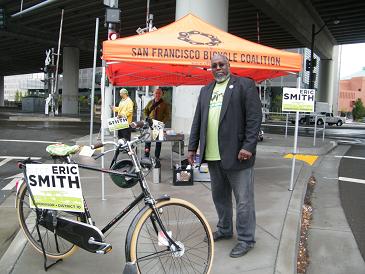
Coming into work this morning, I was greeted by the sight of D10 candidate Eric Smith standing under a San Francisco Bike Coalition tent near the railroad/freeway intersection at 16th and 7th Street in Potrero Hill.

Curious, I stopped by their tent where I was greeted by a hearty handshake from Smith, and plenty of input from the Bike Coalition’s Marc Caswell and League of Conservation Voters president Amandeep Jawa about why they support Smith.

“Eric is about integrity and sustainability,” Jawa said. “In a district like D10 that so desperately needs those things, Eric is the obvious choice.”

“D10 has a lot of really great street projects that are already approved by the MTA,” Caswell added. “So we are looking for strong leadership from Eric on the Board of Supervisors around biking, walking and transportation.”

Smith for his part chatted about Sup. John Avalos’ recently introduced Local SF legislation, which would require contractors to meet local hiring goals that will be phased in over the next few years.

Smith supports Avalos’ legislation—and thinks it needs to go even further.

“A lot of the folks who are clamoring for jobs don’t have the skills,” Smith said, noting that only John O’Connell High School of Technology has vocational training.

“Idle union workers could train folks for prime time, that’s the basic premise of the work that Raquel Pinderhughes did,” Smith said, referring to the efforts of Pinderhughes, an urban studies professor at San Francisco State, to secure truly green-collar local jobs.
“There has to be a mechanism to train folks who need skills, to get them truly trained and ready to take the union tests. That would be a sustainable approach and a huge part of the solution.”

Overcoming a foreclosure, Cohen promises to be a “fierce advocate”

16

D10 candidate Malia Cohen deserves kudos for publicly confronting rumors that she was facing a foreclosure–and for vowing to be a strong advocate, in future.

“I first addressed the rumors publicly a month ago,” said Cohen, who returned to the topic of her foreclosure earlier this week at a San Francisco Housing Coalition candidate night.

You can watch the entire proceedings of the Housing Coalition’s candidate night by clicking on the video clip at the end of this post.

But what Cohen personally told me today not only typifies many of the foreclosure horror stories that have been making national headlines. It also illustrates the abysmal lack of local leadership on this issue–and that’s something that Cohen says she’ll change.

“During the apex of the economic boom, I was the recipient of a predatory loan,” Cohen explained. “I bought a house in the Bayview in 2006 and started the process to modify my home loan. It took one year to get the banks to answer my questions, my paperwork has been lost, and I have a housing counselor I’m working with.”

“Months ago, I got word that my foreclosure has been rescinded and the property is back in my name, so I look forward to being a housing advocate, if elected,” Cohen continued.”Because what the housing crisis has done locally has been to decimate and destabilize our local neighborhoods.”

She notes that 1400 homes have already been lost in the Bayview, and another 1200 are currently teetering on the edge, but so far efforts to reform foreclosure laws have failed in the California legislature.

“Senator Mark Leno proposed SB 1275, which laid out a homeowner’s Bill of Rights, but the bank lobby was too strong,” Cohen said.

‘It’s such a helpless feeling, it’s been a nightmare, “ Cohen continued. “And once again there was no leadership locally to protect our interests, which is another reason why Malia Cohen is in this race. I am going to work hard to advocate on behalf of the community. It’s a crime the amount of money that was transferred out of the Latino and African American community during this crisis. Someone needs to be held accountable.”

Republican who wants to overturn rent control pumps $200,000 into district elections

25

Thomas J, Coates, a big time investor in apartments and mobile homes, has dropped a total of $225,000 into five independent expenditure committees that are trying to push conservative-friendly candidates and measures over the victory line this fall.

Coates, a 56-year-old Republican (he donated $2,000 to George Bush in the 2004 presidential election) and yacht racing enthusiast, was the biggest single spender in the November 2008 election, when he contributed nearly $1 million to Prop. 98, a statewide measure that sought to repeal rent control in California and limit government’s right to seize private property by eminent domain.

And with only 11 days until the election, Coates has given local Republican war chests an enormous last-minute boost: He plunked $100,000 into Common Sense Voters, a committee in support of Mark Farrell in D2. He plunked $10,000 into the Alliance for Jobs and Sustainable Growth’s committee in support of Scott Wiener in D8. He plunked $45,000 into the Alliance’s committee in support of Theresa Sparks in D6. He dropped $45,000 into the Alliance’s committee in support of Steve Moss in D10. And he dropped another $25,000 into San Franciscans for a Better Muni, a committee in support of Measure G, which attempts to reform Muni by focusing on transit operator wages.

As the Guardian previously reported, this Alliance has received thousands from the SF Police Officer’s Association, the Building Operators and Managers Association, the Golden Gate Restaurant Association, and SEIU-United Healthcare Workers, which supports a mega-hospital on Cathedral Hill.

But Coates’ donation raises questions about his choices’ commitment to rent control. As Coates told the Chronicle in an interview in 2008, “There is a reason why 35 of 50 states expressly prohibit rent control by law – and the reason is it doesn’t work.”

Coates, who is a principal in Jackson Square Properties, which specializes in apartments and mobile homes, is also the founding partner of Arroya & Coates, a commercial real estate brokerage and investment firm whose clients include Walgreens, Circuit City, and J.P. Morgan Investment Management. And as campaign disclosures show, he’s dumped a large part of his money into the same conservative alliance that has already collectively spent almost $170,000 on Moss, Sparks and Wiener.

So far, labor has countered the Republican money by spending $70,000 in support of Debra Walker in D6 and $90,000 on Mandelman in D8, and the SF Tenants Union has spent a total of $20,000 on mailers opposing Moss, Sparks and Wiener. But collectively the downtown money, which is also being funnelled into several other independent expenditure committees, continues to massively outweigh the progressive bucks.

Coates’ phone line continues to register a “busy” signal, making it impossible to leave him a message, but I’d be happy to include his comments here, if and when I talk to him.

But Gullicksen said he was disturbed by Coates’ heavy spending on the supervisors’ races.

“Coates is the main funder of Prop. 98, his property is in Southern California, he’s pumping a lot of money into supervisors and he clearly has an agenda that we fear Moss, Sparks and Wiener share, which is to make the existence of rent control an issue the Board will take up, if those supervisors are elected.”

It will be interesting to see if Moss, Sparks and Wiener are prepared to pledge that they have no intention to attack rent control….so, stay tuned.

Meanwhile, labor is organizing a protest outside Coates office at 500 Washington Street at 5 p.m on Tuesday, Oct. 26.

“Be there or be evicted!” labor warned.


Hold onto yer Wiggs, change comin’ to Western Addy

0

Morgan Fitzgibbons isn’t thinking small when it comes to goals for his Western Addition sustainability group, the Wigg Party. “We want to make our community a leader in the transformation in resilience,” he tells me during our coffee date to discuss the group’s upcoming anti-boycott “carrotmob” at Matching Half Cafe (Sat/23). 

It’s no coincidence that his language sounds a little new age-y. The basis for Fitzgibbons’ vision for the Wigglers seems grounded in the PhD of Philosopy, Cosmology, and Consciousness he received at California Institute for Integral Studies. “We’re these sacred beings,” he tells me earnestly of his San Francisco community. “This is a sacred movement – I want people to look back in a hundred years and see that.”

Woo-woo? Well yeah, but hold your jaded mutterings until you hear what the guy’s done with his convictions in “cosmological evolution,” as he puts it. Fitzgibbons has assembled a core group of Western Addition residents who operate in four different arenas of turning the area around SF’s “Wiggle” (the well-trafficked bike route through the Panhandle and between the hills in Lower Haight and Duboce Triangle) into a leader in scaled-back, neighborhood-focused living.

Bicycling barristers: Morgan Fitzgibbons and Wigger Dave Bryson on a city-wide urban farms bike tour. Photo by Jenny Sherman

Their areas of attack, you ask? There’s a sustainable business group, who works on incentives for local outfits that find ways of greening their ways. For example, this Saturday’s carrotmob (you can read more about the nationally recognized concept here) is a concentrated effort to storm Matching Half’s doors with business in support of their pledge to buy a bike trailer to transport farmer’s market-purchased goods, switch to organic milk, and chuck the plastic wrap for reusable food containers. 

There’s also a local food group who works with local markets to freecycle unpurchased produce at the neighborhood’s Hayes Valley Farm, a “rescaling” group focusing on ways to limit commercial consumption, and the Wiggle Transformers, who are collaborating with the SF Bike Coalition on the Wiggle portion of their Connecting the City Initiative, a comprehensive plan to improve bike passage throughout San Francisco.

Like I said, comprehensive. And most of the core group – which Fitzgibbons pegs at around 20 party members – are under 30 years old. Which is neat-o, and most likely made possible by the group’s party ethos when it comes to fighting for what they believe. I mean, I say fighting but I think I really mean loving, or something equally hippie. A bunch of them live in a place called the Sunshine Castle, for god’s sakes, where they throw “shenanigans” (according to Fitzgibbons) after-parties for their events, like the recent 10/10/10 day of action that saw the Wigglers conduct a 50-60 person bike tour of the city’s urban farms and a coordinated garden plant in collaboration with Kitchen Garden SF

In the works are plans for a Bernal Bucks-esque local currency, which the group hopes will inspire Western Addition residents to patronize more heavily the wealth of small businesses along the Divisadero Corridor and surrounding areas (holler, happy hour at Bean Bag). 

Fitzgibbons says the hyper-localism of the Wigg Party is perfectly suited for the history and relative youth of the Western Addition neighborhood.

The Wiggle itself provides a apt symbol for the group. The Wiggle Transformers’ work is making bike traffic better for everybody, but also a physical passage that Fitzgibbons hopes will say “you’re stepping into a different place now” to bikers entering the Western Addition.

“San Francisco has always been a seed of revolution,” he reflects. “Of the younger neighborhoods – the Mission and Western Addition – Western Addition is a lot less nihilistic. With University of San Francisco near the area, there’s always going to be a lot of young people living out here, and that’s who our message resonates with. It’s such a new community.”

This last comment raises a red flag in my mind. The parties, the bike tours, it all sounds grand, but given that all this is coming from a twenty-something guy with a complicated mullet and a hoody, how much does the Wigg Party truly represent the Western Addition, an area that’s been wracked by recurring waves of gentrification and is subject, like everywhere else in the city these days, to ever-increasing rent prices and displacement of long time residents? Despite the free food at Hayes Valley, are we being sustainable, or are we being hipster-sustainable? 

“To be a truly successful movement, we’ll have to organize everybody,” Fitzgibbons says, who himself has lived in the neighborhood for three years. Among those that regularly attend Wigg meetings, there is but one long-time resident, he tells me, who plays an active role advising on how to better integrate with the neighborhood’s ongoing goals and activities. Past that, “there’s tacit support among the long-term residents, and we get a lot of family participation in our Wiggle events,” Fitzgibbons tells me.

But I trust that he’s learning as he goes. After all, in explaining his philosophy on activism to me, Fitzgibbons appropriates that sustainability champion himself: Socrates. “The only thing I know is I don’t know everything,” he smiles. “We don’t have to have all the t’s crossed and i’s dotted, but we can whip up excitement and hopefully inspire people to do this in their communities. Create that showcase.” And if figuring it all out looks like a party in the streets, sayeth the Wigglers, so be it. 

Wigg Party Carrotmob

Matching Half Cafe

Sat/23 3-6 p.m., free

1799 McAllister, SF

www.wiggparty.org


Our Weekly Picks: October 20-26

0

THURSDAY 21

THEATER

“The Laramie Residency”

Just when you thought it was safe to come out of the closet, a chilling spike in suicide rates among gay teenagers who have been bullied or harassed has reemerged as national news. Which makes this rare double-header of The Laramie Project and its sequel, The Laramie Project: Ten Years Later, Epilogue uncannily apropos. Written in response to the notorious murder of Matthew Shepard, a young gay man in small-town Wyoming, both plays were created from hundreds of interviews with the inhabitants of Laramie. The results offer a detailed examination of how violence affects not only the perpetrators victims, but an entire community. “The Laramie Residency” also includes a special Thursday dialogue between director and coauthor Moisés Kaufman and Tony Taccone of the Berkeley Rep. (Nicole Gluckstern)

Thurs/21, 7 p.m.; Fri/22–Sat/23, 8 p.m., $10–$55

Jewish Community Center of San Francisco

3200 California, SF

(415) 292-1233

www.jccsf.org

FILM/PERFORMANCE

All About Evil: The Peaches Christ Experience in 4-D”

Horror fans are well familiar with the tag line for Wes Craven’s 1972 Last House on the Left: “To avoid fainting, keep repeating ‘It’s only a movie … It’s only a movie…'” Well, it wouldn’t be Halloween in San Francisco without Peaches Christ, whose alter ego, the less-flashy but no less fabulous filmmaker Joshua Grannell, brings his All About Evil to life at the very Mission District theater where it was shot. The film and its accompanying pre-show performance have been out roaming the U.S. and the U.K. for the past several months; expect the hometown gig to be extra-specially spooky, with musical and multimedia numbers by Peaches and Evil cast members. And since the Victoria plays an important supporting role in the film, expect interactive surprises galore. Only a movie? Don’t be so sure! (Cheryl Eddy)

Through Sun/24

8 p.m., $20

Victoria Theater

2961 16th St, SF

www.peacheschrist.com

MUSIC

Joshua Bell with the San Francisco Symphony

An average street performer isn’t always average. In 2007, the acclaimed violinist Joshua Bell participated in an experiment in which he played for 45 minutes as an anonymous busker in the D.C. Metro. The few who bothered to pause in their morning bustle and pull out their headphones realized they were in the presence of greatness. Renowned worldwide, virtuoso Bell joins the San Francisco Symphony in Bruch’s Violin Concerto No. 1. Conducted by James Conlon, the evening also includes Wagner’s Prelude to Act I of Die Meistersinger von Nürnberg, as well as Dvorák’s In Nature’s Realm and the overtures to Carnival and Othello. (Emmaly Wiederholt)

Thurs.–Sat., 8 p.m.; Sun, 2 p.m., $15–$150

Davies Symphony Hall

201 Van Ness, SF

www.sfsymphony.org

MUSIC

Steve Lawler

You can either love or hate seminal Ibiza club Space, and there’s been plenty of room to do both in its 20-year history. But just when you throw up your hands in a bad way at all the astringent trance, tipsy Brits, and noodling minimal, boom!, a DJ comes along who can drag you back to the dance floor. Rightly respected Brit Steve Lawler, known as the “King of Space,” scored that tiara by leapfrogging styles and keeping his sets limber. There’s some fluttering bass, chunky old-school breakdowns, and searing tech in his bag as well as, gasp, snippets of wistful melody. Lawler especially rocks the hard-driving, samba-esque Spanish-Berlin sound that’s become Ibiza’s best recent export. (Marke B.)

9:30 p.m., $10–>$20

Vessel

85 Campton Place, SF

(415) 433-8585

www.vesselsf.com

DANCE

Kunst-Stoff and LEVYdance

Dancers are famous for their kinesthetic memory. Without activating the brain, their muscles recall whole dances — or at least fragments. Show them a step or two and the rest follows. But dancers also seem to be able to dig even deeper, into something akin to an ancestral memory. It may take personal affinity but also a lot of hard research to unearth the kind of treasure trove that then can be used creatively. Two temperamentally different choreographers, Yannis Adoniou, of Greek descent, and Ben Levy, from a Jewish-Persian family, have done the excavations. Adoniou’s Rebetiko, commissioned by CounterPULSE’s Performing Diaspora Program, and Levy’s Our Body Remembers should make for an intriguing evening of might be called “kinetic history.” (Rita Felciano)

Through Oct. 30

Thurs.–Sat. and Sun/24, 8 p.m., $18

ODC Theater

3153 17th St., SF

(415) 863-9834

www.odctheater.org

FRIDAY 22

MUSIC

Stone Foxes

Let’s talk foxes, shall we? The native gray one is uncommon in San Francisco. The exotic red species, however, is a regular interloper of the Presidio. The Stone Foxes, four young dudes who play mean blues, are more like the former: genuine, rare, and always a treat to see in the wild. Sometimes you don’t want indie or nu-gaze or psych-doom-metal — you simply need real rock ‘n’ roll. Their sophomore album Bears and Bulls was released this past July, and though not as raw as their killer debut, it exudes a new and natural confidence. This is their official vinyl release show, so bring extra cash. (Kat Renz)

With Soft White Sixties and Real Nasty

10 p.m., $12

Bottom of the Hill

1233 17th St., SF

(415) 621-4455

www.bottomofthehill.com DANCE

Paco Gomes and Dancers

In his choreography, Brazilian-born Paco Gomes speaks with a powerfully articulated and mature voice. His dances beautifully integrate modern and Afro-Brazilian influences; as a company director he gathers around him — and trains — multi-ethnic dancers who seem to thrive under his tutelage. Now, with guest choreographers Jorge Silva and J. Pazmino, Gomes is presenting Amor O, an evening of works old and new that circles around love: of self, of friends, and also as remembered and lived within families. In addition, the program includes an excerpt of a new work in progress planned for an upcoming international tour. It examines love within another “family,” the Orixas, from the Yoruba religion. Perhaps it’s a consolation that in the world of the gods, not everything went smoothly either. (Felciano)

Through Sat/23

8 p.m., $15

Garage

975 Howard, SF

(415) 518-1517

www.975howard.com

MUSIC

Karl Blau

Eclectic K Records artist Karl Blau throws a wrench into the indie/folk scene with a chameleon-like ability to work within multiple genres. Ignoring the usual expectations of singer-songwriter stereotypes, Blau is known to inject everything from hip-hop and electronic influences to world and reggae music into his solo albums. He’s also worked with some notable names in Phil Elvrum (The Microphones, Mount Eerie) and Laura Veirs. Blau can currently be found playing bass for droney doom-metal band, Earth. It’ll be interesting to see how he melds all these elements together in a live setting. (Landon Moblad)

With Dina Maccabee and Birds and Batteries

7 p.m., free ($5 donation suggested)

Viracocha

998 Valencia, SF

(415) 374-7048

www.viracochasf.com

MUSIC

Lyrics Born

If it was any other rapper describing his newest album as “more synth-oriented” and “dealing with a lot of issues that are more mature than the last few albums, from abandonment to betrayal to incredible joy,” I’d say watch out for a lawsuit from one Mr. West. But since half of Latryx (with Lateef the Truthspeaker) and cofounder of Quannum Records, Lyrics Born is known for bringing his own brand of substance to the scene while pushing the genre forward. His new material, which features emerging artists Trackademicks, Francis and the Lights, and Sam Sparro, will be on display at this release party. (Ryan Prendiville)

With Chali 2na and the House of Vibe and Rakaa

9 p.m., $25

Independent

628 Divisadero, SF

(415) 771-1421

www.theindependentsf.com

SATURDAY 23

MUSIC

Triptykon

After almost 30 years in the arena, Tom G. Warrior has earned his status as heavy metal royalty. The Swiss singer and guitarist formed Hellhammer in 1982 and went on to found Celtic Frost two years later. Both bands contributed immeasurably to the development of extreme metal, and their influence reverberates throughout the genre today. Having parted ways with Celtic Frost in 2008, Warrior formed Triptykon, planning to pick up where Monotheist (Celtic Frost’s 2006 LP) left off. The new band’s music combines slabs of doomy guitar, razor-wire black metal, and Warrior’s paint-peeling vocals, breaking down genre boundaries in pursuit of heaviness. Come out and play. (Ben Richardson)

With 1349 and Yakuza

9 p.m., $23

Slim’s

333 11th St, SF

(415) 255-0333

www.slims-sf.com

EVENT

“SF DocFest Roller Disco Costume Party”

Have you ever stared longingly at the roller skaters in Golden Gate Park? Always wanted to join in but too embarrassed by your lack of boogie? Still hung up over the accident you had at a fifth grade skate party? Well, get over it. The Roller Disco Costume Party offers a simple solution: anonymity. As part of DocFest, admission is free with a ticket stub or just $5 if you strap on your best costume (which could potentially double as padding in case of collision.) (Prendiville)

8 p.m., free–$10

CELLSpace

2050 Bryant, SF

www.sfindie.com

MUSIC

Taj Mahal, Toumani Diabaté, Vieux Farka Touré

Tonight the Paramount plays host to a blues exploration featuring American bluesman Taj Mahal, Malian kora player Toumani Diabaté, and Malian guitarist Vieux Farka Touré. To trace the roots of the blues immediately leads to Africa, and in particular to Mali, and each of these three frontmen represents a different facet of that exploration. Mahal has spent decades reinterpreting the blues through far-flung musical traditions from the Caribbean and Hawaii to Europe and Latin America; Diabaté brings to the fore the centuries old West African tradition of the kora; and Touré, the torch-bearing son of the late Ali Farka Touré, represents a more recent cross-pollination of traditional Malian sounds with American blues and rock. While each of the three musicians is a monster in his own right, together they represent a veritable blues trifecta. (Mirissa Neff)

8 p.m., $25–$75

Paramount Theatre

2025 Broadway, Oakl.

(510) 465-6400

EVENT

“B.Y.O.Q.: Bring Your Own Queer”

Gurla-Q, you better bring it: a cavalcade of queer artists, musicians, and performers is avalanching Golden Gate Park for a full day of heady debauchery. Vinyl soul from the Hard French party DJs, homo-futurist sounds from Honey Soundsystem, Las Bomberas de la Bahia’s Afro-Puerto Rican percussion and dance, local indie faves Excuses for Skipping, fashion shows, a candygram booth, art displays, and so much more to turn you hot pink with multitasking. Plus, special guest John Cameron Mitchell giving you Hedwig fierceness. The annual B.Y.O.Q. has been a sweet, sweet success, conjuring up the activist days of yore while introducing some amazing new talent. Don’t wrap your internal pansy up in a plain brown bag, let her shine and shine. (Marke B.)

Noon–6 p.m., free

Golden Gate Park Music Concourse, SF

www.byoq.org

SUNDAY 24

MUSIC

Reigning Sound

Reigning Sound burst out of the gates in 2002 with the garage-punk classic, Time Bomb High School. Since then, the Tennessee-based group — performing as part of the ninth Budget Rock festival — has continued to refine its brand of country, soul, and classic R&B touches by way of organ-filled, distorted guitar-driven rock ‘n’ roll, most recently on 2009s Love & Curses. The band also recently backed up original Shangri-la member Mary Weiss on her 2007 comeback album, further evidence of the range its capable of. As far as modern garage rock goes, Reigning Sound is as classy and fun a group that you’re likely to find. (Moblad)

With Flakes, Ty Segall, and Touch-Me-Nots

9 p.m., $15

Bottom of the Hill

1233 17th St, SF

(415) 621-4455

www.bottomofthehill.com 

The Guardian listings deadline is two weeks prior to our Wednesday publication date. To submit an item for consideration, please include the title of the event, a brief description of the event, date and time, venue name, street address (listing cross streets only isn’t sufficient), city, telephone number readers can call for more information, telephone number for media, and admission costs. Send information to Listings, the Guardian Building, 135 Mississippi St., SF, CA 94107; fax to (415) 487-2506; or e-mail (paste press release into e-mail body — no text attachments, please) to listings@sfbg.com. We cannot guarantee the return of photos, but enclosing an SASE helps. Digital photos may be submitted in jpeg format; the image must be at least 240 dpi and four inches by six inches in size. We regret we cannot accept listings over the phone.

Summer in the fall

0

arts@sfbg.com

MUSIC As I sit sipping some morning coffee, Elizabeth Morris of Allo Darlin’ is wrapping up an unseasonably sunny London afternoon. “I don’t know what’s happening, but it’s really warm weather,” she says over the phone. “The last week was really cold and miserable, and then the last two days have been absolutely beautiful.”

It seems fitting to be discussing Allo Darlin’s self-titled album with Morris on a day when the sun won’t be denied. You’d be hard-pressed to find a more perfect “summer” album released in October. Full of shimmery electric guitar, tambourine shakes, and bass lines that would sound at home on lost Motown cuts, the group’s music oozes charm, occupying some sort of space between Belle & Sebastian and a modern, garage-y spin on the Shangri-Las. Out at the forefront of it all is Morris with her ukulele and enchanting vocals.

Originally born and raised in Australia, Morris moved to London five years ago, shortly after finishing school in Brisbane, hoping to do something with the songs she’d begun writing. In Brisbane, Morris doubted her talents and ability to fit in, but London’s music scene proved to be a much more fertile ground for her. “Brisbane at the time was really grunge-y, noise rock, avant-garde kinda stuff — which is cool, but I felt really out of place and would never have felt confident playing little pop songs,” she explains. “I’d definitely written a bunch of songs, but I thought they were all pretty much rubbish. I didn’t feel like I’d written anything good until I moved to London.”

Once settled in London, Morris fronted the Darlings, a group made up of coworkers from the TV and film sound production facility she worked at. After that group dissolved, she began playing solo before winding up with a backing band made up of friends of friends, brothers of friends, and members of some of her favorite local bands. It all came together with a little help from the Boss.

“I was asked to do a Bruce Springsteen song for this tribute compilation and I knew Paul (Rains, Allo Darlin’ guitarist-keyboardist) was really into him. So I asked if he wanted to do this song with me, and that’s kinda how I got started playing with these guys. So we were brought together by Springsteen,” Morris says with a laugh.

In the interview, Morris talks excitedly about some of her musical loves: Jonathan Richman, Steve Martin’s banjo playing, the Go-Betweens, old reggae. She and her bandmates share an affection for Yo La Tengo and their parents’ old Beach Boys’ records. Her earnest and enthusiastic admiration mirrors the tone of her lyrics, which play a major role in making Allo Darlin’ fun. One minute she’s combining lines about love and chili, the next she’s breaking into a verse from Weezer’s “El Scorcho” or singing what’s gotta be the first pop song ever written about Ingmar Bergman’s Wild Strawberries (1957). Her lyrical style is clever and unique — by turns romantic, silly, pensive, or yearning.

“I kind of always write from emotion or feeling rather than anything else. I never really sit and write things in a notebook or compose words,” Morris says. “I’ve tried to write story-songs or songs about characters, but it just never really works. I’m not very poetic, I guess. I’m better at seeing things how they are, trying to put them into words with a nice melody and seeing what happens.”

Allo Darlin’s upcoming tour marks the group’s third trip to the U.S., but it’s their first time in California. Despite the impersonal nature of a phone conversation, Morris’ excitement is palpable. She’s even picking up some American slang. “All the bookers say ‘psyched’ — like ‘We’re psyched that you’re coming.’ It’s really cute,” she says, laughing.

“So yeah, we’re psyched to be doing the West Coast.”

ALLO DARLIN’

with Eux Autres, Terry Malts

Wed/27, 8 p.m.; $10

Rickshaw Stop

155 Fell, SF

(415) 861-2011

www.rickshawstop.com

On the margins

3

Sarah@sfbg.com

Franklin is a 20-something computer programmer who shares an apartment with 10 other people around his age, an arrangement that helps him and his housemates come up with $3,500 each month for rent in the Mission, a rapidly gentrifying part of town.

“Everyone is pretty much working, but they are in and out at different times so the house isn’t ever really empty. But there’s usually only three or four of us at a time, ” Franklin told the Guardian, speaking on his cell phone as he rode his bike to work.

But how does an apartment that officially has only one bedroom sleep 10 people? Franklin said there are other rooms in the house — including a dining room and a double parlor that splits into two with sliding doors — and that each of these spaces has a couple sleeping in it. “And there is one person sleeping in a closet and another sleeping in a space atop the bathroom.”

While overcrowding has been a problem in immigrant communities in San Francisco, it’s reaching a new area: young people who have for generations flocked to the city to escape uncomfortable home lives, find a supportive community, and make a new start in life.

Ted Gullicksen, director of the San Francisco Tenants Union, said at least 1,250 housing units annually were lost to condominium and tenancy-in-common conversions in the dot.com and housing bubble years, a loss rate that has slowed only slightly since then.

“Right now, it’s about 1,000 units a year,” he said.

It’s become more common for young people to struggle to pay rent in a town where well-paying jobs are scarce and educational programs have been cut — a triple whammy that means youth with additional challenges are at risk of becoming homeless and getting trapped in vicious cycle of abuse and incarceration.

COMPOUNDING THE PROBLEM

Sherilyn Adams, executive director of Larkin Street Youth Services, which provides housing, medical, social, and educational services to at-risk homeless and runaway youth, says all young people in San Francisco face the same basic challenges.

“And if, in addition, these youth are part of a group like LGBTQ youth, or are youth of color, or immigrant youth, documented or not, then the circumstances and barriers are much more exacerbated,” she said.

Adams said San Francisco has done a lot to add resources for transitional age youth, a group that traditionally has been defined as ages 12 to 24. “But there is still a significant gap in resources, especially for the more disenfranchised groups, because the longer you’ve been on the street, the more complex your issues in terms of substance abuse and mental health.”

Civic leaders, including California Assembly member Tom Ammiano, recently held a rally and candlelight march to raise awareness of the tragic rise in homelessness and suicides among LGBTQ youth. Shortly after, Adams told us, “Youth who came here escaping homophobia in their family or city then face the harsh reality of San Francisco.”

Adams understands that some people see Proposition L, legislation on the November ballot to criminalize sitting or lying on city sidewalks, as a way to address disruptive and aggressive behavior on the streets. “But it becomes part of the larger divide, because youth who come here and are on the street are mostly there because they have no other place. So penalizing them in the absence of services, housing, and education is ineffective at best and really harmful at worst,” Adams said.

Many young people on the brink of homelessness are “somewhat invisible,” and therefore at high risk, she said. “Youth will double, triple up. They will couch surf as a way to be off the streets. And we hear the stories where youth are faced with a Sophie’s choice: Do you sleep on the street, or do you barter with what you have available so as to get shelter? And LGBTQ youth are at particular risk because the more disenfranchised and disconnected you are, the more you have to make impossible choices to survive.”

Jodi Schwartz, executive director at Lyric, an SF nonprofit that focuses on building community and inspiring change in LGBTQ youth, said the group serves 500 youth and reaches out to 800 to 1,000 more each year. “We go into classrooms and talk about hate speech, putting it in the context of racism and other forms of oppression,” she said.

“There’s a misconception that because we live in San Francisco and have a lot more dialogue and interaction with the LGBTQ community, that young people’s experience here is so much better. It may be different, but I wouldn’t say it’s better,” Schwartz said, noting that harassment levels, especially for transgendered youth in local schools, are very high.

HELPING THOSE IN NEED

Young women are another at-risk group, especially if they are pregnant, have kids, or are in the foster or juvenile justice system.

As executive director of the Center for Young Women’s Development in San Francisco’s gritty SoMa district, Marlene Sanchez tries to stabilize at-risk young women, then engage them in policy work so they can advocate for other young people they know.

“We work with young women who are involved in the underground street economies, doing prostitution, drug sales, and selling stolen goods like clothes,” Sanchez said. “We try to reach them on the streets and inside Juvenile Hall, so we take an inside-outside approach.”

Leajay Harper, who coordinates CYWD’s Young Mothers United program, works with young pregnant women inside Juvenile Hall.

“We have all experienced poverty, parents on drugs, and having to take care of younger siblings,” Harper said. “When young moms get incarcerated, they are at risk of having their children taken away at much higher rates. So we started parenting classes that are age and culturally relevant.”

City records show that while only about 12 percent of Juvenile Hall detainees are female, they are twice as likely as their male counterparts to land back in custody for probation violations.

“There are lots of young women with felonies struggling to pay their bills and feed their kids who look out the window and see they can sell drugs. And that often seems like the only option,” Sanchez explained.

City statistics also show that of the overwhelmingly male population at Juvenile Hall, almost half is African American, and that many are inside for what appear to be gang-related offenses.

Easop Winston, a 35-year-old local musician, church pastor, and member of the Visitacion Valley Peacekeepers, regularly visits young men inside Juvenile Hall, where gangs are a topic of discussion every week.

“The same guys that they have been fighting with, they are now incarcerated with,” Winston observed. “So one of the approaches I try to take is rehabilitating how they think about their neighbor. You are killing/fighting with someone who lives one block over. It’s plain genocide”

He credits the juvenile justice system for doing its best, but worries that it fails to rehabilitate youthful offenders with jobs skills, education, and counseling before sending them back into society.

He blames the churches for not doing a better job of making youth feel welcome. “Churches are part of the fabric of our community,” he said. “They need to do more outreach and not have so many rules. They need to accept youth as they are, with their tattoos, piercings, and styles of clothing.”

Winston believes politicians need to do a better job of making sure community-based organizations deliver on their promises to help working class communities of color. At the same time, as he acknowledges, “We can’t cure the world in one day.”

“Over the last five to 10 years, the African American population in SF has shrunk,” he observed. “Everybody is moving to Antioch and Fairfield because people can’t afford to live here. People are losing their jobs. And San Francisco has almost become impossible to live in unless you have a college degree. A lot of what I hear from youth is about economics. They want jobs. They want to be trained.”

PUSHING THEM OUT

Political disputes over the city’s sanctuary city policies on undocumented immigrants — which have left in limbo the question of whether arrested immigrants will get their days in court before being turned over to the federal government for possible deportation — have also been a source of instability for immigrant teens, many of whom are homeless and/or LGBTQ.

Police Commissioner Angela Chan, a staff attorney with the Asian Law Caucus, decried Mayor Gavin Newsom for refusing to implement Sup. David Campos’ due process legislation, which the board approved in November 2009.

“It’s been a little bit upsetting for the many groups that took the democratic process seriously. But these groups are still very committed to these kids,” Chan said. “We are hoping to work with the new U.S. Attorney Melinda Haag to clarify this issue and explain that the top priority of the Obama administration is not to deport undocumented youth.”

Other so-called tough-on-crime initiatives also threaten local at-risk young people. In September, City Attorney Dennis Herrera secured an injunction against 41 alleged gang members in Visitacion Valley, a strategy that progressives fear will accelerate the ongoing displacement of the African American community.

Court documents show that 66 percent of the men named in the injunction are 18 to 25 years old and that many have children in public housing, where lease holders are predominantly women of color.

San Francisco City College Trustee Chris Jackson, 27, is running for the District 10 seat on the Board of Supervisors. Noting that the southeast SF district has some of the highest numbers of poor people and children citywide, Jackson said that youth issues are similar to challenges that other voters face.

“But the context is different,” said Jackson, who previously served on the San Francisco Youth Commission. “Young people care about safe streets because it’s us or our friends who are on them. We care about schools because we are in them and want to go to college. And we are concerned about the future of employment because how do you tell folks to go to school if there are no jobs?”

Jackson notes that in the Bayview-Hunters Point, home to the city’s largest remaining African American community, kids don’t come back if they leave for college. “We see a brain drain. It’s really difficult to retain young people, so it’s important to first make sure that youth’s housing needs are met. And they also need access to careers so that when they graduate, they know there is a job in the city. But right now, youth can’t even find a summer job because of the recession.”

He called for city policies that are based on the needs of current city residents rather than developers’ profits or the desires of well-off outsiders to move here.

“San Francisco is more of an opportunity for Silicon Valley residents than for youth who were born and raised here. And part of the problem is city policies, ineffective programs, and a failure to provide job opportunities for youth,” he said. “Everything for youth has been gutted.”

And those evaporating opportunities are compounded by punitive policies like Prop. L, Jackson said, further alienating young people. “It comes down to how much money you have,” Jackson observes. “If you are rich, you can enjoy the parks, the clubs, the transit. But if you are low-income, especially low-income youth of color, it’s very hard to take advantage of everything the city has to offer.”

Noting that both City College and the San Francisco Unified School District canceled their summer school program, Jackson said, “it doesn’t look like youth are prioritized.”

Jackson was recently at Double Rock (a.k.a. the Alice Griffith Public Housing Project) and he saw four kids under 10 who were at home while their parents were at work. “Why aren’t they in school or in child care? And don’t give me the line that these are hard to serve communities. We have to serve them.”

N’tanya Lee, executive director of Coleman Advocates, agrees that while all young people are struggling in the city, African American children and youth are having one of the worst times.

“We don’t need 5,000 different strategies and initiatives when 90 percent of these kids live in extreme poverty, mostly concentrated in public housing, and you could fit the city’s entire black high school student population into one auditorium,” Lee said.

She wants the city to create a database of these youth and develop specific strategies to help this population before it’s too late.

“No one in city government feels accountable for the outcomes for black children and youth,” she said. “Instead you have one group who are about young people and another who are about economic development — and they have nothing to do with each other. Meanwhile, we’ve lost half of all black families with children in this city in the past 20 years.”

Our 44th Anniversary Issue also includes stories by Rebecca Bowe on ageing out of the foster care system, Caitlin Donohue’s account of the Haight street kids, and Tim Redmond’s editorial on the issues facing our rising generation

The soul of the city

23

tredmond@sfbg.com

44th ANNIVERSARY SPECIAL We all arrived in San Francisco broke: Paulo and me in the ’73 Capri, crawling over Donner Pass with a blown valve and three cylinders firing; Tracy and Craig in the back of a VW van, behind in the payments and on the run from the repo men; Tom and Sharon hitching across the Southwest after Tom, who could bullshit with the best, talked himself out a jail cell in New Orleans. Moak showed up in a rusty Datsun with the wheels falling off. Jane and Danny came on the old hippie bus, the Green Tortoise, $69 across the country.

But we all had a friend who knew a friend where you could crash for a little while. And in the early 1980s you got food stamps the first day and it only took a couple of weeks to get a job waiting tables or canvassing or selling trinkets on the Wharf. And once you’d scraped together a couple hundred dollars — maybe two weeks’ work — you could get a place to live. My first room in a flat in the Western Addition was $120 a month.

We did art and politics and writing and music. After a while, some of us went to law school, some of us became journalists, some of us went into government and education. A few of us fled, and Paulo died in the plague (dammit). But in the end, a lot of us were — and are — San Franciscans, part of a city that welcomed us and gave us a chance.

It was a very different time to be young in San Francisco.

I’m not here to get all nostalgic, really I’m not. There were serious problems in 1982 — raging gentrification was creating clashes in the Mission and the Haight and south of Market that were more violent than anything going on today. And frankly, broke as we were, most of my friends were from middle class homes and were college educated and had a leg up. We weren’t going to starve; we didn’t have to make really ugly choices to eat.

Most of the stories in this special anniversary issue are about marginalized youth — young people trying to survive and make their way against all odds in an increasingly hostile city and a bitter, harsh economy.

But there’s an important difference about San Francisco today, something earlier generations of immigrants didn’t face. The cost of housing, always high, has so outstripped the entry-level and nonprofit wage scale that it’s almost impossible for young people to survive in this town — much less have the time to add to its artistic and creative culture.

I met the 21-year-old daughter of a college friend the other day. She’s as idealistic as we all were. She wants to move to San Francisco for the same reasons we did and you did — except maybe she won’t. Because she felt as if she had to come visit first, to use her dad’s network, see if she could line up a job and figure out if her likely earnings would cover the cost of living. When I mentioned that I’d just up and left the East Coast and headed west, planning to figure it out when I got here, she gave me a look that was part amazement and part sadness. You just can’t do that anymore.

The odds are pretty good that San Francisco won’t get her — her talent and energy will go somewhere else, somewhere that’s not so harsh on young people. I wondered, as I do every once in a while when I’m feeling halfway between an angry political writer and an old curmudgeon: would I come to San Francisco today?

Would Harvey Milk? Would Jello Biafra? Would Dave Eggers? Would you?

If you were born here, would you stay?

Are we squandering this city’s greatest resource — its ability to attract and retain creative people?

The two people who started the Bay Guardian 44 years ago were young arrivals from the Midwest. Bruce Brugmann looked around the city room at the Milwaukee Journal, where he worked as a reporter, and realized there wasn’t any job he wanted there in 10 years. With two young kids and a dream of starting a weekly newspaper in one of the world’s most exciting cities, Bruce and his wife, Jean Dibble, settled in a $130-a-month flat. The Guardian’s first office was a desk in the printers shop. When they paper could finally afford its own space, Bruce and Jean moved the staff into a $60-a-month four-room place on Ninth and Bryant streets.

From the start, the paper was a “preservationist” publication — both in terms of environmental issues like saving the bay and in the larger political sense. The San Francisco Bay Guardian was out to save San Francisco.

The city was under assault — by the developers who were making fast money tossing high-rises into downtown; the speculators making fast money flipping property, ducking taxes, and driving up rents; the unscrupulous landlords who were letting their buildings fall apart while they charged ever higher rent. For the Guardian, fighting this urbicide meant protecting San Francisco values, preserving the best of the city from what Bruce liked to call “the radicals at the Chamber of Commerce.”

For the Guardian, progress wasn’t measured in the number of new buildings constructed, but in the ability of the city to remain a place where artists and writers and community organizers and hell-raisers — and the young people who were always bringing new life to the city — could survive. We supported rent control, and growth limits, and affordable housing policies, and limits on condo conversions, and minimum-wage and sanctuary city laws — and a long list of other things that together amounted to a progressive agenda.

And in 2010, the assault on the young, the poor, the nonconformists, the immigrants, is still on, at full force. The mayor and his allies are pushing a ballot measure that would make it illegal just to sit on the sidewalk. He’s also turning the local juvenile authorities into immigration cops, breaking up families in the process. He’s cut funding for youth services, and wants to make it easier for speculators to evict tenants, take affordable rental housing (especially the flats that young people share to save money) off the market, and create high-priced condos. Virtually all of the new housing he’s pushing is for rich people. He’s shutting down parties and arresting DJs and, in effect, declaring a War on Fun.

What he’s doing — and what the downtown forces want — is the transformation of San Francisco from a welcoming city where the weird is the normal, where the young and the crazy and the brilliant and the broke can be part of (or even drivers of) the culture, to one where profit and property values are all that matter. And that’s a recipe for urban doom.

Richard Florida’s 2004 bestseller The Rise of the Creative Class shook up political thinking by pointing out that cities thrive with iconoclasts, not organization people. Everyone likes to talk about that now, even Mayor Gavin Newsom. But the missing piece, from a policy perspective, is that the creative class — particularly the young people who are going to be the next generation of the creative class — needs space to grow. And that means the most important thing a creative city can do is nurture the very people Newsom and his allies want to drive away.

If Prop. L, the “sit-lie” law, passes, if the rental flats in the Mission that have been home to several generations of young artists, writers, musicians and future civic leaders vanish in the name of condo conversions, if 85 percent of all the new housing in San Francisco is affordable only to millionaires, if the money that helps foster kids and runaways and at-risk youth dries up because this rich city won’t raise taxes, if nightlife becomes an annoyance to be stifled…then we’re in danger of losing San Francisco.

Our 44th Anniversary Issue also includes stories by Sarah Phelan on SF’s disadvantaged youth, Caitlin Donohue’s account of the Haight street kids, and Rebecca Bowe’s look at ageing out of the foster care system

How they’re sitting

182

caitlin@sfbg.com

I’ve been hanging out with the Haight Street kids. Over the course of a week or so, I smoked weed, drank malt liquor, witnessed nasty run-ins with police officers — all events that anyone who has walked down the sidewalks of that legendary street would expect. But I also met people who’d give away their last dollar to a friend, people who know a thing or two about community, and people who don’t see sidewalks only as thoroughfares to commerce.

Ironically, though the homeless kids on Haight are the explicit inspiration for Proposition L, the sit-lie measure on the Nov. 2 ballot, their voices have been significantly absent from the vitriolic debate on its merits and faults. Ironic because of all people, it’s these young men and women — and the citizens of San Francisco who interact humanely with them — who could teach us the most about what public space in San Francisco could be.

I didn’t just stand with a notebook, fire questions, and walk away. I took a seat and spent time with the kids, to see for myself whether its true that they’re harassing people, letting their dogs run amok, and generally ruining everyone’s lives as much as sit-lie supporters say they are. That it turned out to be uplifting was an added bonus. I got to see what many don’t on their way to shop for souvenir bongs, retro dresses, and designer skateboards — the reason young people from around the country come to the neighborhood.

It doesn’t have anything to do with fancy Victorians and boutiques, which may explain the disconnect between the street kids and their detractors. They come for the legacy of individuals brave enough to slough off social mores that Haight-Ashbury residents are so ostensibly proud of — not to mention the companionship of others who are comfortable with their rejection of and by society. They come to share stories and pipes and encouragement, and it was cool to watch a streetscape in San Francisco that wasn’t geared solely to commerce.

And while the young people I talked to told me how much they liked to travel, to live free of convention and without ties to the workday world, after a while most acknowledged that they had left behind families who couldn’t or didn’t care for them, home situations that were uncomfortable enough to make life on the streets seem like a better alternative.

Although violent incidents, uncivil behavior, and threatening dogs are well-documented by other news sources, I didn’t see any of that when I was hanging out on Haight. That doesn’t mean that these things don’t exist — but it might suggest that some of the strident supporters of Prop. L are seeing what they want to see.

SPANGING

Steven, who asked us not to use his full name, is 20 and homeless. He grew up in Stockton, became a welder after high school, then decided he “didn’t want the hassle” of staying put for a wage job. His fingernails play host to an ungodly amount of dirt, but his tight blonde curls, pretty golden eyes (“they look like a lion’s!” says one friend in amazement) and mellow, generous demeanor make him a popular hub among his homeless peers.

It doesn’t hurt that he sells weed, small amounts at a time to passing tourists and acquaintances. He silently passes a pipe around to his companions with the slightest provocation. Steven approached me on the street before he knew I was a journalist, a fact that seemed to make little difference to him.

He says he came to the Haight “for the people,” for the area’s reputation of open souls and unconventional artists that originated in the glory days of Janis Joplin and the Grateful Dead. Like most of the kids I talked to, he eschewed the often dangerous shelter scene to sleep in Golden Gate Park or nearby Buena Vista Park despite the police surveillance that could result in spendy fines for park camping.

Although Steven’s worldly possessions fit into the large camping backpack he carries with him 24 hours a day, and even though he’s been living on Haight less than nine months — broken by a jaunt to Eugene, Ore., where he found it “too rainy” to join the town’s expansive street kid community — he doesn’t plan on being homeless forever. It’s just that nothing about this economic climate inspires him to sell his freedom for a paycheck. He plans to go to a four-year college eventually. He sees an education as the only way to get a “real” job. “But until then, why not do this?” he asks. I’m not sure if he’s waiting for my answer.

“This” is sit on Haight Street and “spange,” the term used for “flying a sign” and asking shoppers and neighbors walking by for money, often in a creative way. Of the many crimes street kids are guilty of in the eyes of supporters, spanging is the only one Prop. L would effect.

If Francisco voters approve it, anyone who sits or reclines on the sidewalk (with exceptions for the handicapped and those with permits — but not for the tired, workers on breaks, or people waiting for buses) will be subject to a fine of $50 to $100 for the first offense and $300 to $500, or a maximum of 10 days in jail, for someone found guilty twice within 24 hours of unduly supporting his or her body on the sidewalk between 7 a.m. and 11 p.m. Similar laws can be found up and down the West Coast — although Portland’s was pulled from the books last year after being found unconstitutional because it targeted the homeless.

I ask street kid after street kid why they’ve chosen this lifestyle. Many wouldn’t have it any other way. “Why do people want us off the street?” says Oz, a 21 year old from upstate New York who deals alongside Steven. “Probably because they can’t do this themselves.”

Though I’m skeptical at first, after a while I see why the unconventional group of “travelers” on Haight choose to spend their time spanging. Conversations get struck up with the most unusual people — the old hippie who bought a new Mad Hatter cap for the weekend, the suburban woman who might or might not like to buy some weed (she can’t decide). When a few businesses ask us to move so they can sweep the sidewalk or clear a doorway, the street kids I’m watching relocate with little protest. Many who walk past Steven seemed to find humor in his sign, which that day reads “Are you one paycheck away from having this be your job too?” He says he likes to switch his message daily. “Keep it fresh.”

By hanging out with the spangers, I get to see a Haight Street with human interaction at its core. People walk by, often dropping off surprisingly generous gifts: a ex-Grateful Dead roadie with a massive beard who lives in Fairfax and stopped by the neighborhood for a quick lunch with his daughter parks in front of Steven’s group and approaches them. “You kids hungry? You look like you could use a pizza.”

He emerges a half-hour later with a large cheese pie and drives away after chatting for a few minutes about the old days, to the glee of the group (many of the street kids are Dead Heads). The kids eat their fill, then start handing out the remaining pizza to people walking by, a comic role reversal. “I like to support the community — they get back all the money they get sucked out of them,” Steven tells me.

“NARCOTIC FUELED, ANTISOCIAL THUGS”

The campaign to put a sit-lie ordinance into effect in San Francisco kicked into gear with a Saturday morning stroll. As San Francisco Chronicle columnist C.W. Nevius — who regularly publicizes complaints against the Haight street kid culture — reported Feb. 27, Mayor Gavin Newsom recently relocated to the neighborhood and saw evidence of drug use on the main stretch of Haight where he was walking with his infant daughter. “As God as my witness, there’s a guy on the sidewalk smoking crack,” Newsom reportedly said.

The mayor threw his support behind a sentiment already being voiced by the Haight Ashbury Improvement Association, a resident-merchant alliance in the area. HAIA sees the street kids as disruptive outsiders. “These are not the flower children of the 1960s. It’s narcotic fueled, antisocial thugs who act like a quasi-gang,” Ted Loewenberg, president of the association, was quoted as saying in Business Week.

Adds the Prop L website: ” … the Haight-Ashbury district — once synonymous with peace and love — this corridor is now a hot spot for street bullies, pit bulls, and drug abuse.” It’s a deft cultural lobotomy that dissociates drugs from the Summer of Love, and a devious one that implies that street kids weren’t major players in that social revolution.

As for the bullies, I didn’t see any violence from the street kids in the days and nights I spent out on Haight Street.

I couldn’t get cops to talk to me about it, either. There were two police officers on foot traversing Haight’s main strip and I introduced myself when they stood chatting with a coffee shop owner in the afternoon sunshine and asked them about the sort of neighborhood complaints they regularly received about the street kids.

“No comment,” Cop No. 1 told me. Okay, Cop No. 2, your thoughts? “I don’t speak English.”

To my requests that they share their view of crime on Haight, I could get one response: “It’s complicated.” Later, when I returned to write down their badge numbers, they were standing silently, staring at a lone young man sitting against a wall next to his skateboard. The kid was looking at the ground. Eventually they handcuffed him and put him in a police car while he pleaded meekly about it “only being a little bit of weed — and I was only skateboarding on the sidewalk.”

The most aggression I witnessed from any party took place while I was tapping my feet to a group of traveling bluegrass musicians performing around 10 p.m. on a Thursday. Their cover of Del Shannon’s “Runaway” had inspired an older homeless man to strike up a curiously graceful stomp dance on the sidewalk. He was so drunk and fully immersed in the music that the bottle of Jim Beam in his flailing hand didn’t even register when the police officer approached him and asked, “What do you think you’re doing?”

The musicians began to pack up. “I could have told you this would happen 20 minutes ago,” one tells me, nodding toward the old man. “Don’t say a word or I’ll fucking take you in,” said the cop, who poured out the half-full bottle and wrote a ticket for the older man, who had made a few feeble protests that ended abruptly with the cop’s obscenity.

The officer said he’d received a complaint about the music, a line I heard from each cop I came into contact with on Haight — including one officer who cautioned a family with a toddler to pack up the bracelets they were selling to pay the towing charges on their van. “People don’t like to see people with kids out here, you better move it along,” the cop said.

“I’ve seen aggression because people start shit,” Steven tells me when I ask him about his experience with street violence. A man has just walked by chanting “dirty, dirty” in Steven’s and his friends’ faces. “They don’t like to see people sit on the ground.”

“There are people who come down here just to make themselves look better,” chimes in Oz. “Like ‘ha ha ha, I have air conditioning.’ All kinds of people start shit”

I asked if they knew they were the focus of a massive political debate in San Francisco. “No, what debate?” asked Steven.

“You mean sit-lie?” Oz asks. “It probably has to do with tourism. I don’t see why else they would do that.”

Even the most well-known recent case of Haight Street violence — which was reported June 11 by New York Times reporter Scott James as having “inspired a grass roots movement” that propelled Prop. L, seems to be a question of mutual aggression on the two sides of the street kids issue.

The story goes that a man named Thomas was hosing down the sidewalk in front of his house — a practice that is growing more common in the Haight to make property inhospitable to the homeless. He found himself “surrounded and engaged in a heated confrontation,” as James reports. Thomas reportedly shouted “Do you want a piece of me?” and a scuffle erupted between him and Chad Potter, a 26-year old homeless man, culminating with Potter being arrested and set free the next day. Thomas says Potter and friends continued to harass him after the incident.

James Orr, 24, is busking with his flute when I meet him sitting by a store that sells flowing hippie skirts and bumper stickers that command future tailgaters to “Coexist.” He’s looking to trade his wind instrument for a banjo, which he plays in addition to guitar. A rolling stone, Orr is in town for the Hardly Strictly Bluegrass festival that weekend — he travels the country going to festivals, and even scored a job recently at upstate New York’s Mountain Jam for the event’s blog site, taking photos with a borrowed camera of performances by (ex-member of The Band) Levon Helm and Michael Franti.

Orr’s quite erudite and eager to “say something articulate” about the situation of the street kids and travelers on Haight. He tells me that yeah, he’s seen aggression go down here on occasion. But he resents those situations leading to laws against sitting on the street.

“It’s another example of the few that do mess up casting a bad light on everyone else. Most of us just want to make some money, put a smile on someone’s face.” As a busker, he finds it baffling that people who are against the presence of the homeless would want him to stop plying his trade by making sitting illegal. “You should point out also that it’s how we make money!” he exclaims.

THE PIT BULLS

Snarling ruffians on frayed rope leashes stalking the city streets! As evidenced by the Civil Sidewalks campaign, dogs — specifically pit bulls — are another source of controversy on the pavement. Last December, SFist identified a C.W. Nevius tirade against the breed as example of its ongoing feature “Pit Bull Hate Watch.” The paper has pointed out that the demonized dogs can make great members of society and are often the subject of a media smear campaign.

But for many homeless youth, their dogs aren’t the means of imposing chaos on the gentry. They keep them for the same reasons we do: friendship, protection, love — and during the days I spent on Haight, it was a pleasure to pat the doggies while interviewing their owners. Most were as gentle and laid back as the kids they sprawled next to, a reasonably expected result from the 24 hours a day of socialization with humans that the homeless lifestyle affords.

Smiley is an inveterate street kid unlikely to go indoors anytime soon. “I don’t know how to do anything else,” she tells me. Now in her early 20s with a shock of magenta, purple, and dirty blonde hair and fanciful purple ear plugs that pierce her lobes before spiraling nearly to her shoulders, she’s been traveling since she was 12 — “a Bohemian by blood,” as she puts it. Not only did her parents move their household regularly throughout her childhood, but their heritage is Romani, from the traveling tribes of Eastern Europe.

For Smiley, travel outside the bounds of business trips and weekend vacations is her life’s norm, and Haight Street’s legacy resounds in her nomadic soul. “Most of the people that travelers idolize were here,” she tells me.

Smiley has a year-old behemoth black mutt with droopy eyes. He obliges her as she leans into him holding her spanging sign, which tells the world the pup needs Benadryl for an upcoming van ride to Southern California. “He’s carsick,” she tells me sheepishly. She admits that the dog can limit her mobility on public transportation, but his benefits outweigh his cost. He keeps her warm at night — and, more important for a young woman who is often on her own, he protects her. For a moment breaking out of tough girl mode, she tell me, “oh yeah, I don’t have to worry about anything when he’s around.”

We talk about the perceived threat of dogs on Haight Street. “They want us to leash them, which I guess I understand — but look at that!” A well-dressed woman in her 40s has her Chihuahua off its leash and it has run into the busy street, with her in hot pursuit. “That dog’s out of control,” Smiley smiles.

PISS

Sitting against a mural on a wall where Haight meets Clayton, I watch Piss, an outgoing, gangly guy in his early 20s with a curly blonde mohawk in a growing-out stage. I ask him where he got his unusual moniker. “I like to get drunk and piss on things,” he says.

Well. Originally from Billings, Mont., Piss has been traveling since his mid-teens. “Let’s just say me and my family don’t get along,” he tells me.

His answers to my questions about why he’s on the streets follow a path I see with many of the younger homeless youth: they insist that the lure of the open road was too hard to ignore, but eventually reveal that their parents kicked them out or were unable to care for them at a young age. Many, like Juju, another small-time weed dealer I met, bounced from family member to family member until frictions with them and their significant others left no recourse but the street.

Piss says he’s been to every state in the country, plus Canada and Mexico. With so many years on the road, he is, as they say, letting his freak flag fly. Piss has a blue, vaguely tribal tattoo that curls around his right eye. He’s wearing white tube socks on the dirty pavement. At first glance, he could be crazy — and maybe he is. Whatever his motivation for travel, it’s not to blend in with the locals.

Piss is also actively spanging passersby in a manner that oscillates between off-putting and charming. “You got some money for some crack and ice cream?” he inquires of a passing trio of young women. They shake their head, but before they’re gone completely he continues “I’m just kidding! I don’t like ice cream! Hey miss, you have a nice ass … day!”

Over the course of the hour that I watch him a stand up routine emerges. Beneath the grime, he’s a charismatic kid with an enviable sense of comedic timing.

As he ranges up and down a 20-foot stretch of sidewalk, belly laughs are elicited from a few targets, dollars surfacing here and there. One man carrying an accordion and wearing an expensive-looking pair of leather Chaco sandals donates a handful of strawberries to Piss and to those of us acting as his entourage.

But Piss’ play is a little rough — like a big puppy — and he’s alienating the people who don’t crack up over crack. A couple of people walk away quickly from his petitions shaking their heads over one of the zingers, their suspicions confirmed about those rowdy Haight Street kids.

He’s not doing anything more than what young travelers do all over the world. Thousands of families bid see you later to young adults en route to Prague, Peru, and Perth each year, where they lug their dirty backpacks through the world’s most wondrous towns.

Of course, these kids aren’t sleeping in the public parks of Cuzco — but in countries with plenty of cheap travelers’ hostels, you don’t have to. And though international flights cost more than the van rides and freight train hops that brought in most of the Haight Street kids, backpackers abroad do the same things: take fewer showers and flaunt social norms — not because they want to cause a problem for the natives of the lands they pass through, but because they are young, and discovering themselves for the first time, and can’t see much past that. Piss isn’t being violent, but he has lost the language to deal with “normies” and he’s seen as unpredictable to the not-traveling, not-disenfranchised around him. Which to those who see public space as a place that should be predictable, mean he’s a threat.

The clash between the settled and transient in the Haight is not new. Indeed, it’s what made the neighborhood famous. As far back as the mid-1960s, officials have been simultaneously fighting and publicizing the Haight’s worldwide reputation as a traveler’s meeting place, a place with a culture of loosened societal moorings and enlightenment through free love, drugs, and art.

Businesses claim that the omnipresent homeless drive away paying customers from Haight Street. It a curious claim in an area where the vagrant hippie culture made the place the tourist attraction it is today, and one that is belied by the entry of Whole Foods, which plans to open a branch this year at a lot at Haight and Stanyan vacant since 2006. When contrasted with the Tenderloin — another neighborhood with a visible street community — and its chronic problems attracting a grocery store, the Haight street kids’ effect on local commerce doesn’t seem to be all that grave.

They certainly aren’t making the place any less desirable of a neighborhood to live in for the wealthy. Real estate website Trulia.com puts the median listing price for homes in the Haight-Ashbury neighborhood at $962,264.

The Haight Street kids I spoke could all too easily see what sit-lie would mean for San Francisco. When you control public space, you control who is in public space — and they have no illusions about whether or not they’re included in the perfect world of those who push the measure. If it’s enacted, the subculture that made Haight famous — part of which still survives today in a different form — would be gone, leaving it sterile and safe for the head shops and clothing boutiques, an even less authentic version of the ’60s love fest their patrons come to the street for. One wonders if a scrubbed-clean Haight is even what the residents and business owners who have thrown their lot behind sit-lie truly want, or if they’ve been duped into sit-lie’s efficacy by the same forces that on a national level have convinced us that curtailing civil liberties will lead to freedom for the real Americans. It comes down to this: What do we want Haight Street to be? Do we want to capitalize and benefit from the accepting, messy, wildly creative legacy the 20th century endowed our streets, or do we want a clean, friendly, outdoor mall? The powers of homogenization and gentrification can demonize the little heathens on Haight Street all they want, but they’ve miscalculated if they think that they don’t belong in San Francisco — after all, Haight created them, not the other way around.

Our 44th Anniversary Issue also includes stories by Sarah Phelan on SF’s disadvantaged youth, Rebecca Bowe’s look at ageing out of the foster care system, and Tim Redmond’s editorial on the issues facing our rising generation

On the edge

0

rebeccab@sfbg.com

It’s a strange and daunting time for anyone just starting out, but youth who age out of foster care are up against particularly harsh challenges.

In July, the national unemployment rate for 16- to 24-year-olds reached a staggering 51 percent, according to the Bureau of Labor Statistics. A recent article in The New York Times Magazine described how, in the face of a bleak job market, 20-somethings today are far more likely than those in past generations to go back to school, travel, volunteer, or complete unpaid internships — extending a phase of impermanence and financial dependency for years beyond what used to be considered the norm. Studies show that nearly half of youth between ages 18 and 25 move back home with their parents at least once.

But young people aging out of the foster care system typically have to face this world of churning uncertainty without the benefit of a safety net. Many post-foster care youth don’t have the luxury of “failing to launch,” embarking on an early career path without pay, or landing back home if nothing else pans out. Foster youth lose their support base at 18, when the state ceases to be their legal guardian. For these young people, who are often the least equipped to achieve financial self-sufficiency, becoming emancipated as a legal adult is no cause for celebration; rather, it’s a source of anxiety.

Most foster youth lack the skills, connections, and resources they would need to transition to independence at age 18 — a prospect that would be difficult even for youth with greater access to resources and no major family history problems. Studies measuring the outcomes for this population paint a grim picture: many wind up homeless, incarcerated, or at risk of losing children of their own by the time they reach their early 20s.

There’s a growing awareness that many of the approximately 5,000 youth who age out of foster care in California every year are slipping through the cracks. Local and state programs have been initiated to improve their chances of achieving independence, but efforts on both fronts have run up against obstacles.

In Sacramento, Assembly Bill 12 — which extends key services for foster youth to age 21 — was signed into law several weeks ago, but the intentions behind it were undermined when Gov. Arnold Schwarzenegger issued a line-item veto of $80 million in funding for child welfare programs. In San Francisco, a housing facility designed for youth at risk of homelessness seems to hold promise as an effective model, yet it has encountered resistance from local neighborhood organizations.

The plight of these young people is both a measure of our compassion and potentially a harbinger of larger societal problems to come.

HIGH STAKES

Kirsten Johnson-Bell is an emancipated youth who turned 18 in January. She has six siblings still in foster care in the East Bay, and she says she has been in more than 20 foster care placements since 2007.

Johnson-Bell told the Guardian that she has housing assistance that will last for 18 months — but she’s already beginning to wonder what will happen after that. “Where am I supposed to go?” Johnson-Bell wondered. If the experience of her peers who’ve exited the system is any indication, her concern is well founded.

Nationwide, nearly 40 percent of post-foster-care youth have been homeless at some point by the time they turn 24, according to survey results released by the University of Chicago and Partners for Our Children at the University of Washington. Just 6 percent had completed college degrees by that age, and only 48 percent were working — mostly in low-wage jobs. More than half of the young men had been convicted of crimes, and roughly three-quarters of the young women had received government benefits to meet basic needs. Teen pregnancy is statistically higher among young women exiting foster care.

Most youth in foster care aren’t housed continuously with a single caregiver, but bounce from place to place, making it tough to form long-lasting relationships. “It’s a fairly rare experience that youth stay in one home, and that means moving schools and moving friends,” notes Rachel Antrobus, executive director of Transitional Age Youth San Francisco (TAY SF), a city-funded nonprofit. Many foster kids take medication for behavioral problems, and it’s common for them to experience emotional upheaval.

“It’s practically inevitable that they’re going to have long-term emotional impacts,” Antrobus said, noting many bear the long-term scars of abuse, neglect, or forced separation from their families for some other reason. “It’s a much longer road, and they have to do it with deeper wounds. Even the kids that are the most together … will likely experience some really dark places in their 20s.”

In San Francisco, there are 1,400 young people in the foster care system, and all but about 500 are in placements outside the city. Lynette Davis, who turned 18 this year, moved from San Francisco to Oakland when she first entered foster care in the eighth grade. Davis acknowledges that she was one of the lucky ones. Rather than move in with a stranger, she went to live with her godmother and remained there until her 18th birthday.

Davis is now living with her boyfriend and his family in Oakland — and the household was in the process of moving when the Guardian spoke with her. Her godmother offered to continue housing her after she turned 18, Davis noted. “But she’s got her own kids. I felt like I should be able to go off and do my own thing.” The requirement in either housing situation is that she must work, go to school, or both, Davis said. She’s attending classes at Oakland’s Merritt College. In the meantime, she’s mired in the frustrating exercise of applying for job after job.

“It’s been pretty ridiculous,” Davis said of her fruitless job hunt. “Sometimes it makes me want to stop and give up. But as long as you’ve got people around you who care about you, it’s okay.”

Many foster kids who didn’t have the support network that Davis did are up against alarmingly high stakes as they age out. “Some people are mothers and they have to pay rent and are looking for more than two jobs,” she said. Asked what she thought were the greatest challenges facing foster youth in San Francisco, she mentioned poverty, gangs, and a lack of job opportunities.

“To be successful, you have to be financially stable,” she said. “With some youth, that’s hard. They don’t have jobs, or they can’t get jobs. They want to find an easy way out.” That’s when they become more susceptible to gangs or drugs, she said. Davis says she was a “rebellious youth” at a younger age, but now she’s focused on her goal of obtaining a degree in psychology so that one day she can go into counseling. When she became a member of California Youth Connections, which aids youth with transitional support, she met other foster youth and realized she could really have an impact.

HELP OR HARM?

The difference between ages 18 and 21 can be critical, so foster youth advocates throughout the state cheered Sept. 30 when AB12, California’s Fostering Connections to Success Act, was signed into law. It allows California to make use of federal matching funds to provide transitional support for qualifying foster youth until age 21. It also authorizes the state to take advantage of a federal subsidy for an existing guardianship program for relatives of foster youth who want to become caregivers. Many foster youth advocates have thrown support behind the kin caregiver model — it can be less traumatic for youth to move in with a grandparent than being suddenly dropped into a strange place.

A major sponsor of A 12 was the John Burton Foundation for Children Without Homes, and policy director Amy Lemley hailed its passage as “the biggest child-welfare improvement in 20 years.” Studies show that youth who receive support beyond 18 are 200 percent more likely to be working toward completion of a high school diploma, 65 percent less likely to have been arrested, and 54 percent less likely to have been incarcerated than those who exit with no support. The benefits could also generate savings by reducing the number of people in prison, on welfare, or in need of publicly funded health and human services. The law will be implemented in 2012.

The law also will provide new housing options. The federal government will chip in to cover more placements in the Transitional Housing Program Plus — nearly axed during the last budget cycle — which offers supervised transitional housing for emancipated youth. Youth may also receive a rent subsidy that could apply in a dorm, a shared-living situation, or another arrangement that fits the youth’s needs. This flexibility is a positive change, Lemley noted. “We’re not telling young people ‘it’s our way or the highway,'<0x2009>” she said.

“If a state like California can do this in the context of its current fiscal deficit, it sends a strong signal to other states,” Lemley said. However, an unexpected line-item veto put a damper on the landmark achievement. Schwarzenegger dealt a blow to the child-welfare system by cutting $80 million in funding for programs the California Legislature had restored, which actually amounts to more like $133 million due to the loss of federal matching funds.

“It’s really just a schizophrenic policy on the governor’s part,” Lemley said. “We were hoping he would have a legacy of the foster care governor, but now it doesn’t seem as if he will have that legacy at all.”

While the deep budget cut isn’t aimed at AB12 directly, Lemley said, it erodes funding for child-welfare workers and forces counties to make painful funding cuts. The overarching effect is that abuse and neglect may go undetected more often, and youth in the system will have fewer available resources once they’re placed.

ANOTHER CHANCE

Of all the challenges facing foster youth who age out of the system, housing is among the most critical, particularly in San Francisco. A partnership between the city, Larkin Street Youth Services, and nonprofit developer Community Housing Partnership (CHP) aims to address this by providing a space for transitional-age youth who wouldn’t otherwise be able to afford housing in the city. Located at the King Edward II Inn near Cow Hollow and the Marina district, the facility would house 24 young people, ages 18 to 24, who are at risk of homelessness.

“By definition, that includes youth aging out of foster care,” explains David Schnur of CHP. The nonprofits are working in tandem with the city’s Human Services Agency and Mayor’s Office of Housing.

Youth housed at Edward II would have access to physical and mental health care, substance abuse and HIV-related services, education and job training, coaching in basic life skills such as budgeting and personal hygiene, and case management, Schnur said. They would be required to contribute a portion of their income, whatever the amount, toward rent.

However, an organized force of opposition has already surfaced from the surrounding community, which comprises one of San Francisco’s wealthiest neighborhoods. “I think people are just nervous about what it means to have a building of this type in the neighborhood,” Schnur noted. To assuage neighborhood concerns, the nonprofits have set up a project advisory committee in hopes of talking it out and bringing everyone on board.

Patricia Vaughey, with the Marina-Cow Hollow Neighbors, is actively opposed to the project but insists that it isn’t out of NIMBY (Not In My Backyard) concerns. “We are not NIMBYs,” she told the Guardian. “We want to find a location that’s suitable. We want to make sure those kids are safe.” She said that criminal activity in the neighborhood made the inn a poor choice. Yet advocates insist that for the youth, the program could mean the difference between a lifetime of hardship and a chance to get their lives on track at a crucial age. “The safety net for these young people is so thin,” Lemley noted. “You might have one person, you might have another. But then the winds of change blow and suddenly the bloom falls off the rose.”

Our 44th Anniversary Issue also includes stories by Sarah Phelan on SF’s disadvantaged youth, Caitlin Donohue’s account of the Haight street kids, and Tim Redmond’s editorial on the issues facing our rising generation

On the cheap listings

0

Events listings are compiled by Caitlin Donohue. Submit items for the listings at listings@sfbg.com.

WEDNESDAY 20

hell strung and crooked Release Party The Beat Museum, 540 Broadway, SF; www.thebeatmuseum.com. 6pm, free. The Beat Museum helps to present a night of intensely creative bards from the world over in anticipation of the release of their new poetry tome.

Smack Dab Open Mic Magnet, 4122 18th St., SF; wwwmagnetsf.org. 8pm, free. All ages and genders are welcome to this open mic, which sets a medley of musicians and poets onstage to the tune of five minutes a piece. No open mic traumas here, people.

THURSDAY 21

Art Attack One Year Anniversary supperclub, 657 Harrison, SF; www.visualsby3.com. 9:30 pm, $8. The flopsy, floozy art performance group celebrates its first 365 days on this earth with a burlesque-off featuring Alotta Boutté, Scotty the Blue Bunny, and more local A-listers from the world of tassels and tease.

"Graphic Details: Confessional Comics by Jewish Women" Cartoon Art Museum, 655 Mission, SF; (415) CAR-TOON, www.cartoonart.org. 7pm, $5. Beyond the kvetch and kibitz, female Jewish cartoonists have proven themselves adept at a stark, honest rendering of life in the 21st century. Hear them discuss their art at this panel discussion.

Jo Scott-Coe Books Inc., 2275 Market, SF; (415) 864-6777, www.booksinc.net. 7:30 pm, free. An ex-public school teacher exposes the subtle and overt forms of violence in the education system in her latest book, which she’ll discuss at this bookstore klatch.

BAY AREA

Homeless Connect Health Fair Multi Service Center, 2362 Bancroft, Berk; (510) 809-8516, www.sites.google.com/site/bfhphealth. Noon, free. Vision screenings, STD tests, flu shots, therapist and addiction referrals, haircuts, and more at this gathering of service providers for the homeless.

FRIDAY 22

UN-65 Muir Woods Walking Tour Cathedral UN Grove, Muir Woods, Sausalito; (415) 267-1866; www.una-sf.org. 11am, free. Advance registration requested. Mark 65 years of the United Nations’ brand of global collaboration with this trek through the redwoods, a cup of tea, and some Qi Gong — a path braved by UN founders in 1945.

Fog City Necropolis 354 5th St., SF; (415) 606-2503. 7pm, 10pm. Take a tour through SF’s interactive haunted house, whose theme this year is a truly scary trope: eviction! Evade the undead grasp of Jack Kerouac, Frida Kahlo, the crazy cat man of the Presidio, and more so that you can live to pay rent again.

BAY AREA

"Analysis of the Tea Party Movement" UC Berkeley Alumni House, Bancroft and Telegraph, Berk; www.ccsrwm.berkeley.edu/conferences. 8:30am-5:30am, free. Political scientists and sociologists take a look at America’s most grating political movement: are the Tea Partiers part of a grass roots campaign, a media-driven construction, or something in between?

SATURDAY 23

Actors Theatre Season Kick-Off Actors Theatre, 855 Bush, SF; (415) 345-1287; www.actorstheatresf.org. 7 pm, $10. A cabaret to celebrate the new stage season, featuring the psychedelic tropes of comedian Wil Franken, and the world premiere of William Blake Sings the Blues, penned by the theater’s own company member.

Bernal Yoga Literacy Series Bernal Yoga, 461 Cortland, SF; (4125) 643-9007, www.bernalyoga.com. 8pm, $5 suggested donation. Tsering Wangmo Dhopma and Stephen O’Connor, writers both, will fill the chakras of this neighborhood ayurvedic space with readings from their recent publications.

Bring Your Own Queer Festival Music Concourse, Golden Gate Park, SF; www.byoq.org. Noon-6pm, free. Pack a gay in your rucksack for this community collaboration of art, performance, and music, featuring DJ collectives Honey Soundsystem and Hard French, the Bay Area Derby Girls, and a rescue dog fashion show.

Drag Racing Day Velma’s, 2246 Jerrold, SF; (415) 824-4606. Noon, by donation. A Bayview family needs help raising funds for their drag racing team. They make their own motors and transmissions! Grab a bite at this neighborhood restaurant while you watch racing footage and dad Mike Henery’s presentation to interested young people.

Potrero Hill History Night International Studies Academy, 655 De Haro, SF; (415) 863-0784. 5:30 pm barbeque, $6; 7 pm historical program, free. A movie on Potrero Hill public housing, urban gardening in the neighborhood, and hood tales from 50-year residents like "Goat Hill Phil."

Seismic Safety Fair San Francisco General Hospital, 1001 Potrero, SF; www.sfdph.org/dph/rebuildsfgh. 9am, free. Feeling a little shaky? SF General’s setting aside a day to explain the base-isolated design of its new earthquake retrofitting. It’s meant to be the most seismically-resistant plan available today, so go on and get grounded.

BAY AREA

Cal Science and Engineering Festival Haas Pavilion, Bancroft, Berk; (510) 642-0352, www.scienceatcal.berkeley.edu/festival. 10am, free. Kids been clamoring to touch a real human brain? Bring ’em to this hands-on extravaganza of natural science — for free.

Fantastic Fountain Thistle Recovery Work Party Highway 92-W and I-280-N, San Mateo. 9am, free with RSVP. Remove invasive pampas grass and Australian tea tree so that our small bristly friend the fountain thistle can continue to live long and prosper in the Bay Area.

SUNDAY 24

Sunday Streets: Civic Center and Tenderloin Civic Center Plaza, SF; www.sundaystreetssf.com. 10 am- 3pm, free. The last Sunday Streets car-free community event takes the action to the heart of downtown, with clear biking and walking from a roller disco outside the Asian Art Museum to the Tenderloin National Forest.

Tricycle Music Fest West Various libraries and times, SF; www.sfpl.org/tricycle. Free. Three wheel from library to library or plunk the kiddies in front of a show of their choosing for this day of kids’ music, that effervescent establisher of early literary skills.

Stage listings

0

Stage listings are compiled by Guardian staff. Performance times may change; call venues to confirm. Reviewers are Robert Avila, Rita Felciano, and Nicole Gluckstern. Submit items for the listings at listings@sfbg.com.

THEATER

OPENING

Dracula’s School for Vampires Young Performers Theatre, Fort Mason Center, Bldg C, Third Floor, Room 300; 346-5550, www.ypt.org. $7-10. Opens Sat/23, 1pm. Runs Sat, 1 pm; Sun, 1 and 3:30pm. Through Nov 14. Young Performers Theatre presents a Dracula comedy by Dr. Leonard Wolf.

BAY AREA

Dracula Center REPertory Company, 1601 Civic, Walnut Creek; (925) 943-SHOW, www.centerrep.org. $36-42. Previews Fri/22-Sat/23, 8pm; Sun/24, 2:30pm. Opens Tues/26, 7:30 pm. Runs Wed, 7:30pm; Thurs-Sat, 8pm; Sun, 2:30pm (also Nov 20, 8pm). Through Nov 20. Eugene Brancoveanu stars as the Count in a production directed by Michael Butler.

The Great Game: Afghanistan Roda Theatre, 201 Addison, Berk; (510) 647-2949, www.berkeleyrep.org. $17-73. Call for times. Through Nov 7. Berkeley Rep presents the West Coast premiere of a three-part show about Afghanistan.

Winter’s Tale Live Oak Theatre, 1301 Shattuck, Berk; (510) 649-5999, www.aeofberkeley.org. $12-15. Opens Fri/22, 8pm. Fri-Sat, 8pm (also Oct 31, Nov, 7, and Nov 14, 2pm; Nov 18, 8pm). Through Nov 20. Actor’s Ensemble of Berkeley presents the rarely-performed Shakespeare play.


ONGOING

Absolutely San Francisco Phoenix Theatre, Stage 2, 414 Mason; 433-1235, www.absolutelysanfrancisco.com. $20-25. Fri-Sat, 8pm. Through Sat/23. A one-woman musical starring Karen Hirst, with book and music by Anne Doherty.

Anita Bryant Died For Your Sins New Conservatory Theatre Center, 25 Van Ness; 861-8972, www.nctcsf.org. $24-40. Wed-Sat, 8pm; Sun, 2pm. Through Sun/24. New Conservatory Theatre Center presents a show by Brian Christopher Williams.

Cat on a Hot Tin Roof Actors Theatre, 855 Bush; 345-1287, www.actorstheatresf.org. $26-38. Wed-Sat, 8pm. Through Fri/22. Actors Theatre presents Tennessee Williams’ sultry, sweltering tale of a Mississippi family, directed by Keith Phillips.

Christian Cagigal’s Obscura: A Magic Show EXIT Cafe, 156 Eddy; (800) 838-3006, www.brownpapertickets.com. $15-25. Thurs-Sat, 8pm. Through Dec 18. Magician Christian Cagigal presents a mix of magic, fairy tales, and dark fables.

A Funny Thing Happened on the Way to the Forum Eureka Theatre, 215 Jackson; 255-8207, www.42ndstmoon.org. Wed, 7pm; Thurs-Fri, 8pm; Sat, 6pm; Sun, 3pm (also Sat/16, 1pm). Through Sat/ 24. Although a little slow and awkward at the start, not long into 42nd Street Moon’s staging of Stephen Sondheim classic and classical (being inspired by the farces of Plautus) musical comedy (with book by Burt Shevelove and Larry Gelbart) you feel it’s making up in enthusiasm and grit what it lacks in Broadway-sized budgets. It helps that artistic director Greg MacKellan has assembled an able cast, especially in the principal roles. It can’t be easy to follow in the cavorting footsteps of Zero Mostel and Nathan Lane, but Megan Cavanagh has absolutely no trouble wooing the audience in the central role of Pseudolus, the clever slave bargaining and scheming for his freedom. Strong performances come too from Michael Rhone as fellow slave Hysterium (a name that speaks for itself), Bob Greene as horny paterfamilias Senex, and Rob Hatzenbeller as the self-loving captain Miles Gloriosus. Nice costuming (by Louise Jarmilowicz), a hint of Roman architecture (courtesy of set designer Jon Wai-keung Lowe), generally spiffy choreography (by Tom Segal) and jaunty musical accompaniment from musical director Dave Dobrusky and horn player Nick Di Scala all add lift to a gradual charmer of a show. (Avila)

Futurestyle ’79 Off-Market Theater, Studio 250, 965 Mission; (800) 838-3006, www.brownpapertickets.com. $15-20. Wed, 8pm. Through Oct 27. A fully improvised episodic comedy played against the backdrop of SF in 1979.

Habibi Intersection for the Arts, 446 Valencia; 626-2787, www.theintersection.org. $15-25. Thurs-Sun, 8pm. Through Nov 7. Intersection for the Arts and Campo Santo present the world premiere of a play by Sharif Abu-Hamdeh.

*Hamlet Alcatraz Island; 547-0189, www.weplayers.org. By donation. Sat-Sun, times vary. Through Nov 21. Outside of an actual castle, it would hard to say what could serve as a more appropriate stand-in for Kronborg castle of Helsingør—also known as Elsinore—than the isolated fortress of Alcatraz Island, where WE Players are presenting Hamlet in all its tragic majesty. As audience members tramp along stony paths and through prison corridors from one scene to the next, the brooding tension the site alone creates is palpable, and the very walls impart a sense of character, as opposed to window-dressing. Deftly leaping around rubble and rock, a hardy troupe of thespians and musicians execute the three-hour production with neat precision, guiding the audience to parts of the island and prison edifice that aren’t usually part of the standard Alcatraz tour package. Incorporating movement, mime, live music, and carefully-engineered use of space, the Players turn Alcatraz into Denmark, as their physical bodies meld into Alcatraz. Casting actress Andrus Nichols as the discontent prince of Denmark is an incongruity that works, her passions’ sharp as her swordplay, the close-knit family unit of Laertes, Ophelia, and Polonius are emphatically human (Benjamin Stowe, Misti Boettiger, Jack Halton), and Scott D. Phillips plays the appropriately militaristic and ego-driven Claudius with a cold steel edge. (Gluckstern)

Last Days of Judas Iscariot Gough Street Playhouse, 1620 Gough; (510) 207-5774, www.CustomMade.org. $10-30. Thurs-Sat, 8pm; Sun, 7pm. Through Oct 30. Custom Made Theatre Company presents the 2005 play by New York’s Stephen Adly Guirgis (Our Lady of 121st Street, Jesus Hopped the A Train), which places purgatorial Judas (Kristoffer Alberto Barrera) on trial to determine his deserved fate for dropping a dime on Jesus and all that jazz. Flamboyant, sycophantic and horny prosecutor El-Fayoumy (Ben Ortega) and defense attorney Loretta (Amelia Avila) call between them a series of brow-raising witnesses—including Mother Teresa (Brandy Leggett), Sigmund Freud (Catz Forsman), and Satan (Richard Wenzel)—as Judas (seated on the upper tier of Sarah Phykitt’s suitably imposing split-level set) stares stoically in relative silence or appears in a series of childhood flashbacks. Characteristically funny and streetwise, as well as versed in the Catholic rigmarole as filtered through a NYC-boroughs sensibility, Guirgis’s play is also unusually tedious in its jokey, poky unfolding since—offering not much more than a cipher in the largely mute Iscariot—the proceedings lack a strong sense of dramatic stakes. It feels more like a revue than a play, or like an unnecessarily long-winded excuse for the final, well-turned concluding monologue by a heretofore marginal character (a speech delivered with admirable understatement by director Brian Katz). (Avila)

Love Song Exit Theatre, 156 Eddy; (800) 838-3006, www.brownpapertickets.com. $20. Thurs-Fri, 8pm; Sat, 3 and 8pm. Through Sat/23. An offbeat comedy by John Kolvenbach, directed by Loretta Janca.

Mary Stuart The Ashby Stage, 1901 Ashby, Berk; (510) 841-6500, www.shotgunplayers.org. $15-30. Thurs-Sat, 8pm; Sun, 5pm. (also Wed/20, Oct 27, Nov 3; 7pm). Through Nov 7. Shotgun Players presents Friedrich Schiller’s historical drama, directed by Mark Jackson.

Nina and the Monsters Shotwell Studios, 3252A 19th; 509-8656, 509-8656. $10-15. Fri-Sat, 8pm (also Sun/24, 2pm). Ninjaz of Drama with Footloose present a modern-day fairy tale.

*Pearls Over Shanghai Thrillpeddlers’ Hypnodrome, 575 10th St; (8008) 838-3006, www.brownpapertickets.com. $30-69. Sat, 8pm. Through Dec 19. Thrillpeddlers’ acclaimed production of the Cockettes musical continues its successful run.

Proof Exit Stage Left Theatre, 156 Eddy; www.belljartheatre.com. $20. Fri-Sat, 8pm. Through Oct 30. Bell Jar Theatre presents David Auburn’s award-winning play.

*The Real Americans The Marsh MainStage, 1062 Valencia; (800) 838-3006; www.themarsh.org. $20-50. Wed-Fri, 8pm; Sun, 5pm. Through Nov 6. The fifth extension of Dan Hoyle’s acclaimed show, directed by Charlie Varon.

*Scapin American Conservatory Theatre, 415 Geary; 749-2228, www.act-sf.org. $10-90. Tues-Sun, times vary. Through Sat/23. Bill Irwin, the innovative former Pickle Family clown and neo-vaudevillian turned Broadway star, makes a San Francisco return at the helm—and in the title role—of American Conservatory Theater’s production of Moliere’s classic farce. It’s an excuse for some arch meta-theatrical high jinx as well as expert clowning, a love fest really, with many fine moments amid a general font of fun whose heady purity seems like it should fall under some FDA regulation or other—clearly, somebody has paid someone to look the other way, and for once the corruption is unreservedly welcome. Joining the fun is Irwin’s old comrade-in-arms and, here, sacks, Geoff Hoyle, as miserly and dyspeptic daddy Geronte. Other ACT regulars and veterans flesh out a winning cast, among them the ever versatile and inimitable Gregory Wallace as Octave, a flouncing Steven Anthony Jones as put-out patriarch Argante, René Augesen as boisterously unlikely “virgin” Zerbinette, and a wonderfully adept and scene-stealing Judd Williford in the role of Scapin sidekick Sylvestre. As for Irwin, his comedic sensibility shows itself scrupulously apt and timeless at once, and his sure, lithesome performance intoxicating and age-defying. As a director, moreover, he gives as generously to each of his fellow performers as he does to his adoring, lovingly tousled audience. (Avila)

The Shining: Live The Dark Room, 2263 Mission; 401-7891, www.darkroomsf.com. $7-10. Fri-Sat, 8pm. Through Sat/23. The Dark Room becomes the Overlook Hotel in this stage production of the horror classic.

*SHIToberfest Off-Market Theaters, 965 Mission; (800) 838-3006, www.brownpapertickets.com. $20. Fri-Sat, 8pm. Through Oct 30. This special October run of PianoFight’s bowel-loosening comedy series, the S.H.I.T. Show (for acronym fans, that’s the Stop Hating Imagination Time Show), revolves dizzyingly around the subject of beer, Germans and, perhaps less explicably, flatulent dolphins, among much else in the wide open seas of poor taste. Is it hilarious? It is. And you don’t even need to smuggle in a forty to make it so, though it certainly doesn’t hurt. Fine comic acting throughout a charismatic cast (including writer-director-producers Alex Boyd, Zach Cahn, Jed Goldstein, Ray Hobbs, Devin McNulty, Evan Winchester and Duncan Wold, with help from Nicole Hammersla, Gabrielle Patacsil, Rob Ready, Derricka Smith, Andy Strong, Jacque Vavroch and Dan Williams) combines here with generally solid to exceptional sketch work, video and song. Add in a permeating spirit of revelry, debauchery and irreverence and the evening becomes a diversion of the first order, culminating in an utterly sacrilicious sketch about a bunch of toasted beer-brewing monks treated to a papal visit—one of the best venial sins for your buck. When it comes to Octoberfesting this year, “Bavaria” is just S.H.I.T.–faced for Bay Area. (Avila)

Shocktoberfest!! 2010: Kiss of Blood Hypnodrome Theatre, 575 10th; (800) 838-3006, www.brownpapertickets.com. $25-35. Thurs-Fri, 8pm (Thurs/21, Fri/22, Oct 28, Oct 29, Oct 30, and Oct 31 include performances of The Forsaken Laboratory by the Brazilian Grand Guignol group Vigor Mortis). Through Nov 19. Thrillpeddlers’ seasonal slice of eyeball is comprised of three playlets variously splattered with platelets, all directed by Russell Blackwood and bridged by a rousing burst of bawdy song from the full cast. Rob Keefe’s Lips of the Damned (after La Veuve by Eugene Heros and Leon Abric) takes place in a rat-infested museum of atrocities just before the fumigating starts, as an adulterous couple—comprised of a kinky married lady (a vivacious Kara Emry) and a naïve hunk from the loading dock (Daniel Bakken)—get their kicks around the guillotine display, and their comeuppance from the jilted proprietor (Flynn DeMarco). Keefe’s delightfully off-the-wall if also somewhat off-kilter Empress of Colma posits three druggy queens in grandma’s basement, where they practice and primp for their chance at drag greatness, and where newly crowned Crystal (a gloriously beaming Blackwood) lords it over resentful and suspicious first-runner-up Patty Himst (Eric Tyson Wertz) and obliviously cheerful, non-sequiturial Sunny (Birdie-Bob Watt). When fag hag Marcie (Emry) arrives with a little sodium pentothal snatched from dental school, the truth will out every tiny closeted secret, and at least one big hairy one. Kiss of Blood, the 1929 Grand Guignol classic, wraps things up with botched brain surgery and a nicely mysterious tale of a haunted and agonized man (Wertz) desperate to have Paris’s preeminent surgeon (DeMarco) cut off the seemingly normal finger driving him into paroxysms of pain and panic. Well-acted in the preposterously melodramatic style of the gory genre, the play (among one or two other things) comes off in a most satisfying fashion. (Avila)

Sunset Limited SF Playhouse, 533 Sutter; 677-9596, www.sfplayhouse.org. $40-50. Tues-Wed, 7pm; Thurs-Fri, 8pm; Sat, 3 and 8pm. Through Nov 6. This 2006 play by Cormac McCarthy exhibits some of the best and worst of the celebrated author, but significantly more of the latter. It sets an aging white academic and failed suicide (Charles Dean) in a room with his rescuer and would-be savior, a poor black social worker (Carl Lumbly), who has just snatched him from a railway platform ahead of a tête-à-tête with a train called the Sunset Limited. Both characters remain nameless, emphasizing the abstract pseudo-Socratic dimensions attendant on the dialogue-driven realism here (staged with a knowing wink in director Bill English’s scenic design, a partially walled wood-framed shack with see-through slits between the thin horizontal planking). The black man is a born-again Christian and ex-con convinced Jesus has just given him a major assignment. His dogmatic certainty is matched by the white man’s nihilism and despair. “I believe in the primacy of the intellect,” the miserable prof tells his host, who’s locked the door on his self-destructive guest in an effort to buy time to change his mind. Leaving aside the historically clichéd, problematic and baggage-heavy dynamic of a poor black American devoted to the welfare of a rich white one, neither man moves from his respective position one inch (at least until perhaps and partially at the very end), which constrains the dramatic development. Moreover, both sides argue feebly, mainly by gainsaying whatever it is the other one says, making this not a great intellectual debate either. SF Playhouse’s production sets two fine actors at this heavy-handed twofer, but little can be done to redeem so static and arid an exercise. (Avila)

Susie Butler Sings the Sarah Vaughan Songbook Exit Theater Cafe, 156 Eddy; (510) 860-0997, www.brownpapertickets.com. $15-20. Sat, 8:30pm. Through Nov 20. Local actress and singer Susie Butler takes on the Sassy songbook.

Zombie Town Stage Werx Theatre, 533 Sutter; www.stagewerx.org. (800) 838-3006, www.brownpapertickets.com. $24. Thurs-Sat, 8pm (also Oct 31, 5pm). Through Oct 31. Catharsis Theatre Collective presents a documentary play about zombie attacks in Texas.

BAY AREA

*Compulsion Berkeley Repertory Theatre, Thrust Stage, 2025 Addison; (510) 647-2949, www.berkeleyrep.org. $29-85. Dates and times vary. Through Oct 31. Director Oscar Eustis of New York’s Public Theater marks a Bay Area return with an imaginatively layered staging of Rinne Groff’s stimulating new play. Compulsion locates the momentous yet dauntingly complex cultural-political outcomes of the Holocaust in the career of a provocative Jewish American character, Sid Silver, driven by real horror, sometimes-specious paranoia, and unbounded ego in his battle for control over the staging of Anne Frank’s Diary. A commandingly intense and fascinatingly nuanced Mandy Patinkin plays the brash, litigious Silver, based on real-life writer Meyer Levin, a best-selling author who obsessively pursued rights to stage his own version of Anne Frank’s story. The forces competing for ownership of, and identification with, Anne Frank and her hugely influential diary extend far beyond her father Otto, Silver, or the diary’s publishers at Doubleday (represented here by a smooth Matte Osian in a variety of parts; and a vital Hannah Cabell, who doubles as Silver’s increasingly alarmed and alienated French wife). But the power of Groff’s play lies in grounding the deeply convoluted and compromised history of that text and, by extension, the memory and meanings of the Holocaust itself, in a small set of forceful characters—augmented by astute use of marionettes (designed by Matt Acheson) and the words of Anne Frank herself (partially projected in Jeff Sugg’s impressive video design). The productive dramatic tension doesn’t let up, even after the seeming grace of the last-line, which relieves Silver of worldly burdens but leaves us brooding on their shifting meanings and ends. (Avila)

*East 14th: True Tales of a Reluctant Player Marsh Berkeley, 2120 Allston, Berk; www.themarsh.org. $20-50. Dates and times vary. Through Nov 21. Don Reed’s solo play, making its Oakland debut after an acclaimed New York run, is truly a welcome homecoming twice over. (Avila)

*Loveland The Marsh Berkeley, 2120 Allston Way; (800) 838-3006, www.brownpapertickets.com. $20-50. Fri, 7pm; Sat, 5pm. Through Nov 13. Ann Randolph’s acclaimed one-woman comic show about grief returns for its sixth sold-out extension.

Superior Donuts TheatreWorks at the Mountain View Center for the Performing Arts, 500 Castro; (650) 463-1960, www.theatreworks.org. $19-67. Tues-Wed, 7:30pm; Thurs-Fri, 8pm; Sat, 2 and 8pm; Sun, 2 and 7pm. Through Oct 31. This latest from Tracy Letts (August: Osage County, Killer Joe) starts out as a delicious treat but a hollowness in the center of it all leaves one less than fully satisfied. Director Leslie Martinson’s cast shines, however, as the action unfolds in crisp, engaging scenes set in the titular run-down donut shop in Chicago’s slowly gentrifying Uptown neighborhood. Owner-operator Arthur Przybyszewski (Howard Swain) is an aging baby boomer and second-generation Polish immigrant who fled to Canada to avoid the Vietnam draft and returned years later to take over his parents shop, alienated and hesitant, though well liked by his regulars. At least most: As the play opens his shop has been vandalized. Two beat cops are on the scene, James (Michael J. Asberry) and Randy (Julia Brothers), the latter eventually displaying a visible crush on an oblivious, then discombobulated Arthur. When an impressive young African American man named Franco (Lance Gardner) comes in and charms his way into a job, Arthur gradually finds himself drawn out of his shell and faced with the challenge of valuing another human being more than his own hide—a challenge underscored by Arthur’s several monologues, in which his personal history comes to the fore. The play feels pat and a little lazy-sentimental in the end, but there’s no denying the entertainment afforded here, especially by the magnetic pairing of leads Swain and Gardner. (Avila)

Alerts

0

news@sfbg.com

WEDNESDAY, OCT. 20


Oakland candidates forum

The Alameda County Democratic Lawyers Club hosts at forum featuring the candidates for Oakland mayor and Alameda County Superior Court judge. With the Oakland mayor’s race between well-funded favorite Don Perata and progressive challengers Rebecca Kaplan and Jean Quan heating up as it comes into the home stretch, this could be a fun one.

5–7 p.m., $25 for members, $30 for nonmembers

Everett & Jones BBQ Restaurant

126 Broadway, Oakl.

510-836-7563

demlawyers.org/events

THURSDAY, OCT. 21


Save the Dolphins

Earth Island Institute presents “From Flipper to The Cove to Blood Dolphin$: A Conversation with Ric O’Barry,” a plea to save dolphins for being slaughtered in Taiji, Japan. O’Barry, star of the Oscar-winning documentary The Cove and the Animal Planet TV miniseries Blood Dolphin$, will update his campaign with information and video footage from his recent trip to Japan.

7 p.m., $5–$20 sliding scale

The David Brower Center

2150 Allston Way, Berk.

510-859-9100

www.eii.org/events/dolphin

FRIDAY, OCT. 23


Ports blocked for Oscar Grant

The International Longshore and Warehouse Union Local 10 has called for a shutdown of Bay Area ports to call for justice in the case of Oscar Grant, who was fatally shot by BART police officer Johannes Mehserle on an Oakland train platform on New Year’s Day 2009. “Bay Area ports will shut down that day to stand with the black community and others against the scourge of police brutality,” said Jack Heyman, an executive board member for the union. Mehserle was convicted of involuntary manslaughter in July and is scheduled to be sentenced Nov. 5.

All day, free

Ports through the Bay Area

www.ilwu10.org

jackheyman@comcast.net

SUNDAY, OCT. 24


Sunday Streets

The final Sunday Streets car-free event of the season will for the first time travel through the streets of the Tenderloin and Civic Center area. Bicyclists, pedestrians, and skaters travel a route that passes City Hall, Boedekker Park, Tenderloin Recreation Center, and the Tenderloin National Forest in Cohen Alley, off Ellis near Leavenworth, featuring live performances, the Funkytown Roller Disco, and free bike rental and repair stations. This event also coincides with the second annual Tricycle Music Festival, with live music from 11 a.m. to 2 p.m. on the steps of the Main Library.

10 a.m.–3 p.m., free

Civic Center/Tenderloin

sundaystreets@gmail.com

415-344-0489. ext. 2

www.sundaystreetssf.com

MONDAY, OCT. 25


Earth-a-llujah Revival

Reverend Billy and the Church of Life After Shopping Choir returns to San Francisco as part of their Earth-a-llujah, Earth-a-llujah Revival Tour, bringing the environmentalist and anti-consumerist gospel to the Mission District. Fresh off of a run for the mayor of New York City and successful campaign to get Chase Manhattan Bank to disinvest in mountaintop removal coal mining, Rev. Billy (a.k.a. performance artist Billy Talen, who got his start here in SF) and his flock will fill you with the Holy Spirit and exorcise you of your credit cards. Hallelujah!

7 p.m., $12

Victoria Theater

2961 16th St., SF

(415) 863-7576

www.revbilly.com/events/cali-tour

www.brownpapertickets.com/event/133698

Beat patrols: A case study

14

If you want a case study that illustrates why San Francisco needs Proposition M, taken a look at Bernal Heights.

In 2008, two people were killed at the Alemany public housing project, topping off a disturbing increase in street crime. Neighborhood activists responded by working successfully with the captain of the Ingleside Station to a beat cop on Cortland Ave. Crime dropped.

But several weeks ago, Captain Louis Cassanego cut that foot patrol, citing the need to reallocate scarce SFPD manpower to more violent areas.

We couldn’t reach Cassanego, but at an Oct. 6th Police Commission meeting, Chief George Gascon said the beat patrol fell victim to budget problems. He explained that a beat cop on Cortland wasn’t needed anymore because the policy “was set there at a time when there was an increase in robberies… in this community that is no longer there today.”

But comminity activists say that’s precisely the point: “When we got the beat cops, crime went down,” Joseph Smooke, executive director of the Bernal Heights Neighborhood Center, told us. In fact, Smooke said, the foot patrol reduced overall crime in the surrounding neighborhoods as well.

And now, with the foot patrols gone, residents fear that crime will rise again.

Supervisor David Campos, a coauthor of Prop M, told us: “It doesn’t make sense: the community wants more policing, not less. They rightly feel that we’re moving backwards, that something they worked very hard for is being taken away.”

Prop M would hamper future foot patrol cuts by requiring the Chief of Police to prescribe a comprehensive “Foot Beat Patrol Program” for all SFPD stations.

Says community organizer Buck Bagot, who volunteers with the Bernal Height Neighborhood Center, “It’s hard not to think [Prop M] makes sense.”

Prop M could also address what Bagot and Smooke agree is the larger problem: community-police synergy. Besides mandating foot patrols, Prop M would require the Police Commission to “adopt a comprehensive written policy on community policing,” including “a plan for… open communication… among [SFPD] personnel and community members,” with a focus on “neighborhood-specific policing priorities and strategies.”

In recent years Bernal Heights community groups have fallen somewhat out of step with local police. Communication with Ingleside Station has at times been strained. The station’s former captain, David Lazar, started a program in August of 2009 that alloowed merchants and residents to call cell phones that beat cops carried on duty. Cassanego ended that program, too.

Cassanego cut the Cortland Ave beat, he compensated by extending two bike patrol beats into that area. Though Bagot is skeptical that this will be effective, losing personal access to the police irks him most. “At least if we could talk with [the cops], we could work with them…. But if they’re not going to patrol there anymore, and we can’t call them on the cell phones, then we’re kind of floating free.”