Local

Live Shots: Dance Brigade, 11/12/2010

0

They are part bird and part woman — the dancers in the all-female dance company Dance Brigade, in a current program entitled “Manifest!val for Social Change: Like Oil and Water, from Gaza to the Gulf,” moved between flight and rest.

Their dance tells the story of women in the Middle East, their movements hinting to a tragic ballet and the music being a version of the classic score from The Dying Swan. The dancers ability to combine pure grace and total frenzy was incredible, creating both an image of beauty and struggle in the same instant. Through Nov. 20, Dance Mission Theater will host fifteen different dance groups, as part of Dance Brigade’s Manifest!val for Social Change, which is a great opportunity for anyone to see some amazing local dancers, but also a chance to promote social awareness and community.

For more information about this weekend’s program, click here.

PS — and check out this preview video for Dance Brigade’s next program, “The Great Liberation Upon Hearing” coming in July 2011

KPFA’s Morning Show purged

43

KPFA has always been part radical-left radio station and part radical-left soap opera. It’s a collection of talented shit disturbers supervised at times by wildly incompetent managers who report to a highly political elected board that is so packed with agendas it’s hard to imagine how anything ever gets done.


Every time KPFA and its parent Pacifica Foundation have money problems — and like most progressive organizations, money problems are a fact of life — there are layoff talks and discussions of cutbacks that lead to protests, counterprotests, and full-blown rehtorical wars.


And yet, every morning, I tune my radio to the Morning Show, and somehow, what comes over the airwaves is solid progressive journalism. Hosts Brian Edwards-Tiekert and Aimee Allison, with  the support of news director Aileen Alfandary, always put on a good show (full dislosure: I’ve been a guest on it a few times).


So I was startled Nov. 10th to hear a show piped in from Los Angeles — and to learn that the entire Morning Show crew, including both Edwards-Tiekert and Allison, had been summarily fired.


The way Pacifica Executive Director Arlene Englehardt has described it, the move was made entirely for budgetary reasons. No question: KPFA’s budget is in the red, and that station had to borrow money to make payroll recently. And since the KPFA staff is unionized, layoffs are supposed to be made by seniority, which Englehardt also said tied her hands.
But actually, Edwards-Tiekert has more seniority than other people who weren’t alid off — and I have to say, this looks a lot more like a programming decision than a simple layoff.


It’s also a kind of crazy move: KPFA lives on listener support, and the Morning Show is the most lucrative program on the station when it comes to pledge drives. KPFA listeners want local content; in fact, since the Morning Show staff was laid off, listenership has plummetted. Figures I’ve obtained on web listenership (which is easy to track, and at KPFA ultimately tends to be similar to the overall listenership tends) show that the peak audience dropped more than 60 percent after the station started piping in outside content.


I can’t get Englehardt on the phone (possibly because of the Veterans Day holiday) but she made her case on KQED’s Forum Nov. 10th. You have to listen to this show; it’s only half an hour. Elglehardt is on with Larry Bensky, a former KPFA staffer, Polk Award winner, and one of the most respected progressive media voices in the country. And frankly, Bensky tears her arguments apart (in his brilliant, logical way) pointing out the insanity and inconsistency of what she’s done here.
 
I guess they’re going to try to do a new Morning Show, but I don’t know who is going to host it; according to Edwards-Tiekert, the unionized staff have agreed not to take each other’s jobs. And it’s hard to find people with the kind of experience and skill it takes to do something as complicated as hosting the Morning Show on KPFA.


I’ve tried in the past year to stay out of the drama at KPFA — I’m a KPFA member, a longtime supporter and a fan of what the station does, and I don’t think contant media scrutiny and leftist harping about every single cut and personnel decision in tough financial times does any good for the progressive cause. But this one seems to be a big mistake, and I don’t see how Englehardt is going to fix it.


You can listen to the last Morning Show talking about all of this and read the staff’s comments, and the details of how this went down, at the KPFA staff blog here.


Portrait of a San Francisco construction worker

1

One of the many fascinating pieces of data to emerge in the discussion about Sup. John Avalos’ proposal to mandate local hiring is a recently published analysis of the characteristics of construction workers whose primary workplace is San Francisco.

In October, L. Luster & Associates published a labor market analysis, using data from EDD payrolls and the U.S. Census American Community Survey, that shows there were 14,629 construction workers employed in San Francisco in June 2010. And that five trades currently dominate this workforce and constitute more than 75 percent of the total numbers of construction workers employed in the city.

Carpenters are the biggest group (4,623 workers) followed by construction laborers (2,796 workers) painters (1,459 workers), electricians (1,119 workers) and plumbers, pipe fitters and steamfitters (1,023 workers).

But while this population shows racial diversity (whites and Latinos each make up about 40 percent of the workforce, followed by Asians and Pacific Islanders at 17 percent) African Americans and women each account for only 3 percent of this market. In other words, only 440 African Americans and 405 women were construction workers in June 2010, compared to 5,830 Latinos, 5673 whites, 2,528 Asians and Pacific Islanders.

So, how do these ethnic percentages compare with San Francisco’s overall distribution?
 “Latinos make up a considerably larger portion of workforce than they do the overall population (40 percent of construction workforce v. 13 percent of city’s population),” the Luster report states. “ All other major racial categories constitute a smaller portion of the construction workforce than they do of the total population: Whites (39 percent of construction workforce compared to 49 percent of city population overall) followed by Asian and Pacific Islanders (17 percent compared to 28 percent overall) and African Americans (3 percent compared to 6 percent overall.)

(That last statistic should be a shocker: What?! Only six percent of San Francisco’s current residents are African American?! But the city produced a report two years that detailed the “black out migration” –but provided little money or authority to help follow through on the report’s various recommendations).

Meanwhile, Luster’s report concludes that, “the main imbalance between the employed construction workforce and the San Francisco population lies with the gender distribution. Women comprise only 3 percent of the 14,629 construction workers in San Francisco, whereas they account for nearly half of the overall population.”

Next up in the Luster report was the question of residency. And according to its findings, only 39 percent of workers employed in San Francisco’s construction industry call the city and county of San Francisco their home.

San Mateo County is home to 18 percent of this workforce, Alameda County accounts for another 17 percent, Contra Costa County is home to 13 percent, Sonoma and Marin each are home to 8 percent, and Napa and Solano County each account for a further 5 percent.

These numbers are significant in a number of ways. For instance, 2, 636 workers commute in from San Mateo, 2,418 from Alameda, 1,929 from Contra Costa, 1,197 from Sonoma and Marin, and 773 workers from Napa and Solano, all of which adds up to wear and tear on roads, impacts on air quality, and increased levels of greenhouse gas generation (depending on whether these workers take public transit, car pool or drive the freeways solo, of course).

It also means that when communities oppose aspects of a local construction project—be it a proposed bridge over Yosemite Slough, or a proposed mega-hospital on Cathedral Hill—they are likely to encounter opposition from a workforce that increasingly lives outside San Francisco,  faces a 40 percent unemployment rate, and can be mobilized to show support for these projects, either through showing up physically at meetings or through union dues that can be used to wage political wars with far-reaching percussions for the ability of local residents to influence local land use and economic development decisions.

So, why do so many construction workers live outside San Francisco? The obvious reasons are their relatively low income levels and their related inability to afford housing in the city.
According to Luster’s report, “nearly 33 percent of these workers report earnings of less than $30,000 per year” (based on data that incorporates union and non-union workers, and part-time workers).

Another way of looking at this is to study Luster’s analysis of construction workers who currently live in San Francisco.

“From EDD payroll data and from historic employment relationships between San Francisco, San Mateo, and Marin counties, we estimate there were 7,855 construction workers residing in San Francisco and who were employed as of June 2010—roughly 1 percent of total residents in the city,” Luster reports.

The Luster report also notes that the same five trades make up an even higher proportion of the resident employed construction workforce than they did the total employed construction workforce in the city (86 percent v 75 percent). But now the top two places are reversed: Construction Laborers is the largest trade with 2,442 workers, followed by Carpenters (1,914 workers), Painters (1,122 workers), Electricians (814 workers) and Plumbers (484 workers).

The ethnic distribution of these resident workers is also diverse. Whites (34 percent,) Latinos (31 percent), Asians and Pacific Islanders (30 percent, which is considerably higher than for the overall workforce employed in San Francisco) and African Americans (5 percent).

But women, once again, make up only 3 percent of residents in construction employment.

The Luster report takes the analysis one step further by looking at age distribution. This criterion reveals that the white resident construction workforce is aging, as is the Asian resident construction workforce, though to a lesser extent.

“By contract, the Latino workforce is concentrated among the younger age groups, particularly among the 25-34 age group,” Luster notes. “Of note, 47 percent of the resident San Francisco construction workforce is over the age of 45. Moreover, 23 percent is already 55 years and older. Currently, the number of workers aged 55-64 is 1,544 and declines to 264 for workers aged 65 and older, dropping from 20 percent of the workforce to 3 percent. If construction workers continue to leave the sector in the same proportions by the time they reach 64, a sizeable number of new openings will be created.”

The report, which goes into detailed breakdowns of apprentices (each of the four largest ethnic groups have almost equal shares, and women have 10 percent), the construction trades (which has a greater participation of white workers) and journey people, also gets into workforce projections (the bulk of the jobs generated by the city’s Capital Plan will be generated within the first five years) local hire programs and policy issues. As such, it’s  a must-read for those following Avalos’ proposed local hire legislation, and you can view the full report by clicking here.

Yee launches mayoral bid as supervisors consider their options

0

Amid the jockeying for position on who will be San Francisco’s next mayor, Sen. Leland Yee this morning filed paperwork at the SF Elections Department to form a mayoral exploratory committee before a throng of journalists who were invited yesterday for a big “announcement.”

Yee diligently hit his talking points and did little to divert from a script emphasizing his deep local roots, his belief in being a humble public servant, and how this action was “beginning a conversation with San Franciscans” about “what they want of their city government and their next mayor.” Yee used the word “conversation” so many times that an AP reporter asked him to explain his issues and reasons for running without using the word “conversation,” a word Yee still slipped into his answer.

Meanwhile, members of the Board of Supervisors yesterday introduced competing motions for naming an interim mayor to replace Gavin Newsom while he leaves in January to become lieutenant governor. Sups. John Avalos, David Campos, and Chris Daly are seeking to have the board vote on a replacement mayor as soon as next week, while Board President David Chiu asked the board clerk’s office to develop a framework and process for choosing a new mayor. Asked whether he has the six votes needed to take up the matter next week, Avalos told the Guardian, “That’s my hope, but we’ll see.”

While Yee seems focused on winning the mayoral election next fall, rather than winning six votes on the board now, he told reporters, “I have the highest regard for members of the Board of Supervisors…They have a tremendous challenge in front of them and I wish them well.”

In his prepared statement that listed his contact person as Jim Stearns, a political consultant who usually works for progressive candidates and ballot measures, Yee sought to differentiate himself from Newsom, who has had hostile relations with the board throughout his seven-year tenure. “I want to see the Mayor work with, and not against the Board of Supervisors,” Yee said in that statement.

Asked by the Guardian to elaborate on what appears to be a critique of Newsom, Yee demurred. “I’m not going to judge this mayor. History will do that,” he said.

Playing it safe for now could be a sound strategy for Yee, who would be the city’s first Chinese-American mayor and who has a history of endorsing progressive candidates and positions, but who also just raised and spent more than $1.2 million (much of it in big corporate donations that far exceed limits on local donations that his committee will now allow him to begin collecting) on his uncontested Senate reelection, including giving six-figures to Stearns and spending almost as much on polling.

Stearns tells the Guardian that, consistent with his message today, Yee will run a very positive campaign. “We’re going to run a different kind of campaign, a very collaborative campaign,” he said. “This city deserves a different kind of campaign where people are just firing their guns at each other.”

Appetite: Rare tequilas I sampled in Mexico

3

In my travels last week through the magical land of Tequila, Mexico, I tasted, yes, a ridiculous amount of tequila from a wide range of distillers. After watching it being made and sampling it its homeland, I gained a deeper appreciation than I already had for the agave spirit. Here are three superb but uncommon tequilas only found in Mexico or here in the states with some investigative cunning. Of course, the incomparable Tommy’s Mexican Restaurant often stocks all of these by the pour if you wish to sample.

San Matias Gran Reserva Anejo
San Matias’ Gran Reserva Anejo is distilled in Ojode Agua, Jalisco, aged three years in French oak barrels, and is a shocking value in Mexico at less than $20 a bottle. Recommended to me by a restaurant owner on the outskirts of Guadalajara, I was pleased by its gentle amber color and subtle notes of orange peel, roasted apples and smoke playing off the herbaceousness it thankfully retains despite age (a fault I sometimes find with anejos). When asking locals why it’s so cheap compared to other anejos, they said it’s because it’s about 80% agave vs. a high quality 100%. Their website says otherwise, claiming to be 100%. I may never know the truth, but I can say this was a favorite find during my time in Mexico and certainly the best deal.

Arette Unique Reposado
Arette was one of the distilleries I visited in Tequila and has become a favorite, specifically for their fabulous, reasonable — around $60 a bottle in US, $30 in Mexico — Reposado Artesanal. (They also have a basic reposado). But the one everyone claims can only be purchased in Mexico is their Unique Reposado (there’s a Unique Blanco and Extra Anejo as well). Though I see K&L Wines can special order it and even if I actually prefer the Artesanal repo, the Unique impresses with its refined balance, aged 11 months in white oak bourbon barrels. Nuanced and subtle, it’s a fine reposado intro for the uninitiated.

I was more excited by the rare, small production Gran Clase Extra Anejo, aged over three years with woody mellowness yet herbaceous, agave properties… and the extra anejo El Gran Viejo with its artistic, unusual bottle. It’s warm with vanilla, almond richness, rested six years in bourbon barrels.

Reserva de los Gonzalez Blanco
Another sip recommended by a Mexican local, Reserva de los Gonazalez has Don Julio ties. Its directors are Eduardo and Francisco González, sons of none other than Don Julio González. Produced in Los Altos, Jalisco, and made from the Tequilana Weber blue agave plant, the Reserva Blanco is 100% pure agave, clean, reminiscent of Don Julio’s blanco with a gentle sweetness, floral, grassy notes, and plenty of agave.

 –Subscribe to Virgina’s twice monthly newsletter, The Perfect Spot

Our Weekly Picks: November 10-16, 2010

0

WEDNESDAY 10

EVENT

“Goldies After Party”

You dog-eared the pages of last week’s Guardian, reading about the Guardian Outstanding Local Discovery award winners. Tonight, head to 111 Minna to congratulate the artists in person — and to rock out at the free, open-to-the-public after party. Taking the stage: Oakland “slop-pop” rockers Bare Wires, SF popsters Brilliant Colors, dark post-punker Soft Moon (a.k.a. Luis Vasquez), pop sensation Myles Cooper (of “Gonna Find Boyfriends Today” fame) with club sensation Alexis Penney, and DJs Naoki Onodera and Primo Pitino. Don’t miss what’s sure to be a mother lode (yep, shameless gold joke) of a party! (Cheryl Eddy)

9 p.m., free

111 Minna Gallery

111 Minna, SF

www.sfbg.com/2010/11/03/goldies-2010


THEATER

Or,

Aphra Behn was a woman ahead of her time. A 17th century spy and the first professional female playwright, Aphra Behn is the topic of Liz Duffy Adams’ new play Or, at Magic Theatre. Full of sensationalism, sex, art, politics, and laughs, this comedy hosts a variety of eccentric characters including double agent William Scot, actress Nell Gwynne, and even King Charles II himself. Adams received the fifth Lillian Hellman Award for Playwrighting for Or, at the 2010 Lilly Awards; the play promises a dose of English history and a chance to chuckle the night away. (Emmaly Wiederholt)

Through Dec. 5

Wed.–Sat., 8 p.m. (also Sat, 2:30 p.m.);

Sun, 2:30 p.m.; Tues, 7 p.m., $45–$60

Magic Theatre

Fort Mason Center, Building D, Third Floor, SF

(415) 441-8822

www.magictheatre.org


THURSDAY 11

DANCE

Ampey!

In 2008, Adia Tamar Whitaker took a trip to Africa, where she encountered ampey, a Ghanian children’s dance for which you need to be on your toes in more ways than one. It became the inspiration for Ampey!, in which she explores complexities surrounding identity, family, and home. For Whitaker, that “return” trip had been become a voyage of discovery — though not in the way she anticipated. Presented as a work in progress last year, one could sense Ampey!’s artistic potential; it already included a powerful percussive “sitting dance.” Perhaps the best aspect of the two-year Performing Diaspora Project is its offer to artists like Whitaker to keep working on what needs to be done. (Rita Felciano)

Through Nov. 21

Thurs/11–Sun/14 and Nov. 18–20, 8 p.m.;

Nov. 21, 3 p.m., $19–$24

Counterpulse

1310 Mission, SF

1-800-838-3006

www.counterpulse.org


MUSIC

Ghostface Killah

No one has your back like Iron Man. Pretty Toney was the original link that brought the whole Wu-Tang together. Always willing to lend a devastatingly together verse to just about anybody’s single (MSTRKRFT, Prefuse 73, DANGERDOOM, etc), Starky still has found time to release classic after classic album. On his latest, Ghostdini: Wizard of Poetry in Emerald City, the Wallabee Kingpin went the extra mile, dispensing priceless relationship advice via a series of YouTube videos. Isn’t it about time you gave Ghostface Killah a little something back in return? (Ryan Prendiville)

With Sheek Louch and Music by Frank Dukes

9 p.m. $22

Slim’s

333 11th St., SF

(415) 255-0333

www.slims-sf.com


MUSIC

Masaki Batoh

Incorporating elements of Krautrock, folk, free jazz, and all manner of indigenous instrumentation, enigmatic Japanese psych collective Ghost are the heirs to such earlier cosmic emissaries as fellow countrymen the Taj Mahal Travelers. Founder and core player Masaki Batoh takes a similarly eclectic approach in his non-Ghost releases, whether turning out a chugging acoustic cover of Can’s “Yoo Doo Right” or mournful dirges, as on his recent collaborative albums with Espers’ Helena Espvall. Tonight’s rare solo set, with Batoh alternating between guitar and banjo and a table full of electronics, should prove no different. (Matt Sussman)

With Young Elders

10 p.m., $10

Vortex Room

1082 Howard, SF

www.myspace.com/thevortexroom

Also Fri/12

With Sic Alps

10 p.m., $5

Ghost Town Gallery

2519 San Pablo, Oakl.

www.myspace.com/ghosttowngallery


DANCE

Sankai Juku

Butoh is perhaps one of the most enigmatic dance forms. Emerging in the late 1950s in opposition to the Westernization of Japan, butoh often explores the more grotesque side of human nature. Unlike other dance forms with a syllabus of movements, butoh may be completely conceptual, hyper-slow, playful, scary, or none of the above. It defies definition. Audiences can begin to wrap their minds around butoh as Sankai Juku, the legendary Japanese butoh company, tours to San Francisco to present Hibiki: Resonance from Far Away, a piece said to plumb poetic beauty. Meditative and hypnotic in its simplicity, this award-winning work is a signature of butoh. (Wiederholt)

Thurs/11–Sat/13, 8 p.m.;

Sun/14, 2 p.m., $35–$60

Yerba Buena Center for the Arts

Novellus Theater

700 Howard, SF

(415) 978-2787

www.ybca.org


FRIDAY 12

MUSIC

Lindstrøm

Known to much prefer holing up in the studio in his home base of Oslo, Norway, than performing live, this is a rare opportunity to catch a set from one of the more interesting electronic music producers around. Lindstrøm first made a name for himself as a remix artist, reworking tracks from the likes of LCD Soundsystem, Roxy Music, Franz Ferdinand, and the Boredoms. His solo albums are full of frosty disco beats, heavy synthesizers, classic funk influences and enough of an adventurous streak to appeal to more than just the dance floor crowd. (Landon Moblad)

With Marbeya and Publicist

9 p.m., $15

Mezzanine

444 Jessie, SF

(415) 625-8880

www.mezzaninesf.com


DANCE

“Manifestival: Like Oil and Water: From Gaza to the Gulf”

Lots of Bay Area artists know that the world is a village, all politics are local, and that it’s probably not a good idea to ignore an problem until it burns your face. Socially committed dance is a large part of what we see on our stages. Artists are the antennas of the race and following them is fun as well as instructive. This year’s Manifestival theme of “Like Oil and Water: From Gaza to the Gulf” should provide more than enough inspiration for the two different programs. Onstage the first weekend are Jessica Damon, Jose Navarrete, Michael Velez, Nicole Klaymoon, Sri Susilowati, Naked Empire Buffoon, Stella Adelman, and Youth Speaks. (Felciano)

Through Nov. 20

Fri.–Sat., 8 p.m., $22

Dance Mission Theater

3316 24th St. SF

(415) 273-4633

www.brownpapertickets.com


VISUAL ART

“A Journeyman’s Papers”

Rare is the gallery show at which the owner of said gallery steps out from the wings and shows his or her own work. Risks! No one wants to be seen as the next megalomaniac Thomas Kincaid, drunkenly careening into the heavily curtained schlock-nests of Midwestern housewives, right? No fear of that kind of showboating here. Rob Delamater, co-owner of dapper cognoscenti-magnet Lost Art Salon, creates voluptuously genteel, generous-spirited pieces that fit right in with his gallery’s excellent collection of rare vintage modern works. Block-printed portraits of the wanton Bloomsbury group, evocative and crepuscular figure studies, and, perhaps most intriguing, softly primitive compositions evoking the California coastline painted on vintage book covers are the gorgeous, midcentury-type whistle stops on Delamater’s artistic journey. Doff your fedora, shed your silk shift, and have a lovely look. (Marke B.)

Through Jan. 31, 2011

5:30–8:30 p.m., free

Lost Art Salon

245 S. Van Ness, Suite 203, SF

(415) 861-1530

www.lostartsalon.com


SATURDAY 13

MUSIC

Dãm-Funk

George Clinton and Parliament Funkadelic are going to be at Yoshi’s next week. That’s cool. But instead of waiting to enjoy what’s sure to be a great reminiscing on where funk’s been, why not check where it’s going? Dãm-Funk (pronounced “Dame Funk”) lays down a DJ set at Som Bar. A DIY DJ, producer, and recording artist, Dãm-Funk uses the same playbook as Ariel Pink, digging deep into genres and musical styles that were left by the wayside to create distinct sounds. While I can’t guarantee that he’ll break out the Animal Collective (so many records to choose from), word is that he’ll bust out the keytar. (Prendiville)

With King Most, Jacob Pena, and Freddy Anzures

9 p.m., $10

Som.

2925 16th St., SF

www.som-bar.com


EVENT

“Frogs in the Fog”

Wow, I just found the frikkin’ treasure trove! Not even my ecology-expert friends knew that the San Francisco Naturalist Society has the most kickass events calendar (www.sfns.org/events) — one that’s updated daily, to (hiking) boot. Probably the coolest-sounding upcoming event is led by “Mr. Science,” a.k.a. Chris Giorni, founder of Tree Frog Treks, and starts with checking out his extensive stash of amphibians and reptiles. After bonding with uncharacteristic mini-fauna, grab a slice of pizza to sustain your explorer spirit onward toward the hidden ponds, sacred groves, and endless discoveries of western Golden Gate Park. While the Treks’ mission is to make science fun for the kiddos, this adventure is open to all. (Kat Renz)

4 p.m.–6:15 p.m., $15–$50 (sliding scale)

Tree Frog Treks’ Frog Hall

2114 Hayes, SF

(415) 564-4107

www.baynature.org


SUNDAY 14

MUSIC

Nile

Specializing in impossibly fast blast beats and meticulously researched Egyptological lyrics, Nile has carved out a niche as one of the scene’s most revered death metal acts. The South Carolina quartet hews closely to the genre’s traditions, playing intricate, epic compositions that lean heavily on tremolo picking and sheer speed. Replicating such extreme chops live is no mean feat, but previous appearances by the band have been flawless and incendiary, particularly when they launch into epic closer “Unas Slayer of the Gods.” Whether you’re there for the tales of bloodthirsty pharaohs or just excited to bask in the copious beats-per-minute, Nile will take no prisoners. (Ben Richardson)

With Ex Deo, Psycroptic, Keep of Kalessin

7:30 p.m., $30

Slim’s

333 11th St., SF

(415) 255-0333

www.slims-sf.com


MONDAY 15

MUSIC

Thermals

For punk-tinged indie rockers Thermals, consistency is the name of the game. Never straying too far from its bare-bones, guitar, bass, and drums format, the Portland, Ore.-based band has now released five albums of punchy Buzzcocks-esque rock ‘n’ roll. Its newest, Personal Life, was produced by Death Cab for Cutie’s Chris Walla and includes a nice mix of slower, more drawn-out tracks and infectious, pound-on-your-steering-wheel bursts of adrenaline, such as lead single “I Don’t Believe You.” (Moblad)

With Night Marchers and White Fang

8 p.m., $16

Independent

628 Divisadero, SF

(415) 771-1421

www.theindependentsf.com 


The Guardian listings deadline is two weeks prior to our Wednesday publication date. To submit an item for consideration, please include the title of the event, a brief description of the event, date and time, venue name, street address (listing cross streets only isn’t sufficient), city, telephone number readers can call for more information, telephone number for media, and admission costs. Send information to Listings, the Guardian Building, 135 Mississippi St., SF, CA 94107; fax to (415) 487-2506; or e-mail (paste press release into e-mail body — no text attachments, please) to listings@sfbg.com. We cannot guarantee the return of photos, but enclosing an SASE helps. Digital photos may be submitted in jpeg format; the image must be at least 240 dpi and four inches by six inches in size. We regret we cannot accept listings over the phone.

On the Cheap Listings

0

Events listings are compiled by Caitlin Donohue. Submit items for the listings at listings@sfbg.com. For further information on how to submit items for the listings, see Weekly Picks.

WEDNESDAY 10

Holiday Ice Rink in Union Square Union Square, SF. Sun-Thu 10am-10pm. Fri and Sat 10am-11:30pm. Runs through January 17. $4.50 for kids and $9 for adults before 6pm; $5 for kids, $9.50 for adults after. It’s time to glide into the holidays (or bruise your bottom) as this annual tradition opens for all comers on two blades. E may not have snow, but we’ll sure as heck have Celine Dion belting through the speakers at young couples.

How to Do Physics Experiments at Home Bazaar Café, 5927 California, SF. (415) 831-5620, www.julianagallin.com/howto. 7pm, free. Learn how to melt glass in your microwave, make your own speaker, speed up time (or at least your watch) – Maker Faire favorite Zeke Crossover of Physics Circus teaches you some snazzy physics tricks at the invaluable monthly How To series at Bazaar cafe.


THURSDAY 11

SF Etsy Team Show Shawna Stoney, 390 Kansas, SF. (415) 863-9700, www.shawnastoney.com. Noon-6pm, free. Kickstart your holiday shopping (or just pick up some ideas for the future) as Esty.com’s San Franciscan craftspeople band together to present an “Everything Handmade Show.” Cute and ingenious goodies galore – all locally made and often one-of-a-kind.

BAY AREA

Censored 2011 Revolution Books, 2425 Channing Way, Berk. (510) 848-1196, www.revolutionbooks.org. 7pm, free. From “Capitalist Forces Reaking Havoc in Africa” and “Internet Privacy and Personal Access at Risk” to “Global Plans to Replace the Dollar” and “US Funds and Supports the Taliban,” Project Censored has exposed the major stories reported about least in the mainstream media – in one handy annual compendium. Censored 2011 coauthors Mickey Huff and Peter Phillips discuss 20 of the big stories you might have missed, and how they affect us all.


FRIDAY 12

Big Things Grand Opening Kitsch gallery, 3265 17th St., SF; www.bigbigbigthings.com. 6pm, free. Big Things, a new local website dedicated to art, fashion, design, travel, people, “and other inspirational things” is launching, officially, with this giant shindig. Featuring drawings, paintings, video, sculpture and installations by a bevy of artists, music by kids from the the SF Rock Project and DJs April Knows Best and Ben Bracken. Plus, colorful objects to take home!


SATURDAY 13

“A Community Writing Itself” Book Launch Meridian Gallery, 535 Powell, SF. (415) 398-7229, www.acommunitywritingitself.com. 7:30pm, $10 (no one turned away for lack of funds). Local author and poet Sarah Rosenthal has compiled a book of her many fruitful and titillating conversations with Bay Area vanguard writers and experimentalists. This launch party will include poetry readings and Q&As with Truong Tranm Juliana Spahr, Stephen Ratcliffe, and Elizabeth Robinson.

“The Nutrition Perscription” Institute on Aging, 3600 Geary, SF; (415) 273-5481, www.sfvs.org. 8pm, free. The San Francisco Vegetarian Society invites Dr. Donald Forrester to speak about diet and its relationship to the major degenerative diseases plaguing Americans today. (Hint: drop that French fry!) Dr. Forrester has a background in both family practice medicine and chemical engineering, and has more than 30 years experience in the field.

Writers with Drinks Make-Out Room, 3225 22nd St., SF. www.makeoutroom.com; www.writerswithdrinks.com. 7:30pm-9:30pm, $5-$10 sliding scale. This monthly literary hoot continues to augment the heady with the fizzy. This time around, Richard Kadrey, Debbie Stoller, Deb Campo, Larry-Bob Roberts, and Indigo Moor take the stage and freshen your wordy cocktail.


MONDAY 15

Long Now: Rachel Sussman presents “The World’s Oldest Living Organisms” Cowell Theater, Fort Mason Center, Pier 2, SF; www.longnow.org; www.fortmason.org. 7 p.m., $10. long Now, the organizazion dedicated to slower living, presents a lecture and showing of Rachel Sussman’s photographs of some of the world’s longest-living beings, including 400,000-year-old Siberian bacteria.

TUESDAY 16

Mommy’s Playdate Good Vibrations Polk Gallery, 1620 Polk, SF; (415) 345-0400, www.goodvibessexymama.com. 7pm-9pm, free. Attend this afterhours mixer with like-minded moms who want to learn how to put some spice back into their sex lives. Enjoy a “Mommi-tini,” learn tips from Good Vibes sexologist Dr. Carol Queen, meet mommy writer Billee Sharp, quick-witted author of Fix It, Make It, Grow It, Bake It: The D.I.Y. Guide to the Good Life.

Stage Listings

0

Stage listings are compiled by Guardian staff. Performance times may change; call venues to confirm. Reviewers are Robert Avila, Rita Felciano, and Nicole Gluckstern. Submit items for the listings at listings@sfbg.com. For further information on how to submit items for the listings, see Picks. 

THEATER

ONGOING

Christian Cagigal’s Obscura: A Magic Show EXIT Cafe, 156 Eddy; (800) 838-3006, www.brownpapertickets.com. $15-25. Thurs-Sat, 8pm. Through Dec 18. Magician Christian Cagigal presents a mix of magic, fairy tales, and dark fables.

Comedy Ballet Exit Stage Left, 156 Eddy; (800) 838-3006, www.brownpapetickets.com. $10-20. Thurs-Sat, 8pm. Through Nov 20. Dark Porch Theatre’s latest (a reworked version of the piece it premiered at the Garage in July) is a fractured meta-theatrical tale about death. Not to put too fine a point on it, writer-director Martin Schwartz approaches the subject with what you might call deliberate absurdity, basking in whimsical inspiration with serious intent. Roxelana (a compellingly earnest Molly Benson) pursues an affair with the confident but completely in-over-his-head KC (Brandon Wiley), the handsome young employee of her husband (Scott Ragle), who goes tellingly by the moniker Baby Death God. Her three vaguely psychotic neighbors, meanwhile, known as The Intrepid Gentlemen (the amusingly anarchic trio of Natalie Koski-Karell, Bernard Norris, Matthew Von MeeZee), invite her to the wake for their dead dog, over whom they are unnaturally bereft. Between scenes an interviewer (Rachel Maize) queries members of the cast on a variety of subjects, including attitudes toward human sacrifice. (The actors feign indignation at the idea.) It all gradually comes to make some kind of sense, but letting go the effort to make any sense of it helps in the appreciation. Smoothing the way are likeable performances, not least Nathan Tucker’s wonderfully controlled hyperbole in the part of consummate thespian Foreplay. Integral and pleasingly unexpected passages of movement (choreographed by producer Margery Fairchild), as well as a permeating spirit of morbid fancy, further contribute to an intentionally jagged work that may be difficult to define but not hard to enjoy. (Avila)

Dracula’s School for Vampires Young Performers Theatre, Fort Mason Center, Bldg C, Third Floor, Room 300; 346-5550, www.ypt.org. $7-10. Sat, 1 pm; Sun, 1 and 3:30pm. Through Sun/14. Young Performers Theatre presents a Dracula comedy by Dr. Leonard Wolf.

*Equus Boxcar Theatre Playhouse, 505 Natoma; 776-1747, www.boxcartheatre.org. $10-25. Wed-Sat, 8pm. Through Nov 20. In the last year, it seems like there’s been more full-frontal nudity in Bay Area theatre than in the preceding ten years combined. One certainly hopes it’s not due to the economy. Of course, nudity isn’t the only reason you should go and see Boxcar Theatre’s Equus—but its presence is indicative of the overall bravery of the production. Minutely updated and Americanized by director Erin

Gilley, the tale of a troubled teen who mutilates a stable of horses without apparent provocation seems disconcertingly as plausible as when it first debuted in 1973. The uncomfortable parental dynamics as enacted by Laura Jane Bailey and Jeff Garret, the dogged pedantry of Michael Shipley’s Dysart, a man measuring out his desperation not with teaspoons but with tomes of Doric architecture. Most especially, rivaling the single-minded intensity of child crusaders, teenage suicide bombers, and accidental martyrs, 18-year-old Bobby Conte Thornton’s unflinching portrayal of Alan Stang ably taps into the extremist

impulses of adolescence. “Extremity,” Shipley reminds us, “is the point”, and it’s exactly what Thornton delivers, from his nervous misdirections, to the ferocious abandon of his midnight rituals. Artistic Director Nick a. Olivero’s skills as a set designer are suitably showcased by a convincingly stable-like thrust of rough planks and second story “loft” seating, while Krista Smith’s lighting subtly adds texture and depth. (Gluckstern)

Failure to Communicate The Garage, 975 Howard; (800) 838-3006, www.brownpapertickets.com. Call for prices. Fri-Sat 8pm; Sun, 2pm. Through Sun/14. One part Torey Hayden, and one part Dr. Pangloss, Veronica Gray (Jaimielee Roberts) is an artist in need of a job, and so takes the position of teaching assistant in a classroom for severely troubled children. At first it seems like a good fit for her — she’s unfazed by the student’s scare tactics and drawn to their talents, in particular the artistic streak displayed by the autistic Loomis (Geoff Bangs). But eventually the extreme stress of her responsibilities starts to effect her equilibrium, and the rest of the play becomes a sort of elegiac apology for her eventual request to be transferred, and the havoc it plays on the emotions of her students. A first foray into playwriting for Performers Under Stress company member Valerie Fachman, Failure to Communicate feels very much like a work in progress. Its strengths – compelling material, quirky characters, and an insider’s perspective on an overloaded educational system – are soon overwhelmed by its weak points: too many veiled references to various abuses without follow-up, too much random violence without consequences, too many lengthy transitions and choppy scenes which neither drive the skeletal plot nor flesh out the occasionally hilarious yet often frustratingly two-dimensional characters. As a concept, Failure is intriguing but I’m hoping there will be a version 2.0 in the future, with a tighter focus and more comprehensive character development. (Gluckstern)

*Hamlet Alcatraz Island; 547-0189, www.weplayers.org. By donation. Sat-Sun, times vary. Through Nov 21. Outside of an actual castle, it would hard to say what could serve as a more appropriate stand-in for Kronborg castle of Helsingør—also known as Elsinore—than the isolated fortress of Alcatraz Island, where WE Players are presenting Hamlet in all its tragic majesty. As audience members tramp along

stony paths and through prison corridors from one scene to the next, the brooding tension the site alone creates is palpable, and the very walls impart a sense of character, as opposed to window-dressing. Deftly leaping around rubble and rock, a hardy troupe of thespians and musicians execute the three-hour

production with neat precision, guiding the audience to parts of the island and prison edifice that aren’t usually part of the standard Alcatraz tour package. Incorporating movement, mime, live music, and carefully-engineered use of space, the Players turn Alcatraz into Denmark, as their physical bodies meld into Alcatraz. Casting actress Andrus Nichols as the discontent prince of Denmark is an incongruity that works, her passions’ sharp as her swordplay, the close-knit family unit of Laertes, Ophelia, and Polonius are emphatically human (Benjamin Stowe, Misti Boettiger, Jack Halton), and Scott D. Phillips plays the

appropriately militaristic and ego-driven Claudius with a cold steel edge. (Gluckstern)

Hedda Gabler Phoenix Theatre, 414 Mason; (800) 838-3006, www.offbroadwaywest.org. $35. Thurs-Sat, 8pm. Through Sat/13. The action unfolds in the parlor of the newly married Tesmans, young mediocre academic George (Adam Simpson) and town beauty Hedda, née Gabler (a crisp, tightly wound and nicely understated Cecilia Palmtag), a woman of exceptional intelligence, ambition and pride—to call her fiery wouldn’t be bad either, especially since she’s so fond of shooting off her late father’s pistols. Frustrated by her paltry new life, Hedda seeks news of an old flame, Eilert Lovborg (Paul Baird), via the admiring and vaguely lecherous Judge Brack (Peter Abraham) and a timid acquaintance from school days, Thea (Joceyln Stringer). The semi-wild but brilliant Lovborg has published a new book that imperils George’s chances for a professorship. Less interested in securing George’s career than controlling Lovborg’s destiny, Hedda soon manipulates events around her with bold determination and tragic consequences. Passionate, violent and psychologically complex, Henrik Ibsen’s titular heroine is at turns sympathetic and disturbing, an independent soul trapped in and warped by a society that allows her too little scope—a modern predicament that has inspired many modern and postmodern adaptations. Off Broadway West’s straight-ahead production of the late-19th-century drama, helmed by artistic director Richard Harder, remains faithful to the period setting. This includes Bert van Aalsburg’s respectable scenic design and Sylvia Kratins impressive costumes, as well as the old if fine translation by William Archer, who first introduced Ibsen to the English-speaking world. Unfortunately, the quaint diction is not handled with equal grace across an uneven cast. Palmtag’s solid, at times admirable performance in the lead, however, goes a good way toward grounding an otherwise patchy production. (Avila)

It’s All the Rage The Marsh, 1062 Valencia; (800) 838-3006, www.brownpapertickets.com. $20-50. Sat, 8:30pm; Sun, 7pm. Through Dec 5. The Marsh presents a new solo show by Marilyn Pittman.

Law and Order: San Francisco Unit: The Musical! EXIT Theater, 156 Eddy; (800) 838-3006, www.brownpapertickets.com. $10. Mon, 8pm. Through Mon/15. Funny But Mean comedy troupe extends its newest show at a new venue.

Marcus, or the Secret of Sweet American Conservatory Theater, 415 Geary; 749-2228, www.act-sf.org. $22-82. Call for dates and times. Through Nov. 21. American Conservatory Theater presents its contribution to the three-theater Bay Area debut of Tarell Alvin McCraney’s Brother/Sister Plays , completing the young African American playwright’s much-touted but generally underwhelming trilogy with a coming-of-age story about a gay 16-year-old (a sharp and likeable Richard Prioleau) in a small black community of the Louisiana bayou. A recurring dream haunts the still-closeted Marcus, while the man in it, the long-gone Oshoosi Size (a vital Tobie L. Windham), stalks the stage with an ominous-sounding message for his older brother, Ogun (played with listless, gathering despair by Gregory Wallace). But the action unfolding against Alexander V. Nichols’ gorgeously moody, shape-shifting backdrop (a video-based evocation of land, sky and built environment) has only a perfunctory urgency to it. The play, smoothly directed for maximum laughs by Mark Rucker, is more inclined toward amiable scenes of tentative concern by all (including three key female characters played brilliantly by Margo Hall), Marcus’s sexual initiation by a visitor from the Bronx (Windham), or the fraught but whimsical camaraderie between Marcus and childhood friends Osha (Shinelle Azoroh) and Shaunta (Omozé Idehenre). Last-minute intimations of Katrina, meanwhile, come as arbitrary and less than powerful. “Sweet” is the sexually knowing, ambiguous term attaching to Marcus—whom all seem to already know and more or less accept as gay—but it’s also a too apt description for this well-acted but overblown and forgettable play. (Avila)

Murder for Two: A Killer Musical Eureka Theatre, 215 Jackson; 252-8207, www.42ndstmoon.org. Runs Wed, 7pm; Thurs-Fri, 8pm, Sat, 6pm, Sun, 3pm. Through Nov 21. 42nd Street Moon presents a mix of Agatah Christie and musical comedy, by Kellen Blair and Joe Kinosian.

*Pearls Over Shanghai Thrillpeddlers’ Hypnodrome, 575 10th St; (8008) 838-3006, www.brownpapertickets.com. $30-69. Sat, 8pm. Through Dec 19. Thrillpeddlers’ acclaimed production of the Cockettes musical continues its successful run.

A Perfect Ganesh New Conservatory Theatre Center, 25 Van Ness; 861-8972, www.nctcsf.org. $22-40. Wed-Sat, 8pm; Sun, 2pm. Through Dec 19. New Conservatory Theatre Center presents the Terrence McNally play, directed by Arturo Catricala.

*Reluctant Brava Theater Center, 2781 24th St; 641-7657, www.brava.org. $10-25. Thurs, 8pm; Fri-Sat, 10pm. Through Sat/13. Joel Israel joins the likes of Eric Bogosian, Joe Frank, and Jack Nicholson (in The King of Marvin Gardens) in making the radio booth one of the more intimate yet far-reaching of metaphors—a hermetic recess of lonely, fervid minds that ranges over the collective unconscious by air, with the power to infiltrate the most vulnerable, unguarded corners of an unsuspecting populace. Shrewdly directed by Meiyin Wang, the New York playwright-performer’s cool, slyly seductive piece of theatrical psychopathology, Reluctant, makes an impressive West Coast debut in Brava’s appropriately intimate upstairs studio. There, on Sophia Alberts-Willis’s choice radio-studio set, and under Simone Hamilton’s moody lighting, the audience slips effortlessly into the hushed, anxious trance of Israel’s intoxicating noir storyteller. Nattily dressed in jacket and tie, and cooing deftly crafted prose over eerie nocturnal underscoring by sound designer Mark Valadez, the storyteller unfurls a performative “audio” spectacle at the borderline between imagination and deed—and maybe personality too. This guy is not to be trusted, especially opposite the woman he interviews (Brava’s artistic director Raelle Myrick-Hodges on opening night but played, in serial fashion, by a different actress each time). No, like any devil in your ear, you don’t want to trust him, but you don’t want to tune him out either. (Avila)

Shocktoberfest!! 2010: Kiss of Blood Hypnodrome Theatre, 575 10th; (800) 838-3006, www.brownpapertickets.com. $25-35. Thurs-Fri, 8pm. Through Nov 19. Thrillpeddlers’ seasonal slice of eyeball is comprised of three playlets variously splattered with platelets, all directed by Russell Blackwood and bridged by a rousing burst of bawdy song from the full cast. Rob Keefe’s Lips of the Damned (after La Veuve by Eugene Heros and Leon Abric) takes place in a rat-infested museum of atrocities just before the fumigating starts, as an adulterous couple—comprised of a kinky married lady (a vivacious Kara Emry) and a naïve hunk from the loading dock (Daniel Bakken)—get their kicks around the guillotine display, and their comeuppance from the jilted proprietor (Flynn DeMarco). Keefe’s delightfully off-the-wall if also somewhat off-kilter Empress of Colma posits three druggy queens in grandma’s basement, where they practice and primp for their chance at drag greatness, and where newly crowned Crystal (a gloriously beaming Blackwood) lords it over resentful and suspicious first-runner-up Patty Himst (Eric Tyson Wertz) and obliviously cheerful, non-sequiturial Sunny (Birdie-Bob Watt). When fag hag Marcie (Emry) arrives with a little sodium pentothal snatched from dental school, the truth will out every tiny closeted secret, and at least one big hairy one. Kiss of Blood, the 1929 Grand Guignol classic, wraps things up with botched brain surgery and a nicely mysterious tale of a haunted and agonized man (Wertz) desperate to have Paris’s preeminent surgeon (DeMarco) cut off the seemingly normal finger driving him into paroxysms of pain and panic. Well-acted in the preposterously melodramatic style of the gory genre, the play (among one or two other things) comes off in a most satisfying fashion. (Avila)

Susie Butler Sings the Sarah Vaughan Songbook Exit Theater Cafe, 156 Eddy; (510) 860-0997, www.brownpapertickets.com. $15-20. Sat, 8:30pm. Through Nov 20. Local actress and singer Susie Butler takes on the Sassy songbook.

The Tempest Exit on Taylor, 277 Taylor; (800) 838-3006, www.cuttingball.com. $15-20. Thurs-Sat, 8pm; Sun, 5pm (no show Nov 25). Cutting Ball Theater opens its 11th season with a three-person chamber version of the Shakespeare classic.

The Unexpected Man EXIT Theatre, 156 Eddy; (800) 838-3006, www.brownpapertickets.com. $18-25. Fri-Sat, 8pm; Sun, 3pm. Through Sun/14. Spare Stage revives Yasmina Reza’s ironic comedy, starring Ken Ruta.

*West Side Story Orpheum Theatre, 1192 Market; www.orpheum-theater.com. $88-378. Check for dates and times. Through Nov 28. Opening night of the touring Broadway revival coincided with game two of the World Series, and giddy Giants fans were loath to put away their smart phones until the final plea from the house managers. But then the curtain rose on perhaps the finest and most moving display of athleticism, professionalism, and grace to be found outside of AT&T Park. The 1957 musical, which updated Romeo and Juliet with a cross-cultural romance between Tony (Kyle Harris) and Maria (Ali Ewoldt) amid immigrant gangland New York, came instantly alive with all its storied potency—revved up for new millennium audiences with less reserved violence and the addition of a smattering of real Spanish throughout. David Saint’s excellent cast—including standout Michelle Aravena as Anita—and a nicely dynamic orchestra under conductor John O’Neill do satisfying justice to the jagged, jazzy modernism of Leonard Bernstein’s score, Stephen Sondheim’s soaring lyrics, Arthur Laurents’ smart book, and Jerome Robbins’ mesmerizing choreography (here re-created by Joey McKneely). At intermission, the house manager graciously announced the final winning score from the ballpark, and everyone cheered. It was a win-win situation. (Avila)

BAY AREA

Becoming Britney Center REPertory Company, Knight Stage 3 Theatre, 1601 Civic Drive, Walnut Creek; (925) 943-SHOW, www.centerREP.org. $25. Thurs-Sat, 8:15pm; Sun, 2:15pm. Through Sat/14. Center REPertory Company presents an original musical about a naïve pop star, written by Molly Bell and Daya Curley.

Burning Libraries: Stories From the New Ellis Island Laney College Theater, 900 Fallon, Oakl; (800) 838-3006, www.brownpapertickets.com. $15-25. Wed-Sat, 8pm, Sun, 3pm (also Sun/7, 7pm). Through Nov 14. Alice presents an evening-length theatrical performance spectacle, directed and co-written by Helen Stoltzfus.

Cinderella, Enchanted Julia Morgan Center for the Arts, 2640 College, Berk; (510) 665-5565, www.berkeleyplayhouse.org. $15-33. Call for run times. Through Dec 5. Frenchie Davis is plays the Fairy Godmother in this production of the Rogers and Hammerstein musical.

CTRL-ALT-DELETE Pear Avenue Theatre, 1220 Pear, Mountain View; (650) 254-1148, www.thepear.org. $15-30. Thurs-Sat, 8pm; Sun, 2pm. Through Nov 21. Pear Avenute Theatre presents the comedy by Anthony Clarvoe.

Dracula Center REPertory Company, 1601 Civic, Walnut Creek; (925) 943-SHOW, www.centerrep.org. $36-42. Wed, 7:30pm; Thurs-Sat, 8pm; Sun, 2:30pm (also Nov 20, 8pm). Through Nov 20. Eugene Brancoveanu stars as the Count in a production directed by Michael Butler.

*East 14th: True Tales of a Reluctant Player Marsh Berkeley, 2120 Allston, Berk; www.themarsh.org. $20-50. Dates and times vary. Through Nov 21. Don Reed’s solo play, making its Oakland debut after an acclaimed New York run, is truly a welcome homecoming twice over. (Avila)

*Loveland The Marsh Berkeley, 2120 Allston Way; (800) 838-3006, www.brownpapertickets.com. $20-50. Fri, 7pm; Sat, 5pm. Through Sat/13. Ann Randolph’s acclaimed one-woman comic show about grief returns for its sixth sold-out extension.

Palomino Aurora Theatre, 2081 Addison, Berk; (510) 843-4822, www.auroratheatre.org. $10-55. Wed-Sat, 8pm; Sun, 2 and 7pm; Tues, 7pm. Through Dec 5. David Cale brings his new solo play about a gigolo to Aurora Theatre for its Bay Area premiere.

Pirates of Penzance Novato Theatre Company Playhouse, 484 Ignacio, Novato; 883-4498, www.novatotheatercompany.org. $12-22. Thurs-Sat, 8pm; Sun, 3pm. Through Nov 21. Novato Theatre Company revives the popular Gilbert and Sullivan swashbuckling tale.

*The Play About the Naked Guy La Val’s Subterranean, 1834 Euclid, Berk; (800) 838-3006, www.brownpapertickets.com. $10-20. Thurs-Sat, 8pm (no show Nov 25). Through Dec 11. Impact Theatre presents an off-Broadway hit, written by David Bell and directed by Evren Odcikin.

Winter’s Tale Live Oak Theatre, 1301 Shattuck, Berk; (510) 649-5999, www.aeofberkeley.org. $12-15. Fri-Sat, 8pm (also Sat/14, 2pm; Nov 18, 8pm). Through Nov 20. Actor’s Ensemble of Berkeley presents the rarely-performed Shakespeare play.


Bless the beasts and children

0

HAIRY EYEBALL It’s hard not to look at Ryan McGinley’s road-trip photographs — in which his young, often nude, subjects, having ventured far from civilization, run through the woods, climb trees, dance amid a Vulcanic cascade of sparklers, and leap into the void — and not sigh a little. What now separates them from the images he shot for Levi’s current “Go Forth” campaign, seemingly plastered on every other Muni shelter, is frequently a conspicuously displayed pair of jeans.

McGinley has built his reputation on capturing Edenic visions of youth running wild. His pictures are gauzy and nostalgic, shot through with the sexy frisson of their in-the-moment documentation of a way of living that rebukes authority and throws caution to the wind. No one is at work in a McGinley photograph (an irony, perhaps, given the faux-literati, “we are all workers” sloganeering that Levi’s uses elsewhere in the campaign). Rather, people, such as the New York area taggers he started off photographing early in his career, create. Or, as in the road trip pictures, they drop out, escape.

No wonder Levi’s came calling. McGinley’s photographs deliver the promise of youth and all its freedoms in a sexy visual package. When McGinley is at his strongest, though, his pictures also offer up flashes of mystery and unaffected joy. Sometimes, when his subject’s eyes lock with his camera they seem to transmit the promise of a secret to be shared.

The road-trip photographs make up roughly half the images in “Life Adjustment Center,” McGinley’s current exhibit at Ratio 3. However much they dazzle — Tom (Blue, Pink and Orange), a male nude study, gives George Platt Lynes a glowing Technicolor kiss — they are not the true draw. The animals are.

The other half of the show consists of black and white studio portraits of models (again, nude) posing with all sorts of fauna: deer, a domesticated mutt, a peacock, a butterfly, and a coyote. They are the inverse of the road-trip scenes: nature has been brought inside. Both creatures and humans address us with unblinking stillness that, at first glance, gives the impression that the former are stuffed. However, the press notes inform us that the animals are real, which makes a photo like India (Coyote) all the more riveting.

The coyote is draped around India’s shoulders, her hands balancing it in place, in a pose that echoes classic depictions of Christ as shepherd holding aloft his allegorical lamb. The coyote — its tongue hanging out — appears at ease, as does India. Their proximity to each other is nonetheless unsettling (we are left to guess whether or not the scars that criss-cross India’s torso and legs were acquired while posing or before the shoot).

The photograph also makes me think of Josef Beuys’ famous 1974 performance in which he stayed in the René Block Gallery with a wild coyote for eight hours over three days. By the end of the piece, the coyote had become tolerant enough of Beuys to allow the artist to give it a farewell embrace.

In McGinley’s remarkable photographs animals and humans pose together, but there is no hierarchy of prop and subject. In these double portraits McGinley has captured a momentary, and intensely tactile, experience of trust and vulnerability shared between unlike creatures.


OF COWBOYS AND CARNIES

I have one thing to say to fans of 2005’s Brokeback Mountain and Warhol’s Lonesome Cowboys (1968) who haven’t yet seen local animation wunderkind and 2008 Goldie winner Samara Halperin’s epic, stop-motion same-sex cowboy romance Tumbleweed Town (1999). Get thee to YouTube.

A brief plot synopsis is in order. As Todd the Tonka cowboy hitchhikes his way across the Texas desert he navigates a rugged world of plastic masculinity only to find true love in the arms of a two-stepper at a raunchy roadhouse.

Currently in residence this week at Southern Exposure, Halperin has been converting the space’s sizeable gallery into a set for West of the Wonder Wheel, her much-awaited sequel to Tumbleweed Town, which trades wide, open spaces for the enclosed, topsy-turvy world of the carnival.

Halperin’s miniature amusement park, complete with rides and games of skill, was greatly inspired by Coney Island’s recently demolished Astroland Park, one of the subjects of a Halperin-curated series of short films about amusement parks that is shown alongside the film set/sculpture.

The last tiny detail is set to be glued in place this Friday, and to celebrate Halperin is hosting a pre-filming carnival-themed party with live music, games, and, of course, cotton candy.

RYAN MCGINLEY: LIFE ADJUSTMENT CENTER

Through Dec. 11

Ratio 3

1447 Stevenson, SF

(415) 821-3371

www.ratio3.org

SAMARA HALPERIN: WEST OF THE WONDERWHEEL

Through Nov. 15 (carnival reception Fri/12, 7 p.m.–9 p.m.

Southern Exposure

3030 20th St., SF

(415) 863-2141 www.soex.org

Side of the road

0

arts@sfbg.com

FILM Kelly Reichardt wrote and directed a pair of arresting short features in the 1990s — River of Grass (1993) and Ode (1999) — but it was the two poignant recalibrations of the road movie she made during the George W. Bush years that put her on the map. With so much American independent cinema gone upwardly mobile, Old Joy (2006) and Wendy and Lucy (2008) were films that dug back in to that minor place that gives the 1970s cinema of Monte Hellman (1971’s Two-Lane Blacktop), Bob Rafelson (1970’s Five Easy Pieces), Barbara Loden (1970’s Wanda), and Eagle Pennell (1978’s The Whole Shootin’ Match) its plaintive appeal. Reichardt’s characters (the recent ones all developed with the help of Portland, Ore., author Jon Raymond) are side-winding, shipwrecked, or otherwise in limbo. The films do not engineer uplift, but instead reserve empathy for melancholy souls who, for one reason or another, feel themselves cut off.

Some of the elements of Reichardt’s “naturalism” include her subtle direction of actors (an emphasis on gesture and rhythm); her deceptively unhurried pacing which, as in the best short stories, reveals the continuity of life in its interruptions; her sensitivity to the emotional registry of politics; and the strong regional accents of all her films. If you’ve seen the two earlier movies, you know that Reichardt has a strong feeling for the southeast’s glades, but she’s since come to be associated with Oregon’s overcast skies (her new film, Meek’s Cutoff, was shot upon the state’s hardscrabble plains). Reichardt could probably make a good picture in any out-of-the-way place — a lot of America, actually.

Reichardt’s films unfold as ballads: a cast of two, with occasional walk-ons, observed from a near distance. The incremental addition of events anticipates heartbreak or worse, with context and emphasis left between the lines. Always, we find ourselves in an America where it’s hard to escape and easy to get lost. However the meaning of “escape” and “getting lost” might vary, the characters emerge similarly bruised: walking the strip, stuck in traffic, riding a freight train, or back at home without consolation. Many of Reichardt’s memorable scenes — and there are already many — might have been torn from Robert Frank’s The Americans.

Like all good ballads, the stories strike us as being emblematic. In interviews, Reichardt has made it clear that she intends her films to remind us of the times, whether evoking the left’s ineffectual ties in Old Joy or the lack of a public sphere in Wendy and Lucy. As with her ’70s forerunners, the films invite a pastoral daydream (renewal in the wilderness or out on the road) only to have it dissipate in responsibility or a dead end. Something Cozy (Lisa Bowman) says in River of Grass hangs over all Reichardt’s movies: “It’s funny how a person can leave everything she knew behind and still wind up in such a familiar place.”

Even before learning that Meek’s Cutoff (which premiered at the 2010 Venice Film Festival; no local release date has been announced) was to be set in 1845, it seemed reasonable to assume that we wouldn’t soon see a computer or text message in one of Reichardt’s films. Her characters all have difficulty communicating — this can be vexing, especially in Wendy and Lucy — but the films finally turn on the repressed energies and vulnerabilities that only surface in the midst of a genuine encounter. In Reichardt’s early work, intimate productions provided the right scale for these fragile relationships. That began to change in Wendy and Lucy by virtue of Michelle Williams, and now Meek’s Cutoff represents another enlargement of cast and budget. Reichardt will be in conversation with film scholar B. Ruby Rich following the Pacific Film Archive’s screenings of Old Joy and Wendy and Lucy, and it will be interesting to hear whether the extra attention has made it any more difficult for her to keep to the byways. 

KELLY REICHARDT WITH B. RUBY RICH

Nov. 11–13, $5.50–$9.50

Pacific Film Archive

2575 Bancroft, Berk.

(510) 642-5249 www.bampfa.berkeley.edu

Prison for killer cop

0

rebeccab@sfbg.com

On Nov. 5, former BART Police officer Johannes Mehserle was sentenced to two years in state prison for fatally shooting Oscar Grant, a 22-year-old African American rider, on the Fruitvale train platform on New Year’s Day 2009.

Mehserle, who is white, was convicted of involuntary manslaughter in July in an incident that has become charged with racial undertones. He received credit for 292 days served in jail so far, which will considerably reduce his time in prison. It was the lightest prison sentence he could have received for the crime.

Grant supporters gathered in Frank Ogawa Plaza in downtown Oakland to express anger and sorrow upon hearing news of the sentence. “I’m not shocked,” said Cat Brooks, who helped organize an afternoon rally for the Coalition for Justice for Oscar Grant. “But I’m disgusted and distraught. It seems like the justice system didn’t work.”

After the rally came to a close and night fell, protesters spilled into the streets and marched toward the Fruitvale BART Station, the scene of the crime. But after a dozen car windows were smashed along the way, police officers in riot gear corralled the group into a residential neighborhood. Police then placed 152 protesters under mass arrest, mostly on charges of unlawful assembly. Roughly two-thirds of those arrested were Oakland residents, according to the Oakland Police Department, while others were from Berkeley, San Francisco, Hayward, and other local cities.


COMMUNITY RESPONDS

A stage outside Oakland City Hall was transformed into a venue for personal expression in the wake of the sentencing. Community members lined up to air their frustrations and resolve to keep fighting. They piled flowers onto a shrine that had been created with a picture of Grant’s face. Some painted pictures, while others gave spoken word or hip-hop performances. Several told stories of loved ones who’d died in police shootings.

Cephus Johnson, Grant’s uncle, was at the Los Angeles courtroom where Mehserle was sentenced, but shared some thoughts with the Guardian beforehand. Asked what he’d thought when the verdict had been announced, Johnson said, “My first thought was that we’re witnessing the criminal justice system failing to work as it should have worked.” If the sentence fell short of the 14-year maximum, he said, “it will be another slap in the face, signifying that black and brown men are worthless.”

East Bay labor organizer Charles Dubois was among those attending the Nov. 5 rally. “Every black parent, every brown parent, lives with this nightmare of their children being killed by some cops because they thought they had a gun,” Dubois said in an interview with the Guardian. “It’s been happening since I was a kid. It’s been happening then and it’s happening now, and it’s going to keep happening until we do something.”

California Assemblymember Tom Ammiano (D-SF) also weighed in during a phone call with the Guardian. “This verdict is outrageous,” he said. “It’s Dan White all over again.”


JUDGE DROPS GUN ENHANCEMENT

Judge Robert Perry sided with arguments presented by Mehserle’s defense attorney, Michael Rains, when he levied a reduced punishment. Mehserle could have served up to 14 years prison for involuntary manslaughter committed while wielding a gun, but Perry tossed out the firearm enhancement.

“No reasonable trier of fact could have concluded that Mehserle intentionally fired his gun,” the judge was quoted in media reports as saying. But that appears to be what the jury found, as the prosecution argued in a presentencing memorandum.

“The evidence was presented regarding the use of the gun, and in discussing the use of the gun in the jury room, somehow or another the jury decided he had used the gun illegally,” criminal defense attorney and National Lawyers Guild observer Walter Riley told the Guardian. “One has to believe the jury expected him to have exposure to a greater amount of jail time because of that.”

Perry said he believed Mehserle suffered a “muscle memory accident” that led him to draw and fire his service weapon instead of his Taser, a cornerstone of the defense’s case.

Rains wrote to the court prior to sentencing that jurors should never have been allowed to apply the firearm enhancement to an involuntary manslaughter conviction “because in this case, there is no logical way to square a verdict of involuntary manslaughter and a finding that Mehserle intended to use his gun.”

Prosecutor David Stein of the Alameda County District Attorney’s Office countered that the jury’s conviction showed they believed Mehserle intended to shoot, but not to kill, Grant. Yet Perry agreed with the defense, conceding he had mistakenly permitted the jury to enhance Mehserle’s sentence.

Riley said he sympathized with frustrations over the gun enhancement getting dismissed. “The use of guns is too prevalent in circumstances where law enforcement comes in contact with young black people,” he said. “Our society — our civil society, our judicial authority, and our communities — have to hold government and law enforcement officers to a higher level of accountability in their interactions with citizens. When people with guns shoot an inordinate number of people of one group, it’s worth tremendous scrutiny.”


ANOTHER NIGHT IN JAIL

Twice before, activists took to the streets in furious protest over this case. In January 2009, things escalated to the point where cars were set ablaze. In July 2010, a street rally gave way to rioting and looting. So on Nov. 5, many downtown Oakland storeowners boarded up and closed business early in anticipation of a third wave of vandalism.

Yet the turnout was smaller than the previous events. And while there were reports of smashed car windshields and other instances of vandalism along the circuitous path of the march, there was far less property destruction.

The community affair outside Oakland City Hall ended around 6 p.m., when the permit expired. Soon after, activists spilled into the intersection of 14th and Broadway streets, then began advancing down 14th Street chanting “No Justice! No Peace!” and “The whole system is guilty!” The march turned right onto Madison Street, then left onto 10th Street.

A police helicopter with a spotlight kept pace overhead while it progressed, and when protesters reached Laney College, police officers in riot gear blocked them in. So protesters cut through a park and wandered in a pack until they reached the intersection of East 18th Street and Sixth Avenue in a residential neighborhood. Once again, police surrounded the protesters. This time, the crowd was trapped.

Rachel Jackson, an activist who was barricaded in, began sounding off. “We were going to Fruitvale,” she explained. “We wanted to go to the scene of the crime. All night the police have been trying to suppress our free speech.” When a nearby TV news reporter asked her about windows that had been busted along the march, she was incensed. “We will not equate glass with Oscar Grant’s life!” she responded. “If we have to come out ourselves and board up windows, we’ll do that. But what we are concerned with right now is murder.”

Reporters were allowed to exit the confined area, but if anyone else had been inclined to leave peacefully, they were unable to. Police issued a call on a megaphone telling activists, “You are all under arrest. Do not resist arrest.” By the time the mass arrest was underway, public information officer Jeff Thomason told a group of reporters that there were more police officers on the scene than protesters.

“When the rocks were being thrown, it was declared an unlawful assembly,” Thomason explained. He said a dispersal order had been issued simultaneously. Yet it would have been impossible for the trapped crowd to comply with such an order.

Meanwhile, a resident of the Oakland neighborhood who had come outside when the commotion began told the Guardian that she sympathized with the protesters. “The only thing I don’t condone is the vandalism,” said Dyshia Harvey, who surveyed the scene from behind a fence with her six-year-old son.

Harvey had been anticipating word of Mehserle’s sentencing. “I was upset. I was frustrated, angry, and hurt” by the outcome, she said. But she wasn’t surprised. “I already knew we weren’t going to get no justice,” she said. “For taking a life, 14 years isn’t enough. It makes you feel like there’s no justice in the justice system.”


NOT OVER YET

Alameda County District Attorney Nancy O’Malley has not stated whether her office will appeal Perry’s ruling. Rains told reporters in L.A. that he would appeal Mehserle’s involuntary manslaughter conviction.

Meanwhile, the Civil Rights Division of the U.S. Department of Justice released a statement indicating that a federal investigation is in the works. “The Justice Department and the U.S. Attorney’s Office for the Northern District of California have been closely monitoring the local prosecution of this case,” a USDOJ prepared statement notes. “Now that the state prosecution has concluded and consistent with department policy, we will thoroughly review the prosecution and its underlying investigation to determine whether further action is appropriate.”

BART settled a civil lawsuit filed on behalf of Grant’s daughter in January that is likely to total $5.1 million, according to civil rights attorney John Burris’ website. Two other lawsuits, one on behalf of Grant’s mother and one on behalf of five other men on the Fruitvale station platform that night, have been consolidated into a single trial that will begin in May 2011, Burris told the Guardian.

Meanwhile, Grant’s death marked just one of three police shootings that occurred Jan. 1, 2009 — the other two cases also sparked allegations of civil-rights violations, since both victims were African American men. Adolph Grimes, 22, was fatally shot 14 times, including 12 times in the back, by a group of New Orleans police officers, who erroneously believed he was a suspect who’d fled the scene of a shooting.

The same night, Robert Tolan, 23 — the son of a Major League Baseball player — was shot and seriously injured outside his home in an upscale Houston suburb by a police officer who mistakenly believed Tolan had stolen the vehicle he was driving. Sgt. Jeffrey Cotton, the white officer who shot him, was ultimately acquitted.


CREATIVE OUTLET

Not everyone in Oakland reacted to Mehserle’s sentence by charging through the streets. The Oscar Grant Foundation, which facilitated live art performances at Frank Ogawa Plaza Nov. 5, is calling for youth groups, Bay Area schools, and adults to participate in an art and poetry showcase inspired by Grant. Information can be found online at IamOscarGrant.org. The foundation is advertising a $1,000 grand prize. Three artists from the Trust Your Struggle Collective didn’t wait to join a contest, however, and spent the afternoon of Nov. 5 adorning plywood covering the Youth Radio building windows at 17th Street and Telegraph Avenue, a few blocks from Frank Ogawa Plaza.

The mural displayed a prominent image of Grant holding his daughter, Tatiana, who was four years old when Grant was killed. The pair are flanked by the names and figures of more than 20 people killed by police.

“We asked the youth inside what they wanted to see,” Miguel Perez, an artist with the Trust Your Struggle Collective, told the Guardian as he looked over the mural. “They said they wanted to see the names of people killed by police nationwide, not just in the Bay Area. The list is so huge, it’s hard to pick out specific names.”

Perez said Trust Your Struggle is a group of artists and educators with social-justice backgrounds who create art as activism. “Being a person of color, I’ve had racist stuff said to me by the police,” Perez said. “It seems like it’s slowly been changing for the past hundreds of years, but it’s still not enough — enough being fairness.” *

The next mayor

108

tredmond@sfbg.com

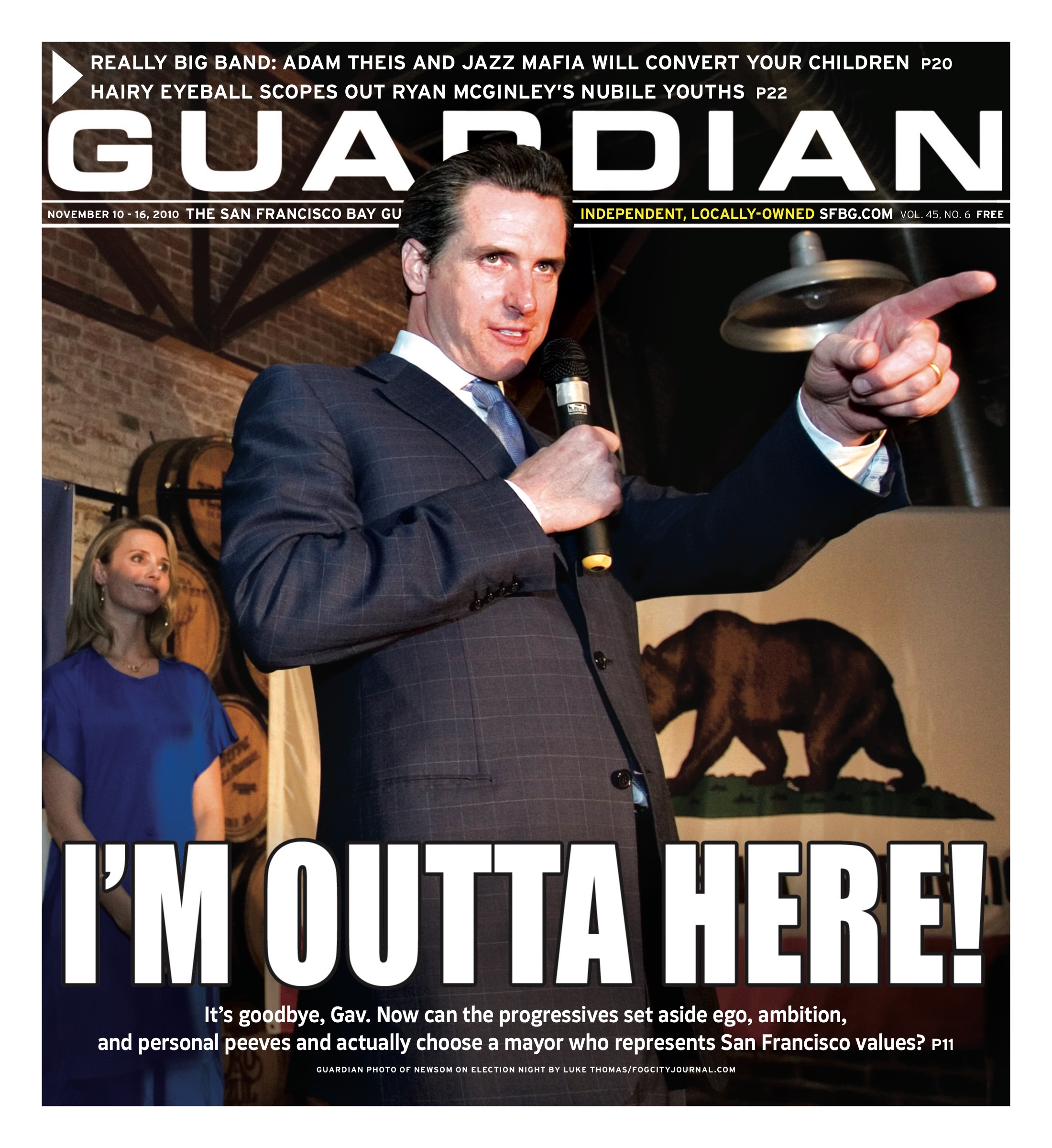
By the time a beaming Mayor Gavin Newsom took the stage at Tres Agaves, the chic SoMa restaurant, on election night, enough results were in to leave no doubt: the top two places on the California ballot would go to the Democrats. Jerry Brown would defeat Meg Whitman in the most expensive gubernatorial race in American history — and Newsom, who once challenged Brown in the primary and dismissed the office of lieutenant governor, would be Brown’s No. 2.

It might not be a powerful job, but Newsom wasn’t taking it lightly anymore. “We can’t afford to continue to play in the margins,” he proclaimed proudly, advancing a vague but ambitious agenda. “There is absolutely nothing wrong with California that can’t be fixed with what’s right with California.”

But around the city, as results trickled in for the local races, the talk wasn’t about Newsom’s role in the Brown administration, or the change the Democrats might bring to Sacramento. It was about the profound change that could take place in his hometown as he vacates the office of mayor a year early — and opens the door for the progressives who control the Board of Supervisors to appoint a chief executive who agrees with, and is willing to work with, the majority of the district-elected board.

At a time when the Republican takeover of Congress threatens to create gridlock in Washington, there’s a real chance that San Francisco’s government — often paralyzed by friction between Newsom and the board — could take on an entirely new direction. It’s possible that the progressives, long denied the top spot at City Hall, could put a mayor in office who shares their agenda.

This could be a turning point in San Francisco, a chance to put the interests of the neighborhoods, the working class, small businesses, the environmental movement, and economic justice ahead of the demands of downtown and the rich. All the pieces are in place — except one.

To make a progressive vision happen, the fractious (and in some cases, overly ambitious) elected leaders of the progressive movement will have to recognize, just for a little while, that it’s not about any individual. It’s not about David Chiu, or Ross Mirkarimi, or Chris Daly, or John Avalos, or Eric Mar, or David Campos, or Jane Kim, or Aaron Peskin. It’s not about any one person’s career or personal power.

It’s about a progressive movement and the issues and causes that movement represents. And if the folks with the egos and personal gripes and career designs can’t set them aside and do what’s best for the movement as a whole, then the opportunity of a generation will be wasted.

Folks: this is a hard thing for politicians to recognize. But right now it’s not about you. It’s about all of us.

It’s an odd time in San Francisco, fraught with political hazards. And it’s so confusing that no one — not the elected officials, not the pundits, not the lobbyists, not the insiders — has any clear idea who will occupy Room 200 in January.

Here’s the basic scenario, as described by past opinions of the city attorney’s office:

Under the state Constitution, Newsom will take office as lieutenant governor Jan. 3, 2011. The City Charter provides that a vacancy in the Mayor’s Office is filled by the president of the Board of Supervisors until the board can choose someone to fill the job until the end of the term — in this case, for 11 more months.

So if all goes according to the rules (and Newsom doesn’t try to play some legal game and delay his swearing-in), David Chiu will become acting mayor on Jan.3. He’ll also retain his job as board president.

On Jan. 4, the current members of the Board of Supervisors will hold a regularly scheduled Tuesday meeting — and the election of a new mayor will be on the agenda. If six of the current supervisors can agree on a name (and sitting supervisors can’t vote for themselves) then that person will immediately take office and finish Newsom’s term.

If nobody gets six votes — that is, if the board is gridlocked — Chiu remains in both offices until the next regular meeting of the board — a week later, when the newly elected supervisors are sworn in.

The new board will then elect a board president — who will also instantly become acting mayor — and then go about trying to find someone who can get six votes to take the top job. If that doesn’t work — that is, if the new board is also gridlocked — then the new board president remains acting mayor until January 2012.

There are at least three basic approaches being bandied about. Some people, including Newsom and some of the more conservative members of the board, want to see a “caretaker” mayor, someone with no personal ambition for the job, fill out Newsom’s term, allowing the voters to choose the next mayor in November, 2011. That has problems. As Campos told us, “The city has serious budget and policy issues and it’s unlikely a caretaker could handle them effectively.” In other words, a short-termer will have no real power and will just punt hard decisions for another year.

Then there’s the concept of putting in a sacrificial progressive — someone who will push through the tax increases and service cuts necessary to close a $400 million budget gap, approve a series of bills that stalled under Newsom, take the hits from the San Francisco Chronicle, and step out of the way to let someone else run in November.

The downside of that approach? It’s almost impossible for a true progressive to raise the money needed to beat a downtown candidate in a citywide mayor’s race. And it seems foolish to give up the opportunity to someone in the mayor’s office who can run for reelection as an incumbent.

Which is, of course, the third — and most intriguing — scenario.

The press, the pundits, and the mayor have for the past few months been pushing former Sup. Peskin as the foil, trying to spin the situation to suggest that the current chair of the local Democratic Party is angling for a job he wouldn’t win in a normal election. But right now, Peskin is no more a front-runner than anyone else. And although he’s made no secret in the past of wanting the job, he’s been talking of late more about the need for a progressive than about his own ambitions.

“If the board chose [state Assemblymember] Tom Ammiano, I would be thrilled to play a role, however small, in that administration,” Peskin told us.

In fact, Peskin said, the supervisors need to stop thinking about personalities and start looking at the larger picture. “If we as a movement can’t pull this off, then shame on us.”

Or as Sup. Campos put it: “We have to come together here and do what’s right for the progressive movement.”

Two years ago, the San Francisco left was — to the extent that it’s possible — a united electoral movement. In June, an undisputed left slate won a majority on the Democratic County Central Committee. In November 2008, Districts 1, 3, 5, and 11 saw consensus left candidates running against downtown-backed opponents — and won. In D9, three progressives ran a remarkably civil campaign with little or no intramural attacks.

The results were impressive. As labor activist Gabriel Haaland put it, “we ran the table.”

But that unity fell apart quickly, as a faction led by Daly sought to ensure that Sup. Ross Mirkarimi couldn’t get elected board president. Instead that job went to Chiu — the least experienced of the supervisors elected in that class, and a politician who is, by his own account, the most centrist member of the liberal majority.

This fall, the campaign to replace Daly in D6 turned nasty as both Debra Walker and Jane Kim openly attacked each other. Walker sent out anti-Kim mailers, and Kim’s supporters charged that Walker was part of a political machine — a damaging (if silly) allegation that created a completely unnecessary rift on the left.

And let’s face it: those fights were all about personality and ego, not issues or progressive strategy. Mirkarimi and Daly have never had any substantive policy disagreements, and neither did Walker and Kim.

In the wake of that, progressives need to come together if they want to take advantage of the opportunity to change the direction of the city. It’s not going to be easy.

“We’re good at losing,” Daly said. “I’m afraid we’re doing everything we can to blow it.”

The cold political calculus is that none of the current board members can count on six votes, and neither can Peskin or any of the other commonly mentioned candidates. The only person who would almost certainly get six votes today is Ammiano — and so far, he’s not interested.

“I know you never say never in politics, but I’m happy here in Sacramento. Eighty-six percent of the voters sent me back for another term, and I think that says something,” he told us.

It’s hardly surprising that someone like Ammiano, who has a secure job he likes and soaring approval ratings, would demur on taking on what by any account will be a short-term nightmare. The city is still effectively broke, and next year’s budget shortfall is projected at roughly $400 million. There’s no easy way to raise revenue, and after four years of brutal cuts, there’s not much left to pare. The next mayor will be delivering bad news to the voters, making unpleasant and unpopular decisions, infuriating powerful interest groups of one sort or another — and then, should he or she want the job any longer, asking for a vote of confidence in November.

Yet he power of incumbency in San Francisco is significant. The past two mayors, Newsom and Willie Brown, were reelected easily, despite some serious problems. And an incumbent has the ability to raise money that most progressives won’t have on their own.

Chiu thus far is being cautious. He told us his main concern right now is ensuring that the process for choosing the next mayor is open, honest, and legally sound. He won’t even say if he’s officially interested in the job (although board observers say he’s already making the rounds and counting potential votes).

And no matter what happens, he will be acting mayor for at least a day, which gives him an advantage over anyone else in the contest.

But some of the board progressives are unhappy about how Chiu negotiated the last two budget deals with Newsom and don’t see him as a strong leader on the left.

Ross Mirkarimi is the longest-serving progressive (other than Daly, who isn’t remotely a candidate), and he’s made no secret of his political ambitions. Then there’s Campos, an effective and even-tempered supervisor who has friendly relationships with the board’s left flank and with centrists like Bevan Dufty. But even if Dufty (who I suspect would love to be part of electing the first openly gay mayor of San Francisco) does support Campos, he’d still need every other progressive supervisor. Campos also would need Chiu’s vote to go over the top. Which means Chiu — who needs progressive support for whatever his political future holds — would have to set aside his own designs on the job to put a progressive in office.

In other words, some people who want to be mayor are going to have to give that up and support the strongest progressive. “If there’s someone other than me who can get six votes, then I’m going to support that person,” Campos noted.

Then there are the outsiders. City Attorney Dennis Herrera has already announced he plans to run in the fall. If the board’s looking for a respected candidate who can appeal to moderates as well as progressives, his name will come up. So will state Sen. Mark Leno, who has the political gravitas and experience and would be formidable in a re-election campaign in November. Leno doesn’t always side with the left on local races; he supported Supervisor-elect Scott Wiener, and losing D6 candidate Theresa Sparks. But he has always sought to remain on good terms with progressives.

All that assumes that the current board will make the choice — and even that is a matter of strategic and political dispute. If the lame duck supervisors choose a mayor — particularly a strong progressive — you can count on the San Francisco Chronicle, Newsom, and the downtown establishment to call it a “power grab” and cast doubt on the legitimacy of the winner.

“But choosing a mayor is the legal responsibility of this board and they ought to do their jobs,” Peskin said.

The exact makeup of the next board was still unclear at press time. Jane Kim is the likely winner in D6 and has always been a progressive on the School Board. She’s also close to Chiu, who strongly supported her. If Malia Cohen or Lynette Sweet wins D10, it’s unlikely either of them will vote for a progressive mayor.

Newsom also might try to screw things up with a last-minute power play. He could, for example, simply refuse to take the oath of office as lieutenant governor until after the new board is seated.

Chiu’s allies say it makes sense for the progressives to choose a mayor who’s not identified so closely with the left wing of the board, who can appeal to the more moderate voters. That’s a powerful argument, and Herrera and Leno can also make the case. The progressive agenda — and the city — would be far better off with a more moderate mayor who is willing to work with the board than it has been with the arrogant, recalcitrant, and distant Newsom. And if the progressives got 75 percent of what they wanted from the mayor (as opposed to about 10 percent under Newsom), that would be cause to celebrate.

But to accept that as a political approach requires a gigantic assumption. It requires San Franciscans to give up on the idea that this is still, at heart, a progressive city, that the majority of the people who live here still believe in economic and social justice. It means giving up the dream that San Francisco can be a very different place, a city that’s not afraid to defy national trends and conventional wisdom, a place where socioeconomic diversity is a primary goal and the residents are more important than the big companies that try to make money off them. It means accepting that even here, in San Francisco, politics have to be driven by an ever-more conservative “center.”

It may be that a progressive can’t line up six votes, that a more moderate candidate winds up in the Mayor’s Office. But a lot of us aren’t ready yet to give up hope.

Additional reporting by Noah Arroyo.

Editor’s Notes

0

tredmond@sfbg.com

Way back in 1986, Tom Hsieh Sr., an architect and one of the most conservative members of the Board of Supervisors, called his colleague Harry Britt — by all accounts the most liberal supervisor — and asked for a meeting. The way both men described it to me at the time, Britt was a little mystified; why would someone who was on the opposite end of the political spectrum want to be pals?

Well, it turned out that Hsieh had a message for his colleague. "Someday," Hsieh told Britt, "the gays and the Asians will be running this town, and we might as well get along."

It’s taken a while, but Hsieh (whose son is a moderate-to-conservative political consultant and activist) was prophetic. One of the little-noticed facts about this supervisorial election is that the majority of the members of the next Board of Supervisors will be either Asian or gay. And the odds are pretty good that the person in the Mayor’s Office in 2012 will be Asian (David Chiu, Leland Yee, Phil Ting) or gay (Tom Ammiano, David Campos, Mark Leno).

I mention that bit of interesting history as a sort of a prelude to the fascinating historic challenge facing progressives in San Francisco today. At a time when the rest of the country seems to be drifting (at least for the moment) to the right, San Francisco has a chance to go to the left. There hasn’t been a mayor the progressives supported in this town in at least 20 years (and that’s if you count Art Agnos, which is a bit of a stretch). With Gavin Newsom (will he be San Francisco’s last straight white mayor?) leaving early in his term, the supervisors could profoundly change the direction of the city.

And they could also duck, punt, or make a terrible mistake.

If the board wants to appoint someone who’s going to promote a progressive agenda, that person not only needs to be able to get six votes in January, but hold on to the seat until November — when the competition will be intense. And any progressive mayor will be vilified by the local daily papers, mocked by the national media, and held to an almost impossible standard by his or her constituents.

You wonder why anyone would want the job.

But taking on that insane challenge is also about history, and about proving that this city is (still) different. And the person in the job is going to need a whole lot of help and support. I have to believe that we’re up to it.

The “Democratic Machine” myth

34

Okay, I read the gloating from Randy Shaw about Jane Kim defeating the “Democratic Party Machine,” which, as far as I can tell, seems to consist of the Democratic County Central Committee and the Bay Guardian. (As I’ve said before, if I were that powerful, things would change around this city ….)


It annoys me because machine politics were once a harsh reality in this town. But not these days.


Let’s look seriously at the supposed immense clout of the DCCC. Everyone from Shaw to The Chron’s C.W. Nevius has been freaking out over the ability of the local Democratic Party to control who gets elected to the Board of Supervisors. And while I think it’s a good idea to have prgoressives control the local party (this is, after all, San Francisco), even a cursory look at election results suggests that this vaunted machine isn’t really running much of anything.


In every contested race for supervisor — every single one — the candidate endorsed first by the DCCC appears headed for defeat. It’s not just D6; The DCCC endorsed DeWitt Lacy in D10, and he finished well out of the picture. The person leading that race today, Tony Kelly, wasn’t even in the DCCC’s top three. The panel backed Rafael Mandelman in D8; Scott Wiener won. The party gave its nod to Janet Reilly in D2, and if early RCV results hold, she’s in serious trouble.


Here’s the facts: With district elections, and a weak mayor, power is far too diffuse in San Francisco today for anyone to operate a political machine. District races this time around weren’t about the DCCC; they were about local campaigns organizing around local issues.


The DCCC helped Debra Walker somewhat in D6 , but it also hurt: In the end, Kim won with a campaign that painted Walker as an old-school machine party politician — and, interestingly enough, according to Paul Hogarth, she won by reaching out to the more conservative voters:


We focused on pitching her biography as a Stanford and Berkeley graduate, who is a civil rights attorney. And Jane Kim was the kind of young professional these voters could relate to. 


If Randy Shaw was right, and a powerful Democratic party machine ran city politics, we wouldn’t all be scratching our heads and wondering who the hell the next mayor will be. I can tell you right now: Aaron Peskin, the titular head of this mighty machine, is pretty far out of the running. Sup. David Chiu, who has pretty much cut ties with Peskin and worked to elect Kim, is one of the top mayoral contenders. It’s also entirely possible that Mark Leno — who is by no means part of any Peskin operation — will wind up in Room 200.


Labor — supposedly part of this machine, too — can’t even agree half the time on its own endorsements — witness the United Healthcare Workers local splitting dramatically with its Local 1021 brothers and sisters in SEIU. UHW backed Wiener, Theresa Sparks and Steve Moss — all candidates opposed by Local 1021.


It’s an unsettled time in local politics, and I hope that the progressives who care about issues, not personalities and silly labels, can come together and choose a mayor who will support a progressive agenda. But that will be a close call, and no doubt will involve a temporary coalition that will fall apart as soon as the deal is done.


Because right now, nobody’s calling the shots in local politics. Just look at the facts on the ground. 

Wallpaper’s pattern: party-ready indie singles

2

I guess it’s time to move past the Bay Area party blowout that was last week and into, well hell, more parties – San Fran’s no one-binge pony, after all.

Luckily, these post-World Series, pre-holiday days coincide nicely with the return of Wallpaper to the Bay Area. The indie-pop Oakland duo who made its name with the slo-mo champagne stumble-through video, “I Got Soul, I’m So Wasted” and its remix of Das Racist’s “Combination Pizza Hut and Taco Bell” is playing The Independent tonight (Mon/8).

And holler, they’re bringing their newest handsintheairlikeyoudon’tcare banger with them, “Indian Summer.” We got the video (recorded last week using Red Bull and a dash-mounted flip camera somewhere in a desert that materialized between the group’s tour gigs) for your viewing pleasure. Sound quality is middling, but the sentiment we like.

Wallpaper’s “Indian Summer Desert Session”

The song is like, made for these November days of milk, honey, and short-wearing jags for the optimistic among us, right lead singer Eric Federic? “I was born and raised in the Bay Area. I have memories of being confused about why it was July and it was so cold — my birthday’s in July,” said Federic, an Oakland native, who took his eyes off the road between his shows in Boise and Seattle’s Showbox at the Market to talk to SFBG on the phone about that perma-fave topic of discussion among Bay Area-ites: meterological variances. 

“I’d remember we’d be so hot and sweaty and restless, we’d all get Astro Pops or whatever. I have all these great memories of growing up in this Bay Area weather system – it being warm up until the wee hours of the morning,” Federic said.

Cause for celebration, or at least for another single. Wallpaper’s well-known for its ability to mock up hot videos in a timely manner, which may explain the group’s success over the last year or so. And regardless of the temperature outside, you can achieve maximum condensation levels at its live show. Jump around with Ricky Reed, Federic’s self-hyping flashbanger character of “I’ve Got Soul, I’m So Wasted” and feel good about heading into the championship rounds of holiday party season.

Wallpaper

W/ The Heavy and DJ Aaron Axelsen

Mon/8 8 p.m., $15

The Independent

628 Divisadero, SF

(415) 771-1421

www.theindependentsf.com


ABU to UCSF: adopt local hire plan or halt Mission Bay hospital construction

7

Aboriginal Blacks United (ABU) President James Richards has asked UCSF Chancellor Susan Desmond-Hellmann to meet with the community before Nov. 15 about UCSF’s local hiring plan, or halt all work at its Mission Bay Hospital construction site.

Noting that ABU is still waiting for a call regarding a Nov. 2 letter that ABU hand delivered to the Chancellor’s office, requesting a meeting to discuss the lack of community jobs or even a community hiring policy at UCSF’s Mission Bay Hospital project, Richards is asking UCSF to “halt all work at the UCSF construction site until you sit down to sign a community hiring plan, one that guarantees local workers will perform half the work required to build the new Mission Bay Hospital.”

In his Nov. 2 letter to Desmond-Hellmann, Richards stated, “You are spending $1.7 billion on this construction right here in our backyard, but you and UCSF have no policy or plan in place to put San Francisco residents, especially those from neighboring committees such as Bayview-Hunters Point, to work on your project.”

‘Your staff’s excuse is that work has not yet started at the site and they are working on a plan,” Richards added. “This however is an untruth as there are people out there at the construction site as we speak and we have already seen your team’s haphazard attempts to hite a community worker only to fire them within a matter of days.”

“We represent men and women, black, brown, white and everything else, union workers from Bayview Hunters Point and the southeast sector, workers from our community, a community that no one gives a damn about,” Richards continued. “We believe that if the community doesn’t work, no one works and never again will we allow the lost opportunities before us pass us by as we struggle to survive and stay in the City.”

“Many hours have been wasted by many people in many meetings with various staff over the past year and a half, so now we come to meet with you,” Richards concluded.“We ask you to stop all work at the hospital immediately until you have a community hiring plan in place that has consensus approval from the community.”
 
Richard’s latest missive comes the same day that the Board’s land use and economic development committee is holding an informational hearing at 2 p.m. in Room 263 on San Francisco’s local hiring policy. And comes shortly after Barbara French, UCSF’s vice chancellor for university relations, told the Guardian that UCSF is working to evaluate hiring needs for phase of the project, talking to the unions, and intends to make its findings public in December.

“We have had a voluntary local hiring policy since 1993,” French told the Guardian, confirming that in the past 17 years, the university has reached a 12 percent local hire rate on average. “Sometimes it was 7 percent, sometimes it was 24 percent … Our [goal] is to reach a number that is beyond what we reached before but which is realistic.”

French also recently told community-based organizations that UCSF hadn’t signed a contract with the contractor at its Mission Bay hospital project, didn’t have the permits yet, and that the recent community celebrations didn’t mark the start of active construction at the site. French said general hiring at Mission Bay will begin in December. “We don’t get any city funds at this site, so our commitment is voluntary. But we feel very strongly that we have to reach out.”

To date, Sup. John Avalos, who has introduced legislation to impose phased-in fines on contractors that don’t achieve local hiring goals, has acknowledged that UC is not under San Francisco’s jurisdiction and can’t be compelled to do more local hiring.

“But we know that they are doing a critical amount of building and investing taxpayer dollars, and that this land use impacts the surrounding community,” Avalos told the Guardian. “So it makes sense that we have local hire legislation and access to serious end-use jobs at the hospital.”

Our Weekly Picks: November 3-9, 2010

0

WEDNESDAY 3

EVENT

“The Neighborhood”

Audyssey, an L.A.-based audio laboratory, must have a thing for San Francisco. First it marketed its iPhone docking station as the South of Market, and now it’s calibrating the music scene by launching a monthly music showcase at 111 Minna: “Multiple genres. Local talent. The Neighborhood.” With live performances by Maus Haus, My First Earthquake, Shortkut, Trackademicks, Ghosts On Tape, DLRN, and Electric Sunset, and DJs King Most, Prince Aries, and A-Ron, the lineup is enough to make you forget the whole synergistic marketing thing (it’s free, yo). That many diverse acts and the promise of local food carts to keep you fed? (Food not free.) Half the fun should be seeing if it all come together under one roof. (Ryan Prendiville)
9 p.m., free
111 Minna Gallery
111 Minna, SF
(415) 974-1719
www.audyssey.com/theneighborhood

THURSDAY 4

COMEDY

Michael Ian Black

First gaining widespread fame for his work on Stella, The State, Viva Variety and other TV shows, comedian Michael Ian Black has honed his sarcastic commentary on pop culture to a fine, surgical-quality blade, quite literally stealing the show on every appearance he has made on VH1’s I Love The … series. For those who just can’t get enough of his wit and witticisms from the short, seconds-long snippets that make it on the air, here’s the chance to experience a full-on onslaught of hilarious, side-splitting observations from one of the best funnymen on the circuit today. (Sean McCourt)
Thurs.–Sun., 8 p.m. (also Fri.–Sat., 10:15 p.m.), $22.50–$23.50.
Cobb’s Comedy Club
915 Columbus, SF
(415) 928-4320
www.cobbscomedyclub.com

MUSIC

Marnie Stern

Kill Rock Stars artist Marnie Stern brings her whirlwind brand of finger-tap guitar shredding to Oakland. With influences ranging from math-rock godfathers Don Cabellero to punk and classic-rock staples, Stern and her band create quite the interesting racket. Equally impressive as Stern herself is her drummer, Zach Hill (of Hella), who matches her yelping vocal style and hyperactive arena rock solos with a frenetic creativity all his own. Stern’s new self-titled album brings the “noise for the sake of noise” level down just a tad and offers a more melodic and direct approach to her songwriting. (Landon Moblad)
8 p.m., $12
New Parish
579 18th St., Oakl.
www.thenewparish.com

FRIDAY 5

VISUAL ART

“I Live Here: SF”

It goes without saying that we live in a pretty diverse city, but since February 2009 photographer Julie Michelle has been capturing the people and stories that make SF great in her “I Live Here: SF” portrait series. The end result includes more than 170 images of SF residents, complete with their personal stories and accounts of their connection to this lovely, crazy, and exciting city of ours. Her subjects cut across races, classes, ages, and neighborhoods; you might just be surprised by the SF microcelebrities who pop up in them. I guarantee you’ll recognize someone photographed for the exhibit — or at least have seen one walking by you on the street. (Ben Hopfer)
6-9 p.m., free
SOMArts
934 Brannan, SF
(415) 552-1770
www.iliveheresf.com

DANCE

“Shared Space 4”

This is the fourth “Shared Space” season for Todd Eckert and Nol Simonse, two dancers who couldn’t be more different from each other. Yet as choreographers they find common ground. At least for this season, they are both diving into the past for their world premieres. The intricate meters of a medieval poetic form and the music of J.S. Bach inspired Eckert’s new Sinfonia. Continuing his interest in Greek mythology, Simonse is reaching even farther back. Demeter, the goddess of harvest and generosity, became the springboard for Greater Than. With Dancer for Hire, however, he hits a painful, up-to-date note: how to keep dancing in these parlous times. (Rita Felciano)
Fri/5-Sat/6, 8 p.m.; Sun/7, 7 p.m., $20
Dance Mission Theater
3316 24th St., SF
(415) 273-4633
www.sharedspacesf.org

MUSIC

Ray Manzarek and Roy Rogers

A recent project bringing together two luminaries of the 1960s and ’70s California rock ’n’ roll scene, the collaboration between legendary Doors keyboardist Ray Manzarek and blues guitarist par excellence Roy Rogers has produced an eclectic exploration of musical styles, including reimaginings of Doors classics, along with other blues and jazz tracks. Tonight’s show is being billed as “An Evening of Rock ’n’ Roll Tales and Music” since the duo promise to share stories about their long and fruitful careers between songs — fans won’t want to miss this rare opportunity to hear them straight from the still-rocking source. (McCourt)
8 and 10 p.m., $18–$25
Yoshi’s San Francisco
1330 Fillmore St., SF
(415) 655-5600
www.yoshis.com

DANCE

AXIS Dance Company and inkBoat

Known for its mix of disabled and able-bodied dancers, AXIS Dance Company has joined forces with Shinichi Iova-Koga and his company inkBoat to create ODD, a piece inspired by the work of Norwegian painter Odd Nerdrum. With cellist Joan Jeanrenaud performing a live original composition, ODD delves into themes found in Nerdrum’s paintings, including loneliness, fear, sexuality, and degradation. Iova-Koga’s choreography is mesmerizing to say the least and exactly how he will fuse two companies, a musician, and an artist’s work into an evening show is the source of much anticipation. (Emmaly Wiederholt)
Fri/5–Sat/6, 8 p.m., Sun/7, 3 p.m., $15–$18
ODC Theater
3153 17th St, SF
Also Nov. 12–14, $10–$22
Malonga Theater
1428 Alice, Oakl.
www.axisdance.org

SATURDAY 6

MUSIC

San Francisco Symphony Día de los Muertos family concert

One hundred years ago as the Mexican Revolution kicked into high gear, could Emiliano Zapatista or Pancho Villa have anticipated the havoc that has their country in a stranglehold today? We hear so much about the Mexican drug wars (and bankroll them on the weekend) that it’s easy to forget our southerly neighbor’s beauty and culture. This makes it a particularly salient year for the symphony’s annual celebration of Chicano heritage, underwritten by an homage to the centennial celebration of the Revolution. Papel picado, sugar skulls, and steaming cups of Mexican chocolate precede the musical program, which itself features kid-friendly works from accomplished Latino composers. (Caitlin Donohue)
2 p.m., $15–$68
Davies Symphony Hall
201 Van Ness, SF
(415) 864-6000
www.sfsymphony.org

PERFORMANCE

Burning Libraries: Stories from the New Ellis Island
Arts and Literacy in Children’s Education (ALICE) is a grassroots organization composed of artists from multiple genres committed to bringing arts education to economically disadvantaged schools. Born out of a project encouraging children to learn their oral histories is Burning Libraries: Stories from the New Ellis Island, a new piece by ALICE Presents, the professional performing arm of ALICE. Encapsulating 30 stories from people in minority and immigrant communities, this theatrical piece fuses dance, music, video, puppetry, and aerial arts to explore what it truly means to be American. (Wiederholt)
Through Nov. 14
Thurs/4 and Fri.–Sat., 8 p.m.;
Sun, 3 p.m., $15–$30
ZSpace at Theater Artaud
450 Florida, SF
Also Dec. 3–-5,
$15–$25
Laney College Theater
900 Fallon, Oakl.
www.alicepresents.com

MONDAY 8

DANCE

WestWave Dance Festival

If you are counting live performances, this is program three of this year’s WestWave Dance Festival. If you like your dance on screen as well as on stage, this is program four, since officially Nov. 7’s “Dance on Film Nite” is program three. Enough bean counting. It’s good to see that Monday night dance has caught on. Audiences apparently appreciate not having to squeeze all their dance fixes into the weekend. Of course, it helps to program stuff people want to see; tonight’s event is a good mix of well-, fairly-well, and little-known choreographers: Lisa Townsend, Brittany Brown Ceres, Erika Tsimbrovsky, Robert Dekkers, and Andrew Skeels. (Felciano)
8 p.m., $25
Cowell Theater
Fort Mason Center, Marina at Laguna, SF
(415) 345-7575
www.westwavedancefestival.org

TUESDAY 9

MUSIC

The Pains of Being Pure at Heart

With a name like the Pains of Being Pure at Heart, you’d be justified in taking these guys for some sappy, Bright Eyes wannabes. Luckily, this isn’t the case. Based out of New York City (who isn’t these days?), the band makes lovely little indie-pop tunes that couple boy-girl harmonies with Jesus and Mary Chain-style distortion. Check out the absolutely infectious track “Young Adult Friction” from the 2009 self-titled album for a taste. (Moblad)
With Weekend and Grave Babies
8 p.m., $15
Independent
628 Divisadero, SF
(415) 771-1421
www.theindependentsf.com

MUSIC

Kurt Vile and the Violators and Soft Pack

If sneering “I hope I die before I get old” epitomized a generation, what’s the significance of Matt Lamkin singing “I know I’m gonna die before I see my prime” on Letterman? Rock ’n’ roll is now collecting Social Security and emerging acts are hoping for a YouTube apotheosis. Musical appreciation amounts to identifying a band’s influences and then immediately writing them off. With the driving beat of Lamkin’s L.A.-based Soft Pack or the writing-from-the-bottom-of-a-well style of Philadelphia’s Kurt Vile and the Violators, this would be a disservice. The sounds familiar, but moves forward, and as Vile reminds, “I’ve got a freeway mind, let go of my head.” (Prendiville)
With Purling Hiss
8 p.m., $14
Rickshaw Stop
155 Fell, SF
(415) 861-2011
www.rickshawstop.com

What beard does Newsom fear?

7

Mayor Gavin Newsom seemed to jokingly endorse Giants closer Brian Wilson for mayor at the parade Nov. 3rd (and Wilson might have endorsed his BDSM-loving neighbor), but maybe the mayor’s words have been misinterpreted. Maybe he was referring to another local player when he proclaimed the words “fear the beard.” Just a thought.


Newsom endorses Wilson, who endorses “the machine”

11

As Mayor Gavin Newsom prepares to leave San Francisco for the Lieutenant Governor’s Office in Sacramento, he has burned enough bridges here that he’s not going to have much of a role in picking his successor. But he made a play today during the Giants World Series celebration at City Hall that just may resonate with local voters and elected officials alike.

“This town is going to need another mayor soon, and I have just three words: fear the beard,” Newsom said as he wrapped up his speech to a crowd of several hundred thousand fans, giving his cheeky endorsement to the Giants’ star closing pitcher, Brian Wilson.

But during his own speech, Wilson respectfully declined the opportunity. “I don’t think I’m up to that job, but I know someone who is: Where’s the machine?” Wilson told the crowd, appearing to give the nod to the next speaker, Giants star pitcher Tim Lincecum, who didn’t take himself out of the running.

“All I can say is thank you and go San Francisco!” Lincecum said.

So, what do you say, San Francisco? Are we ready for Mayor Lincecum?

Is this a joke? Maybe not, after all, while being interviewed before the festivities began, a jubilant Newsom said, “The politicians need to step out of the way and that’s when you can restore a sense of pride to the city.” And in your case, Mister Mayor, we at the Guardian couldn’t agree more. Have a great trip to Sacramento!

UPDATE: A friend has now clued me in to the possibility that Wilson wasn’t actually endorsing Lincecum, but his BDSM neighbor. Huh? Yeah, I’m not sure either, but check this out: http://www.youtube.com/watch?v=6ckloLGOgVo


Election 2010: SF’s season of political madness

7

You can draw — or not draw — all sorts of conclusions about the meaning of last night’s national election, but I can tell you what the state and local results mean: A season of political madness. As of the first week in January, San Francisco will have a new mayor and (probably) a new district attorney, and neither will be elected by the voters. And if some pundits are correct and Nancy Pelosi decides to retire rather than taking a seat on the back bench, then a once-in-a-lifetime change to take a safe seat in Congress will open up. And man, will the mad scramble be on.


Gavin Newsom will be sworn in as lt. governor the same day that Kamala Harris (if her lead in the polls holds) will be sworn in as attorney general. In theory, that means Board President David Chiu will become acting mayor — with the authority to appoint a new district attorney. That’s if Harris doesn’t step down a day early, allowing Newsom to appoint her replacement. Deals are being offered and tossed around already (and one of the interesting elements is that Chiu has always been interested in the D.A.’s job — which would open up not only the board presidency but his D3 seat.)


Then the current board members will have five days before their terms end to choose a new mayor by majority vote (except that no supervisor can vote form him or herself), and in the meantime, Chiu will be both acting mayor and board president. If the supes can’t make a decision, the new board — and we still don’t know who will be on that board — will get a chance to elect both a new board president (and acting mayor) and a new mayor.


And to make it more complicated, a number of the people being looked at for the mayor’s job — and some of the people who plan to run for mayor next November — would also be very interested in Pelosi’s seat.


This election isn’t over yet — but already, I promise you, the talks are on and everyone’s thinking about the deal.


It’s going to be crazy — and it also offers progressives a rare change to reshape city politics. No matter what happens with the D6 and D10 races, progressives will hold the board majority. If they can work together — thinking about the larger agenda, not just their personal egos — this could turn out very well indeed.

GOLDIES 2010

0

GOLDIES 2010 Welcome to the 22nd annual Goldies issue. The Goldies stand for Guardian Outstanding Local Discovery awards, and rather than isolating one particular art form as a promotional endeavor, they aim to bring the Bay Area arts community together to celebrate actors, choreographers, filmmakers, musicians, and performance and visual artists who have added something special to the creative landscape.

It’s always tempting for me to imagine a grand Goldies production codirected by all of a year’s awardees. As they come together, the Goldies have a tendency to take on a life or identity of their own, and this year it’s fair to say that through chance or happenstance, the awards are sporting a little more gay glitter than usual. Another theme that has revealed itself is how true fandom or intense appreciation for a form of expression can, through the type of education that blooms from extreme dedication, metamorphose into art. A number of this year’s winners began as fans or enthusiasts, and over time, converted that enthusiasm into unique sites, sights, and sounds.

The 14 2010 Goldie winners were selected by myself along with fellow Guardian editors Cheryl Eddy and Marke B., and regular critics and contributors Robert Avila, Rita Felciano, and Matt Sussman. The initial nominations came from contributors to the Bay Area arts scenes and a number of Guardian writers. You can join the awardees and some surprise special guests Nov. 10 for a free celebration at 111 Minna Gallery. If you’re wondering what to wear, go for the gold. (Click below to learn more about this year’s winners, and check out last year’s winners here.)

GOLDIES 2010:

LIFETIME ACHIEVEMENT: RICK AND MEGAN PRELINGER

LIFETIME ACHIEVEMENT: MARC HUESTIS

LIFETIME ACHIEVEMENT: SLUMBERLAND RECORDS

VISUAL ART: JENNIFER LOCKE

MUSIC: SAID ADELEKAN

THEATER: CHRISTOPHER KUCKENBAKER

DANCE: AMY SEIWERT

MUSIC: HUNX AND HIS PUNX

VISUAL ART: AMANDA CURRERI

DANCE: RAMÓN RAMOS ALAYO

FILM: JOSHUA GRANNELL

MUSIC: DJ BUS STATION JOHN

VISUAL ART: RUTH LASKEY

STAGE: JESSE HEWIT/STRONG BEHAVIOR


All Goldies portraits by Saul Bromberger and Sandra Hoover


GOLDIES PARTY

With Myles Cooper, Alexis Penney, and surprise guests TBA

DJing by Primo Pitino and Naoki Onodera

Wed/10, 9 p.m., free

111 Minna Gallery

(415) 974-1719

www.111minnagallery.com

Stage Listings

0

Stage listings are compiled by Guardian staff. Performance times may change; call venues to confirm. Reviewers are Robert Avila, Rita Felciano, and Nicole Gluckstern. Submit items for the listings at listings@sfbg.com. For further information on how to submit items for the listings, see Picks. For complete listings, see www.sfbg.com.

THEATER

OPENING

Comedy Ballet Exit Stage Left, 156 Eddy; (800) 838-3006, www.brownpapetickets.com. $10-20. Previews Thurs/4, 8pm. Opens Fri/5, 8pm. Runs Thurs-Sat, 8pm. Through Nov 20. Dark Porch Theatre presents a genre-bending production written and directed by Martin Schwartz.

It’s All the Rage The Marsh, 1062 Valencia; (800) 838-3006, www.brownpapertickets.com. $20-50. Opens Sat/6, 8:30pm. Runs Sat, 8:30pm; Sun, 7pm. Through Dec 5. The Marsh presents a new solo show by Marilyn Pittman.

Murder for Two: A Killer Musical Eureka Theatre, 215 jackson; 252-8207, www.42ndstmoon.org. Previews Wed/3, 7pm; Thurs/4-Fri/5, 8pm. Opens Sat/6, 6pm. Runs Wed, 7pm; Thurs-Fri, 8pm, Sat, 6pm, Sun, 3pm. Through Nov 21. 42nd Street Moon presents a mix of Agatah Christie and musical comedy, by kellen Blair and Joe Kinosian.

A Perfect Ganesh New Conservatory Theatre Center, 25 Van Ness; 861-8972, www.nctcsf.org. $22-40. Previews Fri/5-Sat/6, 8pm; Nov 10-Nov 12, 8pm. Opens Nov 13, 8pm. Runs Wed-Sat, 8pm; Sun, 2pm. Through Dec 19. New Conservatory Theatre Center presents the Terrence McNally play, directed by Arturo Catricala.

The Tempest Exit on Taylor, 277 Taylor; (800) 838-3006, www.cuttingball.com. $15-20. Previews Fri/5-Sat/6, 8pm; Sun/7, 5pm. Opens Nov 11, 8pm. Runs Thurs-Sat, 8pm; Sun, 5pm (no show Nov 25). Cutting Ball Theater opens its 11th season with a three-person chamber version of the Shakespeare classic.

BAY AREA

Burning Libraries: Stories From the New Ellis Island Laney College Theater, 900 Fallon, Oakl; (800) 838-3006, www.brownpapertickets.com. $15-25. Previews Thurs/4-Fri/5. Opens Sat/6, 8pm. Runs Wed-Sat, 8pm, Sun, 3pm (also Sun/7, 7pm). Through Nov 14. Alice presents an evening-length theatrical performance spectacle, directed and co-written by Helen Stoltzfus.

Cinderella, Enchanted Julia Morgan Center for the Arts, 2640 College, Berk;; (510) 665-5565, www.berkeleyplayhouse.org. $15-33. Previews Sat/6, 2pm. Opens Sat/6, 7pm. Call for run times. Through Dec 5. Frenchie Davis is plays the Fairy Godmother in this production of the Rogers and Hammerstein musical.

CTRL-ALT-DELETE Pear Avenue Theatre, 1220 Pear, Mountain View; (650) 254-1148, www.thepear.org. $15-30. Previews Thurs/4, 8pm. Opens Fri/5, 8pm. Runs Thurs-Sat, 8pm; Sun, 2pm. Through Nov 21. Pear Avenute Theatre presents the comedy by Anthony Clarvoe.

The Play About the Naked Guy La Val’s Subterranean, 1834 Euclid, Berk; (800) 838-3006, www.brownpapertickets.com. $10-20. Previews Thurs/4-Fri/5, 8pm. Opens Sat/6, 8pm. Runs Thurs-Sat, 8pm (no show Nov 25). Through Dec 11. Impact Theatre presents an off-Broadway hit, written by David Bell and directed by Evren Odcikin.


ONGOING

Christian Cagigal’s Obscura: A Magic Show EXIT Cafe, 156 Eddy; (800) 838-3006, www.brownpapertickets.com. $15-25. Thurs-Sat, 8pm. Through Dec 18. Magician Christian Cagigal presents a mix of magic, fairy tales, and dark fables.

Dracula’s School for Vampires Young Performers Theatre, Fort Mason Center, Bldg C, Third Floor, Room 300; 346-5550, www.ypt.org. $7-10. Sat, 1 pm; Sun, 1 and 3:30pm. Through Nov 14. Young Performers Theatre presents a Dracula comedy by Dr. Leonard Wolf.

Equus Boxcar Theatre Playhouse, 505 Natoma; 776-1747, www.boxcartheatre.org. $10-25. Wed-Sat, 8pm. Through Nov 20. Boxcar Theatre kicks off its fifth season with Peter Shaffer’s drama, directed by Erin Gilley.

Failure to Communicate The Garage, 975 Howard; (800) 838-3006, www.brownpapertickets.com. Call for prices. Fri-Sat 8pm; Sun, 2pm. Through Nov 14. One part Torey Hayden, and one part Dr. Pangloss, Veronica Gray (Jaimielee Roberts) is an artist in need of a job, and so takes the position of teaching assistant in a classroom for severely troubled children. At first it seems like a good fit for her — she’s unfazed by the student’s scare tactics and drawn to their talents, in particular the artistic streak displayed by the autistic Loomis (Geoff Bangs). But eventually the extreme stress of her responsibilities starts to effect her equilibrium, and the rest of the play becomes a sort of elegiac apology for her eventual request to be transferred, and the havoc it plays on the emotions of her students. A first foray into playwriting for Performers Under Stress company member Valerie Fachman, Failure to Communicate feels very much like a work in progress. Its strengths – compelling material, quirky characters, and an insider’s perspective on an overloaded educational system – are soon overwhelmed by its weak points: too many veiled references to various abuses without follow-up, too much random violence without consequences, too many lengthy transitions and choppy scenes which neither drive the skeletal plot nor flesh out the occasionally hilarious yet often frustratingly two-dimensional characters. As a concept, Failure is intriguing but I’m hoping there will be a version 2.0 in the future, with a tighter focus and more comprehensive character development. (Gluckstern)

Glory Days Boxcar Studios, 125 Hyde; www.jericaproductions.com. $30. Fri-Sat, 8pm; Sun, 2pm. Through Nov 7. Jerica Prodcutions and the Royal Underground Theatre company present Nick Blaemire’s and James Gardiner’s one-act musical.

Habibi Intersection for the Arts, 446 Valencia; 626-2787, www.theintersection.org. $15-25. Thurs-Sun, 8pm. Through Sun/7. Intersection for the Arts and Campo Santo present the world premiere of a play by Sharif Abu-Hamdeh.

*Hamlet Alcatraz Island; 547-0189, www.weplayers.org. By donation. Sat-Sun, times vary. Through Nov 21. Outside of an actual castle, it would hard to say what could serve as a more appropriate stand-in for Kronborg castle of Helsingør—also known as Elsinore—than the isolated fortress of Alcatraz Island, where WE Players are presenting Hamlet in all its tragic majesty. As audience members tramp along

stony paths and through prison corridors from one scene to the next, the brooding tension the site alone creates is palpable, and the very walls impart a sense of character, as opposed to window-dressing. Deftly leaping around rubble and rock, a hardy troupe of thespians and musicians execute the three-hour

production with neat precision, guiding the audience to parts of the island and prison edifice that aren’t usually part of the standard Alcatraz tour package. Incorporating movement, mime, live music, and carefully-engineered use of space, the Players turn Alcatraz into Denmark, as their physical bodies meld into Alcatraz. Casting actress Andrus Nichols as the discontent prince of Denmark is an incongruity that works, her passions’ sharp as her swordplay, the close-knit family unit of Laertes, Ophelia, and Polonius are emphatically human (Benjamin Stowe, Misti Boettiger, Jack Halton), and Scott D. Phillips plays the

appropriately militaristic and ego-driven Claudius with a cold steel edge. (Gluckstern)

Hedda Gabler Phoenix Theatre, suite 601, 414 Mason; (800) 838-3006, www.offbroadwaywest.org. $35. Thurs-Sat, 8pm. Through Nov 13. The action unfolds in the parlor of the newly married Tesmans, young mediocre academic George (Adam Simpson) and town beauty Hedda, née Gabler (a crisp, tightly wound and nicely understated Cecilia Palmtag), a woman of exceptional intelligence, ambition and pride—to call her fiery wouldn’t be bad either, especially since she’s so fond of shooting off her late father’s pistols. Frustrated by her paltry new life, Hedda seeks news of an old flame, Eilert Lovborg (Paul Baird), via the admiring and vaguely lecherous Judge Brack (Peter Abraham) and a timid acquaintance from school days, Thea (Joceyln Stringer). The semi-wild but brilliant Lovborg has published a new book that imperils George’s chances for a professorship. Less interested in securing George’s career than controlling Lovborg’s destiny, Hedda soon manipulates events around her with bold determination and tragic consequences. Passionate, violent and psychologically complex, Henrik Ibsen’s titular heroine is at turns sympathetic and disturbing, an independent soul trapped in and warped by a society that allows her too little scope—a modern predicament that has inspired many modern and postmodern adaptations. Off Broadway West’s straight-ahead production of the late-19th-century drama, helmed by artistic director Richard Harder, remains faithful to the period setting. This includes Bert van Aalsburg’s respectable scenic design and Sylvia Kratins impressive costumes, as well as the old if fine translation by William Archer, who first introduced Ibsen to the English-speaking world. Unfortunately, the quaint diction is not handled with equal grace across an uneven cast. Palmtag’s solid, at times admirable performance in the lead, however, goes a good way toward grounding an otherwise patchy production. (Avila)

Law and Order: San Francisco Unit: The Musical! EXIT Theater, 156 Eddy; (800) 838-3006, www.brownpapertickets.com. $10. Mon, 8pm. Through Nov 15. Funny But Mean comedy troupe extends its newest show at a new venue.

Mary Stuart The Ashby Stage, 1901 Ashby, Berk; (510) 841-6500, www.shotgunplayers.org. $15-30. Thurs-Sat, 8pm; Sun, 5pm. (also Wed/3; 7pm). Through Sun/7. Shotgun Players presents Friedrich Schiller’s historical drama, directed by Mark Jackson.

*Pearls Over Shanghai Thrillpeddlers’ Hypnodrome, 575 10th St; (8008) 838-3006, www.brownpapertickets.com. $30-69. Sat, 8pm. Through Dec 19. Thrillpeddlers’ acclaimed production of the Cockettes musical continues its successful run.

*The Real Americans The Marsh MainStage, 1062 Valencia; (800) 838-3006; www.themarsh.org. $20-50. Wed-Fri, 8pm; Sun, 5pm. Through Nov 6. The fifth extension of Dan Hoyle’s acclaimed show, directed by Charlie Varon.

*Reluctant Brava Theater Center, 2781 24th St; 641-7657, www.brava.org. $10-25. Thurs, 8pm; Fri-Sat, 10pm. Through Nov 13. Joel Israel joins the likes of Eric Bogosian, Joe Frank, and Jack Nicholson (in The King of Marvin Gardens) in making the radio booth one of the more intimate yet far-reaching of metaphors—a hermetic recess of lonely, fervid minds that ranges over the collective unconscious by air, with the power to infiltrate the most vulnerable, unguarded corners of an unsuspecting populace. Shrewdly directed by Meiyin Wang, the New York playwright-performer’s cool, slyly seductive piece of theatrical psychopathology, Reluctant, makes an impressive West Coast debut in Brava’s appropriately intimate upstairs studio. There, on Sophia Alberts-Willis’s choice radio-studio set, and under Simone Hamilton’s moody lighting, the audience slips effortlessly into the hushed, anxious trance of Israel’s intoxicating noir storyteller. Nattily dressed in jacket and tie, and cooing deftly crafted prose over eerie nocturnal underscoring by sound designer Mark Valadez, the storyteller unfurls a performative “audio” spectacle at the borderline between imagination and deed—and maybe personality too. This guy is not to be trusted, especially opposite the woman he interviews (Brava’s artistic director Raelle Myrick-Hodges on opening night but played, in serial fashion, by a different actress each time). No, like any devil in your ear, you don’t want to trust him, but you don’t want to tune him out either. (Avila)

Shocktoberfest!! 2010: Kiss of Blood Hypnodrome Theatre, 575 10th; (800) 838-3006, www.brownpapertickets.com. $25-35. Thurs-Fri, 8pm. Through Nov 19. Thrillpeddlers’ seasonal slice of eyeball is comprised of three playlets variously splattered with platelets, all directed by Russell Blackwood and bridged by a rousing burst of bawdy song from the full cast. Rob Keefe’s Lips of the Damned (after La Veuve by Eugene Heros and Leon Abric) takes place in a rat-infested museum of atrocities just before the fumigating starts, as an adulterous couple—comprised of a kinky married lady (a vivacious Kara Emry) and a naïve hunk from the loading dock (Daniel Bakken)—get their kicks around the guillotine display, and their comeuppance from the jilted proprietor (Flynn DeMarco). Keefe’s delightfully off-the-wall if also somewhat off-kilter Empress of Colma posits three druggy queens in grandma’s basement, where they practice and primp for their chance at drag greatness, and where newly crowned Crystal (a gloriously beaming Blackwood) lords it over resentful and suspicious first-runner-up Patty Himst (Eric Tyson Wertz) and obliviously cheerful, non-sequiturial Sunny (Birdie-Bob Watt). When fag hag Marcie (Emry) arrives with a little sodium pentothal snatched from dental school, the truth will out every tiny closeted secret, and at least one big hairy one. Kiss of Blood, the 1929 Grand Guignol classic, wraps things up with botched brain surgery and a nicely mysterious tale of a haunted and agonized man (Wertz) desperate to have Paris’s preeminent surgeon (DeMarco) cut off the seemingly normal finger driving him into paroxysms of pain and panic. Well-acted in the preposterously melodramatic style of the gory genre, the play (among one or two other things) comes off in a most satisfying fashion. (Avila)

Sunset Limited SF Playhouse, 533 Sutter; 677-9596, www.sfplayhouse.org. $40-50. Tues-Wed, 7pm; Thurs-Fri, 8pm; Sat, 3 and 8pm. Through Nov 6. This 2006 play by Cormac McCarthy exhibits some of the best and worst of the celebrated author, but significantly more of the latter. It sets an aging white academic and failed suicide (Charles Dean) in a room with his rescuer and would-be savior, a poor black social worker (Carl Lumbly), who has just snatched him from a railway platform ahead of a tête-à-tête with a train called the Sunset Limited. Both characters remain nameless, emphasizing the abstract pseudo-Socratic dimensions attendant on the dialogue-driven realism here (staged with a knowing wink in director Bill English’s scenic design, a partially walled wood-framed shack with see-through slits between the thin horizontal planking). The black man is a born-again Christian and ex-con convinced Jesus has just given him a major assignment. His dogmatic certainty is matched by the white man’s nihilism and despair. “I believe in the primacy of the intellect,” the miserable prof tells his host, who’s locked the door on his self-destructive guest in an effort to buy time to change his mind. Leaving aside the historically clichéd, problematic and baggage-heavy dynamic of a poor black American devoted to the welfare of a rich white one, neither man moves from his respective position one inch (at least until perhaps and partially at the very end), which constrains the dramatic development. Moreover, both sides argue feebly, mainly by gainsaying whatever it is the other one says, making this not a great intellectual debate either. SF Playhouse’s production sets two fine actors at this heavy-handed twofer, but little can be done to redeem so static and arid an exercise. (Avila)

Susie Butler Sings the Sarah Vaughan Songbook Exit Theater Cafe, 156 Eddy; (510) 860-0997, www.brownpapertickets.com. $15-20. Sat, 8:30pm. Through Nov 20. Local actress and singer Susie Butler takes on the Sassy songbook.

The Unexpected Man EXIT Theatre, 156 Eddy; (800) 838-3006, www.brownpapertickets.com. $18-25. Fri-Sat, 8pm; Sun, 3pm. Through Nov 14. Spare Stage revives Yasmina Reza’s ironic comedy, starring Ken Ruta.

*West Side Story Orpheum Theatre, 1192 Market; www.orpheum-theater.com. $88-378. Check for dates and times. Through Nov 28. Opening night of the touring Broadway revival coincided with game two of the World Series, and giddy Giants fans were loath to put away their smart phones until the final plea from the house managers. But then the curtain rose on perhaps the finest and most moving display of athleticism, professionalism, and grace to be found outside of AT&T Park. The 1957 musical, which updated Romeo and Juliet with a cross-cultural romance between Tony (Kyle Harris) and Maria (Ali Ewoldt) amid immigrant gangland New York, came instantly alive with all its storied potency—revved up for new millennium audiences with less reserved violence and the addition of a smattering of real Spanish throughout. David Saint’s excellent cast—including standout Michelle Aravena as Anita—and a nicely dynamic orchestra under conductor John O’Neill do satisfying justice to the jagged, jazzy modernism of Leonard Bernstein’s score, Stephen Sondheim’s soaring lyrics, Arthur Laurents’ smart book, and Jerome Robbins’ mesmerizing choreography (here re-created by Joey McKneely). At intermission, the house manager graciously announced the final winning score from the ballpark, and everyone cheered. It was a win-win situation. (Avila)

BAY AREA

Becoming Britney Center REPertory Company, Knight Stage 3 Theatre, 1601 Civic Drive, Walnut Creek; (925) 943-SHOW, www.centerREP.org. $25. Thurs-Sat, 8:15pm; Sun, 2:15pm. Through Nov 14. Center REPertory Company presents an original musical about a naïve pop star, written by Molly Bell and Daya Curley.

Dracula Center REPertory Company, 1601 Civic, Walnut Creek; (925) 943-SHOW, www.centerrep.org. $36-42. Wed, 7:30pm; Thurs-Sat, 8pm; Sun, 2:30pm (also Nov 20, 8pm). Through Nov 20. Eugene Brancoveanu stars as the Count in a production directed by Michael Butler.

*East 14th: True Tales of a Reluctant Player Marsh Berkeley, 2120 Allston, Berk; www.themarsh.org. $20-50. Dates and times vary. Through Nov 21. Don Reed’s solo play, making its Oakland debut after an acclaimed New York run, is truly a welcome homecoming twice over. (Avila)

*The Great Game: Afghanistan Roda Theatre, 201 Addison, Berk; (510) 647-2949, www.berkeleyrep.org. $17-73. Call for times. Through Nov 7. Berkeley Rep presents the West Coast premiere of a three-part show about Afghanistan.

*Loveland The Marsh Berkeley, 2120 Allston Way; (800) 838-3006, www.brownpapertickets.com. $20-50. Fri, 7pm; Sat, 5pm. Through Nov 13. Ann Randolph’s acclaimed one-woman comic show about grief returns for its sixth sold-out extension.

Palomino Aurora Theatre, 2081 Addison, Berk; (510) 843-4822, www.auroratheatre.org. $10-55. Wed-Sat, 8pm; Sun, 2 and 7pm; Tues, 7pm. Through Dec 5. David Cale brings his new solo play about a gigolo to Aurora Theatre for its Bay Area premiere.

Pirates of Penzance Novato Theatre Company Playhouse, 484 Ignacio, Novato; 883-4498, www.novatotheatercompany.org. $12-22. Thurs-Sat, 8pm; Sun, 3pm. Through Nov 21. Novato Theatre Company revives the popular Gilbert and Sullivan swashbuckling tale.

Winter’s Tale Live Oak Theatre, 1301 Shattuck, Berk; (510) 649-5999, www.aeofberkeley.org. $12-15. Fri-Sat, 8pm (also Sun/7, and Nov 14, 2pm; Nov 18, 8pm). Through Nov 20. Actor’s Ensemble of Berkeley presents the rarely-performed Shakespeare play.
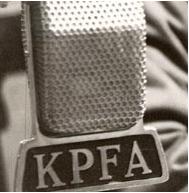
GOLDIES 2010: Ruth Laskey

1

One thing that Bay Area art has no shortage of is color. Whether it be Albers-informed theory, Op-influenced repetitious patterns, Mission muralismo, or mural-like Mission School paintings, in general, local color has been primary, if not outright garish. Ruth Laskey’s palette stands apart — confident enough to be low-key or even muted in comparison. “Color is kind of it for me,” Laskey says, in the middle of a sleepy afternoon at a Mission cafe. “It’s where a piece gets its emotion.”

You could say that there’s a quality of quiet intensity to Laskey’s work, and the artist herself is soft-spoken. She’s also strong, clear, and candid in terms of viewpoint. “My relationship to color is not very systematic,” she says, when the topic of Albers references in relation to her work is broached. “It’s more intuitive. I already see things from a painter’s perspective. When you’re a painter making color, there’s an evolution that happens.”

In Laskey’s case, this evolution is ongoing — and it isn’t taking place within traditional painting. Both “7 Weavings,” her first solo exhibition at Ratio 3 in 2008, and a self-titled show at the same space this year are taken from her larger “Twill Series,” a growing group of “investigations” that she began in 2005, years after taking a weaving class in between undergraduate and graduate studies at California College of the Arts. “Twilling is basic, the first pattern weave you learn,” she says. “The loom I’ve been using from the beginning is basic. I was thinking about my understanding of weaving, and I was interested in how twill creates shape on its own. It kind of clicked one day that I could use twill, but insert the thread in the same way I would with tapestry.”

That moment kick started Laskey’s unique use of dye and weft and warp to create color forms in which minimalism and materiality intersect. Her “Twill Series” has generated a cover story critical appraisal in Artforum and many responses locally — in some ways, the discourse about her growing body of work (including my own 2008 piece for this publication, which focused on geometric elements) reveals as much about the writers as it does about the art itself, which invites contemplation and allows open interpretation. It’s a mistake to assume this openness is cool detachment, though. “It’s fabric,” she says. “It’s inherently warm.”

At the moment, Laskey’s studio is in the garage of her apartment in Glen Park, a neighborhood that has housed some artists of renowned dedication, like Bruce Conner. Her day job at California College of the Arts’ Oakland library is one source of inspiration and perspective. Music could be another. When I ask her what sounds might make apt accompaniment for an audiovisual presentation of her art, her choice is Sun Ra. Thinking of her work as what Ra would call an “art form of dimensions tomorrow” adds another a playful element to its fabric. She uses blankness around an image as he uses the silence that surrounds sound. Space is the place.

As for Laskey’s “Twill Series,” at the moment it’s hard to gauge how large it will grow, but there is no doubt her deployment of dye and geometric shape is subtly shifting. “It’s an issue that artists have to deal with all the time,” she reflects. “I might still be interested in what the work is doing, but is it still engaging for everyone else? There’s always that tiny figure on your shoulder saying, ‘Maybe you need to move on.’ But I feel like it’s taking me on this journey. It might be a really slow journey. It might have small steps. But I’m enjoying that. For me, it’s fruitful.” 

www.ratio3.org; www.ruthlaskey.com

>>MORE GOLDIES 2010

GOLDIES 2010: Hunx and his Punx

0

It should come as no surprise that a gay 30-year-old male living in the Bay Area who borrows elements of his fashion-forward look from Freddie Mercury is putting out the “gayest music ever.” He’s a Pisces who rocks a switchblade comb and blends leather daddy duds with a 1950s-meets-1980s juvenile delinquent touch.

Seth Bogart, a.k.a. Hunx, has been devoted to rock and trash pop culture for years. He made zines as a teen in Arizona when riot grrrl was happening, and has essentially created a life from his variety of enthusiasms.

“I do it for myself, to have fun. It makes me feel better being constantly creative. As cheesy as it sounds, happiness is doing what you want to do,” says the rather butch-looking Bogart over tortas at a 24th Street restaurant. His eyes are piercing, he’s wearing a torn biker jacket, and he’s sporting a few days more than a five o’clock shadow.

Probably tired from having just gotten back from New York City, where he spent eight days recording the next Hunx and His Punx album for Sub Pop’s subsidiary label Hardly Art, Bogart appears happy to be home. After years living in Oakland, he currently resides in the Bayview District.

Thematically, Bogart describes the first proper Hunx and His Punx album as being similar to this year’s compilation Gay Singles (True Panther) in that it deals with love and teenage heartbreak. “It sounds like a dream,” he exclaims. But the upcoming album delves deeper into a sadness he said he’s never really written about before. His father committed suicide when he was just a teen, and with his mom left “out of it and depressed” in the immediate aftermath, it’s no wonder he grew up fast and was on his own by 17.

Bogart found catharsis in freedom of expression. As the tale goes, after his previous group Gravy Train!!! disbanded, friends such as Nobunny and Christopher McVicker helped pen some of the early Hunx and His Punx songs. On the new album, Bogart more fully takes the reins, writing half the album’s tracks himself, with his bold bassist and bandmate Shannon Shaw also contributing a few numbers. As for Hunx’s flirty and quick-witted onstage candor, Bogart attributes some of his brazen confidence to old pal and former roadie Nobunny, who instilled in him that you only have one chance in life. This attitude has led to a colorful album insert of Hunx in the buff, as well as an awkward moment when his Internet-browsing mom unexpectedly saw his boner in a Girls music video.

If you think Bogart’s skills to pay the bills begin and end with music, guess again. He happens to co-own Down at Lulu’s, a popular Oakland vintage boutique and salon, with Tina Lucchesi (of Trashwomen, Bobbyteens, and now Midnite SnaXXX). The shop has been open four years, and Bogart, a licensed cosmetologist, cuts hair there three days a week. He and his friend Brande Baugh are also developing a TV talk show.

Although owning his own shop and contributing to the local music scene are two obvious ways Bogart serves the Bay Area community, it’s what he stands for on a larger scale as a unique gay personality in the still hetero male-dominated genre of punk — and broader realm of rock — that makes him bold and noteworthy. You can call him bubblegum and outrageous, but the fact remains that Hunx exudes an image of strength and confidence. He fills a void in garage rock that isn’t quite clean enough for the Castro and maybe too queer for some fans of harder sounds. He blurs the lines, breaks down boring boundaries, and stays true to himself all the while. 

www.myspace.com/hunxsolo; www.myspace.com/gayestmusicever

>>MORE GOLDIES 2010