Local

She’s got the look

0

culture@sfbg.com

QUEER Apparently being a lesbian is the hottest new trend — so much so that middle-aged white dudes are posing as gay ladies, writing famous blogs and filling entire websites with lesbian content. (Yes, I’m talking to you, “Amina” and “Paula.”) Really?

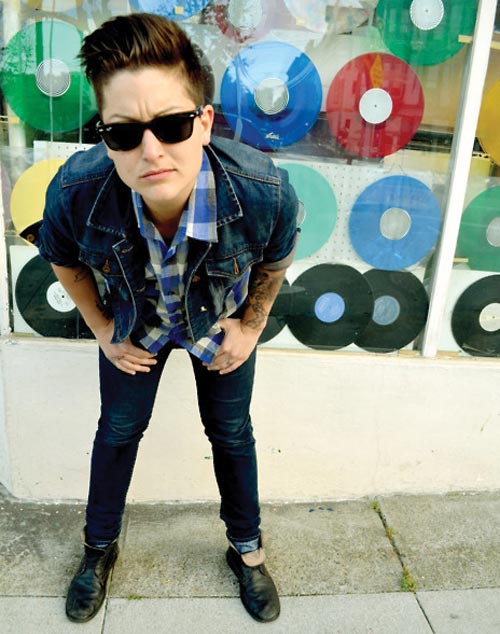
Fortunately, there are plenty of actual queer women who can blog for themselves, thank you very much. Catherine “Cat” Perez, is one of those real-life queer women — verified by an in-person chat at the Wild Side West bar — posting real-life depictions of other actual lesbians on her blog Lesbians in San Francisco, a tribute to girls who like girls in America’s gay capital.

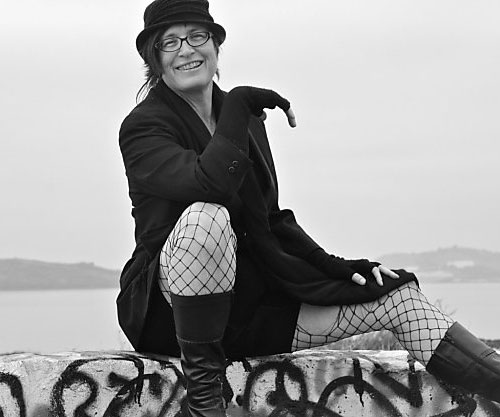
The layout is simple: each featured lez gets one photo and three fun facts of her choosing (“She won a s’mores eating contest as a Girl Scout.” “She doesn’t know how to whistle.” “She is related to Chuck Norris.”) Perez started LISF last summer with the intention of giving queer women of the Bay some flattering but honest representation.

“I just think in terms of the queer community, women can get bypassed and overlooked,” she told me, flicking her cigarette. “I want to educate people about what queer women look like, what they’re interested in, what they do. It may not always be what people assume.”

Perez began by photographing her friends, then opened it to anyone in the Bay Area, aiming for an accurate depiction of the city’s diversity. She swears there is no screening process. Although the aim is inclusion, the final product looks pretty tailored. Beauty may reside in the eye of the beholder — but it’s undeniable that these super-fashionable, adorably hipster girls are hot.

“Yes, there is definitely a ‘scene’ element to it. But that’s not the point,” Perez shakes her head and throws up her hands. “I’m only one person and I work a nine-to-five. People need to actively pursue a shoot with me.”

And it’s that simple — send Perez an e-mail, brainstorm your idea for the shoot, and show up. It’s an offer she often won’t refuse. So why are only a specific type of lezzies contacting LISF? Vanity? A need for self-promotion? Has LISF become a showcase of our local celesbians? Maybe it’s time for the rest of the community to get our faces up there, too.

“I wouldn’t consider myself a celesbian — I don’t know how I feel about that term,” Perez said with a laugh. “If I had to choose a label, I would identify as a queer woman,” embracing the broader, more inclusive mode of thinking. The title of the blog has discouraged some women from participating, but Perez says she has no plans to change it anytime soon.

“Growing up, I always wondered what queer communities looked like outside of my home in New Jersey,” she says. With its general-interest name, her blog comes up pretty high on Google searches. “I just want to shed some light on the people who live here. That’s it.”

Through the end of the month at the Lexington Club (www.lexingtonclub.com), Perez is exhibiting a collection of blog-inspired photos called “Stereo,” which simultaneously celebrates and debunks lesbian stereotypes. Perez selected 15 queer women and photographed them each twice: once in a stereotypical role (softball player, gym teacher, high femme) and once as themselves. As one might imagine, there’s a lot of overlap.

“Some girls were dressing up as other’s stereotypes,” she says. “Stereotypes don’t have to be negative. These photos embrace that, because, yeah, sometimes we are the stereotype.”

Bright on

1

culture@sfbg.com

QUEER Heady, hilarious, heartbreaking: Big Sex Little Death explores legendary sex writer, educator, and instigator Susie Bright’s coming of age from the 1960s to the present. Bright’s memoir focuses on her involvement with The Red Tide, a radical high school newspaper in Los Angeles in the 1970s, and her subsequent membership in a socialist sect that sends her halfway across the country. Her union organizing stint lasts until the Party leadership expels her for “joining or leading a cult of personality.” Personality is certainly one of Bright’s strong points, so perhaps we should be grateful for this particular falling out. It eventually leads to Bright’s role in founding the first lesbian porn magazine, On Our Backs, in San Francisco in 1981, as well as her pioneering work as a fiery spokesperson for free speech and sexual liberation. I spoke with her over the phone about sex and memory and writing.

SFBG You do such a great job of talking about your sexual coming of age as a teenager: describing your sluttiness without shame, your curiosity about bodies and pleasure and the intricacies of sexual positioning.

Susie Bright I think it’s because I wrote my memoir like a storyteller, like a poet — not a polemicist. I wasn’t ashamed; it never occurred to me. Margaret Mead would have found my little teenage tribe to be quite poignant.

SFBG There’s a tendency for many sex-positive spokespeople to glamorize even the most annoying, mundane, or gross sexual experiences as somehow — well — positive. Sometimes this sex-positive rhetoric ends up making those of us who don’t always succeed at having a wonderful sex life feel like failures …

SB I think bad sex — obnoxious, absurd, BIG FAIL sex — is funny, nostalgic, and more endearing as you grow older. It also goes hand in hand with adventurous, rapturous, mind-blowing sex. You actually know the difference. You’ve spanned the spectrum, you’ve lived. The big bummer with American sex right now is the unrelenting banality and flat-out scarcity.

SFBG The most striking part of Big Sex Little Death for me is the way you describe betrayal in the social and political realms you choose to inhabit — places that initially give you so much hope. Like when you helped to start On Our Backs, the first lesbian porn magazine, in the early ’80s. Feminist bookstores refused to carry it, claiming that you were aiding the patriarchy.

SB It was more than that. The whole mainstream feminist movement was calling for our heads. Or, as Barbara Grier of Naiad Press put it, “Everyone I know thinks y’all should be assassinated.”

It’s been a part of every civil rights and social justice movement that I’ve been a part of. We know it — we talk about how the powers that be would prefer to let the weak fight among themselves. We see how divide-and-conquer tactics are so effective, but it’s very hard to resist.

What kills me is the blindness, even years after the fact. Sometimes it’s comical. I got a letter from an ambitious writer the other day who told me that in the ’80s she fought the sex-positive On Our Backs types tooth and nail, no tactic too dirty. “We” were pimping the patriarchy and she was on point to take us down. She asked me if I found it amusing that she’s now in a submissive relationship with a man — no! Then she asked me if I would blurb her new book.

Someone asked me on this tour if I ever got an apology, and I was startled. No, not for the bombings or the death threats or the bannings or the locked doors or the bizarre libels and slanders. No way.

SFBG When the feminist movement refused to support you, you found several surprising allies. Among them were John Preston, at the time the editor of the gay leather magazine Drummer; cult filmmaker Russ Meyer of Faster Pussycat fame; and even the Mitchell brothers of that legendary exploitative straight strip club on O’Farrell Street.

SB Well, those were strange bedfellows, eh? They were all mavericks, iconoclasts, outlaws, film buffs, and we shared that in common. Aside from public librarians and ACLU lead attorneys, these guys were probably the most eloquent defenders of the First Amendment you ever met.

SFBG On Our Backs was started by two strippers who worked at various clubs in the Tenderloin and North Beach. One of the most heartbreaking chapters in Big Sex Little Death is where you show us how so many strippers worked to support their lovers financially, male and female, and then ended up strung out on drugs, homeless, or dead after their lovers used and abused them.

SB “Legalize it,” as Peter Tosh said. That is why these tragedies happen — because sex work is criminalized.

SFBG In your preface, you say, “I’m more preoccupied with people dying than with people coming.” And so of course you want to prevent these unnecessary deaths. Toward the end of the book, you also mention the deaths of friends, lovers, and confidantes to AIDS — but only briefly. It’s as if it’s still too painful to talk about.

SB The main deaths I talk about are my parents’, where I could fit more of the puzzle together; then John Preston, as a small example of what went on in early ’80s plague life; and the dykes I first knew at On Our Backs, some of who died too young. I am angry and too ragged to write about it all yet — I don’t have the distance from it. The last memorial I attended this past fall was [for] one of my greatest inspirations, a total ball-of-fire who ate a Fentanyl patch, choked to death on her vomit, and left a suicide note.

It was the exact one-year anniversary of the death of her father, a Southern fundamentalist preacher who beat and raped her as a child. She left him at 15 to come to California and made her way as one of the first generation of out dyke strippers and punk rockers. My redheaded friend was a leader of a local NA chapter by the time she was 20. What happened to her, all these years later, breaks the heart of everyone who knew her. She was a wonderful, wonderful, caring, radical feminist creative dyke who wanted to be a superhero who would vanquish all the abusers. It’s not fair.

SFBG Fairness is one of the central issues of the book — who lives and who dies, which cultures disappear and which remain. At the end of the book, you talk about deciding to give birth to a child, Aretha, and raising her. I’ll admit I got a bit worried that you would suddenly talk about this trajectory in a way that erased your sexual and political history, the histories of people like the friend you just mentioned.

SB My daughter has a trajectory of her own, now!

SFBG But somehow you’re able to talk about your love for Aretha while making it clear that child rearing certainly isn’t for everyone, and still articulating an anti-assimilationist queer world view focused on sexual liberation and radical politics.

SB I’m just drawn that way.

SFBG Why do you think gay assimilationists emphasize marriage, military inclusion, and child-rearing as the only choices for respectable queers, narrowing the options for everyone and rejecting sexual liberation as something dangerous from the past?

SB They’re squares — what can I say? They’ve always been around. Square used to be a synonym for straight. We’re constantly caught in the middle on this, the boho bunch. Of course we want civil rights for all, duh. I defend anyone’s right to let the state be their pimp, to fight the wars, be the cannon fodder, acquire family assets like a stamp-collecting hobby. Bully for you. But as Peggy Lee said, “Is that all there is?” Christ, I hope not.

Mattilda Bernstein Sycamore (mattildabernsteinsycamore.com) is most recently the author of So Many Ways to Sleep Badly.


Yearbook of heartbreak and outrage

0

news@sfbg.com

The giant commemorative AIDS ribbon that was up on Twin Peaks during the first half of June has been taken down, but the 30th anniversary of the epidemic, and how it changed San Francisco, is still reverberating throughout the city.

“It was like paradise,” Mark Ottman said as he guided me through the high-ceiling lobby, quiet as a library, of Union Bank on 400 California St. “For a few years. Then things got really scary.”

Ottman, the vice president of personal trust and estate services at the bank, recalled arriving in the city in 1981 as a 22-year-old Montana transplant. That year, the gay newspaper the Bay Area Reporter published the word AIDS for the very first time.

Although the paper has been at the forefront of reporting gay news for its 40 years — from White Night Riots of the 1970s through the Lavender Sweep of the 1990s, the Bowers vs. Hardwick decision through the “don’t ask, don’t tell” repeal — the way it straightforwardly handled the heartbreak of AIDS and the outrage that followed has become its lasting legacy.

“This was not stuff that was shown on the nightly news,” Ottman continued. “The B.A.R. was three or four months ahead in covering AIDS. In that sense, it was really the leader.”

This month, those with a thirst for history will need to look no further than newsprint. Union Bank’s LGBT Alliance has commissioned a retrospective exhibit highlighting the Bay Area Reporter’s coverage of the gay and lesbian community.

When the B.A.R. started in 1971, founders and friends Paul Bentley and Bob Ross had the intention of making it more than just a gossipy guide to bars and bathhouses. The newspaper focused on serious local news — even recruiting Harvey Milk as a political columnist.

“The founders weren’t journalists,” said Rick Gerharter, the longtime freelance photographer who curated the photo- and front page-filled exhibit at Union Bank. “But as the paper grew, it certainly became more professional.”

In 1981, when AIDS first appeared, the B.A.R. had no choice but to undergo a journalistic coming of age as it struggled to be first and be fair covering the mysterious disease that had begun to mow down gay men.


UNEASY EARLY AIDS COVERAGE

Yet the newspaper was not immune to the confusion and uneasiness that enveloped the community during the early days of the “gay cancer.”

“Me and my boyfriend both laughed — it must be another Anita Bryant plot against homosexuals,” said Robert Julian, recalling his first response to talk of the “gay-related immunodeficiency” or GRID.

“Gay people are united by sexual orientation, not genetics,” said Julian. Initially, the former B.A.R. entertainment editor and author of But the Show Went On: San Francisco 1987-1988 had his suspicions, thinking that a “physical ailment confined solely to gay people was a practical impossibility.”

It didn’t take long before the B.A.R. began reporting on the latest research, medical resources, and information about financial services available to the hundreds of gay men in San Francisco who had contracted the HIV virus.

Once researchers discovered that AIDS was being transmitted sexually, public opinion divided. Then-Mayor Diane Feinstein and Director of Public Health Mervyn Silverman wanted to close the bathhouses, but some members of the gay community considered this a violation of personal rights.

“There was this repression around gay people and sex, this hysteria around bathhouses,” said Gerharter. And the B.A.R. was hesitant to feed into that frenzy at first. “When it was clear what was really happening, how this thing was being spread around, then it clicked — and the paper really jumped to the forefront of covering what had tuned into an epidemic.”


STEAMY BATHHOUSE DEBATE

The paper not only began to cover the AIDS crisis extensively, but did it with an editorial slant that fostered debate in the community. Paul Lorch, then-managing editor, became a prominent voice arguing to keep the bathhouses open. Bathhouses don’t give you AIDS; unprotected sex gives you AIDS, Lorch expressed in strongly-penned editorials. Sometimes he even answered back to Letters to the Editor.

“Lorch and the publishers didn’t believe closing the bathhouses would solve it,” said Wayne Friday, who took over the paper’s political column after Harvey Milk was assassinated and continued it for 27 years. “But no one had an alternative. Diane [Feinstein] would call me at 5 a.m. asking me what we should do about this thing.”

The community was split. Some, including Friday, believed that the bathhouses were a public health hazard while others accused Feinstein of scapegoating. “Those people were being selfish and foolish,” Friday said. “Closing the bathhouses saved lives.”

In 1984 the San Francisco Health Department asked for a court order forbidding renting out private rooms in bathhouses. Without the luxury of privacy, most closed within months. “San Francisco became a blueprint of how to handle AIDS on the city level for the rest of the country,” Friday said.


OBITUARIES KEPT SAD TALLY

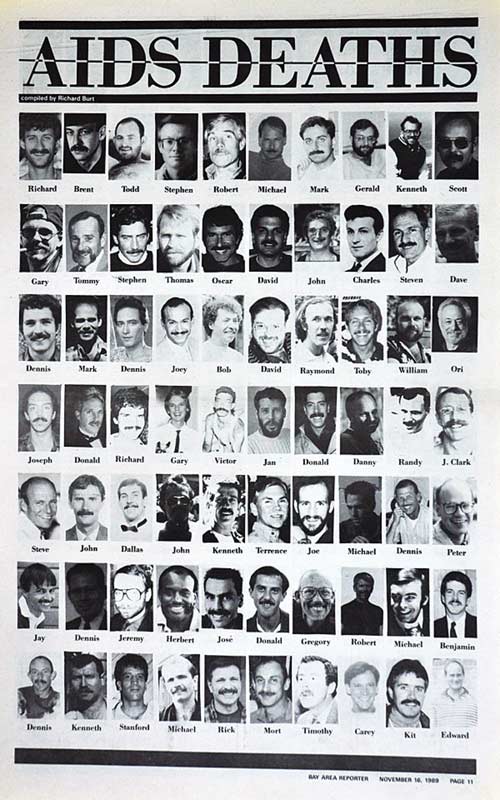
During this time, the B.A.R. was also keeping a more morbid type of tally: the obituaries. Each week the paper published two pages — 30 to 50 obituaries — until 1998.

“When you picked it up, it was the first thing you turned to,” Gerharter said. “It was just a name and a face. Maybe you recognized the person. Maybe someone you tricked with.”

In 1989, art director Richard Burt became so overwhelmed by the number of obituaries that had been turned in to the B.A.R. within the first 10 months that he wanted to convey the sinking feeling in the pages of the paper. The Nov. 16 issue included a four-page collage of everyone who had passed away due to AIDS that year. Just a name and a face.

“It was heartbreaking,” Julian said, “to see my friends and lovers pictured there.”

Through the efforts of Tom Burtch and the San Francisco GLBT Historical Society, a massive searchable online database of B.A.R. obituaries since 1979 was launched in 2009 (www.leifkerdesigns.com/olo/index.jsp).

During his tenure at the paper, Julian chose not to cover AIDS, feeling that the point of entertainment news was to distract away “from the soul-crushing presence of the grim reaper stalking our neighborhoods.”

Though AIDS was a heavily political newsbeat, Friday removed himself from covering it for different reasons. “I knew every elected official. I sat in on all the City Hall meetings about the bathhouses,” Friday said. “But I just couldn’t do it every week. It was too damned personal.”

“Thinking about turning the page to those obituaries even now is making me shiver,” Ottman said. “It’s like a high school reunion, except you don’t know which half made it.”


COVERING THE RISE OF ACTIVISM

The B.A.R. was also instrumental in covering the various political and protest actions that accompanied the disease, including the bloody police sweep of ACT-UP protesters the Castro and the Stop AIDS Now or Else blockade of the Golden Gate Bridge, both in 1989.

Gerharter remembers the blockade. “They arranged it for the morning commute. And thank God it was foggy or else the surveillance cameras would have stopped us.”

Gerharter would often be trusted with information about an upcoming demonstration and be the only photographer allowed to tag along. “You can document history better when you become a part of it. You get closer to the people — they’re not posing,” he said. “It was our job to be advocates and watchdogs.”

After consistently seeing the tragedy of AIDS on the front page for almost a decade, the B.A.R. became more active itself, inciting its readers to action. “We’d read the B.A.R. to find out about the rallies were happening so we could skip work and take a road trip to Sacramento,” Ottman said. “The Chronicle would never cover that.”

When the fight against AIDS became a war, the B.A.R.’s writers often felt like they had become war correspondents, complete with all the outsize personality conflict and drama of the classic stereotype.

“[Bob] Ross was a nightmare boss, a pain in the ass, and complete rageaholic,” Julian said of B.A.R.’s often conservative cofounder, who died in 2003. “But he was committed to keeping the paper and us running.”

THE BAY AREA REPORTER 40TH ANNIVERSARY EXHIBIT

Through June 30, 9 a.m.–5 p.m.

Union Bank Main Branch

400 California, SF


Saving Oakland libraries

When I went to Oakland’s Art Murmur a couple weeks ago, a funeral procession organized to call attention to the possible loss of Oakland public libraries wound its way through the streets.

It wasn’t the only creative mobilization launched in Oakland in response to the possible closure of 14 branch libraries, including the Tool Lending Library, African-American Museum and Library at Oakland, and Second Start Adult Literacy program, to make up for steep revenue shortfalls. Under the painful budget scenario to be discussed by Oakland City Council at its June 21 meeting, just four library branches would stay open, with services just three days a week.

On June 20, a coalition called Save Oakland Libraries organized a 14-hour read-in, featuring local authors reading out loud in front of Oakland City Hall to vocalize support for keeping the libraries open.

Meanwhile, this is what happened last week when anti-capitalist protesters associated with Bay of Rage took to the streets as a “book block” to protest library closures:

http://www.youtube.com/watch?v=1UMo3prDOLw&feature=channel_video_title

While anarchist bookworms tangle with the cops on the streets, the Coalition to Save Oakland Libraries is asking people to send “polite” letters to the Oakland Police Officers Association to “ask them to make their Fair Share contribution to their retirement to keep the libraries open.” Oakland City Hall will likely be packed tonight.

Video by David Martinez.

Our Weekly Picks: June 22-28, 2011

0

WEDNESDAY 22

DANCE

Hard Core: Getting Raw

Finding your identity is tough unless you are a vegetable. Asserting your identity — going against mom and dad — can be tough. However, if who you are and who you want to be goes against societal norms, be prepared to fight for your life. People have died doing it. It’s what the Queer Arts Festival is all about: paying tribute to and celebrating being “out there.” It’s most appropriate that hip-hop — street-born, street-nourished — is part of this yearly event. Hard Core: Getting Raw is a multimedia show put together by Josh Klipp and members of the Freeplay Dance Crew in which each artist (Klipp, Liz Angoff, Kevan Arrington, Hana Azman, and Molly Tsongas) tells a story about a journey undertaken. (Rita Felciano)

Wed/22–Thurs/23, 8 p.m., $15

Garage

975 Howard, SF

(415) 518-1517

www.brownpapertickets.com


THURSDAY 23

EVENT

Manic D Press showcase

In concert with this month’s Pride festivities, the recently relocated Modern Times Bookstore hosts a reading to spotlight luminaries from the queer independent scene. Many affiliated artists stop by, none of whom are exclusively tied to the literary scene but many of whom are pursuing a more experimental approach instead The night features poet Daphne Gottlieb (author of nine books), zinester Larry-Bob Roberts (he’s been called “the Stephen Colbert of queer culture”), badass trans musician-performer Lynn Breedlove, and performance artist extraordinaire Alvin Orloff. With such an eclectic collection of artists of the queer community gathered in one space, the night looks to be a classy, entertaining classy bookend to the flashier parties and parades to come. (David Getman)

7 p.m., free

Modern Times Bookstore

2919 24th St., SF

(415) 282-9246

www.mtbs.com


EVENT

Mara Hvistendahl

On glimpsing the title of Science magazine correspondent Mara Hvistendahl’s new book Unnatural Selection: Choosing Boys Over Girls, and the Consequences of a World Full of Men, I immediately thought what any reasonable boy-crazy person would: yeeeeesssss! Because in the meat-marketplace of a society burdened by a capitalistic priapism, the more infinite the choices, the better. But as usual, first impressions are incomplete. Join Hvistendahl as she explains the repercussions of selective sex abortion and the resulting 160 million women missing from Asia. How is this imbalance tweaking entire nations, and what does the West have to do with it (aside from having invented the ultrasound)? Can I get some ladies here? (Kat Renz)

6 p.m., $5–$15

World Affairs Council Auditorium

312 Sutter, Suite 200, SF

(415) 293-4600

www.itsyourworld.org


FRIDAY 24

PERFORMANCE

I Love Being Me, Don’t You?

A cherished comedian, singer, actress, gay deity, and recent Sarah Palin pummeler, Sandra Bernhard comes to town with a new show and new songs from a new album (both show and album are called I Love Being Me, Don’t You?) as well as dependably cutting observations about the world as such — all in time for Pride. Judging by reports from New York City’s sold-out Town Hall appearance, Bernhard — also working on a new musical with Justin Vivian Bond titled Arts and Crafts — flourishes trademark comedic and vocal chops while keeping outspoken, outrageous, and just plain out. (Robert Avila)

Fri/24–Sat/25, 7 p.m., $45–$75

Marines’ Memorial Theatre

609 Sutter, Second Floor., SF

(415) 771-6900

www.marinesmemorialtheatre.com


MUSIC

Brainfeeder Records Showcase

Started in 2008, the Brainfeeder label has essentially the same musical genetics as its founder, Flying Lotus: bass, hip-hop, electronic, things that go bleep-bloop, and jazz (all with a distinctively experimental bent). Following performances in New York City and L.A., Flying Lotus and a collection of labelmates will be bringing a showcase to 103 Harriet. Of particular interest will be 20-year-old Austin Peralta, a composer and jazz keyboardist who has drawn comparisons to McCoy Tyner and Chick Corea. His album, Endless Planets, has a sense of continuity with the forward elements of the genre (that seemed in part to stall outside of Japan in the ’70s) modernized for the 21st century. (Ryan Prendiville)

With Flying Lotus, Thundercat, Austin Peralta, Teebs, and Strangeloop

9 p.m., $22.50

103 Harriet, SF.

(415) 431-1200

www.1015.com


EVENT

“World’s Ugliest Dog Contest”

Festival season has arrived, and if the tie-dye at the Haight Ashbury Street Fair and the impending smolder of the Queer Tango Fest (June 29-July 3) hasn’t yet reminded you of the all-consuming special-ness of the Bay Area, I hereby announce the entrance of the ugly dogs. Yes, the Sonoma-Marin Fair was the birthplace of the snaggle-toothed, wonky-tailed trend of funky puppy adulation that has since made its way from The Tonight Show with Jay Leno show to Europe and back again. The day culminates in the crowning of another freaky furry friend (the 23rd annual!), but get to the fair early to enjoy dog training lessons, treat demonstrations, and, oh yes, the rest of the pig-and-pie county fair action. (Caitlin Donohue)

6 p.m. (fair hours, noon–midnight), $8–$15

Sonoma-Marin Fairgrounds

175 Fairgrounds, Petaluma

www.sonoma-marinfair.org


FILM

San Francisco United Film Festival

As per its mission statement, the San Francisco United Film Festival draws from an impressively varied pool of films for its third year in the city. From Bhopali, a somber look at the 1984 Union Carbide disaster in Bhopal, India, to The Dead Inside, a zombie-centric musical (the first?), there are strong indicators that the oft-used mantra “something for everyone” is apropos. Documentaries are the meat of this year’s selection and provide some of the more outstanding picks. Eat the Sun examines the practice of sun-gazing, or staring directly into the sun for prolonged periods of time in the belief that this will provide miraculous sustenance, and Superheroes dives mask-first into the world of real-life costumed vigilantes. Superheroes particularly holds promise as a crowd favorite as director Michael Barnett follows avengers Mr. Extreme on patrol and in their daily lives. Super! (Cooper Berkmoyer)

June 24–30, $10.75 (all-film pass, $25–$50)

Roxie Theater

3117 16th St., SF

(415) 863-1087

www.theunitedfest.com/sanfrancisco


SATURDAY 25

MUSIC

San Francisco Free Folk Festival

What better place than a middle school to host a wholesome folk festival? San Francisco’s 35th annual Free Folk Festival features music, dance, and art performances, workshops, and jam sessions for toddlers, teens, 20-somethings, and tried and true folks of any age. The festival provides a great opportunity to fine-tune your Gypsy jazz guitar, pennywhistle, left-handed mandolin, and countless other highly specialized instruments in hour-long workshops throughout the day. If listening and dancing are more your thing, there’ll be storytelling, Moroccan dance, jug band swing, and Bohemian national polka sessions galore. It seems no pocket of culture around the world will go untapped. On the off chance that you think something’s been overlooked, there’s a plain old open mic, too. (Getman)

Sat/25–Sun/26, noon–10 p.m., free

Presidio Middle School

450 30th Ave., SF

www.sffolkfest.org


MUSIC

“Rites of Massive”

Opulent Temple, the SF-based Burning Man camp that has been rocking the playa since 2003, is going big again on Treasure Island, drawing in a wide variety of Burning Man DJs, sculptures, performers, art cars, and music lovers. After filling Building 180 two years ago for its Massive Cox party featuring DJ Carl Cox, OT is moving to the larger Hangar 3 space for Rites of Massive (playing off this year’s Burning Man art theme “Rites of Passage”). Internationally acclaimed headliners DJ Dan, Christopher Lawrence, and Elite Force join notable local DJs on six stages, with burner sound collectives Distrikt, Symbiosis, and others joining the Opulent Temple hosts. Get ready to go big. (Steven T. Jones)

9 p.m.–4 a.m., $30–$50

Hangar 3, 600 California

Treasure Island, SF

www.opulenttemple.org


MUSIC

Cibo Matto

They’ve become hyperactive again. Prior to Cibo Matto’s split in 2001, the duo of instrumentalist Yuka Honda and singer Miho Hatori were responsible for some of the most infectious and bizarre sweet, sweet music of the 1990s. Based in New York City, Cibo Matto had a tendency to be mistaken for a J-Pop band at first listen, in part because of a consistent, aforementioned energy level, but in truth it skipped across the musical spectrum with a complete disregard for genres. The trip-hopping of “Sugar Water.” The ray-gun blap rap of “Working for Vacation.” The tropicalia version of “About a Girl.” Reunited for a Japanese benefit and now a small tour, the band is reportedly working on a new album. (Prendiville) With Chain Gang of 1974

9 p.m., $25

1025 Columbus, SF

(415) 474-0365

www.bimbos365club.com


SUNDAY 26

FILM

“Sand Up Your Vortex”

Since beach dreams rarely come true ’round these foggy, windy parts, why not ditch the S.P.F. and stuff your wild bikini at the Vortex Room instead? Tonight’s quadruple feature kicks off with Roger Corman’s 1957 Attack of the Crab Monsters (nukes made ’em giant; human flesh makes ’em hungry); Jack Curtis’ 1964 The Flesh Eaters (contains Nazis, beatniks, and — again — gruesomely gourmet human flesh); Monster from the Surf (1965), perhaps best explained by its alternate title, The Beach Girls and the Monster; and Nate Watt’s 1961 The Fiend of Dope Island (“He took everything and everyone he wanted!”), which is firmly ensconced on my list (along with 1976’s Shriek of the Mutilated and 1981’s Make Them Die Slowly) of all-time best movie titles. (Cheryl Eddy)

7 p.m., $5

Vortex Room

1082 Howard, SF

www.myspace.com/thevortexroom 


The Guardian listings deadline is two weeks prior to our Wednesday publication date. To submit an item for consideration, please include the title of the event, a brief description of the event, date and time, venue name, street address (listing cross streets only isn’t sufficient), city, telephone number readers can call for more information, telephone number for media, and admission costs. Send information to Listings, the Guardian Building, 135 Mississippi St., SF, CA 94107; fax to (415) 487-2506; or e-mail (paste press release into e-mail body — no text attachments, please) to listings@sfbg.com. Digital photos may be submitted in jpeg format; the image must be at least 240 dpi and four inches by six inches in size. We regret we cannot accept listings over the phone.


Film Listings

0

Film listings are edited by Cheryl Eddy. Reviewers are Kimberly Chun, Michelle Devereaux, Peter Galvin, Max Goldberg, Dennis Harvey, Johnny Ray Huston, Louis Peitzman, Lynn Rapoport, Ben Richardson, and Matt Sussman. For rep house showtimes, see Rep Clock. For first-run showtimes, see Movie Guide.

FRAMELINE

The 35th San Francisco International LGBT Film Festival runs through Sun/26 at the Castro, 429 Castro, SF; Rialto Cinemas Elmwood, 2966 College, Berk; Roxie, 3117 16th St., SF; and Victoria, 2961 16th St., SF. For tickets (most films $9-$15) and complete schedule, visit www.frameline.org.

OPENING

Bad Teacher Cameron Diaz don’t need no education. (1:29) Shattuck.

Buck This documentary paints a portrait of horse trainer Buck Brannaman as a sort of modern-day sage, a sentimental cowboy who helps “horses with people problems.” Brannaman has transcended a background of hardship and abuse to become a happy family man who makes a difference for horses and their owners all over the country with his unconventional, humane colt-starting clinics. Though he doesn’t actually whisper to horses, he served as an advisor and inspiration for Robert Redford’s The Horse Whisperer (1998). Director Cindy Meehl focuses generously on her saintly subject’s bits of wisdom in and out of a horse-training setting — e.g. “Everything you do with a horse is a dance” — as well as heartfelt commentary from friends and colleagues. In the harrowing final act of the film, Brannaman deals with a particularly unruly horse and his troubled owner, highlighting the dire and disturbing consequences of improper horse rearing. (1:28) Embarcadero, Shattuck, Smith Rafael. (Sam Stander)

Cars 2 Owen Wilson, Larry the Cable Guy, Michael Caine, and others give voice to the autos in this spy-themed Pixar sequel. (1:52) Balboa, Shattuck.

Conan O’Brien Can’t Stop Conan O’Brien Can’t Stop seems less of a movie title and more like a hushed comment shared between one of the many hangers-on during the filming of the “Legally Prohibited From Being Funny On Television Tour.” Throughout 23 cities’ worth of footage, O’Brien seethes, paces, sweats, yells and beats dead jokes so hard that they spring back to life, as he is wont to do.

At this point, the Leno/Coco drama is a bit stale — at least in internet time — but the documentary is a fascinating comedian character study nonetheless. It may be hard to sympathize with a man nursing a bruised ego as he cashes a $45 million dollar check, but it’s easy to see that he’s one of the best late night hosts (temporarily off) the air. Split primarily between clips of O’Brien performing songs on stage with a myriad of celebrity guests and bemoaning how exhausted and frustrated he is, Can’t Stop derives most of its hilarity from the off-the-cuff comments that pepper Conan’s everyday conversations. (1:29) Lumiere, Shattuck. (David Getman)

Oki’s Movie See review at www.sfbg.com. (1:20) Yerba Buena Center for the Arts.

*Viva Riva! Gritty, riveting, and even heartbreaking, Viva Riva!, the first Congolese feature film to get distribution in the states, is much like its small-time crook of an anti-hero, Riva (Patsha Bay Mukuna) — in love with life and prepared to laugh in the face of death when it comes knocking. Director Djo Tunda Wa Munga’s African Movie Academy Award winner tumbles with the grimy details of its Kinshasa, Congo, backdrop, and rarely stumbles. A mere foot soldier in a sprawling crime world, Riva has seized his chance at breaking into the big time, with a score of stolen gasoline, and has returned home. His eyes are on an unlikely prize, Nora (Marie Malone), the well-guarded moll of a Kinshasa gangster. As Riva stalks his lithe prey, he’s tailed by the ruthless Angolan crime boss he’s crossed (Hoji Fortuna) and a local military commander under the thug’s thumb (Marlene Longage). As sexy and violent as a contemporary noir, and as familiar as a folk tale unraveled round a campfire, Viva Riva! holds your attention with all the bruised bravado of its Stagger Lee-like protagonist, catching you in with the way the gorgeous Nora undulates at an outdoor gathering at one moment, then squats in the dirt to take a piss at the next. (1:36) Lumiere, Shattuck. (Chun)

ONGOING

*L’Amour Fou Pierre Thoretton’s documentary L’amour fou opens with two clips of men bidding farewell. The first, from 2002, is of the French-Algerian couturier Yves Saint Laurent announcing his retirement in a moving and emotional speech worthy of his favorite writer Marcel Proust. The second is of Pierre Bergé, Saint Laurent’s longtime business partner and former lover, eulogizing his departed friend at the designer’s memorial service six years later. Thoretton’s film is suffused with goodbyes, many tender and candid, some portentous and rehearsed. To be sure, L’amour fou is a touching portrait of the powerful and tempestuous bond between Saint Laurent and Bergé, a bond that lasted close to five decades and resulted in one of the great empires of 20th century fashion. But it is also, alongside David Teboud’s two 2002 YSL documentaries, another entry in the hagiography of Saint Laurent, one cannily steered by Bergé as much as by Thoretton. Well-spoken and charming, Bergé still comes off as the punchy entrepreneurial foil to Saint Laurent’s dazzling but fragile genius. He can be both hyperbolic (praising Saint Laurent’s gifts) but also forthcoming (discussing the designer’s demons). Former muses Loulou de la Falaise and Betty Catroux are also interviewed, but this is clearly Bergé’s show. (1:43) Opera Plaza. (Sussman)

The Art of Getting By The Art of Getting By is all about those confusing, mixed-up and apparently sexually frustrating months before high school graduation. George (Freddie Highmore) is a trench coat-wearing misanthrope — an old soul, as they say — whose parents and teachers are always trying to put him inside a box and tell him how to think. He finds a kindred sprit in Sally (Emma Roberts) who smokes and watches Louis Malle films. Hot. Heavily scored by the now-ancient songs of early ’00s blog bands, it may all sound like indie bullshit but this one has charm and wit despite its post-trend package. Like a sad little crayon, Highmore is a competent Michael Cera surrogate du jour. Writer-director Gavin Wiesen embraces hell of clichés, but he suitably sums up a generational angst along the way. The film may not always feel real, but it does have real feeling. Look out for great performances from Blair Underwood and Alicia Silverstone. (1:24) 1000 Van Ness, Sundance Kabuki. (Ryan Lattanzio)

*Beautiful Boy Save the children, but pity the parents. Director-cowriter Shawn Ku’s Beautiful Boy is one of two recent films concerning parents of kids who go on school killing sprees, and it’ll get potentially shortchanged due to the forthcoming We Need to Talk About Kevin‘s head-turning cast and its Hitchcockian literary source material. Still, Beautiful Boy shines in its own humble way, by dint of its quiet sense of integrity and refusal to pander. The bone-deep unhappiness suffusing the family concerned was present long before 18-year-old college student Sammy (Kyle Gallner) picked up a gun, killed more than a dozen people, then took his own life. Surviving parents Kate (Maria Bello) and Bill (Michael Sheen) already kept separate bedrooms under the same roof and led separate lives, with Bill pasting an unsettling grin on for work and Maria relentlessly pushing to make everything all right, neither noticing the barely perceptible warning signs that their only son was succumbing to despair. Belying its title, Beautiful Boy is less focused on the desperate youngster than on the adults attempting to cope with the horror he’s wrought — not necessarily cleaning up after him or picking up the pieces, but somehow finding their way through their own explosive responses. Bolstered by fine performances by Bello and Sheen, it’s yet another installment in the post-9/11 cinema of trauma — this time, attempting to imagine the unimaginable and to comprehend a kind of healing. (1:40) SF Center. (Chun)

*Beginners There is nothing conventional about Beginners, a film that starts off with the funeral arrangements for one of its central characters. That man is Hal (Christopher Plummer), who came out to his son Oliver (Ewan McGregor) at the ripe age of 75. Through flashbacks, we see the relationship play out — Oliver’s inability to commit tempered by his father’s tremendous late-stage passion for life. Hal himself is a rare character: an elderly gay man, secure in his sexuality and, by his own admission, horny. He even has a much younger boyfriend, played by the handsome Goran Visnjic. While the father-son bond is the heart of Beginners, we also see the charming development of a relationship between Oliver and French actor Anna (Mélanie Laurent). It all comes together beautifully in a film that is bittersweet but ultimately satisfying. Beginners deserves praise not only for telling a story too often left untold, but for doing so with grace and a refreshing sense of whimsy. (1:44) Embarcadero, Piedmont, Sundance Kabuki. (Peitzman)

*Bill Cunningham New York To say that Bill Cunningham, the 82-year old New York Times photographer, has made documenting how New Yorkers dress his life’s work would be an understatement. To be sure, Cunningham’s two decades-old Sunday Times columns — “On the Street,” which tracks street-fashion, and “Evening Hours,” which covers the charity gala circuit — are about the clothes. And, my, what clothes they are. But Cunningham is a sartorial anthropologist, and his pictures always tell the bigger story behind the changing hemlines, which socialite wore what designer, or the latest trend in footwear. Whether tracking the near-infinite variations of a particular hue, a sudden bumper-crop of cropped blazers, or the fanciful leaps of well-heeled pedestrians dodging February slush puddles, Cunningham’s talent lies in his ability to recognize fleeting moments of beauty, creativity, humor, and joy. That last quality courses through Bill Cunningham New York, Richard Press’ captivating and moving portrait of a man whose reticence and personal asceticism are proportional to his total devotion to documenting what Harold Koda, chief curator at the Costume Institute at the Metropolitan Museum of Art, describes in the film as “ordinary people going about their lives, dressed in fascinating ways.” (1:24) Opera Plaza. (Sussman)

Bride Flight Who doesn’t love a sweeping Dutch period piece? Ben Sombogaart’s Bride Flight is pure melodrama soup, enough to give even the most devout arthouse-goer the bloats. Emigrating from post-World War II Holland to New Zealand with two gal pals, the sweetly staid Ada (Karina Smulders) falls for smarm-ball Frank (Waldemar Torenstra, the Dutchman’s James Franco) and kind of joins the mile high club to the behest of her conscience. The women arrive with emotional baggage and carry-ons of the uterine kind. As the harem adjusts to the country mores of the Highlands, Frank tries a poke at all of them in a series of sex scenes more moldy than smoldery. This Flight, set to a plodding score and stuffy mise-en-scene, never quite leaves the runway. Not to mention the whole picture, pale as a corpse, resembles one of those old-timey photographs of your great grandma’s wedding. These kinds of pastoral romances ought to be put out to, well, pasture. (2:10) Opera Plaza. (Lattanzio)

*Bridesmaids For anyone burned out on bad romantic comedies, Bridesmaids can teach you how to love again. This film is an answer to those who have lamented the lack of strong female roles in comedy, of good vehicles for Saturday Night Live cast members, of an appropriate showcase for Melissa McCarthy. The hilarious but grounded Kristen Wiig stars as Annie, whose best friend Lillian (Maya Rudolph) is getting hitched. Financially and romantically unstable, Annie tries to throw herself into her maid of honor duties — all while competing with the far more refined Helen (Rose Byrne). Bridesmaids is one of the best comedies in recent memory, treating its relatable female characters with sympathy. It’s also damn funny from start to finish, which is more than can be said for most of the comedies Hollywood continues to churn out. Here’s your choice: let Bridesmaids work its charm on you, or never allow yourself to complain about an Adam Sandler flick again. (2:04) Empire, 1000 Van Ness, Shattuck, Sundance Kabuki. (Peitzman)

*Cave of Forgotten Dreams The latest documentary from Werner Herzog once again goes where no filmmaker — or many human beings, for that matter — has gone before: the Chauvet-Pont-d’Arc Cave, a heavily-guarded cavern in Southern France containing the oldest prehistoric artwork on record. Access is highly restricted, but Herzog’s 3D study is surely the next best thing to an in-person visit. The eerie beauty of the works leads to a typically Herzog-ian quest to learn more about the primitive culture that produced the paintings; as usual, Herzog’s experts have their own quirks (like a circus performer-turned-scientist), and the director’s own wry narration is peppered with random pop culture references and existential ponderings. It’s all interwoven with footage of crude yet beautiful renderings of horses and rhinos, calcified cave-bear skulls, and other time-capsule peeks at life tens of thousands of years ago. The end result is awe-inspiring. (1:35) SF Center, Shattuck. (Eddy)

*The Double Hour Slovenian hotel maid Sonia (Ksenia Rappoport) and security guard Guido (Filippo Timi) are two lonely people in the Italian city of Turin. They find one another (via a speed-dating service) and things are seriously looking up for the fledgling couple when calamity strikes. This first feature by music video director Giuseppe Capotondi takes a spare, somber approach to a screenplay (by Alessandro Fabbri, Ludovica Rampoldi, and Stefano Sardo) that strikingly keeps raising, then resisting genre categorization. Suffice it to say their story goes from lonely-hearts romance to violent thriller, ghost story, criminal intrigue, and yet more. It doesn’t all work seamlessly, but such narrative unpredictability is so rare at the movies these days that The Double Hour is worth seeing simply for the satisfying feeling of never being sure where it’s headed. (1:35) Opera Plaza. (Harvey)

Green Lantern This latest DC Comics-to-film adaptation fails to recognize the line between awesome fantasy-action and cheeseball absurdity, often resembling the worst excesses of the Christopher Reeve Superman movies. A surprisingly palatable Ryan Reynolds stars as Hal Jordan, the cocky test pilot who is chosen to wield a power ring as a member of an intergalactic police force called the Green Lantern Corps. He must face down Parallax, an alien embodiment of fear, who appears here as a chuckle-inducing floating head surrounded by tentacles. Peter Sarsgaard is effectively nauseating as Hector Hammond, who becomes Parallax’s crony after he is transformed by a transfusion of fear energy. The acting is all over the map, with Blake Lively’s blank-faced love interest caricature as the weakest link, and the effects are hit-or-miss, but scenes featuring alien Green Lanterns should please fans, and you could probably do worse if you’re looking for an entertaining popcorn flick. (1:45) 1000 Van Ness, Sundance Kabuki. (Stander)

The Hangover Part II What do you do with a problematic mess like Hangover Part II? I was a fan of The Hangover (2009), as well as director-cowriter Todd Phillips’ 1994 GG Allin doc, Hated, so I was rooting for II, this time set in the East’s Sin City of Bangkok, while simultaneously dreading the inevitable Asian/”ching-chang-chong” jokes. Would this would-be hit sequel be funnier if they packed in more of those? Doubtful. The problem is that most of II‘s so-called humor, Asian or no, falls completely flat — and any gross-out yuks regarding wicked, wicked Bangkok are fairly old hat at this point, long after Shocking Asia (1976) and innumerable episodes of No Reservations and other extreme travel offerings. This Hangover around, mild-ish dentist Stu (Ed Helms) is heading to the altar with Lauren (The Real World: San Diego‘s Jamie Chung), with buds Phil (Bradley Cooper) and Doug (Justin Bartha) in tow. Alan (Zach Galifianakis) has completely broken with reality — he’s the pity invite who somehow ropes in the gangster wild-card Mr. Chow (Ken Jeong). Blackouts, natch, and not-very-funny high jinks ensue, with Jeong, surprisingly, pulling small sections of II out of the crapper. Phillips obviously specializes in men-behaving-badly, but II‘s most recent character tweaks, turning Phil into an arrogant, delusional creep and Alan into an arrogant, delusional kook, seem beside the point. Because almost none of the jokes work, and that includes the tired jabs at tranny strippers because we all know how supposedly straight white guys get hella grossed out by brown chicks with dicks. Lame. (1:42) 1000 Van Ness, SF Center, Shattuck, Sundance Kabuki. (Chun)

Judy Moody and the Not Bummer Summer Try not trying so hard, Judy Moody. The tween paperback fave gets an OTT makeover for the cineplex, as director John Schultz and company throw as many bells, whistles, silly new slang, kooky gruesome colors, CGI twinkles, sing-along subtitles, and zany hijinks into the mix as possible, in vain hope of keeping kiddie eyeballs from drifting. Bright-eyed redhead Judy Moody (Jordana Beatty) — think Pippi Longstocking, only way more annoying — is stuck at home for the season, sans most of her pals and parentals, scuttling her plans for a Not Bummer Summer filled with weirdly competitive thrill points (her very own invention) and pointless faux adventures (ditto). Her cute, arty, wack-eee Aunt Opal (Heather Graham) offers some diverting solace, but the summer seems to find its groove only after Judy slimily co-opts younger bro Stink’s (Parris Mosteller) obsession with Bigfoot. Lovers of visceral kid stuff will appreciate Judy and mob’s affection for pee and puke references — too bad the entire enterprise just reeks of very bummer desperation. (1:31) 1000 Van Ness. (Chun)

Kung Fu Panda 2 The affable affirmations of 2008’s Kung Fu Panda take a back seat to relentlessly elaborate, gag-filled action sequences in this DreamWorks Animation sequel, which ought to satisfy kids but not entertain their parents as much as its predecessor. Po (voiced by Jack Black), the overeating panda and ordained Dragon Warrior of the title, joins forces with a cavalcade of other sparring wildlife to battle Lord Shen (Gary Oldman), a petulant peacock whose arsenal of cannons threatens to overwhelm kung fu. But Shen is also part of Po’s hazy past, so the panda’s quest to save China is also a quest for self-fulfillment and “inner peace.” There’s less character development in this installment, though the growing friendship between Po and the “hardcore” Tigress (Angelina Jolie) is occasionally touching. The 3-D visuals are rarely more than a gimmick, save for a series of eye-catching flashbacks in the style of cel-shaded animation. (1:30) 1000 Van Ness, SF Center. (Stander)

*Making the Boys In 1968 The Boys in the Band revolutionized Broadway and opened a lot of minds by being a hit play (and film) about NYC homosexuals. Yet on the cusp of “Gay Liberation” and for many years thereafter, much of the actual gay community hugely objected to author Mart Crowley’s fictive portrait of its ‘mos as insular, shallow, classist, bitchy, and guilt-ridden. It was (as interviewee Edward Albee notes here) a picture ideally suited to straight Broadway audiences who lined up to see queers rendered pitiful if still identifiably human. Crayton Robey’s absorbing documentary chronicles the bumpy road of Boys and its creators — Crowley never had another hit, floundering until he moved into TV series scripting. The cast of the 1970 movie version, directed by William Friedkin (one year before The French Connection, followed by The Exorcist), saw their big break turn into a virtual industry blacklisting. Exceptions were unimpeachably heterosexual thespians Laurence Luckinbill and Cliff Gorman, who only “played” gay. This engrossing document recalls a work that trailblazed, was rejected as politically correct, then re embraced as an important touchstone in gay visibility and self-empowerment. (1:33) Roxie. (Harvey)

Midnight in Paris Owen Wilson plays Gil, a self-confessed “Hollywood hack” visiting the City of Light with his conservative future in-laws and crassly materialistic fiancée Inez (Rachel McAdams). A romantic obviously at odds with their selfish pragmatism (somehow he hasn’t realized that yet), he’s in love with Paris and particularly its fabled artistic past. Walking back to his hotel alone one night, he’s beckoned into an antique vehicle and finds himself transported to the 1920s, at every turn meeting the Fitzgeralds, Gertrude Stein (Kathy Bates), Dali (Adrien Brody), etc. He also meets Adriana (Marion Cotillard), a woman alluring enough to be fought over by Hemingway (Corey Stoll) and Picasso (Marcial di Fonzo Bo) — though she fancies aspiring literary novelist Gil. Woody Allen’s latest is a pleasant trifle, no more, no less. Its toying with a form of magical escapism from the dreary present recalls The Purple Rose of Cairo (1985), albeit without that film’s greater structural ingeniousness and considerable heart. None of the actors are at their best, though Cotillard is indeed beguiling and Wilson dithers charmingly as usual. Still — it’s pleasant. (1:34) Albany, Balboa, Embarcadero, 1000 Van Ness, Piedmont, Sundance Kabuki. (Harvey)

Mr. Popper’s Penguins (1:35) 1000 Van Ness.

*My Perestroika Robin Hessman’s very engaging documentary takes one very relatable look at how changes since glasnost have affected some average Russians. The subjects here are five thirtysomethings who, growing up in Moscow in the 70s and 80s, were the last generation to experience full-on Communist Party indoctrination. But just as they reached adulthood, the whole system dissolved, confusing long-held beliefs and variably impacting their futures. Andrei has ridden the capitalist choo-choo to considerable enrichment as the proprietor of luxury Western menswear shops. But single mother Olga, unlucky in love, just scrapes by, while married schoolteachers Lyuba and Boris are lucky to have inherited an apartment (cramped as it is) they could otherwise ill afford. Meanwhile Ruslan, once member of a famous punk band (which he abandoned on principal because it was getting “too commercial”), both disdains and resents the new order just as he did the old one. Home movies and old footage of pageantry celebrating Soviet socialist glory make a whole ‘nother era come to life in this intimate, unexpectedly charming portrait of its long-term aftermath. (1:27) Balboa. (Harvey)

Submarine (1:37) Opera Plaza, SF Center.

*Super 8 The latest from J.J. Abrams is very conspicuously produced by Steven Spielberg; it evokes 1982’s E.T.: The Extra-Terrestrial as well as 1985’s The Goonies and 1982’s Poltergeist (so Spielbergian in nature you’d be forgiven for assuming he directed, rather than simply produced, the pair). But having Grandpa Stevie blessing your flick is surely a good thing, especially when you’re already as capable as Abrams. Super 8 is set in 1979, high time for its titular medium, used by a group of horror movie-loving kids to film their backyard zombie epic; later in the film, old-school celluloid reveals the mystery behind exactly what escaped following a spectacular train wreck on the edge of their small Ohio town. The PG-13 Super 8 aims to frighten, albeit gently; there’s a lot of nostalgia afoot, and things do veer into sappiness at the end (that, plus the band of kids at its center, evoke the trademarks of another Grandpa Stevie: Stephen King). But the kid actors (especially the much-vaunted Elle Fanning) are great, and there’s palpable imagination and atmosphere afoot, rare qualities in blockbusters today. Super 8 tries, and mostly succeeds, in progressing the fears and themes addressed by E.T. (divorce, loneliness, growing up) into century 21, making the unknowns darker and the consequences more dire. (1:52) California, Empire, 1000 Van Ness. (Eddy)

*13 Assassins 13 Assassins is clearly destined to be prolific director Takashi Miike’s greatest success outside Japan yet. It’s another departure for the multi-genre-conquering Miike, doubtless one of the most conventional movies he’s made in theme and execution. That’s key to its appeal — rigorously traditional, taking its sweet time getting to samurai action that is pointedly not heightened by wire work or CGI, it arrives at the kind of slam-dunk prolonged battle climax that only a measured buildup can let you properly appreciate. In the 1840s, samurai are in decline but feudalism is still hale. It’s a time of peace, though not for the unfortunates who live under regional tyrant Lord Naritsugu (Goro Inagaki), a li’l Nippon Caligula who taxes and oppresses his people to the point of starvation. Alas, the current Shogun is his sibling, and plans to make little bro his chief adviser — so a concerned Shogun official secretly hires veteran samurai Shinzaemon (Koji Yakusho) to assassinate the Lord. Fully an hour is spent on our hero doing “assembling the team” stuff, recruiting other unemployed, retired, or wannabe samurai. When the protagonists finally commence their mission, their target is already aware he’s being pursued, and he’s surrounded by some 200 soldiers by the time Miike arrives at the film’s sustained, spectacular climax: a small village which Shinzaemon and co. have turned into a giant boobytrap so that 13 men can divide and destroy an ogre-guarding army. A major reason why mainstream Hollywood fantasy and straight action movies have gotten so depressingly interchangeable is that digital FX and stunt work can (and does) visualize any stupid idea — heroes who get thrown 200 feet into walls by monsters then getting up to fight some more, etc. 13 Assassins is thrilling because its action, while sporting against-the-odds ingeniousness and sheer luck by our heroes as in any trad genre film, is still vividly, bloodily, credibly physical. (2:06) Bridge, Shattuck. (Harvey)

The Tree of Life Mainstream American films are so rarely adventuresome that overreactive gratitude frequently greets those rare, self-conscious, usually Oscar-baiting stabs at profundity. Terrence Malick has made those gestures so sparingly over four decades that his scarcity is widely taken for genius. Now there’s The Tree of Life, at once astonishingly ambitious — insofar as general addressing the origin/meaning of life goes — and a small domestic narrative artificially inflated to a maximally pretentious pressure-point. The thesis here is a conflict between “nature” (the way of striving, dissatisfied, angry humanity) and “grace” (the way of love, femininity, and God). After a while Tree settles into a fairly conventional narrative groove, dissecting — albeit in meandering fashion — the travails of a middle-class Texas household whose patriarch (a solid Brad Pitt) is sternly demanding of his three young sons. As a modern-day survivor of that household, Malick’s career-reviving ally Sean Penn has little to do but look angst-ridden while wandering about various alien landscapes. Set in Waco but also shot in Rome, at Versailles, and in Saturn’s orbit (trust me), The Tree of Life is so astonishingly self-important while so undernourished on some basic levels that it would be easy to dismiss as lofty bullshit. Its Cannes premiere audience booed and cheered — both factions right, to an extent. (2:18) California, Embarcadero, Smith Rafael, Sundance Kabuki. (Harvey)

*The Trip Eclectic British director Michael Winterbottom rebounds from sexually humiliating Jessica Alba in last year’s flop The Killer Inside Me to humiliating Steve Coogan in all number of ways (this time to positive effect) in this largely improvised comic romp through England’s Lake District. Well, romp might be the wrong descriptive — dubbed a “foodie Sideways” but more plaintive and less formulaic than that sun-dappled California affair, this TV-to-film adaptation displays a characteristic English glumness to surprisingly keen emotional effect. Playing himself, Coogan displays all the carefree joie de vivre of a colonoscopy patient with hemorrhoids as he sloshes through the gray northern landscape trying to get cell reception when not dining on haute cuisine or being wracked with self-doubt over his stalled movie career and love life. Throw in a happily married, happy-go-lucky frenemy (comic actor Rob Brydon) and Coogan (TV’s I’m Alan Partridge), can’t help but seem like a pathetic middle-aged prick in a puffy coat. Somehow, though, his confused narcissism is a perverse panacea. Come for the dueling Michael Caine impressions and snot martinis, stay for the scallops and Brydon’s “small man in a box” routine. (1:52) Albany, Clay, Smith Rafael. (Devereaux)

*Trollhunter Yes, The Troll Hunter riffs off The Blair Witch Project (1999) with both whimsy and, um, rabidity. Yes, you may gawk at its humongoid, anatomically correct, three-headed trolls, never to be mistaken for grotesquely cute rubber dolls, Orcs, or garden gnomes again. Yes, you may not believe, but you will find this lampoon of reality TV-style journalism, and an affectionate jab at Norway’s favorite mythical creature, very entertaining. Told that a series of strange attacks could be chalked up to marauding bears, three college students (Glenn Erland Tosterud, Tomas Alf Larsen, and Johanna Morck) strap on their gumshoes and choose instead to pursue a mysterious poacher Hans (Otto Jespersen) who repeatedly rebuffs their interview attempts. Little did the young folk realize that their late-night excursions following the hunter into the woods would lead at least one of them to rue his or her christening day. Ornamenting his yarn with beauty shots of majestic mountains, fjords, and waterfalls, Norwegian director-writer André Ovredal takes the viewer beyond horror-fantasy — handheld camera at the ready — and into a semi-goofy wilderness of dark comedy, populated by rock-eating, fart-blowing trolls and overshadowed by a Scandinavian government cover-up sorta-worthy of The Girl with the Dragon Tattoo (2009). (1:30) Lumiere. (Chun)

*X-Men: First Class Cynics might see this prequel as pandering to a more tweeny demographic, and certainly there are so many ways it could have gone terribly wrong, in an infantile, way-too-cute X-Babies kinda way. But despite some overly choppy edits that shortchange brief moments of narrative clarity, X-Men: First Class gets high marks for its fairly first-class, compelling acting — specifically from Michael Fassbender as the enraged, angst-ridden Magneto and James McAvoy as the idealistic, humanist Charles Xavier. Of course, the celebrated X-Men tale itself plays a major part: the origin story of Magneto, a.k.a. Erik Lehnsherr, a Holocaust survivor, is given added heft with a few tweaks: here, in an echo of Fassbender’s turn in Inglourious Basterds (2009), his master of metal draws on his bottomless rage to ruthlessly destroy the Nazis who used him as a lab rat in experiments to build a master race. The last on his list is the energy-wrangling Sebastian Shaw (Kevin Bacon), who’s set up a sweet Bond-like scenario, protected by super-serious bikini-vixen Emma Frost (January Jones). The complications are that Erik doesn’t ultimately differ from his Frankensteins — he pushes mutant power to the detriment of those puny, bigoted humans — and his unexpected collaborator and friend is Xavier, the privileged, highly psychic scion who hopes to broker an understanding between mutants and human and use mutant talent to peaceful ends. Together, they can move mountains—or at least satellite dishes and submarines. Jennifer Lawrence as Raven/Mystique and Nicholas Hoult as Hank McCoy/Beast fill out the cast, voicing those eternal X-Men dualities — preserving difference vs. conformity, intoxicating power vs. reasoned discipline. All core superhero concerns, as well as teen identity issues — given a fresh charge. (2:20) Empire, 1000 Van Ness, Sundance Kabuki. (Chun)


Alerts

0

ALERTS

 By Jackie Andrews


THURSDAY, JUNE 23


Radical Women meeting

Attend this round-up of radical women and LGBTQ organizers who work hard to improve their communities to fight against racism, sexism, homophobia, and labor exploitation. Tonight there will be a light summer supper followed by a discussion and brainstorming session inspired by the “It Gets Better” campaign — a national group that provides hope for queer youth around the country. Collaborate with like-minded people who want to make change happen at home and help hammer out a plan to translate the mission of the “It Gets Better” campaign to our local queer community’s needs.

6:15 p.m., $7.50

New Valencia Hall

625 Larkin, SF

(415) 864-1278

www.radicalwomen.org


Medicare for all

Many progressives around the country are less than enthusiastic with the current administration’s reform on health care, which they see as a sellout to corporate interests. The San Francisco chapter of the Progressive Democrats of America presents this public forum on the topic, where Don Bechler, a tireless organizer for single-payer healthcare since 1994, and clinical psychologist Stephen Berman will discuss just how close we are to having a truly universal healthcare.

7 p.m., free

Unitarian Universalist Center

Martin Luther King Room

1187 Franklin, SF

(415) 776-4580

www.pdaamerica.org


SATURDAY, JUNE 25


People’s Movement assembly

Attend this community forum and planning session for next year’s East Bay Social Forum — inspired by the U.S. Social Forum in Detroit last June where more than 20,000 diverse people came together to build strong progressive movements for housing, health, justice, education, immigration, ecology, and peace.

9:30 a.m.–4:30 p.m., free

Lutheran Church of the Cross

1744 University, Berk.

(510) 848-1424

www.eastbaysocialforum.org


TUESDAY, JUNE 28


Clean Air Act

Find out how the Clean Air Act, signed into law by President Nixon in 1970, is the U.S.’s most important and successful law for controlling air pollution and why it is our best hope in curbing climate change. If used effectively, it could significantly reduce greenhouse gases to a level deemed safe by climatologists. Learn how the Clean Air Act works, what kinds of threats it faces from Congress, and how it can be used to protect the planet and our future.

7–10 p.m., free

Unitarian Universalists’ Hall

1744 University, Berk.

(510) 841-4824

www.bfuu.org 


Mail items for Alerts to the Guardian Building, 135 Mississippi St., SF, CA 94107; fax to (415) 437-3658; or e-mail alert@sfbg.com. Please include a contact telephone number. Items must be received at least one week prior to the publication date.

The Performant: Impossible weekend! Or: what to do when there’s everything to do?

0

Bicycle Music Festival and “A Clockwork Orange Afternoon”

Oh lordy, let me catch my breath. Weekend, you have officially kicked my ass.

Merely mortal, I found it difficult to plot an itinerary efficient enough to be able to hit every event that beckoned my attention over those bright and sunny 48 hours. Would I attend the annual Juneteenth street festival or a lecture on the benefits of zombie domestication? Journey to the End of the Night or a CLASH scavenger hunt? Sharon Jones and the Dap Kings at Stern Grove or Klaus Kinski at YBCA? Cloning myself seems a more attractive option by the day.

Spoiled for choice, and seeking the sun, I was wooed by the Bicycle Music Festival on Saturday afternoon. Located in the comfy meadow just past the De Young in Golden Gate Park, the Bicycle Music Fest kicked off with local folk rockers StitchCraft. Heather Normandale’s Jolie-Holland husk accompanied by her own guitar and Joey “Cello Joe” Chang wafted sweetly in the mild breeze while a team of stationary-bike pedalers powered up the PA system. 

Introduced by festival organizer and Rock the Bike founder Paul “Fossil Fool” Freedman as an “OG” of the Bicycle Music movement, Normandale is a fixture with the Pleasant Revolution bicycle-powered music touring group, including a five-month tour of Europe with fellow BMF-featured performers, The Ginger Ninjas, as well as a participant of the Shake Your Peace 2009 Winter Walking Tour. Next up, Cradle Duende brought the gypsy noise followed by Evan Francis and fellow jazz mafiosos  who played a mellow, sax-heavy set, warm as the rare June sunshine.

Solar-charged, pedal-powered, and ready for shade, I made tracks on Sunday for “A Clockwork Orange Afternoon” at the Edinburgh Castle. A celebration of the 40-year anniversary of the notorious Kubrick film made of the Anthony Burgess book of the same name, choice excerpts were read, and partly enacted, by Castle regulars: Jack Boulware as narrator, pub proprietor Alan Black as a slew of bit characters (including a spot-on interpretation of the Prison Chaplain), and bowler-hatted Crispin Barker as “Little Alex”. 

At 49, the book itself is still pretty spry, alternating between restless and relentless, full of ultra-violence, yes, and weepy devotchkas and the red, red vino on tap — but not far below the shock value of its remorseless protagonist’s actions lies Burgess’ unwavering belief that the basis for our humanity is our power of choice, for good or for ill. 

“When a man cannot choose he ceases to be a man,” asserts the prison chaplain doggedly, a statement echoed by Burgess himself in his 1986 essay “A Clockwork Orange, Resucked”. Stripped of his ability to choose his own moral path, and simultaneously losing his ability to listen to Beethoven’s Ninth (for Burgess, a self-taught composer, this was undoubtedly the ultimate cruelty), Alex pays dearly for his state-sanctioned “freedom”. And nearly fifty years later, the dire implications of the “Ludovico technique” still provoke as strongly as any spot of “twenty-to-one”.


Suhr sounds open to Portland-style FBI terrorism taskforce resolution

1

When the Guardian sat down with SFPD Chief Greg Suhr last week, it was shortly after the Board of Supervisors unanimously approved Julius Turman as the next Police Commissioner. Turman’s appointment means the Commission, which provides civilian oversight of SFPD’s policies and procedures, now has seven members, once again, and thus can get on with addressing important outstanding issues, including what to do about the FBI’s hitherto secret agreement around SFPD officers assigned to the FBI’s terrorism taskforce.


At issue is an agreement with the FBI that then SFPD Chief Heather Fong signed in March 2007, but the Police Commission never reviewed. Further complicating the issue is the fact that in December 2008, the FBI introduced looser surveillance guidelines that appear to clash head-on with SFPD’s tighter surveillance policies, which require reasonable suspicion before any spying can be approved.


During Suhr’s first few weeks as Chief, the Police Commission and the Human Rights Commission held a joint hearing on the FBI’s hitherto secret agreement with the SFPD. And during that meeting, Suhr introduced a new bureau order which clarified that, under Suhr’s command, SFPD surveillance policies trump the FBI guidelines.


But civil rights advocates, including the American Civil Liberties Union and the Asian Law Caucus, continued to raise concerns. And evidently Suhr has listened to them. During our interview, Suhr told me that he met with ACLU’s John Crew, and Crew explained that Suhr’s new bureau order is only a temporary solution.


“It’s only a remedy as long as I am Chief,” Suhr explained, noting that the ACLU wants to sit down and review the matter and see if there is a way to tighten any loopholes,


“And if we can’t reach accord with the FBI, then we’ll talk about how to move forward with a Portland-style resolution,” Suhr said, referring to a recent decision by the Portland city council in Oregon not to sign the FBI’s agreement, and instead draft its own resolution to better define the terms and conditions under which local officers can participate in the FBI-led joint terrorism taskforce.


Asked what he thought about the FBI’s decision not to send a representative to address community concerns at the joint hearing of the San Francisco Police Commission and Human Rights Commission, Suhr replied, “I don’t think they [the FBI] thought it would be productive,” adding that his talks with Stephanie Douglas, the FBI Special Agent in charge of the terrorism taskforce, have been very “productive” so far.


Tonight: Freedom of information panel on press passes

A few articles have been published over the past year or so about the availability of press passes in San Francisco, spurring a slew of questions: Who gets them? Why are they needed? What are the laws surrounding media access? And what are the rules governing the local process of issuing press badges, anyway?

To sort it out, the Freedom of Information Committee of the Northern California Chapter of the Society of Professional Journalists is organizing a panel discussion today, June 21, at the San Francisco Public Library. It’s not intended to be a debate, but an informational session for journalists and other interested parties to clear up some of the misconceptions surrounding press passes. Panelists will include Lt. Troy Dangerfield of the San Francisco Police Department’s Media Relations unit, Acting City Administrator Amy Brown, Attorney David Greene of the First Amendment Project, and Chris Roberts, a reporter who has covered controversy surrounding press passes before.

The panel will be held at 5:30 p.m. at the San Francisco Public Library, 100 Larkin St., in the Latino/Hispanic Community Meeting Room, located on the Library’s lower level. (Enter at 30 Grove Street, proceed down stairs to the lower level.)

Will another DREAMer be deported, despite ICE’s S-Comm reforms?

51

Last week, ICE announced reforms to its controversial Secure Communities program. Civil rights advocates denounced these changes as window dressing, and the Guardian broke the news about S-Comm’s importance to the FBI’s Next Generation Identification (NGI) initiative, which appears to be using S-Comm on undocumented folks to secure support for a fingerprint dragnet to cover a much broader segment of the population than undocumented immigrants. But now, even before folks have had a chance to fully process the potential civil liberties impacts of the FBI’s NGI’s initiative, comes word that Mandeep, a DREAM Act honors pre-med student at UC Davis, who was once voted “most likely to save the world” by her peers at Los Altos High in Mountain View, could be deported to India on Wednesday.


Mandeep is pursuing a degree in Neurology, Physiology, and Behavior at UC Davis. But she is undocumented, and thanks to Congress’ failure to pass the DREAM Act last year, she now faces deportation to a country she barely knows. Immigrant rights advocates note that it was only a  month ago that President Obama spoke about the importance of providing a path to citizenship for students like Mandeep.


“We should stop punishing innocent young people for the actions of their parents,” Obama said. “We should stop denying them the chance to earn an education or serve in the military.”


They note that Obama has authority to grant administrative relief, which would make qualified DREAM Act youth safe from deportation, but that he has said he can’t use his executive authority in that way. So they’ve been sounding the alarm about Mandeep’s plight by faxing government officials about her situation.


But weren’t ICE’s newly announced S-Comm reforms supposed to provide relief for students like Mandeep?


Immigrant rights advocates say they are concerned that the reforms may not have much real impact on Mandeep because they rely on advocates and attorneys to get attention on individual cases. They note that Mandeep and her mother turned themselves into ICE this morning because they are scheduled to be deported tonight at 1am. And that ICE released them. But it is not clear what will happen next….


Meanwhile, ICE today announced the results of a seven-day targeted “Cross Check” enforcement operation that led to the arrest of more than “2,400 convicted criminal aliens and immigration fugitives” in May, as part of its promise to focus S-Comm resources on undocumented residents who have also broken criminal laws.


“The results of this operation underscore ICE’s ongoing focus on arresting those convicted criminal aliens who prey upon our communities, and tracking down fugitives who game our nation’s immigration system,” ICE Director John Morton said. “This targeted enforcement operation is a direct result of excellent teamwork among law enforcement agencies who share a commitment to protect public safety.”


ICE notes that everyone taken into custody as part of this latest sweep had prior convictions for crimes such as armed robbery, drug trafficking, child abuse, sexual crimes against minors, aggravated assault, theft, forgery and DUI. ICE also noted that 22 percent of the individuals were immigration fugitives-convicted criminal aliens with outstanding orders of deportation who failed to leave the country.


ICE says it conducted its first successful Cross Check operation in December 2009,  and has since conducted similar operations in 37 states, but that this seven-day operation, was the largest of its kind, and involved the collaboration of more than 500 ICE agents and officers, and coordination with the U.S. Marshals Service, the U.S. Diplomatic Security Service, U.S. Customs and Border Protection, the U.S. Postal Inspection Service, and ICE’s state and local law enforcement partners throughout the United States.


Arrestees included a 32-year-old man residing in Amesbury, Mass., from the Dominican Republic, who is a registered sex offender convicted of assault, battery on a household member, indecent assault, battery on a child, and leaving the scene/person injured; a 51-year-old man residing in Denver, Colo. from Libya convicted of first degree sexual assault against a child and assault domestic violence; a 38-year-old man residing in Orlando, Fla. from the Philippines convicted of battery on a law enforcement officer, resisting officer with violence, reckless driving and refusal to submit to blood/urine test; andaA 37-year-old residing in North Hills, Calif. from Mexico convicted of aggravated felony sex crime and rape of an unconscious victim. He was also identified as re-entering the United States after deportation. He will be removed following prosecution for illegal re-entry after deportation; and a 47-year-old man residing in Magnolia, Texas from Mexico convicted of injury to a child with intent to cause bodily injury, burglary, marijuana possession, driving while license suspended and indecency with a child by sexual contact.


“ICE is focused on smart, effective immigration enforcement that prioritizes efforts first on removing those serious criminal aliens who present the greatest risk to the security of our communities, such as those charged with or convicted of homicide, rape, robbery, kidnapping, major drug offenses and threats to national security. ICE also prioritizes the arrest and removal of those who game the immigration system including immigration fugitives or those criminal aliens who have been previously deported and illegally re-entered the country, “ ICE stated.


Hmm. It sure sounds like Mandeep doesn’t fit ICE’s criminal alien profile or priorities any more…

Reminder: Guardian forum tonight

0

Come by the Local 2 hall, 209 Golden Gate, tonight for the second Guardian Forum on issues in the mayor’s race. We’ll be talking about budget, healthcare and social services, with a great lineup of speakers. And it’s all about audience participation — so bring your ideas. There will be plenty of time for discussion.


Panelists:


Gabriel Haaland, SEIU 1021


Brenda Barros, health care worker, SF General


Debbi Lerman, Human Services Network


Jenny Friedenbach, Budget Justice Coalition


the Unite Here Local 2 hall is at 209 Golden Gate, at Leavenworth. Couple of blocks from Civic Center BART. We start at 6 p.m. and run until 8 p.m. See you there.

Guardian Forum June 21: Budget, healthcare and social services

5

We’re doing the second in a series of Guardian forums on issues in the mayor’s race June 21. This one will focus on the budget, healthcare and social services. We’re looking for ideas — progressive approaches to the policy and process of setting the city budget, priorities in healthcare and social services, how to balance reveue and cuts, where new revenue should come from etc. The panelists will make some suggestions and outline some issues, but this is a community process and we want to hear from you. So come by, listen — and participate.

It’s at the Unite Here Local 2 hall, 209 Golden Gate. 6 pm. June 21.

panelists:


Gabriel Haaland, SEIU 1021

Brenda Barros, health care worker, SF General

Debbi Lerman, Human Services Network

Jenny Friedenbach, Budget Justice Coalition


The Local 2 hall is easy to get to, right near Civic Center. Join us.


Civil rights advocates say S-Comm reforms are spin, part of bigger FBI biometric tracking plan

23

In face of mounting criticism nationwide, the U.S. Department of Homeland Security announced today changes to its Secure Communities (S-Comm) deportation program. These changes include protections for domestic violence victims, and immigrants who are pursuing legitimate civil liberties protections. They give more discretion to ICE prosecutors, create a new detainer form that stipulates in multiple languages that arrestees cannot be detained under an ICE hold for more than 48 hours, except on holiday weekends. The form also requires local law enforcement to provide arrestees with a copy, which has a number to call if they believe their civil rights have been violated. The agency also said it will provide civil rights training related to its S-Comm program at the state and local level.

Immigrant and civil rights advocates said the announcement shows that the administration acknowledges that there are serious problems with S-Comm’s design and implementation. But they charged that the announced reforms fall far short of the S-Comm moratorium that an increasing number of advocates and lawmakers, including California Assemblymember Tom Ammiano, have demanded.

And some advocates expressed concern that the feds’ insistence on expanding S-Comm, in which fingerprints taken by local law enforcement agencies are automatically shared with federal and international databases, is proof that the program is the first step towards rolling out a much larger program called the Next Generation Identification (NGI) initiative.

Under the NGI, the FBI plans to phase-in the deployment of a host of new biometric interoperability capabilities to state and local law enforcement agencies within the next five years. And NGI likely won’t be limited to non-citizens and undocumented immigrants, suggesting that US citizens charged with a crime will also find that once their fingerprints are taken, law enforcement agencies will immediately compile a huge and internationally interconnected dossier on them, regardless of whether they are innocent of the charges.

Civil rights advocates also worry that local enforcement agencies’ participation in S-Comm will become inevitable because S-Comm is simply the first of a number of biometric interoperability systems being brought online by the NGI.
In other words, S-Comm is just the first of many additional information systems that are being made available to local law enforcement agencies to fully and accurately identify suspects in their custody.

And, according to the FBI/CJIS’s own documents, the feds have adopted a three-part strategy to deal with jurisdictions that do not wish to participate:
1.    Deploy S-Comm to as many places as possible in the surrounding locale, creating a “ring of interoperability” around the resistant site.
2.    Deploy S-Comm selectively to state correctional system facilities, permitting identification of Level 1 offenders who may have been arrested and sentenced in the non-participating jurisdiction,
3.    Ensure that the jurisdiction understands that non-participation does not equate to non-deployment.
In other words, though a local law enforcement agency is technically free to shut off, or ignore, the receipt of records related to the fed’s fingerprint-matching capabilities, the feds are already warning local law enforcement agencies that local officers may find themselves “deprived of substantive information relating to an arrested subject’s true identity, place of origin, and other pertinent data of significant law enforcement value.”

Ammiano, who is the author of California’s TRUST Act, which would allow local governments to opt out of S-Comm, said: “Today’s announcement by ICE is simply window dressing. How many more innocent people have to be swept up by the ironically named Secure Communities program before the Obama administration will change course? Talking about the need for comprehensive immigration reform is not an excuse for continuing with a flawed, unjust program that is having tragic consequences for communities across the country. It is time for a moratorium on S-Comm pending a real review of the program not just PR spin from ICE.”

Professor Bill Ong Hing, immigration law expert at the University of San Francisco, stated, “The fact is, under our Constitution, immigration is a federal responsibility. Neither a state like Arizona, nor the federal government itself, can force local governments to act as immigration agents. Such measures compound the injustices of our deeply broken immigration system – and public safety and local resources are among the first casualties.”

And the Asian Law Caucus, the ACLU of California, the Coalition for Humane Immigrant Rights of Los Angeles, the California Immigrant Policy Center, and the National Day Laborer Organizing Network released the following joint statement:  “We are deeply disappointed by the inadequacy of the Administration’s response to the mounting body of evidence that the ‘Secure’ Communities program is damaging public safety and ensnaring community members. The painful stories of domestic violence victims and other innocent community members facing deportation thanks to S-Comm underscore that the program has simply gone off the rails. While today’s announcement acknowledges that problems exist with the program, the measures outlined by the Administration are a far cry from workable solutions these problems. To announce “reform” before review is an exercise in politics, not policy. The administration should suspend the program and wait for the Inspector General report in order to develop fair and transparent policies.” 

“Before vital relationships between local law enforcement and immigrant communities are furthered damaged, before more domestic violence victims, street vendors, family members, and workers who are merely striving for the American dream are swept up for deportation, S-Comm must be reigned in,” the coalition continued. “For the sake of public safety and transparency, we need real solutions. We strongly support California’s TRUST Act, which sets safeguards the federal government has failed to implement and allows local governments out of S-Comm, and we continue to call for a national moratorium on this fundamentally flawed program.”

In recent weeks, Illinois, New York, and Massachusetts, have either pulled out or refused participation in the program while numerous local governments have sought a way out of a deportation dragnet that harms public safety and has operated with no transparency or local oversight. And Ammiano’s TRUST Act, which also sets basic standards for those jurisdictions that do want to participate in S-Comm passed the state Assembly in May and the Senate Public Safety Committee this week.

During today’s press conference, ICE Director John Morton told reporters that “it makes sense to prioritize resources. We don’t have enough resources to remove everyone who is here unlawfully.”

But when the Guardian asked if the reforms address the community criticisms that S-Comm was rolled out as a way to catch serious criminals, but has been largely used to deport non-felons, Morton maintained the S-Comm has always focused on serious criminal offenders, but was never limited to that.
“We remove felony offenders at a higher rate than are convicted in the general population,” he stated. ‘But federal law does not provide that you can come here unlawfully and then commit crimes other than violent crimes.”

True, but local law enforcement agencies have repeatedly observed that you break vital trust with immigrant communities if they believe that contact with police, including  being arrested for crimes they did not actually commit, or arrests for very low-level misdemeanors, will lead to deportation.

“This feels like a non-announcement, and it’s far from reform,” said B, Loewe of the National Day Laborers Organizing Network. “You don’t put a collar around a snake and call it a pet.”

And SF Police Commissioner Angela Chan, a staff attorney at the Asian Law Caucus, said the reason ICE and the FBI, “are so crazy for S-Comm is because it’s the first step in a much bigger loop that will include citizens and non-citizens alike.”

NDLON and the Asian Law Caucus are part of the coalition that is calling on the Obama administration to publicly oppose and terminate all programs that create partnerships between state and local law enforcement and the Department of Homeland Security; halt the development of the vast data gathering infrastructure that houses S-Comm, and inform the public of the current scope and purpose of its data collection and dissemination activities; and allow state and local jurisdictions to opt-out of S-Comm.

After today’s press conference, ICE issued a press release stating that through April 30, 2011, more than 77,000 immigrants convicted of crimes, including more than 28,000 convicted of aggravated felony (Level 1) offenses like murder, rape and the sexual abuse of children were removed from the U.S. after identification through S-Comm.

“These removals significantly contributed to a 71 percent increase in the overall percentage of convicted criminals removed by ICE, with 81,000 more criminal removals in FY 2010 than in FY 2008,” ICE stated. “As a result of the increased focus on criminals, this period also included a 23% reduction or 57,000 fewer non-criminal removals.

ICE also observed that the agency currently receives an annual congressional appropriation that is only sufficient to remove a limited number of the more than 10 million individuals estimated to be in the U.S. unlawfully. “As S-Comm is continuing to grow each year, and is currently on track to be implemented nationwide by 2013, refining the program will enable ICE to focus its limited resources on the most serious criminals across the country,” ICE stated.

ICE further noted that it is creating a new advisory committee that will advise ICE on ways to improve S-Comm, including recommending on how to best focus on individuals who pose a true public safety or national security threat.  This panel will be composed of chiefs of police, sheriffs, state and local prosecutors, court officials, ICE agents from the field and community and immigration advocates.  The first report of this advisory committee will be delivered to the Director of ICE within 45 days.

ICE Director Morton also issued a new memo that directs the exercise of prosecutorial discretion to ensure that victims of and witnesses to crimes are properly protected. The memo clarifies that the exercise of discretion is inappropriate in cases involving threats to public safety, national security and other agency priorities.

And ICE and the DHS Office for Civil Rights and Civil Liberties (CRCL) have created an ongoing quarterly statistical review of the program to examine data for each jurisdiction where S-Comm is activated to identify effectiveness and any indications of potentially improper use of the program. “Statistical outliers in local jurisdictions will be subject to an in-depth analysis and DHS and ICE will take appropriate steps to resolve any issues,” ICE stated.
.

Two bike photo projects show love for the movement

0

We’re in a moment of bike love. Bikes are hot: in SF the weather’s hot, the Bicycle Music Festival‘s coming up, an extended network of bike paths is on their way – and around the world, there’s a lot of energy surrounding the rise of two-wheeled transport. It’s an important time for bicycles, so let look at how it’s being documented. 

One way: Matthew Finkle and Brittain Sullivan are the authors of a book called – yes – I Love My Bike (Chronicle Books, $16.95, 160 pages) that recently landed in our Guardian mailbox. Finkle and Sullivan, the book’s intro tells me, met on a bike ride on a summer night in Boston and subsquently pedaled across the country with each other, snapping flicks of their bikey buddies along the way.

Theirs is a photo book of bikes and their riders, smattered with terse little quotes from all the pretty things (“when I get pissed off I build gold bikes!” the handlebar-mustachioed, booze-toting Erik Noren of Minneapolis’ Peacock Groove Cycles enigmatically proclaims). America’s lookin’ real good on our bikes, according to I Love My Bike — everyone’s got a bicycle fit to induce heavy breathing among the so-inclined.

I have to admit, I started getting a little hot and bothered over some of the (bike!) specimens – there’s a yellow banana seat cruiser on page 109 for which I die, and I know that according to the bike snob gods I’m not supposed to like those five spoked plastic fixie rims anymore, but Daniel Mueller of Boston’s pink and powder blue creation… I don’t care, want.  

I Love My Bike: Wall to wall wheel walls 

When I shut I Love My Bike, I did so with the impression that the US is a solid mass of trendy, creative (mainly) young people — on bikes. I like those kinds of people – some might say that I am one myself. The book, presented as an aspirational showcase of hipster and high performance bike fashion, works just fine. 

But Finkle and Sullivan need to holler at whoever’s writing their back cover blurb. “Throughout their travels they met cyclists of all kinds…,” it rather hyperbolically shouts. Or maybe they met cyclists of all kinds, but they didn’t publish any photos of them – I’m didn’t see any families in there, and certainly no one with a junker bike that isn’t a hard-to-find, check-my-steez brand of junker. This is a book of bikers that are just a few freeways from having a big ass social ride to a BBQ of local, organic edibles in a park somewhere.

I think that people who bike are more complex than that — in a good way. For a different take on a bike photography project, head south. And east. Really far in both of those directions. 

There you will find South Africa’s Bicycle Portraits, a photo series that was started by Nic Grobler and Stan Engelbrecht to highlight the brave, self-propelled souls on roads where cars aren’t always the friendliest neighbors for meat puppets (to borrow a favorite term from David Byrne’s Bicycle Diaries). You’re not getting the idea that everyone depicted in Bicycle Portraits is a brother from a different mother — but you are getting the feeling that the biking movement is moving away from the “ain’t it cool?” model of awareness-building to the “ain’t it necessary?” school of thought. 

You can’t scroll through Grobler and Engelbrecht’s website without realizing that biking in South Africa may well be a lifestyle, but it’s not a single lifestyle — people aren’t just riding bikes because it’s fun, hip, or social, but because it’s the mode of transportation that makes the most sense for them. Bicycle Portraits purposefully paints a country of bikers as a diverse, important group of citizenry.

Rich people, poor people, old people, kiddos. Ashton May’s black township cruiser, Loza Philani’s well-ridden Raleigh (“my bike is like oxygen to me – it keeps me alive,” he says), and Brandon Searle’s high tech Durban Cannondale. The two also collected in-depth interviews with each subject to help explain how bikes figured in each of the lives they documented.

After two successful Kickstarter campaigns, the Bicycle Portraits team is now accepting pre-orders for what is sure to be a phenomenal book. (Swoop.)

In a land such as our own when bike riding all too often is stereotyped as the domain of flippant and sullen (does that work?) trendoids who refuse to “mature” into taking crowded public transportation and gas-guzzling automobiles, projects like Bicycle Portraits seem incredibly important. If we have proof in front of our eyes that bikes are helping people lead lives that help the planet, city governments are way more likely to invest in bike systems, parents are more likely to encourage their wee ones to take to two wheels, and people who don’t fit the hipster stereotype are more likely to pedal off into the sunset. Fashion is fun, but fashion alone can’t influence urban planning. 

We do the movement a disservice if we paint ourselves as the sole face of biking in today’s cities – but of course, the diehard dandies among us are always going to Love our bikes. Damn Carolyn Ngo of San Diego, where’d you get that metallic blue handlebar tape?


Candidates land punches in first D.A. debate

5

District Attorney and former SFPD Chief George Gascón, Alameda County Deputy District Attorney Sharmin Bock, and former San Francisco Police Commissioner David Onek all landed solid punches during a three-way District Attorney debate that was co-hosted by the San Francisco Young Democrats and the Alice B. Toklas LGBT Democratic Club, and moderated by Recorder editor Scott Graham. The primary sponsor of the debate was the City Democratic Club, according to CDC President Jim Reilly. So, thanks CDC for helping to pull off a great event.

The debate was framed as a choice between Bock, a veteran prosecutor with leadership experience, Gascón, a career cop with managerial experience, and Onek, a former San Francisco Police Commissioner and criminal justice reform expert. And above all it proved that if you lock three attorneys in the same room and pit them in a three-way fight, you’ll be rewarded with a blood sport spectacle.

Bock kicked off by noting that there are many similarities between the three candidates—except when it comes to independence and experience “Experience matters,” Bock said, throwing a one-two punch at Gascón and Onek. “The job of the District Attorney is not a management job, a police job or a job for someone with just a law degree. It needs a veteran prosecutor,” she said—remarks that resonated well with the crowd, judging from the applause.

But after a few niceties, Gascón shot right back at Bock and Onek. “I am the only one who has led large organizations and pushed public policy forward in an effective manner,” he said.

And Gascón struck a home run when he revealed that when he took the job of Chief of Police in Mesa, Arizona, he was “facing one of the most toxic environments” in terms of hatred towards people of color and the LGBT community–and that he did something about it, by standing up to anti-immigrant Sheriff Joe Arpaio of Maricopa County, and protecting the local LGBT community’s right to protest.

When it was his turn to speak, Onek fired off his own rounds at Bock and Gascón, noting that the state’s criminal justice system is broken—and claiming that it will take an outsider to fix it.
“This is a once-in-a-lifetime opportunity to reform the criminal justice system,” Onek said, laying out his reform-minded track record.

And then he stuck it to both Bock and Gascón by stating that the death penalty does not work. “I will never seek it in San Francisco under any circumstances,” Onek said, earning excited applause, as he noted that he’ll look at all policy question through the prism of three questions: ‘Does it make us safer, is it cost effective and is it fair and equitable?”

Onek also noted that neither the Supreme Court’s ruling that California must reduce its prison population by 30,000, nor Gov. Jerry Brown’s call for prisoner realignment, come with any money.
‘That’s a disaster,” observed Onek, as he stressed the need to demand resources to help deal with the upcoming load of prisoners that about to return to San Francisco.

Gascón fielded questions about whether they are enough people of color and LGBT background in management in the D.A.’s Office. “Well, I think there’s definitely always room for improvement in any organization,” he said, noting that he has a history in the Los Angeles Police Department, the Mesa, Arizona Police Department and the SFPD, “of pushing very aggressively to have diversity within the office.”
But he started a bit of a buzz when he said it was “really a surprise to me that I promoted the first male, black, police captain to the San Francisco Police Department.”
“You would think that there have been, you know, male African-Americans in that department for many years. It was hard for me to believe that actually in 2009 we had not had one,”  Gascón continued, a remark that got some debate observers asking afterwards, if this meant that Gascón really did not know that former SFPD Chief Earl Sanders was a black male.

Meanwhile, Bock was happily trampling all over the sit-lie legislation that then SFPD Chief Gascón and Mayor Newsom backed last fall, as she noted that more foot patrols and community policy are what’s actually needed. “Political hot-button measures don’t work,” Bock said. “Both sides agree it hasn’t worked. It’s the wrong response to the real problem.

Asked if he had a conflict of interest, when it comes to investigating allegations of police misconduct, Gascón claimed the problem is limited to a small number of officers, adding, “if the allegations are true.”

“In reality the majority of the SFPD are hard-working people doing the right thing,” he said. “And there has been only one challenge—and our office has prevailed,” Gascón said. “However, there have been a finite number of cases where I personally adjudicated the bad conduct—and those will be handled by the Attorney General’s office.”

Bock stressed that she was not in favor of sending drug offenders to prison and would focus on restorative justice, instead. Asked if she would have a panel on her staff review potential death penalty cases, Bock confirmed that she is committed to having a Special Circumstances Committee, as D.A. Kamala Harris did, to get input around the facts and from lawyers involved in such cases.“The ultimate decision is mine, and I oppose the death penalty,” Bock said, noting that she does not believe that 12 jurors will return a unanimous death penalty verdict. “But I do think as prosecutor you need to go case by case.”

Asked if he would have sought the death penalty in a case like the L.A. Night Stalker, who murdered 13 people, many of them elderly, Gascón said, “Probably not. All of us agree that the death penalty is not a good tool. But it is part of our system, and I continue to have the system Kamala Harris had in place. At the end of the day, it’s my decision, and I’m the only one in the room, who can say I’ve already turned down the death penalty.”

Agreeing with Bock that a jury is unlikely to go for the death penalty, Gascón maintained that the death penalty is “an illusory issue,” and that the real question is, “How do we rewrite the State Constitution [so the death penalty is not on the books]?”

Asked how he felt about marijuana, Gascón said he doesn’t believe folks should be incarcerated for use—and that folks are already being diverted to community courts in those instances.

But when Onek tried to wrap up by positioning himself as a the reformist-minded outsider, Gascón pounced, reminding folks that Onek was a Police Commissioner, when the Police Commission recommended Gascón to Mayor Newsom as the next SFPD Chief. “While David is someone I respect—and one of those who hired me, David has painted himself as an outsider, when the Police Commission is the policy-making body for the SFPD. There are no outsiders here. The question is, what have you done? There’s a difference between calling yourself a reformer and having other people call you a reformer.”

Bock for her part used her closing remarks to remind folks that there has been a crime lab scandal, alleged police misconduct, a DNA backlog, and about 100 cases dismissed as a result of these scandals, and a bunch of prisoners are about to be sent back to the community because of realignment. “We’re in challenging times, at a critical crossroads, with stormy weather ahead,” she said. “I’m not going to be trying things out at your expense. As a veteran progressive prosecutor, I’m fully prepared.”

Tribes author burrows into the Big Apple

0

Thanks to the help of burners from at least five different tribes that I’ve covered or camped with at Burning Man, my New York City book tour was a successful adventure in art and community, from the Figment festival on scenic Governors Island to exotic eating and drinking in the East Village and Queens to a great underground party at an old Catholic school in Brooklyn to getting canonized by Rev. Billy and his 25-person choir into the Church of Earthalujah along with SF-based performance artist Guillermo Gómez-Peña.

The June 7-13 trip was in support of The Tribes of Burning Man: How an Experimental City in the Desert is Shaping the New American Counterculture, my book chronicling how an event born in San Francisco has spawned a vast, well-developed culture and ethos that is affecting life in cities around the world, even seemingly impervious megalopolises like the Big Apple.

I arrived on the red eye Wednesday morning just as a heat wave was peaking in New York, showing up mid-morning at the Upper East Side apartment of Jax, a recent transplant from SF who I worked with on last year’s Temple of Flux project. Her air conditioner hadn’t arrived yet, so I sweated through a needed nap before surrendering myself to exploring the city.

That night was my Tribes launch party in a great spot called Casa Mezcal on Orchard Street on the Lower East Side. Fellow Shadyvil campmate Wylie Stecklow had not only arranged the venue, which is owned by one of his law clients, but he moved the weekly Big Apple Burners happy hour and the final planning meeting for Figment (an event he co-founded four years ago) to the venue, giving me a built-in audience of interested burners who seemed to really appreciate my reading and discussion.

Also joining the party were two NYC figures who appear in my book: Not That Dave, Burning Man’s NYC regional contact and a Figment director, and Billy Talen, the former San Francisco performance artist who transformed himself into NYC’s Reverend Billy, pastor of the Church of Stop Shopping, which evolved into the Church of Life After Shopping before becoming the Church of Earthalujah to reflect a mission that expanded from economic justice and anti-consumerism to environmentalism and a holistic way of looking at the perils of our economic system.

As I’ve been doing at some of my Bay Area book events, I read chapters that introduced them and then let them speak, and they each had lively, weird, heart-warming things to say. Several other New Yorkers who I know through Burning Man showed up at the event to join the discussion, wish me well, and buy books. The most surprising guest was Mike Farrah, former Mayor Gavin Newsom’s old right-hand man who did more to facilitate the temporary placement of burner artworks in SF than anyone in City Hall. He now lives in NYC and showed up late, so after talking SF politics and BRC art over beers, we wandered past some of the oldest tenement buildings in the city together as we headed toward the subway.

The city was sweltering the next day (although Jax’s air conditioner had blessedly arrived), so I spent over three hours in the Metropolitan Museum of Art, which makes SF’s museums seem like mere gallery spaces. I walked through Central Park between the reservoir and the Great Lawn, which was being set up for that evening’s Black Eyed Peas concert, all the way to the Upper East Side and my reading at the Columbia University Bookstore (which nobody showed up for, a combination of school being out, the heat, and a freak thunderstorm that was just rolling in as my event began – my first flop after more than a dozen bookstore events).

But New York is a city for nightowls, as I was just beginning to appreciate, particularly after I made my way down to the East Village that night to meet a Garage Mahal campmate who I’ve known for years simply as Manhattan. He’s been living in his apartment for 15 years and the city for 25, developing a detailed knowledge of the best places to eat, drink, and otherwise indulge.

Manhattan won’t go to the Upper East Side, preferring to remain in “civilization,” as he calls the East Village, which earned its storied reputation as the center of the nightlife universe. We ate Japanese curry at Curry Ya, drank hard-to-find German Kolsch beer at Wechsler’s Currywurst, danced with saucy Armenian women on Avenue C, drank cold sake underground at Decibel, indulged in the most decadent fried pork sandwiches at Porchetta, mingled with beautiful young people in the Penny Farthing, and then drank cocktails on his stoop until dawn, the streets never going to sleep in this lively neighborhood.

On Friday in the early afternoon, I met Wylie at The Cube, a public art piece near the 8th Street subway stop, and we hopped a train down to the southern tip of Manhattan to catch the free ferry to Governors Island for the opening day of Figment, an art festival started there by burners in 2007 that has since expanded to Detroit, Boston, and Jackson.

Mayor Michael Bloomberg and other city officials have embraced and facilitated the popular three-day event, which now includes art projects such as a treehouse built of old doors, massive steel sculptures, and an elaborate miniature golf course that will remain on the island through the summer. Most of the projects featured the interactivity that is the hallmark of burner art, such as a sound project in an enclosed courtyard in which passerby had to figure out how they were controlling the sounds they heard.

Wylie and I pedaled on borrowed rental bikes to cover all the projects on a large island that is a decommissioned military base with gorgeous views of the Manhattan and New Jersey skylines. Out on the Picnic Point lawn, with the Statue of Liberty looking on from the bay, the venerable NYC-based Burning Man sound camp Disorient hosted a rocking set of DJs under a massive wooden sculpture that they built for Figment and the playa this year.

Unfortunately, Figment is permitted only as a daytime event that ends at 6 pm, because the energy of the 100-plus organizers and volunteers could have driven this party well into the wee hours. Instead, they all gathered after the event at the 340-year-old White Horse Tavern to discuss the day, celebrate, and share endless ideas for new art projects and ways of measuring and directing all the creative energy that flows through their event and city.

After partying until dawn again, Manhattan and I climbed into his car (yes, a car, in Manhattan, the better to cover more ground, he says) Saturday mid-afternoon, picked up a friend near Wall Street, and crossed the Brooklyn Bridge headed toward Astoria, Queens. There, we drank pitchers of rich Czech beer at the 100-year-old Bohemian Hall and Beer Garden, run by the nonprofit Bohemian Citizens’ Benevolent Society, a fraternal order open only to those with Czech blood. With an outdoor capacity of almost 1,000 people, this place was like my beloved Zeitgeist on steroids.

On the way back to the East Village that night, Manhattan did a sudden U-turn and parked in a bus zone in front of a crowded outdoor eatery called Tavern Kyclades, muttering something about needing octopus and telling us he’d just be a minute. The wait for tables at this amazing Greek seafood spot was 90 minutes, but after less than 10 he was back with a to-go container with three long octopus legs, grilled, tender, and just insanely good.

That night, the plan was to hit an underground party in Brooklyn, thrown in a former Catholic school by Rubulad, a venerable party crew. It was after 1 am when we finally left Manhattan’s apartment for the party, catching the subway at Union Square and arriving to find the party in full swing, with more than a dozen rooms with different offerings: DJ dance parties, avante garde films, a piano bar, live music from a trio that had the beautiful crowd dancing hard and smiling. As the party wound down, I headed to Queens with a new friend and we watched a new day dawn on the Empire State building standing tall in the distance.

Sunday might be a day of rest for some, but not for me, not with the kind of roll I was on. So I caught the last ferry to Governors Island at 3 pm and spent the afternoon at Figment with some other burner friends, Shanthi and Patty, who came back to the East Village with me afterward for my third and final Tribes event: being canonized by Reverend Billy during the Church of Earthalujah’s regular Sunday evening performance at Theatre 80 on St. Marks Place.

I’ve been covering Billy and his crew for years, from their performances in San Francisco’s Castro Theater and other local venues to their film “What Would Jesus Buy?” to their work at Burning Man, including their touching sendoff of burner work crews to the Gulf Coast in 2005 to do cleanup and rebuilding work after Hurricane Katrina, an effort that became Burners Without Borders.

As I write in my book, Billy and his choir of several dozen were transformed by Burning Man, and they have returned that embrace of a culture that magnifies and perpetuates their values. And after being called from the audience and walking toward the stage during a rousing rendition of the “When the Saints Go Marching In,” I was warmly embraced by the entire 25-member chorus – actually, it was probably closer to a group grope – and I became Saint Scribe.

And after that, it’s all a bit of a blur, and a vibrant, decadent, Big Apple blur. Thanks, everyone, for a truly memorable trip.

Ford says goodbye at Golden Wheel Awards

2

Just hours after being asked to leave the San Francisco Municipal Transportation Agency, director Nat Ford was at the San Francisco Bicycle Coalition’s annual Golden Wheels Awards accepting an award for the MTA’s Livable Streets Team. But that potentially awkward moment was eased by the universal political support for making the streets of San Francisco safer and more inviting for pedestrians and bicyclists.

Coming from car-centric Atlanta in 2006, Ford admitted he was an unlikely champion of turning San Francisco into one of the country’s best cities for biking. But he said the SFBC was “very persistent and worked with us.” While the bike injunction hurt progress, Ford said the support of SFBC and city officials allowed the agency to beef up the program from just a couple of staffers to “a dozen of the best bike planning and engineering folks in this country.”

“It was great working with all of you to get the MTA where it is today in terms of biking,” Ford told the capacity crowd in the War Memorial Building’s second floor event space, where the balcony overlooked City Hall and a sea of hundreds of bikes parked on the sidewalk out front.

Mayor Ed Lee spoke next, pledging to continue the progress and telling the crowd, “I want to give my very special thanks to Nat Ford for his five years of very dedicated service.”

Both Ford and MTA members told the Guardian that the split was a “mutual decision.” Ford told us, “Now’s a good time to go,” and that he’s still figuring out his next move. MTA board chair Tom Nolan told us, “It’s something we arrived at together. It’s good for his family and him.”

Indeed, it seems very good for Ford. The board approved a $385,000 severance package to go with its request that he resign before his contract expires, a payout that is drawing some criticism. “I am deeply disappointed that MTA would approve a nearly $400,000 golden parachute for an outgoing city executive. At a time when our budget is cutting critical social services for our kids and the most vulnerable in our city, we can ill-afford to be paying excessive payouts to administrators who are no longer working for the public. I have fought these exorbitant sweetheart deals at UC and CSU, and as mayor I will reform these practices,” Sen. Leland Yee, a candidate for mayor, said in a prepared statement.

Nolan says it’s time to restore the agency. “I’ve talked about wanting to restart what we do,” he told us. While Ford’s reported job hunting was one reason for the split, Nolan also alluded to mismanagement of the agency and the mistrust of its administration by Transport Workers Union Local 250A and other employees.

“We clearly have a problem when the drivers turn down a contract two-to-one,” Nolan said of the union’s rejection of its latest contract, which has since been approved by an outside arbitrator. “We can do a lot better.”

But the Ford saga was just a sideshow during an evening devoted to celebrating the improvements to the city’s bicycle network and selling the SFBC’s vision of what’s next, which it calls “Connecting the City.” The plan calls for three, green, separated bikeways (like those now on a stretch of Market Street) bisecting the city by 2015 (with the first Bay To Beach route done by next year) and a fully connected network of 100 miles of bikeways by 2020.

“Safe, comfortable, crosstown bikeways for everyone,” was how MTA Commissioner Cheryl Brinkman put it in slick video that the SFBC premiered at the event to promote the plan.

SFBC Director Leah Shahum told the crowd the idea is to connect and promote the city’s various neighborhoods and encourage “regular San Franciscans” to take more frequent trips by bike. “Seven in 10 of us, that’s how many people are already riding a bike,” she said, citing a survey of how many city residents own or have access to bikes. “We’re developing a vision where people are connected by safe, family-friendly bikeways.”

Shahum praised how engaged Mayor Lee has been with the plan and the need to improve the city’s cycling infrastructure. “Let me tell you how impressed I am with the level of involvement from Room 200,” she said.

Lee pledged to make cycling safer on dangerous sections of Oak and Fell streets that connect the Panhandle with the Lower Haight – sections Shahum took Lee on during Bike to Work Day this year – and to complete a new green bike lane on JFK Drive this year.

“We can get a lot of the goals of the Bicycle Coalition done together. We need your help in November,” Lee told the crowd, calling for them to support a street improvement bond measure on the fall ballot. He said the bicycling community has made the streets more fun and inviting, telling the crowd that at this weekend’s Conference of Mayors, he is “going to brag about our bike lanes and our way of living.”

Ears of the Beholder outdoor show at El Rio

0

An afternoon show under fruit trees and bright sunshine is always nice, but a line-up of super chill local music is extra conducive to ideal weekend mentality. As long as the weather keeps up its good behavior, Saturday’s Ears of the Beholder four-band showcase will be a total hit and a great introduction to some homegrown electro-pop.

Ears of the Beholder is a pretty rad indie-music blog, started by an San Francisco guy named Peter in 2008. The site promotes a lot of great shows around the city, handpicked with the best intentions. Start with beer, dab your beak with sunscreen and don’t forget the layers; the show may start early at the lovely El Rio, but it won’t wrap until after sunset. The ticket price also includes food, which means you won’t have to run-off mid-set for dinner and instead, you’re encouraged to plop down for a full evening. Take a listen to the line-up:

Phantom Kicks

This SF band keeps things feather-light with pretty, super mellow guitars. They’re minimalist post-rock that’s super easy on the ears and their new synth addition is sure to add in a sweet surge of electro-pop. 


Blackbird Blackbird

The mystical chimes, mermaid voices, and super glassy synth melodies of San Francisoc’s Blackbird Blackbird wash over your senses in slow-motion. They’re a perfect soundtrack for underwater swimming.


Old Arc

These Santa Cruz guys keep things psychedelic, but add in a heavier, more danceable punch. Their random bag of tricks switches up quick and the super diverse samples insures things stay uber fresh from track to track.


Yalls

The honest, fragile vocals from this Oakland native are compelling enough, but then he adds in pianos and totally weird racing beats. There’s something twisted about the combinations he throws and the unpredictability of it all keeps you along for the bright ride. 


EARS OF THE BEHOLDER OUTDOOR SHOW

Sat./18, 3 p.m., $8

El Rio

3158 Mission Street, SF

www.ElRioSF.com

CA Senate committee approves TRUST Act in face of rising “S-Comm” concerns

2

The California Senate Public Safety Committee approved Assemblymember Tom Ammiano’s TRUST Act, (AB 1081) today in a 5-2 vote, in face of rising concerns about a troubled federal fingerprinting and deportation program known as Secure Communities (S-Comm). The TRUST Act would reform California’s participation in S-Comm, which has increasingly come under fire for undermining public safety and operating without transparency or local oversight. Ammiano’s AB 1081 assures that local governments have the ability to opt out of the program and it sets basic standards for jurisdictions that choose to participate. The bill now heads to the Senate Appropriations Committee for consideration.

San Francisco Police Commissioner Angela Chan, a staff attorney with the Asian Law Caucus, says  that immigrants rights activists are calling on California Gov. Jerry Brown and Attorney General Kamala Harris to suspend S-Comm entirely, for now. These calls come in the wake of New York decision to suspend the troubled program, Illinois’s decision to terminate the program, Massachusetts’ decision to refuse to sign the Department of Homeland Security’s proposed S-Comm agreement, and the Inspector General’s announcement that it plans to investigate S-Comm allegations this summer.
“But if S-Comm eventually becomes unsuspended, that’s where the TRUST Act would come into place,” Chan said.

At today’s hearing in Sacramento, retired Sacramento Police Chief Arturo Venegas testified in support of the TRUST Act, calling S-Comm a “Trojan horse,” thanks to Immigration and Customs Enforcement (ICE’s) alleged misrepresentation of S-Comm to law enforcement. And community leader Renee Saucedo read the testimony of Norma, a domestic violence victim whose calls for help landed her in deportation proceedings thanks to S-Comm.

Tuesday’s vote comes on the heels of a growing firestorm of congressional criticism of the program, which reportedly has an annual budget of $200 million. And the latest statistics from ICE show that of all the states, California has deported the most immigrants under S-Comm. As of April 2011, California had deported 41, 833 individuals since it began phasing in its participation in S-Comm in May 2009. These figures include 12,133 folks (30 percent of deportees) who did not have a criminal record. And if you add those with low-level offenses to the non-criminal category, the percentage grows to 70 percent. Texas was in second place after California, with 27,000 S-Comm deportations.

The ol’ Vic-trola

0

arts@sfbg.com

SOUND TO SPARE The potential closing of Haight Street’s Red Vic Theater has unsettled me. With one less place to go out and enjoy, what’s a shut-in-prone type like me to do?

Fortunately, when I spoke to Sam Sharkey, one of the co-op’s managing partners, he offered a ray of hope by saying that the Red Vic Movie House is here, organized — it just partnered with the Haight Street Fair and the California Jug Band Association for a benefit — and best of all, still screening movies, some of them music-related.

Let me take a breath for a minute to reflect and appreciate some of the carefully curated films I’ve encountered at this fine establishment. I’ve transcended the mundane through Ziggy Stardust’s gender-bending, screwed-up-eyes stage persona in Ziggy Stardust and the Spiders from Mars. Director D.A. Pennebaker, better known for documenting Bob Dylan in the 1960s, tried his hand at capturing the Bowie in full glam garb during a 1973 tour. Mick Ronson shreds on guitar to undeniably comical proportions. I recall the audience cracking up, something you just don’t get when you’ve opted to Netflix at home.

The less acclaimed — but equally gorgeous — somber sounds of a pop-star- turned-recluse proved to be quite a treat. Scott Walker: 30th Century Man (2006) was one of those films I didn’t know I needed to see, until the rainy day someone sent me a YouTube link to his song “It’s Raining Today.” The opening atmospheric sounds alone on this track are enough to captivate, but as it moves forward into Walker’s commanding crooning voice, you realize that he has the ability to convey dread and beauty at once. The film is a concrete testament to his influence on contemporary musicians.

Later I was given the soundtrack to boxing’s “Rumble in the Jungle,” set in early 1970s Zaire, where a showcase of mostly familiar soul artists pulled off a hugely successful stadium concert. Soul Power (2008) sort of serves as a musical counterpart to 1996’s When We Were Kings, which was the cinematic predecessor dealing with the same Ali vs. George fight. The symbolic implications of the event for African and African American pride are brought to the fore, and the concept of power is examined, whether it is achieved physically, politically or even musically.

Sharkey said that declining attendance was the Red Vic’s main obstacle. Single-screen theaters aren’t as much of a sustainable business anymore, as evidenced by the number that have closed in the last 10 to 20 years. The Castro Theatre and the Roxie in the Mission seem to be surviving, though — I wondered why people weren’t coming out for movies in the Haight anymore. Was it a bad rap from all the sit-lie buzz? Sharkey didn’t seem convinced on that argument, trusting that his patrons wouldn’t buy into that hype. He leaned toward more technology, calling this an age of competition and noting that the accessibility of movies via broadband Internet is just too convenient.

If you’re a music fan who wants to help curb the trend against local establishments falling by the wayside, then the no-brainer is to hit the Red Vic for the following music films. Rock out for the cause — or you may end up drowning in a sea of Whole Foods.

June 26-28, Phil Ochs: There But for Fortune. The unsung 1960s antiwar folksinger (who doesn’t mind taking a backseat to Dylan) gets the full doc treatment.

July 14, The Hippie Temptation. Vintage 1967 footage of the Haight-Ashbury scene in its glorious heyday as seen through the eyes of CBS News. Originally aired on TV, this “hilariously biased” take on flower power should have you craving the street peddlers’ wares immediately after the show.

July 15-16, Stop Making Sense. Classic Talking Heads circa 1984 at L.A.’s Pantages Theatre. Watching a jittery David Byrne working the crowd in his oversized boxy white suit should be worth the price of admission alone.

July 19-20, The Last Waltz. This one’s cool for a couple of reasons. First, it’s directed by Martin Scorsese and, second, it captures The Band’s final show at San Francisco’s old Winterland Ballroom, a place I’ve often dreamed of seeing a show.