Live

Spank it

0

superego@sfbg.com

SUPER EGO Dear Baby New Year, can you cut up a lot more lines of that fantastic 2010 stuff? Local nightlife and dance music was off the hot hooker. And if the phalanx of shindigs piled up for New Year’s Eve is any indication, there’s a glitter-canon’s worth of glee to come. Below are my favorites, check ’em out. Thxy! Love, Marke B. (P.S. Er, one more thing … you’ve got a little VCR on your leftie. Kids these days!)


1984

The long-running (as in almost 20 years!) retro ’80s party is playing host to a free flashback at Mighty, in appreciation of, well, everything ’80s. DJs Dangerous Dan and Skip play all the faves and waves.

9 p.m.–2 a.m., free. Mighty, 119 Utah, SF. www.mighty119.com


BOOTIE NYE

The outrageous mashup club teams up with Mezzanine to present this bonkers night, with DJs Adrian and Mysterious D, live band Smash-Up Derby, French rapper Grandpamini, upstairs room by Brass Tax, pirate balloon drop, and much more.

9 p.m.–late, $20–$40. Mezzanine, 444 Jessie, SF. www.mezzaninesf.com


COUNTDOWN

Get down with a rockin’ reggaeton, hip-hop, and reggae new year fiesta at Club Six, with the awesome Los Rakas live (seriously, those guys are dope), Jah Warrior Shelter Hi-Fi, the Coo-Yah Ladeez, Mr. E, and more to fill all three dance floors.

8 p.m.–4 a.m., $10. Club Six, 66 Sixth St., SF. www.clubsix1.com


15TH ANNUAL COMEDY COUNTDOWN

Yuck up your new year with super-hip (and mostly cute!) comedians Charlyne Yi, the Sklar Brothers, Shane Mauss, Nick Thune, Christina Paszitsky, and a ton more. Hilarious balloon drop!

9:30 p.m., $60–$120. Palace of Fine Arts, 3301 Lyon, SF. www.ticketmaster.com


ICEE HOT NYE

Get down and wobbly as the city’s best showcase for grimy-funky new musical styles brings in the new year with London’s Bok Bok and Ramadanman, DJs Disco Shawn, Ghosts on Tape, and Rollie Fingers.

9 p.m., $15–$20. Elbo Room, 647 Valencia, SF. www.elbo.com


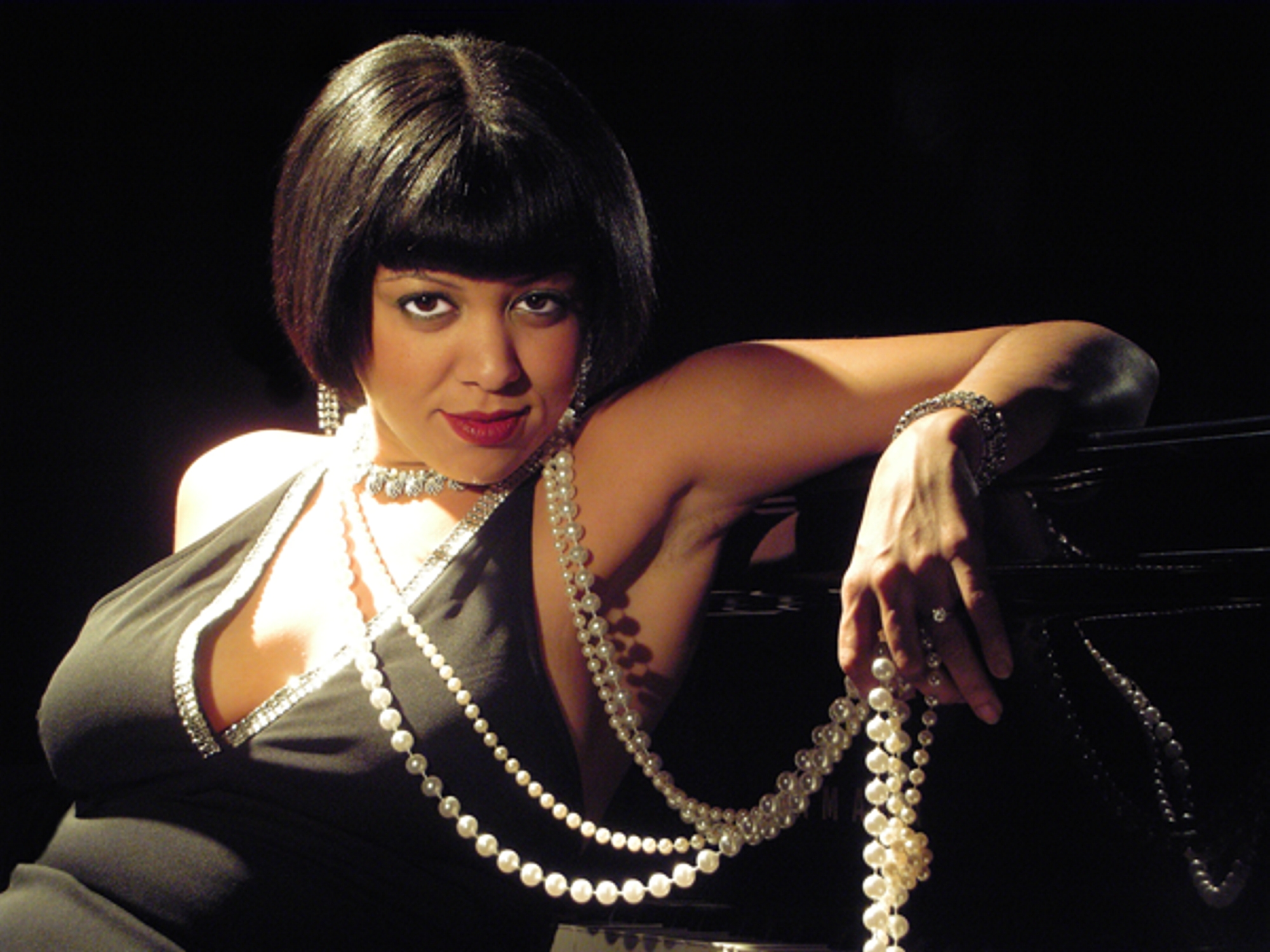
KIM NALLEY

The incredibly gifted and hot-to-trot jazz chanteuse will “Let the Good Times Roll” with two smokin’ shows on New Year’s Eve at the wondrous Rrazz Room at Hotel Nikko. Just watch Ms. Nalley go!

7:30 p.m. and 10 p.m., $35. Rrazz Room at Hotel Nikko, 222 Mason, SF. www.therrazzroom.com


LEXINGTON CLUB NYE

Spend the eve getting down with the coolest dykes on the planet (and the ladies who love them). DJs DURT and Pony Boy rock the tables, Aimee and Chandra host. Free glass of champers from 8 p.m.-9 p.m.!

8 p.m., free. Lexington Club, 3464 19th St., SF. www.lexingtonclub.com


LOOSE JOINTS NYE

The awesome funky Friday weekly party with DJs Tom Thump, Damon Bell, and Centipede is a top choice for those looking to get down.

9 p.m., $10. Make-Out Room, 3225 22nd St., SF. www.makeoutroom.com


MARGA GOMEZ NYE SPECTACULAR

The queer queen of comedy ramps up her annual yuk-a-thon — she’s really, really funny, folks and her shows are a total treat.

7 and 9 p.m., $30–$35, $10. Victoria Theater, 2961 16th St, SF. www.therhino.org

POWERHOUSE NYE

Showering go-go boys! Muscular bartenders serving it up stiff! Yep, you’re at the Powerhouse, spraying your man-champagne into 2011, with DJ DAMnation and a $100 wet towel contest. (free towel check!)

10 p.m., $10. Powerhouse, 1347 Folsom, SF. www.powerhouse-sf.com


ROLLER DISCO

Shrug off the pressure of having to skate off to a hundred other parties and roll to some new wave and disco jams sprinkled with a little Burning Man fairy dust. The Black Rock Roller Disco crew hosts.

8 p.m., $10. CellSpace, 2050 Bryant, SF. www.cellspace.org


SOME THING NEW

Some Thing, the weekly Friday night theatrical drag extravaganza (always full of hot altqueers), comes up with something special — drag goddess Juanita More takes the turntables with Sidekick and Stanley Frank to turn you out.

10 p.m., $10. The Stud, 399 Ninth St., SF. www.studsf.com


SUNSET AND HONEY

Two of the city’s smartest house and techno collectives, Honey Soundsystem and Sunset, join forces at the awesome new Public Works, with special guests Kim Ann Foxman of Hercules and Love Affair and Tim Sweeney of Beats in Space.

9 p.m.–5 a.m., $30. Public Works, 161 Erie, SF. www.publicsf.com


TRANNYSHACK NYE

Good lord — Heklina and her cray-cray drag queens are teaming up with circus-themed party Big Top to wrestle 2010 out the door. Look out, shoulder pads! Tons of performances, Ejector live, and DJ Omar.

9 p.m.–3 a.m., $20. DNA Lounge, 375 11th St., SF. www.dnalounge.com 


Peep our complete list of NYE picks at www.sfbg.com/NYE2011


Deportation hotel

1

By David Bacon

news@sfbg.com

MEXICALI, Mexico — Last year, almost 400,000 people were deported from the United States. That’s the largest wave of deportations in U.S. history, even larger than the notorious Operation Wetback of the 1950s, or the mass deportations during the Great Depression.

Often the Border Patrol empties buses of deportees at the border gates of cities like Mexicali in the middle of the night, pushing people through at a time when nothing is open and no services are available to provide them with food or shelter. Most deportees are young people. They had no money in their pockets coming to the United States, and have nothing when they return to Mexico.

These are invisible people. In the wave of anti-immigrant hysteria gripping the United States, no one asks what happens to the deportees once they’re sent back to Mexico.

In Mexicali, a group of deportees and migrant rights activists have taken over an old abandoned hotel, formerly the Hotel Centenario (or Hundred Year Hotel). They’ve renamed it the Hotel Migrante, or the Migrant Hotel. Just a block from the border crossing, it gives people deported from the United States a place to sleep and food to eat for a few days before they go home or try to cross the border again. The government gives it nothing. Border Angels, the U.S.-based immigrant rights group, provides what little support the hotel gets. A cooperative of deportees cooks the food and works on fixing the building.

During the winter, about 50 or 60 people live in the hotel at any given time, while five or six more knock on its doors every night. Last summer, at the peak of the season when people try to cross the border looking for work, the number of deportees seeking shelter at the hotel rose to more than 300. “A lot of people get hurt trying to walk through the mountains around Mexicali,” says Benjamin Campista, a cooperative member. “It’s very cold there now, and when they get caught and deported, many are just wearing a T-shirt and tennis shoes. Some get sick — those we take to the hospital. The rest stay here a few days until their family can send them money to get home, or until they decide to try to cross again.”

Border Angels and the hotel collective agreed to pay the landlord 11,000 pesos a month in rent (about $900), but they’re already six months behind. Every day hotel residents go out to the long lines of people waiting to cross through the garita (the legal border crossing). They ask for money to support the hotel, and each resident gets to keep half of what he or she is given. The other half goes mostly for food for the evening meal. Deportees have plenty of time to explain their situation to people standing in line, since on a recent afternoon the wait to get through the garita was two hours.

Every day Campista hears deportees tell their stories. “Three brothers stayed here last summer, before they tried to cross. A month later, one came back. I saw him on the roof, crying as he looked at the mountains where the other two had died from the heat. A woman came here with her two-month-old baby. Her husband had died in the desert too.”

“We’re human beings!” Campista exclaims. “We’re just going north to try to work. Why should we die for this? Our governments should end these violations of human rights. Then our hotel wouldn’t even be necessary.”

David Bacon is the author of Illegal People — How Globalization Creates Migration and Criminalizes Immigrants (Beacon Press, 2008) and Communities Without Borders (Cornell University/ILR Press, 2006)


New Year’s Eve 2011 parties

6

As always, we recommend attending several parties on New Year’s Eve — just to spread your personal brand of bubbly around (and change up the scenery a bit.) Below are some recommendations for maximum impact, all of which take place the night of Fri/31. Chin chin! (Check out our Music Listings for even more.)

1984

The long-running (as in almost 20 years!) retro ’80s party is playing host to a free flashback at Mighty, in a ppreciation of, well, everything ’80s. DJs Dangerous Dan and Skip play all the faves and waves.

9 p.m.–2 a.m., free. Mighty, 119 Utah, SF. www.mighty119.com


BEARRACUDA

Calling all big, hot gay men — the fur will fly at this hairy annual affair, with DJs Steve Sherwood, dabecy of Electronic Music Bears, and Medic

8 p.m.–4 a.m., $25 advance. Deco, 510 Larkin, SF. www.bearracuda.com/NYE


BLOW UP NYE

Stylish hip-electro madness continues to reign at this monthly party, and the NYE Blow Up blowout should be pretty spectacular (and gorgeously messy). DJs Jeffrey Paradise, Eli Glad, and more help you explode.

10 p.m.–3 a.m., $18 advance, 18+. Kelly’s Mission Rock, 817 Terry Francois Blvd., SF. www.blowupsf.com


BOOTIE NYE

The outrageous mashup club teams up with Mezzanine to present this bonkers night, with DJs Adrian and Mysterious D, live band Smash-Up Derby, French rapper Grandpamini, upstairs room by Brass Tax, pirate balloon drop, and much more.

9 p.m.–late, $20–$40. Mezzanine, 444 Jessie, SF. www.mezzaninesf.com


COSMIC VOYAGE

Hardworkin’ San Diego techno DJ Donald Glaude is no stranger to SF — he’ll know exactly how to take you higher (and blow up the Funktion One sound system) at Vessel for this intergalactic jam

9 p.m.–6 a.m., $25–$65. Vessel, 85 Campton Place, SF. www.vesselsf.com


COUNTDOWN

Get down with a rockin’ reggaeton, hip-hop, and reggae new year fiesta at Club Six, with the awesome Los Rakas live (seriously, those guys are dope), Jah Warrior Shelter Hi-Fi, the Coo-Yah Ladeez, Mr. E, and more to fill all three dance floors.

8 p.m.–4 a.m., $10. Club Six, 66 Sixth St., SF. www.clubsix1.com


ECLECTIC FEVER

Cumbia, Afro-Latin funk, bhangra, reggae, flamenco, soul, and more styles take over the floor with live performances from Sila, B-Side Players, Locura, Non Stop Bhangra, and more.

8 p.m.–3 a.m., $35 advance. West Bay Center, 1290 Mission, SF. ef2010.eventbrite.com


ELECTRIC VARDO

A wonderfully global dance party with a “Palace on Wheels” theme, featuring fat Chance Belly Dance, DJs Amar and lady ra, chef Ranjan Dey’s Indian creations, and music from Bollywood to Andalusia.

9 p.m., $29–$80. New Delhi Restaurant, 160 Ellis, SF. palaceonwheels2010.eventbrite.com


“11”

Deep house master Marques Wyatt from L.A. joins our own Mark Farina, Julius Papp, and many more for a dance floor marathon, claiming to be the “longest New Year’s Eve celebration.” Whew!

8 p.m.–6 a.m., $30 advance. The Factory, 525 Harrison, SF. 11-zvents.eventbrite.com


15TH ANNUAL COMEDY COUNTDOWN

Yuck up your new year with super-hip (and mostly cute!) comedians Charlyne Yi, the Sklar Brothers, Shane Mauss, Nick Thune, Christina Paszitsky, and a ton more. Hilarious balloon drop!

9:30 p.m., $60–$120. Palace of Fine Arts, 3301 Lyon, SF. www.ticketmaster.com


G.A.W.K.

The still-spunky, 25-year-old Gay Artists and Writers Kollective is hostings its annual NYE blowout, with live musical performances and readings that attract newcomers and classic artists alike for some kollective fun.

8 p.m.–1 a.m., free and all ages. Tikka Masala, 1668 Haight, SF. 


ICEE HOT NYE

Get down and wobbly as the city’s best showcase for grimy-funky new musical styles brings in the new year with London’s Bok Bok and Ramadanman, DJs Disco Shawn, Ghosts on Tape, and Rollie Fingers.

9 p.m., $15–$20. Elbo Room, 647 Valencia, SF. www.elbo.com


KIM NALLEY

The incredibly gifted and hot-to-trot blues chanteuse will “Let the Good Time Roll” with two smokin’ shows on New Year’s Eve at the wondrous Rrazz Room at Hotel Nikko. Just watch Ms. Nalley go!

7:30 p.m. and 10 p.m., $35. Rrazz Room at Hotel Nikko, 222 Mason, SF. www.therrazzroom.com


LEXINGTON CLUB NYE

Spend the eve getting down with the coolest dykes on the planet (and the ladies who love them). DJs DURT and Pony Boy rock the tables, Aimee and Chandra host. Free glass of champers from 8 p.m.-9 p.m.!

8 p.m., free. Lexington Club, 3464 19th St., SF. www,lexingtonclub.com


LOOSE JOINTS NYE

The awesome funky Friday weekly party with DJs Tom Thump, Damon Bell, and Centipede is a top choice for those looking to get down.

9 p.m., $10. Make-Out Room, 3225 22nd St., SF. www.makeoutroom.com


MANGO NYE

The funky summer jam for a diverse and stylish crowd of lesbians returns to wave bye-bye to ’10. DJs Marcella & Edaj make it happen at El Rio.

7 p.m., $15–$40 advance. El Rio, 3158 Mission, SF. mango2011nye.eventbrite.com


POWERHOUSE NYE

Showering go-go boys! Muscular bartenders serving it up stiff! Yep, you’re at the Powerhouse, spraying your man-champagne into 2011, with DJ DAMnation and a $100 wet towel contest. (free towel check!)

10 p.m., $10. Powerhouse, 1347 Folsom, SF. www.powerhouse-sf.com


RENDEZ-VOUS IN PARADISE

Normally the phrase “Las Vegas’s best DJ!” sends us running to the barn for pitchforks — but this is scratch turntable legend Tina T, who is amazing. North Beach’s Atmosphere club is pretty swank, but the crowd will get down.

10 p.m., $50–$75. Atmosphere, 447 Broadway, SF. www.a3atmosphere.com


SEA OF DREAMS

This incredibly huge, longtime New Year’s Eve tradition is bursting with star power: Balkan Beat Box, Thievery Corporation, Modeselektor, Beats Antique, and tons more. Plus, a “GalaxSea” theme, for all you Neptunefish of 2011.

9 p.m.–5 a.m., $75–$135. Concourse Exhibition Center, SF. www.seaofdreamsnye.com


S.O.S. (STANDING ON STARDUST)

The fab rare disco and funky stylings of DJ Bus Station John will be on full display at this incredible-sounding shindig at Burritt Room, put on by handsome duo Bon Vivants. We hear there’ll be yummy food and a giant ice-sculpture unicorn shooting champagne, so ….

9 p.m.-2 a.m., $85. Burritt Room, 417 Stockton, SF. More info here.


SOME THING NEW

Some Thing, the weekly Friday night theatrical drag extravaganza (always full of hot altqueers), comes up with something special — drag goddess Juanita More takes the turntables with Sidekick and Stanley Frank to turn you out.

10 p.m., $10. The Stud, 399 Ninth St., SF. www.studsf.com


STREETS OF SAN FRANCISCO

Infamous DJ Steve Aoki and club photographer Cobrasnake are leaving the electro hipsters behind and appearing at this fancy ball, featuring a scale replica of the city’s beloved monuments.

9 p.m., $12–$200 advance. Fort Mason Center Festival Pavilion, Marina Blvd., SF. www. sanfrancisconewyear’seve2011.com


SUNSET AND HONEY

Two of the city’s smartest house and techno collectives, Honey Soundsystem and Sunset, join forces at the awesome new Public Works, with special guests Kim Ann Foxman of Hercules and Love Affair and Tim Sweeney of Beats in Space.

9 p.m.–5 a.m., $30. Public Works, 161 Erie, SF. www.publicsf.com


TEMPLE OF LIGHT

Temple’s annual luminous extravaganza goes “3-D” to delight the eyes and ears (and a third thing — feet?) with DJ Paul Hemming, Jaswho? live, Ben Tom, Soulspin, and more.

9 p.m.–4 a.m., $40–$150. Temple, 540 Howard, SF. www.templesf.com


TRANNYSHACK NYE

Good lord — Heklina and her cray-cray drag queens are teaming up with circus-themed party Big Top to wrestle 2010 out the door. Look out, shoulder pads! Tons of performances, Ejector live, DJ Omar, and an appearance by Kembra Pfaler of the Voluptuous Horror of Karen Black.

9 p.m.–3 a.m., $20. DNA Lounge, 375 11th St., SF. www.dnalounge.com

Year in Music: Pantha du Prince’s Top 10 (+1) of 2010

0

Phill Niblock, Touch Radio 57
Efdemin, Chicago
Konrad Sprenger, Versprochen
Avey Tare, Down There
Foxtrot Echo Lima Tango fanzine
Autechre, Oversteps
Moritz Von Oswald Trio, Live In New York
Live jams by The Sight Below in New York
Sohrab, A Hidden Place
John Roberts, Glass Eights
Craig Haines, Until the Point of Hushed Support

Pantha du Prince, “Stick to My Side”:


Ma seeks to ban raves in latest War on Fun offensive

11

Someone needs to tell Assembly member Fiona Ma that the ’90s – with its myopic War on Drugs mentality, ascendant rave scene, and chest-beating “tough on crime” political one-upsmanship – are over, even though we’re still paying that era’s bills. Because Ma just introduced AB 74, which seeks to bans raves in California.

Why now? Well, her website says this “historic legislation” was written “on the heels of recent drug-related tragedies in Los Angeles and the Bay Area,” referring to three drug-related deaths at two events last May and June. And even though the same statement claims “attendance at raves can range from 16,000 to 185,000 people,” Ma somehow thinks that a few overdoses justifies a broad ban on dance parties (although she pointedly exempts live concerts, for reasons she doesn’t explain, even though the exact same argument can be made about concerts).

As a representative from the vibrant city of San Francisco, Ma (who did not return our calls for comment) is an embarrassment, taking the already-regressive War on Fun efforts by so-called “moderate” politicians to a new low. But unfortunately, the effort to ban public dance parties has already gained traction at the federal level with provisions of the long-controversial RAVE Act – promoted by top Democrats as well as Republicans — finally sneaking their way onto the books last year.

And now, Ma wants to get into the act, as always seeking to curry favor with the cops in the process (not to mention the alcohol industry, a prime funder of the War on Drugs and the ambitions of its political foot soldiers such as Ma). If they get their way, nothing short of our basic constitutional right of freedom of assembly is at risk, and that should be of concern to people of all ideological stripes.

Does Mayor Newsom represent SF workers or San Mateo politicians?

2

“Does Newsom represent local workers or San Mateo politicians?” That’s the question being asked  at City Hall today. And it’s threatening to deliver an unwelcome kick to Mayor Gavin Newsom on his way out of City Hall’s revolving doors, as dozens of unemployed construction workers deliver 1,000 Christmas cards that residents of Bayview Hunters Point, Chinatown, the Mission, the Tenderloin and South of Market have signed. The cards urge Mayor Gavin Newsom to “put the Merry into Christmas and the Happy back into New Year” and sign local hire law that the Board passed a week ago.

This special holiday season delivery has been in the works since Dec. 14, when Bayview-based job advocates Aboriginal Blackmen United (ABU) tried to meet with Newsom and get his signature on legislation that a super-majority on the Board support.

But after Newsom was a no-show and his chief of staff Steve Kawa refused to give ABU any assurances, community advocates Brightline Defense Project printed up a thousand of the cards urging Newsom to “put the Merry into Christmas”. And Brightline, ABU, Chinese for Affirmative Action, PODER, and the A. Philip Randolph Institute then asked unemployed workers, activists, and concerned citizens to sign this unusual set of greeting cards.

The move comes a day after the San Mateo County Board of Supervisors voted unanimously to urge Newsom to veto Avalos local hire policy. Local hire advocates suspect this counter-move was orchestrated to give Newsom political cover, should he choose to make the seemingly Scrooge-like move of vetoing, just before the holiday season, legislation that would help San Francisco residents secure work on billions of dollars worth of local tax-payer funded construction projects .

But the San Mateo supervisors claim that San Francisco’s plan, which would mandate that 50 percent of workers on city-funded projects are local residents, threatens to hurt an already sluggish regional economy.

“This is not the time to put isolation around a community,” San Mateo Sup. Carole Groom reportedly said at a hastily convened Dec. 21 special session.
 “If this is rejected, it would be time for all of us to sit down and talk about this,” fellow San Mateo County Sup. Adrienne Tissier reportedly said.

Newsom has until Christmas Eve to either sign or veto the law, though the Board can still override his veto, provided Avalos still has eight votes in the New Year. And if Newsom doesn’t sign or veto the law by week’s end, it will go into effect in 60 days.


San Mateo officials are arguing that the local hire legislation particularly impacts their county, because the law contains a “70-mile” clause that includes the San Francisco Airport, the Hetch Hetchy water system and the San Bruno jail.

Sup. John Avalos previously told the Guardian that project labor agreements protect workers at the airport and working on projects that the San Francisco Public Utilities Commission funds. But Tissier reportedly claimed that San Francisco’s local hire policy would kick in, once new contracts are negotiated.

Reached by phone, Avalos said it’s not clear if the San Mateo supervisors have actually read his legislation
‘If they had, they’d see a lot of ways that is supports San Mateo workers,” Avalos said.

San Francisco’s local hire legislation, which is the nation’s strongest, requires that 20 percent of workers within each construction trade be local residents starting in 2011. That number increases 5 percent annually for seven years, as local workers join trades where community representation is lacking, before reaching 50 percent. In other words, 80 percent of the workforce could be non-city residents in 2011, and even at 50 percent local hire, half of the jobs will still be available to workers who don’t live in San Francisco.
 
“That’s hardly an exclusion especially when you consider that San Francisco taxpayers are making the investments on these projects,” Avalos stated.
He believes that the San Mateo County Building Trades Council pressured the San Mateo Board to pass their Dec. 21 resolution urging a veto on his measure. Either way,  Victor Torreano, vice president of the San Mateo County Building Trades Council was quoted in media coverage of the Dec. 21 vote, saying, “the need for housing in San Francisco and the Peninsula make it impossible for many blue collar workers from sinking family roots in the area.”

Avalos acknowledges that San Francisco International Airport is in San Mateo County, and its workers understandably wants jobs there,
“San Mateo County has to put up with the sound of the airport, and its residents deserve to have jobs there, but this is much ado about nothing,” Avalos said. “But it’s the Building Trades that are uncomfortable with changing slightly their practices.”

Mike Theriault, Secretary-Treasurer of the San Francisco Building Trades Council, acknowledged that his group has never been pleased with Avalos’ legislation.

“But we are resigned to seeing how it plays out,” Theriault told the Guardian. “We think there are better things they could have done to guarantee access of San Francisco residents to careers in our trades.”

Theriault believes that Avalos may not understand the project labor agreement are of limited duration.
“So, they will require an extension of the existing labor agreement,” Theriault said,  noting the legislation states that future extensions would have to comply with the new law.

But Theriault acknowledged that with or without Newsom, Avalos’ legislation still has a chance to move forward.
“If he vetoes it, I understand that the Board will have another crack at it, Jan. 4,” THeriault said, referring to the current Board’s last meeting in January.
 
The Bay Area Council has also announced its opposition to Avalos’ legislation,
 “This troubling trend of intra-county battles being started by the San Francisco Board of Supervisors needs to stop,: Bay Area Council President and CEO Jim Wunderman said in a Dec. 21 statement. “The Bay Area is one regional economy, not nine island states. We need to focus on nurturing the fragile economic recovery in our region, not setting bad policies that pit county against county.  The Bay Area Council urges Mayor Newsom to veto this foolhardy piece of legislation.  Right now, we do not need any more incentives for businesses to leave any county, the Bay Area, or California.”

But advocates for the legislation note that the San Francisco Controller recently estimated that the law will pump $270 million into the local economy over the next 10 years. They hope Newsom will emerge from his warren-like office today and sign the law, delivering a historic Christmas present to the city’s growing ranks of unemployed workers.


But even if he doesn’t, Avalos isn’t sweating it.


“Newsom probably won’t sign it, and he’ll write a letter saying he’s opposed to it,” Avalos predicted. “And even if the new mayor is [SFPUC director] Ed Harrington, he’s been supportive of the measure. So Newsom has to answer his own conscience and ask himself, if he’s going to represent local residents or San Mateo politicians.”


According to Brightline’s Joshua Arce, ABU led about 30 to 40 workers from Bayview, Chinatown, and the Mission up to Room 200 today to drop off 1,000 signed  cards from residents in every neighborhood asking the Mayor to sign the community’s local hiring law by Christmas.
 
“Room 200 was locked, but we kept knocking,” Arce told the Guardian. “Eventually the doors opened and out came [Mayor Gavin Newsom’s chief of staff] Steve Kawa. We showed him all of the Christmas cards that we had for his boss and he thanked us. Ashley Rhodes of ABU explained that since we heard how much the Mayor liked the ABU holiday card last week, we printed up 1,000 more and got them signed by people from every community in San Francisco.”
 
“We asked where the Mayor was in terms of making his decision, he said that the Mayor was still studying all of the issues,” Arce continued. “He brought up the opposition from the San Mateo County Board of Supervisors, so we asked him to tell the Mayor to support us, the thousands of unemployed and job-hungry San Franciscans, over four San Mateo politicians.”
 
“Steve Kawa said that they will be working around the clock to make sure all concerns are addressed, and we showed Steve a card signed by Sup. Bevan Dufty just moments before we came upstairs,” Arce addded. “Sups. John Avalos and Eric Mar also signed Christmas cards to the Mayor.”

According to Arce, ABU left the two huge Santa bags full of cards with Kawa, who picked them up, commenting “These bags are awfully heavy.” 

“I asked him to make sure to tell his boss that the cards were printed on 100% recycled paper,” Arce concluded. “Let’s hope that Mayor Newsom puts the Merry into Christmas and the Happy back into New Year!”

Alerts

0

news@sfbg.com

WEDNESDAY, DEC. 22

Floyd Westerman Retrospective

You may remember him for his role in “Dances with Wolves” as Chief Ten Bears and as a country western singer/songwriter. But Floyd Westerman, a.k.a. Red Crow, was also an outspoken activist for Native Americans and the environment. A new documentary by Steve Jacobson explores his later life and activism. Along with the film, there will also be a social hour at 6:30 and a discussion following the film.

7:30–9:30 p.m., $5 suggested donation

Humanist Hall

390 27th St., Oakl.

510-681-8699

Real Mercantile Holiday Bazaar

If you still have some holiday shopping to do and just can’t summon the will to hit the stores or feed the machine, you can get some great stuff while supporting the local arts community and underground economy at the Real Mercantile Holiday Bazaar. held at arts impresario Chicken John spacious home and performance space. Homemade gifts and food are all available in a festive and very San Francisco atmosphere.

5–9 p.m., free

Chez Poulet

3359 Cesar Chavez, SF

www.therealmerchantile.com

THURSDAY, DEC. 23

Festivus 2010

San Francisco’s legendary Sisters of Perpetual Indulgence and pot activist Ed Rosenthal’s Green Aid unite to present a night of fundraising for the Medical Marijuana Legal Defense and Education Fund. The bash features an airing of grievances, feats of strength, the annual meeting of Dessert First Club, and live music and entertainment including The Phat Fly Girls and burlesque. Creative dress and cross-dressing encouraged.

7:30–11:30 p.m., $50 presale, $60 at door

SomArts

925 Brannan, SF

415-515-7483

SUNDAY, DEC 26

Get Your Spawn On

Join Brent Plater on a stroll through Muir Woods National Monument to learn more about coho and steelhead salmon and how to help them survive. The walk also features a search for endangered salmon in Redwood Creek. Make sure to wear something warm and bring your hiking boots.

10–12 p.m., free with RSVP

Meet at the Dipsea Trail trailhead

Muir Woods National Monument, Mill Valley

www.wildequity.org/events/3166

TUESDAY, DEC 28

Castro Queer-in

Join concerned local resident ins protesting the recently passed sit/lie ordinance more formally known as Proposition L. Bring out any and all musical instruments, games, food to share, face-painting kits, and any items to barter. Everyone will gather outside of Harvey Milk’s former camera store.

Noon–2 p.m., Free

575 Castro

Mail items for Alerts to the Guardian Building, 135 Mississippi St., SF, CA 94107; fax to (415) 437-3658; or e-mail alert@sfbg.com. Please include a contact telephone number. Items must be received at least one week prior to the publication date.

Game over(load)

0

GAMER 2010, TAKE TWO For the first time in my life, in 2010, I feel the weight of games yet unplayed. Soon, 2011 will begin, and the ghosts of my gaming fecklessness will lurk, dormant, on my hard drive, pregnant with the possibility of fun.

Maybe it’s just that I finally got a life; I am now too busy to head out to GameStop on a Tuesday morning, come home with a new game, and only take a break — for lunch — around 7:30. Maybe games have gotten harder, or I’ve gotten worse — are all those mistimed jumps and bungled headshots adding up? Maybe there’s a simpler answer: games have gotten better, and there are many, many more of them.

With each passing month, it grows harder to prioritize, to write off vast swathes of the medium in the hopes of maintaining a schedule that actually allows for gainful employment. Indie games are becoming more ambitious, jabbing the mega-budgeted mainstream in the ribs with the elbow of unfettered creativity. Minecraft, coded by Swedish programmer Markus Persson in his spare time, has attained nearly 2 million registered users, despite debuting in mid-May alongside the putative game of the year, Rockstar’s cowboy epic Red Dead Redemption.

You also start with a backlog of old games: last year’s modern classics and overlooked gems (one day, I will finish Psychonauts), not to mention the really old games that are increasingly available for a Monopoly-money pittance on networks like Xbox LIVE, Playstation Network, Wii Network, and Valve’s potent PC-gaming service Steam — an insidious piece of software that is the gaming equivalent of having a drug dealer literally living in your house.

As if the congestion wasn’t already bad enough, you can never really finish a game anymore. Downloadable content (DLC) has extended the shelf-life of marquee titles almost indefinitely, allowing developers to graft on missions, characters, and crucial plot developments long after the game has been boxed and shipped, thanks to the aforementioned download services. In general, these add-ons don’t provide much in the way of bang-for-buck, though that may change with time. Nevertheless, in some cases, pertaining particularly to popular multiplayer first-person shooters, purchasing DLC is a prerequisite for participation.

Even if you manage to scale your towering “to play” list, the release schedule simply refuses to cooperate. Sid Meier’s Civilization is the game that made me the addict I am today, and when Civilization V was slated for a Sept. 21 release, I was ecstatic. But a round of Civilization takes about 10 hours, and Dead Rising 2 lurked, hungry for brains, on the horizon, ready to hit store shelves the following week. Next to it, juggling a ball with a confident smirk, was FIFA 11, sharing the same release date. I didn’t stand a chance. In the end, the strategy classic got shamefully short shrift.

Whatever guilt I felt at betraying my childhood obsession was assuaged by countless six-minute soccer showdowns and the corpses of exactly 2,129 zombies. Then, just at the time I was ready to consider diving back into Civ, (or at least to compose Mr. Meier an apologetic letter), Fallout: New Vegas ushered in Armageddon.

To date, I have invested nearly 50 hours of gleeful postnuclear role-playing. Despite this effort, there is much of the game I will probably never see. At a certain point, I had to move on, lest I get hopelessly behind. Thanks to the month of December — the annual industry doldrums — some catch up has been played, but not nearly enough. Two weeks from now, we’ll have a new year. Five weeks from now, we’ll have Dead Space 2, and the backlog will begin again.

Curtain calls

1

arts@sfbg.com

THEATER Freud called dreams wish fulfillment; or reality, disguised, but basically as we’d like it to be. If you asked the Buddha and Heisenberg about reality, you’d get pretty much the same answer. Not that any of these guys went to the theater a lot in 2010. This year oscillated between quasi-documentary fidelity to facts and burrowing hallucinations like those induced by Gysin and Sommerville’s spinning stroboscopic Dreamachine. (A facsimile of one even graced The Burroughs and Kookie Show, Christopher Kuckenbaker’s Fringe Festival winner and definitely a peak stage encounter in 2010.) But it all amounted to an assault of some kind on the sleepwalking world outside. Dreaming in the theater can be much more lucid.

Best political theater riffs: In the Wake (Berkeley Rep) was not a perfect play, but Lisa Kron’s slightly lopsided new political dramedy had a way of upsetting some fundamental and suspect assumptions of mainstream liberals that was at times electrifying. Dan Hoyle’s The Real Americans, while not as politically provocative, also ventured outside the “liberal bubble” into red state territory, bringing back reportage in the form of deft rapid-fire characterizations, comedy, and music by the young but prodigious solo performer–playwright of Tings Dey Happen and Circumnavigator. And finally, the 51-year-old San Francisco Mime Troupe’s reaffirmed that its brand of agitprop is still a going concern. Posibilidad, or the Death of the Worker, set partly in the USA but inspired by the recent factory takeovers by workers in Argentina, was a shrewd, funny, tuneful plea for cooperatives against the grinning, co-opting tendencies of “capitalism with a human face.”

The most hyped production: Terrell Alvin McCraney’s trilogy, The Brother/Sister Plays. The only one that really worked for me was the second, The Brothers Size, which got a very strong production at the Magic under Octavio Solis. It was lean, focused, a small story with subtle, far-reaching reverberations. The other two plays reached consciously for the grandiose without finally grasping much. Nevertheless, the precedent-setting coordination between the Magic, Marin Theatre Company, and American Conservatory Theater in introducing these plays to the Bay Area was an exciting development.

Boldest venture: Berkeley Rep’s London import, Afghanistan: The Great Game, a seven-hour marathon of short scripts by 12 playwrights on the history and politics of this current critical object of U.S. imperial desire. A mixed bag theatrically, though impressively produced, but the historical perspective — boiling down to a dismal pattern of imperial design and hubris, infamy, and failure — was a point well taken. Indeed, the antiwar protest outside the White House on Dec. 16, where 131 arrests were made ahead of President Obama’s declaration of “progress” in Afghanistan, seemed its logical conclusion.

Best solo performances behind a large desk: Paul Gerrior in Krapp’s Last Tape (Cutting Ball); Joel Israel in Reluctant (Brava).

Best Pas de Donut: Howard Swain and Lance Gardner in Superior Donuts at TheatreWorks.

Best mise-en-scène as meaningful, mindful mess: This Is All I Need by Mugwumpin.

Best visiting productions: Japan’s Zenshinza Theatre Company at Zellerbach (Cal Performances); West Side Story at the Orpheum; Jane Austen Unscripted at BATS’ Bayfront Theater.

Best indefinable night in a theater: Dan Carbone at the Dark Room.

Best experiential fare: Etiquette by London’s Rotozaza (hosted by Yerba Buena Center for the Arts at the Samovar Tea Lounge).

Best extraterrestrial fare: Cynthia Hopkins’ The Success of Failure (or, The Failure of Success) at Yerba Buena Center for the Arts.

Best all-around design: The Tempest at Cutting Ball.

Best productions with death references in the title: Don’t Feel: The Death of Dahmer by writer-performer Evan Johnson; and when i die, i will be dead, a pair of dance/theater pieces by Alicia Ohs. Both Don’t Feel and when i die were nurtured and staged at the now-shuttered queer performance incubator Mama Calizo’s Voice Factory. Until some hoped-for resurrection, R.I.P. Mama Calizo’s.

Best (deconstruction of) Shakespeare: Juliet, directed by Mark Jackson at San Francisco State.

Best Bill Murray: Jody Frandle in Caddyshack Live! at the Dark Room.

Best debut by a new company: Symmetry Theatre with Show and Tell at the Thick House.

Best ensemble casts in a comedy: Learn to Be Latina (Impact Theatre); Shotgun Players’ production of The Norman Conquests (with a special nod to Richard Reinholdt in the title role); Man of Rock (Climate Theater); Scapin (ACT).

Best ensemble cast in a drama: Aurora Theatre Company’s Trouble in Mind (with a special nod to Margo Hall).

Best non-singing lead in a comic opera: Patrick Michael Dukeman in Jerry Springer, the Opera (Ray of Light Theatre).

Classic ‘Rock’

0

arts@sfbg,com

THEATER Only the barbarity of these dark dumb days could make someone nostalgic for the Reagan era. A simpler time? Not for most — hairstylists maybe least of all. But in The Man of Rock, New Jersey in 1986 appears mercifully devoid of economic mayhem, quasi-fascist politics, or the doom-shrouded future they portend, which is probably why this lively new music-blasted comedy can rock so well. Heavy metal, yes; heavy going, no.

At the same time, Bay Area playwright Daniel Heath (of Forking fame) shrewdly draws here on George Etherege’s 1676 Restoration comedy, The Man of Mode, or, Sir Fopling Flutter, for a sweet and saucy adaptation that ensures there are brains, too, under all the big hair. One could almost call The Man of Rock (featuring spot-on original music by Ken Flagg) the thinking person’s Rock of Ages.

In Heath and director Jessica Heidt’s sure, evocative transplantation, Etherege’s witty aristocratic rake, Dorimant, becomes a one-hit rocker and multihit lady-killer operating a live-music bar on the trashy tourist boardwalks of the Jersey Shore. Perennially short of rent, Dorimant (played by a smooth Adam Yazbeck) gets a tip from his weary landlady (Arwen Anderson, in the first of several deft turns) about the arrival of a rich, eligible young Connecticut princess, Antoinette (Anderson again), also known as Toni, summering at the shore under the watchful eye of her cheerfully high-strung, busybody mother (a sharp and funny Danielle Levin, in one of several distinct roles).

Never mind that Dorimant already has a girlfriend, singer Suzie Love (a winningly earthy Michelle Maxson), or that he’s working on throwing her over for her best friend, the smart but smitten Missy (a somber, soulful Levin): Dorimant loves only Dorimant.

Until he meets Toni, of course. Then sparks fly in all directions. The brainy, initially icy Toni, for her part, is slower to savor the comical suave of her rock-star suitor. Yazbeck delivers cocksure rogue Dorimant with laid-back cool and a convincing glam-rock literary pretentiousness that is the play’s single overt nod to the lilting language of the original text, while nimbly aligning it with an utterly distinct era. “Your ship of conjecture has left the feeble harbor of your facts,” he tells a suspicious Suzie at one point. It’s a ridiculous phrase, yet Dorimant can get away with it, even amid the more off-the-rack working-class accents and preppy inflections of those around him. At the same time, a good part of the fun between Dorimant and Toni is the latter’s ruthless ability to mock this verbal frippery.

Meanwhile, Suzie smells a rat, Missy wallows in lovelorn guilt, and Dorimant’s fellow musicians — assembled under the choice name Silverwolf (bassist Chadd Ciccarelli, guitarist Joshua Hertel, and keyboardist Dane Johnson, backed on drums by an able and charismatic Lance Gardner in another of the production’s outstanding multirole performances) — cast disapproving glances in his direction.

A couple more significant subplots unfurl as well, the first having to do with the fact that Toni is not as well off as she appears, and her mother is therefore desperate to see her married to eligible childhood chum Harry Bellair (a smart, effortlessly charming Patrick Alparone), son of a wealthy businessman (a hilariously loud, cigar-chomping Gardner), but also secretly gay. Then there’s the arrival of a new band on the scene, Hämmer (conjured by the same backing musicians in different wigs), complete with umlauts and a lead singer named J.J. Rock — a balls-out, over-the-top fop played with sock-puppet falsetto but real panache by Alparone. The cast as a whole convincingly sells the rock numbers scattered throughout the play with a combination of respectable, even exceptional musical ability and pitch-perfect histrionics.

Naturally, everything resolves on the tonic, which is to say on a happy note. And if that’s not reality, it’s not noise pollution either. *

THE MAN OF ROCK

Through Dec. 23

Wed.–Thurs., 8 p.m.; $15-35

470 Florida, SF

(800) 838-3006

www.climatetheater.org

Homelessness: Newsom’s real legacy

4

OPINION His voice tinged with modest pride, Gavin Newsom recently announced that he has housed 12,000 people since becoming mayor. This is an absurdly high number, four times larger then any street count of homeless people since he has been in office, but it’s been accepted by the media and public.

Homelessness has been a key issue for Newsom. He first got elected in large part by taking it on, and has been celebrated in some quarters as a champion for homeless people.

But digging behind the veneer, removing bus tickets out of town, permanent housing his predecessor, Willie Brown, created, and temporary stays and duplication, there are 1,395 permanently affordable housing units that Newsom can truly take credit for. More frequently his administration has housed people (fewer then 2,000) by leasing residential hotel rooms from slumlords and charging homeless people unaffordable rents to live there.

Only 14 percent of the units have been for families, although they make up 40 percent of the homeless population.

Newsom put three different initiatives on the ballot that have spurred hatred against homeless people. His signature operation was mixing kindness with punishment. This way, he wooed conservatives who saw through the camouflage, and liberals who did not.

Care Not Cash was the first measure. That campaign focused on accusing homeless welfare recipients of spending all their money on booze and drugs. The proponents claimed they would take public assistance away, in return for housing and treatment. The treatment part never came to fruition, and of course proponents never mentioned they were counting shelter as housing.

Care Not Cash catapulted Newsom into the limelight. His self-deprecating charm conveyed the message: “The status quo simply isn’t working.” In the end, benefits were slashed and perpetual shelter vacancies were created while shelter-seekers were turned away. Food lines exploded.

Newsom could have used his power to raise the money to house people — without stealing it from other destitute people. He chose not to.

The next year Newsom ran for mayor and simultaneously put an anti aggressive panhandling initiative on the ballot. In classic Newsom strategy, the proposition loosely defined the term “aggressive” and bizarrely required, but did not fund, substance abuse treatment for perpetrators.

It was the meanest campaign in three decades. Several violent acts were wrongly attributed to homeless people. The Golden Gate Restaurant Association put out billboards claiming homeless people spread venereal disease. Once implemented, the initiative made no visible impact on the number of panhandlers in San Francisco.

Most recently, Newsom introduced Proposition L, an ordinance that could put people in jail for 30 days on a second offense just for sitting or lying on the sidewalk. It passed, and set the parameters for very nasty dialogue about poor people once again in San Francisco.

All three of these votes took place very strictly along class lines — affluent people supported them and poor people did not.

Homelessness is not a lifestyle choice; it’s a symptom of poverty. Yet Newsom’s legacy of hatred against homeless people has made it difficult to amass the public support needed to create true solutions. Overstating his accomplishments and spreading myths about homeless people sets us back. It gives San Franciscans the impression homeless people have the help they need but simply choose to remain out on the cold hard pavement.

In a city filled with thousands of destitute people, it is now illegal to sleep unsheltered. After Newsom’s plaster media façade crumbles, this will be his lasting legacy. *

Jennifer Freedenbach is executive director of the Coalition on Homelessness.


Page street

0

Rebecca Solnit’s Infinite City: A San Francisco Atlas (University of California Press, 158 pages, $24.95) is one of the best ideas a writer has come up with in a long time. By combining private and public support, Solnit was able to give away portions of the atlas in full-color, full-spread map handouts. (My favorite tracked both famous/infamous queer public spaces and the migration of butterflies throughout the city.). In the process, she also gave lectures in public spaces, providing a public service in the name of history and inclusion before dropping this tome on the book-buying masses. Gent Sturgeon’s version of a city-fied Rorschach alone is worth the price of the ticket. From insect habitats to serial killers, Zen Buddhist centers to the culture wars of the Fillmore and South of Market that some call redevelopment; Solnit and her cadre of artists, writers, cartographers, and researchers — Chris Carlsson, Guillermo Gómez-Peña, and Mona Caron among them — give us the infinite depths and limitless potential that can be found in 49 square miles. (D. Scot Miller)

A lot of good and even great books came from the Bay Area this year, but one stands out: a book of poetry, Cedar Sigo’s Stranger in Town (City Lights, 100 pages, $13.95). He is a young writer who improves dramatically each time I hear him read, and his poetry and critical writing are among the wonders of our age. And of the age before, since through him speak the dead poets David Rattray, John Wieners, Robert Creeley, Denton Welch, Philip Whalen, Salvador Dali, Jean Cocteau, Eartha Kitt, Raymond Roussel, Lorine Niedecker, and Cole Porter. When new writers come to San Francisco, they ask me if I’ve met Cedar Sigo. If they don’t know Sigo’s work, then I hand them a copy of the new collection. Don’t have to say much, I just step back a little to avoid the stars and diamonds and apples popping out of their eyes like toast from a toaster, because this crazy work is that crazy good. (Kevin Killian)

Compared with the prosaic grind of the inner city, the Sunset can seem like a — albeit foggy — vacation. Wide streets, surf breaks, dunes fit to get lost in: the neighborhood is just right for an offbeat bohemian getaway. But maybe those are just the reverberations of the past, which western neighborhood historian Woody LaBounty has dug up in Carville-by-the-Sea (Outside Lands Media, 144 pages, $35). This coffee table book illustrates the lives of the Sunset’s first modern-day inhabitants, who constructed a seaside village of retired street cars to inhabit back in the days before the N-Judah. Colorized at times for an Oz-like effect, the photos LaBounty digs up to illustrate “Cartown” reveal a community of artists, families, and enthusiasts — even a women’s cycling club — amid an untamed, oscillating sandscape. Those converted SoMa warehouse apartments suddenly don’t seem quite so rugged, do they now? (Caitlin Donohue)

In a city that boasts literally hundreds of theatrical world premieres per year, it’s astounding how few make it to the printed page. Bravo, then, to EXIT Press, new publishing arm of the venerable EXIT Theatre, for helping to ensure that at least some of our local play-writing talents will be preserved for posterity. And who better to inaugurate the series than Mark Jackson, whose professional development has been closely tied to the EXIT, and to the San Francisco Fringe Festival, which it produces? Far from being merely a collection of “Fringe-y” experimentation, Ten Plays (EXIT Press, 492 pages, $19.95) is a testament to the tenacity of vision. From reimagined Shakespearean classics (R&J, I Am Hamlet) to Jackson’s breakout hit The Death of Meyerhold, the bleakly comedic American $uicide, and the stirring Kurosawa-esque epic The Forest War, what these plays have in common is an audacious commitment to the illimitable possibilities of live theater. Of which, giving these works an opportunity to reach a wider audience is but one. (Nicole Gluckstern)

By any good political standard, John Lescroart’s Damage (Dutton, 416 pages, $26.95) is awful. It’s all about how a criminal uses the technicalities of law to get released (damn liberal judges) and how his family — newspaper publishers with ties to the (damn liberal) political establishment — protects him even as he continues to rape young women. Reminds me of that atrocious movie Pacific Heights, which is supposed to convince you that eviction protection and tenants rights are unfair to the poor landlords. But Lescroart writes about San Francisco, and does a pretty good job describing the city, and his characters are so real and well-crafted that I’m able to set aside the politics. In this case, Ro Curtlee, the rapist, is such an evil, evil bad guy — but a plausible, privileged evil bad guy — that he comes to life in a way that makes you want to kill him yourself. And makes you understand why a cop might feel the same way. And in the world of crime fiction, making you feel pain is half the game. It’ll be out in paper this spring. (Tim Redmond)

What Carl Rakosi was to Objectivism — a significant poet who dropped out of sight only to reemerge an old master — Richard O. Moore is to the SF Renaissance. The 90-year-old Moore was active in Kenneth Rexroth’s libertarian-anarchist circle in the 1940s, but abandoned poetry publishing for the more efficacious mass media of radio and TV, cofounding both KPFA and KQED in the process (and shooting the only footage of Frank O’Hara to boot). But Moore never stopped writing, and his debut volume Writing the Silences (University of California Press, $19.95) offers a brief but tantalizing introduction to more than 60 years of poetic activity. Moore’s diction is spare but memorable; a hawk’s wings, for example, “balance on the blind/ push of air.” Yet his low-key tones are wedded to an experimental sensibility; witness 1960’s “Ten Philosophical Asides,” which might be the first poem in English riffing on Wittgenstein, more than a decade before language poetry. Writing the Silences is thus belated yet ahead of its time. (Garrett Caples)

I commissioned three of the works in Veronica De Jesus’s Here Now From Everywhere (Allone Co. Editions, 130 pages, $26). Her portraits of Michael Jackson and Jay Reatard ran in the Guardian, while I paid out of pocket for her to render a tribute to the poet John Wieners for my boyfriend. Along with just-announced SECA Award winner Colter Jacobsen, who published this book, De Jesus is my favorite creator of drawings in the Bay Area. Like Jacobsen, she delves into memory — her memorial portraits can be seen for free on the windows of Dog Eared Books, where this book is for sale. The charm and value of Here Now From Everywhere is immediate, but the book reveals more of its multfaceted personality with each return visit. De Jesus’ illustrated dictionary of inspirational icons ranges from superstars to half-forgotten pop heroes, from cultural figures to obscure female athletes. It’s a gift. (Johnny Ray Huston)

“I told Micah last night that my new book would be a haunted house.” Berkeley-based poet Julian Poirier’s El Golpe Chileño (Ugly Duckling Presse, 128 pages, $15) is filled with the ghosts of past and present. Essentially a bildungsroman, it tracks Poirier’s protagonist’s growth from youthful journeyman into adulthood though a kind of mixed-genre Theatre of the Absurd. Vaudeville, comics, memoir, film pitch, epistolary, failed novel, poetry, the carnival, and travelogue are all wielded brilliantly in the hands of Poirier, making for a phantasmagoric reading experience where the whole emerges defiantly greater than the sum of its parts. Poirier writes, “I turned my whole brain into a city and wrote down everything I saw happening there.” And indeed it certainly feels that way — the book is ripe with the names of places, of friends living and dead; with lists of dates and years; and with drawings and photographs, making up what Poirier somewhat obliquely labels “The Stolen Universe.” El Golpe Chileño is truly a success of form and content, of the high and low, of pop and elegy. (John Sakkis)

Look forward in anger

0

arts@sfbg.com

HAIRY EYEBALL/YEAR IN ART The year in art is ending on a note both sour and defiant. On Nov. 30, Smithsonian Secretary G. Wayne Clough, caving to criticism voiced by conservative politicians and religious groups, ordered the removal of David Wojnarowicz’s 1987 video A Fire in My Belly from the National Portrait Gallery’s exhibition “Hide/Seek: Difference and Desire in American Portraiture.” It was a cowardly decision; one that ultimately has undermined the credibility of Clough and his institution.

It’s unfortunate that it took an act of censorship to get art — specifically, art by an openly gay artist responding to the darkest hours of the AIDS crisis — back into the national conversation, but the chorus of condemnation coming variously from journalists and critics, art museum associations, and even The New York Times editorial page, has helped to do just that.

Additionally, Wojnarowicz’s piece, which was uploaded to Vimeo by his estate and New York’s PPOW Gallery soon after it had been taken down in Washington, D.C., has undoubtedly been seen by more viewers in the past month than it had at the Smithsonian, or perhaps even in past installations (as of writing this column, the uploaded version has received more than 18,000 views).

This will probably continue to be the case as more galleries and museums across the country, in an impressive show of institutional solidarity, screen and/or install A Fire In My Belly. Locally, SF Camerawork and Yerba Buena Center for the Arts held screenings earlier this month. Southern Exposure will continue to show the piece through mid-February, and SFMOMA is scheduled to screen the full-length version of the video in early January.

While I agree with Modern Art Notes’ Tyler Green that SFMOMA’s commitment to screen A Fire in My Belly is “a turning point” in this whole debacle (New York’s four biggest art museums have remained silent on the matter), I find his characterization of SFMOMA as “America’s most conservative, play-it-safe modern-and-contemporary art museum” a bit harsh. Certainly, this year’s recently revealed SECA winners — three of whom, it must be noted, have been past Goldie recipients, including 2010 winner Ruth Laskey — attest to the fact that, for every groaner of an exhibit (“How Wine Became Modern,” anyone?), SFMOMA is also committed to supporting artists whose work cannot be dismissed as “play-it-safe.” For starters, the memory drawings of Colter Jacobson, one of this year’s SECA winners, certainly fall along the continuum of queer portraiture displayed in “Hide/Seek.”

This is not to encourage wishful thinking. While it’s hard to imagine a San Francisco art institution doing something along the lines of the Smithsonian, I don’t think anyone expected a reignition of decades-old culture wars, let alone in the very city where the Corcoran Gallery infamously canceled a Robert Mapplethorpe exhibit in 1989. The shorter our cultural memory, it seems, the greater is our propensity to repeat the lowest moments of our history.

So, over the past few weeks, I’ve been going over the works, exhibits, and events that I was thrilled did happen here, all glorious reclamations of our Convention and Visitors Bureau’s tagline, “Only in San Francisco.” Here is an in no way complete rundown of some of the art I didn’t cover in this column for a variety of reasons (scheduling conflicts, in-the-moment preference, critical laxity), save for the works themselves.


L@TE, BERKELEY ART MUSEUM, MOST FRIDAY NIGHTS

Turning staid-by-day museums into hip nightspots for hip young folks has been the hip thing for institutions to do for some time now. Thankfully, the Berkeley Art Museum knows how to do it right. Skip the catered canapés and light show, and focus on programming that is truly varied and more often than not, locally-minded — from Terry Riley celebrating his 75th to Xiu Xiu frontman Jamie Stewart improvising film soundtracks, from performance artist Kalup Linzy singing dirty love songs to outré Mexican B cinema— all for next to nothing.


CARINA BAUMANN, UNTITLED (2) (2008-09), 2ND FLOOR PROJECTS, JAN.–FEB.

At first I couldn’t see the woman’s face in Carina Baumann’s Untitled (2). I stared into the slate-like surface (actually, translucent white film developed on aluminum), incrementally adjusting my height, until the blackness stared back. The effect was not one of shock, as with the mirrors at the end of Disney’s Haunted Mansion ride, in which the holographic undead crowd in with your reflection. Baumann’s art asks for patience and slow adjustment, and in return, regifts your sense of sight.


“SUGGESTIONS OF A LIFE BEING LIVED,” SF CAMERAWORK, SEPT.–OCT.

Perhaps most germane to the issues about queerness, identity politics, and representation now being raised (again) by Wojnarowicz-gate and the “Hide/Seek” exhibit, this group show put together by Chicago-based curator Danny Orendorff and SF native Adrienne Skye Roberts took “queerness” out into the desert, helped it cast off the much-tattered coat of identity politics, and asked a group of artists, activists, and filmmakers to record its unfettered visions of things to come (many of which, as the resulting work testified to, are being lived out right now).


MATT LIPPS, “HOME,” SILVERMAN GALLERY, APRIL-JUNE; R.H. QUAYTMAN, “NEW WORK,” SFMOMA, THROUGH JAN. 16, 2011

Although Matt Lipps is a photographer and R.H. Quaytman is a painter, they tweak their respective mediums in these unrelated shows to arrive at a similar kind of flat sculpture, which flickers between abstract prettiness and representational heavy-lifting. Lipps’ densely layered photographs of assemblages — in which variously colored photographs of domestic interiors, cut into facets and taped back together to form the original image, become backdrops for cut-out reproductions of Ansel Adams landscapes — collapse foreground and background, personal space and photographic history. Quaytman, working in dialogue with the poetry of Jack Spicer and SFMOMA’s photo archive, silk-screens images from the museum’s holdings onto beveled, wooden panels of various sizes, augmenting them with flashes of Easter eggs-like color and glittering crushed glass.


ERIK SCOLLON, “THE URGE,” ROMER YOUNG (FORMERLY PING PONG), JULY–AUG.

Although nothing will top his porcelain casts of assholes that littered Ping Pong Gallery like so many discarded sand dollars for the 2009 group show “Live and Direct,” Eric Scollon’s more recent solo exhibit at the gallery, “The Urge,” continued to queer form and function. The 50 or so small porcelain works, painted in the blue and white style of Dutch Delftware and arranged in pun-laden groupings, smartly played off ceramics’ dual cultural status as both a “fine art” and kitsch object, while throwing shade at modern art’s conflicted relationship to ornament. Speaking of which, if only I had a Scollon for my tree.


ANDY DIAZ HOPE, “INFINITE MORTAL,” CATHARINE CLARK GALLERY, THROUGH JAN. 1, 2011

Diaz Hope’s dazzling sculptures owe as much to his engineering background as to, as he puts it in an e-mail, a “revisiting of childhood thoughts about mortality and infinity.” Their mirrored, crystalline exteriors yell “Gaga!” but once immersed in their kaleidoscopic guts, they are, much like Yayoi Kusama’s infinity boxes, meditation chambers built from carnival ride components. Simply beautiful stuff.

Editor’s Notes

3

tredmond@sfbg.com

When the talk comes around to budget politics these days — and these days, nobody in politics can talk about much else — there’s a pretty consistent line out there, from the mainstream left to the far right, and it goes like this:

Public employees have been riding high on great pay and benefits, and they’re going to have to accept that those days are over. We can do it nicely, and negotiate and all, but the people who work for the city and the state are getting a haircut. Pension reform. Health care premium hikes. Two-tiered wage systems. Sorry, folks — there’s no other choice.

And I understand the feeling. There are plenty of unemployed people out there who aren’t happy that they’re still paying taxes to support generous pay and health benefits for workers who are consistently maligned as lazy. There are small business owners who can barely afford minimally adequate health insurance for themselves and their employees. There are underpaid private-sector workers who get jealous when they hear what you make over at City Hall.

I get it, and in terms of political reality, public-sector pensions, pay, and benefits are going to have to be part of any budget resolution in Sacramento or San Francisco.

But let me say something else.

In the past 30 years, while public-sector unions were getting organized, becoming a political force and negotiating decent pay and benefits, the United States economy was shifting radically, in a way that we hadn’t seen since the turn of the Century. From Reagan on through Bush I, Clinton and Bush II, powerful forces in Washington launched a class war in this country, one that has as many victims as most of the traditional wars we’ve fought in the past century. The winners have been a small number of people and businesses that have grown impossibly rich — by taking money away from everyone else.

And they aren’t getting any cuts. In fact, their pay, pensions, benefits, and wealth aren’t even on the table. Which is profoundly unfair.

Of the 400 richest people in America (according to Forbes), 80 live in California. Their combined new worth is $231.8 billion — about 10 times the size of the state’s budget deficit. If they gave up just a modest amount of the benefits they get from living in this state and this country (and yes, the rich got that way in part because of the benefits they get from living here), we wouldn’t have a budget crisis at all.

The people who declared this war were smart enough to figure out how to divide the opposition, to turn us against each other. That’s why they keep winning.

Year in Music: E Da Boss’s Top 10 of 2010

0

Myron & E live with Kings Go Forth and The Selector Kirk at Elbo Room, SF
The Pendletons, “Comin Down”/”Waiting On You” 7-inch
Roy Ayers, live at Yoshi’s, SF
Sweater Funk, every Sunday night at Li Po Lounge, SF
– Track the Movement, with Jerry Nice and B. Cause, first Saturdays at Showdown Bar, SF
– 45 Sessions One Year Anniversary, with DJ’s Platurn, Pump and Headspin, Enki, and E da Boss at Layover Bar, Oakland
Change the Beat, with DJ Centipede and Mophono, every Tuesday at SOM SF.
– GrownKidsRadio Episode No. 18: “Natural Self Feature”
– El Guincho, “Bombay” video
– Groove Merchant 20 Year Anniversary LP

The video for El Guincho’s “Bombay”:

“Simple and Sweet,” from Starbooty by Roy Ayers and Ubiquity:

Year in Music: Amp Live’s Top 10 Songs of 2010 (Guilty Pleasure List)

0


Bassnectar, “The 808 Track”
The Black Keys, “Tighten Up”
Drake, “Fancy”
Jay Electronica, “Exhibit C”
Flying Lotus, “Do the Astral Plane”
E-40 “B*tch”
Wiz Khalifa, “Black and Yellow”
Fat Joe, “Ha Ha”
Civil Twilight, “Letters from the Sky”
Rihanna, “Only Girl (In the World)”

The video for Wiz Khalifa’s “Black and Yellow”:

San Francisco activists denounce WikiLeaks crackdown

3

A small group of protesters gathered outside the British Consulate in San Francisco’s financial district Dec. 16 to speak out against the recent crackdown on WikiLeaks founder Julian Assange, who is out on bail after being imprisoned for nine days by British authorities.

Assange, whose organization recently created an international stir with the release of secret diplomatic cables, could be extradited to Sweden to be tried on sex crimes charges following a hearing in January.

According to a recent New York Times article, U.S. government officials are trying to build a case against Assange for conspiracy. In the wake of the leak, Sen. Joe Lieberman was calling for the New York Times to be investigated for espionage for publishing information provided by WikiLeaks, and last week, a Fox news pundit even said he thought Assange should be assasinated.

Among the small crowd that gathered before twilight were representatives from Veterans for Peace, Courage to Resist, and the Electronic Frontier Foundation.

Rainey Reitman, an activist with the Electronic Frontier Foundation — a legal firm and nonprofit that defended WikiLeaks against a 2008 lawsuit from Swiss bank Julius Baer — called the recent backlash a threat to Internet freedom and freedom of speech.

“Let me be clear. Here in the United States of America, WikiLeaks has a fundamental right to publish truthful political information. And equally important, Internet users have a fundamental right to read that information and voice their opinions about it. We live in a society that values freedom of expression and shuns censorship. Unfortunately, those values are only as strong as the will to support them — a will that seems to be dwindling now in an alarming way,” Reitman said.

Reitman said the case touched on broader issues. “This isn’t just about WikiLeaks. It never was. It’s about the future of the Internet and the future of free speech.”

Among several other speakers, Reitman was joined by Jeff Patterson of Courage to Resist, which has mounted a support campaign for U.S. Army Private Bradley Manning. Manning has been accused of acting as WikiLeaks’ source for 250,000 secret government documents and classified military footage, which has now been made available to the general public.

Patterson noted that the Bradley Manning Support Network had raised $100,000 for Manning’s legal defense. Although many activists have sent letters of support to Manning, who is being held in solitary confinement in a prison outside of Washington, D.C., “the military is rejecting letters pretty much arbitrarily,” Patterson claimed.

To read more about the WikiLeaks saga, check out the blog of the Electronic Frontier Foundation.

Q&A: The unexpurgated Books

0

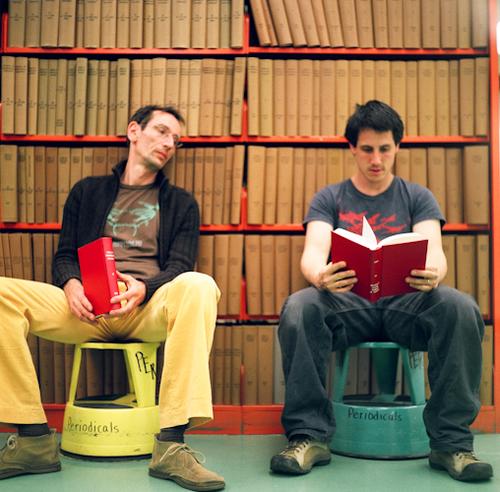
Accurately summing up the music The Books create is a tall order. Folktronica, indie-pop, cut & paste, experimental — all these tags can loosely be assigned to it, but none can fully capture the group’s mix of acoustic virtuosity and trippy electronics. First meeting in New York City in 1999, Nick Zammuto and Paul de Jong soon began crafting their unique combination of found sounds, cello, guitars, vocals and studio experimentation. Their work has led to four albums, a remix collaboration with Prefuse 73, and a commission to create elevator music for the Ministry of Culture in Paris. Zammuto took some time to chat about the group’s use of samples and its newest release, The Way Out (Temporary Residence Limited). Below is a longer version of a Q&A that recently ran in the Guardian.

SFBG You guys seem to put a lot of thought into the venues you perform at. How do you choose?

Nick Zammuto At first, beggars can’t be choosers, so we kinda just played wherever people would have us. And then I think the promoters started to realize that our show just works better when there’s a little more focus and when the ceiling is high enough for our projection to look the way it should. More than anything, the venue — the shape of it and the sound of it — creates the evening. And it’s amazing how it brings out different characteristics in an audience. Part of it is what they bring and part of it is what we do. But there’s that third element, which is the venue. It’s a mysterious thing. I love shows that are sitting down because I think it brings out this more careful detail that we try to bring out in our records, which is difficult to translate to the stage when it’s a noisy environment and beers bottles clinking and stuff like that. But then again, I love the energy of shows that are standing up because people can express themselves easier and we get more feedback from the audience. So both have their benefits.

SFBG You’re playing with Gene Back this tour, which will be the first time you’ll be performing as a three-piece. How did this come about?
 
NZ He’s a guy from Brooklyn who we met through a project we did with a cellist named Zach Miskin. He was kinda Zach’s right-hand man for this project and he came up to record at my place and I was just really taken with his playing. He can play anything you put in front of him. He learns really fast, so it’s been great to throw stuff at him to see what he can do. He doesn’t disappoint.

SFBG How much of a collaborative process was it in terms of him adding or not adding his own touches to the existing material you guys will be performing?

NZ It depends on your definition of collaboration, but I think the energy he brings with his playing, it changes our set drastically and that’s definitely something we have no control over, you know. That’s his thing. He’s tried to execute the parts that we’ve created for him, but he’s also solved a lot of problems that we wouldn’t have foreseen, not being able to play them ourselves. And he loves to dive into things. For example, he can actually play the guitar riff on “Tokyo.” He came up to us and was like, “Hey, look what I can do.” That’s something we never expected to be able to play live, and sure enough, it’s in the set now because of him.

SFBG Speaking of the guitar line on “Tokyo,” that’s one of many parts on your guys’ albums that makes you wonder how exactly it was created and recorded.

NZ I think nothing is really what it seems on our records and we do a lot of work to cover our tracks in terms of where things come from and how things were made. But essentially, I played that guitar line just as it appears on the record, except it was about half the speed when I originally played it. I just sped it up to see what it would sound like. And it turned the tambour of the guitar into this high-strung, mandolin kind of sound, which was cool, so we kept it. My fingers just don’t move that fast. But luckily there are people out there who can execute my ideas (laughing).

SFBG As diverse as your music can be, there is still a very recognizable overall sound. But it’s not always easy to describe. After all these years, have you guys settled on a fallback response when someone asks what kind of music you make?

NZ The word we go back to because it’s kind of open-ended is “collage.” We pull things from all different places and try to put them together in some compelling way, and I guess the most basic word for that is collage. I think people try to attach all kinds of genre names to it, but none of it has really felt comfortable to us. We just kinda do what we do. But you know, sampling is a big part of what we’ve always done. Figuring out a way to connect all these disparate elements is the basic work we do. So, it feels like collage.

SFBG I’ve always been curious about how you find the material you sample. Where did the material featured on The Way Out come from?

NZ During our tours in 2006 and 2007, we stopped at thrift shops all along the way, wherever we could. We’d pick [up] VHS tapes and audio tapes. Paul is kind of in charge of the audio side of the collection and I do more of the video side. Basically, we take the tapes and digitize them and then go through them and save all the stuff we think might be useful, having no idea what it might be used for. If it kind of has this memorable, emotional quality, we save it and keep it around. And the cream rises to the surface, in a way. We end up with these samples that are so far and above anything that anyone would expect, and you just have to use them. So, we throw all those in a folder called “Must Be Used.” And that’s what starts a lot of the ideas for the compositions.

SFBG The answering machine messages in “Thirty Incoming” are simultaneously touching and kind of silly. How do you decide what musical tone and context you’re going to frame a sample in once you decide to use it?

NZ A sample like that just speaks to everyone, you know. And it’s interesting how the interpretation of that phone message varies from “Wow, this is the most sincere man I’ve ever heard in my life” — which was my interpretation when I first heard it — to “That’s creepy. I don’t know what I’d think if I got that message on my phone.” So, it just has this sort of supercharged quality to it where it means a lot to everyone who hears it, but for different reasons. You can’t really go wrong with it, unless you were to counteract its tone somehow. What it suggested to me was this oceanic kind of sound. Those lines go so deep, that it had to be this wave after wave of pulsating sound coming in and then receding. Then we tried to find musical elements that could achieve that sound. So, we ended up using cello and effected vocals, electric guitar and bass to pull it all together. And also this drum tom that I recorded last summer while we were in London. This is the first time we’ve used real drum sounds in forever. It was fun to work with that quality of sound.

SFBG Hearing drums sprinkled throughout was a nice surprise on this album. I particularly like the hi-hat pattern throughout “I Didn’t Know That.”

NZ That was a lucky find. It was from a rare record with only like 500 copies made in the 1970s. It’s from this black history record. And it’s just this great hi-hat riff that’s just there between these two spoken word tracks. When we heard it, we were like, “Wow, that’s totally amazing.”

SFBG Have you ever been contacted by someone who appears in one of the found samples you’ve used throughout your career?

NZ People ask this a lot, and we haven’t, I think for a couple of reasons. Like going back to the “30 Incoming” samples, that tape must be 20 years old already, so who knows how old those people are now. And you know, we’re a pretty small band and it doesn’t really go outside of a certain circle of people who listen to this kind of thing. So, I don’t know how it would get to them, unless it was through some crazy kind of way. Maybe it will happen someday.

It would probably take some crazy series of connections. But it’d have to be a crazy feeling for someone to stumble upon a song that contains something they said or did and most likely forgot about 20 or 30 years ago.

It feels like archeology, even though it’s of the recent past. It feels like there’s some distance between now and then, so it takes on a totally different meaning. There’s all this inadvertent cultural information in these tapes. Stuff that was in the background when people were making them, but now they become the foreground because it’s so different from how we are now. And it often comes across as funny. But it also has this unconscious quality to it, which is what I like about it. That none of this stuff is planned. It’s not preconceived what this stuff means. It’s really honest in the way it comes though. It’s just people being themselves.

SFBG As meticulous as you guys seem to be at crafting albums and each individual song, do you ever struggle with deciding when something is done being worked on?

NZ Yeah. I mean, I compose the stuff and it takes forever (laughing). And it’s a completely exhausting process. But you just kinda know when you’re done, because you don’t want to work on it anymore. It becomes like a zero-sum game. Nothing you can do can make it any better than what it is, so you just let it go. Tracks are never finished, they just kind of escape.

SFBG You switched from the European label Tomlab to the US-based Temporary Residence Limited for The Way Out. Is there a difference between how Europeans and Americans approach your music?

NZ I think Europeans think of us as kind of like a freak show (laughing). And they like us for that reason. But I think when we play in the US, there’s this familiarity because there’s more nostalgia to it. Because we all grew up in the times that we’re sampling from, the ’80s and ’90s mostly. It’s less of a freak show and more of a warm look at the past and where we came from. Kind of reclaiming our childhoods in a way.

SFBG What kind of music inspired you both during the creation of the new album? And is there something you’ve been particularly into as of late?

NZ Me personally, I’ve been on a big Police kick. I don’t know why. But going back to their catalog, I love the way their records are produced. And I especially love Stewart Copeland’s contribution. He can play the drums like no one else. It all has this clarity and precision and energy to it that I really love. So, I’ve kind of been studying that from more of a production standpoint. As for inspiration during The Way Out, during our visit to London in 2009, Nigel Godrich’s engineer Drew Brown invited us to Nigel’s studio for about a week. Nigel was away working on something else and Drew was like, “You should just go and play,” and we were like, “Are you kidding me?” (laughing). And seeing how that studio is put together and the music that has come out of it, Nigel’s and Drew’s way or working is really inspiring to me in terms of getting a mix that’s kind of warm and transparent but also really powerful. I think that had a direct effect on our record.

Live review: Dr. Dog hit the retro road

0

Philadelphia’s Dr. Dog is the kind of band that can’t seem to get enough of life on the road. Earlier this fall, during the first of two nights at the Fillmore on what is the band’s second full tour in support of April’s Shame, Shame (Anti), fans were treated to a lengthy, lively set of retro-minded indie-rock.

The show kicked off with Shame, Shame opener “Stranger,” which showcased bassist Toby Leaman’s perfectly frayed vocals set amongst some soaring Beatles-esque harmonies and Motown posturing from his band mates. “Slowly I’ve become undone/ a stranger, with a stranger heart,” he yelped with a gruff clip to his voice, sounding like Harry Nilsson during his late, destroyed vocal cord phase.

Shame, Shame material filled most of the band’s set list, with Leaman and guitarist Scott McMicken trading off lead vocal duties nearly song for song. McMicken’s higher-pitched, smoother-around-the-edges voice offered a nice counterpoint to Leaman’s, and led to a couple of the show’s highlights. “The Old Days” from 2008’s Fate (park the Van) started with a slow, snaking piano line courtesy of Zach Miller (the band’s stoically efficient keyboardist/organist) and McMicken singing, “Let go of the old ones/ we’ve got some new ones.” By song’s end, the band was jumping around the stage during a rollicking outro section led by Leaman’s catchy bass line and McMicken’s classic-rock soloing. “The Breeze” offered maybe the best example of how well these guys have locked down their live arrangements, with tambourine, shakers, and three-part harmonies carrying the sparse opening lines before the whole band jumped in. Leaman took over vocals during the song’s breakdown, gazing right through the crowd, singing, “Are there dark parts, to your mind/ Hidden secrets, left behind/ Where no one ever goes/ But everybody knows” with an unsettling stare, finishing with a cathartic “It’s alright!”

Elsewhere, the brand new “Take Me Into Town” sounded like Beggars Banquet-lite, the Architecture in Helsinki cover “Heart it Races” took on a classic soul and R&B feel, and “Worst Trip” from 2007’s We All Belong (Park the Van) was rushed through at a breakneck, almost punk-rock pace. Props must be given to new(ish) drummer Eric Slick, who has stepped in seamlessly and added his own little touches to the band’s live shows.

The encore offered up some unexpected treats for long-time fans. “Say Something” and “Oh No,” two tracks from the 2005 EP Easy Beat (Park the Van) sounded great and far beefier than their lo-fi album counterparts. The highlight, however, was “California,” a stripped-down acoustic ditty with jug band and barbershop quartet touches that really separated itself stylistically from everything that’d come before it.

Tastemakers like Pitchfork have lazily written Dr. Dog off as derivative muggers of ‘60s and ‘70s rock standards, and the band still hasn’t experienced the mainstream success its devout followers know it deserves. But for lovers of good old-fashioned, no-bullshit rock and roll, this is one of the more fun, hardworking live bands around.

Live Shots: Badly Drawn Boy, Swedish American Hall, 12/14/10

0

“How long do you plan on sitting down there?” said Damon Gough of Badly Drawn Boy as I stared up at him through my fifty millimeter lens perched on the steps of the stage. “Three songs,” I replied, holding up the appropriate number of digits. Our conversation ended there. It was the first time a musician had interacted with me at a concert, and to be honest, it was slightly awkward.

Badly Drawn Boy’s tunes originally entered my ears behind the images of Hugh Grant, in the movie About a Boy. There was something so playful about those soundtrack pieces that went perfectly with Grant’s crooked smile. Gough’s music is much more mellow these days, and actually rather melancholy. I’m not as comfortable with these kinds of songs, especially since I’m known to cry at anything in a minor key (top waterworks instigators include “All the pretty little horses” … no joke.).

But then again, Gough is from England and according to my amigo Craig, it’s cold and dark there, so maybe Gough is just expressing a bit of that gray and gloom with the help of his guitar.

One last question … what’s up with crocheted cap? He always wears the same one … I want to know the story behind, or rather under, it.

Cheerio yo!


80 billionaires — and California’s broke?

67

Jerry Brown’s message to educators was framed as bleak — but as I pointed out, there were some bright spots. At least the new gov mentioned that this is a rich state that ought to be able to afford education. Robert Cruickshank at Calitics has a nice post on the point:


A tax increase of about $20 billion would secure our public services for years to come with a very tiny impact on our economic activity. Surely 1% of our GDP can be harnessed to fund the services that we must have for broadly shared prosperity in this state.


Let me take it a step further. I just went through the Forbes 400 list of the richest Americans and started counting, and guess what? A full 80 of the 400 live in California. That’s one out of every five billionaires in America, living right here in a state that can’t afford to educate its kids.


Then I took out my calculator and added up a long row of numbers and got a big one: The total net worth of the billionaires in California is $231.8 billion. Ten percent of that wipes out the budget deficit. And that doesn’t even count the folks worth $900 million or less; they didn’t make the list.


Folks: This is a very, very rich state. A very modest tax increase on a very tiny number of people could solve our budget problems not just today but into the foreseeable future.


This is the message Brown needs to deliver to the people of the state — and if the antitax people (or my trolls) want to argue that all the rich people would leave if we taxed them just a little bit, let me say: That’s ridiculous. David Geffen is going to move out of Malibu because he has to pay a teeny bit more of his income, money he won’t miss, in taxes? Ain’t happening.


That’s it, Jerry. That’s your answer. Now get to work.