Live

The message of 1968

4

By J.H. Tompkins

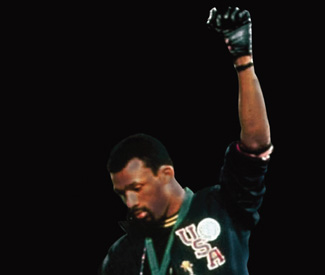
LIT On October 16, 1968, in Mexico City, American Olympic sprinters Tommie Smith and John Carlos electrified the world by accepting their medals with heads down and gloved fists thrust proudly in the air. Their defiance provided a fitting end for a year that began with Czechoslovakia’s Prague Spring and America’s military humiliation during the Tet Offensive in Vietnam, and saw the assassination of Dr. Martin Luther King Jr. and its explosive aftermath, the general strike in France, the riveting presence and influence of the Black Panther Party, mushrooming opposition to the draft, and rioting in Chicago during the Democratic Convention.

Like Mohammed Ali, who in 1967 went to prison rather than fight in Vietnam, Smith and Carlos wrote an important page in American history. Like Ali, they have remained true to the principles they embodied years ago. Now, 43 years down the road, it’s hard to find anyone to speak against what they did.

But at the time, precisely because their enemy was weakened by exposure and their supporters inspired, they faced a blistering backlash. They were banished from Olympic Village, and sent back to the United States. Their crime? Smith and Carlos were allegedly guilty of tarnishing the spirit of an Olympic games that were supposed to be above and beyond politics.

Author-columnist-cultural critic Dave Zirin, who with Carlos has just published “The John Carlos Story: The Sports Moment That Changed the World,” has more than a few things to say about the sanctity of sports and the way political context shapes athletes as well as the games they play. These days, a conversation with Zirin has a special quality: not only has he written a book that sheds new light on an important, long-ago event, the present moment is energized by political turmoil that brings to mind the 1960s.

“I was an absolute sports junkie in the ’90s, when I was in college,” Zirin told me in a recent interview. “I memorized stats, followed every sport, it was my oxygen. I didn’t follow politics, much less politics in sports, until something happened that stopped me cold: In 1996 [Denver Nuggets guard] Mahmoud Abdul Rauf made a decision not to stand during the National Anthem. He was asked whether he understood that the flag was a symbol of freedom and equality throughout the world, and he said it may be to some, but to others it’s a symbol of oppression and tyranny. This was before the spread of the Internet, and Rauf’s stand was only covered by the mainstream media. They crushed him.”

Zirin realized then that there was an aspect of sports history he hadn’t concerned himself with, “the place where social justice and sports intersect,” as he put it. It has shaped the work he’s done since.

Among many other things, Zirin writes a column, “Edge of Sports” for the Sports Illustrated Website, has a weekly radio show called “Edge of Sports Radio” on XM, and contributes regularly to The Nation and SLAM Magazine. Along with “The John Carlos Story,” he was written books including “What’s My Name, Fool? Sports and Resistance in the United States,” “Welcome to the Terrordome: The Pain, Politics, and Promise of Sports,” and “A People’s History of Sports in the United States.”

As Zirin and Carlos point out in the book, the futures of both runners were shaped by what they did in Mexico City. They struggled to find jobs, stability, and peace of mind. Still, Zirin writes “Unlike other 1960s iconography — Woodstock, Abbie Hoffman, Richard Nixon — the moment doesn’t feel musty. It still packs a wallop.”

It resonates because the injustices they protested are still rife in America, and because the arena in which they took their stand — sports — creates common ground for so many people.

“I don’t think there’s any place where the contradictions in American society are on such sharp display as in sports,” Zirin told me. “Think back to African American boxing champions Jack Johnson and Joe Louis. Neither made explicit political statements, but they had representative political power, representing power and pride in the context of racism and white supremacy. They weren’t just entertainers but in fact their presence, the inspiration they provided, was a threat to the established order of things.”

In sports today, there’s no doubt that athletes, in particular African American athletes, play a similar role. NBA hall of famer Charles Barkley once objected — perhaps with his tongue somewhat in his cheek — to the idea that he was a role model. Zirin laughed at the mention of this, saying, “Yeah, and the sky isn’t blue. You don’t chose to be a role model, you are one. It’s an objective thing. And if people are going to be role models, like it or not, then we all have to examine what they’re modeling. If you believe that the fact that a player can dunk makes him a great person, that says one thing. If having a sense of purpose in politics is important, then that says something very different.”

When Zirin and Carlos planned their book, both agreed that they weren’t interested in producing a sports memoir. “We didn’t want to say ‘look at me, genuflect at my athletic greatness.’ We wanted to say that not everyone can run at a world-class speed, but anyone can live a life dedicated to a sense of purpose.”

That approach runs head-on into a mainstream media that has made a point of emphasizing how “today’s pampered athletes,” as the media often put it, want nothing more than a fat pay check. There’s truth in this perspective — although it should be noted that both the NFL and NBA have experienced lockouts this year and that the same media outlets rarely describe the fabulously wealthy owners of professional franchises as pampered billionaires.

“I wrote an article,” he explained, called “‘NBA Players: Welcome to the 99%.’ Despite their money and privilege, they found themselves in a position where they were facing arrogant billionaires asking for a bailout because they made a lot of bad business decisions as NBA owners. It’s just like Wall Street bankers want American working people to cover all their bad bets. Will their proposed savings go back to fans? I don’t think so, they’ll just get a bigger slice of the pie.”

Besides, Zirin pointed out that there’s a lot more to the story that rarely reaches the public. Professional sports will publicly punish athletes who are caught crossing certain lines. But when it comes to speaking to the politics of injustice, the leagues try to deal with transgressions behind the scenes.

“There’s a ton of corporate and financial pressure on these athletes,” he says. “And these players talk to each other about guys like Craig Hodges [a guard on three Chicago Bulls championship teams], who in 1992 passed a note to Bush Sr. about Iraq War I when the Bulls visited the White House. He was drummed out of the league for that and these stories are passed down almost like scare stories. At the end of the day, we have to remember what Carlos and Smith did was in the context of global revolt and crisis. It was a symbol of the moment and a perfect merging of movements and moments. We can’t forget that.”

Although Zirin makes a point in his work to include athletes of all nationalities and sexual preferences, he has particular insights into the role African American athletes play in American culture.

“John Thompson says that Black athletes have the blessing of the burden of representation,” he noted. “It’s a burden because if one athlete does something, then it’s an issue for all Black athletes to deal with, for instance Michael Vick’s involvement with dog fighting. It’s not Peyton Manning’s problem that Chris Herron [a white one-time basketball standout from the mid-2000s] got on drugs. It works in a different way for Black athletes. The blessing part is the you’re part of a tradition, you stand on the shoulders of men and women like Jim Brown, Bill Russell, Wyomia Tyus, and Mohammed Ali, and you have an ownership of that tradition. It’s true that Steve Nash and all athletes are part of the tradition, but it runs more seamlessly through the African American community.”

These days, the sports world is talking about another scandal, this time the ugly situation at Penn State. Zirin discusses those problems in the context of a bankrupt culture, where the NCAA — the self-proclaimed moral arbiter of college sports — refuses to speak to hypocrisy that links all the problems in order to ensure its own survival.

Sooner or later, he said, the NCAA will either sink beneath its own corrupt weight, or athletes — who because of the professionalization of youth sports know each other in many cases from their early teens — band together and demand some compensation for the money that they generate. College presidents are the loudest complainers and the most important enablers.”

Public health and Occupy

8

By Sasha J. Cuttler

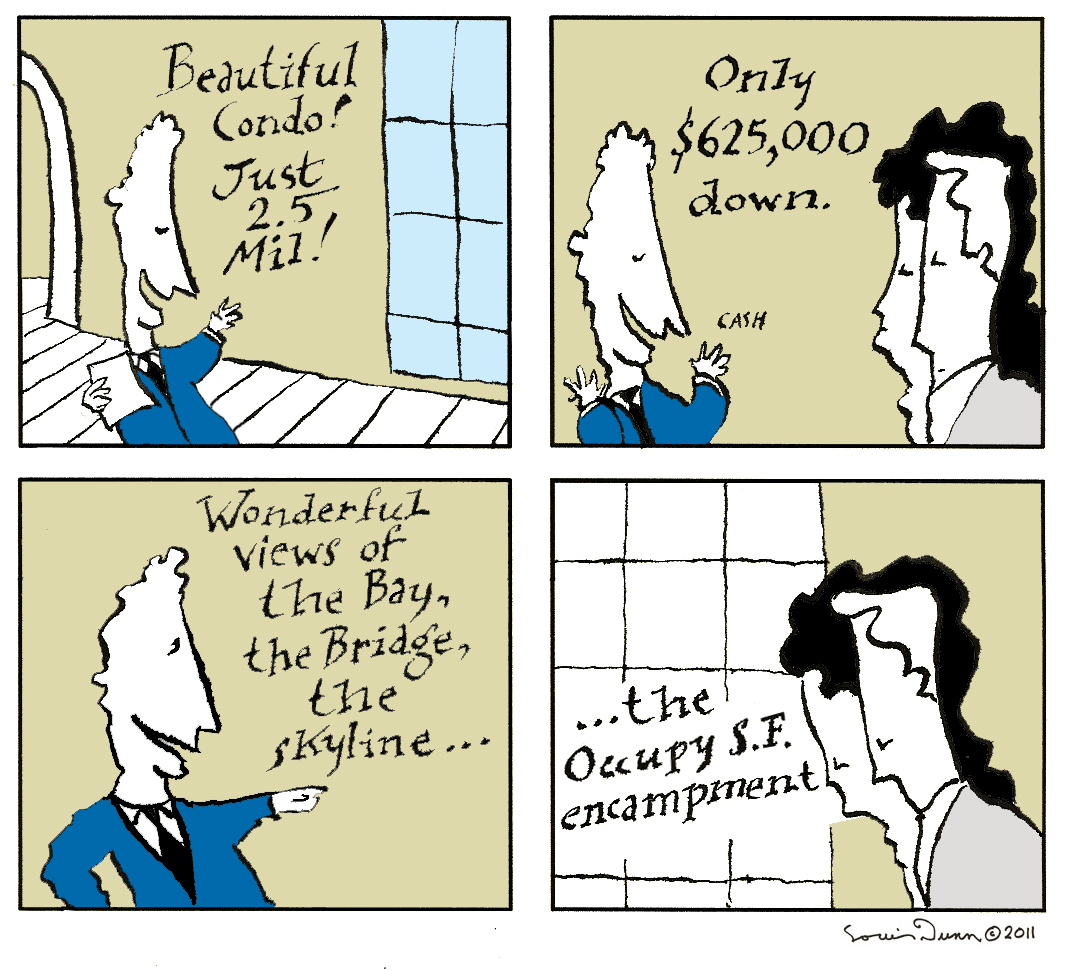
OPINION On November 17, Mayor Ed Lee’s administration declared OccupySF a "public health nuisance." The mayor and other city officials are using this declaration as a justification to evict the OccupySF camps.

But rather than being a nuisance, the Occupy camps are reclaiming public space and voices while making health disparities more visible. Dozens of health organizations are making statements of solidarity, including the American Public Health Association, with more than 30,000 members, which recently passed a resolution with overwhelming support of the Occupy movement.

San Francisco officials say that overcrowding and inadequate sanitation are causing a threat to public health and safety. But as noted by public health nurse Martha Hawthorne, "When is the last time city department heads have left their offices and taken a walk through the Tenderloin, just minutes away from the San Francisco Occupy site? Smells of human waste? Evidence of street drug use? Garbage on the street? It’s there and has been for years, the inevitable consequence of the lack of affordable housing and years of cutbacks to mental health and substance abuse funding in San Francisco."

As far as overcrowding of tents, Hawthorne goes on to note: "Overcrowding? Go anywhere in the city with a public health nurse. You’ll see multiple families living in one flat, sharing a kitchen, having their own tiny room if they are lucky and can afford it. People sleep in shifts and live elbow-to-elbow in garages, basements, closets, old office spaces — and they are the ones we nurses can see, because at least they have an address. "

The one percent is attempting to maintain control by blaming the victim. Rather than blame the marginalized for their misery, the Occupy movement opens an opportunity for dialogue and mass mobilization while providing tangible assistance to those in need of help right now. Homeless and mentally ill individuals have been receiving food and shelter at Occupy encampments everywhere.

The Occupy movement is making visible the public health consequences of insatiable corporate greed. Income inequality is closely paralleled, unsurprisingly, by poorer health outcomes. The rich are not only getting richer, they are living longer, healthier lives than the majority of us in the 99 percent.

Despite months of Occupy experience world-wide, the only evidence of ill health and injury directly related to the camps can be found in the hundreds of nonviolent activists exposed to clouds of tear gas, fountains of pepper spray, myriads of beatings, and volleys of rubber bullets. These incidents of state-sponsored violence can cause lasting health impacts on the individuals who are exercising their right to free speech and assembly.

We can do better than this. We need to use this gathering as a reminder that health care is a human right and do everything in our power to help, not hinder, the populations we serve.

Like thousands of other public health workers, I believe that the Occupy movement is creating an incredible opportunity that needs to be protected and expanded. Public health does need to be protected — and one of the best ways is through engagement with the Occupy movement, not through its eviction. 2

Sasha J. Cuttler, R.N., Ph.D, is a nurse and SEIU Local 1021 activist

Hungry much?

4

By Hugh Biggar

news@sfbg.com

Here’s something to chew on with your bagel and coffee—assuming you can afford that in these trying times. Roughly, 2.3 million Californians are receiving official help getting enough to eat, but nearly 3 million others who qualify are not.

In fact, California’s low enrollment in the federal food stamp program, known officially as the Supplemental Nutrition Assistance Program or in California, CalFresh, is costing the state both socially and economically.

“There’s a deepening crisis,” Matthew Sharp, a senior advocate with the nonprofit California Food Policy Advocates, said. “California’s high housing costs and extreme unemployment are two forces that have put pressure on households.”

Despite increasing need, however, less than half of those eligible for Cal Fresh assistance receive it, placing California next to last nationally. In other states, about 75 percent of those eligible for federal food stamp help take part, and some states are well above that threshold. Oregon, for instance, reaches about 90 percent of those who qualify.

In California, though, just about 43 percent of those eligible take part.

Socially, this means, of course, that millions of people are not getting enough to eat, leading to a range of other issues including health problems and hungry children underperforming at school. (In California, about 17 percent of children live in poverty, including roughly 3 million who qualify for free or reduced price meals.)

Economically, low participation in CalFresh also leaves money on the table at time when businesses and California’s tax bureau are badly in need of funds. While the money per day may seem small, $4.50 for individual or about the cost of that bagel and coffee, it can still go a long way. Weekly CalFresh assistance equals $31 for an individual, or $325 monthly for a family of four.

“Food stamps stimulate the economy in a variety of ways,” explained Chris Wimer, associate director of the Stanford Center for the Study of Poverty and Inequality.

For instance, the U.S. Department of Agriculture—the federal administrator of the food stamp program—has found that every $5 spent from food stamps generates about $9 in related economic activity.

Additionally, CFPA has found that boosting California’s food stamp participation to the 75 percent level would generate about $131 million in sales tax revenue, including $27 million for non-general fund expenses.

But instead, low enrollment means California’s loses out on about $5 billion annually or nearly $9 billion in related economic activity. On the county level, this includes losses as well. Los Angeles County is estimated to lose out on $1.3 billion in direct assistance and $2.4 billion in related activity; Alameda County, $106 million and $191 million; San Diego County, $354 million and $634 million.

At the same time, the level of need continues to increase due to a stalled economy and flat wages.

“Overall wages have dramatically declined, particularly in the services industries such as hotel workers,” Sharp said from CFPA’s Los Angeles office, noting that falling incomes have made Cal Fresh an increasingly common supplement to family’s budgets.

In addition, the type of person in need of help has also shifted, and can include college students, those with jobs but not making enough to get by, and senior citizens.

“The variety of households taking part has increased astronomically,” Sharp said. “This includes families that have never struggled with unemployment before and it has had a staggering effect on them.”

Elizabeth Kneebone, a senior research associate at the Brookings Institution, also said the changing face of poverty now increasingly includes the suburbs as well as inner-city neighborhoods. In California, inland cities such as Riverside and Fresno have seen rapid spikes in suburban poverty, she said, sometimes double the levels in urban areas. (In a report published this month, Kneebone also determined that Fresno ranked fifth nationally for neighborhoods with extreme poverty.)

Despite this grim news, California is making some strides towards helping those in need.

In October, for example, Gov. Jerry Brown signed into law several bills that eliminated obstacles to CalFresh enrollment. Assembly Bill 6, for example, ended California’s unusual requirement that mandated that everyone 18 and over in a household receiving CalFresh be finger printed. New laws have also ended a rule requiring CalFresh participants to file quarterly reports. Instead, California will switch to simplified semi-annual, or roughly twice a year reporting, beginning in 2013.

But there are still challenges and threats ahead.

“The recession has erased a lot of the social gains made during the 1990s, so it will take a number of years to make that up,” said Caroline Danielson of the Public Policy Institute of California in Oakland. She also points to a need for smarter policies such as placing jobs closer to communities and public transit.

There is also concern that the current deficit reduction talks at the federal level could also add to the burden on households, increasing their need for supplemental help.

“The [deficit reduction talks] could reduce support for low-income families,” Stanford’s Wimer said. While the food stamp program may not be target, he added, related services such as a women and child component known as WIC could be on the chopping block.

“We’ll have to see how it plays out,” added CFPA’s Sharp. “But right now there is extreme pressure on households and they are struggling to find adequate resources. It is certainly not unreasonable to try to close that 50 percent [CalFresh] gap.”

This story was funded by a grant from the Sierra Health Foundation to do independent reporting on the topic of food access in California.

Localized Appreesh: Symbolick Jews

0

Localized Appreesh is our weekly thank-you column to the musicians that make the Bay. Each week a band/music-maker with a show, album release, or general good news is highlighted and spotlit. To be considered, contact emilysavage@sfbg.com.

I must admit, the first thing that endeared me to Symbolick Jews was the name. It’s a good name. But when I actually took a listen, I was still hooked – and amused. Good name, good hooks, good sense of humor.

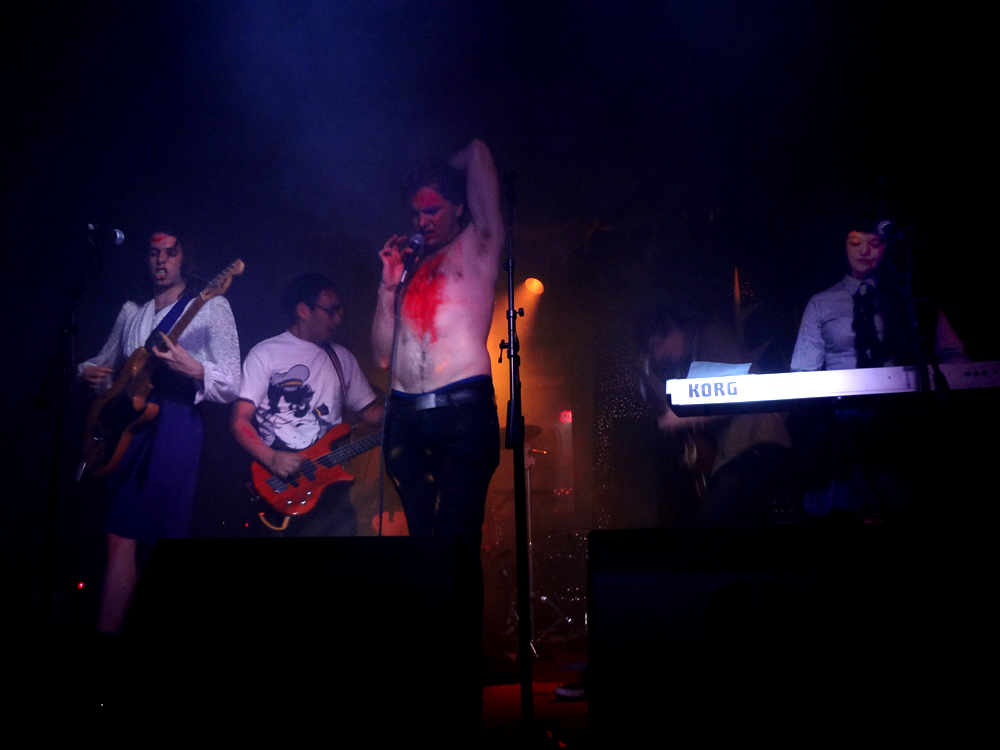
The weirdo experimental San Francisco band has a handful of tripped out releases, including American Masters Volume 5, which came out this month. With dragging bass and creepy, haunted voices matched to high pitched squeals piping up from nowhere, there are jumbly moments of Mr. Bungle greatness seeping in often.

Take a solitary hour and listen to everything that’s happening on the release – there’s much to contemplate. Then get up and check out the Symbolick Jews show; live music waits for no thought process. The Jews play the Stork Club tomorrow night. Get to know them first below.

Year and location of origin: Late 2009, San Francisco.
Band name origin: We flipped through a dictionary and the first word we put our finger down on was, “Chumbawumba,” so we just went with Symbolick Jews. The additional ‘k’ is for ‘kindness.’
Band motto: “Are we getting paid tonight?”
Description of sound in 10 words or less: The fear of God.
Instrumentation: Adam – Vocals, Brian – Drums, Jasper – Guitar/Vocals, Burd – Bass/vocals, Paul – Guitar/vocals, Vanessa – Keyboard/vocals
Most recent release: Slave to Love
Best part about life as a Bay Area band: Everyone in the Bay Area loves our music and won’t stop talking about us.
Worst part about life as a Bay Area band: Living in the shadow of Third Eye Blind and Flipper.
First record/cassette tape/or CD ever purchased: Weird Al Yankovic, Bad Hair Day.
Most recent record/cassette tape/CD/or Mp3 purchased/borrowed from the Web: Robert Anton Wilson Explains Everything.
Favorite local eatery and dish: The Philly cheese steak at Mission Kitchen is forged in the fires of gastro-intestinal hell, and I stand by its superiority over any other cheese steak in the city. 

Symbolick Jews
With Dimples, Grandma’s Boyfriend, Curse Words, Burgers
9:30 p.m., $5
Stork Club
2330 Telegraph, Oak.
(510) 444-6174
www.storkcluboakland.com

No more introduction needed: Pterodactyl at El Rio

0

On Saturday night in the cloistered show room at El Rio, Joe Kremer of Pterodactyl passed through the idle crowd to consult the sound guy about his microphone reverb, making a whacking hand gesture to illustrate the slap back resonation he wanted — something he’s probably had to do at every venue between Brooklyn, NY, (where the band is from) and San Francisco because it’s so essential to Pterodactyl’s sound.

Kremer has mischievous blonde facial hair and a sarcastic glint in his eye that’s hard to read. It’s not unlike Pterodactyl itself, a band that creates dissonant indie-rock by lathering sunny harmonies in reverb for a murky, psychedelic sound. But Spills Out (Jagjaguwar), the band’s newest album, has one major difference from its previous two: it teases with catchy melodies.

When Pterodactyl kicked into song, it was Kremer who had the stage antics — riffing on electric guitar, swinging around rambunctiously, and closing his eyes to enter into his own little world at the microphone. He had an unfading, boyish enthusiasm that lasted all night. Matt Marlin sat behind the drums with his sweating shirt sleeves rolled up, harmonizing on each song and looking to the others for signals (and giving them) with a blank face. He seemed to quietly run the show. Duncan Gamble on keyboards and Jesse Hodges on bass guitar were the more stationary and restrained of the group. The four had a likeable presence on stage, as though each one had a role to play: there was the ebullient charmer (Kremer), the mysterious one (Marlin), and the two nervous and loveable characters (Gamble, Hodges).
 
When Pterodactyl performed songs from Spills Out, the coherence and melody of songs like “Searchers” and “School Glue” was somewhat lost. Those two songs have a conspicuous presence on the record and represent a significant departure for a band that has preferred atonalism. However, when performed live, they fell indistinguishably in with the rest of the discordant, highly effected set. Kremer’s voice also was different from the record and the live performance. It sounded higher in pitch, even cartoonish. It wasn’t necessarily a drawback musically speaking — the band sounded impressive and put on a fine show — but you sometimes wondered if Kremer was involved in some inside joke that no one else got.
 
One highlight on Spills Out is “Allergy Shots,” which the band performed terrifically on stage. The four minutes of droning bass has a kind of mystical lugubriousness. It feels
like a trudging descent into an ever-expanding pit. “The grass isn’t greener/when there is no grass at all,” Hodges sang mechanically. In the hopeless mood of the song, his
singing was appropriate.
 
Even after releasing three albums, Pterodactyl is still having to introduce itself to moderate sized crowds like the one at El Rio. It’s can be a difficult introduction. Listen to the band’s albums in succession — the self-titled debut, WorldWild, and Spills Out — and you’ll see that Pterodactyl has never been content doing the same thing. The debut thrashes around rampantly; WorldWild is psychedelic and airy, while Spills Out is less experimental and more dulcet. But if Pterodactyl makes more first impressions like
Saturday night’s, the band will soon need no introduction at all.
 
 
All photos by Ryan Kauffman
 

Live Shots: tUnE-yArDs at the Regency Ballroom

0

tUnE-yArDs seemed so playful and free on Wednesday at the Regency, like a band of highly skilled children, in particular the ringleader-pied piper of the bunch, Merrill Garbus. Hopping around barefoot, playing with different toys – pedals and looping samples, ukuleles, and crash drums – all on a square of carpet that had a curvy gray racetrack: genius kindergartner. Or as a show companion described it, “it feels like the world’s greatest camp band.”

Part of their gaiety may have been due to timing – the show, which took place the night before Thanksgiving, yet still nearly sold out – was the very last of a long tour for tUnE-yArDs. Openers Pat Jordache, a spry Montreal quartet with four-part harmonies and two drummers, presented Garbus with a cake during its set to celebrate the end of their joint journey. A very sweet moment, in a night full ’em.

After a brief intermission Garbus was back out on stage, this time dressed more in her stage persona – thick paint streak across her cheeks, one gigantic hoop earring. Her band also wore face-paint, along with sweatbands. My only concern of the entire evening: I feel like perhaps the warpaint thing has had its day, but of course, that’s just a matter of personal opinion. And really, no matter. The music is the important thing here. And that blew me away, every tune.

Each song felt like a jazzy Afro-folk art project; Garbus would create a beat, or a vocal chant, then loop it endlessly, add more varying vocals then jump from peddle to peddle, drum to drum. The two saxophonists free jazzed it, and the bassist played along with Garbus while adding his own tone. She’d count off then one-two-three, switch! The song changed, the beat stopped, or suddenly it was Garbus alone, chilling, beautiful vocals booming through the expansive space.

She’s the mastermind up there, her strength is ever-present, and at times, she nearly growls. She’s like a lioness, mouth open wide with harmonized roars. At one point she yelled out, “this is where we jump!” and the crowd erupted, bouncing in near-unison – my old-lady perch upstairs was suddenly shaking. At another point a beat she created didn’t quite work and she just stopped and smiled, “this isn’t danceable!” adding “people always ask if we ever mess up, now you know!” The next beat worked and we all sighed with relief. As expected, and similar to that last time I caught the act, “Bizness” got the biggest crowd response, but the audience cheered for nearly every other song as well, even the slightly less poppy, moodier new one.

At the end of the official set, or I should say, pre-encore, Pat Jordache got back on stage to celebrate with tUnE-yArDs, while large trash bags full of colorful balloons were released upon the young, absolutely fucking thrilled, crowd. It was a tasty pre-holiday treat, and we didn’t even have to sit at the kid’s table (hell yeah, balcony).

Live Shots: WU LYF at the Independent

0

I showed up pretty early to catch WU LYF at the Independent on Monday night. A cold breeze drifting through the venue and the giant white Wucifix standing on an empty stage made for a decidedly ominous vibe. It quickly warmed up, though, as a sold out crowd filled the place to capacity for the Manchester, UK, quartet’s very first performance in San Francisco.

I was feeling some serious deja vu. Less than two years ago another British four piece, Wild Beasts, had graced the same stage for its inaugural San Francisco show, which was also completely sold out. Pumped as I’d been for Wild Beasts, I was even more excited to watch these young hoodlums perform the intense, grandiose anthems of their breakthrough debut Go Tell Fire To The Mountain.

Exuberant cheers erupted from the audience as WU LYF gathered in front iof the illuminated Wucifix. Leader Ellery Roberts plucked out the first few organ chords of the slow-building opener “L Y F,” then turned his back to the crowd to show off his tattered denim jacket which also bared the mark of the band. Bassist Tom McClung was the most animated member on stage. He handled his instrument with an emphatic flair and provided the high-pitched vocal cries of “Wu” that added a chilling undercurrent to “L Y F” and other songs.

Most bands have a backbone, and WU LYF’s is Evans Kati. The set was driven by Kati’s wailing, melodic guitar. Joe Manning’s bursting percussion was pretty solid, though the drummer looked a bit bored. The raw, energetic “Spitting Blood,” and the fiery, impassioned “Concrete Gold,” were highlights of the evening.

Roberts’ snarling vocals were just as tortured and cathartic as on the record. Between songs, he spoke in mostly unintelligible grunts, which felt a little contrived. When I interviewed the singer a couple weeks ago, he was quite eloquent and soft spoken. It was an unfortunate bias, as the rest of the audience was completely enthralled by the primal character who stood before us.

Though I often had no idea what Roberts what saying, when he commanded us to howl like a desperate pack of wolves, we obeyed. Late in the set, he remarked that the audience was too calm. Roberts’ cheeky observation resulted in a wild, volatile reaction from fans when the band launched into a frenzied rendition of “We Bros.”

Since WU LYF is a relatively new group with a limited catalog of work, the show was without many surprises, save for a lovely instrumental piece led by McClung. Not surprisingly, the band closed with its cinematic Alma Mater, “Heavy Pop.” Though I half-heartedly joined the crowd in cheering for an encore, I knew it was no use. WU LYF had already given us everything they had.

Opener:
Long Beach’s Crystal Antlers opened with a soulful, noisy ruckus. The quartet’s retro garage sound seemed a cross between the Black Keys and Cymbals Eat Guitars. In his flannel and heavy coat, vocalist-bassist Johnny Bell was a vision of grunge. His face remained hidden behind long, sweat-drenched hair. Though the band appeared to have stepped out of the ’90s, its sound was more reminiscent of ’60s psych rock. Crystal Antlers’ keyboardist flaunted some flashy moves that included tipping his synthesizer onto one leg while continuing to play impeccably.

All photos by Wolfgangg Photography..

Flipping the bird: Your best bets for last-minute Thanksgiving meals

0

Wandering through the smorgasbord of Thanksgiving options is no small feat.Turkey, duck, fake bird, no bird? Pie flavors, side dishes, stuffings, and guestlists present a swamp of options — assuming you’re staying home to toil in the kitchen.

But for those eager to get out for whatever reason – a volunteering spirit, a mounting desire to escape from relatives, your ex decided to bring him to your Friendsgiving – there’s a cornucopia of alternative Thanksgiving choices in the Bay. Some of these samplings are far cheaper (and maybe even better?) than an at-home meal attempt. Some entail helping out folks who might not otherwise get to eat on T-Day. Some are real-deal moveable feasts: order it up and take it to go. But all run their pudgy fingers up and down the backbone essential of Turkey Day: eating, and then eating some more.

Cafe Gratitude

Various volunteer opportunities, free meal, Noon-3 p.m.

The Mission, Berkeley, and San Rafael locations of Café Gratitude put on a veritable feast for the walking broke and volunteers alike. Some gems we sighted on the exisquite vegan menu include a butternut squash tamale and a pecan-persimmon salad. 

Various Bay Area locations. Call (415) 824-4652 to volunteer. www.cafegratitude.com 


Tenderloin Block Party

Volunteer needed to pass out meals, registration starts at 9 a.m.

City Impact 911’s 27th Tenderloin Block Party provides more than five thousand hot meals to Tenderloin residents – and it’s still looking for volunteers. $25 gets you registered and helps to boost the program.

240 Eddy, SF. Call (415) 292-1770 to register, www.sf911.com 


Cruelty-free Thanksgiving potluck

Free potluck, 3:30 p.m.

Sponsored by Sonoma County’s vegan society, the free potluck holds the promise of a quinoa overload. Reviews of dinners past are breathless in their praise of creative animal-free offerings. 

1400 W. College Ave., Santa Rosa. www.compassionatelivingoutreach.org


Tommy’s Joynt

Thanksgiving dinner, prices vary, 10 a.m.-2 a.m.

“Where turkey is king,” reads the front door of Tommy’s Joynt, an ageless wonder on Van Ness and Geary streets that has a menu ranging from meat to yep, more meat. Prices sit safely below $10 and the Joynt even has some pies its made for the special day. Just be prepared for a massive line (no reservations available)

1101 Geary, SF. www.tommysjoynt.com


Park Chalet and Beach Chalet

Thanksgiving dinner, $43, 11 a.m.-9 p.m.

Thanksgiving in the land of foggy dunes, sedate Sunday brunches, and bottomless mimosas? Believe it. Long the lone outposts of tastiness where Golden Gate Park meets Ocean Beach, the Chalets host an all-day, $43 buffet of red pumpkin soup, turkey, prime rib, local cheeses, pumpkin pie tartlets, and the in-all-likelihood delicious “cold appetizer station.”

1000 Great Highway, SF. (415) 386-8439, www.parkchalet.com


Cheung Hing

Turkeys, $55, 9 a.m.-9 p.m.

Known throughout the Sunset and beyond for the roasted duck, Cheung Hing is one of those spots with a dripping rotisserie that works partially to baste fowl and partially to mesmerize children. If you’re searching for ambiance, this might not be the spot to chow down – but in that case pick up a special turkey to-go, haul it up to nearby Grandview Park, and enjoy one of the best city views around.   

2339 Noriega, SF. (415) 665-3271


Chenery Park

Thanksgiving menu, under $30, 5:30-9:15 p.m.

With a special three-course Thanksgiving menu, one of Glen Park’s family restaurant darlings transforms into a nicer, cleaner, thoroughly festive version of home feasting. Reservations are going fast.

683 Chenery Street, SF. (415) 337-8537, www.chenerypark.com


Pena Pachamama

Raw Thanksgiving dinner, $39.95-$45, 4-10 p.m.

The South American oasis of North Beach, Pena Pachamama serves up a raw meal with the same decadence as any turkey-centered one. A “tuRAWkey loaf” comes rolled with apple-cinnamon stuffing and accompanied by creamy squash soup and white truffle mashed potatoes, plus pumpkin pudding with vanilla persimmon sauce. Live bouncy music accompanies the feast. 

1630 Powell, SF. (415) 646-0018, www.pachamamacenter.org


Garcon

Thanksgiving Dinner, $28-$34 (entrees), 1-10 p.m.

Rabbit and biscuits, local foie gras, molasses-glazed turkey – the slowly-wrought, rich feast offered at the Mission eatery will open the door to leftovers aplenty. Lingering over the three-course meal seems encouraged, as dinner starts at 1 p.m.

1101 Valencia, SF. (415) 401-8959, www.garconsf.com


Luna Park

Thanksgiving dinner, $34, 5:30-10:30 p.m.

Thanksgiving sides, those taken-for-granted little dishes supporting the ballast that is the turkey, are not meant to be light. The Mission’s Luna Park knows this, offering brussel sprouts in brown butter, salads with equal parts cheese and leaf, and garlicky, milky mashed potatoes. They don’t forget the turkey either. 

694 Valencia, SF. (415)553-8584, www.lunaparksf.com


Moss Beach Distillery

Thanksgiving Dinner, $35.95, 11:30 a.m.-8 p.m. 

They do serve the bird tonight, but the South Bay’s Moss Beach Distillery might be the spot to come for a fishier alternative. Known for their seemingly endless cocktail list and wild-caught seafood, the sea is the limit. 

140 Beach Way, Moss Beach. (650) 728-5595, www.mossbeachdistillery.com


Zazie

Thanksgiving brunch, various prices, 9 a.m.-1 p.m. 

It’s often prudent to just leave the house altogether on a day renowned for slow-burn family feuds. But finding a cheerful spot can be the rub – no one wants to belly up to a skunky-tasting Anchor Steam with a barful of lethargic drinkers. Enter Zazie, Cole Valley’s warm neighborhood bistro, which will offer a long, relaxed Thanksgiving brunch perfect for those looking to linger until the last possible second. No reservations accepted.

941 Cole, SF. (415) 564-5332, www.zaziesf.com


Our Weekly Picks: November 23-29

0

WEDNESDAY 23

Immortal Technique

“So now that it’s proven, that a soldier of revolution/ Or head of an empire, disguised in a constitution/ Can not escape the retribution or manipulation/ Of the self-appointed rulers of the planet’s corporations.” So says Afro-Peruvian rapper Immortal Technique on new mixtape The Martyr (Viper Records). Born Felipe Coronel, Tech seizes every opportunity to eviscerate American class warfare and excoriate the United States government’s complicity. Tech’s angry sermons get a little lost in the first half of Martyr because of distracting riffs taken from the Beatles, Aerosmith, and The Goonies soundtrack, though there is a clever reworking of ABBA’s “Money, Money, Money” in reference to this generation’s “Rich Man’s World (1%).” Pure, undiluted Tech shines through on the mixtape’s second half. Swill with care. (Kevin Lee)

With Chino XL, Da Circle, DJ GI Joe

8 p.m., $32.50

Fillmore

1805 Geary, SF

(415) 346-6000

www.thefillmore.com


MOM’s Family Funk’tion

Before you indulge in caloric binges, first endear yourself to the soulful 1960s sound that has always sounded sweeter during the holidays: Motown. No one knows and appreciates this more than the masterminds behind MOM (Motown on Mondays) who bring originals, remixes, and “close relatives” of Motown label songs to venues and events across San Francisco, including Madrone Art Bar, Public Works, SF Funk Fest, even the Treasure Island Music Festival. The first MOM’s Family Funk’tion goes down the night before the turkey funeral that is Thanksgiving at Brick & Mortar, with DJs Gordo, Timo, Phleck, and Matteo spinning the tracks that get the tail-feathers shaking. The crew from MOM promises to provide “toasty soul and fresh funk jams.” (Emily Savage)

10 p.m., $5

Brick & Mortar Music Hall

1710 Mission, SF

(415) 800-8782

www.brickandmortarmusic.com


tUnE-YarDs

Before her set at Pitchfork Music Festival last summer, we were all given tubes of neon yellow warpaint so we could emulate tUnE-YarDs’ Merrill Garbus. Though we may have resembled her, it was no use. We would never be as badass as the woman on stage looping ukulele, smashing drums, and wailing something fierce. With help from additional saxophonists and drummers, the playful jams of Garbus’ quirky hit album w h o k i l l (4AD) burst forth into the calculated cacophony that is tUnE-YarDs. (Frances Capell)

With Pat Jordache

8 p.m., $23

Regency Ballroom

1300 Van Ness, SF

(415) 673-5716

www.theregencyballroom.com


FRIDAY 25

“Sing-A-Long Sound of Music”

Chances are “Sing-A-Long Sound of Music,” the classic musical from 1964 with lyric subtitles so the whole theater can burst into song, is your mother’s dream come true — unless I am the only one who has watched their mom caper around the house, singing “My Favorite Things” (a possibility). It’s fortunate that “Sing-A-Long Sound of Music” should show the weekend after Thanksgiving. If mom’s in town, it’s your best bet. Additionally, the theater hands out goody bags, holds a pre-film concert featuring organist David Hegarty, as well as a costume contest. Your mom can dress up as Maria, of course, and you can dress as one of the Von Trapp children. Come on, do it for family. (James H. Miller)

7 p.m., $15

Castro Theater

429 Castro, SF

(415) 621-6120

www.castrotheater.com


Nadastrom

Are there a lot of orphans in the DJ community? Why are they active the weekend after Thanksgiving, when touring bands are presumably in food comas? Thankfully, there’s still down and dirty shows like this to sweat the gravy out, featuring a big lineup of international and SF DJs including Nadastrom, the progenitors of the bastard toddler of Dutch house and reggaeton: moombahton. Put on by Soundpieces, Camp?, and Irie Cartel, the proceeds of the event will benefit DJs Bogl and Benjammin Taylor, who lost their home in the fire above the Haight and Fillmore Walgreens a couple months back.(Ryan Prendiville)

With Truth (NZ), Stylust Beats (CAN), Lorne B (CAN), Tuffist (SP), Dnae Beats and more

10 p.m., $15 advance

103 Harriet, SF

(415) 431-1200

www.1015.com


“Velveteen Rabbit”

There is a lovely tradition in English children’s books that dresses issues around growing up with imagination and a gentle but firm hold on reality. Winnie the Pooh and Wind in the Willows are two of them. Marjorie Williams’ 1922 The Velveteen Rabbit is another. ODC/Dance’s KT Nelson, a young mother at the time, choreographed it 24 years ago. Today, it’s as fresh and imaginative as ever, with wonderfully colorful costumes, Benjamin Britten’s splendid score and Geoff Hoyle’s intimate narration. The two-person high Nana has just a touch of Victorian strictness about cleaning up the nursery but her efficiency is more than held in check by the toys who have minds of their own. Opening performance is Grandparents’ (20 percent off) and photo day (Rita Felciano)

Through Dec. 11, times vary, $15–$45

Novellus Theater

Yerba Buena Center for the Arts

700 Howard, SF

(415) 978-2787

www.ybca.org


“Great Dickens Christmas Fair”

Do not discount the Dickens Fair’s potential for holiday weekend shenanigans. Opportunities for hijinx abound, and not just because the fair’s 800 performers — from dirty-overcoated “guvnah!” drunks to crinoline-encased ladies who tea — are encouraged to interact in character with passers-by (mess with them gently! They love it!) The fair fills the cavernous Cow Palace, and houses a corsetry with live models coordinated by local cinchers Dark Garden, an adventurer’s salon where you can share your rollicking tales of shot glass exploration with fantastically mustached gents — and yes, you can booze your face off. Four bars, people! Including an absinthery in an alley, where you can mix chemically-induced hallucinations in with your environment-induced ones. (Caitlin Donohue)

Through Dec. 18, $22–$25

Cow Palace

2600 Geneva, SF

1-800-510-1558

www.dickensfair.com


Boys Noize

Here’s a great way to shed those new extra turkey (or Tofurkey) pounds — waddle into the Mezzanine Saturday night in your most comfortable tight jeans and dance your ass off. Boys Noize throws down the kind of relentlessly squelchy music that might make pioneers of Detroit’s minimal techno scene wince. Noize, actually the moniker of German DJ Alex Ridha, has been busy as of late, pushing releases on his record label, BoysNoize Records and its digital offshoot BNR Trax. The label’s sounds range from acidy techno to sinister electro, with a sprinkle of wobbly dubstep and a dash of oddball, leftfield sounds — much like the label’s creator himself. (Lee)

10 p.m., $30

Mezzanine

444 Jessie, SF

415) 625-8880

www.mezzaninesf.com


SUNDAY 11/27

Jeffrey Luck Lucas and Nebulous Orchestra

The Mission District’s Episcopal Church of St. John the Evangelist is no ordinary church — sure, it holds regular worship services, but it is also highly progressive (vocally supportive of LGBT rights, for example), boasts a colorful mural on one of its exterior walls, and is staunchly community-oriented, welcoming the occasional secular event into its historic (circa 1910, after being rebuilt post-1906 quake) building. Tonight’s performance features Mission troubadour Jeffrey Luck Lucas, heading up an “orchestra” (pipe organ, oboes, clarinets, strings, and more) comprised of other local musicians. You can bet that the acoustics in the church — itself known for a strong music program — will render the experience even more amen-worthy. (Cheryl Eddy)

With Gloaming Boys

6 p.m., $8–$20 (no one turned away for lack of funds)

Episcopal Church of St. John the Evangelist

1661 15th St., SF

www.saintjohnsf.org


MONDAY 11/28

“You Are All Captains”

A beguiling and beautiful meta-fiction, You All Are Captains grew out of Oliver Laxe’s experience teaching film workshops to local kids in Tangiers. Everyone plays themselves in this reflexive movie, though Laxe casts himself as the fool — a presumptuous European director guiding students to his own ends. The disguise allows him to realize sly but substantive reflections upon the ontology and ethics of filming. It’s fitting that You All Are Captains is making its local premier in a classroom: a U.C. Berkeley student group flying under the banner of “Picturing Neo-Imperialism” has invited Laxe to present his debut in person more than a year after it won the FIPRESCI critics’ award at Cannes. (Max Goldberg)

7 p.m., free

UC Berkeley

Dwinelle B-4, Berk.

www.pnwg.wordpress.com/events


TUESDAY 11/29

Metal Mother

By some standards, Oakland’s Tara Tati came into music fairly late: she didn’t take up the piano seriously until she was 23. But you wouldn’t guess as much listening to her ethnic fusion project, Metal Mother. On the debut album Bonfire Diaries, the singer-songwriter builds up a bold and elemental sound. With its trudging percussion and distinctly dark temper, Metal Mother invokes ’80s goth rock, ethnic fusion bands like Dead Can Dance, and at times, world ambient soundscapes. And yet, at heart, Tati sounds like a pop artist in the same vein as Björk circa Homogenic, and that alone implies talent. (Miller)

With Horns of Happiness, Mortar and Pestle, Birdseye

8 p.m., $10

Cafe Du Nord

2170 Market, SF

(415) 861- 5061

www.cafedunord.com


Retox

Is the Locust a joke? With its speedy deliver, high vocals, beepy attack synth, and masked personas, I never could quite decide. And yet, who cares? The energy level was always high, the shows always masterful absurdist romps. Justin Pearson and Gabe Serbian from the screamy ’90s-born Three One G act have now formed Retox — like Locust 2.0. Masks now off, and sounds a bit filled in (but really, just a smidge — its new album clocks in at 13 minutes total), it’s shinier, thicker, less jokey. It’s helter-skelter rock’n’roll, minus the screeching buzz-saw, the painful intro to “Boredom is Counter-Revolutionary” notwithstanding. The band is matched well with frantic experimental Japanese noise-punk act Melt-Banana. Anticipate high-energy, non-medical spasms. (Savage)

With Melt-Banana, Peace Creep

9 p.m., $14

Bottom of the Hill

1233 17th St., SF

(415) 621-4455

www.bottomofthehill.com

Garage troubadour

0

arts@sfbg.com

MUSIC “I did something really stupid,” was pretty much the first thing Ty Segall said to me as we walked to Philz Coffee in the Mission. Originally the plan was to sit at El Metate, but that got nixed as we agreed an afternoon jolt of caffeine was more important.

I asked what he had done that was so stupid, but it wasn’t specifically clear which act he was referring to. On the defensive, he went off on a tangent about how he perceives his guitars almost as talismans. “It’s like voodoo,” he said. That’s how he explains his behavior when he gives a guitar away to somebody. Other times he goes with the more cliched rock ritual of destroying one on stage. This also led to his purchase of a 1965 sea-foam green Mustang Fender. The excitement in his voice as he described his new toy was apparent. Music is what makes him tick.

I interviewed him in 2009 when Lemons (Goner Records) came out, but that was forever ago considering his well-documented abundance of releases. Now that Goner is putting out a double LP, Singles 2007-2010 (out this week), it seemed like an appropriate time to catch up and see how constant touring may be taking its toll on the 24-year-old garage rock answer to a troubadour.

We settled at a picnic table at a nearby soccer park where Segall, clad in Ray Bans and a brown cardigan, explained his fatigue from life on the road. He had just wrapped up a slew of local gigs, including a Halloween show where he and his band performed as the Spits. There, they struggled for the spotlight as an unruly woman from the audience — who was allegedly “humping everything” — stole a purse, and had to be bounced. Then it was off to Austin for a couple of dates where he performed alongside Thee Oh Sees, who he considers the best live band San Francisco has to offer, Black Lips and the Damned at the three-day Fun Fun Fun Fest.

“We never really stop touring. I wonder how we’re still here,” he said in bewilderment of both the physical and mental drain bands endure. “Everybody hits a wall.” He was referring to breaking points, but was also responding to my prodding about a previous interview he gave to Spinner.com where he commented on the fragility of one’s mind, and how you can “lose it at any moment”.

Just as he was admitting his own sensitivity, three pugs walked over to him, as if on cue. I watched him pet the triplets in a moment of adorably comforting symbiosis. It appears he’s learning his limits, coping with an over-analytical brain and growing a thicker skin.

But that’s not to say his creative well is running dry any time soon. While the singles compilation is a retrospective, along with some unreleased material, Segall said he’s still “psyched” to record something new. 2012 promises to be fruitful as his booking agent claimed the native So Cal. surfer has three records coming out next year.

While he doesn’t see himself as being in a “party band”, he’s been given the unique opportunity to partake in the second annual Bruise Cruise. It’s a three-day cruise to the Bahamas loaded with garage bands, their fans, and 75 percent regular ol’ tourists, according to Segall. The concept seems a bit ridiculous in the sense that trash rockers will converge with such decadence. This year he’s joining a super group of sorts called the Togas with Shannon Shaw of Shannon and the Clams, Phillip Sambol from Strange Boys, and Lance Willie (drummer from the Reigning Sound).

But for now Segall can hold off and breathe for a second before setting sail. He can enjoy what he considers the vacation of just being home, doing his laundry, and all the other domestic yearnings that come with wanting a house with a yard and a basement.

Film Listings

0

Film listings are edited by Cheryl Eddy. Reviewers are Kimberly Chun, Max Goldberg, Dennis Harvey, Lynn Rapoport, and Matt Sussman. For rep house showtimes, see Rep Clock.

OPENING

Arthur Christmas Santa’s son (voiced by James McAvoy, who heads up an all-star, mostly-British cast) steps up to solve a North Pole crisis in this 3D animated tale. (1:37) Presidio, Shattuck.

Hugo Martin Scorsese directs this fanciful 3D tale of an orphan secretly living in a train station. (2:07) Shattuck, Sundance Kabuki.

The Muppets Of course The Muppets is a movie appropriate for small fry, with a furry cast (supplemented by human co-stars Jason Segel and Amy Adams) cracking wise and conveying broad themes about the importance of friendship, self-confidence, and keeping dreams alive despite sabotage attempts by sleazy oil tycoons (Chris Cooper, comically evil in the grand Muppet-villain tradition). But the true target seems to be adults who grew up watching The Muppet Show and the earliest Muppet movies (1999’s Muppets from Space doesn’t count); the “getting the gang back together” sequence takes up much of the film’s first half, followed by a familiar rendition of “let’s put on a show” in the second. Interwoven are constant reminders of how the Muppets’ brand of humor — including Fozzie Bear’s corny stand-up bits — is a comforting throwback to simpler times, even with a barrage of celeb cameos and contemporary gags (chickens clucking a Cee-Lo Green tune — I think you can guess which one). Co-writer Segal pays appropriate homage to the late Jim Henson’s merry creations, but it remains to be seen if The Muppets will usher in a new generation of fans, or simply serve as nostalgia fodder for grown-ups like, uh, me, who may or may not totally still own a copy of Miss Piggy’s Guide to Life. (1:38) Presidio. (Eddy)

My Week With Marilyn See “No Bombshell.” (1:36) Albany, Clay, Piedmont.

*Sigur Rós: Inni This ain’t your mom’s 3D IMAX arena-rocker exercise. The follow-up to 2007’s Heima, which set out to contextualize Sigur Rós in its native Iceland, Inni opens with a torrent of light and shadow that resolves into the image of frontperson Jónsi Birgisson on bowed guitar, a bright splinter on a stage otherwise drenched in black. The screen explodes with bleached-out light as Birgisson hits the high note, drummer Orri Pall Dyrason bashes his cymbal, and the combo picks up a symphonic head of noise. The still somewhat-mysterious ensemble that burst fully formed onto the international music scene along with the new millennium is seen here through the prism of live performance, worth catching on a big screen (Inní was also released this month on DVD along with a live double-CD). Director Vincent Morisset infuses the often-not-so-interesting genre of concert film with all the drama and unique strategies appropriate to a group that has charted its own indelible path from the start. Sigur Rós’ music may connect to that of Mogwai and other post-rock outfits, but those groups can only hope to score the moving-image counterpart that the Icelandic band finds here, its own variant of Inní‘s smoky, reflective black and white imagery, flickering in time to the beat, fading in and out of focus, and favoring off-center compositions. Undercutting the serious beauty onstage are clips of Sigur Rós’s slightly surreal reality of life on tour and snippets of archival footage from its first decade of life. (1:14) Roxie. (Chun)

*The Swell Season In 2008, musicians Glen Hansard (1991’s The Commitments, Irish band the Frames) and Markéta Irglová won an Oscar for the original song “Falling Slowly” from the folk rock musical Once, in which they star as a Dublin street busker and a young Czech immigrant who spend a week writing and recording songs that document their falling in love. The film boosted them into the public eye at hyperspeed, and they began to tour extensively, performing under the name the Swell Season. For three years following Once‘s debut, filmmakers Nick August-Perna, Chris Dapkins, and Carlo Mirabella-Davis followed the pair, who had become romantically involved, as they struggled to negotiate sudden fame, life on the road, and the stresses of time and change on their relationship. The beautifully filmed black-and-white documentary that resulted is a quiet affair whose visual intimacies and personal revelations are balanced by soft, muted monochromes that preserve some necessary degree of distance for Hansard and Irglová. Troubling issues are engaged in conversational tones, and the rest of the tale is told onstage amid Hansard’s gorgeous emotional storms and Irglová’s more spare but equally lovely compositions. The honesty is sometimes uncomfortable to witness, as two people accustomed to baring their souls in their songs agree to face the camera for a little while longer. (1:31) SFFS New People Cinema. (Rapoport)

*Tomboy In her second feature, French filmmaker Céline Sciamma (2007’s Water Lilies) depicts the brave and possibly perilous gender experimentations of a 10-year-old girl. Laure (Zoé Héran) moves with her family to a new town, falls in with the neighborhood gang during the summer vacation, and takes the stranger-comes-to-town opportunity to adopt a new, male persona, Mikael, a leap of faith we see her consider for a moment before jumping, eyes open. Watching Mikael quietly observe and then pick up the rough mannerisms and posturing of his new peers, while negotiating a shy romance with Lisa (Jeanne Disson), the sole female member of the gang, is to shift from amazement to amusement to anxiety and back again. As the children play games in the woods and roughhouse on a raft in the water and use a round of Truth or Dare to inspect their relationships to one another, all far from the eyes of the adults on the film’s periphery, Mikael takes greater and greater risks to inhabit an identity that he is constructing as he goes, and that is doomed to be demolished sooner, via accidental discovery, or later, when fall comes and the children march off to school together. All of this is superbly handled by Sciamma, who gently guides her largely nonprofessional young cast through the material without forcing them into a single precocious situation or speech. The result is a sweet, delicate story with a steady undercurrent of dread, as we wait for summer’s end and hope for the best and imagine the worst. (1:22) Embarcadero. (Rapoport)

ONGOING

*El Bulli: Cooking in Progress Oh to be a fly on the wall of El Bulli — back in 2008 and 2009, when director Gereon Wetzel turned his lens on the Spanish landmark, it was considered the best restaurant in the world. This elegantly wrought documentary, covering a year at the culinary destination (now closed), allows you to do just that. Wetzel opens on chef-owner Ferran Adrià shutting down his remarkable eatery for the winter and then drifting in and out of his staff’s Barcelona lab as they develop dishes for the forthcoming season. Head chef Oriol Castro and other trusted staffers treat ingredients with the detached methodicalness of scientists — a champignon mushroom, say, might be liquefied from its fried, raw, sous-vide-cooked states — and the mindful intuition of artists, taking notes on both MacBooks and paper, accompanied by drawings and much photo-snapping. Fortunately the respectful Wetzel doesn’t shy away from depicting the humdrum mechanics of running a restaurant, as Adrià is perpetually interrupted by his phone, must wrangle with fishmongers reluctant to disclose “secret” seasonal schedules, and slowly goes through the process of creating an oil cocktail and conceptualizing a ravioli whose pasta disappears when it hits the tongue, tasting everything as he goes. Energized by an alternately snappy and meditative percussive score, this look into the most influential avant-garde restaurant in the world is a lot like the concluding photographs of the many menu items we glimpse at their inception — a memorable, sublimely rendered document that leaves you hungry for more. (1:48) Opera Plaza. (Chun)

*The Descendants Like all of Alexander Payne’s films save 1996 debut Citizen Ruth, The Descendants is an adaptation, this time from Kaui Hart Hemmings’ excellent 2007 novel. Matt King (George Clooney) is a Honolulu lawyer burdened by various things, mostly a) being a haole (i.e. white) person nonetheless descended from Hawaiian royalty, rich in real estate most natives figure his kind stole from them; and b) being father to two children by a wife who’s been in a coma since a boating accident three weeks ago. Already having a hard time transitioning from workaholic to hands-on dad, Matt soon finds out this new role is permanent, like it or not — spouse Elizabeth (Patricia Hastie, just briefly seen animate) will not wake up. The Descendants covers the few days in which Matt has to share this news with Elizabeth’s loved ones, mostly notably Shailene Woodley and Amara Miller as disparately rebellious teen and 10-year-old daughters. Plus there’s the unpleasant discovery that the glam, sporty, demanding wife he’d increasingly seemed “not enough” for had indeed been looking elsewhere. When has George Clooney suggested insecurity enough to play a man afraid he’s too small in character for a larger-than-life spouse? But dressed here in oversized shorts and Hawaiian shirts, the usually suave performer looks shrunken and paunchy; his hooded eyes convey the stung joke’s-on-me viewpoint of someone who figures acknowledging depression would be an undeserved indulgence. Payne’s film can’t translate all the book’s rueful hilarity, fit in much marital backstory, or quite get across the evolving weirdness of Miller’s Scottie — though the young actors are all fine — but the film’s reined-in observations of odd yet relatable adult and family lives are all the more satisfying for lack of grandiose ambition. (1:55) California, Piedmont, SF Center, Sundance Kabuki. (Harvey)

Dragonslayer Dragonslayer tags along with Josh “Skreech” Sandoval, a Fullerton, Calif. skater celebrated for shredding pools and living a vagabond’s life. First-time director Tristan Patterson fronts with the kind of side-winding portraiture that prizes sensory impressions instead of back-story, but whittle away Dragonslayer‘s loose ends and you end up with an unremarkable lost generation romance, a Bonnie and Clyde with lower stakes. The film meets Skreech at 23: he’s turned his back on sponsorship gigs and a romance that produced a son (no trace of the mother here). In an arbitrarily defined chapter structure, Skreech investigates freshly abandoned pools, squats in a friend’s backyard, shows off his medical marijuana license, and cracks tallboys in Southern California’s magic light. He’s stunned by a pretty girl’s red lipstick and fades into a relationship with her (it takes a while before the movie treats her as anything more than scenery). He takes a few earnest stabs at fatherhood and rehearses his principles of no principles to the soundtrack’s well-stocked bangs. There are a few genuinely poignant moments — Skreech’s taking a call from his estranged mother in a bus full of punks — but in general Dragonslayer is too caught up in its own glossy reverie to register emergent emotions. Patterson’s tendency to use editing as dramatic shorthand is evident in an early sequence of Skreech muffing a skate contest abroad: repeated shots of Skreech wiping out are cut with the eventual winner’s triumphs and then back to our hero’s defeated expression. Arranged in the foregone style of reality television, the actual event is given no room to breathe. (1:14) Roxie. (Goldberg)

*Drive Such a lovely way to Drive, drunk on the sensual depths of a lush, saturated jewel tone palette and a dreamlike, almost luxurious pacing that gives off the steamy hothouse pop romanticism of ’80s-era Michael Mann and David Lynch — with the bracing, impactful flecks of threat and ultraviolence that might accompany a car chase, a moody noir, or both, as filtered through a first-wave music video. Drive comes dressed in the klassic komforts — from the Steve McQueen-esque stances and perfectly cut jackets of Ryan Gosling as the Driver Who Shall Remain Nameless to the foreboding lingering in the shadows and the wittily static, statuesque strippers that decorate the background. Gosling’s Driver is in line with Mann’s other upstanding working men who hew to an old-school moral code and are excellent at what they do, regardless of what side of the law they’re working: he likes to keep it clear and simple — his services as a wheelman boil down to five minutes, in and out — but matters get messy when he falls for sweet-faced neighbor Irene (Carey Mulligan), who lives down the hall with her small son, and her ex-con husband (Oscar Isaac) is dragged back into the game. Populated by pungent side players like Albert Brooks, Bryan Cranston, Ron Perlman, and Christina Hendricks, and scattered with readily embeddable moments like a life-changing elevator kiss that goes bloodily wrong-right, Drive turns into a real coming-out affair for both Danish director Nicolas Winding Refn (2008’s Bronson), who rises above any crisis of influence or confluence of genre to pick up the po-mo baton that Lynch left behind, and 2011’s MVP Ryan Gosling, who gets to flex his leading-man muscles in a truly cinematic role, an anti-hero and under-the-hood psychopath looking for the real hero within. (1:40) Lumiere. (Chun)

Happy Feet Two (1:40) Four Star, 1000 Van Ness, Presidio.

Le Havre Aki Kaurismäki’s second French-language film (following 1992’s La Vie de Boheme) offers commentary on modern immigration issues wrapped in the gauze of a feel good fairy tale and cozy French provincialism a la Marcel Pagnol. Worried about the health of his hospitalized wife (Kaurismäki regular Kati Outinen), veteran layabout and sometime shoe shiner Marcel (Andre Wilms) gets some welcome distraction in coming to the aid of Idrissa (Blondin Miguel), a young African illegally trying to make way to his mother in London while eluding the gendarmes. Marcel’s whole neighborhood of port-town busybodies and industrious émigrés eventually join in the cause, turning Le Havre into a sort of old-folks caper comedy with an incongruously sunny take on a rising European multiculturalism in which there are no real racist xenophobes, just grumps deserving comeuppance. Incongruous because Kaurismäki is, of course, the king of sardonically funny Finnish miserabilism — and while it’s charmed many on the festival circuit, this combination of his usual poker-faced style and feel-good storytelling formula may strike others as an oil-and-water mismatch. (1:43) Bridge. (Harvey)

Immortals Arrow time (comin’ at ya, in 3D), blood lust, fascinating fascinators, and endless seemingly-CGI-chiseled chests mark this rework of the Theseus myth. Tarsem Singh flattens out the original tale of crazy-busy hero who founded Athens yet seems determined to outdo the Lord of the Rings series with his striking art direction (so chic that at times you feel like you’re in a perfume ad rather than King Hyperion’s torture chamber). As you might expect from the man who made the dreamy, horse-slicing Cell (2000), Immortals is all sensation rather than sense. The proto-superhero here is a peasant (Henry Cavill), trained in secret by Zeus (John Hurt and Luke Evans) and toting a titanic chip on his shoulder when he runs into the power-mad Cretan King Hyperion (Mickey Rourke, struggling to gnash the sleek scenery beneath fleshy bulk and Red Lobster headgear). Hyperion aims to obtain the Epirus Bow — a bit like a magical, preindustrial rocket launcher — to free the Titans, set off a war between the gods, and destroy humanity (contrary to mythology, Hyperion is not a Titan — just another heavyweight grudge holder). To capture the bow, he must find the virgin oracle Phaedra (Freida Pinto), massacring his way through Theseus’ village and setting his worst weapon, the Beast, a.k.a. the Minotaur, on the hero. Saving graces amid the gory bluster, which still pays clear tribute to 1963’s Jason and the Argonauts, is the vein-bulging passion that Singh invests in the ordinarily perfunctory kill scenes, the avant-garde headdresses and costumes by Eiko Ishioka, and the occasional edits that turn on visual rhymes, such as the moment when the intricate mask of a felled minion melts into a seagoing vessel, which are liable to make the audience gasp, or laugh, out loud. (1:50) 1000 Van Ness. (Chun)

In Time Justin Timberlake moves from romantic comedy to social commentary to play Will Salas, a young man from the ghetto living one day at a time. Many 12-steppers may make this claim, but Salas literally is, because in his world, time actually is money and people pay, say, four minutes for a cup of coffee, a couple hours for a bus ride home from work, and years to travel into a time zone where people don’t run from place to place to stay ahead of death. In writer-director Andrew Niccol’s latest piece of speculative cinema, humans are born with a digitized timepiece installed in their forearm and a default sell-by date of 25 years, with one to grow on — though most end up selling theirs off fairly quickly while struggling to pay rent and put food on the table. Time zones have replaced area codes in defining social stature and signaling material wealth, alongside those pesky devices that give the phrase “internal clock” an ominous literality. Niccol also wrote and directed Gattaca (1997) and wrote The Truman Show (1998), two other films in which technological advances have facilitated a merciless, menacing brand of social engineering. In all three, what is most alarming is the through line between a dystopian society and our own, and what is most hopeful is the embattled protagonist’s promises that we don’t have to go down that road. Amanda Seyfried proves convincible as a bored heiress to eons, her father (Vincent Kartheiser) less amenable to Robin Hood-style time banditry. (1:55) 1000 Van Ness, Shattuck. (Rapoport)

*Into the Abyss: A Tale of Death, a Tale of Life How remarkable is it that, some 50-plus features along, filmmaker Werner Herzog would become the closest thing to a cinema’s conscience? This time the abyss is much closer to home than the Amazon rainforest or the Kuwaiti oil fields — it lies in the heart of Rick Perry country. What begins as an examination of capital punishment, introduced with an interview with Reverend Richard Lopez, who has accompanied Texas death row inmates to their end, becomes a seeming labyrinth of human tragedy. Coming into focus is the execution of Michael Perry, convicted as a teenager of the murder of a Conroe, Tex., woman, her son, and his friend — all for sake of a red Camaro. Herzog obtains an insightful interview with the inmate, just days before his execution, as well as his cohort Jason Burkett, police, an executioner, and the victims’ family members, in this haunting examination of crime, punishment, and a small town in Texas where so many appear to have gone wrong. So wrong that one might see Into the Abyss as more related to 1977’s Stroszek and its critical albeit compassionate take on American life, than Herzog’s last tone poem about the mysterious artists of 2010’s Cave of Forgotten Dreams (and it’s also obviously directly connected to next year’s TV documentary, Death Row). The layered tragedies and the strata of destroyed lives stays with you, as do the documentary’s difficult questions, Herzog’s gentle humanity as an interviewer, and the fascinating characters that don’t quite fit into a more traditional narrative — the Conroe bystander once stabbed with a screwdriver who learned to read in prison, and the dreamy woman impregnated by a killer whose entire doomed family appears to be incarcerated. (1:46) Embarcadero, Shattuck. (Chun)

J. Edgar The usual polished, sober understatement of Clint Eastwood’s directing style and the highlights-compiling CliffsNotes nature of Dustin Lance Black’s screenplay turn out to be interestingly wrong choices for this biopic about one of the last American century’s most divisive figures. Interesting in that they’re perhaps among the very few who would now dare viewing the late, longtime FBI chief with so much admiration tempered by awareness of his faults — rather than the other way around. After all, Hoover (played by Leonardo DiCaprio) strengthened his bureau in ways that, yes, often protected citizens and state, but at what cost? The D.C. native eventually took to frequently “bending” the law, witch-hunting dubious national enemies (he thought the Civil Rights movement our worst threat since the bomb-planting Bolshevik anarchists of half a century earlier), blackmailing personal ones, weakening individual rights against surveillance, hoarding power (he resented the White House’s superior authority), lying publicly, and doing just about anything to heighten his own fame. A movie that internalized and communicated his rising paranoid megalomania (ironically Hoover died during the presidency of Nixon, his equal in that regard) might have stood some chance of making us understand this contradiction-riddled cipher. But J. Edgar is doggedly neutral, almost colorless (literally so, in near-monochrome visual presentation), its weird appreciation of the subject’s perfectionism and stick-to-it-iveness shutting out almost any penetrating insight. (Plus there’s Eastwood’s own by-now-de rigueur soundtrack of quasi-jazz noodling to make what is vivid here seem more dull and polite.) The love that dare not speak its name — or, evidently, risk more than a rare peck on the cheek — between Hoover and right-hand-man/life companion Clyde Tolson (Armie Hammer, very good if poorly served by his old-age makeup) becomes both the most compelling and borderline-silly thing here, fueled by a nervous discretion that seems equal parts Black’s interest and Eastwood’s discomfort. While you might think the directors polar opposites in many ways, the movie J. Edgar ultimately recalls most is Oliver Stone’s 1995 Nixon: both ambitiously, rather sympathetically grapple with still-warm dead gorgons and lose, filmmaker and lead performance alike laboring admirably to intelligent yet curiously stilted effect. (2:17) Four Star, Marina, 1000 Van Ness, SF Center, Shattuck, Sundance Kabuki. (Harvey)

Jack and Jill (1:39) 1000 Van Ness, Shattuck.

*Like Crazy Jacob (Anton Yelchin) and Anna (Felicity Jones) meet near the end of college; after a magical date, they’re ferociously hooked on each other. Trouble is, she’s in Los Angeles on a soon-to-expire student visa — and when she impulsively overstays, then jets home to London for a visit months later, her re-entry to America is stopped cold at LAX. (True love’s no match for homeland security.) An on-and-off long-distance romance ensues, and becomes increasingly strained, even as their respective careers (he makes furniture, she’s a magazine staffer) flourish. Director and co-writer Drake Doremus (2010’s Douchebag) achieves a rare midpoint between gritty mumblecore and shiny Hollywood romance; the characters feel very real and the script ably captures the frustration that settles in when idealized fantasies give way to the messy workings of everyday life. There are some contrivances here — Anna’s love-token gift from Jacob, a bracelet engraved “Patience,” breaks when she’s with another guy — but for the most part, Like Crazy offers an honest portrait of heartbreak. (1:29) California, Piedmont, SF Center, Sundance Kabuki. (Eddy)

*Love Crime Early this year came the announcement that Brian De Palma was hot to do an English remake of Alain Corneau’s Love Crime. The results, should they come to fruition, may well prove a landmark in the annals of lurid guilty-pleasure trash. But with the original Love Crime finally making it to local theaters, it’s an opportune moment to be appalled in advance about what sleazy things could potentially be done to this neat, dry, fully clothed model of a modern Hitchcockian thriller. No doubt in France Love Crime looks pretty mainstream. But here its soon-to be-despoiled virtues of narrative intricacy and restraint are upscale pleasures. Ludivine Sagnier plays assistant to high-powered corporate executive Christine (Kristin Scott Thomas). The boss enjoys molding protégée Isabelle to her own image, making them a double team of carefully planned guile unafraid to use sex appeal as a business strategy. But Isabelle is expected to know her place — even when that place robs her of credit for her own ideas — and when she stages a small rebellion, Christine’s revenge is cruelly out of scale, a high-heeled boot brought down to squash an ant. Halfway through an act of vengeance occurs that is shocking and satisfying, even if it leaves the remainder of Corneau and Nathalie Carter’s clever screenplay deprived of the very thing that had made it such a sardonic delight so far. Though it’s no masterpiece, Love Crime closes the book on his Corneau’s career Corneau (he died at age 67 last August) not with a bang but with a crisp, satisfying snap. (1:46) Lumiere. (Harvey)

*Margin Call Think of Margin Call as a Mamet-like, fictitious insider jab at the financial crisis, a novelistic rejoinder to Oscar-winning doc Inside Job (2010). First-time feature director and writer J.C. Chandor shows a deft hand with complex, writerly material, creating a darting dance of smart dialogue and well-etched characters as he sidesteps the hazards of overtheatricality, a.k.a. the crushing, overbearing proscenium. The film opens on a familiar Great Recession scene: lay-off day at an investment bank, marked by HR functionaries calling workers one by one into fishbowl conference rooms. The first victim is the most critical — Eric Dale (Stanley Tucci), a risk-management staffer who has stumbled on an investment miscalculation that could potentially trigger a Wall Street collapse. On his way out, he passes a drive with his findings to one of his young protégés, Peter (Zachary Quinto), setting off a flash storm over the next 24 hours that will entangle his boss Sam (Kevin Spacey), who’s agonizing over his dying dog while putting up a go-big-or-go-home front; cynical trading manager Will (Paul Bettany); and the firm’s intimidating head (Jeremy Irons), who gets to utter the lines, “Explain to me as you would to a child. Or a Golden Retriever.” Such top-notch players get to really flex their skills here, equipped with Chandor’s spot-on script, which manages to convey the big issues, infuse the numbers with drama and the money managers with humanity, and never talk down to the audience. (1:45) Presidio, Sundance Kabuki. (Chun)

*Martha Marcy May Marlene If Winter’s Bone star Jennifer Lawrence was the breakout ingénue of 2010, look for Martha Marcy May Marlene‘s Elizabeth Olsen to take the 2011 title. Both films are backwoodsy and harrowing and offer juicy roles for their leading starlets — not to mention a pair of sinister supporting roles for the great John Harkes. Here, he’s a Manson-y figure who retains disturbing control over Olsen’s character even after the multi-monikered girl flees his back-to-the-land cult. Writer-director Sean Durkin goes for unflashy realism and mounds on the dread as the hollow-eyed Martha attempts to resume normal life, to the initial delight of her estranged, guilt-ridden older sister (Sarah Paulson). Soon, however, it becomes clear that Things Are Not Ok. You’d be forgiven for pooh-poohing Olsen from the get-go; lavish Sundance buzz and the fact that she’s Mary-Kate and Ashley’s sis have already landed her mountains of pre-release publicity. But her performance is unforgettable, and absolutely fearless. (1:41) Lumiere. (Eddy)

*Melancholia Lars von Trier is a filmmaker so fond of courting controversy it’s like he does it in spite of himself — his rambling comments about Hitler (“I’m a Nazi”) were enough to get him banned from the Cannes Film Festival earlier this year, where Melancholia had its debut (and star Kirsten Dunst won Best Actress). Oops. Maybe after the (here’s that word again) controversy that accompanied 2009’s Antichrist, von Trier felt like he needed a shocking context for his more mellow latest. Pity that, for Melancholia is one of his strongest, most thoughtful works to date. Split into two parts, the film follows first the opulent, disastrous, never-ending wedding reception of Justine (Dunst) and Michael (Alexander Skarsgard), held at a lavish estate owned by John (Kiefer Sutherland), the tweedy husband of Justine’s sister, Claire (Charlotte Gainsbourg). Amid the turmoil of arguments (John Hurt and Charlotte Rampling as Justine and Claire’s divorced parents), pushy guests (Stellan Skarsgard as Justine’s boss), livid wedding planner (Udo Kier, amazing), and hurt feelings (Michael is the least-wanted groom since Kris Humphries), it’s clear that something is wrong with Justine beyond just marital jitters. The film’s second half begins an unspecified amount of time later, as Claire talks her severely depressed, near-catatonic sister into moving into John’s mansion. As Justine mopes, it’s revealed that a small planet, Melancholia — glimpsed in Melancholia‘s Wagner-scored opening overture — is set to pass perilously close to Earth. John, an amateur astronomer, is thrilled; Claire, fearful for her young son’s future and goaded into high anxiety by internet doomsayers, is convinced the planets will collide, no matter what John says. Since Justine (apparently von Trier’s stand-in for himself) is convinced that the world’s an irredeemably evil place, she takes the news with a shrug. Von Trier’s vision of the apocalypse is somber and surprisingly poetic; Dunst and Gainsbourg do outstanding work as polar-opposite sisters whose very different reactions to impending disaster are equally extreme. (2:15) Albany, Embarcadero, Smith Rafael. (Eddy)

Midnight in Paris Owen Wilson plays Gil, a self-confessed “Hollywood hack” visiting the City of Light with his conservative future in-laws and crassly materialistic fiancée Inez (Rachel McAdams). A romantic obviously at odds with their selfish pragmatism (somehow he hasn’t realized that yet), he’s in love with Paris and particularly its fabled artistic past. Walking back to his hotel alone one night, he’s beckoned into an antique vehicle and finds himself transported to the 1920s, at every turn meeting the Fitzgeralds, Gertrude Stein (Kathy Bates), Dali (Adrien Brody), etc. He also meets Adriana (Marion Cotillard), a woman alluring enough to be fought over by Hemingway (Corey Stoll) and Picasso (Marcial di Fonzo Bo) — though she fancies aspiring literary novelist Gil. Woody Allen’s latest is a pleasant trifle, no more, no less. Its toying with a form of magical escapism from the dreary present recalls The Purple Rose of Cairo (1985), albeit without that film’s greater structural ingeniousness and considerable heart. None of the actors are at their best, though Cotillard is indeed beguiling and Wilson dithers charmingly as usual. Still — it’s pleasant. (1:34) Opera Plaza, Shattuck. (Harvey)

The Other F Word The 1980s U.S. hardcore punk scene was one refreshing bastion of opposition in the Reagan era of militaristic, monetary, and quasi-“family values” conformism. It was a fairly harmless outlet (if also a factory) for all that excess testosterone. Boys will be boys, etc. Sooner or later they’d have to grow the fuck up. Right? Well, punk became punk-pop, embraced by the musical product divisions of multinational corporations everywhere, and while the chords didn’t change much, the lyrics stopped being angry about political-economic injustice — now they were about dubious injustices like girl problems. How (let alone why) do you grow up when label execs and fans want you to stay the guy who causes shoulder dislocations worldwide? Illustrating one gun-to-head route toward responsible adulthood is Andrea Nevins’ The Other F Word, a fun if superficial new documentary in which the missing unmentionable is (gasp) fatherhood. Punks become dads! Like whoa! Break out the swear jar! Much of this is cute. But the notion that getting older and more sedate is any more revelatory in a 45-year-old man from a 20-year-old band than it is for the rest of us seems questionable. Our principal guide is very likeable Pennywise leader Jim Lindberg, seen getting less and less happy with his road-to-family-time ratio. Some other interviewees here look like parental recipes for future therapy; a deeper documentary might have probed that. But F Word seldom gets past the surface “shock” appeal of heavily tattooed, aging bad boys changing nappies and joining the PTA. It’s still stuck in a testosterone zone most of its subjects have at least learned to compartmentalize. (1:38) Lumiere, Shattuck. (Harvey)

Puss in Boots (1:45) 1000 Van Ness.

The Skin I Live In I’d like to think that Pedro Almodóvar is too far along in his frequently-celebrated career to be having a midlife crisis, but all the classic signs are on display in his flashy, disjointed new thriller. Still mourning the death of his burn victim wife and removed from his psychologically disturbed daughter, brilliant-but-ethically compromised plastic surgeon Robert (played with smoldering creepiness by former Almodóvar heartthrob Antonio Banderas) throws himself into developing a new injury-resistant form of prosthetic skin, testing it on his mysterious live-in guinea pig, Vera (the gorgeous Elena Anaya, whose every curve is on view thanks to an après-ski-ready body suit). Eventually, all hell breaks loose, as does Vera, whose back story, as we find out, owes equally to 1960’s Eyes Without a Face and perhaps one of the Saw films. And that’s not even the half of it — to fully recount every sharp turn, digression and MacGuffin thrown at us would take the entirety of this review. That’s not news for Almodóvar, though. Much like Rainer Werner Fassbinder before him, Almodóvar’s métier is melodrama, as refracted through a gay cinephile’s recuperative affections. His strength as a filmmaker is to keep us emotionally tethered to the story he’s telling, amidst all the allusions, sex changes and plot twists torn straight from a telenovela. The real shame of The Skin I Live In is that so much happens that you don’t actually have time to care much about any of it. Although its many surfaces are beautiful to behold (thanks largely to cinematographer José Luis Alcaine), The Skin I Live In ultimately lacks a key muscle: a heart. (1:57) Embarcadero, Shattuck. (Sussman)

Steve Jobs: The Lost Interview Is this a quickie cash-in following the tidal wave of appreciation following the death of Steve Jobs? Interviewer Robert Cringely made Triumph of the Nerds, a PBS miniseries about the birth of the personal computer industry, in 1995, and much of this lengthy talk with Jobs (his former employer) didn’t ultimately make the cut, although the Apple co-founder’s critique of Microsoft as lacking taste went down in history. The master tapes of this discussion were thought to be lost until the series editor unearthed an unedited copy of the entire interview in his London garage. This rush production isn’t quite unedited (at points Cringely steps in to contextualize) — and it was done more than 15 years ago, before Jobs sold NeXT to Apple and returned to the firm to shake the firmament with the iPod, iPhone, and iPad — but the interview and the answers Cringely fields are nevertheless fascinating, from the potentially silly question “are you a hippie or a nerd?” (“If I had to pick one of those two, I’m clearly a hippie,” Jobs responds with a sly look in his eye, “and all the people I worked with were clearly in that category, too”) to Jobs’ prophesies about the impact of the Web to musings like “I think everybody in this country should learn to program a computer, learn a computer language, because it teaches you how to think.” (1:00) Opera Plaza. (Chun)

Tower Heist The mildest of mysteries drift around the edges of Tower Heist — like, how plausible is Ben Stiller as the blue-collar manager of a tony uptown NYC residence? How is that Eddie Murphy’s face has grown smoother and more seamless with age? And how much heavy lifting goes into an audience member’s suspension of disbelief concerning a certain key theft, dangling umpteen floors above Thanksgiving parade, in the finale? Yet those questions might not to deter those eager to escape into this determinedly undemanding, faintly entertaining Robin Hood-style comedy-thriller. Josh Kovacs (Stiller) is the wildly competent manager of an upscale residence — toadying smoothly and making life run perfectly for his entitled employers — till Bernie Madoff-like penthouse dweller Arthur Shaw (Alan Alda) is arrested for big-time financial fraud, catching the pension fund of Josh’s staffers in his vortex. After a showy standoff gets the upstanding Josh fired, he assembles a crew of ex-employees Enrique (Michael Peña) and Charlie (Casey Affleck), maid Odessa (Gabourey Sidibe), and foreclosed former resident Mr. Fitzhugh (Matthew Broderick), as well as childhood friend, neighbor, and thief Slide (Murphy). Murphy gets to slink effortlessly through supposed comeback role — is he vital here? Not really. Nevertheless, a few twists and a good-hearted feel for the working-class 99 percent who got screwed by the financial sector make this likely the most likable movie Brett Ratner has made since 2006’s X-Men: The Last Stand — provided you can get over those dangles over the yawning gaps in logic. (1:45) 1000 Van Ness, Shattuck. (Chun)

Twilight Saga: Breaking Dawn — Part One Some may have found Robert Pattinson’s stalker-suitor Edward Cullen sufficiently creepy (fits of overprotective rage, flirtatious comments about his new girlfriend’s lip-smackingly narcotic blood) in 2008’s first installment of the Twilight franchise. And nothing much in 2009’s New Moon (suicide attempt) or 2010’s Eclipse (jealous fits, poor communication) strongly suggested he was LTR material, to say nothing of marriage for all eternity. But Twilight 3.5 is where things in the land of near-constant cloud cover and perpetually shirtless adolescent werewolves go seriously off the rails — starting with the post-graduation teen nuptials of bloodsucker Edward and his tasty-smelling human bride, Bella Swan (Kristen Stewart), and ramping up considerably when it turns out that Edward’s undead sperm are, inexplicably, still viable for baby-making. One of the film’s only sensible lines is uttered at the wedding by high school frenemy Jessica (Anna Kendrick), who snidely wonders whether Bella is starting to show. Of course not, in this Mormon-made tale, directed by Bill Condon (1998’s Gods and Monsters, 2004’s Kinsey). And while Bella’s dad, Charlie (Billy Burke), seems slightly more disgruntled than usual, no one other than lovesick werewolf Jacob Black (Taylor Lautner) seems to question the wisdom of this shotgun-free leap from high school to honeymoon. The latter, however, after a few awkward allusions to rough sex, is soon over, and Bella does indeed start showing. Suffice it to say, it’s not one of those pregnancies that make your skin glow and your hair more lustrous. What follows is like a PSA warning against vampire-bleeder cohabitation, and one wonders if even the staunchest members of Team Edward will flinch, or adjust their stance of dewy-eyed appreciation. (1:57) Marina, 1000 Van Ness, SF Center, Sundance Kabuki. (Rapoport)

A Very Harold and Kumar 3D Christmas Delivery of a mystery package to the crash pad Kumar (Kal Penn) no longer shares with now-married, successfully yuppiefied Harold (John Cho) forces the former to visit the latter in suburbia after a couple years’ bromantic lapse. Unfortunately Kumar’s unreconstructed stonerdom once again wreaks havoc with Harold’s well-laid plans, necessitating another serpentine quest, this time aimed toward an all-important replacement Xmas tree but continually waylaid by random stuff. Which this time includes pot (of course), an unidentified hallucinogen, ecstasy, a baby accidentally dosed on all the aforementioned, claymation, Ukrainian mobsters, several penises in peril, a “Wafflebot,” and a Radio City Music Hall-type stage holiday musical extravaganza starring who else but Neil Patrick Harris. Only in it for ten minutes or so, NPH manages to make his iffy material seem golden. But despite all CGI wrapping and self-aware 3D gratuitousness, this third Harold and Kumar adventure is by far the weakest. While the prior installments were hit/miss but anarchic, occasionally subversive, and always good-natured, Christmas substitutes actual race jokes for jokes about racism, amongst numerous errors on the side of simple crassness. There are some laughs, but you know creators Jon Hurwitz and Hayden Schlossberg are losing interest when the majority of their gags would work as well for Adam Sandler. Cho and Penn remain very likeable; this time, however, their movie isn’t. (1:30) 1000 Van Ness. (Harvey)

The Woman on the Sixth Floor There is a particular strain of populist European comedy in which stuffy northerners are loosened up by liberating exposure to those sensual, passionate, loud, all-embracing simple folk from the sunny south. The line between multicultural inclusion and condescension is a thin one these movies not infrequently cross. Set in 1960, Philippe Le Guay’s film has a bourgeoisie Paris couple hiring a new maid in the person of attractive young Maria (Natalia Verbeke). She joins a large group of Spanish women toiling for snobbish French gentry in the same building. Her presence has a leavening effect on investment counselor employer Jean-Louis (Fabrice Luchini), to the point where he actually troubles to improve the poorly housed maids’ lot. (Hitherto no one has cared that their shared toilet is broken.) But he also takes an inappropriate and (initially) unwanted romantic interest in this woman, lending a creepy edge to what’s intended as a feel-good romp. (For the record, Verbeke is about a quarter-century younger than Luchini — a difference one can’t imagine the film would ignore so completely if the genders were reversed.) Le Guay’s screenplay trades in easy stereotypes — the Spanish “help” are all big-hearted lovers of life, the Gallic upper-crusters (including Sandrine Kiberlain as J-L’s shallow, insecure wife) emotionally constipated, xenophobic boors — predictable conflicts and pat resolutions. As formulaic crowd-pleasers go, it could be worse. But don’t be fooled — if this were in English, there’d be no fawning mainstream reviews. In fact, it has been in English, more or less. And that ugly moment in cinematic history was called Spanglish (2004). (1:44) Opera Plaza, Shattuck. (Harvey)

*The Woodmans Francesca Woodman jumped off a building in 1981 when she was 22, despondent over the fact that her photographs hadn’t found a niche in New York’s competitive art world. She was no stranger to competition — she’d grown up with a parents who placed art-making above all other obligations. Fast-forward to the 21st century, and Francesca remains the most-acclaimed Woodman; her haunting black-and-white photos, often featuring the artist’s nude figure, have proven hugely influential in the realms of both fine art and fashion. She was, as the San Francisco Museum of Modern Art website says (an exhibit of her work opens Nov. 5), “ahead of her time.” Scott Willis’ documentary features extensive interviews with her parents, George and Betty, and to a lesser extent Francesca’s brother, Charles (also an artist); the film is both Woodman bio and incisive exploration of the family’s complex dynamics. Most fascinating is Charles, who remarks of his daughter’s posthumous success, “It’s frustrating when tragedy overshadows work.” But after her death, he took up photography, making images that resemble those Francesca left behind. (1:22) Roxie. (Eddy)

Young Goethe in Love You might be suspect North Face (2008) director Philipp Stölzl’s take on Germany’s most renowned writer is biting off of 1998’s Shakespeare in Love, but the filmmaker manages to rise above facile comparisons to deliver his own unique stab at re-creating the life and love of the 23-year-old polymath, long before he became an influential poet and cultural force. Stölzl and co-writers Christoph Müller and Alexander Dydyna spin off the autobiographical nature of what some consider the world’s first best-seller, 1774’s The Sorrows of Young Werther, though there were few sorrows at first for the young Johann Wolfgang von Goethe (Alexander Fehling) — a perpetually raging, playful party animal rather than the brooding forerunner of romanticism. Unable to move forward in his law studies and believed a wretched failure by his father (Henry Hübchen), Goethe is exiled to a job in a small-town court, beneath the thumb of the fiercely bourgeois court councilor Kestner (Moritz Bleibtreu). Embodying the charms of provincial life: Lotte Buff (Miriam Stein), the bright-eyed, artistic eldest daughter of a struggling widower. Naturally Goethe and Lotte end up caught in each other’s orbits, although rivals for affection and attention lie around each corner, as does a certain inevitable sense of despair. Charismatic lead actors and attention to period details — as well as an infectious joie de vivre — are certain to animate fans of historical romance. (1:42) Embarcadero, Shattuck. (Chun) 


Gifts with grace

1

culture@sfbg.com

HOLIDAY GUIDE 2011 It’s the gift-giving season, and each foil-wrapped bauble tells a tale. There’s the love-you-this-much of a parent’s infamous peach cobbler pie, the damn-I-just-took-your-breath-away of a winter getaway to the Bahamas. There is the who-are-you-again? of Aunt Shirley’s yearly package of black dress socks. But then there are the let’s-change-the-world gifts, the ones that are not just about the recipient but that nonetheless land in the giftee’s hands with a heft that speaks of their worth to the community. Toasty as a chestnut roasting on an open fire, no? Giving that warmth can be as simple as copping a T-shirt, book, or card from one of the do-gooder nonprofits and shops listed below. And remember, even if you’re not the thin sock-loafer type, you can always improve your own karma by snail-mailing a heartfelt thank you note to Shirley. 


NIROGA CENTER

Everyone seems to make the same tired New Year’s resolution: lose weight, live healthier, blah blah blah. At the Niroga Center, however, you can spring for a yoga package for that uncreative loved one that will not just help brighten their inner light, but will go to stoke the spark of others who are struggling to make ends meet. The center offers affordable, high-quality yoga instruction, and puts particular focus on at-risk and underserved individuals, teaching yoga to incarcerated youth, high school children, and cancer survivors. For the holidays, you can donate any amount of money to the center, which will fund their donation-based classes and classes that teach yoga to the underprivileged. You can also purchase yoga classes to start someone’s year anew for as low as $10.

1808 University, Berk. (510) 704-1330, www.nirogacenter.org


CASA BONAMPAK

With a salesfloor awash in papel picado and other crafts from Chiapas, Casa Bonampak believes in preserving Mexican traditions, and that reconnecting with culture can transform and heal. All in all, it’s a feel-good (and community-building) place to do your holiday shopping. The shop’s all-woman staff works directly with Mexican and Latin American artists to sell unique jewelry, luchador masks, and handmade cards, with most items ranging from $4 to $13. The store has also been dedicated to promoting local Latin artists in the Bay Area for 15 years. With so many gorgeous handicrafts crammed into the Valencia Street storefront, Casa Bonampark is a great place to support culture on either sides of the border.

1051 Valencia, SF. (415) 642-4079, www.casabonampak.com


GUARDSMEN CHRISTMAS TREE LOT

The Guardsmen, a group of Bay Area men who work together to help at-risk children and organize educational and outdoor activities for inner-city youth have organized this forest of fir every year since 1947. Now as way back then, the proceeds from the lot support the organization’s doing-good year-round. Post-Thanksgiving, a corner of Fort Mason is transformed into a winter wonderland with trees as tall as 15 feet decorated with ornaments and wreaths. The all-volunteer guardsmen staff can assist you in picking the perfect holiday tree with which to surprise your apartmentmates — you can even arrange to have one delivered to your home. Coupled with events like crab feeds, wine tastings, and opportunities to take photos with Santa, picking up some beautiful boughs for the family never felt so good.

Festival Pavilion, Fort Mason Center, 38 Fort Mason, SF. www.guardsmentreelot.com


LIBERATION INK

Do you have a friend who has been dying for a “Brown and Proud” T-shirt ($24)? Perhaps they’re jonesing for an organic tote with a picture of Assata Shakur ($16)? Liberation Ink, an all-volunteer, worker-owned apparel printing and design collective, believes in a sustainable movement for social justice that is funded from within. It prints revolutionary faces and sayings on shirts made organically and/or without the use of sweatshop labor. All profits go directly to support grassroots social justice organizations like the May 1st Alliance for Land, Work and Power, and the Deporten a la Migra Coalition. The brand’s comfy, stylin’ T-shirts will have your lucky giftee looking fly and spreading the word of social equality in one fell swoop.

www.liberationink.org


COMMUNITY THRIFT STORE

A nonprofit secondhand store, Community Thrift relies entirely upon donations of clothes, knick-knacks, kitchen supplies, and furniture to keep its doors open. And they stay open, too: the Mission District shop is open to browsing and donations from 10 a.m. to 5 p.m. daily. Shopping here — and if your boyfriend’s been searching for that perfect yet affordable leather bomber jacket or snazzy armchair, this should be your first stop — supports local non-profits like the San Francisco LGBT Center and the San Francisco Child Abuse Prevention Center, just two of almost 200 organizations that benefit from Community Thrift’s largess.

623 Valencia, SF. (415) 861-4910, www.communitythriftsf.org


SAN FRANCISCO ZOO

Has the kid you nanny been yapping about adopting a Magellanic penguin? Maybe your friend has always admired Chilean flamingos? You can sponsor their love of the wild by donating $50 in their name to the Adopt-an-Animal program at the San Francisco Zoo. The donation will help to provide veterinary care for the furred and feathered, not to mention support educational programs for tomorrow’s wildlife champions. Once you’ve dropped the dough your loved one will receive a certificate of adoption — very official! — as well as a fact sheet and photo of the critter they’re sponsoring. Feeling flush? Your other option is the zoo’s Guardian program, which for a minimum annual contribution of $1000 will help provide further support to the zoo. It supports high-quality animal care, and all kinds of incidentals that keep the family destination open to the public. Give the gift of Guardianship and your buddy will receive free admission, carousel rides, and free parking near their furry for an entire year.

San Francisco Zoo, 1 Zoo Road, SF. (415) 753-7080, www.sfzoo.org


THE BOOKMARK STORE

Sure, the money from your holiday purchase here will go to a good cause — but it’s also the perfect place to browse and spend your lunch hour while you shop down your holiday list. The Bookmark is a non-profit that’s run by the Friends of the Oakland Public Library. It houses everything from science fiction to cooking to non-fiction, an inexpensive place where you don’t have to scour shelves to find those hard-to-find, out-of-print books your favorite bibliophile will flip to receive. Plus, all proceeds from your sale will keep libraries in Oakland with their pages open to the public.

721 Washington, Oakl. (510) 444-0473, www.thebookmarkstore.org


Holiday gift guide

0

culture@sfbg.com

HOLIDAY GUIDE 2011 We know. Between the blasts of pepper gas you sustained at the last Cal protest and all those “support needed” texts you’ve been receiving from Occupy Everything, Everywhere, All the Time you’ve barely had a spare moment to think about your holiday shopping list. Easy now, no need to get your bandanna in a twist. We’ve been trekking around the city (and that hella occupied burg on the other end of the Bay Bridge) for the very best in affordable presents this holiday season — and we found them all at locally-owned businesses. So don’t break the bank — occupy its lobby instead, conquered shopping list in hand. 


DICK VIVIAN MIX CD, $10

ROOKY RICARDO’S

There is perhaps nothing more happy than a man with soul in his heart, as anyone who watches the YouTube video entitled “Dick Vivian cuttin’ the rug at Rooky’s!” can attest. Vivian is the owner and spiritual embodiment of the venerable Lower Haight record store, which he stocks with real-cheap 45s, vintage camera equipment, and a passel of witty lapel pins and magnets.

For real holiday majick, however, one must turn to Vivian’s lovingly-crafted mix CDs. There they sit, 10 bucks a pop with witty, retro-recreation packaging, a wonderland of ’60s soul, girl bands, and more. Many of the tracks, Vivian will attest, have never been captured in CD form before. Do you have a dad who still digs on the funky sounds of his youth? A buddy who is never more happy than when she’s doing the twist? You friend, have struck shopping list gold.

448 Haight, SF. (415) 864-7526, www.rookyricardos.com


WOMEN’S SHOES, $8

CLOTHES CONTACT

Half the battle of holiday shopping is remaining positive. You will find the perfect token of your affection for each and every coworker, friend, family member, and postal worker. The secret to undying enthusiasm this season is patronizing shops where retailing can make you happy — which is why a visit to Clothes Contact is essential. The Mission vintage shop is a carnival of colors and patterns, and sells most of its items by the pound ($10 per!)

Some of the shop’s most attractive items are the individually-priced accessories like its bowties and fedoras, which combine for a package that’ll make even the most sartorially uninspired chappie stoked for the office holiday party. The real steal, however, is in the shoe section, where you will find women’s kicks for a pittance. $8 gets you this pair of jewel-toned slippers, whose sexy-comfy flat heels have the power to traipse with you through much more than eight crazy nights.

473 Valencia, SF. (415) 621-3212


BLOOD ORANGE BITTERS, $5.50

BLACKWELL’S WINE AND SPIRITS

The average behind-the-bar adventurer knows bitters to be highly concentrated blends of herbs, spices, rinds, and roots sure to add zing to a standard cocktail. This non-alcoholic blood orange bottle lends a deep, pumpkin-y hue to your drinks — as well as a slightly sweet taste.

5620 Geary, SF. (415) 386-9463, www.blackwellswines.com


MY MISSION GUIDEBOOK, $7

MISSION LOC@L

Mission Loc@l’s guidebook lives up to the neighborhood news site’s name: their pocket-sized collection of various Missionites’ (from grade-schoolers to aging boho poets) favorite places in the ‘hood could open the eyes of the most seasoned South Van Ness dweller to hidden gems amidst the murals and taco shops.

Available in various SF locations. Order online at www.missionlocal.org (search term: guidebook)


VINTAGE BOWTIES, $10

PAUL’S HAT WORKS

Paul’s Hat Shop has been around since 1918 — and the same goes for many of its hat styles. Check out the silky old bowties that sit seductively on a countertop. They come in patterns that haven’t seen the light of day for decades, guaranteeing that vintage fans recipients will wear them with care.

6128 Geary, SF. (415) 221-5332, www.hatworksbypaul.com


CANDY NIPPLE TASSELS, $10

GOOD VIBRATIONS

Open the door to the best kind of trouble with these dangling pasties, made from the same chalky rainbow sweets as traditional candy necklaces. Swing by Good Vibe’s newest store at 899 Mission to check out the sex toy vanguard’s downtown flavor.

Various Bay Area locations. www.goodvibes.com


JAPANESE HOUSE SLIPPERS, $4.89

SAKURA DISCOUNT STORE

Unless your recipient’s feet fall outside the size four to thirteen range, they can rest easy in the soft silken threads of Sakura’s house slippers. A jam-packed and family-run Japanese discount store, this spot stocks hundreds of the kicks, which are perfect for padding around the house or slipping on for a last-minute car-moving operation since yes, street sweeping is this morning.

936 Irving Street, SF. (415) 665-5064, www.sakurasf.com


DIY HOLLOW BOOK, COST OF SUPPLIES

YOUR HOUSE (YOU’VE GOT OLD BOOKS, RIGHT?)

A sweet present for a secretive soul: choose a book from your shelves that you’re done with (hardcover tends to work best), glue the pages together with super glue or epoxy leaving one cover free, and use an Exacto knife to cut out a square in the middle of the pages, creating a nook worthy of a Sherlock Holmes novel. Stick in a note that declares your end-of-2011 love and give to the super sleuth you fancy the most.

For more DIY present ideas, check out www.instructables.com


ROSEWATER CANDIED CASHEWS, $8 FOR ¼ POUND BAG

LAURA’S NUTS

Slow Food adherent Laura Forst makes the perfect housewarming present for nutters: candied floral cashews that steer clear of holiday-heavy saccharine.

www.laurasnuts.com


1985 MR. POTATO HEAD WITH ACCESSORIES, $10

SF MISSION FINDS

An online Etsy toybox of vintage toys and kitschy coffee cups, SF Mission Finds clearly subscribes to that old Playskool truism: “Mr. Potato Head’s other parts might get mixed up, but his heart is always in the right place.” Cop the shop’s 1985 Mr. Potato Head for the beloved misfit toy on your list.

www.etsy.com/shop/SFMissionFinds


MYSTERIES OF THE UNKNOWN BOOK, $5

PAINTED BIRD

Could Time-Life Books have imagined that their series on the paranormal — which was published between 1987 and 1991 and broke sales records for the publishing house — would find new popularity on the shelves of a Mission District vintage clothing store? Surely not, but the occult fan in your life will certainly appreciate the resurrection of such titles as Cosmic Duality and Spirit Summonings.

1360 Valencia, SF. (415) 401-7027, www.paintedbird.org


FELTED CHRISTMAS TREE ORNAMENT, $8

KATE’S CLOSET

For the holidays, this cozy little shop in Potrero Hill is selling felted ornaments made by two women who live right in the neighborhood. No need to truck out to the Christmas superstore this year (sorry, Target)!

1331 18th St., Potrero Hill, SF. (415) 624-3736


VEGAN MAPLE PECAN PIE, COST OF SUPPLIES

YOUR KITCHEN

Of course, you can always give them something that will, without fail, ensure that sharp intake of breath that marks the happy receipt of a caloric holiday gift-bomb. This holiday sweet from Isa Chandra Moskowitz and Terry Hope Romero’s Vegan Pie in the Sky (DaCapo Press, 233pp, $17) should do just the trick — and will win the heart of gentle vegans and fierce omnivores alike.

Makes one nine-inch pie or one 11-inch pie

INGREDIENTS:

1 nine-inch pie crust

Filling:

½ cup sugar

½ cup brown sugar

½ cup pure maple sugar

¼ cup nonhydrogenated margarine

6 ounces extra-firm silken tofu

¼ cup cold unsweetened plain nondairy milk

2 tablespoons cornstarch

½ teaspoon salt

1 teaspoon pure vanilla extract

2 cups pecan halves

First, we’re going to make a caramel. In a two quart saucepan, mix together the sugars and the maple syrup. Heat over medium heat, stirring often with a whisk. Once small bubbles start rapidly forming, stir pretty constantly for about 10 minutes. The mixture should become thick and syrupy. It shouldn’t be boiling too fiercely; if big bubbles start climbing the walls of the pan then lower the heat a bit.

Add the margarine and stir to melt. Turn the heat off, transfer the mixture to a mixing bowl, and let it cool for a bit. In the meantime, prepare the rest of the filling.

Crumble the tofu into a blender or food processor, along with the milk, cornstarch, and salt. Puree until completely smooth, scraping down the sides of the blender to make sure you get everything.

Transfer the filling to the prepared pie crust and bake for 40 minutes. When done, the pie is going to be somewhat jiggly, but it should appear to be set. Let cool, slice, and serve! No cheating and pulling pecans off the pie.

Variation: Sprinkle ½ teaspoon coarse sea salt over the cooled pie.

For more vegan recipes from Isa Chandra Moskowitz, check out www.theppk.com


FRESH SPINACH FETTUCCINE, $3.98 PER POUND

LUCCA FOODS

There’s just something that works about Italian feasts over the holidays. Maybe it’s the decadence of the cuisine, or perhaps the vivid hues of marinara, eggplant, and basil — wherever the allure lies, you can get your buddy rolling on a meal to remember with this cheap but classy gift: a pound or two of Lucca Foods’ housemade spinach pasta.

1100 Valencia, SF. (415) 647-5581, www.luccaravioli.com


NEIGHBORHOOD BATH SALTS, $8

URBAN BAZAAR

Few might initially elect to smell like Union Square, but Roman Ruby’s handmade soaps ($10) and bath salts are redolent in the postcard-pleasure of San Francisco’s most beloved areas. Ocean Beach (coconut and sea salt), Golden Gate Park (grass and rose), Potrero Hill (goat milk and lemon verbena), and Bernal Heights (fig and brown sugar) are all represented.

1371 Ninth Ave., SF. (415) 664-4422, www.urbanbazaarsf.com


ICE CREAM CONE EARRINGS, $1-4

BOOBADEEBOO JEWELRY

This sweet Etsy page is run by a self-proclaimed misanthrope right here in the city, and stocks a passel of darling, uber-affordable earrings. Made of polymer clay, ice cream cone earrings can be ordered in a variety of “flavors” — the mint is a lovely light green and bubblegum is a pretty pink dotted with green and blue sprinkles.

www.etsy.com/shop/boobadeeboo


ONE POUND OF INCENSE, $10

BUDDHISM FENG SHUI SUPPLY

We all know the adage about quantity and quality, but what about when you can get a lot of something that also happens to be really good? Buddhism Feng Shui Supply’s incense is high quality (meant for use in shrines) and comes in a wide variety of scents. Unless your giftee is a real burner, it’s pretty much bound to last a lifetime.

907 Clement, SF. (415) 831-1987


DATE NIGHT AT THE MOVIES, $5 DONATION

LOST WEEKEND

How very adorable will it be when you take your baby to this well-loved local video store for one of its cheap-as-heck movie nights? Like, very very. Grab two of the seats near the front of the store and bring their fave candy for maximum points. Film buffs rejoice: Lost Weekend’s projection screen productions tend to involve flicks not available on Netflix (in fact, in September it hosted a film festival called just that).

1034 Valencia, SF. (415) 643-3375, www.lostweekendvideo.com


LUBE SHOOTER, $8.95

FEELMORE 510

One touch and you’ll be touching: this handy little number from Oak-Town’s hottest new feminist-queer sex shop promises that it “puts the lube between your cheeks, not on the sheets.” That means the only unwanted friction between you and your lover over the holidays will be about whose family is more bizarre.

1703 Telegraph, Oakl. (510) 891-0199, www.feelmore510.com


SECONDHAND T-SHIRT, $6

NEW JACK CITY

Along one wall of this super-fly supplier of 1990s and aught-era Starter jackets, ball caps, and occasional fanny packs is the $6 t-shirt rack. Browse its hangers for tees from your giftee’s alma mater, fave sports team, or artistic nemesis: a recent trip to the store uncovered a Takashi-Murakami-designed number from Kanye West’s “Glow in the Dark” tour.

299 Guerrero, SF. (415) 624-3751, newjackcity.blogspot.com


CHOCOLATE-COVERED MANGOS, $9.95

TCHO

Snag a treat from the city’s most educational chocolate factory for your holiday honey — if they’re really into the fine chocolate bathing these succulent pieces of fruit you can bring them back for one of TCHO’s Wonka-fied tours of its factory floor.

Pier 17, SF. (415) 981-0189, www.tcho.com


ORGANIC PLANT SIX PACK, $3.69

RAINBOW GROCERY

In our experience, all it takes to restore confidence in a would-be gardener with a track record of failed ferns is a salad green seedling. Rainbow’s got the goods in this department: stock up on a sixer of Asian mizuna greens, lemongrass, chives, and more for your budding grower.

1745 Folsom, SF. (415) 863-0620, www.rainbow.coop


FRANK LLOYD WRIGHT PLAYING CARDS, $8.50

ROOM 4

What started out as an interior design studio has since evolved into a great resource for handpicked vintage goods, but hints of Room 4’s roots are visible in its selection of playing cards, which features a deck printed with the Prairie School architectural school progenitor’s greatest hits. Your giftee’s Solitaire game has never been this well-constructed.

904 Valencia, SF (415) 647-2764, www.room4.com


BEESWAX SHEETS, $4.59; WICK, 29 CENTS PER YARD

THE HOBBY COMPANY OF SAN FRANCISCO

Candlemaking is a craft pretty much anyone can conquer — and a fragrant one at that. Hobby Co.’s beeswax comes in a variety of colors, including the standard yellow. With wicks retailing for less than fifty cents a yard, expect your giftee’s electric bill to significantly drop.

5150 Geary, SF. (415) 386-2802, www.hobbycosf.com


TERRARIUM, $10

MISSION STATEMENT

One of the three owners of this well-turned-out Mission boutique crafts these “air plants” in bulbous aquarium bowls. Rocks, sand, moss, and greenery coexist peacefully within the bowels of the terrariums – the perfect window sill companion for your buddy who longs for more nature in their life.

3458 18th St., SF (415) 244-7457, www.missionstatementsf.com


Dickens and drag queens and dreidels (oh my!)

0

culture@sfbg.com

HOLIDAY GUIDE 2011 You know what would be a good present to yourself this holiday season? Some ankle weights. Imagine all the almond cake and vegan eggnog you’ll have shoved into your belly by this time next month, you soon-to-be-less-svelte snowy sexpot. Not into approximating a house arrest prisoner? How about pledging to run about to as many as the Bay’s holiday hotspots as possible this year — you’ll be a Kwanzaa cutie in no time a’tall. And with such jingling gems — from costume fairs to drag queens in Union Square and free chamber orchestra performances — you’ll come out on the other side (2012) cut and cultured. 


Union Square iceskating rink Good news for nervous wall-grabbers and double axel spinners alike: the holiday ice rink is back at Union Square. Cue icicle lights, grand romantic gestures, and seizing onto strangers for suddenly-needed support.

Through Jan. 16. 10 a.m.-11:30 p.m. except for when closed for private parties, $10 for 90-minute session. Union Square, SF. www.unionsquareicerink.com


Great Dickens Fair Before Harry Potter and Kate Middleton transformed young Americans into full-blown Anglophiles, a whole different conception of Britain flourished stateside: the Dickensian version, replete with scones and hot toddies. Walk off your burgeoning middle with a jaunt through the Cow Palace’s temporary lamp-lit alleys.

Saturdays and Sundays through Dec. 18, 11 a.m.-7 p.m., $25. Cow Palace, 2600 Geneva, SF. www.dickensfair.com


“The Best Time of Year” SF Symphony Christmas special concert The San Francisco Symphony and Chorus exhale classical Christmas picks and carols to a fully-bedecked Davies Symphony Hall.

Nov.30-Dec.1, 8 p.m., $25–$68. Davies Symphony Hall, 201 Van Ness, SF. (451) 864-6000, www.sfsymphony.org


Working Solutions holiday gift fair Showcasing San Francisco businesses assisted by Working Solutions’ micro loan programs, this fair lets shoppers pick up everything from Bernal Heights-wrought knives to chunks of Mission-crafted chocolate.

Dec. 1, 5-8 p.m., free. 101 Second St., SF. (415) 655-5433, www.tmcworkingsolutions.org


The Golden Girls: The Christmas Episodes Trannyshack takes on the blue-haired wonder that was The Golden Girls in a glitzy, raucous yearly San Francisco tradition.

Thursdays, Fridays, and Saturdays Dec. 1-23, 8 p.m., $25–$30. Victoria Theater, 2961 16th St., SF. www.trannyshack.com


A Christmas Carol There’s no better way to get in the mistletoe mood than to watch old Ebenezer slowly thaw out his icy, pinched heart in the Deco glory of the ACT Theatre.

Dec. 1-24, 7 p.m., $20–$75. American Conservatory Theatre, 415 Geary, SF. (415) 749-2228, www.act-sf.org


Holiday tree-lighting ceremony Jack London Square becomes a Bay-side holiday crèche two hours with live reindeer, snow, wintry tunes, and a tree-lighting to launch the flurry of the holidays.

Dec. 2, 5-7 p.m., free. Jack London Square, Oakl. www.jacklondonsquare.com


Oakland-Alameda Estuary lighted yacht parade How can yachts parade, you ask? With style, we answer — East Bay boat owners trick out their vessels with festive lights visible from the shore.

Dec. 3, 5:30 p.m., free. Visible from Jack London Square, Oakl. www.lightedyachtparade.com


Fantasy of Lights celebration ‘Tis the season for brilliant night-time lights, and Union Street will not be an exception. Stately Victorians provide the glowing background for a holiday gathering featuring everything from a monkey to Santa and his elves.

Dec. 3, 3-7 p.m., free. Union between Van Ness and Steiner, Fillmore between Union and Lombard, SF. www.sresproductions.com


San Francisco Forest Choir Imagine yourself in a snowy Narnia glen, the Forbidden Forest, or roaming through the woods with Hansel and Gretel to the music of the San Francisco Forest Choir, an all-female group who sing in Japanese and English at the Western Addition library.

Dec. 3, 3-4 p.m., free. Western Addition branch library, 1550 Scott, SF. (415) 355-5727, www.sfpl.org.


Sharon Art Studio winter pottery and craft sale Thousands of gleaming pieces are up for sale by this staple of the Bay Area craft scene; lug your loot home and get your bicep curls out of the way for a week.

Dec. 4, 11 a.m., free. Sharon Art Studio, Children’s Playground, Golden Gate Park, SF. (415) 753-7005, www.sharonartstudio.org


SF Chamber Orchestra holiday family concert Circus Bella and the SF Chamber Orchestra team up for a strangely compelling holiday pairing: clownish acrobatics set to the strains of classical music.

Dec. 4, 3-4 p.m., free with RSVP. Bayview Opera House, 4705 Third St., SF. (415) 824-0386, www.bayviewoperahouse.org


Gourmet Ghetto’s snow day For those Bay citizens unfamiliar with the bliss of a true snow day, the Gourmet Ghetto’s version provides a superior version to the rest of the country’s admittedly frigid ones: real snow, yes, but also crafting, hot cocoa and cookies, a Snow Queen, and the warmth of community.

Dec. 5 10 a.m.-3 p.m., free. Andronico’s parking lot, 1550 Shattuck, Berk.; 1-4 p.m., free. M. Lowe and Co., 1519 Shattuck, Berk.; Noon-4 p.m., free. Twig and Fig, 2110 Vine, Berk. www.gourmetghetto.org


“Winter in the Wineries” Sixteen wineries will stamp your passport for a two-month period starting December 2, enabling you to enjoy unlimited tastings, tours, and meet-and-greets throughout Napa Valley.

Various locations and times, Calistoga. www.calistogavisitors.com. $50 for one passport ticket


Palestinian Craft Fair Straight from the hands of Palestinian artists and craftspeople: olive oil-based soap, embroidery, glassware, ceramics, books, honey, and Dead Sea products sold to benefit their makers an ocean away.

Dec. 4, 10 a.m.-4 p.m., free. Live Oak Park, 1301 Shattuck, Berk. (510) 548-0542, www.mecaforpeace.org


“Songs and Harps to Celebrate the Holiday Season” Harpists of the Bay, unite! The young pluckers of the Bay Area Youth Harp Ensemble join the Triskela Celtic Harp Trio to perform holiday pieces from around the world. Singing along is not only encouraged but expected.

Dec. 6, 6 p.m., free. Main Library, 100 Larkin, SF. (415) 557-4400, www.sfpl.org


“Drag Queens on Ice” Break out your very best glitz for a night spent skating next to legions of SF’s drag personalities. A 9:30 p.m. performance by the queens in question ends the evening.

Dec. 8, 8 p.m., $10 for 90-minute session. Union Square, SF. www.unionsquareicerink.com


“A Very Shut-Ins Xmas” The vanguard leaders of the “hulabilly” sound, the Shut-Ins return with a Christmas show to benefit San Francisco’s Legal Assistance to the Elderly.

Dec. 8, 5:30-8 p.m., $20. 50 Mason Social House, 50 Mason, SF. (415) 538-3333, www.laesf.org


Golden Gate Park tree lighting Golden Gate Park’s hundred-foot Monterey cypress (shouldn’t it have a name by now?) transforms into a light-bedecked behemoth for the 82 year.

Dec. 8, 5 p.m., free. McLaren Lodge, 501 Stanyan, SF.


La Cocina gift fair Its cryptic but tasty-sounding “tamale alley” should provide enough of a draw, but La Cocina’s gift fair also promises local vendors selling organic olive oils, handmade pasta, and mushrooms nourished by recycled coffee grounds. Pretty easy to stomach.

Dec. 9, 5-9 p.m., free. Mission Cultural Center for Latino Arts, 2868 Mission, SF. www.lacocinasf.org


Winter Wunderkammer holiday art sale The most you can spend here on one item is 50 bucks, the least a dollar. Accompanied by spiced wine and tunes, small-format works from local artists are on sale. Proceeds from this walk-in curio cabinet benefit The Lab and participating artists.

Opening party Dec. 9, 6-11 p.m., free. Also Dec. 10, 11 a.m.-4 p.m., free. The Lab, 2948 16th St., SF. (415) 864-885, www.thelab.org


California Revels Ah, the revels. This year, the interactive period presentation will sit you smack down at the Round Table. Dance and sing, young knight — no one’s mocking you at this costume-heavy conclave.

Dec. 9-11, 16-18; Fri. 8 p.m., Sat. and Sun. 1 p.m. and 5 p.m., $19-52. Scottish Rite Theater, 2850 19th Ave., SF. (510) 452-8800, www.californiarevels.org


SF Ballet’s Nutcracker Even with its lampoonable name, the Nutcracker remains a incomparable date choice for its lush costumes, fantastical storyline, and ability to trigger childhood flashbacks.

Dec. 9-25, various times, $25–$285. War Memorial Opera House, 301 Van Ness, SF. (415) 865-2000, www.sfballet.org


Misfit Toy Factory For one evening, artists cobble together sculptures, toys, and gifts under one roof to the beat of DJ Yukon Cornelius. Items are sold at the end of the evening for a fixed price of forty dollars.

Dec. 10, 7-10 p.m., free. Root Division, 3175 17th St., SF. (415) 863-7668, www.rootdivision.org


The Revolutionary Nutcracker Sweetie A radical alternative to the holiday classic, Dance Brigade’s version features Clara, an undocumented worker, a homeless Sugar Plum Fairy, and an angel of resistance.

Dec. 10, 2 p.m. and 6 p.m.; Dec. 11, 1 p.m. and 5 p.m., $15–$17. Brava Theater, 2781 24th St., SF. www.dancemission.com


Hanukah festival of light Geared towards the younger set and their handlers, the JCC East Bay’s festival of light features storytelling, menorah making, dreidel games, and a concert by Isaac Zones, a mainstay in the Bay’s Jewish music scene.

Dec. 11, 10 a.m-2 p.m., $5. JCC East Bay, 1414 Walnut, Berk. www.jcceastbay.org.


“Holidays: Christmas, Chanukah, and Other Festive Celebrations” lecture Library docents present an examination of paintings from around the world dealing with everyone’s favorite subject: the giving, feasting, and receiving endemic to the holiday season.

Dec. 14, 6:30-7:30 p.m., free. Glen Park branch library, 2825 Diamond, SF. (415) 355-2858, www.sfpl.org


Mechanics’ Institute holiday gift and poster sale The staggeringly lovely Mechanics’ Institute hosts a large sale of hard-cover and paperback books, gifts, and posters straight from its library.

Dec. 15, 4:30-6:30 p.m., free. Mechanics’ Institute, 57 Post, SF. (415) 393-0100, www.milibrary.org


Holiday youth mariachi concert Three zestful youth mariachi bands perform traditional Mexican holiday music, providing an energizing segue into a sometimes exhausting season.

Dec. 16, 7:30 p.m., $10. Mission Cultural Center for Latino Arts, 2868 Mission, SF. (415) 643-2785, www.missionculturalcenter.org


Holiday Memories double feature Head back to the times of toboggans and candle-lit windows with two short films recounting rural winters of yesteryear. A Child’s Christmas in Wales visualizes Dylan Thomas’ Welsh childhood; The Sweater animatedly recounts Roch Carrier’s Quebecois, hockey-centered upbringing.

Dec. 17, 2 p.m., free with $15 museum admission. The Exploratorium, 3601 Lyon, SF. (415) 561-0360, www.exploratorium.edu


Renegade Craft Fair holiday market For the third year and showcasing more than 250 makers and craftspeople, the Renegade Craft Fair’s holiday happening can be a bit overwhelming. But it’s an undeniably great answer to gifting woes: pick up jewelry, body products, paper goods, clothing, and way, way more, all DIY enough to satisfy your most loca-ttired friend.

Dec. 17-18, 11 a.m.-6 p.m., free. Concourse Exhibition Center, 635 Eighth St., SF. www.renegadecraft.com


Reclaiming Yule ritual It may be chilly outside, but Sebastapol’s midwinter celebration (led by Starhawk, a leader in Bay Area earth-based spirituality) is indoors and full of warmth-inducing activities, namely dancing in honor of the Earth and Sun.

Dec. 18, 6:30 p.m., $7. Sebastopol Community Center, 390 Morris, Sebastapol. www.reclaiming.org


Solstice Eve celebration With a bonfire and roles doled out to participants (rocks, trees and mists), celebrating the longest night of the year on Ocean Beach is actually rather toasty. Bring items to release into the transformative fire — love letters are just the starting point.

Dec. 20, 3:30 p.m., free. Ocean Beach at Taraval, SF. www.reclaiming.org


Bill Graham menorah lighting The lighting itself takes place at 5 p.m., but the hours-long run-up is by no means lacking: traditional Jewish music, arts and crafts, and menorahs for every child fill Union Square starting at 3 p.m.

Dec. 20, 5 p.m., free. Union Square, SF. www.chabadsf.org


Kujichagulia celebration Kwanzaa’s day of personal definition and expression comes to City Hall, followed by a candle-lighting ceremony and dinner at Gussie’s, known for its fried tasties, red velvet cake, and Southern sweet tea.

Dec. 27, noon, City Hall, SF., 6 p.m., Gussies Chicken and Waffles, 1521 Eddy, SF. www.kwanzaasanfrancisco.com


Ujima celebration On Ujima, the third day of the week-long Kwanzaa holiday, community members gather to celebrate a collective spirit of responsibility and work.

Dec. 28, 3-6 p.m., free. Bayview Hunters Point YMCA, 1601 Lane, SF. www.sfpl.org


Keeping Score: Ives Holiday Symphony screening Unrecognized at the time of his death, experimentalist composer Charles Ives labored over his Holiday Symphony, which now gets fitting recognition by the San Francisco Symphony in a library concert that follows an hour-long documentary on the man.

Dec. 29, noon, free. Main Library, 100 Larkin, SF. (415) 557-4400, www.sfpl.org


Kuumba celebration Fittingly, the main San Francisco celebration of Kwanzaa’s Kuumba (day of creativity) occurs in the Jazz Heritage Center, a space shared by musical hotspot Yoshi’s. Celebrate the Fillmore’s manifold musical virtuosos on the last day of the year.

Dec. 31, 1-5 p.m., free. Jazz Heritage Center, 1330 Fillmore, SF. www.jazzheritagecenter.org

Tradition!

3

emilysavage@sfbg.com

MUSIC Row after row of sentimental — sometimes kitschy, sometimes renowned — vinyl albums are lining pristine white walls in a small storefront, waiting for the opening of a record store that will exist for just one month.

Quite possibly the world’s first Jewish pop-up record shop, it’s in San Francisco on the edge of Mission and Bernal, in rotating art-music space, Queens Nails.

Like flashes of nostalgic dreams, each cardboard cover at the shop is its own piece of art: there’s the colorful impressionist style square enclosing Fred Katz’s trippy 1958 klezmer-meets-folk record Folk Songs for Far Out Folk, the shelf above holds Johnny Mathis’ breathtaking Kol Nidre, along with the campy Mickey Katz album, Mish Mosh — the cover of which depicts the artist as a (hopefully kosher) butcher posing with both meat-links and brass instruments.

There also are brand new copies of the recently released Songs for the Jewish American Jet Set, a compilation of wildly varying tracks (surf rock from the Sabras, deep soul Morrocan-born singer Jo Amar doing “Ani Ladodi”) culled from the archives of now-defunct Tikva Records, a Jewish label that was around from 1950 through 1973.

The Idelsohn Society for Musical Preservation released Songs for the Jewish American Jet Set, and is hosting the pop-up store, also dubbed Tikva Records. The group, whose mission focuses on preserving the 20th century Jewish experience through recorded sound, also has put out a number of reissues and hosted live music events in the past — this store will encompass both.

“When we initially did the reissues, we went out and found a lot of the artists on these records and we realized we really wanted to tell the stories of the music,” explains David Katznelson, the music biz veteran behind Birdman Records, president of the San Francisco Appreciation Society, and one of four Idelsohn Society co-founders.

So, in addition to selling vintage records and reissues, the store also will play host to a series of Jewish and Hebraic-themed live acts. Beginning Dec. 1 with the official opening party, artists will drop by for free, by donation performances: on Dec. 2, founding Los Lobos member Steve Berlin will original score a silent film, Los Angeles band Fool’s Gold will celebrate the release of its second LP with an in-store performance Dec. 7, classic duo the Burton Sisters will perform live for only the second time in the past five decades on Dec. 8, members of Dengue Fever will play live Dec. 10. And plenty more follow.

The Chanukah candle lighting ceremonies will begin with a performance by Zach Rogue — the leader of Oakland’s Rogue Wave who recently released Come Back To Us under the name Release the Sunbird. While some of the others acts were a natural fit in the Tikva lineup, Rogue was one that surprised me — his music has always seemed rather secular to me, so I asked him about it. Turns out, it will be his first time playing a Chanukah event. So will he play Rogue Waves songs, Release the Sunbird jams, or traditional Chanukah melodies? “I’m trying to figure that out now. I wouldn’t say that Chanukah songs are necessarily the top my repertoire.”

He explained his reasoning for participating in the event, “When I think back in terms of what got me into wanting to play the guitar, my parents raised me on psychedelic, ’60s British invasion stuff, but in terms of the actual acoustic guitar, a lot of it was Jewish summer camp — Camp Swig in Saratoga,” adding, “I was fascinated with the song leaders and the cadence of Jewish folk songs and Eastern European sound.”

Weaving around the ’50s epoch furniture (solid hand carved shelves and credenzas that look like wet bars, record players) of the newly constructed pop-up shop with “Tikva Records” in red lettering on the window front, I got a sense of a cozy, hangout for record lovers, Jewish or not, which lead me to again question: what exactly makes music Jewish?

Vibrant, and clearly enamored with these albums, Katznelson was on hand with some helpful thoughts. “I think, like all music, it’s open to interpretation. What we do is use this music to look at Jewish history — it’s beyond Jewish music, it’s music that has affected the Jewish experience.”

Jewlia Eisenberg, leader of SF group Charming Hostess, was also previewing the store — it was her first time taking a peek around too, and she seemed ecstatic, slipping records out of the shelves and commenting, “oh my god, look at this one!” Along with the help of a few volunteers, Eisenberg will be running the shop during the month of December.

Katznelson and Eisenberg pulled out records to examine, including the classic Fiddler on the Roof, but more so albums that recently came back to light, like the Latin-tinged Bagels and Bongos — another album the Idelsohn Society reissued. Says Katznelson, “Hybrids happened, and it created new sounds — so what are those new sounds called?”

An example of the modern Jewish hybrid: Jeremiah Lockwood, New York-based bandleader of the Sway Machinery and grandson of legendary cantor Jacob Konigsberg, who will light the final two nights of Chanukah candles at the store, and perform live.

During his second appearance, Ethan Miller of Howling Rain and Luther Dickinson of the North Mississippi All Stars will join Lockwood in performance. He met Dickinson back in 1998 when they worked on a friend’s album together. Says Lockwood. “It was my first trip to the South after spending my adolescence obsessed with country blues and it made a big impression on me.”

The rest of his performances will be a mixed bag, reflecting decades of the Jewish — and American — music experience. “I’m most comfortable playing blues-oriented material when I play solo, but I definitely plan to hit some tunes from the new Sway Machinery album,” he says, “I will certainly dig out some of my family’s Chanukah standards…very beautiful bits of Jewish folklore I grew up on and that were a part of the family Chanukah lighting ceremony.”

And just like that, after a month of record-selling and live performances culminating with holiday revelry, the pop-up will end, and it’ll be on to the next great idea for the Idelsohn Society. Like it was all some nostalgic, far-out folk dream. 

TIKVA JEWISH POP-UP RECORD STORE

Dec. 1-Dec. 28, times vary, free (donations suggested)

3191 Mission, SF

www.idelsohnsociety.com/tikvastore

www.tikvarecords.eventbrite.com


The one percent on the waterfront

10

EDITORIAL While Mayor Ed Lee struggles with the OccupySF encampment, another, very different group has its eyes on the city’s waterfront. On the edges of the ground where protesters are talking about the one percent of Americans that control the vast majority of the nation’s wealth, two major development projects aimed entirely at that very wealthy sliver are starting to move forward.

At 8 Washington and 75 Howard, developers want to build a total of 365 condominiums aimed at people with incomes that place them in the top sliver of the richest Americans. It will be a key test for the Ed Lee administration: Will he evict the Occupy protesters and allow the One Percent to claim choice property on the waterfront?

The 8 Washington project calls for 165 of what developer Simon Snellgrove says will be the most expensive condos ever built in San Francisco. The 12-story building, sitting on the edge of the Embarcadero, would include units selling for as much as $10 million, and even the low-end places would go for $2.5 million or more.

At 75 Howard, the Paramount Group and Morgan Stanley want to demolish a parking garage and erect a 284-foot tower with units that the San Francisco Business Times predicts would sell for at least $1,000 a square foot.

Just to be clear what we’re talking about here, a $2.5 million condo, according to real estate experts, would require that a buyer have $625,000 cash to put down and an income of more than $450,000 a year. Either that or millions in spare cash to plunk down.

That, needless to say, is not the majority of the working people in San Francisco.

There’s no conceivable planning or housing-policy rationale for either of these projects. They offer nothing that the city needs; there is absolutely no shortage of housing for people with that kind of income. In fact, allowing these two projects to proceed would directly violate the city’s own General Plan and every regional planning proposal for San Francisco’s housing mix. The General Plan states that some 60 percent of all the new housing built in San Francisco should be below market rate. Environmental sanity suggests that the city ought to be building housing for people who work here — high housing costs have driven thousands of local workers to live in the East Bay or further out, leading to long, energy-intensive commutes. And the more of this ultra-luxury housing the city builds, the more the housing balance gets disrupted — and the more rapidly San Francisco becomes a city of, by and for the One Percent.

The two projects have powerful support — among other things, Lee’s friend and ally Rose Pak is promoting 8 Washington, as is lobbyist Marcia Smolens. If Lee has any scrap of independence he’ll make it clear that both of these projects are dead on arrival.

Alerts

0

alerts@sfbg.com


THURSDAY 24

“Indigenous Peoples Sunrise Ceremony”

Honor indigenous peoples for a sunrise ceremony on Alcatraz Island on Un-Thanksgiving Day. Held annually since 1975, the Alcatraz ceremony honors the Alcatraz-Red Power Movement’s occupation of the island in 1969. The ceremony will feature Aztec Dancers, Pomo Dancers, live performances, and speakers. Hosted by the International Indian Treaty Council and American Indian Contemporary Arts. Ferry tickets go on sale at 4:15 a.m. Boats leave Pier 33 from 4:45 a.m. until 6 a.m.

6 a.m., free (plus $14 ferry ticket)

Alcatraz Island, SF

www.treatycouncil.org


SATURDAY 26

“Guardianas de la Vida (Guardians of Life)”

Observe the United Nation’s annual International Day for the Elimination of Violence Against Women with music, poetry, and art. The event opens with an interactive sewing piece, followed by a show at 7:30 featuring poetry by Judy Grahn, Genny Lim and Nina Serrano; Latin music by Bay Area singer-songwriters Maria Loreto, MamaKoatl and Marta Sevilla; theater by Circulo Cultural; and dance by Maria Luna, Maica Folch and Paloma Parra.

6 p.m., $10 donation

Dance Mission Theater

3316 24th St., SF

dancemission.com


TUESDAY 29

“David Barsamian on Journalism, Academia, and Censorship”

David Barsamian is founder and director of Alternative Radio. He has co-authored books with Noam Chomsky, Howard Zinn, Arundhati Roy, Edward Said, and other leading intellectuals. He was deported from India this past September, and his talk is titled Stories from Kashmir and California. Sponsored by the San Francisco Public Library and the San Jose Peace and Justice Center.

6 – 8 p.m., free

San Francisco Public Library

Koret Auditorium 100 Larkin St., SF

alternativeradio.org


WEDNESDAY 30

“The History of the Future”

Ponder utopias and dystopias, imagination and revolution, and the power of social movements and propaganda to shape the future with Starhawk, Megan Prelinger, and Chris Carlsson. Prelinger is the author of “Another Science Fiction,” offering a whimsical look at corporate representations of the Space Race. Starhawk’s “The Fifth Sacred Thing” and Chris Carlsson’s “After The Deluge” both present alternative utopian futures for San Francisco a century or more in the future. Join the conversation with these three authors.

7:30 p.m., free

CounterPULSE

1310 Mission, SF

www.shapingsf.org


Mail items for Alerts to the Guardian Building, 135 Mississippi St., SF, CA 94107; fax to (415) 437-3658; or e-mail alert@sfbg.com. Please include a contact telephone number. Items must be received at least one week prior to the publication date.

Period Piece: The saga of the California turkey

0

“The wild turkey…is a finer representative of America than the eagle,” boldly stated the Chronicle in a 1909 five-paragraph ode to the noble fowl. Maybe for the rest of the country, but not for California, where wild turkeys were introduced from – get this – Mexico in 1877. 

So is it really our bird if it’s not native to the state? An ex-judge in Illinois had a lot to say on the matter.

John Dean Caton, who penned such classics as The Origin of a Small Race of Turkeys actually sent live young turkeys to California, turkeys he had raised himself from eggs found in his rural Illinois backyard.

It was an enterprise that now seems part scientific, part recreational, and part gastronomical. These were not truly wild turkeys. They, and the turkeys from Mexico, were carefully cared for and bred before being released into the wilds of California, all with one purpose in mind: to be hunted by lovers of white and dark meat.

Caton was a character. He described turkey farmers as “not writing men, though frequently good observers.” He compulsively checked in on the state of his Illinoisan turkey brood, sequestered on Santa Clara Island under the care of a similarly-obsessed acquaintance. Reports came back: they were inbred, severely underdeveloped, and kept dying. Not exactly the best hunting challenge, or the finest looking trophies after the fact.

Rio Grande wild turkeys, a hardier variety than those originally imported to California, are now everywhere. Map via National Wild Turkey Federation

The Department of Fish and Game got on board the turkey train in 1908, transplanting more Mexican specimens throughout California and keeping a breeding pool big enough to produce a thousand birds in a five-year period.

But the fowl just wouldn’t take flight here in the Golden State. The California hybrid turkey – a mix of Mexican and Eastern U.S. stock – wasn’t wild enough. Placed anywhere outside of the farm that it was raised on, it couldn’t survive, however feral its genes. 

So where were all the tough turkeys? The rough-and-tumble birds used to evading gun-toting hunters? Perhaps a little obviously, they were in Texas. Most of California’s wild turkeys today descend from a Rio Grande variety first imported in 1959. 

Chances are the turkey you feast upon on Thursday won’t be a wild one (or even free of a chicken-stuffed duck in its gullet). But on a day where gorging is de rigueur, remember that the sacred Butterball has a wild cousin lurking out there, one that deserves at least a toast for keeping it real. 


Live Shots: The Destiny Muhammad Jazz Trio at Red Poppy Art House

5

 Destiny introduced herself to the audience as “your friendly harp player from the ‘hood.” Word. This ain’t your grandmama’s tea parlor harp music. This is jazz harp – maybe the only jazz harp in the world – with all the syncopation and improvising you would expect to hear at any classic jazz joint.

Destiny and her trio worked together to create familiar rhythmic curiosities like “Bye Bye Blackbird,” but then also went above and beyond by taking a classic nineteenth-century Celtic jig and making it jazz-tastic. Super inventive. It’s fun to see people do what they truly love, and as a musician, Destiny has definitely found her path in life.

Fun Jazz Harp Video:
http://www.youtube.com/watch?v=N_sFSlukHp0

Guardian editorial: The one per cent on the waterfront

27

EDITORIAL While Mayor Ed Lee struggles with the OccupySF encampment, another, very different group has its eyes on the city’s waterfront. On the edges of the ground where protesters are talking about the one percent of Americans that control the vast majority of the nation’s wealth, two major development projects aimed entirely at that very wealthy sliver are starting to move forward.

At 8 Washington and 75 Howard, developers want to build a total of 365 condominiums aimed at people with incomes that place them in the top sliver of the richest Americans. It will be a key test for the Ed Lee administration: Will he evict the Occupy protesters and allow the One Percent to claim choice property on the waterfront?

The 8 Washington project calls for 165 of what developer Simon Snellgrove says will be the most expensive condos ever built in San Francisco. The 12-story building, sitting on the edge of the Embarcadero, would include units selling for as much as $10 million, and even the low-end places would go for $2.5 million or more.

At 75 Howard, the Paramount Group and Morgan Stanley want to demolish a parking garage and erect a 284-foot tower with units that the San Francisco Business Times predicts would sell for at least $1,000 a square foot.

Just to be clear what we’re talking about here, a $2.5 million condo, according to real estate experts, would require that a buyer have $625,000 cash to put down and an income of more than $450,000 a year. Either that or millions in spare cash to plunk down.

That, needless to say, is not the majority of the working people in San Francisco.

There’s no conceivable planning or housing-policy rationale for either of these projects. They offer nothing that the city needs; there is absolutely no shortage of housing for people with that kind of income. In fact, allowing these two projects to proceed would directly violate the city’s own General Plan and every regional planning proposal for San Francisco’s housing mix. The General Plan states that some 60 percent of all the new housing built in San Francisco should be below market rate. Environmental sanity suggests that the city ought to be building housing for people who work here — high housing costs have driven thousands of local workers to live in the East Bay or further out, leading to long, energy-intensive commutes. And the more of this ultra-luxury housing the city builds, the more the housing balance gets disrupted — and the more rapidly San Francisco becomes a city of, by and for the One Percent.

The two projects have powerful support — among other things, Lee’s friend and ally Rose Pak is promoting 8 Washington, as is lobbyist Marcia Smolens. If Lee has any scrap of independence,  he’ll make it clear that both of these projects are dead on arrival.


Live Shots: Pilot 59 at ODC Dance Commons, 11/19/11

0

After eleven weeks of creating, fine-tuning, and probably lots of serious sweating, six emerging choreographers presented their work this weekend at ODC for Pilot 59 that showed an eager, sold-out audience what they’ve got. It turns out, that entails quite a bit — the diversity in dancers and themes was striking. Two pieces especially caught my eye.

I loved the sex-bot, robo-girl piece choreographed by Bianca Cabrera, titled “Feral.” It gave a peculiar vision of the future, with a hint of zombie take-over and a pinch of nasty. The glittery costumes were fantastic. Major props to her dancers on capturing pixilated pulsations perfectly. Very impressive.

I also enjoyed “Allegretto,” choreographed by Charles Slender. I’m a bit of a FACT/SF groupie and find their work incredibly innovative and perfectly quirky. Set to Beethoven’s familiar Symphony No. 7 in A Major (if you heard it, you’d recognize it), the dancer’s movements struck me as innovative and beautifully strange. The beginning of the piece made me think a bit of traffic guards, while my husband said that it reminded him of Russian kittens (the fuzzy hats probably had something to do with that). Slender’s ability to make people dream of the bizarre (i.e. flag signals and cute pets, all in the same dance) for me, is the genius of his choreography.