Labor

Activists urge Gov. Brown not to veto the Domestic Workers Bill of Rights again

5

Supporters of the California Domestic Workers Bill of Rights are gathering outside the State Capitol Building this afternoon (Tues/13), culminating caravans that began with rallies in a half-dozen cities (including San Francisco this morning), hoping to extend basic labor protections to the people who care for our children and grandparents and clean our homes.

Although activists want to reach members of the California Senate, where Assembly Bill 241 awaits approval after clearing the Assembly (it now awaits action by the Senate Appropriations Committee), their main target is Gov. Jerry Brown, who vetoed a similar bill last year.

As we wrote in an April cover story on the issue, “Do We Care?,” Brown cited concerns that extending overtime, minimum wage, and other basic labor standards to domestic workers — who, along with farm workers, are the only workers exempt from federal labor laws — could cause employers to lay off or reduce the hours of domestic workers.

Activists said they were insulted by that paternalistic approach. Nonetheless, the bill was modified to address some of those concerns, said Carlos Alcala, spokesperson for Assemblymember Tom Ammiano, who sponsored the bill last year and again this year. For example, he said it eliminated the need for state agencies to write new regulations to enforcement the measure.

“It now puts the rules into the code. There’s more than one way to skin a cat. If we write the rules, then the rules say what we want,” Alcala told us. Still, he said they’ve gotten no indications from the Governor’s Office that Brown would sign this version: “It’s really hard to read where he is, but the good thing is we’ve already been through this.”

Activists with the California Domestic Workers Coalition — which brings together domestic workers, their employers, labor unions, and progressive groups — say they’ve been lobbying the Governor’s Office but they don’t know where he stands.    

“Gov. Brown has not given any indication he’s going to sign the bill,” said Katie Joaquin, who is coordinating the campaign. “This caravan has involved numerous leaders from various communities urging Gov. Brown to work with us.”

Bay Area Walmart employees say they were fired in retaliation for striking

After working for nearly two years at Walmart in San Leandro, Dominic Ware said he’d witnessed too many co-workers struggle to make ends meet, and had felt disrespected for long enough. A co-worker recruited him to join Organization United for Respect at Walmart, or OURWalmart, a national group of Walmart associates organizing for better workplace conditions and pay.

“She couldn’t even pass the pen fast enough,” said Ware. Last October, he participated in the first mass-strike of American workers in Walmart’s history.

In May, Ware joined a hundred others in the longest Walmart workers’ strike yet, lasting from May 29 through June 8, to demand protection for strikes, livable wages, the option for full-time shifts, and respect in the workplace. After two weeks of striking, a legally protected activity for all workers, Ware went back to work. Things were normal at first. But in mid-July, he was fired.  

Raymond Bravo, a maintenance associate at the Richmond Walmart, also joined Ware and other OURWalmart members on a caravan of striking workers to demonstrate outside Walmart’s corporate headquarters in Bentonville, Arkansas in May.

“I saw the lack of respect and favoritism,” said Bravo. “I wanted to join because I had no voice at Walmart, and I believe we should stand together.”

Like Ware, Bravo returned to the job after Arkansas with little fuss. “My next scheduled day was June 12, and nothing happened,” said Bravo. But two weeks down the line, Walmart began coaching associates for absences, and changing his schedule.

“I knew my days were numbered,” said Bravo. “I had already been disciplined for striking last year, and I’d heard from other associates that their hours were cut. That was kind of fishy.” Roughly two weeks after returning, Bravo was fired.

It appears that Ware and Bravo’s terminations weren’t isolated incidents. Around 60 Walmart associates across the country were disciplined or terminated after participating in the strike, according to OURWalmart. Since termination in retaliation for striking activity is illegal under the National Labor Relations Act, both Ware and Bravo plan to embark in legal battles to get their jobs back.

Walmart may rightfully fire an individual employee after he violates the company’s absence policy by missing work, Walmart spokesman Dan Fogleman told the Guardian. In Bravo’s case, “the decision has nothing to do with a specific protest or activity of that nature,” said Fogleman. “We have a strict policy against retaliation.”

Fogelman claims the OURWalmart demonstrations were not legitimate strikes, but “made for TV” publicity stunts for the union that has leant support for OURWalmart, the United Food and Commercial Workers. Walmart made a similar claim in response to the October 2012 strikes. The nation’s largest private employer, Walmart employs roughly 1.4 million American workers, all non-unionized.

“Walmart didn’t want to recognize a strike as strike,” said Ware. “But they are playing with people’s lives. Those who are working 45 hours a week, that’s not a lot, but that’s all they have, and if you take that away, they’ll lose everything they have.”

According to a report issued by American Rights at Work, a nonprofit that advocates for democracy in the workplace, OURWalmart received more than 150 accounts of individual incidents of harassment, threats, changes to shifts and hours, and retaliatory discipline, including termination, from workers who participated in the wave of work stoppages and demonstrations that began last October.

Bravo has filed a wrongful termination affidavit with the National Labor Relations Board. “Walmart is pushing the envelope right now,” said Bravo, “but I know that I’ll get my job back.”

But according to John Logan, professor and director of labor and employment studies at San Francisco State University, the law may protect work stoppage and protests but does not necessarily protect low-wage workers like Ware and Bravo from the damages of retaliation.

“In a very large employer like Walmart, in a non-union environment, protections are very weak and penalties for violations are very ineffectual,” said Logan. “In reality, you are only slightly better off than if you have no legal protections at all.”

When asked about the effectiveness of filing a complaint with the labor board, Logan said that process is long and painful, and may accomplish little for the worker in the end. “These cases often move at a glacial speed at the labor board,” said Logan. “Even if they were to get the original position they are legally entitled, in a lot of instances, workers who go back stay for a very short period of time because the working conditions are intolerable, or made to be intolerable.”

“The obvious point is that clearly, the effect on the worker is the same whether or not they were fired for strike or absentee policy,” said Logan. “They lost their job.”

Last tango: Investigators sort through BART’s labor impasse

123

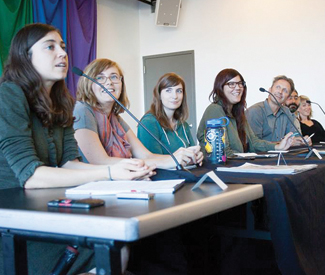
Much of BART’s dirty laundry was aired at the first hearing on the negotiations in Oakland today, part of a seven-day investigation called by Gov. Jerry Brown after Sunday night’s talks between unions and management threatened the Bay Area with another strike.

The particulars of each side’s bargaining offers are normally hush-hush, but the hearing was a chance for the public to get a peek into what each side has been asking for. As the three-person panel on the governor’s fact-finding board sat at a long table facing the audience, management and unions sat on separate tables, much like that in a courtroom. 

Amid all the particulars of wages and economics, the unions levied  major allegations over safety concerns, saying that BART management hasn’t incorporated safety changes after the deaths of workers.

Saul Almanza, a BART representative from SEIU Local 1021 and a 17-year railroader, showed the board a set of photos of the places where BART workers had been killed on the job. 

“I’d like to start out with the picture with the part where Robert [Rhodes] was killed,” he said. “The area where Mr. Rhodes was killed was very dark, and remains that way today. Look at the picture to the left, and that’s where Mr. Rhodes was standing as the southbound train proceeded through the interlock. It was dark and loud, and that’s where he was struck as he stood there with no place to go.”

Almanza said that he brought up lighting improvements to his management at many levels, many times. When no improvements were made, that’s when the safety issues became a major point in bargaining, one sticking point that led to the four-day strike in early July. 

Paul Oversier, BART’s general manager of operations, made it a point to hammer home how pained the Bay Area was during the strikes, alleging that “people who depend on BART, who want to fill their prescriptions” may have been delayed, among others. 

He also touted some drastic numbers, saying the direct cost of the BART strike to the Bay Area was estimated at about $73 million per a weekday. 

“That doesn’t include empty tables at Bay Area restaurants, higher day care payments for working parents, or the  overall increase in personal stress throughout the region,” Oversier said. “None of these are counted in the economic model used for the BART strike.” 

But the union said that management did everything short of inviting them to strike, repeatedly used stalling tactics, making counter-offers that had changes of “point five percent” from their previous offers, and avoiding bargaining for as long as 33 hours at a time. 

Vincent Harrington has represented BART unions in contract negotiations since 1978, but he said this negotiation has had more hardball tactics than he’s seen in any negotiation. “This time around, we couldn’t even reach an agreement on ground rules,” he told the board. 

He also said that management used the media as a way to spread inaccurate information. He wanted to use the hearing as a chance to air the “facts versus myths.”

One commonly misreported figure is that BART workers pay only $92 per month into their healthcare, he said. “That doesn’t tell the full story. These workers contributed 1.627 percent of their wages into a fund to cover not only the ongoing health care of active employees, but also the retirees. There are 3,000 employees in the plans,” he said.

That brings the total to about $180 per person, he said, with a caveat. Some time ago, employer-provided healthcare was capped. “Additional costs beyond that cap would be on the workers and their families, not on BART,” he said.

Harrington also brought up a point of contention in negotiations that is familiar to regular BART riders: how bathrooms in the station are routinely locked and unavailable for use.
“We want BART to reopen bathrooms for patrons. We are not aware of a single transit station today that keeps the bathrooms locked. What does that mean for workers and our patrons? Where do they go? That means they relieve themselves in the stations,” he said. The bathrooms were locked since the 9/11/01 terrorist attacks at nearly every station. “We asked them to open them up. BART has said no.”

Management and the unions both presented their idealized BART systems, with management reiterating their need to invest in new trains and to control pension costs, and unions saying their workers deserve a living wage.

This will be the only public hearing day, and afterward the panel of Jacob Applesmith, Micki Callahan, and Robert L. Balgenort will put together a draft report for Brown, which is due Sunday. 

This could lead to a 60-day cooling off period where no strikes could take place, or Monday morning we could find ourselves with no BART trains and negotiations again at a standstill.

BART union negotiators said that they were willing to talk, and that they could even hammer out a deal with management by Sunday — if management is willing to bargain in good faith.

“It’s like a textbook on how to bargain but not actually be bargaining,” Harrington said. “It’s like a tango: you can’t do it by yourself very effectively.”

Any member of the public that wishes to send a comment about the BART negotiations may do so to communications@dir.ca.gov until 9am tomorrow [Thu/8]. The board said its report, once sent to the governor, would also be made public and likely available on the governor’s website.


From the mouths of BART workers; cleaning the dreaded escalators, skirting death

213

A reprieve in BART negotiations has given the Bay Area time to breathe before the next possible strike, but a lot of public concerns and animosity toward BART still remains. So the Guardian decided to take a look at BART workers themselves (we found them through their union) and ask, “How would your life change if the unions adopted BART management’s offers on safety, pensions, wages and health care?”

Note: The audio interviews are summarized in this post, but give them a listen to get a fuller picture of the impact of labor negotiations on worker’s lives.

First we met Robert Earl Bright, a 47-year-old transit vehicle mechanic at the Hayward yards, where he’s been for three years. BART trains seem tame compared to the machines he used to work with, as he started out as an Air Force mechanic working on cargo planes.

It’s that experience he draws from when he said BART’s policies are becoming increasingly dangerous.

Bright is tall but soft-spoken, and while we sat at a bench in a courtyard at Lake Merrit BART station, he talked about the shortcuts BART has taken lately, and how overtime and consolidation are bad practices for everyone involved.

There used to be specific workers called Power & Way controllers who looked out for workers on the train tracks and made sure they were safe, he said, but those responsibilities were consolidated into a separate train controller position. Since then, Bright saw the death of a colleague, a mechanic who switched from a graveyard shift to a day shift and was hit by an oncoming train.

Only after the death did BART take steps to ensure parts of the track where there was less clearance safe from trains were marked, he said.

“The problem is BART seems to wait until someone gets killed until they want to do something about it,” he said.

Bright is a new grandfather. He helps support his daughter and her two toddlers, and he supports his older brother who suffers from dementia. Bright has a home that his fiance bought, but is “upside-down,” as he says, because of a predatory loan.

He’s one of the lucky ones though, as the military pays for his health care, and the negotiations don’t impact him as far as that goes. But he does worry about his pension, and thinks he may have to cut back on supporting his elderly brother and his grandchildren. Even with those cutbacks in his life, he’ll likely have to look for a part time job as a car mechanic, he said.

While contemplating that future, his four-hour daily commute, and the new expectations BART asked of his crew to repair more cars in less time, he started to develop an ulcer.

“They’re short on people, and it’s cheaper for the managers to pay for overtime than to pay for another person,” he said. The stress pressed on him and one day at work he grew dizzy and collapsed, and that’s when he started to be a little more zen about what BART asked of him. But he still said it’s not right.

“Our shop is a mod [modification] shop, but we got tasked with doing preventive maintenance. Our shop isn’t set up for that,” he said. And that means workers who aren’t trained for that particular job are pushed to fix up cars when normally they’re doing an entirely different job. That can be dangerous, he said.

“We have to make sure that those trains not only run, we also have to make sure they’re safe,” Bright said. “Something could happen, like a panel popping off. It touches the third rail, it could catch on fire. If we could miss something… it could cause a derailment.”

As far as Bright goes, he said he’s seeing more people working over time at the request of managers, working longer hours that could lead to unsafe conditions — not just for the mechanics, but for the people who ride BART every day.


Phyllis Alexander, a BART systems service worker, cleans up in the Mission. Photo courtesy of Mark Mosher, SEIU 1021

Phyllis Alexander

Phyllis Alexander has been with BART for 16 years in systems service, which she said basically means, “cleaning, cleaning, cleaning.”

“Wherever they need me, that’s what I do,” she said.

Alexander often starts her days cleaning the elevators and escalators at Powell Street Station, and if you’ve been reading the news lately, you know what that means.

She doesn’t mince words about it: “I clean the urine and the feces out of the elevators and make sure it’s clean and smelling good for the patrons.”

But Alexander doesn’t hold it against the homeless. When she first started at BART, she had little contact with them. But over the years, she’s made good friends out of some of the homeless at Powell and 16th St. stations, and the latter is where she sat and told her story.

“As the years passed it got worse. People living in their cars on the streets, in their doorways. I’ve met a lot of wonderful homeless people, wonderful people,” she said. And as the years went by, it got harder for the cleaning crew, too. She’s one of two systems service folk who take care of Powell Street Station at any one time.

“Sometimes it can be tough, it can get hectic, but we get it done. It’s hecka huge, and there’s only two of us, but we have to do the best we can do.”

But she keeps with it for herself and her daughter.

Her daughter just finished medical school and is still living with her. Alexander makes about $52,000 a year, she said, and couldn’t figure out major cuts she’d make in her lifestyle to make room for paying more into her pension or health care.

“It would hurt me,” she said. She said that though people in the Bay Area demonize BART workers for wanting a raise, she feels it’s simply been too long since they’ve had one.

“I think I haven’t gotten a raise in two contracts. Its been like seven or eight years,” she said.

Devoutly religious, ultimately she keeps faith that the workers will prevail in negotiations.

“(God) is going to bring this through … this thing with management, it’s going to be all right,” she said.

Chevron hit by lawsuit and mass march on anniversary of refinery blaze

Almost exactly a year ago, an explosion and chemical fire at Chevron’s Richmond refinery sent a toxic plume of smoke billowing into the air. Visible for miles, the blaze sent 15,000 to the hospital with respiratory and other health problems.

On the eve of the anniversary of that disaster, Chevron faces mounting pressure from all sides as everyone from city officials to environmentalists continue to seek accountability.

On Aug. 2, Richmond city officials held a press conference to announce that the city is suing the multinational oil giant for damages related to the refinery fire. Richmond Mayor Gayle McLaughlin joined other officials and representatives from the firm Cotchett, Pitre & McCarthy in announcing the legal action, which was unanimously approved by City Council.

The complaint charges that Chevron’s failure to address safety issues at the plant is reflective of a deeper problem.

“In our view, the incident on Aug. 6, 2012 was not an isolated incident – it really is one that followed a period of dozens of prior incidents” of harmful chemical releases, attorney Frank Pitre told the Guardian. “These aren’t coincidences, they’re indicative of a problem of corporate culture at Chevron that ignores safety.”

Pitre added that the very year that Chevron’s refinery blaze occurred, it recorded record profits with the Securities and Exchange Commission exceeding $26 billion, and its top executives were paid around $100 million apiece. Additionally, the company recorded about $10 million in spending on political campaigns and lobbying. Meanwhile, Chevron’s spending on City Council races in Richmond alone hovers at around $1 million, according to local activists.

The lawyer refused to speculate on how much Richmond plans to seek in damages, but noted that the city had been impacted by factors like mounting an emergency response to the blaze as well as “intangibles,” like the effect the incident had on the comfortable use and enjoyment of public spaces. “You had people who had to run into their homes, as if they were imprisoned.”

Pitre also said that the suit aims to correct Chevron’s lax attitude toward safety, and to “send a very loud and clear message into the corporate board room that they have to change their behavior.”

That message is also coming from grassroots organizations.

On Saturday, Aug. 3 at 10 a.m., activists with a broad coalition of Bay Area environmental and labor organizations will converge in Richmond for a march and rally to call on Chevron to improve its safety practices.

The event, which is expected to draw quite a crowd, is part of 350.org’s national Summer Heat campaign, which seeks to foster climate change activism at the local level. The march will by led by Idle No More, an indigenous rights organization, and organizers have hinted that there will be some form of civil disobedience at the refinery.

Andres Soto, a Richmond organizer with the environmental justice organization Communities for a Better Environment, explained that the safety issues at the refinery stem from Chevron’s failure to address pipe corrosion, which is worsened by the practice of refining dirty crude oil with high sulfur content. Roughly 80 percent of the crude that is processed in Richmond originates in the Persian Gulf, Soto said, and contains high levels of sulfur.

Refining this type of crude oil can result in worse air pollution, and also makes it harder for the company to predict the degree of corrosion that will result from processing.

This graph is from a report issued by the Chemical Safety Board, showing the steadily increasing levels of sulfur content in the piping circuit that failed and caused the refinery blaze.

“The blast on Aug. 6, 2012 was caused by a failed carbon steel pipe,” Soto explained. A report issued by the federal Chemical and Safety Board contained urgent recommendations directing the company to use pipes that are more resistant to corrosion, Soto said, but not all of those recommendations have been implemented, even after the failed unit was brought back into service.

The safety board report went into great detail about just how bad things were allowed to get before the blast occurred. “The 52-inch component where the rupture occurred had experienced extreme thinning,” the safety board found. “The average wall thickness near the rupture location was approximately 40 percent thinner than a dime.” (A dime.)

Soto regards this level of deterioration as par for the course at Chevron. “It’s about a management culture that allows the equipment to fail,” he told the Guardian. “They’re just waiting until the pipes fail, and then they’re going to replace them.”

On the Cheap: July 31 – August 7, 2013

0

On the Cheap listings are compiled by Guardian staff. Submit items for the listings at listings@sfbg.com. For further information on how to submit items for the listings, see Selector.

WEDNESDAY 31

Michael Hearst Booksmith, 1644 Haight, SF; www.booksmith.com. 7:30pm, free. The musician and author presents “Unusual Creatures,” describes as a “nerdy, family-friendly sort of Ted talk” about some of the planet’s most bizarre animals.

Andrea Carla Michaels and Bernadette Luckett Book Passage, One Ferry Building, SF; www.bookpassage.com. 6pm, free. The contributors read from a new anthology of women comedy writers, No Kidding: Women Writers on Bypassing Parenthood.

THURSDAY 1

Asian Art Museum $5 admission Asian Art Museum, 200 Larkin, SF; www.asianart.org. 5-9pm, $5. The Asian Art Museum stays open late every Thursday, and visitors who arrive after 5pm pay just $5 (regular adult admission is $12). Current exhibits include “In the Moment: Japanese Art from the Larry Ellison Collection.”

“Downtown Berkeley MusicFest” Downtown Berkeley BART Plaza, Berk; www.downtownberkeleymusicfest.org. 5-7pm, free. The sixth annual fest kicks off with concerts by Andre Thierry and Zydeco Magic, and Talk of da Town.

Larry O. Dean and Hugh Behm-Steinberg Moe’s Books, 2476 Telegraph, Berk; www.moesbooks.com. 7:30pm, free. The Chicago-based Dean and the Berkeley-based Behm-Steinberg read from their latest poetry collections.

FRIDAY 2

“Downtown Berkeley MusicFest” Berkeley Public Library, 2090 Kittredge, Berk; www.downtownberkeleymusicfest.org. 12:15-1pm, free. The sixth annual fest continues with the Steve Gannon Blues Band.

“Oakland Art Murmur: First Friday Gallery Walk” Art project spaces in Jack London, Downtown, and Uptown, Oakl; www.oaklandartmurmur.org. 6-9pm, free. Check the website for an open studios map to the galleries and other art venues staying open late for this monthly event.

SATURDAY 3

Bay Area Peace Lantern Ceremony North end of Aquatic Park (near Interstate 80 and the west end of Addison), Berk; progressiveportal.org/lanterns. 6:30pm, free. Commemorate the bombing of Hiroshima and Nagasaki with the floating of peace lanterns on the park’s lagoon. Arrive at 6:30 to construct lanterns; at 7pm, there will be musical and cultural performances, messages from the mayors of Hiroshima and Nagasaki, and a report from a bombing survivor. Lanterns launch at 8pm.

Fruit Pie Contest Omnivore Books on Food, 3885a Cesar Chavez, SF; www.omnivorebooks.com. 3-4pm, free for entrants ($5 if you’re tasting only). The food-focused bookstore hosts the ultimate pie-making smack down (cobblers, crisps, tarts, crumbles, and buckle-type desserts also allowed). Show up a little before 3pm with your creation cut into as many pieces as you can — because the more people who taste it, the better chance you have of winning. Top vote-getter splits the door money with the shop and gets bragging rights ’till next time. (Non-bakers need pay only $5 to taste all the goodies.)

Vintage Paper Fair Golden Gate Park, Hall of Flowers (County Fair Bldg), Ninth Ave at Lincoln, SF; www.vintagepaperfair.com. 10am-6pm, free. (Also Sun/4, 11am-5pm, free). Antique paper fans, look no further for a vast selection of “postcards, trade cards, stereoviews, photography, labels, brochures” and more to add to your collection. Appraisals are also offered free of charge.

SUNDAY 4

“Beat Generation Instawalk” Meet at Jack Kerouac Alley (near Broadway and Grant), SF; www.thecjm.org. 1-4:30pm, free. In conjunction with its exhibit “Beat Memories: The Photographs of Allen Ginsberg,” the Contemporary Jewish Museum hosts an Instagram-based scavenger hunt through North Beach that ends at the museum — where participants can win Beat-themed prizes and get free museum admission by showing their Instagram photos.

MONDAY 5

Alexander Maksik Booksmith, 1644 Haight, SF; www.booksmith.com. 7:30pm, free. Litquake co-sponsors this reading by the author of A Marker to Measure Drift.

TUESDAY 6

S.G. Browne Booksmith, 1644 Haight, SF; www.booksmith.com. 7:30pm, free. The author reads from Big Egos, a satirical look at identity in the not-too-distant future.

“Neither Friar Nor Conquistador” Emerald Tablet, 80 Fresno, SF; www.emtab.org. 7-9pm, free. An evening dedicated to the history of Monterey’s Spanish immigrant community, featuring a screening of labor activist Michael Muñoz’s short film The Spanish Pruners Strike 1932, as well as a reading from his biography, Change From Within. *


Mayor on local health care policy: “Everything is on the table”

A recent controversy has been brewing around San Francisco’s Health Care Security Ordinance, the 2006 legislation authored by then-Sup. Tom Ammiano that created Healthy San Francisco, the city’s medical services safety net program for the uninsured.

As we explain in greater depth in an article for tomorrow’s issue of the Guardian, influential forces in the business community such as the San Francisco Chamber of Commerce and the Golden Gate Restaurant Association have been publicly raising questions about the Health Care Security Ordinance in light of the federal implementation of the Affordable Care Act, aka Obamacare.

In a recent article in the San Francisco Business Times, Small Business California President Scott Hauge was quoted as saying, “We question whether Healthy San Francisco should continue in its current form with the ACA coming in.” And an article published today suggests that some are continuing to question whether the HCSO can legally coexist alongside the federal requirements under the ACA despite clarification given by Jon Givner of the San Francisco City Attorney’s Office last Thursday stating that the ACA expressly allows jurisdictions like San Francisco to adopt health-care policies such as the HCSO.

Meanwhile, the message from defenders of the city’s health care policy at a hearing called by Sup. David Campos last week was clear: Funding for employee health care generated by employer contribution provisions under the HCSO will be needed more than ever once the ACA is implemented, because many people who now rely on the low-cost Healthy San Francisco for medical care will suddenly find themselves ineligible for that program and automatically funneled into a new system where they are eligible to sign up for subsidized health care, but won’t necessarily be able to afford it.

The ACA will begin enrollment in October, and will take effect in January of 2014. At that point, roughly two-thirds of current enrollees in Healthy San Francisco will either transition to Medi-Cal (if they earn up to 138 percent of the federal poverty level) or qualify for subsidized health care coverage under Covered California, the health benefit exchange created under the ACA. Things are apt to be the most complicated for Healthy San Francisco enrollees who discover they cannot actually afford to take advantage of the options offered under Covered California. 

For this reason, Campos stressed that the HCSO should remain in place without being scaled back or tampered with, because medical reimbursement accounts provided by employer contributions under the ordinance could serve to fill those gaps and help low-wage earners obtain coverage regardless of income. As things stand, Campos and Healthy San Francisco advocates said, gaps created under the ACA will be filled by stronger HCSO provisions, so the programs stand to complement one another.

But the business community, seeking what GGRA executive director Rob Black described to the Guardian as “guidance” from the city on how to move forward given the pending implantation of federal health care reform, wishes instead to open up a new policy dialogue about the HCSO. The mayor has been receptive to their concerns, and recently reconstituted the Universal Healthcare Council, a body that was previously formed to hash out local health care policy.

A key question is who will be appointed serve on that board: Department of Public Health Director Barbara Garcia will chair it, but so far the only indication of who else will be named is that it will consist of “community, healthcare, labor and business stakeholders,” according to a quote attributed to Garcia in the Business Times. Will the makeup include members of the GGRA, the business organization that sued the city to overturn the employer contribution mandate under the HCSO? 

In response to questions about whether the mayor believed the employer spending requirement ought to be revisited in light of ACA implementation, and who would be appointed to the newly convened healthcare council, mayoral spokesperson Christine Falvey responded ot the Guardian with the following statement: “Everything is on the table as the City develops a plan to best implement [the Affordable Care Act]. This is a great opportunity to see how the city can continue to be a leader in making sure San Franciscans have access to quality healthcare. We are currently updating a membership list for the Universal Healthcare Council. More information on that as it becomes available.”

Building on progress

0

news@sfbg.com

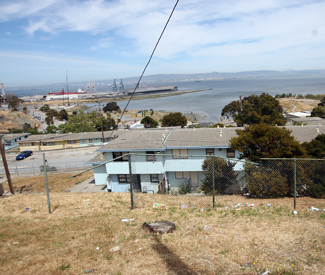
A month-long labor standoff at the Hunters Point Shipyard redevelopment project has been put on hold as the city steps in to provide workforce mediation and oversight. But community-based organizations are left wondering how their workers will actually benefit.

Aboriginal Blackman United (ABU), a Bayview organization representing roughly 300 construction workers, announced on July 15 that it was calling off demonstrations at the construction site that had begun just before a June 26 groundbreaking ceremony (see “Lennar finally breaks ground amid controversies,” July 10).

ABU President James Richards suspended the protests after the Successor Agency to the San Francisco Redevelopment Agency informed him that Young Community Developers (YCD), another neighborhood nonprofit, would no longer exclusively manage job placements at Lennar Urban’s shipyard project.

The Hunters Point construction is expected to create 1,500 jobs annually, over the course of a 15- to 20-year build out. But critics have taken issue with local hiring guidelines hashed out in a 2003 development agreement with Lennar Corp. that are limited to good-faith promises rather than binding quotas.

Since then, community-based organizations have urged Lennar and the Building Trades Council to formalize their commitment to hiring from within the Bayview-Hunters Point community.

Building Trades Secretary-Treasurer Michael Theriault has so far been resistant to these efforts. “There is no inherent flaw in good faith,” Theriault said of local hire promises by Lennar. “Like any system, you have to enforce it.”

Until last week, Young Community Developers (YCD) was tasked with meeting local hire goals by recruiting and training tradespeople from the neighborhood and facilitating their placement on the project.

But Richards and other community advocates were skeptical of this arrangement because Theriault is vice president of YCD’s executive board. “How can [Theriault] be against mandatory hiring and be on YCD’s board?” asked Richards, who viewed it as an obvious conflict of interest.

ABU’s protests finally prompted Lennar and the Building Trades Council to seek the involvement of CityBuild, a workforce-training program and centralized referral network administered by the San Francisco Office of Economic and Workforce Development.

YCD Executive Director Shamann Walton said a meeting between the two organizations produced “a gentleman’s agreement that there will be an MOU in place between YCD and CityBuild,” designating CityBuild, rather than YCD, as the primary recruiting coordinator on the project.

YCD will be just one of a handful of community-based organizations that will assist in training and placement — others will include ABU, Anders & Anders, and the A. Philip Randolph Institute (APRI). APRI San Francisco Executive Director Jacqueline Flin says she supports a switch to CityBuild because it provides “a very good prospect of goal delivery. They have a fair process that’s been proven to work and the city’s invested in the effort.” Flin added, however, that she hadn’t yet heard any real details of the new arrangement with CityBuild. SFOEWD did not respond to the Guardian’s requests for comment. Terry Anders, director of the Anders & Anders Foundation, expressed disappointment that negotiations were taking place behind closed doors. Anders wants to see all the stakeholders brought to the table. He was quick to point out that, though CityBuild promises to be above board, “it is not a neighborhood organization.” “Somebody is making backroom deals,” Anders asserted, “and I am not for it. I don’t like being left out of the process.” He demanded an inclusive and transparent discussion, but a week after bargaining seemingly began and ended, it was unclear whether he would get one. “Lennar’s main concern is getting the buildings up, and they don’t care who does it,” he said. And though Richards is hopeful that CityBuild will be an improvement over YCD, he too was measured in expressing full confidence in the municipal agency just yet. For a lasting solution, CityBuild will need to work very closely with ABU and others. “We stopped all traffic ongoing to the shipyard and coming out for about a month,” to get this far, explained Richards, “the only way we guarantee that our people get jobs is that we are involved.”

Supporting unions helps all workers

0

EDITORIAL The San Francisco Bay Area has traditionally been very pro-labor, from the days when legendary longshoreman leader Harry Bridges led the San Francisco General Strike of 1934 to the modern era when labor unions have lent the muscle and money to myriad progressive reforms that San Francisco and California have proudly exported to the rest of the country.

But sadly, that sense of solidarity seems to be changing during these times of widespread economic anxiety, declining union membership, increasing urban gentrification, and a divide-and-conquer political climate created by both major parties. Too often, Bay Area residents are indifferent or even hostile to the plight of the working class.

We’ve seen it in the public reactions to the labor contract impasse and strikes at Bay Area Rapid Transit, whose unions staged a four-day strike that ended July 4 and which could resume again after a 30-day contract extension and cooling off period ends on Aug. 4. If the strike resumes — which seems likely at this point, disrupting commutes on a non-holiday workweek — the public’s anger and finger-pointing could be even worse than last time.

We heard similar resentments expressed in reaction to last week’s cover story (see “Striking Out,” July 24) about the stadium concession workers at San Francisco Giants’ games, who have been without a contract since 2010 and are even denied tip jars to supplement pay that is actually less than San Francisco’s minimum wage in many cases.

The common criticism is that these workers should just be glad to have a job, regardless of pay and benefits. And when it comes to the full-funded pensions of BART workers, critics rightfully point out that few of us enjoy that kind of retirement security.

But that criticism turns the real problem on its head. We all need far more retirement security than we have now, a reality that will hit hard in the coming years as the so-called “silver tsunami” breaks, leaving families and society to care for baby boomers who run out of retirement savings (which could happen quickly given that three-quarters of Americans aged 50-64 have less than $30,000 in retirement savings).

Bay Area residents should be supporting our brothers and sisters in organized labor, helping them so they can in turn help us, as SEIU Local 1021 and other unions are trying to do on the issue of retirement security for all (last year’s approval of SB1234 in California was a good start, but far more is needed).

When unions win good contracts, it generally increases wages and benefits in the region, even for non-union jobs (the opposite is also true, that wages stagnate when unions lose these fights), so it should be in our enlightened self-interest to support BART and Giants workers. Particularly during these times of economic uncertainty and woe, it’s important to overcome our resentments and stand in solidarity with our fellow workers — for their sake, for our own, and for the long-term best interests of our region and country.

Rep Clock: July 24 – 31, 2013

0

Schedules are for Wed/24-Tue/30 except where noted. Director and year are given when available. Double and triple features marked with a •. All times pm unless otherwise specified.

CASTRO 429 Castro, SF; (415) 621-6120, www.castrotheatre.com. $8.50-11. •Gloria (Cassavetes, 1980), Wed, 7, and Escape from New York (Carpenter, 1981), Wed, 5, 9:20. San Francisco Jewish Film Festival, July 25-Aug 1. See www.sfjff.org for program information.

CHRISTOPHER B. SMITH RAFAEL FILM CENTER 1118 Fourth St, San Rafael; (415) 454-1222, www.cafilm.org. $6.75-$10.25. The Hunt (Vinterberg, 2012), call for dates and times. The Look of Love (Winterbottom, 2013), call for dates and times. One Track Heart: The Story of Krishna Das (Frindel, 2012), call for dates and times. Rebels With a Cause (Kelly, 2012), call for dates and times. Storm Surfers 3D (McMillan and Nelius, 2012), call for dates and times. 20 Feet From Stardom (Neville, 2013), call for dates and times. Dial M for Murder (Hitchcock, 1954), Thu and Sun, 7 (also Sun, 4:15).

CLAY 2261 Fillmore, SF; www.landmarktheatres.com. $10. “Midnight Movies:” Samurai Cop (Sharvan, 1989), Fri, midnight; The Rocky Horror Picture Show (Sharman, 1975), Sat, midnight, with the Bawdy Caste performing live.

“FILM NIGHT IN THE PARK” This week: Creek Park, 400 Sir Francis Drake, San Anselmo; www.filmnight.org. Free (donations appreciated). Moonrise Kingdom (Anderson, 2012), Fri, 8; The Road to El Dorado (Bergeron, Finn, Paul, and Silverman, 2000), Sat, 8.

FIRST UNITARIAN UNIVERSALIST CHURCH 1187 Franklin, SF; www.laborfest.net. Donations accepted. FilmWorks United: International Working Class Film and Video Festival: Roadmap to Apartheid (Nogueira and Davidson, 2012), Thu, 7.

518 VALENCIA SF; www.laborfest.net. Donations accepted. FilmWorks United: International Working Class Film and Video Festival: •The Machinist (Majid and York, 2010), and Bhopali (Carlson, 2011), Fri, 7.

JACK LONDON SQUARE Market lawn, Harrison at Water, Oakl; www.jacklondonsquare.com. Free. Brave (Andrews, Chapman, and Purcell, 2012), Thu, sundown.

MISSION CULTURAL CENTER FOR LATINO ARTS 2868 Mission, SF; www.laborfest.net. Donations accepted. FilmWorks United: International Working Class Film and Video Festival: Dreamworks China (Facchin and Fraceschini, 2012), with “War in Paterson, the Strike that Changed the Labor Movement” (Seidel, 2010), and “A Witness to the Paterson Strike” (Golzio), Sun, 7:30.

NEW PARKWAY 474 24th St, Oakl; www.thenewparkway.com. $6. “SPECTRUMQueerMedia.com presents:” Strange Frame: Love and Sax (Hajim, 2012), Sun, 3.

NEW PEOPLE CINEMA 1746 Post, SF; www.jffsf.org. $13. “J-Pop Summit Festival: Japan Film Festival of San Francisco,” new films and anime from Japan, July 27-Aug 4.

NIMBY’S 8410 Amelia, Oakl; www.brainwashm.com. $10. Brainwash Drive-In/Bike-In/Walk-In Festival, Fri-Sat, 9 (music at 8). All shows broadcast in FM stereo.

NINTH STREET INDEPENDENT FILM CENTER 145 Ninth St, SF; detourdance.com/TDFF. $10-15 (two-day pass, $25). detour dance presents: “Tiny Dance Film Festival,” short dance films from around the globe, Fri-Sat, 8.

PACIFIC FILM ARCHIVE 2575 Bancroft, Berk; (510) 642-5249, bampfa.berkeley.edu. $5.50-9.50. “A Call to Action: The Films of Raoul Walsh:” They Died with Their Boots On (1942), Wed, 7; What Price Glory (1926), Sat, 6. “Tales of Love: The Enchanted World of Jacques Demy:” Lola (1961), Thu, 7; Bay of Angels (1962), Fri, 7; The Umbrellas of Cherbourg (1964), Sat, 8:30. “Dark Nights: Simenon and Cinema:” Monsieur Hire (Leconte, 1989), Fri, 8:45; The Bottom of the Bottle (Hathaway, 1956), Sun, 7. “Castles in the Sky: Masterful Anime from Studio Ghibli:” Princess Mononoke (Miyazaki, 1997), Sun, 4:30.

ROXIE 3117 and 3125 16th St, SF; (415) 863-1087, www.roxie.com. $6.50-11. A Band Called Death (Covino and Howlett, 2012), Thu, 7. Big Star: Nothing Can Hurt Me (DiNicola and Mori, 2012), Wed, 9; Thu, 9:15. An Oversimplification of Her Beauty (Nance, 2012), Wed-Thu, 7, 9:15. “This Must Be the Place: Post-Punk Tribes 1983-1990,” docs and oddities, Fri-Sun. Check website for full schedule. Plimpton! Starring George Plimpton As Himself (Bean and Poling, 2012), July 26-31, 6:45, 8:45.

YERBA BUENA CENTER FOR THE ARTS 701 Mission, SF; www.ybca.org. $8-10. Viola (Piñeiro, 2012), with “Muta” (Martel, 2011), Thu and Sat, 7:30; Sun, 2. *


Striking Out

21

news@sfbg.com

Today marks 1,575 days since concession workers at AT&T Park have had a raise, during which time the San Francisco Giants have been fabulously successful, both on and off the playing field.

The 750 workers represented by UNITE-HERE Local 2 are currently involved in frustrating and fruitless negotiations with their employer, Centerplate, a South Carolina-based food service company contracted by the Giants to sell beer, garlic fries, and other overpriced consumables at games.

The Giants and its front office seem fairly unconcerned about the plight of workers who proudly don the team’s logo and pad its revenues. Not a single concession worker that we interviewed for this article said that they work for Centerplate — each of them said that they work for the Giants.

Since the last contract expired in March 2010, the Giants have won two World Series championships, raised the average ticket price by 20 percent, and have seen the value of the team shoot up by $223 million. The only thing that hasn’t improved are the wages of the concession workers.

Cashiers currently make $16.40 per hour, in-seat runners make $13.40, and some entry-level workers make just $10.45, which is actually less the city’s minimum wage. That’s only legal because those workers were under contract for $10.45 per hour when the wage increased to $10.55 at the beginning of this year. And Centerplate won’t even let Giants workers have a tip jar to augment their substandard wages.

Local 2 reports that revenue from concessions is divided up in a 55-45 split between the team and Centerplate (the Giants PR office disputes this number, but it won’t divulge the actual split). So when a fan spends $17 for a hot dog and 16oz beer, Centerplate and its workers get $7.65 and the Giants get $9.35, all of it pure profit. And the Giants executives even set the concession prices, not Centerplate.

But the team says the plight of these workers isn’t its problem. “We continue to urge both parties to get back to the bargaining table and to have productive discussions so the matter can be resolved as quickly as possible. This dispute is between Centerplate and Local 2, not the Giants,” is the team’s public position on the issue.

The Giants communications office responded with this stance to every question the Guardian asked about the issues involved: What have you done to “urge” Centerplate to settle the contract? Couldn’t the Giants force a settlement if it really wanted to? Why haven’t concessions workers shared in the team’s success and rising revenues? How can you claim to support the community if you can’t even ensure the people who work in your stadium are paid minimum wage?

The Giants had nothing to say about a petition signed by 600 of the workers urging the team and Centerplate to agree to a deal, instituting a company-wide no-comment policy on the standoff with concession workers.

“It would be nice if they would come in and talk—not be a mediator, but to know what we’re asking for and say why they’re not providing it or why they feel they shouldn’t provide certain information,” Billie Feliciano, who has worked as a Giants cashier for more than 30 years, told us. “They could talk to the president of the union on that if they wanted to. You know, we’re not asking you to tell us how you spend your money. We just want to know how much control you have of this situation.”

Feliciano and her fellow workers just want the Giants to be team players.


WHO’S IN CONTROL?

Contrary to what the Giants may say, there is one pressing issue—job security for the workers—that is nearly impossible for the workers and Centerplate to resolve. Every worker interviewed for this story has explicitly said that job security is their most important goal.

Even Centerplate says only the Giants can offer job security to concession workers. If Centerplate goes out of business or loses its contract, the concession workers will likely lose their jobs, which is why they’re advocating for a succesorship clause that would guarantee their employment in that scenario.

When The Guardian inquired with the Giants office about the issue, its spokesperson once again responded, “This is an issue between the workers and Centerplate, not the Giants.”

But with the Giants controlling who runs its concession and how much they charge the fans, is Centerplate just an easy scapegoat for squeezing more profits from workers? Because on the subject of health benefits and wages, the two camps are separated by a wide chasm.

In order to qualify for healthcare, the workers need to work at least 10 games in a month (they’re eligible for health insurance only from June 1 through December 1) to have coverage a month later, which means that the health and well-being of the 750 workers hinges on Major League Baseball’s scheduler.

Workers almost got denied coverage for August because June only had nine games, but they ended up qualifying because they worked a private event at AT&T Park for the biotechnology firm Genentech.

Yet Centerplate wants to raise the number of qualifying games to 12, while Local 2 wants to keep it at 10 and grant healthcare coverage to workers who work every game in months with less than 10 games.

On wages, Centerplate has offered 25-cent increase in hourly pay, no retro raises for the years worked under the expired contract, and a $500 bonus. Though Local 2 has not put out an exact number on their wage demands, its spokesperson says Centerplate’s wage offers are beyond unacceptable; they’re insulting.

Centerplate’s main message in this quarrel is its insistence that the concessions workers are among the highest paid in the nation and that they accrue more benefits than most part-time workers. But the workers say that claim is misleading given the high cost of living in the Bay Area.

“If we were living in Dallas, Texas, I’d say yeah, we’re probably overpaid. But we’re not,” Anthony Wendelburger, who has been a cook for three years, told us.

The Bay Area is among the most expensive metropolitan areas in the nation. Last month, the business consultant Kiplinger published a list of the top 10 most expensive cities in the U.S. San Francisco was third behind Honolulu and New York, with nearby San Jose in fourth and Oakland eighth.

The average concessions worker makes around $11,000 in a year while some make upwards of $13,000 during the regular season. Based on differences in the cost of living, we calculate (using www.bankrate.com) that $11,000 translates to $7,760 if they served food and drinks for the Seattle Mariners, $7,880 for the Chicago Cubs or White Sox, and $6,530 for the Atlanta Braves.


THE OLD BALLGAME

At the Giants-Padres game on June 18, a Tuesday, several hundred protesters gathered at a rally to show support for the Giants concession workers. Most were affiliated with Local 2, but a few off-duty concession workers came to join the demonstration.

They implored the fans—most whom seemed to be just learning about the dispute—to abstain from purchasing any concession stand products. The rally started an hour before game time engulfed fans waiting in line with chants of “No justice, no garlic fries!” and “Ain’t no protest like an union protest because an union protest don’t stop!”

Inside the stadium, 44 protesters (all of whom had purchased tickets) staged a sit-in in front the garlic fries stand situated behind sections 122 and 123. Their numbers withered as the game progressed and by the fourth inning, the area in front of the stand was cleared and business resumed, with 10 protesters arrested for refusing to disperse.

That protest followed a more significant action on May 25, when all of the 750 workers staged an one day strike, authorized by a 500-16 vote by workers. For that game, Centerplate employed volunteer workers who only got paid in tips. Yes, the scabs got the tips that the regular workers are being denied.

Food and drink service during that game was significantly slower than normal, as even the Giants acknowledged. There were reports of fans standing up to 40 minutes in line for a beer, which is usually more than two innings, an amount of playing time that few true baseball fan would ever give up for a beer run.

Critics—including several passerby fans who were loudly expressing their disdain for the demonstrators at the Giants-Padres game—say the workers should be content with what they have, perhaps assuming the workers were getting more from that $10 beer than they really are.

When Pearlie Jones started working concessions at Giants games 22 years ago, hot dogs were $3. Today they sell for twice that amount at the stand that Jones now manages.

We met Jones at the Local 2 building in the Tenderloin. She lives in Daly City, survives on unemployment during the off-season, and has no other source for health insurance. With nervous laughter, Jones told us she “prays to God during [the off season] that I don’t get sick.”

Wendelburger, who has to commute almost two hours each way to the ball park, works as a bartender during the off-season, although he can only get three days a week. When asked about health insurance during the off-season, this husband and father of two says, “Unless I’m going to die, I’m not going to see a doctor.”

But Jones says that as important as improved wages and healthcare benefits are to her and other employees, they really fear losing their jobs: “Our job security is the main issue that we’re pushing for right now.”

One issue that seems telling of the way Centerplate and the Giants are treating concession workers is on the issue of tips. The workers are currently not allowed a tip jar or a tip line on credit card receipts, a standard feature of food service, particularly here in the Bay Area, where even butchers and bakers have tip jars.

Ramirez says she’s utterly baffled by Centerplate’s stubbornness on the issue. “A tip line is something that doesn’t cost management anything and requires a small change in the computer system and is something the customers are actually demanding. We have a great experience with our fans and customers and they want to share their gratitude and they can’t,” she told us.

Another seemingly minor yet deadlocked issue is the request for benches for in-seat food runners. These workers currently have nowhere to sit for breaks or in between food runs, yet Centerplate has refused to budge on that issue.

When asked about these minor demands, a Centerplate spokesperson said that they have not seen any list of demands from Local 2, a statement disputed by workers and Local 2.

Centerplate has cast workers as greedy, even filing a lawsuit against Local 2 claiming that the union and the workers are trying to exploit the Giants’ World Series championships, an action that the union and its workers heard about from reporters, adding to the aura of mistrust hanging over these negotiations.


LONG STANDOFF

Both sides have accused the other of not operating in good faith, something they both hope will change when negotiations resume on July 29.

Centerplate says it wants to give the workers a contract, but blames the deadlocked negotiations on Local 2 head Mike Casey, who also serves as the elected president of the San Francisco Labor Council.

“Unfortunately, Local 2 and its leader Mike Casey have not responded to our economic proposal. Our employees, and Local 2 members, remain without a contract, raise, bonus, and health security all because of Casey’s failures,” Centerplate spokesperson Gina Antonini told us.

But the concession workers seem to strongly support Casey, who was on vacation and unavailable for comment. “I have tremendous faith in our Local 2 union leadership. Mike Casey is brilliant,” Patricia Ramirez, a line cook of 14 years, told us. “I think Casey and [Local 2 organizer] Alphonso Pines are leading us in the right way and I think we’re going to win because of their guidance.”

Centerplate seemed unaware of Casey’s local reputation and community support. “The entire labor community is supporting Local 2 and our message is clear: If you have to go to the games, don’t buy the food” San Francisco Labor Council Executive Director Tim Paulson told us.

Local 2’s tough, deliberate, long-term strategy is one that has paid big dividends numerous times in its history, even if it has resulted in long standoffs with management, as was been the case with hotel workers in San Francisco.

“We have seen plenty of times that they have deadlocked for a period of time, they hold out, they tend to fight as long as it takes, and they tend to win” said Ken Jacobs, chair of the UC Berkeley Labor Center.

For their part, concession workers involved in the negotiations blame Centerplate lawyer and lead negotiator George Aude and his abrasive style for the impasse and the tense relations. Several workers we talked to cited Aude’s disrespectful demeanor, with one worker calling him a “giant hothead”.

In one of the negotiations, Aude made several irate comments, which Local 2 took as a threat. They say Aude demanded of the Local 2, “If you don’t stop all these actions you’ve been doing, we’ll offer you less money.”

We reached Aude to comment on the contract talks, he said simply “unsatisfied,” and when we asked for further details, Aude hung up and refused to answer our calls.


SUPPORTING THE TEAM

Mayor Ed Lee says he’s urging the two sides to settle the standoff and that he has offered to help, although he’s leaving it to the mediators involved. So for those keeping score, City Hall has offered help but the Giants organization has not.

Yet Lee’s half-hearted offer to help Giants workers belies his zealous efforts to promote the Giants and its brand. In February, Lee and the Giants launched a citywide anti-litter program called “The Giant Sweep,” named in honor of the Giants’ sweep of the Detroit Tigers in the 2012 World Series.

“Last year the Giants showed us that winning the World Series took a team effort that went far beyond individual heroics. It required the effort of every player, coach, manager, and support staff — not to mention the fans — to build a championship team. The same approach is needed to attack San Francisco’s litter problem. The Giant Sweep will help San Francisco remain a place where people want to live, work and visit,” the Mayor’s Office said in announcing the program.

Mayor Lee and Gavin Newsom awarded the Giants a “Key to the City” for their World Series wins. Pitcher Matt Cain was awarded a “Key” last year for his perfect game against the Houston Astros. Even disgraced slugger Barry Bonds was given a “Key” after passing Hank Aaron on the all time home run list in August 2007.

“You know, we usually give keys to individual dignitaries who have accomplished great things, whether it was the president of Ireland, or Tony Bennett, or even a Matt Cain on his wonderful perfect game in San Francisco,” Lee said during last year’s celebration. “We normally celebrate those individual accomplishments, but today, we’re gonna break with that tradition and present this key to the entire team and coaching staff, everybody involved in the Giants, the investors, their front office. Congratulations to a team that doesn’t know how to quit, never gives up, and defied the odds at every opportunity.”

Then the city spent nearly a reported quarter-million-dollars to throw its team a massive victory parade and San Franciscans went wild in celebrating the Giants, once again, as the concession workers waited to feel like part of the team.

Could Lee or other City Hall figures help solve the standoff? Other mayors have successfully intervened in situations like this before. In 2004, then-Mayor Newsom sided with the 4,300 picketing hotel workers after the hotels refused his request to end a lockout.

Less than a year before that, Newsom ran for mayor as a “business friendly centrist” who raised millions of dollars from the hotel industry and other downtown business interests. But when he saw that hotel management wasn’t being reasonable, he used the power of his office to help broker an agreement.

It would seem Lee could do the same thing if he wanted, particularly given that the Giants are currently asking the city for land and support to help grow its business.

STADIUM SPRAWL

The Giants organization is currently working on a $1.6 billion, 27-acre development project at Pier 48, located on the opposite side of Mission Creek from AT&T Park. The gargantuan project will include 1,000 housing units, 125,000 square feet of retail, 1.7 million square feet of office space, 2,690 garage parking spaces, and more than eight acres of public space. The project is on public land and will be subject to numerous approval processes, by both the city and the Port of San Francisco. Pier 48 and Seawall Lot 337 are some of the last valuable, easily developable sections of waterfront in San Francisco, so one might say the team is asking a lot from the community. And of course, Mayor Lee offered unqualified, enthusiastic support for the project, telling the Chronicle, “Among my highest priorities is to make sure our homegrown companies can stay, grow, and hire right here in San Francisco, driving job growth, improving our neighborhoods, and in this case our world-class waterfront.” But Lee, Centerplate, and the Giants seem to think that just creating jobs is enough, regardless of pay, benefits, and job security. “The success of a Major League Baseball club is measured by more than game-winning rallies and pennant drives. Beyond the box scores, a ballclub has a unique opportunity to create partnerships to improve the quality of life in its community,” the Giants proclaim on its community page. But for Giants workers, such sentiments have done little to improve their quality of life.

Alerts: July 24 – 31

0

WEDNESDAY 24

Milk Club Dinner & Gayla Roccapulco Supper Club, 3140 Mission, SF. http://milkdinner2013.eventbrite.com. 7-10pm, $40 and up. Join the Harvey Milk LGBT Democratic Club in celebrating 37 years of queer progressive leadership. Featuring U.S. Army Lieutenant Dan Choi, staunch advocate for the successful repeal of the U.S. military’s “Don’t Ask, Don’t Tell” policy affecting LGBT service members, as keynote speaker. Milk Club honorees include whistleblower Bradley Manning, queer activist group ACT UP, the San Francisco Gay Men’s Chorus and others.

THURSDAY 25

Forum: The worst international trade deal you’ve never heard of First Unitarian Universalist Society of San Francisco, 1187 Franklin, SF. 7-9pm, free. You may or may not have heard of the Trans-Pacific Partnership, a multinational “free-trade” agreement that’s being hashed out largely behind closed doors. Why should you are? Here’s a hint: It’s being orchestrated by the likes of Chevron, Halliburton, Walmart, and major financial firms among others. Join experts in globalization and learn about international resistance to this shady trade deal.

SATURDAY 27

Party with Meiklejohn Civil Liberties Institute 1715 Francisco St., Berk. (510) 848-0599. 1:30-4pm, donation requested. This benefit gathering for a unique think tank on human rights will include a special treat: Oakland attorney Walter Riley will deliver a talk on “getting the Oakland Police Department to obey the law.” And just in case you require more discussion on our eroding civil liberties to make your hair stand up, there will also be discussion about how drones violate the California Constitution.

TUESDAY 30

Teach-in: immigration and labor ILWU Local 34 union hall, 801 2nd St., SF. (415) 362-8852, http://www.lclaa.org. 7-9pm, free. Join the International Longshore and Workers Union for this Laborfest event, offering a concise history of labor and immigration in California. The history of the Bracero Program is key to understanding the current Congressional debate about immigration reform. Featuring members of the Association of Braceros of Northern California. Al Rojas, a labor organizer and with Labor Council For Latin America Advancement, LCLAA, of Sacramento, will discuss the continuing struggle of California Braceros for justice and the connection of the struggle for immigrant rights.


Labors of love

0

arts@sfbg.com

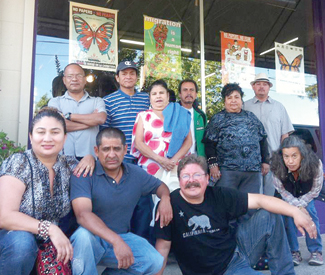
THEATER A white passenger van pulls to the curb in a Santa Rosa neighborhood, discharging a group of Latino men and women at the door of a converted warehouse. The visitors vary by age, class, and education. All hail from Mexico or Central America, but more recently Los Angeles, where they’re among the city’s thousands of jornaleros, or day laborers, making their way job by job, often without secure documentation or security of any kind.

Standing beside the warehouse on this quiet street, they could be mistaken for an ad hoc work crew. But the warehouse is a theater, and this sunny afternoon in June is the culmination of a precious week off. Not that these men and women aren’t here in Santa Rosa to work — just this time, it’s on a play.

Brent Lindsay and Amy Pinto, artistic directors of the Imaginists, greet the visitors as they collect outside the theater and saunter in, joining other members and friends of the Santa Rosa company. It’s the final day of a weeklong artistic exchange between the Imaginists and Teatro Jornalero Sin Fronteras (Day Laborer Theater Without Borders), a Los Angeles–based Spanish-language ensemble theater created by and for the immigrant day laborer population. The ten-member troupe, founded in 2008 under the umbrella of LA’s Cornerstone Theater and led by co–artistic directors Juan José Mangandi and Lorena Moran, has created 15 short plays that they perform mostly at day laborer centers across Los Angeles — although last year saw TJSF tour both Northern California and El Salvador. The plays examine everything from the legal and human rights of immigrant workers to the transnational cultures migrant workers share and foster.

After a light breakfast of coffee and pan dulce, the two companies gather in a circle for warm up exercises led by both Lindsay and Moran. Then they all get back to work on a playlet they’ve been developing from improvisations. It begins with two workers who alternately pay off and slip by a snoozing guard (played by Imaginists company member Eliot Fintushel) to dump toxic waste into a nearby stream. When this causes an environmental disaster, a government spokesperson (Pinto) assures people in the audience that their organic produce is safe. Meanwhile, a cleanup crew of migrant workers is slowly poisoned to death. A news team rushes to the scene of the eco-disaster, but seems to take no notice of the brown bodies sprawled over it. Left alone onstage, the workers rise as ghosts — beginning with one who sings, “They’re carrying me off to the cemetery. Don’t anyone cry for me. Just sing my favorite song…” — and one by one exit the stage.

Throughout, Lindsay directs from a chair audience-side, giving advice or suggestions. All, however, are welcome to chime in with comments and do. An elderly woman named Adela Palacios, for instance, suggests that before departing the stage each ghost can simply state their name and what they did for a living, a suggestion readily embraced by all. Soon the form of the scene has a solid arc, and a tone that makes a virtue of the mix of amateur and professional actors. Combining slapstick, winking asides, an eerie sense of tragedy, and a moving use of direct address, it’s a surprisingly affecting bit of work.

“We come to the theater as older people,” explains Moran. “But we feel we’ve found a company [in the Imaginists] like us. We share the same path.” A native of Guatemala who worked in business administration before fleeing domestic abuse and the country, Moran (translated by Gustavo Servin of the Imaginists) speaks eloquently about the company she joined five years ago amid a dangerous working life both foreign and alienating to her. She acknowledges frankly, “Theater saved my life.”

TJSF is currently developing its first full-length play, Caminos al Paraíso (Paths to Paradise), written by Mangandi and directed by Moran. This exchange in Santa Rosa, made possible by a grant from the Network of Ensemble Theaters, has offered TJSF members the opportunity to learn important technical aspects of crafting a full evening’s production from their more experienced colleagues. At the same time, it’s offered the Imaginists, which has grown into a bilingual company since rooting itself in Santa Rosa, a chance to advance its own mission through contact with a deeply community-driven Latino theater. But neither motive really captures the personal ties and mutual respect that have been forming here, the subtle and profound reciprocity of influence, and the solidarity emerging from it all.

“TJSF is a brave, important theater company that is telling stories that we don’t usually hear,” reflected Pinto by email. “Coming together for a week, we were able to strengthen our own resolve to tell these stories, not to be afraid of being deemed ‘political.’ For the Latino members of the Imaginists, the exchange was a catalyst to be empowered by their histories and stories. This exchange reinforced how necessary it is to have comrades, to share experiences and methods, to have a network of support throughout the country for this work.”

The Imaginists plan to travel to Los Angeles for another face-to-face meeting with TJSF over next steps. Together they hope to develop something that can tour to labor centers across the country.

In the meantime, inspired by the exchange, the Imaginists are concocting a new play, based on a famous children’s story, which will address the plight of undocumented people. Working title: REAL. *

For an extended version of this story, visit www.sfbg.com/pixel_vision.


Giraudo (and activists) close CPMC deal

18

The takeaway message from a July 11 press conference held in the Mayor’s Office touting legislation authorizing California Pacific Medical Center’s construction of two new San Francisco hospitals was seemingly this: Everyone hearts Lou Giraudo.

A part owner of Boudin Bakery and former president of the San Francisco Police Commission, Giraudo was called in last year to help mediate a deal that seemed doomed when CPMC, city officials, and a coalition of labor and community organizations were unable to hash out an agreement that was acceptable to all sides.

Negotiations have been contentious over the past year due to early indications that CPMC would not guarantee that St. Luke’s, a health care facility relied upon by many low-income San Franciscans, would keep its doors open as a condition of moving forward with the new Cathedral Hill facility, a centerpiece of CPMC’s $2.5 billion project.

Enter Giraudo, who was, according to a not-so-subtle hint dropped by former Mayor Willie Brown in his San Francisco Chronicle column last year, “quietly brought in” by the mayor’s office to fix the half-baked mess that the CPMC deal had evidently devolved into.

Sup. David Campos sang Giraudo’s praises, saying, “I have yet to meet a finer public servant,” and calling Giraudo “a real hero of mine.”

Giraudo himself told the Guardian that his strategy was “to de-politicize the process and get people to think about the community.”

Board President David Chiu, who worked closely with Campos and Sup. Mark Farrell to negotiate with CPMC and other parties on behalf of the Board, went so far as to compare Giraudo to Batman. He even joked that he was going to shine a bat signal the next time a negotiator was needed, in hopes that Giraudo would save the day.

Yet while Giraudo may have provided the catalyst needed for a deal, it was community advocates who ensured that the public at large benefited from the CPMC plan more than they would have otherwise — since the mayor’s office seemed willing to go along with the health care giant’s original terms.

Long before Giraudo’s involvement, a coalition of labor and community organizations waged a campaign to rebuild CPMC “the right way,” holding strong on the issue of St. Lukes and refusing to agree to anything that would leave open the possibility that the hospital, a critically important facility for low-income patients, would be shuttered. “That coalition has been working for quite some time … to save St. Lukes,” Campos said of the diverse coalition of community and labor leaders, who formed under the name San Franciscans for Healthcare, Housing, Jobs and Justice. “It kept working for many years.” Under the terms of the agreement that was ultimately agreed upon, St. Luke’s will have a number of specified services to ensure it remains a full-service hospital, and CPMC will commit to providing services to 30,000 charity care patients and 5,400 Medi-Cal managed care patients per year. CPMC will also contribute $36.5 million to the city’s affordable housing fund, and it will pay $4.1 million to replace the homes it displaces on Cathedral Hill. While many advocates for San Francisco’s most vulnerable populations heralded the deal, some were disheartened that it did not dedicate space for psychiatric care.

Beginning on broke

1

news@sfbg.com

Despite signs of economic recovery, many young people still face hard times due to high unemployment, low wages, and a lack of job opportunities. San Francisco Mayor Ed Lee recently sought to tackle this issue locally with the rollout of Summer Jobs + 2013, a public-private partnership with an ambitious goal of providing 6,000 jobs and paid internships for San Francisco’s young adults. It was the most ambitious goal ever pursued in a city jobs initiative, with particular emphasis on low-income youth.

“I’m calling on all San Francisco companies to take on this challenge to support the youth of San Francisco,” Mayor Lee said at a press conference in April, when he joined House Democratic Leader Nancy Pelosi in unveiling the program, the local manifestation of an Obama Administration jobs initiative. “Creating meaningful employment opportunities for our young people today will set them up for success now and in the future.”

But Summer Jobs + is falling far short of its goal, resulting in the creation of only 3,200 summer jobs. The Mayor’s Office is still holding out for a possible influx of hires next month that could bring it closer to the goal before summer’s end, Gloria Chan with the San Francisco Office of Economic and Workforce Development told us.

Last summer, the Mayor’s Office launched a similar initiative aimed at providing 5,000 youth jobs and internships, and ultimately exceeded the goal by 200 positions. Roughly 32 percent of those jobs were in the private sector, predominantly tech. At the end of the day, only about 14 percent of the program’s participants locked down private-sector jobs, with employers ranging from Starbucks to Bank of America to Twilio.

Despite some success in helping young San Franciscans find work, the efforts so far amount to a kind of Band-Aid solution to a problem that goes much deeper and cannot be solved by simply teaching young people to draft polished resumes. Youth unemployment, particularly among low-income and marginalized groups, has worsened over time and is linked to a broader trend of economic inequality.

The Urban Institute, a nonpartisan think tank, recently turned an eye toward economic pressures facing young people with the release of a study titled, “Lost Generations? Wealth Building among Young Americans.” (see “Wealth vs. work,” May 1).

The institute found that among young people, “Average wealth in 2010 was 7 percent below that of those in their 20s and 30s in 1983. Even before the Great Recession, young Americans were on a strikingly different trajectory. Now, stagnant wages, diminishing job opportunities, and lost home values may be merging to paint a vastly different future for Gen X and Gen Y. Despite their relative youth, they may not be able to make up the lost ground.”

In the aftermath of the Great Recession triggered by the economic crash of 2009, millennials ages 16 to 24 have faced dramatically lower employment and income rates in comparison with their elders, according to Bureau of Labor Statistics data.

In California, where unemployment stands at 10.5 percent, the millennial unemployment rate is 20.2 percent. Additionally, the median income of employed young adults in California fell from about $35,000 to $32,000 from 2005 to 2011, while other age groups recovered on average. In San Francisco, the unemployment rate for young people aged 16 to 24 was just shy of 14 percent in 2011, double that of individuals spanning ages 18 to 34.

“We know that there’s been a lot of reporting out there that the recession was particularly hard for young adults, but it’s also important to note that they are in a much bigger hole than everyone else,” Rory O’Sullivan, a policy director for Young Invincibles, told the Guardian.

Young Invincibles is a national organization that works to expand opportunities for young adults in education and employment, and to bring attention to the oft-ignored economic plight of young adults seeking a foothold in the job market.

Young Invincibles found the Great Recession hit young adults harder than any previous recession in recent history. A quarter of job loss experienced by millennials occurred after the recession ended, while the unemployment rate for 18 to 34 year olds has consistently been double that of those 35 and up.

“Young people usually take a big hit in a recession,” said O’Sullivan. “Since they’re often the first fired, last hired in a seniority system. You’re going to let go of recent hires and not the more experienced folks.”

It’s a problem that can potentially have broader effects in the long run. “There are huge consequences for the economy down the road if we have a whole generation out of work,” explained O’Sullivan. “Lack of internships and first jobs can really hurt a young person’s wages. If a young person graduates in a recession, their wages will take a hit for decades afterwards — and that could have huge consequences. We’re still a long way behind.”

There’s no easy fix for the myriad economic pressures surrounding young adults, but O’Sullivan points to public-private partnerships as a way to get young people back in the market, even though that doesn’t seem to be working in San Francisco. O’Sullivan said Young Invincibles would like to see more public service jobs created for young people. “There’s a huge demand,” O’Sullivan said. “Rebuilding after national disasters, building houses, tutoring. We have to do a better job of connecting young people to this workforce.”

Power struggles

12

rebecca@sfbg.com, steve@sfbg.com

Opposition from the San Francisco Labor Council scuttled the San Francisco Public Utility Commission’s plans to approve CleanPowerSF on July 9. But activists supporting the renewable energy program actually welcomed that new roadblock, saying it could trigger a more robust rollout of renewable energy projects that they’ve been seeking all along.

“It gives us leverage,” Eric Brooks, an organizer with Our City who has pushed the SFPUC to adopt a more aggressive CleanPowerSF, told us. “They’re insisting on local union jobs and California union jobs, and we’re glad they said that.”

Brooks said labor’s insistence on union job guarantees places the SFPUC under renewed pressure to implement a more aggressive buildout of local energy projects, from building retrofits to wind power generation facilities.

The SFPUC has already come under attack for the program because Shell Energy was the sole bidder to do the initial energy purchases. International Brotherhood of Electrical Workers Local 1245, which represents PG&E workers, has used the Shell contract as ammunition in a campaign against CleanPowerSF.

Shell’s involvement also helped IBEW persuade the Labor Council to oppose the project, despite its longstanding support for community choice aggregation, the model for pooling customers into renewable power programs on which CleanPowerSF is based.

“The Labor Council is for community choice aggregation, we just don’t like how the players have shaped up,” Tim Paulson, the council’s executive director, told us. “It really makes us hold our nose that Shell Oil is going to have a role … one of the worst labor law violators in the world.”

While the council’s May 13 resolution criticizes Shell, it also expresses support for renewable energy generation in the city to “help San Francisco meet its climate action goals.”

Brooks and other progressive activists share labor’s disdain for Shell. They’re trying to limit its involvement to merely purchasing the first 20 megawatts of power so CleanPowerSF can get underway with enough customers.

The SFPUC should then take over on power purchases, Brooks says, and start issuing revenue bonds against the CleanPowerSF customer base to build green power projects. New research by consultant Local Power shows CleanPowerSF could create 1,500 local jobs per year for 10 years.

Brooks also doesn’t like Shell’s involvement, but he said it was an acceptable means to the end, which was being able to roll out a CCA program that was competitive enough on price with PG&E that at least 80 percent of its targeted customer base would not choose to opt out, the level he believes they need to fund the buildout, which would bring prices down even more.

When we left a message for Local 1245 spokesperson Hunter Stern to ask whether the union would support CleanPowerSF if it guaranteed more union jobs, he referred questions to Paulson, who wouldn’t go beyond his initial statements.

“If it wasn’t for PG&E’s pressure, Local 1245 probably wouldn’t be doing this,” Brooks said of the union’s aggressive campaign against CleanPowerSF.

Representatives from the San Francisco Public Utilities Commission told the Guardian that the agency intends to pursue a buildout of green power infrastructure, although CleanPowerSF director Kim Malcolm says only a few million dollars a year will initially be invested in renewable and efficiency projects.

“That line item is one of the reasons why the advocates are pretty much unanimously supporting this program,” SFPUC spokesperson Charles Sheehan noted. “We listened to them. They wanted a lower rate, they wanted dedicated money for local buildout.”

But to overcome labor’s opposition, those activists want the SFPUC to go further. Malcolm sounded a note of skepticism on Local Power’s job estimate, saying it was based on the assumption that the agency would issue bonds totaling a billion dollars.

“We have no confidence that we could issue a billion dollars worth of bonds in the first few years of the program,” Malcolm said, instead saying the highest the agency expected to go was closer to $200 million.

Brooks wants the Local Agency Formation Commission to hold a public hearing vetting the buildout studies by Local Power, showing the SFPUC and the general public that they are viable. Brooks said that hearing will likely take place in the next two weeks, before SFPUC votes on CleanPowerSF in late July or early August.

Asked about opposition to the program from the San Francisco Labor Council, Malcolm said the SFPUC was in talks to address their concerns. “We have this week been talking to representatives of the Labor Council about those conditions, and how they might actually be implemented in ways that might be practical and promote a sustainable program,” she said.

Brooks said he’s feeling more hopeful than ever about CleanPowerSF, particularly now that the SFPUC has gotten the price down to about 11.5 cents per kilowatt hour, about the same as what PG&E would offer for its proposed green energy program and just $6 more per month than its current brown power service.

“We’ll now hit that sweet spot on prices, and that’s when we can say, ‘Now let’s go for the buildout,” Brooks said. “We know we’re not going to win this if we don’t have labor behind us.”


Events: July 17 – 23, 2013

0


On the Cheap listings are compiled by Guardian staff. Submit items for the listings at listings@sfbg.com. For further information on how to submit items for the listings, see Selector.

WEDNESDAY 17

Kim Deitch Booksmith, 1644 Haight, SF; www.booksmith.com. 7:30pm, free. The graphic novelist presents The Amazing, Enlightening and Absolutely True Adventures of Katherine Whaley, accompanied by a screening of the 1915 silent film The Hypocrites, plus a slide show highlighting Deitch’s underground cartoon work.

Stephanie Lehmann Books Inc, Laurel Village, 3515 California, SF; www.booksinc.net. 7pm, free. Also Thu/18, 6pm, free, Towne Center Books, 555 Main, Pleasanton; www.townecenterbooks.com. The author reads from Astor Place Vintage, a novel set in turn-of-the-20th-century New York City.

THURSDAY 18

“Shipwreck: Competitive Erotic Fanfiction for Literary Perverts” Booksmith, 1644 Haight, SF; www.booksmith.com. 7pm, $10. Six writers “destroy one great book, one great character at a time,” with the end results read aloud in dramatic fashion (and the audience choosing a winning author). Target this go-round is J.R.R. Tolkien’s The Hobbit.

FRIDAY 19

“Friday Nights at the de Young: Sights and Sounds of Mexico” de Young Museum, 50 Hagiwara Tea Garden, Golden Gate Park, SF; deyoung.famsf.org. 5pm, free (access to permanent collections and special exhibits requires admission fee). Jazz and pop fusion with Ilan Bar-Lavi and Sonex, plus a lecture on photographer Rose Mandel. Plus, the de Young’s 144-foot observation tower stays open until 8pm.

“Friday Nights @ OMCA” Oakland Museum of Art, 1000 Oak, Oakl; www.museumca.org. 5-9pm, half-price admission for adults ($6); 18 and under free. This month’s theme is “Indie Rock,” so you can wager a guess as to what type of music will be filling this family-friendly night market. Also: art workshops for kids, food trucks, foodie talks, and more.

SATURDAY 20

“Exploratorium Market Days: Local Motion” Public plaza outside the Exploratorium, Pier 15, SF; www.exploratorium.edu. 11am-3pm, free. The science museum kicks off a monthly series of free outdoor events with “a celebration of the myriad ways people, machines, and animals get around.” On tap: a bionic suit, a personal submarine, a dragon boat, a pedal-powered Ferris wheel, and a chicken foot dissection.

“Pedalfest” Jack London Square, Broadway at Embarcadero, Oakl; www.jacklondonsquare.com. 11am-7pm, free. More than 20,000 bike fans are expected to cycle through this event, which features daredevil and stunt performances, a BMX competition, a children’s bicycle parade, a bike rodeo, live music, “pedal-powered food,” and more.

“San Francisco Waterfront Labor History Walk” Meet at 75 Folsom, SF; www.laborfest.net. 10am, free. Labor historians lead this walking tour that focuses on SF’s maritime industry from 1835-1934, with additional discussion of the 1901 transportation strike.

SUNDAY 21

“Off the Grid SF: Picnic at the Presidio” Main Post Lawn, Presidio, SF; offthegridsf.com/picnic. 11am-4pm, free. Food trucks converge to sell tasty treats (added bonus: gorgeous bay views) from local hotspots like Humphrey Slocomb, Hog and Rocks, Namu Gaji, and more. Pro-tips: bring blankets for seating, and get there early to line up for your favorites — the best stuff tends to sell out well before 4pm.

TUESDAY 23

Nyna Pais Caputi Koret Auditorium, San Francisco Main Library, 100 Larkin, SF; www.sfpl.org. 6:30-7:30pm, free. The director of Petals in the Dust: The Endangered Indian Girls screens a trailer for her film and discusses current efforts by activists to end violence against women in India.

C.W. Gortner BookShop West Portal, 80 West Portal, SF; (415) 564-8080. 7pm, free. The author reads from his second book in the “Elizabeth I Spymaster Chronicles,” The Tudor Conspiracy.

“Slave Labor, Free Labor, and Working People Today” 518 Valencia, SF; www.laborfest.net. 7pm, free. CUNY lecturer Carol Lang charts the links with the fight against slave labor (2013 marks the 150th anniversary of the Emancipation Proclamation) with the fight for workers’ rights around the world today.

“Strange Invaders: Ants, Termites, and Bedbugs” SoMa StrEat Food Park, 428 11th St, SF; www.askascientistsf.com. 7pm, free. Ask a Scientist and Wonderfest co-present this discussion of creepy-yet-common household invaders. Eeek! *


Alerts: July 17 – 23, 2013

0

Wednesday 17

Panel: Upholding the People’s Right to Know ILWU Local 34 Hall, 801 Second St, SF. 7-9pm, free. It seems the phrase “whistleblower” is on everyone’s lips these days, and upholding the public’s right to know about government policies and actions is critical. Closely related is the right of the press to perform its job without fear of government reprisal. Join panelists Larry Bush, San Francisco political ethics and open-government activist and journalist; Peter Phillips, president, Media Freedom Foundation/Project Censored; Tracy Rosenberg, executive director of Media Alliance and Josh Wolf, freelance videographer-journalist for this important discussion on freedom of the press, government transparency, and the freedom of information.


Friday 19

Forum: The re-entry process and the Black community Rasselas Jazz Club, 1534 Fillmore, SF. sfblf2002@yahoo.com. 6-8pm, free. Join an informational forum with community experts on the re-entry process, and how it impacts the black community. The discussion will be led by Sheriff Ross Mirkarimi, Chief Adult Probation Officer Wendy Stills, and Public Defender Jeff Adachi’s Representative, Attorney Vilaska Nguyen. The discussion will focus on the re-entry policy and procedure, as well as its possible consequences, challenges and opportunities for the black community.


Friday 19

San Francisco Living Wage Coalition third annual awards dinner Janitors Local 87 Hall, 240 Golden Gate Avenue, SF. livingwage-sf.org, sflivingwage@riseup.net. 6:30pm, $35 in advance. Come out in support of a community that is working to improve economic conditions for all workers. Olga Miranda, president of Janitors Local 87, will be presented with the Labor Woman of the Year Award, and the Labor Man of the Year Award goes to Mike Casey, president of UNITE HERE Local 2 and president of the San Francisco Labor Council.


Saturday 20

Laborfest event: Kick the high rent monopoly goodbye Musician’s Union Hall, 116 9th St., SF. info@thecommonssf.org. 11am-3pm. Join a group of housing rights advocates, renters, gamers and friends for prizes, fine music and food. Play monopoly by the old rules and then a different set of rules designed to upend the housing market for working people.


Labors of love

0

Los Angeles’s Teatro Jornalero Sin Fronteras makes common cause with Santa Rosa’s the Imaginists

(Note: what follows is an extended version of a story and interview that appears in this week’s Guardian.)

A white passenger van pulls to the curb in a largely residential Spanish-speaking neighborhood in Santa Rosa, discharging a group of Latino men and women at the door of a converted warehouse. The visitors vary by age, class, and education. All hail from Mexico or Central America, but more recently Los Angeles, where they’re among the cities thousands of jornaleros, or day laborers, making their way job by job, often without secure documentation, or much security of any kind.
Standing beside the warehouse on this quiet street, they could be mistaken for an ad hoc work crew. But the warehouse is a theater, and this sunny afternoon in June is the culmination of a precious week off. Not that these men and women aren’t here in Santa Rosa to work — just this time it’s on a play.

Brent Lindsay and Amy Pinto, founders and artistic directors of the Imaginists, greet the visitors warmly as they collect outside the theater and slowly saunter in, joining other members and friends of the Santa Rosa company inside its spacious single room, together with their small children. The two groups have known each other barely a week, but already seem more than colleagues — more like extended family.

It’s the final day of a weeklong artistic exchange between the Imaginists and Teatro Jornalero Sin Fronteras (Day Laborer Theater without Borders), a Los Angeles–based Spanish-language ensemble theater created by and for the immigrant day laborer population. The ten-member troupe, founded in 2008 under the umbrella of LA’s Cornerstone Theater and led by co-artistic directors Juan José Mangandi and Lorena Moran, has so far created 15 short plays that they perform mostly at day laborer centers across Los Angeles — although this last year saw TJSF tour both Northern California and El Salvador. The plays examine everything from the legal and human rights of immigrant workers to health issues to the transnational cultures migrant workers share and foster.

After some socializing over a light breakfast of coffee and pan dulce, the two companies gather in a circle for some warm up exercises led by both Lindsay and Moran. One particular challenging memory game provokes mild frustration and laughter. “This is why we do this exercise,” explains Moran to her actors, all amateurs and volunteers united by the unique opportunities their theater has offered them. “We need to connect to another person and remember details about them.”

Then they all get back to work on a playlet they’ve been developing from improvisations. It begins with two workers who alternately pay off and slip by a snoozing guard (played by Imaginists company member Eliot Fintushel) to dump toxic waste into a nearby stream. When this causes an environmental disaster, a government spokesperson (played by Pinto) assures people in the audience that their organic produce is safe. Meanwhile, a cleanup crew of migrant workers is slowly poisoned to death. A news team rushes to the scene of the eco-disaster, but seems to take no notice of the brown bodies sprawled over it. Left alone onstage, the workers rise as ghosts — beginning with one who sings, “They’re carrying me off to the cemetery. Don’t anyone cry for me. Just sing my favorite song…” — and one by one exit the stage.

Throughout, Lindsay directs from a chair audience-side, giving advice or suggestions at various points. All, however, are welcome to chime in with comments and do. An elderly woman named Adela Palacios, for instance, suggests that before departing the stage each ghost can simply state their name and what they did for a living, a suggestion readily embraced by all. Soon the form of the scene has a solid arc, and the action gains many subtleties, as well as a tone that makes a virtue of the mix of amateur and professional actors. Combining slapstick, winking asides, an eerie sense of tragedy, and a moving use of direct address, it’s a surprisingly affecting bit of work.

“We come to the theater as older people,” explains Moran. “But we feel we’ve found a company [in the Imaginists] like us. We share the same path.” A native of Guatemala who worked in business administration before fleeing domestic abuse and the country, Moran (translated by Gustavo Servin, a young member of the Imaginists) speaks eloquently about the company she joined five years ago amid a dangerous working life that was both foreign and alienating to her. She acknowledges frankly, “Theater saved my life.”

TJSF is currently developing its first full-length play, Caminos al Paraíso (Paths to Paradise), written by Mangandi and directed by Moran. This exchange in Santa Rosa, made possible by a grant from the Network of Ensemble Theaters, has offered TJSF the opportunity to learn important technical aspects of crafting a full evening’s production from their more experienced colleagues. At the same time, it’s offered the Imaginists, which has grown into a bilingual company since rooting itself in Santa Rosa, a chance to advance their own mission through contact with a deeply community-driven Latino theater. But neither motive really captures the personal ties and mutual respect that have been forming here, the subtle and profound reciprocity of influence, and the solidarity emerging from it all.

“TJSF is a brave, important theater company that is telling stories that we don’t usually hear,” reflected Amy Pinto recently by email. “They tell them with humor, with heartache, in a group, in Spanish. Coming together for a week, we were able to strengthen our own resolve to tell these stories, not to be afraid of being deemed ‘political.’ For the Latino members of the Imaginists, the exchange was a catalyst to take ownership and be empowered by their histories and stories. This exchange reinforced how necessary it is to have comrades, to share experiences and methods, to have a network of support throughout the country for this work.”

The Imaginists plan to travel to Los Angeles for another face-to-face meeting with TJSF over next steps. Together they hope to develop something that can tour to labor centers across the country.

In the meantime, inspired by the exchange, the Imaginists are concocting a new play, based on a famous children’s story, which will address the plight of undocumented people. Working title: REAL.

“For Teatro Jornalero there is no division,” notes Pinto. “They are telling the stories of their lives. They are humanizing a ‘political’ situation. We have to let that sit in us, that uncomfortability — can we turn our politics off and on? No. Everything in art is a choice.”

She adds that the encounter held surprises for them too. “To have an encounter where all your expectations are turned upside down,” she marvels, “theater can do that. We are changed. There was so much laughter the entire week. And a fare share of tears.”

Voices from Teatro Jornalero Sin Fronteras

The following excerpts are from conversations that took place on Saturday, June 22, at the warehouse theater of the Imaginists in Santa Rosa. Members of the Imaginists and Teatro Jornalero Sin Fronteras had just completed their rehearsal, ahead of a public performance that evening, and were seated in a semi-circle to answer a few questions about their collaboration. Translation was provided by Julie Kaiser.

SF Bay Guardian Can I ask a general question of the members of Teatro Jornalero? Anyone who would like to answer please do. What brought you to the company, and why did you join? What does being in the company offer you?

Teatro Jornalero Sin Fronteras My name is Alberto Scareño. I found out about this when some of my friends told me about it. It was really interesting, so I called them up to see if there was a spot for me. They said, sure, come that day. And I went in. I’ve never been an actor. We started with exercises. It was really interesting and relaxing. Sometimes I have a lot of stress, or I’m just mad, and to come to this place that relaxes me — it relieves my stress, and time flies. Now what I hope for is to work with even more verve and learn more about the theater.

SFBG What kind of work do you do to make a living?

TJSF Every morning I go out and look for work at a corner in central Los Angeles. I’m a day laborer.

SFBG And you still find energy after a long day’s work for theater?

TJSF The deal is, I don’t get work everyday. So if I don’t work one day, then I have energy to go. When I work, I’m tired, but I get there, and I get my friends, and we do the exercises and I relax. And it’s fascinating.

SFBG Anyone else?

TJSF My name is Xico [pronounced “Chico”] Salvador Paredes. I was on a workers’ corner in California — I’d joined a battle to have a [day laborer] center made — and the first person that [I met] was Juan José. He had participated in theater as an actor, and he was starting to work on his play about illegals. Then he invited me and Lorena [Paredes is married to artistic director Lorena Moran], and other guys, to work in theater. At first I didn’t like it, because I’m a worker: I just get work, get work, get work — I’m not interested in anything else. I send money [home]. That was my only vision, to have a day of work.

But after I came in, I realized, it’s a weapon for communication and understanding, a means of connecting with other people. We started to create pieces out of our own experience, and to recreate our experience. It serves to take out of us what’s inside of us, and to let us know that we’re not alone. The best part of being in this theater is that we’re getting together with people who don’t know what a day laborer is. A day laborer stands on a corner. In the morning he’s cold. He doesn’t have anything to eat. He doesn’t have the security he’s going to actually get work. People walk by and say, “Oh what a lazy guy,” or they pass by as if you’re just a tree, because you’re just standing there all the time. Nobody understands what you’re doing standing there. But a day laborer has huge hope. And he doesn’t know if he’s going to get work. And that’s us.

With the theater, we’ve told many people about what a day laborer is, and shared with those who don’t know anything about their rights. Now we can say, “This is what it is.” It’s really difficult. I just got into a situation where I’ve gotten into the deportation process. I’m in the struggle, but I also have to go to court. I have to do lots of things. And I might get deported. I came here not just to work; I came here to tell my story. And my story’s big. No bigger than anybody else’s. But it’s very positive for people to hear: Here we are.

TJSF I’m Mario Rivera, and I’m very happy to be here sharing with you all. I’m also, like my friends here, a day laborer and I work in central Los Angeles. I came into the theater because I was invited by Lorena. What I like is learning from my compañeros. I had nerves when people looked at me, and I lost that. I lost that fear, and I really like being here. I’d like to learn more from everybody. And I like the play that we’re doing here [with the Imaginists]. This all suits me. I like all of this.

TJSF I’m Adela Palacios. And I’m not very good for talking. The reason why I’m in the theater is because I don’t have work. I studied nursing. Two times I graduated in nursing. I am a nurse. But I had an accident. Now I can’t find work. In this country there’s a lot of discrimination about age. I looked for work for two years. The only opportunity I’ve found, that opened doors for me without discrimination, was this theater. We are volunteers. We don’t have work. They help us. Sometimes they give us food. I am very grateful to this great person, Lorena. And I’m very grateful to Cornerstone Theater. We have some understanding there. We are not heard as we should be [in society], but they do a little, what they can. They give us a little bit of a normal life. My stress is better than it was. And they’ve done everything possible. They do what they can. They can’t do more. I’m really grateful. You have to accept what there is and not ask for much.

TJSF I’m Heidi Guevara. My problem is I have a fear of being in front of people. But now it’s gone. I didn’t think I’d ever do something like this, because I’m really embarrassed easily. Now I have the courage to be in front of people. Lorena gives us exercises. And they help you to use your voice and express yourself, to overcome your shame. It’s a little complicated, but I’m learning more little by little. And here we go! I’ve been with them one year — you have to keep learning and learning. You know this. You have to keep going and learning. Little by little, but I’m going. Thank you, Lorena.

TJSF My name is Raul Salinas. I’m from northern Mexico. Chihuahua. I have six kids. I’ve been ten years here. Now I’m in the Centro Jornalero for work. I don’t have full-time work. I’ve been with the theater three months. How did I get here? I don’t know. It was just chance. One day Lorena came to the work center. She came to do casting for a play that they’re doing called Ways to Paradise. I wasn’t going to do it. No. But there was another person who wanted to go and I helped him with directions to the place where they were doing the casting. And then I got involved. Now I’m involved with Ways to Paradise, about the problems facing migrant workers, explaining who we are, what we’re doing: Yeah, we’re undocumented, we’re from Central America, Mexico … I started thinking about the work, and I really like it. So I stayed. That’s it. There’s not much more to tell.

SFBG I’d like to ask Lorena: How did you become involved in the theater, and how has your relationship with it evolved over the years?

Lorena Moran I would like to tell you the story of Teatro Jornalero, how the project got created. In 2006, Michael John Garcés, the director of Cornerstone Theater, wrote a play called The Illegals. He went and did castings at all the day laborer centers. [Co–artistic director] Juan José [Mangandi] came out of that. He participated in the work, along with other workers from day laborer centers at the national level. And they were invited to a national congress of day laborers. One day they were bored, just hanging out. And Juan José said, “You know what? I have the script of The Illegals. Why don’t we just do a little piece of it and present it to the congress?” It was a marvelous idea.

We have lots of ideas that are marvelous. We need a reason to do it and we also need people to help us. Nothing is possible without that. This was a great idea of Juan José. And we got a lot of help from Michael Garcés and Cornerstone Theater. Roberta Uno of the Ford Foundation gave us our first grant, a big grant of several thousand dollars for two years. And right now, we’re working on a small grant of $25,000 for two years. It’s not much — it’s a big deal to maintain 21 people on $25,000. But it would not have been possible at all if we didn’t have these workers — gardeners, housekeepers, bouncers, day laborers, nurses — they all have stories and voices. And they can educate others, and educate themselves about the rules of this country, the laws, their status as undocumented people.

In 2008, I was invited to participate in a casting for the first company of Teatro Jornalero Sin Fronteras. We were 12 members, two directors. Ethan Sawyer, an American graduate of Northwestern, helped train Juan José, who didn’t know anything about the technical part of theater but had a big spirit for it. They helped us, and the other 12 members of the company.

And that’s how my story starts. I’d had just a year here. I’m from Guatemala. I suffered domestic violence; that’s something I don’t want to remember. They even have my three kids; they’re still there now. But I’m here. And I’m growing a better life. And my dream is that when I’m a citizen I can bring my kids here. But nevertheless, I’ve had five years in this country, and the theater saved my life. And if I’m well, I want my friends to be well, in spite of the traumas, the economic problems. I was this close to getting deported once. I was this close to getting deported once. I was working on a corner with my husband, Xico. I was working gardening, in construction, cleaning houses. I spent five months making six houses. Twelve men, one woman. I was the only woman building houses.

All that showed me the world of day laborers from the roots up. We’d get up at 5:00 in the morning and be standing next to Home Depot. And somebody would drive up and say, “I need somebody,” and we’d run. It was like trying to play the raffle. In my country I’m actually a business administrator. I have a university degree. It’s a totally different life. And there I am, standing on the day laborer corner. I’ve had to clean bathrooms, deal with sexual harassment, I’ve had to clean, and change floors out, and paint — it was a completely different thing for my life. And I realized this is the moment to find a sense of what it’s like to be a migrant. Separated from our families, from our countries; we’re not raking in money, we just want to live with dignity.

So we did a casting. We had some administrative help from Michael John Garcés. And I was named the managing director. It was a whole process. It didn’t happen immediately. But from the beginning I was a part of this group. There’s a moment when you’re present, and there’s a moment when you leave. I don’t know when I’ll leave. But I want people to love this group. We have a voice, and we have a story. We ourselves are part of this story, and we’re writing it.

For today, I’m grateful for my life, and I share with Brent and Amy and their group. I haven’t stop writing, because each day I want to get down every word that drops out of their mouths. For me, it’s part of my learning. That’s what this exchange is all about. We’re training in technical ways with a group that has a lot of similarity with us. They’re helping our community of day laborers and house cleaners. We’re talking. Not in the same idiom, but the same language. And I’m very grateful.

SFGB Can you say a little more about what it’s been like to work with the Imaginists?

LM This is a dream. It’s a dream. To think it all started those years again with Juan José and Sergio in Washington, DC. Juan José Mangandi, the other artistic director, he dreams all the time. He thinks of all these big ideas. For four years we’ve been looking for funds to do this. And we found a grant. And here we are. And we’re dreaming of a second one. We don’t know when or how, but we have a dream, we’re going to keep going, we want to build a network of theaters nationally in the same line as [Teatro Jornalero]. But even so, we have to talk more. This coming together now is a first pass.

We’re just dreaming — some groups in a bus, in a van, connecting with each other from different cities. We’re empowering our voice as immigrants with respect to the larger population of whites, African American, and other groups. This is the story that we have. We’re trying to remove the barriers to our opportunities. It’s huge that we came together.

SFBG What about for the Imaginists?

Amy Pinto For us, the kind of work we’re doing — in bringing Spanish and English together, the issues of the day laborers, and bringing people who are day laborers and professionals together to perform — sometimes the community doesn’t understand, and we’re not always supported. So you [Teatro Jornalero] coming here gives us strength. You teach us how to be strong and to come together to make this kind of work. I think for [Imaginists company members] Zahira [Diaz], and Sergio [Zavala], and Marcela [Mejia], and Gustavo [Servin], who is young, meeting all of you — they see the road then; and it can empower them to take more leadership.

Brent Lindsay It reminds us of why we do theater.

LM I have one question for Amy and Brent. How did it come about that two white people decided to come so close to our community, and do such magic things and help empower us? There’s migrants and Latinos — how did two white people decide to tell our stories, to live our stories?

BL There was a gentleman in the video that you showed. Close to the end, he said, I want to be proud of what I do in life. Like you, Lorena, theater saved me. And it became my religion because it saved me. My investment in theater now is the investment of human beings, what theater can give to others. Because what it did for us, that gift — now we should become its messenger. We have to invite every person into this art form. For the reasons that you’re finding: It heals us. It’s too easy to let fear divide us. We have to worker harder, to overcome fear and come together. Because so much of that fear is based on nothing. It’s nonsense. And the best way we learn that is to do what we’re doing now.

A conversation with co–artistic director Juan José Magandi [translation by Marcela Mejia]

SFBG Can you tell me about Caminos al Paraíso and your part in the production?

Juan José Mangandi As the dramaturg, I try to put the stories together in a cohesive way, drawing from the experience of the actors and my own — as a day laborer, as a community organizer, as an undocumented person. There was a lot of pressure of impose specific themes or stories, but in the end I put in what I felt was the most appropriate for the story as a whole. I was tempted to tell my own personal story, but I tried to tell the story of our community. it’s the first full-length play of Teatro Jornalero since I’ve been working with them, seven years now.

SFBG What was the starting point for this new project?

JJM I’ve worked for many years on behalf of day laborers, and have heard many stories, experiences, tragedies, dreams, songs. So Caminos al Paraíso is the story of the breakdown of connection, of what it feels like for people to lose their home, their town, their country. For example, Chronic Stress Disorder is something that affects many immigrants. Every time you cross a border, and then another, the syndrome grows worse. You don’t get rid of it. It manifests in the way you behave — in anxiety, fear, even the change in the diet has an effect, in addition to the intrinsic dangers that a journey like that implies.

So we speak about these things, so people know what happens when one cross the border, including the abuses on the Mexican side of the border. Everybody talks about the US and the racism and the discrimination of an imperialistic government, but what happens when our own people are the ones that are doing the discriminating? So the governments from Mexico and Central American countries say they want to protect the rights of our emigrants and yet they are often the first ones to commit abuses. So it’s a critique of the economic, political, and social conditions. It’s an industry, an industry of immigrants, not only here but there as well, where for the ones that benefit — the government, the traffickers, the narcos, everybody — it’s a business, it creates a lot of employment for people.

So there are a lot of tragic events that immigrants experience before they arrive in the US. And then what happens when we arrive in “paradise”? That will be the second half, and that’s a totally different story. We start to mix with other races, and we start to change. I mentioned already the diet, but also the culture, the values, the sense of belonging to a community, not necessarily a country. And chronic health problems can ensue. Many become bipolar or diabetic, suffer from high cholesterol, high blood pressure. It’s like the body is not prepared for all of this processed food. It’s a big shock physically, in addition to all the other aspects impacting the humanity of the immigrant.

We are escaping because we are old, victims of the corruption, the lack of opportunities. But we come here and there are no jobs really, and we don’t have a social identity — just the paper itself makes such a difference. It’s like being invisible. Besides doing dangerous work, we are also breaking with our cultures, with our identities, who we were and where we came from. Some people get really uptight about clinging to their past identities. It can become a big obstacle to making bridges to connection with each other, to understand each other.

SFBG Do you see the theater you’re making as a means of helping forge a new culture, bridging those divides?

JJM I think that the theater is a weapon of social struggle and transformation—not only for the people that are out in the audience but also for the actors themselves. The government teaches us about political borders, and then the poverty and the ignorance help us create another border, another barrier. We want to be different, we want to be better than the other, we want to separate form each other—a Salvadoran has to be better than a Mexican, a Mexican has to be better than a Guatemalan, and so on. For me, in my experience, the great problem is, and my big question is: Why can’t we integrate? This is what Teatro Jornalero is searching and striving for, to break these separations. We’ve had people from Cuba, Mexico, Salvador, Guatemala… Sometimes it gets heavy between the actors. There’s an inner racism. All of these themes that hurt so much, that we don’t want to talk about, are in Caminos al Paraíso. But then there is also a message for the community. That we should get ready to integrate. That we like this country. That we have adopted it as our own. Now we want them to adopt us as well, as members, and let us taste the good of this country so we can practice compassion for the ones that come after us.


CEQA reform battle sparks welcome changes even before final compromise

32

UPDATED When Sup. Scott Wiener last year introduced legislation that would limit people’s ability to appeal development projects by reforming the California Environmental Quality Act’s local procedures, progressives and neighborhood activists rose up in strong opposition. But now, with that measure and a competing alternative up for approval by the Board of Supervisors tomorrow (Tues/16), there is a compromise in the offing that all sides may see as an improvement on the status quo, particularly given administrative changes that the Planning Department has made along the way.

“We made a series of amendments in April that addressed almost all the concerns raised by the neighborhood activists,” said Judson True, the top aide to Board President David Chiu, who has once again taken the lead role in crafting a compromise on controversial legislation

Final details of the deal are still being worked out, but sources on both sides say there is an agreement on the broad outlines of a true compromise. It would accomplish Wiener’s main goal of limiting the current ability of project opponents to file a CEQA appeal at any time while also improving the public notification process.

“It’s still pretty fluid now, but we’re working to get to a consensus measure, we hope,” True told us.

Wiener has always emphasized that his legislation applies only to relatively small projects, those that are “categorically exempt” under CEQA from having to do detailed environmental studies. And he said the compromises now being developed appear to meet his initial goals.

“I’m cautiously optimistic that it will be approved,” Wiener told us, adding that, “If this turns out to be a kumbaya moment, that will show the legislative process works.” [UPDATE: The compromise legislation was unanimously approved by the board.]

One byproduct of that process was recent changes on the Planning Department’s website that make it much easier for activists to track the status of projects — with a new map showing projects that have been granted CEQA exemptions that would move forward unless challenged — which activists requested during the Land Use Committee hearings on this legislation.

“We heard from members of the public that our existing posting process was cumbersome. It was also time-consuming for staff. We decided to revamp the system, using technology we’ve developed in recent years. By converting the checklist into electronic format and having it searchable by location, it’ll be easier for the public to search for a particular project and more efficient for staff to process,” Planning Department spokesperson Joanna Linsangan told us.

True said the hearings on the legislation have helped to illuminate problems that could be addressed administratively: “There’s been a real push from supervisors and the Planning Department itself to improve noticing.”

Eric Brooks, who has been working with the 42 groups that coalesced to oppose Wiener’s legislation — including environmentalists, neighborhood groups, labor, and historic preservationists — said ensuring proper noticing was half the battle. He gave credit to Sup. Jane Kim for resisting the Wiener legislation and working with activists to put forward a competing measure, sowing the seeds for the Chiu compromise.

“This was  a real community process and Jane Kim needs to be lauded for taking part in this,” Brooks said, although he later added, “Whatever happens with this, David Chiu owns it because he’s put himself in the middle of this.”

One key piece of the puzzle that might not be resolved tomorrow is with what has always been the biggest concern for activists, which is how the legislation limits appeals to a project’s initial approval. “We knew that it would be way too early and it cuts off our ability to negotiate with developers,” Brooks said.

For complicated legal reasons, it was difficult to build into this legislation a process for activists to challenge a project that changes after its initial approval, so Kim has introduced trailing legislation that would do so (which is set to be heard Wednesday by the Historic Preservation Commission and Thursday by the Planning Commission).

It would allow activists to appeal changes to a project that they find environmentally significant, even if city staff doesn’t (or, in planning parlance, to appeal the environmental review officer’s categorical exemption determination — to that same officer).

“If the environmental review officer has to suffer the hearing if she makes a bad call, she will make fewer bad calls,” Brooks said. “And if we don’t change the environmental review officers’ mind, we’ll be able to take it to court.”

A community-based coalition, a trio of supervisors and a very special mediator helped seal CPMC deal

The takeaway message from a July 11 press conference held in the Mayor’s office touting legislation authorizing California Pacific Medical Center’s construction of two new San Francisco hospitals was seemingly this: Everyone hearts Lou Giraudo.

A part owner of Boudin Bakery and former president of the San Francisco Police Commission, Giraudo was called in last year to help mediate a deal that seemed doomed when CPMC, city officials, and a coalition of labor and community organizations were unable to hash out an agreement that was acceptable to all sides.

Negotiations have been contentious over the past year due to early indications that CPMC would not guarantee that St. Luke’s, a health care facility relied upon by many low-income San Franciscans, would keep its doors open as a condition of moving forward with the new Cathedral Hill facility, a centerpiece of CPMC’s $2.5 billion project.

Enter Lou Giraudo, everybody’s favorite public servant who was, according to a not-so-subtle hint dropped by former Mayor Willie Brown in his San Francisco Chronicle column last year, “quietly brought in” by the mayor’s office to fix the half-baked mess that the CPMC deal had evidently devolved into.

“He’s often said he’s just a businessman. A baker, if you will,” Lee said during yesterday’s press conference. But Giraudo came to the table with the right “recipe” and the “main ingredients” for a successful deal, Lee added.

Sup. David Campos also sang Giraudo’s praises, saying, “I have yet to meet a finer public servant,” and calling Giraudo “a real hero of mine.” 

Giraudo himself told the Guardian that his strategy was “to de-politicize the process and get people to think about the community.”

Board President David Chiu, who worked closely with Sups. David Campos and Mark Farrell to negotiate with CPMC and other parties on behalf of the Board, went so far as to compare Giraudo to Batman. He even joked that he was going to shine a bat signal the next time a negotiator was needed, in hopes that Giraudo would save the day.

Presumably, when this happens, Giraudo will dust the flour off his apron after toiling away at some sourdough bread shaped like an alligator, duck into a Boudin Bakery bathroom to squeeze into a superhero costume, strap on his jet pack and take off for the gold-capped dome.

Giraudo may have provided the catalyst needed for a deal, but it was community advocates who ensured that the public at large benefitted from the CPMC plan more than they would have otherwise – since the mayor’s office seemed willing to go along with the health care giant’s original terms.

Long before Giraudo’s involvement, a coalition of labor and community organizations waged a campaign to rebuild CPMC “the right way,” holding strong on the issue of St. Lukes and refusing to agree to anything that would leave open the possibility that the hospital, a critically important facility for low-income patients, would be shuttered.

“That coalition has been working for quite some time … to save St. Lukes,” Campos said yesterday. The diverse coalition of community and labor leaders, who formed under the name San Franciscans for Healthcare, Housing, Jobs and Justice, commissioned studies on the need for health care services for low-income populations, studied housing and transportation impacts, and developed a broad base of support for a better deal than what was originally floated by the healthcare giant. “It kept working for many years,” Campos noted.

Under the terms of the agreement that was ultimately agreed upon, St. Luke’s will have a number of specified services to ensure it remains a full-service hospital, and CPMC will commit to providing services to 30,000 charity care patients and 5,400 Medi-Cal managed care patients per year. CPMC will also contribute $36.5 million to the city’s affordable housing fund, and it will pay $4.1 million to replace the homes it displaces on Cathedral Hill.

But wait, one last thing we’ve just learned about Giraudo: Did you know he also served as chairman at Pabst Brewing Company? The next time you get drunk off PBR while gorging yourself on sourdough baked into the shape of a teddy bear, or for that matter receive emergency medical care at St. Luke’s after an unsuccessful attempt at building a DIY jetpack, you’ll know who to thank.