Kids

Stories for big kids: Tales hit the stage with Paul Flores, the Living Word Project, Campo Santo, and Word for Word

0

Stories aren’t just for youngsters who read The Very Hungry Caterpillar before bed or tell scary tales around a campfire. The big kids need stories too, and lucky for San Francisco, the city boasts dynamic performers enacting mature and human stories on stage. Feeding complex chronicles to the souls of grown up audience members, Paul Flores, Living Word Project, Campo Santo and Word for Word do their parts to prove stories for big kids rule.

In You’re Gonna Cry, a one-man show about the effects of Mission District gentrification performed in February at Dance Mission Theater, Flores embodied about a dozen neighborhood characters. Ranging from a Latino bohemian, a pink-haired DJ, and an elderly dumpster-diving immigrant, to a salsa-dancing old timer, a drug dealer, and a well-meaning business man, the personalities illuminated his story from diverse perspectives.

With versions of each character walking the streets in real life, You’re Gonna Cry‘s tales resonated. “The project is not meant to be consumed passively, but to move people to respond and take action,” Flores wrote in the program notes, revealing his intention to employ art for social change. The call to action: empathy, respect, and support for one’s neighbors, and acknowledgment of the cultural nuances in the Mission District. For Flores, hip-hop theater and storytelling helped to put a human face on the issue. 

A Def Poet, playwright, novelist, and spoken-word artist, Flores continues to make a huge impact on teens as a co-founder of Youth Speaks, which implements programs connecting poetry, spoken word, youth development, and civic engagement. The resident theater company of Youth Speaks, the Living Word Project extends the reach of  personal narratives, emphasizing spoken storytelling to communicate important social issues and current movements. Living Word Project Artistic Director Marc Bamuthi Joseph, also a former Def Poet, works closely with a select group of writers and performers, whose ages span from 19 to 25, for the productions.

Trailer for the Living Word Project’s ‘Word Becomes Flesh’:

Excerpts from the Living Word Project’s Word Becomes Flesh appeared in December of last year at YBCA’s Left Coast Leaning festival, co-curated by Joseph. There, committed performers enacted letters to an unborn son, with electrifying physicality and rapid-fire wordplay. The work presented a counter-narrative to the narrow frame of current commercial hip-hop, breaking stereotypes. Through performance, the group focused on the oral transfer of a story, directly confessing personal thoughts and emotions to make connections. Watch for them with Campo Santo at Intersection for the Arts this November in Tree City Legends, written by Dennis Kim of Denizen Kane and directed by Joseph.

Campo Santo, the resident theater company at Intersection for the Arts led by Sean San Jose, plays a major role in theatrical storytelling, linking writers to the stage. “Campo Santo is Spanish for sacred ground,” the group’s artist statement declares. “Like the roots of our name, we are taking the sacred form of storytelling and using it as a tool to bond community through socially relevant plays.”

In May, Campo Santo performs for the first time in Intersection for the Arts’ new home at the San Francisco Chronicle Building, presenting Nobody Move, based on the book by Denis Johnson. Adapted by San Jose, the performance offers a noir psychic picture of the United States from an outsider’s seat. In September, Campo Santo continues its work with Pulitzer Prize-winning author Junot Diaz when it presents The Pura Principle, created from Diaz’s recent short stories and original writings. Also expect storytelling to be part of this year’s Bay Area Now Triennial at Yerba Buena Center for the Arts, where San Jose is one of several curators for performances during the final months of 2011.

Another group breathing life into short stories is the Word for Word Performing Arts Company, operating at Z Space. Founded by Susan Harloe and JoAnne Winter, Word for Word is known for staging performances of classic and contemporary fiction, enabling the company to tell literary stories with theatricality. Word for Word’s last show was extended due to its popularity and positive critical reception. This week, The Islanders opens at Z Space, telling about the bonds of friendship – as two women reunite for a trip to Ireland — by bestselling author Andrew Sean Greer, directed by Sheila Balter. 

While some degree of storytelling already exists in most narrative theater work, the outward expression of a story onstage shifts the performances of Flores, the Living Word Project, Campo Santo, and Word for Word into distinct territory. By combining narrative and literature with powerful theatricality, these San Francisco performers make clear that stories are for people of all ages.

THE ISLANDERS
Wed./9-Fri./11, 8 p.m.; Sat./12, 3 and 7 p.m.; $15-$40
Z Space
450 Florida, SF
www.zspace.org

Looney AutoTunes: KMEL on a Saturday morning, and when urban radio was urban radio

0

When I made the promise to listen to 106 KMEL for this piece, I fantasized about a weekend afternoon listening to hip-hop from the golden era of the mid-’90s. I expected a few aggravating commercials, maybe an abrasive deejay or two. Nothing I couldn’t handle, right? Wrong. Dead fucking wrong.

On a Saturday morning, I faced the ad-nauseum assault of urban contemporary on its own battleground. At 10 a.m., I tuned into the AutoTune onslaught. A little ditty from Diddy-Dirty Money called “Loving You No More” gave way to the entrepeneur formerly known as Puff Daddy’s “All About The Benjamins,” which in turn was blended into Dru Down’s “Mack of the Year.” The chain continued with 50 Cent’s “Just A Lil Bit,” and then Twista featuring Chris Brown’s “Let’s Make a Movie,” before finally settling into Lloyd Banks featuring Jeremih’s “I Don’t Deserve You,” another “slapper.”

Somewhere between the third or fifth time I heard Nicki Minaj featuring Drake’s sports-drink-commercial- disguised-as-a-pop-song “Moment 4 Life” (but, unfortunately, not before a Waka Flocka Flame/Rick Ross mashup), I turned it off. Less than two hours had passed, but I checked the mirror for a long gray beard anyway. There were two reasons for this: first, listening to the radio seemed to extend time beyond my conceptions of seconds, hours, and years; secondly, well, I felt old. I found myself reminiscing like old-timers are wont to do. “I remember when urban radio was urban radio,” we might say.

J-Boogie’s Dubtronic Science featuring Lunar Heights, “Inferno”:

I remember when urban radio was urban radio. When I met DJ Wisdom (then known as Winnie B) at a house party in the early ’90s and told him that I was teaching creative writing to “under-served” youth in Hunter’s Point, and then met J-Boogie at another party a few days later, they invited me onto their new KUSF radio show, BeatSauce, to promote my program. I came through a few more times over the years, and it was a pleasure just to watch the fellas sift through the stacks of LPs and EPs, trying to create the best soundtrack for the evening. Sometimes the songs would relate to a topic that came up during the totally-ill call-ins. At other times, the challenge seemed to be to have the one record that answered some obscure, esoteric request. You never knew what to expect, and that was the fun and danger of it. Being one of those Methuselahs who remembers the thrice-dubbed 90-minute cassettes of Mr. Magic‘s Rap Attack, I had an appreciation for how far the music of my generation had come.

San Antonio-based Clear Channel Radio, the owners of both 106 KMEL and its competitor for the urban market, WILD 94.9, programs these stations from afar based on global market appeal and point systems, a process that results in indescribable, nay, perverse musical setbacks. The pre-recorded radio personalities don’t answer phones or jockey discs, and the only solid beats I heard were on the public service announcements telling kids to get tested. Unlike listeners who find fault with the powerless deejays, local programmers, and the indies who pay them, I found myself feeling sorry for the whole lot. They gotta listen to this shit every day knowing they’re playing themselves…right out of a job.

Beadeviled

1

CHEAP EATS Dear Earl Butter,

As it turns out, the whole purpose of Mardi Gras is to catch beads. There are also little plastic cups and stuff, but what I want is a football. I want to make a leaping spinning catch, like a halftime Frisbee dog, bring it on home, lay it at Coach’s feet, and pant.

Do you think she will pat me on the head?

Do you think she will let me play in the season opener (this weekend!) even though I’ve missed every single practice since training camp?

I don’t know.

She texted me yesterday to ask how my lesbianism was coming along. I said, We’re at a parade, recording the crowd and the sounds of feet, and taking pictures of the childerns. I said I was trying real hard to catch a football for her, but so far … beads.

She expressed her disbelief (which I share) that I was ever even thinking of France over Mardi Gras. Then she texted again and said, for clarification, "Boobies!!!!!"

I paraphrase. There might have only been four exclamation marks. The point is, Earl, that when people think of Mardi Gras, they think of tits. Well, I am here to tell you — you, Earl, of all people, because I know you are more interested in subtlety and nuance than most of my two lesbian friends — that this is about so much more than that.

For example: ass.

I’m kidding. I’ve been to four parades already and I’ve seen about as much skin as I would have seen if I went to church. Admittedly, I haven’t been hanging out in the French Canadian Quarter, let alone on Bourbon Street, which is what everyone associates with Mardi Gras, not to mention New Orleans. But that’s like thinking of San Francisco as Fisherman’s Wharf.

Which would be what? Ridiculous. Yes. So my own personal, privately-held, and highly journalistic insider’s impression of Mardi Gras so far is that it’s a family affair, featuring marching bands of pimply teenagers and cute-ass kids punctuated by horses, trucks, and tractor-pulled floats from which ridiculously attired adults shower the citizenry and streets of New Orleans with insanely cheap and even more insanely coveted toys and trinkets. You can imagine my joy!

Boobs be damned, Earl, I am catching Coach a football or my name ain’t whatever my name is.

Dear Li’l Sister,

That is great. Me and Diane went to Katana-Ya in downtown San Francisco after seeing the greatest western movie of all time. Diane called my tongue unsavory, which you would think would put me in a funk, but, I don’t know, I just blew it off somehow.

Which is kind of what happens in this western we seen. This guy kind of gets his tongue blew off. It’s an odd way to start an afternoon when you are going to write about food. But it is not too odd.

We both got ramen. Big bowls of delicious noodle soup with prizes, like pot stickers. Hers was vegetable with soba noodles ($11) and mine was the katanaya, which had fried chicken and pork and pot stickers (get to the pot stickers early or they get a little chewy) and corn and fried potatoes and seaweed and scallion and barbecued pork and boiled egg. That is a lot of prizes ($12.90).

We talked of how we were both going to find us mates. Her plan was, I forget. And my plan was to get a garage space in my building and then get a car and a motorcycle. I believe it is the parking inconvenience that has hindered me all these years.

We also had edamame.

And Diane had a lollipop, seeing that there was a bowl of them on the counter and they were free. That is supposed to be a good sign.

Yers,

Earl

Katana-Ya

Daily: 11:30 a.m.–1 a.m.

430 Geary, SF

(415)771-1280

MC/V

Beer and wine

Youth in revolt

0

arts@sfbg.com

SAN FRANCISCO INTERNATIONAL ASIAN AMERICAN FILM FESTIVAL What’s the matter with kids today? Young people wrestle with issues that many adults would find beyond their ken at this year’s SFIAAFF. Coming of age is a hazard in a Vietnam where street gangs grapple with injustice, under highly emotional — and entertaining — circumstances; in Iran, where oppressive fundamentalism colors even the most carefree youth; and in Hawaii, where the endless party of skate-rat slackitude hits the skids of very adult responsibilities.

The young folks of Le Tranh Son’s Clash (2009) are desperate — and alas, all too used to it. The doe-like, fiery-eyed, and formidable fighter Trinh (actress-vocalist Ngo Thanh Van), a.k.a. Phoenix, has plenty to scowl about. Kidnapped at a tender age to serve as a prostitute, she was plucked from the brothel by crime king pin Black Dragon (Hoang Phuc) — an opera-loving, white-suited baddie that John Woo would love — to be groomed as one of his highly skilled soldiers. Now on a mission to steal a briefcase of codes for Vietnam’s first satellite, Trinh assembles a crew that Son films like the suavest thugs in the slum, set to a chest-thumping arena-rock and hip-hop soundtrack. The most handy-in-a-corner hottie of the bunch is Quan (Johnny Tri Nguyen), a.k.a. White Tiger.

Contrary to initial impressions, “we’re not in some cheesy Hong Kong action movie,” as one character declares when Trinh attempts to wield an iron fist of intimidation over her charges — although Nguyen and Ngo’s stunningly rapid-fire martial arts skills (and chemistry: the two are a real-life couple) make this flick a must-see for fight fans. Clash was the highest-grossing movie in 2009 in its homeland; though the film strives to please with its visceral, full-throttle fight scenes, it seems haunted by a colonial past as well as recent terrors. Life is a constant struggle for Clash‘s young people. They’re fully capable of working their conflicts out with bare knuckles, but what really breaks through their defenses are the injustices that befall family dear to them.

The ties that bind the handful of 20-something Iranians are tested in Hossein Keshavarz’s Dog Sweat (2010) — though not in ways one would immediately expect. The lo-fi, handheld camerawork can be distractingly shaky, especially since Dog Sweat was shot without the proper permissions and permits. But the director’s eye for telling detail is sure, at times humorous, and other moments poetically penetrating. Bedroom rock is the only way to go: behind closed doors, a trio of men booze it up on so-called Dog Sweat moonshine while dancing and flipping on and off the light switch for a homemade strobe effect — they’re dreaming of Western-style intoxicants and freedoms and wondering why America doesn’t come and “save us from this nightmare.”

In another bedroom, girls gossip (“There were some hot guys at the demonstration!”) while shimmying with themselves in the mirror. Keshavarz captures the propaganda-embellished concrete and the parks for men searching for other lonely men, and the double standards that apply to the music-loving woman who yearns to sing but must hide from the recording studio owner, and the rebellious girl who acts out by donning a scarlet hijab and romancing her cousin’s husband. A rough snapshot of a generation that crosses class lines, conceived during Ahmadinejad’s crackdown on artists and dissidents, Keshavarz succeeds in conveying the palpable hopes, humor, anxieties, and fears of young people in resistance, primed to explode.

“Da kine,” that fuzzy, vagued-out arbiter of “whatever,” reigns supreme in the Hawaii of writer-director-skater Chuck Mitsui’s One Kine Day (2010). Welcome to the other side of the isle, far away from touristy Waikiki, where skater Ralsto (Ryan Greer) is dealing with his morning-sick 15-year-old girlfriend Alea. His boss at the skate shop isn’t buying his diffuse excuses for lateness; Alea doesn’t want to go through another abortion; mom is putting pressure on him to get a stable job at the post office; and loutish friend Nalu believes he can score the money for “da kine” abortion at an underground cock fight. Of course, it will all come crashing down at the big house party — but will the perpetually tragic-faced Ralsto go postal? Mitsui shines a light on the less-than-savory aspects of the islands — the pregnant teens in the malls, the ‘shroom-popping adults who turn on and phase out, the fact that you have to drive everywhere — and dares you to tear your eyes away from the sun-streaked, well-baked screen.

SAN FRANCISCO INTERNATIONAL ASIAN AMERICAN FILM FESTIVAL

March 10–20, most shows $12

Various venues

www.caamedia.org

Mystery of the school lunches — revealed!

0

Editors note: My son, Michael, constantly complains that none of the reporters who cover the public schools (including me) ever talk to the students. We listen to school board members, adminstrators, parents, sometimes teachers — but the kids never get a voice. I agree — it’s a problem. So when his sixth grade Language Arts class at Aptos came by the Guardian for a field trip (thanks, Ms. Oryall), I decided to let them write their own story, about whatever was bothering them. Here’s the result; I have edited it only for style.

Did you know that the school lunches are made in Illinois? They’re not always organic; in fact, at best they’re only organic once a month.


The district spends $18 million a year on about 4 million lunches.

They’re shipped in a refrigerated truck about 2,000 miles – releasing CO2 emissions.

We got this information by calling Nancy Waymack, executive director of policy and operations for SFUSD.

The lunches are made, she said, by human beings but are packaged by machine. The salads are grown in California and the bread is made in the Bay Area, but those are the only local parts of the lunch.

Aleta Oryall, sixth grade teacher who has worked at Aptos for 12 years, said that for the first nine years she was at the school, food was made at the cafeteria. “They would bake real chickens,” she said. “They served turkey over sweet potatos. It was good.”

Why has it changed?

Waymack said the reason the district can’t go back to local cooking is that it would take more labor, more time and more money. “The district would have to charge $5 or $6 for lunches.”

Students at Aptos are not thrilled with the quality of the lunches. “Most lunches are good, but they are not priced well,” said Jimmy Paterson. “They should be made in the kitchen.”

Jie Tao Tan said that “some are good, but the ones that aren’t good are disgusting because they are soggy.”

Emmanuel Nwabueze said that they lunches were “bad because they’re cold, and they should be made by real people.”
 
Editor’s PS: When Margaret Brodkin was running for school board, she proposed the district do a bond act to pay for a new central kitchen so all the district’s lunches could be made locally. She didn’t win, but it’s still a good idea.

In Wisconsin, it’s all about jobs–249,865 of them

1


By Jess Brownell

(Jess Brownell is a freelance writer in Milwaukee who keeps a sharp eye on job-creating events in Madison, Wisconsin.)

  According to our new Governor, Scott Walker, his budget – which includes big tax breaks for the private sector and strips public employees and teachers of their collective bargaining rights – will engender a business climate that will soon produce 250,000 new jobs in Wisconsin.  Right now the outcome remains uncertain.  The battle is on, and after the battle the war will continue.   Yet who can argue with the need for jobs?  And what state couldn’t use 250,000 new ones?  So in the interest of fairness, let us put aside our differences for a moment and peer into this rosy future . . .

(The Governor of Wisconsin and an aide are showing a prospective factory site to a manufacturer who is considering moving his production facility to Wisconsin.)

WisGov:  I’m sure you’ll like it here.  We are all very proud of our natural beauty.  Why, not far from here Frank Lloyd Wright built his dazzling Taliesin.  With no help from the state, I might add.  And with my new budget and laws governing bargaining and employment we’re attracting attention all over the world.  You could lose out on this prime location if you don’t move quickly.

Mfr:  Very nice, the beauty and the Frank-What’s-His-Name and all that, but what about the nitty-gritty?  What about taxes?

WisGov:  No taxes.

Mfr:  No taxes?

WisGov:  None at all.  We’ve eliminated all taxes on business.  I would point out that even Alabama and Mississippi still collect some taxes, or try to.   We’ve given that up. So there you go.  Moving to Wisconsin just makes economic sense.

Mfr:  It’s very tempting, I must admit.  Could you tell me a little about the public school system?

WisGov:  Don’t have one.

Mfr:  No public schools?

WisGov:  Nope.  We used to have them, but after I gave the teachers the ass-kicking they had coming our damn test scores kept going down.  So we closed the public schools and now we give every kid a voucher for a private school instead.

Mfr:  And the test scores are better? 

WisGov:  That’s the beauty part.  There’s no requirement for testing private school students.  We are totally off the hook on education.  Saves a ton of money.

Aide:  We’re pretty sure that a lot of those kids can read and write.

WisGov:  And do simple sums.

Mfr:  Well, our jobs aren’t terribly demanding in that way.  But it could cause some problems in assembling a competent work force.

WsGov:  We’ve got that covered, too.  Our new laws say that you don’t have to pay any employee until you are completely satisfied with his or her performance.  It’s part of what we call the Wisconsin Idea.

Mfr:  Wow.  How long does that provision last?

WisGov:  There’s no time limit.  (Laughs.)  Wink, wink, nudge, nudge.

Mfr:  Got ya.  I have to hand it to you folks in state government here.  You really do have your people on the run.  Talk about desperation!

WisGov:  I said I was going to create a business-friendly climate, and with the help of the good Lord and a Republican majority, that’s what I’ve done.

Mfr:  You’ve convinced me.  I’m moving the business to Wisconsin.  Uh, you wouldn’t throw in a sign, would you?

WisGov:  You bet we would.  Neon, if you want.  I can see it now, right out on the highway.  The H. Allen Smith Putty Knife Factory.

Mfr:  Big letters?

WisGov:  As big as you want.  By the way, how many jobs are we talking about?

Mfr:  Oh, 25, maybe 30.

Aide:  That’s really great.  (To WisGov, looking at his clipboard.)  Only 249, 865 to go.  Or 249,870, as the case may be.  (To Mfr.)  That’s counting the 105 new state workers we hired to run the Business Development Department, of course.

Mfr:  (Glancing up at the sky.)  What was that?

WisGov:  That?  Just a snowflake.

Mfr.  You have snow?

Wisgov:  It’s Wisconsin.  You have to expect a little snow in the winter.

Mfr:  There wasn’t anything in your brochure about snow.  Or winter.

WisGov:  We didn’t really think it was necessary.

Mfr:  I’m not moving anyplace that’s got winter.

WisGov:  You don’t have to live here, for God’s sake.

Mfr:  Yeah, but what if I have to come here in the wintertime for a meeting or something.  I could get snowed in.  I could slip and fall on the ice and hurt myself.

WisGov:  We’ve got snowplows.  We’ve got salt.

Mfr:  That’s just it.  I don’t want anything to do with any place that needs snowplows and salt.

WisGov:  Look, we’re burning coal and oil as fast as we can.  We buy it at a discount from the Koch brothers.  At least they assured me over the phone it was a discount.  But climate change doesn’t happen overnight, you know.

Mfr:  But you do expect a winter this year?

WisGov:  Yes.

Mfr:  And next year?

Wisgov:  Probably.

Mfr:  Sorry, but that’s a deal-breaker for me.  I’m outa here.  (Shivers, puts up his collar and hurriedly departs.)

Aide:  Well, I guess we’re back to 249, 895.

WisGov:  Goddamn wimp.

Aide:  Don’t take it so hard, Governor.  We’ve got that delegation coming in from Fiji tomorrow.  They’re sure to love it here.

Okay, the above is admittedly fanciful.  Given its current poisonous political climate, not even a putty knife manufacturer would consider moving to Wisconsin.   Also, I know the reference to H. Allen Smith is pretty obscure.  Anyone who recalls H. Allen Smith reveals a lot about both his age and his taste in literature, but I always thought that his Life in a Putty Knife Factory was one of the great American book titles.  I never thought that as a concept it would be preferable to life in Wisconsin, though.


American Idol: The women struggled a bit

0

Not as great a night for the women, I have to say. The guys pretty much blew everyone away, but I only saw one Idol-class performance from the women, and I saw a lot of pretty weak stuff. The good news: Pia Toscano. The last one on stage, after the final commercial, just when I was trying to hustle the kids off to bed, and we just had to sit down and shut up and listen. Amazing; no props, no horrible background (those floating clouds just have to go), just a woman with an amazing voice hitting all the notes and holding the audience spellbound.

The bad news: Rachel Zevita. What was that? The maybe: Michael, my son who plays bass and loves heavy metal, and my daughter, who plays piano and loves Rhianna and Taylor Swift, both were into Kendra Chantelle. Me? Not so much. Okay, but nothing special.

Overall, bad song selection, too much hype and not enough delivery — and damn! Randy’s starting to channel his inner Simon. Harsh, Dawg. But you were right.

Tonight: I predict more pathos, more drawn-out drama about everyone’s childhood, lots of tears and very little singing.

The future of the San Francisco left

72

That, at least, was the title of the Milk Club forum March 1. Quite a panel, too: Sups. Avalos, Campos, Chiu, Kim and Mar. Tim Paulson from the Labor Council. Former Milk Club Prez Jef Sheehy. Tiny from Poor Magazine. And me.


I told the assembled that it was worth reminding ourselves how far we’ve come — when I started in this business, in 1982, Dianne Feinstein was mayor, there was exactly one reliable progressive on the Board of Supervisors (Harry Britt) and it was impossible for grassroots types without big gobs of money to get elected to high office. I’ve lived through Feinstein, Agnos, Jordan and Brown, all (until the end of the Brown Era) with at-large boards. It was awful trying to get anything good done; all we could do was fight to prevent the truly horrible from happening. Under Brown, as Sheehy noted, San Francisco politics was locked down, tight; the machine ruled, the Democratic Party was not a force for progressive issues and only a few exceptional leaders, like Tom Ammiano, kept the spirit alive.


Today, the very fact that five supervisors showed up at a Milk Club event to talk about progressive politics shows how district elections has transformed the city and how far we’ve come.


That said, we’ve still failed to make much progress on the most important issue of the day — the gap between the rich and the poor, the fact that this city has great povery and great wealth and the utterly unsustainable economic and tax system that has made us the most socially unequal society in the industrialized world.


Sheehy talked about the schools (both he and are are parents of kids in the public schools). Good schools, he said, are one of the most important socialequalizers; with a good education, poor kids have a chance. But while our local billionaires enjoy nice tax breaks, we’re starving the schools.


Kim talked abou the need for summer school and longer school years (I would add longer school days). These are things San Francisco can do — if we’re willing. “We’re talking about taxes,” Sheehy said, and he’s right.


In the past five years, I think we’ve cut about a billion dollars out of the General Fund, labor has given back more than $300 million — and we’ve raised $90 million in new taxes. Not good enough, not even close.


Yes, the bad economy is to blame for our fiscal problems, but so is the fact that we have a tax structure that systematically underfunds the public sector. (And yes, my conservative friends, cops shouldn’t retire with $250,000 a year pensions. Got it.)


Tiny made a strong statement about the essential problem facing the city when she asked, “who isn’t here?” She didn’t just mean that there were too many white people in the room (althought that was true); she meant that there were were too many working-class and poor people who can no longer live in San Francisco.


Sheehy was even more blunt: “In five years,” he said, looking out at the room, “none of us are going to be here.”
And my essential message to the crowd (and the elected officials on the panel) was: We don’t have to accept that. These are problmes we can address, right here in San Francisco. If we want to, we can shift the burden of paying the costs of society at least a little bit off the backs of the poor and middle class and onto the rich.


Nobody directly disagreed with me. In fact, Chiu announced that “income inequality is something all of us care about.”
How agressively he and others try to turn that concern into legislation will tell us something.


Two other interesting moments:


1. Every single person on the panel talked about how important Tom Ammiano was to the modern progressive movement. One by one, every panelists described the 1999 Ammiano for Mayor campaign as a defining moment in their lives and in the emergence of today’s progressive politics. Good to see the guy get the recognition he so richly deserves.


2. Campos, who was sitting next to Chiu, made a point of saying that there’s no longer a progressive majority on the board, and he pointed to the committee assignments that gave conservatives control of some key panels. Chiu responded: “At the end of the day, we have a progressive majority on the board that will serve as a backstop” to anything bad that comes out of committees.


It was curious; it sounded almost as if Chiu was disappointed in his own assignments. Why would you need a “backstop” if the committees were good in the first place?


So I called him the next day and asked him about it. First he said he thought the commitees were balanced and it was all going to be fine. But when I asked him directly — why not appoint progressive majorities on the key committees? — he responded:


“I wish the board presidency vote hadn’t turned out the way it did.”


In other words: If the progressives had all voted for Chiu, he wouldn’t have appointed conservatives to key posts of power. Instead, some progressives voted for Avalos, and Chiu won with the votes of Carmen Chu, Scott Wiener, Sean Elsbernd and Mark Farrell (along with Kim and Mar). The payback, the deal, the whatever you want to call it, means that bad decisions will be made at Land Use and Rules and maybe in the Budget Committee, and Chiu as much as admitted that the progressive majority will have to go to unusual lengths to undo them.


I know how politics works; I know you have to dance with the ones that brung you and all that. But it would be nice if every now and then someone would do something just because it was the right thing to do, and to hell with the political consequences.


I suppose that’s too much to ask.


Redevelopment debate full of bum choices

3

At the Potrero Hill Democratic Club’s debate about Gov. Jerry Brown’s proposal to ax local redevelopment agencies to balance the state’s $26 billion deficit, folks attempted to evaluate if redevelopment agencies are essential for job creation and community revitalization, if reform, not total destruction, is possible, and if bum choices are all we have to look forward to.

The Chronicle’s Marisa Lagos, who moderated the debate, noted that redevelopment agencies were created over 60 years ago to create economic development opportunities by borrowing against future tax increases that agencies think they can create.

 “That’s a fancy way to say ‘borrow against future taxes,’” Lagos joked, pointing to the Candlestick Point/Hunters Point Shipyard project as an example of an ongoing project, and the Yerba Buena project as an example of a completed success.

 “The Governor is arguing that when the state is cutting schools and other essential services, this is not the best use of tax dollars,” Lagos stated.

 Panelist Olson Lee, deputy executive director of San Francisco’s Redevelopment Agency, pointed to affordable housing as evidence of the agency’s positive impact.

 “I think Redevelopment is important because of the good things it has done,” Lee said, pointing to 11,000 units of affordable housing that the agency helped build in the city.

 Panelist Carroll Wills, the communications director for the California Professional Firefighters, said “many wonderful projects” have occurred under Redevelopment. But he pointed to what he called “a decade of tricks and games,” on the part of Redevelopment agencies as one reason why the state is in a fiscal crisis that threatens firefighters’ jobs.

 “Concrete does not trump core services,” Wills said, arguing that it’s not clear that many affordable housing projects would not have been built without redevelopment aid

Arc Ecology’s Saul Bloom accused Gov. Brown of “short-circuiting” what could have been an important statewide discussion about redevelopment reform, with his bombshell suggestion in January to eliminate redevelopment agencies entirely

 “I’m sympathetic to the argument that Redevelopment takes money away from core services,” Bloom said. “But what do we do to replace it? And is economic development versus core services a false choice?”

Lee pointed to Mission Bay as further evidence of Redevelopment’s success.

“It was considered a brown field, and through development, it’s much different,” Lee said, noting that 20 percent of tax increment financing goes to the General Fund to pay for redevelopment infrastructure. “Clearly the university would not have been there. It was an opportunity to place UC there and generate economic opportunities.”

 Wills argued that Redevelopment Agencies are a luxury we can no longer afford, even as he acknowledged being unfamiliar with local redevelopment projects.

“At best, redevelopment moves around the pieces,” Wills said. “It doesn’t increase economic development and it doesn’t necessarily pay for itself.”

Bloom noted that developments like Mission Bay are dependent on large institutions, like the University of California, which can’t be forced to implement city laws like local hire.

And he said he found it “disappointing” that there wasn’t much more of a dialogue around the plans to redevelop Candlestick Point and the Shipyard, despite the fact that the city held hundreds of meetings over the past decade.

“It was more a case of, Here’s our idea, tell us what you think of it,’” Bloom said. “Perhaps if we had invited the nation’s largest industrial developer, instead of the nation’s second largest home developer, we would have had a different dialogue.”

 Lee replied that the Shipyard has been under discussion for 15 years.

“It’s a very large project, the largest in the Western United States,” Lee said. “It’s a brownfield, though I know Espanola will say it’s a Superfund site,” he continued, as Bayview elder Espanola Jackson bristled under her hat, and the audience wondered if Lee meant that the US E.P.A. somehow got it all wrong.

Lee further shocked audience members by saying Treasure Island was not a redevelopment project (leading Bloom to clarify that Treasure Island is under the jurisdiction of the local Treasure Island Development Authority, if not the SF Agency).

“People felt they wanted economic development at the shipyard,” Lee continued, noting that the neighborhood suffered after the Navy withdrew from the shipyard in the 1970s. But he did not mention that major bones of contention around the redevelopment proposal, centered on plans to build 10,000 mostly market-rate condos, a bridge over an environmentally sensitive slough, the taking of a chunk of the community’s only major park, and no proof that thousands of promised jobs will materialize.

Wills noted that most local redevelopment commissions are peopled by the members of each municipality’s city council, a situation he believes leads to a lack of accountability. But members of the audience, including this reporter, noted that San Francisco’s Redevelopment Agency consists entirely of mayoral appointees, who, unlike elected officials, can’t easily be voted off the proverbial island.

It was at this point that panelist Calvin Welch, a longtime housing activist, showed up at the debate, apologizing for being late, but blaming his tardiness on being on a phone call with Sen. Mark Leno to discuss Brown’s redevelopment proposal.

And from there, the conversation veered towards discussions of what could happen to existing redevelopment projects if Brown goes through with his elimination threat.

 Lee noted that if projects simply had a disposition and development Aagreement (DDA), but Redevelopment was no longer there, there would be no project financing. “The devil’s in the details,” Lee said. “Because if you don’t have bonds, what’s the point of having an agreement.”

 Wills opined that Gov. Brown’s proposal has “a vehicle to roll back the bum’s rush” of projects that local municipalities have been trying to push across the finish line, ever since Brown dropped his Redevelopment elimination bomb in January.

 Welch went off on a historical riff about how the San Francisco Redevelopment Agency (SFRA) was met with controversy and outrage until 1988, when Art Agnos was elected mayor, and brokered a deal under which SFRA could do tax increment financing, provided the majority of funds were used for affordable housing.

“It became a finance agency to build infrastructure and affordable housing,” Welch said, noting that attempts to build out Mission Bay around commercial offices and high rises failed, until the Agency used tif to redevelop the site.

 “But mark my words, Lennar is going to come out of this just fine,” Welch added, reminding me of a recent comment that former Lennar executive Emile Haddad reportedly made that suggests Haddad believes the California housing market is poised for a rebound.

(The article outlined how Haddad sold 12,000 acres in California for a $277 million profit at the housing market’s peak four years ago, reacquired it at half the price in 2009, and is now saying it’s time to build in his new role as CEO of FivePoint Communities Inc., which is developing four new master-planned communities with a combined 45,000 residences at Newhall Ranch north of L.A., the El Toro Marine Corps Air Station in Orange County, the Candlestick Point/Hunters Point shipyard and Treasure Island  in San Francisco, with investors including Lennar, Michael S. Dell’s MSD Capital LP, Ross Perot Jr.’s Hillwood Development Co. and Rockpoint Group LLC. “I don’t want the party to show up and I’m not dressed,” Haddad, 52, reportedly said in a recent interview. “When the market says ‘I’m here,’ we’ll be one of the few that can deliver inventory.” 

(The Haddad article, which appears to be a non-bylined reprint from Bloomberg News, also claimed that Hunters Point sales are set to begin by late 2012 with prices starting at $525,000, as the Navy continues its cleanup of the 700-acre site. And that the plan now calls for as many as 12,000 homes, 3 million square feet (of commercial space and a new stadium for the 49ers. And that 7,000 homes may eventually be built on Treasure Island and adjoining Yerba Buena Island, under terms of a final development agreement that may go before the San Francisco Board of Supervisors for approval in May, with units averaging  $800,000 and reaching up to $2 million, according to Lennar V.P Kofi Bonner.)

And during the Potrero Hill Dems debate, Bloom noted that the Treasure Island plan is being “sped up” and that the Board is expected to vote on the plan as soon as possible. “But since these plans were not bonded before January [when Gov. Brown took office], what’s the point of speeding up the process?” Bloom asked.

“We’re basically seeing a brick wall,” Welch interjected. “There are virtually no funds for permanent affordable housing in San Francisco.But Jerry Brown is not going to commit financial hari kari. Every major developer of market rate housing will come out just fine, because of state actions, not because of a local vote. Deals are going to be made. It’s the question of affordable housing that’s our challenge. You’re gonna be stuck with public housing, as it is, unless there’s affordable housing financing.”

 Wills claimed that Prop. 22, which voters approved last November, “created a mechanism so rigid,” that the state’s only option was to eliminate redevelopment. “Basic services are dying on the vine,” he said. “We can’t afford to give developers subsidies.”

 Lee noted that SFRA built thousands of affordable units over the years that saved the city thousands in terms of core services it would otherwise have to provide. “Affordable housing is so basic, you can’t do things we take for granted if you are living under a freeway,” he said.

 Bloom suggested Redevelopment could do a better job of economic development, including the creation of permanent and sustainable jobs, like his proposal to create maritime uses at the Shipyard—something not entertained under the city’s Shipyard plan.

 Welch connected the dots between the taxpayer revolt that led to Prop. 13’s passage and the current fiscal woes of municipalities unable to raise taxes on commercial development. “That’s a killer,” he said, noting that housing costs more to build and maintain than it generates property taxes, especially if it’s family housing. ‘It’s those damn kids,” he joked.

Welch noted that Gov. Brown used redevelopment money to enable market rate development in downtown Oakland when he was mayor of Oakland—and claimed that Brown equated affordable housing with crime, at the time.

“We love Brown better than Meg Whitman, but it’s 2011 and we face bum choices.”

Community advocate Sharen Hewitt, who heads the C.L.A.E.R. project, asked if the panel thought San Francisco could be a “demonstration model” for using Redevelopment funds to build 50 percent affordable housing.

Welch said conversations have “already happened” between Mayor Ed Lee and Gov. Jerry Brown that have led him to believe that, “all of San Francisco’s redevelopment projects will be made whole, affordable housing will be protected and Brown will be committed to a San Francisco model.”

“It’s like the film Casablanca, when people are shocked to find out that gambling is going on in a casino,” Welch said. “People are shocked to find out that capital talks in a capitalist system.”

 Espanola Jackson asked Welch what will happen to the shipyard development, in face of a lawsuit that POWER brought that’s due to be heard March 24.

“The shipyard plan has a political function,” Welch said, noting that it was the result of a citywide vote in 2008. ‘We opposed it, but we lost. The structure of that deal flows from the vote.”

 City College Board member Chris Jackson expressed frustration that the Redevelopment conversation had devolved into a housing conversation.

“Mission Bay is all about biotech, but who works at UCSF?” Jackson said, noting that Redevelopment, as a state-funded agency, does not have to agree to the city’s newly approved local hire law.

Welch acknowledged that there has never been a study to determine the tipping point required to lift the Bayview out of poverty.

Lee admitted that Redevelopment’s focus has been housing, “because San Francisco is such an unaffordable city.” But he claimed that SFRA had a “much more aggressive program on local hire than the city, for many years.” Noting that SFRA has tried to attract restaurants and food establishments to Third Street, over the years, Lee said, “It hasn’t been something we’ve been particularly successful at.”

Welch opined that the “skills and abilities of the San Francisco community are far greater at stopping projects and protecting neighborhood character, but we can’t figure out how community-based organizations can employ their own people.”

 And then it was time to go back out into the cold March wind and try to wrap our minds about the true meaning of “bum choices” in 2011.

The American dream, for sale

14

news@sfbg.com

For Mao Huajun and Wen Lin, a trip to San Francisco is a chance to stock up on American retail. With at least five bags in each arm, the couple from China is all smiles. Through an interpreter, they point to the tags on their new clothes and cologne and explain: "Made in China."

Consumer products devised here and made there are too expensive or not available for Chinese shoppers, so Mao and Wen, who come from Wenzhou, where Mao made a fortune in wood products and real estate, are taking full advantage of their trip.

But don’t confuse them with typical tourists. The two are on a boutique pre-immigration tour of the Bay Area, tailored for rich people who want to move to this country — without the typical problem of getting documents.

An anti-immigration wave is sweeping across the country. The Obama administration has overseen the deportation of a record 390,000 people in the past year. College kids who came here as young children are finding they can’t stay and work. The much-anticipated DREAM Act, which would allow college graduates a chance at citizenship, is in a Republican-induced limbo. Poor and working-class immigrants are getting kicked out of the country every day.

But private companies are going overseas and recruiting investors with the promise of a little-known federal program: For half a million bucks, you can get yourself a green card.

If you’ve got the cash, the promoters say it’s easy. Invest that sum with a broker who’s doing some sort of development in a low-income area and you’re guaranteed the right to move to the United States, immediately, with your entire family. You can live anywhere you want (not just in the area where you invested). And you’re on track to become a U.S. citizen.

But the program, known by its federal moniker of EB-5, is riddled with loopholes and lack of oversight. It has a history of creating few or no jobs, and the projects it funds can harm low-income communities. The immigrant investors aren’t safe, either. They put their fate in the hands of brokers and immigration officials, and if everything doesn’t go according to plan (and sometimes they have no control over that plan), they lose their money and face deportation — sometimes years after settling into their new lives.

In truth, the real winners in this program are the private brokers who profit by connecting immigrant investors with projects that desperately need funding.

San Francisco has been late to enter the EB-5 game — but now long-time political figures, including former Redevelopment Commissioner Benny Yee, are getting in on the action. Oakland has several EB-5 centers looking for money.

THE RICH ARE DIFFERENT


The federal government has long offered employment-based visas that allow people with exceptional skills or who are otherwise valuable to the American economy to immigrate to the U.S. But EB-5, created in 1990, is different: it places value on immigrants based on their wallets, not on their brains.

When Congress debated the creation of EB-5, politicians and members of the public saw it as a bona fide way to create citizenship opportunities. The rationale: people who create jobs with their money deserve to live here.

Federal officials and EB-5 experts told us how it works, at least in theory. To gain initial residence visas for themselves and their families, would-be immigrants have to invest $1 million in a new business or an existing and struggling one. If the business is in a Targeted Employment Area — defined by law as "a rural area or an area that has experienced high unemployment of at least 150 percent of the national average" — the investment requirement drops to $500,000.

The EB-5 applicants can invest on their own or they through a broker, known as a regional center. Regional centers make the process easier for investors; they also pool investment to generate the capital necessary for big projects.

Each investor must create or preserve at least 10 full-time sustainable jobs within two years to stay in the country permanently.

Exact numbers aren’t available, but government data shows that the vast majority of investors opt for the $500,000 plan — and few invest on their own. Luz Irazabal, spokesperson for United States Citizenship and Immigration Services, the agency overseeing EB-5, estimates that 80 percent to 90 percent of visas are granted through the regional centers.

So in practice, the program allows private, unregulated brokers to take the money of wealthy people and invest it in projects that are supposed to create jobs in low-income areas. It’s not necessarily a bad idea, and there’s nothing wrong with opening the most possible paths to legal residency.

But it doesn’t always work out — for the immigrants or the community.

WIN-WIN-WIN-WIN?


The EB-5 program is booming. Only 11 regional centers existed in 2007. Today 133 businesses are designated as regional centers allowed to offer EB-5 visas to foreigners in exchange for their cash and 180 applications for the status are pending.

And while EB-5 started out slowly (only a few hundred green cards were issued in the first few years) and still isn’t a huge factor in immigration (1,886 permits were issued last year), most observers agree it’s on the rise.

"As domestic money has gotten tighter, project developers have discovered the EB-5 program as a possible way to obtain foreign capital," said Stephen Yale-Loehr, a professor at Cornell University Law School, veteran immigration lawyer, and self-described "guru" of EB-5."

Some are dubious. Henry Liebman, the Seattle-based CEO of one of the oldest and most successful regional centers, told us that "most of these [new] regional centers aren’t going to raise a nickel." He added that EB-5 is "not going to be the panacea that’s going to lift us out of the great depression."

And it’s something of a Wild West. The federal agency that runs the program doesn’t regulate the regional centers once they’re approved for business. And even though the centers make loans and invest money, the Securities and Exchange Commission doesn’t monitor them. Indeed, there’s no real regulation at all.

Yale-Loehr says the program helps everyone. "Project developers can win because they can get access to capital for their projects. U.S. workers win because the EB-5 money will create jobs. U.S. taxpayers win because EB-5 money stimulates the economy and creates jobs at no expense to taxpayers. And foreign investors win because they get a green card through their investments."

Not exactly. A Dec. 22, 2010 Reuters news service report notes that "thousands of immigrants have been burned by misrepresentations that EB-5 promoters make about the program, inside and outside the United States. Many have lost not only their money, but their chance at winning U.S. citizenship."

In fact, the news service found that in 2009 "four Koreans who invested in a South Dakota dairy farm through EB-5 lost their entire investment when the price of milk collapsed and the operators of the farm stopped paying the mortgage. When the four, who had invested a total of $2 million in the dairy, tried to step in and save the venture, they discovered their partner had left their names off the title. When they tried to sue in state court, the case went nowhere."

If a project falls apart and no jobs are created, the immigrants face deportation.

And there’s little guarantee that the projects these investors fund actually create any jobs for the communities where they’re located.

Regional centers have plenty of ways to win. According to center executives, they typically charge the investors a fee for facilitating the program they charge their clients. In some cases, the immigrant investors become part owners of a business enterprise; the investors and the regional center gets paid when the business turns a profit. But it’s far more common for the regional center to lend the money for projects and collect the interest. Usually immigrant investors get paid only around 1 percent in interest and the regional center picks up the rest.

It’s certainly worked for Liebman. He owns and runs 10 regional centers with offices throughout the United States and one in Tokyo. All his investments have gone into commercial real estate. "You don’t get to be Bill Gates through EB-5, but it certainly raises your game," he said.

Yale-Leohr did say the program must be "done correctly" and that it’s no piece of cake. "It is hard to set up a project that meets all immigration and securities-related requirements."

JOBS? WHERE?


Everyone agrees that the program exists primary because it’s supposed to create jobs. "There is a lot of scrutiny of job creation because that is the foundation of the program," Irazabal said.

But that scrutiny is actually limited.

It shouldn’t be hard to determine if an investment is creating jobs in the community; either there are people working in a local business or not. But EB-5 experts told us that most of the EB-5 investment doesn’t create direct jobs. Sharon Rummery, also a spokesperson for the Citizenship and Immigration Service, said she suspects most of the jobs are indirect. But after checking with agency staff, she told us there’s no data.

The difference is critical. Say, for example, some investors build an electric car factory in a neighborhood with high unemployment. They hire 10 people to build cars, and create 10 direct jobs.

But when the workers go out to lunch and the deli counter down the street hires more help, that’s indirect job-creation — and how one specific investment creates other jobs is essentially guesswork.

Of course, the electric car factory has to buy materials and parts — say, computer chips — that might be made halfway across the country (and possibly in an area that doesn’t have high unemployment). Those jobs count, too. According Irazabal, USCIS has "no requirement for the [indirect] jobs to be in the geographic area" that is struggling economically.

The geographic flexibility USCIS allows is interesting considering that, according USCIS rules, regional centers must have "plans to focus on a geographical region within the United States and must explain how the regional center will achieve economic growth within this regional area."

The most interesting question is whether any of the indirect jobs are ever really created. And the bottom line is, USCIS never checks.

Here’s the process, according to USCIS officials. Regional centers create business plans. Then they hire consulting firms to evaluate how many indirect jobs will be created if the business plan all goes as projected. USCIS signs off on the report and the E-5 visas are approved.

The government never does its own studies or reports, never tracks actual indirect job creation, and rarely questions what the private consultants say.

Economist Peter Donahue, who runs PBI Associates in San Francisco, told us the job creation promises under EB-5 amount to a "parable." Models used to track indirect jobs "give the appearance of the science but its probably someone’s best guess," he said. "I’m not persuaded this stuff adds up."

Assumptions inherent in the models are not commonly verified, he added, and often fail to calculate the net effect of an investment, like when a new firm crowds out existing firms.

Tom Henderson, who’s setting up an EB-5 center in Oakland, told us the indirect jobs model "is all smoke and mirrors — it’s bullshit" (see sidebar).

Still, Irazabal says, "numbers don’t lie." USCIS checks that business plan and the job creation strategy is "viable, can be reproduced, and is practical. We have people whose area of specialty is looking at this."

To make things more complicated, most EB-5 money isn’t going into creating goods or services. It’s going into real estate development. And unlike a factory, a new building by itself creates barely any direct jobs.

It may have the opposite effect. High-end office development often displaces existing businesses, particularly industrial ones. And those lost jobs aren’t taken into account.

THE AMERICAN DREAM


Mao said his No. 1 reason for seeking residency in the United States is the prospect of better education for his two sons, 5 and 17.

It’s ironic. Mao’s American Dream for his children is no different from the dreams of immigrants like Shing Ma "Steve" Li, a 20-year-old nursing student in San Francisco.

Li has lived in San Francisco since he was 12. speaks Cantonese, English, French and Spanish. He was arrested Sept. 15, 2010 by ICE agents, held in a detention center for two months, and threatened with deportation because his parents lacked the proper documentation.

Li, like tens of thousands of others, has talent and education and a lot to offer the United States. But he doesn’t have $500,000.

Immigration activists like Ali Noorani, executive director of the National Immigration Forum, aren’t against EB-5 just because its immigrants are privileged. "We don’t believe there are good immigrants or bad immigrants when it comes to folks who contribute to this nation," he said.

But, he added, "We are looking for equity in our immigration system."

Immigrant-rights activists properly support almost any program that helps open the doors, particularly at a time when the right-wing is exploiting anti-immigrant sentiment. But it seems unfair that one class of immigrants, the ones with large sums of extra money to invest, are getting recruited to come to the U.S. while a much larger group — including people who have lived here for years, worked hard, built businesses and contributed to the nation — is being shown the exit door.

Francisco Ugarte, an attorney with the San Francisco Immigrant Legal and Education Network, made the point: "We disagree with legal standards that make it easier for rich people to immigrate than poor people.

"Our legal system is designed to protect the rich and powerful," he added. "People who are coming out of necessity have a much harder time immigrating than wealthy people looking to move."

"It is," he added, indicative of a broken immigration system." *


EB-5 COMES TO SAN FRANCISCO

Tom Henderson’s clients call San Francisco jiou jin shan, meaning "old gold mountain" in Mandarin and referring to the Gold Rush era impression that San Francisco must be awash in opportunity.

His soon-to-be-unveiled San Francisco Regional center is still waiting on final government approval, but Henderson has already been lining up investors to participate in the program.

He spends a third of his year in China and has done business there for decades. Armed with an international network of business relationships and a quirky charisma, Henderson has won over people like Mao Huajun, low profile but extremely wealthy potential investors with sights on America.

Although more than 20 regional centers are certified to do work in Southern California, only a handful are operating in the Bay Area — although applications for more regional centers are in the pipeline.

Featured prominently on the website of the Synergy Regional Center are two prominent local figures: former Mayor Willie Brown and former Redevelopment Commission member Benny Yee.

The website has pictures of the Synergy management "meeting former San Francisco Mayor Willie Brown, to discuss about how EB-5 investment can stimulate the local economy."

Yee is listed as one of six principals at the firm. He didn’t return our phone calls seeking comment. Neither did Brown (who, to be fair, may have simply been part of a photo op since it appears the picture was taken at a fund-raising event for his institute).

According to Synergy CEO Simon Jung, Yee joined after initially "giving [Jung] advice on how to do business. He can help us bring deals in San Francisco we don’t have access to otherwise."

James Falaschi heads the Bay Area Regional Center in Oakland. His website that features three potential projects — all real estate developments in downtown and east Oakland.

Sunfield Development is the company building at the Fox Uptown and at Seminary and Ninth streets, two of the projects the Bay Area Regional center is working on. Sunfield CEO Sid Afshar said EB-5 is "a very good idea because it is a win-win for everyone."

The new player on the scene is Henderson, and he is unveiling an EB-5 vision with a lot of promise.

Mao was bombarded with options when he first heard of EB-5. As a savvy businessman, he was wary of jumping into something sketchy. Through an interpreter, he told us he went with Henderson because he "can see the way Tom is doing this business is transparent, so [he] know[s] the step by step."

Henderson has yet to reveal what his projects will be, but he says they are all businesses, not real estate projects. He said all the companies he is setting up will inhabit industries the city has identified as central to Oakland’s economic growth.
"I was born in Oakland. I work in Oakland. I live in Oakland," he said. "I won’t do projects that don’t create direct jobs."

Leather forever

0

Every year since 1989, 25 movies are added to the National Film Registry, deemed worthy of preservation for being “culturally, historically, or aesthetically significant.” Their current number encompasses Eraserhead (1976) and Enter the Dragon (1973), the Zapruder and Hindenburg footage, The Muppet Movie (1979), “Let’s All Go to the Lobby,” Stan Brakhage and Kenneth Anger films, and This is Spinal Tap (1984) — as well as, you know, Citizen Kane (1941) and stuff. Which is to say, it is one of those ways in which democracy just kinda works.

However, even a list as diverse in age, genre, theme, and purpose as this one is capable of heinous omission, the kind that makes you question the whole system and wonder why somebody just doesn’t do something. You may not even want to continue here, because what you are about to read will infuriate you. It is this: there are 550 movies at present in the National Film Registry. And not one is Heavy Metal Parking Lot (1986).

You could argue it is not there because the Library of Congress does not want future generations to know a truth that ugly — but then, how to explain the presence of Hoosiers (1986)? Simply, it is an injustice that can only have been orchestrated by evildoers who hate freedom. They do not want you to rock.

Fortunately here in San Francisco we know how to rock out — yes, frequently with our cocks out — and will be doing so particularly when the Found Footage Festival returns to the Red Vic. This is good news enough, but it is made extra-special because in addition to their debonair live commentary on the latest batch of mind-boggling VHS clips culled from garage sales and thrift stores, FFF curators Nick Prueher and Joe Pickett will be presenting a 25th-anniversary screening of Heavy Metal Parking Lot.

In 1986, Jeff Krulik and John Heyn had the extremely good idea of taking their camcorder to the late Capital Centre stadium in Landover, Md., before a Judas Priest concert and letting the fans outside just … be. The resulting anthropological study went viral in an analog era, spurring countless homages and imitations, eventually getting a theatrical release (opening for Chris Smith’s longer 2001 documentary Home Movie — much as Dokken opened for the Priest!) and, once a few music rights issues were ironed out, a deluxe DVD. Not afraid to milk it, the filmmakers later explored further vistas of hot pavement in Neil Diamond Parking Lot, Yanni Parking Lot, Michael Jackson Arraignment Parking Lot, Pro Wrestling Sidewalk, Science Fiction Convention Lawn, and so forth. Proving there is, perhaps, endless variety between groups of people who are exactly like each other.

Which in Heavy Metal‘s case means shirtless, drunk, mullet or teased-haired, and absolutely certain everything either sux (like Dokken) or rüles (duh). What really sucks, of course, is everything not metal, like the musical and societal blight known as “that punk shit.” With inimitable logic, one young buck opines “Madonna can go to hell. She’s a dick.” But he’s unusually verbose — most of the kids here stick to sentiments short enough they’ll have no trouble heaving them onto the cement a couple hours later.

The titanium-strength cluelessness on display is enhanced by one’s knowledge that this sea of fist-pumping testosterone was shortly about to worship the rare metal lead singer who not only looked like he’d stepped out of the Folsom Street Fair, but probably actually had. (Denial is the most powerful weed: even I was shocked along with the rest of a 1978 Queen concert’s Kalamazoo, Mich., audience when Freddie Mercury acted kinda … you know. I mean, who’d have guessed?)

Heavy Metal will just be only one of the many amazing artifacts excavated and edited for your edification by the Found Footage Fest dudes, who have been doing this for seven years now and might actually make money at it. Their current program of video oddities from the golden age of VHS includes montages devoted to ventriloquism instruction (oddly creepier even than the sex-hypnosis segment), real-life Elmer Fudds’ hunting calls, things strange even by public-access-channel standards, horrifyingly dull seminar speakers, and the inevitable vintage exercise-video grotesquerie.

Other highlights include a bit from How to Spot Counterfeit Beanie Babies (what Pruehler calls “this adorable crime”), the lowest of all Linda Blair career lows, and something called “Rent-A-Friend,” which stares into an existential void more terrifying even than Heavy Metal Parking Lot.

FOUND FOOTAGE FESTIVAL

Fri/4–Sat/5, 7:15 and 9:15 p.m., $12

Red Vic

1727 Haight, SF

(415) 668-3994

www.redvicmoviehouse.com

John Ross memorial takes the streets

1

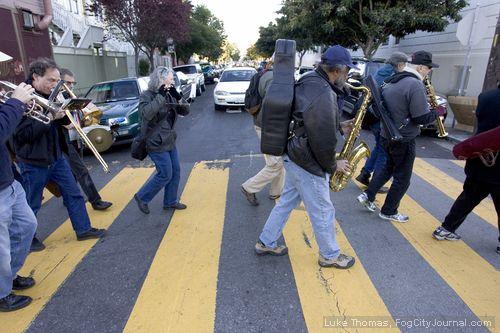
A standing-room-only crowd gathered at United Mission Presbyterian Church on 23rd and Capp Feb. 25th to remember Guardian correspondent and hell-raising investigative poet John Ross. John’s old friends Q.R. Hand, Hermann Bellinghausen, Frank Bardacke, Kevin Quigley and me spoke; his kids, Carla Ross-Allen and Dante Ross, gave moving remeberances. Then we marched through the Mission, led by the Musicians Action Group playing the Internationale. It was a perfect Ross moment: A few of the celebrants put pieces of yellow tape across their chests and stood in the streets halting traffic to the let the procession pass. A couple of confused bicycle cops went by, but took no action, which was good for all involved.


When we reached Cafe LaBoheme, the crowd took over much of 24th Street — but the air of fun and solidarity was so visible and loud that most of the cars simple stopped and waited patiently for room to crawl past. A wild, crazy anarchist funeral mob on the streets of San Francisco; we sent him off right.


PS: The generally nice obituary in the Chronicle described Ross as


“an author, poet, liberal activist and journalist who toiled against perceived injustice from the jungles of Chiapas, Mexico, to the baked streets of Baghdad.”


Which is wrong on two accounts. First of all, there was nothing “perceived” about the injustice Ross saw and wrote about; it was very real. But that’s just a daily paper trying to be objective in a way that turns out to be embarassing. More to the point, as his longtime friend Elizabeth Bell noted, calling Ross a “liberal”  is wildly inaccurate.


Here’s the letter she sent to the Chron:


Although some time has gone by since the Chronicle’s obituary of Bay Area activist and poet John Ross, I must correct a glaring inaccuracy–indeed, slander–that appears in the very first sentence of your otherwise adequate write-up.  John Ross was not at the time of his death, nor had he ever been, a “liberal.”  He was not a liberal-diaper baby, his pioneering refusal to serve in the Vietnam war was not the act of a liberal, nor was placing his body between Palestinian olive farmers and club-wielding Israelis.  His response to a Mexican journalist who asked his profession, “Soy comunista,” does not translate to “I’m a liberal.”  A raucous rebel and man of the people, Ross believed to his dying day that revolution in the United States was necessary and possible. A brief vocabulary lesson, Mr. Coté: Gavin Newsom is a liberal. John Ross was a liberal like a Molotov cocktail is a gin rickey.


Bug artist under glass

1

Kevin Clarke is riffling through drawers, tossing around their various contents and muttering to himself, “I can’t believe I can’t find the lingerie.”

On every surface of his Richmond home, which doubles as his studio, the instruments of his trade are scattered: pins, needles, razorblades and film. But this isn’t some sort of dungeon, and Clarke’s job isn’t to indulge clients’ fetishistic fantasies. His trade is insect art, and the lingerie is for his beetles.

Clarke is a trained conservation biologist who now spends his days boiling butterflies and spreading insect wings, creating whimsical dioramas and gorgeous butterfly wing necklaces he bills as “museum quality insect art.” This year marks the first that his company, Bug Under Glass, has been his sole source of income, but Clarke’s fascination with all things creepy-crawly started long ago.

“I grew up in Massachusetts, where I was fortunate enough to have a huge tract of land behind my house,” he says. “I explored, played with dirt, and got to know insects really well.”

A generation later, Clarke – who is expecting a wee one of his own with wife, Jen – worries that children today won’t have access to anything like the natural world he experienced as a youngster. Urban and suburban areas in the United States are undergoing a process of fragmentation, he explains, that leaves mere pockets of green space too small to support native species. 

“Most people driving by don’t even realize it,” he says. Which is the reason he’s given up flirtations with dentistry and psychology – and a bona fide job in financial analysis – in order to educate through beautiful and humorous entomological displays.  

Though he draws the connection between finance and ecology – studying patterns in order to make predictions – Clarke simply wasn’t meant to wear a suit and sit behind a desk. In 2002, when a friend informed him that the California Academy of Sciences needed help preparing and cataloguing insects for a terrestrial arthropod inventory of Madagascar, Clarke began pinning bug parts for free.  Six months later, anticipating an opportunity to work in South Africa for famed ant scientist Brian Fisher, Clarke quit his finance job cold in order to train.

Clarke says he was a “geeky, eager kid who was always pestering (Fisher) for a job” – a description Fisher agrees with wholeheartedly, adding that “people studying insects tend to feel free to be more themselves.”

Indeed, it was after working for Fisher that Clarke returned to his hometown of Medfield, Mass., moving in with his parents at age 30 in order to pursue graduate studies in conservation biology. There, he saw his former backyard playground taken over by housing developments, his town “consumed by urbanization.” Suddenly, habitat preservation became a real, tangible issue.

 So how did the formally trained conservation biologist end up gluing farm-raised beetles to bicycles for a living? The seed was planted at the California Academy of Sciences, where Clarke worked in a room amidst 14 million specimens. 

“I was blown away by the diversity of insects, yet I was disappointed that these beautiful insects were in an area of the museum that people don’t ever see.”

Clarke’s art is his response to the growing alienation of people from their natural world. He is a purveyor of formally matted butterflies, artful displays of insects foiled by paper ephemera, and – to the delight of the young and young-at-heart – beetles humorously inserted into an array of human landscapes.

“It’s a great way to have a product that is educational, conservation-minded, and reminds people of a world they can’t necessarily always see,” Clarke says.

Clarke notes that the anthropomorphized insects – beetles playing the saxophone or sitting on the toilet reading a newspaper – are a particularly good way to draw in audiences with an insect aversion. “The same people who look at spiders in my traditional displays – the ones whose reactions are ‘ick, argh, eww’ – will get up real close,” he says. “It brings the natural world a little closer in a weird, distorted way.”

Clarke started building his displays as gifts for friends, but says “I’d always had this dream of making bugs my business.” Today that business supports his family, but also supports butterfly farmers – and conservation efforts – across the world. 

According to Kristin Natoli, a California Academy of Sciences biologist who supervises the importation of farmed butterfly chrysalises for the museum’s live exhibits, butterfly farming provides an important form of economic activity that doesn’t rely on destroying ecosystems, as agriculture or logging might. Instead, it ensures that rainforest areas from Costa Rica to Thialand, Indonesia to Africa are preserved, because butterfly farmers must collect wild larvae to breed, and plant native habitat on their property to raise their captive population. 

Clarke adds that butterfly farming is supported by the UN Wildlife Fund and The Nature Conservancy. “It’s a way to help impoverished people around rainforest areas that isn’t destructive,” he says.

Clarke has personally visited many of the farms from which he purchases his insects, and unlike butterfly observatories, Clarke’s shadowbox displays make use of animals that have lived out their full lifecycles and died naturally. They also provide a product that people can take home, sit on their shelf, and experience forever. 

For Clarke, who once worked as a stager for Pottery Barn making “life-size dioramas,” gluing arthropods onto park benches seemed like a natural next step. Fascinated by miniatures since childhood, he grew up with a huge train set in his basement and a family of hermit crabs who were treated to a constant stream of newly-renovated Lego architecture.

“It took me over a year to figure out how exactly to get them to stay on there,” he says, describing the day he finally conquered the difficulty of manipulating the bugs, which must be soaked, softened and pinned in place in a multi-step process. “I had just broken up with I girlfriend. I was drinking. It was euphoric.”

And the type of glue he uses?

“It’s a trade secret.  I can’t tell you,” he grins. “But I’ll give you a hint: I use three kinds.” 

Clarke hopes that his epiphany will ultimately help children relate to insects with less apprehension and more curiosity.  

“Fear of insects is a learned behavior,” he says. “When I see kids at my craft shows, they always want to come right up to the displays. Their parents are afraid.”

Clarke notes that insects account for 80 percent of all animals. Of nearly one million known insect species, less than one percent have been evaluated.  With some sources estimating that several thousand species go extinct each year, Clarke understands the importance of turning around our “nuisance” mentality toward insects.

“We’re stung by a bee or see ants in our kitchens, so our conception of insects is negative. We forget about the great things: ants spread 30 percent of all plant seeds and aerate more soil than earthworms … we learn things from insects, and they provide one in three free ecosystem services – things like pollination, that amount to billions, trillions of dollars annually.”

But “in general, scientists are horrible communicators,” Clarke says. He argues that showcasing insects in terms of their beauty, wonder, and – yes – humor can help bring the whole issue a little closer to home. 

“Because,” he says, paraphrasing author E.O. Wilson’s view on environmental destruction, “when it happens in your own backyard, you’ll care.”

You can shop Kevin’s creepy-crawlies online at www.bugunderglass.com

Local hire victory party a political who’s who

2

The atmosphere at the local hiring victory party that Laborers Local 261 held at its Union Hall this week  was positively elated. Beer, wine and yummy pupusas flowed, commendations were made, and live drumming gave the event a playful edge. And it didn’t hurt that the place was crammed with political candidates, past, present and future, as San Francisco gears up for a a mayor, D.A. and sheriff’s race, this fall.

Sup. David Campos, who hasn’t thrown his hat in the mayor’s race, at least not yet, described the mood as “exciting.” “Who would have thought a year ago that we’d be having this victory,” Campos said, crediting fellow progressive Sup. John Avalos and the community for “great legislative work.”

Sup. John Avalos, who isn’t showing signs of running in the mayor’s race despite his legislative victories, saw implementation and resistant building trades as the biggest hurdles, moving forward. But he felt city departments will lead the way in showing how to implement the new law, when it kicks in March 25. “The San Francisco PUC has shown that local hire can be successful,” he said. “The new PUC building is at 48 percent local hire across all trades.”

Avalos hoped the building trades will come to see local hire in a more positive light. “They need to understand that it’s good for this city, their unions and union membership,” he said.

Avalos noted that he recently met with members of the San Mateo Board of Supervisors to address concerns that SF’s local hire would lead to job losses in San Mateo.Just before Christmas, the San Mateo supes voted unanimously to urge Newsom to veto Avalos’ local hire policy, but it turns out they had been misled around the law’s impacts. ”I met with [County Sups.] Carole Groom and Adrienne Tissier and said, ‘We have a huge misunderstanding,” Avalos said, noting that Jerry Hill’s recent grandstanding against local hire appears to be going nowhere.

Mayor Ed Lee, who insists he’s not planning to run for mayor in November, urged folks to focus on implementation of Avalos’ legislation.
“We are not just here to celebrate a legislative victory but the first jobs we create,” Lee said. “The world does not just turn by signing legislation.”

Board President David Chiu, who dropped by towards the end of the party with Sup. Jane Kim,Board President David Chiu, said he is “still thinking” about running for mayor, and acknowledged that the road to implementing local hire could be challenging. “But during this Great Recession, we have to do everything we can to make sure San Francisco residents get put to work, and local hire is an important part of that.”

Sup. Ross Mirkarimi, who has just announced that he is running for sheriff, linked high recidivism rates in San Francisco to the need to do a better job of hiring local residents. “We have a 70 percent repeat offender rate,” Mirkarimi said. “That’s 3 out of 4 folks.” Noting that there are 1800 parolees in San Francisco daily, Mirkarimi observed that if folks can’t get a job when they come out of the criminal justice system, they are way more likely to re-offend.

Bayview resident Deanna Rice, who got out of a federal penitentiary a year ago, and is still looking for work, said unemployment is another barrier in the way of her trying to regain custody of her kids, who are 9 and 10 years old.

Laborers Local 261 Business Manager Ramon Hernandez acknowledged that more work needs to be done to make local hire a go.
“We will try to do the best we can to get everyone on the same page,” he said

Local 261 Secretary-Treasurer David De La Torre said their membership is struggling and hurting, existing members and residents are not working
“Local hire is not about a sense of entitlement,” he said. “We gotta put people to work and build the local economy. It’s not about race. It’s about community, a disadvantaged community.”

Greg Doxey of the Osiris Coalition pointed to the economic benefits of local hire.
“If you hire local, people are going to shop two, three blocks from home, the economy will get stronger, they’ll be more tax revenue, and folks could even qualify to buy homes

CityBuild’s Guillermo Rodriguez praised the Board, department heads and Mayor Ed Lee “for getting together with labor” to pass Avalos local hire legislation.

But despite the happy vibes at the party, I left wondering if there is going to be adequate investment in workforce development side come budget time, if folks will try to game the system by using the address of locally-based subcontractors to establish local residency, and whether local efforts to sabotage the legislation are going to escalate now that the San Mateo Board no longer seems opposed to the law. But I also left knowing that folks like James Richards, President of Aboriginal Blacks United, have made it clear that if local hire doesn’t get  implemented, they’ll keep protesting until it does. So, stay tuned….


SATURDAY SATURDAY SATURDAY! Monster trucks, y’all!

0

For many of us that grew up in the 1970s and 80s, the recent slew of TV commercials for this weekend’s “Monster Jam” monster truck event in Oakland has been bringing back a flood of fond memories, with the overly-exaggerated and amped up announcer wildly informing us about the stampede of horsepower that is about to come thundering into town — though it’s Sat/26, not SUNDAY SUNDAY SUNDAY as it seemed most of the ads back then proclaimed.

Generations of kids have undoubtedly imagined being in the driver’s seat of Bigfoot, Grave Digger, or one of the other many colorful and burly monstrous machines over the years, going to live shows, watching them on TV, or playing with their Hot Wheels toys in the backyard.

One Bay Area native who has gone on to actually become a professional monster truck driver is Kelvin Ramer, who was born and raised in Corralitos, down in Santa Cruz County. Ramer’s retro cool custom creation is Time Flys, a monster truck based on the body of a 1934 Ford pick up, which he drives for his own family-run team, the appropriately named Living The Dream Racing.

Ramer can trace his racing and automotive roots back to high school, where he spent a lot of time in the auto shop, and got his first 4×4. He then attended UTI, worked as a mechanic for several years, opened his own shop, Auto Care Towing, and gradually became involved with the local auto racing and monster truck scene.

Finally, about 14 years ago, he bought the first part to start building his own monster truck — but it would be another 7 years before it was completed.

“I started buying parts and saving money and building, saving and building until it was done,” says Ramer, who now takes part in about 30 monster truck events each year, some part of the famous ‘Monster Jam’ series, others at smaller, independent events, fairs, and festivals.

Considering the humble beginnings of his truck and team, Ramer has come a long way, having travelled all throughout the western United States with Time Flys — and now he even has his own official Hot Wheels car — Mattel approached him last year about making a replica toy of Time Flys, and he excitedly approved.

“From where we started to where we are now is sort of surreal. They’ve actually made a Hot Wheels of Time Flys! It’s sort of unbelievable that something I designed is a Hot Wheel. It’s like, ‘I’ve really made it big — I’ve got a Hot Wheel!’”

This weekend’s show will be somewhat like a hometown event for Ramer, who with his family and team, does all the work on the 10,500 pound, 1500 horsepower truck at his shop in Watsonville. On Saturday he’s expecting that he’ll probably see many of the same fans that have come to meet him before, which thrills him — and he always enjoys meeting new ones as well, and likes to use the opportunity to help inspire people, in several different ways.

“I had a whole bunch of Boy Scouts come up at the last show I was at — they were about the right age for algebra and calculus — so I started talking about how my shocks work, and how the pressures change in the shocks from the accumulator from the nitrogen side to the liquid side. I started giving them the numbers, and they realized that there’s a lot of mathematics involved in monster trucks and understanding how to adjust these things and tune them — you can actually lay it all out on paper mathematically.”

He also makes side trips to meet with some of his fans, such as a young boy in Turlock, who has had to have multiple heart surgeries, and he sees him every time he’s in town. He’s gotten to know the family over the past couple of years, and recently the boy’s mom told Ramer that her son won’t wear a nice shirt to the first day of school, he’ll only wear his Time Flys shirt.

Ramer says that it’s things like this that are really what he appreciates about being in the position that he is, whether it’s helping out charities, visiting one on one with fans, or simply getting out there and smashing some cars and blowing off some steam in front of thousands of spectators.

“To me, it’s really cool that I have the ability to let people forget their troubles for a few hours, and bring a smile to their face.”

“Monster Jam 2011”
Sat/26, 3 p.m. pit party; 7 p.m. main event, $7.50–$30
Oakland Coliseum
7000 Coliseum Way, Oakl.
1-800-745-3000
www.monsterjam.com

The dance of motherhood as … a dance

1

From Amy Chua’s “Tiger Mother” rules to Ayelet Waldman’s “Bad Mother” guilt, the stories about motherhood are not only filling bookshelves and mommy blogs, they’re being danced on stage.

Sat/26, Ellis Wood, choreographer and mother of three, performs the world premiere of Mom, an evening-length solo, at Fort Mason’s Southside Theater. Speaking about the angle of the work, Wood said, “Motherhood is not the prettiest thing in the world. There are so many sides to it and so many things you didn’t know you were getting into, and so many leaps you have to take, and so many crashes you have to deal with, and the piece addresses that. It’s not a stereotypically pretty picture of mom. Hopefully it’s a more thought-provoking look into a layered experience.”

At 46 with children ages 7, 5, and 2, Wood never really stopped dancing. “There were times when I performed when I was eight months pregnant and that was a lot of fun. If I just had the baby that was harder … but usually I performed.” said Wood. Ideas for Mom emerged when Wood was dancing in Japan just weeks before giving birth to her youngest. She considers the intimate nature of the Southside Theater well-matched for this raw and personal solo, a mix of dance and video.

Wood comes from a dance family. Her parents, Marni and David Wood, performed with the Martha Graham Dance Company when she was growing up. “We used to take classes from them when we were kids, little Graham classes here and there. We used to travel with the Graham company when we were really little, when they would go on tour, and there were always people like Merce Cunningham and John Cage and Carolyn Brown, and it was just normal to have all those people around. I didn’t know then but I think of it now as a special thing … being around people like Martha and [Isamu] Noguchi … I got a lot of info pretty young about the dance world and that did affect my whole path.” said Wood.

Visiting the Bay Area holds special significance for Wood. She has returned every year for about a decade, performing in the city and usually teaching at UC Berkeley, where her parents started the dance program. “My parents built the studio. There was no dance department and they helped sand the floors,” she said. “They literally built the studio, so it has so much nostalgia for me. My dad picked the building on campus that he wanted to be the dance studio. They had a different building chosen for him and he saw this church on the corner of Bancroft and Dana with these beautiful stained glass windows and he said ‘I’ll take this, I want the space.’ He and my mom built the whole dance department there.”

With Mom, Wood refocuses herself, returning to solo work, which is how she started 15 years ago with her solo Canary. Through the years her work has always addressed women either politically or energetically, and at the upcoming performance, audience members will have the opportunity to say a few words about motherhood, which will be filmed and shared at the end of the performance. 

“I had just finished [Ayelet Waldman’s] book Bad Mother,” said Wood. “It’s very provoking and maybe even controversial, but it is interesting and brings up a lot of issues that are taboo and I like that.  So whether I agree or not, it brings up things that a lot of people don’t want to talk about, and hopefully, not in a way that pushes people away, but in a way that draws people.  My goal is to do that too.”

Mom

Sat/26, 8 p.m., $20

Southside Theater           

Fort Mason Center

Marina at Laguna, SF

(415) 345-7575

www.fortmason.org

Back to the streets

2

Coronel knew an old man in Granada who said

(who often said):

“I wish I were a foreigner, so that I

Could go home

— Zero Hour, Ernesto Cardenal

I first came into contact with the work of poet Roberto Vargas a couple of years ago, when I saw his face, projected several stories tall, on a wall just off Valencia Street.

I was riding my bike to the Day of the Dead procession when I came across filmmaker Veronica Majano screening historical footage of the old Mission District on the wall of Dog Eared Books. The footage of Vargas was from a movie called Back to the Streets, and it showed a Latino hippie fest in Precita Park circa-1970. Long-haired Chicanos smoked weed and danced and played bongos on the grass while Vargas read from a stage. On today’s Valencia Street, Vargas was a ghost returned from a long-lost Mission, now standing twenty feet tall on the bookstore’s wall, reading a powerful poem that angrily denounced the SFPD for the mysterious death of a Mission Latino youth in police custody.

The film of Vargas was a beautiful snapshot of Latino youth culture in the neighborhood before gang violence and gentrification, like a Mission High School yearbook scene from an exhilarating era of Latino self-determination. In 1970, the Free Los Siete movement was feeding the community at a free breakfast program out of St. Peter’s Church on Alabama Street and had started free clinics and legal aid programs in the Mission. In the years to follow, the neighborhood would see the founding of the Mission Cultural Center and Galeria de la Raza and the inception of many of the neighborhood’s now world-famous mural projects.

Looking at the groovy scene in the park, it was hard to imagine that just a few short years later, Vargas and other kids from the Mission would be fighting alongside the Sandinistas in the jungles and mountains of Nicaragua. Yet the utopian promise of the era’s poetry, art, and youth culture in many ways culminated in the guerrilla war in which Vargas and other poets from San Francisco would fight and ultimately — in 1979 — help defeat the forces of Nicaraguan dictator Anastasio Somoza.

On Feb. 24, the day of his 70th birthday, Roberto Vargas makes a rare return to San Francisco to perform in a poetry event at the Mission Cultural Center in honor of that Nicaraguan solidarity movement of the 1970s. A video will be shown of footage from that struggle — classic scenes of Vargas and others taking over the Nicaraguan consulate in San Francisco; of the famed nightly candlelight vigils at 24th and Mission BART Plaza in support of the Sandinistas — and Vargas will be reunited on stage to read with old poet friends like Lawrence Ferlinghetti, Diane di Prima, Alejandro Murguía, and Vargas’ old compañero from San Francisco State University’s Third World Liberation Front, actor Danny Glover. The event is not open to the public. Invitations have been given out and the small MCC theater’s 150 seats have already been filled. Yet the event provides an opportunity to publicly honor Roberto Vargas’ contributions to the Mission, and to reflect on the hopes and dreams of Mission past.


POETRY AND REVOLUTIONARY VISION

Poetry was a part of Vargas’ world from the beginning. Vargas was born in Nicaragua, but came to the United States when he was a small child. In his 1980 collection of poems Nicaragua Te Canto Besos, Balas, y Sueños, he writes of “living in an offbeat alley called Natoma Street (where I always imagined a lost Mayan city existed beneath the factories).” By the late 1950s, Vargas may have been the first Mission District Latino Beat poet. “I graduated from Mission High School in 1958 and used to hang out in North Beach, going around to see all the poets,” he says. “I met Allen Ginsberg when I was just a 19-year-old kid running around in North Beach. Diane di Prima, Bob Kaufman, Ted Berrigan — all the major poets knew me when I was in my teens.”

After a stint in the U.S. Marine Corps and an attempt at a boxing career that ended with a detached retina (an injury that also helped him avoid the Vietnam-era draft), Vargas went to SF State, where he was heavily active in the student strike of 1968-69. Students walked out of campus and battled riot police while standing on picket lines for five months to demand an ethnic studies program at the university.

In the spirit of the times, Vargas and other poets — including a young Mission Chicano named Alejandro Murguía — joined the Pocho-Che Collective to publish poetry by local Latino poets. The poets went to cut sugar cane in the Venceremos Brigade in Cuba. They put out small poetry chapbooks in the Mission, full of poems that linked Che Guevara’s call for Third World revolution with the experience of the Chicano barrios of the United States in a new vision tropical. In the era after the SF State strike, the city started funding community arts projects in the ghettos. Like all classic zines, the first copies of Pocho-Che were scammed, in this case late at night at Vargas’ new job in the Mission’s Neighborhood Arts Program. In the years to come, the group would eventually publish hardbound books by Vargas, Nina Serrano, and others.

Today, Murguía is a professor in the ethnic studies program at SF State that the strikers fought to originate. He is the author of the American Book Award-winning short story collection This War Called Love (2002) and the memoir The Medicine of Memory (2002). He remembers, “The poetry scene was incipient, very young, and the readings weren’t always very formal. Sometimes they were at community events or protest rallies. But we had contact with Latin America. We knew people who had been in Chile, like Dr. Fernando Alegría.”

Alegría was a poet who had been the cultural attaché to the U.S. under Allende in Washington. Vargas recalls, “Alegría had myself and some other young poets come to Chile and spend a month or two studying with [Pablo] Neruda. But, of course, our plans were canceled by the coup in Chile.”

Murguia remembers the September 1973 coup in Chile that overthrew the popularly elected Socialist democracy of Salvador Allende caused the young poets to organize rare formal readings at Glide Memorial Church in protest. “We had several big ones there,” he says. “There was a broad range of poets — Michael McClure, Fernando Alegría, Jack Hirschman, Bob Kaufman, Janice Mirikitami all read. There was a line going down the block to get in.”

In addition to their mentor, Alegría, Vargas, and Murguía also knew one of their heroes, the Nicaraguan Marxist poet and priest, Ernesto Cardenal. Cardenal lived under the Somoza dictatorship in a sort-of internal exile in a religious artist commune called Solentiname. Vargas wanted to bring Cardenal to read in the United States, but Somoza would not allow the poet, who was critical of the Nicaraguan dictator, to travel outside the country. Vargas went to his old pal Ginsberg for help.

“Because Allen knew me when I was a kid, he helped me with my organizing for Nicaragua,” says Vargas. “Allen was part of PEN, and in 1973 or ’74 he went to the State Department with other writers to put pressure on [Anastasio] Somoza. Eventually Somoza relented and we brought Cardenal to New York for a reading.”

The poetry of Cardenal was a north star to the young Mission poets. Cardenal’s epic 1957-60 masterwork Zero Hour is perhaps the literary foundation of revolution in Nicaragua. Influenced formally by Ezra Pound, Zero Hour weaves a sprawling history of Somozan oppression and U.S. intervention in Nicaragua together with lyrical imagery of Nicaragua’s natural beauty and wildlife. The poem creates a poignant sense that Nicaraguans, unable to enjoy and own these natural riches, had under Somoza become exiles within their own country.

Of particular interest to the young Mission poets, though, was Cardenal’s Homage to the American Indians (1969), a book-length meditation on the glory of Mayan and North American native civilizations. “For us, the work of Cardenal was very important,” says Murguía. “Homage to the American Indians is a continental vision of Native Americans — everything from the San Blas Indians of Panama to the Indians of Omaha to the Indians of Mexico City and Peru.”

In Homage, Cardenal evokes a lost Indian Utopia “so democratic that archaeologists know nothing about their rulers,” where “their pyramids were built with no forced labor, the peak of their civilization did not lead to an empire, and the word wall does not exist in their language.” He writes:

But how to write anew the hieroglyph,

How to paint the jaguar anew,

How to overthrow the tyrants?

How to build our tropical acropolis anew

Cardenal’s poems of this lost glorious past were to Vargas more pointedly a vision of a Latin American utopia that can also be regained in the future. In Cardenal’s work, says Vargas, “There is a longing for the simplicity of that civilization — the creativity, the innocence, the tribalism. Can we get it back after all the dictatorships, after all that capitalism has done? Cardenal showed us what we were, what we had, what we lost.”

Under Cardenal’s influence, the Mission poets turned seeing lost Mayan cities beneath the city’s factories into a literary movement. By 1975, members of Pocho-Che had started a magazine called El Tin Tan with Murguia as editor and Vargas as contributor. El Tin Tan presented a sweeping utopian vision of a borderless invisible Latino republic united culturally and politically under the sign of the palm tree. The poets situated the capital of this world right here in the Mission District.

“To tropicalize the Mission — to see it as a tropical pueblo — was a political act of defiance and self-determination,” says Murguía. “We were saying that we put this particular neighborhood — our pueblo, in a way — not in a context of North American history but in the context of Latin American history. The history of the eastern U.S. doesn’t affect California until 1848 when the first illegal immigrants came to California — not from the South, but from the East.

El Tin Tan,” Murguía continues, “was probably the first magazine that was intercontinental in scope, a combination of politics and literature and art and different trends from the Mission to Mexico City to Argentina and everywhere in between.” He proudly recalls that it ran the first North American essays on Salvadoran poetry, and translated and printed a short story by Nelson Marra, a writer imprisoned by the Uruguayan dictatorship.

Yet for all its international perspective, El Tin Tan remained firmly rooted in the Mission. Columns by Nuyorican poet Victor Hernández Cruz and news of the assassination of Salvadoran guerrilla poet Roque Dalton ran side by side with the first comics by future Galeria de la Raza founder Rene Yáñez, all folded between wildly colorful cover art by neighborhood favorites like the famed Chicano artist Rupert Garcia and the muralist Mike Rios.

“The magazines were colorful — tropical — on the outside, but very political on the inside,” says Murguía. “That was a metaphor for our own work.”

By this time, Vargas had become an Associate Director at the SF Arts Commission. From within City Hall, he started to pump city arts money into the Mission, helping to fund projects like Mike Rios’ mural of the people holding BART on their backs at 24th and Mission BART Plaza and the Balmy Alley Mural Project — art that can still be seen in public today.

Once, Vargas commissioned a Chuy Campesano mural for the Bank of America building at 22nd and Mission. “I read a poem called “Boa” and had the crowd dancing and chanting, Es la Boa, Es la Boa,” says Vargas. “We were trying to say, ‘You made your millions off our farmers, but now you are on our turf in the Mission here in occupied Mexico. So we’ll put hieroglyphics on the walls of your bank like we used to do!’ Someone from the bank tried to take the mic from me and cops came and escorted us out.”

Vargas’s story of the mural’s dedication ceremony captures the bravado of the era. “It was a beautiful time, all of us young and thinking we were going to change the world. We wanted to change the world through culture.”

The poets organized the community to demand a neighborhood’s arts center, too. In 1977, the dream was realized when the City, with pressure from Vargas from within City Hall in the Arts Commission, purchased an old, five-floor furniture store at 24th and Mission to be made into the Mission Cultural Center. Murguia became the center’s first director.

The Mission utopia was becoming a reality for Vargas. In Nicaragua Te Canto, he wrote:

We used to drive

Our lowered down Plymouths and Chevys

On top of the breast of a mountain to

Make love and drink wine… Never

Knowing what was going to happen after

Mission High School

The Mission is now an expression of real culture, a many-faceted being … both plus and minus with the soul of a human rainbow…My people watching slides of Sandino and Nica history … White children wearing guarachas and afros trippin’ down the streets to party. Young Salvadoran poets discussing the assassination of Roque Dalton … The Mission is now an implosion/explosion of human color, of walls being painted by muralistas. There is a collective feeling of compassion for each other Nicas Blacks Chicanos Chilenos Oppressed Indios. The sense of collective survival, histories full of Somozas, Wounded Knees written on the walls.

In Zero Hour, Cardenal wrote of Nicaragua’s trees and birds and lakes, and their call to revolution, as seen from its mountains:

What’s that light way off there? Is it a star?

Its Sandino’s light shining in the black mountain


Vargas, the excited Mission kid, echoed in his work:


Tonight I am sitting on a mountain called Bernal Hill

Tonight I see the flames of America Latina spreading from here …


STRUGGLE AND VICTORY — AND STRUGGLE

Perhaps inevitably, the Latin American Utopia Vargas and company created in poetry would seem so tantalizingly close to actualization that they would be forced to pick up the gun and fight for its existence.

When the enormous earthquake of 1972 left Nicaragua’s capital, Managua, in ruins, Nicaraguan refugees flocked to SF’s Mission District. Soon, San Francisco was home to more Nicaraguans than any place on Earth outside of Nicaragua. The family of Anastasio Somoza had controlled Nicaragua with brutal repression for generations. Somoza’s embezzling of relief funds for earthquake victims led to increased revolutionary activity against his rule. Taking their name from Augusto Sandino, a Nicaraguan revolutionary who led resistance against U.S. occupation of Nicaragua in the 1930s, La Frente Sandinista de Liberacion Nacional (FSLN) — or the Sandinistas, as they were popularly known — began guerrilla activities in late 1974 by taking government officials and Somoza relatives hostage in a raid on the house of the minister of agriculture. They received a $2 million ransom and had their communiqué printed in the national newspaper. Thus was born the Sandinista revolution.

In the Mission, Vargas, Murguía, and others were in touch with La Frente, and began organizing Sandinista solidarity rallies to coordinate with La Frente’s actions in Nicaragua. Out of offices in the Mission Cultural Center, along with El Tin Tan, the poets published a newspaper called La Gaceta about the situation in Nicaragua. The paper had a circulation of 5000 copies and was available for free all over the district. The sight of pro-Sandinista rallies at 24th and BART Plaza became so common that the plaza was popularly nicknamed Plaza Sandino.

Vargas organized takeovers of the Nicaraguan consulate in San Francisco and traveled the US, speaking about Nicaragua. Yet, soon, this kind of support didn’t seem like enough. In Cardenal’s poetry, victory was inevitable. Cardenal had written that Indian time was circular, that “history became prophecy,” and that therefore the “empire will always fall.” He had also written, “The hero is reborn when he dies. And the green grass is reborn from the ashes.” In poetry, Vargas and Murguia found inspiration to go to war.

In 1976 and 1977, Mission District residents, in solidarity with the FSLN, began quietly leaving San Francisco to join up with La Frente and pick up the gun in the Sandinista Revolution. Among them were Roberto Vargas and Alejandro Murguía.

“It was very romantic,” says Murguía. “If you grew up in the time after Che’s death, when you had Che’s figure calling for “1,2,3, many Vietnams” and a lot of different armed struggles going on all over Latin America, then it would seem logical, I think, if you were kind of young and crazy, that you would want to participate in some of these situations besides just doing solidarity work or organizing rallies. Also, the coup in Chile crushed our generation’s hope for electoral change in Latin America.”

Today, Murguía tries to situate the poets’ embrace of armed struggle within the spirit of those long ago times, but one senses that Vargas would not hesitate to join a guerrilla war tomorrow morning. When I ask him how the young poets made the leap from verse to bullets, he is incredulous at the question.

“We had to fight! There was no other way!” Vargas says. “We had the historical perspective and as a people we were worthless if we let that situation stand. We had our own books out. But are we really revolutionary poets if we just sit back and collect our laurels?”

Murguía compares the Sandinista war with the Spanish Civil War, when there were many international brigades in which writers had been involved. He suggests the poets went to war because they were poets. “If you knew the situation intimately in Nicaragua and you were reading Cardenal’s poems,” he says, “it was easy to see the connection between poets and political necessity.”

Vargas began organizing small, tight-knit cadres for battle in Nicaragua, recruiting his Sandinista guerrillas right off of the streets of the Mission. “I was secretive and I found them one by one,” he explains. “We were very clandestine and very compartmentalized. We never had more than a dozen people in our committee at once.”

Men who were menial laborers in San Francisco would one day be among the most respected heroes of the Nicaraguan Revolution. “When I recruited Chombo [Walter Ferretti], he was a cook at the Hyatt Regency,” says Vargas. “Later, Chombo would become a head of national security in Nicaragua. Another recruit was a former pilot, so I went to talk to him where he pumped gas at 21st and South Van Ness. That was Commandante Raúl Venerio. After the triumph of 1979, he would become the Chief of the Nicaraguan Air Force.”

When in San Francisco, Venerio later served as the editor of La Gaceta. In Nicaragua, the former gas station attendant became a real hero. “They got an airplane and attacked the National Palace,” says Vargas, laughing. “They hit it and split, and got away — real Mission boys!”

Before heading off to join La Frente, Vargas’ recruits would undergo a regimen of training and political education, an informal boot camp largely hidden in plain sight in the Bay Area.

“It was primitive,” remembers Murguía. “We didn’t really have someone with a military background to train us. We got just guns at pawn shops on Mission Street and practiced shooting at the firing range in Sharp Park down in Pacifica. We worked out with a friend who was a black belt in karate.”

Murguía says the most difficult part of training was the daily pre-dawn run of five laps around Bernal Hill. “We would run up the hill counter-clockwise — because that way is more difficult,” he says, “and we would wear these combat boots we bought at Leed’s Shoes on Mission.”

Besides being a part of physical conditioning, the run was a litmus test of the recruits’ commitment. “Doing activity like that is almost impossible if you’re not really psychologically into it,” says Murguía. “Try running five times around Bernal Hill! You start wondering after your third lap, ‘Goddamn! Why am I doing this?‘ Especially when no one is forcing you to do it!”

When I ask if the daily jog of 10 or 12 Latino men in combat boots on the hill at sunrise did not attract any, uh, attention, Murguía shrugs. “There were less people on the hill in those days,” he says. He recalls that the Mission cadres trained in complete anonymity: “We got money to rent planes and we took turns learning to fly the planes around the Bay Area. Nobody suspected anything because nobody knew anything about Nicaragua then.”

When I try to imagine a phalanx of Sandinistas at dawn on today’s Bernal Hill, surrounded by a crowd of early morning dog walkers, I can’t help but laugh. But the cadre’s training was deadly serious, and Murguía says its value was far more than psychological. “What I discovered when I went to the Southern Front was that our San Francisco cadres were some of the most advanced in the war,” he explains. “We understood the political situation and the tactic of insurrection and we had a minimum of physical conditioning. But some of these other cats, man! They literally just walked in off the street!”

For a time, Murguía remained the director of the Mission Cultural Center, while making regular trips to fight in Nicaragua. In 1977, Vargas resigned from the Arts Commission and went to battle for six or seven months. He and Murguía would spend the next couple of years rotating back and forth from the war front in Nicaragua to their solidarity work in the Mission. Murguía describes his entry into Nicaragua, his stay in various guerrilla safe houses in Costa Rica, and his experiences in the war in his 1991 American Book Award-winning fictionalized memoir, Southern Front.

Though Murguía says the actual military war on the ground was largely a stalemate between the Sandinistas and the Somozas’ National Guard, the Sandinistas were at last able to triumph through international pressure, strategic military victories, and a general strike. Somoza fled in July of 1979, and the Sandinistas entered Managua victorious on July 19 of the same year. Cardenal’s poem “Lights” describes the city as seen from a plane that brought the elder poet into a Managua free from the Somoza family’s rule for the first time in 43 years. In Managua, street graffiti declared, El triunfo de la revolución el triunfo de la poesía.

Vargas and Murguía, however, did not enter Managua with the victorious army. The Southern Front did not go to Managua, and Vargas had recently been sent back to the U.S., to coordinate a simultaneous take over of the Nicaraguan consulates in major U.S. cities from coast to coast to coincide with the victory in Managua.

Vargas’ work for Nicaragua did not end with victory. The Mission High kid now found himself serving in the new revolutionary government as cultural attaché to the United States. “I was jailed in the takeover of the DC consulate,” Vargas says, laughing, “but then I came back several months later to serve there!”

The voluble poet grows uncharacteristically silent when I ask him what it felt like to actually win the war.

“To win?,” he asks, pronouncing the word as if he was hearing it for the very first time. “Well … it’s like taking off a huge load, man. Like taking mountains off your back.” He is silent for a bit and then adds, “But what do you win? You win the right to continue the struggle.”

“To win was to reach the objective of getting rid of the Somoza family once and for all,” Vargas says. “But it was not really a win/lose situation.” Indeed, the Sandinistas inherited a country in ruins and in debt, with an estimated 50,000 war dead, and 600,000 homeless. Nicaragua’s left-wing powers would become an obsession for the Reagan Administration, who for the next ten years offered heavy financial assistance and training to the Contras, a coalition of pro-Somoza and anti-Sandinista guerrillas who fought to overthrow the revolutionary government. The U.S. strangled Nicaragua’s economy with a trade embargo like it employed against Cuba. In reality, for the Sandinistas, the war literally never ended.

“Somoza bombed everything in Nicaragua before he left the country. Reagan was spending — what? — $100 million a year annually against us at that time?” says Vargas. “They spent so much for a decade to destroy our little country.”

Nonetheless, poetry remained in the forefront of the Nicaraguan revolution. Cardenal was named Ministry of Culture, and he instituted poetry workshops across Nicaragua as part of a highly successful literacy campaign that raised literacy from just 12 percent to over 50 percent in the first 6 months of the revolutionary government. Soon, poetry was being written and taught in the tiniest villages and in the fields.

“We tried,” Vargas says bluntly. “We were doing very important land reform, incredible stuff for the economy. But it was dangerous to be a good example. We had the potential, but we had to hold off this enormous power [of the U.S.] for decades. Ultimately, we had to step back so they would not destroy Nicaragua.”

In 1990, Nicaraguan voters, weary of war and economic misery, chose to elect FSLN President Daniel Ortega’s U.S.-backed opponent, Violetta Chamorro, in the presidential election. “We lost the elections,” says Vargas. “But we had to allow them to demonstrate that we were not like Cuba or other revolutions. We lost beautiful young men and women to get that liberty.”

I ask Vargas to consider the successes and failures of the Nicaraguan revolution. He pauses and then seemingly changes the subject, excitedly telling me of the time he brought Ginsberg to meet the Sandinista soldiers. “Ginsberg was fascinated by the Sandinistas,” says Vargas. “And he wanted to see what he had been supporting on my behalf all these years. So I took him to the fighting along the Honduras border in 1984, during the Contra war.”

When Ginsberg went to the war zone, he brought not a rifle but a concertina. “I took him to meet these young soldiers in a trench. They see Allen with the concertina and they were like, ‘Who the hell is this guy?’ I told them he was a very famous poet. At once, they all started taking bits of paper out of their pockets that they had written poems on and started reading them to Allen. So there we are, with these soldiers in the trench with their rifles reading poetry, and Allen just wailing away on this concertina!”

I think of the strange road from Cardenal’s vision of lost Mayan cities to Vargas’ dreams of a Bernal Hill utopia to Ginsberg listening to soldiers’ poetry in a Nicaraguan trench, and I see that Vargas has answered my question with his own, the question asked by revolutionary poetry.


LOST CITIES, AND NEW ONES

The lost moment with Ginsberg in the trenches is like a missing chapter out of Roberto Bolaño’s Savage Detectives. Indeed Vargas’ story in many ways embodies that of Bolaño’s exile poet generation, of which he wrote, “They dreamed of a Latin American paradise and died in a Latin American hell.” Except for one crucial difference: Vargas is very much alive and still fighting.

Today, Vargas still puts in a tireless 50-hour work week as a labor organizer for the American Federation of Teachers in San Antonio, TX. During our conversation, he excitedly tells me of an action he is organizing for next month, a march of teachers on the Texas capital to protest budget cuts to education. “I camp out in the teacher’s lounge and talk to them when they are on break,” he says. “I signed up 50 new members last week!”

As he nears 70, the poet shows no signs of slowing down. “I can’t afford to!” he says. “My youngest son is only 17. When I get finished putting him through college, then maybe I can take a break.”

But work seems like more than necessity to Vargas; political struggle is the central theme of his life’s work. “Work, work, work, Erick,” he tells me. “That is what we have to do. I could go back and forth about what went wrong in Nicaragua, but there is more work to do and I have to stay positive. It is all part of the process.”

When Vargas comes back to the Mission Cultural Center this week, he will literally return, full circle, to a building he helped build. “We had no money to hire laborers, so we’d be there with our kids every weekend, building the place,” he remembers.

One of those kids was Vargas’ son, Mission poet Ariel Vargas, who will read in public with his father for the first time this week. “Cardenal baptized him when Ernesto came to bless the new Mission Cultural Center in 1977,” Vargas says. “He had offered to baptize any children who also might be there. In the end, there was a line of families around the block on 24th Street who had brought their children for Ernesto Cardenal to baptize. Ariel had already been there every weekend on his hands and knees sanding those huge gymnasium-like floors with us. The Mission Cultural Center is still there and that is our monument.” As he discusses the Mission, Vargas forgets the problems of the Nicaraguan revolution and begins talking nonstop again at last. He comes back to the stories that started our conversation. “You know, I lived at 110 Mullen on Bernal Hill,” he says, his excitement gathering. “Mike Rios was my neighbor. Rene Yáñez lived on the block. So it was all happening right there! Carlos Santana lived down the block at around 180 Mullen or something. We used to hear him and his band jamming all the time. The Arts Commission had a stage truck and I’d take it out to Precita Park and put the stage down for Carlos to play on.” I think of Cardenal’s vision of the repeating cycle of time, the promise that the empire will always fall and the hero will always be reborn. Much in the Mission has changed. But Vargas, the old poet, still looks out from Bernal Hill today and sees lost cities beneath the surface.




Taser proposal will move forward

Following a hearing at the San Francisco Police Commission that stretched late into the night, the seven-member panel voted 6 to 1 to authorize the San Francisco Police Department to develop a proposal for implementing Tasers or other less-lethal weapons.

Representatives from immigrant advocacy groups, communities of color, queer and transgender communities, mental-health professional organizations, and civil-rights watchdog groups turned out en masse to voice opposition to the plan. Out of around 50 speakers, just one spoke in favor of adopting Tasers.

As the discussion wore on, commissioners revised the resolution again and again. Interim Police Chief Jeff Godown had initially requested permission to draft a proposal in 30 days; it was extended to 90. Instead of researching the feasibility of Tasers alone, commissioners said the SFPD should look into other less-lethal weapons as possible alternatives. Another amendment prioritized outreach to marginalized communities.

Commissioner Petra DeJesus cast the lone vote of dissent, saying, “No matter how you dress it up, it’s a soft-pitch way to authorize Tasers.” DeJesus voiced concerns about how the departmental budget would be impacted. She also noted, “They’re being used more in the minority community, and that’s the community we’re trying to build trust with.”

Commissioner Angela Chan invited a series of guests to testify about concerns surrounding Tasers. Among them was Attorney John Burris, who has sued police departments over misuse of Tasers; a University of California Berkeley professor who gave a detailed presentation about Tasers and cardiac arrest; and Allen Hopper of the American Civil Liberties Union, who presented a video clip showing outrageous instances of Taser use. At the end of the night, however, Chan was persuaded to go along with the proposal.

Chan later told the Guardian that she supported the resolution because the timeline had been lengthened, which allowed for greater community outreach, and because the discussion had been broadened to include discussion about less-lethal weapons other than Tasers. Also, Chan noted that her suggestion for the force to review their use-of-force tactics as part of moving forward with the program was integrated into the resolution.

Several members of the San Francisco police force told horror stories about situations in which they said they could have used Tasers. A Mission Station officer suffered an attack by a Nortenos gang member in Garfield Park, and feared for his life until backup arrived. A Tenderloin Station officer was thrown into a store window after responding to a call about a trespasser. Just before it happened, “I was reaching for my firearm, and I was going to shoot him,” the officer said.

During the hearing, Chief Godown asked all SFPD officers to stand. He announced, “Everybody that’s in this room are my kids. I’m passionate about making sure they don’t get hurt.” Following a role-playing scenario in which a person waved a knife at an officer, Godown said that without a Taser, “That officer would have had no other option but to shoot that man.”

Equally disturbing, however, were stories about Taser deployments gone wrong. There was the petite African American woman who was at a drugstore buying candy when police attacked and Tasered her because they mistook her for a shoplifter. There was the Virginia couple that was hosting a backyard baptism celebration when police responded to a noise complaint and Tasered them both; the woman was pregnant, and could have suffered a miscarriage due to the electric charge. There was the 17-year-old grocery store clerk who suffered a heart attack and died after police Tasered him — the whole thing started with his employer’s complaint that he was eating a hot pocket he didn’t pay for. Then there was the man who was Tasered during a traffic stop by cops who thought he was drunk. In reality, he was in diabetic shock.

Mayor Ed Lee’s Deputy Chief of Staff, Cristine DeBerry, made an appearance to say Lee was in support of the department’s proposal to move forward with investigating the use of Tasers.

Sheriff Mike Hennessey also offered comments, saying Tasers have been an effective tool in San Francisco jails, yet are rarely used.

Community members, meanwhile, raised a slew of concerns. They highlighted pending budget cuts and asked how these new and expensive instruments could possibly be paid for. They questioned the erosion of trust between police and the public, particularly in communities of color, where Taser use tends to be disproportionately high. Many people, particularly from the mental health community, voiced concerns about accidental deaths due to Taser use.

“I’m a great-grandma with a heart murmur,” said Terrrie Frye, “and I wonder if the police will be able to recognize that when we’re all protesting the budget cuts that will result from these Tasers.”

*This post has been updated from an earlier version.

Pony up, kids

0

le.chicken.farmer@gmail.com

CHEAP EATS From Crawdad’s house in Berkeley, you can see Golden Gate Fields racetrack. I take her kids to the soccer pitch next door, to watch and run, and I walk their dog along the water behind the track.

When I was little, I used to circle my favorite-named horses in the sports section, then check back the next day to see how much I’d won. My uncles and aunts played the ponies. Punker and Gatorgator, they play the ponies. I have been invited. And invited.

I associate three of my favorite writers with horse racing, but have never been, not even once, to the track. Until last Saturday.

Damon Runyon, Charles Bukowski, Mike DeCapite, and now me. Finally, finally I can say with authority that I pulled a kazoo out of the septic in the sixth at Fair Grounds to show and he did! He seconded, paying 51-1.

Now, Hedgehog had a Li’l Loveable visiting from her hometown and this ‘un was marking her daughter’s 21st birthday by redefining herself, running a half marathon, eating weird things, and just getting a tattoo. Loveable was the only one of us with prior track experience, except, I think, that Hedgehog might have been once or twice too. A succincter way of saying this might be that I was the only one without track experience.

And therefore the only winner. Yep, after dropping tacos in the fourth and fifth on a couple of popular pinstripes who failed to impress, let alone deliver, I thought I would change majors — which was good timing because a can-do named Mayo was odds-on incumbent just then, and … yuck!

Hedgehog head-cheesed Mayo, and I — being a world renowned mayophobe — looked for the oppositest entrée, which was the horse called Crispy. Crispy was 20-1 when I placed my taco, but by gate was 51-1. Or, more than twice as losery in the imagination of the wagering public.

But the hard part was I couldn’t even scream as my quantum leap long-shotted across the finish line because we watched that inning from the field announcer’s booth, Hedgehog being the wig that she is. Our host was on mic, and that meant we had to be perfectly quiet, for the sake of the sport, while the unthinkable dreamed itself before my very blinkers. I bit my tongue real hard.

The integrity of horse racing thus preserved, I windowed up to collect my Cheerios. Come to think of it, I’m surprised more of my San Francisco friends didn’t come visit me in New Orleans once they got wind of the kind of column inches I was ethering home to this rag. Just Kayday, and I don’t even think she reads me.

Anyway, she was waiting at her hotel piano bar, so I nut-jobbed my winnings, kissed Hedgehog, high-fived her townie, and went. We had a two-dinner, three-bar date with Frenchmen Street, whereas Hedgehog and the Loveable were updressing for some gala or something. Oh, I was invited, but didn’t have anything to wear. Since Kayday ain’t my fairy godmother, the Cinderella story ends right there.

Things we ate that night included grilled oysters wrapped in bacon, fried crawfish, fried pickles, mac ‘n’ cheese with meatballs, and gumbo. So probably the ball-goers didn’t have anything on us, save maybe a higher dry-cleaning bill.

The next night I cooked for everybody, and the day after that, Kayday’s last, we thought we would go up to Riverbend, get a bucket of crawfish, and sit on the levee, which, my little master’s mama assured us, would be “the right thing to do.”

Except they didn’t have boiled crawfish at Cooter Brown’s, so we got raw oysters and pecan pie and that was when I blew my New Orleans food fuse. “I’m done. Tell me about home, Kayday,” I said, sitting on the grass, on the levee, watching barges on the Mississippi.

She said she had the best burger ($10.50) she ever had at Chez Maman in Potrero Hill. She said the waiter said everything in French, then English. She said the frites … the burger! she said.

“Was there peanut butter on it?”

“No,” she said.

Next week I write you from France.

CHEZ MAMAN

Mon.–Fri. 11:30 a.m.–11 p.m.;

Sat.–Sun. 10:30 a.m.–11 p.m.

1453 18th St., SF

(415) 824-7166

MC/V

Beer and wine

Snap Sounds: Forest Swords — and the spirit of Aaliyah

1

FOREST SWORDS
Dagger Paths E.P.
(No Pain in Pop/Olde English Spelling Bee)

High on the “Ideas I Wish I Had” list is Forest Swordscover of Aaliyah’s “If Your Girl Only Knew,” a different (if equally idiosyncratic) take on R&B than that of fellow Olde English Spelling Bee act Autre Ne Veut. The group’s M. Barnes taps into the recessive, almost ghostly shade-throwing of the original — one reason why Aaliyah was a unique pop phenomenon — and slows it down to near-Gothic stasis, while adding another twist to the lyric’s romantic intrigue by flipping the gender of the vocalist. The spirit of Aaliyah haunted dubstep and its mutant kin in 2010, thanks to Forest Swords’ “If Your Girl,” and also James Blake’s “CMYK,” which sends the vocals of her best-known hit, “Are You That Somebody?,” through a series of flying-floating transformations. Check out the originals and covers/updates, as well as some more ruminations about this phenom, after the jump.

Of course, Aaliyah’s influence has been seeping into non-pop or R&B places for some time, from the Gossip’s live interpretation of “Are You That Somebody?” (which followed in the footsteps of Northwest no-bass counterparts the Spinanes cover of the same song)  to Gang Gang Dance’s professions of love for her around the time of Saint Dymphna. The vinyl version of The xx’s debut album includes the group’s cover of “Hot Like Fire,” which, like “If Your Girl Only Knew,” comes from Aaliyah’s 1996 album One in a Million, where her lithe mystique found a perfect home within Timbaland’s shadowy and spacious yet rhythmic production.

It’s tempting to view Aaliyah’s eternal return as an outgrowth of the fact that some if not many of these artists (and others) were probably kids swept up in radio love back when she was a major phantom of the airwaves. But as time passes, the summer and fall of 1998 — when “Are You That Somebody?” was topping the charts, Missy Elliott’s songwriting was in full effect, Brandy and Monica were fighting over a boy, and R. Kelly was beginning to explore musical narratives with Sparkle and Kelly Price — is starting to seem like a halcyon era of R&B pop. While I like some of the tributes to Babygirl I’ve just outlined, I can confidently say her originals stand supreme.

Forest Swords, “If Your Girl,” from Dagger Paths EP:

Aaliyah, “If Your Girl Only Knew,” from One in a Million:

James Blake, “CMYK,” from CMYK EP:

http://www.youtube.com/watch?v=w6nd8kr3Chk

Aaliyah, “Are You That Somebody”:

http://www.youtube.com/watch?v=-EymH-COrGk

The children

0

Robert Moses may not know it, but he is a pied piper. The ability to hold the attention of 200 hormone-packed middle school students at 9 a.m. on a Wednesday in early February must qualify as some kind of superhuman ability.

But Moses, choreographer and artistic director of Robert Moses’ Kin, defers to his own pied piper, the one on stage who immortalized the German city of Hamelin. As the fabled character, Dexandro “D” Montalvo twitches, churns, and first commands the rats; then, with beckoning index fingers, he mesmerizes the “children” to follow him who knows where.

The Sunset District students may not have known the story of the Pied Piper of Hamelin, who was cheated out of his justly earned wages and took awesome revenge. But they surely recognized the popping moves Montalvo so skillfully threaded into his character. One way or another, the kids were hooked. For close to an hour, they sat quietly and took in what Moses and his dancers had to show them from their upcoming world premiere, Fable and Faith.

As a kid, I was terrified by the Pied Piper story. No good grades or cleverness — usually assigned to boys anyway in fairy tales — were going to get me out of this scenario. No prince was coming, and there was no happy ending. I was going to be locked in that mountain. The adults had royally messed up. My mother assured me that “it’s just a story.” Well, mom, you were wrong.

Myths, fables, and fairy tales tell us about the way the world works. “Actions”, Moses explains after the performance, “have consequences. The stories talk about life, adversity and perseverance through hard times.” He admits that some of them can be problematic. Stepmothers, for instance, get a “major bum rap.”

Perhaps that’s what initially drew Moses to last year’s The Cinderella Project, which will be performed with the new Fable and Faith before going on tour later in the spring. Cinderella Project, his first collaboration with writer/actor Anne Galjour, who also wrote and performs the text for Fable and Faith, was informed by interviews with contemporary constructed families rooted in love, not blood. “Still, tough as it was,” Moses notes, “Cinderella stuck to who she was and it turned out alright.”

In the 1950s, there was a move underfoot to clean up some of these old tales; the thinking was that children’s psyches would be damaged by so much darkness and uncertainty. Fortunately, the stories have survived, though it’s good to know that Rapunzel no longer gets locked up in the tower because she was pregnant — it was just the evil deed of a jealous witch.

Moses takes a common sense, “age-appropriate” approach when he reads to his own two children, ages five and three. It was this fatherly task of sharing an imaginary world — everything from Dr. Seuss and the Brothers Grimm to African American folktales and Greek mythology — that got him to think about the contemporary resonance of some of these once-upon-a-time tales.

“Think of it,” he says. “Children are being abducted. Or today we talk about ‘the wolf at the door.’ ” In Fable and Faith, the wolf (Montalvo) goes to see a psychiatrist (Katherine Wells) to find out why he is behaving the way he does. The back-and-forth exchange in words and movement ends on a note of real poignancy.

Formally, Moses and Galjour decided on a structure “in which stories clash into each other.” The setting, they felt, had to be a village. “It’s where life happens,” Moses says. Elaine Buckholtz, who started lighting with Contraband and who has become a magician of visual installation, will do the honors on Fable and Faith. To keep a child’s presence at the forefront of these adult dances, Moses is partnering with the San Francisco Boys Chorus. They will perform, among other selections, the “Lacrimosa” from Mozart’s Requiem.

As the students were leaving for their classes, a teacher turned to me and whispered, “We have been very lucky this morning.”

FABLE AND FAITH

Fri.18-Sun./20, 2 p.m.; $25–$35

Yerba Buena Center for the Arts, Novellus Theater

701 Mission, SF

(415) 978-2700

www.ybca.org

Warren Hellman: The rich are undertaxed

31

I couldn’t reach financier Warren Hellman before I wrote my column in this week’s paper talking about the employee pension discussions. But he called me yesterday (Feb. 16) after he’d seen it, and I expected he’d give me some shit.


Wrong.


In fact, Hellman had only one problem with my analysis: “Your article is didn’t go far enough.” Turns out he thinks I was a bit too easy on the billionaires.


“When you compare upper-echelon tax rates [in America] to any developed country in the world,” Hellman said, “the rich pay very low taxes here. You’re article is exactly correct — the wealthy are undertaxed.” He told me that he’s stopped trying to amass more personal wealth (“it’s all going into a foundation”) because he realizes that he couldn’t possibly spend all the money he has “and all that happens if you leave it all to the next generation is that you spoil your kids.” 


Quite a statement coming from one of the city’s richest and most influential business leaders.


Of course, putting all the money in a foundation isn’t the only answer.   The only way to address the wealth gap, and the decline in social, education and infrastructure spending, to for the government to get more involved — and that means collecting more tax money from the people who can afford to pay it. Hellman told me that he’s not about to accept a reduction in his lifestyle — but we both agreed that he doesn’t have to. He could pay a lot more in taxes and still be really, really rich.


So we talked about my proposal, which goes like this:


I’ve got a suggestion for the pension reform negotiators. Why not talk a little about parity.


 Yes, pensions have to be fixed; let’s start at the top. Maybe nobody should have a pension of more than $100,000 a year; certainly, a former police chief shouldn’t get $250,000 a year for life. Maybe the highest-paid city employees should have to pay more into the pension system to protect the pensions of the people who make less. I could easily support progressive pension reform that would save the city money.


 I just think tax reform should also be part of the equation.


 Hellman wants $300 million in pension savings? Good — how about pairing it with $300 million in new taxes on the wealthy? How about big business and rich people give up something this time around, instead of all of the cuts falling on public employees and poor San Franciscans?


And Hellman, to his credit, didn’t disagree with the concept. His problem he said, was with the politics. “Taxes are the third rail of politics,” he said. “I’ve gotten my head handed to me three times now when I’ve supported tax increases.” 


But I still think there’s a way to move forward here. The city employee unions agree to some sort of pension reform, which starts with a pension cap and higher payments from higher earners (not with what amounts to a pay cut for lower-wage employees who have already taken pay cuts in the past few years). Then Hellman, Mayor Ed Lee and Sup. Sean Elsbernd agree to support a progressive tax measure that would bring in badly needed revenue for public services and education.


It’s possible that the tax measure would have to wait until Nov. 2012, when it would only require a 50 percent vote. Maybe both measures go on that ballot. And Hellman, Elsbernd and Lee use their clout with downtown to push the Chamber of Commerce and the Commitee on JOBS to at least stay neutral and cut off any big-money campaign against the tax measure. Then they all agree to help raise money and campaign to pass it. And labor agrees to work for both measures.


Hellman said he feared that “one would kill the other” and both measures might fail. But I believe the people of San Francisco are willing to support new taxes — progressive new taxes — if they don’t think the money’s going to waste. And pairing pension refrom with new taxes sends a strong message: We’re all sharing the pain. Particularly if Hellman, Elsbernd and Lee can sell the tax package part of the deal to the business community.


It’s worth a try. Because otherwise, we’re going to have another Prop. B battle, both sides are going to spend a ton of money, and nobody’s going to walk away happy.


“It’s worth thinking about,” Hellman told me. I hope so.