Kids

Future, the Auto-Tune rapper du jour, had a very lazy night at the Regency

0

Future, America’s Auto-Tune rapper du jour, is in a cushy position. His recent album Honest is one of the year’s most critically acclaimed rap albums so far, and it’s moved enough units to establish him as a major presence on 2014’s hip-hop scene. Hip-hop fans know who he is, as do a lot of indie kids who’ve stumbled across fawning reviews of his work online. But he’s not yet a star.

As such, he doesn’t get a lot of high-profile hate. His most notable detractor is his direct stylistic predecessor, T-Pain, who’s expressed resentment towards the acclaim Future’s garnered through his use of the same software T-Pain was so often mocked for during his own career heyday. Auto-Tune was — and still is — viewed by musical conservatives as a crutch, a fancy tool for artists who couldn’t sing and were thus “talentless.” Along with laptop DJing and lip-synching, it is one of the most likely factors anyone will cite in arguing music has gotten worse.

All three of these factors were part of Future’s Regency Ballroom set on June 30. And as highly as I hold my own musical non-conservatism as a value, I must admit I have a much better conception of why the rockists, live-music defenders, and Tupac worshippers of the T-Pain era were so incensed. I still believe laptops, lip-synching, and Auto-Tune are not mutually exclusive to a great performance. But I also see how people can use them to cut corners.

Future didn’t even try to put on a show. He made no attempt to hide the fact that he was rapping over a pre-recorded vocal track, frequently staring off into space and taking brief but obvious pauses to catch his breath. His stage banter was incomprehensible. He moved around a lot, but not with any particular charisma — his stiff, awkward bounces made him look like a figurine being held by the head and “walked” by an invisible child. His job was not to perform or to rap — his job was to be Future, to stand there and be important while the DJ absent-mindedly cued up his own songs.

The most glaring aspect of his performance was the lack of his trademark vocal processing. Without it, the weakness of his flow and rhymes stuck out like a sore thumb — especially given how good he sounded on the pre-recorded track, all effects intact. At the risk of sounding like one of the rockists who unfairly accused T-Pain, Lil Wayne, and Kanye West of using Auto-Tune as a crutch, I am prepared to lobby the same accusation at Future. He simply doesn’t seem able to do anything well without it.

The opening acts easily showed him up. The show kicked off with mini-sets by members of Future’s Freebandz crew, at least two of whom were both better performers and rappers than Future but who engaged in some heinous misogyny and uncomfortable crowd interactions (hearing a rapper spend 12 acapella bars describing an audience member’s vagina isn’t really fun for anyone except the rapper). Rico Love’s set was worth watching if only because his trio of DJs made their own beats live; Love himself was buffoonish, one of those alpha-male lovermen who seem more obnoxious and dated as each of their peers falls from grace (Chris Brown, Robin Thicke, Justin Timberlake).

This might sound like a nightmare to sit through. For the uninitiated, perhaps. But the artists increased in popularity as they decreased in showmanship, meaning that a Future fan could be thrilled by the openers, even more thrilled when Future drops one of his trademark tracks, and come out of the show having had a great time. Future’s set was essentially a bunch of Future recordings being played over a massive sound system, with the man himself MCing. If you’ve heard and come to love “Move That Dope” and “Turn On The Lights,” hearing them on such a scale must be a treat.

And for the audience, that seemed to be the case. The entire floor shook during “Move That Dope,” with all the diverse audience demographics — hip-hop fans, bros, middle-aged staff, the occasional Hitler Youth hairdo who could only have been there because of Honest‘s 8.1 on Pitchfork — jumping up and down in a massive communal wave. Blunts were lit every six feet, couples did the grind, hands were thrown in the air. Everyone seemed to be enjoying themselves.

Which brings me back to my criticism of Future’s set, and my own insecurities over my willingness to play along with the natural and unstoppable (d)evolution of live music. How can I criticize Future for not putting any effort into his show when nobody really seemed to care? Is it fair to judge his set as an outsider, when those who know all the Honest songs by heart can revel in singing along to them? If people are willing to shell out 30 bucks to watch their favorite artist not give a shit, so be it.  As for me, I’ll be at home, illegally downloading his albums.

A benefit series aims to keep the unique Meridian Gallery afloat

0

In 2001, interns at Powell Street’s Meridian Gallery planned and painted a 13×48 foot mural on the wall of the SRO Hartland Hotel, a few blocks away in the Tenderloin. The mural, a colorful and sunny street scene showcasing the multiculturalism of the neighborhood, was revered by residents and and left untouched for 10 years until it was vandalized by graffiti. In response, former interns who had worked on the project came back together and, alongside the current kids in the program, repainted the piece. The artists’ lasting willingness to help Meridian in times of need reemerges in a broader sense this week, which marks the climax of the gallery’s June Benefit Series (tonight’s entry: “16 Years of Meridian Music,” a diverse program of new music). 

Meridian Gallery, whose name comes from its mission to focus on hemispheric and cross-cultural interactions, is facing eviction. As rent around Union Square has skyrocketed, from $400 per square foot in 2007 to up to $3,000 today (according to retail consultant Helen Bulwik, quoted in a KQED report), many galleries have been forced to close their doors. The stately Perine Mansion, the three-story French Second Empire brick building where Meridian makes its home, is an especially attractive and lucrative piece of property. Instead of throwing in the towel, Anne Brodzsky, the dynamic co-founder of the gallery who has overseen its operations for over 25 years, has reached out to her friends. 

The original eviction notice was handed down in April. Some close to the gallery are convinced that despite any efforts, the rent will be impossible to pay. Others, Brodzky chief among them, think that the response to the bad news suggests a potential long-term rally from Meridian. Her optimism is fueled by two forces. First, on May 13, the SF Board of Supervisors beefed up affordability programs, including supplemental displacement funds and health benefits, for struggling art non-profits in the city. “I’m amazed by how they’ve managed to come together to help arts programs,” Brodzky exclaimed. 

More effective and instantly helpful than any bureaucratic assistance, however, have been the programs put together by artists affiliated with Meridian. Around the time of the Supervisors’ decision, Brodzky asked her gallery-mates if they were willing to stage an auction. The response was staggering; over 60 artists put up works. More astonishing to Brodzky, though, was the kind of excitement many of the participants exhibited for further events. “Bob Marsh, among many others, approached me and asked if they could stage fundraisers.” 

 Tonight, Marsh is one of the main attractions at the “16 Years of Meridian Music” showcase. An avant-garde visual artist and musician, Marsh discovered Meridian shortly after his arrival in San Francisco 14 years ago. “I started visiting galleries and found that Meridian had a wonderful monthly music series,” he says.

Marsh was inspired by the political sharpness of the organization. “I thought early on, ‘They’re not purveyors of bourgeois wallpaper,’ like so many galleries can be.” For Marsh’s offering, “The Visitor,” he’ll don his Sonic Suit #9, a wearable sculpture made from empty water bottles and other modern detritus, and engage in narrative movement to a musical accompaniment.

“He’s a visitor from another dimension,” Marsh says. “He arrives here, looks around, and has different reactions to the confusing environment that is our world.” Marsh debuted the ever-changing character at the Meridian and feels that its a fitting tribute to the openness and experimentation that the gallery fosters. 

Despite his excitement about the benefit, Marsh turns somber when discussing its necessity. “They have given so much with such passion,” he says. “It’s sad to see them persecuted by blind greed … I don’t think its personal, but everyone just wants a lot of money. Everybody thinks that’s some kind of virtue.”

Neither Brodzky, Marsh, nor other performers and Meridian affiliates with whom I talked  were quick to link the gallery’s financial troubles to a larger ill in San Francisco. They seemingly eschew that brand of macrocosmic victimhood and instead zoom in on what they can do to stay open, one step at a time. Their optimism may be healthier, but it does not mask the sad fact that rising rents are making grassroots galleries a thing of the past. If the artists continue to come together with the intensity of the mural renovation, auction, and benefit series, however, Meridian may just buck the trend.  


16 Years of Meridian Music: Composers in Performance

With Bob Marsh, Andrea Williams, Bryan Day, Phillip Greenlief and Jon Raskin’s 1+1, David Samas, Tom Bickley, and the Cornelius Cardew Choir

Thu/26, 7-10pm, $35

Meridian Gallery

535 Powell, SF

meridiangallery.org


Comedy without limits means ‘No Happy Endings’ for SF’s Granny Cart Gangstas

0

Sexy granny panties? Up-and-coming San Francisco comedy troupe Granny Cart Gangstas recently proved this isn’t an oxymoron. Taking a cue from the Kids in the Hall — one of member Ava Tong’s biggest inspirations — who were once photographed wearing bras over suits, the troupe decided to do something similar (one member flaunted a pair of leopard-print granny panties) for a photo shoot ahead of its Sat/28 show, “No Happy Endings,” at SF’s Little Boxes Theater. 

Founding members Tong and Aureen Almario dreamed about creating their own comedy troupe since 2006. The two met at San Francisco State University, where Tong was Almario’s teaching assistant in an Asian American studies class. “Then she ended up being one of my friends’ girlfriends and I was like ‘Oh … hey!’ and I saw her at Bindlestiff [Studio] and it was like … ‘Can’t get away from you, Aureen!’” The two finally created the troupe in 2011, with five total members, and continued to expand by inviting women associated with Bindlestiff that they worked well with. 

The name of the comedy troupe, Granny Cart Gangstas, juxtaposes two contrasting concepts. Tong said Almario, who came up with the name, was inspired by the pedestrian lifestyle of granny-cart owners in the midst of the hustle and bustle of certain SF neighborhoods. “That’s like, ‘I don’t care. I’m going to do my thing and I don’t care what anyone else thinks,’” Tong explained. 

Lauren Garcia, who joined the troupe last October, expanded on the name’s connotations. “If you have a granny cart, you know, you can’t politely, say, go through the bus or the street, and go ‘Excuse me, excuse me.’” (Tong interjected, “You’re just unapologetic.”) Garcia continued, “You just run over those people’s feet.”

When it comes to the troupe’s material, this mindset is always relevant. Its material is solely comprised of things that make its own members laugh. And even though members grapple with worries that no one else will find certain things funny, they’ll keep them in anyway.

“No Happy Endings” opens with a piece that pays homage to grannies — one of the first pieces where the members assume the role of grannies. “You’ve got to respect grannies,” Garcia said. “They’re grannies — they’ve been through shit.” In the sketch, the troupe members are nursing home residents (sans granny carts, unfortunately), comatose as a nurse administers their daily medicine. Before the nurse leaves, she switches on a radio, which starts playing classical music. But one of the grannies won’t have that and slowly trudges to the radio — with the assistance of her walker — and changes the music to something more modern: Beyoncé’s “Grown Woman.” Instantly rejuvenated, the grannies begin to dance. 

The troupe returns to this scene later to close the show. “Grown Woman” is still playing. “We actually bust out into our younger selves and we do a short synchronized dance,” Tong said, “kind of saying that every granny is young inside them. They have that young person that lived there before.” Combined with the young souls’ dance, Beyoncé’s lyrics “I’m a grown woman / I can do whatever I want” only serve to further drive this message home.

“I feel like so many people forget that older people were young once and they are people — they’re not the sacks that people treat them as,” Garcia said. As a nurse, she said she constantly witnesses incidents of verbal elder abuse where nurses and other people in the hospital condescendingly speak to elderly patients. 

Besides the geriatric piece, the group likes to write about womanhood. For their first show, “Rise of the Red Dawn,” the group performed a sketch titled “Look At This Betch.” “We’re making fun of the idea that women sometimes … have this competition with each other,” Garcia said. “They’re cutthroat and catty and will cut other women to get ahead when they should be helping other women. They know what it’s like to be a woman in this world.”

However, Tong said the group noticed that much of the last show focused on the negative aspects of womanhood. To depict women in a more positive light, it included a sketch titled “Vag Save” in the upcoming show, which also includes films and stand-up. Garcia introduced “Vag Save” to me through a mock movie trailer voiceover: “Save your best friend’s vagina. Coming soon, this Saturday, June 28, we will be saving … your vaginas.”

The sketch follows a group of women at a club banding together to protect each other from the unwelcome advances of creepy men. “Not everybody sees that world,” Tong said. “Guys definitely don’t know when other guys are being creepy — or when they’re being creepy — and this is how women see it.”

The troupe is entirely comprised of women of color. Members write cultural references sparingly — one of the lines in sketch “Spanx” plays with how similar the word “backpack” and the Tagalog word for “vagina” (pekpek) sound: “Reach into my pekpek” — because they don’t want to alienate any audience members. Sometimes they’ll include references if a character has an accent (the references are usually improv ad libs), but they stray from writing references that aren’t obvious or explained. 

At the same time, Tong and Garcia appreciate San Francisco’s diversity and open-mindedness. “I think we take advantage of that,” Tong said. “We almost take it for granted. We don’t think about having to be sensitive.” The two joked that they might have things thrown at them on stage or their citizenship papers checked in more conservative states. Most of the members are Bay Area natives, but live in cities as spread apart as Walnut Creek, San Francisco, and Hayward, which Tong admitted makes getting together for rehearsal tough.

Inspiration can hit the troupe at any time — sources range from people, such as Beyoncé, or the minutiae of daily life, such as putting in a Diva Cup. (A Diva Cup is an eco-friendly alternative to a tampon. Garcia shared some tips from a YouTube how-to video she watched, where an upside-down wine glass served as a model vagina: improper nail length can quickly make the experience unpleasant and one of the tricky things is “getting it into a little ball and making sure it goes in before it pops open … because then that’s painful and you don’t want to do that, let me tell you.” Tong was a little hesitant about this sketch idea.) Throughout the interview, Tong and Garcia effortlessly bounced new ideas off each other, assuring me they could even parody the interview we were having. “You’ll be in this,” Garcia told me. “Come watch our stuff; you’ll see yourself.”

Six days before the show, at least one troupe member’s grandmother was confirmed to attend “No Happy Endings.” Garcia’s mother purchased tickets for several family members — before her daughter explained that the not-so-family-friendly show was “mature, sexual, and raunchy.” Garcia complained that her grandmother would simply have to sit through performances such as “Octopussy,” where she sings “I’ve tried everything / You could possibly do / When you’re in bed with two / Wheelbarrow, doggy style / Missionary, 69 / It feels so fine / But he can’t make me cum.”

“We’ll apologize later if you need us to,” Tong reassured Garcia. 

Emphasis on “need.” After all, a true granny cart gangsta is never apologetic if they can help it. 

Granny Cart Gangstas’ “No Happy Endings”

Sat/28, 8pm, $15

Little Boxes Theater

1661 Tennessee, SF

(415) 603-0061

www.littleboxestheater.wordpress.com

Your latest SF gentrification soundtrack: Cold Beat, Thee Oh Sees, Violent Change, and more

3

Is San Francisco doomed?  The legendary SF punk band Crime said so 35 years ago on their album San Francisco’s Doomed. Yet with tech money flowing into San Francisco and musicians being priced out of the city, the phrase has taken on a new resonance among those musicians who have stayed in town.

There’s been no shortage of music and other art forms lamenting the sea change in our dear city: Earlier this month, Katie Day drew accolades and vitriol with “San Francisco (Before the West Falls),” and tonight [Wed/25], cabaret singer-songwriter Candace Roberts will celebrate the debut of her theatrical “Not My City Anymore” with a party at the Gold Dust Lounge (where the music video was shot).

Stepping up to the plate for the indie/garage/punk kids is Hannah Lew, currently of Cold Beat, formerly of Grass Widow, and most recently the curator of a compilation whose name differs from Crime’s album by one contraction: San Francisco Is Doomed.  Released on Lew’s Crime On The Moon label, the compilation features 13 songs by either former or current San Francisco bands and artists, from Thee Oh Sees to Erase Errata to Violent Change, all of them dealing with the tech boom’s effect on the city and its music scene.

Lew has lived in the city since 1989, and was a first-hand witness to the ascent of the city’s garage-rock scene to international prominence as a member of Grass Widow. Though she plans to stay in the city, it’s increasingly difficult for musicians in San Francisco to keep up with increased prices. Most of the artists on the compilation have since moved.

“People are moving here to make money now,” Lew said. “It’s never really been like that before — not since the Gold Rush. Because of that there’s a lot of foodie culture…things catered to people with a lot of money. I think that creates a cultural divide.”

The compilation isn’t an act of war against the “techies,” though; according to Lew, some of the artists on the compilation actually work in the tech industry. It’s not a benefit album either. It’s simply a snapshot of the time and place in which SF musicians currently exist. 

For now, Lew and Cold Beat are still headquartered and playing shows in the city — the compilation seems timed nicely to coincide with the release of the band’s latest, Over Me, which will be out July 8 (a music video for the first single just premiered over at NPR). But it’s hard to say the band is part of a “scene” anymore. Bay Area scenes have come and gone, of course, from psychedelic rock to ’80s thrash metal, and, as others have noted, it’s increasingly apparent that the garage-rock movement is at the end of its lifespan. The question of whether or not San Francisco’s music scene is truly doomed relies on a different equation — whether musicians are willing to move into San Francisco. And according to Lew, it’s not exactly an attractive option for most.

“I can’t really imagine people moving here for a thriving music scene without the rent prices going way down,” she said. “Usually the towns with a thriving music scenes are affordable to live in. But it’s hard to even find an affordable practice space in San Francisco these days.”

“There’s nothing we can do about it,” she added. “[San Francisco] is becoming more of a fancy town. But we just want to talk about it and hopefully provide another voice in that conversation.”
 
San Francisco Is Doomed Record Release

With Cold Beat, Synethic ID, Violent Change, Caged Animal

July 1, 9pm, free

Brick and Mortar Music Hall

1710 Mission, SF

www.brickandmortarmusic.com


This Week’s Picks: June 25 – July 1, 2014

0

WEDNESDAY 25


‘Football Under Cover’

Unofficial festivities for World Cup fans whose allegiances lie with Die Mannschaft (rather than with The Yanks) begin the night before the Germany-USA match. Don’t expect the Goethe-Institut San Francisco’s screening of 2008’s Football Under Cover to include any headbutts directed toward German athletes. The documentary follows the first match between the Iranian women’s soccer team and a German women’s club team. In spite of cultural differences, the two teams are united by a universal love for soccer — or in that part of the world, football. In that mindset, it doesn’t matter which team wins Thursday’s match&ldots;right? Thomas Müller will be noticeably absent tonight to convince you otherwise. (Amy Char)

6:30 pm, $5

Goethe-Institut San Francisco

530 Bush, SF

(415) 263-8760

www.goethe.de


‘Yours For Eternity’ with Damien Echols and Lorri Davis

In 1996, Lorri Davis attended a early screening of Paradise Lost, the first in what would become a trilogy of documentaries about the West Memphis Three. Haunted by the film, she dashed off a letter to Damien Echols, who’d been sentenced to death for a brutal crime all evidence suggested he did not commit. They soon became passionate pen pals, and she left her successful career in NYC to devote herself to proving his innocence. Echols penned best-selling memoir Life After Death after the WM3 were released in 2011; now comes the intimate Yours For Eternity, a collection of missives Davis and Echols exchanged over 16 years. The WM3 tale is well-known, but this angle is not, and it makes for one of the most unusual and genuine love stories you’ll ever read. (Cheryl Eddy)

6pm, free

Book Passage

1 Ferry Bldg, SF

www.bookpassage.com 


Also Thu/26, 7pm, free

Copperfield’s Books

850 Fourth St, San Rafael

www.copperfieldsbooks.com


Zvuloon Dub System

Despite hailing from Tel Aviv rather than Kingston, Zvuloon Dub System is committed to the sound of classic roots reggae. The band’s two albums, 2012’s Freedom Time and this year’s Anbessa Dub, eschew the tight production sheen of contemporary reggae artists like Rebelution in favor of a spacious sound evoking the classic soundboard wizardry of Lee “Scratch” Perry and King Tubby. Yet Zvuloon is hardly conservative. Anbessa Dub finds the group collaborating with Ethiopian-Jewish artists, wrapping the sounds of modern Ethiopian music in a dense cloak of dub. Though some of the sounds on Anbessa Dub might sound alien to Western ears —particularly set against the more familiar sounds of reggae — the melange of styles and sounds rapidly starts to make a whole lot of sense. (Daniel Bromfield)

9pm, $15

Brick & Mortar

1710 Mission, SF

(415) 800-8782

www.brickandmortarmusic.com


THURSDAY 26


Kit Hinrichs

Five years removed from the founding of his independent graphic design outlet, former Pentagram partner Kit Hinrichs is still going strong. His recent work includes crafting new brand identities and aesthetics for the University of San Francisco, the Golden Gate Bridge’s 75th anniversary, and the Walt Disney Family Museum. Add that to visual consultancy work with the San Francisco Zoo, the California Academy of Sciences, and a bevy of other local institutions, and one begins to understand the extensive cultural influence that Hinrichs wields in the city. He takes to the stage of the Contemporary Jewish Museum to discuss the legacy of Paul Rand, the late Modernist designer responsible for the ABC, IBM, and UPS logos. Hinrich’s lecture, which is part of San Francisco Design Week, will focus on Rand’s uncanny ability to adapt to trends over the course of his half-century career. (David Kurlander)

6:30pm, $10

Contemporary Jewish Museum

736 Mission, SF

(415) 655-7881

www.thecjm.org


FRIDAY 27


Daria Kaufman farewell show

When she graduated from Mills in 2008, Daria Kaufman decided to stick around. The Bay Area seemed a good place for the kind of choreography she had in mind — interdisciplinary, flexibly structured, collaborative, site-specific. Now she is going to another, reportedly hot city for experimental dance on the western edge of another continent, Lisbon. The upcoming concert is summing up and looking forward. The reprise of Product examines the type of job that used to be routinely offered to women grads: marketing assistant. (The other was editorial assistant). She is also taking with her two world premieres, a solo for herself, Restless Myth, and an ensemble piece, In Her Tower, for longtime collaborators and colleagues Bianca Brzezinski, Rebecca Chun, Aura Fischbeck, and Karla Quintero. (Rita Felciano)

Also June 28, both 8pm, $20

Joe Goode Annex

401 Alabama, SF

www.inhertower.brownpapertickets.com


‘What Stays’

Home is where the art is in this site-specific dance-theater piece presented by Right Brain Performancelab and Dance Up-Close/East Bay — a final iteration of Right Brain Performancelab’s What Stays, which explores the subjects of home and the passage of time in a literal and metaphorical treatment that has the audience moving about Berkeley’s Shawl-Anderson Dance Center (once a craftsman house, now a series of spacious studios). Performers include Right Brain’s John Baumann and Jennifer Gwirtz along with Lisa Claybaugh, Laura Marsh, and Jennifer Minore. David Samas accompanies on instruments of his own invention, performing original compositions by Dave Rodgers. (Robert Avila)

Also June 28, both at 8pm, and June 29, 5pm, $20-25

Shawl-Anderson Dance Center

2704 Alcatraz at College, Berk.

www.whatstays.brownpapertickets.com


SATURDAY 28


No Happy Endings

Even without the guarantee of any happy endings, Granny Cart Gangstas’ one-night-only comedy show promises to deliver. Feeling uncertain? The “granny cart” will steer you in the right direction. In fact, the members of this women-of-color comedy troupe have even reclaimed the very notion of strolling in San Francisco’s streets with one of those recognizable carts. It’s commendable —”gangsta,” even — in their eyes. The group will also wheel in other stereotypes, such as glorified consumerism and sexist media depictions, to satirize during tonight’s show, promising a night full of laughs, regardless of your gender. (Amy Char)

8pm, $15

Little Boxes Theater

1661 Tennessee, SF

(415) 603-0061

www.littleboxestheater.wordpress.com


Dave and Phil Alvin

Hailing from the working class town of Downey, California, brothers Dave and Phil Alvin grew up absorbing a host of varied musical influences, among them old-school blues. Forming scorching roots-rockers extraordinaire The Blasters in 1979, the siblings eventually went their separate ways when Dave left the band in 1986 — until now, that is. Following a health scare for Phil two years ago, the duo has gotten back together and returned to one of their first musical loves, paying tribute to bluesman Big Bill Broonzy on their excellent new LP, the aptly titled Common Ground (Yep Roc). This is a family reunion you won’t want to miss. (Sean McCourt)

8pm, $22

Great American Music Hall

859 O’Farrell, SF

(415) 885-0750

www.slimspresents.com

The British Invasion

Dust off your best mod outfit and head over to this Inner Richmond haunt for The British Invasion, a night of tunes and dance from Anglophilic local bands. Topping the bill is Chick Jagger, an energetic, female-fronted Rolling Stones tribute band. Known for an oeuvre-spanning set that includes tracks as disparate as “It’s All Over Now” and “Beast of Burden” — not to mention a delightfully gimmicky “Moves Like Jagger”), the group’s Stones scholarship and appreciation is palpable. Also performing are The Landbirds, who are first and foremost a Beatles cover group but may also offer hits from The Kinks, the Who, and the Yardbirds (from whom they take their name). Dancer Rasa Vitalia offers a choreographed set of additional upbeat British classics. The nostalgia and pastiche will be flowing along with the drinks late into the evening. (David Kurlander)

8:30pm, $10

Neck of the Woods

406 Clement, SF

(415) 857-2725


www.neckofthewoodssf.com


SUNDAY 29

Roxie Kids

By now, even childless people are sick of Frozen and every song that filled last year’s Disney sensation. Take a break from Elsa and company and introduce the kids to Papa Panda and his wee son, stars of Panda! Go, Panda!, an early entry in Hayao Miyazaki’s filmography (he wrote the 1972 film, which came out over 10 years before Studio Ghibli was founded). This gentle adventure — about a young girl who befriends the roly-poly zoo escapees — kicks off the Roxie’s “Reel Kids” Japanese animation summer series, a co-presentation with CAAM. Future entries include Miyazaki’s directorial debut, The Castle of Cagliostro (1979), in July; and four episodes of Osamu Tezuka’s classic manga series Astro Boy in August. (Eddy)

Also July 27 and Aug 24

2pm, free for kids under 12 (adults, $7.50)

Roxie Theater

3117 16th St, SF

www.roxie.com


Sharon Van Etten

Less than a month removed from the release of her acclaimed fourth album Are We There, Sharon Van Etten is already on a summer-long world tour. The new album, on which she is also the lead producer, sounds remarkably live — extended jams and minimal overdubs make the songs feel kinetic and ready for the stage. The Brooklyn-based folk-rocker sticks mostly with her favorite subject, the torture and confusion of love and relationships, but couples her angst with hilarious and confrontational lyrics like “I washed your dishes, then I shit in your bathroom.” Van Etten is looking increasingly consistent and prolific, as the shockwaves from her gorgeous and hyped 2012 album Tramp had barely settled before talk of Are We There began. Add constant touring, including a summer 2013 stint with Nick Cave and the Bad Seeds, and Van Etten begins to look almost supernatural in her output. (Kurlander)

8pm, $20

Independent

628 Divisadero, SF

(415) 771-1421

www.theindependentsf.com


MONDAY 30


Future

One of modern hip-hop’s greatest eccentrics, Future takes the Auto-Tuned rapper-turned-singer template established by T-Pain and Lil Wayne in the aughts and runs wild with it. While those artists use the oft-derided vocal software to make their voices slippery and smooth, Future wails, growls, and shrieks maniacally, leaving the Auto-Tune to bubble up over his voice like a pie crust. By all logic, such an unhinged artist should be an underground curiosity. But he’s a rising star, with names as prestigious as Pharrell, Kanye, and Andre 3000 gracing his new album Honest. Even if you still blast “Death of Auto-Tune” in your car every day, there’s no denying Future is — and will likely continue to be — one of the most interesting figures in contemporary hip-hop. (Bromfield)

8pm, $30

Regency Ballroom

1300 Van Ness, SF

(415) 673-5716

www.theregencyballroom.com


The Guardian listings deadline is two weeks prior to our Wednesday publication date. To submit an item for consideration, please include the title of the event, a brief description of the event, date and time, venue name, street address (listing cross streets only isn’t sufficient), city, telephone number readers can call for more information, telephone number for media, and admission costs. Send information to Listings, the Guardian, 225 Bush, 17th Flr., SF, CA 94105; or e-mail (paste press release into e-mail body — no attachments, please) to listings@sfbg.com. Digital photos may be submitted in jpeg format; the image must be at least 240 dpi and four inches by six inches in size. We regret we cannot accept listings over the phone.

Rep Clock: June 25 – July 1, 2014

0

Schedules are for Wed/25-Tue/1 except where noted. Director and year are given when available. Double and triple features marked with a •. All times pm unless otherwise specified.

ANSWER COALITION 2969 Mission, SF; www.answersf.org. $5-10 donation. Two Spirits (Nibley, 2009), Wed, 7.

ARTISTS’ TELEVISION ACCESS 992 Valencia, SF; www.atasite.org. $7-10. “Rotterdam VHS Festival,” short videos, Thu, 8. “Mission Eye and Ear #5,” new music/sound and film/video collaborations by Dominique Leone and Brenda Contreras, Kyle Bruckmann and John Slattery, and Gino Robair and Bryan Boyce, Fri, 8.

BERKELEY FELLOWSHIP OF UNITARIAN UNIVERSALISTS 1924 Bonita, Berk; www.bfuu.org. $10 suggested donation. Born This Way (Tullmann and Kadlec, 2012), Sat, 7:30.

CASTRO 429 Castro, SF; (415) 621-6120, www.castrotheatre.com. $8.50-11. Frameline 38: SF International LGBT Film Festival, June 19-29. For tickets and schedule, visit www.frameline.org.

COURTHOUSE SQUARE 2200 Broadway, Redwood City; www.redwoodcity.org. Free. Frozen (Buck and Lee, 2013), Thu, 8:45. Presented sing-along style.

JACK LONDON FERRY LAWN Clay and Water, Oakl; www.jacklondonsquare.com. Free. “Waterfront Flicks:” The Secret Life of Walter Mitty, Thu, sundown.

PACIFIC FILM ARCHIVE 2575 Bancroft, Berk; (510) 642-5249, bampfa.berkeley.edu. $5.50-9.50. “Martin Scorsese Presents Masterpieces of Polish Cinema:” Mother Joan of the Angels (Kawalerowicz, 1961), Wed, 7; Innocent Sorcerers (Wajda, 1960), Fri, 7. “Kenji Mizoguchi: A Cinema of Totality:” The Story of the Last Chrysanthemums (1939), Thu, 7; The 47 Ronin, Parts I and II (1941/42), Sat, 6. “Rude Awakening: American Comedy, 1990-2010:” Waiting for Guffman (Guest, 1996), Fri, 8:50; Groundhog Day (Ramis, 1993), Sun, 6. “Picture This: Classic Children’s Books on Film:” “Take Aways,” short films, Sun, 3:30.

ROXIE 3117 and 3125 16th St, SF; (415) 863-1087, www.roxie.com. $6.50-11. Frameline 38: SF International LGBT Film Festival, Wed-Sun. For tickets and schedule, visit www.frameline.org. Ping Pong Summer (Tully, 2014), Wed-Thu, 6:30, 8:20. Breathing Earth: Susumu Shingu’s Dream (Riedelsheimer, 2013), Fri-Sat, 6, 8; June 29-July 3, 7, 9. “Roxie Kids:” Panda! Go, Panda! (Takahata, 1972), Sun, 2.

SMITH RAFAEL FILM CENTER 1118 Fourth St, San Rafael; (415) 454-1222, www.cafilm.org. $6.50-$10.75. Breathing Earth: Susumu Shingu’s Dream (Riedelsheimer, 2013), June 27-July 3, call for times.

YERBA BUENA CENTER FOR THE ARTS 701 Mission, SF; www.ybca.org. $8-10. Thy Womb (Mendoza, 2012), Thu and Sat, 7:30; Sun, 2. *


Film Listings: June 25 – July 1, 2014

0

Film listings are edited by Cheryl Eddy. Reviewers are Kimberly Chun, Dennis Harvey, Lynn Rapoport, and Sara Maria Vizcarrondo. For rep house showtimes, see Rep Clock. For complete film listings, see www.sfbg.com.

FRAMELINE

Frameline 38, the San Francisco International LGBT Film Festival, runs through June 29 at the Castro Theatre, 429 Castro, SF; Roxie Theater, 3117 16th St, SF; Victoria Theatre, 2961 16th St, SF; and Rialto Cinemas Elmwood, 2966 College, Berk. For tickets (most shows $10-15) and schedule, visit www.frameline.org.

OPENING

Breathing Earth: Susumu Shingu’s Dream Japanese artist Susumu Shingu has built his career through his concerted engagement with the natural world. The wise and eternally smiling 75-year-old creates angular and often gargantuan mobiles that harness the power of wind and water to gyrate in ever-changing directions. In Breathing Earth, German director Thomas Riedelsheimer crafts a deliberately paced rumination on Shingu’s life philosophy that, while devoid of the frenetic facts, figures, and trite biographical rehashes that punctuate hyper-informative pop-docs, uses a beautifully simplistic narrative arc to illuminates Shingu’s attempt to create a hilly, open-air collection of windmills. The sculptor’s impassioned narration and charming conversations with potential landlords and investors (who usually entirely miss the point of his mission to raise environmental consciousness through aesthetic beauty) make Shingu impossible not to fall in love with — he is laid-back, funny, and astonishingly youthful. Riedelsheimer’s camera is similarly relaxed, gliding sumptuously over the green and wild landscapes on which Shingu installs his works. Despite his meditative tempo, Riedelsheimer manages to explore a remarkably wide scope; Shingu’s late-life marriage to a fellow sculptor, his appeals to both Japanese and German schoolchildren to care for the earth and help to avoid environmental disasters, and his intricate technical processes all receive intimate and inspiring sections. (1:37) Roxie, Smith Rafael. (David Kurlander)

Citizen Koch After quietly influencing conservative ideology, legislation, and elections for decades, the billionaire industrialist Koch brothers have found themselves becoming high-profile figures — much to their dismay, no doubt. The relative invisibility they hitherto enjoyed greatly abetted their impact in myriad arenas of public policy and “popular” conservative movements. Look behind any number of recent red-vs.-blue flashpoint issues and you can find their fingerprints: Notably state-level union busting; “smaller government” (i.e. incredible shrinking social services); seeding allegedly grassroots organizations like the Tea Party; furthering the Corporations = People thing (see: Citizens United); and generally helping the rich like themselves get richer while fostering working-class outrage at everybody else. This documentary by Trouble the Water (2008) co-directors Carl Deal and Tia Lessen touches on all those matters, while also focusing on Wisconsin as a test laboratory for the brothers’ Machiavellian think-tank maneuvers, following a Louisiana GOP candidate on the campaign trail (one he’s marginalized on for opposing corporate influence peddling), and more. Any one of these topics could support a feature of their own (and most already have). Citizen Koch‘s problem is that it tries to encompass too much of its subjects’ long reach, while (despite the title) leaving those subjects themselves underexplored. (It also suffers from being a movie completed at least 18 months ago, a lifetime in current US political terms.) For the reasonably well-informed this documentary will cover a lot of familiar ground—which is not to say that ground isn’t still interesting, or that the added human interest elements don’t compel. But the film covers so much ground it ends up feeling overstuffed and unfocused. (1:26) Opera Plaza, Shattuck. (Harvey)

Coherence See “Vortex Room.” (1:29) Presidio.

Korengal This companion piece to 2010’s Oscar-nominated Restrepo — one of the best docs about modern-day warfare to date, offering unfiltered access to an Army platoon stationed in Afghanistan’s Korengal Valley — uses previously unseen footage shot during the year filmmakers Sebastian Junger and Tim Hetherington spent shadowing their subjects. Korengal is structured as a more introspective work, with musings on what it feels like to be a soldier in the Korengal, surrounded by rough (yet strikingly beautiful) terrain populated by farmers who may or may not be Taliban sympathizers, not to mention unpredictable, heavily armed opponents referred to simply as “the enemy.” Interviews reveal sadness, boredom, a deep sense of brotherhood, and the frustrating feeling of going from “100 miles an hour to a dead halt” after the surreal exhilaration of a firefight. Korengal also functions as a tribute to Hetherington, who was killed in 2011 while on assignment in Libya. Not only does his death add a layer of poignant subtext, it also suggests why Junger felt moved to revisit this story. That said, though Korengal‘s footage is several years old, its themes remain distressingly timely. (1:24) Opera Plaza, Shattuck. (Eddy)

Snowpiercer Eighteen years after an attempt to reverse global warming has gone wildly awry — freezing all life into extinction — the only known survivors are on a one-of-a-kind perpetual-motion train that circles the Earth annually, has its own self-contained ecosystem, and can smash through whatever ice buildup has blocked its tracks since the last go-round. It’s also a microcosm of civilization’s worst class-economic-racial patterns over history, with the much-abused “tail” passengers living in squalor under the thumb of brutal military police. Unseen at the train’s front is its mysterious inventor, Wilford, whose minions enforce “Eternal Order Prescribed by the Sacred Engine.” Curtis (Chris Evans) is default leader of the proletariat’s latest revolt, in which they attempt to force their way forward though the prison section (where they free Song Kang-ho and Go Ah-sung as the train’s original lock designer and his psychic daughter) on to the wonders of the first class compartments, and beyond. This first (mostly) English-language feature by South Korean Bong Joon-ho (2006’s The Host, 2009’s Mother), based on a 1982 French graphic novel, starts out as a sort of locomotive, claustrophobic Mad Max (1979) variation. But it gets wilder and more satirical as it goes along, goosed by Tilda Swinton’s grotesquely comic Minister Mason, and Alison Pill as a teacher propagandist in a particularly hilarious set piece. In case the metaphor hasn’t already hit you on the head, one character explains “The train is the world, we the humanity.” But Snowpiercer‘s sociopolitical critique is as effective as it is blunt, because Bong handles everything here — visceral action, absurdist humor, narrative left-turns, neatly etched character archetypes, et al. — with style, confidence, and wit. Some of the FX may not be quite as seamless as it would have been in a $200 million Hollywood studio production, and fanboys will no doubt nitpick like nitwits at various “credibility gaps.” (As if this movie ever asks to be taken literally.) But by current, or any, sci-fi action blockbuster standards, this is a giddily unpredictable, risk-taking joy. (2:07) (Harvey)

Third Person A screenwriter, Paul Haggis, pens a script in which a novelist (Liam Neeson) sits alone in a smoke-filled hotel room in Paris struggling over a manuscript about a novelist who can only feel emotions through his characters. What that psychic state would actually look like remains unclear — when the woman (Olivia Wilde) he’s left his wife (Kim Basinger) for shows up, their playful, painful, fraught interactions reveal a man with above-average emotional reserves. Meanwhile, in another hotel in another city, Rome, a sleazy fashion industry spy (Adrien Brody) finds his life turned sideways by a seemingly chance encounter in a bar with a beautiful Romanian woman (Moran Atias) in dire need of money. And in a third hotel, in Manhattan, a young woman (Mila Kunis) cleans up the suites she used to stay in when she was married to a renowned painter (James Franco), with whom she has a son she may or may not have harmed in some terrible way. The film broadly hints at connections between these three sets of lives — in each, the loss or endangerment of a child produces an unrelenting ripple effect; speaking of which, objects unnaturally submerged in water present an ominous visual motif. If the movie poster doesn’t give the game away as you’re walking into the theater, the signposts erected by Haggis ensure that you won’t be in the dark for long. Learning how these characters relate to one another, however, puts considerable drag on the fabric of the plot, exposing the threadbare places, and where Haggis offers his tortured characters redemption, it comes at the cost of good storytelling. (2:17) Shattuck. (Rapoport)

Transformers: Age of Extinction Mark Wahlberg and the Dinobots star in the latest installment of Michael Bay’s action sci-fi series. (2:30) Presidio.

Under the Electric Sky Hey, raver! This 3D concert film enables you to experience the Electric Daisy Carnival without punching any holes in your brain. (1:25)

Violette Taking on another “difficult” woman artist after the excellent 2008 Séraphine (about the folk-art painter), Martin Provost here portrays the unhappy life of Violette Leduc (Emmanuelle Devos), whose fiction and autobiographical writings eventually made her a significant figure in postwar French literature. We first meet her waiting out the war with gay author Maurice Sachs (Olivier Py), one of many unrequited loves, then surviving via the black market trade before she’s “discovered” by such groundbreaking, already-established talents as Jean Genet (Jacques Bonnaffé) and Simone de Beauvoir (Sandrine Kiberlain). It is the latter, a loyal supporter who nonetheless retains a chilly emotional distance, who becomes bisexual Violette’s principal obsession over the coming 20 years or so. Devos does her best to portray “a neurotic crazy washed-up old bag” with an “ugly mug” — hardly! — who is perpetually broke, depressed, and awkward, thanks no doubt in part to her mean witch of a mother (Catherine Hiegel). “Screaming and sobbing won’t get you anywhere,” Simone at one point tells her, and indeed Leduc is a bit of a pill. For the most part lacking the visual splendors of Séraphine (this character’s environs weren’t so pastoral), Violette is finely acted and crafted but, like its heroine, hard to love. (2:18) Albany, Embarcadero. (Harvey)

ONGOING

Belle The child of a British naval officer and a Caribbean slave, Belle (Gugu Mbatha-Raw) is deposited on the doorstep — well, the estate grounds — of her father’s relatives in 1769 England after her mother dies. Soon she’s entirely orphaned, which makes her a wealthy heiress and aristocratic title holder at the same time that she is something less than human in the eyes of her adopted society. For Belle is black (or more properly, mixed-race), and thus a useless curiosity at best as a well-bred noblewoman of the “wrong” racial makeup. Based on a murky actual historical chapter, Amma Asante’s film is that rare sumptuous costume drama which actually has something on its mind beyond romance and royalty. Not least among its pleasures are a fine supporting cast including Tom Wilkinson, Miranda Richardson, Penelope Wilton, and Emily Watson. (1:45) Embarcadero, Piedmont, Shattuck. (Harvey)

A Coffee in Berlin How do you say “mumblecore” in German? Jan Ole Gerster’s debut feature has certain arty pretensions — it’s shot in black-and-white, and scored with peppy jazz — but it’s more or less a rambling day in the life of law school dropout Niko (Tom Schilling). It happens to be the very day Niko’s golf-loving father decides to stop funding his shiftless son’s slacker lifestyle, though that crisis (which, you know, Lena Dunham built an entire HBO comedy around) receives nearly equal heft as a cutesy ongoing gimmick that sees Niko incapable of getting a cup of coffee anywhere in Berlin. Hipster ennui can be compelling if it has some underlying energy and purpose (see: 2013’s Frances Ha, to which this film has been compared), but A Coffee in Berlin comes up short on both. That said, it does offer an intriguing portrayal of Berlin — a city whose modern-chic façade barely contains the history that haunts it — and some of its supporting characters, particularly Friederike Kempter as a former schoolmate of Niko’s who has outgrown him emotionally by about one thousand percent, provide pleasant enough distractions. (1:28) Opera Plaza, Shattuck. (Eddy)

The Fault in Our Stars I confess: I’m no card-carrying, vlog-flogging Nerdfighter in author John Green’s teen-geek army. But one can admire the passion — and teary romanticism — of the writer, readers, and the breakthrough novel that started it all. Much has been made over the cinematic tweaks to the best-selling YA book, but those seem like small beefs: OK, male romantic lead Gus’s (Ansel Elgort) perhaps-understandable brattiness seems to have been toned down a touch, but we’ll all get the somewhat-subversive push and pull of Green’s love story centered on two cancer-stricken innocents. Sixteen-year-old Hazel (a radiant Shailene Woodley) has been battling cancer almost all her life, fighting back from the brink, and now making her way every day with an oxygen tank and her devoted parents (Laura Dern, Sam Trammel) by her side. Her mordant wit, skeptical attitude, and smarts attract Gus, a handsome teen with a prosthetic leg, at a cancer support group, and the two embark on what seems like the most normal thing in the world — sweet, sweet love — albeit cut with the poignancy of almost-certain doom. Would the girl who calls herself a grenade dare to care for someone she will likely hurt? That’s the real question on her mind when the two reach out to the solitary author (Willem Dafoe) of their favorite book, An Imperial Affliction. The journey the two make leaves them both open to more hurt than either ever imagined, and though a good part of Fault‘s denouement boils down to a major puddle cuddle — with solid performances by all, but particularly Dern and Woodley — even a cynic is likely to get a bit misty as the kids endure all the stages of loss. And learning. (2:05) Balboa, 1000 Van Ness, Presidio, SF Center. (Chun)

Gore Vidal: The United States of Amnesia Nicholas Wrathall’s highly entertaining documentary pays tribute to one of the 20th century’s most brilliant, original, and cranky thinkers, with extensive input from the man himself before his death in 2012 at age 86. The emphasis here is less on Vidal’s life as a literary lion and often glittering celebrity social life than on his parallel career as a harsh scold of US social injustices and political corruption. (Needless to say, recent history only sharpened his tongue in that department, with George W. Bush dismissed as “a goddamn fool,” and earlier statements such as “This is a country of the rich, for the rich and by the rich” seeming more apt than ever.) He’s a wellspring of wisdoms both blunt and witty, sometimes surprising, as in his hindsight doubts about the virtues of JFK (a personal friend) as a president. We get plenty of colorful archival clips in which he’s seen verbally jousting with such famous foes as William F. Buckley and Norman Mailer, invariably reducing them to stammering fury while remaining exasperatingly unruffled. His “out” homosexuality and outré views on sexuality in general (at odds with an increasingly assimilationist gay community) kept him controversial even among many liberals, while conservatives were further irked by his rock-solid family connections to the ruling elite. In our era of scripted political rhetoric and pandering anti-intellectualism, it’s a joy merely to spend an hour and half in the company of someone so brilliantly articulate on seemingly any topic — but particularly on the perpetually self-mythologizing, money-worshipping state of our Union. (1:29) Opera Plaza. (Harvey)

The Grand Seduction Canadian actor-director Don McKellar (1998’s Last Night) remakes 2003 Quebecois comedy Seducing Doctor Lewis, about a depressed community searching for the town doctor they’ll need before a factory will agree to set up shop and bring much-needed jobs to the area. Canada is still the setting here, with the harbor’s name — Tickle Head — telegraphing with zero subtlety that whimsy lies ahead. A series of events involving a Tickle Head-based TSA agent, a bag of cocaine, and a harried young doctor (Taylor Kitsch) trying to avoid jail time signals hope for the hamlet, and de facto town leader Murray (Brendan Gleeson) snaps into action. The seduction of “Dr. Paul,” who agrees to one month of service not knowing the town is desperate to keep him, is part Northern Exposure culture clash, part Jenga-like stack of lies, as the townspeople pretend to love cricket (Paul’s a fanatic) and act like his favorite lamb dish is the specialty at the local café. The wonderfully wry Gleeson is the best thing about this deeply predictable tale, which errs too often on the side of cute (little old ladies at the switchboard listening in on Paul’s phone-sex with his girlfriend!) rather than clever, as when an unsightly structure in the center of town is explained away with a fake “World Heritage House” plaque. Still, the scenery is lovely, and “cute” doesn’t necessarily mean “not entertaining.” (1:52) Albany, Embarcadero. (Eddy)

Ida The bomb drops within the first ten minutes: after being gently forced to reconnect with her only living relative before taking her vows, novice nun Anna (Agata Trzebuchowska) learns that her name is actually Ida, and that she’s Jewish. Her mother’s sister, Wanda (Agneta Kulesza) — a Communist Party judge haunted by a turbulent past she copes with via heavy drinking, among other vices — also crisply relays that Ida’s parents were killed during the Nazi occupation, and after some hesitation agrees to accompany the sheltered young woman to find out how they died, and where their bodies were buried. Drawing great depth from understated storytelling and gorgeous, black-and-white cinematography, Pawel Pawilowski’s well-crafted drama offers a bleak if realistic (and never melodramatic) look at 1960s Poland, with two polar-opposite characters coming to form a bond as their layers of painful loss rise to the surface. (1:20) Albany, Clay, Piedmont. (Eddy)

Ivory Tower The latest “issue doc” to come down the pipeline is this very timely and incisive look at the cost of higher education from director Andrew Rossi (2011’s Page One: Inside the New York Times). Rossi is a Yale and Harvard Law grad, and he begins his film in the hallowed halls of the latter to frame the question: In the era of skyrocketing tuition, and with the student loan debt hovering at a trillion bucks, is college still worth it? The answer is left open-ended, though with the very strong suggestion that nontraditional education (including community colleges, online learning, and the Silicon Valley-spawned “uncollege” movement) is certainly something worth exploring, particularly for the non-wealthy. Along the way, we do see some positive tales (a kid from the mean streets of Cleveland gets a full-ride scholarship to Harvard; students at rural Deep Springs College follow philosophy discussions with farm work; African American women at Spelman College thrive in an empowering environment), but there’s a fair amount of cynicism here, too, with a hard look at how certain state schools are wooing deep-pocketed out-of-staters with fancy athletic stadiums, luxurious amenities, and a willingness to embrace, however unofficially, their hard-partying reputations. Segments following a student protest at New York’s Cooper Union, a formerly free school forced to consider collecting tuition after a string of financial troubles, echo Frederick Wiseman’s epic At Berkeley (2013), a thematically similar if stylistically very different work. (1:37) California. (Eddy)

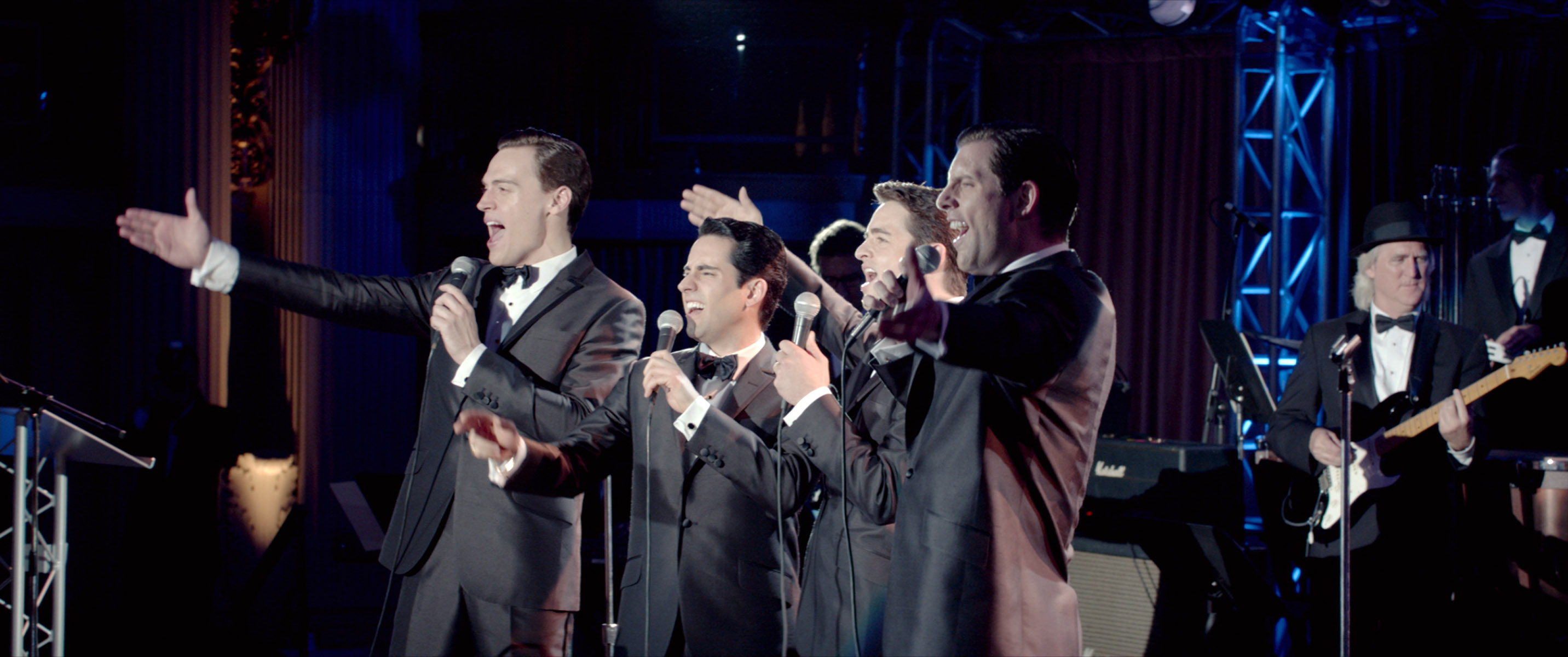
Jersey Boys The musical that turned the back story of Frankie Valli and the Four Seasons — the 1960s hit making machines behind upbeat doo-wop ditties like “Sherry,” “Big Girls Don’t Cry,” “Walk Like a Man,” and a zillion more; you will recognize all of them — into Broadway gold ascends to the big screen thanks to director Clint Eastwood, a seemingly odd choice until you consider Eastwood’s own well-documented love of music. Jersey Boys weaves a predictable tale of show biz dreams realized and then nearly dashed, with a gangster element that allows for some Goodfellas-lite action (a pre-fame Joe Pesci is a character here; he was actually from the same ‘hood, and was instrumental in the group’s formation). With songs recorded live on-set, à la 2012’s Les Misérables, there’s some spark to the musical numbers, but Eastwood’s direction is more solid than spontaneous, with zero surprises (even the big finale, clearly an attempt at a fizzy, feel-good farewell, seems familiar). Still, the cast — including Tony winner John Lloyd Young as Valli, and Christopher Walken as a sympathetic mobster — is likable, with Young in particular turning in a textured performance that speaks to his years of experience with the role. For an interview with cast members Young, Michael Lomenda (who plays original Four Season Nick Massi), and Erich Bergen (as Bob Gaudio, the member who wrote most of the group’s hits), visit www.sfbg.com/pixel_vision. (2:14) Four Star, Marina, 1000 Van Ness, SF Center, Shattuck, Sundance Kabuki, Vogue. (Eddy)

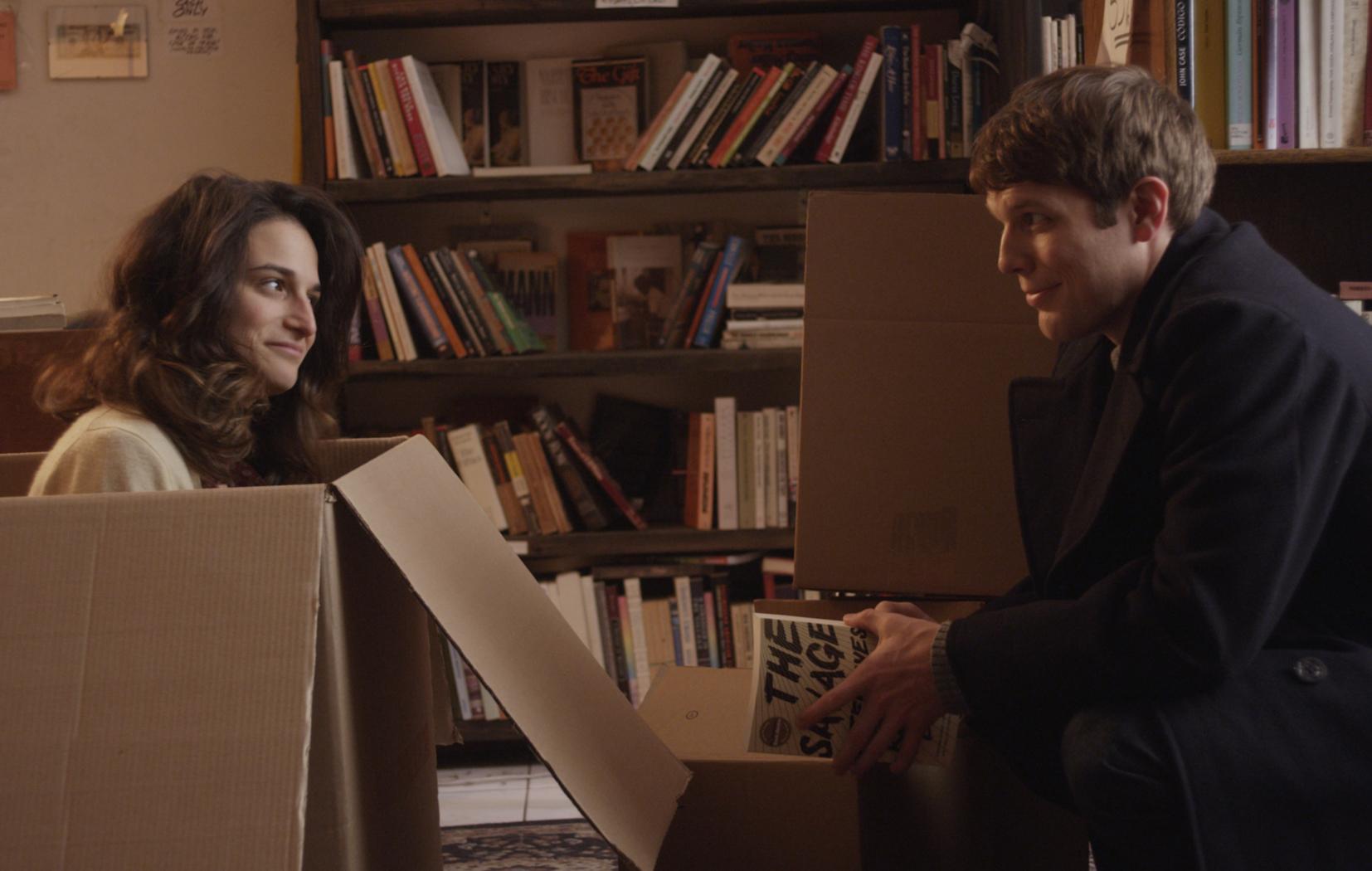
Obvious Child We first encounter the protagonist of writer-director Gillian Robespierre’s funny, original film — a Brooklyn-dwelling twentysomething named Donna (Jenny Slate), who works at a lefty secondhand bookstore and makes regular (if unpaid) appearances at a local comedy night — onstage mining such underdiscussed topics as the effects of vaginal discharge on your garden-variety pair of underwear. This proves a natural segue to other hefty nuggets of embarrassment gold concerning her love life, to the dismay of boyfriend Ryan (Paul Briganti), auditing from the back of the club. He pretty much deserves it, however, for what he’s about to do, which is break up with her in a nasty, well-populated unisex bathroom, taking time to repeatedly glance at the texts coming through on his phone from Donna’s good friend, with whom he’s sleeping. So when Donna, mid-drowning of sorrows, meets a nice-looking fellow named Max (Jake Lacy) at the bar, his post-fraternity-presidency aesthetic seems unlikely to deter her from a one-night stand. The ensuing trashed make-out dance-off in Max’s apartment to the Paul Simon song of the title is both comic and adorable. The fractured recap of the evening’s condom-free horizontal events that occurs inside Donna’s brain three weeks later, as she hunkers down with her best friend, Nellie (Gaby Hoffmann), in the bookstore’s bathroom after peeing on a stick, is equally hilarious — and unwanted-pregnancy jokes aren’t that easy to pull off. Robespierre’s treatment of this extended windup and of Donna’s decision to have an abortion is a witty, warmhearted retort to 2007’s Knocked Up, a couple generations’ worth of Hollywood rom-com writers, and an entertainment industry that continues to perform its sweaty contortions of storytelling in the gutless cause of avoiding the A-word. (1:15) California, Embarcadero, Piedmont, Sundance Kabuki. (Rapoport)

Ping Pong Summer Eighties teen flicks of the My Bodyguard (1980), smart-dweebs-beat-the-bullies ilk are paid homage in Michael Tully’s deadpan satire, which is closer in spirit to the Comedy of Lameness school whose patron saint is Napoleon Dynamite. Radley (Marcello Conte) is an average teen so excited to be spending the summer of 1985 in Ocean City, Md. with his family that he renames himself “Rad Miracle.” He acquires a new best friend in Teddy (Myles Massey), who as the whitest black kid imaginable might make even Rad look cool by comparison. However, they are both dismayed to discover the local center for video gaming and everything else they like is ruled by bigger, older, cuter, and snottier douchebag Lyle Ace (Joseph McCaughtry) and his sidekick. Only kicking Lyle’s ass at ping pong — with some help from a local weirdo (a miscast Susan Sarandon, apparently here because she’s an off screen ping pong enthusiast) — can save Rad’s wounded dignity, and the summer in general. A big step up from Tully’s odd but pointless prior Septien (2011), this has all the right stuff (including a soundtrack packed with the likes of the Fat Boys, Mary Jane Girls, New Edition, Whodini, and Night Ranger) to hilariously parody the era’s inanities. But it’s just mildly amusing — a droll attitude with lots of period detail but not much bite. (1:32) Roxie. (Harvey)

The Rover Future days have never seemed quite so bleak as they are depicted in the wild, wild Aussie west of The Rover — rendered by Animal Kingdom (2010) director David Michod, who co-wrote The Rover with Joel Edgerton. Let’s just say we’re probably not going to see any primo Burner ensembles inspired by this post-apocalyptic yarn: Michod ventures to a plausible future only a decade out, after a global economic collapse, and breaks down the brooding road trip to its hard-boiled bones, setting it in a beauteous, lawless, and unceasingly violent outback. A heist gone wrong leads a small gang of robbers to steal the car belonging to monosyllabic, ruthless mystery man Eric (Guy Pearce). The latter wants his boxy little sedan back, badly, and, in the cat and mouse game that ensues, seems willing to die for the trouble. Meanwhile, one of the gang of thieves — the slow, dreamy Rey (Robert Pattinson), who has been left to die of a gunshot wound in the dirt — turns out to be more of a survivor than anyone imagined when he tracks down the tracker hunting for his brother and cohorts. Michod seems most interested in examining and turning over the ties that bind, in a mean time, an eminently absurdist moment, when everything else has fallen away in the face of sheer survival. Cineastes, however, will appreciate the elemental, existential pleasures of this dog-eat-dog Down Under out-Western, not the least of which include the performances. Pearce’s rework of the Man With No Name exudes intention in the very forward thrust of his stance, and Pattinson breaks his cool — and the confines of typecasting — as a blubbering, babbling, thin-skinned man-child. Clad in the mystic expanses of the South Australia desert, which tip a hat to John Ford Westerns as well as scorched-earth-of-the-mind movies such as El Topo (1970) and Paris, Texas (1984), The Rover is taken to the level of tone poem by the shuddering, moaning cellos of Antony Partos’s impressive, atonal electroacoustic score. (1:42) Metreon, Shattuck. (Chun)

The Signal Sharing its title with a 2007 film — also a thriller about a mysterious transmission that wreaks havoc in the lives of its protagonists — this offbeat feature from co-writer and director William Eubank belies its creator’s deep affection for, and knowledge of, the sci-fi genre. Number one thing The Signal is not is predictable, but its twists feel organic even as the story takes one hairpin turn after another. MIT buddies Nic (Brenton Thwaites) and Jonah (Beau Knapp) are driving Nic’s girlfriend, Haley (Olivia Cooke), cross-country to California. Complicating the drama of the young couple’s imminent separation is Nic’s deteriorating physical condition (it’s never explained, but the former runner apparently has MS or some other neurological disease). The road trip turns dark when the trio (who also happen to be hackers) realize an Internet troll they’ve tangled with in the past is stalking them. After a brief detour into found-footage horror — fooled ya, Eubank seems to be saying; this ain’t that kind of movie at all! — the kids find themselves embroiled in ever-more-terrifying realities. To give away more would ruin the fun of being shocked for yourself, but think Twilight Zone meets Area 51 meets a certain futuristic trilogy starring Laurence Fishburne, who turns up here to play a very important role in Nic and company’s waking nightmare. (1:37) Metreon. (Eddy) *


Trying to have hope

44

OPINION I get it, as Harvey Milk famously said: “You gotta give them hope.” But how do you do that when the LGBT community you love so much is being priced and evicted out of the city?

When immigrants, people of color, artists, the poor and working-class, people with AIDS, seniors, persons with disabilities, and so many others are being pushed out — like you, Harvey, were forced out of your camera store and apartment on Castro Street when your rent was tripled. Just before an assassin’s bullet took you from us, you were preparing an anti-speculation tax to deal with the rising rents and displacement caused by speculators and real estate investors.

We tried to curb their dirty work via a state bill limiting use of the Ellis Act, but Democrats buckled in to pressure from the real estate industry that owns them. Shame on Democratic House Speaker Toni Atkins from San Diego, an out lesbian, whose inaction on the bill helped kill it.

Our only hope is the anti-speculation tax on the November ballot. Brian Basinger of the AIDS Housing Alliance is calling it the Harvey Milk Anti-Speculation Tax.

The stakes are high right now. Our housing crisis is destroying our community. According to the Anti-Eviction Mapping Project, which tracks displacement throughout the city, District 8 (which includes the Castro) has the highest rate of Ellis Act and Owner Move-In evictions, almost 2,000 units emptied since 1997. That doesn’t include buyouts and threats of evictions, de facto evictions that have pushed out many more, most of them tenants with AIDS. Far too many people with AIDS are homeless in a city that used to be called the “model of caring.”

The motive for these evictions is obvious. A two-bedroom across the street from my Castro apartment rents for $4,200. An apartment above the new Whole Foods at Sanchez and Market can cost you as much as $8,000. A month! I don’t want to upset you, Harvey, so I won’t tell you how high commercial rents are, and how poorly neighborhood businesses are faring these days.

The economic disparity has never been greater. Two Williams Institute studies show that our community is as poor as, and in some instances poorer than, other communities. In our city’s latest homeless count, 29 percent of respondents identified as LGBT and an additional 3 percent as transgender. Other reports say that 40 percent of the city’s homeless youth are queer.

Forget Altoona, that homeless queer kid in the Haight or Castro needs a sense of hope. We have a sit/lie law similar to the one you opposed that prevents these kids from getting subsidized housing if they have an unpaid citation. They sleep in the park because they’re not safe in the shelters. Sadly, Human Rights Campaign and Equality California have never made them — or the poor — a priority.

Cranes and rainbow flags may be all the rage in Upper Market these days, but what’s being built will not be affordable to homeless, poor, or working class (even some middle-class) people. The Castro has only one affordable housing project in the pipeline: 110 units for LGBT seniors at 55 Laguna. Our D8 supervisor and City Hall have let us down big time.

Harvey, I want to think that 10 years from now, our community will still have the Castro as a refuge. I want to believe that poverty, homelessness, and hunger will be greatly reduced. That we can stop the evictions. That we can give young people a piece of the dream. That we can provide seniors a secure place to spend their final days. That we can have elected officials who truly represent us, as you did.

I really want to have hope.

Tommi Avicolli Mecca, a longtime queer and housing rights activist (and an organizer of the first Philadelphia Pride march in 1972), is a grand marshal of this year’s Pride Parade.

Doo-wop (that thing): talking with the cast of ‘Jersey Boys’

0

The backstage musical that turned the story of Frankie Valli and the Four Seasons — known for 1960s doo-wop ditties like “Sherry,” “Big Girls Don’t Cry,” “Walk Like a Man,” and a zillion more; you will recognize all of them — into Broadway gold ascends to the big screen Fri/20 thanks to director Clint Eastwood, a seemingly odd choice until you consider Eastwood’s own well-documented love of music. 

Jersey Boys weaves a predictable tale of show biz dreams realized and then nearly dashed, with a gangster element that allows for some Goodfellas-lite action (a pre-fame Joe Pesci is a character here; he was actually from the same ‘hood, and was instrumental in the group’s formation). With songs recorded live on-set, à la 2012’s Les Misérables, there’s some spark to the musical numbers, but Eastwood’s direction is more solid than spontaneous, with zero surprises (even the big finale, clearly an attempt at a fizzy, feel-good farewell, seems familiar). 

Still, the cast — including 2006 Tony winner John Lloyd Young as Valli, and Christopher Walken as a sympathetic mobster — is likable, with Young in particular turning in a textured performance that speaks to his years of experience with the role. I spoke with Young, Michael Lomenda (who plays original Four Season Nick Massi), and Erich Bergen (as Bob Gaudio, the member who wrote most of the group’s hits) when the trio made a recent visit to San Francisco to promote the movie.

https://www.youtube.com/watch?v=6tC1yOUvvMo

SF Bay Guardian This must be a crazy time for you guys.

John Lloyd Young It’s a very exciting time for all three of us, and including our fourth colleague Vincent Piazza [who plays Four Season co-founder Tommy DeVito]. This is our first major studio feature film, and we got to be directed by Clint Eastwood. 

SFBG Did he ever break into song on the set?

Michael Lomenda [Laughs.] It was very interesting, actually, to see him between takes trying to capture that Frankie Valli falsetto. I think it was an ongoing challenge for him the whole 38 days that we shot, to try and figure out how to manipulate his voice in that way.

JLY It was a tongue-in-cheek challenge, because it was all playful. He knew he wasn’t gonna sing like Frankie!

SFBG Few can! Though, you’ve been able to do it for several years. How do you keep your voice in shape to hit those notes?

JLY Well, you either have a falsetto or you don’t. If you have it, you just keep it in shape the same way any singer does. Obviously, singers, there’s certain things we can’t do. We can’t go out and yell all night in a bar. We shouldn’t smoke, we shouldn’t drink. The voice is very delicate. Those are very delicate muscles. Anything you do that’s not good for your body in general won’t be good for your voice. But, basically, just living a clean life. And Frankie Valli himself will tell you the same thing.

SFBG It’s interesting that you bring up clean living. I hadn’t seen the stage show, and I didn’t know much about the group before I saw the movie. But in every show-biz biopic, there’s always some kind of vice (usually drugs or booze, as in Walk the Line) that threatens to ruin the performer’s success. Here, it’s the mobster subplot — mobsters are not the typical vice.

Erich Bergen I think that’s one of the things that’s very interesting is that Frankie didn’t get into [drugs or alcohol]. That’s sort of the reason why he’s still around and he’s still on the road, because he’s been able to preserve not only his gift, but his life. Of course, he went through some harsh things in life. He went through a couple of marriages and divorces, and obviously he lost a daughter. Actually, and we don’t go into this in the movie, but he’s lost two daughters. He’s lived a very hard life. He didn’t need drugs or alcohol; that hard life came to him naturally. 

I think that’s what makes this story so interesting: we’re watching someone whose life is hitting him in the face. And we sort of identify with that. I don’t know about you, but for me personally, when I watch a lot of biopics and they start to get into the drugs and all that type of stuff — that’s where I sort of lose them a little bit, because that’s just sort of the generic story at this point. What makes Jersey Boys work is that we really connect with these guys because we identify with them. It’s written in a way that even when they’re not at their highest point, when they’re doing things that aren’t so great — especially the character of Tommy DeVito — we still root for them, and we still want them to succeed. 

SFBG The movie really shows how hard they had to work to be successful. It’s a stark contrast to the music business of today, where someone can become famous overnight thanks to a YouTube video.

EB That’s exactly what we talk about when we’re asked the question, “What makes this story so interesting?” If you look at the groups of today, whether it’s a One Direction or a Justin Bieber, before we actually know their songs, we know what they had for breakfast. But [the Four Seasons] really came at a time when you were trying to hide your real story and project out a shiny, clean image, because that’s what everyone wanted. That’s why Jersey Boys can exist today, because the story was never known. 

JLY I have a thought about that, too, which is that nowadays — without naming anyone by name — a lot of successful music acts are created as an idea in a marketing boardroom first, and then they find someone to fit that image. You know what I’m saying? It seems like the marketers are the stars nowadays. The more you can get an audience to feel there’s something really exciting there, and then get them there, then you’ve won. But when they get there and they don’t have a great experience, well, you already got their money, so who cares?

But I think at the time of Jersey Boys, to succeed you had to work really hard. There were only three networks, and there were very few print outlets. If you actually got on the cover of a magazine, or you got on a network, you made it. But you had to have something to show for it. You had to have talent, and especially that generation of Baby Boomers — the biggest generation we’ve ever had in American history. That’s a lot of people competing for which of the talented ones among them would become known. And the Four Seasons had the talent, but they also had that special, very distinctly East Coast, riveting-to-an-audience kind of thing, with that Mob connection that makes their story unique among that era of bands.

SFBG The movie makes it clear that they had to succeed, because they didn’t have anything to go back to.

ML It’s true. These guys are from the wrong side of the tracks. You have some choices. You can go in the army, you can get mobbed up, or you can become famous, as they say in the film. We also sort of say that they did two out of the three. But I think their music spoke for itself. They broke when their music had to speak for them, and that’s what made them successful.

EB The proof of that is that everyone knows these songs, but not the band. There are so many songs we don’t even get to in this movie, because we’d run out of time! That tells you how much talent they really had as performers, writers, producers — all of those things. Their catalog is endless, and yet nobody knew they were all by the same group.

JL I just saw Clint Eastwood on the Today show, and when they introduced him, they said the Four Seasons had 71 chart-topping hits. 71! I think that’s incredible for that band, coming out of that decade.

SFBG They were also commercially savvy. The songs were so catchy. No wonder people liked them.

ML I think that’s they key to why their music has stood the test of time. Maybe it’s commercially viable, and it is good pop music. But if you did a little deeper into some of the lyrics — for example, “Dawn” is one of my favorite songs, and they’re singing, “Dawn, go away, I’m no good for you, think about what the future would be with a poor guy like me…” It’s that kind of lyric that brings depth so what initially could be perceived as just pop, bubblegum music. It spoke to an audience that I think was sort of the fabric of America.

JLY Their early attempts at marketing are sort of outlined in the movie. You got [producer] Bob Crewe giving them advice on how to get their songs out there. You have Bob Gaudio figuring out how to get his songs out there. I know, and am friends with, the real Bob Gaudio, and it’s funny, he’s a hugely successful songwriter, but he almost seems more proud of his business successes than he does of his songwriting. He gets pumped by being smart in business as he gets pumped by writing a good song.

SFBG As actors, does it present a particular challenge to play a real person, a famous person, particularly if that person is still living? Or were you able to put your own stamp on the characters?

EB I think John had the most pressure out of all of us, because he’s playing someone that’s so well-known, and John can tell you about that experience. But for the rest of us, we really did invent these characters. Even though they were real people, and while we wanted to pay respect to these people, and their families, we did have the luxury of not having to play John Lennon and Paul McCartney. They’re not well-known to the public. So we did get to use our skills as actors and create characters from the ground up.

JLY One of the benefits as an actor approaching the role of Frankie, even in the beginning in the original cast, is that he is known. People know what he looks like and they know what he sounds like. He did some talk show stuff, so they kind of know how he moves. So I knew that I needed to get his physical attributes down. I needed to evoke his sound, look like him, talk like him. But outside of those physical things, the internal life of Frankie Valli, we don’t really know. We didn’t know. 

When I was researching the original Broadway show, all I could find were maybe 12 minutes of footage of him at the Museum of Television and Radio. That was, like, the year before YouTube broke, so now there’s footage of him everywhere, but I didn’t have the benefit of that. But now I have seen a lot of YouTube and everything. So I thought, as long as I get those physical characteristics down, the story of the Four Seasons, the story of Frankie Valli, is still largely unknown to audiences. So I had free reign to kind of build the psychological reality of the character using my own imagination, and the cues that I had from the script. And knowing Bob Gaudio, Frankie Valli’s real-life best friend, and the things he told me about Frankie, and knowing, of course, the man himself. 

But I didn’t feel pressure so much. The pressure I felt was to honor the people who put this movie together, which was Frankie and Bob, and to portray the character in a way that was compelling and riveting to an audience so that we’d have as successful a show as we could have. And now, I think that I feel very proud of what we’ve accomplished with this movie, and I think it’s an enhancement, actually, of what has been out there all these years, with the successful stage musical across the world. 

SFBG How true is the movie to the stage production?

ML It’s actually very similar. We were lucky to work with [screenwriters and musical authors] Marshall [Brickman] and Rick [Elice] on the film, which I think we were all very grateful for, because it meant that we didn’t have to learn too many new lines. [Laughs.] But it was great. I think when I first found out that the movie was being done, I was really concerned that the final product would be true to the stage, because the script is so fantastic. But beauty of film is that you get to flesh out certain relationships, and certain storylines. I think fans of Jersey Boys are going to love a lot of the scenes that they loved from the stage version, but they’re also going to go crazy over the other stuff, the extra stuff that is put into the film.

The stage production is directed in a very slick fashion, but logistics dictate that you have to move from scene to scene very quickly to keep up the energy going in the two-and-a-half hour show. But what Mr. Eastwood does so beautifully with this movie, and with all of his movies, is create a real environment that’s rich and tangible, that you can really sense in the theater. I think Jersey Boys fans are going to love that as well.

JYL If people love the stage show of Jersey Boys, the movie is going to give then a much deeper, more thorough, and much more detailed experience.

SFBG I did not realize, until I was reading up on the movie, that there were Jersey Boys superfans who have seen the show hundreds of times.

EB Michael and I opened the national tour of Jersey Boys in San Francisco, and six years later Michael closed that tour in the same theater. This was my first discovery with anything remotely like that. I remember seeing these fans come in over and over again. At first I thought, “What are they doing?” and “Where are they getting the money that they’re buying such great seats three times a week?” I remember I got a letter one time, we all got these letters, from a fan who said, “I know you probably think it’s crazy that I’m here all the time, but this is the first time I’ve felt happy in 10 years.”

When we get things like that, we don’t really know what to make of that. But we are so thrilled that it’s had an impact. I don’t know if it can be explained. People often ask us, “What is it about Jersey Boys that keeps people coming back?” I don’t know if I know. I don’t know if anyone knows. I know that when people come to see the show, they’re affected by it for whatever reason. It moves them, it changes them. They are really passionate about it, and we’re just sort of lucky that we got to be a part of that somehow. I don’t really know what else to say about it!

JYL I have something else to say about it, and that is: if a person has seen the stage play of Jersey Boys 100 times, let them know, please, on our behalf, that for the price of one Broadway ticket, they can see this movie 10 times! [All three laugh.] So we hope that they decide to make their investment in 10 tickets for the movie. 

SFBG What’s up next for you guys? More musicals?

ML I think we’ve all been bitten by the movie bug. To start on a Clint Eastwood set, we’ve been a bit blessed and totally spoiled. So, I think certainly, we would all like to dive further into this genre and explore it.

EB I agree. My album comes out next week, some new music that I just recorded down in Nashville, and I’m in a new series on CBS this fall called Madame Secretary. I will also be hosting lots of Jersey Boys viewing parties once the DVD comes out. [Laughs.]

JLY I have a new album that I just released, My Turn — it’s R&B hits from the 60s in my voice, not Frankie’s, and it’s on iTunes and Amazon. I’m also a recent appointee by Barack Obama to the President’s Committee on the Arts and Humanities. So I’ll be working with kids in the lowest-performing schools, re-inserting arts into their curriculum to increase their school performance and their school culture. The actor Kal Penn and I will be sharing a school district in Des Moines, Iowa. I’m really looking forward to it.

JERSEY BOYS opens Fri/20 in Bay Area theaters.

Get up

0

marke@sfbg.com

SUPER EGO Fellow freakazoids, I’m disturbed. There’s an alarming new microtrend in nightlife: daylife. More specifically: morninglife. Halp!

First NYC’s Daybreaker party hit our shores a couple weeks ago, enticing hundreds of people to line up outside Audio at 8am for two hours of pre-work dancing ($15-$20) that apparently involved giant jellyfish costumes, a brass band (just to make sure you were awake?), and Four Barrel coffee — no alcohol here. I didn’t make it, because fuck that. But I was intrigued! Daybreaker’s AM disc jockey DJ Bradley P is a quality cutie, and the after-vids were rad. I’m waiting to hear if more are in the works.

Now comes Morning Gloryville from London (Wednesday, June 25, 6:30am-10:30am, $20. Heron Arts, 7 Heron, SF. www.morninggloryville.com), which places itself at the nexus of Burning Man, Ministry of Sound, and 24-Hour Fitness. Kind of a spiritual neon-flashmob throwdown, with wigs, massages, and smoothies. “Rave your way into the day!” It looks real cute. And exhausting.

I should have seen this coming the moment fluorescent Fitbits and post-ironic ’80s “Get Physical” dance routines started hitting the dance floors. Of course, SF has a long, glorious, deranged history of morning parties, from 6am Sunday Church at the End Up in the ’70s to recent blasts at North Beach’s Monroe and our own occasional Morning Glory party. I’ve loved dancing in the wee hours ever since I hung out in West Berlin in the ’80s and discovered high school kids hit the clubs before going to school.

But this new wave is just so darn wholesome — complete with slick marketing campaigns, relentless cheerfulness, and franchise ambitions. Despite my liver’s squeaky pleas, I’m not quite ready to come over to the “nightlife as workout routine” side, let alone sans cocktails. At least not yet. Yes, this fantastic ass came from tripping the light fantastic four-six nights a week. But these massive biceps? Grasping my vodkas, dear. Perhaps one day I’ll see the light.


BAIKAL

Sound Department continues to delve monthly into the more thought-provoking side of electronic music. This 11th installment features Berlin multi-layerist Baikal, who’s been building a body of impeccable (yet quite danceable) tech-work.

https://www.youtube.com/watch?v=roAxi8EQ6dk

Fri/20, 9pm-3am, $10. Monarch, 101 Sixth St., SF. www.monarchsf.com


GRIT & GLAMOUR

New show “Gorgeous” at the Asian Art Museum challenges and redefines the notion of beauty in “Eastern” art: Fantastic-sounding opening party makes it all come to life, with deep techno tunes from Dr. Sleep and Robot Hustle, bounce jams from DavO and Natalie Nuxx, vogue extravaganza from House of Nu Benetton, milky tea, fresh nail designs, full bar, and an afterparty at the Stud.

Fri/20, 7pm-11pm, $20–$25. Asian Art Museum, 200 Larkin, SF. www.asianart.org


LEE BANNON

Based-goth monthly funhole 120 Minutes presents this brilliant, trip-hoppy Ninja Tuner, drifting on gorgeous, post-glitch waves to the darker side.

Fri/20, 10pm, $8–$10. Elbo Room, 647 Valencia, SF. www.elbo.com


LOCO DICE

Maestro of that muscular quasi-minimal Ibiza sound — and not bad to look at, either — Mr. Dice blew me away last time he touched down, a couple years back. He’ll be on the 1015 system this time: All aboard the silver spaceship.

Fri/20, 9pm-4am, $20–$25. 1015 Folsom, SF. www.1015.com


LOUIE VEGA

Here’s a “flashback” night for ya: Master at Work and Latin house legend. He’ll be stretching back into his roots with some Afrobeat, samba, disco, and soul at Mighty. With old school heroes David Harness and Jayvi Velasco.

Fri/20, 10pm-4am, $20 advance. Mighty, 119 Utah, SF. www.mighty119.com


KAFANA BALKAN

“Join us for wild brass, abandon, and reverberating floors” — you can say that again, as this whirling, stomping Balkan delight returns to its Rickshaw Stop home. DJ Zeljko, Fanfare Zambaleta live band, Elizabeth Strong, and the Foxglove Sweethearts belly dancers bring gypsy joy to an adoring crowd.

Sat/21, 9pm, $15. Rickshaw Stop, 155 Fell, SF. www.rickshawstop.com


MAYA JANE COLES

The superfly UK whiz kid with a knack for connecting dance music history dots continues to thrill in the spotlight. She’s headlining a powerhouse night featuring NYC early-’90s fantasist Kim Ann Foxman, Alex Arnout, Young Marco, Bells & Whistles, and more at the As You Like It party.

https://www.youtube.com/watch?v=eV4ZiUSFvIQ

Sat/21, 9pm-5am, $20–$25 advance. Public Works, 161 Erie, SF. www.ayli-sf.com


WERD.

The classic Sunday weekly ran at now-closed Otis Lounge for more than seven years — now it’s at Monarch and sweeter than ever. This week’s ace tech-house guest Peter Blick helps break things in.

Sun/22, 9pm, $5. Monarch, 101 Sixth St., SF. www.monarchsf.com


Your Treasure Island Music Festival lineup: Outkast, Massive Attack, and more

3

Thanks to a glitch in Ticketmaster’s system (or a human who works for Ticketmaster who is now having a very bad day), we got the lineup for this year’s Treasure Island Music Festival (Oct. 18 and 19) a little earlier than promoters Another Planet Entertainment were planning on announcing it. [Update as of noon-ish: The lineup’s now on the festival’s official website, too.] Here we go:

Outkast
Massive Attack
Zedd
alt-J
TV On the Radio
Janelle Monae
Santigold
The New Pornographers
Washed Out
Jungle
Banks
St. Lucia
White Denim

POLICA
The Growlers
Classixx
Chet Faker
Ryan Hemsworth
Ana Tijoux
Asgeir
Xxyyxx
Ratking
Tobacco
Bleached
Painted Palms
Waters

With the exception of Painted Palms and Waters (good on ya, boys), it’s a pretty non-local crowd — but otherwise a pleasant mix of electronic and indie/garagey kids, which is of course in line with the crowd the festival usually draws. And if you missed Outkast at Coachella and BottleRock (where they were somewhat disappointing and excellent, respectively), well, here’s your next chance. At this point, honestly, we just hope it’s warmer than last year, because the chilled-to-the-bone memory of chugging overpriced wine and wondering if our hands would ever regain feeling again while waiting for Beck to come on is still alarmingly fresh.

Tickets go on sale this Thursday at 10am. Other thoughts on the lineup, folks?

If you even have time to make it to the movies between World Cup matches…

0

…read on for our takes on the new flicks of the week. Pssst: lots of good stuff still to come at DocFest, too!

Alone Yet Not Alone Remember that Christian historical drama that was Oscar-nominated for Best Song but then got kicked out of the running because of the songwriter’s sketchy campaign tactics? No? Well, here ’tis. (1:43)

https://www.youtube.com/watch?v=INW6i6K1NmQ&feature=kp

Gore Vidal: The United States of Amnesia Nicholas Wrathall’s highly entertaining documentary pays tribute to one of the 20th century’s most brilliant, original, and cranky thinkers, with extensive input from the man himself before his death in 2012 at age 86. The emphasis here is less on Vidal’s life as a literary lion and often glittering celebrity social life than on his parallel career as a harsh scold of US social injustices and political corruption. (Needless to say, recent history only sharpened his tongue in that department, with George W. Bush dismissed as “a goddam fool,” and earlier statements such as “This is a country of the rich, for the rich and by the rich” seeming more apt than ever.) He’s a wellspring of wisdoms both blunt and witty, sometimes surprising, as in his hindsight doubts about the virtues of JFK (a personal friend) as a president. We get plenty of colorful archival clips in which he’s seen verbally jousting with such famous foes as William F. Buckley and Norman Mailer, invariablyreducing them to stammering fury while remaining exasperatingly unruffled. His “out” homosexuality and outré views on sexuality in general (at odds with an increasingly assimilationist gay community) kept him controversial even among many liberals, while conservatives were further irked by his rock-solid family connections to the ruling elite. In our era of scripted political rhetoric and pandering anti-intellectualism, it’s a joy merely to spend an hour and half in the company of someone so brilliantly articulate on seemingly any topic — but particularly on the perpetually self-mythologizing, money-worshipping state of our Union. (1:29) (Dennis Harvey)

How to Train Your Dragon 2 Sequel to the 2010 animated hit about Vikings and their dragon buddies, with voices by Jay Baruchel, Cate Blanchett, Gerard Butler, Djimon Honsou, America Ferrera, Kit Harington, Jonah Hill, and others. (1:42) 

Obvious Child We first encounter the protagonist of writer-director Gillian Robespierre’s funny, original film — a Brooklyn-dwelling twentysomething named Donna (Jenny Slate), who works at a lefty secondhand bookstore and makes regular (if unpaid) appearances at a local comedy night — onstage mining such underdiscussed topics as the effects of vaginal discharge on your garden-variety pair of underwear. This proves a natural segue to other hefty nuggets of embarrassment gold concerning her love life, to the dismay of boyfriend Ryan (Paul Briganti), auditing from the back of the club. He pretty much deserves it, however, for what he’s about to do, which is break up with her in a nasty, well-populated unisex bathroom, taking time to repeatedly glance at the texts coming through on his phone from Donna’s good friend, with whom he’s sleeping. So when Donna, mid-drowning of sorrows, meets a nice-looking fellow named Max (Jake Lacy) at the bar, his post-fraternity-presidency aesthetic seems unlikely to deter her from a one-night stand. The ensuing trashed make-out dance-off in Max’s apartment to the Paul Simon song of the title is both comic and adorable. The fractured recap of the evening’s condom-free horizontal events that occurs inside Donna’s brain three weeks later, as she hunkers down with her best friend, Nellie (Gaby Hoffmann), in the bookstore’s bathroom after peeing on a stick, is equally hilarious — and unwanted-pregnancy jokes aren’t that easy to pull off. Robespierre’s treatment of this extended windup and of Donna’s decision to have an abortion is a witty, warmhearted retort to 2007’s Knocked Up, a couple generations’ worth of Hollywood rom-com writers, and an entertainment industry that continues to perform its sweaty contortions of storytelling in the gutless cause of avoiding the A-word. (1:15) (Lynn Rapoport)

The Signal Sharing its title with a 2007 film — also a thriller about a mysterious transmission that wreaks havoc in the lives of its protagonists — this offbeat feature from co-writer and director William Eubank belies its creator’s deep affection for, and knowledge of, the sci-fi genre. Number one thing The Signal is not is predictable, but its twists feel organic even as the story takes one hairpin turn after another. MIT buddies Nic (Brenton Thwaites) and Jonah (Beau Knapp) are driving Nic’s girlfriend, Haley (Olivia Cooke), cross-country to California. Complicating the drama of the young couple’s imminent separation is Nic’s deteriorating physical condition (it’s never explained, but the former runner apparently has MS or some other neurological disease). The road trip turns dark when the trio (who also happen to be hackers) realize an Internet troll they’ve tangled with in the past is stalking them. After a brief detour into found-footage horror — fooled ya, Eubank seems to be saying; this ain’t that kind of movie at all! — the kids find themselves embroiled in ever-more-terrifying realities. To give away more would ruin the fun of being shocked for yourself, but think Twilight Zone meets Area 51 meets a certain futuristic trilogy starring Laurence Fishburne, who turns up here to play a very important role in Nic and company’s waking nightmare. (1:37) (Cheryl Eddy)

Supermensch: The Legend of Shep Gordon See “Puff Piece.” (1:24) 

https://www.youtube.com/watch?v=qm8UaNdq24c&feature=kp

22 Jump Street In this TV-inspired sequel, “Previously on 21 Jump Street…” is all the backstory we get. 22 wastes no time sending Officers Schmidt (Jonah Hill) and Jenko (Channing Tatum) back to school to solve another case. A few details have changed (they’re in college now, where the drug of choice is “Why Phy”), but the situation is self-consciously boilerplate, which lets the filmmakers cast (ironic) judgment on sequels — and imply the TV show was redundant. College proves hilarious, from the rundown of dorm room essentials to Schmidt’s walk of shame, and the touchstones are sharp and embarrassing. An extended fight between Schmidt and a girl (Jillian Bell, fabulous) twists gender issues and sexual assault into gloriously absurd politics. Best of all is a fairly understated joke in front of the Benjamin Hill School of Film Studies. I laughed as much at 22 as I did at 21, but 22 spends so much time calling out its number-two status that it almost becomes performance art. (1:45) (Sara Maria Vizcarrondo)

Kevin Epps’ new film targets outsize black and latino student suspensions

9

A second grader recounts his school calling in the police to stop his tantrum. A young girl repeatedly suspended by her school lowers her head in sorrow. A community confronts a seemingly-violent teen who lost his way.

Kevin Epps’ 2002 film Straight Outta Hunters Point pulled viewers through the painful churn of poverty in a historically black San Francisco neighborhood. In his newest film, Solutions not Suspensions, Epps shows viewers one systemic cause of poverty: kids who are suspended and sent out onto the streets, instead of embraced by their communities when they falter.

These students aren’t only held back by each other, they’re held back by their schools. Studies show African American and Latino students are disproportionately suspended compared to other ethnic groups, a topic we wrote about in our cover story “Suspending Judgement, [12/13].”

That’s now changing, and Epps’ film chronicles the efforts of Coleman Advocates and other youth groups to push the San Francisco Unified School District to implement Restorative Practices, a new form of discipline focusing on community-building as opposed to punishment.

The stakes are high. Though some argue students need punishment, the film (and Coleman Advocates) argue this is counter-intuitive. Suspensions don’t heal wounds, don’t address behavior, and exacerbate the school to prisons pipeline.

“I’m a troublemaker, I have a police record,” one girl in the film says, talking about how her teachers and counselors no longer trust her. “They don’t care about me now.”

Restorative Practices are a new set of rules for handling conflict in SFUSD schools, calling for students and teachers in disagreements to enter into restorative circles to discuss their differences. One of the most powerful moments in Solutions not Suspensions puts you right in the middle of one teen’s restorative circle.

A teenager sits in a room surrounded by teachers and his community. To his left is his crying mother, to his right is a man leading the restorative circle.

“I need for you to fall back a little bit from that man role in taking the lead,” the man tells the teen. “Just be a young man. Enjoy this journey to being a man. One thing I know is you love that woman right there so much.”

He points to the teens’ crying mom. 

“I know you carry a heavy load sometimes,” he says. “You worry about her, you worry about your family, and worrying about your family may be behind the decisions in life you made. But you’ve got a network of people. You’ve got to let us know about that load.”

“You’ve got to tell us. You’ve got to tell us.”

Epps told the Guardian that the teen had gotten into fights at school. He came from a broken home and his mother had troubles with substance abuse. The fight, Epps said, “was his cry for help.” 

And that’s the power of restorative practices, he said, it gives students help instead of sending them to the streets.

“Instead of suspending him they took him to the side,” Epps said. “They said ‘let’s talk about this.'”

Epps said Solutions not Suspensions has direct ties to his seminal film, Straight Outta Hunters Point, and its sequel. The kids suspended from schools, he said, were the same kids living in poverty and getting caught up in “mischievious things” in his other films.

“It’s a direct connection,” he said.

Solutions not Suspensions premieres tonight at th San Francisco Public Library Main Branch, in the Latino room, at 6pm. Coleman Advocates will then host the film on their website for viewing, and announce a number of subsequent showings.

coleman

Event Listings: June 18-24, 2014

0

Listings are compiled by Guardian staff. Submit items for the listings at listings@sfbg.com. For further information on how to submit items for the listings, see Selector.

WEDNESDAY 18

“Exploding Stars, Dark Energy, and the End of the Universe” Randall Museum Theater, 199 Museum Way, SF; www.randallmuseum.org. 7:30pm, free (donations encouraged). UC Berkeley astrophysicist and cosmologist Brad Tucker leads this lecture presented by the San Francisco Amateur Astronomers.

Susan Jane Gilman Book Passage, 1 Ferry Bldg, SF; www.bookpassage.com. 6pm, free. The author reads from her debut novel, The Ice Cream Queen of Orchard Street.

“Peter Orlovsky, A Life in Words” City Lights Bookstore, 261 Columbus, SF; www.citylights.com. 7pm, free. The late poet is remembered with Peter Orlovsky, a Life in Words: Intimate Chronicles of a Beat Writer, read by Bill Morgan, Joanne Kluger, and Michael McClure.

Tom Spanbauer Books Inc., 2275 Market, SF; www.booksinc.net. 7:30pm, free. The author reads from his first novel in seven years, I Loved You More.

THURSDAY 19

“Ink: The Enduring Art of Tattoos” Creativity Explored Gallery, 3245 16th St, SF; www.creativityexplored.org. Opening reception tonight, 7-9pm. Free. Exhibit through Aug 6 (Mon-Fri, 10am-3pm; Thu, 10am-7pm; Sat-Sun, noon-5pm). Creativity Explored artists present works inspired by tattoo art in this group exhibition.

FRIDAY 20

Community of Writers at Squaw Valley benefit reading Starr King Room, First Unitarian Universalist Church, 1187 Franklin, SF; www.squawvalleywriters.org. 7pm, $12-24. Readings by poets Don Mee Choi, Robert Hass, Harryette Mullen, C.D. Wright, and Matthew Zapruder.

SATURDAY 21

“Action and Adventure: The Beginning of Modern Comics” Escapist Comic Bookstore, 3090 Claremont, Berk; www.escapistcomics.com. 3-5pm, free. Gerard Jones (Men of Tomorrow: Geeks, Gangsters, and the Birth of the Comic Book) and Nicky Wheeler-Nicholson (granddaughter of the founder of DC Comics) discuss the early days of comics.

“Step Back” Meet in front of City Lights Bookstore, 261 Columbus, SF; www.radarproductions.org. 4pm, free. Radar presents this walking tour (with performances!) through the queer origins of North Beach with author and historian Nan Alamilla Boyd (Wide Open Town: A History of Queer San Francisco to 1965).

San Mateo SummerFest B Street between Tilton and Sixth Aves, San Mateo; www.sresproductions.com. 10am-6pm, free. Also Sun/22. Historic downtown San Mateo hosts this summer fair, with arts and crafts, cooking demos, live entertainment, and more.

“Sexy Summer Dance Party” One Grove Street, SF; www.ftloose.org. 7-11pm, $20-50 donation. Raise money for nonprofit art group Footloose at this event, featuring live music by Stephanie Teel Band and Rasa Vitalia, plus raffles, a silent auction, and more.

“What the Truck?” Jack London Square, Broadway at Embarcadero, Oakl; www.jacklondonsquare.com. 11am-5pm, free. Not just food trucks, though there’ll be plenty of those; this event also boasts art trucks, toy trucks, a mobile photo bus, and fashion boutiques on wheels.

SUNDAY 22

“Sunday Storytime Hour” Cartoon Art Museum, 655 Mission, SF; www.cartoonart.org. 11am-noon, included with museum admission ($4-8). Reading for kids spotlighting the John Klassen books This is Not My Hat and I Want My Hat Back, plus treats from Arizmendi Bakery. Wear your favorite hat!

“We Shape Our City” Old Mint, 88 Fifth St, SF; www.sfhistory.org. 1-4pm, $5-10. Ongoing every Sunday. The San Francisco Museum and Historical Society hosts docent-led tours of the historic landmark, as well as showcasing a number of exhibits, including photographic explorations of various SF neighborhoods and the new “We Shape Our City,” dedicated to local innovators.

MONDAY 23

Kenneth Turan Book Passage, 1 Ferry Bldg, SF; www.bookpassage.com. 6pm, free. The veteran film critic reads from Not to Be Missed.

TUESDAY 24

Jeffrey Renard Allen Booksmith, 1644 Haight, SF; www.booksmith.com. 7:30pm, free. The author reads from Song of the Shank.

Joanna Smith Rakoff Book Passage, 1 Ferry Bldg, SF; www.bookpassage.com. 6pm, free. The author shares her memoir, My Salinger Year.

Adam Wilson and Lucy Corin City Lights Bookstore, 261 Columbus, SF; www.citylights.com. 7pm, free. The authors share What’s Important Is Feeling and One Hundred Apocalypses. *


Luis Valladares, East Bay recycler

0

“My father is a farmer in Chiapas, and grows corn, mangoes, and bananas. Our land wasn’t enough to support our family, though. The little we were able to grow was just to eat.

“When I was 16 I left home and school, and went to Mexico City. Parents never want their children to leave. But we … can’t stay. The majority of young people in my town have left, like me, looking for a way to help their families survive.

“In Mexico City I found work as a musician, because I play the marimba. Then I met my wife. I was the one who suggested to her that we come here. I came first and found a job with this same agency. After five months, I put together enough money to bring my wife.

“We had a daughter we had to leave behind. She was just 3 when we left, and she’s 16 years old now. This was very hard for us. We send money home for her, but she doesn’t want to come live here and leave her grandmother. We don’t want to force her. And now, of course, it’s much harder to come. It’s not just more expensive, but you’re risking your life.

“When we were thinking about coming here, my idea was that we’d stay here for two or three years, save up some money, and then go back and build a house. Now we’ve been here 14 years, and we can’t go back. My children belong here, and there are a lot of benefits for them here.

“I worked at ACI for 12 years. When I started I was a sorter on the line. Then they asked me if I wanted to operate machinery. I ran the packing machine. My job was to watch the line, and calculate the weight of the material going into the machine. If I let too much go in, the machine would seize up. It would be a big headache.

“No one is irreplaceable, but it takes anyone time to learn. You can’t go to sleep on this machine. If you fall in, you’ll wind up in pieces. This is a very dangerous place to work.

“At another company, a friend of my wife reached in to free a piece of metal that had jammed the machine. The machine grabbed his foot. He didn’t lose it, but he’s disabled now.

“When I started at ACI they paid me $6.75 an hour. I left in 2009 because they were only paying me $8.50. But the person they hired to replace me wasn’t very good at the job. After a year, the agency called me and I went back at $10 an hour.

“I didn’t know about the living wage, but some women at work talked with Agustin from the union and decided to file the suit. I never imagined they would fire us for this.

“I thought if we filed a suit, it might lead to having a union. Instead, [the agency managers] said, ‘We want you to re-verify your Social Security number, and bring us proof that you can continue to work here.’

“If we had good numbers we’d never have the kind of problems we have now. By 2001, when I came, you could not get a real Social Security number, although long ago you could.

“At first I was very angry. I felt helpless. And then quickly I began to worry. I have to pay the rent, the bills. The kids have to eat. When you’re working, you only make enough just to live.

“I haven’t been able to find another job. My wife is working, but only part time. Lately I’ve been going out to work with some friends. But it’s just two or three days a week. Every penny I make I’m putting away to pay the rent.

“I don’t believe that what happened to us at ACI is just. We’re looking for the welfare of our families, trying to get a fair wage so we can live better. People need to understand what happened to us — the abuse and low pay that immigrants have to live with.”

Editor’s note: Valladares’ name was changed to protect his identity.


Party Radar: Daybreaker gets you moving – on a Tuesday morning

0

Back in 1988, I hung out for a summer in West Berlin. Yep, this was before the wall fell, when West Berlin was a roiling, hyperactive, neon-crazy island in a sea of Communist repression — kind of like the most exclusive nightclub in the world.

One of the things that took my breath away: high school kids and college students went to clubs before school. At least the few I knew would met their friends around 5-6am at the all-night club du jour and dance it out for a while before heading to class. “This is the best place in the world!” I thought at the time.

Also: “Why can’t we have this?” Well, now we kinda do. Welcome to San Francisco, Daybreaker.

OK, OK, it has no alcohol, and you still have to be 21 to get in. (And it’s $15-$20, so you may have to save up that pocket change.)

HOWEVER, this 8am-10am Tue/10 morning dance party at the beautiful Audio Discotech — hello, morning skylight! — looks incredibly promising for what organizers Radha, Brimer, Steph, and Mustafa call “a little mischief.” You get music from cutie pie DJ Bradley P. Plus it sounds like a damn fun morning workout! So much better than a gym.

See you there, bright and bleary. Press release:

Over a late-night falafel in Williamsburg a few months back, we mused over an idea. An idea about dancing before the day broke with people we love. About cultivating a community that values camaraderie, self-expression, wellness, immediacy… and mischief. About going to work with our brows slightly dewed from moving our bodies with reckless abandon, sans alcohol but with so much spirit, surrounded by the most amazing people we know.

DAYBREAKER is a morning dance party and community of good-hearted people, and on Tues, June 10th, DAYBREAKER SF will commence.
No more dreary treadmills. No more lackluster mornings. No more dancing only when the sun is down.
With your ticket, you get:
+ good beats by DJ Bradley P
+ fresh Philz coffee
+ delicious smoothies
+ live musicians & performers
+ occasional costumes
+ (no booze)
Be a part of something new and different. Daybreaker will set the tone for your day unlike anything has before 🙂
// Tuesday, June 10th @ Audio — 316 11th St. (btw Folsom and Harrison)
// Dance Party: 8 am – 10 am

Middle fingers to the sky, Lady Gaga takes San Jose for an artRAVEy ride

18

There are a lot of critiques that I can make about Lady Gaga’s Tuesday night performance in San Jose — the sports arena acoustics, the horrifically boring opening acts, the focus on her new and less popular album Artpop, $80 sweatshirts, the fact that she performed some of her most popular tunes in truncated versions and neglected to play “LoveGame” altogether — but the fact is, none of these shortcomings made a dent in the incredible energy and impassioned performance that Gaga dished out. The show was fucking incredible.

Lady Gaga doesn’t do concerts. She does productions. With a full band, an elaborate set, a dozen or so backup dancers and as many costume changes, her artRAVE tour is a feast for the eyes and ears alike. The set, bulbous, white, and otherworldly, looked straight out of Tattooine and the dancers’ eye-catching array of outfits reflected this extra-terrestrial theme. Part of artRAVE’s spectacle is simply witnessing Gaga’s amazing ability to dance in five-inch pumps and a leotard with shiny black tentacles sticking out in all directions. These theatrics, however, are in no way a crutch or a form of compensation. Lady Gaga’s talent is stunning.

From the moment that she rose out of the stage floor in angel wings and a rhinestone bodice, it was impossible to tear your eyes from Lady Gaga. Amagnetic presence, impressive dancer, and truly powerful singer, it’s easy to see why she’s made such a lasting impression on pop culture. Mixing her set with dance anthems and ballads, Gaga was able to show off her versatility as a singer; her voice is unbelievable — its clarity and power are not adequately represented by her highly-processed recorded material. Live, it soars between roaring rock growls and deep, rich vibrato, all in perfect pitch.

Though the surface of Gaga’s persona is all rhinestones and superstardom, the show was peppered with heartfelt moments and breaks from the highly organized and choreographed show. Some of her fortune cookie-wisdom lines (“Welcome to a place where we judge no one tonight. We criticize no one. We hate no one.”) are clearly rehearsed, but also clearly strike a chord with her fans, who roared appreciatively with every mic break. In the best moment of the show, Gaga pulled two fans out of the audience to sit on the piano bench with her as she sang an impassioned ballad version of “Born this Way,” as each of the girls she pulled up sang along, weeping openly.

Lady Gaga embraces and uses her status as a queer icon to spread a gospel of love and acceptance that actuallly feels incredibly urgent and genuine, and clearly impacts her fans deeply. At one point between songs, she paused to read aloud a letter that a fan had thrown on stage. In a deeply emotional note, the fan credited “Born This Way” for getting him through high school and allowing him to survive being bullied for his sexuality.

In one of her most impassioned moments, pointing out how many people had come out for her show despite warnings early in her career that she was too queer or warnings from her label that Artpop (which was indeed a flop compared with her previous albums) was too artsy, Gaga roared, “just because we’re gay or like art doesn’t mean we’re fucking invisible, ok?” with both middle fingers to the sky.

In addition to her dedication to supporting her LGBT fans, I found myself extremely inspired by Lady Gaga’s unapologetic sex-positivity and her disregard for gender roles. Her dancers wore unisex outfits that drew heavily from the gender-bending Club Kids of the early ‘90s, and Gaga herself sang openly about masturbating and even deconstructed her own typically flawless image by doing her last costume change onstage, topless and wigless, with a crew of people to help her undress and redress into a truly awesome Derelicte-Harijuku-raver oufit. Before she dirobed, Gaga joked, “Just in case we didn’t make any of you uncomfortable tonight, we’re about to.”

While the production of artRAVE is an airtight spectacle of choreography and stunning visuals, it’s the candid moments that make Lady Gaga’s stage show something special. Underneath the glitter, tentacles, and rainbow dreadlocks, there is something very real and emotionally raw.

Her messages of equality and universality are both genuine and revolutionary in an artist as mainstream and financially successful as she is. Artpop may not have been a huge success, and the Haus of Gaga certainly doesn’t hold the same untouchable status as it did in 2010, but Lady Gaga’s refusal to compromise and willingness to stay strange are truly inspirational.

There is too much going on this weekend: The Congress, Not Dead Yet Fest, and more

2

Y’all ever have that thing where a week or two will go by without a show you’re particularly stoked on, and then all of a sudden there’s one weekend where you want to go to everything? But you can’t, because you’re human, and science is too busy ensuring you’ll have nightmares of outstanding proportions tonight to get on that teleportation thing, so you have to make all these god-awful decisions?

Yeah, me too. This is one of those weekends. Here we go:

FRI/6

The Congress with Andy Allo and Wil West at the Great American Music Hall:

A self-described Army brat who moved around for much of his youth, composer-singer- trumpeter Marcus Cohen grew up on gospel music in church, with a magnet arts school in Philadelphia nurturing his obvious talent at a young age. That explains the unmistakable soul coursing through the veins of The Congress, the 10-piece purveyors of a very danceable funk-soul-hip-hop-R&B stew, who’ll bring their unique sound to the GAMH Friday.

“I tend to write when I’m in transit — on planes, subways,” says Cohen, who recently moved to LA after nine years in SF. We can forgive him the wanderlust if it keeps producing songs like those on last August’s Conversations. Since then, Cohen has been working on new material, adjusting the band’s lineup, and singing more — the record he’s begun writing over the past year sounds more like where he’s at right now, he says. This show should be a good, sweaty dance party, and a good chance to hear some new tunes.

https://www.youtube.com/watch?v=82MONdiYGN0

French Cassettes with Major Powers and the Lo-Fi Symphony at Awaken Cafe in Oakland: Because nothing says First Friday like a local two-fer, featuring crazy-nerdy-glam-rock-costumed-piano-funk (fresh off a spot at BottleRock) followed by danceably infectious indie pop hooks from these SF scene darlings (fresh from the Locals Stage at BFD). All of it for the low price of zero dollars!


Scraper with Midnite Snaxx and So What at Hemlock: Classically and somehow reassuringly misanthropic punk rock with a sense of humor. Yes please.

SAT/7

Oakland’s own tUne-yArDs with dream-team electro-funk-pop East Bay openers (and Goldie winners) The Seshen at The Fillmore: Duh.

Not Dead Yet Fest with Strange Vine, Cellar Doors, Annie Girl & the Flight, Ash Reiter, and tons more at Thee Parkside: Don’t believe the hype — not every single SF musician is deserting for more affordable pastures. It was with that in mind that the Bay Bridged organized this one-day fest, with a nice, diverse lineup of local indie kids. Fresno’s Strange Vine in particular put on a weirdly alluring psychedelic shitshow of a good time.

Les Claypool’s Duo De Twang with Reformed Whores at Great American: Music writer and lady with good taste Haley Zaremba says: Les Claypool has an amazing eye for weirdness. His band Primus has made a decades-long career out of defying every possible genre classification, wearing monkey masks onstage, and naming their albums things like Pork Soda and Sailing the Seas of Cheese. Now Claypool is going the opposite direction, creating the most minimalist, deconstructed music possible, with one vocal, one bass, one guitar, and one makeshift percussion tool — but don’t worry, it’s still bizarre.
In his Duo De Twang, which was originally organized as a one-off for Hardly Strictly Bluegrass, Claypool teams up with longtime buddy and collaborator Bryan Kehoe to play originals and tasty twang covers (including the Bee Gees and Alice in Chains). The show promises down-to-earth, intimate weirdness, plus seriously incredible musicianship.

Lagos Roots Afrobeat Ensemble at The Chapel: How often do you get to see a 17-piece afrobeat ensemble in a room like the Chapel’s? Led by Geoffrey OMadhebo, these musicians will temporarily make you forget exactly what decade and continent you currently inhabit, in a good way.

Listen: Katie Day’s anti-tech bro jam “San Francisco (Before the West Falls)”

79

Between POW!’s “Hi-Tech Boom,” the schticky “Google Bus Song” from Cachebox, and Violent Vickie’s “Fuck You!!!!!”, it’s safe to say San Francisco musicians — the ones that are left here, haha! sorry — are currently leading the nation in anti-gentrification music.

This is a good thing, of course. It means the city still has a pulse. You know what we’ve been sorely lacking, however? As Emma Goldman basically said, give the people a summery, socially conscious anthem we can fucking dance to.

Enter Katie Day, who self-released her new EP, Burn It to the Ground, yesterday. There’s a lot to like here, including a love song for the Lower Haight, but the instant earworm is a semi-tongue-in-cheek indie-electro-pop jam called “San Francisco (Before the West Falls),” with shimmery, bubble-gum synths and keys layered with lyrics that lament the bygone days when coffee was 80 cents, and give serious side-eye to the tech bros moving into her neighborhood: “Someone told me about the boys next door/They put the boards on the window of the record store/And now the kids don’t get to play no more…”

“The extreme wealth disparity we’re experiencing in SF as a result of tech can make living here as an artist straight-up oppressive, but I think having a song that speaks to that oppression and makes you want to get up and dance anyway can negate any feeling of self-pity, even if you’re living under constant threat of eviction while there’s trained German Shepherd acting as an elevator operator at the Google office,” Day wrote me when I asked about her inspirations. “It’s something they can’t take away from you.”

Get your un-gentrifiable dance on when she plays with Stages of Sleep, New Spell, and Memory Motel this Sat/7, 8pm at Amnesia.


This Week’s Picks: June 4 – 10, 2014

0

WEDNESDAY 4


‘Mr. Irresistible’

Multifaceted showman and irrepressible art-dragster D’Arcy Drollinger, the brains and falsies behind such contemporary camp classics as Shit & Champagne and Sex and the City Live!, is poised to deliver on his biggest project since Project: Lohan, or even 2010’s cutting-edge Scalpel!: A sci-fi musical comedy about love and robots and office work entitled Mr. Irresistible. First produced in workshop form last year at New York’s La Mama E.T.C., the Aesop-inspired story of unpopular Eileen Morchinsky and her titular mechanical friend (purchased from a magazine ad and destined to turn her life right around) sails into the fairly exotic Alcazar Theatre for a limited run, aloft on a score by Christopher Winslow, book and lyrics by Drollinger, and some big-wig talent. (Robert Avila)

Through June 8, 8pm; Sun. 7pm only, $25

Alcatraz Theatre

650 Geary, SF

(415) 766-4588

www.mrirresistiblemusical.com


The Damned

Remember, kid: Heroes get remembered, but legends never die. Yes, we’re talking about THE Damned. Formed in 1976, The Damned were the first punk band in the UK to release a single, a record, or tour the United States. They cut their teeth opening for bands like the Sex Pistols and T. Rex, and are still going strong. Not only were they punk rock pioneers, they also were some of the frontrunners of the goth scene in the ’80s, and now, nearly into their fourth decade, The Damned are still going strong. With an ever-changing lineup and an incredible repertoire of revolutionary tunes, these dudes are incredible at evolving and even better at performing. They’re not to be missed tonight at Slim’s. (Haley Zaremba)

With Koffin Kats, Stellar Corpses

9pm, $30

Slim’s

333 11th St, SF

(415) 225-0333

www.slimspresents.com


THURSDAY 5


XV: St. James Infirmary 15-Year Anniversary Party

Lost in the outpouring of accolades in the wake of the great Maya Angelou’s passing last week was her crucial time as a sex worker, which she chronicled, unashamed, in her 1974 book Gather Together in My Name. It’s indicative of the stigma sex workers still face when even the well-documented past of the nation’s literary godmother is scrubbed free of any reference. San Francisco’s own groundbreaking St. James Infirmary, the first occupational safety and health clinic for sex workers in the United States, deals with the damage of that stigma by offering non-judgmental medical and social services. The organization also knows how to celebrate: This huge party and fundraiser boasts one of the city’s best house DJs, David Harness, as well as porn-star-turned-DJ Ricky Sinz, movers and shakers from the international sex workers rights movement, sexy pole dancing, a Kink.com demonstration dungeon, and oodles more. The whole joint will be singin’ and swingin’ and getting’ merry like Christmas. (Marke B.)

9pm-3am, $20 ($40 includes free lapdance)

Temple

540 Howard, SF

www.templesf.com


Urban Air Market Summer Night Block Party

Urban Air Market’s newest addition to its community-enriched neighborhood events around the city begins tonight. Head on over to Fern Alley — a hidden walkway located between Polk and Larkin Streets — for this one-night affair. In partnership with the Lower Polk Art Walk, Urban Air Market is hosting a summer night block party of sustainable art, fashion, food, and live music at this unassuming Tenderloin location. While occasionally occupied by a small farmers’ market, tonight Fern Alley will be bustling with food trucks, henna tattooing, face painting, interactive fashion film installations, live bands, and countless booths from sustainable and local brands: Oaklandish, Synergy Organic Clothing, Indosole, and Skunkfunk USA to name a few. (Laura B. Childs)

6pm, free

Fern Alley (Fern St. between Polk and Larkin St.)

www.urbanairmarket.com


Nature For Sale

For the past few years, Bolivian-born artist Javier Rocabado has been producing stunning, icon-like portraits of famed gays like RuPaul, early AIDS activists, and local beauties. All these figures have been posed with gold halos against Rocabado’s signature dollar-bill background, glowing with symbolic meaning. (Rocabado paints only the backside of the dollar.) His new series turns to nature: Beautiful bird specimens, frogs, and weeping monkeys take on aspects of holy saints. “I want to point out the universally ridiculous thinking of ‘economics is first’ under Capitalism. Through this new series of paintings, I strive to create images of animals that allow the viewers to experience the false pride in human civilization to conquer nature and profit from it,” he says. Dark spirits of Chevron, BP, and other disaster-fueling multinationals hover at the borders of his exquisite new works, but their sheer gorgeousness radiates hope as well as guilt. (Marke B.)

Through July 1, opening party 8-11pm, free

Public Barber Salon

571 Geary, SF

www.publicbarbersalon.com


FRIDAY 6


‘Test’

Test is not great, but it’s a beautiful, honest film that evokes the mid-’80s, when AIDS was ravaging San Francisco’s gay community, a time when a test had become available but no cure was in sight. The film follows a naïve young man’s coming of age (a splendid Scott Marlow of LEVY Dance) as a gay man and as dancer in a local modern dance company. The film excellently captures what it meant living at the edge of uncertainty, when nothing could be taken for granted and yet, despite of it all, everything seemed possible. Test includes extensive and fine dance sequences choreographed by the remarkable Sidra Bell. Fun to see was just how many other local dancers were involved in this small, but big-hearted movie. (Rita Felciano)

Opens June 6, times vary

Presidio Theater

2340 Chestnut, SF

(415) 776-2388


Rialto Cinemas Elmwood

2966 College, Berk.

(510) 433-9730


The Buzzcocks

It must be punk rock royalty week at Slim’s, because just two days after The Damned grace the SoMa stage the Buzzcocks are coming to town. Part of the Holy Trinity that also includes the Clash and the Sex Pistols, the Buzzcocks are a crucial piece of UK punk history. Bringing the world such killer tunes as “Ever Fallen in Love” and “What Do I Get,” challenging British radio with songs like “Orgasm Addict” and confronting the punk community with an open and serious examination of homosexuality, the Buzzcocks are a tireless and fearless force of nature. Plus, 38 years into their career, they’re still touring regularly and have a new record out this year. Is there anything more punk than refusing to succumb to gray hair or body fat? (Zaremba)

With Doug Gillard, Images

8pm, $35

Slim’s

333 11th St, SF

(415) 225-0333

www.slimspresents.com


SATURDAY 7


Les Claypool’s Duo De Twang

Les Claypool has an amazing eye for weirdness. His band Primus has made a decades-long career out of defying every possible genre classification, wearing monkey masks onstage, and naming their albums things like Pork Soda and Sailing the Seas of Cheese. Now Claypool is going the opposite direction, creating the most minimalist, deconstructed music possible, with one vocal, one bass, one guitar, and one makeshift percussion tool — but don’t worry, it’s still bizarre. In his Duo De Twang, which was originally organized as a one-off for Hardly Strictly Bluegrass, Claypool teams up with longtime buddy and collaborator Bryan Kehoe to play originals and tasty twang covers (including the Bee Gees and Alice in Chains). The show promises down-to-earth, intimate weirdness, plus seriously incredible musicianship. (Zaremba)

With Reformed Whores

9pm, $38

Great American Music Hall

859 O’Farrell, SF

(415) 885-0750

www.slimspresents.com


tUnE-yArDs

What a difference five years makes: Merrill Garbus moved to the Bay around that time, as word quickly spread about the undeniable force of her musical vision, one that draws from African, folk, and electro-acoustic quarters, and her visceral one-woman performances. Since her maiden tUnE-yArDs outing, BiRd-BrAiNs, she’s put out the album that every critic could agree on in 2011, whokill, which scored her the coveted top spot in that year’s Pazz and Jop poll. Her third full-length, Nikki Nack, takes tUnE-yArDs further, into Garbus’s fascination with Haitian artistic traditions, as she turned to the country’s boula drum to lay the groundwork for the recording’s intoxicating call and response. (Kimberly Chun)

With the Seshen

9pm, $26

The Fillmore

1805 Geary, SF

(415) 346-6000

www.thefillmore.com


SUNDAY 8


Silent Frisco Beats on Ocean Beach

Summertime throwdowns are the types of shows the brilliant Silent Frisco have made their niche — take a pristine outdoor environment, add groovin’ music and people, let fun ensue. “Scene Not Heard” as the Silent team puts it. The key to making these public shows possible is ditching speakers and substituting wireless headphones, removing complaint-inducing noise, and leaving the amusingly awesome sight of befuddled onlookers observing limbs gyrating to what appears to be silence. For this event, two channels allow movers and shakers to select from a rotation of California electronic music talent throughout the day. Fresh off touring with The Glitch Mob, Ana Sia will bring big, bouncy, driving bass, while Dutch grandmasters Kraak & Smaak headline with two hours of their lush, disco-tinged sound. (Kevin Lee)

With Kraak & Smaak, Ana Sia, Pumpkin, JLabs, Motion Potion, and more

11am, $20; kids and dogs free (all-ages show)

Ocean Beach Great Highway at Balboa Ave, SF

www.silentfrisco.com


TUESDAY 10


Tom Robbins

“If Tibetan Peach Pie doesn’t read like a normal memoir, that may be because I haven’t exactly led what most normal people would consider a normal life,” forewarns writer Tom Robbins in the preface of his first nonfiction book. With that on readers’ minds, Robbins reflects on his colorful adventures, from an accident laden-youth in Depression-era North Carolina in which his mother dubbed him “Tommy Rotten,” to an established literary career in Washington state. Along the way, Robbins studies the weather in Korea, experiments with acid, embarks on international religious journeys, tangos with Hollywood, and discovers some love. Tibetan Peach Pie‘s 41 succinct tall tales crackle with a Robbins’ rare blend of warmth, wisdom, and wit. (Lee)

In conversation with Isabel Duffy

7:30pm, $27

Nourse Theatre

275 Hayes, SF

(415) 392-4400


The Guardian listings deadline is two weeks prior to our Wednesday publication date. To submit an item for consideration, please include the title of the event, a brief description of the event, date and time, venue name, street address (listing cross streets only isn’t sufficient), city, telephone number readers can call for more information, telephone number for media, and admission costs. Send information to Listings, the Guardian, 225 Bush, 17th Flr., SF, CA 94105; or e-mail (paste press release into e-mail body — no attachments, please) to listings@sfbg.com. Digital photos may be submitted in jpeg format; the image must be at least 240 dpi and four inches by six inches in size. We regret we cannot accept listings over the phone.