John Avalos

SFPD allows OccupySF to grow into a tent city

14

Photos by Steven T. Jones, who also contributed to this report.

It seems the San Francisco Police Department is laying off the OccupySF encampment, at least for now. After top city officials sent mixed messages to the occupiers during a pair of high-profile hearings in City Hall this week, a full-blown tent city with working kitchen and medical tent has now been erected in Justin Herman Plaza.

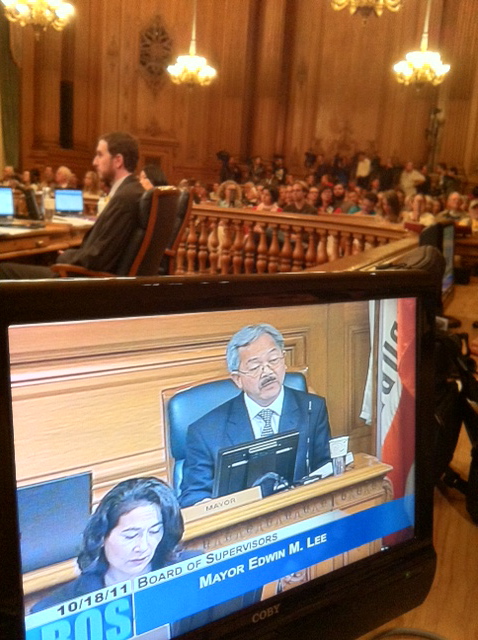
During the Board of Supervisors meeting on Tuesday, Mayor Ed Lee voiced support for the movement’s message, but said that tents, tarps, and cooking in the plaza or in OccupySF’s presence on the sidewalk in front of the Federal Reserve wouldn’t be tolerated.

A string of protesters testified against the policy and the two recent police crackdowns, which was also criticized by John Avalos and other progressive supervisors who are working on a legislative solution to the standoff. But at the Police Commission hearing the next night, Police Chief Greg Suhr seemed to announce that police would stand  down and allow the encampment to continue.

Protesters packed the meeting and disrupted the proceedings with chants of “SFPD where is your humanity” and accusations of police brutality at several recent raids of their camp. Many representatives made public comments condemning police brutality and repression of the protests, and many speakers also connected it with a broader problem of police harassment, notably in Bayview-Hunters Point.

Said OccupySF protester Christopher Ray: “Obama himself does not have the right to come tell us to stop, to tell us to take down our tarps, to tell us we can’t eat, to cook food, to sleep there. Period. You would have change the Constitution of the United States in order to do that. We’re not leaving.”

By the end of the long meeting, Suhr expressed support in what seemed like a promise to OccupySF: “We have no future plans to go into the demonstration. We know that it’s for the long haul. We did work, or, I’m told that we were trying to work all day Sunday to take down the tarps and the structures. We did meet last week and I did provide a written notice that’s been provided wholesale since down there. We realize that this movement could go on indefinitely, and as such, I’m actually working with the Mayor’s Office personally to put the port-o-potties and the handwashing stations down there to provide sanitation. I don’t know that anybody’s doing that. And in other towns where this movement has grown and is very large, they’re already experiencing things like dogs that have bitten people, rats, sanitation issues, the lack of running water so I can assure you that our efforts are to keep it safe and to facilitate the First Amendment demonstration.”

His statement was meant with a cry of “Now that’s what I’m talking about!” and thunderous applause from the chamber, and the OccupySF movement has interpreted the remarks as permission for the encampment to continue without further police harassment. Guardian calls to the SFPD Public Affairs Office to clarify the policy have not yet been returned.

By last night, the encampment’s numbers and infrastructure had grown — with a kitchen producing group dinners and new tents being added throughout the evening — and there seemed to be only a cursory police presence. Many protesters were essentially declaring victory, telling the Guardian that the numbers only grew after each police raid, expressing hope that the city has now had a change of heart. 

This comes after a rocky history of SFPD relations with the protest. On October 5, police issued a notice requiring all tents at the encampment to be removed. Protesters complied, but police still moved in, confiscated all the protest’s materials, and ended up making one arrest in the ensuing altercation. Since, OccupySF has mostly refrained from erecting any structures; instead, the growing numbers, now an average of 200 per night, sleep on the sidewalk. When they put up two tarps when weather turned rainy on Sunday the 16th, the result was another nighttime police raid, this time with five arrests and several injuries to demonstrators.

Yet the next morning, protesters had strung up more tarps.  And in the past few days, many have pitched tents. Now, tents number over 40, and the police are yet to raid.

On Thursday, California Nurses Association and the National Nurses Association worked with OccupySF’s medic team to set up a medical tent. The tent has been sorely needed for a while, but it is only recently that supporters of the protest felt safe creating it.

When the tent was put up, police came and circulated a notice that had been issued on Oct. 1 stating, “Tents, overhead tarps, and/or wooden pallets are not to be within the demonstration area unless appropriate permits are obtained because of the potential hazard they present.” But police exited without attempting to enforce this notice, and as of now the medical tent, complete with a cot and a growing stock of supplies, is still in place.

Said Pilar Schiavo, an organizer with CNA who has been working with OccupySF: “We were able to provide treatment to a bunch of occupiers today.” She says there are many at OccupySF with no other access to health care besides the new tent. “It’s just basic first aid so far, but a little goes a long way here. One had a broken finger from Sunday’s raid.”

Schiavo says when they set up the tent early Thursday morning, protesters Tweeted, Facebooked, and otherwise put out calls for needed medical supplies. Shiavo was proud to report that “supplies started showing up an hour later.”

Just a short BART ride away, city officials in Oakland have accommodated Occupy Oakland and it has grown into a large tent city with ever-improving infrastructure and organization. Perhaps OccupySF is now headed down the same path.

Editorial: Mayor Lee is tough as hell on Occupy SF protestors, but keeps City Hall safe for PG@E and the downtown gang

70

And so Mayor Ed Lee once again shows his true colors:  he is tough as hell on Occupy SF protestors and, unlike every other mayor in every other U.S. city,  sends in the cops to roust them out in  two midnight raids and trumpets the word  by bullhorn from the mayor’s office that he will harass them until the end of time. Meanwhile, he is is quietly sending  sending out the message that under his stewardship that City Hall will be safe for PG@E, the downtown gang, the big developers, the bailed banks, and the feds who are going after the dispensers of medical marijuana and the newspapers who run their ads.  (Full disclosure: that’s us at the Guardian.)  B3

EDITORIAL This is what civility and compromise looks like:

At a little after 10 P.m. Oct 16, a squadron of San Francisco police equipped with riot gear raided and attempted to shut down the OccupySF protest. It was the second time San Francisco has embarrassed itself, becoming the only major U.S. city to attempt to evict members of the growing Occupation movement — and this time, the cops used a lot more force.

The first crackdown, on Oct. 5, was supposedly driven by concerns that the activists were using an open flame for their communal kitchen without the proper permits. This time around, the alleged lawbreaking was confined to a Park Code section that bans sleeping in city parkland after 10 p.m. And since Justin Herman Plaza, where OccupySF is camped, is technically under the jurisdiction of the Recreation and Park Department, that ordinance could be enforced.

But let’s be serious: The encampment endangered nobody, and if any Rec-Park officials had actually complained, the police couldn’t provide their names. This was all about rousting a protest against corporate greed and economic injustice. It came with police batons, several beatings and five arrests.

And the mayor of what many call the most liberal city in America hasn’t said a word. Mayor Ed Lee was clearly consulted on the raid, clearly approved it — and now becomes unique among the chief executives of big cities across the country, most of whom have worked to find ways to avoid police confrontations.

David Chiu, the president of the Board of Supervisors, issued a ridiculous statement saying that “Both the Occupy SF protesters and the San Francisco Police Department need to redouble their efforts to avoid confrontations like the ones we saw last night.” No: The protesters didn’t start it, didn’t provoke it, didn’t want it — and frankly, did their best to avoid it. The crackdown is all about the folks at City Hall trying to get rid of one of the most important political actions in at least a decade — and doing it with riot police.

This is what the civility and compromise so touted by Mayor Lee and Board President Chiu looks like. And it’s a disgrace.

In Oakland, where the encampment at Frank Ogawa Plaza, renamed Oscar Grant Plaza for the event, has far more people than Occupy SF, city officials approached the activists and offered to issue whatever permits were needed. Mayor Jean Quan visited the general assembly, waited her turn to speak, and then politely asked the group not to damage the somewhat fragile old oak tree on the site. In deference to her wishes, the group surrounded the tree with a fence.

In New York, the private owner of the park where Occupy Wall Street is camped agreed not to evict the demonstrators — or even move some of them to all for a regular park cleaning.

Why is San Francisco acting so hostile? Is this not a city with a reputation for political activism and tolerance? Is it really that big a problem to allow activists to peacefully occupy public space to denounce the greatest corporate thievery in a generation?

San Francisco ought to be supporting the OccupySF movement, not harassing it. Lee should immediately call off the police raids. The Board of Supervisors should have a hearing on this, bring Police Chief Greg Suhr, Mayor Lee and representatives of Rec-Park and the Department of Public Health and work out a solution that doesn’t involve repeatedly rousting the protesters in the middle of the night. And if this continues, perhaps OccupySF should move to the plaza in front of City Hall.

Sup. John Avalos is the only person at City Hall who is making an outspoken effort to protect the protest; he needs some support.


OccupySF appeals to City Hall, but the standoff continues

40

Frustrated by repeated late-night police raids on their encampments and empty statements of support by top city officials, hundreds of protesters with OccupySF entered City Hall today – under the watchful eyes of a large police presence with riot gear at the ready – to testify at today’s Board of Supervisors meeting.

The meeting began with the scripted monthly question time session with Mayor Ed Lee, who was asked by Sup. Jane Kim – whose District 6 includes the OccupySF encampment, which she visited for a couple hours last night – to “describe the plan that our offices have been developing” to facilitate the OccupySF movement.

But in Lee’s response and in exchanges with journalists after the meeting, as well as Guardian interviews with people in both offices, it doesn’t seem city officials have a coherent plan for carrying out Lee’s contradictory goals of supporting the Occupy movement and keeping sidewalks and parks clear of encampments.

Kim seemed to acknowledge as much later in the meeting when she said voiced support for OccupySF and for city officials who object to tents, kitchens, and other basic infrastructure that the month-old movement needs to continue. “We’re all struggling to figure out the best way to accommodate it,” she said.

Lee’s message was even more muddled, saying he supported the movement and agreed with its economic justice message. “From the very beginning, I have fully supported the spirit of the OccupySF movement,” Lee told the crowd, transitioning into reciting a litany of economic development efforts with little relevance to the demands of the movement.

“Then don’t send the police in to destroy it,” a protester shouted from the audience, which was filled to capacity and had a line out front and an overflow room. “We are working with you,” Lee responded, but then went on to complain about the lack of consistent contacts in the leaderless movement and emphasizing his bottom line that any kind of encampment with infrastructure is an impermissible violation of city codes.

“I need to make sure our public spaces are open to be used by anyone,” he said. Later, his Press Secretary Christine Falvey clarified the mayor’s stance by saying he supports the message but not the movement: “The tactic of camping overnight, he does not support.”  

Afterward, talking to reporters, Lee couldn’t really explain why the police needed to do their raids in the middle of the night, why San Francisco is cracking down on conditions that are being allowed in many other Occupy cities, or how the movement might be able to avoid future crackdowns if it continues, ignoring questions about where OccupySF might be able to go to avoid police raids.

Sup. John Avalos, who has been working to try to mediate the dispute between OccupySF and the city, responded to Lee’s speech by calling it “very frustrating. I’m alarmed that he is moving toward nightly standoffs with the Occupy movement.” Avalos says he supports protesters’ right to peacefully occupy public spaces and acknowledges their need for basic supplies to do so, calling the current standoff, “unsafe for both sides.”

“I’m proud to say that we are the 99 percent,” Sup. Eric Mar said, echoing the movement’s mantra and saying he would defer to Avalos’ leadership to create a “resolution strongly holding the police accountable for the crackdowns.”

Avalos had invited OccupySF participants to raise their concerns during the public comment portion of the meeting, and he said that he plans to use their input to form a resolution or plan for how the city should accommodate a movement that six of the 11 supervisors professed to support at the meeting.

When the long line of OccupySF protesters finally took to the microphone for public comment, they made it clear that the issue wasn’t as complicated as some city officials were trying to make it.
“It is outrageous and inhumane to see our camp raided in the middle of the night by San Francisco Police,” Magic, a middle-aged woman and lifelong activist, told the supervisors, closing with, “This can be a celebration or a battle, but we will not back down.”

Several speakers were dismissive of city claims to be protecting public health and safety, noting how dangerous the midnight confrontations have been, saying food and shelter are basic human needs, and noting how peaceful and cooperative OccupySF has been with the escalating series of city demands as the protest’s numbers have grown.

Michael Goldman said police have asked them to return to the sidewalk in front of the Federal Reserve, where they are densely packed in what he called unsafe conditions. “We have too many people to fit in front of 101 Market,” he said.

That was what prompted the move to nearby Justin Herman Plaza, where police cracked down Sunday night, citing a violation of the park’s 10 pm curfew. Another protester who works at the Ferry Building angrily noted that even before OccupySF began, he regularly watched city crews chase the homeless away from the site at 3 am with water trucks.

“We are a peaceful and nonviolent people and we do not deserve to be treated this way by our city and our country,” he said.  

“They were waiting to be talked to and not just run over by the police,” said iconic San Francisco activist Father Louie Vitale, who gestured to the waiting protesters and said, “We’re very proud of these people, very proud.”

It was a point echoed by others like local resident Andy Blue, who said, “They are doing a great service to this city and the world.”

SF values and OccupySF

5

EDITORIAL This is what civility and compromise looks like:

At a little after 10 P.m. Oct 16, a squadron of San Francisco police equipped with riot gear raided and attempted to shut down the OccupySF protest. It was the second time San Francisco has embarrassed itself, becoming the only major U.S. city to attempt to evict members of the growing Occupation movement — and this time, the cops used a lot more force.

The first crackdown, on Oct. 5, was supposedly driven by concerns that the activists were using an open flame for their communal kitchen without the proper permits. This time around, the alleged lawbreaking was confined to a Park Code section that bans sleeping in city parkland after 10 p.m. And since Justin Herman Plaza, where OccupySF is camped, is technically under the jurisdiction of the Recreation and Park Department, that ordinance could be enforced.

But let’s be serious: The encampment endangered nobody, and if any Rec-Park officials had actually complained, the police couldn’t provide their names. This was all about rousting a protest against corporate greed and economic injustice. It came with police batons, several beatings and five arrests.

And the mayor of what many call the most liberal city in America hasn’t said a word. Mayor Ed Lee was clearly consulted on the raid, clearly approved it — and now becomes unique among the chief executives of big cities across the country, most of whom have worked to find ways to avoid police confrontations.

David Chiu, the president of the Board of Supervisors, issued a ridiculous statement saying that “Both the Occupy SF protesters and the San Francisco Police Department need to redouble their efforts to avoid confrontations like the ones we saw last night.” No: The protesters didn’t start it, didn’t provoke it, didn’t want it — and frankly, did their best to avoid it. The crackdown is all about the folks at City Hall trying to get rid of one of the most important political actions in at least a decade — and doing it with riot police.

This is what the civility and compromise so touted by Mayor Lee and Board President Chiu looks like. And it’s a disgrace.

In Oakland, where the encampment at Frank Ogawa Plaza, renamed Oscar Grant Plaza for the event, has far more people than Occupy SF, city officials approached the activists and offered to issue whatever permits were needed. Mayor Jean Quan visited the general assembly, waited her turn to speak, and then politely asked the group not to damage the somewhat fragile old oak tree on the site. In deference to her wishes, the group surrounded the tree with a fence.

In New York, the private owner of the park where Occupy Wall Street is camped agreed not to evict the demonstrators — or even move some of them to all for a regular park cleaning.

Why is San Francisco acting so hostile? Is this not a city with a reputation for political activism and tolerance? Is it really that big a problem to allow activists to peacefully occupy public space to denounce the greatest corporate thievery in a generation?

San Francisco ought to be supporting the OccupySF movement, not harassing it. Lee should immediately call off the police raids. The Board of Supervisors should have a hearing on this, bring Police Chief Greg Suhr, Mayor Lee and representatives of Rec-Park and the Department of Public Health and work out a solution that doesn’t involve repeatedly rousting the protesters in the middle of the night. And if this continues, perhaps OccupySF should move to the plaza in front of City Hall.

Sup. John Avalos is the only person at City Hall who is making an outspoken effort to protect the protest; he needs some support.

SFPD raids OccupySF again, using more force this time (PHOTOS AND VIDEO)

10

2:10 pm UPDATE: OccupySF plans to march on City Hall today (Mon/17) starting at 5 pm at Justin Herman Plaza.

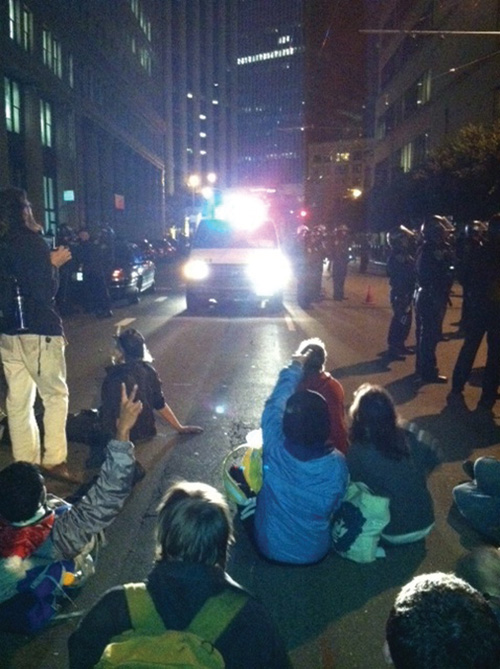
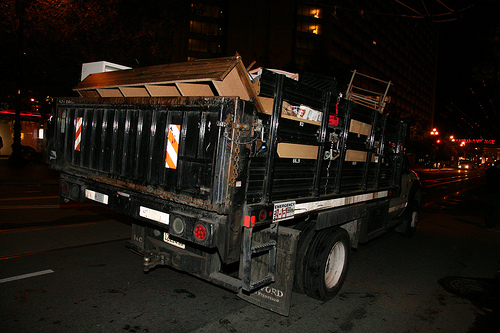
Police raided the OccupySF encampment for the second time last night. The events were similar to the Oct. 5 incident, where police stood in riot gear while the protesters’ materials were loaded into Department of Public Works trucks, then protesters sat, lay, and stood on the street around the trucks in an attempt to prevent them from leaving. In both cases, a kitchen and medical tent that had been set up by protesters were dismantled.

Police were by many accounts more aggressive than in the previous raid, which was the first direct police attack on an Occupy encampment in a major U.S. city. Last night, protesters were dragged, kicked, and struck by police officers, prompting the dispatch of an ambulance to take an injured protester to the hospital. There were at least five arrests.

Journalist Josh Wolf shot some excellent footage of the raid:

San Francisco Police Department spokespersons didn’t answer calls from the Guardian. Police Chief Greg Suhr told us after the last raid (which was also approved by Mayor Ed Lee) that they were only removing public safety hazards and “we will surgically and as best as possible and with as much restraint as possible try to deal with the hazards while protecting people’s First Amendment rights.” Yet last night’s raid shows the city is actually dealing more harshly with the Occupy movement than most cities. 

Around 10:15 pm, the group received a warning that police planned to enforce 10 pm curfew in Justin Herman Plaza. The camp had moved there on Saturday to accommodate growing numbers. Police informed protesters that they could not sleep in the park and that they would need to take down a few tarps that had been propped up, providing a roof for the kitchen and communications area in camp. They claimed that there would be no trouble if the camp moved back to their previous location at nearby 101 Market Street, on the sidewalk in front of the Federal Reserve Building.

Protester Katt Hobin served as a liaison with police throughout the night. She was skeptical of police claims that 101 Market Street was an “agreed upon spot.” Hobin told us, “We were encouraged to relocate. We were never told we could be at 101, or that we could be here.”

There were about 100 protesters gathered. In response to warnings of arrest for those who stayed at Justin Herman Plaza, about 30 moved to 101 Market Street. Protesters began texting, calling and tweeting supporters to come join, and by 11:30 pm there were about 200 protesters at camp.

At first, when asked, police could not provide any written statement detailing reasons for disturbing the camp or arresting participants. An officer whose nametag read G. Tom said they were there based on grievances from the Recreation and Parks Department, but that he could not name a specific individual who had complained. After some deliberation, police produced a copy of San Francisco Park Code Section 3.13, which prohibits sleeping in public parks during certain hours.

Sup. John Avalos, the mayoral candidate who has been most actively engaged with the OccupySF movement, negotiated with officers and protester representatives on speakerphone. Avalos suggested that the police come back during the day; Officer Tom replied, “It works better for us to do this in the middle of the night.”

After some negotiations, officers warned that if the tarps that had been erected were not taken down, they would have to proceed with the raid.

Around 11:30 pm, protesters met briefly and agreed not to comply with that order. Said one protester, “We took down the tents last time, and they still took our stuff and arrested people. We can’t trust them. We need to stand our ground.”

At 11:47, about 70 police in riot gear marched on to the scene. They surrounded the camp and began dismantling structures. At 11:53, Department of Public Works trucks pulled in and police began loading them with items from the camp. This included food, tarps, signs, and personal and communal items.

One protester had duct taped himself to a poll within the camp structure. Police ripped him off the poll, threw him to the ground and struck him in the head and ribs. When he left by ambulance a few hours later, he appeared to be convulsing or seizing.

As they had on Oct. 5, protesters poured into the street in an attempt to block trucks from leaving with their possessions. But the street next to Justin Herman Plaza, the southbound side of Embarcadero, separated from the northbound side by a large concrete platform, is quite narrow compared to Market Street where a similar confrontation happened last Wednesday.

Protesters were much more successful last night in blocking the trucks from leaving, and it took about an hour before the four DPW trucks were able to exit. Protesters sat, lay, and stood in the way of trucks, chanting “the people united shall never be divided” and “we shall not be moved.”

Between about midnight and 1:30 am, police tactics escalated. At first, they attempted to back the trucks out, but protesters ran to block all paths. Then one truck lurched forward onto the sidewalk dividing area, where protesters ran to block it as well as talk with the driver about why he was participating in confiscating their belongings.

Soon, police began dragging and pulling protesters who were in their way and the way of the trucks, throwing them from the street to the sidewalk. They also arrested four of those sitting in on the street.

Protester Ryan Hadar, 19, told us: “They bent back my thumbs, trying to pry me away from the people I was locking arms with. When I asked if they were trying to break my thumbs [one officer] replied, ‘only if I have to.’ Then they dragged me to the sidewalk by my index finger. I asked if they were trying to break my finger, and this time they replied, ‘Yes.’”

This level of activity continued about an hour. Protesters sprinted and zoomed back and forth on skateboards, blocking trucks from leaving in all directions. Police pushed protesters out of their path as they marched back and forth, trying to maintain hold of the situation.

At 1 am, the last truck successfully left. Police who had been behind the truck, pushing protesters away from it, were suddenly alone in a sea of OccupySF particpants. They quickly formed into a block, batons poised, as protesters encircled them. A tense moment passed before protesters broke out in cries of “the whole world is watching!”

There were reportedly 2,100 people viewing the live video stream of the events.

The altercation ended in a bizarre fashion, as police marched across Justin Herman Plaza, stopped in the tracks, then seemingly changed their minds and marched back towards the Embarcadero. A smaller contingent then reappeared at the corner of Mission and Steuart streets. Protesters formed a line confronting them and demanding that they release those arrested; a man who had been arrested at the previous week’s altercation had been held 10 days before he was released on bail funds raised by OccupySF.

One officer said that police would continue standing there until protesters left; many protesters were determined to stand until the police left. Eventually, around 1:40 am, police did decide to exit first. A chorus burst out, singing “Na na na na, hey hey hey, goodbye” as they left.

Ten minutes after the incident ended, about four tarps had been restrung and the camp had begun to rebuild its food and water supply. Protesters surveyed the aftermath, including loads of fresh vegetables and other food strewn on the ground near the former kitchen. Many picked up brooms and began cleaning, while others got to work compiling media information.

Those arrested were released around 3 am and arrived back at camp at 3:30. Xander, a protester who had been sleeping at the camp since its first night on Sept. 17, was one of those arrested. He recounted, “They hit me a couple of times on my shoulders and put me in the truck. We weren’t able to leave because our brothers and sisters had surrounded the truck. We were singing and banging on the walls.”

Those arrested were charged with resisting arrest and impeding traffic.


BREAKING: Police threaten another OccupySF raid

4

After moving yesterday from the sidewalk in front of the Federal Reserve into nearby Justin Herman Plaza, the OccupySF encampment is again being threatened by the San Francisco Police Department, which is telling the group the city will enforce the nighttime curfew on the park and protesters must disperse. Sup. John Avalos is trying to mediate the conflict and Guardian news intern Yael Chanoff is covering the situation from the scene. Check back in the morning for a full report on this and other developments in the Occupy movement and its many manifestations around the world.

UPDATE: During an impromptu General Assembly, OccupySF votes to peacefully defy the police and not take down the camp as ordered. You can follow live video of the action here.

OccupySF protesters shut down Wells Fargo HQ

30

At 7 a.m. this morning (Wed/12), protesters against corporate greed were poised for one of the most impactful actions since OccupySF began.

About 50 people associated with the Foreclose Wall Street coalition were seated in front of all the entrances to the Wells Fargo corporate headquarters on California and Montgomery streets. Back at the site of the OccupySF camp in front of the Federal Reserve Bank on Market Street, protesters gathered. They held a rally there that included a speech from Sup. John Avalos, the only mayoral candidate to actively support the movement.

When the march started off to join those blockading Wells Fargo, there were about 1,000 protesters present, according to estimates of those present. They stopped off at the Hyatt across the street from the Fed to support Unite Here Local 2 hotel workers who are involved in a boycott against the Hyatt before continuing in the march. Protesters chanted, “make banks pay” and “we are the 99 percent.”

The march reached the Wells Fargo building and began rallying there. The sit-ins in front of entrances were still going strong. There, activist and author Naomi Klein addressed the crowd.

When Wells Fargo employees began to arrive at work. According to Max Bell Alper, one of those involved in the blockade, “a number of bankers were trying to get in and yelling at us.” Then they called the police.

When the police arrived, Alper says, “at first, the people from the march were physically blocking them from arresting us.”

Around 8:30 a.m., 11 were arrested. They were brought to the North Beach/Chinatown police station, were they were cited for trespassing, held for about an hour and then released. When I spoke to Alper, he was back from the police station, chanting and marching with the crowd.

He told me that when his parents’ home was foreclosed this year, they moved in with his uncle, whose home was then foreclosed. Currently his grandmother is facing foreclosure. He listed Chase, Wells Fargo, and Bank of America as the banks involved in his family members’ foreclosures.

“Enough is enough. Banks need to recognize that they need to pay,” said Alper.

Protesters continued to block every entrance besides the employee entrance on Leidesdorff Street with sit-ins, as well as march in picket lines, chant “banks got bailed out, we got sold out”, and cheer as organizers spoke. The bank was unable to open until they chose to leave around noon.

SFPD Lt. Troy Dangerfield said that no more arrests were made because Wells Fargo did not request them- apparently, they preferred to wait it out. Said Dangerfield, “It would make it worse if they had to remove them. It doesn’t look good.”

Dangerfield insisted that he “had no stake whatsoever” in what will result from the Occupy movement throughout the country. He has noticed, “it seems like it’s growing nationwide.”

Activist Lucia Kimble sat helping to block the bank’s California entrance from 7:15 to noon. She says protesters voluntarily left at noon because, “We’ve been out here five hours. We successfully shut down the bank. I think our message has been heard.”

Kimble, 27, is a Bay Area resident and housing counselor with Causa Justa :: Just Cause, a group that works to advocate for housing and tenants rights for low income and African American and Latino communities in San Francisco and Oakland. Kimble said that her group was part of the coalition that put on this event “to give a voice to those most affected by our economic crisis.”

Kimble listed the Foreclose Wall Street West coalition’s demands with this action: an immediate moratorium on foreclosures, fixed annual interest rates, an end to Wells Fargo’s financing of high-interest Pay Day Loans, and that they “pay their fair share – pay taxes and give them to the community.”

Shaw San Liu of the Chinese Progressive Association – which just voted to endorse OccupySF and today joined the movement – was an energetic and inspiring speaker throughout the event. Said Liu: “A lot of folks have been saying there’s no diversity in the Occupy movement…In San Francisco it’s becoming clear the diversity of groups that support this movement. Youth, community groups, anti-war, we’re all coming together”

Liu maintained that the problems she was fighting did not start with the financial collapse in 2008. “In my work in Chinese immigrant communities, I know that even before the recession, we were already suffering from unemployment, low wages, and poor housing. I’m excited to see how the country is waking up to oppose a system that allows 1 percent of the people to control 42 percent of the wealth.”

The California Nurses Association, one of the many labor organizations that have showed support for OccupySF, was present at the protest. Said Pilar Schiavo, 36, a CNA organizer from Oakland, “I’m fed up with social inequity. I’m tired of corporate America buying politicians and passing laws to benefit the rich.”

“Patients are foregoing treatment and losing their healthcare. The nurses are here fighting for everyone,” she said.

Schiavo’s father, Bill, drove from Sonora to be at the protest today. A 65-year-old retired electrician, he says that the medical benefits he felt fortunate to have after retiring from a secure job have become unaffordable. “My medical benefits went up $300 a month this year. Who can afford that? Does anyone get a $300 raise? But Wall Street has benefits galore.”

Schiavo made his opinion clear about the Wall Street crisis and bailouts: “It was unbridled theft. We’re angry.”


Crackdown came from the top

8

steve@sfbg.com

The decision to raid the OccupySF protest camp in the middle of the night Oct. 5 was approved by Mayor Ed Lee and Police Chief Greg Suhr — and involved a more aggressive approach to limiting protest activities than authorities in any other major city have undertaken.

Both Lee and Suhr insist that they support the protesters right to free speech. But the raid was more than a modest effort to get a propane stove turned off or to bring food preparation up to health codes.

The move only served to galvanize the movement and increase its numbers. And both police and protesters say they expect this occupation to continue for a long time.

Suhr told the Guardian that the decision to move into the encampment and seize its supplies was made after consultation with the Fire Department, Department of Public Health, and the Mayor’s Office. While DPH expressed concerns about food preparation on the site, Suhr said health officials never asked the police to shut the kitchen down. The Fire Department was another story.

“There was open flame, propane, and tons of fuel, near plywood. The Fire Department told us there as a fire danger,” Suhr told us. “Deputy Chief Cashman made the call that we would go move the people away from the fuel.”

Suhr said Mayor Ed Lee gave the okay to remove public safety hazards, but said the protest itself shouldn’t be interfered with. “In San Francisco, protesters are acting within their First Amendment right to free speech and freedom to assemble. While allowing for peaceful protests, we also must ensure that our streets and sidewalks remain safe and accessible for everyone,” Lee said in a public statement, although his office has not responded to a list of questions about the decision and its implications.

After all, the tents and other shelters were hardly a hazard to anyone; leaving the activists out in the rain with no tents was, strictly speaking, more of a health issue.

A movement that calls for the indefinite occupation of public spaces to protest corporate greed is bound to continue to cause conflicts with local ordinances and property interests, something that Suhr acknowledged. “We will surgically and as best as possible and with as much restraint as possible try to deal with the hazards while protecting people’s First Amendment rights, Suhr said.

He objected to the notion that there was a police crackdown on the protest. “They’re occupying it now, and they’re probably going to be there was a long time,” Suhr said. “We haven’t arrested one demonstrator. The only person arrested punched a cop and then threatened to kill him afterward.”

But Sup. John Avalos, the one major mayoral candidate to show up during the raid and try to mediate the conflict, said he’s disappointed with the city’s stance. “This is not the San Francisco that I know. This is not the San Francisco I love. This City has served as a sanctuary for free speech and assembly for generations, and we must protect that legacy,” Avalos said in prepared statement that he closed with, “This should be a city for the rest of us — for the 99 percent. I stand with Occupy SF.”

Even Suhr said that the SFPD has no intention of removing the protesters from their perch in front of the Federal Reserve, and will continue safeguarding regular OccupySF marches, telling us, “We will continue to facilitate this.”

“They got everything out of there so we could start over,” Suhr said the encampment’s kitchen and other hazards. “This demonstration isn’t going away. I think people are justifiably upset by this issue nationally.”

SF’s foreclosure crisis

0

OPINION Foreclosures are still ravaging San Francisco neighborhoods.

As steward of the city’s property roll and head of the department that appraises every home in San Francisco, I see every day the toll the mortgage crisis is having on real estate values and the city budget.

Thousands of Notices of Default have been filed with my office in the last few years, and every Monday there’s a vivid reminder San Francisco is far from out of the woods on foreclosures as homes are auctioned off on the steps of City Hall.

Two Mondays ago, lifelong Bayview-Hunter’s Point resident Curtis Warren’s home — which my office assessed to be worth $165,000 — was scheduled to be auctioned because he had fallen behind on a $15,000 debt.

Imagine having your home foreclosed upon over a loan less than 10 percent of the value of the property. Imagine a family in your neighborhood being put on the street and a home in your community sitting vacant under such circumstances.

Fortunately, the foreclosure sale of Curtis’s home was canceled. Curtis is a member of the Alliance of Californians for Community Empowerment (ACCE) — a grassroots organization working to help victims of the mortgage meltdown.

Unfortunately, cases like Curtis’s are all too common. That is why I am fighting foreclosure as your Assessor-Recorder and working to get Sacramento to act, too.

ACCE recently published startling findings in their “The Wall Street Wrecking Ball” report.

San Francisco homeowners are estimated to lose $6.9 billion in property values as a result of foreclosures.

Foreclosure costs San Francisco government an estimated $42 million in lost revenue.

Local government spends an additional $19,229 on increased safety inspections, police and fire calls, and trash removal and maintenance for every foreclosure. This costs San Francisco $73 million.

San Francisco LITERALLY cannot afford this foreclosure crisis, which is why I have joined with Supervisors John Avalos, Malia Cohen and Ross Mirkarimi in support of the following plan of action:

A foreclosure fee to ensure banks pay their fair share: The city should charge a $10,000 to $20,000 fee per foreclosure to defray loss of home values and costs to taxpayers. This fee would raise roughly $2 billion to $4 billion over the next year to partially reimburse local governments.

A strong AG settlement. Any agreement between banks and the 50 attorneys general must include 1) a monetary settlement commensurate with the harm caused by banks; 2) limited release of bank liability; 3) principal reductions fairly distributed to communities hardest hit by predatory lending and foreclosure; and 4) homeowner restitution for irresponsible and illegal foreclosure practices.

Stop preventable foreclosures: The city should require court-based mediation programs to help homeowners modify loans and end the “dual track” process, whereby banks continue foreclosure proceedings while simultaneously negotiating loan modifications.

Wall Street must pay for foreclosure-related blight: Banks must maintain and pay for the cleanup of blighted, vacant homes in neighborhoods.

As long as our economy and housing market is being hampered by foreclosures caused by banks and Wall Street, we must continue to fight for common-sense solutions that protect our neighborhoods and the city.

Phil Ting is assessor-recorder of San Francisco.

On Guard!

1

news@sfbg.com

ORACLE’S DIRTY SECRET

If wealth trickled down from Oracle’s OpenWorld conference in San Francisco last week, very little of it reached a small group of low-wage laborers hired from out of state to set up for a concert hosted as an event highlight on Treasure Island.

Oracle is a prominent Bay Area tech company helmed by Larry Ellison, the billionaire CEO who worked closely with top city officials to bring the America’s Cup sailing regatta to San Francisco.

The Oct. 5 Oracle OpenWorld concert on Treasure Island featured Sting and Tom Petty as headliners. Registration packages for the weeklong tech conference, which drew some 45,000 attendees to San Francisco, ranged from $1,395 to $2,595.

A member of the carpenters union contacted the San Francisco Office of Labor Standards & Enforcement (OLSE) Sept. 16 to formally complain that a construction crew assembling a large seating structure for the event was being paid less than the city-mandated minimum wage of $9.92 per hour, city documents show.

Josh Pastreich, an OLSE official, went to the worksite to interview crew members. Their names were redacted from public records, but Pastreich described them as monolingual Spanish speakers who travel from city to city building seating arrangements for major events.

“Everyone is being paid $8 an hour (except for the supervisors),” he reported in a city document. “Workers generally started at 6:30 am but there was a little confusion about quitting times.” At least one work day lasted 11 and a half hours, according to a timesheet. The workers were hired by subcontractors brought in by Hartmann Studios, an events management outfit working directly for Oracle.

“We made a phone call, and sent them some emails,” OLSE director Donna Levitt explained. “Nobody said, ‘we intended to pay them the [legal] rate,'” but the subcontractors increased workers’ hourly wages to comply with San Francisco minimum wage ordinance requirements, Levitt said. Since the company adjusted the rate immediately, no fines were issued. There were fewer than 20 workers on the project.

OLSE did not correspond with Oracle directly, but spoke to the subcontractors. One was T & B Equipment, a Virginia-based company. “We were not aware of the minimum wage there, but we fixed it before the payroll was done,” a T & B representative identified only as Mr. Waller told the Guardian. Lewmar, a Florida-based subcontractor, assisted with staffing for the job. Oracle, Hartmann Studios, and Lewmar did not respond to Guardian requests for comment.

Since the enforcement agency intervened, the laborers earned $9.92 per hour instead of $8 — still well below the average Bay Area payscale for similar work. Building bleachers is comparable to raising scaffolding for major construction projects, and the prevailing wage for unionized scaffolding erectors in California is $37.65 per hour, or $62.63 when benefits are factored in.

None of the workers were from San Francisco, which likely spurred the carpenters union complaint — Carpenters Local 22 has faced significant losses in membership since the economic downturn due to high levels of unemployment disproportionately impacting the construction sector. Represenatives from Local 22 did not return calls seeking comment.

Boosters of the America’s Cup have hailed the upcoming sailing event as an engine for local job creation, but Oracle’s use of low-wage, out-of-state laborers at its pricey, high-profile OpenWorld event raises questions. While the tech company is a separate outfit from the America’s Cup organizing team, Ellison holds leadership positions at both.

Ellison was named the world’s sixth wealthiest individual in a Forbes profile in 2010, with a net worth of $28 billion. His total compensation last year was listed as $70,143,075. That’s 3,399 times the amount a person earning $9.92 an hour would make in a year working 40 hours every week — before taxes, of course. (Rebecca Bowe)


LEE’S TELLING VETO

The Board of Supervisors approved legislation to close a gaping loophole in the city’s landmark Health Security Ordinance on Oct. 4, in the process forcing Mayor Ed Lee to promise his first veto and reveal his allegiance to business interests over labor and consumer groups.

Sup. David Campos sponsored legislation that would prevent SF businesses from pocketing money they are required to set aside for employee health care, seizures that totaled about $50 million last year. These health savings accounts are often used by restaurants who charge their customers a 3-5 percent surcharge, ostensibly for employee health care, instead simply keeping most of the money.

Despite aggressive lobbying against the measure by the San Francisco Chamber of Commerce — which went so far as to threaten to withdraw support for Prop. C, the pension reform measure it helped craft with Lee and labor unions — the Board of Supervisors approved the measure on a 6-5 vote on first reading (final approval was expected Oct. 11 after press time).

But then Lee announced that he would veto the measure, claiming it was about “protecting jobs,” a stand that was criticized in an Oct. 5 rally on the steps of City Hall featuring labor unions, consumer advocates, and mayoral candidates John Avalos, Leland Yee, Dennis Herrera, and Phil Ting.

Lee and Board President David Chiu — who voted against the Campos legislation, along with Sups. Sean Elsbernd, Mark Farrell, Carmen Chu, and Scott Wiener — have each offered alternative legislation that lets businesses keep the money but make some minor reforms, such as requiring businesses to notify employees that these funds exist.

Both Lee and Chiu talk about seeking “compromise” and “consensus” on the issue, but Campos and his allies say it’s simply wrong for businesses to take money that belongs to the employees, to gain a competitive advantage over rivals who actually offer health insurance or pay into the city’s Healthy San Francisco program, and to essentially commit fraud against restaurant customers.

“This money belongs to the workers and it’s something that consumers are paying for,” Campos said. “We have a fundamental disagreement.” (Steven T. Jones)


ET TU, DAVID CHIU?

In a press release on Oct. 6, mayoral candidate David Chiu stated his concerns over Mayor Ed Lee’s potentially illegal campaign contributions from employees of the GO Lorrie airport shuttle service. That company benefited from a decision by airport officials in September and then offered to reimburse employees for making $500 contributions to Lee, according to a Bay Citizen report.

“These revelations raise deeply troubling questions that merit a full investigation by state authorities. City Hall cannot be for sale. Pay-to-play politics has no place in San Francisco, and will have no place in a Chiu administration — you can count on that,” he said in the release.

But has Chiu — one of the top fundraisers in the mayoral field — been engaging in a little pay-to-play of his own? That was the question we had after we saw that he had received lots of donations from restaurant owners, whose side he took last week in opposing Sup. David Campos’ legislation to keep them from raiding their employee health care funds.

The Golden Gate Restaurant Association (GGRA) waged unsuccessful legal battles against the Health Care Security Ordinance and lobbied against Campos’ recent reforms of its loophole. And in the latest donation cycle, the GGRA donated the maximum $500 to the Chiu campaign. Other Bay Area food services contributed up to $5,950.

So the question remains, despite Chiu’s posturing against “pay-to play politics”— are these food service companies contributing to Chiu’s campaign because he’s doing their bidding in opposing the Campos measure and sponsoring an alternative that lets them keep most of the money?

When Liane Quan, co-owner of SF’s Lee’s Deli, was asked if the health care legislation was a reason she donated, she said, “Yes, that’s one reason.” She then hesitated to elaborate why. Members of the Quan family associated with Lee’s Deli contributed a total of $1,000 to the campaign.

Maurizio Florese, an Italian-speaking co-owner of Mona Lisa’s Restaurant who contributed $100, didn’t want to talk about his contribution or employee health care. Neither did his wife and co-owner, Filomena Florese, who is also President of Mona Lisa Inc., which manufactures chocolate and pastry products.

In fact, despite leaving messages at seven local restaurants who donated to Chiu, none wanted to talk. But we did finally get ahold of Chiu campaign manager Nicole Derse, who said Chiu has a broad array of supporters and his donations from restaurants had nothing to do with his stance on the Campos legislation.

“There definitely is no correlation at all,” she told us. “Any suggestion to the contrary is ludicrous.” (Christine Deakers)

Chronicle taps Chiu, opening up the mayoral field

112

David Chiu has snagged the mayoral endorsement of the San Francisco Chronicle, beefing up his fairly paltry list of endorsers and giving his campaign something to trumpet with its hefty cash reserves in the final weeks. Most importantly, the endorsement opens up the race and probably hurts perceived frontrunner Ed Lee.

After the Examiner endorsed Lee as its top pick, it would have solidified the appointed incumbent mayor’s standing as the consensus pick of pro-business centrists – who always have a strong influence in the mayor’s race – if the Chron had also gone that way. But now, both that vote and the Chinese-American vote will be divided, with some of the latter also picked up by Leland Yee, who got the top endorsements of the Labor Council, Sierra Club, and other influential groups.

The Chronicle endorsement probably gives the biggest advantage to Dennis Herrera, who has placed second in most public opinion polls as well as many endorsements, including getting the second place nod in the Guardian, Examiner, Labor Council, Milk Club, San Francisco Democratic Party, and others – an impressive array that covers the full spectrum of San Francisco politics.

Lee, Herrera, and Jeff Adachi also got praised by the Chronicle in a companion editorial entitled “Three other candidates to consider,” and that will also help Adachi with his left-right punch and outsider appeal, making him another candidate who can’t be counted out just yet.

By opening up the mayor’s race and creating a more complicated calculus in the city’s ranked choice voting system, the varied list of endorsements and the dethroning of Lee as a done-deal could also be a boon to John Avalos, the consensus pick of the city’s left who has a long list of first place endorsements (including those of the Guardian, Milk Club, SF Democratic Party, and many others). Avalos could capitalize on the rising frustration with corporate America that is embodied to the Occupy movement, which he has been nearly alone among the mayoral field in actively supporting.

(You can read an Excel file of the endorsements of various San Francisco organizations, which we’ll periodically update, here.)

While the Lee campaign and the many independent expenditure groups that back him are expected to vastly outspend the rest of the field, obscene displays of corporate cash could end up backfiring this year, particularly against the backdrop of OccupySF and the business community’s raid on employee health care funds and deceptive surcharges on restaurant bills, which Chiu and Lee have been supporting.

Bottom line: with four weeks left until Election Day, the mayor’s race is still up for grabs.

The Hangover: Oct. 7-9

0

Jounce with us, if you will, through the Guardian staff’s frenzied weekend. Here’s our live reviews, hot raging, random sightings.

***Blow Up is reputed to be the best party in the city. I’ll say it’s almost certainly the best regular event for the 18+ crowd. But rule number one of going to a 18+ club event: don’t wear your nice shoes, even if the code does say “dress to impress.” It was only thanks to sheer luck and repeat viewings of The Matrix that I managed to avoid a geyser of projectile vomit in The Factory’s overcrowded men’s room Saturday night at Blow Up Forever II. “You go here.” I said, guiding the poor kid to the urinal I was about to use. “I’ll wait for the stall.” Click here for full story. (Ryan Prendiville) 

***Stationary bikes snuggled into the corners of Public Works’ sweaty cavern of a first floor, but the realness of the Bikes and Beats party on Friday was onstage. The event was billed as J Boogie’s album release party and the DJ spent the night doing what he does best: orchestrating sick collaborations. At one point he had Jazz Mafia (including emcee Aima the Dreamer) and Duece Eclipse sharing the stage with him simultaneously. That’s a lot of local live luminaries to look at. (Caitlin Donohue)

***Overt-sweetness ran emboldened through Twin Sister’s set opening for Pains of Being Pure at Heart on Friday at Slim’s, leaving a trail of cotton candy kisses in its wake. Lead singer Andrea Estella, hugging herself tightly, laid out tender and girlish vocals over the band’s funked out disco’d-Cardigans tone. The Long Island band, spread across stage in a perfect line at the front, pulled through decorated versions of “Bad Street” and other tunes off its highly enjoyable, recently released album, In Heaven. The only misstep, in my mind, is the oddly nasally pop tune “Saturday Sunday.” It’s too cutesy, the call and response of weekend days is at times cloying. By contrast, Pains of Being Pure at Heart kept it moody, with songs like “Heart in Your Heartbreak” recalling the darkened club scenes from Nic Cage classic, Valley Girl, when the Plimsouls’ thrust into “A Million Miles Away.” Quick tip: Slim’s has a pretty decent hummus plate. (Emily Savage)

***Completely inappropriate for a blog feature called the Hangover, but nonetheless we must give props to the Life Is Living Festival on Saturday in West Oakland’s De Femery Park for being the Bay’s feel-good event of the year. Was it the way the breakdancing children spun blithely on their heads? Maybe the youth parkour obstacle course, spoken word stage, or arts and crafts tables? Probs an amalgamation of it all. Plus, Los Rakas and ?uestlove made for a slammin’ live block party soundtrack. Click here for full story. (Donohue)

***(See accompanying photo) Someone had to make a statement at this weekend’s West Coast Cannabis and Music Festival — the medical marijuana industry is in absolute turmoil after last week’s forboding ruling by the IRS about Harborside Health Center’s tax status. Speaker Senator John Vasconsellos spoke to a multitudinous crowd at one stage (perhaps the free joints that promoters promised to anyone willing to take a seat upped number a little), and outside in the sunshine Rock the Bike bravely endeavored to keep the music stage pedal-powered, despite a location off the festival’s beaten track and corresponding dearth of volunteers.  

***Emotions ran high for the second consecutive sold-out Girls show at the Great American Music Hall last night. Chris Owens, JR White, and their talented ensemble were perfectly in sync as they treated us to a lengthy set highlighted by a trio of charismatic female vocalists. A powerful solo from one of the ladies made for an especially moving rendition of “Vomit.” Girls played nearly every song from Father Son Holy Ghost as well as old favorites like “Heartbreaker,” “Hellhole Ratrace,” and “Lust For Life.” The high point for me was the tender encore of “Jamie Marie,” which began with just Owens and his guitar on the flower ornamented stage before the rest of the band stepped out to resounding applause. The rapport between band members was palpable and I couldn’t help feeling a little bummed to be witnessing the closing chapter of their national tour. (Frances Capell)

***”This is the only mayoral candidate that’s doing drag events!” The woman at the door was, of course, wrong — just last week Lil Miss Hot Mess coupled with Queers for John Avalos to through the high school-themed Homo Homecoming at the Verdi Club. But last night’s Bevan Dufty’s “Politics is a Drag” campaign fundraiser was staged by the mayoral race’s only gay candidate, which was good enough reason to attract a Florence and the Machine-themed number from La Monistat and a return to the Sarah Palin costume that Anna Conda donned for a Work More! event — a reprise of a number she choreographed with the help of Guardian Managing Editor Marke B. (Caitlin Donohue)

***The Stevie Nicks show at The Fillmore on Sunday night was like a time warp to an early 1980s high school. Although most of the women in the audience were in their 40s and 50s, they were competing for “Best Dressed” like girls more than half their age. They paid tribute to their Queen Stevie in dark velvet, shimmering shawls, and long skirts. If I didn’t know better, I would say they’d kept those clothes in their closets for 20 years just for this occasion. But shopping with my mom has taught me that they sell it all at Chico’s. Click here for full story. (Ann Edwards) 

Few surprises in Examiner endorsements

15

The San Francisco Examiner – a paper with a generally conservative editorial stance, and one that endorsed John McCain for president in 2008 – has endorsed a slate of Establishment candidates for citywide office: Ed Lee for mayor, George Gascon for DA, and Chris Cunnie for sheriff.
That’s not really surprising, but its second and third choices for mayor were: Dennis Herrera second and Bevan Dufty third. Herrera was also the Guardian’s second choice and Dufty was someone we considered for third, choosing instead to go with Leland Yee. As the Examiner wrote, there are lots of qualified candidates in this race, and there were a lot more worrisome ones the paper could have picked.
For a newspaper that often takes ridiculous right-wing stances, such as its editorial last year denying global warming, the mayoral endorsement actually reads fairly reasonably. I don’t agree with its conclusion that Lee’s aversion to politics and business-friendly focus are good things, but I was happy to see the Examiner call out Lee’s cronyism and uncritical praise for bad corporate actors like PG&E.
“We do have some concerns about his ties to former power-brokers and off-the-cuff comments that are now being blasted in negative campaign ads. We implore Lee to work harder to separate himself from those who claim responsibility for his success, for they are just as likely to be responsible for any downfall. We ask that Lee, as we would any mayor to be open and honest about his relationships,” the paper wrote.
And its comments about the other candidates it liked were also pretty much on target. The only real criticism I would offer – and it is a significant one – is that progressive favorite John Avalos didn’t even get mentioned among the eight it discussed. WTF?
Now I’m sure they wouldn’t have had great things to say, given their conservative leanings. But to simply leave Avalos out shows the paper has a disregard and disdain for the left that is a big part of what’s wrong in San Francisco. It’s why our mayor and police chief can make this the first city in the country to launch an aggressive midnight raid on the Occupy Wall Street movement. It’s why the Chamber of Commerce can so shamelessly demand that businesses be allowed to drain the employee health funds that a hard-won city law requires them to provide.
San Francisco is not a progressive city, although a large number of San Franciscans are progressive and they have helped usher in a number of important progressive reforms, from worker and tenants protections to environmental initiatives, often through battles that Avalos helped wage on the people’s behalf.
So to ignore Avalos is to ignore progressives in this city. And they can steal our money or our tents, but we aren’t going away.

Lee backs crackdown; Avalos: “I stand with Occupy SF”

136

Mayor Ed Lee has just released a statement on last night’s police raid of the Occupy San Francisco encampment – claiming to basically support the movement but also support the harsh police crackdown and seizure of tents, food, and other personal property – that offers a sharp contrast to the position of his mayoral rival, John Avalos, who is condemning the SFPD’s actions.

Once again, as Lee also did this week in defending businesses that seize money set aside for employee health care costs, our “consensus and civility” mayor is showing that if you try to stand for everything, you end up standing for nothing. Yet Avalos understands that there are times when one side is simply wrong and that supporting the people means being willing to fight for them.

On both issues, Lee mouthed the meaningless “jobs” defense, claiming that he was trying to help working people by letting their employers raid their health care funds, allowing restaurants to fraudulently jack up their bills, or directing the police to seize their tents and food. That’s not just pandering, it’s insulting.

I’ve tried unsuccessfully to get Lee’s office to offer more detailed explanations of his positions, but they’re so far sticking to prepared statements that are riddled with contradictions. So we’re just going to run the full statements by Lee and Avalos and let you decide who makes more sense and best reflects San Francisco values.

Lee wrote:

“I understand and sympathize with the anxiety and frustration felt by so many in our country caused by a lingering recession and joblessness. That’s why I am doing everything I can to create jobs, get people back to work and make our families stronger here in San Francisco. I support the spirit of the Occupy Wall Street movement that calls for peacefully assembling to protest and bring national attention to disparity issues in our country.
“In San Francisco, protesters are acting within their First Amendment right to free speech and freedom to assemble. While allowing for peaceful protests, we also must ensure that our streets and sidewalks remain safe and accessible for everyone. I will continue to work closely with our Police Chief to ensure San Francisco responds appropriately to these demonstrations.  
“San Francisco is a city that embraces free speech and freedom to assemble like no other city.”

Indeed, no other city among the 60 or so that have followed the Occupy Wall Street example of occupying public spaces has sent police and trucks in to raid encampments in the middle of night, so San Francisco is indeed alone in its treatment of the movement that Lee shamelessly claims to support.

And now Avalos:

“Last night I gathered in solidarity with the protesters Occupying San Francisco. Like many people all over the country, I have been watching this protest gather strength and grow as more and more of us, more of the 99 percent, demand accountability from the corporations and people who are responsible for the destruction of our economy and devastation of our families.

“I came to down to observe the protest last night in response to summons from protesters and a notice from the police accusing their encampment of a number of minor infractions, ranging from open flames on a city street or sidewalk to serving food without a permit. I observed and negotiated with police in good faith to keep the peace and allow the encampment to remain, only to hear of a crackdown shortly after I left.

“This is not the San Francisco that I know. This is not the San Francisco I love. This City has served as a sanctuary for free speech and assembly for generations, and we must protect that legacy. With our unemployment rate nearing 10 percent, we have a responsibility to be a sanctuary for the 99 percent.

“Instead, last night we witnessed that 99 percent being detained, arrested, and intimidated with force.

“My vision is of a true sanctuary city – one that protects our right to free speech and assembly, and one that holds real criminals accountable. This should be a city for the rest of us – for the 99 percent. I stand with Occupy SF.”

Lee seeks to lessen political damage from his promised veto

3

Mayor Ed Lee says he will veto legislation that the Board of Supervisors approved yesterday that would have banned San Francisco businesses from keeping money they’re required to set aside for employee health care costs. But he seems to be worried about how that move will be seen by voters, touting his support for a “consensus strategy” that doesn’t yet exist and might not be possible given the fundamentally different way both sides see the issue.

The legislation by Sup. David Campos addresses the $50 million per year that businesses have been taking from their employees’ health savings accounts, which they set up to comply with city law requiring them to cover employee health care costs and which many restaurants subsidize by placing a 3-5 percent surcharge on their customers’ bills.

The San Francisco Chamber of Commerce and opponents of the Campos legislation defend the practice and cast efforts to reserve that money for employee health care as a job-killing loss to the business community, although some have finally come around to calling the practice a “loophole” that should be addressed with minor reforms. Yet labor groups and consumer advocates say businesses have no valid claim to that money, making it difficult to see where this elusive common ground might lie.

Supporters of the legislation – including mayoral candidates Leland Yee, Dennis Herrera, John Avalos, and Phil Ting, as well as Assemblymember Tom Ammiano, who authored the Health Care Security Ordinance as a supervisor – rallied on the steps of the City Hall today, calling for Lee to sign the legislation.

Shortly thereafter, the Mayor’s Office issued a press release with the headline “Mayor Lee Convenes Group to Improve Health Care Access & Protect Job,” announcing a “consensus building effort” that includes business groups and Campos and other supporters of the measure. Campos tells the Guardian that he did get a call from the Mayor’s Office today and he agreed to take part in the effort – just as he did in fruitless negotiations with Chamber officials – but he still has a fundamental disagreement with Lee and other Chamber allies over the issue.

“I talked to the Mayor’s Office about their proposal and I have indicated my concerns,” Campos said. He noted that both Lee’s proposal and another alternative by Board President David Chiu – who was quoted in Lee’s press release saying “I am committed to continuing the collaborative effort to ensure health care access to workers while protecting jobs.” – let businesses profit from money that’s supposed to be dedicated to employee health care

“So far, none of the proposals except for mine ensure that whatever consumers pay goes to health care,” Campos said, expressing confidence that public opinion is on his side. “It’s one of those issues that the more everyday San Franciscans hear what’s happening, the more outraged they are.”

But while Lee and Chiu each use the language of seeking compromise and trying to “close the loophole,” both rely on the basic Chamber paradigm that this money belongs to the businesses and setting it aside for employee health care as city law calls for would hurt “jobs.”

When Lee was asked about the issue by a group of reporters today, he said: “Next week, we’re forging a labor and management entities’ meeting with the Mayor’s Office and supervisors to try to forge changes to the Campos legislation. I cannot sign it the way it is now, because of two reasons. One, it does not focus on the healthcare needs of the employees; and two, it will force the employers to just keep millions of dollars lying around without any use and that will decrease the efforts to create more jobs. So both objectives have to be reflected in the ordinance, and I want to make the changes appropriate for that.”

The first reason seems to ignore the fact that the city is barred by federal ERISA law from telling businesses how to provide health coverage, which is why so many of them opted to create these health savings accounts – which are almost useless for people facing serious medical costs – rather than providing health insurance or paying into the city’s Healthy San Francisco program. And supporters of the legislation simply reject the validity of Lee’s second reason.

“That position is based on a false premise. This money belongs to the workers and it’s something that consumers are paying for,” Campos said. “We have a fundamental disagreement.”

Will Mayor Lee veto legislation that helps workers and protects consumers?

10

After the Board of Supervisors today voted 6-5 to bar San Francisco businesses from pocketing money they and their patrons set aside for employee health care, Mayor Ed Lee faces a tough but telling choice: Whether to heed business community demands that he veto legislation that has wide labor and consumer support.
A veto is widely expected, but complicating that decision is the position that was staked out today by one of his main rivals as a mayoral candidate, Leland Yee, who issued a statement echoing supporters claims that this is an issue of workers’ rights and consumer protection versus corporate greed: “This is a defining issue of who we are as a city. If Ed Lee vetoes this legislation, one of my first acts as Mayor will be to reverse his veto and sign this legislation into law.”
Neither Lee’s mayoral nor campaign spokespersons answered a Guardian email about whether he will veto the measure, which would kill it unless two supervisors who opposed the measure (David Chiu, Sean Elsbernd, Mark Farrell, Carmen Chu, and Scott Wiener) break ranks, which is unlikely given the polarization on this measure. San Francisco Chamber of Commerce officials have made a top priority of killing the measure, even threatening to withdraw support from Prop. C, the pension reform measure that they helped create with Lee.
At issue is the roughly $50 million per year that San Francisco businesses have been taking from health savings accounts they create for employee health care – funds that are often subsidized by 3-5 percent surcharges that many restaurants have chosen to tack onto their customers bills – under legislation that then-Sup. Tom Ammiano created to require employers to provide health care coverage for their employees.
The position of the Chamber – which fought Ammiano’s legislation and supported years of unsuccessful lawsuits challenging it – is that this $50 million “loss” to city businesses would be a “job killer.” Chiu has also accepted that paradigm and introduced legislation that would let businesses use that money, but require them to let employees know they can tap into it and other reforms. But supporters of the legislation say these businesses are deceiving their customers, defying city law, and stealing from their employees.
“People have tried to complicate this issue, but it is a simple issue. It’s about the right of workers to have health care,” Sup. David Campos, the author of the legislation, said at today’s hearing.
Campos said he would limit his comments, given how widely the issue has already been discussed, and he announced a limitation on how long employees could tap the fund after their termination “in the spirit of compromise.” But then opposing supervisors attacked the measure, its timing, and supporters’ refusal to “compromise,” with Elsbernd chiding Campos that his legislation is “not the best way to encourage jobs.”
So Campos went into more detail about why his measure was needed, noting that Chiu’s alternative would cap an employee’s access to health care at just $4,300, far less than the cost of a night’s hospital stay and a small fraction of the cost of a serious ailment. “You’re looking at a situation where very little could be provided for them,” Campos said.
He also said how important it is to ban the fraudulent practice of restaurants charging customers for employee health care costs and then simply keeping the money, a practice that a recent Wall Street Journal investigation discovered was widespread. Campos said 80 percent of the money collected on diners’ bills is pocketed by the restaurants.
“When consumers are paying for this, the expectation is that workers will have basic coverage,” Campos said, noting that his legislation would guarantee that “every cent that that consumer pays is actually spent on health care…This is not just about workers, it’s about consumer protection.”
Even worse, Campos noted that these consumers are actually paying twice for restaurant employees’ health coverage, first on their dinner bills, and then again as taxpayers when those uninsured employees end up in General Hospital with their expenses paid for by the city.
Under the federal ERISA law – which was the basis for the failed lawsuit challenging the city program, brought primarily by the Golden Gate Restaurant Association – the city cannot tell employers how to provide health coverage, and so they have the option of providing health insurance, paying into the city’s Healthy San Francisco plan, or providing the medical savings accounts that this legislation addresses.
Sup. Jane Kim said she supported the legislation largely because of the horror stories she’s heard from employees who not only weren’t told of the existence of these accounts, but who were denied payment for medical procedures even after they learned about them. She also said the city could be vulnerable to another ERISA lawsuit if it took Chiu’s approach of directing how businesses used their funds, citing an earlier discussion of the board’s role in protecting the city from litigation.
On that issue, Kim today introduced an alternative to legislation by Farrell and Elsbernd that would end the city’s program of providing matching funds to publicly financed mayoral and supervisorial candidates once their privately financed competitors break the spending cap. The US Supreme Court recently ruled a similar program in Arizona to be unconstitutional.
The Chamber and other downtown groups – mostly supporters of Mayor Lee, who are close to breaking the spending limits – had signaled their intent to sue the city over the issue. The Farrell/Elsbernd legislation, which needed eight votes to change the voter-approved program, today failed on a 6-5 vote, with Sups. Campos, Kim, John Avalos, Eric Mar, and Ross Mirkarimi opposed.

Endorsement interviews: Terry Baum

26

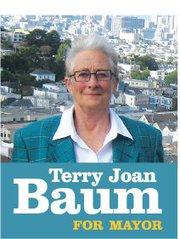
Terry Joan Baum is the Green Party candidate for mayor. She told us she got in the race to get progressive issues out and on the agenda; she was a candidate before Sup. John Avalos announced, and she says she’d be supporting him if she weren’t a candidate. She told us she’s the only candidate calling for criminal charges against PG&E in the San Bruno explosion. “I understand that I’m a longshot,” she said, “but I’ve already influenced the debates.” Listen to the interview and watch the video after the jump.


Baum by endorsements2011

On the streets with Occupy San Francisco

31

The messages sounded yesterday on the streets of San Francisco – delivered in speeches, chants, signs, songs, interviews, and the petition handed to Chase Bank officials by a half-dozen protesters before their arrest – should resonate with most Americans. After all, while rich corporations and individuals have been accruing ever more wealth, the vast majority of us have been falling behind.

“Banks get bailed out, we get sold out,” was one of those chants by the several hundred people who marched through the Financial District – our OccupySF effort building off the two-week Occupy Wall Street events – targeting some of the villains of the economic meltdown: JPMorgan Chase, Bank of America, Citibank, Charles Schwab, the Federal Reserve, and Goldman Sachs.

They may be relatively small and easy to ignore, these “occupations” of Wall Street and San Francisco and other cities that are entering their third week, but they’re being driven by a palpable anger and stirring critiques of economic and political systems that exploit the powerless. But as the foreclosures, layoffs, and other hardships continue, this nascent movement could have some staying power.

“I think it’s starting to wake people up out of their complacent distraction,” Robin Kralique, a 26-year-old SF resident holding a sign that read “Let’s have the GDP measure happiness,” told the Guardian. “We’re planting the seeds for a better future, and I’m hoping it wakes some people up.”

Like many of the young protesters gathered outside the corporate office building at 555 California at the start of the march, she was inspired by Occupy Wall Street. They’re angry watching their economic opportunities evaporate as more and more of the country’s wealth accumulates in fewer and fewer hands.

“There’s an insane amount of greed in this country,” 24-year-old Erin Kramer, a dancer and performance artist stuck in a corporate job she needs to get by, told me. Her sign read, “Don’t be afraid to say revolution!”

And many weren’t, with calls for revolution on the tips of many lips, albeit tempered with healthy doses of realism. “Even if it isn’t at critical mass yet, it sets the stage for the next revolution,” Kralique said when I asked her what she hoped this moment would accomplish.

Sup. John Avalos, a progressive mayoral candidate who spoke at the rally, is pushing legislation to create a municipal bank in San Francisco, one that would invest far more money in local projects and small businesses than Bank of America, which manages most of the city’s money.

“We have to figure out new ways to use our local dollars to help our economy,” Avalos told us. “The message here is we’re pulling our dollars out of these banks unless they help us.”

Before Avalos spoke – asking the boisterous crowd, “Have you ever felt like you’ve been had?” – activist Bobbi Lopez was on the microphone decrying the “lack of accountability for the people responsible for this decline.”

And then, the march was off – flanked by dozens of San Francisco Police officers on motorcycles, riding bicycles, and in cars – to deliver creative forms of protest around the Financial District, including a funny song and dance routine by Fresh Juice Party in front of the Schwab office, singing, “Land of the free, home of the brave, this is the street our labor paved.”

In fact, that was almost literally true at the San Francisco march, which was shepherded by off-duty city workers from SEIU Local 1021.

“This Wall Street thing is really spreading. The message of a small group of people in New York has really spread…Wall Street is a symbol of all this corruption, cronyism, and greed,” Gabriel Haaland, an organizer with SEIU Local 1021, told me at the start of the march. “It’s really resonated with our members…It’s been picking up steam as things have been unraveling over the last year.”

An hour or so later, Haaland was one of six people who staged an occupation of the Chase branch at Market and 2nd streets, along with two women in his union who have been unsuccessfully battling bank foreclosures on their homes – Brenda Reed and Tanya Dennis – and three other activists: William Chorneau, Manny S. Tucker, and Claire Haas.

Tipped off by Haaland, I was inside the bank lobby as the march approached and a police officer on a bicycle came inside to warn bank officials, “The protest is headed your way, you may want to secure the premises.”

He and another officer helped prevent protesters from getting inside, but the six protesters had already infiltrated the building. They began chanting and pulled blankets out of a suitcase, laying them out and placing them on the ground.

Reed spoke for the group, demanding to meet with JPMorgan Chase & Co. CEO Jamie Dimond to present a petition calling for a halt to the bank’s foreclosures. Through tears, she told the story of her long struggle to protect her home from foreclosure by Chase, which had taken her loan over from another lender.

SFPD Lt. M.E. Mahoney told the group, “You’re not going to be able to camp out here and wait for the CEO to come talk to you,” asking store managers whether they wanted to make a citizen’s arrest. They did, but Mahoney also told Reed that he would watch as she handed the petition to store managers.

“I’m here today because for two and a half years, I have desperately tried to get Chase to work with me,” Reed told a bank employee as hundreds of protesters outside looked on and chanted their support. “You have put me through hell. You’ve destroyed my health, you’ve destroyed my business, and it’s not fair what you’ve done.”

After she was finished, another bank manager (who refused to give his name) told Reed, “Just to let you know, we are compassionate to your cause,” drawing from the protesters the frustrated retort, “No you aren’t!” Through the day, protesters noted that the banks have been profitable and don’t need to be foreclosing on so many homes, sitting on so much capital, and funneling their profits out of desperate communities and into the accounts of wealthy investors – particularly after being bailed out by taxpayers in 2008.

Outside, the crowd chanted “Go, Brenda, go!” and “Let those people go, arrest the CEO!”

The crowd remained outside for more than an hour as police tried to wait them out, finally arresting the occupiers on trespassing charges and quickly citing and releasing them, apparently in the hope it would clear the people out of congested Market Street. “That was my quickest arrest ever,” Haaland, a veteran of many labor actions and progressive protests over the years, told me afterward.

Reed addressed the crowd on a bullhorn, explaining that she refinanced her home in 2007 with a shady “pretender lender” who misrepresented what her monthly payments would be. They ballooned to a level she was unable to cover and she sought a loan modification from Chase, which had taken over the loan from the now defunct Washington Mutual.

“Chase Bank is trying to steal my home of 38 years,” she told the crowd. “Jamie Dimond, come out from under your rock and let me talk to you.”

She decried how government bailed out the banks and then allowed them to aggressively foreclose on homes whose mortgages they didn’t originate, but who acquired the title out of the complex financial derivatives that has sliced and diced mortgages into complex financial instruments.

“It’s government-sanctioned fraud,” she said. Despite what she said were Chase’s plans to auction her home in Oakland next month, she pledged, “You will not get my home. You will not get what belongs to me.”

But whether that kind of fierce resolve – voiced over and over again, by hundreds of activists fed up with economic injustice – translates into any kind of real change is yet to be determined.

Occupy Wall Street comes to SF: VIDEO

24

Guardian City Editor Steven T. Jones is out in the streets this afternoon (9/29) covering the Occupy Wall Street protests that were brought to San Francisco by a coalition of labor and economic justice advocates, and inspired by ongoing demonstrations in New York City. Mayoral candidate Sup. John Avalos was spotted mixing with demonstrators as they flew signs calling for taxes on the rich.

“People are understanding that we’ve had the wool pulled over our eyes,” Avalos said, “and they’re fighting back.”

Here’s footage from the scene shot outside 555 California, a San Francisco skyscraper that was the former Bank of America headquarters and now houses offices for Goldman Sachs and other major financial players.

Video by Steven T. Jones

Progressives battle downtown over economic and political reforms

63

Battles between progressive members of the Board of Supervisors and downtown power brokers such as the San Francisco Chamber of Commerce defined City Hall politics for much of the last decade, until the new politics of “civility” and compromise took hold this year, a dynamic that has favored downtown interests. But now, a pair of important, high-profile issues headed to the full board on Tuesday has revived the old dynamic. And in both cases, wealthy interests are putting enormous pressure on the board.

The first involves a proposal – put forward by Sups. Sean Elsbernd and Mark Farrell, the two most conservative supervisors – to gut the city’s system for publicly financing campaigns because downtown is threatening a lawsuit. They propose to end San Francisco’s program of giving publicly financed candidates more money when a privately funded candidate exceeds the spending cap because the Supreme Court recently struck down similar provisions in Arizona.

This week, after convening in closed session to discuss the threat of litigation by downtown groups, the board voted 7-3 – with Sups. David Campos, Jane Kim, and Eric Mar opposed, and Sup. Ross Mirkarimi absent because he rushed out to large structure fire in his district – for the Elsbernd/Farrell measure, one vote short of the supermajority needed to amend the current city law.

Campaign finance reform advocates such as Steven Hill argue that it’s unfair to modify the city program right in the middle of an election season in which Mayor Ed Lee and the wealthy independent expenditure groups supporting him are poised to spend millions of dollars to defeat a large field of mostly publicly funded mayoral candidates.

Hill and his allies are appealing to Mirkarimi – who told the Chronicle that he is leaning toward supporting the amendment when the measure returns to the board on Tuesday – not to support what they consider an overly broad capitulation to downtown’s threats. They’re also lobbying Sup. John Avalos to switch his vote, while downtown players are putting the screws to supervisors as well.

In an interview with the Guardian, Mirkarimi clarified his stance, noting that he was the sponsor of the original public financing law and his goal is to protect it, even if it needs to be modified to withstand a legal challenge. “I’m looking for alternatives to fortify San Francisco’s program,” he told us, noting that he missed some of this week’s discussion and he’s hoping something can be done to retain provisions that level the financial playing field with wealthy candidates.

Meanwhile, downtown forces are pulling out the stops to kill Sup. David Campos’ legislation that would prevent San Francisco businesses from pocketing money they set aside for their employees’ health care under a city mandate that they provide health coverage – totaling about $50 million last year – legislation that gets its first hearing tomorrow (Friday/30) at 10 am.

Board President David Chiu has put forward competing legislation that is more to the Chamber’s liking, letting businesses (mostly restaurants that are even placing surcharges of customers’ bills, ostensibly to subsidize their legal obligations) keep the money. But Campos and his labor allies believe they have the six votes they need to pass the legislation, thanks largely to moderate Sup. Malia Cohen’s pledge to support the measure.

While even some supporters have quibbled with the timing of this measure, Campos notes the urgency of keeping money intended for workers in their hands. “It’s an outrage and the longer we wait, the worse it gets,” Campos tells us, noting that the practice, “is what many of us consider fraud.”

Unfortunately, even if the board approves the measure this Tuesday, it will still need the signature of Mayor Lee to become law. While he hasn’t formally taken a position, given that his political base is the downtown crowd, he’s expected to veto the measure. But we’ll ask him about it tomorrow when he’s scheduled to meet with the Guardian for an endorsement interview at 2 pm.