

In today’s epidsode, Johnny and Johnny talk about the most crucial under-reported issue of the day–net neutrality–plus Hurd’s fall at HP and Jerry’s Green jobs.

In today’s epidsode, Johnny and Johnny talk about the most crucial under-reported issue of the day–net neutrality–plus Hurd’s fall at HP and Jerry’s Green jobs.
SFPD Chief George Gascon kicked off today’s press conference about a Community Ambassadors program on the Third Street corridor by saying that it’s a grassroots pilot.
“This is not a police program, it’s a community program,” Gascon said, as he introduced Adrienne Pon from the Mayor’s Office to speak about what is being framed as a trailblazing effort to address violence on public transit at a time when money is tight all around.
Board President David Chiu, Sups. Carmen Chu, Sophie Maxwell and Eric Mar, and Chinese Chamber of Commerce consultant Rose Pak were also in attendance and everyone was all smiles and put on an apparent show of solidarity for what appears to be a desperately needed program
But Chiu did not know that the press conference was happening, when I called him last night for details. I’d assumed that he would be in the loop as the Board President and the most visible of the city’s top Asian American political leaders. But as Chiu confirmed today, he only was briefed a few hours before it took place.
Asked what was going on, Chiu waxed diplomatic.
“As you know, I didn’t know about it yesterday when you called,” Chiu said. “So, when I heard about it, I called the Chief and he sent the information. I’m happy this is happening.”
Oddly, when I called the SFPD this morning to confirm that today’s press conference was happening, I was asked who had told me about it. By then, I also knew that D. 10 candidate Marlene Tran was going to be speaking at the press conference. And while it’s great that Tran is an advocate for public safety programs, it’s weird that a candidate on the November ballot was in Gascon’s press conference loop, when Board President Chiu was not.
“We are in a neighborhood with serious public safety concerns,” Chiu told reporters today. “The issues that come from one of our ethnic communities are of concern for us all.
“We are working with the Mayor’s Office and the Chief,” Chiu continued, noting that the Board has been working hard to restore funding for violence prevention programs and to ensure there is funding for a new program for translation services.
“A multi-ethnic program is the type of program we need to move the healing process forward,” Chiu said, thanking the SFPD and the District Attorney’s Office for working to help victims of violence get help and translation services.
Sup. Maxwell talked about how the Ambassadors Program will be good for seniors, young people and very very young people.
“We need to make sure we continue these kinds of programs,” Maxwell said.
Sup. Eric Mar thanked AT& T for providing cell phones to the 12 outreach workers who have been trained as Community Ambassadors.
And Pon of the Mayor’s Office promised that this would be the first of many efforts to address public safety concerns.
‘There is no place for violence in the community,” Pon said. “Any time anyone gets hurt, it rips a hole in the fabric of society. It’s not just the recent acts of physical violence and threats against some of our residents. No one should have to contend with being spit upon and name-calling and threats.”
Thanking Sharen Hewitt, Rose Pak and “the courageous community members who came forward,” Pon said the pilot program will last until mid-September and will focus on the Number 9-San Bruno bus and the T-Third line. Funding is coming from the city’s general fund and federal job stimulus funds.
“Unfortunately, those funds are going to end in September, so we’re looking for funding from the corporate community,” Pon said, referring to AT&T.
She described the Community Ambassadors program as a “non-law enforcement presence.”
“People can get along regardless of their cultural and linguistic differences,” Pon said.
AT& T California President Ken McNeely talked about his company’s “long and storied history”, noting that the first transcontinental call happened over 100 years ago and involved a call from San Francisco’s Chinatown to New York City.
“We’re in the business of really connecting people,” McNeely said.
Sup. Carmen Chu said the pilot program is the beginning of efforts to build community across ethnic lines.
“It starts to sends a message about what we want to accomplish,” Chu said.
“Crime is not something we want to see tolerated,” Chu continued.
On August 3, the Board considered legislation that Chu authored to implement higher penalties for crimes on and around Muni. Like the Community Ambassadors program, Chu’s legislation came in response to recent attacks on Asian Americans by African-American teens. In one case, a group beat a 57-year-old woman then pushed her onto the tracks. In another, an 83-year-old man died in the hospital after he was assaulted.
If passed, Chu’s legislation would increase the penalties for aggressive pursuit and loitering while carrying a concealed weapon to $1,000 if the crime occurred on or around MUNI (as opposed to $500 for the same crime committed elsewhere.) The Board also recommended that juveniles convicted of these crimes be given community service or in-home sentences instead of probation or juvenile hall.
Police Commission President Dr. Joe Marshall was also on hand today to voice his enthusiasm for the Community Ambassadors pilot.
“This is pretty cool,” Marshall said. “We got a model. I don’t know if any other cities are doing this, but they should be. I commend the ambassadors for being involved.”
And D. 10 candidate Marlene Tran said the program represented an opportunity to work “for peace and harmony.”
“This is an auspicious occasion,” Tran said, noting that there would be “double happiness” in the Asian American community over two community hubs, one in Viz Valley, the other in the Bayview.
“We encourage more collaboration amongst our community,” she said.
Rose Pak, consultant to the Chinese Chamber of Commerce, hinted that she would be squeezing more money out of AT&T.
“I knew we had a problem, and I knew who to go to,” Pak said, noting that she wasn’t not going to let AT&T “get away with pilot support.”
“I expect them to write a big check,” she said.
Pon told reporters that the Community Ambassadors speak a total of seven languages: English, Cantonese, Mandarin, Vietnamese, Spanish, Samoan and Hawaiian.
But when reporters asked how City Attorney Dennis Herrera’s newly announced gang injunction against two warring street gangs, the Down Below Gangsters and Towerside Gang, in Viz Valley, might be compromised by the Community Ambassadors program, Gascon stepped forward.
“If thoughtfully implemented, gang injunctions can be a powerful tool,” Gascon said, noting he believes the Community Ambassadors will be a model that “we’d like to take to other neighborhoods.”
But how can 12 people armed solely with AT&T cell phones and fluorescent yellow jackets tackle what seems primarily to be youth violence against Asians? And what will happen in six weeks when the pilot program’s funding dries up?
“For the past two weeks, and continuously until mid-September, they are going through training at the SFPD and the MTA,” Pon said, noting that some of this training involved cultural and linguistic competency training.
“We’re building a pilot,” Pon continued. “The phones are preprogrammed to speed dial the SFPD, and we recruited these 12 ambassadors from over a hundred candidates in the Jobs Now program’s census outreach team. So, they are used to working in public and are comfortable with working with individuals of diverse backgrounds and ethnicities.
Pon acknowledged that the pilot has a shoestring budget.
“We are seeking private and foundation funding, so I’ll be doing lots of grant writing,” Pon continued, noting that a permanent program would need “at least half a million dollar budget.”
Asked if the Mayor’s Office was kept in the loop about today’s event more than Chiu, Pon smiled.
“SFPD called the conference and we are all making sure that we are working together,” Pon said.
But AT&T’s Ken McNeely was happy to talk about his company’s efforts to provide cell phones for connecting with first responders.
“Public-private partnerships are critically important,” McNeely told the Guardian.
“We’ve made education one of our key pillars for giving back,” he said. “ For us all to do well, it’s going to take public private partnerships.”
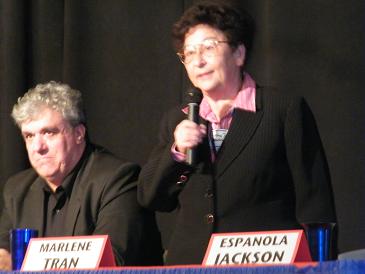
SFPD Chief George Gascon will roll out a pilot program today in an effort to address violence against Asians seniors on public transit.
A press release notes that the SFPD in conjunction with AT&T and the Office of Civic Engagement & Immigrant Affairs, which is a division of the City Administrator’s Office, has developed the San Francisco Community Ambassadors program.
“This is a pilot program, designed to enhance community awareness and safety,” the release states. “The pilot program will consist of community safety teams assigned to public transit locations in Visitation Valley and Bayview to provide a safe, visible and supportive presence for residents. This program will consist of 12 ambassadors who are from various cultural backgrounds. Many of the ambassadors are bilingual as well.”
D. 10 candidate Marlene Tran, who speaks Cantonese, Mandarin, understands Vietnamese and has taught English as a Second Language for 37 years, told the Guardian she has been working on community safety issues for 20 years. Tran also said that she recently did a bilingual survey in light of a wave of violence against seniors on the Third St. corridor.
“I have daily contact with students and residents, so I have my finger on the pulse of the community as a whole,” Tran said. “It’s a battleground out there, but for a long time no one knew about it, because many of the victims are not English speaking.”
“We want to be an integrated community,” Tran continued, “and seniors should have the flexibility to move around, but many of them don’t dare go out after 4 p.m., unless they are escorted, so having this program is a step in the right direction. Some of these cases are never reported. We need to encourage residents to be more proactive.”
Details of how the program will be funded and how long it will last remain sketchy at this point. Sharen Hewitt, founder of the Community Leadership Academy and Emergency Response Project (CLEAR), told the Guardian that she pitched the concept of having monitors on the bus some months ago, during her last meeting with Board President David Chiu and Sup. Carmen Chu.
“I suggested we take money from Trent Rohrer’s Jobs Now program to pay for it,” Hewitt said. “I also suggested we go to developers in the Bayview and engage them in a constructive conversation about donating dollars to help with translation services.”
Gascon and 12 ambassador staff will be present to speak about the program at today’s press conference, which takes place at 2:45 p.m. at 2574 San Bruno Ave.

Mayor Gavin Newsom was quick to frame the Board of Supervisors’ 10-1 vote for Lennar Corp.’s massive redevelopment proposal for Candlestick Point-Hunters Point Shipyard on July 27 as a sign that plans to revitalize the Bayview are about to begin.
“Now we can truly begin the work of transforming an environmental blight into a new center of thousands of permanent and construction jobs, green technology investment, affordable housing, and parks for our city,” Newsom claimed in a prepared statement after the board (with Sup. Chris Daly as the lone dissenter) approved Lennar’s 700-acre project.
The proposal calls for 10,500 residential units; 320 acres of parks, retail and entertainment facilities, green-tech office space; and a San Francisco 49ers stadium if the team decides not to move to Santa Clara.
But Kofi Bonner, who worked for Mayor Willie Brown before becoming Lennar’s top Bay Area executive in 2006, said the vote means he can start shopping the plan around. “Now we have to find some money to move forward with the project,” Bonner told the San Francisco Chronicle.
Given the stubbornness of the recession, Bonner’s revelation that Lennar has yet to find all the necessary investors means local workers and public housing residents could be waiting a long time for jobs and housing in Bayview. If and when the project finally breaks ground, it will involve building condos in the Bayview’s only major park.
These realities undermine the claims of Lennar, which used the mantra of “jobs, housing, and parks” in 2008 to sell Proposition G but made no mention of a bridge over environmentally sensitive Yosemite Slough or selling state parkland for condos.
Also disturbing, says Sierra Club local representative Arthur Feinstein, is the lack of any economic analysis to support Lennar’s claims that the bridge is needed.
Indeed, the only thing clear to longtime observers of the plan is that the much vaunted jobs won’t happen soon, most of the housing will be unaffordable to current Bayview residents, and Candlestick Point State Recreation Area, the only major open space in the Bayview, will be carved up so Lennar can build luxury condos on waterfront land.
These concerns have led the Sierra Club to threaten a lawsuit over issues on which Board President David Chiu was the swing vote in favor of the Lennar and Redevelopment Agency plan. Yet Chiu told the Guardian that the process got him thinking that it might be time to reform the redevelopment process.
“Now might be a good time to address concerns about the potential for inconsistency between Redevelopment and the city when it comes to land use and planning visions,” Chiu said. “And I have concerns about the tax increment financing process.” Tax increment financing allows the Redevelopment Agency to keep all property tax increases from the project, up to $4 billion, to use in redevelopment projects rather than into city coffers.
Chiu says the amendment he offered July 12, which narrows Lennar’s proposed bridge over Yosemite Slough by half, was based “on the belief that having a connection between jobs and housing is important. And I had understood that it would cost the developer an additional $100 million if the bridge was removed.”
But Feinstein counters that it’s hard to imagine that building a bridge over an environmentally sensitive slough will attract investors that support green technology. He is concerned that the development is expected to attract 24,465 new residents but that the Lennar plan fails to mitigate for transit-related impacts on air quality. “The Bayview already has the highest rates of asthma and cancer in the city,” Feinstein said.
Chiu says the supervisors can introduce separate legislation to address this concern. “It’s my understanding that an air quality analysis could be implemented by the board,” he said.
Although the board’s July 27 vote was a relief for termed-out Sup. Sophie Maxwell, its failure to support the no-bridge alternative, increased affordability standards, and an air quality analysis could result in expensive and time-consuming litigation, Feinstein warns.
And although Sups. Chris Daly, Ross Mirkarimi, David Campos, John Avalos, and Eric Mar supported all three of these amendments, they were ultimately thwarted by a redevelopment law that limits the city’s control of such projects.
During the meeting, Daly acknowledged that it would be impossible for Lennar to meet his 50 percent affordability amendment. But he noted that if the project becomes too expensive “there’s going to be a pretty new neighborhood with lots of white folks living in the Bayview.”
But after Michael Cohen, Newsom’s top economic advisor, said the project would not be financially viable with 50 percent affordability, Sups. Chiu, Maxwell, Bevan Dufty, Michela Alioto-Pier, Carmen Chu, and Sean Elsbernd voted against Daly’s amendment.
These same six supervisors voted against Mirkarimi’s proposal to eliminate plans for a bridge across Yosemite Slough, even though Cohen was unable to point to any economic analysis to support Lennar’s claims that the bridge is necessary.
Arc Ecology owner Saul Bloom, whose nonprofit did studies indicating that an alternative route wrapping around the slough is feasible, says Lennar’s plan illustrates the problem that San Francisco has with development. “Elected officials couldn’t do anything,” he said, except give the nod to a plan he describes as “developed by a mayoral administration and approved by that mayor’s political appointees [on the Redevelopment Agency board],” Bloom said.
“The message that the environmental community takes away from all this is that it doesn’t pay to play well,” Bloom continued. “No matter how much you spend to try and ensure that litigation is not the only way to obtain the desired outcome, ultimately the message that comes back from the city and the developer is ‘sue us!’ That brings out the worst political conduct, not the most appropriate.”
Feinstein wouldn’t confirm that a Sierra Club lawsuit is imminent, but predicted that if the coalition — which includes Golden Gate Audubon, the California Native Plant Society, and SF Tomorrow — goes to court, it’s likely to win. “If we do litigate, we’ll probably do it on a wide range of issues,” Feinstein said. “They approved a fatally flawed document, and they could provide no documented evidence of the need for a bridge — and admitted that publicly.”
Feinstein contends that Lennar’s plan has been a runaway project from the get-go. “The idea was to march it through before the mayor is gone with little regard for process. And despite all the much vaunted public meetings, little in the plan has changed,” he said.
Feinstein added that he was disappointed in Chiu’s stance on the bridge. “There were five supervisors in the Newsom camp, but as board President, Chiu had a responsibility to be more vigilant,” he said. “We told him what’s wrong with the bridge plan, but he didn’t share our view.”
“This is a rare opportunity,” Maxwell said before the board’s final vote. “It focuses public and private investment into an area that has lacked it in the past. It’s unmatched by any development project in San Francisco. This project is large and complicated, no doubt. But let us not be fearful of this project because of its scale, because how else can we transform a neglected landscape?”
But project opponents say everyone should fear a deal that required the board to ask Lennar’s approval to amend a plan that was pitched by the Newsom administration and approved by a bunch of mayoral appointees on the Redevelopment Commission with little chance for elected officials to make changes.
Mirkarimi said the problem with a process in which redevelopment law trumps municipal law is that it creates a shadow government in those few municipalities in California where the Board of Supervisors or City Council is not the same entity as the Redevelopment Commission.
“This is not the first time Redevelopment’s plans have trumped the concerns of local residents,” Mirkarimi said, referring to the agency’s botched handling of the Fillmore District in the 1960s, which led to massive displacement of African and Japanese Americans.
“I’ve been told, ‘Don’t worry, Ross, this is not going to happen, we’re not going to use eminent domain.’ Well, jeez, that’s a consolation, because even when we’ve exercised our legislative influence and given our blessing, [Redevelopment] unilaterally changed the plan after it left the board,” Mirkarimi said, referring to Lennar’s decision to replace rental units with for-sale condos when it first began work on the shipyard in 2006. “That suggests a condescending role in which the developer is able to go to the Redevelopment Commission and make a unilateral change.”
Mirkarimi’s concerns seemed justified after Cohen, Bonner, and Redevelopment Director Fred Blackwell huddled in a corner of City Hall during the board’s July 27 meeting to decide which of the supervisors’ slew of amendments they would accept. When Cohen returned with the amendments organized into three categories (acceptable as written, to be modified, and completely unacceptable), Mirkarimi’s no-bridge amendment had been sorted into the “unacceptable” pile.
“With regard to your insistence on the economic reasons [for the bridge], please point to which document says that,” Mirkarimi said, leafing in vain through the project materials.
Cohen mentioned “a lessening of attractiveness,” “a lower-density product,” and a reduction of revenue available through tax increment financing to pay for the bridge.
“Yes, but I’m still trying to look for the information and all I’m hearing is this pitch,” Mirkarimi said. “The economic study is absent. There are no supporting documents here. This is why I feel it’s justified for us to have a review of this.”
Cohen rambled on about “rigorous public discussion over a number of years” and claimed that a “huge amount of studies had been done.”
“But there is no economic study,” Mirkarimi repeated.
The board then voted 6-5 against Mirkarimi’s amendment after deputy City Attorney Charles Sullivan said that the only way to remove the bridge — since the project’s environmental impact report had rejected that option — would be to reject the entire plan. “I wish we had been able to eliminate the bridge,” Campos told the Guardian after the vote. “Part of the challenge we have is to reexamine how Redevelopment works and explore the potential for taking it over.”
Daly believes the bridge has nothing to do with connecting the neighborhood to the city. “The idea is to allow white people to get the fuck out of the neighborhood,” he said. “And it connects a different class of people to a new job without having to go through a low-income community of color. That’s why the bridge is needed.”
Mirkarimi said he was satisfied that he had dissected the arguments against the no-bridge alternative but fears that institutional memory is lacking on the current board. “A lot of my colleagues have not been involved in the debacle,” he said, referring to decades of problems with redevelopment in San Francisco. But Maxwell was all smiles. “I did my homework a long time ago — that’s why they couldn’t touch the core of the project,” she said. “They just added to and augmented it.”
Dear Andrea:
My husband and I are in our early 40s. We have been together 15 years and married for nine. We have sex about once a week, which is all we can manage with two little kids, two full time jobs, and everything else.
For about the past five years much of our sex has centered around light B&D play. We both find this kind of play arousing. At first, my husband needed some encouragement, but now it’s all we do. Even though it is sometimes super-hot, I’m also, sometimes, a tiny bit bored. I sometimes wish he found me as sexy and irresistible as mySELF as he does when I am in my submissive, subservient role. However, I notice that on the rare occasions when we have non-B&D sex, it is not as exciting for either of us. And my master … er, I mean husband … is capable of very tender acts of lovemaking, but only, it seems, when I am blindfolded and tied to the bed. Is there any way to make non-B&D sex as arousing as our little games?
Thanks,
Sign me Mwlf
Dear Mwlf:
You’re actually doing fine in the “how often” department. Once a week may be few people’s fantasy, but it is something like most people’s reality. You are — surprise! — normal.
As for what you’re doing fine with … here are your kudos for branching out a good 10 years into your relationship. Despite constant exhortations to try! new! sex! tricks!, most couples tend to gradually contract their repertoires, not necessarily on purpose, but out of habit, lack of attention, and the sense that “good enough” is actually good enough. Don’t get me wrong, good enough actually is good enough, often enough. But just as often people stop exploring and then end up wondering why the surrounding territory looks so damned familiar and, dare we say it, dull.
You are hardly the first to find it hard to reacclimate to so-called vanilla sex after a sojourn in kinkland. I don’t believe you can get “addicted” to silk scarves and stilettos. Neither do I believe that our bodies/psyches/neurochemical receptors inevitably build tolerance to sexual sensation and require ever more extreme whatever-it-is to achieve the same response.
I am not sure that the answer for you lies in “making non-B&D sex as arousing as your little games.” Sure, that would be good, but remember how in all those columns about female libido it keeps coming back around to women responding strongly to feeling desired? Or, as you put it: “I sometimes wish he found me as sexy and irresistible as mySELF?”
You may well be a bit bored, of course, but I think you’re feeling a bit under-appreciated, a trifle invisible. You need him to see you, not just the damsel in distress he has tied to the railroad tracks. Tell him. And try not to think of BDSM and vanilla as opposites. This is, like practically everything else, more of a spectrum than an on/off switch. Try the S-M -inflected vanilla for a bit. At least it would be different.
Love,
Andrea
Got a question? Email Andrea at andrea@altsexcolumn.com
steve@sfbg.com
These are strange days for the San Francisco Democratic Party, which is seeking to overcome bitter divisions on the local level and come together around candidates for statewide office that include Mayor Gavin Newsom, whose fiscal conservatism and petulant political style are the main sources of that local division.
The tension has played out recently around the Board of Supervisors deliberations on the new city budget and November ballot measures and in dramas surrounding the newly elected Democratic County Central Committee, where the battles during its July 28 inaugural meeting previewed a more significant fight over local endorsements coming up Aug. 11.
Almost every elected official in San Francisco is a Democrat. Newsom, the Democratic nominee for lieutenant governor, has been the main obstacle to new taxes that progressives and labor leaders say are desperately needed to preserve public services, deal with massive projected deficits in the next two years, and quit balancing budgets on the backs of workers.
“We balanced the budget without raising taxes. I don’t believe in raising taxes. We don’t need to raise taxes,” Newsom said proudly at his July 29 budget signing ceremony, during which he also effusively praised the labor unions whose support he needs this fall: “Labor has been under attack in this state and country. They’ve become a convenient excuse for our lack of leadership in Sacramento and around the country.”
That hypocritical brand of politics has been frustrating to his fellow Democrats, particularly progressive supervisors and DCCC members. At the July 27 board meeting, Sup. Ross Mirkarimi and Board President David Chiu reluctantly dropped their pair of revenue measures that would have raised $50 million, bowing to opposition by Newsom and the business community.
The San Francisco Chamber of Commerce has become such a vehicle for antitax and antigovernment vitriol that the DCCC on July 29 approved a resolution calling for the organization — which hosted a speech by Republican National Chair Michael Steele in June — to renounce the platform of the Republican National Committee.
“The Chamber is not a knee-jerk right-wing organization,” Chamber President Steve Falk felt compelled to clarify in a July 28 letter to DCCC Chair Aaron Peskin, closing with, “Anything you can do to avoid painting the Chamber as a pawn of the GOP would be greatly appreciated — because it just isn’t true.”
Yet Rafael Mandelman, who sponsored the resolution and is a progressive supervisorial candidate in District 8, told us the Chamber’s fiscal policies are indistinguishable from those pushed by Republicans. “They’re the leading force pushing the Republican agenda in San Francisco,” Mandelman said, calling the stance short-sighted. “It’s not in the long-term interests of the business community for our public sector to fall apart.”
Chiu’s business tax reform measure is a good example of how conservative ideology seems to be trumping progressive policy, even among Democrats. Only 10 percent of businesses in the city pay any local business tax, and the measure would increase taxes on large corporations, lower them on small businesses, create private sector jobs, bring $25 million per year into the city, and expand the tax burden to 25 percent of businesses, including the large banks, insurance companies, and financial institutions that are now exempt. But even the Small Business Commission refused to support the plan, prompting Chiu to drop the proposal and tell his colleagues, “There is still not consensus about whether this should move forward.”
Sup. Chris Daly, the lone vote against the budget compromise with Newsom and the removal of revenue measures from the November ballot, noted at the July 27 board meeting how the business community has sabotaged city finances, citing its 2002 lawsuit challenging the gross receipt taxes, which the board settled on a controversial 8-3 vote. “This is a large part of our structural budget deficit,” Daly said.
But antitax sentiment has only gotten worse with the current recession and political dysfunction, causing Democrats like Newsom to parrot Republicans’ no-new-taxes mantra, much to the chagrin of progressives.
“A lot of this is being driven by statewide politics. [Newsom] needs to not have taxes go up but he also needs the support of the labor unions, so we get weird stuff happening in San Francisco,” Mandelman said.
The situation has also fed Newsom’s animus toward progressives, who have enjoyed more local electoral success than the mayor. Newsom responded in June to the progressive slate winning a majority on the DCCC by placing a measure on the November ballot that would ban local elected officeholders from serving on that body, which includes four progressive supervisors and three supervisorial candidates.
Nonetheless, Newsom then unexpectedly sought a seat on the DCCC, arguing that his lieutenant governor nomination entitled him to an ex officio seat (those held by state and federal elected Democrats) even though the DCCC’s legal counsel disagreed. While noting the hypocrisy of the request, Party Chair Aaron Peskin took the high road and proposed to change the bylaws to seat Newsom.
Some progressives privately groused about giving a seat to someone who, as DCCC member Carole Migden said at the meeting, was “picking a fight” with progressives by pushing a measure she called “disrespectful and unconstitutional.” But in practice, the episode seems to have hurt Newsom’s relations with progressives without really strengthening his political hand.
Newsom ally Scott Wiener — a DCCC member and District 8 supervisorial candidate (who told us he opposes the mayor’s DCCC ballot measure) — proposed to amend Peskin’s motion to change the bylaws in order to seat Newsom with language that would allow Newsom to continue serving even if he loses his race in November.
That amendment was defeated on a 17-13 vote that illustrated a clear dividing line between the progressive majority and the minority faction of moderates and ex officio members. Even with Newsom and District Attorney Kamala Harris (who was seated as the Democratic nominee for attorney general) being seated — and counting the one absent vote, Sen. Leland Yee, who is expected to sometimes vote with progressives and sometimes with moderates — progressives still hold the majority going into the process of endorsing local candidates and allocating party resources for the fall campaign.
“Presuming that 17 people of that 33-member body all agree on something, then the presence of Mayor Newsom doesn’t change anything,” Peskin said. He also noted that even if Newsom’s measure passed and the progressive supervisors were removed, “the irony is that the chair of the party [Peskin] would appoint their successors.”
Also ironic is the political reality that it is Newsom who most needs his party’s support right now, while it is progressives who are adopting the most conciliatory tone.
“We should all be working to turn out the vote and help Democrats win,” Peskin told us. “I implore our mayor and lieutenant gubernatorial candidate to work with us and get that done.”
Yet after Newsom gave a budget-signing speech that included the line, “At the end of the day, it comes down to leadership, stewardship, collaboration, partnership,” he told the Guardian that he has no intention of removing or explaining his DCCC ballot measure, saying only, “If the voters support it, then it would be the right thing to do.”
Chiu responded to the news by telling us, “I hope the mayor can move beyond the politics of personality and build a party vehicle that is about unity.”
By Christopher D. Cook, Karl Beitel, and Calvin Welch.
OPINION It’s hard to trust hope these days — to imagine that our world, or even our city — could be different. But for the next 10 or 15 minutes, as you read this, we invite you to suspend the cynicism and disbelief that hang over contemporary life, and allow your mind to imagine that, yes, a different San Francisco is possible. Just for 15 minutes, although we hope this helps kick-start a much longer-term revival of hope and urban reimagining.
It’s time to create something new in San Francisco — a visionary movement for constructive change that’s bold and unapologetic. Imagine, for instance, if San Francisco became a national model for how cities can reinvest local profits (public and private) and assets to expand economic opportunity and social equity. Imagine if, instead of promoting a dispiriting and volatile blend of corporate development and Darwinian “free-market” anarchy, San Francisco transformed how American cities define success by creating concrete alternatives to the chaos of capitalism.
Now imagine that San Francisco had its own public bank — a fiscally solvent, interest-generating financial force (potentially a half-billion dollars strong) dedicated to public financing and economic stimulus, that functioned as a vigorous incubator for homegrown industries and sustainable, true-green job creation.
We are proposing no less than a reinvention of San Francisco — a dramatic shift in priorities, resources, politics, and culture that marries the very best in both creative innovation and urgently needed reforms to make our city socially equitable and sustainable, both ecologically and economically.
Toward this end, the Community Congress, Aug. 14-15 on the University of San Francisco campus, will stimulate ideas, discussion, and planning to reinvigorate civic engagement and inspiration and create a concrete, locally actionable agenda for reshaping the city. You’re invited. (Visit www.sfcommunitycongress.wordpress.com for more information.) The congress is a conversation starter and idea incubator — an opportunity to begin reimagining San Francisco as a socially equitable, racially inclusive, ecologically sustainable city that grows its own food, supplies its own energy, and is an affordable haven for working-class people, immigrants, artists, and creative folk of all stripes.
We humbly propose a city that embraces cosmopolitanism and international exchange while empowering its residents to achieve a decent and livable quality of urban life. We are not trying to turn back the clock; we are trying to create new forms of social and economic value that give people meaning and sustenance, and hope.
Couldn’t we save such sweeping aspirations for a rainy day? The sky isn’t falling yet, is it? Not quite, but the present constellation of crises San Francisco is ensnarled in — massive and rising structural deficits, a boom/bust economy that’s profoundly unstable and inequitable, deepening economic and social divides that destabilize communities, to name a few — is simply unsustainable.
San Francisco’s economic and fiscal crisis is not a passing moment. Rather, it signals long-term structural flaws in the city’s economic policies and planning. San Francisco has lost roughly 45,000 jobs since 2000, and each “recovery” is marked by steadily higher unemployment rates (currently resting at 9.2 percent). More critically, as jobs and wages have grown more precarious and housing prices have steadily risen (over the long term), thousands of San Franciscans have been displaced.
Any serious vision for change must incorporate race and class dynamics. Consider the economic evisceration of much of the city’s African American population, which has plummeted from 13.4 percent of the population in 1970 to just 6.5 percent today (more than 22,000 African Americans left the city between 1990 and 2008). The gutting of communities of color is intrinsically intertwined with issues of job and wage loss and soaring housing costs. This is particularly acute in the geographic and political dislocation of African Americans in San Francisco. Add to this picture intense overcrowding and poverty in Chinatown and in Latino and immigrant communities, and you get a set of inequities that are morally unacceptable and socially untenable.
Like other major American cities, San Francisco faces a crucial historical moment. Global warming and fast-dwindling oil supplies require a transformative shift in how we conceive (and implement) economic development far beyond the city’s current piecemeal approach to “green procurement.” The Peak Oil Preparedness Task Force, appointed by the Board of Supervisors in 2007, concluded that a full 86 percent of San Francisco’s energy use comes from fossil fuels, primarily petroleum and natural gas, and a small amount of coal. Given the world’s fading oil supplies and mounting climate chaos, this is simply unsustainable.
The specter of a looming energy and environmental crisis, combined with economic instability marked by persistently high unemployment, rising income inequality, systemically entrenched homelessness, consumer debt, and the deepening crisis of cutbacks to critically needed human services and affordable housing call for a radical shift in how society — and San Francisco’s economy — are run.
Transforming San Francisco into a truly sustainable city will mean dramatic shifts in what (and how) we produce and consume, and aggressive city policies that promote local renewable energy. Our economy — how our food, housing, transportation and other essential goods are made — will have to be rebuilt for a world without oil.
These and other limits mean we must redefine growth and profit—fast. Work and sustainability must become fully intertwined, and we must think creatively about how jobs can produce social and community value, instead of profits concentrated at the top.
Creating truly sustainable and equitable cities for the 21st century will also mean dramatic shifts in how we produce and consume. There is no better place to begin than here in San Francisco, long an incubator in progressive thinking and genuine grassroots action and innovation. In an earlier Community Congress in 1975, residents and groups from across San Francisco united in a movement of ideas and organizing that led to district supervisorial elections and successful campaigns to stem the tide of downtown corporate development, helping to democratize politics and economics in San Francisco.
The 2010 Community Congress is aimed at reinvigorating local movements for lasting change, both on the policy level and in the relationship between people and their government. We hope to inspire a spirited and creative shift in the city’s culture and politics — with concrete, politically actionable policies to democratize planning and development and a more sweeping transformation of our expectations — toward a far richer and deeper engagement of people and communities in their own governance.
What would this City of Hope look like, and how would it work? Consider what we could accomplish with a municipal bank. The City and County of San Francisco currently has almost $2.6 billion in highly liquid reserves, about $500 million of which could be used to fund a Municipal Bank of San Francisco. Once established (and federally insured), the Municipal Bank could take additional deposits and use this to issue more loans. The bank could promote economically viable worker-run cooperatives that produce goods and services addressing community needs — be it day care, urban gardening, or ecologically sustainable light industry that creates meaningful employment for local residents. The bank could provide competitive small-interest loans to help stimulate small-business development — the key economic engine of the city. Currently, access to credit is one of the primary impediments to small business growth in San Francisco.
The city could also start a Municipal Development Corporation to produce goods and services that meet essential needs, boost local employment, and generate surpluses that would be available for local reinvestment. San Francisco could launch itself on the path to local energy self-reliance with funds from the Municipal Bank, together with revenue bonds—raising large pools of capital to finance large-scale alternative energy investments such as solar panels to generate energy for sale to local businesses and households.
The proceeds could help subsidize community-based development such as urban farming projects that could grow food for our public schools. The Municipal Development Corporation could explore other initiatives like large-scale medical marijuana cultivation and development of a commercial fiberoptic network. Other ideas can be developed; we need to engage our collective imagination to envision what can exist if there’s enough people power and political will.
By expanding access to credit, municipalizing a chunk of the city’s assets, establishing an economically viable municipal development enterprise, and democratizing city planning and development, San Francisco can enable long-disenfranchised communities to create sustainable and diversified development — instead of fighting over “jobs versus the environment” and other false choices and getting nowhere for decades.
It’s time for proactive, community-led economic development that addresses urgent needs, from local hiring and training, to creating a diverse base of neighborhood-serving businesses, to ecologically sustainable and healthful development and planning that is driven by communities and residents.
San Francisco’s job creation policies can be transformed to prioritize community needs over corporate profits by linking major development contracts to strict local hiring and training, community benefits agreements that invest in social goods like childcare and in-home health services, and ensuring dramatic increases in the city’s stock of affordable housing.
We need to build new forms of public participation in local government in ways that address people’s everyday needs. For instance, the congress will propose a new partnership between residents and Muni to make Muni work better, involving current riders and drivers in a new, more powerful role in how Muni lines function.
We need to find better ways to sustain a diverse population of working-class, people of color, artists, writers, musicians, and others. We need to make sure development isn’t just code for finding new ways to gentrify neighborhoods and displace existing residents.
Specific proposals will address how the city and community-based nonprofits deliver critical health and human services to our neediest residents. We propose making this an integrated part of the budget process, not a last-minute afterthought. Toward this end, the Community Congress will present actionable proposals to create innovative “resident/government” partnerships to improve local government responsiveness and efficiency.
One of the keys to unlocking the city’s stagnating economy is progressive revenue generation and more democratic participation in budgeting. We must enlarge the public pie while reapportioning it in a way that stimulates job creation and shifts the tax burden onto the large businesses that reap vast private benefits from public goods and services. The city’s budget process must be dramatically reshaped and democratized. Communities need a seat at the fiscal table when the budget is being crafted — instead of lobbying tooth and nail at the end of the process just to retain funding that barely keeps programs afloat.
How can we build a participatory budgeting movement that brings residents and communities into the process? For instance, community budget councils composed of elected and appointed residents from every supervisorial district could assess neighborhood needs and incorporate them into drafting the budget. Whatever form this takes, the goal is to put the needs of residents at the forefront of how the city spends its resources.
The Community Congress can also help redefine fiscal responsibility. Taxing and spending must be accountable and transparent and respect the fact that this is the public’s money. Let’s be honest: much of what passes for government excess is due to management and executive bloat at the top, not salaries of frontline workers like bus drivers, social service providers, and hospital workers. True fiscal responsibility also means investing in prevention: education, healthcare, and services that help people build their lives.
It’s time to reclaim the public sector as the sphere of our shared interest. Rather than thinking in terms of the old paradigm that counterpoises “government” and “the market,” let us envision a new citizen movement to create a more participatory, democratic, and accountable system of self-government.
The San Francisco Community Congress is about bringing people together — community activists, those working in the trenches of our increasingly strained social services, our environmental visionaries, our artists, the urban gardeners and permaculturists, poets, bicycle enthusiasts, inventors … in short, assembling our pool of collective knowledge and wisdom, and yes, our differences — in a forum to discuss, debate, share concerns and viewpoints, and ultimately produce a working template that is both visionary and can be implemented.
The Community Congress will create a space for all of us to participate in defining our own vision of San Francisco. It is a first step toward reasserting popular control over economic development. It is an invitation to be visionary, rethinking in fundamental ways what it means to live in the 21st century city, and a forum for creating real, practical platforms and proposals that can be implemented using the powers of local government.
We want to propose a new vision of urban governance. Not more bureaucracy, more commissions, more departments, but the creation of new institutions that are democratically accountable and place new kinds of economic and political resources in the hands of ordinary citizens.
We don’t have any illusions. There are limits to what local government can do. Ultimately, deep change will require actions by higher levels of government. More profoundly, it will require a deeper change in citizen awareness, a rejection of life dominated by the pursuit of narrow self-interest, in favor of a more ecologically sustainable, socially just, and more democratic way of life.
But we can begin at the local level, here and now, to envision and implement the kind of changes that will need to take place if we want to insure that our city, our country, and our planet will be the kind of place we want our children to live. Please come. Bring your hopes, passions, and ideas. This is our collective project, our shared wisdom, our joint vision of the kind of city and society in which we want to live.
Christopher D. Cook is an author, journalist, and former Bay Guardian city editor (www.christopherdcook.com). Karl Beitel is a writer, scholar, and activist. Calvin Welch is the director of the San Francisco Information Clearinghouse and a long-time affordable housing advocate. This story was funded in part by www.spot.us
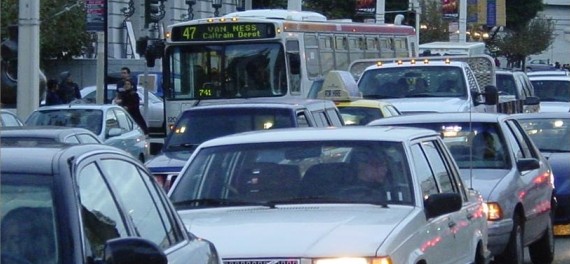
San Francisco is now one step closer to becoming the first American city to implement a congestion pricing plan as the San Francisco County Transportation Authority staff prepares to present their final study findings to the Board of Supervisors this fall.
Dubbed the San Francisco Mobility and Access Pricing Study, the investigation considered the costs and benefits of charging drivers a fee to enter or leave the most traffic-burdened areas of the city. The million-dollar study was funded through the Federal Highway Administration’s Value Pricing Pilot program.
“We’ve been looking at how we improve transportation options and conditions today and also how our city can grow in a sustainable and competitive way in the future,” SFCTA deputy director for planning Tilly Chang said Tuesday in the first in a series of public meetings.
According to the Transportation Authority, congestion pricing generally tends to “pick off people on the margin,” prompting drivers who don’t really need a car to ride the bus, walk or bike instead. If the system runs according to plan, commuters would see a 21 percent reduction in time spent on roadways and cause a 5 percent reduction in local greenhouse gas emissions.
“We also want to solve very real and current congestion problems, particularly for our surface transportation,” Chang said. “Our buses are operating on our city streets at rather low speeds.”
What’s more, the system is projected to bolster city revenue by more than $60 million annually. Zabe Bent, SFCTA principal transportation planner, said that extra revenue would be a necessity considering the enormous boom predicted for the city.
“Over the next 20 years, the region expects to add 150,000 residents and 230,000 more jobs,” Bent said. “This is essentially the population of Santa Rosa and all the jobs in Oakland today. So that’s pretty significant growth by 2030.”
Congestion pricing, Bent said, is an option that will both remedy the population increase and lighten the load of an underfunded public transportation system.
“We need to have solutions that are both managing demand and also generating revenue so that we can fund much needed improvement projects,” Bent said. “Some of that, we want to spend on capital improvements that could be provided up front or over the course of the program as well as Muni operating improvements on an annual basis.”
The toll zone has yet to be determined and the exact amount to charge drivers remains subject to change. Bent said that the model evaluated fees between 50 cents and $5. “A $3 fee in peak periods seems like the most viable option,” she said. “We’ve found that cost to be the most balanced. It encourages a substantial number of people to reduce congestion but yet doesn’t overwhelm the system.”
The most likely candidate for paid use is the area east of Laguna and Guerrero streets and north of 18th Street, a section the group is calling the Northeast cordon. A similar program was implemented in London more than five years ago, with drivers subject to fees upon entering central parts of the city. Stockholm, Singapore, and Rome also have congestion charges in place. Most recently, the city of New York supported charging drivers $8 upon entering the highly congested streets of Manhattan. However, the fledgling plan died after reaching the State Assembly last year.
Although the program was modeled after pricing plans in other countries, transportation officials said that the plan intends to account for the uniqueness of San Francisco, perhaps even using current electronic collection technology such as FasTrak.
“We want to preserve the urban design of the city,” Bent said. “We’ve heard ideas of mounting camera-based detectors on our existing mast arms or, potentially, new signs on the streets. Essentially, it would look very much like a red light running camera.”
The Transportation Authority held two informational meetings this week and has plans for two lunchtime webinars in August. Transportation officials said that the meetings were arranged with public feedback in mind, with each session containing an electronic polling segment and ample time for dissenters to ask questions.
To ease the minds of skeptics, Chang was careful to note that the congestion pricing plan would not be approved or finalized immediately.
“By no means would we be looking at doing anything tomorrow,” Chang said. “We understand that now is not any time to be adding to existing burdens and costs, but what we are trying to do is anticipate the city’s growth and development needs.”
Despite the lengthy timeline, the plan has come under attack by business owners and regional commuters. Hut Landon, executive director of San Francisco Locally Owned Merchants Alliance, worried that a $3 fee might deter customers from visiting shops within the cordon, thereby slashing profit.
“Any policy that will have a negative affect on businesses is misguided,” he said. “Local businesses are revenue and job generators and doing something that gives people less incentive to shop in certain areas is, I would argue, bad for San Francisco.”
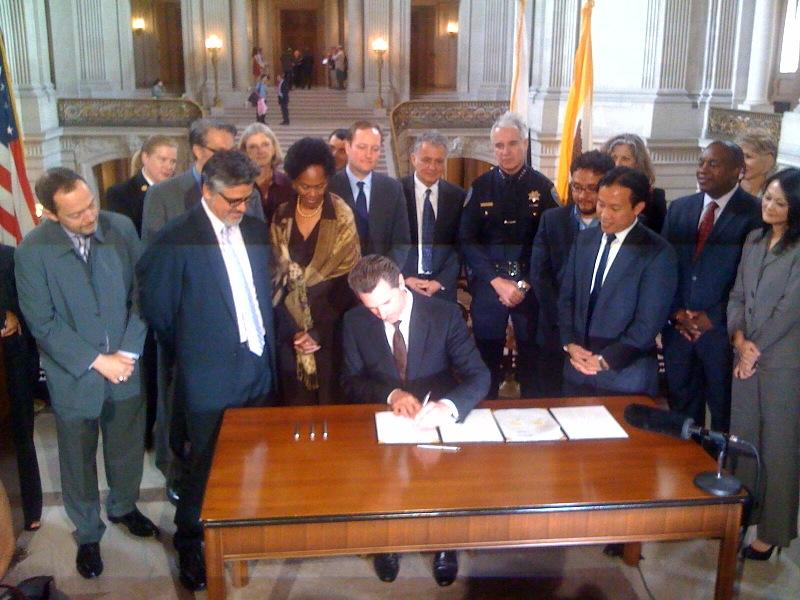
Hypocrisy hung thickly in the air at City Hall today as Mayor Gavin Newsom refused to responsively address glaring contradictions on a pair of high-profile policy stances, pursuing naked self interest while cloaking himself in deceptive but high-minded rhetoric. Newsom used the city budget-signing ceremony to effusively praise the labor unions that he publicly shamed into giving back $250 million over two years to balance the budget without tax increases, a budget that cut services and increased various fees and fines.
“Labor has been under attack in this state and country. They’ve become a convenient excuse for our lack of leadership in Sacramento and around the country,” Newsom said without blushing, defending unions against pension reform measures such as Public Defender Jeff Adachi’s SF Smart Reform, which he opposes while continuing to support the need for pension reform.
But Newsom seemed unaware that the layoffs, forced furloughs, and voluntary pay cuts accepted by the unions that he publicly demonized just a couple months ago and now praises – whose support he needs for his current run for lieutenant governor – is connected to his steadfast opposition to new taxes, which he reiterated today: “We balanced the budget without raising taxes. I don’t believe in raising taxes, we don’t need to raise taxes.”
Despite the fact that just 10 percent of San Francisco businesses pay any business taxes to the city, Newsom opposed and this week helped kill a measure by Board President David Chiu to reform the business tax system in a way that would increase taxes on large corporations, lower them on small businesses, create private sector jobs, bring $25 million per year into the city, and expand the tax burden to 25 percent of businesses, including the large banks, insurance companies, and financial institutions that are now exempt. Instead, labor took a deep hit and the city still faces projected $500 million budget deficits each of the next two fiscal years.
But Newsom’s hypocrisy isn’t confined fiscal issues. After the ceremony, he told reporters that he was sticking by his November ballot measure to ban local elected officials from serving on the Democratic County Central Committee, even after last night insisting that body give him a seat, which they had to change the bylaws to accommodate.
At last night’s DCCC meeting, members of an elected committee that includes four progressive supervisors and three current supervisorial candidates called for Newsom or his proxy John Shanley to explain why he is pushing a policy to ban locally elected officials from serving on the DCCC, a body in which elected state and federal officials automatically get seats.
“This mayor is on record as saying local officials should not serve on the committee,” Sup. David Campos said at the meeting, calling for Newsom to clarify this policy contradiction and offer his reasoning for the policy: “We don’t want to do anything that is inconsistent with what the mayor has said so far.”
Chair Aaron Peskin translated Campos’s comments as indicating “some level of irony or hypocrisy,” but Campos objected, insisting “it’s not a personal attack” but a genuine desire to know why Newsom sought to ban local elected officials after progressives won a majority of the DCCC seats in June.
Both Shanley last night and Newsom today gave the same legalistic answers, noting that he’s not serving in his capacity as the mayor, but as an ex officio member who automatically gets a seat for being the Democratic nominee for a statewide office (although the DCCC legal counsel said Newsom wasn’t entitled to a seat because the bylaws only award a seat when the current holder of the office being sought is a Democrat).
But DCCC member Carole Migden objected to Shanley’s answer, saying of Newsom’s effort to unseat duly elected members, “That’s picking a fight, if we want to be clear…That effects my vote, I have to say. It’s disrespectful and unconstitutional.”
DCCC member David Chiu noted that Newsom’s ballot measure would explicitly ban supervisors and the mayor from serving on the DCCC and said that the mayor still had a few days before the deadline for him to withdraw the measure, which he single-handedly placed on the ballot using his authority as mayor.
But today, when asked by the Guardian, Newsom said he had no intention of either withdrawing the measure or explaining it to the DCCC. When we asked about the contradiction in his positions, Newsom said only, “If the voters support it then it would be the right thing to do.”
He was similarly dismissive when other reporters continued to ask about the controversy, gesturing toward me with a dismissive wave of his hand as he said, “Certain people with certain newspapers major in the minor.”
After being told that Newsom is sticking by his DCCC ballot measure, Chiu told us, “I hope the mayor can move beyond the politics of personality and build a party vehicle that is about unity.”
Images by Luke Thomas
The Board of Supervisors found itself in the humiliating position July 27 of having to ask for the approval of Lennar and the city’s Redevelopment Agency before it could amend Lennar’s massive redevelopment plan for Candlestick Point-Hunters Point Shipyard.
If that’s not an argument for reforming how this city approaches redevelopment, I don’t know what is. Especially since the Board’s meeting illustrated only too well how thoroughly Lennar’s local executives, who used to work for the city under Mayor Willie Brown, understand this game and how to outfoxed any resistance to their ongoing effort to eat San Francisco whole.
“This is a rare opportunity,” Sup. Sophie Maxwell said ahead of the Board’s 10-1 vote (Sup. Chris Daly was the lone dissenting voice) to approve Lennar’s entire plan. “It focuses public and private investment into an area that has lacked it in the past,”continued Maxwell, who represents the district that encompasses the shipyard and Candlestick Point. ” It’s unmatched by any development project in San Francisco. This project is large and complicated, no doubt. But let us not be fearful of this project because of its scale, because how else can we transform a neglected landscape?”
But who wouldn’t be afraid of a deal that found Maxwell, Board President Chiu and Sups. Michela Alioto-Pier, Carmen Chu, Bevan Dufty and Sean Elsbernd joining forces to vote against Sup. Ross Mirkarimi’s proposal that Lennar be required to include a non-bridge alternative?
And who wouldn’t be doubly afraid, given that these six supervisors took that vote after Michael Cohen, Mayor Gavin Newsom’s top economic advisor, was unable to point to a single document to support his claims that Lennar’s $100 million bridge over an environmentally sensitive slough is actually needed?
Talk about scary.
To his credit, Mirkarimi did a good job of illustrating what’s wrong with a process that allows a private developer like Lennar to pitch plans and get mayoral appointees to approve them, but doesn’t allow San Francisco’s elected officials to make any amendments unless the developer and Redevelopment agree.
At the root of this travesty is the fact that redevelopment law trumps municipal law, a power imbalance that creates a shadow government in those few municipalities in California where the city council or board of supervisors is not the same entity as the Redevelopment Commission.
San Francisco is one such municipality, and, as Mirkarimi explained, this is not the first time that Redevelopment’s plans have trumped the concerns of local residents.
“I’m the supervisor for the Fillmore, the first urban renewal laboratory took place in my district, and I vowed to never let it happen again, ”Mirkarimi said, referring to the massive displacement of African Americans and Japanese Americans that took place when Redevelopment decided to makeover the Fillmore in the 1960s.
“I’ve been told, “Don’t worry, Ross, this is not going to happen. We’re not going to use eminent domain,’” Mirkarimi continued. “Well, Jeez, that’s a consolation! Because even when we’ve exercised our legislative influence and given our blessing, [Redevelopment] unilaterally changed the plan after it left the Board. That suggests a condescending role in which the developer is able to go to the Redevelopment Commission and have a unilateral change.”
Mirkarimi was referring to how proposed rental units on Parcel A, the first parcel of shipyard land released for redevelopment, became for-sale condos at Lennar’s request, without the Board having any recourse, even though the area surrounding the redevelopment is ground zero for the city’s last remaining African American community and home to other low-income communities of color.
Deputy City Attorney Charles Sullivan explained that the s supervisors would require the approval of the developer and Redevelopment to amend Lennar’s latest plan, under Redevelopment law. Failing that, their only recourse would be to reject Lennar’s plan in its entirety–a nuclear option that only Daly seemed prepared to carry through.
Sup. David Campos noted that the city’s legal advice had been “somewhat of a moving target.” His comment suggested the Board had been misled in the critical weeks before this final vote, including ahead of the Board’s July 14 vote to accept certification of the project’s final environmental impact report.
“When a number of us raised questions about the EIR, we were told we couldn’t, but that we would probably be able to make changes to the substantive plan,” Campos recalled. “But now we are getting a more complicated answer.”
Deputy City Attorney Sullivan said the situation was complicated, because some of the proposed amendments “don’t involve a simple stroke of the pen.”
But Campos pointed to the fact that Board President Chiu had introduced an amendment that only allows for a 41 ft. bridge across Yosemite Slough, thereby halving the width of the 82 ft. bridge that Lennar is proposing to build.
That amendment, which Chiu introduced July 12, leaves the door open for the 82 ft. version of the bridge, if the 49ers indicate interest in a new stadium on Hunters Point Shipyard, a possibility the city claims is still alive, even though Santa Clara voters approved a new stadium for the 49ers this June.
“So, why can you amend the plan to include a scaled-down version of the bridge but not eliminate it altogether?” Campos asked.
“You can make that motion by voting not to approve the project,” Sullivan said.
“So, the change has to point to something already embedded in the project?” Campos asked.
“Or not be a rejection of everything that’s already been brought forward,” Sullivan replied.
After Mirkarimi proposed his no-bridge alternative, along with a slew of other amendments that Daly, Campos, and Sups. Eric Mar and John Avalos had been working on to strengthen the proposed development, Cohen, Mayor Gavin Newsom’s top economic advisor, huddled somewhere in City Hall along with Kofi Bonner, Lennar’s top local executive and Fred Blackwell, the head of SF’s Redevelopment Agency to decide which of the Board’s amendments they would accept.
Cohen returned with the amendments organized into three categories: acceptable as written, modified, and completely unacceptable.
And predictably enough (to anyone tracking Lennar’s insistence on a bridge) Mirkarimi’s no-bridge amendment had been tossed into the “unacceptable” pile.
“With regards to your insistence on the economic reasons for the bridge, please point to which document says that,” Mirkarimi said, leafing through the project materials that were piled on his desk.
Cohen mentioned a number of factors, including an alleged “lessening of attractiveness,” “a lower density product” and a reduction of property tax revenue that would be available through tax increment financing to pay for Lennar’s proposed bridge.
“Yes, but I’m still trying to look for the information, and all I’m hearing is this pitch,” Mirkarimi replied. “The economic study is absent. There are no supporting documents here. This is why I feel it’s justified for use to have a review of this.”
Cohen talked some more about “rigorous public discussion over a number of years.”
“But there is no economic study,” Mirkarimi repeated. At which point a deafening silence pervaded the Board’s venerable chambers, much as if the emperor had shown up without his proverbial clothes.
Deputy City Attorney Sullivan broke the silence by indicating that the only way for the Board to move a no-bridge alternative forward would be to stop all project approvals and send the plan back to Redevelopment.
And Mirkarimi reminded the supervisors that at the Board’s July 13 hearing, Cohen had said that there was no conclusive evidence around the need for the bridge.
But then the Board voted 6-5 against Mirkarimi’s proposal, a move insiders said was more about not pissing off Labor, which hopes to create jobs for iron workers, and not pissing off Lennar, whose control runs deep and wide, and less about being convinced of the actual need to build over the last unbridged waterway in the city’s southeast sector.
And a couple of amendments later, the Board gave its blessing and it was all kisses and hugs and applause in the Board Chambers, even though the folks from Dwayne Jones Communities of Opportunities (COO) program, who usually show up to support the plan, strangely weren’t in attendance, rumoredly because their program has been cut off at the knees in the last few weeks, following Jones resignation as COO’s director.
“I wish we had been able to eliminate the bridge,” Campos told me after the Board’s final vote. “I think part of the challenge we have is to reexamine how Redevelopment works and explore the potential for taking it over.”
Mirkarimi was satisfied that he had dissected the arguments against the no-bridge alternative, but feared that institutional memory is lacking on the Board, and that without fundamental Redevelopment reform, the city is in danger of seeing this kind of travesty repeated, over and over.
“A lot of my colleagues have not been involved in the debacle,” Mirkarimo said, referring to how Redevelopment’s infamous role dates back five decades, and how Lennar has been working the local political scene for longer than most of the Board’s current members.
But Maxwell was all smiles.
“I did my homework a long time ago, that’s why they couldn’t touch the core of the project,” she said. “They just added to and augmented it.”
With Maxwell’s days on the Board drawing to a close, I asked what she’s contemplating doing next.
“Sophie is looking into water policies and conservation,” Maxwell said. “Without blue there is no green.
It was about then that Mayor Gavin Newsom released a press statement that blabbed on in vaguely frothing terms about what would happen next.
“Now we can truly begin the work of transforming an environmental blight into a new center of thousands of permanent and construction jobs, green technology investment, affordable housing and parks for our City,” Newsom said
His words came shortly before Bonner said that Lennar would now start looking for investors, and shortly after Cohen admitted that it could be years before anything in Lennar’s plan actually gets built. But none of them mentioned that the Sierra Club and other environmental groups are planning to sue the City over the bridge, an outcome that could have been averted, Sierra Club officials warned, if the No-bridge alternative had been included in the final redevelopment plan.
Stay tuned….
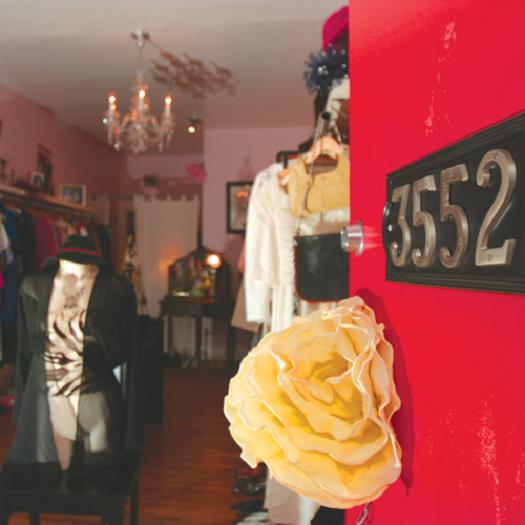
Best of the Bay 2010 Editors Picks: Shopping
Well before colony collapse disorder became a phrase of terror, Bay Area bee geeks were eyeing their neglected backyard anise and eucalyptus plants as potential ambrosial fill-up stations for honeybees. In 2008, Her Majesty’s Secret Beekeeper entered the scene, giving the city’s swelling ranks of colonial wannabees the ultimate sweet spot: a one-stop source for everything Apoidea. The clean, light-filled store — which has the distinction of being the only urban beekeeping store in the country — stocks backyard starter kits and supplies, those fabulous white hazmat-style suits (and really, haven’t you always wanted one for demonstrations or Halloween?) beeswax candles, books, bee DIY products (i.e., honey and honeycombs), and, yes, bees. Let’s face it, you haven’t really tasted SF or embraced its hive mentality until you’ve drizzled some Gold Fine Crystal over your locally baked artisanal bread.
3520 20th St., SF. (415) 744-1465. www.hmsbeekeeper.com
Shopping at P-Kok can be exhausting. You have to the cross the street, sometimes several times, just to take in all the cute clothes, bags, jewelry, scarves, etc. (and all at affordable prices) at P-Kok’s two Haight Street locations. It’s enough to make you want to find a tranquil garden, flop down on a chaise lounge with a beverage, and soothe your weary self with a sauna. At the P-Kok on the even side of the street (the one at 776 Haight), you can. Formerly the site of a day spa, P-Kok has preserved and replanted the inherited backyard garden sauna — renamed Eden — and rents it for $15 an hour. The best part: it accommodates up to 10. Packed like sardines or solo, it’s the perfect antidote to bustling Haight Street— and the perfect refreshment before going back out into P-Kok(s) and loading up on more cute stuff.
776 Haight, SF. (415) 503-1280, www.pkoksf.com
Distraction is the enemy of sock shopping — you came for ultrathin running socks, but omigod, the store has lilac suede Fluevogs with four-inch heels! Before you know it, you’re out $250 and you still have no socks. That cannot happen at SockShop Haight Street. The small, newish, locally-owned store has nothing but socks and sock-related habiliment, including high socks, low socks, toe socks, boot socks, jock socks, kids socks, dad socks, tights, slipper-socks, and sock monkeys. And within those categories, SockShop goes way deep with wool socks, striped socks, plain socks, dot socks, cotton socks, argyle socks, cashmere socks, skull socks, floral socks, flag socks, food socks, animal socks, music socks, holiday socks, fox socks, blocks socks, and rocks socks … Really, need we say more?
1780 Haight, SF. (415) 396-5400, www.sockshoponhaight.com
OK, not all of us can afford to buy some ancient heap of stones fixer-upper villa in Siena where, caressed by sun and Italian hunks, we blossom into writers (bite us, Under the Tuscan Sun and Bella Tuscany). No, we must make do in our fog-shrouded garrets, scrounging for dropped change for a $2 cappuccino. But at some point, we can all afford to splurge on at least one small piece of authentic Italian splendor to add luster to our hardscrabble lives. That’s when we head to Biordi Art Imports in North Beach, a floor-to-ceiling treasure trove of hand-painted Majolica ceramics. And once you start sipping your coffee from a gorgeous De Simone mug or spooning your gruel from a colorful Eurgenio Ricciarelli bowl, the virtual sunlight comes rushing in. You won’t miss that stinkin’ villa at all. Maybe the hunks.
412 Columbus, SF. (415) 392-8096, www.biordi.com
Be it ever so humble or token, city dwellers always seem to crave some connection to the natural world: the single bathroom orchid, the three desktop seashells, the rock and glass arrangement lining the windowsill. When it comes to finding these small grace notes (outside of illicitly pocketing them from Glass Beach or Muir Woods), our vote goes to Xapno. The small one-woman shop in the Lower Haight offers a beautiful and fragrant cornucopia of the best that nature and humanity create: fresh and dried flowers, plants, vases, candles, jewelry, cards, shells, branches, cacti, books, paper, paintings, and sometimes clothes and shoes. Furthermore, about half the artists are local, including a ceramics student at City College who has been baking baskets-full of delicate ceramic roses in varying shades of ivory, peach, and pink.
678 Haight, SF. (415) 863-8199, www.xapno.com
Ombre feather earrings, Hollywood Regency lamps, and two-headed chicks by way of the taxidermist — that’s what BellJar is made of. Less evocative of Sylvia Plath’s total collapse than a delicate glass chamber filled with oodles of fascinating objects, the Mission boutique has made a name for itself as the discriminating gothette or vintage girl’s go-to for unique tchotchkes and gifts for loved ones — or, better yet, one’s own bad, sweet self. Here, and on the store’s recently revamped website, you’ll find delightfully retro-esque and oh-so-womanly clothing, witty trinkets that draw inspiration from nature’s bounty, exquisite earrings and necklaces, and founder Sasha Darling’s dark-femme ‘n’ fabulous eye for the Francophile, the girly, and the gorgeously Grimm.
3187 16th St., SF. (415) 626-1749, www.shopbelljarsf.com

Seductively snug latex over a perfectly pert nipple — yes, please! Skip the tassels, beads and sequins, and go for a super-sexy set of pasties that show off your breasts and hint at the budding shape beneath. The Heartbreaker pasties by Madame S are individually fashioned by hand in the SoMa fetish wear and sex shop’s very own latex production lab by Madame’s devilishly talented crafters. Hidden in the back behind kinky-costumed mannequins and closed doors, your breast’s friend is taking on a cute, heart-shaped form right now and you should be anticipating ways to fit them into your daily wardrobe. Traditional black- and red-rimmed, these pasties are coquettish, classy, and come-hither all at once. Guaranteed to make jaws drop and temperatures rise with appreciation.
385 Eighth St., SF. (415) 863-9447, www.madame-s.com
Nothing celebrates life more than death — or at least, nothing is more invigoratingly creepy than opening a beautifully wrapped gift to find a life-size crown of thorns made with an assortment of deceased birds’ legs. Haight boutique Loved to Death is stocked with goose-bump inflicting fancies, many of which are gold-encrusted and way more thought-provoking than a living bouquet. Say “I love you” with a 24-karat badger-claw brooch, surprise him with a scorpion in a vial, or show her you care by putting an antique baby doll head under her pillow. Taxidermy (no animals were killed in the making — they were dead already), resurrected art, antiques, and goth-hip jewelry are way more fun when they test your lover’s limits. And if your delicate beloved can’t handle your purchase, you’ll get to keep the muskrat mandible gold-gilded earrings yourself.
1681 Haight, SF. (415) 551-0136, www.lovedtodeath.net
“We want to make things that have joy and humor, but that people aren’t embarrassed to have lying around their house,” says Gama-Go cofounder Greg Long. When Long and Chris Edmundson quit their day jobs at an East Bay toy company 10 years ago, they were following a dream to make well-designed, cartoon-inspired clothing and products that played off the enormously popular, collectible-crazy pop surrealism movement happening in L.A. at the time. It was a vision that launched a thousand T-shirts. Today, some of Gama’s cute-with-bite stock characters like Tigerlily, DeathBot, and that cuddly ice-bluish fave, Yeti, are common sights on city streets, clubbers’ chests, and shopaholics’ totes. And now there’s Go for your pad too. Guitar-shaped spatulas and “pot” holders that resemble big old Mary Jane leaves make perfect gifts for that urban class clown.
335 Eighth St., SF. (415) 626-1213, www.gama-go.com

Photo by Ben Hopfer
Screw a monument and urban planning: we live in City Beautiful. Walk down nearly any street in SF and there on the pavement and buildings you will find the stencils, murals, super burners, tags, and — how do you say? — art that makes this town rich in color, rich in mind. So where does the discerning street artist go for the tools and gear she needs to make these blocks pop? It’s gotta be 1:AM gallery, where prices on paint pens and aerosol spray trump the art supply and hardware stores every time. (1:AM as in “First Amendment” — and a tagger’s preferred rise and shine.) Not to mention the whole gallery side of the space, which hosts some of the most original sometimes-street artists around — who often tag the outside of the store’s Sixth Street walls in kaleidoscopic temporary letterings and designs.
1000 Howard, SF. (415) 861-5089, www.1amsf.com
Word to the aspiring pageant queens: (apparently) it’s not all about the Vaseline on the teeth and duct-taped boobs. You want that crown, you need a face full of grade-A goos and glosses — and we know just the place to get them, girl. Kryolan Professional Makeup has been in the primp game since 1942, plumping and perking a passel of pretties, including the 2010 Miss USA contestants. But maybe you’re a DIY kind of queen? All good — Kryolan’s got a kaleidoscopic showroom full of the glitz and glamour for them bright lights, including glitter in animal, vegetable, and mineral form (the company produces more than 16,000 products in 750 colors — over the top, just like you!). If you need help slopping it on in style, or just some tips on how to blend with a little subtlety, then strut, mamma, strut to application classes in the same building.
132 Ninth St., SF. (415) 863-9684, www.kryolan.com
Better circulation, cardiovascular health, time to reflect: running makes you free. (Especially if it’s away from an out-of-shape cop.) But pounding these city streets can be tough on the joints and bones. You’d like a little freedom from aching discomfort as well. So jog over to On the Run, an Inner Sunset shoe store that specializes in helping peeps in pain — seriously, half the store’s first-time customers arrive with a doctor’s referral. Its trained staff will send you for a walk on an electronic pad that measures foot pressure, plus pronation and supination (both refer to the angle at which your foot hits the block). They use a fancy device to measure your feet accurately, then hook you up with some sweet kicks that have you feeling fit, fast, and fab. You pay a bit more for all this podiatric prognostication, but hey, all runners know there’s gotta be some pain in the gain.
1310 Ninth Ave., SF. (415) 665-5311, www.ontherunshoes.com
The fog makes a great excuse for those with black thumbs. Usually we can blame our houseplants’ premature striptease of this mortal coil on the clouded vagaries of our mini-ecosystem. However, even fact-based finger-pointing fails when it comes to the death of a beloved succulent. One simply should not be able to kill a cactus. And yet one does. Sigh. Should your astrophytum be stymied or your once-verdant aloe shade into an unbecoming red, Succulence is there. This secret garden store is hidden away on a Bernal Heights video store’s back patio, packed with many a bulbous, spiny, or just plain prickly new friend for you to take home in an inventive recycled planter. But don’t ditch that sickly chum languishing in your window box! Succulence also mixes a special soil blend that can resuscitate even the saddest looking ball o’ spikes.
402 Cortland, SF. (415) 282-2212
In some lovely, distant universe, all we buy are magnificent orchids, and all the money goes to AIDS prevention and relief organizations. This impractically gorgeous fantasy becomes reality at nonprofit Orchid Mania’s beautifully named Orchid Temple, based in an unassuming house in the Excelsior District that contains a three-climate greenhouse. OM has packed its temple with orchids that resemble dancing ladies, some smelling of blood (all the better to woo their insect pollinators), that will stop your housemates in their tracks with their glory on your kitchen table. Call ahead to alert the temple guards — or show up during the all-volunteer operation’s open orchard hours, 11 a.m.-2 p.m. Sundays — and take your time browsing for a worthy cause. The temple also functions as a bulb foster home to keep rare species from extinction. Let’s just say they’re into the preservation of beautiful lives all around.
717 Geneva, SF. (415) 841-1678, www.orchids.org
You can’t walk by Martin’s 16th Street Emporium without ogling the ghoulish delights displayed in the windows. Casual strollers might be forgiven for thinking the place is called “The Skull Store” — an apt description, anyway, considering that the store is stuffed floor-to-ceiling with skulls galore. Though it’s not open very often (try Thurs.-Sat. afternoons — look for the pirate flag out front), it’s well worth a special visit to pick up a gift for your favorite skull collector. Sterling silver jewelry is the main attraction, with everything from dangerous-looking knuckle-duster rings (scary skull!) to delicate pendants and earrings (fashion skull!). It also carries skull figurines and other knickknacks, not all of them skull-related, but many of them vintage. Imagine stumbling upon an uber-cool, slightly spooky estate sale. If the estate was owned by Cap’n Blood, that is.
3248 16th St., SF. (415) 552-4631, www.skullsinsf.com
Do you need a dashiki-looking starter jacket, a grafted Italian fresco, an antique colored glass chandelier — like, yesterday? Friend, welcome to the power of collection. And welcome to Cottage Industry, the domain of a one Claudio Barone. The Italian-born Barone has spent the last 22 years traipsing about the globe, purchasing goods from indigenous craftspeople (at prices reasonable to all parties involved), and then retreating to Fillmore, treasure secured and ready to be squeezed into his darling shop — waiting for the day when you must, absolutely, positively, have that carved ebony figurine from the Congo, right away! Even if your mission lacks a hysterical level of urgency, do drop by. The piled shelves of goods ranging in price from 10 cents to $30,000 will either heighten or assuage the most pressing case of wanderlust.
2326 Fillmore, SF. (415) 885-0326
A gorilla sits in Japantown’s classic origami store. She’s squat and a little wrinkly, but say what you want about her lumps and rolls, she’s fantastically multidimensional — and even carries a little baby on her back. You can expect that kind of artistic wonder from Paper Tree, opened by the Mihara family in 1978 and run to this day by sisters Vicky and Linda, who constructed the primate in question. Not only can their shop meet your most fantastical origami needs (and those for quirky Japanese “office supplies” like sushi-shaped erasers and beribboned money envelopes), but the Miharas are serious about taking a role in their neighborhood community. Their lively origami classes and art, a staple for the last 43 years at the Cherry Blossom Festival, are testament to their desire to share the love of a good fold.
1743 Buchanan, SF. (415) 921-7100, www.paper-tree.com
There are those who blow and bluster about the lack of true beach weather in our city of rolling fog. And then there are those that smile and manifest sunbeams. Of the latter faction is Meggie White, whose Marina boutique, .meggie., imparts the same hope for rays as its fetching blonde owner. A breezy interior of hardwood and weathered white fixtures plays snazzy backdrop to .meggie.’s wonderland: fly floral sundresses share racks with the thinnest of sherbet-colored tees and cardigans. So stock up — what if that freak summer sunburst pokes through, and you without your pastels! .meggie. stocks several local designers, and White herself makes a supremely sand-worthy line of hand-forged silver, stone, and shell jewelry. So much more fun than that panicked schlep to J.Crew.
2277 Union, SF. (415) 525-3586, www.meggiejewelry.com
Stymied on the menu for tonight’s dinner? Try this: start with a solid base of local, independent business, add two cups of foodie focus, stir in equal parts retro chic and current craze, bake with a product no one can get enough of, and never allow to cool (serve each slice with a celebrity sighting.) Problem solved! Such is the taste of your new culinary North Star, Omnivore Books, which happens to be the hawtest cookbook-only lit shop in Noe Valley. Owner Celia Sack has stocked her shelves with yummy tomes both new and old, and the small space packs in hungry audiences for its stellar author events. Recent speakers have included New York Times food writer Frank Bruni and local cheesemonger Gordon Edgar. It’s enough food inspiration to sate the least decisive dining divas among us.
3885 Cesar Chavez, SF. (415) 282-4712, www.omnivorebooks.com
So you’re headed to psych class at City College one day when, on a dime, you say forget it — I’m going to follow my love and start a mini-skateboard empire in the Tenderloin instead. Welcome to the life of Johnny Roughneck. The boarder opened tee shirt treasure trove Dwntwn Skate Supply to hawk his Roughneck line of skate hardware and give a hand to new designers, like those of TL-repping clothing line The Loin, all while establishing a let’s-have-fun attitude in a neighborhood that often has its odds stacked against it. Occasional barbeques out on the Hyde Street pavement have given the shop some presence on the block, and Dwntwn has even played jump-off to some wildly legit skating events. Check out the video of the Roughneck crew’s 2010 Caltrain tour for Bay skating inspiration.
644 Hyde, SF. (415) 913-7422, www.dwntwnsf.com
Raising your fist is all well and good, but if your arm gets tired, you’ll want that rebel yell printed on your T-shirt for good measure. After helping to found the Mission’s community screen-printing shop, Mission Gráfica, radical artist Jos Sanches opened Alliance Graphics in 1988. He needed a place where he could continue to churn out his poster print protests against the world’s various sources of evil (capitalism, neoimperialism, commercialism, and a busted justice system, to name some of his faves) — and still be a resource for the progressive causes that to this day need a voice on the street. Does your war cry scream out to be monogrammed on a bumper sticker, backpack, or umbrella? Alliance can get the job done right, with union labor and made in the USA products to boot.
1101 Eighth St., Berk. (510) 845-8835, www.unionbug.com
Lord, these used clothing stores. The racks of oversized leggings, the bins of kitty-appliquéd sweatshirts, the puff paint visors. (Wait, are those hip now?) Who has the time for such excavations? There are times when you just want to throw your hands in the air like you just don’t care and head to the local Anthropologie. But back down off that ledge! Delisa Sage’s Collage on Potrero Hill can be your one-stop cool kid shop when you haven’t the time to rifle through Grandma’s old church dresses. Skone-Rees has stocked her boutique with well-edited used clothing at prices not too far above Goodwill price gouges. (Her nifty store of scavenged home décor is next door.) And you’ll never find her array of locally-made jewelry and well-preserved boots and slippers at any Salvation Army. But be forewarned: Collage’s collection of late 1990s failed tech startup mascot hats is a bit lacking.
1345 18th St., SF. (415) 282-4401, www.collage-gallery.com
Is there anything that Bianca Starr owner Bianca Kaplan can’t do? After moving on from her and hubby’s bangin’ DJ spot, 222 Hyde, Kaplan turned her eyes from beats to threads — secondhand designer label threads, which her Mission boutique sells to all the fly ladies looking for a clubby, classy, strappy looks (with just a hint of “Dynasty” decadence and chola sass) in which to creature up the night. Dresses, separates, handbags, belts, jewelry, and footwear: no detail is overlooked. Always collaborative, Kaplan picks chic up-and-coming designers to feature at her packed monthly stylist boutique events, and hands them the reigns to her racks for the night. And if you happen to stroll past Bianca Starr (so-called for her childhood friend’s coolest name ever) on a sunny day, you might just catch Kaplan and her girlfriends lounging streetside with a bottle of champagne. Wearing the cutest frocks you’ve ever seen, natch.
3552 20th St., SF. (415) 341-1020, www.biancastarr.com

Photo by Ben Hopfer
The mother-in-law’s birthday approaches, and all we know is that she likes to knit socks. Maybe we can help out with her frosty feet at the ImagiKnit store we always pass in the Castro? Probably great for some yarn — maybe a little bit fusty, too, though, and maybe somewhat intimidating to those who’ve never pearled. Imagine our surprise as we enter a rainbow wonderland busting with spectacular spun materials — spiky mohair, luminous silk, titillating cashmere, speckled cotton — and staffed by immediately accommodating people who don’t want to stick needles in our naïve newbie eyes. More shock: we run into several of our hippest friends leafing through vintage pattern books and holding court at the DIY wool winders. ImagiKnit’s community vibe and vibrant stock draw us in for hours. In the end we make the momentous decision to knit those socks ourselves. Sorry about the six toes, Mom.
3897 18th Street, SF. (415) 621-6642, www.imagiknit.com
Fountain pen lovers are a strange bunch. We spend hundreds of dollars on something that’s part status symbol, part jewelry, part objet d’art and, oh, yes, part writing instrument. Sometimes these works of exquisite craftsmanship write beautifully; sometimes they leak, skip, spurt ink all over the paper (and our hands), and don’t write at all. That’s why Stephanie Boyette, the fountain pen expert at Flax, is our favorite nibster. She can help you pick the right pen and ink, tell you how to use acrylic flow enhancers, give you tips on maintenance, and often tell you with a quick glance why your precious pen is malfunctioning. In fact, she’s so devoted that she’s been chosen to work as an apprentice to John Mottishaw, the Los Angeles nib-repair expert who is widely regarded as the best fountain pen surgeon in America.
1699 Market, SF. (415) 552-2355, www.flaxart.com
What’s that on your head? If it ain’t a wig, get thee to the Wig Factory, pronto, because every man, woman, boy, girl, dog, cat, bird, and goldfish needs at least one follicular embellishment to send their look into another, more fabulous dimension. The Wig Factory’s capital selection includes everything from utter realness to costume frivolity — it’s got you covered like Andre Agassi’s cranium after half a can of Ron Popeil’s spray-on hair. Devotees know that Wig Factory is subject to some controversy because of its rules limiting the number of hairpieces you can try on in a single visit, which some people complain about. Such folks conflate whining with Yelping — ignore them. Do you want to try on a wig that’s already been tested by a hundred finicky entitled shoppers who think their scalps don’t stink? We don’t think so. Queens and princesses, beauty is here, on a mannequin head. Kings and princes, you can look like Adam Lambert or a Brylcreemed silver fox in a single fitting.
3020 Mission, SF. (415) 282-4939
It’s easy to show your California love when it’s directed at Mint Mall, a SF-based online clothing shop that mixes fine originals with vintage finds. An appreciation for natural fabrics, an eye for vibrant eras of well-known and obscure labels, and the type of tough dedication required to make the best thrifting finds are three of the special ingredients that make up Mint Mall. But the two main factors are co-owners Corina Biliandzija and Genevieve Dodge, who teamed up over half-a-decade ago and have refined their own designs and vintage visions with each passing day. Mint Mall items are fun to wear and born from the pair’s love and enthusiasm for fashion and everyday style. Native fringe, Aztec or cartoon prints, bell-sleeved tunic tops, Grecian gold thread minis, Bergdorf Goodman floral maxis, Diane von Furstenberg silk wraps, Givenchy platforms, original hoodies — the dynamic duo behind Mint Mall work hard for your closet, so you better treat them right.
www.stores.ebay.com/the-mint-mall
Even before it opened, Candy Darling had a reputation, thanks to its fabulous name and kicky red plastic sign. Passersby were left to wonder — would it be a candy shop, or a drag queen fashion emporium? Those with a sweet tooth were the ones who received the happy answer, though, to be honest, there’s something wonderfully Grey Gardens about the store’s vintage 1960s or ’70s feel. Candy Darling the Warhol superstar was utterly unique, the essence of feminine glamour, and as soft and lovely as a lilac-scented breeze. Candy Darling the corner shop is a little paradise of sea-salt caramels, milk chocolate turtles, rocky road clusters, English toffee bars, and dark chocolate-dipped candied ginger. It does its namesake proud, which is no small feat. Visit Candy Darling just once and you might never see Mrs. See again.
798 Sutter, SF. (415) 346-1500
A great bookstore is almost like an inspiring place of worship, except more fun and more grounded in palpable truth. Some of San Francisco’s best bookstores are nestled into nooks, like the esoteric Bolerium, or ready to move, like 871 Fine Arts. The numbers in this tome emporium and gallery’s name are enigmatic: for years, it brought some historical heart and heft to the art biz maze that is 49 Geary, and now it’s at 20 Hawthorne, another half-hidden location. (So the name’s obviously not address-oriented; perhaps it refers to the year Viking king Bagsecg died?) Owner Adrienne Fish has developed a selection of art books that is simply second to none in SF — 871 mixes old and new titles, is well-organized, and brings a sense of depth and breadth to any movement or era. The layout and lighting are attractive and efficient, and browsers and buyers can also enjoy an art show during a visit, since Fish’s curatorial acumen regarding California art is extra-sharp.
20 Hawthorne, SF. (415) 543-5155
Great reasons to use a glass dildo: they last longer, they’re less likely to harbor harmful bacteria, they retain temperature well — and on first glance, they more resemble works of fine art than hump handles. It was this urge toward aesthetic excellence that compelled Samantha Liu to open Glass Kandi, the display shop for her online catalog Glass Dildo Me. Liu provides expert guidance to the adventurous singles and curious couples who grace her door, smoothly introducing them to the exact masterpiece of whorled glass and embedded metals that will rev their engines. And don’t worry if you have a lady who likes to accessorize — Glass Kandi’s arsenal of whips, wigs, jewelry, and more is tinglingly top notch.
569 Geary, SF. (415) 931-2256, www.glasskandi.com
It’s a bad cliché. The snooty bike repair dude, sniffing down his (lensless) thick-frame glasses at your beloved, if somewhat mind-boggling, bicycle. Will he overquote you? Will he really fix the problem with due diligence? Will you regret asking him the question in the first place? Blow by those stereotypical scaries and enter the world of Roaring Mouse Cycles. Racks and racks of high-quality road, track, and mountain bikes await to be sized expertly to your frame. (Should your size not be in stock, they’ll order it for you with a perfect-fit guarantee). Plus, the racing enthusiast staff is pro enough to know exactly what your two-wheeled buddy needs to get rolling again. They pride themselves on a steel frame code of service, and definitely won’t hurt your bike — or your ego. You’ll never feel velo-vapid again!
1352 Irving, SF. (415) 753-6272, www.roaringmousecycles.com

Photo by Ben Hopfer
Way out west, where Midwestern dreams take form, there’s a Victorian that predates the great 1906 quake. There, you’ll find men’s workwear goods refined to something like an art form. They’re well-arranged in a shop known to sport an American flag or two, not in any jingoistic way, but as a reflection of its “finest quality dry goods”: jeans, shirts, bags, boots, and other masculine items, all selected by Todd Barket, whose design eye has influenced some of the more popular mass-market clothing brands on Market Street. The attire in Unionmade is considerably pricier for the most part, but with a sharpness, durability, and practical ingenuity (they’ve carried Chester Wallace canvas bags built to fit two six-packs) you won’t find for a lower tag. While a different nearby store has Japanese denim for those whose wallets can indulge in jean dreams, Barket stocks Levi’s from the ’40s, ’50s, and ’60s, a tack that taps into the brand’s SF past and relates to it newer brands such as Woolrich and Gitman Tanner. Look for the Unionmade label, or rather, for the stamp on your bag when you’ve made a purchase.
493 Sanchez, SF. (415) 861-3373, www.unionmadegoods.com
If you can’t find something to geek out on in Japantown’s five-story New People Tokyo fashion mall, you’re not doing it right. But not many of the pop culture palace’s multitudinous corners have spawned their very own local subcultures — which brings us to Baby, the Stars Shine Bright, a Harajuku ministore mecca, and one of the original brands responsible for the “Sweet Lolita” dress up movement in Japan. Lady-like Lolita adherents flounce around in intensely festooned outfits otherwise seen only on the most precious of collectible baby dolls. And since this is the BSSB brand’s only U.S. retail source, pretty-pretty princesses come from far and wide to partake in the store’s frillfest of matching dresses, bonnets, Mary Janes, and parasols. For extra credit, the Lolitas can play at BSSB-organized tea parties, held at pinkies-up swank spots all over the city.
1746 Post, SF. (415) 525-8630, www.newpeopleworld.com
After failing to win support from the small business community for a measure that would have helped it and fearing a well-funded attack from large corporations, Board of Supervisors President David Chiu today made the motion to reject his business tax reform ballot measure.
Labor leaders have also raised concerns about not having enough resources to fight for several revenue measures on the November ballot, mostly because they are focused on approving a hotel tax increase, supporting progressive supervisorial candidates, and defeating Jeff Adachi’s measure to increase how much city employees pay for health care and into their pensions.
“There is still not consensus about whether this should move forward,” Chiu said of his measure, which also suffered from being complicated and not easy to explain in an election campaign. It would have created a more progressive payroll tax structure – increasing taxes on large corporations and lowering them on small businesses – and a commercial rent tax that also would have exempted small businesses, raising about $25 million for the city and creating hundreds of private sector jobs, according to the city’s Office of Economic Analysis.
But the fear among some progressives is that too many revenue proposals would hurt their individual chances, given that the ballot will now include a hotel tax increase, a real estate transfer tax on properties worth more than $5 million (which the board approved today on an 8-3 vote), a $10 local surcharge on vehicle license fees, and a parcel tax from the Community College District.
So Sup. Ross Mirkarimi today also abandoned his proposal to increase the city’s parking tax from 25 percent to 35 percent, which would have raised about $25 million per year. Both Chiu and Mirkarimi said their measures were good policy and would have raised desperately needed revenue, but they were bowing to political reality.
“We’re challenged by the practicality of mounting a fall campaign around these revenue measures,” Mirkarimi said at the meeting.
The board voted 10-1 to table both measures, with a dissenting vote by Sup. Chris Daly, who said, “I just disagree with that political analysis.” He said voters would consider the measures individually and “I don’t think disappearing a progressive payroll tax and progressive parking tax are going to help the real estate transfer tax.”

OPINION Why is the Congressmember from the gayest city in America blocking legislation that protects lesbian, gay, bisexual, and transgender workers from workplace discrimination? That’s the question LGBT workers across the country are asking, and why LGBT workers picketed her office in the Federal Building and delivered a letter demanding that she not kill the Employee Non-Discrimination Act (ENDA).
Most LGBT workers have no protections from workplace discrimination. ENDA would provide legal protection against discrimination nationally. In 29 states, it is still legal to fire someone solely because they are lesbian, gay, or bisexual. And in 38 states it is legal to fire someone solely for being transgender. The current version of the bill would outlaw discrimination on both sexual orientation and gender identity.
Speaker of the House Nancy Pelosi repeatedly promised that she would schedule a vote on the law, but repeatedly broke these promises.
A 2006 study by the Guardian and Transgender Law Center found that 60 percent of transgender people in San Francisco earn less than $15,300 per year, only 25 percent have a full-time job, and nearly 9 percent have no source of income.
Only 4 percent reported making more than $61,200, which is about the median income in the Bay Area. More than half of local transgender people live in poverty, and 96 percent earn less than the median income. Forty percent of those surveyed don’t even have a bank account.
What this study reveals is that even in a city that is considered a haven for the LGBT community, transgender workers face profound employment challenges and discrimination. If this is true in San Francisco, imagine the figures in less queer-friendly towns.
A 2007 meta-analysis from the Williams Institute of 50 studies of workplace discrimination against LGBT people found consistent evidence of bias in the workplace. The analysis found that up to 68 percent of LGBT people reported experiencing employment discrimination, and up to 17 percent said they had been fired or denied employment.
Public opinion polling shows that Americans are overwhelmingly in favor of making sure LGBT Americans get the same employment opportunities as everyone else. In fact, the latest surveys show that nearly 90 percent of Americans support workplace fairness for LGBT workers.
In a few weeks, Congress will finish its legislative business for the year so members can return to their districts to run for reelection. Last month at a LGBT Pride event, Rep. Jackie Spier (D-San Mateo) announced to a stunned crowd that not only would we not get ENDA before the end of the legislative session but she doesn’t think we would get it for five years because we won’t have enough votes in Congress again to ensure passage.
That’s right, at this moment, members of Congress are planning on leaving town and going home to campaign for their own jobs — while leaving thousands of LGBT workers without protections for the next five years. When 90 percent of Americans support workplace fairness, it’s challenging to believe that Pelosi fears a backlash from the voters.
That said, it’s fair to say that Pelosi may get a backlash from LGBT voters if she continues to block ENDA from a vote. The time to pass ENDA is now. The American people support it; the politicians promised it. No more broken promises. We demand that the House speaker stop blocking ENDA and schedule a vote.
Gabriel Haaland is a member of Pride at Work.
Today, the Board of Supervisors confirmed that though they are elected officials, they have been told that they can’t do anything except second a massive redevelopment plan for the Bayview that was developed, first by Mayor Willie Brown and then by Mayor Gavin Newsom’s administrations. in cohoots with Lennar, an out-of-state private developer, and approved by a bunch of Brown and Newsom’s political appointees.
“At this point, a deal has been done and the Board has been neutralized,” Arc Ecology’s Saul Bloom said today. “It says a great deal about the process.”
Bloom spent today visiting the supervisors to explain the problems with the current Lennar plan, including a bridge that is proposed to be built across the environmentally sensitive Yosemite Slough.
“Sup. Ross Mirkarimi said the bridge plan reminds him of the exact same through way that was argued for during the Fillmore plan,” Bloom said.”That would never happen now, at least not overtly,
Bloom added that shopping the no-bridge alternative around to the Board today wasn’t exactly uplifting.
“The sense we got was that we were dragging a dead body around.”
So far, Board President David Chiu has taken major heat by deciding to suggest a narrower bridge rather than no bridge.
But at least he took a stand. That is more than can be said for those colleagues of his on the Board that sat silently through the July 13/14 proceedings, presumably making sure they can be reelected with the help of deep-pocketed developers.
Here’s hoping that this latest redevelopment charade convinces the progressives on the Board to reform the Redevelopment Agency, so that private developers and political appointees can no longer trump the legitimate concerns of the residents of San Francisco and their duly elected supervisors
And no matter what people in the Bayview have been led to believe, the sad truth if that the promised jobs and housing aren’t likely to happen any time soon.
“The developer is not going to be running hog wild out there,” Bloom observed. “Part of the sad trick is that the only rush was for them to have control over the property.”
Bloom predicts that the plan will ultimately be headed to court.
“They will have lawsuits and elections to contend with,” he said. “The message that the environmental community takes away from all this is that it doesn’t pay to play well. No matter how much you spend to try and ensure that litigation is not the only way to obtain the desired outcome, ultimately the message that comes back from the city and the developer is, ‘Sue us!’ That brings out the worst political conduct not the most appropriate.”
The good news? Lennar’s Treasure Island’s EIR is on the street, and environmental justice advocates should be fully versed in reading such hefty tomes and figuring out where the body is buried. The bad news? Redevelopment and the Mayor’s Office still control the process.
I’m glad to see the New York Times circle back to the Candlestick-Shipyard development with an article that was a tad more critical than their previous piece.
But while I enjoyed NYT’s joke about how the proposed bridge over the Yosemite Slough “has become a 950-foot-long chicken bone that keeps getting stuck in San Francisco politicians’ throats,” I’m afraid the Board is in greater danger of choking on the bones of red herrings that they have been fed about this project, along with last week’s bombshell that the Board won’t be able to amend Lennar’s plan, after all, when it votes July 27 on this massive proposal..
D. 10 candidate Tony Kelly says if that bombshell turns out to be true, it’ll be another example of what he calls, “The bait and switch and switch,” on the deal.
“I’m worried that the Board is getting advice that is less about a case of not being able to vote, and more a case of, if you vote, you could open up the city to liability,” Kelly said.
“Back in 2008, folks were told, just vote for Prop. G because it’s just a concept and we’ll have a robust conversation about the plan itself, but they’ve been running away from that promise ever since,” Kelly explained. “And during the EIR hearings, we were told that folks were simply approving the environmental impact report, not the plan itself.”
Kelly’s critiques of Lennar’s plan and the process by which it has been winning final approvals helped him win former Board President Matt Gonzalez’s endorsement last week in the pivotal race to replace termed-out D. 10 Sup. Sophie Maxwell.
But Kelly worries about the fallout that the next D. 10 supervisor will be left to mop up, if the Board goes ahead and approves Lennar’s plan, as is.
“What I’d dread to see happen is that this plan get bullied through on an up and down vote, and then a fifth, or even a tenth of people’s concerns prove to be true, and the next D. 10 supervisor spends the next 4-8 years apologizing to the people of the Bayview, because they won’t be able to do anything else for the area, and this plan keeps lumbering along and doesn’t even work,” Kelly explained.
He says he wants to know who can amend the plan, if it’s not the Board and when.
“ My concern is that after the July 27 vote, the city and Lennar will never have to come before the Board again,” Kelly said, pointing to the uncritical endorsement of the project EIR that the Planning and Redevelopment Commissions, the lead agencies on the plan, made June 3, and who would likely be tasked with any additional studies and findings.
Sup. Ross Mirkarimi confirmed today that the Board has been told that it has limited reach because of Redevelopment law, which supercedes municipal law.”
“But, nonetheless, I’m going to try to make some amendments,” Mirkarimi said.
He noted that the five amendments that Board President David Chiu introduced July 12 during a Land Use Committee hearing were “very benign.”
‘They mostly restated what was already in the project agreement or project EIR,” Mirkarimi said. “So, they don’t amend much, because they are statements of what has already been evaluated or pre-agreed to by Lennar and the city. And they are very benign because they do not require any changes to the plan.”
Mirkarimi observes that the current process by which the city is trying to push this deal through is designed to lock the Board out.
“There are larger questions in play here about our relationship with the Redevelopment Agency and redevelopment law,” Mirkarimi continued. He notes that San Francisco is one of only a few counties in California where the Board is not the same entity as the Redevelopment Agency.
“It’s long overdue that we return to the idea of having the Board have authority over the Redevelopment Agency, it’s been a problem for 40 years,” Mirkarimi said, referring to Redevelopment’s disastrous handling of the Fillmore, which resulted in the massive and mostly permanent displacement of the Western Addition’s African American community—a negative consequence that many fear will be repeated by the plan for Candlestick-Hunters Point.
“There is a real capitalization on a starving population which is desirous of and at times desperate for positive changes and for jobs and housing, which is understandable,” Mirkarimi continued. “But absent of any alternative, it’s logical that this plan would move forward.”
In an effort to improve the plan, Mirkarimi says he will try to introduce a range of amendments at the Board’s July 27 meeting.
‘These include an attempt to make sure that whatever changes the Board makes are indeed enforceable,” he said. “And I am not satisfied with the discussion on the bridge, and how the gate has been left open on a bridge of any kind.”
Mirkarimi notes that there has been a lot of fanfare surrounding a community benefits agreement that various community-based organizations, labor and the project proponents entered into, in spring 2008.
“But I think they can do better, especially in reaching out to a community that has a high ex-offender population, and connecting to other disadvantaged communities throughout the city,” Mirkarimi said.
He also wants to ensure that if public power is not implemented, or fails, then Community Choice Aggregation program would automaticcally take over.
Mirkarimi is further concerned that there is nothing in the current plan that defines the percentages of housing units offered for rental and for home ownership.
“We are proposing to build 10,500 units but we have no idea what percentage is rental,” he said, noting that he also has concerns about air quality, air monitoring and parcels of land that have not yet been cleaned up to residential standards.
“Parcel E-2 is the most famous, but it’s not the only one,” he said. “The bridge and Parcel E-2 have become major distractions in that they have sucked the oxygen out of other areas of these gargantuan project.”
So, is it true that elected officials on the Board can’t amend a plan sent to them by the Redevelopment Agency, whose commissioners are all political appointees of the mayor?
“It’s a yes or no vote, if you will,” a deputy City Attorney told the Guardian, on background, noting that the Board could tell Redevelopment that it doesn’t like the plan and wants the Agency to make some changes and bring it some amendments.
“Ultimately, the Board has the final say, but it has to have gone through the Redevelopment process and its PAC (project area committee) and have seen a plan that has been referred to it by the Planning Commission,” the deputy city attorney continued.“So, they could communicate their dissatisfaction and the agency would have to take their view into account. It’s not that the Board has no authority, but it can’t decide unilaterally.”
The City Attorney’s Office also confirmed that under Redevelopment Law, local jurisdictions can decide how to implement redevelopment plans.
“In a number of jurisdictions, the city council has made itself a Redevelopment entity, just as our Board is also the Transportation Authority in San Francisco,” the deputy said.“And if the same body proposes the plan, it probably will be satisfied.”
The City Attorney’s office noted that if agencies that regulate permits to fill the Bay, as is required to build a bridge over Yosemite Slough, deny the city those permits, then the city would require amendments to its planning documents, but no further environmental impact review would be required, if the bridge was gone.
With the Board’s July 27 vote around the corner, D. 10 candidate Tony Kelly says he has a bunch of concerns that include, but are not limited to the bridge, starting with the projects financing mechanisms.
Kelly points to the fact that city staff recommended and the Board approved July 13 that “significant blight in the project area cannot be eliminated without the increase in the amount of bonded indebtedness from $221 million to $900 million and the increase in the limitation on the number of dollars to be allocated to the Agency from $881 million to $4.2 billion.”
Kelly wants the city to explain to the Board how much tax increment financing money will be left for the Bayview, now that the area’s debt ceiling has been tripled.
“Does this mean that all BVHP property tax revenues for the next 30 years will go towards paying down this debt and nothing else?” Kelly asked. “And what will that mean for the rest of BVHP in terms of service and programs it won’t be able to afford?
Kelly would also like to see the Board request an audit of Lennar’s record on Parcel A. As Kelly points out, the Navy conveyed Parcel to the city in 2004, and the city gave Lennar the green light to develop 1,600 mostly luxury condos on that parcel, in 2006.
“But no one has ever done an audit of Parcel A,” Kelly said. “Given the scrutiny that the Board usually brings to five figure numbers, the supervisors should be demanding this information, since we are dealing with a ten-figure number ($4,220,000,000) in future.”
It would be helpful if the City would also brief the Board as to who it believes will be investing in the project, including the investment companies’ names, their board of directors, and whether these companies are based in the US. Rumors are swirling that some project proponents have entered into side-deals that involve limited liability companies that are selling Lennar’s proposed condos to folks in China, and that a $1 million investment in a condo could translate into a work permit for the condo owner or occupant.
Kelly worries that the city and Lennar’s joint redevelopment plan is being allowed to squeak past the Board’s financial review simply on the basis of vague estimates.
“They rely once again on promises that won’t show up,” Kelly said, pointing to a recent report that emerged from the Controller’s Office.
Arc Ecology’s Saul Bloom notes that the Controller used averaged figures in that report, an approach that neatly obscures the fact that many of the project’s alleged and benefits– will not be created or felt for years. Bloom for his part is hoping the Board can introduce a maritime uses amendment. This would allow relatively unskilled jobs to be created at the shipyard in short order, compared to vague promises of building a green tech office park there, some day.
Last week, Mayor Gavin Newsom’s top economic advisor Michael Cohen suggested that plan amendments would delay project construction.
But Cohen was quick to add that, “702 acres of waterfront land in San Francisco is an irreplaceable asset. It’s not a question of if—but when—it gets developed.”
Others are less sure that Cohen’s much promoted vision will ever translate into reality.
So, here’s hoping the Board will grill Cohen and city staff over the financial details, including the internal rate of return (IRR) that Lennar is demanding, and what will happen to promised community benefits, if the IRR doesn’t pencil out. D. 10 candidates DeWitt Lacy, Chris Jackson and Tony Kelly have suggested that some form of liquidated damages are needed, but if the City believes these are unnecessary, it should explain why.
And then there are questions about the impact on air quality of the traffic related to an additional 24,500 residents and 10,000 workers into the city’s southeast.
Personally, I was fascinated by an April 2010 report from the Redevelopment Agency in which the agency discussed the challenges of driving piles through contaminated soil, which is what could happen if a bridge is built over the Yosemite Slough. In the past, the city made the argument that the NFL and the 49ers were requiring this bridge.
But last week, in the wake of Santa Clara’s vote in favor of a new stadium for the 49ers near Great America, the city began arguing that the bridge would make the project more attractive to financers, because employers want to get their employees quickly in and out.
This was the first time I ever heard city staff make that particular argument and they made it when it’s still not clear who these employers even are.
So, let’s flesh out the list of potential employers, so the Board can determine if design decisions are being made in the interest of the local community or out-of-state businesses.
And then there’s the fact that it appears that this proposed $100 million bridge would only save commuters a few minutes, while permanently filling the San Francisco Bay.
Today, the Sierra Club, the Golden Gate Audobon Society, the California Native Plant Society and San Francisco Tomorrow released a report that asserts that the Candlestick Point-Hunters Point Shipyard EIR “misrepresents the need for a bridge.”
“A statistical review demonstrates that a route around Yosemite Slough could be as efficient as a bridge route while being better for the environment,” stated a letter that the Sierra Club-led environmental coalition released today. “It’s time for the Board of Supervisors to reject the bridge alternative and insist that the feasible upland route around Yosemite Slough be seriously considered.”
The letter argues that a regression model result found in the Transportation Study Appendix F of the Candlestick Point-Hunters Point Phase 11 EIR provides “no statistically significant evidence to support the claim that a 5 minute increase in transit travel time would lead to a 15 percent decrease in transit ridership, or, indeed, to any decrease in ridership.”
“Therefore, routing the BRT around Yosemite Slough is as consistent with a transit-first redevelopment goal as a bridge alternative, but without the environmental damage wrought by the bridge,” the Sierra Club-led report states in summary. “The results of the regression analysis used in the EIR and relied upon to support the bridge alternative have been misinterpreted in such a way that even if they were statistically significant they are off by a factor of ten: the decrease in transit ridership associated with 5 extra minutes of transit time would be predicted to be approximately 1.5 percent, not 15 percent,” it concludes.
“When the analysis [presented in the Sierra Club’s letter] is combined with previous analyses by LSA Associates (which estimate the increase in travel time would be approximately 2 minutes, rather than the 5 minutes in the final EIR) and other available information, one must reach the conclusion that the FEIR misrepresents the effect on travel time and ridership that would result from a route around Yosemite Slough. Overall, it poses further questions about the need for a bridge over San Francisco’s largest wetland restoration project.”
The Sierra Club-led report lands two weeks after Board President David Chiu introduced his July 12 package of amendments which seeks to narrow the bridge, not eliminate it, and require the Board to hold hearings before the Navy transfers Parcel E-2 to the city.
It’s a good idea for the Board to require hearings before E-2 is transferred to the city. But does this mean the Board will be able to direct the Navy, when it’s time to decide whether to cap or excavate the contamination in that parcel? The answer appears to be no. All the Board can do is to reject the Navy’s proposed solution.
But how would this work? What would happen then? And Parcel E-2 isn’t the only parcel on the shipyard where seriously nasty stuff has been found and is still be cleaned up.
The good news is that at this point, the project still doesn’t belong to the Board.
The bad news is that, as of tomorrow, it could belong to them, if the supervisors opt to approve Lennar’s plan with a simple up-down vote. And given the rush and the political pressure that the process has been subjected to since 2006, it’s almost certain that some scandal will engulf the project, some time in the future. And this Board of Supervisors’ names will be on it. Even if nothing ever gets built at the shipyard.
“How can the city say nothing will be built for years, because we have promised so much, when they say out of the other side of their mouth, that the only way that we can make these promises to the community, is if the community supports the plan?” Kelly asks. “On what planet do we think this makes sense? I think we are moving out of the solar system with every passing week.”
There’s no crime in members of the Board admitting tomorrow that they have not read the entire plan and don’t understand all the details. As the folks in Alameda humbly admitted last week, when they kicked out developer SunCal, it took them years to understand what was being proposed—including the fact that the project might leave their city in the hole, financially.
But it would be a crime for the San Francisco Board of Supervisors to vote yes on this massive proposal without first having done that homework. Yes, I’ve heard supervisors say in the past they are deferring to Sup. Maxwell, since the project lies in her district. But Maxwell is termed out, and the project will impact all of the city, especially in terms of its ethnic and economic diversity, in future. So, as we’ve said, buyer beware!
For the past month, fireworks and deals have been going on at City Hall as the Board prepares to vote on Lennar’s massive redevelopment plan for Candlestick Point-Hunters Point Shipyard. And recently, the Board vowed to make a slew of amendments to the plan, even as they approved the project’s environmental impact report.
But now it’s beginning to look like the only winners could be the developer—and perhaps those folks at city hall who are staking their political careers on jamming this deal over the finish line, come hell or high water, before the November election comes around and they go into the private sector as real estate developers.
I say this because two weeks ago, the progressives on the Board were saying that they had been told that they couldn’t amend the EIR July 14, but that they could amend the actual redevelopment plan when it comes before them on July 27. It was for this reason, they said, that they decided to vote to accept the EIR in an 8-3 vote, with only Sups. John Avalos, Chris Daly and Eric Mar, voting to reject the project’s key environmental document.
But today, with less than two working days before the Board’s July 27 meeting, I’m hearing rumors that the Board will only be able to take an up and down vote, when they consider Lennar’s actual redevelopment plan.
In other words, the only way the Board would be able to change anything would be to reject the plan in its entirety.But everyone knows that this is a pigs-may-fly scenario, given the massive pressure the Mayor’s Office, labor and Lennar have been exerting on the Board.
So, if these “up-and-down-vote only” rumors turn out to be true, folks who care about environmental and economic justice better start sounding the alarm. Because there is a plethora of unresolved issues that Sups. John Avalos, David Campos, Chris Daly, Eric Mar, and Ross Mirkarimi identified July 13 as needing shoring up, before the actual redevelopment plan would ever pass their sniff test.
These concerns included fears that the project’s financing plan amounts to daylight bank robbery, that the proposed bridge across the Yosemite Slough is unnecessary, and that the amount of projected air pollution related to the development is unacceptable.
And then there’s the fact that the Controller’s “economic benefits” report only used averaged figures, and therefore did not give any details about how many jobs and benefits the project would create in this economically depressed community in the next few years.
And did I mention the part about liquidated damages and watershed concerns? Or the fact that there are no maritime uses in the current plan, even though these uses could translate directly into relatively unskilled jobs, if old ships were broken up at the shipyard.
But despite the hours of discussion on July 13 that the Board sat through last week, I do not recall anyone from the Mayor’s or City Attorney’s Office advising the supervisors that they would not be able to amend the actual plan when it comes before them July 27.
Right now, a lot of confusion is swirling as folks point to the fact that Board President David Chiu introduced five amendments at a July 12 Land Use Committee hearing that eight supervisors subsequently voted to accept. This move led the rest of the Board to believe that they too could make amendments to the final plan.
But a review of Chiu’s amendments and the project’s EIR suggests that these changes are in fact repackaged pieces of the EIR, and that the move misled other supervisors into believing that that they would have a chance to amend the actual redevelopment plan.
So far, no one from the Mayor’s Office has returned my calls seeking clarification on this process. But if it turns out that the only way the Board can have input is to kick the plan to the curb, or ask the Planning Commission to make new findings, then democracy in San Francisco has been replaced with an empty charade.
“The Board can make changes along the line that David made in the Land Use Committee, “ Chiu’s legislative aide Judson True told me today. But he wasn’t clear on the process next week, and suggested that I call Cohen’s office, which I did (only to find myself shunted to Cohen’s voice mail.)
So, what gives? And why would the Board allow an out-of-town developer in partnership with the Mayor’s Office to sidestep its responsibility in this way?
“We were told we could not make amendments to the EIR, but could make amendments to the plan that we will be voting on this Tuesday,” Campos told me today, noting that he and Mirkarimi were prepared to make changes July 13, but were then told they could not do that.
“The biggest fear I have with this project, and any project this size in this economy, is that a lot is promised, but will anything get developed, or will we be stuck holding the bag,” Campos added.
Similar questions led the Alameda city council to kick developer SunCal to the curb last week. Ironically, the move could open the door to a developer like Lennar to try and swoop in and pick up the pieces in the island city across the Bay from San Francisco.
But folks in Alameda are pointing to San Francisco as an example of how difficult it is to nail down developers, noting that Michael Cohen, Mayor Gavin Newsom’s top financial advisor, recently admitted that investment money is scarce, even though the city’s EIR for the project has been approved.
Actually, Cohen went a step further by intimating that all the benefits that the community wants out of the plan would deter investors even more—comments that were perhaps just a precursor to this potential bombshell that the Board won’t actually be able to amend the deal, after all? Stay tuned.

San Francisco’s Recreation and Park Commission voted July 15 to let an expensive private preschool displace a free, 38-year-old City College parenting class that included guided activities for children. College officials and neighborhood groups understand the desire to make money from rent at the Laurel Hills Playground clubhouse, but they’re upset about how little notice and community input was involved in the decision.
“On the face of it, they wanted to lease this property and they didn’t really care what the public thought,” City College Trustee John Rizzo told the Guardian. “They cared so little about the public that it was too late once they were notified.”
The commission approved a two-year lease for Language in Action, a preschool offering nine-month terms immersing two to five year olds in Spanish and Mandarin. Tuition ranges from $1,000 — for two hours per day, two days per week — to $14,000 for full day, five day per week instruction, according to the company’s website.
“People want to call it privatization. I think that’s an offensive word. I would rather call it revenue generating for site appropriate uses and recreation,” Recreation and Park Commission President Mark Buell said at the July 15 meeting. “It’s a reality.”
City College Child Development and Family Studies Department Chair Kathleen White told the Guardian that she feels torn by the position of having to compete with other child care services. “I never want to stand in the way of child care, this is my department,” she said. “We all want the same thing. We want parenting classes and we want child care. There should be plenty of places in the Park and Rec [Department] to do both.”
Freelance San Francisco writer Ellen Lee, who used to attend City College’s child observation class with her toddler, told the Guardian there were attributes of the program that she would miss, although she hopes to enroll her child in the Language in Action preschool.
“It’s the little things,” she said. “I learned new songs that I could sing to her at home. They gave out handouts every week on different child development issues — how to deal with temper tantrums and that kind of thing. The teacher was always available to talk with us.” Lee wrote an article on the termination of the class at Laurel Hill here.
The Recreation and Park commission elected to evict the City College class in favor of a tenant that could pay $1,500 per month for use of the clubhouse. Laurel Heights neighborhood groups expressed some interest in fundraising to save the class and help City College pay the rent, but the process happened too quickly to mobilize during a term when the school has cancelled summer classes and almost no faculty are on campus, White said. The community college is prohibited by state law from charging tuition for non-credit courses like the parenting class and is facing a $12 million deficit.
“We’re in as dire straights as Park and Rec is,” White told the Guardian.
City College Trustee Chris Jackson, who is running for the District 10 seat on the Board of Supervisors, told us the college combated its dire budget deficit by cutting salaries at the top, a tactic he recommended for both the Recreation and Park Department and San Francisco as a whole. He suggested bringing middle and upper management positions to the level they were 10 years ago, saving jobs for entry-level workers and free public programs like the City College class.
“When you start charging and raising fees for some of these public programs, especially in working class neighborhoods like District 10, people start dropping out of them, and you create a recipe for disaster,” he said.
Rizzo spoke to what he called a disturbing trend of privatization and fees the Recreation and Parks Department has adopted while attempting to close its own budget deficit. The Board of Supervisors voted in May to allow the department to charge a $7 admission to non-resident visitors at the Golden Gate Park Botanical Gardens. Threesixty theater’s production of Peter Pan in Ferry Park has turned the once free park into a fenced-in, fee-charging venue.
“The public is kicked out and private interest comes in,” Rizzo said.

By John Lambert Pearson
Does life on the road effect the music of the constantly-touring Shout Out Louds? “I guess it does,” says singer Adam Olenius. “You know, I think you’re sorta living a different life on the road and you think about home and being away and returning and of course that effects you. You meet a lot of people. People that you meet and things that happen while you’re traveling and things we do as a band become [what] I sing about. I’m not sure it’s being at a certain place, it’s just…being away, and trying to figure out your life.” On the eve of the group’s recent show at Great American Music Hall in support of their new album Work, I sat down and talked with Olenius about the pleasure and the work of being in a band.
SFBG Your existence as a band is constantly battled by traveling, you’re always together, but you’re also trying to remain individuals at the same time. I’m wondering if there’s anything you do that helps you. Do you stay together, or do you do things by yourself?
AO It depends if you have friends or crew or other people coming along. On this tour we have Henrik [Jonzon] with us, an old childhood friend. I haven’t had time to see him for awhile and now on the road we’re catching up a lot. He’s filling in for Ted [Malmros, on bass] who got a baby a few days ago.
SFBG I heard.
AO That’s kinda why we took a break after the second [album; Our Ill Wills]. We felt that we should try and find ourselves a bit. It’s not that we were tired of hanging out together. As you said, you’re a band all the time, and people just need to sort of think about what they want.. We agree that we still want to be in a band, so it was great that everyone was on the same boat.
SFBG Do you think a fourth album is coming?
AO Absolutely. And I think it’s gonna be coming sooner than the others. We have a lot of ideas, a lot of things we want to try — to start doing things by ourselves, I think. I want the next one to be more… schizophrenic. I love [Work], but there’s always a reaction to what you do.
SFBG People have said [Work] was quite a change from your previous work, but going back to some of your older work I can hear it in the older stuff. It’s interesting that it took you quite a long time and two other albums to get to this sound that I heard a long time ago. I’m wondering if there’s something that made you want to do that.
AO I think having two albums to look at while you’re working on the third one you can see what you liked on every record. We went back to ideas and back to the way I felt about certain songs. People kept saying we found our sound – I don’t think we found our sound, but we found ourselves.
SFBG I was thinking about your music in terms of an environment and a landscape. Our Ill Wills had a kind of maritime or nautical theme, and I was wondering if you thought Work had a specific place to which it belonged.
AO We wanted every song to be like a train – we talked about very straight roads, an escalating train. When we did the arrangements for the songs, they start slow and accelerate, and end in a bombastic way. That was something we didn’t really plan, it just happened. I think [Work] belongs more in a factory, with those belts…
SFBG You talk about books and libraries a lot – are any of you big readers?
AO Bebban [Stenborg] and Carl [von Arbin] are I read a lot, but Bebban reads like 10 books a month. She is a good writer as well, she’s writing short stories. Everything — art and music and a lot of films – inspires us. Our songs, we can talk about them more [in those terms] as well.
SFBG Photography seems very important to you guys.
AO Yeah, it is because we also are very involved in all the artwork. and Carl was talking about how we took a lot of inspiration from Irving Penn and his photography on this record. The title came from many different ideas, but it has to do with Warhol’s Factory, and how Lou Reed and John Cale did a song called “Work.”
SFBG So that’s an example of where your ideas for the covers of your albums come from?
AO We’ve always been negative about showing ourselves too much, even though we have a lot of photography on the homepage. There isn’t a typical band photo.
[Work] looks very nice when you have it, especially on vinyl. Very ’70s, and because Irving Penn passed away last year, it was a tribute to him.
SFBG You have a lot of people that I love remixing your songs, like Kleerup and Russian Futurists and Studio. Is there anyone you’re still looking to get?
AO Of course. I would love Daft Punk. There’s some British guys doing one right now, Punks Jump Up.
SFBG They recently did a really good one for Lykke Li. What bands are you listening to right now?
AO I saw Caribou, I like that album. I haven’t really been listening to new stuff, but I bought the new National record, and last year I liked Girls a lot.
I saw them in a small club in Stockholm about six months ago, I think they’re really good. I’ve been listening to a lot of old stuff like Todd Rundgren and old early-’70s songwriter stuff.
SFBG Do you listen to a lot of Swedish music?
AO On tour we listen to a lot of Swedish bands. But we’ve listened to a lot of Fleetwood Mac on this tour – Rumours.
SFBG How would you describe your live show in comparison to your album?
AO It’s more explosive. This record sounds better live, because we didn’t have to change the songs to make live versions.
It took a couple months to find a live sound for the songs [on Our Ill Will].
SFBG What is the song “Time Left For Love” about?
AO It’s a story. I remember writing the first sort of lines. It was a long time ago, when we recorded the first record. In Stockholm they have this truck that cleans the streets and it comes in the middle of the night, once a week — especially in Stockholm, cause we use a lot of sand in winter to get the streets dry. A lot of things had changed in my life, and that truck, that sound, every night put me to sleep.
SFBG Do you have a favorite song from Work?
AO My favorite song to write was “Throwing Stones.” It’s a song I started writing right before flying home from Melbourne, and I finished just 3 hours after I landed in Stockholm, so it’s an important song for me. It has a freedom to it. I like “Walls,” too. That was the first song I wrote for the album. Bebban actually played that piano melody on glockenspiel — I think the first time she played that was in Columbus, Ohio
I listened to the demo of “1999” recently, it’s got a more electronic and sharp sound. I think I liked the demo version more. But I like how we do it, like “Hard Rain” from the second album, that [also] has that beat with rushed melodies on top
http://www.youtube.com/watch?v=01oqzy-C7zw
SFBG I think “Hard Rain” and “1999” are the two closest songs from your two albums.
AO Yeah, and that’s why we made [“1999”] song number one, because it puts those two together, if you listen to our albums in a row. But who does that? Haha, I did that when I was fourteen with Guns ‘n’ Roses.
SFBG Are you close with any other bands in particular?
AO The Stockholm scene is tight, you know. We’re good friends with the Concretes, and Peter, Björn and John. We spend a lot of time with Swedish ones. Lykke Li, she’s a neighbor — I mean when she’s home. I can hear her when she’s writing songs and she can probably hear mine, cause we don’t have day jobs and you can hear through the walls
It took until 1 a.m. for the Alameda City Council to vote 4-0 (councilmember Lena Tam abstained) to deny SunCal’s “modified optional entitlement application,” and take the first step towards ending its four-year relationship with SunCal, an Irvine-based developer that planned to build 4,800 homes, a 60-acre sports complex, a ferry terminal, parks, schools and offices at the former Alameda Naval Air Station, which accounts for one-third of this island city.
Along the way, SunCal threatened to sue, a move that elicited boos from the 200 or so people crammed into Alameda’s City Hall chambers for the showdown.
“We are entitled to go to the end of the road on this thing,” SunCal attorney Skip Miller said. “If not, we will be in court seeking very substantial damages.”
The vote came after City staff cited a long list of concerns, including fears that the project would cause traffic congestion, lacked solid financial backing and would not deliver on jobs.
“We think there are a lot of risks, “ Alameda deputy city manager Jennifer Ott said.
Local unions expressed support for the plan, as did some environmental advocates, while opponents attacked SunCal’s poor financial record and voiced concerns about how thousands of new residents would block the island’s underground tubes, which are the only way to exit the ibase-side of the island, other than a ferry terminal,
The city council’s vote came five months after 85 percent of Alameda residents voted against excluding SunCal from the island’s ban on multi-unit housing. Since then, the relationship between the city and the developer has become increasingly hostile, city staff reported. The move leaves the city wide open to offers from other developers, although staff said at this point they have no plan to hire another master developer for the abandoned base.
WEDNESDAY 21
MUSIC
There’s no telling where Justin Champlin, clad in tighty-whiteys and a bunny mask, got his rabbit obsession, though Bunnicula comes to mind. Known for his stage antics, the Nobunny leader — and sole member, really, if you exclude the backing musicians shuffling in and out — is something of a rock ‘n’ roll animal classified in the punk rock phylum (or garage rock class). Love Visions (2008), with homages like “Chuck Berry Holiday,” produced catchy tracks faster than a rabbit could procreate. Champlin’s histrionics, and even messier sound, recall the Ramones or more recently, Hunx and His Punx. (Ryan Lattanzio)
With Spits, Scumby, and Carolyn the DJ
9 p.m., $12
Bottom of the Hill
1233 17th St., SF
(415) 621-4455
THURSDAY 22
FILM
A few years after creating wannabe-pop group the Monkees, Bob Rafelson wrote — along with Carole Eastman — and directed 1970’s Five Easy Pieces. Like Easy Rider (1969), it’s a man-is-a-lonely-island-unto-himself picture starring Jack Nicholson and the squalid splendor of the American landscape. Bobby leaves his affluent family for the life of an oil rigger, but what he finds are consequences both understated and overwhelming. Nominated for four Oscars, Pieces is not an easy film. Like the literature of Cormac McCarthy or Hemingway, it’s biblical, masculine stuff. Yet for all its ruggedness, it has a bittersweet side worth noting for Laszlo Kovacs’ muted cinematography, as well as the weepy country tunes of Tammy Wynette. (Lattanzio)
7 p.m., $5.50–$9.50
Pacific Film Archive
2575 Bancroft, Berk.
(510) 642-5249
VISUAL ART
The medieval notion of a cabinet of curiosities or Wunderkammern holds great fascination to this day, even though a room filled with animal bones, coins, and unmarked pottery shards would seem a fairly undisciplined display format for scientific artifacts at this point. But if the Wunderkammern is academically anachronistic, the folks at SFMOMA Artists Gallery still find it a useful vehicle for conveying art and culture. The opening of “Wondrous Strange” will feature a time traveler costume contest, burlesque performance by the Burley Sisters, and music from the Grannies. The opening ceremonies will also extend to the nearby Long Now Foundation (also in Fort Mason’s Building A), where interested parties can check out their prototypes for the 10,000 Year Clock. (Sam Stander)
Through Aug 28
5:30 p.m., free
SFMOMA Artists Gallery
Bldg. A, Fort Mason Center
Marina at Laguna, SF
(415) 441-4777
FILM
Behind the Burly Q
While relatively tame by today’s standards, burlesque was once perceived as a scandalous art form. Featuring comedians, strippers, and satire, burlesque threatened conservative views about sex and sought to undermine accepted social norms. Even though vaudeville-inspired acts have recently made a nostalgic comeback, their roots remain widely misunderstood. Director Leslie Zemeckis’ documentary Behind the Burly Q goes straight to the source to uncover more than just pasties. By interviewing many of the women and men who starred and worked in the industry, Zemeckis traces the often overlooked history of American burlesque and honors all those who managed to use a g-string as a political weapon. (Katie Gaydos)
Thurs/22-Sat/24, 7:30 p.m.;
Sun/25, 4 and 6 p.m., $6–$8
Yerba Buena Center for the Arts
701 Mission, SF
(415) 978-2787
FRIDAY 23
MUSIC
Along with most of the rest of his band, Cynic guitarist Paul Masvidal avoided an awkward ’90s-metal swan song by disappearing into the jazz scene. Suddenly, in 2006, Masvidal and his main collaborator, drummer Sean Reinert, resurfaced with a renewed sense of purpose, and the release of 2008’s Traced in Air ushered in an era of relentless touring that saw the prog-metallers quickly reestablish their towering reputation. This summer’s Decibel-sponsored headlining tour features the band playing its 1993 classic Focus in its entirety, so prepare for Mixolydian assault. (Ben Richardson)
With Intronaut, Dysrhythmia
8 p.m., $17
Slim’s
333 11th St., SF
(415) 255-0333
DANCE
For a few years, choreographer Enrico Labayen disappeared from the local radar screen. He now has reemerged with an ambitious full-evening work based on two rituals from opposing sides of the planet. Turns out that Labayen, an early member of Alonzo King’s LINES Dance Company who also has 15 years’ experience as an independent choreographer, spent the intervening years in his native Philippines to study the matriarchal aspects of its culture that have long fascinated him. His new Carmina Burana: Revisited delves into Carl Orff’s raucous reimagining of Medieval European Christianity for a work that explores the choreographer’s own memory of Tadtarin, a Philippine ritual that celebrates femininity. (Rita Felciano)
Fri/23-Sat/24, 8 p.m.; Sun/25, 7 p.m., $30
Dance Mission Theater
3316 24th St., SF
(415) 273-4633
MUSIC
Portland, Ore.’s Liz Harris, who records and performs ambient drone music as Grouper, has composed a new piece specifically for the Berkeley Art Museum, which incorporates video as well as tape music and live instrumentation. This continues the “L@TE: Friday Nights @ BAM/PFA” series’ dedication to avant-garde performance. Previously, L@TE has brought in such luminaries as Terry Reilly and the Residents; later this summer the series features sometime Grouper collaborator Jamie Stewart of Xiu Xiu. Grouper’s premiere of “SLEEP” will be preceded by music from Eugene Petrushansky, who plays early music on a harpsichord of his own construction, an interesting juxtaposition and perhaps fitting complement to Harris’ intense soundscapes. (Stander)
7:30 p.m., $5
Berkeley Art Museum, Gallery B
2625 Bancroft, SF
(510) 642-0808
SATURDAY 24
EVENT
The Oxygen Network — the equivalent of an unclaimed baggage room for celebrities past their prime — still airs Tori and Dean: Home Sweet Hollywood, where Tori Spelling can be seen redecorating her house or renewing her vows (eep!) But unlike most stars in the dreary constellation of reality TV, Spelling actually isn’t that dumb. With a resume longer than the New York Times best seller list she topped in 2008, she’s the ultimate media mogul. In her new book, uncharted terriTORI, she returns to the Narcissus pool of sTORI Telling with some fresh anecdotes like her bout with H1N1 and her life as a Twit. Err … I mean, a Tweeter. (Lattanzio)
7 p.m., free
Books, Inc.
2251 Chestnut, SF
(415) 931-3633
DANCE/MUSIC
Why watch Dancing With the Stars when you can dance under the stars? All right, the summer fog might not stay away long enough for us to actually see any stars, but thanks to dance festival “Salsa on the Fillmore,” we can safely say, for once, a night in SF will be hot and sweaty. Forget bar hopping in the Mission. With open dance floors and live music at Yoshi’s, Rasselas Jazz Club, Sheba Piano Lounge, and 1300 on Fillmore, it’s time to go rumba hopping! Start off the night at Fillmore Center Plaza with free salsa lessons by Bay Area Latin dance instructors Juan Gil and Rebecca Miller, and live music by Los Bolores. (Gaydos)
7 p.m.–2 a.m., free–$25
Fillmore between Eddy and Geary, SF
(808) 352-4315
MUSIC
If you have any affinity at all for the American labor movement, these are depressing times. All that populist energy generated in the wake of 2008’s financial meltdown seems to have been wasted on fruitless antigovernment paranoia, while essential state services are being eliminated nationwide, taking thousands of union jobs with them. Those sympathetic to the cause of social justice can be forgiven for not feeling much like singing. On the other hand, nothing rabble-rouses like a good anthem, and no movement ever got far on despair. The Bay Area Rockin’ Solidarity Labor Chorus realizes this, and is presenting, as part of the Bay’s yearly LaborFest, a program of union songs old and new, celebrating victories won and anticipating those still to come. (Zach Ritter)
7 p.m., $5
ILWU 34 Hall
801 Second St., SF
(415) 648-3457
SUNDAY 25
MUSIC
Queensryche and burlesque. On the one hand, it’s a completely arbitrary juxtaposition, akin to, say, “submarines and kumquats.” On the other, it makes perfect sense. The veteran Seattle prog-metal act have always had a flair for the theatrical, the lushly orchestrated, the ever-so-slightly over the top. And during a break in the recording of its new album, the band decided to really go for broke, setting out on the road with the “world’s only adults-only rock show,” featuring contortionists, trapeze artists, jugglers, and other delights. If you’ve been waiting your entire life to combine scantily clad women and immaculately composed concept albums, wait no longer. (Richardson)
8 p.m., $40
Regency Ballroom
1290 Sutter, SF
(415) 673-5716
MUSIC
While our government issues frantic safety advisories to Colombia-minded travelers, Locumbia ticks out a merry beat toward a perch atop South America’s creative culture heap. Medellín, Bogotá, Chico Trujillo, the via-L.A. party tunes of Very Be Careful — this a land where you festivate like you mean it, even if a decades-long battle between the guerrillas and army rages in the hinterlands. Lucky for media-boozled us: the international tour. Bomba Estéreo mixes hawt psychedelic cumbia beats with Caribbean folkloric sound and enough echo to qualify as a dance group. Speaking of dance group — start one under the Stern Grove green at the group’s free show. (Caitlin Donohue)
With Jovanotti
2 p.m., free
Sigmund Stern Grove
Sloat and 19th Ave., SF
(415) 252-6252
TUESDAY 27
MUSIC
The album cover for Obits’ I Blame You claims it is “Xtra Compressed for Maximum Listener Fatigue,” and, while 41 minutes doesn’t seem like such a short album these days, the music itself has a tight, claustrophobic intensity that really good garage rock delivers so well. Lead guitarist Rick Froberg, formerly of Hot Snakes and Drive Like Jehu, journeys through all manner of rock in those 41 minutes, skewing the familiar sounds of surfer twang and post-punk into a nonstop groove that leaves the listener just as breathless as the cover promises. Obits knows you don’t have to break any musical barriers to crack a few eardrums. (Peter Galvin)
With Night Marchers and Moonhearts
9 p.m., $14
Bottom of the Hill
1233 17th St, SF
(415) 621-4455
EVENT
In a world where gaming is “no longer just for kids!” or nerds, and where major members of the artistic establishment (cough-Ebert-cough) take up arms against the perceived aesthetic immaturity of videogames for no good reason, it would do us all a little good to get a firmer grasp on how computerized gaming has developed. Jesse Schell, CEO of Schell Games and author of The Art of Game Design: a book of lenses, will be presenting his thoughts on the “social, cognitive, and technological trends” in gaming. We can only hope the event’s gloomy title, “Visions of the Gamepocalypse,” is tongue-in-cheek, though it definitely implies a refreshingly futurist approach to games. (Stander)
7:30 p.m., $10
Novellus Theater
Yerba Buena Center for the Arts
700 Howard, SF
(415) 978-2787
The Guardian listings deadline is two weeks prior to our Wednesday publication date. To submit an item for consideration, please include the title of the event, a brief description of the event, date and time, venue name, street address (listing cross streets only isn’t sufficient), city, telephone number readers can call for more information, telephone number for media, and admission costs. Send information to Listings, the Guardian Building, 135 Mississippi St., SF, CA 94107; fax to (415) 487-2506; or e-mail (paste press release into e-mail body — no text attachments, please) to listings@sfbg.com. We cannot guarantee the return of photos, but enclosing an SASE helps. Digital photos may be submitted in jpeg format; the image must be at least 240 dpi and four inches by six inches in size. We regret we cannot accept listings over the phone.

sarah@sfbg.com
Lennar Corp.’s massive redevelopment plan for Candlestick Point-Hunters Point cleared a critical hurdle July 14 when the Board of Supervisors voted 8-3 to affirm the Planning Commission’s certification of the project’s final environmental impact report, with Sups. John Avalos, Chris Daly, and Eric Mar opposed
Board President David Chiu called the vote "a milestone." Termed-out Sup. Sophie Maxwell, whose District 10 includes Candlestick Point and the former Hunters Point Naval Shipyard, saw the vote as evidence that city leaders support the ambitious plan. Yet many political observers saw the vote as proof that Lennar and its Labor Council allies have succeeded in lobbying supervisors not to support opponents of the project.
"I’m concentrating on pushing this over the finish line," Maxwell said at the hearing in the wake of the vote, which came in the wee hours of July 14 after a 10-hour hearing. Supervisors can still amend Lennar’s development plan during a July 27 hearing and project opponents are hoping for significant changes.
Mar said he wants to focus on guaranteeing that the city has the authority to hold Lennar responsible for its promises. "I want to make sure that we have the strongest enforcement we can," he said.
Lennar’s plan continues to face stiff opposition from the Sierra Club, the Golden Gate Audubon Society, the California Native Plant Society, San Francisco Tomorrow, POWER (People Organized To Win Employment Rights) and CARE (Californians for Renewable Energy).
Representatives for these groups, whose appeals of the EIR certification were denied by the board, say they are now weighing their options. Those include taking legal action within 30 days of the board’s second reading of and final action on the developer’s final redevelopment plan, which will be Aug. 3 at the earliest.
Supervisors are expected to introduce a slew of amendments July 27, when they consider the details of the proposal and its impacts on the economically depressed and environmentally polluted.
Michael Cohen, Mayor Gavin Newsom’s top economic advisor, admitted July 19 that all these various demands will likely delay project construction. "But 702 acres of waterfront land in San Francisco is an irreplaceable asset," Cohen reportedly told the San Francisco Chronicle. "It’s not a question of if — but when — it gets developed."
Chiu already has introduced five amendments to the plan in an effort to alleviate concerns about shipyard toxins, Lennar’s limited financial liability, a proposed bridge over Yosemite Slough, and the possibility that local residents will need more access to healthcare and training if they are to truly benefit from the development plan.
Sup. Ross Mirkarimi told the Guardian that he expects the board will require liquidated damages to ensure the city has some redress if the developer fails to deliver on a historic community benefits agreement that labor groups signed when Lennar was trying to shore up community support for Proposition G, the conceptual project plan voters approved in June 2008.
Mirkarimi said the board would also seek to increase workforce development benefits. "Thirty percent of the target workforce population are ex offenders. So while they might get training, currently they won’t get jobs other than construction," Mirkarimi observed.
He supports the health care access amendment and the public power amendment Chiu introduced July 21, pointing to Mirkarimi’s previous ordinance laying the groundwork for public power in the area. "This ordinance established that where feasible, the City shall be the electricity provider for new City developments, including military bases and development projects," Mirkarimi said. "PG&E was ripped when we pushed that through."
But Sierra Club activist Arthur Feinstein isn’t sure if additional amendments will help, given intense lobbying by city officials and a developer intent on winning project approvals this summer before a new board and mayor are elected this fall.
"Chiu’s amendments gave us what we asked for over Parcel E-2" Feinstein said, referring to a severely contaminated section of the shipyard for which Chiu wants an amendment calling for a board hearing on whether it’s clean enough to be accepted by the city and developed on.
But Feinstein is less than happy with Chiu’s Yosemite Slough amendment, which would limit a proposed bridge over it to a width of 41 feet and only allow bike, pedestrian, and transit use unless the 49ers elect to build a new stadium on the shipyard. In that case, the project would include a wider bridge to accommodate game-day traffic.
"The average lane size is 14 feet, so that’s a three-lane bridge. So it’s still pretty big. And it would end up filling almost an acre of the bay," Feinstein said.
Feinstein thanked Mirkarimi and Campos for asking questions that showed that the argument for the bridge has not been made. "But it’s disappointing that a progressive Board would be willing to fill the Bay for no reason," Feinstein said.
He concurred with the testimony of Louisiana-based environmental scientist Wilma Subra and environmental and human rights activist Monique Harden, who challenged the wisdom of the Navy digging out toxins while the developer installs infrastructure at the same site.
Subra said contamination is often found at Superfund sites after they have been declared clean when contractors to later dig into capped sites and expose workers and the community to contamination. Harden said the plan to begin construction on some shipyard parcels while the Navy removes radiological-contamination from shipyard sewers is "like a person jumping up and down on a bed that another person is trying to make."
But Cohen, who has aggressively pushed the project on Newsom’s behalf, countered that there is no scientific evidence to support such concerns. "It’s a very common situation," Cohen said. "It’s the basis for shipyard artists and the police being on the site for many years … It’s safe based on an extraordinary amount of data."
But Feinstein pointed to his experience working for the Golden Gate Audubon Society at the former Alameda Naval Station. He recalls how a remediation study was completed, but then an oil spill occurred at the site, which had been designated as a wildlife refuge.
"The military didn’t know about everything that happened and was stored on site, and it’s easy to miss a hot spot," he said. "And who’ll be monitoring when all these homes are built with deeds that restrict the renters and owners from digging in their backyards?"
Feinstein said he’s concerned that only Campos seemed to be asking questions and making specific requests for information around the proposed project’s financing
"Lennar is paying city staff and consultants and promising labor huge numbers of jobs. When you are throwing that much money around, it’s hard for people to resist — and the city has been co-opted," Feinstein said. "And how much analysis and resistance can you expect from city commissions when the Mayor’s Office is the driving force behind the project? So we don’t have a stringent review. The weakness of the strategy of ignoring our bridge concerns is that when we sue, we may raise a whole bunch of issues."
Arc Ecology director Saul Bloom says Chiu’s bridge proposal "screwed up the dialogue. We were close to a deal," Bloom claims. "But while that amendment allowed one board member to showboat, it prevented the problem from being solved."
Bloom is concerned that under the financing deal, the project won’t make any money for at least 15 years and will be vulnerable to penalties and bumps in the market — an equation that could lead the developer to build only market rate housing at the site.
"It’s a problematic analysis at best," he said.
"The bigger the development, the more it benefits people who have the capacity to address it — and that’s not the community," Bloom said. "So there’ll be more discussion of the bridge, and that’s where the horse-trading is going to be."
He also said the bridge has now taken on a symbolic value. "The thing about the bridge is that it’s not actually about the bridge any more," Bloom added. "It’s about Lennar telling people, ‘You will support us.’ If they get the bridge, it will give them free rein, an unencumbered capacity to do as they see fit. They are willing to make deals, but they have to have the bridge because it defeats the people who have been the most credible and visible — and then they have no opposition."
Tredmond@sfbg.com
I just got back from a short trip to Canada, the land of government health care and tight bank regulations, where business is booming. From my hotel room in downtown Toronto, I could see construction cranes everywhere. The Globe and Mail had a fascinating report on a construction company manager in Winnipeg who was learning the language of the Cree tribe and creating a new apprenticeship program for First Nations people — in large part because he was facing a serious labor shortage.
Yeah, that’s right: in Canada, they can’t find enough construction workers to fill all the jobs. And there’s a good reason (which has nothing to do with zoning or taxes or fees on developers): The banks in our neighboring country to the north have always been more tightly regulated, so they didn’t have the same meltdown we saw here in the USA.
Then I came back and read that Meg Whitman, candidate for governor of California, wants to eliminate the capital gains tax in the state. I like the Huffington Post headline: "Meg Whitman tax plan: she stops paying hers."
There are two types of people in the world, the rich and the rest of us, and the rich quite often don’t work for a living. Whitman, for example, doesn’t have a day job. She pays the bills with the money she makes by investing the billion dollars or so that she racked up working at eBay.
Actually, she probably doesn’t invest much of it herself these days; she hires someone else to do that. Which means she doesn’t do anything at all to earn the money that comes in each week.
That income is called capital gains — and the HuffPo estimates that she’s bringing in enough that she’d probably owe the state about $4 million a year in taxes at current rates. If she gets elected, and manages to repeal the capital gain tax, she won’t pay any taxes on that money at all.
Which means the state will be even more broke — or that the rest of us suckers, who actually go to work every morning, will have to pay more to make up for it.
I suppose next she’ll want to deregulate the banks.
EDITORIAL It’s rare to see a fairly conservative city agency, created in part to make it harder for progressives to push measures that might affect business, come down in favor of a new business tax. But the San Francisco Office of Economic Analysis has concluded that the proposal by Board of Supervisors President David Chiu to change the local payroll tax and impose a new tax on commercial rents would actually help local businesses, particularly small businesses. The proposal presents a crucial opportunity for progressives to make the case that the Chamber of Commerce and big downtown corporations are not advancing the interests of small businesses — and local merchant groups need to pay attention.
Chiu has taken on a problem that has lingered in San Francisco for decades. The city’s business tax is terribly regressive: Only 10 percent of the companies in town even pay the payroll tax, in part because banks, insurance companies, and financial services firms are exempt under state law. That means the burden falls the heaviest on small and medium-sized companies — the ones that provide most of the net job growth in the city.
The new proposal would make the flat payroll tax more progressive and would exempt more small businesses. It would also raise $28 million more a year for the cash-strapped municipal coffers by taxing commercial rents of more than $60,000 a year.
The commercial rent levy would force the big outfits that now pay no city taxes whatsoever to take on at least some of the burden of financing San Francisco government. Smaller companies with modest leases, and small commercial landlords, wouldn’t pay the new tax at all.
Chiu originally had proposed an even broader tax, which would have raised more than $35 million. But after the Small Business Commission expressed concerns, he changed the measure, reducing the burden on small business even further. And at this point, Ted Egan, the city’s chief economist at the Office of Economic Analysis, reports that the tax would lead to greater job creation in the private sector (because of the reduction in the payroll tax) as well as greater job creation in the public sector (because of the additional revenue to the city).
It’s the kind of idea that ought to have broad-based support — progressives looking to fund crucial services see it as a way to bring in money, and small businesses ought to see it as a way to cut taxes and create jobs in the sector of the city that most needs economic stimulus.
Unfortunately, the response from small business leaders hasn’t been encouraging. The commission hasn’t taken a stand on the measure; on July 12th, the panel deadlocked 2-2, with one member absent and two slots still vacant (the mayor hasn’t filled them). That lets the big downtown players — the Chamber, the Building Owners and Managers Association, the Committee on JOBS, etc. — in a position to claim that the Chiu proposal is anti-business.
We’ve seen this pattern far to often. Small business groups allow big corporations, which have no interest in the real issues that impact local merchants, stick the little folks out front on political issues. We’ve seen it over the years with public power, commercial rent control, downtown development, and taxes — and it needs to stop.
The Small Business Commission, the Council of District Merchants, all the local community merchant groups, and anyone else who really cares about the interests of small business in San Francisco should support the Chiu measure. It’s a tax plan that’s good for small business. And if the advocates don’t realize that, they’re hurting themselves, the customers, and the city.
A new proposal to make the flat payroll tax more progressive and exempt more small businesses
EDITORIAL It’s rare to see a fairly conservative city agency, created in part to make it harder for progressives to push measures that might affect business, come down in favor of a new business tax. But the San Francisco Office of Economic Analysis has concluded that the proposal by Board of Supervisors President David Chiu to change the local payroll tax and impose a new tax on commercial rents would actually help local businesses, particularly small businesses. The proposal presents a crucial opportunity for progressives to make the case that the Chamber of Commerce and big downtown corporations are not advancing the interests of small businesses — and local merchant groups need to pay attention.
Chiu has taken on a problem that has lingered in San Francisco for decades. The city’s business tax is terribly regressive: Only 10 percent of the companies in town even pay the payroll tax, in part because banks, insurance companies, and financial services firms are exempt under state law. That means the burden falls the heaviest on small and medium-sized companies — the ones that provide most of the net job growth in the city.
The new proposal would make the flat payroll tax more progressive and would exempt more small businesses. It would also raise $28 million more a year for the cash-strapped municipal coffers by taxing commercial rents of more than $60,000 a year.
The commercial rent levy would force the big outfits that now pay no city taxes whatsoever to take on at least some of the burden of financing San Francisco government. Smaller companies with modest leases, and small commercial landlords, wouldn’t pay the new tax at all.
Chiu originally had proposed an even broader tax, which would have raised more than $35 million. But after the Small Business Commission expressed concerns, he changed the measure, reducing the burden on small business even further. And at this point, Ted Egan, the city’s chief economist at the Office of Economic Analysis, reports that the tax would lead to greater job creation in the private sector (because of the reduction in the payroll tax) as well as greater job creation in the public sector (because of the additional revenue to the city).
It’s the kind of idea that ought to have broad-based support — progressives looking to fund crucial services see it as a way to bring in money, and small businesses ought to see it as a way to cut taxes and create jobs in the sector of the city that most needs economic stimulus.
Unfortunately, the response from small business leaders hasn’t been encouraging. The commission hasn’t taken a stand on the measure; on July 12th, the panel deadlocked 2-2, with one member absent and two slots still vacant (the mayor hasn’t filled them). That lets the big downtown players — the Chamber, the Building Owners and Managers Association, the Committee on JOBS, etc. — in a position to claim that the Chiu proposal is anti-business.
We’ve seen this pattern far too often. Small business groups allow big corporations, which have no interest in the real issues that impact local merchants, stick the little folks out front on political issues. We’ve seen it over the years with public power, commercial rent control, downtown development, and taxes — and it needs to stop.
The Small Business Commission, the Council of District Merchants, all the local community merchant groups, and anyone else who really cares about the interests of small business in San Francisco should support the Chiu measure. It’s a tax plan that’s good for small business. And if the advocates don’t realize that, they’re hurting themselves, the customers, and the city.