

Why is it that we like to read about food and drink so much on the Web? In no other Internet area, except maybe porn, is the meeting of the weightlessly virtual and the essentially physical so addictively fruitful. And while crackerjack local liquor expert Camper English’s Alcademics site doesn’t tear off your panties with glossy cocktail shots, his entertainingly detailed descriptions of the latest drool-worthy liquors will have you practically licking your screen. Over the past four years — besides visiting more than 70 distilleries, blending houses, and bodegas in 14 countries — Alcademics has helped refine the Bay Area’s cocktail-blogging niche with some much-needed worldliness and a willingness to look deeper at what’s in our highball. (English’s degree in physics helps here.) We’ve said it before: you really can drink to feel smarter!
Internet
Best of the Bay 2011: BEST SAFETY NET FOR THE ‘NET
When technology evolves faster than law, unanticipated questions on Internet users’ rights spring up like weeds. Think of the Electronic Frontier Foundation as a machete for slashing through these digital thorns. Cops want to suck all the data out of your iPhone? Consult the EFF’s online consumer guide Know Your Rights. Wondering how that social media site you’re addicted to ranks on privacy policies? Check the EFF’s Who Has Your Back? campaign. The nonprofit employs a mix of advocacy, education, and litigation to protect consumer privacy and defend Internet free speech. Its lawsuits have countered everything from warrantless wiretapping to the feds’ unrestrained zeal in targeting Twitter-ers tied to WikiLeaks. A godsend for geeks, EFF helps you surf safe.
454 Shotwell, SF. (415) 436-9333, www.eff.org
Best of the Bay 2011 Editors Picks: City Living
Best of the Bay 2011 Editors Picks
City Living

BEST KEPT KITTY CLUB
A horizontal open bag of kibble is not the only thing needed to ensure cat survival on your mid-August getaway. But Pet Camp’s Cat Safari dangles off the other end of the kitty-care spectrum. Appropriately tucked along the mansions and boutiques of Presidio Heights, its facilities include an indoor jungle gym where your precious can rub furry elbows with other pampered felines, huge garden windows, aquariums to gaze at, myriad perches, and even twirling club lights (to facilitate a killer catnip trip?). For the rare feline that actually gives a shit about people, Cat Safari even offers “very individualized playtime sessions.” Your lap never looked so boring.
3233 Sacramento, SF. (415) 282-0700, www.petcamp.com
Who doesn’t like a little Miles with their rinse, a little Bird when they scrub, or some sweet, sweet flights of Mingus while they watch the tumble-dry? If your washing life seems culturally impoverished, then put a little Louis in your laundry at the Fillmore District’s Jazz Wash. Piped in scat, bebop, swing, and jazz standards help lift spirits while the state-of-the-art washers help lift stains. This little Laundromat has free Wi-Fi and a friendly, responsive owner who likes to mingle. The “midweek special” is a true deal: on Tuesday, Wednesday, and Thursday, it’s only $1.50 for a 30-pound wash. Perks other than joint’s squeaky cleanliness and squeaky saxiness? We’ve run into a few hottie jazz aficionados here who’ve made us quite Dizzy Gillespie.
1119 Fillmore, SF. (415) 238-5791
BEST STUBBORNLY ROOTED NEIGHBORHOOD NURSERY
The subject of an ongoing, highly politicized brouhaha (San Francisco’s Recreation and Parks Department is seeking to evict it) also happens to be an excellent place to shop for compost. The Haight Ashbury Neighborhood Council (HANC) Recycling Center plant nursery is a treasure trove for gardeners who want to transform backyard plots to reflect the Bay Area’s natural ecology. HANC’s botanical collection features dozens of varieties native to San Francisco — all the better to attract winged visitors and helpful pollinators. Expertly tended by the green-thumbed Greg Gaar, seedlings sprouted under HANC’s care have also benefited urban ecology projects like the Mission Greenbelt.
780 Frederick, SF. (415) 753-0932, www.hanc-sf.org
BEST MORNING-AFTER MEDICINE
You’ve just experienced one of those glorious one-night stands you read about in fairy tales like the “Sex and the City” columns of yore. But the morning after … well, let’s just say things aren’t exactly coming up roses. Where do you turn for safe, comfortable, confidential STD testing and treatment? San Francisco City Clinic, of course. This year the clinic is celebrating 100 years of zapping not just simple post-tryst maladies, but more alarming epidemics as well. From the “red plague” of the Barbary Coast (syphilis) to the devastation of “gay cancer” (AIDS) and beyond, the capable city clinicians — trained through the San Francisco Department of Public Health — have fought back against STDs in an honest, shame-free environment. Free and low-cost diagnosis and treatments are a priority; promoting healthy sex while protecting against transmission and outbreaks is the mission.
356 Seventh St., SF. (415) 487-5500, www.sfcityclinic.org, www.100yearsofsex.org
BEST FLURRY FORECASTS
Though winter chills have given way to summer chills, SF residents won’t forget the “it’s gonna snow!” moment of February 2011. During this glorious time, we had not one, but two, reliable weather websites we could turn to: isitsnowinginsanfrancisco.com and isitsnowinginsfyet.com. Taking a cue from isitchristmas.com, the sites’ simple 1990s-era setups and delightfully snarky pre- and post-snow quips combined to make SF’s most recent winter weather hysteria a lot more fun for the majority of the city who didn’t see flakes. (Enough of the subfreezing temperature gloating, Sunset and Twin Peaks — you’re covered in fog the other 364 days of the year.)
www.isitsnowinginsanfrancisco.com, www.isitsnowinginsfyet.com
BEST REAL DEAL BARBER
Florindo “Flo” Cimino opened his barber shop atop Potrero Hill in 1953, when he was 20. He has been snipping at the same address ever since — he’s even lived about three blocks away, in the same Arkansas Street house, since his parents brought him back from St. Luke’s Hospital as a baby. Now 80, he’s spent six decades as a barber, hair stylist, news destination, and Potrero Hill institution. Many clients have been with him for decades and come from all around the Bay and beyond — for good reason. His barbershop has the look of a place that Sam Spade would visit regularly for a trim and the neighborhood scoop.
Flo’s Hair Styling, 1532 20th St., SF. (415) 642-0887

Get back, consumerist hoo-ha! Popular wisdom tells us that iPhones, like love and Goldfish crackers, are ephemeral. Crack your screen? Time for a new iPhone. Drop it in the toilet? Wassup, Apple store. But Shakeel the iPhone Guy sees through the capitalist flapjaw. The enterprising, customer service-oriented, cash-only Apple wizard operates out of a South San Francisco storage unit, stocks replacement parts, and can fix things we didn’t know were fixable, even waterlogged cell phones. He gives you a one-year guarantee on parts and labor — and all for prices way below what you’d find anywhere near official Mac Death Star retailers. No wonder the man’s a Yelp celebrity.
160 S. Spruce, Suite C001, South San Francisco. (650) 861-2810
BEST EXTRACTION SANS DISTRACTION
It really, truly is all about you when it comes to esthetician Jaydee Cohen of Alameda salon It’s All About You. Under her gentle, patient, and friendly ministrations, you’ll get one of the most detailed, carefully customized facials in the Bay, filled with good common-sense advice (yes, you can OD on certain products, harshing over-stressed pores) and soothing but no-nonsense, treatments. Plus Cohen dares to go where many estheticians fear to squeeze — we’re talking ’bout extracting those seemingly intractable little white bumps below your eyebrows, ladies and gents. The brave Cohen applies her considerable wisdom and expertise, as well as an absolutely perfect amount of pressure, and makes clarity happen — all sans the dreaded scarring. Blessed be.
2500 Central, Suite 1, Alameda. (510) 864-7000
BEST SWEAT FOR YOUR STANZAS
Fitting, we must profess, that the namesake of George Sterling Memorial Park was a poet. The views from this Russian Hill rec hub make us want to write stanzas between sets of tennis and ballads after basketball runs. Near-360-degree views of this epic setting can be found up at the corner of Hyde and Lombard streets (yes, right where Lombard begins to snake downward). Come for the views but stay for the play — four tennis courts and a full basketball court await the aerobically inclined. Waits can get long for the tennis courts, so be sure to abide by (and enforce!) the one-set-per-court rule.
Lombard and Hyde, SF
BEST FOREST GUARDIANS
In February, Chevron was found guilty of causing massive oil contamination in the Amazon and ordered to pay $9 billion — a landmark victory that took 17 years of litigation, brought by thousands of indigenous Ecuadorians affected by cancer and birth defects. Amazon Watch helped them win. The nonprofit supported their struggle through media work, speaking tours, and letter-writing campaigns — and it’s not stopping until Chevron cuts the check. During the oil giant’s recent shareholders conference, Amazon Watch partnered with the Rainforest Action Network to send three courageous souls rappelling off the Richmond Bridge with a banner bearing the message “Chevron Guilty: Clean Up the Amazon!”
221 Pine, Suite 400, SF. (415) 487-9600, www.amazonwatch.org
BEST SLICE OF POSTAPOCALYPTIC PARADISE
Maybe it’s the late summer evenings we’ve spent here drinking cheap wine on a slab of concrete while looking out over the San Francisco Bay. Maybe it’s the graffiti-adorned rocks or the handmade concrete hut, evocative of Dr. Seuss creation. Maybe it’s the bizarre formations of twisted rebar and spinning bike parts that can be found dotting the landscape amid tall, scraggly weeds. Maybe because it’s the prettiest former landfill we’ve ever explored. Whatever the source of its charm, there will always be a special place in our hearts for the Albany Bulb, which makes a great dog park but is also great for anyone who needs to get off their leash and run around. To get to the park, head bay-ward from Golden Gate Fields in Albany.
BEST CLUCK CONNECTION
You can find dogs and cats anywhere. But say you want to adopt a chinchilla — or perhaps a snake. How about a rat? A rabbit? A couple of birds — or yes, a feathered chicken friend? You’ll have to head down to the San Francisco Animal Shelter. The city shelter is the only place in town that adopts out just about every type of (small) animal that anyone could imagine keeping as a pet. Sadly, most of the creatures arrive there because they were no longer wanted in someone’s home — but that doesn’t mean they aren’t cute, cuddly, bouncy, fun, and ready to take up a (tiny) space in your apartment or backyard. Hell, they might even pay their own way — omelet, anyone?
1200 15th St., SF. (415) 554-6364, www.animalshelter.sfgov.org

BEST GARDEN VARIETY HISTORICAL HOTBED
With rock walls made from the stones of a medieval monastery, gravel beds, and balmy southern exposure, the San Francisco Botanical Garden succulent garden is one of our favorite places to bask in the heat like a lizard. But even here, the storms of controversy gather. The rightful ownership of the wall rocks has been disputed for decades — they’ve changed hands from Spanish monks to the megalomaniacal William Randolph Hearst to the City of San Francisco to an abbey near Sacramento to their current scattered locations throughout Golden Gate Park. Whew! Talk about your rolling stones.
Ninth Ave. and Lincoln, Golden Gate Park, SF. (415) 661-1316, www.sfbotanicalgarden.org
BEST NEIGHBORHOOD NOM NOMS
Every Mission District Sunday, a line forms for the Free Farm Stand‘s toothsome tenderheartedness. Founder Tree Rub has run the show since 2008, giving away thousands of pounds of mostly organic local produce from his garden to all who come. He believes everyone should have access to nutritious food, and that most of it can be grown right in our backyards. Apparently he’s not the only one: the stand is run by volunteers who often contribute their own homegrown surplus — from hummus to loquats to collard green seedlings to the free weekly bounty. The seed has been planted: last year FFS and other nonprofits opened an urban farm on Gough and Eddy streets that has added fuel to the food-giving fire.
Sundays 1–3 p.m. Parque Niños Unidos, 23rd and Treat streets, SF. www.freefarmstand.org
BEST WITHIN-SIGHT OVERNIGHT
From the vantage point of Kirby Cove — a small, sandy shore on the southern edge of the Marin Headlands — day-trippers and campers can gaze at the topaz glow of the Golden Gate Bridge-framed city or look westward toward the infinite Pacific blue — maybe even China. Wave to the container ships — hello, Shan Hai, Evergreen, and Maersk Danang shipping lines! — from what feels like your own private beach. Just two warnings: plan ahead if you wanna pitch a tent — there are only four sites and reservations can fill up to three months in advance. And bring earplugs — sea dreams will likely be interrupted by the endearing but incessant sound of foghorns.
Battery Spencer, Conzelman Road, Sausalito. (415) 331-1540, www.parksconservancy.org
BEST GRADUATION GUIDANCE
Without a parent who has been through the applications, intense study schedules, and patently awful cafeteria food, getting through college can seem like a tough circus to ringlead for many high school students. Studies show that scholarly parents are a big factor in kids’ academic success. That’s why we give props to First Graduate, a nonprofit founded in 2000 that guides first-generation, university-bound students through a decade of life. From seventh grade all the way through college graduation, the low-income kids receive monetary support, tutoring, counseling, and career exploration opportunities. So far, 100 percent of participants have conquered high school and made it to year two of university — surely something that’s worth tossing those tassels in the air.
37 Graham, SF. (415) 561-3450, www.firstgraduate.org
BEST CEREBRAL STROLL
Joel Pomerantz has a lot of nerve asking people to think and walk at the same time. He also has a lot of nerd. In fact, he bills his ThinkWalks — designed especially for locals — as “nerdy tours for San Franciscans.” Possibly the man who coined “the Wiggle” to describe the city’s best cross-town bike corridor, Pomerantz offers sliding-scale strolls that explore what makes San Francisco such an unusual city. He thinks it’s because these parts boast a headlong collision of the urban and the natural — like the buried waterway under the Wiggle and the Mission District’s latent ecology. So buy the ticket and take the stride: fresh geography, stronger legs, and opened eyes ahead.
(415) 505-8255, www.thinkwalks.org
BEST SENTIENT WEED WHACKERS
From an environmental standpoint, herbicides and lawnmowers are unsatisfactory ways to control invasive plant species. Enter City Grazing‘s goats. The Bayview rental company offers a pack of furry, friendly billies to spruce up your degraded land. While the goats nibble plants, their hooves work seeds into the soil, maintaining beneficial organisms and obviating the need for heavy equipment — thereby minimizing soil disturbance and compaction. They trample dried brush, create natural mulch, and add organic matter to the soil. And don’t forget the cuteness factor. When was the last time your lawnmower bleated playfully, nibbled your sweater hem, and butted your thighs (without causing serious bodily injury)?
Port of San Francisco Railyard, 100 Cargo Way, SF. (415) 756-4233
BEST EMANCIPATION STATION
Independent broadcast radio can be hard to locate on the dial these days. But we can still turn to KPOO, an African American owned and operated — and nonprofit — radio station. Since 1971 it’s been playing the silkiest, grooviest, most obscure soul, jazz, R&B, rap, blues, and gospel out there. KPOO also broadcasts weekly meetings of the San Francisco Redevelopment Agency, as well as community-minded interviews and event coverage catering to underserved audiences — y’know, Native Americans, women, LGBT folk, youth, and low-income listeners. Click over to 89.5 FM, pump up the volume, and listen. That’s the sound of freedom from corporate media, folks.
1329 Divisadero, SF. (415) 346-5373, www.kpoo.com

BEST NEW CHAIN GANG
San Francisco: we party on Judgment Day, we party on drugs, we party on crooked streets and Big Wheels — and now we party on bikes. Hard. The San Francisco Bike Party slapped the scene silly at the beginning of 2011 with its monthly low-conflict costume-partied rides, invented in San Jose. (When does anything in SJ ever get props in SF? For this alone, SFBP deserves praise.) Call it the natural evolution of Critical Mass, call it an awesome Friday night with hundreds of velo-minded new friends, call it an excuse to make a hot toddy in a thermos. But SFBP riders call it one thing, do so and at the top of their lungs to boot: “Bike Par-TY!”
First Fridays of the month, 7:30 p.m., free. Check website for start location, sfbikeparty.wordpress.com
BEST SAFETY NET FOR THE ‘NET
When technology evolves faster than law, unanticipated questions on Internet users’ rights spring up like weeds. Think of the Electronic Frontier Foundation as a machete for slashing through these digital thorns. Cops want to suck all the data out of your iPhone? Consult the EFF’s online consumer guide Know Your Rights. Wondering how that social media site you’re addicted to ranks on privacy policies? Check the EFF’s Who Has Your Back? campaign. The nonprofit employs a mix of advocacy, education, and litigation to protect consumer privacy and defend Internet free speech. Its lawsuits have countered everything from warrantless wiretapping to the feds’ unrestrained zeal in targeting Twitter-ers tied to WikiLeaks. A godsend for geeks, EFF helps you surf safe.
454 Shotwell, SF. (415) 436-9333, www.eff.org
BEST PARENT PEN
The only way they’d be getting a more authentic Mission experience is if they slept on your roommate’s couch and ate a leftover burrito for breakfast. But parents are rarely down for things like that, so shack ’em up at the Inn San Francisco. The Victorian bed and breakfast is a quick walk from mural alley stalking and 826 Valencia-ing. Inside, rooms with a jewel-toned grandma motif look out over a peaceful backyard garden. Your folks’ll love the rooftop patio for catching those Mission rays after a hard day of tourism, and a huge complimentary breakfast spread will make it difficult to convince them to brave the line at Boogaloo’s. Rates start at $120 for two.
943 South Van Ness, SF. (415) 641-0188, www.innsf.com
BEST PLACE FOR KIDS TO BE — OR NOT TO BE
Five-year-olds double, double, toil, and trouble. People too young to read Elizabethan English belt out the poetic lines of The Comedy of Errors. And generations of Bay Area kids get exposed to Shakespeare, literature, and performance in a way that makes even the most shy and inexperienced player feel comfortable. These are the San Francisco Shakespeare Festival’s summer camps. Their teachers are professional actors with extensive instructing experience, unafraid to split up lead roles so that more kids can get a shot at stardom — ages 4 to 18, all are encouraged to discover the Bard in their own unique, 2011 San Francisco way.
Various Bay Area locations. (415) 558-0888, www.sfshakes.org/camp
BEST HYPERACTIVE HERO
A one-time sports supplement entrepreneur who took the book bestseller lists for a ride with Four Hour Work Week — quit answering so many e-mails! — and then again with Four Hour Body — eat red meat, hello unbridled virility! — Tim Ferriss is clearly unfamiliar with the concept of specialization. In addition to being a career and fitness guru, he set world records in tango and regularly doles out info on his Experiments in Lifestyle Design blog on Mac viruses, luxury vacations on the cheap, and applying the philosophical lessons of Seneca to everyday life. The wisdom is always presented in the form of first person findings, a manic mishmash of Ferris’ life less ordinary.

BEST QUEER EXHIBITIONISM
It seems crazier than a Twinkie defense that San Francisco — one of the hottest of hotspots in terms of queer liberation and visibility — hasn’t had a history museum to preserve and explore all the wonder of LGBT life. Until now. In January, the 25-year-old GLBT Historical Society found a permanent space to display and interpret its vast archives of paper, photos, films, and audio recordings: the GLBT History Museum. The first of its kind in the U.S., the sleek storefront gallery may be small, but it packs a huge emotional and educational punch. From FBI files to feminist sex toys, radical activist pamphlets to old-school gay bar flyers, the museum’s lavender arsenal has ripped the lid off the often obscured queer past, and attracted tens of thousands of curious visitors (Britney Spears among them).
4127 18th St., SF. (415) 621-1107, www.glbthistory.org/museum
BEST BACKYARD BLISS-OUT
We were sartorially spoiling ourselves among P-Kok’s clothing racks of fripperies when we heard that the garden-sauna space behind the store had been converted into a self-care community. Tall Tree Tambo is a gym of sorts — members pay either a monthly or more affordable yearly fee depending on how much they want to utilize the space, and drop-in rates are available — but there are no StairMasters here. Instead, the tranquil backyard zone is used for meditation, reiki, yoga, sitting in the sauna, and reconnecting to self. Everyone’s encouraged to bring their own expertise to amplify the space’s curative effects, and intimate classes in healing are held regularly.
776 Haight, SF. (415) 430-8285, www.talltreetambo.org
BEST SECOND-CHANCE SENIORS
If we treated old people the way we treat old dogs, Dr. Jack Kevorkian would have made a fortune. Every day people pack their old pals off to the shelter in their golden poochie years. Many of those dogs — who are healthy but just a step slower and more in need of patience — are euthanized. Muttville, a San Francisco rescue group started by legendary dog-saver Sherri Franklin, aims to change that. The organization takes older dogs from shelters and connects them with adoption-ready families. One look at the website and you’ll fall in love with all the well-worn woofers looking for nice homes — especially considering their potty training, mellow demeanors (Franklin makes sure the ones who’ve led rough lives are fully socialized before they’re adopted out), and underdog chances.
(415) 272-4172, www.muttville.org

BEST SF AMBASSADORS
After 57 years of loyally cheering and impatiently waiting, San Francisco Giants fans finally got their wish when our team became the 2010 Major League Baseball champs. And boy, did we represent the orange and black, from the superfans to the drag queens to the drag queen superfans. If the enigmatically dark beard of closer Brian Wilson or the maroon-colored thong of outfielder Aubrey Huff didn’t hook the nation on San Francisco funk, the fans would have picked up the slack. Gigantes devotees caught everyone’s attention — including that of a Texas reporter who couldn’t help but be amazed by the fans outside AT&T Park getting high on life, among other things. What do you say team, how about two in a row?
Best of the Bay 2011 Editors Picks: Food and Drink
Best of the Bay 2011 Editors Picks
Food and Drink

BEST BEELZEBUBIAN BEIGNETS
A beignet craze has swept the Bay, and really, who could withstand the fiendish temptation of these deep-fried, sugar-sprinkled, French-by-way-of-New-Orleans brunch delights? Our current favorites come courtesy of the new Devil’s Teeth Baking Company in the Sunset which, despite its intimidating name, traffics in heavenly pastries. (The bakery’s name is actually a tribute to a sobriquet for the Farallone Islands.) The diabolically good bakers here have even set aside a day for beignet worship: zip down to beignet Sundays and fill those idle hands with made-to-order clouds of perfection — and cups of Blue Bottle coffee to boot. While you’re there, score a batch of spice-chunked ginger cookies or a gooey-sweet pie. Followed by a stroll down Ocean Beach? Yes please, Mr. Mephistopheles.
3876 Noriega, SF. (415) 683-5533. www.devilsteethbakingcompany.com
BEST RETURN OF THE MAC
A one-room schoolhouse feel, minus the ‘marm but plus the mac? That seems right for a light-hearted, full-flavored spot that zaps you back — maybe not to Little House on the Prairie days (although the ingredients are Ingalls-fresh), but at least to second grade, when a grilled cheese and tomato soup were all the haute cuisine one needed. Oakland’s cute Homeroom makes us want to check that we have both of our mittens clipped to our sleeves as we dive into updated youth classics: grilled cheese with Inna jalapeño jam, Blue Lake string beans, and Three Twins root beer floats. Best of all, oodles of mac ‘n’ cheese, made with everything from tangy chevre to hot chorizo, Gilroy garlic to vegan-version walnut. School’s in for summer!
400 40th, Oakl. (510) 597-0400, www.homeroom510.com
BEST PORK DESSERT
If they shoot horses (don’t they?) and make garlic ice cream, they might as well whip up a dessert with pork in it. And they do: the peanut butter pie at Straw, a nifty little carnival-themed restaurant that opened recently on Octavia Boulevard in Hayes Valley. The pie filling is a luxurious mousse and the crust is chocolate, so you could make a good case that such a confection wouldn’t need pork — or anything else. But in the spirit of fun, the kitchen does lay some bits of candied bacon atop each slice. Candied bacon! When Homer Simpson finally dies and goes to heaven, this is what he will feast on. Until then, you can treat yourself to a little taste.
203 Octavia, SF. (415) 431-3663, www.strawsf.com
BEST SOUTHERN SLICE OF GLASS PIE
Aficionados of Southern cooking will agree that a slice of pecan pie is a nice way to end a meal. But even if you don’t like pecan pie — or you’re forswearing all desserts for some reason — you can still help yourself to a big slice of the glass pie at Criolla Kitchen, because the New Orleans-influenced restaurant is itself a big slice of glass pie. The wedge-shaped space is window-intensive, looks westward, and is splashed with sunlight in its many shades and tempers. It’s like the second coming of Zuni Cafe. In such an enchanted setting, it could be easy for the food to slip, but not here; from the hushpuppies to the po’boys to (yes!) the pecan pie, the kitchen consistently delivers.
2295 Market, SF. (415) 552-5811, www.criollakitchen.com
BEST CLIPSY WHISKEY
Meet Salvatore Cimino: barber by day, 1512 Spirits whiskey distiller by night. His unaged but surprisingly balanced Barbershop Rye — of which he makes only 350 bottles per month — makes it clear that this man knows spirits as well as he does scissors. As plainly evidenced from the bottle, which displays a 1923 photo of Cimino’s grandfather in Prohibition-era Potrero Hill, he hails from a long line of distillers. But his eyes are on the future: Cimino hopes to release a classic bourbon and cherry-smoked bourbon to expand 1512’s lineup. Sip these locally-made spirits at bars across the city, or get a pour with a shave at Cimino’s 1512 Barbershop in Nob Hill.
BEST IMPERSONATION OF AN ART GALLERY BY A RESTAURANT
You are to be pardoned if you approach the nondescript brick SoMa building that houses Una Pizza Napoletana, walk through the door (plate glass, like the rest of the façade), and have the brief sensation of arriving at an art gallery between installations. Or perhaps the high-ceilinged, white-walled cube — with a turquoise-tiled conical shape rising from the center — seems more like a museum? No. It’s a pizzeria, home to tattooed chef and former New Yorker Anthony Mangieri, and the tiled shrine is the pizza oven. Pizza is the sole objet d’art: that’s it, nothing more, no sides, substitutions, condiments, nada. The drill isn’t quite as severe as on Seinfeld’s “Soup Nazi” episode, but it’s still a singular — and tasty — experience.
210 11th St., SF. (415) 861-3444, www.unapizza.com/sf

BEST CRAFT CHEERS
When the Bourbon and Branch crew took over the former Tenderloin bar Club 441, it dubbed the bar Mr. Lew’s Win Win Bar & Grand Sazerac Emporium for a birthday party for B and B creative director. The renaming was meant as a one-night joke, but the name stuck (regulars shorten it to “441”. Whatever you call it, the dive — naturally — serves quality Sazeracs and other classic cocktails. Everyone gets into cheesy movie Wednesdays: Top Gun led to a group rendition of “You’ve Lost That Lovin’ Feeling,” complete with a craft-cocktailed gentleman belting atop the bar. Though there’s talk of remodeling, we hope 441 stays as is: a dingy, sticky place where industry insiders can grab a well-made post-shift drink.
441 Jones, SF. (415) 474-2284, www.mrlews.com
BEST SWEET TREATS FOR TECH GEEKS
Sure, there are plenty of places in the Mission to park it and plug in, but the Summit Café provides the chance to nosh on cocoa nib nougatine and buttermilk bubbles (no stale croissants here) while the ol’ MacBook boots up. The Summit my seem steep — a tiny mocha is $5 and most desserts are $9 or $10 — but the payoff is oh-so-sweet. The concept behind Summit is innovative in a techie way: it hopes to combine work and home into a “third space” to foster broader interaction and creativity. So while basically working forever, we’ll happily gorge on a rotating dessert menu full of high quality ingredients and imaginative concoctions (think beet fluid gel and Summit-exclusive Humphry Slocombe espresso balsamic ice cream) as we whip up that superhuman invisibility app.
780 Valencia, SF. (415) 861-5330, www.thesummit-sf.com
BEST CRUNCHY ALMOND BALLS
Waits are long at dingy, bustling Hong Kong Lounge, but on weekends you’ll be kept company by multigenerational Chinese families — kids and grandparents bonding over mountainous cheap meals. Like all superlative dim sum spots, not only is a meal here blessedly affordable (generally $2-$6 for dim sum plates), there are unusual items — like deep-fried coffee pork ribs that taste robustly of a cup of joe — to keep things interesting. We’re in love with the Lounge’s egg yolk almond balls: they’re doughy and filled with yellow sweet cream that looks like yolk. The balls taste similar to Chinese egg custards and are coated in almond shavings for a satisfying crunch.
5322 Geary, SF. (415) 668-8836
BEST CHANGE OF CHEESE
Waits can be epic at Plow, which has become Potrero’s brunch destination in the year since it opened. But there’s no reason to spin your wheels — try the breakfast and lunch menus Tuesday through Friday for quicker comestibles. For a midday meal, you could hardly do better than Plow’s grilled cheese sandwich. It’s always bracketed by thick slabs of Acme bread, but its filler rotates: one day you might be noshing on Vermont cheddar accompanying a Point Reyes Toma, on another you’ll sink into Gruyere and creamy fromage blanc with sweet oven-roasted tomatoes. Collect them all! It’s certainly a possibility — sandos this good have us craving another by the last bite.
1299 18th St., SF. (415) 821-7569, www.eatatplow.com

BEST NO-HASSLE HOF
We’ve been raving about good cheer and good food at Leopold’s since it opened in January. The masses quickly followed suit and the Austrian hofbrau has been packed ever since. Tip back German, American, and Belgian draft beers at hearty pinewood tables under animal heads and Austrian art — a warm, welcoming space created by Sazlberg natives and brothers Albert and Klaus Rainer. With comforting Hungarian goulash (the border between Hungary and Austria is a shifty thing) and traditional wiener schnitzel, you’ll never make it out of here hungry — just make sure you save room for the apfelstrudel.
2400 Polk, SF. (415) 474-2000, www.leopoldssf.com
BEST HOME ROASTS IN THE AVENUES
The gracious husband and wife team behind the beans at Brown Owl Coffee have been roasting together as Hearth Coffee Roasters for a few years now. Their passion shows — the two serve lush coffees at their tiny, cozy cafe. Impeccable cappuccinos and a mean cup of drip pair well with breads and pastries from local producers like Mi2Sweets; Oakland’s Pepples Donuts; and baklava from Richmond Egyptian restaurant Al Masri. Affogato lovers, take note — theirs is a beaut, made with Straus vanilla ice cream. Tucked out in the avenues, Brown Owl’s a big “how now?” to those who locate SF’s superior beans solely Mission and SoMa-side.
1131 Taraval, SF. (415) 242-1426, www.brownowlcoffee.com
BEST WAY TO GET SMARTER BY DRINKING
San Franciscans are lucky to have educational opportunities like the Boothby Center for the Beverage Arts. Over the last year — since it debuted during SF Cocktail Week — it has played host to a slew of classes, tastings, and events regarding all things drink. Of course, cocktails and spirits are heavily represented, but founder H. Joseph Ehrmann also envisions coffee classes, tea and wine seminars — and more — for the future of his Mixology 101 series. With classes like “One Bourbon, One Scotch, One Beer” and “When It’s Cocktail Time in Cuba” (a journey through Cuba’s cocktail and rum heyday), learning was never so much — hic! — fun.
1161 Mission, Suite 120, SF. Facebook: Boothby Center for the Beverage Arts
BEST BEANS ON A TRUCK
You’ll know it by the smell of slow-roasting ribs and pulled pork: on weekdays Smoke BBQ generally parks its truck on a semi-desolate warehouse stretch of Bayview-Hunters Point. The pulled pork has a satisfying juiciness, reflecting its Midwest roots. The brisket and ribs are well loved by local worker bees. But what gives the meats a run for their money is the Smoke BBQ’s BBQ beans. Rich broth, smoky beans, and fatty chunks of pork — so good you just might forget your carnivorous entree.
1438 Davidson, SF. (415) 312-1637 www.smokebbqsf.com

BEST BESTING OF THE BIG BOTTLES
The year was 2010, a flim-flam was erupting over the high alcohol content of kombucha sold long after its bottling date — and large companies with their complicated supply lines were compelled to pull their brews from grocery store shelves. Not so House Kombucha, SF’s little ‘bucha bottler that could. The Sixth Street factory was able to gain a sturdy market share due to its local distribution and small company profile — not to mention its sustainable practices (the company recently announced a 42 percent bottle return rate — that 50-cent deposit really works!). Best of all: we got to continue drinking its delicate vanilla orchid root and rose black tea flavors uninterrupted.
Available at various Bay Area grocery stores. housekombucha.food.officelive.com
BEST RIGHTEOUS VEGAN SASS
If we could even fake the exuberance that Vegansaurus editor-founder Laura Beck trips out willy-nilly in her sparklingly sassy blog posts sans animal products … we’d be running to the store a lot more for economy-sized boxes of capital letters and exclamation points. But the site’s zazz is by no means irritating — indeed, we consider its daily updates on the hottest new vegan grub dens, footwear, and activist news required reading for leading a sexy, cutting-edge vegan lifestyle in the Bay (and with the addition of new writers, the country). Plus, the site dares to say everything non-meaties tend to suppress for politeness’ sake. Sample quote on animal-abusive lab workers: “I hope they get totally fucked by justice!”
BEST ARMAGNAC ATTACK
There’s a saying that goes “the French make cognac, but they drink Armagnac.” Add an “as do San Franciscans” parenthetical to the truism, because one 76-year-old Fillmore Street liquor store stocks a collection of the superior Gallic brandy fit to spawn a connoisseur. We refer to D&M Liquors’ Armagnac selection, which includes $50 bottles of Tariquet for everyday sips as well as Veuve J. Goudoulin Vieux Bas vintages dating back to 1929 and bottled especially for the store. Ex-D&M employee Charles Neal set up this transatlantic partnership and proceeded to (literally) write the book on the subject — Armagnac: The Definitive Guide to France’s Premier Brandy. Unfamiliar with Armagnac? The friendly staff are happy to give you the 411.
2200 Fillmore, SF. (415) 346-1325, www.dandm.com
BEST BROMANCE ON BREAD
We like our sandwiches the way Comcast and peep shows like their customers: pay-per-view. We don’t want no pre-made, plastic-wrapped, sittin’ around sandwiches. We want to watch. And we especially want to watch if hunky Italian uomini are making the sandwiches, and hunky construction worker uomini are waiting for them, and hunky delivery uomini are picking them up. Which brings us to Calabria Bros. in Potrero Hill, where what appear to be three generations of Vinnies manhandle (in a good way) the various cheeses, peppers, and salted pig parts to meet your specifications. The bros also put out a drool-worthy daily special (meat balls on Thursdays, chicken parm Fridays). Whatever sandwich you choose, the brothers will ask if you want it with their homemade garlic spread. Say yes.
2249 17th St., SF. (415) 863-1213, www.calabriabrosdeli.com
BEST AQUATIC SMOKES
We love smoked salmon. Cold-smoked, hot-smoked, maple-smoked, pepper-smoked — especially wild and locally caught salmon purchased from a seasoned Half Moon Bay fisherman named Pietro Pavarrano. But we also recognize that there are other fish in the sea, especially the Caspian Sea. And when we’re in that transoceanic frame of mind, we head to New World Market in the Richmond, where the no-nonsense Russians who run the place offer dozens of species of smoked fish, ranging from sturgeon to sea bass to fish you’ve never heard of. While we’re there, we also like to pick up the housemade borscht, kefir, and — to undo all the good effects of the beets in the borscht and the priobiotics in the kefir — some chocolate babka and an Obolon beer from the Ukraine.
5641 Geary, SF. (415) 751-8810
BEST FRENCH KISS (ON BOTH CHEEKS)
Ah, the French. They may be derided as pretentious and spoofed for pomposity, but really, is there anything more irresistibly charmant than a mâitre d’ with a French accent who runs to greet, addresses you as “monsieur” or “madame,” kisses your hand, and almost renders you dizzy with the inebriating bonhomie wafting from his person? We don’t think so. And when we want this kind of treatment — and some superlative food and wine — we head to Bistro Central Parc. A Panhandle institution long before NoPa was NoPa (the neighborhood) and NoPa had Nopa (the restaurant), this friendly Francais fixture excels at staples like beef bourguignon and duck confit. Can’t find it? Follow the neighbors, and the mingled smells of bouillabaisse and frites.
560 Central, SF. (415) 750-1111. www.bistrocentralparc.com

BEST PLACE TO YUCA IT UP
Yuca — sounds like yucky, often looks and tastes like same. Turquoise-splashed Puerto Rican restaurant Parada 22 in the Upper Haight turns that yuca to yum. Rarely eaten here, yuca is the deliciously inescapable side dish for the bulk of the entrees, the centerpiece of the vegetarian platter, and the base of the yucca, avocado and garlic soup. Even as a standalone side, mashed and marinated in onion, olive oil, garlic, and spices, it shines. Parada 22’s savory way with the cassava root (as it’s known in much of the USA) complements home-style island favorites like tender, oregano-suffused pernil asado pork and a piquant pollo encebollado (chicken smothered in onions). For real starch maniacs, order a side with the truly scrumptious mofongo, mashed plantains with shrimp criolla.
1805 Haight, SF. (415) 750-1111. www.parada22.com
BEST ROBBER BAR-ROOM
Revisit the era of California’s four robber barons — those capitalist tycoons who plundered their way to railroad riches in gold-rushing 19th-century California — at the Huntington Hotel’s Big Four Restaurant. Kitty-corner from the austere spires of Grace Cathedral (built on the earthquake-ravaged land of the Big Four’s Charles Crocker himself), the Bay’s premier lounge pianist Michael Parsons tinkles the joint’s keys while congenial barkeeps Ty and Jeffrey reside behind a 10-stool counter of gleaming brass. Join the boys at the bar or settle into leather-cushioned table seating for chef Gloria Ciccarone-Nehls’ specialty: wild game. Eat your meat and gaze upon the historic framed photos lining the walls.
1075 California, SF. (415) 771-1140, www.big4restaurant.com
BEST RUSSIAN RUSH
If you come from good peasant stock (did your grandfather slurp coffee from his saucer? Grandmother wear dresses and wool socks?), then you probably have regular waves of nostalgia for things like cabbage soup, pickled cabbage, cabbage rolls, cabbage dumplings, and cabbage pie. All at the same meal. At Cinderella Russian Bakery and Café, you can indulge all your yearnings for foods sour, smoked, sweet, earthy, tangy, and cruciferous. The ultra-tiny cafe has been around since 1953 and hasn’t strayed from its peasant-food-with-panache approach, offering blinchiki, piroshki, pirogi (if you already know the difference between those last two, congratulations), sour soups, etc. Come here to eat loudly; see really short, really cute older dames; and wear your woolly-sock-and-dress combo with pride.
436 Balboa, SF. (415) 751-9690. www.cinderellabakery.com
BEST CHOCOLATE LIQUIFACTION
In the third season of Dexter, top cop Maria has two bonding experiences with women that are consummated with two words: “ganache frosting.” Ganache — that rich, delicious, thick, delicious, dense, delicious mix of chocolate and cream — is the base element of Boulette Larder’s singular cup of Eastern European-style hot chocolate. All day long, Boulette’s attentive chefs keep a pan of molten ganache simmering in anticipation of its hot chocolate fans. The result is hot chocolate so thick you almost need a spoon, and so satisfying you can omit that dollop of cream. But an almost-colloidal scoop of liquid nirvana doesn’t come cheap: it’ll cost your $5 to go and $6 to stay. Still, that’s way cheaper than booking a flight to Prague. Now we know how Maria felt.
1 Ferry Building No. 48, SF. (415) 399-1155. www.bouletteslarder.com
BEST GRINDER AT YOUR BAR STOOL
So you’re happily imbibing at the Mission’s 500 Club, and you’re a wee bit too wobbly to uproot yourself from your bar stool. But dammit — you’re hungry, and no amount of tipsy wishing can summon the Tamale Lady on command. Thank the gods for Clare’s Deli and Late Night Kitchen. Just steps away from the Five, you can call in, order up (the meatball grinder, an homage to the legendary East Coast staple, is a comfort-food masterpiece), and be back in your spot before your latest song even finishes on the juke box. Clare’s will deliver your salvation to you at the bar, or anywhere in San Francisco. Though this is a mighty fine service — and Clare’s is open seven days, 11 a.m.–11 p.m., with a neato daily dinner menu — the deli also offers options for non-boozehounds: park at the few tables on location, or grab your food to go: to your home, to nearby Dolores Park, or to wherever delicious meatballs are needed mos t.
3505 17th St., SF. (415) 621-3505, www.claresdeli.com
BEST BIGGEST BAYVIEW BRAZILIAN BURGERS
Make sure you’re hungry when you roll up to the Junior Barbecue food truck to order one of Junior’s famous Brazilian burgers. The sandwich Junior hands you, wrapped in paper to keep the juices from cascading out, will be enormous. The uniquely delicious, stick-to-your-ribs burgers are packed with enough ingredients to equal about three meals — beef patty, egg, bacon, hot dog, cheese, ham, pineapple, grilled onion, fresh lettuce, tomato, and corn mayo crammed into a bun. Eight dollars gets you a burger, which will feed you for a couple days, and a Coke. Junior is a gracious Brazilian who has lived in the United States for 11 years and can’t do enough to ensure that his customers are happy. Want some ketchup? Need a napkin? On a bike? How about a bag with handles to make it easier for you?
Napoleon at Evans, S.F.

BEST FAMILY ITALIAN (WITH FREE CHEESE!)
The eponymous vintage painting of two blondes and their reflections that hangs inside an alcove of this classic Sunset District Italian resataurant is far from its sole golden attraction. Complimentary sharp cheddar cheese with crackers awaits you at the bar — not quite as epistemologically relevant, but certainly a nice prelude to your veal piccata and housemade tiramisu. The Gold Mirror Restaurant started as a 1940s Fillmore District cocktail lounge but relocated in the 1950s. Since then — except for when a runaway delivery truck caused a temporary closure in 2004 — chef Giuseppe Di Grande, wife Josephine, and sons Domenico and Roberto have continuously maintained the classy-comfortable place for what it is: a shining reflection of old-style San Francisco.
800 Taraval, SF. (415) 564-0401, www.goldmirrorrestaurant.com
BEST SUBLINGUAL HIGH
The Bay Area’s well-developed medical marijuana industry has done much to elevate the age-old practice of smoking marijuana to new heights, with sticky, stinky new strains and a wide variety of edibles. Along with improvements of the herbal variety have come winning technological advances: the formulation of some mighty fine of cannabis tinctures and other concentrates. Our favorite? Alta California tinctures by CBD Science, formerly known as 420 Alchemy. Take a drop or two sublingually (that’s under the tongue, stoners) and you’ll attain a beautiful high that’s different from smoking, vaporizing, or eating — a clear but consuming ride that seems to emanate from your very tissues, almost ecstasy-like. Three varieties — Healing, Tranquility, and Euphoria — give fans a range of satisfaction.
(877) 737-4420, www.4altacalifornia.com
BEST WAKE ‘N’ SHAKE
The only bad thing about Rudy’s Can’t Fail Café in Emeryville is the parking — and that’s because everything else is so damn good. (A new second location in uptown Oakland may bring drivers better luck.) From breakfast-all-day omelets and tofu scrambles to straight-up burgers and fries, the time-honored diner fare is good enough to keep cars circling the block for a spot. But if you’re eco-conscious, you’ll consider fueling yourself, rather than your car, to start your day off Rudy’s-right. For that, there’s nothing better than the Rudy’s Can’t Fail Shakin’ Jesse — an inspired blend of Guinness stout, chocolate ice cream, and homebrewed espresso. All the essentials in one malty mug, ready to whisk away the previous night’s hangover and power a morning of full-throttle accomplishment.
481 Hollis, Emeryville. (510) 594-1221 and 1805 Telegraph, Oakl. (510) 251-9400, www.iamrudy.com
BEST STAR EGG
You’ll want to come back to Oakland’s Commis again and again and again for chef James Syhabout’s not-so-secret faux breakfast, a dreamy amuse-bouche that is almost always on his $68 five-course prix fixe menu. Behold a blissfully custardy Commis slow-poached egg, a deep-yellow yolk cradled in a “white” of cream and onion and sprinkled with tiny pebbles of granola — you’ve soft-landed on Planet Sublime. The dish is just one reasons the Oakland native Syhabout — a veteran of Spain’s El Bulli, the U.K.’s Fat Duck, and the Bay Area’s Coi — and his crew earned O-town’s first Michelin star. The other reasons lie in the subtle magic he wrings out of seasonal, locally grown or foraged ingredients like garlic scapes, wild fennel pollen, sea lettuce, English peas, oxalis, thyme, and nasturtium.
3859 Piedmont, Oakl. (510) 653-3902, www.commisrestaurant.com.
BEST SMILING STAR OF THE SALVADORAN SAVORIES
Maria del Carmen Flores of Estrellita’s Snacks has been cooking since she was six. She took notes from her mother in El Salvador until she had mastered the pupusa. Then she lived in Mexico, learning the local cuisine. Her masa envelopes are plump, griddle-crispy on the outside and packed with toothsome seasoned meats, vegetables, and cheese. The pickled veggies are optional — in name only. Sliced thick, they’re best when combined with Flores’ hot salsa: all told, a perfectly crafted snack (but really a meal) you’ll crave all week long. Or maybe you’re just missing the metal stars that flash in Flores’ grill every time she smiles — telling you that the woman’s a dedicated entrepreneur.
Sat.–Sun., 7:30 a.m.–3 p.m. Alemany Farmers Market, 100 Alemany, SF. Also various Bay Area festivals. www.estrellitassnacks.com
BEST HAPP(IL)Y( SELF-DETERMINED) HOUR
Booze cruise to Asiento at 5 p.m. Every day, the first person into the Mission District bar at the designated hour of power gets to name their poison and their drink is added to the day’s happy hour specials. A soaring purple comet mural covers one side of Asiento — follow its trajectory and you’ll find classy cocktails, tapas, board games, and a comfy yet sleek neighborhood bar. Quietly gaining popularity in recent months as a friendly place to meet your building mates, Asiento also offers a late-night Sunday happy hour from 10 p.m. to midnight for the hard-working service industry superstars among us. It’s even serves brunch.
2730 21st St., SF. (415) 829-3375, www.asientosf.com
BEST REVENGE SERVED COLD
At 7.5 percent alcohol by volume, Speakeasy Brewery’s Payback Porter is dark, sweet, and potent — good traits for anything, great traits in a beer. This is not to say Payback is cloying; rather, it begins with a fresh bitterness that quickly melts into one of the smoothest strong beers available, whether on tap or in 22-ounce bottles. For all you lager louts, Payback makes for an easy first step into darker brews. And once you’re hooked, Payback is easy to get — it was formerly known as “Hunters Point Porter” in honor of the location of Speakeasy’s brewery — and is now sold all over its hometown.
1195 Evans, SF. (415) 642-3371, www.goodbeer.com
BEST DONUTSOS
All our lives, we have searched for a pastry that resembles a mosh pit fatality. And now that we’ve found it — the raspberry jelly-filled Headbanger — small matter that we have go to San Jose to re-up. Such is the glory that is Psycho Donuts, where the employees wear old-fashioned nurse uniforms and preside over a parade of freak-out frosteds, meat-stuffed donuts, tart raspberry-and-key-lime vegan ‘nuts, even 14-inch donut pizzas made to order and a cocktail-flavored donut of the month. Many are charmingly dubbed with losing-it labels: Cereal Killer, Dead Elvis, Comfortably Numb. Liberate the patients from their glass pastry case! You’d be crazy to miss out.
288 South Second St., San Jose; 2006 South Winchester, Campbell. (408) 378-4540, www.psycho-donuts.com
BEST PANCAKE WITH A SIDE OF CHOW MEIN
Punjab Chinese American Restaurant (the name’s not a reference to the Indian state, here it means “fire dragon” offers free mimosas with its weekend brunch, a standard Americana menu of eggs, pancakes, french toast, and the like. Standard that is, until one considers that the weekday menu is also fair game, from traditional Chinese fare to trash food staples like hot dogs and cheeseburgers — and some say the joint’s Polynesian fried chicken is among the best cluck in town. Whatever’s making your tummy rumbly, the secret to Punjab is to call in your order in advance — this homemade fare takes time to prepare.
2838 24th St, SF. (415) 282-4011
BEST LIQUOR LOWDOWN
Why is it that we like to read about food and drink so much on the Web? In no other Internet area, except maybe porn, is the meeting of the weightlessly virtual and the essentially physical so addictively fruitful. And while crackerjack local liquor expert Camper English’s Alcademics site doesn’t tear off your panties with glossy cocktail shots, his entertainingly detailed descriptions of the latest drool-worthy liquors will have you practically licking your screen. Over the past four years — besides visiting more than 70 distilleries, blending houses, and bodegas in 14 countries — Alcademics has helped refine the Bay Area’s cocktail-blogging niche with some much-needed worldliness and a willingness to look deeper at what’s in our highball. (English’s degree in physics helps here.) Now you can drink to feel smarter!

BEST COMMUNAL EATS, TWEETED
“Red leaf lettuce soup crème fraiche toasted almonds, country ham on pan de mie caramelized onions dijon mustard, arugula and green bean salad” is just one character shy of 140 characters. And that one character is you — as in “Why aren’t you rushing down to farm : table right now to stuff your face?” The super-tiny Tenderloin breakfast and lunch hotspot didn’t pioneer the art of announcing its daily menu via Twitter every morning, but it quickly became the most mouthwatering thing on our feed. In real life, farm : table has the whole local, foraged, organic, and yummy thing down. And you can share your meal seated around one large inside table with strangers — a boon for those seeking a more communal feel in this often alienating world.
754 Post, SF. (415) 292-7089, www.farmtablesf.com
BEST SWEET HOOKERS
We used to love watching David “Hooker” Williams rule the pool table and patio at the Pilsner Inn back in the day. But who knew then that lurking within him was the potential to blow our sweet tooth into the stratosphere? Good thing he let that scrumptious light shine, following his muse to create Hooker’s Sweet Treats — handmade, habit-forming, sea-salted, dark chocolate-covered caramels. These little babies, which Williams calls his “hookers,” work the corners of finer food stores like Bi-Rite Market or display themselves tantalizingly at the homey Hooker’s Sweet Treats Café in the Tenderloin, tempting you to pick up a private evening’s worth of smooth and gooey entertainment. Or hey, just gorge on all the hookers you want right there, accompanied by a fresh cup of Sightglass coffee and to-die-for plum pudding.
442 Hyde, SF. www.hookerssweettreats.com
BEST RUM LEED-ER
When Bar Agricole opened earlier this year, the provenance of its architectural design made almost as many headlines as its food. Impeccably eco-contemporary and obsessively LEED-standard compliant, the striking tavern in SoMa raised the bar for restaurant design. Good for it. It’s lovely; it’s immaculate; we would almost eat off the walls. But — besides the fact that all this green-edged conception has actually yielded a comfortable vibe, stellar drinks, and spectacular cooking (please try the sauerkraut soup and roasted mussels with chorizo) — what’s the real news? Agricole! The classic West Indian white rum, or rhum, is derived from pure cane juice and much prized by the French. Bar Agricole serves it in its ti punch cocktail, spiffily accented with lime zest. The clean, crisp taste evokes an amiable warmth within, much like Bar Agricole itself.
355 11th St., SF. (415) 355-9400, www.baragricole.com
BEST KOREAN CHICKEN GARAGE
You hear tales of a magical Korean restaurant located in a converted garage near Ocean Beach, barely marked by a strand of Christmas lights and a winking chicken with a bowtie and green hair. The restaurant is open until 2 a.m. and is perfect for after-bar snacks: kimchee fried rice, calamari and beef bulgogi, heaps of noodles, crispy fried clucker, and jugs of thick, soju-infused cocktails. When you enter Toyose, it’s actually the quaintly decorated Korean restaurant of your imagination, with a tasty underground vibe to boot. Perfect for post-bar refreshment, true, but a destination in itself: you could lose yourself (and your party) in one of the huge, savory seafood casseroles or cauldrons of sizzling rice soup. And so affordable! No wonder it’s jam-packed with the young and hot.
3814 Noriega, SF. (415) 731-0232
BEST SHABU-SHABU FOR KLUTZES
We’re not sure what your list of priorities looks like when it comes to promising soulmate candidates, but for us, that person better damn well know how to cook. Here’s one nifty little trick for finding out if the person across the table can adequately steam your beef: schedule a shabu-shabu date. The Japanese cuisine, which requires you to use chopsticks to cook your own thinly sliced meats and veggies in a shared hotpot, is incredibly fun and tasty — once you get the hang of it. The friendly Shabusen in Japantown is our favorite, because it has an authentic atmosphere and a klutz-patient staff who don’t mind a little splashy ineptitude. And if your companion happens to be a butterfingers, you can always save face with one of Shabusen’s umami-riffic sukiyakis.
1726 Buchanan, SF. (415) 440-0466
BEST CAKE-TASTROPHES
“I just want to make people read my evil shit,” gleefully wicked Bay Area meta-baker and blogger Shannon O’Malley of Apocalypse Cakes told us last year. “Fatalistic gluttons!” Branch Davidian Texas Pecan Pie, Seismic Haitian Mudcake; Bird Flu Feather Cake, “Inexplicable” Blackbird Pie, Global Jihad Date Cake, even Gay Wedding Cake (there’s bondage involved) — O’Malley’s hilarious, conceptual “recipes for the End” play up our primal fascination with food and disaster while tweaking the foodie propensity for perky cultural appropriation. Now her End Times creations have been collected into an Apocalypse Cakes book, so you can unplug, retreat to your mountain survival hut, and indulge your millennial cravings, enraptured.
apocalypsecakes.wordpress.com
Mayor Lee meets with Bayview community leaders about officer-involved shooting
Mayor Ed Lee and officials from the San Francisco Police Department met with Bayview community leaders in City Hall July 19 to discuss the police investigation surrounding a July 16 officer-involved shooting that has prompted intense community anger and protests. While city officials indicated that the meeting was called to provide information and updates for the community, frustrated community members emerging from the City Hall conference room dismissed it as “more of a lecture,” saying city officials weren’t open to hearing broader community concerns that have intensified in the wake of this tragic event.
Reporters were not allowed in the room while the meeting was held because “it’s more of a community meeting,” according to mayoral communications staff member Francis Tsang. Attendees included Bayview community leaders Chris Jackson, Geoffrea Morris, Mike Brown, Charlie Walker, Ed Donaldson, and the Rev. Amos Brown. District 10 Sup. Malia Cohen also issued invitations to the meeting, which was scheduled at the same time as the full Board of Supervisors meeting, and sent a representative.
The shooting victim was Kenneth Harding Jr., 19, from Washington. Police say he fired one round at officers before police fired nine rounds, killing him. However, some witnesses initially reported that they did not see Harding fire a gun, and a firearm wasn’t immediately recovered from the scene. Police initially tried to detain Harding on the station platform of the Oakdale / Palou stop on the T-Third line on suspected fare evasion. After Harding was killed, it came to light that he had a criminal history and had been named as a person of interest in the fatal shooting of a 19-year-old pregnant woman from Washington. The incident, which occurred in broad daylight and was captured on film and witnessed by people who were out on the street, proved to be a traumatizing event for a low-income, predominantly African American community where tensions already run high between police and residents.
Lee indicated to the Guardian that the July 19 meeting had been called primarily to clear up misinformation. “There have been a lot of stories spreading about what did and didn’t occur, and we felt it was necessary to get the community updated as quickly as possible,” Lee said. “Any time there is a death in any community we’re very concerned … this one in particular has been represented in many different ways, and a lot of it has been very inflammatory in terms of what people have said occurred. We’ve heard points like there was no gun, when in fact now we’ve found a gun through police investigation. That there was no shot made at officers when … the officers have at least some evidence through the ShotSpotter program that there was an initial shot made by the suspect.”
Lee added that MUNI staff had reported people relaying “all kinds of stories” while riding the buses. “These are very hard, hard feelings,” he said. “So I felt it necessary that we confront this head on with community leaders. We met with some yesterday, we’re meeting with some today, [Police Chief Greg Suhr] is hosting a town-hall meeting in the Bayview tomorrow to yet again find every opportunity to fully explain what they have uncovered as the evidence, and to make sure people base their views on the facts.” A larger community meeting is scheduled for July 20 at 6 p.m. at the Bayview Opera House.
Meanwhile, Bayview community leaders Chris Jackson and Geoffrea Morris were not pleased when they emerged from the conference room. “The mayor left without hearing one public comment,” Morris said. “It was just a lecture. It wasn’t addressing the police, and how they deal with fare evasion, and harass people along the T train. It was not that. It was just, the mayor said his little thing, did not say goodbye, and ran out.”
Morris went on, “We don’t have grief counselors out there. We don’t have the police saying that they’ll stay off the T-Train platform until the investigation is done. We thought this meeting was going to be for them to go, ‘where do we go from here?’ And the thing that people are missing … whatever demon that boy had, that was a human life.” Concerns are still swirling about how long it took for an ambulance to arrive after the shooting, Morris said, and about how police arrived at the scene with high-powered weapons which they kept drawn even as Harding writhed in a pool of blood on the sidewalk.
Morris and Jackson said that during the meeting, officials showed a Channel 7 TV news broadcast clip and played an audio of gunshots being fired to demonstrate that the suspect had fired an initial shot before police opened fire. “We all have Internet, smart phones, and all the footage as well,” Morris said. “I was there on the site.”
Shortly after the meeting, the San Francisco Police Department issued a statement to announce that gunshot residue had been detected on Harding’s right hand during an investigation. “The presence of gunshot residue on Harding’s right hand supports statements from witnesses that Harding held the gun in his right hand as he fired at the police officers,” the press release stated. It went on to note that the presence of gunshot residue on an individual’s hand could indicate that the individual fired a gun, or was in close proximity to a gun when it was fired, or touched something that was coated with gunshot residue.
Morris and Jackson also voiced concerns that went beyond the details of this particular case. “The response really needs to be a policy shift,” Jackson said. “We need a better approach in terms of violence prevention. We cannot address this with more cops on the T line.”
Jackson, who ran for District 10 supervisor in 2010, also questioned why police officers had been tasked with fare evasion enforcement on the T-Third line in the first place. MUNI also employs fare inspectors, he pointed out, and the city has a specialized program, called the ambassadors program, which was created last year in the wake of violence along the T-Third line directed at members of the Asian community. “Where was the public conversation about putting cops on MUNI trains?” Jackson wanted to know. “Who came up with that idea?”
Asked about this, Lee told the Guardian that he had specifically requested a higher police presence in areas where higher levels of crime were anticipated – and the July 16 shooting occurred in just such an area.
“I actually asked the chief to pay more attention to areas that had a history of gun violence and shootings and other kinds of violence … and it just so happens that this particular area, Third and Palou, is a place where there’s a lot of violence,” Lee said. “So we had more uniformed officers on that specifically at not only my request, but with the understanding of the police chief, too. He’s trying to do his best to keep everybody safe. And that in the summer, with all of the evidence that we have about where the shootings are and where they’re occurring, we naturally focus on areas where we think there’s going to be more violence to have more presence. So circumstances occurred where an individual was stopped because of a fare evasion, and I believe police were there to begin to detain him, and ask him to provide some evidence of who he is and why he did what he did, and that turned out to be a chase. A chase is one thing, but a chase with an opening of a firearm is a completely different thing.”
Meanwhile, Bayview community residents who ride the T-Third line experienced delays in recent days because MUNI operations staff decided to stop running light rail trains into the Bayview, instead dropping people off partway through the route and then directing them to wait for shuttle buses.
On July 18, a little before dark, a T-Third driver stopped at the Marin Street stop and announced that all passengers would have to wait for a shuttle bus. When passengers demanded to know why, she responded, “They’re acting up on Third Street, and our bosses don’t want us in the middle of it.”
According to SFMTA spokesperson Kristen Holland, operations staff began receiving reports around 6:30 or 7 p.m. July 18 that “there were upwards of 50 people walking on the right-of-way for the trains. As a safety precaution, our operations folks deployed buses for that portion of the line. We were told that they started at the southern terminus, and were walking north.”
This Guardian reporter hopped onto a shuttle bus with a notebook in hand after hearing that people were “acting up,” but by the time the bus made its way into the heart of the Bayview, the streets were calm. A MUNI employee who asked not to be named said he’d heard that someone had kicked in a window on one of the T-Third cars, and that was why the trains weren’t going through.
Meanwhile, the unexpected transfer left passengers weary, since for many waiting for the shuttle marked a second or third transfer on public transportation to get home. “People’s kind of frustrated. You go a few blocks, and they say it’s the end of the line. You go a couple blocks and they tell you the same thing,” said Darwin Green.
Another passenger, a youth who was with a friend and seemed concerned about the unfamiliar route the shuttle bus was taking, said, “I think it’s bullshit that they’re issuing citations. And there’s no need to shoot somebody because they didn’t have change for the bus fare.”
Another passenger was also disgruntled about the delays. Asked what he thought about everything that had been going on in recent days, he said, “It seems like they spend an awful lot of money in wages chasing down $2 fares.”
As the world turns

arts@sfbg.com
THEATER The title of Matt Smith’s solo show recalls a certain long-running television soap, but the tale it flags is nutty even by the guiding light of that genre. The Seattle-based writer-performer’s All My Children, now running at the Berkeley Marsh, is the wry, offbeat first-person account of one solitary middle-aged man’s shameless construction of a family by unconventional means — namely, stalking the children of his exes.
Max Poth (an affable, dryly amusing Smith) explains he’s had six serious romantic relationships in his life. But owing to a certain reticence or immaturity on his part, none of them lasted or led to marriage, let alone children. Max has recently learned, however — after a little nostalgic trawling of the Internet — that the women he once loved all managed to marry some other dude within months of breaking up with him. More than that, they each had a child — their one and only child — within a year of leaving him.
Max is the kind of guy who takes that kind of thing personally. Intrigued, stirred, and more than likely gripped by a midlife crisis, the wiry, weathered, graying perennial bachelor seeks out these grown children one by one, and tells them he is their real father. To hear Max confess it, this pronouncement comes out the first time as the pure inspiration of the moment, an irresistible impulse. But what begins willy-nilly soon continues with premeditation, a half-examined earnestness, and an almost scientific detachment. We, his audience, listen with increasingly rapt attention, a combination of fascination, mounting horror, and nervous laughter as Max — alone on a small stage with no mise-en-scène to speak of beyond a deliberately hokey light shift or two — waxes on about his cuckoo-like experiment in brood parasitism, or fatherhood.
The beauty of the show and its sly, unadorned storytelling (handily managed by director Bret Fetzer) lies in its ability to expand beyond a one-liner premise. Max soon introduces us to six younger characters as intriguing as his own suspect self. That this droll, unpredictable yarn ends up not just a midlife ode to parenting but one with something that smacks of real truth in it can be chalked up to the delicate (im)balance in Max between seemingly psychotic tendencies, morbid humor, and a genuine urge to devote himself, at last, to others. If love is the ultimate high he seeks, for Max — and all his voluntary children — a willing weirdness is the gateway drug.
SUBURBAN MAUL
Dysfunctional parents and dysfunctional children ultimately harmonize and heal amid the silent stalking of an escaped tiger in Tigers Be Still, a sweet and competent if TV-mannered 2010 comedy from young New York City playwright Kim Rosenstock, now making a sure West Coast debut at SF Playhouse under director Amy Glazer.
After her advanced degree in art therapy leads to exactly no job offers, Sherry (Melissa Quine) moves back into her mother’s house. It’s a house that admittedly could use some therapy. Mom is a recluse who communicates by an internal phone line from upstairs (and offstage), where she battles the shame of weight gain from an unknown ailment. Sister Grace (Rebecca Schweitzer) meanwhile occupies the couch, besotted, recovering not too well from a breakup with her fiancé with the aid of a large bottle of Jack Daniels, a well-worn DVD of Top Gun, and a reckless flirtation with the geriatric postman.
But Sherry’s ostensible charge, and first client, is in fact Zack (Jeremy Kahn), the morose son of her mother’s old flame and Sherry’s new boss (Remi Sandri). Zack, it turns out, is burdened by guilt over the car accident that took his own mother’s life, and his relationship with his loving but perplexed father has accordingly attenuated. In other words, that escaped tiger outside ends up standing for a lot of people’s trauma and fear — unless of course it’s just as lost and bored and depressed as everybody else in this gentle, mildly funny, and well-acted production. Although sentimental and not quite as outrageous or acute as it would like to pretend, Tigers Be Still has some decent laughs and can charm, especially with so likeable a cast, even if it doesn’t bite.
ALL MY CHILDREN
Fri/22, 8 p.m.; Sat/23, 8:30 p.m., $20–$50
Cabaret at Marsh Berkeley
2120 Allston, Berk.
TIGERS BE STILL
Extended through Sept. 10
Tues.–Wed., 7 p.m.; Thurs.–Sat., 8 p.m. (also Sat., 3 p.m.), $30–$50
SF Playhouse
533 Sutter, SF
Music Listings
WEDNESDAY 20
ROCK/BLUES/HIP-HOP
Barn Owl, Sean Smith, 3 Leafs Elbo Room. 9pm, $8.
Brush Prairie, Sexy Water Spiders, Ruby Feathers Knockout. 9pm, $10.
“DAMSF” DNA Lounge. 10pm. Emerging artists’ showcase with dancers, musicians, and more.
Liturgy, Chelsea Wolfe, Common Eider King Eider, DJ Rob Metal Bottom of the Hill. 9pm, $10.
Hamilton Loomis Biscuits and Blues. 8 and 10pm, $18.
Mental 99, Wesley Morgan Madrone Art Bar. 7pm, free. Every Wed. in July.
Jeremy Messersmith, Lumineers, Rin Tin Tiger Hotel Utah. 8pm, $10.
Paper City Kimo’s. 8pm, $6.
Tim Robbins and the Rogues Gallery Band Bimbo’s 365 Club. 8pm, $28.
Spyrals, VonVeederVeld, Nectarine Pie, Outlaw Hemlock Tavern. 8:30pm, $8.
JAZZ/NEW MUSIC
Cat’s Corner with Nathan Dias Savanna Jazz. 9pm, $10.
Cosmo Alleycats Le Colonial, 20 Cosmo, SF; www.lecolonialsf.com. 7pm.
Dink Dink Dink, Gaucho, Michael Abraham Amnesia. 7pm, free.
Jazz organ party with Graham Connah Royal Cuckoo, 3202 Mission, SF; www.royalcuckoo.com. 7:30pm, free.
Ben Marcato and the Mondo Combo Top of the Mark. 7:30pm, $10.
“Outsound New Music Summit: Face Music” San Francisco Community Music Center, 544 Capp, SF; www.outsound.org. 8:15pm, $12.
“Underground Sound” Stage Werx, 533 Sutter, SF; www.brownpapertickets.com. 8pm, $12. With Kurt Weill Project and Kat Downs.
DANCE CLUBS
Booty Call Q-Bar, 456 Castro, SF; www.bootycallwednesdays.com. 9pm. Juanita Moore hosts this dance party, featuring DJ Robot Hustle.
Buena Onda Little Baobab, 3388 19th St, SF; (415) 643-3558. 10pm, free. Funk, swing, rare grooves, and more with Dr. Musco and guests.
Joe Clausell, Afrolicious DJs Public Works, 161 Erie, SF; www.publicsf.com. 10pm.
Mary Go Round, the New Generation Lookout, 3600 16th St, SF; www.lookoutsf.com. 10pm, $5. Drag with Suppositori Spelling, Mercedez Munro, and Ginger Snap.
No Room For Squares Som., 2925 16th St, SF; (415) 558-8521. 6-10pm, free. DJ Afrodite Shake spins jazz for happy hour.
Third Wednesdays Underground SF. 10pm-2am, $3. With Ms. Jackson, DJ Loryn, and Becky Knox spinning electro, tech, house, and breaks.
THURSDAY 21
ROCK/BLUES/HIP-HOP
Big Talk with Ronnie Vannucci Rickshaw Stop. 10pm, $15. Plus Popscene DJs.
Con Brio, Audiafauna Café Du Nord. 8:30pm, $13.
Dreamdate, Lotus Moons, Skystone Amnesia. 9pm, $7.
Johnny Gill with live band Yoshi’s San Francisco. 8 and 10pm, $38.
Laurie Morvan Band Biscuits and Blues. 8 and 10pm, $16.
Mannequin Planet, Slave Unit, Spellbound, Scission Red Devil Lounge. 9pm, $6.
Memory Tapes, Painted Palms, Sleep Over Slim’s. 9pm, $15.
Asada Messiah, Lord Dying, Nether Regions, Pigs Thee Parkside. 9pm, $7.
Naked Fiction 50 Mason Social House, 50 Mason, SF; www.50masonsocialhouse.com. 9pm, free.
Soundgarden, Mars Volta Bill Graham Civic Auditorium, 99 Grove, SF; www.ticketmaster.com. 7:30pm, $62.75.
Steel Hot Cakes, Olive Ewe, Inferno of Joy Hemlock Tavern. 9pm, $6.
Superhumanoids, Easy Street, Half-handed Cloud Bottom of the Hill. 9pm, $10.
Chris Webby 330 Ritch. 8pm.
Zodiac Death Valley, Lilac, Cannons and Clouds, DJ Mikey Tashjian Independent. 8pm, $12.
JAZZ/NEW MUSIC
Dave Parker Quartet Purple Onion, 140 Columbus, SF; (415) 956-1653. 7:30-10:30pm, free.
Dime Store Dandy Rite Spot, 2099 Folsom, SF; www.ritespotcafe.net. 9pm.
Gilbert Fix Trio Rose Pistola, 532 Columbus, SF; www.rosepistola.com. 8pm, free.
Organsm featuring Jim Gunderson and “Tender” Tim Shea Bollyhood Café. 6:30-9pm, free.
“Outsound New Music Summit: The Freedom of Sound” San Francisco Community Music Center, 544 Capp, SF; www.outsound.org. 8:15pm, $12.
Savanna Jazz jam Savanna Jazz. 7pm, $5.
Soul jazz party with Chris Siebert Royal Cuckoo, 3202 Mission, SF; www.royalcuckoo.com. 7:30pm, free.
Stompy Jones Top of the Mark. 7:30pm, $10.
FOLK/WORLD/COUNTRY
Crooked Still, Cahalen Morrison and Eli West Great American Music Hall. 8pm, $20.
Muddy Roses, Emily Bonn and the Vivants Hotel Utah. 9pm, $6.
DANCE CLUBS
Afrolicious Elbo Room. 9:30pm, $5. Afrobeat, Tropicália, electro, samba, and funk with DJs Pleasuremaker and Señor Oz.
Culture Corner Koko Cocktails, 1060 Geary, SF; www.kokococktails.com. 10pm, free. Roots reggae, dub, rocksteady, and classic dancehall with DJ Tomas, Yusuke, Vinnie Esparza, and Basshaka and ILWF.
Double Down John Colins, 138 Minna, SF; www.johncolins.com. 9pm, $5. Soul, funk, and hip-hop with DJs Guillermo, E Da Boss, and Kung Fu Chris, plus a live performance by Myron & E.
Guilty Pleasures Gestalt, 3159 16th St, SF; (415) 560-0137. 9:30pm, free. DJ TophZilla, Rob Metal, DJ Stef, and Disco-D spin punk, metal, electro-funk, and 80s.
1984 Mighty. 9pm, $2. The long-running New Wave and 80s party features video DJs Mark Andrus, Don Lynch, and celebrity guests.
Thursday Special Tralala Revolution Café, 3248 22nd St, SF; (415) 642-0474. 5pm, free. Downtempo, hip-hop, and freestyle beats by Dr. Musco and Unbroken Circle MCs.
Thursdays at the Cat Club Cat Club. 9pm, $6 (free before 9:30pm). Two dance floors bumpin’ with the best of 80s mainstream and underground with Dangerous Dan, Skip, Low Life, and guests.
Tropicana Madrone Art Bar. 9pm, free. Salsa, cumbia, reggaeton, and more with DJs Don Bustamante, Apocolypto, Sr. Saen, Santero, and Mr. E.
FRIDAY 22
ROCK/BLUES/HIP-HOP
Automatic Rival, Endroit, Phantoms, Era Escape Blue Macaw, 2565 Mission, SF; www.thebluemacawsf.com. 9pm, $10.
B’z Fillmore. 8pm, $55.
Frank Bey Biscuits and Blues. 8 and 10pm, $20.
Mike Burns Rite Spot, 2099 Folsom, SF; www.ritespotcafe.net. 9pm.
Earth, Angelo Spencer et Les Hauts Sommets, Whirr Slim’s. 9pm, $15.
Ben Folds, Kenton Chen Warfield. 8pm, $38.
I The Mighty, A Lot Like Birds, Case In Theory, Quiet Game Starting Now Bottom of the Hill. 8:30pm, $12.
Love is Chemicals, Mist and Mast, To The Sea Hemlock Tavern. 9:30pm, $8.
Odd Future Regency Ballroom. 8pm, $22.
Old-Fashioned Way, Altars, Upstairs Downstairs, Honey for the Bears Café Du Nord. 9:30pm, $12.
Peeling Grey, Tongue + Teeth, DJ MIB Retox Lounge. 9pm.
Langhorne Slim, Henry Wolfe Independent. 9pm, $15.
Tainted Love, This Charming Band Bimbo’s 365 Club. 8pm, $23.
Velvet Teen, Silian Rail, Worker Bee, Not to Reason Why Great American Music Hall. 8:30pm, $13.
Nick Waterhouse and the Tarots, Allah-Las, DJ Lucky Elbo Room. 10pm, $10.
JAZZ/NEW MUSIC
Black Market Jazz Orchestra Top of the Mark. 9pm, $10.
Dan Heffez Trio Rose Pistola, 532 Columbus, SF; www.rosepistola.com. 8pm, free.
“Outsound New Music Summit: The Art of Composition” San Francisco Community Music Center, 544 Capp, SF; www.outsound.org. 8:15pm, $12.
Suzanna Smith Savanna Jazz. 7pm, $8.
Soul Jazz Party with Jules Broussard and Chris Siebert Royal Cuckoo, 3202 Mission, SF; www.royalcuckoo.com. 7:30pm, free.
Vaughan Johnson Jazz Combo Jack’s Club, 2545 24th St., SF; (415) 641-1880. 7pm, free.
FOLK/WORLD/COUNTRY
Spoonbill 50 Mason Social House, 50 Mason, SF; www.50masonsocialhouse.com. 9pm, free.
DANCE CLUBS
Afro Bao Little Baobab, 3388 19th St, SF; (415) 643-3558. 10pm, $5. Afro and world music with rotating DJs including Stepwise, Steve, Claude, Santero, and Elembe.
Baxtalo Drom Amnesia. 9pm, $7-10. Gypsy punk and belly dance.
DJ Cam Yoshi’s San Francisco. 10:30pm, $20.
Doc Martin, Garth, Nikola Baytala, Galen, Bo, Rouzbeh Public Works, 161 Erie, SF; www.publicsf.com. 10pm.
Duniya Dancehall Blue Macaw, 2565 Mission, SF; (415) 920-0577. 10pm, $10. With live performances by Duniya Drum and Dance Co. and DJs dub Snakr and Juan Data spinning bhangra, bollywood, dancehall, African, and more.
Dillon Francis, Adam F., Ototoxik, Manics, Ultraknock Rickshaw Stop. 10pm, $13-16.
Greasetrap Underground SF. 10pm. DJs Cutso, Doc Fu, and Mr. Lucky spin ghettotech, booty bass, and more.
Hubba Hubba Revue: That Old Time Religion DNA Lounge. 9pm, $10-15. Bible-thumpin’ bump n’ grind.
Soul Rebel Koko Cocktails, 1060 Geary, SF; www.kokococktails.com. 10pm, free. Reggae, punk, 2tone, oi, and more with Dougie, Tim, and Tomas.
Vintage Orson, 508 Fourth St, SF; (415) 777-1508. 5:30-11pm, free. DJ TophOne and guest spin jazzy beats for cocktalians.
SATURDAY 23
ROCK/BLUES/HIP-HOP
Ambrosia Biscuits and Blues. 8 and 10pm, $30.
Audiodub, Sean Tabor Band, Starving Millionaires Independent. 9pm, $15.
Alvarius B, Porest, Cave Bears Hemlock Tavern. 9:30pm, $12.
Alan Choy and Dingle 50 Mason Social House, 50 Mason, SF; www.50masonsocialhouse.com. 9pm, free.
Ferocious Few, Rad Cloud, Indianna Hale Amnesia. 9pm, $10.
Hallflowers Rite Spot, 2099 Folsom, SF; www.ritespotcafe.net. 9pm.
Mister Loveless, Books On Tape, Stripmall Architecture Bottom of the Hill. 10pm, $10.
Nothington, Build Us Airplanes, Semi Evolved Simians, Why I Hate Thee Parkside. 9pm, $8.
Socialists Party, Yes Gos Thee Parkside. 3pm, free.
Tainted Love, This Charming Band Bimbo’s 365 Club. 8pm, $23.
Uncle Rebel, Soft White Sixties, Hypnotist Collectors Slim’s. 8:30pm, $14.
Wallpaper, Hood Internet Great American Music Hall. 9pm, $19.
Zoo Station: The Complete U2 Experience, Lovefool: The Quintessential 90s Party Band Café Du Nord. 9pm, $15.
JAZZ/NEW MUSIC
Dee Dee Bridgewater Yoshi’s San Francisco. 8 and 10pm, $25-30.
Eddie Duran Duo Rose Pistola, 532 Columbus, SF; www.rosepistola.com. 8pm, free.
Escalay Seventh Avenue Performances, 1329 Seventh Ave, SF; www.sevenperforms.org. 7:30pm, $15-20.
Gina Harris and Mark Jordan Savanna Jazz. 7pm, $10.
Jazz Organ Party with Graham Connah Royal Cuckoo, 3202 Mission, SF; www.royalcuckoo.com. 7:30pm, free.
Lisa Mezzacappa’s Bait and Switch Red Poppy Art House. 9pm, $10-12.
“Outsound New Music Summit: Sonic Foundry Too!” San Francisco Community Music Center, 544 Capp, SF; www.outsound.org. 8:15pm, $12.
Sunday jazz jam 50 Mason Social House, 50 Mason, SF; www.50masonsocialhouse.com. 9pm, free.
FOLK/WORLD/COUNTRY
Hafez Modirzadeh and Ethel Yerba Buena Center for the Arts, 701 Mission, SF; www.ybca.org. 8pm, $25.
Maurice Tani, Jenn Courtney, 77 El Deora St. Cyprian’s Episcopal Church, 2097 Turk, SF; www.noevalleymusicseries.com. 8pm, $13-15.
DANCE CLUBS
Afro Bao Little Baobab, 3388 19th St, SF; (415) 643-3558. 10pm, $5. Afro and world music with rotating DJs including Stepwise, Steve, Claude, Santero, and Elembe.
Bootie SF: Mysterious D’s Birthday DNA Lounge. 9pm, $8-15. Mash-ups with a special birthday set by resident DJ Mysterious D.
Fog & Laser #2 Rickshaw Stop. 10pm, $7-10. With DJs EmDee and RamblinWorker, plus an electro set by Little Wings.
4OneFunktion Elbo Room. 10pm, $5-10. Hip-hop and funk DJs.
Go Bang! Deco Lounge, 510 Larkin, SF; www.gobangsf.com. 9pm, $5. Atomic dance floor disco action with DJs Pat Les Stache, Mykill, Kuze, Steve Fabus, and Sergio.
SUNDAY 24
ROCK/BLUES/HIP-HOP
Cody Canada and the Departed Slim’s. 8pm, $15.
Coathangers, Swann Danger, Morning Crazies Hemlock Tavern. 9pm, $7.
Cults Redwood Room and Velvet Room, Clift Hotel, 495 Geary, SF; cliftsessions@morganshotelgroup.com. 9pm, free (RSVP required).
Pokey LaFarge and the South City Three, Swamp Noir Amnesia. 9pm, $7-10.
Emily Wells, Blank Tapes Café Du Nord. 8pm, $10.
JAZZ/NEW MUSIC
Dee Dee Bridgewater Yoshi’s San Francisco. 5 and 7pm, $5-25.
Jazz organ party with Lavay Smith and Chris Siebert Royal Cuckoo, 3202 Mission, SF; www.royalcuckoo.com. 7:30pm, free.
Little Brown Brother Jazz and Blues Jam Savanna Jazz. 7pm, $5.
Rob Evans Trio Rose Pistola, 532 Columbus, SF; www.rosepistola.com. 8pm, free.
Sherri Roberts, David Udolf, Chris Amberger Bliss Bar, 4026 24th St, SF; www.blissbarsf.com. 4:30pm, $10.
San Francisco Symphony Sigmund Stern Grove, 19th Ave at Sloat, SF; www.sterngrove.org. 2pm, free.
Sunday jazz jam 50 Mason Social House, 50 Mason, SF; www.50masonsocialhouse.com. 9pm, free.
Tom Lander Duo Medjool, 2522 Mission, SF; www.medjoolsf.com. 6-9pm, free.
DANCE CLUBS
Batcave Cat Club. 10pm, $5. Death rock, goth, and post-punk with Steeplerot Necromos and c_death.
Dub Mission Elbo Room. 9pm, $6. Dub, roots, and classic dancehall with DJ Sep, J Boogie, and guest Dub Snakkr.
Jock Lookout, 3600 16th St, SF; www.lookoutsf.com. 3pm, $2. Raise money for LGBT sports teams while enjoying DJs and drink specials.
La Pachanga Blue Macaw, 2565 Mission, SF; www.thebluemacawsf.com. 6pm, $10. Salsa dance party with live Afro-Cuban salsa bands.
MONDAY 25
ROCK/BLUES/HIP-HOP
Zachary Cale, Fort King, Cabinet of Curiosities Knockout. 9pm, $7.
Cold Cave, Austra, Prurient Great American Music Hall. 8pm, $16.
Fucked Up Independent. 9pm, $15.
Iceage, Cult of Youth, DJ Omar Elbo Room. 9pm, $12.
Project Film, Moonbell, Horsefly Kimo’s. 8pm.
Ana Popovic Biscuits and Blues. 8 and 10pm, $22.
DANCE CLUBS
Death Guild DNA Lounge. 9:30pm, $3-5. Gothic, industrial, and synthpop with Joe Radio, Decay, and Melting Girl.
M.O.M. Madrone Art Bar. 6pm, free. DJs Timoteo Gigante, Gordo Cabeza, and Chris Phlek playing all Motown every Monday.
Sausage Party Rosamunde Sausage Grill, 2832 Mission, SF; (415) 970-9015. 6:30-9:30pm, free. DJ Dandy Dixon spins vintage rock, R&B, global beats, funk, and disco at this happy hour sausage-shack gig.
TUESDAY 26
ROCK/BLUES/HIP-HOP
Sharif Ali and the Radical Folksonomy Kimo’s. 8pm, $6.
Bombino, Magic Leaves Slim’s. 8pm, $25.
Faye Carol Yoshi’s San Francisco. 8pm, $10-20.
Ghost Animals, Kids on a Crime Spree, Permanent Collection Hemlock Tavern. 9pm, $7.
Iceage Amoeba, 1855 Haight, SF; www.amoeba.com. 6pm, free.
Thurston Moore, Kurt Vile, Hush Arbors Great American Music Hall. 8pm, $22.
Sheens, Sad Bastard Book Club, Cryptics Bottom of the Hill. 9pm, $8.
Tidelands, Debbie Neigher, Blue Rabbit Café Du Nord. 8pm, $10.
Yuck, Unknown Mortal Orchestra Independent. 8pm, $15.
Music listings are compiled by Cheryl Eddy. Since club life is unpredictable, it’s a good idea to call ahead to confirm bookings and hours. Prices are listed when provided to us. Submit items for the listings at listings@sfbg.com. For further information on how to submit items for the listings, see Picks.
Pod people
arts@sfbg.com
LIGHTS OUT Ironically, the Bay Bridged founders Christian Cunningham and Ben Van Houten were on their yearly pilgrimage to South by Southwest when they came up with the idea for a local music website.
In 2006, the two were watching a San Francisco band whose name has since been lost to time, wondering why they’d come all the way to Austin to discover how much they liked this band from their own town. “It just struck us as odd,” Van Houten explains.
Life-long music fans, they decided they wanted to take active roles in promoting the local SF indie scene. When they returned to the Bay Area, they started an audio podcast. “Since I had done college radio, my friend kept telling me about podcasting and he finally sold me on the idea,” Van Houten says. “We just decided we would interview a band every week that was always local, and that all the music was going to be local.”
From there, the mission expanded — now the Bay Bridged is a nonprofit with a complete website that gives out recording grants and other creative support to local music groups. The podcast continues, airing every other week. During the first week of the month, the site offers tracks from a sampling of bands coming to the Bay Area. Later in the month, it releases a mixtape with a thematic binding agent, like a single artist (the most recent mix featured a set of 15 favorite Ty Segall songs) or a festival (for example, 20 tracks by bands playing at SF Pop Fest 2011). “The question we’ve been asking ourselves for the past five years is how to get people interested in local music,” Van Houten says.
These days, it’s not a Bay Bridged deal breaker if you’re not a local band. Van Houten explains that the organization’s new focus is on getting people out to see the music for themselves. “If you stay just on the Internet, then you’ll discover good things — but you’ll never have that visceral experience one gets with live music.”
Many Bay Area shows are a mix of local and other music, a combination of sounds that becomes part of the experience of seeing these bands. The site clues you into a gig with one of your favorite visiting bands, and in the process you discover a rad local opener: mission accomplished. The website also curates its own concert and festivals, including the third annual Regional Bias fundraiser showcase that will stuff four local indie groups into the Verdi Club on Aug. 6.
“On the radio waves you can’t find independent rock in San Francisco,” Van Houten says. “[But] podcasts are good for many of the same reasons radio is great. I still think there’s a value to being a passive participant in music, to being part of the audience and letting someone else do the programming.”
We’re living in an era when most of our AM and FM radio waves are stuck in a controlled loop. Luckily, it’s also the age of the Internet and for many music fans, creating a podcast is just mic check away.
The Bay Bridged recently made its 250th podcast. And Van Houten sees no end to his role as a local hype man. “Periodically we say, ‘Surely, we’re going to run out of things we’re interested in.’ But It hasn’t happened yet — and I don’t see it happening in the near future.”
THE BAY BRIDGED’S REGIONAL BIAS 2011
With Royal Baths, Little Wings, Sea of Bees, and White Cloud
Aug. 6, 8 p.m., $10–$50 donations
Verdi Club
2424 Mariposa, SF
Tech blogger takes on Silicon Valley
Critiquing the tech industry has to be one of San Francisco’s favorite events in the armchair Olympics – but usually the harangues are coming from my friend that can’t seem to hold onto his personal chef gigs. Incisive commentary about the social merits of Silicon Valley from within the tech community are hard to come by (maybe because they are all fully employed).
Perhaps that’s why a critical blog post that tech news site The Next Web ran this week by normally ebullient reporter Hermione Way (who covers the start-up entrepreneur beat) set off so many alarms among her techie cohorts. Way, who I kind of think is a genius at being immersed in, and taking the piss from the tech industry, moved to Bay six months ago from the UK to interview start-up masterminds (we caught her before she’d even hopped the pond to learn about the life of a pro social networker), called out Silicon Valley on being motivated for all the wrong reasons:
I’ve heard pitch after pitch of the same technology and keep wondering why all these highly intelligent, well educated youngsters, many of whom have been educated in the best universities in the world (Stanford, Yale and Harvard) are not putting their brains to good use by solving real-world problems. Instead they’re building technology to solve trivial issues – like apps that show where to spot your nearest tofu cupcake and share it with your friends.
It’s an obvious critique that’s been levied by many people that haven’t met a fraction of the Internet entrepreneurs that Way has, but the post stirred up it’s fair share of wrath.
Robert Scoble, who found initial fame as a Microsoft blogger and has been called a “technical evangelist”, pointed to financier Cynthia Ringo and Kevin Surace of Serious Material as exemplars of conscious technology movers.
Over at Y Combinator, a start-up seed firm that operates news forums on its Hacker News website, some commenters thought the problem is that Way simply doesn’t understand what Silicon Valley is:
There isn’t a ‘problem’ with Silicon Valley, it simply exists like a beaker sitting over a bunsen burner. Over time different chemicals are available in the beaker and sometimes something magical happens, and sometime noxious fumes come out, but the place is an engine.
Of course, geographic locations don’t themselves create new techologies, socially-minded ones or otherwise — the people that live in them do. But to say that there is no culture of Silicon Valley – or hey, any place – is remarkably un-self aware. What is worked on, funded, and valued are trends that is agreed on by any community, even if, like Scoble, you can find exceptions to the rule. Here’s hoping that Way’s words will make techsters take a break from the coding-networking-developing grind to look at what they’re working towards.
Couscous with Al Qaeda
marke@sfbg.com
TRAVEL TALES Earlier this year, a wave of revolution swept the Arab world: Tunisia and Egypt deposed their dictators through popular protest, almost all of it nonviolent and nonsectarian, with similar uprisings — many still in progress — in pretty much every other country with a substantial Arab population. Democracy was the stated goal of many of these upheavals, and a newly technologized pan-Arab youth movement was leading the way to freedom via Facebook and Twitter, using social networking to undermine long-entrenched authoritarianism.
It was inspiring. It was exhilarating. It was absolutely delicious.

Pastry vendor, Marrakech. All photos by David Schnur
Hunky Beau and I wanted to taste the revolution. We planned a trip to check out Morocco — which, despite the nonviolent, populist Fevrier 20 movement, had so far escaped turmoil due to a popular and quick-footed king — and Tunisia, which was still dazed by its quick success and which we wanted to support with our meager tourist dollars and a show of good will. The outbreak of air bombing in Libya stymied any plans to expand our journey to Egypt, so we made do with more time in our Spanish travel base, Madrid, which underwent its own plaza-occupying convulsions while we were there, influenced by the Arab Spring.

Berber castle, Southern Morocco
Besides the energy, though, we sought the flavors. The scintillating temptation of Maghreb (North African) cuisine, a hybrid of zesty Mediterranean, formal French, savory Arabic, Spice Route African, and indigenous Berber flavors, was possibly a mirage in this globalized world of ours, but it seemed one worth chasing, preferably by camel, even if it came served on a pizza with a side of fries. Also I wanted to explore my Arab heritage a bit — I’m half-Lebanese, but as pretty much everyone we met in North Africa observed, I have “Berber face.” I’d eat my way to my roots!

Central roundabout, Douz, Tunisia
So off we headed in April and May, a newly gay-married, half-Arab virtual drag queen nightlife columnist and a punk-rock Jewish leather enthusiast, backpacks laden, travel sporks at the ready.
PIGEON PIE AND PISTACHIO JUICE
Fez, my friends, is magical chaos. You will hardly get a minute alone. The life of the justly famed souk (market) dominates this pale, sprawling adobe metropolis. You are here to buy things, and the citizens are going to use any means necessary to sell things to you. The labyrinthine souk itself befuddles and enchants: an ancient, arterial maze of sensory overload, jostling with polyglot shoppers, hard-haggling hawkers, dogged hustlers, shrieking children, braying mules, the odd scrawny chicken. No one wears fezzes. Intertwined roof slats suffuse the tiny passageways with idyllic light. Food stalls tower with rose hips, fig relish, lamb heads, preserved lemons, mint leaves for the ever-present national drink (syrup-sweet mint tea), and myriad pyramids of neon-tinted spices.
And always someone wanting to meet you, someone wanting to know where you’re from. “Ali Baba!” some would call me, referring to my beard. “Obama!” many would say admiringly, shining with African pride, on learning we were rare American visitors. And then, ugh, “Schwarzenegger!” when we mentioned California.

In the Fez souk
Morocco doesn’t have a native dining-out tradition, people eat big meals at home, so we had to hit up tourist restaurants for basic dishes like steaming heaps of vegetable couscous; bubbling, cumin-spiked lamb tajine; and the fabled kefta mkaouara, beef meatballs stewed with eggs and paprika. That was fine, these were good and everywhere. Street food was our real holy grail. Hunky Beau was observing Passover in the Sephardic kosher tradition, which meant avoiding most doughs, so he munched on a array of meaty kabobs. Moroccans will skewer and roast almost anything. Meanwhile, I went all in for a Fez specialty, bastilla (pigeon pie), snagged from a jolly vendor near the ATM at the Bab Boujeloud gate. The small, addictive, golden-baked phyllo triangles stuffed with squab, cinnamon, almonds, salt, and sugar steamed with savory sweetness. I ate, like, 10.
When the pandemonium became too much, we clung to thick, musky camel burgers on the roof of Cafe Clock, located in a medieval water clock tower; drank fortifying bowls of tomato lentil harira soup from the nice guy next to the garish Cremerie Disney Channel ice cream parlor; or rested in Place Baghdadi, a huge square surrounded by the old city’s crenellated walls, where the city’s mass of unemployed young men gathered in the evening to socialize and dig through a massive clothing swap. There we sipped tart glasses of radioactively chartreuse pistachio juice, purchased from a cart run by Fatal Tigers, the boisterous fan club of Fez’s champion soccer team, and discussed world affairs with the city’s male youth. (Morocco was packed with lively women who, apparently, were busy doing everything. We did eventually make a few female friends. however.)

A rare woman in Place Baghdadi
By the way, did I mention that young Arab people — and 65 percent of the Arab world is under 30 — are freaking gorgeous? Seriously, we’re about to see some major Arab children flooding our runways. But most of them are dressed in G-Star Raw knockoffs, which I guess is like Old Navy now in Europe? And who knew that those cute boys whispering “shooky” weren’t offering us hash at all, but blow jobs? Oh well.
Older Moroccan men gathered in the evening to play the backgammon-like shesh besh and talk politics at sidewalk cafes, like Salon de Thé Afaf, where we joined them for espresso with a side of water (cafe noir avec l’eau) a Fez staple, and nibbled on roasted chickpeas sprinkled with cumin, watching the hurly-burly street scene and Al Jazeera simultaneously in the fading pink light. No matter what was happening in other Arab countries — like satellite dishes and vehicular hubbub, Al Jazeera’s breathless revolution reporting was everywhere — young King Mohammed VI had so far managed to dodge the boot by immediately offering, and later following through on, constitutional reforms. Compared to everywhere else, this country of 32 million was almost too peaceful. Or so it seemed.
A BOWL OF SNAILS
It smelled like the sewers had been backing up all week by the time we entered Marrakech, so a gas explosion didn’t seem so entirely out of the question. We’d just come from the “Hollywood of Africa,” Ouarzazate, where Lawrence of Arabia and Gladiator were filmed. A fantastically diverse former caravan trade route outpost, Ouarzazate lay on the edge of the Sahara and was the gateway to the Draa Valley, studded with crumbling Berber warrior ksars (fortresses) from long ago. While there, we happened upon an enormous International Women’s Day celebration, bursting with brightly attired clans, ululations abounding. It was some fierce female power out there.


International Women’s Day, Ouarzazate, Morocco
And we had to check out one of North Africa’s top French-Berber restaurants, Relais Saint-Exupéry — named for The Little Prince author and storied desert aviator’s private runway — where, for about $30 we could pull out the stops with an eight-course formal diner Francais. Lapin and canard pate, balled melon pelted with pink peppercorns, a tangy, deep-red dromedaire avec sauce “Mali,” and a tiny chalice of Berber fig liquor were soon finished off, as was a yummy bottle of full-bodied 2002 Domaine du Sahari Guerrouane Rouge. That’s right, even in the Sahara I could sniff out wine.

In the Draa Valley

Les Jeunes Tinariwen de M’Habib performing in Ouarzazate
Now, unearthly, overcast, red-walled Marrakech thrummed with activity, masses of tourists pouring into the huge, famous Djemaa El Fna square. Djemaa is basically where all your Raiders of the Lost Ark fantasies of Morocco come to life — snake charmers, smoke-pouring food stalls, boisterous storytellers, scheming monkeys, even (yes!) elaborate drag shows. Except, of course, for all the cell phones, dreadlocked Spanish kids in genie pants, and tacky French families dressed in the worst cheap Quechua brand travel wear imaginable. Obviously, colonialism didn’t win.
The morning of April 28 we’d hunted in vain for bisara, a thick pea breakfast soup drizzled with green olive oil from Moulay Idriss, but had given up, grabbed a couple kaab el ghzal (“gazelle’s horns,” small croissants stuffed with almond paste) and decided to e-mail our folks.
We were in a nearby Internet cafe when the blast hit. The clock rocked against the wall: 10:56. A man in a hooded shepherd’s tunic at the terminal next door looked up at me, panicked, and then mimed ducking under his desk as a question. I wasn’t sure how to answer. When no immediate second blast came, we hurried out of the building. No source of the explosion could be found, but Hunky Beau and I both had the same thought: the square. We walked about 100 meters and rounded the corner into catastrophe.
It looked like the Cafe Argana, a large, terraced tourist favorite, where backpackers regularly stopped for ice cream sundaes, had folded in on itself. A man dressed in a tuxedo gestured like a mad maitre d’ from the collapsing second floor to the crowd below, most of which was covered with debris. We surged forward to see what we could do, but people were already hauling off bodies. I saw a frantically shaking, middle-aged white woman lifted in the air with no legs. A man’s bald head lay on a table, an arm (his?) had landed like a limp bird on a crumpled metal railing. Yellow tablecloths were used as stretchers, as shrouds. Finally, the ambulances came.

Stunned, we walked slowly from the square. Morocco was supposed to be safe! Rumors quickly spread. Someone was smoking by a gas canister. An oven had exploded. An old furnace burst. Polisario, the Western Saharan separatist group, had struck. The anti-monarchical Fevrier 20 movement had turned violent. Possibly Al Qaeda itself?
It kind of was. In the end, 17 people died, Moroccans as well as foreigners, including a 10-year-old girl. A man in his 20s named Adel Othmani is accused of dressing “like a Western hippie” with long hair and a guitar case, ordering an orange juice, and leaving behind a bomb that he later detonated with a cell phone. (The Fevrier 20 movement led a peace vigil the night of the bombings, at which people symbolically drank glasses of orange juice to protest terrorism.) Al Qaeda in the Western Maghreb officially denied involvement — though it supported the outcome — but it seems Othmani was a terrorism junkie, trying previously to get into Iraq and Chechnya, and the government claims that he bombed the Argana as a tribute to Al Qaeda. This was like his audition! What psychological madness can grip our world’s young. I had never been so close to pure evil.
The people of Marrakech are nothing if not resilient, though. A day later and it was almost as if nothing happened. Out came the snake charmers, out came the Quechua Frenchmen. (Al Qaeda is tired, anyway — the Arab Spring is mostly about the economy and internal reform, not religious war and anti-Westernism.) All the tourist restaurants and food stalls were closed in the square though. Since we were still in shock and hardly had any appetite, we took the opportunity to order some of the more adventurous things on offer in the market. A bowl of snails ladled by a handsome vendor held a surprisingly delicious broth (soup will always help) and the snails, extracted with a toothpick, were more chewy than slimy, like salty jerky.

And a shared ground beef heart sandwich, richer than anything, washed down with an avocado shake, even richer than that, helped calm our stomachs. Our thoughts, however, remained disquieted.
TUNA TUNISIENNE
OK, food. “Thank you Facebook” read graffiti in English on Avenue Bourguiba, Tunis’ main thoroughfare. “The women of Tunisia are and will remain free” read another in French. And another in Arabic: “Bourguiba is for the people,” referring to either the road itself or the beloved Westernizing dictator it was named after, who ruled before the dictator the people just kicked out.

Tunisia is regarded as the most educated country in North Africa — a program of free schooling proved deposed authoritarian Ben Ali’s undoing when students, frustrated by the lack of jobs, used their knowledge to organize and overthrow him. (We met a street hustler named Wassam, for example, who said he held degrees in art history, math, and textile design, because what else had there been for him to do except keep enrolling in school?) So if we felt intimidated that everyone in Morocco was expected to speak at least three languages fluently — French, Standad Arabic, and Moroccan Arabic — here was a whole country of people who could probably help build a superconductor.

Five months after the revolution, however, and the recession was still there. General disgruntlement was simmering again. Protesters, impatient for the July general elections (later postponed until October) were showing up on the ministry steps. The shine of the revolution appeared to be tarnishing. Still, everyone we met was so intensely proud of what they’d accomplished, positively giddy with their newfound freedom of speech. We had no problem making conversation. Any lingering bitterness about the Bush era seems to have been dispelled once President Obama signed on to NATO’s bombing campaign against Gadaffi. They hate Gadaffi.
Because of the recent clashes between protesters and police, however, the interim government had imposed a 9 p.m. curfew right when we arrived. That made it difficult to find dinner — northern Tunisians are European in their late eating habits — but everyone seemed to take it in stride. Cafes were bustling on the evening sidewalks beneath Tunis’ famous mid-20th-century architectural gems.

Plates came laden with Tunisian staples: creamy mechouia (eggplant salad), bread and dipping harissa (hot red pepper paste), young olives, salade Tunisienne (shredded tuna with olive oil and tomatoes), and slata (mixed salad). Our dinner experience — with alcohol! — at seafood paradise L’Orient included octopus steaks simmered in cumin sauce and a dazzling platter of fruits de mer. (Tunisia has 700 miles of glittering Mediterranean coastline, a seafood lover’s paradise.) A row of restaurants serving cuisine from the southern city of Sfax hooked us on salt-and-pepper fried fish over couscous and stewed rabbit with pequillo peppers. And, believe it or not, Tunisian sandwiches, stuffed with tuna, olives, harissa, and french fries, are bangin’.
A certain wide-eyed tension between the past and future could be felt everywhere in the white and turquoise city. Cell phone ads targeting gay men, however ambiguously, had started showing up, and gay groups were emerging from the shadows with blogs and Facebook pages. At the same time, some religious women were reembracing the head-covering hijab, banned since 1981. Hip-hop had fueled the revolution — the aggressive sounds of El General, DJ Costa, and Blid Boy blared next to those of classic divas like Fakhet Amina and Oum Kalthoum and more traditional raï singers. (And then there were the ethereally overamplified calls to prayer from the muezzins high atop their minarets, some of them divas in their own right, auditioning for Arabian Idol. You’ve never heard the Koran recited until you’ve heard it AutoTuned.)

Finally, there’s the Carthaginian connection, with breathtaking mosaics and legendary landmarks from the classical empire that rivaled Rome scattered everywhere. We could barely tear ourselves away from the great archaeological treasures of the Bardo Museum, located in an old harem, but we were eager to make our way to the south, where the revolution began, and where we heard the ojja (sausage stew) was piping hot.
More tasty camels, another brush with Al Qaeda, and an Englishwoman who said God told her to drive through Libya with a Jesus fish on her bumper: Read part two of this story here.
Stage Listings
Stage listings are compiled by Guardian staff. Performance times may change; call venues to confirm. Reviewers are Robert Avila, Rita Felciano, and Nicole Gluckstern. Submit items for the listings at listings@sfbg.com. For further information on how to submit items for the listings, see Picks. For complete listings, see www.sfbg.com.
THEATER
OPENING
Left-Handed Darling Exit Theatre, 156 Eddy, SF; www.brownpapertickets.com. $15-30. Opens Thurs/14, 8pm. Runs Fri-Sat, 8pm. Through Aug 13. Foul Play Productions perfomrs the world premiere of Nikita Schoen’s Dust Bowl-era drama.
BAY AREA
Fly By Night Lucie Stern Theatre, 1305 Middlefield, Palo Alto; (650) 463-1960, www.theatreworks.org. $19-69. Previews Wed/13-Fri/15, 8pm. Opens Sat/16, 2 and 8pm. Runs Tues-Wed, 7:30pm; Thurs-Sat, 8pm (also Sat, 2pm); Sun, 2 and 7pm. Through Aug 13. TheatreWorks performs the world premiere of Kim Rosentock, Michael Mitnick, and Will Connolly’s musical, set in 1965 New York.
A Midsummer’s Night Dream This week: Live Oak Park, 1301 Shattuck, Berk; www.womanswill.org. Free (donations requested). Opens Sat/16, 2pm. Also this week: Rossmoor’s Hillside Clubhouse Lawn, Walnut Creek. Sun/17, 2pm. Performances continue at Bay Area parks through Aug 21. Woman’s Will performs the Shakespeare favorite.
ONGOING
Act One, Scene Two SF Playhouse, Stage Two, 533 Sutter, SF; (415) 869-5384, www.un-scripted.com. $10-20. Thurs-Sat, 8pm. Through Aug 20. Un-Scripted Theater Company hosts a different playwright each night, performing the first scene of an unfinished play and then improvising its finish.
Assisted Living: The Musical Imperial Palace, 818 Washington, SF; 1-888-88-LAUGH, www.assistedlivingthemusical.com. $79.59-99.50 (includes dim sum). Sat-Sun, noon (also Sun, 5pm). Through July 31. Rick Compton and Betsy Bennett’s comedy takes on “the pleasures and perils of later life.”
Billy Elliot Orpheum Theater, 1192 Market, SF; www.shnsf.com/shows/billyelliot. $35-200. Tues-Sat, 8pm (also Wed, 2pm); Sun, 2pm. Through Sept. 17. As a Broadway musical, Billy Elliot proves more enjoyable than the film. The movie’s T. Rex score may have been a major selling point, but it was a bit maudlin for a story that needed no help in that department. The musical naturally has a sentimental moment or three, but it’s much more often funny, muscular in its staging (with repeatedly inspired choreography from Peter Darling), and expansive in its eclectic score (Elton John) and well-wrought book and lyrics (Lee Hall). Moreover, Stephen Daldry (who also directed the 2000 film) plays up bracingly the too-timely class politics of the modest 1980s English mining town besieged by Margaret Thatcher’s neoliberal regime in the latter’s ultimately successful bid to crush the once-powerful miners union. The cast is likewise very strong. The second act is not as strong as the first, but as crowd-pleasing entertainment the musical burrows deep and more often than not comes up with gold. (Avila)
The Book of Liz Custom Made Theatre, 1620 Gough, SF; www.custommade.org. $10-29. Thurs-Sat, 8pm; Sun, 7pm. Through July 31. Custom Made Theatre performs David and Amy Sedaris’ comedy about an unconventional nun.
Indulgences in the Louisville Harem Phoenix Theatre, 414 Mason, SF; 1-800-838-3006, www.offbroadwaywest.org. $20-40. Thurs-Sat, 8pm. Through July 30. Two spinster sisters find unlikely beaux in Off Broadway West Theatre’s production of John Orlock’s play.
Not Getting Any Younger Marsh San Francisco, 1062 Valencia, SF; www.themarsh.org. $15-50. Thurs, 8pm; Sat, 8:30pm; Sun, 7pm. Through July 24. Marga Gomez presents a workshop production of her new comedy, her ninth solo show.
OMFG! The Internet Dating Musical ODC Theater, 3153 17th St, SF; (415) 863-9834. $18. Fri/15-Sat/16, 8pm; Sun/17, 2pm. Composer and ODC Theater artist-in-residence Christopher Winslow’s uneventful musical take on the perils of cyber courtship concerns itself with a pair of lonely, wannabe-codependent heterosexual 40somethings — insecure occupational therapist Heather (Cindy Goldfield) and nerdily wound-up elementary-school art teacher Brandon (Jackson Davis) — as they power up their laptops and their self-images to spin far-fetched mutual fantasies for one another through a dating website. Although their inflated presentations all but preclude the possibility of meeting in the real world — he’s suddenly a he-man sailor and she becomes an equally unlikely Latina hottie from Guadalajara, “Puerto Rico” — the mechanics of a happy ending are in sight early on in this treacly, formulaic frolic. Winslow’s able score (performed by a trio led by the composer) and Gavin Geoffrey Dillard’s book and lyrics follow short, well-trodden paths in musical theater. The songs accordingly shine only rarely. And while gamely essayed by director Tracy Ward and principals Davis and Goldfield (with generally welcome support from a three-person chorus comprised of Juliet Heller, Calia Johnson, and Reggie D. White), the central characters remain drips — loveable, perhaps, according to taste but hardly challenging or riveting. There are moments, though. Goldfield, a potent singer as well as performer, offers a palliative highlight with her rendition of the saucy “Gravity’s Got Me Down Blues.” (Avila)
Salty Towers Exit Theatre, 156 Eddy, SF; (415) 673-3847, www.theexit.org. $15-25. Thurs-Sat, 8pm; Sun, 3pm. Through July 23. Thunderbird Theatre Company performs a farce that combines Greek mythology with a tale of sea creatures running a two-star hotel.
Tales of the City American Conservatory Theater, 415 Geary, SF; (415) 749-2228, www.act-sf.org. $35-98. Tues-Sat, 8pm (also Sat, 2pm); Sun, 2 and 7pm. Extended through July 31. ACT performs a musical version of Armisted Maupin’s beloved San Francisco story.
Twilight Zone Live: Season 8 Dark Room, 2263 Mission, SF; www.ticketturtle.com. $20 ($5 discount if you use the code word “maggie”). Fri-Sat, 8pm. Through July 29. The Dark Room Theater presents its eighth annual tribute to classic Twilight Zone episodes.
*Vice Palace: The Last Cockettes Musical Thrillpeddlers’ Hypnodrome, 575 10th St; (800) 838-3006, www.brownpapertickets.com. $30-35. Fri-Sat, 8pm; Sun, 7pm. Through July 31. Hot on the high heels of a 22-month run of Pearls Over Shanghai, the Thrillpeddlers are continuing their Theatre of the Ridiculous revival with a tits-up, balls-out production of the Cockettes’ last musical, Vice Palace. Loosely based on the terrifyingly grim “Masque of the Red Death” by Edgar Allan Poe, part of the thrill of Palace is the way that it weds the campy drag-glamour of Pearls Over Shanghai with the Thrillpeddlers’ signature Grand Guignol aesthetic. From an opening number set on a plague-stricken street (“There’s Blood on Your Face”) to a charming little cabaret about Caligula, staged with live assassinations, an undercurrent of darkness runs like blood beneath the shameless slapstick of the thinly-plotted revue. As plague-obsessed hostess Divina (Leigh Crow) and her right-hand “gal” Bella (Eric Tyson Wertz) try to distract a group of stir-crazy socialites from the dangers outside the villa walls, the entertainments range from silly to salacious: a suggestively-sung song about camel’s humps, the wistful ballad “Just a Lonely Little Turd,” a truly unexpected Rite of Spring-style dance number entitled “Flesh Ballet.” Sumptuously costumed by Kara Emry, cleverly lit by Nicholas Torre, accompanied by songwriter/lyricist (and original Cockette) Scrumbly Koldewyn, and anchored by a core of Thrillpeddler regulars, Palace is one nice vice. (Gluckstern)
What Mamma Said About Down There SF Downtown Comedy Theater, 287 Ellis, SF; www.sfdowntowncomedytheater.com. $15. Thurs-Sat, 8pm. Through August 20. Sia Amma returns with her solo comedy.
BAY AREA
All My Children Cabaret at Marsh Berkeley, 2120 Allston, Berk; www.themarsh.org. $20-50. Fri, 8pm; Sat, 8:30pm. Through July 23. Not the soap opera — it’s Seattle Improv co-founder Matt Smith in his comedy about a middle-aged man with boundary issues.
East 14th: True Tales of a Reluctant Player Marsh Berkeley, 2120 Allston, Berk; www.themarsh.org. $20-50. Sat, 8:30pm; Sun, 7pm. Through Aug 7. Don Reed’s hit solo comedy receives one last extension before Reed debuts his new show (a sequel to East 14th) in the fall.
Macbeth Dominican University of California, Forest Meadows Amphitheater, 1475 Grand, San Rafael; (415) 499-4488, www.marinshakespeare.org. $20-35. Opens Fri/15, 8pm. Performance times vary; check website for schedule. Through Aug 14. Marin Shakespeare Company takes on the Scottish play, opening under a full moon, no less.
Metamorphosis Aurora Theatre, 2081 Addison, Berk; (510) 843-4822, www.auroratheatre.org. $10-55. Tues and Sun, 7pm (also Sun, 2pm); Wed-Sat, 8pm. Extended through July 24. Aurora Theatre Company performs a terrifying yet comic adaptation of Kafka’s classic by David Farr and Gísli Örn Gardarsson.
The Verona Project Bruns Amphitheater, 100 California Shakespeare Theater Way, Orinda; (510) 548-9666, www.calshakes.org. $35-66. Tues-Thurs, 7:30pm; Fri-Sat, 8pm (also July 30, 2pm); Sun, 4pm. Through July 31. California Shakespeare Theater performs a world-premiere play (inspired by The Two Gentlemen of Verona) by Amanda Dehnert.
*Working for the Mouse La Val’s Subterranean, 1834 Euclid, Berk; www.impacttheatre.com. $10-20. Thurs/14-Sat/16, 8pm. It might not come as a surprise to hear that even “the happiest place on earth” has a dark side, but hearing Trevor Allen describe it during this long overdue reprise of 2002’s Working for the Mouse, will put a smile on your face as big as Mickey’s. With a burst of youthful energy, Allen bounds onto the tiny stage of Impact Theatre to confess his one-time aspiration to never grow up — a desire which made auditioning for the role of Peter Pan at Disneyland a sensible career move. But in order to break into the big time of “charactering,” one must pay some heavy, plush-covered dues. As Allen creeps up the costumed hierarchy one iconic cartoon figure at a time, he finds himself unwittingly enmeshed in a world full of backroom politics, union-busting, drug addled surfer dudes with peaches-and-cream complexions, sexual tension, showboating, job suspension, Make-A-Wish Foundation heartbreak, hash brownies, rabbit vomit, and accidental decapitation. Smoothly paced and astutely crafted, Working for the Mouse will either shatter your blissful ignorance or confirm your worst suspicions about the corporate Disney machine, but either way, it will probably make you treat any “Casual Seasonal Pageant Helpers” you see running around in their sweaty character suits with a whole lot more empathy. (Gluckstern)
On the Cheap Listings
On the Cheap listings are compiled by Jackie Andrews. Submit items for the listings at listings@sfbg.com. For further information on how to submit items for the listings, see Picks.
WEDNESDAY 13
How to be a podcaster Bazaar Cafe, 5927 California, SF; www.howtonight.com, www.sparkminute.com. 7pm, free with food or drink purchase. Have something to say, but don’t have the resources to buy a radio transmitter à la Christian Slater in Pump up the Volume? Luckily for you it’s the 21st century, and you can record digital files and distribute them via the Internet as podcasts. Davis Spark – journalist, producer, and founder of Spark Media Solutions – will show you the ropes of creating your own unique podcast series, and even making a buck or two in the process.
THURSDAY 14
Not your average poetry reading Cartoon Art Museum, 655 Mission, SF; (415) CAR-TOON, www.cartoonart.org. 7-10pm, $5-10. Part of the Cartoon Art Museum’s “Art of Howl” exhibition, local celebrities – including Dean Disaster, Dam Dyke, Supervisor Eric Mar, and Sunny Angulo – read selections from Allen Ginsberg’s groundbreaking poem Howl. Local artists Justin Hall and Jon Macy also appear, and the evening is hosted by the always fabulous Anna Conda.
FRIDAY 15
Roller disco party Cellspace, 2050 Bryant, SF; www.cellspace.org. 9pm-2am, $5-$10. Celebrate the 32nd anniversary of the Golden Gate Park Skate Patrol, which grew out of the explosive popularity of outdoor roller skating in Golden Gate Park in 1979 when 20,000 plus funky roller disco enthusiasts started skating through the park every Sunday. Hardcore roller disco junkies can check out either the 7pm or 9pm viewing of Skate Town USA at the Roxie Theater (3117 16th St., SF.) – bring your ticket stub for discounted admission to the roller disco party – and then boogie-oogie to the funkiest jams and relive the good ‘ol days of roller disco.
“When We Were Kids” opening reception 1:AM Gallery, 1000 Howard, SF; (415) 861-5089, www.1amsf.com. 6:30-9:30pm, free. View the art work of Minette Mangahas, Christopher deLeon, and James Garcia at this 21 plus-only art exhibition inspired by the summertime nostalgia of being a kid – whether it be backyard BBQs or learning the hardships of life and struggle. View the primary-colored drama while sipping free-flowing wine and PBR to the beats of DJ Don Kainoa on the wheels of steel.
SUNDAY 17
Daytime Realness El Rio, 3158 Mission, SF; Facebook: Daytime Realness. 3-8pm, $8. Drag has officially stepped into the light – the daylight that is. This 1970s-themed daytime drag party – think summertime BBQ at a cross-dressing trailer park circa 1976 – debuts as part of El Rio’s new Sunday schedule of patio parties. Every third Sunday from here on out, hosts Heklina (Trannyshack) and DJ Carnitas (Hard French) along with DJ Stanley Frank (Chilidog) will get you cutting the shag rug as they showcase San Francisco’s finest queens. On this month’s bill are performances by Gina La Divina, Ambrosia Salad, Miss Rahni, Rotisserie Ethnicity Jackson Houston Ross, and more.
Candlestick Park Antique Faire Candlestick Park, Hunter’s Point Expressway at Jamestown, SF; (650) 242-1294, www.candlestickantiques.com. 6am-3pm, $5-$10. Calling all thrifters, hoarders, or just regular folks looking for cool stuff at bargain prices: soak up the summer sun with hundreds of interesting vendors and booths filled with antique and collectible treasures for sale all day long. You will find one-of-a-kind vintage clothes, jewelry, furniture, plus gourmet food trucks (no soggy hot dogs here) and free parking all day long.
AIDS Walk after-party Club Six, 60 Sixth St., SF; (650) 242-1294, www.clubsix1.com, www.brownpapertickets.com. 9pm, $5. Since 1987, AIDS Walk San Francisco has raised nearly $74 million for HIV research programs in the San Francisco Bay Area. Tonight, make musical history while serving a good cause at the 25th anniversary bash for the AIDS walk, called “Hip-Hop, Hope, and Harmony.” Help raise money and awareness for next year’s walk through music – this party will feature performances by BPos, Z’Amico, Simian Scribes, and many others.
Prepare for the playa Café Cocomo, 650 Indiana, SF; (650) 242-1294, www.preparefortheplaya.com. 12-7pm, free. Attend this huge street festival and stock up on everything you need for a great burn at Nevada’s Black Rock Desert – tribal, furry, steampunk, and goth fashions, dust goggles and masks, funky costumes, accessories and more will be showcased to get you hyped for Burning Man. There will also be art installations aplenty, and Playa U will teach you survival tactics at various how-to clinics.
Bicicultura
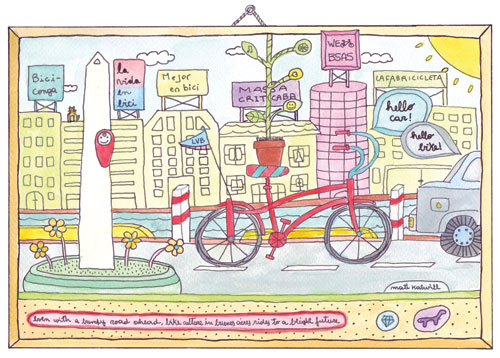
caitlin@sfbg.com
I couldn’t take my eyes off it. It was gorgeous: a two-way protected bicycle lane. It went the length of Figueroa Alcorta Avenue, a wide, tree-covered boulevard that traverses Buenos Aires’ central neighborhoods. And people were riding bikes on it — cruisers and those funky low-riding foldable bikes. It was a totally different but super-familiar scene. I had to join.
I didn’t come to Buenos Aires expecting to find the bike culture I did. Call me provincial, but the Bay Area bike scene is so exhilarating — the various Bike Party group theme rides, the radical workshops of the East Bay’s Cycles of Change, the gonzo tunes on trailers of the Bicycle Music Festival, SF Bike Coalition’s advocacy work, the slammin’ art and fashion of the Bikes and Beats parties — that it can make a body think we’re taking the whole lane, as it were.
But what else is cruising around out there?
“Buenos Aires does not have any formal complete streets initiatives as the term is understood in the United States,” says Andrés Fingeret, director of the Institute for Transportation and Development Policy (ITDP). Fingeret’s organization helps cities on three continents — including Jakarta; Guangzhou, China; and Denver — create sustainable transit systems, so I figured the organization would be a good start if I was going to understand where Buenos Aires stands in terms of biking.
“It’s a rare case,” Fingeret continues in an e-mail to me. “A compact city with great weather that is very flat but has no history of urban cycling.”

Following a visit from former Bogotá mayor and bike path champion Enrique Peñalosa, the Buenos Aires city government began working on 100 kilometers of new bike lanes in 2010, many of which are like the one I fell in love with: barrier-protected and luxurious. BA even has Mejor en Bici (“Better on a bike”), a network of free bike rental stations for city residents.
“When these plans were presented, it seemed like a utopia, something that would be impossible in our city,” says Fingeret. “Luckily nowadays, it is debated less and less that bicycles deserve an important role in the mobility of porteños (residents of Buenos Aires).”
But it’s one thing to create bike infrastructure — quite another to get people riding. And despite the city’s ambitious plans, BA has some serious roadblocks when it comes to its population accepting bikes as acceptable forms of transit.
DUMPSTERS IN THE BIKE LANES
A few days after catching sight of that first bike lane, I was on my way to La Bicicleta Naranja (“The Orange Bike”), the Buenos Aires equivalent of SF’s Blazing Saddles bike rental shops. The shop is true to its word — it specializes in renting tangerine-colored cruisers for goober tourists.
Not to retread the path of David Byrne’s Bicycle Diaries too much, but there is something spectacular about seeing a new city from a banana seat. Being a tourist is way more attractive when you can check out multiple neighborhoods in a day, especially in a metropolitan area of 12 million people.
Compared to American cities, traffic in Buenos Aires had a different flow. “Right of way” is a more fluid notion with fewer traffic lights and stop signs but just as many people on the roads — bicyclists, motorists, and pedestrians just have to use their eyes a lot more. Also Buenos Aires appeared to have little emissions level oversight — colectivo buses belched fumes into the streets, discouraging for people commuting without the protection of car walls and windows.
The reality of riding my bike through the city wasn’t quite as paradisiacal as it appeared when standing on the curb — especially given motorists’ ignorance of hand signals (they’re still an uncommon practice among bicyclists there), oblivious pedestrians, and garbage bins parked in delineated bike lanes.
“THE STREETS ARE FOR EVERYBODY”
On a busy street in one of the city’s northern neighborhoods, a year-old bike workshop and skill-share operates out of the back room of a community center. Two days a week, La Fabricicleta is staffed by volunteer bike mechanics who created the workshop after they met through city’s two-year-old Masa Critica (Critical Mass, in one of its many global incarnations), which attracts up to 2,000 riders in the warm summer months and takes to the streets every first Sunday at 4 p.m., with special rides on full-moon nights.
On any given day of operation, the tiny room is packed with mostly young people drinking yerba mate, pumping music, teaching each other how to fix flats and true wheels, and leaving donations for parts and to keep the shop running. It’s similar to SF’s Bike Kitchen — save for its provenance.
Buenos Aires’ neighborhood asambleas were formed in the wake of the country’s 2001 economic collapse, in the midst of runs on the banks, 25 percent unemployment rates, and looting — but also remarkable community organizing. In scenes reminiscent of this spring’s Madrid indignado demonstrations, the city’s plazas filled with demonstrations and entire neighborhoods occupied abandoned buildings, establishing a space where they could try to work through the seismic craziness rocking their country.
Villa Urquiza’s asamblea was one of these — it once housed La Ideal pizzeria, whose sign hangs over the doorway and whose massive ovens still greet visitors. Still buzzing a decade after the crash, the asamblea now hosts political meetings, an anarchist library, occasional fundraiser parties with live music and cheap beer — and La Fabricicleta.
“This is a lifestyle,” says Gustavo Troncoso, one of the workshop’s six core volunteer mechanics. He was introduced to La Fabricicleta through cyclist friends and was impressed by the way people “come to spend the day, and then end up doing mechanics.”
The shop protests throwaway culture, encouraging people to put in the time to resuscitate old bikes. Some of the volunteers who run the shop roll through with decades-old rides restored to impeccably detailed perfection. Another Fabricicleta goal is to provide bikes (and the smarts to maintain them) to low-income riders in the community.
Pausing from helping two young women take their bikes through a routine tuneup, Troncoso explains that riding in the city provides him with some much-needed autonomy from the sardine-packed subway system and environment-polluting car life. “When you get in a car and go somewhere quickly — well you’re not leaving much room for yourself.”
“The streets are for everybody,” he says. “We think everyone can share the same streets with respect. Bikes make you more autonomous, free — you can do it yourself.”
But the social stigma of bikes in Argentina is hard to shake. “Older people still believe that bicycles are for poor people,” says Troncoso, shaking his head. “It’s just a question of education.”
It’s easy to see why La Fabricicleta is packed during its open hours. People come to help out and tune up — but many are there just to kick it. More than a functional service center, the small room is a clubhouse in a town that’s not totally ready for the bike life.

LA VIDA IN BICI
It would be simplistic to say there is a single face of Buenos Aires’ bicicultura (“bicycle culture”). But if you had to choose one, you might select native porteño Matias Kalwill, director of nascent bike culture blog La vida en bici.
Kalwill believes that his city is hitting a “creative boiling point” when it comes to bikes — and other cultural vehicles, for that matter. “Buenos Aires is in a sweet spot,” he tells me over a late night beer. “For example, there’s been new kinds of sounds emerging in the local music scene over the last few years — it’s like a new kind of porteño energy.”
A bicyclist since his high school days who previously worked in a young family education center, Kalwill and friends started Biciconga in October 2010. The group promotes the bike as a part of Buenos Aires’ burgeoning creative culture, not just as a cool toy.
“We wanted to generate bicycle culture by fashion or style. We wanted to make it cool — not just a hippie or sporty thing,” says Felix Busso, one of the group’s founders and a fashion photographer. They began organizing free bike parties, riding en masse to predetermined secret locations where live bands played. The parties took off and in February, Kalwill started La vida en bici.
In the beginning, he used it to share his bike illustrations and videos of various bike happenings. Its popularity grew quickly. Kalwill’s simple view of cycling freedom (“You know how superheroes fly around the city using their own energy? That’s what happens you ride your bike to see a friend across town.”) and anthropomorphic animal characters make bikes seem like something so elementary as to be a common sense part of city living.
The success of the blog and the events Kalwill sponsored through it earned La vida en bici entry into the British Council’s Climate Generation program, a worldwide network that supplies promising young environmental activists with the practical tools needed to make their organizations more effective. Theirs is one of the program’s only bike projects.
I met Kalwill three months after the launch of La vida en bici, at an event he curated at the city’s Museo de Arquitectura y Diseño (The Museum of Architecture and Design). He and the other artists who’d begun working with La vida en bici had been granted use of the museum’s minimalist concrete basement as studio space and had lined it with whimsical bike illustrations, silkscreens, and photographs.
That day, the group was holding its second Bicifriendly event at the museum. On the schedule were art demonstrations, bike maintenance lessons, and a discussion with city experts on the potential of complete streets plans in the city. Kalwill was dashing around in his signature Life Aquatic with Steve Zissou-esque red beanie, playing welcome wagon, docent, and hype man.
“One year ago, none of this existed,” he said. “This idea that the bicycle was cool, that’s really something special. It broke into the culture of the city without permission. And since it didn’t ask permission, it has people asking, ‘Hey, where are you going?'”
But he’s had something to do with this shift in perception. The Biciconga collective and the artists in La vida en bici — rarely older than Kalwill’s 30 years — are experts at packaging the joy of riding a bike in the city into a thousand easily digestible, easily sharable forms — key in the Facebook era. Bicifriendly, although an inspiring moment for those who could make it to the architecture museum, would soon have its impact magnified one-hundredfold by sweetly soundtracked event videos and professional-quality photographs posted onto blogs.
This dispersal is a big part of Kalwill’s plan. “For me, my work is like seeds. Thanks to the Internet, what I do is in part a result of things happening in other countries. And other things will come from what we’re doing here.” He is an avid follower of sites like Streetsblog in New York City, Los Angeles, San Francisco, and Washington, D.C., as well as the San Francisco Critical Mass site. He regularly posts bike happenings from around the world on his own websites.
La vida en bici‘s tastemaking ability has also caught the attention of city officials. Paula Bisiau, director of the Palermo neighborhood government, tapped the group to create a “Bicifriendly plaza” featuring a massive mural inspired by Luna de Enfrenta, a book of Jorge Luis Borges poems. In La vida en bici‘s typical cartoonish style, the design will revolve around the question “What would it be like to ride a bike to the moon?”
Bisiau has high hopes for promoting bicicultura projects in her neighborhood. “We hope that these spaces will be starting points to develop more ideas to help foment the use of bicycles in the rest of the city of Buenos Aires,” she wrote to the Guardian. “I think that this change is possible because it’s positive and healthy for everyone. I’m sure that in four more years, we’re going to see many more bicycles in circulation throughout the whole city.”
But it’s not all line drawings and bike music. In the run-up to the July 9 mayoral election, representatives from the office of the city’s current mayor, Mauricio Macri, as well as the two opposition candidates called Kalwill to discuss bike policy in the city.
He chatted with them about what’d he seen in the city — a bit reluctantly. Kalwill is loathe to get involved in politics, wary of the limitations they can impose on cultural movements. But soon afterward the two challengers reversed their previously held viewpoints that the city’s burgeoning bike lane network was a waste of street acreage and resources. Days before the election, everyone could agree that bikes were key to sustainable mobility. “It’s like bicycles won in this election,” reflects Kalwill, who maintains a strictly nonpartisan stance. Between the city’s cultural activists and politicians, he says, “the dialogue is happening.”
At a recent rally, Macri announced plans to build 100 new stations for the city’s Mejor en Bici program. Kalwill was pleased to learn of the plan but does have one bone to pick: at the moment all the free bikes are yellow. He thinks adding different colors to the mix would make the system more attractive to potential bike riders and would “reflect the diversity of the users.”
RUNWAY TO CHANGE
I didn’t bring a bike to the June Masa Critica Buenos Aires ride, and it hurt — I wanted to ride it bad. But my flight back to the States was scheduled to depart in three hours so I stood beneath the massive obelisk that soars from a plaza in the middle of Buenos Aires’ 14-lane 9 de Julio Avenue, the widest street in the world, saying goodbye to my new friends on their two wheels.
But Buenos Aires wasn’t done with me yet — a volcano explosion in the Andes delayed my flight home for three days. As luck would have it, I neatly missed the Biciconga post-Masa bike runway show, where 30 bikers, fresh from the ride, rolled down a makeshift red carpet on the front porch of an organic food co-op to live music by the Mahatma Dandys, a local folk-rock ensemble.
Busso, a driving force behind the show, hoped the spectacle would be a moment that helped change the way Buenos Aires looks at the way it uses bikes. “The more people who use the bicycle, the better. The change will not come from the government, it will come from these groups.”
After biking in Buenos Aires, it seems clear that people in other cities are forming indigenous, exciting bike cultures. But this turn to bicycles is less of a globalized fad as much as water naturally finding its level. In a world where the future of fossil fuels is uncertain and people everywhere are beginning to see the need for a more sustainable lifestyle, urban biking is a matter of common sense.
For Kalwill, the rise of the bike means a better future for his home. “It brings hope that things can change. And we need big changes if we expect to survive in a world that’s getting more crowded and warmer. We need hope. In Buenos Aires, bikes seem to be providing that.”
The summer camp that’ll change the world, now accepting applications

Kids. Activist. Summer. Camp. The words kind of send shivers down our Never-Never Land synapses. And though we’re not exactly the target demographic for the Santa Cruz Mountains’ Youth Empowered Action Camp, breathless longtime camp professional Nora Kramer’s three year old vision of a place where socially conscious rockstars ages 12 to 17 could get together, hike it out, eat delicious vegan foods, and work on their plan to change the world has us all riled up in a yeah-that-exactly way.
The first California — there’s also a session in our northernly neighbor Oregon — camp session starts real soon (July 23) and Kramer wants everyone to know that scholarships for young Julia Butterfly Hills and Van Joneses — wherever they’re at in their activist skills and projects — are available. Know a parent or a kidlet? Forward them this interview, which single-handedly put Kramer and her team way, way up there on our “people who are really awesome” list.
San Francisco Bay Guardian: Tell me the story of how the camp started? When, where, who, all that.
Nora Kramer: I started YEA Camp in April 2009 after years of thinking “I want to start a camp one day for kids who want to change the world.” I couldn’t find a program quite like the one I wanted to work at — one that trained young people to be effective in taking action for what they believe in and care about. I was teaching environmental education and, with the economy really tanking, I was laid off. On my last day with the middle school club I advised, they asked me what I was going to do next. I wanted to reassure them that I’d be OK, so I nervously told them that someday I was planning on starting a camp for kids who want to change the world. They were so excited about it and asked me when the camp would start! In that moment, I knew I was ready to launch the program, and that there was a demand for this, and I said “August!”
I had already done an intensive training with the American Camp Association and worked as a camp director. I had a friend design our website pro-bono, and we had our pilot program in summer 2009. I hired incredible staff who all worked for free and we had amazing campers, most on almost full scholarships, as we were an unproven program people had never heard of. I contacted a beautiful venue I had been to with another youth program and found a time it was available, and I paid the deposit on it out of my savings account, hoping to recoup it once kids registered. That session was a total success, and we’re now up to summer No. 3.

Tomorrow’s leaders gettin’ crazy at YEA Camp 2010. Photo by Cody Cha
SFBG: What’s a typical day at the camp?
NK: We get up and have French toast or pancakes prepared by our talented cooks. We make music or do some other group activity to wake up. Then we head off to a hike or fun outdoor activity. When we come back, we do a workshop about an issue or practice a skill to bring about change on any issue, like how to start a club at school. We have a snack, like fruit or chips and salsa, and might play a group game that demonstrates a concept we are working on. We watch a movie about young activists who are doing amazing work right now and discuss their leadership qualities and what made them successful. Then we have lunch — maybe vegetarian BLTs or burritos — and then we have free time after that. Our afternoon workshops would be another skill or knowledge-building activity such as how to run a successful campaign (for example how to get recycle bins at your school), a group game, and discussion. We have amazing dinners — pizza or sushi with brownies or chocolate chip cookies for dessert. All of our food is vegan, mostly organic, and all delicious. We cap the day off with a fun group evening activity like a scavenger hunt, dance party, or night hike.
SFBG: Why did you think it was important for a camp like this to exist?
NK: I had been doing grassroots activism for a long time, and had worked with youth at camps, after-school programs, and teaching high school, and I met a lot of young people who were passionate about making the world a better place in some way–whether by rescuing an animal, recycling religiously, being part of their Gay Straight Alliance at school, or being a vegetarian. I started to notice they didn’t necessarily have any training or support or role models to nurture their involvement. There’s coaches and after-school practice to help you get better at sports, but what about to train you to make a difference in your community?
Sometimes kids who care or speak up about environmental or other issues are made fun of or criticized and get discouraged. I feel like our world is facing so many challenges, and we need to bring youth together with like-minded peers and adults to support them in taking action so they can bring about the world they want to see. If there can be successful summer camps for kids who like volleyball or theater or play the violin, why not for youth who want to make the world a better place?
SFBG: Where did you go to learn about activism as a youth? Where do you think most kids go today?
NK: I was not by any stretch a youth activist. When I was a teenager, I had no idea what activism was. I had a vague sense that there was some injustice in the world — I grew up in New York City, where I saw incredible wealth not far from people sleeping on the streets. But while I had progressive parents who taught me to question things and think for myself, I wasn’t really aware of a lot of social problems until college, and had no sense that I had any power to make a difference. Today, youth have far greater access to information — it’s no comparison — thanks in large part to the Internet and technology. Kids today reach out to organizations online, watch videos on Youtube, and might join a school club or get involved with a local youth program. But I honestly think a lot of youth don’t get or stay involved because there is not enough support.

Silly, silly changemakers. Photo by Ivan Olsen
SFBG: Is it easier today to learn about this stuff than when we were growing up?
NK: Absolutely. I grew up pre-Internet, which was a whole different world. Technology like Yahoogroups and Googlegroups, blogs and vlogs, e-newsletters, Youtube, Facebook causes, Twitter, and so much more make it more possible than ever to access information, connect with others who are like-minded, and advocate for important causes. Most organizations have multiple websites devoted to different issues they are working on. Ironically and unfortunately, this can also lead people to feel like they are on information overload, overwhelmed, alone and helpless to take action in the face of such large issues.
SFBG: Surely your campers are all the offspring of super activists already — or have you ever had a camper whose parents weren’t super stoked on the idea of camp?
NK: It totally varies. A lot of our kids’ parents are very progressive and politically aware and active; others aren’t but they want their kids to be happy and go to whatever camp they want. Often we have parents contact us and say “This is so perfect for my son! He started an environmental club at his school and doesn’t know anybody else who cares about these issues as much as he does!” They are relieved to find a program that speaks directly to their child’s interest and passion, whether or not it’s shared by the parent.

Thumb hug. Photo by Mike Melero
SFBG: What are some of the awesome projects that have come out of the camp?
NK: So many cool things! Campers have organized a beach cleanup, created a music video about youth empowerment, started several school clubs, raised over $1000 for a local animal shelter, interned at a nonprofit, gotten vegetarian options in their school cafeteria, organized a call-in to Congress, and lots more. There’s also the daily actions, like campers bringing water bottles with them, buying less stuff, eating healthier, or using communication skills they learned at camp to speak more effectively about their issue and influence people at school to get involved. Two campers also organized a benefit concert and a fundraising dinner to pay for their tuition to return to camp this year!
SFBG: What’s the hardest part about running a camp like this?
NK: I think it’s staying present to how amazing the camp is in, say, February, when last year’s camp seems like a long time ago and next summer’s camp seems like a long ways away. It makes doing work throughout the year tougher to keep in context. I think also going beyond my own comfort zone and skill set to learn more and build the team has been a great but challenging experience for me. Working at a start-up non-profit poses challenges, but every time I read an amazing camper application, I feel so proud and honored to do what I do.
Youth Empowered Action Camp
Session I: July 23-29, $925 without scholarship
Session II: July 30-August 5, $925 without scholarship
Quaker Center, Ben Lomond Calif.
(415) 710-7351
Ghost Fleet wanderers
Scott Haefner, Stephen Freskos, and Jon Haeber aren’t the types to stand out in a crowd. Haefner is a web developer, Freskos supervises projects for an engineering firm, and Haeber has a desk job at a company that helps businesses hit high on Google — three straight-laced Bay Area professionals who blend readily into the corporate world.
But everyone’s got their thing — a way to break out of bounds, or scratch the itch of some incessant curiosity.
For these three friends in their late-20s to mid-30s, their thing entails prowling around in rundown deserted places by the light of the full moon, at times taking great pains to avert detection by security patrols. “We go into places that most people don’t go,” Haefner says. They’ve been traipsing into the unknown and documenting their discoveries together for years, motivated as much by art as adrenaline.
This past May, after weighing the consequences, they publicized one of their boldest excursions yet: Sneaking aboard the Mothball Fleet in Suisun Bay to spend entire weekends roaming the bowels of the mildewed vintage ships, while dodging the beams of patrol-boat searchlights.
Unlike many nocturnal wanderers magnetically drawn to abandoned spaces — squatters, taggers, or scrappers, for instance — they don’t break in, vandalize, or steal. Instead, they adopt the same sense of reverence in decaying, chemical-laden industrial places that conscientious hikers assume on backwoods trails. They shoot night photos with professional quality gear, occasionally using flashlights to achieve a technique called light painting.
Haefner, Freskos and Haeber consider themselves advanced practitioners in the art of urban exploration (a.k.a. urbex or UE), an underground activity that’s grown trendier as it draws in adventuresome novices. Now that they’ve publicized their caper aboard the Mothball Fleet, however, they’ve also come under the watchful eye of the feds.
EXPIRATION DATE
At first they thought it was a pipe dream. Doubting their ability to access the Mothball Fleet was saying a lot, considering they’d once snuck onto the Vandenberg Air Force Base and wandered amid abandoned missile silos, absorbing the gravity of the military history those Cold War artifacts represented. Another time they’d managed a nighttime excursion to Neverland Ranch, the famed private amusement park of the late Michael Jackson.
But the ghost ships moored at Suisun Bay seemed out of their league. The rows of hulking, government-owned vessels were locked up and berthed offshore, surrounded by a security headquarters and a shoreline barricade plastered with “No Trespassing” signs. Patrol boats equipped with searchlights circled the docks 24 hours a day, and the prospect of climbing aboard without being spotted seemed crazy.
But then they got word that the last of the aging ships would soon be towed away and destroyed. For Haeber, the history nut of the bunch, this changed everything. “It was about the urgency of making sure these ships were documented,” he explained. “Getting them in the current state that they’re in is so important.”
Alternatively known as the Mothball Fleet and the Ghost Fleet, the ships are part of the National Defense Reserve Fleet, a collection of cargo ships, tankers, and military auxiliaries overseen by the U.S. Maritime Administration (MARAD). Created in 1946 to be ready for deployment in case a national emergency arose, the fleet consisted of 2,277 ships at its height in 1950, strategically stationed at eight anchorages nationwide. For most of the vessels, the call to service never came, and they declined into obsolescence. By April, the entire fleet had dwindled to just 178 ships, at dock in Suisun Bay; Fort Eustis, Va.; and Beaumont, Texas.
The ships that have been moored at Suisun Bay for decades have long since deteriorated, and now they’re being hauled off to the scrap yard bit by bit, though the spot will continue to serve as an anchorage for newer additions to the National Defense Reserve Fleet.
Some were constructed in the World War II era, while others date back to the 1960s and 1970s. While many are tankers or merchant vessels, there are also warships, relics of history deployed in World War II, the Korean War, the Vietnam War, and Operation Desert Storm.
Many of the roughly 70 dilapidated ships have become ecological hazards, leaching toxins and heavy metals into the tidal estuary, which flows into San Francisco Bay. The monumental task of removing and dismantling them began late last year, providing badly needed blue-collar jobs on Mare Island, in the economically depressed city of Vallejo.
By 2017, the last of the ghost ships will have met with torch cutters. At least one will be salvaged: the USS Iowa (BB-61) — a 1938 lead battleship that shuttled President Franklin D. Roosevelt to and from the Tehran Conference during World War II — will be donated and turned into a museum.
Aside from being scrapped, outmoded ships meet with a variety of fates. Some are donated for educational use while others are deliberately sunk to create artificial reefs. Still others are used for target practice in the Navy’s sink-at-sea live-fire training exercises program (SINKEX).
“We saw that these things were going to be gone,” Haefner said. “So we planned it out.”
Haeber examined satellite imagery on Google Earth. Freskos, who’d spent time at sea, studied the tidal patterns. The three scoured the Internet for online photos of the Ghost Fleet. They conducted a scouting mission with binoculars in hand, and gained a sense of when they could take advantage of windows of opportunity between the 30-minute patrol boat rounds.
Long before they even discovered a navigable slough that snaked through a marsh into Suisun Bay or spotted the Craigslist post advertising an inflatable raft for sale, Freskos went up to shoreline gate where the “No Trespassing” signs were posted. He peered through at the tantalizing rows of mothballed ships, and hollered as loud as he could. Nobody responded.
DECAYED TIME CAPSULES
After the months of planning left them confident that it was indeed possible to access the Mothball Fleet, the trio of photographers set out for their first visit, with about 700 pounds of gear in tow. They split the cost of a 12-foot inflatable Fish Hunter raft with a Minn Kota trolling motor. They carried the raft and their gear through a muddy expanse to a marshy spot where the low-profile craft could be set into a narrow slough, safely out of view.
“We always went on or exited at nighttime,” Haefner said. “We would go on nights near the full moon so we could take pictures. It makes it look even more ghostly.”
Their first target was Row F, a line of ships docked in a straight shot from where the slough filtered into the bay. They maneuvered down the narrow channel in their raft, dodging submerged obstacles along the way. Keeping tabs on the whereabouts of the security boat, they started rowing once they reached the open water, and managed to bridge the 800-foot distance to the first ship.
“Our plans were kept secret to all except our loved ones,” Haeber wrote in an online account of that first excursion. “Nobody, other than my girlfriend, knew exactly where I was that weekend. For all intents and purposes, I was on a fishing trip with some friends.”
“Keep Off” signs announcing an invisible 500-foot barrier that was not to be breached were affixed to the hull of every ship. The intruders maneuvered their raft between two Coast Guard cutters, Planetree and Iris, and tied up.
“It can be kind of a challenge getting on,” Haefner explained. “We’re risking ourselves, obviously, but we also brought a bunch of expensive camera gear.” He was the first one to climb aboard the Iris, reaching high to grab onto a bumper that he could then pull himself up on to gain access to the ship. While Freskos kept watch, Haeber handed the gear up to Haefner bit by bit. Once all three were aboard with their backpacks and camera equipment, they hauled up the raft and deflated it.
The Iris was commissioned in 1944. In 1970, it responded to the scene of an oil-rig fire in Galveston, Texas. In 1987, it assisted with cleanup operations in Prince William Sound after the Exxon-Valdez spill. It was decommissioned in 1995, so their entrance likely marked the first time anyone other than MARAD employees had been aboard in 16 years.
A handy feature of ghost ship exploration is that once aboard a ship, it’s possible to access any ship along the entire row, thanks to gangplanks connecting the vessels. So while many of the mothballed vessels were completely secured, there was always the chance that the next one down would have an unlocked entranceway. Part of the ethos of urban exploration is to avoid breaking anything, so they only accessed the interiors of unsecured ships. “They are fairly vigilant about keeping doors locked up tight,” Haefner said. “But there are just so many doors.”
Haeber found a single open door on the SS Exxon Gettysburg, a mammoth oil tanker constructed in 1957, and entered the ship alone, enthralled. The interior, he later wrote, smelled like a mix of mold, benzene, and soggy newspaper. He turned on his flashlight and began tiptoeing through the corridors and peering into the cabins. “They were like time capsules, untouched since the 1970s,” Haeber said.
“Some of the ships were 15 stories deep, like a maze,” Freskos said. “We’d get lost inside.” The trio split from Row F before sunrise and managed to get back to the slough without any mishaps, but they returned on a handful of other occasions with sleeping bags and enough food and water to last a weekend. On those subsequent journeys, they’d seek out places to sleep, often crashing in the once-luxurious captain’s quarters. They slept by day, so that entire nights could be devoted to wandering in awe of the decayed, post-apocalyptic industrial environs, shooting hundreds of photographs.
They visited rooms where crews once hung out playing board games, still littered with cigarettes. They photographed molded interiors, dark cavernous stairwells, engine parts, navigational equipment, and abandoned cabins with peeling wallpaper. “We found personal letters, cards, things people left,” Haefner said. “We were always looking for signs of life.” They wandered through mess halls, engine rooms, bathrooms, galleys, even chilling places with operating chairs and overhead spotlights. They climbed around on the decks in the open night air, wandering through derricks and cranes.
The old ships would make eerie creaking noises when the tide rushed in, and there was always that mild sensation that one experiences on a boat, of things not staying still. “It was like a cacophony of sound when the current was coming in,” Freskos recalled. Hawks, osprey, and owls nested aboard some of them, so the creaking noises were sometimes accompanied by screeching birds of prey.
“The place is steeped in history,” Freskos said. “I’d always think of what this room was used for, or what went on here, when people were experiencing the suffering, craziness, and nervousness of war.”
HIGHLIGHTS AND HAIR-RAISERS
A highlight of their journeys aboard the Mothball Fleet was stumbling across the sleek black Sea Shadow, a stealth ship, which was ensconced within a barge on Row G. Shrouded in secrecy, the angular vessel was developed by Lockheed for the U.S. Navy to test how low of a radar profile could be achieved, and it served as inspiration for a stealth ship featured in a James Bond film. According to the MARAD website, “Sea Shadow was constructed and tested under a high degree of secrecy; until the Navy made its existence public in 1993, all tests were conducted at night.” The ship entered the Suisun Bay Reserve Fleet in September 2006.
They also found their way aboard the USS Iowa, which bears the distinction of being the only U.S. Navy warship ever outfitted with a bathtub, so FDR could have a soak while crossing the Atlantic. While they didn’t manage to go inside, an eerie photograph of three enormous guns on deck conveys the magnitude of the battleship.
One of Haeber’s most cherished discoveries was a three-story-tall mural he photographed inside the SS President Lincoln, an American President Lines ship constructed in San Francisco in 1961. An early version of a containerized cargo vessel, the Lincoln doubled as a cruise ship catering to a small number of elite passengers, and remnants of the elegant interior décor remained. The ship has since been hauled to the scrap yard.
It wasn’t always smooth sailing for the three urban explorers. Once they narrowly dodged a work crew aboard a ship — “but we saw or heard them before they saw us,” Haefner said. Another time, while paddling back to the slough, they discovered their raft was punctured and had to manually pump air into it as they traveled. Then, at the tail end of their final journey to the Ghost Fleet, they found themselves fully illuminated by the dreaded patrol-boat searchlight for a full 10 seconds. They froze, convinced they’d been caught. But nothing happened, so they powered up and rowed like hell to get back ashore, and never returned.
Of course, posting interior photographs of the Mothball Fleet all over the Internet and delivering a public slideshow about their sneak-aboard escapades has attracted the attention of the federal government. “The Department of Homeland Security has been looking into it,” said Haefner, who can tell by monitoring web traffic on his blog. “I know that they know.” He also noticed hits from the U.S. State Department and the U.S. Department of Justice, but so far, none have come knocking.
In response to a Guardian request for comment about the Mothball Fleet photographers, Kim Riddle, a spokesperson for MARAD, e-mailed an official statement. “We were aware of the intrusion,” she wrote. “We are concerned about the safety of individuals onboard our ships. This is a dangerous industrial site, and we take significant precautions for our own workers when they are onboard the fleet to make sure that areas are safe for them to enter. While trespassing on federal property, these photographers put themselves in a very dangerous position and could have been severely injured or killed from a fall or by entering an enclosed space that doesn’t have enough oxygen. Since learning of this incident, we took additional security steps, reviewed our procedures, and reinforced training with our employees to stop these kinds of intrusions.”
Freskos touched on the safety issue in an online discussion about the project. “There were many long discussions about oxygen-deprived spaces such as anchor chain lockers and ballast tanks,” he wrote. “There were contingency plans made for injuries. We carried a medical kit, we wore [life jackets], and took many other precautions.” He also responded to those who questioned the wisdom of publicizing their late-night excursions to the Mothball Fleet. “I think I speak for the three of us when I say that we are well aware of the consequences,” Freskos wrote. “But it’s a passion of ours, and it’s worth it.”
The photographers’ work can be viewed here, here, and here.
Stage Listings
Stage listings are compiled by Guardian staff. Performance times may change; call venues to confirm. Reviewers are Robert Avila, Rita Felciano, and Nicole Gluckstern. Submit items for the listings at listings@sfbg.com. For further information on how to submit items for the listings, see Picks. For complete listings, see www.sfbg.com.
THEATER
OPENING
Act One, Scene Two SF Playhouse, Stage Two, 533 Sutter, SF; (415) 869-5384, www.un-scripted.com. $10-20. Opens Thurs/7, 8pm. Runs Thurs-Sat, 8pm. Through Aug 20. Un-Scripted Theater Company hosts a different playwright each night, performing the first scene of an unfinished play and then improvising its finish.
Not Getting Any Younger Marsh San Francisco, 1062 Valencia, SF; www.themarsh.org. $15-50. Opens Thurs/7, 8pm. Runs Thurs, 8pm; Sat, 8:30pm; Sun, 7pm. Through July 24. Marga Gomez presents a workshop production of her new comedy, her ninth solo show.
Salty Towers Exit Theatre, 156 Eddy, SF; (415) 673-3847, www.theexit.org. $15-25. Opens Thurs/8, 8pm. Runs Thurs-Sat, 8pm; Sun, 3pm. Through July 23. Thunderbird Theatre Company performs a farce that combines Greek mythology with a tale of sea creatures running a two-star hotel.
Twilight Zone Live: Season 8 Dark Room, 2263 Mission, SF; www.ticketturtle.com. $20 ($5 discount if you use the code word “maggie”). Opens Fri/8, 8pm. Runs Fri-Sat, 8pm. Through July 29. The Dark Room Theater presents its eighth annual tribute to classic Twilight Zone episodes.
BAY AREA
Macbeth Dominican University of California, Forest Meadows Amphitheater, 1475 Grand, San Rafael; (415) 499-4488, www.marinshakespeare.org. $20-35. Previews Fri/8-Sun/10, 8pm. Opens July 15, 8pm. Performance times vary; check website for schedule. Through Aug 14. Marin Shakespeare Company takes on the Scottish play, opening under a full moon, no less.
The Verona Project Bruns Amphitheater, 100 California Shakespeare Theater Way, Orinda; (510) 548-9666, www.calshakes.org. $35-66. Previews Wed/6-Fri/8, 8pm. Opens Sat/9, 8pm. Runs Tues-Thurs, 7:30pm; Fri-Sat, 8pm (also July 30, 2pm); Sun, 4pm. Through July 31. California Shakespeare Theater performs a world-premiere play (inspired by The Two Gentlemen of Verona) by Amanda Dehnert.
ONGOING
All Atheists Are Muslim Stage Werx, 533 Sutter, SF; www.brownpapertickets.com. $20. Sun/10, 7pm. Zahra Noorbakhsh returns with her timely comedy.
Assisted Living: The Musical Imperial Palace, 818 Washington, SF; 1-888-88-LAUGH, www.assistedlivingthemusical.com. $79.59-99.50 (includes dim sum). Sat-Sun, noon (also Sun, 5pm). Through July 31. Rick Compton and Betsy Bennett’s comedy takes on “the pleasures and perils of later life.”
Billy Elliot Orpheum Theater, 1192 Market, SF; www.shnsf.com/shows/billyelliot. $35-200. Tues-Sat, 8pm (also Wed, 2pm); Sun, 2pm. Through Sept. 17. As a Broadway musical, Billy Elliot proves more enjoyable than the film. The movie’s T. Rex score may have been a major selling point, but it was a bit maudlin for a story that needed no help in that department. The musical naturally has a sentimental moment or three, but it’s much more often funny, muscular in its staging (with repeatedly inspired choreography from Peter Darling), and expansive in its eclectic score (Elton John) and well-wrought book and lyrics (Lee Hall). Moreover, Stephen Daldry (who also directed the 2000 film) plays up bracingly the too-timely class politics of the modest 1980s English mining town besieged by Margaret Thatcher’s neoliberal regime in the latter’s ultimately successful bid to crush the once-powerful miners union. The cast is likewise very strong, beginning with opening night’s impressive J.P. Viernes in the title role. Broadway’s Faith Prince is an especially engaging presence as the ballet teacher who takes an interest in Billy’s inherent talent, setting him on a course out of the doomed town and into London’s Royal Ballet School — much to the violent disgust of his predominantly male and prickly household. The first act is a nearly perfect balance of bawdy humor, aggressive staging, adept scene-setting and character development and a potent tide of song and group choreography that is hard to resist. There are some unfortunate choices later on, like a bit of Peter Pan wire work that has Billy twirling over the stage (an excessive display that hovers awkwardly over dullsville) and in general the second act is not as strong as the first. It’s also the point where the working-class politics paid homage to by the script gets seriously blunted by a concomitant streak of middle-class individualism. But as crowd-pleasing entertainment the musical burrows deep and more often than not comes up with gold. (Avila)
The Book of Liz Custom Made Theatre, 1620 Gough, SF; www.custommade.org. $10-29. Thurs-Sat, 8pm; Sun, 7pm. Through July 31. Custom Made Theatre performs David and Amy Sedaris’ comedy about an unconventional nun.
“Fury Factory 2011” Various venues and prices; www.brownpapertickets.com. Through Tues/12. Over 30 Bay Area and national companies participate in this bi-annual theater festival.
Indulgences in the Louisville Harem Phoenix Theatre, 414 Mason, SF; 1-800-838-3006, www.offbroadwaywest.org. $20-40. Thurs-Sat, 8pm. Through July 30. Two spinster sisters find unlikely beaux in Off Broadway West Theatre’s production of John Orlock’s play.
The Pride New Conservatory Theatre Center, 25 Van Ness, SF; (415) 861-8972, www.nctcsf.org. $24-40. Wed/6-Sat/9, 8pm; Sun/10, 2pm. New Conservatory Theatre Center performs the West Coast premiere of Alexi Kaye Campbell’s love-triangle time warp drama.
*Vice Palace: The Last Cockettes Musical Thrillpeddlers’ Hypnodrome, 575 10th St; (800) 838-3006, www.brownpapertickets.com. $30-35. Fri-Sat, 8pm; Sun, 7pm. Through July 31. Hot on the high heels of a 22-month run of Pearls Over Shanghai, the Thrillpeddlers are continuing their Theatre of the Ridiculous revival with a tits-up, balls-out production of the Cockettes’ last musical, Vice Palace. Loosely based on the terrifyingly grim “Masque of the Red Death” by Edgar Allan Poe, part of the thrill of Palace is the way that it weds the campy drag-glamour of Pearls Over Shanghai with the Thrillpeddlers’ signature Grand Guignol aesthetic. From an opening number set on a plague-stricken street (“There’s Blood on Your Face”) to a charming little cabaret about Caligula, staged with live assassinations, an undercurrent of darkness runs like blood beneath the shameless slapstick of the thinly-plotted revue. As plague-obsessed hostess Divina (Leigh Crow) and her right-hand “gal” Bella (Eric Tyson Wertz) try to distract a group of stir-crazy socialites from the dangers outside the villa walls, the entertainments range from silly to salacious: a suggestively-sung song about camel’s humps, the wistful ballad “Just a Lonely Little Turd,” a truly unexpected Rite of Spring-style dance number entitled “Flesh Ballet.” Sumptuously costumed by Kara Emry, cleverly lit by Nicholas Torre, accompanied by songwriter/lyricist (and original Cockette) Scrumbly Koldewyn, and anchored by a core of Thrillpeddler regulars, Palace is one nice vice. (Gluckstern)
What Mamma Said About Down There SF Downtown Comedy Theater, 287 Ellis, SF; www.sfdowntowncomedytheater.com. $15. Thurs-Sat, 8pm. Through August 20. Sia Amma returns with her solo comedy.
BAY AREA
All My Children Cabaret at Marsh Berkeley, 2120 Allston, Berk; www.themarsh.org. $20-50. Fri, 8pm; Sat, 8:30pm. Through July 23. Not the soap opera — it’s Seattle Improv co-founder Matt Smith in his comedy about a middle-aged man with boundary issues.
East 14th: True Tales of a Reluctant Player Marsh Berkeley, 2120 Allston, Berk; www.themarsh.org. $20-50. Sat, 8:30pm; Sun, 7pm. Through Aug 7. Don Reed’s hit solo comedy receives one last extension before Reed debuts his new show (a sequel to East 14th) in the fall.
Metamorphosis Aurora Theatre, 2081 Addison, Berk; (510) 843-4822, www.auroratheatre.org. $10-55. Tues and Sun, 7pm (also Sun, 2pm); Wed-Sat, 8pm. Through July 17. Aurora Theatre Company performs a terrifying yet comic adaptation of Kafka’s classic by David Farr and Gísli Örn Gardarsson.
A Raisin in the Sun Pear Avenue Theatre, 1220 Pear, Mtn. View; (650) 254-1148, www.thepear.org. $15-30. Thurs/7-Sat/9, 8pm; Sun/10, 2pm. Lorraine Hansberry’s classic play comes to life on the Pear Avenue Theatre stage.
2012: The Musical! Cedar Rose Park, 1300 Rose, Berk; www.sfmt.org. Free. Sat/9-Sun/10, 2pm. Continues through Sept. 25 at various Bay Area venues. San Francisco Mime Troupe mounts their annual summer musical; this year’s show is about a political theater company torn between selling out and staying true to its anti-corporate roots.
*Working for the Mouse La Val’s Subterranean, 1834 Euclid, Berk; www.impacttheatre.com. $10-20. Thurs/7-Fri/8, 8pm. It might not come as a surprise to hear that even “the happiest place on earth” has a dark side, but hearing Trevor Allen describe it during this long overdue reprise of 2002’s Working for the Mouse, will put a smile on your face as big as Mickey’s. With a burst of youthful energy, Allen bounds onto the tiny stage of Impact Theatre to confess his one-time aspiration to never grow up — a desire which made auditioning for the role of Peter Pan at Disneyland a sensible career move. But in order to break into the big time of “charactering,” one must pay some heavy, plush-covered dues. As Allen creeps up the costumed hierarchy one iconic cartoon figure at a time, he finds himself unwittingly enmeshed in a world full of backroom politics, union-busting, drug addled surfer dudes with peaches-and-cream complexions, sexual tension, showboating, job suspension, Make-A-Wish Foundation heartbreak, hash brownies, rabbit vomit, and accidental decapitation. Smoothly paced and astutely crafted, Working for the Mouse will either shatter your blissful ignorance or confirm your worst suspicions about the corporate Disney machine, but either way, it will probably make you treat any “Casual Seasonal Pageant Helpers” you see running around in their sweaty character suits with a whole lot more empathy. (Gluckstern)
PERFORMANCE/DANCE
Front Line Theatre CounterPULSE, 1310 Mission, SF; www.brownpapertickets.com. Fri/8-Sun/10, 8pm. Also July 21-23, 8pm, Garage, 975 Howard, SF; www.brownpapertickets.com. Both venues, $20. The company presents the world premiere of Rare Earth, a verse-and-movement comedy about waste and the past.
Miguel Gutierrez Garage, 975 Howard, SF; www.brownpapertickets.com. Fri-Sun, 8pm. $15. The choreographer performs his 2010 work Heavens What Have I Done as part of Verge, the Garage’s workshop series.
LINES Ballet Summer Program Cowell Theater, Fort Mason Center, Marina at Laguna, SF; www.linesballet.org. Tues/12, 7:30pm. $15. The LINES Ballet Summer Program celebrates its 10th anniversary with the first of two student showcases.
“OMFG! The Internet Dating Musical” ODC Theater, 3153 17th St, SF; www.odctheater.org. Fri-Sat, 8pm; Sun, 2pm. Through July 17. $15-18. ODC Theater Resident Artist Chris Winslow presents his new comedy about a couple who both fear they can’t live up to reality after meeting online.
“Project Bust” Z Space, 450 Florida, SF; www.brownpapertickets.com. Wed/6 and Aug 3, 8pm. $15. Malinda LaVelle presents her evening-length dance-theater piece.
“Sympathetic: An Aerial Dance Performance Honoring Labor” Rincon Annex Post Office, 121 Spear, SF; (415) 564-4010. Sat, 1 and 3pm. Free. The Labor Archives and Research Center, San Francisco State University, and Flyaway Productions present this work honoring the 1934 San Francisco General Strike by choreographer Jo Kreiter and musician Pamela Z.
“The Tinker Show” Stage Werx, 533 Sutter, SF; www.thetinkershow.com. Thurs-Fri, 8pm. $18-20. “Old school immaturity” via live sketch comedy and improv, plus original short films.
Yubiwa Hotel Performing Arts Company NOHspace, 2640 Mariposa, SF; www.sfiaf.org. Fri, 8pm; Sun, 3pm. $12. The company performs the play Mesujika Doe, a Japanese-American collaboration from Shirotama Hitsujiya and Trista Baldwin.
Fetish and armor

culture@sfbg.com
LUST FOR LIFE The year I was 16, I wore nothing but thrift shop vintage lingerie. As outerwear. I’d layer two slips or two half-slips on top of each other so they wouldn’t be quite as see-through and clomp around in impossibly high heels. I bought my actual underwear from the Victoria’s Secret at the mall when they had their blowout sales. There and at places like Forever 21 — flashy, clubby, and cheap.
I tell you these details because it’s important, naming the places I picked up armor and fetish. Because it felt like armor and it felt like fetish — in all senses of the word. Sexual but mythic and protective in proportion, too. That lacy magenta push-up demi-bra, the one that was just a little too tight, the one that was always uncomfortable. But I’d wear it anyway because I understood the importance of armor. Of having something that would protect me if bad shit went down.
The refrain from my mother — and from the more prudish crowd at my school, the tough homophobic boys in my neighborhood, the cat-calling older men at the Mission BART Station who didn’t realize how young I was — was that if you wear clothes like that, you are asking for it. You’re putting yourself in danger.
But didn’t any of them realize that this was my way of staying out of danger? I felt so much more powerful in those impossible heels, tits pushed up and out, cleavage for days, fishnets encasing my thighs, tight leather boots hugging my calves. I felt so much more powerful and able to fight if any shit went down.
I get that kids are sexualized young in this culture, especially girls. That’s creepy, and I’m not saying it’s okay. When Abercrombie & Fitch sold thongs to preteens, it disgusted me. Toddler beauty pageants scare the hell out of me.
But whenever people get moralistic and concerned about teenage girls’ slutty outfits, about how sexual teens are these days — I cringe. Because I was that girl who got into screaming fights with her mother about fishnets and cleavage and dresses that were too tight. And I want us to actually talk to that girl without screaming at her. To see how she feels about what she’s wearing. To see if she’s doing it solely to impress people, or if she’s doing it to go along with the crowd, but she really hates it. Or if she’s doing it because it’s a way to claim power in a world that hates sexuality and hates femininity.
I was a queer chubby girl wearing sexy clothes trying to learn how to love herself in a viciously fatphobic, sexist, homophobic world. Honestly? Cobbling together a wardrobe of vintage lingerie was one of the ways I coped. I spent a lot of time figuring out what clothes worked for my body. Like most fat people, I had to figure it out on my own.
There is no cultural road map for being fat and sexual. We’re taught that the two are at odds with each other. I have lost count of how many times I have heard people say — in person, on the Internet, in print media — that fat people should not go out in clothes that are tight or revealing or provocative. That the very sight of our flesh — and in particular, the sight of our sexual bodies — is cause for disgust, even for violence. I wonder sometimes if people would have reacted as strongly to my outfits as a teenager if I’d been a size 2 or 4 instead of a size 12 or 14. How much of it was fear of young people being sexual? How much of it was fear of fat people being sexual?
I was speaking at a reproductive justice conference a while back, on a panel called something vague and cutting-edge like “The Politics of Sexuality.” I was supposed to be talking about my work in the porn industry as a fat queer woman — what I like and don’t like about doing porn. But the panel moderator opened the session by referring to Andrea Dworkin and Catherine McKinnon (who are famously anti-porn) as “sex-radical feminists.” My eyes about bugged outta my head.
It all went downhill from there. Women in the audience started disclosing their rape fantasies during the Q&A: “Why do we like this? Are we fucked up?” It was like group therapy and second-wave feminist sex guilt were getting together to have a really terrible party. By the end of it, I was bowled over and exhausted.
And then a pretty young fat girl — white, maybe 19 or 20, kinda punky, with wire-rimmed glasses and fine blonde hair with an orange streak — walked up to me as I gathered my things. She had tears in her eyes.
“I’ve …” She had to gulp, she was that choked up. “I’ve never… Gina, you’re the first fat person I’ve ever heard talk about being comfortable with your body and comfortable with sex. I really want to be there, and I’m not yet. What do I do?”
I was floored. I almost started crying too. I hugged her. I told her she was beautiful. I scribbled down some websites and some book titles. And then I hugged her — again — and told her she was beautiful — again. I felt like I could not say that enough times.
I wish I’d had time to tell her my story — how wearing clothes as armor and fetish helped and healed, and got me to where I am now. If that girl wants to wear nothing but vintage lingerie for a year? For the rest of her life? More power to her.
Gina de Vries is a San Francisco-based writer, sex worker, activist, and writing instructor. Hear all about her at www.ginadevries.com. Hot for Lust for Life? It’s our new sex column, stay tuned.
Film Listings
Film listings are edited by Cheryl Eddy. Reviewers are Kimberly Chun, Michelle Devereaux, Peter Galvin, Max Goldberg, Dennis Harvey, Johnny Ray Huston, Louis Peitzman, Lynn Rapoport, Ben Richardson, and Matt Sussman. For rep house showtimes, see Rep Clock. For first-run showtimes, see Movie Guide. Due to the Fourth of July holiday, theater information was incomplete at presstime.
OPENING
A Better Life Demian Bichir (Weeds) stars in this drama about an immigrant family struggling to realize the American dream. (1:38)
Horrible Bosses Jason Bateman and Jennifer Aniston star in this workplace comedy. (1:33)
How to Live Forever After his mother died, documentarian Mark S. Wexler began to seriously contemplate aging and, inevitably, his own death. A certain amount of baby boomer naval-gazing is the inevitable result, but Wexler is curious enough to expand his quest into realms beyond his own graying hair and expanding midsection. The film’s (mostly) tongue-in-cheek title comes into play as he visits scientists, inventors, new age types, cryonics-facility workers, and doctors with various anti-aging philosophies and agendas. But probably the most compelling long-life widsom comes from the elderly folks he visits for practical advice. While the Guinness record-holding 114-year-olds aren’t much for coherent communication, quite a few of the 80-, 90- and 100-somethings Wexler talks to suggest that simply being a spitfire is a key to longevity. Highlights include the late fitness guru Jack LaLanne, enviably energetic in his mid-90s; a 104-year-old Brit who’s a smoker, drinker, and aspiring marathoner; and an 80-year-old tap dancer who decides to compete in a beauty pageant for senior citizens. “I’m older than he is,” she giggles of her boyfriend. “But he can drive at night!” (1:34) (Eddy)
Vincent Wants to Sea An anorexic, an obsessive-compulsive, and someone with Tourette syndrome go on a roadtrip: it’s not the setup to a bad joke, it’s the gist of Vincent Wants to Sea, a mostly fun, sometimes touching, but often improbable film. When Vincent’s mother dies, his father (Heino Ferch) decides it’s time for Vincent (Florian David Fitz — who also wrote the screenplay) to once and for all eradicate his tics and spasms and sequesters him at a summer camp-esque institution in the German countryside. The subsequent escape and journey to the Italian coast (where Vincent hopes to scatter his mother’s ashes) with two fellow patients, the anorexic Marie (Karoline Herfuth) and the Bach-loving compulsive Alex (Johannes Allmayer), is rife with self-discovery and uplifting music, so much so that it sometimes resembles a Levi’s ad more than a feature film. There’s real heart and humor beneath the cheese, but there’s a lot of cheese. (1:36) (Cooper Berkmoyer)
Zookeeper Kevin James graduates from policing mall rats to hanging with talking zoo animals. (1:42)
ONGOING
The Art of Getting By The Art of Getting By is all about those confusing, mixed-up and apparently sexually frustrating months before high school graduation. George (Freddie Highmore) is a trench coat-wearing misanthrope — an old soul, as they say — whose parents and teachers are always trying to put him inside a box and tell him how to think. He finds a kindred sprit in Sally (Emma Roberts) who smokes and watches Louis Malle films. Hot. Heavily scored by the now-ancient songs of early ’00s blog bands, it may all sound like indie bullshit but this one has charm and wit despite its post-trend package. Like a sad little crayon, Highmore is a competent Michael Cera surrogate du jour. Writer-director Gavin Wiesen embraces hell of clichés, but he suitably sums up a generational angst along the way. The film may not always feel real, but it does have real feeling. Look out for great performances from Blair Underwood and Alicia Silverstone. (1:24) (Ryan Lattanzio)
Bad Teacher Jake Kasdan, the once-talented director of a few Freaks and Geeks episodes and 2002’s underrated Orange County, seems hell-bent on humiliating everyone in the cast of Bad Teacher. Cameron Diaz is Elizabeth, the title’s criminally bad pedagogue who prefers the Jack Daniels method to the Socratic. Her impetus for pounding Harper Lee into her middle school students’ bug-eyed little heads is to cash in on a bonus check to fund her breast-y ambitions and woo Justin Timberlake and his baby voice. The only likable onscreen presence is Jason Segal as a sad sack gym teacher in love with Elizabeth. But he could do so much better. There’s no shortage of racist jokes and potty humor in this R-rated comedy pandering to those 17 and below. When asked if she wants to go out with her coworkers, Elizabeth ripostes, “I’d rather get shot in the face!” That scenario is likely a better alternative than suffering this steaming pile of cash cow carcass. (1:29) (Lattanzio)
*Beginners There is nothing conventional about Beginners, a film that starts off with the funeral arrangements for one of its central characters. That man is Hal (Christopher Plummer), who came out to his son Oliver (Ewan McGregor) at the ripe age of 75. Through flashbacks, we see the relationship play out — Oliver’s inability to commit tempered by his father’s tremendous late-stage passion for life. Hal himself is a rare character: an elderly gay man, secure in his sexuality and, by his own admission, horny. He even has a much younger boyfriend, played by the handsome Goran Visnjic. While the father-son bond is the heart of Beginners, we also see the charming development of a relationship between Oliver and French actor Anna (Mélanie Laurent). It all comes together beautifully in a film that is bittersweet but ultimately satisfying. Beginners deserves praise not only for telling a story too often left untold, but for doing so with grace and a refreshing sense of whimsy. (1:44) (Peitzman)
*Bill Cunningham New York To say that Bill Cunningham, the 82-year old New York Times photographer, has made documenting how New Yorkers dress his life’s work would be an understatement. To be sure, Cunningham’s two decades-old Sunday Times columns — “On the Street,” which tracks street-fashion, and “Evening Hours,” which covers the charity gala circuit — are about the clothes. And, my, what clothes they are. But Cunningham is a sartorial anthropologist, and his pictures always tell the bigger story behind the changing hemlines, which socialite wore what designer, or the latest trend in footwear. Whether tracking the near-infinite variations of a particular hue, a sudden bumper-crop of cropped blazers, or the fanciful leaps of well-heeled pedestrians dodging February slush puddles, Cunningham’s talent lies in his ability to recognize fleeting moments of beauty, creativity, humor, and joy. That last quality courses through Bill Cunningham New York, Richard Press’ captivating and moving portrait of a man whose reticence and personal asceticism are proportional to his total devotion to documenting what Harold Koda, chief curator at the Costume Institute at the Metropolitan Museum of Art, describes in the film as “ordinary people going about their lives, dressed in fascinating ways.” (1:24) (Sussman)
Bride Flight Who doesn’t love a sweeping Dutch period piece? Ben Sombogaart’s Bride Flight is pure melodrama soup, enough to give even the most devout arthouse-goer the bloats. Emigrating from post-World War II Holland to New Zealand with two gal pals, the sweetly staid Ada (Karina Smulders) falls for smarm-ball Frank (Waldemar Torenstra, the Dutchman’s James Franco) and kind of joins the mile high club to the behest of her conscience. The women arrive with emotional baggage and carry-ons of the uterine kind. As the harem adjusts to the country mores of the Highlands, Frank tries a poke at all of them in a series of sex scenes more moldy than smoldery. This Flight, set to a plodding score and stuffy mise-en-scene, never quite leaves the runway. Not to mention the whole picture, pale as a corpse, resembles one of those old-timey photographs of your great grandma’s wedding. These kinds of pastoral romances ought to be put out to, well, pasture. (2:10) (Lattanzio)
*Bridesmaids For anyone burned out on bad romantic comedies, Bridesmaids can teach you how to love again. This film is an answer to those who have lamented the lack of strong female roles in comedy, of good vehicles for Saturday Night Live cast members, of an appropriate showcase for Melissa McCarthy. The hilarious but grounded Kristen Wiig stars as Annie, whose best friend Lillian (Maya Rudolph) is getting hitched. Financially and romantically unstable, Annie tries to throw herself into her maid of honor duties — all while competing with the far more refined Helen (Rose Byrne). Bridesmaids is one of the best comedies in recent memory, treating its relatable female characters with sympathy. It’s also damn funny from start to finish, which is more than can be said for most of the comedies Hollywood continues to churn out. Here’s your choice: let Bridesmaids work its charm on you, or never allow yourself to complain about an Adam Sandler flick again. (2:04) (Peitzman)
Buck This documentary paints a portrait of horse trainer Buck Brannaman as a sort of modern-day sage, a sentimental cowboy who helps “horses with people problems.” Brannaman has transcended a background of hardship and abuse to become a happy family man who makes a difference for horses and their owners all over the country with his unconventional, humane colt-starting clinics. Though he doesn’t actually whisper to horses, he served as an advisor and inspiration for Robert Redford’s The Horse Whisperer (1998). Director Cindy Meehl focuses generously on her saintly subject’s bits of wisdom in and out of a horse-training setting — e.g. “Everything you do with a horse is a dance” — as well as heartfelt commentary from friends and colleagues. In the harrowing final act of the film, Brannaman deals with a particularly unruly horse and his troubled owner, highlighting the dire and disturbing consequences of improper horse rearing. (1:28) Smith Rafael. (Sam Stander)
Cars 2 You pretty much can’t say a bad thing about a Pixar film. Cars 2 is by no means Ratatouille (2007) or Wall-E (2008), but the sequel to the 2006 hit Cars offers plenty of sleek visuals and one-note gags under its hollow hood. If nothing else, Pixar seems to have overcome the dingy, dark glaze that plagues 3-D films. Directors John Lasseter and Joe Ranft return to beloved autos Lightning McQueen (Owen Wilson) and the “extremely American” Mater (Larry the Cable Guy). This time around, secret agents Finn McMissile (Michael Caine) and Holley Shiftwell (Emily Mortimer) come along for the ride while working to expose sabotage in the alternative fuel industry. Compelling chase sequences, explosions and more than a few jabs at cultural stereotypes follow suit. This is the lightest, silliest Pixar film to date, but you probably don’t have any business seeing it unless you’ve got a kid in tow. (1:52) Balboa. (Lattanzio)
*Cave of Forgotten Dreams The latest documentary from Werner Herzog once again goes where no filmmaker — or many human beings, for that matter — has gone before: the Chauvet-Pont-d’Arc Cave, a heavily-guarded cavern in Southern France containing the oldest prehistoric artwork on record. Access is highly restricted, but Herzog’s 3D study is surely the next best thing to an in-person visit. The eerie beauty of the works leads to a typically Herzog-ian quest to learn more about the primitive culture that produced the paintings; as usual, Herzog’s experts have their own quirks (like a circus performer-turned-scientist), and the director’s own wry narration is peppered with random pop culture references and existential ponderings. It’s all interwoven with footage of crude yet beautiful renderings of horses and rhinos, calcified cave-bear skulls, and other time-capsule peeks at life tens of thousands of years ago. The end result is awe-inspiring. (1:35) (Eddy)
Conan O’Brien Can’t Stop Conan O’Brien Can’t Stop seems less of a movie title and more like a hushed comment shared between one of the many hangers-on during the filming of the “Legally Prohibited From Being Funny On Television Tour.” Throughout 23 cities’ worth of footage, O’Brien seethes, paces, sweats, yells and beats dead jokes so hard that they spring back to life, as he is wont to do. At this point, the Leno/Coco drama is a bit stale — at least in internet time — but the documentary is a fascinating comedian character study nonetheless. It may be hard to sympathize with a man nursing a bruised ego as he cashes a $45 million dollar check, but it’s easy to see that he’s one of the best late night hosts (temporarily off) the air. Split primarily between clips of O’Brien performing songs on stage with a myriad of celebrity guests and bemoaning how exhausted and frustrated he is, Can’t Stop derives most of its hilarity from the off-the-cuff comments that pepper Conan’s everyday conversations. (1:29) (David Getman)
*The Double Hour Slovenian hotel maid Sonia (Ksenia Rappoport) and security guard Guido (Filippo Timi) are two lonely people in the Italian city of Turin. They find one another (via a speed-dating service) and things are seriously looking up for the fledgling couple when calamity strikes. This first feature by music video director Giuseppe Capotondi takes a spare, somber approach to a screenplay (by Alessandro Fabbri, Ludovica Rampoldi, and Stefano Sardo) that strikingly keeps raising, then resisting genre categorization. Suffice it to say their story goes from lonely-hearts romance to violent thriller, ghost story, criminal intrigue, and yet more. It doesn’t all work seamlessly, but such narrative unpredictability is so rare at the movies these days that The Double Hour is worth seeing simply for the satisfying feeling of never being sure where it’s headed. (1:35) (Harvey)
Empire of Silver Love, not money, is at the core of Empire of Silver — that’s the M.O. of a Shanxi banking family’s libertine third son, or “Third Master” (Aaron Kwok) in this epic tug-of-war between Confucian duty and free will. The Third Master pines for his true love, his stepmother (Hao Lei), yet change is going off all around the star-crossed couple in China at the end of the 19th century and the start of the 20th, and the youthful scion ends up pouring his passion into the family business, attempting to tread his own path, apart from his Machiavellian father (Tielin Zhang). Much like her protagonist, however, director (and Stanford alum) Christina Yao seems more besotted with romance than finance, bathing those scenes with the love light and sensual hues reminiscent of Zhang Yimou’s early movies. Though Yao handles the widescreen crowd scenes with aplomb, her chosen focus on money, rather than honey, leaches the action of its emotional charge. It doesn’t help that, on the heels of the Great Recession, it’s unlikely that anyone buys the idea of a financial industry with ironclad integrity — or gives a flying yuan about the lives of bankers. (1:52) (Chun)
Green Lantern This latest DC Comics-to-film adaptation fails to recognize the line between awesome fantasy-action and cheeseball absurdity, often resembling the worst excesses of the Christopher Reeve Superman movies. A surprisingly palatable Ryan Reynolds stars as Hal Jordan, the cocky test pilot who is chosen to wield a power ring as a member of an intergalactic police force called the Green Lantern Corps. He must face down Parallax, an alien embodiment of fear, who appears here as a chuckle-inducing floating head surrounded by tentacles. Peter Sarsgaard is effectively nauseating as Hector Hammond, who becomes Parallax’s crony after he is transformed by a transfusion of fear energy. The acting is all over the map, with Blake Lively’s blank-faced love interest caricature as the weakest link, and the effects are hit-or-miss, but scenes featuring alien Green Lanterns should please fans, and you could probably do worse if you’re looking for an entertaining popcorn flick. (1:45) (Stander)
The Hangover Part II What do you do with a problematic mess like Hangover Part II? I was a fan of The Hangover (2009), as well as director-cowriter Todd Phillips’ 1994 GG Allin doc, Hated, so I was rooting for II, this time set in the East’s Sin City of Bangkok, while simultaneously dreading the inevitable Asian/”ching-chang-chong” jokes. Would this would-be hit sequel be funnier if they packed in more of those? Doubtful. The problem is that most of II‘s so-called humor, Asian or no, falls completely flat — and any gross-out yuks regarding wicked, wicked Bangkok are fairly old hat at this point, long after Shocking Asia (1976) and innumerable episodes of No Reservations and other extreme travel offerings. This Hangover around, mild-ish dentist Stu (Ed Helms) is heading to the altar with Lauren (The Real World: San Diego‘s Jamie Chung), with buds Phil (Bradley Cooper) and Doug (Justin Bartha) in tow. Alan (Zach Galifianakis) has completely broken with reality — he’s the pity invite who somehow ropes in the gangster wild-card Mr. Chow (Ken Jeong). Blackouts, natch, and not-very-funny high jinks ensue, with Jeong, surprisingly, pulling small sections of II out of the crapper. Phillips obviously specializes in men-behaving-badly, but II‘s most recent character tweaks, turning Phil into an arrogant, delusional creep and Alan into an arrogant, delusional kook, seem beside the point. Because almost none of the jokes work, and that includes the tired jabs at tranny strippers because we all know how supposedly straight white guys get hella grossed out by brown chicks with dicks. Lame. (1:42) (Chun)
Happy Happy, a documentary by Roko Belic (1999’s Genghis Blues), traces the contented lifestyles of men and women around the globe. Manoj Singh is a Kolkata rickshaw driver sustained by his son’s smile. Anne Bechsgaard’s life is enriched by her co-housing community in Denmark. These soothingly sentimental profiles are intercut with commentary from leading neuroscientists and psychologists. They provide a cursory guide to the rare balancing act that is happiness in the 21st century. A brisk 75 minutes, the film is saturated with thought-provoking tidbits (the Bhutan government aims for gross national happiness instead of GDP) and an ambient backing track that’s heavy on the chimes. However, sometimes there’s the sense that these mechanics of happiness aren’t cinematically compelling enough, and that rifling through a couple Wikipedia pages might offer just as much insight. At its best, Happy sparks a reflection on how many of the unofficial criteria for joy one has fulfilled, and suggests ideas for simple happiness boosters. (1:15) Roxie. (Getman)
Kung Fu Panda 2 The affable affirmations of 2008’s Kung Fu Panda take a back seat to relentlessly elaborate, gag-filled action sequences in this DreamWorks Animation sequel, which ought to satisfy kids but not entertain their parents as much as its predecessor. Po (voiced by Jack Black), the overeating panda and ordained Dragon Warrior of the title, joins forces with a cavalcade of other sparring wildlife to battle Lord Shen (Gary Oldman), a petulant peacock whose arsenal of cannons threatens to overwhelm kung fu. But Shen is also part of Po’s hazy past, so the panda’s quest to save China is also a quest for self-fulfillment and “inner peace.” There’s less character development in this installment, though the growing friendship between Po and the “hardcore” Tigress (Angelina Jolie) is occasionally touching. The 3-D visuals are rarely more than a gimmick, save for a series of eye-catching flashbacks in the style of cel-shaded animation. (1:30) (Stander)
Larry Crowne While Transformers: Dark of the Moon may be getting all the attention for being the most terrible summer movie, I’d like to propose Larry Crowne as the bigger offender. No, it doesn’t have the abrasive effects of a Michael Bay blockbuster, but it’s surely just as incompetent. And coming from an actor as talented as Tom Hanks — who co-wrote, directed, produced, and stars in the film —Larry Crowne is insulting. The plot, insofar as there is one, centers around the titular Larry (Hanks), a man who goes to community college, joins a scooter gang led by Wilmer Valderrama, and ends up falling for his cranky, alcoholic teacher Mercedes (Julia Roberts). The scenes are thrown together hapharzadly, with no real sense of character development or continuity. Larry Crowne doesn’t even feel like a romantic comedy until a drunk Mercedes begins kissing and dry humping her student. But hey, who can resist a shot of Larry’s middle-aged bottom as he tries to wriggle into jeans that are just too small? (1:39) (Peitzman)
Midnight in Paris Owen Wilson plays Gil, a self-confessed “Hollywood hack” visiting the City of Light with his conservative future in-laws and crassly materialistic fiancée Inez (Rachel McAdams). A romantic obviously at odds with their selfish pragmatism (somehow he hasn’t realized that yet), he’s in love with Paris and particularly its fabled artistic past. Walking back to his hotel alone one night, he’s beckoned into an antique vehicle and finds himself transported to the 1920s, at every turn meeting the Fitzgeralds, Gertrude Stein (Kathy Bates), Dali (Adrien Brody), etc. He also meets Adriana (Marion Cotillard), a woman alluring enough to be fought over by Hemingway (Corey Stoll) and Picasso (Marcial di Fonzo Bo) — though she fancies aspiring literary novelist Gil. Woody Allen’s latest is a pleasant trifle, no more, no less. Its toying with a form of magical escapism from the dreary present recalls The Purple Rose of Cairo (1985), albeit without that film’s greater structural ingeniousness and considerable heart. None of the actors are at their best, though Cotillard is indeed beguiling and Wilson dithers charmingly as usual. Still — it’s pleasant. (1:34) Balboa. (Harvey)
Monte Carlo (1:48)
Mr. Nice By the second hour of Mr. Nice, star Rhys Ifans and company have exhausted every possible pot smoking flourish. There’s the seductive French inhale by the pool, the suggestive mouth to mouth, the euphoric dragon release in the deserts of Pakistan: all rendered in extreme close-up with improbably thick plumes of white smoke. Mr. Nice is mostly sexy drug use tutorial, though it’s also part biography of real-life drug smuggler Howard Marks. His claim to fame — at least according to the movie’s tagline — is the sheer number of aliases, phone lines, and children he had (43, 89, and 4, respectively). Unexpectedly, it’s the period costuming, cinematography, and the enchanting listlessness of Chloe Sevigny that redeem the film. Mr. Nice is captivatingly interlaced with vintage news and scenery clips from the period and it’s shot in a way that is both hyper-stylized and erratic. Those twists and turns of Marks’s life turn out to be not nearly as suspenseful onscreen as they should be, making the movie less of a traditional drug thriller and more of a mildly interesting reflection on the culture of the period. (2:01) (Getman)
Mr. Popper’s Penguins (1:35)
*My Perestroika Robin Hessman’s very engaging documentary takes one very relatable look at how changes since glasnost have affected some average Russians. The subjects here are five thirtysomethings who, growing up in Moscow in the 70s and 80s, were the last generation to experience full-on Communist Party indoctrination. But just as they reached adulthood, the whole system dissolved, confusing long-held beliefs and variably impacting their futures. Andrei has ridden the capitalist choo-choo to considerable enrichment as the proprietor of luxury Western menswear shops. But single mother Olga, unlucky in love, just scrapes by, while married schoolteachers Lyuba and Boris are lucky to have inherited an apartment (cramped as it is) they could otherwise ill afford. Meanwhile Ruslan, once member of a famous punk band (which he abandoned on principal because it was getting “too commercial”), both disdains and resents the new order just as he did the old one. Home movies and old footage of pageantry celebrating Soviet socialist glory make a whole ‘nother era come to life in this intimate, unexpectedly charming portrait of its long-term aftermath. (1:27) Balboa. (Harvey)
*Page One: Inside the New York Times When Andrew Rossi’s documentary premiered at Sundance this January, word of mouth on it was respectable but qualified, with nearly everyone opining that it was good … just not what they’d been led to expect. What they expected was (in line with the original subtitle A Year Inside the New York Times) a top-to-bottom overview of how the nation’s most respected — and in some circles resented — arbiter of news, “style,” and culture is created on a day-to-day as well as longer term basis. That’s something that would doubtless fascinate anyone still interested in print media, or even that realm of web media not catering to the ADD nation. But that big picture and the wealth of minute cogs within isn’t Page One‘s subject. Instead, Rossi focuses on the Gray Lady’s wrestling with admittedly fast-changing times in which newspapers and any other information source on paper seem to constitute an endangered species. This particular Times, however, is such a special case that that crisis might better have been explored by training a camera on a less fabled publication, perhaps one of the many that have succumbed to a once unthinkable, market-shrunk mortality in recent years. The film finds its colorful protagonist in David Carr, an ex-crack addict turned media columnist who retains his cranky, nonconformist edge even as he defends the Times itself from the same out-with-the-old cheerleaders who 15 years ago were inflating the dot-com boom till it burst. Facing one particularly smug champion of the blogosphere at a forum, Carr notes that without a few remaining outlets — like the Times — doing the hard work of serious research and reportage, the web would have nothing to purloin or offer but its own unending trivia and gossip. Page One does what it does entertainingly well, but if you’re looking for insight toward this not-dead-yet U.S. institution as a whole, you’d be better off simply picking up this week’s Sunday edition and reading every last word. (1:28) Smith Rafael. (Harvey)
*Super 8 The latest from J.J. Abrams is very conspicuously produced by Steven Spielberg; it evokes 1982’s E.T.: The Extra-Terrestrial as well as 1985’s The Goonies and 1982’s Poltergeist (so Spielbergian in nature you’d be forgiven for assuming he directed, rather than simply produced, the pair). But having Grandpa Stevie blessing your flick is surely a good thing, especially when you’re already as capable as Abrams. Super 8 is set in 1979, high time for its titular medium, used by a group of horror movie-loving kids to film their backyard zombie epic; later in the film, old-school celluloid reveals the mystery behind exactly what escaped following a spectacular train wreck on the edge of their small Ohio town. The PG-13 Super 8 aims to frighten, albeit gently; there’s a lot of nostalgia afoot, and things do veer into sappiness at the end (that, plus the band of kids at its center, evoke the trademarks of another Grandpa Stevie: Stephen King). But the kid actors (especially the much-vaunted Elle Fanning) are great, and there’s palpable imagination and atmosphere afoot, rare qualities in blockbusters today. Super 8 tries, and mostly succeeds, in progressing the fears and themes addressed by E.T. (divorce, loneliness, growing up) into century 21, making the unknowns darker and the consequences more dire. (1:52) (Eddy)
*13 Assassins 13 Assassins is clearly destined to be prolific director Takashi Miike’s greatest success outside Japan yet. It’s another departure for the multi-genre-conquering Miike, doubtless one of the most conventional movies he’s made in theme and execution. That’s key to its appeal — rigorously traditional, taking its sweet time getting to samurai action that is pointedly not heightened by wire work or CGI, it arrives at the kind of slam-dunk prolonged battle climax that only a measured buildup can let you properly appreciate. In the 1840s, samurai are in decline but feudalism is still hale. It’s a time of peace, though not for the unfortunates who live under regional tyrant Lord Naritsugu (Goro Inagaki), a li’l Nippon Caligula who taxes and oppresses his people to the point of starvation. Alas, the current Shogun is his sibling, and plans to make little bro his chief adviser — so a concerned Shogun official secretly hires veteran samurai Shinzaemon (Koji Yakusho) to assassinate the Lord. Fully an hour is spent on our hero doing “assembling the team” stuff, recruiting other unemployed, retired, or wannabe samurai. When the protagonists finally commence their mission, their target is already aware he’s being pursued, and he’s surrounded by some 200 soldiers by the time Miike arrives at the film’s sustained, spectacular climax: a small village which Shinzaemon and co. have turned into a giant boobytrap so that 13 men can divide and destroy an ogre-guarding army. A major reason why mainstream Hollywood fantasy and straight action movies have gotten so depressingly interchangeable is that digital FX and stunt work can (and does) visualize any stupid idea — heroes who get thrown 200 feet into walls by monsters then getting up to fight some more, etc. 13 Assassins is thrilling because its action, while sporting against-the-odds ingeniousness and sheer luck by our heroes as in any trad genre film, is still vividly, bloodily, credibly physical. (2:06) (Harvey)
Transformers: Dark of the Moon I’ll never understand the wisdom behind epic-length children’s movies. What child — or adult, for that matter — wants to sit through 154 minutes of assaultive popcorn entertainment? It’s an especially confounding decision for this third installment in the Transformers franchise because there’s a fantastic 90-minute movie in there, undone at every turn by some of the worst jokes, most pointless characters, and most hateful cultural politics you’re likely to see this summer. But when I say a fantastic movie, I mean a fantastic movie. It took two very expensive earlier attempts before director Michael Bay figured out that big things require a big canvas. Every shot of Dark of the Moon‘s predecessors seemed designed to hide their effects by crowding the screen. Finally we get the full view — the scale is now rightly calibrated to operatic and ridiculous. The marquee set pieces are inspired and terrifying, eliciting a sense of vertigo that’s earned for once, not imposed by the editing. The human hijinks are less consistent but ingratiatingly batshit, and without resorting to preening self-awareness and elaborately contrived mea culpas. But unfortunately Bay is too unapologetic even to walk back the ethnic buffoonery that not only upsets hippies like me but also seems defiantly disharmonious with the movie he’s trying to make. Bay is like that guy at the party who thinks amping up the racism will prove he’s not a racist. It’s that kind of garbage (plus, I guess, some universal primal hatred of Shia LaBeouf that I don’t really get) that makes people dismiss these movies wholesale. This time it’s just not deserved. I wouldn’t want to meet the asshole who made this thing, but credit where credit is due. It’s a visual marvel with perfectly integrated, utterly tactile, brilliantly choreographed CG robotics — a point that’ll no doubt be conceded in passing as if it’s not the very reason the movie exists. As if it’s not a feat of mastery to make a megaton changeling truck look graceful. (2:34) (Jason Shamai)
The Tree of Life Mainstream American films are so rarely adventuresome that overreactive gratitude frequently greets those rare, self-conscious, usually Oscar-baiting stabs at profundity. Terrence Malick has made those gestures so sparingly over four decades that his scarcity is widely taken for genius. Now there’s The Tree of Life, at once astonishingly ambitious — insofar as general addressing the origin/meaning of life goes — and a small domestic narrative artificially inflated to a maximally pretentious pressure-point. The thesis here is a conflict between “nature” (the way of striving, dissatisfied, angry humanity) and “grace” (the way of love, femininity, and God). After a while Tree settles into a fairly conventional narrative groove, dissecting — albeit in meandering fashion — the travails of a middle-class Texas household whose patriarch (a solid Brad Pitt) is sternly demanding of his three young sons. As a modern-day survivor of that household, Malick’s career-reviving ally Sean Penn has little to do but look angst-ridden while wandering about various alien landscapes. Set in Waco but also shot in Rome, at Versailles, and in Saturn’s orbit (trust me), The Tree of Life is so astonishingly self-important while so undernourished on some basic levels that it would be easy to dismiss as lofty bullshit. Its Cannes premiere audience booed and cheered — both factions right, to an extent. (2:18) (Harvey)
*The Trip Eclectic British director Michael Winterbottom rebounds from sexually humiliating Jessica Alba in last year’s flop The Killer Inside Me to humiliating Steve Coogan in all number of ways (this time to positive effect) in this largely improvised comic romp through England’s Lake District. Well, romp might be the wrong descriptive — dubbed a “foodie Sideways” but more plaintive and less formulaic than that sun-dappled California affair, this TV-to-film adaptation displays a characteristic English glumness to surprisingly keen emotional effect. Playing himself, Coogan displays all the carefree joie de vivre of a colonoscopy patient with hemorrhoids as he sloshes through the gray northern landscape trying to get cell reception when not dining on haute cuisine or being wracked with self-doubt over his stalled movie career and love life. Throw in a happily married, happy-go-lucky frenemy (comic actor Rob Brydon) and Coogan (TV’s I’m Alan Partridge), can’t help but seem like a pathetic middle-aged prick in a puffy coat. Somehow, though, his confused narcissism is a perverse panacea. Come for the dueling Michael Caine impressions and snot martinis, stay for the scallops and Brydon’s “small man in a box” routine. (1:52) Smith Rafael. (Devereaux)
*Trollhunter Yes, The Troll Hunter riffs off The Blair Witch Project (1999) with both whimsy and, um, rabidity. Yes, you may gawk at its humongoid, anatomically correct, three-headed trolls, never to be mistaken for grotesquely cute rubber dolls, Orcs, or garden gnomes again. Yes, you may not believe, but you will find this lampoon of reality TV-style journalism, and an affectionate jab at Norway’s favorite mythical creature, very entertaining. Told that a series of strange attacks could be chalked up to marauding bears, three college students (Glenn Erland Tosterud, Tomas Alf Larsen, and Johanna Morck) strap on their gumshoes and choose instead to pursue a mysterious poacher Hans (Otto Jespersen) who repeatedly rebuffs their interview attempts. Little did the young folk realize that their late-night excursions following the hunter into the woods would lead at least one of them to rue his or her christening day. Ornamenting his yarn with beauty shots of majestic mountains, fjords, and waterfalls, Norwegian director-writer André Ovredal takes the viewer beyond horror-fantasy — handheld camera at the ready — and into a semi-goofy wilderness of dark comedy, populated by rock-eating, fart-blowing trolls and overshadowed by a Scandinavian government cover-up sorta-worthy of The Girl with the Dragon Tattoo (2009). (1:30) (Chun)
*X-Men: First Class Cynics might see this prequel as pandering to a more tweeny demographic, and certainly there are so many ways it could have gone terribly wrong, in an infantile, way-too-cute X-Babies kinda way. But despite some overly choppy edits that shortchange brief moments of narrative clarity, X-Men: First Class gets high marks for its fairly first-class, compelling acting — specifically from Michael Fassbender as the enraged, angst-ridden Magneto and James McAvoy as the idealistic, humanist Charles Xavier. Of course, the celebrated X-Men tale itself plays a major part: the origin story of Magneto, a.k.a. Erik Lehnsherr, a Holocaust survivor, is given added heft with a few tweaks: here, in an echo of Fassbender’s turn in Inglourious Basterds (2009), his master of metal draws on his bottomless rage to ruthlessly destroy the Nazis who used him as a lab rat in experiments to build a master race. The last on his list is the energy-wrangling Sebastian Shaw (Kevin Bacon), who’s set up a sweet Bond-like scenario, protected by super-serious bikini-vixen Emma Frost (January Jones). The complications are that Erik doesn’t ultimately differ from his Frankensteins — he pushes mutant power to the detriment of those puny, bigoted humans — and his unexpected collaborator and friend is Xavier, the privileged, highly psychic scion who hopes to broker an understanding between mutants and human and use mutant talent to peaceful ends. Together, they can move mountains—or at least satellite dishes and submarines. Jennifer Lawrence as Raven/Mystique and Nicholas Hoult as Hank McCoy/Beast fill out the cast, voicing those eternal X-Men dualities — preserving difference vs. conformity, intoxicating power vs. reasoned discipline. All core superhero concerns, as well as teen identity issues — given a fresh charge. (2:20) (Chun)
The Village Voice, Ashton Kutcher and prostitution ads
There’s some fascinating back and forth in media circles about the Village Voice, its chain (which includes SF Weekly), Ashton Kutcher, Demi Moore, prostitution, and layoffs and budget cuts as the nation’s oldest alternative weekly.
It’s all so juicy I don’t know where to begin. Perhaps with the SF Weekly’s cover story this week, which also ran in the Voice and most of the chain’s other papers.
The story takes Kutcher and Moore to task for launching a campaign against child prostitution using bogus numbers.
For the record: I have no reason to doubt the Voice’s conclusions here. I have no problem with adult ads (which the Guardian also takes). And frankly, I have no problem with prostitution, which, like gambling and drugs, ought to be legalized, regulated and taxed.
And the Voice was scrupulous about disclosing that it has a financial interest in this issue. How much of an interest? Well, a lot. In fact, according to the New York Observer, the prostitution ads could well be floating the financially troubled chain:
Backpage, which is a fraction of the size of Craigslist, is the only popular classifieds site left willing to host the paid escort and body-rub ads that are often thinly veiled fronts for prostitution. In the month after Craigslist closed its erotic services sections under pressure from Congress and state attorneys general, Backpage enjoyed a half-million-visitor bump in traffic, according to Quantcast, and became the No. 1 publisher of escort ads on the Internet. The Aim Group, a media consulting firm, estimated that in January, Backpage brought in $2.1 million in revenue from erotic services ads alone.
That would be about $24 million a year — and the Observer notes that VVM desperately needed the cash:
For more than two decades, Village Voice Media executive editor Mike Lacey employed a simple, often devastatingly successful strategy for gaining control of the country’s alternative weekly business: acquire the local paper, cut editorial costs (lay off critics, reporters and, reportedly, entire fact-checking departments), pump the paper full of nationally syndicated content and splash an occasional local investigative piece on the cover. It was working like a charm until 2004, when the San Francisco Bay-Guardian sued VVM’s SF Weekly for manipulating ad prices in an attempt to drive the rival paper out of business. According to court transcripts, Mr. Lacey told the staff on his first day as owner of SF Weekly that this was precisely his intention.
Despite facing legendary antitrust lawyers in a state notorious for its aversion to monopolistic practices, Mr. Lacey spent years appealing the court’s award of $16 million, which grew to $21 million with interest, until the California Supreme Court threw out VVM’s petition. During the proceedings, the company revealed that it owed creditors $80 million and claimed it could not afford to pay the award. Lawyers for the Bay-Guardian threatened to force bankruptcy.
In January 2011, VVM and SF Weekly settled the issue privately. Though the terms of the agreement were not disclosed, between the settlement and what one attorney familiar with the case said were legal fees of at least $5 million to fight the case, VVM was likely left with an eight-figure hole burned in its pocket.
Since last spring, the company’s efforts to patch that hole up have included the unthinkable (laying off legendary Village Voice investigative reporter Wayne Barrett in January); the surprising (selling off Kansas City Pitch to Tennessee publisher South Comm, Inc., in mid-March); and the long overdue: shutting down an experiment with a pair of sex blogs that were never publicly launched despite being published for nearly a year.
(For the record: The Guardian and VVM have agreed not to discuss the terms of the settlement.)
Mike Lacey, the executive editor of Village Voice Media, shot back with a letter to the Observer featuring his typical wild-ass metaphors and flowery prose:
In fact, in just the past few months Backpage.com has spent millions of dollars policing content to attempt, for example, to keep underage kids out of adult listings. Despite Trench’s professed lack of knowledge, which we do not doubt for a second, anyone looking at Backpage will notice the absence of nudity-merely one of thousands of changes over the past year.
Damn — no more nudity on Backpage. Then Lacey goes on to describe what he found at the Voice when he took it over:
We found a Voice “library” where an individual sat with scissors and clipped out articles from other publications for filing. The age of the Internet stopped at the library’s doors. Town cars arrived to ferry one late working chap to Westchester County. While we kept critics at Cannes, Toronto, and Sundance, we equivocated on sending them to Rotterdam. The Voice was the only alternative newspaper in the country that thought its reporters needed to have their facts checked in addition to being edited, copyedited, and proofread. I disagreed. (Though I do not wish to presume that the Observer might not benefit from such staffing.)
Actually, it was a little more than that. There were a number of longtime Voice staffers — mostly with politically left views — who earned, by alternative press standards, fairly high salaries. They’ve been shoved out the door. Nat Hentoff, James Ridgeway, Wayne Barrett … all gone. They were, in some ways, the soul of the old Voice — scrappy, unafraid to be progressives (and to care about political causes) and interested in social change. That didn’t fit with Lacey’s world view.
But it gets better: The Voice and Kutcher are now in a tweet war — and all of this is going to bring more attention to Backpage and the sex ads — which, again, don’t bother me, but do bother a lot of stuck-up law-enforcement types, who will now have even more reason to go after VVM. At the Observer notes:
As Backpage grows in popularity, more news stories have emerged suggesting that the kinds of abuses that led lawmakers to demand Craigslist shutter its erotic-services section are increasingly occurring on the site. In September a former child prostitute sued VVM for knowingly publishing advertisements of her, and later that month 21 attorneys general called on the company to follow Craigslist’s lead and ban escort ads. VVM declined, but offered to continue cooperating with law enforcement officials on cases originating on the site.
I’m not sure all this publicity is exactly what Lacey had in mind.
One Hundred Days of Spring: As Mid-Market talks, two organizers do
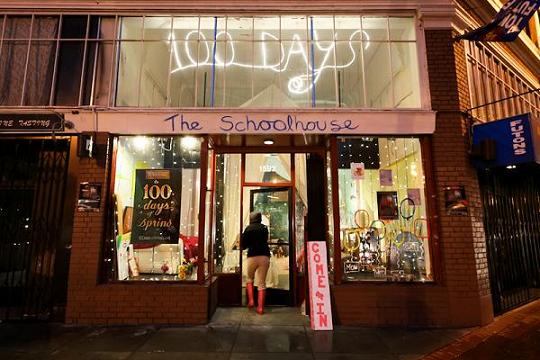
All photos by Stephen Heraldo
Just beyond the scope of the perpetual debate of revitalizing Mid-Market — defined as the stretch from Fifth Street to Van Ness Avenue — an extraordinary project is quietly closing its doors on an oblique, no-man’s-land corner of Market near Franklin. There, for one hundred days and nights, an empty glass storefront opened up to spill a swath of light and music onto the cigarette-studded sidewalk — without funding, a business model, or (as founders Will Greene and Sam Haynor are the first to say) much of anything else.
“Ask us our mission statement,” One Hundred Days of Spring organizer Haynor challenges.
“We don’t have one,” Greene, his creative partner, cuts in.
“Well, yes we do,” says Haynor.
“Yeah, that not doing it seemed like a cop-out,” the pair concludes.
“It” was creating more than three months of free and donation-based events, classes, and recorded stories representing a variegated slice of the local population: hipster kids in art collectives, professionals on their Market Street commutes, and low income neighborhood residents, including many who bed down each night on the block.
As part of Central Market Partnership’s ongoing efforts to inject arts and culture into revitalization plans for mid-Market, the San Francisco Office of Economic and Workforce Development is joining with the Arts Commission to hold a series of focus groups exploring ways to engage artists, small businesses and cultural organizations in the making of a thriving creative district.
Five focus groups have already met, according to OEWD’s Jordan Klein, and over the coming weeks, more gatherings — of community residents, transportation advocates, historical preservation advocates, and nonprofit leaders — will provide insight for the Central Market Economic Strategy, to be released in the late summer or early fall.
One Hundred Days of Spring wasn’t on the agenda of any of these meetings. A former boutique clothing store sandwiched between SROs and auto body shops on a strip shadowed by the sheer, block-long face of a Honda dealership, the space’s previous tenants didn’t last long. But transformed into a gypsy-tent-circus-wagon-theater-gallery-cum-classroom, the storefront, reborn as the Schoolhouse, rooted itself in the neighborhood in just a few months.
The hundred days are now over. But if the packed closing ceremony was any indication, Haynor and Greene’s model is one that the community is keen to reproduce. Mark Singer, a research librarian and freelance writer who found the project in what the two founders call the “analog way” — by stumbling across the threshold — told supporters, “I challenge everyone in this room to replicate what we’ve seen here, seen in the last hundred days.”
“The ultimate goal,” Haynor said, “is not only to share and to educate, but at the end of one hundred days, to have created one hundred new ideas for people to carry out into the world.”
Nothing to it
One Hundred Days of Spring was an experiment in community-supported programming. Rather than relying on or waiting for grant money, Haynor and Greene hoped to show that a community space can be self-sustaining — for the benefit of those who can contribute more and those who must contribute less.
“San Francisco is grant rich,” Haynor explains, “but it’s also full of people waiting for grants. They have a bunch of awesome ideas, but by the time the grant cycle comes around, the initial spark is gone. For us, going after a grant would just eat up time, and we wouldn’t end up doing what we wanted.”
Instead, the two 25-year-olds pooled their savings and paid $2,000 a month for rent from March to June, $200 for utilities, plus a few hundred extra for renovations and insurance. Within three weeks of the initial idea, they had moved into the space and populated a calendar of events through friends, friends of friends, and tools like SF Chalkboard. They were running full tilt by day six.
In just over three months, the team offered more than 250 classes, shows, and tutorials — sometimes five in a day — covering everything from truffle-making and fermentation to bike repairs, aerial silks, and open mics. By collecting donations on a pay-what-you-can basis, Haynor and Greene were able to recover a large portion of their initial output, and also garner an extra $4,000 to reinvest into the project.

Greene on the value of 100 days of events: “If you try to put a value on what we have now, that we didn’t have then, you couldn’t buy it for $4,000.”
Though the Schoolhouse founders ended up $4,000 short, Greene says they “could have broken even” if they had focused more on the project’s revenue-generating components, like filming videos for musicians who performed in the space.
Even so, for Greene the worth of One Hundred Days of Spring was indisputable. “If you try to put a value on what we have now, that we didn’t have then, you couldn’t buy it for $4,000,” he says.
When Judy Nemzoff, community arts and education program director for the Arts Commission, stopped by the Schoolhouse and asked how Haynor and Greene did what they did, the two replied, “Well, we just signed a lease.”
It takes two
Inside the Schoolhouse, the laid-back attitude seemed to likewise shrug “nothing to it but to do it.” But the warm, easy atmosphere belied the late nights and hard work it took to get ‘er done.
Understanding how One Hundred Days of Spring came to be — and why it worked so well — means understanding a bit about its creators

Greene and Haynor, hanging at the Schoolhouse
Haynor and Greene have the kind of friendship people make movies about. Besides the sort-of charming things like finishing each other’s sentences and bragging about accomplishments each knows the other would never mention for himself, there’s the sense that somehow, these two unassuming fellows are going to change the world.
“We’re a good balance,” Greene says. With the air of someone showing how two-plus-two equals four, he explains, “Sam’s a bit spastic, and I can plunge a toilet.”
“We have different skill sets, but we share goals,” he continues. “We keep each other in check. We’re both very often wrong, but we’re rarely both wrong at the same time.”
Coco Spencer, who joined One Hundred Days of Spring as an intern partway through and become an indispensible team member, says she was willing to dedicate so many hours to the Schoolhouse because, “Basically, Sam and Will are the most inspiring people I’ve ever met.”
Haynor and Greene were campers and later counselors together at the Bar 717 Ranch in Trinity County. There, they found each other, and also a passion for teaching — or, as they put it, “helping people to be good versions of themselves.”
Though each has traveled and embarked on sundry individual projects — Greene as a musician and videographer, Haynor as a chess champion and conflict-area journalist — they continue to connect over their drive to educate in unique new ways.
Bathroom, beats, and big ideas
At the Schoolhouse, that meant engaging community members through a service-based approach. “Our main goal is to provide resources to people who need resources,” Greene says. “We’re not interested in providing resources to people who have resources.”
Given the diversity of The Schoolhouse’s participants, “resources” could mean different things.
Haynor explains, “For some people, we’re a bathroom. For some we’re a place to stop in and say ‘hi.’ For some, we’re a place to do events.”
“We’re successful because we’re always doing something fun, and everyone feels invited,” Greene says. “It’s the loose nature of our project. There’s no doorman, no guy with a cash box.”
There were challenges (“Sam’s been trying to put together homeless poetry readings, but he’s scheduled them for the first of the month. That’s when everyone gets their checks, so everyone gets drunk,” Greene says at one point), but there were also many moments — like when a woman from the block walked up and started giving Haynor a massage, or when Greene calmly negotiated with a rowdy, intoxicated visitor, encouraging her to pipe down and eventually leave — that pointed to a deft interface with the surrounding community.
“They respect our storefront more than they do the others,” Greene says. Some locals worked shifts at the Schoolhouse in return for resources. Others stopped in for music, for food and nutrition classes, or to look at the art. Some simply came by to talk about living in the area.
During an “Un-Talent Show”, a performer named SofT humorously described a street-dweller’s perpetual problem: carrying belongings. He showed an in-stitches audience how to bundle objects in an old sweater — a wholly relatable rap on wrapping. Another visit came from Benny, one of SF’s famous itinerant tamale sellers, who lives in an SRO across the street and makes what partakers described as “possibly the world’s best tamales” across town in his girlfriend’s kitchen.
Haynor describes a woman who walked into a sewing workshop — run by SF Social Fabric, a volunteer-staffed bike maintenance and sewing skills collective — with “some trepidation.”
“She was in a room with a bunch of people who were nothing like her,” he says, “but we got to know each other over the fact that we all wear clothes. And they all fall apart.”

Neighborhood connections at the Schoolhouse
“There’s a duality to this corner,” Haynor says. “From doctors to the people who live on the block to all the people in the middle who travel Market Street. Before us, some wouldn’t even cross the street.”
“At our best,” he continues, “we’re a place people from another demographic can discover the old-fashioned way — with their eyes and their feet. They cross the threshold, ask what we’re doing, decide to stay, and learn something. Now, I can’t go five minutes without seeing someone I know, or someone who I recognize, or someone who just popped in.”
Singer, a perfect example of the phenomenon, started stopping by between two and five times a week after his initial discovery. He framed the project’s importance in simpler terms: “This is where we need these things to happen. Where it smells like urine on a hot day.”
Let’s put on a show!
Singer believes that projects like the Schoolhouse can “transform parts of San Francisco” by providing services that are more than “just artists and gallery-talk.” The Schoolhouse, he says, “was something visceral.”
“One Hundred Days of Spring created an infinite possibility for community that can’t be replicated on a screen or keyboard. We’re not talking Internet cafés with white earbuds, but humans breathing in the same space — collaborating, communicating in one room, and that room changing every darn day.”
Indeed, the walls of the Schoolhouse were repainted so many times over the course of the hundred days — with layers of murals, street art, installations, white space for projecting films — that Spencer, who took charge of many of the events’ logistics, joked she was hoping to reduce the interior square footage, and thus, the rent.
The zealous energy required to transform the space again and again was reminiscent — Singer pointed out — of Babes-in-Arms-era Mickey Rooney and Judy Garland exclaiming Hey, kids! Let’s put on a show in this old barn! That down-home, DIY energy may be just what efforts like the Mid-Market revitalization require.
Greene, who attended one of the Central Market Partnership’s focus groups, says the consensus was that knowledge about and access to space were the biggest obstacles to creating and executing programs of any kind.
“People are looking for answers,” he says, “looking for some larger entity to hand them space, or looking tax breaks. There’s the feeling that you can’t just do what you want to do.”
“Rather than saying ‘if you give us space, we’ll fill it with beautiful things,’ you can say ‘I’m just going to do it.’ If you’re willing to make it happen, if you work really hard, if you work with the people you’re trying to reach, then you don’t have to worry about anything else.”
Despite the waiting, wanting, hoping attitudes Greene says he encountered, he points out that plenty of others are “just doing it.” The Schoolhouse helped along a few such visionaries by sponsoring two “Grant Prix Dinners.” During the informal roundtables, entrepreneurs presented project ideas between courses. Participants paid a fee for dinner and a ballot on which to elect their favorite projects – to whom the entry frees were turned over as seed money at the end of the night.
Bringing together the neighborhood
At times, especially in San Francisco and other urban areas where real estate is costly, amping up a neighborhood’s arts and cultural amenities has acted as a roundabout measure to invite the type of gentrification that sweeps streets clean. That kind of programming is not intended to serve current residents so much as to usher in new ones.
By contrast, the Schoolhouse made a conscious decision to serve the neighborhood’s existing population — with safer-feeling streets resulting, and much more quickly, at that.
One Hundred Days of Spring was a bold, direct move to engage the local community. As such, it was highly effective not only at providing needed resources, but at tempering the less-desirable qualities of the neighborhood by creating a sense of community and responsibility among residents and passers-through.
“Coming out of Muni, walking home on Market Street,” Singer had said, “can frankly be pretty scary. There’s substance abuse, drug deals, and people who may or may not be harmless.” The Schoolhouse, he said, helped diffuse that lack of ownership and feeling of “anything goes.” For Singer – and Schoolhouse denizens of all backgrounds — the space managed to help tie a few new knots.
“The Schoolhouse brought me closer to a world that’s very marginal,” Singer said. “the homeless world.”
Whether or not Mid-Market planners will look to the Schoolhouse for a lesson in effective community building, the project’s two masterminds have undoubtedly developed a model they can draw on in the future.
Haynor and Greene plan to continue working together on community education projects. With One Hundred Days of Spring under their belts, they will be able to approach supporters “not just with an idea, but with a proven concept.”
“We are both in this together to see what we’re both capable of,” Haynor said. “To see if we’re any good at this thing.”
In the style of banter so typical of the pair, Greene added, “So we can figure out the rest of what we’re going to do with our whole darn lives.”
Film Listings
Film listings are edited by Cheryl Eddy. Reviewers are Kimberly Chun, Michelle Devereaux, Peter Galvin, Max Goldberg, Dennis Harvey, Johnny Ray Huston, Louis Peitzman, Lynn Rapoport, Ben Richardson, and Matt Sussman. For rep house showtimes, see Rep Clock. For first-run showtimes, see Movie Guide.
OPENING
Happy Happy, a documentary by Roko Belic (1999’s Genghis Blues), traces the contented lifestyles of men and women around the globe. Manoj Singh is a Kolkata rickshaw driver sustained by his son’s smile. Anne Bechsgaard’s life is enriched by her co-housing community in Denmark. These soothingly sentimental profiles are intercut with commentary from leading neuroscientists and psychologists. They provide a cursory guide to the rare balancing act that is happiness in the 21st century. A brisk 75 minutes, the film is saturated with thought-provoking tidbits (the Bhutan government aims for gross national happiness instead of GDP) and an ambient backing track that’s heavy on the chimes. However, sometimes there’s the sense that these mechanics of happiness aren’t cinematically compelling enough, and that rifling through a couple Wikipedia pages might offer just as much insight. At its best, Happy sparks a reflection on how many of the unofficial criteria for joy one has fulfilled, and suggests ideas for simple happiness boosters. (1:15) Roxie. (David Getman)
Larry Crowne A recently unemployed man (Tom Hanks, who also co-wrote and directs the film) starts attending college, where he promptly becomes hot for teacher (Julia Roberts). (1:39) Four Star, Piedmont, Presidio, Shattuck.
Monte Carlo Selena Gomez, Leighton Meester, and Katie Cassidy play friends who fake their way to an awesome European vacation. (1:48)
Mr. Nice By the second hour of Mr. Nice, star Rhys Ifans and company have exhausted every possible pot smoking flourish. There’s the seductive French inhale by the pool, the suggestive mouth to mouth, the euphoric dragon release in the deserts of Pakistan: all rendered in extreme close-up with improbably thick plumes of white smoke. Mr. Nice is mostly sexy drug use tutorial, though it’s also part biography of real-life drug smuggler Howard Marks. His claim to fame — at least according to the movie’s tagline — is the sheer number of aliases, phone lines, and children he had (43, 89, and 4, respectively). Unexpectedly, it’s the period costuming, cinematography, and the enchanting listlessness of Chloe Sevigny that redeem the film. Mr. Nice is captivatingly interlaced with vintage news and scenery clips from the period and it’s shot in a way that is both hyper-stylized and erratic. Those twists and turns of Marks’s life turn out to be not nearly as suspenseful onscreen as they should be, making the movie less of a traditional drug thriller and more of a mildly interesting reflection on the culture of the period. (2:01) Lumiere, Shattuck. (Getman)
*Page One: Inside the New York Times When Andrew Rossi’s documentary premiered at Sundance this January, word of mouth on it was respectable but qualified, with nearly everyone opining that it was good … just not what they’d been led to expect. What they expected was (in line with the original subtitle A Year Inside the New York Times) a top-to-bottom overview of how the nation’s most respected — and in some circles resented — arbiter of news, “style,” and culture is created on a day-to-day as well as longer term basis. That’s something that would doubtless fascinate anyone still interested in print media, or even that realm of web media not catering to the ADD nation. But that big picture and the wealth of minute cogs within isn’t Page One‘s subject. Instead, Rossi focuses on the Gray Lady’s wrestling with admittedly fast-changing times in which newspapers and any other information source on paper seem to constitute an endangered species. This particular Times, however, is such a special case that that crisis might better have been explored by training a camera on a less fabled publication, perhaps one of the many that have succumbed to a once unthinkable, market-shrunk mortality in recent years. The film finds its colorful protagonist in David Carr, an ex-crack addict turned media columnist who retains his cranky, nonconformist edge even as he defends the Times itself from the same out-with-the-old cheerleaders who 15 years ago were inflating the dot-com boom till it burst. Facing one particularly smug champion of the blogosphere at a forum, Carr notes that without a few remaining outlets — like the Times — doing the hard work of serious research and reportage, the web would have nothing to purloin or offer but its own unending trivia and gossip. Page One does what it does entertainingly well, but if you’re looking for insight toward this not-dead-yet U.S. institution as a whole, you’d be better off simply picking up this week’s Sunday edition and reading every last word. (1:28) Bridge, Shattuck, Smith Rafael. (Harvey)
Transformers: Dark of the Moon Just wondering how Michael Bay could possibly improve on the previous film’s robot balls. (2:34) Presidio.
ONGOING
The Art of Getting By The Art of Getting By is all about those confusing, mixed-up and apparently sexually frustrating months before high school graduation. George (Freddie Highmore) is a trench coat-wearing misanthrope — an old soul, as they say — whose parents and teachers are always trying to put him inside a box and tell him how to think. He finds a kindred sprit in Sally (Emma Roberts) who smokes and watches Louis Malle films. Hot. Heavily scored by the now-ancient songs of early ’00s blog bands, it may all sound like indie bullshit but this one has charm and wit despite its post-trend package. Like a sad little crayon, Highmore is a competent Michael Cera surrogate du jour. Writer-director Gavin Wiesen embraces hell of clichés, but he suitably sums up a generational angst along the way. The film may not always feel real, but it does have real feeling. Look out for great performances from Blair Underwood and Alicia Silverstone. (1:24) Sundance Kabuki. (Ryan Lattanzio)
Bad Teacher Jake Kasdan, the once-talented director of a few Freaks and Geeks episodes and 2002’s underrated Orange County, seems hell-bent on humiliating everyone in the cast of Bad Teacher. Cameron Diaz is Elizabeth, the title’s criminally bad pedagogue who prefers the Jack Daniels method to the Socratic. Her impetus for pounding Harper Lee into her middle school students’ bug-eyed little heads is to cash in on a bonus check to fund her breast-y ambitions and woo Justin Timberlake and his baby voice. The only likable onscreen presence is Jason Segal as a sad sack gym teacher in love with Elizabeth. But he could do so much better. There’s no shortage of racist jokes and potty humor in this R-rated comedy pandering to those 17 and below. When asked if she wants to go out with her coworkers, Elizabeth ripostes, “I’d rather get shot in the face!” That scenario is likely a better alternative than suffering this steaming pile of cash cow carcass. (1:29) Marina, 1000 Van Ness, Shattuck, SF Center. (Lattanzio)
*Beginners There is nothing conventional about Beginners, a film that starts off with the funeral arrangements for one of its central characters. That man is Hal (Christopher Plummer), who came out to his son Oliver (Ewan McGregor) at the ripe age of 75. Through flashbacks, we see the relationship play out — Oliver’s inability to commit tempered by his father’s tremendous late-stage passion for life. Hal himself is a rare character: an elderly gay man, secure in his sexuality and, by his own admission, horny. He even has a much younger boyfriend, played by the handsome Goran Visnjic. While the father-son bond is the heart of Beginners, we also see the charming development of a relationship between Oliver and French actor Anna (Mélanie Laurent). It all comes together beautifully in a film that is bittersweet but ultimately satisfying. Beginners deserves praise not only for telling a story too often left untold, but for doing so with grace and a refreshing sense of whimsy. (1:44) Embarcadero, Piedmont, Sundance Kabuki. (Peitzman)
*Bill Cunningham New York To say that Bill Cunningham, the 82-year old New York Times photographer, has made documenting how New Yorkers dress his life’s work would be an understatement. To be sure, Cunningham’s two decades-old Sunday Times columns — “On the Street,” which tracks street-fashion, and “Evening Hours,” which covers the charity gala circuit — are about the clothes. And, my, what clothes they are. But Cunningham is a sartorial anthropologist, and his pictures always tell the bigger story behind the changing hemlines, which socialite wore what designer, or the latest trend in footwear. Whether tracking the near-infinite variations of a particular hue, a sudden bumper-crop of cropped blazers, or the fanciful leaps of well-heeled pedestrians dodging February slush puddles, Cunningham’s talent lies in his ability to recognize fleeting moments of beauty, creativity, humor, and joy. That last quality courses through Bill Cunningham New York, Richard Press’ captivating and moving portrait of a man whose reticence and personal asceticism are proportional to his total devotion to documenting what Harold Koda, chief curator at the Costume Institute at the Metropolitan Museum of Art, describes in the film as “ordinary people going about their lives, dressed in fascinating ways.” (1:24) Opera Plaza. (Sussman)
Bride Flight Who doesn’t love a sweeping Dutch period piece? Ben Sombogaart’s Bride Flight is pure melodrama soup, enough to give even the most devout arthouse-goer the bloats. Emigrating from post-World War II Holland to New Zealand with two gal pals, the sweetly staid Ada (Karina Smulders) falls for smarm-ball Frank (Waldemar Torenstra, the Dutchman’s James Franco) and kind of joins the mile high club to the behest of her conscience. The women arrive with emotional baggage and carry-ons of the uterine kind. As the harem adjusts to the country mores of the Highlands, Frank tries a poke at all of them in a series of sex scenes more moldy than smoldery. This Flight, set to a plodding score and stuffy mise-en-scene, never quite leaves the runway. Not to mention the whole picture, pale as a corpse, resembles one of those old-timey photographs of your great grandma’s wedding. These kinds of pastoral romances ought to be put out to, well, pasture. (2:10) Opera Plaza. (Lattanzio)
*Bridesmaids For anyone burned out on bad romantic comedies, Bridesmaids can teach you how to love again. This film is an answer to those who have lamented the lack of strong female roles in comedy, of good vehicles for Saturday Night Live cast members, of an appropriate showcase for Melissa McCarthy. The hilarious but grounded Kristen Wiig stars as Annie, whose best friend Lillian (Maya Rudolph) is getting hitched. Financially and romantically unstable, Annie tries to throw herself into her maid of honor duties — all while competing with the far more refined Helen (Rose Byrne). Bridesmaids is one of the best comedies in recent memory, treating its relatable female characters with sympathy. It’s also damn funny from start to finish, which is more than can be said for most of the comedies Hollywood continues to churn out. Here’s your choice: let Bridesmaids work its charm on you, or never allow yourself to complain about an Adam Sandler flick again. (2:04) Marina, 1000 Van Ness, Shattuck, Sundance Kabuki. (Peitzman)
Buck This documentary paints a portrait of horse trainer Buck Brannaman as a sort of modern-day sage, a sentimental cowboy who helps “horses with people problems.” Brannaman has transcended a background of hardship and abuse to become a happy family man who makes a difference for horses and their owners all over the country with his unconventional, humane colt-starting clinics. Though he doesn’t actually whisper to horses, he served as an advisor and inspiration for Robert Redford’s The Horse Whisperer (1998). Director Cindy Meehl focuses generously on her saintly subject’s bits of wisdom in and out of a horse-training setting — e.g. “Everything you do with a horse is a dance” — as well as heartfelt commentary from friends and colleagues. In the harrowing final act of the film, Brannaman deals with a particularly unruly horse and his troubled owner, highlighting the dire and disturbing consequences of improper horse rearing. (1:28) Embarcadero, Shattuck, Smith Rafael, Sundance Kabuki. (Sam Stander)
Cars 2 You pretty much can’t say a bad thing about a Pixar film. Cars 2 is by no means Ratatouille (2007) or Wall-E (2008), but the sequel to the 2006 hit Cars offers plenty of sleek visuals and one-note gags under its hollow hood. If nothing else, Pixar seems to have overcome the dingy, dark glaze that plagues 3-D films. Directors John Lasseter and Joe Ranft return to beloved autos Lightning McQueen (Owen Wilson) and the “extremely American” Mater (Larry the Cable Guy). This time around, secret agents Finn McMissile (Michael Caine) and Holley Shiftwell (Emily Mortimer) come along for the ride while working to expose sabotage in the alternative fuel industry. Compelling chase sequences, explosions and more than a few jabs at cultural stereotypes follow suit. This is the lightest, silliest Pixar film to date, but you probably don’t have any business seeing it unless you’ve got a kid in tow. (1:52) Balboa, Empire, 1000 Van Ness, Presidio, SF Center, Shattuck, Sundance Kabuki. (Lattanzio)
*Cave of Forgotten Dreams The latest documentary from Werner Herzog once again goes where no filmmaker — or many human beings, for that matter — has gone before: the Chauvet-Pont-d’Arc Cave, a heavily-guarded cavern in Southern France containing the oldest prehistoric artwork on record. Access is highly restricted, but Herzog’s 3D study is surely the next best thing to an in-person visit. The eerie beauty of the works leads to a typically Herzog-ian quest to learn more about the primitive culture that produced the paintings; as usual, Herzog’s experts have their own quirks (like a circus performer-turned-scientist), and the director’s own wry narration is peppered with random pop culture references and existential ponderings. It’s all interwoven with footage of crude yet beautiful renderings of horses and rhinos, calcified cave-bear skulls, and other time-capsule peeks at life tens of thousands of years ago. The end result is awe-inspiring. (1:35) SF Center, Shattuck. (Eddy)
Conan O’Brien Can’t Stop Conan O’Brien Can’t Stop seems less of a movie title and more like a hushed comment shared between one of the many hangers-on during the filming of the “Legally Prohibited From Being Funny On Television Tour.” Throughout 23 cities’ worth of footage, O’Brien seethes, paces, sweats, yells and beats dead jokes so hard that they spring back to life, as he is wont to do. At this point, the Leno/Coco drama is a bit stale — at least in internet time — but the documentary is a fascinating comedian character study nonetheless. It may be hard to sympathize with a man nursing a bruised ego as he cashes a $45 million dollar check, but it’s easy to see that he’s one of the best late night hosts (temporarily off) the air. Split primarily between clips of O’Brien performing songs on stage with a myriad of celebrity guests and bemoaning how exhausted and frustrated he is, Can’t Stop derives most of its hilarity from the off-the-cuff comments that pepper Conan’s everyday conversations. (1:29) Lumiere, Shattuck. (Getman)
*The Double Hour Slovenian hotel maid Sonia (Ksenia Rappoport) and security guard Guido (Filippo Timi) are two lonely people in the Italian city of Turin. They find one another (via a speed-dating service) and things are seriously looking up for the fledgling couple when calamity strikes. This first feature by music video director Giuseppe Capotondi takes a spare, somber approach to a screenplay (by Alessandro Fabbri, Ludovica Rampoldi, and Stefano Sardo) that strikingly keeps raising, then resisting genre categorization. Suffice it to say their story goes from lonely-hearts romance to violent thriller, ghost story, criminal intrigue, and yet more. It doesn’t all work seamlessly, but such narrative unpredictability is so rare at the movies these days that The Double Hour is worth seeing simply for the satisfying feeling of never being sure where it’s headed. (1:35) Opera Plaza. (Harvey)
Empire of Silver Love, not money, is at the core of Empire of Silver — that’s the M.O. of a Shanxi banking family’s libertine third son, or “Third Master” (Aaron Kwok) in this epic tug-of-war between Confucian duty and free will. The Third Master pines for his true love, his stepmother (Hao Lei), yet change is going off all around the star-crossed couple in China at the end of the 19th century and the start of the 20th, and the youthful scion ends up pouring his passion into the family business, attempting to tread his own path, apart from his Machiavellian father (Tielin Zhang). Much like her protagonist, however, director (and Stanford alum) Christina Yao seems more besotted with romance than finance, bathing those scenes with the love light and sensual hues reminiscent of Zhang Yimou’s early movies. Though Yao handles the widescreen crowd scenes with aplomb, her chosen focus on money, rather than honey, leaches the action of its emotional charge. It doesn’t help that, on the heels of the Great Recession, it’s unlikely that anyone buys the idea of a financial industry with ironclad integrity — or gives a flying yuan about the lives of bankers. (1:52) Four Star. (Chun)
Green Lantern This latest DC Comics-to-film adaptation fails to recognize the line between awesome fantasy-action and cheeseball absurdity, often resembling the worst excesses of the Christopher Reeve Superman movies. A surprisingly palatable Ryan Reynolds stars as Hal Jordan, the cocky test pilot who is chosen to wield a power ring as a member of an intergalactic police force called the Green Lantern Corps. He must face down Parallax, an alien embodiment of fear, who appears here as a chuckle-inducing floating head surrounded by tentacles. Peter Sarsgaard is effectively nauseating as Hector Hammond, who becomes Parallax’s crony after he is transformed by a transfusion of fear energy. The acting is all over the map, with Blake Lively’s blank-faced love interest caricature as the weakest link, and the effects are hit-or-miss, but scenes featuring alien Green Lanterns should please fans, and you could probably do worse if you’re looking for an entertaining popcorn flick. (1:45) 1000 Van Ness, Sundance Kabuki. (Stander)
The Hangover Part II What do you do with a problematic mess like Hangover Part II? I was a fan of The Hangover (2009), as well as director-cowriter Todd Phillips’ 1994 GG Allin doc, Hated, so I was rooting for II, this time set in the East’s Sin City of Bangkok, while simultaneously dreading the inevitable Asian/”ching-chang-chong” jokes. Would this would-be hit sequel be funnier if they packed in more of those? Doubtful. The problem is that most of II‘s so-called humor, Asian or no, falls completely flat — and any gross-out yuks regarding wicked, wicked Bangkok are fairly old hat at this point, long after Shocking Asia (1976) and innumerable episodes of No Reservations and other extreme travel offerings. This Hangover around, mild-ish dentist Stu (Ed Helms) is heading to the altar with Lauren (The Real World: San Diego‘s Jamie Chung), with buds Phil (Bradley Cooper) and Doug (Justin Bartha) in tow. Alan (Zach Galifianakis) has completely broken with reality — he’s the pity invite who somehow ropes in the gangster wild-card Mr. Chow (Ken Jeong). Blackouts, natch, and not-very-funny high jinks ensue, with Jeong, surprisingly, pulling small sections of II out of the crapper. Phillips obviously specializes in men-behaving-badly, but II‘s most recent character tweaks, turning Phil into an arrogant, delusional creep and Alan into an arrogant, delusional kook, seem beside the point. Because almost none of the jokes work, and that includes the tired jabs at tranny strippers because we all know how supposedly straight white guys get hella grossed out by brown chicks with dicks. Lame. (1:42) 1000 Van Ness, SF Center. (Chun)
Kung Fu Panda 2 The affable affirmations of 2008’s Kung Fu Panda take a back seat to relentlessly elaborate, gag-filled action sequences in this DreamWorks Animation sequel, which ought to satisfy kids but not entertain their parents as much as its predecessor. Po (voiced by Jack Black), the overeating panda and ordained Dragon Warrior of the title, joins forces with a cavalcade of other sparring wildlife to battle Lord Shen (Gary Oldman), a petulant peacock whose arsenal of cannons threatens to overwhelm kung fu. But Shen is also part of Po’s hazy past, so the panda’s quest to save China is also a quest for self-fulfillment and “inner peace.” There’s less character development in this installment, though the growing friendship between Po and the “hardcore” Tigress (Angelina Jolie) is occasionally touching. The 3-D visuals are rarely more than a gimmick, save for a series of eye-catching flashbacks in the style of cel-shaded animation. (1:30) 1000 Van Ness, SF Center. (Stander)
*Making the Boys In 1968 The Boys in the Band revolutionized Broadway and opened a lot of minds by being a hit play (and film) about NYC homosexuals. Yet on the cusp of “Gay Liberation” and for many years thereafter, much of the actual gay community hugely objected to author Mart Crowley’s fictive portrait of its ‘mos as insular, shallow, classist, bitchy, and guilt-ridden. It was (as interviewee Edward Albee notes here) a picture ideally suited to straight Broadway audiences who lined up to see queers rendered pitiful if still identifiably human. Crayton Robey’s absorbing documentary chronicles the bumpy road of Boys and its creators — Crowley never had another hit, floundering until he moved into TV series scripting. The cast of the 1970 movie version, directed by William Friedkin (one year before The French Connection, followed by The Exorcist), saw their big break turn into a virtual industry blacklisting. Exceptions were unimpeachably heterosexual thespians Laurence Luckinbill and Cliff Gorman, who only “played” gay. This engrossing document recalls a work that trailblazed, was rejected as politically correct, then re embraced as an important touchstone in gay visibility and self-empowerment. (1:33) Roxie. (Harvey)
Midnight in Paris Owen Wilson plays Gil, a self-confessed “Hollywood hack” visiting the City of Light with his conservative future in-laws and crassly materialistic fiancée Inez (Rachel McAdams). A romantic obviously at odds with their selfish pragmatism (somehow he hasn’t realized that yet), he’s in love with Paris and particularly its fabled artistic past. Walking back to his hotel alone one night, he’s beckoned into an antique vehicle and finds himself transported to the 1920s, at every turn meeting the Fitzgeralds, Gertrude Stein (Kathy Bates), Dali (Adrien Brody), etc. He also meets Adriana (Marion Cotillard), a woman alluring enough to be fought over by Hemingway (Corey Stoll) and Picasso (Marcial di Fonzo Bo) — though she fancies aspiring literary novelist Gil. Woody Allen’s latest is a pleasant trifle, no more, no less. Its toying with a form of magical escapism from the dreary present recalls The Purple Rose of Cairo (1985), albeit without that film’s greater structural ingeniousness and considerable heart. None of the actors are at their best, though Cotillard is indeed beguiling and Wilson dithers charmingly as usual. Still — it’s pleasant. (1:34) Albany, Balboa, Embarcadero, 1000 Van Ness, Piedmont, Sundance Kabuki. (Harvey)
Mr. Popper’s Penguins (1:35) 1000 Van Ness.
*My Perestroika Robin Hessman’s very engaging documentary takes one very relatable look at how changes since glasnost have affected some average Russians. The subjects here are five thirtysomethings who, growing up in Moscow in the 70s and 80s, were the last generation to experience full-on Communist Party indoctrination. But just as they reached adulthood, the whole system dissolved, confusing long-held beliefs and variably impacting their futures. Andrei has ridden the capitalist choo-choo to considerable enrichment as the proprietor of luxury Western menswear shops. But single mother Olga, unlucky in love, just scrapes by, while married schoolteachers Lyuba and Boris are lucky to have inherited an apartment (cramped as it is) they could otherwise ill afford. Meanwhile Ruslan, once member of a famous punk band (which he abandoned on principal because it was getting “too commercial”), both disdains and resents the new order just as he did the old one. Home movies and old footage of pageantry celebrating Soviet socialist glory make a whole ‘nother era come to life in this intimate, unexpectedly charming portrait of its long-term aftermath. (1:27) Balboa. (Harvey)
Submarine (1:37) Opera Plaza.
*Super 8 The latest from J.J. Abrams is very conspicuously produced by Steven Spielberg; it evokes 1982’s E.T.: The Extra-Terrestrial as well as 1985’s The Goonies and 1982’s Poltergeist (so Spielbergian in nature you’d be forgiven for assuming he directed, rather than simply produced, the pair). But having Grandpa Stevie blessing your flick is surely a good thing, especially when you’re already as capable as Abrams. Super 8 is set in 1979, high time for its titular medium, used by a group of horror movie-loving kids to film their backyard zombie epic; later in the film, old-school celluloid reveals the mystery behind exactly what escaped following a spectacular train wreck on the edge of their small Ohio town. The PG-13 Super 8 aims to frighten, albeit gently; there’s a lot of nostalgia afoot, and things do veer into sappiness at the end (that, plus the band of kids at its center, evoke the trademarks of another Grandpa Stevie: Stephen King). But the kid actors (especially the much-vaunted Elle Fanning) are great, and there’s palpable imagination and atmosphere afoot, rare qualities in blockbusters today. Super 8 tries, and mostly succeeds, in progressing the fears and themes addressed by E.T. (divorce, loneliness, growing up) into century 21, making the unknowns darker and the consequences more dire. (1:52) California, Empire, 1000 Van Ness, Presidio. (Eddy)
*13 Assassins 13 Assassins is clearly destined to be prolific director Takashi Miike’s greatest success outside Japan yet. It’s another departure for the multi-genre-conquering Miike, doubtless one of the most conventional movies he’s made in theme and execution. That’s key to its appeal — rigorously traditional, taking its sweet time getting to samurai action that is pointedly not heightened by wire work or CGI, it arrives at the kind of slam-dunk prolonged battle climax that only a measured buildup can let you properly appreciate. In the 1840s, samurai are in decline but feudalism is still hale. It’s a time of peace, though not for the unfortunates who live under regional tyrant Lord Naritsugu (Goro Inagaki), a li’l Nippon Caligula who taxes and oppresses his people to the point of starvation. Alas, the current Shogun is his sibling, and plans to make little bro his chief adviser — so a concerned Shogun official secretly hires veteran samurai Shinzaemon (Koji Yakusho) to assassinate the Lord. Fully an hour is spent on our hero doing “assembling the team” stuff, recruiting other unemployed, retired, or wannabe samurai. When the protagonists finally commence their mission, their target is already aware he’s being pursued, and he’s surrounded by some 200 soldiers by the time Miike arrives at the film’s sustained, spectacular climax: a small village which Shinzaemon and co. have turned into a giant boobytrap so that 13 men can divide and destroy an ogre-guarding army. A major reason why mainstream Hollywood fantasy and straight action movies have gotten so depressingly interchangeable is that digital FX and stunt work can (and does) visualize any stupid idea — heroes who get thrown 200 feet into walls by monsters then getting up to fight some more, etc. 13 Assassins is thrilling because its action, while sporting against-the-odds ingeniousness and sheer luck by our heroes as in any trad genre film, is still vividly, bloodily, credibly physical. (2:06) Four Star, Opera Plaza, Shattuck. (Harvey)
The Tree of Life Mainstream American films are so rarely adventuresome that overreactive gratitude frequently greets those rare, self-conscious, usually Oscar-baiting stabs at profundity. Terrence Malick has made those gestures so sparingly over four decades that his scarcity is widely taken for genius. Now there’s The Tree of Life, at once astonishingly ambitious — insofar as general addressing the origin/meaning of life goes — and a small domestic narrative artificially inflated to a maximally pretentious pressure-point. The thesis here is a conflict between “nature” (the way of striving, dissatisfied, angry humanity) and “grace” (the way of love, femininity, and God). After a while Tree settles into a fairly conventional narrative groove, dissecting — albeit in meandering fashion — the travails of a middle-class Texas household whose patriarch (a solid Brad Pitt) is sternly demanding of his three young sons. As a modern-day survivor of that household, Malick’s career-reviving ally Sean Penn has little to do but look angst-ridden while wandering about various alien landscapes. Set in Waco but also shot in Rome, at Versailles, and in Saturn’s orbit (trust me), The Tree of Life is so astonishingly self-important while so undernourished on some basic levels that it would be easy to dismiss as lofty bullshit. Its Cannes premiere audience booed and cheered — both factions right, to an extent. (2:18) California, Embarcadero, Empire, Smith Rafael, Sundance Kabuki. (Harvey)
*The Trip Eclectic British director Michael Winterbottom rebounds from sexually humiliating Jessica Alba in last year’s flop The Killer Inside Me to humiliating Steve Coogan in all number of ways (this time to positive effect) in this largely improvised comic romp through England’s Lake District. Well, romp might be the wrong descriptive — dubbed a “foodie Sideways” but more plaintive and less formulaic than that sun-dappled California affair, this TV-to-film adaptation displays a characteristic English glumness to surprisingly keen emotional effect. Playing himself, Coogan displays all the carefree joie de vivre of a colonoscopy patient with hemorrhoids as he sloshes through the gray northern landscape trying to get cell reception when not dining on haute cuisine or being wracked with self-doubt over his stalled movie career and love life. Throw in a happily married, happy-go-lucky frenemy (comic actor Rob Brydon) and Coogan (TV’s I’m Alan Partridge), can’t help but seem like a pathetic middle-aged prick in a puffy coat. Somehow, though, his confused narcissism is a perverse panacea. Come for the dueling Michael Caine impressions and snot martinis, stay for the scallops and Brydon’s “small man in a box” routine. (1:52) Albany, Clay, Smith Rafael. (Devereaux)
*Trollhunter Yes, The Troll Hunter riffs off The Blair Witch Project (1999) with both whimsy and, um, rabidity. Yes, you may gawk at its humongoid, anatomically correct, three-headed trolls, never to be mistaken for grotesquely cute rubber dolls, Orcs, or garden gnomes again. Yes, you may not believe, but you will find this lampoon of reality TV-style journalism, and an affectionate jab at Norway’s favorite mythical creature, very entertaining. Told that a series of strange attacks could be chalked up to marauding bears, three college students (Glenn Erland Tosterud, Tomas Alf Larsen, and Johanna Morck) strap on their gumshoes and choose instead to pursue a mysterious poacher Hans (Otto Jespersen) who repeatedly rebuffs their interview attempts. Little did the young folk realize that their late-night excursions following the hunter into the woods would lead at least one of them to rue his or her christening day. Ornamenting his yarn with beauty shots of majestic mountains, fjords, and waterfalls, Norwegian director-writer André Ovredal takes the viewer beyond horror-fantasy — handheld camera at the ready — and into a semi-goofy wilderness of dark comedy, populated by rock-eating, fart-blowing trolls and overshadowed by a Scandinavian government cover-up sorta-worthy of The Girl with the Dragon Tattoo (2009). (1:30) Lumiere. (Chun)
*X-Men: First Class Cynics might see this prequel as pandering to a more tweeny demographic, and certainly there are so many ways it could have gone terribly wrong, in an infantile, way-too-cute X-Babies kinda way. But despite some overly choppy edits that shortchange brief moments of narrative clarity, X-Men: First Class gets high marks for its fairly first-class, compelling acting — specifically from Michael Fassbender as the enraged, angst-ridden Magneto and James McAvoy as the idealistic, humanist Charles Xavier. Of course, the celebrated X-Men tale itself plays a major part: the origin story of Magneto, a.k.a. Erik Lehnsherr, a Holocaust survivor, is given added heft with a few tweaks: here, in an echo of Fassbender’s turn in Inglourious Basterds (2009), his master of metal draws on his bottomless rage to ruthlessly destroy the Nazis who used him as a lab rat in experiments to build a master race. The last on his list is the energy-wrangling Sebastian Shaw (Kevin Bacon), who’s set up a sweet Bond-like scenario, protected by super-serious bikini-vixen Emma Frost (January Jones). The complications are that Erik doesn’t ultimately differ from his Frankensteins — he pushes mutant power to the detriment of those puny, bigoted humans — and his unexpected collaborator and friend is Xavier, the privileged, highly psychic scion who hopes to broker an understanding between mutants and human and use mutant talent to peaceful ends. Together, they can move mountains—or at least satellite dishes and submarines. Jennifer Lawrence as Raven/Mystique and Nicholas Hoult as Hank McCoy/Beast fill out the cast, voicing those eternal X-Men dualities — preserving difference vs. conformity, intoxicating power vs. reasoned discipline. All core superhero concerns, as well as teen identity issues — given a fresh charge. (2:20) 1000 Van Ness, Sundance Kabuki. (Chun)
Rep Clock
Schedules are for Wed/22–Tues/28 except where noted. Director and year are given when available. Double and triple features are marked with a •. All times are p.m. unless otherwise specified.
BALBOA 3620 Balboa, SF; www.balboamovies.com. $20. “Opera, Ballet, and Shakespeare in Cinema:” Rigoletto, performed by Placido Domingo, Sat-Sun, 10am.
CASTRO 429 Castro, SF; (415) 621-6120, www.castrotheatre.com. $7.50-10. “Frameline 35: San Francisco International LGBT Film Festival,” Wed-Sun. Visit www.frameline.org for complete schedule and ticket information. Stonewall Uprising (Davis and Heilbroner, 2010), Tues, 7. Free screening.
CHRISTOPHER B. SMITH RAFAEL FILM CENTER 1118 Fourth St, San Rafael; (415) 454-1222, www.cafilm.org. $10.25. The Tree of Life (Malick, 2011), call for dates and times. The Trip (Winterbottom, 2010), call for dates and times. Coppelia, performed by the Bolshoi Ballet, Thurs, 7 and Sun, 1. This event, $18. Buck (Meehl, 2011), June 24-30, call for times.
“FILM NIGHT IN THE PARK” This week: Creek Park, 451 Sir Francis Drake, San Anselmo; (415) 272-2756, www.filmnight.org. Donations accepted. Breakfast Club (Hughes, 1985), Fri, 8; National Velvet (Brown, 1944), Sat, 8.
FOUR STAR 2200 Clement, SF; www.lntsf.com. $10. “Asian Movie Madness” •The Host (Bong, 2006), and Yang Zean (1979), Thurs, call for times.
MECHANICS’ INSTITUTE 57 Post, SF; (415) 393-0100, rsvp@milibrary.org. $10. “CinemaLit Film Series: Music and Nostalgia:” The Blues Brothers (Landis, 1980), Fri, 6.
PACIFIC FILM ARCHIVE 2575 Bancroft, Berk; (510) 642-5249, www.bampfa.berkeley.edu. $5.50-9.50. “Japanese Divas:” Tokyo Story (Ozu, 1953), Wed, 7; Dragnet Girl (Ozu, 1933), Fri, 7; Sisters of the Gion (Mizoguchi, 1936), Fri, 9; Street of Shame (Mizoguchi, 1956), Sat, 8:45. “The Cult of the Kuchars:” “8mm Films by George and Mike Kuchar,” Thurs, 7; Weather Diary 1 (George Kuchar, 1986), Sat, 6. “Secession from the Broadcast: The Internet and the Crisis of Social Control,” lecture by Gene Youngblood, Sat, 3:30. “Arthur Penn: A Liberal Helping:” Little Big Man (1970), Sun, 5:30; Night Moves (1975), Sun, 8:10.
RED VIC 1727 Haight, SF; (415) 668-3994; www.redvicmoviehouse.com. $6-10. “Midnites for Maniacs:” •The Purple Rose of Cairo (Allen, 1985), Wed, 2, 9:15, and Broadway Danny Rose (Allen, 1984), Wed, 7:15. Single film, $7; double feature, $10. Forgetting Dad (Minnich, 2009), Thurs, 7:15, 9:25. The Warriors (Hill, 1979), Fri-Sat, 7:15, 9:20 (also Sat, 2, 4:15). Phil Ochs: There But For Fortune (Bowser, 2011), Sun-Tues, 7:15, 9:20 (also Sun, 2, 4:15).
ROXIE 3117 and 3125 16th St, SF; (415) 863-1087, www.roxie.com. $5-9.75. “Frameline 35: San Francisco International LGBT Film Festival,” Wed-Thurs. Visit www.frameline.org for complete schedule and ticket information. Making the Boys (Robey, 2009), Wed-Thurs, 7:30, 9:30.
SUBTERRANEAN ARTHOUSE 2179 Bancroft, Berk; (510) 540-7185, www.brownpapertickets.com. $10. “Innovative California Dance Films,” Fri, 8:30.
“TEMESCAL STREET CINEMA 2011” 49th St at Telegraph, Oakl; www.temescalstreetcinema.com. Free. Trust (Kelly and Yamamoto, 2010), Thurs, 8:45. With music by Ash Reiter at 8pm.
TOP OF THE MARK InterContinental Mark Hopkins, One Nob Hill, SF; www.topofthemark.com. Free. Bullitt (Yates, 1968), Tues, 7:30. YERBA BUENA CENTER FOR THE ARTS 701 Mission, SF; (415) 978-2787, www.ybca.org. $6-8. Oki’s Movie (Hong, 2010), Thurs, 7:30; Sun, 2.
Film Listings
Film listings are edited by Cheryl Eddy. Reviewers are Kimberly Chun, Michelle Devereaux, Peter Galvin, Max Goldberg, Dennis Harvey, Johnny Ray Huston, Louis Peitzman, Lynn Rapoport, Ben Richardson, and Matt Sussman. For rep house showtimes, see Rep Clock. For first-run showtimes, see Movie Guide.
FRAMELINE
The 35th San Francisco International LGBT Film Festival runs through Sun/26 at the Castro, 429 Castro, SF; Rialto Cinemas Elmwood, 2966 College, Berk; Roxie, 3117 16th St., SF; and Victoria, 2961 16th St., SF. For tickets (most films $9-$15) and complete schedule, visit www.frameline.org.
OPENING
Bad Teacher Cameron Diaz don’t need no education. (1:29) Shattuck.
Buck This documentary paints a portrait of horse trainer Buck Brannaman as a sort of modern-day sage, a sentimental cowboy who helps “horses with people problems.” Brannaman has transcended a background of hardship and abuse to become a happy family man who makes a difference for horses and their owners all over the country with his unconventional, humane colt-starting clinics. Though he doesn’t actually whisper to horses, he served as an advisor and inspiration for Robert Redford’s The Horse Whisperer (1998). Director Cindy Meehl focuses generously on her saintly subject’s bits of wisdom in and out of a horse-training setting — e.g. “Everything you do with a horse is a dance” — as well as heartfelt commentary from friends and colleagues. In the harrowing final act of the film, Brannaman deals with a particularly unruly horse and his troubled owner, highlighting the dire and disturbing consequences of improper horse rearing. (1:28) Embarcadero, Shattuck, Smith Rafael. (Sam Stander)
Cars 2 Owen Wilson, Larry the Cable Guy, Michael Caine, and others give voice to the autos in this spy-themed Pixar sequel. (1:52) Balboa, Shattuck.
Conan O’Brien Can’t Stop Conan O’Brien Can’t Stop seems less of a movie title and more like a hushed comment shared between one of the many hangers-on during the filming of the “Legally Prohibited From Being Funny On Television Tour.” Throughout 23 cities’ worth of footage, O’Brien seethes, paces, sweats, yells and beats dead jokes so hard that they spring back to life, as he is wont to do.
At this point, the Leno/Coco drama is a bit stale — at least in internet time — but the documentary is a fascinating comedian character study nonetheless. It may be hard to sympathize with a man nursing a bruised ego as he cashes a $45 million dollar check, but it’s easy to see that he’s one of the best late night hosts (temporarily off) the air. Split primarily between clips of O’Brien performing songs on stage with a myriad of celebrity guests and bemoaning how exhausted and frustrated he is, Can’t Stop derives most of its hilarity from the off-the-cuff comments that pepper Conan’s everyday conversations. (1:29) Lumiere, Shattuck. (David Getman)
Oki’s Movie See review at www.sfbg.com. (1:20) Yerba Buena Center for the Arts.
*Viva Riva! Gritty, riveting, and even heartbreaking, Viva Riva!, the first Congolese feature film to get distribution in the states, is much like its small-time crook of an anti-hero, Riva (Patsha Bay Mukuna) — in love with life and prepared to laugh in the face of death when it comes knocking. Director Djo Tunda Wa Munga’s African Movie Academy Award winner tumbles with the grimy details of its Kinshasa, Congo, backdrop, and rarely stumbles. A mere foot soldier in a sprawling crime world, Riva has seized his chance at breaking into the big time, with a score of stolen gasoline, and has returned home. His eyes are on an unlikely prize, Nora (Marie Malone), the well-guarded moll of a Kinshasa gangster. As Riva stalks his lithe prey, he’s tailed by the ruthless Angolan crime boss he’s crossed (Hoji Fortuna) and a local military commander under the thug’s thumb (Marlene Longage). As sexy and violent as a contemporary noir, and as familiar as a folk tale unraveled round a campfire, Viva Riva! holds your attention with all the bruised bravado of its Stagger Lee-like protagonist, catching you in with the way the gorgeous Nora undulates at an outdoor gathering at one moment, then squats in the dirt to take a piss at the next. (1:36) Lumiere, Shattuck. (Chun)
ONGOING
*L’Amour Fou Pierre Thoretton’s documentary L’amour fou opens with two clips of men bidding farewell. The first, from 2002, is of the French-Algerian couturier Yves Saint Laurent announcing his retirement in a moving and emotional speech worthy of his favorite writer Marcel Proust. The second is of Pierre Bergé, Saint Laurent’s longtime business partner and former lover, eulogizing his departed friend at the designer’s memorial service six years later. Thoretton’s film is suffused with goodbyes, many tender and candid, some portentous and rehearsed. To be sure, L’amour fou is a touching portrait of the powerful and tempestuous bond between Saint Laurent and Bergé, a bond that lasted close to five decades and resulted in one of the great empires of 20th century fashion. But it is also, alongside David Teboud’s two 2002 YSL documentaries, another entry in the hagiography of Saint Laurent, one cannily steered by Bergé as much as by Thoretton. Well-spoken and charming, Bergé still comes off as the punchy entrepreneurial foil to Saint Laurent’s dazzling but fragile genius. He can be both hyperbolic (praising Saint Laurent’s gifts) but also forthcoming (discussing the designer’s demons). Former muses Loulou de la Falaise and Betty Catroux are also interviewed, but this is clearly Bergé’s show. (1:43) Opera Plaza. (Sussman)
The Art of Getting By The Art of Getting By is all about those confusing, mixed-up and apparently sexually frustrating months before high school graduation. George (Freddie Highmore) is a trench coat-wearing misanthrope — an old soul, as they say — whose parents and teachers are always trying to put him inside a box and tell him how to think. He finds a kindred sprit in Sally (Emma Roberts) who smokes and watches Louis Malle films. Hot. Heavily scored by the now-ancient songs of early ’00s blog bands, it may all sound like indie bullshit but this one has charm and wit despite its post-trend package. Like a sad little crayon, Highmore is a competent Michael Cera surrogate du jour. Writer-director Gavin Wiesen embraces hell of clichés, but he suitably sums up a generational angst along the way. The film may not always feel real, but it does have real feeling. Look out for great performances from Blair Underwood and Alicia Silverstone. (1:24) 1000 Van Ness, Sundance Kabuki. (Ryan Lattanzio)
*Beautiful Boy Save the children, but pity the parents. Director-cowriter Shawn Ku’s Beautiful Boy is one of two recent films concerning parents of kids who go on school killing sprees, and it’ll get potentially shortchanged due to the forthcoming We Need to Talk About Kevin‘s head-turning cast and its Hitchcockian literary source material. Still, Beautiful Boy shines in its own humble way, by dint of its quiet sense of integrity and refusal to pander. The bone-deep unhappiness suffusing the family concerned was present long before 18-year-old college student Sammy (Kyle Gallner) picked up a gun, killed more than a dozen people, then took his own life. Surviving parents Kate (Maria Bello) and Bill (Michael Sheen) already kept separate bedrooms under the same roof and led separate lives, with Bill pasting an unsettling grin on for work and Maria relentlessly pushing to make everything all right, neither noticing the barely perceptible warning signs that their only son was succumbing to despair. Belying its title, Beautiful Boy is less focused on the desperate youngster than on the adults attempting to cope with the horror he’s wrought — not necessarily cleaning up after him or picking up the pieces, but somehow finding their way through their own explosive responses. Bolstered by fine performances by Bello and Sheen, it’s yet another installment in the post-9/11 cinema of trauma — this time, attempting to imagine the unimaginable and to comprehend a kind of healing. (1:40) SF Center. (Chun)
*Beginners There is nothing conventional about Beginners, a film that starts off with the funeral arrangements for one of its central characters. That man is Hal (Christopher Plummer), who came out to his son Oliver (Ewan McGregor) at the ripe age of 75. Through flashbacks, we see the relationship play out — Oliver’s inability to commit tempered by his father’s tremendous late-stage passion for life. Hal himself is a rare character: an elderly gay man, secure in his sexuality and, by his own admission, horny. He even has a much younger boyfriend, played by the handsome Goran Visnjic. While the father-son bond is the heart of Beginners, we also see the charming development of a relationship between Oliver and French actor Anna (Mélanie Laurent). It all comes together beautifully in a film that is bittersweet but ultimately satisfying. Beginners deserves praise not only for telling a story too often left untold, but for doing so with grace and a refreshing sense of whimsy. (1:44) Embarcadero, Piedmont, Sundance Kabuki. (Peitzman)
*Bill Cunningham New York To say that Bill Cunningham, the 82-year old New York Times photographer, has made documenting how New Yorkers dress his life’s work would be an understatement. To be sure, Cunningham’s two decades-old Sunday Times columns — “On the Street,” which tracks street-fashion, and “Evening Hours,” which covers the charity gala circuit — are about the clothes. And, my, what clothes they are. But Cunningham is a sartorial anthropologist, and his pictures always tell the bigger story behind the changing hemlines, which socialite wore what designer, or the latest trend in footwear. Whether tracking the near-infinite variations of a particular hue, a sudden bumper-crop of cropped blazers, or the fanciful leaps of well-heeled pedestrians dodging February slush puddles, Cunningham’s talent lies in his ability to recognize fleeting moments of beauty, creativity, humor, and joy. That last quality courses through Bill Cunningham New York, Richard Press’ captivating and moving portrait of a man whose reticence and personal asceticism are proportional to his total devotion to documenting what Harold Koda, chief curator at the Costume Institute at the Metropolitan Museum of Art, describes in the film as “ordinary people going about their lives, dressed in fascinating ways.” (1:24) Opera Plaza. (Sussman)
Bride Flight Who doesn’t love a sweeping Dutch period piece? Ben Sombogaart’s Bride Flight is pure melodrama soup, enough to give even the most devout arthouse-goer the bloats. Emigrating from post-World War II Holland to New Zealand with two gal pals, the sweetly staid Ada (Karina Smulders) falls for smarm-ball Frank (Waldemar Torenstra, the Dutchman’s James Franco) and kind of joins the mile high club to the behest of her conscience. The women arrive with emotional baggage and carry-ons of the uterine kind. As the harem adjusts to the country mores of the Highlands, Frank tries a poke at all of them in a series of sex scenes more moldy than smoldery. This Flight, set to a plodding score and stuffy mise-en-scene, never quite leaves the runway. Not to mention the whole picture, pale as a corpse, resembles one of those old-timey photographs of your great grandma’s wedding. These kinds of pastoral romances ought to be put out to, well, pasture. (2:10) Opera Plaza. (Lattanzio)
*Bridesmaids For anyone burned out on bad romantic comedies, Bridesmaids can teach you how to love again. This film is an answer to those who have lamented the lack of strong female roles in comedy, of good vehicles for Saturday Night Live cast members, of an appropriate showcase for Melissa McCarthy. The hilarious but grounded Kristen Wiig stars as Annie, whose best friend Lillian (Maya Rudolph) is getting hitched. Financially and romantically unstable, Annie tries to throw herself into her maid of honor duties — all while competing with the far more refined Helen (Rose Byrne). Bridesmaids is one of the best comedies in recent memory, treating its relatable female characters with sympathy. It’s also damn funny from start to finish, which is more than can be said for most of the comedies Hollywood continues to churn out. Here’s your choice: let Bridesmaids work its charm on you, or never allow yourself to complain about an Adam Sandler flick again. (2:04) Empire, 1000 Van Ness, Shattuck, Sundance Kabuki. (Peitzman)
*Cave of Forgotten Dreams The latest documentary from Werner Herzog once again goes where no filmmaker — or many human beings, for that matter — has gone before: the Chauvet-Pont-d’Arc Cave, a heavily-guarded cavern in Southern France containing the oldest prehistoric artwork on record. Access is highly restricted, but Herzog’s 3D study is surely the next best thing to an in-person visit. The eerie beauty of the works leads to a typically Herzog-ian quest to learn more about the primitive culture that produced the paintings; as usual, Herzog’s experts have their own quirks (like a circus performer-turned-scientist), and the director’s own wry narration is peppered with random pop culture references and existential ponderings. It’s all interwoven with footage of crude yet beautiful renderings of horses and rhinos, calcified cave-bear skulls, and other time-capsule peeks at life tens of thousands of years ago. The end result is awe-inspiring. (1:35) SF Center, Shattuck. (Eddy)
*The Double Hour Slovenian hotel maid Sonia (Ksenia Rappoport) and security guard Guido (Filippo Timi) are two lonely people in the Italian city of Turin. They find one another (via a speed-dating service) and things are seriously looking up for the fledgling couple when calamity strikes. This first feature by music video director Giuseppe Capotondi takes a spare, somber approach to a screenplay (by Alessandro Fabbri, Ludovica Rampoldi, and Stefano Sardo) that strikingly keeps raising, then resisting genre categorization. Suffice it to say their story goes from lonely-hearts romance to violent thriller, ghost story, criminal intrigue, and yet more. It doesn’t all work seamlessly, but such narrative unpredictability is so rare at the movies these days that The Double Hour is worth seeing simply for the satisfying feeling of never being sure where it’s headed. (1:35) Opera Plaza. (Harvey)
Green Lantern This latest DC Comics-to-film adaptation fails to recognize the line between awesome fantasy-action and cheeseball absurdity, often resembling the worst excesses of the Christopher Reeve Superman movies. A surprisingly palatable Ryan Reynolds stars as Hal Jordan, the cocky test pilot who is chosen to wield a power ring as a member of an intergalactic police force called the Green Lantern Corps. He must face down Parallax, an alien embodiment of fear, who appears here as a chuckle-inducing floating head surrounded by tentacles. Peter Sarsgaard is effectively nauseating as Hector Hammond, who becomes Parallax’s crony after he is transformed by a transfusion of fear energy. The acting is all over the map, with Blake Lively’s blank-faced love interest caricature as the weakest link, and the effects are hit-or-miss, but scenes featuring alien Green Lanterns should please fans, and you could probably do worse if you’re looking for an entertaining popcorn flick. (1:45) 1000 Van Ness, Sundance Kabuki. (Stander)
The Hangover Part II What do you do with a problematic mess like Hangover Part II? I was a fan of The Hangover (2009), as well as director-cowriter Todd Phillips’ 1994 GG Allin doc, Hated, so I was rooting for II, this time set in the East’s Sin City of Bangkok, while simultaneously dreading the inevitable Asian/”ching-chang-chong” jokes. Would this would-be hit sequel be funnier if they packed in more of those? Doubtful. The problem is that most of II‘s so-called humor, Asian or no, falls completely flat — and any gross-out yuks regarding wicked, wicked Bangkok are fairly old hat at this point, long after Shocking Asia (1976) and innumerable episodes of No Reservations and other extreme travel offerings. This Hangover around, mild-ish dentist Stu (Ed Helms) is heading to the altar with Lauren (The Real World: San Diego‘s Jamie Chung), with buds Phil (Bradley Cooper) and Doug (Justin Bartha) in tow. Alan (Zach Galifianakis) has completely broken with reality — he’s the pity invite who somehow ropes in the gangster wild-card Mr. Chow (Ken Jeong). Blackouts, natch, and not-very-funny high jinks ensue, with Jeong, surprisingly, pulling small sections of II out of the crapper. Phillips obviously specializes in men-behaving-badly, but II‘s most recent character tweaks, turning Phil into an arrogant, delusional creep and Alan into an arrogant, delusional kook, seem beside the point. Because almost none of the jokes work, and that includes the tired jabs at tranny strippers because we all know how supposedly straight white guys get hella grossed out by brown chicks with dicks. Lame. (1:42) 1000 Van Ness, SF Center, Shattuck, Sundance Kabuki. (Chun)
Judy Moody and the Not Bummer Summer Try not trying so hard, Judy Moody. The tween paperback fave gets an OTT makeover for the cineplex, as director John Schultz and company throw as many bells, whistles, silly new slang, kooky gruesome colors, CGI twinkles, sing-along subtitles, and zany hijinks into the mix as possible, in vain hope of keeping kiddie eyeballs from drifting. Bright-eyed redhead Judy Moody (Jordana Beatty) — think Pippi Longstocking, only way more annoying — is stuck at home for the season, sans most of her pals and parentals, scuttling her plans for a Not Bummer Summer filled with weirdly competitive thrill points (her very own invention) and pointless faux adventures (ditto). Her cute, arty, wack-eee Aunt Opal (Heather Graham) offers some diverting solace, but the summer seems to find its groove only after Judy slimily co-opts younger bro Stink’s (Parris Mosteller) obsession with Bigfoot. Lovers of visceral kid stuff will appreciate Judy and mob’s affection for pee and puke references — too bad the entire enterprise just reeks of very bummer desperation. (1:31) 1000 Van Ness. (Chun)
Kung Fu Panda 2 The affable affirmations of 2008’s Kung Fu Panda take a back seat to relentlessly elaborate, gag-filled action sequences in this DreamWorks Animation sequel, which ought to satisfy kids but not entertain their parents as much as its predecessor. Po (voiced by Jack Black), the overeating panda and ordained Dragon Warrior of the title, joins forces with a cavalcade of other sparring wildlife to battle Lord Shen (Gary Oldman), a petulant peacock whose arsenal of cannons threatens to overwhelm kung fu. But Shen is also part of Po’s hazy past, so the panda’s quest to save China is also a quest for self-fulfillment and “inner peace.” There’s less character development in this installment, though the growing friendship between Po and the “hardcore” Tigress (Angelina Jolie) is occasionally touching. The 3-D visuals are rarely more than a gimmick, save for a series of eye-catching flashbacks in the style of cel-shaded animation. (1:30) 1000 Van Ness, SF Center. (Stander)
*Making the Boys In 1968 The Boys in the Band revolutionized Broadway and opened a lot of minds by being a hit play (and film) about NYC homosexuals. Yet on the cusp of “Gay Liberation” and for many years thereafter, much of the actual gay community hugely objected to author Mart Crowley’s fictive portrait of its ‘mos as insular, shallow, classist, bitchy, and guilt-ridden. It was (as interviewee Edward Albee notes here) a picture ideally suited to straight Broadway audiences who lined up to see queers rendered pitiful if still identifiably human. Crayton Robey’s absorbing documentary chronicles the bumpy road of Boys and its creators — Crowley never had another hit, floundering until he moved into TV series scripting. The cast of the 1970 movie version, directed by William Friedkin (one year before The French Connection, followed by The Exorcist), saw their big break turn into a virtual industry blacklisting. Exceptions were unimpeachably heterosexual thespians Laurence Luckinbill and Cliff Gorman, who only “played” gay. This engrossing document recalls a work that trailblazed, was rejected as politically correct, then re embraced as an important touchstone in gay visibility and self-empowerment. (1:33) Roxie. (Harvey)
Midnight in Paris Owen Wilson plays Gil, a self-confessed “Hollywood hack” visiting the City of Light with his conservative future in-laws and crassly materialistic fiancée Inez (Rachel McAdams). A romantic obviously at odds with their selfish pragmatism (somehow he hasn’t realized that yet), he’s in love with Paris and particularly its fabled artistic past. Walking back to his hotel alone one night, he’s beckoned into an antique vehicle and finds himself transported to the 1920s, at every turn meeting the Fitzgeralds, Gertrude Stein (Kathy Bates), Dali (Adrien Brody), etc. He also meets Adriana (Marion Cotillard), a woman alluring enough to be fought over by Hemingway (Corey Stoll) and Picasso (Marcial di Fonzo Bo) — though she fancies aspiring literary novelist Gil. Woody Allen’s latest is a pleasant trifle, no more, no less. Its toying with a form of magical escapism from the dreary present recalls The Purple Rose of Cairo (1985), albeit without that film’s greater structural ingeniousness and considerable heart. None of the actors are at their best, though Cotillard is indeed beguiling and Wilson dithers charmingly as usual. Still — it’s pleasant. (1:34) Albany, Balboa, Embarcadero, 1000 Van Ness, Piedmont, Sundance Kabuki. (Harvey)
Mr. Popper’s Penguins (1:35) 1000 Van Ness.
*My Perestroika Robin Hessman’s very engaging documentary takes one very relatable look at how changes since glasnost have affected some average Russians. The subjects here are five thirtysomethings who, growing up in Moscow in the 70s and 80s, were the last generation to experience full-on Communist Party indoctrination. But just as they reached adulthood, the whole system dissolved, confusing long-held beliefs and variably impacting their futures. Andrei has ridden the capitalist choo-choo to considerable enrichment as the proprietor of luxury Western menswear shops. But single mother Olga, unlucky in love, just scrapes by, while married schoolteachers Lyuba and Boris are lucky to have inherited an apartment (cramped as it is) they could otherwise ill afford. Meanwhile Ruslan, once member of a famous punk band (which he abandoned on principal because it was getting “too commercial”), both disdains and resents the new order just as he did the old one. Home movies and old footage of pageantry celebrating Soviet socialist glory make a whole ‘nother era come to life in this intimate, unexpectedly charming portrait of its long-term aftermath. (1:27) Balboa. (Harvey)
Submarine (1:37) Opera Plaza, SF Center.
*Super 8 The latest from J.J. Abrams is very conspicuously produced by Steven Spielberg; it evokes 1982’s E.T.: The Extra-Terrestrial as well as 1985’s The Goonies and 1982’s Poltergeist (so Spielbergian in nature you’d be forgiven for assuming he directed, rather than simply produced, the pair). But having Grandpa Stevie blessing your flick is surely a good thing, especially when you’re already as capable as Abrams. Super 8 is set in 1979, high time for its titular medium, used by a group of horror movie-loving kids to film their backyard zombie epic; later in the film, old-school celluloid reveals the mystery behind exactly what escaped following a spectacular train wreck on the edge of their small Ohio town. The PG-13 Super 8 aims to frighten, albeit gently; there’s a lot of nostalgia afoot, and things do veer into sappiness at the end (that, plus the band of kids at its center, evoke the trademarks of another Grandpa Stevie: Stephen King). But the kid actors (especially the much-vaunted Elle Fanning) are great, and there’s palpable imagination and atmosphere afoot, rare qualities in blockbusters today. Super 8 tries, and mostly succeeds, in progressing the fears and themes addressed by E.T. (divorce, loneliness, growing up) into century 21, making the unknowns darker and the consequences more dire. (1:52) California, Empire, 1000 Van Ness. (Eddy)
*13 Assassins 13 Assassins is clearly destined to be prolific director Takashi Miike’s greatest success outside Japan yet. It’s another departure for the multi-genre-conquering Miike, doubtless one of the most conventional movies he’s made in theme and execution. That’s key to its appeal — rigorously traditional, taking its sweet time getting to samurai action that is pointedly not heightened by wire work or CGI, it arrives at the kind of slam-dunk prolonged battle climax that only a measured buildup can let you properly appreciate. In the 1840s, samurai are in decline but feudalism is still hale. It’s a time of peace, though not for the unfortunates who live under regional tyrant Lord Naritsugu (Goro Inagaki), a li’l Nippon Caligula who taxes and oppresses his people to the point of starvation. Alas, the current Shogun is his sibling, and plans to make little bro his chief adviser — so a concerned Shogun official secretly hires veteran samurai Shinzaemon (Koji Yakusho) to assassinate the Lord. Fully an hour is spent on our hero doing “assembling the team” stuff, recruiting other unemployed, retired, or wannabe samurai. When the protagonists finally commence their mission, their target is already aware he’s being pursued, and he’s surrounded by some 200 soldiers by the time Miike arrives at the film’s sustained, spectacular climax: a small village which Shinzaemon and co. have turned into a giant boobytrap so that 13 men can divide and destroy an ogre-guarding army. A major reason why mainstream Hollywood fantasy and straight action movies have gotten so depressingly interchangeable is that digital FX and stunt work can (and does) visualize any stupid idea — heroes who get thrown 200 feet into walls by monsters then getting up to fight some more, etc. 13 Assassins is thrilling because its action, while sporting against-the-odds ingeniousness and sheer luck by our heroes as in any trad genre film, is still vividly, bloodily, credibly physical. (2:06) Bridge, Shattuck. (Harvey)
The Tree of Life Mainstream American films are so rarely adventuresome that overreactive gratitude frequently greets those rare, self-conscious, usually Oscar-baiting stabs at profundity. Terrence Malick has made those gestures so sparingly over four decades that his scarcity is widely taken for genius. Now there’s The Tree of Life, at once astonishingly ambitious — insofar as general addressing the origin/meaning of life goes — and a small domestic narrative artificially inflated to a maximally pretentious pressure-point. The thesis here is a conflict between “nature” (the way of striving, dissatisfied, angry humanity) and “grace” (the way of love, femininity, and God). After a while Tree settles into a fairly conventional narrative groove, dissecting — albeit in meandering fashion — the travails of a middle-class Texas household whose patriarch (a solid Brad Pitt) is sternly demanding of his three young sons. As a modern-day survivor of that household, Malick’s career-reviving ally Sean Penn has little to do but look angst-ridden while wandering about various alien landscapes. Set in Waco but also shot in Rome, at Versailles, and in Saturn’s orbit (trust me), The Tree of Life is so astonishingly self-important while so undernourished on some basic levels that it would be easy to dismiss as lofty bullshit. Its Cannes premiere audience booed and cheered — both factions right, to an extent. (2:18) California, Embarcadero, Smith Rafael, Sundance Kabuki. (Harvey)
*The Trip Eclectic British director Michael Winterbottom rebounds from sexually humiliating Jessica Alba in last year’s flop The Killer Inside Me to humiliating Steve Coogan in all number of ways (this time to positive effect) in this largely improvised comic romp through England’s Lake District. Well, romp might be the wrong descriptive — dubbed a “foodie Sideways” but more plaintive and less formulaic than that sun-dappled California affair, this TV-to-film adaptation displays a characteristic English glumness to surprisingly keen emotional effect. Playing himself, Coogan displays all the carefree joie de vivre of a colonoscopy patient with hemorrhoids as he sloshes through the gray northern landscape trying to get cell reception when not dining on haute cuisine or being wracked with self-doubt over his stalled movie career and love life. Throw in a happily married, happy-go-lucky frenemy (comic actor Rob Brydon) and Coogan (TV’s I’m Alan Partridge), can’t help but seem like a pathetic middle-aged prick in a puffy coat. Somehow, though, his confused narcissism is a perverse panacea. Come for the dueling Michael Caine impressions and snot martinis, stay for the scallops and Brydon’s “small man in a box” routine. (1:52) Albany, Clay, Smith Rafael. (Devereaux)
*Trollhunter Yes, The Troll Hunter riffs off The Blair Witch Project (1999) with both whimsy and, um, rabidity. Yes, you may gawk at its humongoid, anatomically correct, three-headed trolls, never to be mistaken for grotesquely cute rubber dolls, Orcs, or garden gnomes again. Yes, you may not believe, but you will find this lampoon of reality TV-style journalism, and an affectionate jab at Norway’s favorite mythical creature, very entertaining. Told that a series of strange attacks could be chalked up to marauding bears, three college students (Glenn Erland Tosterud, Tomas Alf Larsen, and Johanna Morck) strap on their gumshoes and choose instead to pursue a mysterious poacher Hans (Otto Jespersen) who repeatedly rebuffs their interview attempts. Little did the young folk realize that their late-night excursions following the hunter into the woods would lead at least one of them to rue his or her christening day. Ornamenting his yarn with beauty shots of majestic mountains, fjords, and waterfalls, Norwegian director-writer André Ovredal takes the viewer beyond horror-fantasy — handheld camera at the ready — and into a semi-goofy wilderness of dark comedy, populated by rock-eating, fart-blowing trolls and overshadowed by a Scandinavian government cover-up sorta-worthy of The Girl with the Dragon Tattoo (2009). (1:30) Lumiere. (Chun)
*X-Men: First Class Cynics might see this prequel as pandering to a more tweeny demographic, and certainly there are so many ways it could have gone terribly wrong, in an infantile, way-too-cute X-Babies kinda way. But despite some overly choppy edits that shortchange brief moments of narrative clarity, X-Men: First Class gets high marks for its fairly first-class, compelling acting — specifically from Michael Fassbender as the enraged, angst-ridden Magneto and James McAvoy as the idealistic, humanist Charles Xavier. Of course, the celebrated X-Men tale itself plays a major part: the origin story of Magneto, a.k.a. Erik Lehnsherr, a Holocaust survivor, is given added heft with a few tweaks: here, in an echo of Fassbender’s turn in Inglourious Basterds (2009), his master of metal draws on his bottomless rage to ruthlessly destroy the Nazis who used him as a lab rat in experiments to build a master race. The last on his list is the energy-wrangling Sebastian Shaw (Kevin Bacon), who’s set up a sweet Bond-like scenario, protected by super-serious bikini-vixen Emma Frost (January Jones). The complications are that Erik doesn’t ultimately differ from his Frankensteins — he pushes mutant power to the detriment of those puny, bigoted humans — and his unexpected collaborator and friend is Xavier, the privileged, highly psychic scion who hopes to broker an understanding between mutants and human and use mutant talent to peaceful ends. Together, they can move mountains—or at least satellite dishes and submarines. Jennifer Lawrence as Raven/Mystique and Nicholas Hoult as Hank McCoy/Beast fill out the cast, voicing those eternal X-Men dualities — preserving difference vs. conformity, intoxicating power vs. reasoned discipline. All core superhero concerns, as well as teen identity issues — given a fresh charge. (2:20) Empire, 1000 Van Ness, Sundance Kabuki. (Chun)