Internet

Shakin’ spines

0

marke@sfbg.com

LIT Once again, the raucous, two-week Litquake festival is set to liquidate our shores with the mighty crack and crash of living language. Dazed authors and reeling poets will grace our lesser known alleyways; literary agents and bookstore owners will awaken satisfied on the curbs of our better sex clubs. Kindles will be hijacked, asses will be signed. Some actual writing may get done.

And yet, while the larger events justly command the spotlight (opening party “The Devil’s Lexicon” on Fri/7, New Directions 75th anniversary party on Tue/11, infamously drunken unofficial closing blowout Litcrawl on Sun/15), there are a host of smaller and satellites events that tap into the true flavor of contemporary literature. Below are some attractive-looking ones. (Unless noted, more info can be found on these functions at www.litquake.org.)


OFF THE RICHTER SCALE

This two-part event is the quavering blood and guts of Litquake: an unabashed free showcase of some of the most cutting-edge talent on offer. Rhyming or Not: Bay Area Poetry (Sat/8, 1 p.m., free) shores up the verse side of things, while Golden Gate and Beyond (Sun/9, noon, free) props up the prose. This year’s theme is, “to explore writing in extreme circumstances and from deep within the mind—defined in terms spiritual, physical, or cybernetic.” I’m bringing popcorn.

Sat/8 and Sun/9, Variety Room, 582 Market, SF.


CHRISTINE BEATTY

OK, this isn’t officially a part of Litquake — but the ‘quake also spawns a slew of satellite events, so let’s just shake things up. Christine Beatty is tearing up the transsexual literature circuit with her memoir, “Not Your Average American Girl,” which tells her fascinating story from growing up hippie, serving in the military, hooking in the Tenderloin, engineering software, and much more. It’s a great slice of Northern Californiana.

Sat/8, 8 p.m., free. Center for Sex and Culture, 1349 Mission, SF. www.sexandculture.org


THAT’S MY F*CKING STOOL! WRITERS AT THE BAR

I know next to nothing about this night except that it takes place at one of my favorite bars, Vesuvio, and involves some very interesting writer-personalities, like Jack Boulware, Beth Lisick, Missy Roback, and Frances Stroh. I hope it’s Jell-O wresting, but I’ll be happy with a good ol’ round of slams and shots.

Sun/9, 4 p.m., free. Vesuvio, 255 Columbus, SF.


THE SECRET LIFE OF METAPHOR

Am I terrified of an expert on metaphors who is also a juggler, and who illustrates his points by “juggling balls as well as words”? I am kind of terrified of this person! And yet, I find the promise of respected writer James Geary’s lecture almost too tantalizing to resist. Should I let my prejudices keep me away, or should I let the wild carnival of knowledge commence? Right now, it’s a toss-up.

Sun/9, 4 p.m., $5–$7. Z Space, 450 Florida, SF.


TEENQUAKE: NOT YOUR MOTHER’S BOOK CLUB

You either have come to accept that teenagers are rightfully taking over this world, or you need to look up this little thing called the Internet. Of course, teens have maliciously kept most of the best recent fiction writing to themselves, via “young adult” books. (If I’m addicted to Hunger Games does that mean I’m young forever?) Popular teen fiction writers Simone Elkeles, Becca Fitzpatrick, Michelle Hodkin, and Moira Young come together to dish their secrets.

Mon/19, 7 p.m., free. Books Inc. Opera Plaza, 601 Van Ness, SF.


ORIGINAL SHORTS: FAILURE TO COMMIT

Will the six authors — including Ladipo Manyiko and Shawna Yang Ryan — who were asked to “look deep into the heart of the flaky soul and emerge with original short stories on the theme of failing to commit” even show up? Now that would be some performative literature right there. If you’re stood-up, you’ll at least have the Lone Palm’s excellent cocktails for succor.

Mon/10, 7 p.m., free. Lone Palm, 3394 22nd St., SF.


BARBERSHOP READING: A LITTLE OFF THE TOP AND OVER THE TOP

The gays do love to fuss about their tops! This party-slash-gathering of LGBT writers in the fab Joe’s Barbershop has already become a Litquake fixture for lit queens and their chasers, and proof that our community’s writing talent hasn’t been sucked into Grindr chats and Dinah missed connections.

Tue/11, 9 p.m., free ($5–$10 suggested donation). Joe’s Barbershop, 2150 Market, SF.


FIGURE FOUR CAPS LOCK: PRO WRESTLING MEMOIRS FROM CLASSY FREDDIE BLASSIE TO THE FABULOUS MOOLAH

Boxing, schmoxing — the real money melon for sports book fans of the last two decades have been professional reminiscences of flamboyant flings in the ring. I mean, c’mon, Rowdy Roddy Piper, people: what more titillation do you need (besides a kick in the rear from the Iron Sheik’s pointy-toed shoes?) Writers Alia Volz, Rick Luxury, Alan Black and many more cactus clothesline this important body of work with tributes and testimonials.

Fri/14, 7 p.m., $10. Hemlock Tavern, 1131 Polk, SF.


INVISIBLE CITY AUDIO TOURS: EVERYWHERE MAN

“Alternative self-guided walking audio tour” purveyors Invisible City combine music, words, sonic landscapes, and historical information to create realtime experiences that map the ethereal onto SF streets. Latest work “Everywhere Man” is a mystery that whose clues are divulged while participants ride cable cars throughout the city. This sounds too, too cool, especially for first-time visitors.

Sat/15, 2 p.m., pre-order accompanying map and podcast at www.invisiblecityaudiotours.org for $15. Meet at the cable car turnaround, Market and Powell, SF.


WORDS ON WAVES

The North Bay literary scene gets some incredible shine at this event, which takes place on the houseboats of Sausalito. Move from one houseboat to the next and experience samplings of such topics as “Rum, Sodomy, and the Lash: Tall Tales from the Boat Dwellers” on Boat #134, SMITH Magazine’s “Water, Fire, Rocks: Life in Six Words” on Boat #42, and “Vanda Marlow, Poetry Faerie” on Boat #12 (actually a restored World War II landing craft.) Get saucy, Sausalito. Literally.

Sat/15, 1 p.m., $25 advance. Private houseboat pier (for exact location email wotw@litquake.org), Sausalito.

The price of civilization: high taxes to support a high level of government services

8

Jeffrey D. Sachs
Jeffrey D. Sachs is Professor of Economics and Director of the Earth Institute at Columbia University. He is also Special Adviser to United Nations Secretary-General on the Millennium Development Goals.

NEW YORK – We live in an era in which the most important forces affecting every economy are global, not local. What happens “abroad” – in China, India, and elsewhere – powerfully affects even an economy as large as the United States. 

Economic globalization has, of course, produced some large benefits for the world, including the rapid spread of advanced technologies such as the Internet and mobile telephony. It has also reduced poverty sharply in many emerging economies – indeed, for this reason alone, the world economy needs to remain open and interconnected.

Yet globalization has also created major problems that need to be addressed. First, it has increased the scope for tax evasion, owing to a rapid proliferation of tax havens around the world. Multinational companies have many more opportunities than before to dodge their fair and efficient share of taxation.

Moreover, globalization has created losers as well as winners. In high-income countries, notably the US, Europe, and Japan, the biggest losers are workers who lack the education to compete effectively with low-paid workers in developing countries. Hardest hit are workers in rich countries who lack a college education. Such workers have lost jobs by the millions. Those who have kept their jobs have seen their wages stagnate or decline.

Globalization has also fueled contagion. The 2008 financial crisis started on Wall Street, but quickly spread to the entire world, pointing to the need for global cooperation on banking and finance. Climate change, infectious diseases, terrorism, and other ills that can easily cross borders demand a similar global response. 

What globalization requires, therefore, are smart government policies. Governments should promote high-quality education, to ensure that young people are prepared to face global competition. They should raise productivity by building modern infrastructure and promoting science and technology. And governments should cooperate globally to regulate those parts of the economy – notably finance and the environment – in which problems in one country can spill over to other parts of the world.

The need for highly effective government in the era of globalization is the key message of my new book, The Price of Civilization. Simply put, we need more government nowadays, not less. Yet the role of government also needs to be modernized, in line with the specific challenges posed by an interconnected world economy.

I wrote The Price of Civilization out of the conviction that the US government has failed to understand and respond to the challenges of globalization ever since it began to impact America’s economy in the 1970’s. Rather than respond to globalization with more government spending on education, infrastructure, and technology, Ronald Reagan won the presidency in 1980 by pledging to slash government spending and cut taxes.

For 30 years, the US has been going in the wrong direction, cutting the role of government in the domestic economy rather than promoting the investments needed to modernize the economy and workforce. The rich have benefited in the short run, by getting massive tax breaks. The poor have suffered from job losses and cuts in government services. Economic inequality has reached a high not seen since the Great Depression.

These adverse trends have been exacerbated by domestic politics. The rich have used their wealth to strengthen their grip on power. They pay for the expensive campaigns of presidents and congressmen, so presidents and congressmen help the rich – often at the expense of the rest of society.  The same syndrome – in which the rich have gained control of the political system (or strengthened their control of it) – now afflicts many other countries.

Yet there are some important signs around the world that people are fed up with governments that cater to the rich while ignoring everyone else. Start with the growing calls for greater social justice. The upheavals in Tunis and Cairo were first called the Arab Spring, because they seemed to be contained to the Arab world. But then we saw protests in Tel Aviv, Santiago, London, and now even in the US. These protests have called first and foremost for more inclusive politics, rather than the corrupt politics of oligarchy.

Moreover, US President Barack Obama is gradually shifting toward the left. After three years in which his administration coddled corporate lobbyists, he has finally begun to emphasize the need for the rich to pay more taxes. This has come late in his term, and he might well continue to favor the rich and Wall Street in exchange for campaign contributions in 2012, but there is a glimmer of hope that Obama will defend a fairer budget policy.

Several European governments, including Spain, Denmark, and Greece, also seem to be moving in the same direction. Spain recently imposed a new wealth tax on high-net-worth taxpayers. Denmark elected a center-left government committed to higher government spending financed by new taxes on the rich. And Greece has just voted for a new property tax to help close its yawning fiscal deficit.

The European Commission has also called for a new Financial Transactions Tax (FTT) to raise around $75 billion per year. The Commission has finally agreed that Europe’s financial sector has been under-taxed. The new FTT might still face political opposition in Europe, especially in the United Kingdom, with its large and influential banking sector, but at least the principle of greater tax fairness is high on the European agenda.

The world’s most successful economies today are not in Asia, but in Scandinavia. By using high taxes to finance a high level of government services, these countries have balanced high prosperity with social justice and environmental sustainability. This is the key to well-being in today’s globalized economy. Perhaps more parts of the world – and especially the world’s young people – are beginning to recognize this new reality.


Jeffrey D. Sachs is Professor of Economics and Director of the Earth Institute at Columbia University. He is also Special Adviser to United Nations Secretary-General on the Millennium Development Goals.

Copyright: Project Syndicate, 2011.
www.project-syndicate.org

Hiding the condoms

3

news@sfbg.com

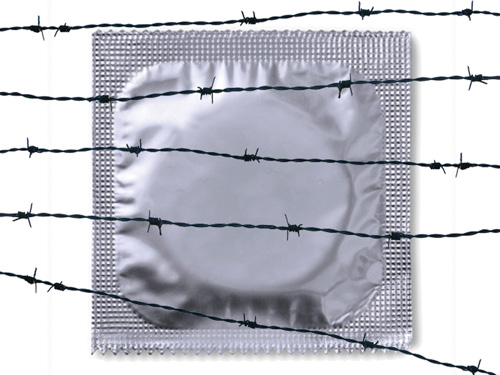
“All Condoms primary location at Customer Service” reads a small sign surrounded by empty shelves that once held condoms, pregnancy tests, and other important sexual health products at the Safeway on Potrero Avenue.

Because of concerns about theft, the condoms now sit among the Nicorette and razors in a row of glass cases near Customer Service, amid the chaos of hurried shoppers headed to and fro. Although Safeway’s recent condom lock-up may have reduced theft, it has also reduced accessibility, and may have deterred customers from buying a product crucial for the prevention of pregnancy and STD’s.

The increased security measures are not contained to the Potrero store, or even San Francisco’s Safeways. “There are a number of products (Oil of Olay for example) that we’ve had to secure under lock and key because of theft,” Susan M. Houghton, Safeway’s Northern California spokesperson tells the Guardian. “It varies by store and city, but yes, condoms were recently added — due to theft.”

Houghton would not go into any further detail about when or why the condoms were locked, but the move has raised concerns by public health advocates.

“We fully understand the position that Safeway is in, but we really would advocate for people having pregnancy tests, condoms — anything that really helps people manage their lives better — to be much more accessible,” Adrienne Verrilli, a spokesperson for Planned Parenthood in San Francisco tells the Guardian. “Accessibility is often key, especially for young people.”

Kyriell Noon, executive director of San Francisco’s STOP AIDS project, says he believes locked cases could deter people from buying condoms, “especially for young people who are shy or could be embarrassed about asking for help…Condoms should be as easy for people to access as any other item available for purchase on the market. When there are barriers between people and condoms, I think many people will shrug and give up. But if they’re easy to access there’s no excuse to not use them.”

STOP AIDS knows the importance of condoms in the prevention of HIV, and distributes free condoms to 90 locations throughout San Francisco.

Safeway representatives and staff members refused to say which Safeways have moved condoms behind glass, but a visit to four San Francisco Safeways found condoms locked in cases at each of them, some even locked behind the Customer Service counter.

At the Safeway at Church and Market streets, we found that there is often a line at Customer Service, which customers must now wait in to purchase condoms. The process of acquiring condoms requires requesting the case be unlocked, making a selection under the watchful eye of an employee, and having the employee remove it from the case and walk it back to Customer Service where it can be purchased. Ten minutes had passed before I was leaving with my $8.99 12-pack of Trojan ENZ.

This challenge could affect teenagers more than adults due to embarrassment, hassle, or the now public process of choosing and purchasing condoms at Safeway. “It puts young people in a very awkward situation,” says Leah LaCroix, president of the San Francisco Youth Commission. LaCroix says she does not believe condoms should be locked up, even if it means a company loses profits.

“I think public safety is more important than that,” she tells the Guardian. LaCroix and the rest of the Youth Commission are currently urging the San Francisco Unified School District, “to reevaluate and come up with a new curriculum for health education,” she said. “I’m sure safe sex will be a component of their new curriculum.”

A 2009 Center for Disease Control survey found that 43.5 percent of high school students did not use a condom during sex, and 85.6 percent did not use birth control pills the last time they had sex, making sex education and birth control availability increasingly vital.

“I’m not sure you can criticize Safeway for protecting their merchandise,” says Beth Brown, manager of San Francisco’s New Generation Health Center. “I think there’s a larger issue of a lack of resources and lack of resourcefulness.”

Brown says she believes the Department of Public Health is responsible for providing these resources. One resource that is available is a service called Family PACT, which provides reproductive health services to low-income residents.

“The state of California pays for young people who need confidential services…and you can get all the birth control you want,” she tells the Guardian. The New Generation Health Center enrolls teenagers and young adults in the service, and gives away free condoms to non-enrolled teenagers as well.

“The state of California is actually a very good place to be if you’re young and sexually active,” says Brown, “because they will pay for it.”

“What’s interesting about that,” Verrilli said of Safeway’s condom lockup, “is that it’s kind of going backwards to where we used to be as opposed to moving forward to where we are.”

Today, with condoms available to purchase for any age, public health clinics in most cities, and sexual education available on the Internet, making birth control readily and publicly accessible seems to be the next logical step. Besides preventing pregnancy, condoms are crucial in preventing the spread of HIV, the virus that causes AIDS.

“I think we should all be in the practice of increasing access to condoms rather than decreasing it,” Noon said. “I don’t know that Safeway’s decision alone would make a huge contribution to the spread of HIV, but they could be setting a precedent that other stores that sell condoms might follow. If it were the case that Walgreen’s and Rite-aid, etcetera, also began to follow this practice, I think we would have a problem.”

SFBG’S CONDOM BUYER’S GUIDE FOR THE YOUNG AND SHY

A wide variety of unlocked condoms are sold at:

Planned Parenthood — 1650 Valencia St. off Mission

Price: 30 cents each, come individually and in strips of 8 or 10.

Plus: offers STD testing and other health services

Walgreens — 200 West Portal at 15th

Price: 12 count $14 and up

Walgreens — 3201 Divisadero at Lombard

Price: 12 count $8.99 and up

Plus: open 24 hours a day

Walgreens — 3400 Cesar Chavez at Mission

Price: 12 count $13.99 and up

Walgreens — 1496 Market at Van Ness

Price: 12 count $15.99 and up

CVS/Pharmacy — 731 Market at 3rd

Price: 12 count $12.99 and up

CVS/Pharmacy — 2025 Van Ness at Jackson

Price: 12 count $12.99 and up

Plus: open until midnight every day

Free condoms are available at:

New Generation Health Center — 625 Potrero at 18th

Plus: offers bags of 20 at a time

STOP AIDS — 2128 15th at Market

Plus: also distributes free condoms to restaurants and stores in the city including:

Marlena’s — 488 Hayes at Octavia

SOMA Health Center — 551 Minna at 6th

Crossroads — 1519 Haight at Ashbury

LBGT Center — 1800 Market at Octavia

Books Inc. — 2275 Market at Noe

(Oona Robertson)

Because Princess says so

3

caitlin@sfbg.com

SEX ISSUE 2011 I saw Donna Dolore for the first time at a Hard French queer soul dance party at El Rio. I remember because she took my drink so authoritatively that I had no choice but to be okay with it. She sipped it, handed it back, and strode away. Can I get a thank you? Throughout the whole, sloppy afternoon, I noticed it was kind of her theme.

But no one seemed to care. Part of it was obvious: Dolore is a Sophia Loren with wider eyes, maybe a little taller, with the same generous tendencies towards sharing glimpses of the bust line. Only — I reflected, shortly before falling back into cheap-beer-and-go-go-dancer melee — that attitude. Who the hell is this woman?

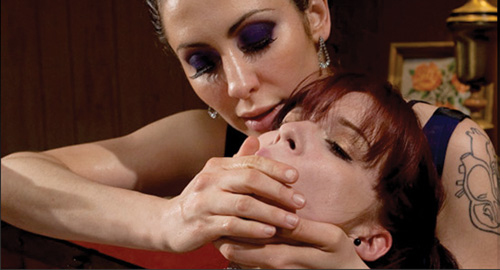
Weeks later, I’m telling her the story in person in the cavernous break room at Kink.com’s headquarters in the San Francisco Armory (everything at the Armory is cavernous). It turns out that Dolore is in fact, a pretty big deal. Just ask her legions of heavy-breathing fans who know her as Princess Donna, the Kink.com director and star queer dominatrix.

“Oh my gosh, I did that?” At the office from where she plans shoots for the three Kink websites she heads, Dolore is a less formidable figure. She’s not wearing any makeup. Her black outfit makes her look like she’s about to take off for a light jog around the Mission.

But she might just be being coy. After all, I’d stalked her up good before our appointment and had come across this gem in a video interview she did a few years back: “I’m pretty true to form — Princess Donna acts a lot like I do.”

Dolore double majored at New York University, perfectly enough, in gender and sexuality studies and photography. She became a stripper while at school, and then on a tip from a coworker, got into professional BDSM shoots. Although she had been to some BDSM play parties, the work was the first time she’d ever been tied up.

“I was immediately into the challenge of being in a really stressful position — being flogged or caned, total sensory overload,” she remembers. “I would leave a shoot feeling really invigorated, a stronger person. It made me want to see what my body was capable of.”

Nowadays, Princess Donna sits — utterly sexily, usually in a short skirt and fuck-me heels — atop the Internet BDSM porn puppy pile.

At Kink she is the mind behind no less than three sites. For “Public Disgrace,” Dolore makes trips around the world to supervise the stripping-down, feeling-up, and penetration of beautiful women in town squares and busy bars. On “Wired Pussy,” she plays with electrical equipment, inducing screaming orgasms in her female partners.

In her latest endeavor, “Bound Gang Bang,” Dolore supervises teams of horny men and one or two women in fantasy-type shoots: high school nerds get their revenge on the bitchy mean girls, a prison warden drops her key and winds up giving head to inmates through a chain link fence. She has guest-starred in many of Kink’s different sites, usually as a top, sometimes as a bottom.

“I get stressed out because we have so much content to produce,” says Dolore, who works on one or two shoots a week. “But it’s a challenge that I enjoy.” One gets the sense that at Kink, Dolore has found a place that can nurture her talent for perversion.

http://www.youtube.com/watch?v=bYkStoeNtuw

Like most of Kink’s offerings, Dolore’s sites are unapologetically brutal. Women are dominated, wind up covered in ejaculate and with bound breasts that are agonizing to look at (well, at least for the BDSM newbie).

This is exactly the kind of stuff that sends shivers — the bad kind — up the spines of anti-porn feminists. But Dolore is a feminist too. As articulate as she is and as prominent she is and as wild as her porns are, she’s often called on to defend BDSM’s treatment and portrayal of women.

“I think the exact opposite of the people that think that BDSM would promote violence against women,” she says. That tired question — “is porn degrading to women?” — is something that Dolore finds degrading. Why, she asks, don’t the anti-porn musketeers ask the same of men in the industry?

“What is going on in our society that we continue to see sex as something that is put on women that they don’t desire? Why can’t we fathom it being a dream job for a woman?”

Kink is doing its part to raise awareness about the sexual pleasure that can be experienced by submissive actors. Before and after each shoot, the man or woman who you’ve watched screaming, a cattle prod or vibrator pressed against their genitals, is interviewed. That familiar dazed after-sex look is all over their faces, and their endorphin-heavy perk is really all you need to know what Dolore says is true: the models at Kink really, really love their job.

Delore contests the notion that only people who have been sexual abused take pleasure in pain, although she says you’ll find abuse victims in porn studios, just like any other workplace.

“Unfortunately, you could look to any profession and say a lot of them were abused as kids. You could look at secretaries and say that. Personally, I wasn’t sexually abused.” She smiles. “I’m just a natural pervert.”

Delore’s a regular on the queer party circuit — this week, you can catch her stealing drinks at Sunday’s “Deviants” Folsom Street Fair closing party. Her exuberance in exploring the outer realms of sexuality haven’t gone unnoticed in the San Francisco sex community. Kelly Lovemonster, editor of the queer quarterly sexuality zine [SSEX BBOX] is a close friend of Dolore, and calls her a “super heroine.”

“Even when she is portraying a submissive bottom, being cattle prodded, nipples clamped down and attached to electric cords, you can tell she is absolutely in control,” says Lovemonster. “She shows us that our dirtiest, scariest, and wildest sexual fantasies can come true through healthy communication and BDSM play. She rescues us all from a world where sexuality is suppressed and made shameful.”

This, according to Dolore, is a big part of why what Kink produces is important. The website puts BDSM urges out there, lets people that get turned on by being slapped across the face know that they’re not the only ones.

For the dis-empowered and isolated BDSM fan, that can be heady stuff. “You can explore your rape fantasy in a way that the woman is in control of what’s happening to their body — it’s a way to relive a situation where you had no control and relive it in a way in which you do have control,” says Dolore.

In a direct repudiation of the claims that abuse victims fall into BDSM for unsavory reasons. Dolore says she’s seen rough sex and power play rehabilitate partners whose sexuality seems terminally fucked. “I’m not a therapist but I feel like I am sometimes.”

But when I ask her if she considers herself an activist, she says no.

“When I think of the word activist, I think of people who are more outspoken than I am. I do my thing on my website, and people can come watch it if they want to.”

Which is not to say that the forward girl at Hard French doesn’t think she’s affecting change. Says the princess: “I’m just happy that I can help people be honest about what they want in bed.” 

DEVIANTS: OFFICIAL FOLSOM STREET FAIR CLOSING PARTY

Sun/25 4 p.m.-3 a.m., $20-30

Public Works

161 Erie, SF

www.publicsf.com


[SSEX BOXX] shoots up-skirt

0

Hey hey Monday! It wouldn’t be the start of the week without a totally inappropriate photo gallery!

We caught wind last week about the real life sexuality film project [SSEX BBOX]‘s fundraiser at El Rio and walked away with three words on our mind (well one hyphenated word and one more): up-skirt photobooth. We love. We hollered at the Internet film project’s Priscilla Bertucci, and she sent us the images you’ll see if you click below — the greatest hits of their particularly innovative event photography tactic. Read the background [SSEX BBOX] here — you wanna know how these genital glories came about, right?

CROTCH THIS WAY!

Transportive

2

MUSIC One way in which to think about the development of what could now be called “ambient electronic music” is to trace the attempts by musicians who fall under that banner to work against and around time.

Terry Riley’s legendary all night concerts of the late ’60s and early ’70s were enabled by a simple tape delay mechanism he dubbed the “time lag generator,” which repeated and echoed the notes Riley repeatedly sounded whether on organ or saxophone. Brian Eno devised Ambient music as a way to make the passing of “free” time — whether spent (as in Eno’s case) bed-ridden recovering from an injury, or, as with his breakthrough 1978 album Music for Airports (EG), waiting for a departing flight — less noticeable. And experimental duo Coil took things to new extremes when they claimed that the slowly evolving synthesizer drones on their composed-under-the-influence-of-psychedelics 1998 release Time Machines were meant to “dissolve time.”

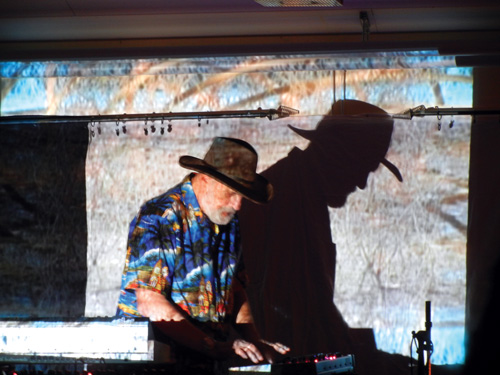
It is fitting then, that J.D. Emmanuel prefers to be thought of as a time traveler rather than as a musician (the self-designation is practically everywhere you look on his website). There is something undeniably transportive about listening to Emmanuel’s expansive meditations for synthesizer and electronic keyboard. Clusters of notes gradually coalesce and dissolve around a dominant drone. Occasionally, he’ll introduce field recordings of environmental sounds — birds, lapping waves, wind — into the mix, but these serve as compliments to the synthesized elements rather than as sonic footholds of the outside world (the point of Emmanuel’s music isn’t to hold on to anything, but to drift).

But, as is now so often the case, were it not for the Internet (another sort of time machine) far fewer listeners would be drifting along. The three LPs of ambient music that Emmanuel self-released in the early to mid ’80s were long considered grails for private press collectors until a Belgian label did a limited re-release of Wizards, Emmanuel’s second album from 1982, in 2007 (followed by its inevitable distribution on file-sharing networks). A compilation of electronic works from 1979-82 followed in 2009, and last year Important Records re-issued Wizards to a wider audience and much critical acclaim which lead Emmanuel to start playing concerts after a near three-decade hiatus.

His closing night set is undoubtedly one of the anticipated highlights of the 12th annual San Francisco Electronic Music Festival, whose location at the Brava Theater should provide a comfortable venue for time traveling without moving.

Emmanuel expressly admits that his own musical approach was greatly shaped by listening to Riley and Steve Reich in 1970. Riley, is in many ways, the Kevin Bacon of electronic music, and his name — along with Reich’s and that of their New York minimalist associate LaMonte Young — make up a cannon unto themselves, leading to inevitable comparisons when discussing younger artists working in a similar vein. The appearance at SFEMF by another elder statesman of drone, Bay Area composer Yoshi Wada, who will be performing with his son Tashi Wada (a composer in his own right) actually brings things full circle.

The elder Wada moved to New York in 1967 and got introduced to drone music via Young and later studied with Pandit Pran Nath, the great North Indian singer who was also Young’s teacher at the time. Their influence is audible in the sonorous, shimmering drones heard on EM Records’ steady output of re-issues of Wada’s two official albums and various concert recordings from the ’70s and ’80s. The younger Wada has very much continued to in his father’s footsteps, exploring harmonic overtones and dissonance in his own practice, and their joint headlining performance on Saturday night is bound to be resonant in more ways than one.


12TH ANNUAL SAN FRANCISCO ELECTRONIC MUSIC FESTIVAL

Sept. 8-11

Brava Theater

2789 24th St., SF

San Francisco Museum of Modern Art

151 3rd St., SF.

(415) 641-7651

www.sfemf.org

Editor’s Notes

6

tredmond@sfbg.com

I have friends — progressives, activists, good people — who support Ed Lee for mayor. They tell me that Lee is accessible, that he listens to labor and grassroots community groups, that he’s going to be good on a lot of issues and that, compared to the mayors we’ve had in the past 30 years or so, he won’t be all that bad.

I respect that. I understand. But I try to remind them, and anyone else who’s listening, that the years when Willie Brown ran this town were really, really bad.

At the height of the Brown era, during the dot-com boom, hundreds of evictions were filed every single month. Thousands and thousands of low-income and working-class tenants were displaced, tossed out of San Francisco forever. Blue-collar jobs were destroyed as high-tech offices took over industrial space. Every single developer who waved money at the mayor got a permit, no matter how ridiculous, dangerous or crazy the project was.

In 1999, Paulina Borsook wrote a famous piece for Salon called “How the Internet ruined San Francisco.” But the Internet was just technology; what damaged this city so badly was a mayor who didn’t care what happened to the most vulnerable populations. At one point, Brown even said that poor people shouldn’t live in this city. We called his policies “the economic cleansing of San Francisco.”

He controlled local politics — brutally. If you didn’t kiss the mayor’s ring, you were crushed. He announced one day that the supervisors (then elected citywide) were nothing but “mistresses who have to be serviced” — and since most of them were utterly subservient to Brown, they didn’t even complain. Only one person on the board — Tom Ammiano — regularly defied the mayor; occasionally, Leland Yee and Sue Bierman joined him. But that was it.

The corruption was rampant. People who paid to play got in the door; nobody else came close. You did a favor for Brown and you got a commission appointment or a high-paid job, even if you weren’t remotely qualified.

The ones who suffered most were the poorest residents, particularly tenants, particularly on the east side of town. Brown didn’t seem to care that his appointments, deals and policies were causing terrible pain on the ground; it was as if politics was just a fun game, as if he were some sort of royal potentate, partying in the executive suites and ignoring what was happening on the streets.

There are people who believe that Ed Lee can be independent of Brown, and I hope they’re right. But Lee and Brown are close, and Brown helped put him in office — and the thought of even a small part of that rotten era of sleaze coming back makes me very, very nervous.

5 Things: August 26, 2011

0

>>WATER WORKS Everyone’s abuzz about Ali Farzat, the Syrian cartoonist whose hands were broken after creating wildly popular illustrated works critiquing the government. The assault on Farzat is a reminder that art has the power to change minds and lives — an idea that US artists with Estria Miyashiro’s Water Writes mural series were fully with when they teamed up with young people to create eight environmental justice-themed murals at water purification sites in eight days in Gaza. The beleaguered city was the project’s fifth stop — including already-completed Phillipines and Hawaii walls, the Water Writes project will go to 10 worldwide cities in total.

>>BABY BANKROLL Back in June, Tim Redmond looked at the reasons for why families stay in San Francisco. His isn’t the only clan that is sticking in the city: Broke Ass Stuart just launched a new column called Mommy No Bucks that’ll be looking at how all us broke asses (with children!!) make it work in the concrete jungle. 

Not til you’re 21, honey. 

>>CHEESE IT! With all the experimental mixologists in San Francisco and our very own grilled cheese food truck, Toasty Melts, you’d think we’d be the first to come up with this: the grilled cheese martini. The Internet has been aglow in gooey praise/disgust the past few days over this concoction, which can be ordered at Bennett’s Pure Food Bistro in Seattle and the Cellar at Beecher’s in New York – both owned by Kurt Beecher Dammeier. It consists of grilled cheese sandwich-infused vodka (“six piping hot sandwiches in 10 gallons of vodka”), fresh tomatoes, basil, and tomato juice. Sounds like vomit central.

>>WINING DOWN We went to check out the public premiere of Wine From Here, a documentary on California’s nascent natural wine culture. Natural wine, we say? Yeah, the definition’s under a fair amount of debate — never more evident than at the filmmaker Q&A after last night’s screening at the Victoria Theatre. The crowd quibbled over things like the use of oak barrels (shouldn’t the fragrant wood be considered an additive since it alters vino’s flavor profile?), labeling moratoriums, and relative price points of wine grown with and without the addition of foreign yeasts, dyes, and government-approved chemicals. Hopefully the differences of opinion were smoothed over at the screening’s after-party at natural wine-friendly Heart, where the profiled vignerons’ bottles were on the menu, including pours from Coturri Winery and Berkeley’s Edmund St. John.

>>BLAST-OFF TO THE WEEKEND When the aliens come for us, we hope they have noodle faces like the claymates in the new Hopie Spitshard and Del the Funky Homosapien video for Hopie’s single “Space Case,” shot outside Beauty Bar and around the Yay. And we hope they transmorgrify our faces with the same fly colorblock eyeshadow as Bay Area MC Hopie’s. And we hope that the ray of light doesn’t come for us today — we wanna catch Spitshard’s show at 111 Minna tonight, part of a fundraiser for Alameda’s Bohol Circle Filipino community center. 


SF sued for approving AT&T’s sidewalk boxes without an EIR

19

A coalition of San Francisco citizens groups today sued the city over the 5-6 vote last month by the Board of Supervisors to allow AT&T to install 726 utility boxes on sidewalks throughout the city without studying the impact and alternatives with an environmental impact report.

The groups include San Francisco Beautiful (filing its first lawsuit against the city in its 64-year history), San Francisco Tomorrow, Dogpatch Neighborhood Association, Potrero Boosters, and the Duboce Triangle Neighborhood Association. Their appeal of AT&T’s permit was rejected by Sups. Sean Elsbernd, Mark Farrell, Malia Cohen, Carmen Chu, David Campos, and Scott Wiener, allowing the project to move forward.

“The city has refused to do what should be a routine environmental review,” Milo Hanke, a past president of San Francisco Beautiful, told us. He said the public should have been allowed to consider alternatives to the “unwanted and unwarranted degradation of the public sidewalks by a greedy corporation.”

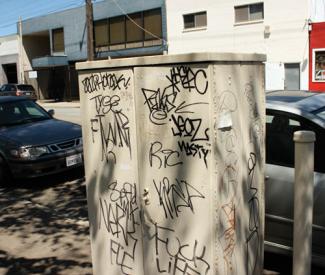
While the project will allow AT&T to upgrade its Internet service and other capabilities, many in the technology community told us back in May that there are better options for improving the high-tech infrastructure in the city without the unsightly boxes that will block sidewalks and be magnets for graffiti.

But those groups, and the groups that filed this lawsuit, say they felt ignored by City Hall and AT&T. “We were shut out of the process,” Hanke said. Now, the plaintiffs will go to court to seek an injunction to stop the project as they wait for a ruling on the merits of the case.

Inside the V.I.P. cocktail party with Willie Brown

The Alliance for Jobs and Sustainable Growth hosted a V.I.P. reception just before a mayoral candidate forum held at UCSF Aug. 16, and former Mayor Willie Brown appeared to be the guest of honor. Although the theme of the event was technically “honoring San Francisco’s mayors” — former Mayor Frank Jordan was there, someone indicated that former Mayor Art Agnos was in the room, former Mayor Gavin Newsom was invited but didn’t show, and Mayor Ed Lee was of course in attendence — Brown seemed to be given more prominent recognition than any of the others.

The moment he strolled in, Sup. Mark Farrell, who was doing introductions for the the affair, scrambled onstage to announce Brown’s presence and deliver a warm welcome, and everyone applauded. Within minutes, the former mayor was seen chatting with a crowd that included Mayor Lee and several others. Soon after, Brown and former Mayor Frank Jordan were summoned to the stage to say a few words.

Once in the limelight, Brown cracked a few jokes. He said he felt for the 36 mayoral candidates, who are forced to campaign in an era when the Internet threatens to reveal videos and photos of them at any time to thousands of online viewers. “I’m glad they didn’t have that kind of communication system when I was running,” he said. “I can’t imagine the photographs you’d have of me floating around doing things I shouldn’t have been doing.”

As for his own time in Room 200, “I enjoyed every single solitary minute of it, and if I really thought I had great skills, I would be number 37,” he said, drawing more applause.

Then again, common wisdom says it isn’t necessary for Brown to bother campaigning in order to gain access to Room 200 these days. Later that same evening, during his own turn in the spotlight at the mayoral debate, Mayor Lee came under fire from Board President David Chiu, who revealed that Lee had privately confided to him about a week before he announced his candidacy that he was having a difficult time saying no to Brown and influential Chinatown business consultant Rose Pak when it came to launching a campaign for a full term.

Chiu’s pointed question for the mayor was what had changed in his mind since that conversation, but Lee referenced neither Brown nor Pak in his answer. Instead, he said he’d changed his mind after witnessing his success in changing the tone of government and getting things done in City Hall.

Back at the V.I.P. reception, Brown and Jordan were invited onstage again, this time to receive awards presented by the Alliance for Jobs and Sustainable Growth. But first Steve Falk, president and CEO of the San Francisco Chamber of Commerce, reminded the crowd that there was still time to buy a drink before the debate got underway. He said, “Debates are much more interesting after three drinks.”

Before Falk presented Brown with a commemorative plaque, he said, “It’s tough to put in a few sentences the life and times of Willie Brown,” and proceeded to note that, with his term in the California Assembly and time serving as mayor of San Francisco behind him, Brown “has now followed his friend Herb Caen into an honest line of work as a columnist for the San Francisco Chronicle.”

Being a newspaper columnist doesn’t mean Brown is always kind to members of the local media. While mixing through the crowd minutes after receiving his award, he fired some harsh words at a well-known City Hall reporter who had recently published some unflattering articles about the “Run, Ed, Run” effort to encourage Lee to seek a full term.

In recent months, Brown’s columns have provided the public at large with a rare glimpse into Mayor Lee’s dining experiences in San Francisco. In February, Brown wrote in one of his columns that he went out to North Beach Restaurant at sat at the window table with Lee, Brown’s “friend” Sonya Molodetskaya, and Jack Baylis, who serves as the US Group Executive of Strategic Development for AECOM, one of the city’s largest contractors and a sponsor of the Alliance for Jobs and Sustainable Growth Event. (Baylis was on the invite list for the V.I.P reception, too.)

Apparently, AECOM had something to celebrate that same day — according to an Aug. 16 press release, an AECOM joint venture was just awarded a $150 million contract for program management services for the San Francisco Public Utilities Commission’s wastewater improvement program.

The V.I.P. reception had representation from many key players in the downtown business community, with sponsorship from AT&T, AECOM, Pacific Gas & Electric Co., Wells Fargo, Motorola, California Pacific Medical Center, the San Francsico Chamber of Commerce, the Building Owners and Managers Association, the San Francisco Police Officer’s Association, Shorenstein Properties, and others. Several labor unions, including the United Association of Plumbers & Pipefitters Union Local 38, United Brotherhood of Carpenters and Joiners of America Local Union No. 22, and United Food and Commercial Workers Union Local 5 were also listed as sponsors. Guests included district supervisors, developers, lobbyists, business owners, mayoral candidates, media spokespeople, executives from the health care industry, and other political insiders.

Clearly, there were many people in the room who wanted to get on Brown’s good side.

Stop cell phone censorship

13

EDITORIAL The bizarre move by BART officials Aug. 11 to shut down cell phone service in the underground train stations made headlines around the world — and for good reason. It was, Wired Magazine reported Aug 15, apparently the first time in United States history that a public agency sought to block electronic communications as a way to prevent a political protest.

It came at a time when oppressive governments around the world have been disabling cell phone and internet services to frustrate protest organizers. And it followed months of abysmally bad behavior by the transit agency, which is trying to respond to yet another dubious BART police shooting. Civil liberties activists have issued statements of condemnation and outrage; state Sen. Leland Yee, who is also running for mayor, has called on the BART board to adopt policies preventing future shutoffs.

But the BART board has proven itself unable to properly monitor and oversee its law-enforcement operations. At this point, the state Legislature needs to step in.

It’s not surprising that protesters have been swarming around BART stations this summer. The agency has a history of failing to control its police force, and when an officer shot and killed an apparently drunk man in the Civic Center station July 3, activists were fed up. BART responded badly, refusing to turn over video of the incident — and the more facts that came out, the worse the agency looked.

We understand the frustration that commuters felt when angry activists disrupted service for a brief period during the afternoon rush hour. And we understand BART’s concern that further actions inside the stations could be difficult to control.

But let’s remember: The BART board has never been particularly open to public input and most of its members show little interest in accountability. Over the past two decades, hundreds of people have appeared to speak at board meetings to demand a serious response to police shootings — and nothing ever happened. It took a particularly horrendous incident — a point-blank shooting of an unarmed man that was recorded on video — for the board to create even a modest police oversight program.

BART officials are trying to argue that cell phone service in the underground stations is a new service, something offered at the agency’s discretion — as if BART were some sort of private café that gives its customers free wifi. But that ignores the fact that the Bay Area Rapid Transit District is a government agency, one that has no more business shutting down cell phone service than the White House does blocking a newspaper from publishing embarrassing secrets.

As a practical matter, the decision was foolish: The protesters may have been inconvenienced, but so were hundreds of others who may have been trying to make business calls or connect to family members. In political terms, it was inexcusable. Think about it: A public agency was intentionally disabling communications to prevent a political protest. That’s about as bad as it gets.

We agree with Yee that the BART board ought to set a clear policy against any future attempts to control cell phone service for political purposes. But that’s not likely to happen — and it won’t be enough. The state Legislature needs to pass a measure specifically banning any public agency in California from disabling or interfering with any public communications system for political purposes. We can’t wait to see BART lobbyists show up and try to oppose that one.

Editorial: Stop cell phone censorship

43

The bizarre move by BART officials Aug. 11 to shut down cell phone service in the underground train stations made headlines around the world and for good reason. It was, Wired Magazine reported Aug 15, apparently the first time in United States history that a public agency sought to block electronic communications as a way to prevent a political protest.

It came at a time when oppressive governments around the world have been disabling cell phone and internet services to frustrate protest organizers. And it followed months of abysmally bad behavior by the transit agency, which is trying to respond to yet another dubious BART police shooting. Civil liberties activists have issued statements of condemnation and outrage; state Sen. Leland Yee, who is also running for mayor, has called on the BART Board to adopt policies preventing future shutoffs.

But The BART Board has proven itself unable to properly monitor and oversee its law-enforcement operations. At this point, the state Legislature needs to step in.

It’s not surprising that protesters have been swarming around BART stations this summer. The agency has a history of failing to control its police force, and when an officer shot and killed an apparently drunk man in the Civic Center station July 3, activists were fed up. BART responded badly, refusing to turn over video of the incident and the more facts that came out, the worse the agency looked.

We understand the frustration that commuters felt when angry activists disrupted service for a brief period during the afternoon rush hour. And we understand BART’s concern that further actions inside the stations could be difficult to control.

But let’s remember: The BART Board has never been particularly open to public input and most of its members show little interest in accountability. Over the past two decades, hundreds of people have appeared to speak at board meetings to demand a serious response to police shootings and nothing ever happened. It took a particularly horrendous incident a point-blank shooting of an unarmed man that was recorded on video for the board to create even a modest police oversight program.

BART officials are trying to argue that cell phone service in the underground stations is a new service, something offered at the agency’s discretion as if BART were some sort of private café that gives its customers free wifi. But that ignores the fact that the Bay Area Rapid Transit District is a government agency, one that has no more business shutting down cell phone service than the White House does blocking a newspaper from publishing embarrassing secrets.

As a practical matter, the decision was foolish: The protesters may have been inconvenienced, but so were hundreds of others who may have been trying to make business calls or connect to family members. In political terms, it was inexcusable. Think about it: A public agency was intentionally disabling communications to prevent a political protest. That’s about as bad as it gets.

We agree with Yee that the BART Board ought to set a clear policy against any future attempts to control cell phone service for political purposes. But that’s not likely to happen and it won’t be enough. The state Legislature needs to pass a measure specifically banning any public agency in California from disabling or interfering with any public communications system for political purposes. We can’t wait to see BART lobbyists show up and try to oppose that one.


Al Gore calls for an “American spring”

4


In an interview with Keith Olberman Tuesday night  on his Current TV show,   Al Gore called for “an American spring” to counter the assault of the teaparty Republicans

and to go on the offensive from the grassroots and on the internet.  Gore was eloquent in his Goreish way and made many of the right points.

Olberman asked him, quite diplomatically, if a Democrat ought to run against  Obama and if Gore would support a Democratic primary fight.

Gore said no, he supported Obama and would continue to support him, and that the history of primary fights meant that the President and his challenger would both

lose.  He said Obama needed lots of help and pressure from the grassroots. Here’s the interview:  The Keith Olberman show is at 8 p.m. weekdays at Channel 107 in San Francisco.

I think Olberman is even better in this  format than he was when he pioneered the progressive tv show on MSNBC.  B3

http://current.com/shows/countdown/videos/al-gore-on-why-america-needs-a-non-violent-tahrir-square-part-one


Complete interview: “Between Two Worlds” directors Deborah Kaufman and Alan Snitow

0

In 1981 Deborah Kaufman founded the nation’s first Jewish Film Festival in San Francisco. Thirteen years later, with similar festivals burgeoning in the wake of SFJFF‘s success — there are now over a hundred around the globe — she left the festival to make documentaries of her own with life partner and veteran local TV producer Alan Snitow.

Their latest, Between Two Worlds, which opens at the Roxie Fri/5 while playing festival dates, could hardly be a more personal project for the duo. Both longtime activists in various Jewish, political, and media spheres, Snitow and Kaufman were struck — as were plenty of others — by the rancor that erupted over the SFJFF’s 2009 screening of Simone Bitton’s Rachel. That doc was about Rachel Corrie, a young American International Solidarity Movement member killed in 2003 by an Israeli Defense Forces bulldozer while standing between it and a Palestinian home on the Gaza Strip.

As different sides argued whether Corrie’s death was accidental or deliberate, she became a lightning rod for ever-escalating tensions between positions within and without the U.S. Jewish populace on Israeli policy, settlements, Palestinian rights, and more — with not a few commentators amplifying the conservative notion that any criticism of Israel is anti-Semitic, even (or especially) when it comes from Jews themselves.

People who hadn’t seen (and boasted they wouldn’t see) the strenuously even-handed Rachel called the documentary an “anti-Israeli hate fest” akin to “Holocaust denial,” its SFJFF inclusion “symptomatic of a demonic strategy” by “anti-Semites on the left.” KGO radio’s John Rothmann opined on air that the festival had “crossed the line” and “sympathized with those who participate in terror.”

Stunned SFJFF executive director Peter Stein (who’s leaving the festival after its current edition) decried Jewish community “thought police” who pressured the institution and those connected to it with defunding and boycotting threats. The festival attempted damage control by inviting a public foe of the screening (Dr. Michael Harris of StandWithUs/Voice for Israel) to speak before it, which only amplified the hostile rhetoric.

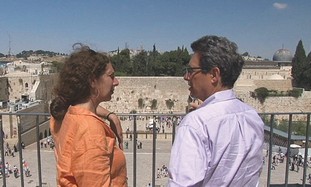
Seeing the festival being used by extremists on both sides became a natural starting point for Between Two Worlds, which takes a many-sided, questioning, sometimes humorous look at culture wars in today’s American Jewish population. It touches on everything from divestment debates at UC Berkeley to the disputed site of a Museum of Tolerance in Jerusalem (atop a 600-year-old Muslim cemetery), from the tradition of progressive liberalism
among U.S. Jews to rising ethnic-identity worries spawned by intermarriage and declining birth rates.

The fundamental question here, as Kaufman puts it, is “Who is entitled to speak for the tribe?” For the first time, the filmmakers have made themselves part of the subject matter, exploring their own very different personal and familial experiences to illustrate the diversity of the U.S. Jewish experience. Snitow’s mother had to hide her prior Communist Party membership to remain active in social-justice movements after the 1940s, while Kaufman’s father was a devoted Zionist from his Viennese childhood who had to adjust to offspring like “Tevye’s daughters gone wild,” including one who converted to Islam.

They’re clearly in sympathy with other documentary interviewees insisting that one core of Jewish identity has been, and should remain, a stance against absolutism and injustice towards any peoples. Between their SFJFF screenings the filmmakers chatted with the Guardian.

SFBG: Is the Bay Area still a bastion of Jewish liberalism, relatively speaking? Watching your movie I wondered how many other places there are where a Jewish film festival audience would boo and heckle a conservative pro-Israeli speaker like Dr. Michael Harris.

Deborah Kaufman: What we saw at the festival during the Rachel uproar was a collapse of the center. It was really a moment when the extremes were at battle and the center simply disappeared. That’s what was and is so disturbing. A kind of apathy where the moderates just throw up their hands and walk away from what’s become a very toxic debate.

Alan Snitow: It’s not that the Bay Area is unique to boo a so-called “pro-Israel” speaker. It’s that the Bay Area has maintained an open debate about Israeli policies when other Jewish communities never countenanced such debate from the get-go. Rachel was not shown in other Jewish film festivals around the country because they are already creatures of conservative donors. The aim in this power grab by the right in San Francisco was and is to silence people and institutions like the festival that oppose a McCarthyite crackdown in a remaining bastion of free speech. And this is being mirrored in Israel itself where the Knesset recently passed a law punishing anyone who publicly supports the idea of a boycott of the West Bank settlements.

I think we also have to question this claim of “pro-Israel.” All criticism of Israel’s occupation is now being branded as “anti-Israel.” Theodore Bikel — a lifelong Zionist activist who went to jail with my mother at the Soviet consulate in Washington DC — was recently called an “anti-Zionist” because he supported an actors’ boycott of performing in the settlements. J Street — an explicitly and consistently pro-Israel voice that is critical of Israeli policies — is regularly attacked as not really pro-Israel for that very reason. “Pro-Israel” has come to mean pro the policies of the current, most right-wing government in Israeli history — a government that is now advocating the truly Orwellian position that there is no occupation at all! That’s not what pro-Israel or Zionist ever meant except to some ideologues on the far right.

DK: The Bay Area has had a history of passionate political commitment — to both the Zionist and anti-Zionist causes. But today the right wing is certainly louder and aside from what we saw at the theater that day, there has been a significant silencing of voices critical of Israel’s occupation policies.

SFBG: Conversely, have you perceived the local Jewish community as growing more conservative in recent years? In particular, more inclined to treat criticism of Israeli government policies as inherently anti-Semitic, even when voiced by fellow Jews?

DK: We were interested in the notion of excommunication — going back to Spinoza — and to the accusation “self-hating Jew” that some people used to attack Hannah Arendt when she wrote Eichmann in Jerusalem. Today, right-wing Jews are leveling charges of treason against Jewish academics, rabbis, and community members whose positions on israel aren’t as rabidly right wing as theirs. We didn’t have to look very far to find dramatic stories for our film on these themes. Censorship and the stifling of dissent are happening right in our home town.

AS: There’s conservative and there’s conservative. The Jewish community hasn’t become more conservative in terms of voting patterns or support for civil rights or the welfare state, but the establishment has become more and more dependent on an ever smaller number of big conservative donors who have bought out these institutions and compromised their independence and legitimacy as representing the whole Jewish community. This is a major reason for the crisis. More and more young Jews are finding the community’s institutions do not reflect their liberal beliefs and upbringing, particularly when it comes to Israel. The result is that many young people are not identifying with Israel because its actions are not consistent with their ideals as American Jews.

SFBG: Had you already been thinking about somehow addressing political rifts in the Jewish community before the SFJFF fracas?

DK: We began the film over a year before the JFF fracas. We were focusing more on Jewish identity than politics — looking at intermarriage, hybrid identities, a new generation of American Jews — we wanted to re-tell the Biblical story of Ruth, and we were following a fantastic feminist-queer internet discussion called “Rabbis: Out Of My Uterus!” that we thought would be fun to film — but we kept getting swept into the Israel vortex and realized we had to address the question of dissent and who speaks for the Jewish community at this historical moment for the film to be relevant.

SFBG: The festival had shown other movies relating to different aspects of the Palestinian conflict before, and Rachel does make an effort to represent all the different sides of its story. What do you think particularly ticked people off about that film?

DK: Over the years the festival had shown many films that were more controversial than Rachel. In fact, that same summer the festival showed a film called Defamation that we felt was far more critical of the Jewish establishment, but it went right under everybody’s radar. It was the Tea Party summer — almost anything could have been the spark that ignited a controversy. But the tragic death of Rachel Corrie had already made her an internationally famous symbol of opposition to Israel’s occupation, so the anger was focused on the program with her name.

AS: Rachel was just a pretext. In the months before the film festival, think tanks in Israel had declared the Bay Area a node of “delegitimization” of Israel (along with Toronto and London). The right was looking for a test case to make an example of Jewish institutions that step out of line. The San Francisco Jewish Film Festival was founded as a transgression right from the start — a place where unpopular and counter-cultural and diverse views could engage. It was a perfect target to attack.

One other item: when the festival allowed [Harris] on the podium to attack one of its own films and filmmakers it was a bad precedent, and the right smelled blood in the water. The festival’s good faith effort was viewed as a sign of weakness and the attacks only intensified. The people who wrote the attacking emails are people who think that any criticism of Israel is tantamount to anti-Semitism. They are not to be appeased by any symbolic action. They want control and silence.

SFBG: Deborah, since you left the festival it’s seen several well-regarded executive and programming directors depart, seemingly burnt out. Do you think the effort it takes to represent and placate the festival audience has gotten harder?

DK: I’m not sure things have changed so much. There has always been pressure on festival directors to do what major donors demand. I got a lot of that during my tenure but resisted the pressure. The difference is the political atmosphere which is more polarized and shrill, especially since the new, ultra-right government in Israel has come to power. It’s hard to withstand the bullying and accusations of treason and self-hate.

AS: I think it’s also important to add that Deborah and Janis [Plotkin] — who was director for many years — also had a lot of fun with the festival. This is a very hard job, but it’s a creative and fascinating one, and these attacks may come with the territory, but they don’t dominate it.

DK: In terms of the audience it’s always been a diverse group. I have fond memories of the midnight screening of the silent version of The Golem (1920) we did at the Roxie in our second year — where people in the audience were literally screaming at each other and at the projectionist during the whole screening about whether we should turn the volume up or down on the rock music sound track we had commissioned.

SFBG: You’ve shown Between Two Worlds to a variety of Jewish audiences so far, in Toronto, New York, and Jerusalem as well as SF. What have been some of the responses?

DK: The response has been great and sometimes surprising — we’ve had people from the left and right of the political spectrum both say the film has made them reconsider their own stridency. Non-Jews have said it mirrors what they felt they could not say out loud. Young people have told us it’s affirming of their perceptions and reveals a history they didn’t know existed. In Jerusalem one person felt the film was overly optimistic because it didn’t examine the support of right-wing Christian fundamentalists for the settlements!

AS: I think the personal stories we tell of our own families ring true to many people. Most Jews know deep down that if you look at the family histories of American Jews, you will find intense long term debates between those people at the Passover seder table who were Communists, Socialists, and Zionists. Often, the only way to sit down together was to maintain silence, but we wanted to bring those utopian hopes and ideals back into focus, and people across the political spectrum seem to take that as an opportunity to think about and question their own families and their own positions.

SFBG: How did the decision come about to put yourselves in the film? As filmmakers, was it awkward to become subjects?

DK: We’ve never been in our own films so it was something of a challenge for us. We don’t feel relaxed in front of the camera, but early in the production we realized we had to be in the film so that people would know where we were coming from, and also because our family histories shed a lot of light on debates inside the Jewish community today. We watched a lot of work by other documentary filmmakers who put themselves in their films like Marlon Riggs, Alan Berliner, and Ross McElwee, and decided we’d give it a try. We also felt this film was really about the intersection of the personal and the political, so the structure that moves back and forth between the two made sense to us.

AS: My daughter, Tania, is an actor, and I kept thinking that we needed to consult with her about being on camera. It’s not just something that you do. You have to work at it and learn how to do it. After we did it a couple of times, we realized that we weren’t dressing right, that the hair was wrong, that I was scratching my head, that we should have shot ourselves from above and not below. Rather than being an on camera ego-trip, it was a humbling experience.

Between Two Worlds opens Fri/5 at the Roxie.

Whose voice?

0

arts@sfbg.com

FILM In 1981 Deborah Kaufman founded the nation’s first Jewish Film Festival in San Francisco. Thirteen years later, with similar festivals burgeoning in the wake of SFJFF’s success — there are now over a hundred around the globe — she left the festival to make documentaries of her own with life partner and veteran local TV producer Alan Snitow.

Their latest, Between Two Worlds, which opens at the Roxie this Friday while playing festival dates, could hardly be a more personal project for the duo. Both longtime activists in various Jewish, political, and media spheres, Snitow and Kaufman were struck — as were plenty of others — by the rancor that erupted over the SFJFF’s 2009 screening of Simone Bitton’s Rachel. That doc was about Rachel Corrie, a young American International Solidarity Movement member killed in 2003 by an Israeli Defense Forces bulldozer while standing between it and a Palestinian home on the Gaza Strip.

As different sides argued whether Corrie’s death was accidental or deliberate, she became a lightning rod for ever-escalating tensions between positions within and without the U.S. Jewish populace on Israeli policy, settlements, Palestinian rights, and more — with not a few commentators amplifying the conservative notion that any criticism of Israel is anti-Semitic, even (or especially) when it comes from Jews themselves.

People who hadn’t seen (and boasted they wouldn’t see) the strenuously even-handed Rachel called the documentary an “anti-Israeli hate fest” akin to “Holocaust denial,” its SFJFF inclusion “symptomatic of a demonic strategy” by “anti-Semites on the left.”

Stunned SFJFF executive director Peter Stein (who’s leaving the festival after its current edition) decried Jewish community “thought police” who pressured the institution and those connected to it with defunding and boycotting threats. The festival attempted damage control by inviting a public foe of the screening (Dr. Michael Harris of StandWithUs/Voice for Israel) to speak before it, which only amplified the hostile rhetoric.

Seeing the festival being used by extremists on both sides became a natural starting point for Between Two Worlds, which takes a many-sided, questioning, sometimes humorous look at culture wars in today’s American Jewish population. It touches on everything from divestment debates at UC Berkeley to the disputed site of a Museum of Tolerance in Jerusalem (atop a 600-year-old Muslim cemetery), from the tradition of progressive liberalism among U.S. Jews to rising ethnic-identity worries spawned by intermarriage and declining birth rates.

The fundamental question here, as Kaufman puts it, is “Who is entitled to speak for the tribe?” For the first time, the filmmakers have made themselves part of the subject matter, exploring their own very different personal and familial experiences to illustrate the diversity of the U.S. Jewish experience. Snitow’s mother had to hide her prior Communist Party membership to remain active in social-justice movements after the 1940s, while Kaufman’s father was a devoted Zionist from his Viennese childhood who had to adjust to offspring like “Tevye’s daughters gone wild,” including one who converted to Islam.

They’re clearly in sympathy with other documentary interviewees insisting that one core of Jewish identity has been, and should remain, a stance against absolutism and injustice towards any peoples. Between their SFJFF screenings the filmmakers chatted with the Guardian.


SFBG Is the Bay Area still a bastion of Jewish liberalism, relatively speaking?

Deborah Kaufman What we saw at the festival during the Rachel uproar was a collapse of the center. It was really a moment when the extremes were at battle and the center simply disappeared. That’s what was and is so disturbing. A kind of apathy where the moderates just throw up their hands and walk away from what’s become a very toxic debate.

Alan Snitow It’s not that the Bay Area is unique to boo a so-called “pro-Israel” speaker [like Harris]. It’s that the Bay Area has maintained an open debate about Israeli policies when other Jewish communities never countenanced such debate from the get-go. Rachel was not shown in other Jewish film festivals around the country because they are already creatures of conservative donors. The aim in this power grab by the right in San Francisco was and is to silence people and institutions like the festival that oppose a McCarthyite crackdown in a remaining bastion of free speech. And this is being mirrored in Israel itself where the Knesset recently passed a law punishing anyone who publicly supports the idea of a boycott of the West Bank settlements.

I think we also have to question this claim of “pro-Israel.” All criticism of Israel’s occupation is now being branded as “anti-Israel.” “Pro-Israel” has come to mean pro the policies of the current, most right-wing government in Israeli history — a government that is now advocating the truly Orwellian position that there is no occupation at all! That’s not what pro-Israel or Zionist ever meant except to some ideologues on the far right.


SFBG Had you already been thinking about somehow addressing political rifts in the Jewish community before the SFJFF fracas?  

DK We began the film over a year before the SFJFF fracas. We were focusing more on Jewish identity than politics — looking at intermarriage, hybrid identities, a new generation of American Jews — we wanted to re-tell the Biblical story of Ruth, and we were following a fantastic feminist-queer internet discussion called “Rabbis: Out Of My Uterus!” that we thought would be fun to film. But we kept getting swept into the Israel vortex and realized we had to address the question of dissent and who speaks for the Jewish community at this historical moment for the film to be relevant.

Between Two Worlds opens Fri/5 at the Roxie.

Hot sexy events: July 27-August 3

0

Ugh. There is nothing sexy about breast cancer (unless you’re Annie Sprinkle). But honestly, when life gives you tumors, you give that thing tumescence – or at least, that’s adult film performer Hollie Stevens’ view.

Stevens was diagnosed with breast cancer this year, but it’s hardly held her down. The clown porn enthusiast filmed an intense scene on societysm.com in which her head was shaved – it had to happen anyway for chemo, so why not make it someone’s fantasy? This week, you can help young Stevens out in her quest for health. On Fri/29, she’s hosting a low-lit lingerie roller disco, complete with an auction featuring Chuck Stevens pornography prints, and Girls and Corpses magazines – the site of Stevens’ recent “Playdead bunnies” feature.

“Is Leather Dead? Does it Need to Die?”

Leather leader-author Guy Baldwin, kink educator Race Bannon, lesbian activist Gayle Rubin, and Instigator magazine editor Michael Thorn take a hard look at leather’s relevance today. In the age of Internet cruising, can a community still be said to exist? Heady questions being asked mere days before the Up Your Alley street fair. 

Weds/27 7-10 p.m., free

LGBT Center

1800 Market, SF

www.folsomstreetfair.org


A Night for Hollie Stevens

The press release says bring your fat wallet, lingerie, or both. So you’ve got options. Can’t make it? Donate to Stevens here.

Fri/29 8:30 p.m.-12:30 a.m., $30

Private SoMa location, SF (buy ticket for details)

www.holliestevensxxx.com


Comfort and Joy Active Touch

Burning Man fundraising season is upon us (for those who were lucky enough to score a ticket) and one of the most venerable playa sexy camps is throwing a big, swinging bash set to jams by DJ Bus Station John

Fri/29 10 p.m.-4 a.m., $20 suggested donation

Mission Control 

www.missioncontrolsf.org


Perverts Put Out! Dore Alley edition

Our sex columnist Gina De Vries is over the moon for this recurring performance series that focuses on the gamut of sex and artistic expression – cop fantasies, “bearlesque,” even cruising the Excelsior has gotten its due on stage over the years. What will go off this year? You’ll have to attend to find out – it’s also the perfect pre-party for all those that are gonna have to work Up Your Alley tomorrow. 

Sat/30 7:30 p.m., $10-15

1349 Mission, SF

(415) 552-7399

www.sexandculture.org


Up Your Alley street fair 

In the thick of hippie summer fests comes Up Your Alley Fair, an al fresco get-together that unmasks the sexual undertones of other festivals. Why pretend it’s all about the music when you know all you’re trying to do is get that hottie back to your tent to get laid? Up Your Alley (and Folsom Street Fair, its big brother) makes no pretense – it’s all sexy sex all the time, in the DJ areas, in the women-only Venus Playground, and by your favorite pillory. 

Sun/31 11a.m.-6 p.m., $7 suggested donation

Folsom between Seventh and 12th St., SF

www.folsomstreetfair.org/alley