International

Trash Lit: The commies of Agent 6

2

Agent 6

By Tom Rob Smith

Grand Central Publishing, 467 pages, $25.99

I get it: Life in the Soviet Union under Stalin and Krushchev was pretty bad. Food was sometimes scarce, spies were everywhere, people got locked up in jail for disloyalty to the State … I know all that. I read The Gulag Archipelago when I was in High School. It made me more wary of powerful governments than it did of Communism, but whatever — I’ll stipulate that the Soviet Union of that era was not exactly the great workers paradise it was supposed to be. (We had a few problems with repression here at home, too.)

But Child 44, Tom Rob Smith’s bestselling 2008 thriller about Leo Demidov, an idealistic Soviet security officer, is still hard to read. Every single person in the Soviet government is corrupt and evil. Every aspect of life is absolutely miserable. There is no hope, just bleakness; the only way anyone can do any good at all is either by mistake or by subversion. Child 44 just drips of the sort of anti-Communist propaganda I was fed in grade school, and while it’s a brilliantly constructed crime mystery, I had to put it down every few pages and say:

Really?

So I opened the sequel, Agent 6, with some hesitation. These books are long and thick, and some of the references are obscure, so you have to pay attention. And I wasn’t sure I wanted to wade through another 467 pages of Commie Plot Nightmare.

But Agent 6 is a pleasant surprise. It’s much lower on the bleakness scale and much more of a serious international novel of intrigue, with realistic characters, some good action and (of course) not much sex. I guess they don’t do that in Russia. Maybe it’s too cold.

The plot actually stretches from the Cold War to the present, but the heart of the matter occurs in 1965, when out hero Demidov (dismissed from the security service in some sort of disgrace, downgraded to a minor plant manager with a crummy apartment) discovers that his schoolteacher wife, Raisa, has been asked to take her students on a friendship tour of the United States. Of course, the couple’s two teenage daughters will be going along — but not poor Leo. He’s been such a bad boy that he can’t leave the country.

Then there’s an African American singer who was a huge star — and an outspoken commie — in the U.S. in the 30s and 40s, but has since been blacklisted and driven to poverty by the American version of Soviet repression. He, like Leo, has a shitty apartment in a slum. But the singer, Jesse Austin, gets invited by some shady crew that may be part Soviet propaganda machine and may be part FBI/CIA op, to sing at the friendship event — except that he’s not really officially invited, so he stands outside on a box — and winds up dead. One of Leo’s daughters is arrested for the murder, Leo’s wife is killed along the way — and the former Soviet cop spends the rest of his life trying to figure out what happened (and for his efforts is exiled to Soviet-occupied Afghanistan).

What happened is a good tale. The parallels between the way the Americans treated a one-time commie and the commies treated a one-time cop make this a lot more intellectually interesting than the first book. The scenes (and lessons) from the Soviet disaster in Afghanistan are a good real, and relevant to anyone who thinks it’s every possible for a foreign nation to invade that country. The depressing ending is about what you’d expect from a writer who makes his living describing depressing conditions and sad people, but it works.

I’m changing my mind about Tom Rob Smith. And while this is being sold as the last one, I suspect he’s got another Leo Demidov story in him somewhere.

Daly is back in a progressive leadership role

45

Chris Daly, a pivotal organizer of progressive politics during his decade on the San Francisco Board of Supervisors, has returned to a high-profile role in the movement. Last month, he went to work for Service Employees International Union Local 1021, the city’s largest public employee year. And today, he was named its interim political director.

“I’m excited and I think everyone here is excited to have Chris’s talent and experience and energy on this team,” local President Roxanne Sanchez, who was elected as part of a progressive reform slate in 2010, told the Guardian. “Part of the vision of the executive board, and the mandate that we were elected on, is to build a long-lasting sense of power at the rank-and-file level.”

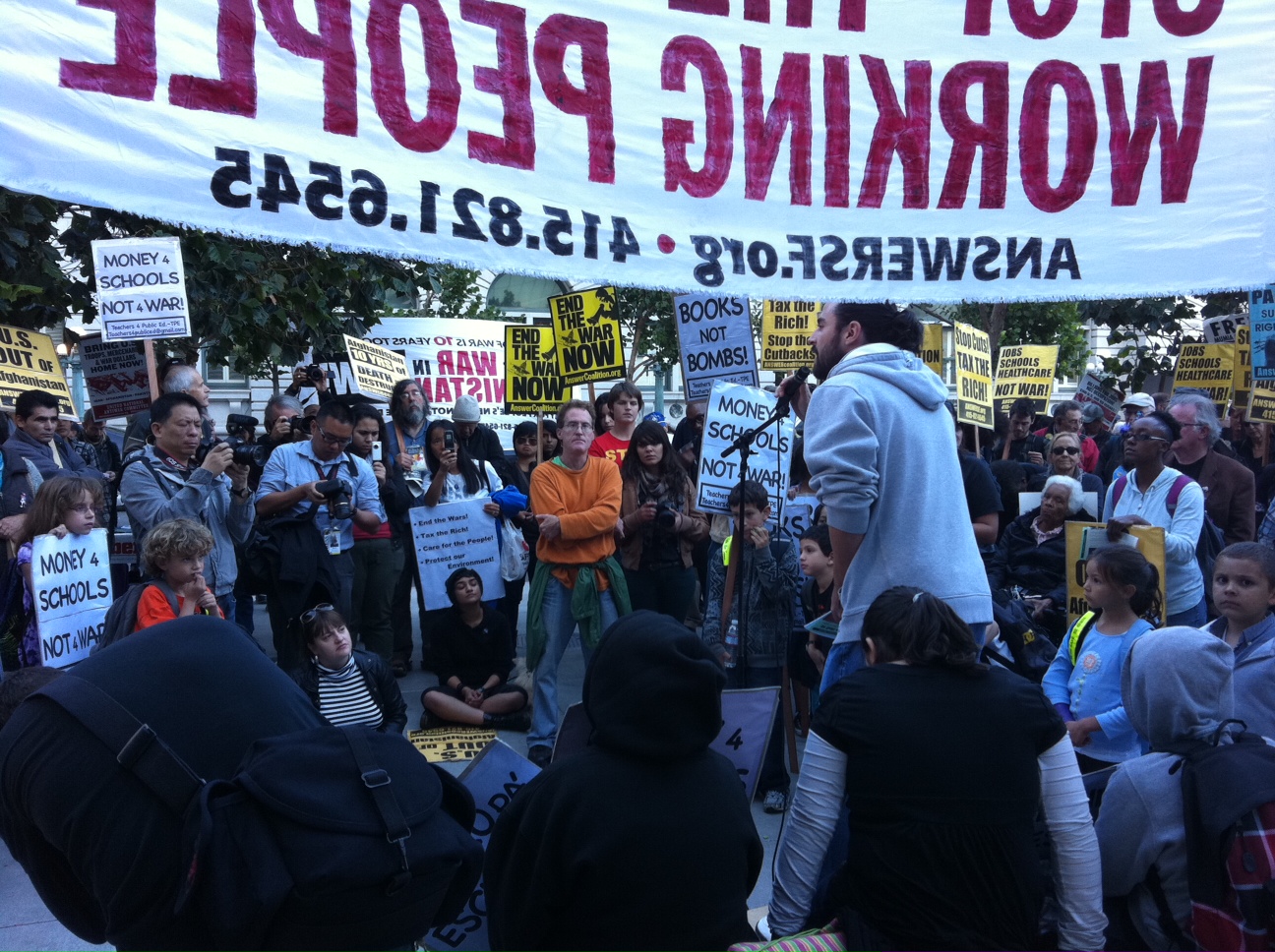
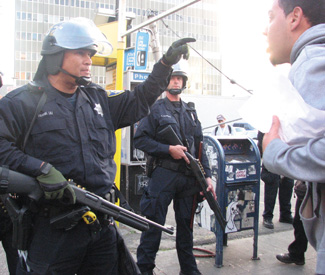
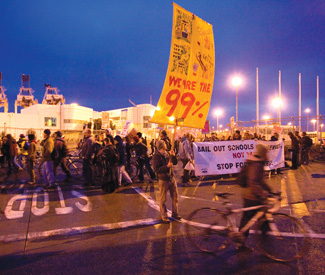
Even before lending support to the Occupy movement and its challenge to the power of the richest 1 percent of society, Local 1021 was targeting banks and other downtown financial institutions with its Fight for a Fair Economy campaign. Now Daly can continue pushing that agenda and connecting the dots between the consolidation of wealth and the hardships faced by workers and local government.

“The spark has been the Occupy movement, but it’s been 1021 that has been helping to instigate some of these possible next steps…It has an opportunity to be successful if there’s some institutional support for it,” Daly said of San Francisco’s progressive movement, which suffered a setback when he and other board progressives were termed out, and a bit of a revival in the fall with the emergence of OccupySF.

“Occupy is going to need some foundation to continue its work,” Daly said. “Without organizational or structural support, that could have been a one-time thing.”

But now, during an important election year when the union’s contracts with the city expire, Daly sees an opportunity to forward the interests of both union members and the broader progressive movement. Both Daly and Sanchez say educating their members and the general public about the importance of progressive issues is essential to advocating for their members, who are among the city’s lowest paid workers and those who have suffered the most layoffs in recent years.

“If there’s not a notion of the distribution of wealth and the 99 percent, we won’t be successful,” Daly said. “Downtown is powerful, and labor needs to be here to offset the power of downtown. Without that, we’re stuck.”

Sanchez said the reorganization now underway in her union, of which hiring Daly is a key component, is about turning the clock back on the labor movement and returning to an agenda of broadly building working class power, as unions did in the ’30s and ’40s before becoming more bureaucratic institutions in the ’50s.

“Chris, and his perspective of building community strength, is our focus,” Sanchez said. “This is the time when unions have to help move a working family agenda and to push back on the opportunistic wealthy interests in this society.”

In the year since he left the board, Daly has been running the bar he purchased, The Buck (formerly Buck Tavern) – which became like a progressive clubhouse and gathering spot – as well as helping John Avalos’s mayoral run and other campaigns. Daly says he wants to maintain that role by continuing to tend bar on Friday nights, but he plans to pour most of his energies into a new role that is really a continuation of his old role.

“For me, it was never about being on the Board of Supervisors. It was about trying to make the progressive movement strong and more effective…In some ways, I was one of the unofficial political directors of progressive San Francisco,” Daly told us. “I have a strong motivation to build a progressive political program, and now I have the opportunity to do that.”

Lights, Jolie, action

0

arts@sfbg.com

FILM The grudging, occasionally outright hostile tone some critics, culture vultures, and fan types have taken toward In the Land of Blood and Honey points toward a fundamental problem most of them have, though few admit it: the belief that Angelina Jolie is just too damn famous, too much a figure of public speculation and private fantasy, to be taken seriously — let alone to make a movie about rape and genocide during the War in the Balkans.

That bleak historical chapter occurred about the same time that Jolie was a Beverly Hills goth teen into knife play, too many recreational drugs, and her brother (eww), with a fledgling professional resume consisting of modeling gigs, music videos, and an inglorious starring role in 1993’s Cyborg 2. Since then she has grown up a lot, and in ways that count (adopting children as well as bearing them, actually working at her “humanitarian causes” rather than using them as photo ops), is sort of a model world citizen as far as ginormous movie stars go. She also paired off with another such example, Brad Pitt — World’s Sexiest Woman, meet World’s Sexiest Man, cue celestial chorus — and while it may be a coincidence, shortly after that event he started consistently behaving onscreen like a real actor and less like an International Male model.

Jolie, too, can act, but since becoming a big star (circa 2001’s Lara Croft: Tomb Raider), it’s been disappointing how seldom she’s been called upon to do so — as opposed to bringing the near-cartoonish va-voom and ass-whup in movies like 2003’s Lara Croft Tomb Raider: The Cradle of Life, 2005’s Mr. & Mrs. Smith, 2008’s Wanted, and 2010’s Salt. Truth be told, when she has gotten a serious part in a serious film such as 2008’s Changeling or 2007’s A Mighty Heart, the stubborn glare of celebrity hobbles our ability to let her disappear into the role. It’s not fair, but there ya go. Those are highly competent, versatile performances that nonetheless might be more effective if delivered by someone whose first name alone seems to call for an exclamation point.

This is all beside the point when it comes to In the Land of Blood and Honey, or ought to be. But the fact is, her narrative debut as writer and director (she’s also credited with a little-seen 2007 documentary, A Place in Time) would probably be getting reviews in the respectable-to-rave range if created by anyone else. It’s certainly gotten some of those, but you’d be hard-pressed not to glimpse a certain “Who does she think she is?” resentment behind others who see the film as heavy-handed do-gooderism from a chick who should leave cinematic commentary about profoundly tragic historical events to people who are less … er, sexy.

Not that Blood and Honey doesn’t have its genuine faults. There’s contrivance in the way that young Muslim painter Ajla (Zana Marjanovic) and Serb cop Danijel (Goran Kostic) have a first date just as the war reaches 1992 Sarajevo — we never do find out how they met or how well they already know each other — then intersect again when she’s a POW and he’s an officer in the Serbian Army. This allows him to save her from the regular rapes other women prisoners suffer at the hands of guards, and eventually to set her up as his protected mistress, a breach of code that is unwelcome news to the ears of his powerful father General Nobosjsa (Rade Serbedzija), a fanatical “ethnic cleanser.” This premise is typical movie exceptionalism, even if it’s still a good step above the usual device of casting a Western character-star as our guide in unpleasant foreign affairs (see: Christian Bale in Zhang Yimou’s new Rape of Nanking drama The Flowers of War). The queasy but passionate love under impossible circumstances between Danijel and Ajla is compelling, but never as powerful as several instances of madness and cruelty that befall subsidiary characters, like the brutalization of a young woman who volunteers her sewing services, or an infant’s thoughtless fate simply for crying. The shocking senselessness of war atrocities depicted in scenes like these have some of the gut-punch impact of similar bits in Schindler’s List (1993). Keeping herself off camera (unlike many an actor turned director), Jolie also keeps stylistic flourishes likewise; Blood and Honey isn’t impersonal, but eschews any vestige of auteurist “personality.” (Comparisons may be odious, but it’s worth noting the seriousness Jolie achieves this way is the diametrical opposite of the superficial showiness displayed by Madonna’s directorial calisthenics to date.) It’s immaculately crafted, though, and the assurance with which the director tempers her own screenplay’s potential for excess suggests a refined intelligence beyond what can be condescendingly explained away by having the funds and ability to hire first-rate collaborators.

While not a great movie, Blood and Honey is a very good one; an honorable achievement, not just a vehicle for honorable intentions. Of course the point is nothing more complicated than “War is hell,” but how often do movies actually punch that across, as opposed to pouting a bit while making war look exciting?

Don’t hate her movie because she’s beautiful, rich, freaky, not Jennifer Aniston, or anything else related to the larger-than-lifeness of being Angelina Jolie. If someone else made In the Land of Blood and Honey, there would be little question about admiring its stark effectiveness. Of course, if someone else had made it, you probably wouldn’t be interested in seeing it, or even able to — the one positive her celebrity brings to bear here.

IN THE LAND OF BLOOD AND HONEY opens Fri/5 in San Francisco.

High whore holy day: A San Francisco tradition turns nine

4

It was Saturday, December 17. A jazz funeral was being held for victims of violence against sex workers at the Center for Sex and Culture. Post-event, its message was still resonating in its attendees. “The holiday was beautiful,” sex activist and post-porn star Annie Sprinkle told the Guardian about the ninth year of the International Day to End Violence Against Sex Workers that she helped to found. 

The tradition goes back to 2003, when hundreds of sex workers and their allies came together on the steps of San Francisco’s City Hall. Gary Ridgeway, Seattle’s “Green River Killer,” had just been convicted, having confessed to murdering 90 women over 20 years before he was caught. Prostitutes, he said, “were easy to pick up without being noticed…I thought I could kill as many of them as I wanted without getting caught.”

Bay Area performance artist and long-time sex worker Sprinkle was incensed. She teamed up with Robyn Few of the Sex Workers Outreach Project (SWOP) to create an event that would raise awareness about the abuse experienced by workers in the sex industry. 

The event has now spread to the far corners of the earth. Last Saturday, vigils, marches, and educational events to commemorate the day took place from Chicago to Cape Town. 

Kitty Stryker, a local sex worker and performer who worked as stage manager for San Francisco’s event, said that the mood in 2011 was more celebratory this year. There were spoken word, humor and musical performances that “were celebratory and fierce and fighting back, and performances that were more introspective and hurt, understanding that these things come in balance,” she said.

“It wasn’t all angry activism or all sad crying,” continued Stryker. “We wanted the event to be a celebration of people who are still here with us, and support so we can continue to do this work.”

Sex workers rights groups decry coerced or forced prostitution, insisiting that many prostitutes have chosen their profession and deserve the same rights as other workers. This message conflicts with that of many anti-sex trafficking groups, who often conflate prostitution and sex trafficking, and depict all prostitutes as victims.

Sprinkle told the Guardian that the day is especially important because it is planned by and for sex workers and their allies. “It’s become a high holy day of whores. The one day that we all remember the real victims, not these made up situations. A lot of them are not victims, but people like to think we are.”

Sprinkle remembered the story of a friend who was raped and robbed while working as an escort in New York City. The friend reported the crime to the police, and the culprit was apprehended — along with the victim, who was arrested for being a prostitute. Many sex workers rights activists campaign for the decriminalization of sex work, arguing that if sex workers could report crimes against them to the police, it could help curb high rates of rape, robbery, assault and murder of sex workers. 

Sprinkle pointed out that sex work is not the only risky business out there. “Working in a convenience store or as a taxi driver is also very dangerous. Your risk being killed working at a 7/11.” 

The modern sex workers’ rights movement demanded the decrimalization of sex work, working to end the stigma against sex workers in the 1970s. San Francisco was the movement’s teeming center. Prostitutes marched on City Hall singing, “Everybody Needs a Hooker Once in Awhile.” Even Willie Brown attended the fabulous annual Hookers’ Ball.

And this year’s news stories provided a poignant reminder of the day’s importance. During last summer a serial killer targeting prostitutes in Long Island murdered eight women. He was the third Long Island-based serial killer in twenty years to target sex workers.

Sex workers may still be considered criminals. But if the now-decades-old sex workers rights movement has anything to say about it, that view will evolve in years to come. Hopefully someday we will all be able to walk the streets a little more safely.

Are we green yet?

2

rebeccab@sfbg.com

A contract agreement for San Francisco’s innovative clean energy program, CleanPowerSF, could be approved by the San Francisco Board of Supervisors as soon as January, representing a major milestone for efforts to put the city in the retail electricity business.

CleanPowerSF, which stands out as one of California’s most ambitious community choice aggregation (CCA) municipal energy programs, would offer San Francisco customers the option of powering their homes with 100 percent renewable energy instead of the standard mix of predominantly gas and nuclear-generated power supplied by PG&E.

According to a draft contract introduced at the board, energy would be purchased on the open market by Shell Energy North America and delivered to residential customers, who would pay a modest premium for the service. The first phase would target a narrow customer base, with plans for expansion.

In the long run, the San Francisco Public Utilities Commission (SFPUC) has committed to constructing city-owned wind farms, solar arrays, and combined-heat-and-power systems to generate green power locally, which would ultimately lock in lower electricity rates — but this remains in an early assessment phase. Energy consultant Paul Fenn of Local Power Inc. is conducting the study.


HURRY UP AND WAIT?

The fact that a draft contract agreement is under consideration signifies a breakthrough for a program that for years crept along at a snail’s pace, as tension simmered between SFPUC officials and members of the Local Agency Formation Commission (LAFCo), the body overseeing CleanPowerSF implementation.

“We have been waiting for this for so many years,” remarked Sup. David Campos, who chairs LAFCo. “We pushed the [SFPUC] really hard.”

Yet longtime advocates of San Francisco’s CCA, like Eric Brooks and other environmentalists affiliated with the Local Clean Energy Alliance, worry that CleanPowerSF will never hit its stride because it won’t be accessible to customers who want to go green but can’t afford the higher price tag. In an ironic twist, he and others who previously excoriated the SFPUC for its sluggish progress are now urging the lead agency to pause instead of steamrolling ahead.

“We did not want things to go the way they did,” Brooks said. “We’re saying, you should not finalize the contract with Shell until we have the build-out information. It enables us to get better rates,” he added. With detailed, shovel-ready plans in place, Brooks said, arrangements with Shell could hinge on plans for city-owned generation.

Early plans for city-generated power call for enough projects and retrofits to account for 360 megawatts of efficient and renewable energy capacity, including 31 MW of solar panels and 150 MW from a wind farm, plus a combination of weatherization and other efficiency measures. The Local Clean Energy Alliance estimates that more than 1,000 jobs associated with these projects could be created within the first three years.

SFPUC officials and Campos remain unconvinced that it’s a good idea to hold off on finalizing the Shell contract.

“We’re all kind of moving toward the same goal,” SFPUC spokesperson Charles Sheehan said. “If we wait a year or two years, you don’t know what’s going to happen in the future. We have to seize the moment.”

Campos and Sheehan both said advocates’ concerns would be addressed by a contract provision allowing the city to swap green power purchased by Shell with green power produced locally, once the electricity becomes available. The SFPUC also agreed to a provision committing to the build-out program, on a separate track from the Shell contract.

“We’re not going to be able to [start building] unless we have the customer base to begin with,” Campos pointed out. “I have a different perspective in terms of why it’s important to move forward,” he acknowledged, but said he was looking forward to a “healthy debate” at the board.

For all its complications, CleanPowerSF is a quintessential example of that progressive adage “think globally, act locally.” In early November, the International Energy Agency issued a warning calling for dramatic changes in power generation. With so many coal-fired power plants under construction worldwide, the agency noted, the opportunity to avert the worst impacts of global climate change will have passed completely by 2017.


ULTRA GREEN, FOR A FEE

San Franciscans will be able to reduce personal energy usage and perhaps shed some consumer guilt by participating in the CCA program. Under the plan, Shell will purchase electricity from carbon-free sources and sell it to the SFPUC for distribution to CleanPowerSF customers. The shift will green the power mix on the grid while sending market signals that the demand for renewable power is on the rise.

At the start of the program, which the SFPUC pegs as July or August of 2012, up to 270,000 residential customers will be automatically enrolled. Targeted customers will also receive notices asking them to choose whether to stay with the program, or opt out and continue receiving power from PG&E.

Exact rates won’t be hammered down until February or March of 2012, but preliminary estimates suggest most customers will pay roughly $7 a month more for the green power, though a few (those who use a lot of electricity) could wind up paying as much as $50 more.

The price tag could prove to be a tough sell, even in affluent San Francisco. “We’ve done extensive market research,” explained Sheehan. “And we have taken into account PG&E’s opposition campaign,” an all-but-guaranteed response to the program which the utility giant unleashed in full force when neighboring Marin County undertook its own CCA.

Based on the research, “We are forecasting a two-thirds opt-out rate,” Sheehan explained. Initially, this means only around 10 percent of San Francisco residents — a population likely limited to those in higher income brackets — are expected to enroll. From there, new rounds of enrollment and opt-out noticing would follow.

The draft contract includes a $19.5 million appropriation, which includes operating reserves plus a $15 million escrow account. That’s the maximum payout Shell could receive if the city terminated the contract before the agreed-upon date and left the company stuck with unused power.

“It’s one way of showing we have some skin in the game,” Sheehan explained. Shell would only be eligible for $15 million at the start of the 4.5 year contract, he added, and even then it would only take effect if Shell was forced to sell the excess power at a lower price than it paid.

The Shell contract cannot go into effect until several steps have been accomplished. First, the board must give its stamp of approval for the contract and the $19.5 million appropriation. The SFPUC must then finalize program rates.

The SFPUC is also awaiting a ruling from the California Public Utilities Commission (CPUC) determining a bond amount required for all CCA programs. The bond is “kind of a mechanism to make PG&E whole, if in the very unlikely circumstance, this program would cease,” and PG&E had to absorb all CCA customers immediately, Sheehan explained. He said a ruling is expected in February.

The plan to offer ultra green power at a higher price is a departure from the original program goals, which were to offer greener-than-average power at or below PG&E electricity rates. That concept was jettisoned after SFPUC staff determined the objective wouldn’t pencil out in the short term.

Whether or not the supervisors will sign off on the contract as it stands remains to be seen, though Sheehan was optimistic. Campos said it would be important to educate members of the board of supervisors and the public about the program. “It’s going to be investment that’s going to pay for itself,” he said, “many years down the road.”

The unlikely sheriff

1

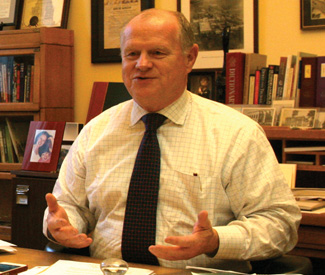
Michael Hennessey has served as San Francisco’s sheriff for half of his life, the longest such career in California history — and by all accounts the most progressive. Since taking office in 1980, Hennessey has been an island of liberal enlightenment in a political climate and law enforcement culture where tough-talking conservatism has been ascendant.

Yet in that era, Hennessey pioneered the creation of innovative programs to compassionately deal with drug abuse, violence, recidivism, and lack of education among jail inmates. He proactively brought unprecedented numbers of minorities, women, LGBT employees, and ex-convicts onto his staff. And he sometimes resisted carrying out evictions or honoring federal immigration hold orders, bold and risky social-justice stands.

His stances drew scorn from the local law enforcement community, which never endorsed him in contested elections, and criticism from political moderates and national media outlets. But San Francisco voters reelected him again and again, until he finally decided to retire as his current term ends next month.

He credits his success and longevity to the people of San Francisco, who have also bucked the harsh national attitude toward criminals and the poor. “San Francisco is still largely a liberal voting town,” he told us in his well-worn office at City Hall, “and not many liberals run for sheriff.”

That logic held up in this year’s election when progressive Sup. Ross Mirkarimi — Hennessey’s hand-picked successor — was elected to the post. Mirkarimi, who led a tribute to Hennessey at the Dec. 13 Board of Supervisors meeting, said he’s honored to be able to continue the legacy of someone he called “the most innovative sheriff in the United States.”


LONG RECORD

Hennessey was a 32-year-old Prisoner Legal Services attorney for the Sheriff’s Department in 1979 as he watched then-Sheriff Eugene Brown letting go of reform-minded staffers and ending his predecessor Dick Hongisto’s early experiment with a school in the jail. So Hennessey quit his job and focused on running for the office.

“I said to myself that I’m not sure if I’ll be a good sheriff or not, but I know I’m better than anyone else running,” he told us, later adding, “I certainly never expected to be sheriff for 32 years.”

Rank-and-file deputies — with whom Hennessey has periodically clashed throughout his career — always preferred one of their own in the job. “As seen in this election, they would like to see someone coming from their ranks,” said Hennessey, even though he notes that at this point, he has hired all but three of the department’s nearly 1,000 employees.

But Hennessey’s outsider status allowed him to deal with the inmate population in a way that the average San Franciscan appreciated, even if the average cop didn’t. “When you’re in law enforcement, all you see are criminals, victims, and people in law enforcement. But I would talk to all kinds of people in the community,” Hennessey said, noting that his experience as a jailhouse attorney gave him a holistic view of his job. “I worked in the jail and I got to know prisoners as people.”

They were people who had certain needs and problems, such as substance abuse, a common problem among criminals. And they were people who would be returning to society at some point, as Hennessey constantly reminded those who expected prisoners to be treated harshly or simply warehoused.

So he broke down the wall between the jail and the community, bringing the city’s social service providers and educators to work programs in the jails, and developing anti-recidivism and vocational programs that allowed ex-offenders to re-engage with the local community.

“Take the bold step of inviting the public in, not all the public, but those who can provide services and help address people’s problems,” Hennessey said. “Then we took the same concept and applied it to violent offenders, which is a little riskier.”

But it was a risk that has paid off as recidivism rates among jail inmates has dropped, and it’s been without any serious cases of inmates harming outsiders. Hennessey is particularly proud of the high school he created in the jail, which will graduate its next class on Jan. 3.

He said the school can truly transform those who end up behind bars. “It gives them a leg up and it’s like a booster shot,” Hennessey said. “They’re at the lowest point in their lives when the come to jail, and then they’re given an opportunity to accomplish something they haven’t been able to on the outside.”

One of many controversial moves during Hennessey’s storied career was his decision to allow female inmates to leave the jails and perform in theaters around San Francisco with the Medea Project, which was created by Rhodessa Jones and the Culture Odyssey art collective to turn the stories of female inmates into plays.

“Rhodessa is a very persuasive person who talked me into letting these women out of jail to perform,” Hennessey said, smiling at the memory. “It was very controversial.”


HIRING REFORMERS

Hennessey’s mentor in the Sheriff’s Department — the man who hired him, ran his first campaign, and then became his longtime chief-of-staff — was the late Ray Towbis, a tough activist whose social justice stands on behalf of tenants, prisoners, and other marginalized members of society would sometimes put Hennessey into difficult positions.

“Ray caused me aggravation many times,” said Hennessey, who nonetheless kept a life-sized cutout photo of Towbis in his office long after he was gone, a reminder to fight for the values he believed in.

There was the time when Towbis angrily flipped over a table and cursed at a panel of parole commissioners after failing to win the release of a model inmate, triggering a demand from the presiding judge that Hennessey fire Towbis, which the sheriff ignored.

Later, Towbis adopted a compassionate approach to the evictions that sheriff’s deputies are forced to perform, allowing deputies to spare tenants who were disabled or elderly and personally calling journalists to help publicize cases in which the parties bringing the eviction action might back off. That sensitivity stays with Hennessey today.

“That’s one of the tough spots I’m in is doing these foreclosure evictions,” Hennessey said, clearly troubled by his duty but also aware that it is one that he is required to perform, despite pressure from progressive groups urging him to refuse to carry them out.

As a lawyer, Hennessey said he must respect court orders and avoid being held in contempt of court, as Hongisto was in the mid-1970s for refusing to carry out evictions against tenants in the International Hotel.

Hennessey and his staff have always been willing to help tenants resist eviction. His office has an eviction assistance program, and Towbis would sometimes tip off the media to publicize certain unjust evictions. One time, Hennessey said Towbis even called hotel magnate Leona Helmsley and talked her out of allowing her company to evict an elderly ParkMerced resident. Instead, Helmsley allowed the woman to live rent-free for the rest of her life, an unlikely gesture of kindness from the “queen of mean” that Towbis helped publicize.

Hennessey draws the line at outright refusal to carry out a judge’s eviction order. “The sheriff shouldn’t be a law-breaker,” he says. Yet Hennessey’s lawyerly approach to complex issues also resulted in his recent policy of not honoring federal detention holds on undocumented immigrants in the jail, after discovering that the holds are administrative — different than arrest warrants — so defying them isn’t a crime.

The policy Hennessey created last year was to ignore ICE requests for prisoners who aren’t charged with felonies or domestic violence charges, noting that the latter charges are often brought but eventually dropped against people who are the victims of domestic violence.

Hennessey tapped federal and foundation grant money to fund his new treatment and educational programs, hiring an ex-convict to write his grant proposals, something that particularly irked many of his deputies.

But Hennessey believed that ex-offenders had something to offer the department so he didn’t back down in hiring them, going so far as to elevate Michael Marcum, who had gone to prison for killing his own abusive father, to the top position of undersheriff in 1993.

Police groups were outraged, but Hennessey said he had known Marcum for many years and valued his counsel and perspective on the criminal justice system. “It wasn’t hard because I knew him and I know of his integrity and loyalty,” Hennessey said.

Hennessy also irked conservative cop culture for aggressive efforts to make the department more diverse. “We wanted more minorities, we wanted more women, and we wanted gay people,” said Hennessey, who initiated outreach efforts to each of those communities.

In 1984, when he approved of an outreach event in Chaps, a gay leather bar in the Castro — complete with flyers around the Castro publicizing the event — it generated a furor that made headlines not just locally in the San Francisco Chronicle, but the National Enquirer tabloid as well.

Yet Hennessey was able to ride out each of the controversies, many of which happened to fall years away from his next reelection campaign. “Those are good times to make dramatic changes,” Hennessey said.

And because he also saw to some neglected basics in the Sheriff’s Department — such as improving training and the jails’ physical structures to prevent escapes and instituting policies to reduce violence between inmates and guards — Hennessey endured and became a beloved sheriff.


VICTORY OF PERSISTENCE

“I’ve always felt somewhat isolated in these beliefs,” said Hennessey, who said that the biggest failure of his career was not proselytizing those beliefs to a statewide and national audience more aggressively. Instead, he has focused on San Francisco, quietly turning the city into a national model for a different kind of policing.

Despite his progressive record, Hennessey has won plaudits and respect from across the political spectrum. In the last election, even the cops who sought to replace him and to undermine his endorsement of Mirkarimi — Chris Cunnie, Paul Miyamoto, and David Wong — all praised Hennessey and promised to continue his programs.

During the Dec. 13 board meeting, Sup. Mark Farrell — consistently one of the most conservative votes on the board — said he has known Hennessey almost his entire life (the sheriff and Farrell’s dad were law school classmates). “I cannot think of anyone with more integrity, a more trustworthy and honest person, than I’ve ever know in my life,” Farrell said.

Sup. David Campos said the immigrant community owes Hennessey a tremendous debt of gratitude. “You have been a tremendous champion for civil rights,” Campos said. “For that, history will judge you very kindly.”

It is a history that Mirkarimi pledges to continue. “Who’s going to fill his shoes? It’s impossible,” Mirkarimi said at the board meeting. “But we certainly have an incredible standard to try to live up to.”

As for Hennessey, he has a fairly clear idea of what he plans to do now that his long and unlikely run as one of the city’s top cops is over: “I’m going to goof around.” *

Top flight

0

arts@sfbg.com

YEAR IN DANCE If you are a trend spotter, you will have noticed two changes within the local dance ecology that probably will influence how we see dance in the foreseeable future.

First, not only have dancers been foregoing the proscenium theater — after all, there aren’t that many around here — but they’ve also been sidestepping theaters altogether. They find spaces in museums, bars, parks, and streets, even former newspaper offices. Or they perform in studios which become informal community gatherings where audiences, in addition to seeing work, get a sense of participating in something being created. Dancers’ Group and CounterPULSE’s “2nd Sundays,” the RAWDance’s “CONCEPT Series,” and Kunst-Stoff Arts are among the most prominent examples of this.

The second change relates to funding. No need to spell out how dire the financial picture has become for big organizations that have infrastructures to support. But for the small and medium-sized companies, it’s been just about catastrophic. So how to get the cash to put on a show or take advantage of a touring opportunity? In the commercial world it’s called “direct marketing.” Dancers are nothing if not entrepreneurial. They are taking to the internet, asking for small donations and keeping people informed about the progress of the “campaign.”

Trying to rethink the past 12 months of dance viewing is mind-boggling; coming up with a “best-of list” is no less so. Take the following ten as one observer’s bouquet to all the dancers who have enriched our lives in 2011. They are listed chronologically by the date of when they were seen.

In its third program (Feb. 24, War Memorial Opera House), San Francisco Ballet showcased the classical language as infinitely pliable and capable of contemporary expressiveness. Yet Yuri Possokhov and William Forsythe could not have done it more differently. Possokhov’s 2010 small-scaled Classical Symphony — three couples and a corps of eight — seduced with its speed, wit, and exuberance. Forsythe’s 1984 tour de force Artifact Suite challenged a huge ensemble with gale-force attacks, imploding unisons, and ever-changing designs. In this context even Helgi Tomasson’s 1993 Nanna’s Lied looked decent.

Spanning 55 years of work, the Merce Cunningham Company (Feb. 3, Cal Performances/Zellerbach Hall) bid its farewell with three pieces that beautifully showcased the late choreographer’s extraordinary range. Antic Meet (1958) showed him young and clever; in the lyrical Pond Way (1998) we saw Cunningham’s affinity for the natural world, and in Sounddance (1975) the backdrop swallowed his dancers one by one. It was a good-bye from artist who had the guts to pull the curtain on himself.

Zaccho Dance Theatre‘s The Monkey and the Devil (April 17, Novellus Theater) didn’t pull any punches about the persistence of racism. A tough show to watch, it was low on “entertainment” values but chock-full of convincingly painful confrontations in which two couples, one white, one black, mirrored each others’ anguish and anger.

In 1979, audiences were taken aback by Lucinda ChildsDance (April 28, San Francisco Performances/Novellus Theater) which incorporated a film by Sol LeWitt and a score by Philip Glass. Its rigor, aesthetic purity, and pedestrian vocabulary alienated many. Yet Dance is a gorgeous piece of choreographic architecture. How fun it was to watch, in 2011, dancers doing the exact same steps so differently as those caught on the film more than 30 years ago.

The Polish Teatr Zar‘s stunningly original and impeccably realized The Gospels of Childhood Triptych, (May 25, St. Gregory’s Episcopal Church and Potrero Hill Neighborhood House) is one of the reasons that the San Francisco International Arts Festival has to exist. With its ritualistic pacing and its fusion of music, movement, and language (“Zar” means “funeral song”), Gospels attempted to suggest something approaching the divine and the restrictions of the self.

Pooling resources is today’s mantra. But few go to the depth of intellectual and emotional sharing that Janice Garrett and Charles Moulton do. They co-choreographed the exhilarating The Experience of Flight in Dreams (June 9, ODC Theater) and came up with a soloists-ensemble format rarely seen in modern dance. To have such a unified and well-realized perspective from such different artists was thrilling.

Science, or writers such Maxine Hong Kingston or Gary Snyder, often inspire Kathryn Roszak‘s work. The reprise of the fine Pensive Spring (Sept. 25, Hertz Hall, UC Berkeley), based on the works by Emily Dickinson, proved to be a thoroughly intelligent and finely crafted dance theater piece that illuminated a great creative mind through music, dance, and language.

AXIS Dance Company (Oct. 7, Malonga Casquelourd Theater) commissioned the Australian choreographer Marc Brew to give the company its first story-ballet. Taking a bow to dance history and soap operas, Brew’s slyly voyeuristic Full of Words moved through knotted entanglements with insight, humor, and compassion. It was a fine vehicle for the company and should be around for a long time.

José Limón is a giant of early modern dance, yet few practitioners have ever seen his work live. So for tiny San Jose’s sjDANCEco (Oct. 15, California Theatre, San Jose) to attempt Missa Brevis, a major Limon choreography, just about amounted to hubris. But former Limón dancer and sjDANCEco’s artistic director, Gary Masters, scoured the community and trained the dancers — some of them college and high school students — in the requisite combination of strength and restraint. The performance of this jewel of modernism became a minor miracle.

Finally, Deborah Slater and Julie Hébert‘s Night Falls (Oct. 21, ODC Theater) looked at the process of aging from a “three ages of man” perspective, except that this was a woman’s life crisis. Most intriguing was the way language and dance — much of it gestural — bounced off each other, creating the vibrant environment in which the performers could fully extend themselves.

Curtain calls

2

arts@sfbg.com

YEAR IN THEATER With a grateful nod to former colleague Brad Rosenstein, we re-inaugurate a system of accolades and nah-ccolades celebrating some memorable highs and lows of the rapidly closing year in theater and performance.


Most Memorable Food Fight

A Three Little Dumplings Adventure

Within seconds of the appearance of the three titular protagonists of Megan Cohen’s A Three Little Dumplings Adventure — a hot pink and powder blue hurricane wreaking havoc on the subdued prison of a suburban living room — it was impossible not to get sucked into their chaotic orbit. Alternating between being patently obnoxious, emotionally unanchored, and frankly homicidal, the “three little dumplings” played by Sarah Moser, Molly Holcomb, and Megan Trout teased, baited, jabbed, and wrestled each other across the stage, culminating in Moser pinning Trout to the floor threatening to eat her (“dumpling” being no tidy euphemism here, but a physiological condition). Presented at the Bay One Acts Festival, it was definitely the year’s best meta-cannibalistic food frenzy, and it whetted our appetite for more. (Nicole Gluckstern)


Best Drug Story

Greg Proops at “Previously Secret Information”

Admittedly the best highs are often hard to remember. Kudos to the seemingly rock-hard memory of otherwise mellow-ab’d comedian Greg Proops, who recalled prodigious intake and takeout as a Chicken Delite delivery boy in 1970s San Carlos for an edition of Joe Klocek’s storytelling series, “Previously Secret Information.” (Robert Avila)


Best Political-Historical Thesis Disguised as a Wildly Funny and Louche “Songplay”

Beardo

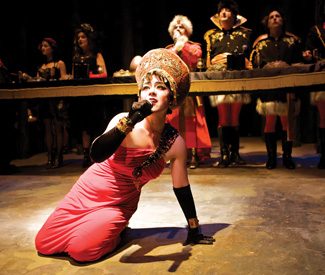
Their own prior hit, 2008’s Beowulf: A Thousand Years of Baggage, was going to be a hard act to follow. But Banana Bag & Bodice and producers Shotgun Players made playwright Jason Craig and composer Dave Malloy’s take on Rasputin look like child’s play — very precocious child’s play — where performances, music, costumes, mise-en-scène, themes, and dialogue all contributed to another hirsute masterpiece. (Avila)


Most Inscrutable Triumvirate

Mimu Tsujimura, Lily Tung Crystal, and Katie Chan in Songs of the Dragons Flying to Heaven

Speaking of frankly homicidal, the otherwise nameless characters “Korean 1, 2, and 3” in the joint Crowded Fire/Asian American Theater Company production of Young Jean Lee’s Songs of the Dragons Flying to Heaven were as outrageously bloodthirsty a collection of countertypical characters as ever graced the Thick House stage. By turns violent, ecstatic, girlish, and demented, the eclectic trio played by Mimu Tsujimura, Lily Tung Crystal, and Katie Chan skewered every tradition-bound Asian stereotype in the book. Clad in the dazzle camouflage of their flowing silk dresses, rendering their monologues in their respective “mother” tongues, not spoken by this or many other audience members, the fiercely energetic characters expertly revealed themselves by not revealing a thing. (Gluckstern)


Best Lighting Design

Allen Willner for inkBoat’s The Line Between

Willner’s worked wonders before, not least with longtime collaborators inkBoat (Heaven’s Radio), but he outdoes himself in this wild and excellent production, making the lighting design a full member of the ensemble with a world of shifting moods and ideas. (Avila)


Best Tentative Revival of a Theatrical Artform

Puppetry

Where have all the puppets gone? It seemed like for a few years there they all went into hiding, perhaps barricading themselves in little puppet bunkers, awaiting the end times. But a modest slew of puppet-driven performances resurfaced over the course of 2011, reigniting our hopes for a full-blown revival in the future. A shortlist of memorable puppets encountered this year include Lone Wolf Tribe’s dark circus of clowns and war veterans in Hobo Grunt Cycle; a beleaguered Orson Welles puppet manipulated by Nathanial Justiniano’s sociopathic Naked Empire Bouffon Company alter ego Cousin Cruelty; Thomas John’s “hard-boiled” egg puppets who populated his Humpty Dumpty noir thriller The Lady on the Wall; the over-the-top awesomeness of a trio of Audrey Jrs. in Boxcar Theatre’s Little Shop of Horrors, and the silently suffering soldier of Aurora Theatre’s A Soldier’s Tale. Here’s hoping this miscellany foreshadows the triumphal return of the missing puppets, to as opposed to their last hurrah. (Gluckstern)


Nicest timing

The Agony and the Ecstasy of Steve Jobs

Just before public figures across the spectrum wailed their approval of a fallen business idol, Seattle-based monologist Mike Daisey, at Berkeley Rep, not-so-quietly reminded people of what a corporation is. Then Occupy Wall Street happened. (Avila)


Most Polarizing Descent Into the Reptilian Complex

Chekhov Lizardbrain

Whether you loved it or loathed it, Pig Iron’s touring production of Chekhov Lizardbrain was certainly one of the year’s most striking. Performing as part of foolsFURY’s Fury Factory, the Philadelphia-based Pig Iron spearheaded an expedition into the inner workings of one man’s brain beset by shifting vagaries of memory and truth. Combining a series of pompously-referenced “rules” of drama, stock Chekhovian alter-egos, and the dual personalities — internal and external — of an undersocialized protagonist (James Sugg) struggling to shape his memories into a recognizable narrative, Chekhov Lizardbrain elicited the most polarized reaction from its sold-out houses I saw all year. From a standing ovation to a fair number of disgruntled walk-outs, this dark-edged exploration inspired a panorama of strong responses in its audience, a solid sign of success in my book. (Gluckstern)


Best Labor of Love

The Companion Piece

Inspired by a concept by Beth Wilmurt, who was inspired by a book about the biological roots of human emotions (A General Theory of Love), Mark Jackson directed Wilmurt and fellow “vaudevillians” Christopher Kuckenbaker and Jake Rodriguez at Z Space in one of the most inspired pieces of devised theater all year (with a close second going to Jackson’s own SF State production of the blissful Wallflower). (Avila)


Best Conversation Starter

The closure of a “remixed” Little Shop of Horrors

Another polarizing moment in Bay Area theater occurred this summer when Boxcar Theatre’s ambitious remix of the cultish Alan Menken and Howard Ashman musical Little Shop of Horrors was shut down by Music Theatre International due to admitted violations of its licensing agreement. The debate inspired by both the violations and the show’s subsequent closure was as passionate and considered as the production that inspired it, from both perspectives of the situation. Without taking sides, I found the conversation about artistic freedom vs. artists’ rights to their own works to be as stimulating and thought-provoking as any night in the theater could strive to be. It seems unlikely that Boxcar Theatre knowingly set out to become the vanguard for open-source theater-making, but here’s hoping it’s a banner they are willing to carry a little longer. (Gluckstern)


Best Part of Getting Old

Geezer at the Marsh

I’m glad I lived long enough to see Geoff Hoyle live long enough to produce this solo piece extraordinaire. (Avila)


Best Couch-Surfing Opportunity

“Home Theater Festival”

Sometimes it’s hard to leave the comfort of one’s home to gamble on the capricious vicissitudes of a theater outing. Gambling in the comfort of someone else’s home was, on the other hand, really easy. (Avila)


Best Ostentatious Design Overload

The Lily’s Revenge

Watching the four-and-a-half-hour epic performance mash-up that was Taylor Mac’s The Lily’s Revenge at the Magic Theatre was in parts harrowing, exhausting, and transcendentally fabulous, but what stuck with me long after the vague twists of plot and character had mostly faded from my memory were indelible images of the seriously overwhelming design. From dazzling, sequined flower costumes by Lindsay W. Davis, to four complete sets built to accommodate five acts designed by Andrew Boyce, to the extravagant lighting by Sarah Sidman, The Lily’s Revenge could have been subtitled The Tech Crew’s Revenge, which would have been a fitting description of the glorious fantasia created by the uniformly top-notch production team. (Gluckstern)


Best Jump on George Clooney

Farragut North

North is better known to multiplex crowds as The Ides of March. But Bay Area theatergoers were first to get a former Howard Dean speechwriter’s fictionalized story of real-deal electoral politics in a so called democracy — and in a nimble low-budge production from OpenTab Productions at Noh Space that made it all the sweeter for not being Hollywooden. (Avila)


Best Planned Revitalization of a Theater District Linchpin

PianoFight at Original Joe’s

When the venerable, family-run Original Joe’s at 144 Taylor burned down in 2007 it was a catastrophic blow to the neighborhood — especially to all the theaters in the area who had adopted it over the years as a go-to post-show hang-out. It even served as a San Francisco Fringe Festival off-site venue for several years, hosting the likes of RIPE Theatre and Dan Carbone. So it was wonderful news on many levels when the turbo-charged PianoFight theater company signed a ten-year lease with the Duggan family to turn the old Original Joe’s into the new home of PianoFight. In addition to rebuilding the restaurant and bar, PianoFight plans to house two theaters, offices, and rehearsal spaces under the same roof — a huge boost to the neighborhood and greater theatrical community both. (Gluckstern)


Worst-Attended Theatrical Gem

Hobo Grunt Cycle at the Exit Theater

I’m not sure why there were so few people in the audience for this stunning cri de coeur against warfare by Kevin Augustine’s rightly acclaimed New York–based puppet theater ensemble, Lone Wolf Tribe. As hard as it can be to look at the real face of war, this piece brilliantly insisted on the need to do just that: manipulated with consummate grace by one or more black-clad puppeteers, Augustine’s life-sized puppets remained strikingly sentient, heartbreakingly damaged beings you absolutely could not take your eyes off. (Avila)


Classiest Beginning to a Final Bow

In the Maze of Our Own Lives

Playwright-director Corey Fischer’s sleekly staged, prescient take on the radically influential Group Theatre ensemble of the thoroughly agitated 1930s, In the Maze of Our Own Lives, which lead off the Jewish Theatre’s 34th and last season. (Avila)

Best Reason to Cross the Bridge: SQUART at Headlands Center for the Arts This 24-hour, all-stops-pulled-out version of choreographer Laura Arrington’s shrewd experimental series in collaborative performance-making capped a residency at the Headlands with a well-attended set of four sneaky, astonishing pieces by a multi-talented ensemble of harried sleep-deprived creator-conspirators. Why isn’t art always made this way? (Avila)

Worst Gas-to-Show Ratio Lolita Roadtrip at San Jose Stage A surprisingly unmoving outing from otherwise quick playwright Trevor Allen, who indeed quickly bounced back with a remounting of his popular solo, Working for the Mouse. (Avila)  

Strangest Encounter Between “Performer” and “Audience” Robert Steijn Steijn questioned everything, including what the hell he was doing onstage in front of the people assembled to see the famed Dutch performer at Joe Goode’s new annex in the Mission. They were all good questions, and the micro-choreography of physical and psychic states to which they pointed charged the room with a delicate intensity that encouraged many thoughtful beers afterward. (Avila)

Short takes: Biggest Dick: Kevin Spacey as Richard III. With balls and chops to match.  

Best Beefcake Ham and Cheese on Wry for under $100: Hugh Jackman at the Curran.

Best use of salvia: Philip Huang at “Too Much!”  

Best medicine for complacency: Cancer Cells, selections from late works and words by Harold Pinter by Performers Under Stress.  

Biggest site-specific punch (with gloves on or off): Peter Griggs’ one-man show, Killer Queen: The Story of Paco the Pink Pounder, at Michael the Boxer Gym and Barbershop.

Most intellectually stimulating drag lecture: David Greenspan reading Gertrude Stein’s Plays at the Contemporary Jewish Museum. (Avila)

Our Weekly Picks: December 21-27

0

WEDNESDAY 21

Krafty Kuts

Before closing out the year with the Sea of Dreams NYE blowout, the party people at Sunset Promotions (along with Metrowize.com) are throwing a community appreciation show and bringing out the U.K.’s Krafty Kuts. He’s best known for his 2006 album Freak Show and a Fabriclive release in 2007, but is largely building a reputation as an international, multiple award-winning breakbeat DJ and turntablist through live performances. Krafty Kuts’ most recent mix — for his November Canadian tour — unrelentingly shifts between the likes of Beastie Boys, Wolfgang Gartner, Fast Crew, and Bart B More. Like the best of breakbeat, Krafty Kuts plays a high wire act, always keeping energy up without growing tiresome nor ADD addled. (Ryan Prendiville)

With DJ Zeph, Motion Potion

9 p.m., free with RSVP; $5 at door

www.krafty-xmas.eventbrite.com

Mighty

119 Utah, SF

(415) 762-0151

www.mighty119.com


How The Grinch Stole Christmas: The Musical!

First published in 1957, Dr. Seuss” How The Grinch Stole Christmas was adapted into an animated film in 1966, featuring the unforgettable narration of Boris Karloff, and a bevy of now-classic songs such as “You’re A Mean One, Mr. Grinch,” belted out by Thurl Ravenscroft. Fans of all ages can relive the beloved holiday special this month when How The Grinch Stole Christmas: The Musical! brings the classic tale to life on stage with colorful costumes and amazing sets that recreate the magical world of Whoville and the inspirational events that transpire there. (Sean McCourt)

Through Dec. 29, times vary, $25–$85

Golden Gate Theatre

1 Taylor, SF

(888) 746-1799

www.shnsf.com


THURSDAY 22

“Nutcracker”

There is something about the shortest days of the year that invites you to become hopeful about what lies ahead. Perhaps it is that we know that the sun will be back. So you don’t have to be a Christian or hooked on family traditions to celebrate what is an extraordinary, though yearly occurring season. “Nutcracker,” often for sentimental reasons, is part of that feeling. Graham Lustig’s 2000 version, now part of Oakland Ballet Company, has plenty of sentiments but little sentimentality. No whiff of Victorian attitudes inhabits this family’s turn of the 20th century modernity. The home is what was considered high-tech at the time: tile, steel, concrete, and huge expanses of glass that invite the sunny, snow-covered outside in. The very fact that the Oakland Ballet Company exists again, is a sign of hope. (Rita Felciano)

Through Dec. 24; 2 and 7 p.m., $15–$59.50

Paramount Theater

2025 Broadway, Oakl.

(800) 745.3000

www.ticketmaster.com


“RitLab: Hanukkah-Houdini”

The Contemporary Jewish Museum’s RitLab (Ritual Laboratory) series stretches the idea of what can be done with such a space as the CJM. Often museums host children’s interactive events, but RitLab is more like afterschool activity time for adults too — I once learned how to make my own spicy pickles at a RitLab event, m’kay? For this Hanukkah-Houdini version, there will be very-mature holiday crafting (magic card wallets, monkey-fist key chains, thaumatropes), a dreidel spin-off, and perhaps most importantly, a performance by Conspiracy of Beards — a local a capella Leonard Cohen cover group. It’ll be fun for kids of all ages, especially those who dig magic and Cohen. (Emily Savage)

6-8 p.m., free with admission (admission is $5 after 5 p.m.)

Contemporary Jewish Museum

736 Mission, SF

(415) 655-7800

www.thecjm.org


Dan the Automator

Popscene is bringing home someone special for its Xmas Gala. An innovative hip-hop and electronic producer, Dan “the Automator” Nakamura needs little introduction. Collaborating with Kool Keith, Del the Homosapien, Prince Paul, Damon Albarn, and Mike Patton on projects such as Dr. Octagon, Deltron, Handsome Boy Modeling School, Gorillaz, and Lovage (to name a few), Automator always looms large. He’s recently produced albums for English rockers Kasabian and locals Dredg, while contributing to Albarn’s Kinshasa One Two charity project along with the likes of Totally Enormous Extinct Dinosaurs and Jneiro Jarel. (And yes, continuing to tease the long awaited follow-up, Deltron 3040.) (Prendiville)

With DJs Omar, Miles the DJ

10 p.m., $10–$12

Rickshaw Stop

155 Fell, SF

(415) 861-2011

www.rickshawstop.com


FRIDAY 23

Rare Exports: A Christmas Tale

“The Coca-Cola Santa Clause is a hoax,” little Pietari tells his friend. He hands him a picture he’s torn from an old book — St. Nicholas with goatish antlers, dropping a child into a boiling cauldron. “The real Santa Clause, he tears naughty kids to pieces.” Rare Exports: A Christmas Tale (2010) directed by Jalmari Helander and based on ancient Scandinavian mythology — might make the kids sooner want Freddy Kruger coming down the chimney on Christmas rather than Santa. When an archeology dig coincides with a bizarre series of events (slaughtered reindeer, missing children, stolen blow dryers), Pietari knows that the real Santa has been unearthed. Rare Exports is a dark tale that’s full of unsuspecting and outlandish surprises. You’ll never see Santa the same way again. (James H. Miller)

10:30 p.m., $9–$11

SF Film Society Cinema

1746 Post, SF

(415) 561-5000

www.sffs.org


Charlie Chaplin’s 1925 The Gold Rush

You loved The Artist, and now you’re obsessed with seeing every silent movie you can jam into your sockets. The San Francisco Silent Film Festival isn’t until next summer, but you can check out one of the genre’s very best this week at the Smith Rafael: Charlie Chaplin’s 1925 The Gold Rush, a delightful comedy even Buster Keaton 4-Lyfe Fan Club members can get behind. Unspooling in a snazzily restored 35mm print (with Chaplin’s own 1942 score as accompaniment, arranged by composer Timothy Brock), this film follows the Little Tramp as he tries his luck prospecting in the frozen Yukon. As the Smith Rafael notes point out, “it’s the one in which Chaplin eats his boot” and contains “The Dance of the Rolls,” an iconic bit of playing-with-one’s-food familiar to fans of 1993’s Benny & Joon — and the current Muppets movie. (Cheryl Eddy)

Through Dec. 29, call for times, $6.75–$10.25

Christopher B. Smith Rafael Film Center

1118 Fourth St., San Rafael

(415) 454-1222

www.cafilm.org


Jazz Mafia

Jazz Mafia is a Bay Area institution. With its eclectic influences, cutting edge genre crossovers are this musical collective’s forte. Jazz Mafia has featured a ton of talented players, with founding member and trombonist-bassist Adam Theis contributing to no less than 10 acts since its inception. The Shotgun Wedding Quintet is a dynamic hip-hop and jazz hybrid fronted by exceptionally cool lyricist Dublin. Brass Mafia is a weird and wonderful New Orleans-y brass ensemble that covers songs from the likes of Skatalites and the Rolling Stones. And, well, there are simply too many incredible acts to list. It’s Jazz Mafia’s 11th anniversary, and I’m sure this San Francisco family has plenty of surprises in store. (Frances Capell)

With Adam Theis and the Jazz Mafia String Quartet, Joe Bagale, and more

9 p.m., $8–$12

Brick & Mortar Music Hall

1710 Mission, SF

(415) 371-1631

www.brickandmortarmusic.com


“Kung Pao Kosher Comedy”

For those who don’t celebrate Christmas — or those who do, but could use a good laugh after spending the day with family — “The 19th Annual Kung Pao Kosher Comedy” show is a sure-fire bet for entertainment while much of the rest of the city shuts down for the holiday. With a line-up featuring Elayne Boosler, Avi Lieberman, Jeff Applebaum, and Lisa Geduldig, what better way to spend the night than with a bit a bit of Jewish comedy — and what better location than in a Chinese restaurant! (McCourt)

Through Sun/25; 6 and 9:30 p.m. Fri.-Sat.; 5 and 8:30 p.m. Sun.; $42–$62.

New Asia Restaurant

772 Pacific, SF

(415) 522-3737

www.koshercomedy.com


SATURDAY 24

Tony! Toni! Toné!

There’s no expression of love more pure than early 1990s-era R&B. And in the golden age of sensual R&B, few could compete with Oakland’s Tony! Toni! Toné!. During the late ’80s and early ’90s, this trio cranked out the jams, climbed the Billboard charts, and provided the soundtrack for countless moments of passion and romance. Did you slow dance with your high school sweetheart to “(Lay Your Head On My) Pillow?” Did you bump and grind to “Whatever You Want?” The holidays are a time for nostalgia; a time for showing our loved ones how much we care. Why not spend Christmas Eve with Tony! Toni! Toné!? (Frances Capell)

8 p.m., $26

Yoshi’s

510 Embarcadero West, Oakl.

(510) 238-9200

www.yoshis.com/oakland


SUNDAY 25

“Death Guild: X-Mess Night”

Undeniably, the holiday season is an adorable one — children point in store windows and glow; Dads are donned in gay apparel; It’s A Wonderful Life airs without end on basic cable; bells a-ringing, figgy pudding, fa la la la la and what have you. However, for some of us around this time of year, it feels like we’re being smothered by a hand knit stocking. Thankfully Death Guild’s “X-Mess Night” is here for anyone who prefers leather corsets instead of holiday turtle necks, The Sisters of Mercy over Bing Crosby, and of course, gin and tonics, not milk and cookies. DJs Decay, Melting Girl, Daniel Skellington, Sage, and Lexor spin gothic, industrial, synth pop and more. (Miller)

9 p.m., $5

DNA Lounge

375 Eleventh, SF

(415) 626-1409

www.dnalounge.com


“It’s a Jewish Christmas”

Christmas day falls on the fifth night of Hanukkah. It’s also the Make-Out Room’s “It’s a Jewish Christmas,” which means Jews and Gentiles both face a dilemma. In the case of us Jews, it comes down to either enduring Grandpa Eshkol, or shooting over to the Mission for a Woody Allen film festival, Chinese food, and a salacious game of strip dreidel. With all that being offered, I doubt old Eshkol would blame you for schlepping out without him. Hosted by none other than Broke-Ass Stuart, the travel writer behind the recent IFC documentary, Young, Broke & Beautiful, “It’s a Jewish Christmas” also features the sounds of DJs J Dub and M.O.T. Mazz. Ah Freilichen Chanukah! (Miller)

5 p.m., $10

Make-Out Room

3225 22nd St., SF

(415) 647-2888

www.makeoutroom.com


TUESDAY 27

Pal Joey

Set amongst the swingin’ nightclubs of San Francisco, 1957’s Pal Joey stars Frank Sinatra as a womanizing singer who dreams of one day owning his own club — and plans to seduce a wealthy widow (portrayed by Rita Hayworth) to secure the funding. Things begin to go awry, however, when he meets Kim Novak’s character, and starts to fall for her instead. Featuring the iconic tune “The Lady Is A Tramp,” the film earned Ol’ Blue Eyes a Golden Globe for Best Actor (in a Musical), and remains a shining example of why he was the king of the crooners. (McCourt)

Double feature with Bye Bye Birdie, which screens at 2:40 and 7 p.m.

4:45 and 9:05 p.m., $7.50–$10

Castro Theatre

429 Castro, SF.

(415) 621-6120

www.castrotheatre.com

Stage Listings

0

Stage listings are compiled by Guardian staff. Performance times may change; call venues to confirm. Reviewers are Robert Avila, Rita Felciano, and Nicole Gluckstern. Submit items for the listings at listings@sfbg.com. For further information on how to submit items for the listings, see Picks.

THEATER

ONGOING

Absolutely San Francisco Alcove Theater, 414 Mason, Ste 502, SF; (415) 992-8168, www.thealcovetheater.com. $32-50. Thurs, 8pm. Through Dec 29. Not Quite Opera Productions presents Anne Nygren Doherty’s musical about San Francisco, with five characters all portrayed by Mary Gibboney.

The Golden Girls: The Christmas Episodes Victoria Theatre 2961 16th St, SF; www.trannyshack.com. $30. Thurs/22-Fri/23, 8pm. Despite the unseasonably warm weather, it was beginning to feel a lot like Christmas, circa 1987, thanks to the return of four luminous drag queens and a little TV-to-stage holiday special that, after six years, can safely be called a San Francisco tradition. Heklina (Dorothy), Pollo Del Mar (Rose), Matthew Martin (Blanche), and Cookie Dough (Sophia) are the older ladies of Miami, delivering verbatim two episodes of the famed sitcom, each with a special gay yuletide theme — fleshed out by special guests Laurie Bushman (as Blanche’s gay kid brother Clayton) and Manuel Caneri (as thinly disguised lesbian Jean). (Opening night also saw special appearances by morning-radio personalities and emcees Fernando Ventura and Greg Sherrell.) Of course, a Word for Word production this isn’t. Knowing drag mischief and unflappable performances allow a certain welcome latitude in attitude, not to mention costuming, which is wonderful in that Pasadena estate sale way: a veritable bazaar of ’80s bizarre. (Avila)

*On the Air Pier 29 on the Embarcadero (at Battery), SF; (415) 438-2668, love.zinzanni.org. $117 and up (includes dinner). Wed/21, Fri/23, Tues/27, Dec 28-30, 6:15pm (also Dec 28, 11:30am); Sat/24, 11:30am; Dec 31, 8:30pm. Teatro ZinZanni’s final production at its longtime nest on Pier 29 is a nostalgia-infused banquet of bits structured around an old-time radio variety show, featuring headliners Geoff Hoyle (Geezer) and blues singer Duffy Bishop. If you haven’t seen juggling on the radio, for instance, it’s pretty awesome, especially with a performer like Bernard Hazens, whose footing atop a precarious tower of tubes and cubes is already cringingly extraordinary. But all the performers are dependably first-rate, including Andrea Conway’s comic chandelier lunacy, aerialist and enchanting space alien Elena Gatilova’s gorgeous “circeaux” act, graceful hand-balancer Christopher Phi, class-act tapper Wayne Doba, and radio MC Mat Plendl’s raucously tweeny hula-hooping. Add some sultry blues numbers by raunchy belter Bishop, Hoyle’s masterful characterizations (including some wonderful shtick-within-a-shtick as one-liner maestro “Red Bottoms”), a few classic commercials, and a healthy dose of audience participation and you start to feel nicely satiated and ready for a good cigar. Smoothly helmed by ZinZanni creative director Norm Langill, On the Air signals off-the-air for the popular dinner circus — until it can secure a new patch of local real estate for its antique spiegeltent — so tune in while you may. (Avila)

*Period of Adjustment SF Playhouse, 533 Sutter, SF; (415) 677-9596, www.sfplayhouse.org. $20-50. Tues-Thurs, 7pm (also Wed/21-Thurs/22, 2pm); Fri-Sat, 9pm (also Sat, 3pm; no show Sat/24). Through Jan 14. A nervous young man with an unaccountable tremor, George Haverstick (a compellingly manic Patrick Alparone) has waited until his honeymoon to finally call on his old Korean War buddy, Ralph (a stout but tender Johnny Moreno) — only to drop his new bride, Isabel (the terrifically quick and sympathetic MacKenzie Meehan), at the doorstep and hurry away. As it happens, Ralph’s wife of five years, Dorothea (an appealing Maggie Mason), has just quit him and taken their young son with her, turning the family Christmas tree and its uncollected gifts into a forlorn monument to a broken home — which, incidentally, has a tremor of its own, having been built atop a vast cavern. Tennessee Williams calls his 1960 play “a serious comedy,” which is about right, since although things end on a warm and cozy note, the painful crises of two couples and the lost natures of two veterans — buried alive in two suburbs each called “High Point” — are the stuff of real distress. SF Playhouse artistic director Bill English gets moving but clear-eyed, unsentimental performances from his strong cast — bolstered by Jean Forsman and Joe Madero as Dorothea’s parents—whose principals do measured justice to the complex sexual and psychological tensions woven throughout. If not one of Williams’s great plays, this is an engaging and surprisingly memorable one just the same, with the playwright’s distinctive blend of the metaphorical and concrete. As a rare snowfall blankets this Memphis Christmas Eve, 1958, something dark and brooding lingers in the storybook cheer. (Avila)

A Tale of Two Genres SF Playhouse, 533 Sutter, SF; (415) 869-5384, www.un-scripted.com. $10-20. Wed/21, 8pm. Un-Scripted Theater Company presents an improvised musical inspired by Charles Dickens.

Xanadu New Conservatory Theatre Center, 25 Van Ness, SF; (415) 861-8972, www.nctcsf.org. $25-45. Wed-Sat, 8pm (no show Sat/24); Sun, 2pm (no show Sun/25 or Jan 1). Through Jan 15. New Conservatory Theatre Center performs the retro roller-skating musical.

BAY AREA

*God’s Plot Ashby Stage, 1901 Ashby, Berk; (510) 841-6500, www.shotgunplayers.org. $18-27. Wed-Thurs, 7pm; Fri-Sat, 8pm; Sun, 5pm (no shows Wed/21-Sun/25). Through Jan 15. Playwright-director Mark Jackson excavates a bit of deep history for Occupy USA, an episode in the annals of colonial American theater and jurisprudence that played, and plays, like a rehearsal for a revolution — this time with music. Capping Shotgun Players’ 20th anniversary season of new work, God’s Plot comically animates and literally underscores (through song, and irresistible banjo and bass accompaniment courtesy of Josh Pollock and Travis Kindred) the story surrounding “Ye Bare and Ye Cubb,” a play performed in 1665 Virginia but now lost. The legal battle that engulfed this satire of the English crown and its economic and political domination of the colonies was an early instance of the close but little acknowledged relationship between art and politics in proto-American society, with much too of religious conflict in the mix (personified here by a powerfully smoldering John Mercer as closet-Quaker Edward Martin). The playwright, a brash self-inventor named William Darby (a sure, charismatic Carl Holvick-Thomas), colludes with a disgruntled merchant (Anthony Nemirovsky) and a former indentured servant climbing the social ladder as a new tenant hand (Will Hand). Darby, meanwhile, is secretly wooing — and even more, being wooed by — Tryal Pore (an ebullient, magnetic Juliana Lustenader), a young woman even braver and more outspoken than he. As an expression of her novel and unbridled spirit, Tryal alone breaks into song to express her feelings or observations. Her temperament is meanwhile a source of worry to her father (a comically deft Kevin Clarke) and mother (Fontana Butterfield), but also attracts an unwitting suitor (a compellingly serious Joe Salazar). The play’s overarching narrative of nationalist ferment, which reaches an overtly stirring pitch, thus comes mirrored by the tension in two dramatic triangles whose common point is the precocious, golden-throated Tryal Pore. More of the private drama might have served the overall balance of the play, but a good part of the achievement of director Jackson and his generally muscular cast is making a complex play of enduring ideas and conflicts look so effortless and fun. (Avila)

The Secret Garden TheatreWorks at Lucie Stern Theatre, 1305 Middlefield, Palo Alto; (650) 463-1960, www.theatreworks.org. $19-72. Wed/21, 2 and 7:30pm; Thurs/22-Fri/23, 8pm; Sat/24, 1 and 6pm; Dec 27-28, 7:30pm; Dec 29-30, 8pm (also Dec 30, 2pm); Dec 31, 2pm. TheatreWorks performs the Tony Award-winning musical adaptation of Frances Hodgson Burnett’s novel.

*The Wild Bride Berkeley Repertory Theatre, Roda Theatre, 2015 Addison, Berk; (510) 647-2949, www.berkeleyrep.org. $14.50-73. Tues, Thurs-Sat, 8pm (also Thurs and Sat, 2pm); Wed and Sun, 7pm (no show Sun/25). Through Jan 1. In the first act of Kneehigh Theatre’s The Wild Bride, the destinies of an innocent girl (Audrey Brisson), her moonshine-making father (Stuart Goodwin), and a predatory devil in a cheap suit (Stuart McLoughlin) become inextricably entwined by an ill-fated bargain. Steeped in European fairytale logic and American folk and blues music, Bride is inventively staged at the base of a giant tree, combining mime, puppetry, dance, live music, Cirque du Soleil-style vocals, acrobatics, and taut verse into a swooping, expressionistic fable. Accidentally promised to the devil by her doting but drink-dulled dad, “The Girl” suffers first the creepy indignity of being perved on by her preternatural suitor, and secondly the horror of having her hands chopped off by her own father, actions which drive her to flee into the woods, morphing into a character known only as “The Wild” (played by Patrycja Kujawska). After a stint as an unlikely, Edward Scissorhands-esque queen, The Wild too is driven from comfort and morphs a second time into a third character “The Woman” (Éva Magyar), an experience-toughened mother bear who kicks the devil’s ass (literally), and triumphs over adversity, without even uttering a single word. At turns dark, dexterous, fanciful, and fatal, Bride rises above the usual holiday fare with a timeless enchantment. (Gluckstern)

The World’s Funniest Bubble Show Marsh Berkeley, TheaterStage, 2120 Allston, Berk; (415) 826-5750, www.themarsh.org. $8-50. Sun and Dec 26-30, 11am (no show Sun/25). Through Dec 31. Louis “The Amazing Bubble Man” Pearl returns with this kid-friendly, bubble-tastic comedy.

PERFORMANCE/DANCE

“Cut the Crap! With Semi-Motivational Guru, Clam Lynch” Dark Room, 2263 Mission, SF; www.darkroomsf.com. Jan 6 and Jan 13, 8pm. $15. Get motivated with self-help-guru-satirizing comedian Clam Lynch.

“Dieter und Shiela at the San Francisco International Youth Hostel” Eureka Theatre, 215 Jackson, SF; www.combinedartform.com. Wed-Fri, 9:30pm, $20. Will Franken presents his latest solo, multi-character comedy.

“Forking II: A Merry FORKING Christmas” StageWerx, 446 Valencia, SF; www.pianofight.com.Wed/21-Fri/23 and Dec 25-30, 8pm. $25-35. Well holy forking shit, it’s been three years already since Daniel Heath’s A Merry Forking Christmas debuted at PianoFight’s old Off-Market Theater digs, and in that time a few new faces have been added to the cast, and a few loose ends tied up in a bow, rendering the overall package a ho-ho-holiday treat worth indulging in. Hate the holidays? Not nearly as much as Goth girl morgue assistant Charlotte (Leah Shesky); her buddy Monique (Emma Shelton), a frustrated culinary genius selling pot cookies to stressed-out shoppers; Adam (Jed Goldstein), a disaffected Jew hired on as a Mall Santa from a temp agency; or Charles (Alex Boyd), an effete metrosexual dangerously enervated by his fiancée’s perfectionist vigor (Nicole Hammersla). Hilariously guided by Ray Hobbs and Gabrielle Patacsil, who play a variety of bit roles (Headbanger vs. Bible Banger, embattled parents fighting over the last coveted “Meat Panda,” feral children), the audience periodically gets to vote over the next permutation of plot, the “forks” alluded to in the title. According to artistic director Rob Ready (also featured in the cast as “Old Ben”), there are 362,880 possible combinations, and yes, the actors have memorized them all. Question is, will you? (Gluckstern)

“Kung Pao Kosher Comedy” New Asia Restaurant, 772 Pacific, SF; (415) 522-3737, www.koshercomedy.com. Fri-Sat, 6 and 9:30pm; Sun, 5 and 8:30pm. $42-62. Now in its 19th year, this night of “Jewish comedy on Christmas in a Chinese restaurant (where else?)” features headliners Elaine Boosler, Avi Liberman, Jeff Applebaum, and Lisa Geduldig.

Mark Foehringer Dance Project | SF Children’s Creativity Museum, 221 Fourth St, SF; www.brownpapertickets.com. Wed-Fri, 11am and 2pm. $20-35. The contemporary ballet company performs Mark Foehringer’s Nutcracker Sweets.

“Santaland Diaries” Eureka Theatre, 215 Jackson, SF; www.combinedartform.com. Thurs/22-Sat/24 and Dec 26-30, 8pm (also Fri/23-Sat/24, 3pm). $20-50. Combined Artform presents David Sedaris’ holiday comedy.

Smuin Ballet Yerba Buena Center for the Arts, 701 Mission, SF; www.smuinballet.org. Wed-Fri, 8pm (also Wed, 2pm); Sat, 2pm. $65. The company performs its acclaimed tribute to the holidays, The Christmas Ballet.

“Tenderloin Christmas Hustler: Occupy the ‘Loin!” Phoenix Theater, 414 Mason, Sixth Flr, SF; www.tenderloinxmashustler.com. Wed-Fri, 8pm. $20-25. Mash-up Christmas parody, complete with sock puppet Jesus at intermission.

“Welcome to Boswick’s House” SF Playhouse, 533 Sutter, SF; www.boswick.net. Thurs-Fri and Mon-Tues, 11am. $19. Boswick the Clown performs a goofy holiday show aimed at kids ages 4-8 years old.

“Yes Sweet Can” Dance Mission Theater, 3316 24th St, SF; (415) 225-7281, www.sweetcanproductions.com. Dec 27-29, 2:30 and 4:30pm; Dec 30, 4 and 8pm; Dec 31-Jan 1, 2pm. $15-60. Sweet Can Productions presents an hourlong extravaganza of circus arts for the holidays.

End war, bring that money home — a controversial proposition, even in SF?

9

A substantial majority of Americans support ending the war in Afghanistan, decreasing the military budget, and redirecting that money to domestic needs, a position held even more strongly in liberal San Francisco. Yet three members of the Board of Supervisors this week still opposed a resolution in support of that position, a resolution that was mocked on the cover of today’s San Francisco Examiner.

So-called political “moderates” here love to deride progressives and label them out-of-touch with the rest of the country or with what they consider the “real world.” But how sensible and fiscally responsible is it to continue spending more than half of the federal budget on the military, a dollar amount that has more than doubled since Bill Clinton left the White House, when domestic conditions are so bad that tens of thousands of people across the country have been willing to spend months occupying their town squares?

The resolution approved Tuesday on a 8-3 vote – with Sups. Sean Elsbernd, Mark Farrell, and Carmen Chu, consistently the board’s most conservative members, in dissent – was similar to resolutions approved in dozens of jurisdictions across the country, most recently in Los Angeles and Pittsburgh, Penn. In May, a similar resolution was also approved by the U.S. Conference of Mayors, the first such action since the Vietnam War.

The resolution calls for members of Congress to “reduce the military budget, end the wars in Iraq and Afghanistan, and redirect the savings to domestic needs.” In support of that position, it notes that we’re spending almost $1 trillion per year on the military and war debt, more than 50,000 U.S. troops have been killed or injured in the two conflicts, and that everything from schools to public services to the country’s infrastructure needs are severely underfunded.

“It’s a way to signal to the federal government – in this case, particularly [Reps.] Nancy Pelosi and Jackie Speier – that people are fed up with their local economies being plundered to support war,” Janet Weil, who works on resolution like this as part of Code Pink’s Bring Our War Dollars Home campaign, told us. San Francisco’s resolution was developed by the New Priorities Campaign, a nationwide coalition that includes Code Pink.

But during this week’s approval of the measure – which included no discussion and lasted less than a minute – Elsbernd rolled his eyes as the measure came up and then voted against it. Afterward, I asked him why, and he gave a two-pronged answer. He generally opposes local resolutions on international issues, and on this one, he said that pulling all troops out of Afghanistan is an unrealistic position that is out of the national mainstream.

“Is this the appropriate forum to discuss how many troops we should have in Afghanistan? Probably not,” he said.

Yet most people clearly see the connection between lack of resources at home and trying to fight two simultaneous wars and maintain a military presence in 63 countries, something that Weil said has fed the Occupy movement around the country, where signs and public statements have repeatedly made that connection.

“I visited OccupySF and I saw very eloquent anti-war messages on dozens of signs, and that had nothing to do with organizing by Code Pink or other anti-war groups,” Weil said. “For a lot of people, it’s such a no-brainer that people don’t even bring it up.”

Yet she said that many politicians and mainstream media outlets have been out-of-touch with that reality. For example, while there has been some popular outcry over this week’s approval of a provision in the latest defense authorization bill that allows for indefinite military detentions of suspected terrorists captured on U.S. soil, the fact that the bill principally authorizes a whooping $662 billion in new military expenditures has gotten less attention.

“But the Occupy movement has pulsed energy and people into the anti-war movement across the country,” Weil said, predicting that the connection between domestic needs and wasteful military spending will put increasing pressure on the federal government to address the issue.

As for whether local resolutions will help with that process, even moderate political consultant Jim Ross – who mocked this week’s anti-war resolution in the Examiner article – correctly noted that San Francisco helped lead the international effort to boycott South Africa and end its apartheid regime, a movement that began with a resolution approved by the San Francisco Board of Supervisors.

Or, to put it in the bumper sticker mentality that conservatives seem to appreciate: think globally, act locally.

Policing the police

2

Bay Area cities have been at the forefront of local challenges to the police state, making stands on issues including racial profiling, deportations of undocumented immigrants, the use of force against peaceful protests, and police intelligence-gathering and surveillance of law-abiding citizens. But the city of Berkeley is creating comprehensive policies to address all of these issues in a proposed Peace and Justice Ordinance that is now being developed.

The effort comes against the backdrop of clashes between police and Occupy movement protesters, including the violent Oct. 25 police raid on OccupyOakland, with Berkeley Police and other jurisdictions on the scene.

Among other things, Berkeley is redefining when it will join other communities in what’s called “mutual aid” agreements — deals that require nearby agencies to help each other out when one public-safety department is overwhelmed.

It’s not terribly controversial when it applies to firefighting — but some people in San Francisco and Berkeley weren’t happy to see their officers joining the Oakland cops in the crackdown in peaceful protesters.

Berkeley officials also want to limit the ability of local cops to work with the FBI and federal immigration agents.

The effort began quietly last summer with behind-the-scene organizing spearheaded by the Washington D.C.-based Bill of Rights Defense Committee, which reached out to a wide variety of groups, include the NAACP, the ACLU, Asian Law Caucus, National Lawyers Guild, the Coalition for a Safe Berkeley, and the city’s Peace and Justice Commission.

“It was a series of one-on-one conversations with the leaders of these groups and then getting them into a room together,” said Bill of Rights Defense Committee Executive Director Shahid Buttar.

That effort got a major push forward last month when Councilmembers Jesse Arreguin and Kriss Worthington led an effort to suspend mutual aid agreements the Berkeley Police Department has with the University of California police and two other police agencies — as well as two city policy documents — over concerns about the use of force against peaceful protesters and domestic surveillance activities.

The council approved the proposal unanimously. Ironically, on the day after the vote, the university launched a violent and controversial crackdown on the OccupyCal encampment — without the help of Berkeley Police.

“It sends the message that we’re not going to try to suppress people’s rights to demonstrate and express themselves,” Arreguin told the Guardian.

The timing of the violent police raid on OccupyOakland — which made international headlines — helped elevate the issue. “What happened in Oakland made people very concerned,” Arreguin said.

Peace and Justice Commission member George Lippman agreed: “People were so shocked by what happened in Oakland that they didn’t resist. …To me, it comes down to what are our values.”

Arreguin used public records laws to obtain the mutual aid agreements between the various cities and then, with help from activists, identified provisions that conflict with Berkeley laws and values. Worthington said that work was crucial to winning over other members of the council: “If it was a generic objection to the whole thing, we would not have won the vote.”

The agreements that the council suspended were with the UC police, the Northern California Regional Intelligence Center (an arm of the Joint Terrorism Task Force, a domestic surveillance pact that has ramped up activities since 9/11), the Urban Area Security Initiative (a creation of the Department of Homeland Security), the city’s Criminal Intelligence Policy, and its Jail Policy (which directs local officers to honor federal immigration holds).

“There is a real potential for problems when we give police the blank check to respond to mutual aid agreements,” he said. “We’re trying to ensure they respect this community’s values.”


“WE DON’T DO ICE’S JOB.”

Arreguin and other members of his coalition have been working on modifying provisions of these documents, and they are expected to return to the council for a vote next month. But that’s just the first step in Berkeley’s efforts to create comprehensive peace and justice policies, covering civil liberties, crowd control policies, use of force, and cooperation with other policing agencies.

“The ordinance we’re discussing would cover a lot of these areas,” Arreguin said. “What we’re trying to achieve here is more accountability.”

For example, the police are the ones who decide what is an “emergency situation” that would trigger a mutual aid response. But should a peaceful protest that blocks traffic or goes on an unpermitted march be considered an emergency? “It may not be appropriate for us to respond to every request, particularly when it comes to political activities,” Arreguin said. “Just because people are breaking laws, that shouldn’t be a pretext to respond to mutual aid.”

In a similar vein, the coalition is developing policies to support Berkeley’s status as a sanctuary city for immigrants of all kinds and looking for ways to resist the federal Secure Communities program, a national database of fingerprints and arrest information that allows Immigration and Customs Enforcement agents to place detention holds on those suspected of being undocumented immigrants.

The boards of supervisors in San Francisco, Santa Clara, and other jurisdictions have tried unsuccessfully to opt out of the program, something that requires state approval. But the activists say Santa Clara has become a model by following up with an ordinance that says the county won’t honor the federal requests until they have a signed written agreement to cover all the county’s costs associated with honoring the holds.

“We don’t do ICE’s job,” Sup. George Shirakawa told supporters after the Oct. 17 vote, according to published reports. Arreguin called the effort “a smart approach and we want to see if we can do it in Berkeley.”

Other Bay Area cities have also begun to examine issues related to a police state that has expanded since the 9/11 attacks, including Richmond and Piedmont. In San Francisco, the latest process of challenging the role of local police officers in domestic surveillance — issues the city has periodically wrestled with for decades — began earlier this year (“Spies in blue,” April 26). It led to an ordinance that would limit that activity, which activists say Sup. Jane Kim will introduce next month.

“If our local police are going to work with the FBI at all, they have to observe our local laws,” says John Crew, the police practices expert with the ACLU-Northern California who has been helping develop San Francisco’s ordinance. “Far to often, the FBI has shown interest in protest activities that have nothing to do with illegal activities.”

For example, documents unearthed by a lawsuit filed by the ACLU and the Bay Guardian and through other avenues show FBI coordination with local police agencies related to the Occupy protests, those aimed at BART, and in the aftermath of the trail of Johannes Merserle, the former BART officer who shot Oscar Grant. The UC Board of Regents also canceled a meeting last month where a large protest was organized, citing unspecified intelligence about threats to public safety.

Crew noted that a right to privacy is written into California’s constitution, yet San Francisco has two experienced police inspectors assigned full-time to work with FBI and its Joint Terrorism Task Force. “They aren’t focused on laws being broken, but on collecting massive amounts of information,” Crew said.


SURVEILLANCE IN THE SPOTLIGHT

Veena Dubal of the Asian Law Caucus, which has also been involved with Berkeley coalition, is happy to finally be connecting various issues related to an overreaching police state. “What’s really exciting about the ordinance is it’s pushing back on all these very problematic federal polices that have really gone after communities of color,” she said. “The people being spied on in Berkeley are not the people who live in the hills, it’s the students and people of color.”

She said the Occupy movement, its broad appeal to the 99 percent, and police overreaction to peaceful protests have helped to highlight some of these longstanding policing issues and caused more people to feel affected by this struggle.

“The Occupy movement certainly brings these issues to an audience that wasn’t concerned about it before. Surveillance and police brutality, all the sudden that’s in the spotlight.” she said, noting that people have begun to question their willingness to give police more power after 9/11. “More and more people are understanding that the powers the government took aren’t just being directed at terrorists, but members of their families.”

Willie Phillips of Berkeley’s NAACP chapter, a lifelong Berkeley resident who has experienced discrimination and racial profiling by police his whole life, said it’s good to finally build a coalition that broadens support for addressing policing issues.

“It gets people discussing issues that overlap and creating that kind of dialogue is important,” he told us. “Separation only creates a division in addressing the issue that we’re facing…..We have to start looking at our commonalities and our hopes, instead of fear, because fear is what divides us.”

Phillips said the Occupy movement, with its engaged young people who have stood strong against aggressive police tactics, has helped place the spotlight back on policing issues after progress on combating racial profiling in the ’90s was derailed by 9/11.

“It’s shows that everyone can be marginalized,” Phillips said of the Occupy movement. “Ninety-nine percent of people have been marginalized and that context helps us understand each other.”

Arreguin hopes that Berkeley’s work in this realm sparks discussions with other Bay Area jurisdictions. “We want to work on a regional level to deal with these issues,” he said, later adding, “I’ve been alarmed as the police state has developed over the years.”

Asked whether he’s gotten any pushback from police to his efforts, Arreguin said Police Chief Michael Meehan and his department have been very cooperative and that “our police are just waiting for a dialogue about what kind of changes we want to see.”

A Berkeley Police spokesperson says the department won’t comment on political matters. Berkeley Police Association President Tim Kaplan said mutual aid agreements are important to public safety, but that “we do feel like we’re part of the Berkeley community and we want to work with the city and its citizens….We’re going to do what the law says.”

And the coalition is intent on writing some of the country’s most progressive laws for policing the police.

“The victory we had on mutual aid agreements is very exciting and we have an opportunity to make some real changes,” Arreguin said.

Buttar said his organization has helped to facilitate similar coalitions in about 30 cities, from Los Angeles to Hartford, Conn. But he said Berkeley’s is the biggest and has the most ambitious agenda. “I tend to think that just getting the coalition together is a win,” Buttar said. “So, to that extent, Berkeley is already a model.”

Plugging the flow

0

rebeccab@sfbg.com

When significant events related to the Occupy movement occur in the pre-dawn hours, it usually means a protest encampment has been raided. But on Dec. 12, Occupy protesters were the ones carrying out a strategic plan before sun up.

Activists organized by OccupyOakland effectively blocked cargo shipments from moving through several Port of Oakland terminals that day, as part of a coordinated West Coast Port Blockade that featured similar actions in other cities including San Diego, Portland, Seattle, and Longview, Washington.

About 150 longshore workers were sent home from their morning shifts at Oakland shipping terminals because protesters were marching in circular picket lines outside the gates.

The day began when more than 1,000 protesters met up at the West Oakland BART station at 5:30 a.m., sleepily raising signs and banners in the chilly morning air as they proceeded down 7th Street toward the port. Once they reached the sprawling shipping hub, they formed picket lines outside terminal entrances. Police were on the scene and clad in riot gear, but no clashes with protesters occurred early in the day.

Around 7 a.m., when the morning shift would have typically started, two International Longshore & Warehouse Union (ILWU) dockworkers — who declined to give their names — stood near the Hanjin Shipping gate at berths 55 and 56. Past the gate, a cargo vessel which had likely come from Japan was berthed and waiting to unload.

The men calmly surveyed the roughly 200 chanting Occupy activists as they marched around and around in a circular picket. “Ain’t nobody going to cross it,” one offered. The other gestured toward the protesters. “These are Americans wanting American jobs,” he said.

Around 10 a.m. outside the same terminal, protest organizer and Oakland hip-hop artist Boots Riley declared the first part of the port shutdown to be a victory. “Longshoremen are going home now,” he said. “Effectively, the Port of Oakland is shut down.” Later in the afternoon, protesters returned to prevent the start of an evening shift.

Until recently, the nationwide Occupy movement manifested as tent cities springing up everywhere in rebellion against the lopsided economic conditions. After a series of police raids cleared the tents away, however, organizers in the Bay Area and beyond took a different tack with the port blockade.

Working in tandem with allies from labor, occupiers from San Diego all the way up to Anchorage directed their gaze at international shipping hubs, critical infrastructure for multinational businesses importing and exporting goods between Asia and North America.

Cargo terminals make for heavyweight targets, as five of the nation’s 10 largest ports are located along the West Coast. The value of annually traded goods flowing in and out of Oakland alone is $34 billion, and authorities there estimate some $8 million could be lost if business were to be halted for a full day.


MAKING HISTORY

OccupyOakland unanimously approved the call for a coordinated West Coast port blockade at a Nov. 18 General Assembly.

“The ports play a pivotal role in the flow and growth of capital for the 1 percent in this country and internationally,” occupiers explained on a website announcing the port shutdown. “For that reason alone it is the ideal place to disrupt their profit machine.”

The ports weren’t selected as a target for that reason alone, but rather as an affront to specific corporations whose labor practices have sparked the ire of port workers. Export Grain Terminal (EGT) and its parent company, Bunge, Ltd., came into Occupy’s crosshairs because of their ongoing dispute with ILWU Local 21 in Longview, Wash., stemming from what longshoremen characterize as union-busting practices.

Port terminal operator Stevedoring Services of America (SSA Marine) and its parent company’s primary shareholder, Goldman Sachs, were also singled out in support of low-wage port truckers whose employment classification as independent contractors bars them from unionizing.

The third objective of the blockade, according to organizers, was to strike back against a series of police raids that dismantled Occupy encampments nationwide.

It wasn’t the first time cargo ships traversing the Pacific would be stalled by a politically motivated coast-wide port blockade. In 2008, ILWU members coordinated a West Coast port shutdown in dissent of the Iraq War.

In 1984, longshoremen and anti-apartheid activists blocked South African cargo to boycott the apartheid regime, noted ILWU member Stan Woods. Similar shutdowns, carried out in response to politically explosive issues going back to 1934, have been led by community activists forming picket lines at port entrances to prevent dockworkers from beginning their shifts.

Occupy’s call for a coordinated blockade brought an unprecedented twist to this historic trend, representing the first time a group unaffiliated with dockworkers had called for a shutdown spanning the entire West Coast. It left some seasoned organizers wondering anxiously how things would unfold, while others saw it as a gust of wind in the sails of the labor movement.

“One of the good things about the Occupy movement is that it’s challenging leaders of progressive institutions,” Woods said. “The old way … isn’t working. There’s been a one-sided class war, and there has to be a two-sided class war.”

Organizer Barucha Peller noted that the Occupy movement could be galvanizing for non-unionized workers, too. “Our movement is giving a framework for the 89 percent of workers who are not in unions,” she said.

For occupiers up and down the West Coast, the port shutdown also seemed to present a kind of test as to whether their young movement could successfully “exert its collective muscle,” as an OccupyOakland press statement put it, and effectuate a mass mobilization even after police raids flattened their encampments.


A ROUGH VOYAGE

In the weeks leading up to Dec. 12, even as Bay Area Occupy organizers plastered fliers about the blockade everywhere, met with union members, and organized outreach events to garner community support, they stumbled into challenges. Robert McEllrath, the president of the ILWU, publicly criticized the blockade plan, saying organizers had failed to reach out to union officials before unanimously approving the call to action.

“Any decisions made by groups outside of the union’s democratic process do not hold water, regardless of the intent,” McEllrath wrote. He seemed troubled that Occupy had attached itself to a union struggle without adequate communication, but an official endorsement of a third-party blockade by the ILWU would have landed the union in legal trouble.

“Whenever a group of people decide to march into a workplace in an effort to shut it without respecting the democratic decision-making process, it’s not an ideal situation,” ILWU spokesperson Craig Merrilees told the Guardian.

Some rank-and-file ILWU members saw things differently. “The rank and file do support the principles of the community, and Occupy,” said Anthony Lavierge, an ILWU steward. “Longshoremen had a good response to [the Nov. 2 port blockade]. It was empowering to a lot of people that so many came out.”

Another rank-and-file union member said, “the majority of ILWU workers are supportive of what’s going on, definitely.”

One rank-and-file ILWU member and self-described anarchist published a critique online raising concerns that OccupyOakland had failed to bring local union officials on board before approving the call to action.

In response, OccupyOakland organizer Mike King said, “We never brought it to them, because it’s not something they could endorse.” Yet he added that they had sought to include the rank-and-file from the start.

“We have done far more outreach for Dec. 12,” than in the days prior to the Nov. 2 port shutdown, which brought tens of thousands of activists to the street, King said. “Leading up to Nov. 2, we never expected half that many people would show up.”

Occupiers in San Diego, Los Angeles, Portland, Vancouver, Anchorage, and other cities all signed up to participate, and the idea drew support from activist groups as far away as Japan who vowed to perform solidarity actions in their own communities.

Nevertheless, the international union president’s statement prompted a flurry of mainstream news articles — along with some downright derisive columns — casting occupiers as out of sync with the very workers they claimed to stand with.

In Oakland, authorities of the targeted facility posed another obstacle. The Port of Oakland took out full-page ads in local daily newspapers and the New York Times urging the community to “Keep the Port Open.” The ads borrowed the language of the movement by proclaiming that the port “employs the 99 percent.” Port spokesperson Robert Bernardo emphasized this message in an interview with the Guardian. “When you shut down a port, you lose jobs,” he said. “Local jobs.”

Sue Piper, special assistant to Oakland Mayor Jean Quan, noted prior to Dec. 12 that the mayor was working with police and port officials to ensure that the port remained open for business. On the morning of the port blockade, however, police stood down and did not prevent protesters from circling up in front of terminal entrances.


BIG FISH TO FRY

Lost in much of the mainstream coverage of the port blockade were Occupy Oakland’s three main objectives. The protesters aimed to demonstrate solidarity with low-income port truckers laboring in service of the powerful SSA Marine; stand with ILWU Local 21 members in their face-off against EGT; and deliver a show of resistance against coordinated police raids of Occupy encampments nationwide.

In October, 26 Los Angeles truckers working for a port company called Toll Group were fired after wearing Teamsters truckers’ union jerseys to their shifts to demonstrate their wish to unionize. Because they’re classified as independent contractors instead of employees, it’s illegal for the truckers to join unions. They’re paid per shipment rather than per hour, which translates to hours of unpaid labor spent in the queue, and must cover their own job-related costs.

Occupy Los Angeles caught wind of the incident and began to talk about doing an action in solidarity with the truckers.

“The date of Dec. 12 was originally suggested by people in Los Angeles,” explained Dave Welsh, a delegate of the San Francisco Labor Council and secretary of the Committee to Defend the ILWU. “It’s also Our Lady of Guadalupe feast day, a Mexican holiday. Since many truckers of the Port of LA are Mexican, they picked that date. One focus [of the blockade] is support for truckers and their demand for better wages, working conditions, etc.”

On the day of the blockade, an open letter from port truckers was published on the website of the Coalition for Clean and Safe Ports, an advocacy group. “We are inspired that a non-violent democratic movement that insists on basic economic fairness is capturing the hearts and minds of so many working people,” the message read. “Thank you ’99 Percenters’ for hearing our call for justice. We are humbled and overwhelmed by recent attention. Normally we are invisible.”

The second major target of the blockade was EGT, which constructed a new grain terminal on Port of Longview property at the edge of the Columbia River in southern Washington, about an hour’s drive from Portland, Ore.

EGT’s parent company is Bunge, Ltd., a major agribusiness firm that has come under fire for everything from tax evasion, to rampant clearing of Amazon rainforest lands for soybean cultivation, to the use of slave labor in Brazil.

Although the terminal construction first brought hope to a small community inflicted with 15 percent unemployment , ILWU Local 21 President Dan Coffman says things soured when EGT brought in out-of-state laborers to build the facility, then refused to hire members of his union.

Coffman contends that EGT’s lease with the port means the company is required to hire Local 21 workers, but EGT disputes this, and has been locked in a federal court battle with the port. The dispute has prompted union members to stage port blockades of their own, resulting in some arrests.

Peller, the Occupy Oakland organizer, announced on a megaphone Dec. 12 that occupiers in southern Washington had shut down the Port of Longview, according to a text message from ILWU Local 21. Union members wanted to thank the movement for the show of support, she added.

“They thought they could just run over a small local,” Coffman told the Guardian, referencing EGT. “Well, David met Goliath. We’re going to fight them till the bitter end.”

George Chen’s list of things that didn’t suck in 2011

0

For so many more year-end music lists, click here and pick up this week’s paper.

Musician and writer George Chen says, “2011: man, most of it was shitty, but here were the good things:”

1. Helm. Luke Younger from Birds of Delay, Halloween weekend in London. Best noise set I’ve seen in a while, it helped that there was a fan blowing his bangs out of his hoodie. He has an album called Cryptography out on Kye.

2. White Lung. Youngins from Vancouver B.C. playing sick, straight forward punk. Saw them in a bowling alley.

3. Village of Spaces’ Alchemy and Trust album. It took a village to put this out, or at least four labels working in conjunction. Dan Beckman’s (Uke of Spaces Corners) quiet folk masterpiece.

4. Divorce. A band from Glasgow that exists in kind of a cultural vacuum there, a bit like the early ’00s trapped in amber, but then cracked open and given adrenal supplements. They are coming to America in July 2012.

5. Trash Kit put out an album in 2010, but I only got to see them once in 2011. Sadly, they have broken up. Finger-picky jaunty punk with weird rhythms.

6. Andrew W.K. This was not particularly “good”, but distinct encapsulation of the zeitgeist. My band played a show with him at Dem Passwords. He didn’t actually watch us or anything, he showed up right before going on with an entourage. Fans started force-feeding him bananas, Redbull, and whiskey and it turned into a freakish spectacle. I took a nap during his set, came back in, and he was still going for like two and a half hours, driving his fans away. Respect, the modern Andy Kaufman.

7. This Invitation. Chen Santa Maria went on a California tour with Warren in April and it was sparsely attended, but perhaps we’re to blame for that. It’s nice to see one of your oldest friends get some recognition for their work, which Aquarius did by giving their stamp of approval to his three (!) double CDs.

8. Cacaw from Chicago, a few ex-Coughs peeps project. They are now broken up, but this summer they came through and it was a monstrous sludge engine. Dark and fierce.

9. Anika. Technically a 2010 release, but she played at the Independent in October. The lady herself has a passive stage presence, but the music of the whole group (members of Portishead and Beak>) is best described as “Nico fronting PiL” (someone at the LA Times can claim that one).

10. SF Comedy. I still feel like an outsider at all this, but holy shit, there’s good stuff going on right now. Perhaps it is a national, even international renaissance in comedy, but the energy and talent going on here feels as exciting to me as the music scene used to feel. I actually don’t want to name names although the free show at the Rite Spot is a good place to start. I also noticed that none of the music I put on this list has anything to do with the Bay Area. Sorry, music. I just listen to podcasts now.

Young Canadian punk band White Lung:

The tops of 2011

0


CHERYL EDDY, GUARDIAN


TOP 10 METAL SHOWS OF 2011 (CHRONOLOGICAL ORDER)

1. Feb. 2: Motörhead, Clutch, and Valient Thorr at Warfield

2. March 11: Weedeater, Zoroaster, Kvelertak, and Begotten at Thee Parkside

3. March 12: Slough Feg, Christian Mistress, and Witch Mountain at Hemlock

4. April 3: Saint Vitus, Red Fang, and Howl at Mezzanine

5. June 7: Orange Goblin and Gates of Slumber at Bottom of the Hill

6. Aug. 12: Eyehategod, Impaled, Laudanum, and Brainoil at Oakland Metro

7. Aug. 16: Pentagram at Mezzanine

8. Oct. 13: Enslaved at Slim’s

9. Nov. 3: Mastodon and Red Fang at Warfield

10. Nov. 19: Kyuss Lives! and Black Cobra at Regency Ballroom


JOSH CHEON, DARK ENTRIES RECORDS


TOP 10 NEW RELEASES OF 2011

1. Container, S/T LP (Spectrum Spools) 2. Staccato du Mal, Sin Destino (Weird Records) 3. Bronze, Copper (RVNG Intl.) 4. Grouper, Dream Loss/Alien Observer (Yellow Electric) 5. White Fence, Is Growing Faith (Woodist) 6. Belong, Common Era (Kranky) 7. Widowspeak, S/T LP (Captured Tracks) 8. Total Control, Henge Beat (Iron Lung) 9. Iceage, New Brigade (What’s Your Rupture?) 10. Brotman & Short, Heights (Cold Dick)


GEORGE CHEN, MUSICIAN AND WRITER


2011: MAN, MOST OF IT WAS SHITTY. BUT HERE WERE THE GOOD THINGS

1. Helm. Luke Younger from Birds of Delay, Halloween weekend in London. Best noise set I’ve seen in a while, it helped that there was a fan blowing his bangs out of his hoodie. He has an album called Cryptography out on Kye. 2. White Lung. Youngins from Vancouver B.C. playing sick, straight forward punk. Saw them in a bowling alley. 3. Village of Spaces’ Alchemy and Trust album. It took a village to put this out, or at least four labels working in conjunction. Dan Beckman’s (Uke of Spaces Corners) quiet folk masterpiece. 4. Divorce. A band from Glasgow that exists in kind of a cultural vacuum there, a bit like the early ’00s trapped in amber, but then cracked open and given adrenal supplements. They are coming to America in July 2012. 5. Trash Kit put out an album in 2010, but I only got to see them once in 2011. Sadly, they have broken up. Finger-picky jaunty punk with weird rhythms. 6. Andrew W.K. This was not particularly “good”, but distinct encapsulation of the zeitgeist. My band played a show with him at Dem Passwords. He didn’t actually watch us or anything, he showed up right before going on with an entourage. Fans started force-feeding him bananas, Redbull, and whiskey and it turned into a freakish spectacle. I took a nap during his set, came back in, and he was still going for like two and a half hours, driving his fans away. Respect, the modern Andy Kaufman. 7. This Invitation. Chen Santa Maria went on a California tour with Warren in April and it was sparsely attended, but perhaps we’re to blame for that. It’s nice to see one of your oldest friends get some recognition for their work, which Aquarius did by giving their stamp of approval to his three (!) double CDs. 8. Cacaw from Chicago, a few ex-Coughs peeps project. They are now broken up, but this summer they came through and it was a monstrous sludge engine. Dark and fierce. 9. Anika. Technically a 2010 release, but she played at the Independent in October. The lady herself has a passive stage presence, but the music of the whole group (members of Portishead and Beak>) is best described as “Nico fronting PiL” (someone at the LA Times can claim that one). 10. SF Comedy. I still feel like an outsider at all this, but holy shit, there’s good stuff going on right now. Perhaps it is a national, even international renaissance in comedy, but the energy and talent going on here feels as exciting to me as the music scene used to feel. I actually don’t want to name names although the free show at the Rite Spot is a good place to start. I also noticed that none of the music I put on this list has anything to do with the Bay Area. Sorry, music. I just listen to podcasts now.


JHAMEEL, MUSICIAN


TOP 10 SONGS FOR 2011

1. “Cruel” by St. Vincent 2. “Don’t Fuck with my Money” by Penguin Prison 3. “Holocene” by Bon Iver 4. “Bam Bam” by King Charles 5. “King of Diamonds” by Motopony 6. “Don’t Move” by Phantogram 7. “5 O’Clock” by T-Pain 8. “White Lie” by Jhameel 9. “Love U More” by Sunday Girl (RAC Mix) 10. “Imprint” by Amtrac


MARC RIBAK, TOTAL TRASH FEST


TOP 10 RECORDS I AM DIGGING DURING THANKSGIVING WEEK

1. The Fall, Wonderful and Frightening World of the Fall (particularly the tape that includes singles)

2. The Spits, Kill the Cool (demos and rarities, LP on In the Red)

3. Reigning Sound, Time Bomb High School and Too Much Guitar (LPs on In The Red)

4. The Ronettes, Presenting the Fabulous Ronettes featuring Veronica, and Phil Spector’s A Christmas Gift for You.

5. Devo, Workforce to the World (early live bootleg)

6. The Marvelettes, Greatest Hits (LP on TAMLA)

7. Coachwhips, Bangers Versus Fuckers (LP on Narnack)

8. South Bay Surfers, Battle of the Bands (LP on Norton)

9. Tav Falco and the Unaproachable Panther Burns, Panther Phobia (In the Red Records)

10. Jonathan Richman, Rockin’ and Romance (LP on Twin/Tone)


FRANCES CAPELL, GUARDIAN


TOP TEN SELF-RELEASED ALBUMS OF 2011

1. WU LYF, Go Tell Fire To The Mountain Recorded in an abandoned church, the full-length debut from British heavy pop quartet WU LYF was funded by membership fees for the band’s deviant fan club, the Lucifer Youth Foundation.

2. Death Grips, Ex Military The sinister debut mixtape from Sacramento’s Death Grips is an explosion of dark, twisted shout-rap and noisy, industrial beats.

3. Nick Diamonds, I Am An Attic Former Unicorn and current member of Islands and Mister Heavenly, Nick Diamonds (a.k.a. Nick Thorburn) released his understated, haunting solo album via Bandcamp.

4. Clams Casino, Instrumental Mixtape Clams Casino’s collection of swirling, synth-laden instrumentals crafted for the likes of Lil B and Soulja Boy reveals the genius of this visionary New Jersey producer.

5. Big K.R.I.T, Return of 4Eva Of all the exciting rap mixtapes released in 2011, Southern heavy-hitter Big K.R.I.T.’s Return of 4Eva is my favorite.

6. Frank Ocean, nostalgia, Ultra. This R&B pop gem presents Frank Ocean as, perhaps, the only member of the OFWGKTA family who proved worthy of the hype in 2011.

7. Fort Lean, Fort Lean (EP) Though it’s only 12 minutes long, Fort Lean’s infectious, summery debut EP is a promising glimpse of things to come for this indie five-piece from Brooklyn, NY.

8. Friendzone, Kuchibiru Network II I chose East Bay duo Friendzone’s Kuchibiru Network 2 over Main Attrakionz’s 808’s & Dark Grapes II, as it showcases Main Attrakionz at its best along with tasty selections from Oakland’s Shady Blaze and Finally Boys, Japanese producer Uyama Hiroto, and more.

9. Small Black, Moon Killer In addition to some of Small Black’s catchiest electronic pop songs to date (like the Nicki Minaj-sampling “Love’s Not Enough”), this mixtape features two appearances by Das Racist’s Himanshu Suri, and some inspired remixes from Star Slinger and Phone Tag.

10. The Weeknd, House of Balloons This is a no brainer. Canadian-Ethiopian R&B prodigy the Weeknd’s debut mixtape House of Balloons is the best album of the year, period. (Frances Capell)


LAURA GRAVANDER, DIRTY CUPCAKES


TOTALLY NEPOTISTIC LIST OF THE TOP TEN LIVE BANDS OF 2011

1. ELECTRO: This is the band of 8-year-old girls I mentored this summer as a volunteer at Bay Area Girls Rock Camp. After learning two chords from scratch, they wrote a droney, unintentionally avant-garde five-minute anti-bullying opus with a rap breakdown that blew my mind at their July showcase at the Oakland Metro. This is the future.

2. Uzi Rash: Swamp reptile Max Nordile and his band of trashy weirdos play music that is both grating and catchy, and deceptively complex. See them live and they will freak you out, and possibly hit you in the eye socket with an empty 40 oz. (it happened to me).

3. Shannon and the Clams: Seeing the Clams live feels like being magically reunited with your childhood dog — happy and nostalgic, a little bit sad. This metaphor is especially apt if you and your childhood dog loved to DANCE! 4. Younger Lovers: Killer guitar parts, dance-crazy beats, and singer-drummer-songwriter Brontez’s onstage bitching makes Younger Lovers’ shows unpredictable and exciting. Plus, their guitarist is super-cute!

5. King Lollipop: Elfin hillbilly plays bubblegum rockabilly (or something like that!) backed by six drummers who sound like a marching band meets drum circle, minus the lame.

6. Human Waste: Freaky spacesuited dystopian moog-punk from the Moon. Rumored to consist of members of Uzi Rash, Shannon and the Clams, and Dirty Cupcakes. More space waste to come in 2012.

7. Glitter Wizard: Intricate, impressive glam rock. And once, mid-song, I saw frontman Wendy Stonehenge light his hand on fire!

8. PIGS: This three-piece plays metal for people who love metal. Ripping it up soon in a scummy warehouse near you.

9. Knifey Spoony: Oakland punk rockers with impressive live show and unexpectedly melodic hooks. Singer-guitarist Steve Oriolo studied music in college but uses his powers for good (rock), not evil (anything that doesn’t rock).

10. Sweet Nothing: I’m a sucker for two-piece bands and girl drummers, and Ian and Melissa always rock my face off.


KUSH ARORA AND THE INGROOVES OFFICE STAFF


TOP 10 RELEASES OF 2011

1. Los Rakas, Chancletas Y Camisetas (Soy Raka Inc.) 2. Am and Shawn Lee, Celestial Electric (ESL Records) 3. People Under The Stairs, Highlighter (Piecelock 70 ) 4. Toddla T, Watch Me Dance (Ninja Tune) 5. Boris, New Album (Sargent House) 6. Kendrick Lamar, Section.80 (Top Dawg Entertainment/Section 80) 7. Youth Lagoon, The Year of Hibernation (Fat Possum) 8. Little Dragon, Ritual Union (Peacefrog Holdings Ltd) 9. Jay Rock, Follow Me Home (Strange Music) 10. Vybz Kartel, Colouring Book EP (Tad’s Records)


MARCO DE LA VEGA (@S4NTA_MU3RTE), 120 MINUTES


TOP 10 SUBSTANCES THAT HAVE INFLUENCED MUSIC IN 2011

1. Adderall: Not just because Bay-local comeup, Kreayshawn, spits bout slangin’ em (“gnarly, radical, on the block I’m magical… see me at your college campus baggie full of Adderalls”) or even because of Kendrick Lamar’s thoughtfully spaced out track “A.D.H.D.” but mostly because of its association with hyperactive, creative, and willfully scattered children. Odd Future blew up, Tyler the Creator dropped Goblin, A$AP Rocky put out one of the strongest releases of the year with LIVELOVEA$AP. All kinds of kids were spittin’ up mixtapes right outta high school and then signing multimillion dollar contracts.

2. DMT: Dimethyltryptamine is some fucked up shit, and I mean that in the most complementary way possible. A small glimpse behind the fabric of reality. There were a few releases this year that resemble and reflect this completely alien and confusing greater truth. Oneohtrix Point Never’s Replica, James Ferraro’s Far Side Virtual, and Laurel Halo’s flawless EP, Hour Logic (Hippos In Tanks).

3. Nitrous Oxide: whippets are back and that shit makes everything sound like you’re living in a vacuum cleaner. As much as I despise the hyperwobbly, fist pumpin’ sounds of brosteppers like Rusko, and (cringe) Skrillex, I can’t deny that that shit is selling cars; dubstep car commercials. Also, to be fair, real dubstep and what is often called post-dubstep is some amazing music and some of its less commercially viable/more critically acclaimed artists have put out some beautiful work. Zomby dropped Dedication this year on 4AD and that shit is sick. James Blake’s debut album is also impossibly good.

4. Pills: maybe it’s just the kids I roll with, but I assume that most sensitive, well thought, independent rock is made by people on pills (think old Brian Jonestown Massacre or Jesus and Mary Chain). The second I heard that track “Vomit” off of friends and local heroes Girls new album Father, Son, Holy Ghost, I had to raid my own medicine cabinet, take a couple Vicodin, and listen to a stack of records including that, Tamaryn, King Dude, Chelsea Wolfe, and Zola Jesus.’Bout as close to heaven as a guy like me can get.

5. Coke: coke always has and always will rule the dancefloor. It goes further than that though; coke rap is alive and well. Trap rap (rap about drug dealing) in general is continuing to run shit. And when you got Lex Luger droppin’ some of the illest beats around for songs that are 90 percent chorus, how can you go wrong? This is a very serious statement — the Ferrari Boyz (Gucci Mane and Waka Flocka Flame) mixtape that came out about a week before that overhyped, tired, abomination that is Watch the Throne, has some of the best tracks this year.

6. K: club drugs in general are back, and nothing says party like as strong debilitating dissociative. I mentioned this album earlier when I was talking about DMT, but it’s good and weird enough that it needs to be mentioned twice. James Ferraro’s Far Side Virtual.

7. Acid: my favorite substance. LSD is an extended barrage of overwhelming sensory input, particularly sight and sound, and should therefor be discussed in those terms. Sight: this year has been all about projections, lasers, and smoke — there are a lot of amazing producers playing live right now, and a dude with a laptop ain’t a show, so it’s important to add some flare. Sound: from mixtapes like White Ring’s tranced out Chaind and Nike7up’s crazy melted-pop gem 33:33 to Araabmuzik’s breathtakingly unfuckwithable album Electronic Dream, this has been the strongest showing dosed out music has had since the mid ’90s.

8. MDMA: like I was saying earlier, club drugs are huge right now. Best part about the ecstasy thing though is that we’re not talking pressies here, just pure crystalized love. You can hear it in the work of groups like Sleep 8 Over and (of course) Pure X. But I think it’s most evidenced by song’s like The Weeknd’s “High for This” and on Pictureplane’s brilliantly positive album Thee Physical (Lovepump United).

9. Weed: not that weed ever goes away, but it’s had a really strong year. Seems like everybody’s smoking blunts and flipping pounds these days. Wiz Khalifa, A$AP, Lil B, Lil Wayne, Miley fucking Cyrus. and of course Zip and a Double Cup himself, Juicy J., which brings us to our big winner…

10. Promethazine: Lean, purple drank, double cup, sizzurp — codeine cough syrup has a lot of names, and it’s been an important factor in rap, particularly Southern rap, for a very long time. But that influence is spreading. Bands like Salem have created whole new subgenres of music built off applying the late great DJ Screw’s production sensibilities as liberally as possible. New York Rappers like A$AP Rocky are singing the praises of Screw and Pimp C while repping Harlem and putting New York back on the map. I think 2012 is gonna be all about double cup dinner parties and art walks. Do yourself a favor, call your doctor and fake a cough, pop in Clams Casino’s Instrumental mixtape and/or LIVELOVEA$AP and chill for a bit.


The Hangover: Dec. 8-11

1

**Environmental concerns aside, there is something satisfying about delving into the lost art of film photography. Or maybe I was thrilling to analogue on account of all the pretty cameras that were on sale at the opening of Union Square’s new Lomography store on Thursday, Dec. 8. Pretty patterns, candy colors — coupled with the hand-infused vodkas in flavors like sasparilla, orange peel, and bayleaf being churned out by experimental mixers Cocktail Lab, the creative possibilities were intoxicating. The store specializes in cameras that produce Instagram-esque shots, check out the thousands of color-soaked photos that have been uploaded to its website by film freaks around the country. (Caitlin Donohue)

**A couple words used (and possibly made up) to describe Jose James’ show at New Parish on Friday night: swoontastic and babymakingmusic. The rising neo-crooner gigged in San Jose and SF the preceding two  evenings, but for our money it’s hard to beat the intimacy of the small Oakland venue. Whereas James’s previous shows in the Bay Area featured more traditional jazz with restrained piano accompaniment, on this tour he was backed up with a full band capable of illustrating his range. It made for a super talented quintet including keyboardist Kris Bowers (who appeared on Kanye and Jay Z’s Watch the Throne album), bassist Solomon Dorsey, trumpet player Takuya Kuroda (a familiar collaborator of James’s), and standout drummer Nate Smith. (Ryan Prendiville) 

**If there was one cohesive thread linking the entirety of the sold-out Tycho show at the Independent on Saturday night, it would be water. Basic H20. Though, more to the truth, water spruced up with rolling waves, psychedelic cuts, vintage surfers, and a hazy orangeish moon on the horizon — the latter a constant in the current Tycho aesthetic, gracing the cover of the recently released album, Dive (Ghostly International). Behind the live three-piece, there was a running stream of visuals with a few shots that appeared to be out of surfer-cinematographer George Greenough’s groundbreaking 1975 surf film, Crystal Voyager. Tycho’s ebb and flow rose with its backdrop; there was silvery synth and acid-popped live drum hits laced together with smooth, wandering guitar and rippling bass. With shots of giant kohl-rimmed eyes and warming balls of sun, the performance was complete. And what better night to see Tycho (a.k.a. SF’s Scott Hanson, a.k.a graphic designer ISO50) than the evening of the blood-red lunar eclipse? (Emily Savage)

**It’s been over a year since Dave Portner – the yelping member of Animal Collective better known as Avey Tare – released his crocodile-inspired solo debut Down There (Paw Tracks). Maybe Tare needed to spend some time away from the songs that dealt with divorce, death, and illness, as he only recently set out on tour in support of the album. He finished his brief solo tour on Sunday night at Oakland’s New Parish, and I couldn’t wait to finally check him out. The dismal grey weather was well-suited to Tare’s dark and murky debut. A youthful crowd clad in an unsettling amount of lumberjack plaid filled the venue. Onstage was a creepy Yoda skeleton and a white sequined cloth-draped table with a few baby crocodiles placed around several electronic instruments. (Frances Capell) 

Occupy shuts down morning shift at Port of Oakland

Usually, when significant events related to the Occupy movement occur in the pre-dawn hours, it means an encampment has been raided. But this morning, Occupy protesters were the ones carrying out a strategic plan before the sun came up.

A main objective of today’s Port of Oakland shutdown — the second in two months initiated by Occupy Oakland — was to strike back against the police raids that dismantled their camps.

Protesters led by Occupy Oakland effectively shut down the morning shift at the Port of Oakland today, Dec. 12, as part of a Coordinated West Coast Port Blockade that Occupy groups from San Diego to Anchorage have been planning since Nov. 18, when Occupy Oakland’s General Assembly unanimously approved the call to action.

Several hundred activists met up at the West Oakland BART station at 5:30 a.m. and proceeded to march down Seventh Street to the sprawling shipping hub, where they formed picket lines outside terminal entrances to prevent workers from entering the gates for the 7 a.m. shift. Shortly after they began picketing, truckers waiting to load or unload cargo began turning around to exit port property.

There were several busloads of protesters in addition to those who traveled to the port on foot, as well as a bicycle contingent. While most protesters filed through the streets in an uncharacteristically quiet march that seemed muted due to a lack of sleep, a few displayed gusto with a sound system, shiny homemade flags, and flashy outfits. Some showed up toting a life-sized cut-out of Lt. John Pike, the University of California Davis officer who became notorious for dispersing teargas into student protesters’ eyes, with the face cut out so people could pose for photos.

Police arrived on the scene clad in riot gear, but did not attempt to prevent protesters from circling up around the gate entrances and forming picket lines. They stood in formations in front of the gates weilding batons and teargas launchers, though protesters had no intention of entering the gates and only sought to block them. Alameda County Sheriff buses circled the area as well.

Around 7 a.m., when the morning shift would have typically started, two ILWU dockworkers (who declined to give their names) stood near the Hanjin Shipping gate at berths 55 and 56, surveying the picket line. Past the gate, a cargo vessel which had likely come from Japan was berthed and waiting to unload.

“Ain’t nobody going to cross it,” one of the men offered. The other gestured toward protesters and said, “These are Americans wanting American jobs.” Asked how he felt about the picket, he responded, “We don’t support it, because it’s not in our contract — but I do see some issues, like we’re hurting, too.” The ILWU members said longshoremen turned away because of the picket line wouldn’t be paid for the day, because they’re only registered as having reported to work if they’re physically on the terminal. They also noted that there was a relatively light workload at Oakland terminals on this particular day.

The official objectives of the port blockade, aside from showing resistance against crackdowns on Occupy encampments, were to demonstrate Occupy’s solidarity with longshore workers and port truckers. The International Longshore & Warehouse Union (ILWU) Local 21, based in Longview, Wash., has been locked in a legal dispute with Export Grain Terminal (EGT) stemming from what workers characterize as union-busting practices.

Port truckers, particularly in Los Angeles, have been unable to unionize due to their employment classification as independent contractors, and protesters sought to highlight their struggle as well. Picketers held signs declaring solidarity with the ILWU and truckers against the one percent — global shipping companies owned in part by agribusiness giant Bunge, Ltd. and Goldman Sachs, respectively, who profit from their labor.

Speaking into a megaphone, organizer Barucha Peller announced that occupiers in southern Washington had shut down the Port of Longview, according to a text message from ILWU Local 21. Union members wanted to thank the movement for the show of support.

By around 10 a.m., an independent arbitrator had ruled that the picket posed a health and safety risk to longshore workers, so the dockworkers were sent home, effectively halting port activity for the first part of the day. “I’m really impressed that so many people got up at five o’clock in the morning,” Anthony Lavierge, a steward with ILWU, said into the megaphone. “It’s officially shut down. The longhshore labor is officially going home.” However, protesters planned to return to the port later on to prevent the start of an evening shift.

Following the announcement that workers had gone home for the day, protesters marched back to West Oakland BART station. A second march to the port is planned for 4 p.m., leaving from 14th and Broadway streets in downtown Oakland following a 3 p.m. rally. A third march to the port is scheduled to leave the West Oakland BART station at 5 p.m.

OccupySF retakes plaza to debate whether to keep it

10

OccupySF and its supporters defended Justin Herman Plaza last night (Wed/7) in a strong display of nonviolent action, demonstrating a commitment to the movement. But the unfolding events also showed the group is at a crossroads as it debates its next moves, and whether to continue trying to occupy the plaza after the group’s tent city was removed by police and city workers.

About 250 gathered for a rally at 5 pm at 101 Market Street, marching the half a block to Justin Herman Plaza an hour later. Since the plaza was cleared out that morning, it had been guarded on all sides by a line of police. But as they approached, improbably, the police line parted, letting protesters through.

The group began to hold a general assembly meeting, but after 20 minutes police issued an order to disperse. About 50 sat down in a show of civil disobedience while a couple hundred more surrounded the outskirts.

Clashes with police in the past have been characterized by tension and angry cries from protesters. This one was more peaceful. Protesters held their ground and refused to leave, but besides a few incidents in which police detained and shoved protesters, most supporters were restrained and calm.

At 8:50 pm, police suddenly began to clear out. Jubilant protesters rushed into the plaza, having won it once again. However, from the meeting that followed, it seemed clear that many are restless to put their energies into actions other than defending the plaza.

The meeting consisted of several announcements concerning upcoming actions, such as taking part in the local march in support of International Human Rights Day on Saturday and Monday’s West Coast port shutdown. Occupy groups from Anchorage to San Diego have pledged to shut down their cities’ ports on Dec. 12.

Representatives from Occupy Community College of San Francisco and Occupy SF State University, both of which have now created tent city occupations of their own, were also present. After announcements, the discussion turned to strategy. Many saw a great opportunity to pitch tents and try to take back Justin Herman Plaza. Numbers had dwindled somewhat, but there were at least 150 protesters still present for that discussion. Others argued that OccupySF had successfully shown they could retake the plaza and that they should try and avoid a police clash that night, and instead sleep at and near 101 Market Street, their other recently reclaimed protest site.

Many insisted that OccupySF would be strategically wise to allow their supporters to reserve their energy for upcoming marches and actions; nightly calls to defend camp, said one protester, were wearing many down. In the end it was clear that “OccupySF is a network of autonomous individuals. Some will stay in Justin Herman, some won’t—but we’re all in solidarity.”

All this discussion took place amid reports that police were massing in the garage underneath the nearby Hyatt Hotel and at the police tactical building on 16th and De Haro streets. Many believed that they were staging to come back and make arrests if protesters attempted to re-erect their tent city. During the meeting, protesters put up five tents, but by 11:20 pm, they had voluntarily taken down their tents.

The OccupySF general assembly consented last week to defend Justin Herman Plaza anytime it is threatened. Yet the events of the past few days, as well as the destruction of large Occupy sites throughout the country in the past weeks, many sense that strategy may now be shifting.

Gordon Mar, director of Bay Area Jobs With Justice and OccupySF supporter who risked arrest last night, told us, “There’s a lot of exciting ideas and debate about new directions, including reoccupying JHP, but also moving forward in different ways. Occupy our homes initiatives have taken off recently, as well as occupations on college campuses, different communities and neighborhoods. It’s a really exciting and hopeful moment.”

Shaw San Liu of the Chinese Progressive Alliance issued a public statement saying, “You can raid a camp, but you can’t raid a movement. The movement cannot be stopped. [The occupation] was just the tip of the iceberg.”


ILWU attitudes toward port blockade aren’t so simple

The Chronicle’s Andrew Ross describes Occupy organizers as “brilliant” in a sarcastic tone for vowing to move ahead with the Dec. 12 West Coast port blockade, despite public statements from the longshore union’s president criticizing the plan. But Ross’ article misses the mark, and seems to ignore alliances that have been forged between various sectors of labor and the Occupy movement in recent months.

“Trouble is, the folks they purport to be in solidarity with don’t seem hot on the idea to ‘effectively shutdown the hubs of commerce’ at all,” Ross writes. The Chronicle’s narrative is clear: Here you have some everyday working people trying to do their jobs, make ends meet, and put food on the table. They don’t want to see business as usual disrupted by a bunch of out-of-touch radicals who claim to speak for them.

But in reality, workers’ attitudes toward the port shutdown are far more nuanced. After all, longshore and warehouse workers are feeling the pinch as advances in technology reduce the number of jobs to be filled along waterfront shipping facilities, and many truck drivers who haul cargo to and from West Coast ports are barely able to make ends meet since they’re employed as independent contractors and paid low hourly wages without union representation.

The president of the International Longshore and Warehouse Union (ILWU), Robert McEllrath, issued a statement Dec. 6 in which he criticized the plan for a west coast port blockade, which occupiers in Oakland, Los Angeles, Seattle, Portland, Vancouver, and Anchorage have all vowed to participate in on Dec. 12.

The official aim of the Occupy port shutdown is to demonstrate solidarity with longshore workers engaged in a labor dispute against EGT in Longview, Wash., and to stand with port truckers in Los Angeles whose attempts to unionize have been thwarted. The action is also meant as payback for raids against Occupy encampments in Portland, Oakland, Los Angeles, and other major cities, which were carried out in the wake of coordinated teleconferences between metropolitan mayors and a powerful organization of former police chiefs engaged in shaping law enforcement practices.

“Support is one thing,” wrote McEllrath, the ILWU president. “Organization from outside groups attempting to co-opt our struggle in order to advance a broader agenda is quite another and one that is destructive to our democratic process and jeopardizes our over two year struggle in Longview.”

ILWU spokesperson Craig Merrilees echoed McEllrath’s statement, telling the Guardian, “The Occupy Oakland group failed to respect the ILWU’s democratic decision-making structure. It’s unfortunate — it could’ve been handled differently.”

Dan Coffman, president of ILWU Local 21 in Longview, Washington, had just gotten out of a court hearing with grain terminal operator EGT when the Guardian caught up with him by phone. His union has been locked in an ongoing struggle against EGT, stemming from the multinational corporation’s attempts hire non-union workers and erode standard worker benefits such as overtime pay at a new grain terminal built on Port of Longview property.

“The ILWU has no involvement in [the port blockade] whatsoever,” Coffman explained. “We are not organizing this, and we are not promoting it.”

Yet he emphasized that, speaking as individual, “I’m a 99 percenter. Things have got to change. We’ve got to get some sanity back in this country. It’s obscene what they’re doing to working people and poor people in this country.”

Some rank and file members of ILWU said they agreed with the principles of the Occupy movement.

“Longshoremen had a good response to the [Nov. 2 general strike and port blockade],” Anthony, a longshoreman who’s worked at the Port of Oakland for more than a decade, told the Guardian in a phone interview. “It was empowering to a lot of people that so many people came out.” He added, “The rank and file do support the principles of the community and Occupy.”

The Port of Oakland ran full-page ads in major newspapers last week condemning plans for a port blockade, yet incorporating a key phrase of the Occupy movement into its message. “Port of Oakland is where the 99% work,” the ad proclaimed. “Occupy groups have called for a ‘total west coast ports shutdown’ on December 12th. Port of Oakland maritime operations were partially shut down on November 2nd. What did that accomplish? Lost work hours, lost shifts, and lost wages for workers and their families.”

Asked about the ad, Anthony called it “a lot of propaganda.”

Tremaine Waters, another longshoreman at the Port of Oakland, told the Guardian, “The majority of ILWU workers are supportive of what’s going on. They understand the situation occurring in America right now.” He added that if community members organize a picket line on Dec. 12, “I would say, yes, the ILWU members will respect it.”

Clarence Thomas, a third generation Oakland longshoreman, discussed the planned port shutdown in an interview with Worker’s World. Thomas emphasized that ILWU traditions and practices dictate that union members do not cross community picket lines.

“A picket line is a public demonstration — whether called by organized labor or not,” Thomas said in the interview. “It is legitimate. There are established protocols in these situations. To suggest to longshoremen that they shouldn’t follow them demands clarification. It is one thing to state for the record that the union is not involved, but another thing to erase the historical memory of ILWU’s traditions and practices included in the Ten Guiding Principles of the ILWU adopted at the 1953 biennial convention in San Francisco,” Thomas said. He added, “Labor is now officially part of the Occupy movement. That has happened.”