International

Last train

steve@sfbg.com

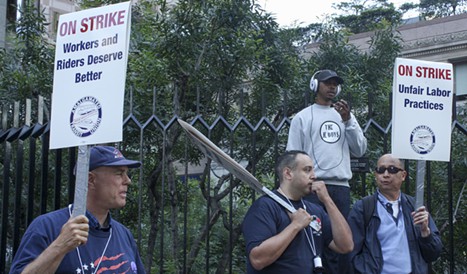
Last week’s four-day strike by Bay Area Rapid Transit workers dominated the news and made headlines around the country, marking the latest battleground in a national war between public employee unions and the austerity agenda pushed by conservatives and neoliberals.

Of course, that wasn’t how the conflict was framed by BART, most journalists, or even the two BART unions involved, all of whom dutifully reported the details of each sides’ offers and counter-offers, the competing “safety” narratives (new security procedures demands by unions versus spending more on capital improvements than raises), and the strike’s impact on commuters and the local economy.

But once this long-simmering labor standoff seized the attention of a public heavily reliant on BART, fueling the popular anger and resentment increasingly directed at public employee unions in recent years, familiar basic storylines emerged.

At that point, the Bay Area could have been placed in Wisconsin, Ohio, Michigan, or Illinois — the most recent high-profile labor union battlegrounds, with their narratives of greedy public employees clinging to their fully funded pensions and higher than average salaries while the rest of us suffer through this stubbornly lingering hangover from the Great Recession.

Around water coolers and online message boards, there were common refrains: How dare those unions demand the raises that the rest of us are being denied! Pensions? Who has fully funded pensions anymore? Why can’t they just be more realistic?

When Bay Area residents were finally forced to find other ways of getting around, within a transportation system that is already at the breaking point during peak hours thanks to years of austerity budgets and under-investment in basic infrastructure, those seething resentments exploded into outright anger.

And those political dynamics could only get worse in a month. The BART strike could resume full strength on a non-holiday workweek if the two sides aren’t able to come to an agreement before the recently extended contract expires.

This is the Bay Area’s most visible and impactful labor standoff, and it could prove to be a pivotal one for the modern American labor movement.


BART AS BELLWETHER

Chris Daly was a clarion voice for progressive values while serving on the San Francisco Board of Supervisors from 2000-2010. Now, as political director of Service Employee International Union Local 1021, one of the BART unions, he says this standoff is about more than just the issues being discussed at the bargaining table.

“The terms and conditions of workers in the public sector is a buoy for other workers,” Daly told us, explaining how everyone’s wages and benefits tend to follow the gains and setbacks negotiated by unions. “The right understands this, which is why the right has been mercilessly attacking public sector workers.”

Ken Jacobs, chair of the UC Berkeley Labor Center, confirmed that union contracts affect the overall labor market. “When unions improve wages and benefits, it does have a ripple effect,” Jacobs said. He agreed that the outcome at BART could be a bellwether for the question, “As the economy comes back, how much will workers share in that prosperity?”

Demonizing public sector workers as greedy or lazy also serves to undercut the entire labor movement, Daly said, considering that public employees make up a far higher percentage of union members than their private sector counterparts. And during election time, it is union money and ground troops that typically contest wealthy individuals and corporations’ efforts to maintain or expand power.

“Labor is one of the main checks on unbridled corporate power, and public sector unions are the backbone of labor,” Daly told us.

So in that context, BART’s battle is about more than just the wages and benefits of train drivers and station agents, with their average base salary of $62,000, just barely above the area median income, and their demand for raises after accepting wage freezes in recent years.

Daly sees this as part of a much broader political standoff, and he said there are indications that BART management also sees it that way, starting with the $399,000 the transit agency is paying its lead negotiator Thomas Hock, a veteran of union-busting standoffs around the country.

“He has a history of bargaining toward strikes, with the goal of breaking unions,” Daly said, noting that Hock’s opening offer would have taken money from BART employees, with new pension and healthcare contributions outweighing raises. “It was a takeaway proposal when you add it up, while they have a $100 million surplus in their budget and the cost of living in the Bay Area is shooting up.”

But BART spokesperson Rick Rice told us that Hock is simply trying to get the best deal possible for this taxpayer-funded agency, and he denied there is any intention to break the union or connection to some larger anti-worker agenda.

“There is definitely a need to start funding the capital needs of the district,” Rice told us. “I don’t see that we’re pushing an austerity agenda as much as a realistic agenda.”


AUSTERITY AND EXPANSION

But Daly said the very idea that austerity measures are “realistic” excuses the banks and other powerful players whose reckless pursuit of profits caused the financial meltdown of 2008. The underlying expectation is that workers should continue to pay for that debacle, rather than bouncing back with the rebounding economy.

“They get in this austerity mindset, and we see it in every contract we’re negotiating,” Daly said, noting that capital needs and benefits have always needed funding, despite their elevation now as immediate imperatives. “You have good people with good intentions like [BART Board President] Tom Radulovich pushing this austerity mindset.”

Radulovich, a longtime progressive activist, told us he agrees with some of how Daly is framing the standoff, but not all of it. He said that BART is being squeezed into its position by unique factors.

Radulovich said that healthcare and pension costs really are rising faster then ever, creating a challenge in maintaining those benefit levels. And he said that Hock isn’t simply carrying out some larger anti-union agenda. “He’s negotiating what the district wants him to negotiate,” he said.

Radulovich said that while BART’s workers may deserve raises, most of BART’s revenues come from fares. “So it’s taking from workers to give to other workers,” Radulovich said. “It’s a little more complicated because it is a public agency and Chris is aware of that.”

Yet Radulovich acknowledged that BART has opted to pursue an aggressive expansion policy that is diverting both capital and operating expenditures into new lines — such as the East Contra Costa, Oakland Airport, and Warm Springs extensions now underway — rather than setting some of that money aside for workers.

“And for a lot of those, we were being cheered on by the [San Francisco] Labor Council, one of many ironies,” said Radulovich, who favors infill projects over new extensions. “These are some of the conversations I’ve had with labor leaders in the last few weeks, how we think strategically about these things.”

But if BART wanted to defeat the union, it may have miscalculated the level of worker discontent with austerity measures.

“What they didn’t plan on is some high-level Bay Area political pressure,” Daly said, referring to the local uproar over the strike that led Gov. Jerry Brown to send in the state’s two top mediators, who made progress and created a one month cooling off period before the strike can resume.


RETIREMENT SECURITY

One of the hardest issues to overcome in the court of public opinion may be the fully funded pensions of BART employees. “Times are changing, costs are escalating rapidly, and we’re asking for a modest contribution,” Rice said of BART’s demand that employees help fund their pensions.

Daly acknowledges the resentments about the pension issue, even though it was essentially a trap set for public employee unions back in the 1980s, when BART and other public agencies were the ones offering to pay for employee pensions in lieu of raises.

But rather than resenting public employees for having pensions, he said the public should be asking why most workers don’t have retirement security and how to fix that problem.

“At what point do we organize and demand retirement security for all workers?” Daly said, noting that SEIU is now leading that fight on behalf of all workers, not just its members. “What we ought to be talking about is how we restore the social contract.”

Jacobs confirmed that SEIU has indeed been pushing the retirement security issue at the state and federal levels. And it’s a crucial issue, he said, noting that just 45 percent of workers have pensions and that the average retirement savings is just $12,000.

“The retirement problem we have is not the pension crisis, it is the lack of pensions crisis,” Jacobs said.

That’s one reason that he said this standoff has implications that extend far beyond the Bay Area.

“The fight goes beyond these particular workers,” Jacobs said. “It’s an important set of negotiations and an important strike in terms of looking at what happens in this country as the economy improves.”

Daly agrees there’s a lot at stake, for more than just his members.

“Losing on this means we’d be hard pressed to win elsewhere, anytime,” Daly said. “It is important symbolically, and it is important to the strength and morale of the movement.”


Is Larry Ellison cheating?

If you’re wondering why the hell there was only one boat was out there “racing” in the first match of the America’s Cup on Sunday, here’s the rundown on “Ruddergate,” yet another contentious chapter in the 162-year history of the America’s Cup.

At issue is the size and shape of the rudders on the twin hulls of the AC72s. Original design parameters were established back in 2010 when, in the interest of fairness, details of the boats were agreed upon by all teams — so exactly this kind of conflict wouldn’t occur. A “box rule” was applied, which means the boats won’t be identical, but they will be similar (Emirates Team New Zealand and Luna Rossa actually have near-identical boats as the Italians came late to the party and bought New Zealand’s design to save time.)

Then, after Andrew Simpson was killed when Artemis’s boat capsized on May 9, regatta director Iain Murray made 37 new safety recommendations, which the Coast Guard made into requirements when they permitted the race.

“Basically, for marine events, marine event sponsors are responsible for the safety of the events,” U.S. Coast Guard chief Mike Lutz explained, noting that the 37 rule changes originated with Murray and were approved by the Coast Guard as a package.

Some of those changes are straightforward and simple, like no guests aboard during races, more body armor, buoyancy and other personal safety gear, and no racing in winds over 23 knots (That one is actually a hindrance for ETNZ and Luna Rossa, who deliberately built for prevailing San Francisco Bay conditions, i.e. as much as 35 knots of wind.) 

But that’s not what the two teams are protesting. They don’t like new size and shape rules for the rudder elevators, which are designed to stabilize the boat when it’s foiling. Oracle has a pretty good description of how they work here.

The new rule lays out minimum and maximum area, depth, and span and says they should be symmetrical. None of the 36 other safety recommendations touch on design elements. The fishy part is that Oracle has been practicing with a bigger, symmetrical rudder elevator since they launched their second boat on April 24. Before Simpson died, before Murray’s new safety rules, Oracle was using what would be considered an illegal rudder. And now, voila, it’s legal.

The Kiwis immediately filed a protest to the rule, on June 28, and four days later Luna Rossa joined them.

“I’m not saying all the changes have been made for them, but it’s nothing related to safety. What really upsets me is that there is one boat sailing since they launched on April 24 who has been sailing out of the class rule,” Luna Rossa’s Max Sirena told the media on July 2. “Why design a boat that doesn’t comply with the class rule? And then one week before the Louis Vuitton Cup, you ask the other teams to change the position of the rudders and the elevators…”

In the meantime, rather than delay the first race or move up the date of the protest hearing, Murray said it was okay for the Kiwis and Italians to race without the “safer” rudder elevators, to which ETNZ’s Grant Dalton said, “The point is that under the recommendations you can run both. The question is why?  Because, if you can run both, then why do you need the ones that aren’t rule compliant?”

Dalton also thinks this design change could make the boats more dangerous because the rudder elevators would extend wider than the maximum beam of the boat and could slice a sailor in half if he slips over the side of the hull.

He hasn’t said something dirty’s going down. He told the media, “If the question is, has that rule been put in there deliberately to help Oracle, then no I don’t think it has – I don’t think for a second Iain Murray has done that. Is it helping them as a kind of byproduct of it, then yes it is.”

Luna Rossa’s Max Sirena has been more critical. “It is not safety related at all … It is the first time in the history of the America’s Cup that they can change the class rule just like that, just because they want to change it and with no reason. To change a class rule you need unanimity. Why when Oracle capsized last October did they not come up with this change then?”

Luna Rossa boycotted until the jury made a decision, stating that it would seem like silent affirmation if they raced. A last minute deal to get them on Sunday’s course fell through and for the time being, the Italians are sticking to their principles – they were out practicing yesterday, showing their boat is more than capable of performing with the smaller, asymmetrical, noncompliant rudders.

“The teams don’t believe it’s proper to change the class rule without a vote of the teams,” said America’s Cup spokesperson Sean McNeill. “They believe [Murray] didn’t have the authority to make such a change.”

If the jury rules in favor of Luna Rossa and ETNZ, Murray would have to go back to the Coast Guard with a new safety plan in order to obtain a new racing permit. “If there’s any change, they would have to submit an updated safety plan,” Lutz noted, saying he was confident that it could be reviewed in a short time and a second permit could be issued without too much of a delay.

The jury convened yesterday to hear the protests and a decision is due Wednesday, but this debacle raises a couple of questions. Why didn’t they hear the protests prior to the first race? That race day was established a long time ago, and hasn’t changed. The jury had at least five days to review the protests – ample time if the race organizers were really concerned with keeping the event from totally losing face.

Instead, two of the three boats were out of the race before it had even begun, creating animosity among the handful of sponsors still involved. Louis Vuitton’s Bruno Trouble – who initially anticipated 15 contenders, then 8, and certainly no less than 5 – is pissed that not even two could show up and the event has been very far from the big splash it was billed to be. Meanwhile, international media aren’t holding back the ridicule. Fairfax NZ’s Duncan Johnstone called it “a hugely embarrassing situation for regatta organisers, a major dent for the on-shore festivities and massive sponsorships that envelop this ridiculously expensive event.”

And, if the larger rudder elevators really are safer, why didn’t Oracle say something back in April before Simpson died? Or in October when their boat capsized? Instead, they’ve been very mum on the subject. Control is going to be as important as speed in this Cup and with the Kiwis and Italians burnt by the lowered wind limits, it looks like Ellison is hoping to top them in the control category. Larger rudders create more drag and less speed, but may get Oracle foiling for longer periods with enhanced stability – which they desperately need.

ETNZ and Luna Rossa have indicated it would be impossible for them to adapt their rudders now that racing has begun. Meanwhile, Oracle gets to hang back until the finals in September, practicing their moves while Ellison carries on with acting too rich too fail.

Rebecca Bowe contributed to this report.

Depp stinks but Death rules: new movies!

0

By now you’ve heard how much The Lone Ranger sucks (for more on that, my review here), so what else should you be spending your weekly movie-theater budget on? Well, the Roxie just opened a doc about Detroit band Death (Dennis Harvey breaks it down here), plus there’s a new Pedro Almodóvar joint, a coming-of-age summer flick starring Sam Rockwell and Steve Carell as cool and not-so-cool father figures, and (since one Carell movie ain’t enough) Despicable Me 2  — just the thing for the kidz who’ve already seen Monsters University.

Read on for our takes on these films, and more!
http://www.youtube.com/watch?v=irSSZumpYS4

Augustine When a 19-year-old Parisian kitchen maid (single-named French musician Soko) has a dramatic seizure during dinner service, she makes for Salpêtrière Hospital, where she becomes the superstar patient of Dr. Charcot (Vincent Lindon) — a real-life 19th century professor and neurologist who later mentored Sigmund Freud. There’s no “talking cure” at work here, though; Augustine’s medical treatment consists mostly of naked poking and prodding, as well as hypnosis-induced episodes of her increasingly sexualized “ovarian hysteria.” The tension builds as Charcot struggles against popular disdain for his methods (read aloud to him from newspapers by his coolly elegant wife), as well as his forbidden attraction to Augustine. Occupying the same moody, sensual milieu as David Cronenberg’s too-talky A Dangerous Method (2011), first-time feature writer-director Alice Winocour approaches her tale of misunderstood madness from a point of view that’s more emotionally-driven, with some subtle feminist undercurrents. Points deducted, though, for some obvious symbolism — like costuming Augustine in a brand-new red dress right after she starts her period for the first time. (1:42) (Cheryl Eddy)

http://www.youtube.com/watch?v=KtVEj86Vmzo

Deceptive Practice: The Mysteries and Mentors of Ricky Jay David Mamet fans will recognize Ricky Jay from multiple appearances in the director’s work; he’s also been in films like Boogie Nights and Tomorrow Never Dies (both 1997). But Jay’s true passion is stage magic, specifically card and other sleight-of-hand tricks, performed with a skill so dazzling that it’s tempting to believe he really does have supernatural powers. He’s also a witty, self-deprecating, and sometimes “irascible” (to quote a word used in Molly Bernstein and Alan Edelstein’s doc) character — and has a vast, ever-expanding interest in magic history. Using first-hand interviews, TV and stage-show clips, and some wonderful vintage footage, Deceptive Practice traces Jay’s career (he was a child prodigy in the 1950s, thanks to his supportive grandfather), pausing along the way to pay tribute to the men who influenced him and, in many cases, taught him their top-secret techniques. Throughout, Jay is seen demonstrating his own mind-bending tricks — as “simple” as changing a card’s suit, as elaborate as making it sail across the room and plunge like a knife into a watermelon rind — although never, of course, revealing how he does it. (1:28) (Cheryl Eddy)

Despicable Me 2 The laughs come quick and sweet now that Gru (Steve Carell) has abandoned his super-villainy to become a dad and “legitimate businessman” — though he still applies world-class gravitas to everyday events. (His daughter’s overproduced birthday party is a riot of medieval festoonage.) But like all the best reformed baddies, the Feds, or in this case the Anti-Villain League, recruit him to uncover the next international arch-nemesis. Now a spy, he gets a goofy but highly competent partner (Kristen Wiig) and a cupcake shop at the mall to facilitate sniffing out the criminal. This sequel surpasses the original in charm, cleverness, and general lovability, and it’s not just because they upped the number of minion-related gags, or because Wiig joined the cast; she ultimately gets the short end of the stick as the latecomer love-interest (her spy gadgets are also just so-so). However, Carell kills it as Gru 2 — his faux-Russian accent and awkward timing are more lived-in. Maybe the jokes are about more familiar stuff (like the niggling disappointments of family life) but they’re also sharper and more surprising. And though the minions seemed like one-trick ponies in the first film, those gibberish-talking jellybeans outdo themselves in the sequel’s climax. (1:38) (Sara Maria Vizcarrondo)

I’m So Excited I’m So Excited may be to Pedro Almodóvar what Hairspray (1988) was for director John Waters: a kind of low-intensity, high-fluff gateway drug for a filmmaker who’s otherwise an “acquired taste.” (Note: unlike Hairspray, this is not a family movie.) Almodóvar’s previous pictures were far more explicit about their obsessive thinking: mothers suffered (1999’s All About My Mother); sex was deadly (1990’s Tie Me Up! Tie Me Down!) and men were dishonorable (all of them). But in this drug and booze-addled flame-fest, Almodóvar takes one of his lesser themes (the joy of confinement) and transforms a flight from Madrid to Mexico into the funniest soap opera to ever feature cabaret and S&M talk. Early in the flight we learn the landing gear is shot; this means the flight’s dueling pilots have to find a place to host an emergency landing while Europe is on holiday. They anesthetize all of coach (um…metaphor, anyone?), leaving the rich to bellyache over their lost children, lost happiness, and stubborn virginity. Business class is full of drama queens so the flamboyantly gay attendants spike a cocktail with ecstasy (to make everyone get along) and an orgy ensues, complete with a seemingly victimless rape and multiple change-overs from hetero to homo. Almodóvar does have a knack for make-believe, but his biggest gift for fantasy happens in his stress-free transitions; oh, that coming out could be so liberating — but living in a Catholic country lousy with sexual disorientations, maybe the only place that can happen is at 30,000 feet. (1:35) (Sara Maria Vizcarrondo)

http://www.youtube.com/watch?v=NX9gUw3Kwb4

Kevin Hart: Let Me Explain The comedian (2012’s Think Like a Man) performs in this concert film, shot at Madison Square Garden during his 2012 stand-up tour. (1:15)

Maniac And it came to pass that William Lustig’s trashy classic Maniac (1980) was remade, with Elijah Wood assuming the role of twisted killer Frank, a role closely associated with its originator, the late, great cult actor Joe Spinell. Lustig is credited with a producing credit on this otherwise largely French effort, directed by Franck Khalfoun and co-written by Alejandre Aja and Grégory Levasseur — who also worked together on the 2006 remake of The Hills Have Eyes. Though it’s set in contemporary Los Angeles (complete with dating websites and cell phones), Maniac is shot to mimic the original film’s late-1970s New York (cabs, deserted subways, grimy streetscapes), with a synth-heavy score enhancing the retro vibe. Frank is still obsessed with mannequins, scalps, and his dead mother, with shades of both Psycho (1960) and The Silence of the Lambs (1991) filtering through. When Frank meets Anna (Nora Arnezeder), a beautiful French photographer whose preferred subject is mannequins, he grows ever more confused — and more violent. The entire movie is shot from Frank’s POV (we see Wood’s face only in mirrors and photographs), an off-putting gimmick that fails to add much in the way of suspense or scares. As for the gore, there’s nothing amid the CG enhancements that matches the work of special effects genius Tom Savini, whose memorable exploding-head scene plays just as repulsively effective in 2013 as it did in 1980. If you really wanna be freaked out by a movie maniac, skip this so-so do-over and spend some quality time with Spinell instead. (1:29) Roxie. (Cheryl Eddy)

http://www.youtube.com/watch?v=mK7AS_cITKI

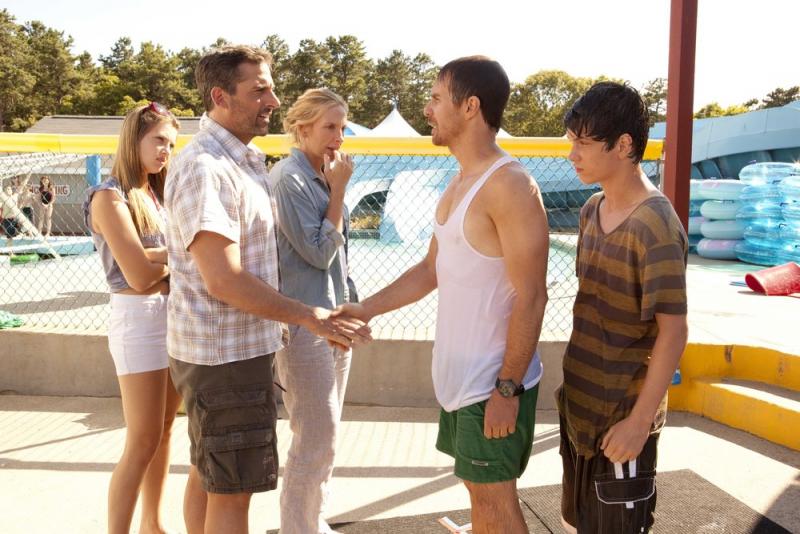
The Way, Way Back Duncan (Liam James) is 14, and if you remember being that age you remember the awkwardness, the ambivalence, and the confusion that went along with it. Duncan’s mother (Toni Collette) takes him along for an “important summer” with her jerky boyfriend, Trent (Steve Carell) — and despite being the least important guy at the summer cottage, Duncan’s only marginally sympathetic. Most every actor surrounding him plays against type (Rob Corddry is an unfunny, whipped husband; Allison Janney is a drunk, desperate divorcee), and since the cast is a cattle call for anyone with indie cred, you’ll wonder why they’re grouped for such a dull movie. Writer-directors Nat Faxon and Jim Rash previously wrote the Oscar-winning screenplay for 2011’s The Descendants, but The Way, Way Back doesn’t match that film’s caliber of intelligent, dry wit. Cast members take turns resuscitating the movie, but only Sam Rockwell saves the day, at least during the scenes he’s in. Playing another lovable loser, Rockwell’s Owen dropped out of life and into a pattern of house painting and water-park management in the fashion of a conscientious objector. Owen is antithetical to Trent’s crappy example of manhood, and raises his water wing to let Duncan in. The short stint Duncan has working at Water Wizz is a blossoming that leads to a minor romance (with AnnaSophia Robb) and a major confrontation with Trent, some of which is affecting, but none of which will help you remember the movie after credits roll. (1:42) (Sara Maria Vizcarrondo)

Hungry for reform

16

news@sfbg.com

Sitawa Jamaa is among the thousands of California inmates who, two years ago this summer, took part in the largest prison hunger strike in US history to protest harsh conditions and their invisibility to those outside prison walls.

Now, Jamaa and other prisoners are about to launch another hunger strike to highlight the system’s unfulfilled promises and the persistence of inhumane conditions.

The California Department of Corrections and Rehabilitation (CDCR) counted 6,000 prisoners throughout the state who refused food over several weeks in July 2011. During a follow-up strike that September, the number of prisoners missing meals swelled to 12,000, according to the federal receiver who was appointed by the courts to oversee reforms in the system. At least one inmate starved to death.

As one of four inmates who call themselves the Short Corridor Collective, Jamaa was a key organizer of the hunger strike. The group of inmates drafted a list of core demands calling for the strike when they weren’t met.

That was no easy task for Jamaa, who has spent most of the last 28 years alone in a windowless, 8-by-10 foot concrete cell in Pelican Bay State Prison, a supermax facility not far from the Oregon border, where some 1,200 men are held in similar conditions.

Inmates held in solitary confinement (in government lingo: “Segregated Housing Units”, or “SHU” for short) aren’t supposed to communicate with each other, verbally or through the mail. But they were able to organize with the help of their lawyers, who they are allowed to communicate with, and prison reform advocates outside.

Jamaa and other inmates are planning to launch a second hunger strike on July 8. The Short Corridor Collective has drafted a list of 45 demands, reflecting concerns ranging from inadequate health care to extreme solitary confinement—conditions that prison advocates characterize as cruel and unusual punishment.

The list is an extension of the five initial demands that Pelican Bay inmates presented in 2011 before initiating a hunger strike. Most of those demands were never met, or they were met only with lip service, leading prisoners back to where they started.


CONFINEMENT AS TORTURE

High on the list are concerns about conditions in the SHU, the amount of time prisoners can be made to spend in isolation, and the public’s inability to monitor the situation.

“I feel dead. It’s been 13 years since I have shaken someone’s hand and I fear I’ll forget the feel of human contact,” Pelican Bay prisoner Luis Esquivel told attorneys with the Center for Constitutional Rights in an interview.

Along with Jamaa and others, Esquivel is a plaintiff in a lawsuit against the state of California that would effectively cap the time someone can spend in solitary confinement to 10 years.

“The hunger strike is an extreme act,” says Terry Kupers, a Piedmont-based psychology professor and clinical psychiatrist who has testified before the California State Assembly on long-term solitary confinement. “It’s very dangerous, and you can die. So when a group of prisoners go on hunger strike, it means they’ve exhausted all ways of expressing themselves and having their demands considered. And that’s very much the case here—some of these guys have been in SHU for 30 or 40 years.”

Kupers believes solitary confinement in California prisons violates the 8th Amendment’s prohibition on cruel and unusual punishment, a view echoed by activists who’ve launched a statewide effort called the Stop the Torture Campaign.

United Nations Special Rapporteur Juan Méndez, an expert on torture, has called for a ban on solitary confinement where inmates are kept in isolation for 22 hours a day or more, saying the practice should only be used in very exceptional circumstances and for short time periods.

The CDCR has made some concessions and reforms since the 2011 hunger strikes, but critical issues have gone unaddressed. In Pelican Bay’s SHU, the men are now allowed beanie caps for when it gets cold. They can now have wall calendars to track time and bring a human touch to their surroundings.

Some prisoners have received exercise equipment, such as a handball or pull-up bar. Each year, they now have permission to have one photograph of themselves taken to send to family members, and prison administrators have signaled that they are looking into extending Pelican Bay’s visitation hours.

But more pressing issues have yet to be resolved, so the prisoners who drafted the 45 demands are resorting to starvation once again, despite official statements that it will do little to improve their conditions.

“Negotiation is something the department does not do,” says Terry Thornton, a spokesperson for CDCR. But the department has met periodically with a mediation team, consisting of lawyers and prison activists, who have communicated the inmates’ concerns and gone over their demands with prison authorities.


RESISTING REFORM

In 2002, the state of California was sued, and lost, in an 8th Amendment class-action lawsuit: Plata v. Davis. The federal judge overseeing the case called the medical treatment in California prisons “horrifying,” sinking “below gross negligence to outright cruelty,” ordering improved treatment and reductions in severe prison overcrowding.

A court-appointed doctor found that out of 193 deaths over the course of one year, 34 were “probably preventable,” but medical staff gave “well below even minimal standards of care.” Eleven years later, the state is still under federal receivership, until it can show that conditions have actually improved.

Court-appointed consultant Dr. Raymond Patterson wrote his 14th annual assessment report last April, blaming high suicide rates behind bars on a lack of “adequate assessment, treatment or intervention.” After it was released, he quit the post in frustration, writing: “It has become apparent that continued repetition of these recommendations would be a further waste of time and effort.”

So inmates are taking in upon themselves to accomplish what the courts and consultants have failed to do: reform conditions in the prisons.

As happened in 2011, in spite of what is planned to be a peaceful protest, prisons housing strikers will be, according to Thornton, on “modified program” (or “lockdown,” as prisoners call it). Generally, that means inmates aren’t allowed to leave their cells, even to shower.

New regulations created after the 2011 strikes call for no visits for striking prisoners, and for their canteen food to be confiscated. In addition, “inmate(s) identified as strike leaders, instrumental in organizing, planning, and perpetuating a hunger strike, shall be isolated from non-participating inmates.”

Since March of this year, the Guantanamo Bay prisoner hunger strike has made news around the world for highlighting alleged violations of international law. There, when a striker goes below 85 percent Ideal Body Weight, regulations dictate that he or she be shackled to a chair, fitted with a mask, and have tubes inserted through their nostrils into their stomachs for up to two hours at a time.

That didn’t happen in California back during the 2011 strikes, but the Division of Correctional Health Care Services devotes five pages of its policy handbook to outlining specific instructions for dealing with hunger strikers, including transfers to prison medical facilities where they could potentially be force-fed, another practice the UN regards as torture.

Prisoners and activists believe the policy was instituted as preemptive attack on the upcoming hunger strike. “We are concerned that, under the pretext of ‘welfare’ checks, prisoners are being harassed, targeted, and deprived of sleep as the date of planned hunger strikes and work stoppages approaches,” said Isaac Ontiveros of the Prisoner Hunger Strike Solidarity group. “Whatever the case, new CDCR Secretary Jeffery Beard has an opportunity to avoid the strike and begin to undo the indescribable harm that the California prison system has caused.”


DANGEROUS ASSOCIATIONS

Problems associated with solitary confinement are closely connected to CDCR’s most commonly used tool for sending prisoners like Jamaa into the SHU: the controversial “gang validation” process.

Once an inmate is listed in prison records as a gang member, he or she loses multiple rights on the assumption that they’re a threat to the order of the prison. With no disciplinary write-ups since 1995, Jamaa would have been eligible for parole in 2004, except for the gang validation that led to his indefinite SHU sentence.

Getting pegged as a member of a gang can happen easily. Guards can write prisoners up for anything from the possession of artwork deemed to be gang-related, to information obtained from confidential informants whose claims prisoners often aren’t allowed to refute and whose identities remain unknown to the targeted prisoners.

Last year, in the wake of hunger strikes, CDCR announced a “complex retooling” of the gang validation practices. The so-called Step Down process, created in conjunction with the Department of Homeland Security, is meant to transition inmates out of gangs over the course of four years, with privileges gained over that time.

It might be the most significant of the reforms that followed the last hunger strike, but prisoners and their advocates criticize it as too lengthy of a process, subject to the arbitrary whims of the correctional officers overseeing a given prisoner. In fact, they say it may widen the definition of who counts as a gang member.

Manuel Sanchez, who is participating in the Step Down program at Corcoran State Prison, wrote in a letter that he is “seriously considering returning to SHU, where I’d be less harassed and I’d get more yard access more consistently.”

Compounding the problems in the prisons is a lack of transparency and public accountability.

“It’s like mentioning July 8 is anathema,” says San Francisco Bay View Editor Mary Ratcliff, whose African American-focused newspaper has been a CDCR censorship target.

From January to April of this year, Ratcliff said papers were being returned from Pelican Bay undelivered because they included articles about the hunger strikes, representing “material inciting participation in a mass disturbance,” and “a serious threat to the safety and security” of the prison, according to CDCR Administrator R.K. Swift.

“I think it’s remarkable that hunger strikes are considered a ‘disturbance,'” says Ratcliff. “A disturbance is supposed to mean a fight—something that threatens people. A hunger strike is a threat to no one except the people who are participating in it.”

Just as inmates can’t get news from the outside, they are also walled off from journalists who might cover them and the conditions they live in.

Since 1996, the CDCR has limited reporters to only interviewing prisoners they’ve selected. Last September, Governor Jerry Brown vetoed legislation that would have opened up media access to the prisons. “Giving criminals celebrity status through repeated appearances on television will glorify their crimes and hurt victims and their families,” he wrote, citing the media spectacle around Charles Manson.

But activists say the nearly $2 million Brown received from the California Correctional Peace Officers Association (CCPOA) during his successful bid for governor in 2010 had more to do with it than infamous serial killers.

Assembly member Tom Ammiano, who authored the most recent bill, stressed that “Press access isn’t just to sell newspapers. It’s a way for the public to know that the prisons it pays for are well-run. I invite the governor to visit the SHU to see for himself why media access is so important.”


DRASTIC MEASURES

Last time around, Jamaa lost 19 pounds. Deprived of sunlight, the Oakland-born man has developed melanin and vitamin D deficiencies that have lightened his normally dark brown skin. He suffers stomach problems and swollen thyroid glands that he didn’t have before prison. Starvation is a possibly lethal proposition. “Make no mistake, none of us wants to die. But we are prepared to, if that’s what it takes to force a real reform,” he and other strike leaders wrote in a statement last December. Jamaa’s sister, Marie Levin, who has organized monthly vigils for the strikers at Oakland’s monthly First Fridays/Art Murmur event, is worried about how her brother’s body will cope this time around. “It’s something that we as family members don’t want them to have to experience again,” she notes with anxiety. Yet both the prisoners and their advocates on the outside say they can’t simply let dehumanizing conditions in California’s prison system continue indefinitely. “I think things have changed, but not substantially in terms of actual conditions,” Kupers argues. “What is changed is the CDCR had to recognize the strikers, and conceded some of the things. And subsequently, the various prisoner groups have come together and made a commitment not to have violence between groups inside the prisons. This is huge advancement.” But unless all 45 demands are met, they say the strike will commence July 8. For now, Jamaa and others are readying their bodies for hunger, for a cause they believe goes far beyond prison walls. “Know this,” he wrote from SHU, words that needed to be smuggled out through unconventional means to get around an official wall of silence. “I am a … Prisoner of War, and I serve the interest of all people.”

New Zealand’s Cup

7

news@sfbg.com

A few weeks ago I was walking down the dock in the marina where I live, in Wellington, New Zealand, when I passed a woman and a young boy. I’d never seen them before, which is uncommon here in this municipal marina — about 100 boats — in a small suburb of the country’s capital.

The boy was walking from berth to berth pointing out certain rig and hull features and expounding on them as only a future aficionado can. “Lots of different boats, huh?” I asked as I passed.

“Different than America,” he confirmed in an accent the same as mine.

The kid is sharp, I thought, or maybe it’s just obvious, even to an eight-year-old from Chicago. The New Zealand sailing scene is vastly different than its American counterpart, which is not to say there’s no comparing — they’re not exactly navigating carved logs with gunnysack sails down here.

But the boats in my marina are, in fact, mostly homebuilt from steel, cement, aluminum, and wood. They appear a motley crew compared to the cookie-cutter production fiberglass Beneteaus, Catalinas, and Hunters, with their identical pacific blue sail covers lined up in San Francisco’s South Beach Marina.

In New Zealand, a boat is rarely a status symbol — it’s part of the middle-class way of life, the home base for holidays and weekend fishing trips and lots and lots of competitive racing. If I’ve noticed one thing since I arrived in this country (aboard a sailboat, after leaving San Francisco and my job as a Bay Guardian staff writer), it’s that every little harbor town has a yacht club and an awful lot of Kiwis own boats — and they sail the shit out of them.

Which is part of the reason why the New Zealand government is willing to invest NZ$36 million (US$27 million) to compete in the 34th America’s Cup against some of the richest men in the world in a race that has become so elite there’s barely any competition.

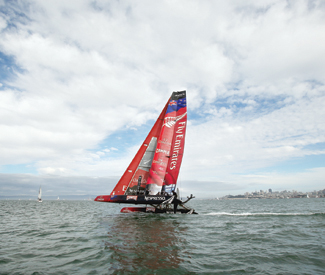
Small as the field is, Emirates Team New Zealand (ETNZ) is quickly shaping up to be the team to beat if you’re on a high-speed, air-catching AC72 catamaran. If they succeed, it will show that developing an America’s Cup team doesn’t have to come from having deep pockets in your Nantucket Red pants — it comes from having the sport ingrained in your culture, filtered through affordable local boat clubs, city-run facilities, volunteer programs, publicly accessible shorefronts, and an innovative marine industry.

In fact, without New Zealand’s maritime way of life, Larry Ellison wouldn’t have much of a team: of the 27 sailors and management crew aboard Oracle, a third are Kiwis. Another third are Australians. If you count Ellison, there are only three Americans aboard. Just one of them — tactician and grinder John Kostecki — grew up sailing on San Francisco Bay.

Ellison’s boat is mostly a Kiwi production, too — the fixed-wing sails and structural components for Oracle’s two AC72s were made in New Zealand, as were the boats, sails, and rigs for ETNZ and Luna Rossa. The only other syndicate competing, Sweden’s Artemis, in the wind since the death of crewmember Andrew Simpson, is the outlier, but they still have eight New Zealanders on board.

America’s Cup is looking more and more like it owes a lot to New Zealand. Is the Cup doing as much for San Francisco as it is for this little island nation, with a population just a tenth of California’s?

“If it wasn’t called Team New Zealand, we wouldn’t get a lot out of it,” says Sven Pannell, a competitive dinghy racer and employee of the economic development agency Grow Wellington. “The numbers of boat builders, carbon fabricators, sail makers, yacht designers coming out of New Zealand are the reason we’re still at the top of the global game. If we can bring the Cup home that means a lot for our country.”

It may also save America’s Cup from becoming even more out of touch with reality.


IT’S THE CULTURE, STUPID

It’s June 8, summer in San Francisco but winter in Wellington. The first race of the 2013 Winter Series at Evans Bay Boat Club hits hypothermic seas beneath steely overcast skies and 20-30 knots of wind — “perfect conditions,” one sailor enthuses. Tame, actually, for Wellington. A week ago, wind blew out the fifth story windows of a building downtown.

Sven Pannell has just finished racing a 12-foot skiff, a super lightweight, often homebuilt boat that probably originated in Australia and is almost exclusively raced in the Southern Hemisphere, though an 18-foot version will be showcased in San Francisco this September alongside the America’s Cup finals. Weighing about 100 pounds, with no class restrictions on sail area, they rooster-tail around Wellington harbor, bow high, barely in the water. They seem to require a similar caliber of nerve as the AC72s.

Which Pannell, who won today, evidently has. He grew up sailing as a kid, as did his crew, Craig Anderson. Neither of them can think of anyone who didn’t get into sailing as a child.

“A lot of people around the world think yachting is a well-heeled sport, but not in New Zealand,” he says. “There’s a reason that half those [America’s Cup] boats are full of Kiwis and Aussies. Go out and see the number of eight-year-olds in Optis in all kinds of weather here. A high number of people sailing at that age creates a deep pool of sailors in demand.”

“America’s Cup is about stretching the limits, but it starts here, when you’re eight years old,” he adds.

Eager to get out of the icy Antarctic wind, I enter the boat club where about 35 people are gathered at the bar, buzzing from adrenalin, barefoot and wet from spray or capsizes, gripping ginger beers and green bottles of Steinlager, the Budweiser of New Zealand. It’s a humble looking crowd — no flash gear or cashmere.

I’m introduced to Mike Rhodes, 26, wearing a blue sweatshirt and camo pants. He’d love to race an America’s Cup boat, but he also satisfies himself with a 12-foot skiff, which he stripped and rebuilt, fashioning the stainless steel fittings himself — he’s a sheet metal worker.

“New Zealand sailing is all about learning and moving forward,” he says. “The boats we’re sailing are always changing. We have set rules for weight, width, and length. After that it’s wide open. You can put up as much rig as you can handle. We went out in 50 knots last weekend. It was insane. We probably had boat speeds of 30 knots.”

The speed and innovations are what appeal to Rhodes and also connect to the America’s Cup, which has been an historic proving ground for leaps forward in boat design. “Who thought New Zealand could make the boat fly first?” he says of ETNZ’s proficiency at foiling the AC72 — going so fast the hull actually lifts off the water.

We’re soon joined by Laura Hutton, a 30-year-old from Cape Cod. She’s raced dinghies, coached and taught sailing for years. Now a speech therapist, she moved to New Zealand three months ago and immediately hooked into the local yachting scene. It’s palpably different than what she’s used to in the States. Here, she says, “It’s a lot more laid back. It’s more inclusive than exclusive. I used to go to events at New York Yacht Club in Newport and I felt so uncomfortable there. It’s the most elite, snobby place.”

“You can’t get coaching in the US unless you’re part of a yacht club or go to a school with a racing team,” she adds, and there’s often a huge cost to enter the sport. “Here, I can join the local yacht club for $35 a month,” she deadpans.

I spend more money riding the bus, I tell her, but I wouldn’t in San Francisco, where it’s cheap to catch a bus but where most people rarely board boats.

The American yacht club tradition has a certain “if you have to ask how much it costs, you can’t afford it” attitude. Ellison is one of 300 members of Golden Gate Yacht Club, official host for the Cup. Its neighbor, St. Francis Yacht Club, 2,300 strong, also has a role in the festivities. Both are exclusive, members-only clubs and neither would tell me what their members pay for the club’s privileges.

However, they’re officially nonprofit organizations and filings with the IRS show St. Francis made nearly $13 million in 2011. Golden Gate Yacht Club took home $660,000 the same year. Ironically, both clubs are on public lands, leased from San Francisco’s Recreation and Parks Department for $231,125 and $64,000 annually respectively.

Both clubs run learn-to-sail programs for kids — $350 for St. Francis and $200 for GGYC — which seem affordable, but what’s the next step? Joining the club, but apparently it’s too rude to query the price.

By contrast, Wellington’s Evans Bay Boat Club charges NZ$281 (US$210) to join and Royal Port Nicholson Yacht Club, which is a sister club to St. Francis, costs NZ$160 (US $120). The Bay Area is lucky — Berkeley and Treasure Island both have affordable clubs, however one could argue that if St. Francis and GGYC are on public lands, they should be paying more in dues to the city.

If there’s a posh club in Auckland, it’s ETNZ’s home — the Royal New Zealand Yacht Squadron. “But it’s a Kiwi version of posh, nothing like some of the yacht clubs I have been to in places like England, where women aren’t allowed to order drinks at the bar,” says Ben Gladwell, a journalist for Boating New Zealand who will be racing an 18 foot skiff in San Francisco in a regatta concurrent with the Cup finals. “At the Squaddy, there are obviously rules, like no cell phones, and dress codes and such like, but the fees are still only a few hundred dollars per year and it is much more inclusive than other yacht clubs around the world.”

Gladwell explored the health of New Zealand’s sailing culture in a story called “State of the Racing Nation” for Boating New Zealand. He found that although there is a drop-off in interest during university years, many yacht clubs have created partnerships to keep kids in the sport, there are mobile learn-to-sail units roaming the country, and lots of accessible city-run programs for kids. Couple that with low lifetime fees to stay in the sport and you see healthy clubs like Evans Bay, where people of all ages are out racing every weekend, all year round.

“Having so many people involved in sailing is a major reason we are successful,” he says. “Children are introduced to it at such a young age…by the time they come to competing at youth international regattas, they are hugely experienced and winning becomes a habit.”


“AMERICA’S CUP IS NOW NEW ZEALAND’S CUP”

In 1995, when Black Magic smoked Dennis Connor’s Stars and Stripes in a five-race shut-out, commentator Peter Montgomery famously quipped “America’s Cup is now New Zealand’s cup,” a line that’s gone down in Kiwi history like the “I have a dream” speech.

For the first time, the Auld Mug would be defended in New Zealand. Back then, Auckland’s Viaduct Harbor probably looked a lot like parts of San Francisco’s waterfront does today — dilapidated piers and old industrial buildings crumbling on their pilings. It would cost of NZ$58 million (US$29 million at the time) to dredge the harbor and spruce up the waterfront for the Cup.

The city made its money back. Hosting for two years, in 2000 and 2003, brought NZ$1 billion (US$500 million, at the time) in economic benefits to the country, about 85 percent of that going to Auckland’s local businesses, mostly from visiting megayachts and the services required for the nine syndicates that competed — twice as many as are in San Francisco today.

And Auckland made a lot less than the US$900 million predicted for San Francisco, already trimmed from the US$1.4 billion initially estimated. What the city actually gains from the $22.5 million investment they’ve been forced to make remains to be seen. Meanwhile, Auckland continues to benefit from the race.

It’s been estimated that the four Cup contenders have collectively spent half a billion on their campaigns and a decent chunk of that has been in Auckland, particularly during the AC72 design, build, and testing phases. Already, taxes paid by ETNZ employees amount to NZ$22.4 million (US$16.5 million). That doesn’t include the employee payroll taxes of all the businesses doing Cup-related activity, like the boat builders, riggers, and sailmakers.

ETNZ CEO Grant Dalton has netted sponsorships from more than 100 companies and argues that the Cup efforts have kept many marine businesses afloat that would have otherwise shuttered. Kiwis have not been immune to the world financial situation: the high New Zealand dollar hurting exports and the NZ$30 billion (US$22.5 billion) price tag for the February 2011 Christchurch earthquake have stressed the country’s coffers.

Because of that, funding ETNZ has been as contentious here as hosting Ellison’s party has been to San Franciscans. The agreement was signed in 2007 by a Labour Party-led government and when National Party’s John Key won the Prime Minister’s seat in 2008, he looked into breaking the contract, a move supported by other parties. “Funding the America’s Cup is surely a ‘nice to have’, rather than essential spending, in the current economic climate,” said Green Party co-leader Metiria Turei at the time.

The government was advised they’d still be legally on the hook for the money if they broke the contract, so ETNZ proceeded, but proof of economic return was a contingency and Dalton has taken pains to keep the public good in the conversation, a sharp contrast to Ellison’s attitude toward San Francisco. Dalton has said if New Zealand wins, the world should expect a sharp scaling back of costs. “We stand for nationality rule and we stand for real budget numbers that real people can raise,” he has said.

There’s definitely a sense that this could be New Zealand’s last chance to bring the Auld Mug home. If they don’t, the America’s Cup also loses. Who else will save it from American-style exclusiveness?

Wrongfully terminated Oakland Airport workers still fighting to get their jobs back

A year ago, Hakima Arhab, a former Subway employee at Oakland International Airport, spoke up about the restaurant breaking living wage laws that guarantee paid sick days for employees. For this, she believes she was fired.

Since then, a campaign has been launched to raise awareness about Subway and Jamba Juice workers at the Oakland airport who say they were terminated for speaking out. This afternoon, June 27, members of service workers’ union Unite Here will join with Arhab and other terminated employees in picketing outside the Port of Oakland’s Port Commission meeting, from 4 to 6 p.m. 

According to Arhab, “I left for a vacation for a month and a half, and I had told my employers four months before the fact. They were fine with it.” Nevertheless, “When I came back, they said they had no hours for me, and I was fired. I then knew they had fired me not because I took a vacation, but I had complained about them breaking living wage laws.” 

Arhab said Subway had not given paid sick days since 2009. The Port of Oakland’s living wage law requires employers to provide 12 paid sick days per year. 

Last year, the National Labor Relations Board charged the operators of the airport Subway and Jamba Juice with breaking labor laws by terminating workers who had made complaints to the Port of Oakland. According to a report in the East Bay Express, the port conducted its own investigation, and also concluded that the store operators were in violation.

Unite Here representatives filed an appeal earlier this year to demand that Arhab and Diamond Ford, a former Jamba Juice employee, be reinstated to their jobs. Following an appeals hearing, the port agreed and ordered the operators to reinstate the terminated employees. 

But that still hasn’t happened. Though Arhab has participated in the campaign to shed light on unfair labor practices at the Oakland Airport, she says she still feels powerless. 

“I feel mad and un-powerful that these companies were breaking laws, and they had the power to fire me just because I complained,” Arhab said. “I did the right thing. When will they?”

Picketers who plan to gather outside the Port Commission today aim to pressure the agency to compel the fast food restaurants to comply with orders to reinstate the terminated employees.

Sarah Norr, an Organizer for Unite Here, feels that Arhab and the other employees are being served an injustice. “The airport is on public land and is a public resource,” Norr said. “When workers don’t have sick days or job security, there’s something wrong with that.” 

HOT PINK LIST 2013: BOOT BLACKS

0

Midway through Folsom Street’s dark Powerhouse leather bar, you’ll find the bootblack, toiling away with a kit of rags and polish — break out your Stompers for a sublime shine. “What I’ve learned is that for me, bootblacking is religion,” says seven-year bootblacker Ms. V. “What I do is simple, slow, and uncluttered — and it reveres the authenticity of the boot and shoe above all.” She was first introduced to bootblacking seven years ago at Folsom Street Fair. “What a mystical experience seeing this polish-smeared wizard at work,” she recalls. “I wondered if I could do this with a female sensibility.” Bootblacking has long been the purview of males, but Ms. V embarked on her journey to learn the craft from leather community members and old school shoeshine experts anyway. She picked up a protege, Luna, with whom she teams up to keep leather footwear in prime condition. It’s a business transaction, driven by passion, power, and polish. “There is a dance that goes on between the customer and me,” says Ms. V.

Bootblacks Ms. V, International Ms. Bootblack 2007, and Luna, International Community Bootblack 2011  

BART workers authorize strike

Note: This post has been updated from an earlier version.

Bay Area Rapid Transit workers, whose contract expires June 30, have authorized a strike if negotiations with the transit agency do not result in renewed contract terms that are acceptable to both sides.

“They just announced it. Both unions overwhelmingly supported a strike vote,” Leah Berlanga, chief negotiating officer for Service Employees International Union 1021, told the Guardian in a phone call this morning. Votes were cast yesterday, and the results have just come in.

SEIU represents about 1,400 BART inspectors and maintenance workers. The Amalgamated Transit Union Local 1555, which has also voted to authorize a strike, represents BART drivers.

For now, Berlanga said, SEIU and ATU remain at the negotiating table, and “we’re just focusing on reaching an agreement.” The contract is valid throughout June 30, so the earliest the transit workers could go out on strike would be Monday morning.

Contentious issues in the contract negotiations include workers’ request for raises, which haven’t been granted in years despite an uptick in ridership, and the agency’s insistence that employees pick up a share of their pension contributions.

Union representatives have emphasized that their primary concern is worker safety. Last week, SEIU filed an unfair practices labor lawsuit alleging that BART was not negotiating in good faith, pointing to worker safety as a central concern. “We’ve been talking about health and safety for the last four years. By law, health and safety is a mandatory subject of bargaining. Management has rejected every proposal we’ve put forward that addresses safety, and they are not bargaining in good faith,” Berlanga said. On June 25, unionized workers and supporters held a press conference outside the 24th Street BART station, nearby where an employee was struck and killed by a train in 2001. SEIU representatives have said this death was preventable, blaming it on poor lighting inside BART tunnels.

Antonette Bryant, president of ATU 1555, also emphasized safety issues. “We’ve had over 1,000 passengers assaulted and 99 workers assaulted,” she told the Guardian. “That’s something that we take very seriously. We want our work environment and riding environment on the BART to be safe.”

The agency is also trying to make changes to workers’ compensation programs, Bryant added, an issue that goes hand in hand with safety concerns. “They just give [compensation] to people that are hurt, they don’t make efforts to rehabilitate and bring these people back to work,” Bryant said. “We are trying to start a new program for this and they just don’t want to deal with it.”

Reached by phone, BART spokesperson Rick Rice told the Guardian, “We’re still confident there’s a deal to be had at the negotiating table. As far as I know, they are back at the table” after taking a break from negotiations yesterday, he said.

As of the morning of June 26, “We’ve gotten no notice from them” about when a strike could start, but “they’ve said publicly they’ll give 72 hours warning, and we would hope they would, for the sake of the riders.”

With regard to safety concerns, Rice said BART management meets weekly with union leaders on these issues and that the agency is planning to spend $4.5 million to replace lighting in train tunnels and had budgeted for “hundreds of new security cameras.” He said BART is asking employees to make higher contributions to their health care, and pay into their pension plans. He added that workers are requesting the equivalent of a 23.2 percent wage increase over the duration of the new contract. Rice did not have information about how this requested wage increase compares with the expected rise in the cost of living in the Bay Area, but said this was almost certainly a part of the conversation at the negotiating table.

Asked about the unfair labor practices suit, Rice declined to comment specifically on the allegations raised but stated, “We’re definitely at the table negotiating in good faith.”

What’s hot in Siberia

0

arts@sfbg.com

THEATER Emerald green rooftops and gold domes enliven the skyline of Omsk, a provincial city and former Soviet industrial hub of roughly one million people, located at the intersection of two Siberian rivers: the wide, island-populated Irtysh and the smaller, swifter Om. The latter gave its name to the town, which grew from a fort established at the meeting point of the rivers in 1716, back when this was the disputed frontier of the expanding Russian empire.

But now it’s the last week of May 2013. The fort is long gone. In its place stands the Lighthouse, a large white hotel-cum–shopping mall festively crowned with neon Cyrillic lettering. Rounded at one end and peaked with towers, it drolly resembles a cruise ship in port. The sun is still out at 10 p.m., and a gusty wind rolling off the plains churns the warm air pleasantly.

Sleepy though this town seems by comparison with St. Petersburg, Moscow, or even Yekaterinburg — the three other stops on a four-city tour I joined last month, in conjunction with a US-Russia theater dialogue developed by the Center for International Theatre Development — Omsk turns out to be not so remote in many ways. For one thing, it’s a hotbed of theatrical activity at the moment, with the biennial Young Theaters of Russia Festival in full swing. Nor is the Russian empire entirely a thing of the past, as tonight’s provocation by a troupe from the former Yugoslav republic of Slovenia makes plain enough.

Damned be the Traitor of His Homeland! — a production of Ljubljana’s internationally renowned experimental company, Mladinsko Theatre — is a no-holds-barred attack on jingoism, xenophobia, and the false allegiances they promote, as well as on complacency in the face of recent history, government corruption, and social decay. Taking its title from the last verse of the former Yugoslav national anthem, it gleefully lobs profanity, insult, accusation, nudity, a flurry of gunshots, and lots of local dirt (dug up for the occasion) at its unsuspecting audience — who frequently find themselves unnaturally exposed and singled out under merciless house lights.

It begins quietly enough: its ten cast members onstage, reclining on the floor and clutching musical instruments, looking like a freshly slaughtered marching band — until the sound of breathing through a tuba begins a general stirring that quickly escalates into an instrumental movement titled, “Won’t Go Against My Brother.” Next, the cast introduces itself with ribald, pointed, self-effacing humor through their own imagined obituaries — each of which makes explicit reference to an imaginary production of “Hey, Slavs!” (in fact, the title of the Yugoslav anthem) directed by acclaimed Bosnian Croatian bad-boy director Oliver Frljic (in fact, the production’s own director).

Cycling through various loosely related scenes, all built from improvisations, Damned delivers its pleas and gibes with a potent combination of muscular staging, lively wit, intrepid honesty, and moments of wrenching beauty. It produced some walkouts the night we saw it — many more the night before, reportedly — but its themes were undeniably urgent and its manner both raw and sure. This was all before Edward Snowden went public with details of the NSA’s PRISM program or had arrived in Moscow from Hong Kong en route to some hoped-for political asylum abroad. But there was no denying the implications for any Americans in the audience as well.

Omsk has nine large municipally funded or federally funded theaters, leaving far behind most American cities of a comparable or even much larger size. And in short it, and the Festival, had much more to offer beyond this one highlight, even if not as explicitly provocative or political in nature. (Those curious to learn more should know that Chris White, artistic director of Mugwumpin and the other San Franciscan on the tour, has written a series of reports on HowlRound with many further details).

Highlights in Moscow included an exquisite production from leading director Dimitry Kymov (whose collaboration with Mikhail Baryshnikov, In Paris, came to Berkeley Rep last year). Based (like In Paris) on the work of famed Russian short story writer Ivan Bunin, Katya, Sonya, Polya, Galya, Vera, Olya, Tanya … is an original production crafting a series of oddball, sometimes grim love stories into a kind of high art twist on Grand Guignol.

Also utterly memorable was the best production of Hamlet I’d ever seen —staged in a ramshackle venue whose lobby was stuffed with a vaguely foul-smelling array of garage sale toys, Soviet kitsch, and other odds and ends, and whose stage was a small, low-ceilinged black box packed into the aisles with what appeared to be mainly teens. The theater and the production belong to famed Russian director and playwright Nikolay Kolyada. Somewhat infamous after his endorsement of Putin in the last elections (which points to one way in which Russian theater, offstage, can be nothing if not political), Kolyada delivers a decisive reading of Shakespeare’s play as a bald, barbaric parable of power — in an incredibly meticulous, distinct, and forceful style whose macabre wit brought to mind some weird admixture of Richard Foreman, Tim Burton, and Terry Gilliam. Whatever else it demonstrated, it showed the Bard’s play as utterly, repulsively, and compellingly contemporary — something too rarely accomplished in any language. *

Our Weekly Picks

0

WEDNESDAY 26

Dita Von Teese

With a seductive and sexy nod to the past, modern pin-up and burlesque queen Dita Von Teese has been at the forefront of reviving a nearly lost art form for two decades now. Bringing back the sense of classic style and glamour of the golden days of Hollywood and meshing it with the tantalizing teasing of the old-time burlesque circuit, Von Teese returns to the city this week with her “Burlesque: Strip, Strip, Hooray!” show, a live revue featuring not only her own titillating talents, but a host of other performers as well, including Dirty Martini, Catherine D’Lish, and Lada Nikolska from the legendary “Crazy Horse Paris.”

(Sean McCourt)

Through Fri/28, 7:30pm, $40

Fillmore

1805 Geary, SF

(415) 346-6000

www.thefillmore.com


“Harvey Milk 2013”

The San Francisco Gay Men’s Chorus, the world’s first chorus comprised of openly gay men, had its first unofficial public performance at a candlelight vigil for Harvey Milk. The group has since become known for its dazzling holiday concerts, but its historical origins mean it’s fitting that — as part of its 35th anniversary celebration — SFGMC is presenting the world premiere of I Am Harvey Milk. Starring its composer Andrew Lippa as Milk, with guest soprano Laura Benanti, this blend of theater and choral works traces the courageous life of the slain politician, with accompaniment by the Bay Area Rainbow Symphony. (Cheryl Eddy)

Wed/26-Fri/28, 8pm, $25-60

Nourse Theatre

201-299 Hayes, SF

www.sfgmc.org


THURSDAY 27

Clay Shirky

“I’m trying to figure out what difference communications technologies makes to society,” Clay Shirky remarked in a 2011 interview. “What is it about the Internet, what is it about mobile phones, applications built on top of them, that changes how we behave.” The New York University professor has become one of the world’s foremost authorities on gauging how technology has shifted social action. His 2010 book Cognitive Surplus: Creativity and Generosity in a Connected Age outlined how web tools have provided new opportunities for creation in place of consumption, pointing out dynamics such as self-publication and charitable crowdfunding. Shirky has championed government transparency in recent editorials exploring the high-profile leaks of US surveillance programs. (Kevin Lee)

6:30 p.m., $20 (member, $12; students $7)

Commonwealth Club

595 Market, SF

(415) 597-6700

www.commonwealthclub.org


Tommy Davidson

Comedian Tommy Davidson might be offensive, but his keen observations about the absurdity of our daily lives and his animated delivery guarantee laughs. His ability to comment on situations that arise in all walks of life ensures everyone has something to chuckle about through his bits. Known for his roles in the ’90s hit sketch show In Living Color, films like Strictly Business (and OK, Juwanna Mann) and most recently in the spotlight for his character Cream Corn on Adult Swim’s cartoon Black Dynamite, Davidson tours pretty infrequently, so catch him while you can — likely offering fresh takes on old habits. (Hillary Smith)

8pm and 10pm, $24-26

Yoshi’s

1330 Fillmore, SF

(415) 655-5600

yoshis.com/sanfrancisco


FRIDAY 28

Y La Bamba

Indie-folk rocker group Y La Bamba has been steadily building a fan base over the past couple of years, earning high praise from NPR and loaning songs to television programs such as Bones. The Portland-based band’s hauntingly rich and ethereal sound is propelled by singer-songwriter Luzelena Mendoza, whose vocals float and weave tales above Latin-inspired rhythms and unique backing vocals. Its latest full-length album, last year’s Court The Stormwas produced by Los Lobos member Steve Berlin, and an excellent EP, Oh February was released this January. (McCourt)

9pm, $12–$15

Chapel

777 Valencia, SF

(415) 551-5157

www.thechapelsf.com


Japanther

Japanther lets everything go in its performances. Punk is its staple, and the group is known for fuzzy overtones and generally sloppy delivery. All this culminates into weird, disorienting live shows. But whether the band drops five Ramones covers on you or blasts into its own songs (likely off newest album, Eat Like Lisa Act Like Bart) with a raw, unpredictable energy, it will be fun. Keep an eye out for the duo’s signature telephone microphones and the more-often-than-not shirtless bat-shit drummer. (Smith)

With Defiance, Ohio, Psilovision

9pm, $12

Bottom of the Hill

1233 17th St., SF

(415) 626-4455

www.bottomofthehill.com


SATURDAY 29

San Francisco FrontRunners Pride Run

For folks who love to sweat, there’s no better way to celebrate Pride than with veteran LGBT running club the San Francisco FrontRunners, who’ve hosted this event for over three decades. Choose the 5K or the 10K by asking yourself “How many times do I want to haul ass up that hilly stretch of Golden Gate Park’s JFK Drive?” — but remember, the emphasis here is mos def on fun. Sure, some speed demons do turn out (last year’s 5K winner clocked in at just over 18 minutes), but casual joggers are also in effect, as are Pink Saturday-themed athletic ensembles. Upbeat DJs and tasty food at the finish line add to the festive atmosphere. (Eddy)

9am, $40

Golden Gate Park (near Metson and Middle Dr. West), SF

www.sffr.org


In A Daughter’s Eyes

Two women, two very different circumstances: the first, the daughter of a Black Panther sentenced to death for killing an Oakland cop; the second, the daughter of the slain man. Locked in a room together, how will the women negotiate their differences — and is there any chance of forgiveness and healing? Brava! For Women in the Arts and Black Artists Contemporary Cultural Experience present award-winning playwright A. Zell Williams’s In A Daughter’s Eyes in its West Coast debut; though it features just one location and only two characters, expect a powerful, intense story, guided by the sure hand of veteran director Edris Cooper-Anifowoshe. (Eddy)

Through July 14

Previews Thu/27-Fri/28, 8pm; opens Sat/29, 8pm; runs Thu-Sat, 8pm; Sun, 3pm, $15

Brava Theater Center

2781 24th St, SF

www.brava.org


The Juan MacLean (DJ Set)

After years of producing quality electro-disco-club music for DFA Records (home to legendary sometimes-retired LCD Soundsystem), DJ and producer the Juan MacLean (stage name for John Maclean) has leapt head first into a stripped-down, nu-house sound. With vocalist and longtime collaborator Nancy Whang, MacLean released the cool, classy “You Are My Destiny” this March, completing a shift that may have taken root as far back as 2011 with his Peach Melba side project. Transitions are standard practice for the former hardcore guitarist turned electronic music artist, who has collaborated with LCD Soundsystem, !!!, and Holy Ghost! and remixed Yoko Ono and Stevie Nicks. In the midst of a relentless international tour schedule, MacLean signaled his return to dance music prominence earlier this month with a set on BBC Radio 1’s prestigious Essential Mix program. (Lee)

With Kim Ann Foxman, Blacksheep

9pm, $10–$20

Monarch

101 Sixth St., SF

(415) 284-9774

monarchsf.com


SUNDAY 30

Deltron 3030

If you’ve lived in SF for at least a year, then you probably know about Stern Grove’s awesomely free and diverse ongoing music festival. But if not, this summer-long (June 16-Aug.18) series offers the community a chance to get outside and enjoy nature while picnicking with live musical accompaniment. The beautiful, towering eucalyptus trees, redwoods, and grassy meadows provide the best possible settings for a summer music festival. This Sunday’s lineup features dance hip-hip super group Deltron 3030. Rapping about evil corporate Goliaths and space battles, often alongside an orchestral band, Deltron 3030’s performance is anything but typical. The festival itself is always worth checking out, but the group makes this Sunday’s show one of the highlights of summer. (Smith)

2pm, free

Stern Grove

19th Avenue and Sloat, SF

www.sterngrove.org


“Science On Screen: The Science of Baseball”

Hey, batter! There are very few Bay Area residents who don’t have an opinion on which baseball team to root for (default consensus: “L.A. sucks”), but there’s more to the game than trash talk and World Series trophies. Indeed, there’s some pretty serious science behind all those curve balls and home runs, and who better to break it down than the Exploratorium’s David Barker and Linda Shore? (Check out the museum’s clever and educational “Science of Baseball” site at exploratorium.edu/baseball.) Using clips from documentaries and Hollywood films, the duo gets into the nitty-gritty of baseball’s complex biomechanics — so the next time you watch Hunter Pence step up to the plate, you’ll be able to spot the physics behind his hitting prowess. (Eddy)

7pm, $12

Christopher B. Smith Rafael Film Center

1118 Fourth St, San Rafael

www.cafilm.org


TUESDAY 2

Pure Bathing Culture

Listen to Portland, Oreg.-via-Brooklyn duo Pure Bathing Culture’s ethereal, synth-laced cover of Fleetwood Mac’s “Dreams,” and you’ll likely tumble into a web search hole, digging out other soundscape-y Fleetwood Mac covers to quench your newfound obsession (likely finding that PBC’s is still tops). Crawl out of the hole and face your new favorite, Pure Bathing Culture, head on by grabbing a hold of 2012’s self-titled EP, an ode to dreamy 1980s pop produced by Richard Swift. Then note influences like Talk Talk and Cocteau Twins expanding on recently released tracks off upcoming debut full-length, Moon Tides. Band members guitarist Daniel Hindman and keyboardist Sarah Versprille have contributed in the past to records by Foxygen and Damien Jurado, but together as Pure Bathing Culture, they form a loosely wound union of shimmering guitars, twinkling synths, and delicate vocals, twisting along a well-worn path. (Emily Savage)

With Cocktails, Cannons and Clouds, CoolGreg

9pm, free

Brick and Mortar Music Hall

1710 Mission, SF

(415) 800-8782

www.brickandmortarmusic.com


The Guardian listings deadline is two weeks prior to our Wednesday publication date. To submit an item for consideration, please include the title of the event, a brief description of the event, date and time, venue name, street address (listing cross streets only isn’t sufficient), city, telephone number readers can call for more information, telephone number for media, and admission costs. Send information to Listings, the Guardian, 225 Bush, 17th Flr., SF, CA 94105; or e-mail (paste press release into e-mail body — no attachments, please) to listings@sfbg.com. Digital photos may be submitted in jpeg format; the image must be at least 240 dpi and four inches by six inches in size. We regret we cannot accept listings over the phone.

Heads Up: 7 must-see concerts this week

0

Pride Week is upon us y’all, and with those excited, proud, rainbow-waving masses, come awesome live acts, DJs, bands, you know the drill by now; there are official shows, tangential nights, and underground events (check out Mykki Blanco at Mezzanine, or Magic Mouth with THEESatisfaction at Hard French Hearts Los Homos). Many more Pride listings will be in the paper this week.

And of course, there’s also some unrelated live rock‘n’roll you should be checking out right now as well, including two doubled-headlined shows of high-quality locals; there’s the Warm Soda/Midnite Snaxxx night at Brick and Mortar, along with the White Barons/Wild Eyes SF shakedown at Bender’s. Plus, Deltron 3030 plays the free summer series at Stern Grove this weekend.

There’s plenty to do and see in San Francisco at the moment, so buckle up. An aside: I’d also recommend Austra at the Independent Wed/26, debuting its new album Olympia; the show is sold out but I know you creative types have ways around this.

Here are your must-see Bay Area concerts this week/end:

Warm Soda and Midnite Snaxxx
This should make for a fizzy summer combo: both local to Oakland and full of vigor, Warm Soda’s glistening ‘80s pop will be matched in this Brick and Mortar lineup to Midnite Snaxxx’s leather-jacket-babe rock‘n’roll bubblegum smash. The results should be explosive, like a shaking up a two-liter bottle of cola and showering those around you with its sticky sweetness. Plus, it’s your last chance to see Warm Soda this summer — the group’s about to head out on its first European tour.
With Primitive Hearts, the Wild Ones
Thu/26, 9pm, $8
Brick and Mortar
1710 Mission, SF
www.brickandmortarmusic.com
http://www.youtube.com/watch?v=OUQQDb4fkmo

Mykki Blanco
The self-described “Acid Punk Rapper” behind debut mixtape Cosmic Angel: The Illuminati Prince/ss brings his global nightlife pulse to San Francisco this week, (once again — when he performed here last year, Marke B. called Blanco a “Dark and fierce queer rapper from the future”). The hyperreal, multifaceted rapper is a supporter of underground arts and a rather busy one; he’s written books, recorded albums, posed as a fashion muse, and served as a nightclub dignitary, once telling Interview mag: “I didn’t plan for it, but everyday in the morning, for extra energy, I drink a raw garlic smoothie with fruit. I have nothing to lose and everything to gain by working hard. To have this be the beginning of my career and receive this much positive support — I cannot waste a fucking minute, and I’d be a fool to waste a minute.”
Thu/27, 9pm, $15
Mezzanine
444 Jessie, SF
www.mezzaninesf.com
http://www.youtube.com/watch?v=w39Fxx10CEI
http://www.youtube.com/watch?v=LSgVZEGpo6U

Y La Bamba
“Indie-folk rocker group Y La Bamba has been steadily building a fan base over the past couple of years, earning high praise from NPR and loaning songs to television programs such as Bones. The Portland-based band’s hauntingly rich and ethereal sound is propelled by singer-songwriter Luzelena Mendoza, whose vocals float and weave tales above Latin-inspired rhythms and unique backing vocals. Its latest full-length album, last year’s Court The Stormwas produced by Los Lobos member Steve Berlin, and an excellent EP, Oh February was released this January.” — Sean McCourt
Fri/28, 9pm, $12–$15
Chapel
777 Valencia, SF
(415) 551-5157
www.thechapelsf.com
http://www.youtube.com/watch?v=sP9U4tm8xJc

The Juan MacLean (DJ Set)
“After years of producing quality electro-disco-club music for DFA Records (home to legendary sometimes-retired LCD Soundsystem), DJ and producer the Juan MacLean (stage name for John Maclean) has leapt head first into a stripped-down, nu-house sound. With vocalist and longtime collaborator Nancy Whang, MacLean released the cool, classy “You Are My Destiny” this March, completing a shift that may have taken root as far back as 2011 with his Peach Melba side project. Transitions are standard practice for the former hardcore guitarist turned electronic music artist, who has collaborated with LCD Soundsystem, !!!, and Holy Ghost! and remixed Yoko Ono and Stevie Nicks. In the midst of a relentless international tour schedule, MacLean signaled his return to dance music prominence earlier this month with a set on BBC Radio 1’s prestigious Essential Mix program.” — Kevin Lee
With Kim Ann Foxman, Blacksheep
Sat/29, 9pm, $10–<\d>$20
Monarch
101 Sixth St., SF
(415) 284-9774
www.monarchsf.com
http://www.youtube.com/watch?v=Nwf31pKvGc4

The White Barons and Wild Eyes SF
Some background: local Southern fried rock group (“by way of Atlanta, Jakarta, and two Midwest podunk towns”) the White Barons includes members of Thee Merry Widows, Winter Teeth, and Whiskey Dick Darryls, and SF’s Wild Eyes recently opened for King Khan and BBQ Show at Slim’s. This Bender’s show is a party for a few things: it’s the birthday of Bender’s doorperson and Subliminal SF booker Mikey Madfes, it’s a split seven-inch release celebration for the White Barons and Wild Eyes, and lastly, there’s a band vs. band chili cook-off (if you buy a record, you’ll get a chili sample). So you know it’s going to be a messy mix of raucous rock’n’roll and tender cooked meats.
Sat/29, 10pm, $5
Bender’s Bar and Grill
806 S. Van Ness, SF
www.bendersbar.com
http://www.youtube.com/watch?v=9UXOSZPocks

Deltron 3030
“If you’ve lived in SF for at least a year, then you probably know about Stern Grove’s awesomely free and diverse ongoing music festival. But if not, this summer-long (June 16-Aug.18) series offers the community a chance to get outside and enjoy nature while picnicking with live musical accompaniment. This Sunday’s lineup features dance hip-hip super group Deltron 3030. Rapping about evil corporate Goliaths and space battles, often alongside an orchestral band, Deltron 3030’s performance is anything but typical.” — Hillary Smith
Sun/30, 2pm, free
Stern Grove
19th Avenue and Sloat, SF
www.sterngrove.org
http://www.youtube.com/watch?v=ijPE7fe4XTg

Magic Mouth
To get a taste of the soulful energy Magic Mouth exudes, check the YouTube video “MAGIC MOUTH LIVE: MISSISSIPPI STUDIOS,” (below); it’s like watching James Brown front a garage-punk band. The lively Portland, Ore. queer soul-punk quartet will play Hard French Hearts Los Homos (an event described by DJ Carnita as “an intergalactic Pride Party for all the gayliens who love to dance in outer space”), opening up for THEESatisfaction.
Sun/30, 4-11pm, $20
Roccapulco
3140 Mission, SF
hardfrenchpride2013.eventbrite.com
http://www.youtube.com/watch?v=otA5i0Y6wlE

Win tickets to Frameline37: the San Francisco International LGBT Film Festival

0

Frameline37: the San Francisco International LGBT Film Festival returns to the Bay Area with its signature showcase of the world’s leading queer cinema. Frameline37 unites diverse communities for 11 days of innovative and socially relevant cinema, paying tribute to a rich legacy of queer filmmaking, and envisioning the future landscape of LGBT media. Behold emerging talents and embrace an unparalleled community of festival-goers at the world’s oldest and largest celebration of queer cinema. Frameline37 relishes LGBTQ experiences through pioneering documentaries, gripping features, delightful shorts, cinematic classics and more.

The festival includes international imports from China, Nepal, Cambodia, Thailand, Taiwan, and South Korea, as well as local gems. Get tickets here. To enter to win a pair of tickets, follow this link.

Thursday, June 20 Thru Sunday, June 30 @ Castro, Roxie, and Victoria Theatres in San Francisco and in Berkeley at Rialto Cinemas Elmwood