Housing

Eviction epidemic spurs legislative solutions

3

Tenants, organizers and residents impacted by Ellis Act evictions packed the Board of Supervisors Chambers at San Francisco City Hall Nov. 14 for a hearing on eviction and displacement in San Francisco. As more and more residents face ousters only to be priced out, lawmakers and advocates are floating legislative fixes to try and reverse the trend before it reaches the soaring levels of the displacement epidemic that impacted the city during the first dot-com boom.

“It seems to me that we have a tale of two cities,” Sup. David Campos, who requested the hearing, said at the start of the discussion, held at the Board of Supervisors’ Neighborhood Services and Safety Committee. “We must act urgently to address this crisis, which I believe is a crisis,” he added. “We are fighting, I think, for the soul of San Francisco.”

Fred Brousseau of the San Francisco Budget and Legislative Analyst’s office shared his recent analysis on eviction and displacement trends across the city.

Overall evictions in San Francisco rose from 1,242 to 1,716 over the past three years, he said, reflecting an increase of 38.2 percent. Ellis Act evictions rose by 169.8 percent in that same time frame.

Almost 42 percent of individuals impacted by eviction had some form of disability, Brousseau noted, while 49 percent had incomes at or below the federal poverty level. On the whole, a total of nearly 43 percent of San Francisco households are “rent-burdened,” a term that officially means devoting more than 30 percent of household income toward rent, the study found.

Ted Gullicksen of the San Francisco Tenants Union emphasized that tenant buyouts, frequently offered in lieu of an eviction, are also driving displacement, although those transactions aren’t reflected in city records. “There are about three of them for every Ellis Act eviction,” he said. “When you consider them in combination with Ellis, the numbers are very dramatic.”

Throughout the afternoon, tenants shared their stories and fears about getting frozen out of San Francisco by eviction. “I’m looking at shopping carts, and I’m terrified,” one woman told supervisors during public comment. “You have to do something. It might not be enough for me right now, but you can’t do this to any more people.”

Campos is working with Assembly Member Tom Ammiano on a proposal to grant San Francisco the authority to place a moratorium on Ellis Act evictions. He’s also pursuing legislation that would create a mechanism at the San Francisco Rent Board to allow tenants to register formal complaints about landlord harassment and other kinds of pressure.

“I am eager to introduce a bill in January,” Ammiano noted. “One option might be a law that will allow the local jurisdictions, like San Francisco, to suspend the Ellis Act or establish a moratorium, because of the emergency housing situation. Another possibility is working to make sure that landlords are not skirting Ellis eviction requirements by improperly pressuring tenants to leave. We must do something, but we have to work together to make it successful.”

Meanwhile, Mayor Ed Lee recently announced that he is working with Sen. Mark Leno on legislation to curb Ellis Act evictions by requiring additional permits or hearings before they proceed. They’re also contemplating floating more stringent regulations on the sale and resale of properties where tenants have been evicted under Ellis.

At the end of the day, it’s clear that housing advocates are gaining momentum as the spike in tenant ousters continues in pricey San Francisco, where rents are the highest in the nation.


Albany Bulb squatters lose in court and turn to direct action to resist evictions

4

Yesterday marked a big day for Albany Bulb residents. The Bulb, a closed landfill turned homeless encampment, has been under the threat of eviction by the Albany City Council for the last month. 

After an afternoon in a San Francisco courtroom, Judge Charles Breyer of the US District Court for the Northern District of California denied a stay away order filed by the residents’ attorneys seeking to prevent an imminent eviction by the City of Albany. Later that day, after an Alban City Council meeting, residents and activists marched to the Bulb and set up a permanent occupation in protest of the impending eviction.

The stay away order was filed last week in order to prevent eviction during the winter. Osha Neumann, one of the residents’ attorneys and a longtime artist whose work is represented at the Bulb, said that it was unusually cruel to make the residents, some with severe disabilities and mental health issues, move off the Bulb without any homeless shelters or temporary housing available in Albany.

“They haven’t said what is the urgency or need to do it in the middle of winter,” Neumann said of the city, “It’s nonsense.”

Albany Housing Advocates was also a plaintiff, along with 10 of the Bulb residents in the lawsuit.  Julie Winklestein, the president of the AHA was in the court audience, said she hoped that the stay away order would be given: “We decided for a temporary restraining order to keep the conversation going.”

And while that conversation was put to a halt, another has started.

According to a press release issued by area activists and Bulb residents sent early this morning, “activists say they will be participating in trainings, hosting workshops, and planning more actions targeting the City of Albany, as well as the Sierra Club and Citizens for East Shore Parks, recreationalist organizations that are sponsoring the eviction.”

Based on information obtained in court documents, $570,000 was allocated to remove the Bulb residents, based on an Albany City Council decision made on October 21, with $171,000 spent on the cleanup of the campsites and the remainder spent on two portable trailers with bunk beds to serve as transitional housing for six months.

 Many of the campers, such as six-year resident Amber Lynn Whitson, believe that the transitional housing isn’t responsive enough for disabled people, as they believe it would not be open during the day.

“It’s ridiculous that they say they don’t know of any specific disabilities,” said Whitson about the city’s attempt provide transitional housing.

“If I’m not back there, I’m on the streets,” Kris Sullivan, an 18-month Bulb resident said about the encampment. “We’re safe back there.” 

Parents under pressure

In recent weeks, the San Francisco Unified School District has held a series of community forums to ask parents what they think kids need in order to thrive in school. The meetings were held as part of a policymaking process leading up to next year’s renewal of two important funds – the Children’s Fund and the Public Education Enrichment Fund, which account for some $100 million in funding combined.

There were huge turnouts – a Chinatown forum, where Mayor Ed Lee was reportedly in attendance, attracted more than 180 participants, while a Nov. 14 meeting at Cesar Chavez Elementary in the Mission District drew a crowd of between 80 and 90.

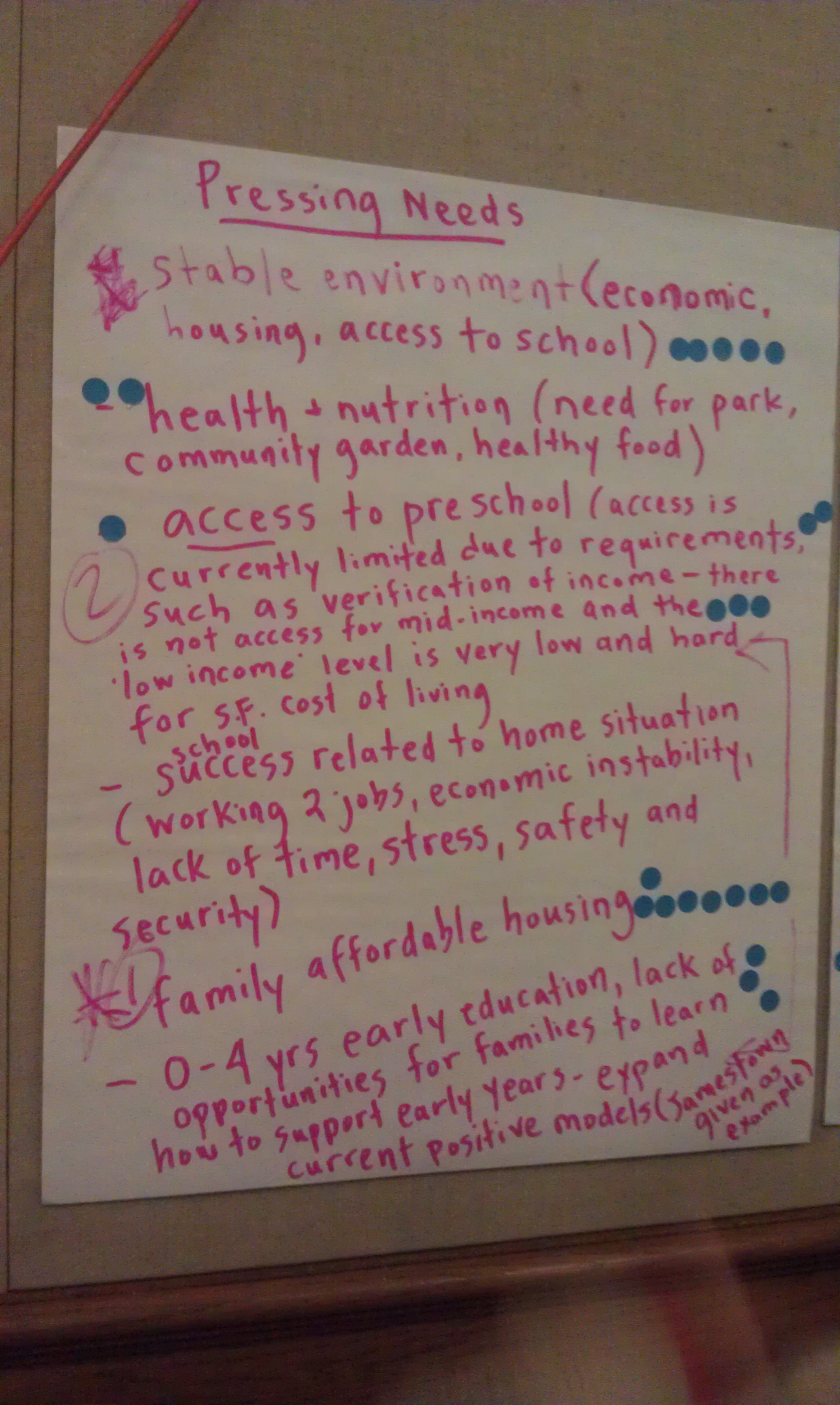
The parents weren’t exactly asking for more museum field trips for their kids. During breakout sessions where facilitators wrote group members’ concerns on flip pads, a few recurring themes emerged. “Job security for parents,” one read. “Affordable housing,” another stated. “It’s a shame to have to talk about lack of funds given wealth and corporations in SF,” more parent feedback stated.

Maria Su, director of the San Francisco Department of Children, Youth and their Families, thanked parents for coming and told them, “We know how hard it is and how challenging it is to survive in the city. But that doesn’t mean we should give up.”

The event provided a glimpse into just how tough it is for families to get by in a city where a hefty cost of living amounts to serious pressure. “The sacrifices they make is, their children will have access to resources you can’t get anywhere else,” said Mario Paz with the Good Samaritan Family Resource Center, who works with a lot of Latino immigrant families.

A report digesting the findings of stakeholder focus groups distilled the pressures facing families. “Many participants commented on … the extraordinarily high cost of living in San Francisco,” it noted, which “contributes to both financial and emotional strain on the part of our many working class and lower income residents.”

Hundreds attend hearing to call for action on evictions

Tenants, organizers and residents impacted by Ellis Act evictions packed the Board of Supervisors Chambers at San Francisco City Hall today, Thu/14, for a hearing called by Sup. David Campos on eviction and displacement in San Francisco.

“It seems to me that we have a tale of two cities,” Campos said at the outset of the hearing, which was held by the Board of Supervisors Neighborhood Services and Safety Committee. “The vast majority of individuals are struggling to stay in San Francisco. We must act urgently to address this crisis, which I believe is a crisis.” He added, “We are fighting, I think, for the soul of San Francisco.”

Tony Robles of Senior and Disability Action, who showed up at the hearing wearing a black hooded sweatshirt with pobre (the Spanish word for “poor”) printed across the front, expressed his frustration with the surge of evictions taking place in the booming economic climate. “We have been overlooked – the workers, communities of color … it’s almost as if we are an afterthought,” he said.

Fred Brousseau of the San Francisco Budget and Legislative Analyst’s office delivered a report on his recent analysis of eviction and displacement trends across the city.

Overall evictions in San Francisco rose from 1,242 in 2010 to 1,716 in 2013, reflecting an increase of 38.2 percent, according to San Francisco Rent Board Data highlighted in Brousseau’s report. 

Ellis Act evictions in particular increased by 169.8 percent in that same time frame, he said, with the most recent data showing a total of 162 Ellis Act evictions over the twelve months ending in September 2013. That number reflects units evicted, not how many tenants were impacted.

Ted Gullicksen of the San Francisco Tenants Union emphasized that tenant buyouts, frequently offered in lieu of an eviction, are also driving displacement even though these transactions aren’t reflected in city records.

“We need to get in control of these buyouts,” he said. “There are about three of them for every Ellis Act eviction. When you consider them in combination with Ellis, the numbers are very dramatic.”

Brousseau also showed a slide profiling the people who’ve been impacted by evictions citywide. Almost 42 percent had some form of disability, the data revealed, while 49 percent had incomes at or below the federal poverty level.

On the whole, Brousseau said, a total of nearly 43 percent of San Francisco households are “rent-burdened,” a term that officially means devoting more than 30 percent of household income to monthly rental payments.

Throughout the afternoon, tenants shared their stories and fears about getting frozen out of San Francisco by eviction. “I’m looking at shopping carts, and I’m terrified,” one woman told supervisors during public comment. “You have to do something. It might not be enough for me right now, but you can’t do this to any more people.”

Hene Kelly noted that elderly tenants are being disproportionately impacted by Ellis Act evictions. “They don’t have the reserves, they don’t have the jobs, and they don’t have the money to be able to move if they are evicted,” she said. Referencing landlords and speculators who are driving displacement, she added, “It makes me think of cabaret. Money, money, money, money, money makes the world go round.”

Campos noted that he is working with Assembly Member Tom Ammiano on a proposal to grant San Francisco the authority to place a moratorium on Ellis Act evictions.

He’s also working toward legislation that would create a mechanism at the San Francisco Rent Board allowing tenants to register complaints of harassment or other forms of pressure from landlords seeking to drive them out.

His proposal also envisions doubling the amount of relocation assistance that landlords would have to provide to tenants, in the case of no-fault evictions. He also mentioned the possibility of regulating buyouts, by requiring landlords to record these transactions with the rent board, and possibly prohibiting property owners from charging market-rate rent directly after completing a tenant buyout.

Meanwhile, Mayor Ed Lee recently announced that he is working with Sen. Mark Leno on legislation that is meant to reduce Ellis Act evictions. That proposal would require additional permits or hearings before an Ellis Act eviction could go forward, and place more stringent regulations on the sale and resale of properties where tenants have been evicted under the state law.

Just a couple weeks ago, a coalition of housing advocates proposed a sweeping package to turn the tide on evictions.

At the end of the day, it’s clear that housing advocates are gaining momentum as the spike in tenant ousters continues in pricey San Francisco, where rents are the highest in the nation.

“We’ve never been late on our rent,” noted Beverly Upton, executive director of the San Francisco Domestic Violence Consortium, who is battling an Ellis Act eviction. “We’ve paid for every improvement ever done in 25 years. And now we have to leave.” She appealed for legislators to take action for the sake of the city’s future, asking, “Once the advocates and the organizers and the people who care are gone, who will be left in our city?”

Eternal spring

0

arts@sfbg.com

Chris Marker did not seem to see a hard distinction between cities and their people. The cat-loving leftist documentarian, whose distinctly poetic outlook we sadly lost last year, is probably best known for his experimental sci-fi short La Jetée (1962) and his ethnography-cum fictionalized-travel-memoir Sans Soleil (1983), film-school favorites both available through the Criterion Collection.

But his filmography goes much deeper than that, and often focuses on the inner life of human and political organisms. Restored and screened at this year’s Cannes Film Festival, Le Joli Mai is a 1962 collaboration with cinematographer Pierre Lhomme, which traipses geographically and temporally around Paris in May ’62. Much of the movie consists of man-and-woman-on-the-street interviews, with an assortment of more settled chats in people’s homes or workplaces. Framed by a chimera of English and French narration, by Simone Signoret and Yves Montand respectively, the film gives its “biggest roles” to “free people, those who are able to question, to refuse, to undertake, to think, or simply to love.”

Marker investigates these free people’s attitudes toward their professions, their social lives, their home city, the housing problems of Paris, the Algerian War, and numerous other subjects close to their hearts. Some are passionately political, while others think it’s best to keep silent or ignore certain crises — a cross-section of political approaches that echoes throughout modern society, whether in Europe or the United States. Indeed, seeing this movie now with its specificity of time and place, it’s possible to imagine a not-too-different portrait of, say, 2012 Paris, or Los Angeles, or London.

During the mostly casual interviews, Lhomme’s camera wanders, never too committed to its initial subject to notice something more interesting in the background, or even just elsewhere on the subject’s person. Marker and Lhomme’s approach is almost never without levity — people’s opinions on the issues of the day are not to be mocked necessarily, but neither are they to be taken at face value. They’re all just people, and the texture of the film repeatedly reinforces that truth. In one segment, a talkative inventor loses the spotlight to a spider crawling on his suit. In another, as two engineering consultants debate in complex Marxist terms the future of labor, the film cuts away over and over to close-ups on the faces of housecats, serving as both commentary and comic relief for the heated discussion.

Marker and Lhomme strive to represent the true diversity and cultural fabric of ’62 Paris. Their subjects include poets, a painter, an inventor of automotive technology, a pair of teenage stock market assistants, an introverted single theater seamstress and cat-lover, a worker from Algeria, a student from Dahomey, a poor family finally granted more spacious housing, an ex-clergyman turned union militant, and on and on.

In the film’s final act, a montage of city symphony-esque time lapse shots of the city and a litany of statistics about life, death, and resources in the month of May gives way to a glimpse at Paris’ not-so-free inhabitants. Finally, Marker offers a reflective monologue (via Signoret) in a style that will be familiar to anyone who has seen Sans Soleil, and which also prefigures Werner Herzog’s sci-fi-tinged epilogue to his Cave of Forgotten Dreams (2010). Marker makes a literary text of the human face, offering his interpretations and looking for recurring themes among the wildly diverse denizens of Paris; he imagines how a “Martian just landed on the planet Earth” might read these human documents, and philosophizes about what plagues these haunted-looking faces.

His poetic extrapolation might frustrate some viewers, as it leaps beyond the boundaries of empirical detail to ponder the collective psyche of the people of Paris, but this is Marker’s true gift. He is an imaginative reader of the human face, mind, and heart as they operate in an urban environment, and his critique from 1962 is as valuable as ever today. *


LE JOLI MAI opens Fri/15 in Bay Area theaters.

Driving us crazy

209

STREET FIGHT Parking reform is one of the most radically important elements of making San Francisco a more livable and equitable city.

In this geographically constrained city, parking consumes millions of square feet of space that could be used for housing, especially affordable housing in secondary units. Curbside parking in the public right of way impedes plans to make Muni more reliable for hundreds of thousands of transit riders. Parking in new housing and commercial developments generates more car trips on our already congested and polluted streets, slowing Muni further while bullying bicyclists and menacing pedestrians.

Fundamentally, parking is a privatization of the commons, whereby driveway curb cuts and on-street parking hog the public right-of-way in the name of private car storage. The greater public good — such as reducing greenhouse gas emissions and enhancing public safety through bike lanes, wider sidewalks, public green spaces, and transit-first policies — is subsumed to narrow private interests. These are among the many reasons why, for over a decade, parking reform has been a key part of progressive transportation policy.

Yet lately, it has been disappointing to watch progressives, especially on the Board of Supervisors, retreat from that stance. In Potrero Hill and North Mission, a vitriolic reaction has slowed rollout of nationally acclaimed SF Park, which raises revenue for Muni and is a proven sustainable transportation tool. Yet there are murmurings that some progressive supervisors might seek an intervention and placate motorists who believe the public right-of-way is theirs.

On Polk Street, some loud merchants and residents went ballistic when the city and bicycle advocates proposed removing curbside parking to accommodate bicycles. The city, weary of Tea Party-like mobs, ran the other way, tail-between-legs. Progressive supervisors seem to have gone along with the cave-in.

Along Geary, planning for a desperately needed bus rapid transit project drags on. And on. And on. And on. The lollygagging includes bending over backward to placate some drivers who might be slightly inconvenienced by improvements for 50,000 daily bus riders.

One thing that is remarkably disturbing about this backpedaling is that, in an ostensibly progressive city by many measures (civil rights, tolerance, environmentalism), the counterattack is steeped in conservative ideology. That is, conservatives believe that government should require ample and cheap parking, whether in new housing or on the street. This conservative ideology, shared by many car drivers and merchants — and even by some self-professed progressives — is steeped in the idea people still need cars. This despite the evidence that cars are extremely destructive to our environment, socially inequitable, and only seem essential because of poor planning decisions, not human nature.

Progressive backpedaling has become more confusing with the recent debate over 8 Washington, defeated at the polls Nov. 5, and on the same day of a convoluted Board of Supervisors hearing on a proposed car-free housing development at 1050 Valencia. Both of these projects highlight the muddled inconsistency emerging among progressive supervisors.

Enough has been written about how 8 Washington was a symbolic battle for the soul of San Francisco. But during the campaigns, the lack of attention to parking was curious. Notably, progressive-leaning transportation organizations like the San Francisco Bicycle Coalition, Walk SF, and Transform sat out the election despite the project’s excessive 327 underground parking spaces, which violated hard-fought progressive planning efforts to make the waterfront livable. The Council of Community Housing Organizations also sat it out, despite benefitting from the progressive parking policies that 8 Washington violated. It appears that despite their transit-first rhetoric, progressives made a tactical calculation to keep parking out of the campaign.

The progressive victory came with a Faustian bargain which involved ignoring parking. To ensure 8 Washington was defeated, conservative voters were folded into the opposition. Groups like Eastern Neighborhoods United Front (ENUF), the Coalition for San Francisco Neighborhoods, and the Republican Party came out against 8 Washington and yet, ironically, all are opponents of progressive parking reform.

Moving forward, whatever happens at the 8 Washington site must include progressive parking policies. Don’t expect this from the unimaginative leadership at the Port, which speciously demanded the excessive parking. Don’t expect it from the developer, who steadfastly insists that the rich must have parking. And don’t expect conservatives to latch on to a waterfront scheme that is both publicly accessible and genuinely transit-oriented. It is progressives who will need to muster political will for a zero-parking project at the waterfront and set the tone for consensus among the other factions in the waterfront debate.

Meanwhile on the same day 8 Washington went down, 1050 Valencia barely made it out of a tortuous Board of Supervisors hearing in which progressives seemed to be the antagonists. As the first car-free market-rate housing proposal on Valencia under progressive parking reforms, this 12-unit mixed use building seemed an obvious win for progressives. It would be a walkable, bicycle-friendly urban infill mixed-use project with on-site affordable housing, all of which the city needs more of.

Yet since 2010, when the project first went to the Planning Commission, conservative rhetoric has been deployed to stop the project. Significantly, the Liberty Hill Neighborhood Association objected to the transit-oriented characterization of the project. It claimed that the 14 Mission and 49 Mission/Van Ness are filthy, crime-ridden, and unreliable and so 1050 Valencia must have parking.

Unlike progressives, who also decry shortfalls with Muni but propose solutions, the Liberty Hill opponents offered only secession from public transit, insisting on driving in secure armored cocoons instead of addressing Muni reliability, and they also expect free or cheap parking in the public right of way.

You would think that progressives at the Board of Supervisors would see through this thinly veiled bigotry against the 14 and 49 buses. But instead, four self-professed progressive supervisors — John Avalos, David Campos, Jane Kim, and Eric Mar — voted against 1050 Valencia.

They may argue that they were more concerned about the neighboring Marsh Theater, which has concerns about construction noise (and also parking). The noise issue can be worked out, and why the progressive supervisors did not work this out in advance is a mystery. But if you watch the hearing closely, the Marsh basically opposed the development — period — and thus a modest car-free development that included affordable housing at an appropriate location. And so did four progressive supervisors. It’s baffling.

At the end of the day, 1050 Valencia moved forward, barely. But it can still be stopped at the upcoming Board of Appeals hearing. Meanwhile, it’s time for progressives to make a frontal response to the Muni-bashing coming out of Liberty Hill.

The SFMTA is offering a bold and ambitious proposal for these buses on Mission between 13th and Cesar Chavez. This includes a transit-only lane, restricting automobile traffic, rearranging loading zones, and removing curbside parking so that 46,000 daily 14 and 49 passengers have better reliability and less crowding.

This plan will make life easier for San Franciscans who rely on these buses, but will require progressive supervisors to openly and sincerely advocate for removal of on-street parking, to support SF Park, and push for car-free housing development in the Mission, rather than knee-jerk posturing for a few political points in future elections. Progressives, stop screwing around.

Street Fight is a monthly column by Jason Henderson, an urban geography professor at San Francisco State University.

How San Francisco should really be helping the Philippines

49

There were a couple good stories in today’s San Francisco Chronicle related to concerns the Guardian and its readers have sounded in recent months: Mayoral appointees blocking CleanPowerSF against the will of the elected Board of Supervisors, and the massive scale of the proposed Warriors Arena, which is now getting slightly downsized.

It was getting a little lonely beating the drum over the anti-democratic actions of the Mayor Ed Lee and his minions to undermine the only plan San Francisco has to substantially decrease its greenhouse gas emissions and meet its own ambitious goals for addressing climate change. Glad to see the Chronicle turn up the heat, at least in its news section (unlike the neocon neanderthals that write the paper’s editorials).

While the mainstream media sometimes does good work, it usually fails to connect the dots, which is an important journalistic function. So if I would find fault with the otherwise solid and long overdue story by reporters Marisa Lagos and David R. Baker, it would be with its failure to note that CleanPowerSF is really the only plan for seriously addressing climate change, which is one of the biggest and most impactful challenges we face.

This morning on KQED’s Forum, while discussing the devastating typhoon that struck the Philippines — one of the strongest ever recorded — they did connect the dots between the severity of that storm and the warming oceans of the world, albeit in fairly detached and non-urgent way.

So please allow me to connect another dot.

“Our hearts go out to all of those who have suffered in the Philippines from possibly the world’s strongest storm. The people of the Philippines are in our thoughts and prayers today, and we will continue to support them in the days and months ahead as we learn the true impact caused by Typhoon Haiyan,” Mayor Lee said Friday in a prepared statement sent to the media. “San Francisco stands ready to aid in the rebuilding and recovery efforts. The work of rebuilding communities begins immediately, and San Francisco understands how important a sustained, vigorous recovery effort is. Our City stands ready with the Bay Area Filipino-American community to assist today and into the future to help in the rebuilding efforts in the Philippines.”

What he didn’t mention was climate change. While it’s great that San Franciscans stand ready to address the effects of this and other natural disasters — which all the global warming models show will become stronger and more frequent — why aren’t we willing to show more leadership in addressing the root cause of this problem?

Instead of collaborating with developers on ever more ambitious schemes to build expensive buildings on a waterfront that will already be challenged by rising seas, the Mayor’s Office should be channeling its energies into making San Francisco a role model for other 21st century cities to follow.

The real challenges that we and other cities around the world face now are how to address poverty, the energy and transportation needs of a growing population, and a planet in peril; instead, this Mayor’s Office is focused on poaching Oakland’s basketball team and building more housing for the 1 percent.

If Mayor Lee is serious about the sympathies he’s expressing for vulnerable populations in the developing world, then he and allies should do more than send care packages when they are devastated by the byproducts of the wasteful and overly consumptive economic policies that they are promoting.  

Filipino group snubs mayor over evictions

4

The board members of a local Filipino heritage organization, with ties to a high-profile eviction defense battle at San Francisco’s International Hotel in the late 1970s, have declined to an accept an award that San Francisco Mayor Ed Lee had planned to extend to them as part of a Filipino American History celebration because they are angry about a growing trend of senior evictions.

In a written statement sent to the media by board member Tony Robles, the Manilatown Heritage Foundation explained that it couldn’t accept the award as long as “elders are being preyed upon, evicted and given a de facto death sentence thereof.”

The Manilatown Heritage Foundation board members were informed by Board of Supervisors President David Chiu that Lee had planned to recognize the I-Hotel as part of an annual cultural history celebration at City Hall, the statement noted.

“Part of the occasion was to honor the I-Hotel and its many tenants and activists for its contribution to Filipino American history,” board members explained.

In 1976, the I-Hotel was targeted for demolition, prompting a historic eviction defense battle led by housing activists who rallied to the defense of the impacted tenants. As a young attorney who worked with the Asian Law Caucus, Ed Lee was involved in that fight — as an activist defending tenants’ rights to stay. He frequently referred to this chapter of his personal history while running for mayor in 2011, to demonstrate his sensitivity to concerns about affordable housing.

But now that Lee is well into his mayoral term, a surge of evictions of low-income seniors is worsening on his watch. Tenant defense organizations such as Eviction Free San Francisco are showing up outside landlords’ homes and offices to protest eviction notices that threaten to push low-income seniors with few options out of the city.

“The I-Hotel fight was for dignity and it lived by the premise that housing is a human right,” the group’s statement explained. “The fight for the I-Hotel galvanized the community around the fight for affordable housing, particularly for seniors who sacrificed much and on whose shoulders we stand. The fight included tenants, elders, activists, artists and students who recognized that the real estate developers and financial interests were out of control—power unchecked.” 

Home from prison

3

rebecca@sfbg.com

Danielle Evans, director of Women’s Services at the Center on Juvenile and Criminal Justice, likes to tell the story of a woman who managed to turn over a new leaf after spending a year in a residential support program.

The client was found on the streets of San Francisco, pregnant, after an overdose. She was over 40, had never graduated from high school, and had a string of drug offenses on her rap sheet. She had multiple children who had been given up for adoption, and she was homeless.

But after getting emergency treatment at San Francisco General Hospital and entering substance abuse counseling and transitional housing from there, she was able to overcome her drug addiction, regain custody of her daughter from Child Protective Services, and enroll in a vocational program for janitorial work.

The woman was aided through a yearlong stay at Cameo House, a transitional home for homeless pregnant women and new moms run by CJCJ. After living there with her daughter while getting pointers on parenting from the staff, she’s now working toward her GED and has a goal of landing a job — something she’s never had.

“I’m like, look where you came from and where you are today,” Evans reflected. The client’s daughter is now a healthy two-year-old, Evans said, and “she is so motivated to be a good mom.”

It’s not a typical narrative. A recent event hosted by New America Media focused on the personal stories of Bay Area youth who’ve grown up with parents entangled in the criminal justice system. More often, those parent-child relationships are strained or nonexistent, especially in cases where parents are far away from home, serving out prison sentences.


CHILDREN OF REENTRY

For many, having a parent behind bars has the potential of becoming a vicious cycle, but new realizations about how harmful that childhood experience can be are giving rise to a new way of thinking about how to deal with parents in the criminal justice system.

New approaches include alternatives to incarceration, something that’s gaining momentum in this era of prison overcrowding and realignment, which has shifted some responsibility of housing inmates from the state to California counties.

Children of incarcerated parents are three times as likely as their peers to wind up in the criminal justice system, Jessica Flintoff, director of the Reentry Division at San Francisco’s Adult Probation Department, said at the New America Media forum in downtown San Francisco. Some policies that the county has embraced are designed to factor in long-term youth impacts, at the time when key decisions are being made about their parents’ fates.

The event featured a series of short films and multimedia projects spotlighting the experiences of youth and their formerly incarcerated parents, with a focus on what happened when the parents returned home.

Young producers, working with the nonprofit Silicon Valley DeBug and community newspaper Richmond Pulse, created the projects through hours of interviews in which parents and kids divulged intensely personal details about their experiences. The idea behind the Children of Reentry media project was to open up a conversation that kids with incarcerated parents often shy away from, because of an associated stigma.

The project conveyed intimate narratives about an experience that an estimated 2.7 million children of incarcerated parents are familiar with nationwide: A son who got to know his father in a prison visitation room; a mother who gave birth to her daughter in prison only to be separated until completing her sentence; a father who barely knew his daughter before her 21st birthday because he’d been in prison for the duration of her childhood.


WHAT DO KIDS NEED?

In San Francisco, the mission of the San Francisco Adult Probation Department explicitly includes a goal of “breaking the intergenerational cycle of incarceration,” Flintoff explained at the forum.

The city tries to take a child’s needs into account before the parent is sentenced, she said. Under this system, a deputy probation officer is required to conduct an investigation into the needs of the affected children, and even maps out a genogram of the convicted person’s familial ties, to convey to a judge what kind of situation the child will wind up in once their parent is imprisoned.

The sentencing then takes this background information into account. “The criminal justice system is a series of decisions,” Flintoff said. “We can make different decisions at every turn.”

The impact of parental incarceration on youth has been a hot topic lately. In August, a White House conference was devoted to understanding the problem, which is fueled by an American incarceration rate that’s four times higher than it was in the 1970s.

Research has yielded sobering data. According to the American Bar Foundation, which hosted the White House conference, roughly half of all inmates serving time in U.S. prisons are parents. Communities of color are disproportionately impacted — nationwide, one in four black children has had a parent behind bars at some point. These youth tend to have a tougher time once they reach adulthood, with typically lower rates of academic achievement, decreased chances of graduating from college, and a higher percentage facing unemployment.

“I feel like I saw both of my parents in each video,” Mailee Wang said after the series of short film screenings, tearing up a little. Wang, whose mother and father each spent time in prison, is now program director at Project WHAT! (We’re Here And Talking), an initiative run by local nonprofit Community Works that aims to assist these impacted youth.

“Having a prison mentality is real,” she added. “How do you lock somebody up, and keep them from their kids, and release them, and expect that prison mentality to turn off? It’s chaos when the person returns home. People talk about family reunification, but what does that look like?”

SERVICES INSTEAD OF PRISON

Meanwhile, a new partnership between San Francisco and CJCJ seeks to eliminate the traumatizing effect of parental incarceration by swapping out time behind bars for a different rehabilitative approach. That option involves sending would-be inmates to Cameo House, the transitional home that already helps homeless moms to get on track as providers for their young kids.

Housed in an 11-unit Victorian in the Mission, the center offers group therapy, parenting classes, training for job seekers, and other kinds of support services to help put women in the position of being able to provide for their kids. Cameo House contracts with the Department of U.S. Housing and Urban Development to provide the services, and receives local funding and assistance from private donors.

Under this alternative, pregnant women or mothers with children under six who are facing prison or jail time could be placed in Cameo House instead of being made to spend time behind bars away from their kids.

“It’s an option on the table, where before it was, ‘you’re going to county jail, and there is no other option,'” Evans said. “But we’re saying, ‘hey, let’s try this. Let’s intervene where intervention is needed. Let’s not re-traumatize this family.'”

Making it fit

300

joe@sfbg.com

San Francisco’s overheating housing market has polarized the city. While progressive activists push to protect rent-controlled apartments and encourage construction of new below-market-rate housing, moderates, Realtors, and developers say any new housing helps keep prices in check, calling on the city to build 5,000 units per year.

But there is a hidden side to the housing issue in San Francisco, one that offers both complex challenges and enormous potential as a source of housing for low-income city residents, and it’s getting a fresh look with desperate eyes.

Secondary units — also known as granny flats or in-law housing — dot the city by the thousands, and are for the most part illegal. They’re tucked behind garages, in basements, or in backyards, most of them single serving sized and largely ignored.

Such units are legal under California law, and the reasons they’re quasi-legal in San Francisco are complex. It mostly boils down to the fact that often these units aren’t up to Building or Planning codes, but there have also been decisions to deliberately limit density in some neighborhoods, sometimes driven by concerns about more competition for street parking spaces.

Tenants in such units can be reluctant to report housing code violations for fear of losing cheap apartments in this rapidly gentrifying city, even if that means living in substandard housing. And the owners of those units often can’t afford to bring them up to code or pay the fines. It remains an underground industry with few watchdogs.

Caught between conflicting realities of housing shortages, poverty, and safety, the city has largely turned a blind eye to in-law units, adopting what housing advocates call a “don’t ask, don’t tell” policy around inspecting in-law units. Now that may change.

Board of Supervisors President David Chiu and Sup. Scott Wiener have plans in the works that could spur development of secondary units in the city. San Francisco has been there and done that though, and the bodies of failed past granny flat campaigns litter the political wasteland.

“In-law legalization has been for a lot of housing advocates the holy grail, but for a lot of politicians, it’s been a third rail,” said Tom Radulovich, executive director of Livable City, a nonprofit group that advocates for a more walkable, livable San Francisco.

Despite the many failed jump starts over the years, Radulovich sees hope in the prospects of legalizing more secondary units because “it’s a good, cheap, and green way to add housing.”


BUILD SMALL

So what’s different now? First off, unlike past efforts, the politicians involved are taking some small but significant steps.

Wiener’s plan could directly spur the creation of new secondary units, but it’s limited to only the Castro District. It basically lifts caps on the number of units that can be built in a single residence, waiving some density and other Planning Code requirements.

Wiener views his plan as a pilot program. “I decided to try a more limited geographic area to show that it can work,” he told us, saying that the past failed campaigns tried to force the issue citywide.

The Castro is a prime candidate for more affordable housing. The neighborhood has many tenants who are single, Wiener said. And as gentrification slammed the Castro, the vulnerable were hurt as well. Jeremy Mykaels, a 17-year Castro tenant living with AIDS, recently fought back an Ellis Act eviction that would have cost him his home.

“I am not looking for pity,” Mykaels wrote on his website, addressing his eviction. “I just want to shed a light on a growing problem in this city for many senior and disabled tenants like myself.”

Wiener’s office declined to say how many secondary units could be built. But as he introduced the legislation to the Board of Supervisors on Oct. 22, he said that many longtime residents in the Castro, in terms of housing, “are living on the edge.”

Castro residents like Mykaels have lived under rent control for years, and once folks like him are pushed out, they often can’t afford to stay in the city.

Fair market rent in the Castro for a two-bedroom apartment is $3,295 a month, according to the Department of Public Health. According to its rental affordability map, a tenant would need 6.2 full-time minimum wage jobs to afford to live there.

“It’s a neighborhood in desperate need of additional housing options,” Wiener said.

Enter in-law units, which are often more affordable. Though there have been no citywide studies of their affordability, a study this year by the Asian Law Caucus, “Our Hidden Communities,” said the average cost of those units in the Excelsior neighborhood is between $1,000–$1,249 a month, way below average rents.

Wiener’s legislation was turned over to the Land Use and Economic Development Committee, where it will be evaluated for impacts to the neighborhood. The supervisors will hear it again in 30 days.


GO BIG

One housing advocate thinks Wiener is thinking too small and needs to expand his vision.

“I think Wiener’s proposal is creating a patchwork of regulation, but this will create a mess, which the board is accomplished at doing,” Saul Bloom, head of Arc Ecology, told the Guardian. He thinks a citywide proposal to legalize in-law units is the only way go to — because the city is in a housing crisis right now, he said, and we don’t have time for just a pilot.

One big advantage is the units are far cheaper to construct than traditional houses or condominiums. Bloom notes the Lennar Urban will be spending about $400,000 for each of the thousands of homes it will build at Hunters Point Shipyard and surrounding areas, but that small secondary units can be built in existing neighborhoods for $75,000 to $200,000 each.

“We’re not expanding units in affordable housing through existing strategies,” Bloom said, and he’s right.

San Francisco has mostly built about 1,500 new housing units a year, which is much less than needed to keep up with demand, according to San Francisco Planning and Urban Research Association (SPUR) and the Housing Action Coalition.

To keep up with the frantic demand, San Francisco would need to build 5,000 new units a year, the groups argue. If the city could keep up with demand for housing, the price of housing itself could go down — meaning lower rents for everyone.

“If we want to actually make the city affordable for most people — a place where a young person or an immigrant can move to pursue their dreams, a place a parent can raise kids and not have to spend every minute at work — we have to fix the supply problem,” SPUR Executive Director Gabriel Metcalf wrote in a recent article for The Atlantic (“The San Francisco Exodus,” Oct. 14).

Yet progressive housing activists have long said that the city can’t build its way to affordability, arguing that demand for market rate units is essentially insatiable, and that what the city needs to do is build housing specifically for low-income residents.

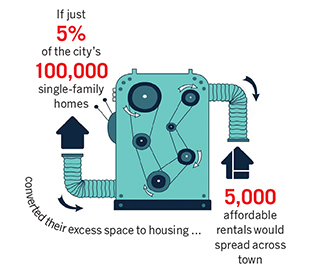
Bloom put out a study from Arc Ecology, suggesting that if just 5 percent of the city’s 100,000 single family homes converted their excess space into in-law units, an additional 5,000 affordable rentals would spread across town.

Wiener’s proposal looks at making new units in just a slice of the city, but another proposal will look at the issue citywide. Chiu’s legislation seeks to take that sea of hidden and unlawful granny flats and bring them up to code, but it wouldn’t look to build new ones.

“The big picture is that we’re exploring legalizing existing [in-law] units that are illegal, to make sure they become safe and protect residents there,” said Amy Chan, an aide in Chiu’s office.


UP TO CODE

Safety isn’t the only consideration, as this could also help the housing supply in the city, those involved told the Guardian. Often these in-law units are rented out to friends and family, and once up to code they’d open up to the market.

But safety is important because these units also often lack city permits because they’re dangerously constructed. Sometimes that can lead to death.

“A lot of time (the units) may not have proper egress for an emergency,” said Dan Lowrey, deputy director of inspection services at the Department of Building Inspection. “We just had a fire last month where three people died because of that.”

Lowrey is part of Chiu’s workgroup that’s navigating the complexities of his new legislation. Just how do you make these units legal? There’s a number of challenges, he said.

When looking at a unit, housing inspectors have a checklist to look through, and some of it is real garden variety stuff. Smoke detectors? Check. Proper floor covering? Check. Those are easy. The real challenge is when there are ceilings that are too low, hallways not wide enough to navigate in an emergency, or the unit has no windows from which to escape in a fire.

That’s when you have an in-law apartment that requires total reconstruction to be brought up to code, a straight up illegal unit. As the law stands now, the only recourse for the city in that case is to evict the people living there.

“That’s the challenge, what do we do with the [in-law apartments] that can’t be legalized?” said Bill Strawn, a spokesperson for DBI. Those are some of the questions that Chiu’s workgroup is tackling now.

The good news, he said, is that there are a good number of units that are up to the Building Code, but not the Planning Code — that’s a much easier hurdle to clear.

The Planning Code basically separates neighborhoods of the city into zones for one, two, or three families in a housing unit. This looks at the amount of available free space, sunlight, air, and parking. With those lifted, many units could be more easily converted to living use.

But finding the units that aren’t up to code is important, said Omar Calimbas, a senior staff attorney at the Asian Law Caucus.

He led the “Our Hidden Communities” study that revealed 33 percent of homes in the Excelsior district contained in-law units, far above the city’s estimates.

His team went door to door and found out for itself. What Calimbas saw was that those living in unregulated units often lived in substandard conditions with nowhere to go for help.

There are some units with no heating, he said. Other times the in-law unit is in a basement barely renovated for use as a living space. Sometimes the bathrooms and shower are really tiny cubes. There are mold and dampness problems.

“You’re living in a space that doesn’t make you feel protected from the elements,” he said. And when the units are made without permits, tenants feel they can’t go to the city for help.

To put it in a nutshell, they are in dire need of regulation. Calimbas is also working with Chiu on his legislation to do just that. But ultimately, each of the two ordinances around secondary units takes small bites out of the housing pie.

Bloom is calling for the city to move aggressively on this issue. “We’re rapidly becoming a more expensive city to live in, more and more so every year.” As more and more San Franciscans are priced out of their homes, time may soon run out.

UPDATED: Board narrowly approves closing city parks at night

44

The San Francisco Board of Supervisors today narrowly approved Sup. Scott Wiener’s legislation to close parks and large plazas from midnight to 5am, a measure that Wiener said was about preventing vandalism but which progressive activists called an attack on the homeless.

The vote was 6-5, with Sups. John Avalos, London Breed, David Campos, Jane Kim, and Eric Mar voting against the proposal. The key swing votes in the decision were Breed — who wrote an op-ed for this week’s Guardian (posting soon) explaining her position — and Sup. Norman Yee, who was elected last year in Dist. 7 with progressive support.

To address the homeless issue, Kim asked for an amendment to make an exception for sleeping in the parks. Without the amendment, “we are criminalizing poverty and issuing fines people will never pay, and not getting the results we wanted,” she said. 

Hundreds of homeless lay their heads to rest in the parks of San Francisco every night as the city struggles to meet housing demand, which is already illegal under city law. Kim’s amendment says those sleeping in parks are to be cited under previously existing codes against sleeping in parks and not double-fined under this ordinance. Wiener supported the amendment and it was inserted into the legislation, although that didn’t end the debate over the legislation or win over its main opponents.

As the legislation was first introduced, Wiener made the argument he’s made many times before. Closing the parks at night is about vandalism, he said. 

“We need to establish a clear baseline that establishes hours for the park to combat vandalism and dumping,” Sup. Scott Wiener told the board. He made the case that most major cities in the U.S. have laws closing their parks and playgrounds at night, and that even New York City had them on the books.

Wiener also directly and flatly denied that his legislation was an attack on the homeless. 

“If the police wanted to remove people sleeping and camping in parks, they already have the tools to do that. This legislation does not give them those tools beyond what they have,” he said. 

But opponents of the measure, who have been organizing against it for weeks, said it will target the homeless and be selectively enforced. As Mar said at the hearing, “I think this is a really mean-spirited ordinance.”

And that’s when the avalanche of arguments began. Campos, Mar, Avalos, and Kim all  passionately defended the homeless that sleep in the parks. But no one brought more facts to the argument than Breed.

“We have 1,339 shelter beds and 6,000 people in San Francisco with nowhere to sleep,” she said. “I’ve been told again and again this will not target the homeless. But if it doesn’t target the homeless or the investment banker or the firefighter, who will this law target? Suspicious looking people in hoods? Teenagers?” 

The room took on a chill as she evoked echoes of Trayvon Martin and others who have been selectively targeted in the name of justice. Enforcement was her next bone of contention. There are only a handful of park police, often only two, that patrol over 220 parks in San Francisco, she said. 

If the ordinance is supposed to combat vandalism, it doesn’t even do that effectively, she said to the board: “We don’t have a legislative problem, we have an enforcement problem.”

To that end, Yee amended Wiener’s proposal to identify more funding for the park police. Everyone on all sides of the argument acknowledged that two to three officers to cover over 4,000 acres of San Francisco parks was woefully inadequate. 

It’s still unclear where that funding will come from, and how much it will be. 

After the meeting the Guardian asked Police Chief Greg Suhr, who was present for the meeting, if the homeless would be targeted under the ordinance.

“We’re not that Police Department,” he said. But he also said the controversial Sit/Lie Ordinance doesn’t target homeless people either, a claim that homeless advocates would dispute. “We’re a reasonable suspicion detention department.” 

An audio interview with Police Chief Greg Suhr just after the park closure legislation passed, where we asked Suhr, “Will the homeless be targeted?”

Tom Temprano, president of the Harvey Milk LGBT Democratic Club, disagreed. 

“I think that anyone who tells you the homeless will not be targeted in legislation that closes our parks at night are lying to you. There’s no other way to read this legislation,” he said. Temprano was one of the lead organizers of the sleep-in protest of the ordinance, which we previously covered.

When we asked if the ordinance would spur increased law enforcement in the parks, Suhr referred us elsewhere. 

“I leave the deployments to the station captains… certainly [the captains] have a pulse on what’s going on in the parks,” he said. 

So we called Captain Greg Corrales at Park Station, which oversees one of the most populous sections of Golden Gate Park, filled to the brim with campers. Corrales told us he didn’t imagine this ordinance would spur him to increase patrols or enforcement.

“There will not be more officers. The hours of the park have been posted on signs in the park, and past closing time people were cited for failure to abide by the signs,” he said. 

They cite 10-20 people for sleeping in the park per night, he said. As Kim noted, often these don’t lead to any prosecutions at all. 

But as for vandalism, Corrales said that there was recently a vandal throwing rocks through the windows of the Conservatory of Flowers and McLaren Lodge in Golden Gate Park. Would the ordinance help curb people from that kind of behavior?

“We’re already enforcing park closure,” he said. “It really doesn’t have much impact on us.” 


Mayor Ed Lee’s committee gives $10,000 that it doesn’t have to the 8 Washington project UPDATED

186

Mayor Ed Lee presents himself as a model of fiscal responsibility, but the Mayor Ed Lee for San Francisco Committee that he controls has recently been spending big money that it doesn’t have, including more than $10,000 that it has recently given to the Yes on Propositions B&C campaign, according to campaign finance filings.

The Mayor Ed Lee for San Francisco Committee, a general purpose committee that Lee and its Treasurer Kevin Heneghan are jointly responsible for, made late contributions of $8,666.66 on Oct. 29 and $1,667 on Oct. 30 to San Franciscans for Parks, Jobs and Housing, Yes on Props. B&C, which supports the 8 Washington project. Lee’s committee also made a $4,333.34 contribution to the Yes on A campaign on Oct. 29.

The Lee committee’s contributions are actually small potatoes for the Yes on B&C campaign, which is spending more than $2 million to have voters green-light the project, most of it coming from the developer, Pacific Waterfront Partners, which kicked in late contributions of $450,000 on Oct. 28 and $250,000 on Oct. 24, bringing its total to about $1.8 million.

But what’s interesting about the Lee committee’s donations is that the final pre-election statement that it filed on Oct. 24 showed that it had just $1,208 in the bank and $26,886 in outstanding debts — most of that to Oakland-based EMC Research for polling it conducted during the Sept. 22-Oct. 19 period.

Neither Heneghan nor Lee responded to our calls for comment, and Lee doesn’t have any public events scheduled between now and election day on Tuesday, so details on this intriguing bit of deficit spending and what kind of polling work the mayor’s committee was doing remain a mystery. [UPDATE 11/5: Lee’s office deferred to Heneghan, who just emailed us this response: “As you know, political committee report filings are a snapshot in time. The Mayor Ed Lee for San Francisco ballot measure committee has received additional contributions since the most recent report that will be appropriately reported. All activity through the committee in support of ballot measures endorsed by Mayor Lee will continue to be appropriately reported as well.” We asked Heneghan whether he would disclose the donors, and we’re waiting to hear back.]

The Mayor Ed Lee for San Francisco Committee hasn’t reported raising any money this year, unlike last year when it raised about $400,000 from some of the city’s biggest establishment players, including Lennar Homes ($35,000), Committee on Jobs ($30,000), San Francisco Alliance for Jobs and Sustainable Growth ($25,000 in basically a pass-through from venture capitalist Ron Conway), San Francisco Association of Realtors ($20,000), and the city’s police and firefighters’ unions ($10,000 each).

But how exactly could the Mayor Ed Lee for San Francisco Committee give $10,000 to the Yes on Props. B&C campaign if it didn’t actually have the money to cover the checks?

When we asked a source at San Francisco Ethics Commission about it, at first he was puzzled, and then he told us that while the committee is required to report late expenditures that it makes before the election, it isn’t required to report late contributions that it receives. That we won’t find out until its Form 460s are due Jan. 31, 2014.

So who really paid for Lee’s contributions to the Yes on B&C campaign, as well as more than $20,000 in polling work that Lee’s committee paid for? And what will our mayor do in return for the people who are digging his committee out of its debts?  


Angered by senior evictions, Filipino American activists decline award

The board members of a local Filipino heritage organization, with ties to a high-profile eviction defense battle at San Francisco’s International Hotel in the late 1970s, have declined to an accept an award that San Francisco Mayor Ed Lee had planned to extend to them as part of a Filipino American History celebration because they are angry about a growing trend of senior evictions.

In a written statement sent to media by board member Tony Robles, the Manilatown Heritage Foundation explained that it couldn’t accept the award as long as “elders are being preyed upon, evicted and given a de facto death sentence thereof.”

The Manilatown Heritage Foundation board members were informed by Board of Supervisors President David Chiu that Lee had planned to recognize the I-Hotel as part of an annual cultural history celebration at City Hall, the statement noted. “Part of the occasion was to honor the I-Hotel and its many tenants and activists for its contribution to Filipino American history,” board members explained.

In 1976, the I-Hotel was targeted for demolition, prompting an historic eviction defense battle led by housing activists who rallied to the defense of the impacted tenants. A significant fixture in what was once a predominantly Filipino neighborhood known as Manilatown, the I-Hotel housed 196 tenants, predominantly low-income Filipino immigrants. 

“The I-Hotel fight was for dignity and it lived by the premise that housing is a human right,” Manilatown Heritage Foundation members explained in the written statement. “The fight for the I-Hotel galvanized the community around the fight for affordable housing, particularly for seniors—who sacrificed much and on whose shoulders we stand. The fight included tenants, elders, activists, artists and students who recognized that the real estate developers and financial interests were out of control—power unchecked.” 

The fight dragged on, at one point more than two thousand people surrounded the building to blockade the doors in an effort to prevent an eviction from going forward. The battle over the I-Hotel also brought on a famous San Francisco episode in which then-Sheriff Richard Hongisto served five days in his own jail for refusing to carry out the eviction order. In the end, the tenants were finally ousted. But the epic battle ultimately helped to produce a different outcome, many years later: The property became the site of low-cost senior housing, complete with a commemorative display in the interior documenting the dramatic I-Hotel fight.

As a young attorney who worked with the Asian Law Caucus, San Francisco Mayor Ed Lee was involved in that fight – as an activist defending tenants’ rights to stay. He frequently referred to this chapter of his personal history while running for mayor in 2011, to demonstrate his sensitivity to concerns about affordable housing.

But now that Lee is well into his mayoral term, a surge of evictions of low-income seniors is worsening on his watch. Tenant defense organizations such as Eviction Free San Francisco are showing up outside landlords’ homes and offices to protest eviction notices that threaten to push low-income seniors with few options out of the city. Some evictions have caught the attention of mainstream media, such as the ouster of elderly Chinatown couple Gum Gee Lee and Poor Heung Lee and their disabled daughter, Shiuman Lee.

Some advocates have proposed legislative solutions; meanwhile, the situation has evidently become so criticial that even city’s Human Services Agency is seeking outside assistance to provide eviction prevention services for elderly and disabled tenants facing Ellis Act evictions.

And today, the board of the Manilatown Heritage Foundation drew a line in the sand to send Lee a clear message by refusing to accept the honor of recognition in the current housing climate. So far, mayoral spokesperson Christine Falvey has not responded to the Bay Guardian’s request for comment in response to the Manilatown Heritage Foundation’s statement.

“Given the current state of San Francisco housing by forces out to make a killing by killing our communities, we as the torch bearers of the I-Hotel struggle and in the memory of its displaced elders and advocates Al Robles, Bill Sorro, Felix Ayson, Wahat Tampao and others, cannot, in good consciousness, accept any honor or award while elders are being preyed upon, evicted and given a de facto death sentence thereof. And it doesn’t matter if the honor is bestowed by Mayor Lee, President Obama or the pope. We have to say no.”

Here’s the full statement from the Manilatown Heritage Foundation. Here’s an historical essay about the I-Hotel from Shaping San Francisco’s digital archive at FoundSF.org.