History

Our Weekly Picks

0

WEDNESDAY 3

PANTyRAiD

Seven years after meeting in Costa Rica, Martin Folb and Josh Mayer are still doing their thing as seductive bass collaboration PANTyRAiD, even while each has achieved solo success as the Glitch Mob’s Ooah and MartyParty respectively. New album PillowTalk has the right touch of move and groove while keeping an arm’s length from booming, bro-centric dubstep or ear-shattering electro. PANTyRAids like to jump from genre to genre, dropping some trap here and some glitch there, keeping listeners on their toes. Standout track “Just For You” showcases the duo’s slick handling of hip-hop drums, brooding basslines, and melodic synths. Call it mood music for the bass-minded. (Kevin Lee)

10pm, $20-25

1015 Folsom

(415) 431-1200

www.1015.com

Fruition

Upright bass, acoustic guitars, and mandolin (quickly strummed and finger-picked) fill out Fruition’s sound, but don’t clutter its performance. And this show will feature Bridget Law of Elephant Revival, an addition that only upgrades the night. Bluegrass itself requires a lot of emotion and passion to sound right, but Fruition harbors a certain old-back-road, last drop of sunlight through the trees kind of passion. “Make me an angel that flies from Montgomery,” sings the group in gorgeous country harmonies, in its cover of John Prine’s “Angel from Montgomery.” (Hillary Smith)

7pm, free

Brick and Mortar Music Hall

1710 Mission, SF

(415) 371-1631

www.brickandmortarmusic.com


THURSDAY 4

Oil and Water

It just wouldn’t be summer in the Bay Area without the San Francisco Mime Troupe — so thank goodness the veteran company was able to raise enough funds (in part through crowdsourcing, a testament to its loyal supporters) for its 54th season. Though the 2013 musical will still be performed mostly for free, and comes complete with a political theme (corporations vs. environmental activists), the format is different this year. The show is broken into two musical one-acts: Crude Intentions and Deal With the Devil, both written by Pat Moran And Adolfo Mejia. Per tradition, the show opens July 4 in Dolores Park before spreading its jolly satire ’round NorCal parks through Labor Day; check website for additional shows this week in Golden Gate Park and beyond. (Cheryl Eddy)

Through Sept. 2

Thu/4, 2pm, free

Dolores Park

18th St. and Dolores, SF

www.sfmt.org


Giraffage

San Francisco-based futuristic dream R&B producer Charlie Yin has made some big leaps in 2013, with a performance at SXSW along with upcoming gigs at Southern California’s Lightning in a Bottle festival and SF’s Treasure Island Music Festival. His new album Needs on Los Angeles label Alpha Pup Records is a thesis in music manipulation, a comprehensive counterargument to straightforward 4/4. Vocal samples are up-shifted in tempo to lend a playful mood. Tracks are sometimes dipped in sonic mud halfway through, decelerating to a crawl before jumping back to normal time. But Needs never feels jerky, which owes to Yin’s tight transitions and harmonious melodies throughout. The sensual, infectious, shifty third track “Money” sounds like it will be played in lounges in 2050. (Lee)

With Mister Lies, Bobby Browser

9:30pm, $13–$15

Rickshaw Stop

155 Fell

(415) 861-2011

www.rickshawstop.com


FRIDAY 5

“Fiestas Fridas”

There’s a reason this three-day event is subtitled “celebrating the 103rd and 106th birthday of Frida Kahlo:” the iconic Mexican painter was actually born in 1907, but she liked to say she was born in 1910 — the year the Mexican revolution began. The fest kicks off with a gala dinner featuring Kahlo’s own recipes (cooked by Puerto Alegre, Gracias Madre, Mijita, and other restaurants), with proceeds going to Cine + Mas; Saturday brings film screenings and Kahlo-inspired performances. The fest wraps up Sunday with an afternoon and evening of live art, dance, DJs, and more family-friendly fun, like a costume contest with a variety of categories: Best Frida and Diego, Best “Little Frida,” and Best “FriDRAG.” (Eddy)

Opening dinner tonight, 6-11pm, $50

Mission Cultural Center

2868 Mission, SF

Film screening and performance, Sat/6, 5-11pm, $35

Victoria Theater

2961 16th St, SF

Community event, Sun/7, 2-9pm, $10 suggested donation

Women’s Building

3543 18th St, SF

www.fiestasfridassf.com


Johnny Mathis with San Francisco Symphony

Legendary crooner Johnny Mathis’ family moved to San Francisco when he was very young, and it was here in the city that he developed his love for music; while studying at San Francisco State University, he began performing at the Black Hawk nightclub and eventually garnered the attention of some high-profile promoters. In early 1956, Mathis recorded his first album, and he continues to this day. Singing hit songs such as “Chances Are,” “Wonderful! Wonderful!,” “A Certain Smile,” and many more, Mathis has been going strong for nearly 70 years now — don’t miss you chance to see a true icon this weekend, performing with the San Francisco Symphony (Sean McCourt)

Also Sat/6, 8pm, $20–$125

Davies Symphony Hall

201 Van Ness, SF

(415) 864-6000

www.sfsymphony.org


Accidental Bear Queer Summer Tour

What, you thought just because DOMA got overturned and same-sex couples might be getting married again this summer that our work was over? And also that we’re too hungover from Pride to start partying again? Queer mental health issues and suicide risk are still a huge concern in the community, and hyperenergetic SF gay blogger Mike Enders, a.k.a Accidental Bear, is trying to break the stigma and bring awareness — by throwing a big, fun, charitable concert and party, of course. Colorful gay novelty rappers Rica Shay and Big Dipper (let the double entendre zingers fly!), dazzlingly alien outfit Conquistador, local electro heartthrobs Darling Gunsel, and soulful tunesmith Logan Lynn fill the bill, with proceeds going to the Stonewall Project, the Ali Forney Center, and more. (Marke B.)

8pm, $15

Beatbox

314 11th St., SF.

www.accidentalbear.com


SATURDAY 6

Beast Crawl

Now in its second year, Beast Crawl is a free literary festival featuring more than 140 writers in one night. It’s probably pretty hard to go wrong with that many options. Spread out over 26 local galleries, restaurants, bars, and cafes, the annual event offers a place and performance for everyone. Beast Crawl has four legs — the first one beginning at 5pm, and the last one (the after-party) starts at 9pm. Visit the Uptown, have a drink at Telegraph Beer Garden, open your eyes at Awaken Café, all while taking in some of the best Bay Area authors, poets, and even stand-ups. You know how you always hear people say “I went to this rad little poetry reading the other night,” and then wonder where the hell they always are? Well, here’s your chance to finally check out one, or 20. (Smith)

5pm, free

Uptown, Oakland

(415) 706-9128

beastcrawl.weebly.com


Audiobus Mission Creek

Properly executed, music should take you on a mental voyage, a mini musical vacation, if you will. It’s not to remove all thought, but to direct your attention elsewhere momentarily, in the direction the sound dictates. The AudioBus, a mobile venue, will delete the figurative from that jaunt, and take you on a literal trip down a specific San Francisco route. For AudioBus Mission Creek — a Soundwave SonicLAB event — sound artists Jeffy Ray and Jorge Bachmann will sonically guide passengers through the old and new Mission District, narrated by Adobe Books’ Andrew Mckinley. Together, they’ll explore “profound themes of the past, from nostalgia to displacement, and the future ideas of technology and possibility.” The sound-tour will leave the temporary station twice tonight, once for a sunset tour and then again on a starry night ride. A reminder: the bus waits for no one, so don’t miss your stop. (Emily Savage)

8 and 9pm, $16

Bus station: Adobe Books

3130 24th St., SF

www.projectsoundwave.com


Fillmore Jazz Festival

Live jazz music, crafts, and gourmet food, all in one place (and most of it is free to check out). The Fillmore Jazz Festival is the largest of its kind on the West Coast, reportedly luring in a mind-blowing 100,000 visitors over the two-day event. Considering the history and popularity of the neighborhood — and the sheer amount of bands and musicians playing the fest — that number starts to make sense. Sultry local vocalist Kim Nalley will bring her jazzy blues blend to the stage, as will instrumentalist-composer Peter Apfelbaum, Mara Hruby, John Santos Sextet, Beth Custer Ensemble, Crystal Money Hall, Bayonics, and Afrolicious, among many others. Stroll through the 12 blocks, and you’re bound to find some acts that give you a reason to pause. (Smith)

Also Sun/7, 10am-6pm, free

Fillmore Street between Jackson and Eddy, SF (800) 310-6563

www.fillmorejazzfestival.com


Woolfy

I miss Kevin Meenan’s show listings at epicsauce.com. At one time it was a go-to for highlights of small shows going on in the city, filler free, and super reliable for finding a new act to see live. Meenan has since dropped the showlist (perhaps made redundant with the availability of social apps), but is still active with his regular event Push The Feeling. This edition features a DJ set by English born, LA musician, Simon “Woolfy” James, whose eclectic and spacey post-punk dance sensibility first got my attention with the caressingly Balearic “Looking Glass” and the recent James Murphy-esque snappy cut on Permanent Release, “Junior’s Throwin’ Craze.” (Ryan Prendiville)

With Bruse (Live), YR SKULL, and epicsauce DJs

9pm-2am, $6, free before 10 w/ RSVP

Underground SF

424 Haight, SF

www.undergroundsf.com


SUNDAY 7

Cleopatra

The backstory that looms over 1963’s Cleopatra is very nearly as glorious as the film itself, which ain’t no small feat; Joseph L. Mankiewicz’s epic take on the legendary Queen of Egypt ran famously over-budget, but damn if all those dollars aren’t one hundred percent visible, with lavish sets, costumes, and blingy whatnots filling every frame. But really, who cares about overapplied eye make-up and historical inaccuracies when you have the Elizabeth Taylor-Richard Burton romance playing out before your very eyes? There’s no better way to relive the drama — oh, the drama — than in this 50th anniversary restored DCP screening, a one-day-only affair at the Castro. (Eddy)

2 and 7pm, $8.50–$11

Castro Theatre

429 Castro, SF

www.castrotheatre.com


TUESDAY 9

Chef Hubert Keller

Hubert Keller is a culinary celebrity as a multiple James Beard Award winner and the owner and executive chef of trendy restaurants across the country, including the highly-praised San Francisco-based Fleur de Lys. But the classically trained French chef is not all expensive, showy cuisine — during the first season of Top Chef Masters, he earned the respect of broke college kids and amateur foodies everywhere when he resourcefully used a dorm room shower to cool a pot of pasta. Last year, he collaborated with co-author Penolope Wisner to publish Hubert Keller’s Souvenirs: Stories and Recipes from My Life, a memoir-cookbook featuring instructions on 120 dishes. (Lee)

In conversation with Narsai David

6pm, $25 (students, $7)

Commonwealth Club

595 Market, SF

(415) 597-6700 www.commonwealthclub.org

New Zealand’s Cup

7

news@sfbg.com

A few weeks ago I was walking down the dock in the marina where I live, in Wellington, New Zealand, when I passed a woman and a young boy. I’d never seen them before, which is uncommon here in this municipal marina — about 100 boats — in a small suburb of the country’s capital.

The boy was walking from berth to berth pointing out certain rig and hull features and expounding on them as only a future aficionado can. “Lots of different boats, huh?” I asked as I passed.

“Different than America,” he confirmed in an accent the same as mine.

The kid is sharp, I thought, or maybe it’s just obvious, even to an eight-year-old from Chicago. The New Zealand sailing scene is vastly different than its American counterpart, which is not to say there’s no comparing — they’re not exactly navigating carved logs with gunnysack sails down here.

But the boats in my marina are, in fact, mostly homebuilt from steel, cement, aluminum, and wood. They appear a motley crew compared to the cookie-cutter production fiberglass Beneteaus, Catalinas, and Hunters, with their identical pacific blue sail covers lined up in San Francisco’s South Beach Marina.

In New Zealand, a boat is rarely a status symbol — it’s part of the middle-class way of life, the home base for holidays and weekend fishing trips and lots and lots of competitive racing. If I’ve noticed one thing since I arrived in this country (aboard a sailboat, after leaving San Francisco and my job as a Bay Guardian staff writer), it’s that every little harbor town has a yacht club and an awful lot of Kiwis own boats — and they sail the shit out of them.

Which is part of the reason why the New Zealand government is willing to invest NZ$36 million (US$27 million) to compete in the 34th America’s Cup against some of the richest men in the world in a race that has become so elite there’s barely any competition.

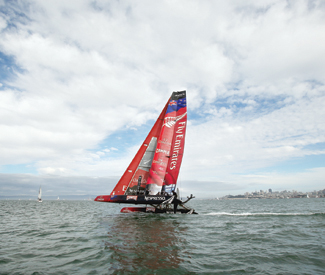
Small as the field is, Emirates Team New Zealand (ETNZ) is quickly shaping up to be the team to beat if you’re on a high-speed, air-catching AC72 catamaran. If they succeed, it will show that developing an America’s Cup team doesn’t have to come from having deep pockets in your Nantucket Red pants — it comes from having the sport ingrained in your culture, filtered through affordable local boat clubs, city-run facilities, volunteer programs, publicly accessible shorefronts, and an innovative marine industry.

In fact, without New Zealand’s maritime way of life, Larry Ellison wouldn’t have much of a team: of the 27 sailors and management crew aboard Oracle, a third are Kiwis. Another third are Australians. If you count Ellison, there are only three Americans aboard. Just one of them — tactician and grinder John Kostecki — grew up sailing on San Francisco Bay.

Ellison’s boat is mostly a Kiwi production, too — the fixed-wing sails and structural components for Oracle’s two AC72s were made in New Zealand, as were the boats, sails, and rigs for ETNZ and Luna Rossa. The only other syndicate competing, Sweden’s Artemis, in the wind since the death of crewmember Andrew Simpson, is the outlier, but they still have eight New Zealanders on board.

America’s Cup is looking more and more like it owes a lot to New Zealand. Is the Cup doing as much for San Francisco as it is for this little island nation, with a population just a tenth of California’s?

“If it wasn’t called Team New Zealand, we wouldn’t get a lot out of it,” says Sven Pannell, a competitive dinghy racer and employee of the economic development agency Grow Wellington. “The numbers of boat builders, carbon fabricators, sail makers, yacht designers coming out of New Zealand are the reason we’re still at the top of the global game. If we can bring the Cup home that means a lot for our country.”

It may also save America’s Cup from becoming even more out of touch with reality.


IT’S THE CULTURE, STUPID

It’s June 8, summer in San Francisco but winter in Wellington. The first race of the 2013 Winter Series at Evans Bay Boat Club hits hypothermic seas beneath steely overcast skies and 20-30 knots of wind — “perfect conditions,” one sailor enthuses. Tame, actually, for Wellington. A week ago, wind blew out the fifth story windows of a building downtown.

Sven Pannell has just finished racing a 12-foot skiff, a super lightweight, often homebuilt boat that probably originated in Australia and is almost exclusively raced in the Southern Hemisphere, though an 18-foot version will be showcased in San Francisco this September alongside the America’s Cup finals. Weighing about 100 pounds, with no class restrictions on sail area, they rooster-tail around Wellington harbor, bow high, barely in the water. They seem to require a similar caliber of nerve as the AC72s.

Which Pannell, who won today, evidently has. He grew up sailing as a kid, as did his crew, Craig Anderson. Neither of them can think of anyone who didn’t get into sailing as a child.

“A lot of people around the world think yachting is a well-heeled sport, but not in New Zealand,” he says. “There’s a reason that half those [America’s Cup] boats are full of Kiwis and Aussies. Go out and see the number of eight-year-olds in Optis in all kinds of weather here. A high number of people sailing at that age creates a deep pool of sailors in demand.”

“America’s Cup is about stretching the limits, but it starts here, when you’re eight years old,” he adds.

Eager to get out of the icy Antarctic wind, I enter the boat club where about 35 people are gathered at the bar, buzzing from adrenalin, barefoot and wet from spray or capsizes, gripping ginger beers and green bottles of Steinlager, the Budweiser of New Zealand. It’s a humble looking crowd — no flash gear or cashmere.

I’m introduced to Mike Rhodes, 26, wearing a blue sweatshirt and camo pants. He’d love to race an America’s Cup boat, but he also satisfies himself with a 12-foot skiff, which he stripped and rebuilt, fashioning the stainless steel fittings himself — he’s a sheet metal worker.

“New Zealand sailing is all about learning and moving forward,” he says. “The boats we’re sailing are always changing. We have set rules for weight, width, and length. After that it’s wide open. You can put up as much rig as you can handle. We went out in 50 knots last weekend. It was insane. We probably had boat speeds of 30 knots.”

The speed and innovations are what appeal to Rhodes and also connect to the America’s Cup, which has been an historic proving ground for leaps forward in boat design. “Who thought New Zealand could make the boat fly first?” he says of ETNZ’s proficiency at foiling the AC72 — going so fast the hull actually lifts off the water.

We’re soon joined by Laura Hutton, a 30-year-old from Cape Cod. She’s raced dinghies, coached and taught sailing for years. Now a speech therapist, she moved to New Zealand three months ago and immediately hooked into the local yachting scene. It’s palpably different than what she’s used to in the States. Here, she says, “It’s a lot more laid back. It’s more inclusive than exclusive. I used to go to events at New York Yacht Club in Newport and I felt so uncomfortable there. It’s the most elite, snobby place.”

“You can’t get coaching in the US unless you’re part of a yacht club or go to a school with a racing team,” she adds, and there’s often a huge cost to enter the sport. “Here, I can join the local yacht club for $35 a month,” she deadpans.

I spend more money riding the bus, I tell her, but I wouldn’t in San Francisco, where it’s cheap to catch a bus but where most people rarely board boats.

The American yacht club tradition has a certain “if you have to ask how much it costs, you can’t afford it” attitude. Ellison is one of 300 members of Golden Gate Yacht Club, official host for the Cup. Its neighbor, St. Francis Yacht Club, 2,300 strong, also has a role in the festivities. Both are exclusive, members-only clubs and neither would tell me what their members pay for the club’s privileges.

However, they’re officially nonprofit organizations and filings with the IRS show St. Francis made nearly $13 million in 2011. Golden Gate Yacht Club took home $660,000 the same year. Ironically, both clubs are on public lands, leased from San Francisco’s Recreation and Parks Department for $231,125 and $64,000 annually respectively.

Both clubs run learn-to-sail programs for kids — $350 for St. Francis and $200 for GGYC — which seem affordable, but what’s the next step? Joining the club, but apparently it’s too rude to query the price.

By contrast, Wellington’s Evans Bay Boat Club charges NZ$281 (US$210) to join and Royal Port Nicholson Yacht Club, which is a sister club to St. Francis, costs NZ$160 (US $120). The Bay Area is lucky — Berkeley and Treasure Island both have affordable clubs, however one could argue that if St. Francis and GGYC are on public lands, they should be paying more in dues to the city.

If there’s a posh club in Auckland, it’s ETNZ’s home — the Royal New Zealand Yacht Squadron. “But it’s a Kiwi version of posh, nothing like some of the yacht clubs I have been to in places like England, where women aren’t allowed to order drinks at the bar,” says Ben Gladwell, a journalist for Boating New Zealand who will be racing an 18 foot skiff in San Francisco in a regatta concurrent with the Cup finals. “At the Squaddy, there are obviously rules, like no cell phones, and dress codes and such like, but the fees are still only a few hundred dollars per year and it is much more inclusive than other yacht clubs around the world.”

Gladwell explored the health of New Zealand’s sailing culture in a story called “State of the Racing Nation” for Boating New Zealand. He found that although there is a drop-off in interest during university years, many yacht clubs have created partnerships to keep kids in the sport, there are mobile learn-to-sail units roaming the country, and lots of accessible city-run programs for kids. Couple that with low lifetime fees to stay in the sport and you see healthy clubs like Evans Bay, where people of all ages are out racing every weekend, all year round.

“Having so many people involved in sailing is a major reason we are successful,” he says. “Children are introduced to it at such a young age…by the time they come to competing at youth international regattas, they are hugely experienced and winning becomes a habit.”


“AMERICA’S CUP IS NOW NEW ZEALAND’S CUP”

In 1995, when Black Magic smoked Dennis Connor’s Stars and Stripes in a five-race shut-out, commentator Peter Montgomery famously quipped “America’s Cup is now New Zealand’s cup,” a line that’s gone down in Kiwi history like the “I have a dream” speech.

For the first time, the Auld Mug would be defended in New Zealand. Back then, Auckland’s Viaduct Harbor probably looked a lot like parts of San Francisco’s waterfront does today — dilapidated piers and old industrial buildings crumbling on their pilings. It would cost of NZ$58 million (US$29 million at the time) to dredge the harbor and spruce up the waterfront for the Cup.

The city made its money back. Hosting for two years, in 2000 and 2003, brought NZ$1 billion (US$500 million, at the time) in economic benefits to the country, about 85 percent of that going to Auckland’s local businesses, mostly from visiting megayachts and the services required for the nine syndicates that competed — twice as many as are in San Francisco today.

And Auckland made a lot less than the US$900 million predicted for San Francisco, already trimmed from the US$1.4 billion initially estimated. What the city actually gains from the $22.5 million investment they’ve been forced to make remains to be seen. Meanwhile, Auckland continues to benefit from the race.

It’s been estimated that the four Cup contenders have collectively spent half a billion on their campaigns and a decent chunk of that has been in Auckland, particularly during the AC72 design, build, and testing phases. Already, taxes paid by ETNZ employees amount to NZ$22.4 million (US$16.5 million). That doesn’t include the employee payroll taxes of all the businesses doing Cup-related activity, like the boat builders, riggers, and sailmakers.

ETNZ CEO Grant Dalton has netted sponsorships from more than 100 companies and argues that the Cup efforts have kept many marine businesses afloat that would have otherwise shuttered. Kiwis have not been immune to the world financial situation: the high New Zealand dollar hurting exports and the NZ$30 billion (US$22.5 billion) price tag for the February 2011 Christchurch earthquake have stressed the country’s coffers.

Because of that, funding ETNZ has been as contentious here as hosting Ellison’s party has been to San Franciscans. The agreement was signed in 2007 by a Labour Party-led government and when National Party’s John Key won the Prime Minister’s seat in 2008, he looked into breaking the contract, a move supported by other parties. “Funding the America’s Cup is surely a ‘nice to have’, rather than essential spending, in the current economic climate,” said Green Party co-leader Metiria Turei at the time.

The government was advised they’d still be legally on the hook for the money if they broke the contract, so ETNZ proceeded, but proof of economic return was a contingency and Dalton has taken pains to keep the public good in the conversation, a sharp contrast to Ellison’s attitude toward San Francisco. Dalton has said if New Zealand wins, the world should expect a sharp scaling back of costs. “We stand for nationality rule and we stand for real budget numbers that real people can raise,” he has said.

There’s definitely a sense that this could be New Zealand’s last chance to bring the Auld Mug home. If they don’t, the America’s Cup also loses. Who else will save it from American-style exclusiveness?

City budget boosts homelessness spending, but not enough to meet demand

6

The city budget that is now awaiting approval by the Board of Supervisors includes new funding for individuals and families facing homelessness, but community advocates say it doesn’t devote enough of the city’s rebounding revenues to addressing this growing problem.

Last Thursday, the Board of Supervisor’s Budget and Finance Committee approved $2.4 million in “add-backs” to homeless services, on top of the $2.3 million that Mayor Ed Lee pledged to supplement the city’s initiatives to curb the burgeoning number of San Francisco’s individuals and families becoming homeless.

The committee’s proposed budget will go before the full Board of Supervisors’ for a vote this month, devoting at least $2 million for this fiscal year and $1 million the next in to continue the successful Homelessness Prevention and Rapid Re-housing (HPRP) program that provides eviction defense and rent and utility vouchers to residents at-risk of homelessness.

Other homelessness initiatives in the proposed budget include extending the Lower Haight First Friendship shelter for homeless families to a year-round schedule, permanent housing units at 5th and Harrison streets for transitional age youth, 33 Local Operating Subsidy Program (or LOSP) subsidies for low-income homeless individuals and families, and funding to construct 24 shelter beds for the City’s first LGBTQ-focused homeless shelter at Dolores Street Community Center.

But for many residents and families, these initiatives may not be enough to stay in their homes, or re-house themselves after becoming homeless. And as the rent prices continue to drastically rise in San Francisco as the city’s economy heats up, the search for affordable housing or shelter beds has become more and more desperate.

January’s point-in-time homeless count identified 6,436 homeless persons on the streets and in the shelters in the city, a majority of which became homeless as San Franciscans. The current number on the city’s wait list is 220 families with an expected wait of seven to eight months, according to the Human Services Agency, which runs the city’s homeless shelter system. This is slightly down from 268 families earlier this year, then the largest in city history.

As the Guardian reported recently, the number of eviction notices in San Francisco hit a 12-year high this year, indicating an increase in displacement that may compound the number of families on the emergency shelter waiting list.

Bevan Dufty, the mayor’s point person on homelessness, told the Guardian that “the city definitely is not seeking to expand the shelter system,” despite the near-record waiting list.

 “Yes, we have lost shelter beds in recent years, and the 24 we are adding at Dolores Street Community Services is a minimal number,” Dufty added. “But you have to have a toolbox to respond in different ways.” And Dufty claims that re-housing families through programs like HPRP services in the budget has been shown to be the best way to prevent homelessness.

In response, Jennifer Friedenbach of the Coalition on Homelessness told the Guardian that, although the $1 million of HPRP services did prevent 1,300 San Francisco households from becoming homeless last year, it only covered 15 percent of the city’s overall need based on the number of people seeking services through San Francisco’s Eviction Defense Collaborative.

When asked to respond to the Coalition’s estimate, Dufty replied that he could not comment on its accuracy, but he conceded that the HPRP funding is “certainly not going to satisfy all the need.”

Dufty stressed that the city has been able to reduce the number of homeless veterans and has responded to a noticeable outcry in the need for more transitional housing, especially from LGBTQ community activists. Although the version of the budget making it to the Board of Supervisor’s vote this month would not expand the homeless shelter system beyond the Dolores Street Community Services project, it would improve the city’s oft-criticized shelter reservation system for single adults.

Along with Dufty and the Mayor Lee’s support, Friedenbach advocated in the homeless community to change the current line-based system to a lotterized system run through the city’s 311 system.

“The current shelter waitlist system is really archaic,” Friedenbach told the Guardian. “People spend 17 hours a day trying to get a bed at night.” Mayor Lee proposed this change in his budget, especially so the indigent and elderly no longer have to stand for hours waiting in line for a bed.

Though Friedenbach acknowledges the positive in the budget initiatives, she pointed out that there is still only one shelter spot for every six homeless persons in San Francisco, and that she “doesn’t know what standard you can go by to say that is too much.”

The new revenue from November’s business tax reform measure, won through a ballot initiative pushed by on-the-ground community groups like the Coalition on Homelessness, should “go back to low-end communities who are hurt from years of reduced services in mental and public health,” Friedenbach said.

Last month, the Coalition on Homelessness and other advocates pushed the Budget and Finance Committee to double Mayor Lee’s proposed $1 million for HPRP for 2013-2014 and an additional 75 LOSP rental subsidies on top of the 25 the Mayor had already pledged. At its last meeting before the new fiscal year, the Budget and Finance Committee pledged an addition $1 million for HPRP, but only added eight new LOSP subsidies.

Friedenbach attributed the lower number to the city’s logistical problems of trying to find additional service providers for subsidies. The “add-backs” marked “a lot of progress for poor folks,” Friedenbach said, although the city will still have “a situation where a lot of money is coming in, but not trickling down.”

“San Francisco is at a critical juncture,” Friedenbach prefaced her public comment at a Budget and Finance hearing last month. “The influx of wealth is pushing the heart of the city—the working class and poor—out.”

The budget approved by the Budget and Finance Committee last Thursday will likely go to the full Board of Supervisors starting next week, July 9.

Community awaits benefits as Lennar finally breaks ground in Hunters Point

26

More than five years after San Francisco voters approved a massive redevelopment plan for the Hunters Point Shipyard and much the southeast part of the city — giving Lennar Corp., the country’s biggest home builder, the largest tracts of open land in the city — that project is now finally, slowly, getting underway.

But activists who have been following the project say the city is getting played by Lennar because of an agreement that lacks performance standards and has allowed the company to drag its feet to maximize its profits despite an affordable housing crisis in the city. And some community members say Lennar hasn’t lived up to promises of jobs and other benefits.

“The modus operandi of Lennar is bait and switch and delay,” Saul Bloom of Arc Ecology, who consulted on this development deal for the Redevelopment Agency before his contract was dropped in 2010 after publicly raising concerns, told us. Bloom and his firm have decades of experience analyzing complex development deals, and he has been tracking Lennar’s pattern of behavior around the country. 

Bloom said that when Lennar cut its initial deals with then-Mayor Willie Brown and other local officials in 1997, the company said it needed no external financing and that it would build housing affordable to Hunters Point residents, including rentals. Since then, the deal has gotten steadily better for the company and worse for San Francisco, and the groundbreaking date has been repeatedly pushed back.

“The city was not smart enough to build in liquidated damage and a performance schedule and that kind of thing,” Bloom said. “Lennar tells them what they want and the city tends to roll over, and there’s been no pushback.”

When Lennar ended up needing financing after all, the project stood by while a $1.7 billion deal with the China Development Bank Corp. was structured in 2012. Despite Mayor Lee personally participating in the quest for capital in China alongside the developer, the deal quickly collapsed. It is yet to be seen how Lennar will satisfy its commitments in the Bayview and at its separate Treasure Island site since the plug was pulled on the loan deal.

Lennar Urban Director of Community Affairs Cheryl Smith referred our questions to communications consultant David Satterfield of G.F. Bunting, who said that he passed them on to Lennar officials and, “They don’t have anything to say.” The Mayor’s Office also has not responded to our request for comment on the issues that Bloom is raising.

With a weak agreement and a lack of political will to push the company to expedite construction of affordable housing, Bloom said Lennar has simply waited for housing prices to increase and for other developers to lead the way in gentrifying Bayview Hunters Point before moving forward on the nearly 1,400 acres of land it controls in San Francisco — an area equivalent in size to the Presidio.

“Their incentive is to wait for the property values to rise…Lennar understands how much this land is worth,” Bloom said. “What Lennar has done is crafted a strategically smart box that the city is in.”

Yet after years of delays, the project did officially get underway last week (Wed/27), with a well-attended hilltop ceremony.  Mayor Ed Lee, former Mayor Willie Brown, District 10 Sup. Malia Cohen, and Cohen’s predecessor, Sophie Maxwell, joined Lennar Urban President Kofi Bonner to speak at the long-anticipated event.

Lennar’s local subsidiary, Lennar Urban, unveiled a master plan to convert the land to a brand new mixed-use community. At the ceremony, Brown remarked that “there is no other piece of soil that is as lucrative” as the Bayview Hunters Point peninsula and that it promises to be the “ideal place to live.”

The Hunters Point Shipyard, occupies roughly 500 acres of southeastern San Francisco and when taken together with neighboring Candlestick Point and parts of Bayview, it is the largest single tract of land in San Francisco designated for redevelopment. The other big redevelopment site in the city, Treasure Island, is also controlled by Lennar and its partners.

A former naval base, the shipyard was transferred to the city in 2004. Most naval operations there had ceased in 1974 and commercial uses declined in the 20 years that followed, steadily displacing black workers employed on the premises.

Affordable housing and job creation for neighborhood locals were two major stipulations in the ballot measure San Francisco voters approved in 2008. The “Bayview Jobs, Parks, and Housing Initiative,” however, entrusted that goal fulfillment almost wholly to Lennar and Bloom now questions whether that trust was well placed.

Phase 1 of the project will consist of construction of 1,400 new residential units in the shipyard, approximately 30 percent of which will one day be affordable housing. But Bloom said that Lennar has delayed construction of the affordable units until after much of the more lucrative market rate housing is done.

At the event, Bonner enthusiastically outlined the goal of having 800 of 1,100 market rate homes in this first phase constructed and occupied within 36 months time and Mayor Lee opened his remarks with the celebratory chant “Welcome to The Bayview! We need housing for everybody!”

But Bloom said that the city is rapidly gentrifying as Lennar waits to meet its affordable housing obligations, noting that the city was 11 percent African-American when Lennar cuts its first deal to develop Hunters Point in 1997, and that population is now 4 percent and falling.

Reconstruction of the Alice Griffith Public Housing Project will help Lennar to satisfy its affordable housing quota. Announcements of these plans garnered large applause from community activists in attendance, though they are slated for the project’s second phase, which likely won’t begin for years.

“They could build all of Alice Griffith on Parcel A, but they’re not going to do it,” Bloom said. “When is this community going to get what was promised to them?”

A group of picketers from Aboriginal Blackman United (ABU) was contained by SFPD at the bottom of the hill during the afternoon’s proceedings. As black town cars chauffeured officials to the event site, the protesters’ cries were drowned out by the music of Miles Davis playing from stage speakers.

ABU was protesting non-inclusive hiring practices at the shipyard site. Members, who were outnumbered by police 2-to-1, argued that they were being wrongfully barred access to the ceremony above and by the event’s conclusion, they had been relocated from the main intersection at Innes Avenue and Donahue Street to a side access road.

Job creation was trumpeted generally in the afternoon’s speeches, with Sup. Cohen applauding the public-private partnership between Lennar and Bayview organizations and Mayor Lee praising the project for “honoring labor and honoring local residents.” However, ABU’s founder and president, James Richards, said “we’re not getting the jobs or the contracts that the community people are supposed to get and that’s why we’re out here.”

Though ABU wants to see local residents of color placed in many of the new positions opening up, workers in the community have only been promised good faith consideration rather than actual job guarantees by the San Francisco Building and Construction Trades Council, which is in charge of staffing the project. Attempts to reach Michael Theriault, Secretary-General of the Council, were unsuccessful.

Bloom said Lennar has insulated itself from community criticism with an agreement that promises money to community groups that refrain from publicly criticizing Lennar or the project. He said Lennar has followed a similar pattern here as it has elsewhere, using its clout and political contacts to get lucrative redevelopment deals, then using delay and bait-and-switch tactics to make those projects more lucrative. He cited Lennar’s Mare Island project, which is now in bankruptcy, and its massive Newhall Ranch project north of Los Angeles.

In that latter deal, the California Public Employees’ Retirement System lost the $970 million it paid Lennar in 2007 for part of its stake in Newhall Land Development Co., which went bankrupt when the housing market crashed the next year. But Lennar built in an option to reclaim the shares, which a bankruptcy judge allowed Lennar to do in 2009 for just $138 million.

Bloom said that deal is typical behavior for a manipulative company that has a history of acting contrary to the public interest, but in which local political officials have given tremendous control over the city’s future.

“We remain skeptical about their commitment to getting it done,” Bloom said of the affordable housing that Lennar has promised. “What we’d like to see is some real action on the promises that were made to the public.”

Before Outside Lands: Youth Lagoon on Art Garfunkel, the spiritual significance of pelicans

0

Youth Lagoon, the aloof youth that is Trevor Powers, has explored new land in latest album Wondrous Bughouse (Fat Possum). Revealing, yet withholding, the album proved his ability to not just create cosmic bliss, but deliver a few deep messages while doing it.

With the album, the 24-year-old Idaho native takes us through the fires of temptation in song “Mute,” dances with death on “Raspberry Cane” and paints an immensely disturbing and bloody image of love and sacrifice in “Pelican Man.”

Currently on tour in Europe, Powers will be here in SF to perform at Outside Lands this Aug. 9-11 (he plays Saturday, Aug. 10).The professional effects tinkerer and melody craftsman talked with me about his afro days, his penchant for destroy-and-create-again style of making music, and how bloody violence can really be sweet: 

San Francisco Bay Guardian Most of the songs on Wondrous Bughouse sound melancholic, pensive, or a bit glum. Would you say this was a reflection of where your mind was at when recording this album or have you simply felt more compelled to write songs of this nature?

Trevor Powers I always feel pulled different ways at different times, so what I write is always a reflection of where I am at the moment. I stay in certain obsessions for long periods of time so when I write for months at a time, usually those blocks of time show a type of consistency with whatever I’m working on.

I’ll have periods where I hate melody or how it’s portrayed, and other times where I go back to it and take the music and rip it into pieces mentally to see how I can put it back together. With this record, I wanted to go a deeper with the melancholy.

SFBG You have said before that you’re getting more into heavy expressive sounds lately and in Wondrous Bughouse,’is there something this specific style of music does for you that maybe straight rock or grunge doesn’t?

TP I guess I don’t usually think of music in styles like a lot of people. I just hear sounds being used in altered ways. Maybe I’m just desensitized to it all by now. Everybody hears sounds differently. Something I find relatable or exciting that I show to someone else could make the other person cringe, and vice versa. So it really has nothing to do with musical styles, but with speaking through sounds and noise, and that never looks the same.

SFBG What’s the best concert you have ever been to and why?

TP Art Garfunkel — it was my first concert and I was a little boy with an afro.

SFBG  Could you talk a little bit about the meaning of song “Pelican Man”?

TP Pelicans have a lot of history for spiritual significance. There are legends that say when a pelican’s babies are starving, the mother will stab her own breast with her beak to draw blood that her children can then drink. She’ll bleed out so her babies can drink her up, giving her life for theirs. A sacrifice similar to that of Jesus. Lyrically, that idea is contrasted with one of murder and serial killing. Violence out of ultimate love juxtaposed with violence out of complete hate.

SFBG Are there any artists at Outside Lands you’re looking forward to seeing?

TP I’m actually not sure who is playing so I’ll have to look up the schedule tonight and start getting my planning on. I will wear my new camouflage jumpsuit.

http://www.youtube.com/watch?v=SvWDUN57Cko

Buddy cops, a one-man army, a boozy doc, and more: new movies!

0

This week: two music docs, a buddy-cop movie starring Sandra Bullock and Melissa McCarthy, and America’s Sweetmeat Channing Tatum saves the White House and, ergo, the world. Plus, more! Read on for takes from our critics.

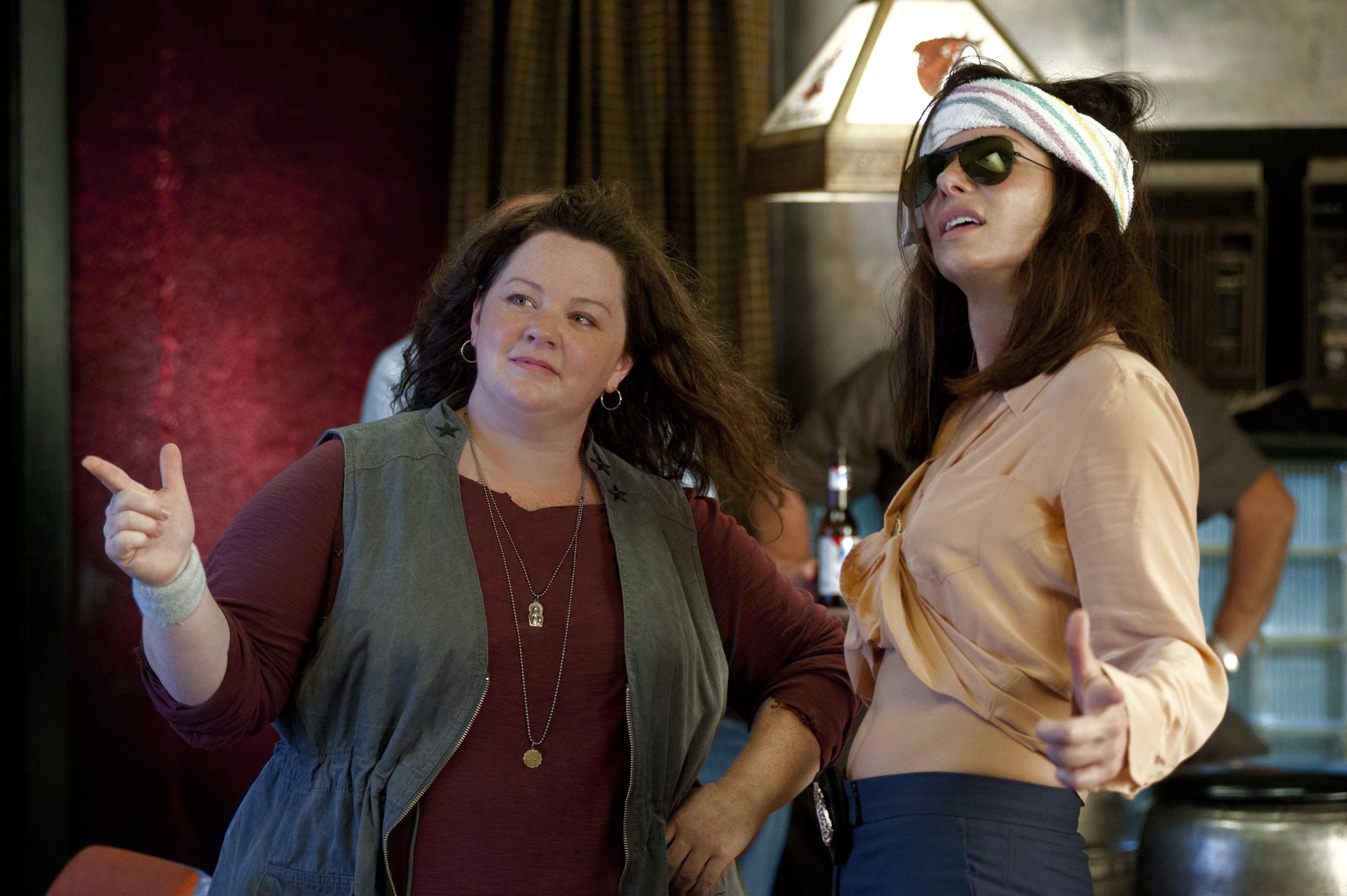
The Heat First things first: I hated Bridesmaids (2011). Even the BFF love fest between Maya Rudolph and Kristen Wiig couldn’t wash away the bad taste of another wolf pack in girl’s clothing. Dragging and dropping women into dude-ly storylines is at best wonky and at worst degrading, but The Heat finds an alternate route. Its women are unlikable; you don’t root for them, and you’re not hoping they become princesses because such horrifying awkwardness can only be redeemed by a prince. In Bridesmaids and Heat director Paul Feig’s universe, friendship saves the day. Sandra Bullock is Murtaugh to Melissa McCarthy’s Riggs, with tidy Bullock angling for a promotion and McCarthy driving a busted hoopty through Boston like she’s in Grand Theft Auto. Circumstances conspire to bring them together on a case, in one of many elements lifted from traditional buddy-cop storylines. But! The jokes are constant, pelting, and whiz by like so much gunfire. In one running gag, a low-rung villain’s worst insult is telling the women they look old — but neither character is bothered by it. It’s refreshing to see embarrassment humor, so beloved by chick flicks, get taken down a peg by female leads who don’t particularly care what anyone thinks of them. (1:57) (Sara Maria Vizcarrondo)

http://www.youtube.com/watch?v=3HUwmDqi2kA

Hey Bartender Hey, have you heard of this trendy thing called craft cocktails? Be warned, sophisticated San Francisco drinkers: Douglas Tirola’s upbeat documentary mentions our fair city in passing only a handful of times; instead, it concentrates on New York City’s relatively recent “cocktail revolution,” interviewing movers and (literal) shakers on the scene while giving a brief history of cocktails in America (again, with an emphasis on NYC). Hey Bartender‘s focal points are well-chosen studies in contrast: ex-Marine Scott — tattooed and scrupulously mustached — who’s working his way up the ranks at hipster lounge Employees Only; and middle-aged Steve, who runs a struggling blue-collar bar just outside the city and is slowly coming around to the idea of adding fancier drinks to his menu. Though dive-bar denizens may roll their eyes at some of Hey Bartender‘s more pretentious trappings (the movie doesn’t mention it, but drinks at Employees Only are in the $15-16 range), it does make the case that today’s superstar “mixologists” deserve just as much recognition as superstar restaurateurs. And the film has a point: can a Top Chef spinoff for bartenders be that far off? (1:32) Roxie. (Cheryl Eddy)

http://www.youtube.com/watch?v=rwDzRzqFaIE

Laurence Anyways Xavier Dolan’s latest is yet another gorgeously-designed love story; it fits perfectly alongside his extremely personal I Killed My Mother (2009) and the devastating Heartbeats (2010). Although some critics have suggested that this young director needs to hire an editor (Laurence Anyways clocks in at two hours and 48 minutes), I would argue that this epic, gender-bending love story needed to take its stylized time to achieve what most films never do: humanize a transgendered lead character. Melvil Poupaud (Raúl Ruiz’s favorite ingénue) is stunning as Laurence; as his longtime lover, Fred, Suzanne Clément performs with a guttural passion that should keep audiences glued to the screen. For those willing to accept a decade’s worth of hypnotic set and costume designs (the film spans 1989-1999); cryptic character development; a crew of campy castaways; and an electric, eclectic soundtrack (Depeche Mode, Celine Dion), Laurence Anyways is well worthy of its epic running time. Could this be the film that elevates Canada’s best-kept secret to being the leader of a post-gender film movement that’s just about to explode? (2:48) Metreon. (Jesse Hawthorne Ficks)

The Secret Disco Revolution Jamie Kaster’s Canadian documentary chronicles the rise and fall of the 70s booty shaking phenomenon — though what with the subsequent developments of house music, rave culture, et al., you might say disco never really went away. It’s got a goldmine of kitschy vintage clips, and plenty of enjoyable interviews with the scene’s erstwhile stars (Thelma Houston, “KC” Casey, etc.), producers, and observers. (The weirdest are scenes with the Village People, who today are staples on the corporate-party circuit and seem bizarrely eager to deny they were ever a subversively gay act.) Unfortunately, Kaster also burdens the film with sometimes overreaching arguments for disco’s sociopolitical radicalism, as mostly articulated by academic Alice Echols. And there’s a labored staged thread in which an arch narrator informs of us the behind-the-scenes mechanizations of three fictive “masterminds” (played by actors) who propagated disco to liberate gays, women and ethnic minorities. It’s a whimsical conceit that falls completely flat. As a result, there’s plenty of fun to be had here, but the conceptual missteps make this less than the definite disco doc it aims to be. (1:25) (Dennis Harvey)

20 Feet From Stardom Singing the praises of those otherwise neglected backup vocalists who put the soul into that Wall of Sound, brought heft to “Young Americans,” and lent real fury to “Gimme Shelter,” 20 Feet From Stardom is doing the rock ‘n’ roll true believer’s good work. Director Morgan Neville follows a handful of mainly female, mostly African American backing vocal legends, charts their skewed career trajectories as they rake in major credits and keep working long after one-hit wonders are forgotten (the Waters family) but fail to make their name known to the public (Merry Clayton), grasp Grammy approval yet somehow fail to follow through (Lisa Fischer), and keep narrowly missing the prize (Judith Hill) as label recording budgets shrivel and the tastes, technology, and the industry shift. Neville gives these industry pros and soulful survivors in a rocked-out, sample-heavy, DIY world their due on many levels, covering the low-coverage minis, Concert for Bangladesh high points, gossipy rumors, and sheer love for the blend that those intertwined voices achieve. One wishes the director had done more than simply touch in the backup successes out there, like Luther Vandross, and dug deeper to break down the reasons Fischer succumbed to the sophomore slump. But one can’t deny the passion in the voices he’s chosen to follow — and the righteous belief the Neville clearly has in his subjects, especially when, like Hill, they are ready to pick themselves up and carry on after being told they’re not “the Voice.” (1:30) (Kimberly Chun)

Unfinished Song A grumpy widower (Terrence Stamp) learns to enjoy life again by joining an unconventional choir group. Vanessa Redgrave, Gemma Arterton, and Christopher Eccleston round out the cast. (1:36)

http://www.youtube.com/watch?v=Wa5aasz5VXg

White House Down Ah, the mid-1990s: a time when two big-budget movies on the same subject were regularly released within months of each other (1997’s Volcano and Dante’s Peak; 1998’s Armageddon and Deep Impact). When a director named Roland Emmerich ascended into the blockbuster pantheon with Independence Day (1996), a film that’s best-remembered for that iconic shot of the White House exploding under alien death rays. The intervening years have seen Emmerich plunge ever-deeper into various flavors of disaster, and White House Down — which reignites that ’90s copycat-rivalry thing by riding the fumes of March’s Olympus Has Fallen — finds its boogeyman in domestic terrorism. It beings on a triumphant day for President James Sawyer (Jamie Foxx), who has just ordered all US troops removed from the Middle East — angering some high-up men in his administration, as well as some ex-military goons with axes of their own to grind. When the White House is compromised, a wannabe Secret Service agent (Channing Tatum), at the Prez’s house for a tour with his precocious daughter, shoulders one-man-army duties. Rockets are launched; there’s a high-speed limo chase across the White House lawn; we learn the truth about Marilyn and JFK; and thanks to evil genius Skip Tyler (Jimmi Simpson), “the greatest hack the world has ever seen” is about to unleash World War III. Yep, that’s right: 17 years after ID4‘s Jeff Goldblum broke into the alien mainframe, thereby saving the White House-less planet, Emmerich has decided that hackers are actually bad guys. It goes with White House Down‘s warning that the enemy is no longer an external threat, but something lurking right under your nose. Better start working out, America — and working on your one-liners. (2:17) (Cheryl Eddy)

HOT PINK LIST 2013: Faetopians

0

Once a year, a mystical gathering of artists, musicians, cultural visionaries, political agitators, sexual explorers, spiritual travelers, and just plain magickal beings gathers to share knowledge and intertwine in giant spontaneous puppy piles at Faetopia (www.faetopia.org). A collaboration between the radical faerie Feyboy Collective, the Sisters of Perpetual Indulgence, the Calamus Fellowship, Comfort and Joy Burning Man Camp, and more, the week-long extravaganza, now through Fri/28) presents everything from ritual drum circles and wild, neon-lit dance performances to workshops devoted to the history of gay porn and “Hastening the Post-Capitalist Post-Patriarchy through Post-Monogamous Practice.” Its a wonderfully woolly queer freak happening, a necessary complement to Pride’s relatively straight-laced affairs.

Some Faetopians: Pinkfeather, Dino, Kyle DeVries, Ian MacKinnon, Jon Ginoli, Javier Rocabado artwork, Miss Rahni, Justin Morrison


HOT PINK LIST 2013: COMICS GEEKS

0

It’s been a big year for queer comics. A movie based on a lesbian comic book, Blue is the Warmest Color, swept the top prizes at Cannes. The first textbook history of queer comics No Straight Lines was released by local hero Justin Hall, and snagged the Lambda Literary Award for Best Anthology. Heck, even Green Lantern went queer in “Earth Two,” and there was a gay wedding in Archie’s hometown, Riverdale. Here in the Bay, of course, comics have been queer for decades: from the pioneering work of Mary Wings and Lee Marrs in the 1970s to a lively slew of young upstarts, eager to expand the genre. Take, for example, this year’s packed “Batman on Robin” show, curated by Hall and Rick Worley, which imagined the Dynamic Duo in comic contortions that had many saying, “Shazam!”

Comics Geeks: Cartoonists: Agnes Czaja, Beth Dean, Christine Smith, Diego Gomez, Ed Luce, Jon Macy, Justin Hall, MariNaomi, Paige Braddock, Rick Worley.

(Photo of Diego Gomez by Sloan Kanter)

BONUS! Legendary groundbreaker Lee Marrs just sent her picture to us, and it may be our favorite yet:


Religious leaders celebrate Supreme Court decision upholding marriage equality

Photos by Rebecca Bowe

While proponents of the now-unenforceable Proposition 8 might have pointed to scripture to justify opposition to same-sex marriage, a group of religious leaders from throughout the Bay Area came together this afternoon to celebrate an historic Supreme Court ruling upholding marriage equality.

Clergy from a variety of faiths including Christianity, Judaism, Islam, Buddhism and the Church of Latter Day Saints gathered on the steps of Grace Cathedral on San Francisco’s Nob Hill on June 26 for a buoyant press conference held in celebration of the Supreme Court’s decision to strike down Prop. 8 and the Defense of Marriage Act (DOMA).

“The lies of separate but equal have no place on this holy hill,” said the Rev. Marc Handley Andrus of Episcopal Bishop of California. “Gay marriage is marriage, gay parents are parents, and all people are people.”

“For 20 years I’ve been marrying gay and lesbian couples, because in the eyes of God, that love and commitment was real, even when it wasn’t in the eyes of the state,” said Rabbi Michael Lerner of the Beyt Tikkun Synagogue. “We as religious people have to apologize to the gay community,” he added, for religious texts that gave opponents of gay marriage ammunition to advance an agenda of discrimination.

He added that the take-home message of the long fight for marriage equality is, “don’t be ‘realistic.’ Thank God the gay community vigorously fought for the right to be married – because they were not ‘realistic,’ the reality changed. Do not limit your vision to what the politicians and the media tell you is possible.” Their message caught on, he said, because “The theme of love touched people who had stony hearts in other respects.”

Mitch Mayne’s presence was especially significant.“I am an openly gay, active Mormon,” he explained to the crowd. “I am an optimist. I think you have to be, to be a gay Mormon,” he added, eliciting some chuckling from the crowd. “As a gay man, and as a Mormon, I believe Prop. 8 was one of the most un-Christlike things we have ever done as a religion,” Mayne stated. But he said he’d witnessed an unexpected outcome as a result. “Out of this troubling time has come a mighty change in heart from inside the Mormon community, with greater tolerance than ever before,” he said, adding that many Mormons had marched in solidary with gay and lesbian couples.

Rev. Kamal Hassan, pastor of Sojourner Truth Presbyterian in Richmond, said, “I am glad that DOMA was struck down, because it did not defend marriage – it exclusivized it, and defended heterosexual privilege.” But Hassan, like many other clergy members who spoke, seized on the Supreme Court’s decision striking down part of the Voting Rights Act the day before its ruling on same-sex marriage as yet another civil rights cause that needed to be fought.

“The work is not finished – it continues until the rights of all people are protected and defended,” he said. Referencing the famous quote by Dr. Martin Luther King that the arc of history is long but bends toward justice, Hassan said, “We’ve got to be some arc drivers. We should not be as patient as we’ve been so far. We have to push in order for these things to move forward.”

Still beating

27

cheryl@sfbg.com

FILM/LIT A few weeks before our scheduled interview, Laura Albert mails me copies of 2000’s Sarah and 2001’s The Heart is Deceitful Above All Things. Inscribed on Heart‘s title page is a note: “Thanks for being available to revelation.” The volumes are signed “Yours, LA and JT” — the latter, of course, referring to JT LeRoy, the identity under which Albert penned both books.

That secret’s been out since late 2005, and has been dissected over and over. It even inspired a Law and Order episode. LeRoy, and his fantastically tragic back story (just out of his teens, he’d survived drugs, homelessness, and prostitution en route to becoming the lit world’s hottest wunderkind), were Albert’s creations. She was the true author behind the best-sellers listed above, plus 2004’s Harold’s End, dozens of magazine articles, an early script for Gus Van Sant’s Elephant (2003), and numerous other works. (Meanwhile, the androgynous “JT” that had been appearing in public was actually the half-sister of Albert’s then-partner; she wrote her own tell-all in 2008.) On Albert’s website, there are tabs marked “Who is Laura Albert?” and “Who is JT LeRoy?” Both link to Albert’s biography.

Years have passed since l’affaire LeRoy, and Albert has moved through the experience in her own way. (Her business card lists her as “literary outlaw.”) Later this summer, Sarah will be reissued as an ebook, with a fairy tale-inspired cover by artist Matt Pipes. Albert also is working on her memoirs (though she doesn’t like to use the word “memoirs”), and tells me there’s a documentary forthcoming from Jeff Feuerzeig, who made 2005’s critically-acclaimed The Devil and Daniel Johnston. This weekend, Asia Argento’s 2004 adaptation of The Heart is Deceitful Above All Things screens as part of the Clay Theatre’s midnight-movie series, with Albert and producer Chris Hanley in person, plus Argento via Skype.

Sitting in her San Francisco kitchen, Albert eyes my tape recorder and admits she’d rather focus on the film, not JT — though it’s a topic that inevitably arises. Argento, Albert says, encountered Heart the way many LeRoy readers did, via word-of-mouth recommendation.

“She read the book and she didn’t know anything about JT. At the same time, a small publisher was putting out the book [in Italy], and they wanted to bring JT over,” Albert recalls. “It was a weird coincidence. They were putting on an event, and they wanted to get someone to read. They had contacted Asia, and she already knew about the book, and she wanted not only to do this event, but to make the movie. It’s funny because I thought Sarah would be the first [to become a film], because it was already optioned by Gus [Van Sant]. But Asia moved really fast. We went over to meet her, and I had turned down a lot of people. My feeling was, it’s my baby and I’m giving it up for adoption, and I saw that this was someone I could give my baby to.”

Argento, the daughter of famed Italian horror director Dario Argento, is best-known stateside as an actor; previous to Heart, her directing experience was limited to short films and 2000’s flamboyant Scarlet Diva. Once she decided to helm the movie, her decision to star as the free-spirited, needy, sometimes-cruel single mother of the story’s young protagonist was an obvious choice.

“I had concerns about that, how much she would take on the role, how much it would become her. It’s ironic, because I had given myself over completely to Jeremy, to JT, to Jeremiah,” Albert says. She pauses. “Did you see that French film, about the guy who assumes different characters?”

Holy Motors?”

“Yeah! It really was transformative to me. There’s a scene where someone asks [the main character], ‘Why are you still doing this?’, and he makes reference to the act of giving yourself over completely. And that was it. I gave myself over completely. I did not break character. You know how, in that movie, he’ll do anything? He’ll kill someone! He’s in it. Most people don’t know what that’s like. And that was it. I will never apologize,” she says, firmly. “We’re talking about art. Nobody was harmed in this, really. I didn’t really scribble that far outside the lines. Everything was labeled ‘fiction.'”

At her mention of an apology, I have to ask: does she feel like people demanded one?

“People like to give themselves a lot of credit for how vanguard they are. I can’t tell you how many people I’ve had tell me, ‘Warhol would have loved it!’ — including people who were close with Warhol,” she says. “I think it revealed more about other people and what they could accommodate, and what they put on the work, than it does about me. If you have a personal relationship with JT, then that’s a conversation between you and me. I put my email [in the books], and I really did have a connection with the fans because I grew up in the punk scene, and I wasn’t into hero worship. The problem was — psychologically — I wasn’t able to do that. It wasn’t like [adopts goofy voice], ‘Gee, how do I burst forth onto the literary scene? I know! I’ll create a little boy!’ No. It wasn’t like that.”

As we talk, Albert makes references to her own troubled youth: surviving abuse, living in a group home, being institutionalized. Amid the tumult of her teenage life, she would “call hotlines — I don’t know what I would talk about, but it was the only time I could feel. I would give myself over to another being, and it was always a boy. So when I hear people say, ‘I’m gonna do what you did,’ it’s like, good luck. For me it was created the way an oyster creates a pearl: out of irritation and suffering. It was an attempt to try to heal something. And it actually worked, and it did so for a lot of other people. The amazing thing is, now I can be available to people.”

We’re delving more into her work (“I didn’t do anything new — writers have always been using combinations of pseudonyms and identities,” she points out) when the doorbell rings; it’s a Comcast technician here to see about Albert’s Internet connection. We move to her office, which features a wall collaged with photos and several filing cabinets full of archives — material she’s letting Feuerzeig use in his documentary.

But it’s not a room completely given over to the past. It’s also where Albert works on her new projects (besides her memoirs, she’s writing screenplays — building off her experiences working on Deadwood with David Milch), and stashes new mementos, including a program from a recent Brazilian rock opera entitled JT, A Punk Rock Fairy Tale.

Before I leave, she gives me a copy of a New York Times article from 2010 entitled “Life, In the Way of Art;” its subjects include Joaquin Phoenix, still smarting from the backlash after his faux breakdown in I’m Still Here. The director of that film, Casey Affleck, cites a line from a Picasso quote that Albert emails to me in full the day after we speak: “We all know that art is not truth. Art is a lie that makes us realize truth, at least the truth that is given us to understand. The artist must know the manner whereby to convince others of the truthfulness of his lies.”

She’s just as frank over email as she is in person. “It’s OK with me if someone doesn’t like my writing. But they shouldn’t try to tell me how I’m obliged to present my work,” she writes. “When I talk about my personal background, I’m not attempting to somehow bestow legitimacy to what I’ve written — anyone should be able to do what I did. My life history doesn’t matter and isn’t being offered as any kind of excuse.”

I think back to something she said in her kitchen — a simple, powerful summation of a story that will never not be complicated. “JT was my lifeboat. You loved him? Well, I loved him more.” 

THE HEART IS DECEITFUL ABOVE ALL THINGS

Fri/28, midnight, $10

Clay

2261 Fillmore, SF

www.landmarktheatres.com


Supreme Court same-sex marriage decisions: DOMA invalidated, Prop 8 case dismissed, SF reacts [UPDATED]

27

Watch this space throughout the day for breaking news on the decision and reactions. Tonight there will be a celebration of the Court’s decisions at Castro and Market Streets at 6:30pm. (Join  the Guardian beforehand, 6-9 at the Pilsner in the castro, at its annual pre-Pride event.) 

DOMA INVALIDATED

The Supreme Court released its ruling this morning that the Defense of Marriage Act, which denies federal recognition of same-sex marriage, “is unconstitutional as a deprivation of the equal liberty of persons that is protected by the Fifth Amendment.”

“DOMA singles out a class of persons deemed by a State entitled to recognition and protection to enhance their own liberty,” according to the majority opinion. “DOMA’s principal effect is to identify a subset of state sanctioned marriages and make them unequal.” The Court voted 5-4, with Justice Kennedy, who wrote the majority opinion, as the decisive vote along the usual liberal/conservative lines. You can read the full opinion here

This means that same-sex marriages performed in states that have legalized such marriages will be recognized by federal law.  

PROP 8 DISMISSED ON STANDING

As for Hollingsworth v. Perry, the Prop 8 case, it was dismissed on standing, due to the fact that the State of California refused to defend the case that would uphold Prop 8 (which denied same-sex marriage).That meant private citizens were left to defend a state statute, which was unprecedented, and the Court refused to rule on those grounds.

We have never before upheld the standing of a private party to defend the constitutionality of a state statute when state officials have chosen not to. We decline to do so for the first time here,” the majority Court statement (which broke along the typical 5-4 line) said. That means there is no specific decision from the Court regarding Prop 8, and the previous ruling, by Judge Vaughan Walker and upheld by the Ninth Circuit Court, that invalidated Prop 8 as discriminatory, stands.

This may mean that same-sex marriages in California can resume as early as July.

You can read the full Prop 8 ruling here.

Scene this morrning at SF City Hall, with Mayor Ed Lee and Lt. Gov. Newsom. Photo by Dan Bernal.

[UPDATE] REACTIONS AT CITY HALL

Steven T. Jones reports from SF City Hall:

City Hall was totally packed at 7am when the US Supreme Court convened — tons of journalists, lots of couples, many signs in the crowd. Two screens were set up, one with a live blog from court chamber, the other with the CNN live feed. Huge cheers erupted at 7:11 when the decision was announced striking down DOMA and forcing the federal government to recognize the rights of same-sex married couples.  Then at 7:38, when the Prop 8 statement came down, the room went nuts. 

A moment later, an array of current and former city officials appeared at the top of the City Hall main staircase. Mayor Ed Lee and Lt. Gov. Gavin Newsom escorted a fragile Phyllis Lyon down the stairs — she, along with the late Del Martin, were the first same-sex couple to get legally married in California in 2004 — flanked by the rest of the city family, all with big smiles.

“Welcome to the people’s house of San Francisco,” Mayor Lee said, thanking the crowd “for sharing in this historic moment.”

“It feels good to have love triumph over ignorance,” he said.

At 7:44, City Attorney Dennis Herrera and Chief Deputy City Attorney Terry Stewart, who had been on the City Hall steps addressed reporters’ question on the legal details of the ruling, joined the crew to sustained applause as Lee recognized them. He then introduced Newsom, who in 2004 as San Francisco mayor allowed same-sex marriages to be performed, as “one person who used the power of this office to make history and show his love for the city.”

“San Francisco is not a city of dreamers, but a city of doers,” Newsom said. “Here we don’t just tolerate diversity, we celebrate our diversity.” He thanked Herrera and everyone who contributed to this moment. “It’s people with a true commitment to equality that brought us here.”

Newsom introduced Kate Kendall with the National Center for Lesbian Rights, who has led the coalition of groups that have push for marriage equality. She looked around the crowd and said, “Fuck you, Prop 8!”

The crowd roared, and she said that she had scanned the room for children, and promised to “put a dollar in the swear jar” if necessary. But she said that, “We have lived for too many years under that stigmatizing piece of crap.”

Then Herrera took the podium, turned to Newsom, and said, Now you can say, ‘Whether you like it or not!'” — a joking reference to Newsom’s same-sex marriage rallying cry, which some blamed for boosting the anti-same-sex marriage cause.

“We wouldn’t be here today if it wasn’t for Gavin Newsom’s leadership,” Herrera continued. ““I remember in 2004 when people were saying it was too fast, too soon, too much.”

But today, that long effort has been vindicated, Now, he said, “It’s about changing the hearts and minds of people and educating them.” He also pledged to continue the fight that began here in City Hall more than nine years ago: “We will not rest until we have marriage equality throughout this country.”

Gavin Newsom being interviewed inside City Hall. Photo by Steve Jones

Finally Stewart, who has argued cases related to San Francisco’s stand before both the US and California Supreme Courts, praised both the Prop. 8 and DOMA rulings and the precedents they set. “In the DOMA case decision, the Supreme Court expressed a stong equal protection philosophy…that will help legalize same sex marriage in other states.”

Three members of the Board of Supervisors were also invited by Kendell to address the huge City Hall crowd: Board President David Chiu and Sups. David Campos and Scott Wiener, the only two current supervisors who are gay.

Chiu noted that the bust of slain Sup. Harvey Milk is prominently positioned outside the Board Chambers, a reminder of the long struggle for gay rights that San Franciscans have led. “That work lives on today,” he said.

He added the hope that the work done here will ripple out of across the country because, he said, “As goes San Francisco, so goes California, so goes the rest of the country.”

Campos, an attorney who has long been in a committed relationship, said, “It’s a very emotional moment for those of us who are part of the LGBT community.” He said this Supreme Court ruling is the first time it has really acknowledged “that we are people and we have dignity,” and that the rulings sends a clear message to Congress that legislation like DOMA is unconstitionally discriminatory.

Wiener praised the resilience of the LGBT community, from the early days of enduring the AIDS crisis and fighting for federal support through the current campaign for marriage equality. And he cheered the fact that, “Those marriages that we see under the rotunda [in City Hall] will get a little more diverse.”

11:30 AM UPDATE: Style and substance

While Newsom strutted around like a proud peacock in front of City Hall — clearly the leading man in this epic story with the happy ending, much in demand by the television crews — Herrera and Stewart briefed various reporters on the details of the case that they had just won.

Gavin Newsom outside City Hall. Photo by Steve Jones.

“I wanted a merits ruling, but a standing ruling is a victory too,” Herrera told us, making the distinction between the court ruling that banning same-sex marriage is unconstitutional on the grounds of equal protection under the law — which it did not do — and the 5-4 ruling it did issue: that those who appealed the Ninth Circuit Court ruling invalidating Prop. 8 lack proper legal standing to do so.

The standing ruling leaves same-sex marriage opponents more wiggle room to argue that the ruling might only apply to the couples named in the suit, or in just the counties that took part, which also included Alameda and Los Angeles, positions they were already signaling in press statements.

But Herrera said that he would vigorously contest that kind of challenge, which he considers to be without merit, telling us, “The injunction is not limited in its scope.”

UPDATE: SFPD isn’t worried

Police Chief Greg Suhr, who attended the City Hall event, said the timing on the ruling during Pride Week couldn’t be better. “It’s nice that it all lined up for us,” he told us. “This town is going to rock ‘til the wheels come off.”

Asked whether he has any heightened security concerns about the Pride Parade in the wake of a ruling that is controversial to some, Suhr said that he’s not worried. He said SFPD is now fully staffed and all available personnel working this weekend, although he will try allow many of his gay and lesbian officers to join the celebration if they want.

“We’re going to police what’s likely to be the biggest party this city has ever seen,” Suhr said, adding that his policing philosophy is, “We plan for the worst and hope for the best.”


What’s hot in Siberia

0

arts@sfbg.com

THEATER Emerald green rooftops and gold domes enliven the skyline of Omsk, a provincial city and former Soviet industrial hub of roughly one million people, located at the intersection of two Siberian rivers: the wide, island-populated Irtysh and the smaller, swifter Om. The latter gave its name to the town, which grew from a fort established at the meeting point of the rivers in 1716, back when this was the disputed frontier of the expanding Russian empire.

But now it’s the last week of May 2013. The fort is long gone. In its place stands the Lighthouse, a large white hotel-cum–shopping mall festively crowned with neon Cyrillic lettering. Rounded at one end and peaked with towers, it drolly resembles a cruise ship in port. The sun is still out at 10 p.m., and a gusty wind rolling off the plains churns the warm air pleasantly.

Sleepy though this town seems by comparison with St. Petersburg, Moscow, or even Yekaterinburg — the three other stops on a four-city tour I joined last month, in conjunction with a US-Russia theater dialogue developed by the Center for International Theatre Development — Omsk turns out to be not so remote in many ways. For one thing, it’s a hotbed of theatrical activity at the moment, with the biennial Young Theaters of Russia Festival in full swing. Nor is the Russian empire entirely a thing of the past, as tonight’s provocation by a troupe from the former Yugoslav republic of Slovenia makes plain enough.

Damned be the Traitor of His Homeland! — a production of Ljubljana’s internationally renowned experimental company, Mladinsko Theatre — is a no-holds-barred attack on jingoism, xenophobia, and the false allegiances they promote, as well as on complacency in the face of recent history, government corruption, and social decay. Taking its title from the last verse of the former Yugoslav national anthem, it gleefully lobs profanity, insult, accusation, nudity, a flurry of gunshots, and lots of local dirt (dug up for the occasion) at its unsuspecting audience — who frequently find themselves unnaturally exposed and singled out under merciless house lights.

It begins quietly enough: its ten cast members onstage, reclining on the floor and clutching musical instruments, looking like a freshly slaughtered marching band — until the sound of breathing through a tuba begins a general stirring that quickly escalates into an instrumental movement titled, “Won’t Go Against My Brother.” Next, the cast introduces itself with ribald, pointed, self-effacing humor through their own imagined obituaries — each of which makes explicit reference to an imaginary production of “Hey, Slavs!” (in fact, the title of the Yugoslav anthem) directed by acclaimed Bosnian Croatian bad-boy director Oliver Frljic (in fact, the production’s own director).

Cycling through various loosely related scenes, all built from improvisations, Damned delivers its pleas and gibes with a potent combination of muscular staging, lively wit, intrepid honesty, and moments of wrenching beauty. It produced some walkouts the night we saw it — many more the night before, reportedly — but its themes were undeniably urgent and its manner both raw and sure. This was all before Edward Snowden went public with details of the NSA’s PRISM program or had arrived in Moscow from Hong Kong en route to some hoped-for political asylum abroad. But there was no denying the implications for any Americans in the audience as well.

Omsk has nine large municipally funded or federally funded theaters, leaving far behind most American cities of a comparable or even much larger size. And in short it, and the Festival, had much more to offer beyond this one highlight, even if not as explicitly provocative or political in nature. (Those curious to learn more should know that Chris White, artistic director of Mugwumpin and the other San Franciscan on the tour, has written a series of reports on HowlRound with many further details).

Highlights in Moscow included an exquisite production from leading director Dimitry Kymov (whose collaboration with Mikhail Baryshnikov, In Paris, came to Berkeley Rep last year). Based (like In Paris) on the work of famed Russian short story writer Ivan Bunin, Katya, Sonya, Polya, Galya, Vera, Olya, Tanya … is an original production crafting a series of oddball, sometimes grim love stories into a kind of high art twist on Grand Guignol.

Also utterly memorable was the best production of Hamlet I’d ever seen —staged in a ramshackle venue whose lobby was stuffed with a vaguely foul-smelling array of garage sale toys, Soviet kitsch, and other odds and ends, and whose stage was a small, low-ceilinged black box packed into the aisles with what appeared to be mainly teens. The theater and the production belong to famed Russian director and playwright Nikolay Kolyada. Somewhat infamous after his endorsement of Putin in the last elections (which points to one way in which Russian theater, offstage, can be nothing if not political), Kolyada delivers a decisive reading of Shakespeare’s play as a bald, barbaric parable of power — in an incredibly meticulous, distinct, and forceful style whose macabre wit brought to mind some weird admixture of Richard Foreman, Tim Burton, and Terry Gilliam. Whatever else it demonstrated, it showed the Bard’s play as utterly, repulsively, and compellingly contemporary — something too rarely accomplished in any language. *

Father’s day

0

arts@sfbg.com

LIT In late-1980s San Francisco, Steve Abbott hosted a gay writer’s workshop at his small apartment at the fabled corner of Haight and Ashbury. One fleeting but reliable occurrence was an appearance by Alysia, the daughter he’d raised since his wife died in a car accident years earlier.

Each week, the teenager stormed about just long enough so we could feel her wrath before slamming the bedroom door. It was funny, but also understandable: at that age, who wants their personal space regularly invaded by strangers? Let alone gay male adults, reinforcing your separation from the heterosexual family norm?

Steve was a significant presence in SF’s literary scene for nearly two decades, publishing his own adventuresome small-press books in various idioms (poems, essays, fiction). He edited small magazines including the influential Poetry Flash; was first to promote such edgy “postmodernist” voices as Kathy Acker and Dennis Cooper; and was an idiosyncratic cultural commentator for local weeklies (including the Bay Guardian). He was unfailingly generous with other fledgling writers, myself included.

He barely kept the rent paid via rote day jobs, while raising a child alone — an awkward match to the carefree gay community he joined upon moving to SF (and coming out) in 1974. As Alysia Abbott writes in her acclaimed new release Fairyland: A Memoir of My Father (W.W. Norton and Company, 352pp., $25.95), there were no role models then for gay single parents. Their very close but turbulent relationship amplified the clash between her often-peevish parental needs and his belated self-discovery in a sexual-artistic bohemia. They found balance as she found her own identity upon leaving for college. But then the AIDS epidemic swept both up in its devastation.

Abbott, now living in Boston with a husband and two children, answered questions in advance of two local appearances this week.

San Francisco Bay Guardian You had an unconventional childhood with an unconventional parent. Has that influenced your own parenting?

Alysia Abbott My father was raised in a strict Catholic household where family members rarely showed affection. He kept his feelings bottled up. By the time he had me, he wanted a completely different family experience, transparent and open. He often shared his romantic and professional woes, sometimes seeking my advice.

I absorbed a lot of my dad’s worry, and sometimes found myself in situations where I had to be more adult than I was ready to be. I want to be my true self with my children. But I also want to protect their innocence to some degree.

SFBG You’re frank about having been an “obnoxious” unhappy teenager. Are there things you or your father could have done differently? Was it a phase you just had to work through?

AA We were trying to create a life with a lot of setbacks, sharing a cramped one-bedroom in the Haight with little money or family help. My father was lonely, and trying to get sober just when I discovered drugs and alternative culture. We did our best under the circumstances. But as often as we clashed, there was a lot of love. This was a period we needed to go through.

SFBG Your father identified so strongly as a writer, but Fairyland doesn’t address how you became one yourself.

AA I’d always wanted to be a writer, or an artist. But after watching him struggle financially, I pursued steady-paycheck work in cushy corporate structures (which I now hate). I also didn’t know if I had his native talent, or could be as intellectually rigorous and pure. I always had our story to tell, but worried I wasn’t worthy of it. The idea of writing Fairyland and having it not meet my own expectations was unbearable. Now I realize perfectionism is the enemy of creativity. To succeed, you have to be willing to fail.

SFBG When Steve was facing mortality, he wrote that you’d probably better appreciate his writing after he’d passed on. What do you think about his literary legacy now?

AA I’m embarrassed to admit I really didn’t read my father’s books until ten years after he died. During his lifetime, the work’s weirdness, its attraction to transgressive figures and ideas threatened me. I accused him of not being a “real writer” because no one had heard of him and he didn’t make any “real money.” What a terrible thing for a daughter to say!

Researching for Fairyland, I came to respect his contributions and integrity. All the writers I know today have to be such master self-promoters. My father was almost embarrassingly naïve in this regard. That may be why few people know his work today. But he was so devoted to writing, and supporting writers that impressed him, even if that effort did nothing for his own career.

I now really love several of his poems and books, especially Lives of the Poets — but some still make me uncomfortable. I’m not sure if it’s because they aren’t good, or still too “out there” for me.

SFBG After so many years, how do you feel about returning to SF? Many of your father’s creative generation are dead. It’s a much yuppie-er burg.

AA San Francisco is very different from the city I knew in 1974, or even 1994. I’ve worried that those who remember the old San Francisco, or appreciate its history, are dwindling — they’ve died or been forced out by Ellis laws. But new residents are attracted by the city’s beauty just as we were. And though much better-heeled, these tech workers and professional types are also trying to reinvent culture, if with much greater odds of profit — and interest in profit.

ALYSIA ABBOTT

Wed/19, 7pm, free

City Lights Books

261 Columbus, SF

www.citylights.com


Thu/20, 6:30pm, free

San Francisco Public Library

100 Larkin, SF

www.sfpl.org

Lives less ordinary

0

arts@sfbg.com

FRAMELINE Each year Frameline’s program vividly reflects issues that of late have seemed most urgent in the LGBT community — for many years, for instance, there was an understandably overwhelming amount of films about AIDS. Most recently, the fights for gay marriage and trans rights have dominated many a dramatic and documentary selection.

It is sometimes nice, therefore, in the fray of pressing public debate and community activism to escape topicality and sink into the achievements and personalities of more distant queer-history eras. Several documentaries at Frameline37 offer just that, as they chronicle the lives and times of five extraordinary men (albeit one normally found in a dress and fright wig).

The most San Francisco-centric of them is Stephen Silha, Eric Slade, and Dawn Logsdon’s Big Joy: The Adventures of James Broughton, about “a golden secret of West Coast bohemia.” The late James Broughton was a poet, prankster, and experimental filmmaker who began making films in the late 1940s “to see what my dreams really looked like.” A significant figure in the pre-Beat San Francisco renaissance of avant-garde art, he won a prize at Cannes for 1953’s typically playful, hedonistic The Pleasure Garden, but declined the commercial directing career offered him — in fact he didn’t make another movie for 15 years, when free-love hymn The Bed became a counterculture smash.

Broughton married and had three children (including one with not-yet-famous local film critic Pauline Kael), but at age 61 found his soulmate in 26-year-old fellow director Joel Singer, thereafter devoting his life and work to celebrations of gay male sexuality. (Interviewed here, his ex-wife Susanna calls this turn of events “a very unwelcome incident from which I never recovered.”) The documentary provides a treasure trove of excerpts from a now little-seen body of cinematic work, as well as much archival footage of SF over the decades.

Bringing joy to a lot of people during his too-brief life was Glenn Milstead, the subject of Jeffrey Schwarz’s I Am Divine. A picked-on sissy fat kid, he blossomed upon discovering Baltimore’s gay underground — and starring in neighbor John Waters’ underground movies, made by and for the local “freak” scene they hung out in.

Yet even their early efforts found a following; when “Divine” appeared in SF to perform at one of the Cockettes’ midnight movie/theater happenings, he was greeted as a star. This was before his greatest roles for Waters, as the fearsome anti-heroines of Pink Flamingos (1972) and Female Trouble (1974), then the beleaguered hausfraus of Polyester (1981) and Hairspray (1988). Despite spending nearly his entire career in drag, he wanted to be thought of as a character actor, not a “transvestite” novelty. Sadly, he seemed on the verge of achieving that — having been signed to play an ongoing male role on Married … with Children — when he died of respiratory failure in 1988, at age 42.

A different kind of tragedy is chronicled in Clare Beaven and Nic Stacey’s British Codebreaker, about Alan Turing — perhaps the most brilliant mathematician of his era, who basically came up with the essential concept of the modern-day computer (in 1936!) He played a huge role in breaking the Nazi’s secret Enigma code, thus aiding an Allied victory. But instead of being treated as a national hero, he was convicted of “gross indecency” (i.e. gay sex) in 1952 and hounded by police until he committed suicide two years later. Half conventional documentary and half reenactment drama (with Ed Stoppard, playwright Tom’s son, as Turing), Codebreaker illustrates the cruel price even an upper-class genius could pay for his or her sexuality in the days before Gay Lib.

Two literary lions are remembered in the last of these historical bio-docs. Daniel Young’s Swiss Paul Bowles: The Cage Door is Always Open recalls the curious life of a successful American composer turned famous expat novelist. He and wife Jane Bowles moved to post-World War II Tangiers, where they entertained a parade of visiting artists — and, by all accounts, a succession of same-sex lovers. Clips from Bernardo Bertolucci’s underrated adaptation of Bowles’ literary masterwork The Sheltering Sky (1990) are here alongside input from acquaintances and observers including John Waters and Gore Vidal.

http://www.youtube.com/watch?v=INW6i6K1NmQ

The latter is the whole focus in Nicholas Wrathall’s Gore Vidal: The United States of Amnesia, and what could be better than that? Perhaps undervalued as a frequently very fine novelist because he was so prolific (and popular), he’s considered here primarily as a public intellectual — a term that seems positively antiquated in our climate of pundits and ranters — and fierce lifelong critic of American hypocrisy in all its forms, especially the political. He was a scold (or a “correctionist,” as he put it), albeit of the wittiest, most clear-headed and informed type. Among myriad highlights here are seeing him on TV reduce friend-rival Norman Mailer to sputtering fury, shred the insufferable right-wing toady William F. Buckley, and make poor Jerry Brown squirm under his effortless tongue-lashing.

Endlessly quotable (“We’ve had bad Presidents in the past but we’ve never had a goddam fool,” he said of George W. Bush), obstinately “out” from an early age if never very PC in his views (“Sex destroys relationships … I’m devoted to promiscuity”), Vidal is aptly appreciated here as “a thorn in the American Establishment, of which by birth he is a charter member.” There will never be anyone quite like him — but we sure could use some who are at least in the general ballpark. *

FRAMELINE37

June 20-30, various venues

www.frameline.org

The Selector

0

WEDNESDAY 19

Camera Obscura

“If you want me to leave, then I’ll go/If you want me to say, let it show/Do you want me to leave, let me know,” pleads Scottish indie pop group Camera Obscura on heartstruck ballad “Fifth in Line to the Throne” off the group’s newest full-length, Desire Lines. It’s the Glasgow five-piece’s first new record in four years (the most recent being My Maudlin Career). And yes, the new one maintains the band’s 17-year-strong streak of stunning, wistful ballads, laced gently through with heartfelt vocal musings. Much like that other lauded Glasgow-based gentle indie pop act, Belle and Sebastian, Camera Obscura has mastered the art of the melancholy pop song, seeped in lovely whispers and lilting moans, gentle strings, soft piano keys, drumming pitter-patters, the works. But we love them for it, like those weepy torch songs of yesteryear. The show gives you the chance to cry in public. Want you to leave? No, we’ll let it show. (Emily Savage)

With Photo Ops

8pm, $25

Regency Ballroom

1290 Sutter, SF

(415) 673-5716

www.regencyballroom.com


Dogcatcher

If Dogcatcher was a brand of alcohol, it’d be Jameson — it’s that smooth. By crafting tight rhythms and jazzy guitar riffs, the San Jose-based trio provides an almost flawless fusion of jazz and rock. And its simple and soft vocals create an intimate experience on stage. Dogcatcher’s songs are well-constructed and the delivery creates a calmer version of traditional jazz. Song “Be Easy” off its most recent album It’s Easy reflects this: “Because tonight you know, it’s all about the sound/Just be easy,” sings Andrew Heine in a lazily seductive voice that makes you believe that for him, it really is just that simple (Hillary Smith)

With the Sam Chase, the Gallery

9pm, $8

Bottom of the Hill

1233 17th St., SF

(415) 861-1615

www.bottomofthehill.com


THURSDAY 20

Fresh Meat Festival

With “Trailblazers,” the 12th annual Fresh Meat Festival — a celebration of transgender and queer performance — is paying tribute to musicians, dancers, and theater people who hoe their own rows. This year they all do it in our own neighborhoods. The dancers, AXIS Dance Company, Barbary Coast Cloggers, Allan Frias’ Mind over Matter and Sean Dorsey Dance and Las Bomberas de la Bahia couldn’t be more different from each other. What they share, beyond working in the Bay Area, is a clear vision of what they want to do and the skill and perseverance to stick to it. Very simply, they have become tops in their field. To see them now in a sort of meta context of their sexual orientation, is a joyous opportunity to add another notch to their trailblazers spirit. (Rita Felciano)

Through Sat/22, 8pm, $15–$25

Z Space

450 Florida, SF

www.brownpapertickets.com


The Ape Woman: A Rock Opera

Step right up and view Dark Porch Theatre’s presentation of The Ape Woman, May van Oskan’s rock opera exploring the life of one Julia Pastrana, an indigenous Mexican woman who achieved fame (infamy?) on the 19th century circus sideshow circuit. Sometimes also dubbed “the Bear Woman,” the diminutive Pastrana suffered from hypertrichosis — resulting in thick, dark hair all over her face and body, a trait that made her a valuable prize for unscrupulous promoters. With a set styled like a Victorian sideshow tent, van Oskan’s opera tells Pastrana’s fascinating live story via 14 original songs, backed up by a seven-piece ensemble. (Cheryl Eddy)

Opens tonight, 8pm

Runs Thu-Sat and June 26, 8pm; Sun/23, 4pm, through June 29, $15–$30

Exit Studio

156 Eddy, SF

www.theapewoman.com


The Bottle Kids

I once saw Bottle Kids frontperson Annie Ulukou at the Stork Club with nothing but a ukulele. This could have gone any which way, but instead of succumbing to the soft, lullaby tone inherent to the miniature instrument, Annie amplified and distorted its sound to backup the heartbreak and pure aggression of her voice. This is indicative of the Bottle Kids sound as a whole. Their shows can be as personal, subtle, soulful and as easy to access as a ukulele in a small room while still sucker-punching you square in the gut. Check this band out while it’s still free to see it live. (Ilan Moskowitz)

9:30pm, free

Grant and Green Saloon

1371 Grant, San Francisco

(415) 693-9565

www.grantandgreensaloon.com


FRIDAY 21

PANSY

Why does nightlife hold us in its timeless spell? And, perhaps more topical, will the nostalgia for the necessary craziness and joy of ’90s nightlife ever let us go? Evan Johnson, one of our most intriguing drag performers (beloved alter-ego Martha T. Lipton, the Failed Actress, is a hoot) goes deeper in solo stage show Pansy, conceived with Ben Randle. His character, Michael, discovers a time capsule full of VHS tapes, cassettes, and flyers documenting ’90s gay club kid Peter Pansy, and finds shivery parallels with his own life emerging. “I want to address the ‘shadows’ of AIDS and queer history and Pride… That time period, 1993-95, became the vehicle for me to address the vital nostalgia and escape of the San Francisco queer fantasy,” he says. Johnson’s been hosting lively Q&As with legendary nightlife biggies after each performance, including Pansy Division’s Jon Ginoli, Dan Nicoletta, Alvin Orloff, and Sister Roma. (Marke B.)

Through June 29th, $10-$15

New Conservatory Theatre

25 Van Ness, SF

(415) 861-8972

www.nctcsf.org


SATURDAY 22

San Francisco Bicycle Music Festival

First of all, can we just enjoy this awesome WTF moment? A music festival. Powered by bicycle pedaling. Even in its seventh year, SF’s annual Bicycle Music Festival is still a wonder to locals. It offers the chance to listen to great music by folk band Laurie Lewis and the Righthands, Bill McKibben, Justin Ancheta Band, Manicato, and more, in a beautiful setting for free. In fact, it’s in three beautiful settings, because the event is packed up and deployed throughout Golden Gate Park. The event is known to draw some crazies, the cool kind who perform synchronized dances or twirl around on cycles while playing the trumpet — so be warned. It is definitely worth checking out, particularly if you’re a bike enthusiast interested in meeting fellow cyclists, or just a live music fan. And if the bicycle-powered music bit doesn’t have the same amazeballs effect on you, there will also be hand-cranked ice cream and smoothies made from the same bike power. (Smith )

Noon-5pm, free

Golden Gate Park

Pioneer Log Cabin Meadow to Stow Lake Drive at JFK Drive, SF

bicyclemusicfestival.com


Grandpa Fest

You don’t know Grindcore Grandpa? Hmm, how to explain to this. Basically, he’s the stoic elder gent who shows up at tons of hardcore and underground punk shows, lives for grind, and has a Lack of Interest shirt with his own face on it (as such, he’s more known as Grandpa of Interest). He’s turning 86, and that’s a big deal, so the Gilman is hosting Grandpa Fest and bringing in some of his favorite acts, legends of the scene including experimental Man is the Bastard offshoot Bastard Noise, and sludge-master Noothgrush, along with Stapled Shut, To the Point, Connoisseur, and Happy Pill Trauma. If you know what’s good for you, you’ll honor the man with a dive in the pit at breakneck speed. (Savage)

7pm, $10–$12

924 Gilman, Berk.

www.924gilman.org


Fete de la Musique

“The music everywhere and the concert nowhere,” declared French composer Maurice Fleuret in 1981. And then e went on to launch “Fete de la Musique” on the summer solstice of 1982, slyly celebrating that pagan holiday by bringing the French population out into the streets to play all the music they could. Soon the festival spread, and became a French tradition. Now, San Francisco’s Alliance Francaise is reviving the tradition with a roisterous day full of bands (Rue 66, Horse Horse Tiger Tiger, Crash Landings, Kiwi Time, more), drum circles, guitarists, and more — plus a few bars stocked with great wine, natch, to keep us in the spirit — on three floors. “Enjoy some Canadian music and food as well,” the Alliance promises, “as we welcome our Quebec cousins to celebrate their national holiday, the Fête de la Saint-Jean Baptiste.” French sounds all round! (Marke B.)

2pm-8pm, free

Alliance Française de San Francisco

1345 Bush, SF

fetedelamusiquesanfrancisco.wordpress.com


SUNDAY 23

City Lights at 60

Bookstore, publishing house, Beat writers hub, San Francisco institution. City Lights, founded by poet Lawrence Ferlinghetti and Peter D. Martin in 1953 (and now co-owned by Ferlinghetti and Nancy Peters), has meant a great many things to several generations of San Franciscans and tourists that flock to its North Beach storefront. It’s published important tomes, hosted readings and acoustic concerts, political conversations and book release celebrations. Just this past year saw a Pussy Riot gathering, Richard Hell reading, and a Sister Spit anthology release party. In celebrating six decades of life (that’s right, City Lights is officially 60 years young), the bookstore will host “City Lights at 60” lectures and readings through the rest of the year (“Howl Legacy: The Continuing Battle for Free Expression,” July 14, “Women of the Beat Generation,” Nov. 19), and an ongoing “Sundays in Jack Kerouac Alley” series. It all kicks off with the official birthday party today at the shop. The fête includes flash readings, archival footage, store discounts, and a live performance by the Latin Jazz Youth Ensemble of San Francisco. (Savage)

2-5pm, free

City Lights

261 Columbus, SF

(415) 863-2020

www.citylights.com


TUESDAY 25

Tyler Bryant and the Shakedown

Listening to Tyler Bryant, I get the sense that music was his first love. And even though he sings, “take my hand/take my heart/now honey, my super lady,” in the song “Lipstick Wonder Woman,” (which, conceivably, is about a human woman) I still believe that his most sultry seductress is the raw power and electricity present in his songs. His Nashville-based group makes authentic rock’n’roll that’s not reliant on over-reverbed guitar tones or a few simple fuzz-laden chords. Bryant can play, and his songs overwhelming reflect this. Reminiscent of the Black Keys, Bryant’s vocals are filled with soul, and the energetic beats anchoring his songs beg you to dance. (Smith)

With Girls and Boys

9pm, $15

Brick and Mortar Music Hall

1710 Mission, SF

(415) 371-1631

www.brickandmortarmusic.com


The Guardian listings deadline is two weeks prior to our Wednesday publication date. To submit an item for consideration, please include the title of the event, a brief description of the event, date and time, venue name, street address (listing cross streets only isn’t sufficient), city, telephone number readers can call for more information, telephone number for media, and admission costs. Send information to Listings, the Guardian, 225 Bush, 17th Flr., SF, CA 94105; or e-mail (paste press release into e-mail body — no attachments, please) to listings@sfbg.com. Digital photos may be submitted in jpeg format; the image must be at least 240 dpi and four inches by six inches in size. We regret we cannot accept listings over the phone.

The end of an era, but not of a legacy

47

Tim Redmond has a big heart. He cares deeply about this city and he cared deeply about this newspaper. But last Thursday was Tim’s last day at the Bay Guardian, the place where he worked for the bulk of the past three decades. In typical fashion, he stuck to his principles to the end.

The Guardian is not as economically healthy as it once was, and 2013 has not been kind to the paper. Revenues are down and many issues lose money, a trend that threatens our mission if left unchecked. During the past month, Guardian management had been contemplating some painful but necessary changes that included layoffs. Tim participated in these discussions, but in the end he chose to resign rather than downsize a staff he loved like family.

I understand Tim’s decision, but believe it was shortsighted. During the past year and a half, the Guardian’s two sister papers — the San Francisco Examiner and SF Weekly — have undergone similar restructuring, which included layoffs. The goal was not to extract obscene profits — a mission I wouldn’t support even if it were still possible in 2013 — but rather to ensure both papers’ survival and recovery. It was an unpleasant process, and one that Tim could not abide.

But today, the Examiner and Weekly are both significantly healthier than they used to be. The Examiner is no longer the mouthpiece of right-wing buffoons, and in recent months has expanded its Peninsula coverage and enlarged its editorial staff. And the Weekly boasts significantly more new coverage, listings and advertising than it did just six months ago.

I want the Guardian’s future as a progressive voice to be similarly assured. So now, 32 years after selling my first freelance news article to the paper — a brief about BART’s effort to evict the Ashby Flea Market — I find myself replacing Tim as publisher. Longtime Managing Editor Marke Bieschke, aka Marke B., is filling his shoes as interim editor.

I know some Guardian readers assume that this means the end of progressive journalism in the paper. Please let me assure you that will not occur. I have spent the bulk of my career editing investigative newsweeklies and have no intention of going down in history as the guy who dumbed-down the Guardian.

The very night before Tim told me he was leaving, he presided over a packed forum on the topic of economic dislocation in San Francisco. At the height of a tech boom that has inflated rents and led to a wave of migration and evictions, it’s hard to imagine few other topics of greater importance. Tim and the Guardian have reported extensively on this issue in the year since the paper was acquired by the San Francisco Print Media Company. Of course, the Guardian was already writing about evictions long before Tim’s predecessor assigned me to write that 1981 article about the flea market.

Under Tim’s successor, that emphasis will not change.