Healthcare

Care clash

13

The first week in April was a rough time for Connie Salguero. The Filipina nursing assistant, who says she would’ve been eligible to retire in two years, reported to her shift at the University of California San Francisco medical center at Mt. Zion on April 1 — and was told she was laid off. Two days after that, she was forced out of her home through an eviction, but fortuitously met an elderly Filipina woman who said Salguero could stay with her until she gets back on her feet.

“This manager said to me, Connie, come here, let’s talk,” and delivered the bad news, Salgeuro recounted, getting a little misty-eyed. Two other Filipina hospital assistants in her unit met with the same fate that day, she said.

“I’m trying to find a job,” Salguero said. “It’s very hard. But I will survive.” She projected a sense of resolve despite the whirlwind of sudden stress, which seemed fitting for someone whose job entailed feeding, bathing, and assisting up to ten bedridden patients at a time, many of them suffering from cancer.

Salguero said management told her the layoffs were necessary because of the most recent wave of federal budget cuts. But Cristal Java, lead organizer for UC patient care technical workers’ union, AFSCME 3299, interjected during an interview with the Bay Guardian to refute that explanation, calling it “total crap. They don’t want to tell workers the truth,” Java said, “which is that the hospitals are extremely profitable.”

UCSF ELIMINATES 300 POSITIONS

Salguero is one of about 25 UCSF certified nursing assistants whose recent layoffs prompted AFSCME to register a formal complaint with the Public Employee Relations Board, an agency that mediates labor disputes. The CNA layoffs hit in March and early April as part of a raft of cutbacks that eliminated a total of 300 full-time equivalent positions. Some of those positions were unfilled while other staffers were reassigned elsewhere or had their hours cut; a total of 75 individuals were laid off.

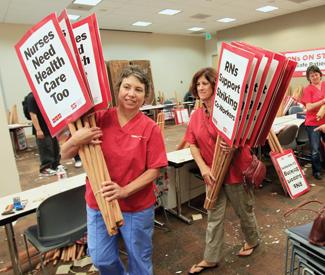
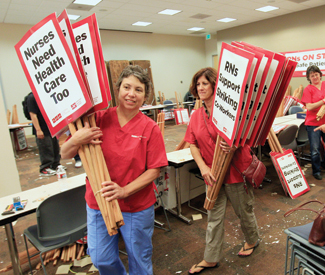
The cuts prompted union representatives to organize a protest at UCSF’s Parnassus Campus April 4, with San Francisco Sup. John Avalos and California Sen. Leland Yee turning out in support of the workers. Salguero was there too, waving a sign, and she wound up telling her story for an international broadcast by a Filipino news station. Things took a dramatic turn when police arrived on the scene, and Union President Kathryn Lybarger and some others were escorted off the premises in handcuffs.

Asked to explain the rationale behind the layoffs, UCSF spokesperson Karin Rush-Monroe responded, “We evaluated the impact of the Affordable Care Act, expected reductions in Medicare, MediCal and private insurance reimbursements,” as well as employee benefits and rising costs in drugs and medical supplies, and ultimately decided on a 4 percent labor budget cut. “We must make a ‘course correction’ if we are to maintain our resources to care for our patients,” Rush-Monroe said.

But the staffing cuts hit just weeks after AFSCME published a blistering report, titled “A Question of Priorities,” charging that UC has prioritized profit margins at its medical centers since 2009 while needlessly eliminating frontline staff positions, all to the detriment of patient care.

“It feels very much like they’re chasing down the Wall Street model of business,” Randall Johnson, an MRI technologist at UCSF Parnassus Campus who is active with Local 3299, told the Guardian. “We’re pressed to move faster and faster and faster. It’s more about profit than it is about patient care.”

Steve Montiel, spokesperson for UC Office of the President, told us that UCSF is “consistently ranked as one of the top hospitals in the country by U.S. News and World Report,” and pointed out that the AFSCME report coincided with an ongoing contract dispute concerning patient care technical workers, which may lead to a strike authorization in the next few weeks.

DANGEROUSLY LOW STAFFING LEVELS?

Billed as a “whistleblower report,” AFSCME’s 40-page publication portrays an internal environment throughout UC medical centers in which staffers — particularly frontline workers — are exhausted, overburdened, and dangerously likely to make mistakes.

Peppered with anecdotal horror stories describing things like dried blood observed on operating room tables at facilities where custodial staffing was cut to a bare minimum, or an incident in which a mentally altered patient was found on a window sill at a medical facility where harrowed nursing assistants’ attention was divided too many ways, the report portrays an unsafe environment that seems out of sync with the system’s reportedly healthy earnings derived from patient care.

“Bring it up at bargaining, and you get told to kick rocks,” said union spokesperson Todd Stenhouse. AFSCME has called upon state agencies and lawmakers to investigate UC policies on “cutting costs, reducing staff, and maximizing revenue.”

“We’ve been getting lots of reports about short staffing, and no coverage for breaks,” said Tim Thrush, a diagnostic sonographer who works with patients experiencing complications in pregnancy, and has worked at UCSF for years. “If you get a break or a lunch, it seems to be rare — even though it’s state law.” Thrush added. “It looks to us … that UC’s response to us raising concerns … is to say, OK well then let’s make it worse. Let’s lay off a whole bunch of people.

“It’s been very disappointing,” he said, “and it’s getting to be kind of scary.”

The report emphasizes California Department of Public Health findings of violations relating to bedsores from 2008 to 2012. The sores can occur if a patient stays in one position for too long, causing reduced blood flow and damage to skin tissue, and have been linked to infection.

Among those affected by the layoffs were “lift and turn team” members, including care workers tasked with turning immobilized patients to prevent bedsores.

Ironically, Rush-Monroe, the UCSF spokesperson, noted in response to a Guardian query that a $300,000 “incentive pay” bonus CEO Mark Laret received in 2011 was based on multiple “clinical improvement goals” that had to be satisfied in order to qualify for the 2011 compensation increase. One of these targets was a reduction in the number of hospital-acquired bedsores.

While the union report points to rising instances of bedsores, and the UCSF administration claims they were reduced to the extent that the CEO was monetarily rewarded for the accomplishment, a quick look at scores on hospital ranking website California Hospital Compare showed that pressure sore rankings at UCSF are almost exactly even with the statewide average.

Meanwhile, hospital rankings of patient safety indicators on Health Grades, an online consumer ranking website, didn’t reflect any dramatic differences between patient safety scores at UCSF, CPMC or Kaiser Permanente.

QUESTIONS RAISED

In the midst of these staffing cuts, AFSCME charges, the $6.9 billion system has enjoyed robust finances, with UCSF earning $100 million in net revenue last year. Between 2009 to 2012, management positions increased by 38 percent system-wide, while payroll costs for managers grew by 50 percent, with an additional $100 million a year allocated to administrative staffing.

According to a 2013-14 budgetary report prepared at the UC level, the system’s network of public universities have suffered deep financial cuts while its five medical centers “have continued to flourish and grow,” and “enjoy robust earnings.”

A revenue breakdown in the UC budget report shows that 62 percent of medical center earnings system-wide were derived from private health care plan reimbursements, while about a third came from Medicare and MediCal, funded by the federal and state government.

Meanwhile, ASCFME’s report has raised eyebrows in the California Senate. Sen. Ed Hernandez, who represents part of Los Angeles County and chairs the Senate Health Committee, “has expressed an interest in looking at it further,” according to committee consultant Vincent Marchand. “We may decide to call a hearing” sometime in May to see if further action is warranted, he added.

Sen. Yee lambasted the UC system for what he called “blatant disregard for the working staff.” Yee said the layoffs raised concerns about the quality of patient care, saying, “How do you lay off 300 individuals and think that it’s not going to compromise patient care?”

Yee added that he thought the UC budget ought to be scrutinized when it goes before the Senate. “Although the Constitution gives the UCs of California tremendous autonomy via the Board of Regents, ultimately we in the Legislature still allocate dollars … so there is a legislative and moral responsibility that we need to exercise,” he said. “Are the dollars within UC being used appropriately to take care of patients and in ensuring their safety?”

CONSTRUCTION, COMPENSATION AND VIPS

In early 2015, UCSF will open its new Mission Bay complex, a 289-bed facility featuring a children’s hospital with an urgent/emergency care unit and an adult care unit for cancer patients. The estimated price tag for the project is about $1.5 billion, and construction costs associated the project were referenced in an Oct. 12 letter Laret, UCSF’s CEO, issued to hospital staff announcing the pending staffing cuts.

Thrush questions decisions made at the highest administrative levels. Laret is “eliminating 300 jobs, and we’re opening a new facility, and he’s getting a $300,000 bonus,” he said, referring to a “retention bonus” expected to be awarded this year, which could be followed by a $400,000 bonus in 2014. “Why is he getting a huge bonus if we’re having to lay off so much staff?”

With a total compensation of around $1.2 million in 2011, Laret’s salary seems excessive in comparison with that of frontline workers — and it is. At the same time, it seems to be within the realm of a CEO of a major medical facility, a quick Internet search reveals.

ACSFME’s report targets Laret specifically, saying he repeatedly emphasized to hospital staff, “When you see patients, you should see dollar signs.” Johnson, the MRI technician, told the Guardian he heard Laret make this statement years ago, when he first came on as CEO. “I know that some physicians were outraged by it,” he said. “I heard that the physicians told him to stop, and he stopped saying it.” UCSF did not respond to Guardian requests for a comment on this allegation.

The report also focuses on a practice of so-called “VIPs” — patients connected with the UC Regents or other influential persons — receiving preferential care. “I got called in on a Sunday to take care of a celebrity, because they had a headache,” said Johnson. “I’ve seen patients have to be on hold so we can scan the [VIPs]. They definitely get preference. I’ve been told, if one of those VIPs comes in, we have to get them on the scanner.” UCSF didn’t respond to Guardian questions concerning VIP patient treatment, either.

LABOR DISPUTE

Montiel, the media relations director for the UC system, responded to a Guardian query with a wholesale rejection of the detailed 40-page report, without directly addressing any of the allegations. Instead, he said the whole controversy arose from a labor rift over pension reform.

“These claims by AFSCME coincide with a bargaining impasse, and the scheduling of a strike vote by its patient care technical workers,” Montiel wrote in an email. “Quality of care is not the issue. The real issue is pension reform. AFSCME has resisted pension reforms that eight unions representing 14 other UC bargaining units have agreed to. The reforms also apply to UC faculty and staff not in unions.”

AFSCME recently announced that its membership would begin voting on April 30 over whether to authorize a strike, following months of stalled negotiations over a contract that expired last September. Stenhouse, the union spokesperson, called it “the impasse of impasses” yet suggested to the Guardian that the strike authorization vote was a side issue from the concerns raised in the whistleblower report. The workers are there to “provide patient care,” he told the Guardian. “They’re not making Buicks.”

“This report is about something much bigger than our members’ livelihoods,” Lybarger stated when the report was released. “It’s about whether the UC is prioritizing quality care for the millions of Californians who put their lives in our hands.”
Check, please

44

steve@sfbg.com

San Francisco restaurants that have been cheating their customers and employees — charging diners for city-required healthcare coverage that they aren’t fully providing to workers — will finally be exposed in the coming weeks, with some notable names in foodie circles among the likely culprits.

City Attorney Dennis Herrera is working on settlements with dozens of restaurants that responded to his investigation and partial amnesty offer, which had an April 10 deadline. His effort augments the complaint-driven enforcement actions by the city’s Office of Labor Standards Enforcement, which has collected millions of dollars for thousands of employees of negligent local businesses in recent years.

At issue is the Healthcare Security Ordinance, the landmark 2008 law authored by then-Sup. Tom Ammiano that requires San Francisco businesses to provide a minimal level of healthcare benefits to their workers. Businesses are also required to report spending and surcharge figures to the OLSE annually, with the next report due April 30.

Last year’s data show celebrity chef Michael Mina’s Mina Group LLC — which includes the restaurants Michael Mina, RN74, Bourbon Steak, and Clock Bar — to be the top violator, collecting $539,806 in surcharges from customers and spending just $211,809 on employee healthcare.

Herrera used that list to ask more than 70 businesses to show they are in compliance with the law or reach discounted settlements now to avoid punitive fines or criminal charges later, and Herrera told us he received 60 responses and had his inquiry snubbed by fewer than a dozen.

“It’s too early to talk about how large a recovery we’ll be getting for workers, but I’m pleased with the response rate,” Herrera told us. He refused to estimate how many of the respondents were found to be in violation, but in an April 11 message to reporters covering the issue, his spokesperson Matt Dorsey wrote, “Based on our investigation so far, we anticipate that the majority of these establishments will be required to pay money to compensate their workers.”

WHAT THE FIGURES SHOW

The Guardian contacted many of the restaurants that topped the OLSE list. Some wouldn’t respond, some said they’ve changed their policies since the controversy erupted, and some wouldn’t talk until after a settlement is announced — including the Mina Group. That seems to indicate they’re about to pay for past violations.

Nicole Kraft, who handles public relations for the Mina Group, responded to Guardian inquires by writing, “I wanted to let you know that Mina Group will soon be releasing a joint statement with the City Attorney’s office, which should answer many of your questions. We’ll be sure to send it your way ASAP.” [UPDATE 4/29: Mina Group settled its case for $83,617.]

Sources in the City Attorney’s Office say settlements with as many as 10 restaurants that admit clear violations of the HCSO could be announced in the next week or two, while another 10 or so have provided data showing they are not in violation. The rest are more complicated and could take weeks or months of investigations, which are being led by Deputy City Attorney Sarah Eisenberg.

“There are going to be some that are given a clean bill of health,” Herrera told us. Herrera also told us that his investigation is just getting started and that it will look at businesses that haven’t made required annual reports to the OLSE. “When we get to a place where we’re announcing settlements, we’ll have more to say,” he said when asked for details and dimensions of his investigation.

GGRA Executive Director Rob Black has maintained that the OLSE figures don’t accurately reflect whether businesses are in compliance because the reporting requirements are confusing. GGRA held a compliance workshop on April 17, and Black told us about 40 restaurateurs attended.

“It was very informative and we got really good feedback from the restaurants,” Black told us. “We had people saying, ‘knowing what I know now, we should redo my 2011 form because I did it wrong.”

Black was initially critical of Herrera’s focus on the restaurant industry, but told us last week, “He made a commitment that the process would be efficient and fair, and he’s lived up to that so far….I still believe that the majority [of violators] didn’t have a mal-intent…Many people on the list that was reported have done nothing wrong.”

Cheesecake Factory — which was seventh on last year’s OLSE list, allegedly taking in $159,242 more in surcharges than it spent on employee health care — insists that it is in compliance and expects the City Attorney’s Office to confirm that.

“We believe the City Attorney’s initial review was erroneous,” Richard J. Frings, the company’s vice president of compensation and benefits, told us. “We are in full compliance with HCSO. Our healthcare costs in San Francisco have far exceeded the surcharge that we have collected. Once the City Attorney’s office has an opportunity to review our filings, we believe this matter will be closed without any further action.” He refused to provide figures to support the assertions.

THE HSA PROBLEM

Most of the restaurants that have been accused of stiffing employees use health savings accounts, which health officials say is a far worse option than private health insurance or the city’s Healthy San Francisco plan, which was created in conjunction with HCSO. Federal law bars cities from prescribing how health benefits are delivered.

San Francisco’s restaurant industry has always been hostile to the HCSO’s employer mandate, with the Golden Gate Restaurant Association unsuccessfully challenging the law all the way to the US Supreme Court. Controversy then erupted in 2011 with revelations (first in the Wall Street Journal, followed up by local media outlets) that some of the city’s most high-profile restaurants were shirking their responsibilities even as they charged diners 3 percent to 5 percent surcharges, sometimes essentially pocketing that money at the end of each year.

That verges on consumer fraud, but District Attorney George Gascon has refused to investigate, telling the Guardian and other papers that he was deferring to the OLSE and the City Attorney’s Office.

In 2011, a progressive-led majority on the Board of Supervisors passed legislation authored by Sup. David Campos to require that businesses keep the money they are required to spend on employee healthcare — which is currently $2.33 per employee-hour for large companies or $1.55 per employee-hours for businesses with less than 100 employees — for employees to use as needed.

But under aggressive lobbying by the GGRA and San Francisco Chamber of Commerce — which asserted the right of business owners to raid these funds, calling the set-aside a multi-million-dollar annual loss to the local economy — Mayor Ed Lee vetoed the measure. He later signed watered-down legislation requiring the money be set aside for two years, setting standards for letting employees know how to access the funds, and explicitly calling for all customer surcharges to remain in escrow accounts.

The OLSE, which also monitors compliance with the city’s paid sick leave and minimum wage laws, can only investigate businesses when an employee files a complaint. But then complaints trigger investigations that cover all of a given business’s employees, who are often compensated for past violations. To file a complaint, just write hcso@sfgov.org or call (415) 554-7892.

OLSE figures show the agency has investigated more than 100 complaints since 2008, resulting in $8.1 million in health care benefits provided to more than 6,400 employees and $244,000 in penalties paid to the city. Herrera’s office also reached a $320,000 settlement with the owners of Patxi’s Chicago Pizza in January, just before announcing his broader investigation.

“The vast majority of San Francisco employers have complied with their obligation to make health care expenditures pursuant to the HCSO,” OLSE Manager Donna Levitt told the Guardian. “With respect to the minority of businesses who fail to meet their obligations, the OLSE works tirelessly to ensure that workers receive the benefits to which they are entitled and that all businesses compete on a level playing field.”

Among the restaurants near the top of the OLSE list that did not respond to the Guardian inquires are Squat & Gobble, Wayfare Tavern, and Trinity Building Services.

“We are actually in complete compliance,” Larry Bouchard, manager of One Market restaurant, told us, explaining its inclusion on the OLSE list by saying, “It’s my understanding that we reported the wrong information.” He said the restaurant uses health savings accounts, but that they are widely used by employees, who get their expenditures repaid within three weeks.

Scott Carr, general manager of Boulevard — who sources say was one of the first restaurants to use the healthcare surcharges on customer bills, and whose parent company, Reroute LLC, was fifth on the OLSE list, underspending by $169,777 — told us the figures didn’t fully reflect the company’s spending on employee health care.

He wouldn’t say whether the company will be settling with Herrera for any past violations, but he did say that the restaurants decided to abandon health savings accounts in favor of health insurance policies for employees starting on Jan. 1. As he told us, “We feel we’ve made a positive step.”

Live Shots: Keystone XL pipeline protest

8

Photos by Bowerbird Photography

SFBG’s Rebecca Bowe reported on the anti-pipeline protesters who greeted President Obama yesterday in the cold and fog. SFBG photographers from Bowerbird Photography were there as well. After the jump, Ariel of Bowerbird’s take on the scene. 

Young and old showed up Wednesday evening, shouting to have their voices heard over the polite clinking of knives and forks at a $32,500 a plate dinner organized for Pres. Obama at the Getty’s home in Pacific Heights. Whenever the President rolls into town, so many different lobbying groups come to raise their banners and clear their throats that it is easy to mistake the gathering for a traveling carnival of weirdness.

Yet, this time felt different. While various groups still made their causes known (and advocated for single payer health care, releasing Bradley Manning, and closing Guantanamo Bay), the overwhelming preponderance of protesters stood together in unity and urged Pres. Obama to prevent construction of the Keystone XL pipeline.

Even though the diversity in age, ethnicity and attire (yes, someone showed up wearing sequins and roller blades – this is San Francisco after all!) ranged wide, solidarity on this single issue was strong.  Both sides of the sidewalk shouted together against building the pipeline. Apparently, the oil supporters (if any), did not show.  Perhaps they found warm comfort in a limousine ride to a fancy dinner at the Getty residence.

Who knows? While the outcome of the fight for Pres. Obama’s ear is unknown, it is clear that hundreds of protesters shivering in the fog and cold got hoarse trying.

CAREERS AND ED: Top 10 careers

0

CAREERS AND ED “Looking into the future is difficult” says Larry Bliss, the director of academic advising and career education at California State University’s East Bay campus. “Ten years ago, would we have been very supportive of a student who said that she wanted to make a career out of designing web pages for businesses? I think not. But today, that’s a pretty handsomely paid job.”

The best advice Bliss tells the Guardian he can offer to college students is to pick a major they like and think about the transferable skills that each course of study will impart.

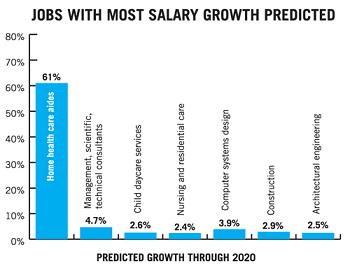
According to the Bureau of Labor’s predictions, not all of the US job markets with the largest projected growth (outside of the medical field) require a significant academic resume. If you’re after high salary jobs, stay in school — the nursing, technical consulting, and computer system jobs predicted to see salary increases all require a little more educational incubation. 

INDUSTRIES WITH LARGEST PREDICTED GROWTH

All figures in parentheses reflect predicted growth through 2020

1. Personal care aides (70.5%)/home care aides (69.4%)

2. Medical secretaries (41.3%)

3. Medical assistants (30.9%)

4. Retail sales (26%)

5. Physicians and surgeons (24.4%)

6. Receptionists and information clerks (23.7%)

7. Construction (21.3%)

8. Landscaper/groundskeeper (20.9%)

9. Heavy truck driver (206%)

10. Childcare workers (20.4%)

11. Accountants, bookkeepers, auditors (15.7%)

JOBS WITH MOST SALARY GROWTH PREDICTED

1. Home health care aide (61%)

2. Management, scientific, technical consultants (4.7%)

3. Child Daycare Services (2.6%)

4. Nursing and residential care (2.4%)

5. Computer systems design (3.9%)

6. Construction (2.9%)

7. Architectural engineering (2.5%)


Sutter/CPMC agrees to a contract with its nurses in SF, clearing the path for its hospital deal

10

Ending a long and contentious labor impasse and setting the stage for the city to approve the pair of new hospitals that Sutter Health and its California Pacific Medical Center affiliate want to build in San Francisco, the California Nurses Association today announced that it has reached a tentative contract agreement with the hospital corporations.

As we’ve reported, reaching a deal with its nurses seemed to be the last major hurdle for Sutter/CPMC to overcome before the community-labor coalition would fully support the compromise hospital deal that a city-CPMC negotiating team announced on March 5. The nurses helped force that hard-won deal in part by aggressively advocating for St. Luke’s Hospital to remain financially viable and open to the low-income community it serves.

“We are delighted to finally reach a contract deal. It’s been six years of a very contentious relationship,” Eileen Prendiville, a registered nurse who works at CPMC’s California Campus, told the Guardian. She said that the nurses are thrilled to have attained good job security and patient advocacy standards while ensuring St. Luke’s stays open. “Working with a coalition of labor and community, we were successful at changing the face of healthcare in San Francisco.”

Under a previous agreement reached last year between CPMC and the Mayor’s Office, St. Luke’s would have had just 80 beds and could have been closed if the corporations revenues sagged. But activists and the Board of Supervisors were able to kill it and force the corporations back to the bargaining table.

In today’s print edition of the Guardian, I cover the movement to value caregiving in our uncaring economic system and the key role that CNA has played has in that growing movement. In San Francisco, CNA has faced down lawsuits, lock-outs, and harsh union-busting tactics as it pushed for contracts with strong patient advocacy protections.

Sup. David Campos, who help negotiate the latest hospital deal, said he was “thrilled” to hear Sutter/CPMC reached a deal with CNA. “We’ve always said it’s really important as we finalize the agreement that there is protection for the workers,” Campos told us.

Board President David Chiu, another key negotiator in the recent deal, told us, “I’m tremendously excited that there’s finally an agreement between oru nurses and CPMC, and thank the parties for their hard work in reaching this point. Along with the agreement we recently arrived at for the new Cathedral Hill and St. Luke’s campuses, this is an important moment for our city’s health care futue.”

CPMC spokespersons didn’t immediately respond to our calls for comment, but we’ll update this post if and when we hear back. The CNA press release announcing the deal and its details follows:


Nurses Reach Agreement with Sutter California Pacific

RNs Hail Community Support, Decision to Keep St. Luke’s Open 


Registered nurses at two San Francisco Sutter hospitals, California Pacific Medical Center and St. Luke’s Hospital, have, at long last, reached agreement with hospital officials on a new collective bargaining contract for the 800 RNs who work at the two facilities, the California Nurses Association said today.

The agreement expands patient protections, strengthens the nurses’ bargaining and job security rights, and provides for economic gains. It must still be ratified by CPMC and St. Luke’s nurses who will vote on the pact in membership meetings soon.

The RNs emphasized that they are especially pleased with the overall political and community framework, announced earlier this month, that preserves St. Luke’s after years of uncertainly and threats of closure for the historic hospital that serves a medically underserved community in San Francisco.

CNA Executive Director RoseAnn DeMoro praised the unity of the nurses over the long contract fight and the broad public support for nurses as critical to protecting St. Luke’s and winning a new agreement for the nurses.

“San Francisco nurses have worked extremely hard, with the widespread support of a very broad community coalition and the support of a number of community leaders, including members of the Board of Supervisors, to protect this vital community resource. We are proud of the efforts of everyone who has held the line for maintaining St. Luke’s,” DeMoro said.

For the first time, the RNs at both hospitals will be under one contract with equal job security and seniority rights. The pact includes safe patient handling provisions to stem patient falls and injuries to patients and nurses. Additionally it obligates the employer to provide for meal and rest breaks and stipulates that new technology not supplant RN professional judgment.

On economics, all the RNs will receive across the board pay increases of 6 percent over the next 34 months, as well as additional pay based on years of service in the San Francisco hospitals, at other Sutter facilities, and foreign nursing experience.

“We are delighted to finally reach a contract settlement with Sutter/CPMC,” said California Pacific campus RN Susan Blaschak RN.  “Our contract provides for continued patient advocacy and will keep our professional nursing standards high for years to come.”

“The process has been tumultuous but in the end we had a vision and we were successful in performing the ultimate in patient advocacy – saving St Luke’s,” said Jane Sandoval, a St. Luke’s RN and CNA board member. “In addition, with our collective bargaining agreement we have preserved patient care standards, having a voice in that and in our professional integrity.”

“Working with a coalition of labor and community groups, we have been successful in changing the face of healthcare for San Francisco’s future. St Luke’s will not only remain open it will offer more healthcare services to residents in the community south of Market,” said Eileen Prendiville RN at the California Pacific campus of CPMC.

“Our contract settlement was also made possible by the strong support for the nurses by San Franciscans for Healthcare, Housing, Jobs and Justice as well as elected leaders who knew San Franciscans overall would be best served by a fair collective bargaining agreement,” said Sandoval.

CNA also calls on Sutter officials in its headquarters in Sacramento, and other Sutter regions to view the San Francisco agreement as a new opportunity to resolve outstanding contract fights with RNs in the East Bay and North Bay.

Nurses have now reached agreement with CNA-represented Sutter hospitals in the past nine months at Mills-Peninsula in Burlingame and San Mateo, Sutter Santa Rosa, Sutter Lakeside in Lakeport, and Sutter VNA in Santa Cruz.

Contracts remain unresolved at Alta Bates Summit in Berkeley and Oakland, Eden in Castro Valley and San Leandro, Sutter Delta in Antioch, Sutter Solano in Vallejo, and Sutter Novato.

“Every one of those disputes could also be resolved if those hospital’s officials would approach negotiations with a desire to stop the war on their nurses, remove unwarranted and punitive concessions demands, and show the community served by their hospitals that they desire a cooperative relationship with nurses based on therapeutic healing for their patients,” said Sandoval.

Do we care?

77

steve@sfbg.com

Teresa Molina faced abusive, belittling treatment on the job.

The 52-year-old immigrant from Sinaloa, Mexico, says she was paid $500 a month to provide 24-hour, live-in care to a girl in a wheelchair and her family. She wasn’t allowed regular breaks. She couldn’t eat what she wanted. Even her sleep was disrupted.

“I spoke up a couple times, but when I did, my employer told me I was dumb and good for nothing,” Molina, speaking Spanish through a translator, told us. “She would ask my immigration status, and I said that was not important, but she used that as a threat.”

Molina is a domestic worker — one of the only two professions (the other being farm work) exempt from federal labor standards.

Her experience, a common one among immigrant women in California, prompted Molina to get involved in last year’s California Domestic Worker Bill of Rights campaign, part of national effort that resulted in the first-ever protections being signed into law in New York in 2010.

Gov. Jerry Brown vetoed the California version of the bill late on the night of Sept. 30, 2012, the deadline for signing legislation, citing the paternalistic concern that better pay and working conditions might translate into fewer jobs or fewer hours for domestic workers.

“I was offended by how he did it, in the middle of the night on the last day, and he basically trivialized it,” Assembly member Tom Ammiano (D-SF), who sponsored the measure, told us. “Here in California, it’s a major workforce, but there’s no rules and there’s a documented history of abuses.”

But if anything, Brown’s veto has energized local activists, who say the battle for domestic worker rights is part of a much larger issue that women, children, immigrants, and their supporters are struggling against as they try to get society to value one of the most basic of social and economic functions: caring and caregiving.

Those in the caregiving professions are used to such defeats, but this one seems to be galvanizing and uniting several parallel movements — most of which have a strong presence here in the Bay Area — that want to apply human values and needs to an economic system that has never counted them.

It is, economists and policy experts say, a profoundly different way to measure economic output — and if the domestic workers and their allies succeed, it could have long-term implications for national, state, and local policy.


CARING DOESN’T COUNT

There are endless examples of how society undervalues caring and caregiving and other labor that has long been deemed “women’s work.” They range from nurses fighting for fair contracts to in-home support service workers fighting for their jobs. Many are jobs that have traditionally been done in the home — and in some cases, not counted at all as part of the Gross Domestic Product.

Social work, teaching, administrative support, caring for children or seniors, community organizing, and other jobs held predominantly by women and people of color are consistently among the lowest paid professions.

But the demand for those jobs is increasing — and the price of under-investing in education, caregiving, and child development is decreased productivity and increased crime and other costs for decades to come — so activists say they are critical to the nation’s future.

“It’s a different perspective. Caregiving isn’t transactional the way we think about other jobs,” said Alicia Garza, executive director of People Organized to Win Employment Rights (POWER), which has joined with other organizations nationwide for a Caring Across Generations campaign. “We’re a nation that has a growing aging population with no plan for how we’re going to take care of these people.”

In California today, caregivers find themselves under attack. Despite playing an important role in electing Brown as governor and in keeping Kaiser Hospital in Oakland and CPMC’s St. Luke’s Hospital in San Francisco open to the low-income residents they serve, the California Nurses Association is still stuck in a years-long contract impasse with those huge hospital corporations.

“We don’t think of ourselves first, we think of others first,” says Zenei Cortez, a CNA co-president who has been a registered nurse for 33 years, noting that patient care and advocacy standards have been key sticking points in their negotiations.

During each year with a budget shortfall, in-home support services for the sick, elderly, and disabled have been placed on the budgetary chopping block in California and many of its counties — including San Francisco, which has about 21,000 such workers — saved only by political organizing efforts and a longstanding lawsuit against the state (which was just settled on March 20 and will result in an 8 percent across-the-board cut in services).

“This program has been under assault for a full decade,” says Paul Kumar, a public policy and political consultant for the National Union of Healthcare Workers, calling that attack short-sighted, in both fiscal and human terms. “People get better care in a home setting.”


UNDERVALUED, ACROSS THE BOARD

If people generally act in their financial self interest, as economic theory holds, Oakland resident Lil Milagro Martinez would oppose the Domestic Workers Bill of Rights and its requirement that she pay her nanny at least minimum wage and allow for breaks and sick days.

After all, Milagro and her family are barely scraping by, with her husband working four jobs as she balances care for their infant son with coursework as a theology graduate student. Instead, Milagro said, she offers their nanny a living wage, benefits, and good working conditions.

“I wanted to feel that we were affirming her rights, so she would pass on that level of respect to my son,” Milagro told us. “If I can do this, and there are companies out there saying they can’t afford to do the right thing, that angers me.”

She was also angry when Brown vetoed the Domestic Workers Bill of Rights. She’s been working with a domestic worker employer group called Hand in Hand, a part of the larger National Domestic Worker Coalition.

“Our goal is to bring people together to create the kinds of worker relationships they want with people in their homes,” Danielle Feris, the national director of Hand in Hand, told us. “There will just be more and more people that need care in the home, so this touches all families.”

Milagro and other domestic worker employers say their stand is about much more than enlightened self-interest. They say this is an important step toward recognizing the important contributions that women and minority groups make to society and creating an economy focused on addressing human needs.

“Care, we can say, is undervalued across the board,” Feris said.

In addition to reintroducing the bill in Sacramento this year, the coalition is pushing similar legislation in Massachusetts and Illinois.

“I think the domestic workers have done a fantastic job at organizing across the country,” Ammiano said. “Making a movement of something isn’t easy, but once it gets traction then it’s tough to ignore.”

Like Milagro and Ammiano, Molina said she was bitterly disappointed by Brown’s veto, although all say it only strengthened their resolve to win the fight this year. “I felt very sad, depressed, and betrayed,” Molina said. “But we will win this…And I think the movement for women, workers, and immigrants will only grow from us winning.”

Domestic Workers Coalition campaign coordinator Katie Joaquin noted that the campaign is about triggering a cultural shift as much as it’s about winning legal protections, as important as they may be. “Once this bill passes and we have basic protections doesn’t mean the abuses will stop,” she said, noting that this is really about valuing care work.

“It’s bringing people together around the care we need,” Joaquin said. “These are conversations that are breaking new ground. The bill is really something that gets the ball rolling.”

Once some household work gets recognized, it’s not a big step toward a conversation about valuing all kinds of caring work and including that in our measures of economic progress.

“We definitely support the idea of valuing all care work, both paid and unpaid,” Feris said. “We all have something to gain by valuing each other.”


THE REAL WEALTH OF NATIONS

Author and researcher Riane Eisler has been a leading thinker and advocate for creating a more caring economy for decades, work that resulted in her seminal 1988 book The Chalice and the Blade, which sold half a million copies and was lauded as a groundbreaking analysis of the gender roles in ancient and modern history. She followed that with The Real Wealth of Nations in 2007, and the creation of the Center for Partnership Studies (CPS) and the Caring Economy Campaign.

Eisler takes issue with what most people call “the economy,” a wasteful and incomplete system that doesn’t actually economize in connecting what we have to what we need. She persuasively argues that it makes sense in both human and fiscal terms to value caring and caregiving, for one another and the natural world, providing myriad examples of countries, cultures, and companies that have benefited from that approach.

“In a way, the concepts are very simple. What could be more simple than saying the real wealth of nations isn’t financial? It consists of the contributions of people and nature,” Eisler told us by phone from her home in Monterey.

On March 20, Eisler gave a Congressional Briefing (attended by members and staffers in the Rayburn House Office Building) entitled “The Economic Return From Investing in Care Work & Early Childhood Education,” presenting a report on the issue that CPS and the Urban Institute released in December: “National Indicators and Social Wealth.”

“I think this is extremely timely,” Eisler told us, noting that the Republican Party’s currently aggressive fiscal conservatism must be countered with evidence that meeting people’s real needs is better economic policy than simply catering to Wall Street’s interests.

Her address to Congress followed ones that Eisler has given to the United Nations General Assembly and other important civic organizations around the world, and it was followed the next day by an address she gave to the State Department entitled: “What’s Good for Women is Good for World: Foundations of a Caring Economy.”

While Eisler said “there are people who are very excited about it,” she admits that her ideas have made little progress with the public even as the global economy increasingly displays many of the shortcomings she’s long warned against. “This is still very much on the margins.”

But that could be changing, particularly given the political organizing work that has been done in recent years around the rights of domestic workers and immigrants and on behalf of the interests of children and the poor, some of it drawing on the work of liberal economists such as Paul Krugman and Joseph Stiglitz.

“The Gross Domestic Product is a very poor measure of economic health,” she told us, noting that it perversely counts excessive healthcare spending, rapid resource depletion, and the cleanups of major oil spills as positive economic activity.

Erwin de Leon, a Washington DC policy researcher, opens “National Indicators and Social Wealth” with a quote from a speech that Robert F. Kennedy gave in 1968 criticizing GDP as a bad measure of progress: “It measures neither our wit nor our courage, neither our wisdom nor our learning, neither our compassion nor devotion to our country, it measures everything, in short, except that which makes life worthwhile.”

De Leon then writes: “An urgent need met by measuring a nation’s social wealth is identifying the attributes of a society that make it possible to create and support the development of the full capacities of every individual through the human life span. Social wealth indicators identify these drivers, with special focus on the economic value of caring for and educating children and the contributions of women and communities of color.”

The carefully documented report makes an economic argument that investment in caregiving and early childhood development more than pays for itself over the long run in terms of increased productivity and decreased costs from crime and other social ills, creating a happier and more egalitarian society in the process.

“Nobody talks about the work that immigrant women do and how it contributes to productivity. They free us up to do other things, but we don’t count it,” De Leon told us in a phone interview. “We put lots of value on numbers and the views of economists. The problem with the numbers is it’s an economic number that just values production.”

Eisler’s approach is neither liberal nor conservative, and she takes equal issue with capitalism and socialism as they’ve been practiced, labeling them both “domination-based” systems (as opposed to the “partnership-based” systems she advocates) that devalue caregiving and real human needs.

In fact, she seems to be even harder on progressives than those on the other end of the ideological spectrum, given the Left’s stated concern for women and communities of color. It was a point that Ammiano echoed: “There’s a lot of liberal guilt, but the follow-through has yet to happen.”

“What this entails is re-examining everything,” Eisler told us. “It starts with examining the underlying beliefs and values.”


INSTITUTIONAL SEXISM

Even in supposedly enlightened San Francisco, things are getting worse. On March 26, following a battle with SEIU Local 1021 that began last fall, the city’s Department of Human Resources submitted to a labor mediator its proposal to lower the salaries for new hires in 43 job categories, including vocational nurses, social workers, and secretaries.

The rationale: Those workers were paid more than market rates based on a survey of other counties. But it’s also true that those positions are disproportionately held by women and minorities. In the 1980s, San Francisco made a policy decision to raise the pay of what were traditionally female-dominated professions, part of a nationwide campaign to erase decades of pay inequity.

“The city is rolling back decades of historic work on pay equity in this city,” SEIU Political Director Chris Daly told us. “We were concerned about equal treatment of workers who were disproportionately women and people of color.”

DHS spokesperson Susan Gard told us, “The city is committed to that principal, equal pay for equal work, and we don’t think our proposal erodes that.” But she couldn’t explain why that was true. In reality, the move will lower the salaries for women that come to work for the city.

Those involved in the Domestic Workers Bill of Rights campaign mince no words when it comes to seeing the long history of sexism in political and economic institutions as one of the main obstacles they face.

“In so many ways, domestic work is women’s work, and women’s work has always been undervalued and underpaid,” Milagro said.

She even saw it growing up as child when she accompanied her father when he did housekeeping work, when he was treated “as nonentity, not human,” abuse and mistreatment that was exacerbated by the twin facts that he was an immigrant doing women’s work.

“Sexism has undervalued care work,” Feris said.

Ammiano likened the current struggle to the gay rights movement, and he said that when he started as a teacher back in the 1970s and wanted to teach in the early primary grades, he was told that was for women.

“It’s the feminization of labor,” Ammiano said. “When you have institutional sexism, you have to peel it back layer by layer.”

Eisler is equally direct: “We’ve all been taught to marginalize anything connected to the feminine,” she said.

She noted the vastly disproportionate global poverty rates of women compared to men and said “it’s because most are full or part-time caregivers,” work that isn’t often compensated.

Eisler said the current economic system “marginalizes and dehumanizes half the population,” asking how that could ever be considered ethical or equitable. She dismisses arguments that we can’t afford to value caregiving or work done in the home, noting that “there’s always money for the masculine values” of war and economic expansion.

Ammiano said the cultural blinders that prevent people from seeing how society discriminates against women and the work they do makes the problem more insidious and tougher to solve.

“If they’re doing it deliberately, it’s almost better because you can sink you teeth into it, but if it’s not deliberate then it’s tougher to corral,” he said.

Yet there could be subtle but important changes underway in how people value the roles of men and women in society.

There are indications that substantial majorities of people increasingly see men and masculine values as a big part of the problems the people of the world are facing. Author John Gerzema, whose forthcoming book is entitled Athena Doctrine: How Women (And the Men Who Think Like Them) Will Rule the Future, revealed some of the extensive polling research behind his book in a recent TED Talk.

Much of it points to what he called a “global referendum on men,” with strong majorities in countries around the world — with Canada the only exception — agreeing with the statements “I’m dissatisfied with the conduct of men in my country” and “The world could be better if men thought more like women.”

He and his research partners also had the tens of thousands of people they surveyed rate a list of traits as either masculine or feminine, and then later he had respondents state the traits they most wanted to see in their political leaders, finding that people around the world have begun to strongly prefer feminine traits to male ones in their leaders.

His conclusion: “Femininity is the operating system of 21st Century progress.”


THE SILVER TSUNAMI

The “silver tsunami” — Baby Boomers reaching old age and about to need more care — is about to break.

POWER, Senior Action Network, and many other San Francisco-based organizations in the Caring Across Generations campaign are part of a national push to increase access to and investment in caregiving, from early childhood development through care for those with disabilities to elder care.

“The caregiver industry is something we should invest in,” said POWER’s Garza. “We believe in a society that values care and we want to value that work.”

Yet with short-term, bottom-line thinking guiding the decisions, that requires a bold paradigm shift. Instead, the popular state In-Home Support Services program — which provides some compensation for caregivers of those with disabilities — is now facing an 8 percent cut as part of the recent settlement to lawsuits filed to prevent the 20 percent cut that then-Gov. Arnold Schwarzenegger had proposed.

The SF-based lawyer who filed the lawsuit, Stacey Leyton, told us this was the best settlement possible given the current political climate and the risk of deeper cuts if the Ninth Circuit Court of Appeals ruled in the state’s favor. But she thinks any IHHS cuts are short-sighted: “Any cuts to home care may balance the budget ledger now, but they can cause more costs later in the form of nursing home care and emergency room visits.”

James Chionsini, a community organizer with the Senior and Disability Action (SDA, formerly Senior Action Network), tells us that in addition to the sheer size of the “silver tsunami” coming through — which will require a huge influx of caregivers — efforts by the federal and state governments to contain medical costs could hurt the “upper-poor,” who are required to somehow pay a share of their MediCal health care costs.

That’s one reason why SDA, POWER, and other groups are supporting several campaigns aimed at creating a more caring society, from the Domestic Workers Bill of Rights to Caring Across Generations to basic, bread-and-butter political organizing efforts.

“Organizing is so important,” Garza said, while Chionsini said, “It’s about raising the profile of people who are providing care.”

Milagro said that if the immigrant women who do domestic work score a major victory, that could empower other marginalized groups. “It’s about a change in consciousness,” she said. “This can show a path for other movements to build, strengthen, and work together.”

Garza agrees that important, foundational changes are already underway, even though they will require lots of hard organizing work to bring them to fruition.

“There is a groundswell. This is happening,” she said, noting that it revolves around asking important questions. “How do you look at an economy not rooted in patriarchy? What would it look like if we had to compensate mothers?”

Next week: Part II, Do we care about the natural world?

Fighting for patients, beyond the bedside

1

It’s no coincidence that the California Nurses Association has been the most active and effective union in fighting for a broad social and economic justice agenda, one that seeks to give greater value to caring and caregiving. Unlike many unions that fight mostly for their members’ interests, CNA is an extension of the nursing ethos itself.

“It’s not enough to advocate for patients at the bedside. We take it out into the streets and the community. That’s what nursing is,” Zenei Cortez, an RN of 33 years and co-president of CNA, told us. The CNA agenda has included support for increasing taxes on the wealthy to restore cuts to social services, advocacy for a single-payer healthcare system, affordable housing, and some of the best and sharpest opposition to the gubernatorial ambitions of Meg Whitman, who proposed deep cuts to state spending on education and other essential programs.

“We have a health care system that only cares about profits and nothing else,” said Chuck Idelson, who heads the communications staff that works for the nurses, “which is why you need people who value care over profit.”

And that’s the nurses, who have been growing in both numbers and political strength just as the healthcare profession has increasingly fallen under the sway of Wall Street and its values, making CNA an important political force.

“When I first started in nursing, we had a lot of time with our patients at the bedside,” Cortez told us. “But now, that human factor has disappeared.”

Nurses first began to flex their power early in Cortez’s career when “nurses were thought to be the handmaidens of doctors. But we were able to change that mentality,” one that was rooted in sexism and old domination-based models.

After the doctors, the nurses stood up to the healthcare corporations, winning statewide minimum patient care staffing ratios and contracts for themselves that gave them a stronger voice in patient care. As the Occupy Wall Street movement took root two years ago, CNA and its larger National Nurses United launched its Main Street Campaign to push people’s interests over those of the wealthiest 1 percent of Americans. “We have to have partnerships with our patients,” Cortez said. “The companies only care about the bottom line…We are not afraid to fight, particularly because we know it’s not for our own jobs, but for the good of our communities.”

Behind the Chron’s paywall

24

I wish the Chronicle luck at its experiment with a “paywall.” Once upon a time, we used to call that a “subscription” — that is, you pay money and someone delivers to you something worthwhile to read. Since nobody much likes to pay to read anything any more, it’s considered risky and a bit radical for a newspaper to charge money for access to the work that it pays a staff a fair amount of money to produce.

Let’s do the nice thing here, shall we, and set aside the question of whether the journalism the Chron produces is of such high quality that people ought to pay a premium for it. I have my gripes with the Chron, and always have, but seriously: Having a local newspaper that tells you what’s going on in town — even if it doesn’t always do it well — is worth a dollar a day. Which is what the print version costs.

Writers need to get paid. Reporters are necessary to the function of democracy, and if they can’t make a living doing the job, it’s not going to get done. Since most young people aren’t used to paying to read anything these days, the only option has been selling (more and more) ads.

That’s actually a model the alternative press has followed for decades, and it’s worked fine. In the days before cable, that’s how TV worked, too — it comes in free, and you pay for it by watching (annoying) ads.

But it’s a problem on the web, where ads don’t bring in the revenue they once did in print, so everyone’s scrambling to find a way to pay the bills. If you’re Markos over at Daily Kos, you build a huge, huge community that loves what you’re doing, and keep the staff fairly modest, and sell enough ads and bring in enough donations to pay for it all. If you’re Nick Denton’s Gawker Media Empire, you keep costs very low by hiring very limited staff (certainly not a lot of reporters) and sell ads ads ads everywhere, including “sponored posts.”

But if you’re the San Francisco Chronicle, with 280-plus reporters who need health care, and lots of editors and executives, and the Hearst Corp. demanding impossible profits, you’re kind of SOL.

Thus: Paywall.

These things don’t tend to work very well. Sfgate had a paywall for “premium content” years ago, and it just sort of faded away. The Wall Street Journal and the Business Times pubs get away with it, because people who read biz pubs are used to paying for information. I’m not sure how many truly loyal Chron readers there are who are willing to pay to read Matier and Ross and Chuck Nevius on the web. Most of those people already pay for a print subscription.
The other problem is that it’s really unclear what the identities of the two sites, sfgate and sfchronicle, will be. They look different (sfgate looks like a newsy website, sfchronicle looks like a print newspaper), but where do you go every day for news? If you read sfgate, you’re missing stuff that only appears on sfchronicle, but if you read sfchronicle, you’re missing stuff that appears on sfgate. It’s not like you get a “premium” edition of the paper in one place; you have to check two sites to get your local news, not one.

For example, today you can get The Chron’s own Carolyn Lochhead on the same-sex marriage case at sfgate. If you pay extra, you can go to sfchronicle and get an AP story that’s not exclusive and will run in lots of papers.

Why does this make me want to pay?

So I don’t know; it’s going to take a lot of evolving to make this work. Again, I wish them luck; anyone who’s trying to find a way to keep paying a news staff deserves credit. But at this point, it seems like a pretty dubious plan.

The real CPMC story

10

OPINION The recently announced terms for the development of California Pacific Medical Center’s hospitals at Cathedral Hill and St. Luke’s generated front-page and lead stories in the local news media. But nearly without exception, only part of the story was reported. Missing from most accounts of the terms of the new deal, which dramatically changed last year’s failed draft development agreement negotiated by Mayor Ed Lee, was the decisive role played by a community/labor coalition, San Franciscans for Healthcare, Housing, Jobs and Justice.

Key details of the agreement have yet to be finalized, and provisions of the terms announced on March 5th need to be improved. But the new agreement, in virtually all respects, is an improvement over the old one. And on the same day the terms of the new deal was announced one of the union members of the coalition, the National Union of Healthcare Workers signed a contact with CPMC that protected union organizing rights, job security at Cathedral Hill and full employer paid health care — issues that had been unresolved over the last few years. Still missing is an ageement between Sutter and its nurses, a critical component of labor peace.

The basic structure of the current terms mirror almost exactly the positions outlined by the SFHHJJ over the last year, including a requirement for labor peace with all unions at CPMC. This was no accident; it was the result of the efforts of the community/labor coalition. When the old deal was stalled at the Board of Supervisors in early 2013 and it was clear that the Mayors Office had no idea how to proceed, the members of the coalition came up with a framework to get discussions going again. The key ingredient was the involvement of a skilled an knowledgeable mediator, mutually respected by all parties and the participation of Sutter Corp. in Sacramento — the real party able to make actual binding corporate commitments, not the subsidiary the mayor had dealt with.

The second step was to agree to a framework of issues that would form the substance of negotiations — and the coalition’s own comprehensive set of positions served as that framework.

The next step was to get a critical mass of supervisors to agree to participate in the negotiations. Two Supervisors, David Chiu and David Campos, agreed to the coalition’s framework and the use of a third-party mediator. They added a third supervisor, Mark Farrell, to their group in order to assure buy-in from the full board.

Finally, the mediator had to be found and in that the coalition (and the rest of the city) simply were lucky that Lou Girardo was willing and able to provide his own special skills and credibility.

The SFHHJJ is not the first community/labor coalition in San Francisco history. Such coalitions were present in both the District 1 and District 5 supervisors races last year with mixed success, and in 2008 a community/labor coalition fought for revenue measures, again with mixed success but real unity. A new labor/community coalition has emerged to oppose Scott Wiener’s ill-advised weakening of our local California Environmental Policy Act procedures.

As the Democratic Party transforms itself into ever greater political irrelevancy by becoming the home of moderate Republicanism at all levels of government, community and labor co-operation seems to be growing over an increasing number of issues, showing a level of political vibrancy impossible to ignore.

Calvin Welch is a longtime community organizer in San Francisco and is a member of the SFHHJJ CPMC Negotiating Committee

CPMC deal gets warm welcome despite some shortcomings

9

Even though the Board of Supervisors unanimously approved the term sheet for the California Pacific Medical Center’s hospital deal this week, comments from the supervisors and the general public indicated there are still a few outstanding issues before the project returns to the board for final approval, probably in July.

As the Guardian recently reported, CPMC’s longstanding contract impasse with the California Nurses Association remains the biggest sticking point even for many labor-community coalition members who helped hammer out the deal that was announced last week. James Tracy of the Community Housing Partnership told the supervisors that he was almost ready to uncork the champagne and celebrate, “but I’m holding off until there is labor peace with the nurses.”

New District 5 Sup. London Breed went on extended tirade ripping into the hard-won compromise plan, voicing support for the nurses, wanting more specifics on how affordable housing money will be used, calling for more money for job training to support the plan’s local hiring standards (“I need to know how this is going to transfer into support for Western Addition residents,” and concluding that she’s generally supportive of the deal but “I will reserve final judgment.”

Calvin Welch of the Council of Community Housing Organizations echoed Breed’s concern that the $36.5 million in affordable housing funds will be paid into the Mayor’s Office of Housing’s general pot rather than be set aside for specific projects. “We are very concerned with how this multi-faceted program will unfold,” Welch said, asking that COCHO be included in decisions about how the money from CPMC gets used.

Sup. Scott Wiener decried how the new deal’s $14 million in transportation impact fees is 30 percent less than the ill-fated previous deal – the result of a significantly smaller footprint of the Cathedral Hill Hospital – saying, “Once again transit comes out on the short end.”

The change called for by more supervisors than any other is an increase in job training funds to support the guarantee that 30 percent of construction jobs and 40 percent of permanent entry level jobs go to San Franciscans. Even though job training funds were doubled to $4 million under the new agreement, some supervisors and activists say that’s not enough.

“That’s a big improvement, but it’s still not enough, given the type of training needed for low-income San Franciscans to be able to work in the hospitals,” Gordon Mar of San Franciscans For Healthcare, Housing, Jobs and Justice told the Guardian.

Yet even with all these gripes and picking of nits, which will play out as the development agreement is prepared and goes through the Planning Commission approval process starting in May, the consensus across the ideological spectrum seems to be that this is a good deal for the city that is likely to be approved if CPMC can reach a contract with CNA

And all hailed it as a vast improvement over the deal CPMC cut last year with the Mayor’s Office, offering a lesson for city officials who are now negotiating other big deals, such as the Warriors Arena proposal. As Sup. John Avalos said at the hearing, “I remember a statement form the Mayor’s Office last year that this is the best we can get. I think we always need to challenge that.”

SEIU 1021 employees authorize strike as its clash with the city goes to arbitration

40

[UPDATE: The two sides reportedly reached a tenative agreement over the weekend]. Service Employees International Union Local 1021, which represents most city employees in San Francisco, continues to fight both internal and external challenges, with its own staff employees overwhelmingly authorizing a strike just as the union battles the city over pay equity issues.

As we reported last month, SEIU Local 1021 organizers, researchers, negotiators, and other professional staff, represented by Communication Workers of America Local 9404, have been without a contract since last fall and they’re resisting concessions to their pensions and health care benefits that President Roxanne Sanchez and her leadership team are seeking.

After several cancelled negotiating sessions between the two sides (which haven’t met since our story was published), CWA last week called for a strike authorization vote that was approved by 94 percent of voting members. CWA Area Director Libby Sayre and Nick Peraino, a CWA shop steward at Local 1021, say the vote repudiates Sanchez’s characterization that it is a small but vocal group that is unhappy with management.

“We’re very much united in our position and our willingness to do what it takes to get a decent contract,” Peraino told us. Sayre told the Guardian, “There is widespread sentiment they’re being low-balled by management.”

The two sides are scheduled to meet tomorrow (Fri/15), and Sayre told us the likelihood of a strike “depends on what management’s attitude is tomorrow.”

Sanchez and her core leadership team, including Vice President of Politics Alysabeth Alexander (both she and Sanchez are on leave from their jobs at Tenderloin Housing Clinic) and Larry Bradshaw, the vice president for the San Francisco region, last week won decisive re-election victories, indicating they have strong support from members.

Sanchez didn’t return a phone call seeking comment, but Local 1021 Political Director Chris Daly told us that he expects the dispute with employees to be resolved without a strike. “We have reason to believe it’s a tactic before they come to settle,” he said. He also questioned how many people voted in the election, and Sayre hasn’t returned our call with that follow-up question.

Meanwhile, Sup. John Avalos last week held a hearing before the Land Use and Economic Development Committee on Local 1021’s dispute with the city over a proposal by the Department of Human Resources to unilaterally lower the salaries on new hires in 43 job categories. Such changes were allowed in hard-won contract that the union negotiated with the city last year.

City officials say the salaries are too high based on a survey of similar positions in other Bay Area cities and counties, but the union has cast it as a pay equity issue, noting that the jobs are disproportionally held by women and minorities and they were deliberately increased in the ’80s and ’90s to offset historical institutional sexism and racism.

But pay equity provisions were removed from the City Charter during its 1997 revision, and Avalos has indicated he may sponsor legislation to address the issue. But in the meantime, Daly said appeals to Mayor Ed Lee to weigh in have been ignored and DHR officially submitted its pay reduction proposal to the arbitrator in the dispute on Monday.

So stay tuned, folks, San Francisco’s biggest labor union has a lot of the table right now and we’ll let you know how it turns out.

The right to transgender health care

23

OPINION When I first came out as a transgender man in the mid 1990s, I quickly realized that I would have to pay out-of-pocket for the health care I needed.

Nearly every insurance plan has outdated exclusions that bar transgender people from receiving medically necessary health care. Everything from cancer screenings to the care related to gender transition is commonly excluded, despite being provided without exclusion to non-transgender health insurance customers.

For working people everywhere, including members of the LGBT community, accessible, affordable, quality healthcare is critical. And for union members like myself, healthcare equity is part of a basic and broader vision for equality for all people.

In recognition of this vision, Pride at Work, the SEIU National Lavender Caucus, National Center for Transgender Equality, the Transgender Law Center, and Basic Rights Oregon have partnered for the very first Transgender Month of Action, aimed at lifting the healthcare inequities that face our community.

I began to gender transition in 1996, starting with hormone therapy, a process that required walking through countless hoops. I will forever be thankful to the Tom Wadell Clinic and Lyon Martin Clinic for making hormone therapy accessible to low-income and uninsured trans people like myself, but I know I was one of the lucky ones. A few years later, when I was insured, I began to feel as if insurance companies were the gatekeepers of my body.

I knew that I needed to get chest surgery and that it wouldn’t be covered by my insurance, so I held a rent party and told my friends and loved ones that I needed help. It took a lot of vulnerability to do that. Like everyone else, transgender people need acute care when they are sick and preventative care to keep us from becoming ill, including services that are traditionally considered to be gender specific — such as Pap smears, prostate exams, and mammograms.

But insurers frequently expand discriminatory exclusions in a way that denies transgender people coverage for basic services. Take the outrageous example of a transgender woman in New Jersey who was denied coverage for a mammogram on the basis that it fell under her plan’s sweeping exclusion for all treatments “related to changing sex.”

Sometimes, trans people are denied care completely. In the late 1990s, I went to a gynecologist, but the doctor refused to treat me. Over the next 10 years, likes so many other trans people, I did not get an exam, too embarrassed and outraged to seek treatment.

In 2001, I worked with the a group of transgender healthcare activists to remove discriminatory exclusions for trans employees. When the Board of Supervisors voted to remove these exclusions, it was a huge and historic victory. Since that decision over a decade ago, San Francisco has proudly provided inclusive health care to city employees — and there’s been no cost increase to the overall plan.

Pride at Work, the organization that brings together LGBT union members and their allies, has a sign in the office that states: An injury to one is an injury to all. That’s the premise that underscores the labor movement’s commitment to LGBT equality, including trans-inclusive healthcare.

And it’s why Pride at Work is organizing local and national efforts to educate LGBT people and labor unions about the importance of ensuring access to basic healthcare for transgender people and providing coverage of medically-necessary transition-related care in health insurance. This first-of-its-kind effort is inspired by the belief that all workers deserve to have all medically-necessary care covered by health insurance, including transgender people whose healthcare needs are not being met.

Gabriel Haaland is co-vice president of Pride at Work.

Nurses still waiting for CPMC to fully embrace San Francisco

25

Labor and community activists cheered this week’s news of a much-improved deal between the city and California Pacific Medical Center to build two new hospitals in San Francisco, and there are hopeful signs that frosty local relations with this sometimes-stubborn corporate behemoth may improve. But they also say they are withholding full support for the deal until CPMC reaches a contract agreement with the California Nurses Association.

CPMC and its parent, Sutter Health, have had a nasty running battle with CNA over the six years since their last contract expired that has included strikes, lockouts, lawsuits, harsh union-busting tactics, and the pooling of bad blood on both sides. But CPMC announced a labor agreement with its other major union, National Union of Healthcare Workers, on the day after the hospital deal was announced and there are signs that a deal with CNA could also be imminent.

“We’ve made some progress and we have the makings of a settlement on the table, but we’re not there yet. Yet now is the time,” Fernando Losada, CNA’s collective bargaining director for California.

It was CNA and other labor groups that effectively partnered with community organizations and progressive members of the Board of Supervisors last year to kill the hospital deal that CPMC cut with the Mayor’s Office and to force the much-improved agreement that was announced on Tuesday. “It’s all about necessity and their being able to implement their plans,” Losada said of CPMC’s designs on San Francisco. “Obviously, the full of implementation of their plans were thwarted with the help of some good community organizing.”

And Losada said he expects that labor-community coalition to stand firm on expecting CPMC to reach a fair agreement with the nurses, who are seeking more job security and benefit concessions than CPMC has been willing to make so far.

“The successful community organizing that we played an active role in putting together has had a lot to do with them being more forthcoming at the bargaining table,” Losada said. “We like where this has ended up, particularly on the St. Luke’s [Hospital] issue [guaranteeing a larger and more viable new hospital than originally proposed]. But we can’t support this wholeheartedly and we won’t if our nurses are left out in the cold.”

Gordon Mar of San Franciscans for Healthcare, Housing, Jobs, and Justice, which formed up around the CPMC negotiations with the city, said that most community groups will also insist on CPMC reaching an agreement with CNA before the project moves forward.

“A contract for CNA is the last remaining big issue the coalition would like to see resolved,” Mar, who also works with the labor group Jobs With Justice, told us. “We at Jobs With Justice would not support the deal unless the CNA dispute is resolved.”

Paul Kumar, a consultant with NUHW who represented the coalition during the negotiations between CPMC and the city, as represented mostly by Sups. David Campos, David Chiu, and Mark Farrell, said he was happy to see CPMC reach agreements with the city and NUHW, but that it’s too soon to conclude the corporate has turned over a new leaf.

“I think it’s premature because relationships take a long time to transform themselves, but there are transformative moments, and it’s our duty to make the best of them. This may be one of them,” Kumar told us. “They’re obviously now trying to pursue their business interests in alignment with their community instead of without regard to their community, which has characterized their behavior in the past.”

Kumar said the coalition that overcame last year’s aggressive and uncompromising effort by CPMC to push through a deal that was bad for the city has learned a lot from that fight and evened out the playing field. “It’s up to us to try to build on their breakthrough,” Kumar said.

CPMC spokesperson Dean Fryer was unable to put the Guardian on contact with Sutter officials that our sources say may be responsible for the softening of CPMC’s tough negotiating stance in San Francisco, or to offer a comment on the changing dynamics in the company.

He stressed that CPMC has “a lot of interface with various communities in San Francisco” and said the company “does more charity care than anyone in San Francisco.” But he’s only been with CPMC for a few months and was unaware of studies last year showing CPMC actually does the least per-capita charity care of any hospital in San Francisco, a major point of controversy that resulted in improved charity care commitments in the latest agreement.

As for the prospects of an agreement with its nurses, “I can’t address CNA, that has been ongoing and it’s something I can’t comment on.”

NUHW – which represents medical technicians, administrative staff, and hospital workers other than nurses and doctors – announced that it reached a deal with CPMC at 12:30am on Tuesday that includes no labor concessions, retroactive wage increases, job security provisions, fully employer-paid health coverage, an improved pension, and maintenance of retiree health coverage.

Losada said he was happy to see the CPMC agreement with the city include strong local hiring requirements for construction workers, a predominantly male workforce, and now it’s time for CPMC to do right by its nurses, “an overwhelmingly female workforce.”

“As it stands, they have no protections and no guarantees they’ll be hired in the new facilities,” he said, noting how frustrating it’s been to get any assurances from CPMC as it has pursued this hospital deal over many years. “It’s always been about issues of job security, and affordable health care, ironically.”

Compromised position

16

steve@sfbg.com

When Mayor Ed Lee came to the Board of Supervisors for his monthly “question time” appearance Feb. 12, Sup. David Chiu tried to get some sense of where the mayor stood on a controversial piece of legislation that would allow more condominium conversions.

Chiu explained the complexities and implications of an issue where the two sides have dug in and appear to have little common ground, and he asked the mayor for some guidance.

“What is your position on this pending legislation?” he asked. “What protections would you support to prevent the loss of rent-controlled housing in our increasingly unaffordable city? How would you address the concern that if we allow the current generation of tenancy in common owners to convert, we will replace then with a new generation of TIC owners and additional real estate investments that will lead us right back to an identical debate within a short time?”

But if Chiu and other board members were looking for leadership, direction or a clue of where the mayor might stand, they didn’t get it. Lee said he understood both sides of the issue and hoped they could reach a consensus solution — without offering any hints what they might look like or how to achieve it. “I can’t say that I have a magic solution to this issue that will make everyone happy,” the city’s chief executive explained.

Asked by the Guardian afterward why he didn’t take a position and whether he might be more specific about how he’d like to see this conflict resolved, he replied, “I actually did take a position, even though it didn’t sound like it, because I actually believe they have good points on both sides.”

That’s a typical answer for a mayor who rose to power preaching the virtues of civility and compromise and striving to replace political conflict with consensus. But now several major, seemingly intractable issues are facing the city — and insiders say Lee’s refusal to take a strong stand is undermining any chance for successful.

The lack of mayoral leadership has been maddening to both sides involved in the negotiations over the condo-conversion legislation. Tenant advocates say the mayor’s waffling hardened the positions on both sides and emboldened the group Plan C and its allies in the real estate industry to reject the compromises offered by supervisors and tenant advocates.

“It’s very unhelpful,” San Francisco Tenants Union head Ted Gullicksen said of Lee’s refusal to take a stand. “Someone needs to kick the realtors in the butt, and that’s not happening. They have no impetus at all to compromise.”

Then there’s the case of California Pacific Medical Center’s proposed new hospital, a billion-dollar project that would transform the Cathedral Hill neighborhood and have lasting impacts on health care in San Francisco.

The mayor’s eagerness to get the deal done — even if it wasn’t the best deal for the city — led to a proposal that fell apart last year under scrutiny by the Board of Supervisors. That project has now been in mediation for months — and sources tell us they’re getting close to a deal that has little resemblance to the anything offered by the Mayor’s Office.

California Nurses Association Director of Public Policy Michael Lighty, who has been involved with the CPMC negotiations, said Lee’s unwillingness to take a strong and clear stand, or to help mediate the dispute once the deal blew up, is why this negotiation has been so difficult and protracted.

“If he had engaged stakeholders and the supervisors, we wouldn’t have had to go to the brink last summer,” he said. “You’ve got to have clear objectives and be willing to fight for those, and that means saying no…If you’re willing to accept any deal and just put political spin on it, this is what you get.”


ADMINISTRATOR-IN-CHIEF

Neither Lighty nor others involved in the CPMC negotiations would discuss details of the pending deal, as per the instructions of mediator Lou Giraudo. But they did talk to the Guardian about the political shortcomings that led to such a protracted mediation process on a project that has been in the works for many years and involving a looming state deadline to replace the seismically unsafe St. Luke’s Hospital.

Lighty called Lee’s conciliatory approach to CPMC “an administrative orientation and not a political one,” noting that what worked during Lee’s long career as a city administrator may not be working well now that he’s in the Mayor’s Office dealing with issues where consensus isn’t always possible.

“I don’t think it’s a very sophisticated view and I don’t think it’s one that produces the best results,” Lighty said.

Lighty did say the negotiations were getting close to resolution. “What comes before the board is going to be vastly superior to what the mayor and CPMC proposed,” he said. “I think what you’ll find whenever this comes out is it will repudiate the mayor’s approach.”

He contrasted Lee’s style to that of his predecessor, Gavin Newsom, who took positions on most controversial issues and would often get involved with forcing his allies to cut deals. For example, shortly after taking office on 2004, Newsom demanded that his allies in the hospitality industry end their lockout of hotel workers, and when they refused he turned on them and even famously joined workers on the picket line, pressuring the hotels to soon end the lockout.

“Why did you need to bring in an outside mediator for CPMC? Why didn’t the mayor do that?” Lighty asked, noting that Lee has stayed away from the current negotiations.

Ken Rich from the Mayor’s Office of Economic and Workforce Development has been in those meetings but didn’t return our call. Mayoral Press Secretary Christine Falvey has also ignored repeated messages seeking comment on the issues raised in this story.

Rudy Nothenberg, who negotiated big deals on behalf of five successive mayors before Lee and who has been critical of the Warriors Arena deal that the Mayor’s Office has negotiated, said Lee’s unwillingness to take strong stands with developers is hurting the city.

“I was able to say I’m going to get the best deal I can for the city,” Nothenberg told us, saying he approached all negotiations, including the construction of AT&T Park, with the understanding from the mayors he worked for that he could simply say no to bad deals. “You need to bargain for the city as if these guys walked away, well, then that’s okay too.”

Sup. David Campos, who has been trying to get CPMC to strengthen its commitment to keeping St. Luke’s open as a full-service hospital, agreed that, “There have to be times when you’re willing to say no.” And on the CPMC project, Campos said that fell to the supervisors when the Mayor’s Office wasn’t willing to. “It was clear that the board was not going to approve it,” Campos said, “and sometimes you have to do that to get to a result you can live with,”

UCSF Political Science Professor Corey Cook said the problem is less with Lee’s overall philosophy than with what is strategically smart on individual issues.

“The mayor’s strength is in trying to come up with consensus measures,” Cook told us, calling the approach “generally a good one” and saying “the decider isn’t always who you want, then you get George W. [Bush].” Yet Cook also said intractable problems like the condo conversion debate may require a different approach. “Sometimes you do need to stake out clear ground to limit the terms of the debate.”


CHIU’S CENTRAL ROLE

Chiu has at least been willing to put his energies behind his belief in compromise, taking an active role in the CPMC and condo negotiations, as well as complicated current negotiations involving how to legalize but limit Airbnb’s shared housing business in San Francisco, which involves landlord-tenant-neighbor dynamics, regulation of private leases, and complex land use and taxation issues.

“It’s been a very long month. I’ve been going around the clock on several challenging negotiations,” Chiu told the Guardian. “The most important things to work on are often the ones that are the most difficult to get done.”

Chiu was reluctant to discuss the negotiations, calling it a sensitive moment for each of them. But he did admit that he was disappointed in Lee’s non-answer to his publicly posed question. “I had hoped for a little more direction,” Chiu said. And while these negotiations haven’t shaken his faith in compromise, he did say, “It depends on the substance of the issue whether there are common ground solutions that are superior to two warring sides.”

But all involved in the condo debate say it appears we’ll be stuck with the latter. “The two sides are so far apart that I don’t know what a compromise that both sides would live with would even look like,” Campos said. “There are certain issues where I don’t think compromise or consensus is possible.”

On this one, tenant advocates are trying to protect a finite supply of rent-controlled housing and real estate interests want to convert that same housing into condos. “If the issue was just existing TIC owners, we would come to an agreement,” Gullicksen said. “But clearly the agenda of Plan C and the realtors is they just want more condos.”

Plan C board member Kat Anderson told us, “I have a simple approach to this: Home ownership is important to me.”

She was undeterred by arguments that thousands of new condos are now being built in San Francisco, but there’s a steadily dwindling number of rent-controlled apartments in a city where two-thirds of San Franciscans are renters.

Anderson made it clear that she wants to not only allow the backlog of condo applicants to be approved, but she doesn’t want to slow the flow of condo conversions for a few years thereafter or place TICs themselves under the cap, compromises offered by Gullicksen. “The worry is that if you change the system, it will never come back and we’ll lose our tiny toehold of 200 units [that the lottery allows to be converted to condos annually],” Anderson said. And so we end up with the very thing Lee sought to avoid: a big, nasty, divisive public fight that will probably end up being decided by big money and deceptive campaign mailers rather than a civil, deliberative political process. And the mayor has nobody to blame but himself.

“Unlikely trio” of supervisors saves CPMC hospital deal

37

An ideologically diverse trio of supervisors, a community-minded mediator, and a deliberate negotiations process (one that that involved local stakeholders and verified corporate claims) has managed to do what the Mayor’s Office couldn’t: reach an agreement that seems to be a good deal for the city and has broad political support for California Pacific Medical Center to build two new full-service hospitals in town.

It differs from the disastrous deal announced by Mayor Ed Lee last year in key ways. St. Luke’s Hospital – a staple of care for low-income San Franciscans that must to rebuilt to meet new state earthquake safety standards – will be about 50 percent larger than previously proposed, while the new luxury hospital that CPMC has been trying to build on Cathedral Hill will be about 50 percent smaller.

That simple flip alleviated much of the Cathedral Hill project’s impact on traffic and affordable housing – which CPMC will still pay $14 million and $36.5 million respectively to mitigate, more than in the previous agreement and part of a roughly $80 million payment to the city – and overcame community concerns about the company’s commitment to St. Luke’s.

The new deal also has stronger local hiring requirements and more stringent guarantees that CPMC will serve MediCal patients and provide more charity care to the poor, regardless of the company’s financial situation, while maintaining contributions to community-based organizations at the same level as under the previous agreement.

In many ways, the agreement repudiates the deal cut last year by Mayor Ed Lee, which CPMC refused to significantly modify or even support with verifiable financial claims even as it fell apart in spectacular fashion under scrutiny last year by the Board of Supervisors, particularly during hearings at the Land Use Committee chaired by Sup. Eric Mar.

That flawed deal was rushed to completion just as the Saleforce headquarters expansion that had been trumpeted by Lee and the America’s Cup real estate deal both fell apart, which sources tell the Guardian put pressure on Lee to quickly deliver something to the business community and building trades (read tomorrow’s Guardian for more on Lee’s approach to tough negotiations and its implications).

But today’s press conference to announce the new deal at St. Luke’s was a forward-looking celebration of what was universally lauded as a big victory for the community. And most of the credit seems to go to mediator Lou Giraudo, who owns Boudin Bakery, and Sups. David Campos, David Chiu, and Mark Farrell, who all stepped up late last summer to salvage the project.

“There are two stories: the deal itself and the process,” Giraudo told the crowd. He said that he had some trepidation going in and that all he knew of the supervisors was what he read in the newspapers, and that the three represented the left (Campos), right (Farrell), and center (Chiu). Giraudo said they were the keys to making this deal happen.

“I have never been so impressed by politicians to come together as one,” Giraudo said, praising the trio for working hard, bringing in outside expertise to verify CPMC’s financial claims, and working with their constituencies. “We depoliticized together and then we built trust.”

Farrell also praised both the deal – “It ensures we have access to quality health care for years to come in San Francisco.” – and the process, in which the three supervisors worked well together. “I think about the future of the Board of Supervisors and us working together as colleagues,” he said. “None of us have spent more time on anything than we have CPMC.”

Campos echoed the point. “I really cannot be more proud of the work that we as the Board of Supervisors did here,” Campos said, noting how they had all committed to work together for the good of the city, demonstrating “how we, as the Board of Supervisors, can work on even the most difficult issues and resolve them.”

He also praised his constituents in the community coalition of labor, housing, and social justice advocates – including San Franciscans for Healthcare, Housing, Jobs, and Justice – who had pushed for a better deal for San Francisco. “This is a victory for them at the end of the day,” Campos said, singling out their consultant Paul Kumar for helping shape a deal that ensures that, “St. Luke’s plays a large role in the CPMC system.”

Kumar, a consultant with the National Union of Healthcare Workers who wasn’t at the event, later told the Guardian, “This is a victory for democratic planning.” He noted that CPMC and its parent company, Sutter Health, are notoriously hard-nosed negotiators and that he’s hoping this agreement represents a turning point in their relationship with the community and their employees.

“The question is if we can parlay this into a better and more responsible relationship between Sutter and the city,” Kumar said.

Chiu – who has been at the center of several difficult city negotiations in recent years, and who helped lead the board’s charge against CPMC last year – told the conference, “When we started this process, I was not hugely optimistic we would get here,” calling the supervisors “an unlikely trio.” But he praised all parties involved for working to get a deal with strong local hiring and charity care provisions.

“This is a comprehensive project,” Chiu said.

When Lee spoke, he praised the deal and the crucial role played by the three supervisors. “This project would not have gotten done without their direct involvement,” said Lee, who didn’t attend any of the dozens of negotiating sessions, although Ken Rich from the Mayor’s Office was involved. Yet the unusually grim-faced mayor also seemed to bring up the only doubts expressed about the deal, saying “The job is never done, this is an announcement about where we are today” and vaguely warning that, “It’s sensitive, people do have trepidation about what this will mean to them going forward.”

Afterward, Lee took reporters’ questions while walking steadily to his car, without pausing to get into what he was alluded to or why this deal seems so much better than the one he cut, except to say that the “health care landscape has changed.” Later, a mayoral staffer who would only speak on background, said one key to this deal was that CPMC had decided that demand for hospital beds would drop in the future and that they needed fewer in San Francisco.

CPMC CEO Dr. Warren Browner, who had some tough clashes with supervisors last year, didn’t go into the reasons behind the sweetened deal during his presentation (except to contest Giraudo’s comment that he had fought through “deal fatigue and was weary at times” by saying that he actually had a lingering case of “walking pneumonia” that he thanked CPMC’s medical staff for helping to cure.).

After comparing the negotiations to the legend of Sisyphus repeatedly pushing a boulder uphill, Browner said, “We are looking forward to going through the process and putting shovels in the ground, hopefully in 2013.”


Terms of the deal, which were formally introduced at today’s Board of Supervisors meeting, include:

  • Permits for a 120-bed St. Luke’s Hospital, 274-bed Cathedral Hill Hospital (or an additional 30 beds if St. Luke’s operates at 75 percent capacity), medical office buildings at both hospitals, a parking garage with up to 990 spaces (limited to CPMC staff and patients only) on Cathedral Hill, and a new Neurosciences Institute at Davies Medical Center.

  • St. Luke’s Hospital will have a number of specified services – including acute care, senior and community health care, labor and delivery, intensive care, cancer treatment, mental health services, and outpatient care – to ensure it remains a full-service hospital.

  • CPMC caring for 30,000 charity care and 5,400 Medi-Cal managed care patients per year, limits on healthcare cost increases to city employees, and CPMC endowing a new $9 million Healthcare Innovation Fund to increase capacity at local clinics.

  • CPMC contributing $36.5 million to the city’s affordable housing fund and paying $4.1 million to replace the homes it displaces on Cathedral Hill.

  • At least 30 percent of construction job and 40 percent of the permanent entry-level positions in the new facilities will be San Franciscans, and CPMC will contribute $4 million to job training.

  • To offset transportation impacts at Cathedral Hill, CPMC will give $14 million to the SFMTA and “institute a robust transportation demand management program,” as well as spending $13 million on pedestrian safety and streetscape improvements at all its San Francisco facilities.


Everybody likes Jerry; now what?

12

For the first time in many years, Californians seem to like their governor. Jerry Brown’s approval rating is now above 50 percent; actually, it’s closer to 60 percent. And the Legislature is more popular, too. (Although ratings of the state Leg, like ratings of Congress, are pretty bogus — I may think the Legislature as a whole is doing a crappy job, because there are too many conservatives, but I think my own Assemblymember, Tom Ammiano, and my own state Senator, Mark Leno, are excellent. Republicans feel the opposite way. Nobody likes the body as a whole, because the body as a whole will never be liberal enough for me or conservative enough for Orange County.)

So here’s the question:

In politics, one of the things you do is build capital. You build it with your reputation, by doing things well (or at least things that make some group of constituents happy). You can’t keep it in the bank forever, or it gets stale and eventually starts to fade away; at some point, you have to use it.

The typical younger politician builds capital for future races — you get high marks as a city council member or county supervisor and you cash in some of that to get elected to the state Leg, then maybe to statewide office or Congress. But our guv isn’t typical in any way, and he’s not young; he might have one more term in office, which at this point he would win easily if he seeks it. But that’s almost certainly the end of the line. For better or for worse, I just don’t see a President Jerry Brown in our future.

So what’s he going to do with his political capital? What are the Democrats in the state Leg, who finally have the confidence of the voters, going to do?

If Jer thinks he’s going to build a couple of giant tunnels under the Delta to move more water south, he’s even battier that we think; that’s never going to happen. The entire environmental world is against it, it’s way too expensive, it will wind up getting delayed by lawsuits until long after Brown is out of office, and there’s no guarantee a future governor will keep Jerry’s Big Dig alive.

He’s got high-speed rail, a much better use of money that has widespread support, but that’s also a long-term project.

So what about reforming Prop. 13? He knows it’s a policy disaster. It’s not going to be repealed, but with the governor’s support, a split-role measure or some other credible reforms could transform local government and do more for the public schools than any pointed-headed “education reform” plan will ever do.

Or single-payer health care. Everyone knows that California’s getting screwed by the insurance industry. We have to write new rules for implementing Obamacare anyway. Twice, the state Leg has passed single-payer bills that were vetoed by the governor (not this governor).

It’s actually possible to lead the way to some changes that people will remember for decades. Jerry: You won’t get this chance again.


Nite Trax: DJ Sprinkles lays it out

32

The phenomenal house DJ and experimental musicmaker on mainstream visibility, transgender globalism, Bay Area queer culture, and the “shopping mall diversity” of the current dance music scene.

Techno has always had room for theorists and intellectuals, from Derrick May to the Mille Plateaux label roster, and social activists, like Moodymann and Underground Resistance. Most of that discourse usually takes place musically, however, with concepts emerging from the vinyl itself. The celebrated DJ Sprinkles, a.k.a. Terre Thaemlitz, the American head of Japan-based label Comatonse, tops all that by making intellectually grounded music glimmering with poetic touches and expounding in interviews and writing on such heady, heated topics as essentialism, gender idenitity, surveillance, and authenticity. She leads workshops, goes on speaking engagements, and isn’t afraid to let loose in interviews. (For example — see below — rather than “born this way” platitudes, she considers her queer identity “beat this way.”) 

It’s a beautiful thing, especially in the rare context of controversial truth and radical opinion pouring from the mouth and keyboard of an outspoken transgender major player on the stubbornly homogenous global house-techno DJ scene. Of course, it all comes down to the music — we’ll get a treat when Sprinkles (who chose the name because he wanted something that sounded “totally pussy” in opposition to macho DJ culture, to buck the testosteronal scene) performs Sun/24 at Honey Soundsystem — and Sprinkles certainly has the goods. He’s released umpteen pieces in an astoundng breadth of genres under multiple pseudonyms over the past 20 years. Masterpiece deep house album “Midtown 120 Blues” siezed the top of several best of 2009 charts and was, typically, followed by Soulnessless, a 30-hour “mp3 album” of music and video. Because why the hell not?

I got a chance to exchange emails with Sprinkles before her appearance here. It’ll be an interesting return to the Bay Area, where she lived for several years before decamping to Japan. Here’s all she had to say.    

http://www.youtube.com/watch?v=UY79cyv8pH8

SFBG It’s been 13 years since you lived in Oakland, is that correct? Can you tell me why you decided to leave and what it was like to live here then, with regards to the music, political, and queer scene?

DJ SPRINKLES Yes, it’s been a long time. I used to live across the street from a hotel where the Unabomber once stayed. Honestly, I can’t say I miss California. I never really connected with any queer or transgendered communities in SF or Oakland. Whenever I tried, they seemed immersed in West Coast spiritualism and zodiac bullshit, which I found completely alienating. Most of the transgendered people I met there were prone to metaphysics — by which I mean they were ideologically (and economically and medically) invested in defining their transgenderism in relation to a perceived split between their “physical bodies” and their “true inner selves.” I’m an anti-essentialist, non-op, materialist, anti-spiritualist… so that clearly wasn’t a match with my own transgendered identity.

There was also a weird conservatism in SF’s queer scenes that I associated with the fact a lot of people in SF had been raised in conservative Midwestern towns, so they were in SF to “live the life.” I felt there was a lot of unacknowledged parody and role play going on — people trying to overcome a life of repression and closets by wrapping themselves in rainbow flag culture. Yet, when going to buy groceries or such, I still found myself being harassed as a “fag” on the street like in any other town in the US. I felt my four years there was all quite standard. I don’t really think of the Bay Area as a “special place” for being queer and transgendered.

US identity politics have a particularly inextricable link to the concept of the ghetto — not only as a place of economic strife and forced communal ostracization from a “white middle-class mainstream,” but also as a self-invested “safe space” for non-mainstream social movements. This is part of migrant culture. For example, after my grandparents passed through Ellis Island, they immediately moved to a place where people spoke the same language as their homeland, etc. The Castro, New York’s West Village, Little Italy, China Town… these are all migrant-based communities formed by people seeking safety in numbers in the face of not being welcome elsewhere — these two dynamics of “safety” and “alienation” are inseparable to most US identity politics. So these communal zones all display the problems and contradictions of cultural identification that plague mainstream US culture as an “immigrant nation” that is simultaneously “anti-immigrant” – because the “immigrant” is a brutal reminder that there are no “real Americans” beyond Native Americans, which the majority are not. And of course, the fact that recent generations of immigrants are primarily people of color does not jibe with conventional black/white US race discourse, which continues to be largely devoid of other browns, as well as the concept of the person of color as a willing immigrant (as opposed to the descendant of a slave). This history and context is peculiar to the US social landscape, and it creates a lot of weird identity essentialisms and hostilities around gender, sexuality, race, ethnicity, class…

Not to say other countries don’t have their own fucked up ways of causing and dealing with social problems, but moving to Japan and realizing that pretty much the entirety of Western identity politics did not function here was a big life experience. It was like leaving the Earth’s gravitational pull — it didn’t mean gravity no longer existed, but almost everything I had internalized and believed I understood about my relationship to gravity was no longer helpful in understanding the dynamics of dominations at work in this other context. I wasn’t freed of gravity, but lost in weightlessness. I had to learn to feel weight in a completely different way. This is why so many of my projects dealing with my own immigration and cultural issues consistently invoke the rather limited and problematic US language of black/white race relations. It is a critical gesture intended to highlight the limitations of my having been raised amidst that US language and social conditioning, yet now living within a non-US context with few tools to work with.

Because music’s value is so often tied to an essentialist concept of racial authenticity, it becomes difficult and risky to ask an audience to question their relationships to the very value systems through which they likely purchased the album – but that is also why I choose to work with audio. Not because of its possibilities, but its all-too-clear limitations. Since I am unable to believe in the authenticity or purity of identities of any kind, when I invoke “identifiable” sounds (a “queer” sound, a “black” sound, etc.) I am doing so to question the social relationships around their construction, proliferation, and distribution. The moment we become lazy about our use of those “identifiable” sounds — the minute we take it for granted that the essentialist associations they have come to carry are unquestionable and real reflections of material social experiences — everything becomes one-dimensional and shallow. This is why almost all music is one-dimensional and shallow! [Laughs.] For example, if I can beat a dead horse, my problem with Madonna’s “Vogue” is not that it was “inauthentic,” but that its terms of discourse misrepresented its relationship to vogueing by actively erasing the very contexts of Latina and African-American transgendered culture that inspired it (via lyrics about “It makes no difference if you’re black or white, a boy or a girl”… it TOTALLY made a difference, and THAT SOCIAL REALITY is where any real discussion on vogueing BEGINS.). So I’m interested in these other directions of audio discourse that cannot even occur if one is preoccupied with conflated essentializations of identity and sound. There is never a true point of origin for anything. It’s all referential and contextual. In my opinion, there is no point in discussions focussing on identifying the source of a sound or style — that is a hopelessly futile exercise, although it is the dominant exercise! It’s a distraction from the real discussions needing to be held, and those are discussions on relations of domination.

As a DJ in the late ’80s and early ’90s, there were a lot of drag queens asking me to play Madonna’s “Vogue” when it first came out. I refused, but I could understand their requests. We all have very complicit and complex relationships to dominations, and a perverse desire to celebrate our visibility within the dominant mainstream, no matter how unfamiliar or distorted that reflection may be… often because we are conditioned to feel so unhappy with what we see in the mirror to begin with. Mainstream visibility is like getting approval of the Father. It’s a mental and abusive process. It is also totally standard. So I get it… But there is also that which remains unrepresented and invisible to most. That which existed, and may have already been lost, but did so without seeking approval of the Father. And again, this is generally not a freed or liberated space, but a space of intense hatred for the Father. These are difficult things to speak of and represent, because any act of representation has the potential to be a violation of the cultural site it wishes to speak of. So to speak of them requires obfuscating or complicating the usual functions of language – not through vague poetry, but unexpected flashes of clarity coming from unexpected vectors.

http://www.youtube.com/watch?v=R2iKF_11WbY

SFBG You left during the first Internet boom I believe, and now SF is in the middle of a second one (although a bit different than the first —  the first wave seemed to have much more geeks and freaks in it, while this one seems much more regimented and Ivy League, even while many longtime residents are still feeling the results of “global recession”). When was the last time you were back here? And what are some of your recent thoughts on how house music is being affected by economic circumstances?

DJ SPRINKLES I was only back once about 10 years ago, visiting friends for a few days. When I moved away at the end of 2000, internet and web development had already undergone a rigid formalization. Years earlier, a web designer did a bit of everything. By 2000, developers were already split into specific teams focussing on interface, coding, page flow, etc… all processes were specialized, departmentalized, corporatized. I hadn’t heard about the “second internet boom” there, but the way you describe it doesn’t surprise me since it would surely be an extension of that regimentation that took place in the first boom.

And in a way, the same can be said of this “second boom” (third?) around house music. In the same way almost all websites have taken on the same continuity and feel, so has electronic dance music. You buy an album, and all the tracks sound similar — as opposed to the old days when an electronic dance track like Donna Summer’s “I Feel Love” was tacked on to the end of an otherwise standard soul-band album that didn’t sonically match it at all. Today’s music consumer experience is much more streamlined and organized, which affects how people produce an album as well. Younger generations — 20-somethings — grew up amidst this homogenization, so I am fairly sure they do not feel what I am speaking of… although they may recognize it as a historical process.

I try to play with discontinuity and mixing things up, like in my K-S.H.E album, “Routes not Roots,” which had monologues and ambient tracks interspersed between house cuts. But I once made the mistake of reading people’s blog comments, and they really seemed upset about this kind of thing. “Way to ruin the mix,” or “Why the fuck didn’t you put that monologue at the end of the album?” They have no patience for non-homogeneity. The same goes for my Comatonse Recordings website itself — people seem utterly confused and helpless. If one doesn’t do everything completely standard and at the same level, people get disoriented. It’s a kind of cultural compression going on, similar to audio compression, where everything has to be “punched up” to the same intensity or people feel lost. What the fuck is so wrong with being lost? Why would you expect — let alone insist — your interactions with non-mainstream media to be completely mainstream in process?

http://www.youtube.com/watch?v=B8iF7JQiz50

SFBG I’ve been hanging out recently with the new, young generation of ACT-UP activists who are transcending mere ’90s revival and undertaking a lot of energizing political discourse and action. Were you involved in the queer activist movement back then — or now? Would you characterize your musical project as a form of activism, especially in its more intellectual and challenging aspects?

DJ SPRINKLES That’s nice to hear. Although you use the term “action,” I assume the real interesting stuff has little to do with demos and “direct actions,” and more to do with communal education initiatives, etc.? My direct action days were mostly during the late ’80s and early ’90s, while living in New York. Most of those activities were in conjunction with various caucuses in ACT-UP, and WHAM! (Women’s Health Action & Mobilization).

I do consider my audio and other projects “political” — in theme, and also in their attempts to (dis)engage with standard industry practices. But clearly this is something different than direct action “activism” or community outreach, because my main social engagements are with people working for labels, distributors, music festivals, museums, and other culture industries. Maybe “culture jamming” is a better way to put this kind of political activity. Personally, I found myself distanced from direct action groups because the terms of identification they cultivated out of strategic necessity so often folded back into essentialisms that excluded me on a personal level. So I was always advocating for the recognition and acceptance of something other than myself (like the way “born this way” ideologies take over discussions of LGBT rights… I consider myself more “beat this way,” my queer identity being primarily informed by material ostracism and harassment than by some mythological self-actualization and pride). That, combined with the mid-’90s move away from direct action toward CBO’s (Community Based Organizations) — largely because the tactics of direct action had been so thoroughly coopted by mainstream media – was pretty much the end of my serious direct action involvements. Over the years, enunciating this process has become the core political act of my projects and activities. I do not do this to discourage people from forms of direct action, but as a simultaneous form of critical analysis that hopefully contributes in other ways to our various attempts to react to dominations.

SFBG Do you feel that, as the means of production and distribution have been more and more democratized in the past decade, house and techno music-making and DJing have been living up to their potential as a form of resistance to mainstream capitalism and culture, or do you feel they’ve become more homogenized and/or annexed by neoliberal, bourgeois culture?

DJ SPRINKLES I do not believe the means of production and distribution have become more democratized. I take issue with the way people always confuse “commercial accessibility” with “democratization.” The breadth and variation of today’s music production strategies is no more than a shopping mall diversity. We are all working with similar software on similar platforms. Mac, Windows, Unix… Banana Republic, Abercrombie & Fitch, The Gap… Having said that, if these musics had a potential, I believe it was lost back in the ’90s when anti-sampling legislation (mostly focusing on hip-hop) laid the groundwork for today’s electronic music. It basically reinvigorated house with “musicianship,” “authorship,” and all that crap which used to play far less of a role in this genre’s early days. And the younger generation – basically, today’s 20-somethings who grew up after the whole sampling debates — really don’t seem to understand how record label legal departments work.

So they list up all the samples they recognize in a track in the comment fields of music websites, which is putting the producers they wish to support at risk. There is no sense of how we can cultivate — let alone protect — “underground” media and information in this online era. Everything is about “sharing,” when in fact we need to be developing a parallel discourse around meaningful information distribution patterns, including strategically withholding information from the web. The cliché idea of making “everything accessible for everyone” is not only naîve, but negates the social and cultural specificities that give certain forms of media their alternative values, in particular collage and sampling. Anyone who has used a random image taken from a Google image search on their blog page, and then gotten an email from Getty Images’ legal department asking for back royalties, knows what I’m talking about. Treating subcultural musics as though they are meant for “everyone” — whether this is being done by fans, or the labels and online distributors themselves — is the biggest sign of people not understanding the media they are dealing with. And since all of that is SOP these days, it’s pretty much a sign that the sample-based genres of house is dead. Is talking about house’s political potential in 2013 really all that different than the trend of talking about the radical politics of ’60s rock during the ’80s?

http://www.youtube.com/watch?v=v4M3-t9lw7o

SFBG I feel like, with parties like Honey Soundsystem, there is a huge resurgence of interest in an underground queer dance music culture — a kind of new underground opposed to corporate or low-quality dance music (yet still taking place in corporate spaces). Is this phenomenon occurring in Japan as well? Do you feel there are specific possibilities with this, not just in terms of opportunity for queer DJs to travel but of transformation of queer discourse and politically actualizing a new generation?

DJ SPRINKLES Hey, low-quality is where it’s at. It’s what it’s all about. What was Chicago house if not low quality? It’s important to place value within the “low” in order to counter conventional associations between the terms “good,” “high quality” and “upper class.” I’m not talking about celebrating kitsch, or that kind of petit-bourgeois trivialization of the “low.” I’m talking about finding other values in the “low” that cannot find expression within a language developed to express everything in terms of “low vs. high.” This is ultimately about the identification of other values amidst class struggle.

I don’t think house resonates as a queer medium anymore. Those days are over. Today it is primarily a white, heterosexual, European phenomenon. That was the case early on. I mean, how many Americans became aware of house music in the ’80s by buying Chicago house sold back to us on UK compilations? The US has always treated its own history of electronic music like utter shit… The US is such a fucking rock’n’roll shithole. So I think for people to appreciate house music’s queer roots, and to actively invest in those themes today, requires people becoming deliberate and explicit about those interests. But whether that deliberate action would focus on “queer visibility” or not is another issue. It doesn’t have to focus on “visibility” — especially since visibility has become such an oppressive aspect of dominant LGBT movements. Explicitness can also be about closets. Not only the usual closets born of heterosexism, but less considered closets around sexuality and gender that have been formed by the actions of the “born this way” LGBT mainstream. Well, that’s the direction I try to take it… reflecting on, and constructing, queer and transgendered histories that are as skeptical of Pride[TM] as they are angry about violence. And I do believe, globally speaking, queer and transgendered experiences are much more informed by violence than pride. So this should be reflected in how and where we make noise. In my opinion, music that functions in completely standard ways – socially and economically – does not have much potential for reflecting queer or transgendered contexts in politically precise, helpful or meaningful ways. You end up with essentialist, humanist shit like Lady Gaga’s, “Born This Way.” She is not somebody I would consider an ally.

You know, American media is so fixated on the idea that sexuality and gender must either be biologically predetermined, or a personal choice. The “it’s not a choice” argument is a common theme in television shows, etc. Both of these options revolve around a fiction of free will. Like, if it’s not a choice, then the only other possibility must be some supra-social, biological reason that cannot be questioned. Both of these conclusions preserve the status quo brutality of how culture forces gender and sexual binaries upon us. The thought that our absence of choice might be rooted in social tyrannies – not biological predispositions – remains unthinkable. The mainstream has it half right when they say, “it’s not a choice,” but it’s a half-truth that has been twisted into a decoy from the real issues at hand – the inescapability of the hetero/homo and female/male paradigms. We are given no other choices through which to understand our genders and sexualities. Sexuality is far greater than two or three. The same goes for gender — and yes, I’m speaking biologically, human bodies are way more diverse than A or B. To argue that the reason you deserve rights under a humanist democratic system is because of genetics is a retreat into feudalist logic. It’s the same as an aristocrat arguing that their rights and privileges were deserved because of their family blood-line and DNA. “Born this way” is antithetical to any democratic argument for rights rooted in a social capacity for understanding and transformation. It is astounding that the majority of people cannot comprehend that any “born this way” argument is a complete obliteration of their social agency. “I can’t help it, so give me the same rights as you…” Fuck that. We shouldn’t be asking to participate in the rights and privileges of those who have oppressed us. We should be trying to divest those groups of privileges. That is the best way to help ourselves and minimize the violence we enact on others.

Humanist legislative practices are still rooted in feudal ideologies, and I am convinced the long-term repercussions of this is a cultural entrenchment that makes any democratic project (including US-brand democracy, socialism or communism) an impossibility. We can already see how the post-Cold War world is retreating into clan-based, privatized, anti-state organization structures. Capitalism is increasingly liberated of democratic agendas because — surprise! — capitalism works better with slavery. Capitalism is not about the distribution of wealth, and everyone’s equal chance to partake in a petit-bourgois lifestyle. It is about the isolation of wealth. There is no doubt in my mind that today’s moral insistence that all people must work at whatever job society throws them, and the accompanying presumption that all lower-class unemployed people are “lazy” (which is perpetuated by many lower-class peoples themselves), is an argument for slavery: forced labor in return for base subsistence at best. How is that not the reality of poverty under globalized capitalism?

…and that’s why I hate Lady Gaga. [Laughs.]

http://www.youtube.com/watch?v=y-JtoRxqK8s

SFBG You have some fascinatingly poetic thoughts about the intersection of transgender issues and immigration, the idea of “living as a ghost” in politicized and police-monitored spaces. Do you have any current thoughts on how globalization continues to affect transgender issues?

DJ SPRINKLES I think the fact that the world’s two largest economies around gender transitioning are in Thailand and Iran, yet the aesthetics of those economies follow largely western models of beauty and body, says a lot about how globalization affects transgendered issues. Thailand’s dominant transgendered culture revolves around the “Ladyboy” — a very essentialist transgendered model that is rooted in heterosexism and the cultural/ideological necessity for some men to “unbecome-man” in order for “straight men” to have sex with other men. Western transgendered discourses love to fetishize the “Ladyboy” as some kind of locally celebrated and accepted third-world transgendered native other, but this is patent orientalism. It refuses to envision how the strict regimentation of social codes for those transgendered people can be oppressive, or how the mythical “transgendered native’s special place at the edge of the village, possibly as a shaman” is a form of segregation. People also never address how such cultures are invariably patriarchies, and their models for transgenderism almost exclusively revolve around the MTF paradigm. And far as I know, Thailand has still not lifted their government prohibition on homosexual government employees, which is relatively new legislation passed just a few years back. This is all part of that context of transgendered production.

Meanwhile, Iran is a country where Islamic law prohibits homosexuality by fatwah. Since the ’70s, gender transitioning has been promoted as a way for men who have sex with men to avoid the death penalty, although many transitioned people still face the possibility of being murdered by their families or local communities. The cost of their procedures is partially subsidized by the Iranian government itself. While some Westerners have attempted to portray that as “progressive,” clearly it is the opposite. Many post-op transsexuals find themselves ghettoized, unemployed and cut off from the family structures that play such important roles in Iran’s social structure.

In both Thailand and Iran one can see how the global growth of gender-transitioning economies is connected to heterosexism and homophobia — something current Western gender analyses attempt to separate from gender transitioning through clear ideological divisions between gender and sexuality. While I believe these divisions between gender and sexuality are important and do have social value in the West, it is clear that the West is not the world. And the West has surely not overcome its heterosexism and homophobia, either. I believe it is more than coincidence that the global proliferation of gender transitioning technologies is happening parallel to medical industries’ attempts to divest of their previously blatant attempts to cure homosexuality, due to such methods falling out of cultural favor in the West and elsewhere. I also believe it is more than coincidence that today’s inescapable “born this way” arguments serve and justify today’s medical agendas so well.

For sure, my stance on medical transitioning has always been that I support peoples’ abilities to transform their bodies as they see necessary. Considering how few options for gender identification are offered to us, I can understand how a person can become no longer able to live within one’s body as it has been defined and shaped by social gender constraints. But, for obvious reasons, I am unable to believe those medical systems which propagated today’s gender binary are capable or willing to offer us a way out of our gender crises. Those industries move us further and further away from cultural environments that enable transgendered people to build medically unmediated relationships to our bodies. I just can’t accept that the medical industry’s methods for mediating our suffering are the only way. It really angers me… particularly since so many transgendered people are impoverished and without health care…

Hmm, you’re probably getting an idea as to why I am never invited to perform my more thematic projects in the US — just to DJ some house and go back home to Japan. [Laughs.]

SFBG Speaking of essentialism, ha: Any food or restaurants you miss from living here?

DJ SPRINKLES Mexican food…! It’s shockingly absent in Japan… and when you do find some, you generally wish you hadn’t. But what a weak note upon which to end this interview. [Laughs.]

Union divisions

28

steve@sfbg.com

Service Employees International Union Local 1021 strenuously resists the wage and benefit givebacks regularly demanded in recent years by employers, including the city of San Francisco, which is now trying to slash the salaries for more than 40 city job classifications.

At the same time, Local 1021 is asking its own employees for benefit givebacks during new contract negotiations, a move that their own union is blasting as hypocritical.

That has squeezed Local 1021 President Roxanne Sanchez and her leadership team into a difficult position. They must fend off a revolt from staff that is turning vitriolic, without offending members who are in some cases worse off than the SEIU employees who represent them — all without weakening the union’s position at the bargaining tables with employers that relentlessly work to undermine the labor movement.

And they have to do it in the middle of an internal union election that they need to win to stay in power.

“The irony here is SEIU works assiduously to avoid takeaways in their contracts with employers and here they want givebacks from their own sweatshop-type working conditions,” says Libby Sayre, area director for Communications Workers of America Local 9404, which has represented SEIU Local 1021 employees since an internal reorganization in 2007. “It’s time for them to put some of their union principles into play.”

Local 1021 is proposing to increase how much employees pay for one of their health plans, eliminate the 401(k) pension match, and change some work rules, while keeping salaries where they’ve been stuck for many years. Employees say the givebacks total $416,000, and they’re coming even as the union maintains healthy reserves of about $11 million (the union says that level is now closer to $9 million).

“These are proposals they wouldn’t accept from an employer and they’re trying to impose them on their own employees,” Sayre told us. “It’s not justifiable. It’s not like this is a union in collapse.”

Yet Sanchez and her team, including Political Director Chris Daly, say the internal revolt led by a small number of disgruntled employees misrepresents how good the workers actually have it, particularly compared to members who have endured severe layoffs and salary and benefit cuts in recent years. Employees have another generous pension on top of the 401(k) (paying 2.5 percent of final salary per year worked), employer-paid health benefits (costs would go up for the PacificCare plan, but not Kaiser), normal step salary increases, and bonuses in lieu of raises in each of the last two years.

“Our staff has not given up anything,” Sanchez said. “They saw us cut the board’s budget by several hundred thousand dollars before we asked for anything.”

She said that with dues revenue falling along with membership numbers, and pension and health care costs rising steeply, the union can’t afford to keep dipping into its reserve funds, as it has in each of the last two years.

“We’re asking them to give modestly to their health care costs, and that we don’t pay for that second pension,” Sanchez said. “We are not balancing the budget on their backs, like what gets done with us.”

While both Daly and Sanchez admit the local has healthy reserve funds for its budget level, they say that’s necessary for the union to project strength, whether it be threatening a strike at the bargaining table or taking on ballot measures that would cripple the labor movement, such as last year’s Prop. 32, which the local dug into its reserve funds to fight.

“If we didn’t have healthy reserves, we’d be coming at them for more [givebacks] and doing layoffs,” Sanchez said.

While Sanchez said she resents being compared to the employers that her union battles, her rhetoric about the need for fiscal discipline is echoed by city officials who say they are already being generous with workers and they can’t afford to continue paying salaries that are so far beyond market rates.

“The city has to look at all the costs and be fiscally responsible and prudent,” said Susan Gard, a spokesperson for the city’s Department of Human Resources. “We don’t have the luxury of just looking at what’s best for employees.”

As allowed by the two-year contract Local 1021 reached with the city last year, DHR did a study comparing local salaries with eight other jurisdictions, finding that positions such as social workers, clerks, secretaries, custodians, and nursing assistants were between 16 and 48 percent above the Bay Area average. So the city is seeking to lower the salaries in 43 job classifications (applied to new hires only) and raise them for four classifications. The proposal will go before an arbitrator for a decision early next month.

Gard said the increases take into account San Francisco’s high cost of living and historic desire for pay equity, so most increases are less than half of the pay differentials the survey revealed. “They would all still be above market rates,” she said.

But Local 1021 officials say most of these positions had their salaries deliberately increased back in the 1980s and 1990s as part of an official city policy promoting pay equity for jobs often held by women and minorities. Even though that provision was removed from the official City Charter in 1996, they say it remains an important city policy.

“The city is rolling back decades of historic work on pay equity in this city,” Daly said. “We were concerned about equal treatment of workers who were disproportionately women and people of color.”

To highlight that pay equity issue, Local 1021 is planning a rally on Feb. 14 at noon outside DHR offices at 1 South Van Ness Avenue. Gard denies that the DHR proposal rolls back pay equity advances: “The city is committed to that principal, equal pay for equal work, and we don’t think our proposal erodes that.”

Sanchez said Local 1021 employees are undermining the union’s position in fights like this one, but they say the local needs to recognize and reward their work rather than justifying givebacks by comparing employees to members. “We don’t want to play the ‘our benefits are better than X-group’ games,” Nick Peraino, a 1021 researcher and CWA steward, told us. “We work very hard on behalf of the membership.”

Sayer accused Local 1021 leaders of arrogance and told us, “There is an attitude problem on the bargaining team and a reality problem on the part of the local,” a tone that that Sanchez sometimes mirrored when talking about the CWA campaign against her leadership.

Yet such vitriolic rhetoric may have as much to do with internal union politics as it does a true impasse. The leaders of the revolt by SEIU employees recently tried to decertify CWA and go with more forceful representation, a vote they lost badly but which may have spurred CWA to toughen its approach. Similarly, after SEIU members have accepted some bad contracts in recent years, some members may resent the organizers. Sanchez stressed how Local 1021 is member-led and responsive to the needs of workers, despite the current conflict.

“We want to make this organization good and strong,” Sanchez said, “and you can’t do that if you’re screwing over someone.”

‘United in Anger’ reveals ACT-UP’s surprising intricacies

0

In the end, it was the women who saved us — and we, in turn, helped save them.

As a gay man, this was one of the lessons I took from Jim Hubbard and Sarah Schulman’s brilliant, sometimes harrowing film, United in Anger: A History of ACT-UP, which I caught yesterday at the GLBT History Museum in the Castro, and which screens again tonight Fri/1 at 6pm at the San Francisco Art Institute. The 93-minute movie, bristling with mindblowing archival footage, swiftly but effectively traces the AIDS Coalition to Unleash Power movement from its rambunctious beginnings in 1987 in New York, through its major actions like the die-in inside St. Patrick’s Cathedral and the storming of the NIH headquarters in Maryland, to its eventual, sad dissipation under the weight of endless death in the mid-1990s. There is a lot of great retro fashion in this, btw.

But what sets United in Anger apart from other AIDS-related documentaries is its special attention to the broader sociological implications of a movement that united not just middle-class white gay men looking to save themselves (a commonly held view of ACT-UP that is specifically addressed throughout the film) but also lesbians, people of color, the poor, the homeless, trans people, and straight men and women people in general. Still, as firm as it is in its convictions, it’s never strident, letting the facts and footage carry the case in incredibly moving and sometimes, frankly, aesthetically beautiful ways. 

http://www.youtube.com/watch?v=X4ZacAyc4b8  

One particularly effective narrative thread is that of how many women were involved in ACT-UP, who have basically vanished from the common telling of the story. (Another excellent AIDS doc, the SF-centric We Were Here, also directly addresses this point, but not as broadly).

Those women knew this would happen, of course. They even called themselves “Invisible Women.” In United in Anger these women are not just given a voice, in effect the whole movie is turned over to them, fantastically, as it documents not just the early movement when hundreds of lesbians and straight women (mothers, sisters, lovers) joined ACT-UP, but the grueling, four-year struggle to get the Centers for Disease Control to redefine the meaning of AIDS to include the related diseases that women with HIV were experiencing, thus granting those women disability and social security benefits, along with better access to treatment. It’s worth it to remember that for years women died of HIV, but not officially AIDS — mostly because AIDS was then considered a white gay man’s disease, and “womens’ symptoms” were anathema to that stereotype.

This successful attempt at redefinition, which many devoted their last days to making, had huge implications for the fight for universal healthcare (indeed, footage shows some ACT-UP descendants rallying for it in 2007, with an unspoken glance towards Obamacare) and is firmly set in the lineage of women’s rights and the fight for abortion access.  

Another revelation for many will be the conscious inclusion of people of different backgrounds and means in ACT-UP — Asians, African-Americans, the poor, the homeless, the freaks — who are not just highlighted in the film, but shown to be, in the end, ACT-UP’s major impetus. United in Anger doesn’t shy of implying that ACT-UP was an expression of the great liberal impulse to fight for equality and visibility, linking it not just to the Civil Rghts movement (from which ACT-UP explicity borrowed such effective strategies as affinity groups and canny press manipulation) but the epic historical battle to wrest power away from the wealthy yet ignorant and award it back to the people. And ACT-UP did have its practical personal triumphs. As one interviewee says, “I wouldn’t be here — the medicines I take now to stay alive wouldn’t be here if we hadn’t been dragged screaming across the street by police 20 years ago.”

The best part of the movie, for me, was that it takes the time to give every activist it shows a name — and (its own suspense) a set of birth-to-death dates appears all too frequently beneath that name. But beyond immortalizing its players, United in Anger shows ACT-UP to be a classic and inspiring convulsion of the liberal spirit, brought on by tragedy, eventually fading away like a cloud of human ashes, yet living on as an example of what can happen when people join together out of anger and compassion. And it ain’t preachy about it, either.  


Today in gun deaths

28

I have friends in the Gun Left, and even a few in the Gun Right, who firmly believe that they have to have a large collection of dangerous weapons so that when the Forces of Repression or the International Socialist Order come marching up to their doors to lock them up in concentration camps, they can fight back for their freedom. Like this, I guess.

Only: The dozen or so rifles in your closet won’t do much good up against the US Army, if that’s who you fear — and if you fear the International Socialist Order, relax: You’ll get free health care.

But in the meantime, all these guns are doing an awful lot of killing. Teenage inauguration performer shot in Chicago. Five people shot at an office building in Phoenix. Urologist shot in California.

Of course, we all know that the only thing stopping a bad guy with a gun is a good guy with a gun, so: We need armed guards in every office building, and in every urologist’s office, and on the streets of Chicago. Wait — we already have cops in Chicago. And in Oakland. And still.


Herrera steps up his crackdown on surcharge fraud by restaurants

46

City Attorney Dennis Herrera has stepped up his efforts to ensure San Francisco restaurants aren’t committing consumer fraud with their healthcare surcharges – by pocketing money collected from diners ostensibly to cover their city obligation to provide health coverage to employees – offering an amnesty period for following city law.

At a City Hall press conference on Friday – flanked by Sups. David Campos and David Chiu, Assembly member Tom Ammiano, and local restaurant employees – Herrera announced an investigation and enforcement effort targeting dozens of local business who have reported spending less on employee health care than they collect from customers for that purpose. They will receive letters this week urging voluntarily compliance during an amnesty period, after which they could be hit with lawsuits and civil penalties.

“The enforcement program we’re launching today isn’t simply to protect employees and consumers from surcharge fraud – it’s also to protect the vast majority of competing restaurants that follow the law and provide health care benefits to their workers,” said Herrera. “We San Franciscans take great pride in a vibrant local restaurant scene that enriches our neighborhoods, employs thousands of our residents, and serves millions of tourists each year. And it’s unfortunate that the illegal business practices of a relative handful of bad actors require the creation of this enforcement initiative.”

The City Attorney’s Office is refusing to release the list of restaurants that will receive the letters, calling it an ongoing investigation that exempts the list from public disclosure. But the office did furnish reporters who asked with a spreadsheet from the city’s Office of Labor Standards Enforcement, which ensures compliance with the landmark Health Care Security Ordinance that Ammiano authored as a supervisor, going into effect in 2008 and creating the Healthy San Francisco program.

That list includes many well-known restaurants. Topping the list is Mina Group LLC (which includes restaurants Michael Mina, RN74, Bourbon Steak, and Clock Bar) collecting $539,806 and spending $211,809, Wayfare Tavern collecting $303,207 and spending $68,018, Layers LLC (owners of Paxti’s Pizza, which Herrera’s reached a settlement with two weeks ago), Squat & Gobble collecting $160, 498 and spending nothing on employee health care. Others on the list include Cheesecake Factory, Max’s Opera Cafe, Asia SF, Burgermeister, Folsom Pie, Cafe Bellini, and One Market Restaurant.

Golden Gate Restaurant Association Executive Director Rob Black lashed out at Herrera’s office for releasing that list and media outlets for publishing it, claiming that he’s talked to many of those restaurateurs and that they had filled out the forms wrong or that they simply hadn’t yet spent the surcharges collected even though the funds may be set aside for employee health care.

“They aren’t committing fraud, which is the accusation by the city attorney, just because of errors in filling out a form,” Black said, urging the public to reserve judgment until the investigation is complete.

But it’s hard to feel too bad for GGRA or the member restaurants that aggressively contested and then sued the city over the health care law, appealing it all the way to the Supreme Court, then turned around when they lost and used deceptive (and sometime fraudulent) surcharges to single out those costs for customers.

According to a press release put out by Herrera’s office:

“The City Attorney’s target letter outlined conditions worst-offender restaurants must take steps to meet by a deadline of April 10, 2013 to come into legal compliance, and avoid civil litigation by Herrera’s office for pocketing customer surcharge money intended to fund employee health care benefits.  
* Worst-offenders must provide an accounting to City Attorney investigators for all health care surcharges collected during the period from 2009 to 2011, along with health care expenditures pursuant to the Health Care Security Ordinance, or HCSO, for that time period.
* Worst-offenders must distribute 50 percent of unallocated health care surcharge funds  to employees who worked for the company during the time surcharges were imposed on customers, covering the years 2009 to 2011, in accordance with City Attorney instructions.
* Worst-offenders must remit amounts unredeemed by their eligible employees to the San Francisco City Attorney’s Office for the purpose of funding future enforcement of the HCSO and other consumer protection laws.
* Worst-offenders must attest that they will refrain from committing further consumer fraud and remain in full compliance in good faith with the HCSO going forward, in accordance with City Attorney instructions.”

In his press conference, Herrera emphasized the “relative handful” of restaurants targeted by his office, just a few dozen in a city with thousands of restaurants. But he also said that his office is aware of restaurants that use the surcharge without even reporting to the OLSE as required, so both the amnesty program and his investigation goes beyond just the restaurants who get letters.

“I’m tremendously gratified by this very statesmanlike and generous gesture by the City Attorney’s Office, Mr. Herrera in particular,” Ammiano said. “I feel somewhat parental toward this program, the Health San Francisco program. It was a hard fight to get it and it’s been successful, so any attempts to sully it, minimize it, or water it down get my dander up.”

Norman Solomon: Dear progressives

21

A Letter I Wish Progressive Groups Would Send to Their Members

By Norman Solomon

Norman Solomon is co-founder of RootsAction.org and founding director of the Institute for Public Accuracy. He co-chairs the Healthcare Not Warfare campaign organized by Progressive Democrats of America. His books include “War Made Easy: How Presidents and Pundits Keep Spinning Us to Death.” He writes the Political Culture 2013 column. b3

Dear Progressives,

With President Obama’s second term underway and huge decisions looming on Capitol Hill, consider this statement from Howard Zinn: “When a social movement adopts the compromises of legislators, it has forgotten its role, which is to push and challenge the politicians, not to fall in meekly behind them.”

With so much at stake, we can’t afford to forget our role. For starters, it must include public clarity.

Let’s face it: despite often nice-sounding rhetoric from the president, this administration has continued with a wide range of policies antithetical to progressive values.

Corporate power, climate change and perpetual war are running amok while civil liberties and economic fairness take a beating. President Obama has even put Social Security and Medicare on the table for cuts.

Last fall, the vast majority of progressives voted for Obama to prevent the presidency from going to a Republican Party replete with racism, misogyny, anti-gay bigotry and xenophobia. Defeating the right wing was cause for celebration. And now is the time to fight for genuine progressive policies.

But let’s be real about our current situation. Obama has led the Democratic Party — including, at the end of the legislative day, almost every Democrat on Capitol Hill — deeper into an abyss of corporate-driven austerity, huge military outlays, normalization of civil-liberties abuses and absence of significant action on climate change. Leverage from the Oval Office is acting as a brake on many — in Congress and in progressive constituency groups — who would prefer to be moving legislation in a progressive direction.

Hopefully we’ve learned by now that progressive oratory is no substitute for progressive policies. The soaring rhetoric in Obama’s inaugural address this week offered inspiring words about a compassionate society where everyone is respected and we look out for each other. Unfortunately and routinely, the president’s lofty words have allowed him to slide by many progressives despite policies that often amount to a modern version of “social liberalism, fiscal conservatism.”

The New York Times headline over its front-page coverage, “Obama Offers a Liberal Vision in Inaugural Address,” served up the current presidential recipe: a spoonful of rhetorical sugar to help the worsening austerity go down. But no amount of verbal sweetness can make up for assorted policies aligned with Wall Street and the wealthy at the expense of the rest of us.

“At their inaugurals,” independent journalist I.F. Stone noted long ago, our presidents “make us the dupes of our hopes.”

Unlike four years ago, Obama has a presidential record — and its contrasts with Monday’s oratorical performance are stark. A president seeking minimally fair economic policies, for instance, would not compound the disaster of four years of Timothy Geithner as Secretary of the Treasury by replacing him with Jack Lew — arguably even more of a corporate flack.

On foreign policy, it was notably disingenuous for Obama to proclaim in his second inaugural speech that “enduring security and lasting peace do not require perpetual war” — minutes after completing a first term when his administration launched more than 20,000 air strikes, sharply escalated the use of weaponized drones and did so much else to make war perpetual.

Meanwhile, the media hype on the inaugural speech’s passage about climate change has lacked any indication that the White House is ready to push for steps commensurate with the magnitude of the real climate crisis.

The founder of the Sustainable Energy and Economy Network, Daphne Wysham, points out that the inaugural words “will be meaningless unless a) the Obama administration rejects the Keystone XL tar sands pipeline; b) Obama selects a new EPA administrator who is willing to take action under the Clean Air Act to rein in CO2 emissions from all sources; c) he stops pushing for dangerous energy development deep offshore in the Gulf, in the Arctic and via continued fracking for oil and gas; d) he pursues a renewable energy standard for the entire country; and e) he directs our publicly financed development banks and export credit agencies to get out of fossil fuels entirely.”

The leadership we need is certainly not coming from the White House or Congress. “A genuine leader is not a searcher for consensus but a molder of consensus,” Martin Luther King Jr. observed. The leadership we need has to come, first and foremost, from us.

Some members of Congress — maybe dozens — have shown commitment to a progressive agenda, and a larger number claim a progressive mantle. In any event, their role is not our role. They adhere to dotted lines that we should cross. They engage in Hill-speak euphemisms that we should bypass. Routinely, they decline to directly confront wrong-headed Obama administration policies. And we must confront those policies.

If certain members of Congress resent being pushed by progressives to challenge the White House, they lack an appreciation for the crucial potential of grassroots social movements. On the other hand, those in Congress who “get” progressive social change will appreciate our efforts to push them and their colleagues to stand progressive ground.

When we’re mere supplicants to members of Congress, the doors that open on Capitol Hill won’t lead very much of anywhere. Superficial “access” has scant impact. The kind of empowered access we need will come from mobilizing grassroots power.

We need to show that we’ll back up members of Congress who are intrepid for our values — and we can defeat others, including self-described “progressives,” who aren’t. Building electoral muscle should be part of building a progressive movement.

We’re in this for the long haul, but we’re not willing to mimic the verbiage or echo the silences from members of Congress who fail to challenge egregious realities of this administration’s policies. As Howard Zinn said, our role is to challenge, not fall in line.

Norman Solomon is co-founder of RootsAction.org and founding director of the Institute for Public Accuracy.  He co-chairs the Healthcare Not Warfare campaign organized by Progressive Democrats of America. His books include “War Made Easy: How Presidents and Pundits Keep Spinning Us to Death.” He writes the Political Culture 2013 column. b3


________________________________________