Governor

The Peripheral Canal emerges from the dead like Dracula

8

The Chron has pretty much signed off on the inevitability of a giant set of tunnels moving water from the Sacramento River to the San Joaquin River, screwing up even futher the ecosystem of the San Francisco Bay and Delta:

The water world has already separated into three camps: the water contractors, the federal government, the governor and the state Department of Water Resources, which support the “conveyance” as a necessary part (but only one element) of providing future water supplies;

the environmental community, which does not speak with a single voice but, conceding that the $14 billion facility probably is inevitable, is focusing on how it might be operated.

The last group, the delta residents and the Northern California congressional delegation, is opposed, seeing a loss of water and productive farmland and little tangible benefit in return.

But let’s remember: When this came up in 1982, it was voted down statewide, with something like 80 percent of Northern California saying “no.” And it wasn’t just the pumps and the Big Suck — it was the whole concept of shifting more water to unsustainable agriculture in the desert. That point hasn’t changed at all. Until we get a handle on why the state allows farmers to grow rice and tomatoes in the US version of Africa’s Serenghetti, I don’t see why we’re spending a whole lot of money to make things worse.


Perspective and proportion

46

steve@sfbg.com

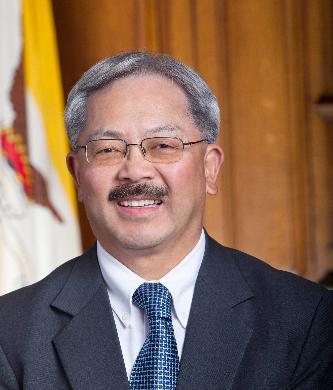
In the eyes of his critics, suspended Sheriff Ross Mirkarimi may never be able to recover from the portrayal by prosecutors and Mayor Ed Lee that he abused his wife, intimidated her with threats to use his power to take custody of their young son if they divorced, and used her and his campaign manager to try to dissuade witnesses and thwart a police investigation.

The tearful video of his wife, Venezuelan actress Eliana Lopez, displaying the bruise on her arm, and the fact that Mirkarimi pleaded guilty to a misdemeanor false-imprisonment charge in connection with the incident are all these critics need to condemn him. Indeed, it was all that Lee relied on when he suspended Mirkarimi without pay and launched unprecedented official misconduct proceedings to remove him from office.

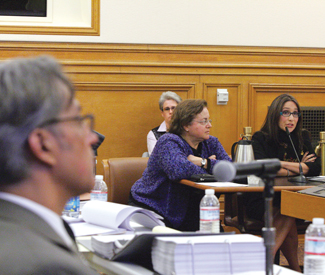
But now that the Ethics Commission has gotten through the substance of its inquiry — and past the tedious work of creating from scratch systems and standards for gathering evidence and evaluating whether it warrants an elected official’s removal by the mayor — the testimony has told a very different story of what really happened.

Accusations of witness dissuasion (which had been one of three original criminal charges Mirkarimi faced before agreeing to a lesser plea deal) and abusing his official position haven’t been supported by any direct evidence or testimony, and as the hearings wore on, Deputy City Attorneys Peter Keith and Sherri Kaiser were looking increasingly vindictive as they fruitlessly pursued those angles with witnesses who seemed credible.

There is also no direct evidence that the abuse was anything more than a moment of frustration and bad judgment at noontime on Dec. 31, when Mirkarimi grabbed Lopez’s arm as she tried to walk away from their heated argument about divorce child custody, and she yanked it away, eight days before his swearing in as sheriff.

Whether that incident and its aftermath meets the City Charter’s broad and untested definition of official misconduct — including “conduct that falls below the standard of decency, good faith and right action impliedly required of all public officials” — will be up to the interpretation of the Ethics Commission, which has now accepted all the evidence that it has deemed relevant and credible. All that remains is the fight over its “finding of fact” at an Aug. 16 hearing and its subsequent recommendation to the Board of Supervisors, which could begin considering the matter in September.

There won’t be an inquiry into whether Mayor Lee committed perjury on June 29, as outside witnesses said he did on two separate issues. The commission July 19 rejected the argument by Mirkarimi’s attorneys that Lee’s alleged lies under oath would cast doubt over his reasons for launching these unprecedented proceedings and the discretionary judgment he exercised. Commissioners decided that was a tangential issue.

In the final hour of the commission’s laborious work in whittling down the voluminous evidence that the city has presented in this case — which both sides and the commission openly acknowledge will likely be considered by the courts as well as the board — it also made deep cuts into the written testimony of attorney Nancy Lemon, a domestic violence expert who drew damning conclusions about Mirkarimi based on how “batterers” typically behave.

That’s been a big part of the city’s case, reducing Mirkarimi down to a two-dimensional batterer whose every action can be predicted by that distinction, from the manner in which he relinquished his weapons to police to the reasons why Lopez has resisted cooperating with efforts to charge her husband with crimes and remove him from office.

Lemon’s testimony was based almost solely on second-hand descriptions of life in the Mirkarimi household in a 22-page written declaration by neighbor Ivory Madison, who was also the only witness that Lee said he spoke to before removing Mirkarimi from office. But most of Madison’s incredible and fantastical narrative — which painted Mirkarimi as a monster who repeatedly abused Lopez and their son and controlled every aspect of their domestic life, right down to what and whether they ate — had already been discredited and disallowed by skeptical commissioners in June.

“I was disappointed by the content of Ivory Madison’s declaration. A first-year lawyer should know that much of it is inadmissible and it should not have been given to us,” Commissioner Paul Renne told Keith in June. Renne called the declaration “clearly hearsay, clearly having the intention of poisoning the well of this hearing.”

Keith apologized and offered little resistance to much of the declaration’s removal, but the city has nonetheless continued to rely on the second-hand accounts of Madison and another neighbor, Callie Williams, in its descriptions of Mirkarimi’s conduct and the questioning of witnesses.

But that hearsay evidence and speculation was countered on July 18 and 19 with the extended cross examination of two key witnesses in the case: Lopez and Mirkarimi campaign manager Linnette Peralta Haynes, a woman with domestic violence training who Lopez reached out to on that pivotal day of Jan. 4 when Madison called the police. Each woman spent more than three grueling hours each on the stand, questioned by city attorneys and commissioners — and they painted a very different portrait of the events than Lee and Madison had.

As for Madison — having had most of her testimony stricken from the record, and with Lopez testifying about Madison’s sudden zeal for going after Mirkarimi and involving his political opponents in that process — Mirkarimi’s team decided not to call her to the stand for live cross-examination. Attorney Shepherd Kopp told reporters, “I think the neighbor’s testimony is suspect at best.”

The go-between

Haynes was central to the city’s allegation that Mirkarimi dissuaded witnesses and sought to thwart a police investigation. Phone and electronic records revealed that she communicated with both Lopez and Mirkarimi many times on Jan. 4, the day Mirkarimi learned that his wife had been confiding with neighbors about the Dec. 31 incident and that Madison had broken that confidence and called the police.

The city’s apparent theory was that Haynes acted as Mirkarimi’s agent in trying to cover up the incident and do damage control, including coaching Lopez on what to say to Madison and Williams.

But the city has never had any evidence to support its theory, and this was its first chance to question Haynes, who had been at the end of a high-risk pregnancy and resisted cooperating with the investigation.

Yet despite Kaiser and commissioners grilling Haynes for more than three hours — twice as long as she had told the commission that she would need — no smoking gun emerged. Haynes seemed calm and consistent as she described giving Lopez emotional support and probing to ensure that she wasn’t in danger. Kaiser fumbled through technical difficulties and maintained an accusatory and belittling tone even as the answers she was receiving seemed to destroy her line of questioning.

“I think the house of cards that mayor has been trying to establish about witness dissuasion was demolished by Linnette Peralta Haynes, who was absolutely credible,” Mirkarimi attorney Shepherd Kopp told reporters after the hearing.

Haynes has a background in domestic violence, undergoing a 40-hour certification training in the mid-90s when she went to work for a domestic violence center in San Mateo for almost two years, then later helping develop and teach a domestic violence curriculum for the jail in San Francisco.

She’s familiar with the Power and Control Wheel — the basis for many of Lemon’s conclusions — which indicates how physical abuse can be connected to other forms of abuse, such as emotional, verbal, and sexual abuse. It was with this background and training that Haynes questioned Lopez about whether she was in danger and being abused when she got an unexpected call on the morning of Jan. 4.

“She let me know she had an argument with Ross and wanted to talk to me,” Haynes said, later answering another question by saying, “She told me she was really worried about custody issues and she was talking to a friend who was an attorney.”

That friend turned out to be Madison, who Lopez maintains had represented herself as an attorney who would keep their conversation and the video they made of her injuries confidential, to be used only in the event of a custody battle. The city has sought to cast doubt on that claim — which the court rejected in Mirkarimi’s criminal case when it admitted the video as evidence — implying that Madison was simply a concerned friend and the attorney argument was developed weeks later.

Haynes said she asked Lopez whether there had been any prior incidents of physical abuse, whether Lopez felt unsafe, and whether she had been subjected to other forms of abuse — defining each form for Lopez — and that she was told “no” to each question.

“I asked if she thought she was in danger and she said no,” Haynes said.

Later on Jan. 4, Lopez told Haynes she had made the video: “She told me a friend had helped me do a video just in case I needed it for custody issues…She did tell me that she really wanted to work on her marriage, that she wanted to make to make it work, but that just in case she wanted to make sure she got custody of Theo.”

Lopez later testified that one reason she sought out Haynes was because Madison had suddenly become aggressive in trying to convince her that she was a domestic violence victim and the incident needed to be reported to the police, and Lopez wanted to get the perspective of someone with a background in domestic violence.

“I said, I have a person telling me this, I want your opinion about it,” Lopez testified.

Around 12:30pm that day, when Madison informed Lopez that she had called the police and they were on the way, she frantically called Haynes from Madison’s house and suddenly put the two women on the phone together, which Madison and the city have characterized as a witness dissuasion effort.

Haynes said she was confused when Lopez suddenly handed the phone to Madison: “She said, ‘help me, help me, help me,’ and I’m on the phone wondering what’s going on.”

“[Madison] told me, ‘I’ve been talking to Eliana for several days and I just called the police,’” Haynes said.

Haynes said she asked Madison if she had called any domestic violence agencies or if she just called the police “and she got very agitated” — adopting a defensive tone of voice — and that reaction seemed “fishy” to Haynes.

Asked whether she tried to dissuade Madison from talking to the police, she responded, “I told her she should maybe talk to her friend about what she wants.” She said that she could hear Lopez telling Madison, “This is not what I want, this is not what I want.”

So Haynes said she tried to extricate herself from the situation: “I told her I really think you need to get off the phone, talk to Eliana, and respect her.” And the phone conversation ended with Lopez getting back on the line and telling Haynes to call Mirkarimi to let him know what was going on.

But Mirkarimi was busy and not answering his phone, prompting Haynes to text at one point that he needed to answer ‘so I can protect you.” What did she mean by that, Kaiser asked.

“My thinking was that something sounded fishy, something wasn’t right, and they need legal help,” Haynes said.

“Your focus had been on Eliana up until then?” Kaiser asked.

“My focus has always been Eliana,” Haynes responded.

Later, asked about the nature of her repeated phone conversations with Lopez, she denied helping her strategize ways to dealing with witnesses or police. “I was just providing support for her, emotional support,” Haynes said, later adding “I wanted to be present for her.”

The victim

Lopez testified that while the grabbing incident was unacceptable and serious — which she conveyed to Mirkarimi — she didn’t consider herself to be in an abusive environment or in need of outside help, except perhaps the marriage counseling she had been seeking and which Mirkarimi finally agreed to.

“An abusive environment is when those kinds of think happen every day or every week,” she said, maintaining — in the face of repeated questioning — that this was the first and only instance of physical abuse.

“At the end of the day on Dec. 31, I told him, that cannot happen, this is wrong, we need counseling,” she said. “He realized it was wrong and he took it very seriously.”

But she said that Madison went from being a supportive friend and counselor on Jan. 1 to suddenly becoming increasingly insistent that Lopez report the incident to police in the days that followed.

“She started trying to convince me to call the police in that email,” Lopez said, answering a question about a Jan. 2 message from Madison, “but that wasn’t our conversation on Jan. 1.”

Lopez said Madison’s approach got more aggressive. “She said, ‘screw him, I have a lot of friends willing to help you,’” Lopez said, noting that Madison offered her the vacant homes of rich friends and offered to bring in journalist Phil Bronstein, DA George Gascon, Attorney General Kamala Harris, and Lieutenant Governor Gavin Newsom to help her.

“It looked to me suspicious…She was calling Ross’ political enemies,” Lopez said.

When Lopez finally made it clear she didn’t want police involvement, Madison called the police.

“I didn’t expect that my lawyer could call the police on her own. I thought that was my decision,” Lopez said.

Keith tried to tie Lopez’s custody concerns to his status as sheriff, driving at that point with many questions. But Lopez said her concern was that California family courts would favor Mirkarimi simply because he’s an American and she’s from a country that has bad relations with the US.

“In this country, I think he’s in a better position than me,” she said. After he again tried to make it about his official position, she said, “As a sheriff, no; as an American, yes.”

She denied the claim by the city and Madison that it was Mirkarimi who sought to improperly use his position, a key element of removing him for official misconduct. Lopez said her conclusions about Mirkarimi’s advantages in a potential custody battle were the result of conversation that happened much earlier.

“That conversation happened in March 2011. He wasn’t even thinking about running for sheriff at that point,” she said, denying that Mirkarimi ever raised his official position in their custody conversations and claiming the concerns about his power were her own. “He never said that, that was my conclusion of our conversations. He never said, ‘I am a powerful man.'”

Throughout hearings, Mirkarimi’s side has enjoyed strong shows of public support, with many of his supporters wielding signs that read, “I believe Eliana” and “I support Eliana,” both in Spanish and English.

During a recess in the July 18 hearing, Mirkarimi said he appreciated the outpouring of support: “There are scores of people showing their support who think this has gone way too far.”


Governor signs high-speed rail funding bill at Transbay Terminal

8

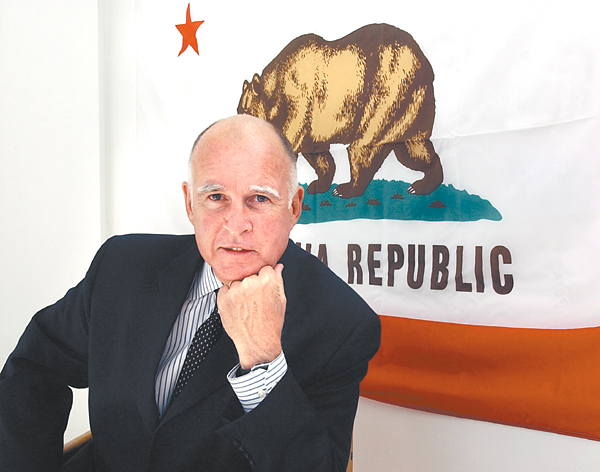
The mood was jubilant at the Transbay Terminal construction site in downtown San Francisco this afternoon as political leaders gathered to watch Gov. Jerry Brown sign Senate Bill 1029, the hard-won recent authorization for selling the first $4.7 billion in state bonds to fund the California High-Speed Rail Project.

That money – part of the $10 billion that voters approved for the project in 2008 – and $7.9 billion in federal matching funds will go mostly to build the first high-speed rail section linking Merced to the San Fernando Valley. But it also includes money for related projects in the Bay Area, including $820 million to electrify and improve the Caltrain tracks that the project will share, $145 million for BART replacement cars and track improvements, and $61 million for SF’s Central Subway project.

The fact that Brown chose Transbay Terminal – the northern terminus for trains expected to travel at up to 220 mph between there and Los Angeles’ Union Station in less than three hours by the year 2027 – was an indicator of his focus on the long-term benefits of the project rather than its immediate impacts, a theme he emphasized in his speech.

“What this is about is investing in the future,” he said, pointing to the high-rises around him and noting how they were also the products of people with long-term vision. “The buildings that are up here didn’t come out of fear, they came from bold risk-taking.”

High-speed rail has been under increasing criticism from conservatives who complain about its cost (the total project cost is estimated at about $68 billion) and SB 1029 squeaked through the Legislation, with not a vote to spare in the Senate, where President Pro Tem Darrell Steinberg and other political leaders had to twist arms to get it done.

“The people know we can cut, the people know we can patch and mend, but the skeptics wonder whether we have the will to build,” Steinberg said at the event, which he said answered that question. “This is about economic vitality.”

Mayor Ed Lee praised state leaders for moving the project forward and said, “This project means more than just celebrating a great transit system, which high-speed rail is,” noting that the overall Transbay Terminal project will also include about 40,000 new residential units being built on a dozen surrounding buildings, including what will be the tallest on the West Coast.

But that project has its critics, including Quentin Kopp, the retired judge and former legislator who sponsored the bill that created the California High-Speed Rail Project and was the first chair of the California High-Speed Rail Authority. He has derided Transbay Terminal as simply a “real estate deal,” noting that the tunnel from there to the Caltrain station is too expensive, still unfunded, and shouldn’t be built.

Asked about that $1 billion-plus funding shortfall, Brown replied, “Let’s see the first phase, then the second phase, then we’ll figure out how to get it here.” He criticized the “NIMBYs and fearful men” and emphasized the long view of the project: “I signed my first high-speed rail bill 30 years ago. It’s taken some time to get this going.”

Several speakers cast the project as an obligation to future generations. Deputy US Secretary of Transportation John D. Porcari said most of the country’s most important infrastructure we enjoy today was built by past generations, and he asked, “Are we doing right by the next generation? Are we paying it forward?”

City College fights back

19

news@sfbg.com

When your options are bad, terrible, and unthinkable, how do you choose which way to go? And should that decision be graded on a curve that takes into account the dire fiscal circumstances facing most public colleges in California these days?

City College of San Francisco (CCSF), which serves more than 90,000 students a year, last year did what some consider unthinkable: laying off administrators and leaving a reserve fund at dangerously low levels in order to save classes and stave off faculty layoffs. The current $187 million operating budget has a reserve of only $2.2 million, or just over 1 percent compared to the state-recommended 5 percent.

Such decisions may cost the college its accreditation and threaten its very existence, but they also represent legitimate differences over what role educational institutions should play in their communities.

In June, the college came under fire for administrative and financial mismanagement by the Accrediting Commission for Community and Junior Colleges, a private organization that evaluates K-12 schools and higher education institutions every six years.

Although the commission applauded the school for its commitment to students, it placed the school under its most severe sanction before accreditation is terminated: “show cause.”

It identified eight problem areas that the college has failed to address since 2006, which include measuring student learning outcomes, attaining financial solvency, and revising the college’s mission statement to reflect current fiscal realities.

“The team finds that the current, ongoing funding for San Francisco City College appears insufficient to fully fund the mission of the college as it is currently conceived,” the commission wrote in its June report. “The team advises the college to assure the mission of the college is obtainable based on accurate short-term and long-term funding assumptions.”

Essentially, the commission is recommending a refocusing of the school’s mission to prioritize college transfer classes. The report went on to say that too many people making decisions through a highly decentralized governance system slowed down or halted altogether the college’s ability to make cuts where it needed to — or where the state and commission thought cuts should be made.

These competing visions of how community colleges should continue to exist have driven a wedge between local college officials and state-level decision makers — a clash made clear through City College’s accreditation woes.

“It’s not that City College isn’t doing a good job, it’s that these are emerging trends we have,” former Student Trustee Jeffrey Fang said. “In the long run, it might actually improve City College. The bad part is that it came at a time when we are so strapped and mired neck deep in political games.”

Those games have starved funding for public education statewide, in the process redefining the role of community colleges.

“City College has a very ambitious mission. Part of that mission is that it’s a true community college,” CCSF spokesperson Larry Kamer said. “Now, decisions are being made de facto by the budget and we need to re-evaluate that mission.”


PUTTING THE “COMMUNITY” IN COLLEGE

Adult education used to be integrated into K-12 districts. But over the years, two-year “junior” colleges took over that responsibility, transforming them into today’s “community” colleges.

The newly minted community colleges began serving thousands of immigrants learning English, job seekers needing new skills, and elderly citizens looking to continue their education. But when California’s budget crisis hit a critical point, that all began to change.

Three years ago, the California Legislature said when the community colleges cut courses, they shouldn’t cut courses involving transfer, career technical education, and basic skills, State Community College Chancellor Jack Scott said in a phone interview.

Scott is responsible for overseeing all 112 community colleges in California, a quarter of all community colleges in the country. He’s on the cusp of retirement, and the end of his tenure has been marked with the changing mission of the colleges he oversees.

“I want it clearly understood that I personally want to see the community colleges offer all the classes it wants to,” he said. “But with scarcity, you have to prioritize. If you offer the same classes you did before, you’ll go bankrupt. Something has to give.”

The state agreed and asked community colleges to prioritize enrollment, with a focus on recent high school graduates who plan to transfer to a university in two years and anyone else seeking a degree or certificate.

If community colleges can’t afford to offer classes sought by their broader communities, and K-12 schools are ill-equipped to plug back into that task, does the notion of continuing adult education just fade away?

David Plank, executive director of policy analysis for California Education, a Stanford University-based research center, says it just may: “I don’t think that responsibility will be reimposed on K-12 districts because it was always seen as a sort of add-on supplementary responsibility.”


BUDGET WOES TRICKLE DOWN

California’s Master Plan for Higher Education — which mandates that community colleges provide classes for everyone — only worked as long as there was money to fund it. But Plank says that money has been steadily shrinking since 1978 when voters passed Proposition 13, which capped property tax increases and raised the voting threshold for the Legislature to increase other taxes.

As funding from Sacramento has been slashed by more than $500 million in the past year alone, California’s 112 community colleges have turned away more than 300,000 students trying to enter the system. If Governor Jerry Brown’s tax proposal wins in November, community college funding will stay at about the same level, but if it fails, the system will see further cuts of more than $340 million.

“The system now is breaking down,” Plank said. “We’ve finally reached a point where the state’s share is too small to hold things together. We see tuition going up at very rapid rates and a substantial deterioration both in access and affordability.”

In flush times, community colleges could serve everyone — rich and poor, those seeking new skills and others working toward a new degree. Now, the community college system faces two choices if it’s unable to find new sources of revenue: continue on the path of deep cuts, or change its priorities altogether.

City College Board member Steve Ngo cites new statistics that show enrollment in English as Second Language (ESL) classes are trending down, a sign that those classes should be cut first. “The community should lead. If the demand is down, you’re not serving your community,” he said.

Yet others say community colleges should strive to serve everyone who needs them.

“Some [classes] are really valued by our Pacific Islander population, but their enrollment may not be as high. Should those classes go away? I don’t think so. It’s something I feel like the whole college community needs to come to grips with” CCSF math instructor Hal Hunstman said.

City College ESL instructor Susan Lopez said her classes have been cut about 29 percent over a decade, which she considers drastic.

“Despite that large and somewhat intentional reduction, we still serve 20,000 annually throughout the city. By comparison with our very large ESL Department, the English Department serves only 7,000,” Lopez said. “How could we abandon those who are most educationally needy and often desperately poor in favor of those who are less needy?

“We need to step up adult education across the board,” she said. “The problem is all the pressure to do less and to fund less of this type of education.”


SMOTHERED ON ALL SIDES

The accreditation commission is an independent body, but it’s been pressured too.

“In the current climate of increased accountability, our regional accrediting associations find that tight spot to be more like a vice,” a commission newsletter said in 2006. “On one side are forces at the national level ready to throw out regional accreditation in favor of a federal approach; while at the local level, they are faced with institutions resistant to rapid change and increased scrutiny.”

In the past year, private entities ponied up thousands of dollars to help usher in a new numbers-based approach to education. In 2011, a 20-member body comprised of public and private representatives was charged with evaluating the community college system.

Called the California Community College Student Success Task Force, its creation was mandated by the state, but to many people it reeked of privatization.

Several private organizations funded the task force’s work, including the Lumina Foundation, an educational research and grant-making institution with ties to the American Legislative Exchange Council (ALEC), a controversial lobbying group for private interests that authored the Stand Your Ground gun law.

By fall 2011, students, faculty, and administrators across the state began to question the task force’s methods and recommendations, which initially included proposals to cut many non-credit and enrichment courses, restrict financial aid, prioritize transfer students, and cap the number of units one person could take.

Under the veil of increasing so-called “student success,” the task force was asking schools to prioritize limited funds and change their missions to once again become “junior” colleges — a fate that City College has refused to accept.

City College’s Board of Trustees passed a resolution in November 2011 opposing the task force, nearly unanimously, with Ngo the sole dissenting vote. Then-Chancellor Don Griffin warned that the task force’s agenda was a transparent attack on open access that would disproportionately affect poor people and people of color, imploring the board to reject its recommendations.

“They’re talking about taking over the vehicle of community colleges and turning it into something else,” Griffin said. “We have to take a hard stand because everybody around the state is watching City College of San Francisco.”

Students and faculty at City College joined the fight. They spoke out at Board of Governors meetings in Sacramento. They wrote letters, emails, and scathing editorials. The school’s student-run school newspaper, The Guardsman, led a statewide campaign opposing the task force.

Despite the public’s concerns, the California Community Colleges Board of Governors adopted the task force’s final report in January.

“As wonderful as open admissions is, if it’s a false promise to an objective, it fails,” Peter MacDougall, Board of Governors member and task force chair, said at the January meeting.

“Our objective is to have that promise realized, that’s what the recommendations are intended to achieve.”

Ultimately, the initiative succeeded, shifting priority enrollment to students who are freshly in the college system. The Task Force report is now Senate Bill 1456, sponsored by Sen. Alan Lowenthal and commonly known as the Student Success Act of 2012.


AHEAD OF THE PACK

As everyone waits with crossed fingers hoping for a favorable outcome at the ballot in November, City College officials are fighting keep the school open.

“Do we alter our mission slightly, or fundamentally? It’s not clear yet what we’re going to do,” Ngo said.

The trustees have until October to present the commission with a plan and then until March to prove they can achieve it. In the meantime, the commission requires that preparations be made for potential closure, which Interim Chancellor Pamila Fisher and other CCSF officials say won’t happen.

Only two other community colleges received a “show cause” order this year: College of the Redwoods and Cuesta College. Yet as of January, 25 percent of California’s community colleges are under sanctions, according to the accreditation commission documents.

Federal funding hinges on the certification and other educational institutions, such as the University of California and the California State University systems, only accept transfer credits from other accredited institutions.

Everyone seems to agree that City College is too big to fail — with more than 90,000 students, it’s the largest community college in the nation — but how it will look and operate in the future remains unknown.

City College already cut dozens of classes this year — including many with students already enrolled after the spring semester began. But City College isn’t alone in its plight.

Santa Monica Community College caused an uproar earlier this year when it proposed charging more for popular classes. As of July 1, classes cost $46 per unit but under Santa Monica’s proposal students would pay $180 per unit for courses in high demand.

When students protested this two-tiered payment system in April, police pepper-sprayed them, just five months after UC Davis students received the same brutal treatment for holding a non-violent Occupy-style action against their own tuition hikes.

“What we see is a move towards privatization, in the sense that we are now expecting students to pay a larger share of the cost,” Plank said. “Over certainly the last 40 years, California has been steadily disinvesting in post secondary education.” Whether tuition increases at the CSUs and UCs in the near future depends on whether voters approve Brown’s tax proposal this November. City College’s financial future hinges not only on the governor’s tax proposal, but a local parcel tax initiative as well. City College needs both to pass in November just to break even. “A lot of San Francisco’s workforce is educated at City College,” City College board member Chris Jackson said, adding that for poor and working class people, it’s the only affordable option. In addition, as veterans return from foreign conflicts, ex-offenders are released from prison and enrollment capped at the state universities, Jackson said, “We need local investment in City College.”

NUDE BEACHES 2012

7

Editors Note: Below you’ll find our annual update on the state of nude beaches in the Bay Area, along with detailed guides and directions to several of our favorites. For details on dozens more, please see our complete Nude Beaches Guide, which we are in the process of updating. 

NUDE BEACHES Arrests for being naked on the sand, anti-nudity warning signs going up at previously unthreatened spots, outright threats of beach closures, social activists making their mark on San Francisco’s most well-known clothing-optional beach: this is shaping up to be one of Northern California’s busiest nude beach seasons in recent memory.

Faced with a July 1 deadline, on June 28 Governor Jerry Brown’s administration announced it saved or would stall shutting down all but one of 70 state parks and beaches targeted for closure due to budgetary shortfalls. These include three sites in our annual guide: Montara’s Gray Whale Cove, Carmel’s Garrapata State Park, and Zmudowski State Beach in northern Monterey County.

Officials said they would use $13 million in bond money in the budget to keep the properties running at least through summer. Some 40 parks will remain open for an estimated one to five years, due to temporary funding and support agreements being negotiated with nonprofit foundations and other organizations. More than 25 other properties, including Gray Whale Cove, also known as Devil’s Slide, will keep going while deals are completed.

When asked exactly how long Gray Whale Cove, Garrapata, and Zmudowski would stay open, California State Parks spokesman Dennis Weber told me they could keep going for a month, the entire summer, a year, or even longer. “We don’t know how much time we have,” he said.

Paul Keel, the state parks sector superintendent for the area that includes Gray Whale Cove, was more optimistic. He told me he’s keeping the popular beach open through at least the end of July because while “nothing’s been signed or inked, it’s fair to say we are optimistic” an agreement with a private operator or nonprofit will be finalized before then. Until the state took control, the site was run by a private licensee, San Francisco developer Carl Ernst and his company, Gray Whale Cove Enterprises, Inc.

Ruth Coleman, head of the State Parks and Recreation Department, said the bonds would fund solar power systems, as well as automatic pay machines that take credit and debit cards. And visitors arriving at Devil’s Slide or Garrapata are likely to notice signs that urge them to pay for parking instead of parking outside.

The card machines are likely to be particularly handy at Devil’s Slide after a long-awaited tunnel bypassing rockslide-prone Highway 1, which remains the access point to the beach, is expected to open this fall. Keel suspects the Devil’s Slide Tunnel will bring larger crowds to the beach.

But the news wasn’t all good. Maintenance and garbage pick up operations are likely to remain reduced or eliminated. In late June, Brown partly vetoed a larger, $41 million funding bill that had been OKed by the state legislature. State Senator Joe Simitian (D-Palo Alto), who coauthored the bigger funding plan, criticized the veto, calling it “a lost opportunity to take action.” Another lost opportunity: in November 2010, California voters rejected a ballot initiative that would have raised about $500 million for state parks.

Meanwhile, while Sacramento was cutting back beach services, activists were making additions to the section of San Francisco’s Baker Beach used by nudists. Naturists have erected driftwood art sculptures and tent-like structures without walls, called “dunies,” at the north end of the beach. And they’ve vowed to keep the site free of gawkers by staring them down in what organizers call a non-confrontational approach to self-policing. “They usually decide to leave pretty soon,” says Santosh, 46, an artist and street fair producer.

Speaking of policing, in the past year cops have raided Garrapata and put up signs about nudity at Bonny Doon Beach and at least two other beaches north of Santa Cruz.

At Garrapata, rangers and lifeguards cited over a dozen persons for public nudity last summer and began patrolling the beach at least two times a day after receiving what lifeguard Eric Sturm told the Carmel Pine Cone were reports of “sex acts on the beach.”

And at Bonny Doon, Laguna Creek, and Panther Beach, “Nudity In The State Park System Is Prohibited” signs have been posted, although naturists there remain defiant and are still visiting the sites. “A 50-year tradition (of clothing-optional use at Bonny Doon) cannot be extinguished by a simple sign,” said Rich Pasco, coordinator of the Bay Area Naturists, after the signs went up. He urged nudists to “be polite and respectful” of rangers and suit up “if requested,” but to engage them in “intelligent conversations.” After two months, the signs at Bonny Doon, though, were taken down because, according to Joe Connors, public safety superintendent for state beaches in the Santa Cruz area, “we don’t get a big volume of complaints there.”

Want to join others in having fun at a clothing-optional spot this summer? The USA’s only naked “Full Moon Hikes” will take place in Castro Valley in late July, August, and September (see our listings online at SFBG.com for Last Trampas in Contra Costa County for details). Another idea to meet and socialize with fellow naturists: drop by Bonny Doon on September 15, when fans of the site will be gathering to keep it pristine by finding and removing trash.

Finally, you can aid the naturist community by sending me your new beach discoveries, trip reports, and improved directions (especially road milepost numbers), along with your phone number to garhan@aol.com or Gary Hanauer, c/o San Francisco Bay Guardian, 71 Stevenson, 2nd Floor, San Francisco, CA 94105.

Our ratings: [full moon] signifies a beach that is large or well-established and where the crowd is mostly nude; [half moon] indicates places where fewer than half the visitors are nude; and [quarter moon] means small or emerging nude areas.

SAN FRANCISCO

NORTH BAKER BEACH, SAN FRANCISCO

RATING: A

Social activists have begun streaming onto the sand of America’s biggest urban nude beach, creating what visitor Santosh calls “a tone that’s like Burning Man,” with regulars bringing guitars, drums, and Frisbees to the sand, putting up art work best described as eclectic, and occasionally staring down gawkers.” There’s no requirement that you go nude,” says Santosh, an artist, graphic artist, and producer of San Francisco’s How Weird Street Faire, an outdoor street fair held each year in the SoMa neighborhood as a fundraiser for the World Peace Through Technology Organization. “But if a creeper dude plops down next to a (nude) person or if they are staring at someone’s private parts and it’s happening close to where we are, on the far north end (of North Baker), then they will start being the object of ridicule.

Directions: Take the 29 Sunset bus or go north on 25th Avenue to Lincoln Boulevard. Turn right and take the second left onto Bowley Street. Follow Bowley to Gibson Road, turn right, and follow Gibson to the east parking lot. At the beach, head right to the nude area, which starts at the brown and yellow “Hazardous surf, undertow, swim at your own risk” sign. Some motorcycles in the lot have been vandalized, possibly by car owners angered by bikers parking in car spaces; to avoid trouble, motorcyclists should park in the motorcycle area near the cyclone fence.

LAND’S END BEACH

RATING: A

Considered one of the most beautiful places in the Bay Area to doff your togs, Land’s End should really be called Swimsuit’s End. The reason: although it draws more clothed users than nudists, more than a few swim tops and bottoms magically “disappear” on warm spring, summer, and fall days at the little cove off Geary Boulevard. Come early to grab your share of the sand on this semi-rocky shoreline, which is sometimes dotted with rock-lined windbreaks left by previous sunbathers. Bring a light jacket or sweatshirt in case the weather changes.

Directions: Follow Geary Boulevard to the end, then park in the dirt lot up the road from the Cliff House. Take the trail at the far end of the lot. About 100 yards past a bench and some trash cans, the path narrows and bends, then rises and falls, eventually becoming the width of a road. Don’t take the road to the right, which leads to a golf course. Just past another bench, as the trail turns right, go left toward a group of dead trees where you will see a stairway and a “Dogs must be leashed” sign. Descend and head left to another stairway, which leads to a 100-foot walk to the cove. Or, instead, take the service road below the El Camino del Mar parking lot 1/4 mile until you reach a bench, then follow the trail there. It’s eroded in a few places. At the end, you’ll have to scramble over some rocks. Turn left (west) and walk until you find a good place to put down your towel.

GOLDEN GATE BRIDGE BEACH

RATING: A

On the hottest days, Golden Gate Bridge Beach becomes so packed with people that one visitor describes it as a “gay mob scene.” But the rocky shore, which connects three picturesque coves, also gets its share of straight men and women. Prime, non-cruising activities include sunbathing, enjoying breathtaking views of the Bridge, and even taking some dips in the water. “You can sometimes go out over 100 feet during low tide,” a woman tells me.

Directions: from the toll booth area of Highway 101/1, take Lincoln Boulevard west about a half mile to Langdon Court. Turn right (west) on Langdon and look for space in the parking lots, across Lincoln from Fort Winfield Scott. Park and then take the beach trail, starting just west of the end of Langdon, down its more than 200 steps to Golden Gate Bridge Beach, also known as Marshall’s Beach. Despite recent improvements, the trail to the beach can still be slippery, especially in the spring and winter.

FORT FUNSTON BEACH

RATING: C

What’s the only Golden Gate National Recreation Area park where you can walk your dog without a leash, as well as the spot where the world record for the farthest tossed object (a flying ring sent soaring 1,333 feet by Erin Hemmings) was set in 2003? Answer: Fort Funston, which is affectionately called Fort Fun by its fans. Known for its magnetic sand, steady winds (especially in March and October) that make its cliffs popular for hang gliding, and, in particular, its dogs, who appear here with their human escorts by the hundreds, the area even attracts a few naturists from time to time. Mostly hidden away in the sand dunes on the beach, naked sunbathers usually stay away on the weekends, when families swarm the area. To keep the “fun” in Fort Funston, even on weekdays, be sure to use caution before disrobing.

Directions: From San Francisco, go west to Ocean Beach, then south on the Great Highway. After Sloat Boulevard, the road heads uphill. From there, curve right onto Skyline Boulevard, go past one stoplight, and look for signs for Funston on the right. Turn into the public lot and find a space near the west side. At the southwest end, take the sandy steps to the beach, turn right, and walk to the dunes. Find a spot as far as possible from the parking lot.

CONTRA COSTA COUNTY

LAS TRAMPAS REGIONAL WILDERNESS, CASTRO VALLEY

RATING: C

Want to go walking around nude at night outside without being hauled off to jail? Imagine hiking naked guided only by your flashlight in the East Bay Hills, with the trail silhouetted by a full moon and small herds of horses coming up to greet you.

“It’s absolutely surreal,” says Jurek Zarzycki. “The horses come within inches of you, so close you can feel their breath. It’s like being on a moonscape with aliens. You may be a little afraid at first, but the horses are very friendly.”

America’s only nude “Full Moon Hikes” have been taking place on summer full moon nights in Castro Valley for more than seven years. The next ones will be held July 29, August 31 (arrive by 6pm), and September 28 (starting at 5:15pm) “We start early so that we have the full moon already risen by the time the sun sets,” says San Leandro’s Dave Smith, who leads most of the hikes. “Then we hike up the trail around sunset.”

Coordinated by a partnership between the Sequoians Naturist Club and the Bay Area Naturists, based in San Jose, walkers leave the property of the Sequoians fully clothed at dusk and walk through meadows and up hills until the moon rises, before heading back down the slopes completely nude, with their clothes folded neatly into their backpacks.

After the walk, most hikers shower at The Sequoians, and, for a fee of $5, take a dip in the 86-degree pool there and enjoy a plunge in the facility’s hot tub. “It was fabulous,” says Zarzycki about an earlier trek. “I pitched my tent right there at The Sequoians and then slept under the sky.”

Directions: Contact The Sequoians (www.sequoians.com) or the Bay Area Naturists (www.bayareanaturists.org) for details on how to join a walk. Meet at The Sequoians. To get there, take Highway 580 east to the Crow Canyon Road exit. Or follow 580 west to the first Castro Valley off-ramp. Take Crow Canyon road toward San Ramon .75 mile to Cull Canyon road. Then follow Cull canyon road around 6.5 miles to the end of the paved road. take the dirt road on the right until the “Y” in the road and keep left. Shortly after, you’ll see The Sequoians sign. Proceed ahead for about another .75 mile to The Sequoians front gate.

SAN MATEO COUNTY

DEVIL’S SLIDE, MONTARA

RATING: A

Although Devil’s Slide, also known as Gray Whale Cove, was scheduled to be closed this month by the state due to budget shortfalls, officials plan to keep it open while they negotiate with what Paul Keel, San Mateo coast state parks sector superintendent, calls a prospective “donor to keep it in operation for the coming year.” At press time, Keel told us that although “nothing’s been signed or inked, it’s fair to say we are optimistic, so hopefully we will know more in the next month.” Access to the site, though, is changing: after a long-awaited, voter-approved Devil’s Slide tunnel is completed this fall, Keel and others expect a possible increase in traffic to the beach, as more pedestrians and bicyclists use a nearby section of Highway 1 that is being closed. Meanwhile, rangers say they will allow a long-standing tradition of nudity to continue on the sand unless visitors complain.

Directions: Driving from San Francisco, take Highway 1 south through Pacifica. Three miles south of the Denny’s restaurant in Linda Mar, turn left (inland or east) on an unmarked road, which takes you to the beach’s parking lot and to a 146-step staircase that leads to the sand. Coming from the south on Highway 1, look for a road on the right (east), 1.2 miles north of the Chart House restaurant in Montara. Starting this fall, from the north, take Highway 1 through the Devil’s Slide tunnel and then turn left onto the road described above. From the south, continue using the above directions. Most naturists use the north end of the beach, which is separated by rocks from the rest of the shore.

SAN GREGORIO NUDE BEACH, SAN GREGORIO

RATING: A

Still the USA’s longest continually used nude beach, San Gregorio even has its own web site and live web cam at www.freewebs.com/sangregoriobeach. The privately run operation, which is located next to San Gregorio State Beach, recently began its 46th year of serving the clothing-optional community.

The beach often draws a large gay crowd, along with some nude and suited straight couples, singles, and families. “It’s a really romantic spot,” says a single woman. However, first-timers are sometimes annoyed (as I was, years ago) by the driftwood structures on the sandy slope leading down to the beach, which are used by some visitors as “sex condos.” However, fans of the beach savor San Gregorio’s stunning scenery. It has “awesome natural beauty,” says regular visitor Bob Wood. Attractions of the 120-acre site include two miles of soft sand and tide pools to explore, as well as a lagoon, lava tube, and, if you look closely enough on the cliffs, the remains of an old railroad line.

Directions: From San Francisco, drive south on Highway 1, past Half Moon Bay, and, between mileposts 18 and 19, look on the right side of the road for telephone call box number SM 001 0195, at the intersection of Highway 1 and Stage Road, and near an iron gate with trees on either side. From there, expect a drive of 1.1 miles to the entrance. At the Junction 84 highway sign, the beach’s driveway is just .1 mile away. Turn into a gravel driveway, passing through the iron gate mentioned above, which says 119429 on the gatepost. Drive past a grassy field to the parking lot, where you’ll be asked to pay an entrance fee. Take the long path from the lot to the sand; everything north of the trail’s end is clothing-optional (families and swimsuit using visitors tend to stay on the south end of the beach). The beach is also accessible from the San Gregorio State Beach parking area to the south; from there, hike about a half-mile north. Take the dirt road past the big white gate with the Toll Road sign to the parking lot.

SANTA CRUZ COUNTY

GARDEN OF EDEN, FELTON

RATING: C

Tucked away in Henry Cowell Redwoods State Park, between Santa Cruz and Felton, the Garden Of Eden is a much-used skinny-dipping hole on the San Lorenzo River, which is also visited by clothed families. Some hikers are surprised when they see people nude there and either use the spot anyway or keep walking. Watch out for poison oak and slippery sections on the trail. Eden is one of three clothing-optional swimming holes on the river. To find them, look for cars pulled over on Highway 9, next to the state park, which bans nudity but seldom sends ranger patrols to the creek.

Directions: From Santa Cruz, drive north on Highway 9 and look for turnouts on the right side of the road, where cars are pulled over. The first, a wide turnout with a tree in the middle, is just north of Santa Cruz. Rincon Fire Trail starts about where the tree is, according to reader Robert Carlsen, of Sacramento. The many forks in the trail all lead to the river, down toward Big Rock Hole and Frisbee Beach; Carlsen says the best area off this turnout can be reached by bearing left until the end of the trail. Farther up the highway, 1.3 miles south of the park entrance, is the second and bigger pullout, called the Ox Trail Turnout, leading to Garden of Eden. Park in the turnout and follow the dirt fire road downhill and across some railroad tracks. Head south, following the tracks, for around .5 miles. Look for a “Pack Your Trash” sign with park rules and hours and then proceed down the Eden Trail.

Ox Trail, which can be slippery, and Eden Trail both wind down steeply to the creek. “The path continues to the left, where there are several spots for wading and sunbathing,” Carlsen says. The main beach is only 75 feet long and 30 feet wide, but fairly sandy. Carlsen’s favorite hole is accessible from a trail that starts at the third turnout, a small one on the right side of the road, about 4.5 miles from Highway 1 and just before Felton. A gate marks the start of the path. The trail bends left. When you come to the road again, go right. At the railroad tracks, go right. From here, look for the river down the hill on your left; many paths lead to it. Says Mike: “Within 10 yards, you can be in the water.”

BONNY DOON NUDE BEACH, BONNY DOON

RATING: A

Despite the temporary erection of anti-nudity warning signs at longtime nudie fan favorite Bonny Doon Beach, north of Santa Cruz, officials have told us they have no immediate plans to issue citations at the north end of the site, which has traditionally been occupied by naturists. In fact, the signs were taken down after just two months.

In fact, in June, Pam, of San Mateo, even found a nudist at the main public, south side of the beach, which is used by suited visitors. A 15-foot long rock on the sand, along with a sloping cliff with rocks that jut out, separate the two sides of the cove that form Bonny Doon.

“In the short term, things at Bonny Doon are destined to continue the way they are,” says Kirk Lingenfelter, sector superintendent for Bonny Doon and nearby state beaches. Lingenfelter says he likes Bonny Doon just the way it is. “It’s one of our pocket beaches,” he explains. “They can really give you the feeling of rugged, untouched majesty. I like standing on those beaches. You can sometimes forget that there’s a highway in the distance. It’s a very important feeling to maintain. “The clothing-optional section usually attracts more women and couples than most nude beaches. “Minuses” include occasional vehicle burglaries and gawkers on the bluffs or in the bushes.

Directions: From San Francisco, go south on Highway 1 to the Bonny Doon parking lot at milepost 27.6 on the west side of the road, 2.4 miles north of Red, White, and Blue Beach, and some 11 miles north of Santa Cruz. From Santa Cruz, head north on Highway 1 until you see Bonny Doon Road, which veers off sharply to the right just south of Davenport. The beach is just off the intersection. Park in the paved lot to the west of Highway 1; don’t park on Bonny Doon Road or the shoulder of Highway 1. If the lot is full, drive north on Highway 1, park at the next beach lot, and walk back to the first lot. Or take Santa Cruz Metro Transit District bus route 40 to the lot; it leaves the Metro Center three times a day on Saturdays and takes about 20 minutes. To get to the beach, climb the berm next to the railroad tracks adjacent to the Bonny Doon lot, cross the tracks, descend, and take a recently improved, sign-marked trail to the sand. Walk north past most of the beach to the nude cove on the north end. Alternately, Dusty suggests parking as far north as possible, taking the northern entrance, and, with good shoes, following a “rocky and steep” walk down to the sand.

2222 BEACH, SANTA CRUZ

RATING: A

In late May, when my girlfriend and I visited a little cliffside park above it and peered down on the aptly named 2222 — it’s the number of the house across the street — we discovered that the pocket-size cove looked as beautiful as ever. In fact, America’s smallest nude beach is so small it could probably fit in your yard. And that’s what makes it a magical place. You won’t find crowds at 2222, which takes scrambling to reach and isn’t recommended for children or anyone who isn’t a good hiker. However, those who are agile enough to make it down a steep cliff and over some concrete blocks on the way down will probably be rewarded with an oasis of calm and a good spot to catch some sunrays.

Directions: The beach is a few blocks west of Natural Bridges State Beach and about 2.5 miles north of the Santa Cruz Boardwalk. From either north or south of Santa Cruz, take Highway 1 to Swift Street. Drive .8 miles to the sea, then turn right on West Cliff Drive. 2222 is five blocks away. Past Auburn Avenue, look for 2222 West Cliff on the inland side of the street. Park in the nine-car lot next to the cliff. If it’s full, continue straight and park along Chico Avenue. Bay Area Naturists leader Rich Pasco suggests visitors use care and then follow the path on the side of the beach closest to downtown Santa Cruz and the Municipal Wharf.

PRIVATES BEACH, SANTA CRUZ

RATING: A

“Privates is one of my favorite beaches,” says Brittney Barrios, manager-buyer of Freeline Design Surf Shop, which is located nearby and sells keys to unlock the gate leading to the clean, beautiful cove. “It’s always very peaceful.” Visitors include nudists, surfers, families, and local residents. “Everyone gets along,” adds Barrios. “And it’s never crowded.”

Barrios says many of the naturists, who often visit in groups, like to play Paddle Ball on the sand. As for Barrios, she prefers to “lay out,” as she calls it, in the sun.

There’s almost no litter, wind, noise, or troublemakers — security guards plus a locked gate keep the latter out — and world class surfers, such as those who starred in Endless Summer II, regularly put on a free show for the naked people who share the warm, clean sand with surfers.

“It’s really nice,” says Hunter Young, a former worker at Freeline, which sells up to 600 beach passes a year. “Surfers love it because it has good waves. It’s 100 percent standup surfing, with paddling. Anytime I go to Privates, I can expect a long ride on my longboard.”

“The beach is also very family oriented,” explains Barrios. “And it’s OK for dogs too.”

“There are two different coves on the beach,” says Young. “Clothed families who use the beach know which cove is nude and stay away from it. If you want to play naked Frisbee, at the bottom of the beach stairs you just walk to the left.”

Directions: 1) Some visitors walk north from Capitola Pier in low tide (not a good idea since at least four people have needed to be rescued). 2) Others reach it in low tide via the stairs at the end of 41st Avenue, which lead to a surf spot called the Hook at the south end of a rocky shore known as Pleasure Point. 3) Surfers paddle on boards for a few minutes to Privates from Capitola or the Hook. 4) Most visitors buy a key to the beach gate for $100 a year at Freeline (821 41st Ave., Santa Cruz, 831-476-2950) 1.5 blocks west of the beach. Others go with someone with a key or wait outside the gate until a person with a key goes in, provided a security guard is not present (they often are there). “Most people will gladly hold the gate open for someone behind them whose hands are full,” says Bay Area Naturists leader Rich Pasco. The nude area starts to the left of the bottom of the stairs.

MARIN COUNTY

MUIR NUDE BEACH, MUIR BEACH

RATING: A

Mellow times are continuing at one of the Bay Area’s easiest to reach and most enjoyable nude beaches, the clothing-optional north side of Muir Beach. Also known as Little Beach, it’s separated by the main public beach by a line of large rocks that visitors usually walk over. Says Lucas Valley’s Michael Velkoff, who switched from Red Rock to become a regular at Muir: “This season, there’s plenty of sand. It’s also a great place for women because people leave you alone here. Nobody’s hitting on you. And high tide only comes a third of the way up the beach.” Recent additions include a new bridge over a marshy, lagoon-like area near the parking lot, plus about a half dozen Porta-Potties.

Directions: From San Francisco, take Highway 1 north to Muir Beach, to milepost 5.7. Turn left on Pacific Way and park in the Muir lot (to avoid tickets, don’t park on Pacific). Or park on the long street off Highway 1 across from Pacific and about 100 yards north. From the Muir lot, follow a path and boardwalk to the sand. Then walk north to a pile of rocks between the cliffs and the sea. You’ll need good hiking or walking shoes to cross; in very low tide, try to cross closer to the water. The nude area starts north of it.

RED ROCK BEACH, STINSON BEACH

RATING: B

One of the most popular Bay Area nude beaches, Red Rock has struggled with sand erosion that’s left a smaller site the last few seasons, along with a more crowded feel to it and, perhaps in reaction, fewer overall visitations. Except for being a little overgrown with vegetation in early July and some poison oak on the half nearest the highway, the beach trail, however, is reported in good shape this year. “Just wear shoes with socks, go single file in spots, and you should be okay,” advises Stinson Beach attorney-teacher Fred Jaggi. Rock climbing and various kinds of Frisbee continue to be frequent pastimes at Red Rock — Ultimate Frisbee games there can last as long as three hours. Naked Scrabble and Nude Hearts are among the other games played by sunbathers. “It’s very peaceful at the beach,” says Jaggi. “Nobody ever brings down a large boombox.”

Directions: Go north on Highway 1 from Mill Valley, following the signs to Stinson Beach. At the long line of mailboxes next to the Muir Beach cutoff point, start checking your odometer. Look for a dirt lot full of cars to the left (west) of the highway 5.6 miles north of Muir and a smaller one on east side of the road. The lots are at milepost 11.3, one mile south of Stinson Beach. Limited parking is also available 150 yards to the south on the west side of Highway 1. Or from Mill Valley, take the West Marin/Bolinas Stage toward Stinson Beach and Bolinas. Get off at the intersection of Panoramic Highway and Highway 1. Then walk south .6 mile to the Red Rock lots. Follow the long, steep path to the beach that starts near the Dumpster next to the main parking lot.

BOLINAS, BASS LAKE

After Tracey, of San Anselmo, hiked to what she called “beautiful, clean, sunny” Bass Lake, she went onto a message board in June to urge those who are considering trying the Bolinas attraction to “Go. Go. Go now.” “The trail was a little overgrown. But I had fun swimming nude in the lake,” says regular Dave Smith, of San Leandro, about his adventure last year. “If you want to visit an enchanted lake, Bass is it,” agrees Ryan, also of the East Bay. “Tree branches reach over the water, forming a magical canopy, and huge branches of calla lilies bloom on the shore.” Ryan isn’t kidding: even walking (45-60 minutes from the parking area over 2.8 mostly easy miles) to Bass can be an adventure unlike any other. One time, rangers stopped and cited a clad man with an unleashed dog, but let some passing nudists continue. And Smith, who usually walks naked, has come across bobcats and mountain lions early in the morning. “I came around a corner and there was a mountain lion sitting like Egypt’s Great Sphinx of Giza 50 yards down the path,” he says.

Directions: From Stinson Beach, go north on Highway 1. Just north of Bolinas Lagoon, turn left on the often-unmarked exit to Bolinas. Follow the road as it curves along the lagoon and eventually ends at Olema-Bolinas Road. Continue along Olema-Bolinas Road to the stop sign at Mesa Road. Turn right on Mesa and drive four miles until it becomes a dirt road and ends at a parking lot. On hot days the lot fills quickly. A sign at the trailhead next to the lot will guide you down scenic Palomarin Trail to the lake. For directions to Alamere Falls, 1.5 miles past Bass Lake, please see “Elsewhere In Marin” in our online listings.

RCA BEACH, BOLINAS

RATING: A

Want to recharge your life? A trip to RCA can do just that. And a single stopover at the beautiful beach will probably inspire you to keep coming back. “It hasn’t changed much in 20 years,” says regular visitor Michael Velkoff. “A downside is that it’s very exposed to the wind. The good news is that there are lots of nooks that are sheltered from the wind. And there’s so much driftwood on the sand that many people build windbreaks or even whole forts. You could build a village with all that driftwood. The last time I went, somebody built a 30 foot tall dragon out of it.” Suited and unsuited males and females and families visit the shoreline, which seems even bigger than its one mile length because, adds Velkoff, “we’ll see six people on a beautiful day on a Sunday. Picture [please see next listing] Limantour as far as how people are spread out on the sand. Everybody’s like 100 feet apart. It’s great.”

Directions: From Stinson Beach, take Highway 1 (Shoreline Highway) north toward Calle Del Mar for 4.5 miles. Turn left onto Olema Bolinas Road and follow it 1.8 miles to Mesa Road in Bolinas. Turn right and stay on Mesa until you see cars parked past some old transmission towers. Park and walk .25 miles to the end of the pavement. Go left through the gap in the fence. The trail leads to a gravel road. Follow it until you see a path on your right, leading through a gate. Take it along the cliff top until it veers down to the beach. Or continue along Mesa until you come to a grove of eucalyptus trees. Enter through the gate here, then hike .5 miles through a cow pasture on a path that will also bring you through thick brush. The second route is slippery and eroding, but less steep. “It’s shorter, but toward the end there’s a rope for you to hold onto going down the cliff,” tells Velkoff.

LIMANTOUR BEACH, OLEMA

RATING B

At Limantour, in Point Reyes National Seashore, you can walk a mile wearing nothing but your smile. “I just head away from any people and put my towel down in the dunes or against a wall,” says visitor Michael Velkoff. “Nobody bothers you. Of course, I carry a pair of shorts, just in case I need to put them on. I love it at Limantour. Plus it has tons of nice sand.” You may also want to don a pair of binoculars for watching birds, seals, and other wildlife. This May, Velkoff saw a whale from his vantage point on the sand; he’s also seen porpoises frolicking just offshore. The long shoreline is one of America’s most beautiful beaches, yet few visitors realize the narrow spit of sand is clothing-optional. The site is so big — about 2.5 miles in length — you can wander for hours, checking out ducks and other waterfowl, shorebirds such as snowy plovers, gray whales, and playful harbor seals. Dogs are allowed on six-foot leashes on the south end of the beach. To grab the best parking, arrive by 10:30am.

Directions: Follow Highway 101 north to the Sir Francis Drake Boulevard exit, then follow Sir Francis through San Anselmo and Lagunitas to Olema. At the intersection with Highway 1, turn right onto 1. Just north of Olema, go left on Bear Valley Road. A mile after the turnoff for the Bear Valley Visitor Center, turn left (at the Limantour Beach sign) on Limantour Road and follow it 11 miles to the parking lot at the end. Walk north .5 miles until you see some dunes about 50 yards east of the shore. Nudists usually prefer the valleys between the dunes for sunbathing, which may be nearly devoid of or dotted with users, depending on the day.


 

Saving City College

18

By Chris Jackson

Although a recent accreditation report levels a long list of criticisms of City College, some of them legitimate issues that need to be addressed, the real problem is the state’s defunding of public education and its disinvestment in our community-college system.

There’s no question that everyone is going to work to keep City College open and serving our communities.

City College of San Francisco serves more than 90,000 students each year, trains (and retrains) our workforce, teaches English to our immigrant populations, fosters lifelong learning, and provides affordable, accessible pathways into all of higher education’s opportunities. But five years of drastic cuts in state funding has resulted in shrinking programs and overflowing classes; skyrocketing costs to students and families; employee furloughs, pay cuts, and givebacks; shutting the doors on far too many students who are unable to get the classes they need; and an increasing sense that community college education and its mission are wholly threatened for our city’s diverse students.

Overall, if you read the Accrediting Commission for Community and Junior College’s report, the commission is asking City College to shrink its mission of providing a high quality, affordable education to all who come to its doors. The ACCJC wants City College to step away from its San Francisco value of “chopping from the top” — cutting administration instead of teachers.

Let’s be clear, the buck stops with the elected Board of Trustees. We as a board are going to work together with the entire City College family to save the college and its accreditation and look at and resolve all of the issues brought up in the accreditation report.

With that said, it’s important to understand that California’s institutions of higher education have taken huge cuts during our historic recession and subsequent unemployment — a time when more and more people have come to use our educational resources to help in their quest to find jobs.

Over the past four years, the state has cut more than $1 billion from the community college system. That includes a $17 million cut to City College last year — and this year, we’ve worked to close an additional $14 million budget deficit. Last year, more than 10,000 students were unable to attend City College due to lack classes.

While students are scrambling for classroom seats, the commission is arguing that City College has too few administrators. But we’re proud of the fact that every available dollar continues to go to saving City College classes and student access.

City College has spent the last year planning to place a parcel tax on this November’s ballot — to raise funds specifically to address many of the problems cited in the report. If the City College parcel tax and Governor Brown’s tax both pass, City College will have the money to restore many of the classes, services and liabilities that we’ve been unable to address.

As the largest community college in California, our mission and values are to serve all that come to the doors of City College, and let this be clear to our communities: We will never shrink away from that mission.

Chris Jackson is a member of the San Francisco Community College Board of Trustees


Landlords and government, or WTF Chuck Part Two

7

If you didn’t get enough from my latest WTF, Chuck, Calitics has a nice addition. In a discussion about the governor’s tax proposal and the likely opposition, Brian Leubitz notes that the Howard Jarvis Taxpayers Association is going to run its usual playbook: Government is fat, government is bad — oh, and here’s a few examples of wasteful spending. Notes Leubitz:

Of course, take any large organization and you can find some dumb stuff going on. And, the California government is such and organization. But, just because there is a small stupid thing going on, doesn’t mean that we should just toss the big, smart things that go on every day. Like, you know, educating our children, maintaining our streets, and so on. California government is simply too big to fail.

Yet, that is where we are headed. With the continued pessimism and me-first attitudes of the anti-tax organizations, we are stuck on a 20th century budget in a 21st century reality.

Yes: In San Francisco city government, there are small stupid things going on. There are overtime issues and (some) pension issues, and somewhere, somebody’s probably getting an extra welfare check. You simply cannot have a $6 billion budget and not have some types of waste. Anyone who has ever run anything larger than a lemonade stand knows that.

And if that’s what the press focuses on, then we’re going to fail as a country, a state and a society.

Why does the mayor appoint supervisors?

16

The Alameda County Board of Supervisors just found a replacement for Nadia Lockyer, who resigned in April (“amidst a drug and sex scandal,” the Chronicle notes, and you know how much journalists love to use that phrase). The four remaining members of the board deadlocked for a while, then settled on Union City Council member Richard Valle.

All of which makes me wonder, as I often do: Why does the Mayor of San Francisco get to fill vacancies on the Board of Supervisors?

Other county boards fill the vacancies themselves — and if you don’t think the SFBOS can handle that, remember that every two years the 11 contentious folks choose a president, and it doesn’t take more than a few hours, and not that long ago, they chose a mayor.

I don’t know any other situation where the executive gets to choose legislators. The governor doesn’t fill seats in the state Assembly. The president doesn’t fill vacancies in Congress. There’s an important balance of powers issue here, and it has played out to the detriment of democracy in the past. At one point, more than half of the sitting supervisors had been appointed by Mayor Willie Brown. There was no balance; the mayor called all the shots.

Imagine if, instead of the mayor secretly huddling with advisors and choosing a new supe, the Rules Committee took applications and nominations and then the full board, in open session, debated and discussed and voted. The outcome would reflect the much broader perspectives of 10 district supervisors — and the person chosen would owe a debt to all of his or her colleagues, not to the mayor.

You can make a good case that the mayor ought to fill vancancies in other elected offices (sheriff, city attorney, public defender etc.); those are, at least arguably, executive offices. Although I could also make the case that the 11 district-elected supervisors should make those calls.

But that’s a different issue. The clear and obvious anomaly here is that San Francisco’s chief executive gets to choose his own legislators in the event of a vacancy — and that’s just wrong.

Now, in Alameda if they can’t reach a decision, the governor steps in. In San Francisco, with 10 voting supes, it seems highly unlikely that we’d ever see a long-term deadlock, but the mayor could step in the break the tie in that case — or some other city official could, or you could come up with a dozen other solutions. The bottom line is that most of the time, as in Alameda, the board would come to if not a consensus, then a majority vote.

Who’s up for some Charter reform?


Turnout light in SF; eyes on Wisconsin

0

My usual limited polling sample — my precinct in Bernal Heights — suggests what everyone pretty much knew: Turnout in San Francisco will be very low. Control of the local Democratic Party, and its endorsements, will be determined by a small fraction of the eligible voters.

On the national front, since the presidential primaries are long over and California has long been irrelevant, everyone’s looking at Wisconsin, where the battle to recall Gov. Scott Walker will have national implications. Walker’s trying to survive by blaming public employees for the state’s economic woes; since he ended collective bargaining, he said today, the state budget is running a surplus and property taxes are down.

If by some chance he’s thrown out of office — and it doesn’t look good right now — labor will have one of its greatest victories in years. If he becomes the first governor in US history to survive a recall, he’ll portray it as a confirmation that the public supports his attack on unions. The right-wing types have poured millions into this race — and if they get their way, a lot of labor folks are going to be asking why President Obama (who will be in San Francisco to raise money at Clint Reilly’s office building June 6) didn’t make an appearance in Wisconsin.

Labor came in big for the president in 2008, and this one is hugely important — and the White House has been entirely missing in action. And he may have to answer for it if Walker survives and GOP governors across the country take up the call and attack public-sector unions as the start of a larger attack on organized labor.

In California, I don’t care how much money the tobacco companies spent — Prop. 29, the cigarette tax, is going to win. And I think the term-limits measure squeaks through, too. Locally, we all know that Prop. A will lose under a barrage of Recology money; I hope Prop. B survives the strange last-minute money blitz.

We may not know for days how the Democratic County Central Committee races are shaking out. If it’s close, and control of the panel hangs on a couple of tight races, the absentee votes that get counted over the next few days will make the difference.

We’ll be posting updates all evening.

Green presidential candidate seeks to energize the disenfranchised

6

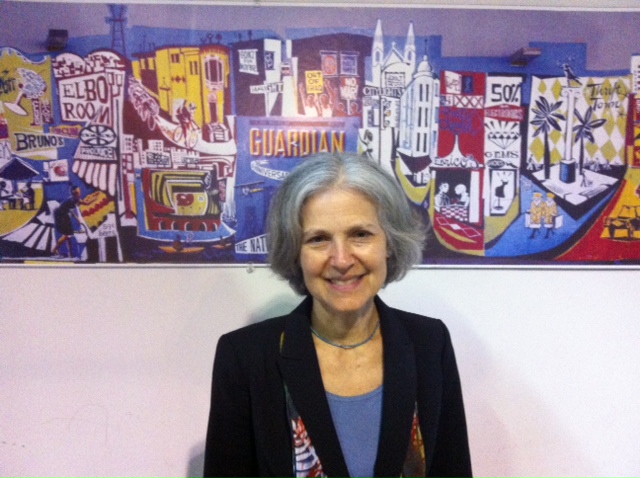
After participating in last weekend’s Green Party presidential debate against Roseanne Barr in San Francisco, which we cover in this week’s paper, frontrunner candidate Jill Stein stopped by the Bay Guardian office to chat about her hopes for progressive change in this tumultuous political year.

“The political-corporate establishment should not be given a pass in the voting booth,” the Massachusetts physician told us. “Four more years of Wall Street rule is what we get if you give them your vote.”

She ticked off a litany of bipartisan failures from the Democratic and Republican parties, from reforming Wall Street and narrowing the wealth gap to seriously addressing climate change and this country’s wasteful wars, and said people are fed up and want fundamental reforms.

“The rebellion is in full swing, you just don’t hear about it from the press,” she said. “With the exception of the Bay Guardian, we don’t have a press. We have an o-press and a re-press.”

This is Stein’s first run for national office, but she already faced off against presumptive Republican nominee Mitt Romney in the 2002 Massachusetts governor’s race, garnering just 3.5 percent of the vote but winning praise in the Boston Globe for her debate performance. She thinks both Romney and Obama are vulnerable this year, although she said, “I’m not holding my breath that we’re going to win, but I’m not running to lose.”

Her plan is to wage an aggressive grassroots and social media campaign to capitalize on the discontent most Americans feel with both major political parties, and to hopefully catch enough fire to reach 15 percent support in national polls, the threshold for getting into the presidential debates. “If we can get into the debates, we can really change things.”

To get there, Stein plans to reach out to a wide variety of groups on the left and across the spectrum, including supporters of the Occupy Wall Street movement, which she toured last year, visiting 25 encampments across the country, most of them populated by people wary of modern electoral politics.

“When I go to Occupy, I go to support them and not ask for their support,” Stein said, saying that she understood their belief that the electoral system is broken, but that it’s important to participate in it as part of a multi-pronged movement for social change that includes presidential politics. “Can we beat back the predator without have an organization? No, we need a party.”

She thinks the Green Party best represents the values of disenfranchised Americans and has the best vision for where this county needs to go, and she said, “We’re finding all kinds of networks are really getting energized and promoting us.”

Low taxes are bad for business

29

The teachers at San Francisco’s public schools are talking about going on strike. The contracts talks with the district are at an impasse. Things look bleak.

Well, they don’t look as bleak as things in Philadelphia, but that’s not really much in the way of good news.

Part of the issue: The district wants the teachers to accept up to nine furlough days next year. Even if the governor’s tax measure passes, four furlough days are still on the schedule.

The teachers are complaining — with good reason — that the forced days off and other concessions cost them money, as much as $5,000 a year. But there’s another issue here: Furlough days are horrible for working parents — and for the businesses that employ them.

Ron Leuty has a nice column on this in the San Francisco Business Times, which doesn’t let you read all the stories unless you subscribe, but here’s the gist:

For parents, SFUSD parents who already have barely managed through four furlough days each of the past two school years, nine each year becomes intolerable. That totals up to nearly two school weeks for which we must find some sort of childcare or one-day mini-camps — and it’s cash out of our pocket. Or it means time off. For businesses, that means lost productivity, down work time and employees who are paying more for — and worrying more about — childcare.

For low-income parents who have to miss a day’s work and a day’s pay every time the kids are out of school, it’s a serious economic issue. And the local businesses, particularly small businesses which aren’t equipped to deal with excess employee absenteeism, it’s a nightmare.

Leuty doesn’t place any blame or explain how we got to this situation, so I will: Prop. 13 (and later, Prop. 218) made it really hard to raise local taxes, and a handful of Republicans are making it hard to raise state taxes, so there’s not enough money for the schools. Americans today, particularly wealthy Americans and corporations, are taxed far less than they were for most of the century, certainly the post-War era.

Local business leaders love to talk about the value of public schools. I don’t think many serious people who have looked at the finances believe that the SFUSD is fat, bloated, or wasting a lot of money; these days, even the anti-government folks have to admit it’s a pretty lean operation.

So why won’t those business folks (and, for the matter, the Business Times) start campaigning for changes in Prop. 13 to allow communities to fund the schools and avoid these debilitating furlough days? What, is this problem supposed to get fixed by magic?


Obama and state’s rights

8

So how many angry pot smokers (and how many of my libertarian-leaning blog trolls) are going to love this? The governors of four western states want to take control of federal land inside their borders, and they’re organizing to do it. Mostly a political stunt — the governors want to allow more mining, ranching, and drilling on public lands, and the feds are taking it a bit more slowly. And nothing new — we’ve had these western range wars for decades, and for decades Utah governors have insisted that the state ought to be making the decisions around the 66 percent of the total Utah land mass that’s owned by Washington.

There’s no doubt in my mind that the administration is doing the right thing by resisting — you can’t just take national parks and national forests and Bureau of Land Management land and turn it over to development-oriented states. Much of that was federal land before there were states. And it’s not as if the Interior Department is all pristine about it — there’s already far too much resource development on public property, and the public doesn’t get anywhere near enough money for it. Sometimes it’s so bad it’s nutty.

But Obama’s got a problem, and it’s called medical marijuana — and he’s doing the same dumb thing that presidents before him have done, and all it does is create allies for the far right. Hell, after the U.S. attorney started attacking dispensaries I was ready to seceed. Let’s take California and walk; we’re already the ninth largest economy in the world, and we pay far more in federal tax money than we get in federal benefits. The Sierra makes a pretty defensible permiter; who needs Washington?

Of course, I’m quite happy that Obama doesn’t want to let the nuts in Arizona and Alabama get away with their racist and oppressive anti-immigrant laws and I’m happy to argue (in those cases) that immigration is a federal issues and that states shouldn’t try to mess around with it.

Except that San Francisco is a sanctuary city, and we have our own policy, which is excellent and the feds should leave us alone. And when this city did same-sex marriage, in defiance of state law, that was one of the coolest things ever.

You see where I’m going here.

Both sides can raise this Constitutional stuff and argue state’s rights and a long list of other things, and any good law school professor can spend years talking and writing about the historical and legal issues. There are some things that should be left to the states, and some things that the federal government should do, and that is always evolving.

But really, a lot of this is about policy. Legal pot is a good thing. So is same-sex marraige. Crackdowns on immigration are bad. Drilling and mining on public land are a problem, whether it’s state land or federal land. Politics isn’t perfect, and I’m willing to take our victories where we can get them.

But when the president is inconsistent (he’s cracking down on medical marijuana in CA but not Colorado; he’s against the Arizona/Alabama laws but still his ICE trying to mess with SF’s Sanctuary City) and does things that make his allies and supporters (that’s us potheads) mad at him, then it’s easier for the governor of Utah to say the feds are on his land and should leave him alone. Just like the pot farms.


Poll shows tax-the-rich measure hurt by Brown’s merger

9

A new poll confirms a fear we’ve raised before – Gov. Jerry Brown’s insistence on coupling the popular tax on millionaires with an unpopular increase in the sales tax could doom the revenue package this November – putting pressure on the governor and his allies to step up their political games and save the schools from disastrous cuts.

The SF Chronicle’s story on the Public Policy Institute of California poll focused on the disconnect voters have between government services they support and their willingness to pay for them, which isn’t exactly news to anyone. A big reason for this state’s dire fiscal situation is that people want something for nothing.

Last year, thanks to the Occupy Wall Street movement highlighting how the richest 1 percent have amassed ever-greater wealth at the expense of the rest of us, that dynamic began to change. People started to openly and consistently advocate for increasing taxes on the wealthy, no longer cowed by accusations of “class warfare.”

The PPIC poll found that 65 percent of respondents like the idea of taxing millionaires and putting that money toward education, while 80 percent oppose the $5 billion in trigger cuts to schools that will occur if voters reject the tax measure. But only a slim majority of 54 percent favor the measure that Brown is pushing, mostly because 52 percent say they don’t like the sales tax increase, a regressive tax that will likely be highlighted repeatedly by opponents of the measure.

That’s a big challenge for the broad coalition that supports the measure, but it’s an especially big deal for Brown. He was the one who created this bad combination in the first place, and convinced the California Federation of Teachers to drop its Millionaires Tax – the clean measure that would have 65 percent support right now – in favor of a merged measure that’s a bit more progressive than Brown’s original idea.

Assembly member Tom Ammiano and other progressives we respect have said they like the compromise and worried that competing tax measures could sink them all in this make-or-break election (that’s because under state law, tax measures need a simple majority only during presidential elections, meaning it will be four more years until we have this opportunity again).

Maybe, but the sales tax increase was never a good idea, and these poll numbers show they’ve got a difficult challenge on their hands. In particular, Brown will need to finally prove his repeated campaign statements that he’s the one with the knowledge, skills, and experience to get things done in the dysfunctional, gridlocked state. It’s time to make good on those words, governor.

Guardian endorsements for June 5 election

34

>>OUR ONE-PAGE “CLEAN SLATE” PRINTOUT GUIDE IS HERE. 

As usual, California is irrelevant to the presidential primaries, except as a cash machine. The Republican Party has long since chosen its nominee; the Democratic outcome was never in doubt. So the state holds a June 5 primary that, on a national level, matters to nobody.

It’s no surprise that pundits expect turnout will be abysmally low. Except in the few Congressional districts where a high-profile primary is underway, there’s almost no news media coverage of the election.

But that doesn’t mean there aren’t some important races and issues (including the future of San Francisco’s Democratic Party) — and the lower the turnout, the more likely the outcome will lean conservative. The ballot isn’t long; it only takes a few minutes to vote. Don’t stay home June 5.

Our recommendations follow.

PRESIDENT

BARACK OBAMA

Sigh. Remember the hope? Remember the joy? Remember the dancing in the streets of the Mission as a happy city realized that the era of George Bush and The Gang was over? Remember the end of the war, and health-care reform, and fair economic policies?

Yeah, we remember, too. And we remember coming back to our senses when we realized that the first people at the table for the health-policy talks were the insurance industry lobbyists. And when more and more drones killed more and more civilian in Afghanistan, and the wars didn’t end and the country got deeper and deeper into debt.

Oh, and when Obama bailed out Wall Street — and refused to spend enough money to help the rest of us. And when his U.S. attorney decided to crack down on medical marijuana.

We could go on.

There’s no question: The first term of President Barack Obama has been a deep disappointment. And while we wish that his new pledge to tax the millionaires represented a change in outlook, the reality is that it’s most likely an election-year response to the popularity of the Occupy movement.

Last fall, when a few of the most progressive Democrats began talking about the need to challenge Obama in a primary, we had the same quick emotional reaction as many San Franciscans: Time to hold the guy accountable. Some prominent left types have vowed not to give money to the Obama campaign.

But let’s get back to reality. The last time a liberal group challenged an incumbent in a Democratic presidential primary, Senator Ted Kennedy wounded President Jimmy Carter enough to ensure the election of Ronald Reagan — and the begin of the horrible decline in the economy of the United States. We’re mad at Obama, too — but we’re realists enough to know that there is a difference between moderate and terrible, and that’s the choice we’re facing today.

The Republican Party is now entirely the party of the far right, so out of touch with reality that even Reagan would be shunned as too liberal. Mitt Romney, once the relatively centrist governor of Massachusetts, has been driven by Newt Gingrich and Rick Santorum so deeply into crazyland that he’s never coming back. We appreciate Ron Paul’s attacks on military spending and the war on drugs, but he also opposes Medicare and Social Security and says that people who don’t have private health insurance should be allowed to die for lack of medical care.

No, this one’s easy. Obama has no opposition in the Democratic Primary, but for all our concerns about his policies, we have to start supporting his re-election now.

U.S. SENATE

DIANNE FEINSTEIN

The Republicans in Washington didn’t even bother to field a serious candidate against the immensely well-funded Feinstein, who is seeking a fourth term. She’s a moderate Democrat, at best, was weak-to-terrible on the war, is hawkish on Pentagon spending (particularly Star Wars and the B-1 bomber), has supported more North Coast logging, and attempts to meddle in local politics with ridiculous ideas like promoting unknown Michael Breyer for District Five supervisor. She supported the Obama health-care bill but isn’t a fan of single-payer, referring to supporters of Medicare for all as “the far left.”

But she’s strong on choice and is embarrassing the GOP with her push for reauthorization of an expanded Violence Against Women Act. She’ll win handily against two token Republicans.

U.S. CONGRESS, DISTRICT 2

NORMAN SOLOMON

The Second District is a sprawling region stretching from the Oregon border to the Golden Gate Bridge, from the coast in as far as Trinity County. It’s home to the Marin suburbs, Sonoma and Mendocino wine country, the rough and rural Del Norte and the emerald triangle. There’s little doubt that a Democrat will represent the overwhelmingly liberal area that was for almost three decades the province of Lynn Woolsey, one of the most progressive members in Congress. The top two contenders are Norman Solomon, an author, columnist and media advocate, and Jared Huffman, a moderate member of the state Assembly from Marin.

Solomon’s not just a decent candidate — he represents a new approach to politics. He’s an antiwar crusader, journalist, and outsider who has never held elective office — but knows more about the (often corrupt) workings of Washington and the policy issues facing the nation than many Beltway experts. He’s talking about taxing Wall Street to create jobs on Main Street, about downsizing the Pentagon and promoting universal health care. He’s a worthy successor to Woolsey, and he deserves the support of every independent and progressive voter in the district.

U.S. CONGRESS, DISTRICT 12

NANCY PELOSI

Nancy Pelosi long ago stopped representing San Francisco (see: same-sex marriage) and began representing the national Democratic party and her colleagues in the House. She will never live down the privatization of the Presidio or her early support for the Iraq war, but she’s become a decent ally for Obama and if the Democrats retake the House, she’ll be setting the agenda for his second term. If the GOP stays in control, this may well be her last term.

Green Party member Barry Hermanson is challenging her, and in the old system, he’d be on the November ballot as the Green candidate. With open primaries (which are a bad idea for a lot of reasons) Hermanson needs support to finish second and keep Pelosi on her toes as we head into the fall.

U.S. CONGRESS, DISTRICT 12

BARBARA LEE

This Berkeley and Oakland district is among the most left-leaning in the country, and its representative, Barbara Lee, is well suited to the job. Unlike Pelosi, Lee speaks for the voters of her district; she was the lone voice against the Middle East wars in the early days, and remains a staunch critic of these costly, bloody, open-ended foreign military entanglements. We’re happy to endorse her for another term.

U.S. CONGRESS, DISTRICT 13

JACKIE SPEIER

Speier’s more of a Peninsula moderate than a San Francisco progressive, but she’s been strong on consumer privacy and veterans issues and has taken the lead on tightening federal rules on gas pipelines after Pacific Gas and Electric Company killed eight of her constituents. She has no credible opposition.

STATE SENATE, DISTRICT 11

MARK LENO

Mark Leno started his political career as a moderate member of the Board of Supervisors from 1998 to 2002. His high-profile legislative races — against Harry Britt for the Assembly in 2002 and against Carole Migden for the Senate in 2008 — were some of the most bitterly contested in recent history. And we often disagree with his election time endorsements, which tend toward more downtown-friendly candidates.

But Leno has won us over, time and again, with his bold progressive leadership in Sacramento and with his trailblazing approach to public policy. He is an inspiring leader who has consistently made us proud during his time in the Legislature. Leno was an early leader on the same-sex marriage issue, twice getting the Legislature to legalize same-sex unions (vetoed both times by former Gov. Arnold Schwarzenegger). He has consistently supported a single-payer health care system and laid important groundwork that could eventually break the grip that insurance companies have on our health care system. And he has been a staunch defender of the medical marijuana patients and has repeatedly pushed to overturn the ban on industrial hemp production, work that could lead to an important new industry and further relaxation of this country wasteful war on drugs. We’re happy to endorse him for another term.

STATE ASSEMBLY, DISTRICT 17

TOM AMMIANO

Ammiano is a legendary San Francisco politician with solid progressive values, unmatched courage and integrity, and a history of diligently and diplomatically working through tough issues to create ground-breaking legislation. We not only offer him our most enthusiastic endorsement — we wish that we could clone him and run him for a variety of public offices. Since his early days as an ally of Harvey Milk on gay rights issues to his creation of San Francisco’s universal health care system as a supervisor to his latest efforts to defend the rights of medical marijuana users, prison inmates, and undocumented immigrants, Ammiano has been a tireless advocate for those who lack political and economic power. As chair of Assembly Public Safety Committee, Ammiano has blocked many of the most reactionary tough-on-crime measures that have pushed our prison system to the breaking point, creating a more enlightened approach to criminal justice issues. We’re happy to have Ammiano expressing San Francisco’s values in the Capitol.

STATE ASSEMBLY, DISTRICT 19

PHIL TING

Once it became abundantly clear that Assessor-Recorder Phil Ting wasn’t going to get elected mayor, he started to set his eyes on the state Assembly. It’s an unusual choice in some ways — Ting makes a nice salary in a job that he’s doing well and that’s essentially his for life. Why would he want to make half as much money up in Sacramento in a job that he’ll be forced by term limits to leave after six years?

Ting’s answer: he’s ready for something new. We fear that a vacancy in his office would allow Mayor Ed Lee to appoint someone with less interest in tax equity (prior to Ting, the city suffered mightily under a string of political appointees in the Assessor’s Office), but we’re pleased to endorse him for the District 19 slot.

Ting has gone beyond the traditional bureaucratic, make-no-waves approach of some of his predecessors. He’s aggressively sought to collect property taxes from big institutions that are trying to escape paying (the Catholic Church, for example) and has taken a lead role in fighting foreclosures. He commissioned, on his own initiative, a report showing that a large percentage of the foreclosures in San Francisco involved some degree of fraud or improper paperwork, and while the district attorney is so far sitting on his hands, other city officials are moving to address the issue.

His big issue is tax reform, and he’s been one the very few assessors in the state to talk openly about the need to replace Prop. 13 with a split-role system that prevents the owners of commercial property from paying an ever-declining share of the tax burden. He wants to change the way the Legislature interprets Prop. 13 to close some of the egregious loopholes. It’s one of the most important issues facing the state, and Ting will arrive in Sacramento already an expert.

Ting’s only (mildly) serious opponent is Michael Breyer, son of Supreme Court Justice Breyer and a newcomer to local politics. Breyer’s only visible support is from the Building Owners and Managers Association, which dislikes Ting’s position on Prop. 13. Vote for Ting.

DEMOCRATIC COUNTY CENTRAL COMMITTEE

You can say a lot of things about Aaron Peskin, the former supervisor and retiring chair of the city’s Democratic Party, but the guy was an organizer. Four years ago, he put together a slate of candidates that wrenched control of the local party from the folks who call themselves “moderates” but who, on critical economic issues, are really better defined as conservative. Since then, the County Central Committee, which sets policy for the local party, has given its powerful endorsement mostly to progressive candidates and has taken progressive stands on almost all the ballot issues.

But the conservatives are fighting back — and with Peskin not seeking another term and a strong slate put together by the mayor’s allies seeking revenge, it’s entirely possible that the left will lose the party this year.

But there’s hope — in part because, as his parting gift, Peskin helped change state law to make the committee better reflect the Democratic voting population of the city. This year, 14 candidates will be elected from the East side of town, and 10 from the West.

We’ve chosen to endorse a full slate in each Assembly district. Although there are some candidates on the slate who aren’t as reliable as we might like, 24 will be elected, and we’re picking the 24 best.

DISTRICT 17 (EAST SIDE)

John Avalos

David Campos

David Chiu

Petra DeJesus

Matt Dorsey

Chris Gembinsky

Gabriel Robert Haaland

Leslie Katz

Rafael Mandelman

Carole Migden

Justin Morgan

Leah Pimentel

Alix Rosenthal

Jamie Rafaela Wolfe


DISTRICT 19 (WEST SIDE)

Mike Alonso

Wendy Aragon

Kevin Bard

Chuck Chan

Kelly Dwyer

Peter Lauterborn

Hene Kelly

Eric Mar

Trevor McNeil

Arlo Hale Smith

State ballot measures

PROPOSITION 28

YES

LEGISLATIVE TERM LIMITS

Let us begin with a stipulation: We have always opposed legislative term limits, at every level of government. Term limits shift power to the executive branch, and, more insidiously, the lobbyists, who know the issues and the processes better than inexperienced legislators. The current system of term limits is a joke — a member of the state Assembly can serve only six years, which is barely enough time to learn the job, much less to handle the immense complexity of the state budget. Short-termers are more likely to seek quick fixes than structural reform. It’s one reason the state Legislatures is such a mess.

Prop. 28 won’t solve the problem entirely, but it’s a reasonable step. The measure would allow a legislator to serve a total of 12 years in office — in either the Assembly, the Senate, or a combination. So an Assembly member could serve six terms, a state Senator three terms. No more serving a stint in one house and then jumping to the other, since the term limits are cumulative, which is imperfect: A lot of members of the Assembly have gone on to notable Senate careers, and that shouldn’t be cut off.

Still, 12 years in the Assembly is enough time to become a professional at the job — and that’s a good thing. We don’t seek part-time brain surgeons and inexperienced airline pilots. Running California is complicated, and there’s nothing wrong with having people around who aren’t constantly learning on the job. Besides, these legislators still have to face elections; the voters can impose their own term limits, at any time.

Most of the good-government groups are supporting Prop. 28. Vote yes.

PROPOSITION 29

YES

CIGARETTE TAX FOR CANCER RESEARCH

Seriously: Can you walk into the ballot box and oppose higher taxes on cigarettes to fund cancer research? Of course not. All of the leading medical groups, cancer-research groups, cancer-treatment groups and smoking-cessation groups in the state support Prop. 29, which was written by the American Cancer Society and the American Heart Association.

We support it, too.

Yes, it’s a regressive tax — most smokers are in the lower-income brackets. Yes, it’s going to create a huge state fund making grants for research, and it will be hard to administer without some issues. But the barrage of ads opposing this are entirely funded by tobacco companies, which are worried about losing customers, particularly kids. A buck a pack may not dissuade adults who really want to smoke, but it’s enough to price a few more teens out of the market — and that’s only good news.

Don’t believe the big-tobacco hype. Vote yes on 29.

San Francisco ballot measures

PROPOSITION A

YES

GARBAGE CONTRACT

A tough one: Recology’s monopoly control over all aspects of San Francisco’s waste disposal system should have been put out to competitive bid a long time ago. That’s the only way for the city to ensure customers are getting the best possible rates and that the company is paying a fair franchise fee to the city. But the solution before us, Proposition A, is badly flawed public policy.

The measure would amend the 1932 ordinance that gave Recology’s predecessor companies — which were bought up and consolidated into a single behemoth corporation — indefinite control over the city’s $220 million waste stream. Residential rates are set by a Rate Board controlled mostly by the mayor, commercial rates are unregulated, and the company doesn’t even have a contract with the city.

Last year, when Recology won the city’s landfill contract — which was put out to bid as the current contract with Waste Management Inc. and its Altamont landfill was expiring — Recology completed its local monopoly. At the time, Budget Analyst Harvey Rose, Sup. David Campos, and other officials and activists called for updating the ordinance and putting the various contracts out to competitive bid.

That effort was stalled and nearly scuttled, at least in part because of the teams of lobbyists Recology hired to put pressure on City Hall, leading activists Tony Kelley and retired Judge Quentin Kopp to write this measure. They deserve credit for taking on the issue when nobody else would and for forcing everyone in the city to wake up and take notice of a scandalous 70-year-old deal.

We freely admit that the measure has some significant flaws that could hurt the city’s trash collection and recycling efforts. It would split waste collection up into five contracts, an inefficient approach that could put more garbage trucks on the roads. No single company could control all five contracts. Each of those contracts would be for just five years, which makes the complicated bidding process far too frequent, costing city resources and hindering the companies’ ability to make long-term infrastructure investments.

It would require Recology to sell its transfer station, potentially moving the waste-sorting facility to Port property along the Bay. Putting the transfer station in public hands makes sense; moving it to the waterfront might not.

On the scale of corrupt monopolies, Recology isn’t Pacific Gas and Electric Co. It’s a worker-owned company and has been willing to work in partnership with the city to create one of the best recycling and waste diversion programs in the country. For better or worse, Recology controls a well-developed waste management infrastructure that this city relies on, functioning almost like a city department.

Still, it’s unacceptable to have a single outfit, however laudatory, control such a massive part of the city’s infrastructure without a competitive bid, a franchise fee, or so much as a contract. In theory, the company could simply stop collecting trash in some parts of the city, and San Francisco could do nothing about it.

As a matter of public policy, Prop. A could have been better written and certainly could, and should, have been discussed with a much-wider group, including labor. As a matter of real politics, it’s a messy proposal that at least raises the critical question: Should Recology have a no-bid, no contract monopoly? The answer to that is no.

Prop. A will almost certainly go down to defeat; Kopp and Kelly are all alone, have no real campaign or committee and just about everyone else in town opposes it. Our endorsement is a matter of principle, a signal that this longtime garbage deal has to end. If Recology will work with the city to come up with a contract and a bid process, then Prop. A will have done its job. If not, something better will be on the ballot in the future.

For now, vote yes on A.

PROPOSITION B

YES

COIT TOWER POLICY

In theory, city department heads ought to be given fair leeway to allocate resources and run their operations. In practice, San Francisco’s Department of Recreation and Parks has been on a privatization spree, looking for ways to sell or rent public open space and facilities as a way to balance an admittedly tight budget. Prop. B seeks to slow that down a bit, by establishing as city policy the premise that Coit Tower shouldn’t be used as a cash cow to host private parties.

The tower is one of the city’s most important landmarks and a link to its radical history — murals painted during the Depression, under the Works Progress Administration, depict local labor struggles. They’re in a bit of disrepair –but that hasn’t stopped Rec-Park from trying to bring in money by renting out the place for high-end events. In fact, the tower has been closed down to the public in the past year to allow wealthy patrons to host private parties. And the city has more of that in mind.

If the mayor and his department heads were acting in good faith to preserve the city’s public spaces — by raising taxes on big business and wealthy individuals to pay for the commons, instead of raising fees on the rest of us to use what our tax dollars have already paid for — this sort of ballot measure wouldn’t be necessary.

As it is, Prop. B is a policy statement, not an ordinance or Charter amendment. It’s written fairly broadly and won’t prevent the occasional private party at Coit Tower or prevent Rec-Park from managing its budget. Vote yes.


Judge denies Mirkarimi motions; city process begins Monday

35

Superior Court Judge Harold Kahn today denied all motions by Sheriff Ross Mirkarimi’s legal team challenging his suspension without pay, city procedures, and the constitutionality of the city’s official misconduct charter language, saying it’s premature to conclude Mirkarimi isn’t being treated fairly.

“But the courthouse door remains open,” Kahn concluded, inviting Mirkarimi to return after the Ethics Commission establishes rules of procedure and evidence, which it will begin doing on Monday. Today’s rulings, and another yesterday, in which Kahn ruled against a motion to disqualify the City Attorney’s Office from overseeing the proceedings, clears the way for the Ethics Commission to consider recommending to the Board of Supervisors that Mirkarimi be removed from office.

Kahn also seemed to agree with Mirkarimi’s team that Mayor Ed Lee didn’t give him a fair hearing before suspending him or that he made an argument for suspending him without pay. But Kahn sided with the city on the legal question of whether Mirkarimi has a “property interest” in his salary, which would have triggered the right to a hearing before being suspended, making such procedural questions moot.

“If there was a property right, what the mayor stated would not be adequate due process,” Kahn said, referring to Lee’s affidavit describing their March 19 meeting, where Lee told Mirkarimi to resign or be suspended. Lee claims he gave Mirkarimi the opportunity to tell his side of the story, which Mirkarimi denies, saying the mayor had made up his mind and wasn’t interested in the real story. On the salary question, Deputy City Attorney Sherri Kaiser said Mirkarimi would be entitled to full back pay from his suspension period if the supervisors vote to keep him in office, arguing that he isn’t being harmed.

Mirkarimi was suspended based on language in the city charter that was adopted in 1996 – banning “conduct that falls below the standard of decency, good faith and right action impliedly required of all public officers” – that has never been reviewed by the courts and which Mirkarimi attorney David Waggoner contends is unconstitutionally vague.

But Kahn didn’t agree, saying, “The charter is not so clearly outside the bounds of California law that I should preempt the processes.”

Waggoner complained that the city procedures didn’t set rules of evidence or procedure or standards of guilt, making it difficult to prepare a defense, a point to which Kahn seemed sympathetic, noting the variety of legal standards for different types of cases, from “beyond reasonable doubt” to “a preponderance of evidence.”

“We don’t know which of any of those is going to apply here. Is that a problem?” Kahn asked Kaiser.

She said no, that Mirkarimi and his legal team could return to court for help “if the commissioners really mess up” in the work they’ll begin on Monday. “That summarizes my view. It is hypothetical to say the procedures are going to be unfair,” Kahn agreed. 

Addressing reporters after the hearing, Kaiser praised the judge’s rulings and offered a small window into what will likely transpire in the coming months: “Certainly, the sheriff is going to have to testify under oath and not just to the media.” (Waggoner told reporters “no comment” when asked whether Mirkarimi will indeed testify under oath).

Kaiser’s apparent dig at the various media interviews that Mirkarimi has just started to grant this week echoes statements that have come from District Attorney George Gascón, who has criticized Mirkarimi’s characterization of his guilty plea and the behaviors that constituted false imprisonment, calling the media accounts “disturbing and telling.”

But Mirkarimi shot back at Gascón today, noting that the two men “have had some very high-profile disagreements” when Gascón was police chief and Mirkarimi chaired the Board of Supervisors Public Safety Committee. They had high-profile clashes over requiring police to do foot patrols, the crime lab controversy, budget issues (including Mirkarimi’s unsuccessful efforts to find out how much Mayor Gavin Newsom’s police security detail was costing the city as he ran for governor), and Gascón’s controversial public statement equating people of Middle Eastern descent (such as Mirkarimi, who is Persian) with terrorists.

“It sometimes bubbles up in the course of these proceedings,” Mirkarimi said of Gascón’s alleged personal or political animosity toward him.

Asked for a response, District Attorney’s Office spokeperson Stephanie Ong Stillman wrote, ““It is the duty of the San Francisco District Attorney to uphold the law,
regardless of who violates it and without political motivation.  Ross Mirkarimi was afforded the same rights as any defendant. We treated his case no differently than any of the 776 domestic violence cases our office charged and reviewed last year.”

Justice for Trayvon organizers react to Zimmerman murder charges

3

The Bay Area joined cities across the country in holding protests and rallies demanding justice for Trayvon Martin, a 17-year-old shot and killed by 28-year-old George Zimmerman in Sanford, Florida Feb. 26. 700 wore hoodies and marched downtown March 21. An “emergency scream-out” held March 26 outside of the Hall of Justice and jail at 850 Bryant called for justice for Martin as well as victims of police violence such as Ramarley Graham, an unarmed 18-year old Bronx man who was killed in his home by police. A “hoodies and hijabs” march last week in Oakland commemorated Martin’s death alongside the death of Shaima Al-Awadi, a 32-year old mother of five who was killed in a potential hate crime in her El Cajon home last month.

Speakers at these protests expressed outrage that Zimmerman had not been charged with any crime.

Now he has. On April 11, Zimmerman was charged with murder in the second degree.

I asked local activists- is this justice?

“I’m not jumping up for joy that this murderer has finally been arrested. I hope we can question what took so long,” said Tiny Gray-Garcia, creator of POOR magazine, who helped organize the scream-out.

She compared the case to that of Oscar Grant and his killer, Johannes Mehserle. After protest erupted demanding that Mehserle be charged with Grant’s killing, he became the first police officer in the history of California to be charged with murder. He was convicted of involuntary manslaughter and served eleven months in prison. 

“In the same way that Mehserle was finally charged, will Zimmerman eventually get a slap on the wrist?” asked Gray-Garcia. 

The March 26 scream-out was “not only for our young brother Trayvon. It was for Oscar Grant, Ramarley Graham, it was for Idress Stelley, Aiyana Jones, all the victims of police terror,” said Gray-Garcia

Unlike Graham, Stelley, and Jones, Martin was not killed by a police officer. But Gray-Garcia believes that his death can be atttibuted to “police culture.”

“Trayvon was murdered by a volunteer vigilante,” said Gray-Garcia of the neighborhood watch captain who had aspirations of becoming a police officer. “He was part of a violent police culture.”

If police and prison culture is a problem, is Zimmerman’s arrest- by police- justice?

In the media storm that followed the incident, some writers, such as this one at the Crunk Feminist Collective, have grappled with the question.

“How can I demand a criminal conviction for Zimmerman when I am opposed to prisons?” asks the Crunk Feminist Collective writer. “How do I reconcile these things?  I’m not sure yet.  But what I do know is that this really is not about the prison, but about a prison state that targets black and brown bodies in problematic ways.  It’s about a system of policing and surveillance, in which some bodies are always under the eye of the state.”

Isaac Ontiveros of the Oakland-based Critical Resistance, a group whose “vision is the creation of genuinely safe, healthy communities that respond to harm without relying on prisons and punishment,” has also struggled with this issue.

“That’s a challenging question for everybody,” said Ontiveros. “Part of it is, how can we start to dislodge the logic of neighborhood watches? You look at neighborhood watch associations and who are they watching, what do they mean by neighborhood, and who is considered suspicious?”

After Martin’s death, protests across the country were unrelenting calling for Zimmerman’s arrest. Days before the arrest and charge were made, a group of students who had marched 40 miles to Sanford from Daytona Beach “occupied” the Sanford police station, condemning how the case had been handled and demanding the termination of Sanford police Chief Bill Lee Jr. Police had declined to press charges against Zimmerman, saying that he had acted in self-defense.

On March 23, almost a month after the Feb. 26 shooting, Florida governor Rick Scott appointed special prosecutor Angela Corey to investigate the case. Zimmerman was charged with murder and taken into custody April 11.

“We do not prosecute by public pressure or petition. We prosecute based on facts and the laws of Florida,” said Corey at the time.

“She contends that neither petitions or media pressure influenced her decision, when we know too well that without it, nothing would have happened to Zimmerman,” said Mesha Irizarry, another scream-out organizer. Irizarry’s son, Idriss Stelley, was killed by police in 2001. 

The incident has put a national spotlight on racism in the United States. In Sanford, the NAACP held a town hall meeting for African American residents to air their frustrations with profiling in their own lives; hundreds attended

“If you’re black and you’re shot, particularly by someone who’s not black, that it is not viewed as seriously,” Sanford City Manager Norton Bonaparte told Reuters.

He added: “that’s why some feel that Mr. Zimmerman was allowed to just go on his way while Mr. Martin went to a morgue. And certainly if it was reversed, and Zimmerman had been black, he would have been detained and arrested.”

The same sentiment was expressed by protesters in San Francisco March 21. The speakers that day were family members of black teens who had been killed and whose murders had, they said, not been thoroughly investigated.

“Personal justice would be to open up all these other cases,” said Gray-Garcia.

Guest opinion: It’s not about Mirkarimi, it’s about us

70

Virtually unmentioned in the torrent of words that have flowed over the Ross Mirkarimi false imprisonment, suspension and pending vote to determine his removal by the Board of Supervisors is any reference to what should now be the most important issue to be considered as the sad saga unfolds: the fact that Mirkarimi was, just four months before his removal, elected by a majority vote and his removal from office would simply set aside that vote, diminishing all of our cherished beliefs about “majority rule.”

Mirkarimi didn’t just win, he won big. He beat the second place candidate by nearly 19,000 votes, winning outright without the need for the magic of instant run-off. Mirkarimi got more first place votes than did Ed Lee (70,204 vs. 59,663). Moreover, Mirkarimi’s election was without controversy, complaint or charge of illegality, unlike Ed Lee’s, which resulted in a total of 25 misdemeanor convictions for illegal campaign contributions by a city contractor with a pending contact before a commission appointed by the mayor.

Since the 5-4 vote of the Supreme Court to give George Bush the election in 2000 after Al Gore won a majority of the popular vote, there has been a distressingly frequent willingness by the media to accept executive and judicial actions that set aside popular votes. The conservative governor of Michigan has simply taken over local governments that he deems financially “irresponsible” setting aside the votes of local residents. In California, a tiny minority of Republican legislators, elected by a comparative handful of voters, yearly stymie the overwhelmingly majority elected legislators, forcing deeply unpopular budget cuts — and the media simply goes along.

Majority rule, the very bedrock of representative democracy, seems unnervingly easy to set aside now days. Majority rule is our bedrock because it’s the only way in which our system has to define the political will of the people. Let’s be clear, the very City Charter that is being used to remove Mirkarimi from office rests on the power given by “the people of the City and County of San Francisco,” (Preamble to the Charter) and was itself adopted by a majority vote. Setting aside majority votes is a dangerous business for us all; it risks substituting the will of a few insiders for the will of the people.

The political riskiness of the move has been entirely incorrectly cast by the San Francisco Chronicle, the main voice to overturn the expressed will of the people. The Chronicle asserts the political risks as now falling on the supervisors who most vote to sustain the mayor’s action with nine votes. Indeed, the ace vote counter at the “Comical,” former Mayor Willie Brown, who went zero-for-ever in the last four years of his term in votes at the board, confidently predicts that the vote will be 11-zip to sustain the mayor because of the fear of voter retribution.

But facts indicate that “fear” will play the other way. Last November Mirkarimi won in six of the 11 supervisorial districts (D3, D5, D6, D8, D9 and D10) . In two of them (D8 and D10), he won more first-place votes than the current supervisor. In these same six districts he outpolled Ed Lee by some 18,000 votes. By what measure, other than the huffing and puffing of ex-Mayor Willie, C(onsistenly) W(rong) Nevius, and the two stooges, Matier and Ross, does any political risk fall on these supervisors to vote with their constituents?

Chances are nine votes will NOT be there and that Mirkarimi will remain sheriff, where the people put him.We will have gone through a divisive fight addressing none of our deep problems, Mayor Lee will squander the good will of the supervisors and voters for nothing and we will be exactly where we are now.

We have a way to remove Mirkarimi from office that is far better for our democracy. It’s one of the great inventions of the Progressive Era. It’s called recall, and it puts the matter where it should be: before the people. It’s really not about Mirkarimi anymore. Its about us, the meaning of our votes, and the responsibility of supervisors to understand in whose name they govern. All power to the people!

Calvin Welch lives, works and plays in San Francisco.

Dick Meister: Labor’s David vs. GOP’s Goliath

0

By Dick Meister

 Dick Meister, former labor editor of the SF Chronicle and KQED-TV Newsroom, has covered labor and politics for more than a half-century. Contact him through his website, www.dickmeister,com, which includes more than 350 of his columns.

Organized labor is doing exactly what it must do to combat the onslaught against unions being waged by Republican politicians nationwide, throwing lots of money and lots of ground troops into the election campaigns of Democrats – most especially President Obama’s campaign for re-election.

The AFL-CIO made it official with a ringing endorsement of Obama. Federation President Rich Trumka declared that “as president, Barack Obama has placed his faith in America’s working men and women to lead our country to economic recovery and our full potential. So we’re putting our faith in him.”

Trumka acknowledged that the AFL-CIO has sometimes disagreed with Obama and “often pushed his administration to do more – and do it faster.” But he said there never has been any doubt about Obama’s commitment to working families.

On the other hand, Trumka noted, the Republicans seeking their party’s presidential nomination have all “pledged to uphold the special privileges of Wall Street and the 1% that have produced historic economic inequality and drowned out the voices of working people.”

Trumka characterized working people as “the Davids standing up to Goliath in today’s politics. Our strength is in our numbers, our values and plain hard work. When we come together, we are formidable.”

Labor’s political forces have indeed been formidable in past elections, putting millions of dollars and millions of union members into the campaigns of labor-friendly Democrats such as Obama. The AFL-CIO pledges to do even more for Obama’s re-election bid, aided in part by a 2010 Supreme Court ruling that allows unions to go door-to-door to solicit support from non-union voters as well as union members.

Unions expect to spend $400 million this year on national, state and local elections, fully one-fourth of it coming from a key AFL-CIO affiliate, the American Federation of State, County and Municipal Employees. The Service Employees International Union expects to mobilize 100,000 of its members, many of them public employees. The AFL-CIO itself anticipates spending nearly $7 million it has collected primarily for campaigning among non-union voters.

The federation aims to outdo its extraordinary campaign for Obama’s election in 2008. A quarter-million union volunteers took part in that effort, knocking on 14 million doors, making 76 million phone call, sending out 57 million pieces of mail and distributing 29 million leaflets at work sites.

It’s certainly true that Obama has generally been a good friend to organized labor. But what, specifically, has he done for working people and their unions? Why do unionists feel he’s deserving of so much union money and so much union effort?

Why? The AFL-CIO’s Trumka cites, for example, Obama’s American Recovery and Reinvestment Act which “saved or created 3.6 million jobs” and averted a second Great Depression. There’s also Obama’s championing of comprehensive health insurance reform which “set the nation on a path toward health security,” and Wall Street reform that will eventually lead to reversal of the financial deregulation “that put our entire economy at risk.”

Re-electing a labor-friendly president will be only a part of labor’s election-day mission. Unions will be campaigning at least as hard to defeat the many anti-union Republicans who are running at the local, state and national level and threatening the very existence of unions.

As AFL-CIO Political Director Michael Podhorzer notes, “they’ve clearly tried to weaken unions and drain our treasuries. But the consequence has been more like kicking a hornets’ nest than draining our resources.”

Unions hope to repeat their success of last November in Ohio, where they waged a major campaign that repealed a Republican-sponsored law that greatly weakened the collective bargaining rights of the state’s public employees. It was an overwhelming victory with 62 percent voting for repeal, only 38 percent for retaining the law, which was similar to those proposed elsewhere, along with other anti-union measures.

The AFL-CIO is confident that it can rally millions of voters for Obama in Ohio and other battleground states, including Michigan, Pennsylvania and Wisconsin. Unions have already had a major impact in Wisconsin, where voters have approved the holding of recall elections for Gov. Scott Walker, his lieutenant governor and four Republican state senators because of their support for legislation that stripped public employees of their collective bargaining rights. Previous labor campaigns led to the recall of two other Republican state senators.

Obama would seem to need unions as much as they need him. The latest polls indicate that only about half the citizenry approves of the job he’s doing. He’s going to have to work hard to win over the large body of Americans who apparently don’t share labor’s view of him, but who could be convinced to at least give him another four years to meet their expectations.

Labor’s election–year role, in short, will be to do much of the convincing needed to help rally millions of voters behind their friend in the White House. That would be highly rewarding to labor and to millions of Americans, union and non-union alike.

Dick Meister, former labor editor of the SF Chronicle and KQED-TV Newsroom, has covered labor and politics for more than a half-century. Contact him through his website, www.dickmeister,com, which includes more than 350 of his columns.

Brown compromise may water down Millionaires Tax

4

The Restore California campaign and Governor Jerry Brown’s—the authors of two competing ballot initiatives that would both raise taxes to fund education—are in talks today. The two groups hope to strike a deal and agree on one measure.

“I think we’ll have a compromise measure that will be more progressive than governor’s current one,” said Fred Glass, communications director for the California Federation of Teachers (CFT).

The CFT, along with the measure’s co-sponsor Restore California, have seen widespread support for their proposed Millionaires Tax. In its current form, the measure would raise taxes on the state’s highest income earners. California residents earning $1 million per year would pay an additional three percent in income taxes; those making $2 million or make per year would add five percent. 60 percent of funds raised would go towards education.

The proposed initiative would not raise taxes on anyone earning less than $1 million per year, and tax increases would be permanent.

Brown’s plan included a half-cent sales tax increase and would expire after five years.

But Brown has expressed concern that competing measures would mean defeat for any plan to fund education, and now a deal may be reached between the two parties.

The Sacramento Bee reports that the compromise measure may lower Brown’s proposed sales tax increase to a quarter-cent and extend the tax increase to seven years.

But the deal could pose an organizing challenge. Polls have consistently shown majority support for the Millionaires Tax, and signature gathering is already well underway; if a new deal is reached, proponents would need to start fresh and may face only four to five weeks to gather more than one million signatures.

According to Glass, many lawmakers might have supported the Millionaires Tax in its original version if it hadn’t been for Brown’s competing version.

“Everybody wanted to support the governor. There was enormous pressure on the legislature, even those who were sympathetic [to the Millionaires Tax],” said Glass.

Details of a finalized compromise measure could be announced as soon as this afternoon.

The struggle for housing money at City Hall

24

It’s barely March, and the next election isn’t until June and that’s just primaries and the Democratic County Central Committee, but we just started getting political mail anyway. It’s a piece from the Board of Realtors, denouncing plans for an increase in the real-estate transfer tax “to provide subsidized housing to people who want to live in San Francisco but don’t have the means to do so.” Mayor Ed Lee, the flier says, is backing this “outrageous” plan.

What, exactly, is going on here?

Well, for starters, the mayor is distinctly NOT pushing for an increase in the transfer tax, not right now, anyway. What he is doing is meeting with housing advocates and legislators and trying to come up with a stable source of funding for affordable housing — yes, for families and low-income people, many of them longtime residents who are being forced out by Ellis Act evictions, others of them people who work in the city and would rather live here than commute from Pinole, which everyone with any sense agrees is a good idea.

The problem: For years, San Francisco used Redevelopment Agency tax-increment money for affordable housing. Now that money’s gone, since the governor abolished redevelopment agencies. Actually, the money’s not gone, technically — the increased tax revenue from redevelopment project areas still exists. It’s just that the state is now taking a bunch of it, and other taxing entities like BART and the school district get some of it, and now it’s impossible to send bonds and borrow money against it. So what was once tens of millions for affordable housing is now a few million.

“We might have $20 million a year in the general fund,” said housing activist Peter Cohen. “But that’s compared to the $40 million or $50 million we had in the past, and it still leaves housing short.”

Lee has promised repeatedly to fix that problem, to find a way to make sure that there’s enough money that the nonprofits who build housing can plan and develop for the long term. Right now, it’s being called a Housing Trust Fund, but nobody knows exactly how it will actually work.

Remember: The city’s own General Plan states that 60 percent of all new housing should be available at below market rate. All of the regional growth projections say that San Francisco needs to build more housing — for its own workforce, not just for the rich. (And the local workforce, for all the tech jobs the mayor keeps hyping, is still mostly public-sector workers and service employees, most of whom can’t possibly afford the soaring rents and housing prices in this city.)

A lot of the existing affordable housing money comes from the city’s inclusionary housing law, which mandates that market-rate developers set aside a percentage of their new units (usually 20 percent) for lower-income people. Most developers eschew allowing poor people into their condo enclaves, so they pay a fee into a city fund instead.
But if we’re aiming for 60 percent, and we’re getting (at most) 20 percent, we’re a long ways off. Oh, and the developers are starting to argue that the 20 percent rule is too onerous and they can’t build enough condos for the rich if they have to throw scraps to the poor and middle-class, too.

And some supervisors are squawking about building more housing for the middle class, and right now in a zero-sum game, that means less for low-income people.
This all adds up to a mess for the mayor, and it’s no wonder some advocates are talking about raising the transfer tax — which, after all, is paid by the seller of a residential or commercial building, and while there are absolutely some houses underwater in San Francisco (and there should probably be an exemption in the tax for that situation), overall home prices are rising again, and many, probably most home sales these days involve substantial profit. It’s not a perfect tax, but it’s a tax on a class that is (generally) better off to support a class that is typically not so well off.

Here’s the problem: If the mayor supports a transfer tax, and that’s part of the final package, the realtors and the commericial building owners will no doubt put huge amounts of money into defeating it. That would mean Lee would have to raise a bucket of money and campaign really hard to pass it. But Lee’s demonstrated that he’s not the fighting type; he wants something that nobody serious will oppose. Which is why my sources at City Hall say that he wants the transfer tax off the table.

That could mean that the Housing Trust Fund will be a basic set-aside, a budgetary mandate that a certain amount of money go into a reliable fund for housing. That’s one of the city’s most pressing needs (really, if this becomes a city of just the rich, even those of us who own houses or have rent-controlled apartments won’t want to live here any more. Mayor Larry Ellison? Eeew.) So I’m okay with that. I’m not a big fan of set-asides, but this is the whole future of San Francisco we’re talking about.

So the realtors can take a chill pill — the mayor doesn’t want to get in a fight with you. Sigh.

Jerry Brown says everyone on death row is guilty

7

I’m glad the governor is so confident that there are no innocent people on death row.

On one level, I don’t care — I’m against the death penalty period, and I don’t care how horribly guilty the folks who face execution are. Of course, many of them, probably most, were severely mentally ill at the time of the crimes, but that doens’t seem to matter to the gov either.

It’s hard to believe, though, that he really knows much about any of these cases, because innocent people have been put on death row, and some have been executed, all over the country. Jerry’s California is so special that our legal system never makes mistakes? (Notice that he didn’t say no innocent people have been executed; he went way beyond that to say that they’re all guilty. Amazing.)

Occupying the Capitol

5

It’s an unseasonably hot day at UC Davis, and student activists are milling around a tent city, set up especially for 100 people arriving from a four-day March on Education. The school, one of the hubs of the Occupy movement, gained notoriety when public safety Officer John Pike casually pepper sprayed a line students during a sit-in back in November. Now, officers bike through the idyllic scene, smiling and chatting up occupiers.

Everyone is preparing for the next day, March 5, the statewide day to defend education that will bring thousands of students and teachers to Sacramento to demand an end to budget cuts and fee hikes at California’s schools, community colleges, and universities.

Those on the march hope to highlight the importance of this issue, marching 79 miles from the Bay Area. The first night, the march stayed in Richmond, and the next day Richmond’s Mayor Gayle McLaughlin came out to welcome them.

Students march annually on Sacramento, and say they won’t stop until education is affordable (or, as some would demand, free). A climate of worldwide protest over disparities in wealth and opportunity, including Occupy protests in the United States, helped fuel a larger than usual turnout this year.

More than 5,000 people converged in Sacramento March 5 and marched to the Capitol building, occupying the Rotunda all day. Many chanted “no cuts, no fees, education must be free.”

Community college student throughout the state are reeling from the cuts, and resulting fee hikes—course units, once free, were raised from $26 to $36 per unit last year, and will be increased another $10 this summer. These costs go towards closing the state budget deficit, and not toward a bigger course catalogue; classes continue to be slashed.

Frances Gotoh of San Bernardino Valley College is back at school after being laid off from her longtime job at Bank of America. She said she desperately needs the retraining; without it her job prospects look dim. She needs to support her family—her 20-year-old son is also a college student—but says she can’t afford the increasing fees. “Why is education being taken away?” asked Gotoh. “It belongs to the people.”

Josselyn Torres, a psychology major at Sonoma State University, felt similarly. “Every year, the fees are getting higher but the class size is getting bigger,” said Torres, who noted that many of her friends won’t be graduating with her because so many of the classes they needed were cut. “The politicians have all gone to college. If they keep cutting our education, how can we make it as far as them?”

When the march reached the Capitol, student and state government leaders spoke on the importance of education. Students demanded an end to fee hikes and budget cuts. Assembly Speaker John Perez (D-Los Angeles) and Senate President Pro Tem Darrell Steinberg (D-Sacramento) praised student activists and expounded on the necessity of accessibility to education. Almost all speakers decried the two-thirds majority needed to raise taxes, allowing just a few Republicans to block them.

Lt. Gov. Gavin Newsom also spoke, describing the need to support education in staunchly free-market terms: “You can’t have an economic development strategy without a workforce development strategy.”

Periodically, the crowd interrupted Newsom and other politicians in the midst of making promises with chants of “show us.” They also chanted this election year threat: “You’ll hear us out or we’ll vote you out!”

Around 12:30 p.m., the permitted rally ended and thousands dispersed. About 400 stayed to “Occupy the Capitol.” The group streamed into the building and into the rotunda. California Highway Patrol officers, responsible for policing the Capitol, blocked more than 150 from entering the central area. So, communicating via the Peoples Mic with several rounds of crowd repetition for every sentence spoken, the group participated in a statewide general assembly.

Some building employees showed support, but the only politician to sit down with the protesters was Newsom, who sits on the UC Board of Regents and CSU Board of Trustees. He chatted with students, some of whom requested that he ask police to stop blocking students from meeting in the same area; he didn’t do so, but was able to convince them to give protesters in the rotunda access to bathrooms.

The group managed to collectively decide on demands of the state: support the Millionaire’s Tax ballot initiative, repeal Prop. 13, cancel all student debt, fund all education through college, and democratize the Board of Regents. When building closed at 6 p.m., officers declared the assembly unlawful and arrested 70 who refused to disperse.

Meanwhile, another 400 or so attended a permitted rally on the Capitol lawn called by several Sacramento labor unions to support Occupy the Capitol.

Over the past five years, education funding in California has been cut drastically. Spending per K-12 student per year has gone down by almost $2,000 and higher education has seen program cuts and tuition hikes. Gov. Jerry Brown’s latest budget proposal includes still more cuts to California colleges and universities.

Several proposed ballot initiatives are designed to address this. An initiative sponsored by Brown would bring spending per student per year up by $1,000, stabilizing at $7,658 (it was $7,096 in 2011-12) and reversing a five-year slide. But it would still be less than 2007-08, according to a report from the California Budget Project (CBP).

That report shows K-12 education spending is the biggest piece of the state budget, although California ranks dismally low compared to other states for spending on K-12 education: 47th in the country.

The governor’s proposal would raise funds with a combination of a tax increase for those earning $250,000 and over per year and a sales tax increase. But critics say the increase in the sales tax, which is notoriously regressive, would hurt lower and middle income families.

The measure is up against other potential ballot initiatives that would raise revenue strictly from the wealthiest Californians. The so-called Millionaire’s Tax, for example, would raise funds for education by increasing taxes on those making $1 million or more per year. The Millionaire’s Tax also has the advantage of resulting in a permanent change in the law, while Brown’s measure would apply only for the next five years.

“California’s problems have also been exacerbated by tax cuts, one-time ‘solutions,’ overly optimistic assumptions, and the fact that the two-thirds vote requirement for the legislature to approve any tax measure has blocked adoption of a balanced approach towards bridging the budget gap,” according to the CBP report.

Teachers’ unions are divided over the best ballot measure. The California Teachers’ Association has endorsed Brown’s measure, emphasizing that it includes a plan to close the budget deficit.

“The governor’s initiative is the only initiative that provides additional revenues for our classrooms and closes the state budget deficit, and guarantees local communities will receive funds to pay for the realignment of local health and public safety services that the Legislature approved last year,” said Dean Vogel, CTA president, in a press release.

But the Millionaire’s Tax was sponsored by the California Federation of Teachers, and it has now been endorsed by this student general assembly. John Rizzo, president of the City College of San Francisco Board of Trustees, also endorsed the measure.

“We’ve got to tell the state of California that we cannot continue this. We cannot continue the cuts to our community colleges, to UCs, to the California State Universities,” said Rizzo, speaking at a March 1 rally in San Francisco.

According to a recent report, of five polls conducted throughout California, each initiative has majority support, but voter prefer the Millionaire’s Tax, with a recent Field Poll showing 63 percent support.

Legislators are also at work trying to increase education funding. Assembly Speaker Perez has introduced a bill that would slash tuition fees by two-thirds at CSU and UC schools for students of families making less than $150,000 per year. The bill would also allocate funding to city colleges throughout the state, for them to determine how to best use the money.

The cost of the plan, about $1 billion, would be paid by eliminating a corporate tax loophole that the Legislature approved in 2009, which would allow companies to choose the cheaper of two formulas for calculating their taxes. Critics have called the legislation bad for business, saying that removing tax incentives would hurt California companies.

“The California Middle Class Scholarship Act is very simple,” Perez told students at UC Davis when he unveiled the bill on Feb. 3. “Too many families are getting squeezed out of higher education. For students whose families make $150,000 a year or less, too much to qualify for our current financial aid system, but not enough to be able to write a check for the cost of education, without feeling that pinch, the Middle Class Scholarship Act reduces fees at the UC system and at the CSU system by two-thirds, giving tremendous assistance to those families to make college affordable again.”

Education advocates say California needs to do something to reverse the spiraling cost of higher education in California, which could do long-term damage to the state, affecting young people and businesses that need skilled workers and spiraling out from there. And these advocates say this short-sighted strategy is easily preventable if there is the political will to address it.

“There are a lot of sources of revenue that are not being taken advantage of,” Lisa Schiff, a member of Parents for Public Schools of San Francisco, told us.

Even if tuitions were lowered or—as the most ambitious of protesters demand—higher education was made free, most former students would still be saddled with massive debt. As costs have risen, debts of hundreds of thousands of dollars are commonplace. With the job market recovery slow and painful, graduates often feel helpless to pay back their debt.

Robert Meister, a professor of Political and Social Thought at UC Santa Cruz and president of the Council of UC Faculty Associations, has long argued that the state’s higher education systems ought to focus on keeping tuitions low and student debt in check (see “In the red,” 1/11/11).

Yet he told us that growing income inequality makes people even more desperate for a college education and willing to accept levels of student debt that limit their ability to become anything more than corporate cogs after graduation. “Their ability to raise tuition is a function of the growth of income inequality,” he told us.

In his speech at UC Davis, Perez cast the issue as one of a disinvestment in the state’s future: “California’s public colleges and universities has been one of our most prestigious institutions, and, unfortunately, because of the collapse of the economy, we’ve moved away from fully investing in those universities and colleges.”

A month later, the school again served as a backdrop for illustrating the problem and calling for reform. Dani Galietti, a MFA student at UC Davis who was setting up a performance art piece when I arrived, greets everyone cheerfully and is thrilled about the Occupy movement.

“I wanted to share myself and my work with the movement,” Galietti tells me while taping a “paper trail” to the sidewalk; she plans to walk on it with home-made stamps attached to the bottoms of her shoes.

But her mood darkens when I ask about her student debt. “I came out of five years of education $100,000 in debt,” says Galietti, “and I’m not the only one.”

She is a first generation college student, she explains, who helped pay for school with McNair scholarships.

“I grew up one of five, with a single mother,” Galietti explains. “We struggled my whole life, as a lot of people have, financially.”

“So many people are graduating with so much debt. There’s this looming fear, fear and hopelessness. The economy’s bad, the job market sucks. I’m so thankful that they’re out here. People are active, they’re making a difference.”

“We need education,” Galietti says. “I mean, knowledge is power.”


Teachers, students demand funding for education

9

People across the Bay Area joined in the National Day of Action to Defend Public Education March 1, with rallies at Berkeley City Hall, UC Berkeley, Oakland City Hall, SF State, and at the State Building on Golden Gate Ave.  Demonstrators at UC Santa Cruz shut down the campus for the day demanding well-funded and quality public education.

At the State building, about 100 engaged in civil disobedience, entering the building’s large lobby for a teach-in on the importance of public education. Speakers included teachers and students from several local schools, including City College of San Francisco, San Francisco State University, and Mission High School.

Around 4 p.m, most left the building to go two blocks down the street to Civic Center Plaza, where about 400 converged to share stories of hardship in affording education and voice demands.

Students from local elementary schools express their concerns at the Civic Center rally to defend public education. Video by Carol Harvey

The day of action was supported and shaped in part by Occupy groups throughout the country, including, here in the city, Occupy SF, Occupy SF State and Occupy CCSF. But unlike most occupy-affiliated demonstrations, speakers March. 1 urged the crowd to support specific policies; initiatives that may go to the ballot in November.

Specifically, the group expressed support for the Millionaire’s Tax measure. If the measure passes, California residents earning $1 million per year would pay an additional three percent in income taxes; those making $2 million or make per year would add five percent. 60 percent of funds raised would go towards education.

There are several competing ballot initiatives to fund education, including one proposed by Governor Jerry Brown. According to a recent Field Poll, the Millionaire’s Tax polls the highest, with 63 percent support.

Some protesters also expressed support for the Tax Oil to Fund Education Initiative.

Support for both measures was one of the demands on a demand letter distributed throughout the events. Activists began the protest with lobbying at the offices of state legislators, and convinced four aides to fax the demand letter to their representatives, including Leland Yee, Mark Leno, Fiona Ma, and Tom Ammiano.

However, some protesters at the State Building teach-in emphasized that legislation would not solve the whole problem.

“This issue is bigger than just taxes. The same power structure that is causing the destruction of our educational system is also destroying the face of the planet that we live on. It’s destroying our personal relationships with one another and all of our brothers and sisters around the world,” said Ivy Anderson, a 2011 SF State graduate and organizer with the environmental group Deep Green Resistance.

The event was peaceful and lasted only a few hours. When the state building closed at 6 p.m., 14 remained inside, continuing to “occupy.” Police issued a dispersal order shortly after six o’ clock, and by 6:40, 13 had been cited on-site and released, according to SF occupier Joshua.

At that point, several raced to board buses down the block, joining about 100 others who began a march to Sacramento. Known as the “99 Mile March for Education,” protesters plan to walk about 20 miles a day until arriving in Sacramento March 5 to take their demands for accessible education to the governor.

According to Joshua, the conflict-free day was a success.

“We had a great rally, and I thought it was an excellent lead-up to Sacramento,” said Joshua.

“But the capitol is obviously going to be a bigger fish.”