food

Dick Meister: Fair Trade: Not With Columbia

1

By Dick Meister

Dick Meister, former labor editor of the SF Chronicle and KQED-TV Newsroom, has covered labor and politics for more than a half century. Contact him through his website, www.dickmeister.net, which includes more than 350 of his columns.

By all accounts, Colombia is one of the world’s worst abusers of workers and their unions. Yet President Obama has just signed a Free Trade Agreement with Columbian President Juan Manuel Santos.

The agreement, set to go into effect May 15, will align the United States with a nation in which working people have very few of the basic labor rights long granted U.S. workers.

In fact, trying to exercise those rights in Colombia can be fatal. Two-dozen Colombian labor leaders and organizers were killed during the past year.

The U.S.-Colombia trade agreement was supposed to implement an “Action Plan on Labor Rights” that the two nations agreed to in 2011. The plan was designed to “protect internationally recognized labor rights, prevent violence against labor leaders, and prosecute the perpetrators of such violence” in Colombia.

Violence continues, however, as does the anti-union actions of the Colombian government and Colombian employers. Colombian union leaders noted in a joint statement that though the action plan calls for some badly needed reforms, it does not address many others also needed. That includes combating the serious violations of labor and human rights that continue to plague Colombia.

Many workers, for example, are prevented from exercising the two most important of all labor rights – the right to collective bargaining and to free association. The labor leaders said the government has done very little to prosecute the employers who deny those rights and other fundamental rights of workers.

“Labor activists and other human rights defenders remain subject to threats and violence, including murder, when they stand up to fight for their rights,” the leaders concluded.

As now written, the leaders said, the Colombia Free Trade Agreement “perpetuates a destructive economic model that expands the rights and privileges of big business and multinational corporations at the expense of workers, consumers and the environment.”

Other trade agreements that have followed that basic model have “historically benefitted a small minority of business interests, while leaving workers, families and communities behind.”

Key U.S. labor leaders also have denounced the U.S.-Colombia trade agreement, even though it was championed by President Obama, who generally gets high marks from labor’s establishment, as he should.

AFL-CIO President Richard Trumka saw Obama’s signing of the agreement as “deeply disappointing and troubling. We regret that the administration has placed commercial interests above the interests of workers and their trade unions.”

That is, the administration thinks the returns U.S. businesses and the economy generally gain from trading with Colombia are more important than protecting Colombian workers from exploitation by rejecting deals with businesses that violate the workers’ rights.

Trumka and the Colombian union leaders want a new trade agreement with lofty but reachable goals of creating jobs on a widespread scale, boosting economic development and raising the standard of living in both the United States and Colombia.

Workers would be guaranteed stronger protections. But more than that, Trumka and the Colombian leaders would add provisions “to ensure a healthy environment, safe food and production, and the ability to regulate financial and other markets to avoid crises like that of 2008.”

That would be fair trade as well as free trade – a vital, necessary fair and free trade agreement that would benefit millions of people on both sides of the agreement.

Dick Meister, former labor editor of the SF Chronicle and KQED-TV Newsroom, has covered labor and politics for more than a half century. Contact him through his website, www.dickmeister.net, which includes more than 350 of his columns.


7 vegan and gluten-free indulgences

0

True, at first glance a vegan and gluten-free lifestyle sounds like a joke from Portlandia‘s Allergy Pride Parade. Wave those flags high, besmirched friends. But here’s a non-snarky thought: for some people, it’s just life. They have actual allergies to gluten and/or dairy.

Or, there are those who simply eat delectable vegan meals for personal reasons and have best friends, family, or partners with high risks of Celiac disease. Either way, any way, whatever way, with all the delicious, forward-thinking offerings in the Bay Area, it ain’t so bad. In fact, it’s really, really good. Don’t hate, just taste. 

QUESADILLAS DE CALABAZA AT GRACIAS MADRE

This quesadilla is the antitheses of the greasy pocket you’re used to. It’s a folded upright pillow, weighted lightly in the base with mouth-watering folds of whipped butternut squash and carmelized onions. While the presentation — which reimagines the quesadilla with a classic samosa shape — is worth it alone, the dish comes slathered in Gracias Madre’s signature spicy cashew cheese and a nutty pumpkin seed salsa. It defies logic, and sets gentle fire to the tongue.

2211 Mission, SF (415) 683-1346, www.gracias-madre.com

FRESH SPINACH LEAVES APPETIZER AT ANGKOR BOREI

When you listen close enough, people in bars are having conversations about food all over San Francisco. Angkor Borei Cambodian Cuisine is a word of mouth restaurant, passed from vegan to vegan, bar patron to bar patron. While there are other yummy choices here (try the pumpkin curry with tofu, served in half a pumpkin piece), perhaps the most surprising, most exemplary idea of what you can do without wheat and dairy is the deceptively simple vegetarian fresh spinach leaves app. It’s a circle of little glass bowls, each with one ingredient: ginger cubes, peanuts, coconut, lime wedges, and the titular fresh spinach leaves. Scoop up a leaf, pile on the accoutrement with tiny spoons then spread the dipping sauce atop; the combined pop of zesty flavor is a delicious experiment.

3471 Mission, SF (415) 550-8417, www.cambodiankitchen.com

VEGAN CHARCUTERIE AT GATHER

It’s an elegant, inspired dish, there’s no debate. Loved by both vegans and omnivores alike. It won Best of the Bay in 2010, made Food & Wine’s 10 Best Dishes of 2010, and earned countless, breathless reviews on local and visiting vegan blogs. But it also should be noted that the vegan charcuterie at Gather — a sturdy board dotted with the most imaginative vegan offerings imaginable, from smoky watermelon to unrecognizable trios of mushrooms — is also gluten-free (save for the hunk of unnecessary Acme bread on the side). Dip your fork tenderly into the offerings, for each is a piece of tasty art.

2200 Oxford, Berk. (510) 809-0400, www.gatherrestaurant.com

PISTACHIO AND CORNMEAL-CRUSTED TEMPEH QUINOA AT THE PLANT CAFE

This tempeh provides a mouthful of dancing flavors. The large pistachio and cornmeal-crusted triangles meet rich, fluffy quinoa covered in a spicy cucumber sauce. Pow. The zing. The Plant is another spot that has many delicious vegan options, and some wheat-free choices, but this is one of few meals that encompass both. Make sure to check the menu — true to its cause, the Plant’s dishes are seasonal, though the crusted tempeh itself seems to be a frequent option (previous incarnations have come dressed up with pumpkin seeds and served over coconut mashed yams).

Pier 3, Ste 103, SF (415) 984-1973, www.theplantcafe.com

GREEN PAPAYA SALAD AT HERBIVORE

Let’s get to the most salient question: yes, this salad is big enough to fill you up on its own. Its tangy shreds cover the whole plate and rises in a crunchy mound in the center. Next, let’s discuss the unfairness of most green papaya salad itself: yes, the Thai custom is to make dish with dried shrimp, and we’re not trying to change tradition here, however, it’s a shame such a tantalizing dish isn’t more often served vegan, when it’s just one ingredient that offends. Herbivore’s version has crispy shreds of tomato, green beans, red cabbage, carrots, onions, tofu, peanut, and mint, all with a spot-on ginger-tamarind dressing. No shrimp needed.

531 Divisadero, SF (415) 885-7133, www.herbivorerestaurant.com

FRIED OKRA AT SOULEY VEGAN

Just thinking about these tiny fried balls of perfection makes me long for a warm afternoon perched on the outdoor benches next door at Beer Revolution, chomping okra and scarfing vegan mashed potatoes. Everything at Souley Vegan is rich and delicious. But there’s something about that spicy fried okra that makes the meal super-special. Twist the lemon slice offered atop, pop one in, then share among friends on the benches. Or keep them all to yourself. No one will judge you.

301 Broadway, Oakl. (510) 922-1615, www.souleyvegan.com

SAHA SAMPLER AT SAHA

Saha has the goods: creamy hummus, smokey baba ganoush perfection, fire-roasted eggplant and tomato spread, and a colorful mix of Mediterranean olives. All of these come in one dish, naturally, the Saha sampler. The cherry on the sampler is the offering of gluten-free pita wedges, every bit as hearty as the kind with wheat, and just as perfect for scooping all that good Middle East-inspired spread.

1075 Sutter, SF (415) 345-9547, www.sahasf.com

Appetite: Exploring 3 wineries in Niagara-on-the-Lake, Ontario

0

Call it dessert wine if you will, icewine (eiswein in German) is definitely sweet. But winemakers prefer to call it “rich and concentrated,” an apt icewine description, which, when produced well, retains enough acidity to keep it from being cloying.

Icewine’s intensity comes from frozen grapes, allowing greater flavor concentration. Unlike in Sauternes, Bordeaux, icewine is not sweet from botrytis (noble rot), rather from frozen, concentrated juice. Canada and Germany are the largest icewine producers in the world, with most of Canada’s icewine vineyards in Ontario, which I recently visited. Besides attending the annual Niagara Icewine Festival, I spent time with three wineries and tasted winning salumi and cheeses made locally.


INNISKILLIN WINERY

On a clear winter night, I arrived in Niagara-on-the-Lake, an idyllic, sleepy town on Lake Ontario, a short distance from Niagara Falls. By morning, a gentle but steady snowfall covered the woods and stately homes in a blanket of white.

Legendary Inniskillin winery, which put Canadian icewine on the map in the ’80′s, was my home base. A flat expanse of vines and shimmering, frosty grapes surround the warm, modern Inniskillin buildings, including one that is a restored 1920′s barn.

Austrian native Karl Kaiser started Inniskillin in the 1970′s with Donald Ziraldo to fill a need for premium Canadian table wine, getting into icewine in the 1980′s. Kaiser was Inniskillin’s first winemaker, while Nicholson got into wine in Niagara in the 1980′s, quickly moving up the ranks to winemaker at Jackson Trigg’s Okanagan winery in British Columbia. He returned to the East Coast and became Inniskillin’s winemaker in 2007, his wines having won over 1400 awards internationally. Terroir-driven as a winemaker, Nicholson states: “You don’t try to emulate someone else’s style because the terroir will dictate the wine you make.”

Due to icewine’s labor-intensive process, including picking in the middle of the night at lowest temperatures, the best icewine is expensive. And being as good as it gets, Inniskillin wines can be pricey.

Nicholson says for it to be icewine, they cannot legally pick until temperatures reach -8 Celsius (17.6 °F), a lower temp than required in Germany (-7 °C), but he typically prefers -10 °C or below. He calls that: “the sweet spot for balance of acidity and sweet.”

Inniskillin produces far more than icewine with Burgundian influenced Pinot Noir, Chardonnay and the like. I was impressed with numerous wines like an acidic, floral Riesling icewine. I particularly love their sweet but earthier Vidal icewines, from a balanced, bright 2008 Vidal to a  2008 Gold Vidal, uber sweet with marmalade and candied brown sugar balanced by crisp acidity and funky earth notes. Another standout is a red icewine, 2007 Cabernet Franc, robust, rosy, tasting more like strawberry conserves vs. fresh strawberries. If you’re at the winery tasting room in winter, ask for a hot chocolate made with icewine. You won’t regret it.

JACKSON-TRIGGS WINERY

A sister winery to Inniskillin, Jackson-Triggs impressed with dramatic high ceilings, a modern barn-like feel, giant, roaring fireplace, and state-of-the-art production facilities.

We met with head winemaker Marco Piccoli, who is from Friuli, Italy. He brings a European aesthetic to the wines, married to New World vision, having also worked in Argentina. He was long ago fascinated by icewine and how it single-handedly put Canada on the wine map, though he produces everything from a peach blossom-redolent 2010 Sauvignon Blanc to an acidic, sandalwood-inflected 2007 Cab Franc. I enjoyed a unique 2007 Entourage Sparkling Merlot, but my favorite was their buttery yet citrus-laden Silver Series Chardonnay, which unfortunately we do not yet have available in the state.

LE CLOS JORDANNE

I met with young winemaker Sébastien Jacquey from Burgundy who creates Burgundian-style, single vineyard Pinots at Le Clos Jordanne. I wasn’t as taken with Pinots as with best wines at Inniskillin or Jackson-Triggs, but enjoyed a mint and plum-accented 2009 Pinot Noir Le Grand Clos and a dusty, earthy 2009 Talon Ridge Vineyard Pinot.

WINERY MEALS

Eating well was not a problem at the wineries. Great Estates of Niagara chef David Penny (who worked at Four Seasons Hawaii) cooked Inniskillin meals with a couple key highlights.

He smoked a luscious slab of pork belly on a smoker behind the winery. Braving the snow and wind, Penny cooked the fatty belly, slicing it on toasts with an onion jam. A superb breakfast. Penny also created an Inniskillin poutine, topping warm fries with duck confit, Niagara Gold cheese, and red wine gravy.

On a freezing cold night, I was warmed by a moveable feast all over the Jackson-Triggs winery, starting with a spread of excellent Pingue charcuterie. The meal was prepared by pastry chef Anna Olson, a Food Network star in Canada, and culinary instructor/chef husband Michael Olson. Favorite eats from the night were a mini-tureen of choucroute garnie, a favorite Alsatian sausage and sauerkraut dish of mine, and mushrooms in Chardonnay thyme cream sauce with potato cheddar focaccia. No surprise: a round of Anna’s desserts was the perfect ending, each rich and flavorful, from raisin butter tarts to cranberry gingerbread upside down cake.

Subscribe to Virgina’s twice-monthly newsletter, The Perfect Spot, www.theperfectspotsf.com

Alerts

0


Thursday 19
Vivamos Zapata/Living Zapata Eric Quezada Center, 518 Valencia, SF, (510) 654-9587, 7-9pm, $5-10 suggested donation www.518valencia.org. The Chiapas Support Committee presents a critical look at the war on drugs and its effects in in Mexico and for immigrants.  A panel will include speakers from the National Network for Immigrant and Refugee Rights as well as a delegation from the Chiapas support committee to report back on the situation there.
40 years of radical writing, rabble rousing, and romancing your brain El Rio, 3158 Mission, SF, 6-9pm, $5-15 suggested donation www.mtbs.com. Modern Times has officially moved from its Valencia street location to 24th street- that’s reason enough for a party! Of course, the party will celebrate not just the move but everything Modern Times has stood for since it was founded in 1971 as a collectively owned alternative bookstore. Featuring drink specials, food, prizes, surprises, and local talents: queer poet Daphne Gottlieb, zine editor and musician Erick Lyle, critical mass co-founder Chris Carlsson, and self-proclaimed Old Radical Lesbian Feminist Marge Nelson. 

Saturday 21
Unite and fight racism Redstone Building, 2940 16th st, SF, 6pm, free www.norcalsocialism.org.The International Socialist Organization presents a discussion on what a civil rights movement for black liberation could be today. This event will feature Ahmed Shawki, author of Black Liberation and Socialism, Dionne Smith, who has spoken out about her experiences and thoughts on the justice system since her son James Rivera Jr was killed by police in 2010; Archbishop Franzo King, pastor of the Church of St. John Coltrane African Orthodox Church; and Fly Benzo, MC and college student.

Sunday 22
Love the land: Earth day 2012 Ohlone Park at Sacramento, Berk, 11am, free, lovethelandmarch.blogspot.com. What better way to spend Earth Day than picnicking with your family and friends in the park, listening to live music and learning and sharing skills for free? And then rallying and marching for food sovereignty: “the right of communities to their own healthy, local, and sustainably grown food.” 
World naked bike ride Jane Werner Plaza, Castro and Market, SF, 10am, free, www.tinyurl.com/wnbrearthday . What better way to spend Earth Day than feeling the wind on your skin as you bike naked? Or, as the organizers suggest, topless, bathing suits, body paint—particularly black body paint, as this Earth Day ride commemorates the BP oil spill of April 20, 2010. As such, this is only the second annual Earth Day ride but don’t worry- even if events like these end oil spills forever, there will still be world naked bike rides.

Laksa and lemongrass: a tasty Malaysian cooking class

0

Azalina was all smiles. Originally from Malaysia, this spunky chef is now part of the incubator cooking program at La Cocina. He taught a Malaysian street food cooking class this week, which Sam Love and I felt very lucky to be a part of. We visited Malaysia a few years ago and fell in love with the wonderful street food that filled each and every corner with exotic smells. As soon as we entered the kitchen at La Cocina, those smells came right at us — garlic, ginger, chilies, and lemongrass ready to be chopped and roasted and blended into our evening meal.

We spent a large part of the class learning how to make fresh wheat noodles to put in laksa soup, dyed a beautiful orange color with turmeric. Everyone got a turn at rolling and slicing the noodles into thin strips, which were then placed into little mounds that looked like upside-down bird nests. Malaysian food is influenced by Chinese and Indian cooking, while still keeping its own distinctive cooking techniques using caramelized shrimp in palm sugar and garnishing the soup with deep fried tempeh. If you didn’t get a chance to make it to the class, Azalina sells her Malay food products at Bi-Rite (like her amazing coconut jam, which we got to try, drizzled atop fried banana fritters) and she’s also whipping up Malaysian street food every Friday night at Fort Mason for Off the Grid.

The Performant: Tropical nights and Pacific days

0

Stepping out with Brownout and Sunday Streets

It was quite a diverse crowd bobbing and weaving out on the dance floor of the Elbo Room as local Afrolicious stalwart DJ Señor Oz spun a red-hot Latin-fusion funk mix, which belied the blustery weather outside.

The Elbo Room is good for fantasies of decadent tropical nights — it’s a small room which fills up and heats up fast — all that de rigueur protective outerwear coming off pretty quickly when there’s sweaty beats to be had. It was an energetic set, and you could almost visualize a clump of palm trees swaying against the horizon of some pristine, white sand beach, fireflies and paper lanterns to light up the starry night (there actually are paper lanterns dangling from the ceiling of the Elbo Room—which helps the fantasy along).

The vibe became less Caribbean and more Texas borderland via Miami when nine-piece Austin-based Latin-funk band Brownout (Grupo Fantasma’s alter-ego) finally swooped to the stage like the titular eagles from the title track off their second album, Aguilas and Cobras. Suddenly from every corner of the room, a torrent of Texas natives swamped the dance floor from the first strains. The band’s name might sound like a state of electrical failure, but their mostly instrumental onstage powerjam was downright electrifying, a spiraling mix of funky urban grooves, swirling desert psychedelia, and a dollop of spicy Afro-Cuban rhythms, involving three percussionists, three horn players, two guitarists, and an electric bass. Touring to support a brand-new album, Oozy (Nat Geo Music, April 2012), Brownout did not neglect to play some old favorites, including a loopy, spacey “Pole Position,” which literally raised an intergalactic sweat from band members, not to mention their jostling groupies.

http://www.youtube.com/watch?v=i5a6gvc-LcU

The last buzzing traces of the tropics dissolved into the light grey cloud cover of Sunday’s staunchly NorCal climate reality check, as Sunday Streets stormed the beach and swarmed the Great Highway. Sure, Valencia Street might attract more weekend yogis and gourmet popsicle vendors, but there’s something about cruising the Great Highway with the laidback Sunset crowd that really appeals. Certainly no other Sunday Streets route has quite the same visuals — lush springtime parkland and blooming sand dunes, as opposed to the urban density that characterizes the other routes. On the Great Highway, the microclimates and windswept landscapes of Northern California take centerstage rather than the human tide, putting the focus more firmly on the participants rather than the distractions. 

But of course the usual Sunday Streets funmakers were around too. Party bikes decked out with boomboxes and bubble machines. The Sports Basement repair gang fixing flats and tightening brakes. Scattered food trucks and circulating petitioners. Dogs and rollerblades. Kites and kids. One plucky band, Please Do Not Fight,  decked out a pedal rickshaw and rode the full length of the route playing their guitars, while a backup rickshaw took the rear, passing out stickers and enjoying the ride. (Bands on bikes, it would appear, are big these days.) True, they could have maybe used a little more Afro-Cuban percussion to round out their sound, but for a lazy, gauzy Sunday, their good-natured, low-key California vibe fit right in.

10 dishes that’ll bowl you over

0

Check out this week’s Feast food and drink supplement for the best in hidden Bay bites

The bowl, the cradle of sustenance, a definite necessity on those windy, overcast days to which SF is so prone. Here are some of my local favorites, from classic French onion from Chez Maman to Coi’s bowl-bound fried egg artistry. 

Pork ramen with buttered corn from Genki Ramen

Ramen, that steaming, succulent noodle soup, is sure-enough Japanese comfort food. Genki does it right, with a well-balanced broth, springy noodles, tender meat, and a heaping spoonful of buttered corn to pack in just a few more decadent calories.

3944 Geary, SF. (415) 752-2663, www.genkiramen.com

Onion soup from Chez Maman

Onion soup is such a French classic that when restaurants do it wrong it’s downright shameful, and when they get it right it’s amazing. Chez Maman has the best brew I’ve ever tasted, with just the right ratio of salty beef broth to sweet carmelized onion, topped with a thick soft layer of lightly bruléed gruyere. Even though it’s wonderfully filling, one bowl is never enough. 

1453 18th St., SF. (415) 824-7166, www.chezmamansf.com

Guilin lamb noodle soup from Mission Chinese Food

This trendy spot may be better known for its pork belly, but the noodle soup here is the unsung hero of the menu. Tender braised lamb cheek mingles with thick rice noodles, flavorful peanuts, and crunchy pea shoots in a generously-sized bowl. Eating it makes me think of windswept nights on the Mongolian tundra, cuddling in a yurt. While geographically inaccurate, the fantasy conveys the rugged snuggle of this yummy bowl. 

2234 Mission, SF. (415) 863-2800, www.missionchinesefood.com

Spaghetti with ricotta, fava leaves and black pepper-cured egg yolk from Flour + Water

Finally, a pasta dish in which the focus is on the very essence of pasta: not sauce, or meatballs, just the flour and water of its name. My favorite so far is Flour + Water’s spaghetti, al dente noodles enhanced with minimal topping. With a sprinkling of sweet and salty ricotta, a gentle glaze of egg yolk, and a handful of tender greens, this dish makes me feel like a sophisticated woman in springtime as I slurp.

2401 Harrison, SF. (415) 826-7000, www.flourandwater.com

“Fried egg, not fried” from Coi

This is probably the most artistic bowl on the list. A custardy egg yolk sits atop a nest of breadcrumbs, brassica, and garlic blossoms with a puree of roasted garlic below. The intricate presentation recalls an exhibit in a gastronomic art museum. Tastes like a rarified, amazingly seasoned, smokey toad-in-the-hole.

373 Broadway, SF, (415) 393-9000, www.coirestaurant.com

Seasonal soups from Outerlands

Outerlands caters to a crowd of Sunset-dwellers seeking warmth. The restaurant even offers a basket of blankets in which to wrap yourself. When even that’s not enough, the velvety seasonal soup is always there for you. My favorite is the “early girl” summer tomato. Sweet, tangy, creamy, and fresh, it goes great with their thick, crusty toast or a grilled cheese sandwich. In winter there’s butternut squash, topped with maple hazelnuts and yogurt. Other varieties include carrot ginger, roasted red pepper, potato leek, spicy kale and red bean, broccoli, cauliflower, and lentil.

4001 Judah, SF. (415) 661-6140, www.outerlandssf.com

Vermicelli bowl with roasted pork and imperial rolls from Pho Garden

This staple of Vietnamese menus everywhere is exceptional at Pho Garden. The pork has the right amount of grill char and sweetness, and the imperial rolls are crispy bites of heaven, overflowing with bits of barbecue pork and diced black mushroom. A cheap, thoroughly satisfying meal.

2109 Clement, SF. (415) 379-8677, www.phogardensf.com

Mapo tofu rice bowl with eggplant at Suzu Noodle House

Immensely filling, with soft cubes of tofu swimming in a spicy brown sauce of ground pork and Szechuan pepper, this bowl reminds us of just how delicious tofu can be. The sautéed eggplant is the third delectable component, all stacked atop a sticky, vibrantly white mound of rice. If you finish the entire bowl, you probably won’t have to eat again for a few days.  

1825 Post, SF. (415) 346-5083

Cha Cha bowl at Orlando’s Caribbean BBQ

The Cha Cha bowl is that rare thing – healthy and delicious ballpark food. Rice, black beans, and tender chunks of jerk chicken are topped with pineapple salsa, shredded zucchini, carrots, onions, and one of four sauces – BBQ, chipotle, jalapeño, or habanero. No matter how much sauce you slather on, no worries about spilling on your jersey. It all comes in a neat, portable container. Yay for bowls! 

24 Willie Mays, SF, (415) 972-1800

Bowl of beignets from Spruce

And now for dessert. The beignet is the dainty, fluffy, Southern cousin of the donut hole. Spruce dusts its version with sparkling sugar, and accompanies the treats with twin dishes of chocolate ganache and crème anglaise for dipping.

3640 Sacramento, SF. (415) 931-5100, www.sprucesf.com


Attention: Tiny book in your newspaper (Feast is here!)

0

Our bi-yearly Feast food and drink magazine hit newsstands today, so strap up your sneaks and step out because you have a lot of dining around to do. Marke B. went on a tapas tour of the city’s sabrosos Spanish spots, Virginia Miller did a neat breakdown (sauce-by-sauce, no less!) of authentic Southern barbecue spots in the Bay Area, and surprising spring cocktail trends. Emily Savage makes it easy for limited-diet types with her exploration of tasty vegan and gluten-free dishes, and I took advantage of flu season to discover the many styles of the city’s tea houses. And special web-only bonus: Ali Lane gets bowled over by the best dishes… in bowls

And click here to see the mag in all its printed glory. And bon appetit, of course.


Gourmet fresh (and cheap)

1

virginia@sfbg.com

APPETITE Trekking around the Bay for what is not at all elusive — excellent food — is ever a pleasure. Finding it on the cheap? Options are endless. Sandwiches stand as one of the easiest ways to fill up for less, making the continued glut of sandwich openings unsurprising. (Check out the Richmond’s new Chomp n’ Swig — hard to top the Bacon Butter Crunch sandwich: white cheddar, tomato, bits of bacon, guacamole. Or in the Mission, the Galley inside Clooney’s Pub at 1401 Valencia serves a meaty French Onion sandwich, yes, like the soup and oh so good.) Beyond mere sandwiches, here are some other affordable delights.


MARKET AND RYE


West Portal is lucky to claim new Market and Rye, from Top Chef alum Ryan Scott. What could be just another sandwich shop is instead an airy, high-ceilinged cafe in yellows and whites under skylights. Salted rye bread is made specifically for the spot by North Beach’s classic Italian French Baking Company (IFBC’s sourdough and wheat bread choices are also available).

Sandwiches ($8.50–9) offer enough playful touches to keep them unique, like Funyuns on roast beef or Cool Ranch Doritos adding crunch to chicken salad layered with avocado spread and pepper jack. I took to the Reuben chicken meatball sandwich on salted rye, its generous contents falling out all over the place, overflowing with 1000 Island dressing, sauerkraut, Swiss cheese, red cabbage caraway slaw, and house chicken meatballs. I almost didn’t miss the corned beef.

Build-your-own-salads offer healthy alternatives, while above average sides ($4 per scoop, $7.50 2 scoops, $10.50 3 scoops) are generous helpings of the likes of roasted zucchini tossed with cherry tomatoes and boccaccini (mini mozzarella balls), enlivened by mint vinaigrette. The side that didn’t work for me was grilled broccoli. It appeared green and verdant, dotted with ricotta and walnuts in red wine dressing, but was so cold, its flavor was stunted.

Housemade root beer float “Twinkies” ($3.50) are a fun finish, though Twinkie-lovers be aware: these are dense, dark cakes filled with a dreamy root beer float cream, neither fluffy nor spongy.

68 West Portal Ave., SF. (415) 564-5950


ALL GOOD PIZZA

A jaunt to Jerrold and Third Street leads to a food truck parked in a Bayview oasis: a parking lot filled with picnic tables, potted cacti, and herbs used for cooking. All Good Pizza — open weekdays only: 10am-2pm — just launched this month from neighborhood locals desiring healthy food and “good, sincere pizza,” with a real commitment to the area (check out the site’s community page).

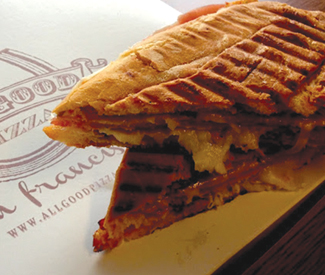
The lot invites lingering over cracker-thin pizzas (a steal at $7), from a basic Margherita to a spicy pie dotted with peppers, fennel, mozzarella, and Louisiana hot links smoked on site. The trailer houses a 650 degree gas-fired oven. These aren’t game-changing pies but there’s nothing like it in the ‘hood — nor are there many healthy salads, like a kale, radicchio, sweet potato crisps, Parmesan, balsamic reserva combo. There are also panini sandwiches ($7) such as a pig-heavy, super salty Nola Muffaletta: Genoa salami, smoked ham, olive salad, fior di latte mozzarella, and provolone cheese.

Italian sodas ($2.50) are all made on premises, like a candy sweet coconut soda evoking coconut oil, beaches and vacation. All this in a Bayview parking lot.

1605 Jerrold Ave., SF. (415) 846-6960, www.allgoodpizza.com


ANDA PIROSHKI

A close childhood pal is Russian and her mother and grandmother often home-baked us unforgettable treats as kids, from blintzes to piroshkis, those little baked buns stuffed with goodness. I still dream of them — a rarity in this town. Not even in Chicago or NY have I tasted any piroshkis as fresh as those at Anda Piroshki, a stall in the tiny but idyllic 331 Cortland marketplace housing a few take-out food purveyors. I’ve eaten Anda at SF Street Food Fest, but the ideal is to arrive at 331 soon after it opens when piroshkis are pulled from the oven piping hot.

The dough is airy yet dense, ever-so-subtly sweet, like a glorified Hawaiian roll. No skimping on fillings — one piroshki ($3.75–4.50) fills me up. Sustainable meats and local ingredients make them relatively guilt-free. Try a button mushroom piroshki overflowing with fresh spinach, or one of ground beef, rice and Swiss, oozing comfort. My favorite is Atlantic smoked salmon and cream cheese accented by black pepper and dill. It makes a savory, creamy breakfast.

The one downside has been a straight-faced, disinterested server who could not be bothered as I asked a question about Russian sodas (like Kvass, a fermented rye soda — pleasing rye notes if too saccharine) and acted the same when I returned a second time… a stark contrast to the friendliness I encounter at every other 331 business. But momentary coldness is still worth those warm piroshkis.

331 Cortland Ave., SF. (415) 271-9055, www.andapiroshki.com

Subscribe to Virgina’s twice-monthly newsletter, The Perfect Spot, www.theperfectspotsf.com


Film Listings

0

Film listings are edited by Cheryl Eddy. Reviewers are Kimberly Chun, Max Goldberg, Dennis Harvey, Lynn Rapoport, and Matt Sussman. For rep house showtimes, see Rep Clock.

SAN FRANCISCO INTERNATIONAL FILM FESTIVAL

The 55th San Francisco International Film Festival runs April 19-May 3; most shows $13. Venues: Castro Theatre, 429 Castro, SF; Pacific Film Archive, 2575 Bancroft, Berk.; SF Film Society Cinema, 1746 Post, SF; and Sundance Kabuki Cinema, 1881 Post, SF. For additional info, visit www.sffs.org.

OPENING

*Attenberg Isolated in a seaside Greek hamlet, naive about the ways of the world, and committed to watching her brilliant, terminally ill father slowly ebb away, Marina (Ariane Labed) might be living in a kind of hell from the viewpoint of many of her 20-something peers. But as imagined by writer-director Athina Rachel Tsangari, Marina’s circumscribed life instead teems with small, fascinating moments and weird, awkward instances of intimacy — the kind that add up to a compelling portrait of a coming of age and a kind of arrival of wisdom. About to face a lonely future with the imminent passing of architect dad Spyros (Vangelis Mourikis), Marina works as a driver, tooling around town to the chilled anguish of Suicide, attempting to learn about the facts of life from sexually experienced chum Bella (Evangelia Randou, a ringer for musician Eleanor Friedberger), and sparring playfully with her father. “We built an industrial colony on top of sheep pens and thought we were making a revolution,” he says in one scene, looking out at the water. “I like it. It’s soothing, all this uniformity,” Marina replies. “That’s because deep down you’re an optimistic bourgeois modernist.” “Bonjour, bourgeois.” A ripple is sent through Marina’s insular existence with the arrival of an engineer (Yorgos Lanthimos) — a real candidate for an intimate social experiment. Aligning herself firmly with her protagonist, Tsangari is gifted with a unique voice and has a remarkable eye for a resonant, poetic image. She channels both into a quiet film reminiscent of indies an age away à la Stranger Than Paradise (1984), finding a vein of humanistic hope during end times. (1:35) Presidio. (Chun)

Chimpanzee Just in time for Earth Day, Tim Allen narrates this kid-friendly, Jane Goodall-approved nature doc. (2:00) Shattuck.

4:44 Last Day on Earth Abel Ferrara’s latest imagines what the end of the world might be like for a volatile Lower East Side couple — he’s an ex-junkie (Ferrara favorite Willem Dafoe), she’s a young painter (Shanyn Leigh, Ferrara’s real-life companion). The film’s title refers to the predicted instant that an environmental catastrophe will completely dissolve the ozone layer, but 4:44 is mostly set indoors, specifically within the headspace of Dafoe’s character. It’s a gritty film that veers between self-indulgence and stuff that honestly seems pretty practical (sure, there’s a lot of Skyping, but if the world were ending, wouldn’t you?); as far as inward-looking disaster movies go, anyone planning an apocalypse film festival could double-bill 4:44 nicely with 2011’s Melancholia. (1:25) Balboa. (Eddy)

Letters From the Big Man Don’t fear the yeti. Filmmaker Christopher Munch (1991’s The Hours and Times) gets back to nature — and a more benevolent look at the sasquatch — with the engrossing Letters From the Big Man. Sarah (Lily Rabe, Jill Clayburgh’s daughter, perhaps best known for her ghostly American Horror Story flapper) is a naturalist and artist determined to get off trail, immerse herself in her postfire wilderness studies in southwestern Oregon, and leave the hassles and heartbreak of the human world behind. She’s far from alone, however, as she senses she’s being tailed — even after she confronts another solo hiker, Sean (Jason Butler Harner), who seems to share her deep love and knowledge of the wild. What emerges — as Sarah lives off the grid, sketches soulful-eyed Bigfoots, and powers her laptop with her bike — is a love story that might bear a remote resemblance to Beauty and the Beast if Munch weren’t so completely straight-faced in his belief in the big guys. The question, the mystery, isn’t whether or not sasquatch exist, according to the filmmaker, who paces his tale as if it were as big and encompassing as an ancient forest — rather, whether we can hold onto a belief in nature and its unknowables and coexist. (1:44) Roxie, Smith Rafael. (Chun)

The Lucky One Iraq War veteran Logan (Zac Efron) beats PTSD by walking with his German shepherd from Colorado to the Louisiana bayou, in search of a golden-haired angel in cutoff blue jean short shorts (Taylor Schilling). His stated (in soporific voice-over) aim is to meet and thank the angel, who he believes repeatedly saved his life in the combat zone after he plucked her photograph from the rubble of a bombed-out building. The snapshot offers little in the way of biographical information, but luckily, there are only 300 million people in the United States, and he manages to find her after walking around for a bit. The angel, or Beth, as her friends call her, runs a dog kennel with her grandmother (Blythe Danner) while raising her noxiously Hollywood-precocious eight-year-old son (Riley Thomas Stewart) and fending off the regressive advances of her semi-villainous ex-husband (Jay R. Ferguson). Logan’s task seems simple enough, and he’s certainly walked a fair distance to complete it, but rather than expressing his gratitude, he becomes tongue-tied in the face of Beth’s backlit blondness and instead fills out a job application and proceeds to soulfully but manfully burrow his way into her affections and short shorts. Being an adaptation of a Nicholas Sparks novel, The Lucky One requires some forceful yanking on the heartstrings, but director Scott Hicks (1999’s Snow Falling on Cedars, 1996’s Shine) is hobbled in this task by, among other things, Efron’s wooden, uninvolved delivery of queasy speeches about traveling through darkness to find the light and how many times a day a given woman should be kissed. (1:41) Marina, Shattuck. (Rapoport)

*Marley Oscar-winning documentarian Kevin Macdonald (1999’s One Day in September; he also directed Best Actor Forest Whitaker in 2006’s The Last King of Scotland) takes on the iconic Bob Marley, using extensive interviews — both contemporary (with Marley friends and family) and archival (with the musician himself) — and performance and off-the-cuff footage. The end result is a compelling (even if you’re not a fan) portrait of a man who became a global sensation despite being born into extreme poverty, and making music in a style that most people had never heard outside of Jamaica. The film dips into Marley’s Rastafari beliefs (no shocker this movie is being released on 4/20), his personal life (11 children from seven different mothers), his impact on Jamaica’s volatile politics, his struggles with racism, and, most importantly, his remarkable career — achieved via a combination of talent and boldness, and cut short by his untimely death at age 36. (2:25) California, Embarcadero. (Eddy)

*My Way South Korean director Kang Je-gyu (2004 Korean War epic Taegukgi) returns to the battlefield for another bombastic action flick with a very complicated bro-down at its center. This time, it’s World War II, and the head-butting protagonists are not actually brothers, but lifelong frenemies: Japanese Tatsuo (mega-idol Joe Odagiri) and South Korean Joon-sik (Taegukgi star Jang Dong-gun). They meet in occupied South Korea, where class and country lines amp up their frequent confrontations as competitive long-distance runners. When WW2 breaks out, Joon-sik is forced to join the Japanese army, with guess who ordering him around; during My Way‘s meaty war-is-hell section, the men’s relationship endures a Soviet labor camp, knife (and fist) fights, blizzards, gunshot wounds, deafness, countless explosions (including lots of exploding bodies), sprints on the beach, bellowing arguments, runaway tanks, grenades, Nazis, D-Day, and moments of heroism, cowardice, insanity, weepy emotion, and dumb luck. Somehow, Kang keeps the pace between “frenetic” and “superfly TNT” for a solid two hours — the man may not care much for subtlety, but My Way is nothing if not insanely entertaining. (1:59) SF Center. (Eddy)

*Surviving Progress The very definition of a movie that most needs to be seen by the people least likely to see it — i.e. most folk the right of the political dial — this excellent documentary manages to interweave virtually all the leading planet threatening woes of our era in a succinct and entertaining fashion. Its thesis is author Ronald Wright’s notion that “We’re at the end of a failed experiment.” It’s been around a while, so you’ve doubtless heard of it: the Industrial Revolution. That shift from small-scale, self-sustaining agrarian communities to much larger ones dependent on mass production and import-export created pockets of enormous First World wealth and comfort. But the populations that benefitted used up resources wildly out of proportion to their number; now countries like China and India want their share of the industrialized pie, just as we’ve realized those resources might actually run out. Cue summaries of the harm global warming, overpopulation, consumption, soil depletion, “market fundamentalism,” etc. have done and will do, as duly noted here by a roster of A-list experts including Stephen Hawking and Jane Goodall. (The latter vividly contextualizes just how out of whack humanity has gone by opining that ours is the only species capable of terminating its future by destroying its own habitat.) While this may sound like a bitter pill to swallow, not to mention one you’ve swallowed many times before, Surviving Progress colorfully weaves together a vast assortment of audiovisual materials as well as information, to highly watchable results. Do the earth a favor: see this movie, and drag a skeptic you know along. (1:26) Lumiere, Shattuck. (Harvey)

Think Like a Man Based on Steve Harvey’s best-seller Act Like a Lady, Think Like a Man, this ensemble rom-com stars Romany Malco, Gabrielle Union, Kevin Hart, and Wendy Williams. (2:02) Shattuck.

ONGOING

American Reunion Care for yet another helping of all-American horn dogs? The original American Pie (1999) was a sweet-tempered, albeit ante-upping tribute to ’80s teen sex comedies, so the latest in the franchise, the older, somewhat wiser American Reunion, is obliged to squeeze a dab more of the ole life force outta the class of ’99, in honor of their, em, 13th high school reunion. These days Jim (Jason Biggs) is attempting to fluff up a flagging postbaby sex life with wife Michelle (Alyson Hannigan). Kevin (Thomas Ian Nicholas) yearns to get in touch with his buried bad boy. Oz (Chris Klein) has become a sportscaster-reality competition star and is seemingly lost without old girlfriend Heather (Mena Suvari). Stifler (Seann William Scott) is as piggishly incorrigible as ever—even as a low-hanging investment flunky, while scarred, adventuring biker Finch (Eddie Kaye Thomas) seems to have become “the most interesting man in the world.” How much trouble can the gang get into? About as much of a mess as the Hangover guys, which one can’t stop thinking about when Jim wakes up on the kitchen floor with tile burns and zero pants. Half the cast—which includes Tara Reid, John “MILF!” Cho, Natasha Lyonne, and Shannon Elizabeth — seems to have stirred themselves from their own personal career hangovers, interludes of insanity, and plastic surgery disasters (with a few, like Cho and Thomas, firmly moving on), and others such as parental figures Eugene Levy and Jennifer Coolidge continuing to show the kids how it’s done. Still, the farcical American franchise’s essentially benign, healthy attitude toward good, dirty fun reads as slightly refreshing after chaste teen fare like the Twilight and High School Musical flicks. Even with the obligatory moment of full-frontal penis smooshing. (1:53) Metreon, 1000 Van Ness. (Chun)

Bad Fever Dustin Guy Defa’s tiny, odd character study centers on one Eddie Cooperschmidt (Kentucker Audley, a director himself), who looks like Mr. February 1992 on a calendar of sensitive grunge band hunks, but acts more like Homer Simpson — the Nathanael West version, not Matt Groening’s. He still lives with mom (unsympathetically played by Annette Wright), doesn’t or can’t hold a job, has no friends, fumbles through an oddly formal vocabulary, and carries himself like a 13-year-old who’s just had all his growth spurts in one go. In other words, he’s the sort of character whose precise status — just socially inept, or developmentally disabled, or both? — is a mystery the film doesn’t bother clarifying. Nor do we find out what the story is behind Irene (Eleonore Hendricks), his hard-bitten antithesis, who seems to be staying in an empty school classroom as some sort of weird art experiment rather than because she’s “homeless,” and who manipulates the hapless Eddie into videotaped situations that are perverse but stop short of pornography. (Or rather he — almost certainly a virgin — stops short there.) As if more goofy pathos were needed here, Eddie’s dream is to be a stand-up comedian, a career he is about as well equipped for as brain surgeon. When Eddie plays his big first (and probably last) comedy gig, the onscreen audience appears to be wondering the same thing you might: is this just sad, or some kind of Andy Kaufman-type performance piece? Painstakingly low-key and realistic in execution, Bad Fever‘s success will depend on whether you can swallow it conceptually — these characters are surrounded by a real world, but they can seem unreal themselves. (1:24) Roxie. (Harvey)

*The Ballad of Genesis and Lady Jaye Once dubbed “the wickedest man in the world”, shock artist and cofounder of seminal industrial music pioneers Throbbing Gristle Genesis Breyer P-Orridge has softened somewhat with time. Her plunge into pandrogyny, an ongoing artistic and personal process embarked upon with the late Jacqueline “Lady Jaye” Breyer P-Orridge, is an attempt to create a perfectly balanced body, incorporating the characteristics of both. As artists, the two were committed to documenting their process, but as marriage partners, much of their footage is sweetly innocuous home video footage: Genesis cooking in the kitchen decked out in a little black dress, Lady Jaye setting out napkins at a backyard bar-b-que or helping to dig through Genesis’ archives of COUM Transmissions and Throbbing Gristle “ephemera,” the two wrapped in bandages after getting matching nose jobs. “I just want to be remembered as one of the great love affairs of all time,” Jaye tells Genesis. This whimsical documentary by Marie Losier will go a long way toward making that wish a reality. (1:12) Roxie. (Nicole Gluckstern)

Blue Like Jazz Tap or bottled water, rainy Portland, Ore. or dry Texas — how does a sincere, young Bible-thumping Baptist reconcile the two — a fish out of water nonetheless determined to swim upstream and make his way to adulthood. Based on the Donald Miller memoir-of-sorts, Blue Like Jazz may look like a Nicholas Sparks romantic opus from afar, but in the care of director-cowriter Steve Taylor, this tale of a young man coming to terms with the wider, wilder world apart from the strict confines of lock-in abstinence groups snatches a bit of the grace John Coltrane tapped in A Love Supreme. The earnest Donald (True Blood‘s Marshall Allman) is all set to go to his nearby Bible Belt Christian university until his bohemian jazz-loving dad pulls favors and enrolls him at free-form Reed College. Donald will have to closet his holy-roller background if, as his new lesbian pal (Tania Raymonde) cautions, he “plans on ever making friends or sharing a bowl or seeing human vagina without a credit card.” Donald finds his way back to meaning and spirit — and the fun is getting there, as he joins a civil-disobedience-club-for-credit (Malaysian cocktail tennis was canceled) and falls for passionate activist Penny (Claire Holt). Allman, who also co-executive produced, emerges as a thoughtful actor who can carry a potentially maudlin and ultimately lovable collegiate coming-of-age story on his own. (1:47) 1000 Van Ness, Opera Plaza. (Chun)

*Bully Anyone who’s ever been a kid on the wrong side of a bully — or was sensitive and observant enough not to avert his or her eyes — will be puzzling over the MPAA’s R rating of this doc, for profanity. It’s absurd when the gory violence on network and basic cable TV stops just short of cutting characters’ faces off, as one blurred-out bus bully threatens to do to the sweet, hapless Alex, dubbed “Fish Face” by the kids who ostracize him and make his life hell on the bus. It’s a jungle out there, as we all know — but it’s that real, visceral footage of the verbal (and physical) abuse bullied children deal with daily that brings it all home. Filmmaker Lee Hirsch goes above and beyond in trying to capture all dimensions of his subject: the terrorized bullied, the ineffectual school administrators, the desperate parents. There’s Kelby, the gay girl who was forced off her beloved basketball team after she came out, and Ja’Maya, who took drastic measures to fend off her tormenters — as well as the specters of those who turned to suicide as a way out. Hirsch is clearly more of an activist than a fly on the wall: he steps in at one point to help and obviously makes an uplifting effort to focus on what we can do to battle bullying. Nevertheless, at the risk of coming off like the Iowa assistant principal who’s catching criticism for telling one victim that he was just as bad as the bully that he refused to shake hands with, one feels compelled to note one prominent component that’s missing here: the bullies themselves, their stories, and the reasons why they’re so cruel — admittedly a daunting, possibly libelous task. (1:35) Metreon, Piedmont, Shattuck, Smith Rafael. (Chun)

*The Cabin in the Woods If the name “Joss Whedon” doesn’t provide all the reason you need to bum-rush The Cabin in the Woods (Whedon produced and co-wrote, with director and frequent collaborator Drew Goddard), well, there’s not much more that can be revealed without ruining the entire movie. In a very, very small nutshell, it’s about a group of college kids (including Chris “Thor” Hemsworth) whose weekend jaunt to a rural cabin goes horribly awry, as such weekend jaunts tend to do in horror movies (the Texas Chainsaw and Evil Dead movies are heavily referenced). But this is no ordinary nightmare — its peculiarities are cleverly, carefully revealed, and the movie’s inside-out takedown of scary movies produces some very unexpected (and delightfully blood-gushing) twists and turns. Plus: the always-awesome Richard Jenkins, and in-jokes galore for genre fans. (1:35) California, Metreon, 1000 Van Ness, Presidio. (Eddy)

*Casa de mi Padre Will Ferrell’s latest challenge in a long line of actorly exercises and comic gestures — from his long list of comedies probing the last gasps of American masculinity to serious forays like Stranger Than Fiction (2006) and Everything Must Go (2010) — is almost entirely Spanish-language telenovela-burrito Western spoof Casa de mi Padre. Here Ferrell tackles an almost entirely Spanish script (with only meager, long-ago high school and college language courses under his belt) alongside Mexican natives Gael García Bernal and Diego Luna and telenovela veteran Genesis Rodriguez. This clever, intriguing, occasionally very funny, yet not altogether successful endeavor, directed by Matt Piedmont and written by Andrew Steele, sprang from Ferrell’s noggin. Ferrell is nice guy Armando, content to stay at home at the ranch, hang with his buddies, and be dismissed by his father (Pedro Armendáriz Jr.) as a dolt. The arrival of his sleazy bro Raul (Luna) and Raul’s fiancée Sonia (Rodriguez) change everything, bringing killer narco Onza (Bernal) into the family’s life and sparking some hilariously klutzy entanglements between Armando and Sonia. All of this leads to almost zero improvisation on Ferrell’s part and plenty of meta, Machete-like spoofs on low-budget fare, from Sergio Leone to Alejandro Jodorowsky. Casa punctures padre-informed transmissions of Latin machismo, but it equally ridicules the idea of a gringo actor riding in and superimposing himself, badly or otherwise, over another country’s culture. (1:25) Four Star. (Chun)

*Damsels in Distress Whit Stillman lives! The eternally preppy writer-director (1990’s Metropolitan; 1994’s Barcelona; 1998’s The Last Days of Disco), whose dialogue-laden scripts have earned him the not-inaccurate descriptor of “the WASP Woody Allen,” emerges with this popped-collar take on girl-clique movies like Mean Girls (2004), Clueless (1995), and even Heathers (1988). At East Coast liberal-arts college Seven Oaks (“the last of the Select Seven to go co-ed”), frat guys are so dumb they don’t know the names of all the colors; the school newspaper is called the Daily Complainer; and a group of girls, lead by know-it-all Violet (Greta Gerwig), are determined to lift student morale using unconventional methods (tap dancing is one of them). After she’s scooped into this strange orbit, transfer student (Analeigh Tipton) can’t quite believe Violet and her friends are for real. They’re not, of course — they’re carefully crafted Stillman creations, which renders this very funny take on college life a completely unique experience. Did I mention the musical numbers? (1:38) SF Center. (Eddy)

*The Deep Blue Sea Caught between the devil and the deep blue sea, filmmaker Terence Davies, much like his heroine, chooses a mutable, fluid sensuality, turning his source material, Terence Rattigan’s acclaimed mid-century play, into a melodrama that catches you in its tide and refuses to let go. At the opening of this sumptuous portrait of a privileged English woman who gives up everything for love, Hester (Rachel Weisz) goes through the methodical motions of ending it all: she writes a suicide note, carefully stuffs towels beneath the door, takes a dozen pills, turns on the gas, and lies down to wait for death to overtake her. Via memories drifting through her fading consciousness, Davies lets us in on scattered, salient details in her back story: her severely damped-down, staid marriage to a high court judge, Sir William (Simon Russel Beale), her attraction and erotic awakening in the hands of charming former RF pilot Freddie Page (Tom Hiddleston), her separation, and her ultimate discovery that her love can never be matched, as she hazards class inequities and ironclad gender roles. “This is a tragedy,” Sir William says, at one point. But, as Hester, a model of integrity, corrects him, “Tragedy is too big a word. Sad, perhaps.” Similarly, Sea is a beautiful downer, but Davies never loses sight of a larger post-war picture, even while he pauses for his archetypal interludes of song, near-still images, and luxuriously slow tracking shots. With cinematographer Florian Hoffmeister, he does a remarkable job of washing post-war London with spots of golden light and creating claustrophobic interiors — creating an emotionally resonant space reminiscent of the work of Wong Kar-wai and Christopher Doyle. At the center, providing the necessary gravitas (much like Julianne Moore in 2002’s Far From Heaven), is Weisz, giving the viewer a reason to believe in this small but reverberant story, and offering yet another reason for attention during the next awards season. (1:38) Embarcadero, Smith Rafael. (Chun)

Detention The latest from A-list music video director turned B-movie helmer Joseph Kahn (2004’s Torque) realllllly wants to be a cult classic. Not sure that’s a certainty, but midnight would definitely be the appropriate hour to view this teen-slasher parody that also enfolds body-swapping, time travel, out-of-control parties, stuffed bears, accidental YouTube porn, unrequited love, the dreaded Dane Cook, and cinema’s most sledgehammer-heavy 1990s nostalgia to date — despite the fact that Detention‘s central homage is to The Breakfast Club, which came out in 1985. Nominally grounding the film’s garish look, broad humor, and breakneck pace are the charms of young leads Shanley Caswell (as klutzy tomboy Riley) and Hunger Games star Josh Hutcherson (as a Road House-worshiping skater), who displays questionable if admirable show biz aspirations by serving as one of Detention‘s executive producers. He was, after all, born in 1992, which in Detention‘s estimation was “like, the coolest year ever!” (1:30) Metreon. (Eddy)

Footnote (1:45) Albany, Clay.

*Friends With Kids Jennifer Westfeldt scans Hollywood’s romantic comedy landscape for signs of intelligent life and, finding it to be a barren place possibly recovering from a nuclear holocaust, writes, directs, and stars in this follow-up to 2001’s Kissing Jessica Stein, which she co-wrote and starred in. Julie (Westfeldt) and Jason (Adam Scott) are upper-thirtysomething New Yorkers with two decades of friendship behind them. He calls her “doll.” They have whispered phone conversations at four in the morning while their insignificant others lie slumbering beside them on the verge of getting dumped. And after a night spent witnessing the tragic toll that procreation has taken on the marriages of their four closest friends — Bridesmaids (2011) reunion party Leslie (Maya Rudolph), Alex (Chris O’Dowd), Missy (Kristen Wiig), and Ben (Jon Hamm), the latter two, surprisingly and less surprisingly, providing some of the film’s darkest moments — Jason proposes that they raise a child together platonically, thereby giving any external romantic relationships a fighting chance of survival. In no time, they’ve worked out the kinks to their satisfaction, insulted and horrified their friends, and awkwardly made a bouncing baby boy. The arrival of significant others (Edward Burns and Megan Fox) signals the second phase of the experiment. Some viewers will be invested in latent sparks of romance between the central pair, others in the success of an alternative family arrangement; one of these demographics is destined for disappointment. Until then, however, both groups and any viewers unwilling to submit to this reductive binary will be treated to a funny, witty, well crafted depiction of two people’s attempts to preserve life as they know it while redrawing the parameters of parenthood. (1:40) SF Center. (Rapoport)

*House of Pleasures Set in a fin de siècle French brothel, Bertrand Bonello’s lushly rendered drama is challenging and frequently unpleasant. Bonello sees the beauty and allure of his subjects, the many miserable women of this maison close, but rarely sinks to sympathy for their selfish and sometimes sadistic clients. Bound as they are by their debts to their Madame, the prostitutes are essentially slaves, held to strict and humiliating standards. All they have is each other, and the movie’s few emotional bright spots come from this connection. The filmmaking is wily and nouvelle vague-ish, featuring anachronistic music and inventive split-screen sequences. Additionally, there is a spidery complexity to the film’s chronology, wherein certain scenes repeat to reveal new contexts. This unstuck sense of newness is perhaps didactic — this could and does happen now as well as then — but it also serves to make an already compelling ensemble piece even richer and more engaging. (2:02) SF Film Society Cinema. (Sam Stander)

The Hunger Games Katniss Everdeen (Jennifer Lawrence) is a teenager living in a totalitarian state whose 12 impoverished districts, as retribution for an earlier uprising, must pay tribute to the so-called Capitol every year, sacrificing one boy and one girl each to the Hunger Games. A battle royal set in a perilous arena and broadcast live to the Capitol as gripping diversion and to the districts as sadistic propaganda, the Hunger Games are, depending on your viewpoint, a “pageant of honor, courage, and sacrifice” or a brutal, pointless bloodbath involving children as young as 12. When her little sister’s name comes up in the annual lottery, Katniss volunteers to take her place and is joined by a boy named Peeta Mellark (Josh Hutcherson), with whom she shares an old, unspoken bond. Tasked with translating to the screen the first installment of Suzanne Collins’s rabidly admired trilogy, writer-director Gary Ross (2003’s Seabiscuit, 1998’s Pleasantville) telescopes the book’s drawn-out, dread-filled tale into a manageable two-plus-hour entertainment, making great (and horrifying) use of the original work’s action, but losing a good deal of the narrative detail and emotional force. Elizabeth Banks is comic and unrecognizable as Effie Trinket, the two tributes’ chaperone; Lenny Kravitz gives a blank, flattened reading as their stylist, Cinna; and Donald Sutherland is sufficiently creepy and bloodless as the country’s leader, President Snow. More exceptionally cast are Woody Harrelson as Katniss and Peeta’s surly, alcoholic mentor, Haymitch Abernathy, and Stanley Tucci as games emcee Caesar Flickerman, flashing a bank of gleaming teeth at each contestant as he probes their dire circumstances with the oily superficiality of a talk show host. (2:22) Marina, 1000 Van Ness, Presidio, SF Center, Sundance Kabuki. (Rapoport)

*The Hunter Shot and set during Iran’s contentious 2009 Presidential campaign, The Hunter starts as a Kafka-esque portrait of quiet desperation in a cold, empty Tehran, then turns into a sort of existential thriller. The precise message may be ambiguous, but it’s no surprise this two-year-old feature has so far played nearly everywhere but Iran itself. Ali (filmmaker Rafi Pitts) is released from prison after some years, his precise crime never revealed. Told that with his record he can’t expect to get a day shift on his job as security guard at an automotive plant, he keeps hours at odds with his working wife Sara (Mitra Haijar) and six-year-old daughter Saba (Saba Yaghoobi). Still, they try to spend as much time together as possible, until one day Ali returns to find them uncharacteristically gone all day. After getting the bureaucratic runaround he’s finally informed by police that something tragic has occurred; one loved one is dead, the other missing. When his thin remaining hope is dashed, with police notably useless in preventing that grim additional news, Ali snaps — think Peter Bogdanovich’s 1968 Targets. He’s soon in custody, albeit in that of two bickering officers who get them all lost in the countryside. Pitts, a long-ago child performer cast here only when the actor originally hired had to be replaced, makes Ali seem pinched from the inside out, as if in permanent recoil from past and anticipated abuse. This thin, hunched frame, vulnerable big ears, and hooded eyes — the goofily oversized cap he wears at work seems a deliberate affront — seems so fixed an expression of unhappiness that when he flashes a great smile, for a moment you might think it must be someone else. He’s an everyman who only grows more shrunken once the film physically opens up into a natural world no less hostile for being beautiful. (1:32) Roxie. (Harvey)

*The Island President The titular figure is Mohamed Nasheed, recently ousted (by allies of the decades long dictator he’d replaced) chief executive of the Republic of Maldives — a nation of 26 small islands in the Indian Ocean. Jon Shenk’s engaging documentary chronicles his efforts up to and through the 2009 Copenhagen Climate Summit to gather greater international commitment to curbing greenhouse gas emissions. This is hardly do-gooderism, a bid for eco-tourism, or politics as usual: scarcely above sea level, with nary a hill, the Maldives will simply cease to exist soon if waters continue to rise at global warming’s current pace. (“It won’t be any good to have a democracy if we don’t have a country,” he half-jokes at one point.) Nasheed is tireless, unjaded, delightful, and willing to do anything, at one point hosting “the world’s first underwater cabinet meeting” (with oxygen tanks, natch) as a publicity stunt. A cash-strapped nation despite its surfeit of wealthy vacationers, it’s spending money that could go to education and health services on the pathetic stalling device of sandwalls instead. But do bigger powers — notably China, India and the U.S. — care enough about this bit-part player on the world stage to change their energy-use and economic habits accordingly? (A hint: If you’ve been mulling a Maldivian holiday, take it now.) Somewhat incongruous, but an additional sales point nonetheless: practically all the film’s incidental music consists of pre-existing tracks by Radiohead. (1:51) Smith Rafael. (Harvey)

*Jeff, Who Lives at Home The failure-to-launch concept will always thrive whenever and wherever economies flail, kids crumble beneath family trauma, and the seduction of moving back home to live for free with the parental units overcomes the draw of adulthood and individuation. Nevertheless brotherly writing and directing team Jay and Mark Duplass infuse a fresh, generous-minded sweetness in this familiar narrative arc, mainly by empathetically following those surrounding, and maybe enabling, the stay-at-home. Spurred by a deep appreciation of Signs (2002) and plentiful bong hits, Jeff (Jason Segel) decides to go with the signals that the universe throws at him: a mysterious phone call for a Kevin leads him to stalk a kid wearing a jersey with that name and jump a candy delivery truck. This despite the frantic urging of his mother (Susan Sarandon), who has set the bar low and simply wants Jeff to repair a shutter for her birthday, and the bad influence of brother Pat (Ed Helms), a striving jerk who compensates for his insecurities by buying a Porsche and taking business meetings at Hooters. We never quite find out what triggered Jeff’s dormancy and Pat’s prickishness — two opposing responses to some unspecified psychic wound — yet by Jeff, Who Lives at Home‘s close, it doesn’t really matter. The Duplass brothers convince you to go along for the ride, much like Jeff’s blessed fool, and accept the ultimately feel-good, humanist message of this kind-hearted take on human failings. (1:22) SF Center. (Chun)

Jiro Dreams of Sushi Celebrity-chef culture has surely reached some kind of zeitgeist, what with the omnipresence of Top Chef and other cooking-themed shows, and the headlines-making power of people like Paula Deen (diabetes) and Mario Batali (sued for ripping off his wait staff). Unconcerned with the trappings of fame — you’ll never see him driving a Guy Fieri-style garish sports car — is Jiro Ono, 85-year-old proprietor of Sukiyabashi Jiro, a tiny, world-renowned sushi restaurant tucked into Tokyo’s Ginza station. Jiro, a highly-disciplined perfectionist who believes in simple, yet flavorful food, has devoted his entire life to the pursuit of “deliciousness” — to the point of sushi invading his dreams, as the title of David Gelb’s reverential documentary suggests. But Jiro Dreams of Sushi goes deeper than food-prep porn (though, indeed, there’s plenty of that); it also examines the existential conflicts faced by Jiro’s two middle-aged sons. Both were strongly encouraged to enter the family business — and in the intervening years, have had to accept the soul-crushing fact that no matter how good their sushi is, it’ll never be seen as exceeding the creations of their legendary father. (1:21) Embarcadero, Piedmont, Shattuck, Smith Rafael. (Eddy)

*The Kid with a Bike Slippery as an eel, Cyril (Thomas Doret) is the bane of authorities as he tries to run away at any opportunity from school and a youth home — being convinced that the whole adult world is conspiring to keep his father away from him. During one such chase he literally runs into hair-salon proprietor Samantha (Cécile De France), who proves willing to host him on weekends away from his public facility, and is a patient, steadying influence despite his still somewhat exasperating behavior. It’s she who orchestrates a meeting with his dad (Jerémié Renier, who played the child in the Dardennes’ 1996 breakthrough La Promesse), so Cyril can confront the hard fact that his pa not only can’t take care of him, he doesn’t much want to. Still looking for some kind of older male approval, Cyril falls too easily under the sway of Wes (Egon Di Mateo), a teenage thug whom everyone in Samantha’s neighborhood knows is bad news. This latest neorealist-style drama from Belgium’s Dardenne Brothers treads on very familiar ground for them, both in themes and terse execution. It’s well-acted, potent stuff, if less resonant in sum impact than their best work. (1:27) Opera Plaza. (Harvey)

*The Lady Luc Besson directs Michelle Yeoh — but The Lady is about as far from flashy action heroics as humanly possible. Instead, it’s a reverent, emotion-packed biopic of Nobel Peace Prize winner Aung San Suu Kyi, a national hero in Burma (Myanmar) for her work against the country’s oppressive military regime. But don’t expect a year-by-year exploration of Suu’s every accomplishment; instead, the film focuses on the relationship between Suu and her British husband, Michael Aris (David Thewlis). When Michael discovers he’s dying of cancer, he’s repeatedly denied visas to visit his wife — a cruel knife-twist by a government that assures Suu that if she leaves Burma to visit him, they’ll never allow her to return. Heartbreaking stuff, elegantly channeled by Thewlis and especially Yeoh, who conveys Suu’s incredible strength despite her alarmingly frail appearance. The real Iron Lady, right here. (2:07) Bridge, Shattuck. (Eddy)

L!fe Happens Ah, another movie in the Juno-Knocked Up continuum of “Unplanned and totally ill-advised pregnancy? Welp, guess I’m having a baby!” We never know if a “shmishmortion” occurs to Kim (Krysten Ritter), because she has unprotected sex in the first scene and the next scene is “one year later,” with infant in tow. The wee babe’s dad, a surfer with neck tattoos, is out of the picture; Kim makes do with her job as a dog walker (Kristen Johnston plays her kid-hating, cheesy-diva boss) and the good graces of her roommates, sardonic budding self-help guru Deena (Kate Bosworth) and cheerful Laura (Rachel Bilson), whose only defining characteristic is that she’s a virgin (omg, the irony). As directed by Kat Coira (who co-wrote with Ritter), L!fe Happens lurches toward Hollywood conventionality by pairing Kim with a hunky guy (Geoff Stults) who doesn’t realize she’s a MILF. Fortunately, that storyline is frequently overshadowed — seriously, they might as well have named the baby “Plot Device” or “Conflict Generator” — by the remarkably realistic I-love-you-but-sometimes-I-want-to-kill-you relationship between BFFs Kim and Deena, which forms the film’s true emotional core. +100 for casting Weeds‘ Justin Kirk as an ascot-wearing weirdo who woos the icy Deena, with (not-so) surprising results. (1:40) 1000 Van Ness. (Eddy)

Lockout Just when you thought Luc Besson was turning over a new, serious-minded leaf with Aung San Suu Kyi biopic The Lady, Lockout arrives to remind you that this is the dude whose earliest efforts (1990’s La Femme Nikita, 1997’s The Fifth Element) have since been subsumed beneath piles of dispose-o-flicks that resemble outtakes from the Transporter movies (which he produced, natch). That’s not to say there aren’t certain pleasures to be found in tossed-off action flicks; Lockout, which inexplicably needed two directors (James Mather and Stephen St. Leger, who co-wrote with Besson), is enjoyable enough in the moment, in addition to being completely, consistently ludicrous throughout. Guy Pearce plays the wisecracking Snow, a wrongfully-convicted government agent who’s about to suffer the Punishment of the Future: being sedated and then blasted to space prison for 30 years. That is, until the First Daughter (Maggie Grace) finds herself trapped aboard the facility when a riot breaks out. Naturally, reluctant rescuer Snow is chosen for prison-break-in-reverse duties. The rest goes like this: Boom! Quip! Boom! Quip! Lockout purports to be from an “original idea” by exec producer Besson, a bold claim considering the movie is more or less Con Air (1997) pasted over the Die Hard series and John Carpenter’s Escape movies. (1:35) 1000 Van Ness, SF Center, Shattuck. (Eddy)

Mirror Mirror In this glittery, moderately girl-powery adaptation of the Snow White tale (a comic foil of sorts to this summer’s gloomier-looking Snow White and the Huntsman), Julia Roberts takes her turn as stepmom, to an earnest little ingenue (Lily Collins) whose kingly father (Sean Bean) is presumed dead and whose rather-teeny-looking kingdom is collapsing under the weight of fiscal ruin and a thick stratum of snow. Into this sorry realm rides a chiseled beefcake named Prince Alcott (Arnie Hammer), who hails from prosperous Valencia, falls for Snow White, and draws the attentions of the Queen (Roberts) from both a strategic and a libidinal standpoint. Soon enough, Snow White (Snow to her friends) is narrowly avoiding execution at the hands of the Queen’s sycophantic courtier-henchman (Nathan Lane), rustling up breakfast for a thieving band of stilt-walking dwarves, and engaging in sylvan hijinks preparatory to deposing her stepmother and bringing light and warmth and birdsong and perennials back into fashion. Director Tarsem Singh (2000’s The Cell, 2011’s Immortals) stages the film’s royal pageantry with a bright artistry, and Roberts holds court with vicious, amoral relish as she senses her powers of persuasion slipping relentlessly from her grasp. Carefully catering to tween-and-under tastes as well as those of their chaperones, the comedy comes in various breadths, and there’s meta-humor in the sight of Roberts passing the pretty woman torch, though Collins seems blandly unprepared to wield her power wisely or interestingly. Consider vacating your seats before the extraneous Bollywood-style song-and-dance number that accompanies the closing credits. (1:46) Metreon, 1000 Van Ness. (Rapoport)

*Monsieur Lazhar When their beloved but troubled teacher hangs herself in the classroom — not a thoughtful choice of location, but then we never really discover her motives — traumatized Montreal sixth-graders get Bachir Lazhar (Fellag), a middle-aged Algerian émigré whose contrastingly rather strict, old-fashioned methods prove surprisingly useful at helping them past their trauma. He quickly becomes the crush object of studious Alice (Sophie Nelisse), whose single mother is a pilot too often away, while troublemaker Simon (Emilien Neron) acts out his own domestic and other issues at school. Lazhar has his own secrets as well — for one thing, we see that he’s still petitioning for permanent asylum in Canada, contradicting what he told the principal upon being hired — and while his emotions are more tightly wrapped, circumstances will eventually force all truths out. This very likable drama about adults and children from Quebec writer-director Philippe Falardeau doesn’t quite have the heft and resonance to rate among the truly great narrative films about education (like Laurent Cantet’s recent French The Class). But it comes close enough, gracefully touching on numerous other issues while effectively keeping focus on how a good teacher can shape young lives in ways as incalculable as they are important. (1:34) Albany, Embarcadero, Smith Rafael. (Harvey)

People v. The State of Illusion Writer-producer-star Austin Vickers’ slice of self-help cinema is a motivational lecture illustrated by a lot of infomercial-type imagery, plus a narrative strand: when a stressed-out yuppie single dad’s carelessness results in a traffic death, he’s sent to prison. Naturally Aaron (played by J.B. Tuttle) hate, hate, hates it there, until the world’s most philosophically advanced janitor (Michael McCormick) gradually gets him to understand that the real “prison” is his mind — freedom requires only an “awareness shift.” The larger film, with Vickers addressing us directly and various experts chipping in, furthers that notion to suggest even cellular science supports the notion that reality is a matter of perception — and thus the roadblocks and limitations that gum us up on life’s paths (relationships, income, self-doubt, et al.) can be overcome if one believes so and acts accordingly. This elaborate pep talk isn’t really the sort of thing you can evaluate in art or entertainment terms, save to say it’s well-crafted for its type. As for value in other terms, well, odds are you’ve heard all this in one form or another before. But if you happen to be stuck in any kind of personal prison, who knows, People might be just the prod that gets you moving. (1:26) Opera Plaza. (Harvey)

*The Raid: Redemption As rip-roaring as they come, Indonesian import The Raid: Redemption (from, oddly, a Welsh writer-director, Gareth Huw Evans) arrives to reassure genre fans that action films are still being made without CG-embellished stunts, choppy editing, and gratuitous 3D. Fists, feet, and gnarly weapons do the heavy lifting in this otherwise simple tale of a taciturn special-forces cop (Iko Uwais) who’s part of a raid on a run-down, high-rise apartment building where all the tenants are crooks and the landlord is a penthouse-dwelling crime boss (Ray Sahetapy). Naturally, things go awry almost immediately, and floor-to-floor brawls (choreographed by Uwais and co-star Yayan Ruhian, whose character is aptly named “Mad Dog”) comprise nearly the entirety of the film; of particular interest is The Raid‘s focus on pencak silat, an indigenous Indonesian fighting style — though there are also plenty of thrilling gun battles, machete-thwackings, and other dangerous delights. Even better: Redemption is the first in a planned trilogy of films starring Uwais’ badass (yet morally rock-solid) character. Bring it! (1:40) Metreon. (Eddy)

*Salmon Fishing in the Yemen In Lasse Hallström’s latest film, a sheikh named Muhammed (Amr Waked) with a large castle in Scotland, an ardent love of fly-fishing, and unlimited funds envisions turning a dry riverbed in the Yemeni desert into an aquifer-fed salmon-run site and the surrounding lands into an agricultural cornucopia. Tasked with realizing this dream are London marketing consultant Harriet Chetwode-Talbot (Emily Blunt) and government fisheries scientist Alfred Jones (Ewan McGregor), a reluctant participant who refers to the project as “doolally” and signs on under professional duress. Despite numerous feasibility issues (habitat discrepancies, the necessity for a mass exodus of British salmon, two million irate British anglers), Muhammed’s vision is borne forward on a rising swell of cynicism generated within the office of the British prime minister’s press secretary (Kristin Scott Thomas), whose lackeys have been scouring the wires for a shred of U.K.-related good news out of the Middle East. Ecology-minded killjoys may question whether this qualifies. But putting aside, if one can, the possible inadvisability of relocating 10,000 nonnative salmon to a wadi in Yemen — which is to say, putting aside the basic premise — it’s easy and pleasant enough to go with the flow of the film, infected by Jones’s growing enthusiasm for both the project and Ms. Chetwode-Talbot. Adapted from Paul Torday’s novel by Simon Beaufoy (2009’s Slumdog Millionaire), Salmon Fishing is a sweet and funny movie, and while it suffers from the familiar flurried third-act knotting together of loose ends, its storytelling stratagems are entertaining and its characters compellingly textured, and the cast makes the most of the well-polished material. (1:52) California, Four Star, Opera Plaza, Piedmont. (Rapoport)

*The Salt of Life Gianni Di Gregorio is both a triumph over and cautionary illustration of the aging uomo, racking up decades of experience yet still infantilized by that most binding tie. He’s a late bloomer who’s long worked in theater and film in various capacities, notably as a scenarist for 2008’s organized crime drama Gomorrah. That same year he wrote and directed a first feature basically shot in his own Rome apartment. Mid-August Lunch was a surprise global success casting the director himself as a putz, also named Gianni, very like himself (by his own admission), peevishly trying to have some independence while catering to the whims of the ancient but demanding mother (Valeria De Franciscis) he still lives with. Lunch was charming in a sly, self-deprecating way, and The Salt of Life is more of the same minus the usual diminishing returns: the creator’s barely-alter ego Gianni is still busy doing nothing much, dissatisfied not by his indolence but by its quality. But his pint-sized, wig-rocking, nearly century-old matriarch has now moved to a plush separate address with full-time care — and Salt‘s main preoccupation is Gianni’s discovery that while he’s as available and interested in women as ever, at age 63 he is no longer visible to them. While Fellini confronted desirable, daunting womanhood with a permanent adolescent’s masturbatory fantasizing, Di Gregorio’s humbler self-knowledge finds comedy in the hangdog haplessness of an old dog who can’t learn new tricks and has forgotten the old ones. (1:30) Smith Rafael. (Harvey)

*A Separation Iran’s first movie to win Berlin’s Golden Bear (as well as all its acting awards), this domestic drama reflecting a larger socio-political backdrop is subtly well-crafted on all levels, but most of all demonstrates the unbeatable virtue of having an intricately balanced, reality-grounded screenplay — director Asghar Farhadi’s own — as bedrock. A sort of confrontational impartiality is introduced immediately, as our protagonists Nader (Peyman Moadi) and Simin (Leila Hatami) face the camera — or rather the court magistrate — to plead their separate cases in her filing for divorce, which he opposes. We gradually learn that their 14-year wedlock isn’t really irreparable, the feelings between them not entirely hostile. The roadblock is that Simin has finally gotten permission to move abroad, a chance she thinks she must seize for the sake of their daughter, Termeh (Sarina Farhadi). But Nader doesn’t want to leave the country, and is not about to let his only child go without him. Farhadi worked in theater before moving into films a decade ago. His close attention to character and performance (developed over several weeks’ pre-production rehearsal) has the acuity sported by contemporary playwrights like Kenneth Lonergan and Theresa Rebeck, fitted to a distinctly cinematic urgency of pace and image. There are moments that risk pushing plot mechanizations too far, by A Separation pulls off something very intricate with deceptive simplicity, offering a sort of integrated Rashomon (1950) in which every participant’s viewpoint as the wronged party is right — yet in conflict with every other. (2:03) Lumiere, Shattuck. (Harvey)

A Simple Life When elderly Ah Tao (Deanie Ip), the housekeeper who’s served his family for decades, has a stroke, producer Roger (Andy Lau) pays for her to enter a nursing home. No longer tasked with caring for Roger, Ah Tao faces life in the cramped, often depressing facility with resigned calm, making friends with other residents (some of whom are played by nonprofessional actors) and enjoying Roger’s frequent visits. Based on Roger Lee’s story (inspired by his own life), Ann Hui’s film is well-served by its performances; Ip picked up multiple Best Actress awards for her role, Lau is reliably solid, and Anthony Wong pops up as the nursing home’s eye patch-wearing owner. Wong’s over-the-top cameo doesn’t quite fit in with the movie’s otherwise low-key vibe, but he’s a welcome distraction in a film that can be too quiet at times — a situation not helped by its washed-out palette of gray, beige, and more gray. (1:58) Metreon. (Eddy)

*They Call it Myanmar: Lifting the Curtain Recent elections signal that Myanmar’s status as “the second-most isolated country on the planet,” per Robert H. Lieberman’s doc, may soon be changing. With that hopeful context, this insightful study of Myanmar (or Burma, depending on who’s referring to it) is particularly well-timed. Shot using clandestine methods, and without identifying many of its fearful interviewees — with the exception of recently-released-from-house-arrest politician Aung San Suu Kyi, a Nobel Peace Prize winner — They Call it Myanmar offers a revealing look at a country largely untouched by corporate influences and pop culture. Myanmar’s military dictatorship is the opposite of a cult of personality; it’s scarier, one subject reflects, because “it’s a system, not an individual,” with faceless leaders who can be quietly be replaced. The country struggles with a huge disconnect between the very rich and the very poor; it has a dismal health care system overrun by “quacks,” and an equally dismal educational system that benefits very few children. Hunger, disease, child labor — all prevalent. Surprisingly, though the conditions that surround them are grim, Myanmar’s people are shown to be generally happy and deeply spiritual as they go about their daily lives. A highlight: Lieberman’s interactions with excited Buddhist pilgrims en route to Kyaiktiyo Pagoda, with an up-close look at the miraculously teetering “Golden Rock.” (1:23) Lumiere. (Eddy)

The Three Stooges: The Movie (1:32) Metreon, 1000 Van Ness, Presidio.

Titanic 3D (3:14) Metreon, 1000 Van Ness.

*The Turin Horse Hungarian auteur Béla Tarr’s final cinematic statement is extrapolated from a climactic episode in the life of Friedrich Nietzsche, wherein the philosopher tearfully intervened in the beating of a horse on the streets of Turin. Tarr, working with frequent collaborators Ágnes Hranitzky and László Krasznahorkai, conjures the lives of a horseman and his daughter as they barely subsist amid a windswept wasteland. This glacial Beckettian dirge of a film, shot in black and white and composed of Tarr’s trademark long takes, doesn’t so much develop these two characters as wear them down. Their stultifying daily routines — cleaning the stable, fetching water from the well, changing and cleaning their numerous layers of clothing — occupy much of the film, so it is all the more unsettling when this wretched lifestyle is torn asunder by the whims of nature. (2:26) SF Film Society Cinema. (Sam Stander)

*21 Jump Street One of the more pleasant surprises on the mainstream comedy landscape has to be this, ugh, “reboot” of the late-’80s TV franchise. I wasn’t a fan of the show — or its dark-eyed, bad-boy star, Johnny Depp — back in the day, but I am of this unexpectedly funny rework overseen by apparent enthusiast, star, co-writer, and co-executive producer Jonah Hill, with a screenplay by Scott Pilgrim vs. the World (2010) co-writer Michael Bacall. There’s more than a smidge of Bacall’s other high school fantasy, Project X, in the buddy comedy premise of nerd (Hill’s Schmidt) meets blowhard (Channing Tatum’s Jenko), but 21 Jump Street thankfully leapfrogs the former with its meta-savvy, irreverent script and har-dee-har cameo turns by actors like Ice Cube as Captain Dickson (as well as a few key uncredited players who shall remain under deep cover). High school continues to haunt former classmates Schmidt and Jenko, who have just graduated from the lowly police bike corps to a high school undercover operation — don’t get it twisted, though, Dickson hollers at them; they got this gig solely because they look young. Still, the whole drug-bust enchilada is put in jeopardy when the once-socially toxic Schmidt finds his brand of geekiness in favor with the cool kids and so-called dumb-jock Jenko discovers the pleasures of the mind with the chem lab set. Fortunately for everyone, this crew doesn’t take themselves, or the source material, too seriously. (1:49) Metreon, 1000 Van Ness, Shattuck, Sundance Kabuki. (Chun)

We Have a Pope What if a new pope was chosen … but he didn’t want to serve? In this gentle comedy-drama from Italian writer-director Nanni Moretti (2001’s The Son’s Room), Cardinal Melville (veteran French actor Michel Piccoli) is tapped to be the next Holy Father — and promptly flips out. The Vatican goes into crisis mode, first calling in a shrink, Professor Brezzi (Moretti), to talk to the troubled man, then orchestrating a ruse that the Pope-elect is merely hiding out in his apartments as the crowds of faithful rumble impatiently outside. Meanwhile, Melville sneaks off on an unauthorized, anonymous field trip that turns into a soul-searching, existential journey; along the way he hooks up with a group of actors that remind him of his youthful dreams of the stage — and help him realize that being the next Pope will require a performance he’s not sure he can deliver. Back at the Vatican, all assembled are essentially trapped until the new Pope is publicly revealed; the bored Cardinals kill time by playing cards and, most amusingly, participating in a volleyball tournament organized by Brezzi. Irreverent enough, though I’m not sure what kind of audience this will draw. Papal humorists? (1:44) Embarcadero. (Eddy)

Wrath of the Titans Playing fast and loose with Greek myths but not agile enough to kick out a black metal jam during a flaming underworld power-grab, Wrath of Titans is, as expected, a bit of a CGI-crammed mess. Still, the sword-and-sandals franchise has attracted scads of international actorly talent — the cast is enriched this time by Édgar Ramírez (2010’s Carlos), Bill Nighy, and Rosamund Pike — and you do get at least one cool monster and paltry explication (Cerberus, which bolts from earth for no discernible reason except that maybe all hell is breaking loose). Just because action flicks like Cloverfield (2008) have long dispensed with narrative handlebars doesn’t mean that age-old stories like the Greek myths should get completely random with their titanic tale-spinning. Wrath opens on the twilight of the gods: Zeus (Liam Neeson) is practically groveling before Perseus (Sam Worthington) — now determined to go small, raise his son, and work on his fishing skills — and trying to persuade him to step up and help the Olympians hold onto power. Fellow Zeus spawn Ares (Ramírez) is along for the ride, so demigod up, Perseus. In some weird, last-ditch attempt to ream his bro Zeus, the oily, mulleted Hades (Ralph Fiennes) has struck a deal with their entrapped, chaotic, castrating fireball of a dad Cronus to let them keep their immortality, on the condition that Zeus is sapped of his power. Picking up Queen Andromeda (Pike) along the way, Perseus gets the scoop on how to get to Hell from Hephaestus (Nighy playing the demented Vulcan like a ’60s acid casualty, given to chatting with mechanical owl Bubo, a wink to 1981 precursor Clash of the Titans, which set the bar low for the remake). Though there are some distracting action scenes (full of speedy, choppy edits that confuse disorientation for excitement) and a few intriguing monsters (just how did the Minotaur make it to this labyrinth?), there’s no money line like “Release the Kraken!” this time around, and there’s way too much nattering on about fatherly responsibility and forgiveness —making these feel-good divinities sound oddly, mawkishly Christian and softheaded rather than mythically pagan and brattily otherworldly. Wasn’t the appeal of the gods linked to the fact that they always acted more like outta-hand adolescents than holier-than-thou deities? I guess that’s why no one’s praying to them anymore. (1:39) Metreon, 1000 Van Ness. (Chun)

Summer camp on wheels

1

emilysavage@sfbg.com

MUSIC While Rupa Marya of Rupa & the April Fishes and Gabe Dominguez of Shake Your Peace are crossing their fingers for cloudless, sunny days ahead during their joint week-long bicycle trek around the Bay Area, in some ways, they were brought together by a storm.

It was a storm both physical and figurative: the scattered downpours during their first encounter at the now-dispersed Occupy SF campsite at Justin Herman Plaza last November (11.11.11) during the Occupy Music Festival — where both bands played — and, the subsequent storm of ideas that lead to the bike tour agreement.

“So it was kind of like the perfect storm,” says Dominguez, sitting next to Marya in the Nervous Dog Coffee cafe on Mission Street in early April. “It was an auspicious day,” Marya later adds. “Oh my god, what a day.”

The fruit of that brainstorm, the Bay Rising Tour, will kick off tomorrow at Stanford University, with the ragtag bicycle caravan of around 15 core riders heading counterclockwise around the Bay, stopping in nine cities over 10 days, playing both conventional music venues and guerillas art spaces. The musicians on bikes piled high with gear will turn their final corner on to Divisadero to play the Independent April 28.

Marya and Dominguez had walked into the Nervous Dog that afternoon smiling, bubbling with expectations of the impending tour. The two are clearly platonically smitten with another other’s passion for social justice, global music, and good old-fashioned bike fun.

As Marya nibbles an empanada from the cafe, Dominguez continues their story. “We made the connection that both of our bands make multicultural dance rebel music, rock music for the ecotopian revolution. Bicycles, bioregionalism, now being the time — it all just coalesced.”

One key difference that’s soon to evaporate: Shake Your Peace has done many bike tours, but this will be Rupa & the April Fishes’ first (though they’ve done some trial runs in preparation).

Along with leading Shake Your Peace, and playing in Tiny Home with his girlfriend, Sonya Cotton, Dominguez is a co-founder of the yearly Bicycle Music Festival (since 2007) with Paul Freedman, who too plays a role in the Bay Rising Tour.

Freedman’s company is Rock the Bike, which built the pedal-powered audio system the groups will use in the open space and outdoor venues — San Jose Bike Party, Fremont Earth Day Grounds, Keller Beach Park.

Along with those mentioned, the tour will roll to A Place for Sustainable Living in Oakland for an Earth Day party (with food cooked by Marya’s urban farmer brother), a Beaver Liberation show in Martinez, and a Glen Cove ceremony by Ohlone Leaders in Vallejo.

Out on the road between venues, the caravan has three transportation strategies: people carrying their own instruments on bicycles, those packing larger instruments like guitars on Xtracycles — an Oakland company that sells an extension for the back of the bike — and lastly, a few riders on electric-hybrid bikes carrying six-to-eight foot trailers.

They also are encouraging other cyclists and Bay Area residents to come along for the day rides between shows — to help map out the flattest routes. There’s a real community effort feel to the plan.

“In the wake of where we find ourselves right now, economically, sociopolitically, we can’t wait for someone to hand us the reality we want. We have to build it, we have to create it. And that’s what’s so exciting about this way of touring,” Marya says.

She adds, “it’s not asking for permission, it’s just doing what you do as a musician, which is to mobilize yourselves…bring people on your journey, have a chance to interact with them in another way, which is so different than get on the tour bus, be isolated, be backstage. We’re going to create the stage, we’re going to create the experience.”

Both bands make the kind of music that invites interaction and discussion, so an interactive tour, flipping the tradition of a clear separation between artist and audience, seems the right direction.

Rupa & the April Fishes — now wrapping up their third studio album, Build — have long been fixtures on the global music scene, a Bossa nova bumping mix of Brazilian, Indian, Latin, and French influences, sung in three languages. While based out of San Francisco, they’re often out exploring the world, most recently Chiapas, Mexico; Amsterdam; and Athens, Greece.

Shake Your Peace started out in New York as folk trio, but now “Shake Your Peace 2.0” makes a style of music that Dominguez has dubbed “whup” — a melding of Afro-Latin beats with bluegrass instruments such as fiddle, and gospel harmonies.

“W-H-U-P, it’s a celebratory spirit with a philosophy, a political approach,” Dominguez explains excitedly. “We’re not just fighting for better wages, we’re fighting for life. It’s the spirit of your heart kicking. The scream when you come out of the womb. Life, yaow!”

He appears equally amped on the Bay Rising tour itself, adding again that others should join the rides with the bands — “they’re welcome to experience this rolling summer camp with us.” And they’ll both be Tweeting their locations along the way for the day rides.

As the effusive conversation in Nervous Dog comes to a close, Dominguez and Marya are still talking about the logistics of the trip, including where they’ll crash at night, and the importance of gathering tarps to cover all their gear, just in case of bad weather. 

BAY RISING TOUR

With Rupa & the April Fishes, Shake Your Peace

Thu/19-Sat/28

Various venues, Bay Area

www.theaprilfishes.com


The hunt for authentic Bay BBQ

2

virginia@sfbg.com

For a child of East, West, and Middle America, I have an unexpected and profound affinity for the music and food of the South. Traveling in the region, my love grows. Florida conch and stone crab, Tex-Mex and Texas brisket. But when I dream of the South, I think Deep South. Start talking low country and Gullah cuisine, or Cajun and Creole cooking, and I become brutally homesick for a home I never had.

Then there is the barbecue. And by barbecue, I mean pulled pork, those words being synonymous in the Deep South. Texas brisket? Naturally. Memphis ribs? Hell yeah. But pulled pork, that tender, shredded, fatty mound of piggy goodness, for me, is the pinnacle of BBQ. Don’t even get me started on sauces. South Carolina mustard or thick, sweet Kansas City sauce? I’ll take it all, thank you. A proper sauce turns impeccable meat into ecstasy.

One of the more memorable journeys the Renaissance Man and I ever took was a two-week road trip through four Southern states for BBQ, music, and food. Though I’ve been a California girl for the larger part of my life, in this glorious state of endless riches I rarely find barbecue comparable to that of my Southern exploits — even coming from those who claim to be Southern natives. There are whispers of true BBQ here, but often something indefinable is lacking. The problem commonly lies in sauces, smoking techniques and woods used, or the meat’s tenderness (I’m sorry: it ain’t real BBQ if it’s not fatty). Even delicious ‘que is missing a certain raw, gut-level sense of place outside the South.

Regardless, some worthy Bay Area spots have emerged to satisfy ‘que cravings. Uncle Frank’s was the best BBQ I’ve had in California, until it tragically closed last fall. Frank’s brisket was thick with fat, served in the back of a dodgy dive bar in suburban, staid Mountain View.

Bo’s Barbecue (3422 Mount Diablo Boulevard, Lafayette. (925) 283-7133, www.bosbarbecue-catering.com) specializes in solid brisket. Golden Gate Park golf course houses an unexpected gem, Ironwood BBQ (around 47th Ave., SF. (415) 751-8987, www.ironwoodbbq.com) which is strong on pulled pork. Years ago, Brother-in-Law’s BBQ morphed to Lilly’s and became Da Pitt (705 Divisadero, SF. (415) 440-7427, www.dapittbbq.com). Though past its glory days, it’s still a worthy detour, wafting glorious smoke aromas down the street. What of ever-popular Memphis Minnie’s (576 Haight, SF. (415) 864-7675, www.memphisminnies.com)? I must admit that despite a love for their rowdy Southern tunes and spirit, I can’t get behind the lackluster meats and watery sauces.

We go through waves of ‘que openings and we’re in the midst of another now. Here are five recent BBQ openings.

SNEAKY’S BBQ

From Wednesday to Sunday, this pop-up kitchen in Rebel steps outside tradition with items like Kurobuta pork belly. But more than any of the other newer ‘que joints on this list, it gets Carolina-style pulled pork right — Sneaky’s is among the best in town. Only downside is the price — a single platter of meat and two sides is $17, a two meat combo $26, compared to $12 and $18 for the same options at CatHead’s BBQ.

Sauces: Vinegar BBQ, spicy jalapeno-habanero, South Carolina mustard, Rooster (a creamy version of spicy sauce)

Stand-outs: Aforementioned pulled pork is tops here, as is South Carolina mustard sauce (and they’re perfection together). Sneaky’s brings it with Creekstone Farms brisket and baby-back ribs. The outfit is to be commended for using all natural, hormone-free meats, smoked with locally-cut almond wood. Sides ($4) include a classic coleslaw, and fresh — not soggy or overcooked — collard greens. Cheeky points for Rebel’s fancified gay biker bar setting, and the majestic motorcycle that serves as the room’s centerpiece.

1760 Market, SF. (415) 431-4200, sneakysbbq.blogspot.com

CATHEAD’S BBQ

Nate’s BBQ had quite a following — not to mention coveted home delivery. It recently morphed into CatHead’s BBQ under the direction of Tennessee native Richard Park and Pamela Schafer, and has become one of the city’s best BBQ options. Thankfully, it still offers delivery. Vegetarians get a nod with cornmeal-crusted BBQ tofu. Mains are wonderfully priced at $7 with a mini-biscuit and pickles, while a platter with two sides is $12. Of note: large biscuits are aptly described as having the size of a cat’s head

Sauces: Mustard, ketchup-based BBQ sauce, North Carolina finishing sauce, habanero, CatHead’s catsup, pepper vinegar

Stand-outs: They had me with Coca Cola-smoked brisket. A subtle sweetness permeates the über-smoky beef. Ribs are also strong, the best of any place listed. The secret is extra fat, rendering the meat fall-apart tender. All sides ($4 each) are vegetarian, including mustard or spicy habanero slaw. Collard greens taste healthy, a fresh change of pace from traditional collards. Though I miss the ham hocks.

1665 Folsom, SF. (415) 861-4242, www.catheadsbbq.com

B SIDE BBQ

Tanya Holland of West Oakland’s beloved Brown Sugar Kitchen opened B Side Barbeque a few months ago, a hip, comfortable space lined with photos of African American cowboys. Look closely through the smoky, rich air and you’ll see Tanya and her husband in one of the old-timey shots on the walls.

Sauces: Hot vinegar, Carolina mustard, or traditional

Stand-outs: Pulled pork is tender and lush in Carolina mustard sauce, but they shine with smoked brown sugar-rubbed brisket ($9 half order; $16 full order). Fatty beef sings with sugary crust. Ribs are succulent. A side of fresh, spicy coleslaw ($4), light on the mayo, is a happy companion. Food is prepared with care, a step above many East Bay ‘que joints.

3303 San Pablo, Oakl. (510) 595-0227, www.bsidebbq.com

CEDAR HILL

The Marina has itself a BBQ restaurant. Small, welcoming, and lined with rustic artwork and paraphernalia from Texas to the Carolinas, Cedar Hill is a big win for the neighborhood to the north. The ‘que is not as soul-satisfying as it is in the South, but has plenty to offer with dishes like Cajun shrimp on Anson Mills grits topped with andouille sausage and piquillo peppers ($17), or sweet tea-fried chicken ($7.50–$19 for a quarter to whole chicken).

Sauces: Texas red, KC BBQ, South Carolina mustard, North Carolina vinegar

Stand-outs: Tender smoked pork ($4.50-16) wins out over Texas beef brisket ($4.50-16), while Memphis baby back ribs ($5-25) are a little dry. Worthy sides ($3.50–$11.50, portion to quart) include a fresh, bright coleslaw, or pit beans glorified with burnt tips. Ruth’s buttermilk pie ($5) with graham cracker crust is a creamy delight. Extra points: Cedar Hill serves bottles of North Carolina’s classic wild cherry soda, Cheerwine.

3242 Scott, SF. (415) 934-5403, www.cedarhillsf.com

SOUTHPAW BBQ

Southpaw BBQ has the most welcoming, festive atmosphere of any of the new ‘que joints, with beer brewed right in the dining room, additional beers on draft (like Bruery Mischief, Brother Thelonious, and Deschutes Green Lakes), and a playful cocktail menu offering sazeracs made with Germain-Robin craft brandy and tea syrup.

Sauces: Alabama white sauce, Eastern North Carolina, South Carolina mustard, sweet potato habanero, sweet chili vinegar, Memphis

Stand-outs: Slightly smoky Honey Bunny cocktail (blanco tequila, red pepper, orange and carrot juice, agave) is lively and fun. Platters ($14-19) come with cornbread and two sides. As much as I wanted to love the ribs, brisket and pulled pork, they bordered on being either dry or not as flavorful as other ‘que joints. Though not barbecue, fresh, flaky catfish ($14) from Louisiana is my favorite here: comfortingly fried and not at all fishy.

2170 Mission, SF. (415) 934-9300, www.southpawbbqsf.com

I get by with the help of my local DIY classes

0

What would the ultimate DIY day look like? There’s heaps of classes you can take in the Bay Area to make yourself more handy and sustainability-minded. Here’s a hypothetical 24 hours using the skills you can cull from those courses — scroll to the end of the article for details on where you can take each class concerned.

It’s Saturday! Wake up to the smell of coffee you roasted yourself (“Home Coffee Roasting”). Pour in your homemade almond milk for a nutty kick. (“Everyday Nut Milks and Cheeses”) For breakfast, you’re having toast with the jam you preserved (“Basics of Food Preservation and Jam-Making”) and fresh honey from your backyard beehive. (“Backyard Beekeeping”) Say hello to the chicken peeping outside, and thank your favorite hen as you enjoy that plate of scrambled eggs. (“Intro to Backyard Chickens”)

Mosey out to your freshly-landscaped garden, picking your way past the brand-new bank of sprightly succulents. (“Strategies in Urban Permaculture”) Admire your new water-saving irrigation system — she’s a real looker. (“Greywater, Rainwater Catchment, Earthworks”)

Time to primp for your day. Wash your body with the soap you made from scratch (“Cold Process Soap Making”) and afterwards, spritz yourself with handcrafted perfume. (“Making Natural Perfumes”) Head to your closet and pick out the fresh new frock you sewed (“Patternmaking and Design”), adorning yourself with those homemade earrings and pendant. (“Stitch DIY Class: Jewelry Making”)

After running a few errands around town, return to your garden to enjoy a cup of seasonal tea. It’s perfectly steeped — no need for artificial sweeteners. (“Tea and Food Pairing”) For lunch, you’re thinking crab ravioli with tomato cream sauce. (“Using Your Noodle”) Sprinkle fresh herbs gathered from your garden onto your plate for that extra kick. (“Starting an Herb Garden”)

Your out-of-town friends have been eating out every day of their trip, so you invite them over for a home-cooked meal. You remember hearing one of them saying that he craved sushi — sounds like the perfect night for nigiri and maki. (“We Be Sushi Workshop”) The handsome wooden table you built last weekend (“Wood and Metal”) makes the perfect centerpiece over which to catch up on each other’s lives.

The evening is going smoothly. Until, that is, one of your guests bumps into a burning candle on her way to the bathroom. The fire spreads quickly, but what do you know, those skills you copped from San Francisco’s firefighters save the day. (“Disaster Preparedness Training”)

Singe avoided, you and your friends get in the car to head to a mutual friend’s art show. Snap — the car sputters out! But you dodge an evening of tow trucks and mechanics’ waiting rooms. That auto repair class (“Essentials of Auto Maintenance”) taught you everything you need to save the day. Again.

You drift off to a deep sleep wrapped in a warm nest of your favorite knitted blankets. (“Knitting 101”) Sweet dreams, most capable person ever. 

“Home Coffee Roasting” May 3, 6pm-9pm, $30–$60. Modern Coffee, 411 13th St., Oakl. (510) 927-3252, www.iuhoakland.com

“Everyday Nut Milks and Cheeses” May 2, 6pm-8:30pm, $40-65. Instructor’s private home in Oakland, www.rawbayarea.com

“Basics of food preservation and jam-making” Fri/20, 6:30pm-8pm, $10. Pot and Pantry, 593 Guerrero, SF. (415) 206-1134, www.potandpantry.com

“Backyard beekeeping” Tue/24, 6pm-9pm, $35. Sticky Art Lab, 1682 University, Berk. (510) 655-5509, www.biofueloasis.com

“Intro to Backyard Chickens” Sun/15, 2pm, $35. Mill Valley Chickens, 106 Lomita, Mill Valley. (415) 389-8216, www.millvalleychickens.com

“Strategies in Urban Permaculture” Sun/15, noon-5pm, $25. Hayes Valley Farm, 450 Laguna, SF. (415) 753-7645, www.hayesvalleyfarm.com

“Greywater, Rainwater Catchment, Earthworks” basics of home irrigation Sun/29, 10am-1pm, $15. EcoHouse, 1305 Hopkins, Berk. (510) 548-2220, www.ecologycenter.org

“Cold Process Soap Making” Fri/20, 6pm-9pm, $65. Nova Studio, 24 West Richmond, Point Richmond. (510) 234-5700, www.thenovastudio.com

“Making Natural Perfumes” May 6, 10 am-5 p.m., $125. Nova Studio, 24 West Richmond, Point Richmond. (510) 234-5700, www.thenovastudio.com

“Patternmaking and Design” Four weekly classes, $175. Apparel Arts, 2325 Third St. Suite No. 406, SF. (415) 436-9738, www.apparel-arts.com

“Stitch DIY Class: Jewelry Making” Sat/14, 2:30pm-3:30pm, free. Indie Industries Castro Store, 2352 Market, SF. (415) 861-1150, 5titch.eventbrite.com

“Tea and Food Pairing” Tue/17, 7pm-8:30pm, $85. Tea Time Room, 542 Ramona, Palo Alto. (650) 328-2877, www.tea-time.com

“Using Your Noodle” 5/1, 6:30pm-9:30pm, $45-60. Marina Middle School,104A, 3500 Fillmore, SF. (415) 749-3495, www.ccsf.edu/continEd

“Starting an Herb Garden” May 5, 10:30am, $39. Common Ground Organic Garden Supply and Education Center, 559 College, Palo Alto. (650) 493-6072, www.commongroundinpaloalto.org

“We Be Sushi Workshop” Sat/14 and Sat/21, 10am-1pm, $65-80. We Be Sushi, 538 Valencia, SF. (415) 565-0749, www.ccsf.edu/continEd

“Wood and Metal” April 23 through July 2, Mon. 6pm-9pm, 10 sessions for $520. The Crucible, 1260 Seventh St., Oakl. (510) 444-0919, www.thecrucible.org

“Disaster preparedness training” Tues/17, 6:30pm-9:30pm, free. Valencia Gardens Community Room, 390 Valencia, SF. (415) 970-2024, www.sf-fire.org

“Essentials of Auto Maintenance” Sat/14, 11am, $60. Metric Motors, 1480 Howard, SF. (415) 295-4486, www.thedistilledman.com

“Knitting 101” Weekly instruction hours Mon. and Wed., 7 p.m.-9pm; Sat., 8:30am-10:30am, $66. Imagiknit, 3897 18th St., SF. (415) 621-6642, www.imagiknit.com


Film Listings

0

Film listings are edited by Cheryl Eddy. Reviewers are Kimberly Chun, Max Goldberg, Dennis Harvey, Lynn Rapoport, and Matt Sussman. For rep house showtimes, see Rep Clock.

OPENING

*Applause See “Diva in the Headlights.” (1:27) Lumiere, Shattuck.

Bad Fever Dustin Guy Defa’s tiny, odd character study centers on one Eddie Cooperschmidt (Kentucker Audley, a director himself), who looks like Mr. February 1992 on a calendar of sensitive grunge band hunks, but acts more like Homer Simpson — the Nathanael West version, not Matt Groening’s. He still lives with mom (unsympathetically played by Annette Wright), doesn’t or can’t hold a job, has no friends, fumbles through an oddly formal vocabulary, and carries himself like a 13-year-old who’s just had all his growth spurts in one go. In other words, he’s the sort of character whose precise status — just socially inept, or developmentally disabled, or both? — is a mystery the film doesn’t bother clarifying. Nor do we find out what the story is behind Irene (Eleonore Hendricks), his hard-bitten antithesis, who seems to be staying in an empty school classroom as some sort of weird art experiment rather than because she’s “homeless,” and who manipulates the hapless Eddie into videotaped situations that are perverse but stop short of pornography. (Or rather he — almost certainly a virgin — stops short there.) As if more goofy pathos were needed here, Eddie’s dream is to be a stand-up comedian, a career he is about as well equipped for as brain surgeon. When Eddie plays his big first (and probably last) comedy gig, the onscreen audience appears to be wondering the same thing you might: is this just sad, or some kind of Andy Kaufman-type performance piece? Painstakingly low-key and realistic in execution, Bad Fever‘s success will depend on whether you can swallow it conceptually — these characters are surrounded by a real world, but they can seem unreal themselves. (1:24) Roxie. (Harvey)

Blue Like Jazz Tap or bottled water, rainy Portland, Ore. or dry Texas — how does a sincere, young Bible-thumping Baptist reconcile the two — a fish out of water nonetheless determined to swim upstream and make his way to adulthood. Based on the Donald Miller memoir-of-sorts, Blue Like Jazz may look like a Nicholas Sparks romantic opus from afar, but in the care of director-cowriter Steve Taylor, this tale of a young man coming to terms with the wider, wilder world apart from the strict confines of lock-in abstinence groups snatches a bit of the grace John Coltrane tapped in A Love Supreme. The earnest Donald (True Blood’s Marshall Allman) is all set to go to his nearby Bible Belt Christian university until his bohemian jazz-loving dad pulls favors and enrolls him at free-form Reed College. Donald will have to closet his holy-roller background if, as his new lesbian pal (Tania Raymonde) cautions, he “plans on ever making friends or sharing a bowl or seeing human vagina without a credit card.” Donald finds his way back to meaning and spirit — and the fun is getting there, as he joins a civil-disobedience-club-for-credit (Malaysian cocktail tennis was canceled) and falls for passionate activist Penny (Claire Holt). Allman, who also co-executive produced, emerges as a thoughtful actor who can carry a potentially maudlin and ultimately lovable collegiate coming-of-age story on his own. (1:47) (Chun)

*Bully Anyone who’s ever been a kid on the wrong side of a bully — or was sensitive and observant enough not to avert his or her eyes — will be puzzling over the MPAA’s R rating of this doc, for profanity. It’s absurd when the gory violence on network and basic cable TV stops just short of cutting characters’ faces off, as one blurred-out bus bully threatens to do to the sweet, hapless Alex, dubbed “Fish Face” by the kids who ostracize him and make his life hell on the bus. It’s a jungle out there, as we all know — but it’s that real, visceral footage of the verbal (and physical) abuse bullied children deal with daily that brings it all home. Filmmaker Lee Hirsch goes above and beyond in trying to capture all dimensions of his subject: the terrorized bullied, the ineffectual school administrators, the desperate parents. There’s Kelby, the gay girl who was forced off her beloved basketball team after she came out, and Ja’Maya, who took drastic measures to fend off her tormenters — as well as the specters of those who turned to suicide as a way out. Hirsch is clearly more of an activist than a fly on the wall: he steps in at one point to help and obviously makes an uplifting effort to focus on what we can do to battle bullying. Nevertheless, at the risk of coming off like the Iowa assistant principal who’s catching criticism for telling one victim that he was just as bad as the bully that he refused to shake hands with, one feels compelled to note one prominent component that’s missing here: the bullies themselves, their stories, and the reasons why they’re so cruel — admittedly a daunting, possibly libelous task. (1:35) Piedmont, Shattuck. (Chun)

*The Cabin in the Woods If the name “Joss Whedon” doesn’t provide all the reason you need to bum-rush The Cabin in the Woods (Whedon produced and co-wrote,  with director and frequent collaborator Drew Goddard), well, there’s not much more that can be revealed without ruining the entire movie. In a very, very small nutshell, it’s about a group of college kids (including Chris “Thor” Hemsworth) whose weekend jaunt to a rural cabin goes horribly awry, as such weekend jaunts tend to do in horror movies (the Texas Chainsaw and Evil Dead movies are heavily referenced). But this is no ordinary nightmare — its peculiarities are cleverly, carefully revealed, and the movie’s inside-out takedown of scary movies produces some very unexpected (and delightfully blood-gushing) twists and turns. Plus: the always-awesome Richard Jenkins, and in-jokes galore for genre fans. (1:35) California, Presidio. (Eddy)

*Damsels in Distress Whit Stillman lives! The eternally preppy writer-director (1990’s Metropolitan; 1994’s Barcelona; 1998’s The Last Days of Disco), whose dialogue-laden scripts have earned him the not-inaccurate descriptor of “the WASP Woody Allen,” emerges with this popped-collar take on girl-clique movies like Mean Girls (2004), Clueless (1995), and even Heathers (1988). At East Coast liberal-arts college Seven Oaks (“the last of the Select Seven to go co-ed”), frat guys are so dumb they don’t know the names of all the colors; the school newspaper is called the Daily Complainer; and a group of girls, lead by know-it-all Violet (Greta Gerwig), are determined to lift student morale using unconventional methods (tap dancing is one of them). After she’s scooped into this strange orbit, transfer student (Analeigh Tipton) can’t quite believe Violet and her friends are for real. They’re not, of course — they’re carefully crafted Stillman creations, which renders this very funny take on college life a completely unique experience. Did I mention the musical numbers? (1:38) (Eddy)

Detention The latest from A-list music video director turned B-movie helmer Joseph Kahn (2004’s Torque) realllllly wants to be a cult classic. Not sure that’s a certainty, but midnight would definitely be the appropriate hour to view this teen-slasher parody that also enfolds body-swapping, time travel, out-of-control parties, stuffed bears, accidental YouTube porn, unrequited love, the dreaded Dane Cook, and cinema’s most sledgehammer-heavy 1990s nostalgia to date — despite the fact that Detention‘s central homage is to The Breakfast Club, which came out in 1985. Nominally grounding the film’s garish look, broad humor, and breakneck pace are the charms of young leads Shanley Caswell (as klutzy tomboy Riley) and Hunger Games star Josh Hutcherson (as a Road House-worshiping skater), who displays questionable if admirable show biz aspirations by serving as one of Detention‘s executive producers. He was, after all, born in 1992, which in Detention‘s estimation was “like, the coolest year ever!” (1:30) (Eddy)

*The Lady Luc Besson directs Michelle Yeoh — but The Lady is about as far from flashy action heroics as humanly possible. Instead, it’s a reverent, emotion-packed biopic of Nobel Peace Prize winner Aung San Suu Kyi, a national hero in Burma (Myanmar) for her work against the country’s oppressive military regime. But don’t expect a year-by-year exploration of Suu’s every accomplishment; instead, the film focuses on the relationship between Suu and her British husband, Michael Aris (David Thewlis). When Michael discovers he’s dying of cancer, he’s repeatedly denied visas to visit his wife — a cruel knife-twist by a government that assures Suu that if she leaves Burma to visit him, they’ll never allow her to return. Heartbreaking stuff, elegantly channeled by Thewlis and especially Yeoh, who conveys Suu’s incredible strength despite her alarmingly frail appearance. The real Iron Lady, right here. (2:07) Bridge, Shattuck. (Eddy)

L!fe Happens Ah, another movie in the Juno-Knocked Up continuum of “Unplanned and totally ill-advised pregnancy? Welp, guess I’m having a baby!” We never know if a “shmishmortion” occurs to Kim (Krysten Ritter), because she has unprotected sex in the first scene and the next scene is “one year later,” with infant in tow. The wee babe’s dad, a surfer with neck tattoos, is out of the picture; Kim makes do with her job as a dog walker (Kristen Johnston plays her kid-hating, cheesy-diva boss) and the good graces of her roommates, sardonic budding self-help guru Deena (Kate Bosworth) and cheerful Laura (Rachel Bilson), whose only defining characteristic is that she’s a virgin (omg, the irony). As directed by Kat Coira (who co-wrote with Ritter), L!fe Happens lurches toward Hollywood conventionality by pairing Kim with a hunky guy (Geoff Stults) who doesn’t realize she’s a MILF. Fortunately, that storyline is frequently overshadowed — seriously, they might as well have named the baby “Plot Device” or “Conflict Generator” — by the remarkably realistic I-love-you-but-sometimes-I-want-to-kill-you relationship between BFFs Kim and Deena, which forms the film’s true emotional core. +100 for casting Weeds‘ Justin Kirk as an ascot-wearing weirdo who woos the icy Deena, with (not-so) surprising results. (1:40) (Eddy)

Lockout When the president’s daughter is trapped amid a prison uprising in outer space, the government has no choice but to call in Snake Plissken — er, Guy Pearce — to save the day. (1:35) Shattuck, Vogue.

*Monsieur Lazhar When their beloved but troubled teacher hangs herself in the classroom — not a thoughtful choice of location, but then we never really discover her motives — traumatized Montreal sixth-graders get Bachir Lazhar (Fellag), a middle-aged Algerian émigré whose contrastingly rather strict, old-fashioned methods prove surprisingly useful at helping them past their trauma. He quickly becomes the crush object of studious Alice (Sophie Nelisse), whose single mother is a pilot too often away, while troublemaker Simon (Emilien Neron) acts out his own domestic and other issues at school. Lazhar has his own secrets as well — for one thing, we see that he’s still petitioning for permanent asylum in Canada, contradicting what he told the principal upon being hired — and while his emotions are more tightly wrapped, circumstances will eventually force all truths out. This very likable drama about adults and children from Quebec writer-director Philippe Falardeau doesn’t quite have the heft and resonance to rate among the truly great narrative films about education (like Laurent Cantet’s recent French The Class). But it comes close enough, gracefully touching on numerous other issues while effectively keeping focus on how a good teacher can shape young lives in ways as incalculable as they are important. (1:34) Albany, Embarcadero, Smith Rafael. (Harvey)

People v. The State of Illusion Writer-producer-star Austin Vickers’ slice of self-help cinema is a motivational lecture illustrated by a lot of infomercial-type imagery, plus a narrative strand: when a stressed-out yuppie single dad’s carelessness results in a traffic death, he’s sent to prison. Naturally Aaron (played by J.B. Tuttle) hate, hate, hates it there, until the world’s most philosophically advanced janitor (Michael McCormick) gradually gets him to understand that the real “prison” is his mind — freedom requires only an “awareness shift.” The larger film, with Vickers addressing us directly and various experts chipping in, furthers that notion to suggest even cellular science supports the notion that reality is a matter of perception — and thus the roadblocks and limitations that gum us up on life’s paths (relationships, income, self-doubt, et al.) can be overcome if one believes so and acts accordingly. This elaborate pep talk isn’t really the sort of thing you can evaluate in art or entertainment terms, save to say it’s well-crafted for its type. As for value in other terms, well, odds are you’ve heard all this in one form or another before. But if you happen to be stuck in any kind of personal prison, who knows, People might be just the prod that gets you moving. (1:26) Opera Plaza. (Harvey)

A Simple Life When elderly Ah Tao (Deanie Ip), the housekeeper who’s served his family for decades, has a stroke, producer Roger (Andy Lau) pays for her to enter a nursing home. No longer tasked with caring for Roger, Ah Tao faces life in the cramped, often depressing facility with resigned calm, making friends with other residents (some of whom are played by nonprofessional actors) and enjoying Roger’s frequent visits. Based on Roger Lee’s story (inspired by his own life), Ann Hui’s film is well-served by its performances; Ip picked up multiple Best Actress awards for her role, Lau is reliably solid, and Anthony Wong pops up as the nursing home’s eye patch-wearing owner. Wong’s over-the-top cameo doesn’t quite fit in with the movie’s otherwise low-key vibe, but he’s a welcome distraction in a film that can be too quiet at times — a situation not helped by its washed-out palette of gray, beige, and more gray. (1:58) Metreon. (Eddy)

The Three Stooges: The Movie Why? (1:32) Presidio.

*The Turin Horse Hungarian auteur Béla Tarr’s final cinematic statement is extrapolated from a climactic episode in the life of Friedrich Nietzsche, wherein the philosopher tearfully intervened in the beating of a horse on the streets of Turin. Tarr, working with frequent collaborators Ágnes Hranitzky and László Krasznahorkai, conjures the lives of a horseman and his daughter as they barely subsist amid a windswept wasteland. This glacial Beckettian dirge of a film, shot in black and white and composed of Tarr’s trademark long takes, doesn’t so much develop these two characters as wear them down. Their stultifying daily routines — cleaning the stable, fetching water from the well, changing and cleaning their numerous layers of clothing — occupy much of the film, so it is all the more unsettling when this wretched lifestyle is torn asunder by the whims of nature. (2:26) SF Film Society Cinema. (Sam Stander)

We Have a Pope What if a new pope was chosen … but he didn’t want to serve? In this gentle comedy-drama from Italian writer-director Nanni Moretti (2001’s The Son’s Room), Cardinal Melville (veteran French actor Michel Piccoli) is tapped to be the next Holy Father — and promptly flips out. The Vatican goes into crisis mode, first calling in a shrink, Professor Brezzi (Moretti), to talk to the troubled man, then orchestrating a ruse that the Pope-elect is merely hiding out in his apartments as the crowds of faithful rumble impatiently outside. Meanwhile, Melville sneaks off on an unauthorized, anonymous field trip that turns into a soul-searching, existential journey; along the way he hooks up with a group of actors that remind him of his youthful dreams of the stage — and help him realize that being the next Pope will require a performance he’s not sure he can deliver. Back at the Vatican, all assembled are essentially trapped until the new Pope is publicly revealed; the bored Cardinals kill time by playing cards and, most amusingly, participating in a volleyball tournament organized by Brezzi. Irreverent enough, though I’m not sure what kind of audience this will draw. Papal humorists? (1:44) Embarcadero. (Eddy)

ONGOING

American Reunion Care for yet another helping of all-American horn dogs? The original American Pie (1999) was a sweet-tempered, albeit ante-upping tribute to ‘80s teen sex comedies, so the latest in the franchise, the older, somewhat wiser American Reunion, is obliged to squeeze a dab more of the ole life force outta the class of ‘99, in honor of their, em, 13th high school reunion. These days Jim (Jason Biggs) is attempting to fluff up a flagging postbaby sex life with wife Michelle (Alyson Hannigan). Kevin (Thomas Ian Nicholas) yearns to get in touch with his buried bad boy. Oz (Chris Klein) has become a sportscaster-reality competition star and is seemingly lost without old girlfriend Heather (Mena Suvari). Stifler (Seann William Scott) is as piggishly incorrigible as ever—even as a low-hanging investment flunky, while scarred, adventuring biker Finch (Eddie Kaye Thomas) seems to have become “the most interesting man in the world.” How much trouble can the gang get into? About as much of a mess as the Hangover guys, which one can’t stop thinking about when Jim wakes up on the kitchen floor with tile burns and zero pants. Half the cast—which includes Tara Reid, John “MILF!” Cho, Natasha Lyonne, and Shannon Elizabeth — seems to have stirred themselves from their own personal career hangovers, interludes of insanity, and plastic surgery disasters (with a few, like Cho and Thomas, firmly moving on), and others such as parental figures Eugene Levy and Jennifer Coolidge continuing to show the kids how it’s done. Still, the farcical American franchise’s essentially benign, healthy attitude toward good, dirty fun reads as slightly refreshing after chaste teen fare like the Twilight and High School Musical flicks. Even with the obligatory moment of full-frontal penis smooshing. (1:53) California, Four Star, Metreon, 1000 Van Ness, Presidio. (Chun)

*The Artist With the charisma-oozing agility of Douglas Fairbanks swashbuckling his way past opponents and the supreme confidence of Rudolph Valentino leaning, mid-swoon, into a maiden, French director-writer Michel Hazanavicius hits a sweet spot, or beauty mark of sorts, with his radiant new film The Artist. In a feat worthy of Fairbanks or Errol Flynn, Hazanavicius juggles a marvelously layered love story between a man and a woman, tensions between the silents and the talkies, and a movie buff’s appreciation of the power of film — embodied in particular by early Hollywood’s union of European artistry and American commerce. Dashing silent film star George Valentin (Jean Dujardin, who channels Fairbanks, Flynn, and William Powell — and won this year’s Cannes best actor prize) is at the height of his career, adorable Jack Russell by his side, until the talkies threaten to relegate him to yesterday’s news. The talent nurtured in the thick of the studio system yearns for real power, telling the newspapers, “I’m not a puppet anymore — I’m an artist,” and finances and directs his own melodrama, while his youthful protégé Peppy Miller (Bérénice Béjo) becomes a yakky flapper age’s new It Girl. Both a crowd-pleasing entertainment and a loving précis on early film history, The Artist never checks its brains at the door, remaining self-aware of its own conceit and its forebears, yet unashamed to touch the audience, without an ounce of cynicism. (1:40) 1000 Van Ness. (Chun)

*The Ballad of Genesis and Lady Jaye Once dubbed “the wickedest man in the world”, shock artist and cofounder of seminal industrial music pioneers Throbbing Gristle Genesis Breyer P-Orridge has softened somewhat with time. Her plunge into pandrogyny, an ongoing artistic and personal process embarked upon with the late Jacqueline “Lady Jaye” Breyer P-Orridge, is an attempt to create a perfectly balanced body, incorporating the characteristics of both. As artists, the two were committed to documenting their process, but as marriage partners, much of their footage is sweetly innocuous home video footage: Genesis cooking in the kitchen decked out in a little black dress, Lady Jaye setting out napkins at a backyard bar-b-que or helping to dig through Genesis’ archives of COUM Transmissions and Throbbing Gristle “ephemera,” the two wrapped in bandages after getting matching nose jobs. “I just want to be remembered as one of the great love affairs of all time,” Jaye tells Genesis. This whimsical documentary by Marie Losier will go a long way toward making that wish a reality. (1:12) Roxie. (Nicole Gluckstern)

*Casa de mi Padre Will Ferrell’s latest challenge in a long line of actorly exercises and comic gestures — from his long list of comedies probing the last gasps of American masculinity to serious forays like Stranger Than Fiction (2006) and Everything Must Go (2010) — is almost entirely Spanish-language telenovela-burrito Western spoof Casa de mi Padre. Here Ferrell tackles an almost entirely Spanish script (with only meager, long-ago high school and college language courses under his belt) alongside Mexican natives Gael García Bernal and Diego Luna and telenovela veteran Genesis Rodriguez. This clever, intriguing, occasionally very funny, yet not altogether successful endeavor, directed by Matt Piedmont and written by Andrew Steele, sprang from Ferrell’s noggin. Ferrell is nice guy Armando, content to stay at home at the ranch, hang with his buddies, and be dismissed by his father (Pedro Armendáriz Jr.) as a dolt. The arrival of his sleazy bro Raul (Luna) and Raul’s fiancée Sonia (Rodriguez) change everything, bringing killer narco Onza (Bernal) into the family’s life and sparking some hilariously klutzy entanglements between Armando and Sonia. All of this leads to almost zero improvisation on Ferrell’s part and plenty of meta, Machete-like spoofs on low-budget fare, from Sergio Leone to Alejandro Jodorowsky. Casa punctures padre-informed transmissions of Latin machismo, but it equally ridicules the idea of a gringo actor riding in and superimposing himself, badly or otherwise, over another country’s culture. (1:25) Four Star, Metreon, Shattuck. (Chun)

*The Deep Blue Sea Caught between the devil and the deep blue sea, filmmaker Terence Davies, much like his heroine, chooses a mutable, fluid sensuality, turning his source material, Terence Rattigan’s acclaimed mid-century play, into a melodrama that catches you in its tide and refuses to let go. At the opening of this sumptuous portrait of a privileged English woman who gives up everything for love, Hester (Rachel Weisz) goes through the methodical motions of ending it all: she writes a suicide note, carefully stuffs towels beneath the door, takes a dozen pills, turns on the gas, and lies down to wait for death to overtake her. Via memories drifting through her fading consciousness, Davies lets us in on scattered, salient details in her back story: her severely damped-down, staid marriage to a high court judge, Sir William (Simon Russel Beale), her attraction and erotic awakening in the hands of charming former RF pilot Freddie Page (Tom Hiddleston), her separation, and her ultimate discovery that her love can never be matched, as she hazards class inequities and ironclad gender roles. “This is a tragedy,” Sir William says, at one point. But, as Hester, a model of integrity, corrects him, “Tragedy is too big a word. Sad, perhaps.” Similarly, Sea is a beautiful downer, but Davies never loses sight of a larger post-war picture, even while he pauses for his archetypal interludes of song, near-still images, and luxuriously slow tracking shots. With cinematographer Florian Hoffmeister, he does a remarkable job of washing post-war London with spots of golden light and creating claustrophobic interiors — creating an emotionally resonant space reminiscent of the work of Wong Kar-wai and Christopher Doyle. At the center, providing the necessary gravitas (much like Julianne Moore in 2002’s Far From Heaven), is Weisz, giving the viewer a reason to believe in this small but reverberant story, and offering yet another reason for attention during the next awards season. (1:38) Embarcadero, Shattuck, Smith Rafael. (Chun)

Dr. Seuss’ The Lorax (1:26) Metreon, 1000 Van Ness.

Footnote (1:45) Albany, Clay.

*Friends With Kids Jennifer Westfeldt scans Hollywood’s romantic comedy landscape for signs of intelligent life and, finding it to be a barren place possibly recovering from a nuclear holocaust, writes, directs, and stars in this follow-up to 2001’s Kissing Jessica Stein, which she co-wrote and starred in. Julie (Westfeldt) and Jason (Adam Scott) are upper-thirtysomething New Yorkers with two decades of friendship behind them. He calls her “doll.” They have whispered phone conversations at four in the morning while their insignificant others lie slumbering beside them on the verge of getting dumped. And after a night spent witnessing the tragic toll that procreation has taken on the marriages of their four closest friends — Bridesmaids (2011) reunion party Leslie (Maya Rudolph), Alex (Chris O’Dowd), Missy (Kristen Wiig), and Ben (Jon Hamm), the latter two, surprisingly and less surprisingly, providing some of the film’s darkest moments — Jason proposes that they raise a child together platonically, thereby giving any external romantic relationships a fighting chance of survival. In no time, they’ve worked out the kinks to their satisfaction, insulted and horrified their friends, and awkwardly made a bouncing baby boy. The arrival of significant others (Edward Burns and Megan Fox) signals the second phase of the experiment. Some viewers will be invested in latent sparks of romance between the central pair, others in the success of an alternative family arrangement; one of these demographics is destined for disappointment. Until then, however, both groups and any viewers unwilling to submit to this reductive binary will be treated to a funny, witty, well crafted depiction of two people’s attempts to preserve life as they know it while redrawing the parameters of parenthood. (1:40) SF Center, Sundance Kabuki. (Rapoport)

*House of Pleasures Set in a fin de siècle French brothel, Bertrand Bonello’s lushly rendered drama is challenging and frequently unpleasant. Bonello sees the beauty and allure of his subjects, the many miserable women of this maison close, but rarely sinks to sympathy for their selfish and sometimes sadistic clients. Bound as they are by their debts to their Madame, the prostitutes are essentially slaves, held to strict and humiliating standards. All they have is each other, and the movie’s few emotional bright spots come from this connection. The filmmaking is wily and nouvelle vague-ish, featuring anachronistic music and inventive split-screen sequences. Additionally, there is a spidery complexity to the film’s chronology, wherein certain scenes repeat to reveal new contexts. This unstuck sense of newness is perhaps didactic — this could and does happen now as well as then — but it also serves to make an already compelling ensemble piece even richer and more engaging. (2:02) SF Film Society Cinema. (Sam Stander)

The Hunger Games Katniss Everdeen (Jennifer Lawrence) is a teenager living in a totalitarian state whose 12 impoverished districts, as retribution for an earlier uprising, must pay tribute to the so-called Capitol every year, sacrificing one boy and one girl each to the Hunger Games. A battle royal set in a perilous arena and broadcast live to the Capitol as gripping diversion and to the districts as sadistic propaganda, the Hunger Games are, depending on your viewpoint, a “pageant of honor, courage, and sacrifice” or a brutal, pointless bloodbath involving children as young as 12. When her little sister’s name comes up in the ann­ual lottery, Katniss volunteers to take her place and is joined by a boy named Peeta Mellark (Josh Hutcherson), with whom she shares an old, unspoken bond. Tasked with translating to the screen the first installment of Suzanne Collins’s rabidly admired trilogy, writer-director Gary Ross (2003’s Seabiscuit, 1998’s Pleasantville) telescopes the book’s drawn-out, dread-filled tale into a manageable two-plus-hour entertainment, making great (and horrifying) use of the original work’s action, but losing a good deal of the narrative detail and emotional force. Elizabeth Banks is comic and unrecognizable as Effie Trinket, the two tributes’ chaperone; Lenny Kravitz gives a blank, flattened reading as their stylist, Cinna; and Donald Sutherland is sufficiently creepy and bloodless as the country’s leader, President Snow. More exceptionally cast are Woody Harrelson as Katniss and Peeta’s surly, alcoholic mentor, Haymitch Abernathy, and Stanley Tucci as games emcee Caesar Flickerman, flashing a bank of gleaming teeth at each contestant as he probes their dire circumstances with the oily superficiality of a talk show host. (2:22) Marina, 1000 Van Ness, Presidio, SF Center, Sundance Kabuki. (Rapoport)

*The Hunter Shot and set during Iran’s contentious 2009 Presidential campaign, The Hunter starts as a Kafka-esque portrait of quiet desperation in a cold, empty Tehran, then turns into a sort of existential thriller. The precise message may be ambiguous, but it’s no surprise this two-year-old feature has so far played nearly everywhere but Iran itself. Ali (filmmaker Rafi Pitts) is released from prison after some years, his precise crime never revealed. Told that with his record he can’t expect to get a day shift on his job as security guard at an automotive plant, he keeps hours at odds with his working wife Sara (Mitra Haijar) and six-year-old daughter Saba (Saba Yaghoobi). Still, they try to spend as much time together as possible, until one day Ali returns to find them uncharacteristically gone all day. After getting the bureaucratic runaround he’s finally informed by police that something tragic has occurred; one loved one is dead, the other missing. When his thin remaining hope is dashed, with police notably useless in preventing that grim additional news, Ali snaps — think Peter Bogdanovich’s 1968 Targets. He’s soon in custody, albeit in that of two bickering officers who get them all lost in the countryside. Pitts, a long-ago child performer cast here only when the actor originally hired had to be replaced, makes Ali seem pinched from the inside out, as if in permanent recoil from past and anticipated abuse. This thin, hunched frame, vulnerable big ears, and hooded eyes — the goofily oversized cap he wears at work seems a deliberate affront — seems so fixed an expression of unhappiness that when he flashes a great smile, for a moment you might think it must be someone else. He’s an everyman who only grows more shrunken once the film physically opens up into a natural world no less hostile for being beautiful. (1:32) Roxie. (Harvey)

The Iron Lady Curiously like Clint Eastwood’s 2011 J. Edgar, this biopic from director Phyllida Lloyd and scenarist Abi Morgan takes on a political life of length, breadth and controversy — yet it mostly skims over the politics in favor of a generally admiring take on a famous narrow-minded megalomaniac’s “gumption” as an underdog who drove herself to the top. Looking back on her career from a senile old age spent in the illusory company of dead spouse Denis (Jim Broadbent), Meryl Streep’s ex-British Prime Minister Margaret Thatcher steamrolls past hurdles of class and gender while ironically re-enforcing the fustiest Tory values. She’s essentially a spluttering Lord in skirts, absolutist in her belief that money and power rule because they ought to, and any protesting rabble don’t represent the “real England.” That’s a mindset that might well have been explored more fruitfully via less flatly literal-minded portraiture, though Lloyd does make a few late, lame efforts at sub-Ken Russell hallucinatory style. Likely to satisfy no one — anywhere on the ideological scale — seriously interested in the motivations and consequences of a major political life, this skin-deep Lady will mostly appeal to those who just want to see another bravura impersonation added to La Streep’s gallery. Yes, it’s a technically impressive performance, but unlikely to be remembered as one of her more depthed ones, let alone among her better vehicles. (1:45) Opera Plaza. (Harvey)

*The Island President The titular figure is Mohamed Nasheed, recently ousted (by allies of the decades long dictator he’d replaced) chief executive of the Republic of Maldives — a nation of 26 small islands in the Indian Ocean. Jon Shenk’s engaging documentary chronicles his efforts up to and through the 2009 Copenhagen Climate Summit to gather greater international commitment to curbing greenhouse gas emissions. This is hardly do-gooderism, a bid for eco-tourism, or politics as usual: scarcely above sea level, with nary a hill, the Maldives will simply cease to exist soon if waters continue to rise at global warming’s current pace. (“It won’t be any good to have a democracy if we don’t have a country,” he half-jokes at one point.) Nasheed is tireless, unjaded, delightful, and willing to do anything, at one point hosting “the world’s first underwater cabinet meeting” (with oxygen tanks, natch) as a publicity stunt. A cash-strapped nation despite its surfeit of wealthy vacationers, it’s spending money that could go to education and health services on the pathetic stalling device of sandwalls instead. But do bigger powers — notably China, India and the U.S. — care enough about this bit-part player on the world stage to change their energy-use and economic habits accordingly? (A hint: If you’ve been mulling a Maldivian holiday, take it now.) Somewhat incongruous, but an additional sales point nonetheless: practically all the film’s incidental music consists of pre-existing tracks by Radiohead. (1:51) Lumiere, Shattuck, Smith Rafael. (Harvey)

*Jeff, Who Lives at Home The failure-to-launch concept will always thrive whenever and wherever economies flail, kids crumble beneath family trauma, and the seduction of moving back home to live for free with the parental units overcomes the draw of adulthood and individuation. Nevertheless brotherly writing and directing team Jay and Mark Duplass infuse a fresh, generous-minded sweetness in this familiar narrative arc, mainly by empathetically following those surrounding, and maybe enabling, the stay-at-home. Spurred by a deep appreciation of Signs (2002) and plentiful bong hits, Jeff (Jason Segel) decides to go with the signals that the universe throws at him: a mysterious phone call for a Kevin leads him to stalk a kid wearing a jersey with that name and jump a candy delivery truck. This despite the frantic urging of his mother (Susan Sarandon), who has set the bar low and simply wants Jeff to repair a shutter for her birthday, and the bad influence of brother Pat (Ed Helms), a striving jerk who compensates for his insecurities by buying a Porsche and taking business meetings at Hooters. We never quite find out what triggered Jeff’s dormancy and Pat’s prickishness — two opposing responses to some unspecified psychic wound — yet by Jeff, Who Lives at Home’s close, it doesn’t really matter. The Duplass brothers convince you to go along for the ride, much like Jeff’s blessed fool, and accept the ultimately feel-good, humanist message of this kind-hearted take on human failings. (1:22) SF Center, Sundance Kabuki. (Chun)

Jiro Dreams of Sushi Celebrity-chef culture has surely reached some kind of zeitgeist, what with the omnipresence of Top Chef and other cooking-themed shows, and the headlines-making power of people like Paula Deen (diabetes) and Mario Batali (sued for ripping off his wait staff). Unconcerned with the trappings of fame — you’ll never see him driving a Guy Fieri-style garish sports car — is Jiro Ono, 85-year-old proprietor of Sukiyabashi Jiro, a tiny, world-renowned sushi restaurant tucked into Tokyo’s Ginza station. Jiro, a highly-disciplined perfectionist who believes in simple, yet flavorful food, has devoted his entire life to the pursuit of “deliciousness” — to the point of sushi invading his dreams, as the title of David Gelb’s reverential documentary suggests. But Jiro Dreams of Sushi goes deeper than food-prep porn (though, indeed, there’s plenty of that); it also examines the existential conflicts faced by Jiro’s two middle-aged sons. Both were strongly encouraged to enter the family business — and in the intervening years, have had to accept the soul-crushing fact that no matter how good their sushi is, it’ll never be seen as exceeding the creations of their legendary father. (1:21) Embarcadero, Piedmont, Shattuck, Smith Rafael. (Eddy)

John Carter More or less an adaptation of Tarzan author Edgar Rice Burroughs’ 1917 sci-fi classic A Princess of Mars, John Carter is yet another film that lavishes special effects (festooned with CG and 3D) on a rote story filled with characters the viewer couldn’t give two craps about. Angry Civil War veteran John Carter (Taylor Kitsch, more muscleman than thespian) mysteriously zips to Mars, a planet not only populated by multiple members of the cast of HBO’s Rome (Ciarán Hinds, James Purefoy, and the voice of Polly Walker), but also quite a bit of Red Planet unrest. Against his better judgment, and with the encouragement of a comely princess (tragic spray-tan victim Lynn Collins), Carter joins the fight, as red people battle blue people, green four-armed creatures pitch in when needed, and sinister silver people (led by Mark Strong) use zap-tastic powers to manipulate the action for their amusement. If you’re expecting John Carter to be a step up from Conan the Barbarian (2011), Prince of Persia (2010), etc., because it’s directed by Andrew Stanton (the Pixar superstar who helmed 2008’s Finding Nemo and 2010’s WALL*E), eh, think again. There’s nothing memorable or fun about this would-be adventure; despite its extravagant 3D, it’s flatter than a pancake. (2:17) Metreon, 1000 Van Ness. (Eddy)

*The Kid with a Bike Slippery as an eel, Cyril (Thomas Doret) is the bane of authorities as he tries to run away at any opportunity from school and a youth home — being convinced that the whole adult world is conspiring to keep his father away from him. During one such chase he literally runs into hair-salon proprietor Samantha (Cécile De France), who proves willing to host him on weekends away from his public facility, and is a patient, steadying influence despite his still somewhat exasperating behavior. It’s she who orchestrates a meeting with his dad (Jerémié Renier, who played the child in the Dardennes’ 1996 breakthrough La Promesse), so Cyril can confront the hard fact that his pa not only can’t take care of him, he doesn’t much want to. Still looking for some kind of older male approval, Cyril falls too easily under the sway of Wes (Egon Di Mateo), a teenage thug whom everyone in Samantha’s neighborhood knows is bad news. This latest neorealist-style drama from Belgium’s Dardenne Brothers treads on very familiar ground for them, both in themes and terse execution. It’s well-acted, potent stuff, if less resonant in sum impact than their best work. (1:27) Embarcadero. (Harvey)

Mirror Mirror In this glittery, moderately girl-powery adaptation of the Snow White tale (a comic foil of sorts to this summer’s gloomier-looking Snow White and the Huntsman), Julia Roberts takes her turn as stepmom, to an earnest little ingenue (Lily Collins) whose kingly father (Sean Bean) is presumed dead and whose rather-teeny-looking kingdom is collapsing under the weight of fiscal ruin and a thick stratum of snow. Into this sorry realm rides a chiseled beefcake named Prince Alcott (Arnie Hammer), who hails from prosperous Valencia, falls for Snow White, and draws the attentions of the Queen (Roberts) from both a strategic and a libidinal standpoint. Soon enough, Snow White (Snow to her friends) is narrowly avoiding execution at the hands of the Queen’s sycophantic courtier-henchman (Nathan Lane), rustling up breakfast for a thieving band of stilt-walking dwarves, and engaging in sylvan hijinks preparatory to deposing her stepmother and bringing light and warmth and birdsong and perennials back into fashion. Director Tarsem Singh (2000’s The Cell, 2011’s Immortals) stages the film’s royal pageantry with a bright artistry, and Roberts holds court with vicious, amoral relish as she senses her powers of persuasion slipping relentlessly from her grasp. Carefully catering to tween-and-under tastes as well as those of their chaperones, the comedy comes in various breadths, and there’s meta-humor in the sight of Roberts passing the pretty woman torch, though Collins seems blandly unprepared to wield her power wisely or interestingly. Consider vacating your seats before the extraneous Bollywood-style song-and-dance number that accompanies the closing credits. (1:46) Metreon, 1000 Van Ness. (Rapoport)

*The Raid: Redemption As rip-roaring as they come, Indonesian import The Raid: Redemption (from, oddly, a Welsh writer-director, Gareth Huw Evans) arrives to reassure genre fans that action films are still being made without CG-embellished stunts, choppy editing, and gratuitous 3D. Fists, feet, and gnarly weapons do the heavy lifting in this otherwise simple tale of a taciturn special-forces cop (Iko Uwais) who’s part of a raid on a run-down, high-rise apartment building where all the tenants are crooks and the landlord is a penthouse-dwelling crime boss (Ray Sahetapy). Naturally, things go awry almost immediately, and floor-to-floor brawls (choreographed by Uwais and co-star Yayan Ruhian, whose character is aptly named “Mad Dog”) comprise nearly the entirety of the film; of particular interest is The Raid’s focus on pencak silat, an indigenous Indonesian fighting style — though there are also plenty of thrilling gun battles, machete-thwackings, and other dangerous delights. Even better: Redemption is the first in a planned trilogy of films starring Uwais’ badass (yet morally rock-solid) character. Bring it! (1:40) California, Metreon, Sundance Kabuki. (Eddy)

Safe House Frankly, Denzel Washington watchers are starved for another movie in which he’s playing the smartest guy in the room. Despite being hampered by a determinedly murky opening, Safe House should mostly satisfy. Washington’s Tobin Frost is well-used to dwelling into a grayed-out borderland of black ops and flipped alliances — a onetime CIA star, he now trades secrets while perpetually on the run. Fleeing from killers of indeterminate origin, Tobin collides headlong with eager young agent Matt (Ryan Reynolds), who’s stuck maintaining a safe house in Cape Town, South Africa. Tasked with holding onto Tobin’s high-level player by his boss (Brendan Gleeson) and his boss’s boss (Sam Shepard), Matt is determined to prove himself, retain and by extension protect Tobin (even when the ex-superspy is throttling him from behind amid a full-speed car chase), and resist the magnetic pull of those many hazardous gray zones. Surrounded by an array of actorly heavies, including Vera Farmiga, who collectively ratchet up and invest this possibly not-very-interesting narrative — ”Bourne” there; done that — with heart-pumping intensity, Washington is magnetic and utterly convincing as the jaded mouse-then-cat-then-mouse toying with and playing off Reynolds go-getter innocent. Safe House’s narrative doesn’t quite fill in the gaps in Tobin Frost’s whys and wherefores, and the occasional ludicrous breakthroughs aren’t always convincing, but the film’s overall, familiar effect should fly, even when it’s playing it safe (or overly upstanding, especially when it comes to one crucial, climactic scrap of dialogue from “bad guy” Washington, which rings extremely politically incorrect and tone-deaf). (2:00) SF Center. (Chun)

*Salmon Fishing in the Yemen In Lasse Hallström’s latest film, a sheikh named Muhammed (Amr Waked) with a large castle in Scotland, an ardent love of fly-fishing, and unlimited funds envisions turning a dry riverbed in the Yemeni desert into an aquifer-fed salmon-run site and the surrounding lands into an agricultural cornucopia. Tasked with realizing this dream are London marketing consultant Harriet Chetwode-Talbot (Emily Blunt) and government fisheries scientist Alfred Jones (Ewan McGregor), a reluctant participant who refers to the project as “doolally” and signs on under professional duress. Despite numerous feasibility issues (habitat discrepancies, the necessity for a mass exodus of British salmon, two million irate British anglers), Muhammed’s vision is borne forward on a rising swell of cynicism generated within the office of the British prime minister’s press secretary (Kristin Scott Thomas), whose lackeys have been scouring the wires for a shred of U.K.-related good news out of the Middle East. Ecology-minded killjoys may question whether this qualifies. But putting aside, if one can, the possible inadvisability of relocating 10,000 nonnative salmon to a wadi in Yemen — which is to say, putting aside the basic premise — it’s easy and pleasant enough to go with the flow of the film, infected by Jones’s growing enthusiasm for both the project and Ms. Chetwode-Talbot. Adapted from Paul Torday’s novel by Simon Beaufoy (2009’s Slumdog Millionaire), Salmon Fishing is a sweet and funny movie, and while it suffers from the familiar flurried third-act knotting together of loose ends, its storytelling stratagems are entertaining and its characters compellingly textured, and the cast makes the most of the well-polished material. (1:52) Four Star, Opera Plaza, Piedmont, Shattuck, Sundance Kabuki. (Rapoport)

*The Salt of Life Gianni Di Gregorio is both a triumph over and cautionary illustration of the aging uomo, racking up decades of experience yet still infantilized by that most binding tie. He’s a late bloomer who’s long worked in theater and film in various capacities, notably as a scenarist for 2008’s organized crime drama Gomorrah. That same year he wrote and directed a first feature basically shot in his own Rome apartment. Mid-August Lunch was a surprise global success casting the director himself as a putz, also named Gianni, very like himself (by his own admission), peevishly trying to have some independence while catering to the whims of the ancient but demanding mother (Valeria De Franciscis) he still lives with. Lunch was charming in a sly, self-deprecating way, and The Salt of Life is more of the same minus the usual diminishing returns: the creator’s barely-alter ego Gianni is still busy doing nothing much, dissatisfied not by his indolence but by its quality. But his pint-sized, wig-rocking, nearly century-old matriarch has now moved to a plush separate address with full-time care — and Salt’s main preoccupation is Gianni’s discovery that while he’s as available and interested in women as ever, at age 63 he is no longer visible to them. While Fellini confronted desirable, daunting womanhood with a permanent adolescent’s masturbatory fantasizing, Di Gregorio’s humbler self-knowledge finds comedy in the hangdog haplessness of an old dog who can’t learn new tricks and has forgotten the old ones. (1:30) Opera Plaza, Smith Rafael. (Harvey)

*A Separation Iran’s first movie to win Berlin’s Golden Bear (as well as all its acting awards), this domestic drama reflecting a larger socio-political backdrop is subtly well-crafted on all levels, but most of all demonstrates the unbeatable virtue of having an intricately balanced, reality-grounded screenplay — director Asghar Farhadi’s own — as bedrock. A sort of confrontational impartiality is introduced immediately, as our protagonists Nader (Peyman Moadi) and Simin (Leila Hatami) face the camera — or rather the court magistrate — to plead their separate cases in her filing for divorce, which he opposes. We gradually learn that their 14-year wedlock isn’t really irreparable, the feelings between them not entirely hostile. The roadblock is that Simin has finally gotten permission to move abroad, a chance she thinks she must seize for the sake of their daughter, Termeh (Sarina Farhadi). But Nader doesn’t want to leave the country, and is not about to let his only child go without him. Farhadi worked in theater before moving into films a decade ago. His close attention to character and performance (developed over several weeks’ pre-production rehearsal) has the acuity sported by contemporary playwrights like Kenneth Lonergan and Theresa Rebeck, fitted to a distinctly cinematic urgency of pace and image. There are moments that risk pushing plot mechanizations too far, by A Separation pulls off something very intricate with deceptive simplicity, offering a sort of integrated Rashomon (1950) in which every participant’s viewpoint as the wronged party is right — yet in conflict with every other. (2:03) Lumiere, Shattuck. (Harvey)

*They Call it Myanmar: Lifting the Curtain Recent elections signal that Myanmar’s status as “the second-most isolated country on the planet,” per Robert H. Lieberman’s doc, may soon be changing. With that hopeful context, this insightful study of Myanmar (or Burma, depending on who’s referring to it) is particularly well-timed. Shot using clandestine methods, and without identifying many of its fearful interviewees — with the exception of recently-released-from-house-arrest politician Aung San Suu Kyi, a Nobel Peace Prize winner — They Call it Myanmar offers a revealing look at a country largely untouched by corporate influences and pop culture. Myanmar’s military dictatorship is the opposite of a cult of personality; it’s scarier, one subject reflects, because “it’s a system, not an individual,” with faceless leaders who can be quietly be replaced. The country struggles with a huge disconnect between the very rich and the very poor; it has a dismal health care system overrun by “quacks,” and an equally dismal educational system that benefits very few children. Hunger, disease, child labor — all prevalent. Surprisingly, though the conditions that surround them are grim, Myanmar’s people are shown to be generally happy and deeply spiritual as they go about their daily lives. A highlight: Lieberman’s interactions with excited Buddhist pilgrims en route to Kyaiktiyo Pagoda, with an up-close look at the miraculously teetering “Golden Rock.” (1:23) Shattuck. (Eddy)

*This Is Not a Film Jafar Panahi is no longer allowed to make films in Iran. So, with the help of documentarian Mojtaba Mirtahmasb, he made This Is Not a Film. After arrests in 2009 and 2010, Panahi was sentenced to a 20-year ban from filmmaking and a six-year prison term for “assembly and colluding with the intention to commit crimes against the country’s national security and propaganda against the Islamic Republic,” as reported by the Green Voice of Freedom, a human rights website. He is also barred from leaving the country or giving interviews. This Is Not a Film, an “effort” credited to him and Mirtahmasb, seems simple at first: Panahi eats breakfast and gets dressed in long, self-shot takes. Then, after Mirtahmasb arrives to take over the camera, he talks to his lawyer, begins to narrate and reconstruct the last film he was working on, explores memories of filmmaking, and interacts with his neighbors. The editing becomes more complex, more cinematic, and more problematic as the day progresses.There’s a cliché in criticism that certain technically accomplished movies are “pure cinema,” and in a sense, if this is not a film, it’s pure filmmaking. It presents itself as a document, but its authenticity is questionable, and for a man who is banned from filmmaking, so is its legitimacy. But it is a process in action and in dialogue with itself. It is an act of defiance, and the product of an artist’s self-effacing need to express himself. Whether or not this is a film, it is a profound artistic howl. (1:15) SF Film Society Cinema. (Stander)

Titanic 3D (3:14) Metreon, 1000 Van Ness, Sundance Kabuki.

*21 Jump Street One of the more pleasant surprises on the mainstream comedy landscape has to be this, ugh, “reboot” of the late-‘80s TV franchise. I wasn’t a fan of the show — or its dark-eyed, bad-boy star, Johnny Depp — back in the day, but I am of this unexpectedly funny rework overseen by apparent enthusiast, star, co-writer, and co-executive producer Jonah Hill, with a screenplay by Scott Pilgrim vs. the World (2010) co-writer Michael Bacall. There’s more than a smidge of Bacall’s other high school fantasy, Project X, in the buddy comedy premise of nerd (Hill’s Schmidt) meets blowhard (Channing Tatum’s Jenko), but 21 Jump Street thankfully leapfrogs the former with its meta-savvy, irreverent script and har-dee-har cameo turns by actors like Ice Cube as Captain Dickson (as well as a few key uncredited players who shall remain under deep cover). High school continues to haunt former classmates Schmidt and Jenko, who have just graduated from the lowly police bike corps to a high school undercover operation — don’t get it twisted, though, Dickson hollers at them; they got this gig solely because they look young. Still, the whole drug-bust enchilada is put in jeopardy when the once-socially toxic Schmidt finds his brand of geekiness in favor with the cool kids and so-called dumb-jock Jenko discovers the pleasures of the mind with the chem lab set. Fortunately for everyone, this crew doesn’t take themselves, or the source material, too seriously. (1:49) Marina, Metreon, 1000 Van Ness, Shattuck, Sundance Kabuki. (Chun)

Wrath of the Titans Playing fast and loose with Greek myths but not agile enough to kick out a black metal jam during a flaming underworld power-grab, Wrath of Titans is, as expected, a bit of a CGI-crammed mess. Still, the sword-and-sandals franchise has attracted scads of international actorly talent — the cast is enriched this time by Édgar Ramírez (2010’s Carlos), Bill Nighy, and Rosamund Pike — and you do get at least one cool monster and paltry explication (Cerberus, which bolts from earth for no discernible reason except that maybe all hell is breaking loose). Just because action flicks like Cloverfield (2008) have long dispensed with narrative handlebars doesn’t mean that age-old stories like the Greek myths should get completely random with their titanic tale-spinning. Wrath opens on the twilight of the gods: Zeus (Liam Neeson) is practically groveling before Perseus (Sam Worthington) — now determined to go small, raise his son, and work on his fishing skills — and trying to persuade him to step up and help the Olympians hold onto power. Fellow Zeus spawn Ares (Ramírez) is along for the ride, so demigod up, Perseus. In some weird, last-ditch attempt to ream his bro Zeus, the oily, mulleted Hades (Ralph Fiennes) has struck a deal with their entrapped, chaotic, castrating fireball of a dad Cronus to let them keep their immortality, on the condition that Zeus is sapped of his power. Picking up Queen Andromeda (Pike) along the way, Perseus gets the scoop on how to get to Hell from Hephaestus (Nighy playing the demented Vulcan like a ‘60s acid casualty, given to chatting with mechanical owl Bubo, a wink to 1981 precursor Clash of the Titans, which set the bar low for the remake). Though there are some distracting action scenes (full of speedy, choppy edits that confuse disorientation for excitement) and a few intriguing monsters (just how did the Minotaur make it to this labyrinth?), there’s no money line like “Release the Kraken!” this time around, and there’s way too much nattering on about fatherly responsibility and forgiveness —making these feel-good divinities sound oddly, mawkishly Christian and softheaded rather than mythically pagan and brattily otherworldly. Wasn’t the appeal of the gods linked to the fact that they always acted more like outta-hand adolescents than holier-than-thou deities? I guess that’s why no one’s praying to them anymore. (1:39) Metreon, 1000 Van Ness. (Chun)


Heading East: Artists in flux

28

San Francisco isn’t an easy place to live for artists and others who choose to fill their souls at the expense of their bank accounts, particularly with the comparatively cheap and sunny East Bay so close. And with more of these creative types being lured eastward, Oakland and its surroundings are getting ever more hip and attractive — just as San Francisco is being gentrified by dot-com workaholics.

It’s a trend I’ve been noticing in recent years, one that I saw embodied during regular trips to make Burning Man art with the Flux Foundation (see “Burners in Flux,” 8/31/10) and hundreds of others who work out of the massive American Steel warehouse.

At least once a week, I would take BART to the West Oakland station and cycle up Mandela Parkway, a beautiful and inviting boulevard, riding in the wide bike lane past evocative public art projects in weather that was always warmer than my neighborhood in San Francisco.

Since then, I’ve watched waves of my Flux friends moving from San Francisco to the East Bay, pushed by the high cost of living and pulled by the allure of a better and more sustainable lifestyle, a migration of some of the most interesting and creative people I know, some of the very people that have made San Francisco so cool.

“I love San Francisco, but it’s just not an affordable place anymore,” said Jessica Hobbs, one of the Flux founders who last year moved with two other women from the crew into what they call the Flux Meow House in a neighborhood near the intersection of Oakland, Berkeley, and Emeryville.

Hobbs has long worked in the East Bay and “I’ve never been one of those who has that bridge-phobia” — that resistance to cross over into other cities for social gatherings — “but the most interesting culture of San Francisco is starting to move to the East Bay.”

In the last 10 years, workspaces for burners and other creative types have proliferated in the East Bay — including the Shipyard, the Crucible, NIMBY Warehouse, Xian, Warehouse 416, and American Steel — while the number in San Francisco has stayed static or even shrunk. That’s partly a result of SF’s dwindling number of light industrial spaces, but Hobbs said the influx of artists in the East Bay supported and populated these new workspaces and fed the trend.

“They were making space for that to happen, so we came over here,” Hobbs said. “There’s more willingness to experiment over here.”

There have been code-compliance conflicts between these boundary-pushing art spaces and civic officials, including Berkeley’s threats to shut down the Shipyard and Oakland’s issues with NIMBY, but Hobbs said both were resolved in ways that legitimized the spaces. And then events such as Art Murmur, a monthly art walk in downtown Oakland, put these artists and their creations on proud display.

“Oakland and the East Bay have been very welcoming,” Hobbs said. “They want us.”

As we all talked on April 5, Karen Cusolito was throwing a party celebrating the third anniversary of American Steel, a massive workspace she formed for hundreds of artists and a gathering space for her extended community. Cusolito had working in the East Bay since 2005, commuting from Hunters Point before finally moving to Oakland in 2010.

“I moved here with such great trepidation because I thought I’d be bored,” she said. “But I’ve found a more vibrant community than I could have imagined, along with an unexpected sense of calm.”

Reflecting on the third anniversary of American Steel, Cusolito said, “On one hand, I’m astonished that it’s been three years. On the other hand, I’m surprised that this hasn’t always existed,” she said. “I have an amazing community here. I’m very blessed.”

Hobbs’ roommate, Rebecca Frisch, lost her apartment in Hayes Valley last year and decided to seek some specific things that she felt her soul seeking. “I wanted more light and space and a garden. I had a long wish list and nearly all of it came true,” she said. “I cast my net as far north as Petaluma and even Sebastapol. It’s really about a home and setting that felt good and suited my wish list.”

The space they found was spacious and airy, almost suburban but in a neighborhood that is lively and being steadily populated with other groups of their friends who have also been moving from San Francisco, gathered into three nearby homes.

“It was a great space with this huge yard. It’s got sun all day long, fruit trees everywhere, and we now have an art fireplace. You don’t find that in San Francisco,” Hobbs said.

As much as Hobbs and Frisch have been pleased with East Bay living, they each felt finally pressured to leave San Francisco, which makes them wonder what the future holds for the city.

“It’s made me sad because it’s apparent there’s no room for quirky, creative individuals. It’s only for the super rich,” Frisch said. “I feel horrible for families and people with fewer options that I have. I wondered if I would mourn the city I loved, and it’s been just the opposite. I really love it here.”

There have been a few challenges and tradeoffs to living in the East Bay, Hobbs said, including a lack of late-night food offerings and after hours clubs. “With anything, there will be a balance between positives and convenience,” she said.

Not everyone from Flux is flowing east — that balance tips in different ways for different people at different times. Monica Barney recently moved to San Francisco from Oakland and she’s enjoying the more dense urban living.

“I got sick of living in the East Bay,” she said. “I didn’t like that you have to drive everywhere. It changes the tone of the neighborhood when you can get around without a car.”

Yet for most of the couple hundred artsy people in the Flux Foundation’s orbit, the East Bay is drawing more and more people. Jonny Poynton moved to West Oakland three years ago after living in San Francisco for nine. He appreciates the sense of community he’s found in Oakland, and he doesn’t feel like he’s given up much to attain it.

“One of the things I like about West Oakland is how close it is to the city,” he said.

Flux’s latest transplant is Jason DeCook, who works in the building trades and moved from San Francisco to just down the street from Poynton on April 7.

“I moved because of the usual reasons that most have, larger space for the same rent, but also the sunshine and proximity. I’ve been hella reluctant to do this for the past few years but thought about it a couple of times. Now the issue has been forced with all the art this year,” DeCook said.

In addition to working on art at American Steel, DeCook says he’s excited to have a yard and storage areas to work on his own projects.

“I’m a blue collar, hands-on kind of guy and it’s easy for me to feel connected to a lot of the people that live around me or are beginning to visit the area. It’s exciting to be in a place that has been ignored for so long by money, because a group of us can come up with a project or I can on my own and get to doing it with little red tape and it will be appreciated by the neighbors for making the place a little bit better,” DeCook said.

In many ways, he thinks that West Oakland and other East Bay pockets are on a similar trajectory as many of San Francisco’s coolest neighborhoods decades ago, many of which are now getting too expensive for the artists to live.

“Earlier today I was considering how, in the past, like the early ’60s when so many artists and musicians were drawn to the Haight and other places, they did so because it was cheap and close to opportunity,” he said. “I think West Oakland is seeing that happen to it. It is a furnace of creativity, and I am helping however I can to stoke that.

Alerts

0

FRIDAY 13

Born N Raised in Frisco Eric Quesada Center for Culture and Politics, 518 Valencia, SF, 6:30pm, free www.tinyurl.com/poormagevent. A celebration of the end of the People Skool/Escuela de la Gente Winter 2012 session’s course, entitled Born N Raised in Frisco. This class concerned the “stories, poetry, music and media of people who have undergone the trauma of eviction, removal, gentriFUKation, displacement and/or forced migration out of San Francisco due to poverty, redlining, and/or re-devil-opment” and is part of the Uncle Al Robles Living Library project. People Skool, presented by POOR Magazine, lets the voices of San Francisco be heard, and this graduation party will continue the mission of POOR Magazine- to provide “poor people-led/indigenous people-led, grassroots, arts familia creating media, education and art on poverty, racism, disability, indigenous resistance and im/migraiton locally and globally.” 

SATURDAY 14

Just Cause Direct Action Training Lake Merritt United Methodist Church, 1330 Lakeshore, Oakland, 9am-6pm, free. Register at www.tinyurl.com/99springoakland. Around the country, a huge coalition of organizations moveon.org, Green For All, Code Pink, Jobs With Justice, UNITE HERE, and dozens of others have joined forces to present the 99% Spring action training. Their goal is true train 100,000 people in non-violent direct action and this is the week. In the Bay Area, a community-wide training will be led by Causa Justa / Just Cause, Mujeres Unidas y Activas (MUA), the School of Unity and Liberation (SOUL), and the Ruckus Society. The first part of the day will be a lesson on the current political economy, the second part a training in nonviolent direct action “open to people who are organizing with local organizations, Occupy groups, or who want to get involved in actions this Spring.” Smaller trainings in San Francisco will also take place at Million Fishes gallery and the UNITE HERE Local 2 headquarters.

Occupy Oakland Patriarchy BBQ and Speakout Rainbow Park, 5800 International Blvd, 1-5pm, free, www.tinyurl.com./OOpatriarchy. Occupy Oakland continues its weekly Saturday barbecues, meant to engage those who have been occupying with other Oakland residents, share free food, and build community. Last week, they commemorated the anniversary of the death of Black Panther Party icon Lil Bobby Hutton with a celebration of black power; this week, the theme is a speak-out on issues ranging from cuts to schools and services to low wages to racist policing. As organizers say, “the cycle of violence that currently exists attacks poor people, people of color, and women, and is specifically designed to keep us weak so we will passively accept our place in society.”

SUNDAY 15

Youth Theater Project Mission Cultural Center for Latino Arts, 2868 Mission, SF, 4/14 7pm and 4/15 2pm, free, www.tinyurl.com/youththeaterproject. The San Francisco Mime Troupe presents theater written by and about youth in San Francisco. The play comes after an eight-week workshop, and according to the Mime Troupe “The Project promotes artistic expression, discipline, and cross-cultural understanding as creative alternatives to drugs, gangs, prejudice, hostility and violence.” 

On the Cheap Listings

0

On the Cheap listings are compiled by Soojin Chang. Submit items for the listings at listings@sfbg.com. For further information on how to submit items for the listings, see Picks.

WEDNESDAY 11

“The End of the Line” film screening and topical food conversation 18 Reasons, 593 Guerrero, SF. (415) 568-2710, www.18reasons.org. 7pm-9pm, $8 for students; $10 for members; $12 general admission. Have a “halibut” time getting a wake-up call on how our self-fish tastes impact marine life. The film follows Charles Clover to the Straits of Gibraltar through the Tokyo fish market and exposes over-fishing as a global issue that we shouldn’t simply skate around. Mullet over in a discussion with sustainable seafood experts after the film screening.

THURSDAY 12

Lee Ranaldo of Sonic Youth Amoeba, 1855 Haight, SF. (415) 831-1200, www.amoeba.com. 6pm, free. Ranaldo’s newly released album Between the Times and The Tides is a blissful synthesis of saturated melodies and superstar cameos. Produced by longtime Sonic Youth producer John Agnello, the record is interwoven with the guitar strums of Wilco’s Nels Cline as well as nostalgic collabs with a number of the Sonic Youth alumna.

FRIDAY 13

West Portal Avenue’s sidewalk arts and crafts show 236 West Portal, SF. (415) 566-3500, www.pacificfinearts.com. Through Sun/15. 10 am- 5pm, free. Take a stroll through West Portal’s vibrant neighborhood as it becomes colorfully adorned with photography, paintings, ceramics, and jewelry for its three-day artwalk.

“Zen Monster” poetry, art, and political journal launch event San Francisco Zen Center, 300 Page, SF. (415) 863-3136, www.sfzc.org. 7:30 p.m., $5–<\d>$10 donation suggested. Tri-coastal community of poets, writers, artists, and activists inaugurate their third magazine issue. Edited by Buddhists but aesthetically liberated from any particular artistic ideology, “Zen Monster” is intellectually, artistically, and politically-engineered by thinkers committed to the working middle class.

“Rusted Souls” 1AM Gallery, 1000 Howard, SF. (415) 861-5089, www.1amsf.com. 6:30pm-9:30pm, free. Machine versus Man takes a visceral turn in 1AM Gallery’s newest conceptual art exhibit. The future illustrated in this tragic yet eerily beautiful exposition revolves around the concept of a life in which technology eliminates rather than benefits mankind. The Rusted Souls are the seven gifted artists who use their extrasensory powers to lead humanity back from this hypothetical darkness.

“Five Creative Energies: a Tribute to the Muse” a.Muse Gallery, 614 Alabama, SF. (415) 279-6281, www.yourmusegallery.com. Opening reception 6pm-9pm, free. Roman lyrical poet Horace claimed that the muses gave the Greeks their genius. As part of the spring Open Studios day in the Mission, five artists of Art, Wine, and Dine celebrate the people and ideas that spark inspiration and creativity in our contemporary world through an abstract and surrealistic group show.

SATURDAY 14

45th Annual Cherry Blossom Festival Japantown, Post at Buchanan, SF. (415) 563-2313, www.nccbf.org. Through Sun/15. 11am-5pm, free. Cherry blossoms are flourishing just in time for the double weekend extravaganza celebrating the works of local Asian American artists. The Japan Center and its adjacent blocks will be embellished with costumed performers, kendo experts, massive taiko drums, and community-sponsored food bazaars. Classes and demonstrations on flower arranging, ink painting, bonsai, origami, and doll-making are offered throughout.

“Taste 2012: Cultivar” Root Division, 3175 17th St., SF. (415) 863-7668, www.rootdivision.org. Through Sat/28. Gallery hours Wed.-Sat., 2pm-6pm, free. Cultivar is a multi-disciplinary project that incorporates visual, performance, and interactive pieces that communicate the importance of environment sustainability and social practice. Artists blur distinctions between art and life, and strive to expand the urban agricultural evolution through their creative work.

SUNDAY 15

Sunday Streets 2012 spring edition Great Highway route through Golden Gate Park, SF. www.sundaystreetssf.com. 11am-4pm, free. Have you ever walked through Golden Gate Park, mesmerized by its beauty, only to have the rapturous moment destroyed by the sight and sound of passing cars? To celebrate spring in all its natural glory, an extensive route through the park and along the coast to the zoo will be vacated of all automobile traffic.

“World’s Longest chain of Skaters” world record challenge Skatin’ Place, Sixth Ave., SF. (415) 412-9234, www.cora.org. 10am-3pm, $15 includes skate rental. The California Outdoor Rollersports Association cordially invites you to assist in breaking the Guinness World Record for the longest chain of roller skaters and/or the longest skating serpentine. With miles opened up for non-motor vehicles, this Sunday marks an opportune moment for all competition-addicts.

Vegan cooking demonstration Whole Foods Market, 230 Bay Place, Oakl. (510) 834-9800, www.oaklandveg.com. 12:30pm-1:30pm, free. Life without dairy is definitely a daunting notion for first-timers to grasp. Join Allison Rivers Samson of Allison’s Gourmet as she reinvents omnivorous meals and learn how normally and appetizingly life can resume sans gouda.

MONDAY 16

“Aging Gracefully” member-led forum Commonwealth Club Office, 595 Market, SF. (415) 597-6700, www.commonwealthclub.org. 5:15pm, free for members; $20 general admission; $7 for students. Liz Lemon harshly describes the dilemma of aging as having two roads: the youth-clinging lane of Madonna, or the poised, dignified path of Meryl Streep. The folks at Commonwealth Club believe that aging gracefully doesn’t have to involve such diabolically opposed decisions, and that the key is lifestyle changes that can help personally prepare you to keep enjoying life to the fullest.

TUESDAY 17

“Sky Train: Tibetan Women on the Edge of History” City College of San Francisco, Ocean Campus, 50 Phelan, SF. (415) 239-3000, www.canyonsam.com. Noon-1pm, free. Writer and activist Canyon Sam explores the history of Tibet through the lens of its women. The memoir encompasses 20 years of personal interactions with Tibetan families, life stories of the people she met on the Beijing-to-Lhasa train, and profound conversations of Tibet’s courage and resilience.

“Can Sex Save the Planet?” Good Vibrations, 1620 Polk, SF. (415) 648-3392, www.savenature.org. 5:30pm-7:30pm, free. We have always thought so, but now it’s definite that sex can save the world. Good Vibrations is partnering up with SaveNature.Org to teach the public about the allure of safe sex while simultaneously raising funds to help global wildlife.

Two on the rise

0

virginia@sfbg.com

APPETITE Age is good thing: for wine, whiskey, cheese, wisdom, sense of self… Age deepens, fills out, matures. In the scheme of things, these two restaurants are youngsters — Bar Tartine has been successful since opening in 2005, Txoko was the new kid on the block in 2011. But they’ve steadily improved: what was exceptional at times last year is now more consistently so. 

BAR TARTINE

Bar Tartine has long been notable. Now it has become exciting. Last year I wrote of new chef Nick Balla, fresh from Nombe, who launched a Hungarian-influenced menu acknowledging his roots. Eastern European touches render the food unique yet exude down-home goodness.

Tripe strikes fear in the hearts of many. I don’t mind it, but only at Oliveto’s 2010 Whole Hog dinner had I found it delicious. Balla’s grilled tripe ($12) stands as the best tripe dish I’ve ever tasted. Silky (not slimy) strips of tripe fill a bowl aromatically entwined with fennel, cabbage and paprika. Beets, an ingredient we’ve been inundated with in recent years, are electrifying in an ensalada rusa ($12) with celery root, dill, chili, peppercress, and plenty of lime. This invigorating expression stands above the best beet dishes. An entree winner is Hungarian farmer’s cheese dumplings, nokedli ($17). Sunchoke (Jerusalem artichoke) and wild onion meld with doughy, slightly cheesy, dumplings: sheer comfort.

Puffy, fried Hungarian potato bread, langos ($10), remains the must-order menu item upon every visit, drizzled with sour cream and dill — it is blissfully garlicky. Not since my travels through the Hungarian countryside have I seen this addictive bread. Here’s hoping when cherry season hits, we’ll witness the return of Balla’s fantastic version of Hungarian chilled sour cherry soup, meggyleves.

The wine list persists in quality, a recent example being two Riesling beauties set in contrast: a dry, elegant, German 2009 Keller Von der Fels Trocken Riesling alongside a lively, unusual-but-refined Santa Barbara 2008 Tatomer Vandenberg Riesling.

Balla’s proven addition to Bar Tartine’s expanded, inviting, glowing space, confirms the restaurant as a personal favorite — and one of the best in town.

8561 Valencia, SF. (415) 487-1600, www.bartartine.com

TXOKO

With so little Basque cuisine in our city, I was delighted when Txoko (pronounced “choko”) opened in the spacious space that was once home to Enrico’s, promising Basque influence. (See Paul Reidinger’s August 2011 review.) Lots of small plates and just a few larger ones appealed with an opportunity to try more. Early visits last year yielded delectable small bites, while I found larger plates less exciting. When the menu recently changed to a more traditional appetizer and entree format, I feared it would lose its uniqueness. Pleasingly, however, Txoko’s menu has been rounded out, entrees keeping pace with starters. I do sense the Basque influence is looser than it was before, however, and would rather not see that aspect fade.

Txoko’s Wednesday night, four-course foie gras dinners ($55) are arguably the best way to ride out the remaining months until June when the California foie gras ban takes effect (Txoko owner Ryan Maxey is a foie defender.) The menu varies weekly though typically finishes with buttery foie gras ice cream. One week I savored silky foie gras torchon on a flaky puff pastry, in a lavender golden raisin sauce redolent with thyme. My main was a gorgeous foie gras a la plancha (grilled), savory and meaty on a mound of beluga lentils, mirepoix, and chorizo, surrounded by strips of duck jamon, topped with crispy chicharrones.

On the regular menu, two dishes left an impression. Warm lamb’s tongue salad ($11) is a surprisingly light salad of lamb mixed with poached potatoes, manchego cheese, shishito peppers and frisee, surrounded by smoked tomatoes. Different and delightful. A heartwarming dish of grilled venison Denver leg ($29) is served medium rare, draped over mashed yams in blood orange endive marmelata, dotted with crispy sage leaves and pine nuts. Each dish is artfully presented and generously portioned.

Drink options are vibrantly varied, with choices like a bone dry 2009 Isastegi Basque cider ($6) and wines like an earthy, plum and berry-inflected 2001 Senorio de P. Pecina Reserva Rioja. Txoko has a full bar with commendable cocktails ($10), such as a playful, refreshing Cool Hand Luke Fizz utilizing Fighting Cock bourbon, Peychaud’s bitters, and egg whites for froth, made vivacious with Mexican Coke.

Finishing the evening with moist, Spanish-style bread pudding ($8), sweetened with prunes, olive caramel, and candied marcona almonds is a pleasure. I look forward to Txoko’s continued evolution, keeping up its refreshing change of pace in North Beach, and, indeed, the city.

504 Broadway, SF. (415) 500-2744, www.txokosf.com

Subscribe to Virgina’s twice-monthly newsletter, The Perfect Spot, www.theperfectspotsf.com


Heading East: The photographer

7

This week’s Guardian takes a look at San Francisco versus Oakland — and asks whether the big city may have lost its caché to the East Bay

caitlin@sfbg.com

Sasha Kelley grew up in the East Bay. The 22-year old photographer moved to San Francisco for the love of art — but she moved back East for the same reason.

“I was expecting [SF] to be this free-loving, accepting, encouraging place where anything can happen and everything would be welcomed.” Kelley told the Guardian through a series of phone and email interviews. “But it’s a place that is already established, the different art scenes have been formed and branded. Unless you are fortunate enough to have your own space, you are almost forced to fall into line with the given formula.”

That wasn’t the kind of artistic guidelines Kelley was looking for when she moved to the Tenderloin to study at the Academy of Art. While in San Francisco, she started C Proof (c-proof.org), a site she uses to explore African American life.

But she was having trouble finding the black arts community in the city. Besides MoAD, “the big exception,” as she put it, “the voice of the black artist just wasn’t there.”

And the call of home was a BART ride away. After three years in SF, Kelley decided to move away from the cramped studio she shared with two other people to Oakland in the summer of 2011.

“Right now in Oakland there is a little more wiggle room for experimentation,” she said. “There is still a lot of room to grow, to hold space, and establish new norms.”

One day, attending a general assembly meeting of Occupy Oakland, she met artist Githinji Mbire, who was opening up Omiiroo, a community gallery just one block from the 12th Street BART station (400 14th St., Oakl.) Kelley spent eight hours there the first time she visited.

“We just talked about art,” Kelley said. “A vision of a community space where people could just be and where it’s not about the formal aspects of it, it’s just really the work and reaching out to people.”

Now, Kelley hosts Sunday dinners at Omiiroo to bring together local artists. It’s become a drop-in creative space where Mbire crafts his multimedia maps of Africa. Local vegan food activist Bryant Terry stops by to sell his tea and talk to passers-by during the neighborhood’s thriving monthly Art Murmur. Kelley thinks such a space is possible in SF, but it would depend on finding an investor. “It’s a lot easier to sustain yourself in the East Bay,” she said.

San Francisco’s loss

116

news@sfbg.com

San Francisco is increasingly losing its working and creative classes to the East Bay and other jurisdictions — and with them, much of the city’s diversity — largely because of policy decisions that favor expensive, market-rate housing over the city’s own affordable housing goals.

“It’s definitely changing the character of the city,” said James Tracy, an activist with Community Housing Partnership. “It drains a big part of the creative energy of the city, which is why folks came here in the first place.”

>>Is Oakland cooler than San Francisco? Oaklanders respond.

Now, as San Francisco officials consider creating an affordable housing trust fund and other legislative changes, it’s fair to ask: Does City Hall have the political will to reverse the trend?

Census data tells a big part of the story. In 2000, the median owner-occupied home in San Francisco cost $369,400, and by 2010 it had more than doubled to $785,200. Census figures also show median rents have gone from $928 in 2000 up to $1,385 in 2010 — and even a cursory glance at apartment listings show that rents have been steadily rising since then.

Tracy and other affordable housing activists testified at an April 9 hearing before the Board of Supervisors Land Use and Economic Development Committee on a new study by the Budget and Legislative Analyst, commissioned last July by Sup. David Campos, entitled “Performance Audit of San Francisco’s Affordable Housing Policies and Programs.”

“There’s a hearing right now at City Hall about our housing stock and how it’s been skewing upward toward those with higher incomes,” Board President David Chiu told us, noting that it is sounding an alarm that, “Creative individuals that make this place so special are being driven out of the city.”

Oakland City Council member Rebecca Kaplan said that San Francisco’s loss has been a gain for Oakland and other East Bay cities, which are enjoying a new cultural vibrancy that has so far been largely free of the gentrifying impacts that can hurt a city’s diversity.

“You can add more people without getting rid of anybody if you do it right. Most of development is looking at places that are now completely empty like the Lake Merritt BART station parking lot, empty land around the Coliseum, and the West Oakland BART station,” Kaplan told us. “We have to commit to revitalization without displacement.”

Yet the fear among some San Franciscans is that we’ll have just the opposite: displacement that actually hinders the city’s attempts at economic revitalization. “What’s at stake is the economic recovery of the city,” Tracy said. “You can’t have such a large portion of the workforce commuting into the city.”

TOO MANY CONDOS

A big part of the problem is that San Francisco is building plenty of market-rate (read: really expensive) housing, but not nearly enough affordable housing. The report Campos commissioned looked at how well the city did at meeting various housing construction goals it set for itself from 1999 to 2006 in its state-mandated Housing Element, which requires cities to plan for the housing needs of its population and absorb a fair share of the state’s affordable housing needs.

The plan called for 7,363 market-rate units, or 36 percent of the total housing construction, with the balance being housing for those with moderate, low, or very low incomes. Developers built 11,293 market rate units during that time, 154 percent of what was needed and 65 percent of the total housing construction. There were only 725 units built for those with moderate incomes (just 13 percent the goal) and just over half the number of low-income units needed and 83 percent of the very low-income goal met.

“We have to do a better job of monitoring and evaluating each project,” Chiu said. “Every incremental decision we make determines whether this will be a city for just the wealthy.”

The situation for renters is even worse. From 2001-2011, the report showed there were only 1,351 rental units built for people in the low to moderate income range, people who make 50-120 percent of the area median income, which includes a sizable chunk of the working class living in a city where about two-thirds of residents rent.

“The Planning Commission does not receive a sufficiently comprehensive evaluation of the City’s achievement of its housing goals,” the report concluded, calling for the planners and policymakers to evaluate new housing proposals by the benchmark of what kind of housing the city actually needs. Likewise, it concluded that the Board of Supervisors isn’t being regularly given information it needs to correct the imbalance or meet affordable housing needs.

Policy changes made under former Mayor Gavin Newsom also made this bad situation even worse. Developers used to build affordable housing required by the city’s inclusionary housing law rather than pay in-lieu fees to the city by a 3-1 ratio, but since the formulas in that law changed in 2010, 55 percent of developers have opted to pay the fee rather than building housing.

Also in 2010, Newsom instituted a policy that allowed developers to defer payment of about 85 percent of their affordable housing fees, resulting in an additional year-long delay in building affordable housing, from 48 months after the market rate project got permitted to 60 months now.

Tracy and the affordable housing activists say the city needs to reverse these trends if it is to remain diverse. “It’s not even debatable that the majority housing built in the city needs to be affordable,” Tracy said.

Mayor Ed Lee has called for an affordable housing trust fund, the details of which are still being worked out as he prepares to submit it for the November ballot. Chiu said that would help: “I will require a lot of different public policies, but a lot of it will be an affordable housing trust fund.”

GROWTH AND DIVERSITY

San Francisco’s problems have been a boon for Oakland.

“With much love and affection to my dear SF friends, I must say that Oakland is more fun,” Kaplan told us. “Also I think a lot of people are choosing to live in Oakland now for a variety of reasons that aren’t just about price. We have a huge resurgent art scene, an interconnected food, restaurant, and club scene, a place where multicultural community of grassroots artists is thriving, best known from Art Murmur.”

There is fear that Oakland could devolve into the same situation plaguing San Francisco, with rising housing prices that displace its diverse current population, but so far that isn’t happening much. Oakland remains much more racially and economically diverse than San Francisco, particularly as it attracts San Francisco’s ethnically diverse residents.

“We’re not looking at a situation where the people moving into town are necessarily predominantly white,” Kaplan said. “We’re having large growth in quite a range of communities, including growing Ethiopian and Eritrean and Vietnamese populations…If you don’t want to live in a multicultural community, maybe Oakland’s not your cup of tea.”

According to the 2010 census, a language other than English is spoken at home in 40.2 percent of Oakland households, compared to 25.4 percent in San Francisco. “Almost every language in the world spoken in Oakland,” Kaplan said.

African Americans make up 28 percent of Oakland’s population, compared to only 6.1 percent in San Francisco, and 6.2 percent of the population of California. In San Francisco, the number of black-owned businesses is dismal at 2.7 percent, compared to 4 percent statewide and 13.7 percent in Oakland. The census also finds that 25.4 percent Oaklanders are people of Latino origin, compared to San Francisco at 15.1 percent and 37.6 percent statewide. San Francisco is 33.3 percent Asian, compared to Oakland at 16.8 percent and all of California at 13 percent.

Both cities are less white than California as a whole; the state’s white population is 57.6 percent, compared to 34 percent in Oakland and 48.5 percent in San Francisco.

Gentrification shows its face differently depending on the neighborhood. Some say Rockridge, a trendy Oakland neighborhood where prices have recently increased, has gone too far down the path.

“Rockridge has been ‘in’ for a long time, but the prices are staggering and it isn’t as interesting any more,” Barbara Hendrickson, an East Bay real estate agent, told us.

The nationwide foreclosure crisis didn’t spare Oakland and may have sped up its gentrification process. “The neighborhoods are being gentrified by people who buy foreclosures and turn them into sweet remolded homes,” observed Hendrickson.

Yet Kaplan said many of these houses simply remain vacant, driving down values for surrounding properties and destabilizing the community. “I think we need a policy where the county doesn’t process a foreclosure until the bank has proven that they own the note,” said Kaplan, who mentioned that the city has had some success using blight ordinances to hold banks accountable for the empty buildings.

And as if San Francisco didn’t have enough challenges, Kaplan also noted another undeniable advantage: the weather. “The weather is really quite something,” she said. “I have days with a meeting in San Francisco and I always have to remember to bring completely different clothing. Part of why I wanted to live in California was to be able to spend more time outdoors, be healthy, bicycle, things like that. So that’s pretty easy to do over here in Oakland.”

Localized Appreesh: The Buttercream Gang

5

Localized Appreesh is our weekly thank-you column to the musicians that make the Bay. To be considered, contact emilysavage@sfbg.com.

The Buttercream Gang is pretty much based on good deeds. That is, the San Francisco-based, Napa-born group initially formed as a loosely defined do-gooder crew (read all about that below) and this week, it does another mitzvah: the band will play a benefit for the San Francisco Food Bank at CELLspace.

The Gang’s music is feel-good as well, a playful mix of upbeat sun-soaked California indie pop with jangly guitar, jumpy African inspired percussion, and multi-part harmonies. There’s even some sax in there – the ultimate party instrument, at least, according to ’80s movies. Sonically, it’s somewhat in line with pals (and fellow Localized Appreesh-ers) Waterstrider, and has gained a few worthy comparisons to the likes of Vampire Weekend and others leading the celebrated Afro-pop charge.

So now that you’re versed, lick the sugary frosting off your lips, because it’s Buttercream Gang time.

http://www.youtube.com/watch?v=oKE1VQYrCWM

Year and location of origin: We formed in a garage in Napa in 2003. We had a different name then and were just a cover band. About a year and a half later we were writing original music and changed our name (for better or for worse) to The Buttercream Gang. Our first show was on New Years, we played Devo’s “Whip It”.

Band name origin: The Buttercream Gang was a movie that our group of friends thought was really funny in high school. We formed our own real life version of The Buttercream Gang and did a couple half-assed good deeds, in imitation of the protagonists of the film. We decided on The Buttercream Gang because, in a weird way, we see playing music as the good deed that we supply to listeners.

Band motto: We make ya move an twist with the flick of a wrist.

Description of sound in 10 words or less: Infantile adults dancing aimlessly to the sounds of the world.

Instrumentation: Pete Davies, Bobby Renz, Robinson Kuntz, and added to the band in 2011 for our album release were Max Bonick and Alex Garcia. We are all multi-instrumentalists and rotate around drums, guitars, bass, organ, keys, percussion, vocals, saxophone.

Most recent release: Our third full length album, Polite Men. Working towards releasing new material by the end of summer.

Best part about life as a Bay Area band: There are many good bands to be inspired by.

Worst part about life as a Bay Area band: Getting noticed amongst so many good bands.

First album ever purchased: Pete: Kris Kross – Totally Krossed Out; Bob: Green Day – Dookie cassette tape; Robinson: MC Hammer – Please Hammer, Don’t Hurt ‘Em; Max – Beastie Boys – License to Ill.
Most recent album purchased/downloaded: Pete: Tanlines – Mixed Emotions; Bob: Chantells – Waiting in the Park ; Rob: Wye Oak – Civilian ; Max: Rahsaan Roland Kirk – Rip, Rig, Panic.

Favorite local eatery and dish: Pete: French Laundry; Bob & Robinson: San Tung’s Dry Fried Chicken Wings; Max: The pastor burritos from Tacos Labamba in Sonoma
 
Vupes, Vulpes – a Silverfox Concert for Good
With the Buttercream Gang, Mahgeetah, Sun Life
Thu/12, 7pm, Use the code “SFBG” for $20 entry (50% off),
includes open bar
CELLspace
2050 Bryant, SF
vulpesvulpes.eventbrite.com

And just for kicks, here’s some clips from the direct-to-video movie that inspired the band name:
http://www.youtube.com/watch?v=AOWW-r0AWr8

So you want to be a time traveler!

0

If you’re an aspiring time traveler, you need to pick up a copy of the brand-new how-to book So You Created a Wormhole: The Time Traveler’s Guide to Time Travel (Berkley Trade, 326pp., $15). If you are already a time traveler, you should probably pick up a copy, read it, then go back in time till before you time-traveled in the first place, and use your new knowledge wisely.

Wait, does that make any sense? Time travel is some intense and tricky stuff. I got ahold of authors and time-travel experts Phil Hornshaw and Nick Hurwitch for further intel on the matter.

SFBG The book contains several film references (Back to the Future, Bill and Ted’s Excellent Adventure, The Terminator, etc). In your opinion, which film offers the most accurate depiction of time travel? Which is the least accurate?

Phil Hornshaw Back to the Future is a pretty reliable resource for the perils of time travel, even if it does take a few liberties in the service of being awesome. Granted, you can’t go into the future and find yourself there — how could you be there in the future if you left from the past? — but the ideas of timelines being corrupted and for the most part, of needing antecedents in the past in order to create the future, is handled pretty deftly in Back to the Future.

http://www.youtube.com/watch?v=2SrV13F3x7Y

McFly: accurate.

Conversely, Terminator is a pretty terrible time travel movie, even though evil robots are super-cool, because of the problem of Kyle Reese going back, creating John Connor, and then getting sent back by John Connor in order to create John Connor in order to get sent back by John Connor. Those kinds of stories can work, but they make your brain ache. And that’s just not very nice, James Cameron. But really, there’s not really a “worst” time travel movie because they’re pretty universally terrible at being time travel movies. That was a big reason for the Time Traveler’s Guide in the first place.

Nick Hurwitch Agreed. You can’t go wrong with the Holy Trilogy — that’s Back to the Future, not Star Wars, kids. But the time travel movies that always bug me are those that send their characters to the era during which the film was made for the rest of the movie. For example, in Time After Time, the movie starts out in the late 19th Century, but the hero and the villain are quickly sent to San Francisco, 1979. The movie was made in, you guessed it, 1979.

That’s to say nothing of all the hundreds of movies and television shows that get time travel completely wrong — but at a minimum, don’t be lazy. Hopefully after reading this guide, the audience at large will have a better grasp of what works in a time travel movie and what doesn’t.


SFBG The book points out that time travel can have catastrophic results when executed improperly. Which rule of time travel is the most important?

NH You should never, under any circumstances, visit yourself in the past. History is easy enough to screw up simply by hopping around through time, but any interactions with other versions of yourself increase the risk of paradoxes exponentially. You could prevent yourself from traveling back in the first place, get yourself killed, be mistaken for yourself, or, more often than not, engage in hand-to-hand combat to the death with yourself. If you’re going to mess up time for the rest of us, at least stick to stepping on butterflies.

PH Yeah, that’s a good one. Also don’t make out with your mom or dad. That actually applies all the time. You don’t have to be a time traveler to apply that to your life.


SFBG Is time travel an activity suited for beginners? What kind of pre-training do you recommend, and will a montage be necessary?

PH The biggest danger of time travel is getting killed within the first 10 minutes of your arrival, so if there’s one thing a novice time traveler should be good at, it’s running. We also recommend bringing along a firearm, so if you’re looking for a montage, I’d recommend track-running and then gunplay. We don’t recommend them at the same time as that’s generally frowned upon no matter what time you’re visiting, but both are useful skills.

NH Many idiots less prepared and less intelligent than your readers have shot off through spacetime and managed to make it back alive, or at least only partially maimed. That’s a crapshoot, though. The best way to get your feet wet (or singed by electricity, as the case may be) is to sign up for the Qualified Users And Negotiators of Time Travel Universal Ministry (QUAN+UM) internship program, WEDGIE (the Wormhole Educational Development and Guided Internship Experience). It’s the bottom rung of time travel, sure, but you learn the ins and outs of quantum physics, proper shotgun etiquette, laboratory-mopping, and sandwich-making. 


SFBG Two of the most obvious reasons to attempt time travel are the “do-over” — re-living some important past event — and the “betting on sports games/lotteries in the past after learning the final score/winning number in the future.” The book strongly discourages both. Can you elaborate on why?

PH Do-overs never go all that well. When you head to the past to do over something you already did, you have your past-self to deal with. He or she is, you know, there doing the thing. Doing it poorly, usually. How do you get rid of yourself in order to do something over? You can’t kill them or really remove them from the situation because you risk further complications. Plus, you’re Old You and they’re Younger You and it gets all complex and confusing. It’s generally inadvisable. As for time gambling, it has to do with the Biff’s World Effect which is that acquiring a bunch of money through time travel generally makes you a jerk.


SFBG If a time traveler finds your book mid-journey, which is the first chapter he or she should read?

NH That of course depends on what era they find themselves in. The survival guide portion of the book is organized by era, so should they be in Prehistory in need of shelter or a dino pal, then the Prehistory chapter is for them. Or, if they’re next up to joust at the Renaissance Festival an actual festival during the Renaissance the chapter on medieval times might just get them out alive. For general panic on the run, however, Chapter IV: The Perplexing Pandemic of Potential Paradoxes, is your one-stop shop for things you’re likely about to screw up.

PH There’s a lot of generalized knowledge right at the front of the Survival Guide portion of the book. Really, though, you should never time travel without reading the whole book. And you should always have a copy. And a backup copy. As many copies as you can comfortably carry. The more copies you have, the safer you probably are. We have no science to back that up.


SFBG Which do you prefer, traveling forward in time or backward? Why? And what is the time and place of your favorite or ideal destination?

PH There’s a period right before the Robot Uprising and subsequent Robopocalypse when things are pretty great. Robotic butlers, plenty of technology, food for everyone generally, everything is beaches and mai tais. Immediately after this comes the Robot Uprising, life underground and the near destruction of humanity, and after that comes peace between robots and humans, immediately after which aliens arrive and subjugate Earth for quite a while. But after that things are pretty cool. Especially if you like space adventures, which everyone does, obviously.

NH Riding dinosaurs is one of the most underrated facets of human existence, sadly underserved due to a lack of time travel. It’s also pretty neat using just a single leaf as a blanket. But if you put a gun to my head, nothing beats forming a ragtag team of castoffs and space aliens and bounding around the universe as a smuggler and/or freedom fighter.


SFBG QUAN+UM is a mysterious entity often referenced in the book. What are you at liberty to reveal about the organization? Why are the official colors purple and orange?

NH Only that they have the best damned bowling team this side of the Cretaceous. As for the colors: it’s a science-y thing. You wouldn’t understand.

PH Purple and orange are great colors for intern time travel test jumpsuits because they stand out when you’re trying to recover bodies, but have you seen them together? It’s so horrific, it has been known to drive people insane. Also, as it happens, purple and orange are radioactive when combined.


SFBG Do you think time travel will ever be an option for uber-rich tourists like Richard Branson and Ashton Kutcher, a la space travel? Would this be a disastrous business venture that would ultimately require a hero or machine-man to travel back from the future to prevent?

NH If we learned anything from Jurassic Park, and we did, it’s that tourism and playing God with science do not mix.

http://www.youtube.com/watch?v=g5gbNtYw9KA

“Hold onto your butts.”

PH QUAN+UM exists because of jerks with money and crazy people in their basement, making radioactive mini-fridges and trying to ride in them to visit the Wild West. We’re not really supposed to talk about it, but to answer your questions, yes. And yes. Repeatedly. In fact, that’s kind of what we’re doing in 2012 right now. We won’t say who needs a strict talking to, however. He knows what he did.


SFBG What’s the most dangerous foe (dinosaurs, wizards, Nazis, alien overlords, etc.) one might encounter while traveling through time? What’s the most important thing to know about them?

NH Yourself. No other foe is as dangerous to you or to the sanctity of the timeline. The most important thing to know about them is that they know everything about you. The second most important thing to know about them is that they will turn hostile, inevitably. It’s best to be unpredictable and use moves and tactics that you would never use, otherwise they’ll have a leg up in the battle. Or … a leg even, anyway.

PH Also dragons.

***

Bonus round:

SFBG This sign appeared last year outside of the Guardian offices. Please advise.

NH Uh-oh. What was the date, exactly? Looks like another intern is trying to “take matters into his own hands.”


Check out Hornshaw and Hurwitch’s web site for more info on So You Created a Wormhole: The Time Traveler’s Guide to Time Travel, which contains extended discussions on riding dinosaurs, the Robot Uprising, and other topics.