Events

SF Camerawork and YBCA do the right thing (Updated)

0

Stop me if you think that you’ve heard this one before: a Washington DC art institution caves in to right wing politicians and conservative Christians calling for the removal of “controversial” work made by an openly gay artist.

No, I’m not talking about what happened with Robert Mapplethorpe more than two decades ago. In case you haven’t been following what’s turning into the biggest art news story of 2010, David Wojnarowicz’s video A Fire in My Belly was removed from the National Portrait Gallery’s exhibit “Hide/Seek: Difference and Desire in American Portraiture” on November 30th, after Smithsonian Secretary G. Wayne Clough bowed to pressure from Bill Donohue, President of the Catholic League, incoming House Speaker John Boehner, and Majority Leader Eric Cantor, who denounced the video as a form of, “hate speech.”

In response, the artist’s estate and the P.P.O.W. Gallery in New York have made Fire In My Belly available for exhibiton, and several museums and galleries across the country have started installing the video, along with other Wojnarowicz pieces. Two San Francisco institutions (that, incidentally, happen to be just down the street from each other) join the protest tomorrow.

The Queer Cultural Center and San Francisco Camerawork will screen the entire 13-minute version of Wojnarowicz’s piece at SF Camerawork’s gallery space at 7pm. The screening will be followed by a presentation on censorship and the arts by art historian Robert Atkins as well as a roundtable discussion with Ian Carter, Kim Anno and (via-Skype) “Hide/Seek” curator Jonathan Katz. Yerba Buena Center for the Arts will also show A Fire in My Belly from 11pm to 2am on a continuous loop as part of its Noel Noir party.

I’m still waiting to hear back from SFMOMA’s press office as to whether or not the museum has any plans to install and/or screen the video. In the meantime, Tyler Green’s ongoing coverage of the fiasco at Modern Art Notes continues to be indispensable.

UPDATED: SFMOMA is going to do the right thing too, in January. A publicist for the museum has just confirmed that it will hold a free screening of the full-length (30-min) version of A Fire In My Belly on Tuesday, Jan. 4 at 5:30 pm with a discussion afterward. Way to go!

DAVID WOJNAROWICZ: A FIRE IN MY BELLY

Friday, Dec 10

7pm, free

San Francisco Camerawork

657 Mission St, Second Floor

(415) 512-2020

http://www.sfcamerawork.org/events/index.php?view=monthly

11pm-2am, $20 general admission

YBCA

701 Mission St

(415) 978-2700

http://www.ybca.org/tickets/production/view.aspx?id=12312


Hot sexy events: December 8-14

1

So how’s this for weird: rich folks get freaky too! Yes indeed, according to our friends at the Bay Citizen, upon the launch of an investigation into her and her husband’s possible involvement in an inside trading ring (don’t they just always want to get into those things?) Pac Heights lady-who-lunches Annabel McClellan was discovered to be working on the gosh darn kinkiest iPhone app we’ve ever heard of: My Nookie. 

The app allows users to dish down to the nitty-gritty about their super hot hookups, right down to the positions, location of consummation, and partner used and abused. Share the info with your friends and even send de-personalized My Nookie messages to potential partners with purple anonymous avatars performing the sex event you’d like to try with them. Says McClellan (whose lawyer denies her involvement with the app)’s business partner Milly Hanley to the Bay Citizen, “we are housewives, our kids are older now. We were looking for something to do.” Consider your wealth-induced ennui assuaged, ladies! Now onto the sex events.

Women’s Community Clinic benefit

What’s really, really sexy? A capable, respectful place to nurture your reproductive health, that’s what. Join the women of Pin Up Clinic for live tunes and readings by Carol Queen, Lorelei Lee, and Tina Horn, plus a chance to get your 2011 copy of their frisky sexy lady calendar. All proceeds go to the Women’s Community Clinic, a place that’s more than worthy of your oooh’s and aaah’s. 

Wed/8 6-8 p.m., free

Good Vibrations

1620 Polk, SF

(415) 345-0500

www.goodvibes.com


Little Minksy’s Burlesque

For six years, Douglas Good has been holding an SF burlesque show every week – do you know how many pasties that is? His event, Little Minksy’s (named after the banned shows that rocked NYC at the turn of the 20th century) features this week talent from Alotta Boutte, Dottie Lux, Kentucky Fried Woman, Bitter Waitress, and more. It packs Club Deluxe every time – so get there early for a good shot of these lady lumps and attentive bar service. 

Thurs/9 9 p.m.-2 a.m., $5

Club Deluxe

1511 Haight, SF

(415) 552-6949

www.sfclubdeluxe.com


Kinky Holiday Fantasia

Just your typical holiday party here folks, nothing to see: ornament hanging (on bare skin), (living) tree and menorah lighting, jingle bell (boobs), and seasonal (bondage) fashion. More than enough fodder to keep you snickering through your family’s sit-down to watch It’s a Wonderful Life for the 800th time. 

Thurs/9 7:30-10:30 p.m., $15-25 sliding scale

SF Citadel

1277 Mission, SF

(415) 626-2746

www.sfcitadel.org


“Modern Love: A Panel About Open Relationships”

Are we still swinging, San Francisco? Smart money’s on hell yeah, particularly if you ask the speakers at this panel on polyamory: Ethical Slut author Dossie Easton will be there, as well as Carol Queen (She. Is. Everywhere.), and Sarah and Chris, creators of Mission Control’s KISS play party. Perfect for the seasoned spouse-swapper, or any couples looking to open up their loving arms in the future.

Fri/10 6-8 p.m., free

Good Vibrations

1620 Polk, SF

(415) 345-0500

www.goodvibes.com


Whobilation

Dr. Suess was due for a kinky overhaul, wasn’t he? Attire yourself in your Whoville best for this holiday play party, where the pinks and purples of the Mission Control harem rooms will try their best not to clash with all the green and red (let’s face it, Judaism has inspired a lot less easily-mimicked pop culture characters, Hanukkah Harry notwithstanding). Like all the other Kinky Salon parties, Whobilation features super sexy talent onstage during the mayhem. On this night of nights, Berkeley’s Burley Sisters Burlesque and Ophelia Coer de Noir take to the fore and Skanky Claus will lead all in a resounding session of dirty carols. 

Sat/11 10 p.m.-late, $25-35 members and allies only

Mission Control 

www.missioncontrolsf.org


“Abuse in Kinky Relationships: How to Reveal, Deal, and Heal”

It can be tough to distinguish love’s good and bad pain – particularly in the world of BDSM. But peer facilitator-in-training Jocelyn is a veteran of both, and is holding this class to teach about how to identify, fix, and recover from abusive relationships — in and out of the dungeon. 

Tues/14 8-10 p.m., $20

SF Citadel

1277 Mission, SF

(415) 626-2746

www.sfcitadel.org


On the Cheap Listings

0

On the Cheap listings are compiled by Caitlin Donohue. Submit items for the listings at listings@sfbg.com. For further information on how to submit items for the listings, see Picks.

WEDNESDAY 8

k11 Craft Sale 2260 Adeline, Berk.; www.knitoneone.blogspot.com 10am-4pm, free. Awash in holiday shopping events? Us too. Let’s retire to this year-round knit and craft sale. This month gathers 12 creative souls who’d like to stuff your stockings – from cheery note cards, vintage-looking totes, bright dish towels, and more.

“This is Art! Live!” live cable access broadcast Steven Wolf Fine Arts, 2747A 19th St., SF; www.stevenwolffinearts.com. 5:30pm, free. A special viewing party for BAVC show “This is Art! Live!” will give participants a chance to get up all in the quirky program, which consists of home-made commercials, dramatic interludes, and thought-provoking queries like “why are women artists hot?” Weigh in, then stick around for a runway fashion show and libations.

THURSDAY 9

Golden Gate Park holiday tree lighting McLaren Lodge, Golden Gate Park, SF; www.sfrecpark.org. 5pm, free. Bundle up and head to the picturesque McLaren Lodge, the (Golden) gate-keeping chalet off of Stanyan, for the 81st annual lighting of the massive pine in front. The kids will be all rosy-cheeked and distracted by train rides, caroling, and a visit from the portly Claus himself.

FRIDAY 10

Lights on Market Street celebration Procession starts at 1119 Market; reception at The Luggage Store, 1007 Market, SF; www.sfartscommission.org. 5-7pm, free. The three light installations funded by Mid-Market’s recent $250,000 NEA grant ignite one by one tonight in a procession headed by members of Sixth Street’s Bayanihan Community Center, and their traditional Filipino parol lanterns. Come bedecked in your own culture’s style of illuminations and enjoy a reception after at community gallery The Luggage Store.

SATURDAY 11

Bazaar Bizarre Fort Mason Center, SF; www.bazaarbizarre.org. Noon-5pm (Also Sun/12 noon-6pm), free. The Boston-spawned crafteria makes its way across the country to bring Bay Area-ites its hearty dose of DIY communitarianism. Come for 150 booths worth of the city’s best hand-crafties and sate your browsing-induced hunger with a crème brûlée or taco from Off the Grid’s fabulous ambulatory food carts.

Creative Arts Craft & Book Fair Creative Arts Charter School, 1601 Turk, SF; (415) 749-3509, www.creativeartscharter.org. 10am-4pm, free. Throw some ducats towards your local student-centered K-8 school at their annual bazaar, home to handmade crafts and a little sustenance for your holiday season – hot soup, cider, and book readings by the Winter Fairy on the hour.

Glamazonia: The Uncanny Super Tranny Mission Comics and Art, 3520 20th St., SF; (415) 695-1545, www.missioncomicsandart.com. 7-10pm, free. Justin Hall reads from the solo comic book debut of his blonde beehived, body rockin’ super tranny. She’s got Superman in a trance! Bruce Lee’s down on his knees! He’s joined by a swath of other pulp fiction luminaries and oh yes, they’ll have copies for signing.

Hawaiian Holiday Craft and Bake Sale St. Patrick’s Parish Center, 409 Magnolia, Larkspur; 10am-4pm, free. Perhaps you are not destined for a beach-side lounge chair and awkward lei tan lines this winter. Undoubtedly, sweets, you’re not the only one. Also, you can get your plate lunch and island treats all the same at this 11th annual fundraiser for Hula On Productions — the snacks and crafts have been cooked up by members of the Halau Hula Na Pua O Ka La’akea, Hula On’s dance contingent.

Spark! Circus benefit show Vagabond Ballroom, 830 Isabella, Oakl.; (415) 816-4620, www.sparkcircus.org. 8pm-midnight, $10-20 sliding scale. It takes a village to blow a kid’s mind – spend an evening with this one to help fund Spark!’s mission to send 15 members of their fire spinnin’, jugglin’, rappin’, and joke crackin’ troupe to perform for kids in refugee camps, migrant schools, hospitals, and orphanages along the Thai-Burmese border.

MONDAY 13

Lemony Snicket Berkeley Repertory Theatre, 2015 Addison, Berk.; (510) 647-2949, www.berkeleyrep.org. 7pm, free. The dreadful, beleaguered children’s book hero sends his “stand-in,” author Daniel Handler to speak for him as part of Berkeley Rep’s always-free “Page to Stage” series.

The Monthly Rumpus The Make-Out Room, 3225 22nd St., SF; www.brownpapertickets.com. 7-9:30pm, $10. The month’s theme, “Ladies Night,” draws some XX luminaries to the literary reading series stage, including Lusty Lady union organizer Antonia Crane, Michelle Tea, and indie folksters The Yellow Dress.

Our Weekly Picks: December 8-14, 2010

0

WEDNESDAY 8

MUSIC

Holy Grail

Though you practically need a PhD in metal to keep track of Holy Grail’s ever-shifting lineup, one thing is obvious to anyone — even a layperson — when he or she first hears the band: singer James Paul Luna has one of the best young voices in rock ‘n’ roll, period. Ascending to falsetto heights with polished ease, the siren-lunged Pasadena, Calif., native fronts a band dedicated to the exuberant excess of early eighties speed metal, and his Halfordesque attack on the mic is complimented by the frenetic shredding and double-bass gallop of the band that backs him up. Touring in support of long-awaited debut LP Crisis in Utopia, Holy Grail is not to be missed. (Ben Richardson)

With Blind Guardian and Seven Kingdoms

8 p.m., $32

Regency Ballroom

1300 Van Ness, SF

1-800-745-3000

www.theregencyballroom.com

PERFORMANCE


David Liebe Hart

Along with James Quall and Richard Dunn (R.I.P.), David Liebe Hart is the cream of the crop of lovingly bizarre actors populating Adult Swim’s Tim and Eric Awesome Show, Great Job! The show takes pride in exposing the world to forgotten Hollywood street performers, bit actors, outsider musicians, and left-field comedians, all of which can be used to sum up Liebe Hart’s career. Armed with his trusty puppet and musical tales of being abducted by Corrinian aliens, he’ll be headlining Club Chuckles’ Seventh Anniversary Show lineup. Be sure to greet him with a friendly “Salame!” (Landon Moblad)

With Hot Panda, Chris Thayer, and Donny Divanian

9 p.m., $7

Hemlock Tavern

1131 Polk, SF

(415) 923-0923

www.hemlocktavern.com


FILM

“Andy Warhol: Face and The Velvet Underground in Boston Cinematheque Benefit”

An early look at recent restorations of two of Andy Warhol’s most obscure movies (both long out of circulation) is the hidden jewel of San Francisco Cinematheque’s fall season. Face (1965) is an hour-long expression of Edie Sedgwick’s superstar photogenie. The Velvet Underground in Boston (1967) collects rare footage of the Exploding Plastic Inevitable house-band in its prime. Taken together, the films should present an unusual view of Factory life. The screening benefits Cinematheque’s upcoming programming, so you’ll leave knowing you’ve done your part for underground movies. (Max Goldberg)

8 p.m., $15

Victoria Theatre

2961 16th St., SF

(415) 863-7576

www.sfcinematheque.org


PERFORMANCE

Legacy, A One Ho Show

Presented by the AIRspace residency program, Trashina Cann (real name: Randen Kane) stars in Legacy, A One Ho Show, a queer-friendly, autobiographical dance theater piece exploring the misfortunes and vices passed down through Kane’s family and their effects on her life today. Journeying through three generations of women and their struggles with abandonment, sexual abuse, unwanted motherhood, prostitution, and incarceration, Kane comes to understand that her troubling past can also save her. Using burlesque, song, dance, and video, Kane manifests her incredible life story and her will to overcome, all the while staying extraordinarily entertaining. (Emmaly Wiederholt)

Wed/8–Thurs/9, 8 p.m., $10–$20

Garage

975 Howard, SF

(415) 518-1517

www.975howard.com


THURSDAY 9

PERFORMANCE

Adam Carolla

What hasn’t funny guy Adam Carolla done in his show business career? He got his start in radio (Loveline), branched out into television (The Man Show), written and starred in a feature film (2007’s The Hammer), and expanded onto the Internet with his podcast talk show. Carolla’s latest foray finds him as the author of a new book, In Fifty Years We’ll All Be Chicks … And Other Complaints From An Angry Middle-Aged White Guy, which he’ll be promoting and signing during his “Christmas Carolla” tour of the West Coast, bringing his caustic yet sidesplitting and hilarious, stand-up to the raw and uncensored — as it should be — live stage. (Sean McCourt)

Thurs/9, 7:30 and 9:30 p.m.;

Fri/10–Sat/11, 8 p.m. and 10:15 p.m., $32.50–$35.50

Cobb’s Comedy Club

915 Columbus, SF

(415) 928-4320

www.cobbscomedyclub.com


FRIDAY 10

VISUAL ART


“Boom”

Art is made in all manners of cracks and crevices and four-bedroom apartments. How are we to know that what we have the pleasure of viewing gallery-side is the best of the best, the most succulent bit of Dungeness in San Francisco’s cioppino? Well, we don’t, and now I’m hungry. But events like “Boom” tend to help matters. The event is an entry fee-free juried art show, which means that a) artists don’t gotta have sold a $700,000 piece to kick it (congrats to Chor Boogie, by the way); and b) Southern Exposure has supplied an expert mind to deem said art worthy of your collection or not. (Caitlin Donohue)

Through Dec. 18

Opening reception tonight, 6–9 p.m., free

Southern Exposure

3030 20th St., SF

(415) 863-2141

www.soex.org


EVENT

“The Lusty Lady’s Kinky Kiss-Mass Party”

Ohhhhh! Uhhhhuh! Fuhkuhhhhhhh … there, no, therrrreee! Ahhhhhhh! Yesssssss! Can’t get enough? Don’t worry, babe, there’ll be plenty to get you off at the Lusty Lady’s ho-ho-holiday fundraiser. Love peppermint? Enter the Candy Cane Suck-Off Contest! Love cheeky 1960s garage rock and ’70s hard glam? See the Minks and Destroyer, covering two great bands named after two great things: the Kinks and Kiss, respectively. Love hot naked women who are unionized, lionized, organized, and revolutionized? Then raise your glass of cheap booze while you help raise funds to keep the shades raised, one hot dollar at a time. (Kat Renz)

With Trixxie Carr, Horror X, and DJ Omar

8 p.m.-3 a.m., $12–$15

DNA Lounge

375 11th St., SF

(415) 626-1409

www.dnalounge.com


SATURDAY 11

MUSIC

“The I Am Donald Tour” with Donald Glover + Childish Gambino

As the man-child Troy on NBC’s Community (and a former writer for 30 Rock), 26-year-old Donald Glover currently stands on the precipice of a breakout comedic acting career. So what’s he doing releasing a non-novelty rap album (under the name Childish Gambino)? Although his current celebrity makes it initially hard to take his music seriously, once you move past the indie-kid stroking (“H.O.V.A. with glasses/Weezy but nerdy”) and TV-star titillation (“NBC is not the only thing I’m coming on tonight”), Glover’s casual willingness to be introspective and examine uncomfortable personal struggles signals that he plans on doing more than vacationing in the genre. (Peter Galvin)

9 p.m., $15

Slim’s

333 11th St., SF

(415) 255-0333

www.slims-sf.com


THEATER

Siddhartha, The Bright Path

Performed entirely by kids and young adults, Siddhartha, The Bright Path chronicles Siddhartha’s epic journey to becoming the Buddha alongside the story of modern-day Chandra from San Francisco. Chandra finds herself amid a bounty of birthday presents posing questions about the real value of material goods in the face of human suffering. The two meet on the banks of the Ganges River under a bodhi tree where the Buddha helps Chandra find enlightenment relevant to her life. Fused with Indian music, art, and kathak dance, this play combines traditional Indian culture with the warmth of the holiday season. (Wiederholt)

Through Jan. 9

Previews Sat/11–Sun/12, 3 p.m.; Dec 16, 7:30 p.m.

Opens Dec 17, 7:30 p.m. (schedule varies), $10–$50

Marsh Youth Theater

1062 Valencia, SF

www.themarsh.org


MUSIC

Gama Bomb

The burgeoning retro-thrash movement has become so overcrowded that it’s hard to separate the wheat from the chaff, but hold onto your gigantic white Reebok hi-tops — Gama Bomb is coming. The Dublin, Ireland, quintet is among the best of an uneven bunch, cranking out gleeful, inventive ditties full of machine-gun picking and nerdy, caterwauled vocals. Tales from the Grave in Space (2009) picked up where its previous effort left off, drawing on the band’s love of booze, bawdiness, and pulpy pop culture to weave an adrenalized tapestry shot through with divebombing solos and single-stroke rolls. Hearing the blitzkrieg live will be another matter entirely, and the Bomb is making its first visit to the U.S., so expect an all-out assault. (Richardson)

With Forbidden, Evile, Bonded by Blood, and Fog of War

2:30 p.m., $20

DNA Lounge

375 11th St., SF

(415) 626-2532

www.dnalounge.com


SUNDAY 12

EVENT

Jeff Hoke

Alchemy, dreams, psychology, the stars — wrapped up in an enigmatic Myst-like museum and served to you in a picture book that aims to explain all four. Jeff Hoke is a unique mind. He’d have to be to hold his position as senior exhibits designer at Monterey Bay Aquarium, and we’re given an inside track to the inner workings of the man’s cerebellum with his new book, Museum of Lost Wonder (whose basic premise is explained above). On this day, he takes to the Exploratorium, where he plans to “merge the myths of science and nature,” according to the museum’s website. Screw on your thinking cap. (Donohue)

3–5 p.m., free with museum admission ($10–$15)

Exploratorium

3601 Lyon, SF

(415) 561-0360

www.exploratorium.edu


MONDAY 13

MUSIC

Tame Impala

Tame Impala describes itself as “the movement in Orion’s nebula and the slime from a snail journeying across a footpath.” Clearly, Tame Impala is a psychedelic rock band, complete with outrageous metaphor and hyperbole. But unlike a number of other noted bands in the resurging genre, its heavy sound derives more from a traditional hard groove than wild, in-studio manipulation. If at times the sound is evocative of the Flaming Lips, there’s good reason: Lips producer Dave Fridmann had his hand in Tame Impala’s debut, Innerspeaker. Adding to the vibe, this bill features Stardeath and White Dwarfs, contributors to the Lips’ 2009 Dark Side of the Moon remake and musical progeny of Wayne Coyne. (Ryan Prendiville)

With Stardeath and White Dwarfs

8 p.m., $15

Independent

628 Divisadero, SF

(415) 771-1421

www.theindependentsf.com


TUESDAY 14

FILM

The Triplets of Belleville

With luck, January 2011 will bring the release of the much-delayed animated picture The Illusionist. Originally intended for rollout in 2007, director Sylvain Chomet’s second film should be of particular interest to Francocinephiles, based on an unproduced script written by Jacques Tati. Until then, revisit The Triplets of Belleville, a showcase of Chomet’s unique gift for caricature and Tati’s influence, free of excessive dialogue. Nominated for Best Animated Film at the 2003 Academy Awards, it lost to Finding Nemo, but it should have at least won Best Animated Dog of All Time. (Prendiville)

Dec. 14–15, 7:15 and 9:15 p.m.;

Also Dec. 15, 2 p.m., $6–$9

Red Vic Movie House

1727 Haight, SF

(415) 668-3994

www.redvicmoviehouse.com


* The Guardian listings deadline is two weeks prior to our Wednesday publication date. To submit an item for consideration, please include the title of the event, a brief description of the event, date and time, venue name, street address (listing cross streets only isn’t sufficient), city, telephone number readers can call for more information, telephone number for media, and admission costs. Send information to Listings, the Guardian Building, 135 Mississippi St., SF, CA 94107; fax to (415) 487-2506; or e-mail (paste press release into e-mail body — no text attachments, please) to listings@sfbg.com. Digital photos may be submitted in jpeg format; the image must be at least 240 dpi and four inches by six inches in size. We regret we cannot accept listings over the phone.

Going to a club — or boarding an airplane?

12

news@sfbg.com

The War on Fun — a term coined by the Guardian in 2006 to describe the crackdowns on nightclubs, special events, and urban culture by police, NIMBY neighbors, and moderate politicians — continues to grind on in San Francisco.

The latest attack was launched by Mayor Gavin Newsom and the San Francisco Police Department, which has proposed a series of measures to monitor and regulate individuals who visit bars or entertainment venues, proposals that the embattled Entertainment Commission will consider at its Dec. 14 meeting.

Perhaps most controversial among the dozens of new conditions that the SFPD would require of nightclubs is an Orwellian proposal to require all clubs with an occupancy of 100 persons or more to electronically scan every patron’s identification card and retain that information for 15 days. Civil libertarians and many club owners call this a blatantly unconstitutional invasion of privacy.

Driving the latest calls for a crackdown is a stated concern over isolated incidents of violence outside a few nightclubs in recent years, something Newsom and police blame on the clubs and that they say warrants greater scrutiny by police and city regulators.

But the proposals also come in the wake of overzealous policing of nightclubs and parties — including improper personal property destruction and seizures, wrongful arrests and violence by police, harassment of disfavored club operators, and even dumping booze down the drain — mostly led by SFPD Officer Larry Bertrand and his former partner, Michelle Ott, an agent with the California Department of Alcoholic Beverage Control.

Those actions were documented in back-to-back cover stories by the Guardian (“The New War on Fun,” March 24) and SF Weekly (“Turning the Tables,” March 17), and they are the subject of multiple ongoing lawsuits by nightclub owners, patrons, and employees, including a racketeering lawsuit alleging that officials are criminally conspiring against lawful activities.

Yet rather than atoning for that enforcement overreach, Newsom and SFPD officials seem to be doubling down on their bets that San Franciscans will tolerate a more heavily policed nightlife scene in the hopes of eliminating the possibility of random violence.

A series of nighttime shootings this year has grabbed headlines and prompted calls to action by the Mayor’s Office and Board of Supervisors President David Chiu, whose District 3 includes North Beach. In February, there were shootings at Blue Macaw in the Mission and Club Suede at Fisherman’s Wharf, followed by a shooting at the Pink Saturday fair in June, one outside Jelly’s in SoMa in July, and the high-profile murder of a German tourist near Union Square in August.

Chiu responded with legislation to give the Entertainment Commission greater authority to close down problem nightclubs and, more recently, with legislation to require party promoters to register with the city so that officials can take actions against those who act irresponsibly.

In September, Newsom asked the SFPD for its recommendations and he received a laundry list of proposals now before the Entertainment Commission. That body held a closed session hearing Nov. 30 to discuss a confidential legal opinion by the City Attorney’s Office on whether the identification scan would pass constitutional muster, an opinion that has so far been denied to the Guardian and the public, although officials say it may be discussed in open session during the Dec. 14 hearing.

“Everything is being considered,” Jocelyn Kane, acting executive director of the Entertainment Commission, told the Guardian. Her office already has looked at the different types of scanners that clubs could use and has discussed the idea with several technology companies.

SFPD Inspector Dave Falzon, the department’s liaison to the nightclubs and ABC, told the Guardian that he believes the data gathered from nightclub patrons would allow police to more easily find witnesses and suspects to solve any crimes committed at or near the nightclubs.

“It’s not intended to be exploited,” Falzon said, stressing that the recommendations are a work in progress and part of an ongoing dialogue with the Entertainment Commission — an agency Newsom, SFPD officials, and some media voices have been highly critical of over the last two years.

Along with the proposal for the ID scanners, SFPD proposed many other measures such as increased security personnel (including requiring clubs to hire more so-called 10-B officers, or SFPD officials on overtime wages), metal detectors at club entrances, surveillance cameras at the entrances and exits, and extra lighting on the exterior of the night clubs.

Though this may sound to many like heading down the dystopian rabbit hole with Big Brother potentially watching your every move, Falzon thinks it’s the opposite. “It isn’t that police department is acting as a militant state,” Falzon said. “All we’re trying to do is to make these clubs safer so they can be more fun.”

Yet critics of the proposals don’t think they sound like much fun at all, and fear that employing such overzealous policing tools will hurt one of San Francisco’s most vital economic sectors while doing little to make anyone safer.

Jamie Zawinski is the owner of the DNA Lounge, which recently celebrated its 25th anniversary. He has been a leading voice in pushing back against the War of Fun, including running a blog that chronicles SFPD excesses. He said the proposed regulations go way too far.

“It’s gang violence happening on the street. The nightclubs are being scapegoated. You don’t solve the problem by increased security in the clubs,” Zawinski told us, adding that the lack of proper policing on the streets should be addressed before putting the financial strain on the entertainment industry.

“It’s ridiculously insulting. I will not do that to my customers. It’s not a way to solve any problems,” Zawinski said. “It sets the tone for the evening when you start demanding papers.”

It’s also a gross violation of people’s rights, says Nicole Ozer, the director of Technology and Civil Liberties Policy for the American Civil Liberties Union of Northern California. She said that recording people’s personal information when they enter a public venue raises troubling legal issues.

“There are some real implications of tracking and monitoring personal data. The details of what you visit reveal things about your sexuality and political views,” Ozer said, adding that the ACLU would also have issues with how that information is used and safeguarded.

In response to police crackdowns on nightlife, club owners and advocates earlier this year formed the California Music and Culture Association (CMAC) to advocate for nightlife and offer advice and legal assistance to members. CMAC officials say they are concerned about the latest proposals.

“The rise in violence has to be looked at from a societal point of view,” said Sean Manchester, president of CMAC and owner of the nightclub Mighty. He noted that most of the violence that has been associated with nightclubs took place in alleys and parking lots away from the bars and involved underage perpetrators. “In many instances [the increased security measures] wouldn’t have done anything to stop it,” he said.

While there are plenty of ideas to combat crime at nightclubs, nightlife advocates say the city is going to have to look beyond club venues to address what can be done to combat crime without infringing on any civil liberties or damaging the vibrant nightlife. Or officials can just listens to the cops, act on their fears, and make the experience of seeing live music in San Francisco more like boarding an airplane.

The Entertainment Commission meets Dec. 14 at 6:30 p.m., Room 400, City Hall.

Shroomin’ at the Fungus Fair

2

All photos by Erik Anderson

“See, it’s starting to smell.” It’s day two of the Mycological Society of San Francisco‘s winter Fungus Fair at Berkeley’s Lawrence Hall of Science this weekend and the ‘shrooms are getting a little funky. MSSF member Peter Wegner is showing us around the caps and stems and he sounds a little apologetic for the earthy musk that has descended on us as we enter the fair’s specimen room. 

But he needn’t be – the sight of the room’s fungi, collected by society volunteers in the Bay Area over the past few days from 25 forage sites, more than makes up for any scent it emits. Not to mention the fair’s culinary offerings, educational bonanza, and the ‘shroom gnome hats so delicately worn by gung-ho clan members – this is the cardinal event of the country’s largest amateur mushroom society. 

Fungus Fair, I think I love you.

Wegner himself has been a MSSF member for eight years. His mushroom mania began on a trip to Italy, incensed by the delectable array of edible fungi that lined dinner tables in the area. He is now  happy to tell Fungus Fair newbies that his favorite mushroom is the black chanterelle (“they’re mysterious,” he says). 

Delicious meals are but one type of draw to the study of mycology – other members we spoke with yesterday expressed interest in the taxonomy of the fungi kingdom, in dyeing clothes from the mushroom’s natural pigment, and in the sheer camaraderie that’s inherent in finding roughly 800 others with an atypical attraction to fine fungal growth. 

“There’s a lot of mentoring that goes on,” says Norm Andresen, MSSF member and conductor of the society’s beginner’s forays into the wilds of McLaren Park and other damp corners of the Bay. A Brobdingnagian, white-haired man, Andresen towers above the tables of the specimen room, keeping his distance from a particularly pungent stand of growths as he answers questions on their providence, properties, and shelf life (“you probably wouldn’t want to eat any of these display ones, they’ve been getting touched by little kids all weekend.”)

In a lecture room a few halls down from Andresen’s post, a man introduced as “the best mushroom photographer in the world” by fair chair person J.R. Blair is playing the music video to his self-penned ode to the fungus among us, “Mushroom Fever.” On repeat. “Hopefully we don’t scare anybody away!” he announces blithely into his microphone as he readies his presentation on his recent mushroom-finding jaunt around the Americas.

Such is the intro to the glory that is Taylor Lockwood, who has achieved a near-godlike status in my eyes by having cobbled together a living off of traveling, digging around in the dirt, and hoisting himself up tree-supported ladders to get the best shot of aerially-inclined mysterious mushrooms. The man flips through a Power Point presentation of some of his best clips, which include squishy mushrooms (“good for the kids!”), fungi resembling tropical purple coral (“probably just convergent evolution”), and Brazilian ‘shrooms he captured on illicit night-time jaunts through a nature preserve.

Lockwood’s pitch for his calendars and assorted publications concluded, we wander past the sold-out mushroom soup kitchen and into the realm of Pat George, the society’s culinary chair. George, set up at at a table kitty-corner from an impressive display of psilocybin, is distributing recipes and information on the group’s regular potluck dinners. She explains that the events feature a carefully planned barrage of  the mushroom’s power to sate — mushroom ragus, mushroom desserts flavored by candy cap mushrooms (“cheesecake, biscotti, there’s all kinds of stuff you can make with a candy cap,” she ventures), even the rare bottle of mushroom beer. 

It’s all very tasty, as is the prospect of the MSSF’s other fare for the nascent mycological enthusiast. Beginners are welcome also to the group’s regular forays into the not-quite-wild for ‘shrooms, many of which are located here in the city for extreme accessibility. For the lazy, Far West Fungi has set up a stand in the vendor hall that stocks the farm’s “mini-farms” in oyster and shiitake — simply uncover the germinated logs and let the fungal growth loose in a shady corner of your bedroom. 

Why so much mushroom mania here in the Bay? The answer, says SF State mycology lecturer Thomas Jenkinson, who is stationed at the fair’s “Introduction to Mushrooms” booth, lies in the ubiquity of fungi throughout the year in our fair glens and dales. “The Bay Area’s a real center of mycology,” he tells me. San Francisco State is the site of the West Coast’s longest study of mycology, as well as what he calls “the most prolific mycology professors.”

And mushrooms lend themselves to a real community notion of life in our natural world. “Fungus is a whole other kingdom – we don’t think about it that much because it’s underground, but microscopic threads of it are just everywhere,” says Jenkinson. The ‘shrooms are getting real neighborly down there, due to these interconnected systems. “The concept of individuality that we have – they just don’t have that underground.” Lack of individuality: a trait hardly shared by the mycological aficionados of Fungus Fair.


Hot sexy events: December 1-7

2

Are you an ecosexual? Do you enjoy skinny dipping, walking barefoot through tall grasses, thrill to a particularly hot sunset – perhaps fill with a lover’s rage at the notion of mountaintop removal and clear-cut forests? 

Well then. Annie Sprinkle is out, and proud, and ready to help you be too: the classic neo-porn star has participated in lavish art weddings the world over with partner Beth Stevens to bind themselves to Mother Earth’s peaks and valleys (often with Annie’s 36E peaks on prominent display). Sprinkle is taking the show to Mission Control for an eco-party tomorrow (Thurs/2), along with Carol Queen’s demonstration of eco-friendly sex toys, and a Gaiia-centered ritual with Francesca Gentille. You may just come out of the earth-loving closet yourself, nature mama.


Bunny Pistol’s Holiday Party

Before you unwrap your presents, watch your (onstage) presents unwrap themselves – burlesque woman-about-town Bunny Pistol is bringing her friends, door presents, and goodies to one of Polk Street’s best bars: the Hemlock. Come make merry…

Wed/1 8:30-11:30 p.m., $6

Hemlock Tavern

1131 Polk, SF

(415) 923-0923

www.hemlocktavern.com


Speakeasy: Ecosexual

Green porno, x-rated environmental activists, closed door rites with a tantra shaman, oh my! Mission Control’s pushing pause on their swinging sex-a-thons for a night to honor the earth. Turns out there’s quite a few of our town’s sex luminaries that are more than willing to connect their cumming with conservation.

Thurs/2 7-11 p.m., $15-20 members and allies only

Mission Control

2519 Mission, SF

www.missioncontrolsf.org


Bent Black and Blue Gala

SF’s kinky youth fiesta is turning five and best believe they’re throwing themselves a soiree. This one will include a designated whipping girl for birthday spanks, magic shows, an anal ring toss (!), and all-night showings of This Ain’t Avatar on the big screen. Plus all the play you can play, you naughty young things.

Fri/3 9 p.m.-2 a.m., $20

SF Citadel

1277 Mission, SF

(415) 626-2746

www.sfcitadel.org


First Friday Follies: F#%k the Holidays

Started as a bangin’ burlesque after-party for downtown Oakland’s Art Murmur walk, First Friday Follies has turned into an attraction unto itself – no cover burlesque? No problem! I’ve had reports that previous shows have involved the onstage canoodling of a ham and cheese sandwich (different lovely ladies playing each filling ingredient), and this week’s theme, F#%k the Holidays, seems like it will lend itself to striptacular shenanigans. 

Fri/3 9:30 p.m., free

Stork Club

2330 Telegraph, Oakl.

(510) 444-6174

www.storkcluboakland.com


Joy Alchemy Playshop

This new sex play space in downtown Oakland has taken to offering regular theme nights that center around rather ambiguous, good things. This month: entice and titillate. At the same time?! Yes, I know, it’s a bit repetitious, but the night promises to be chock-full of everything. Yes everything: art, story-telling, improv, nudity, acceptance, lovin’. Plus, your registration gets you a “session with Hamid”! Who is Hamid, you ask? Direct all questions to hamidrb@yahoo.com. Oh, and it’s also a potluck.

Sat/4 5:30-9:30 p.m., $40-45 pre-registration encouraged

Joy Alchemy

2273 Telegraph, Oakl.

(510) 693-6822

www.joyalchemy.joyofcreativity.com


Eclipse

5,400 square feet of dungeon play space for all women, women-identified, or transpeople. Hosted by Ms. Cat and Ajax, Eclipse is a regularly occurring female space, and this party promises to be no less steamy and sexy as the rest of their three years of frolicking have been.

Sat/4 8 p.m.- 1 a.m., $25

SF Citadel

1277 Mission, SF

(415) 626-2746

www.sfcitadel.org


Ho-ho-horror

0

arts@sfbg.com

FILM There is probably nowhere in the Christian-majority world where it’s as OK to wax hum-buggy about Christmas and all it entails as San Francisco. Allergies to carols (admit it, they’re horrible), frantically enabled shopaholicism, and forced contact with those people you moved here to get away from are all tolerated, even encouraged here.

In the rakishly Grinch-like spirit such sentiments allow, Yerba Buena Center for the Arts is observing “the season” with “Go to Hell for the Holidays: Horror in December.” This series might just as easily have been titled “Grievous Bodily Harm” since it serves up a six-program lineup of film and video features whose common thread is excess of a highly splattery kind. Included are a few variably antiqued golden oldies, as well as newer titles unlikely to get local commercial runs anytime soon (if ever). Some are fun, some deliberately unpleasant, and a couple manage to be both. All provide a sort of palliative effect for those seeking refuge from the suffocation of wholesome holiday cheer.

Because Jesus probably would, let’s approach “Hell”‘s contents tactfully, in ascending order of assault on any delicate sensibilities. The sole double bill on offer is also hands-down winner in terms of camp value, providing unintentional laughs in bulk for every intended scare. In fact, these two underseen gems of bright and shining awfulness comprise one of the more genius programming matches of 2010.

First up is the barely describable, let alone explicable, 1985’s Night Train to Terror, which alongside They Saved Hitler’s Brain (1968), Al Adamson’s ouevre, and a handful of other oddities personifies that most secret, least natural of genres: the Frankensteinian film. By which we don’t mean anything directly related to Mary Shelley, but rather movies crudely, grotesquely composed of parts harvested from other movies abandoned as dead.

Few are as triumphantly, energetically, and entertainingly arbitrary as Night Train, which stitches together bits of three features variably orphaned by legal trouble, runaway funding, aborted shooting, or all the above. Linking them — or desperately trying to — are scenes in which “Mr. Satan” and a white-bearded God gamble in a private car for the souls of their fellow train passengers. The latter are an ensemble of ultra-perky “New Wave” youth in Flashdance (1983) garb singing and kinda dancing in a neverending MTV video for synthpop non-hit “Dance With Me.”

Familiar B-flick faces like John Phillip Law and Cameron Mitchell surface sporadically in the wildly condensed “case histories” our biblical antagonists debate, drawn from individual films otherwise known as Cataclysm, Carnival of Fools, and Scream Your Head Off. That this bastard 1985 anthology was assembled, let alone actually shown in theaters, restores your faith in predictable mankind’s ability to occasionally touch the truly, inspirationally senseless.

This feeling one could apply to virtually anything by the late Doris Wishman, whose decades of bottom-rung exploitation work left miraculously intact an approach to such basics as continuity, camera coverage, and synch sound so primitive it achieves a sort of abstract impressionism. Her 1983 A Night to Dismember was stab at the slasher genre after almost a quarter century selling softcore sex. She brought to it exactly the same WTF aesthetic and narrative perversity she had to Nude on the Moon (1961) and Bad Girls Go to Hell (1965). If you’re a Wishman newbie, Dismember is a great place to start since its saga of the compulsively homicidal suburban Kent family is awesomely clumsy without being too dull or claustrophobic.

The mayhem she contrives (no doubt most “gore” was thriftily broiled for stew after each day’s shoot) looks even more laughable alongside the too convincing graphic ugh-liness of Thai cinematographer Tiwa Moeithaisong’s directorial debut Meat Grinder (2009). Its protagonist is a Bangkok noodle shop proprietor whose extremely abused history triggers a Texas Chainsaw style attitude toward fresh victuals, and whose threadbare grip on reality provides our brain-scrambling POV. Starting out like just another exercise in “Asian Extreme” excess, this grows both more outre and controlled as it goes along, balancing jet-black comedy with a certain grotesque pathos.

Charting a reverse trajectory is Red White & Blue, the first U.S. feature by Brit writer-director Simon Rumley, whose 2006 The Living and the Dead is one of the most original films (horror or otherwise) in recent memory. For 80 minutes, it’s a chillingly fine portrait of some well-marginalized characters in Austin, Texas, culminating in possibly the most alarming home invasion since Henry: Portrait of a Serial Killer (1986). But the rest degenerates into rote revenge-fantasy torture porn, further weakened by deliberate story mystifications more enervating than enigmatic.

There are excuses for horror fans who’ve missed Living and Dead — it was barely released in the U.S. — but none for those as yet unbathed in the blood of Wolf Creek. Allegedly based on actual events (a fib), Greg Mclean’s 2005 first feature takes exactly half its length to let nothing happen. Nothing, that is, save our getting to know three young people just ordinary and interesting enough to grow concerned about as they drive across Australia at summer holiday’s end, halted in the middle of nowhere by what at first seems routine bad luck. Several long dread-accruing minutes later, it turns out what’s happening to them is something far, far worse, unrelated to either luck or anything routine. Brilliantly atmospheric and visceral, Creek justifies YBCA’s hyperbolic claim as “possibly the best horror film of the decade.”

Also on “Hell”‘s menu are two films I could say more about, but won’t. Regarding Mladen Djordjevic’s Life and Death of a Porno Gang (2009), that’s because this all-outrages-inclusive tragicomedic mock-doc road flick was only available for preview in its original Serbian language. Still, it’s recommendable. Whereas Marc D. Levitz’s U.S. documentary Feast of the Assumption: BTK and The Otero Family Murders (2008), about a serial killer’s capture and impact on victims’ families 30 years later, would merit further discussion if it didn’t wobble between tabloid TV and home movie — all the while raising serious questions it doesn’t address, or perhaps even notice.

“GO TO HELL FOR THE HOLIDAYS”

Dec. 2–18, $6–$8

Yerba Buena Center for the Arts

701 Mission, SF

(415) 978-2787

www.ybca.org


The America’s Cup rip-off

10

EDITORIAL Gigantic international sporting events tend to be great fun for the people who attend. They make great promotional videos for the host city. They can generate big revenue and profits for some private businesses.

But when the party’s over and the bills come due, these extravaganzas aren’t always a boon to the municipal treasury. And at a time when San Francisco can’t afford to pay for teachers and nurses and recreation directors, the supervisors ought to be giving much greater scrutiny to the deal that could bring the America’s Cup yacht races to the bay.

In 2009, as the city of Chicago was preparing an unsuccessful bid for the 2016 Olympics, the Chicago Tribune took a look at what the 1996 games had meant to another U.S. city, Atlanta. The Trib’s conclusion: lots of private outfits and big institutions did well — the Atlanta Braves got a new baseball stadium and the Georgia Institute of Techology got a new swimming and diving center — but the city itself didn’t get much money at all.

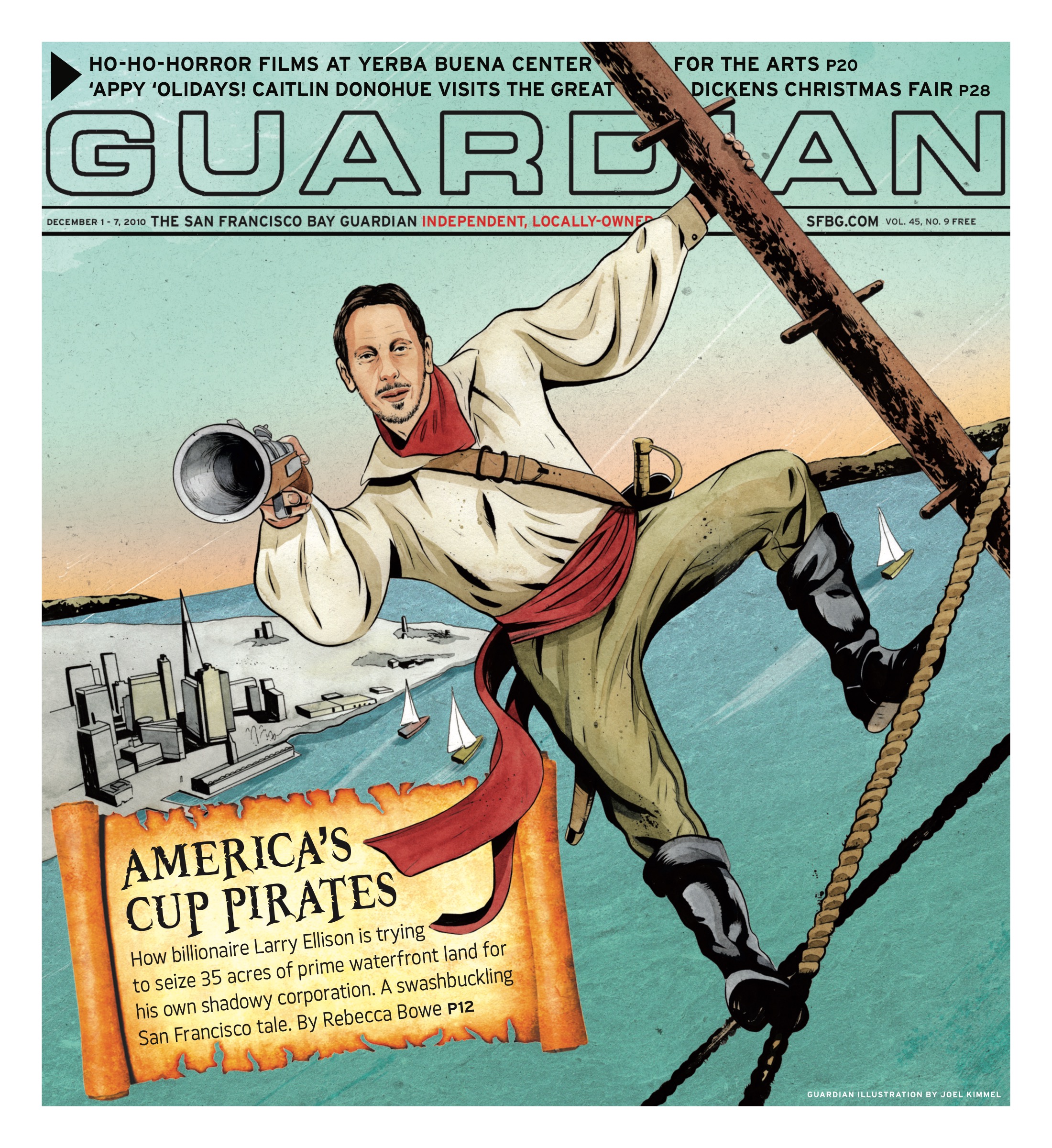
That’s exactly the way the deal that Mayor Gavin Newsom negotiated with Larry Ellison, the multibillionaire database mogul and yachtsman, is shaping up. A shadowy new corporation controlled by Ellison would get control of more than 30 acres of prime waterfront land worth hundreds of millions of dollars. The city could lose $42 million, and possibly as much as $128 million.

We don’t dispute the huge economic impact of holding an event that could attract more than 1 million visitors to the Bay Area. Those people will spend money in bars, restaurants, shops, and hotels. The waterfront improvements and increased tourism will create, according to economic reports, 8,840 jobs.

But as the Board of Supervisors budget analyst points out, those are not permanent, full-time jobs; much of the increased employment needs would be met by increased productivity (bartenders and waiters handling more customers than usual), overtime, and temporary jobs. And again: Most of the benefits will go to the private businesses in the tourist industry. The city’s increased tax revenue won’t be nearly enough to cover the expenses. Even if the America’s Cup group raises $32 million — and that’s not guaranteed in the deal — the city would still be down $10 million.

So in effect, San Francisco is preparing to spend $42 million of taxpayer money (and to forego as much as $86 million more by giving away waterfront land that could be developed) to benefit the sixth-richest person in the world, a new company he’s going to create and control, and the tourist-related businesses in town.

Oh, and to make it even juicier: the city is promising to seek state approval for Ellison to build condos or a hotel on the waterfront — something nobody else can legally do.

This doesn’t strike us as a terribly good deal.

It looks worse when you consider how the negotiations proceeded: The mayor and other city officials insisted they were scrambling to give Ellison everything he wanted to make sure that San Francisco beat out two other competitors. But as Rebecca Bowe reports on page 12, there were no other formal bids; Ellison’s team, based at the Golden Gate Yacht Club, was only negotiating with one city, San Francisco.

There are alternative proposals. The Telegraph Hill Dwellers Association wants to see the race complex moved from the Central Waterfront to the Northern Waterfront, and there may be ways of saving money. And Sup. Ross Mirkarimi points out that if Ellison wins the races in 2013 and comes back again the next time around, San Francisco could become what Newport, R.I., once was: a repeat host to an event that will bring more and more benefits as time goes on. That, however, involves a number of risks and variables that are far from certain at this point.

We’d like to know a lot more about what Ellison’s development plans are. We’d like to know who, exactly, will be running his new corporation that will get development rights for a couple of nice waterfront parcels.

But before the supervisors sign off on any deal, they need to set a bottom line: this can’t cost the city any net revenue. The San Francisco city treasury and local taxpayers shouldn’t be subsidizing an event created by and for the very wealthy.


The biggest fish

6

rebeccab@sfbg.com

Shortly after Larry Ellison, the billionaire CEO of Oracle Corp. and owner of the BMW Oracle Racing Team, won the 33rd America’s Cup off the coast of Valencia, Spain, in February 2010, a reception was held in his honor in the rotunda at San Francisco City Hall.

The event drew members of Ellison’s sailing crew, business and political heavyweights such as former Secretary of State George Schultz, and other VIPs. Attendees posed for photographs with the tall, glittering silver trophy at the base of the grand staircase.

As part of the celebration, Ellison helped Mayor Gavin Newsom into an official BMW Oracle Racing Team jacket, and Newsom granted Ellison a key to the city, a symbolic honor usually reserved for heads of state and the San Francisco Giants after they won the World Series. Shortly after, the mayor and the guest of honor, whom Forbes magazine ranked as the sixth-richest person in the world, sat down for a face-to-face.

That meeting marked the beginning of the city’s bid to host the 34th America’s Cup in San Francisco in 2013. Since securing the Cup, Ellison has made no secret of his desire to stage the 159-year-old sailing match against the iconic backdrop of the San Francisco Bay, a natural amphitheater that could be ringed with spectators gathered ashore while media images of the stunningly expensive yachts are broadcast internationally.

Newsom and other elected officials have feverishly championed the idea, touting it as an opportunity for a boost to the region’s anemic economy. The city’s Budget & Legislative Analyst projects roughly $1.2 billion in economic activity associated with the event — the real prize, as far as business interests are concerned. It would also create the equivalent of 8,840 jobs, mostly in the form of overtime for city workers and short-term gigs for the private sector.

While the idea has won preliminary support from most members of the Board of Supervisors, serious questions are beginning to arise as the finer details of the agreement emerge and the date for a final decision draws near.

Ellison and the race organizers would be granted control of 35 acres of prime waterfront property in exchange for selecting San Francisco as the venue for the Cup and investing $150 million into Port of San Francisco infrastructure. But the event would result in a negative net impact to city coffers.

Hosting the event and meeting Ellison’s demands for property would cost the city about $128 million, according the Budget & Legislative Analyst, just as city leaders grapple with closing a projected $712 million deficit in the budget cycle spanning 2011 and 2012.

Part of the impact is an estimated $86 million in lost revenue associated with rent-free leases the city would enter into with Ellison’s LLC, the America’s Cup Event Authority (ACEA). In exchange for selecting San Francisco as a venue and investing in port infrastructure, ACEA would win long-term control of Piers 30-32, Pier 50, and Seawall Lot 330 — waterfront real estate owned by the Port of San Francisco, with development rights included. Seawall Lot 330, a 2.5-acre triangular parcel bordered by the Embarcadero at the base of Bryant Street, would either be leased long-term or transferred outright to ACEA.

The most vociferous opponent of the America’s Cup plan is Sup. Chris Daly, who has voiced scathing criticism of the notion that the city would subsidize a billionaire’s yacht race at a time of fiscal instability. “The question is whether or not the package that San Francisco’s putting together is good or bad for the city,” Daly told the Guardian, “and whether or not it’s the best deal the city can get.”


THE CREW

According to a Forbes calculation from September 2010, Ellison’s net worth is $27 billion, making him several times wealthier than the City and County of San Francisco, which has a total annual budget of about $6 billion. Ellison reportedly spent $100 million and a decade pursuing the Cup.

As soon as Ellison expressed interest in bringing the Cup to San Francisco, Newsom began charting a course. Park Merced architect and Newsom campaign contributor Craig Hartman of the firm Skidmore, Owings & Merrill was tapped to reimagine the piers south of the Bay Bridge as the central hub for the event, and soon Hartman’s vision for a viewing area beneath a whimsical sail-like canopy was forwarded to the media.

The mayor also issued letters of invitation to form the America’s Cup Organizing Committee (ACOC), a group that would be tasked with soliciting corporate funding for the event. ACOC was convened as a nonprofit corporation, and it’s a powerhouse of wealthy, politically connected, and influential members.

Hollywood mogul Steve Bing, who’s donated millions to the Democratic Party and funded former President Bill Clinton’s 2009 trip to North Korea to rescue two imprisoned American journalists, is on the committee. So is Tom Perkins, a Silicon Valley venture capitalist, billionaire, and former mega-yacht owner who was once dubbed “the Captain of Capitalism” by 60 Minutes. George Schultz and his wife, Charlotte, are members. Thomas J. Coates, a powerful San Francisco real estate investor who dumped $1 million into a 2008 California ballot initiative to eliminate rent control, also has a seat. Coates resurfaced in the November 2010 election when he poured $200,000 into local anti-progressive ballot measures and the campaigns of economically conservative supervisorial candidates.

Billionaire Warren Hellman, San Francisco socialite Dede Wilsey, and former Newsom press secretary Peter Ragone are also on ACOC. There are representatives from Wells Fargo, AT&T, and United Airlines. One ACOC member directs a real estate firm that generated $2.5 billion in revenue in 2009. Another is Martin Koffel, CEO of URS Corp., an energy industry heavyweight that made $9.2 billion in revenue in 2009. There’s Richard Kramlich, a cofounder of a Menlo Park venture capital firm that controls $11 billion in “committed capital.” And then there’s Mike Latham, CEO of iShares, which traffics in pooled investment funds worth about $509 billion, according to a BusinessWeek article.

There’s also an honorary branch of ACOC composed of elected officials including House Minority Leader Nancy Pelosi, Gov. Arnold Schwarzenegger, Sen. Dianne Feinstein, and others. Their role is to help the Cup interface with various governmental agencies to control air space, secure areas of the bay exclusively for the event, set up international broadcasts, and bring foreign crew members and fancy sailboats into the United States without a hassle from immigration authorities.

ACOC is expected to raise $270 million in corporate sponsorships for the America’s Cup. That money will be funneled into the budget for ACEA. It’s unclear whether the $150 million ACEA is required to invest in city piers will be derived from ACOC’s fund drive.

The city also anticipates that ACOC would raise $32 million to help defray municipal costs. “However,” the Budget & Legislative Analyst report cautions, “there is no guarantee that any of the anticipated $32 million in private contributions will be raised.”

A seven-member board, chaired by sports management executive Richard Worth, will direct the ACEA, according to Newsom’s economic advisors, but the other six seats have yet to be filled. ACEA’s newly minted CEO is Craig Thompson, a native Californian who previously worked with a governing body for the Olympics and has helped coordinate major sporting events internationally. In an interview with sports blog Valencia Sailing, Thompson provided some insight on why major corporations might be inspired to donate to the cause. Basically, the Cup is the holy grail of networking events.

“It’s a very difficult economic situation we are going through, and it’s not the best time to be looking for sponsors for a major event,” Thompson acknowledged. “On the other hand, the America’s Cup is one of the very few activities … that offer access to really top-level individuals in terms of education or economic situation. The America’s Cup is a unique platform for a lot of companies that want access to those individuals that are very difficult to reach under normal circumstances. I can tell you for example that Oracle is very pleased with the marketing opportunity the America’s Cup has presented to them. They invite their best customers and are very successful in turning the America’s Cup into a platform for generating business. The same thing can be true for a lot of different companies that need access to wealthy individuals.”

But should San Francisco taxpayers really be subsidizing a networking event for the some of the business world’s richest and most powerful players?


TRANSFORMING THE WATERFRONT

Over the past four months, Newsom’s Office of Economic and Workforce Development (OEWD) has been negotiating with race organizers to hash out a Host City Agreement outlining the terms of bringing the America’s Cup to San Francisco.

The proposal will go before the Board of Supervisor’s Budget & Finance Committee on Dec. 8, and to the full board Dec. 14. A final decision on whether San Francisco will host the race is expected by Dec. 31. ACEA and ACOC will each sign onto the agreement with the City and County of San Francisco.

From the beginning, the event was envisioned as “the twin transformation,” according to OEWD — the America’s Cup would be transformed by attracting greater crowds and heightened commercial interest while San Francisco’s crumbling piers would be revitalized through ACEA’s $150 million investment in port infrastructure.

The plan paints downtown San Francisco as the “America’s Cup Village” during the sailing events, and a study produced by Beacon Economics estimates that the financial boost would come primarily from hordes of visitors flocking to the event — more than 500,000 are expected to attend. The city expects a minimum of 45 race days, including one pre regatta in 2011 and one in 2012 (or two in 2012 if the one in 2011 doesn’t happen), a challenger series in 2013, and a final match in 2013.

The transformation of the city’s waterfront would be dramatic. In addition to the rent-free leases for Piers 30-32, 50, and Seawall Lot 330, ACEA would be granted exclusive use of much of the central waterfront, water, and piers around Mission Bay, and water and land near Islais Creek during the course of the event. Under the Host City Agreement, race organizers would have use of water space spanning Piers 14 to 22 ½; Piers 28, 38, 40, 48, and 54, a portion of Seawall Lot 337, and Pier 80, where a temporary heliport would be sited.

Seawall Lot 330, a 2.5-acre parcel valued by the Port at $33 million, lies at the base of Bryant Street along the Embarcadero and has a nice unimpeded view of the bay. Piers 30-32 span 12.5 acres, and Pier 50 is 20 acres.

The Budget & Legislative Analyst’s study predicts that the ACEA could opt to build a 250-unit condo high-rise on Seawall Lot 330, deemed the most lucrative use. Under the Host City Agreement, the city would be obligated to remove Tidelands Trust provisions from Seawall Lot 330, which guarantee under state law that waterfront property is used for maritime functions or public benefit. Tweaking the law for a single deal would require approval from the State Lands Commission, but Newsom, in his new capacity as lieutenant governor, would cast one of the three votes on that body.

The combination of construction, demolition, lost rent revenue, police and transit, environmental analysis, and other event costs would hit the city with a bill totaling around $64 million, according to the Budget & Legislative Analyst study. Since city government would recoup around $22 million in revenue from hosting the Cup, the net impact would be around $42 million. That doesn’t include the potential $32 million assistance from ACOC.

At the same time, the city would stand to lose another $86.2 million by granting long-term development rights to 35 acres of Port property for 66 to 75 years without charging rent, bringing the total cost to $128 million. OEWD representatives played down that loss in potential revenue, saying past attempts to redevelop piers hadn’t been successful because none could handle the upfront investment to revitalize the crumbling piers.

The Host City Agreement has raised skepticism among Port staff and the Budget Analyst that tempered initial enthusiasm for the event. “The terms of the Host City Agreement will require significant city capital investment and will result in substantial lost revenue to the Port,” a Port study determined. Faith in that plan seems to be eroding and it may be scrapped for an alternative plan that’s cheaper for the city.

The Northern Waterfront alternative substitutes Piers 19-29 as the primary location for the event and eliminates the Mission Bay piers from the equation. Under this scenario, ACEA would invest an estimated $55 million, instead of $150 million. In exchange, it would receive long-term development rights to Piers 30-32 and Seawall 330 on “commercially reasonable terms,” according to a Port staff report.

Board of Supervisors President David Chiu requested that the Port explore that second option more fully, and the Port report notes that it would reduce the strain on Port revenue. The Northern Waterfront plan would cost the Port a total of $15.8 million, instead of $43 million, the report notes. Port staff recommended in its report that both the original agreement and the alternative be forwarded to the full board for consideration.


PHANTOM BIDS?

Under the competition’s official protocol, Ellison, as defender of the Cup, has unilateral power to decide where the next regatta will be held. Race organizers have said it’s a toss-up between San Francisco and an unnamed port in Italy — though it’s anyone’s guess how seriously a European site is being considered by a team headquartered at the Golden Gate Yacht Club, a stone’s throw from the Golden Gate Bridge.

According to a San Francisco Chronicle article published in early September, Newsom issued a memo stating that San Francisco was competing against Spain and Italy to become the chosen venue. Valencia was said to be offering a “generous financial bid,” and a group in Rome was rumored to have offered some $645 million to bring the Cup to Italian shores, the memo noted. It was a call for the city to present Ellison with the most attractive deal possible to compel him to pick San Francisco.

Speaking at an Oct. 4 Land Use Committee hearing, OEWD director Jennifer Matz told supervisors: “San Francisco was designated the only city under consideration back in July. Now we are competing against the prime minister of Italy and the king of Spain.”

However, the veracity of those claims came into question in mid-November. Daly, incensed that the Mayor’s Office never communicated with him about the Cup despite wanting to hold it in his sixth supervisorial district, launched his own personal investigation. He fired off an e-mail to Team Alinghi, a prior America’s Cup winner, and began communicating with other European contacts until he got in touch with someone in Valencia’s municipal government.

“I got a call back from a representative who basically said I should know something,” Daly recounted. Valencia, his source said, never submitted a bid to host the Cup. At a Nov. 13 press conference, Valencia’s mayor Rita Barbera confirmed this claim, according to a Spanish press report, expressing disappointment that the city had been eliminated from consideration as a host venue. “There was no formal bidding process,” she charged. She also denied reports that any money had been offered.

Meanwhile, the Budget Analyst was unable to find any concrete evidence that other host city bids had been submitted. “We have nothing to confirm that other offers have been made,” Fred Brousseau of the Budget Analyst’s office told the Guardian.

In response to Guardian queries about whether the Mayor’s Office had evidence that Italy had indeed submitted a bid, Project Manager Kyri McClellan of the OEWD forwarded a one-page resolution from the Italian prime minister assuring race organizers that there would be tax breaks, accelerated approvals, and other perks guaranteed if the Cup came to Italy. However, an Italian journalist who looked over the resolution told the Guardian that the document didn’t appear to be a formal bid, merely a response to a query from race organizers.

Daly has his doubts that either Valencia or the Italian port were ever seriously considered. “I think they were phantom bids,” he said, “created by either Larry Ellison or the Newsom administration … to place pressure on the Board of Supervisors.”

A representative from OEWD told the Guardian that officials have no reason to doubt that the European bids, and accompanying offers of money, were real. However, the city wasn’t privy to race organizer’s discussions about possible European venues. A final decision is expected before the end of the year.

Daly hasn’t held back in voicing opposition to the America’s Cup and blasted it at an Oct. 5 Board meeting. “This tacking around Sup. Daly will not get you in calmer waters,” Daly said. “I told myself I was not going to make a yachting reference. But I will bring a white squall onto this race and onto this Cup, and I will do everything in my power starting on Jan. 8 to make sure these boats never see that water.”


WIND IN WHOSE SAILS?

The America’s Cup would undoubtedly bring economic benefit to the area and create work at a time when jobs are scarce. Police officers would get overtime. Restaurant servers would be scrambling to keep up with demand. Construction workers seeking temporary employment would get gigs. Hotels would rake it in. Pier 39 would be booming. However, the Budget Analyst report cautioned: “It is unlikely that any labor benefits would remain in the years after the America’s Cup event is completed.”

Certain small businesses would catch a windfall. John Caine, owner the Hi Dive bar at Pier 28, didn’t hesitate when asked about his opinion on the city hosting the Cup. “Please come fix our piers. It’s a shout-out to Larry Ellison,” he said. Caine said he supports the America’s Cup bid 100 percent, and is excited about the boost it could give his business. The Hi Dive would not be required to relocate under the proposal, he added.

At the same time, other small business would be negatively affected, particularly those among the 87 Port tenants who would be forced to relocate to make way for the America’s Cup. The Budget Analyst’s report also notes that retail businesses in the area whose services had no appeal to race-goers might suffer from reduced access to their stores, since crowding and street closures would shut out their customers.

The sailing community has rallied in support of the Cup, and Newsom has received hundreds of e-mails from yachting enthusiasts from as far away as Hawaii and Florida promising to travel to San Francisco with all their sailing friends to watch the world-famous vessels compete.

Ariane Paul, commodore of a classic wooden boat club called the Master Mariners Benevolent Association, told the Guardian that she was excited about the opportunity for the America’s Cup to showcase sailing on the bay. “In the long term, it’s a win-win,” Paul said. “It would be great to have that boost.” As for the financial terms of the deal, she remained confident, saying, “I don’t think that the city is going to let Larry Ellison walk all over them.”

Sup. Ross Mirkarimi is often politically aligned with Daly, but not when it comes to the issue of the America’s Cup. As a kid growing up on the island of Jamestown, a tiny blue-collar community located off the coast of Rhode Island, Mirkarimi learned to sail and occasionally spent summers working as a deckhand. Every few years, the America’s Cup would come to nearby Newport, transforming the area into a bustling hub and bringing the locals into contact with famous sailors. It left an everlasting impression. When the BMW Oracle Racing Team secured the 33rd Cup off the coast of Valencia, Mirkarimi did a double-take when he saw a photograph of the winning team — his childhood friend from Rhode Island was on the crew.

Mirkarimi told the Guardian he supports bringing the Cup to San Francisco because of the economic boost the area will receive — if the Cup continues to return to San Francisco as it did for 53 years in Newport, he said, the city could look forward to a free gift in improved revenue associated with the event, and that could help quiet the tired annual debates over painful budget cuts.

At the same time, he acknowledged that the Budget Analyst report had prompted what he called healthy skepticism. “I think the onus is on the city and Cup organizers to make sure the benefits far, far outweigh the investment,” Mirkarimi said. “This effort is not just about making one of the wealthiest men in the United States that much more wealthy … That can’t be the case,” he said. “It has to be about what will the Cup do in order to be a win-win for the people of San Francisco.” Mirkarimi said he expected scrutiny of the details of the agreement at the Dec. 8 Budget and Finance Committee hearing: “Naturally, in this time of economic downturn … people want to know, what’s the outlay of cost, and what are we going to get in return?” 

Hot sexy events: November 24-30

1

Femina Potens is moving up and out! But not too far. According to an email sent by the gallery featuring a look back by director-founder Madison Young, SF’s favorite woman-run, sex-positive workshop/art show/bacchanal is celebrating its 10th anniversary this month with a move to a larger space that will still be on Market Street.

Says Young of the initial creation of FP, which she named after a tattoo meaning “powerful women” that she saw on a woman’s arm: “I was only 20 years old but felt a very clear calling to create space for people to feel comfortable to express and explore their identity, their bodies, their boundaries, with out shame through art, sexuality, and education.” Oh, and she’ll be incepting a little something of her own: this hot mama’s preggers. Come March 2011, she’ll there will be another MILF on the scene, plus one more body-positive little girl in the world.

Busted: Nips!

Just in case all that bare turkey flesh you’ll be feasting on tomorrow isn’t enough tender meat for you, Chaps is holding the nipples edition of their Busted! fetish nights – eat your nips with a $2.50 Bridgeport IPA or grab a nipple clamp, the evening’s 4 dollar Rolling Rock pint and Tullamore Whiskey shot special.

Wed/24 all night

Chaps 

1225 Folsom, SF

(415) 255-2427

www.chapsbarsanfrancisco.com


Free Entry at Eros

Let’s give thanks for a city that allows us to frolick freely, to share our true selves with a like-minded community, to go to a sex club, expect sweaty satisfaction, and get it – all night long. Eros is certainly down to say grace. The club is inviting all men to make a shower stop for free on this day of gratitude – so carve some hunky turkey and mash those potatoes good. 

Thurs/25 6 p.m.-12 a.m., free

Eros 

2051 Market, SF

(415) 864-3767

www.erossf.com


Traditional Thanksgiving Potluck

A couple reasons why this yearly Citadel event isn’t really all that traditional: one, it’s on the Friday after gobblin’ day. Two, the scene is less in-laws and more BDSM playmates. Three, although it’s not explicitly meant to turn into whippin’ time after the food’s shared, the event description does allow that “being the kinky folks we are….well, ya just never know!” A great way to burn off pie calories, no?

Fri/26 5-9 p.m., free with dish to share

SF Citadel

1277 Mission, SF

(415) 626-2746

www.sfcitadel.org

RSVP: melanie.a.derby@gmail.com


Post Turkey Twist and Shout

Red Hots Burlesque assembles a crack cast of some of the burlesque troupe’s long lost favorites – Fannie Fuller of the Diamond Daggers is here visiting from Portland, Oregon for her solo debut at Red Hots Burlesque and the Flying Fox has spread her wings all the way from New York City. Whatever their mailing zip codes now, these ladies plan to un-zip some serious coquettish talent.

Fri/26 7:30 p.m., $5-10 sliding scale

El Rio

3158 Mission, SF

(415) 282-3325

www.elriosf.com


The 15 Association Party

The longest-standing West Coast gay male BDSM organization, 15 Association is run entirely by volunteers that want to ensure you have a good, safe time in the dungeon of your dreams. This party is meant to be for experienced doms and subs, but if you’re new to the game you can speak with the Association for an invitation at their website

Sat/27 8 p.m.-1 a.m., $25

SF Citadel

1277 Mission, SF

(415) 626-2746

www.sfcitadel.org


Beautiful Bondage

Tying your lovely up need not detract from their genuine preciousness. This course examines the art of bondage with an emphasis on the aesthetic. Harnesses, immobilizing ties, and techniques of upping the sweet torment involved will all be covered in the class, as well as the requisite safety talk.  

Tues/30 8-10 p.m., $20

SF Citadel

1277 Mission, SF

(415) 626-2746

www.sfcitadel.org


Our Weekly Picks: November 24-30

0

WEDNESDAY 24

MUSIC

Pretty Lights

Fewer and fewer new musicians are choosing to fight the losing battle against illegal downloading, deciding instead to align with our interweb overlords and rely on their music to speak for itself. Colorado electronic music producer Derek Vincent Smith, a.k.a. Pretty Lights, has been steadily releasing free albums on his website all year, and this tour is proof that a heavy helping of Internet chatter can indeed get you a big-time show at The Fox. Reminiscent of early-aught DJ Shadow or RJD2 albums, Smith’s style infuses old school, crate-digging funk and soul with contempo dance beats, an approach that’s lain dormant in the aftermath of the mashup. Come for the rad music and stay to see how many “candy kids” it takes to turn the show into a rave. (Peter Galvin)

With Thunderball and Gramatik

7:30 p.m., $27.50

The Fox Theatre

1807 Telegraph, Oakl.

1-800-745-3000

www.thefoxoakland.com


MUSIC

Kenny Dope

I have an urge to use Kenny Dope’s last name as an adjective, but the powers that be informed me I’m cut off from using any more puns this week. So here’s the straight talk: Come Thursday, you’re gonna be in a full on turkey (or tofurkey) coma, which makes tonight night your last chance to squeeze in some cardio. Even for the unmotivated, Kenny Dope will make this happen. Also half of the production duo Masters at Work, Dope is known for reworking disco, jazz, pop, and especially Nuyorican soul to make everything (including your feet) move a whole lot more. (Ryan Prendiville)

With David Harness and LadyHouse

10 p.m., call for price

Endup

401 Sixth St., SF

(415) 646-0999

www.theendup.com


FRIDAY 26

EVENT

Dickens Christmas Fair

Imagine 12,000 square feet of Victorian London, suitable for diversion over Thanksgiving weekend and perhaps some light Christmas shopping (sorry, I said it). But harken! The Dickens Christmas Fair is one costume-heavy event whose appeal goes far beyond the Miss Havisham fan club. Especially if you like beer — there will be five pubs on the cobblestone streets, including the Bohemian Absinthe Bar, and ribald entertainment like daily performances of The Mikado and an explorer’s club where the audience is regaled with tales of British empire expansion. And especially if you like cinching — Dark Garden’s corsetry will be there amid the fake snow and bawdiness, perfect for the French postcard tableaux nearby. Wink. Nudge. (Caitlin Donohue)

Fri/26–Sun/28; also Dec. 4–5, 11–12, 18–19;

11 a.m.–7 p.m., $12–$25

Cow Palace Exhibition Halls

2600 Geneva, SF

1-800-510-1558

www.dickensfair.com


PERFORMANCE

Mummenschanz

With zany characters created from wires, tubes, boxes, and even toilet paper, all ages will delight in Mummenschanz and its imaginative world. Founded in 1972 by Bernie Schüch, Floriana Frassetto, and the late Andres Bossard as a nonverbal theatrical troupe interested in transcending national and cultural barriers, this Switzerland-based pantomime company has enjoyed internationally acclaim. 3×11, a retrospective look back on the company’s most popular and successful works of the past 33 years, will entertain Bay Area audiences immensely this weekend. Come and be enchanted by the wacky, witty universe of Mummenschanz. (Emmaly Wiederholt)

Fri/26-Sat/27, 2 p.m.; (also Sat/27, 8 p.m.);

Sun/28, 3 p.m., $22–$52

Zellerbach Hall

UC Berkeley, Berk.

(510) 642-9988

www.calperformances.org


DANCE

The Christmas Ballet

The late Michael Smuin knew western music inside out. From Bach to Coltrane, Palestrinata to Presley, he let it feed his wit, imagination, and — let’s be frank — a dollop of his sentimentality. Nowhere did he put these propensities to better use than in The Christmas Ballet, a rip-roaring trip through the holidays. You can’t miss the way these composers inspired him for choreography that’s both classical and cool. Every year he added a few new voices, letting others rest. This year the task of keeping the show fresh has fallen to choreographer-in-residence Amy Seiwert, who picked Leonard Bernstein’s version of the “Carol of Bells,” and ballet master Amy London, who went for Andy Williams’ “It’s the Most Wonderful Time of the Year.” The show comes to SF Dec. 15. (Rita Felciano)

Fri/26–Sat/27, 8 p.m.;

also Sat/27, 2 p.m., $20–$62

Lesher Center for the Arts

1601 Civic Center, Walnut Creek

(925) 943-7469

www.smuinballet.org


FILM

Kuroneko

Japanese director Kaneto Shindo has a thing for ghostly mothers and daughters-in-law, perhaps because the supernatural events that unfurl in his elegant, horror-minded films always spring from domestic traumas. In his most famous film, Onibaba (1964), two women are driven to madness after preying on near-dead samurai in feudal Japan. In the equally stunning Kuroneko (Black Cat, 1969), a different pair of women linked by a son gone off to war also prey on samurai: only this time, as vengeful, shape-shifting spirits. Shindo makes more than a few stylistic nods to Jacques Tourneur (especially 1942’s Cat People) in this recently restored beauty, which dwells as much on the sorrows of the dead as it does on the terror the dead inflict on the living. (Matt Sussman)

2:30, 4:45, 7, and 9:15 p.m., $7.50–$10

Castro

429 Castro, SF

(415) 621-6120

www.castrotheatre.com


PERFORMANCE

Yard Dogs Road Show

Two years since this glitter and glory bordello played its own show in the Bay? Egads! But jealous lovers we are not. YDRS felt the need to bring its vaudevillian stage presence to circus freaks around the country, so like the proverbial “thing,” we loved it enough to let it go — and it has returned. High Times described the 13-member troupe as “an acid trip without the come-down” — the group stuffs into its hobo cornucopia cheery fanfare, sword swallowing, burlesque, a mystic man, handlebar mustaches, and Mission Thrift finery enhanced by their temporarily halted epic wanderlust. Dance off your Turkey Day paunch to the freewheeling frolics. (Donohue)

Fri/26–Sat/27, 9 p.m., $20

Independent

628 Divisadero, SF

(415) 771-1421

www.theindependentsf.com


DANCE

The Velveteen Rabbit

Margery Williams’ tale The Velveteen Rabbit has made many a child hope their most beloved toy might one day come to life — and for the past 24 seasons, the story of a boy and his adored stuffed rabbit has come to life itself, thanks to ODC Dance. Directed and choreographed by KT Nelson with music by Benjamin Britten, this dance adaptation features the talented artists of ODC as the madcap characters in this childhood favorite. With festive undertones and a classic narrative about enduring love and what it means to be real, The Velveteen Rabbit is the perfect way to ring in the holidays with the family. (Wiederholt)

Fri/26–Sun/28 and . 5, 12, 2 p.m.;

Dec.2–3 and 9–10, 11 a.m.; Dec. 4 and 11, 1 and 4 p.m.

$15–$45

Yerba Buena Center for the Arts

Novellus Theater

700 Howard, SF

(415) 978-2787

www.odcdance.org


SATURDAY 27

DANCE

Nutcracker at Zeum

Is there a little one in your life who would love The Nutcracker but doesn’t have the attention span to sit through a two-hour extravaganza? There is no better (or more affordable) way to make that first foray into Nut-Land — where brave little Marie lets the evil Mouse King have it — than Mark Foehringer’s theatrically savvy and utterly charming Nutcracker at Zeum. The show runs 50 minutes and squeezes a tiny orchestra into the corner of the stage. The kids can watch scenery being moved. The story is beautifully condensed with dancers still shining in spiffy turns and floating leaps; Brian Fisher’s Drosselmeyer is as mysterious and kindly as any seen on local stages. (Felciano)

Through Dec. 19

Sat.–Sun., 11 a.m. and 2 p.m.;

also Sat., 4 p.m.,$25–$40

Zeum

Yerba Buena Gardens

221 Fourth St., SF

1-800-838-3006

www.brownpapertickets.com/event/125859


MONDAY 29

MUSIC

Grinderman

Apparently deciding he needed to be even more of a badass, Nick Cave went ahead and added blues-punk outfit Grinderman to his repertoire as a songwriter, screenwriter, author, and film scorer. The group is all raw, sweaty, garage-rock drive, full of dirty-sounding guitars and some psychedelic touches sprinkled throughout. Grinderman includes three members of Cave’s touring-recording band, the Bad Seeds, and is further proof that even now into his 50s, he isn’t even thinking of slowing down. (Landon Moblad)

With Armen Ra

8 p.m., $29–$35

Warfield

982 Market, SF

(415) 345-0900

www.thewarfieldtheatre.com


TUESDAY 30

EVENT

SF Green Film Festival screening and launch party

Who’s “greener” — the guy in the Haight who picks up cigarette butts, takes one arguable drag, then deposits them in an otherwise empty can? Or the innumerable Prius drivers? Not sure, but sometimes I turn green when everything from drinking coffee to buying stocks is considered candidacy for eco-martyrdom. What are we, leprechauns? Mythical creatures or no, it’s good to understand what’s going on in the world, and to get inspired to change it if it sucks. Tonight’s kickoff event features a screening of Dive!, chronicling the romantic art of eating out of Dumpsters, plus short films, film clips, and trailers. Cocktails and conversation prescreening; proceeds help bring the films to the inaugural festival next March. (Kat Renz)

6 p.m.–9 p.m., $10–$20

Ninth Street Independent Film Center

145 Ninth St., SF

(415) 625-6100

www.ninthstreet.org


MUSIC

Os Mutantes

Combing traditional bossa nova, samba, and tropicalia music of its native Brazil, with a sound heavily inspired by western rock from the Beatles and Jimi Hendrix, Os Mutantes was one of the more adventurous psych-rock bands of the 1960s. The band has had its music covered and praised by such artists as Kurt Cobain, Beck, and Of Montreal. Front man Sergio Dias has remained active as a solo artist in Brazil, but the band, in any incarnation, hasn’t really been on the map for more than 35 years. Now Dias is leading a new lineup with a new album in tow, resurrecting the Os Mutantes sound. (Moblad)

With Ariel Pink’s Haunted Graffiti

8 p.m., $27

Regency Ballroom

1290 Sutter, SF

1-800-745-3000 www.theregencyballroom.com  


The Guardian listings deadline is two weeks prior to our Wednesday publication date. To submit an item for consideration, please include the title of the event, a brief description of the event, date and time, venue name, street address (listing cross streets only isn’t sufficient), city, telephone number readers can call for more information, telephone number for media, and admission costs. Send information to Listings, the Guardian Building, 135 Mississippi St., SF, CA 94107; fax to (415) 487-2506; or e-mail (paste press release into e-mail body — no text attachments, please) to listings@sfbg.com. We cannot guarantee the return of photos, but enclosing an SASE helps. Digital photos may be submitted in jpeg format; the image must be at least 240 dpi and four inches by six inches in size. We regret we cannot accept listings over the phone.

What I remember of my interview with Yard Dogs Road Show

0

“I brought my costume, it’s in this bag. Well except for the pants.” The song and dance man of the Bay’s vaudevillian acid bordello, Broadway Freddie (aka Miguel Strong, or Michael if you’re trying to get technical about it) is already seated at a corner table at the Right Spot Cafe when I arrive to chat about Yard Dog Road Show‘s first headlining show in San Francisco in years (The Independent, Sat/20). 

Broadway-Miguel is wearing a striped tie, suit jacket, and dapper fedora, which by Yard Dogs Road Show standards seems vaguely pedestrian. But then he stands up. Electric blue, leopard print, so-skinny-they’re-emaciated jeans. “Miley Cyrus,” he confides, tossing his shoulder length blonde locks.

It is fitting that Broadway be a theater of the absurd. He is one of the original three progenitors (in addition to founder-manager-hype man Eddy Joe Cotton, who also wrote the heart-stoppingly wanderlustful memoir Hobo, and filmmaker Fletcher Fledujon) of the theatrically absurd touring troupe with which he makes his livelihood. He is artfully decorative in speech — as befits a man who has spent the last eight years of his life in pursuit of a vision received en route to one of Ken Kesey’s acid tests. 

I can’t say he gives me too many tangibles to work with during the course of our conversation, which is fine, because he has given me some lovely images to share in the article. The Yard Dogs Road Show milieu he finds “beyond English or current events, a landscape of dreams.” Also, it is “a sequined and glittered ceremony, a joyous one.” Fledujon, Cotton, and Strong met “organically destined to be in the same constellation of stars.” Broadway himself is “an electron,” a good show is when “the wind goes through you – you’re not doing it, it’s doing you.”

“Would you like a drink?” I ask him. “Oh, well I’m supposed to be” were finger quotes involved here? “On the wagon. But yes, I’ll have one. What are you drinking – a beer? Yes, I’ll have one of those.”

Things that we do manage to establish: the members of Yard Dogs Road Show – all “fifteen or sixteen” of them, travel together in a vintage Greyhound bus, in which none of them have their own beds save Kid Casbah, this because he is “the golden leopard, untouchable.” They are good house guests. One of their pinnacle moments as a troupe was a performance in an old opera house in Braga, Portugal — a performance that took place under an omnibus of a chandelier on a tour that took them to quite a few grand opera houses, the one in Braga being the grandest. 

The gang’s all here, in the Sonoma Hills. Photo by Hilary Hulteen

Its upcoming shows – the first time the group has had its own night in the Bay in two years — is for friends and family, in the looser sense of those words. New material will be debuted, this new material involving a carousel of prancing, bejeweled pony girls that Broadway and I conclude will resemble “peeking inside a Faberge egg,” a rocket man, and the Queen of Pineapple Island. We would be remiss if we did not mention that the talents of Scotty the Blue Bunny, aerialist Abigail Munn, DJ Shawna, and belly dance impresario Zoey Jakes, will be making their appearances over the two-night run.

At this point, beers have been had. We are touching on the art of the interview. Broadway says the back and forth is a skill he cherishes, and that his last two talks with a journalist were conducted from his bathtub and shower, respectively. “Do you know what would make this a truly great interview?” Broadway leans across our table, holding my gaze. “If we got absolutely wasted! The bartender can finish asking us the questions.” 

I mention I enjoy Bulleit bourbon and it is liberally applied to our conversation. At this point we must rely on my trusty notebook for the gems that were imparted. 


(This in the hand of the friendly bartender, who had been reading an Us Weekly upon our interruption)

Q: How do you feel about J. Simpson’s engagement?

B- Holy f…

C- Nick f??? friend Courtney or danced w/ her at club.

Q: What celebs met recently

B- Garry Busey on tour bus in Malibu. Friendly, liked bus. Wrote # on cigarette pack.

C- Paul Mooney – belligerent interview. Stressed out. Kathy Griffin was a total bitch. 

B- Oscar Grant? Don’t want to go there. What art school CC of A & Crafts

(Drawing of a cell phone with a line drawn over it)

C- 3 beers: surprisingly drunk

S- what kind of whiskey would you like?

(In my handwriting)

happy excess

(sketch by Broadway of suspended circles and stars)


I think Broadway then banged out a few impromptu tunes on The Right Spot’s piano, we drank more whiskey, shenanigans, and we called it a night.

More concrete information is to be had from the Yard Dogs Road Show website itself. For instance, after a bit of digging one can turn up a rider that states that the group requires eight vegetarian and seven omnivorous meals from show venues that do catering, tortilla chips and spicy salsa “of the health food store variety” if not. Three bottles of red wine and 24 bottles of “Stella beer or comparable” either way. To me, this says a conscious approach to health in solid foods, followed by a healthy disregard for matters of the liver. 

Here’s how the “great” (it really was) interview ended: Broadway and I mutually supporting each other outside the cafe, a freak November monsoon raging around us. “So. Did we cover everything?” he wonders. “I think we did a good job,” I slur at him before giving my final regards to Broadway and tripping away in the rain. I still believe it to be the case.

(Sorry about leaving you the tab, Miguel!)

Yard Dogs Road Show

With El Radio Fantastique, Zoe Jakes, DJ Shawna, and more 

Fri/26 and Sat/27 9 p.m., $20

The Independent

628 Divisadero, SF

(415) 771-1421

www.theindependentsf.com


Folsom gives good skrill at the Armory

0

I’ll admit I went to Kink’s baroque bordello atop the Mission Tuesday night to check out the fine china and torpedo breasted, roped-up female statues  – but I stayed to watch men in leather pants give away monies to local angels. 

Those dashing fellows would be Folsom Street Events, who used the ambiance of the Amory’s penthouse to donate $326,161 in 2010 proceeds from the Fair, Up Your Alley, and Magnitude to their 16 beneficiary non-profits. It was a gentle flog on the ass of a reminder to anyone who says that perverts never did anything for our city, not to mention a welcome sign that our great grant-making institutions haven’t completely gone under yet.

Who got their sticky paws on the giant cardboard signifier? Everyone from Pets Are Wonderful, the support agency for low income patients and their animals, to the Queer Cultural Center, to SF Sex Information (for a full list of the leather set’s lucky ones go here). The presenter and announcer of all this do-gooding fuzziness celebrated our momentouxxx surroundings by thanking Kink creator Peter Acworth, who was padding about in baggy jeans and flip-flops, for using the space “even if we don’t enjoy it quite the way you do – or maybe we do, just in different clubs.”

FSE executive director Demetri Moshoyannis told me that the most that his organization has ever donated in a year is $350,000 – but at close to $4.5 million over the history of the fair, Folsom’s making the SF’s charitable contributions look like they just got done skinny dipping in a frigid mountain pool. 

But who can focus on non-profit pissing matches when there’s cock ring cake to be had? Not to mention the well-scrubbed, epically proportioned dinner tables on which one ponders setting down one’s app plate, the chains hanging becomingly from the rather sumptuous ceilings, and the fifteen-foot high oil painting in the Amory stairwell of a well dressed woman offering scraps to a dignified greyhound and crouching blonde clad in nothing but a leather doggie mask? 

Fire and Icing cock ring cake: so good, it was real hard to get a slice. Photo by Caitlin Donohue

“Did you notice the statue?” a spiky haired attache in leather pants inquired in the midst of our reluctant retreat from the Armory’s philanthropic festivities. We had, possessing the facility of sight and rudimentary powers of observation – she stands four feet tall and occupies the center stage of the sitting room upstairs. 

“Did you know that Peter Acworth’s mother sculpted that?” We are treated to the history of the busty bust, who apparently went through three drafts before Acworth told Momma that her lady’s tits were of a prominence suitable for placement in his debauched drawing room. 

As this conversation took place alongside a glass case containing Kink’s gift shop, we had the chance to admire the red and black towels for sale (at one point complimentary clean ups for the on-screen talent, recently put into production when guests started filching them for their own). And then off into the night we went, grateful to see that San Francisco’s sex community is still well endowed in the areas of financial generosity, artistic vision, and commercial enterprise. 


Hot sexy events November 17-23

0

You think that time you had a bad dream and awoke abruptly to the sounds of creaking in the bedroom next door was bad? What if that scene was being filmed, and instead of mom and marital romanticism at issue, Dad was boning Bambi Woods to shouts of “More ass! I need to see more ass!”? Such was the life (well, maybe the filming itself wasn’t going down in his family abode) of Bobby Gordon. Dad in this case was Howie Gordon, Playgirl’s 1979 Man of the Year and star of over 100 pornographic titles. Well hell, you’d make a movie about it too. See’s Bobby’s at Center for Sex and Culture Sat/20.


The ‘O’ of Eros: Evolving Your Orgasms

Goddess bless sexual enrichment coach Amy Cooper, for she has discovered the wisdom of the ages: how to make your climaxes more climactic. Erotic pleasure your game? Then surely you will dive right into Cooper’s one-time course on how to make your o’s easier, more meaningful, more intense, and (surely she must mean “or”!) longer lasting.

Wed/17 6-8 p.m., $20-25

Good Vibrations

1620 Polk, SF

(415) 345-0500

www.goodvibes.com


Laura Antoniou book release and BDSM party 

Leatherwoman extraordinaire and author of the successful series Marketplace, Laura Antoniou is in town to run a series of classes and events at Femina Potens for kinky women. Tonight features a recreated BDSM scene from one of her books – black tie and flogger please, ladies.

Fri/19 8 p.m., members only

Femina Potens 

2199 Market, SF

(415) 864-1558

www.feminapotens.org


Carnival Midway Sextravaganza

Is that ringmaster get-up eating a hole in your closet? Break out the bullwhips and boobies – Mission Control’s acting up again with one of their be-costumed swinger parties. This week you can screw kind strangers while the folks in charge raffle Annie Sprinkle boob prints, a ropes class with Midori, gift certificates for cosetry Dark Garden, and much more.

Fri/19 9 p.m.-2 a.m., $25-30 members only

Mission Control 

www.missioncontrolsf.org


Debbie Does My Dad

You’d think that a tale of a dad going porn star would fall into one of two categories: slapstick comedy or teary-eyed, Vaselined-lens rememberance. Shows what we know. Bobby Gordon’s movie about growing up “in the shadow of dad’s erection” (ha!) treads a middle ground to talk about the effect his dad’s romps had on his own experience of masculinity that is neither unsexy nor unhappy.

Sat/20 8 p.m., $15

Center for Sex and Culture

1519 Mission, SF


(415) 552-7399

www.sexandculture.org


Full Moon Fetish Party

So drop that jock down around your ankles – it’s time to give full moon. The crazies will be out in about for this once a month get-down at the locker room scene of your dreams. Open 24 hours a day, baby.

Sun/21, $5 for one time membership

Steamworks

2107 Fourth St., Berk.

(510) 845-8992

www.steamworksonline.com


Beginning Animal Roleplay

Do you long to have your hooves cleaned, coat stroked, a nice new rhinestone collar perhaps? (I hear catnip has it’s upside…) Anna is here to attune you to the ins and outs of animal role play. She herself is a seasoned pony and is ready and willing to school you on the art of finding your inner critter, the equipment you’ll need, care and training, etc. Get furry with it. 

Tue/23 8-10:30 p.m., $20

SF Citadel

1277 Mission, SF

(415) 626-2746

www.sfcitadel.org


Radical diplomacy: an interview with Guillermo Gómez-Peña

3

“It welcomes hipsters, but advocates for a more intelligent hipsterism.”

Performance artist Guillermo Gómez-Peña is sitting in his unexpectedly luxurious Outer Mission live-work space, surrounded by walls of fake masonry, stacks of props for his work, and velvet paintings of lucha libre wrestlers, police officers, and John Wayne that have accumulated in the 16 years that Gómez-Peña has rent-controlled the place. In anticipation of his upcoming performance at Galeria de la Raza‘s 40th anniversary gala (Sun/21), we’re trying to figure out a few minor details about life in 21st century America.

On the table is our two shot glasses of cachacha (he’s recently returned from a performance in Brazil) immigration politics, the fate of artistic San Francisco, the role of current events in art – just the sort of small talk one always embarks upon when meeting a stranger best known to you for crucifying himself on Ocean Beach and spending time in traditional indigenous Amerindian garb, trapped in a cage stationed in the lobbies of fine art museums’. Gómez-Peña is letting me hold his chihuahua Babalú while he (Gómez-Peña, that is) chain smokes, wearing a black cowboy shirt, bolo tie, and traces of kohl smudged along his lower eyelids.

His hipster comment is about la Galeria. Gómez-Peña has been involved there for 26 years, ever since moving up from Mexico City via Los Angeles. He had heard San Francisco was good for artists, and in Galeria de la Raza, he found spiritual resonance.

“It is one of the most original Chicano-American spaces in the country,” he tells me. Gómez-Peña, whose wife, Carolina Ponce de León, is now the executive director of the gallery, says that he feels a “sentimental connection” with the place. Ever since 1984, when then-director Rene Yañez invited his Border Arts Workshop to stage their first performance in the gallery, he has made a point to bring some version of each of his projects at la Galeria. 

“The Chicano Vampire” shreds border politics, Sun/21

It’s the space’s anti-nationalist viewpoint that draws him. Gómez-Peña, a native of Mexico City, is a man who has made his life on the border, examining the border, erasing the border. In the mid ’90s, the fake masonry that now dominates his ruby-red living room formed a part of “Temple of Confessions,” for which the artist, attired in tribal splendor, and a man dressed as a cholo gang member, sat ensconsed in Plexi-glass – end of the century saints incarnate. They encouraged visitors to approach their “confessionals” and divulge their secret thoughts about Mexico, Mexicans, race, nation.  

I ask him what secrets they told him, how he thinks those secrets would be different now, in the age of SB 1040 and yet another peak of anti-immigrant hysteria. “At that time,” he begins, drawing on his Marlboro, “the pop culture views about Mexico were much more varied. Nowadays the dominant opinion is one of a country of ingovernability, a potential trampoline for drug smugglers and terrorists. There are no longer any redeeming mythologies.”

Gómez-Peña tells me that he thinks that in the age of strife in the Middle East and grave problems within both their interiors, the United States and Mexico are no longer looking at each other. “There is a lot of silence, indifference at the border,” says the man who has staged elaborate stunts at the nations’ fracture point, including a “border wedding” in which the bride and groom stood on either sides of the wall separating us from our neighbors to the south. He says people can’t – or don’t – tell the difference between narco traficantes and migrant workers.

It’s this miasma which makes the art done at Galeria de la Raza all the more important. The space has always been a place where cultures mixed, and where Latinos found ways to enter the psyche of the American zeitgeist. Gómez-Peña says the Chicano spoken word movement got its start there on the corner of 24th Street and Bryant, as did Frida Kahlo-mania. 

But things have been changing, even for this stalwart of the San Francisco neighborhood art scene. For one thing, it’s not so neighborhood anymore. The Mission has transformed into what Gómez-Peña calls, in his typically luminous style, “a bohemian theme park.” Many of the young Chicano artists that “inform the Galeria’s aesthetics” have hightailed it out of here for the easel space and relatively easy rent checks of the East Bay and beyond. 

Obama has disappointed Gómez-Peña. In the wake of a campaign that everyone believed in, wanted to believe in, the arts funding promised hasn’t been delivered. Nowadays, the artist sees fellow creatives having to work two times as hard for their paycheck, even a brain drain of people leaving for the more affordably fertile soils of Buenos Aires and Lisbon. It’s one of the subjects of his performance piece on Sunday, which he calls Strange Democracy. The program will also honor Yañez, House on Mango Street author Sandra Cisneros, and Tomas Ybarra-Frausto, the acclaimed Chicano Studies professor.

But through the slings and arrows of political misfortune, Gómez-Peña has found ways to be proactive. His Pocha Nostra group is one way, a program that hosts artists in both Tempe, Arizona and Oaxaca in forming multi-cultural, politically striking performance pieces – and, as he riffs, contributes to the “trafficking of artists across the border – we’re intellectual coyotes!” 

And on Sunday, he can contribute his unique style to that of Galeria — a place where he says there is “radical cultural diplomacy, a place for different cultures to meet in a time in which the whole country is becoming divided ideologically and when Latinos are being demonized.” A place where we can all meet and talk in the kingdom of confessions, cachaca, and Babalú.


“40 Years Adelante!”: Galeria de la Raza benefit performance and awards ceremony

Sun/21 4-9 p.m., $40-65

Brava Theatre Center

2781 24th St., SF

(415) 826-8009

www.galeriadelaraza.org


Drawn and quartered

0

arts@sfbg.com

FILM “I am not a cartoon cat,” she wrote.

I had shared a link to David O’Reilly’s devastatingly brilliant, computer-animated short film, Please Say Something (2008), the plot of which involves a cat and a mouse living together in an emotionally abusive relationship. The setup is Tom and Jerry, but the characters lead fully anthropomorphized lives: he’s a writer mouse, and most of the time he ignores her to work, even when she buys a new blue scarf. They fight, there’s yelling (or squeaking; the animal talk is subtitled.) The sad relationship is projected into the future, regretfully, with slight potential to go another way. When my girlfriend at the time watched it, I guess it came a little too close for comfort.

Being an animator is as terrible as being a writer. Working for Pixar aside, it’s an isolating process, requiring one to devote hours unending to solitary work (with the additional tedium of repetitiously rendering variations of the same image over and over to create just a few seconds of movement). Misanthropic masochists, with pens and tablets.

That’s most likely a gross stereotype. But watching the Irish-German Please Say Something and the eight other shorts that are part of “Nine Nation Animation,” a showcase for the world’s best recent animated work, I was struck by what seemed to be a shared sensibility, a dysfunctional relationship with the world.

The Belgian short film Flatlife (2004) extends the difficulty of getting along with just one person to all of one’s neighbors. A two-dimensional cutaway view of an apartment building reveals the relationship between the occupants of adjacent units. Set to a staccato drum soundtrack, the animators involve the characters in a chain of events where every decision of one person complicates the life of another.

In Norway’s Deconstruction Workers (2008), a laborer discusses the lack of meaning in life with a coworker. It’s depressing and deadpan, as you would expect, but placed in a comic background: the revolution literally happens without them, they remain utterly oblivious to social upheaval while hanging from beams in a bit from a Harold Lloyd picture.

According to programmer Jonathan Howell, “the intention of the program is to give viewers a sample of techniques and styles of animation from around the world.” There’s no theme, but “as they’re chosen by a selection committee of one, the films inevitably reflect matter that I find interesting.” And it’s true, there are more shorts in the program that aren’t specifically about a social malaise, and have their appeal in other areas. Some are lighter, and some are totally bleak.

As a showcase, “Nine Nation Animation” may be a “mature,” not-for-kids program, but it illustrates the most provocative characteristic of all animation: the ability to approach the darkest of subjects with levity and amusement. How else would you laugh at two people running around hitting each other with frying pans?

NINE NATION ANIMATION

Nov. 19–25, $5–$9.75

Roxie

3117 16th St., SF

(415) 863-1087

www.roxie.com


Skool

1

paulr@sfbg.com

DINE When, in the course of human events, you come across a wood-fired pizza oven in a seafood house — in a seafood house tending in the direction of a sushi bar, no less — you probably blink twice, wondering if you’ve somehow mixed up your meds. But no: step into Skool and there it is, flickering on your left. There is a small catch (!) to stepping into Skool, and that’s finding it in the first place. The restaurant, which opened early in July, lies in a nameless border country surrounded by Mission Bay, Potrero Hill, and the gallery district.

Fifteen or 20 years ago this bricky warehouse neighborhood was deserted at night, and even today, you’d never think you were at the corner of 16th and Valencia streets. Compounding the mystery is the reticence of Skool itself; the restaurant’s street face is a row of tall steel posts, like some kind of barrier to keep tanks from rolling through, marked only by a graphic of an orange fish.

From a checkpoint-like gate you trek steadily uphill, around three sides of an open-air patio, until you finally step inside and find yourself under a firmament of halogen-spot stars, on a loft-like concrete planet forested with gorgeous wood furniture, some pieces of which (I am thinking in particular of the long communal table) look as though they could have come from the workshop of Gustav Stickley himself. It’s sleek, elegant, open, and warm, and the wood makes all the difference.

The restaurant’s style of cooking both does and doesn’t belong in such a setting. It, too, is sophisticated and urban, but — unlike the interior design — it too often goes too far and seems complex for the sake of being complex. The servers are well-drilled in explaining the nuances of the menu and the ingredients that grace the various specials, but the recitations, in their extensive and ruthless precision, made me feel as if I were watching one of those pharmaceutical ads on television, with their windy warnings about side effects that can include drowsiness, dizziness, and sudden death, not to mention certain phenomena lasting more than four hours.

The kitchen’s tendency seems to be not to let high-quality ingredients speak in their own voice without being interrupted — a kind of culinary version of SPIRD (smartest person in the room disorder). We were assured, for instance, that the cubed halibut in the ceviche ($11) was “sashimi grade,” yet it was inflamed with serrano chili and cilantro — two items I love, but they can overwhelm the delicacy of pale-fleshed fish. House-cured sardines ($10) held up a little better, with their oiliness and firmness of flesh not disappearing in the presence of raspberried onion, herb oil, and pillows of ripe avocado. But still, it was a struggle.

A straightforward bowl of squid-ink spaghettini ($17) turned out to be a treasure trove of complexity, with Monterey Bay squid and local white shrimp bathed in a broth of lemongrass, red curry, seaweed butter, and diced tomatoes. These flavors were harmoniously blended, and the look of the dish was striking — a mass of writhing purple-black filaments, like a wig from a character in a Pixar movie — but it did seem to lack a clear direction. A lot of voices, skillfully directed, can become a choir, but they can also turn into a tower of Babel.

Spiced panko salmon ($18) — a thick, shapely filet crusted on one side with bread crumbs — was served atop a sauté of green and yellow wax beans. It was moist and flavorful, but so rich I felt as if I was eating a stick of butter. The fish had been “pan grilled” — in butter?

Some of the best dishes had nothing to do with the sea. The mushroom risotto ($20) was beautifully cooked al dente, and its troupe of wild fungi (among them enoki, buna shimeji, and eryngii) was enhanced by a strong charge of truffle oil, along with plenty of grated Parmesan cheese for that final nutty-salty touch. And (from the pizza oven!) a wonderful flatbread, or coca ($15), like a slimmed-down focaccia, with Laura Chenel goat cheese, sun-dried tomatoes, tapenade, and greens.

The dessert menu, of all places, was an oasis of calm amid the frenzy. A rich slice of chocolate tart ($6) was subtly enhanced with cardamom, while a pear tart ($6) was a disciplined reimagining of that old autumn classic from France, tarte tatin — flaky housemade pastry, fruit in its prime, some whipped cream, not much too it, really. And yet: from less, more.

SKOOL

Dinner: nightly, 5–10 p.m.

Lunch: Mon.-Fri., 11:30 a.m.–2:30 p.m.

Brunch: Sat.–Sun., noon–4 p.m.

1725 Alameda, SF

(415) 255-8800

www.skoolsf.com

Full bar

AE/DC/DS/MC/V

On the noisy side

Wheelchair accessible

From second to first

5

steve@sfbg.com

In Oakland and San Francisco, the big story of this election was ranked-choice voting, a system that allowed Jean Quan to overcome a nearly 10-point election-night deficit to become Oakland’s next mayor and enabled come-from-behind victories in two races for the San Francisco Board of Supervisors.

Those who never liked this system of letting voters rank their top three candidates — a group primarily affiliated with downtown and the moderates who did well under the old system of low-turnout, big-money runoff elections — felt validated by the outcomes. “Ranked-choice voting an undemocratic nightmare” was the headline on Examiner columnist Ken Garcia’s Nov. 11 column.

But for those who understand this system — a product of the progressive movement — and have supported it, this was a watershed election that showcased RCV’s populist possibilities. In Quan’s smart use of an RCV strategy and the huge gap she overcame to topple Don Perata, they see an opportunity for political coalition-building that could influence next year’s San Francisco mayor’s race and beyond.

Besides Perata, if there’s anyone who could justifiably be unhappy with how RCV worked in this election, it would be Tony Kelly. He finished in first place in the D10 supervisorial race on election night only to be defeated by Malia Cohen, who climbed out of fourth place on the strength of those who ranked her second or third. But Kelly is perfectly happy with how RCV worked.

“I supported it before and there’s no reason not to support it now, even though I’m on the edge of this,” Kelly told the Guardian. In fact, he said the only reason he ran for public office in San Francisco was because of progressive electoral reforms such as RCV, district elections and public financing of campaigns. “These are all things that help grassroots candidates.”

Kelly had a ranked-choice strategy; he and Marlene Tran each encouraged their supporters to rank the other second. The alliance might have been a way to overcome the strength of the district’s strong African American voting bloc, which favored Cohen (she got her biggest and most lopsided bumps when Dewitt Lacy and Lynette Sweet were eliminated). But most of Tran’s votes were exhausted when she was eliminated, meaning that many of her voters didn’t list any second and third choices.

“Without RCV, that black vote would have never come together. It would have splintered,” said Steven Hill, a progressive activist who helped design the system.

In Oakland, progressives and other blocs of voters wanted anybody but Perata, a Democratic Party power broker. So Quan reached out to all voters and was particularly helped by a progressive base that she shared with fellow Oakland City Council Member Rebecca Kaplan.

“One thing Jean Quan does consistently at events is say, ‘I would like your first place votes, and if I don’t get that, I would like your second place votes,” Kaplan told the Guardian. “It was striking to me that she consistently asked for No. 2 votes.”

That strategy, along with Quan and Kaplan running mutually supportive races and encouraging their supporters to list the other second, clearly paid off.

“It rewrites the textbook for how to win with ranked-choice voting,” Hill said.

Hill and Kaplan said Oakland voters proved themselves adept at using the ranked-choice system on its debut there. Hill noted how few exhausted ballots there were, showing that voters understood and used their full options — more so than have voters in San Francisco, which has had the system in place since 2004.

“I think what this says is that RCV worked. Voters overwhelmingly filled out their ballots correctly,” Kaplan said. She also noted how the election demonstrated the possibilities of political coalition-building: “It isn’t so much the coattails of the candidates as the coalition of the supporters.”

But many observers also say the situation in Oakland was a perfect storm of opposition to a single candidate, Perata, who professed ignorance about how RCV worked.

“I don’t think we’ll see something like this again, but it adds to what’s possible,” said David Latterman, a political consultant who works primarily with downtown-backed candidates.

Jim Stearns, a consultant who represents more progressive candidates, said moderate candidates with money usually prevail in runoff elections, and that probably would have been the case in Oakland if voters hadn’t switched to RCV: “I think you would have had a very different result if you’d had a runoff.”

Yet most political consultants still don’t like RCV, particularly those who work with downtown candidates. “RCV just probably won two races for me, coming from behind, and I still don’t like it,” said Latterman, who worked with Cohen and D2 winner Mark Farrell. “I like runoffs. I like candidates having to reach out and prove themselves.”

Of course, that system favored candidates who have the resources to reach out and target a voter base that is generally smaller and more conservative than in regular elections. But all the consultants are now trying to figure out how to make RCV work.

“The priority of any candidate in ranked-choice is to build your base,” Stearns, who is now working on Leland Yee’s mayoral campaign, told us. After that, the strategy is about identifying other candidates whose bases would also support your candidate and figuring out how to reach them. “Ranked-choice voting is a labor-intensive thing because you have to talk to everyone within that short window.”

But even Latterman said RCV will be a factor in next year’s San Francisco mayor’s race given what happened in Oakland this year. “For the first time a second place strategy worked and it can’t be ignored anymore,” Latterman said.

Hill said the progressive candidates and political consultants in San Francisco still need to learn how to work together to increase the turnout of their voters, sell swing voters on the progressive message and policies, and seek to win the race without undercutting those first two goals.

“How do you broaden your coalition and can you do that by having other progressives in the race?” Hill said. “These are the sorts of questions that progressives have to ask.”

Unfortunately, Hill hasn’t seen evidence that progressive campaigns in San Francisco have figured this out, noting how progressive supervisorial campaigns have instead criticized each other in the last few election cycles, such as this year’s D6 race between Jane Kim and Debra Walker.

“That’s the kind of behavior we still see from progressives in San Francisco, but that progressives in Oakland have already overcome,” Hill said. “Unfortunately, conservatives may figure this out first.”

Ultimately, Hill said that for progressive candidates to run strong ranked-choice voting campaigns against better-financed moderate candidates in a high-stakes election like the mayor’s race, they need to be a little bit selfless: “The progressive candidates need to care less about whether they win individually than that a progressive wins.”