Event

City College will appeal

9

OPINION City College will appeal last week’s decision by the Accrediting Commission for Community and Junior Colleges (ACCJC) to revoke City College’s accreditation.

The reason for the appeal is simple: Most of what ACCJC asked for has been accomplished, and the rest is well on its way towards completion within a year.

First, the San Francisco City College district is financially secure. This is not a district that is close to fiscal collapse. This year’s audit was “clean,” and the budget is balanced, thanks to multiple cost-saving reorganizations, large spending cuts, reforms in practices, and the passage of Propositions A and 30. City College also has a healthy reserve fund well above that of state requirements. City College is even squirreling away money for a special “Ninth year” fund in the event that voters don’t reapprove Prop A when it expires 8 years from now.

The City College budget also increases spending in areas that ACCJC wanted: there is nearly $3 million per year for new technology and building maintenance, both long deferred through the years of radical state funding cuts. City College is also paying money towards the unpaid liability in retiree health benefits. The City of San Francisco also has this kind of liability — to the tune of $4.4 billion — but has so far not come up with a plan to deal with it. City College, on the other hand, has a plan and the funds to enact it.

City College has also cut costs by millions of dollars. There have been layoffs and furloughs, and salary cuts. For instance, faculty members are earning 5 percent less than they did in 2007. Department chairs are earning less, and the Board of Trustees just cut administrators salaries. Streamlined operations have resulted in other savings.

Governance is another area where City College has made major changes. There have been five major management overhauls to streamline bureaucracy, increase efficiency and speed the carrying out of decisions. And many administrators have been replaced. Any one of these overhauls could ordinarily have taken a year each to implement. There were all done in a matter of months.

For instance, the job description of every dean’s position was completely rewritten; some posts disappeared, and new ones were created. Every dean had to reapply for a job, and many did not return. The same is true for other management positions.

City College also replaced a decades-old department chair structure with a system that costs less and has simpler lines of authority. And last fall, the Board of Trustees acted to completely restructure the Participatory Governance system. This is a state-mandated system of getting input from faculty and staff into management decisions. Over 40 committees were dissolved and replaced with a more streamlined system.

The faculty and staff also worked hard in fixing problems identified by ACCJC, particularly in the areas of planning. One of the most important of these is in the collection of Student Learning Outcome data -– a measure of how well students do. Faculty filed thousands of reports in order to fulfill this requirement, a truly enormous amount of work. The collected data will then be used to improve courses next year. This cycle of planning, data collection, and improvement are the basis of ongoing reform effort that takes a year at minimum to prove that it’s working. There is a lot more work to be done in this area. It will take another year to complete — if City College is given the time.

Not everyone at the college agrees with all of the changes that were made. People have the right to express their views, and indeed, we want the internal experts to speak up and give their best advice. And given the speed and monumental scope of the changes, it is very likely that these changes have flaws and that improvements can be made.

But regardless of what people think of the changes that have occurred, these are changes that ACCJC asked for. City College neither ignored nor fought ACCJC’s recommendations, as many people wish we had. City College’s response was to work to enact ACCJC’s will as quickly as possible.

Unfortunately, the decision to revoke accreditation will harm City College’s otherwise good financial position by causing a large drop in student enrollment for fall — and the loss of millions of dollars in state funding. Ironically, this will make it more difficult to finish what ACCJC wants done.

The best course for students is to let City College retain accreditation while it finishes the job that ACCJC wants done.

John Rizzo is President of the City College Board of Trustees


More ill winds

8

EDITORIAL After years of hype, the 34th America’s Cup finally got underway on the San Francisco Bay this past week — with a single boat formally winning in a match against itself, a fitting metaphor for this whole disappointing affair.

Emirates Team New Zealand sailed solo while its Italian would-be competitor, Luna Rossa, stayed ashore to protest a rule change on rudder design that had been unilaterally decided by regatta director Iain Murray. The third competitor with Larry Ellison’s Oracle Racing team that is defending the cup and hosting the event, Swedish team Artemis, was still trying to rebuild its vessel after a tragic accident resulted in the death of a renowned sailor in May.

It was a lame kickoff. The anticipated hordes of race-goers have yet to materialize, with the once-regal America’s Cup reduced to just another Fisherman’s Wharf tourist trap. In a display that might as well have been used to entice tourists to the Wax Museum, a barker outside the event’s sprawling Pier 27 spectator area fruitlessly tried to lure passersby: “See the fastest boats in the world!”

In an interview with ABC7 news, Oracle Racing CEO Russell Coutts declared the Italians to be “acting like a bunch of spoiled babies,” adding that if they didn’t want to race, they should just leave. You could practically hear the event’s corporate sponsors burying their faces in the palms of their hands.

It wasn’t supposed to be this way. In 2010, when software tycoon Larry Ellison of the Oracle Racing Team hinted to city officials that he might want to stage the next Cup on the Bay, if not Italy or some other exotic destination, economists with the Bay Area Council trumpeted the economic gain that stood to be reaped if Ellison’s plan was realized.

Since a dozen teams competed during the last America’s Cup, the authors of the study reasoned, at least as many could be expected to join this time around. Those initial projections — $1.4 billion in economic activity (like three Super Bowls!, the analysts enthused), thousands of new jobs, a tourism windfall — sounded so rosy in part because 15 syndicates were expected to compete.

But in time, this optimism faded and the city is arguably on the hook for millions in race-related costs. Fortunately, then-District 6 Sup. Chris Daly scuttled an initial plan to cede vast swaths of city-owned waterfront property to Ellison in exchange for the expected economic gain, thus averting an even greater loss.

Meanwhile, Oracle is weathering accusations that it cheated by slipping a design change into a list of safety recommendations, conveniently granting itself a competitive edge. An international jury’s decision on whether to honor the rule change was still up in the air at press time. While we at the Guardian find ourselves rooting for the Kiwis, we remind Ellison that it isn’t too late to right this ship — and cutting a check to the city to cover its losses would be a great place to start.

Independence movement

0

arts@sfbg.com

THEATER/DANCE The crowd outside the Niebyl-Proctor Marxist Library in Oakland was hopping. Fidgeting, really — imperceptibly at first, but soon enough bodies were bouncing and flailing, until the scrum of dancers packed shoulder-to-front-to-back on the sidewalk morphed their collective way through the front door.

June 22 marked one year’s worth of PPP, the monthly performance series instigated by Oakland-based dance collective SALTA. As much a scene as a performance platform, PPP has been building an ethic of serious, unbridled experimentation in a low-key setting where failure is as valid as success, and no one ever encounters a price tag, a door charge, or a gate keeper.

In terms of curation, PPP is equally promiscuous and shrewd, emphasizing a cross-generational perspective. “We try to reach out to people who have paved pathways for us,” says one SALTA member. “And we’ve been a little brazen about cold-emailing, cold-calling people who are in town, like Jeremy Wade.” Meanwhile, PPP has been building a unique audience for contemporary dance-performance and inspiring dialogue about the ethics of art-making in the Bay Area.

As an attribute of its headlong dive into experimentation and openness, PPP never sits still but moves restlessly and freely from one donated space to another. With each space come new networks as well as many PPP diehards. As its members explain, the anniversary installment marked the beginning of a summer hiatus for PPP, so that the collective can better focus on advancing other projects — all geared to creating space, in the widest sense, for dance in Oakland.

SALTA is very much the restive and searching reflection of its monthly series. What began as necessity — a space for dance — has been embraced as ethic. Not that the two were entirely strangers to begin with. As suggested by the conversation below with the members of SALTA (currently seven young women who preferred to speak as members of the collective rather than use their individual names), the realities of dance today imply, more than ever, a confrontation with the values of the dominant culture.

SFBG Which came first, PPP or SALTA, and what’s the relationship?

SALTA It’s funny, we were just talking about this earlier — it’s so confusing!

SALTA I guess we, as a collective, came first.

SALTA And we named that SALTA.

SALTA But the name SALTA didn’t come until after we had the name PPP.

SALTA We all came together in the idea of making space for dance. We were talking a lot about having an actual space and, in the meantime, [we said] let’s do a performance series. So that came second, and then it eclipsed a lot of what we’d been doing. We’re actually going to take a break over the summer and focus on some other stuff.

SALTA We want to have classes, [and start] a dance publication. We want to work on networking. We’ve had some out of town people, but just because the West Coast can be very isolating.

SFBG How did it all start?

SALTA We’re all based in Oakland, and we wanted to have a space for dance to happen here — there are not a lot of venues that are really open for experimental work. That was the big thing: we’re sick of going to San Francisco all the time, and we want to figure out what the community is in Oakland and see what we can build. Something that’s been really cool from the beginning is that a lot of non-dancers come to PPP, a lot of Oakland people who hear about it from different arenas.

SALTA As well as there not being institutions interested in the kind of work we were doing, we were also not interested in institutionalizing art, in the way that it’s done. Also, financially, making it a free event was really important to us as artists and the way we want to make art. Not having to play this whole [“who do you know”] game. It was modeled, or got a lot of guidance from Jmy [Leary] in LA, who started [dance organizers/activists] AUNTS in New York. That’s been a model that we’ve been in dialogue with.

SALTA She’s a mentor of ours, and a benefactor actually, through the Yellow House fund. We originally wanted to create a space here in Oakland similar to Pieter Pasd in LA, but the realities of being who we are as artists and where we are in our lives, as transient people, we thought we’d keep the space moving. We figured out that that worked over the past year.

SFBG I like this ethic of moving around, of asking for a free space each time. It seems a good social ethic to encourage, and it really pushes back against the spirit of the times.

SALTA It’s interesting who said no to the proposal, and who has been really willing to donate space and time — and their art.

SALTA I feel as we continue to exist and assert ourselves into spaces, it opens up more. We have to find a space, ask for a free space, because as dancers we don’t have the resources to be renting all the time. So where there’s this huge scene of First Friday or whatever — “art’s happening all the time in Oakland” — we’re not a part of that. It would be interesting at some point. Well, we WILL be a part of that. [Laughter.] But what does that mean? And how much more legit, in a certain sense, do we have to become? *

For a longer version of this interview, visit www.sfbg.com/pixel_vision; for more information on SALTA, visit www.saltadance.info.

Independence/Movement: extended interview with Oakland’s SALTA dance collective

1

Note: this is an extended version of an article in this week’s Guardian.

The crowd outside the Niebyl-Proctor Marxist Library in Oakland was hopping. Fidgeting, really. Almost imperceptibly at first, while above it a bulging moon hung in the temperate June sky, just itching to go super as it would the following night. But soon enough bodies were bouncing and flailing, until finally the scrum of dancers packed shoulder-to-front-to-back on the sidewalk morphed their collective way through the front door.

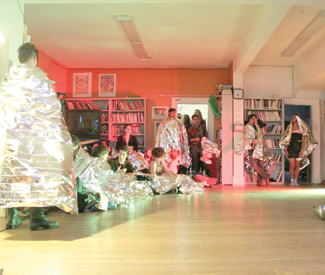
We followed the dancers (choreographed by Abby Crain) inside, swept along by their momentum, and were deposited around the perimeter of the main reading room like dust mice by a strong breeze. On that same floor, a few hours later, choreographer Ronja Ver would be sending her supine audience into dreamland with a couple of Finnish lullabies. Before that, a bowl of liquid nitrogen would send a delicate fog creeping over its wooden surface as the spectators (temporarily wrapped in reflective emergency blankets) braced themselves for a performance by Daniel Stadulis that was part science experiment, part detailed meditation on the fragility of the body.

Much else went on during the event’s roughly four hours, which ended with a dance party. No one stayed put the whole time. Some wandered off to the back rooms to the free bar, or to partake in the desultory clothing swap at the free boutique (both the bar and boutique are voluntarily stocked by the guests). Upstairs, meanwhile, the ebb and flow offered other attractions — a mother and daughter did a duet; a young writer read her first novel aloud for the first time, offering each completed page to anyone who paused to listen…

June 22 marked one year’s worth of PPP, the monthly performance series instigated by Oakland-based dance collective SALTA. As much a scene as a performance platform, PPP has been building a platform for serious, unbridled experimentation in a low-key setting where failure is as valid as success, and no one ever encounters a price tag, a door charge, or a gate keeper.

As an attribute of its headlong dive into experimentation and openness, PPP never sits still but moves restlessly and freely from one donated space to another. Among these have been the Foundry, The Vulcan, The Public School, Subterranean Arthouse, Sri Louise’s Underground Yoga Parlour, private homes, Ellen Webb’s studio, and Zach Houston’s poemstore gallery (site of the inaugural PPP in June 2012). With each space come new networks as well as a growing number of PPP diehards.

Providing room for experimentation and cross-fertilization among artists — from the well known to the unknown, and as disparate as Tere O’Connor (interviewed by Monique Jenkinson), Jmy James Kidd, Peter Max Lawrence, Miriam Wolodorski, Keith Hennessy, Ethan Cowan, Laura Arrington, and Philip Huang, among many others — PPP has also been building a unique audience for contemporary dance/performance, while inspiring dialogue about the nature of art-making in the Bay Area.

The anniversary installment of PPP marked the beginning of a summer hiatus for the series, so that the collective can focus on advancing other projects — all geared to creating space, in the widest sense, for dance in Oakland.

SALTA is very much the restive and searching reflection of its monthly series. What began as necessity — a space for dance — has been embraced as ethic. Not that the two were entirely strangers to begin with. As suggested by the conversation below with the seven women who currently make up SALTA, the realities of dance today imply, more than ever, a confrontation with the values of the dominant culture.

Note: the dancers preferred to speak as members of the collective rather than use their individual names.

SF Bay Guardian Did PPP come first, or SALTA, and what’s the relationship?

SALTA It’s funny, we were just talking about this earlier — it’s so confusing!

SALTA I guess we, as a collective, came first.

SALTA And we named that SALTA.

SALTA But the name SALTA didn’t come until after we had the name PPP.

SALTA We all came together in the idea of making space for dance. We were talking a lot about having an actual space and, in the meantime, [we said] let’s do a performance series. So that came second, and then it eclipsed a lot of what we’d been doing. We’re actually going to take a break over the summer and focus on some other stuff.

SALTA We want to have classes. We would really like a dance publication. We want to work on networking. We’ve had some out of town people, but just because the West Coast can be very isolating. So that’s one of our goals, we’d really like to figure out some way to connect.

SFBG What’s the most urgent or exciting project you’re discussing now?

SALTA I think building a floor.

SALTA And also exploring what it might look like to do a pop-up for one or two months. That would then allow us to do classes and hold performance.

SALTA Yeah, I think classes and workshops and stuff. Not only us — we have a lot of things we’re interested in exploring in teaching — but also, again, people we might invite in from out of town who could come do a workshop and perform. So that kind of thing.

SALTA In that vein of dialogue, it’s important to mention that a lot of our work is multi-generational in curation. We try to reach out to people who have paved pathways for us. And we’ve been a little brazen about cold-emailing, cold-calling people who are in town, like Jeremy Wade.

SFBG I saw his performance at CounterPULSE at that time; really great. What did he do at PPP?

SALTA He tried something new!

SALTA Yeah, he took advantage.

SALTA He did a kind of magic act. He had a crazy magician’s outfit on. Yeah, it was pretty awesome.

SALTA But even he, who is touring at that time with specific ideas, still adhered to this idea of coming and experimenting with us.

SALTA That’s something we’re trying to work more. Inviting people, colleagues, or people whose work we’re interested in that we don’t actually know, from other places but also from the Bay Area. I think last month was a pretty harmonious example of that because we had Ellen Webb. She runs a space for so long and had a company in the ’80s. We didn’t really know her work. We use her space all the time — we’ve actually used it for PPP as well. So we had her come and just share. She showed some video of an amazing piece she did with a hundred dancers on Mandela Parkway, right after the [1989] earthquake. She was there, and then Keith [Hennessy] was there — who’s kind of the next [generation] — and then Jmy [Leary, a.k.a. James Kidd] from LA, who is just a little bit older than us.

SFBG How did you start working together?

SALTA We’re all based in Oakland, and we wanted to have a space for dance to happen here — there are not a lot of venues that are really open for experimental work. That was the big thing: we’re sick of going to San Francisco all the time, and we want to figure out what the community is in Oakland and see what we can build. Something that’s been really cool from the beginning is that a lot of non-dancers come to PPP, a lot of Oakland people who hear about it from different arenas.

SALTA We were also not interested in institutionalizing art, in the way that it’s done. Also, financially, making it a free event — no one is paid, free boutique, free bar  —that was really important to us as artists and the way we want to make art. Not having to play this whole [who do you know] game. It was modeled, or got a lot of guidance from Jmy in LA, who started [dance organizers/activists] AUNTS in New York. That’s been a model that we’ve been in dialogue with.

SALTA She’s a mentor of ours, and a benefactor actually, through the Yellow House fund. So we’ve been working with her. We originally wanted to create a space here in Oakland similar to Pieter Pasd in LA, but the realities of being who we are as artists and where we are in our lives, as transient people, we thought we’d keep the space moving. We figured out that that worked over the past year. We actually made a list before you got here of all the [12] spaces we’ve been in, here in Oakland.

SFBG I like this ethic of moving around, of asking for a free space each time. It seems a good thing to encourage, and it really pushes back against the spirit of the times.

SALTA It’s interesting who has said no, at the proposal, and who has been really willing to donate space and time and their art.

SALTA I feel as we continue to exist and assert ourselves into spaces, it opens up more. We have to find a space, and ask for a free space, because as dancers we don’t have the resources to be renting all the time. So where there’s this huge scene of First Friday or whatever — “art’s happening all the time in Oakland” — we’re not a part of that. It would be interesting at some point. Well, we WILL be a part of that. [Laughter.] But what does that mean? And how much more legit, in a certain sense, do we have to become?

SFBG How did your thinking about a physical space evolve into this broader idea of creating space for dance?

SALTA I live between here and LA. And when I’m in LA I spent a lot of time at Pieter, and I kept asking Jmy questions about how she runs it and how the funding worked. About a year and half ago she asked me to have coffee with her and said, ‘It seems like you really just want to run a space.’ So that planted the seed. I’d danced with some of the people here, so I just brought up the conversation, “Should we start something?” And Ethan [a founding member not currently with SALTA] used to live in New York and we would go to AUNTS events. I think Ethan had an idea to start an event series. So we thought, let’s start an events series and hopefully that will snowball into something bigger.

SALTA Into an actual space.

SALTA Before we even talked about having a performance series, it was very much, “We want a space in Oakland that is about dance/experimental performance.” But, soon we found out: that’s hard!

SALTA I think, too, we like going to different spaces, and we like how that pulls in different people. [We realized] we want to actually make space, however that can happen. One of our ideas — there have been these pop-up spaces; different people have gotten subsidies from the city and empty buildings. We want to see if we can do that kind of thing. Build a moveable floor. So, yeah, it’s just kind of expanded.

SALTA I think too there’s something about the impermanence about it that’s special and that we like. So instead of focusing on the brick-and-mortar — “We’re going to have a space. That’s our jam” — opening it up and being a bit more flexible has allowed us to think a bit more creatively about, “What does it mean to really promote dance and make space for dance in Oakland?”

SALTA All of us are dancers. But something that feels important to us in creating this event is that it’s really not about us, or our agenda as dancers. All of us at some point have performed at a PPP. There’ve been 12, so we’ve all at some point done something. We’ve talked about doing a group dance — there’s this event called Oakland Nights Live that happens once a month. They invited SALTA to perform at it, even though we’ve never made a dance together before. We thought, OK, we’ll go do something there. So there is that fluidity and it definitely feeds into the work that we do, and we’re doing other projects too. But PPP is really about creating space for dance and really trying to open it up to the community.

SFBG It sounds like you’re really creating an audience too. Do you have a lot of return people?

SALTA Yeah! We have diehards.

SALTA We have a following! It’s crazy.

SALTA Our first PPP: Zach Houston had a space in downtown Oakland. It was a poetry space, specifically; he’s a poet…

SALTA That was our first one. And I think because of that we’ve had this nice relationship with the poetry community. And so we’ve had a lot of people from that community that come and watch. So people who are around the arts, or friends of friends — I mean one of the great thing about inviting all these performers is that they bring their people. And their people maybe bring someone else. And they go to the next one. Someone last night was like, “I feel like the more I come to these I get it more, I know how to watch it better.” I thought, wow, that’s a really cool thing.

SALTA It’s very unassuming. We don’t demand a lot. People can come and leave.

SALTA There’s literally an open door policy. Like at Niebyl-Proctor last night, the front door is open and people from the street walk in. That’s happened at a lot of the events we do. And that’s really nice, to have people that are called to it.

SALTA People come to it from so many different places too, which is exciting.

SALTA I think it’s important to us all as dancers, that it is a richer audience with various interests. Because we as dancers are like that, as people, we have varied interests outside of dance that informs our dancing.

SFBG Is performing in this kind of event is more satisfying in some ways? What are the advantages to you and others, as performers, with this kind of format?

SALTA We’ve had performers who are performing on the same night together who maybe have never met each other. There have been connections that have been made there between their work and their interests that might not have happened otherwise.

SALTA It’s a space for experimentation. I think that’s one thing we’re trying to be really intentional about it, how to create a space where people will take experimentation seriously. Not just come do whatever and don’t give a shit. That’s why we were really excited about what Keith [Hennessy] did [at the May PPP at Berkeley’s Subterranean Arthouse]. He was actually late to the pre-performer meeting, saying, “I’m sorry I was late. I was rehearsing!” People come with that mindset often. Not necessarily that they’re creating their masterwork — how can they? We’re not funding them. We don’t have any money. But it’s just a chance to try things out and be able to fail or do something absolutely spectacular, and everything in between. Really, most months, there is something that’s like oh god and also something that’s so inspiring …

SALTA I like that: take experimentation seriously.

SALTA And also it’s not like a critique. We didn’t want that. It’s just a time to try something out, and then you can have conversations about it afterward if you want.

SALTA That said, whenever I’ve performed at PPP there’s always someone who comes up to me who has a really interesting, deep perspective because it’s not your typical dance, performance audience member.

SALTA And I think too that there’s something freeing in that there’s not a whole lot at stake. Oh, you finally got a show at CounterPULSE and you have to make it good if you want to show anywhere else. I think there’s a lot of freedom in knowing that everyone’s there to do the same kind of experiment.

SFBG What’s the financial model that makes possible bringing artists in from out of town, and the other projects you’re looking at?

SALTA I think, at this point, we’re trying to go for the free and grant-supported. That might not be something we continue with.

SFBG So you’ve been getting grants.

SALTA Well, we got one. [Laughter.]

SALTA That’s how it started. It was from Jmy…

SALTA But that’s what we’ve talked about — more than trying to make it a viable business.

SALTA I think it’s really important for it to stay free and non-commodified. [SALTA] has lots of thoughts about the realm of recreation, and dance as recreation rather than something you make money off of.

SALTA One more thing about the name. We had a deadline to submit a fiscal sponsorship application. So there was one meeting where we had to come up with a name. I had the idea of wanting it to be a name, like Pieter, so it could be like a sister or brother [to Pieter Pasd]. But then no one else really liked that idea. So PPP was this compromise where it would be like initials but it wouldn’t refer to a name. But then I was reading a book by Marx and I came across the term, Hic Rhodus, hic salta, which is from an Aesop fable. But Marx translates it as, “Here is the rose, dance here.” Salta is a Latin term that means both to leap and to dance. The way Marx uses it, [the phrase means], “You want to do something? OK, do it. Show the dance. Do the leap.”

So for me it was this nice metaphor for what we were doing. And it’s also something about the dance world, and the disintegration of what it means to be a professional dancer; the eclipse of a company model, where you train and then suddenly there’s this company that will employ you to dance. So it’s also part of this question: What does it mean to dance in this post-Fordist moment when it’s not financially viable to dance? (And also everyone else seemed to like the name SALTA.)

SALTA She even put that on our website: “Hic Oakland, hic salta!”

SFBG In this one year since starting, has the collective or vision changed in ways you didn’t foresee?

SALTA I feel the main change is we’ve let go of trying to have an actual, permanent space. Because a year ago we were looking at Craigslist, and biking around to different buildings, and trying to figure out square footage — and that’s — just the logistics of everyone’s lives …

SALTA And the reality of the rental market right now, it’s insane.

SALTA We were like, “How can we do that with our grant?” The grant is generous but it’s not enough to last over a year of rent.

SALTA And a lot of us do travel a lot, or live in various cities, and we all have different creative projects…

SALTA Originally we had a little flyer saying SALTA is looking for a space. We said that a lot: “PPP is this, a project of SALTA. We are looking for a space. Please contact us.” And we’ve decided we’re just always looking for a space. That’s going to be our new flyer.

The Performant: The Real Patriot Act

0

Celebrating Freedom of Expression with Tourettes Without Regrets

I’m as susceptible as the next ‘Murican to the social imperative of observing certain time-honored holiday traditions, particularly the ones that involve drinking and blowing shit up, but still I appreciate the opportunity to mix things up in that milieu. Which is why this Fourth of July, heading over to the Oakland Metro for Tourettes Without Regrets was the perfect way to celebrate my inalienable right to get freaky.

Probably the least predictable and therefore most electric variety show in the Bay Area, TWR has been throwing down the gauntlet of weird since 1999, a mad mashup of foul-mouthed comedians and spoken word performers, battle rappers, burlesque beauties, and sheer, unbridled chaos. Can YOU guess what’s in host Jamie DeWolf’s pants? Would you fuck a pie onstage? Compete for the prized “golden dildo”? Participate in a bout of pants-off musical chairs? Be forewarned,
there are no true bystanders at TWR and nobody is innocent.

“Everyone is a part of this fucking event,” warns DeWolf at the top of the show, and although his smile is deceptively genial, the cold steel glint in his watchful eyes tells you he means it.

Freedom of speech is so important to our national identity that it was the first right to be codified in the Bill of Rights, way back in 1791. Of course efforts to chip away at that right have been in play from both sides of the political spectrum ever since, and speech considered to be hateful, obscene, seditious, or libelous has been under almost continual attack for centuries. And though much of Tourettes Without Regrets keeps its tongue firmly planted in cheek (any cheek), a paranoid visitor from planet normal could get nervous about the broadness of the show’s interpretation of protected expression.

Dirty Haiku and a sexy pie-eating contest (won handily by a lesbian couple) could easily be viewed in the heartland as obscene, rude Battle Rap as slander, a downright lascivious fantasy about hate-humping Sarah Palin and a joyous spot of burlesque flag-burning as borderline seditious. No stranger to the controversial, the charismatic DeWolf provides as much distraction as direction, deploying an arsenal of colorful tangents and unflinching observations, gleefully pushing the buttons of anyone within earshot, and at some point almost everyone in the freewheeling oddience has at least one chance to squirm uncomfortably beneath the onslaught of freedom we are fortunate enough to take for granted.

Special July 4th additions to the evening’s festivities include a spontaneous shower of sparklers, burlesque dancers in camouflage and red-white-and-blue toting guns and six-packs of cheap beer, and a guest appearance by the Bay Area’s finest amateur wrestling and performance troupe, Hoodslam, who provided their signature wrestling ring to be the event stage, as well as a couple of whirlwind melees involving some of their most iconic players including Johnny Drinko Butabi (sporting stars-and-bars tights with wild fringe), the preternaturally handsome Anthony Butabi, the user-friendly Stoner Brothers, the perpetual user Drugz Bunny, the menacingly masked Scorpion, and the formidable Ultragirl.

And because nothing spells M-U-R-I-C-A so much as conspicuous consumption and wanton destruction, a bout of toilet paper dodgeball involving the entire crowd “wrapped up” the evening in one delightfully riotous exemplar of our constitutional right to make asses of ourselves in public. Now that’s independence!

First Thursdays
8:30pm, $10
Oakland Metro
630 Third Street, Oakl.
www.touretteswithoutregrets.com

Is Larry Ellison cheating?

If you’re wondering why the hell there was only one boat was out there “racing” in the first match of the America’s Cup on Sunday, here’s the rundown on “Ruddergate,” yet another contentious chapter in the 162-year history of the America’s Cup.

At issue is the size and shape of the rudders on the twin hulls of the AC72s. Original design parameters were established back in 2010 when, in the interest of fairness, details of the boats were agreed upon by all teams — so exactly this kind of conflict wouldn’t occur. A “box rule” was applied, which means the boats won’t be identical, but they will be similar (Emirates Team New Zealand and Luna Rossa actually have near-identical boats as the Italians came late to the party and bought New Zealand’s design to save time.)

Then, after Andrew Simpson was killed when Artemis’s boat capsized on May 9, regatta director Iain Murray made 37 new safety recommendations, which the Coast Guard made into requirements when they permitted the race.

“Basically, for marine events, marine event sponsors are responsible for the safety of the events,” U.S. Coast Guard chief Mike Lutz explained, noting that the 37 rule changes originated with Murray and were approved by the Coast Guard as a package.

Some of those changes are straightforward and simple, like no guests aboard during races, more body armor, buoyancy and other personal safety gear, and no racing in winds over 23 knots (That one is actually a hindrance for ETNZ and Luna Rossa, who deliberately built for prevailing San Francisco Bay conditions, i.e. as much as 35 knots of wind.) 

But that’s not what the two teams are protesting. They don’t like new size and shape rules for the rudder elevators, which are designed to stabilize the boat when it’s foiling. Oracle has a pretty good description of how they work here.

The new rule lays out minimum and maximum area, depth, and span and says they should be symmetrical. None of the 36 other safety recommendations touch on design elements. The fishy part is that Oracle has been practicing with a bigger, symmetrical rudder elevator since they launched their second boat on April 24. Before Simpson died, before Murray’s new safety rules, Oracle was using what would be considered an illegal rudder. And now, voila, it’s legal.

The Kiwis immediately filed a protest to the rule, on June 28, and four days later Luna Rossa joined them.

“I’m not saying all the changes have been made for them, but it’s nothing related to safety. What really upsets me is that there is one boat sailing since they launched on April 24 who has been sailing out of the class rule,” Luna Rossa’s Max Sirena told the media on July 2. “Why design a boat that doesn’t comply with the class rule? And then one week before the Louis Vuitton Cup, you ask the other teams to change the position of the rudders and the elevators…”

In the meantime, rather than delay the first race or move up the date of the protest hearing, Murray said it was okay for the Kiwis and Italians to race without the “safer” rudder elevators, to which ETNZ’s Grant Dalton said, “The point is that under the recommendations you can run both. The question is why?  Because, if you can run both, then why do you need the ones that aren’t rule compliant?”

Dalton also thinks this design change could make the boats more dangerous because the rudder elevators would extend wider than the maximum beam of the boat and could slice a sailor in half if he slips over the side of the hull.

He hasn’t said something dirty’s going down. He told the media, “If the question is, has that rule been put in there deliberately to help Oracle, then no I don’t think it has – I don’t think for a second Iain Murray has done that. Is it helping them as a kind of byproduct of it, then yes it is.”

Luna Rossa’s Max Sirena has been more critical. “It is not safety related at all … It is the first time in the history of the America’s Cup that they can change the class rule just like that, just because they want to change it and with no reason. To change a class rule you need unanimity. Why when Oracle capsized last October did they not come up with this change then?”

Luna Rossa boycotted until the jury made a decision, stating that it would seem like silent affirmation if they raced. A last minute deal to get them on Sunday’s course fell through and for the time being, the Italians are sticking to their principles – they were out practicing yesterday, showing their boat is more than capable of performing with the smaller, asymmetrical, noncompliant rudders.

“The teams don’t believe it’s proper to change the class rule without a vote of the teams,” said America’s Cup spokesperson Sean McNeill. “They believe [Murray] didn’t have the authority to make such a change.”

If the jury rules in favor of Luna Rossa and ETNZ, Murray would have to go back to the Coast Guard with a new safety plan in order to obtain a new racing permit. “If there’s any change, they would have to submit an updated safety plan,” Lutz noted, saying he was confident that it could be reviewed in a short time and a second permit could be issued without too much of a delay.

The jury convened yesterday to hear the protests and a decision is due Wednesday, but this debacle raises a couple of questions. Why didn’t they hear the protests prior to the first race? That race day was established a long time ago, and hasn’t changed. The jury had at least five days to review the protests – ample time if the race organizers were really concerned with keeping the event from totally losing face.

Instead, two of the three boats were out of the race before it had even begun, creating animosity among the handful of sponsors still involved. Louis Vuitton’s Bruno Trouble – who initially anticipated 15 contenders, then 8, and certainly no less than 5 – is pissed that not even two could show up and the event has been very far from the big splash it was billed to be. Meanwhile, international media aren’t holding back the ridicule. Fairfax NZ’s Duncan Johnstone called it “a hugely embarrassing situation for regatta organisers, a major dent for the on-shore festivities and massive sponsorships that envelop this ridiculously expensive event.”

And, if the larger rudder elevators really are safer, why didn’t Oracle say something back in April before Simpson died? Or in October when their boat capsized? Instead, they’ve been very mum on the subject. Control is going to be as important as speed in this Cup and with the Kiwis and Italians burnt by the lowered wind limits, it looks like Ellison is hoping to top them in the control category. Larger rudders create more drag and less speed, but may get Oracle foiling for longer periods with enhanced stability – which they desperately need.

ETNZ and Luna Rossa have indicated it would be impossible for them to adapt their rudders now that racing has begun. Meanwhile, Oracle gets to hang back until the finals in September, practicing their moves while Ellison carries on with acting too rich too fail.

Rebecca Bowe contributed to this report.

The Fourth of July: Remembering the good old days in Rock Rapids, Iowa, circa 1940s to 1950s

0

By Bruce B. Brugmann

(Note: In July of 1972, when the Bay Guardian was short a Fourth of July story, I sat down and cranked out this one for the front page on my trusty Royal Typewriter. I now reprint it each year on the Bruce blog, with some San Francisco updates and postscripts.)

Back where I come from, a small town beneath a tall standpipe in northwestern Iowa, the Fourth of July was the best day of a long, hot summer.

The Fourth came after YMCA camp and Scout camp and church camp, but before the older boys had to worry about getting into shape for football. It was welcome relief from the scalding, 100-degree heat in a town without a swimming pool and whose swimming holes at Scout Island were usually dried up by early July. But best of all, it had the kind of excitement that began building weeks in advance.

The calm of the summer dawn and the cooing of the mourning doves on the telephone wires would be broken early on July Fourth: The Creglow boys would be up by 7 a.m. and out on the lawn shooting off their arsenal of firecrackers. They were older and had somehow sent their agents by car across the state line and into South Dakota where, not far above the highway curves of Larchwood, you could legally buy fireworks at roadside stands.

Ted Fisch, Jim Ramsey, Wiener Winters, the Cook boys, Hermie Casjens, Jerry Prahl, Elmer Menage, and the rest of the neighborhood gang would race out of  their houses to catch the action. Some had cajoled firecrackers from their parents or bartered from the older boys in the neighborhood: some torpedoes (the kind you smashed against the sidewalk); lots of 2 and 3-inchers, occasionally the granddaddy of them all, the cherry bomb (the really explosive firecracker, stubby, cherry red, with a wick sticking up menacingly from its middle; the kind of firecracker you’d gladly trade away your best set of Submariner comics for.)

Ah, the cherry bomb. It was a microcosm of excitement and mischief and good fun. Bob Creglow, the most resourceful of the Creglow boys, would take a cherry bomb, set it beneath a tin can on a porch, light the fuse, then head for the lilac bushes behind the barn.

“The trick,” he would say, imparting wisdom of the highest order, “is to place the can on a wood porch with a wood roof. Then it will hit the top of the porch, bang, then the bottom of the porch, bang. That’s how you get the biggest clatter.”

So I trudged off to the Linkenheil house, the nearest front porch suitable for cherry bombing, to try my hand at small-town demolition. Bang went the firecracker. Bang went the can on the roof. Bang went the can on the floor. Bang went the screen door as Karl Linkenheil roared out in a sweat, and I lit out for the lilacs behind the barn with my dog, Oscar.

It was glorious stuff – not to be outdone for years, I found out later, until the Halloween eve in high school when Dave Dietz, Ted Fisch, Ken Roach, Bob Babl, and rest of the Hermie Casjens gang and I made the big time and twice pushed a boxcar loaded with lumber across Main Street and blocked it for hours. But that’s another story for my coming Halloween blog.

Shooting off fireworks was, of course, illegal in Rock Rapids, but Chief of Police Del Woodburn and later Elmer “Shene” Sheneberger used to lay low on the Fourth. I don’t recall ever seeing them about in our neighborhood and I don’t think they ever arrested anybody, although each year the Lyon County  Reporter would carry vague warnings about everybody cooperating to have “a safe and sane Fourth of July.”

Perhaps it was just too dangerous for them to start making firecracker arrests on the Fourth – on the same principle, I guess, that it was dangerous to do too much about the swashbuckling on Halloween or start running down dogs without leashes (Mayor Earl Fisher used to run on the platform that, as long as he was in office, no dog in town would have to be leashed. The neighborhood consensus was that Fisher’s dog, a big, boisterous boxer, was one of the few that ought to be leashed).

We handled the cherry bombs and other fireworks in our possession with extreme care and cultivation; I can’t remember a single mishap. Yet, even then, the handwriting was on the wall. There was talk of cutting off the fireworks supply in South Dakota because it was dangerous for young boys. Pretty soon, they did cut off the cherry bomb traffic and about all that was left, when I came back from college and the Roger boys had replaced the Creglow boys next door, was little stuff appropriately called ladyfingers.

Fireworks are dangerous, our parents would say, and each year they would dust off the old chestnut about the drugstore in Spencer that had a big stock of fireworks and they caught fire one night and much of the downtown went up in a spectacular shower of roman candles and sparkling fountains.

The story was hard to pin down, and seemed to get more gruesome every year – but, we were told, this was why Iowa banned fireworks years before, why they were so dangerous and why little boys shouldn’t be setting them off. The story, of course, never made quite the intended impression; we just wished we’d been on the scene.  My grandfather was the town druggist (Brugmann’s Drugstore, “Where drugs and gold are fairly sold, since 1902″) and he said he knew the Spencer druggist personally. Fireworks put him out of business and into the poorhouse, he’d say, and walk away shaking his head.

In any event, firecrackers weren’t much of an issue past noon – the Fourth celebration at the fairgrounds was getting underway and there was too much else to do. Appropriately, the celebration was sponsored by the Rex Strait post of the American Legion (Strait, so the story went, was the first boy from Rock Rapids to die on foreign soil during World War I); the legionnaires were a bunch of good guys from the cleaners and the feed store and the bank who sponsored the American Legion baseball team each summer.

There was always a big carnival, with a ferris wheel somewhere in the center for the kids, a bingo stand for the elders, a booth where the ladies from the Methodist Church sold homemade baked goods, sometimes a hootchy dancer or two, and a couple of dank watering holes beneath the grandstand where the VFW and the Legion sold Grainbelt and Hamms beer  at 30¢ a bottle to anybody who looked of age.

Later on, when the farmboys came in from George and Alvord, there was lots of pushing and shoving, and a fist fight or two.

In front of the grandstand, out in the dust and the sun, would come a succession of shows that made the summer rounds of the little towns. One year it would be Joey Chitwood and his daredevil drivers. (The announcer always fascinated me: “Here he comes, folks, rounding the far turn…he is doing a great job out there tonight…let’s give him a big, big hand as he pulls up in front on the grandstand…”)

Another year it would be harness racing and Mr. Hardy, our local trainer from Doon, would be in his moment of glory. Another year it was tag team wrestling and a couple of barrel-chested goons from Omaha, playing the mean heavies and rabbit-punching their opponents from the back, would provoke roars of disgust from the grandstand. ( The biggest barrel-chest would lean back on the ropes, looking menacingly at the crowd and yell, “ Aw, you dumb farmers. What the hell do you know anyway? I can beat the hell out of any of you.”   And the crowd  would roar back in glee.)

One year, Cedric Adams, the Herb Caen of Minneapolis Star-Tribune, would tour the provinces as the emcee of local  variety shows. “It’s great to be in Rock Rapids,” he would say expansively, “because it’s always been known as the ‘Gateway to Magnolia.” (Magnolia, he didn’t need to say, was a little town just over the state line in Minnesota which was known throughout the territory for its liquor-by-the-drink roadhouses. It was also Cedric Adams’ hometown: his “Sackamenna,” as Caen would say.  Adams kissed each girl (soundly) who came on the platform to perform and, at the end, hushed the crowd for his radio broadcast to the big city “direct from the stage of the Lyon County Fairgrounds in Rock Rapids, Iowa.”

For a couple of years, when Rock Rapids had a “town team,” and a couple of imported left-handed pitchers named Peewee Wenger and Karl Kletschke, we would have some rousing baseball games with the best semi-pro team around, Larchwood and its gang of Snyder brothers: Barney the eldest at shortstop, Jimmy the youngest at third base, John in center field, Paul in left field, another Snyder behind the plate and a couple on the bench. They were as tough as they came in Iowa baseball.

I can remember it as if it were yesterday at Candlestick, the 1948 game with the Snyders of Larchwood. Peewee Wenger, a gawky, 17-year-old kid right off a high school team, was pitching for Rock Rapids and holding down the Snyder artillery in splendid fashion. Inning after inning he went on, nursing a small lead, mastering one tough Larchwood batter after another, with a blistering fastball and a curve that sliced wickedly into the bat handles of the right-handed Larchwood line-up.

Then the cagey Barney Snyder laid a slow bunt down the third base line. Wenger stumbled, lurched, almost fell getting to the ball, then toppled off balance again, stood helplessly holding the ball. He couldn’t make the throw to first. Barney was safe, cocky and firing insults like machine gun bullets at Peewee from first base.

Peewee, visibly shaken, went back to the mound. He pitched, the next Larchwood batter bunted, this time down the first base line. Peewee lurched for the ball, but couldn’t come up with it. A couple more bunts, a shot through the pitcher’s mound, more bunts and Peewee was out. He could pitch, but, alas, he was too clumsy to field. In came Bill Jammer, now in his late 30’s, but in his day the man who beat the University of Iowa while pitching at a small college called Simpson.

Now he was pitching on guts and beer, a combination good enough for many teams and on good days even good enough  to take on the Snyders. Jammer did well for a couple of innings, then he let two men on base, then came a close call at the plate. Jammer got mad. Both teams were off the bench and onto the field and, as Fred Roach wrote in the Reporter, “fisticuffs erupted at home plate.” When the dust cleared, Jammer had a broken jaw, and for the next two weeks had to drink his soup through a straw at the Joy Lunch cafe, John Snyder, it was said later, came all the way in from center field to throw the punch, but nobody knew for sure and he stayed in the game. I can’t remember the score or who won the game, but I remember it as the best Fourth ever.

At dusk, the people moved out on their porches or put up folding chairs on their lawns. Those who didn’t have a good view drove out to the New Addition or parked out near Mark Curtis’ place or along the river roads that snaked out to the five-mile bridge and Virgil Hasche’s farm.

A hush came over the town. Fireflies started flickering in the river bottom and, along about 8:30, the first puff of smoke rose above the fairgrounds and an aerial bomb whistled into the heavens. BOOM! And the town shook as if hit by a clap of thunder.

Then the three-tiered sky bombs – pink, yellow, white, puff, puff, puff. The Niagara Falls and a gush of white sparks.

Then, in sudden fury, a dazzling display of sizzling comets and aerial bombs and star clusters that arched high, hung for a full breath and descended in a cascade of sparks that floated harmlessly over the meadows and cornfields. At the end, the flag – red, white and blue – would burst forth on the ground as the All-American finale in the darkest of the dark summer nights. On cue, the cheers rolled out from the grandstand and the cars honked from the high ground and the people trundled up their lawn chairs and everybody headed for home.

Well, I live in San Francisco now, and I drive to Daly City with my son, Danny, to buy some anemic stuff in gaudy yellow and blue wrapping and I try unsuccessfully each year to get through the fog or the traffic to see the fireworks at Candlestick. But I feel better knowing that, back where I come from, everybody in town will be on their porches and on the backroads on the evening of the Fourth to watch the fireworks and that, somewhere in town, a little boy will put a big firecracker under a tin can on a wood porch, then light out for the lilacs behind the barn.

P.S. Our family moved in l965 from Daly City to a house in the West Portal area of San Francisco. There are, I assure you, few visible fireworks in that neighborhood. However, down at the bottom of Potrero Hill, the professional and amateur action is spectacular on the evening of the Fourth of July.

From any Potrero Hill height, you can see the fireworks in several directions: the waterfront fireworks in the city, fireworks on the Marin side of the Golden Gate bridge, fireworks at several points in the East Bay, fireworks along the Peninsula coast line.

And for the amateur action, parents with kids, kids of all ages, spectators in cars and on foot, congregate after dusk along Terry Francois Boulevard in San Francisco along the shoreline between the Giants ballpark and the  Mission Rock restaurant.

The action is informal but fiery, fast, and furious: cherry bombs, clusters, spinning wheels, high flying arcs, whizzers of all shapes and sizes. The cops are quite civilized and gingerly patrol the perimeter but don’t bother anybody. I go every year. I think it’s the best show in town. B3.

Political Alerts

0

Thursday 4

San Francisco Mime Troupe: Oil and Water Dolores Park, 18thand Dolores, SF. www.sfmt.org. 2pm, free. This free performance by San Francisco’s beloved Mime Troupe actually incorporates two shorter plays, Crude Intentions and Deal with the Devil. Dealing with issues such as climate change, pollution, water scarcity and fossil fuel dependence, the plays involve a poisoned rainforest river, a senator mysteriously murdered in his office and, true to life, an oil refinery ablaze in the Bay Area.


Saturday 6

Laborfest bike tour of historic SF 518 Valencia, SF. (415) 608-9035, www.laborfest.net. noon-4pm, donation suggested. Led by local author and activist Chris Carlsson, this bike tour will delve into San Francisco’s working-class history, featuring stops at landmarks and tales of dozens of epic battles between owners and workers, culminating in the 1934 General Strike and its aftermath. Join this event for a different look at San Francisco labor history and a new perspective on San Francisco.


Sunday 7

Innocent! The case of Mumia Abu-Jamal 518 Valencia, SF. www.laborfest.net. 2-6pm, free. You may or may not know the story behind the campaign to free America’s most famous political prisoner, former Black Panther and revolutionary journalist, Mumia Abu-Jamal. But whatever your level of knowledge, here’s your chance to hear from experts including Rachel Wolkenstein, investigative attorney for Mumia; family spokesperson Bob Wells; Oakland Teachers for Mumia and ILWU organizer Jack Heyman of the San Francisco longshore union on the West Coast port shutdown organized in defense of Mumia.

Walking tour: Empires, Kings, and Labor Cable-car turnaround, Powell and Market, SF. commonwealth1234@yahoo.com, laborfest.net. 11am, free. Join this hour and fifteen minute tour of Union Square and surrounding blocks, where one can learn the history of labor struggles that unfolded in San Francisco. Tour is led by David Giesen.


Monday 8

Chinatown walk Portsmouth Square, Washington near Kearny, SF. www.laborfest.net. 10am, free. Join SF City Guide Mae Schoening in a walk through Chinatown to learn about Chinese labor history in California, where discrimination by governments and unions, sweatshops, housing issues and other problems have shaped experiences throughout the decades. Learn how immigrant labor struggled for fair treatment while mining gold, building railroads, and working in the garment and building trades. Meet inside Portsmouth Square Park in front of Parking Garage Elevators adjacent corner of Walter P. Lum Place and Washington.

Wedding bells and Pride protests

0

rebecca@sfbg.com ; steve@sfbg.com

The city of San Francisco was a complete whirlwind from June 26 to June 30. First came the historic Supreme Court ruling that ended the ban on same-sex marriage in California and struck down the discriminatory Defense of Marriage Act. The historic decision, handed down just before the city’s Pride festivities got underway and as a rare heat wave gripped the city, unleashed widespread celebration June 26, culminating with a rally and dance party in the streets of the Castro.

The Supreme Court ruled that the Defense of Marriage Act, which denies federal recognition of same-sex marriage, “is unconstitutional as a deprivation of the equal liberty of persons that is protected by the Fifth Amendment.” According to the majority opinion, “DOMA’s principal effect is to identify a subset of state sanctioned marriages and make them unequal.”

Hollingsworth v. Perry, the Prop 8 case, was dismissed on standing due to the fact that the State of California refused to defend it in court. That meant the previous ruling invalidating Prop 8, by Judge Vaughan Walker and upheld by the Ninth Circuit Court, was upheld.

City Hall was totally packed at 7am when the Court convened, with hordes of journalists, gay and lesbian couples, and sign-wielding activists in the crowd. Cheers erupted when the decision was announced striking down DOMA. When the Prop 8 statement came down, the room went nuts.

“It feels good to have love triumph over ignorance,” said Mayor Ed Lee, who joined Lt. Gov. Gavin Newsom in escorting a fragile Phyllis Lyon down the stairway. When Lyon married the late Del Martin, they became the first same-sex couple to get legally married in California in 2004.

“San Francisco is not a city of dreamers, but a city of doers,” Newsom said. “Here we don’t just tolerate diversity, we celebrate our diversity.” He thanked City Attorney Dennis Herrera and others who’d contributed to the fight to for marriage equality. “It’s people with a true commitment to equality that brought us here.”

When Herrera took the podium, he turned to Newsom, and said, “Now you can say, ‘Whether you like it or not!'” — a joking reference to Newsom’s same-sex marriage rallying cry, which some blamed for boosting the anti-same-sex marriage cause. “We wouldn’t be here today if it wasn’t for Gavin Newsom’s leadership,” Herrera continued. “I remember in 2004 when people were saying it was too fast, too soon, too much.” Herrera also pledged to continue the fight that began here in City Hall more than nine years ago: “We will not rest until we have marriage equality throughout this country.”

Later that afternoon, clergy from a variety of faiths including Christianity, Judaism, Islam, Buddhism and the Church of Latter Day Saints gathered on the steps of Grace Cathedral on Nob Hill for a buoyant press conference to celebrate the court’s rulings.

“For 20 years I’ve been marrying gay and lesbian couples, because in the eyes of God, that love and commitment was real, even when it wasn’t in the eyes of the state,” said Rabbi Michael Lerner of the Beyt Tikkun Synagogue. “We as religious people have to apologize to the gay community,” he added, for religious texts that gave opponents of gay marriage ammunition to advance an agenda of discrimination.

He added that the take-home message of the long fight for marriage equality is, “don’t be ‘realistic.’ Thank God the gay community vigorously fought for the right to be married — because they were not ‘realistic,’ the reality changed. Do not limit your vision to what the politicians and the media tell you is possible.”

Mitch Mayne introduced himself as “an openly gay, active Mormon,” which is significant since the Mormon Church was a major funder of Prop 8. He called it “one of the most un-Christlike things we have ever done as a religion,” but noted that the sordid affair had brought on “a mighty change in heart from inside the Mormon community, with greater tolerance than ever before,” with many Mormons going out and marching in solidary with gay and lesbian couples, he said.

Then on June 28, earlier than expected, the County Clerk started issuing same-sex marriage licenses. Kris Perry and Sandy Stier, plaintiffs in the case against Prop. 8, became the first of dozens of happy couples to be married at City Hall that evening, and the marriages continued in the days that followed.

And as if that weren’t enough excitement, it all happened before the weekend, when Pride festivities got underway. This year featured not only the official Pride parade and myriad performances, but also an “Alternative to Pride Parade,” signifying that a radical Pride-questioning movement has been reawakened in San Francisco.

“Have you had enough with the poor political choices of some community leaders that claim to represent you? Are you over the over-corporatizing of SF Pride? Or just tired of the same old events that don’t reflect who you are, and how you want to celebrate your queer pride?” organizers wrote in a statement announcing the event.

The parade itself, meanwhile, also featured some dissenters. The third annual Bradley Manning Support Network contingent swelled in ranks this year, due to the political maelstrom touched off when the Pride Board rescinded Manning’s appointment as Grand Marshal.

The Bradley Manning Support Network contingent attracted more than 2,000 supporters who marched to show solidarity with the openly gay whistleblower, comprising the largest non-corporate contingent in the Parade. Former military strategist Daniel Ellsberg, who leaked secret government documents known as the Pentagon Papers to the press in 1971, donned a pink boa and rode alongside his wife, Patricia, in a pick-up truck labeled “Bradley Manning Grand Marshal.” Patricia told the Bay Guardian, “There is something about the energy and triumph of this beautiful event … Just as the gays have made a tremendous difference with marriage, we have to do the same with wars and aggression” in U.S. foreign policy.

Pride’s legal counsel, Brooke Oliver — who resigned over the Pride Board’s handling of the Manning debacle — marched along with the Bradley Manning contingent. Bevan Dufty, former SF Supervisor and now the mayor’s point person on homelessness, stepped down as a Grand Marshal, also because of the Pride Board’s actions, but didn’t march with the contingent.

Nor were the Bradley Manning supporters the only protest contingent to take part in the parade. A group seized the opportunity to make a political statement by marching with a faux Google bus, an action meant to call attention to gentrification and evictions in San Francisco. They rented a white coach and covered it with signs printed up in a similar font to Google’s corporate logo, proclaiming: “Gentrification & Eviction Technologies (GET) OUT: Integrated Displacement and Cultural Erasure.”

Some trailed the faux Google bus with an 8-foot banner depicting a blown-up version of an Ellis Act evictions map. Others donned red droplets stamped with “evicted” to signify Google map markers, while a few toted suitcases to represent tenants who’d been sent packing. However, their ranks were thin in comparison with the parade contingents surrounding them, which included crowds of workers representing eBay, DropBox, and, of course, Google — the largest corporate contingent in the parade.

“The organizers of this anti-gentrification and displacement contingent are not ‘proud’ that folks are being kicked out of this city that was once their refuge,” organizers of the faux Google bus contingent wrote in a press statement. “The 2013 SF Homeless Count and Survey shows that 29 percent of the city’s homeless population is ‘LGB and other.’ The Castro is experiencing the highest number of evictions in the city. Meanwhile, the SF Pride Parade is becoming as gentrified as SF. This group is calling on Pride to remember its roots.”


Hungry for reform

16

news@sfbg.com

Sitawa Jamaa is among the thousands of California inmates who, two years ago this summer, took part in the largest prison hunger strike in US history to protest harsh conditions and their invisibility to those outside prison walls.

Now, Jamaa and other prisoners are about to launch another hunger strike to highlight the system’s unfulfilled promises and the persistence of inhumane conditions.

The California Department of Corrections and Rehabilitation (CDCR) counted 6,000 prisoners throughout the state who refused food over several weeks in July 2011. During a follow-up strike that September, the number of prisoners missing meals swelled to 12,000, according to the federal receiver who was appointed by the courts to oversee reforms in the system. At least one inmate starved to death.

As one of four inmates who call themselves the Short Corridor Collective, Jamaa was a key organizer of the hunger strike. The group of inmates drafted a list of core demands calling for the strike when they weren’t met.

That was no easy task for Jamaa, who has spent most of the last 28 years alone in a windowless, 8-by-10 foot concrete cell in Pelican Bay State Prison, a supermax facility not far from the Oregon border, where some 1,200 men are held in similar conditions.

Inmates held in solitary confinement (in government lingo: “Segregated Housing Units”, or “SHU” for short) aren’t supposed to communicate with each other, verbally or through the mail. But they were able to organize with the help of their lawyers, who they are allowed to communicate with, and prison reform advocates outside.

Jamaa and other inmates are planning to launch a second hunger strike on July 8. The Short Corridor Collective has drafted a list of 45 demands, reflecting concerns ranging from inadequate health care to extreme solitary confinement—conditions that prison advocates characterize as cruel and unusual punishment.

The list is an extension of the five initial demands that Pelican Bay inmates presented in 2011 before initiating a hunger strike. Most of those demands were never met, or they were met only with lip service, leading prisoners back to where they started.


CONFINEMENT AS TORTURE

High on the list are concerns about conditions in the SHU, the amount of time prisoners can be made to spend in isolation, and the public’s inability to monitor the situation.

“I feel dead. It’s been 13 years since I have shaken someone’s hand and I fear I’ll forget the feel of human contact,” Pelican Bay prisoner Luis Esquivel told attorneys with the Center for Constitutional Rights in an interview.

Along with Jamaa and others, Esquivel is a plaintiff in a lawsuit against the state of California that would effectively cap the time someone can spend in solitary confinement to 10 years.

“The hunger strike is an extreme act,” says Terry Kupers, a Piedmont-based psychology professor and clinical psychiatrist who has testified before the California State Assembly on long-term solitary confinement. “It’s very dangerous, and you can die. So when a group of prisoners go on hunger strike, it means they’ve exhausted all ways of expressing themselves and having their demands considered. And that’s very much the case here—some of these guys have been in SHU for 30 or 40 years.”

Kupers believes solitary confinement in California prisons violates the 8th Amendment’s prohibition on cruel and unusual punishment, a view echoed by activists who’ve launched a statewide effort called the Stop the Torture Campaign.

United Nations Special Rapporteur Juan Méndez, an expert on torture, has called for a ban on solitary confinement where inmates are kept in isolation for 22 hours a day or more, saying the practice should only be used in very exceptional circumstances and for short time periods.

The CDCR has made some concessions and reforms since the 2011 hunger strikes, but critical issues have gone unaddressed. In Pelican Bay’s SHU, the men are now allowed beanie caps for when it gets cold. They can now have wall calendars to track time and bring a human touch to their surroundings.

Some prisoners have received exercise equipment, such as a handball or pull-up bar. Each year, they now have permission to have one photograph of themselves taken to send to family members, and prison administrators have signaled that they are looking into extending Pelican Bay’s visitation hours.

But more pressing issues have yet to be resolved, so the prisoners who drafted the 45 demands are resorting to starvation once again, despite official statements that it will do little to improve their conditions.

“Negotiation is something the department does not do,” says Terry Thornton, a spokesperson for CDCR. But the department has met periodically with a mediation team, consisting of lawyers and prison activists, who have communicated the inmates’ concerns and gone over their demands with prison authorities.


RESISTING REFORM

In 2002, the state of California was sued, and lost, in an 8th Amendment class-action lawsuit: Plata v. Davis. The federal judge overseeing the case called the medical treatment in California prisons “horrifying,” sinking “below gross negligence to outright cruelty,” ordering improved treatment and reductions in severe prison overcrowding.

A court-appointed doctor found that out of 193 deaths over the course of one year, 34 were “probably preventable,” but medical staff gave “well below even minimal standards of care.” Eleven years later, the state is still under federal receivership, until it can show that conditions have actually improved.

Court-appointed consultant Dr. Raymond Patterson wrote his 14th annual assessment report last April, blaming high suicide rates behind bars on a lack of “adequate assessment, treatment or intervention.” After it was released, he quit the post in frustration, writing: “It has become apparent that continued repetition of these recommendations would be a further waste of time and effort.”

So inmates are taking in upon themselves to accomplish what the courts and consultants have failed to do: reform conditions in the prisons.

As happened in 2011, in spite of what is planned to be a peaceful protest, prisons housing strikers will be, according to Thornton, on “modified program” (or “lockdown,” as prisoners call it). Generally, that means inmates aren’t allowed to leave their cells, even to shower.

New regulations created after the 2011 strikes call for no visits for striking prisoners, and for their canteen food to be confiscated. In addition, “inmate(s) identified as strike leaders, instrumental in organizing, planning, and perpetuating a hunger strike, shall be isolated from non-participating inmates.”

Since March of this year, the Guantanamo Bay prisoner hunger strike has made news around the world for highlighting alleged violations of international law. There, when a striker goes below 85 percent Ideal Body Weight, regulations dictate that he or she be shackled to a chair, fitted with a mask, and have tubes inserted through their nostrils into their stomachs for up to two hours at a time.

That didn’t happen in California back during the 2011 strikes, but the Division of Correctional Health Care Services devotes five pages of its policy handbook to outlining specific instructions for dealing with hunger strikers, including transfers to prison medical facilities where they could potentially be force-fed, another practice the UN regards as torture.

Prisoners and activists believe the policy was instituted as preemptive attack on the upcoming hunger strike. “We are concerned that, under the pretext of ‘welfare’ checks, prisoners are being harassed, targeted, and deprived of sleep as the date of planned hunger strikes and work stoppages approaches,” said Isaac Ontiveros of the Prisoner Hunger Strike Solidarity group. “Whatever the case, new CDCR Secretary Jeffery Beard has an opportunity to avoid the strike and begin to undo the indescribable harm that the California prison system has caused.”


DANGEROUS ASSOCIATIONS

Problems associated with solitary confinement are closely connected to CDCR’s most commonly used tool for sending prisoners like Jamaa into the SHU: the controversial “gang validation” process.

Once an inmate is listed in prison records as a gang member, he or she loses multiple rights on the assumption that they’re a threat to the order of the prison. With no disciplinary write-ups since 1995, Jamaa would have been eligible for parole in 2004, except for the gang validation that led to his indefinite SHU sentence.

Getting pegged as a member of a gang can happen easily. Guards can write prisoners up for anything from the possession of artwork deemed to be gang-related, to information obtained from confidential informants whose claims prisoners often aren’t allowed to refute and whose identities remain unknown to the targeted prisoners.

Last year, in the wake of hunger strikes, CDCR announced a “complex retooling” of the gang validation practices. The so-called Step Down process, created in conjunction with the Department of Homeland Security, is meant to transition inmates out of gangs over the course of four years, with privileges gained over that time.

It might be the most significant of the reforms that followed the last hunger strike, but prisoners and their advocates criticize it as too lengthy of a process, subject to the arbitrary whims of the correctional officers overseeing a given prisoner. In fact, they say it may widen the definition of who counts as a gang member.

Manuel Sanchez, who is participating in the Step Down program at Corcoran State Prison, wrote in a letter that he is “seriously considering returning to SHU, where I’d be less harassed and I’d get more yard access more consistently.”

Compounding the problems in the prisons is a lack of transparency and public accountability.

“It’s like mentioning July 8 is anathema,” says San Francisco Bay View Editor Mary Ratcliff, whose African American-focused newspaper has been a CDCR censorship target.

From January to April of this year, Ratcliff said papers were being returned from Pelican Bay undelivered because they included articles about the hunger strikes, representing “material inciting participation in a mass disturbance,” and “a serious threat to the safety and security” of the prison, according to CDCR Administrator R.K. Swift.

“I think it’s remarkable that hunger strikes are considered a ‘disturbance,'” says Ratcliff. “A disturbance is supposed to mean a fight—something that threatens people. A hunger strike is a threat to no one except the people who are participating in it.”

Just as inmates can’t get news from the outside, they are also walled off from journalists who might cover them and the conditions they live in.

Since 1996, the CDCR has limited reporters to only interviewing prisoners they’ve selected. Last September, Governor Jerry Brown vetoed legislation that would have opened up media access to the prisons. “Giving criminals celebrity status through repeated appearances on television will glorify their crimes and hurt victims and their families,” he wrote, citing the media spectacle around Charles Manson.

But activists say the nearly $2 million Brown received from the California Correctional Peace Officers Association (CCPOA) during his successful bid for governor in 2010 had more to do with it than infamous serial killers.

Assembly member Tom Ammiano, who authored the most recent bill, stressed that “Press access isn’t just to sell newspapers. It’s a way for the public to know that the prisons it pays for are well-run. I invite the governor to visit the SHU to see for himself why media access is so important.”


DRASTIC MEASURES

Last time around, Jamaa lost 19 pounds. Deprived of sunlight, the Oakland-born man has developed melanin and vitamin D deficiencies that have lightened his normally dark brown skin. He suffers stomach problems and swollen thyroid glands that he didn’t have before prison. Starvation is a possibly lethal proposition. “Make no mistake, none of us wants to die. But we are prepared to, if that’s what it takes to force a real reform,” he and other strike leaders wrote in a statement last December. Jamaa’s sister, Marie Levin, who has organized monthly vigils for the strikers at Oakland’s monthly First Fridays/Art Murmur event, is worried about how her brother’s body will cope this time around. “It’s something that we as family members don’t want them to have to experience again,” she notes with anxiety. Yet both the prisoners and their advocates on the outside say they can’t simply let dehumanizing conditions in California’s prison system continue indefinitely. “I think things have changed, but not substantially in terms of actual conditions,” Kupers argues. “What is changed is the CDCR had to recognize the strikers, and conceded some of the things. And subsequently, the various prisoner groups have come together and made a commitment not to have violence between groups inside the prisons. This is huge advancement.” But unless all 45 demands are met, they say the strike will commence July 8. For now, Jamaa and others are readying their bodies for hunger, for a cause they believe goes far beyond prison walls. “Know this,” he wrote from SHU, words that needed to be smuggled out through unconventional means to get around an official wall of silence. “I am a … Prisoner of War, and I serve the interest of all people.”

On the Cheap

0

On the Cheap listings are compiled by Guardian staff. Submit items for the listings at listings@sfbg.com.

WEDNESDAY 3

“Fuck the Fourth Sale” AK Press Warehouse, 674-A 23rd St, Oakl; www.akpress.org. 4-8pm, free. Need a little inspiration to face tomorrow’s flag-waving masses? The publisher of anarchist and radical books opens up its warehouse for it annual summer sale: 25 percent off everything, plus a sale table of tomes going for $1-5.

“Salsa in the Square” Union Square between Post, Geary, Powell, and Stockton, SF; www.ybgf.org. 2-4pm, free. Cuban-born, Bay Area-based Fito Reinoso brings the party to Union Square in conjunction with the Yerba Buena Gardens festival and Union Square Live.

THURSDAY 4

Fourth of July at the Berkeley Marina 201 University, Berk; www.anotherbullwinkelshow.com. Noon-10pm, free. Doesn’t get more American than pony rides for kids, but Berkeley throws down the gauntlet with even more fun stuff: performances by the Blue Yonders, the John Brothers Piano Company, juggling and magic acts, and more, plus arts and crafts, dragon boats, and (obviously) fireworks.

Fourth of July at Pier 39 SF; www.pier39.com. Noon, free. If you dare to surf the crowds of tourists, turn up early in the day for kid rockers WJM (noon-2pm) and 1980s cover band Tainted Love (4-7pm). The reason for the season starts booming in the sky around 9:30pm, so get yourself situated at your favorite viewing spot and pray to the weather gods that fog doesn’t hide the whole show.

FRIDAY 5

“Oakland Art Murmur First Friday Gallery Walk” Various venues, Oakl; www.oaklandartmurmur.org. 6-9pm, free. Galleries and mixed-use art spaces in Oakland’s downtown, uptown, and Jack London Square areas open for evening hours; visit the event website for a map of venues.

SATURDAY 6

“Beast Crawl” Various uptown venues, Oakl; beastcrawl.weebly.com. 5-9pm, free. This second annual literary festival boasts the participation of over 140 writers at 26 venues (bars, galleries, cafés, etc.) Plan your crawl (and don’t miss any must-see readings) by picking up a map on “leg one” of the event (5-6pm).

SUNDAY 7

Poetry Unbound Art House Gallery and Cultural Center, 2905 Shattuck, Berk; (510) 472-3170. 5pm (sign-up; reading begins at 5:15pm), $5-10 donation (no one turned away for lack of funds). Wordsmiths John Curl, Clara Hsu, and Eanlai Cronin read, followed by a brief open mic.

TUESDAY 9

“Carol Tarlen Tribute” City Lights Books, 261 Columbus, SF; www.citylights.com. 7pm, free. Laborfest 2013 hosts this celebration of the release of Every Day Is an Act of Resistance: Selected Poems by Carol Tarlen, with Aggie Falk, Jack Hirschman, David Joseph, and others reading work by the late activist, a longtime North Beach resident.

Nina Schuyler Booksmith, 1644 Haight, SF; www.booksmith.com. 7:30pm, free. The NorCal author reads from her latest, The Translator, about a woman who forgets her native language after a head injury and can understand only Japanese.

Rep Clock

0

Schedules are for Wed/2-Tue/9 except where noted. Director and year are given when available. Double and triple features marked with a •. All times pm unless otherwise specified.

ARTISTS’ TELEVISION ACCESS 992 Valencia, SF; www.atasite.org. $6-10. Directing Dissent (Hamacher, 2013), Sat, 8.

CASTRO 429 Castro, SF; (415) 621-6120, www.castrotheatre.com. $8.50-13. •Jaws (Spielberg, 1975), Wed, 2:15, 7, and Rocky (Avildsen, 1976), Wed, 4:35, 9:25. •Josie and the Pussycats (Elfont and Kaplan, 2001), Fri, 7:30; Velvet Goldmine (Haynes, 1998), Fri, 9:30; Wild in the Streets (Shear, 1968), Fri, 11:59. “Scary Cow Independent Film Festival,” Sat, 3. This event, $10-25; visit www.scarycow.com for more details. “50th Anniversary Restoration:” Cleopatra (Mankiewicz, 1963), Sun, 2, 7.

CHRISTOPHER B. SMITH RAFAEL FILM CENTER 1118 Fourth St, San Rafael; (415) 454-1222, www.cafilm.org. $6.75-$10.25. Fill the Void (Burshtein, 2012), call for dates and times. Frances Ha (Baumbach, 2012), call for dates and times. Rebels With a Cause (Kelly, 2012), call for dates and times. 20 Feet From Stardom (Neville, 2013), call for dates and times. Augustine (Winocour, 2012), July 5-11, call for times.

CLAY 2261 Fillmore, SF; www.landmarktheatres.com. $10. “Midnight Movies:” Mr. Hush (Madison, 2011), Fri, midnight. Hosted by Miss Misery.

“FILM NIGHT IN THE PARK” This week: Creek Park, 400 Sir Francis Drake, San Anselmo; www.filmnight.org. Free (donations appreciated). Super 8 (Abrams, 2011), Fri, 8; Return of the Jedi (Marquand, 1983), Sat, 8.

NEW PARKWAY 474 24th St, Oakl; www.thenewparkway.com. Free. “First Friday Shorts,” featuring short films made by local youth, Fri, 6.

PACIFIC FILM ARCHIVE 2575 Bancroft, Berk; (510) 642-5249, bampfa.berkeley.edu. $5.50-9.50. “A Call to Action: The Films of Raoul Walsh:” Sailor’s Luck (1933), Fri, 7; Me and My Gal (1932), Fri, 8:40. “A Theater Near You:” Port of Shadows (Carné, 1938), Sat, 6:30; Kuroneko (Shindo, 1968), Sat, 8:30. “Castles in the Sky: Masterful Anime from Studio Ghibli:” Pom Poko (Takahata, 1994), Sun, 4:30.

ROXIE 3117 and 3125 16th St, SF; (415) 863-1087, www.roxie.com. $6.50-11. Hey Bartender! (Tirola, 2013), Wed-Thu, 7, 9:15. Ain’t In It For My Health: A Film About Levon Helm (Hatley, 2013), Wed, 7:15, 9:15. A Band Called Death (Covino and Howlett, 2013), July 5-11, 7, 9. Maniac (Khalfoun, 2012), July 5-11, 7:15, 9:15.

VICTORIA 2961 16th St, SF; teatrofrida.eventbrite.com/#. $12-35. “Fiestas Fridas:” •Frida: Naturaleza Viva (1984), and The Life and Death of Frida Kahlo as told to David and Karen Crommie (1966), Sat, 5. Followed by “Somos Frida,” a performance showcase. *


Our Weekly Picks

0

WEDNESDAY 3

PANTyRAiD

Seven years after meeting in Costa Rica, Martin Folb and Josh Mayer are still doing their thing as seductive bass collaboration PANTyRAiD, even while each has achieved solo success as the Glitch Mob’s Ooah and MartyParty respectively. New album PillowTalk has the right touch of move and groove while keeping an arm’s length from booming, bro-centric dubstep or ear-shattering electro. PANTyRAids like to jump from genre to genre, dropping some trap here and some glitch there, keeping listeners on their toes. Standout track “Just For You” showcases the duo’s slick handling of hip-hop drums, brooding basslines, and melodic synths. Call it mood music for the bass-minded. (Kevin Lee)

10pm, $20-25

1015 Folsom

(415) 431-1200

www.1015.com

Fruition

Upright bass, acoustic guitars, and mandolin (quickly strummed and finger-picked) fill out Fruition’s sound, but don’t clutter its performance. And this show will feature Bridget Law of Elephant Revival, an addition that only upgrades the night. Bluegrass itself requires a lot of emotion and passion to sound right, but Fruition harbors a certain old-back-road, last drop of sunlight through the trees kind of passion. “Make me an angel that flies from Montgomery,” sings the group in gorgeous country harmonies, in its cover of John Prine’s “Angel from Montgomery.” (Hillary Smith)

7pm, free

Brick and Mortar Music Hall

1710 Mission, SF

(415) 371-1631

www.brickandmortarmusic.com


THURSDAY 4

Oil and Water

It just wouldn’t be summer in the Bay Area without the San Francisco Mime Troupe — so thank goodness the veteran company was able to raise enough funds (in part through crowdsourcing, a testament to its loyal supporters) for its 54th season. Though the 2013 musical will still be performed mostly for free, and comes complete with a political theme (corporations vs. environmental activists), the format is different this year. The show is broken into two musical one-acts: Crude Intentions and Deal With the Devil, both written by Pat Moran And Adolfo Mejia. Per tradition, the show opens July 4 in Dolores Park before spreading its jolly satire ’round NorCal parks through Labor Day; check website for additional shows this week in Golden Gate Park and beyond. (Cheryl Eddy)

Through Sept. 2

Thu/4, 2pm, free

Dolores Park

18th St. and Dolores, SF

www.sfmt.org


Giraffage

San Francisco-based futuristic dream R&B producer Charlie Yin has made some big leaps in 2013, with a performance at SXSW along with upcoming gigs at Southern California’s Lightning in a Bottle festival and SF’s Treasure Island Music Festival. His new album Needs on Los Angeles label Alpha Pup Records is a thesis in music manipulation, a comprehensive counterargument to straightforward 4/4. Vocal samples are up-shifted in tempo to lend a playful mood. Tracks are sometimes dipped in sonic mud halfway through, decelerating to a crawl before jumping back to normal time. But Needs never feels jerky, which owes to Yin’s tight transitions and harmonious melodies throughout. The sensual, infectious, shifty third track “Money” sounds like it will be played in lounges in 2050. (Lee)

With Mister Lies, Bobby Browser

9:30pm, $13–$15

Rickshaw Stop

155 Fell

(415) 861-2011

www.rickshawstop.com


FRIDAY 5

“Fiestas Fridas”

There’s a reason this three-day event is subtitled “celebrating the 103rd and 106th birthday of Frida Kahlo:” the iconic Mexican painter was actually born in 1907, but she liked to say she was born in 1910 — the year the Mexican revolution began. The fest kicks off with a gala dinner featuring Kahlo’s own recipes (cooked by Puerto Alegre, Gracias Madre, Mijita, and other restaurants), with proceeds going to Cine + Mas; Saturday brings film screenings and Kahlo-inspired performances. The fest wraps up Sunday with an afternoon and evening of live art, dance, DJs, and more family-friendly fun, like a costume contest with a variety of categories: Best Frida and Diego, Best “Little Frida,” and Best “FriDRAG.” (Eddy)

Opening dinner tonight, 6-11pm, $50

Mission Cultural Center

2868 Mission, SF

Film screening and performance, Sat/6, 5-11pm, $35

Victoria Theater

2961 16th St, SF

Community event, Sun/7, 2-9pm, $10 suggested donation

Women’s Building

3543 18th St, SF

www.fiestasfridassf.com


Johnny Mathis with San Francisco Symphony

Legendary crooner Johnny Mathis’ family moved to San Francisco when he was very young, and it was here in the city that he developed his love for music; while studying at San Francisco State University, he began performing at the Black Hawk nightclub and eventually garnered the attention of some high-profile promoters. In early 1956, Mathis recorded his first album, and he continues to this day. Singing hit songs such as “Chances Are,” “Wonderful! Wonderful!,” “A Certain Smile,” and many more, Mathis has been going strong for nearly 70 years now — don’t miss you chance to see a true icon this weekend, performing with the San Francisco Symphony (Sean McCourt)

Also Sat/6, 8pm, $20–$125

Davies Symphony Hall

201 Van Ness, SF

(415) 864-6000

www.sfsymphony.org


Accidental Bear Queer Summer Tour

What, you thought just because DOMA got overturned and same-sex couples might be getting married again this summer that our work was over? And also that we’re too hungover from Pride to start partying again? Queer mental health issues and suicide risk are still a huge concern in the community, and hyperenergetic SF gay blogger Mike Enders, a.k.a Accidental Bear, is trying to break the stigma and bring awareness — by throwing a big, fun, charitable concert and party, of course. Colorful gay novelty rappers Rica Shay and Big Dipper (let the double entendre zingers fly!), dazzlingly alien outfit Conquistador, local electro heartthrobs Darling Gunsel, and soulful tunesmith Logan Lynn fill the bill, with proceeds going to the Stonewall Project, the Ali Forney Center, and more. (Marke B.)

8pm, $15

Beatbox

314 11th St., SF.

www.accidentalbear.com


SATURDAY 6

Beast Crawl

Now in its second year, Beast Crawl is a free literary festival featuring more than 140 writers in one night. It’s probably pretty hard to go wrong with that many options. Spread out over 26 local galleries, restaurants, bars, and cafes, the annual event offers a place and performance for everyone. Beast Crawl has four legs — the first one beginning at 5pm, and the last one (the after-party) starts at 9pm. Visit the Uptown, have a drink at Telegraph Beer Garden, open your eyes at Awaken Café, all while taking in some of the best Bay Area authors, poets, and even stand-ups. You know how you always hear people say “I went to this rad little poetry reading the other night,” and then wonder where the hell they always are? Well, here’s your chance to finally check out one, or 20. (Smith)

5pm, free

Uptown, Oakland

(415) 706-9128

beastcrawl.weebly.com


Audiobus Mission Creek

Properly executed, music should take you on a mental voyage, a mini musical vacation, if you will. It’s not to remove all thought, but to direct your attention elsewhere momentarily, in the direction the sound dictates. The AudioBus, a mobile venue, will delete the figurative from that jaunt, and take you on a literal trip down a specific San Francisco route. For AudioBus Mission Creek — a Soundwave SonicLAB event — sound artists Jeffy Ray and Jorge Bachmann will sonically guide passengers through the old and new Mission District, narrated by Adobe Books’ Andrew Mckinley. Together, they’ll explore “profound themes of the past, from nostalgia to displacement, and the future ideas of technology and possibility.” The sound-tour will leave the temporary station twice tonight, once for a sunset tour and then again on a starry night ride. A reminder: the bus waits for no one, so don’t miss your stop. (Emily Savage)

8 and 9pm, $16

Bus station: Adobe Books

3130 24th St., SF

www.projectsoundwave.com


Fillmore Jazz Festival

Live jazz music, crafts, and gourmet food, all in one place (and most of it is free to check out). The Fillmore Jazz Festival is the largest of its kind on the West Coast, reportedly luring in a mind-blowing 100,000 visitors over the two-day event. Considering the history and popularity of the neighborhood — and the sheer amount of bands and musicians playing the fest — that number starts to make sense. Sultry local vocalist Kim Nalley will bring her jazzy blues blend to the stage, as will instrumentalist-composer Peter Apfelbaum, Mara Hruby, John Santos Sextet, Beth Custer Ensemble, Crystal Money Hall, Bayonics, and Afrolicious, among many others. Stroll through the 12 blocks, and you’re bound to find some acts that give you a reason to pause. (Smith)

Also Sun/7, 10am-6pm, free

Fillmore Street between Jackson and Eddy, SF (800) 310-6563

www.fillmorejazzfestival.com


Woolfy

I miss Kevin Meenan’s show listings at epicsauce.com. At one time it was a go-to for highlights of small shows going on in the city, filler free, and super reliable for finding a new act to see live. Meenan has since dropped the showlist (perhaps made redundant with the availability of social apps), but is still active with his regular event Push The Feeling. This edition features a DJ set by English born, LA musician, Simon “Woolfy” James, whose eclectic and spacey post-punk dance sensibility first got my attention with the caressingly Balearic “Looking Glass” and the recent James Murphy-esque snappy cut on Permanent Release, “Junior’s Throwin’ Craze.” (Ryan Prendiville)

With Bruse (Live), YR SKULL, and epicsauce DJs

9pm-2am, $6, free before 10 w/ RSVP

Underground SF

424 Haight, SF

www.undergroundsf.com


SUNDAY 7

Cleopatra

The backstory that looms over 1963’s Cleopatra is very nearly as glorious as the film itself, which ain’t no small feat; Joseph L. Mankiewicz’s epic take on the legendary Queen of Egypt ran famously over-budget, but damn if all those dollars aren’t one hundred percent visible, with lavish sets, costumes, and blingy whatnots filling every frame. But really, who cares about overapplied eye make-up and historical inaccuracies when you have the Elizabeth Taylor-Richard Burton romance playing out before your very eyes? There’s no better way to relive the drama — oh, the drama — than in this 50th anniversary restored DCP screening, a one-day-only affair at the Castro. (Eddy)

2 and 7pm, $8.50–$11

Castro Theatre

429 Castro, SF

www.castrotheatre.com


TUESDAY 9

Chef Hubert Keller

Hubert Keller is a culinary celebrity as a multiple James Beard Award winner and the owner and executive chef of trendy restaurants across the country, including the highly-praised San Francisco-based Fleur de Lys. But the classically trained French chef is not all expensive, showy cuisine — during the first season of Top Chef Masters, he earned the respect of broke college kids and amateur foodies everywhere when he resourcefully used a dorm room shower to cool a pot of pasta. Last year, he collaborated with co-author Penolope Wisner to publish Hubert Keller’s Souvenirs: Stories and Recipes from My Life, a memoir-cookbook featuring instructions on 120 dishes. (Lee)

In conversation with Narsai David

6pm, $25 (students, $7)

Commonwealth Club

595 Market, SF

(415) 597-6700 www.commonwealthclub.org

Heads Up: 6 must-see concerts this week

0

Not to give this family any more attention, but here I go. Are you aware of the fact that the Balloon Boy is now a long-hair tween, in a darker Hanson trio with his brothers, singing operatic heavy metal bits? It’s all here, in a Gawker long-read post. The article notes that the group (Heene Boyz) considers itself the “World’s Youngest Metal Band.” — don’t we have that already here in the Bay with our own Haunted by Heroes? Take that, Balloon Boy. (Whatever, technically they’re billed as “The World’s Youngest Rock Band.”)

But my real point is this: America, home of the free, free to whore oneself and one’s family out on reality TV, to sneak kids into homemade balloon UFOs, to shoot for fame from birth. Happy Fourth of July week, everyone. Celebrate it with the bedlam of Bob Log III, the annual Big Time Freedom Fest at El Rio or Fillmore Jazz Festival, dreamy R&B producer Giraffage, or, the snacktastic Burger Boogaloo fest with headliners Redd Kross, the Oblivians, the Trashwomen, and more! Paint your face red, white, and blue, stick a sparkler behind your ear, and rage out into the night, it’s what the founding fathers would have wanted.

Here are your must-see Bay Area concerts this week/end:

Bob Log III
What’s more US of A than a lone multi-instrumentalist on stage in a glittery bodysuit and microphone-affixed motorcycle helmet, looking like a futuristic Bowie-esque alien, and sounding like a punky blues madman, or a scrappier Bo Diddley meets the Coachwhips, on slide guitar. As the Kansas City Star puts it, “If he hired a drummer, ditched his helmet, and requested a standard swizzle stick to stir his scotch, Bob Log III would still draw an audience. His music is that entertaining.”
With The Okmoniks, Los Vincent Black Shadows (Mexico City).
Wed/3, 8:30pm, $15
Hemlock Tavern
1131 Polk, SF
www.hemlocktavern.com
http://www.youtube.com/watch?v=UQmX4LzaDDU

Big Time Freedom Fest
It’s back, El Rio’s annual Fourth of July patio party Big Time Freedom Fest is here again, and this time brings out the worthy local Black Sabbath tribute act that is Bobb Saggeth, fronted by wailing female powerhouse Meryl Press. The band isn’t nearly as active as I’d prefer, but always plays parties on Halloween and Fourth of July, usually at places like Thee Parkside, Hemlock Tavern, and yes, El Rio. Plus, newish local heavy-psych band Golden Void headlines the show, and Wild Eyes, Couches, and Upside Drown open. And it’s all on the back patio, so you can officially say you spent the holiday outdoors, (with your favorite local rock‘n’rollers).
Thu/4, 3:30pm, $8
El Rio
3158 Mission, SF
www.elriosf.com
http://www.youtube.com/watch?v=Ebe9BtnD6wQ
http://www.youtube.com/watch?v=BmXB7-plWrY

Giraffage
“San Francisco-based futuristic dream R&B producer Charlie Yin has made some big leaps in 2013, with a performance at SXSW along with upcoming gigs at Southern California’s Lightning in a Bottle festival and SF’s Treasure Island Music Festival. His new album Needs on Los Angeles label Alpha Pup Records is a thesis in music manipulation, a comprehensive counterargument to straightforward 4/4. Vocal samples are up-shifted in tempo to lend a playful mood. Tracks are sometimes dipped in sonic mud halfway through, decelerating to a crawl before jumping back to normal time. But Needs never feels jerky, which owes to Yin’s tight transitions and harmonious melodies throughout. The sensual, infectious, shifty third track “Money” sounds like it will be played in lounges in 2050.” — Kevin Lee
With Mister Lies, Bobby Browser
Thu/4, 9:30pm, $13–$15
Rickshaw Stop
155 Fell
(415) 861-2011
www.rickshawstop.com
http://www.youtube.com/watch?v=6PVWP1Zrh4Q

Fillmore Jazz Festival
“Live jazz music, crafts, and gourmet food, all in one place (and most of it is free to check out). The Fillmore Jazz Festival is the largest of its kind on the West Coast, reportedly luring in a mind-blowing 100,000 visitors over the two-day event. Sultry local vocalist Kim Nalley will again bring her jazzy blues blend to the stage, as will instrumentalist-composer Peter Apfelbaum, Mara Hruby, John Santos Sextet, Beth Custer Ensemble, Crystal Money Hall, Bayonics, and Afrolicious, among many others.” — Hillary Smith
Sat/6-Sun/7, 10am-6pm, free
Fillmore Street between Jackson and Eddy, SF (800) 310-6563
www.fillmorejazzfestival.com
http://www.youtube.com/watch?v=5XRE8FSkxQg
http://www.youtube.com/watch?v=hall_F7pTbg

Woolfy
“I miss Kevin Meenan’s show listings at epicsauce.com. At one time it was a go-to for highlights of small shows going on in the city, filler free, and super reliable for finding a new act to see live. Meenan has since dropped the showlist (perhaps made redundant with the availability of social apps), but is still active with his regular event Push The Feeling. This edition features a DJ set by English born, LA musician, Simon ‘Woolfy’ James, whose eclectic and spacey post-punk dance sensibility first got my attention with the caressingly Balearic “Looking Glass” and the recent James Murphy-esque snappy cut on Permanent Release, ‘Junior’s Throwin’ Craze.’” — Ryan Prendiville
With Bruse (Live), YR SKULL, and epicsauce DJs
Sat/6, 9pm-2am, $6, free before 10 w/ RSVP
Underground SF
424 Haight, SF
www.undergroundsf.com
http://www.youtube.com/watch?v=R9WMPPiBimc

Burger Boogaloo
We blurbed this early: everyone is talking about the disparate headliners early LA punk band Redd Kross and Modern Lover/singer-songwriter Jonathan Richman — and rightfully so, they are incredible — but can we also take a minute to thank satan for the Trashwomen addition to the lineup? For those somehow unaware, the Trashwomen are Bay Area noisy surf-punk royalty, born of the ‘90s, and featuring Tina Lucchesi (of every band, ever), Danielle Pimm, and Elka Zolot (Kreayshawn’s hot mama). Check the paper this week for an interview with the Trashwomen. And check Mosswood Park for a sloppy soul dance party.
With the Zeroes, Oblivians, Fuzz, Mikal Cronin, Audacity, Guantanamo Baywatch, Mean Jeans, Pangea
Sat/6-Sun/7, noon-9pm, $25
Mosswood Park
3612 Webster, Oakl.
www.burgerboogaloo.com
http://www.youtube.com/watch?v=QP4hxwyWxHY
http://www.youtube.com/watch?v=eJx5c_cFq5o
http://www.youtube.com/watch?v=jI3XM-X72eQ

Community awaits benefits as Lennar finally breaks ground in Hunters Point

26

More than five years after San Francisco voters approved a massive redevelopment plan for the Hunters Point Shipyard and much the southeast part of the city — giving Lennar Corp., the country’s biggest home builder, the largest tracts of open land in the city — that project is now finally, slowly, getting underway.

But activists who have been following the project say the city is getting played by Lennar because of an agreement that lacks performance standards and has allowed the company to drag its feet to maximize its profits despite an affordable housing crisis in the city. And some community members say Lennar hasn’t lived up to promises of jobs and other benefits.

“The modus operandi of Lennar is bait and switch and delay,” Saul Bloom of Arc Ecology, who consulted on this development deal for the Redevelopment Agency before his contract was dropped in 2010 after publicly raising concerns, told us. Bloom and his firm have decades of experience analyzing complex development deals, and he has been tracking Lennar’s pattern of behavior around the country. 

Bloom said that when Lennar cut its initial deals with then-Mayor Willie Brown and other local officials in 1997, the company said it needed no external financing and that it would build housing affordable to Hunters Point residents, including rentals. Since then, the deal has gotten steadily better for the company and worse for San Francisco, and the groundbreaking date has been repeatedly pushed back.

“The city was not smart enough to build in liquidated damage and a performance schedule and that kind of thing,” Bloom said. “Lennar tells them what they want and the city tends to roll over, and there’s been no pushback.”

When Lennar ended up needing financing after all, the project stood by while a $1.7 billion deal with the China Development Bank Corp. was structured in 2012. Despite Mayor Lee personally participating in the quest for capital in China alongside the developer, the deal quickly collapsed. It is yet to be seen how Lennar will satisfy its commitments in the Bayview and at its separate Treasure Island site since the plug was pulled on the loan deal.

Lennar Urban Director of Community Affairs Cheryl Smith referred our questions to communications consultant David Satterfield of G.F. Bunting, who said that he passed them on to Lennar officials and, “They don’t have anything to say.” The Mayor’s Office also has not responded to our request for comment on the issues that Bloom is raising.

With a weak agreement and a lack of political will to push the company to expedite construction of affordable housing, Bloom said Lennar has simply waited for housing prices to increase and for other developers to lead the way in gentrifying Bayview Hunters Point before moving forward on the nearly 1,400 acres of land it controls in San Francisco — an area equivalent in size to the Presidio.

“Their incentive is to wait for the property values to rise…Lennar understands how much this land is worth,” Bloom said. “What Lennar has done is crafted a strategically smart box that the city is in.”

Yet after years of delays, the project did officially get underway last week (Wed/27), with a well-attended hilltop ceremony.  Mayor Ed Lee, former Mayor Willie Brown, District 10 Sup. Malia Cohen, and Cohen’s predecessor, Sophie Maxwell, joined Lennar Urban President Kofi Bonner to speak at the long-anticipated event.

Lennar’s local subsidiary, Lennar Urban, unveiled a master plan to convert the land to a brand new mixed-use community. At the ceremony, Brown remarked that “there is no other piece of soil that is as lucrative” as the Bayview Hunters Point peninsula and that it promises to be the “ideal place to live.”

The Hunters Point Shipyard, occupies roughly 500 acres of southeastern San Francisco and when taken together with neighboring Candlestick Point and parts of Bayview, it is the largest single tract of land in San Francisco designated for redevelopment. The other big redevelopment site in the city, Treasure Island, is also controlled by Lennar and its partners.

A former naval base, the shipyard was transferred to the city in 2004. Most naval operations there had ceased in 1974 and commercial uses declined in the 20 years that followed, steadily displacing black workers employed on the premises.

Affordable housing and job creation for neighborhood locals were two major stipulations in the ballot measure San Francisco voters approved in 2008. The “Bayview Jobs, Parks, and Housing Initiative,” however, entrusted that goal fulfillment almost wholly to Lennar and Bloom now questions whether that trust was well placed.

Phase 1 of the project will consist of construction of 1,400 new residential units in the shipyard, approximately 30 percent of which will one day be affordable housing. But Bloom said that Lennar has delayed construction of the affordable units until after much of the more lucrative market rate housing is done.

At the event, Bonner enthusiastically outlined the goal of having 800 of 1,100 market rate homes in this first phase constructed and occupied within 36 months time and Mayor Lee opened his remarks with the celebratory chant “Welcome to The Bayview! We need housing for everybody!”

But Bloom said that the city is rapidly gentrifying as Lennar waits to meet its affordable housing obligations, noting that the city was 11 percent African-American when Lennar cuts its first deal to develop Hunters Point in 1997, and that population is now 4 percent and falling.

Reconstruction of the Alice Griffith Public Housing Project will help Lennar to satisfy its affordable housing quota. Announcements of these plans garnered large applause from community activists in attendance, though they are slated for the project’s second phase, which likely won’t begin for years.

“They could build all of Alice Griffith on Parcel A, but they’re not going to do it,” Bloom said. “When is this community going to get what was promised to them?”

A group of picketers from Aboriginal Blackman United (ABU) was contained by SFPD at the bottom of the hill during the afternoon’s proceedings. As black town cars chauffeured officials to the event site, the protesters’ cries were drowned out by the music of Miles Davis playing from stage speakers.

ABU was protesting non-inclusive hiring practices at the shipyard site. Members, who were outnumbered by police 2-to-1, argued that they were being wrongfully barred access to the ceremony above and by the event’s conclusion, they had been relocated from the main intersection at Innes Avenue and Donahue Street to a side access road.

Job creation was trumpeted generally in the afternoon’s speeches, with Sup. Cohen applauding the public-private partnership between Lennar and Bayview organizations and Mayor Lee praising the project for “honoring labor and honoring local residents.” However, ABU’s founder and president, James Richards, said “we’re not getting the jobs or the contracts that the community people are supposed to get and that’s why we’re out here.”

Though ABU wants to see local residents of color placed in many of the new positions opening up, workers in the community have only been promised good faith consideration rather than actual job guarantees by the San Francisco Building and Construction Trades Council, which is in charge of staffing the project. Attempts to reach Michael Theriault, Secretary-General of the Council, were unsuccessful.

Bloom said Lennar has insulated itself from community criticism with an agreement that promises money to community groups that refrain from publicly criticizing Lennar or the project. He said Lennar has followed a similar pattern here as it has elsewhere, using its clout and political contacts to get lucrative redevelopment deals, then using delay and bait-and-switch tactics to make those projects more lucrative. He cited Lennar’s Mare Island project, which is now in bankruptcy, and its massive Newhall Ranch project north of Los Angeles.

In that latter deal, the California Public Employees’ Retirement System lost the $970 million it paid Lennar in 2007 for part of its stake in Newhall Land Development Co., which went bankrupt when the housing market crashed the next year. But Lennar built in an option to reclaim the shares, which a bankruptcy judge allowed Lennar to do in 2009 for just $138 million.

Bloom said that deal is typical behavior for a manipulative company that has a history of acting contrary to the public interest, but in which local political officials have given tremendous control over the city’s future.

“We remain skeptical about their commitment to getting it done,” Bloom said of the affordable housing that Lennar has promised. “What we’d like to see is some real action on the promises that were made to the public.”

‘Alternative to Pride Parade’ announced

57

In the wake of all the kerfuffles besetting Pride this year — from the Pride Board’s egregiously mismanaged reaction to the election of Bradley Manning as a community grand marshal (his supporters have plans of their own), to the recent announcement that military recruiters would be descending upon the celebration in earnest, and, well, just the continued corporatization of Pride in general — it comes as no surprise that a radical Pride-questioning movement has been reawakened.  Just like the ’90s are back, so is Gay Shame, at least in spirit.

And thus an alternative parade to the Pride one on Sunday has been announced — let us not be surprised that it is a bar crawl! In any case, it’s a nice start to getting us back to our gay, unlicensed roots while joining with other activists who are Over the Rainbow(TM). Here’s the statement from the organizers with more details.

Have you had enough with the poor political choices of some community leaders that claim to represent you? Are you over the over-corporatizing of SF PRIDE??? Or just tired of the same old events that don’t reflect who you are, and how you want to celebrate your queer pride?

Want to be part of something different, something fun, something that will challenge conventional thought within the SF LGBTQ community?

Then join us for an ALTERNATIVE TO PRIDE PARADE (AND BAR CRAWL).

We will be getting back to our gay roots, meeting at THE CINCH BAR at 1723 Polk Street at 12 NOON with the parade beginning at 1pm (we don’t think a 10:30am start time for a Pride Parade is appropriate), ending up at THE SF EAGLE.

We will make stops along the way, passing through SF PRIDE at Civic Center to express (peacefully) our displeasure with what passes for gay pride at this event, and then we will continue on to SOMA with stops at THE POWERHOUSE/HOLE IN THE WALL, and finally we will end up at The SF EAGLE.

We encourage you to DRESS UP, whatever you want: Drag, Leather, Freak, Nerd, Casual, Beach Wear, Furry, Punk, etc. We also encourage you to BRING PROTEST SIGNS, be creative (body paint?), be original! We will definitely want folks to know what we are up to and perhaps get people thinking about why we need BUDWEISER, VIRGIN AMERICA, VERIZON, WELLS FARGO, BANK OF AMERICA, and COMCAST to have a good time!

RSVP TODAY!!!

HOT PINK LIST 2013: HIP-HOP NATION

0

If anything will tip the scale when it comes to mainstream hip-hop’s acceptance of pansexual twerking in its midst (hi, Frank Ocean and Mykki Blanco), it will be the simple fact that this new class of queers just bnrings the game better: pops ass more profoundly, wears the shit out of some Hood By Air, and can channel Aaliyah, Slick Rick, and Le1f on the same track. In the Bay (site of many early LGBT hip-hop pioneers), queer rap shines: Monthly El Rio twerkfest Swagger Like Us and new party-on-the-block R U That Somebody spin vogue circles with 2 Chainz, and strong female rappers like Raw-G, Aima the Dreamer, and Micah Tron bang out sharp lyrics and catchy hooks. Those looking for more theoretical grounding found power this year at La Peña Cultural Cultural Center’s Hip Hop Beyond Gender event series, where intersectionalities of class, race, and gender joined in unstoppable flow.

Hip-Hop Nation: Aima the Dreamer, HOTTUB, Hawa Arsala, Yetunde Olagbaju, Tonia Beglari, DJ Jaqi Sparrow, Sky Madden, Raw G, Marco de la Vega, Kelly Lovemonster, DJ Boyfriend, davO, Matrixxman.

Photos by: Angela Dawn, Debbie Smith, Hawa Arsala/Browntourage, Aubrie Pick, Polaroid SF, Brian Moran, Shot in the City, Hannah Cairns, Robbie Sweeney, Molly Decoudreaux.

Still beating

27

cheryl@sfbg.com

FILM/LIT A few weeks before our scheduled interview, Laura Albert mails me copies of 2000’s Sarah and 2001’s The Heart is Deceitful Above All Things. Inscribed on Heart‘s title page is a note: “Thanks for being available to revelation.” The volumes are signed “Yours, LA and JT” — the latter, of course, referring to JT LeRoy, the identity under which Albert penned both books.

That secret’s been out since late 2005, and has been dissected over and over. It even inspired a Law and Order episode. LeRoy, and his fantastically tragic back story (just out of his teens, he’d survived drugs, homelessness, and prostitution en route to becoming the lit world’s hottest wunderkind), were Albert’s creations. She was the true author behind the best-sellers listed above, plus 2004’s Harold’s End, dozens of magazine articles, an early script for Gus Van Sant’s Elephant (2003), and numerous other works. (Meanwhile, the androgynous “JT” that had been appearing in public was actually the half-sister of Albert’s then-partner; she wrote her own tell-all in 2008.) On Albert’s website, there are tabs marked “Who is Laura Albert?” and “Who is JT LeRoy?” Both link to Albert’s biography.

Years have passed since l’affaire LeRoy, and Albert has moved through the experience in her own way. (Her business card lists her as “literary outlaw.”) Later this summer, Sarah will be reissued as an ebook, with a fairy tale-inspired cover by artist Matt Pipes. Albert also is working on her memoirs (though she doesn’t like to use the word “memoirs”), and tells me there’s a documentary forthcoming from Jeff Feuerzeig, who made 2005’s critically-acclaimed The Devil and Daniel Johnston. This weekend, Asia Argento’s 2004 adaptation of The Heart is Deceitful Above All Things screens as part of the Clay Theatre’s midnight-movie series, with Albert and producer Chris Hanley in person, plus Argento via Skype.

Sitting in her San Francisco kitchen, Albert eyes my tape recorder and admits she’d rather focus on the film, not JT — though it’s a topic that inevitably arises. Argento, Albert says, encountered Heart the way many LeRoy readers did, via word-of-mouth recommendation.

“She read the book and she didn’t know anything about JT. At the same time, a small publisher was putting out the book [in Italy], and they wanted to bring JT over,” Albert recalls. “It was a weird coincidence. They were putting on an event, and they wanted to get someone to read. They had contacted Asia, and she already knew about the book, and she wanted not only to do this event, but to make the movie. It’s funny because I thought Sarah would be the first [to become a film], because it was already optioned by Gus [Van Sant]. But Asia moved really fast. We went over to meet her, and I had turned down a lot of people. My feeling was, it’s my baby and I’m giving it up for adoption, and I saw that this was someone I could give my baby to.”

Argento, the daughter of famed Italian horror director Dario Argento, is best-known stateside as an actor; previous to Heart, her directing experience was limited to short films and 2000’s flamboyant Scarlet Diva. Once she decided to helm the movie, her decision to star as the free-spirited, needy, sometimes-cruel single mother of the story’s young protagonist was an obvious choice.

“I had concerns about that, how much she would take on the role, how much it would become her. It’s ironic, because I had given myself over completely to Jeremy, to JT, to Jeremiah,” Albert says. She pauses. “Did you see that French film, about the guy who assumes different characters?”

Holy Motors?”

“Yeah! It really was transformative to me. There’s a scene where someone asks [the main character], ‘Why are you still doing this?’, and he makes reference to the act of giving yourself over completely. And that was it. I gave myself over completely. I did not break character. You know how, in that movie, he’ll do anything? He’ll kill someone! He’s in it. Most people don’t know what that’s like. And that was it. I will never apologize,” she says, firmly. “We’re talking about art. Nobody was harmed in this, really. I didn’t really scribble that far outside the lines. Everything was labeled ‘fiction.'”

At her mention of an apology, I have to ask: does she feel like people demanded one?

“People like to give themselves a lot of credit for how vanguard they are. I can’t tell you how many people I’ve had tell me, ‘Warhol would have loved it!’ — including people who were close with Warhol,” she says. “I think it revealed more about other people and what they could accommodate, and what they put on the work, than it does about me. If you have a personal relationship with JT, then that’s a conversation between you and me. I put my email [in the books], and I really did have a connection with the fans because I grew up in the punk scene, and I wasn’t into hero worship. The problem was — psychologically — I wasn’t able to do that. It wasn’t like [adopts goofy voice], ‘Gee, how do I burst forth onto the literary scene? I know! I’ll create a little boy!’ No. It wasn’t like that.”

As we talk, Albert makes references to her own troubled youth: surviving abuse, living in a group home, being institutionalized. Amid the tumult of her teenage life, she would “call hotlines — I don’t know what I would talk about, but it was the only time I could feel. I would give myself over to another being, and it was always a boy. So when I hear people say, ‘I’m gonna do what you did,’ it’s like, good luck. For me it was created the way an oyster creates a pearl: out of irritation and suffering. It was an attempt to try to heal something. And it actually worked, and it did so for a lot of other people. The amazing thing is, now I can be available to people.”

We’re delving more into her work (“I didn’t do anything new — writers have always been using combinations of pseudonyms and identities,” she points out) when the doorbell rings; it’s a Comcast technician here to see about Albert’s Internet connection. We move to her office, which features a wall collaged with photos and several filing cabinets full of archives — material she’s letting Feuerzeig use in his documentary.

But it’s not a room completely given over to the past. It’s also where Albert works on her new projects (besides her memoirs, she’s writing screenplays — building off her experiences working on Deadwood with David Milch), and stashes new mementos, including a program from a recent Brazilian rock opera entitled JT, A Punk Rock Fairy Tale.

Before I leave, she gives me a copy of a New York Times article from 2010 entitled “Life, In the Way of Art;” its subjects include Joaquin Phoenix, still smarting from the backlash after his faux breakdown in I’m Still Here. The director of that film, Casey Affleck, cites a line from a Picasso quote that Albert emails to me in full the day after we speak: “We all know that art is not truth. Art is a lie that makes us realize truth, at least the truth that is given us to understand. The artist must know the manner whereby to convince others of the truthfulness of his lies.”

She’s just as frank over email as she is in person. “It’s OK with me if someone doesn’t like my writing. But they shouldn’t try to tell me how I’m obliged to present my work,” she writes. “When I talk about my personal background, I’m not attempting to somehow bestow legitimacy to what I’ve written — anyone should be able to do what I did. My life history doesn’t matter and isn’t being offered as any kind of excuse.”

I think back to something she said in her kitchen — a simple, powerful summation of a story that will never not be complicated. “JT was my lifeboat. You loved him? Well, I loved him more.” 

THE HEART IS DECEITFUL ABOVE ALL THINGS

Fri/28, midnight, $10

Clay

2261 Fillmore, SF

www.landmarktheatres.com


Devil may care

0

emilysavage@sfbg.com

TOFU AND WHISKEY Unlike most anticipated albums these days, Austra‘s sophomore LP, Olympia (June 18, Domino Records), came out in gleaming little drops. There were no leaked full downloads — at least, nothing massively widespread. But the sparkly bits that did trickle out, namely first single “Home” and its follow-up, “Painful Like,” were enough to build interest.

The Canadian synth-pop six-piece already had a built-in audience, thanks to 2011’s Feel It Break, mostly created by darkly operatic lead vocalist Katie Stelmanis, former Trust vocalist Maya Postepski on drums, and bassist Dorian Wolf, and made almost exclusively on a computer. Now a more fully realized unit using live instrumentation, the group, which also includes keyboardist Ryan Wonsiak and supernatural twin backing vocalists Sari and Romy Lightman, created the lush, full-bodied second record together in a studio. And it shows: there’s a richness to the sound. There’s a steady dance beat throughout the record, with the addition of sounds like cowbells and even more barreling percussion underneath all those moody vocals wailings and subtle piano keys.

“We have so much percussion on the album, I had days where I would just play all day,” Postepski says from Switzerland, on the group’s brief tour through Europe. “I think it added to the richness to it, and the realness of the sound. As much as it is an electronic record, we wanted it to have a balance with real instruments.”

That first released track “Home” seduced critics earlier this spring with a more upbeat style than typical of Austra, yet the lyrics are again deeply personal for Stelmanis, about someone not coming home at night because they’re out getting wasted, and the desperate feeling of waiting for that person to return.

Sonically, second single, “Painful Like” gets more to the core of what the group does best, meshing gothy dancefloor-ready beats and bubbly synth with crashing drums and Stelmanis’ otherworldly vocals on display.

The lyrics were inspired by “the disillusionment of growing up gay in a small town and finding solace in the arms of a lover.”

Stelmis told Spinner in 2011, “Indie music is funny. It’s really not as queer positive as you would think. In a lot of ways, it’s very centered around white men, basically. I just want there to be space for gays.”

She seems to have taken that to heart on Olympia, including even more of herself than on Feel it Break.

“The lyrics on the new album are personal, intimate reflections of what Stelmanis is going through,” Postepski says.

The new record contains hints of other moody synth-based projects like former tourmate Grimes, the Knife, and Zola Jesus, though Postepski says she almost exclusively listens to music made before 1995, specifically Grace Jones and David Bowie. She does make an exception for British techno producer Andy Stott. “That’s where all the super low bassy stuff comes from,” she explains.

While many of the tracks follow the same formula, Olympia is packed with emotional dancefloor moments. It’s the kind of record that could soundtrack a crying fit in a dark club bathroom, mascara bleeding down the face, strangers surrounding the mirror, all of the drama inherent in nightlife, then follow the main character triumphantly back out onto the floor.

“As much as it is a serious album, there’s a lot of playfulness as well,” Postepski says. “I think we struck a good balance.”

Austra, which has toured internationally with groups like the XX, Grimes, and the Gossip will test the balance on a quick jaunt through the States, only stopping in a few major cities. One lucky enclave is San Francisco — the group plays here this week (Wed/26, 8pm, sold out. Independent, 628 Divisadero, SF). Noted for its creative use of stage layout and synchronized twin dance movements (“they’re kind of like our cheerleaders!”), Austra has a lot to live up to at its live shows. Postepski tells me this very short tour includes a massive, beautiful new backdrop, rented from the Chinese Opera Group in Toronto.

“People are having fun at the shows. I just want it to be a dance party, you know?” Postepski says.

There’s another group traveling to San Francisco this week that also will likely be filling up the dancefloor — and, coincidentally, also has toured with the Gossip — Magic Mouth. To get a taste of the explosive energy Magic Mouth exudes, check the YouTube video “MAGIC MOUTH LIVE: MISSISSIPPI STUDIOS,” it’s like watching James Brown front a garage-punk band. The lively Portland, Ore. queer soul-punk quartet will play Hard French Hearts Los Homos (an event described by DJ Carnita as “an intergalactic Pride Party for all the gayliens who love to dance in outer space”).

Magic Mouth will open for fellow Northwesterners, Seattle’s THEESatisfaction at the event hosted by Lil Miss Hot Mess (Sun/30, 4-11pm, $20. Roccapulco, 3140 Mission, SF; hardfrenchpride2013.eventbrite.com). This will be the band’s second time in SF, after stopping by El Rio last fall. But other tours have taken the group around the country opening for the Gossip, and JD Sampson’s MEN.

Magic Mouth has a glut of reasons to be keyed up for the SF show.

“I’m really looking forward to playing with THEESatisfaction. We’ve been admirers of theirs from afar for a minute and in kind of the same music community,” says frontperson Chanticleer Trü. “And also to celebrate at Hard French, because we love what they do.”

Guitarist Peter Condra adds, “And I’m excited to play a party that’s dedicated to a political cause, which is Bradley Manning. With what went down in San Francisco Pride, I think that fueled the organizers’ enthusiasm about the topic and I want to help them create awareness in any way we can as a band. I think it’s cool they took a stance on that.”

A crash course on those events: The LGBTQ community was torn apart when the SF Pride Board rescinded the election of Wikileaker Bradley Manning to the position of Community Grand Marshal at this year’s Pride celebration. There are planned actions and marches in support of Manning (see pTK) at the Pride parade, June 30.

So yes, Magic Mouth comes to us on a mission of both solidarity and fun. And likely, to gain new fans.

The group’s electric Believer EP saw release in 2012, and now it’s in the process of finishing up another, Devil May Care, which was funded with $10,000 raised through Kickstarter. The foursome worked on the record with Nathan Howdeshell and Hannah Blilie of the Gossip, who walked the band through the process, gave feedback, and connected Magic Mouth with a producer. Devil May Care will be released on vinyl in late summer.

“I’m really proud of this record,” Trü says.

Drummer Ana Briseño says, “Yeah, I think it’s taking us into the next level, a little more grownup, of taking this band seriously. The quality of the recording, and getting to put it out on vinyl, and being able to be involved in the artwork — I think we’re really lucky and not a lot of bands make it to that point.”

“In comparison to our first EP, which we recorded like, between two of our friends’ bedroom studios,” Trü says. “It’s definitely been an evolution, and this time around I feel like we really captured the type of energy we bring to a live performance.”

The band formed in 2010 when Briseño and guitarist Peter Condra met and started talking about music — Nina Simone being the uniting interest. Briseño and Condra started playing garage rock versions of Simone songs, and eventually created their own, which brought them to Trü and bassist Brendan Scott (Condra and Scott had played together before in a cover band). “And Trü was definitely feeling the Nina Simone thing we were channeling,” Condra says.

The group says it’s now actualizing its influences. The band members have already played with one influence in the Gossip and is about to play with another in THEESatisfaction, but future goal spots would be alongside Erykah Badu or Blood Orange. I mishear Trü, thinking he mentioned Beyonce also, so ask for clarification. He laughs and says, “no, but you must be reading my mind.”


THE WHITE BARONS/WILD EYES

Some background: local Southern fried rock group (“by way of Atlanta, Jakarta, and two Midwest podunk towns”) the White Barons includes members of Thee Merry Widows, Winter Teeth, and Whiskey Dick Darryls, and SF’s Wild Eyes recently opened for King Khan and BBQ Show at Slim’s. This Bender’s show is a party for a few things: it’s the birthday of Bender’s doorperson and Subliminal SF booker Mikey Madfes, it’s a split seven-inch release celebration for the White Barons and Wild Eyes, and lastly, there’s a band vs. band chili cookoff (if you buy a record, you’ll get a chili sample). So you know it’s going to be a messy mix of raucous rock’n’roll and tender cooked meats.

Sat/29, 10pm, $5. Bender’s Bar and Grill, 806 S. Van Ness, SF; www.bendersbar.com.