Environment

Spanjian out in D-8

12

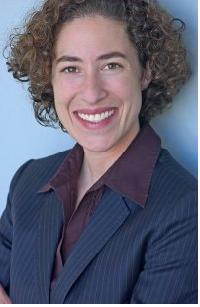
Laura Spanjian, a member of the Democratic County Central Committee and candidate for supervisor in District 8, is leaving town for a new job in Houston. That means she’s out of the hotly contested race to replace Sup. Bevan Dufty in the Castro.


Spanjian was one of three leading candidates, and her withdrawal means that Rafael Mandelman and Scott Wiener are going to be slugging it out for the job. Rebecca Prozan, who also has Alice support, is also in the race, but I don’t see her coming in first.


In a press release sent out this morning, Spanjian said she’d taken a job as sustainability director for the city of Houston. “I am overjoyed to have the opportunity to work directly with Mayor Annise Parker and her staff and contribute to a cleaner environment which is, of course, not just a local issue,” Spanjian’s statement read.


Spanjian currently works for the San Francisco Public Utilities Commission, and will leave that job in April to move to Houston.


Before we get into the political calculus, let me stop for a moment and congratulate Laura, who’s a good person and will do a great job in Houston (although, Jesus — she’s going to have to live in Houston.)


Now then: With Spanjian out of the race, I think Mandelman is on track to come in first. That doesn’t mean he’s going to win an election decided by ranked-choice voting, but I think he comes in first.


“Clearly it’s a win for Rafael,” Jim Stearns, a political consultant who was working for Spanjian, told me today. “Laura was going to go after the more nonideological folks in the district, but she was also going to make a push with the progressives. And now Rafael has the solid progressive base in that district to himself.”


That base, though, isn’t enough alone to get Mandelman elected. It’s going to come down to the second and third votes. And Wiener and Prozan start off competing for a lot of the same voters, but in the end, Mandelman is going to have to get enough of the more centrist folks to at least put him second to finish in the money.


Wild yonder

0

arts@sfbg.com

FILM Fortuitous bookings bring two remarkable American films standing at the crossroads of avant-garde cinema and sensory ethnography to the Bay Area this week: Sweetgrass and Let Each One Go Where He May. Both works adapt effective strategies to work against the slide toward unexamined realism endemic to their troubled genres (the wildlife film and standard anthropological ethnography). First and foremost among them is a coherent program of intense artfulness. One can immediately point to Ernst Karel’s sound design (Sweetgrass) and Chris Fawcett’s 16mm Steadicam cinematography (Let Each One) as virtuoso performances opening the films to beauty and doubt, an unlikely ethnographic tandem.

Short descriptions are bound to fail these films’ experiential stakes, but here are the basic outlines. Recorded between 2001-03 by Lucien Castaing-Taylor and Ilisa Barbash, Sweetgrass immerses us in sheep farming before taking off after a pair of latter-day cowboys on a 150-mile drive through Montana’s Absaroka-Beartooth range — a journey with deep historical roots and no practical future. Let Each One Go Where He May‘s title refers to a Surinamese proverb in which the gods emancipate the native population from slavery. Ben Russell’s film unfolds as 13, 10-minute takes depicting two brothers (Benjen and Monie Pansa) retracing an ancestral slavery route toward a ritual site. As far as global capital is concerned, the nominal “remoteness” of both films’ locations (and the accompanying visual lexicon) is a mirage.

As Sweetgrass‘ rugged scenery beggars (but ultimately unseats) projections of the pastoral, so too do its mild sheep trigger myriad symbolic associations. But in the intensified apprehension of the animals themselves, which occasionally return the camera’s gaze and are heard like Zidane is seen in 2006’s Zidane: A 21st Century Portrait, these abstractions are restored to the dualistic cradle John Berger pinpoints in his essay, “Why Look At Animals?”

Sweetgrass is finally about the relationship between farmhands and their flocks, and in this, it is notably unsentimental. During long takes of shearing and birthing, the correspondent displays of violence and tenderness, much of it erotic and seemingly reflexive, speaks to the human-animal encounter Berger eulogized in 1977. The lonesome cowboys whisper sweet nothings to the dogs and hurl fantastically mismatched streams of curses at the sheep (the absence of women being the common link). Through it all, Castaing-Taylor’s camera is an embodied presence, and hard work at that. Compared with Planet Earth‘s impossible views and spectacular displacements, Sweetgrass has its feet planted on the ground.

Russell also unwinds the notion of a comfortable vista of things as they were, though his long-take structure pushes the edge of hallucination. Russell’s history as a development worker in Suriname helps account for his film’s understanding of the way a sense of place is above all enactive, simultaneously engaging seemingly disparate stages of history, economy, and identity. Thus, Let Each One‘s modernist migration traverses a rural dwelling, country roads, urban bustle, an illegal goldmine, a mythic river, and a baffling reenactment of a clown-masked ritual dance — the ambiguity of whether it’s the brothers motivating the camera or vice versa is posed not as a riddle, but as a dance.

Let Each One‘s formal parameters make it a challenging viewing experience, especially given the paucity of explicatory titles or subtitled language. But then the fact that both filmmaking teams eschew exposition should be viewed in light of all those documentaries that are nothing but context. Even when necessary, these kinds of films tend to substantiate what we already know. Sweetgrass and Let Each One do something very different. In the hours after watching each, my own semi-urban environment seemed quite alien to me, but my feelings were more intact for it.

SWEETGRASS opens Fri/12 in Bay Area theaters

BEN RUSSELL: LET EACH ONE GO WHERE HE MAY

Fri/12, 7:30 p.m., $10

Yerba Buena Center for the Arts

701 Mission, SF

www.sfcinema.org

Psychic Dream Astrology

0

March 3-9

ARIES

March 21-April 19

Something needs a proper burial, so you’ve got to slow down and get out your shovel, ya dig? There is a loss you have to cut and it may be a sad affair, but avoiding it will only make things worse. Let go.

TAURUS

April 20-May 20

A crisis of confidence is no small matter. Put yourself in as supportive an environment as you can so things don’t go form bad to worse. Seek nurturing and security.

GEMINI

May 21-June 21

Being vulnerable has a bad rep, but you can’t have an open heart without being exposed. Take some chances to create the security you want. Right now, your softer parts are your greatest resource.

CANCER

June 22-July 22

Acting generously can multiply what you have to share. This week, try to give what you can, whether it’s patience, your time, or the benefit of the doubt.

LEO

July 23-Aug. 22

Repressed emotions are gonna bring you nothing but anxiety, so hold off on the holding off. A few wormy apples shouldn’t ruin the whole bunch.

VIRGO

Aug. 23-Sept. 22

If you never envision your best-case scenarios, how can you ever create them? Dare to dream big! It’s the first step in creating circumstances that are much better than the ones you have now.

LIBRA

Sept. 23-Oct. 22

Being able to see the potential in a person or situation is very different than dealing with reality. Accept the truth based on what you are experiencing, not what you are waiting for.

SCORPIO

Oct. 23-Nov. 21

Where you go next is totally up to you, Scorpio. If you are dissatisfied with things, you need to get fired up enough to be the change you want to see. Adopt a pace that allows you to emotionally integrate every step of the way.

SAGITTARIUS

Nov. 22-Dec. 21

Start something new this week.Taking risks is great if you can do it without stepping on other people’s toes. Don’t allow your enthusiasm to sway you from acting in concert with your environment.

CAPRICORN

Dec. 22-Jan. 19

If you don’t know the answer, why do you have to assume the worst, Cap? Try to reserve judgment as you cope with feeling overwhelmed. Don’t make decisions from pessimism.

AQUARIUS

Jan. 20-Feb. 18

If you don’t believe in yourself, you can only go so far. Don’t convince others of your awesomeness, embody it.

PISCES

Feb. 19-March 20

There’s a fine line between waiting for the right moment and procrastinating, and you are dancing atop it. Don’t overthink your next move. Get some clarity and go straight to the heart of the changes you desire.

Jessica Lanyadoo has been a psychic dreamer for 15 years. Check out her Web site at www.lovelanyadoo.com or contact her for an astrology or intuitive reading at (415) 336-8354 or dreamyastrology@gmail.com.

MTA board ponders bad options

2

By Adam Lesser

If Friday’s San Francisco Municipal Transportation Agency decision to cut Muni service by 10 percent was met with a backlash, it didn’t get much better this afternoon as MTA Chief Financial Officer Sonali Bose laid out further options for closing next fiscal year’s $56.4 million projected budget deficit.

One option that was very unpopular but potentially lucrative is the possibility of eliminating transfers. That’s right. Going from the Sunset to North Beach, and need to transfer from the N to the 8X? You’ll be paying twice if the MTA Board of directors goes with this option. It would generate $20.4 million to help close the budget gap.

Other proposed changes included a consolidation of transit stops in the system, charging for metered street parking on Sundays, extending meter hours into the evenings, a reduction in work orders requiring payments to other city departments, window wrapping advertising on MTA buses, and dedicated tax measures that would raise additional funding for Muni.

A further 5 percent service reduction was also not ruled out, though CEO Nathaniel Ford suggested that Bose remove it as part of the list of solutions to the budget crunch. For every 5 percent reduction in service, the MTA saves $7.2 million.

Ford tried to strike a conciliatory tone. “Last Friday was a very difficult day. People were understandably upset,” he said. “We must recognize we can only deliver the services we can afford. Going forward our choices are going to get that much more difficult.”

The criticism of the MTA Board was diverse. Tom Radulovich, Executive Director of Livable City, questioned the future of the board. “I think there’s a very good chance the MTA in it current form won’t see its 11th anniversary because it isn’t doing what voters want it to do.” Radulovich said the MTA had failed to live up to its charter mandate by not seeking new funding for the agency.

Many pro-transit groups argued that the Board should extend meter hours and eliminate free parking on Sunday. They felt the best way to promote public transportation and deal with the budget is to increase costs on drivers in San Francisco.

“There is some easily implementable low hanging fruit,” said Marc Caswell, program manager for the San Francisco Bicycle Coalition. “By increasing parking meters, you will help make transit affordable. You must extend meter hours.” Caswell suggested the board was receiving “political pressure” from the mayor’s office not to extend meter hours or eliminate free Sunday parking.

Two issues from Friday’s meeting were continued this afternoon. One was the proposal to exclude the 8X bus lines from the premium pass. Eric Williams from Transport Workers Union Local 250-A was vocal. “You’re putting these raises on the less fortunate. The 8X are coming from the Sunnydale neighborhood. They’re going to get on the local 9 and pack buses. These people are coming off housing projects to get to work.”

The second continued item surrounded the proposed elimination of free parking for employees who work at city garages, effectively charging them to park in the garage where they work. The irony of the proposal was not lost on Mission and Fifth Garage Supervisor Jorge Carrillo who showed up at the hearing to explain to the MTA board that one of his security guards will have to work 30 hours just to pay the monthly 300 dollar parking fee. “It’s outrageous. I live 50 miles away from the garage. That’s two to three hours to get home on public transportation.”

In line with projected budge deficits was a request to extend the current state of fiscal emergency through 2012. Declaring a fiscal emergency allows the MTA to avoid the California Environment Quality Act (CEQA) requirements should it decide to cut service or increase fares over the next two years.

Bose concluded her presentation with a reminder that there will be a town hall meeting on the proposals next Wednesday, March 10th at 6:00pm at 1 South Van Ness on the second floor. The SFMTA Board meets again March 30th.

Sly ‘n’ sincere

0

kimberly@sfbg.com

SONIC REDUCER "Move while you’re watching me / Dance with the enemy — here is my remedy!"

Though the production is vaguely "Toxic," don’t confuse this Brit with Britney. Little Boots, a.k.a. Victoria Hesketh, may be a dulcet, highly infectious dead-ringer for Britney Spears — sporting a sweeter voice and ‘tude, judging from her lyrical preoccupations and her popular homemade YouTube snippets showing the Boots covering Kid Cudi or Cyndi Lauper.

And as El Niño continues to batter our doors, one can’t help but wonder what a steadily heat-seeking, viral-vid starlet like herself makes of the chill falling over pop, both under- and overground in the form of, say, Cold Cave and the xx? Lo, behold synthpop prime mover Phil Oakey of Human League, dueting with Hesketh on "Symmetry," off her debut, Hands (Atlantic), which finally sees its stateside release this week.

"Maybe it sounds cold, but I think it sounds really cool as well. That’s the whole thing, the detached Human League thing," explains Hesketh, 25, phasing in and out by phone from London.

"I’m just really interested in electronic music and inspired by it, so I kind of got into it from that angle, being a fan of the sound and the records."

Today’s colder, sparser synth minimalism perhaps reckons more honestly with the instruments themselves, with a sound that isn’t trying to resemble anything other than itself. Its quiet aggression resonates perfectly with the cold wind of austerity that has been long blowing through the music world. That harder, tougher, oft-pared-down synth sound also jibes with the continuing cultural fascination with the ’80s: rhyming perfectly with fashion’s studded stilettos and architectural leather, it reads like armor against pummeling economic times.

Hesketh is completely frank about the hardscrabble pop environment she’s found herself in — and the way understandable fiscal conservatism is affecting the art and craft of music-making. "I think the industry doesn’t really have any money, and I’m not selling very many records, so they’re just playing it really safe because they’re scared to invest money in anything that’s too weird and can’t fit," offers Hesketh, who’s had Ellie Goulding, Music Go Music, and Marina and the Diamonds on repeat lately. She says that timidity doesn’t bleed into the formation of such delectable nuggets as the Madonna-esque "Stuck on Repeat" and the Telepathe-like "Mathematics," which sees Hesketh winningly rhyming Fibonacci with Pythagoras while entreating, "But the only formula I know will work for us / Is that when we’re together in the sum of our parts / It’s far greater than what we added up to at the start."

That juxtaposition of every-girl vulnerability is full frontal on Hesketh’s solo electric piano version of "Stuck on Repeat," one of the most popular of her DIY, laptop-made videos. Flanneled shoulder to camera, hair dark and bushy, in Paul Frank monkey jammies, she sings to herself — and to the Webcam — in a way that makes one think that you and Hesketh are sharing an intimate moment, much like meeting Lily Allen via MySpace, and peering through a tiny window into her world. But even good things must end. "I don’t do [those videos] anymore," Hesketh says flatly. "I did them a lot, so it’s a bit boring. but yeah, it definitely helped as a way to get exposure. Now I’m kind of having a break from them and doing something new." Namely performing throughout the U.S., in the flesh: these Boots walk onto the Fillmore stage March 9.

LITTLE BOOTS

With Class Actress and Dragonette

Tues/9, 8 p.m., $15–$20

Fillmore

1805 Geary, SF

www.livenation.com


COME IN FROM THE COLD

MIDLAKE


Where Fairport Convention meets Fleetwood Mac, the Denton, Texas, band convenes for its sublime new The Courage of Others (Bella Union). With Matthew and the Arrogant Sea. Thurs/4, 9 p.m., $16–<\d>$18. Great American Music Hall, 859 O’Farrell, SF. www.gamh.com

BARN OWL AND DANIEL HIGGS


It’ll be a hoot when the SF psych-drone nature boys cavort with the Lungfish savant. With Carlton Melton and Electric Jellyfish. Fri/5, 9:30 p.m., $7. Hemlock Tavern, 1131 Polk, SF. www.hemlocktavern.com

Expanding movement

1

rebeccab@sfbg.com

When University of California Berkeley students staged building occupations last fall, their furious, brazen response to startling tuition hikes and staff cutbacks captured the attention of the world, recalling the radical actions of earlier generations.

Yet the thrust behind the March 4 Strike and Day of Action, a mass mobilization for public education and services that is reaching into all corners of the state and spreading nationwide, appears to stem from widespread agitation that extends well beyond the flare-ups on college campuses.

"What’s historic about this is that pre-K through PhD has never walked together," said Lillian Taiz, president of the California Faculty Association, which represents faculty in the California State University system. "We have often been pitted against one another, and I think everyone feels finally, in the end, there is no difference in importance between pre-K and PhD. We need it all."

The historic new alliance faces an uphill climb in an environment characterized by a devastating budget crisis at the state level. California — the world’s eighth-largest economy — hovers around 47th in the nation in terms of per-pupil spending, and the most recent wave of budget rollbacks has cut to the bone.

Students and teachers across the Bay Area argue that with dramatic slashes in funding, the educational system is failing youth. Class sizes are ballooning to claustrophobic levels, students are unable to take their desired courses, fees are going up, bathrooms are getting cleaned less frequently, and staffers are getting stressed by overwhelming workloads. "Classes are jam-packed," Taiz says. "You have kids sitting on the floor. You have students just begging to be allowed in a class."

As University of California students decry a 32 percent hike in fees, the California State University system is suffering from damage inflicted by 2,000 faculty layoffs over the past year. The San Francisco Unified School District, meanwhile, is staring down an estimated $113 million budget deficit over the next two years, and 900 layoff notices recently were issued to teachers, librarians, secretaries, and other school employees to warn them that their jobs could be slashed by the end of the school year.

When San Francisco’s school district faced a gaping budget shortfall during the last budget cycle, it was propped up by a combination of Rainy Day Fund reserve dollars and stimulus funding from the American Recovery and Reinvestment Act. With no such safety nets in place this time around, anxiety levels are higher and the outlook is uncertain.

March 4 is shaping up to be more than an opportunity to vent frustrations to elected leaders. Instead, organizers describe it as a rallying point for a movement to defend public education that has caught on like wildfire, uniting people from different worlds. Pickets and rallies will be staged throughout the region. Thousands are expected to swarm Civic Center Plaza in San Francisco. Students from a handful of East Bay campuses are organizing marches to Frank Ogawa Plaza in downtown Oakland. Students and faculty from Berkeley will be boarding buses to take the message to Sacramento. The Oakland Unified School district will host a districtwide mock "disaster drill" to call attention to the disastrous budget. Even public transit activists opposed to the latest round of Muni service cuts and fare hikes are joining the protests, hoping to expand the discussion to support vital public services (for details on these and other events, see "Alerts" opposite this page).

"We’ve never gotten this level of activism over anything in SF since I’ve been here," says Matthew Hardy, communications director for United Educators of San Francisco. "There’s a growing movement for progressive taxation and budget reform instead of draconian cuts."

Taiz, who teaches history at Cal State Los Angeles, described March 4 as an opportunity to fill a void in leadership. "Historically, in these moments where ordinary people step up to the plate, you end up leading the leaders," she said. "We are kind of shocked, but in truth, we do know what has to be done." Quality education isn’t just important for young people, but for society as a whole, she argued. "I am a baby boomer, and if the folks coming up behind me don’t have really, really good jobs, I’m going to be eating dog food. Because those are the people who pay Social Security and pay the taxes."

In the week preceding March 4, teachers and students throughout the Bay Area were in a frenzy of preparation.

Carlos Baron, a theater professor at SF State, was wondering whether the grand procession of papier-mâché puppets his theater students will unveil on the March 4 Day of Action should take a V-shape or some other form. "The main puppet is the Draculator," explained Baron, a Chilean who directed plays in the Salvador Allende era before he began teaching at SF State in 1978. "It’s a cross between the Terminator-Governor and Dracula. But also it doubles as a banker and a general."

When asked how funding cutbacks affect students, Baron didn’t hesitate. "It impedes the creation of a positive vision for themselves and this society," he said. It stunts "the development of the imagination," he added. "We are trained as individuals to accept our failure and our smallness because we’re familiar with it. They don’t want an educated population, a sensitive population, a dreaming population. Would we select Schwarzenegger?"

Nicole Abreu Shepard, a first-grade teacher at Buena Vista Elementary in San Francisco’s Mission District, was collecting permission slips from parents to take her students to a rally and march down 24th Street. "The entire school is walking out," Abreu Shepherd said. Buena Vista’s art program exists solely because parents volunteer their time, she explained. More than half the students qualify for free or reduced lunch, and many incoming kindergarteners or preschoolers are new to the English language. Now there are proposals on the table to increase kindergarten class sizes to 25 or possibly even 30 students. "It’s sort of tying their hands behind their back and asking them to teach on one foot," she noted, and worried about the eventual result. "It’s going to be harder and harder to keep parents who could afford private school in a public school system."

Meanwhile, at the UC Berkeley campus, Krystof Cantor was sitting behind a table heaped with piles of radical literature bearing titles such as "After the Fall: Communiques from an Occupied California." Cantor, who earned his PhD in vision science in 2005, was joining student organizers in making one last push to drum up student interest in March 4 events at a multi-faceted event called "Rolling University." Late on the evening of Feb. 26, a dance party on the Berkeley campus morphed into a street riot — replete with ignited Dumpsters — in downtown Berkeley. The incident attracted media attention and drew public criticism from administrative officials.

The radicalized student movement that has erupted on the UC Berkeley campus is "very much about seizing power," Cantor told the Guardian several days before. "It’s been disruptive, it’s been militant, and it’s been creative. That’s very scary," to the administrators the movement is targeting, he added.

That focused pressure on UC administrators sets these students apart from the coalition of UC Berkeley faculty members and student government members and allies who are coordinating bus trips to protest in Sacramento March 4, he explained. "Sacramento’s not innocent, but it’s not like the administrators are just doing what they have to do," he charged, pointing to new construction projects on campus even as workers are hit with layoffs and furloughs, plus an increasing trend of privatizing on-campus jobs and services. "You can save the public sector by pouring money into it. But it won’t work if the people in charge … want to privatize everything."

Jasper Bernes, a graduate student in English who was seated next to Cantor, noted that the occupation tactic is catching on at other campuses. "I have no doubt that March 4 will greet us with news of many occupations," he said.

Baron, the Chilean theater professor, noted that some SF State students had occupied a business school building in protest of budget cuts. "They were pissed," he said. "They wanted to do something radical. They really inconvenienced a lot of people — but they took chances nonetheless. I went there, and I locked arms with them for awhile." At the same time, he wondered about how effective it was, he said.

And for all the months of preparation and visioning, Baron said he also wonders what will ultimately be borne out of the marches, rallies, pickets, and procession of lovingly crafted street puppets he helped breathe life into. For all the hard work and planning, he says, "My problem is not so much March 4. It’s March 5."

Is Chevron lying about its crude plans?

1

By Adam Lesser

William Rostov, the Earthjustice lawyer who represents three Bay Area environmental groups, broke it down: “The question is: will it be heavier and will that result in more pollution?” He was speaking about crude oil refining at Chevron’s Richmond refinery as he addressed California’s First Appellate Court in San Francisco this morning. Heavier crude oil is usually less expensive for oil companies to purchase but generates more pollution during the refining process.

Environmentalists, labor unions, lawyers and Chevron representatives packed the courtroom to hear opposing counsel spar over the project’s environmental impact report, which was invalidated by a Contra Costa Superior Court judge last June. The ruling stopped the refinery expansion that Richmond has approved.

Chevron attorney Ronald Van Buskirk hammered the point that “the project didn’t propose a crude switch.” When pressed on why Chevron declined to disclose the data behind the conclusion that there would be no switch to heavier grade crude, Van Buskirk countered that the data constituted “trade secrets” that are protected under law.

Rostov argued that “refinery experts showed this project allows the use of heavier crude” and that Chevron “misled the public” in its EIR. A key component of the environmentalists’ argument rests on the 2007 Chevron annual report to the U.S. Securities and Exchange Commission, which specifies that “design and engineering for a project to increase the flexibility to process lower API-gravity crude oils at the company’s Richmond, California, refinery continued in 2007.” API gravity is a measure of how heavy or light petroleum is. Lower API gravity corresponds to a heavier crude oil. But Van Buskirk countered that the plaintiff’s evidence amounted to “one sentence in a 10K report.”

Justice Patricia Sepulveda questioned Van Buskirk about whether the $61 million Community Benefits Agreement that Chevron offered to contribute to the city of Richmond gave the city “bias to approve the project.” But Van Buskirk said, “It wasn’t a quid pro quo, if that’s what you’re suggesting,” before ultimately conceding that it was fair suggest to that the gift had played a role in the approval.

Judge Ignacio Ruvolo presided over Chevron’s appeal. At the end of oral arguments, he spoke to the efforts the court has taken to expedite the case, pressing attorneys on whether there was any chance of a settlement.

“The parties are still very far apart,” said Van Buskirk, and Rostov nodded the same. For the first time all morning, everyone was in agreement.

The court will rule within 90 days.

Economy vs. environment

0


By Adam Lesser

news@sfbg.com

GREEN CITY The Port of Oakland has long been a battleground that pits economic development against environmental justice, a dichotomy that has become all the more fraught with emotional baggage during the current recession.

For years, West Oakland residents, environmentalists, and public health officials have demanded that government officials do something about the long lines of old, idling diesel trucks that spew toxic emissions that have sickened the surrounding community (see “The polluting Port,” 3/24/09).

When the state finally mandated expensive retrofits of the oldest trucks at the start of this year, truckers and their allies reacted angrily to what they called a job-killing regulation. But rather than viewing such fights in isolation, a new Bay Area movement is seeking to broaden the debates within what it labels the “toxic triangle” extending from the Port of Oakland to San Francisco’s Bayview-Hunters Point to the city of Richmond.

Citing concern for how to effectively address the cumulative impact of pollution, community groups including the West Oakland Environmental Indicators Project and Asian Pacific Environmental Network are sponsoring the Toxic Triangle Hearings. The first hearing was held Feb. 13 in Oakland; the next two hearings will take place later this year in the other two triangle points.

At the first hearing, supporters introduced their cumulative impact pledge, a request that agencies ranging from the Environmental Protection Agency to the California Air Resources Board work together to define emission limits for an entire area and to collectively adopt reduction strategies. The ultimate goal is an environmental justice ordinance that would require any new project to receive an “EJ permit” before a proposed project was allowed to move forward.

The city of Cincinnati approved a similar system last June, but it was put on hold this month due to concerns about the cost of implementing it during these hard economic times. The delay in Cincinnati points to an emerging theme in the narrative from lawmakers and corporations. With high unemployment and huge government budget deficits, can we afford to further regulate pollution?

California Assembly Member Nancy Skinner, who represents Richmond, was on hand at the Toxic Triangle Hearings. Questions arose about the ongoing legal battle between community groups and Chevron, which wants to expand its Richmond refinery. The refinery is the largest in Northern California, with a capacity of 240,000 barrels of crude oil per day.

The retrofit is on hold after a court rejected the project’s EIR, asking Chevron to clarify whether the expanded refinery would process heavy crude oil, which generates more pollution. A Jan. 19 editorial in the Contra Costa Times made the pro-business argument, claiming that Chevron “is poised to shut down its Richmond refinery operations” and laying blame on environmentalists.

“All we know is that the Chevron people have talked of change — there’s been a shift,” Skinner said. “They’re looking at all their North American operations. That doesn’t mean we just roll over. But it means that we have to be aware of that when we sit at the table.”

But environmentalists question whether closing the Richmond refinery is a realistic threat from Chevron, or merely a negotiating tactic. “There is no credible scenario in which this refinery will close anytime soon for business reasons,” said Greg Karras, a senior scientist for Communities for a Better Environment. “The issue is whether Chevron can move to heavier oil and whether they have to disclose that. It has nothing to do with jobs.”

The Toxic Triangle Hearings highlight this perceived conflict between the economy and the environment. But Karras called the dichotomy a “false choice,” arguing that the greatest potential for job growth lies in innovation and green jobs, not a refinery expansion.

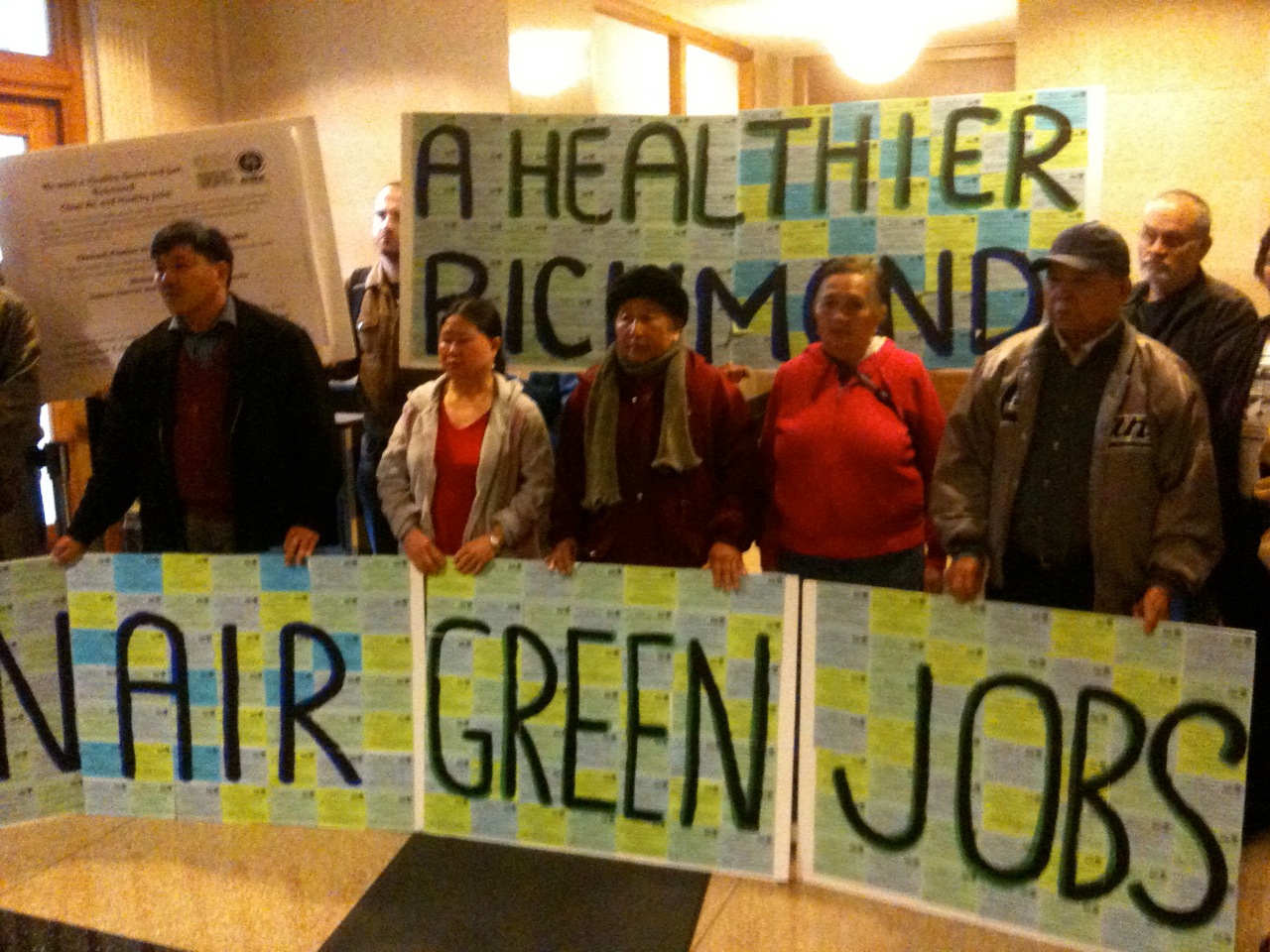
APEN’s State Organizing Director Mari Rose Taruc agreed: “We want people to have jobs and make it out of the recession. But we’re not going to trade our health and the ailing conditions of our community for something worse.”

Taruc sounded frustrated, similar to the tone Karras expressed when faced with the question of the economic impact of environmental regulation. For now, she said the rationale for delay is the recession, but “when the economy is good, there would be another excuse.”

Events listings

0

Events listings are compiled by Paula Connelly. Submit items for the listings at listings@sfbg.com.

WEDNESDAY 24

SF Noir Museum of African Diaspora, Marcus Books, The Atrium, and other Bay Area locations, for more information, visit www.sfnoir.org. Wed. – Sun., $10-$75. Celebrate Black History month at this year’s culinary arts focused SF Noir, featuring food wine and entertainment that highlight the best in Black cuisine.

"World without us" Herbst Theater, 401 Van Ness, SF; (415) 561-6582. 7:30pm, $10. Attend this Long Now Foundation’s Seminar About Long-Term Thinking, where journalist Alan Weisman will discuss his experience traveling the world to investigate what happens when humans stop occupying an area.

BAY AREA

Bike Repair Class Cycles of Change APC Bike Shop, 650 W. Ranger, Alameda; (510) 898-7830. 6:30pm, $80-$150 sliding scale for all four classes. Learn how to fix your bike at this four part basic bike maintenance training program run by a nonprofit community bike shop. Classes include bike anatomy, brakes, shifting, and wheels.

Working in the Shadows Revolution Books, 2425 Channing, Berk.; (510) 848-1196. 7pm, free. Hear Gabriel Thompson discuss his new book, Working in the Shadows: A year of doing the jobs (most) Americans won’t do, about a year spent working all over the United States alongside Latino immigrants.

THURSDAY 25

God, Seed San Francisco Center for the Book, 300 DeHaro, SF; (415) 565-0545. 7pm, free. Attend this reading and slide show presentation based on Bay Area artist Lorna Stevens and poet Rebecca Foust’s new collaborative book, that is a collection of poems and art about the environment.

Historic Wineries of California California Historical Society Museum, 678 Mission, SF; (415) 357-1848. 6pm, $25. Attend this wine tasting and history lesson all in one, with winemakers representing some of the oldest, family-owned California wineries telling tales of growing up on vineyards and offering tastings of their latest vintage.

Kamau Patton and Sara Kraft Yerba Buena Center for the Arts, Gallery 3, 701 Mission, SF; (415) 978-2787. 7pm, $7. Local visual artist Kamau Patton and performance artist Sarah Kraft come together to discuss commonalities within their artistic practice, presenting samples of sounds image and text to illustrate their discussion.

Love Your Body Now Center for Sex and Culture, 1519 Mission, SF; (415) 255-1155. 7:30pm, $10-$30 sliding scale. This interactive workshop allows participants to explore the roots of their own body issues, how it has affected them, and how to combat the barrage of media that focuses on perfection.

FRIDAY 26

Pacific Orchid Exposition Fort Mason Center, Bay at Franklin, SF; (415) 665-2468. Fri. and Sun 10am-5pm, Sat. 10am-6pm; $14. Check out over 150,000 unique orchids from around the world, with educational displays and demonstration. This year’s theme of "Carnaval" will highlight the diverse natural habitats of orchids.

BAY AREA

Seed Swap Ecology Center, 2530 San Pablo, Berk.; (510) 658-9178. 7pm, food and seeds to share or $10 donation. Hang out with fellow local gardeners at this pot luck, seed swap, and party. Bring food, seeds, or a garden related treasure to raffle and you can get in for free.

SATURDAY 27

Chinese New Year Treasure Hunt Hunt begins at Justin Herman Plaza, Market at Embarcadero, SF; (415) 564-9400. 4:30pm, $30-$40. Channel your inner stealthy Tiger at this treasure hunt and urban sleuthing game taking place on the streets of Chinatown, North Beach, and Telegraph Hill. Rain or shine.

Lunar New Year Festival Chinese Cultural Center, 3rd floor, 750 Kearny, SF; (415) 986-1822. Sat.-Sun. 11am-4pm, free. Usher in the year of the Tiger at this Spring Festival celebration featuring lion dancing, performances, activities, fortune telling, art, and more.

Magazine Day Booksmith, 1644 Haight, SF; (415) 863-8688. 1pm, $5. Break out your piles of unread magazines and share them with other magazine lovers as Booksmith turns itself into a giant magazine reading room for the day featuring discussions about magazine publishing, wine, snacks, and plenty of mags to take home from the communal piles.

Art to Empower Africa Space Gallery, 1141 Polk, SF; camfedfundraisersf.org. 7pm, free. Buy donated art from local artists at this auction where all of the proceeds will go to benefit Camfed, an organization that empowers girls in Africa by using a community-based, holistic approach to long-term education, small business training, and HIV prevention.

SUNDAY 28

Ayibobo! Glide Memorial Church, 330 Ellis, SF; (415) 626-7500. 1pm, free. Join San Francisco poet Laureates Lawrence Ferlinghetti, Jack Hirschman, and Janice Mirikitani at this poetry reading and benefit for Haiti. Donations will be given to Doctors Without Borders.

Benefit for the Boob Wild Side West, 424 Cortland, SF; breastcanceremergencyfund.org. 4pm, $5-$20 donation. The Sisters of Perpetual Indulgence are hosting this fundraiser for the Breast Cancer Emergency Fund featuring burlesque performances, drag kings, comedy, sex education, raffle prizes, and more.

TUESDAY 2

Bike Touring 101 San Francisco Bicycle Coalition, Suite 1550, 995 Market, SF; www.sfbike.org. 6:30pm, free. This workshop will go over the basics of bicycle touring, like what you need, what you don’t need, and best practices to keep you happy and healthy on the road. Bring your bicycle to find out if it’s suited for bike touring.

Alerts

0

alert@sfbg.com

WEDNESDAY, FEB. 24


Party like it’s 1986!

A lot has changed since 1986, but electronic privacy law has not. Learn more about the Demand Your Dot Rights campaign — a project of the American Civil Liberties Union — and how we can work together to demand a privacy upgrade. Prizes for best 1980s attire and relics.

6 p.m., free

111 Minna Gallery

111 Minna, SF

www.dotrights.org


Positive Opportunities for Youth

Attend this youth resource fair and rally combining job, college, and internship opportunities with performances and speakers. The event concludes with the presentation a Youth Manifesto petition to the Oakland School Board. Support a safe learning environment where education, not military recruitment, is the priority.

2 p.m., free

Lake Merritt United Methodist Church

1330 Lakeshore, Oakl.

(510) 465-4793


The U.S. and the International Criminal Court

Hear William H. Taft IV of the American Society of International Law, discuss whether the U.S. should join the International Criminal Court to make it more effective in prosecuting those responsible for war crimes and crimes against humanity.

6 p.m., $15

Commonwealth Club

595 Market, 2nd floor, SF

(415) 597-6700

SUNDAY, FEB. 28


Complete the Gaza Freedom March

Hear cofounder of the Electronic Intifada and author Ali Abunimah discuss his recent participation in the international Gaza Freedom March, which served as a call to end Israel’s siege of Gaza on the anniversary of an assault that killed more than 1,400 Palestinians.

7 p.m., $15

Martin Luther King Jr. Middle School Auditorium

1781 Rose, Berk.

(510) 548-0542


You Can’t Be Neutral on a Moving Train

Join the call for an end to the wars in Iraq and Afghanistan and for the U.S. to use our taxes for healthcare, jobs, and education instead at this screening of the 2004 documentary about Howard Zinn’s life and causes. Sponsored by the Unitarian Universalists for Peace.

1:15 p.m., free

Unitarian Universalists Center

1187 Franklin, SF

(415) 776-4580

MONDAY, MARCH 1


Nuclear Tipping Point

Attend this screening of Nuclear Tipping Point, which looks at policymakers who advocate eliminating nuclear weapons. Includes a panel discussion with former Secretary of State George Shultz and former Secretary of Defense William Perry.

6:30 p.m., free

Cowell Theater at Fort Mason

Bay at Laguna, SF

(415) 775-2244, RSVP required

TUESDAY, MARCH 2


Produce to the people

Find out more about the creative ways organizations are addressing the need to find alternative models for local produce distribution, including making farm fresh produce available in underserved and neglected communities.

6:30 p.m., free

Port Commission Hearing Room

Ferry Building, 2nd floor

Market at Embarcadero, SF

www.cuesa.org

Mail items for Alerts to the Guardian Building, 135 Mississippi St., SF, CA 94107; fax to (415) 255-8762; or e-mail alert@sfbg.com. Please include a contact telephone number. Items must be received at least one week prior to the publication date.


Hey Matier & Ross — PG&E is no security blanket

8

Today’s San Francisco Chronicle piece by Phillip Matier and Andrew Ross brought to mind a Pacific Gas & Electric Co.-sponsored Web site that was set up to undermine the city’s fledgling Community Choice Aggregation (CCA) program.

That’s because one of the key points in the story was that San Francisco’s CCA could result in higher customer bills. According to the Chronicle:

“A 2007 city controller’s report concluded that a typical residential utility bill under this type of plan could go up by 24 percent if only half the purchased energy is green. The cost would almost certainly go even higher if the city went totally green, the report said.”

This city controller’s report is referenced on the PG&E-funded Web site, too, and this supposed 24 percent increase was splashed prominently across colorful outsized postcards that the PG&E-sponsored “Common Sense Coalition” sent to businesses and residences throughout the city last December. However, San Francisco’s Local Agency Formation Commission (LAFCo), a city commission responsible for setting CCA in motion, maintains that the claim is misleading.

Why?

The controller’s was drafted in 2007, making it an outdated and unreliable source for an economic-impact projection at this time, according to LAFCo Senior Program Officer Jason Fried.

“PG&E is trying to confuse people now … because they know that in a month or two more, we’ll have a contract” with actual figures to go by, Fried told the Guardian. The city is still in negotiations with Power Choice LLC, the firm selected to handle power purchases, and so it has yet to determine a long-term pricing plan. Fried also pointed out that the 24-percent increase noted in the controller’s report only pertains to electricity generation charges, and not the entire customer bill.

While the report did caution against a potential increase in prices, it also made it clear that the figures were preliminary. Here’s an excerpt:

“San Francisco’s CCA process has not yet advanced to the stage where any definitive economic impact statement can be made. A detailed economic impact assessment will not be possible until the RFP process is complete, a structured long-term rate plan has been submitted, and an opt-out penalty has been set. [NOTE: As of February 2010, the RFP process is complete, but the other two steps haven’t been definitively nailed down yet.]

The proposed implementation of CCA could lead to greater competition in the City’s electricity markets, lower rates for consumers, and a greater reliance on local sources of renewable energy and conservation. Such an outcome would benefit the San Francisco economy and the global environment.”

Since this PG&E-sponsored propaganda campaign got underway, a figure unearthed from this three-year-old report is popping up everywhere, including in the Chronicle.

More importantly, the focus on a potential rate increase under CCA ignores an important question: Is the status quo any better?

Even if CCA did drive up prices, it seems that sticking with PG&E as the region’s sole electricity provider might not be any cheaper in the long run. For example, the following appeared a Feb. 19 article in the Wall Street Journal:

“In December, [PG&E] asked state regulators for permission to raise customer rates 19% or $1 billion in 2011, with additional rate hikes of about $550 million from 2012-13. … The outlook for the increases is unclear, as consumer advocates have vowed to fight them, citing PG&E’s already higher-than-average utility rates, California’s relatively high 12.4% unemployment rate and the state’s ailing economy.”

There are other factors to think about, too, like the dynamic environment we live in and how the cost of a finite energy resource will fluctuate in the long run. The Chronicle piece quotes Severin Borenstein, co-director of the Energy Institute at UC Berkeley’s Haas School of Business, as saying San Francisco’s CCA is “fraught with danger.” This statement seems to ignore what environmentalists have been saying for years, which is that the status quo itself is a treacherous path to go down.

A key difference between San Francisco’s CCA and PG&E’s energy mix is that CCA would rely more heavily on green energy sources, with a goal of offering 51 percent of its energy from renewable resources by 2017 with the plan to transition eventually to 100 percent renewable power. Meanwhile, PG&E is making snail-like progress toward a 33 percent renewable-energy standard by 2020 that is mandated by state law.

In the long run, many experts tell us that energy derived from fossil fuels will be more susceptible to price volatility than wind and solar — especially with added environmental pressures that scientists predict will result from climate change. A future characterized by less rainfall threatens to drive up energy prices, according to the Union of Concerned Scientists, because California gets about 20 percent of its electricity from hydropower, and could be forced to purchase from an outside provider in years of extreme drought. Hotter summers are also expected, which could lead to a higher demand for electricity when everyone is running air conditioners.

Energy analyst Laura Wisland of the California office of the Union of Concerned Scientists put it this way: “We can’t afford not to take advantage of the renewable-energy resources in our own backyard. We will save money, because we will become less dependent on fuels that have more volatile prices.

“We know that we have an exhaustible supply of fossil fuels,” Wisland added. “We know that we have an inexhaustible supply of wind and sun. In the long term, we see renewable energy as investing in … more price certainty and cleaner air — and that can benefit all Californians.”

Philosophy, get hip: “The Examined Life” comes to the Herbst

0

In new documentary The Examined Life, eight of the most famous minds in contemporary philosophy — Cornel West, Avital Ronell, Peter Singer, Kwame Anthony Appiah, Martha Nussbaum, Michael Hardt, Judith Butler, and Slavoj Zizek — seem almost unintimidating. Detached from the props of intellectual life and presented in public setting away from rapt crowds, miked podiums, and the protective custody of academia, these philosophers appear comfortingly average, for entire milliseconds. For instance, on a sunny afternoon, post-structuralist scholar Judith Butler could almost be any other leather-jacketed San Francisco Missionite with a cool haircut ambling down Clarion Alley, perhaps en route to Thrift Town for some more leather jackets. That is, until she begins to discuss, in a slow and deliberate manner with eyes fixed intently into the middle distance, the body’s morphologies as experienced by the subject. Cover blown.

Examined Life director Astra Taylor will be appearing — along with philosopher Judith Butler and activist-artist Sunaura Taylor (who appears with Butler during the segment filmed in Clarion Alley) — at a screening of her film at the Herbst Theater on Thu/25, at 7:30 PM. The three women will participate in a discussion and Q&A session following the screening.


In the last few years, Astra Taylor has become known for her documentaries about philosophy. Previously, she directed the film Zizek!. I hold Zizek! partly responsible for introducing American hipsters to the Slovenian Lacanian-Marxist with saliva glands as hyperactive as his intellect who so rapidly became for youngish creativeish urbanites a sort of Mitteleuropean Moses to Marx’s Abraham.

As a documentary filmmaker, Taylor is no neutral observer; she openly reveres her subjects. Though it has been criticized (A. O. Scott of the New York Times said the film was “too glamorized by its brainy stars to engage them critically”), Taylor’s reverence is fine by me. These eight philosophers are inspiring people who make it their business to think their way through some of life’s most difficult questions. Furthermore, I prefer to keep my philosophers on a pedestal, even when they’re rambling about jazz in the back of someone’s Volvo (ahem, Cornel West).

http://www.youtube.com/watch?v=1zwmum5_ofU

To be fair, Cornel West could talk about his favorite lunch foods and I would find it interesting. ‘Cerebrities’ opining about anything, literally anything, makes for entertainment. In this film, the entertainment value is heightened by some particularly bathetic physical settings. Taylor aims to represent her philosophers outside of the stereotypical realm of academe, and she attempts this by filming them in public places that are both neutral to the philosophers’ private lives and exist outside outside the structured environment of the workplace. In The Examined Life, Appiah is interviewed while waiting around at the Toronto airport. Hardt is filmed rowing a wooden boat, with some difficultly, on a lake in Central Park that is congested with loud, unseemly geese. And, not to be outdone, Zizek requested his segment be filmed at the dump.

But, funny public settings notwithstanding, there is a discernible soapbox in each section of The Examined Life, one all eight philosophers in the film are given time to use carte blanche. Each thinker is provided an open forum to deliver decontextualized soliloquies as if at an imaginary podium in front of some metaphysical audience, and the camera eyes this dotingly. Pretentious? Yes, but forgivably so. With their contributions to their disciplines, these eight thinkers have the right to believe they have important things to say. Watching them, I am inspired to think more critically and rigorously, perhaps from a contact high off the glaring epistemological glow.

In the middle of all this talking, the philosophers do experience occasional challenges in presenting their ideas in a way that make sense to listeners. This is to be expected; even if you limit the scope of the discussion, it is impossible to unpack an ‘examined life’ in the time it takes to watch a movie. I commend these philosophers for trying at all. I also commend them for managing to not be dull, even when in their labyrinthine monologues they’ve lost me completely.

For those interested, I encourage you to attend the screening at the Herbst Theater. If philosophy is the enormous pharmacy we raid to cure ourselves of an unexamined existence, and if an actual philosophy class would be akin to the smallpox vaccine, then The Examined Life is the equivalent a mild herbal supplement. While this film won’t heal anyone of a painfully unexamined existence, a dose of it has its benefits. Think of it as a gateway drug. A documentary may proffer only a minute, highly mediated glimpse into how a philosopher thinks, but it does have the power to ask an non-philosophizing audience to think more philosophically.

Herbst Theater
Thu/25, 7:30PM, $25
401 Van Ness, SF.
(415) 621-6600
www.cityboxoffice.com

Poll: Voters give $11 billion water bond thumbs down

3

By Rebecca Bowe

There is very weak support across political and geographic boundaries in California for a proposed $11 billion water bond that will go on the November ballot, according to the results of a poll released yesterday.

Just 34 percent of respondents said they would vote yes on the proposed $11 billion bond, while 55 percent said they would vote no. A more detailed breakdown revealed that 32 percent of likely voters indicated that they would definitely vote no, while only 12 percent said they would definitely vote yes.

“This bond is in deep trouble,” said Ben Tulchin of Tulchin Research, the firm that conducted the poll. “No bond has ever won statewide that started with a majority against it. It faces a real uphill battle.” Tulchin Research conducted the poll at the request of groups opposing the bond. The poll surveyed 600 likely voters across California, asking respondents to share their opinions after reading them the title and summary.

Tulchin, who has conducted polls for bonds and ballot initiatives throughout California, said support for proposals typically start at a high point and then decline as the election date nears. “In this case, the bond is starting at a low point,” he said. “In general, you want to see support around 60 percent” to win on a proposal, he said. “This is nothing near that.”

The proposed bond would include funding for a variety of water-infrastructure projects including new dams and reservoirs. Its primary backers include Gov. Arnold Schwarzenegger, who last year said he would reject any water bill that didn’t include a plan to fund new water-storage projects, and major agricultural interests who are concerned about secure water availability for irrigation purposes.

Mark Schlosberg, of San Francisco-based Food & Water Watch, opposes the bond.

“It’s the wrong bond, at the wrong time, and it does the wrong thing,” Schlosberg told the Guardian. He described it as a measure that could result in giveaways to corporate interests, such as developers of major desalination facilities. Some $1 billion of the bond is earmarked to go toward water recycling or desalination projects.

Schlosberg said he expects big agriculture and other backers to spend “tens of millions” in support of the proposed bond. But in the face of high unemployment and cuts to education, public safety and other services, “We can’t afford to spend $11 billion on this boondoggle,” he said.

Meanwhile, Congressional representatives have been airing concerns regarding water policy too. According to this post on Calitics, four members of the house recently sent a letter to Sen. Diane Feinstein blasting her plan to introduce legislation to speed pumping out of the Delta.

Rambling Jerry Brown speech raises fear among Dems

22

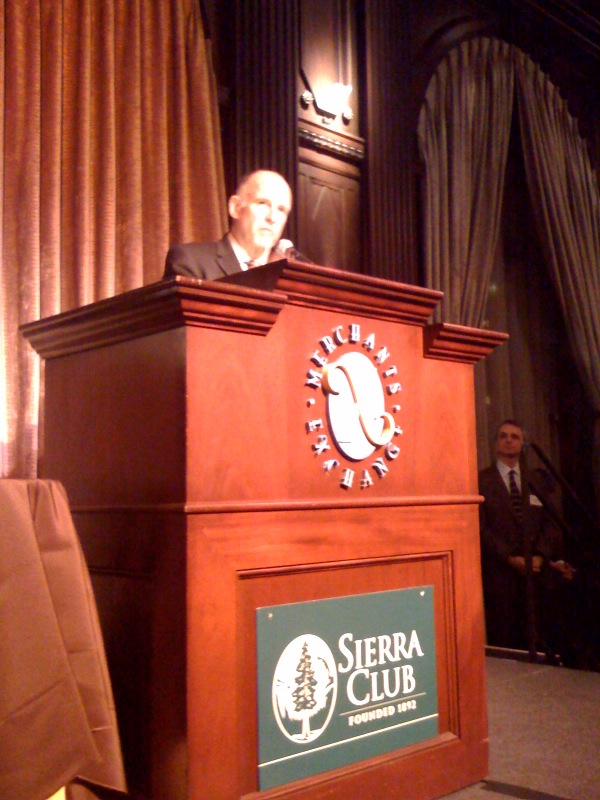
If Jerry Brown’s keynote speech last night to a gala environmentalist dinner is any indication, the Democratic Party faces an uphill battle to win this year’s governor’s race. The rambling, alternately vague and academic, and often pointless address did little to inspire or excite a large, sympathetic crowd that was loaded with top Democrats. In fact, some party luminaries were openly aghast at the poor performance, with one making this succinct (if off-the-record) assessment: “We’re fucked.”

Brown has never been a dynamic speaker, but the unscripted, half-hour speech – given at the Sierra Club San Francisco Bay Chapter’s David Brower Dinner in San Francisco, a $250 per head affair that drew top Bay Area Democrats – illustrates the danger of letting a primary be decided by legend and money rather than political persuasion.

Brown’s fundraising prowess and strong poll numbers chased Gavin Newsom and other potential rivals out of the Democratic Party gubernatorial primary, even though Brown hasn’t really outlined his political vision for California, given many extended speeches since being discussed as a candidate for governor, or even officially declared his candidacy (he and others have until March 12 to do so).

“This thing is really daunting,” Brown said of the governor’s race toward the end of the speech, seemingly unsure that he was ready to run, but saying he would make an announcement sometime in the next couple weeks.

Brown started his speech by telling the crowd that he didn’t know what he was going to talk about, so when he arrived (late) for the speech, he asked San Francisco Democratic Party chair Aaron Peskin what he should say, and Peskin told him to talk about how there were more salmon in the streams and better overall environmental health back when Brown was governor in the ‘70s.

But rather than taking that advice and giving a forceful call to strengthen environmental regulation or conjure up California’s better days, Brown meandered around and mused on that and other topics, feeding fears that the 71-year-old candidate might come off as a nostalgic, slightly senile former-Governor Moonbeam rather than an effective agent of needed change.

“During that period when I was governor, I’m not going to call it the golden age because some people think I’m in the golden age, so I don’t want to get people confused. That’s why I don’t want to talk about way back then, because there are a number of people I can see weren’t even born then, so it gets a little embarrassing and I like to pretend it was just yesterday. But in that period, California created almost twice as many jobs as the nation did. We created jobs at about 24 percent over eight years and the nation grew jobs at 13 percent, so almost twice as much. And then Deukmejian did pretty good, he had about the same, maybe half a percent more,” Brown rambled, ticking off statistics, hedging his point by noting how little governors can really do to create jobs, before working up to a decent line that was flatly delivered: “It was a time when the environment got its biggest boost, as far as public policy.”

Nobody applauded, so he continued. “I was thinking tonight, I was trying to figure out that if I did announce, what the hell would I say? And so I decided to go back and read my first announcement, January 24, 1974. I was 35 then, it was another time, I’m now a little older than that. But I talked about clean air, I talked about the energy crisis and getting new sources of energy. I talked about statewide land use planning” – that last item drawing some applause – “and I talked about jobs. And I was thinking, wow, we still got a jobs problem, we got an energy problem, we have a land use problem that feeds into the energy problem, and while the air is cleaner in many respects, it’s not clean enough, or it isn’t healthy enough.”

On substance, Brown had his moments. But even on the need for better statewide land use planning, he went off on a tangent, saying he didn’t even know what that meant when he filled out a Sierra Club questionnaire back in the ‘70s, and he’s not sure how to accomplish it now. 

“You have to make it easier to live closer to where you work,” Brown said in what of his few lines of the night that drew applause, although he didn’t begin to explain how he might achieve this goal. And on a controversial subject that is easily attacked by the right – big government wants more control over private property – Brown’s lackadaisical discussion of the issue was disconcerting.

He even rankled a few Sierra Club members by vaguely criticizing East Bay growth controls designed to reduce sprawl, which the Attorney General’s Office is seeking to overturn: “Pleasanton wants to create 50,000 jobs, but they have a housing cap – for all I know, Sierra Club probably supported that housing cap, so I want to just rub your nose in the housing cap for just a minute – the trouble with the housing cap is they want to create all these jobs.”

Brown tried to argue that allowing more housing in Pleasanton is a strategy for combating global warming because there are jobs there and it would reduce commutes, but he’s going to need to be more on his game than he is right now to win that argument. Instead, we get his fairly dismissive summary of this important issue: “Land use is a big deal, it’s difficult, lots to do on that.”

Against businesswoman Meg Whitman, the Republican gubernatorial primary frontrunner, there is real potential in Brown’s basic belief that markets need to be regulated and that running the government isn’t just like running a business. And somehow, Brown will need to find a way to better distill and deliver that message to counter the right’s pro-business sound bites. 

“There are people saying business knows best,” Brown said, meandering off about companies and widgets for a minute before continuing his point. “But when you look at what we really have to deal with, it’s not just about economics and the market. It’s also about ecology and morality, and morality is about customs, it’s about traditions, it’s about our deepest patterns of how we all relate to one another and that can’t just be assimilated into market incentives. The market assumes honesty, you meet your promises, and also assumes there’s a framework, because things can just run off the cliff and that’s exactly what’s happening. As you add more people, you have more cars, and when you have more cars, they burn fossil fuel and what’s happening in California is you have cars reproducing faster than people…That’s the real challenge here, that we’re trying to get the idea out that we’re trying to save the future.”

Uproot: Playing with the new Food Environment Atlas

0

By Robyn Johnson

The USDA’s freshly released Food Environment Atlas has been getting some buzz the last few days, coinciding with Michelle Obama’s recent vow to tackle childhood obesity and food accessibility issues and a lot of dialogue and ranting going on in the media about big bad Agribusiness and the hyper-idealism and hypocrisy of the locavore movement. (Mrs. Obama herself has drawn some fire — critics have taken aim at her overstatement of the severity of the rise of obesity and its possible fallout, the “inappropriateness” of mentioning her own daughters’ brush with chubbiness, and her dodginess about important societal causes of childhood obesity. Oh, the pitfalls of a crusading First Lady!)


The atlas interactively charts 90 indicators of the food environment, like availability of fresh produce, fast food restaurants, and grocery stores, amount of physical activity evidenced in the population, and food costs and taxes. Users can generate maps showing variations countywide, regionally, or by state, depending on the data available. Users can also make advance searches for multiple factors, like poverty prevalence plus number of farmers markets available, if you want to carefully dance the line between correlation and causation. Other features include percentages of low-income homes over a mile away from grocery stores, types and quantities of foods eaten at home, food insecurity, obesity rates, farm to school programs, and a slew of other statistical information. (For a real horror show search for low-income preschool obesity rates).

This map shows the availability of farmers markets (or lack thereof) throughout the country.

I can’t say for certain since the highly trafficked link has been breaking throughout the day, but the atlas seems to work best at giving a broader comparative perspective of the food-related socioeconomic issues of the US. When trying to identify the relative culinary desert commonly known as West Oakland, the entire Bay Area portion of the map stayed the same minty green that denotes a high access to grocery stores — clearly not the case. That being said, some interesting disparities crop up. Colorado is among the highest of the states for fast food spending per person, but also has one of the least obese populations — Coloradoans also drink the least amount of soda and rank in the highest category for exercise. Play around and see what you can find, but you may not want to jump to any conclusions ….

Alerts

0

alerts@sfbg.com

WEDNESDAY, FEB. 17

Same Sex Marriage Forum

Attend this forum about which entity — the state or the federal government — should define marriage. The forum is led by a panel of experts from human rights organizations and SF Chief Deputy City Attorney Therese Stewart, attorney for the plaintiffs in the current court case challenging Proposition 8.

6:30 p.m., $20

Commonwealth Club

595 Market, 2nd floor, SF

(415) 597-6700


THURSDAY, FEB. 18

Human rights in Chiapas

Hear Victor Hugo López of Fray Bartolomé de las Casas Human Rights Center (Frayba) in San Cristóbal de las Casas, Chiapas, Mexico. López will discuss human rights and the prospects for political change in the region in 2010. Frayba produces human rights reports, defends cases in court, and supports indigenous communities under attack.

7:30 p.m., $5–$10 sliding scale

La Peña Cultural Center

3105 Shattuck, Berk.

(510 654-9587


Wreaking HavoQ

Attend this organizing meeting for Pride at Work, a queer advocacy group fighting for economic and social justice. The meeting will cover upcoming projects such as fighting the gentrification of queer neighborhoods, resisting attacks on immigrants, and advocating for queer workers’ rights.

6 p.m., free

UNITE HERE Local 2

209 Golden Gate, SF

sfprideatwork.org


SUNDAY, FEB. 21

Day of Remembrance

Commemorate the anniversary of Executive Order 9066, which led to the incarceration of 120,000 people of Japanese descent in 1942 during World War II. The event features a speech by California Assembly Member Warren Furutani (D-Long Beach), a performance by Purple Moon Dance Project, a candle- lighting ceremony, and more. Reception to follow at the Japanese Cultural and Community Center at 1840 Sutter.

2 p.m., free

Kabuki Sundance Cinema

1881 Post, SF

(415) 921-5007


Peacemas

Celebrate the anniversary of the peace symbol with an evening of entertainment that includes inspirational clown Wavy Gravy, Selma Vincent as Mrs. T. Bill Banks of the National Association of Rich People, jazz violinist India Cooke, and more.

7 p.m., free

Redwood Gardens

2950 Derby, Berk.

(510) 845-5481


Yeasayers for Prop. 15

Hear Sen. Mark Leno (D-SF), Assembly Member Tom Ammiano (D-SF), and other luminaries speak in support of the California Fair Elections Act, or Proposition 15, on the upcoming June ballot. The act would pilot a voluntary system of public financing for secretary of state campaigns, which means elected officials can spend less time fund-raising and more time solving California’s problems.

1 p.m., free

San Francisco Main Library

100 Larkin, SF

(415) 648-6740


TUESDAY, FEB. 23


A chicken in every yard

Learn the logistics of raising chickens in a urban environment at this workshop with Alexis Koefoed. The Soul Food Farm maven will answer questions about the legality of raising chickens in your area, what it costs to raise chickens, where to buy chicks, and more. There are two sessions.

6 p.m. and 7:30 p.m., $20

18 Reasons

593 Guerrero, SF email info@18reasons.org 2 Mail items for Alerts to the Guardian Building, 135 Mississippi St., SF, CA 94107; fax to (415) 255-8762; or e-mail alert@sfbg.com. Please include a contact telephone number. Items must be received at least one week prior to the publication date.

Dolce utopia

0

arts@sfbg.com

VISUAL ART Amid day-to-day art world caprice, an event titled "Dynamic Adaptability: A Conference on New Thinking and New Strategies for the Arts" took place Jan. 28 at Herbst Theater. Rather than vie for stability, the organizers envisioned the gathering as an opportunity "to explore our changing environment and offer fresh ways of thinking about the future" of Bay Area arts. "This is a time," they asserted, "of tremendous potential for new ideas to take root."

Surprisingly, the speaker who best formulated this alternative model — this strategy of adaptive dynamism — was an outsider, and the youngest person at Herbst Theater that day. But 22-year-old neuroscientist Jonah Lehrer would argue this makes perfect, logical sense. Author of Proust Was a Neuroscientist (Houghton Mifflin, 256 pages, $24), Lehrer claims remote perspectives and practices offer unforeseeable insights. He argues that keen novelists like Proust can lead us to new understandings of the brain and society at large that neuroscientists (and other professionals) might otherwise overlook. The same goes for innovative artists; great art provokes new questions, which in turn abets new thinking.

The reason, Lehrer argues, is reason. Linear projections fashioned by rationality allow cognition only so many avenues. According to Lehrer, "emotions" — those messy feelings that propel many artists — "underlie cognition differently. And like morality and aesthetics, they have inexplicable qualities." Essentially, the more variegated and multidisciplinary the approach, the better the chance of screwing in that light bulb. The battlefield of "truth," it turns out, isn’t won solely by techies in labs, but also by writers and artists in studios.

Yet what if artists today can’t afford studios? Lehrer convincingly makes a case for dynamism, the importance of arts and humanities disciplines joining hands with sciences and other fields. But with arts budgets always the first to go in a paraplegic, sloughing economy, how are artists to survive, let alone produce? Better yet, how are they to adapt?

Artist-provocateur Philip Huang provided the conference’s other answer. Adorned in a cape, glitter vest, and Snoopy t-shirt, Huang greeted the audience by yelling, "Hey, motherfuckers!" Then he did it again, and again, until the shock wore off, at which point he was able to convince the crowd to taunt back, effectively turning the theater into an absurd acoustic swirl of contrived and zealous "Motherfucker!" chants.

Huang espoused an artistic model borrowed from TV and radio journalist Robert Krulwich, a strategy of "throwing yourself." It’s a prostitution tactic of pitching and hustling, but without the grip of the pimp or institution. And it works. In 10 short minutes, he convinced a dumbfounded-turned-elated crowd to fund his "24-hour Witness Fitness Performance," a straight-from-the-ass proposal to do a performance circuit on sidewalks that face treadmill runners as they vacuously stare into urban inanity. Hoang raised nearly $300 of wadded-up bills, all thrown at him like roses at a princess, despite his goading, "Fork it over, motherfuckers!"

Huang clearly doesn’t give a shit about the economy; he’s the type of artist who, despite uncertainties, will always find a way to produce via hustling. His "studio" is a case in point: the bedroom doubles as a "queer performance space" where he screens work and disseminates it through a YouTube channel (spider75berkely). But it’s his street performances that are most interesting. An artist’s work is likely to suffer if entirely withdrawn from the world (Proust’s last writings, where he ensconced himself in a cork-lined bedroom for three years, attest to this).

The mutability of an "in-between" or "third way" of making art was proposed by speakers at the "What is the Good of Work?" seminars organized by the Goethe-Institut in New York. Aimed at "think(ing) of unemployment as an artistic and philosophical category" given the amount of unemployed artists, the seminar "takes its starting point in the claim that today the artist — defined by creativity, unconventionality, and flexibility — might be seen as a role model for contemporary workers."

Liam Gillick, who spoke at the most recent seminar Jan. 30, believes today’s artist has an opportunity to "to reflect on permanent leisure." "The good artist is always productive and works all the time," he says. This "work" isn’t necessarily work or leisure in the traditional sense, but work characterized by "flexible knowledge-workers exercising self-organization and self-determination where the studio functions as a laboratory." Gillick views entropy as art’s current model: resistance and production via indeterminacy and flux.

In a similar spirit, albeit unwittingly, this article was written in several spaces (Herbst Theater; BART; seat 14B on a Boeing 757; Everyman Espresso and Fresh Salt Bar in NYC; a friend’s Brooklyn bedroom that isn’t really a bedroom but a living room with a partition; and all the criss-crossing streets in between), in several formats (notebook; laptop; cell phone; napkin; and folds in my brain). There were distractions — turbulence announcements; actors rehearsing scripts of banal, big city dating-related dialogue while jogging in place; a man’s heinous, relentless laughter that sounded exactly like a 1980 VW Rabbit desperately trying to turn over in the dead of winter; and near the rampant heat of a misused radiator. This may account for its moments of disjunction, but its words are imbued with many shifts in space and time, so that ideally they reflect more than a static mirror might.

Metacognition, or "thinking about thinking," as Lehrer explains it, is crucial to problem-solving and development. As is distance and movement. This is why Lehrer suggests doing work when traveling, walking — even daydreaming. Distancing oneself from an immediate obstacle allows for relaxation, which allows alpha waves to generate, which leads to moments of insight and epiphany.

"We shouldn’t be complaining about uncertainty or the prospect of no future," Gillick claims. Nor should we follow the opposite instinct of scrambling for "transparent utopias." Those, he warns, are never "transparent but actually opaque and dangerous."

I believe art critic Nicolas Bourriaud proffered the best way out of the current impasse faced by artists in a time of economic struggle and failure: "I am not persuaded that we should respond to this sort of ‘all or nothing’ by another globalizing system," he says. "I’m under the impression that we are approaching an era of ‘dolce utopia,’ to quote Maurizio Cattelan. It’s the idea of constructing temporal spaces which permit for a while experimentation."

’80s babies

1

arts@sfbg.com

I’m from the city of gangstas and broken dreams / where we hopin’ the Lord hear our silent screams / but this dope money helpin’ my self-esteem — J Stalin, “Self-Destruction”


MUSIC I’ve known J Stalin for five years, during which I’ve watched the pint-sized, eternally baby-faced rapper develop from cocky adolescent to full-blown boss, head of a label and an ever-expanding crew of talent both known as Livewire. When we met, he’d already made a prestigious debut as an 18-year-old on Richie Rich’s Nixon Pryor Roundtree (Ten-Six, 2002), but he still had a long grind to get where he is now.

The title of “hottest rapper in Oakland” changes hands rapidly, but at the moment, it’s Stalin’s, coinciding with the recent release of his sophomore album, The Prenuptial Agreement (Livewire/SMC). “Sophomore” is misleading; J’s released countless projects since his first album, On Behalf of the Streets (Livewire/Zoo Ent, 2006) — not simply mixtapes, but full albums under one pretext or another, like a duo disc with Livewire-member Mayback, The Real World, Vol 2 (Livewire/DJ Fresh, 2008), or his entry in SMC’s Town Thizzness series, Gas Nation (2008). But these days, rappers reserve the right to designate “official solo albums” among their endless stream of releases, and J has patiently assembled Prenup over roughly three years.

On Behalf of the Streets was to prove myself to Oakland,” he says. “When I made Prenup, I was trying to make music for the world. My fanbase is bigger than Oakland now, so I gotta make my music bigger.”

Prenup definitely succeeds in this ambition. The Mekanix — who produced all of Streets — return in force, alongside numerous newer producers like teenage Alameda resident Swerve. Tracks like Swerve’s “Neighborhood Stars” (blessed by Oakland’s godfather, Too Short, as well as Mistah FAB) or the Mekanix’s “HNIC” (featuring Messy Marv) are spacious, state-of-the-art numbers that hold up against anything on national radio.

Yet the core of Stalin’s sound is very Oakland — unsurprising, given his role in shaping the Town’s current obsession: the 1980s. Musically, the signatures of this trend are classic 808 beats, layered with old skool keyboards from a time when synths barely resembled the instruments they allegedly imitated. Aside from the 808s, the resulting tracks sound little like ’80s hip-hop (or even funk), evoking more the sonic palette of that decade’s R&B and even new wave.

DJ Fresh, producer of J’s first “pre-album” The Real World (Livewire/DJ Fresh, 2006) and other Livewire projects, acknowledges that these sounds have had a role in digital hip-hop. “That sound was there, but we mastered it,” he said. “Nobody was really touchin’ that sound before. It helped me find my sound, and it sounds natural with the way Stalin raps.”

“I just got it in me, those ’80s beats,” the often melodic Stalin concurs. “It probably got beat into my head as a child. I got a smooth style of rappin’, my harmonizing and all that. I’m on that ’80s melody vibe.”


ROCK OF AGES

Given the size and influence of Livewire, and its association with Beeda Weeda’s PTB crew, the ’80s vibe has gone viral in Oakland over the past couple of years. But unlike other miners of ’80s terrain — say, the Casio rock trend of last decade — the new sound of the Town has an organic lyrical connection through tales of crack and the devastation the drug has wreaked in the ghetto. “Slangin’ rocks” is hardly a novel topic in rap, yet there’s been a shift in presentation. This, I think, is a directly connected to age: unlike their elders, these new rappers are the first generation born during the crack epidemic. Born in West Oakland’s Cypress Village in 1983, Stalin himself is literally a crack baby.

“My mama been clean for two-and-a-half years,” Stalin says. “She did drugs all my life. We wasn’t always broke, because she sold drugs too. But as she got older, she started using more and selling less.”

This was a harsh environment for the young Jovan Smith. When J was only five, his 18-year-old brother, Lamar Jackson, died from swallowing his rocks while escaping from the police. Stalin’s dad, a con man, was in jail for most of Stalin’s childhood.

Stevie Joe — a Livewire rapper whose upcoming disc ‘80s Baby also refers to his East Oakland hood, the Shady 80s — succinctly articulates the effects of such an upbringing.

“A lot of kids grew up alone,” he says. “You gotta go outside because your parents tell you, ‘I’m getting high, get outta here.’ When you outside and they inside getting high, they don’t know what you doing out there. That’s how people get involved with selling drugs, doing drugs, all that.”

Immersed in this environment, Stalin became a d-boy — a teen crack dealer — standing on the corner, taking turns with his friends selling as customers came through. Stevie himself sold drugs more casually until age 19, when his daughter was born. “I never wanted to hit the block, but I needed a stable place where I could make money. It might sound bad on paper, but it helped me raise her.”

Others, like Livewire’s Philthy Rich, whose Town Thizzness disc Funk or Die (SMC) dropped in late ’09, began even earlier. Hailing from East Oakland’s Seminary neighborhood, Philthy caught his first case at age 11 for stealing a bike, before graduating to the dope game.

“I got in the streets when I was young because I had a rough parenthood,” he said. “A single mother. Five different kids from five different fathers. For attention I was rebelling. And it’s not hard to start selling drugs when you already been around that life. Most of the crackheads is people’s family from the neighborhood. So it’s nothing new.

“It was just me out there, trying to find myself,” he continued. “I used to wonder why I was even born.”


D-BOY BLUES

In lyrical terms, the ’80s baby generation primarily identifies with classic Bay Area mob music, bypassing more recent hyphy. But there seems to be a difference in presentation. The ’90s mob rapper tended to rap from an adult perspective, portraying himself in hyperbolic exploits as a kind of Scarface-inspired action figure. To be sure, the ’80s babies haven’t abandoned such tales of million-dollar deals, speedboats, and private planes. But alongside this, the story of the d-boy has emerged, reflecting the trauma of the generation’s upbringing. In contrast to the mobster’s comic-book glory, d-boy stories are frequently anti-glamour in tone, from the mundane, heartbreaking experiences of neglect — wearing the same clothes for a week or more being a common detail — to the painful tragedies of losing parents and siblings to drugs or murder. These stories generally unfold against a middle-school or high-school backdrop and are narrated from a present-tense, first-person perspective. The popularity of Stalin and ’80s-baby peers partly stems from the bond these narratives create between a rapper and his young ghetto fanbase. They can appreciate and admire Stalin as the grownup mobster who measures dope by the kilo, but they can identify with J as the d-boy with a bundle of rocks and “dope fiend” mother.

“They relate to us because we talking about what they going through too,” Stalin says. “I was 17 once upon a time. I can still relate; you just got to remember. I remember when I was 12. I can relate to a 12-year-old.”

Despite his chaotic childhood, Stalin wound up one of the lucky ones. Busted at 17, with a weekday curfew and weekends in juvenile hall, he had time on his hands and, like Mac Dre and many others, he used this isolation to begin writing raps. As it turned out, his late brother’s best friend grew up to be DJ Daryl, who produced 2pac’s 1993 smash “Keep Ya Head Up.” Daryl took Stalin under his wing, eventually introducing J to Richie Rich, who was impressed enough to feature Stalin on several tracks on Nixon. For Philthy Rich — subject of a segment in the recent, somewhat histrionic Discovery TV documentary Gang Wars: Oakland (2009) — as well as Stevie Joe, getting off the block took a lot longer.

“After I had my second son,” says Philthy, “I needed to do something else than what I was doing, in and out of jail. The cycle was just going to repeat. I feel like I can get further doing this.”

A chance encounter with Keak da Sneak manager Dame Fame, who was impressed with the rapper’s talents, helped get Stevie off the block and into the recording studio.

“I backslid one time, after a couple of months,” he admits. “But that didn’t last long because I couldn’t do it no more. So every day since I been rappin’.”

While J, Stevie, and Philthy have left the d-boy life behind, they haven’t forgotten the struggles they went through. The pain of this music offers solace to today’s disaffected youth, who, given the cumulative social effects of crack, are wilder than ever.

“These motherfuckers are crazy, because they never been raised,” Stevie says, citing the passing of pre-crack generations in the hood. These are the kids the new brand of “conscious thug” reaches out to. Alongside glorified tales of killing and dealing, the rappers send out more cautionary messages. Stalin voices the paradox on the intro to Prenup: “I told them I sold rocks on MTV / I’m a hustla, I could sell a million mp3s / and still send the message ‘don’t sell drugs’ to teens.” “As black people, we adapted to the ghetto to where we feel like there’s nothing wrong with us,” Stalin says. “It’s like nobody sees the big picture. It seem like nobody have big dreams of getting out the ghetto. They content; fuck being content — strive for more. Like OK, I sold drugs, but when I die, my obituary’s not going to say ‘drug seller.’ My obituary’s something whole different.”

Biotech’s bonanza

0

By Adam Lesser

news@sfbg.com

It’s difficult to measure the value a biotechnology company receives from locating in San Francisco. Most measures are qualitative: scientists talk about synergy with other biotech companies in the area, the intellectual community that thrives at the University of California-San Francisco, and support offered at the California Institute for Quantitative Biosciences (QB3).

But the quantitative costs are easier to calculate, beginning with rents that often are two to three times higher than in the East Bay or South Bay. Add San Francisco’s 1.5 percent payroll tax, and companies can begin to attach a dollar figure to the premium of being in San Francisco.

To incentivize biotech companies to locate in San Francisco, Mayor Gavin Newsom is asking the Board of Supervisors to extend the six-year-old Biotech Payroll Tax Exemption. The exemption allows any new biotech company to get a full 7.5 years without paying local business taxes as long as it files for the exemption by Dec. 31, 2014.

At a time when San Francisco city officials are struggling to close a budget deficit of more than $500 million — for which Newsom hasn’t offered any significant revenue proposals to help bridge the gap — some are questioning why the city should continue giving millions of dollars in tax breaks to the thriving biotech industry.

The core question of whether the payroll tax credit has worked in bringing more biotech companies to San Francisco is complex. While Newsom boasted of attracting 54 new biotech companies in the last five years during his Jan. 13 State of the City address, analysis of the credit by Ted Egan, the city’s chief economist, indicated that only eight companies had applied for the credit by the end of 2008.

The thriving research environment at UCSF-Mission Bay and the establishment of the state taxpayer-funded California Institute for Regenerative Medicine have played significant roles in creating a favorable environment for young biotech companies. The last five years also have seen broad growth in biotech as scientific discoveries have accelerated. Would biotech companies have come to San Francisco regardless of the payroll tax exemption?

The city’s Office of Economic Analysis looked at the question of how effective the payroll tax exclusion actually has been in spurring biotech growth. Because the size of the incentive — an exemption from paying a 1.5 percent tax on its total payroll — is relatively small, Egan felt that there could not be a conclusive link between the exemption and biotech growth. But he did feel there was some benefit, writing in his analysis that “in fact, the primary worth of the incentive may lie in its marketing value and how it signals to the industry that San Francisco is a credible location for biotechnology.”

Between 2004 and 2008, the biotech tax credit cost the city $1.2 million. If costs stay on pace with 2008, the existing Biotechnology Tax Exclusion will cost at least an additional $2 million. There are no cost estimates yet on extending the credit to give all biotech companies the full 7.5 years of payroll tax exclusion.

The extension faces opposition. Sup. John Avalos, chair of the Board of Supervisors Budget and Finance Committee, has expressed concern about the effectiveness of tax credits.

“I’m not sure the city is going to be able to show a direct connection between taxes and the growth of the biotech industry. The verdict is still out for me,” Avalos told the Guardian. “We’ve created the whole infrastructure for the industry around Mission Bay. That could have a lot to do with companies coming to San Francisco.” The city donated a portion of the land the UCSF-Mission Bay campus was built on.

Allopartis Biotechnologies is a small biotech startup in QB3 at UCSF-Mission Bay that has received venture capital funding. It saved $3,670 in 2009 by qualifying for the payroll exclusion. Allopartis has six employees and focuses on developing technologies to convert biomass into sustainable fuels.

“You pay a premium to be in the city, and it’s worth it,” said Robert Blazej, cofounder of Allopartis. “We’d like to stay close to this nexus of innovation and collaborators. But it’s going to be challenging with the cost of square footage.”

Interviews with other growing San Francisco businesses showed that their biggest concern was the cost and availability of commercial real estate. Zynga, a social gaming company in Potrero Hill, plans to add 800 jobs over the next two years. Newsom has asked for an additional waiver on payroll taxes for all new hires over the next two years, regardless of industry.

“We considered moving out of San Francisco for a couple reasons. One is the availability of commercial real estate. The other is the payroll tax,” said Chief Financial Officer Mark Vranesh. “The large blocks of space we would be looking for are hard to find.”

But as the city tries to plug gaps in dwindling city services, concerns are mounting about how much the city can give away to companies under the premise that tax credits create new jobs. In the debate about the biotech tax credit, objections have been raised about the fundamental fairness of giving a tax break to one industry while others still pay their share. Similar next generation industries with large up-front research and development costs such as solar energy or fiberoptic Internet do not receive payroll tax waivers.

Economists such as the Tax Foundation’s Patrick Fleenor are quick to point out that there are no political advantages to taxing everyone equally. “The problem is a political one. If you tax everyone the same, there aren’t politicians creating little fiefdoms. There aren’t ribbon-cutting ceremonies,” he said.

Avalos has equated judging the effectiveness of tax credits at creating jobs to looking into a crystal ball. But the price tag of each tax credit is borne in the present as the city contemplates laying off hundreds of city workers.

Adding to the political infighting have been public complaints by Sup. Michela Alioto-Pier that Newsom is trying to take credit for the biotech payroll exclusion, which she originally proposed and helped legislate in 2004. She requested an extension for the biotech tax credit in November. Her office has defended the bill. “We’re creating a hub so that other biotech companies can come to San Francisco,” said Bill Barnes, Alioto-Pier’s legislative aide. “When she was courting biotech, she was hearing that the payroll tax was an impediment.”

But other cities charge local business taxes comparable to San Francisco’s payroll tax. And if there was ever an industry that has been heaped with support from the public sector, it is biotech.

Proposition 71 passed with 59 percent voter support in 2004 and established the CIRM, which provides grants and loans for stem cell research. Stem cell research is an area within biotech that has seen significant political support, particularly since the time of the Bush administration, when federal funding for embryonic stem cell research was heavily restricted.

But appearing to be doing something about the economy remains politically important, even if the actual benefits are somewhat dubious.

“It’s a big political game that the mayor is playing. He wants to paint progressives as anti-jobs, which is ridiculous, and paint himself as the mayor for jobs,” Avalos told us. “We would be cannibalizing government services for the private sector.”

Newsom has been vague about whether he accepts that tradeoff or even understands its implications to city coffers and the local economy. Newsom Press Secretary Tony Winnicker recently told us, “He thinks it’s good policy to spur private sector job growth.”

Later, he added: “While not every company has taken advantage of it, we feel extending it sends the right message,”

Work for the Guardian

0

ADVERTISING ACCOUNT EXECUTIVE

Anxious to stay connected with the food and beverage industry without spending all your time waiting tables or hunched over a bar? Then come work as a San Francisco Bay Guardian account executive and help us grow our Food + Drink section.

The ideal candidate is a hard-working, energetic individual who wants to help local restaurants, bars, clubs and merchants of all types develop successful advertising and marketing campaigns. We are looking for someone whose customer service skills have made them successful in hospitality but who is now interested in reclaiming their evenings and weekends.

As a media account executive at the San Francisco Print Media Co., you will also be able to sell into the SF Examiner and SF Weekly. Compensation potential is $50,000-60,000 in your first year with San Francisco’s leading media company.

But you should be motivated not only by personal success, but also by a desire to help clients grow their businesses. Advertising account executives can deploy a wide array of tools to assist their clients, from conventional print advertising to web banners, mobile ads, email blasts, social media and other promotional opportunities.

We offer a competitive base salary, plus commission incentives, with opportunities for career advancement and a full benefits program that includes Medical, Dental, Vision, 401(k), and a company sponsored Life/AD&D/Disability program. Applicants must be eligible to work in the United States for any employer. The Examiner is an EEO Employer.

Between our three publications, the Guardian, Weekly and Examiner reach more readers than any other media outlet and have their finger on the pulse of Bay Area culture, dining, drinking and nightlife. If this opportunity appeals to you, please e-mail us a resume and a passionate cover letter explaining why you’re the right person for the job. 


PROMOTIONS TEAM MEMBER PART-TIME

The San Francisco Print Media Co. is looking for motivated, energetic and outgoing individuals to join our Street Team. This is a part-time, entry level position that does require some early mornings, nights and weekends. The ideal candidate will be organized, hard-working, responsible and capable of multitasking in a fast paced environment. Individuals who excel as Street Team members may be asked to stay on in other capacities.

The Street Team members will act as San Francisco Examiner, The SF Bay Guardian and The SF Weekly brand ambassadors at on-site promotions, in addition to other in-office duties as needed within the San Francisco Print Media Co.’s Marketing Department. On-site responsibilities include but are not limited to assisting with events, set-up/tear-down of equipment, distributing promotional material, interface with clients, readers and the general public. Duties within the Promotions Department will include but are not limited to assisting with event preparation (packing event materials, gassing and loading car), and other general office duties as needed.

The ideal candidate will be a team player who possesses excellent written, verbal, computer and communications skills, with an interest in marketing and promotions. Street Team members must demonstrate a positive attitude, be cheerful and cooperative at all times in order to maintain a productive work environment.

Other requirements:
– Must be 21 or older with a High School Degree or GED
– College students preferred but not required
– Must maintain a flexible schedule and be able to work days/evenings/weekends/holidays
– Valid driver license and a clean driving record is required
– Proficient in Microsoft Office
– Social Media Savvy
– Maintain a professional appearance

Applicants should be able to work evenings, weekends and holidays, and be eligible to work in the United States for any employer. The San Francisco Print Media Co. is an EEO employer that supports diversity in the workplace.

To apply for this position, please email your resume and a cover letter to advjobs@sfexaminer.com. No phone calls, please.

Jobs

0


JOBS:

ADVERTISING ACCOUNT EXECUTIVE

and

PROMOTIONS TEAM MEMBER (PART TIME)

INTERNSHIPS:

Editorial Internships


The San Francisco Bay Guardian, Northern California’s largest circulation newsweekly with more than three quarter million readers, is currently seeking qualified candidates to help us print the news and raise hell.

We are looking for talented-professional individuals to work in an environment that is casual, customer focused, deadline driven, supportive, progressive and professionally competitive.

Your talent, intelligence and ability to help us grow are our only hiring criteria.

The San Francisco Bay Guardian employs dedicated people of all ages, racial backgrounds, and sexual orientations.

Our benefits package for full-time employees includes medical and dental insurance and a generous vacation schedule we expect you to use.

If you feel you are qualified to fill one of the positions above, please submit your resumé today.

THE SAN FRANCISCO BAY GUARDIAN
255 Bush, 17th Floor
San Francisco, CA 94104

Recalling Sophie Maxwell

0

Written with Adrian Castañeda

maxwell.jpg
Does it make sense to try and recall termed-out D. 10 Sup. Sophie Maxwell?


A group of District 10 residents has turned in 8,008 signatures in an effort to recall Sup. Sophie Maxwell. Election department staff says that 7,529 signatures must be verified for the recall attempt to go forward.

‘We think it’s going to be a little tight,” said an election department worker, who preferred to remain anonymous.

Department of Elections staff have 30 days to count and verify the submitted signatures, but they predict the process could be completed as early as Thursday afternoon (Feb. 4) or Friday morning (Feb. 5).

Meanwhile, Maxwell is termed-out in January 2011–a mere 11 months away. And 15 candidates have already filed to enter the D. 10 race this fall, with a dozen others variously threatening to throw their hats in the ring.

But if the recall effort gets the green light and is placed on the June 8 ballot, and if Maxwell actually gets recalled as a result of that vote, Mayor Gavin Newsom would then get to appoint his choice of successor to her seat. And if that successor happens to be one of the candidates vying for Maxwell’s seat, wouldn’t that person have an enviable edge come the November election?

Bayview activist Daniel Landry insists the recall effort would be effective. 
“We’re sending a message to anyone who wants to be a supervisor of D-10, you must recognize the will of the voters,” Landry said.

D 10 candidate Ed Donaldson warns that any supervisor that does not understand the complexity of the city’s largest district can expect a similar backlash. He says the recall effort is evidence of District 10’s diversity.
“There is no one homogenous voice in the community,” Donaldson said.
He says that the current grass-roots organizing that brought about the recall effort is a result of changing political structure in the area, but is not yet on par with the other districts in town.
“We still allow our politics to be controlled from downtown,” Donaldson observed.

D 10 candidate Espanola Jackson warns that if Newsom appoints someone, that person had better listen to the wishes of the community, or else they will face a similar fate to Maxwell.

“What the mayor needs to understand is that if we can get the signatures in two weeks to recall Sophie, we can get them on whoever he appoints as well,” Jackson said.

But D 10 candidate Eric Smith worries that the recall effort will backfire. He cites a recent community meeting in the Bayview on the Department of Park and Recreation’s budget, as an example of why folks are turning to this seemingly desperate strategy.

“People were emotional, angry and desperate, because they feel no one listens to them,” Smith said. “That’s part of the problem here; they would rather have a supervisor go down swinging for them, rather than watch one seemingly side with Lennar, PG&E and the Mayor on issues contrary to their interests. At the DCCC [Democratic County Central Committee] last week, everyone except Chris Daly voted against the recall in support of Sophie.”

Smith added that Daly’s vote, “likely had more to do with his belief that this was a waste of time and had no chance of actually succeeding, but you’ll have to ask him.”

Daly, for his part, says he doesn’t believe the recall effort will qualify.

“Jake McGoldrick introduced an item in committee when he was a supervisor that the Board then passed that doubles the numbers of signatures required for a recall to qualify,” Daly said, noting that under the old recall rules the current effort would likely have succeeded in getting onto the ballot.

“And I don’t think the DCCC’s resolution against the recall effort was accurate,” Daly added. “It was long on the fact that Sophie isn’t guilty of malfeasance, but the truth is that a recall is a tool of democracy that is available and can be applied in cases where a representative is not being responsible to the needs of their district. So, while I’m not supportive of recalling Sophie, it would be patronizing for me to say that thousands of D. 10 residents don’t know what they are doing. The Democratic Party (with a capital D) is working against democracy (with a small d) in a patronizing way in a district that has a disproportionately high number of low-income folks and people of color. There is a significant level of disgruntlement, if that is a word, in District 10, and its residents have lodged a pretty real and significant complaint.”

Aaron Peskin, who chairs the DCCC’s executive board and is the former President of the San Francisco Board of Supervisors, also predicts that the effort to recall Maxwell is probably headed nowhere.

“There’s no way they got the numbers,” Peskin said. “You’re lucky if 50 percent of that shit runs.”

Peskin proffers three reasons why recalling Maxwell is against the community’s own interests.
“First, recalls are an instrument to be used when a representative has committed malfeasance, and not because you disagree with the political positions of a person who has been duly elected three times,” Peskin said. “Second, this elected official is in her last eleven months in office. So, it’s a huge waste of time and money. And third, for those not satisfied with their current supervisor, any representative that the mayor might nominate would be far, far worse.”

Smith also worries that the recall effort is akin to the community shooting itself in the foot.

“If Sophie gets recalled, (and that is a very big if), the Mayor will insert someone and we may be right back where we started from, or worse. That’s the terrible irony and one of the biggest problems in District 10. Folks are so mad, they’re willing to do whatever it takes to make them feel they have a voice in the outcome, even if it’s potentially worse. The same thing happened with the Navy and the Restoration Advisory Board. Some of the same folks who were frustrated by the process, tried to send a signal to the Navy that they weren’t being heard and for all their well- intentioned efforts, got the RAB dissolved. I truly feel for them, it’s absolutely heartbreaking, but at times, they can be their own worst enemy.”

To Smith’s mind, a recall has the potential for exacerbating the very problems the effort is purported to be about.

“This isn’t about malfeasance, or not showing up for work,” Smith observed. “It’s about being heard, respected and listened to. I don’t think any other Supervisor has ever had the challenges that Sophie has had to face here; the Bayview, the Hunters Point Shipyard’s toxic super-fund site, the homicide rate, unemployment, poor public transportation, dwindling services and community resources have made D10 one of the City’s largest melting pots of discontent. It’s just one of the reasons I’m running. The health, welfare, quality of life issues and the environment are the things I put above everything else out here, particularly above special interests and big money.”

“We will soon know how valid those signatures are; I can tell you that the many of the folks behind it feel very confident about it,” Smith continued. “But Sophie still has a lot friends in D10 who will not vote her out, so even if this makes the ballot, there is no guarantee it will carry. There are many, many folks who still love and support Sophie, so the folks who signed the recall petition will have to overcome the balance of the 37,000 D.10 voters who may not want to see her go and have a vested interest in seeing a fair electoral process in November, untainted by a Mayoral appointee, an appointee that would have implied advantage over any of the candidates in November.”

Smith has asked many folks why they are launching a recall when Maxwell only has 10 months left on the job.

“For them, it’s about making a statement; they want everyone to know that ‘They’re mad as hell and not going to take it anymore,’” Smith said. “They also want to send a signal to the D10 candidates that this is what you will face if you don’t listen to them. D10 is not for the squeamish, those easily intimidated or the faint of heart.”

On a side note, Smith observed that “we will need the world to come out to defeat Proposition 16″, the PG&E ballot measure in June. “And, depending on the turn out, many of the folks needed to come out for that, may also play a role as it relates to Sophie’s recall.”

Asked what she thought of the effort to recall her, Maxwell characterized it as “strange” and “destabilizing.”

‘It seems to me that this effort is destabilizing the community,” Maxwell said. “When you undercut the leadership, you destabilize a community in transition. At a time when these folks could have something to say about the future, they are looking at the past. It’s about backward thinking. It’s about not having the best interests of the community. It’s about egos. Because if this is for the community, then why not bring something to the table that’s about bringing some direction to the district?”

One of the last straws, in the minds of some recall signature gatherers, was Maxwell’s 2009 vote against a resolution that would have advised the Navy to restore its community-based Restoration Advisory Board. This board, which was established in 1994, had consistent access to the many technical and environmental documents surrounding the proposed clean-up of the heavily polluted Hunters Point Shipyard.

The RAB, whose primary fucntion was to share information on investigations and clean-ups at the shipyard, was also able to vote on the Navy’s proposed solutions and to request more information and/or speakers and experts so its members could educate themselves on related public health and safety issues. But early last year, the Navy announced that it was dissolving the RAB, citing dysfunctional behavior and off-topic discussions that were getting in the way of the RAB’s intended purpose.

The move to dissolve the RAB came just as the Navy was poised to take a series of important decisions on some of the most polluted and radiologically-impacted parcels on the shipyard. And many in the community saw the timing of the RAB’s dissolution as evidence that the Navy was going to ignore their wish to have these parcels dug out and hauled away, and not capped (a wish shared by the 87 percent of voters who supported Prop. P in 2000.)

But despite the outcry that followed the RAB’s 2009 dissolution, Maxwell voted to tell the Navy to either restore the RAB or find other ways to involve the community–thereby giving the Navy the choice, some felt, to ignore the community’s desire to reinstate the RAB.

And last night, the Navy, along with a flotilla of police and special agents, showed up at the Bayview YMCA to share its plan to reformulate the Navy’s original Community Involvement Plan—a plan that angered many meeting goers ( the majority of which were former RAB members,) since it didn’t appear to aim at reinstating the RAB. But to give the Navy credit, once it became clear that meeting attendees were underwhelmed by its plan, Navy officials scrapped their original agenda and allowed the community to speak instead about their wounds from the past and their hopes for the future. It remains to be seen where the Navy will go next, but those interested in tracking these developments can visit the Navy’s website for updates.

Maxwell for her part defended her vote–and pointed the finger at the Navy.

“The Navy has an obligation to get out its plans to the public,” Maxwell said. “People are getting information in many ways, these days, not just by coming to meetings. The Navy has just got another $92 million towards the shipyard clean up, but does anyone know what this means? It means that instead of taking years to clean up groundwater at the shipyard, we can spend that money on it, now. And if folks knew what capping really means, maybe they wouldn’t be against it. Mission Bay is capped. Schlage Lock will be. And all of them are brown fields.”

Maxwell worries that democracy is not currently being well served within her district, but not by her.
“There are folks who are trying to block real information from getting out, and if only your view can get out, that’s not democracy,” Maxwell said.

But so far, she’s not willing to publicly support anyone in the November D. 10 race.
“I’m waiting for people to have a better understanding of what this community is, what the common thread running through it is, and how to use rank choice voting,” she said.

And despite the current recall effort—and the insults regularly hurled her way with a voracity and meanness not generally seen in other supervisorial districts, Maxwell said she has truly enjoyed serving as D. 10 supervisor.

“When people say that it’s an honor to serve as an elected official, I really know what they mean, because I really feel that. Democracy is challenging, it’s messy and it’s invigorating. I think a lot of what’s going on in my district is about people using people. But what has changed for these folks? Their lives have gotten worse, not better. And they are going after me, because I am not part of their group. I have tried to stay focused on the issues.”


Go Crissy! Green education gets a grand re-opening

0

crissy field 1 0210.jpg

Crissy Field’s new environmental education center is looking damn fine. Photo by Green Building: Project FROG

I don’t have the exact numbers on this, but I’ll wager dollars to doughnuts that most of San Francisco is unaware that there’s a national park within city limits. We are generously parked here- a fact that the Crissy Field Center has been working to educate us on since 2001. This is big! So big that their grand re-opening this weekend isn’t just going to be a fun family celebration, but a well deserved look back at a SF institution done good.

Crissy Field has worn more hats than Elton John. Originally a fishing hangout for the Ohlones back before whitey harshed the original San Franciscans’ buzz, the field has also gone through a life as the city’s airfield. But when the planes stopped landing, a joint project between individuals, businesses and the national park service got rid of much of the concrete and chain link fence to revert the area back to its original state, planting over 100,000 native plants in the process and establishing a connection between the city and the Presidio natural area that Crissy Field edges.

Nowadays, the Crissy Field Center exists to reacquaint city residents with the natural environment that thrives around manmade San Francisco. SF Unified is the center’s primary partner, participating in joint programs vital in introducing ecosystems to kids who may never have been to national park before. Teen leadership programs take place in the center, so called “ladders of learning” that teach young people about renewable energy data collection, leading site tours and other park related activities- skills that translate to greater viability in the job market. The center has educated over 750,000 community members with its programs and classes on the Presidio, an area many are surprised to learn is part of the national park system.


crissy field 2 0210.jpg
Middle school cool kids check out a watershed model through the Crissy Field Urban Trailblazer program. Photo by Joey Chandler

On Saturday, we have a chance to celebrate the work that’s been done to bring our kids closer to nature. Due to the current construction on the Doyle Drive/Pacific Parkway approach to the Golden Gate Bridge, the center has had to temporarily relocate- but what a relocation! The new building is LEED certified, and has generated a fraction of the waste a typical construction site would due to pre-manufactured architecture (Eco-Clad, anyone?) and the use of reclaimed materials- including redwood siding salvaged from a site in Marin County. Plus, it looks badass.

So toddle up to the Marina this weekend and partake in the festivities. There will be live music- Japanese folk drumming group Ensohza, DJ Balthazar and the Banana Slug String Band– as well as free food and fun opportunities for the kiddies and big kids alike to learn about our environment, including lessons on how long our food travels before it hits our bellies and hands-on tutorials on how to make natural cosmetics and house cleaning supplies. Plus the chance to see one of our city’s public education gems… so get green with it already.


Crissy Field Center Grand gREen Opening
Sat/6 11 a.m.-3 p.m., free
199 East Beach, SF
www.crissyfield.org


Marijuana goes mainstream

6

I’ve smoked marijuana on and off for most of my adult life, usually in the evening to help let go of the anxieties associated with being a progressive wage slave in an increasingly conservative capitalist country.

Buying my pot, which is California’s biggest cash crop, has always been a criminal transaction: in hushed tones or coded language, I arrange to meet a dealer I’ve been set up with through friends. And when I meet him (they’ve always been men), I give him cash in exchange for an eighth- or quarter-ounce of whatever kind of pot he’s selling.

I don’t know what variety I’m buying, who grew it, or how it was grown; whether violence or environmental degradation have occurred along the supply chain; or even whether it is an indica or sativa, the two most basic cannabis families that have differing effects on users.

I’ve been completely in the dark, both in terms of what I was buying and who was benefiting from the transaction, but that changed recently. I obtained a doctor’s recommendation to legally smoke weed — honestly citing anxiety as my affliction — and set out to explore the area’s best cannabis clubs.

It was a little strange and disorienting at first, this new world of expert purveyors of the finest Northern California marijuana and the various concentrates, edibles, drinkables, and other products it goes into. But what eventually struck me is just now normal and mainstream this industry has become, particularly in San Francisco, which has long led the movement to legalize marijuana.

Unlike in cities such as Los Angeles, where the rapid proliferation of unregulated pot clubs has made headlines and raised community concerns, San Francisco years ago made its clubs jump through various bureaucratic hoops to become fully licensed, permitted, and regulated, free to join the mainstream business community, pay their taxes, and compete with one another on the basis of quality, price, customer service, ambiance, and support for the community.

As Californians prepare to decide whether to decriminalize marijuana for even recreational use — on Jan. 28, advocates plan to turn in enough valid signatures to place that initiative on the fall ballot — it’s a good time to explore just what the world of legal weed looks like.

Pretty much everyone involved agrees that San Francisco’s system for distributing marijuana to those with a doctor’s recommendation for it is working well: the patients, growers, dispensary operators, doctors, politicians, police, and regulators with the planning and public health departments.

“It works and it should continue to be replicated,” Sup. Ross Mirkarimi, who created the legislation four years ago that led to the current system, told us. “It’s now mainstream.”

Public health officials agree. “In general, we’re very happy about our relationship with the industry and their commitment to the regulations,” said Dr. Rajiv Bhatia, San Francisco’s environmental health director. “We did this well and we did it cooperatively with the clubs.”

Bhatia said there are now 22 fully-permitted clubs (and two more under review) in San Francisco, less than half the number operating when the regulations were created. He also said the city no longer receives many complaints from neighbors of clubs.

Misha Breyburg, managing partner of the nonprofit Medithrive, which opened just a few months ago on Mission Street, supports the process too. “The regulations generally are not easy, but I think that’s okay,” he said. “The process was long and cumbersome and stressful, but very fair.”

Martin Olive, director of the Vapor Room, one of the city’s largest and best dispensaries, agrees that the permitting process professionalized the industry: “I’m proud to be here because the city government has been amazing.”

Richard Lee — founder of Oaksterdam University in Oakland, which teaches marijuana cultivation and is the main financial backer behind the initiative to legalize and tax pot — said San Francisco and Oakland have demonstrated that cannabis clubs can function like any other legitimate industry and become a real asset to their neighborhoods and the local economy.

“Once they started legalizing the clubs, they had no more problems,” Lee told us. “It really is boring and really not a big deal. It’s only the prohibition that makes it exciting and a little scary.”

In fact, Lee said that normalizing and legalizing the marijuana industry is the best way to deal with the problems associated with the illegal drug trade, such as violence, creation of a criminal class, respect for law enforcement, wasted public resources, lost tax opportunities, unsafe growing operations, and environmental damage.

“We need to end cannabis prohibition to end the violence,” Lee said.

Bringing marijuana above ground also has created an artisanship that’s similar to the wine industry, elevating cultivation practices to an art form, improving the science behind it, and making users more sophisticated about subtle differences in taste and effect among the dozens of varieties now on the market.

But the growers themselves still exist in a murky gray area. Although they can get some legal cover as registered caregivers to a cooperative’s members, they’re still exposed to thefts, shakedowns, logistical difficulties, and raids by federal agents or even local police, such as the series of raids in the Sunset District last fall that targeted even legitimate growers for the clubs.

“Right now, cultivators have no air cover at all and they’re getting mixed messages,” Mirkarimi said, calling for the city to better protect growers and even consider getting into the business of growing pot for the clubs and patients. “General Hospital should dispense medical cannabis.”

That issue and others related to the city’s relationship with the industry are currently the subject of a working group convened by Sup. David Campos, a byproduct of which is the proposal to create a Medical Cannabis Task Force to advise the Board of Supervisors, an item the board was scheduled to vote on Jan. 26.

Mirkarimi said he’s also concerned about current rules that ban smoking in clubs that are within 1,000 feet of schools or drug treatment facilities, which has served to prohibit smoking in all but a few San Francisco clubs. Oakland bans smoking in all its clubs. “That’s where the laws could be modified, because you don’t want to take away that social vibe,” Mirkarimi said. “San Francisco needs to be a leader in activating the next step.”

Olive, whose club allows smoking and has a great social scene, agrees that something is lost when the clubs are forced to be simply transactional.

“This is a social healing medicine, and we’re here to promote an inviting atmosphere where people can share their stories,” Olive said. “The whole point is not to just come in and get your medicine, but to be a part of a community.”

That community can range from young stoners to dying old patients, who can both benefit from their communion. “It’s the hippies and the yuppies. Everyone comes here,” Breyburg said. Or as Olive told me, “There is something intrinsically rewarding to sharing a joint with someone, as silly as that sounds.”

The voter-approved Proposition 215 and state law are deliberately vague on what ailments qualify for a doctor’s recommendation, spawning a sub-industry of physicians who specialize in pot, like the ones at the clinic I visited, Dr. Hanya Barth’s Compassionate Health Options in SoMa.

The busy clinic charges around $130 for an initial visit and patients walk away with a legal recommendation, which is all state law requires to legally use marijuana (the clinic recommended also buying a $100 state ID card or a $40 card from the Patient ID Center in Oakland, but I didn’t need them to enter any of the clubs I visited).

The long forms patients fill out even suggest anxiety as an affliction that pot can help, but the clinic also asks patients to sign a waiver to obtain detailed medical records supporting the recommendation. When Barth learned that I have a shoulder separation for which I underwent an MRI a few years ago, she requested those records and added “shoulder pain” to my “anxiety” affliction.

“My goal is not just to give people a recommendation. I look at how I can help or support the person beyond just giving them a recommendation,” Barth told me, illustrating her point by showing me two packs of cigarettes from patients whom she said she convinced to quit smoking.

Her vibe combines the healer and the old hippie, someone who sees a plethora of uses for marijuana and generally thinks society would be better off if everyone would just have a puff and chill out. The clubs also don’t draw distinctions based on their customers’ reasons for smoking.

“There is a distinct difference between medical use and recreational use,” Olive said, telling stories about amazing turnarounds he’s seen in patients with AIDS, cancer, and other debilitating diseases, contrasting that with people who just like to get high before watching a funny movie, which he said is also fine.

But Olive said there’s an important and often under-appreciated third category of marijuana use: therapeutic. “They use cannabis to cope, to unwind, to relax, to sleep better, or to think through problems in a different way,” Olive said.

This third category of user, which I officially fall into, seems to be the majority people I encountered in the local clubs. And while it may be easy for cannabis’ critics to dismiss such patients as taking advantage of laws and a system meant to help sick people, Olive says they play an important role.

“They make it easier for the cannabis clubs to give it away to the people who really need it,” Olive said, referring the practice by most clubs of giving away free weed to low-income or very sick patients, which is supported by the profits made on sales.

The Vapor Room is widely regarded as having one of the best compassionate giving programs, and Olive estimated that the operation gives away about a pound per week through local hospice programs and by giving away edibles and bags of cannabis vapor at the club.

Some of the profits are also used to offer free massage, yoga, chiropractic, and other classes to their members, a system being taken to new heights by Harborside Health Center in Oakland, which has fairly high prices but uses that revenue to offer an extensive list of free services and laboratory analysis of the pot it sells, identifying both contaminants (such as molds or pesticides) and the level of THC, the compound that gets you high.

Olive said there’s also a positive psychological impact of legitimizing the use of marijuana: “It no longer feels like you’re doing a bad thing that you have to be sneaky about.”

As I created my list of the clubs I planned to review, I found abundant online resources such as www.sanfranciscocannabisclubs.com and www.weedtracker.com. But an even better indicator of how mainstream this industry has become were the extensive listings and reviews on Yelp.com.

I combined that information with recommendations from a variety of sources I interviewed to develop my list, which is incomplete and entirely subjective, but nonetheless a good overview of the local industry and the differences among the clubs.

Also, like our restaurant reviewers, I didn’t identify myself as a journalist on my visits, preferring to see how the average customer is treated — and frankly, I was amazed at the high level of friendly, knowledgeable customer service at just about every club. To comply with city law, all the clubs are fully accessible by those with disabilities.

So, with that business out of the way, please join me on my tour of local cannabis clubs, in the (random) order that I visited them:

————

DIVINITY TREE

While the reviews on Yelp rave about Divinity Tree (958 Geary St.), giving it five stars, I found it a little intimidating and transactional (although it was the first club I visited, so that might be a factor). But if you’re looking to just do your business in a no-frills environment and get out, this could be your place.

The staff and most of the clientele were young men, some a bit thuggish. One worker wore a “Stop Snitching” T-shirt and another had “Free the SF8.” But they behaved professionally and were knowledgeable and easy to talk to. When I asked for a strain that would ease my anxiety but still allow me enough focus to write, my guy (patients wait along a bench until called to the counter) seemed to thoughtfully ponder the question for a moment, then said I wanted a “sativa-dominant hybrid” and recommended Neville’s Haze.

I bought 1/16 for $25 and when I asked for a receipt, it seemed as though they don’t get that question very often. But without missing a beat he said, “Sure, I’ll give you a receipt,” and gave me a hand-written one for “Meds.”

Buds weighed on purchase

Open for: three years

Price: Fairly low

Selection: Moderate

Ambiance: A transactional hole in the wall

Smoke On Site: No

Thug factor: Moderate

Access/Security: Easy. Membership available but not required

————-

GRASS ROOTS

Located at 1077 Post St. right next to Fire Station #3, Grass Roots has the feel of a busy saloon. Indeed, as a worker named Justin told me, many of the employees are former bartenders who know and value customer service. With music, great lighting, and nice décor, this place feels comfortable and totally legit. Whereas most clubs are cash-only, Grass Roots allows credit card transactions and has an ATM on site.

The steady stream of customers are asked to wait along the back wall, perusing the menus (one for buds and another with pictures for a huge selection of edibles) until called to the bar. When asked, my guy gave me a knowledgeable breakdown of the difference between sativa and indica, but then Justin came over to relieve him for a lunch break with the BBQ they had ordered in and ate in the back.

Justin answered my writing-while-high inquiry by recommending Blue Dream ($17 for a 1.2-gram), and when I asked about edibles, he said he really likes the indica instant hot chocolate ($6), advising me to use milk rather than water because it bonds better with the cannabinoids to improve the high. Then he gave me a free pot brownie because I was a new customer. I was tempted to tip him, but we just said a warm goodbye instead.

Buds weighed on purchase

Open for: five years

Price: Moderate

Selection: High

Ambiance: A warm and welcoming weed bar

Smoke On Site: No

Thug factor: Low

Access/Security: Easy

————–

HOPENET

Hopenet (223 Ninth St.) is one of the few places in the city where you can smoke on site, in a comfortable, homey style, as if you’re visiting a friend’s apartment. In addition to the loveseat, two chairs, and large bong, there is a small patio area for smoking cigarettes or playing a guitar, as someone was doing during my visit.

Although the small staff is definitely knowledgeable, they all seemed stoned. And when I asked about the right weed for my writing problem, a gruff older woman impatiently dismissed any indica vs. sativa distinctions and walked away. But I learned a lot about how they made the wide variety of concentrates from the young, slow-talking guy who remained.

He weighed out a heavy gram of White Grapes for $15, the same price for Blue Dream, and $2 cheaper than I had just paid at Grass Roots. That was in the back room, the big middle area was for hanging out, and the front area was check-in and retail, with a case for pipes and wide variety of stoner T-shirts on the walls.

Buds weighed on purchase

Open for: seven years

Price: Low

Selection: Moderate

Ambiance: Like a converted home with retail up front

Smoke On Site: Yes!

Thug factor: Low

Access/Security: Easy

————

VAPOR ROOM

Vapor Room (607A Haight, www.vaporroom.com) is San Francisco’s best pot club, at least in terms of feeling like an actual club and having strong connections to its community of patients. It’s a large room where customers can smoke on site, giving this collective a warm, communal vibe that facilitates social interaction and fosters a real sense of inclusiveness.

Each of the four large tables has a high-end Volcano vaporizer on it, there’s a big-screen TV, elegant décor, and large aquarium. There’s a nice mix of young heads and older patients, the latter seeming to know each other well. But, lest members feel a little too at home, a sign on the wall indicates a two-hour time limit for hanging out.

Its early days in the spot next door were a bit grungier, but the new place is bright and elegant. It has a low-key façade and professional feel, and it strongly caters to patients’ needs. Low-income patients are regularly offered free medicine, such as bags full of vapor prepared by staff. Mirkarimi said the Vapor Room is very involved in the Lower Haight community and called it a “model club.”

But they’re still all about the weed, and they have a huge selection that you can easily examine (with a handy magnifying glass) and smell, knowledgeable staff, lots of edibles and concentrates, a tea bar (medicated and regular), and fairly low standardized pot prices: $15 per gram, $25 per 1/16th, $50 per eighth. And once you got your stuff, grab a bong off the shelf and settle into a table — but don’t forget to give them your card at the front desk to check out a bowl for your bong. As the guy told me, “It’s like a library.”

Buds weighed on purchase

Open for: six years

Price: Moderate

Selection: High

Ambiance: Warm, communal hangout

Smoke On Site: Yes!

Thug factor: Low

Access/Security: Easy, but membership required

————-

MEDITHRIVE

The newest cannabis club in town, MediThrive (1933 Mission, www.medithrive.com) has a bright, fresh, artsy feel to it, with elegantly frosted windows and a welcoming reception area as you enter. This nonprofit coop takes your photo and requires free membership, and already had almost 3,000 members when I signed up a couple weeks ago. Tiana, the good-looking young receptionist, said the club recently won a reader’s choice Cannabis Cup award and noted that all the art on the walls was a rotating collection by local patients: “We’re all about supporting local art.”

The decorators seemed to have fun with the cannabis concept, with a frosted window with a pot leaf photo separating the reception area from the main room, while the walls alternated wood planks with bright green fake moss that looked like the whole place was bursting with marijuana. There’s a flat-screen TV on the wall, at low volume.

The large staff is very friendly and seemed fairly knowledgeable, and the huge selection of pot strains were arranged on a spectrum with the heaviest indica varieties on the left to the pure sativas on the right. Lots of edibles and drinkables, too. The cheapest bud was a cool steel tin with a gram of Mission Kush for $14 (new members get a free sample), while the high rollers could buy some super-concentrated OG Kush Gold Dust ($50) or Ear Wax ($45) to sprinkle over their bowls.

Prepackaged buds

Open for: three months

Price: Moderate

Selection: High

Ambiance: Professional, like an artsy doctor’s office

Smoke On Site: No

Thug factor: Very low

Access/Security: Easy, but membership required

————

KETAMA COLLECTIVE

At 14 Valencia St., Ketama is a testament to how silly it is that clubs within 1,000 feet of schools aren’t permitted to allow smoking on site. This former café has a large, comfortable seating area and full kitchen, both of which have had little use since a school opened way down the street last year, causing city officials to ban smoking at Ketama.

Pity, because it seems like a great place to just hang out. Yet now it just seemed underutilized and slow. The staff is small (one door guy and a woman hired last summer doing sales), and we were the only customers during the 20 minutes I was there (except for the weird old guy drinking beer from a can in a bag who kept popping in and out).

But it still had jars of good green bud, several flavors of weed-laced drinks and edibles, and a pretty good selection of hash and kief at different prices, and the woman spoke knowledgeably about the different processes by which they were created. To counteract the slow business, Ketama has a neon sign out front that explicitly announces its business — another indication the industry has gone legit.

Buds weighed on purchase

Open for: five years

Price: Low

Selection: Limited

Ambiance: Dirty hippie hangout, but with nobody there

Smoke On Site: No

Thug factor: Low

Access/Security: Easy, but free membership required

————

MR. NICE GUY

Belying its name, Mr. Nice Guy (174 Valencia St.) thrilled and scared me, but not necessarily in a bad way. Located across the street from Zeitgeist, the thug factor here was high and so was the security, allowing no human interaction that wasn’t mediated by thick Plexiglass, presumably bulletproof.

After initially being told by a disembodied voice to come back in five minutes, I submitted my doctor’s recommendation and ID into the slot of a teller’s window, darkened to hide whoever I was dealing with. Quickly approved, I was buzzed into a small, strange room with three doors.

I paused, confused, until the disembodied voice again told me, “Keep going,” and I was buzzed through another door into a hallway that led to a large room, its walls completely covered in brilliant murals, expertly painted in hip-hop style. Along the front walls, a lighted menu broke down the prices of about 20 cannabis varieties.

Then finally, I saw people: two impossibly hot, young female employees, lounging nonchalantly in their weed box, like strippers waiting to start their routines. The only other customer, a young B-boy, chatted them up though the glass, seemingly more interested in these striking women than their products.

I finally decided to go with the special, an ounce of Fever, normally $17, for just $10. I opened a small door in the glass, set down my cash, and watched the tall, milk chocolate-skinned beauty trade my money for Fever, leaving me feeling flushed. It was the best dime-bag I ever bought.

Prepackaged buds

Open for: ???

Price: Moderate, with cheap specials

Selection: High

Ambiance: Hip hop strip club

Smoke On Site: No

Thug factor: High

Access/Security: High security but low scrutiny

————-

BERNAL HEIGHTS COLLECTIVE

Bernal Collective (33 29th St. at Mission) seemed both more casual and more strict than any of the other clubs in town — and it also turned out to be one of my favorites.

After refusing to buy pot for a guy out front who had just been turned away, I entered the club and faced more scrutiny than I had at any other club. It was the only club to ask for my doctor’s license number and my referral number, and when I tried to check an incoming text message, I was told cell phone use wasn’t allowed for “security reasons.” On the wall, they had a blown-up copy of their 2007 legal notice announcing their opening.

But beyond this by-the-book façade, this club proved warm and welcoming, like a comfortable clubhouse. People can smoke on site, and there’s even a daily happy hour from 4:20–5:20 p.m., with $1 off joints and edibles, both in abundant supply. Normal-sized prerolled joints are $5, but they also offer a massive bomber joint with a full eighth of weed for $50.

The staff of a half-dozen young men were knowledgeable about the 20 varieties they had on hand and offered excellent customer service, even washing down the bong with an alcohol-wipe before letting a customer take a rip from the XXX, a strong, sticky bud that was just $15 for a gram.

Buds weighed at purchase

Open for: five years

Price: Fairly low

Selection: High

Ambiance: A clubhouse for young stoners

Smoke On Site: Yes

Thug factor: Low

Access/Security: Fairly tight

————-

LOVE SHACK

This longtime club (502 14th St.) has had its ups and downs, the downs coming mostly because of its location on a fairly residential block. After taking complaints from neighbors, the city required Love Shack to cap its membership, although that seems to be changing because the club let me in, albeit with a warning that next time I would need to have a state ID card. It was the only club I visited to have such a requirement.

Once inside this tiny club, I could see why people might have been backed up onto the street at times. But the staff was friendly and seemed to have a great rapport with the regulars, who seemed be everyone except me. The knowledgeable manager walked me through their 20-plus varieties, most costing the standard street price of $50 per eighth, or more for stronger stuff like Romulan.

On the more affordable end of the spectrum was the $10 special for Jack Herrer Hash, named for the longtime legalization advocate who wrote The Emperor Wears No Clothes, a classic book on the history of the movement.

Buds weighed at purchase

Open for: eight years

Price: Moderate

Selection: High

Ambiance: Small, like a converted apartment

Smoke On Site: No

Thug factor: Moderate

Access/Security: Tight

————-

COFFEE SHOP BLUE SKY

Blue Sky (377 17th St., Oakland)is based on the Amsterdam model of combining marijuana dispensaries with coffee shops, although it suffers a bit from Oakland’s ban on smoking. Still, it’s a cool concept and one that Richard Lee sees as the future of marijuana-related businesses because of the synergy between smoking and grabbing a bite or some coffee.

Most of Blue Sky is a small coffee shop and smoothie bar, but there’s a little room in back for buying weed. “We’ve got the best prices around,” said the guy who checked my ID, and indeed, $44 eighths and $10 “puppy bags” were pretty cheap. Customers can also sign up to do volunteer political advocacy work for free weed.

The only downside is the limited selection, only four varieties when I was there, although the woman at the counter said the varieties rotate over the course of the day based on the club’s purchases from growers.

Prepackaged buds

Open for: 14 years

Price: Low

Selection: Very limited

Ambiance: A fragrant little room behind a coffee shop

Smoke On Site: No

Thug factor: Low

Access/Security: Easy

————–

HARBORSIDE HEALTH CENTER

I have seen the future of legitimized medical marijuana businesses, and it’s Harborside (1840 Embarcadero, Oakland). With its motto of “Out of the shadows, into the light,” this place is like the Costco of pot — a huge, airy facility with a dizzying number of selections and even a “rewards card” program.

All new members are given a tour, starting with sign-up sheets for daily free services that include yoga, chiropractic, acupuncture, reiki, consultations with herbalists, and classes on growing. Then we moved to a section with the clones of dozens of pot plant varieties available for purchase (limit of 72 plants per visit), along with a potted marijuana plant the size of a tree.

Harborside is also blazing the trail on laboratory services, testing all of its pot for contaminants and THC content, labeling it on the packaging just like the alcohol industry does. Some of the smaller clubs don’t like how over-the-top Harborside is, and they complain that its prices are high. But those profits seem to be poured back into the services at this unique facility.

Prepackaged buds

Open for: three years

Price: High

Selection: Huge

Ambiance: A big, open shopping emporium

Smoke On Site: No

Thug factor: Low

Access/Security: Tight

————-

SANCTUARY

The people who run Sanctuary (669 O’Farrell St.), the first club to fully comply with the new city regulations and get its permanent license, have been active in the political push for normalizing medical marijuana, as a wall full of awards and letters from politicians attests. Owner Michael Welch was commended for his work by the Harvey Milk LGBT Democratic Club, where Sanctuary employee Tim Durning has been an active longtime member and former elected officer.

Sanctuary has a generous compassionate giving program and caters to lots of poor residents of the Tenderloin neighborhood. While the club is prohibited from allowing smoking, they fudge the restriction with a Volcano vaporizer. “A lot of patients are on fixed income and live in the SROs, where they can’t smoke, so we let them vaporize here whether they buy from us or not,” Durning told us.

Those who do buy from them find a huge selection — including 20 different kinds of hash and 17 varieties of buds — at a wide price range. Staffers know their products well and take their business seriously, giving a regular spiel to new members about responsible use, which includes maintaining neighborhood relations by not smoking near the business.

Buds weighed on purchase

Open for: five years

Price: Low to moderate

Selection: High

Ambiance: Campaign headquarters for the marijuana movement

Smoke On Site: No, but vaporizing OK

Thug factor: Low

Access/Security: Easy

————–

GREEN DOOR

If low prices or a huge selection of edibles are what you seek, Green Door (843 Howard St., www.greendoorsf.com) could be the club for you.

Eighths of good green buds start at a ridiculously low $25 and go up to just $50 (the cheapest price for eighths at many clubs and also the standard black market price). If that’s not low enough, super-broke users can buy a quarter-ounce bag of high-grade shake for $40.

If you didn’t already have the munchies going in, you’ll get them perusing the huge menu of edibles: from weed-laced knockoffs of Snickers bars and Reese’s Peanut Butter Cups for just $5 to cupcakes, ice cream, or Chex party mix. They have lots of hash and other concentrates as well.

Somehow, the club also manages to have a strong compassionate giving program and contibutes to local civic organizations that include the Black Rock Arts Foundation, Maitri AIDS Hospice, and Friends of the Urban Forest.

The club itself is a little sterile and transactional, with an institutional feel and employees stuck behind teller windows. But even though that and the steady flow of tough-looking young male customers raise its thug factor a bit, the employees all seemed friendly and helpful, giving free edibles to first-time customers.

Prepackage buds

Open for: 8 years (4 here, 4 in Oakland)

Price: Cheap

Selection: High for edibles, moderate for weed

Ambiance: Like a community bank of cheap weed

Smoke On Site: No

Thug factor: Moderate

Access/Security: Easy access, high security

————–

RE-LEAF HERBAL CENTER

While I had heard good things about Re-Leaf (1284 Mission St.), my first impression was that it’s a little sketchy. As the door guy was checking my recommendation card and ID, I asked whether they allow smoking on site. He looked as if this was a difficult question, paused, and finally told me to ask the people behind the counter.

The small club was blaring gangsta rap when I entered, after a while lowering the volume to compete less with the blaring television set to an ultimate fighting match. It had two small fridges filled with tasty-looking edibles and lots of vaporizers and other merchandise for sale, but only eight varieties of marijuana.

But the service was good, and after knocking $5 off my gram of Jim Jones (a variety I only found here) because I was a first-time customer, he told me it was OK to smoke on site. I sat down on the couch, but there were no bongs, vaporizers, pipes, or even ashtrays to use.

Buds weighed on purchase

Open for: two years (three years at previous SF location)

Price: Fairly low

Selection: Limited

Ambiance: A loud head shop that also has some weed

Smoke On Site: Yes and no

Thug factor: Moderate to high

Access/Security: Easy