Environment

Believe it!

0

arts@sfbg.com

VISUAL ART What would you do if you had been born with a treasure chest? This is a real-life Pippi Longstocking-tale: Jaina Bee is a quirky lady who sports a pink glam crewtop, was raised with minimal parental interference, and is undeniably devoted to her friends. Like Pippi, she was given a suitcase full of gold coins and owns a home.

Thirteen years ago, when Jaina Bee was in her late 20s, she purchased her Potrero Hill property with a vague vision of creating a collaborative-art utopia.

Each chamber of Granny’s Empire of Art has been given a fitting nickname. Sitting in the trophy room, named for its collection of taxidermy, it’s hard to imagine it as just another blank slate with off-white walls. “There’s a difference between decorating and transforming,” Jaina Bee says. Now: antique sofas, stripes of plaid and French country wallpaper, a haunting brick-based collage of cigarettes and electrical plugs, a hanging chandelier, and portraits of Jaina Bee with chickens — and of the benefactors of her inheritance, her step-grandfather Fred Davis and his father Edwin — fill the living room.

“Seriously, the deepest and most inescapable influence was my mother, who was a total prankster, trickster, nonconformist type,” she says. “As soon as I got out of high school and went into college, she lived out her trippy communal fantasy in Santa Cruz.”

As an experiment based around her deep curiosity about people, Jaina Bee’s mother threw open her doors. Those who came in were mostly freeloading Dead Heads of the 1980s. It was a madhouse.

“I took what I learned from observing that and inevitably turned this into my own semi-open house,” says Jaina Bee. “There are lots of people who make this place their home when they’re in town. They’re all creative, and they all contribute in some way to the household, whether it’s designing lights or creating rooms. And when I’m out of town for months at a time, people come and go just as freely as if I were here. So the house has a kind of life of its own. It’s bigger than all of us.”

“You can’t try to control it,” responds Jenny B, who did the lighting for the house and is staying over.

While her mother was watching her lawless social study, Jaina Bee was attending San Francisco Art Institute, where she befriended many artists who would later be involved with Granny’s.

Her professor Tony Labat challenged her to test, trial-and-error-style, without knowing the results. “That gave me the courage to experiment with collaborating with people not necessarily knowing where it was going to go,” she explains. She took this mentality seriously when she began working on her home. “The whole reason things have turned out the way they have here is that I didn’t try and control it too much — just enough to keep it from going into complete chaos.”

Of course, this is not the first art-home assembled by an eccentric heiress. Granny’s Empire of Art follows a tradition extending from Isabella Stewart Gardner and Sarah Winchester to Peggy Guggenheim and Doris Duke. But none of these comparisons quite fit because of Granny’s particular emphasis on collaboration and experimentation.

“It’s an unusual circumstance with Jaina, because she really wants people to do what they’re good at doing. She’s not sitting there saying she wants it this way. She has a lot of trust with her vision,” explains Christine Shields, who met Jaina at SFAI and has done work on the home since the initial painting sessions when she chose red for what would later be known as the opium den.

“When the whole house started, I thought it was so disparate. It seemed very hodgepodge and very crazy-quilt style. But the more time that goes by, the more it becomes this big vision and it has this cohesion that I couldn’t really see in the beginning,” Shields says. “But I know Jaina saw it.”

Granny’s two homes — an old farmhouse in the back and a Victorian in the front — contain a Ripley’s-Believe-It-or-Not!-worthy staircase covered with pencils that leads to a vintage Circus Circus carpet, a Gaudi-meets-the-Yellow-Submarine bathroom with glow-in-the-dark-slices hidden in the tiles, a fur meditation room, a haunted parlor with multicolored drywall, found photographs compiled into a pseudo family albums, and an old-timey phonograph. All this — and more — comes together to form a fairytale dollhouse that expands with the bite of a cookie, just like Alice’s wonderland.

“This is beyond my wildest dreams of the perfect environment. I’m always discovering things I didn’t notice before,” says Jaina Bee. “I think sometimes my friends have actually stuck things in here without telling me.”

Unlike the Peggy Guggenheim Collection or the Isabella Stewart Gardner Museum, there’s an energy that emanates from the life within the home. Jaina Bee says she’s thought about the future of Granny’s Empire of Art and the possibility that it might become a place for an artists residency program, but says she’s made no official plans. Granny’s is alive and growing.

There are even lovely sister cats, Crackle and Quilty, who share the home. “They wrecked a lot,” Jaina Bee says matter-of-factly. “I think in one year these kittens did $1000 in damage — to masterpieces. But that’s art as life. I don’t want it to be so precious I can’t be comfortable.”

www.jainabee.com

Drowned out

0

rebeccab@sfbg.com

GREEN ISSUE The tiny, rigid-hull inflatable boats that researchers at Scripps Institution of Oceanography use for whale tagging are a mere fraction of the size of the blue whales they are deployed to search for. But Scripps PhD candidate Megan McKenna says there’s no reason to worry about the mammoth creatures — which can weigh as many tons as 27 elephants put together — bumping up against the boat when she reaches overboard with a pole to tag them.

“They’re just pretty mellow, I guess,” McKenna says. “There’s no flailing or anything. Some barely even notice that we’re there.” For two summers, she’s ventured out in pursuit of the endangered whales, popping short-term monitoring tags on them to learn how they behave when massive cargo shipping vessels motor past.

It’s an important question for a couple of reasons. Government funding was provided for the Scripps study after two blue whales were struck and killed by commercial shipping vessels in 2007, tragedies magnified by the fact that the marine mammals are still struggling for survival. If even two die in such collisions every few years, the entire species could be imperiled, McKenna says.

At the same time, a less-understood phenomenon has marine scientists worried that the deep-blue giants’ survival is being undermined by a subtler problem, that Jackie Dragon of San Francisco-based Pacific Environment likens to “death by a thousand cuts.” Noise generated by whirring ship propellers registers at the same frequency as the low tones whales use to communicate and forage for food, and researchers are concerned that the constant interruption is affecting their ability to engage in basic survival behavior.

Put together with an array of concerns including chemical pollution, marine debris, over-fishing, and ocean acidification, noise pollution is just coming onto the sonar of local marine sanctuary councils and federal environmental agencies, and proposed solutions are only in the fledgling stages.

Pacific Environment is one of several environmental organizations advocating for shipping vessels to travel at slower speeds, a quieter practice that also reduces the chances of hitting a whale. Despite growing evidence that noise pollution and ship strikes pose big problems for the planet’s largest mammals, it’s likely to be an uphill battle in an growing global industry where time is money, and on-time delivery is paramount.

Endangered whales favor the Gulf of the Farallones and Cordell Bank sanctuaries, not far from San Francisco, so Pacific Environment has chartered a catamaran to take ecologically-minded whale watchers out to what Dragon dubs the “Yosemites of the sea.” Using hydrophones, they capture the deep, rumbling whale calls. They also pick up noise generated by commercial ships, whose designated lanes cut directly through the protected areas.

Under just the right ocean conditions, the low, eerie mating call of a male blue whale off the coast of California can be heard by a female off the coast of Hawaii. “That just has to do with the physics of sound in the ocean,” McKenna explains. “They’re vocal animals. You can think of sound in the ocean as our vision. Sound travels so much better in water than light does, so it’s really an acoustic environment that they’re living in.”

McKenna is working with whale researchers John Calambokidis of the Cascadia Research Collective and John Hildebrand of Scripps Institution. While they’ve observed that some whales linger at the surface longer than usual after a ship has passed, leaving them vulnerable to a strike, there are no conclusive results as of yet.

To explain the noise impacts, Dragon uses an analogy of trying to communicate in a crowded bar where it’s difficult to hear. “In the ocean, sound is king,” she says. “This chronic, noisy, foggy environment … has a masking effect. It might mean whales will not be able to navigate correctly, or may not be able to communicate with mates or offspring.”

The Gulf of the Farallones National Marine Sanctuary supports a rare concentration of blue whales, partly because the water is rich in nutrients, biodiversity, and tiny, shrimp-like creatures called krill. Blue whales and endangered humpbacks forage there from April through November, the colossal blues consuming an astounding 4 tons of krill each day.

At an April 8 joint meeting between the Gulf of the Farallones and Cordell Bank marine sanctuary advisory councils, the groups discussed creating a working group — bringing together stakeholders from the U.S. Coast Guard, shipping industries, and others — to establish a set of recommendations for how to regulate noise pollution in the sanctuaries.

“The purpose is to better understand the issue from the standpoint of the sanctuary,” explains Lance Morgan, who chairs the Cordell Bank council. “Ideally, we’d produce a report that says, here’s what we think the issues are.”

Yet Morgan acknowledges that it won’t be easy to get the federal government to impose new sanctuary regulations since there are still so many outstanding questions. “We’re learning a lot about the acoustic environment,” he says. One concern is whether whales are actually able to perceive the sound of the giant shipping vessels, he notes, since the environment has become so noisy. If they can’t hear the ships, they’re at a much higher risk of collision. “We certainly know we can drown out whale calls in certain situations,” he says, “but what does that mean in the long term?”

There are around 14,000 blue whales left across the entire watery globe, according to the most optimistic estimates, just a sliver of the estimated 300,000 that lived before they were nearly harpooned to extinction during a ruthless whaling era. Scientists are encouraged that their numbers have climbed since the mid-1960s when they were listed as endangered.

Yet even with this mild success story as a backdrop, there is growing concern about potential long-term effects of underwater industrial noise. Navy sonar, military air guns, and blasts from seismic surveys all contribute to the problem at varying frequencies. The collective din of ocean noise has doubled every decade since the 1950s, and the shipping business is only expected to grow.

Maersk, the world’s largest shipping company, runs weekly container ships from Hong Kong to ports in Oakland and Long Beach, a journey lasting more than two weeks. Getting the goods there on time is “the most important thing to our customers,” says Lee Kindberg, the company’s environment director.

The container ships arrive crammed full of everything from electronics — which require special climate-controlled containers — to clothing, bath products, household items, and pharmaceuticals. Perishable items are transported in refrigerators, consuming a third more energy and powered by auxiliary engines. Up to 8,000 containers can be packed onto a single ship, and the average vessel size has expanded around 20 percent in the past five years. More than 90 percent of the world’s traded goods are transported by water, with shipments on container vessels increasingly rapidly.

If ever there was an icon for globalization, and all that the buy-local and sustainability movements rail against, it would be a diesel-powered container ship transporting heavily packaged stuff halfway across the globe.

“Clearly it’s not a good thing if we hit a whale,” Kindberg says. Undersea noise pollution “is certainly an issue that we’ve been made aware of. But there doesn’t seem to be any real clarity as to what the impacts are,” she notes. Maersk would support certain speed reductions to protect the whales, Kindberg says, but “if you slow down in one place, you need to speed up someplace else, and that can take more fuel.”

Regulations in certain waters off the eastern seaboard already require ships to move at slower speeds to minimize harm, and Kindberg says Maersk has voluntarily opted to operate at slower speeds to reduce greenhouse gas emissions (it saves on fuel costs too). But when going along at 10 knots (around 11 m.p.h.), the speed environmental organizations say is safest for marine mammals, it’s harder to maneuver the ship, Kindberg says. Sailing around the marine sanctuaries is not an option in California, she adds, since ships have to pass through them to get to the ports.

Other efforts to solve the shipping-noise problem focus on ship design. “We’re building larger and larger ships, and they’re getting noisier and noisier,” says marine ecologist Leila Hatch of the National Oceanic and Atmospheric Administration (NOAA), who studies the effects of underwater sound on marine mammals.

The International Maritime Organization accepted a plan in 2008 to form a working group and to pin down guidelines for making commercial ships quieter, according to Hatch. Although the guidelines aren’t enforceable and are unlikely to be implemented any time soon, she sees it as an opportunity for a win-win scenario. If new ships featured a design with more efficient propulsion, they could be quieter, cheaper to operate, and more energy-efficient — which would also improve the air-quality problems associated with giant commercial ships.

The California Air Resources Board, meanwhile, initiated an effort last year for a program to get commercial vessels to slow down near the coastline, a bid to reduce emissions of smog-causing chemicals and the greenhouse gas carbon dioxide. Not much is happening on that front to date, but such a program could have the positive side effect of quieting underwater noise.

Hatch has been trying to quantify the decline in hearing ranges for marine mammals as the seas grow increasingly crowded with larger, noisier ships. “Much of the space they used to have is taken up by shipping noise. What is that likely to mean in terms of their ability to communicate effectively and find food?” she asks.

To find answers, she’s engaged in a research project at the Stellwagen Bank National Marine Sanctuary off the coast of Massachusetts that blends GPS ship-tracking data with profiles from sound-monitoring devices planted on the sea floor. Results suggest that whales’ communication ranges have diminished by 80 percent in some places.

There are few easy answers, however, since scientists are still trying to piece it all together. One certainty is that “we’re changing the environment they’re trying to live in,” notes McKenna, who says she now finds herself wondering if she’ll end up purchasing something that’s packed onto a massive containership when she spies one out on the horizon. “To what degree is it impacting them?”

She can’t say exactly, and that’s part of the problem, because the global shipping industry wants to see some concrete facts before the battleship can be turned. In the meantime, Kindberg says the captains helming Maersk line are just trying to avoid hitting the whales.

The dawn of Earth Day

2

tredmond@sfbg.com

GREEN ISSUE The heavens welcomed Earth Day to America. All over the country, April 22, 1970 dawned clear and sunny; mild weather made it even easier to bring people into the streets. The Capitol Mall was packed, and so many members of Congress were making speeches and appearing at events that both houses adjourned for the day.

Mayors, governors, aldermen, village trustees, elementary school kids, Boy Scout troops, labor unions, college radicals, and even business groups participated. In fact, the only organization in the nation that actively opposed Earth Day was the Daughters of the American Revolution, which warned ominously that "subversive elements plan to make American children live in an environment that is good for them."

By nightfall, more than 20 million people had participated in the First National Environmental Teach-In, as the event was formally known. It established the environmental movement in the United States and helped spur the passage of numerous laws and the creation of hundreds of activist groups.

It was, by almost all accounts, a phenomenal success, an event that dwarfed the largest single-day civil rights and antiwar demonstrations of the era — and the person who ran it, 25-year-old Denis Hayes, wasn’t happy.

His concern with the nascent movement back then says a lot about where environmentalism is 40 years later.

Gaylord Nelson, a mild-mannered U.S. senator from Wisconsin, came up with the idea of Earth Day on a flight from Santa Barbara to Oakland. Nelson was the kind of guy who doesn’t get elected to the Senate these days — a polite, friendly small-town guy who was anything but a firebrand.

A balding, 52-year-old World War II veteran who survived Okinawa, Nelson was a Democrat and generally a liberal vote, but he got along fine with the die-hard conservatives. He kept a fairly low profile, and did a lot of his work behind the scenes.

But long before it was popular, Nelson was an ardent environmentalist — and he was always looking for ways to bring the future of the planet into the popular consciousness.

In August 1969, Nelson was on a West Coast speaking tour — and one of his mandatory stops was the small coastal city that seven months earlier had become ground zero for the environmental movement. Indeed, a lot of historians say that Earth Day 1970 was the coming out party for modern environmentalism — but the spark that made it possible, the event that turned observers into activists, took place Jan. 28, 1969 in Santa Barbara.

About 3:30 on a Tuesday afternoon, a photographer from the Santa Barbara News Press got the word that something had gone wrong on one of the Union Oil drilling platforms in the channel just offshore. The platforms were fairly new — the federal government had sold drilling rights in the area in February 1968 for $603 million, and Union was in the process of drilling its fourth offshore well. The company had convinced the U.S. Geological Survey to relax the safety rules for underwater rigs, saying there was no threat of a spill.

But shortly after the drill bit struck oil 3,478 feet beneath the surface, the rig hit a snag — and when the workers got the equipment free, oil began exploding out. Within two weeks, more than 3 million gallons of California crude was on the surface of the Pacific Ocean, and a lot of it had washed ashore, fouling the pristine beaches of Santa Barbara and fueling an angry popular backlash nationwide.

Nelson received an overwhelming reception at his Santa Barbara talk — and horrified as he was by the spill, he was glad that an environmental concern was suddenly big news. But, as he told me in an interview years ago, he still wasn’t sure what the next steps ought to be — until, bored on an hour-long flight to his next speech in Berkeley, he picked up a copy of Ramparts magazine.

The radical left publication, once described as having "a bomb in every issue," wasn’t Nelson’s typical reading material. But this particular issue was devoted to a new trend on college campuses — day-long "teach-ins" on the Vietnam War.

Huh, Nelson thought. A teach-in. That’s an intriguing idea.

Hayes was a student in the prestigious joint program in law and public policy at Harvard. He’d been something of a campus activist, protesting against the war, but hadn’t paid much attention to environmental issues. He needed a public-interest job of some sort for a class project, though, so when he read a newspaper article about the senator who was planning a national environmental teach-in, he called and offered to organize the effort in Boston. Nelson invited him to Washington, was impressed by his Harvard education and enthusiasm, and hired him to run the whole show.

The senator was very clear from the start: the National Environmental Teach-In would not be a radical Vietnam-style protest. The event would be nonpartisan, polite, and entirely legal. Hayes and his staffers chafed a bit at the rules (and the two Senate staffers Nelson placed in the Earth Day office to keep an eye on things), and they ultimately set up a separate nonprofit called the Environmental Action Foundation to take more aggressive stands on issues.

Meanwhile, Hayes did the job he was hired to do — and did it well. Everywhere he turned, from small towns to big corporations, people wanted to plug in, to be a part of the first Earth Day. Many wanted to do nice, noncontroversial projects: In Knoxville, Tenn., students decided to scour rivers and streams for trash to see if they could each clean up the five pounds of garbage the average American threw away each day. In dozens of communities, people organized tree-plantings. In New York, Mayor John Lindsay led a parade down Fifth Avenue.

A few of the actions were more dramatic. A few protesters smashed a car to bits, and in Boston, 200 people carried coffins into Logan International Airport in a symbolic "die-in" against airport expansion. In Omaha, Neb., so many college students walked around in gas masks that the stores ran out. But it was, Hayes realized, an awful lot of talk and not a lot of action. The participants were also overwhelmingly white and middle-class.

Hayes wasn’t the only one feeling that way. In New York, author Kurt Vonnegut, speaking from a platform decorated with a giant paper sunflower, added a note of cynicism.

"Here we are again, the peaceful demonstrators," he said, "mostly young and mostly white. Good luck to us, for I don’t know what sporting event the president [Richard Nixon] may be watching at the moment. He should help us make a fit place for human beings to live. Will he do it? No. So the war will go on. Meanwhile, we go up and down Fifth Avenue, picking up trash."

Hayes finally broke with the politics of his mentor early on Earth Day morning when it was too late to fire him. The next day, the National Environmental Teach-In office would close and the organization would shut down. From that moment on, he could say what he liked and not worry who he offended.

"I suspect," he told a crowd gathered at the Capitol Mall, "that the politicians and businessmen who are jumping on the environmental bandwagon don’t have the slightest idea what they are getting into. They are talking about filters on smokestacks while we are challenging corporate irresponsibility. They are bursting with pride about plans for totally inadequate municipal sewage plants. We are challenging the ethics of a society that, with only 6 percent of the world’s population, accounts for more than half the world’s annual consumption of raw materials.

"We are building a movement," he continued, "a movement with a broad base, a movement that transcends traditional political boundaries. It is a movement that values people more than technology and political ideologies, people more than profit.

"It will be a difficult fight. Earth Day is the beginning."

I first met Hayes in 1990, near the office in Palo Alto where he was planning the 20th anniversary of Earth Day. He’d continued his environmental work inside and outside government, at one point running the National Energy Laboratory under President Jimmy Carter. Earth Day 20 was shaping up as a gigantic event, one that would ultimately involve 200 million people around the globe. Earth Day was becoming the largest secular holiday on the planet.

Hayes was excited about the event, which he was running this time without the moderating influence of a U.S. senator. And he was aiming for a much more activist message — in fact, at that point, he was pretty clear that the U.S. environmental movement was running out of time.

"Twenty years ago, Earth Day was a protest movement," he told a crowd of more than 300,000 in Washington, D.C. "We no longer have time to protest. The most important problems facing our generation will be won or lost in the next 10 years. We cannot protest our losses. We have to win."

And now another 20 years have passed — and by many accounts, we are not winning. Climate change continues, and even accelerates; an attempt at a global accord just failed; and Congress can’t even pass a mild, watered-down bill to limit carbon emissions.

And Hayes, now president of the Bullitt Foundation, a sustainability organization in Seattle, thinks the movement has a serious problem. "Earth Day has succeeded in being the ultimate big tent," he told me by phone recently. "To some rather great extent, is had some measure of success."

But he noted that "in American politics these days, it’s not the breadth of support, it’s the intensity that matters. Environmentalists tend to be broadly progressive people who care about war and the economy and health care. They aren’t single-issue voters. And somehow, the political intensity is missing."

Hayes isn’t advocating that environmentalists forget about everything else and ignore all the other issues — or that the movement lose its broad-based appeal — but he said it’s time to bring political leaders and policies under much, much sharper scrutiny and to "stop accepting a voting record of 80 percent."

It’s hard today to be bipartisan, and compromise is unacceptable, Hayes told me. "I was probably right [in 1990]," he said. "If what you’re aspiring to do is stop the greenhouse gases before they do significant damage to the environment, it’s too late." At this point, he said, it’s all about keeping the damage from turning into a widespread ecological disaster.

"I would like to see Earth Day 50 be a celebration," he said. "I would like to see by then a real price on carbon, nuclear power not proliferating, and a profound, stable investment in cost-effective, distributed renewable energy." But for that to happen, "we need to have a very intense core of environmental voters who realize that these threats to life on the planet are more important than a lot of other things."

Tim Redmond is the author, with Marc Mowrey, of Not In Our Back Yard: The People and Events that Shaped America’s Modern Environmental Movement (William Morrow, 1993) which can still be found in the remainder bins of a few used book stores.


Alerts

0

alert@sfbg.com›

WEDNESDAY, APRIL 14

Organize against General Atomics


Attend this organizing meeting to learn how you can join the upcoming protest against General Atomics, scheduled for May 18–19 in San Diego, and take a stand against this manufacturer of defense drones that have caused the deaths of many innocent civilians in Afghanistan and Pakistan.

7 p.m., free

Global Exchange Office

2017 Mission, Suite 200, SF

codepinkalert.org

Rally Against Carbon Trading


Protest carbon trading and carbon offsets as false solutions to climate change outside the Navigating the American Carbon World conference attended by bankers, oil industry representatives, financial speculators, and big environmental groups.

Noon, free

San Francisco Marriott Marquis

55 Fourth St., SF

west.actforclimatejustice.org

THURSDAY, APRIL 15

Bike to School Day


Whatever kind of student you are, biking is an easy, healthy way to get to school. Encourage kids to take part in this city wide Bike to School Day with group ride locations throughout San Francisco.

All day, free

Throughout the city

Visit, sfbiketoschoolday.org for more information.

SATURDAY, APRIL 17

Berkeley Shore Cleanup

In preparation for Earth Day, help clean up the planet by taking part in one of the many cleanup activities being organized by Berkeley Earth Day and Shorebird Park Nature Center.

Various times and locations, free

(510) 654-6346

www.bayareaearthday.org

Building Bridges


Take part in this conference to build strategies and plans for successful protest, community organizing, civil disobedience, and direct action on LGBTQ, questioning, intersex, asexual, and related social justice issues. Help build solidarity, connections, and momentum.

10 a.m., free

Mission Cultural Center

2868 Mission, SF

(415) 821-1155

www.lgbtbridges.org

Counter Recruitment Training


Whether you’re a teacher, student, activist, parent, veteran, or family member, learn about the resources and materials on the realities of military service, aggressive military recruitment, and alternative options for youth.

9 a.m.; free, donations accepted

War Memorial Veteran’s Building

401 Van Ness, SF

(415) 565-0201, ext. 24

TUESDAY, APRIL 20

Building Materials You Wish You Never Used

Hear a presentation about commonly used building materials that are more hazardous than others and the risk that they pose to the environment and to personal health and safety. Dr. Arlene Blum and Tom Lent discuss the perils of these materials, like PVC vinyl and chemical flame retardants, and offer alternatives.

7 p.m., $10 donation

AIA San Francisco

130 Sutter, sixth floor, SF

(510) 845-1000

International Cannabis Smokers Day


Herb enthusiasts are invited to join fellow ganja smokers in defiant solidarity against the impracticality of enforcing current marijuana laws and to publicly show your support of the upcoming November 2010 statewide ballot initiative to legalize, control, and tax recreational use of marijuana.

4:20 p.m. sharp, free

Hippie Hill

Golden Gate Park, SF

cannabisculture.com

Mail items for Alerts to the Guardian Building, 135 Mississippi St., SF, CA 94107; fax to (415) 255-8762; or e-mail alert@sfbg.com. Please include a contact telephone number. Items must be received at least one week prior to the publication date.

SF smokers kicked to curb, by the cars

9

By Adam Lesser

San Francisco smokers will be hit with the latest in a long lines of restrictions starting April 25, when they’ll be kicked to the curb, out by the cars whose tailpipes are at least as dangerous as secondhand smoke.

But drivers haven’t been as easy to demonize as smokers. Light up within 15 feet of a building entrance and you’ll be breaking the law. Other spots where smokers will be barred include outdoor areas at cafes and restaurants, farmer’s markets, and charity bingo games (grandma can take her wheelchair to the curb if she needs a puff).

But pot smokers need not fear. The new law maintains a provision allowing you to light up in licensed dispensaries. Smoking patios at bars are still okay, though smokers probably shouldn’t get too comfortable.

            The San Francisco Department of Public Health frames the smoking debate in terms of the impacts of secondhand smoke. And there’s some good data there. People tend to think lungs and cancer when they think smoking, but the real problem with second hand smoke is heart attacks.  A 2005 estimate from the California EPA put the number of heart attack deaths from second hand smoke at 3,600 annually. Second hand smoke contains a host of toxins from benzene to arsenic.

But it’s hard to know the incremental benefits of moving smokers to the curb. Almost all of the positive data on public health improvements from smoking bans has come from measures the city has already taken. But Mele Lau-Smith of DPH gave me a preview of the potential next battleground: third hand smoke.

“The new science that’s coming out on third hand smoke is interesting. Third hand smoke is everything that clings to furniture and hair and takes longer to dissipate. They’re smaller particles that get deeper into the lungs,” she says. The term was coined last year in the journal Pediatrics and a 2010 paper showed that nicotine reacts with nitrous acid to form carcinogenic molecules that hang around long after a smoker has left the room.

            So the news gets worse for smokers, and the anti-smoking crusade to completely eliminate smoking gains an inch. The smoking prevalence rate in California is among the lowest in the country at 14.3 percent. Most states are in the 18-20 percent range.

            And while it’s all well and good, one wonders if there are other problems in the air besides second hand smoke. Choosing to live in an urban area like San Francisco lowers one’s life expectancy by two years, and one of the major reasons for that is auto exhaust and illnesses related to poorer air quality.

            Mark Jacobson, Professor of Civil and Environmental Engineering at Stanford University, believes the government should keep regulating until smoking is eliminated. But when comparing deaths from automobile emissions versus second hand smoke, he added, “If you look at the mass of the automobile exhaust, then you’re looking at a much bigger figure than second hand smoke. Vehicle exhaust is still way under regulated for addressing health concerns.” Over 2 million people die globally from air pollution each year. About 500,000 die from second hand smoke.

            In the end, Jacobson says it comes down to combustion. When you start burning, you release toxins that eventually hurt or kill people. It doesn’t matter if it’s diesel fuel, gasoline, or tobacco. Combustible products harm public health, and in the case of oil, the environment.

Smokers have proven ideal targets for taxes. San Francisco smokers pay $2.08 in taxes on every pack of cigarettes. When you’re in the minority and the government needs cash, it’s a political no brainer. A 20 cent cigarette tax was tacked on by the Board of Supervisors last October, done under the argument that the money was needed to clean up cigarette butts. Recent proposals to add a local 10 cent tax on gasoline in order to help various cash strapped public transit agencies haven’t found much traction.

So smokers, enjoy the summer. It’ll be the last summer you can light up after an outdoor sunset meal. The smoking ban at restaurants won’t be implemented for another six months.

But come November you’ll be enjoying that smoke out by the curb, where you’ll also be treated to some car exhaust. But, hey, at this point you’re probably all in anyways.

Uproot: Notes from the underground food scene

0

Recently Kitchen Table Talks, a monthly series of discussions on the US food system, invited a panel of SF entrepreneurs from the emerging underground food scene for a QA, hoping to answer big questions like what’s driving the trend and whether or not it has a future. As Iso Rabins from forageSF, Leif Hedendal, a veteran chef of secret suppers, Lucera Muñoz Arrellano, the owner of a bacon-wrapped hot dog cart in the Mission, shared their stories, I got a sense that no one had an overarching theory about the recent surge of popular interest. But it’s clear a lot of passionate people are firmly committed to redefining our food culture whether the man likes it or not.

Rabins originally began forageSF as a way to educate people about wild food with guided foraging tours that served to recontextualize nature as not an abstraction but an integrated environment to which we are inherently bound; it can even feed us. As he saw more and more people’s interest in preparing food grow and their resources dwindle, forageSF evolve to include the Underground Market, a venue for foragers and other uncertified producers to sell their goods. He’s had a few run-ins with the health department, but since he’s now operating under the quasi-legal status of a club he said he pretty much plans on running the market till forced to shut down.

In the long term, though, Rabins doesn’t have much interest in “legitimizing” the market considering enough certified farmers markets already exist, and to him, adjusting to the regulations would circumscribe the innovative spirit of the project. But he does see it developing into more of a launching pad for those wanting to make the switch over to the mainstream.

Hedendal, after working in brick-and-mortar food establishments, became disillusioned with what he described as kitchen culture — the demanding schedule and strict hierarchy that disconnected workers from the community, and thus, one of the main pleasures of cooking. He’s also critical of the “cheating” that many restaurants resort to in order to still be considered sustainable and not go broke. After getting out of the professional world almost a decade ago, he’s been involved with various food projects and secret dinners that sought to uphold the values of community, affordability, and creativity — it’s a pretty long and impressive resume. As of right now, he’s cooking for Dinner Discussions, which brings together food and socially-engaged artists. But for all his negative experiences working in restaurants, Hedendal’s ultimate goal is to open one that satisfies his values of true sustainability and community—maybe impossible now but who knows what will be eventually possible with the changing tides in our food and economic culture.

Lucero Muñoz Arrellano, though, kept the conversation grounded in the practical reality for a lot of those who informally vend on the streets. When asked why she began selling the popular Mexican hot dogs, she answered, assisted by a translator, that her biggest reason was to find a way to support her children, bringing it home that for many in this recession, underground food is a means to surviving in a shrinking job market that’s squeezing out the marginalized—especially those who might lack formal education or English language skills.

I don’t want to sell her short, though; her experiences and trials as an informal street vendor have given her a goal other than just subsisting. With her recent acceptance into the incubator program at La Cocina, a nonprofit geared towards nurturing low-income food entrepreneurs, Arrellano has been inspired to convince others to legalize their businesses. She’s intimately familiar with the hurdles that are almost impossible to navigate—like the bureaucratese of the necessary documentation that frustrates many non-English speakers or those who have limited education. And she also knows the risks that informal vendors suffer. At a minimum, the $250 citation fee can wipe out more than a day’s worth of work, not to mention the threat of having the cart confiscated and losing what may be their only livelihood. Some work in fear of arrest and deportation. A very big risk indeed.

In some ways the talk was illuminating and in other ways it confirmed ideas I deeply support. I suspect, given the wide-arching participation in decentralizing the mainstream food industry, the underground scene is not solely about hipster novelty-seeking. (Though, let’s not lie, that does play a significant part.) It also reflects the growing public re-evaluation of dysfunctional socioeconomic systems and support for those who are redefining how and what we eat.

The shit show’s extended run

0

By Brady Welch

You really can’t make this shit up, people. Since we last reported on the shit show which had gone cross-bay all the way to Alice Waters’ backyard, further accusations have been lobbed, acid press releases have issued forth, and now there’s even a “legal complaint” against, get this, the UK’s Guardian newspaper.

Francesca Vietor, executive director of the Chez Panisse Foundation and vice president at the center of the San Francisco Public Utilities Commission, the agency at the center of this mess, has filed contested a story in the Guardian,” with that paper including the line “This article is the subject of a legal complaint made by Fransesca Vietor” at the top of its article online. What seems to be at issue is a line that states that the SFPUC’s giveaway “was overseen” by Vietor. While that’s exactly the claim that the Organic Consumers Association has made on its website and in press releases, its probably more accurate to say she was a member of the board that oversees the agency that oversees the program.

In an April 1 statement by the Chez Panisse Foundation (issued the day of the OCA’s original but sparsely attended protest), the organization claimed that, “Ms. Vietor has never promoted the SFPUC program. In fact, as soon as [the OCA] brought the program to her attention, Ms. Vietor asked the staff of the SFPUC to do three things,” which the statement lists as putting the program on hold, conducting additional testing, and issuing a public call for alternative solutions. The first has been put into effect (a fact curiously absent from today’s belated San Francisco Chronicle story on the subject), but as far as we can tell, the last two are still waiting to happen.

Nevertheless, while we’re willing to grant Vietor the benefit of the doubt regarding her initial ignorance about the giveaway program (and then successfully suspending it), what’s still troubling is that it was an outside advocacy group that had to bring the program to her attention in the first place. She’s the vice president of the SFPUC after all, and the compost giveaways were a very public campaign.

It’s one thing if Berkshire Hathaway CEO Warren Buffet claims he didn’t know Fruit of the Loom, a Berkshire-owned company, was using, say, endangered albino chimpanzee pelts in its trademark tighty-whities (which we’re not saying, so put down that lawsuit, Warren). But it’s quite another when the VP of the SFPUC board of commissioners (and executive director of the Chez Panisse foundation, as well as former director of the SF Department of the Environment) didn’t know about her agency’s program to greenwash sewage sludge and give it to the city’s gardeners. We’re not saying Vietor lied. We’re just suggesting that maybe she should have read her company emails. Or at least picked up the newspaper.

The Chez Panisse Foundation, for their part, has asked for a public apology for what they take to be the slanderous charges of the Organic Consumers Association. But if we know the OCA, and we’ve talked to them many times on the phone, this is unlikely to happen.

As far as we’re concerned, the most important thing in the matter is that the program be suspended—something which the OCA, the Center for Food Safety, and apparently, Vietor herself, all sought, and succeeded in doing. The second most important thing is putting all the issues and stakeholders out in the open, which if nothing else, our continued reporting of the story has attempted to do. And while this shit is beginning to get a little bit old, and perhaps less odorous, the Guardian will continue to keep you posted.

Our stuff, our planet

1

Sarah@sfbg.com

Annie Leonard, author of The Story of Stuff (Free Press, 2010), sat in her office in Berkeley explaining why we must direct our energy toward making policy and reforming laws, not just individual green lifestyles, to avoid destroying the planet.

Leonard recalled how, at a recent reading to promote her book, she was presented with the claim that people in Berkeley are environmentally superior to other folks. “But people shouldn’t point the finger at other individuals unless those individuals are the heads of Chevron, Dow Chemical, Disney, Fox News, Halliburton, McDonald’s, Shell, or the World Bank,” Leonard warned.

Her point is that the planet’s biggest problems are systemic, not a result of personal choices. “Because our choices are limited to the forces outside the store. We have this big illusion of that ‘free market,’ but I can’t choose pajamas for my kid without them containing neurotoxins because of the law. And I cannot choose an electrical appliance that lasts for more than a year. The overall structure encourages people to use toxics. We have to start looking at these harder issues,” she said. “It’s so easy to think it’s an individual’s fault.”

Leonard’s quest to shine some cleansing light on the toxic effects of capitalism started with her short film, The Story of Stuff, which became an Internet sensation with more than 10 million viewings. It showed how our obsession with buying stuff is trashing our planet, communities, and health, thanks to the hidden costs in how we organize our economy.

Her book goes into the details of how these costs come at the expense of millions of people who live and work in dangerous, unhealthy circumstances. Leonard isn’t saying that people shouldn’t be responsible and smart in their individual and household actions. But she is critical of the idea that we can solve the problems caused by “our take-make-waste paradigm” entirely through green living.

“Unfortunately, there are no 10 easy things individuals can do to save the planet,” Leonard said. “We definitely should engage in these actions, as long as we don’t let them lull us into a false sense of accomplishment or let the effort of maintaining this constant, uptight, rigorous green screen on our life exhaust us. And as long as taking these actions doesn’t stand in the way of engaging in the broader political arena for real change.”

Leonard includes a list of “recommended individual actions” in her book, but it’s tucked behind examples of “promising policies, reforms, and laws” and ahead of a sample political letter warning that “PVC is the most hazardous plastic at all stages of its lifecycle.”

What worries Leonard is that the planet is already bumping up against ecological limits. “If we don’t change, we’ll have change forced upon us,” she said. “If change is by design, it’ll be much more compassionate and strategic. If it’s by default, it’ll be a lot uglier, a lot more violent, and a lot less fair.”

Leonard says our planetary problem stems from approaching product purchases as if we were exempt from the ecological system. “If you think as a consumer, you want the best product and the best price. But if you think as a citizen, you want what’s best for your community, your environment.

“We all know how to be good consumers, but our citizen muscle has atrophied,” she added. “That has limited our ability to know how to solve problems. And often environmental victories here become problems elsewhere, like e-waste that gets taken to third world countries.”

Fox News has labeled Leonard anticapitalist, describing her as “Karl Marx with a ponytail.” But Leonard stresses that she is not anti-stuff, just stuff that trashes the planet, poisons people, and that people confuse with personal self-worth.

“I’m pro stuff,” she said. “But I want us to have a reverence for it, to ask, ‘Who made this, and where did it come from?’ Because someone mixed those metals, felled that forest. And I’ve become fascinated by why folks in the U.S. can’t talk about capitalism. It’s the economic system that must not be named. It’s like we’re in an ice cream shop that serves only one flavor and we’re not allowed to look over the counter.”

It’s raining reindeer babies in Alaska

0

Whenever I want to find out the goods on Republican nutjob Sarah Palin I turn to www.themudflats.net, which also happens to be a great blog about all things Alaska.

And this time, instead of finding the latest scoop on Sarah “Moose in the headlights” Palin, I discovered that it’s reindeer birthing season. And that mudflats’ readers are being invited to submit names for the 18 or so reindeer calves that are expected to be born any day now at the University of Alaska, Fairbanks research facility.

Readers have already submitted names like Holden and Zoe and Saami and Tasha.

So, while Christmas is still over 260 shopping days away, and you probably don’t believe in Santa Claus anyway, if you want to have input on names that could feature in the next rendition of the most famous reindeer song of all time, submit suggestions now.

As mudflats notes, “On Daniel, on Dawson!  On Pookie and Velvet!  On Coffee, on Cowgirl, on ….. Giggles and Ricardo? It could have potential.”

And while you’re at the mudflats site, check out their information on wolves. Because if there is one thing Palin has taught us, it’s not to take our eyes off the most remote states in the union, lest bad things happen to the wild things there.

Why is the Potrero Power Plant still going strong?

The Potrero Power Plant, a longtime source of pollution and health concerns for residents of San Francisco’s southeastern neighborhoods, is slated for partial closure once the Trans Bay Cable begins transmitting electricity into the city.

The Trans Bay Cable is an undersea cord that will transmit 400 megawatts of power underneath the San Francisco Bay from power plants in the Pittsburg / Antioch area. Last we heard, from a January article in the San Francisco Examiner, the project was running a full month ahead of schedule.

From the Examiner update:

“The cable was scheduled to become operational in March. However, the $505 million project is moving ahead of schedule, according to PJ Johnston, a spokesman for the joint venture that’s financing and installing the cable. The planned date to switch on the cable is now Feb. 1, according to Johnston.”

Well, Feb. 1 came and went. March came and went. Now, it’s April – and the Potrero Power Plant is still going strong, its telltale plume issuing from the tall brick smokestack.

We called PJ Johnston, the spokesperson, for another update. “We’re still testing,” he explained. “We’re going to be testing at least into the next month or longer. We’re working with the [California Independent System Operator] to determine a commercial operation date.”

The construction of the Trans Bay Cable and the converter stations were completed last year; and the system was energized in December; Johnston noted.

“We won’t speculate on a latest start date,” he responded after being asked when, at the very latest, it would go into service.

That elusive date is key, because that’s when the city can kiss the primary unit of its only remaining power plant goodbye. Unit 3, which accounts for the lion’s share of harmful emissions, will no longer be required to operate by the California Independent System Operator (Cal-ISO) once the alternative source is in place, clearing a major obstacle that stood in the way of the plant’s closure for years. Three smaller diesel-fired units at the plant will remain in service until a Pacific Gas & Electric Co. cabling project is finished later this year, but they’ll run far less frequently than the workhorse Unit 3, according to Cal-ISO spokesperson Gregg Fishman.

“We had heard March too,” Fishman commented. He confirmed that “the large unit at Potrero will no longer be needed,” once the cable comes online, and referred us to Johnston for more information. In an accord reached with City Attorney Dennis Herrera last year, Mirant — the company that owns the Potrero plant — agreed that it would shutter the plant once the Cal-ISO gives the nod.

When the cable comes online and Unit 3 finally does become history, the air quality in San Francisco’s Bayview Hunter’s Point neighborhood is sure to improve. Yet as the Guardian has noted in the past, there are environmental justice questions surrounding a project that essentially shifts the pollution impact of the city’s energy needs from one low-income community to a similar neighborhood, farther away. 

Alice Waters protested for supporting using human waste as compost

8

By Brady Welch

In a story that continues to amuse and fascinate, it appears that the human biosolids compost shit show we wrote about last week has left town… and ended up in, of all places, Alice Waters’ own backyard garden. That’s right: the seasonal, local, and cage-free proprietor of Berkeley’s fabled Chez Panisse has emerged as a staunch and unlikely defender of fertilizing your garden with sewage sludge compost, which San Francisco officials have recently discontinued giving away because of environmental concerns.

It all started when the Organic Consumers Association found out that Francesca Vietor, executive director of Chez Panisse’s non-profit arm promoting safe and healthy food for kids, was the same Francesca Vietor who is vice president of the SFPUC Board of Commissioners, which had until very recently been pawning off toxic compost made from human waste contaminated with industrial chemicals and heavy metals.

The news was like finding Mom (Chez Panisse) in bed with a Hells Angel (the SFPUC).

But we understand organizational slip-ups happen, and we trusted Waters to do the right thing, issue an apology, and figure out what to do with Vietor. But it turns out that the Bay Area’s advocate for a slow food economy that is “good, clean, and fair,” has decided instead to stand in defense of a system that is, frankly speaking, fast, cheap, and out of control.

On March 23, OCA National Director Ronnie Cummins wrote a letter to Waters asking how this could be. The letter reads, in part:

“Considering that the sludge was given to several local schools for use on their educational gardens, your work with the Edible Schoolyard should especially elicit your concern. This is certainly in direct opposition to the standards that Chez Panisse Foundation and the Edible Schoolyard encourage and uphold. It seems to us a clear conflict of interest that Francesca Vietor should serve as both the Executive Director of the Chez Panisse Foundation and the Vice President of the PUC.”

Waters wrote back March 30:

“I have been involved with the organic garden movement for 40 years. I believe in the transparency of public institutions and count on the government to offer the highest standards outlined by the Organic Consumers Association and other reliable advocates. I look forward to reviewing the science and working with the SFPUC to ensure the safety of composting methods.”

Well, the science is already in, and as we reported, it isn’t pretty; and more, our public institutions aren’t that transparent either, especially when it comes to sewage sludge compost. So on April 1, the OCA plans to hold a protest at noon to commemorate Chez Panisse Café’s 30th anniversary and perhaps remind the East Bay bastion of sustainability why diners have patronized them for so long.

Introducing Fossil Fools Day

0

“The fossil fools ain’t no joke – but that doesn’t mean we can’t fight them with one,” say activists at www.fossilfoolsdayofaction.org as they announce plans to pull pranks April 1.

Citing destabilization of the global climate, and the inconvenient truth that communities from Alaska to Alberta to Appalachia are being destroyed by dirty energy extraction and combustion, super hurricanes, droughts, Rising Tide North America charges that in December 2009, politicians in Copenhagen, “sold us out to the fossil fools, corporate lobbyists and big banks.”

“Now we’re left with ‘green capitalism,’ carbon market shenanigans and continued assaults on our communities and ecosystems,” Rising Tide states. ” If we’re going to stop climate change, the only real solution is to keep fossil fuels in the ground.”

They are promising to convert the usual April Fool’s Day jokery into Fossil Fool’s Day, by “pulling some pranks that pack a punch.”

In the Bay Area, some of these self-described clowns plan to pay a visit to Chevron “to send a message that fooling around with fossil fuels is fooling around with our future.”

Rising Tide North America spokesperson Sarah Hampton told the Guardian that interested parties are invited to meet at 6:45 am, April 1 at Ashby BART station in Berkeley “to make noise and theater and educate the local public about our demands to Chevron and the atrocities that Chevron is responsible for globally.”

“We are not announcing where we will be going,” Hampton clarified. “But if folks want to get involved, they are welcome to meet at Ashby BART station, dressed like clowns and bringing musical instruments, as long as they are not planning to be violent.”

Trash talk

3

Sarah@sfbg.com

The battle to win San Francisco’s lucrative garbage disposal contract turned nasty as city officials tentatively recommended it go to Recology (formerly Norcal Waste Systems), causing its main competitor, Oakland-based Waste Management, to claim the selection process was flawed and bad for the environment.

Recology is proposing to dispose of San Francisco’s nonrecyclable trash at its Ostrom Road landfill in Yuba County, which is double the distance of the city’s current dump. The contract, worth hundreds of millions of dollars, would run until 2025.

For the past three decades, the city has trucked its trash 62 miles to the Altamont landfill near Livermore, under an agreement that relied on the services of the Sanitary Fill Company (now Recology’s SF Recycling and Disposal) and Oakland Scavenger Company (now Waste Management of Alameda County).

That agreement allowed up to 15 million tons of San Francisco’s municipal solid waste to be handled at Altamont or 65 years of disposal, whichever came first. As of Dec. 31, 2007, approximately 11.9 million tons of the capacity had been used, leaving a balance of 3.1 million tons, which the city estimates will be used up by 2015.

Currently Recology collects San Francisco’s curbside trash, hauls it to Pier 96, which is owned by the Port of San Francisco, then sends nonrecyclables to the Altamont landfill operated by Waste Management.

After SF’s Department of the Environment issued a request for qualifications in 2007, Waste Management, Recology, and Republic Services were selected as finalists. The city then sent the three companies a request for proposals, asking for formal bids as well as details of how they would minimize and mitigate impacts to the environment, climate, and host communities, among other criteria.

Republic was dropped after a representative failed to show at a mandatory meeting, and Recology was selected during a July 2009 review by a committee composed of DOE deputy director David Assmann, city administrator Ed Lee and Oakland’s environmental manager Susan Kattchee.

The score sheet suggests that the decision came down to price, which was 25 percent of the total points and made the difference between Recology’s 85 points and Waste Management’s 80 in the average scores of the three reviewers. But the scores revealed wide disparities between Kattchee’s and Lee’s scores, suggesting some subjectivity in the process.

For instance, Kattchee and Lee awarded Recology 15 and 23 points, respectively, for its “approach and adherence to overarching considerations.” Kattchee awarded 13 points to Recology’s “ability to accommodate City’s waste stream,” while Lee gave it 24 points. And Kattchee awarded Waste Management 13 points and Lee gave it 20 for its proposed rates.

When the selections and scores were unveiled in November, Waste Management filed a protest letter; Yuba County citizens coalition YUGAG (Yuba Group against Garbage) threatened to sue; and Matt Tuchow, president of the city’s Commission on Environment, scheduled a hearing to clarify how the city’s proposals was structured, how it scored competing proposals, and why it tentatively awarded Recology the contract.

Emotions ran high during the March 23 hearing, which did little to clarify why Recology was selected. Assmann said that much of the material that supports the city’s selection can’t be made public until the bids are unsealed, which won’t happen until the city completes negotiations with Recology and the proposal heads to the Board of Supervisors for approval.

YUGAG attorney Brigit Barnes said Recology’s proposal could negatively affect air quality in Alameda, Contra Costa, Solano, Yolo, Sacramento, and Yuba counties, and does not attain maximum possible reductions of greenhouse gas emissions. Barnes pointed to a study commissioned by Waste Management showing the company’s biomethane-fueled trucks emit 68 percent fewer greenhouse gases than Recology’s proposed combination of trucks and trains.

Barnes further warned that Recology’s proposal might violate what she called “environmental justice strictures,” noting that “Yuba County has one of the lowest per capita incomes and one of the highest dependent populations in the state.”

She also claimed that awarding the contract to Recology would create a monopoly over the city’s waste stream and could expose the city to litigation. “Every aspect of garbage collection and waste treatment will be handled by Norcal’s companies,” Barnes stated, referring to antitrust laws against such monopolies.

Deputy City Attorney Tom Owen subsequently confirmed that the two main companies that handle San Francisco’s waste are Recology subsidiaries. “But it’s an open system,” Owen told the Guardian. “Recology would be the licensed collectors and would have the contract for disposal of the city’s trash.”

Irene Creps, a retired schoolteacher who lives in San Francisco and Yuba County, suggested at the hearing that the city should better compare the environmental characteristics of Ostrom Road and the Altamont landfill before awarding the contract. She said the Ostrom Road landfill poses groundwater concerns since it lies in a high water table next to a slough and upstream from a cemetery.

“It’s good agricultural land, especially along the creeks, red dirt that is wonderful for growing rice because it holds water,” Creps said of Recology’s site. “I’d hate to see that much garbage dumped on the eastern edge of Sacramento Valley.”

Livermore City Council member Jeff Williams said the Altamont landfill has the space to continue to dispose of San Francisco’s waste and he warned that Livermore will lose millions of dollars in mitigation fees it uses to preserve open space.

“Waste Management has done a spectacular job of managing the landfill and they have a best-in-their-class methane control system,” Williams said, noting that the company runs its power plants on electricity and its trucks on liquid methane derived from the dump.

Williams pointed out that the Altamont landfill is in a dry hilly range that lies out of sight, behind the windmills on the 1,000-foot high Altamont Pass. “It’s many miles from our grapevines, in an area used for cattle grazing because it’s not particularly fertile land,” Williams said. “We are filling valleys, not building mountains.”

Waste Management attorney John Lynn Smith told the commission that the city’s RFP process was flawed because it didn’t request a detailed analysis of transportation to the landfill sites or fully take into account greenhouse gas emissions, posing the question: “So, did you really get the best contract?”

David Gavrich, who runs San Francisco Bay Railroad and Waste Solutions Group, testified that he helped negotiate the city’s contract 35 years ago, saving taxpayers hundreds of millions of dollars, and that the city needs to be smarter about this contract.

Gavrich and port director Monique Moyer wrote to the Department of the Environment in June 2009, stating their belief that shipping trash by rail directly from the port “can not only minimize environmental impacts, but can also provide an anchor of rail business from the port, and a key economic engine for the local Bayview-Hunters Point community, and the city as a whole.” But Gavrich said DOE never replied, even though green rail from San Francisco creates local jobs and further reduces emissions.

“Let the hearings begin so people get more than one minute to speak on a billion-dollar contract,” Gavrich said, citing the time limit imposed on speakers at the commission hearing.

Wheatland resident Dr. Richard A. Paskowitz blamed former Mayor Willie Brown’s close connection to Recology mogul Michael Sangiacomo for the company’s success in pushing through a state-approved 1988 extension of its Ostrom Road Landfill while assuring Yuba County residents that the site would only be used as a local landfill.

“The issue is that Yuba County is becoming the repository of garbage from Northern California,” Paskowitz said, claiming that the site already accepts trash from Nevada.

Members of the commission told Assmann that they wanted an update on the transportation issue, but they appeared to believe the process was fair. “One guy got the better score,” Commissioner Paul Pelosi Jr. said. “The fact that they may or may not have permits or the best location, that’s for the Board of Supervisors to take up.”

Recology spokesperson Adam Alberti told the Guardian that its bid was predominantly about handling the waste stream. “Everybody’s bid included transportation, so you include the cost of getting the trash there. But primarily we were looking at the cost of handing the city’s waste,” Alberti said. “Recology’s Ostrom Road facility has more than enough capacity to hold not only San Francisco’s, but also the surrounding region’s, waste.”

Alberti said Recology is still pursuing a permit for a rail spur to get the waste from Union Pacific’s line, which ends some 100 yards from Ostrom Road site. Still, he said the company is confident it will be awarded, calling this step “a pro forma application with Yuba County.” Alberti also noted that it’s normal for host communities to object to landfills but that Yuba County stands to gain $1.6 million from the deal in annual mitigation fees.

Assmann told the Guardian the selection process took into account issues raised at the hearing. “The important thing in a landfill is to make sure there is no seepage, no matter how much rainfall there is, “Assmann said. “And there are still two hurdles Recology needs to clear: a successful negotiation, and the approval of the board.”

Can Newsom save SF parties?

11

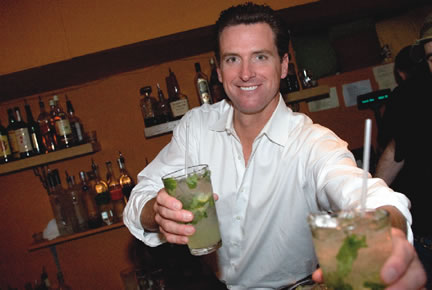
Why won’t Mayor Gavin Newsom save San Francisco’s nightlife and culture? That question was raised toward the end of this week’s cover story on party-crashing cops, but it’s worth highlighting here because Newsom seem uniquely suited to the task of mediating this damaging dispute.

Newsom owned a restaurant and bar before being elected mayor with the strong support of the San Francisco Police Officers Association. The business community is one of his key constituencies, and he constantly talking about the need to promote tourism, which relies on our cultural vitality. He’s the most natural, logical bridge for this divide.

That’s why attorney Mark Webb, who represents several clubs and individuals who have been harassed by SFPD Officer Larry Bertrand, has explicitly been calling for Newsom to get involved.

“I really believe his involvement could help us get to a place of calm,” Webb said. “We have to stop this petty infighting and we have to embrace the cause, which is to make San Francisco’s nightlife an inviting environment.”

DNA Lounge, which is not part of Webb’s lawsuit but has been fighting against harassment by Bertrand and the ABC, also wants to see Newsom broker some peace talks. 

“Absolutely, Gavin certainly has the juice to deal with this problem and we would welcome his involvement,” DNA general manager Barry Synoground told us. “We don’t know why there is such vehemence against nightlife and entertainment…What kills me is we have a large group of responsible purveyors, but we’re not being treated as such. We’re being treated like criminals.”

But Newsom has resisted the call, with his press secretary Tony Winnicker telling us, “I wouldn’t rule it out, but the mayor has department heads for that reason,” saying he preferred for Police Chief George Gascon to tell with it. But the problem is this isn’t a police issue, it’s a political one.

DNA Lounge (which has reguarly blogged the crackdown) has highlighted how SFPD Commander James Dudley sees nightlife in the city: as a nuisance to be abated, rather than an important culture to be embraced and celebrated. Winnicker claims that Newsom understands this: “The mayor understands the importance of a vibrant nightlife.”

But that understanding hasn’t translated into official city policy. Attorney Mark Rennie, who handles permitting and compliance issues for about 40 nightlife and culture clients, said that San Francisco has become notorious for making life difficult for club owners and other purveyors of fun. 

“The city has always had this love-hate relationship with nightclubs. But it’s really bad now,” Rennie said, noting how welcoming other local cities are toward nightclubs, which are important economic drivers. “Berkeley gets it. Oakland gets it. I don’t know why San Francisco doesn’t get it.”

Which is strange because, of all people, Newsom should get it. He should understand the natural tension between certain elements of both the police and nightlife communities and, valuing them both, try to find a way to solve this problem. So whatdaya say, Gavin? After you’re done try to clean up the mess you created with the labor unions, how about stepping in to address a problem that is closer to your sweet spot?


Image by Luke Thomas/Fog City Journal

Our Weekly Picks

0

>>WEDNESDAY 24

MUSIC

Mi Ami

I’m thankful for Mi Ami. Without the SF band that is two thirds ex-Black Eyes members, I’d be more wistful about that band’s untimely collapse. Listening to Mi Ami is like visiting an old friend; it’s even the next logical step in the evolution of that unmistakable Black Eyes sound. Sure, there are lots of drums and rhythmic bass, and the squealing vocals of Daniel Martin-McCormick are one-of-a-kind, but Mi Ami’s songs are longer, more about repetition and atmosphere. With a sophomore LP due this spring, Mi Ami’s abrasive sound isn’t ever going to snag an MTV spot — but they’ll always have a reliably loyal following of listeners to show for it. (Peter Galvin)

With High Places and Protect Me

8:00 p.m., $10

Rickshaw Stop

155 Fell, SF

(415) 861 2011

www.rickshawstop.com


EVENT

“Luna Negra: A Night of Performance for and by Women”

It’s only right that during Women’s History Month, we sit down and listen to writers like Roxanne Dunbar-Ortiz. Born to a landless father/farmer and Native American mother in Oklahoma, Dunbar-Ortiz built a life around supporting the struggle of the disenfranchised. She protested the Vietnam War and played major roles in the Native American civil rights movement and publicizing U.S. treachery against the Sandinistas during the contra war. She’ll be joined onstage by other spoken word voices, Afro-Caribbean music, dancers, an Ecuadorian curandera, and not one Y chromosome. (Caitlin Donohue)

7 p.m. , $5–$7

Mission Cultural Center for Latino Arts

2868 Mission, SF

(415) 643-5001

www.missionculturalcenter.org


>>THURSDAY 25

EVENT/MUSIC

Healing Haiti: An Evening of Arts and Culture

The Haiti benefits of recent weeks often bring together more talented artists than you’d normally find on a single bill. This one is no exception. The Berkeley label Wide Hive (celebrating its 10th anniversary) and the music workshop Own the Mic are uniting with the Element Lounge to put on a show that includes everything from belly dancing to new Bay Area R&B, with gift baskets and raffles thrown in. Tribal Mystics will bring the belly dance, while the music lineup includes DJing by Matt Cali and vocal turns by new voices Alexis Rose, Charito Soriano, Yvette Plant, and Guardian writer Lilan Kane. Radio mainstay Jamillions is one headliner — all proceeds go to Yele Haiti. (Johnny Ray Huston)

9 p.m., $5–$7

Element Lounge

1028 Geary, SF

(415) 440-1125

www.ownthemic.org/healing-haiti


DINE/EVENT

Querido Viejo Tequila Tasting Event

At some point, everyone has a bad run-in with tequila. It could be downing too many margaritas at your coworkers’ wedding or putting back shots because your friends thought you “weren’t quite drunk enough.” We all know this stuff is strong and not to be messed with. Fortunately, Querido Viejo Tequila is offering a tasting where you can actually enjoy the flavors and aromas and not feel pressured to pound one right after the other. This local distiller has been fermenting pure agave for years and is sharing its new line of hooch. The Terrace Room’s 180-degree view overlooks Lake Merritt, so be sure to bring a camera and enjoy the sunset. But remember: pace yourself. (Elise-Marie Brown)

6 p.m.; $2 tequila, $5 appetizer

Terrace Room

1800 Madison, Oakl.

(510) 903-3771

www.theterraceroom.com


MUSIC

Ana Tijoux

As one of Chile’s most respected lady MCs, Ana Tijoux is different from the summery South American songstresses who often breeze through town. Born into exile, Tijoux began life in France, where her Chilean father and French mother fled during Pinochet’s cruel regime. As a teenager, she returned to her father’s homeland and quickly found a home in Santiago’s burgeoning hip-hop scene. It was there that she earned her cred as a conscious “rapera.” Her upcoming solo release 1977 (Nacional Records) drops lyrics that reflect on the year of her birth, and that unique moment in Chile’s turbulent history that heavily influenced her own. (Mirissa Neff)

With Funky C and Joya; DJ set by Juan Data

8 p.m., $12–$15

La Peña Cultural Center

3105 Shattuck, Berk.

(510) 849-2568

www.lapena.org


>>FRIDAY 26

MUSIC

Nite Jewel

She pops in a blank 8-track cassette and takes a deep breath before pressing the ‘Record’ button. Romona Gonzalez, the L.A. lady behind Nite Jewel, insists on making and mixing her sound with old gadgets. She hits play on another deck, letting the beats of early ’90s hip-hop and R&B reverberate on the speakers, while her fingers plunk out lace-lined synth-sounds. Nite Jewel is absolutely ideal for a hazy discotheque or any smoky bedroom with glowing stars on the ceiling. Gonzalez sings and the ghostly melodies bounce and swirl, pulling listeners into a desirable, hypnotic state. She is Debbie Deb, Bronx pop, and alternative disco all at once, layering sounds and personalities that pulse and push, yet still manage to relax and soar. (Amber Schadewald)

With Neon Indian, DJ set by Jonas Reinhart

9 p.m., $15

Mezzanine

444 Jessie, SF

(415) 625-8880

www.mezzaninesf.com


DANCE

Ballet Folclorico de Mexico de Amalia Hernandez

Ballet Folclorico de Mexico de Amalia Hernandez is one of the best in the grand tradition of researching indigenous dances and adapting them to the proscenium theater. It’s also a legendary family-run institution led by the daughter of anthropologist/dancer Amalia Hernandez, who founded the company in 1951. The dances still encompass a wide spectrum of the Mexican experience: an initial quasi-mystical encounter between Aztec gods and humans, the struggle for independence; and the carnivals associated with religious festivals. But they also include choreographies inspired by such mundane activities as games, hunting and wedding rituals. (Rita Felciano)

8 p.m., $25–$65

Marin Veterans Memorial Auditorium

10 Avenue of the Flags, San Rafael

(415) 499-6800

www.marincenter.org


FILM/SEX

Too Much Pussy! Feminist Sluts in The Queer X Show

What do you get when you put seven ladies — musicians, artists, activists, sex workers, and porn stars — in a van and send them around Europe with the duty to discover the line between art and pornography? You get Too Much Pussy, a sex-positive road movie by Emilie Jouvet. The camera follows the group of radical women in and out of nightclubs in Paris, Berlin and Stockholm during the summer of 2009. They span sexual (dis)orientations and gender expressions and the experiences they gather are just as diverse: political, inspiring, sexy and frustrating. Chat up two of the stars, Madison Young and Sadie Lune, after the film for even more dirty secrets. (Schadewald)

8 p.m., $10–$15

Femina Potens

2199 Market, SF

(415) 864-1558

www.feminapotens.org


>>SATURDAY 27

MUSIC

Audio Alchemy: Kid Koala

Who doesn’t love Dan the Automator? From Dr. Octagon to Handsome Boy Modeling School, Loveage, and Deltron 3030, this guy is one of our favorite DJs. Fess up. He is. And here’s another reason to love: he’s presenting Kid Koala in Audio Alchemy, a bimonthly mixing of live music with top DJs at Yoshi’s. Yoshi’s has been been on some other for a minute now. Last year’s sessions with 9th Wonder, Black Quarterback and Manicato in the front room; Alan Marshall, De La Soul, Gil Scot Heron, and Amiri Baraka in the auditorium; swank mixers thrown by the dandies at Brooklyn Circus — they’ve got a tight off-hours scene. One that seems to be fusing together some tastier elements of our desolate culture. (D. Scot Miller)

With DJ Shortkut and the Jazz Mafia All-Stars

10:30 p.m., $20

Yoshi’s SF

1330 Fillmore, SF

(415) 655-5600

www.yoshis.com


DANCE

ODC Pilot 56: “My Young Nostalgic Life”

ODC’s Pilot program showcases are a deal for audiences who like the thrill of discovery. They’re also a break for young choreographers, who get 11 weeks in a supportive environment to create work even as they learn ancillary skills such as marketing, program design, and production and box office management. Since the first Pilot in 1990, close to 300 choreographers have gone through this gentle boot camp. Pilot 56 features six women who collectively decided that “My Young Nostalgic Life” best describes ideas they want to explore through dance. (Felciano)

8 p.m. (also Sun/28, 5 and 8 p.m.), $12

ODC Commons

351 Shotwell, SF

(415) 863-9834

www.brownpapertickets.com


MUSIC

Soweto Gospel Choir

Times are tough in Soweto. Fault me for stating the obvious to provide context for the Soweto Gospel Choir. Are they joyful? Yes. Are they melodious? Uh-huh. Do their voices meld from ululatory to raspy to soaring to proud to a blend of gospel noise and traditional African rhythm? Do audiences come away clapping and laughing and smiling fit to beat the band? Sing it! Part of the group’s elation may have to do with the runaway success of their mission — providing shelter and hope to AIDS orphans in their home communities. So far they’ve toured the world performing for some pretty receptive big dogs — Nelson Mandela, Oprah and Archbishop Desmond Tutu, to name a few. (Donohue)

8 p.m., $25–$65

Paramount Theatre

2025 Broadway, Oakl.

(415) 575-6100

www.ciis.edu


EVENT

Pearls Over Shanghai Kabuki Makeup Class

If the only knowledge you have of Kabuki makeup comes from Memoirs of a Geisha, don’t droop your head in embarrassment — instead, take a class on the traditional Japanese art form. RetroFit Vintage is offering a chance to educated the misinformed or the curious on what it takes to create the perfect Noh heroine. Kegel Kater will apply the makeup for her role as a whore, angel, and lotus dancer in Thrillpeddlers’ Pearls Over Shanghai. (Brown)

3–5 p.m., free

RetroFit Vintage

910 Valencia, SF

(415) 550-1530

www.retrofityourworld.com


EVENT

Muchas Voces Una Vision/Many Voices One Vision”

What is the function of a poet laureate, exactly? I’m fairly certain I’ve never seen one designing fanciful special boards for the neighborhood diner, or doing anyone’s English homework. How can we put these decorated people of the pen to work? Happily, the dilemma is being resolved in fine fashion this weekend, when SF’s official bards past and present join forces and rattle off original lines to benefit the people of Haiti. Catch readings by poet laureate Diane di Prima and her predecessors Devorah Major and Jack Hirschman. They’ll be joined by more than 30 other artists. (Donohue)

7 p.m. , $10 (suggested donation)

La Peña Cultural Center

3105 Shattuck, Berk.

(415) 849-2568

www.lapena.org


>>MONDAY 29

MUSIC

Nellie McKay

You probably didn’t see it coming, but now that Nellie McKay’s As Normal as Blueberry Pie: A Tribute to Doris Day (Verve) is out, it’d be tough to come up with a more suitable pairing. Musician, comedienne, actress — if there’s one thing McKay isn’t, it’s predictable. But who knew she’d pay genuine homage to one of the swinginest singers of the 1950s? Setting aside her often self-depreciating wit, McKay reintroduces Day to a new generation of fans with irresistible exuberance and charm. To make it a truly classy affair, the Great American is going for the sit-down experience. (Galvin)

With Howard Fishman

8:00 p.m., $21

Great American Music Hall

859 O’Farrell, SF

(415) 885-0750

www.gamh.com


MUSIC

Taylor Texas Corrugators

As founder and leader of legendary Southern California punk rockers Black Flag — he started the band and its record label, SST — Greg Ginn has earned his place in the DIY underground pantheon. The famously hard-working artist has never been complacent, and he comes to the city tonight with his new project, the Taylor Texas Corrugators. The Corrugators finds the guitarist leaning in a more Western swing direction, but, as always, with a host of other musical influences thrown in to keep things evolving. (Sean McCourt)

With Guella and Barney Caldron

8 p.m., $10

Red Devil Lounge

1695 Polk, SF

(415) 447-4730 www.reddevillounge.com


* The Guardian listings deadline is two weeks prior to our Wednesday publication date. To submit an item for consideration, please include the title of the event, a brief description of the event, date and time, venue name, street address (listing cross streets only isn’t sufficient), city, telephone number readers can call for more information, telephone number for media, and admission costs. Send information to Listings, the Guardian Building, 135 Mississippi St., SF, CA 94107; fax to (415) 487-2506; or e-mail (paste press release into e-mail body — no text attachments, please) to listings@sfbg.com. We cannot guarantee the return of photos, but enclosing an SASE helps. Digital photos may be submitted in jpeg format; the image must be at least 240 dpi and four inches by six inches in size. We regret we cannot accept listings over the phone.

Past, present, future

0

arts@sfbg.com

MUSIC Am I the only one who feels an overwhelming sensation of near implosion when listening to Flying Lotus? I’m not talking about Steven Ellison’s crackling, low-end production that leans on off-kilter percussion while swerving on warm synth melodies like the late great J Dilla tipping on trucks (although that liquidic soul is mad electrifying too). Ellison also summons this other lunatic style that seeps into my android brain right when I least expect. It’s a sort of smattering mercury-noise that builds to the point of maximum intensity and then falls away suddenly, disclosing a clearing of purplish-orange haze.

All that cyberkinetic production, however, works in tandem. Ellison’s gift is not so much that he can shock and awe with singular frenetic beats, but that he can craft a holistic mood that engages, holds, and in the thick of its hypnotic momentum, casts an entrancing spell. I’d make the case that the effect is a movement of dislocation and reembodiment, parallel to the transcendental objectives behind experimental forms of both spiritual and space jazz recorded in the late 1960s and ’70s. There’s no question that Ellison channels the celestial blood of Alice Coltrane (his great-aunt and perhaps greatest muse) in his testament. And just as those avant-garde jazz legends made headway finding musical freedom within intergalactic space-ways (the infinite within), Ellison charts something of a fractured spatio-temporal exploration himself.

I’m going to take a leap (if you will allow a journalist such an experiment) and tentatively pretend that the titles for Fly Lo’s records map the spiritual blueprint shaping his music. We’ll see if we can make some progress with this approach.

Ellison’s first full-length record, 1983 (Plug Research, 2006), marks the temporal origin of the 27-year-old and a return to a certain aesthetic sphere of possibilities. Ellison graces this effort with video game bleeps and zaps, that stark retro-futuristic sound of 1980s sci-fi film and monstrous joystick machines. But the drenched robotics nourishing “Massage Situation” and the warped sonic bits that weave through arresting drum programming in “Vegas Collie” don’t mine nostalgia. Instead, Ellison recontextualizes familiar sounds in magnetic ways, breathing life into vacuous drones from the past. History is revived to reimagine the future and overlay a richness of sensual value onto the present.

In 2008, Flying Lotus made ground with Los Angeles (Warp), a pioneering effort that won the ears of hip-hop heads, pitch-forking indie rockers, and electronic bass fiends/geeks alike. The record seems to have quickly become one of those pivotal works of art that serve as a reference point for nearly everything new school in electronic music. And Los Angeles, the city itself, the last stop on the New World’s burdened journey for Manifest Destiny, has also become such a symbolic environment for today’s musical wanderers. It’s a city of tense contradictions: endless opportunity and suffocation, cosmopolitan diversity and isolating segregation, an artificial neon-lit haven placed in a sun-choked desert by the sea. It’s not so different perhaps from that Old Word paradise mucked with broken dreams — Jerusalem. Such is the spatio-origin and milieu for Flying Lotus’ second full-length, as we hop on a sizzling “Camel” and “Melt!”; disintegrate into fuzz-drenched traffic on “Orbit 405”; and open our new metallic bodies in the whirlwind swamps around a “Parisian Goldfish.”

The third record on the horizon, Cosmogramma (Warp), set for release in the U.S. on May 4, breaks away from particular spatio-temporal signifiers to reach for the universal. Ellison baptized the record as a “cosmic drama,” and the title itself suggests nothing less than a grammar of infinitum. The single “Computer Face//Pure Being” is perhaps the best example yet of the antagonistic force that fuels Flying Lotus’ adventurous work. It incites a centrifugal experience — perilous and transformative — out of malfunctioning and utterly animate computer jazz. Yes, the age of machines with soul has dawned.

FLYING LOTUS

With Kode9

Sat/27, 9 p.m., $17.50

Mezzanine

444 Jessie, SF

(415) 625-8880

www.mezzaninesf.com

Shit show

5

By Brady Welch


news@sfbg.com

GREEN CITY Food safety groups complain that the San Francisco Public Utilities Commission has until recently been dumping its crap in the backyards and gardens of any residents who unwittingly asked for it.

The city calls this crap “biosolids compost,” and for Mayor Gavin Newsom and the SFPUC, it seemed like a green dream come true. But it turns out that putting processed human excrement into people’s vegetable gardens might not be the elegant — if somewhat gross — reuse strategy it once seemed to be.

The vexing sewage sludge left over after treatment and separation of the city’s wastewater was being treated, combined with woodchips and paper waste, and labeled compost so it could, according to the SFPUC’s Web site, “provide essential plant nutrients, improve soil structure, enhance moisture retention, and reduce soil erosion.” Not bad for the ultimate human waste product.

The problem, say groups including the Center for Food Safety and Organic Consumers Association, is that the SFPUC’s compost contains a host of other toxins and hazardous materials not necessarily originating with what the city’s granola-munching denizens flush down the toilet. In fact, a January 2009 Environmental Protection Agency study of sewage sludge from 74 treatment plants found, in nearly every sample, “28 metals, four polycyclic aromatic hydrocarbons, two semi-volatiles, 11 flame retardants, 72 pharmaceuticals, and 25 steroids and hormones.” Yikes.

“You name it, it’s in there,” John Mayer, said spokesperson for the Organic Consumers Association. The compost “is hazardous waste, and it’s absurd to claim that it’s safe to consume. No matter what the sludge processing industry claims, it is by definition dangerous.” The EPA report would certainly seem to support Mayer’s claim, except that it expressly stops short of doing just that, stating that the results “do not imply that the concentrations for any [substance] are of particular concern to EPA.”

Then again, it was the EPA that started promoting the use of biosolid compost in the first place, back in 1978. The only safety thresholds the agency sets for biosolids compost concern nine heavy metals and the elimination of pathogens — none of the flame retardants, steroids, semi-volatiles, and carcinogens found in their study — a standard that has remained largely unchanged for a decade.

But that’s only part of the story, because as it turns out, San Francisco’s sewage sludge isn’t that contaminated compared to the shit generated in other regions. “We found in our tests that it’s really low for all the emerging pollutants,” SFPUC spokesperson Tyron Jue told us, citing data listed on its Web site indicating that testing goes beyond what the EPA requires, and even beyond more stringent European Union standards. Jue even said that the SFPUC’s biosolids compost has “metal limits lower than in a daily vitamin, and lower or comparable to store-bought compost.”

Yet Paige Tomaselli of the Center for Food Safety understands the data differently. “San Francisco may test above and beyond the national standards. They may think their testing is green. But the truth of the matter is that that the compost they’re giving away is not generated here in San Francisco.”

Indeed, the sewage sludge the SFPUC tested is not the same stuff it was handing out for three years as “organic biosolids compost.” After the organic food industry complained, the utility recently dropped the “organic” designation, offering the admittedly sheepish defense that the label was meant to imply “carbon-rich,” a definition that would make, among nearly everything else, the Guardian you hold in your hands organic.

Jue told us that the utility spends over $3 million annually on its biosolids program, $500,000 of which last year went to contracts with Synagro, “the largest recycler of organic residuals in the United States,” according to its Web site. The compost in the SFPUC’s giveaways came from the corporation’s Central Valley Composting Facility in Merced County, where it was mixed with sludge from at least eight other counties, including municipalities whose safety requirements are nowhere near as stringent as San Francisco’s.

“The vast majority [of sludge] comes from Fresno,” Tomaselli said, adding that the SFPUC continues to cite its own numbers, “completely ignoring the fact that this sewage sludge comes from a city with agricultural and industrial toxins that may be going into the waste stream.”

Many of those toxins remain in the “compost” San Franciscans have been applying to their tomato plants. “You can cook it all day,” Mayer told us. “Those things aren’t going anywhere.”

Both OCA and CFS say that, given such a broad avenue by which toxic material could enter the SFPUC’s compost, the SFPUC is violating San Francisco’s environmental standards. For example, the opening chapter of the Environment Code for the City and County of San Francisco explicitly states that all members of the city’s government should employ the “precautionary principle” in conducting its affairs, requiring the city to err on the side of caution in environmental policy.

One sentence in particular would seem to address biosolids and the 2009 EPA study specifically: “Any gaps in scientific data uncovered by the examination of alternatives will provide a guidepost for future research, but will not prevent the city from taking protective action.” And in the case of so-called biosolids, protective action would seem to call for keeping this shit away from food.

Hugh Kaufman, a senior policy analyst at the EPA and founder of the Superfund program, flatly stated to us over the phone that “there’s no scientific consensus that this stuff is safe. They test less than 1 percent of the stuff that has been tested to be in it.”

The health effects of even that 1 percent can be alarming. Of the nine heavy metals the EPA tests for, chromium is a known carcinogen and mercury can cause permanent nervous system and kidney damage. But if that stuff doesn’t kill you, prolonged exposure to low levels of arsenic, another heavy metal, “can cause a discoloration of the skin and the appearance of small corns or warts,” according to the federal Occupational Safety and Health Administration Web site.

Considering that Kaufman works in the Office of Solid Waste and Emergency Response (as apposed to the Office of Water that oversees biosolids), we asked him how and why his own employer is encouraging the land application of something so potentially hazardous.

“I think it’s very similar to the reason why the government doesn’t ban naked credit-default swaps. You’ve got a situation here where the cheapest way to dispose of the sludge is land application,” he said. By giving away the sludge as compost, as San Francisco has been doing, “you can transfer liability from the government to the public where the stuff is ultimately dumped. There is tremendous economic pressure to keep the ball rolling in the same direction.”

A February 2008 ruling of 11th Circuit Court of Appeals would seem to bear this out. The case involved the McElmurrays, a family of farmers that allowed the city of Augusta, Ga., to apply biosolids on their land from 1979 to 1990. The sludge eventually poisoned their crops and even the cows who fed on them.

Citing Augusta’s lack of disclosure about the noxious effects of the sludge, the McElmurrays sought compensation subsidies under a 2002 Farm Bill, going first to the county, then the U.S. Department of Agriculture’s Farm Service Agency, a state-level agency. After a number of back-and-forth denials and delays, the matter was appealed to the national USDA, which then sought the EPA’s advice for their ruling.

The court found that the series of opinions the EPA subsequently issued were unrelated to the case before the USDA and were nevertheless based on Augusta’s faulty land application data. “In short,” the ruling’s conclusion states, “it appears that the only persons to consider [the McElmurrays’] applications ended up ruling in their favor…. The USDA’s decision to accept a contrary decision, based on no review of the applications by the EPA, was arbitrary and capricious. The conclusions of the EPA were not based on substantial evidence.”

As for SFPUC’s biosolids giveaway, “They wanted a program that would green-wash this dangerous substance,” Mayer told us. “And they participated in this ruse for the benefit of Synagro. Even the mayor got pulled in.”

Tony Winnicker, the spokesperson for the SFPUC before becoming Newsom’s press secretary in January, told us the idea behind the program was a good one. “The spirit behind this is right, in terms of reuse and sustainability,” he said. “This was one of the PUC’s environmental initiatives from the beginning, and the mayor supports the agency’s efforts at environmental sustainability.”

But Winnicker said he was not aware that San Francisco’s well-tested biosolids were being mixed with those of other areas, and that Newsom would defer to SFPUC experts on how to handle the situation.

“I have no doubt that they tell people it’s biosolids compost,” CFS’s Paige Tomaselli told us. But she echoed the 11th Circuit court’s findings when she added, “On the other hand, I don’t think people know what that entails.”

This could be why SFPUC recently suspended the compost giveaways. “We’re reevaluating,” Jue told us. “What we’re trying to do is take a step back. We’re always looking at all the new information presented in front of us.” As for the utility’s record of disclosure, “We’ve always been very transparent with everyone coming to pick up compost. This is bringing awareness to an issue people don’t want to think about. [Sewage] doesn’t disappear. We have to think about it.”

So what’s to be done? Newsom has pushed San Francisco to the national forefront in sustainability and generating zero waste. Unfortunately, “they’re part of the wrong side of the sludge game,” said EPA’s Kaufman. “Is it possible to manage it better? Yes. Is there a black box to spin gold out of hay? No. Can one be invented in the future? Maybe.”

Kaufman found quite a bit of potential in the city’s successful green-bin composting. “San Francisco collects biodegradable waste material, good waste material, that can make very good compost,” he noted. “It’s not made from industrial waste; it’s made from real organic material. That’s not what the giveaway compost is made from. If San Francisco had taken what homeowners had put in for recycling and composted that and given that away, that would be fantastic.”

It would certainly have been better than the shit it has been giving away.

Mutaytor records album in iconic SF house

2

Recently in San Francisco, a unique and iconic band recorded an album in a unique and iconic house, and the two entities seemed to resonate beautifully.

Mutaytor might be the ultimate Burning Man tribe, an eclectic group of Los Angeles-based performers who came together in the event’s Black Rock City more than a decade ago, forming into a band that’s like a traveling circus that evangelizes the burner ethos and culture everywhere they go, just by being who they are: sexy, scruffy, wild, warm, colorful denizens of the counterculture. 

Mutaytor is perhaps the most popular and emblematic musical act to emerge from Burning Man, a group whose spirited performances on and off the playa reflected and helped to shape and define the culture that birthed them. And if that’s not enough cultural cred, many of the two dozen members work for Burning Man in various capacities, from building Black Rock City with the Department of Public Works to forming the backbone of event’s regional network in Los Angeles. 

My path has crossed Mutaytor’s many times, from watching them play at my first Burning Man in 2001 to joining them on the burner-dominated Xingolati cruise ship in 2005 to being invited on the weekend of March 13, 2010 to watch them record their fourth album, “Unconditional Love” in the sprawling Westerfeld House, a Victorian mansion on San Francisco’s Alamo Square that is the legendary former home to such countercultural figures as Satanist Anton LaVey and members of the Manson family to noted ‘60s promoter Chet Helms’ Family Dog Productions and the band Big Brother and the Holding Company.

Today, the house is owned by Jim Siegel, a longtime Haight Street head shop owner and housing preservationist who did a masterful job at restoring this place, showing a striking attention to detail. Siegel owns the Distractions store on Haight Street, one of the few walk-in outlets for buying Burning Man tickets, and became a friend of the Mutaytor family in 2004.

“It all started with a guy crush that I had on someone in the band,” Siegel said, noting how that evolved into a real friendship with the whole band, which he’s hosted many times in his sprawling, 28-room house with the colorful history. Although the dancers and other women who perform with Mutaytor weren’t at this recording – Siegel said they usually prance around the house topless and lend a debaucherous energy to Siegel’s house – he still loves the energy that the band brings when they invade his house: “It reminds me of my hippie days living in communes.”Jim Siegel (left), Buck Down (center), and bassist John Avila (right) take a break.

Jim Siegel (from left), Buck Down, and bassist John Avila (formerly of Oingo Boingo) take a break.

Buck A.E. Down – a key band member, singing and playing guitar, as well as producing and arranging their songs – said the album and accompanying documentary film is Mutaytor trying to build on a career that began as basically a pickup group of musicians and performers on the playa.

“We’re a total product of that environment,” Buck said of Mutaytor’s musicians, dancers, acrobats, fire spinners, aerialists, hoopers, thespians, producers, culture mavens, and facilitators of the arts. While there were nine musicians that played on the latest album they recorded in San Francisco, their full crew is more than triple that number.

“We’ve been underground for 10 years and have a voluminous body of work,” Buck said, talking about the decision to take their three albums worth of songs and other material they’ve developed in live shows and put it all into a new album before adding wryly, “You can’t really call it a greatest hits if you’ve never really had a hit, can you?”

But the band itself has been a huge hit everywhere it’s gone, particularly cities where Burning Man is popular. Buck said that around 2002, rock bands were starting to die out in the Los Angeles area, but the rave scene was still going strong, with DJs packing people into big venues, both underground and clubs. So the members of Mutaytor started to plug into that scene, which was already drawing energy from Burning Man, the event they know so well.

“We knew that the first band that could penetrate the rave scene was going to make it,” Buck said, noting that the tactic worked, with the ravers drawn to their mix of electronica-infused music and performance art. “So, between that and Burning Man, we developed just a ravenous following.”

With this built-in fan base of burners and ravers, Mutaytors was able to start getting gigs in the clubs of Hollywood, San Francisco, and other cities that had significant numbers of people who attended Burning Man.

“We became a very recognizable and tangible part of that culture,” Buck said, noting that burners sought out Mutaytor to plug into the vibe of Black Rock City, if only for a night in their cities. “What we were able to do is provide that vibe.”

Christine “Crunchy” Nash, Mutaytor’s tour manager and self-described “den mother,” said that Burning Man founder Larry Harvey has been very encouraging and supportive of Mutaytor, urging them to essentially be musical ambassadors of the event and its culture. “That’s one thing Larry said to us is I want to do this year round and that’s what we’re doing in LA,” Crunchy said. “Most of the people in the band have been going to Burning Man for more than 10 years.”

Buck added, “We’re like the Jews, the wandering Jews,” which totally cracked up the group, but I understood what he meant, particularly as he went on to explain how the burner tribes are scattered through the world, but they retain that essential cultural connection.

Particularly down in Los Angeles, where the Mutaytor crew regularly works and plays with other Burning Man camps, from the Cirque Berserk performers and carnies to longtime members of my own camp, Garage Mahal, Crunchy said their extended tribe really is a year-round, active community of burners.

“It really is like we are there in LA and we just pick up and move to the playa,” she said.

Crunchy said they have family-like connections in San Francisco – to such businessman-burners as Jim Siegel and JD Petras, who both have sprawling homes where the band can stay – and in cities around the country that have big, established Burning Man tribes, from New York City to Portland, Oregon.

“It’s the movers and shakers of the San Francisco community and others that have allowed us to survive as we’ve tried to make it,” Crunchy said. “It’s made traveling so much easier because we have places to stay at many places we play.”

Buck said that was essential to their survival: “You take that kind of culture away from Burning Man and we would have broke up a long time ago, or we wouldn’t have even formed.” Just as Mutaytor is rooted on the playa, its members also wanted to root this album in a special place and immediately thought of the Westerfeld House.

“There are just places where stuff happens, just certain environments that are special places,” Buck said, citing of the house’s notable past residents, from rock stars to Satanists. “What’s interesting here is the particular blend of eclectic thinking.”

Buck said Mutaytor is made up of musical professionals – from session players to sound guys at venues like the Roxie and for concert tours — and they have three recording studios at their disposal among them, but they chose to do the recording here because it felt magical and personal to them.

“We had an epiphany on the road and decided we just had to record it here,” Buck said, adding how well the decision has worked out acoustically. “Rather than just recording the band, we want to record the house. That’s how we’ve been miking it up.”

Each room on the group floor was filled with musical instruments and recording equipment, and Buck said excitedly that they have been resonating with this 120-year-old building: “We’re getting some of the best tones.”

Mutaytor is trying to carry over into a new era just as Siegel is closing a chapter on an old one. He was one of the original head shop owners on Haight Street, but he says that he’s unhappy with the combination of commercialism and NIMBYism that have overtaken his neighborhood so much so that he’s choosing to close up shop.

“The Haight is dead now, it’s over,” said Siegel, who plans to close Distractions at the end of August, right before Burning Man, and reopen a new business in the thriving, culturally rich Mission District. “I’ve run that store since 1976, so it’ll be a big change in my life.”

Prop 17 discourages going car-free

6

Efforts to encourage car-sharing and ways of getting around that don’t involve owning a car would be undermined by Proposition 17, a June ballot measure that I wrote about in this week’s cover story. While I didn’t mention that impact in the story, it is of real concern to people like me who don’t own cars and encourage others to try the car-free lifestyle on for size.

The measure, sponsored by Mercury Insurance, allows companies to substantially increase monthly premiums on customers who haven’t had continuous insurance coverage. That would be one more barrier to people making the leap of faith to give up their cars and rely on bicycles or public transit, a switch that ought to be encouraged in increasingly traffic-congested cities such as San Francisco.

As I wrote about in another cover story last year, I made the decision several years ago to give up my car, although I still sometimes rent cars to visit my children. Consumer advocates say the cost of renting cars or using car-sharing services – particularly locally owned companies that can’t self-insure like the corporate behemoths – could increase and there would be a disincentive to consider trying it.

 “Anyone who has used car sharing (or for that matter rental cars) as their means of transportation would almost certainly not be considered continuously insured and would face the Prop 17 surcharge if they had to go back to private insurance at some point,” Doug Heller, an insurance expert with Consumer Watchdog, told me.

Currently, the law allows insurance companies to issue discounts to those who have maintained continuous policies with them (Prop. 17 would expand that to allow drivers to change companies and keep their discounts, which would be offset by surcharges on customers who were new or had a lapse in their coverage), and those companies use that discount to actively try to discourage people from experimenting with car-free lifestyles.

Brian Smith, who works for an environmental nonprofit in Oakland, recalls getting that kind of hard sell when he made the leap and got rid of his car.

 “When I cancelled my car insurance, AAA warned me not to. They said, ‘We will make it much more expensive when you come back.’ I said, ‘I sold my car, I don’t need car insurance.’ They said ‘We are just giving you a warning, Sir.’ I said, ‘Cancel it you fucking bastards. I’m never coming back.’ That was 10 years ago.’” Smith wrote to me about the issue.

Proponents of the measure say it would save some drivers $250 per year, while opponents (citing data from Mercury) say the surcharges for everyone else would be about $1,000 per year. So for the soldiers who go off to boot camp, the college students who get an internship in a city with good public transit or bikeways, unemployed individuals who need to trim expenses, or people who want to experiment with going car-free, they would all pay for more for insurance if they went back to driving a car than those who continuously maintained a car-dependent existence.

So, add this to the list of good reasons – and there are many of them in this week’s cover story — to oppose Prop. 17. 

Light into darkness

0

arts@sfbg.com

MUSIC High Places’ upcoming release High Places vs. Mankind (Thrill Jockey) opens with the slow-tempered "The Longest Shadow." The chorus offers a supine first-person perspective of the sun’s effect on the earth at dusk. The first verse focuses on letting love in, but by the second verse Mary Pearson’s lyrics narrate the end of a relationship, which includes that universal nostalgia (a.k.a. confusion) of not really knowing why a relationship terminates, and includes the ritual stages of longing, wondering, and finally, remembering.

High Places’ music is designed to be lost in; it infiltrates and instigates meditation, but it also manages to keep the listener constantly moving. That’s how good the beat is as it weaves in and out of Pearson’s vocals. When the second track "On Giving Up" begins, it’s hard to determine if Pearson’s extending the last poem, and is talking about the actual breakup night, or if she’s talking about quitting cigarettes, booze, or some addiction, as she sings: "It’s all because I feel everything that’s gone. It’s all gone. Well, tonight is going to be the night." But that ambivalence is part of the charm, allowing the listener to relate and reflect.

Pearson and Rob Barber are High Places. The pair explored the natural world on the 2008 compilation 03/07-09/07, and on their self-titled album from the same year (both on Thrill Jockey). But on High Places vs. Mankind, there is a clear shift toward "humanity," as Pearson defines it, "for lack of a better word."

Weather — the hot, the cold — as well as spatial relationships, and differences, have a large impact on how we as humans live and operate. The band moved from New York to Los Angeles roughly a year ago. "We really had no good reason to, other than the weather," Barber says when I ask him over the phone why they decided to move. L.A. literally exists because it averages 320 sunny days a year, which made it the ideal location to film, and thus Hollywood emerged. After settling down in L.A. and taking a pause from touring, the duo suddenly had a great deal more space and time. They began writing and recording. But curiously, the warmth, space, and time led to icier sounds and darker themes in its new recording.

Pearson explains that High Places’ music made in New York "is based on escapism and trying to create our ideal environment. But because it’s so beautiful in L.A. all the time, we don’t need to talk about that stuff quite as much." This allowed the band to explore new ideas.

On High Places vs. Mankind, the blissed-out melodies and undeniable dance rhythms along with the complex layering and tidbits of dub are still apparent. But there is more: guitars sounding like guitars, unlike before, when they could’ve been mistaken for steel drums or sitars. And Pearson’s vocals are less affected, allowing them to be vividly heard.

The back of High Places’ self-titled release reads: "recorded at home by High Places." In New York, the band/best friends lived together. "I think that made us write every note together," says Pearson. In L.A., where they no longer share an apartment, they’ve taken a different approach. The pair discovered that they desired different types of workspaces. "I would work at home, and she would work in an outside studio," Barber explains. "We’d meet up and smash it all together. We’d go back and forth with it, responding to each other like call-and-response."

The change in sound is cooler at times, but it is also more direct in its message. "It was much more based on human relationships, and life and death," says Pearson. The album is dark and light at the same time — tragic contemplations are matched with stretched-out synths, as well as those bouncing beats and rhythmic hooks High Places has utilized in the past to keep things airy. The music makes you pause, get lost, question your own mortality, think about your last heartache, and when the daze is over, you feel one step closer to the infinite.

High Places’ forthcoming show will add one more twinge in its exploration of human relationships by including Pearson’s sister Laura on vocals for the first time, and she’ll continue on most of the U.S. tour. Pearson explains that she and her sister have been singing together informally all their lives — "Karaoke," interrupts Barber — and that HP has wanted to include her on tour for a long time now. *

HIGH PLACES

with Mi Ami and Protect Me

Wed/24, 8 p.m., $10/$12

Rickshaw Stop

155 Fell St., SF

www.rickshawstop.com

Hot sex events this week: March 17-23

0

Break out the green latex, St. Patty’s day has unleashed an Irish car bomb of sex events. So whether you’re in the mood to perfect your rub skills, bid high for a quality sub, or land you a chubby hubby, the following events will have you dancing a jig. You know, a sexy jig.

Sex Workers’ writing workshop

No matter if you’re out on the street or breathing heavy on the phone line, if you’re a sex worker, you have a story to tell. Learn the skills you need to bare all (on paper) in the supportive environment of this regular workshop at CSC.

Wed/17 6-8 p.m., $10-20 sliding scale

Center for Sex & Culture

1519 Mission, SF

(415) 255-1155

www.sexandculture.org

– – – – – – – – – – – – – – – –  

Discover the Beauty of your Body: the “Ins and Outs” of Female Masturbation

Breath: essential to life, a calming force, an orgasm upgrade. Learn how your breathing can enhance your self lovin’, and get the inside scoop on technique, toys and ambience from Good Vibes staffer Lolo Winters.

Wed/17 8-10 p.m., $25-30

Good Vibrations

603 Valencia, SF

(415) 522-5460

www.goodvibes.com

– – – – – – – – – – – – – – – –  

Kumimonster’s St. Patty’s Day Massacre

Fetish muse Kumimonster is celebrating her birthday in style- she’ll be performing the American debut of her new bondage routine with Midori and will be accompanied by a full slate of aerial performers, burlesquers and all manner of fetish pleasing wonders.

Wed/17 8 p.m., $10-20

Glas Kat Supper Club

520 4th St., SF

(415) 495-6620

www.glaskat.com

www.fetishmuse.com

– – – – – – – – – – – – – – – –  

Kinky Knitters

So at long last your crocheted ball gag is almost ready- you just can’t figure out that last drop stitch. Blast! Never fear, for this naughty sewing circle at SF’s sex positive coffeehouse assembles just the crafters to ask.

Thurs/18 7-10 p.m., free

Wicked Grounds

289 8th St., SF

(415) 503-0405

www.wickedgrounds.com

– – – – – – – – – – – – – – – –  

Master’s Den Auction

Stefano and Chey, SF’s “king and queen of the perverts,” supervise this male dom- female sub playground, which begins with separate briefings for the sexes on protocol, and features an auction of lovely lady submissives up for sale to their most compatible master.

Fri/19 7:15 p.m.-1 a.m., $20-30

SF Citadel

1277 Mission, SF

(415) 626-1746

www.sfcitadel.org

– – – – – – – – – – – – – – – –  

Jamie Gillis memorial

Jamie Gillis’ memory won’t be fading anytime soon. The 470 pornos he acted in over the course of his life- not to mention his kinky and gonzo directing credits- pretty much guarantee that, but that’s no reason to miss this weekend’s tribute to the man. Bring your video clips and memories to share.

Sat/20 3-6 p.m., free

Center for Sex & Culture

1519 Mission, SF

(415) 255-1155

www.sexandculture.org

– – – – – – – – – – – – – – – –  

Big

Big boys get their due at this monthly party, where the jelly bellies and the boys that love them mix and mingle. Plus, the first half of the night is happy hour!

Sun/21 6-11 p.m., $5

Stud

399 9th St., SF

www.studsf.com

www.phattestevents.com


Sunday Streets returns

13

The first of nine Sundays Streets events — San Francisco’s version of the car-free ciclovias that have caught on in cities around the world over the last few years, temporarily transforming roadways into vital public spaces — was held Sunday (3/14) along the Embarcadero, drawing an impressive turnout on a beautiful day.

Despite some initial resistance to the idea among Fisherman’s Wharf merchants when it started here two years ago, Sunday Streets now seems to be accepted and welcomed by most San Franciscans, even in the once-fearful business community.

Personally, the slightly sterile Embarcadero route was my least favorite route in years’ past, and I think the concept generally works better in areas with more street life, such as in the Mission, where Sunday Streets will be held June 20 and July 11. So I’m happy to see the number of events being expanded this year to include rides in Western Addition and the Tenderloin this fall.

Ecuador natives push Chevron for settlement

4

By Nima Maghame

The Rainforest Action Network, a non-profit organization that protests the pollution and destruction of natural habitats around the world, recently gathered on a bio-diesel bus named Priscilla with Ecuadorian tribal representative Emergildo Criollo and drove to new Chevron CEO John Watson’s home in Lafayette to deliver a petition demanding the company pay for the clean up of Chevron-owned Texaco’s contamination of the Ecuadorian Amazon rain forest.

“Because of contamination in the river, I have lost two sons and my wife is very ill. I have been in this battle for over 10 years,” said Criollo, who has come to the Bay Area on behalf of the Cohan and Siona people of Amazonian Ecuador as well as the organizations Secoya Indigenous Nations and Frente de Defensa de la Amazonia. They are among the local groups battling Chevron in an Ecuador court, seeking compensation and cleanup money.  

The petition, which has been signed by more than 350,000 people from all over the world, never reached the hands of Watson. The CEO was not home when the activists arrived. The Ecuadorian did have a scheduled closed meeting with Chevron executives at the company’s headquarters in San Ramon later that day. He was accompanied by a demonstration outside the corporation’s office, where a dozen RAN members listed off names of petition signers.

“We here at Chevron, believe that this is a great first step towards an ongoing dialogue between Chevron and Ecuador,” said Gary Fisher, Chevron’s Manager of Public Policy, to RAN activists after the closed meeting with Criollo. 

Criollo lived his entire life in a remote village in Ecuador where he saw Texaco – which was later purchased by Chevron — come and go, leaving oil pollution everywhere. Consumer activists reports show that an estimated 30,000 people have suffered from contamination in Ecuador, just one country out of many who have reported illnesses and mutations caused by the reported 18 billion gallons of toxic waste dumped in the region.

“[Chevron/Texaco] chose to use pumping technology that was not as advanced as the drilling technology they use in the states, which pumps excess crude back into the ground, to save two to three dollars a barrel…There is free standing oil in this pristine rainforest. It’s hot and it just boils in the sun. You can touch it, you can smell it,” said Anderson.

Chevron executives claim that the pollution is the fault of the oil company in charge of extraction now, nationally owned PetroEcuador. They also state they have funded up to $40 million in clean up efforts, a claim that RAN believes to be false. The petition calls for the oil company to fund clean up operations in the region and is estimated to cost them more than $16 billion.

“We believe we are very far away from any resolve from this company,” said Criollo.


Dare you take offense at Steven Wolf Fine Arts?

4

Keith Boadwee is a fascinating artist. Known for his outrageous self-portraits — which combine media that include but are not limited to photography, performance art, painting, self-administered enemas, and pornography — his work is unorthodox to say the least. Boadwee has photographed himself in situations that 99.999% of the world would probably rather die (like for real die) than experience for themselves, and he kills himself fearlessly (see NSFW — I repeat NSFW — images on his Web site). Viewing Boadwee’s work in a gallery setting, such as that of Steven Wolf Fine Arts, is like experiencing the collision of someone’s private world with your own public forehead.

Boadwee’s “Denim on Ice” exhibit there — consisting of works he made with his former students Erin Allen and Issac Gray — evokes the demented scribblings of a disturbed child, albeit one with a great sense of humor. In a more hostile environment, these painting would be legitimately disturbing. Seen together as they are, crowded onto a single gallery wall, the effect is still one of something totally crazy, though overall harmless. Even weirder: the paintings in this exhibit, with their wholly unsophisticated content, evoke the high expressionism of artists like Matisse and Muehl. My favorite piece in “Denim on Ice” was the still-life rendering you see above, “Titties and Milk,” a strange composition of breasts, a glass of milk, and a hat-wearing cactus (who has a face).

“Lincoln Log Bong” by Boadwee, Allen, and Gray

The gallery describes “Denim on Ice” as “paintings that take low humor and bad taste so far they come around again as refinement.” To me this feels accurate. The paintings are in such absurdly bad taste that it’s difficult to imagine how taste level can possibly go lower. While I wouldn’t call any of the work particularly “refined,” the collection displays its subterranean brow so cheerfully that you can’t help but smile and enjoy the ride.

“Birmingham I” by Rives Granade

Paintings “Birmingham I” and “Birmingham II” by Rives Granade — also on display in the gallery in a collection called “Love Force” — pluck figures from famous civil rights photos and transpose them into the sterility of corporate architecture. The effect is uncanny in the strictest Freudian sense. The old black and white photographs of the Birmingham freedom marches, with their nightmarish displays of police brutality, disturb and shame us deeply. In light of the past, the instinctive reaction upon viewing these new paintings is to cry blasphemy. Upon further examination, viewers will note that these paintings are not actually politically irresponsible.

“Birmingham II” by Rives Granade

The images, which draw from the firmament of political history, invite viewers to draw new moral comparisons. The past is still present in Granade’s re-contextualized paintings, camouflaged but not erased. The brutality of that past is obvious, even in an ahistorical setting that seems, for all its artifice and architecture, like a Hobbesian state of nature.

Keith Boadwee, Erin Allen, and Isaac Gray: “Denim on Ice”
Rives Granade: “Love Force”
Through March 20
Steven Wolf Fine Arts
49 Geary Street
www.stevenwolffinearts.com