Environment

2011 Cannabis Club Guide

0

Welcome to our 2011 Cannabis Club Guide. We’ve added four new clubs to our updated guide, a continuation of last year’s.

As I created my list of the clubs I planned to review, I found abundant online resources such as San Francisco Cannabis Clubs and Weed Tracker. But an even better indicator of how mainstream this industry has become were the extensive listings and reviews on Yelp.com.

I combined that information with recommendations from a variety of sources I interviewed to develop my list, which is incomplete and entirely subjective, but nonetheless a good overview of the local industry and the differences among the clubs.

Also, like our restaurant reviewers, I didn’t identify myself as a journalist on my visits, preferring to see how the average customer is treated — and frankly, I was amazed at the high level of friendly, knowledgeable customer service at just about every club. To comply with city law, all the clubs are fully accessible by those with disabilities.

So, with that business out of the way, please join me on my tour of local cannabis clubs, in the (random) order that I visited them. 

2011 REVIEWS

SPARC

The San Francisco Patient and Resource Center, or SPARC (1256 Mission, SF) immediately set a new standard for dispensaries when it opened last August, combining a stunningly beautiful facility with deep connections to the medical marijuana community and a strong commitment to taking care of patients and moving the movement forward.

Even the casual observer can see what a unique place this is. A selection of almost three dozen bud varietals is presented in the style of a Chinese apothecary, each strain laboratory-tested for strength and purity and labeled with THC and CBD levels. The facility was lovingly designed from scratch with state-of-the-art humidors and security systems, creating an environment that is warm, friendly, and secure, with more employees per customer than other clubs.

Below the surface, SPARC is also setting a standard. Founder Erich Pearson and others involved with the club have been movement leaders for many years and they have deep connections with growers, patient groups, and the progressive political community. So they offer everything from free acupuncture and other services to generous compassionate giving programs to strong support for all aspects of the vertically-integrated collective.

But it is the experience of visiting that is most striking. Get expert advice on choosing from a huge range on indoor and outdoor strains and then settle into one of the tables, load a bowl into the high-end Volcano vaporizer, and taste the fruits of SPARC’s expertise.

There are always lots of great deals to choose from, from one-pound bags for baking for $300 to eighths of the finest outdoor weed for as low as $28.

SPARC is truly an industry leader, setting a high bar for what dispensaries can be.

Prepackaged buds

Opened in 2010

Price: Wide range

Selection: Huge!

Ambiance: Warm, comfortable, hip

Smoke on site: Vaporizing only

Thug factor: Low

Access/security: Tight but welcoming

———–

IGZACTLY HEALTH CENTER

Opening in late 2010, Igzactly (527 Howard, SF) is the new kid of the block — but it’s already establishing itself as one of the best cannabis clubs around. With a rotating supply of almost 40 varieties of buds to choose from at a full range of prices, it has the biggest selection in town. I asked the bud tender how the club is able to offer such a wide array of high-quality buds, and he said it’s because they’re using a different model than most clubs. Rather than buying the buds from growers, Igzactly uses a consignment system, splitting the proceeds with the growers.

Complementing the huge stock of dried buds, Igzactly also has a large selection of cannabis-infused edibles, concentrates, tinctures, ointments, and just about anything you can get weed into. On top of that, Igzactly has a comfortable lounge and is one of just a handful of clubs that allows vaporizing on site, giving clients a choice of using the top-end Volcano or the Zephyr (my personal favorite) vaporizer models. They even offer complimentary teas and coffee.

The staff there is friendly and customer-oriented. For example, when the club opened, it offered prepackaged buds like most clubs, but it heeded customer input and quickly switched to displaying all their buds in huge jars and weighing them out on purchase, which many patients prefer. And he said the club plans to expand the lounge soon and to add on-site laboratory services by year’s end.

If Igzactly is a sign of where the industry’s headed, the future looks bright and verdant.

Buds weighed on purchase

Opened in 2010

Price: From cheap to average

Selection: Huge!

Ambiance: Green, friendly, inviting

Smoke on site: Vaporizing only

Thug factor: Low

Access/security: Secure but easy access

———–

SHAMBHALA

I visited Shambhala (2441 Mission, SF) on its second day open, when the smell of paint was stronger than that of weed, so it’s hard to judge it fairly. Check-in for new patients was maddening slow to an almost comical degree, they weren’t yet taking credit cards and had no ATM on site, and they offered a bigger selection of rolling papers than bud varieties.

But I still liked this place, the only one in that stretch of Mission Street. The staff is very friendly and they seem to really know their products. Unlike many clubs that offer a few good deals, the only cheap weed here was Afgoo for $25 per eighth, less than half the price of most of the 13 varieties they offered. When I asked why it was so much cheaper, the bud tender explained that the buds weren’t as tight or well-trimmed as the dispensary expects, although it still proved to be plenty strong and tasty.

Beyond the buds, Shambhala is also part head shop, selling lots of nice glass bongs, a display case filled with pipes, and rolling papers of all shapes and flavors. And while its selection of edibles is small, they do feature all of Auntie Dolores’ yummy cookies and savory snacks, even displaying the pretzels, chili-lime peanuts, and caramel corn in large glass jars on the counter.

Once Shambhala finds its groove, it will be a solid addition to the city’s dispensary network.

Prepackaged buds

Open since 2011

Price: Moderate

Selection: Limited buds, lots of paraphernalia

Ambiance: Clean, open, friendly

Smoke on site: No

Thug factor: Low

Access/security: Tight

———-

MARKET STREET COOPERATIVE

It’s easy to overlook this place (1884 Market, SF), as I did last year when I first began to compile this guide. Nestled into the back of a wide sidewalk courtyard where Market meets Laguna just up the street from the LGBT Center, Market Street Cooperative has low-key signage and doesn’t seem to do much advertising or outreach, particularly compared to marketing-savvy clubs such as the Vapor Room, Medithrive, and SPARC.

But the operators clearly know what they’re doing, offering a wide product selection in a quiet, clean, no-nonsense environment. They offer a choice of buds for every taste and use, from the best high-end buds at a good price down to eighths for a dirt-cheap $18 and three different grades of shake, which many vaporizer users prefer over the tight buds that they need to grind themselves.

Access is limited to members, and the club insists on being able to verify the recommendation of users in a phone call to their doctors, a stricter standard that most clubs use and one that can get users turned away if their visit is after normal business hours (as they unapologetically did to my friend, the first time a club had denied him entry).

But once you’re in, you’re in, and this long-running club will take good care of you. 

Prepackaged buds

Opened in 1999

Price: Moderate with lots of good deals

Selection: High

Ambiance: Low-key and business-like

Smoke on site: No

Thug factor: Very low

Access/security: Tight 


RE-LEAF HERBAL CENTER

I wasn’t terribly impressed by ReLeaf (1284 Mission, SF) when I first reviewed the club in 2010, so at their owner’s request I returned recently to give them another look. They have definitely improved in both the feel of the club and its customer service, but it still suffers from some of the same shortcomings I noticed last year.

While they allow smoking on site, which is great, they don’t have any vaporizers or bongs on hand for patients to use, making it seem a little sketchy. The selection of buds is also fairly limited, with about a dozen varieties divided into two pricing tiers (although only a couple selections on each tier really looked and smelled great), and the clones they had on sale during my visit looked scraggly and sickly.

But the employees there are very nice and helpful, and the atmosphere in the club has become more inviting. There carry a large stock of edibles not available in other clubs, including smoothies and other refrigerated snacks that require a special permit from the city to sell. And the customer appreciation barbecue events they offer are a nice touch.

For a small storefront operation, Releaf does a fine job and it’s worth a visit. But with the way in which the bar has been raised for dispensaries in this city, I wouldn’t put Releaf in the top tier. Sorry guys, maybe next year.


Buds weighed on purchase

Open since 2007 ( with three years at previous SF location)

Price: Moderate

Selection: Limited

Ambiance: A loud head shop that also has some weed

Smoke On Site: Yes

Thug factor: Low

Access/Security: Moderate

—————

2010 REVIEWS

DIVINITY TREE

While the reviews on Yelp rave about Divinity Tree (958 Geary St.), giving it five stars, I found it a little intimidating and transactional (although it was the first club I visited, so that might be a factor). But if you’re looking to just do your business in a no-frills environment and get out, this could be your place.

The staff and most of the clientele were young men, some a bit thuggish. One worker wore a “Stop Snitching” T-shirt and another had “Free the SF8.” But they behaved professionally and were knowledgeable and easy to talk to. When I asked for a strain that would ease my anxiety but still allow me enough focus to write, my guy (patients wait along a bench until called to the counter) seemed to thoughtfully ponder the question for a moment, then said I wanted a “sativa-dominant hybrid” and recommended Neville’s Haze.

I bought 1/16 for $25 and when I asked for a receipt, it seemed as though they don’t get that question very often. But without missing a beat he said, “Sure, I’ll give you a receipt,” and gave me a hand-written one for “Meds.”

Buds weighed on purchase

Open for: four years

Price: Fairly low

Selection: Moderate

Ambiance: A transactional hole in the wall

Smoke On Site: No

Thug factor: Moderate

Access/Security: Easy. Membership available but not required

————-

GRASS ROOTS

Located at 1077 Post St. right next to Fire Station #3, Grass Roots has the feel of a busy saloon. Indeed, as a worker named Justin told me, many of the employees are former bartenders who know and value customer service. With music, great lighting, and nice décor, this place feels comfortable and totally legit. Whereas most clubs are cash-only, Grass Roots allows credit card transactions and has an ATM on site.

The steady stream of customers are asked to wait along the back wall, perusing the menus (one for buds and another with pictures for a huge selection of edibles) until called to the bar. When asked, my guy gave me a knowledgeable breakdown of the difference between sativa and indica, but then Justin came over to relieve him for a lunch break with the BBQ they had ordered in and ate in the back.

Justin answered my writing-while-high inquiry by recommending Blue Dream ($17 for a 1.2-gram), and when I asked about edibles, he said he really likes the indica instant hot chocolate ($6), advising me to use milk rather than water because it bonds better with the cannabinoids to improve the high. Then he gave me a free pot brownie because I was a new customer. I was tempted to tip him, but we just said a warm goodbye instead.

Buds weighed on purchase

Open for: six years

Price: Moderate

Selection: High

Ambiance: A warm and welcoming weed bar

Smoke On Site: No

Thug factor: Low

Access/Security: Easy

————–

HOPENET

Hopenet (223 Ninth St.) is one of the few places in the city where you can smoke on site, in a comfortable, homey style, as if you’re visiting a friend’s apartment. In addition to the loveseat, two chairs, and large bong, there is a small patio area for smoking cigarettes or playing a guitar, as someone was doing during my visit.

Although the small staff is definitely knowledgeable, they all seemed stoned. And when I asked about the right weed for my writing problem, a gruff older woman impatiently dismissed any indica vs. sativa distinctions and walked away. But I learned a lot about how they made the wide variety of concentrates from the young, slow-talking guy who remained.

He weighed out a heavy gram of White Grapes for $15, the same price for Blue Dream, and $2 cheaper than I had just paid at Grass Roots. That was in the back room, the big middle area was for hanging out, and the front area was check-in and retail, with a case for pipes and wide variety of stoner T-shirts on the walls.

Buds weighed on purchase

Open for: eight years

Price: Low

Selection: Moderate

Ambiance: Like a converted home with retail up front

Smoke On Site: Yes!

Thug factor: Low

Access/Security: Easy

————

VAPOR ROOM

Vapor Room (607A Haight, www.vaporroom.com) is San Francisco’s best pot club, at least in terms of feeling like an actual club and having strong connections to its community of patients. It’s a large room where customers can smoke on site, giving this collective a warm, communal vibe that facilitates social interaction and fosters a real sense of inclusiveness.

Each of the four large tables has a high-end Volcano vaporizer on it, there’s a big-screen TV, elegant décor, and large aquarium. There’s a nice mix of young heads and older patients, the latter seeming to know each other well. But, lest members feel a little too at home, a sign on the wall indicates a two-hour time limit for hanging out.

Its early days in the spot next door were a bit grungier, but the new place is bright and elegant. It has a low-key façade and professional feel, and it strongly caters to patients’ needs. Low-income patients are regularly offered free medicine, such as bags full of vapor prepared by staff. Mirkarimi said the Vapor Room is very involved in the Lower Haight community and called it a “model club.”

But they’re still all about the weed, and they have a huge selection that you can easily examine (with a handy magnifying glass) and smell, knowledgeable staff, lots of edibles and concentrates, a tea bar (medicated and regular), and fairly low standardized pot prices: $15 per gram, $25 per 1/16th, $50 per eighth. And once you got your stuff, grab a bong off the shelf and settle into a table — but don’t forget to give them your card at the front desk to check out a bowl for your bong. As the guy told me, “It’s like a library.”

Buds weighed on purchase

Open for: seven years

Price: Moderate

Selection: High

Ambiance: Warm, communal hangout

Smoke On Site: Yes!

Thug factor: Low

Access/Security: Easy, but membership required

————-

MEDITHRIVE

The newest cannabis club in town, MediThrive (1933 Mission, www.medithrive.com) has a bright, fresh, artsy feel to it, with elegantly frosted windows and a welcoming reception area as you enter. This nonprofit coop takes your photo and requires free membership, and already had almost 3,000 members when I signed up a couple weeks ago. Tiana, the good-looking young receptionist, said the club recently won a reader’s choice Cannabis Cup award and noted that all the art on the walls was a rotating collection by local patients: “We’re all about supporting local art.”

The decorators seemed to have fun with the cannabis concept, with a frosted window with a pot leaf photo separating the reception area from the main room, while the walls alternated wood planks with bright green fake moss that looked like the whole place was bursting with marijuana. There’s a flat-screen TV on the wall, at low volume.

The large staff is very friendly and seemed fairly knowledgeable, and the huge selection of pot strains were arranged on a spectrum with the heaviest indica varieties on the left to the pure sativas on the right. Lots of edibles and drinkables, too. The cheapest bud was a cool steel tin with a gram of Mission Kush for $14 (new members get a free sample), while the high rollers could buy some super-concentrated OG Kush Gold Dust ($50) or Ear Wax ($45) to sprinkle over their bowls.

Prepackaged buds

Open for: one year

Price: Moderate

Selection: High

Ambiance: Professional, like an artsy doctor’s office

Smoke On Site: No

Thug factor: Very low

Access/Security: Easy, but membership required

————

KETAMA COLLECTIVE

At 14 Valencia St., Ketama is a testament to how silly it is that clubs within 1,000 feet of schools aren’t permitted to allow smoking on site. This former café has a large, comfortable seating area and full kitchen, both of which have had little use since a school opened way down the street last year, causing city officials to ban smoking at Ketama.

Pity, because it seems like a great place to just hang out. Yet now it just seemed underutilized and slow. The staff is small (one door guy and a woman hired last summer doing sales), and we were the only customers during the 20 minutes I was there (except for the weird old guy drinking beer from a can in a bag who kept popping in and out).

But it still had jars of good green bud, several flavors of weed-laced drinks and edibles, and a pretty good selection of hash and kief at different prices, and the woman spoke knowledgeably about the different processes by which they were created. To counteract the slow business, Ketama has a neon sign out front that explicitly announces its business — another indication the industry has gone legit.

Buds weighed on purchase

Open for: six years

Price: Low

Selection: Limited

Ambiance: Hippie hangout, but with nobody there

Smoke On Site: No

Thug factor: Low

Access/Security: Easy, but free membership required

————

MR. NICE GUY

Belying its name, Mr. Nice Guy (174 Valencia St.) thrilled and scared me, but not necessarily in a bad way. Located across the street from Zeitgeist, the thug factor here was high and so was the security, allowing no human interaction that wasn’t mediated by thick Plexiglass, presumably bulletproof.

After initially being told by a disembodied voice to come back in five minutes, I submitted my doctor’s recommendation and ID into the slot of a teller’s window, darkened to hide whoever I was dealing with. Quickly approved, I was buzzed into a small, strange room with three doors.

I paused, confused, until the disembodied voice again told me, “Keep going,” and I was buzzed through another door into a hallway that led to a large room, its walls completely covered in brilliant murals, expertly painted in hip-hop style. Along the front walls, a lighted menu broke down the prices of about 20 cannabis varieties.

Then finally, I saw people: two impossibly hot, young female employees, lounging nonchalantly in their weed box, like strippers waiting to start their routines. The only other customer, a young B-boy, chatted them up though the glass, seemingly more interested in these striking women than their products.

I finally decided to go with the special, an ounce of Fever, normally $17, for just $10. I opened a small door in the glass, set down my cash, and watched the tall, milk chocolate-skinned beauty trade my money for Fever, leaving me feeling flushed. It was the best dime-bag I ever bought.

Prepackaged buds

Price: Moderate, with cheap specials

Selection: High

Ambiance: Hip hop strip club

Smoke On Site: No

Thug factor: High

Access/Security: High security but low scrutiny

————-

BERNAL HEIGHTS COLLECTIVE

Bernal Collective (33 29th St. at Mission) seemed both more casual and more strict than any of the other clubs in town — and it also turned out to be one of my favorites.

After refusing to buy pot for a guy out front who had just been turned away, I entered the club and faced more scrutiny than I had at any other club. It was the only club to ask for my doctor’s license number and my referral number, and when I tried to check an incoming text message, I was told cell phone use wasn’t allowed for “security reasons.” On the wall, they had a blown-up copy of their 2007 legal notice announcing their opening.

But beyond this by-the-book façade, this club proved warm and welcoming, like a comfortable clubhouse. People can smoke on site, and there’s even a daily happy hour from 4:20–5:20 p.m., with $1 off joints and edibles, both in abundant supply. Normal-sized prerolled joints are $5, but they also offer a massive bomber joint with a full eighth of weed for $50.

The staff of a half-dozen young men were knowledgeable about the 20 varieties they had on hand and offered excellent customer service, even washing down the bong with an alcohol-wipe before letting a customer take a rip from the XXX, a strong, sticky bud that was just $15 for a gram.

Buds weighed at purchase

Open for: six years

Price: Fairly low

Selection: High

Ambiance: A clubhouse for young stoners

Smoke On Site: Yes

Thug factor: Low

Access/Security: Fairly tight

————-

LOVE SHACK

This longtime club (502 14th St.) has had its ups and downs, the downs coming mostly because of its location on a fairly residential block. After taking complaints from neighbors, the city required Love Shack to cap its membership, although that seems to be changing because the club let me in, albeit with a warning that next time I would need to have a state ID card. It was the only club I visited to have such a requirement.

Once inside this tiny club, I could see why people might have been backed up onto the street at times. But the staff was friendly and seemed to have a great rapport with the regulars, who seemed be everyone except me. The knowledgeable manager walked me through their 20-plus varieties, most costing the standard street price of $50 per eighth, or more for stronger stuff like Romulan.

On the more affordable end of the spectrum was the $10 special for Jack Herrer Hash, named for the longtime legalization advocate who wrote The Emperor Wears No Clothes, a classic book on the history of the movement.

Buds weighed at purchase

Open for: nine years

Price: Moderate

Selection: High

Ambiance: Small, like a converted apartment

Smoke On Site: No

Thug factor: Moderate

Access/Security: Tight

————-

COFFEE SHOP BLUE SKY

Blue Sky (377 17th St., Oakland)is based on the Amsterdam model of combining marijuana dispensaries with coffee shops, although it suffers a bit from Oakland’s ban on smoking. Still, it’s a cool concept and one that Richard Lee sees as the future of marijuana-related businesses because of the synergy between smoking and grabbing a bite or some coffee.

Most of Blue Sky is a small coffee shop and smoothie bar, but there’s a little room in back for buying weed. “We’ve got the best prices around,” said the guy who checked my ID, and indeed, $44 eighths and $10 “puppy bags” were pretty cheap. Customers can also sign up to do volunteer political advocacy work for free weed.

The only downside is the limited selection, only four varieties when I was there, although the woman at the counter said the varieties rotate over the course of the day based on the club’s purchases from growers.

Prepackaged buds

Open for: 15 years

Price: Low

Selection: Very limited

Ambiance: A fragrant little room behind a coffee shop

Smoke On Site: No

Thug factor: Low

Access/Security: Easy

————–

HARBORSIDE HEALTH CENTER

I have seen the future of legitimized medical marijuana businesses, and it’s Harborside (1840 Embarcadero, Oakland). With its motto of “Out of the shadows, into the light,” this place is like the Costco of pot — a huge, airy facility with a dizzying number of selections and even a “rewards card” program.

All new members are given a tour, starting with sign-up sheets for daily free services that include yoga, chiropractic, acupuncture, reiki, consultations with herbalists, and classes on growing. Then we moved to a section with the clones of dozens of pot plant varieties available for purchase (limit of 72 plants per visit), along with a potted marijuana plant the size of a tree.

Harborside is also blazing the trail on laboratory services, testing all of its pot for contaminants and THC content, labeling it on the packaging just like the alcohol industry does. Some of the smaller clubs don’t like how over-the-top Harborside is, and they complain that its prices are high. But those profits seem to be poured back into the services at this unique facility.

Prepackaged buds

Open for: four years

Price: High

Selection: Huge

Ambiance: A big, open shopping emporium

Smoke On Site: No

Thug factor: Low

Access/Security: Tight

————-

SANCTUARY

The people who run Sanctuary (669 O’Farrell St.), the first club to fully comply with the new city regulations and get its permanent license, have been active in the political push for normalizing medical marijuana, as a wall full of awards and letters from politicians attests. Owner Michael Welch was commended for his work by the Harvey Milk LGBT Democratic Club, where Sanctuary employee Tim Durning has been an active longtime member and former elected officer.

Sanctuary has a generous compassionate giving program and caters to lots of poor residents of the Tenderloin neighborhood. While the club is prohibited from allowing smoking, they fudge the restriction with a Volcano vaporizer. “A lot of patients are on fixed income and live in the SROs, where they can’t smoke, so we let them vaporize here whether they buy from us or not,” Durning told us.

Those who do buy from them find a huge selection — including 20 different kinds of hash and 17 varieties of buds — at a wide price range. Staffers know their products well and take their business seriously, giving a regular spiel to new members about responsible use, which includes maintaining neighborhood relations by not smoking near the business.

Buds weighed on purchase

Open for: six years

Price: Low to moderate

Selection: High

Ambiance: Campaign headquarters for the marijuana movement

Smoke On Site: No, but vaporizing OK

Thug factor: Low

Access/Security: Easy

————–

GREEN DOOR

If low prices or a huge selection of edibles are what you seek, Green Door (843 Howard St., www.greendoorsf.com) could be the club for you.

Eighths of good green buds start at a ridiculously low $25 and go up to just $50 (the cheapest price for eighths at many clubs and also the standard black market price). If that’s not low enough, super-broke users can buy a quarter-ounce bag of high-grade shake for $40.

If you didn’t already have the munchies going in, you’ll get them perusing the huge menu of edibles: from weed-laced knockoffs of Snickers bars and Reese’s Peanut Butter Cups for just $5 to cupcakes, ice cream, or Chex party mix. They have lots of hash and other concentrates as well.

Somehow, the club also manages to have a strong compassionate giving program and contibutes to local civic organizations that include the Black Rock Arts Foundation, Maitri AIDS Hospice, and Friends of the Urban Forest.

The club itself is a little sterile and transactional, with an institutional feel and employees stuck behind teller windows. But even though that and the steady flow of tough-looking young male customers raise its thug factor a bit, the employees all seemed friendly and helpful, giving free edibles to first-time customers.

Prepackage buds

Open for: nine years (five here, four in Oakland)

Price: Cheap

Selection: High for edibles, moderate for weed

Ambiance: Like a community bank of cheap weed

Smoke On Site: No

Thug factor: Moderate

Access/Security: Easy access, high security

————–

 

A (not so brief) history of hate

9

Since the horrific shooting of Rep. Giffords and the loss of Judge Roll, Christina Green, and four other innocent bystanders, folks have been grappling with the role of violent rhetoric in triggering the tragedy. And now the National Day Laborer Organizing Network has set up A History of Hate: Political Violence in a Rogue State to chronicle political violence and intimidation in Arizona since 1987, which is when U2’s Bono received a death threat because of his stance on Martin Luther King.

“Something strange happened toward the end of the Joshua Tree tour,” Bono noted in a 2006 interview. “We had campaigned for Martin Luther King Day in Tempe, Arizona, where the tour opened back in April. There was a governor there called Mecham who was holding out against it, and we had got involved in local politics there and took a stand. We went back to Tempe at the end of the tour, in December, to play the Sun Devil Stadium.”

“I was getting death threats throughout the tour,” Bono said. “This character was a racist offended by our work, he thought we were messing in other people’s business and taking sides with the Black man. One night the FBI said: ‘Look, it’s quite serious. He says he has a ticket. He said he’s armed.’… So we played the show, the FBI were around, everyone was a little unnerved. You just didn’t know, could he be in the building?”

A History of Hate’s stated mission is “collecting evidence of intolerance that have been brewing and boiling over in this country.” And it’s asking folks to  contribute their story to this growing archive, “so we can turn the tide from a history of hate to a future of progress.”

 “Our hearts go out to the victims and their families in this horrible tragedy,” NDLON director Pablo Alvarado stated. “We mourn alongside them in part because as day laborers, we understand deeply the experience of being targeted by violent hatred and extremism. If there is one lesson from those who have built the historical rights and privileges we enjoy, it is this: hate must be confronted so it can be overcome by love. It cannot be ignored and the world needs to know,” Alvarado continued. “What Arizona needs, and what all of us need, is to confront the hard truth of our current political environment with unifying steps. After we have paused to comprehend the immeasurable tragedy in Arizona, we must now do our part to make a more just society.”

Sounds like a good idea. Hey, maybe immigrant rights advocates and the communities they represent can submit all the hate mail and death threats they regularly receive –a burden they have so far largely borne alone and in silence.


The problem with parking tickets

63

Naturally, C.W. Nevius is outraged that the poor drivers in San Francisco are going to get hit with more parking tickets since the Municipal Transportation Agency has a budget shortfall. We’re going to hear the usual whining form the cars-have-rights-too crowd; why is everybody always picking on the owners of internal combustion vehicles? I mean, they pollute the air and are destroying the planet, but paying for the right to drive in a city is such a horrible oppresive burden. 


But here’s the thing: In this case, I don’t thing Nevius and the gang are entirely wrong.


Parking tickets were never meant to be primarily a revenue source. If you ask any rational urban planner or transporation expert, they’ll tell you that parking meter rates should be designed to encourage turnover of spaces and fines should be used to discourage illegal parking. In a perfect urban setting, the parking fines would be adequate to keep everyone following the rules, and there would be no revenue from tickets at all.


You start depending on illegal behavior as a source of revenue and you get into trouble fast. You get to the point where the city wants you to break the law so there will be enough money to pay for Muni service. Which makes no sense.


The system is also utterly unfair. Some people will never get parking tickets in San Francisco — because they have garages where they live (and garages seriously jack up the cost of housing) and garages where they work (and subsidized parking is an untaxed benefit for the few that harms society as a whole) and large parking lots where they shop (which encourages people to use big chain stores instead of neighborhood merchants.) Those people who never get tickets do just as much damage to the environment — and pay nothing for it.


In the end, parking fines are a somewhat regressive source of revenue. The very rich either don’t pay them or don’t care (in which case the deterrent is missing). Companies that do a lot of deliveries in congested parts of the city just factor the tickets into the cost of doing business — which means the drivers have no reason not to double-park. The average person who is five minutes late to pick the kids at child care (and is getting a $1 a minute penalty for being late; that’s standard in this city) and in desperation sticks the damn car in a yellow zone for just a couple of seconds and gets caught — that person is paying the cost of everyone else’s bad behavior.


But there’s no question that cars have serious negative impacts on the city, and San Franciscans shouldn’t be subsidizing their use. In fact, car users should be subsidizing Muni, big time. It just ought to be fair.


So for once, I’m with Nevius: Let’s use parking fines to discourage illegal parking, free up spaces and stop the damn double-parkers, who screw up everything, particularly Muni service (ever watch a trolley coach try to pull around a double-parked delivery truck downtown?). But when it comes to MTA revenue, we should try to go for a single, annual, progressive car tax. And it should be based on the value of the car.


You own and operate a $50,000 car in San Francisco? Costs you $500 a year in city taxes. Your car’s a 15-year-old beater worth $5,000? Pay $50. Yes, some people will cheat and pretend to live in Berkeley (although once we make this work, every other Bay Area city’s going to join us). Some people always cheat. If they get caught, their car gets towed and impounded. Most people will pay the tax.


Oh, and the neighborhood parking stickers need to be fixed. It costs, what, $300 a month to rent a garage these days — and for $70 A YEAR, you get the equivalent of a city-owned parking space on the street, all yours, all the time. That should be at least doubled. Then in exchange we can cut back on the street sweeping in neighborhoods.


I’ve always suspected that the city’s street-cleaning program was largely a post-Prop.13 way of raising revenue by taxing the people who are well enough off to own a car but not rich enought to have a garage. Sure, the city needs to clean Mission Street three times a week, but where I work, in Potrero Hill, the streets would be fine with a monthly sweeping. Save the city some money, too.


Owning a car in the city should be expensive. But the taxes ought to be fair. That’s all I’m saying.


The music library

1

arts@sfbg.com

MUSIC “They wanna give you it all at the library.”

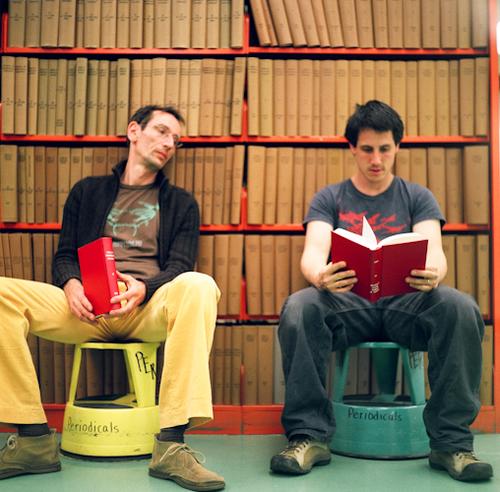
Dade Elderon’s come up with a perfect promotional catchphrase for the SF Public Library’s Main Branch. We’re IMing about the library, where he sets up his gear and writes and records songs on a 9-to-5 schedule. “One part of the library is a very high-tech, clean learning environment. It’s a temple. Then you go down to the [first-floor] bathroom and it’s like a dirty, filthy circus. There is a lot going on in that bathroom. Every stall is a different challenge.”

A few days later, I meet Elderon on the library’s fourth floor. As is his practice, he’s reserved one of the private rooms and has set up his equipment, most notably a Korg Electribe EMX-1 and ESX-1. “This is what I bring to the library — I have a [Roland] TR-606 and other gear at home and at a friend’s house,” he says, handing me a spare pair of headphones. “I use this [the ESX-1] strictly as a drum machine, and load up different sounds depending on what kind of song I want to make. I program the melodies on the EMX-1 because if you run too many parts at once on the ESX-1, it will make the sound muddy.”

For the next half-hour, Elderon — long bangs spilling out from the right side of his SF Giants cap — gives me a brief tutorial, explaining polycyclic wave forms, saw waves, and different hi-hats while running through a variety of sounds, from hip-hop to trance to freestyle. Sitting with him, I can see how the room, with its soundproof clear glass and stylish card-catalog wallpaper, is an ideal readymade recording studio. “I really like the tables and the glass setup,” Elderon says. “It’s peaceful. Sometimes people will stand outside with a ‘What are you doing?’ look on their faces, but I just ignore it. I don’t know what people might think these things [the Electribes] are — some people are suspicious of them, maybe.”

Contrary to a paranoiac’s sense of appearance, Elderon isn’t working with explosives, though he is hoping some of his projects will blow up. Party Effects, the Oakland techno bass crew he helped figurehead, has disbanded, and these days he’s working with a number of different recording artists. “This is a track I’m making with Dz MC’s, a Brazilian freestyle singer,” he says, as a percolating, skittering melody dances around a haunted-sounding female vocal.

Along with Dz MC’s, who has a following in Brazil, Elderon has been making tracks with aspiring Stateside singers such as Gloria Hernandez, a local vocalist whose voice possesses freestyle-ready sass and snap, and Nikki Marx, whose sexy photos and real-life story have intrigued Elderon and his roommate and former Party Effects partner, Alexis Penney. “She’s German, lives in New York City, and works on Wall Street as a day trader,” Elderon explains, as we look at some of Marx’s provocative photos. “Alexis is obsessed with her, and we can’t figure her out.”

At the moment, Elderon is also in the early stages of some remix projects for 679 Artists, a Warner Music Group label based in London that represents Little Boots, Marina and the Diamonds, and Streets. Along with his other roommate, Myles Cooper, he’s also contributing a track to an upcoming album by H.U.N.X., the “gayest music ever” electropop side project of Hunx and His Punx’s Seth Bogart. “I guess Myles’s idea is to make the most annoying song anyone has ever made, and I think he’s doing it,” Elderon says appreciatively. “Seth and I are making a gay freestyle song. He wants it to be over the top. I sampled him making a bunch of sex noises, and I’m going to sprinkle them throughout the track.”

Elderon’s adept way with genre suits one of his recording monikers, Adeptus. He chose the name because — along with invoking “to attain” in Latin, a quest he likens to Afrika Bambaataa’s search for the perfect beat — he likes its “Gothic, occult, and dark-sounding” qualities. On the one hand, he’s a fan of Ace of Base’s 1990s Euro dance pop — in fact, he’s competing against eight other remixers in an Ace of Base-sponsored contest in which the person who comes up with the best mix of “The Sign” wins a car. But on his own tracks, he’s drawn to seductive somber sounds. As he puts it, “I’m attracted to minor scales.”

The public library as a recording studio and potential pop gold mine — it’s all in a day’s music-making for Elderon, who cut his teeth recording with the eccentric, literally offbeat Tarythyas in Party Effects. “His bedroom is the craziest room I’ve ever been in,” Elderon says, when asked to describe Tarythyas’s home dwelling. “There’s no less than 20 to 30 fish tanks in the room, all lit up. There are crazy toys and lights everywhere, and six different computer workstations.”

The strange is familiar to Elderon, whose past includes a military stint and studies in cellular microbiology, and whose current day job involves flying to Turkey once a month to rescue street animals for a fledgling animal-rights crusader in Beverly Hills. He shows me some passports of pets he’s recently flown back to the U.S., including a cat that possesses a mack’s satisfied smile. “The animals freak out on the plane, so they give me a ketamine spray,” he says.

For now, Elderon is the one traveling, but he’s hoping his music will be going international soon as well. At one point he describes Turkey as a “nexus of weird cultures,” and the same description could be applied to his music, which has pop immediacy, but allows room for wild personality. He’s out to attain something special, and it’s just beginning to materialize.

So dreamy

0

Of all the indie bliss-bands to break through in the last year, Teengirl Fantasy — coming to town Sat/8 — is the dreamiest. Not just in the heart-dotted Tigerbeat vein, although TF’s spangly Angelfire website (teengirlfantasy.angelfire.com) certainly plays on giggle-driven hormone rushes.

No, Oberlin College students Logan Takahashi and Nick Weiss also meticulously tap into a subconscious slipstream of musical influences — 1990s R&B, ’70s soul, Balearic house, Windham Hill new age, bubblegum pop — that roils with allusive energy but never jolts upright into blunt nostalgia or jokey parody. The meticulously layered synth-and-sample compositions on debut album 7AM don’t lead directly to the dance floor either. Instead, they amble ecstatically down some long, spectral hallway toward a distant rave. When performing live, however, Teengirl Fantasy moves multitudes.

SFBG Are you guys still in the midst of your big tour? And did you really play the Great Wall of China?

Nick Weiss We still have one semester left of school, so we tour constantly during school breaks. We played a festival near the Great Wall in August. It was amazing — China was such a nuts place to be. Even though the government attempts to create such a restrictive environment, there are plenty of punks and people who party really out of control. One night we were taken to a Go Kart track around 1 a.m. The place where you bought your tickets was also a bar, so everyone was drunk driving!!! It ruled!!

SFBG You’ve mentioned before that one of the aims of your music is to capture a certain dreaminess or “half-asleep” sensation. There’s a rad sound art exhibition going on from L.A.’s 323 Projects right now that reminded me of you. It’s called “from one side to the other, I’ve dreamed that too.” Basically, you call this number, (323) 843-4652 from anywhere until Jan.17 and it plays an array of sound art pieces made by different people. What would you put on a Teengirl Fantasy Hotline?

Logan Takahashi My voicemail answering message is a recording of one of those Buddha Machines made by FM3. I’ve always thought that was a pretty clever idea for a product or a piece, just a bunch of simple, really pleasant infinite loops.

SFBG Speaking of dreaminess and loops, I think one of the best tracks of the year is “Dancing in Slow Motion” from 7AM. It totally reminds me of how everything sounds when you’re trying to say something in a dream and you wake yourself up — this kind of shivery mumbling. Guest singer Shannon Funchess’ sublimated diva delivery is right on.

NW We met Shannon through her Light Asylum bandmate Bruno Coviello, who coincidentally lived at the studio we were working in. However, we had already seen Light Asylum a bunch of times and knew how amazing her voice was. We wrote the song pretty quickly, but our initial impulse was to make a huge ballad, the size of The-Dream but with a dreamier twist …

SFBG: I also adore the “Dancing in Slow Motion” video, directed by Mark Brown. Between that and the “Cheaters” and “Portofino” videos, you’ve been tagged as adopting a “visualizer” aesthetic. How much input have you had with your videos and the visual manifestation of your music?  

NW: We really just choose an artist whose work we really love, give them the track, and let them do whatever they want. Working with Mark Brown, Kari Altmann, and the legendary IASOS has been so cool… we really love the videos each of them made. I wouldn’t call them pure “visualizer,” I’d say that their looks are pretty intentional rather than automated.  However maybe we just have a pretty high tolerance for rave graphix. I could watch fractals pulse to trance for hours.

LT: Honestly we never intentionally were looking for a unifying aesthetic between our videos, but it is kind of funny to go back and look at the things they have in common. I spent a lot of time watching ‘beyond the mind’s eye’ videos as a child and I think that had an effect on my threshold for abstract 3D FX.

SFBG The title of your album, 7AM is kind of an in-joke to old-school ravers, conjuring up both the kooky bombast of KLF’s “3AM Eternal” and warehouse bragging, as in “Dude, I was there at 7 a.m. when Richie Hawtin dropped ‘Pacific 707.'” Do you guys deliberately build references and concepts into your tracks beforehand, or do they come out of a more organic jamming process?

NW It really is an organic process. We won’t usually start talking about a track until after we’ve written and recorded it. Once we start mixing, we might talk references. But when we’re writing, it’s really more about capturing the live feeling and strengthening improvisations.

LT It helps for us to keep that element of viscerality and response as part of the songwriting process.

SFBG Detroit techno seems a touchstone for you …

LT Detroit!!!! Still trying to make it to the Detroit Electronic Music Festival, hopefully this year. Huge fan of the music that comes out of that city.

TEENGIRL FANTASY with Pictureplane, Tormenta Tropical, and Donuts DJs. Sat/8, 10 p.m., $5––$10. Elbo Room, 647 Valencia, SF. www.elbo.com.

Trash talk

0

sarah@sfbg.com

The fate of the city’s mountains of garbage — 1,400 tons a day — will be decided some time in the next few months. Maybe.

Two competing proposals for hauling away the trash have been up for consideration since last spring. But the San Francisco Board of Supervisors still doesn’t seem to know which alternative is better, and the board still hasn’t scheduled a hearing on the issue.

Waste Management Inc. has the current contract and trucks waste to the Altamont landfill. Recology now wants to ship the garbage by rail three times as far away, to the company’s Ostrom Road landfill in Yuba County (“A Tale of Two Landfills,” 06/15/10).

David Assmann, deputy director of San Francisco’s Department of the Environment told the Guardian that his department asked for a hearing in October on its proposal to award the contract to Recology when the city’s contract at Altamont landfill expires in 2015.

“But that hearing request got delayed,” Assmann said. “With a new board, new committees, and maybe new chairs of committees coming in January, I’m not sure when the hearing will take place,” he added. “But I’d be surprised if it’s before Jan. 15.”

Sup. David Campos told the Guardian he still has many questions about the contract. “I don’t know if it’s the correct way to go at this point,” he said. “I’m trying to figure it out.”

That sentiment seems to be shared by Sups. John Avalos and Eric Mar, who took a road trip earlier this year to see both landfills. And some local waste management experts have suggested that Recology’s plan would be greener if the city barged its trash to Oakland, then loaded it onto trains, instead of driving it across the Bay Bridge.

Assmann acknowledged that the barging question keeps coming up, but said would be cost prohibitive since trash would have to be loaded and unloaded both sides of the bay. “It would be horrendously expensive, so it’s not a likely option unless folks want their rates to go up dramatically.”

And now Yuba County officials are rethinking how much to charge the city to dump it waste in their rural county’s backyard. Yuba County Supervisor Roger Abe told the Guardian his board has asked the county administrator to look into the process for raising disposal fees at Ostrom Road.

“We’re supposed to receive a report on that, plus parameters on what you can change,” Abe said, noting that fees at Ostrom Road were set at $4.40 per ton in 1996. “So it’s a 14-year-old fee. Clearly, the cost of living is a lot higher now. And when the landfill was established, it was only serving Yuba County. But now it’s being touted as a regional landfill, an approach that is depleting our county’s ability to dispose of its own trash. So if people outside the county are using our landfill, they should be paying more.”

But Assmann doesn’t think the rate hikes would torpedo the city’s plan. “Whichever one of the two landfills is chosen can always opt to raise fees. But that would also impact the fees of local residents, so it’s a self-inhibiting factor,” he said.

“And who knows the implications of Prop. 26 on this,” he continued, referring to the statewide proposition voters approved in November that requires a two-thirds supermajority vote in the state Legislature and at the ballot box in local communities to pass fees, levies, charges, and tax revenue allocations that previously could be enacted with a simple majority vote.

“But even if the fees double in Yuba County, they’ll still be less expensive that at Altamont,” he said. “So our recommendation is to go forward with the Ostrom Road landfill proposal.”

Abe agreed that Prop. 26 could have an impact on the fee-raising process. “But I find it difficult to believe that Yuba County would have a problem raising fees on out of town garbage,” he said. “If I had a choice, I’d say no to Recology. But if it’s coming anyway, I know that $4.40 per ton is not going to be sufficient compensation — and this county is desperate for funds.”

DoE director Melanie Nutter has claimed the Recology contract is environmentally friendlier and could save ratepayers $125 million over the life of the contract. “This is a good deal for San Francisco and for the environment,” Nutter stated when DoE was pushing for a board hearing in October. “Ostrom Road is a state-of-the-art facility that employs industry best practices, and the price is dramatically lower than the competition. This will help us maintain reasonable refuse collection costs as we move toward zero waste.”

The landfill disposal contract is for 5 million tons or 10 years, whichever comes first. DoE predicts that this amount will decrease in the coming years because of prior success in waste prevention, recycling, and composting programs. San Francisco already recycles 77 percent of its waste stream, the highest diversion rate of any city nationwide.

But Abe notes that Waste Management proposes to use methane generated from trash disposed at its Altamont landfill to power its liquid natural gas trucks. “I can’t see how using trains would be greener,” he said.

Recology spokesperson Adam Alberti has told the Guardian that Recology’s waste disposal contract was environmentally superior, in part because San Francisco has mandatory composting legislation that reduces the amount of decomposing organics, a major source of greenhouse gas emissions, being sent to landfills. But Irene Creps, who has homes in San Francisco and Yuba County, pointed out that not all municipalities disposing trash at Ostrom Road have mandatory composting laws, which means the landfill will continue to generate methane. “A lot of places around here only have a black bin,” Creps said.

Meanwhile, Waste Management has threatened legal action if San Francisco awards the contract to Recology, alleging that Recology’s bid was procured under flawed and potentially unlawful application of administrative rules. In a Nov. 9, 2010 letter, WM’s Bay Area Vice President Barry Skolnick urged San Francisco’s Board of Supervisors to “reject the award to Recology and avoid entering into a high-priced 10-year contract that is not even necessary until 2015, at the earliest, and to apply the procurement process to all qualified bidders fairly and consistently, as the law requires.”

The local trash controversy continues as a grassroots movement to stop Recology from expanding at the Jungo Road Landfill in Humboldt County, Nev., won an interim round. At a Dec. 20 meeting, Humboldt County commissioners voted 4-1 to reject a proposed settlement agreement with Recology that would have allowed the landfill to continue.

Alerts

0

news@sfbg.com

WEDNESDAY, DEC. 22

Floyd Westerman Retrospective

You may remember him for his role in “Dances with Wolves” as Chief Ten Bears and as a country western singer/songwriter. But Floyd Westerman, a.k.a. Red Crow, was also an outspoken activist for Native Americans and the environment. A new documentary by Steve Jacobson explores his later life and activism. Along with the film, there will also be a social hour at 6:30 and a discussion following the film.

7:30–9:30 p.m., $5 suggested donation

Humanist Hall

390 27th St., Oakl.

510-681-8699

Real Mercantile Holiday Bazaar

If you still have some holiday shopping to do and just can’t summon the will to hit the stores or feed the machine, you can get some great stuff while supporting the local arts community and underground economy at the Real Mercantile Holiday Bazaar. held at arts impresario Chicken John spacious home and performance space. Homemade gifts and food are all available in a festive and very San Francisco atmosphere.

5–9 p.m., free

Chez Poulet

3359 Cesar Chavez, SF

www.therealmerchantile.com

THURSDAY, DEC. 23

Festivus 2010

San Francisco’s legendary Sisters of Perpetual Indulgence and pot activist Ed Rosenthal’s Green Aid unite to present a night of fundraising for the Medical Marijuana Legal Defense and Education Fund. The bash features an airing of grievances, feats of strength, the annual meeting of Dessert First Club, and live music and entertainment including The Phat Fly Girls and burlesque. Creative dress and cross-dressing encouraged.

7:30–11:30 p.m., $50 presale, $60 at door

SomArts

925 Brannan, SF

415-515-7483

SUNDAY, DEC 26

Get Your Spawn On

Join Brent Plater on a stroll through Muir Woods National Monument to learn more about coho and steelhead salmon and how to help them survive. The walk also features a search for endangered salmon in Redwood Creek. Make sure to wear something warm and bring your hiking boots.

10–12 p.m., free with RSVP

Meet at the Dipsea Trail trailhead

Muir Woods National Monument, Mill Valley

www.wildequity.org/events/3166

TUESDAY, DEC 28

Castro Queer-in

Join concerned local resident ins protesting the recently passed sit/lie ordinance more formally known as Proposition L. Bring out any and all musical instruments, games, food to share, face-painting kits, and any items to barter. Everyone will gather outside of Harvey Milk’s former camera store.

Noon–2 p.m., Free

575 Castro

Mail items for Alerts to the Guardian Building, 135 Mississippi St., SF, CA 94107; fax to (415) 437-3658; or e-mail alert@sfbg.com. Please include a contact telephone number. Items must be received at least one week prior to the publication date.

Q&A: The unexpurgated Books

0

Accurately summing up the music The Books create is a tall order. Folktronica, indie-pop, cut & paste, experimental — all these tags can loosely be assigned to it, but none can fully capture the group’s mix of acoustic virtuosity and trippy electronics. First meeting in New York City in 1999, Nick Zammuto and Paul de Jong soon began crafting their unique combination of found sounds, cello, guitars, vocals and studio experimentation. Their work has led to four albums, a remix collaboration with Prefuse 73, and a commission to create elevator music for the Ministry of Culture in Paris. Zammuto took some time to chat about the group’s use of samples and its newest release, The Way Out (Temporary Residence Limited). Below is a longer version of a Q&A that recently ran in the Guardian.

SFBG You guys seem to put a lot of thought into the venues you perform at. How do you choose?

Nick Zammuto At first, beggars can’t be choosers, so we kinda just played wherever people would have us. And then I think the promoters started to realize that our show just works better when there’s a little more focus and when the ceiling is high enough for our projection to look the way it should. More than anything, the venue — the shape of it and the sound of it — creates the evening. And it’s amazing how it brings out different characteristics in an audience. Part of it is what they bring and part of it is what we do. But there’s that third element, which is the venue. It’s a mysterious thing. I love shows that are sitting down because I think it brings out this more careful detail that we try to bring out in our records, which is difficult to translate to the stage when it’s a noisy environment and beers bottles clinking and stuff like that. But then again, I love the energy of shows that are standing up because people can express themselves easier and we get more feedback from the audience. So both have their benefits.

SFBG You’re playing with Gene Back this tour, which will be the first time you’ll be performing as a three-piece. How did this come about?
 
NZ He’s a guy from Brooklyn who we met through a project we did with a cellist named Zach Miskin. He was kinda Zach’s right-hand man for this project and he came up to record at my place and I was just really taken with his playing. He can play anything you put in front of him. He learns really fast, so it’s been great to throw stuff at him to see what he can do. He doesn’t disappoint.

SFBG How much of a collaborative process was it in terms of him adding or not adding his own touches to the existing material you guys will be performing?

NZ It depends on your definition of collaboration, but I think the energy he brings with his playing, it changes our set drastically and that’s definitely something we have no control over, you know. That’s his thing. He’s tried to execute the parts that we’ve created for him, but he’s also solved a lot of problems that we wouldn’t have foreseen, not being able to play them ourselves. And he loves to dive into things. For example, he can actually play the guitar riff on “Tokyo.” He came up to us and was like, “Hey, look what I can do.” That’s something we never expected to be able to play live, and sure enough, it’s in the set now because of him.

SFBG Speaking of the guitar line on “Tokyo,” that’s one of many parts on your guys’ albums that makes you wonder how exactly it was created and recorded.

NZ I think nothing is really what it seems on our records and we do a lot of work to cover our tracks in terms of where things come from and how things were made. But essentially, I played that guitar line just as it appears on the record, except it was about half the speed when I originally played it. I just sped it up to see what it would sound like. And it turned the tambour of the guitar into this high-strung, mandolin kind of sound, which was cool, so we kept it. My fingers just don’t move that fast. But luckily there are people out there who can execute my ideas (laughing).

SFBG As diverse as your music can be, there is still a very recognizable overall sound. But it’s not always easy to describe. After all these years, have you guys settled on a fallback response when someone asks what kind of music you make?

NZ The word we go back to because it’s kind of open-ended is “collage.” We pull things from all different places and try to put them together in some compelling way, and I guess the most basic word for that is collage. I think people try to attach all kinds of genre names to it, but none of it has really felt comfortable to us. We just kinda do what we do. But you know, sampling is a big part of what we’ve always done. Figuring out a way to connect all these disparate elements is the basic work we do. So, it feels like collage.

SFBG I’ve always been curious about how you find the material you sample. Where did the material featured on The Way Out come from?

NZ During our tours in 2006 and 2007, we stopped at thrift shops all along the way, wherever we could. We’d pick [up] VHS tapes and audio tapes. Paul is kind of in charge of the audio side of the collection and I do more of the video side. Basically, we take the tapes and digitize them and then go through them and save all the stuff we think might be useful, having no idea what it might be used for. If it kind of has this memorable, emotional quality, we save it and keep it around. And the cream rises to the surface, in a way. We end up with these samples that are so far and above anything that anyone would expect, and you just have to use them. So, we throw all those in a folder called “Must Be Used.” And that’s what starts a lot of the ideas for the compositions.

SFBG The answering machine messages in “Thirty Incoming” are simultaneously touching and kind of silly. How do you decide what musical tone and context you’re going to frame a sample in once you decide to use it?

NZ A sample like that just speaks to everyone, you know. And it’s interesting how the interpretation of that phone message varies from “Wow, this is the most sincere man I’ve ever heard in my life” — which was my interpretation when I first heard it — to “That’s creepy. I don’t know what I’d think if I got that message on my phone.” So, it just has this sort of supercharged quality to it where it means a lot to everyone who hears it, but for different reasons. You can’t really go wrong with it, unless you were to counteract its tone somehow. What it suggested to me was this oceanic kind of sound. Those lines go so deep, that it had to be this wave after wave of pulsating sound coming in and then receding. Then we tried to find musical elements that could achieve that sound. So, we ended up using cello and effected vocals, electric guitar and bass to pull it all together. And also this drum tom that I recorded last summer while we were in London. This is the first time we’ve used real drum sounds in forever. It was fun to work with that quality of sound.

SFBG Hearing drums sprinkled throughout was a nice surprise on this album. I particularly like the hi-hat pattern throughout “I Didn’t Know That.”

NZ That was a lucky find. It was from a rare record with only like 500 copies made in the 1970s. It’s from this black history record. And it’s just this great hi-hat riff that’s just there between these two spoken word tracks. When we heard it, we were like, “Wow, that’s totally amazing.”

SFBG Have you ever been contacted by someone who appears in one of the found samples you’ve used throughout your career?

NZ People ask this a lot, and we haven’t, I think for a couple of reasons. Like going back to the “30 Incoming” samples, that tape must be 20 years old already, so who knows how old those people are now. And you know, we’re a pretty small band and it doesn’t really go outside of a certain circle of people who listen to this kind of thing. So, I don’t know how it would get to them, unless it was through some crazy kind of way. Maybe it will happen someday.

It would probably take some crazy series of connections. But it’d have to be a crazy feeling for someone to stumble upon a song that contains something they said or did and most likely forgot about 20 or 30 years ago.

It feels like archeology, even though it’s of the recent past. It feels like there’s some distance between now and then, so it takes on a totally different meaning. There’s all this inadvertent cultural information in these tapes. Stuff that was in the background when people were making them, but now they become the foreground because it’s so different from how we are now. And it often comes across as funny. But it also has this unconscious quality to it, which is what I like about it. That none of this stuff is planned. It’s not preconceived what this stuff means. It’s really honest in the way it comes though. It’s just people being themselves.

SFBG As meticulous as you guys seem to be at crafting albums and each individual song, do you ever struggle with deciding when something is done being worked on?

NZ Yeah. I mean, I compose the stuff and it takes forever (laughing). And it’s a completely exhausting process. But you just kinda know when you’re done, because you don’t want to work on it anymore. It becomes like a zero-sum game. Nothing you can do can make it any better than what it is, so you just let it go. Tracks are never finished, they just kind of escape.

SFBG You switched from the European label Tomlab to the US-based Temporary Residence Limited for The Way Out. Is there a difference between how Europeans and Americans approach your music?

NZ I think Europeans think of us as kind of like a freak show (laughing). And they like us for that reason. But I think when we play in the US, there’s this familiarity because there’s more nostalgia to it. Because we all grew up in the times that we’re sampling from, the ’80s and ’90s mostly. It’s less of a freak show and more of a warm look at the past and where we came from. Kind of reclaiming our childhoods in a way.

SFBG What kind of music inspired you both during the creation of the new album? And is there something you’ve been particularly into as of late?

NZ Me personally, I’ve been on a big Police kick. I don’t know why. But going back to their catalog, I love the way their records are produced. And I especially love Stewart Copeland’s contribution. He can play the drums like no one else. It all has this clarity and precision and energy to it that I really love. So, I’ve kind of been studying that from more of a production standpoint. As for inspiration during The Way Out, during our visit to London in 2009, Nigel Godrich’s engineer Drew Brown invited us to Nigel’s studio for about a week. Nigel was away working on something else and Drew was like, “You should just go and play,” and we were like, “Are you kidding me?” (laughing). And seeing how that studio is put together and the music that has come out of it, Nigel’s and Drew’s way or working is really inspiring to me in terms of getting a mix that’s kind of warm and transparent but also really powerful. I think that had a direct effect on our record.

Is your food fair?

0

caitlin@sfbg.com

FAIR FOOD We’ve all worked in a restaurant, haven’t we? I know I have — many — and gosh if they aren’t tricky little employment situations. Overtime, what? Breaks, really? And health care — well who the hell gets health care at a restaurant?

But this being San Francisco, restaurant workers are entitled to all these things courtesy of our hard-won labor laws. Which of course doesn’t mean that workers get them all the time, but that they should. And the bars and eateries that provide these benies — along with job safety, respect, and other luxuries — should be the ones that get the business of the conscientious diner.

Until recently the identity of these decent restaurants was only obtainable by sneaking back into the kitchen to chat. But the advocacy group Young Workers United (www.youngworkersunited.org) is changing that. Its guide to SF restaurants, Dining With Justice, is now in its second year of publication, teaching those who want to know where they can get a nice meal served by someone who is happy and secure in their job.

“It’s kind of a counter to Zagat and Yelp,” YWU organizer Edwin Escobar tells me. Escobar just got done talking about his group’s campaign to a room full of City College of San Francisco students at the school’s “Turn the Tables” teach-in last week. The event was sponsored by CCSF’s labor and community studies program and featured presentations from community groups and SF’s Office of Labor Standards Enforcement.

To research the guide, YWU members interviewed 250 employees at 32 restaurants. The 58-question survey ranked businesses in five fields: compliance with wage and working hours laws, job mobility, job satisfaction, health and safety, and job security. Only nine businesses received stars in three or more the categories; none received five out of five.

“People think, oh, it’s San Francisco, all the workers get treated well. But that’s not the case. Restaurants and retail businesses get away with murder,” Escobar says. His organization provides labor law education and advocacy for low-wage workers around the city in an attempt to stem workplace violations.

Recently, YWU shed some light on some of the troubles faced by workers in a struggle with one of the city’s most beloved type of snack stop: the taqueria. The group helped the Latino staff of the Taqueria Azteca chain (which has locations in the Castro and Noe Valley) recoup more than $2 million in back pay from owners who had cheated them of overtime compensation and even minimal control over their schedules. Escobar says one mother involved in the legal proceedings had been given a choice by management: return to work one week after giving birth or lose her job.

“The workers who get cheated the most in San Francisco are Asian immigrants,” says Shaw San Liu, another speaker at “Turn the Tables.” Liu is a lead organizer with the Chinese Progressive Association (www.cpasf.org), which since 1970 has worked to empower the Chinatown community to deal head on with social inequities. Earlier this year, the association released a report on the state of employment in Chinatown restaurants based on one-on-one interviews with 435 workers. The results were disheartening: 50 percent had worked under-minimum wage jobs; 80 percent had been cheated out of overtime; 64 percent had received no on-the-job training; a majority had been injured on the job; and more than half were paying all medical costs out of pocket.

That’s just not cool in a town that nominally protects workers against all these things by law. Liu says CPA would like to publish a guide similar to Dining With Justice to reward responsible restaurants but has run into cultural stumbling blocks. Law-abiding businesses didn’t want to be singled out as such because, owners said, it would make their neighbors look bad. “Everyone knows minimum wage in Chinatown is $1,000 a month,” says Liu. “They didn’t want to be known as the goody two-shoes.”

There are clear challenges to improving the lot of the person serving you your brunch, burritos, and dim sum. But everyone has a part to play in making it happen. “At this point, we’re just asking consumers to be aware,” Liu says.

Efforts like Dining With Justice are a real step in the right direction. YWU plans to expand its scope next year into other city neighborhoods. “Surely there are more than just nine restaurants treating their workers right in this city. We want to know about them,” YWU organizer Tiffany Crain tells the room of students assembled before her. Crain added that if anyone in attendance works for a good employer, they should call her — just as they should call her if they are getting cheated out of wages or a healthy working environment.

“You want to make money?” Liu asked SF restaurant owners. “You’re going to make money if people think you’re a good employer.” In San Francisco, diners like to think they’re eating sustainably: organic, local, and fair to workers. Also, a chef who is happy in his or her job makes for a better dining experience.

Here are restaurants that scored four stars in Dining With Justice.

Arizmendi Bakery

1331 Ninth Ave.; (415) 566-3117, www.arizmendibakery.com

Arlequin

384 Hayes; (415) 626-1211

The Corner

2199 Mission; (415) 875-9258, www.thecornersf.com

Frjtz

590 Valencia; (415) 863-8272 and 581 Hayes; (415) 864-7654, www.frjtzfries.com

Mission Pie

2901 Mission; (415) 282-1500, www.missionpie.com

Poesia

4072 18th St.; (415) 252-9325, www.poesiasf.com

Zazie

941 Cole; (415) 564-5332, www.zaziesf.com

Our Weekly Picks: December 1-7

0

WEDNESDAY 1

MUSIC

Good for the Jews

The last time this parodic-Hebraic duo made it to this city, they were greeted by a protesting Nazi who had posted up in front of their show. “He felt that we were representative of the Jewish-owned media. But I want to know: if we’re representing Zionist power, why am I staying at a Holiday Inn?” says group member Rob Tannenbaum. Honestly, the two (the other member is David Fagin) could probably care less about the crazies. Their Xmas alternative songs, which include “Reuben the Hook-Nosed Reindeer,” poke fun at the schmaltz of Christianity and Judaism — secular, and less so — alike, a perfect side dish for your holiday Chinese takeout. (Caitlin Donohue)

8 p.m., $15

Café Du Nord

2170 Market, SF

(415) 861-5016

www.cafedunord.com


THURSDAY 2

FILM

The Passion of Joan of Arc

One of the great meteors of film history, Carl Theodor Dreyer’s silent elegy literalizes the adage that the eyes are the mirror of the soul. The Passion of Joan of Arc (1928) charges religious iconography with the erotic fluency of moving images, paving the way for subsequent generations of film transcendentalists who have sought the sacred in the profane. Once you’ve witnessed Maria Falconetti’s Joan, your sense of what’s possible in film acting is forever marked. Seeing the movie at the Paramount accompanied by an orchestral performance of Richard Einhorn’s Voices of Light score promises to be an awesome treat — the cinematic equivalent of a purification ritual. (Max Goldberg)

7:30 p.m., $25

Paramount Theatre

2025 Broadway, Oakl.

(510) 642-5249

www.bampfa.berkeley.edu


THEATER

“San Francisco’s Golden Girls: The Christmas Episodes”

Picture it: San Francisco, 2010. Overcome by their affection for The Golden Girls and a tidal wave of holiday spirit, a quartet of drag superstars (Heklina, Cookie Dough, Matthew Martin, and Pollo Del Mar), plus one legendary rocker (Jane Wiedlin of the Go-Go’s), join forces to present two full-length episodes of the immortal sitcom live on stage. (For GG experts, because I know you’re out there, the eps are “Twas the Nightmare Before Christmas” and “Long Day’s Journey Into Marinara.”) Heklina and company earned raves for The Golden Girls: The Play, and this jolly twist offers an ideal, cheesecake-fueled opportunity to greet the season. (Cheryl Eddy)

Through Dec. 23

Thurs.–Sat., 7 and 9 p.m., $25

CounterPULSE

1310 Mission, SF

www.ticketfly.com


MUSIC

Mister Heavenly

Mister Heavenly is the result of a long-rumored collaboration between top-flight indie rock songwriters Nick Thorburn (Islands, Unicorns) and Honus Honus of Man Man. Originally slated to be little more than a tossed-off sidestep, the project picked up steam with the addition of drummer Joe Plummer (Modest Mouse, Shins). No recordings have surfaced yet, so it’s tough to tell what Mister Heavenly is actually gonna sound like. But with Thorburn on record describing it as a low frequency, slowed down version of doo-wop — appropriately dubbed “doom-wop” — I think it’s at least safe to bank on it being awesomely strange. (Landon Moblad)

9 p.m., $12

Café Du Nord

2170 Market, SF

(415) 861-5016

www.cafedunord.com EVENT


EVENT

Left Coast Leaning Festival

Pin it on whatever factor you like, but the fact remains that the Best Coast whoops that other coast’s ass, wraps it up nicely, and drops it in the mail marked “Return to Sender.” For reals, it’s nice out here. You already knew that, and so do the wonderful young-person spoken word artists at Youth Speaks, who along with the Yerba Buena Center for the Arts are putting together this homage to the Wild West’s cultural diversity and its many happy mutations of hip-hop culture. Tonight alone you can check out the modern fusion dance stylings of Adia Tamar Whitaker and a dreamy, beautiful animated piece by Los Angeles’ Miwa Matreyek. (Donohue)

Thurs/2–Sat/4, 8 p.m., $20

Yerba Buena Center for the Arts

701 Mission, SF

(415) 978-2787

www.ybca.org


FRIDAY 3

DANCE

Liss Fain Dance

Choreographer Liss Fain presents The False and True are One, which plays with the notion of how an event can be perceived differently by various people. Fain breaks up the common proscenium presentation of dance by creating a series of galleries on the stage that audience members can meander through at their leisure. Fain’s talented dancers (Jennifer Beamer Fernandez, Private Freeman, Megan Kurashige, Shannon Kurashige, Alec Lytton, and Bethany Mitchell) will perform throughout Matthew Antaky’s architecturally designed performance space while actor Jeri-Lynn Cohen enacts short stories by Lydia Davis. The result will be many different perceptions and viewings of the same performance. (Emmaly Wiederholt)

Fri/3–Sat/4, 8 p.m., $25

Z Space

450 Florida, SF

www.lissfaindance.org


VISUAL ART

“Stella Luminosa”

Electric Works’ new group show “Stella Luminosa” is like a much-needed shot of bourbon to steady oneself against the already advancing avalanche of holiday-themed treacle. Brining together such guiding lights as Dave Eggers, Matt Furie, Ian Huebert, Jason Jägel, Keegan McHargue, Clare Rojas, and Gina Tuzzi, “Stella Luminosa” presents these artists’ highly idiosyncratic winter wonderlands (with extra emphasis on “wonder”) and the odd ducks who inhabit them. Why settle for good cheer when there is plenty of weird cheer to go around? (Matt Sussman)

Through Dec. 24

Reception tonight, 6–8 p.m.

Electric Works

130 Eighth St., SF

www.sfelectricworks.com


MUSIC

Mr. Oizo

Who is the elusive Mr. Oizo? Here’s what we know for sure: French. Reportedly born Quentin Dupleux, although it’s specious. Electro DJ and producer. On the notorious Ed Banger record label with Justice, SebastiAn, and Cassius. Frequent collaborator with additional label-mate and proto Ke$ha, Uffie. Double identity as a film director. The subject of most recent film, Rubber, involves a homicidal tire with psychic powers. First infiltrated the U.S. in 1999 with seemingly harmless yet ubiquitous “Flat Eric” Levi’s ad campaign, the soundtrack from which may have been used to indoctrinate domestic sleeper agents. Current developments in sound are more nefarious and possibly deadly. Further surveillance required. (Ryan Prendiville)

With Boyz IV Men

10 p.m., $19.50

103 Harriet

103 Harriet, SF

(415) 431-1200

www.1015.com


DANCE

Human Creature and Jessica Damon

Human Creature shares the bill with Jessica Damon and Dancers in this performance presented by Resident Artist Workshop (RAW). With four new works choreographed by codirectors Derek Harris and Meegan Hertensteiner and music by composer Mark Hertensteiner, Human Creature’s witty and dark subject matter includes sleep, a postapocalyptic beginning, and the subconscious. Choreographer Jessica Damon’s piece Coated investigates how it must feel to be coated in oil and addresses the environmental problems associated with innovation and the unconsidered costs of technological growth. Stick around for beer and wine at the post-show party in the basement with DJ K-Real. (Wiederholt)

Fri/3–Sat/4, 8 p.m., $10–$20

Garage

975 Howard, SF

(415) 518-1517

www.975howard.com


SATURDAY 4

DANCE

“Pilot 57: Pilot Light”

Twenty years and 27 programs later, ODC’s Pilot series one reason young dancers continue flocking to the Bay Area, cost of living be damned. Pilot participants are not beginners; they have a professional, though usually small, track record. What they want and get from Pilot are 11 weeks of working with equal-minded colleagues in a supportive environment that provides feedback. Practical advice on how to make it in a competitive field is thrown in. Artists Nathan Cottam, Amy Foley, Daria Kaufman, Elizabeth McSurdy, Raisa Punkki, and Charles Slender bring wide perspective to their projects, which should make for appealing shows — and probably had sparks flying during the working sessions. (Rita Felciano)

Sat/4–Sun/5, 8 p.m., $12

ODC Theater

3153 17th St., SF

(415) 863-9834

www.odctheater.org


SUNDAY 5

MUSIC

Jonathan Richman

Some know him as the leader of 1970s pre-punk trailblazers, the Modern Lovers. Others recognize him as the wide-eyed crooner known to pop up in Farrelly brothers comedies. But it’s the 30 years’ worth of quirky solo albums that have made Jonathan Richman one of the finest cult singer-songwriters of his era. Combining early rock ‘n’ roll songwriting strummed out on a clean Telecaster; a surplus of world music influences; and sparse, tasteful accompaniment from his longtime drummer Tommy Larkins, Richman is a hilarious and charming performer whose live show is not to be missed. (Moblad)

With Gail Davies

8 p.m., $15

Great American Music Hall

859 O’Farrell, SF

(415) 885-0750

www.gamh.com


DANCE

Mary Sano Dance Collaborations

Mary Sano is a passionate advocate for the work of Isadora Duncan. In Japan she was a modern dancer until she encountered the work of the great California dance pioneer. Her programs usually feature Duncan and Duncan-style dances, but she often brings in actors, musicians, and poets for intriguing salon-type evenings. For Ship of Dreams: Kanrin Maru 150 Years of Hope, Struggle and Friendship, her first evening-length piece, she dipped into all of these resources. Everybody has heard of Commodore Perry, who is credited-blamed for “opening” Japan to wonders of Western civilization in 1851. But does anybody know the story of the Kanrin Maru, which — against incredible odds — carried the first Japanese emissaries to the U.S. in 1860, landing of course in San Francisco? Sano “recreates” this journey with four dancers, seven actors, and five musicians, including Native American singer Dennis Banks. (Felciano)

7 p.m., $28

Brava Theater

2781 24th St., SF

(415) 647-2822

www.brava.org


MUSIC

Casiotone for the Painfully Alone

Is it possible that Owen Ashworth has cheered up? For more than a decade Casiotone for the Painfully Alone has been an appropriately descriptive title for his brand of subdued, introspective, keyboard-infused indie pop. But now it’s over. He announced in suitably emo fashion (via LiveJournal): “After nearly 13 years of being the dude from Casiotone for the Painfully Alone, I’m ready for a fresh start and a new challenge. So, after Dec. 5, 2010 (the 13-year anniversary of my first show), I’m throwing out the old songs and I’m trying something new.” Expect this show to be especially bittersweet. (Prendiville)

With Donkeys and Ian Fays

9 p.m., $12

Bottom of the Hill

1233 17th St., SF

(415) 621-4455

www.bottomofthehill.com 


The Guardian listings deadline is two weeks prior to our Wednesday publication date. To submit an item for consideration, please include the title of the event, a brief description of the event, date and time, venue name, street address (listing cross streets only isn’t sufficient), city, telephone number readers can call for more information, telephone number for media, and admission costs. Send information to Listings, the Guardian Building, 135 Mississippi St., SF, CA 94107; fax to (415) 487-2506; or e-mail (paste press release into e-mail body — no text attachments, please) to listings@sfbg.com. Digital photos may be submitted in jpeg format; the image must be at least 240 dpi and four inches by six inches in size. We regret we cannot accept listings over the phone.

Emergency forum Tues. / 30 on HANC recycling center eviction

8

An emergency community forum will be held tonight, Nov. 30, about the Recreation and Parks Department’s plan to evict the Haight Ashbury Neighborhood Council (HANC) Recycling Center from a parking lot in Golden Gate Park. If Mayor Gavin Newsom and his former chief of staff, Rec & Park General Manager Phil Ginsburg, succeed in their plan to evict the 36-year old recycling center, they’ll kill 10 green jobs, eliminate a rare source of income for poor people, and put an end to a community resource that costs San Francisco taxpayers nothing.

HANC believes the recycling center is being targeted by Newsom’s administration as a form of political payback, since the progressive organization opposed Proposition L, the sit / lie ordinance, which Newsom supported.

Ginsburg wants to evict the recycling center, which pays rent to the city, and replace it with a community gardening center that would cost $250,000. The shaded lot doesn’t seem like an ideal site for growing produce.

A memo issued Nov. 29 from Ginsburg to Rec & Park Commissioners notes that it is legal for the department to move forward with the eviction without commission approval. Apparently, Newsom’s administration intends to send 10 people to the unemployment line and kick a 36-year-old green resource to the curb without any public input, despite receiving 400 postcards from San Francisco residents opposing the eviction. The Rec & Park Commission will take up the issue of the new community garden center at its Thurs., Dec. 2 meeting.

Tonight’s emergency forum, organized by Keep Arboretum Free, is an attempt to open up a space for public dialogue.

A stakeholder meeting took place this afternoon with Ginsburg, District 5 Sup. Ross Mirkarimi, Department of the Environment Director Melanie Nutter, representatives from the San Francisco Police Department, represenatives from the offices of Assembly Member Tom Ammiano and City Attorney Dennis Herrera, HANC, and area residents.

Jim Rhoads of the HANC Recycling Center told the Guardian just after the meeting, “They’re going to evict us by the end of December. That’s their goal. The mayor has it in for us and he wants to get us out before he leaves.”

The recycling center, located at Frederick and Arguello streets, operates a buyback program for recyclable materials as well as a San Francisco native plant nursery. Residents from the Inner Sunset Park Neighbors have voiced complaints about “quality-of-life issues” that they link with some of the center’s patrons. During buyback hours, held from 10 a.m. to 3 p.m., people arrive with shopping carts filled of cans and bottles to exchange for small amounts of cash. Some of them are homeless.

Representatives from HANC, Rec & Park, and the Inner Sunset Park Neighbors have been invited to speak at tonight’s forum. “There are strongly felt opinions on both sides,” a flier for the event notes. “In the interest of a broad discussion, a number of long time local residents organized this forum for a full public airing of the issues prior to the Dec. 2 Commission meeting.”

The forum will be held tonight, Tuesday, Nov. 30, from 7 to 9 p.m. at St. John of God, 5th Avenue at Irving St.

To voice your opinion about Rec & Park’s plan to evict HANC, call Phil Ginsburg at 415-831-2701 or email him at Philip.Ginsburg@sfgov.org.

Green vs. “green”

12

rebeccab@sfbg.com

Years ago, Greg Gaar was a scavenger, wandering the neighborhoods around Twin Peaks picking up bottles and other kinds of recyclable trash. He began working at the Haight Ashbury Neighborhood Council (HANC) Recycling Center in 1982.

During his tenure, a project designed primarily to divert waste from the landfill expanded to include a unique San Francisco native plant nursery. Located on a converted parking lot on Frederick Street near Lincoln Boulevard, the recycling center is a drop-off for recyclable materials, including used veggie oil, and a source for soil and 65 species of potted plants.

Gaar started small. “I took some seeds,” he explained, “and scattered them into a flat. They came up like fur on a dog’s back.” Over the years, he researched the natural history of the area, saved seeds, and cultivated the grounds surrounding the recycling center. HANC also converted a traffic triangle across the street into a thriving garden.

The Recreation and Parks Department, directed by Phil Ginsburg — former chief of staff to Mayor Gavin Newsom — is seriously considering a plan to evict HANC recycling center and replace it with a garden resource center.

While trading one garden center for another might not seem like a big deal, it appears to be an attack on poor people who make their living recycling cans and bottles, a group that organized to oppose Proposition L, the sit-lie ordinance that Newsom supported in this election.

Or as HANC Executive Director Ed Dunn put it: “He’s going to take it from his enemies and give it to his friends.”

The HANC recycling center has leased Rec and Park property since its inception in 1974, and it’s been at its current location for 30 years. HANC does not receive any city funding for the center, and it pays a small amount in rent for use of the parking lot. It processes roughly 160 tons of recycling per month.

Newsom has worked hard to cultivate his reputation as a green mayor and promote green-job creation, but evicting the recycling center would kill 10 green jobs. Many of the employees were formerly homeless and previously earned petty cash gathering cans to exchange at the center’s buyback station. They were hired without any help from San Francisco taxpayers and now they’re earning living wages while diverting waste from the landfill.

But some neighborhood residents are annoyed by the presence of people who arrive at the center with shopping carts filled to the brim with bottles and cans that they can exchange for cash. Buyback hours are held from 10 a.m. to 3 p.m., so during those times, people who haul around bundles of recyclables line up to receive modest rewards for their hours of effort.

HANC, a progressive organization, publicly and vehemently opposed Prop. L, the voter-approved ordinance that bans sitting and lying down on city sidewalks. Newsom enthusiastically endorsed Prop. L.

Dunn believes the recycling center is being targeted due to HANC’s position on that issue. “It’s all about political payback,” says Dunn. Incidentally, Haight voters rejected sit-lie and HANC sees the pending recycling-center eviction as part of the same agenda. “It’s all part of the gentrification that’s enveloping San Francisco,” said Jim Rhoads, who chairs the HANC Recycling Committee.

Once word of the plans got out, letters started pouring into to Newsom’s and Ginsburg’s offices from the Sierra Club, San Francisco Tomorrow, the Senior Action Network, and other organizations. Additionally, the center’s supporters mailed at least 400 postcards opposing the eviction.

Residents have voiced complaints about the shopping-cart recyclers, some of whom are homeless. The Inner Sunset Park Neighbors (ISPN), which is petitioning Rec and Park to evict the recycling center, has a message posted on its website linking the shopping-cart pushers with “quality-of-life issues such as aggressive panhandling, drug use/dealing, and public safety.” ISPN also charges that the recyclers swipe cans and bottles from rolling curbside bins. The neighborhood group had not responded to requests for an interview by press time.

Rhoads believes that if the recycling buyback program is removed, it would only encourage panhandling — after all, people already lacking basic resources would lose a critical source of income. “People will be very desperate,” he said. According to the results of a HANC survey, one in six recyclers regularly turning up at the center to exchange bottles for cash sleeps outside.

The Recreation and Park Commission will discuss the possible HANC eviction at its Dec. 2 meeting. And since the recycling center is on a month-to-month lease, the 36-year-old green resource could soon suffer eviction. There’s likely to be significant resistance, since the HANC Recycling Center has forged partnerships with urban-agriculture projects throughout the city.

It was a fiscal sponsor of the Garden for the Environment and donated several tons of cardboard for mulching at Hayes Valley Farm. The HANC nursery project has distributed plants to urban agriculture projects throughout the city, including school garden plots, urban habitat corridors designed to protect rare species, and the Mission Greenbelt Project, a network of sidewalk gardens in the Mission.

Details on the proposed garden resource center that would be installed in lieu of the HANC Recycling Center are sketchy. An artist’s rendering of the plan, drawn up by the city’s Department of Public Works, envisions an outdoor classroom amphitheatre, raised garden beds, a semi dwarf orchard, and a composting area. However, Guardian inquiries to Rec and Park requesting more specific details about funding and operation went unanswered by press time. 

Psychic Dream Astrology

0

Nov. 24-30

ARIES

March 21-April 19

There is no need to do anything except treat others as you’d want to be treated, Aries. Focus on being generous, fair-minded, and kind this week as you bumble through uncertainty about what you want next.

TAURUS

April 20-May 20

The holidays can be such a bummer, but here’s a magic ticket that can help you pass through this season with minimal scarring: create new relationships out of the old. Be bold enough to get closer to others.

GEMINI

May 21-June 21

Can you be totally you any old place, or does your youness shift with your environment? Practice staying your unique self in all circumstances and leave your social strategies at the door.

CANCER

June 22-July 22

Don’t cut off your nose to spite your face, no matter how mad you get at that mug! You’re on the verge of self sabotage and overthinking your problems, which will only make things worse. Go for stable if happy is outta reach.

LEO

July 23-Aug. 22

Get real, Leo! You have some stressful problems to deal with that require more than a good attitude right now. Stop feeding your valuable energy into a vacuum; less is more this week (including people).

VIRGO

Aug. 23-Sept. 22

Speak the truth as clearly as you know it and as directly as you can, Virgo. You’re at the start of something new that can only be achieved if you put yourself out there. If your truth is uncertain, share that too.

LIBRA

Sept. 23-Oct. 22

You cannot change or fix the past, not now or ever. Get real and deal with whatever is in front of you with all the patience and care that the important stuff of your life deserves. Just don’t repeat your old mistakes.

SCORPIO

Oct. 23-Nov. 21

You’re seeing things clearly, Scorpio, and are finally ready to deal with them. The trick is to pace yourself. Take on too much too quickly and you’ll burn out right away. Go slowly enough to heed your gut instincts.

SAGITTARIUS

Nov. 22-Dec. 21

Be decisive. You may not be able to choose your ideal, but go for the best mashup of awesome and okay that you can find. Revolution is well starred this week, but impulsive actions are not. Pursue what nurtures you most.

CAPRICORN

Dec. 22-Jan. 19

You can’t control the weather, your friends, or your family, but you can take responsibility for yourself and have a say in what happens in your life. Do what’s right by your own standards.

AQUARIUS

Jan. 20-Feb. 18

There’s no way to know the future. So much is uncertain, and it’s likely to be that way for a while. The best you can do is strive to take care of yourself around the stresses you feel, and to feel your feelings as they come.

PISCES

Feb. 19-March 20

Intimacy without independence is a ticking time bomb. No matter how much you love a person or thing, or how awesome these makes you feel, practice going without it a bit. Balance practical needs with your heart’s desires. *

Jessica Lanyadoo has been a Psychic Dreamer for 16 years. Check out her website at www.lovelanyadoo.com or contact her for an astrology or intuitive reading at (415) 336-8354 or dreamyastrology@gmail.com.

Ragazza

0

paulr@sfbg.com

DINE Ragazza is the younger sorella of Sharon Ardiana’s Gialina in Glen Park and, as is so often the case with siblings, the two restaurants do and do not resemble each other. Much of the differences are traceable to the respective neighborhoods. Glen Park (where we find Gialina) has in recent years become an annex of city’s baby belt, whose big, shiny buckle is just over the hill in Noe Valley. Kids like pizza, and Gialina has fine pizza, along with a selection of pastas, a roast or two, and a selection of contorni. Eating at Gialina is a little like waiting to check in for a flight on Southwest Airlines: the environment is lively, lighthearted, and swarming with small children. (Shouldn’t shrieking children be flown on their own airline, perhaps Screaming Babies Airways, with a big screaming baby head painted on the tail of every plane. But if they want to eat at Gialina, okay.)

Ragazza, by contrast, brings haute pizza culture to a vortex of the Haights (lower and upper) and NoPa that so far shows few signs of turning into kiddieland. The restaurant opened recently in a space that’s worn quite a few masks over the past decade; 10 years ago, it was a bistro called Metro Café, then became a fine Nepalese restaurant called Metro Kathmandu, reverted briefly to Metro Café, and now this.

There is nothing distinctive about the mid-block, storefront setting. The glowing red paint scheme of the Kathmandu era has been dialed back to milder earth tones. Otherwise, the look of the restaurant is little different. (In this aesthetic continuity, too, Ragazza differs from its older sibling, whose neglected space was heavily made over before its opening in early 2007.)

Ragazza’s menu is somewhat less pizza-pie-centric than Gialina’s. The new place offers a number of antipasti choices and small plates, along with several roasted items. (Gialina offers one antipasto and one roast.) You could make do very nicely here without having a pizza at all. But the bulk of the clientele seems to understand Ragazza to be a pizzeria at heart, and so the pies emerge from the kitchen in a steady stream, with at least one seeming to turn up on virtually every table. It’s like watching a quarterback spread the ball around to eight different receivers.

Although Ragazza doesn’t offer Gialina’s fabled chili-bomb pizza, the aptly named atomica, it does have a spicy pie of its own, the moto, fired with Calabrian chilis. (These have an aromatic fume all their own and haven’t really been given their due.) The amatriciana pizza ($16), festooned with a sunny-side-up egg, also offered a noticeable nasal kick. And even the pies that aren’t armed with chili heat tend to be bracingly fragrant — a potato version ($15), for instance, topped with red onion and gorgonzola cheese and liberally laced with thyme. No hint of starch overload here, despite the potentially smothering presence of the spud.

Herbal perfumes, along with chili heat, are a recurrent theme. We were particularly aware of the oregano breath wafting from a crock of corona beans ($6) simmered with oven-roasted tomatoes. Oregano is the quintessential pizza smell, but I’d never come across corona beans before and, from their pale chubbiness, would have guessed them to be cannellini or flageolet. They’d been cooked just right and still offered nominal tooth resistance before yielding an interior creaminess.

Purely creamy, on the other hand, was the soft polenta ($9). Polenta can be bland, and it is sometimes enlivened by sautéed mushrooms and gorgonzola — and given Ragazza’s obvious gusto for big flavors, I wouldn’t have been surprised to find those players here. Instead the boost came from a medallion of tomato mascarpone cream, freighted with basil and set atop the polenta like a rosette.

The real test of any restaurant’s food is whether it can hold your attention even if, say, Mark Zuckerberg is sitting at the next table, making moony eyes with a comely ragazza. Was that really Mark Zuckerberg at the next table, an actual person as opposed to the character in the movie The Social Network and the subject of far too much quacking in the key of same from The New York Times’ waddling line of op-ed ducks? We weren’t sure. Zuckerberg is said to live in the wilds of the Peninsula, sleeping on a mattress on the floor of some faceless apartment, just as Jerry Brown did during his first go-round as governor. Yet there he was — maybe — in Ragazza, having come for the girl and stayed for the (pizza) pie. He didn’t friend us, alas, alack. *


RAGAZZA

Dinner: Sun.–Thurs., 5–10 p.m.;

Fri.–Sat., 5–10:30 p.m.

311 Divisadero, SF

(415) 255-1133

www.ragazzasf.com

Beer and wine

AE/MC/V

Noisy

Wheelchair accesssible

Prison report: The madness of parole

10

By Just A Guy

Editors Note: For much of 2009, Just A Guy wrote reports for us from a California state prison (here’s an example). He was released last November, but continues to send us commentary every now and then.

 
So, it’s been some time since any of you have heard anything from me. Here’s a story for you about how poorly the parole system works.

As many of you will remember, I was released in November of last year, but paroled to a state out of California.


Since that time I have had no problems whatsoever, have been very successful on parole, worked and travelled for business all over the country, supported my family, and been an upstanding citizen.

Earlier this year, I met some people at an industry meeting, and the discussion resulted in my being offered a job that required my moving to a state different than where I was on parole. The transfer paperwork allowing me to move from the controlling state to the new state was initiated a short time after I accepted the position, but the paperwork that was submitted through the Interstate Compact Office was somehow lost.
 
Meanwhile, I moved to the new state in order to start my new position; though I was having to go back monthly to my old state to report for parole, as one isn’t allowed to be out of state on a travel permit for more than 30 days without reporting back to the controlling state. In the beginning of October — three months later — I found out that the transfer paperwork had been lost and had to be re-submitted; meanwhile I had to spend a minimum of $600 a month to go back to my controlling state and report in. Being proactive, I called the out-of-state parole office in California to find out what was going on and explained the situation. California “fast-tracked” my paperwork to get the out-of-state transfer done. Fortunately my parole officer at the time was very understanding and didn’t make me come in to report the last time I was supposed to since the paperwork was confirmed as being processed by California.

Ultimately, in the last week of October, my transfer paperwork came through and I am now officially under the supervision of the new state.

Why does any of this matter? It’s been a year since I left prison, and my parole should be ending. I would have been a “no brainer” to be discharged from supervision in the state I just transferred out of — but because I just moved to a new state, the California Parole Division has recommended I remain on parole because I don’t have a proven track record of success in the new state — even though I have been successfully employed here for four months, and was previously successfully employed in the old state for eight months.

Apparently, it doesn’t matter — because I’m in a new environment and they want to make sure I’m abiding by the rules and regulations of parole in the new environment, which, really are about the same as the old environment.

The irony of all of this is that I went above and beyond in trying to make sure I was doing things right and following the rules of California and the other two states. I even called the California Interstate Office to find out what the problems in facilitating my transfer were and got them resolved. Had I just gone back and forth between the state where I was residing and working (costing $600 a month in travel) and let the system do its slow meandering work, my transfer probably still wouldn’t have gone through — it would have shown I was successful in the “old state” and I would be recommended for discharge.
Now, because I tried to keep things on the up and up, I’m getting punished.

It’s very frustrating. I have to travel with some frequency for my job, but the new state is less permissive with business travel and that affects my ability to do my job and support my family and be successful. I have always been under the impression that parole was meant to help protect the public AND help the parolees make a successful transition back to society. I have done everything humanly possible to be successful, but the process just gets in the way.

I am being recommended to be retained on parole because I started a new job – crazy, since that makes our family’s life better.

Another crazy thing, the reason I had to call the California Interstate Office, is that parole agents are not allowed to contact each other directly. In other words, my parole agent in the state I transferred out of is not allowed to contact the parole office in California directly. I can do it but she can’t. EVERYTHING has to go through Interstate Compact; no direct interaction between agencies is allowed. How’s that for effective.

Bottom line, there’s still a chance the Board of Parole may grant my discharge against the recommendation of the California Parole Unit, but what’s the likelihood of that? After all, now that I’m not in California it doesn’t cost them any money to keep me on parole in the new state! I promise you if I were in California or the previous state it would be rubber stamped.

The worst part is, I don’t get an opportunity to argue my case in front of the board, I don’t get to see the recommendation, I don’t even know when the discharge hearing is going to be.
Result: stuck on parole for another year for doing things the right way, ability to affectively my business greatly disabled. Way to go California, keep up the good work.

Joystick to the world

0

culture@sfbg.com

You can see it at your local Walgreens: that magical moment, at midnight every Nov. 1, when the Halloween display melts into the ether, replaced by a bevy of festive, possibly toxic, green-and-red confections. Christmas comes similarly early in the game business; unlike holiday movies, year-end software blockbusters have to be sitting on store shelves in time to entice flocks of early-bird shoppers.

This year promises a winter harvest of diverse delights, though there is a clear emphasis on familiar faces and established names. Groundbreaking technology will wheedle its way into American shopping carts alongside intellectual property that dates back to 1928.


ROCK HARDWARE

Though its most promising features are spread out over multiple months, Rock Band 3‘s release in the dying embers of October signaled the start of the holiday game glut. On the more casual end of the spectrum, there are many changes designed to improve the title’s performance as a party-powering karaoke machine on steroids. But it’s on the hardcore end that Harmonix’s offering really shines. New “Pro” instrument modes transform the entire idea of the rhythm game, promising exact correspondence between notes heard and notes played, turning an exercise in plastic-instrument frivolity into an actual teaching tool. The retail version ships with a full two-octave keyboard; future bedroom shredders will have to wait until March 1 to get their hands on Squier’s six-string electric guitar-controller hybrid.


KINECTRIC SLIDE

Harmonix rolled out another big title this year: Dance Central, a gleefully earnest dancing simulator that aims to do for cutting rugs what Guitar Hero did for ripping solos. Taking advantage of Microsoft’s Wii-killing, Xbox 360-exclusive Kinect technology (available now), which uses a TV-mounted camera to record player movements, the game weans digital dance off Dance Dance Revolution‘s cheesy floor pads, tracking your entire body and translating that motion into animated on-screen boogieing.

A number of other games have been released that are calibrated for use with the Kinect, either focusing on fitness (YourShape: Fitness Evolved, EA Sports Active 2) or cartoonish, arm-waving sports-mime (Kinect Adventures, Kinect Sports). Liberated from the tyranny of holding onto a controller, 360 owners will also be able to deploy the Kinect’s voice commands, which be useful for browsing through a number of new software features, which include ESPN and Last.fm, streaming direct to your console.


EVERYTHING OLD IS NEW AGAIN

Cannibalizing the past is nothing new when there are profits on the line, but no one does it with the kind of capitalist élan that the game industry evinces. Did you enjoy NBA Jam and Goldeneye 007 in the 1990s? Of course you did. And you’ll enjoy them again, now that they’re back, sporting upgraded display resolutions and gameplay adapted to modern, button-coruscated controllers. NBA Jam began as a downloadable adjunct to NBA Elite 2011; now that that game has been pushed back, the two-on-two hoops title is getting a full retail release on all the major consoles Nov. 17. Goldeneye is available now for Wii and Nintendo DS; playing as Oddjob is still totally cheating.

Japanese giants Namco Bandai have dusted off Splatterhouse, their goofily gory 1988 smash. Musclebound protagonist Rick is back, still sporting a hockey mask, still dismembering ghosts and ghouls with a blood-soaked two-by-four. The survival horror-brawler hybrid is due out Nov. 23 for PS3 and Xbox 360.


MOUSE HOUSE

It’s been a long time since Disney’s iconic character was featured in his own video game, so Junction Point Studio’s Epic Mickey is sure to be met with high expectations. Helmed, bizarrely, by legendary designer Warren Spector, who is better known for gritty cyberpunk classics System Shock and Deus Ex, the game promises a slightly more adult — even gothic — take on Disney’s least-adult character.

Gameplay will center around a painting mechanic. Using his trusty brush, Mickey will be able to transform his environment, daubing in bridges over otherwise impassable chasms. The judicious application of paint thinner will erase dastardly enemies. Look for Epic Mickey Nov. 30.


WHAT A WONDERFUL WORLD (OF WARCRAFT)

If you were to measure the impact of this year’s holiday releases using total hours invested as your metric, there’s no doubt that World of Warcraft: Cataclysm would come out on top. As the third expansion to Blizzard’s megalithic franchise, the game can count on a built-in player-base of some 12 million subscribers, each about as likely to buy Cataclysm as a heroin addict is to buy more smack.

The attractions this time around include two brand-new races — players will now be able to battle their way around Azeroth as Goblins or Worgen (read: werewolves). The expected litany of new dungeons, new loot, and new gameplay tweaks is also provided. The Cataclysm begins Dec. 7. And if you don’t know what to get that tween WoWer in your life at the last minute? But her some game time at www.blizzard.com.

Return to me

0

If magical realism is rooted in Latin American cultures, nobody told Adia Tamar Whitaker. Her Ampey!, a 50-minute dance, chant, music, film, and narration piece, is an incantatory celebration of life — including the parts of life ingrained in our muscles and our dreams. If CounterPULSE’s Performing Diaspora program had produced nothing but Ampey!, it would have been worth doing. Performed by a stellar cast of dancers and musicians, Whitaker has succeeded in pulling together strands of complex subject matter into a first-rate, original piece of poetic theater.

Whitaker is equally skilled in verbal and movement languages. The blunt honesty with which she looks at herself, refusing to sentimentalize or overplay her sense of identity, gives Ampey! a strong backbone. The impetus for the work came from a trip to Ghana, where Whitaker traveled to explore her roots. A small-boned, light-skinned woman who shaves her head, she found herself at odds there. With Ampey!, she set out to explore the disconnect between her African and African American identities. Perhaps not surprisingly, she found misunderstandings on both sides. One of the show’s most insightful moments comes via a film clip, in which an elderly Ghanaian man talked about how outsiders not only view his country, but the whole continent.

Whitaker divides Ampey! into three acts: “Freedom,” “Home,” and “Family.” Her periodic narrations, on film, feel a bit like a personal travelogue, but they also create a sense of anticipation for the live segments. On stage, her persona shifts identity by moving from one dancer to another, an effective way of expanding the personal into a larger context.

In “Freedom,” the dancers, dressed in prim American school uniforms, dive into a high-energy children’s clapping dance, “Getting Lite.” With limbs flying, this is an exuberant, wildly energetic but also playful form of urban expression whose African origins — at least as seen here on stage — are unmistakable. A ring shout and a Haitian dance raise the volume of this affirmation of freedom, though in actually it is being denied. Strong vocalist-dancer Tossie Long, scurrying anxiously among the celebrants, acts as an Elder, cautioning Whitaker to be patient.

“Home” switches gears drastically. With one chair conspicuously empty and Whitaker as the lead vocalist, the dancers sit in a row, chanting and keeping the beat with gourd-like rattles. According to the program notes, the dance is a version of the Ghanaian agbadza, usually performed on an open field. Here, clapping and percussion underline rhythmical, forward-bending movements. The flowing harmonies set against that regular bending pattern proved to be hypnotic — I kept thinking of Muslims praying together on the floors of their mosques. Whitaker dedicated this section to her former teacher, Alicia Pierce, who died in San Francisco while Whitaker was learning this very dance in Ghana. This mourning dance, rising and falling, like waves, like deep breaths, was perhaps Ampey!‘s single most beautiful moment.

The final section, the somewhat problematic “Family,” finds Whitaker on her knees. Carefully measuring and pasting segments of tape, she tries to rearrange the complex floor patterns that look like a mixture of astrology charts and gym floors. As people in colorful garb spill onto the stage, she keeps up her task for a while. The scene becomes a marketplace, with dancers “selling” their wares to each other and to the audience. Here, the performers’ individuality — Eyla Moore, Stephanie Bastos, Veleda Roel, Zakiya Roehl, and Rashidi Omari Byrd — creates a vibrantly pulsating environment. Still, as Whitaker finally takes her place among them, the finale feels a little too easy. It is a lovely ending, but not a completely convincing one.

AMPEY!

Thurs/18–Sat/20, 8 p.m.;

Sun/21, 3 p.m., $19-$24

CounterPULSE

1310 Mission, SF

1-800-838-3006

www.counterpulse.org

Reilly and Kelly concede D2 and D10 races

9

Two weeks after the Nov. 2 election, D2 candidate Janet Reilly and D10 candidate Tony Kelly issued concession statements, as ranked choice voting counts, which will certified by November 30, placed them second: Reilly trailing Mark Farrell in D2, and Kelly behind Malia Cohen in D10.

For Reilly, the disappointment was sharpened by the knowledge that she received more first-place votes than any other D2 candidate. She won 9,625 first place votes (41.15 percent of vote) compated to Farrell’s 9,442 votes (40.37 percent).

But with neither Reilly or Farrell winning an outright majority, second and third place votes were factored in under the city’s ranked choice voting system. And that calculation tipped the balance in favor of Farrell, who finished with 11,105 votes, (50.62 percent) compared to Reilly’s 10,835 votes (49.38 percent).

Reilly tried to put on a brave face in face of adversity.
“I have spent many years serving people outside public office — on the Golden Gate Bridge Board, at Clinic by the Bay, at Catholic Charities CYO, through our family’s high school scholarship program and at many other institutions,” she aid. “Now that the campaign is finished, I will be able to resume these activities.”

But she voiced her belief that attack campaign prevent potentially good candidates from running for political office. Acknowledging that “public service is an honor” and that it is “an integral part of our democratic tradition for candidates to pass a series of difficult tests before earning the right to hold office,” Reilly  added that she “understands why many bright, capable people choose not to run for office when I see how poisonous and cynical the process can be.”

 “In my own race, an independent expenditure committee armed with $230,000 leveled an 11th-hour smear campaign against me,” Reilly noted. “They violated a litany of election laws while peddling gross distortions and outright lies. This is simply wrong. Actions like this deter many good people from public service.”

That said, she ended on a positive note.

 “I am truly proud of the campaign we ran,” Reilly said. “We never wavered in the face of adversity and we continued bringing our positive message to the voters of D2 all the way through Election Day, You can count on me to be fighting by your side every step of the way for the good of the city.”

For his part, Kelly offered congratulations to Cohen and asserted his relative success in the complex D10 race in which race, class and geographical location had a profound impact on voting patterns—and the ultimate results of the supervisor election

”I came in second in the ranked-choice runoff, by a few hundred votes,” Kelly said, alluding to a race in which Lynette Sweet  won most first place votes (2,059, 12.06 percent), ahead of Kelly (2,035 votes, 11.92 percent) and Malia Cohen and Marlene Tran tied third (2001 votes, 11.72 percent of vote). But once second and third place votes were counted, the importance of strategic alliances, positive campaigns and widespread appeal became clear, as Cohen polevaulted into the lead (4,173 votes, 52.60 percent) ahead of Kelly 3, 761 votes (47.40 percent), while Tran remained in third place (3,256 votes, 30.44 percent) and Sweet dropped to a distant fourth (3077 votes, 23.87 percent).

Kelly acknowledged the importance of running grassroots campaigns under this system.
“We had more donors from D10 than anyone, more volunteers from D 10 than anyone, and just as many first-place votes in D 10 as any other campaign,” Kelly observed. “So we know the voters heard us. They, like us, want a supervisor who will listen to all our concerns, bring real progressive ideas to the Board, and ensure that the City’s resources work much harder for the people of District 10.”

He offered an olive branch to the incoming supervisor and her allies by encouraging his supporters to work with Cohen to win the best future for the district.

“Neighborhood leadership is not about one person, or one campaign,” Kelly observed. “The alliances that came together during this year must continue, and I urge everyone interested in my candidacy to work with Sup.  Cohen to show City Hall how to create local jobs, clean up our environment, support our families, and use common sense ideas to fix our budget. In years to come, we will all continue to fight for the people of D10 with courage, compassion, better ideas and hard work.”

And then he signed off with a peace note
”My love to you all, and many thanks, on behalf of my entire staff and the hundreds of volunteers who gave of themselves over the past nine months,” Kelly said.

Peace out to Reilly, Kelly and all the candidates in these long, exhausing and ultimately brutal races.


Free parking

0

arts@sfbg.com

THEATER/DANCE In the world of performing arts, it often feels like there is a dearth of resources. The race for funding, rehearsal space, performance space, and audience attention can easily create disillusion. Lucky for San Francisco, there is a light in all this resource madness: the Garage, a small theater run by Joe Landini.

“There is a danger in believing in limited resources,” Landini recently said. He believes in abundance, that there is actually plenty of room for everyone who wants to create work, and that perpetuating this kind of thinking is essential to the mission of the Garage.

An unassuming building, the Garage’s little red door at 975 Howard St. leads into a modest foyer and black box theater. The basement houses a green room, dressing room, and prop closet in one. A lighting board allowing for tech support and sound can be found directly off the stage to the right of the audience seating. A single bathroom and sink are behind the stage’s back curtain. Yet despite its meager facilities, the Garage is home to a surprisingly large number of artists. Approximately 120 performers from diverse disciplines enjoy residencies at the Garage every year, culminating in more than 200 shows annually.

The Garage offers two kinds of residencies for performing artists: AIRspace (artist in residence), which is geared toward queer artists, and RAW (Resident Artist Workshop), the general program. Both are 12-week residencies culminating in a two-night performance run. Artists receive four hours a week of rehearsal space, totaling 48 hours, plus publicity and technical support. Resident artists may also have the opportunity to present their works-in-progress at the informal Raw and Uncut performance series. But perhaps the pièce de résistance of all this is that it comes at no cost to the artist: the Garage provides free rehearsal space, performance space, tech support, and press.

The Garage’s humble facility might be a clue to how this generosity is achieved. Another clue lies in the number of theater personnel; a friend who recently attended a Garage show commented on Landini’s presence, asking who the guy was who ushered, bartended, ran tech, and was basically the Garage’s ringmaster. In other words, there’s no staff and no expensive facility to run either. The Garage is funded entirely by grants and ticket sales, which goes to supporting the artists.

Angela Mazziotta moved to San Francisco earlier this year after completing her BFA in dance at the University of South Florida. Although she had choreographed within her BFA program, she had little experience creating work outside the college environment. Interested in further exploring her choreographic voice, she took up a residency at the Garage in August and will be presenting her new work, SMACKdab — a piece dissecting themes of belonging — Dec. 1-2 as part of the RAW performance series. While researching the dance community before moving to San Francisco, she stumbled across the Garage’s webpage and recalls feeling like the Garage sounded like a place she could start establishing herself. Mazziotta is an example of a newcomer to the SF dance scene who has been able to pursue her choreographic interests through the Garage’s magnanimity.

“The Garage is a place for anyone who wants to get their dance out there,” Mazziotta mused. More likely, the Garage is a place for anyone who wants to put anything out there. From traditional to classical to contemporary to avant-garde to downright insane, the breadth of the work presented at the Garage is staggering. Sometimes the Garage is sold out; other times there’s a sympathetic handful — but the work goes on.

Although the majority of resident artists come from dance backgrounds — due in part to Landini’s strong ties within the dance community — the Garage is by no means limited to dance. Anything performance-related — thespians, circus groups, musicians, poets, and artists of all walks have enjoyed time on the Garage’s stage — can ostensibly find a home there. The basic screening process includes a short write-up of the proposed work and a YouTube video of prior work, and the majority of applicants are granted residencies. This egalitarian mentality manifests the Garage’s guiding principle that anyone who is willing to give their time and energy in the name of art should have a place to do so.

Thus, a new dancer to the city who needs a place to start choreographing can begin at the Garage. A more established artist with limited funds who wants a theater to present work in is welcome there as well. A multidisciplinary artist interested in combining poetry and film would fit in. An eccentric group of performers who stand on their heads and juggle eggs with their feet could probably be accommodated as well. Imagination is the limit. Whatever the inclination or area of interest, the black box theater at 975 Howard will continue to house and assist performing artists through its generous programming and services. Everyone has a voice, and everyone who wants to should have a forum in which to express that voice. The Garage is a perfect example of an institution that supports and promotes the expression of all voices.

www.975howard.com

Fighting dirty

1

rebeccab@sfbg.com

One by one, representatives from California local governments who had gone toe-to-toe with Pacific Gas & Electric Co. recounted their war stories. They were weary, fatigued, and uncertain of the future. Their resources had been depleted by hefty legal expenses, and they were forever caught up in the game of trying to undo the damage of misinformation campaigns whipped up against them by PG&E. None had ever suspected that following state law would be so arduous.

At a Nov. 8 hearing of the California Senate Select Committee on Renewable Energy, held in San Rafael, officials from the San Joaquin Valley, Marin County, and San Francisco spoke about challenges they faced trying to initiate community choice aggregation (CCA) programs, which would create alternative electricity providers to PG&E.

In accordance with Assembly Bill 117, which allows local governments to purchase power in bulk and distribute it to a customer base using the infrastructure and billing systems operated by investor-owned utilities, representatives from local government agencies said they pursued CCAs to bolster local economies and benefit the environment — but quickly fell prey to fierce marketing campaigns.

So far, PG&E hasn’t faced any real consequences for trying to derail its competitors using unethical and sometimes illegal tactics, and the director of the California Public Utilities Commission, Paul Clanon, did not commit to imposing fines or sanctions against the company.


COOPERATING FULLY

Despite a requirement under AB117 that utilities must “cooperate fully” with CCA implementation, agency representatives testified that PG&E consistently tried to obstruct their success. The San Joaquin Valley Joint Power Authority’s CCA effort was suspended after a protracted legal battle, and has yet to be revisited.

At the hearing, Sen. Mark Leno listened attentively and offered sympathetic words of encouragement. “It is a superhuman accomplishment that you are even here with us today,” he jested after Dawn Weisz, interim director of the Marin Energy Authority (MEA), finished describing a litany of tactics the monolithic utility employed against Marin’s CCA.

Marin’s experience may foreshadow what’s in store for San Francisco. CleanPower SF, the city’s CCA program, is picking up steam again after an initial attempt to hire a contractor failed to yield an acceptable agreement. On Nov. 5, the San Francisco Public Utilities Commission (SFPUC) announced it had received four responses to a second RFP for an electricity service provider to administer the city’s CCA.

Already San Francisco has weathered some attacks. Sup. Ross Mirkarimi, who chairs the Local Agency Formation Commission (LAFCo) and has been a key figure in moving CCA forward, characterized Marin and San Francisco as “brothers and sisters in arms,” saying, “We would share what we knew of what we could expect, because we were no strangers to these tactics.”

Weisz noted that early on, PG&E sent lobbyists to meet privately with local elected officials. Soon after, the company upped the ante with a negative marketing campaign, distributing mailers that contained misleading information about the program. Their activity prompted a rebuke — but no fines — from the CPUC. “I sent PG&E a letter to say knock it off,” Clanon said at the hearing.

PG&E also set up a phone-banking operation to dial up every prospective CCA customer in Marin County and encourage them to opt out of the program and used false information to persuade customers to stick with PG&E service, Weisz charged. “Many were led to believe that their lights wouldn’t go on if they didn’t opt out,” she said.

Once the CCA was in operation, PG&E imposed a delay on the billing process that made one month’s bill artificially low and the subsequent bill abnormally high, making it appear that CCA rates were higher than PG&E rates. This gaffe, which the company chalked up as a technical error, amounted to a sleight-of-hand: “Our rates were set to match PG&E rates,” Weisz explained.

PG&E did not return calls seeking comment.

Against all odds, Marin County is forging ahead with a power program that offers a 26.5 percent renewable energy mix, with 78 percent of its power generated without greenhouse gas emissions. State records show that only 14 percent of PG&E’s energy comes for renewable sources, failing to meet a state requirement that utilities get at least 20 percent of their power from such sources.

Charles McGlashan, a Marin County supervisor who chairs the Marin Energy Authority, noted that implementing a CCA was the most effective method the county could have employed to reduce greenhouse gas emissions, yielding an estimated 500,000-ton reduction of greenhouse gas emissions annually.

While the potential exists for other municipalities to follow suit, PG&E smear campaigns will likely discourage similar projects. “This is a powerful opportunity that has been virtually destroyed by the antics of PG&E,” McGlashan said. “It has had an extraordinary chilling effect on the political leaders to even embark on such an enterprise.” Later he added, “I’m only doing it because I’m so hell-bent on answering the children’s questions about climate change.”


STORM COMING

Meanwhile, in San Francisco, CCA advocates are getting ready to batten down the hatches. “We’re under no illusion — PG&E will compete fiercely,” San Francisco Public Utilities Commission spokesperson Charles Sheehan told the Guardian. He said the city was taking a proactive approach by conducting early outreach to residents and holding public informational meetings about CleanPower SF.

The SFPUC has received four bids from prospective electricity service providers. The respondents are Constellation Energy Commodities Group, Shell Energy North America, Power Choice Inc. (which was selected during the last RFP process but was unable to secure a binding agreement with the city), and Noble Americas Energy Solutions, formerly known as Sempra Energy Solutions. During the Senate hearing, San Francisco CCA director Mike Campbell noted that the city expected to complete a scoring process and select one of the four by the end of the year. The goal is to be fully operational by 2011, he added.

Leno predicted resistance from PG&E. “It’s like a storm coming in,” he said. “We have no doubt of its arrival. They have endless opportunities for nefarious creativity.” He queried Clanon on why the PUC wouldn’t levy fines or sanctions against the utility for the negative campaigns it waged in Marin, as a way to signal that such activity wouldn’t be tolerated in San Francisco.

Clanon did not commit to taking such an action. “That’s a choice about how you get the right behavior,” he said. He noted that the CPUC issued a decision last May preventing the utility from distributing false or misleading information about CCAs or illegally soliciting opt-outs. Clanon warned that PG&E might not be deterred by “fines and sanctions and specific rules.” Pressed on this point later, Clanon told the Guardian that imposing fines or sanctions “would take a lot of resources by us” at a time when the state agency is consumed with other pressing issues, such as the aftermath of the San Bruno explosion caused by a PG&E gas pipeline rupture. “If you set a rule, more people get around the rule,” he said.

Even if the state regulatory body doesn’t hold PG&E’s feet to the fire, Mirkarimi won’t hold back. “We’re tired of the thuggery. We’re tired of the bullying,” he said. He alluded to the Raker Act, a 1913 act of Congress that allowed San Francisco to build the O’Shaughnessy Dam and draw water from the Hetch Hetchy Reservoir under the condition that no private profit was derived from the development, saying the arrangement had been subverted by PG&E. “We should be able to chart our own energy destiny,” Mirkarimi said.

Stage Listings

0

Stage listings are compiled by Guardian staff. Performance times may change; call venues to confirm. Reviewers are Robert Avila, Rita Felciano, and Nicole Gluckstern. Submit items for the listings at listings@sfbg.com. For further information on how to submit items for the listings, see Picks. For complete listings, see www.sfbg.com.

THEATER

OPENING

Caligari Studio 385, 385A Eighth St; www.brownpapertickets.com. $10-30. Opens Thurs/18, 8pm. Runs Fri/19-Sat/20 and Dec 2-3 and 9-10, 8pm. Through Dec 10. HurLyBurLy performs an original adaptation of the 1920 silent film, The Cabinet of Dr. Caligari.

The Tender King Phoenix Theatre, 414 Mason, Sixth Flr; www.secondwindtheatre.com. $20-25. Opens Fri/19, 8pm. Runs Fri-Sat, 8pm; Sun, 2pm. Through Dec 11. Second Wind Productions presents Ian Walker’s noir-tinged World War II drama.

ONGOING

Cavalia: A Magical Encounter Between Horse and Man White Big Top, adjacent to AT&T Park; www.cavalia.net. $39.50-239.50. Check website for shows and times. Through Dec 12. Over 100 performers, including 50 horses, take the stage in this circus-like show from Montreal.

Christian Cagigal’s Obscura: A Magic Show EXIT Cafe, 156 Eddy; 1-800-838-3006, www.brownpapertickets.com. $15-25. Thurs-Sat, 8pm. Through Dec 18. Magician Christian Cagigal presents a mix of magic, fairy tales, and dark fables.

Comedy Ballet Exit Stage Left, 156 Eddy; 1-800-838-3006, www.brownpapetickets.com. $10-20. Thurs/18-Sat/20, 8pm. Dark Porch Theatre’s latest (a reworked version of the piece it premiered at the Garage in July) is a fractured meta-theatrical tale about death. Not to put too fine a point on it, writer-director Martin Schwartz approaches the subject with what you might call deliberate absurdity, basking in whimsical inspiration with serious intent. Roxelana (a compellingly earnest Molly Benson) pursues an affair with the confident but completely in-over-his-head KC (Brandon Wiley), the handsome young employee of her husband (Scott Ragle), who goes tellingly by the moniker Baby Death God. Her three vaguely psychotic neighbors, meanwhile, known as The Intrepid Gentlemen (the amusingly anarchic trio of Natalie Koski-Karell, Bernard Norris, Matthew Von MeeZee), invite her to the wake for their dead dog, over whom they are unnaturally bereft. Between scenes an interviewer (Rachel Maize) queries members of the cast on a variety of subjects, including attitudes toward human sacrifice. (The actors feign indignation at the idea.) It all gradually comes to make some kind of sense, but letting go the effort to make any sense of it helps in the appreciation. Smoothing the way are likeable performances, not least Nathan Tucker’s wonderfully controlled hyperbole in the part of consummate thespian Foreplay. Integral and pleasingly unexpected passages of movement (choreographed by producer Margery Fairchild), as well as a permeating spirit of morbid fancy, further contribute to an intentionally jagged work that may be difficult to define but not hard to enjoy. (Avila)

*Equus Boxcar Theatre Playhouse, 505 Natoma; 776-1747, www.boxcartheatre.org. $10-25. Wed/17-Sat/20, 8pm. In the last year, it seems like there’s been more full-frontal nudity in Bay Area theatre than in the preceding ten years combined. One certainly hopes it’s not due to the economy. Of course, nudity isn’t the only reason you should go and see Boxcar Theatre’s Equus—but its presence is indicative of the overall bravery of the production. Minutely updated and Americanized by director Erin

Gilley, the tale of a troubled teen who mutilates a stable of horses without apparent provocation seems disconcertingly as plausible as when it first debuted in 1973. The uncomfortable parental dynamics as enacted by Laura Jane Bailey and Jeff Garret, the dogged pedantry of Michael Shipley’s Dysart, a man measuring out his desperation not with teaspoons but with tomes of Doric architecture. Most especially, rivaling the single-minded intensity of child crusaders, teenage suicide bombers, and accidental martyrs, 18-year-old Bobby Conte Thornton’s unflinching portrayal of Alan Stang ably taps into the extremist

impulses of adolescence. “Extremity,” Shipley reminds us, “is the point”, and it’s exactly what Thornton delivers, from his nervous misdirections, to the ferocious abandon of his midnight rituals. Artistic Director Nick a. Olivero’s skills as a set designer are suitably showcased by a convincingly stable-like thrust of rough planks and second story “loft” seating, while Krista Smith’s lighting subtly adds texture and depth. (Gluckstern)

*Hamlet Alcatraz Island; 547-0189, www.weplayers.org. By donation. Sat/20-Sun/21, times vary. Outside of an actual castle, it would hard to say what could serve as a more appropriate stand-in for Kronborg castle of Helsingør—also known as Elsinore—than the isolated fortress of Alcatraz Island, where WE Players are presenting Hamlet in all its tragic majesty. As audience members tramp along

stony paths and through prison corridors from one scene to the next, the brooding tension the site alone creates is palpable, and the very walls impart a sense of character, as opposed to window-dressing. Deftly leaping around rubble and rock, a hardy troupe of thespians and musicians execute the three-hour

production with neat precision, guiding the audience to parts of the island and prison edifice that aren’t usually part of the standard Alcatraz tour package. Incorporating movement, mime, live music, and carefully-engineered use of space, the Players turn Alcatraz into Denmark, as their physical bodies meld into Alcatraz. Casting actress Andrus Nichols as the discontent prince of Denmark is an incongruity that works, her passions’ sharp as her swordplay, the close-knit family unit of Laertes, Ophelia, and Polonius are emphatically human (Benjamin Stowe, Misti Boettiger, Jack Halton), and Scott D. Phillips plays the

appropriately militaristic and ego-driven Claudius with a cold steel edge. (Gluckstern)

It’s All the Rage The Marsh, 1062 Valencia; (800) 838-3006, www.brownpapertickets.com. $20-50. Sat, 8:30pm; Sun, 7pm. Through Dec 5. The Marsh presents a new solo show by Marilyn Pittman.

Marcus, or the Secret of Sweet American Conservatory Theater, 415 Geary; 749-2228, www.act-sf.org. $22-82. Call for dates and times. Through Sun/21. American Conservatory Theater presents its contribution to the three-theater Bay Area debut of Tarell Alvin McCraney’s Brother/Sister Plays , completing the young African American playwright’s much-touted but generally underwhelming trilogy with a coming-of-age story about a gay 16-year-old (a sharp and likeable Richard Prioleau) in a small black community of the Louisiana bayou. A recurring dream haunts the still-closeted Marcus, while the man in it, the long-gone Oshoosi Size (a vital Tobie L. Windham), stalks the stage with an ominous-sounding message for his older brother, Ogun (played with listless, gathering despair by Gregory Wallace). But the action unfolding against Alexander V. Nichols’ gorgeously moody, shape-shifting backdrop (a video-based evocation of land, sky and built environment) has only a perfunctory urgency to it. The play, smoothly directed for maximum laughs by Mark Rucker, is more inclined toward amiable scenes of tentative concern by all (including three key female characters played brilliantly by Margo Hall), Marcus’s sexual initiation by a visitor from the Bronx (Windham), or the fraught but whimsical camaraderie between Marcus and childhood friends Osha (Shinelle Azoroh) and Shaunta (Omozé Idehenre). Last-minute intimations of Katrina, meanwhile, come as arbitrary and less than powerful. “Sweet” is the sexually knowing, ambiguous term attaching to Marcus—whom all seem to already know and more or less accept as gay—but it’s also a too apt description for this well-acted but overblown and forgettable play. (Avila)

Match Royce Gallery, 2901 Mariposa; 1-866-811-4111, www.matchonstage.com. $12-28. Thurs-Sun, 8pm. Through Dec 18. Expression Productions presents Stephen Belber’s new suspense drama.

Ménage-À-Plot: A Surf-N-Turf Adventure Off-Market Theater, 965 Mission; www.pianofight.com. $20. Thurs/18-Sat/20, 8pm. PianoFight presents three separate one-act comedies.

Murder for Two: A Killer Musical Eureka Theatre, 215 Jackson; 255-8207, www.42ndstmoon.org. Wed/17, 7pm; Thurs/18-Fri/19, 8pm, Sat/20, 6pm, Sun/21, 3pm. 42nd Street Moon presents a mix of Agatha Christie and musical comedy, by Kellen Blair and Joe Kinosian.

Or, Magic Theatre, Fort Mason Center, Marina at Laguna; 441-8822, www.magictheatre.org. $20-60. Wed-Sat, 8pm (also Sat, 2:30pm); Sun, 2:30pm; Tues, 7pm. Through Dec 5. Magic Theatre performs Liz Duffy Adams’ latest, inspired by pioneering playwright Aphra Behn.

*Pearls Over Shanghai Thrillpeddlers’ Hypnodrome, 575 Tenth St; 1-800-838-3006, www.brownpapertickets.com. $30-69. Sat, 8pm. Through Dec 19. Thrillpeddlers’ acclaimed production of the Cockettes musical continues its successful run.

A Perfect Ganesh New Conservatory Theatre Center, 25 Van Ness; 861-8972, www.nctcsf.org. $22-40. Wed-Sat, 8pm; Sun, 2pm. Through Dec 19. New Conservatory Theatre Center presents the Terrence McNally play, directed by Arturo Catricala.

Shocktoberfest!! 2010: Kiss of Blood Hypnodrome Theatre, 575 Tenth St; 1-800-838-3006, www.brownpapertickets.com. $25-35. Thurs/18-Fri/19, 8pm. Thrillpeddlers’ seasonal slice of eyeball is comprised of three playlets variously splattered with platelets, all directed by Russell Blackwood and bridged by a rousing burst of bawdy song from the full cast. Rob Keefe’s Lips of the Damned (after La Veuve by Eugene Heros and Leon Abric) takes place in a rat-infested museum of atrocities just before the fumigating starts, as an adulterous couple—comprised of a kinky married lady (a vivacious Kara Emry) and a naïve hunk from the loading dock (Daniel Bakken)—get their kicks around the guillotine display, and their comeuppance from the jilted proprietor (Flynn DeMarco). Keefe’s delightfully off-the-wall if also somewhat off-kilter Empress of Colma posits three druggy queens in grandma’s basement, where they practice and primp for their chance at drag greatness, and where newly crowned Crystal (a gloriously beaming Blackwood) lords it over resentful and suspicious first-runner-up Patty Himst (Eric Tyson Wertz) and obliviously cheerful, non-sequiturial Sunny (Birdie-Bob Watt). When fag hag Marcie (Emry) arrives with a little sodium pentothal snatched from dental school, the truth will out every tiny closeted secret, and at least one big hairy one. Kiss of Blood, the 1929 Grand Guignol classic, wraps things up with botched brain surgery and a nicely mysterious tale of a haunted and agonized man (Wertz) desperate to have Paris’s preeminent surgeon (DeMarco) cut off the seemingly normal finger driving him into paroxysms of pain and panic. Well-acted in the preposterously melodramatic style of the gory genre, the play (among one or two other things) comes off in a most satisfying fashion. (Avila)

Susie Butler Sings the Sarah Vaughan Songbook Exit Theater Cafe, 156 Eddy; (510) 860-0997, www.brownpapertickets.com. $15-20. Sat/20, 8:30pm. Local actress and singer Susie Butler takes on the Sassy songbook.

A Tale of Two Genres SF Playhouse, Stage Two, 533 Sutter; www.un-scripted.com. $10-20. Thurs-Sat, 8pm (also Sat, 3pm; no shows Sat/20, Thurs/25; additional shows Dec 20-23). Through Dec 23. Un-Scripted Theater Company performs an improvised musical in the style of Charles Dickens.

The Tempest Exit on Taylor, 277 Taylor; 1-800-838-3006, www.cuttingball.com. $15-20. Thurs-Sat, 8pm; Sun, 5pm (no show Nov 25). Through Nov 28. In Cutting Ball’s latest foray into Shakespearean realms, three entangled subplots and eleven characters are enacted by just three actors, in order to explore the relationships between the principle characters by representing their internal characteristics through the actions of the more minor roles. Set on an enchanted island (or, in Cutting Ball’s interpretation, at the bottom of a swimming pool) The Tempest begins with stormy weather, but quickly grows into a full-blown hurricane of shipwrecked nobles, nymphs, and drunks, plus the turbulent awakenings of a teenage daughter’s libido, and the rumblings of her over-protective papa. The most effective dual-character is Caitlyn Louchard’s Miranda-Ariel, as both characters are quite under the stern control of Prospero (David Sinaiko) and equally deserving of release. Less affecting yet somehow equally congruous is Sinaiko’s comic turn as the buffoonish Stephano, who stumbles through the forest in his boxer shorts, yet somehow maintains an air of mock dignity that does parallel Prospero’s. Donell Hill’s Caliban-Ferdinand endures his lust-love for Miranda and servitude to Prospero alternating between raw physicality and social ineptness. But since “The Tempest” is littered with characters even more minor, the game cast is stretched too thinly to fully inhabit each, and the entire subplot involving King Alonzo, Gonzalo, and Antonio in particular suffers from this ambitious over-extension. (Gluckstern)

*West Side Story Orpheum Theatre, 1192 Market; www.orpheum-theater.com. $88-378. Check website for dates and times. Through Nov 28. Opening night of the touring Broadway revival coincided with game two of the World Series, and giddy Giants fans were loath to put away their smart phones until the final plea from the house managers. But then the curtain rose on perhaps the finest and most moving display of athleticism, professionalism, and grace to be found outside of AT&T Park. The 1957 musical, which updated Romeo and Juliet with a cross-cultural romance between Tony (Kyle Harris) and Maria (Ali Ewoldt) amid immigrant gangland New York, came instantly alive with all its storied potency—revved up for new millennium audiences with less reserved violence and the addition of a smattering of real Spanish throughout. David Saint’s excellent cast—including standout Michelle Aravena as Anita—and a nicely dynamic orchestra under conductor John O’Neill do satisfying justice to the jagged, jazzy modernism of Leonard Bernstein’s score, Stephen Sondheim’s soaring lyrics, Arthur Laurents’ smart book, and Jerome Robbins’ mesmerizing choreography (here re-created by Joey McKneely). At intermission, the house manager graciously announced the final winning score from the ballpark, and everyone cheered. It was a win-win situation. (Avila)

BAY AREA

Cinderella, Enchanted Julia Morgan Center for the Arts, 2640 College, Berk; (510) 665-5565, www.berkeleyplayhouse.org. $15-33. Call for run times. Through Dec 5. Frenchie Davis is plays the Fairy Godmother in this production of the Rogers and Hammerstein musical.

CTRL-ALT-DELETE Pear Avenue Theatre, 1220 Pear, Mountain View; (650) 254-1148, www.thepear.org. $15-30. Thurs/18-Sat/20, 8pm; Sun/21, 2pm. Pear Avenue Theatre presents the comedy by Anthony Clarvoe.

Deviations Durham Studio Theater, Dwinelle Hall, UC Berkeley, Berk; (510) 642-8827, www.ticketturtle.com. $10. Fri/19-Sat/20, 8pm; Sun/21, 2pm. Choreographer Joe Goode collaborates with UC Berkeley’s Theater, Dance, and Performance Studies students on this new theatrical work.

Dracula Center REPertory Company, 1601 Civic, Walnut Creek; (925) 943-SHOW, www.centerrep.org. $36-42. Wed/17, 7:30pm; Thurs/18-Sat/20, 8pm. Eugene Brancoveanu stars as the Count in a production directed by Michael Butler.

*East 14th: True Tales of a Reluctant Player Marsh Berkeley, 2120 Allston, Berk; www.themarsh.org. $20-50. Dates and times vary. Through Sun/21. Don Reed’s solo play, making its Oakland debut after an acclaimed New York run, is truly a welcome homecoming twice over. (Avila)

Happy Now? Marin Theatre Company, 397 Miller, Mill Valley; (415) 388-5208, www.marintheatre.org. $32-53. Tues and Thurs-Sat, 8pm; Wed, 7:30pm; Sun, 7pm. Through Dec 5. Marin Theatre Company performs Lucinda Coxon’s stinging comedy about contemporary marriage.

Palomino Aurora Theatre, 2081 Addison, Berk; (510) 843-4822, www.auroratheatre.org. $10-55. Wed-Sat, 8pm; Sun, 2 and 7pm; Tues, 7pm. Through Dec 5. David Cale brings his new solo play about a gigolo to Aurora Theatre for its Bay Area premiere.

Pirates of Penzance Novato Theatre Company Playhouse, 484 Ignacio, Novato; 883-4498, www.novatotheatercompany.org. $12-22. Thurs/18-Sat/20, 8pm; Sun/21, 3pm. Novato Theatre Company revives the popular Gilbert and Sullivan swashbuckling tale.

*The Play About the Naked Guy La Val’s Subterranean, 1834 Euclid, Berk; (800) 838-3006, www.brownpapertickets.com. $10-20. Thurs-Sat, 8pm (no show Nov 25). Through Dec 11. Impact Theatre presents an off-Broadway hit, written by David Bell and directed by Evren Odcikin.

Winter’s Tale Live Oak Theatre, 1301 Shattuck, Berk; (510) 649-5999, www.aeofberkeley.org. $12-15. Thurs/18-Sat/20, 8pm. Actor’s Ensemble of Berkeley presents the rarely-performed Shakespeare play.

Stage Listings

0

Stage listings are compiled by Guardian staff. Performance times may change; call venues to confirm. Reviewers are Robert Avila, Rita Felciano, and Nicole Gluckstern. Submit items for the listings at listings@sfbg.com. For further information on how to submit items for the listings, see Picks. 

THEATER

ONGOING

Christian Cagigal’s Obscura: A Magic Show EXIT Cafe, 156 Eddy; (800) 838-3006, www.brownpapertickets.com. $15-25. Thurs-Sat, 8pm. Through Dec 18. Magician Christian Cagigal presents a mix of magic, fairy tales, and dark fables.

Comedy Ballet Exit Stage Left, 156 Eddy; (800) 838-3006, www.brownpapetickets.com. $10-20. Thurs-Sat, 8pm. Through Nov 20. Dark Porch Theatre’s latest (a reworked version of the piece it premiered at the Garage in July) is a fractured meta-theatrical tale about death. Not to put too fine a point on it, writer-director Martin Schwartz approaches the subject with what you might call deliberate absurdity, basking in whimsical inspiration with serious intent. Roxelana (a compellingly earnest Molly Benson) pursues an affair with the confident but completely in-over-his-head KC (Brandon Wiley), the handsome young employee of her husband (Scott Ragle), who goes tellingly by the moniker Baby Death God. Her three vaguely psychotic neighbors, meanwhile, known as The Intrepid Gentlemen (the amusingly anarchic trio of Natalie Koski-Karell, Bernard Norris, Matthew Von MeeZee), invite her to the wake for their dead dog, over whom they are unnaturally bereft. Between scenes an interviewer (Rachel Maize) queries members of the cast on a variety of subjects, including attitudes toward human sacrifice. (The actors feign indignation at the idea.) It all gradually comes to make some kind of sense, but letting go the effort to make any sense of it helps in the appreciation. Smoothing the way are likeable performances, not least Nathan Tucker’s wonderfully controlled hyperbole in the part of consummate thespian Foreplay. Integral and pleasingly unexpected passages of movement (choreographed by producer Margery Fairchild), as well as a permeating spirit of morbid fancy, further contribute to an intentionally jagged work that may be difficult to define but not hard to enjoy. (Avila)

Dracula’s School for Vampires Young Performers Theatre, Fort Mason Center, Bldg C, Third Floor, Room 300; 346-5550, www.ypt.org. $7-10. Sat, 1 pm; Sun, 1 and 3:30pm. Through Sun/14. Young Performers Theatre presents a Dracula comedy by Dr. Leonard Wolf.

*Equus Boxcar Theatre Playhouse, 505 Natoma; 776-1747, www.boxcartheatre.org. $10-25. Wed-Sat, 8pm. Through Nov 20. In the last year, it seems like there’s been more full-frontal nudity in Bay Area theatre than in the preceding ten years combined. One certainly hopes it’s not due to the economy. Of course, nudity isn’t the only reason you should go and see Boxcar Theatre’s Equus—but its presence is indicative of the overall bravery of the production. Minutely updated and Americanized by director Erin

Gilley, the tale of a troubled teen who mutilates a stable of horses without apparent provocation seems disconcertingly as plausible as when it first debuted in 1973. The uncomfortable parental dynamics as enacted by Laura Jane Bailey and Jeff Garret, the dogged pedantry of Michael Shipley’s Dysart, a man measuring out his desperation not with teaspoons but with tomes of Doric architecture. Most especially, rivaling the single-minded intensity of child crusaders, teenage suicide bombers, and accidental martyrs, 18-year-old Bobby Conte Thornton’s unflinching portrayal of Alan Stang ably taps into the extremist

impulses of adolescence. “Extremity,” Shipley reminds us, “is the point”, and it’s exactly what Thornton delivers, from his nervous misdirections, to the ferocious abandon of his midnight rituals. Artistic Director Nick a. Olivero’s skills as a set designer are suitably showcased by a convincingly stable-like thrust of rough planks and second story “loft” seating, while Krista Smith’s lighting subtly adds texture and depth. (Gluckstern)

Failure to Communicate The Garage, 975 Howard; (800) 838-3006, www.brownpapertickets.com. Call for prices. Fri-Sat 8pm; Sun, 2pm. Through Sun/14. One part Torey Hayden, and one part Dr. Pangloss, Veronica Gray (Jaimielee Roberts) is an artist in need of a job, and so takes the position of teaching assistant in a classroom for severely troubled children. At first it seems like a good fit for her — she’s unfazed by the student’s scare tactics and drawn to their talents, in particular the artistic streak displayed by the autistic Loomis (Geoff Bangs). But eventually the extreme stress of her responsibilities starts to effect her equilibrium, and the rest of the play becomes a sort of elegiac apology for her eventual request to be transferred, and the havoc it plays on the emotions of her students. A first foray into playwriting for Performers Under Stress company member Valerie Fachman, Failure to Communicate feels very much like a work in progress. Its strengths – compelling material, quirky characters, and an insider’s perspective on an overloaded educational system – are soon overwhelmed by its weak points: too many veiled references to various abuses without follow-up, too much random violence without consequences, too many lengthy transitions and choppy scenes which neither drive the skeletal plot nor flesh out the occasionally hilarious yet often frustratingly two-dimensional characters. As a concept, Failure is intriguing but I’m hoping there will be a version 2.0 in the future, with a tighter focus and more comprehensive character development. (Gluckstern)

*Hamlet Alcatraz Island; 547-0189, www.weplayers.org. By donation. Sat-Sun, times vary. Through Nov 21. Outside of an actual castle, it would hard to say what could serve as a more appropriate stand-in for Kronborg castle of Helsingør—also known as Elsinore—than the isolated fortress of Alcatraz Island, where WE Players are presenting Hamlet in all its tragic majesty. As audience members tramp along

stony paths and through prison corridors from one scene to the next, the brooding tension the site alone creates is palpable, and the very walls impart a sense of character, as opposed to window-dressing. Deftly leaping around rubble and rock, a hardy troupe of thespians and musicians execute the three-hour

production with neat precision, guiding the audience to parts of the island and prison edifice that aren’t usually part of the standard Alcatraz tour package. Incorporating movement, mime, live music, and carefully-engineered use of space, the Players turn Alcatraz into Denmark, as their physical bodies meld into Alcatraz. Casting actress Andrus Nichols as the discontent prince of Denmark is an incongruity that works, her passions’ sharp as her swordplay, the close-knit family unit of Laertes, Ophelia, and Polonius are emphatically human (Benjamin Stowe, Misti Boettiger, Jack Halton), and Scott D. Phillips plays the

appropriately militaristic and ego-driven Claudius with a cold steel edge. (Gluckstern)

Hedda Gabler Phoenix Theatre, 414 Mason; (800) 838-3006, www.offbroadwaywest.org. $35. Thurs-Sat, 8pm. Through Sat/13. The action unfolds in the parlor of the newly married Tesmans, young mediocre academic George (Adam Simpson) and town beauty Hedda, née Gabler (a crisp, tightly wound and nicely understated Cecilia Palmtag), a woman of exceptional intelligence, ambition and pride—to call her fiery wouldn’t be bad either, especially since she’s so fond of shooting off her late father’s pistols. Frustrated by her paltry new life, Hedda seeks news of an old flame, Eilert Lovborg (Paul Baird), via the admiring and vaguely lecherous Judge Brack (Peter Abraham) and a timid acquaintance from school days, Thea (Joceyln Stringer). The semi-wild but brilliant Lovborg has published a new book that imperils George’s chances for a professorship. Less interested in securing George’s career than controlling Lovborg’s destiny, Hedda soon manipulates events around her with bold determination and tragic consequences. Passionate, violent and psychologically complex, Henrik Ibsen’s titular heroine is at turns sympathetic and disturbing, an independent soul trapped in and warped by a society that allows her too little scope—a modern predicament that has inspired many modern and postmodern adaptations. Off Broadway West’s straight-ahead production of the late-19th-century drama, helmed by artistic director Richard Harder, remains faithful to the period setting. This includes Bert van Aalsburg’s respectable scenic design and Sylvia Kratins impressive costumes, as well as the old if fine translation by William Archer, who first introduced Ibsen to the English-speaking world. Unfortunately, the quaint diction is not handled with equal grace across an uneven cast. Palmtag’s solid, at times admirable performance in the lead, however, goes a good way toward grounding an otherwise patchy production. (Avila)

It’s All the Rage The Marsh, 1062 Valencia; (800) 838-3006, www.brownpapertickets.com. $20-50. Sat, 8:30pm; Sun, 7pm. Through Dec 5. The Marsh presents a new solo show by Marilyn Pittman.

Law and Order: San Francisco Unit: The Musical! EXIT Theater, 156 Eddy; (800) 838-3006, www.brownpapertickets.com. $10. Mon, 8pm. Through Mon/15. Funny But Mean comedy troupe extends its newest show at a new venue.

Marcus, or the Secret of Sweet American Conservatory Theater, 415 Geary; 749-2228, www.act-sf.org. $22-82. Call for dates and times. Through Nov. 21. American Conservatory Theater presents its contribution to the three-theater Bay Area debut of Tarell Alvin McCraney’s Brother/Sister Plays , completing the young African American playwright’s much-touted but generally underwhelming trilogy with a coming-of-age story about a gay 16-year-old (a sharp and likeable Richard Prioleau) in a small black community of the Louisiana bayou. A recurring dream haunts the still-closeted Marcus, while the man in it, the long-gone Oshoosi Size (a vital Tobie L. Windham), stalks the stage with an ominous-sounding message for his older brother, Ogun (played with listless, gathering despair by Gregory Wallace). But the action unfolding against Alexander V. Nichols’ gorgeously moody, shape-shifting backdrop (a video-based evocation of land, sky and built environment) has only a perfunctory urgency to it. The play, smoothly directed for maximum laughs by Mark Rucker, is more inclined toward amiable scenes of tentative concern by all (including three key female characters played brilliantly by Margo Hall), Marcus’s sexual initiation by a visitor from the Bronx (Windham), or the fraught but whimsical camaraderie between Marcus and childhood friends Osha (Shinelle Azoroh) and Shaunta (Omozé Idehenre). Last-minute intimations of Katrina, meanwhile, come as arbitrary and less than powerful. “Sweet” is the sexually knowing, ambiguous term attaching to Marcus—whom all seem to already know and more or less accept as gay—but it’s also a too apt description for this well-acted but overblown and forgettable play. (Avila)

Murder for Two: A Killer Musical Eureka Theatre, 215 Jackson; 252-8207, www.42ndstmoon.org. Runs Wed, 7pm; Thurs-Fri, 8pm, Sat, 6pm, Sun, 3pm. Through Nov 21. 42nd Street Moon presents a mix of Agatah Christie and musical comedy, by Kellen Blair and Joe Kinosian.

*Pearls Over Shanghai Thrillpeddlers’ Hypnodrome, 575 10th St; (8008) 838-3006, www.brownpapertickets.com. $30-69. Sat, 8pm. Through Dec 19. Thrillpeddlers’ acclaimed production of the Cockettes musical continues its successful run.

A Perfect Ganesh New Conservatory Theatre Center, 25 Van Ness; 861-8972, www.nctcsf.org. $22-40. Wed-Sat, 8pm; Sun, 2pm. Through Dec 19. New Conservatory Theatre Center presents the Terrence McNally play, directed by Arturo Catricala.

*Reluctant Brava Theater Center, 2781 24th St; 641-7657, www.brava.org. $10-25. Thurs, 8pm; Fri-Sat, 10pm. Through Sat/13. Joel Israel joins the likes of Eric Bogosian, Joe Frank, and Jack Nicholson (in The King of Marvin Gardens) in making the radio booth one of the more intimate yet far-reaching of metaphors—a hermetic recess of lonely, fervid minds that ranges over the collective unconscious by air, with the power to infiltrate the most vulnerable, unguarded corners of an unsuspecting populace. Shrewdly directed by Meiyin Wang, the New York playwright-performer’s cool, slyly seductive piece of theatrical psychopathology, Reluctant, makes an impressive West Coast debut in Brava’s appropriately intimate upstairs studio. There, on Sophia Alberts-Willis’s choice radio-studio set, and under Simone Hamilton’s moody lighting, the audience slips effortlessly into the hushed, anxious trance of Israel’s intoxicating noir storyteller. Nattily dressed in jacket and tie, and cooing deftly crafted prose over eerie nocturnal underscoring by sound designer Mark Valadez, the storyteller unfurls a performative “audio” spectacle at the borderline between imagination and deed—and maybe personality too. This guy is not to be trusted, especially opposite the woman he interviews (Brava’s artistic director Raelle Myrick-Hodges on opening night but played, in serial fashion, by a different actress each time). No, like any devil in your ear, you don’t want to trust him, but you don’t want to tune him out either. (Avila)

Shocktoberfest!! 2010: Kiss of Blood Hypnodrome Theatre, 575 10th; (800) 838-3006, www.brownpapertickets.com. $25-35. Thurs-Fri, 8pm. Through Nov 19. Thrillpeddlers’ seasonal slice of eyeball is comprised of three playlets variously splattered with platelets, all directed by Russell Blackwood and bridged by a rousing burst of bawdy song from the full cast. Rob Keefe’s Lips of the Damned (after La Veuve by Eugene Heros and Leon Abric) takes place in a rat-infested museum of atrocities just before the fumigating starts, as an adulterous couple—comprised of a kinky married lady (a vivacious Kara Emry) and a naïve hunk from the loading dock (Daniel Bakken)—get their kicks around the guillotine display, and their comeuppance from the jilted proprietor (Flynn DeMarco). Keefe’s delightfully off-the-wall if also somewhat off-kilter Empress of Colma posits three druggy queens in grandma’s basement, where they practice and primp for their chance at drag greatness, and where newly crowned Crystal (a gloriously beaming Blackwood) lords it over resentful and suspicious first-runner-up Patty Himst (Eric Tyson Wertz) and obliviously cheerful, non-sequiturial Sunny (Birdie-Bob Watt). When fag hag Marcie (Emry) arrives with a little sodium pentothal snatched from dental school, the truth will out every tiny closeted secret, and at least one big hairy one. Kiss of Blood, the 1929 Grand Guignol classic, wraps things up with botched brain surgery and a nicely mysterious tale of a haunted and agonized man (Wertz) desperate to have Paris’s preeminent surgeon (DeMarco) cut off the seemingly normal finger driving him into paroxysms of pain and panic. Well-acted in the preposterously melodramatic style of the gory genre, the play (among one or two other things) comes off in a most satisfying fashion. (Avila)

Susie Butler Sings the Sarah Vaughan Songbook Exit Theater Cafe, 156 Eddy; (510) 860-0997, www.brownpapertickets.com. $15-20. Sat, 8:30pm. Through Nov 20. Local actress and singer Susie Butler takes on the Sassy songbook.

The Tempest Exit on Taylor, 277 Taylor; (800) 838-3006, www.cuttingball.com. $15-20. Thurs-Sat, 8pm; Sun, 5pm (no show Nov 25). Cutting Ball Theater opens its 11th season with a three-person chamber version of the Shakespeare classic.

The Unexpected Man EXIT Theatre, 156 Eddy; (800) 838-3006, www.brownpapertickets.com. $18-25. Fri-Sat, 8pm; Sun, 3pm. Through Sun/14. Spare Stage revives Yasmina Reza’s ironic comedy, starring Ken Ruta.

*West Side Story Orpheum Theatre, 1192 Market; www.orpheum-theater.com. $88-378. Check for dates and times. Through Nov 28. Opening night of the touring Broadway revival coincided with game two of the World Series, and giddy Giants fans were loath to put away their smart phones until the final plea from the house managers. But then the curtain rose on perhaps the finest and most moving display of athleticism, professionalism, and grace to be found outside of AT&T Park. The 1957 musical, which updated Romeo and Juliet with a cross-cultural romance between Tony (Kyle Harris) and Maria (Ali Ewoldt) amid immigrant gangland New York, came instantly alive with all its storied potency—revved up for new millennium audiences with less reserved violence and the addition of a smattering of real Spanish throughout. David Saint’s excellent cast—including standout Michelle Aravena as Anita—and a nicely dynamic orchestra under conductor John O’Neill do satisfying justice to the jagged, jazzy modernism of Leonard Bernstein’s score, Stephen Sondheim’s soaring lyrics, Arthur Laurents’ smart book, and Jerome Robbins’ mesmerizing choreography (here re-created by Joey McKneely). At intermission, the house manager graciously announced the final winning score from the ballpark, and everyone cheered. It was a win-win situation. (Avila)

BAY AREA

Becoming Britney Center REPertory Company, Knight Stage 3 Theatre, 1601 Civic Drive, Walnut Creek; (925) 943-SHOW, www.centerREP.org. $25. Thurs-Sat, 8:15pm; Sun, 2:15pm. Through Sat/14. Center REPertory Company presents an original musical about a naïve pop star, written by Molly Bell and Daya Curley.

Burning Libraries: Stories From the New Ellis Island Laney College Theater, 900 Fallon, Oakl; (800) 838-3006, www.brownpapertickets.com. $15-25. Wed-Sat, 8pm, Sun, 3pm (also Sun/7, 7pm). Through Nov 14. Alice presents an evening-length theatrical performance spectacle, directed and co-written by Helen Stoltzfus.

Cinderella, Enchanted Julia Morgan Center for the Arts, 2640 College, Berk; (510) 665-5565, www.berkeleyplayhouse.org. $15-33. Call for run times. Through Dec 5. Frenchie Davis is plays the Fairy Godmother in this production of the Rogers and Hammerstein musical.

CTRL-ALT-DELETE Pear Avenue Theatre, 1220 Pear, Mountain View; (650) 254-1148, www.thepear.org. $15-30. Thurs-Sat, 8pm; Sun, 2pm. Through Nov 21. Pear Avenute Theatre presents the comedy by Anthony Clarvoe.

Dracula Center REPertory Company, 1601 Civic, Walnut Creek; (925) 943-SHOW, www.centerrep.org. $36-42. Wed, 7:30pm; Thurs-Sat, 8pm; Sun, 2:30pm (also Nov 20, 8pm). Through Nov 20. Eugene Brancoveanu stars as the Count in a production directed by Michael Butler.

*East 14th: True Tales of a Reluctant Player Marsh Berkeley, 2120 Allston, Berk; www.themarsh.org. $20-50. Dates and times vary. Through Nov 21. Don Reed’s solo play, making its Oakland debut after an acclaimed New York run, is truly a welcome homecoming twice over. (Avila)

*Loveland The Marsh Berkeley, 2120 Allston Way; (800) 838-3006, www.brownpapertickets.com. $20-50. Fri, 7pm; Sat, 5pm. Through Sat/13. Ann Randolph’s acclaimed one-woman comic show about grief returns for its sixth sold-out extension.

Palomino Aurora Theatre, 2081 Addison, Berk; (510) 843-4822, www.auroratheatre.org. $10-55. Wed-Sat, 8pm; Sun, 2 and 7pm; Tues, 7pm. Through Dec 5. David Cale brings his new solo play about a gigolo to Aurora Theatre for its Bay Area premiere.

Pirates of Penzance Novato Theatre Company Playhouse, 484 Ignacio, Novato; 883-4498, www.novatotheatercompany.org. $12-22. Thurs-Sat, 8pm; Sun, 3pm. Through Nov 21. Novato Theatre Company revives the popular Gilbert and Sullivan swashbuckling tale.

*The Play About the Naked Guy La Val’s Subterranean, 1834 Euclid, Berk; (800) 838-3006, www.brownpapertickets.com. $10-20. Thurs-Sat, 8pm (no show Nov 25). Through Dec 11. Impact Theatre presents an off-Broadway hit, written by David Bell and directed by Evren Odcikin.

Winter’s Tale Live Oak Theatre, 1301 Shattuck, Berk; (510) 649-5999, www.aeofberkeley.org. $12-15. Fri-Sat, 8pm (also Sat/14, 2pm; Nov 18, 8pm). Through Nov 20. Actor’s Ensemble of Berkeley presents the rarely-performed Shakespeare play.

GOLDIES 2010: Joshua Grannell

1

Whether he’s all dolled up as Peaches Christ or wearing his everyday attire, Joshua Grannell is a cinematic force to be reckoned with. He turned a love of cult film into a modest empire, with a memorable drag character, a popular midnight movie series, and All About Evil, his first full-length feature film.

But back in 1998 when Grannell was working for Landmark Theatres, Midnight Mass was a tough sell. “Midnight movies had really died in San Francisco,” he recalls. “It was sort of a thing that was considered passé and relegated to the suburbs.”

To Landmark’s credit, Grannell did get the go-ahead to create Midnight Mass, which he hosted as his alter ego Peaches Christ. He screened camp classics like Showgirls (1995), Female Trouble (1974), and Beyond the Valley of the Dolls (1970). The stage show was led by Peaches, who Grannell describes as “a character born out of the world of cult movies.”

“I’m not just programming a movie,” he explains. “I’m also creating an entire environment and a whole show to go along with it.”

While Grannell still produces Midnight Mass sporadically, he no longer maintains it as a regular series. And who can blame him? He has plenty on his plate as a filmmaker, the role he’s wanted to play since childhood.

“I went through a period where I started to freak out and think, oh my God, what have I done?” he admits. “I’m best known for being a clown named after Jesus. And I was proud of that … but I really did start to think that no one was ever going to invest any money in me or my filmmaking.”

But it was his Peaches Christ fame and the popularity of Midnight Mass that gave Grannell an audience who understood and appreciated his vision. He was able to use that when he wrote and directed All About Evil, in which he also cameos — as Peaches, natch.

The film is Grannell’s ode to his idols, an homage to the schlocky gore of Herschell Gordon Lewis and the charming perversity of John Waters. It’s also an impressive achievement, the work of a filmmaker who is accomplished in his own right.

But he hasn’t let the success go to his head. As Peaches, Grannell remains a snarky fan, noting that part of her appeal is her unwavering silliness.

“Peaches is a bit of a goofball, and I certainly don’t take Peaches too seriously,” he notes. “The minute I do, go ahead and put a bullet in my head, because that would ruin everything.”

To Grannell, the fannish aspect is essential to the Peaches Christ brand. In a way, it mirrors his own passion — he’s just as excited to share the stage with his cult heroes as we are to see them.

“I’ve built a whole career centered around worshiping my idols,” Grannell says. “I’ve gotten to meet them and I’ve gotten to work with them. But even though I would say that I consider John Waters to be a friend, I don’t know that he’s a friend to me without my obsession still being there and being a fan.”

Grannell’s humility isn’t an affectation. Despite his considerable successes, he’s still driven by simple goals.

“I make crowd-pleasers,” he says. “I’m an entertainer. There’s a sort of art to what we do, certainly, and an aesthetic, but first and foremost, I get off on making people laugh or puke or scream. That’s always been the thing I’m most interested in.”

www.allaboutevilthemovie.com; www.peacheschrist.com

>>MORE GOLDIES 2010

Picks

0


WEDNESDAY 27

THEATER

West Side Story

West Side Story is back. Directed by Arthur Laurents, author of the original 1957 script, this rendition of the classic Romeo and Juliet story via 1950s New York City brings fresh life to the rivaling Jets and Sharks and Tony and Maria’s forbidden love. Musical favorites in Leonard Bernstein and Stephen Sondheim’s legendary score include “Tonight,” “America,” “Maria,” “I Feel Pretty,” and “Somewhere.” Jerome Robbins’ spirited dynamic choreography is as much a part of the magic as the story and music. See why West Side Story has captivated audiences for decades when its tour hits San Francisco. (Emmaly Wiederholt)

Through Nov. 28

Showtimes vary, $30–$99

Orpheum Theater

1192 Market, SF

1-888-SHN-1799

www.shnsf.com


THURSDAY 28

FILM

“Witches!”

This year’s Halloween-y new releases, Paranormal Activity 2 and Saw 3D (the seventh entry in that undying series), may not be enough to satisfy your need for horror. Luckily, SFMOMA administers a double dose, starting with 1973’s Season of the Witch, an early George Romero film, about a housewife who becomes enmeshed in witchcraft. The must-see, though, is 1977’s Suspiria, in which an American ballet student travels to Germany to attend a new school where sinister goings-on are as common as pointe shoes. Directed by Dario Argento, the film is a Technicolor nightmare and an essential addition to the season. Read on for more Halloween movie revivals, including an additional Suspiria screening. (Ryan Prendiville)

7 p.m., $5 (free with museum admission)

Phyllis Wattis Theater

San Francisco Museum of Modern Art

151 Third St., SF

(415) 357-4000

www.sfmoma.org

FILM

“French Cinema Now”

A week before presenting a run of Olivier Assayas’ 330-minute cine-event, Carlos, the San Francisco Film Society hosts its annual sampling of Gallic small wonders. “French Cinema Now” welcomes a few familiar faces (Isabelle Huppert in Copacabana, Catherine Deneuve in Hidden Diary, one of Guillaume Depardieu’s last performances in A Real Life), along with auteur turns from Bertrand Tavernier (The Princess of Montpensier) and Alain Cavalier (Irène). Closing night brings Certified Copy, in which Abbas Kiarostami, like Hou Hsiao-hsien before him, calls upon Juliette Binoche for his French twist. If early reviews are any indication, the Iranian filmmaker remains intimately concerned with epistemology in spite of the change in scenery. (Max Goldberg)

Through Nov. 3

Showtimes vary, $12.50

Embarcadero Center Cinema

One Embarcadero Center, Promenade Level, SF

www.sffs.org

DANCE

“Performing Diaspora: Devendra Sharma”

During last year’s Performing Diaspora, Devendra Sharma’s Mission Suhani proved to be a major hit. Inspired by the tradition of arranged marriages dowries, it put a light-hearted twist on what has become a controversial though deeply embedded cultural practice. Mission charmed with the wit of its dramatization of this tale about greed, betrayal, and sweet revenge. It is performed by Nautanki Theater, a company of amateurs and professionals residing in Fresno. Nautanki is a North Indian folkloric style, half musical theater, half dance that has migrated to the Central Valley and, clearly, seems to be thriving within the local Indian community. (Rita Felciano)

Thurs/28–Sat/30, 8 p.m.; Sun/31, 3 p.m.,

$19–$24

CounterPULSE, SF

1310 Mission, SF

1-800-838-3006

www.counterpulse.org


FRIDAY 29

MUSIC

Ray Parker Jr.

With an instantly recognizable tune and shout along opportunities galore (“Who ya gonna call?”), the “Ghostbusters” theme song likely brings back a flood of fun memories for anybody who grew up in the 1980s or is a fan of the hit movie and much-played music video. Written and performed by Ray Parker Jr., the tune has had a life of its own ever since it was unleashed on audiences more than 25 years ago. Spirits should be high at tonight’s concert as Parker is sure to resurrect his biggest hit, just in time for Halloween. Bustin’ makes me feel good! (Sean McCourt)

8 p.m., $59

Claremont Hotel, Club, and Spa

41 Tunnel Road, Berk.

(510) 843–3000

www.claremont-hotel.com

MUSIC

Acid King

I’m usually not a huge fan of weddings, but imagine this mythical union: L7 and Sleep joined in holy heavy matrimony, spitting out a bell-bottomed babe with a book titled Say You Love Satan in hand. Overlay this with indigo, fog, fuzz, a killer Hawkwind cover (the first song ever, it is said, to feature the word “parallelogram”), and dreamy female vocals dripping with distortion and demonic dew and doom. D-d-duhhh! This show is a no-brainer: formed back in 1993, Acid King is seminal SF stoner metal. Catch this rare local appearance on the heels of their Australian tour. C’mon, don’t be a plain ol’ square, be movin’ like a parallelogram. (Kat Renz)

With Thrones and Christian Mistress

9:30 p.m., $10

Hemlock Tavern

1131 Polk, SF

(415) 923-0923

www.hemlocktavern.com

THEATER

Failure 2 Communicate

Jaime has a traumatic brain injury limiting his impulse control. Loomis is autistic and particularly sensitive to touch. How they and other students navigate the high school environment is the premise of Valeria Fachman’s new play Failure 2 Communicate. At a high school for students with severe behavior disorders, emotional disturbances, and learning disabilities, teachers develop strong relationships with difficult students, eventually empowering the students to change their lives. This world premiere from Performers Under Stress — a local physical theater company committed to exploring challenging content — ultimately addresses disability and how we cope. (Wiederholt)

Through Nov. 14

Fri.–Sat., 8 p.m.; Sun, 2 p.m., $20

Garage Theater

975 Howard, SF

www.pustheatre.com

DANCE

Hubbard Street Dance Chicago

Why Hubbard Street Dance Chicago? First, fabulous performances; second, it’s a modern dance company that is not a one-choreographer deal; third, it boasts an international repertory we might never see otherwise (they were the first Twyla Tharp entrusted pieces to after she disbanded her own troupe). Further proof of reason No. 3: Spanish choreographer Nacho Duato just disbanded his own ensemble; Hubbard is bringing his baroque music box piece Arcangelo. When Dance Theater of the Netherlands visited last, it had been 22 years. Now Hubbard is bringing a Jirí Kylián work, 27’52”. What’s more, Hubbard promotes from within. The Bay Are premieres of Deep Down Dos and Blanco are the creations of Company dancer and choreographer in residence Alejandro Cerrudo.(Felciano)

Through Sat/30

8 p.m., $32–$68

Zellerbach Hall

Bancroft at Telegraph, UC Berkeley, Berk.

(510) 642-9988

www.calperformances.org

COMEDY

“SF Sketchfest Presents: The Return of Tony Clifton”

When was the last time you saw a real zombie? Rumor has it that Tony Clifton is Andy Kaufman returned from the dead. (Hey, Jesus did it.) Just make sure you don’t mention the late comedian to Clifton; he’s notoriously touchy about the subject. In any case, Clifton is touring with his “Katrina Kiss-My-Ass Orchestra” as community service after being charged with disorderly conduct in New Orleans. Not only do proceeds benefit Comic Relief, but at each show one lucky ticket holder “will get to spend one night at Dennis Hof’s Moonlight Bunny with Mr. Clifton paying for the hooker of the winner’s choice.” Whoever he is, he’s still classy. (Prendiville)

Through Sat/30

8 p.m., $30.50

Cobb’s Comedy Club

915 Columbus, SF

(415) 928-4320

www.cobbscomedyclub.com


SATURDAY 30

FILM/EVENT

Poltergeist

Everyone remembers Carol Anne (“They’re heeeere!”) and Tangina (“This house is clean!”), but Poltergeist diehards know the heart of the 1982 horror classic is JoBeth Williams’ Diane Freeling, the kind of mother who’d crawl up a rope into purgatory to save her youngest child. (She also smokes weed and has a pretty awesome swimming-pool scene alongside several grinning corpses.) Clear your building-houses-over-graveyards-schedule; this Mark Huestis-produced event features an onstage interview with Williams, plus an array of entertainments, from a Carol Anne look-alike contest to a Poltergeist-inspired (creepy clowns? Creepier trees? Maggot-y steaks? Dead parakeets?) fashion show. (Cheryl Eddy)

7:30 p.m. (also noon, with Williams Q&A; 9 p.m., film only), $6–$30

Castro Theatre

429 Castro, SF

(415) 621-6120

www.castrotheatre.com

FILM

“Eli Roth’s Midnight Movie Marathon”

Programmed by horror filmmaker Eli “Bear Jew” Roth, this SF Indiefest event offers nearly 24 hours of Halloween delights. Though drop-ins are welcome, this event is clearly structured to cater to true fiends who’ll sit tight for the whole dirty dozen, with dinner and breakfast breaks thoughtfully sprinkled throughout. Your descent into weak-kneed terror begins at noon with John Carpenter’s 1982 The Thing (highlight: blood-testing scene), and continues, in order, with Lucio Fulci’s 1979 Zombie (zombie vs. shark underwater fight); 1988’s The Vanishing (Dutch version, not Nancy Travis-starring remake); 1982’s Pieces (chainsaw-sploitation); 1973’s The Wicker Man (Nic Cage-free original); 1976 Spanish chiller Who Can Kill a Child?; in-a-row essentials Eraserhead (1977), Suspiria(1977), Cannibal Holocaust (1980), and The Evil Dead (1981); Miike Takashi’s delightfully violent Audition (1999); and 1973 giallo Torso. Brain-scrambling awesomeness. (Eddy)

Noon, free (donations to benefit CellSpace appreciated)

CellSpace

2050 Bryant, SF

www.sfindie.com


SUNDAY 31

“Matinees for Maniacs”

If you’re not too hung over from all the booze, hard drugs, or candy corn you gobbled down the night before, come check out this double-dip of spooky Disney classics on Halloween afternoon. First up is Something Wicked This Way Comes (1983), the Ray Bradbury-based tale of a demonic circus ringleader. (Haven’t thought about it for years, but in hindsight, it maaaaay just have something to do with my irrational fear of the circus.) Next up is Escape to Witch Mountain(1975). Unfortunately, or actually, perhaps very fortunately, this original version doesn’t star Dwayne “The Rock” Johnson or include a song by Miley Cyrus like the 2009 reboot does. (Landon Moblad)

2:30 p.m., $11

Castro Theatre

429 Castro

(415) 621-6120

www.thecastrotheatre.com


TUESDAY 2

MUSIC

Gary Numan

Gaining some initial recognition as the singer and leader of Tubeway Army with their single “Down In The Park,” Gary Numan’s success exploded with the release of his 1979 solo record The Pleasure Prinicipal, which featured the hit single “Cars.” Inspiring untold New Wave, industrial, and goth bands with his sound and look over the ensuing years, Numan has been enjoying a resurgence of late, and has found himself on stage with groups such as Nine Inch Nails as a special guest. Tonight he’ll be performing his debut album in its entirety; expect it to be delivered with an extra dose of seasoned edginess when this icon hits the stage. (McCourt)

8 p.m., $27.50

Fillmore

1805 Geary, SF

(415) 346-6000

www.thefillmore.com 

The Guardian listings deadline is two weeks prior to our Wednesday publication date. To submit an item for consideration, please include the title of the event, a brief description of the event, date and time, venue name, street address (listing cross streets only isn’t sufficient), city, telephone number readers can call for more information, telephone number for media, and admission costs. Send information to Listings, the Guardian Building, 135 Mississippi St., SF, CA 94107; fax to (415) 487-2506; or e-mail (paste press release into e-mail body — no text attachments, please) to listings@sfbg.com. We cannot guarantee the return of photos, but enclosing an SASE helps. Digital photos may be submitted in jpeg format; the image must be at least 240 dpi and four inches by six inches in size. We regret we cannot accept listings over the phone.