Environment

Waste not

0

sarah@sfbg.com

The San Francisco Board of Supervisors has delayed consideration of a city waste disposal contract while officials investigate a broad range of questions ranging from logistical considerations to whether to break up Recology’s current garbage collection monopoly.

Is it feasible to move the city’s entire infrastructure for waste and recycling to the Port of San Francisco? Would it be more sustainable to barge or rail the city’s trash directly from the port rather than drive it across the Bay Bridge to Oakland every day? Considering that recyclables get shipped from Oakland to Asia anyway, why not send them by barge rather than truck? Or is that idea just an empty gesture since recycles, mostly paper products, consitute only 10 percent of the waste stream?

Some of these questions are being studied as part of a survey the San Francisco Local Agency Formation Commission (LAFCO) is trying to complete by April, others as part of a longer-term investigation by the Department of Environment (DoE). At LAFCO’s Feb. 28 meeting, commissioners requested a survey of how other jurisdictions in the Bay Area procure trash collection, hauling, and disposal contracts.

Although the studies differ in scope and duration, both were triggered by a Feb. 3 Budget and Legislative Analyst (BLA) report that revealed that the annual cost to ratepayers of San Francisco’s waste system is $206 million. Yet only the $11 million landfill contract is being put out to competitive bid (see “Garbage Curveball,” 02/08/11).

The BLA report revealed that a 1932 ordinance intended to address territorial disputes around trash collection and transportation in San Francisco ultimately gave Recology (formerly NorCal Waste) a monopoly on all post-collection recycling, consolidation, composting, long-distance transport to landfills, and waste disposal contracts. The report triggered a political firestorm by recommending that the city replace existing trash collection and disposal laws with legislation that would require competitive bidding on all waste contracts and that rates for residential and commercial trash collection become subject to Board of Supervisors approval.

Faced with these recommendations, the Board of Supervisors Budget and Finance Committee asked Feb. 9 for a two-month delay on DoE’s proposal to award Recology a 10-year contract to dispose of San Francisco’s municipal solid waste at Recology’s Ostrom Road landfill Yuba County when its contract at Waste Management’s Altamont landfill expires.

DoE officials predict the WM contract will expire in 2015. But company representatives estimate the contract will last much longer, based on reduced volumes that San Francisco has been trucking to Altamont.

Sup. John Avalos, a LAFCO commissioner, requested that the LAFCO study include a map to give folks “a visual” of landfill locations throughout the greater Bay Area. “And there’s been an interesting discussion about the use of barging,” Avalos said, pointing to the flotilla of barges involved in building the Bay Bridge, which could be repurposed when that jobs ends. “A new maritime use could help the port raise revenue and reinvigorate other maritime uses on its property.”

At that point in the hearing, Sup. Ross Mirkarimi, the vice chairman of LAFCO, floated his “alternative barge plan,” under which only recyclables would get sent across the Bay to Oakland. Noting that he has met with Port Director Monique Moyer and Office of Economic and Workforce Development staff, Mirkarimi said that “the port is not equipped to deal with solid waste. But it is equipped to deal with recyclables, so this is something we should pursue.”

But Sup. David Campos, the chairman of LAFCO, clarified that the survey should still include a study of barging all trash. “Barging is complicated, but this is about providing basic information,” he said.

Records show the port reached out to DoE in 2009 with a letter that identified rail (but not barging) as an environmentally sustainable mode for moving waste from the city to its next landfill site.

In a June 23, 2009 letter to the DoE, Moyer and David Gavrich, president and CEO of the SF Bay Railroad (SFBR), stated that “rail directly from the port can not only minimize environmental impacts, it can provide an anchor of rail business for the port and a key economic development engine for the Bayview-Hunters Point community and the city as a whole.”

Recology’s trucks currently collect and haul about half the city’s waste to its recycling center, which sits on port-owned land at Pier 96. After the recyclables are offloaded for processing, the trucks haul the rest of the garbage through the Bayview and back onto the freeway to Brisbane, where it is loaded onto bigger trucks that haul the trash over the Bay Bridge each night to WM’s Altamont landfill near Livermore.

“It would seem most efficient to not double- or triple-handle the waste but to put it directly onto rail at the port instead,” Moyer and Gavrich wrote in 2009. “Collection vehicles could then go directly back out onto their routes, reducing time, fuel, emissions, and traffic impacts.”

The pair noted that SFBR and its affiliate Waste Solutions Group have used rail to haul more than 2 million tons of waste directly from the port in the past 15 years, using gondolas and 12-foot high municipal solid waste (MSW) containers on flat cars. They included an aerial photo showing Recology’s central recycling facility at Pier 96 and the extensive rail infrastructure and barge options that surround the facility.

But DoE never got back to them, Gavrich recalled last week as he fired up a SFBR locomotive and rode the rail tracks that crisscross the 20-acre port-owned facility that lies between SFBR’s outfit, Recology’s Pier 96 recycling facility, and the bay that is currently home to idle barges and rail cars that sit rusting a stone’s throw from the economically depressed Bayview.

“All that’s needed is two to four acres for an excellent transfer station,” Gavrich said. “Barge and rail access could not be better. It’s just waiting to be developed.”

In February, DoE officials told the Budget & Finance Committee that they had looked into and rejected barging as an option. But it turns out they did not conduct an official study. “There hasn’t been a study to date,” DoE’s Assmann said March 7, when the Guardian requested DoE’s barging report. “We had a discussion about it, but no formal policy.”

Assmann noted that DoE asked waste management companies that bid on the city’s landfill disposal contract to include a barging option. “But nobody did,” Assmann said, referring to Recology and Waste Management, the two finalists in the city’s landfill disposal contract bid process.

Assmann said DoE is currently doing a long-term study into three transportation and facilities options for waste using port facilities: the first option would involve moving the entire infrastructure for waste and recycling to the port. The second would be to use the port as a transfer facility for garbage, and truck, barge, or rail haul garbage from the port. The third would involve barging recyclables only from Pier 96.

Assmann notes that the majority of infrastructure for the city’s waste system is at Recology’s Tunnel Road facility on the San Francisco-Brisbane border, a situation he claims would make it impossible to design, permit, finance, and build new facilities at the port before 2015.

But Barry Skolnick, WM’s vice president for Bay Area operations, told the Guardian that 2016 is a more realistic estimate of the landfill expiration date. “At the current disposal rate, we do not believe San Francisco will exhaust its disposal volumes under the existing Altamont landfill contract until 2016 at the earliest,” Skolnick said. “There is plenty of time for the Board of Supervisors and LAFCO to explore best practices and options for its collection, recycling, composting, transferring, and residual waste disposal services.”

Skolnick noted that WM discussed extending the Altamont contract at the Budget & Finance Committee hearing and the LAFCO hearing, and is proposing to extend the city’s current contract by several years.

“We are preparing a proposed three-year extension of the disposal agreement for San Francisco’s review this week,” Skolnick said. “The extension would involve a price increase for disposal but less than the disposal rate offered under the proposed Recology rail haul to Ostrom Road in Yuba County. The three-year extension would provide disposal at the Altamont until 2019 or 2020.”

But Assmann noted that Recology, which currently pays the port $1 million a year to lease Pier 96, wants to expand its Brisbane facility on Recology-owned land. “We have offered to analyze [the Brisbane expansion] option,” Assmann said, estimating that a new transfer facility would cost $40 to $60 million, while a new integrated facility would cost $200 to $450 million.

“If the infrastructure moved to the port, that would have big positive implications for the port,” Assmann said, acknowledging that the port would lose money if Recology relocates entirely to Brisbane. Plus, Brisbane might demand fees from a new facility, he noted. “But consolidation would save ratepayers money in the long run because the operation would become more efficient.”

Unlike the LAFCO study, DoE won’t have its report ready by April, when the city needs to decide on the landfill contract.

“Our proposal is to look at the bigger picture,” Assmann said. “If the board approves Recology’s landfill contract, we’ll still go ahead and do it. The board can always delay its landfill decision. But this looks at infrastructure the landfill agreement won’t impact.”

DoE recommends working with Recology to implement a pilot program to barge recyclables from Pier 96 to the Port of Oakland as it studies long term infrastructure options including locating infrastructure at the port, Assmann said. DoE also recommends that the proposed plan to award Recology the landfill contract and facilitation agreement remain the same “since our analysis shows (and the port concurs) that all options for utilizing the port for any kind of landfill transportation would require a permitting process that would last a minimum of five years and a total timeline of at least seven to nine years.”

So far, the landfill contract has not come before the full board because of delays and continuations at the Budget & Finance Committee. As Judson True, legislative aide to Board President David Chiu, recently observed, the process over the last few months has raised more questions than answers, including unexpected angles such as how the port can be better utilized and the implications of the 1932 refuse collection and disposal ordinance. “We need to get these answers before we can move forward,” True said. “We all have a lot of work to do before we can figure out what’s best for the city and pick a path.”

But Gavrich hopes history doesn’t repeat itself and that Chiu shows some leadership on the garbage contract hornet’s nest. “There are so many compelling reasons and benefits for the city — but that hasn’t stopped the city from doing the wrong thing in the past,” Gavrich said. Gavrich pointed to 2007, when all members of the board except Sup. Chris Daly voted to give the sewage sludge contract to Recology even though its bid was $3 million higher than the competitor, S&S Trucking.

A Dec. 14 2007 San Francisco Chronicle article by Robert Selna quoted Mirkarimi as saying that a key reason for awarding the contract to Recology was that it was a union company. “That’s the elephant in the room,” Mirkarimi said, framing the board’s decision to go with Recology as being about “the devil we know.” Selna recently left the Chronicle to work as Mirkarimi’s legislative aide.

Mirkarimi’s recent suggestion that LAFCO explore barging recyclables as a pilot program has Gavrich worried. “Saying let’s explore simply barging recyclables makes no sense. It’s a fraction of what makes barge/rail haul economically viable.” Gavrich said. “It would put a greater burden on the ratepayer than the economic and environmentally inefficient system they have in place at Pier 96. The port should get the deal. It would be a cash cow.”

On the Cheap Listings

0

WEDNESDAY 9

DIY bike building Bazaar Cafe, 5927 California, SF; www.howtonight.com. 7pm, free. If you’ve ever thought about custom building a bike and wonder what exactly is involved, come to this latest workshop in the “How To Night” series. Tonight, bicycle and skateboard designer Peter Verdone will show you how he builds custom frames from raw materials.

THURSDAY 10

“Beneath the Pacific Ocean” USF Fromm Hall, 330 Parker, SF; (415) 422-6828, www.pacificrim.usfca.edu. 5:45pm, free. Dr. Stephen R. Hammond of the US National Oceanic and Atmospheric Administration will take you on a visual journey 20,000 leagues beneath the Pacific Rim as he presents his adventures and amazing discoveries from just the first year of a five year study. Learn about the diversity of animal communities, magnetically driven hot springs, underwater volcanoes, and more. Reservations are strongly encouraged.

FRIDAY 11

“History of the Animation Industry in California” California Historical Society Museum, 678 Mission, SF; (415) 357-1848, www.californiahistoricalsociety.org. 6pm, free. Join the California Historical Society and Cartoon Art Museum curator Andrew Farago as he presents his latest book The Looney Toons Treasure – a celebration of classic cartoons that have entertained generations. See how he breathes new life into such iconic characters as Yosemite Sam and Bugs Bunny, with behind-the-scenes memorabilia straight from the Warner Brothers vault.

SATURDAY 12

St. Patrick’s Day festival and parade Festival: Civic Center Plaza, Polk and McAllister, SF. 10am-5pm, free; parade starts at Second and Market, SF, 11:30am, free. www.sresproductions.com. San Francisco’s yearly St. Patrick’s Day festivities are the largest of any city west of the Mississippi, so be sure to attend this year’s 160th annual celebration of Irish American culture. The parade begins at Second and Market at 11:30am and will merrily march toward Civic Center Plaza, where many colorful festivities for the whole family awaits – cultural displays, a petting zoo, pony rides, and much more.

Asian American film festival forum Japantown Peace Plaza, Post and Buchanan, SF; www.caamedia.org; 12-10pm, free. Help kick off the Asian American film festival at this all-day showcase of live music, dancing, food, and fun. On this year’s bill are Taiwanese pop sensation Hola Sisters, indie rockers Soft Knife, dance crew Illest Villains, as well as slam poets, fine art exhibitions, film screenings, and more.

Urban foraging Meet at 7th Ave. and Lawton, SF; (415) 731-5627, www.gardenfortheenvironment.com. 1-3pm, free. Bring your walking shoes – and your appetite – for this eat-your-way-through-San-Francisco tour with local non-profit Garden for the Environment. Learn how to identify the abundant wild foods growing all around us and the best time to harvest as you hoof it up Sutro Hill. The tour is approximately three miles, half of which is uphill, so expect to get a good workout as well. Don’t forget to call ahead to register.

SUNDAY 13

Slingshot turns 23 Long Haul Infoshop, 3124 Shattuck, SF; (415) 863-8688, www.slingshot.tao.ca. 7-9pm, free. Wish Slingshot Collective a very happy birthday at this party featuring live acoustic bands, tons of food, good people, and fun. Slingshot, in case you don’t know, is the quarterly, independent, radical newspaper that’s been published in the East Bay since 1988. You may have seen their cute handy organizers chock-full of radical info, including a menstrual calendar, info on police repression, and more – very handy indeed. They’ll have back issues available as well as a discussion about the future of the collective.

“Breathed…Unsaid” film festival SOMArts Cultural Center, 934 Brannan, SF; (415) 863-1414, www.somarts.org. Noon-8pm, free. Come check out this all-day mini film festival to accompany SOMArts most recent show “Breathed…Unsaid,” the multi-disciplinary exhibit featuring the work of 20 Bay Area artists exploring such themes as geography, origin, borders, and cultural diaspora. Today’s festival includes City of Borders, a film about an underground gay bar in Jerusalem that stands as a symbol of peace in a land divided by war; Crepe Covered Sidewalks, on one woman’s journey back home to New Orleans after Katrina; The Wall, a film about the complicated US immigration issue and the border patrol as well as shorts, previews, and more.

TUESDAY 15

Persian New Year festival The Persian Center, 2029 Durant, Berk.; (510) 548-5335, www.persiancenter.com. 6-10pm, free. Jump over a bonfire for Chahr-Shanbeh Souri to shake off the darkness of winter and welcome the lightness of spring, a Persian ritual passed down since ancient Zoroastrian times. Persian music, food and craft vendors, cultural organizations, and children’s activities add to the experience.


On the Cheap listings are compiled by Jackie Andrews. Submit items for the listings at listings@sfbg.com. For further information on how to submit items for the listings, see Picks.


Board to vote on resolution opposing HANC eviction

Last week, Mayor Ed Lee met for around 45 minutes with Ed Dunn and Jim Rhoads of the Haight Ashbury Neighborhood Council (HANC) Recycling Center, Melanie Nutter of the Department of the Environment, and some others who have been in discussions over HANC’s pending eviction from Golden Gate Park.

“The mayor wanted us to consider alternatives to the site we’re in,” Rhoads told the Guardian after the meeting. He noted that ideas had been floated about relocating HANC to a parcel owned by the Port of San Francisco in District 10, or creating a mobile recycling unit.

“He clearly had been lobbied hard by his own staff,” Rhoads said of Lee, referring to Rec & Park General Manager Phil Ginsburg and others in that department who recommended HANC’s removal from Golden Gate Park.

But HANC doesn’t want to relocate, and the organization has the support of several members of the Board of Supervisors. At today’s March 8 Board of Supervisors meeting, the board will vote on a resolution “requesting the Recreation and Parks Department to rescind the eviction of the HANC Recycling Center from Golden Gate Park,” sponsored by Sups. Ross Mirkarimi, John Avalos, Eric Mar, and David Campos. While the Board cannot compel the Recreation & Park department to reverse its decision, Lee does have that authority.

Meanwhile, HANC’s attorney, Robert DeVries, believes that the notice of termination issued by Rec & Park was improper under state tenant laws, and he issued a letter to the city last week stating as much. March 4, the date Rec & Park named as the termination of HANC’s lease, came and went without incident, and HANC is likely to file a lawsuit if the city moves to carry out an eviction.

Until that happens, “We’re just going to continue to operate,” Rhoads said, “for what period of time, I don’t know.”

Comedian Amy Dresner talks sober comedy

3

Twelve-steppers say in order for an addict to get on the road to recovery, it’s essential that they accept their addiction. But for comics Amy Dresner, Ian Harvie, and Felon O’Reilly, successful recovery is not just about acceptance: it’s about turning addiction into one big, serious joke. It might sound like funny business, but standing onstage with the mic and some yuks has been the only way all three have been able to maintain their sobriety. Now, they’re bringing the laughs throughout the country on their “Laughs Without Liquor” comedy tour, donating proceeds to local “sober living” causes along the way. Lucky for us, March 5th brings the tour to SF.

The three comics kicked off their tour in January, performing at the New York Gay and Lesbian Center in a benefit for a drug and alcohol program. But although the comics now travel and tour together, they didn’t always have a lot in common. Ian Harvie is a trans guy who has toured with Margaret Cho, while Felon O’Reilly has been to rehab 17 times and to jail 50 times more than that.

The two met eight years ago while performing stand-up and working out their respective sobrieties in Maine. O’Reilly proposed the “Laughs without Liquor” concept to Harvie, and soon the two were doing sober stand-up together.  Last year the two found comedian Amy Dresner at the Downtown Comedy Club in Los Angeles. 

“I was onstage ranting about rehab and my drug-induced epilepsy or whatever,” says Dresner. She was quickly added to the tour roster. 

Dresner, originally from LA, grew up in a showbiz environment. Her father was a television comedy writer, with friends and connections to household name comics who Dresner met and knew as a child. But comedy was something she left unexplored until her addiction was kicked. “It’s always been my secret dream to be a comic but I didn’t have the balls to do it until a few years ago. It takes real commitment and prior to that, my commitment was to getting high and being depressed.”

Now that Dresner is both sober and leading the life of a full-time comedian, she is able to reflect on how her career and her sobriety inform each other. “I’ve found that for a lot of people struggling with addiction, there is a lot of shame involved. That is another big trigger for self-destructive behavior. So if I can make people laugh at things they feel ashamed of – well, it can be very healing.”

She can also attest to the ways in which sobriety has improved her stage presence. “When you’re a sober comic you are really present and connected to the audience.  You can see what jokes are working and which ones aren’t. There’s no deluding yourself that you killed when you really bombed.”

Dresner appreciates the positive reactions, understanding and support that she has received from her sober audience members. But she wants to be clear that she doesn’t condemn alcohol or the people that drink it. “I think there’s a big misconception that if you are making jokes about sobriety, you are somehow undermining it. Being sober is not the same as being Mormon. We aren’t trying to bring back Prohibition. I loved getting drunk and if I could do it and not crash my car, ruin all my relationships, lose my job and carry my liver around on a dolly, I would.”

But it’s probably best to leave your booze at home if you want to see Dresner in this tour specifically. While you don’t need to take a breathalyzer test to attend, all of the shows on the tour will take place at churches, sober clubhouses, amphitheaters, and other places that are not bars. Instead of spending too much on drinks, your entrance fee will go to support a local sober living facility or treatment center.

The Laughs Without Liquor SF show will take place at a local church with poet and author Bucky Sinister hosting. All proceeds will go to the Castro Club, a sober gathering place and home for queer folks in recovery. 

For Dresner, the upcoming show in SF will hold a particularly special meaning. “I got strung out on speed for the first time in SF, so it will be very ironic to come back and do a sober gig here.”


Laughs Without Liquor

Sat/5, 8 p.m., $20

Most Holy Redeemer Church

100 Diamond, SF

(818) 588-7390

www.laughswithoutliquor.com


Meet the new boss

3

news@sfbg.com

The Guardian hasn’t been invited into City Hall’s Room 200 for a long time. Former Mayor Gavin Newsom, who frequently criticized this newspaper in his public statements, had a tendency to freeze out his critics, adopting a supercilious and vinegary attitude toward any members of the press who questioned his policy decisions. So it was almost surreal when a smiling Mayor Ed Lee cordially welcomed two Guardian reporters into his stately office Feb. 15.

Lee says he plans to open his office to a broader cross-section of the community, a move he described as a way of including those who previously felt left out. Other changes have come, too. He’s replaced Newsom’s press secretary, Tony Winnicker, with Christine Falvey, former communications director at the Department of Public Works (DPW). He’s filled the Mayor’s Office with greenery, including giant tropical plants that exude a calming green aura, in stark contrast to Newsom — whose own Room 200 was sterile and self-aggrandizing, including a portrait of Robert Kennedy, in whose footsteps Newsom repeatedly claimed to walk.

When it comes to policy issues, however, some expect to see little more than business-as-usual in the Mayor’s Office. Democratic Party chair Aaron Peskin, a progressive stalwart, said he sees no substantive changes between the new mayor and his predecessor. “It seems to me that the new administration is carrying forward the policies of the former administration,” Peskin said. “I see no demonstrable change. And that makes sense. Lee was Willie Brown and former Mayor Gavin Newsom’s handpicked successor. So he’s dancing with the guys that brought him in.”

Sup. David Campos, viewed as part of the city’s progressive camp along with Peskin, took a more diplomatic tack. “So far I’ve been very pleased with what I’ve seen,” Campos noted. “I really appreciate that he’s reached out to the community-based organizations and come out to my district and done merchant walks. I think we have to wait to see what he does on specific policy issues.”

But while Lee has already garnered a reputation for being stylistically worlds apart from Newsom, he still hews close to his predecessor’s policies in some key areas. In our interview, Lee expressed an unwillingness to consider tax-revenue measures for now, but said he was willing to take condo conversions into consideration as a way to bring in cash. He was unenthusiastic about community choice aggregation and dismissive of replacing Pacific Gas & Electric Co. with a public-power system. He hasn’t committed to overturning the pending eviction of the Haight Ashbury Neighborhood Council’s recycling center, and he continued to argue for expanding Recology’s monopoly on the city’s $206 million annual trash stream, despite a recent Budget and Legislative Analyst’ report that recommended putting the issue to the voters.

Public Defender Jeff Adachi, who met Lee in 1980 through the Asian Law Caucus, said Lee would be facing steep challenges. “It’s a fascinating political karmic outcome that he is now our appointed mayor. He didn’t seek it out, as he says, but the opportunity he has now is to focus his efforts on fixing some of the problems that have gone unaddressed for decades, pension reform being one of them. I think he realizes he has a limited time to achieve things of value. The question I and others have is, can he do it?”


THE RELUCTANT MAYOR

Lee identified as a non-politician, patently rejecting the notion that he would enter the race for mayor. In meetings with members of the Board of Supervisors at the end of 2010, he said he didn’t want the job.

Yet while vacationing in Hong Kong, Lee became the subject of a full-court press. “When the lobbying and phone calls started … clearly they meant a lot to me,” Lee told us, adding that the choice “was very heavy on my mind.” He finally relented, accepting the city’s top post.

Although rumors had been circulating that Lee might seek a full term, he told the Guardian he’s serious about serving as a caretaker mayor. “If I’m going to thrust all my energy into this, I don’t need to have to deal with … a campaign to run for mayor.”

Adachi offered an interesting take on Lee as caretaker: “Somewhere along the way, [Lee] became known as the go-to guy in government who could take care of problems,” Adachi said, “like the Wolf in Pulp Fiction.”

Sounding rather unlike Harvey Keitel’s tough-talking character, Lee noted, “One of my goals is to rebuild the trust between the Mayor’s Office and the Board of Supervisors. I think I can do that by being consistent with the promises I make.”

Lee’s vows to keep his promises, mend rifts with the board, and stay focused on the job could be interpreted as statements intended to set him apart from Newsom, who was frequently criticized for being disengaged during his runs for higher office, provoking skirmishes with the board, and going back on his word.

The new mayor also said he’d be willing to share his working calendar with the public, something Newsom resisted for years. Kimo Crossman, a sunshine advocate who was part of a group that began submitting requests for Newsom’s calendar in 2006, greeted this news with a wait-and-see attitude. “I’ve already put in a request,” Crossman said. “Politicians are always in support of sunshine — until they have to comply with it.”


THE ELEPHANT IN THE ROOM

Pointing to the tropical elephant-ear plants adorning his office, Lee noted that elephants are considered lucky in Chinese culture. With the monstrous issues of pension reform and a gaping budget deficit hitting his mayoral term like twin tornadoes, it might not hurt to have some extra luck.

Pension reform is emerging as the issue du jour in City Hall. A round of talks on how to turn the tide on rising pension costs has brought labor representatives, Sup. Sean Elsbernd, billionaire Warren Hellman, City Attorney Dennis Herrera, labor leaders, and others to the table as part of a working group.

Gabriel Haaland, who works for SEIU Local 1021, sounded a positive note on Lee. “He’s an extraordinarily knowledgeable guy about government. He seems to have a very collaborative working style and approach to problem-solving, and he is respectful of differing opinions,” Haaland said. “Where is it going to take us? I don’t know yet.”

Lee emphasized his desire to bring many stakeholders together to facilitate agreement. “We’re talking about everything from limiting pensionable salaries, to fixing loopholes, to dealing with what kinds of plans we can afford in the health care arena,” he noted. Lee said the group had hashed out 15 proposals so far, which will be vetted by the Controller’s Office.

A central focus, Lee said, has been “whether we’ve come to a time to recognize that we have to cap pensions.” That could mean capping a pension itself, he said, or limiting how much of an employee’s salary can be counted toward his or her pension.

Since Lee plans to resume his post as city administrator once his mayoral term has ended, he added a personal note: “I want to go back to my old job, do that for five years, and have a pension that is respectable,” he said. “At the same time, I feel others who’ve worked with me deserve a pension. I don’t want it threatened by the instability we’re headed toward and the insolvency we’re headed toward.”


BRACING FOR THE BUDGET

If pension reform is shaping up to be the No. 1 challenge of Lee’s administration, tackling the city budget is a close second. When Newsom left office, he passed Lee a budget memo containing instructions for a 2.5 percent reduction in most city departments, part of an overarching plan to shave 10 percent from all departments plus another 10 percent in contingency cuts, making for a bruising 20 percent.

Lee said his budget strategy is to try to avert what Sup. David Chiu once characterized as “the typical Kabuki-style budget process” that has pitted progressives against the mayor in years past. That means sitting down with stakeholders early.

“I have opened the door of this office to a number of community groups that had expressed a lot of historical frustration in not being able to express to the mayor what they feel the priorities of their communities are,” Lee said. “I’ve done that in conjunction with members of the Board of Supervisors, who also felt that they weren’t involved from the beginning.”

Affordable-housing advocate Calvin Welch said Lee’s style is a dramatic change. “I think he’s probably equaled the total number of people he’s met in six weeks with the number that Newsom met in his seven years as mayor,” Welch said.

Sup. Carmen Chu, recently installed as chair of the Budget & Finance Committee, predicted that the budget will still be hard to balance. “We are still grappling with a $380 million deficit,” Chu told us, noting that there are some positive economic signs ahead, but no reason to expect a dramatic improvement. “We’re been told that there is $14 million in better news. But we still have the state budget to contend with, and who knows what that will look like.”

Sup. John Avalos, the former chair of the Board’s powerful Budget Committee, said he thinks the rubber hasn’t hit the road yet on painful budget decisions that seem inevitable this year — and the outcome, he said, could spell a crashing halt to Ed Lee’s current honeymoon as mayor.

“We are facing incredible challenges,” Avalos said, noting that he heard that labor does not intend to open up its contracts, which were approved in 2010 for a two-year period. And federal stimulus money has run out.


DID SOMEONE SAY “CONDO CONVERSIONS”?

Asked whether he supported new revenue measures as a way to fill the budget gap, Lee initially gave an answer that seemed to echo Newsom’s inflexible no-new-taxes stance. “I’m not ready to look at taxes yet,” he said.

He also invoked an idea that Newsom proposed during the last budget cycle, which progressives bitterly opposed. In a conversation with community-based organizations about “unpopular revenue-generating ideas,” Lee cautioned attendees that “within the category of unpopular revenue-generating ideas are also some that would be very unpopular to you as well.”

Asked to explain, Lee answered: “Could be condo conversion. Could be taxes. I’m not isolating any one of them, but they are in the category of very unpopular revenue-generating ideas, and they have to be carefully thought out before we determine that they would be that seriously weighed.”

Ted Gullicksen, who runs the San Francisco Tenants Union, said tenant advocates have scheduled a meeting with Lee to talk about condo conversions. Thanks to Prop. 26’s passage in November 2010, he said, any such proposal would have to be approved by two-thirds of the board or the voters. “It’s pretty clear that any such measure would not move forward without support from all sides,” Gullicksen said. “If anyone opposes it, it’s going to go nowhere.”

Gullicksen said he’d heard that Lee is willing to look at the possibility of significant concessions to renter groups in an effort to broker a condo conversion deal, such as a moratorium on future condo conversions. “If, for example, 1,000 TICs [tenants-in-common] became condos under the proposal, then we’d need a moratorium for five years to minimize and mitigate the damages,” Gullicksen explained.

More important, some structural reform of TIC conversions may be on the table, Gullicksen said. “And that would be more important than keeping existing TICs from becoming condos.”

Gullicksen acknowledged that Lee has the decency to talk to all the stakeholders. “Newsom never attempted to talk to tenants advocates,” he said.


GREEN, WITHIN LIMITS

Lee’s two children are in their early 20s, and the mayor said he takes seriously the goal of being proactive on environmental issues in order to leave them with a more sustainable San Francisco. He trumpeted the city’s green achievements, saying, “We’re now on the cutting edge of environmental goals for the city.”

Leading bicycle activist Leah Shahum of the San Francisco Bicycle Coalition had praise for Lee on bike issues. “I’m really encouraged by his very public support of the new green separate bikeways on Market Street and his interest and commitment to creating more,” she said. “I believe Mayor Lee sees the value of connecting the city with cross town bicycle lanes, which serve a wide range of folks, including business people and families.”

Yet some proponents of green causes are feeling uncertain about whether their projects will advance under Lee’s watch.

On the issue of community choice aggregation (CCA), the ambitious green-energy program that would transfer Pacific Gas & Electric Co. customers to a city-run program with a cleaner energy mix, Lee — who helped determine rates as city administrator — seemed lukewarm. “I know Mr. [Ed] Harrington and his staff just want to make sure it’s done right,” he said, referring to the general manager of the city’s Public Utilities Commission, whose tepid attitude toward the program has frequently driven him to lock horns with the city’s chief CCA proponent, Sup. Ross Mirkarimi.

Lee noted that CCA program goals were recently scaled back. He also said pretty directly that he opposes public power: “We’re not in any day getting rid of PG&E at all. I don’t think that is the right approach.”

The controversial issue of the Haight Ashbury Neighborhood Council Recycling Center’s pending eviction from Golden Gate Park still hangs in the balance. The Recreation and Park Commission, at Newsom’s behest, approved the eviction despite overwhelming community opposition.

Lee said he hadn’t looked at the issue closely. “I do know that there’s a lot of strong debate around the viability, what that operation attracts and doesn’t attract,” he said. “I had the owner of HANC here along with a good friend, Calvin Welch, who made a plea that I think about it a bit. I agreed that I would sit down and talk with what I believe to be the two experts involved in that decision: Melanie Nutter at the Department of the Environment and then Phil Ginsburg at the Rec and Park.” Nutter and Ginsburg supported HANC’s eviction.

Welch, who is on the board of HANC, noted that Lee could be swayed by his staff. “The bunch around Newsom had old and bad habits, and old and bad policies. In dealing with mayors over the years, I know how dependent they are on their staff. They’re in a bubble, and the only way out is through a good staff. Otherwise, Lee will come to the same conclusions as Newsom.”

HANC’s Jim Rhoads told the Guardian he isn’t feeling reassured. “He said he would keep asking people about it. Unfortunately, if he asked his own staff, it would be a problem because they’re leftovers from Newsom.”

Speaking of leftovers, Lee also weighed in on the debate about the city’s waste-management contract — and threw his support behind the existing private garbage monopoly. Campos is challenging a perpetual waste-hauling contract that Recology has had with the city since 1932, calling instead for a competitive-bidding process. When the Department of the Environment recommended awarding the city’s landfill disposal contract to Recology last year, it effectively endorsed a monopoly for the company over managing the city’s entire waste stream, at an estimated value of $206 million per year.

The final decision to award the contract was delayed for two months at a February Budget & Finance Committee hearing. Campos is contemplating putting the issue to the voters this fall, provided he can find six votes on the Board.

“I know that Sup. Campos had given his policy argument for why he wants that revisited,” Lee said. “I have let him know that the Recology company in its various forms has been our very dependable garbage-hauling company for many, many decades. … I feel that the company has justified its privilege to be the permit holder in San Francisco because of the things that it has been willing to do with us. Whether or not we want to use our time today to revisit the 1932 ordinance, for me that wouldn’t be a high priority.”


UNFINISHED BUSINESS

In the last week of 2010, Avalos pushed through groundbreaking local-hire legislation, without the support of then Mayor Gavin Newsom or his chief of staff, Steve Kawa, who wanted Avalos to back off and let Newsom takeover the task.

With Lee now in Room 200, things appear to be moving forward on local hire, in face of misleading attacks from Assemblymember Jerry Hill (D-San Mateo), who wants to make sure no state money is used on local-hire projects, presumably because the building trades are upset by it. And Kawa, whom Lee has retained as chief of staff, doesn’t really support the legislation. Indeed, Kawa’s presence in the Mayor’s Office has his detractors believing that the new boss in Room 200 is really the same as the old boss.

“I feel like things are moving forward in the right direction around local hire, though a little more quietly than I’d like,” Avalos told the Guardian. Avalos noted that he is going to hold a hearing in March on implementing the legislation that should kick in March 25.

Welch said he believes that if Lee starts replacing staff wholesale, it could indicate two things: he’s a savvy guy who understands the difficulties of relying on Newsom’s chief of staff Steve Kawa for a budget, and he’s not ruling out a run for mayor.

“If I was in his position, the first thing out of my mouth would be, ‘I’m not running.’ I think he’s very focused in the budget. And it’s going to make or break him. But if he starts overriding Kawa and picks staff who represent him … well, then I’d revisit the question of whether he’s contemplating a run for mayor, say, around June.”

On the Cheap Listings

0

WEDNESDAY 2

Hasan Elahi solo exhibition Intersection for the Arts, 925 Mission, SF; (415) 626-2787, www.theintersection.org 7-9pm, free. After being falsely accused of involvement in the 9/11 terrorist plot, Elahi took the route of total transparency, personally tracking everything from his daily comings and goings via GPS, foods eaten, bank data, and other seemingly mundane information for his solo exhibition “Hiding in Plain Sight,” a series of snippets from the banal realities of everyday life that makes its debut in SF tonight. This show is Elahi’s latest installment of a much larger online project called “Tracking Transience” that began in 2004 and provocatively blurs the line that separates life and art.


THURSDAY 3

Mark Twain Project Mechanics’ Institute, 57 Post, SF; (415) 393-0100, www.mililibrary.org. 6pm, free-$12. Finally, 100 years after his death, UC Press is publishing as promised the memoirs of Mark Twain, compiled from 5,000 pages of notes and jam-packed into just three volumes of even more candid humor, as well as insights into his personal relationships and the truth behind his fiction. Volume one is hot off the presses, so come celebrate the life and work of an American icon as Benjamin Griffin, associate editor, presents part one of this literary milestone. Become a member of the institute, and you can attend this event as well as future literary events for free.

Sun Yat-sen in pictures Pacific Heritage Museum, 608 Commercial, SF; (415) 399-1124. 6-8pm, free. Follow the life of Sun Yat-sen, the father of the Chinese Revolution and one of the most influential figures of the 20th Century, from his childhood and rise to guiding his people toward democratic change, told through the numerous photographs taken of him throughout his life. Present will be speakers — including noted journalist, professor and author Orville Schell — as well as Sue Lee from the Chinese Historical Society and Prof. Tai-chun Kuo of Stanford University.


FRIDAY 4

Seed swap Ecology Center, 2530 San Pablo, Berk. www.ecologycenter.org/basil 7-9pm, free-$10. Join local urban agrarians for a night of celebrating seed diversity with a potluck dinner and music, ho-down style. This is the 12th annual seed swap put on by a growing network of concerned community farmers and fellow horticulture nerds who are committed to preserving the genetic diversity of the world’s seed stock. They have also created a library of seeds that will be made free to the public. Yee-haw! Bring a dish to share or seeds to swap, and get in for free.


SATURDAY 5

Performance of The Prospect Bear Cartoon Art Museum, 655 Mission, SF; (415) CAR-TOON, www.cartoonart.org. 1 and 2pm, free with museum admission. Join the Cartoon Art Museum and DJ Scientific for a unique live performance of The Prospect Bear, the super cute children’s “music book” about a curious cub who follows her dream to become a DJ. The show will feature live music and narration with projected images, as well as a couple of educational presentations on Black Bears and the unique instruments used in the show.

Bay Area Now 6 conversation series Yerba Buena Center for the Arts, 701 Mission, SF; (415) 978-2787, www.ybca.org. 1-4pm, free. Bay Area Now 6 is the sixth installment of YBCA’s celebration of local artists, and usually kicks off with conversations about Bay Area culture and diversity. This time around, expect to hear thought-provoking discussions with Marina Gorbis of the Institute for the Future, Neal Gorenflo of Sharable Magazine, and BAN6 artists on the possible economic paradigms for a sustainable environment in “Upward Spirals: New Economic Models for a Thrivable Future.”


TUESDAY 8

Conversations with radical thinkers The Green Arcade, 1680 Market, SF; (415) 431-6800, www.thegreenarcade.com. 7pm, free. Tonight, Sasha Lilly and Andrej Grubacic discuss the new book, Capitalism and Its Discontents for those of you concerned with a thawing planet, the market-driven ideologies of neo-liberalism, the inherent vulnerabilities of a capitalist system and other current pressing issues. The book is a series of conversations with radical thinkers such as co-presenter Andrej Grubacic, as well as Noam Chomsky, Leo Panitch, Tariq Ali, and more, so expect some heavy content, with definite inspiration and hope for the future.

Suong Yangchareon opening reception Paul Thiebaud Gallery, 645 Chestnut, SF. www.paulthiebaudgallery.com. 5-7pm, free. Check out new works by Los Angeles-based artist Suong Yangchareon at the opening reception for his San Francisco show, “Suong Yangchareon: Paintings,” that features the artist’s established brand of realism depicting the kitsch and splendor of LA’s urban landscape. Working from his own photographs and inspiration from the likes of Hopper and Diebenkorn, Yangchareon’s work beautifully illustrates a melancholy stillness rarely found in metropolitan areas.


On the Cheap listings are compiled by Jackie Andrews. Submit items for the listings at listings@sfbg.com. For further information on how to submit items for the listings, see Picks.

Mad science

2

Is the Bay Area’s experimental beat scene finally coming together? After a few years of lagging behind the explosion of beat conductor talent in Los Angeles, and suffering a steady exodus of potential down south, the Bay Area’s time for creating a forward leaning psychedelia — composed from the bass-infused backbone of instrumental hip-hop — might have arrived.

This week, San Francisco’s DJ veteran Mophono releases his debut full-length, Cut Form Crush, on his upstart CB Records. It’s a colossal experiment in deconstructed percussive patterns and warped synth keys, washed with distorted textures, panning effects, and field recordings. Since 2006, Mophono has hosted the weekly party Change the Beat, guided by only one principle: blow up the soundsystem with unlikely combinations of sounds.

Last week, Change the Beat resident and SF mainstay Salva also dropped his first full-length effort, Complex Housing (Friends of Friends), an excellent dance record that glides across an array of genres infatuated with the interplay of bass, groove, and melody: hip-hop, house, UK funky, Chicago juke, and ghetto-tech all get equal treatment.

Here’s the rub: Although Salva insists that the Bay is still home, especially through his SF-grounded imprint Frite Nite, which supports bubbling acts like Ana Sia and B.Bravo, he was practically unpacking boxes in his new L.A. crib when I spoke to him on the phone before writing this article. On the other hand, another L.A. force of sonic gravity, Low End Theory — Daddy Kev’s acclaimed weekly, which helped form the social fabric that pushed Flying Lotus, the Gaslamp Killer, and Daedalus, among many others, to international attention — has kicked off a monthly residence in San Francisco. Ultimately, both cities can benefit from creative exchange, so let’s just say that California’s got it going on.

Born Benji Illgen, Mophono has been rocking parties in the Bay Area for nearly 20 years as DJ Centipede. His early obsession with digging for records — one that’s amassed a vinyl vault of around 6,000 records — defied genre and era for a love of percussion in all its forms, including conspicuous absence. “I’m drawn to rhythm, both as a DJ and as this metronome-carrier-guy who maintains turntables,” Illgen tells me over the phone, as raucous noise and strange bangs reverberate in the background.

Cut Form Crush could be called a study of drums: percussive patterns unfold and disappear, giving rise to new formations set on their own uneasy path toward self-dissolution. While the drums, crunchy and multilayered, degenerate, a barrage of synth noise and warped textures dance frenetically around the pockets of space jarred open by the percussive momentum. This record alarms as much it disorients.

In many ways, Cut is the product of all the music Illgen has absorbed over the course of the past two decades. From closely following the development of hip-hop and U.K. electronic genres and digging into psychedelic rock, musique concrète, jazz-funk, Kosmische, and post-punk, Illgen became interested in the way imaginative music is made through improvisation. “Bands in the ’60s would get in these zones, really rhythmic areas, and they would tap into a minimal expression,” says Illgen. “I’m interested in those minimal, odd breakdowns, when these cats just jam out on some craziness.”

Rather than just sampling loops and bits from these sources, Illgen decided to reproduce the creative environments that shaped their genesis. “I’d get groups and musicians together in my little studio who aren’t necessarily band mates but are involved in the same sort of music community,” says Illgen. “Then we’d just vibe out. We’d create these recordings that later I’d access and reconfigure the sounds.”

One of the outcomes of this recording process is the dizzying song “Cut Form Crunch,” extracted from multiple sessions with Flying Lotus and later edited into a condensed can of musical psychosis. Thick-bodied synth keys vibrate over muddled bass thumps and compressed percussive claps as if dubstep’s basic components were thrown together into a washing machine, cycling in rotation. “Electric Kingdom” maneuvers through dubstep’s signature helicopter wobble, curdling an off-kilter rhythm with sequenced claps and blips. In “Cut Form Crush Groove,” Illgen reworks the early disco breaks that established the basic framework of hip-hop in circa-1980s South Bronx. A Vocoder-dissimulated MC channels the cosmic frequency of Afrika Bambaataa, calling us to respect the foundation. But even these more conventional drum patterns and familiar vocal refrains wisp away into static and gurgling fuzz.

What Illgen emphasizes in his recording technique is a preference for textural environment over the clarity and crispness often associated with quality. “I see experimentation as an open-minded direction to making music,” he says. “I don’t know what I’m going to find, but if I open my ears, I’ll find something. And I’ll let that dictate where the music goes.”

Paul Salva takes a similar improvisational approach to music production. “Without all the theory and formal training, I have to relish this time where I’m feeling out the instruments and learning what to do with them,” he says. “As amateurs, and coming from a place of ignorance, kids are doing amazing shit — by accident.”

Despite his Chicago upbringing, Salva initially gravitated to West Coast backpacker hip-hop and the East Coast stylings of the Diggin’ In The Crates (DITC) crew before taking an interest in his hometown-bred house and its ghetto-tech offspring. “Record store culture really helped solidify my eclecticism,” he says. “Through working at Gramaphone Records in Chicago and also in Miami, I got into IDM, drum ‘n’ bass, and whatever else caught my ears.” Recently, as genre allegiances have begun to dissolve among young musicians and listeners, Salva grew comfortable with the idea of consolidating his diverse tastes and producing a record on his own terms. Although Complex Housing takes influences from a flux of emerging ideas and sounds across the spectrum of today’s future bass and beat scene innovators, it finds an enduring coherence in being, very simply, a well-crafted dance record.

“Wake Ups” has Salva showing his chops on the synthesizer and the drum machine, layering lush boogie-funk chords over a skittering rhythmic grind. In “Keys Open Doors,” he anchors dirty disco arpeggios with poly-percussion pilfered from the odd-shuffle of UK funky and grime. In these songs, the gritty underside of club music — recalling its many places of origin and evolution in abandoned warehouses and neon-lit bars, juiced from electric outlets in public parks and now the outer zones of the Internet — emerges from layers of shimmering production. The record reaches toward its apex with “I’ll Be Your Friend,” a future-funk rendition of Robert Owens’ early ’90s house classic of the same title. Salva edits Owens’ longing hook into a repetitive chant, spliced around a minimal rhythmic knock and atmospheric washes of sound that delicately grow and just as softly decay.

What consistently stands out within the record is Salva’s ability for crafting effusive melodies over rolling bass lines. It’s an absolutely seductive combination that hinges on a resilient tension in the music: a mechanistic but unsteady beat underpins the expressive quality of the chord progressions. Salva owes this effect at least in part to his recording technique of combining live instrumentation on the keyboard with laptop robotics. “When I’m making music with live instruments, I have more of an open palette,” he says. “When I’m in the computer, in the sequencer — the options are nearly limitless — anything goes. And because of that, my creativity can be stifled if I don’t place restrictions on myself.”

Salva and Mophono both figure out surprising and compelling ways to tap into the elusive formula of creativity. In the end, the search for the future beat is more of a mad science than an exact one.

FIX UP PRESENTS: SALVA COMPLEX HOUSING RELEASE PARTY

With Shlomo, B.Bravo, Epcot, and more

Thurs./17, 9 p.m.; $8

222 Hyde

222 Hyde, SF

(415) 345-8222

www.222hyde.com


CB RECORDS PRESENTS: MOPHONO CUT FORM CRUSH RELEASE PARTY

With Gaslamp Killer and Citizen Ten

Sat./19, 10 p.m.; call for price

SOM

2925 16th St., SF

(415) 558-8521

www.som-bar.com

Noise Pop 2011 highlights

0

MUSIC The 2011 edition of Noise Pop finds the festival stretching the definition of noise pop ever further outward in order to swallow excellent sounds. Back in 1993, when Noise Pop originated, muted My Bloody Valentine-derivative bands with lowercase names evocative of junior-high lunch were the norm. This year, the fest taps into the recent, more sharp-edged shoegaze revival and the current California garage rock zeitgeist, while also making room for hip-hop, freak folk, and deep funk. It’s safe to say that, unlike the character assassinated in Steely Dan’s “Hey 19,” Noise Pop at 19 knows about the queen of soul. Here’s our guide to some of the event’s best lineups.

>>Read more of our Noise Pop 2011 picks here


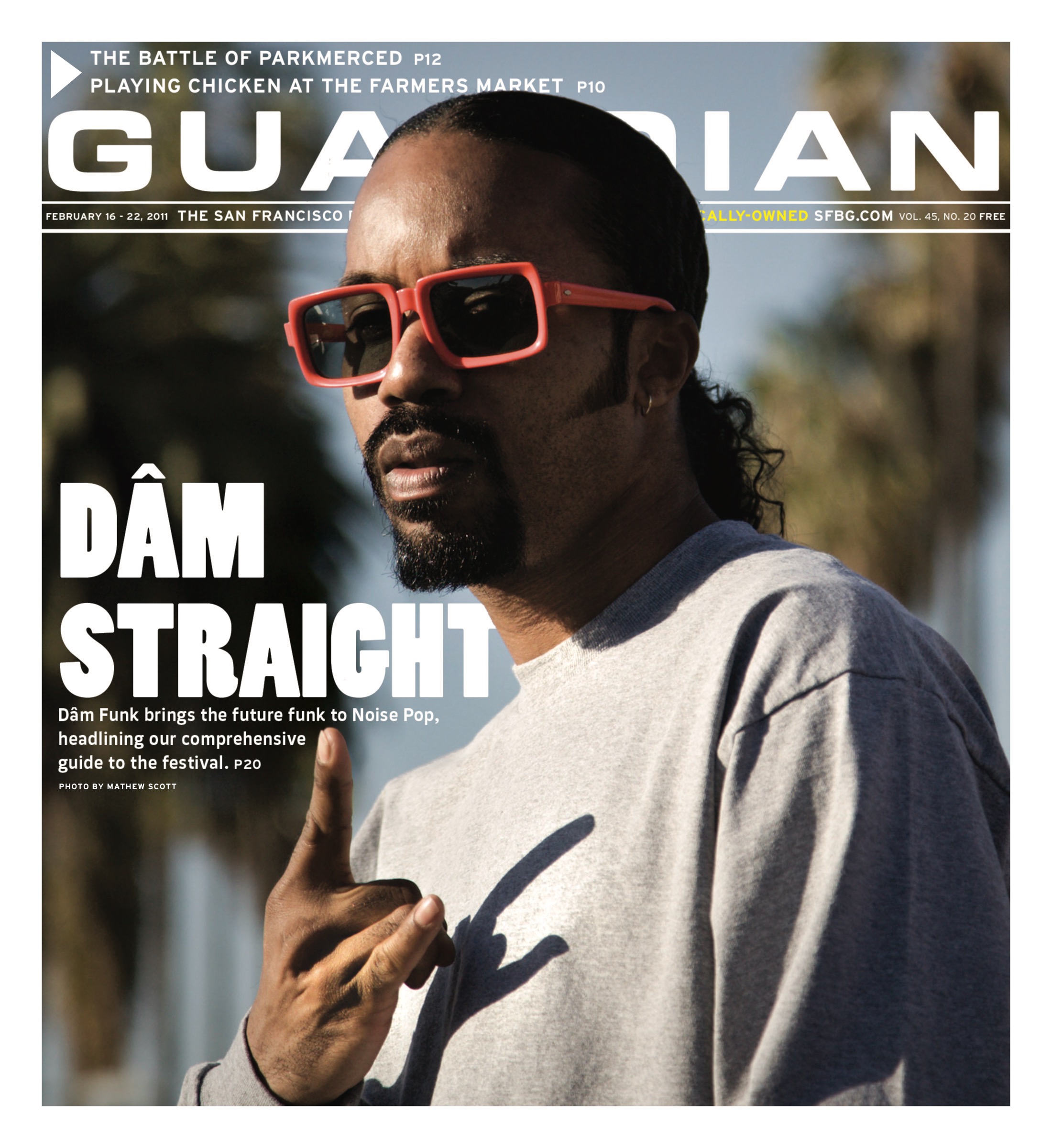
PEANUT BUTTER WOLF AND DÂM-FUNK: THE DISCOVERERS

It’s the midnight hour on Valentine’s Day in Portugal when I reach Dâm-Funk, a.k.a. Damon Riddick, on the phone. He’s just outside of Lisbon, his surroundings are “phenomenal,” and he’s ready to wax enthusiastic about his longtime partner in funk Peanut Butter Wolf. “Me and Chris [Manak, a.k.a. Peanut Butter Wolf] connect on that sound because we remember and we revere,” he says, when I ask about their shared love of soul, hip-hop, and funk. “We knew what it was like before cable television and the Internet existed, we remember everything from those early VHS tapes to the way the sun set.”

As the sun is still rising on Valentine’s Day, in L.A., the man Dâm-Funk calls “Wolf” for short shows similar brotherly love. “When Dâm met me, we had a mutual respect,” says Manak. “He saw my record collection and vice-versa. When we discover songs, we’ll say, ‘Check this out.'” In turn, this shared enthusiasm, and the positive response to Dâm-Funk’s albums Toeachizown and Adolescent Funk — both released on Manak’s label, Stones Throw – has recharged funk sounds in Los Angeles and SF, and led to new discoveries of soulful and funky treasures from the recent past.

One such gem is Jeff Phelps’ 1985 Magnetic Eyes, a Tascam Portastudio 244 bedroom recording with sensational vocals by Antoinette Marie Pugh, who stars in a terrific no-budget video for the album’s “Hear My Heart” currently up on YouTube. “That album is something I’ve known about for a long time,” Dâm-Funk says, when I mention Magnetic Eyes and its hand-drawn yet futuristic cover art. “It’s a great project.”

Another great project is Tony Cook’s Back to Reality (Stones Throw), a collection of mid-1980s recordings by a musician who got his start as James Brown’s drummer. Taking on the role of executive producer, Manak has added some extra pop to the already formidable strut of Cook songs such as “Heartbreaker,” even drafting in Dâm-Funk to contribute new vocals to one track, “What’s On Your Mind.” “You’d think they were 24-track recordings, but he [Cook] only worked on an 8-track,” marvels Manak. “He was a good musician and producer – when you’re bouncing tracks, you have to know what you’re doing. In those days it was hard to achieve a full sound like that.”

These days, both Dâm-Funk and Peanut Butter Wolf know what they’re doing — and that’s a damn lot. Reflecting his Gemini nature, Dâm is planning to explore the dark side on an EP with that title before venturing into the light on his next LP. He’s also remixed Nite Jewel and is collaborating with her on a project, Nite Funk. He’s producing music by Steve Arrington for Stones Throw, and he wants to put out another chapter of his archival venture Adolescent Funk, with him choosing the tracks instead of Manak. As for the man Dâm calls “Wolf,” he’s got Stones Throw’s 15th anniversary on his hands, including a 7-inch box set, and a series of live-to-vinyl performances by the label’s artists in L.A. These guys are busy, but — fortunately for Noise Pop, and for SF — that doesn’t mean they don’t have time to throw a 45 party. (Johnny Ray Huston)

PEANUT BUTTER WOLF, DAM-FUNK

With Guillermo (Sweater Funk), Hakobo (Fresco)

Sat./26, 9 p.m., $15 (21+)

Public Works

161 Erie, SF

(415) 932-0955

www.publicsf.com


DOMINANT LEGS: LOST IN LOVE

Whether he’s raging in the streets alongside fellow Giants maniacs or musically lost between the sheets, Dominant Legs’ Ryan Lynch sounds like he’s sweet to the core—and even more. “I didn’t have anything to do with setting the mattress on fire, but I was there,” says the SF musician of SF’s impromptu World Series throw-downs. “But I wasn’t stopping anybody from celebrating.”

Lynch also rolls with the love when it comes to music. “I don’t really listen to much music that would be characterized as aggressive,” he continues, on one of those sunny Bay afternoons that make it easy to float away on blue skies and daydreams. “I listen to pop music and, honestly, mostly KISS FM.” His favorite song on this crisp, creamy day is R. Kelly’s “Lost in Your Love.” “It’s all about him wanting to bring love songs back to the radio,'” Lynch adds. “And that’s sort of what I also aspire to—not that we get any radio play!”

But, oh, a girl — or a boy who once was a Girl (until recently, Lynch was Girls’ touring guitarist) — can dream. And dreams have been coming true for Lynch, a longtime Giants follower who recently contributed “Finally Champions” to a digital-only benefit comp of Giants tribute songs released by True Panther. Meanwhile Dominant Legs continues to pick up steam—and members.

Once the repository of Ryan’s solo singer-songwriter imaginings away from longtime band Magic Bullets, Dominant Legs found favor when the Redwood City-bred musician was laid off from his job as mail clerk-receptionist at a law firm. He didn’t sink his sparse funds into job retraining classes or the like; instead he bought a cheap Casio keyboard and drum machine. “I shouldn’t have been spending any money,” he recalls now. “But the direction of the music really took off after acquiring those pieces of musical equipment.” Friend Hannah Hunt, who had just graduated from college, offered to help out at a 2009 show at Amnesia and ended up sticking around.

“She brought a softness, and delicacy, which made the songs more delicate since her voice is so different from mine,” he observes. “I think her voice is easier on the ear than mine.” For Noise Pop, the two have acquired a few more legs to help them on their way: drummer Rene Solomon, bassist Andrew Connors, and guitarist Garrett Godard, the latter once the drummer for Girls.

They’ll be filling out the already intoxicating pop bounding off Dominant Legs’ 2010 EP, Young at Love and Life (Lefse), which has inspired music bloggers to go wild, tossing out scattershot, albeit flattering allusions to Orange Juice and Belle and Sebastian, Kelley Polar and Arthur Russell—and even Dave Matthews. Feeling lost again? Just listen to the earnestly lovelorn, gently bopping, synth-popping tunes like the title track and “Clawing Out at the Walls,” with its curious admixture of sweetness and self-doubt. Kindred spirits and modern lovers such as Jeremy Jay and Camera Obscura, also given to such exquisitely anxious reveries, would understand. “The only thing I’ve heard is that [the EP] is too heavily influenced by the ’80s,” says Lynch. “But I don’t see that as a problem.” (Kimberly Chun)

DOMINANT LEGS

With How to Dress Well, Shlohmo, Chelsea Wolfe

Sat./26, 8 p.m., $12–$14

Café Du Nord

2170 Market, SF

(415) 861-5016

www.cafedunord.com


ADMIRAL RADLEY: LIFE AFTER GRANDADDY

Jason Lytle has never been shy in revealing the frustrations leading up to Grandaddy’s demise. Exhaustion from middling success, a love/hate relationship with his lifelong home of Modesto, and a diminished interest in making music with others resulted in a move to Montana to focus on a solo career in 2006. Enter Admiral Radley, a collaboration with members of indie-pop group Earlimart and Grandaddy drummer Aaron Burtch that has him not only playing in a band again, but touring Japan and singing about his former home on songs such as the sarcastic “I Heart California.” Lytle took some time out from a snowy day of magazine shopping at Borders in his new hometown of Bozeman to talk about the project.

SFBG Rumors of a collaboration between you and Earlimart date back to the Grandaddy days. What led to you guys finally working together?

Jason Lytle It was really an excuse to hang out at [Aaron Espinoza’s] studio and just have people coming in and playing parts. We set aside a week as a fun little project. Maybe somebody else had other plans for it, but at the time, I was convinced it was just gonna be a cool opportunity to make a record and be done with it.

SFBG Were you guys surprised by the amount of excitement surrounding the project?

JL Yeah. Then it turned into, alright, we gotta name this record something, and give the band a name, and pretty soon it was this real entity. The Japan thing started off as a joke, and then became more of, “Let’s give this a go, and if it winds up getting us to Japan, we can call it good” — and the whole thing was worth it.

SFBG And how were the Japan shows?

JL They were really scrappy. The places were just dumps. I kept joking with Aaron, saying, “If we weren’t in Japan right now, and if these weren’t exceptional circumstances, there’s no way I’d be putting up with this.”

SFBG You’d expressed some skepticism about playing in bands again after Grandaddy split. Has this experience changed your opinion?

JL My place in Admiral Radley is totally different from what my situation was with Grandaddy. I’m getting off easy. Aaron is a great organizer and knows that a big appeal for me joining the band was not dealing with a lot of the day-to-day crap I used to deal with. I feel like I’m a piece of a puzzle with this band, which after all these years is something I’ve never really experienced. So it’s been kind of neat.

SFBG Both you and Aaron like being hands-on with production in your work. How was the collaborative process on this album?

JL That part was pretty effortless. Aaron and I share a lot of the same philosophies on production and making albums sound a certain way. I definitely sat in on some of the mixing, but there was a lot of it where I was just able to trust what he was going to do, knowing that it probably wouldn’t be too far off from what I’d do myself.

SFBG Was it strange writing lyrics about California now that you’ve been gone for almost five years?

JL I’ve definitely had a renewed perspective. Every time I visit or I’m there doing some work, I’m thrust right into the shit. Like right into L.A. or SF, rather than adjusting or letting it sink in slowly. So, usually it’s pretty jarring for me just because the pace is a lot more relaxed and different here. Having a bit of that outside perspective now allows me to look at things a bit differently. (Landon Moblad)

ADMIRAL RADLEY

With Typhoon, Social Studies, Fake Your own Death

Wed./23, 8 p.m., $12 (21+)

Bottom of the Hill

1233 17th St., SF

(415) 621-4455

www.bottomofthehill.com


GEOGRAPHER: EARTH PEOPLE

The dress code doesn’t include a finely-pressed lab coat, and the toolbox isn’t filled with fragile beakers, but a geographer is indeed a scientist, one who pours himself into the earth and bleeds across its surfaces to observe and categorize its residents. I haven’t asked the members of the San Francisco synth-pop trio Geographer if this occupation has had any inspiration on its sound, but there’s reason to believe the answer may be a humble yes.

Geographer has discovered new ground in the electronic realm. Its unique ménage a trois of music-making contraptions — drums, synth and cello — produces audible scenery that simultaneously calms and energizes the senses. Luscious forests of synth share habitats with rushing bass and guitar. The cello adds a sneaky-smooth layer that easily melts between or melds the more jagged sounds.

Behind the sweet scenery resides a less than pretty picture. Themes of loss and inevitable change creep through their sun-stained melodies, pulling at the roots of the band’s core. In 2005, Michael Deni fled his home in New Jersey, after the unexpected deaths of two family members. He landed in SF, and his instruments became a source of comfort and release while he wandered the new, unfamiliar territory. After a period of searching and surveying, Deni met and began collaborating with Nathan Blaz and Brian Ostreicher. In 2008, Geographer self-released its debut full-length, Innocent Ghosts, a far more relaxed collection that showcases Deni’s round, patient voice.

The landscapes on 2010’s Animal Shapes (Tricycle) are majestic, but far more celebratory. Things are tighter spun, beats kick harder and there’s a cohesive exploratory factor. Specifically fabulous: “Kites,” a track that strikes gold with a lustrous synth party. Deni’s sincere vocals float high above the mountainous bass vibrations, but mingle ever so courteously with the shrill, twinkling electronic additions. Enter the romantic cello and the song is a straight-up gem.

Now is a good time to button up your favorite white jacket and take some notes on the current environment in which you reside. Whether you’re into earth science or not, Geographer is a swell listen that goes well with salty pretzels and an adventure around your own neighborhood. Animal Shapes on repeat will keep you in step with eyes and ears open. And listen carefully: there’s good word on the street about these Geographer guys in the live form. (Amber Schadewald)

GEOGRAPHER

With Butterly Bones, K Flay, Funeral Party

Wed./23, 8 p.m., $13–$15

The Independent

628 Divisadero, SF

(415) 771-1421

www.theindependentsf.com


PSYCHIC FRIEND: PIANO POWER

Will Schwartz and the piano go way back, to when he was nine. “I’ve been attracted to the C chord and to A minor since I was a kid,” he says from L.A., where he’s living in Los Feliz. “I learned to play piano by ear, and it was always based on [starting with] a C major and going from there.”

You could say Schwartz played his first gigs on the instrument. “We had this two-story living room in our house in New Jersey with a little balcony, and the piano was up on the balcony,” he says with a laugh. “I would imagine I was playing for people down below. I would put on shows for the living room furniture.”

In his new band Psychic Friend, Schwartz updates California chamber or piano pop for today’s era, with contributions by Hole drummer Patty Schemel and instrumentalist-producer Bo Boddie. The result is a fresh chapter in Schwartz’s musical story, one that has ranged from the guitar-rock of Imperial Teen to the D.I.Y. choreographed pop of Hey Willpower, which involved contributions from videomaker Justin Kelly, DJ Chelsea Starr, and musician Tomo Yasuda.

Crisp and clean, in a way Psychic Friend sounds like the moment Schwartz has found his voice, or unknown heights or depths of it. The pounding “Once a Servant” revives the spirit of Jobriath. “Water Sign” has a Serge Gainsbourg undercurrent. “Shouldn’t Have Tried Again”‘s rendering of the repeat failure of a relationship matches the plaintive sunshine-y yearning of Harry Nilsson’s sublime covers of Randy Newman.

You could say Psychic Friend is new Californian pop. The piano-based melodic immediacy of the group’s sound has a kinship to Carole King’s solo work, or Burt Bacharach and some of his hits for psychic and other friends, yet both the sound and the lyrical content is very contemporary, not retro. It also isn’t Rufus Wainwright showboating — tracks like “We Do Not Belong” allow Schwartz’s voice a freedom and resonance it hasn’t had before, but he doesn’t run away with himself. “The nature of playing a piano and writing melodic songs, it almost brings you back to ’70s songwriting,” Schwartz observes.

“I just found this place in my voice that feels very connected, actually, that comes from playing the piano, and it feels good,” he adds, simply.

Schemel’s powerful drumming and Boddie’s hit-making skills have a role in this shift. “It’s like an Eddie and the Cruisers feeling,” Schwartz says, “where you start to play something, and by the end it sounds like a finished song.” (Huston)

PSYCHIC FRIEND

With The Concretes, Birds and Batteries, Magic Bullets

Fri./25, 8:30 p.m., $13–$15

Rickshaw Stop

155 Fell, SF

(415) 861-2011

www.rickshawstop.com

Not forgotten

0

arts@sfbg.com

HAIRY EYEBALL Around 500 people a day pass through the long corridor that bisects San Francisco City Hall’s lower level: supervisors dashing to the café for a quick lunch; tour groups of elementary school children; aides making a post office run; the occasional member of a wedding party looking for the bathroom.

It is also one of the last places where you’d expect to find a politically vital art installation, which is what makes San Francisco Art Commission gallery director Meg Shiffler’s decision to hang its current exhibit, “Afghanistan in 4 Frames,” in such a public and heavily-trafficked area so gutsy. Though the SFAC regularly puts on three to four art shows a year in the City Hall space, none in recent memory have resonated so powerfully with the dynamics of the venue itself.

The “4 Frames” exhibit presents a ground-level (no pun intended) portrait of the country through the lenses of four photojournalists who, over the past five years, have embedded themselves with various military forces and units stationed there. Though each photographer varies in style and background, their work — presented as photo-essays — shares a focus on the day-to-day, intersecting lives of civilians and soldiers off the battlefield.

James Lee, a U.S. Marine Corps veteran and current San Francisco State University graduate student whose move to photography from writing was a recent one, captures in crisp color the downtime faced by young Afghan National Security Force soldiers stationed near the Pakistan border.

In contrast to the all-male environment Lee documents, Lynsey Addario’s series “Women at War” focuses on the experience of female U.S. troops and their engagement with female civilians. The Pulitzer Prize-winning photographer has a knack for taking a picture at the moment her subjects are at their most unguarded, whether sharing a laugh with each other or shaving their legs in the barracks.

Addario’s photos are pointedly hung on a wall across from Bay Area photographer Eros Hoagland’s slightly more testosterone-driven series, “Siege Perilous.” The high contrast black and white photos depicting British military forces in the Korengal Valley and Helmand Province practically crackle with tension.

Another veteran photographer, Teru Kuwayama, is the only one who works with actual film, and his grainy, black and white Holga and Leica portraits of rural clans and armed mercenaries feel as if they are from another era. Kuwayama’s most timely work on Afghanistan actually resides offsite and online: his Web reporting initiative, Basetrack, links deployed Marines with life at home through images and video created by embedded journalists (although just last week military brass asked the embeds to leave).

Afghanistan made front pages again last summer after WikiLeaks uncovered 90,000 pages of classified materials chronicling a five-year window in the U.S. military’s long slog there. But “4 Frames” reminds those who encounter it — as well as those who seek it out — that regardless of the headlines, there will always be an ongoing, human side to what has been so often dubbed “the forgotten war.” And forgetting is not a luxury we can afford.


THE ATROCITY EXHIBITION

Although a vastly different beast from “Afghanistan in Four Frames,” SFMOMA’s current juggernaut of a thematic survey “Exposed: Voyeurism, Surveillance and the Camera Since 1870” offers a pointed study in contrast, demonstrating how not to curate a photography show with clarity of vision or regard to what could be called an ethics of representation.

As proclaimed by its title, “Exposed,” which was organized by SFMOMA and the Tate Modern in London, where it originally premiered, attempts to track — across various eras, technologies, and milieu — what the introductory wall text calls the “voyeuristic impulse” in modern and contemporary photography: “an eagerness to see a subject commonly considered taboo.”

With such an open-ended criteria, the curators have essentially given themselves carte blanche to include everything from early 20th-century “detective cameras,” Walker Evans’ portraits of unknowing New York City subway passengers, Ron Galella’s paparazzi snaps of Jackie O., Nick Ut’s iconic image of a crying Kim Phuc in Vietnam (as well as his 2007 picture of a crying Paris Hilton), Robert Mapplethorpe’s BDSM pictures, surreptitious documentation of the liberation of Nazi concentration camps, and Trevor Paglen’s near-abstract renderings of distant military sites.

The 200 or so pieces are arranged in thematically-grouped galleries (“Celebrity and the Public Gaze,” “Witnessing Violence”) that wind through half of the museum’s fifth floor. By the time you’ve made it through the lengthy, final “Surveillance” section of the show, “Exposed” feels more like a photography catalog that become the genesis for an exhibit, and not the other way around.

Such tidy categorization has the negative effect of creating closed systems rather than allowing different pieces to speak to each other. For example, two harrowing, anonymously-attributed lynching photos belong next to one of the most moving selections in “Exposed,” Oliver Lutz’s Lynching of Leo Frank, which hangs in another gallery. At the same time, the very proximity of death images and paparazzi shots cheapens both.

When presenting highly-charged, difficult images, many of which document humankind at its most brutal and unsavory, the context they are displayed in becomes as crucial as the images themselves. “Exposed,” which feels like the result of several unseemly Google image searches rather than a decade of curatorial sweat, disappoints in this regard.

Atrocity. Murder. Fame. Kinky sex. It’s all here! The question no one seemed to ask is: does it need to be? “Exposed” is simply too much. *

AFGHANISTAN IN 4 FRAMES

Through May 13, free

City Hall

1 Dr Carlton B. Goodlett Place (ground floor), SF

(415) 554-6080

www.sfartscommission.org/gallery

EXPOSED: VOYEURISM, SURVEILLANCE, AND THE CAMERA SINCE 1870

Through April 17; free–<\d>$18

San Francisco Museum of Modern Art

151 Third St., SF

(415) 357-4000

www.sfmoma.org


Dense in the west

9

rebeccab@sfbg.com

A marathon special meeting of the San Francisco Planning Commission on Feb. 10 demonstrated a clear split over Parkmerced, a $1.2 billion private development project that will rebuild an entire existing neighborhood on the west side of San Francisco.

While some expressed strong enthusiasm for moving forward with the ambitious plan, many residents turned out to voice vehement opposition, citing concerns about traffic congestion, noise, dust, and the demolition of affordable apartments that some Parkmerced tenants have occupied for decades.

The votes to certify the project’s environmental analysis and send the plan onto the Board of Supervisors with a commission endorsement were split 4-3, with Commissioners Christina Olague, Hisashi Sugaya, and Kathrin Moore dissenting.

Those who voted no were appointees of the Board of Supervisors, while the four commissioners who voted in favor were appointees of former Mayor Gavin Newsom, suggesting a break along clear political lines. State Assemblymember Tom Ammiano also submitted a letter urging commissioners not to approve the project.

While Parkmerced Investors LLC, the project sponsor, eagerly awaits groundbreaking, spokesperson P.J. Johnston noted that they weren’t there yet. “First,” he said, “we have to break ground at the Board of Supervisors.”


IS IT GREEN?

The Parkmerced redesign has been touted as an ecological and sustainable beacon for urban development and, indeed, some features of the grand plan read as if they were plucked from a checklist from the U.S. Green Building Council’s Leadership in Energy and Environmental Design (LEED) green-neighborhood standards.

Walkable, bikeable streets with proximity to transit? Check. Water-efficient landscaping? Check. Energy-efficient dwellings? Check. Project sponsors claim that through dramatic reductions in per capita resource consumption, three times as many residents would consume the same amount of water and electricity as Parkmerced’s current population does today.

Johnston emphasized how adding new units to the west side of the city also helped contribute to “density equality,” since most new projects tend to be concentrated in the eastern neighborhoods.

Johnston was particularly jazzed about an innovative storm-water discharge system envisioned for the plan, which he described as a design that could “regenerate and repair the environment.” It would recirculate rainwater through a naturally filtrating system of ponds and bioswales to recharge Lake Merced, a water body that has been slowly shrinking due to being choked off from its natural watershed by a concrete urban barrier.

Green points might be awarded for plans for an on-site organic garden, but Commissioner Michael Antonini, who said he lives less than a mile from Parkmerced, cautioned that developers shouldn’t get too attached to that idea. After all, he said, many kinds of vegetables won’t thrive in that part of the city.

Meanwhile, the wholesale destruction of existing units is decidedly not eco-chic. The Green Building Council’s LEED neighborhood standards insist that “historic resource preservation and adaptive reuse” is always preferable in a green development — and that’s the point that Aaron Goodman, an architect who previously lived at Parkmerced, has been driving at for more than a year. Proponents maintain that Parkmerced’s wartime construction meant it was built with inferior materials, and that property owners have battled dry rot and other infrastructure problems.

Another not-so-green Parkmerced project feature has also raised eyebrows: parking. While proponents portray the redesign as a switch from a suburban, love-affair-with-the-automobile style to an enlightened departure from car-centrism, plans nonetheless include a parking space for every single unit.

That creates the potential for more than 6,000 new cars on the road in that area, and the 19th Avenue corridor is already notorious for traffic snarls. According to calculations by the Environmental Protection Agency, the typical American motorist generates more than five metric tons of carbon dioxide by driving in a given year.


REPLACING WHAT’S THERE

Before the Planning Commission meeting, residents from the Parkmerced Action Coalition — a relatively new residents’ group formed to oppose the redevelopment and a wholly different entity from the Parkmerced Residents’ Organization — made a public show of their dissatisfaction outside City Hall. Holding signs with slogans such as “Don’t Bulldoze Our Homes,” residents sang protest songs and chanted, “We are Parkmerced!”

With the dramatic makeover, Parkmerced would expand to around 8,900 units, tripling the number of residents who could be accommodated. Existing 1940’s-era garden apartments would be razed to make way for higher, denser housing. The plan comes at a time when neighboring San Francisco State University is undergoing its own phase of expansion.

“This project in its current state is a vision that is not in harmony with the people, place, or the environment,” charged Cathy Lentz, an organizer with the Parkmerced Action Coalition, in a vociferous plea to the commissioners. “It is a narrow vision, a corporate vision … a true vision would be inclusive of present dwellings, inclusive of animals, trees, and present environment.”

One resident lamented the pending loss of his garden courtyard, noting how much his children had enjoyed the green space growing up and listing the different kinds of birds that would surely be driven away by heavy-duty construction and tree removal. For many, the point was not so much what developers intended to build, but what would be lost to make way for it. One speaker dismissed the plan as “architectural clear-cutting.”

Commissioner Moore, an architect, sounded a similar note when she rejected the notion that the Parkmerced redevelopment should be hailed as infill, a desirable development concept that curbs sprawl by utilizing space efficiently. “Urban infill housing is defined as infill on vacant sites,” Moore said, “not sites that have become vacant by demolition.” She added that she believed the environmental impact review “fails to sufficiently examine why housing demolition is even necessary.”

In Moore’s view, “the only reasonable alternative is a significantly redesigned … project.”


WORKING-CLASS NEIGHBORHOOD

Unlike a luxury condominium development, the Parkmerced plan emphasizes built-in economic diversity — yet critics point out that as it stands, the housing complex is already inclusive of many lower-income, working-class residents.

The plan will incorporate several hundred below-market rate units, in accordance with the city’s inclusionary zoning ordinance. Commissioner Antonini also emphasized the boost to city coffers from tax revenue associated with the project.

Meanwhile, questions are still arising on the issue of rent control. “We do not believe it is appropriate for the City and County of San Francisco to be displacing rent-controlled residents,” noted Michael Yarne, a mayoral development advisor. A binding agreement between Parkmerced Investors LLC and the city of San Francisco, which will be linked to the land, promises that new units will be made available to rent-controlled tenants at the same monthly rate they now pay, with rent control intact (See “Weighing a Landlord’s Promise,” Dec. 21, 2010).

Yet Polly Marshall, a commissioner on the San Francisco Rent Board, noted that she still didn’t believe tenant protections were adequate. She also spoke to the pitfalls of tearing down and redoing an entire neighborhood.

“The proposed Parkmerced development is the kind of development that I normally would support. It’s the kind of thing I work on in my profession,” noted Marshall, an attorney who has worked on redevelopment projects. “What’s different about this project is that it involves an existing community. It requires devastation of that community. It reminds me of the old-style redevelopment projects that went on in the Fillmore that destroyed existing neighborhoods. Look around that area now … there’s high density housing there, but that’s about all. The community — the networks of the people — was destroyed decades ago.”

Marshall took it a step further, offering her analysis on why Parkmerced was targeted. “It’s because it’s a working-class neighborhood of renters,” she said. “That’s why we’re going to destroy Parkmerced.”

“Flex” keeps marine scientists guessing

3

I received a call last Friday from Nicole Catalano of Pacific Environment, an environmental nonprofit focusing on marine conservation. An endangered gray whale was headed for California, she told me, and I could follow its movements online. “We expect it to be in California either now, or any day now,” Catalano said.

“Flex,” as researchers have named him, is one of an estimated 120 western Pacific gray whales. The highly endangered species has fared much worse than the related eastern gray whale, which has an estimated population of around 20,000.

The whale was tagged last October as part of a research project geared toward offering the mammoth creatures better safeguards against extinction. “They were going to tag many of them,” Catalano explained, but so far, Flex is the only whale researchers have succeeded in making contact with.

The Marine Mammal Institute at Oregon State University has created a website, updated weekly, to track Flex’s transoceanic journey. So far, he’s gone from Russia, to the Bering Sea, to the Gulf of Alaska, to the coast of Oregon, to the coast of California.

Researchers have been suprised by his progress, and don’t know what to expect next. “Flex’s route may or may not be typical of what western gray whales do — there could be three or four other whales from the western population making this same trip, or Flex could take an entirely different route next year,” said Bruce Mate, director of the Marine Mammal Institute.

The international environmental community’s interest in western Pacific gray whales stems in part from monitoring offshore oil and gas drilling near Russia, Catalano noted. Seismic testing for offshore development is known to impact marine mammals, and some of this activity is occurring nearby the whales’ feeding areas. In 2006, the Western Pacific Gray Whale Advisory Panel was convened by scientists to provide independent recommendations on how oil and gas companies can minimize risks to rare creatures.

Garbage curveball

0

sarah@sfbg.com

A newly released report from the Budget and Legislative Analyst has thrown a curve ball at the Department of the Environment’s proposal to transport the city’s garbage by truck and rail to Yuba County for disposal in Recology’s Ostrom Road landfill.

Recology’s proposal would kick in when the city’s disposal contract with Waste Management’s Altamont landfill reaches its 15 million ton limit, which is anticipated to occur in 2015, or beyond (see “A tale of two landfills,” 06/15/10). But as that much-anticipated proposal finally comes to a Board of Supervisors committee on Feb. 9, the debate has suddenly been significantly broadened.

The Budget and Legislative Analyst’s report recommends replacing existing trash collection and disposal laws with legislation that requires competitive bidding on all aspects of the city’s waste collection, transportation, and disposal system. It also recommends that the Board of Supervisors require that refuse collection rates for both residential and commercial services be subject to board approval, and that competitive bidding could result in reduced refuse collection rates in San Francisco.

The annual cost to ratepayers of the city’s entire refuse system is $206 million, but only the landfill disposal contract, worth $11.2 million a year, gets put out to competitive bid, the BLA observes.

Debra Newman, an analyst with he BLA, told the Guardian that she has been asked why she brought up all these issues in advance of the Board’s Feb. 9 Budget and Finance committee hearing to discuss the Department of Environment’s recommendation that Recology be awarded the disposal contract. The company already has a monopoly over collection and transportation of waste in San Francisco thanks to an 79-year-old voter-approved agreement.

“Our position is that this is the only opportunity to address these issues with the board because of the way the city’s 1932 refuse collection and disposal ordinance reads,” Newman said. “This is the only vehicle we would have because nothing else is going to come to them. The residential rates don’t come to them, the commercial rates don’t even come to the Rate Board. This is our chance to discuss the whole kit and caboodle of waste collection, transportation, and disposal.”

The BLA’s Feb. 4 report notes that “Unlike water rates charged by the SF Public Utilities Commission, neither residential or collection rates are currently subject to Board approval, under the city’s 1932 refuse ordinance.”

Residential rates are approved by the director of Public Works, unless such rates are appealed, in which case they are subject to the approval of the city’s Rate Board, which consists of the city administrator, the controller and the SF Public Utilities Commission director. Recology sets the commercial rates, which are not subject to city approval.

Voters previously rejected two attempts to allow for competitive bidding for refuse collection and transportation (Prop. Z in 1993 and Prop. K in 1994). And the BLA observes that if the Board doesn’t go to the ballot box, it could ask DoE to analyze costs and benefits of using Recology to collect refuse, and using a separate firm to provide transportation, if that firm can avoid transporting refuse through San Francisco’s streets.

Under the never-ending waste ordinance that the city approved during the Great Depression, 97 permits exist to collect refuse within the city, and only authorized refuse collectors that have these permits may transport refuse “through the streets of the City and County of San Francisco.” Due to a number of corporate acquisitions, Recology now owns all 97 permits and so has a monopoly over refuse collected in and transported through the streets of San Francisco.

But the BLA report was unable to identify any portion of the city’s 1932 refuse ordinance that governs the transport of refuse that does not occur through the city’s streets.

“Therefore, it may be possible for a second firm, other than Recology, to transport refuse after it has been collected by Recology, if that second firm’s transfer station was located either outside the city limits or was located near marine or rail facilities, such that refuse from the transfer station to the city’s designated landfill could avoid being transported through the streets of the city and county of San Francisco,” the BLA states.

“These are nuanced issues and they’ve evolved,” Newman observed. “All we are doing is trying to help the board try and decide what to do on this matter. We are saying that the current approach is a policy matter for the board, and recommending that the board submit a proposal to the voters to amend the refuse collection and disposal ordinance.”

The BLA report comes 15 months after the city tentatively awarded the new landfill disposal agreement to Recology to deposit up to 5 million tons of waste collected in San Francisco in Recology’s landfill in Yuba County for 10 years. The award was based on score sheets from a three-member evaluation panel composed of City Administrator (now Mayor) Ed Lee, DoE Deputy Director David Assmann, and Oakland environmental services director Susan Katchee.

The trio scored competing proposals from Recology and Waste Management, and awarded Recology 254, and WM 240, out of a possible 300 points. Lee’s scores in favor of Recology were disproportionately higher than other panelists, and the BLA notes that the largest differences in the scoring occurred around cost.

The BLA concluded that the city’s proposed agreement with Recology was subject to the city’s normal competitive process, “because the landfill disposal agreement is the sole portion of the refuse collection, transportation and disposal process which is subject to the City’s normal competitive bidding process.” And it found that because the transfer and collection of the city’s refuse has never been subject to the city’s normal bidding process, approval of the proposed resolution is a policy decision for the board.

But while DoE’s Assmann has said that California cities must maintain a plan for 15 years of landfill disposal capacity, the BLA notes that such plans can include executed agreements and anticipated agreements. And WM officials confirm that Altamont has capacity for 30 to 40 years. This means the board need not rush its disposal decision.

The BLA report comes against a backdrop of intense lobbying around Recology’s proposal. Records show that in 2010, Alex Clemens of Barbary Coast Consulting recorded $82,500 from Recology, and Chris Gruwell of Platinum Advisors recorded $70,000 from Waste Management to lobby around the city’s landfill disposal contract.

And now both firms continue to press their case in face of the BLA report.

“Folks are trying to cloud the issue,” Recology’s consultant Adam Alberti, who works for Sam Singer Associates, said. He claims the BLA report concludes that Recology’s proposed contract is the lowest cost to rate payers, saving an estimated $130 million over 10 years, that Recology’s green rail option is the environmentally superior approach, and that the city’s contract procurement process was open, thorough, and fair. “In short, the process works—and it works well,” Alberti said. “The rate setting process is an important subject, and one the board should review, but the one before the board now is a fully vetted contract.”

Alberti claimed that contrary to the conclusions of the BLA, which found commercial collection rates are significantly higher in San Francisco than Oakland, Recology’s rates are cheaper than Oakland—once you factor in Recology’s recycling discounts.

Waste Management’s David Tucker said the BLA report “raises lots of good questions.”

“We have said from day one that transportation was a component of the request for proposals [for the landfill disposal contract] that no other company other than Recology had an option to bid on,” Tucker said. “Had we been able to bid on the transportation component, our costs would have been lower.”

Tucker believes that no matter who wins the landfill contract, the BLA report points to a lack of transparency and openness under the city’s existing refuse ordinance.

“Up until this time, no one has been able to understand the process,” Tucker said. “If the Budget and Legislative Analyst has shown that there are some inconsistencies in the statements made by the Department of the Environment, if the process has slight flaws, then the whole process from the request for proposals to the pricing needs to be revised. And time is on the City’s side. There is no need to rush into a decision. Yes, our contract with the city is ending, but our capacity at the Altamont clearly goes into 2030 and 2040. So, this is an opportunity to toss out [Recology’s] proposal and start again.”

Asked if Recology is planning to rail haul waste to Nevada, once its Ostrom Road Yuba County landfill, Alberti said that the city’s current procurement process prohibits that.

“Will that be around next time? I don’t know,” he said. “Recology’s first goal is reducing waste, and managing it responsibly. We believe rail haul is an integral part of that.”

And he insisted BLA’s report should not be connected to Recology’s disposal contract.

“Recology believes that the system is working very well, as evidenced by the fact that it’s yielded the best diversion rates, lower rates than average, and has an open and thorough rate-setting process set by an independent body,” he said. ” We feel the recommendations are separate from the matter-at-hand. But if the board so chooses to have this debate, we’re anxious and happy to be part of that discussion.”

David Gavrich, CEO of Waste Solutions Group, which transports waste by rail and barge from San Francisco, praised the BLA report for “finally peeling back the layers of the onion” on the city’s entire waste system. Gavrich notes that in June 2009, he and Port Director Monique Moyer advised DoE of an option on a piece of long-vacant port property that offers direct rail and barge transportation of waste and could result in tremendous long-term savings to ratepayers.

“But we never got a reply to our letter,” Gavrich said. “Instead, DoE pushed forward with Recology’s trucking of waste to the East Bay, the transloading of waste from truck to railcar in the East Bay, and the railing of waste east to Yuba County.”

Sup. Ross Mirkarimi, which sits on the Board’s Budget and Finance Committee, is concerned that the city is considering enlarging Recology’s monopoly, without calling into question the reform of the 1932 charter.

“I don’t think these two questions should be disconnected in the way they are in the proposal to award Recology the landfill disposal contract,” Mirkarimi said. “The city and the DOE are very defensive about this and have a well laid-out defense to show that they followed the letter of the law in awarding this contract. But that leads to a secondary set of concerns: namely are we getting the best bang for our bucks, and is there something less than competitive about the current process.”

Mirkarimi admits that Recology has been committed to many of the city’s environmental policy advances. “But that’s aside from the larger question of what this mean in terms of institutionalizing further the expansion of a monopoly,” he said. “Our utilities are governed by monopolies like PG&E. So, should we be going in the same direction as 1932, or thinking if we want to diversify our utility portfolio?”

Flush with tips

0

culture@sfbg.com

CULTURE I floated drunkenly into the second-story bathroom at 1015 Folsom. It’s a tiny affair, and my head was just enough obscured to make navigating past the waiting bodies a sure difficulty. I did my business and realized that the man that I had squeezed by, near the sink, wasn’t another patron, but some sort of bathroom attendant. In my inebriated state, it appeared to be an elaborate joke.

He was Latino, wearing a nice suit, and stood in the narrow space between the sink and one of the three urinals, his back against the middle pissoir. He had a mountain of curiosities piled over the sink, and a towel for drying hands draped over one arm.

“Have you worked here long?” I asked.

He shook his head. No. Just a little while.

“Do you keep your tips?”

No. He shook his head again, indicating that there was some sort of split. Reluctantly using the towel, I thanked him and dropped a Washington into the tip jar.

Somewhere, after more French techno, I drifted off to sleep. When I awoke, I wondered, had that really happened? Had I dreamt it? Had I hallucinated?

I sent 1015 Folsom an e-mail inquiring about the attendant. Apparently it was true. Barnaby May, who describes himself as a seven-year veteran of the nightclub scene, took credit for the hookup. He felt that something was lacking from 1015, that it would be better to have a bathroom attendant than not. He put me in contact with Shaun Fausz, who runs a company called Refreshus, which trains and supplies bathroom attendants.

According to Fausz, the service is tailored to appeal to a lackluster economy: it costs the clubs nothing. “Clubs would rather have a free service than have to repaint every few months and replace a trashed sink,” Fausz says. Which makes good sense in a city where one of the dominant aesthetics of the nightlife is a sort of high-class posturing that can quickly be ruined by a Magic Marker. Other clubs have resorted to taunting taggers. Look how fucked up our bathroom is, the Rickshaw Stop seems to say, what else can you do? Put up another sticker? The Independent has painted its water closets black to nullify vandalism.

Bathroom attendants from Refreshus act as security, whether they’re at a nightclub, like 1015, or at a strip club, like the Century Club, where one of Refeshus’ longest standing employees, Gary Lawton, has worked for nine months. Lawton says it’s “a good public service,” although he never imagined performing it. Positioned in the bathroom, he’s able to monitor illicit behavior. “As you hear the snorting, you know what’s going on and you just let them know that they have to take it outside,” he says. “Or they’ll approach me and ask me if its cool, and I’ll just inform them that it’s zero tolerance, as well as alcohol, because there’s no drinking with full nudity.”

This was news to me. (My Catholic upbringing and feminist programming at university makes it impossible to attend a “gentleman’s club.”) If a club includes full nudity, and not just topless dancing, alcohol is verboten. “Our beloved senator is responsible for that, Dianne Feinstein.” says Lawton. “It doesn’t make any sense — I mean that’s what security is for. If you see someone being belligerent, you just tell them to go get some fresh air or something.”

Lawton, who looks like he could be a bouncer, doesn’t necessarily tell people he’s a bathroom attendant as much as “a member of security, who’s stationed in the bathroom.” But no embarrassment shows when he discusses the details. He loves his work, where he gets to act as liaison, recommending girls to patrons and occasionally getting a peek himself. He gets to meet people from all over, and show them a piece of the world that he never glimpsed before being at the Century. “It’s something I can’t explain,” he says. “You know you’re stuck in the bathroom, and then you see them doing something like ‘School Girl Night.’ It’s wild. Like nothing I’ve ever seen before. It’s just amazing every time I get out there. They have several girls who actually lift their legs up and climb all the way to the ceiling. It’s like being at the circus, but they’re stripping.”

It’s an experience that, to put it simply, Lawton is generally priced out of, a world where “private dances” can cost upwards of $100. In terms of straightforward class, Lawton has no shortage — he’s a polite man who chooses his words with the precision of someone who makes a living speaking to people — but if we’re talking economics, he’s low on the ladder. Once or twice before meeting me at the Barbary Coast coffee shop off Market Street, Lawton had to drop appointments at the last minute, his housing situation in tumult. Truth is he’s on General Assistance, in the shelter system, and shared tips from a few nights work a week aren’t enough to get over.

The income for a bathroom attendant, the flow of tips, breaks down across class lines as well as cultural ones. In Lawton’s experience, middle- to upper-class white men tip well. With African American or Indian men, he doesn’t count on tips. In some ways, bathroom attendants perform an obsolete service that only older generations know how to handle. (Think of the bathroom attendants at Bimbo’s, and that club’s retro style.)

Fausz has his own observations: “European people don’t tip. They don’t have tipping over in Europe. Women don’t tip as often — they like to let the guys pay for everything when they go out.” To my knowledge, Refreshus doesn’t have female attendants.

While Lawton can’t enforce any specific prices, he sometimes has to step in, politely explaining that the service isn’t complimentary. “Everyone under 32, they’re oblivious,” he says. “They come in and see the candy and go, ‘Oh, it’s free.’ And you have to remind them that, no, this is a service. But you don’t force any prices. Like I’ll have a jar with a $5 bill and I’ll just let them use their own discretion, just remind them that the colognes are usually this amount because it’s expensive and I have to pay for all that. You just make them feel comfortable and let them know that even though it’s complimentary, this is how I make a living. I’m responsible for all this. Because they think the club provides the service.”

A lot of this has to do with exposure. While a number of clubs — Vessel, Harlot, Trigger — reportedly have similar services, bathroom attendants aren’t common. Lawton had never encountered one before landing his job, just seen them on TV, and he describes the position as obsolete. “Each generation wants their own type of representation,” he says. “So naturally anything they think of as obsolete just doesn’t apply to them.” At the same time, Lawton acknowledges that a genuine amount of surprise plays in his favor, and patrons admire that the service is still on offer.

Whether bathroom attendant work at the nightclubs provides enough income is unclear. In a place where people pack singles, like the strip clubs, the tips are expected to flow more freely. That’s fine with Lawton, who doesn’t like the more amphetamine-infused nightclub culture as much, having had close family members ruin their life over addiction.

Fausz has seen turnover, most often when attendants steal or are headhunted by clubs. Some just aren’t a good fit ,or can’t work in the environment, or can’t hold the right amount of conversation. (The attendant I met at the beginning of this piece no longer works for Fausz.) But there are people willing to work for Refreshus wherever the opportunity arises. On a recent night I ran into Russ, a lean fellow in a sharp jacket stationed in the more luxurious main bathroom at 1015 Folsom. He described the job as “a good way to supplement my income,” adding “I’m a personal trainer.”

Fausz wants to fit bathroom attendants into more of the city’s nightclubs, even if an event tends to draw a crowd for whom a bathroom attendant is an obscure novelty. He puts it simply: “I’m kind of training the next generation of people to tip.”

Where the Magik happens

0

arts@sfbg.com

MUSIC Because of the rusty pieces of corrugated sheet metal crudely affixed to its exterior, I almost mistake Tiny Telephone, a recording studio, for a very large, dilapidated storage unit. But on a brick-red door, alphabet letter magnets spell out “tiny,” and only bits of dried glue and fragments of “telephone” remain. This must be it.

Through the door, a two-wall art installation made of reclaimed redwood (by resident artist Claire Mack) in the lounge/kitchen area catches my eye. I’ve seen pictures of it on the studio’s website. This is it. It’s easy to imagine Death Cab For Cutie or San Francisco songstress Thao drinking beer, shooting the shit, and jamming in this room.

Once I plop down on the couch, pop-folk icon John Vanderslice, owner and manager of Tiny Telephone, pulls up a chair. Minna Choi, the artistic director of Magik*Magik Orchestra, the studio’s official house orchestra, takes a seat on a tan area rug.

“It’s probably like how everyone feels when you’re from San Francisco and you move to the East Coast and there are no good taquerias,” Vanderslice says, laughing, when I ask him about the history of Tiny Telephone. “I was in a small local band,” he elaborates. “We wanted to make a record. We toured every local studio. It was like there were only either rehearsal places with garbage on the floor, or posh, unaffordable, hardwood-floor, uptight-owner situations. There was nothing in the middle.”

In September 1997, Vanderslice opened Tiny Telephone to give independent musicians the opportunity to make affordable hi-fi recordings. Magik*Magik Orchestra entered the picture in 2008. “We wanted to simplify the process of incorporating classically-trained musicians into a nonclassical environment,” Choi says. “So I e-mailed [John].”

“It was like genius!” Vanderslice blurts out.

Adding the orchestra to Tiny Telephone is in tandem with Vanderslice’s evolution as an artist. On 2004’s Cellar Door (Barsuk), he strayed from electric guitar and used acoustic guitar and keyboards. “[Electric guitars] really take up a lot of territory,” he explains. “It’s a little bit like a cock-block. [Keyboards] can sit in one area, and then you can put something directly above them and below them in the frequency spectrum, so there’s plenty of room for, like, a French horn.” This year’s White Wilderness (Dead Oceans), finds Vanderslice’s tenor accompanied by acoustic guitar and a 19-piece ensemble gleaned from Magik*Magik Orchestra’s roughly 180-person membership.

“It’s great to go in a different direction,” Vanderslice says. “It’s great to move on.”

We all stand to start the tour. As I walk across the aqua blue floor, my hand grazes Fender amps that line the walkway to the main recording room. Inside, it’s dimly lit. When Vanderslice flips a switch, a white deer head becomes illuminated — like a statue of an idol — by Christmas lights strung on a pump organ. In one breath, he enumerates some of the equipment that is available: 14 guitar amps, a Hammond b3, a grand piano, keyboards, an EMT reverb plate. The lexicon of music recording equipment is dizzying. Vanderslice points to the walls: “These are all untreated cedar panels. This is cotton batting.” As we leave the room, he pauses to mention that the studio has been booked for more than 400 days in a row.

We climb a few rickety stairs to enter the control room, where we’re joined by Ian Pellicci, Tiny Telephone’s house engineer. With its UV meters, faders, and colored knobs, the room’s Neve console, built in 1976 for the BBC in London, looks like a prop taken from the bridge of the original Star Trek‘s Enterprise. This is the tape machine,” says Choi. “I’m proud to say that I was here when they put all of the light bulbs in, then all of a sudden it came alive like Wall-E.”

To encourage analog recording, Tiny Telephone provides free two-inch tape to clients. “Not that digital is terrible. But the technology has a ways to go,” Pellicci says. “There’s a greater dimension to the sound [of analog].”

Next we shuffle into the isolation room. “We’re basically in an anechoic isolation room where people can do vocals, drums — ” Vanderslice begins to explain. But with the room’s door open, I can hear the raucous sounds of construction taking place down the hallway.

Next door, what once was an auto shop is being converted into a separate studio, a “B Room” Opening in June, the B Room will be set up as an arts nonprofit modeled after The Bay Bridged and 826 Valencia. Unlike Tiny Telephone, which costs $350 per day plus engineers, the B Room will cost $200 daily. “We wanted to give bands a low-cost option to record on a tape machine, on a real console with microphones, in a space where they can make as much noise as they want,” says Vanderslice.

“With this other price point, [Vanderslice] is tapping into another group of bands and artists,” Choi adds. “There are probably so many diamonds in the rough — crazy talent waiting to be discovered.”

As the tour winds down, Vanderslice shares his vision of Tiny Telephone and the B Room: “We’re going to put a picnic table outside, a basketball hoop — we’re going to build community. And that’s what it’s all about.”

Sound and environment: Moving beyond tropical bass with Chief Boima

0

A couple weeks ago I shot a long-winded email to former Bay Area DJ and producer Chief Boima. I had just finished speaking to Dun Dun of the Los Rakas crew for what eventually became this article, and he mentioned an upcoming EP with former Bay Area DJ and producer Boima. Now, if you don’t know about Boima, you need to get acquainted with the Banana Clipz digital funk on Ghetto Bassquake (for free download, too). It’s a joint instrumental album between Boima and Oro 11 of Bersa Discos that merges electronic architectonics with rhythms, melodies, and sound bits from the African diaspora.
Enough of that, though — Boima withstood my long-windedness, and after a couple exchanges, he did all the explaining.

SFBG Dun said that you do with instrumentals what Los Rakas does with lyrics. Do you see similarities in your respective styles? Your backgrounds and influences?
Chief Boima Well, when I first came across Los Rakas I had just come back from Panama, and I was on this high from hearing all the big carnaval tunes and the mix of sounds that reflected my musical and cultural background, but in a Spanish-speaking world. I grew up on the stuff that a lot of Panamanians grew up on, zouk, dancehall, soca, etc. So I was at the SF Carnaval and I heard Panamanian reggae but with this Bay Area flavor to it. (Check my initial reaction here, and I had been posting stuff like this.) I identified with what they were doing immediately.
Also, my father is from Sierra Leone, and I grew up with West African cultural influences, so I try to incorporate that musically into my electronic and hip-hop beats. I feel like Los Rakas do the same thing with Panama, and what Dun said is a great compliment.

SFBG Dun also mentioned a future EP coming up. What’s your process working with Los Rakas? What are some of your thoughts on this upcoming EP?
CB Well I linked up with Rico and Dun after not seeing them for maybe a year. I had given Rico some instrumentals and I never had gotten the chance to record on them. At that point I had a little studio set up in my spot in Oakland, so I invited them down to work on stuff. I think it was a real natural collaboration because we knocked out a lot of different stuff in like 6 months. They would come over and just freestyle or write. A lot of songs came out through different processes. Like one song they gave me an acapella and I constructed a beat around it. Other songs, I played them the beat and they’d just start writing to it, and we’d record. This would all happen after work and on weekends, so it was cool because the sessions were real compact but productive. I’m real excited about the EP. I think the material is strong and unique, so I can’t wait to see the reception.

SFBG “Tropical” or “tropical bass” seems to be the new term which has emerged to cover the range of new electronic music informed by both American and Afro-Latin styles of music, and their many convergences and hybrids. Do you see yourself as part of this tropical movement? Would you trace its form or define it differently?
CB I get the name tropical bass, but I see it akin to a label like world music that’s just kind of vague. I think the styles that are included under the genre are diverse musically, but they share similarities in the production process that is informed by increased access to technology and information across the world. It’s also really related to urban environments, like hip-hop and house were in their beginning stages. So I see all this music as a kind of continuum of hip-hop and electronic music from Detroit and Chicago. I see myself as part of that production process, more than a musical genre.
The genres I enjoy and work with are informed by their local environments and have names like hip-hop, dancehall, coupe decale, house, soca, and kuduro. They come out of specific regions, and their environments inform the music. A lot of the most popular rhythms are related to Africa and its diaspora, people who are generally scattered around the tropics. So that’s why people use tropical, but I wouldn’t necessarily describe myself or anyone else that way. It doesn’t really work anymore when you get [sounds like] Balani in Mali, or UK Funky, which are not tropical [in setting], but are still informed by the same aesthetics and production processes.

SFBG Do you try to digitize or transfer Afro-Latin/Caribbean folk sounds, genres, or ideas into electronic form?
CB Yes, but I don’t explicitly set that as a goal. I add in all my influences, which are informed by growing up in the Midwest and spending time on the West Coast as much as “folk” music. I was into hip-hop and electronic music growing up, and my older relatives would get down to music that was recorded by live instruments. I love those older tunes, they make me nostalgic, and make me feel connected to my culture, so I wanted to bring the feelings that I have when I hear them to a contemporary club space.

SFBG Our sense of place is now more amorphous than it was maybe thirty years ago. The Internet has in many ways uprooted us, and with regards to music, given us access to all sorts of folk genres, sonic forms of indigenous culture, traditional sounds and instruments, beforehand only accessible perhaps by being there or coming into contact with someone who was indeed there. To what extent do you think the open source availability of the Internet influences the way you channel folk forms of music and older sonic traditions in your production? In what way does place or region (whether the Bay, Cuba, NY, or online places, even the temperate range of tropical) inform your music?
CB I think the Internet has facilitated interactions and dialogue, but you can’t overlook things like increased immigration and traveling. A New York Times article recently said that New York is as diverse as it’s ever been. It claims that NY has more people born in other countries living there than ever before. The whole United States is changing. Europe is changing. The feedback loop to global centers of production in the “South” is super influential. International travel is becoming cheaper, so it’s easier to see the whole world. I think we’re going to reach an energy crisis in the near future where all that will be curbed a little, and the Internet will keep those interactions going, but we’re really living at the apex of an empire, just like the Romans, and the Ottomans, and the Greeks were super diverse civilizations informed by cultures from all over the world. So the Internet is just our current means of achieving those interactions. It takes the place of the role that sailors and desert caravans and conquerors had before. It’s just faster, and totalizing across the globe.
I travel a lot, and I have a diverse cultural background with multiple influences. That puts me in a certain position of influence because of my experience, but someone who has never traveled can have the same influences because I post about it on the Internet. But that doesn’t mean that it’s a new thing. Cotton and sugar comes from India. Potatoes come from Peru. Coffee comes from Ethiopia. These are things that are fundamental to our cultural identity today, but we don’t necessarily think about them as coming from other places. I feel like these things seep into everyday life, and they become a part of wherever they end up whether NY, London, Rio, Kampala, etc. But when they get to those places I think they change. In other words, environment’s influence is fundamental and if you listen hard you can tell the difference.

Two’s a crowd?

0

The Companion Piece is a charmingly inventive new work of devised theater conceived by actor Beth Wilmurt and directed by Mark Jackson for Z Space. It unfolds as a series of arch “meta” vaudevillian routines by a frustrated long-time duo (played with uncommon chemistry and comedic finesse by Wilmurt and Christopher Kuckenbaker).

Companion is less a narrative-driven tale than a clever, frequently hilarious, and gently moving set of variations on certain themes. These include the need for companionship, the nature of artistic creation, and the fragile balance between egos desperate to assert themselves yet just as desperately bound to the support and sympathy of others. Wilmurt’s initial inspiration for the show was a scientific treatise on the nature of human connection, the 2000 bestseller A General Theory of Love, by psychiatrists Thomas Lewis, Fari Amini, and Richard Lannon. It’s appropriate that this world premiere runs to the very cusp of dreaded Valentine’s Day.

As often as not, Companion‘s themes develop through telling contrasts. The central one juxtaposes the two needy, half-bumbling performers — as they set about trying to forge their second-string act — with the deft, supremely self-confident solo headliner (played with a flawless, period-flavored, almost animatronic showbiz intensity by Jake Rodriguez). The headliner lives with a manic force exclusively for the few minutes he’s onstage — in a bizarre and well-honed routine delivered at the outset of the play and again at the end — shutting down into an enervated, shell-shocked state in between. The duo, whose high jinx account for the bulk of what we see, meanwhile remains most alive in the give-and-take of their zany, agonized creative process. That process may be forever incomplete, but it produces one captivating scene after another, often with the simplest of means: a sly sock-and-shoe puppet show inside a giant trunk is just one of many winning moments.

All this takes place on a cavernous, shadow-filled stage (courtesy of scenic designer Nina Ball), largely bare but for a grab bag of props — trampolines, musical instruments, toilet plungers, rubber chickens, and the like — and a large olio drop featuring a magnificent vintage-style portrait of the headliner, “the sensation of the stage.” There are also a set of doors in the far wall at the back of the stage, one conspicuously set about 10 feet off the ground, sort of Winchester Mystery House style, with a gold star painted on it. This door, it turns out, is accessible by one of two rolling metal staircases, which both become the inspiration for a gorgeously solemn, oddball waltz between the couple. The deceptively spare environment comes filled with other small surprises, as when Wilmurt’s character swings out from the wing on an industrial crane that slowly glides over the front rows of the audience.

There’s an eerie beauty to this theatrical undress, and the capacious sense of possibility mingling there in the shuffle and tussle of the performers. As they tirelessly ply their shtick and clamber for turf in the enveloping darkness (moodily broken up by Gabe Maxson’s lighting and poignantly underscored by Rodriguez’s evocative sound design), it comes to seem like their environment is no less than the muffling expanse of time and space itself.

In the end, the bracketing of the play’s action with a precise repetition of the headliner’s act does not diminish this impression of infinite negotiation. The headliner himself boasts, paradoxically, “I don’t open no shows, I don’t close no shows.” The lack of a strong narrative works to advantage here, as a way of further demystifying the theatrical conceit itself. As director Jackson suggests in his program note, the arc of a storyline is far too neat a device to contain all the indeterminacy and subtleties of this slipstream existence. The show goes on, as the headliner quips, “one night only — every night,” even if, as my companion that night suggested, we all ultimately “open” and “close” alone. 

THE COMPANION PIECE

Through Feb. 13; $20–$40

Z Space

450 Florida, SF

(800) 838-3006

www.zspace.org


Dreadfully fun

0

Dead Space 2

(Visceral Games/Electronic Arts), Xbox 360, PS3, PC

GAMER Survival horror might be the game genre most affected by the environment it’s played in. You’ll see the best results when a player agrees to meet the title halfway: turning out the lights and turning up the volume. Then it’s up to the developers to deliver on their half of the equation. Though generally lauded when it released in 2008, the original Dead Space launched with promise but ultimately was content to repeat itself for the majority of its playtime.

Dead Space 2 delivers. An homage to movies like 1979’s Alien and 1997’s Event Horizon (which it most closely resembles), the Dead Space series is set in a future where space travel allows humans to embark on “planet cracking” missions, wherein all celestial bodies of the galaxy are prime meat for resource-exhausting expeditions. On one such expedition the shuttle finds an alien artifact, contagion, blah blah blah … zombies. A pretty first-rate “previously on” feature in the main menu will catch anyone up to speed.

As engineer Isaac Clarke, it’s up to you to survive this “necromorph” outbreak, this time aboard a space station named the Sprawl. Armed with a ton of weaponry and a little kinetic energy module, you’ll have to escape another apocalypse of the undead, as always by dismembering their arms and legs (and tentacles).

Perhaps taking a cue from last year’s Mass Effect 2‘s streamlining successes, Dead Space 2 is far more linear and cinematic than its predecessor. But unlike that other similarly space-themed sequel, the divide between what is lost and what is gained in the transition is far less apparent. In embracing the hallmarks of any good survival horror series — jump scares, the feeling of dread around each corner, and limited supplies — this sequel is less about innovation than it is about refinement.

Contrary to the drab shuttle hallways of the first game, the Sprawl was once a bustling metropolis and the environments you encounter are much more varied. From a church to a mall to zero-gravity space walks, the freshness in each area keeps it exciting. While the scares range from terrifyingly atmospheric (a bloodstained and deserted daycare center is especially eerie) to inelegant “monster closets” where enemies pop out of vents as you walk past, the game is never boring.

After a promising debut and a bit of a misstep with the God of War-aping Dante’s Inferno (2010), with Dead Space 2 developer Visceral Games has crafted an adventure that begs to be played more than once. Aspects remain overly familiar but, like the best franchises, the Sprawl provides players with a compelling setting and sense of dread that they’ll happily return to.

Aerial revolution

0

Consider the rise of the extreme athlete: generations of youngsters (and increasingly, brave older folks) competing to see who could pull the sweetest stunts and survive. Ever wonder how is it that a person can make the transition from earthbound and bipedal to gravity-be-damned dare-devilry? When exactly is the moment that a skater, skier, or snowboarder just lets go and trusts their body to take them up, over, around, and (hopefully) gracefully down to the ground?

Last Tuesday, I attended a press event at House of Air – the newest member of Crissy Field’s collection of renovated airplane hangars in San Francisco’s historic Presidio – where I was treated to a glimpse of how such a transformation might become reality. Not to mention a new way that a public sports facility can play with its community.

Given the Presidio’s military history, you may have been tempted to think the newly opened space at 926 Mason is home to helicopters and jets. But the pilots in House of Air aren’t crew-cutted cadets, and the only high-tech equipment in the corrugated steel hangar is an impressive array of custom-made trampolines. Every day in this house-of-bounce, tomorrow’s extreme sportsters are earning their wings – and there isn’t a major commander in sight.

House of Air is the brainchild of Dave Schaeffer and Paul McGeehan, two extreme sports aficionados who trained together on the Lake Tahoe snowboarding circuit. Their concept was helped off the ground (so to speak) by former Olympic skier Jonny Moseley. All three use trampolines to perfect their aerial artistry, and could commiserate over the difficulty of finding a facility where they could train with their respective equipment. According to Moseley, who raised eyebrows as a youth by flipping over his skis in a gymnastics studio, trampolines were few and far-between and most were used for coaching gymnasts and tumblers.

Large-scale trampolines provide the air time necessary for an athlete to teach his body to do tricks like corkscrews and 360s, serving as crucial incubators before a pro takes to the water, pavement, or snow with a new trick. But until House of Air, the idea of a dedicated facility for extreme athletes was unheard of. Now, the studio fills the void with over 2,000 square feet of trampoline space where serious athletes can perfect their skills in a safe (and soft) environment – and where, I was thrilled to find, even the not-so-extreme can have a blast.

House of Air provides lessons to beginners and more serious students of all ages. Instructors with backgrounds in everything from professional snowboarding to circus acrobatics use a specially designed high-performance trampoline deck to teach techniques to budding athletes. The center’s growing team also supervises two segmented jumping arenas, each about the size of a regulation basketball court, complete with angled trampoline enclosures that extend the bounce factor right up the walls. The facility also includes a kiddy bounce house for the younger set, special event rooms, lockers, and showers.

An average person arriving on the scene would begin their foray into the art of flight by checking out a pair of special House of Air shoes – modified wrestling shoes that provide ankle support. They would then have the option of renting some basic bounce time, participating in an organized game (think P.E. classics gone crazy: dodgeball or volleyball are both served up with a side of spring), or taking a class on the foundations of flying, which is where I wound up bouncing on my visit.

I was a bit apprehensive (read: terrified) as Moseley ushered me up to the trampoline deck and demonstrated a few tricks. He flopped through some sick twists, turns, and flips without missing a beat in our conversation. Then it was my turn.


Our intrepid reporter takes to the air at SF’s bounce palace. Photo courtesy of Jonny Moseley

I started with the aptly named “butt-drop”: a move in which the trampolinist replaces a single bounce with a fall on their bum and then – this is the crucial part – returns to her feet without missing a beat. After that, I moved onto “swivel-hips,” wherein the butt-drop is supplemented by a 180 degree revolution on the up-swing. For my final trick, I tried my hand at the sequence that leads up to a front flip: a jump, a fall to all fours, and then a forward rotation that landed me flat on my back. All in all, I wasn’t quite ready for the X Games, but it was killer on the knees and had my quads burning. I had new respect for the little groms busting board-grabs and aerials — and for the brave adults who come to House of Air for the “air conditioning” classes and company team-building sessions. Trampoline dodgeball: a fantastic way to build office camaraderie, or at the very least a good excuse to pummel that passive-aggressive co-worker with a deluge of flying foam rubber.  

Final impressions from the House of Air? Besides the sore thighs, of course? The center seems to be re-thinking the role of the public sports facility, from its boardrooms for the business set to its specially-manufactured props that emulate sports equipment for practicing athletes, like lightweight foam snowboards and a tow rope akin to what a wakeboarder would utilize on the waves. Even the layout of the building itself, which makes use of those large hangar doors to provide jumpers with such an excellent view of the bay one gets the feeling that with one wild leap one might land in the waves, helps to make House of Air a unique resource for the SF community.  

Given the chance to train in a facility like this one as a child, Moseley says he would have been thrilled – and possibly less banged-up in the bargain. “This is the way kids learn to be professionals — without getting hurt.”


House of Air, 926 Mason, SF. (415) 345-9675, www.houseofairsf.com


Mayor Lee and Big Pharma

0

EDITORIAL A piece of simple, logical legislation that would protect San Francisco consumers, public safety, and the environment appears headed for the desk of Mayor Ed Lee — and his signature would be the first clear sign that he’s not going to let powerful lobbyists (or the legacy of Gavin Newsom) guide his decisions.

The bill, by Sup. Ross Mirkarimi, would establish several secure places where people can drop off unused, unwanted, or expired pharmaceuticals for safe disposal. It seems so simple: every year, huge amounts of prescription meds are flushed down toilets or left around in medicine cabinets or drawers in the city. As much as one-third of all medicine purchased in the country is never used. The stuff that goes down the drain already has had a proven impact on aquatic life; the pills that never get thrown away are a hazard, particularly in households with small children.

But under current law, the only safe way to get rid of old meds is to return them to a pharmacy — and pay a fee. The cost of returning old drugs is enough of a deterrent that most consumers don’t bother.

If you have used motor oil in California, you can drop off and recycle it free. Many hardware stores recycle old batteries, light bulbs, and paint. Computer makers have to pay for recycling their products. Why can’t the city mandate the same rules for medication?

The easy answer: because it would cost about $200,000 a year to set up drop-off sites in drug stores and police stations — and the pharmaceutical industry doesn’t want to pay.

It’s a trivial amount of money, a fraction of what the industry spends on lobbying. In fact, with Big Pharma lobbyists from Washington and Sacramento crawling all over City Hall to block the Mirkarimi bill, it’s possible that the drug companies have already spent more fighting the legislation than it would cost to implement it.

The bill would charge companies that sell pharmaceuticals in the city a very modest fee to pay for the drop-off program. Similar programs in other places (San Mateo County, Washington State) have been highly successful — but nobody yet has asked the companies that make billions of dollars selling these products to underwrite the cost. San Francisco would be the first.

The San Francisco Chamber of Commerce has been fighting hard against the measure, claiming it would discourage biotech firms from investing in the city. That’s a huge stretch, but the chamber’s lobbying had an impact. When the measure came up at the end of 2010, four supervisors — Sean Elsbernd, Carmen Chu, Michela Alioto-Pier, and Bevan Dufty — voted with the Chamber and Big Pharma. So the bill would not have survived a Newsom veto.

But thanks to the oddities of scheduling, the legislation comes up for second reading Jan. 25, giving the new board a chance to weigh in. That will be a test for the new supervisors, but Mirkarimi is confident he’s got the six votes to give the measure final approval.

Then it goes to Lee. And if he can stand up to the chamber and the misinformation campaign from Big Pharma and sign the measure, he’ll not only help San Francisco take a national stand on an important consumer and environmental issue, he’ll also demonstrate that he’s not going to fall in line the way Newsom did every time downtown calls.

Cannabis Club Guide

8

CANNABIS CLUB GUIDE 2012 When we first created our detailed local Cannabis Club Guide two years ago — which you can find at www.sfbg.com/cannabisguide — it seemed as if the marijuana business had entered a golden age of openness and professionalism in San Francisco. But with a federal crackdown shuttering at least a half-dozen dispensaries in the Bay Area (Market Street Collective, Sanctuary, Mr. Nice Guy, Medithrive, Divinity Tree, Marin Alliance for Medical Marijuana) things have changed. Luckily for needy patients and stoners alike, San Francisco has always been a resourceful city, so those meddling feds have actually done very little to disrupt the free flow of the world’s best marijuana.

Even before the cannabis industry moved above ground and into brick-and-mortar storefronts, there were always pot delivery services here. Now they’re really proliferating, so we thought it was high time to add them to our guide. And once we delved into this realm, we found that it was every bit as civilized and professional as a visit to our friendly neighborhood dispensary — and perhaps even more convenient and cost-effective.

The process seems just as secure and legally compliant as it is at the clubs, with most reputable delivery services requiring that you become a member before accessing their products. That means sending them copies of your doctor’s recommendation and California ID, which can be even done from a photo on your smart phone. After the services verify you, you’re good to go.

We’re starting the guide with just a trio of the most high-profile delivery services, as well as a couple more dispensaries, but we’ll be adding to the online guide throughout the year, so check back frequently for more updates.

DELIVERIES

THE GREEN CROSS

This is one of San Francisco’s premier cannabis clubs, setting the standard for everyone else in terms of quality, professionalism, and advocacy for the industry. My sources had long been telling me that the Green Cross carries the best weed in the city — information validated by the long string of awards it accumulates at cannabis competitions. And founder Kevin Reed has been a passionate, high-profile leader in the community for years.

But I became even more impressed once I actually used the service. Its great website features the best descriptions of its nearly two dozen strains of lab-tested marijuana, including where and how it was grown, as well as products ranging from inexpensive pipes to eye drops. I settled on a $40 eighth of Blue Deliah, a sativa-dominant hybrid that looked both cheap and good.

Within about 30 minutes, the friendly delivery guy showed up at my apartment, handed me a white paper bag full of goodies, and charged me $35 with my new customer discount. Inside the bag, there was a grinder, a cool jar, rolling papers, a lighter and other Green Cross swag, a pot cookie, non-medicated munchies, an information packet, a receipt stuck to the inside of the bag — and a baggie of beautifully trimmed buds.

www.thegreencross.org

(415) 648-4420

Opened in 2004

Price: Low to average

Selection: Huge and high-quality

Delivery time: Super fast

Sketch factor: Very low

Access: Secure but easy to use


MEDITHRIVE

When Medithrive opened as a dispensary in my Mission District neighborhood, it became one of my favorite clubs, so I was disappointed to see it shut down by threats from the federal government late last year. But it immediately reinvented itself as a delivery-only club, and it still retains the friendly service and large selection that first endeared me to it.

“It’s definitely been a change for us, but if patients can handle the delivery thing, it ends up being better for everyone,” said the employee who took my order: the Apocalypse Medi-Mix, a mix of high-quality small buds (better for vaporizers) for $40 for four grams. And because I was a newbie to its delivery service, they threw in a free joint.

I called at 3 p.m. and was told to expect delivery between 4:15 p.m.-4:45 p.m. — and it actually showed up at 4 p.m. It wasn’t a problem because I was working at home all afternoon, but I can imagine such a long arrival window wouldn’t be ideal for some. And frankly, the buds were pretty dry, perhaps the result of not moving as much inventory as Medithrive is used to.

But on the whole, it’s still a solid dispensary and a very friendly staff that’s still worth using.

www.medithrive.com

(415) 562-MEDI

Opened in 2010

Price: Average with good deals

Selection: Large

Delivery time: Fast but uncertain

Sketch factor: Low

Access: Secure but easy to use


FOGGY DAZE DELIVERY

This place pops up prominently when people Google marijuana delivery services in San Francisco, but other parts of its operation don’t seem quite as tight as its search engine savvy. Even its readily available website, I learned while trying to order, has an outdated menu of available items. For what it actually offers, customers need to visit www.weedmaps.com, where the guy said the menu would quickly appear when I typed in “foggydaze,” but it didn’t.

Finally, I just asked him to recommend a good sativa strain, and he mentioned just two that they had in stock: Headband and Cheezle. Shooting in the dark, I went with an eighth of Cheezle for $45, and he offered me a new member gift of a joint or sample of equal or lesser priced weed. I opted for the joint because it just seemed easier at that point, particularly since my initial call went to voicemail and then I had to wait 45 minutes to get my information verified. An hour later (he said it would be 45 minutes), I had my weed.

Compared to the bad old days of ordering whatever my underground drug dealer had and jumping through whatever hoops he required, Foggy Daze is much better. But in the modern marijuana scene in this highly evolved city, Foggy Daze doesn’t quite measure up as is.

www.foggydazedelivery.com

(415) 200-7451

Price: Average

Selection: Small

Delivery time: OK, but slow on verification

Sketch factor: Medium

Access: Pretty good


DISPENSARIES

APOTHECARIUM

It was only a matter of time before someone had the idea to really emphasize excellent personal service with high-end products in an elegant environment — but the folks at Apothecarium have done it in a way that really sets them apart from the rest of the pack. This place is an experience more than just a place to score weed, much the same way adventurous bars like Alembic aren’t just about getting tipsy but appreciating just what a cocktail can become in the right hands.

Visitors to the Apothecarium are warmly greeted and seated in front of an extensive (and well-designed) menu, which an knowledgeable staffer patiently and enticingly walks you through, focusing exclusively on you and your needs. Once you finally find what you want, a large jar of your chosen buds emerge, and the employee uses long silver tweezers to place the prettiest ones on a display tray in front of you to inspect while he weighs out your choice of small or large buds with an air of showmanship.

2095 Market, SF

(415) 500-2620

www.apothecariumsf.com

Buds weighed on purchase

Opened in 2011

Price: High to low (“compassionately priced” strains available)

Selection: Large, extremely informative menu available

Ambiance: Looks like a fancy hair salon, hardwood floors and patterned wallpaper

Smoke on site: No

Sketch factor: Low

Access/security: Secure but easy access


1944 OCEAN COLLECTIVE

Despite a somewhat forbidding waiting room, this neighborhood dispensary on a mellow stretch of Ingleside’s Ocean Avenue has a real family feel once you step onto the salesfloor.

I was in the market for edibles when I went to 1944, and chatted with the jocular sales staff about which available edible wouldn’t give me couch lock or paranoia — a fully-functioning treat, as it were. My budtender pointed me towards a sativa-based peanut butter cookie with high potency, and then made me feel OK about our difficulty making a decision. “We’re all stoners here,” he laughed.

Once you make your selection among the edibles, flowers, and tinctures on offer, head to the back of the low-glitz, comfortably appointed room to give your money at the cash register. Head back to the bud counter to pick up your selection — if you’re lucky you can grab a brownie bite, cup of tea, or apple from the buffet to assuage your munchies. There’s even a sign that announces the dispensary’s job counseling and resume writing classes. A somewhat cold exterior sure, but it belies a warm heart. (Reviewed by Caitlin Donohue)

1944 Ocean, SF.

(415) 239-4766

Buds weighed on purchase

Opened in 2004

Price: From cheap to high

Selection: Large

Ambiance: Comfortable seating, jovial staff, family feel

Smoke on site: No

Sketch factor: Forbidding waiting room, friendly inside

Access/security: Tight 


2011 REVIEWS

SPARC

The San Francisco Patient and Resource Center, or SPARC (1256 Mission, SF) immediately set a new standard for dispensaries when it opened last August, combining a stunningly beautiful facility with deep connections to the medical marijuana community and a strong commitment to taking care of patients and moving the movement forward.

Even the casual observer can see what a unique place this is. A selection of almost three dozen bud varietals is presented in the style of a Chinese apothecary, each strain laboratory-tested for strength and purity and labeled with THC and CBD levels. The facility was lovingly designed from scratch with state-of-the-art humidors and security systems, creating an environment that is warm, friendly, and secure, with more employees per customer than other clubs.

Below the surface, SPARC is also setting a standard. Founder Erich Pearson and others involved with the club have been movement leaders for many years and they have deep connections with growers, patient groups, and the progressive political community. So they offer everything from free acupuncture and other services to generous compassionate giving programs to strong support for all aspects of the vertically-integrated collective.

But it is the experience of visiting that is most striking. Get expert advice on choosing from a huge range on indoor and outdoor strains and then settle into one of the tables, load a bowl into the high-end Volcano vaporizer, and taste the fruits of SPARC’s expertise.

There are always lots of great deals to choose from, from one-pound bags for baking for $300 to eighths of the finest outdoor weed for as low as $28.

SPARC is truly an industry leader, setting a high bar for what dispensaries can be.

Prepackaged buds

Opened in 2010

Price: Wide range

Selection: Huge!

Ambiance: Warm, comfortable, hip

Smoke on site: Vaporizing only

Sketch factor: Low

Access/security: Tight but welcoming

———–

IGZACTLY HEALTH CENTER

Opening in late 2010, Igzactly (527 Howard, SF) is the new kid of the block — but it’s already establishing itself as one of the best cannabis clubs around. With a rotating supply of almost 40 varieties of buds to choose from at a full range of prices, it has the biggest selection in town. I asked the bud tender how the club is able to offer such a wide array of high-quality buds, and he said it’s because they’re using a different model than most clubs. Rather than buying the buds from growers, Igzactly uses a consignment system, splitting the proceeds with the growers.

Complementing the huge stock of dried buds, Igzactly also has a large selection of cannabis-infused edibles, concentrates, tinctures, ointments, and just about anything you can get weed into. On top of that, Igzactly has a comfortable lounge and is one of just a handful of clubs that allows vaporizing on site, giving clients a choice of using the top-end Volcano or the Zephyr (my personal favorite) vaporizer models. They even offer complimentary teas and coffee.

The staff there is friendly and customer-oriented. For example, when the club opened, it offered prepackaged buds like most clubs, but it heeded customer input and quickly switched to displaying all their buds in huge jars and weighing them out on purchase, which many patients prefer. And he said the club plans to expand the lounge soon and to add on-site laboratory services by year’s end.

If Igzactly is a sign of where the industry’s headed, the future looks bright and verdant.

Buds weighed on purchase

Opened in 2010

Price: From cheap to average

Selection: Huge!

Ambiance: Green, friendly, inviting

Smoke on site: Vaporizing only

Sketch factor: Low

Access/security: Secure but easy access

———–

SHAMBHALA

I visited Shambhala (2441 Mission, SF) on its second day open, when the smell of paint was stronger than that of weed, so it’s hard to judge it fairly. Check-in for new patients was maddening slow to an almost comical degree, they weren’t yet taking credit cards and had no ATM on site, and they offered a bigger selection of rolling papers than bud varieties.

But I still liked this place, the only one in that stretch of Mission Street. The staff is very friendly and they seem to really know their products. Unlike many clubs that offer a few good deals, the only cheap weed here was Afgoo for $25 per eighth, less than half the price of most of the 13 varieties they offered. When I asked why it was so much cheaper, the bud tender explained that the buds weren’t as tight or well-trimmed as the dispensary expects, although it still proved to be plenty strong and tasty.

Beyond the buds, Shambhala is also part head shop, selling lots of nice glass bongs, a display case filled with pipes, and rolling papers of all shapes and flavors. And while its selection of edibles is small, they do feature all of Auntie Dolores’ yummy cookies and savory snacks, even displaying the pretzels, chili-lime peanuts, and caramel corn in large glass jars on the counter.

Once Shambhala finds its groove, it will be a solid addition to the city’s dispensary network.

Prepackaged buds

Open since 2011

Price: Moderate

Selection: Limited buds, lots of paraphernalia

Ambiance: Clean, open, friendly

Smoke on site: No

Sketch factor: Low

Access/security: Tight

———-

MARKET STREET COOPERATIVE

It’s easy to overlook this place (1884 Market, SF), as I did last year when I first began to compile this guide. Nestled into the back of a wide sidewalk courtyard where Market meets Laguna just up the street from the LGBT Center, Market Street Cooperative has low-key signage and doesn’t seem to do much advertising or outreach, particularly compared to marketing-savvy clubs such as the Vapor Room, Medithrive, and SPARC.

But the operators clearly know what they’re doing, offering a wide product selection in a quiet, clean, no-nonsense environment. They offer a choice of buds for every taste and use, from the best high-end buds at a good price down to eighths for a dirt-cheap $18 and three different grades of shake, which many vaporizer users prefer over the tight buds that they need to grind themselves.

Access is limited to members, and the club insists on being able to verify the recommendation of users in a phone call to their doctors, a stricter standard that most clubs use and one that can get users turned away if their visit is after normal business hours (as they unapologetically did to my friend, the first time a club had denied him entry).

But once you’re in, you’re in, and this long-running club will take good care of you. 

Prepackaged buds

Opened in 1999

Price: Moderate with lots of good deals

Selection: High

Ambiance: Low-key and business-like

Smoke on site: No

Sketch factor: Very low

Access/security: Tight 


RE-LEAF HERBAL CENTER

I wasn’t terribly impressed by ReLeaf (1284 Mission, SF) when I first reviewed the club in 2010, so at their owner’s request I returned recently to give them another look. They have definitely improved in both the feel of the club and its customer service, but it still suffers from some of the same shortcomings I noticed last year.

While they allow smoking on site, which is great, they don’t have any vaporizers or bongs on hand for patients to use, making it seem a little sketchy. The selection of buds is also fairly limited, with about a dozen varieties divided into two pricing tiers (although only a couple selections on each tier really looked and smelled great), and the clones they had on sale during my visit looked scraggly and sickly.

But the employees there are very nice and helpful, and the atmosphere in the club has become more inviting. There carry a large stock of edibles not available in other clubs, including smoothies and other refrigerated snacks that require a special permit from the city to sell. And the customer appreciation barbecue events they offer are a nice touch.

For a small storefront operation, Releaf does a fine job and it’s worth a visit. But with the way in which the bar has been raised for dispensaries in this city, I wouldn’t put Releaf in the top tier. Sorry guys, maybe next year.


Buds weighed on purchase

Open since 2007 ( with three years at previous SF location)

Price: Moderate

Selection: Limited

Ambiance: A loud head shop that also has some weed

Smoke On Site: Yes

Sketch factor: Low

Access/Security: Moderate

—————

2010 REVIEWS

DIVINITY TREE

While the reviews on Yelp rave about Divinity Tree (958 Geary St.), giving it five stars, I found it a little intimidating and transactional (although it was the first club I visited, so that might be a factor). But if you’re looking to just do your business in a no-frills environment and get out, this could be your place.

The staff and most of the clientele were young men, some a bit thuggish. One worker wore a “Stop Snitching” T-shirt and another had “Free the SF8.” But they behaved professionally and were knowledgeable and easy to talk to. When I asked for a strain that would ease my anxiety but still allow me enough focus to write, my guy (patients wait along a bench until called to the counter) seemed to thoughtfully ponder the question for a moment, then said I wanted a “sativa-dominant hybrid” and recommended Neville’s Haze.

I bought 1/16 for $25 and when I asked for a receipt, it seemed as though they don’t get that question very often. But without missing a beat he said, “Sure, I’ll give you a receipt,” and gave me a hand-written one for “Meds.”

Buds weighed on purchase

Open for: four years

Price: Fairly low

Selection: Moderate

Ambiance: A transactional hole in the wall

Smoke On Site: No

Sketch factor: Moderate

Access/Security: Easy. Membership available but not required

————-

GRASS ROOTS

Located at 1077 Post St. right next to Fire Station #3, Grass Roots has the feel of a busy saloon. Indeed, as a worker named Justin told me, many of the employees are former bartenders who know and value customer service. With music, great lighting, and nice décor, this place feels comfortable and totally legit. Whereas most clubs are cash-only, Grass Roots allows credit card transactions and has an ATM on site.

The steady stream of customers are asked to wait along the back wall, perusing the menus (one for buds and another with pictures for a huge selection of edibles) until called to the bar. When asked, my guy gave me a knowledgeable breakdown of the difference between sativa and indica, but then Justin came over to relieve him for a lunch break with the BBQ they had ordered in and ate in the back.

Justin answered my writing-while-high inquiry by recommending Blue Dream ($17 for a 1.2-gram), and when I asked about edibles, he said he really likes the indica instant hot chocolate ($6), advising me to use milk rather than water because it bonds better with the cannabinoids to improve the high. Then he gave me a free pot brownie because I was a new customer. I was tempted to tip him, but we just said a warm goodbye instead.

Buds weighed on purchase

Open for: six years

Price: Moderate

Selection: High

Ambiance: A warm and welcoming weed bar

Smoke On Site: No

Sketch factor: Low

Access/Security: Easy

————–

HOPENET

Hopenet (223 Ninth St.) is one of the few places in the city where you can smoke on site, in a comfortable, homey style, as if you’re visiting a friend’s apartment. In addition to the loveseat, two chairs, and large bong, there is a small patio area for smoking cigarettes or playing a guitar, as someone was doing during my visit.

Although the small staff is definitely knowledgeable, they all seemed stoned. And when I asked about the right weed for my writing problem, a gruff older woman impatiently dismissed any indica vs. sativa distinctions and walked away. But I learned a lot about how they made the wide variety of concentrates from the young, slow-talking guy who remained.

He weighed out a heavy gram of White Grapes for $15, the same price for Blue Dream, and $2 cheaper than I had just paid at Grass Roots. That was in the back room, the big middle area was for hanging out, and the front area was check-in and retail, with a case for pipes and wide variety of stoner T-shirts on the walls.

Buds weighed on purchase

Open for: eight years

Price: Low

Selection: Moderate

Ambiance: Like a converted home with retail up front

Smoke On Site: Yes!

Sketch factor: Low

Access/Security: Easy

————

VAPOR ROOM

Vapor Room (607A Haight, www.vaporroom.com) is San Francisco’s best pot club, at least in terms of feeling like an actual club and having strong connections to its community of patients. It’s a large room where customers can smoke on site, giving this collective a warm, communal vibe that facilitates social interaction and fosters a real sense of inclusiveness.

Each of the four large tables has a high-end Volcano vaporizer on it, there’s a big-screen TV, elegant décor, and large aquarium. There’s a nice mix of young heads and older patients, the latter seeming to know each other well. But, lest members feel a little too at home, a sign on the wall indicates a two-hour time limit for hanging out.

Its early days in the spot next door were a bit grungier, but the new place is bright and elegant. It has a low-key façade and professional feel, and it strongly caters to patients’ needs. Low-income patients are regularly offered free medicine, such as bags full of vapor prepared by staff. Mirkarimi said the Vapor Room is very involved in the Lower Haight community and called it a “model club.”

But they’re still all about the weed, and they have a huge selection that you can easily examine (with a handy magnifying glass) and smell, knowledgeable staff, lots of edibles and concentrates, a tea bar (medicated and regular), and fairly low standardized pot prices: $15 per gram, $25 per 1/16th, $50 per eighth. And once you got your stuff, grab a bong off the shelf and settle into a table — but don’t forget to give them your card at the front desk to check out a bowl for your bong. As the guy told me, “It’s like a library.”

Buds weighed on purchase

Open for: seven years

Price: Moderate

Selection: High

Ambiance: Warm, communal hangout

Smoke On Site: Yes!

Sketch factor: Low

Access/Security: Easy, but membership required

————-

MEDITHRIVE

The newest cannabis club in town, MediThrive (1933 Mission, www.medithrive.com) has a bright, fresh, artsy feel to it, with elegantly frosted windows and a welcoming reception area as you enter. This nonprofit coop takes your photo and requires free membership, and already had almost 3,000 members when I signed up a couple weeks ago. Tiana, the good-looking young receptionist, said the club recently won a reader’s choice Cannabis Cup award and noted that all the art on the walls was a rotating collection by local patients: “We’re all about supporting local art.”

The decorators seemed to have fun with the cannabis concept, with a frosted window with a pot leaf photo separating the reception area from the main room, while the walls alternated wood planks with bright green fake moss that looked like the whole place was bursting with marijuana. There’s a flat-screen TV on the wall, at low volume.

The large staff is very friendly and seemed fairly knowledgeable, and the huge selection of pot strains were arranged on a spectrum with the heaviest indica varieties on the left to the pure sativas on the right. Lots of edibles and drinkables, too. The cheapest bud was a cool steel tin with a gram of Mission Kush for $14 (new members get a free sample), while the high rollers could buy some super-concentrated OG Kush Gold Dust ($50) or Ear Wax ($45) to sprinkle over their bowls.

Prepackaged buds

Open for: one year

Price: Moderate

Selection: High

Ambiance: Professional, like an artsy doctor’s office

Smoke On Site: No

Sketch factor: Very low

Access/Security: Easy, but membership required

————

KETAMA COLLECTIVE

At 14 Valencia St., Ketama is a testament to how silly it is that clubs within 1,000 feet of schools aren’t permitted to allow smoking on site. This former café has a large, comfortable seating area and full kitchen, both of which have had little use since a school opened way down the street last year, causing city officials to ban smoking at Ketama.

Pity, because it seems like a great place to just hang out. Yet now it just seemed underutilized and slow. The staff is small (one door guy and a woman hired last summer doing sales), and we were the only customers during the 20 minutes I was there (except for the weird old guy drinking beer from a can in a bag who kept popping in and out).

But it still had jars of good green bud, several flavors of weed-laced drinks and edibles, and a pretty good selection of hash and kief at different prices, and the woman spoke knowledgeably about the different processes by which they were created. To counteract the slow business, Ketama has a neon sign out front that explicitly announces its business — another indication the industry has gone legit.

Buds weighed on purchase

Open for: six years

Price: Low

Selection: Limited

Ambiance: Hippie hangout, but with nobody there

Smoke On Site: No

Sketch factor: Low

Access/Security: Easy, but free membership required

————

MR. NICE GUY

Belying its name, Mr. Nice Guy (174 Valencia St.) thrilled and scared me, but not necessarily in a bad way. Located across the street from Zeitgeist, the thug factor here was high and so was the security, allowing no human interaction that wasn’t mediated by thick Plexiglass, presumably bulletproof.

After initially being told by a disembodied voice to come back in five minutes, I submitted my doctor’s recommendation and ID into the slot of a teller’s window, darkened to hide whoever I was dealing with. Quickly approved, I was buzzed into a small, strange room with three doors.

I paused, confused, until the disembodied voice again told me, “Keep going,” and I was buzzed through another door into a hallway that led to a large room, its walls completely covered in brilliant murals, expertly painted in hip-hop style. Along the front walls, a lighted menu broke down the prices of about 20 cannabis varieties.

Then finally, I saw people: two impossibly hot, young female employees, lounging nonchalantly in their weed box, like strippers waiting to start their routines. The only other customer, a young B-boy, chatted them up though the glass, seemingly more interested in these striking women than their products.

I finally decided to go with the special, an ounce of Fever, normally $17, for just $10. I opened a small door in the glass, set down my cash, and watched the tall, milk chocolate-skinned beauty trade my money for Fever, leaving me feeling flushed. It was the best dime-bag I ever bought.

Prepackaged buds

Price: Moderate, with cheap specials

Selection: High

Ambiance: Hip hop strip club

Smoke On Site: No

Sketch factor: High

Access/Security: High security but low scrutiny

————-

BERNAL HEIGHTS COLLECTIVE

Bernal Collective (33 29th St. at Mission) seemed both more casual and more strict than any of the other clubs in town — and it also turned out to be one of my favorites.

After refusing to buy pot for a guy out front who had just been turned away, I entered the club and faced more scrutiny than I had at any other club. It was the only club to ask for my doctor’s license number and my referral number, and when I tried to check an incoming text message, I was told cell phone use wasn’t allowed for “security reasons.” On the wall, they had a blown-up copy of their 2007 legal notice announcing their opening.

But beyond this by-the-book façade, this club proved warm and welcoming, like a comfortable clubhouse. People can smoke on site, and there’s even a daily happy hour from 4:20–5:20 p.m., with $1 off joints and edibles, both in abundant supply. Normal-sized prerolled joints are $5, but they also offer a massive bomber joint with a full eighth of weed for $50.

The staff of a half-dozen young men were knowledgeable about the 20 varieties they had on hand and offered excellent customer service, even washing down the bong with an alcohol-wipe before letting a customer take a rip from the XXX, a strong, sticky bud that was just $15 for a gram.

Buds weighed at purchase

Open for: six years

Price: Fairly low

Selection: High

Ambiance: A clubhouse for young stoners

Smoke On Site: Yes

Sketch factor: Low

Access/Security: Fairly tight

————-

LOVE SHACK

This longtime club (502 14th St.) has had its ups and downs, the downs coming mostly because of its location on a fairly residential block. After taking complaints from neighbors, the city required Love Shack to cap its membership, although that seems to be changing because the club let me in, albeit with a warning that next time I would need to have a state ID card. It was the only club I visited to have such a requirement.

Once inside this tiny club, I could see why people might have been backed up onto the street at times. But the staff was friendly and seemed to have a great rapport with the regulars, who seemed be everyone except me. The knowledgeable manager walked me through their 20-plus varieties, most costing the standard street price of $50 per eighth, or more for stronger stuff like Romulan.

On the more affordable end of the spectrum was the $10 special for Jack Herrer Hash, named for the longtime legalization advocate who wrote The Emperor Wears No Clothes, a classic book on the history of the movement.

Buds weighed at purchase

Open for: nine years

Price: Moderate

Selection: High

Ambiance: Small, like a converted apartment

Smoke On Site: No

Sketch factor: Moderate

Access/Security: Tight

————-

COFFEE SHOP BLUE SKY

Blue Sky (377 17th St., Oakland)is based on the Amsterdam model of combining marijuana dispensaries with coffee shops, although it suffers a bit from Oakland’s ban on smoking. Still, it’s a cool concept and one that Richard Lee sees as the future of marijuana-related businesses because of the synergy between smoking and grabbing a bite or some coffee.

Most of Blue Sky is a small coffee shop and smoothie bar, but there’s a little room in back for buying weed. “We’ve got the best prices around,” said the guy who checked my ID, and indeed, $44 eighths and $10 “puppy bags” were pretty cheap. Customers can also sign up to do volunteer political advocacy work for free weed.

The only downside is the limited selection, only four varieties when I was there, although the woman at the counter said the varieties rotate over the course of the day based on the club’s purchases from growers.

Prepackaged buds

Open for: 15 years

Price: Low

Selection: Very limited

Ambiance: A fragrant little room behind a coffee shop

Smoke On Site: No

Sketch factor: Low

Access/Security: Easy

————–

HARBORSIDE HEALTH CENTER

I have seen the future of legitimized medical marijuana businesses, and it’s Harborside (1840 Embarcadero, Oakland). With its motto of “Out of the shadows, into the light,” this place is like the Costco of pot — a huge, airy facility with a dizzying number of selections and even a “rewards card” program.

All new members are given a tour, starting with sign-up sheets for daily free services that include yoga, chiropractic, acupuncture, reiki, consultations with herbalists, and classes on growing. Then we moved to a section with the clones of dozens of pot plant varieties available for purchase (limit of 72 plants per visit), along with a potted marijuana plant the size of a tree.

Harborside is also blazing the trail on laboratory services, testing all of its pot for contaminants and THC content, labeling it on the packaging just like the alcohol industry does. Some of the smaller clubs don’t like how over-the-top Harborside is, and they complain that its prices are high. But those profits seem to be poured back into the services at this unique facility.

Prepackaged buds

Open for: four years

Price: High

Selection: Huge

Ambiance: A big, open shopping emporium

Smoke On Site: No

Sketch factor: Low

Access/Security: Tight

————-

SANCTUARY

The people who run Sanctuary (669 O’Farrell St.), the first club to fully comply with the new city regulations and get its permanent license, have been active in the political push for normalizing medical marijuana, as a wall full of awards and letters from politicians attests. Owner Michael Welch was commended for his work by the Harvey Milk LGBT Democratic Club, where Sanctuary employee Tim Durning has been an active longtime member and former elected officer.

Sanctuary has a generous compassionate giving program and caters to lots of poor residents of the Tenderloin neighborhood. While the club is prohibited from allowing smoking, they fudge the restriction with a Volcano vaporizer. “A lot of patients are on fixed income and live in the SROs, where they can’t smoke, so we let them vaporize here whether they buy from us or not,” Durning told us.

Those who do buy from them find a huge selection — including 20 different kinds of hash and 17 varieties of buds — at a wide price range. Staffers know their products well and take their business seriously, giving a regular spiel to new members about responsible use, which includes maintaining neighborhood relations by not smoking near the business.

Buds weighed on purchase

Open for: six years

Price: Low to moderate

Selection: High

Ambiance: Campaign headquarters for the marijuana movement

Smoke On Site: No, but vaporizing OK

Sketch factor: Low

Access/Security: Easy

————–

GREEN DOOR

If low prices or a huge selection of edibles are what you seek, Green Door (843 Howard St., www.greendoorsf.com) could be the club for you.

Eighths of good green buds start at a ridiculously low $25 and go up to just $50 (the cheapest price for eighths at many clubs and also the standard black market price). If that’s not low enough, super-broke users can buy a quarter-ounce bag of high-grade shake for $40.

If you didn’t already have the munchies going in, you’ll get them perusing the huge menu of edibles: from weed-laced knockoffs of Snickers bars and Reese’s Peanut Butter Cups for just $5 to cupcakes, ice cream, or Chex party mix. They have lots of hash and other concentrates as well.

Somehow, the club also manages to have a strong compassionate giving program and contibutes to local civic organizations that include the Black Rock Arts Foundation, Maitri AIDS Hospice, and Friends of the Urban Forest.

The club itself is a little sterile and transactional, with an institutional feel and employees stuck behind teller windows. But even though that and the steady flow of tough-looking young male customers raise its thug factor a bit, the employees all seemed friendly and helpful, giving free edibles to first-time customers.

Prepackage buds

Open for: nine years (five here, four in Oakland)

Price: Cheap

Selection: High for edibles, moderate for weed

Ambiance: Like a community bank of cheap weed

Smoke On Site: No

Sketch factor: Moderate

Access/Security: Easy access, high security

————–

 

Editorial: A timely test for new Mayor Ed Lee and four new supervisors

0

B3 Impertinent Question:  And so we have a timely test for the new mayor and the four new supervisors.  Will they support good consumer and environmental legislation, setting a major national precedent, or will they do a Newsom and go with the Chamber of Commerce  and Big Pharma lobbyists from Washington, D.C., dispatched to City Hall to kill this bill?


Mayor Lee and Big Pharma

EDITORIAL A piece of simple, logical legislation that would protect San Francisco consumers, public safety, and the environment appears headed for the desk of Mayor Ed Lee — and his signature would be the first clear sign that he’s not going to let powerful lobbyists (or the legacy of Gavin Newsom) guide his decisions.

The bill, by Sup. Ross Mirkarimi, would establish several secure places where people can drop off unused, unwanted, or expired pharmaceuticals for safe disposal. It seems so simple: every year, huge amounts of prescription meds are flushed down toilets or left around in medicine cabinets or drawers in the city. As much as one-third of all medicine purchased in the country is never used. The stuff that goes down the drain already has had a proven impact on aquatic life; the pills that never get thrown away are a hazard, particularly in households with small children.

But under current law, the only safe way to get rid of old meds is to return them to a pharmacy — and pay a fee. The cost of returning old drugs is enough of a deterrent that most consumers don’t bother.

If you have used motor oil in California, you can drop off and recycle it free. Many hardware stores recycle old batteries, light bulbs, and paint. Computer makers have to pay for recycling their products. Why can’t the city mandate the same rules for medication?

The easy answer: because it would cost about $200,000 a year to set up drop-off sites in drug stores and police stations — and the pharmaceutical industry doesn’t want to pay.

It’s a trivial amount of money, a fraction of what the industry spends on lobbying. In fact, with Big Pharma lobbyists from Washington and Sacramento crawling all over City Hall to block the Mirkarimi bill, it’s possible that the drug companies have already spent more fighting the legislation than it would cost to implement it.

The bill would charge companies that sell pharmaceuticals in the city a very modest fee to pay for the drop-off program. Similar programs in other places (San Mateo County, Washington State) have been highly successful — but nobody yet has asked the companies that make billions of dollars selling these products to underwrite the cost. San Francisco would be the first.

The San Francisco Chamber of Commerce has been fighting hard against the measure, claiming it would discourage biotech firms from investing in the city. That’s a huge stretch, but the chamber’s lobbying had an impact. When the measure came up at the end of 2010, four supervisors — Sean Elsbernd, Carmen Chu, Michela Alioto-Pier, and Bevan Dufty — voted with the Chamber and Big Pharma. So the bill would not have survived a Newsom veto.

But thanks to the oddities of scheduling, the legislation comes up for second reading Jan. 25, giving the new board a chance to weigh in. That will be a test for the new supervisors, but Mirkarimi is confident he’s got the six votes to give the measure final approval.

Then it goes to Lee. And if he can stand up to the chamber and the misinformation campaign from Big Pharma and sign the measure, he’ll not only help San Francisco take a national stand on an important consumer and environmental issue, he’ll also demonstrate that he’s not going to fall in line the way Newsom did every time downtown calls.


MUNI gets beastly, in a nice way

0

A horde of salt marsh mice scurry down Market Street. Salmon leap across Divisadero traffic. Blue Mission butterflies cover your #22 Fillmore. If you haven’t been doing any wildlife-spotting recently, keep those binoculars close by. A new MUNI art program seeks to bring endangered species to the forefront of our transit consciousness — making our much-maligned buses prettier to look at, and bringing Bay nature back into our daily lives all in one fell swoop.

Visual artist Todd Gilens and an installation team wrapped four city buses with large-scale images of local endangered wildlife in their natural abodes as part of a project called “Endangered Species.” In a space normally reserved for advertisements for bail bondsmen or the new season of Real Housewives, you can now peep aforementioned mice broods and threatened fish and bugs. Gilens came up with the idea after the publication of a municipal transportation agency’s transit effectiveness project. The report used stats to measure the efficacy of SF public transit, but the visual artist felt that something was missing from the survey’s findings: namely, the community presence of our modes of public transportation. 

“I’m a ‘thing’ guy,” says Gilens. “Objects have lives and tell interesting stories. I wanted to think more about what buses are, beyond their technical character.” In the case of buses, Gilens thought it possible that they could be more than just people containers from here to there. “Endangered Species,” a project that took years for him to research and secure funding for, is his aesthetic reclamation of public space.

He eventually found a partner in The Bay Nature Institute, a Berkeley-based publication and project dedicated to celebrating and conserving nature and wildlife in the Bay Area. The group’s website is now the online home for  “Endangered Species,” and houses a bus tracker application that give fauna fans the current locations of all four Endanger buses.

It would stand to reason that the Endanger buses would have some direct conservationist agenda. But for Gilens, the moving art is only about calling attention to the natural beauty in and around the Bay Area. When asked if the project was meant to engage with the public on an ethical level, he said the Endanger buses purpose was really in the eyes of the beholder. “Art helps us to refine our noticing, and from there we can respond according to our capacities.” 

MUNI gets mousey. Photo by Todd Gilens

But Gilens choice to focus on the Bay’s circumscribed members of the animal kingdom might have another reading, one that strikes close to home for creative types being priced out of the city’s stubbornly sky-high rent prices. He made an interesting connection between art and endangered species: “Art is also not very ‘useful,’ perhaps in a similar way that a unique butterfly species or a marsh mouse is superfluous in their environment — But without them we have a flatter, duller, and certainly less robust world.”

Gilens hopes that seeing Endanger buses amongst the city hustle and bustle, will promote new ways of assessing personal experience – and one’s morning commute. “I hope that the beauty and unexpectedness of the images in different situations will invite playful associations. Perhaps the project will encourage a more connected and creative approach to everyday life,” he says. “Whether it’s allowing oneself to be moved by something beautiful, making room for another stranger on a bus, or becoming curious about even stranger life forms beyond urbanization.” Endangered artist or domesticated office rat, at least San Franciscans can agree that Endanger buses will be a refreshing sight to see amongst the city’s urban forest.

The Endanger buses will be out and about until April on different city lines each day. For more information on them – and how you can participate in MUNI’s bus-spotting game for prizes — go to www.baynature.org/endangerbus


La Frontera

0

arts@sfbg.com

HAIRY EYEBALL Walking through Tracey Snelling’s 10-year survey at Rena Bransten brings to mind the famous opening tracking shot of Orson Welles’ 1958 noir Touch of Evil. For over three tension-ratcheting minutes Welles’ camera — all swooping omniscience — takes in the garish sights and sounds of a tourist outpost along the U.S.-Mexico border as it tails an American car that, unbeknownst to the couple behind the wheel, has been planted with a bomb that’s about to go off.

Much like the back lot border-town surveyed by Welles, the Oakland-based Snelling pays repeated visits to liminal spaces: empty strip malls, dusty souvenir shops, seedy motels, and bygone roadside attractions. From her intricate miniature models of these buildings — many outfitted with ambient noise soundtracks, realistic interior lighting, looped video clips of “occupants,” and distressed paint jobs — to the mock-ups of the sort of neon signage once seen along Route 66 that greet you as soon as you walk into the gallery, Snelling’s art drops us somewhere south of some border, just on the edge of town, and definitely on the wrong side of the tracks.

The locations Snelling chooses are for the most part generic and yet deeply familiar. This is in no small part due to their recurrence as archetypical backdrops in pop culture and Hollywood films, something her art self consciously plays with. Take Big El Mirador, a large sculpture of an adobe hotel, for which Snelling has set up six DVD players behind the piece (coordinated with a sync box) to play a different film clip through each of the building’s six window to give the illusion of action happening in the rooms. Other models feature clips swiped from movies that feature similar structures, or are, as with the sculpture of Norma Desmond’s mansion from Sunset Boulevard, miniature versions of buildings from films.

At the same time, Snelling’s obsessive eye for detail — whether getting the fluorescent glare right inside a convenience store or building a perfectly weathered Tecate billboard — make each environment feel more “true-to-life,” inviting the viewer, much as a child does with a doll house, to construct narratives for the often-unseen occupants of these ghost town dioramas.

In other pieces Snelling situates the viewer as the occupant. In the space of a few steps one goes from looking at the exterior of model of the Motel El Diablo to standing in what could presumably be one of its rooms, complete with a cramped single bed, dresser, bad art on the wall, and more suggestively, a pair of black high heels casually tossed on the floor. Another life-size installation is a walk-through gift shop filled with to the brim with motion-activated tchotchkes, fake kachina dolls, Chinatown good luck dragons, and Hindu religious posters.

This scalar slip ‘n’ slide between life-sized and downsized only further adds to the fun house atmosphere generated by Snelling’s lovingly crafted and decidedly lonely monuments to displacement.


MARKING TIME

Max Cole’s acrylic-on-linen paintings feature alternating arrangements of two horizontal elements — ramrod straight lines of varying widths and small vertical hatch-marks — executed in varying shades of gray, black, brown, and white.

Like the painter Agnes Martin, Cole is an abstract precisionist whose canvases function as time cards, that with each tick, document to an almost zero-degree the entire span of their own creation.

And like Martin, Cole’s paintings are also rooted in the natural world, despite their superficial resemblance to, say, ruled writing paper. Titles such as Briscone Pine welcome one to see the grooves and ruts of tree bark, or in the case of the show’s name, “Terra Firma,” geologic strata, in these painting’s large bands and delicate vertical marks. *

TRACEY SNELLING: 10-YEAR RETROSPECTIVE

Through Jan. 29, free

Rena Bransten

77 Geary, SF

(415) 982-3292

www.renabranstengallery

MAX COLE: TERRA FIRMA

Through Feb. 12, free

Haines Gallery

49 Geary, SF

(415) 397-8114

www.hainesgallery.com