Energy

Intimate company

1

arts@sfbg.com

THEATER With the exception of an occasional Miss Julie, the plays of August Strindberg (and there are more than 60 of them) rarely find productions anymore. Yet the iconoclastic and prolific Swedish writer’s influence on modern drama — including such American playwrights as Eugene O’Neill, Tennessee Williams, and Edward Albee — is considered a given. This year marks 100 years since Strindberg’s death, and San Francisco’s Cutting Ball Theater has gone all out in satisfying a yen for a centennial embrace of this monumental (and definitely temperamental) artist who helped define the terms and concerns of modernism.

Capping a year of readings and discussions of the work and the man, Cutting Ball last week began an audacious program of five late “chamber plays,” to run in repertory through November 18. The project includes five new translations by Yale professor (and former American Conservatory Theater dramaturg) Paul Walsh, and the simultaneous publication of all five in a single volume by Exit Press.

Last week, The Ghost Sonata (1908) began stalking the stage of the Exit on Taylor as the opening gambit in Cutting Ball’s Strindberg Cycle. Its original premiere took place on a stage not too unlike this one, as artistic director Rob Melrose explains in a program note, being written (along with the other plays in the Cycle: Storm, Burned House, The Pelican, and The Black Glove) especially for the opening of Strindberg’s new Intimate Theater in Stockholm. This makes the chamber plays an especially apt choice for Cutting Ball’s stage. A pioneer of the chamber play form, Strindberg meant to foster an immersive experience for his audience with these deeply strange, poetical, dreamlike little plays he modeled on chamber music. The emphasis was thus on coziness, small casts in small houses, without the need for elaborate mise-en-scène. Moreover, a level of invention would dominate in these plays in which form would follow theme, rather than the other way around.

The Ghost Sonata is perhaps the best-known example among the playwright’s chamber works. It concerns a heroic and ambitious young poet named Arkenholz (Carl Holvick-Thomas) who, after saving some people from a burning building, finds himself seduced into the good graces of a fancy upper-class household of an aristo Colonel (Robert Parsons) by the machinations of a mysterious wheelchair-bound old man, Director Hummel (the formidable James Carpenter).

Hummel’s real motives become clearer as the play progresses through three short acts (the entire play runs only about 80 minutes without intermission). But the unfolding of all is like a dream, wherein Arkenholz confers unwittingly with the ghost of a Milkmaid (Ponder Goddard) that Hummel can’t see; pines for the beautiful girl (Caitlyn Louchard) in the fancy apartment building, confined to a sweet-smelling Hyacinth Room; and eventually finds his way into the social circle of the girl’s family, stunned old richies who are variously mad, morose, and generally not what they seem.

There’s an almost hilarious amount of exposition packed into the plot and its several reversals and revelations. But the chamber plays are works of a new era, and for a new era, and The Ghost Sonata — not unlike the naturalistic drama Ghosts by Strindberg’s hated contemporary and countryman Henrik Ibsen — seeks to cast a coruscating light on an older generation and its world, to expose and ridicule its corruption, bemoan its stultifying influence on the young, and generally bleed it out like a pus-filled old sore. As darkly shadowed as The Ghost Sonata is, its formal invention is full of air and light to remake the stage and the age.

That doesn’t mean it’s triumphal, or terribly optimistic. The uncertainties, ambiguities, and pitfalls of patrimony, a deep theme for Strindberg, snake through the surreal story like fissures in a crumbling wall. The Ghost Sonata has a quiet anguish running throughout — even in its touch of sardonic humor, as exemplified by the haughty butler, Bengtsson (played a little too broadly by David Sinaiko) — and it rages under all the delicate and sinister weirdness of its setting and action.

This trembling, contorted energy becomes incarnate, and altogether palpable, in Carpenter’s finely hewn and sensitive performance as Hummel, who even as a central demonic force is ultimately pathetic and even pitiable when his own reversal of fortune finally lands.

Carpenter is the best thing about this uneven if worthwhile production. If the play’s historical influence is one thing, its life on the stage is another, at least here. It does look very striking in the meticulous and persuasive design work of Michael Locher (set), York Kennedy (lighting), and Anna Oliver (costumes). The production also features a pervasive, ethereal score and soundscape by longtime Cutting Ball artistic associate Cliff Caruthers. The stage may be small, for instance, but Locher expertly creates a sense of a marble-cool expanse in which the play’s public street and inner chambers are seamlessly, miraculously evoked. A set of mobile dark-wood closets form a central edifice, first the outside wall of the apartment and then its inner parlor, with graceful economy. Oliver’s fine period costuming adds luxuriously to the dreamy world of the play, as does the vaguely macabre makeup on several characters.

Melrose, moreover, who helms each of the plays in the cycle, has assembled a strong cast, several of whom must carry the play with little or no dialogue and only minute gestures. But while individual performances show flashes of depth and charm, his actors rarely connect forcefully or convincingly. The ensemble may cohere further as the production continues in repertory. But it was plain enough on opening night that this vital element of so intimate and intense a play as this hovers somewhere just out of reach. *


“Strindberg Cycle: The Chamber Plays in Rep”

Through Nov. 18, $10-50 (festival pass, $75)

Exit on Taylor

277 Taylor, SF

www.cuttingball.com

Life-and-death decision

7

news@sfbg.com

Proposition 34, the initiative to end the death penalty in California, is trailing in the polls, but proponents are focusing on a surprisingly large voting block that could still put it over the top: undecided voters.

“Anything can happen on Election Day,” said Natasha Minsker, campaign manager for Yes on 34. “I think what this election comes down to is who’s able to reach the undecided voter.”

The Los Angeles Times reports the race is 38-51 against the measure, while the Field Poll survey has it at 42-45 against. Both polls report that 11-13 percent of voters were undecided, and a more recent poll conducted by SurveyUSA shows the undecided vote may have grown to 20 percent.

Those large numbers, with less than two weeks until the election, raise an interesting and troubling question: on a decision as serious as whether we allow the state to kill someone in our name — a practice that is as costly to state finances as it may be to our very souls — why have so many voters failed to form an opinion?

REACHING VOTERS

Leading the charge to win over these ambivalent voters is a coalition of justice organizations, supported by prominent individuals and groups such as the American Civil Liberties Union (ACLU) and Amnesty International.

The campaign has raised more than $6 million in less than a year, outspending the opposition 35-to-1. Minsker told us the campaign is focusing hard on undecided minority voters, devoting most of its resources to an area they believe will help them win.

“We have more of a focus on young Latino, Asian, and African American voters, specifically in LA County,” she said. “These are voters who, once they hear about the facts of the proposition, they vote for it.”

Prop. 34 would replace California’s death penalty with a maximum sentence of life in prison with no chance of parole. The proposition would also make convicted felons work to pay restitution to their victims’ families.

The Field Poll reports that of all the regions surveyed, Los Angeles County contains the highest percentage of undecided voters, at 17 percent. Once voters learn that executions don’t prevent murders (numerous studies show it doesn’t act as a deterrent to crime) or save money (life-in-prison is cheaper than housing someone on Death Row and hearing legal appeals), support for capital punishment falls.

The Field Poll reports that 15 percent of voters aged18-39 are undecided, while minority voters (Latino, Asian and African American) contain even higher rates of undecided voters, ranging from 16-19 percent, higher than undecided white voters, at 11 percent.

Unlike on many liberal-leaning campaigns, this one also has strong support from the Catholic Church.

“The energy the Catholic community has brought to the initiative has been fantastic,” Minsker said. “It is certainly one of the few issues to bring together the ACLU and the Catholic Church, but it’s just wonderful to see.”

But in order for the proposition to pass, undecided voters must decide soon.

Field Poll Director Mark Dicamillo said that at this stage in the contest, the team that is leading in the polls usually wins.

“In our experience, with [two] weeks left, undecided voters usually vote no, if they haven’t figured out where they stand yet,” he said.

But Jeanne Woodford, executive director of Death Penalty Focus, a nonprofit group dedicated to educating the public about capital punishment, says these undecided voters are taking their time to get the facts straight before they decide.

“I think that [undecided voters] are very thoughtful voters who are not going to vote on this issue from a moral perspective,” she said. “Those are voters who are going to want to know the facts.”

DECIDING ISSUES

With the election just around the corner, why are so many “thoughtful voters” still undecided about ending the death penalty?

UC Berkeley Public Policy Professor Bruce Cain attributes the undecided electorate to the state’s inconsistency toward capital punishment.

“Historically, the state of California has flipped on its [death penalty] policy,” he said. “My guess is that it is a little bit hard for voters to navigate through now.”

But at a time when California is in a fiscal crisis and federal judges have ordered the state to substantially reduce the population in its overcrowded prison system, Prop. 34 proponents have been making fiscal arguments more than moral ones.

According to the state’s Legislative Analyst’s Office, ending the Death Penalty would save taxpayers $130 million a year, and set aside a $100 million annual fund for law enforcement agencies to use in solving homicide and rape cases.

Prop 36, reform of the harsh Three Strikes and You’re Out law, is the other big sentencing reform initiative on the ballot. Prop 36 would save taxpayers about $100 million a year, yet it is a 3-1 favorite in the polls, a stark contrast to Prop 34.

“The death penalty has been overshadowed by the Three Strikes prop, and that’s possibly another aspect of the undecided voters,” Cain said. “But remember people that are undecided at the end are the people that only get information from their TV.”

That’s something that Yes on 34 is well aware of and about to address.

The campaign has reported spending more than $3 million since July producing television and cable ads, which are launching this week.

“You’ll be seeing TV and radio which will provide much more information to the public, and when they have that information, the facts speak for themselves,” Woodford said.

But No of 34 campaign has fear and emotional arguments on its side. Spokesperson Peter Demarco told us, “Prop 34 isn’t about saving money. It’s the centerpiece of the liberal ACLU’s agenda to weaken California’s public safety laws.”

Cain thinks Prop 34 has a chance, but the real test is yet to come.

“If indeed the no people plan to throw money into this and really land some hard-hitting emotional ads, then you could see voters being moved dramatically,” he said. “If people see these emotional ads and don’t move, then that tells you that the electorate has changed.”

LONG ROAD

Executions in California go back to its earliest settlements, and it was first authorized in the state’s penal code in 1872.

In 1972, the California Supreme Court ruled the death penalty cruel and unusual punishment in violation of the state’s constitution, commuting more than 100 death sentences to life in the prison without the possibility of parole.

Cain says that during the 1970s and ’80s, when California’s rising crime rate was making big news, the public began to embrace capital punishment.

“There were more violent murders, there was crack cocaine, there was a sense that people were going way over the line, and it was very much a moral issue,” he said.

In 1977, the California Legislature re-enacted the death penalty in first-degree murders only. In 1978, California voters broadened the number of crimes eligible for the death penalty. But polls show the pendulum swinging back.

“We haven’t seen a vote like this to abolish the death penalty in about 40 years,” said Richard Dieter, executive director of Death Penalty Information Center. “Just the fact that it’s happening is indicative to the growing skepticism toward the death penalty.”

The number of countries that have abolished the death penalty has doubled to more than 120 the past 25 years. In the US, Connecticut recently became the 17th state to abolish the death penalty, not including the District of Columbia. Will California be next?

“Ten years ago, it was 70-30 against ending the death penalty in California, but that’s changed and it’s closer now. The information is going to make a difference for undecided voters,” said Dieter.

Among that information, Minsker said, is the fact that “with the death penalty, we sometimes sentence innocent people.”

The University of Michigan Law School and the Center on Wrongful Convictions at Northwestern University School of Law reports that in the last 23 years, more than 2,000 people convicted of serious crimes were exonerated in the US.

The Innocence Project, which assists prisoners using DNA testing, found that 18 people previously sentenced to death in the US have been exonerated.

“We have learned that innocent people have been sentenced to death,” said Innocence Project Policy Director Stephen Saloom. “States are increasingly abolishing the death penalty because it’s just not worth it.” According to the Death Penalty Information Center, since 1978 California has executed 13 out of 725 death row inmates, costing California taxpayers $4 billion. “It’s not worth keeping this lengthy, costly process any longer,” Saloom said, “and I think people are more likely to see that it’s not a very good government program.”

D5 shakeups flip the dynamics of that wild race

110

[UPDATED AND CORRECTED] Wild and unsettling political dynamics have rocked the District 5 supervisorial race, with three major candidates having prominent endorsements withdrawn, the most significant being this week’s mass exodus of support from the campaign of Julian Davis following his bad handling of allegations that he has mistreated women.

Those withdrawing their endorsements of Davis since Saturday include Sups. John Avalos, David Campos, and Jane Kim, Assembly member Tom Ammiano, the Bay Guardian, the Examiner, and the League of Pissed-Off Voters. The Harvey Milk LGBT Democratic Club has scheduled a vote for Monday on whether to withdraw its sole endorsement of Davis.

Avalos gave his endorsement to Sup. Christina Olague over the weekend, and she seems to be getting more progressive support in the wake of Davis’ flame-out and her Oct. 9 vote in favor of reinstating Sheriff Ross Mirkarimi. That vote triggered a strong backlash against Olague from Mayor Ed Lee and his allies, with San Francisco Police Officers Association withdrawing its endorsement.

But former Mayor Art Agnos reached out to Olague – who he didn’t know previously – after the Mirkarimi vote and is rumored to be considering offering her his endorsement and support. Agnos didn’t confirm or deny the rumor, but he did tell us, “I was very impressed by her commitment to the progressive issues we share.”

Olague has a long history of progressive activism and was a consistently good vote during her tenure on the Planning Commission, but many progressives were concerned by her early support for Lee, who then appointed her to the District 5 seat vacated by Mirkarimi’s election as sheriff, and by some of her votes and behaviors since then.

But now that she’s been viciously attacked by Lee’s staffers and allies over the Mirkarimi vote – and iced out by Lee himself, who she says won’t return her calls and who bailed out on a planned campaign appearance – Olague seems to have a newfound independence. “At the end of the day, we serve constituents and the city, and that’s who we should answer to,” Olague told us, agreeing that she feels freed up by recent developments, as difficult as they’ve been. “You don’t become an indentured servant.”

She told us that her decision last year to co-chair the “Run, Ed, Run” campaign to convince Lee to break his promise and run for a full term to the office he’d been appointed to was based on her belief that “we’d see an infusion of new energy and some more diversity” of both ideology and demographics in the Mayor’s Office.

“Sadly, I’m not seeing those changes happening really. I didn’t sign up for another four years of Gavin Newsom and those thugs, and I’ve seen a lot of that same behavior,” she said. “People who played prominent roles in the Newsom administration continue to play prominent roles in this administration.”

Olague said the schism with the administration began this summer when she supported Avalos in trying to bring in new revenue as part of the business tax reform measure that became Prop. E, which Lee had insisted be revenue neutral before compromising with progressives. That was when Olague said she got her first nasty message from Tony Winnicker, the former Newsom press secretary who now works for Lee and wrote Olague a text during the Mirkarimi hearing telling her “you disgust me and I will work night and day to defeat you.”

Some prominent progressives privately worried that schism was an election ploy designed to help Olague win the race for this progressive district given that Davis had captured most of the influential progressive endorsements. But with Lee and his allies continuing to be openly livid over the Mirkarimi vote – and with solid progressive John Rizzo running a lackluster campaign that has less than $5,000 in the bank – there is growing progressive support for Olague.

The big fear among many progressives is that London Breed will win the race, a concern that has been exacerbated by the support that Breed has been receiving from real estate and development interests, both directly and in independent expenditures by the Association of Realtors, which has spent more than $225,000 in this election cycle hoping to knock out progressives in Districts 1 and 5 and tip the balance of power on the board.

Breed told us that she doesn’t know the Realtors or why they’re offering such strong support, pledging to be an independent vote. “I’ve never made any promises to anyone that I would help anyone or that I would be this way or that,” she told us. “I’m not here to do anyone’s bidding, whether it’s Aaron Peskin or Willie Brown or anyone else.”

Brown helped launch Breed’s political career by [CORRECTED recommending then-Mayor Gavin Newsom] appoint her to the Redevelopment Commission, where Breed supported Lennar and other big developers, but she had a falling out with him earlier this year and made impolitic comments about him to the Fog City Journal, causing US Sen. Dianne Feinstein to withdraw her endorsement of Breed.

Brown, Lee, and Chinatown power broker Rose Pak helped raise money for Olague, who has received the maximum $500 donation from such powerful inside players as venture capitalist Ron Conway (and his wife, Gayle), Michael Cohen, Victor Makras, Lawrence Nibbi, Mark Mosher, and John Whitehurst.

But that was before the Mirkarimi vote, which Lee’s allies seem to see as a litmus test on Olague’s loyalty to them. As Tenderloin Housing Clinic director Randy Shaw, who helped engineer the progressive split that brought Lee to power, put it on his Beyond Chron blog, “Olague’s vote was an act of profound disloyalty not only to the mayor who appointed her, but also to those who pushed the mayor to do so.”

Olague says she’s disturbed by that viewpoint, and by those so blinded by their efforts to demonize Mirkarimi “and exploit and politicize issues around domestic violence” that they have failed to consider the price he has already paid for his actions or the legal standards for removing an elected official. “On something like this, it’s not a question of loyalty. It’s about principles,” she said.

Breed says that she has seen an increase in support since the Mirkarimi vote and the Davis meltdown, but she said that she doesn’t want to talk about those cases or exploit them politically. “I don’t take pleasure in the misery of someone else,” she said, adding her hope that the furor about Mirkarimi will die down. “The decision has been made and it’s time for the city to come together.”

Progressive leaders have made similar calls, but Mirkarimi’s critics are showing no signs of letting the issue go. San Francisco Democratic County Central Committee members Zoe Dunning and Matt Dorsey have put forward a resolution condemning the reinstatement vote and calling for Mirkarimi’s ouster, which the DCCC will consider on Wednesday evening, Oct. 24.

[CORRECTED At that meeting, the DCCC will also consider a motion] to reopen the D5 endorsement process, hoping to change the DCCC’s previous “no endorsement” vote, and sources tell us there is currently a strong backroom effort to give the endorsement to Breed. That vote will be a big test for progressives, which lost their majority control over the DCCC in the June elections.

Meanwhile, D5 candidate Thea Selby – who snagged one of the three endorsements by both the Guardian and the Examiner – continues to run a strong and well-funded campaign that has avoided the carnage taking place in the other campaigns. “I feel like I’m in the middle watching out for flying beams,” she told us, adding that both she and Rizzo have been “the grown-ups in the room, so there’s an opportunity there and I’m hopeful.”

But unlike Rizzo, who has seems strangely absent and didn’t return Guardian phone calls [see UPDATE below], Selby has plenty of money in the bank – nearly $60,000 as of the last official report two weeks ago – and could benefit from voter disgust with the ugly politics at play. “It’s my experience that is driving this,” says this small-businessperson, “and not my lifelong desire to be a politician, and that may ring some bells.”

How the ranked-choice voting system will play out in this mess is anyone’s guess, and even Davis seems to be hoping that he still has a shot, resisting calls by the Guardian and others to withdraw from the race. Poorly funded candidates Andrew Resignato and Hope Johnson this week announced they were joining forces for the “People’s Ticket” after being excluded from a University of San Francisco candidates forum.

But most political observers seem to think this race will come down to a two-person contest between Breed and Olague – who each have more than $45,000 in the bank with which to make a strong final push – and the distinctions between them are becoming clearer as more progressives get behind Olague and the moderates and monied interests get behind Breed.

Olague said she’s still “willing to work with anybody,” but that, “I’m worried that moderate forces will seize this moment to try to destroy us.”

UPDATE 4:45: Rizzo just got back to us and said he’s been actively campaigning and feeling good about his chances. “We have a great team and we’ll have enough resources to reach voters,” Rizzo said. He said that he’s had a stong fundraising push in the last couple weeks since the last campaign financing statement was released, and he noted his endorsements and active support by influential progressives including Ammiano, Campos, and Carole Migden. “We’re doing a lot of retail campaigning, meeting voters and getting the message out.”

Live Shots: David Byrne and St. Vincent at the Orpheum

2

David Byrne opened his show with St. Vincent on Monday night by thanking the Orpheum for breaking its run of The Lion King for their performance. The David Byrne-St. Vincent show wasn’t too far off from the theater’s regular selection though. The eight piece brass band doing choreographed marching behind the duo had a theatrical effect, feeling somewhere between a Stop Making Sense-themed halftime show and an instrument-bearing ensemble in West Side Story.

The 60-year-old musical giant and 30-year-old indie star brought out a diverse crowd. Byrne was carrying on the legacy of art-school punk-turned-pop band, the Talking Heads, but some in the crowd seemed to be wondering “who is this pretty young talent helping espouse his eccentric philosophies?” The scalpers outside were only selling Byrne’s name on the tickets and there was an overabundant amount of “we love you David” cries from the audience.


You’d figure, though, that St. Vincent’s three studio albums of incredibly independent and experimental style, projects with diverse artists including Andrew Bird and Kid Cudi, and wide eyes on the cover of Spin magazine might have tipped these guys off as to who she is. Though St. Vincent did call Byrne at one point, “the resident preacher of the evening,” it was clear they were in equal limelight.

The two took turns performing songs from their collaboration, Love This Giant, as well as their own numbers, occasionally fitting their voices in for the harmony. The songs they picked from their respective catalogs carried themes from their joint album, including Byrne’s dilemma of trying to be human in modern America and St. Vincent’s struggles for freedom.

Though at times incredibly personal, the show had a broader message to its audience; one about people coming together despite their differences to figure out the strangeness of life. This was clearly illuminated in Byrne’s lines, “maybe someday we can stand together/ not afraid of what our eyes may see/ maybe someday I’ll understand it better/weird things inside of me.” Byrne even mimed some of these lyrics from “I Should Watch TV” so you couldn’t miss the point.

http://www.youtube.com/watch?v=DWZpX5dQYkA

Everything about the show fit together like the perfect duet: each one had a distinct personality when you tried to focus on them but usually they flowed together seamlessly. When St. Vincent dropped her voice to fit with Byrne on the album and they gave it the egocentric sounding title, Love This Giant, (a reference to Byrne) a lot of the indie fans might have panicked that she would be overshadowed, but in fact this created really great tension.

It allowed St. Vincent to show off her tough core, like when she stood alone, legs apart, rocking on guitar and belting a cry for help in the song “Marrow” from her album Actor. Meanwhile, the band kept the energy up by standing behind her in two opposing lines, bobbing like the Sharks and Jets preparing to rumble.

Surprisingly, the two didn’t use their collaboration to develop from each other musically in the experimental way that Byrne has worked with others, like with Brian Eno. Aside from the brass band, which functioned more as a fun, symbolic decision, we saw the two employing a lot of styles from their previous work. It seemed like they knew already what they wanted their relationship to be: two people standing together despite their differences. And they pulled it off well (thankfully, without a hint of sexual tension).

In this nature, the two swapped soul-sharing moments throughout the show. It began with St. Vincent’s cries for support among flashing lights and dramatic staging while Byrne’s numbers were much more casual, with the musicians lounging around the stage.

As St. Vincent stepped into a more confident role later in the evening, Byrne began to open up with his self-mocking, “Lazy.” By the end though, both performers emerged from their calls to action and got the house on its feet for a small dance party to a few Talking Heads and St. Vincent solo hits, a rare treat in the formal theater setting.


All photos by Bennett Cox.

Live Shots: ABADA-Capoeira’s “The Spirit of Brazil”

0

Sparking machetes. Lots of them, clanking against each other, as the dancers holding them ran in circles.

I’ll be honest, sitting in the front row was slightly intimidating, and also rather exhilarating! The ABADÁ-Capoeira dance troupe, plus special guests from as far Switzerland, filled the stage with pure energy, in rehearsal for the troupe’s “Spirit of Brazil” show, running Thu/18-Sun/20. 

One of the dances tells the story of an ancient church in Brazil, where people of all religions went to be blessed. It was a moody and beautiful piece. There’s live music, soulful singing by the musicians and the dancers, and, yes, seriously speedy dance moves involving very large, sharp knives. It’s primal, wild, and filled with history. Go see it — just make sure your eyebrows don’t get shaved off!

ABADÁ-Capoeira San Francisco’s “The Spirit of Brazil”
Thur/18-Sat/20, 7pm, $23
Sun, October 21, 3pm
ODC Theater
3153 17th St., SF
www.odcdance.org

Burner-built Peralta Junction brings a West Oakland lot to life

5

Bay Area artists and other creative types have been building cities from scratch in the Nevada’s Black Rock Desert for two decades now, forming their culture and honing their ability to fill blank spaces with unique and wondrous offerings. In recent years, they have increasingly turned their energy and vision toward their own backyard, with the latest manifestation being Peralta Junction.

The long-vacant triangular lot near the corner of Mandela Parkway and Grand Avenue in West Oakland (2012 Peralta St.) has now blossomed into an old-timey midway, where visitors can play twisted adaptions of carnival games, check out cool sculptures, shop at artisan craft boutiques, paint personal artworks on a central wall, take in free live entertainment or the weekly movie night (they’re showing Men in Black this Thursday), or just hang out and enjoy the time-warp feel of this communal space.

And, like much that burners build, this temporary installation will enliven this sleepy corner of West Oakland and then disappear into dust in mid-December. The project is produced by Commonplace Productions and One Hat One Hand and sponsored by The Burning Man Project (the nonprofit offshoot of the LLC that stages Burning Man), the Crucible, Stageworks Productions, CASS Recycling, and American Steel Studios – all vaguely burner-related crews.

In fact, Peralta Junction is sort of an annex to its neighbor across the street, American Steel Studios, the behemoth workspace that has birthed some of the biggest projects ever built for Burning Man, from 2007’s Crude Awakening (whose worshipful figures are now bound for a permanent home in Brazil) to this year’s Zoa by the Flux Foundation. Many of the artists involved in Peralta Junction work out of American Steel, which has been developing an increasingly public face with cool, semi-permanent installations like the Brothel and Front Porch projects originally developed for the playa.

Peralta Junction aims at the local West Oakland neighborhood as much as the larger community of burners, and so far it’s been well-received by both. “I think people are responding really well and positively,” Leslie Pritchett, with Commonspace Productions, told us. “The response we’re getting from the people who have been there is just fantastic.”

But after a strong initial surge of people in the week after its Oct. 4 opening, Pritchett is concerned that the lack of foot and car traffic past this low-key spot will make it challenging to support the vendors, food trucks, and other offerings she’s bringing in. That would be shame, because I thought it was super cool when I checked it out last weekend. So get on down there, support the local artist community, and have a great time.

SF Stories: Annalee Newitz

0

46TH ANNIVERSARY SPECIAL Right now, at UC Berkeley, somebody is inventing a new organism. Across the Bay, at the San Francisco hacker space Noisebridge, somebody is programming a giant array of LEDs they bought from a cheerfully piratical Chinese website that sells the lights on long ribbons rolled tightly into bundles. On Mount Tam, long after the park closes on Saturday night, a group of amateur astronomers has set up telescopes and is surveying Messier objects. In Golden Gate Park, historians are leading walking tours; in the Presidio, the Park Service has just painstakingly recreated a dune ecosystem that had been destroyed by development decades ago. And over at Tech Shop, in SoMa, somebody is inventing a high-tech prosthetic that will turn disabilities into superpowers.

The San Francisco Bay Area is globally famous for its subversive subcultures, from the hippies and punks to the hipsters and steampunks. But what we usually forget is that scientists and engineers are part of the city’s phylogeny of subversives too. The Bay Area was home to the nation’s first conservationist movement in the early twentieth century, as well as the first urban “sidewalk astronomy” club in the 1960s. The Homebrew Computer Club, whose members included a bunch of weirdos who invented the first home PCs, started in Silicon Valley in the 1970s. The people who participated in these groups, like John Muir and Steve Wozniak, were activists. Their goal was to teach everyone about science, so that we could use science to transform our cities and the world.

We did it, too. In the 1960s, conservationists prevented developers from choking the Bay with landfill so they could build more condos. In the 1980s, computer scientists at Stanford and Berkeley organized to educate the public about the incredible dangers of Reagan’s “Star Wars” project, a computerized missile defense system. And today, Bay Area scientists are still trying to save the world. Earthquake engineers at an enormous lab in Richmond are figuring out ways to construct buildings that won’t collapse when the Big One hits. Biologists at Walnut Creek’s Joint Genome Institute are using a fleet of genome sequencers save the environment by figuring out which plants make the best biofuels — and which microorganisms are the best carbon sinks.

It’s no accident that San Francisco is home to two of the country’s most radical experiments in politicized science: the Electronic Frontier Foundation (EFF), which fights legal battles to protect people’s privacy and free speech in the realms of technology; and the Public Library of Science (PLoS), which makes scientific journal articles freely available online under open copyright licenses. Both organizations challenge the conventional wisdom that technology and science should be controlled by an elite few.

Here in the Bay Area, we use education to disturb the peace. We do science in the streets. When it comes to rational inquiry, we do not fuck around. And that is why San Francisco will always be a city with one glowing tentacle wrapped tightly around the future. Of course, our version of tomorrow isn’t ruled by brain-eating zombie authoritarians and mind-controlled mutants. Instead, it’s full of green energy, freely-shared information, robotic exoskeletons for people who are paralyzed, carefully maintained ecosystems, and Utopian experiments with Internet democracy. I know you’ve seen that future, too. It lurks in labs and libraries. Of course there are always reasons to be pessimistic. But sometimes, when you climb a hill and look out at the open Bay, you cannot suppress the feeling that we are inventing a better tomorrow.

Annalee Newitz is a surly media nerd who is editor and time distortion field operator for i09.com.


Live Shots: Treasure Island Music Festival 2012

0

Music nerds talk lineups the way sports fans manage fantasy teams, particularly with festivals, where suddenly strategy becomes a part of catching a show. Treasure Island Music Festival, is sort of an exception, since in theory you can catch every single act, given the two alternating stages. At the same time, this means that unless you head to the silent disco or take a nap, one of those geeks will be standing behind you during a set, obsessively talking about how the lineup should be slotted differently.

Day 1
SF’s Dirty Ghosts had the challenging task of being a rock band opening the festival on the traditional hip-hop/electronic day. K. Flay followed, and told the crowd “I know it’s early, but we can still party,” and the local MC proceeded to give a hair tossing performance that had her drummer breaking a snare. It was a decent lead in for Oakland’s the Coup. Boots Riley has been off my radar for a bit, but it appears our ambassador of P-funked rap has been keeping more than his afro tight – pulling from now-more-appropriate-than-ever classics like “5 Million Ways to Kill a C.E.O” and the upcoming Sorry to Bother You.

At 2:31pm, a guy in a tie-dye Quicksilver shirt was vomiting near where Grimes was playing: the festival had started. Like Matthew Dear and Porter Robinson, Grimes is a returning acts from this year’s Noise Pop. Maybe it was just her bandmate’s flowing iridescent ponchos, but Grimes’ sound seemed lighter than at the Rickshaw Stop. I decided I preferred this side of Grimes, but the Euro bubblegum quality of the creepily infantile “Phone Sex” was pushing it. Matthew Dear seemed out of place in full sun on the Bridge Stage, fog machines pumping. His set was similar to what I heard at Public Works, but progressed slowly. Nearing the end of his set the band got into a groove with “You Put a Smell on Me” but it’ was a little late.

Toro y Moi sounded just like when I saw it a couple years back, but would probably have fit in better somewhere on Sunday. Near the end you could hear a DJ on the other stage playing snippets and raising the crowd, partly using soundcheck to hype for Public Enemy. When actually starting, Chuck D arrived on stage, introducing the whole support crew but saved Flavor Flav for last.

The hyperbolic performance took me back to a time before reality TV. Chuck D was outspoken (Fuck BET. Fuck urban radio. Fuck Viacom.) but used time well. Flavor was Flavor, and rambled for five minutes after his time is up. AraabMusik, waiting on the Tunnel Stage didn’t seem to mind: he gave an impressive, sample stuttering finger drumming MPC performance, after having a smoke with his crew.

At 6:01 I saw the guy who’d been throwing up earlier, walking arm in arm with a girl, both smiling and probably holding each other up.

Things started to blur, the time between switching stages seemed to decrease. Porter Robinson left no impression on me. Tycho sounded like a person making slow, thoughtful love to a synthesizer, but whereas it could have been a great lead-in to the xx, suffered from being between Robinson and a high energy performance from the Presets.

Speaking of which, I’ve had an aversion to the Presets (largely stemming from issues I have with Australian pop), but their performance, particularly “If I Know You” won me over. An awkward soundcheck delay for the following band, SBTRKT, meant the worst thing I could say about it is that it felt too short. Producer Aaron Jerome and singer Sampha played to their strengths, closing with “Wildfire” and having what seemed like the whole crowd leaning back and strutting like they were the sexiest, smoothest motherfuckers on the field.

Girl Talk opened with the awesome (and oft utilized) “International Player’s Anthem” by UGK before quickly triggering “Dancin’ in the Dark.” I hear the Boss at least once more before I leave twenty minutes later. I’m sure there was confetti.  

Day 2

Between openers Imperial Teen and Joanna Newsom, things were rather low-key, just all around relaxing, emotional, sunny music (including my returning favorites, Hospitality.) The crowd trickled in steadily and the field fills up with blankets faster than the day before. It’s a rather sedate afternoon, aside from one thing.

Who scheduled Ty Segall – noted garage thrasher, guitar mangler, and kick drum stomper – in that mid-afternoon slot? Love the dude, he sounded great, but he was not much appreciated outside the pit. The blanket crowd? It didn’t dig that. Particularly right between Youth Lagoon’s indie emo Bob Dylan and Gavin’s second cousin. That’s prime time nap time, especially when the first half of Joanna Newsom’s performance can’t be heard past the soundbooth. (Seriously, can Nap Time with Joanna Newsom be a real thing? On Nick Jr. after Yo Gabba Gabba?) The collective bombast of Los Campesinos picked things up – back to back with Segall would have been a hell of a way to wake up.

And bake up. Because Best Coast was playing with the sun going down. When this festival is at its best, the music and the environment seem to play into one another, and from there out, it basically went perfect. I haven’t seen the band since a sloppy show at Regency Ballroom with Wavves a few years back. The basic sound is still the same – beachy guitar pop with a stony edge – but has developed since then. Part of it’s lineup changes, as the new drummer is a lot tighter than before (and has easily the loudest snare of the weekend), part of it’s just improvement. Bethany Consentino apologized for singing a slow song, but there’ was no reason. She can definitely carry a ballad now.

Anticipation iwas high for Divine Fits, the “supergroup” featuring Dan Boeckner, Britt Daniels, and Sam Brown. Mainly I’m sure because a lot of fans were there for the Bay Area debut, but also because of the glorious, Hollywood matte painting skyline waiting for them behind the Tunnel Stage. As soon as they hit the chorus of “Baby Get Worse,” complete with the ’80s throwback keyboard, I was sold. Halfway through the set someone up front was apparently amped enough for Boeckner to ask, “Dude, are you on PCP?” Elsewhere in the crowd people pleasantly remarked, “Hey, this sounds like Spoon.”

Previously I’d thought the crowd seemed thicker due to all the blankets, but when I walked back towards the Bridge Stage, I realizes that simply way more people turned out for some combination of the last three bands.

M83 – returning to the Bay for the first time since their sold out Fillmore shows in the spring – opened with an alien, had lots of lasers, and played that one song. One thing I now know for sure: it is possible to play percussion while doing the running man.

The last act on the Tunnel Stage, Gossip was one of the only real surprises for me this festival. Punk diva Beth Ditto opened by welcoming the audience to comedy night, later commenting that the band hadn’t toured the US in three years, because the Euro is stronger. Crowded at the front of the stage were possibly the most intense fans I saw all weekend, clearly attached not only to Ditto’s vocal talent, but also her empowering, Aretha Franklin-esque sense of Pride. Pointing to the already crowded photo pit, Ditto said cruelly, “I wish there was a lot less space. And a lot more photographers.”

You couldn’t really have more photographers than there were in the pit at the end of the night for the xx, stopping in the Bay Area for the last festival date on their current tour, supporting the sophomore album Coexist.

It was clear that in their live performance the xx tries to capture the same sort of intimacy as their albums, with a stark and stripped down stage and singers Romy Madley Croft and Oliver Sim in the front. Either singer could do well alone, but together there’s an undeniable chemistry, like lovers in dialogue.

In their live show they definitely play into that, while producer Jamie XX stays literally more in the shadows; Sunday night he was up a level behind the pair, manning a series of controllers, cymbals, and drum pads to creates the fundamental beats that the guitars wash over. The resulting music takes its time – I’d call it shoegaze dance if that weren’t such an idiotic concept – and the xx did as well, opening with the enrapturing “Angels,” setting a sensual mood that stayed till then end.

Earlier Ditto had called them, obviously, the Sex Sex. Anyone who really felt that way – or just wanted to get to John Talabot and Jamie XX at Public Works – hopefully caught a cab, as the wait for shuttles off the island at the end of the night were upwards of an hour and a half. Note to self: work that factor into the TIMF strategy next year.

Free screening: Nobody Walks at Embarcadero Theatres

0

Magnolia Pictures presents Nobody Walks, a drama about relationships, marriage, and families, directed by Ry Russo-Young and co-written by Lena Dunham. The film opens on October 26 at Landmark’s Bridge Theatre in San Francisco, and Landmark’s Shattuck Cinemas in Berkeley.

For a chance to catch a free screening on Thursday, October 25 at 7pm @ Embarcadero Theatres, email SanFranciscoPromo@LandmarkTheatres.com with the words “NOBODY WALKS Guardian contest” in subject line. Passes will be delivered via email while supplies last.

Synopsis: Martine (Olivia Thirlby, Juno), a 23-year-old artist from New York, arrives in Los Angeles to stay in the pool house of a family living in the hip and hilly community of Silver Lake. Peter (John Krasinski, The Office), the father, has agreed to help Martine complete sound design on her art film as a favor to his wife. Martine innocently enters the seemingly idyllic life of this open-minded family with two kids and a relaxed Southern California vibe. Like a bolt of lightning, her arrival sparks a surge of energy that awakens suppressed impulses in everyone and forces them to confront their own fears and desires. Exquisitely orchestrated by director Ry Russo-Young (You Won’t Miss Me) and co-written by Lena Dunham (Tiny Furniture), this potent charting of inner urges and sufferings links characters in an intricate dance of lust, denial, and deception. Despite their issues, each comes across as fundamentally human, urging viewers to appraise the characters’ morality by evaluating their own motives. Sexually charged and rigorously composed, Nobody Walks boasts an impressive cast who deliver incisive performances in this absorbing tale.

“Tough and tender, weaving its web of interrelationships, Nobody Walks acutely outlines the invisible frequencies that pass between people.” – Nick Pinkerton

“One of the year’s best American films.” – Twitchfilm

“Subtle, smart, sexually charged.” – L Magazine

For more info, visit this link and watch the trailer below.

Fukushima controversies that the mainstream media ignores

11

This week, we wrote our annual analysis of the list of censored stories released by Project Censored. We wrote that “in one study that got little attention, scientists Joseph Mangano and Janette Sherman found that in the period following the Fukushima meltdowns, 14,000 more deaths than average were reported in the US, mostly among infants.”

It’s true that the study got little attention in mainstream media, with a few exceptions including coverage in Al Jazeera. It was, however, the subject of scrutiny from multiple sources.

Sherman is a physician and former advisory board member for the Environmental Protection Agency (EPA) Toxic Substances Control Act, and Mangano is an epidemiologist and public health administrator and researcher.

The debate that followed the release of their study got into important issues of the health effects of the Fukushima Daiichi nuclear disaster. Both those defending and attacking the study, and the general principle of the health impacts of nuclear energy, had their say. But all this happened outside mainstream media, and in the wake of Fukushima, mainstream media has largely ignored health implications. That’s why the story was highlighted by Project Censored, which explores stories underreported by the mainstream media, in their book Censored 2013: Dispatched from the Media Revolution.

An article by Sherman and Mangano about their research was first published in June 2011 in Counterpunch, a left-leaning political newsletter. It was criticized then. Counterpunch came back with a response from their “statistical consultant” Pierre Sprey, who found that there was an increase in infant deaths, although not as stark as the increase Sherman and Mangano found. He found that the increase was amplified by including other cities in the Pacific Northwest in the set.

An updated version of the study was published in a peer-reviewed journal, the Journal of International Health Services, in December.

Sherman and Mangano came to their conclusions by comparing deaths in a set of US cities during a 28-week period during which the meltdown occurred on March 11 to the same 28-week period in 2010. They found that in the 14 weeks before March 11, deaths were up 2.34 percent in 2011, but in the period after the Fukushima disaster, they were up by 4.46 percent. They extrapolated this data and determined a “a projected 13,983 excess U.S. deaths”

Again, the study was widely criticized. One source of critique was Michael Moyer, who wrote an article in Scientific American lambasting the study. He said that the authors cherry-picked the data they used. Moyer wrote that “No attempt is made at providing systematic error estimates, or error estimates of any kind. No attempt is made to catalog any biases that may have crept into the analysis, though a cursory look finds biases a-plenty (the authors are anti-nuclear activists unaffiliated with any research institution).”

But aside from the Scientific American article and a few other instances of mainstream coverage, the critical response to Sherman and Mangano’s story was also underreported. The people who took another look at their numbers were writing for alternative press. Websites like nuclearpoweryesplease.org, whose creators are “are convinced that nuclear power is vital to securing energy production in a sustainable way until science can provide us with a truly limitless source of power.” and atomicinsights.com, written by self-described “pro-nuclear advocate” Rod Adams.

The whole incident raises interesting questions about what constitutes mainstream media and alternative media, the value of peer-review and fact-checking, and the way that corporate interests control news stories. Almost every person who weighed in on this story was likely biased in some way, from the researchers who set out to see if there was a correlation between US deaths and the Fukushima meltdown to the pro-nuclear activists who attacked their study.

The nuclear industry has plenty of mouthpieces. The Nuclear Energy Institute, a lobbying group for nuclear companies, releases its own press statements. A blog associated with the NEI, neinuclearnotes.blogspot.com, has been a part of the online debunking frenzy surrounding Sherman and Mangano’s work.

Does being associated with the nuclear industry make critiques incorrect? In this situation, it seems clear that the refutations are credible.

It does make them suspicious, as the nuclear industry’s profits rely on the belief that nuclear energy is perfectly safe.

Mainstream news is supposed to serve as a credible and reliable source of information. But coverage of the effects of the Fukushima Daiichi disaster have been mostly left up to bloggers and activists. And Sherman and Mangano’s flawed study is far from the only outcry. In Canada, concerns were raised about radiation levels in rainwater. A series of investigations into RadNet, the EPA’s radiological detection network, found that the system suffers from maintenance and reliability issues, and may have reported false low levels of radiation in the weeks following Fukushima.

In Japan, a strong protest movement insists that they and their children aren’t safe following the meltdown. The country announced plans to phase out nuclear power by 2040 following Fukushima. Strong anti-nuclear sentiment also exists in Germany, where the government has plans to phase out nuclear energy by 2022.

In the United States, the controversy over nuclear energy rages on. The nuclear industry is a powerful corporate interest, and likely has something to do with the suppression of mainstream coverage of nuclear hazards. At the same time, corporate flaks are just as capable of creating “alternative” media sources that twist stories to reflect a pro-nuclear agenda. Of course, so are anti-nuclear advocates, who may be equally willing to ignore facts to promote their agenda.
As Censored 2013 points out, that debate is largely underreported by the mainstream media. Nuclear power may not have led to 14,000 excess deaths in the US following the Fukushima disaster. But it has certainly led to a confused circus of less than reliable sources, competing to be believed as truth, while traditional credible reporting falls away.

Psychic Dream Astrology: October 10-16, 2012

0

Oct. 10-16, 2012

ARIES

March 21-April 19

This is not the time to figure your life out or to ruminate on how things came to be. Look for potential and opportunity all around you instead of wasting energy on wallowing in the past or trying to predict the future. There is much more possible than you are seeing this week, so open up your viewfinder.

TAURUS

April 20-May 20

I would never tell you to risk it all, but this week it’s a good idea to put at least a little bit on the line. Strive to be careful without being overprotective, Taurus. Your life is ready for some heartfelt action, and to pull this off you’re gonna need to be able to act in spite of your fears, no matter how pragmatic they are.

GEMINI

May 21-June 21

The secret to your success this week is in going with the flow. You are meant to put your plans aside and to affix your attention in the direction that your life is pointing you. Be willing to meet your circumstances, relationships or even health where they’re at, instead of trying to force them into someplace “better”.

CANCER

June 22-July 22

Sometimes it’s the stuff that feels like your biggest problems that turn out to be your greatest assets, Cancer. If you can get some perspective on what’s troubling you it’s likely that you’ll see opportunity developing right in front of your eyes. Don’t confuse feeling stuck with actually being trapped this week.

LEO

July 23-Aug. 22

Practice living in the moment this week, Leo. Nothing is permanent, and whether that’s good news or bad, you are meant to stop fiddling with things and just be where you’re at. Don’t let your present circumstances define you; learn from whatever you have going on, and be open to what comes next revealing itself to you.

VIRGO

Aug. 23-Sept. 22

You have to go through it to get to it. Strive to meet your demons head-on, because otherwise they will chase you down, Virgo. You’ll go farther by dealing honestly and directly with your life than by digging your heels in or throwing blame around. Get your hands dirty this week for best results.

LIBRA

Sept. 23-Oct. 22

You have to wrestle with your fears and pin them to the ground, Libra, there’s no way around it. Decide to take control of the part of your life that feels the most chaotic this week. You are capable of change but it won’t happen without a little elbow grease and a whole lot of willingness.

SCORPIO

Oct. 23-Nov. 21

No matter how engaging your relationships are and no matter what you’ve got going on, you need some downtime, Scorpio. Watch out for feeling that creepy crawly feeling that compels you to look for evidence of your life being crappy. Accept your feelings and support yourself through them this week.

SAGITTARIUS

Nov. 22-Dec. 21

Do not try to control, contain or commit to anything new this week, Sagittarius. If you are overwhelmed, the best course to take is to slow down and get a better assessment of what’s happening. If you know the nuances of where you’re at you, you will be better poised to avoid useless drama and pain.

CAPRICORN

Dec. 22-Jan. 19

Lucky you, Capricorn! This week you get to stare the things you’re oh-so-very scared of in the eyes and make them bow down to you. OK, not so much that, but you can make great headway if you deal directly with your troubles. Let your fears point you towards where you need to embody the most courage.

AQUARIUS

Jan. 20-Feb. 18

You should strive to understand what you need instead of expecting others to read your mind, or for the Universe to provide that insight, pal. Look at the places inside of yourself that you feel disconnected from your wants and intentions, Aquarius. Embody your truth without apologies this week.

PISCES

Feb. 19-March 20

Don’t panic! There’s a world of possibility and limitless options, Pisces. You should not try to fix or even make sense of things while you’re feeling anxious this week. Try to sit in whatever you’re feeling, even if it sucks. There is no escaping things, so deal with them only when you can, so you do it smartly.

Jessica Lanyadoo has been a Psychic Dreamer for 18 years. Check out her website at www.lovelanyadoo.com to contact her for an astrology or intuitive reading.


Dog eat dog

0

arts@sfbg.com

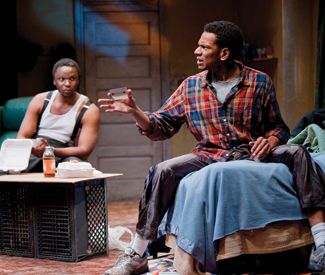
THEATER Audiences arriving at Marin Theatre Company for director Timothy Douglas’ current, beautifully staged revival of Suzan-Lori Parks’ 2001 Pulitzer Prize–winning play, Topdog/Underdog, take in a shabby, dilapidated low-rent studio apartment with its meager and seedy furnishings. But looming overhead the whole time are the red-white-and-blue bunting of some half-forgotten political rally, depending from the flies amid three long strips sheared from the stars and stripes, hung equidistantly across the stage. These thin flags have tightened their belts, and look a bit dingy too, almost sepia-toned, and floating above the impoverished scene below somehow bring to mind that flag behind Ella Watson, the African American cleaning woman in Gordon Parks’ iconic Depression-era photograph, American Gothic, Washington, D.C.

If there’s thus a certain election-year ring to Mikiko Uesugi’s careful scenic design — present before the action even starts — it’s a sonorous and dissonant one, echoing back across a political past with a strange and disorienting nostalgia, a contaminated euphoria. What could be more appropriate?

http://www.youtube.com/watch?v=F0Xll3eZJ8Y

At a time when mainstream political reality seems feverishly bizarre, almost surreal, Parks’ drama endures as a shrewd poetical remix of American history, an elucidating fever dream in a realistic mode: two African American brothers respectively named Lincoln (Bowman Wright) and Booth (Biko Eisen-Martin) by a runaway father who apparently found it funny, share a precarious perch and a tainted patrimony in a poor part of a nameless city — where they act out an overlapping series of fated roles. These mix race, class, sex, family, and money as equal facets of a brutally antisocial system — a racket, in fact, high above (but qualitatively the same as) the Three-card Monte scheme at center of the story.

But in the brothers’ tragic and absurd destinies, half-grasped at best by the protagonists themselves, the play plumbs a deeper understanding too, a historical current churning and moving below everything — and in that understanding opens a sense of possibility.

The apartment is younger brother Booth’s roost, but Linc, as he’s called, is bringing home the bacon (or Chinese food) in exchange for crashing on the La-Z-Boy. Linc has been kicked out by now ex-wife Cookie (an offstage character symbolizing perhaps a kind of standard “fortune” for a married man without economic prospects, something akin to the ambiguous forecast Linc gets with his Chinese takeout: “Your luck will change”). Booth’s offstage love interest is named, with even more symbolic resonance, Grace. Early on, it’s clear she’s pretty much unattainable.

Booth wants knowledge from his brother, more than anything else. Linc was once famous on the streets as a master of the Three-card Monte hustle — which itself has nothing to do with luck — but has given up the cards in the wake of a guilt-ridden incident. Eager brother Booth (played by Eisen-Martin with a nicely coiled energy, dangerous and comically hapless at once) is dying to become a hustler himself, but his efforts to learn the ropes meet with resistance from his jaded, wary older brother (whom Wright imbues with a perfect combination of wistful compassion and alpha-male contempt).

For his part, Linc’s guilty conscience finds a kind of half-bitter contentment in his current job: impersonating his namesake at a carnival sideshow, where he daydreams as sitting duck in white-face Honest Abe drag, before a ready line of customer-assassins. Indeed, Linc’s first appearance onstage comes in the Lincoln get-up, an eerily comic site that already loads the naturalistic performances with dreamy intensity.

If Parks’ drama (which premiered off-Broadway in the summer of 2001) preceded everything from 9/11, the wars on Iraq and Afghanistan, Katrina, the financial crisis, worldwide protest movements against global capitalism and empire, and the advent of the country’s first African American president, MTC’s apt revival shows it more than keeps pace with the times as a gritty and gripping allegory of endemic, convoluted civil wars.

TOPDOG/UNDERDOG

Through Oct. 21, $36-$57

Marin Theatre Company

397 Miller, Mill Valley

www.marintheatre.org


PROJECT CENSORED 2012

6

yael@sfbg.com

People who get their information exclusively from mainstream media sources may be surprised at the lack of enthusiasm on the left for President Barack Obama in this crucial election. But that’s probably because they weren’t exposed to the full online furor sparked by Obama’s continuation of his predecessor’s overreaching approach to national security, such as signing the 2012 National Defense Authorization Act, which allows the indefinite detention of those accused of supporting terrorism, even US citizens.

We’ll never know how this year’s election would be different if the corporate media adequately covered the NDAA’s indefinite detention clause and many other recent attacks on civil liberties. What we can do is spread the word and support independent media sources that do cover these stories. That’s where Project Censored comes in.

Project Censored has been documenting inadequate media coverage of crucial stories since it began in 1967 at Sonoma State University. Each year, the group considers hundreds of news stories submitted by readers, evaluating their merits. Students search Lexis Nexis and other databases to see if the stories were underreported, and if so, the stories are fact-checked by professors and experts in relevant fields.

A panel of academics and journalists chooses the Top 25 stories and rates their significance. The project maintains a vast online database of underreported news stories that it has “validated” and publishes them in an annual book. Censored 2013: Dispatches from the Media Revolution will be released Oct. 30.

For the second year in row, Project Censored has grouped the Top 25 list into topical “clusters.” This year, categories include “Human cost of war and violence” and “Environment and health.” Project Censored director Mickey Huff told us the idea was to show how various undercovered stories fit together into an alternative narrative, not to say that one story was more censored than another.

“The problem when we had just the list was that it did imply a ranking,” Huff said. “It takes away from how there tends to be a pattern to the types of stories they don’t cover or underreport.”

In May, while Project Censored was working on the list, another 2012 list was issued: the Fortune 500 list of the biggest corporations, whose influence peppers the Project Censored list in a variety of ways.

Consider this year’s top Fortune 500 company: ExxonMobil. The oil company pollutes everywhere it goes, yet most stories about its environmental devastation go underreported. Weapons manufacturers Lockheed Martin (58 on the Fortune list), General Dynamics (92), and Raytheon (117) are tied into stories about US prisoners in slavery conditions manufacturing parts for their weapons and the underreported war crimes in Afghanistan and Libya.

These powerful corporations work together more than most people think. In the chapter exploring the “Global 1 percent,” writers Peter Phillips and Kimberly Soeiro explain how a small number of well-connected people control the majority of the world’s wealth. In it, they use Censored story number 6, “Small network of corporations run the global economy,” to describe how a network of transnational corporations are deeply interconnected, with 147 of them controlling 40 percent of the global economy’s total wealth.

For example, Philips and Soeiro write that in one such company, BlackRock Inc., “The eighteen members of the board of directors are connected to a significant part of the world’s core financial assets. Their decisions can change empires, destroy currencies, and impoverish millions.”

Another cluster of stories, “Women and Gender, Race and Ethnicity,” notes a pattern of underreporting stories that affect a range of marginalized groups. This broad category includes only three articles, and none are listed in the top 10. The stories reveal mistreatment of Palestinian women in Israeli prisons, including being denied medical care and shackled during childbirth, and the rape and sexual assault of women soldiers in the US military. The third story in the category concerns an Alabama anti-immigration bill, HB56, that caused immigrants to flee Alabama in such numbers that farmers felt a dire need to “help farms fill the gap and find sufficient labor.” So the Alabama Department of Agriculture and Industries approached the state’s Department of Corrections about making a deal where prisoners would replace the fleeing farm workers.

But with revolutionary unrest around the world, and the rise of a mass movement that connects disparate issues together into a simple, powerful class analysis — the 99 percent versus the 1 percent paradigm popularized by Occupy Wall Street — this year’s Project Censored offers an element of hope.

It’s not easy to succeed at projects that resist corporate dominance, and when it does happen, the corporate media is sometimes reluctant to cover it. Number seven on the Top 25 list is the story of how the United Nations designated 2012 the International Year of the Cooperative, recognizing the rapid growth of co-op businesses, organizations that are part-owned by all members and whose revenue is shared equitably among members. One billion people worldwide now work in co-ops.

The Year of the Cooperative is not the only good-news story discussed by Project Censored this year. In Chapter 4, Yes! Magazine‘s Sarah Van Gelder lists “12 ways the Occupy movement and other major trends have offered a foundation for a transformative future.” They include a renewed sense of “political self-respect” and fervor to organize in the United States, debunking of economic myths such as the “American dream,” and the blossoming of economic alternatives such as community land trusts, time banking, and micro-energy installations.

They also include results achieved from pressure on government, like the delay of the Keystone Pipeline project, widespread efforts to override the US Supreme Court’s Citizens United ruling, the removal of dams in Washington state after decades of campaigning by Native American and environmental activists, and the enactment of single-payer healthcare in Vermont.

As Dr. Nafeez Mosaddeq Ahmed writes in the book’s foreword, “The majority of people now hold views about Western governments and the nature of power that would have made them social pariahs 10 or 20 years ago.”

Citing polls from the corporate media, Ahmed writes: “The majority are now skeptical of the Iraq War; the majority want an end to US military involvement in Afghanistan; the majority resent the banks and financial sector, and blame them for the financial crisis; most people are now aware of environmental issues, more than ever before, and despite denialist confusion promulgated by fossil fuel industries, the majority in the United States and Britain are deeply concerned about global warming; most people are wary of conventional party politics and disillusioned with the mainstream parliamentary system.”

“In other words,” he writes, “there has been a massive popular shift in public opinion toward a progressive critique of the current political economic system.”

And ultimately, it’s the public — not the president and not the corporations—that will determine the future. There may be hope after all. Here’s Project Censored’s Top 10 list for 2013:


1. SIGNS OF AN EMERGING POLICE STATE

President George W. Bush is remembered largely for his role in curbing civil liberties in the name of his “war on terror.” But it’s President Obama who signed the 2012 NDAA, including its clause allowing for indefinite detention without trial for terrorism suspects. Obama promised that “my Administration will interpret them to avoid the constitutional conflict” — leaving us adrift if and when the next administration chooses to interpret them otherwise. Another law of concern is the National Defense Resources Preparedness Executive Order that Obama issued in March 2012. That order authorizes the President, “in the event of a potential threat to the security of the United States, to take actions necessary to ensure the availability of adequate resources and production capability, including services and critical technology, for national defense requirements.” The president is to be advised on this course of action by “the National Security Council and Homeland Security Council, in conjunction with the National Economic Council.” Journalist Chris Hedges, along with co-plaintiffs including Noam Chomsky and Daniel Ellsberg, won a case challenging the NDAA’s indefinite detention clause on Sept. 1, when a federal judge blocked its enforcement, but her ruling was overturned on Oct. 3, so the clause is back.


2. OCEANS IN PERIL

Big banks aren’t the only entities that our country has deemed “too big to fail.” But our oceans won’t be getting a bailout anytime soon, and their collapse could compromise life itself. In a haunting article highlighted by Project Censored, Mother Jones reporter Julia Whitty paints a tenuous seascape — overfished, acidified, warming — and describes how the destruction of the ocean’s complex ecosystems jeopardizes the entire planet, not just the 70 percent that is water. Whitty compares ocean acidification, caused by global warming, to acidification that was one of the causes of the “Great Dying,” a mass extinction 252 million years ago. Life on earth took 30 million years to recover. In a more hopeful story, a study of 14 protected and 18 non-protected ecosystems in the Mediterranean Sea showed dangerous levels of biomass depletion. But it also showed that the marine reserves were well-enforced, with five to 10 times larger fish populations than in unprotected areas. This encourages establishment and maintenance of more reserves.


3. US DEATHS FROM FUKUSHIMA

A plume of toxic fallout floated to the US after Japan’s tragic Fukushima nuclear disaster on March 11, 2011. The US Environmental Protection Agency found radiation levels in air, water, and milk that were hundreds of times higher than normal across the United States. One month later, the EPA announced that radiation levels had declined, and they would cease testing. But after making a Freedom of Information Act request, journalist Lucas Hixson published emails revealing that on March 24, 2011, the task of collecting nuclear data had been handed off from the US Nuclear Regulatory Commission to the Nuclear Energy Institute, a nuclear industry lobbying group. And in one study that got little attention, scientists Joseph Mangano and Janette Sherman found that in the period following the Fukushima meltdowns, 14,000 more deaths than average were reported in the US, mostly among infants. Later, Mangano and Sherman updated the number to 22,000.


4. FBI AGENTS RESPONSIBLE FOR TERRORIST PLOTS

We know that FBI agents go into communities such as mosques, both undercover and in the guise of building relationships, quietly gathering information about individuals. This is part of an approach to finding what the FBI now considers the most likely kind of terrorists, “lone wolves.” Its strategy: “seeking to identify those disgruntled few who might participate in a plot given the means and the opportunity. And then, in case after case, the government provides the plot, the means, and the opportunity,” writes Mother Jones journalist Trevor Aaronson. The publication, along with the Investigative Reporting Program at the University of California-Berkeley, examined the results of this strategy, 508 cases classified as terrorism-related that have come before the US Department of Justice since the 9/11 terrorist attacks of 2001. In 243 of these cases, an informant was involved; in 49 cases, an informant actually led the plot. And “with three exceptions, all of the high-profile domestic terror plots of the last decade were actually FBI stings.”


5. FEDERAL RESERVE LOANED TRILLIONS TO MAJOR BANKS

The Federal Reserve, the US’s quasi-private central bank, was audited for the first time in its history this year. The audit report states, “From late 2007 through mid-2010, Reserve Banks provided more than a trillion dollars… in emergency loans to the financial sector to address strains in credit markets and to avert failures of individual institutions believed to be a threat to the stability of the financial system.” These loans had significantly less interest and fewer conditions than the high-profile TARP bailouts, and were rife with conflicts of internet. Some examples: the CEO of JP Morgan Chase served as a board member of the New York Federal Reserve at the same time that his bank received more than $390 billion in financial assistance from the Fed. William Dudley, who is now the New York Federal Reserve president, was granted a conflict of interest waiver to let him keep investments in AIG and General Electric at the same time the companies were given bailout funds. The audit was restricted to Federal Reserve lending during the financial crisis. On July 25, 2012, a bill to audit the Fed again, with fewer limitations, authored by Rep. Ron Paul, passed the House of Representatives. HR459 expected to die in the Senate, but the movement behind Paul and his calls to hold the Fed accountable, or abolish it altogether, seem to be growing.


6. SMALL NETWORK OF CORPORATIONS RUN THE GLOBAL ECONOMY

Reporting on a study by researchers from the Swiss Federal Institute in Zurich didn’t make the rounds nearly enough, according to Censored 2013. They found that, of 43,060 transnational companies, 147 control 40 percent of total global wealth. The researchers also built a model visually demonstrating how the connections between companies — what it calls the “super entity” — works. Some have criticized the study, saying control of assets doesn’t equate to ownership. True, but as we clearly saw in the 2008 financial collapse, corporations are capable of mismanaging assets in their control to the detriment of their actual owners. And a largely unregulated super entity like this is vulnerable to global collapse.


7. THE INTERNATIONAL YEAR OF COOPERATIVE

Can something really be censored when it’s straight from the United Nations? According to Project Censored evaluators, the corporate media underreported the UN declaring 2012 to be the International Year of the Cooperative, based on the coop business model’s stunning growth. The UN found that, in 2012, one billion people worldwide are coop member-owners, or one in five adults over the age of 15. The largest is Spain’s Mondragon Corporation, with more than 80,000 member-owners. The UN predicts that by 2025, worker-owned coops will be the world’s fastest growing business model. Worker-owned cooperatives provide for equitable distribution of wealth, genuine connection to the workplace, and, just maybe, a brighter future for our planet.


8. NATO WAR CRIMES IN LIBYA

In January 2012, the BBC “revealed” how British Special Forces agents joined and “blended in” with rebels in Libya to help topple dictator Muammar Gadaffi, a story that alternative media sources had reported a year earlier. NATO admits to bombing a pipe factory in the Libyan city of Brega that was key to the water supply system that brought tap water to 70 percent of Libyans, saying that Gadaffi was storing weapons in the factory. In Censored 2013, writer James F. Tracy makes the point that historical relations between the US and Libya were left out of mainstream news coverage of the NATO campaign; “background knowledge and historical context confirming Al-Qaeda and Western involvement in the destabilization of the Gadaffi regime are also essential for making sense of corporate news narratives depicting the Libyan operation as a popular ‘uprising.'”


9. PRISON SLAVERY IN THE US

On its website, the UNICOR manufacturing corporation proudly proclaims that its products are “made in America.” That’s true, but they’re made in places in the US where labor laws don’t apply, with workers often paid just 23 cents an hour to be exposed to toxic materials with no legal recourse. These places are US prisons. Slavery conditions in prisons aren’t exactly news. It’s literally written into the Constitution; the 13th Amendment, which abolished slavery, outlaws  slavery nor involuntary servitude, except as a punishment for crime whereof the party shall have been duly convicted.” But the article highlighted by Project Censored this year reveal the current state of prison slavery industries, and its ties to war. The majority of products manufactured by inmates are contracted to the Department of Defense. Inmates make complex parts for missile systems, battleship anti-aircraft guns, and landmine sweepers, as well as night-vision goggles, body army, and camouflage uniforms. Of course, this is happening in the context of record high imprisonment in the US, where grossly disproportionate numbers of African Americans and Latinos are imprisoned, and can’t vote even after they’re freed. As psychologist Elliot D. Cohen puts it in this year’s book: “This system of slavery, like that which existed in this country before the Civil War, is also racist, as more than 60 percent of US prisoners are people of color.”


10. HR 347 CRIMINALIZES PROTEST

HR 347, sometimes called the “criminalizing protest” or “anti-Occupy” bill, made some headlines. But concerned lawyers and other citizens worry that it could have disastrous effects for the First Amendment right to protest. Officially called the Federal Restricted Grounds Improvement Act, the law makes it a felony to “knowingly” enter a zone restricted under the law, or engage in “disorderly or disruptive” conduct in or near the zones. The restricted zones include anywhere the Secret Service may be — places such as the White House, areas hosting events deemed “National Special Security Events,” or anywhere visited by the president, vice president, and their immediate families; former presidents, vice presidents, and certain family members; certain foreign dignitaries; major presidential and vice presidential candidates (within 120 days of an election); and other individuals as designated by a presidential executive order. These people could be anywhere, and NSSEs have notoriously included the Democratic and Republican National Conventions, Super Bowls, and the Academy Awards. So far, it seems the only time HR 347 has kicked in is with George Clooney’s high-profile arrest outside the Sudanese embassy. Clooney ultimately was not detained without trial — information that would be almost impossible to censor — but what about the rest of us who exist outside of the mainstream media’s spotlight? A book release party will be held at Moe’s Books, 2476 Telegraph, in Berkeley, on Nov. 3. You can listen to Huff’s radio show Friday morning at 8pm on KPFA.

The Mirkarimi vote: Will there be some profiles of courage?

52

(See the postscript for the Chronicle’s shameful crucifixion coverage of Mirkarimi and a timely, newsworthy oped it refused to run by Mirkarimi’s former girl friend. And how Chronicle columnist Debra Saunders ran the Nieves piece on her blog. Damn good for you, Debra Saunders.)

On Jan. 6, 2011, the Bay Citizen/New York Times broke a major investigative story headlined “Behind-the-Scenes Power Politics: The Making of Ed Lee.” The story by Gerry Shih detailed how then Mayor Gavin Newsom, ex-Mayor Willie Brown, and his longtime political ally Rose Pak orchestrated an “extraordinary political power play” to make Ed Lee the interim mayor to replace Newsom, the lieutenant governor-elect.

The story also outlined the start of a chain of events that leads to the vote by the San Francisco Board of Supervisors on Tuesday on whether Sheriff Ross Mirkarimi keeps his job.

Shih reported that “word had trickled out” that the supervisors had narrowed the list of interim candidates to three—then Sheriff Michael Hennessey, former Mayor Art Agnos, and Aaron Peskin, then chairman of the city’s Democratic party.  But the contenders “were deemed too liberal by Pak, Brown, and Newsom, who are more moderate.”

Over the next 48 hours, Pak, Brown, and the Newsom administration put together the play, “forging a consensus on the Board of Supervisors, outflanking the board’s progressive wing and persuading Lee to agree to become San Francisco’s first Asian-American mayor, even though he had told officials for months that he had no interest in the job,” Shih wrote.

The play was sold on the argument that Lee would be an “interim mayor” and that he would not run for mayor in the November election. The Guardian and others said at the time that the play most likely envisioned Lee saying, or lying, that he would not run for mayor and then, at the last minute, he would run and overpower the challengers as an incumbent with big downtown money behind him.  This is what happened. That is how Ed Lee, a longtime civil servant, became the mayor and that is how the Willie Brown/Rose Pak gang won the day for the PG&E/Chamber of Commerce/big developer bloc and thwarted the progressives.

Let us note that the other three interim candidates would most likely never have done what Lee did and suspend Mirkarimi for pleading guilty to misdemeanor false imprisonment in an arm-bruising incident with his wife Eliana. In fact, Hennessey supported Mirkarimi during the election and still does and says he is fit to do the job of sheriff. 

This was a political coup d’etat worthy of Abe Ruef, the City Hall fixer at the start of the century. “This was something incredibly orchestrated, and we got played,” Sup. John Avalos told Shih. Sup. Chris Daly was mad as hell and he voted for Rose Pak because, he told the Guardian, she was running everything in City Hall anyway. Significantly, the San Francisco Chronicle missed the story and ever after followed the line of its columnist/PG&E lobbyist Willie Brown and Pak by supporting Lee for mayor without much question or properly reporting the obvious power structure angles and plays.

This is the context for understanding a critical part of the ferocity of the opposition to Mirkarimi. As the city’s top elected progressive, he was a politician and force to be reckoned with. His inaugural address as sheriff  demonstrated his creative vision for the department and that he would ably continue the progressive tradition of Richard Hongisto and Hennessey. That annoyed the conservative law enforcement folks. He could be sheriff for a good long time, keep pushing progressive issues from a safe haven, and be in position to run for mayor when the time came. So he was a dangerous character.  

To take one major example, the  PG&E political establishment and others regard him as Public Enemy No. 1. Among other things, he managed as an unpaid volunteer two initiative campaigns during the Willie Brown era. They were aimed at kicking PG&E out of City Hall, enforcing the public power provisions of the federal Raker Act, and bringing  the city’s cheap Hetch Hetchy public power to its residents and businesses for the first time. (See Guardian stories since 1969 on the PG&E/Raker act scandal.)

He then took the public power issue into City Hall when he became a supervisor and aggressively led the charge for the community choice aggregation (cca) project.  His work was validated in the recent 8-3 supervisorial vote authorizing the city to start up a public power/clean energy program. This is the first real challenge ever to PG&E’s private power monopoly.

Significantly, Willie is now an unregistered $200,000 plus a year lobbyist for PG&E. He writes a column for the San Francisco Chronicle promoting, among other things, his undisclosed clients and allies and whacking Mirkarimi and the progressives and their issues on a regular basis.  And he is always out there, a phone call here, an elbow at a cocktail party there, to push his agenda.   The word is that he’s claiming he has the votes to fire Mirkarimi.

The point is that the same forces that put Lee into office as mayor are in large part the same forces behind what I call the political assassination of Mirkarimi.  And so, when the Mirkarimi incident emerged, there was an inexorable  march to assassination. Maximum resources and pressure from the police on Mirkarimi. And then maximum pressure from the District Attorney. And then maximum pressure from the judicial process (not even allowing  a change of venue for the case after the crucifixion media coverage.)  And then Lee calls Mirkarimi “a wife beater” and suspends him with cruel and unusual punishment: no pay for him, his family, his home, nor legal expenses for him or Eliana for the duration.

And then Lee pushes for maximum pressure from the City Attorney and the Ethics Commission to try Mirkarimi and force the crucial vote before the election to put maximum pressure on the supervisors. Obviously, the vote would be scheduled after the election if this were a fair and just process.

Lee, the man who was sold as consensus builder and unifier, has become a polarizer and punisher on behalf of the boys and girls  in the backroom.  

And so the supervisors are not just voting to fire the sheriff.  Mirkarimi, his wife Eliana, and son Theo, 3, have already paid a terrible price and, to their immense credit, have come back together as a family.

The supervisors got played last time and voted for a coup d’etat to make Lee the mayor, rout the progressives, and keep City Hall safe for Willie Brown and Rose Pak and friends.   This time the stakes are clear: the supervisors are now voting on the political assassination of the city’s top elected progressive and it’s once again aimed at helping keep City Hall safe for PG&E, the Chamber, and big developers.

The question is, will there be some profiles of courage this time around? b3

P.S.1  Julian Davis for District 5 supervisor: “Supes mum on sheriff,” read the Sunday Chronicle head. Nobody would say how he/she would vote. And poor Sup. Sean Elsbernd claimed that he would be “holed all Sunday in his office reading a table full of thick binders of official documents related to the case plus a few that he’s prepared for himself containing some case law.”  (Anybody wonder how he’s going to vote? Let’s have a show of hands.)  

The last time I saw Julian Davis he was holding a “Stand with Ross” sign at a Mirkarimi rally on the City Hall steps. With Davis, there would be no second guessing and hand wringing on how he would vote. That’s the problem now with so many neighborhood supervisors who go down to City Hall and vote with Willie and downtown. Davis would be a smart, dependable progressive vote in the city’s most progressive district (5), and a worthy successor to Matt Gonzalez and Ross Mirkarimi. If Davis were on the board now, I’m sure he would stand with Ross and speak for Ross, no ifs, ands, or buts. And his vote might be decisive.  

P.S. 2 The Chronicle’s  shameful crucifixion of Mirkarimi continues  The Chronicle has refused to run a timely and  newsworthy op ed piece from Evelyn Nieves, Mirkarimi’s former girl friend. She  wrote an op ed piece for the Chronicle four days before the Tuesday vote.  Nieves is an accomplished journalist who for several years was the San Francisco bureau chief for the New York Times.  She told me that she was notified Monday morning that the Chronicle didn’t have room for the op ed in Tuesday’s paper. I sent an email to John Diaz, Chronicle editorial page editor, and asked him why the Chronicle couldn’t run her op ed when the paper could run Willie Brown, the unregistered $200,000 plus PG&E lobbyist who takes regular whacks at Mirkarimi, as a regular featured column in its Sunday paper.  No answer at blogtime.

This morning, I opened up the Chronicle to find that the paper, instead of running the Nieves piece today or earlier,  ran an op ed titled “Vote to remove Mirkarmi,” from Kathy Black, executive director of the Casa de las Madres, the non profit group that advocates against domestic violence. It has been hammering Mirkarimi for months. On the page opposite, the Chron ran yet another lead editorial, urging the supervisors to “Take a Stand” and vote for removal because “San Francisco now needs its leaders to lead.” It was as if Willie was not only directing the Chronicle’s news operation but writing its editorials–and getting paid both by PG&E and the Chronicle.  And so the Chronicle started out with shameful crucifixion coverage of  Mirkarimi and then continued the shameful crucifixion coverage up until today. Read Nieves on Ross.

Well, the honor of the Chronicle was maintained by columnist Debra Saunders, virtually the Chroncle’s lone journalistic supporter of Mirkarmi during his ordeal. Many Chronicle staffers are privately supportive of Ross, embarrassed by Willie’s “journalism,” and critical of the way the Chronicle has covered Mirkarimi. Saunders posted the Nieves column her paper refused to print on her Chronicle blog. Damn good for you, Debra Saunders.  


Dick Meister: Stalking and killing for sport

1

By Dick Meister

Dick Meister is a San Francisco writer. You can contact him through his website, www.dickmeister.com, which includes more than 350 of his columns

Imagine leading a snarling hound – or a pack of them – to chase a badly frightened bear or bobcat up a tree for you to shoot to death. There are lots of hunters – “sportsmen,” as they’re called – who think that to be great fun.

Boy, are they mad at Gov. Jerry Brown for recently signing a bill that will outlaw the practice in California beginning next year.  As the bill’s author, State Senator Ted Lieu, noted, “There is nothing sporting in shooting an exhausted bear clinging to a tree limb, or a cornered bobcat.”

California legislators thankfully are not the only ones who agree with that. The barbaric practice of using dogs to hunt bears has been banned in two-thirds of the other states. But why not ban it everywhere, along with all other hunters’ cruelties?

Why? Because, say hunting advocates such as Assemblyman Jim Nielsen, that would infringe on hallowed traditions of hunters that date back hundreds of years. Not to mention that it would deprive states of the thousands of dollars they collect for hunting tags. In California, the state’s take amounts to $278,000 a year for bear and bobcat tags alone.

Nielsen said he has received thousands of phone calls and letters protesting Brown’s bill signing.  That, sadly, should be no surprise. Many people, if not most people, seem to approve of stalking and killing our fellow creatures for sport.

Every year, more than 20 million hunters are out searching America’s countryside for winged and four-legged victims. And manufacturers of guns and other hunting equipment, and state fish and game departments, including California’s, are trying hard to increase their incomes by increasing the number of “sportsmen” who are chasing innocent animals. They’re urging more Americans, including youngsters, to go out and kill for sport.

Think especially of the message that’s being delivered to the young. As opponents of hunting have long argued, it tells impressionable youngsters that it’s all right to violently take an innocent life for the fun of it.

Certainly we still kill animals for food. But that is not the same as killing them for amusement. You can argue that killing animals is still necessary for survival, at least unless you’re a vegetarian. But killing them for sport in today’s circumstances is cruel and unnecessary.

In a fully civilized society, the money and energy spent by government agencies and others to promote hunting would instead be devoted to protecting our fellow creatures from human killers, and expanding and protecting their habitats, too many of which are now game preserves open to hunters.

We could at least deny hunters and their bloody practices the respect and approval of society and its leaders that they now enjoy. This is the 21st century, is it not?

Dick Meister is a San Francisco writer. You can contact him through his website, www.dickmeister.com, which includes more than 350 of his columns.


Film Listings

0

Film listings are edited by Cheryl Eddy. Reviewers are Kimberly Chun, Dennis Harvey, and Lynn Rapoport. For rep house showtimes, see Rep Clock.

MILL VALLEY FILM FESTIVAL

The 35th Mill Valley Film Festival runs Oct. 4-14 at the Christopher B. Smith Rafael Film Center, 1118 Fourth St, San Rafael; Cinéarts@Sequoia, 25 Throckmorton, Mill Valley; and 142 Throckmorton Theatre, Mill Valley. For additional venues, full schedule, and tickets (most shows $13.50), visit www.mvff.com. For commentary, see Film.

OPENING

Bitter Seeds Just what we all needed: more incontrovertible evidence of the bald-faced evil of Monsanto. This documentary on destitute Indian cotton farmers follows an 18-year-old girl named Manjusha, a budding journalist who investigates the vast numbers of farmer suicides since the introduction (and market stranglehold) of "BT" cotton — which uses the corporation’s proprietary GMO technology — in the region of Vidarbha. Before BT took over in 2004, these cotton farmers relied on cheap heritage seed fertilized only by cow dung, but the largely illiterate population fell prey to Monsanto’s marketing blitz and false claims, purchasing biotech seed that resulted in pesticide reliance, failing crops, and spiraling debt. It’s a truly heartbreaking and infuriating story, but much of the action feels stagy and false. Should Indian formality be blamed? Considering the same fate befell Micha X. Peled’s 2005 documentary China Blue, probably not. Still, eff Monsanto. (1:28) Roxie. (Michelle Devereaux)

Butter Jennifer Garner, Olivia Wilde, and Hugh Jackman star in this Iowa-set satirical comedy about competitive butter carving. (1:32)

Frankenweenie Wee Victor Frankenstein brings his dog back from the dead in Tim Burton’s black-and-white, 3D animated tale. (1:27) Presidio.

The Mystical Laws As The Master gathers Oscar buzz for its Scientology-inspired tale, another movie based on the teachings of a similarly-named religion, Japanese fringe sect Happy Science, opens this weekend. But that analogy is incorrect, for The Mystical Laws way more resembles 2000’s Battlefield Earth, demonstrating and preaching its source material’s tenants rather than questioning them. Visit Happy Science’s website and you’ll find a New Age mix of Christianity and Buddhism, with woo-woo about truth and love. Its founder, Ryuho Okawa, claims to the reincarnation of "El Cantare," sort of an über-god who controls all spiritual activity on Earth. Anyway, now there’s an anime flick based on one of Okawa’s hundreds of books; it’s about an evil overlord with planet-ruling aspirations who gets smacked down by the powerful combo of aliens, a guy who realizes he’s humanity’s "light of hope" (basically a Jesus-Buddha combo, with psychic powers to boot), and an eight-headed flying dragon. There is Nazi iconography; there are Star Wars-inspired plot points. At one point, the hero preaches directly to the camera. It’s all very heavy-handed. A far more amusing use of your time would be to go to Happy Science’s website and click the tab marked "Astonishing Facts" to learn the spiritual fates of historical figures: "Currently Beethoven lives in the lower area of the Bodhisattva Realm of the 7th dimension in the Spirit world, and aims to transcend the sadness evident in parts of his music and become an expert in the music of joy," while proponent o’ evolution Darwin "is now serving a penance in Abysmal Hell." Hey, wait a minute! Isn’t science supposed to be "happy?" (2:00) New People, 1746 Post, SF; www.newpeopleworld.com. (Eddy)

The Oranges In director Julian Farino’s tale of two families, the Wallings and the Ostroffs are neighbors and close friends living in the affluent New Jersey township of West Orange. We meet David Walling (Hugh Laurie), his wife Paige (Catherine Keener), his best friend Terry Ostroff (Oliver Platt), and Terry’s wife, Carol (Allison Janney), during a period of domestic malaise for both couples — four unhappy people who enjoy spending time together — that is destined to be exponentially magnified over the Thanksgiving and Christmas festivities. We learn much of this in voice-over courtesy of stalled-out 24-year-old design school grad Vanessa (Alia Shawkat), a second-generation Walling whose narrative subjectivity the film makes plain. No one will fault Vanessa for editorializing, however, when her Ostroff counterpart, onetime BFF and present-day nemesis Nina (Leighton Meester), returns home after a five-year absence and, amid maternal pressure to date Vanessa’s visiting brother, Toby (Adam Brody), instead embarks on an affair with their father. The ick factor is large, particularly because it takes a while to keep straight all the spouses, offspring, and houses they belong in. But Farino works to convince us that the romantic spark between David and Nina should be judged on its merits rather than with a gut-level revulsion, a reaction we can leave to the film’s principals. To the extent that this is possible, it’s possible to enjoy The Oranges‘ intelligent writing and fine cast, whose sympathetic characters (perhaps excluding Nina, whose heedlessness regarding the feelings of others verges on sociopathic) we wish the best of luck in surviving the holidays. (1:30) Albany, Clay. (Rapoport)

The Paperboy Lee Daniels scored big with Precious (2009), but this follow-up is so off-kilter in tone and story it will likely polarize critics and confuse audiences, despite its A-list cast. I happened to enjoy the hell out of this tacky, sweat-drenched, gator-gutting, and generally overwrought adaptation of Peter Dexter’s novel (Dexter and Daniels co-wrote the screenplay); it’s kind of a Wild Things-The Help-A Time to Kill mash-up, with the ubiquitous Matthew McConaughey starring as Ward Jansen, a Florida newspaper reporter investigating what he thinks is the wrongful murder conviction of Hillary Van Wetter (a repulsively greasy John Cusack). But the movie’s not really about that. Set in 1969 and narrated by Macy Gray, who plays the veteran housekeeper for the Jansens — a clan that also includes college dropout Jack (Zac Efron) — The Paperboy is neither mystery nor thriller. It’s more of a swamp cocktail, with some odd directorial choices (random split-screen here, random zoom there) that maybe seem like exploitation movie homages. As a Southern floozy turned on by "prison cock" (but not, to his chagrin, by the oft-shirtless Jack), Nicole Kidman turns in her trashiest performance since 1995’s To Die For. (1:46) Embarcadero. (Eddy)

V/H/S See "Gruesome Discovery." (1:55) Bridge, Shattuck.

Taken 2 It’s kidnapping season again, and Liam Neeson is pissed. (1:31) Marina.

ONGOING

Arbitrage As Arbitrage opens, its slick protagonist, Robert Miller (Richard Gere), is trying to close the sale of his life, on his 60th birthday: the purchase of his company by a banking goliath. The trick is completing the deal before his fraud, involving hundreds of millions of dollars, is uncovered, though the whip-smart daughter who works for him (Brit Marling) might soon be onto him. Meanwhile, Miller’s gaming his personal affairs as well, juggling time between a model wife (Susan Sarandon) and a Gallic gallerist mistress (Laetitia Casta), when sudden-death circumstances threaten to destroy everything, and the power broker’s livelihood — and very existence — ends up in the hands of a young man (Nate Parker) with ambitions of his own. It’s a realm that filmmaker Nicholas Jarecki is all too familiar with. Though like brothers Andrew (2003’s Capturing the Friedmans) and Eugene (2005’s Why We Fight), Jarecki’s first love is documentaries (his first film, 2006’s The Outsider, covered auteur James Toback), his family is steeped in the business world. Both his parents were commodities traders, and Jarecki once owned his own web development firm and internet access provider, among other ventures. When he started writing Arbitrage‘s script in 2008, he drew some inspiration from Bernard Madoff — but ultimately, the film is about a good man who became corrupted along the way, to the point of believing in his own invincibility. (1:40) Metreon, Presidio, Smith Rafael, Shattuck. (Chun)

Backwards Athletic disappointment is not a new feeling for Abi (Sarah Megan Thomas, who also wrote the script), who has just learned she’s been named the alternate for the Olympic crew team — a bench warming role she was also relegated to in the last Olympics. But after she quits the team in a huff and moves home, it’s not long before she realizes that her life off the water is pretty depressing, too. Enter former boyfriend Geoff (James Van Der Beek), now the athletic director at the high school where Abi honed her rowing talents, who gives her a job coaching the talented but undisciplined girls who make up the current team. Will this new venture help Abi finally grow up and regain her self-confidence? Will she re-ignite her spark with Geoff? Will there be a last-act conflict involving yet another chance at the Olympics? Will there be multiple training montages? As directed by Ben Hickernell, Backwards hits all of the expected themes about following one’s heart and Doing the Right Thing. Thomas, a former rower herself, has an ordinary-girl appeal, but even Backwards’ attention to authenticity can’t elevate what’s essentially a very predictable sports drama. (1:29) Sundance Kabuki. (Eddy)

Beasts of the Southern Wild Six months after winning the Grand Jury Prize at Sundance (and a Cannes Camera d’Or), Beasts of the Southern Wild proves capable of enduring a second or third viewing with its originality and strangeness fully intact. Magical realism is a primarily literary device that isn’t attempted very often in U.S. cinema, and succeeds very rarely. But this intersection between Faulkner and fairy tale, a fable about — improbably — Hurricane Katrina, is mysterious and unruly and enchanting. Benh Zeitlin’s film is wildly cinematic from the outset, as voiceover narration from six-year-old Hushpuppy (Quvenzhané Wallis) offers simple commentary on her rather fantastical life. She abides in the Bathtub, an imaginary chunk of bayou country south of New Orleans whose residents live closer to nature, amid the detritus of civilization. Seemingly everything is some alchemical combination of scrap heap, flesh, and soil. But not all is well: when "the storm" floods the land, the holdouts are forced at federal gunpoint to evacuate. With its elements of magic, mythological exodus, and evolutionary biology, Beasts goes way out on a conceptual limb; you could argue it achieves many (if not more) of the same goals Terrence Malick’s 2011 The Tree of Life did at a fraction of that film’s cost and length. (1:31) Four Star, Shattuck, Smith Rafael. (Harvey)

Beauty is Embarrassing You may not recognize the name Wayne White offhand, but you will know his work: he designed and operated many of the puppets on Pee-Wee’s Playhouse, including Randy (the blockheaded bully) and Dirty Dog (the canine jazzbo). Neil Berkeley’s Beauty Is Embarrassing — named for a mural White painted on the side of a Miami building for Art Basel 2009 — charts the life of an artist whose motto is both "I want to try everything I can!" and "Fuck you!" The Southern-born oddball, who came of age in the early-1980s East Village scene, is currently styling himself as a visual artist (his métier: painting non-sequitur phrases into landscapes bought from thrift stores), but Beauty offers a complex portrait of creativity balanced between the need to be subversive and the desire to entertain. (1:27) Roxie. (Eddy)

The Bourne Legacy Settle down, Matt Damon fans — the original Bourne appears in The Bourne Legacy only in dialogue ("Jason Bourne is in New York!") and photograph form. Stepping in as lead badass is Jeremy Renner, whose twin powers of strength and intelligence come courtesy of an experimental-drug program overseen by sinister government types (including Edward Norton in an utterly generic role) and administered by lab workers doing it "for the science!," according to Dr. Rachel Weisz. Legacy‘s timeline roughly matches up with the last Damon film, The Bourne Ultimatum, which came out five years ago and is referenced here like we’re supposed to be on a first-name basis with its long-forgotten plot twists. Anyway, thanks to ol’ Jason and a few other factors involving Albert Finney and YouTube, the drug program is shut down, and all guinea-pig agents and high-security-clearance doctors are offed. Except guess which two, who manage to flee across the globe to get more WMDs for Renner’s DNA. Essentially one long chase scene, The Bourne Legacy spends way too much of its time either in Norton’s "crisis suite," watching characters bark orders and stare at computer screens, or trying to explain the genetic tinkering that’s made Renner a super-duper-superspy. Remember when Damon killed that guy with a rolled-up magazine in 2004’s The Bourne Supremacy? Absolutely nothing so rad in this imagination-free enterprise. (2:15) 1000 Van Ness, SF Center. (Eddy)

The Campaign (1:25) 1000 Van Ness.

Celeste and Jesse Forever Married your best friend, realized you love but can’t be in love with each other, and don’t want to let all those great in-jokes wither away? Such is the premise of Celeste and Jesse Forever, the latest in what a recent wave of meaty, girl-centric comedies penned by actresses — here Rashida Jones working with real-life ex Will McCormack; there, Zoe Kazan (Ruby Sparks), Zoe Lister Jones (Lola Versus), and Lena Dunham (Girls) — who have gone the DIY route and whipped up their own juicy roles. There’s no mistaking theirs for your average big-screen rom-com: they dare to wallow harder, skew smarter, and in the case of Celeste, tackle the thorny, tough-to-resolve relationship dilemma that stubbornly refuses to conform to your copy-and-paste story arc. Nor do their female protagonists come off as uniformly likable: in this case, Celeste (Jones) is a bit of an aspiring LA powerbitch. Her Achilles heel is artist Jesse (Andy Samberg), the slacker high school sweetheart she wed and separated from because he doesn’t share her goals (e.g., he doesn’t have a car or a job). Yet the two continue to spend all their waking hours together and share an undeniable rapport, extending from Jesse’s encampment in her backyard apartment to their jokey simulated coitus featuring phallic-shaped lip balm. Throwing a wrench in the works: the fact that they’re still kind of in love with each other, which all their pals, like Jesse’s pot-dealer bud Skillz (McCormack), can clearly see. It’s an shaggy, everyday breakup yarn, writ glamorous by its appealing leads, that we too rarely witness, and barring the at-times nausea-inducing shaky-cam under the direction of Lee Toland Krieger, it’s rendered compelling and at times very funny — there’s no neat and tidy way to say good-bye, and Jones and McCormack do their best to capture but not encapsulate the severance and inevitable healing process. It also helps that the chemistry practically vibrates between the boyish if somewhat one-note Samberg and the soulful Jones, who fully, intelligently rises to the occasion, bringing on the heartbreak. (1:31) Shattuck. (Chun)

The Dark Knight Rises Early reviews that called out The Dark Knight Rises‘ flaws were greeted with the kind of vicious rage that only anonymous internet commentators can dish out. And maybe this is yet another critic-proof movie, albeit not one based on a best-selling YA book series. Of course, it is based on a comic book, though Christopher Nolan’s sophisticated filmmaking and Christian Bale’s tortured lead performance tend to make that easy to forget. In this third and "final" installment in Nolan’s trilogy, Bruce Wayne has gone into seclusion, skulking around his mansion and bemoaning his broken body and shattered reputation. He’s lured back into the Batcave after a series of unfortunate events, during which The Dark Knight Rises takes some jabs at contemporary class warfare (with problematic mixed results), introduces a villain with pecs of steel and an at-times distractingly muffled voice (Tom Hardy), and unveils a potentially dangerous device that produces sustainable energy (paging Tony Stark). Make no mistake: this is an exciting, appropriately moody conclusion to a superior superhero series, with some nice turns by supporting players Gary Oldman and Joseph Gordon-Levitt. But in trying to cram in so many characters and plot threads and themes (so many prisons in this thing, literal and figural), The Dark Knight Rises is ultimately done in by its sprawl. Without a focal point — like Heath Ledger’s menacing, iconic Joker in 2008’s The Dark Knight — the stakes aren’t as high, and the end result feels more like a superior summer blockbuster than one for the ages. (2:44) Metreon. (Eddy)

Detropia Those of us from Detroit, once-glamorous capital of American manufacturing and symbol of the triumph of capitalism, often feel like we were born with the history of the city in our bones. Another common feeling is that of dread upon hearing that yet another arty documentary (or brow-furrowing article, or glossy photo book) is coming down the pipe. The narrative arc of such things is usually this: remember Motown? Cars were amazing. Then there were scary riots, probably out of thin air. Then the jobs left. Isn’t Detroit sad now? Look how spooky this abandoned train station from the 1930s is! America is over. Wait! Some hipsters are starting a farm downtown! There may be hope after all. But who knows? Detropia, directed by Heidi Ewing, who grew up near Detroit, and Rachel Grady, doesn’t exactly deconstruct that crusty storyline (non-spoiler alert: the hipster-farmers become performance artists). But this important and beautiful film shows how much more of the Detroit tale takes on meaning and shape when told through the voices of people who actually live there, with a cinematic eye that doesn’t shy away from reality, even as it bends it to narrative ends. (1:30) Elmwood, Roxie, Smith Rafael. (Marke B.)

Diana Vreeland: The Eye Has to Travel The life of legendary fashion editor Diana Vreeland is colorfully recounted in Diana Vreeland: The Eye Has to Travel, a doc directed by her granddaughter-in-law, Lisa Immordino Vreeland. The family connection meant seemingly unlimited access to material featuring the unconventionally glamorous (and highly quotable) Vreeland herself, plus the striking images that remain from her work at Harper’s Bazaar, Vogue, and the Costume Institute of the Metropolitan Museum of Art. "Narrated" from interview transcripts by an actor approximating the late Vreeland’s husky, posh tones, the film allows for some criticism (her employees often trembled at the sight of her; her sons felt neglected; her grasp of historical accuracy while working at the museum was sometimes lacking) among the praise, which is lavish and delivered by A-listers like Anjelica Huston, who remembers "She had a taste for the extraordinary and the extreme," and Manolo Blahnik, who squeals, "She had the vision!" (1:26) Embarcadero, Shattuck. (Eddy)

Dredd 3D Cartoonishly, gleefully gruesome violence abounds in Dredd 3D, a pretty enjoyable comic-book adaptation thanks to star Karl Urban’s deadpan zingers. This is not a remake of the 1995 Sly Stallone flop Judge Dredd, by the way, though it might as well be a remake of 2011 Indonesian import The Raid: Redemption. The stories are identical. Like, lawsuit material-identical: supercop infiltrates (and then becomes trapped in, and must battle his way out of) a high-rise apartment tower run by a ruthless crime boss. Key difference is that Dredd has futuristic weapons, and The Raid had badass martial arts. Also Dredd‘s villain is played by Lena "Cersei Lannister" Headey, so there’s that. (1:38) Metreon, 1000 Van Ness. (Eddy)

End of Watch Buddy cop movies tend to go one of two ways: the action-comedy route (see: the Rush Hour series) or the action-drama route. End of Watch is firmly in the latter camp, despite some witty shit-talking between partners Taylor (a chrome-domed Jake Gyllenhaal) and Zavala (Michael Peña from 2004’s Crash) as they patrol the mean streets of Los Angeles. Writer-director David Ayer, who wrote 2001’s Training Day, aims for authenticity by piecing together much of (but, incongruously, not all of) the story through dashboard cameras, surveillance footage, and Officer Taylor’s own ever-present camera, which he claims to be carrying for a school project, though we never once see him attending classes or mentioning school otherwise. Gyllenhaal and Peña have an appealing rapport, but End of Watch‘s adrenaline-seeking plot stretches credulity at times, with the duo stumbling across the same group of gangsters multiple times in a city of three million people. Natalie Martinez and Anna Kendrick do what they can in underwritten cop-wife roles, but End of Watch is ultimately too familiar (but not lawsuit-material familiar) to leave any lasting impression. Case in point: in the year 2012, do we really need yet another love scene set to Mazzy Star’s "Fade Into You"? (1:49) Marina, 1000 Van Ness, SF Center. (Eddy)

Finding Nemo 3D (1:40) 1000 Van Ness, SF Center.

For a Good Time, Call&ldots; Suffering the modern-day dilemmas of elapsed rent control and boyfriend douchebaggery, sworn enemies Katie (Ari Graynor) and Lauren (Lauren Miller) find themselves shacking up in Katie’s highly covetable Manhattan apartment, brought together on a stale cloud of resentment by mutual bestie Jesse (Justin Long, gamely delivering a believable version of your standard-issue young hipster NYC gay boy). The domestic glacier begins to melt somewhere around the time that Lauren discovers Katie is working a phone-sex hotline from her bedroom; equipped with a good head for business, she offers to help her go freelance for a cut of the proceeds. Major profitability ensues, as does a friendship evoking the pair bonding at the center of your garden-variety romantic comedy, as Katie trains Lauren to be a phone-sex operator and the two share everything from pinkie swears and matching pink touch-tone phones to intimate secrets and the occasional hotline threesome. Directed by Jamie Travis and adapted from a screenplay by Miller and Katie Anne Naylon, the film is a welcome response to the bromance genre, and with any luck it may also introduce linguistic felicities like "phone-banging" and "let’s get this fuckshow started" into the larger culture. The raunchy telephonic interludes include cameos by Kevin Smith and Seth Rogen (Miller’s husband) as customers calling from such unfurtive locations as a public bathroom stall and the front seat of a taxicab. But the two roomies supply plenty of dirty as Katie, an abashed wearer of velour and denim pantsuits, helps the more restrained Lauren discover the joys of setting free her inner potty mouth. (1:25) SF Center. (Rapoport)

Hotel Transylvania (1:32) Metreon, 1000 Van Ness, Shattuck.

House At the End of the Street Tight T-shirts, a creepy cul-de-sac, couples in cars on lonely lanes, and the cute but weird loner kid — all the stuff of classic drive-in horror fare, revisited in this ambitious tribute of sorts. Don’t mistake House at the End of the Street for genre-reviving efforts by super fans like Eli Roth and Rob Zombie; Mark Tonderai’s mash up of Psycho (1960) and Last House on the Left (1972) lacks the rock ‘n’ roll brio and jet-black humor of, say, Cabin Fever (2002) or The Devil’s Rejects (2005). Instead House reads like an earnest effort to add a thin veneer of psychological realism and even girl power sincerity to a blood-spattered back catalog. Teenage musician Elissa (Jennifer Lawrence) and her overwhelmed mom Sarah (Elisabeth Shue) have found themselves quite a deal of a new rental home — a bit too good, since their next door neighbors were both brutally killed by their brain-damaged offspring who was obviously afflicted with the same greasy hair issues as the ghoulish gal in The Ring. Ryan (Bay Area native Max Thieriot), the boy who continues to live in the house where his parents were murdered, is ostracized, attractive, and much like his home, a fixer — making him mighty attractive to Elissa. A hearty, artistic soul who likes to venture where others fear to tread, she’s drawn to him despite the fact that she feels like she’s being watched from the woods that separate their homes. Switching back and forth between various perspectives — like that of a sputtering, spasmodically edited psychopath-cam and the steady, thoughtful gaze of a rebellious yet empathetic girl — House manages to effectively throw a few curveballs your way, while toying with genre conventions and upsetting your expectations. Shoring up its efforts is a talented cast, headed up by Lawrence’s feisty heroine and Shue’s sad-eyed struggling mom. (1:43) Metreon, 1000 Van Ness. (Chun)

Lawless Lawless has got to be the most pretentiously humorless movie ever made about moonshiners — a criminal subset whose adventures onscreen have almost always been rambunctious and breezy, even when violent. Not here, bub. Adapting Matt Bondurant’s fact-inspired novel The Wettest County in the World about his family’s very colorful times a couple generations back, director John Hillcoat and scenarist (as well as, natch, composer) Nick Cave have made one of those films in which the characters are presented to you as if already immortalized on Mount Rushmore — monumental, legendary, a bit stony. They’ve got a crackling story about war between hillbilly booze suppliers and corrupt lawmen during Prohibition, and while the results aren’t dull (they’re too bloody for that, anyway), they’d be a whole lot better if the entire enterprise didn’t take itself so gosh darned seriously. The Bondurant brothers of Franklin County, Va. are considered "legends" when we meet them in 1931, having defied all and sundry as well as survived a few bullets: mack-truck-built Forrest (Tom Hardy); eldest Howard (Jason Clarke), who tipples and smiles a lot; and "runt of the litter" Jack (Shia LeBeouf), who has a chip on his shoulder. The local law looks the other way so long as their palms are greased, but the Feds send sneering Special Deputy Charlie Rakes (Guy Pearce), it’s an eye for an eye for an eye, etc. The revenge-laden action in Lawless is engaging, but the filmmakers are trying so hard to make it all resonant and folkloric and meta-cinematic, any fun you have is in spite of their efforts. (1:55) 1000 Van Ness, SF Center. (Harvey)

Liberal Arts Against his better judgment, 35-year-old Jesse (How I Met Your Mother‘s Josh Radnor, who also wrote and directed) falls for 19-year-old Zibby (Elizabeth Olsen), a student at the leafy Ohio university he graduated from years before (never named, but filmed at Kenyon College, Radnor’s own alma matter). The two meet when Jesse, now a jaded Brooklynite, visits to celebrate the retirement of Professor Hoberg (Richard Jenkins). Letter-writing, classical-music appreciation, a supremely awkward follow-up visit, and much white-boy angst follows. Liberal Arts is at its best when delineating a specific type of collegiate experience — as safe, privileged bubble where, as Jesse explains, you can announce "I’m a poet!" without anyone punching you in the face. It can also be an oppressive space, as illustrated by a cranky prof who feels trapped by academia (a razor-sharp Lucinda Janney), and a morose classmate of Zibby’s who identifies a little too closely with David Foster Wallace. And it’s stuff like the Wallace references (again, never named — just identified via heavily dropped hints, for all the cool viewers to pick up on) that’re ultimately Liberal Arts‘ undoing. Radnor explores some interesting themes, but the film is full of indie-comedy tropes — the friendly stoner (Zac Efron) who randomly appears to dispense life lessons; an anti-Twilight rant that’s a bit too pleased with itself; the unusually attractive character who appears in the first act and is obviously destined for inclusion in the inevitable happy ending. (1:37) Shattuck. (Eddy)

Looper It’s 2044 and, thanks to a lengthy bout of exposition by our protagonist, Joe (Joseph Gordon-Levitt), here’s what we know: Time travel, an invention 30 years away, will be used by criminals to transport their soon-to-be homicide victims backward, where a class of gunmen called loopers, Joe among them, are employed to "do the necessaries." More deftly revealed in Brick writer-director Rian Johnson’s new film is the joylessness of the world in which Joe amorally makes his way, where gangsters from the future control the present (under the supervision of Jeff Daniels), their hit men live large but badly (Joe is addicted to some eyeball-administered narcotic), and the remainder of the urban populace suffers below-subsistence-level poverty. The latest downside for guys like Joe is that a new crime boss has begun sending back a steady stream of aging loopers for termination, or "closing the loop"; soon enough, Joe is staring down a gun barrel at himself plus 30 years. Being played by Bruce Willis, old Joe is not one to peaceably abide by a death warrant, and young Joe must set off in search of himself so that—with the help of a woman named Sara (Emily Blunt) and her creepy-cute son Cid (Pierce Gagnon)—he can blow his own (future) head off. Having seen the evocatively horrific fate of another escaped looper, we can’t totally blame him. Parsing the daft mechanics of time travel as envisioned here is rough going, but the film’s brisk pacing and talented cast distract, and as one Joe tersely explains to another, if they start talking about it, "we’re gonna be here all day making diagrams with straws" —in other words, some loops just weren’t meant to be closed. (1:58) Four Star, 1000 Van Ness, Piedmont, Presidio, SF Center, Sundance Kabuki. (Rapoport)

The Master Paul Thomas Anderson’s much-hyped likely Best Picture contender lives up: it’s easily the best film of 2012 so far. Philip Seymour Hoffman stars as Lancaster Dodd, the L. Ron Hubbard-ish head of a Scientology-esque movement. "The Cause" attracts Freddie Quell (Joaquin Phoenix, in a welcome return from the faux-deep end), less for its pseudo-religious psychobabble and bizarre personal-growth exercises, and more because it supplies the aimless, alcoholic veteran — a drifter in every sense of the word — with a sense of community he yearns for, yet resists submitting to. As with There Will Be Blood (2007), Anderson focuses on the tension between the two main characters: an older, established figure and his upstart challenger. But there’s less cut-and-dried antagonism here; while their relationship is complex, and it does lead to dark, troubled places, there are also moments of levity and weird hilarity — which might have something to do with Freddie’s paint-thinner moonshine. (2:17) Albany, Embarcadero, 1000 Van Ness, Presidio, Sundance Kabuki. (Eddy)

Moonrise Kingdom Does Wes Anderson’s new film mark a live-action return to form after 2007’s disappointingly wan Darjeeling Limited? More or less. Does it tick all the Andersonian style and content boxes? Indubitably. In the most obvious deviation Anderson has taken with Moonrise, he gives us his first period piece, a romance set in 1965 on a fictional island off the New England coast. After a chance encounter at a church play, pre-teen Khaki Scout Sam (newcomer Jared Gilman) instantly falls for the raven-suited, sable-haired Suzy Bishop (Kara Hayward, ditto). The two become pen pals, and quickly bond over the shared misery of being misunderstood by both authority figures and fellow kids. The bespectacled Sam is an orphan, ostracized by his foster parents and scout troop (much to the dismay of its straight-arrow leader Edward Norton). Suzy despises her clueless attorney parents, played with gusto by Bill Murray and Frances McDormand in some of the film’s funniest and best scenes. When the two kids run off together, the whole thing begins to resemble a kind of tween version of Godard’s 1965 lovers-on the-lam fantasia Pierrot le Fou. But like most of Anderson’s stuff, it has a gauzy sentimentality more akin to Truffaut than Godard. Imagine if the sequence in 2001’s The Royal Tenenbaums where Margot and Richie run away to the Museum of Natural History had been given the feature treatment: it’s a simple yet inspired idea, and it becomes a charming little tale of the perils of growing up and selling out the fantasy. But it doesn’t feel remotely risky. It’s simply too damn tame. (1:37) Shattuck. (Michelle Devereaux)

ParaNorman (1:32) Metreon.

The Perks of Being a Wallflower Move over, Diary of a Wimpy Kid series — there’s a new shrinking-violet social outcast in town. These days, life might not suck quite so hard for 90-pound weaklings in every age category, what with so many films and TV shows exposing, and sometimes even celebrating, the many miseries of childhood and adolescence for all to see. In this case, Perks author Stephen Chbosky takes on the directorial duties — both a good and bad thing, much like the teen years. Smart, shy Charlie is starting high school with a host of issues: he’s painfully awkward and very alone in the brutal throng, his only friend just committed suicide, and his only simpatico family member was killed in a car accident. Charlie’s English teacher Mr. Andersen (Paul Rudd) appears to be his only connection, until the freshman strikes up a conversation with feline, charismatic, shop-class jester Patrick (Ezra Miller) and his magnetic, music- and fun-loving stepsister Sam (Emma Watson). Who needs the popular kids? The witty duo head up their gang of coolly uncool outcasts their own, the Wallflowers (not to be confused with the deeply uncool Jakob Dylan combo), and with them, Charlie appears to have found his tribe. Only a few small secrets put a damper on matters: Patrick happens to be gay and involved with football player Brad (Johnny Simmons), who’s saddled with a violently conservative father, and Charlie is in love with the already-hooked-up Sam and is frightened that his fragile equilibrium will be destroyed when his new besties graduate and slip out of his life. Displaying empathy and a devotion to emotional truth, Chbosky takes good care of his characters, preserving the complexity and ungainly quirks of their not-so-cartoonish suburbia, though his limitations as a director come to the fore in the murkiness and choppily handled climax that reveals how damaged Charlie truly is. (1:43) Albany, California, Embarcadero, Sundance Kabuki. (Chun)

Pitch Perfect As an all-female college a cappella group known as the Barden Bellas launches into Ace of Base’s "The Sign" during the prologue of Pitch Perfect, you can hear the Glee-meets-Bring It On elevator pitch. Which is fine, since Bring It On-meets-anything is clearly worth a shot. In this attempt, Anna Kendrick stars as withdrawn and disaffected college freshman Beca, who dreams of producing music in L.A. but is begrudgingly getting a free ride at Barden University via her comp lit professor father. Clearly his goal is not making sure she receives a liberal arts education, as Barden’s academic jungle extends to the edges of the campus’s competitive a cappella scene, and the closest thing to an intellectual challenge occurs during a "riff-off" between a cappella gangs at the bottom of a mysteriously drained swimming pool. When Beca reluctantly joins the Bellas, she finds herself caring enough about the group’s fate to push for an Ace of Base moratorium and radical steps like performing mashups. Much as 2000’s Bring It On coined terms like "cheerocracy" and "having cheer-sex," Pitch Perfect gives us the infinitely applicable prefix "a ca-" and descriptives like "getting Treble-boned," a reference to forbidden sexual relations with the Bellas’ cocky rivals, the Treblemakers. The gags get funnier, dirtier, and weirder, arguably reaching their climax in projectile-vomit snow angels, with Elizabeth Banks and John Michael Higgins as grin-panning competition commentators offering a string of loopily inappropriate observations. (1:52) Metreon. (Rapoport)

The Possession (1:31) Metreon.

Resident Evil: Retribution (1:35) Metreon, 1000 Van Ness.

Samsara Samsara is the latest sumptuous, wordless offering from director Ron Fricke, who helped develop this style of dialogue- and context-free travelogue with Koyaanisqatsi (1982) and Baraka (1992). Spanning five years and shooting on 70mm film to capture glimmers of life in 25 countries on five continents, Samsara, which spins off the Sanskrit word for the "ever-turning wheel of life," is nothing if not good-looking, aspiring to be a kind of visual symphony boosted by music by the Dead Can Dance’s Lisa Gerrard and composers Michael Stearns and Marcello De Francisci. Images of natural beauty, baptisms, and an African woman and her babe give way to the madness of modern civilization — from jam-packed subways to the horrors of mechanized factory farming to a bizarre montage of go-go dancers, sex dolls, trash, toxic discarded technology, guns, and at least one gun-shaped coffin. After such dread, the opening and closing scenes of Buddhist spirituality seem almost like afterthoughts. The unmistakable overriding message is: humanity, you dazzle in all your glorious and inglorious dimensions — even at your most inhumane. Sullying this hand wringing, selective meditation is Fricke’s reliance on easy stereotypes: the predictable connections the filmmaker makes between Africa and an innocent, earthy naturalism, and Asia and a vaguely threatening, mechanistic efficiency, come off as facile and naive, while his sonic overlay of robot sounds over, for instance, an Asian woman blinking her eyes comes off as simply offensive. At such points, Fricke’s global leap-frogging begins to eclipse the beauty of his images and foregrounds his own biases. (1:39) Opera Plaza, Shattuck. (Chun)

Searching for Sugar Man The tale of the lost, and increasingly found, artist known as Rodriguez seems to have it all: the mystery and drama of myth, beginning with the singer-songwriter’s stunning 1970 debut, Cold Fact, a neglected folk rock-psychedelic masterwork. (The record never sold in the states, but somehow became a beloved, canonical LP in South Africa.) The story goes on to parse the cold, hard facts of vanished hopes and unpaid royalties, all too familiar in pop tragedies. In Searching for Sugar Man, Swedish documentarian Malik Bendjelloul lays out the ballad of Rodriguez as a rock’n’roll detective story, with two South African music lovers in hot pursuit of the elusive musician — long-rumored to have died onstage by either self-immolation or gunshot, and whose music spoke to a generation of white activists struggling to overturn apartheid. By the time Rodriguez himself enters the narrative, the film has taken on a fairy-tale trajectory; the end result speaks volumes about the power and longevity of great songwriting. (1:25) Opera Plaza. (Chun)

Sleepwalk with Me Every year lots of movies get made by actors and comedians who want to showcase themselves, usually writing and often directing in addition to starring. Most of these are pretty bad, and after a couple of festival appearances disappear, unremembered by anyone save the credit card companies that vastly benefited from its creation. Mike Birbiglia’s first feature is an exception — maybe not an entirely surprising one (since it’s based on his highly praised Off-Broadway solo show and best-seller), but still odds-bucking. Particularly as it’s an autobiographical feeling story about an aspiring stand-up comic (Mike as Matt) who unfortunately doesn’t seem to have much natural talent in that direction, but nonetheless obsessively perseveres. This pursuit of seemingly fore destined failure might be causing his sleep disorder, or it might be a means of avoiding taking the martial next step with long-term girlfriend (Lauren Ambrose, making something special out of a conventional reactive role) everyone else agrees is the best thing in his life. Yep, it’s another commitment-phobic man-boy/funny guy who regularly talks to the camera, trying to find himself while quirky friends and family stand around like trampoline spotters watching a determined clod. If all of these sounds derivative and indulgent, well, it ought to. But Sleepwalk turns a host of familiar, hardly foolproof ideas into astute, deftly performed, consistently amusing comedy with just enough seriousness for ballast. Additional points for "I zinged him" being the unlikely most gut-busting line here. (1:30) Opera Plaza, Piedmont, Shattuck. (Harvey)

Solomon Kane Conceived by Conan the Barbarian creator Robert E. Howard, this 16th-century hero is cut from the same sword-and-sorcery cloth, being a brawny brute of slippery but generally sorta-kinda upright morals. Solomon (James Purefoy) is slaughtering his way to a North African treasure trove when demons swallow up his likewise greedy, conscience-free cohorts and damn his soul for a lifetime of bad deeds. Suddenly committed to the greater good, he returns homeward to cold gray England, where Jason Flemyng’s evil sorcerer soon imperils both our protagonist and the Puritan family (complete with love interest) he’s befriended. This movie has been around a while — since 2009, to be exact, yet barely beating director Michael J. Bassett’s new Silent Hill: Revelation 3D to U.S. theaters — and is a good illustration of what can happen when you make a fairly expensive ($45 million) fantasy-action adventure without major stars nor any marketable novelty. Which is to say: not much. There is absolutely nothing wrong with the good-looking, watchable but generic-feeling Solomon Kane, save that nothing about it feels remotely original or inspired. It’s the perfectly okay, like-a-thousand-others mall flick you’ll forget you saw by Thanksgiving, despite being peopled with such normally interesting actors as Max Von Sydow, Alice Krige, and the late Pete Postlethwaite. (1:54) Metreon. (Harvey)

Somewhere Between Five years ago, when filmmaker Linda Goldstein Knowlton adopted a baby girl from China, she was inspired to make Somewhere Between, a doc about the experiences of other Chinese adoptees. The film profiles four teenage girls, including Berkeley resident Fang "Jenni" Lee, whose American lives couldn’t be more different (one girl has two moms and attends a fancy prep school; another, raised by devout Christians, dreams of playing her violin at the Grand Ole Opry) but who share similar feelings about their respective adoptions. The film follows the girls on trips to London (as part of an organized meeting of fellow adoptees), Spain (to chat with people interested in adopting Chinese babies, and where the question "What does it feel like to be abandoned?" is handled with astonishing composure), and China (including one teen’s determined quest to track down her birth family). Highly emotional at times, Somewhere Between benefits from its remarkably mature and articulate subjects, all of whom have much to say about identity and personal history. (1:28) Shattuck. (Eddy)

"Stars In Shorts" Outside of the festival circuit, it’s an uncommon feat for shorts to make it to the big screen, so it can’t hurt to make name recognition a prerequisite for selection. In writer-director Rupert Friend’s Steve, Keira Knightley plays an embattled Londoner under siege by her lonely, pathologically odd neighbor (Colin Firth). Written by Neil LaBute, Jacob Chase’s After School Special sets up a semi-flirtation between two strangers (Sarah Paulson and Wes Bentley) at a playground, only to deliver the kind of gut-level punch you might expect from the writer-director of 1998’s Your Friends and Neighbors. LaBute’s own Sexting is an entertaining exercise in stream-of-consciousness monologuing by Julia Stiles. As with most shorts programs, "Stars" is a mixed bag. Robert Festinger’s The Procession, in which Lily Tomlin and Modern Family‘s Jesse Tyler Ferguson play reluctant participants in a funeral procession, sounds promising, but the conversation palls during the 10-plus minutes we’re stuck in the car with them. Benjamin Grayson’s sci-fi thriller Prodigal, starring Kenneth Branagh, reaches its predictable crisis points several minutes after the viewer has arrived. More successful are Jay Kamen’s musical comedy Not Your Time, starring Seinfeld‘s Jason Alexander as an old Hollywood hand whose writing career has stalled out, and Chris Foggin’s Friend Request Pending, which treats viewers to the sight of Dame Judi Dench gamely wading into the social network in search of a date. (1:53) Opera Plaza. (Rapoport)

Trouble with the Curve Baseball scout Gus (Clint Eastwood) relies on his senses to sign players to the Atlanta Braves, and his roster of greats is highly regarded by everyone — save a sniveling climber named Sanderson (Matthew Lillard), who insists his score-keeping software can replace any scout. Gus’ skill in his field are preternatural, but with his senses dwindling, his longtime-friend Pete (a brilliant John Goodman) begs Gus’ daughter Mickey (Amy Adams) to go with him — to see how bad the situation is and maybe drive him around. Ultimately, the film’s about the rift between career woman Mickey, and distant dad Gus, with some small intrusions from Justin Timberlake as Mickey’s romantic interest. Trouble with the Curve is a phrase used to describe batters who can’t hit a breaking ball and it’s a nuance — if an incontrovertible one — unobservable to the untrained eye. While Mickey and Gus stumble messily toward a better relationship (with a reasonable amount of compromise), Curve begins to look a bit like The Blind Side (2009), trading the church and charity for therapy and baggage. But what it offers is sweet and worthwhile, if you’re tolerant of the sanitized psychology and personality-free aesthetics. But it’s a movie about love and compromise — and if you love baseball you won’t have trouble forgiving some triteness, especially when Timberlake, the erstwhile Boo-Boo, gets to make a Yogi Berra joke. (1:51) Metreon, 1000 Van Ness, Sundance Kabuki. (Sara Vizcarrondo)

Vulgaria (1:32) Metreon.

Won’t Back Down If talk of introducing charter schools into the public education mix tends to give you collective-bargaining-related hives, Daniel Barnz’s Won’t Back Down is unlikely to appeal, unless perhaps as the object of a boycott or a picket line. Two embattled mothers, Jamie Fitzpatrick (Maggie Gyllenhaal) and Nona Alberts (Viola Davis), both with children at a failing Pittsburgh elementary school and the latter a teacher there, join forces to change the institutional culture by leading a parent-teacher takeover, with the goal of creating a charter school. As the bureaucratic process for doing so is described by a school district employee, it should take them three to five years to discover that they’ve been hurling themselves at a brick wall; Jamie, an efficient combination of fireball and pit bull, is determined to pulverize the wall in about two months. Watching her and Nona try to secure more than a third-rate, treading-water education for their kids, it’s hard not to root for the possibility of a transformation, and even an upper-level teachers’ union staffer played by Holly Hunter finds herself climbing the fence. The details of what lies on the other side (and inside Jamie and Nona’s 400-page proposal) stay fairly fuzzy, though. And while Barnz lets his warring factions—desperate mothers and educators, a union boss (Ned Eisenberg) watching the deterioration of the labor movement, a pro-union teacher (Oscar Isaac) ambivalently engaged in the chartering project—impassionedly debate their way through the film, a little more wonkiness might have clarified the arguments of those done waiting for Superman. (2:00) Metreon, 1000 Van Ness, Sundance Kabuki. (Rapoport)

The Words We meet novelist Rory Jansen (Bradley Cooper) as he’s making his way from a posh building to a cab in the rain; it’s important the shot obscures his generally shiny exterior, because we’re meant to believe this guy’s a sincere and struggling novelist. Jeremy Irons, aged with flappy eye makeup, watches him vengefully. Seems Rory fell upon the unpublished novel Irons’ character wrote in sadness and loss — and feeling himself incapable of penning such prose, transcribed the whole thing. When his lady friend (Zoe Saldana) encourages him to sell it, he becomes the next great American writer. He’s living the dream on another man’s sweat. But that’s not the tragedy, exactly, because The Words isn’t so concerned with the work of being a writer — it’s concerned with the look and insecurity of it. Bradley and Irons aren’t "real," they’re characters in a story read by Clay Hammond (Dennis Quaid) while the opportunistic, suggestive Daniella (Olivia Wilde) comes onto him. She can tell you everything about Clay, yet she hasn’t read the book that’s made him the toast of the town — The Words, which is all about a young plagiarist and the elderly writer he steals from. "I don’t know how things happen!", the slimy, cowering writers each exclaim. So, how do you sell a book? Publish a book? Make a living from a book? How much wine does it take to bed Olivia Wilde? Sure, they don’t know how things happen; they only know what it looks like to finish reading Hemingway at a café or watch the sun rise over a typewriter. Rarely has a movie done such a trite job of depicting the process of what it’s like to be a writer — though if you found nothing suspect about, say, Owen Wilson casually re-editing his 400-page book in one afternoon in last year’s Midnight in Paris, perhaps you won’t be so offended by The Words, either. (1:36) SF Center. (Vizcarrondo)


Amanda (Fucking) Palmer unites the freaks at the Fillmore

0

Theatrics! Camp! Bravado! Glitter! Body hair! Going to an Amanda Palmer concert is like taking a trip to the island of misfit toys. Standing in the crowd, I was surrounded by top hats, tutus, tuxedos, pink mohawks, steampunk creations, and many more accessories that I can’t begin to identify. 

The audience at the Fillmore last Wednesday was incredibly diverse in age, gender, and style, seemingly united only by their love for the many artistic eccentricities of Amanda Fucking Palmer, as her fans call her.

An electric performer, Palmer ruled the stage, looking like the black swan in dark, heavy makeup and a corset as she spit her venomously witty lyrics and jerked around like a marionette, swinging a megaphone, banging on her keyboard, and running instrumental drills with her band, the Grand Theft Orchestra. The setlist, dominated by her new album Theatre is Evil, crackled with energy and emotion.

The night’s dynamic itinerary offered many emotional highs and lows. In a particularly heartbreaking segment, Palmer brought up a box that had been left on the merch table for people to fill with all the bad and sad things that had happened in their bedrooms. Usually Palmer reads the box, but her husband, writer Neil Gaiman, offered to read tonight. 

The tragic and highly personal details people shared cast an incredible hush over the sold-out room. Usually, Palmer records this reading and mashes it into a new song, but she forgot on this night (she later issued an online apology and a promise to make it up to the fans with a recorded version.) 

Despite this omission, the segment was incredibly powerful. These dark secrets saw the light in a crowd of people who were really listening. Palmer does something truly incredible here, using performance art to de-stigmatize past trauma and to turn sharing into a beautiful, communal experience.

This solemn moment was balanced with the transcendent song “Bottom Feeder” in which Palmer, looking like a mermaid, jumped into the crowd wearing a jacket that trailed yards of rippling chiffon over the audience. Under the fabric, holding it up with our hands, the audience members were grinning widely at each other in a moment that perfectly captured the whimsical beauty of the song and the entire night.


Endorsements 2012: San Francisco propositions

85

PROPOSITION A

CITY COLLEGE PARCEL TAX

YES

The scathing accreditation report by the Western Association of Schools talks about governance problems at the San Francisco Community College District — a legitimate matter of concern. But most of what threatens the future of City College is a lack of money.

Check out the accreditation letter; it’s on the City College website. Much of what it says is that the school is trying to do too much with limited resources. There aren’t enough administrators; that’s because, facing 20 percent cuts to its operating budget, the college board decided to save front-line teaching jobs. Student support services are lacking; that’s because the district can barely afford to keep enough classes going to meet the needs of some 90,000 students. On the bigger picture, WASC and the state want City College to close campuses and concentrate on a core mission of offering two-year degrees and preparing students to transfer to four-year institutions. That’s because the state has refused to fund education at an adequate level, and there’s not enough money to both function as a traditional junior college and serve as the training center for San Francisco’s tech, hospitality and health-care industry, provide English as a second language classes to immigrants and offer new job skills and rehabilitation to the workforce of the future.

It’s fair to say that WASC would have found some problems at City College no matter what the financial situation (and we’ve found more — the nepotism and corruption under past boards has been atrocious). But the only way out of this mess is either to radically scale back the school’s mission — or to increase its resources. We support the latter alternative.

Prop. A is a modest parcel tax — $79 dollars a year on each property lot in the city. Parcel taxes are inherently unfair — a small house in Hunters Point pays as much as a mansion in Pacific Heights or a $500 million downtown office building. But that’s the result of Prop. 13, which leaves the city very few ways to raise taxes on real property. In the hierarchy of progressive tax options, parcel taxes are better than sales taxes. And the vast majority of San Francisco homeowners and commercial property owners get a huge benefit from Prop. 13; a $6 a month additional levy is hardly a killer.

The $16 million this tax would raise annually for the district isn’t enough to make up for the $25 million a year in state budget cuts. But at least the district would be able to make reasonable decisions about preserving most of its mission. This is one of the most important measures on the ballot; vote yes.

PROPOSITION B

PARKS BOND

YES

There are two questions facing the voters: Does the San Francisco Recreation and Parks Department need money to fix up badly decrepit, sometimes unsafe facilities, and build out new park areas, particularly in underserved neighborhoods? Has the current administration of the department so badly mismanaged Rec-Park, so radically undermined the basic concept of public access to public space, so utterly alienated neighborhoods and communities all over the city, that it shouldn’t be trusted with another penny?

And if your answer to both is yes, how the hell do you vote on Prop. B?

It’s a tough one for us. The Guardian has never, in 46 years, opposed a general obligation bond for anything except jail or prisons. Investing in public infrastructure is a good thing; if anything, the cautious folks at City Hall, who refuse to put new bonds on the ballot until old ones are paid off, are too cautious about it. Spending public money (paid by increased property taxes in a city where at least 90 percent of real estate is way under taxed thanks to Prop. 13) creates jobs. It’s an economic stimulus. It adds to the value of the city’s resources. In this case, it fixes up parks. All of that is good; it’s hard to find a credible case against it.

Except that for the past few years, under the administrations of Mayors Gavin Newsom and Ed Lee and the trusteeship of Rec-Park Directors Jared Blumenfeld and Phil Ginsburg, the city has gone 100 percent the wrong way. Parks are supposed to be public resources, open to all; instead, the department has begun charging fees for what used to be free, has been turning public facilities over to private interests (at times kicking the public out), and has generally looked at the commons as a source of revenue. It’s a horrible precedent. It makes us sick.

Ginsburg told us that he’s had no choice — deep budget cuts have forced him to look for money wherever he can find it, even if that means privatizing the parks. But Ginsburg also admitted to us that, even as chief of staff under Newsom, he never once came forward to push for higher taxes on the wealthy, never once suggested that progressive revenue sources might be an option. Nor did any of the hacks on the Rec-Park Commission. Instead, they’ve been busy spending tens of thousands of dollars on an insane legal battle to evict the Haight Ashbury Neighborhood Council’s recycling center — entirely because rich people in the Haight don’t want poor people coming through their elite neighborhood to cash in bottles and cans for a little money.

So now we’re supposed to cough up another $195 million to enable more of this?

Well, yes. We’re not happy to be endorsing Prop. B, but the bottom line is simple: The bond money will go for things that need to be done. There are, quite literally, parks in the city where kids are playing in unsafe and toxic conditions. There are rec centers that are pretty close to falling apart. Those improvements will last 50 years, well beyond the tenure of this mayor of Rec-Park director. For the long-term future of the park system, Prop. B makes sense.

If the measure fails, it may send Lee and Ginsburg a message. The fact that so many neighborhood leaders are opposing it has already been a signal — one that so far Ginsburg has ignored. We’re going Yes on B, with all due reservations. But this commission has to go, and the sooner the supervisors can craft a charter amendment to give the board a majority of the appointments to the panel the better.+

PROPOSITION C

AFFORDABLE HOUSING TRUST FUND

YES

This measure is about who gets to live in San Francisco and what kind of city this will be in 20 years. If we leave it up to market forces and the desires of developers, about 85 percent of the housing built in San Francisco will be affordable only by the rich, meaning the working class will be forced to live outside the city, clogging regional roadways and transit systems and draining San Francisco of its cultural diversity and vibrancy. And that process has been accelerated in recent years by the latest tech bubble, which city leaders have decided to subsidize with tax breaks, causing rents and home prices to skyrocket.

Mayor Ed Lee deserves credit for proposing this Housing Trust Fund to help offset some of that impact, even if it falls way short of the need identified in the city’s Housing Element, which calls for 60 percent of new housing construction to be affordable to prevent gentrification. We’re also not thrilled that Prop. C actually reduces the percentage of housing that developers must offer below market rates and prevents that 12 percent level from later being increased, that it devotes too much money to home ownership assistance at the expense of the renters who comprise the vast majority of city residents, and that it depends on the passage of Prop.E and would take $15 million from the increased business taxes from that measure, rather than restoring years of cuts to General Fund programs.

But Prop. C was a hard-won compromise, with the affordable housing folks at the table, and they got most of what they wanted. (Even the 12 percent has a long list of exceptions and thus won’t apply to a lot of new market-rate housing.) And it has more chance of actually passing than previous efforts that were opposed by the business community and Mayor’s Office. This measure would commit the city to spending $1.5 billion on affordable housing projects over the next 30 years, with an initial $20 million annual contribution steadily growing to more than $50 million annually by 2024, authorizing and funding the construction of 30,000 new rental units throughout the city. With the loss of redevelopment funds that were devoted to affordable housing, San Francisco is a city at risk, and passage of Prop. C is vital to ensuring that we all have a chance of remaining here. Vote yes.

PROPOSITION D

CONSOLIDATING ODD-YEAR LOCAL ELECTIONS

YES

There’s a lot of odd stuff in the San Francisco City Charter, and one of the twists is that two offices — the city attorney and the treasurer — are elected in an off-year when there’s nothing else on the ballot. There’s a quaint kind of charm to that, and some limited value — the city attorney is one of the most powerful officials in local government, and that race could get lost in an election where the mayor, sheriff, and district attorney are all on the ballot.

But seriously: The off-year elections have lower turnout, and cost the city money, and it’s pretty ridiculous that San Francisco still does it this way. The entire Board of Supervisors supports Prop. D. So do we. Vote yes.

PROPOSITION E

GROSS RECEIPTS TAX

YES

Over the past five years, Board of Supervisors President David Chiu estimates, San Francisco has cut about $1.5 billion from General Fund programs. It’s been bloody, nasty, awful. The budget reductions have thrown severely ill psych patients out of General Hospital and onto the streets. They’ve forced the Recreation and Parks Department to charge money for the use of public space. They’ve undermined everything from community policing to Muni maintenance.

And now, as the economy starts to stabilize a bit, the mayor wants to change the way businesses are taxed — and bring an additional $28.5 million into city coffers.

That’s right — we’ve cut $1.5 billion, and we’re raising taxes by $28.5 million. That’s less than 2 percent. It’s insane, it’s inexcusable, it’s utterly the wrong way to run a city in 2012. It might as well be Mitt Romney making the decision — 98 percent cuts, 2 percent tax hikes.

Nevertheless, that’s where we are today — and it’s sad to say this is an improvement from where the tax discussion started. At first, Mayor Lee didn’t want any tax increase at all; progressive leaders had to struggle to convince him to allow even a pittance in additional revenue.

The basic issue on the table is how San Francisco taxes businesses. Until the late 1990s, the city had a relatively rational system — businesses paid about 1.5 percent of their payroll or gross receipts, whichever was higher. Then 52 big corporations, including PG&E, Chevron, Bechtel, and the Gap, sued, arguing that the gross receipts part of the program was unfair. The supervisors caved in to the legal threat and repeal that part of the tax system — costing the city about $30 million a year. Oh, but then tech companies — which have high payrolls but often, at least at first, low gross receipts — didn’t want the payroll tax. The same players who opposed the other tax now called for its return, arguing that taxing payroll hurts job growth (which is untrue and unfounded, but this kind of dogma doesn’t get challenged in the press). So, after much discussion and debate, and legitimate community input, the supervisors unanimously approved Prop. E — which raises a little more money, but not even as much as the corporate lawsuit in the 1990s set the city back. It’s not a bad tax, better than the one we have now — it brings thousands of companies the previously paid no tax at all into the mix (sadly, some of them small businesses). It’s somewhat progressive — companies with higher receipts pay a higher rate. We can’t argue against it — the city will be better off under Prop. E than it is today. But we have to look around our battered, broke-ass city, shake our poor bewildered heads and say: Is this really the best San Francisco can do? Sure, vote yes on E. And ask yourself why one of the most liberal cities in America still lets Republican economic theory drive its tax policy.

PROPOSITION F

WATER AND ENVIRONMENT PLAN

NO, NO, NO

Reasonable people can disagree about whether San Francisco should have ever dammed the Tuolumne River in 1923, flooding the Hetch Hetchy Valley and creating an engineering marvel that has provided the city with a reliable source of renewable electricity and some of the best urban drinking water in the world ever since. The project broke the heart of famed naturalist John Muir and has caused generations since then to pine for the restoration of a valley that Muir saw as a twin to his beloved nearby Yosemite Valley.

But at a time when this country can’t find the resources to seriously address global warming (which will likely dry up the Sierra Nevada watershed at some point in the future), our deteriorating infrastructure, and myriad other pressing problems, it seems insane to even consider spending billions of dollars to drain this reservoir, restore the valley, and find replacement sources of clean water and power.

You can’t argue with the basic facts: There is no way San Francisco could replace all the water that comes in from Hetch Hetchy without relying on the already-fragile Delta. The dam also provides 1.7 billion kilowatt hours a year of electric power, enough to meet the needs of more than 400,000 homes. That power now runs everything from the lights at City Hall to Muni, at a cost of near zero. The city would lose 42 percent of its energy generation if the dam went away.

Besides, the dam was, and is, the lynchpin of what’s supposed to be a municipal power system in the city. As San Francisco, with Clean Power SF, moves ever close to public power, it’s insane to take away this critical element of any future system.

On its face, the measure merely requires the city to do an $8 million study of the proposal and then hold a binding vote in 2016 that would commit the city to a project estimated by the Controller’s Office to cost somewhere between $3 billion and $10 billion. Yet to even entertain that possibility would be a huge waste of time and money.

Prop. F is being pushed by a combination of wishful (although largely well-meaning) sentimentalists and disingenuous conservatives like Dan Lungren who simply want to fuck with San Francisco, but it’s being opposed by just about every public official in the city. Vote this down and let’s focus our attention on dealing with real environmental and social problems.

PROPOSITION G

CORPORATE PERSONHOOD

YES

If San Francisco voters pass Prop. G, it won’t put any law into effect. It’s simply a policy statement that sends a message: Corporations are not people, and it’s time for the federal government to tackle the overwhelming and deeply troubling control that wealthy corporations have over American politics.

Prop. G declares that money is not speech and that limits on political spending improve democratic processes. It urges a reversal of the notorious Citizens United vs. Federal Elections Commission Supreme Court decision.

A constitutional amendment, and any legal messing with free speech, has serious potential problems. If corporations are limited from spending money on politics, could the same apply to unions or nonprofits? Could such an amendment be used to stop a community organization from spending money to print flyers with political opinions?

But it’s a discussion that the nation needs to have, and Prop. G is a modest start. Vote yes.

To be Dee

0

cheryl@sfbg.com

TRASH Scrolling through Steven Spielberg’s filmography and trying to pick which of his blockbusters should be dubbed “most beloved” is no small task, but even diehard Indiana Jones fans and Velociraptor devotees have to give it up for 1982’s E.T. The Extraterrestrial. In honor of its 30th anniversary, the family classic gets a sparkling Blu-ray upgrade, plus bells and whistles (some extras are recycled from earlier DVD releases, and there’s no commentary, but the behind-the-scenes footage unearthed for “The E.T. Journals” is pretty nifty).

Dee Wallace, best-known for playing the matriarch of E.T.’s earth family — though she’s also a cult fave for her roles in horror flicks like 1981’s The Howling and 1986’s Critters — phoned for a quick chat on the eve of E.T.‘s Oct. 9 Blu-ray release.

San Francisco Bay Guardian Re-watching the movie, I was struck by how much of the film is really about a family in crisis.

Dee Wallace For me, the main theme of the film was the friendship between E.T. and Elliott, and that friendship was heightened because of the crisis of the family. Elliott really needed a friend. He needed somebody’s attention. [My character,] Mary, couldn’t give it to him — she was too busy making a living for everybody and raising three kids, you know? I think the family dynamic certainly catapults the film into people’s hearts, because they understand what it means to need somebody.

SFBG The family interactions seem very natural, and the extras on the Blu-ray go into how the kids were allowed to ad-lib some of their lines. What was that like for you?

DW I always looked at it as just being another one of the kids. I love to work that way, where I never know what’s going to happen. Steven would throw people lines and then he’d tell us, ‘Say this line but don’t tell them you’re gonna say it.’ We all were allowed to improv and bring our own ideas in, and then he would add things in to throw us all off. I love that because it keeps you in the moment all the time.

SFBG In telling the story from the kids’ point of view, Spielberg didn’t shoot any of the adult characters’ faces until well into the film’s third act — except yours. Did you have a sense of that at the time?

DW Oh yes. He explained to me that was his plan and that’s why I was cast, because he felt that my energy had a childlike quality to it. Which is true, even today! I’m still pretty childlike.

SFBG You’re also known for appearing in quite a few classic horror films. (I’m a big fan of 1977’s The Hills Have Eyes!) What drew you to those roles and how is acting in a horror film different than acting in a film like E.T.?

DW I don’t think it’s different — I just think you get to act more! [Laughs.] I think you get to use a wider range of emotions, a lot of times, in a horror film. Although in E.T., Mary was very emotional: she was angry, she was worried, she was joyful. I got to create a really beautiful emotional arc in E.T., and that’s what I look for.

SFBG You’ve appeared in some Rob Zombie movies, including his upcoming Lords of Salem, which features several horror vets in the cast.

DW Yes, Rob uses a lot of iconic horror actors in all of his stuff. I adore Rob. I love working with him. I think he’s brilliant. And he reminds me a lot of Steven: very in the moment, very loose, a real visionary, and open to people’s input and creativity.

Impertinent questions for the PG&E 3 supervisors

10

Note: The Guardian and I were delighted, after fighting PG&E since 1969 to enforce the public power mandates of the federal Raker Act,  to see the SF Board of Supervisors finally start the process rolling on a veto-proof 8-3 vote. Even the San Francisco Chronicle, after all these decades of opposition to public power, noted in its Monday story by John Cote:

“The move would effectively end Pacific Gas & Electric Co.’s decades-long monopoly on the consumer power market in San Francisco, and it would lay the groundwork for the city to generate its own power in the future.

“Public power has long been a goal of major contingent on the city’s political left.  The contract approval comes eight years after the city began setting up a community choice aggregation program, which allows municipalities to choose alternativve energy providers.”

 Two of the PG&E 3 are my supervisors–Sup. Sean Elsbernd and Carmen Chiu. (I live in West Portal in Elsbernd’s district and  a few blocks from Chiu’s Sunset district.) Sup. Mark Farrell was the third PG&E vote.  I  was curious how in 2012,  after PG&E’s misbehavior in the San Bruno blast and after its corporate shenanigans in San Francisco, after all the work that has been done by public power advocates and the  San Francsico Public Utilities Commission on CCA,  could Elsbernd, Chiu and Farrell  vote with PG&E and against public/clean/renewable power. I sent them emails asking some Impertinent Questions. Farrell and Chiu didn’t reply. Elsbernd to his credit did.  Here is the back and forth: . 

B3 to Sup. Elsbernd,

As a constituent, I  am  curious why you voted last week  with PG&E and against clean energy and public power on the PG&E vote and didn’t say anything during the discussion.  I am also curious why, as a neighborhood supervisor, you seem to always vote with the Chamber of Commerce (l00 per cent, according to its last score card) and did so again  on this vote. On what major vote have you differed with the Chamber and PG&E?
I will run your answer on my blog.  Thanks,   b3
http://www.sfbg.com/bruce/2012/09/18/stop-presses-cleanpowersf-8-pge-3
Sean to B3

I opposed the proposal because I have a real concern about the potential for a number of our neighbors becoming unwilling customers of this program.  I said nothing because I believe Supervisor Farrell and Chu expressed the point quite well.
Perhaps the biggest issue on which I differed from the Chamber was Proposition A in 2007, the MTA set aside sponsored by Supervisor Peskin.  I played a large role in supporting that measure, while the Chamber opposed it.

I am curious – on what issues has the Bay Guardian differed from SEIU 1021?
B3 to Sean
 
Thanks, supervisor.  Many issues with the SEIU and labor, and many involving their support of what we call Manhattanization and the over building of projects. The Guardian is friendly to SEIU and labor, but we often differ on endorsements of candidates and propositions, as you can see from Wednesday’s edition.    b3
Sean to B3

Interesting.  I have never seen SEIU 1021 support controversial building proposals; I have, of course seen the Building Trades and other labor support for such construction, just have not see SEIU.  I’ll take your word for it.

B3 to Sean

Thanks, supervisor. I like your idea of the new Goat Hill Pizza in West Portal  bringing us together.

You have always answered my Impertinent Questions. I appreciate it.  I’ll miss you. Good luck. B3