Elections

Mayor Lee discusses removing Mirkarimi from office

24

Mayor Ed Lee today seemed to take a step back from his quote in today’s San Francisco Chronicle that his “gut feeling” was that Sheriff Ross Mirkarimi’s guilty plea to a misdemeanor false imprisonment charge represents a conflict with Mirkarimi’s official duties that could warrant his removal from office.

Speaking to reporters after an appearance before the Board of Supervisors, Lee said he hasn’t made up his mind whether to charge Mirkarimi with official misconduct – which would ultimately require at least nine of 11 supervisors to vote for removal over what was alleged to be an incident of domestic violence – but that Lee said he would probably make that decision next week.

“My gut reaction wasn’t that,” Lee said when asked about his newspaper quote, explaining that he was simply surprised when the new charge replaced the three that Mirkarimi had initially been charged with: domestic violence, dissuading a witness, and child endangerment, all misdemeanors. 

“In the surprise of the legal settlement of the case, I’m required to take a look at this charge that wasn’t talked about before and determine whether those charges and the factual allegations behind those charges are measured up to the standard I have to deal with, which is official misconduct. And I have to allow myself enough time to do that with our City Attorney’s advice to make sure I’m on good legal footing. I was just surprised because it wasn’t one of the original charges,” Lee said, noting he had been doing research on the previous charges.

“Because it’s a new charge and one that was accepted by the courts as well, I have to make a thorough study of that, which is something I wasn’t prepared to do,” he said.

When asked whether the term “false imprisonment” (a broad legal charge that can mean different things depending on the context) affects his approach, Lee responded, “The word false imprisonment is obviously connected to a sheriff who does make a determination about imprisonment in general. But we’re going through the elements of what false imprisonment are and what the factual basis is and then, again, reapplying that to the standards of official misconduct.”

As for the timeline of his decision, Lee said, “I think it’s appropriate to wait until after the sentencing,” which is set for Monday, “so probably sometime next week.” Later, he said, “I am cognizant of the public distraction this case has made to the office, so I’m doing the best I can to comply with at least my own time frame.”

We asked Lee why he thought the charges – which resulted from an incident on New Year’s Eve in which Mirkarimi’s wife allegedly told a neighbor that he grabbed her and left a bruise on her arm – might rise to the level of official misconduct, particularly considering he hadn’t been sworn into office yet.

Lee replied, “That’ll be part of the assessment because I don’t think there’s an automatic thing here. He was elected and this was post election, so it doesn’t matter when he was sworn in and I think he was expected to be sworn in, so we have to take into consideration all of those elements.”

Stage Listings

0

Stage listings are compiled by Guardian staff. Performance times may change; call venues to confirm. Reviewers are Robert Avila, Rita Felciano, and Nicole Gluckstern. Submit items for the listings at listings@sfbg.com. For further information on how to submit items for the listings, see Picks.

THEATER

OPENING

Sam Marlowe and the Mean Streets of San Francisco Stage Werx, 446 Valencia, SF; (415) 412-3989, www.catchynametheatre.org. $20. Opens Thurs/15, 8pm. Runs Thurs-Sat, 8pm. Through April 7. Catchy Name Theatre presents a world premiere noir play by Jim Strope.

BAY AREA

The Coast of Utopia: Voyage Ashby Stage, 1901 Ashby, Berk; www.shotgunplayers.org. $20-30. Previews Wed/14-Thurs/15, 7pm; Fri/16-Sat/17, 8pm; Sun/18, 5pm. Opens March 23, 8pm. Runs Wed-Thurs, 7pm; Fri-Sat, 8pm; Sun, 5pm. Through April 29. Shotgun Players present Tom Stoppard’s riff on pre-revolutionary Russia.

Red Berkeley Repertory Theatre, Thrust Stage, 2025 Addison, Berk; (510) 647-2949, www.berkeleyrep.org. $14.50-83. Previews Fri/16-Sat/17 and Tues/20, 8pm; Sun/18, 7pm. Opens March 22, 8pm. Runs Tues and Thurs-Fri, 8pm (also March 29 and April 26, 2pm; no show April 27); Wed, 7pm; Sat-Sun, 2pm (also Sat, 8pm; Sun, 7pm; no matinees Sat/17-Sun/18 or March 31). Through April 29. Berkeley Rep performs John Logan’s Tony Award-winning play about artist Mark Rothko.

ONGOING

*Blue/Orange Lorraine Hansberry Theatre, 450 Post, SF; (415) 474-8800, www.lhtsf.org. $43-53. Wed/14-Sat/17, 8pm (also Sat/17, 2pm); Sun/18, 2pm. Lorraine Hansberry Theater offers an uneven but worthwhile production of British playwright Joe Penhall’s sardonic comedy of ideas and institutional racism, an intriguingly frustrating three-hander about a young doctor (a bright Dan Clegg) at a psychiatric teaching hospital who begins a battle royal with his suave and pompous supervising physician (a comically nimble Julian Lopez-Morillas) over the release of a questionably-sane black patient. Originally brought in by police for creating a disturbance, Christopher (the excellent Carl Lumbly) still exhibits signs of psychosis and his ability to care for himself seems doubtful to the young doctor treating him. The older physician appeals to the patient’s general competence, hospital procedures, the shortage of beds, and the exigencies of career advancement in countering the younger doctor’s insistence on keeping the patient beyond the mandatory 28-day period required by law. For his part, Christopher, nervous and rather manic, is at first desperately eager to be released back to his poor London neighborhood. Competing interviews with the two doctors complicate his perspective and ours repeatedly, however, as a heated debate about medicine, institutionalization, cultural antecedents to mental "illness," career arcs, and a "cure for black psychosis," leave everyone’s sanity in doubt. Although our attention can be distracted by a too-pervading sound design and less than perfect British accents, Edris Cooper-Anifowoshe directs a strong and engaging cast in a politically resonant not to say increasingly maddening play. (Avila)

"Celebration of Women’s History Month:" The Right Thing Thick House, 1695 18th St, SF; www.3girlstheatre.org. $30. Dates and showtimes vary. Through April 1. Over one long day of legal mediation, aggrieved former CEO Zell Gardner (a brash but vulnerable Catherine Castellanos) and attorney Manny Diamond (a sharp, loquacious Louis Parnell) square off against Zell’s former Big Pharma pals headed up by vindictive interim CEO David Heller (a coolly cutting Lol Levy) flanked by Zell’s longtime colleague Chris McKnight (a nicely down-to-earth John Flanagan). Zell’s lawyer becomes increasingly ambivalent, however, as Manny discovers his tough, brassy mess of a pill-popping client has been less than forthcoming about the charge of sexual harassment the other side is using to justify her dismissal and the company’s pocketing of the three million Zell expected as compensation — a charge involving Zell’s 19-year-old goddaughter, Sam (Karina Wolfe). Attempting to reconcile the parties and broker a deal is retired judge Leigh Mansfield (Helen Shumaker), but she has her work cut out for her with this crowd. AJ Baker’s new drama — the inaugural production of newcomers 3Girls Theatre — take issues of sexual politics and power in its high-powered setting and cracks them against the everyday familial and social dynamics that are perhaps a casualty of the corporate ethos, but without opening them up to a satisfactory degree. Director Suze M. Allen assembles a generally strong cast (Castellanos is riveting throughout), and some scenes smolder with just the right teeth-baring tension, but pacing is inconsistent and the script’s own wayward drift — together with an odd, unnecessary video backdrop—distract from the concentrated treatment the story demands. (Avila)

*Fool For Love Boxcar Studios, 125A Hyde, SF; www.boxcartheatre.org. $25. Showtimes vary. Through April 14. Another installment of Boxcar Theatre’s epic Sam Shepard repertory project, Fool for Love inaugurates their newest performance space within their Hyde Street Studios location. A depressingly realistic reproduction of a claustrophobic motel room, the tiny jewel-box theatre provides no refuge for the actors, and certainly not for the audience, each trapped beneath the pitiless gaze of the other. And if that too-close-for-comfort intimacy doesn’t get to you, the intentionally difficult subject matter — a "typical" Shepardian foray into alcohol-fueled ranting, violence, incest, and casual cruelty — probably will. Shepard’s strength in monologue shows itself off to meaty effect from May’s (Lauren Doucette) melancholy description of her mother’s love affair with the Old Man (Jeff Garrett) to Eddie’s (Brian Trybom) candid admittance to May’s timid suitor Martin (Geoffrey Nolan) that he and May are not cousins at all but half-siblings who have "fooled around" with each other. In addition to the reliably strong performances from each of the actors, Fool features a notably clever bit of staging involving the Old Man who appears not as a specter wandering the periphery of the stage, but as a recurring figure on the black-and-white television, interrupting the flow of cheesy Westerns with his garrulous trailer park wisdom and an omnipresent Styrofoam cup filled, one suspects, with something stronger than just coffee. (Gluckstern)

Geezer Marsh San Francisco, MainStage, 1062 Valencia, SF; (415) 282-3055, www.themarsh.org. $25-100. Thurs/15 and Sat/17, 8pm; Sun/18, 5pm. Geoff Hoyle’s hit solo show returns.

Glengarry Glen Ross Actors Theatre of San Francisco, 855 Bush, SF; (415) 345-1287, www.brownpapertickets.com. $26-40. Fri-Sat, 8pm. Through March 24. David Mamet’s cutthroat comedy, courtesy of the Actors Theatre of San Francisco.

It’s All the Rage Studio Theater, Marsh San Francisco, 1062 Valencia, SF; (415) 282-3055, www.themarsh.org. $15-50. Thurs, 8pm; Sat, 8:30pm, Sun, 7pm. Through April 15. Longtime comedian and radio host Marilyn Pittman’s solo play wrestles with the legacy of her parents’ violent deaths in a 1997 murder-suicide initiated by her father. It’s disturbing material that Pittman, a stout middle-aged woman with a gregarious and bounding personality, approaches indirectly via a good deal of humor — including recounting the first time she did her growing-up-lesbian bit before her mother in a DC comedy club. But the pain and confusion trailing her for 13 years is never far behind, whether in accounts of her own battle with anger (and the broken relationships it has left in its wake) or in ominous memories of her too complacent mother or her charming but domineering father, whose controlling behavior extended to casually announcing murderous dreams while policing the boundaries of his marriage against family interference. A fine mimic, Pittman deploys a Southern lilt in playing each parent, on a stage decorated with a hint of their Southwestern furnishings and a framed set of parental photographs. In not exactly knowing where to lay blame for, or find meaning in, such a horrifying act, the play itself mimics in subtler form the emotional tumult left behind. There’s a too brief but eerie scene in which her veteran father makes reference to a murder among fellow soldiers en route to war, but while PTSD is mentioned (including as an unwanted patrimony), the 60-minute narrative crafted by Pittman and director David Ford wisely eschews any pat explanation. If transitions are occasionally awkward and the pace a bit loose, the play leaves one with an uncomfortable sense of the darker aspects of love, mingled with vague concentric histories of trauma and dislocation in a weird, sad tale of destruction and staying power. Note: review from the show’s 2009 run at the Marsh. (Avila)

Julius Caesar Buriel Clay Theater, African American Art and Culture Complex, 762 Fulton, SF; 1-800-838-3006, www.african-americanshakes.org. $10-30. Sat, 8pm; Sun, 4pm. Through April 1. African-American Shakespeare Company performs a version of the Bard’s classic set during the ongoing civil wars of West Africa.

*Maurice New Conservatory Theatre Center, 25 Van Ness, SF; (415) 861-8972, www.nctcsf.org. $25-45. Wed-Sat, 8pm; Sun, 2pm. Through March 25. The eponymous hero of E.M. Forster’s late novel (written early but published only posthumously) wrestles with his love for another man in Edwardian England — oscillating between defiant assertion of feeling and an anguished recoil into desperate treatments like hypnotism — but manages to find happiness as a homosexual by the end of the story. No doubt that would have most appalled the guardians of those extremely homophobic, repressive times. Today there’s still much to recognize in the confused feelings and social censure faced by such a figure, though what helps make the 1998 stage adaptation (by Brits Andy Graham and Roger Parsley) so compelling a story is the not always flattering complexity and honesty with which Forster portrays the (at least partly autobiographical) Maurice Hall — played winningly by an intelligent, agile Soren Santos in New Conservatory Theatre Center’s persuasive U.S. premiere. Maurice’s outré sexuality is one thing; his class position and status as a man are another, affording him certain limited protection and also contributing to certain weaknesses of character, which become most apparent vis-à-vis his mother (a quietly potent Lindsey Murray) and sister (an effervescent Hilary Hyatt) as well as his second love, ambitious young laborer Alec Scudder (a nicely restrained Andrew Nolan). Director George Maguire rightly concentrates on the reciprocal influences between these vital characters and gets fine performances from his entire cast in an uncluttered, sure and measured production, with capable John Hurst in several supporting roles and Alex Kirschner doing excellent work as Clive Durham, Maurice’s Cambridge classmate and mercurial first love. (Avila)

Merchants Exit Stage Left, 156 Eddy, SF; www.brownpapertickets.com. $10-25. Thurs-Sat, 8pm. Through March 24. According to playwright Susan Sobeloff, the vision for Merchants, premiering this month at the EXIT Theatre, came to her after watching Shakespeare’s The Merchant of Venice, a play at least partially responsible for cementing the caricature of the money-hungry Jew in Western literary tradition for centuries to come. Her intention to write a play featuring a family of more "rounded" Jews doesn’t entirely coalesce once it becomes clear that the bulk of the dramatic tension actually revolves very closely around monetary concerns. As one family business folds, and other members get squeezed out of their jobs by the new economy, a new family business of sorts begins to grow around the quirky, confessional performance art of youngest daughter, Mercedes (Maura Halloran). Emotional blackmail and sheer desperation kickstart their efforts to turn Mercedes into a financially-sustainable "brand," while the all too human costs of burnout, fatigue, and simmering resentments are roundly disregarded, until a crisis point is reached. It’s difficult to connect with this particular set of almost comically self-absorbed characters, despite the desire to root for the underdog, and the play would have benefited from a staging that allowed either more humor or more humanity to creep into the relentless tirades that characterize much of the dialogue. (Gluckstern)

The Real Americans Marsh Studio Theater, 1062 Valencia, SF; (415) 282-3055, www.themarsh.org. $25-50. Fri, 8pm; Sat, 5pm; Sun/18, 2pm. Extended through April 14. Dan Hoyle revives his hit solo show about small-town America.

*True West Boxcar Studios, 125A Hyde, SF; (415) 967-2227, www.boxcartheatre.org. $25. Thurs-Sat, 8pm. Through April 7. The first installment of Boxcar Theatre’s four-play Sam Shepard repertory project, True West ushers in the ambitious run with a bang. This tale of two brothers who gradually assume the role of the other is one of Shepard’s most enduring plays, rich with humorous interludes, veering sharply into dangerous terrain at the drop of a toaster. In time-honored, True West tradition, the lead roles of Austin, the unassuming younger brother, and Lee, his violent older sibling, are being alternated between Nick A. Olivero and Brian Trybom, and in a new twist, the role of the mother is being played by two different actresses as well (Adrienne Krug and Katya Rivera). The evening I saw it, Olivero was playing Austin, a writer banging away at his first screenplay, and Trybom was Lee, a troubled, alcoholic drifter who usurps his brother’s Hollywood shot, and trashes their mother’s home while trying to honor his as yet unwritten "contract". The chemistry between the two actors was a perfect blend of menace and fraternity, and the extreme wreckage they make of both the set (designed by both actors), and their ever-tenuous relationship, was truly inspired. (Gluckstern)

Waiting for Godot New venue: SF Playhouse Stage Two, 533 Sutter, SF; (415) 336-3522, www.tidestheatre.org. $20-32. Thurs, 7pm; Fri-Sat, 8pm. Extended through April 14. The fuchsia papier-mâché tree and swirling grey-on-white floor pattern (courtesy of scenic designer Richard Colman) lend a psychedelic accent to the famously barren landscape inhabited by Vladimir (Keith Burkland) and Estragon (Jack Halton) in this production of the Samuel Beckett play by newcomers Tides Theatre. The best moments here broadcast the brooding beauty of the avant-garde classic, with its purposely vague but readily familiar world of viciousness, servility, trauma, want, fear, grudging compassion, and the daring, fragile humor that can look it all squarely in the eye. (Avila)

The Waiting Period MainStage, Marsh San Francisco, 1062 Valencia, SF; (415) 282-3055, www.themarsh.org. $15-50. Fri, 8pm; Sat, 5pm. Extended through April 27. Brian Copeland (comedian, TV and radio personality, and creator-performer of the long-running solo play Not a Genuine Black Man) returns to the Marsh with a new solo, this one based on more recent and messier events in Copeland’s life. The play concerns an episode of severe depression in which he considered suicide, going so far as to purchase a handgun — the title coming from the legally mandatory 10-day period between purchasing and picking up the weapon, which leaves time for reflections and circumstances that ultimately prevent Copeland from pulling the trigger. A grim subject, but Copeland (with co-developer and director David Ford) ensures there’s plenty of humor as well as frank sentiment along the way. The actor peoples the opening scene in the gun store with a comically if somewhat stereotypically rugged representative of the Second Amendment, for instance, as well as an equally familiar "doood" dude at the service counter. Afterward, we follow Copeland, a just barely coping dad, home to the house recently abandoned by his wife, and through the ordinary routines that become unbearable to the clinically depressed. Copeland also recreates interviews he’s made with other survivors of suicidal depression. Telling someone about such things is vital to preventing their worst outcomes, says Copeland, and telling his own story is meant to encourage others. It’s a worthy aim but only a fitfully engaging piece, since as drama it remains thin, standing at perhaps too respectful a distance from the convoluted torment and alienation at its center. (Avila)

BAY AREA

Cabaret Larkspur Café Theater (American Legion Hall Post 313), 500 Magnolia, Larkspur; www.brownpapertickets.com. $25-45. Fri-Sat, 8pm; Sun, 7pm (no show April 8). Through April 15. Independent Cabaret Productions and Shakespeare at Stinson move their production of the Kander and Ebb classic from Fort Mason to the North Bay.

A Doctor in Spite of Himself Berkeley Repertory Theatre, Roda Theatre, 2015 Addison, Berk; (510) 647-2949, www.berkeleyrep.org. $14.50-73. Tues and Thurs-Sat, 8pm (no show March 23); Wed and Sun, 7pm (also Sun, 2pm). Through March 25. Berkeley Rep performs a contemporary update of the Molière comedy.

*The Kipling Hotel: True Misadventures of the Electric Pink ’80s New venue: Marsh Berkeley, 2120 Allston, Berk; (415) 282-3055, www.themarsh.org. $20-50. Sat, 8:30pm; Sun, 7pm. Extended through May 6. This new autobiographical solo show by Don Reed, writer-performer of the fine and long-running East 14th, is another slice of the artist’s journey from 1970s Oakland ghetto to comedy-circuit respectability — here via a partial debate-scholarship to UCLA. The titular Los Angeles residency hotel was where Reed lived and worked for a time in the 1980s while attending university. It’s also a rich mine of memory and material for this physically protean and charismatic comic actor, who sails through two acts of often hilarious, sometimes touching vignettes loosely structured around his time on the hotel’s young wait staff, which catered to the needs of elderly patrons who might need conversation as much as breakfast. On opening night, the episodic narrative seemed to pass through several endings before settling on one whose tidy moral was delivered with too heavy a hand, but if the piece runs a little long, it’s only the last 20 minutes that noticeably meanders. And even with some awkward bumps along the way, it’s never a dull thing watching Reed work. (Avila)

Mesmeric Revelation Berkeley City Club, 2315 Durant, Berk; (510) 558-1381, www.centralworks.org. Thurs/15-Sat/17, 8pm; Sun/18, 5pm. Central Works opens its season of world premieres with Aaron Henne’s Edgar Allen Poe-inspired drama.

Now Circa Then Lucie Stern Theatre, 1305 Middlefield, Palo Alto; (650) 463-1960, www.theatreworks.org. $19-69. Tues-Wed, 7:30pm; Thurs-Sat, 8pm (also Sat, 2pm); Sun, 2 and 7pm. Through April 1. TheatreWorks performs Carly Mensch’s comedy about a romance that blooms between two historical re-enactors.

The Pirates of Penzance Julia Morgan Center for the Arts, 2640 College, Berk; (510) 845-8542, www.juliamorgan.org. $17-35. Fri-Sat, 7pm (also Sat, 2pm); Sun, noon and 5pm. Through April 1. Berkeley Playhouse performs the Gilbert and Sullivan classic, with the setting shifted to a futuristic city.

Titus Andronicus La Val’s Subterranean, 1834 Euclid, Berk; www.impacttheatre.com. $10-20. Thurs-Sat, 8pm. Through March 31. Impact Theatre takes on the Bard’s bloodiest tragedy.

The World’s Funniest Bubble Show Marsh Berkeley, TheaterStage, 2120 Allston, Berk; (415) 826-5750, www.themarsh.org. $8-50. Extended run: Sun/18, March 25, and April 1, 11am. Also May 5-27 (Sat-Sun, 11am); June 3-July 15 (Sun, 11am). Louis "The Amazing Bubble Man" Pearl returns with this kid-friendly, bubble-tastic comedy.

PERFORMANCE/DANCE

"Arthur in Underland" CounterPULSE, 1310 Mission, SF; www.counterpulse.org. Fri-Sun, 8pm. Through March 24. $15-24. Dandelion Dancetheater performs a new work about a young man whose life is changed when he becomes part of a rock group’s entourage.

"The Big Blow" Ebenezer/Herchurch Lutheran, 678 Portola, SF; www.sflgfb.org. Fri/16, 8pm. Free. In honor of the blustery month of March, the San Francisco Lesbian/Gay Freedom Band performs powerful songs arranged for wind ensembles.

Chitresh Das Dance Company Samsun Hall, Asian Art Museum, 200 Larkin, SF; www.kathak.org. Thurs/15-Fri/16, 7pm; Sun/18, 2pm. $35-55. Chitresh Das Dance Company and the Asian Art Museum present Darbar, a new work in conjunction with the exhibition "Maharaja: The Splendor of India’s Royal Courts."

Dance Repertory Fort Mason Center, Cowell Theater, Marina at Buchanan, SF; (415) 225-0934. "Dance Repertory Review," Fri/16, 8pm; "Vision Series Dance Festival," Sat/17, 4pm and Sun/18, 6pm; "Dance Repertory Extravaganza," Sat/17, 8pm. $15-20. A series of showcases highlights emerging artists and college ensembles.

"Elect to Laugh" Studio Theater, Marsh San Francisco, 1062 Valencia, SF; (415) 282-3055, www.themarsh.org. Tues, 8pm. Ongoing through Nov 6. $15-50. Will Durst and friends perform in this weekly political humor show that focuses on the upcoming presidential election.

"Enchantingly Wicked" Davies Symphony Hall, 201 Van Ness, SF; www.sfgmc.org. March 20-21, 8pm. $15-75. San Francisco Gay Men’s Chorus and Stephen Schwartz perform musical theater hits.

"Exit Cuckoo" Women’s Building, 3543 18th St, SF; www.exitcuckoo.com. Sat/17, 8pm. $15. Lisa Ramirez performs her play about working as a nanny in New York City.

"Improvised Shakespeare" Bayfront Theater, Fort Mason Center, Marina at Laguna, SF; www.improv.org. Sat/17 and March 24, 8pm. $20. Bay Area Theatre Sports (BATS) presents Improvised Shakespeare, a fine troupe (and a slightly different lineup each night, but on March 10 including Kasey Klemm, Rebecca Stockley, Tim Orr, William Hall, Zoe Galvez, and Regina Saisi) with no idea what full length Shakespeare-ish play they will lay on their eager audience until the latter gift them with a title and a key word or two. The rest is remarkably well-tethered mayhem, as cast spontaneously riffs on the audience cue, the conventions of Elizabethan drama, and its own inventions —including the unintentional slip of the tongue, which in this context can prove as productive as anything. March 10 saw the premiere — and simultaneous closing — of an ephemeral little comedy called Two Crows. The players strutted and fretted (or frolicked, really) an hour or so upon the stage.’Twas an idiotic tale, told by some of the sharpest improvisers around, and signifying nothing, save good times. (Avila)

"ODC Dance/Downtown" Yerba Buena Center for the Arts, Novellus Theater, 700 Howard, SF; www.odcdance.org. March 15-25, programs and showtimes vary. $15-750. ODC/Dance kicks off its 41st annual home season with two programs of new works, plus an opening-night gala.

"Rhythm and Roots" Dance Mission Theater, 3316 24th St, SF; www.brownpapertickets.com. Fri/16-Sat/17, 8pm; Sun/18, 6pm. $25-35. San Francisco World Percussion Arts Festival presents this performance of taiko drumming, tabla, dulcimer, Shakuhachi, and dance traditions from Japan, West Africa, and India.

Domestic violence is not a private matter

3

EDITORIAL The legal case against Sheriff Ross Mirkarmi has been essentially settled, with the sheriff pleading guilty to false imprisonment and avoiding a trial on domestic violence charges, but the political case is just beginning.

Already, there are calls for Mirkarimi to step down. And Mayor Ed Lee announced March 12 that he’s Mirkarimi’s plea to “a very serious charge that had introduce a new set of legal issues” merits a thorough review.

That could lead to an explosive scenario where the Board of Supervisors, in an election year, would have to vote on whether to remove a sheriff who many of the supervisors have worked with and supported over allegations that are in effect political poison. Anyone who wasn’t ready to throw the sheriff out of office could be accused of coddling a wife-beater.

Mirkarimi’s friends and allies say the sheriff didn’t want to plead guilty to anything. But the questionnaires that potential jurors had filled out showed that virtually everyone who might sit in judgment had read the sensational media coverage of the case, and Judge Garrett Wong had refused to move the trial elsewhere. The judge also rejected every significant motion Mirkarimi’s attorney, Lidia Stiglich, made, and allowed into evidence material that the sheriff’s team didn’t think should be admissible. So the situation looked bleak, and Mirkarimi took a deal.

Mirkarimi maintains his innocence, and says he has no intention of stepping down. He agreed to plead guilty to a crime that had very little to do with what happened New Year’s Eve, when the District Attorney’s Office said he got into a physical altercation with his wife that left her with a bruise on her arm. False imprisonment was never one of the original charges; as is often the case in criminal cases, both sides accepted a less-serious charge in the name of getting the deal done.

Why Mayor Lee sees that as “a new set of legal issues” is baffling; the issues are exactly the same as they were before the plea bargain. None of this is to say that the original charges, backed up by well-publicized (although never fully examined in court) evidence, aren’t serious. Domestic violence, as we’ve said repeatedly, is not a private matter, is not a minor crime, and has far too often been ignored by the courts, police, and prosecutors, sometimes with deadly consequences.

But the way this could play out will open Lee to charges of political opportunism. The mayor would need to charge Mirkarimi with “official misconduct,” which is defined in the City Charter:

“Official misconduct means any wrongful behavior by a public officer in relation to the duties of his or her office, willful in its character, including any failure, refusal or neglect of an officer to perform any duty enjoined on him or her by law, or conduct that falls below the standard of decency, good faith and right action impliedly required of all public officers and including any violation of a specific conflict of interest or governmental ethics law.”

Other than the “standard of decency” statute, which is pretty vague, there’s not much in there for Lee to go on. Unless you say that because Mirkarimi pleaded guilty to a crime with “imprisonment” in the name he’s somehow a threat to the inmates at the county jail, which is a huge stretch, it’s hard to call this “official misconduct.” (There is, on the other hand, the argument that Mirkarimi will be on probation, and thus part of the criminal justice system he oversees, and that it’s an inherent conflict of interest. That, however, would mean any sheriff who was on probation for anything would be ineligible to serve, which again is a stretch.)

If the mayor files official misconduct charges, and the Ethics Commission, by a supermajority, agrees, then the Board of Supervisors would serve in effect as a trial body, much as the U.S. Senate does in an impeachment case. Nine of the 11 supervisors would have to vote to permanently remove the sheriff from office.

If Lee takes that path, he’ll be setting in motion a political process that was designed in the Charter for highly unusual situations and has only been used once in the past 40 years. (And in that case, involving Airport Commission member Joe Mazzola, a court later ruled that the charges, involving his role in plumbers’ strike, didn’t rise to the standard of official misconduct.) You have to ask: Is this case, and this misdemeanor charge, worthy of the exercise of what is, by any standard, an extraordinary power vested in the city’s chief executive? Is it worth the political circus that would result from a trial by the supervisors (some of whom might well be asked to recuse themselves because of their prior relationships with Mirkarimi, making it almost impossible to reach the magic number of nine anyway)?

If the voters of San Francisco think the sheriff needs to go, there’s the right of recall — and it will be available the first week in July, when Mirkarimi will have served six months. If there’s not enough organized opposition to make that happen, he’ll be facing the electorate again in three years (and trust us, he will be opposed and every details of these charges will be part of the campaign). He’s going to pay for this far beyond his court-ordered probation and fine.

Whatever the plea deal, Mirkarimi was clearly involved in a bad conflict with his wife that turned physical. Unless the evidence we’ve seen so far is completely misleading, it’s clear that he left her with a bruise — and that he was at the very least nasty and more likely emotionally abusive to her. Now that the legal case is over, he needs to come clean and tell the public exactly what happened that day, at which point we can all decide if we believe him, if he’s shown that he’s changed, and if the public is willing to give him a chance at redemption.

But Lee should think very seriously before he escalates this by filing misconduct charges. Since the ones who have the most to lose from that are the progressives on the board who are often Lee’s foes, it will have the stench of political maneuvering — and at this point, nobody needs that. The mayor says he’s a unifier; this would be the most divisive thing he could do.

Why the Post Office matters

4

Nobody writes letters any more. My kids barely know what a letter is. We pay our bills online, and when we buy crap valuable consumer items from Ebay or Amazon, they arrive in a UPS truck. With direct deposit, people don’t even get benefit checks in the mail.

Plus, the Post Office is so much a part of old-fashioned government, an agency that people used to relate to in a positive way. These days, it’s all about bloat and pensions and crazy people. So it’s not surprising that conservative politicians would just as soon shut it down, get rid of employee pensions and eliminate one more part of the public sector.

But there are times when the postal system really matters — elections, for example.

As Brian at Calitics points out, a growing number of people in California vote by mail — and when you shut down post offices and processing centers, the mail gets slowed down. That could be a significant factor in a close election. Secretary of State Debra Bowen:

The USPS asserts the closures won’t affect your ballot, but its future best hopes do not coincide with the current reality voters and elections officials have already witnessed in California. When mail facilities closed last year in Monterey, Ventura, and Yuba counties, officials conducting small local elections there reported mail that used to take one to three days to deliver was instead taking five to seven days.

Of course, that would also apply to last-minute attack mail — because political consultants also use the USPS to deliver their positive and negative messages, timed to arrive in the carefull targeted mailboxes just at the right moment.

Some day, we’ll vote by email. But for now, this particular arm of the hated federal government has a really important role.

Why Mirkarimi pled guilty

103

Sheriff Ross Mirkarimi didn’t want to cop a plea. He knew the damage it  would cause to his political career and he was prepared to fight the charges. But when it became clear that he was losing every single motion around the admissibility of evidence, even when he and his attorney, Lidia Stiglich, were convinced they were right on the merits — and when it was clear from juror surveys that virtually everyone in town had read the salacious press accounts and it was impossible to find a neutral jury, he decided he had no choice.

That’s what people close to the sheriff told me shortly after Mirkarimi unexpectedly agreed to plead guilty to misdemeanor false imprisonment. It may seem an odd plea for a sheriff, but it was a way to get rid of the more serious charges. A domestic violence conviction would seriously interfere with Mirkarimi’s job — among other things, nobody with a DV rap can possess a gun — not that the sheriff of San Francisco needs to carry a gun, but in the law-enforcement world, domestic violence is (properly) taken very seriously.

The calls for the sheriff to resign have already started. An informal sfgate poll on the subject is already posted.

I talked to Mirkarimi shortly after he appeared in court, and he told me he has no plans to step down. “I wanted to resolve this matter and move forward with the important work of the department. And I terribly miss my family and I want to be re-united.”

That’s going to be tough — someone will probably try to mount a recall effort and every single detail that has come out so far in the news media will be repeated if and when he runs for re-election in three years. In politics, that’s a long time away — but these kinds of charges never disappear.

People close to the sheriff told me that that Mirkarimi was concerned that he couldn’t find a jury that hadn’t already convicted him in their minds. “The questionnaires were very clear,” one ally said. “Nearly everyone had read the newspapers and already had some kind of a negative opinion.”

Among other things, his friends said, Mirkarimi was concerned that  a former girlfriend, Christina Marie Flores, would be allowed to testify against him — despite what his team considered serious questions about her credibility.

Flores used to be my next-door neighbor and I’ve always been friendly with her. I was on her TV show once. But the news media accounts have essentially ignored a detail that was in one of Mirkarimi’s defense motions:  After they broke up, Flores sent Mirkarimi a hate poem in which she not-terribly subtly threatened to damage his political career.

I’m not going to quote all of the emails cited in the brief (breakup+email=bad news); suffice to say that until December, 2008, Flores was clearly in love with Mirkarimi and sending him passionate notes asking him to reconsider what was obviously a move by Mirkarimi to end the relationship. (And yeah, there were nude pictures that Mirkarimi was supposed to “enjoy when you miss me.” Gak.)

On Jan 2, 2009, the brief states, “having understood that the relationship with Mirkarimi was over, Flores sent Mirkarimi a lengthy hate poem. In startling contrast to her prior e-mails to Mirkarimi, Flores now called Mirkarami `the worst type of waste of air’ and said that there ‘are smarter and more handsome men BY FAR.’

“Flores ended the poem with the following:

So as 2009 rolls in and you roll out
I remember what my life was all about
Surrounded by so many of my friends
I am rich and happy with how my story ends

Except one thing.

I have never had the distinct pleasure
Of meeting such an idiot of such great measure
That freely let me know of things
That could unwind plans of what his political future brings

Yes, I do know those, some of whom you hate.
Who could have a say in your fate
And long friendships with some that you despise
That after the fact have opened my eyes.

What to do with the ball in my court …
Let us see what happens.”

Don’t know who “some of whom you hate” means, but Mirkarimi has had a contentious relationship the San Francisco Police Department. Flores is the daughter of a police officer and the ex-wife of another officer, who happens to be a domestic violence inspector.

Three years after that poem was written, when she heard about the DV allegations against Mirkarimi, she filed a police report alleging similar behavior. She also talked to two newspapers, the Chronicle and SF Weekly.

In her statement to the district attorney’s office, the brief states, “Flores conceded that she wanted to go public for personal reasons: ‘He said that that woman from Venuzuela (Lopez) knew about our relationship and it didn’t matter to her … which I think is a lie. And that’s probably why I’m here because I don’t think she knew.’”

Doesn’t mean that anything she claims about Mirkarimi was untrue. A woman who is mad at her ex-boyfriend for whatever still has every right to complain about domestic violence, even later; if she was physically abused, then what happened at other points in the relationship doesn’t change anything.
But it’s interesting that the daily papers, which reported freely on the prosecution’s side of this story, haven’t mentioned the equally fascinating (and tawdry) allegations in the defense brief.

It’s the kind of thing that, Mirkarimi’s allies say, made it hard to find a fair jury.

Judges these days go out of their way not to exclude evidence in DV cases, and the fact that this was such a high-profile political case made that even more dramatic. Ruling that the videotape of Mirkarimi’s wife crying and showing a bruise and the testimony of an ex-girlfriend who said he abused her inadmissible would most likely have forced the district attorney to drop the charges. Very few judges would want to take that risk.

So now Mirkarimi has to deal with the fallout, and it raises the question: Can the progressive community accept and once again support a sheriff who has all of this baggage? Is there anything Mirkarimi can do to convince his allies and the voters that either (a) the charges were overblown or (b) he’s learned from this, is going into counseling, is a changed person, and can seek political redemption?

The city forgave Gavin Newsom when he had sex with his close friend’s wife (after he allegedly went into treatment for alcohol abuse) and forgave Willie Brown when he impregnated a campaign fundraiser (because nobody cares about that sort of thing these days), but domestic violence is a very different deal. As it should be.

Any yet, some people are clearly willing to give him a chance. Alix Rosenthal, a longtime leader on women’s issues who supported Mirkarimi for sheriff, told me that she doesn’t think he should step down.

“I think this whole thing has been blown way out of proportion,” she said.

Mirkarimi, she noted, needs to publicly go into counseling with his wife (which he can’t do until the stay-away order is lifted — seriously, right now he can’t even go to counseling with his wife) and he needs to make it clear that he’s addressing anger-management issues. But she thinks he can still play a role in the progressive community.

There will be other progressives who disagree, and Mirkarimi will have to win them over. And all the while, the supporters of Chris Cunnie, the former Police Officers Association president who lost to Mirkarimi in the fall, aren’t going to let this go away quietly.

UPDATE: The Chron is already calling on Mayor Ed Lee to “investigate” the sheriff for misconduct. Investigate? As if there’s anything that hasn’t already become public? The real message is that the Chron wants Lee to try to get rid of Mirkarimi. And so it begins.

The future of the DCCC

26

Now that Aaron Peskin is retiring as chair of the Democratic County Central Committee, and is not even seeking re-election, the future of a realtively obscure but political important agency is very much up in the air.

Peskin had his share of critics, and he would be the fist to say it was time for him to move on, but he orchestrated the progressive takeover of the DCCC four years ago and turned it into an operation that helped get progressives elected to local office. He raised money for the party and kept the often (ahem) fractious progressive committee members going in the same direction. He was a leader — and without him, the left wing of the local Democratic Party is struggling.

Nobody has been able at this point to take Peskin’s place — and in the meantime, the moderate-to-conservative folks are moving agressively to take the DCCC back.

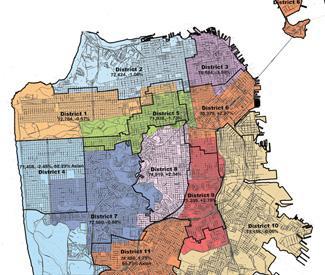
It’s going to be a fascinating race — Gov. Jerry Brown just signed a bill that changes the makeup of the committee, giving the east side of town more members. That’s because more than 60 percent of the Democrats in the city live in what is now Tom Ammiano’s Assembly district. (The east side district of Fiona Ma now includes more of the Peninsula.)

So 14 of the members will be elected from Ammiano’s district, and only 10 from Ma’s (more conservative) district.

But Peskin won’t be on the ballot, and incumbent Debra Walker has stepped down and won’t run (she’s been replaced by Police Commission member Petra DeJesus).

Meanwhile, among the more centrist people who have filed to run: Former Supervisor Bevan Dufty. Sup. Malia Cohen, School Board Member Hydra Mendoza, and former Redevelopment Commission member London Breed. Sup. Scott Wiener, a longtime incumbent, is running for re-election.

The left starts with a vote deficit, since all of the statewide and federal elected officials who are Democrats and live in or represent part of SF are automatically members. That means Sen. Dianne Feinstein, Rep. Nancy Pelosi, Rep. Jackie Speier, Attorney General Kamala Harris, state Sen. Leland Yee, State Sen. Mark Leno, Ma and Ammiano all have votes — and while they never show up, the elected officials send proxies, and other than Ammiano and sometimes Yee and Leno, they can’t be counted on to support progressive candidates and causes.

So progressives need to win more than a simple majority of the contested 24 seats, and while that’s entirely possible, it’s hard to see a full slate in both districts. At best, most progressive groups will probably endorse 12 candidates on the east side and eight on the west — and since the most conservative incumbents will likely win, as will Dufty, probably Cohen and quite possibly Breed, it’s entirely possible that the moderate wing will regain control.

There’s been some tension among progressives in the past few weeks, some arguments about who would best replace Peskin as chair. Animosity over those discussions was one reason Walker resiged. And while there are legit questions about which of the progressives would best run the committee, I fear the candidates were getting ahead of themselves. Because you can’t fight over leadership until you have a majority. And that’s going to be a bigger struggle than it’s been in quite a while.

Olague explains her support for RCV repeal measure

52

  Sup. Christina Olague has drawn ire from progressive circles over her pivotal co-sponsorship of a proposed charter amendment that aims to eliminate Ranked Choice Voting in all citywide races. It takes six members of the Board of Supervisors to place the repeal measure on the November ballot and she is the sixth co-sponsor.

Olague has long ties to the progressive community and was appointed by Mayor Ed Lee to the District 5 seat, one of the city’s most progressive, in January after Ross Mirkarimi was elected Sheriff. This week, she joined Sean Elsbernd, Carmen Chu, Scott Wiener, and Malia Cohen – all considered moderate/conservative supervisors – in supporting Sup. Mark Farrell’s proposal to replace RCV with runoff elections for the mayor’s race and other citywide offices.

“To me, this isn’t a progressive or moderate issue. This is a democratic one here in San Francisco,” Farrell said during Tuesday’s Board of Supervisors meeting, where he introduced the measure, which will have a hearing next month. “Ranked Choice Voting has continued to confuse and disenfranchise voters here for over a decade and, in my opinion, it’s time to restore our voting system to the one person, one vote rule.”

Farrell’s sentiments mirror a similar line trumpeted by the San Francisco Chamber of Commerce, a supporter of runoff elections and longtime opponent of RCV. A recent poll commissioned by the Chamber, which claims 58 percent of respondents prefer runoff elections, has been discounted as biased and based on misleading statements. Farrell, who was elected to the District 2 seat in November using RCV, said he would have prefers to eliminate RCV altogether in San Francisco but said, “This is a significant step in the right direction.” A proposed ballot measure by Farrell and Elsbernd to eliminate RCV was rejected by the Board of Supervisors last month.

Steven Hill, who helped crafted the city’s voter-approved RCV system, criticized the move to repeal it: “Critics of RCV have long maintained that voters are confused and even disenfranchised and yet they have offered no credible evidence to support these claims. In fact, the evidence shows just the opposite, that voters understand what they have to do with RCV, which is to rank their ballots, 1, 2, 3, and they are using their ranked ballots effectively.”

In an interview conducted as she was departing the Westbay Community Center on Thursday, Olague initially rebuffed our request to discuss her support for Farrell’s amendment (just as she had an earlier request by the Guardian), but she ultimately relented.

Here’s what she had to say:

Olague: “What it is is that it begins a conversation.  There was talk of eliminating RCV altogether, which I certainly don’t support.  There was talk from a lot of different corners, not just moderate circles, but progressive circles as well, that maybe we need to examine it and see how has it or has it not really been – has it really helped us reach our goals in the way that we had originally intended that it would.”

SFBG: What were those goals?

Olague: “I think it was to try to make sure that more progressives were elected… and make it easier for people who had lesser means to prevail… So I think maybe it is time to reflect on that a little bit.”

SFBG: What parts of RCV don’t you like or don’t support?

Olague: “Well, I think it’s just time to have a conversation about it.  I’m not even sure that I’m against it, per se. When I signed on to it, I believed it was looking at keeping some of the citywide races, where there are fewer numbers of candidates engaged, to reverting back to a runoff, and keeping the races where we have a diversity of candidates and numerous candidates, which are the district races, as they are – which is ranked choice voting.”

“Now there’s some people who say what we need to do is, well, maybe revisit that and maybe just, rather than have it apply to all citywide races, maybe it should just apply to the mayor’s race.”

“So I think there needs to be a conversation and there needs to be a reflection on its effectiveness.  I think that’s what [Sup. John] Avalos and even [Sup. David] Campos were thinking that there needs to be more education – and I do think there needs to be more education as it relates to RCV.”

SFBG: Voters don’t seem to be confused about filling out an RCV ballot, but maybe there’s confusion about how votes are tallied and candidates are eliminated.  It would appear that there’s a myth being spread that voters are confused about filling in a RCV ballot, but that doesn’t appear to be the case…

Olague: “Do you know that?  I think when you talk to people out there on either side of spectrum, politically, I think there’s still a lot of – I don’t think that people have necessarily concluded that this is the most effective way of achieving certain goals.  But, you know, I think it starts a conversation and it may end up that the voters decide, you know, let’s just leave it the way it is, we’re happy with it.”

SFBG: And how would you feel if RCV is completely eliminated?

Olague: “Well it’s not going to be eliminated because there’s nothing in the charter amendment asking that RCV be eliminated.  What I was concerned about was that there was a push to eliminate it altogether, which I don’t support.  What this does, I figured I’ll meet them halfway because I can’t support a complete repeal of RCV and currently the way this charter amendment is drafted, what is does is it keeps RCV in the District elections.  That stays the same, and the citywide elections would be reverting back to a runoff, so it goes to a more citywide for a runoff, ranked choice voting for District [elections]. There is an argument to be made for why that should be the case.”

SFBG: Wouldn’t this eliminate a diversity of candidates if there were a repeal of RCV in citywide races?

Olague: “So let’s have the debate and people may decide, you know, if it’s not a good idea. People may decide they want to push to amend the charter amendment as it is before us.  Some people are thinking it should just apply to the mayor’s race and not other citywide races like public defender and others. So maybe there’ll be amendments to the charter amendment before it even hits the ballot.”

SFBG: Why do you think some people are up in arms over your support on this?

Olague: “I guess, you know, I mean – I just think that everyone is going to sit around and wait for something, right?  They’re, sort of, laying in wait, right? So it’s just what it is, you know – it’s like people are going to agree with me sometimes, they’re not going to agree with me other times.  There are some things that I am doing that is progressive, there are some things people will perceive as not being progressive.”

SFBG: Did you come to this decision by yourself, or was there any influence or pressure from others to vote the way you did on this?

Olague: “No.  I just think it’s funny because it’s like I don’t really succumb to pressure.  I’m willing to start the conversation at some kind of a compromise.  To me, this is as close to a compromise as we’re going to get and then it can start the conversation. So I think the conversation will start and people can assume all kinds of things, and they will.”

SFBG: So you voted in good conscience?  You didn’t have any doubts about your vote?

Olague: “I vote in good conscience, but sometimes you have to go with a compromise.  It’s not completely what you want and it might not be completely what you don’t want, but the alternative might be something that is completely unacceptable, which could be the complete elimination of RCV.”


A version of this story also appears on Fog City Journal, which is run by Luke Thomas.

The struggle for housing money at City Hall

24

It’s barely March, and the next election isn’t until June and that’s just primaries and the Democratic County Central Committee, but we just started getting political mail anyway. It’s a piece from the Board of Realtors, denouncing plans for an increase in the real-estate transfer tax “to provide subsidized housing to people who want to live in San Francisco but don’t have the means to do so.” Mayor Ed Lee, the flier says, is backing this “outrageous” plan.

What, exactly, is going on here?

Well, for starters, the mayor is distinctly NOT pushing for an increase in the transfer tax, not right now, anyway. What he is doing is meeting with housing advocates and legislators and trying to come up with a stable source of funding for affordable housing — yes, for families and low-income people, many of them longtime residents who are being forced out by Ellis Act evictions, others of them people who work in the city and would rather live here than commute from Pinole, which everyone with any sense agrees is a good idea.

The problem: For years, San Francisco used Redevelopment Agency tax-increment money for affordable housing. Now that money’s gone, since the governor abolished redevelopment agencies. Actually, the money’s not gone, technically — the increased tax revenue from redevelopment project areas still exists. It’s just that the state is now taking a bunch of it, and other taxing entities like BART and the school district get some of it, and now it’s impossible to send bonds and borrow money against it. So what was once tens of millions for affordable housing is now a few million.

“We might have $20 million a year in the general fund,” said housing activist Peter Cohen. “But that’s compared to the $40 million or $50 million we had in the past, and it still leaves housing short.”

Lee has promised repeatedly to fix that problem, to find a way to make sure that there’s enough money that the nonprofits who build housing can plan and develop for the long term. Right now, it’s being called a Housing Trust Fund, but nobody knows exactly how it will actually work.

Remember: The city’s own General Plan states that 60 percent of all new housing should be available at below market rate. All of the regional growth projections say that San Francisco needs to build more housing — for its own workforce, not just for the rich. (And the local workforce, for all the tech jobs the mayor keeps hyping, is still mostly public-sector workers and service employees, most of whom can’t possibly afford the soaring rents and housing prices in this city.)

A lot of the existing affordable housing money comes from the city’s inclusionary housing law, which mandates that market-rate developers set aside a percentage of their new units (usually 20 percent) for lower-income people. Most developers eschew allowing poor people into their condo enclaves, so they pay a fee into a city fund instead.
But if we’re aiming for 60 percent, and we’re getting (at most) 20 percent, we’re a long ways off. Oh, and the developers are starting to argue that the 20 percent rule is too onerous and they can’t build enough condos for the rich if they have to throw scraps to the poor and middle-class, too.

And some supervisors are squawking about building more housing for the middle class, and right now in a zero-sum game, that means less for low-income people.
This all adds up to a mess for the mayor, and it’s no wonder some advocates are talking about raising the transfer tax — which, after all, is paid by the seller of a residential or commercial building, and while there are absolutely some houses underwater in San Francisco (and there should probably be an exemption in the tax for that situation), overall home prices are rising again, and many, probably most home sales these days involve substantial profit. It’s not a perfect tax, but it’s a tax on a class that is (generally) better off to support a class that is typically not so well off.

Here’s the problem: If the mayor supports a transfer tax, and that’s part of the final package, the realtors and the commericial building owners will no doubt put huge amounts of money into defeating it. That would mean Lee would have to raise a bucket of money and campaign really hard to pass it. But Lee’s demonstrated that he’s not the fighting type; he wants something that nobody serious will oppose. Which is why my sources at City Hall say that he wants the transfer tax off the table.

That could mean that the Housing Trust Fund will be a basic set-aside, a budgetary mandate that a certain amount of money go into a reliable fund for housing. That’s one of the city’s most pressing needs (really, if this becomes a city of just the rich, even those of us who own houses or have rent-controlled apartments won’t want to live here any more. Mayor Larry Ellison? Eeew.) So I’m okay with that. I’m not a big fan of set-asides, but this is the whole future of San Francisco we’re talking about.

So the realtors can take a chill pill — the mayor doesn’t want to get in a fight with you. Sigh.

D5 candidates and constituents scrutinize Olague

38

San Francisco’s political lines are in the process of being redrawn. That’s true literally, with the current reconstitution of legislative districts based on the latest census, but it’s also true figuratively: old alliances based on identity and ideology are being replaced with uncertain new political dynamics. And nowhere is that more true than in District 5.

In a recent Guardian, we explored the implications of Sup. Christina Olague’s dual (and potentially dueling) loyalties between Mayor Ed Lee, who appointed her to the job, and the progressive political community with which Olague has long identified. Those seemed to play out yesterday when Olague bucked progressives to be the sixth co-sponsor of Sup. Mark Farrell’s proposed charter amendment to repeal ranked-choice voting for citywide offices.

Already, many of her progressive constituents – even those who have strongly supported her – have been privately grumbling that Olague hasn’t been accessible and expressing doubts about her ability to lead one of the city’s most progressive districts. Olague, who initially returned our calls immediately but said she’d have to get back to us about supporting Farrell’s legislation (I’ll add an update if/when she calls back), adamantly denied that she’s had a slow start.

“We’ve been working with constituents constantly,” she said, rattling off a list of nightly meetings. “I’m in the community all the time, getting coffee with folks…We’re working on multiple issues here.”

Michael O’Connor – who owns The Independent and other businesses and who ran in D5 in 2004 and may run again this year – supports Olague but questions the conventional wisdom that her progressive roots and mayoral support make her a lock for reelection this year.

“Olague is an awesome person and she would be a great supervisor in District 9,” O’Connor said, citing her strong ties to the Mission District and work with the Mission Anti-Displacement Coalition. “But she’s very beatable in D5 because she doesn’t have the deep connections to the community.”

That’s a belief that is shared by others, including London Breed – the executive director of the African American Art & Cultural Center for the last 10 years – who jumped into the race last week and threatened to cut into Olague’s support among Mayor Lee’s supporters.

With Attorney General Kamala Harris and other Lee supporters by her side, Breed cast herself as a more authentic and grassroots representative for the district where she was raised. Or as Harris said, “London understands the challenges and strengths of the district. She is, bar none, the best voice for District 5.”

Left unsaid was the split that her candidacy created among supporters of Lee, whose ascension to Room 200 was engineered largely by former mayor Willie Brown and Chinatown power broker Rose Pak. Brown (along with some of the city’s most influential African American ministers) strongly backed Breed for the D5 appointment, while Pak wanted her ally Malcolm Yeung, although she reportedly got behind Olague in the end.

Breed told us that she was supportive of Olague and that “I’ve been adamant about people giving her a chance and working with her.” But she said that it’s already become “clear that she just doesn’t have what it takes and was probably not going to get there,” based on “the feedback and phone calls I got with the experience people had in meeting her.”

“She’s familiar with planning, but not necessarily with the neighborhood and all its community groups,” Breed said. As for crossing Mayor Lee with her decision to run, Breed told us, “This was a hard decision for me to make because I work with many of these people and have good relationship with him.”

Progressive D5 candidates, such as City College Board President John Rizzo, are waiting to take advantage of votes on which Olague breaks with the progressives to carry water for the mayor. As he told us, “The mayor doesn’t get to make this decision, it’s the voters of this district that will decide.”

Like Breed, Rizzo also emphasized his long ties to the district. “I respect Christina and like Christina, but my connections are very deep,” he said, citing his 26 years of living and working as an environmental activist in the district. “I have a record of going out and taking the initiative and making things happen.”

Thea Selby, president of the Lower Haight Merchants and Neighbors Association, has also been running an active campaign for the D5 job, including highlighting Olague’s split loyalties. “She literally switched camps to help chair the Run Ed Run committee,” she told us. Julian Davis, who ran for D5 supervisor in 2004 and has been rumored to be mulling another run, said that it’s disconcerting just how many elected officials in San Francisco started off with the advantage of being appointed to the office: “It’s not participatory democracy the way we envision it.”

Selby and others will be closely watching how Olague votes this year, and trying to differentiate when those votes are significant (such as being the swing vote to place the challenge to RCV on the ballot) or not (including Olague’s early vote to override Lee’s veto, which fell two votes short of the eight needed). “We need to look and see how she votes on things – and when it matters and when it doesn’t,” Selby said.

Yet already, even before the really big and controversial votes like the upcoming 8 Washington and CPMC projects, Olague is feeling the polar tugs on issues such as bicycling. Many bike advocates are mad that Lee has delayed promised bike lanes on Oak Street and with a rash of tickets that cyclists on the Wiggle have received.

“I’ve long been an advocate of biking, but I know there are issues related to parking in the neighborhood,” Olague told us, straddling the issue. “Parking for some reason is a very controversial issue in the city.”

And where does she come down on the stepped up enforcement of bikes rolling stop signs on the Wiggle? “I want to sit down with the Bike Coalition and see what they think,” Olague said.

Meanwhile, Breed – who is widely considered a political moderate, which could cause her problems winning in D5 – is also trying to position herself as more independent than Olague. “I’m about being progressive,” she told us, citing her recent hiring of a case worker at the AAACC to help young African Americans work through barriers to success. “To me, that’s what being progressive is.”

Breed readily acknowledged her early political support from Brown, who appointed her to the Redevelopment Commission when he was mayor, but said that she would still take a tough stand against Lennar and other developers to ensure the needs of current San Franciscans are being met by new projects.

“I’ve told people, this does not mean you have my support,” Breed said of her political contributors and her support of Lennar’s massive redevelopment of the southeast part of the city. “As my grandmother used to say, all money ain’t good money.”

On Breed’s entrance into the race, Olague told us, “It was expected, so I’m not surprised.” Olague said that she’s begun to set up her election campaign, but that most of her focus has been on getting up to speed at City Hall and in D5: “I’m just trying to focus on the work of the district.”

Occupying the Capitol

5

It’s an unseasonably hot day at UC Davis, and student activists are milling around a tent city, set up especially for 100 people arriving from a four-day March on Education. The school, one of the hubs of the Occupy movement, gained notoriety when public safety Officer John Pike casually pepper sprayed a line students during a sit-in back in November. Now, officers bike through the idyllic scene, smiling and chatting up occupiers.

Everyone is preparing for the next day, March 5, the statewide day to defend education that will bring thousands of students and teachers to Sacramento to demand an end to budget cuts and fee hikes at California’s schools, community colleges, and universities.

Those on the march hope to highlight the importance of this issue, marching 79 miles from the Bay Area. The first night, the march stayed in Richmond, and the next day Richmond’s Mayor Gayle McLaughlin came out to welcome them.

Students march annually on Sacramento, and say they won’t stop until education is affordable (or, as some would demand, free). A climate of worldwide protest over disparities in wealth and opportunity, including Occupy protests in the United States, helped fuel a larger than usual turnout this year.

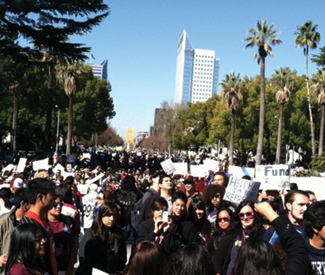
More than 5,000 people converged in Sacramento March 5 and marched to the Capitol building, occupying the Rotunda all day. Many chanted “no cuts, no fees, education must be free.”

Community college student throughout the state are reeling from the cuts, and resulting fee hikes—course units, once free, were raised from $26 to $36 per unit last year, and will be increased another $10 this summer. These costs go towards closing the state budget deficit, and not toward a bigger course catalogue; classes continue to be slashed.

Frances Gotoh of San Bernardino Valley College is back at school after being laid off from her longtime job at Bank of America. She said she desperately needs the retraining; without it her job prospects look dim. She needs to support her family—her 20-year-old son is also a college student—but says she can’t afford the increasing fees. “Why is education being taken away?” asked Gotoh. “It belongs to the people.”

Josselyn Torres, a psychology major at Sonoma State University, felt similarly. “Every year, the fees are getting higher but the class size is getting bigger,” said Torres, who noted that many of her friends won’t be graduating with her because so many of the classes they needed were cut. “The politicians have all gone to college. If they keep cutting our education, how can we make it as far as them?”

When the march reached the Capitol, student and state government leaders spoke on the importance of education. Students demanded an end to fee hikes and budget cuts. Assembly Speaker John Perez (D-Los Angeles) and Senate President Pro Tem Darrell Steinberg (D-Sacramento) praised student activists and expounded on the necessity of accessibility to education. Almost all speakers decried the two-thirds majority needed to raise taxes, allowing just a few Republicans to block them.

Lt. Gov. Gavin Newsom also spoke, describing the need to support education in staunchly free-market terms: “You can’t have an economic development strategy without a workforce development strategy.”

Periodically, the crowd interrupted Newsom and other politicians in the midst of making promises with chants of “show us.” They also chanted this election year threat: “You’ll hear us out or we’ll vote you out!”

Around 12:30 p.m., the permitted rally ended and thousands dispersed. About 400 stayed to “Occupy the Capitol.” The group streamed into the building and into the rotunda. California Highway Patrol officers, responsible for policing the Capitol, blocked more than 150 from entering the central area. So, communicating via the Peoples Mic with several rounds of crowd repetition for every sentence spoken, the group participated in a statewide general assembly.

Some building employees showed support, but the only politician to sit down with the protesters was Newsom, who sits on the UC Board of Regents and CSU Board of Trustees. He chatted with students, some of whom requested that he ask police to stop blocking students from meeting in the same area; he didn’t do so, but was able to convince them to give protesters in the rotunda access to bathrooms.

The group managed to collectively decide on demands of the state: support the Millionaire’s Tax ballot initiative, repeal Prop. 13, cancel all student debt, fund all education through college, and democratize the Board of Regents. When building closed at 6 p.m., officers declared the assembly unlawful and arrested 70 who refused to disperse.

Meanwhile, another 400 or so attended a permitted rally on the Capitol lawn called by several Sacramento labor unions to support Occupy the Capitol.

Over the past five years, education funding in California has been cut drastically. Spending per K-12 student per year has gone down by almost $2,000 and higher education has seen program cuts and tuition hikes. Gov. Jerry Brown’s latest budget proposal includes still more cuts to California colleges and universities.

Several proposed ballot initiatives are designed to address this. An initiative sponsored by Brown would bring spending per student per year up by $1,000, stabilizing at $7,658 (it was $7,096 in 2011-12) and reversing a five-year slide. But it would still be less than 2007-08, according to a report from the California Budget Project (CBP).

That report shows K-12 education spending is the biggest piece of the state budget, although California ranks dismally low compared to other states for spending on K-12 education: 47th in the country.

The governor’s proposal would raise funds with a combination of a tax increase for those earning $250,000 and over per year and a sales tax increase. But critics say the increase in the sales tax, which is notoriously regressive, would hurt lower and middle income families.

The measure is up against other potential ballot initiatives that would raise revenue strictly from the wealthiest Californians. The so-called Millionaire’s Tax, for example, would raise funds for education by increasing taxes on those making $1 million or more per year. The Millionaire’s Tax also has the advantage of resulting in a permanent change in the law, while Brown’s measure would apply only for the next five years.

“California’s problems have also been exacerbated by tax cuts, one-time ‘solutions,’ overly optimistic assumptions, and the fact that the two-thirds vote requirement for the legislature to approve any tax measure has blocked adoption of a balanced approach towards bridging the budget gap,” according to the CBP report.

Teachers’ unions are divided over the best ballot measure. The California Teachers’ Association has endorsed Brown’s measure, emphasizing that it includes a plan to close the budget deficit.

“The governor’s initiative is the only initiative that provides additional revenues for our classrooms and closes the state budget deficit, and guarantees local communities will receive funds to pay for the realignment of local health and public safety services that the Legislature approved last year,” said Dean Vogel, CTA president, in a press release.

But the Millionaire’s Tax was sponsored by the California Federation of Teachers, and it has now been endorsed by this student general assembly. John Rizzo, president of the City College of San Francisco Board of Trustees, also endorsed the measure.

“We’ve got to tell the state of California that we cannot continue this. We cannot continue the cuts to our community colleges, to UCs, to the California State Universities,” said Rizzo, speaking at a March 1 rally in San Francisco.

According to a recent report, of five polls conducted throughout California, each initiative has majority support, but voter prefer the Millionaire’s Tax, with a recent Field Poll showing 63 percent support.

Legislators are also at work trying to increase education funding. Assembly Speaker Perez has introduced a bill that would slash tuition fees by two-thirds at CSU and UC schools for students of families making less than $150,000 per year. The bill would also allocate funding to city colleges throughout the state, for them to determine how to best use the money.

The cost of the plan, about $1 billion, would be paid by eliminating a corporate tax loophole that the Legislature approved in 2009, which would allow companies to choose the cheaper of two formulas for calculating their taxes. Critics have called the legislation bad for business, saying that removing tax incentives would hurt California companies.

“The California Middle Class Scholarship Act is very simple,” Perez told students at UC Davis when he unveiled the bill on Feb. 3. “Too many families are getting squeezed out of higher education. For students whose families make $150,000 a year or less, too much to qualify for our current financial aid system, but not enough to be able to write a check for the cost of education, without feeling that pinch, the Middle Class Scholarship Act reduces fees at the UC system and at the CSU system by two-thirds, giving tremendous assistance to those families to make college affordable again.”

Education advocates say California needs to do something to reverse the spiraling cost of higher education in California, which could do long-term damage to the state, affecting young people and businesses that need skilled workers and spiraling out from there. And these advocates say this short-sighted strategy is easily preventable if there is the political will to address it.

“There are a lot of sources of revenue that are not being taken advantage of,” Lisa Schiff, a member of Parents for Public Schools of San Francisco, told us.

Even if tuitions were lowered or—as the most ambitious of protesters demand—higher education was made free, most former students would still be saddled with massive debt. As costs have risen, debts of hundreds of thousands of dollars are commonplace. With the job market recovery slow and painful, graduates often feel helpless to pay back their debt.

Robert Meister, a professor of Political and Social Thought at UC Santa Cruz and president of the Council of UC Faculty Associations, has long argued that the state’s higher education systems ought to focus on keeping tuitions low and student debt in check (see “In the red,” 1/11/11).

Yet he told us that growing income inequality makes people even more desperate for a college education and willing to accept levels of student debt that limit their ability to become anything more than corporate cogs after graduation. “Their ability to raise tuition is a function of the growth of income inequality,” he told us.

In his speech at UC Davis, Perez cast the issue as one of a disinvestment in the state’s future: “California’s public colleges and universities has been one of our most prestigious institutions, and, unfortunately, because of the collapse of the economy, we’ve moved away from fully investing in those universities and colleges.”

A month later, the school again served as a backdrop for illustrating the problem and calling for reform. Dani Galietti, a MFA student at UC Davis who was setting up a performance art piece when I arrived, greets everyone cheerfully and is thrilled about the Occupy movement.

“I wanted to share myself and my work with the movement,” Galietti tells me while taping a “paper trail” to the sidewalk; she plans to walk on it with home-made stamps attached to the bottoms of her shoes.

But her mood darkens when I ask about her student debt. “I came out of five years of education $100,000 in debt,” says Galietti, “and I’m not the only one.”

She is a first generation college student, she explains, who helped pay for school with McNair scholarships.

“I grew up one of five, with a single mother,” Galietti explains. “We struggled my whole life, as a lot of people have, financially.”

“So many people are graduating with so much debt. There’s this looming fear, fear and hopelessness. The economy’s bad, the job market sucks. I’m so thankful that they’re out here. People are active, they’re making a difference.”

“We need education,” Galietti says. “I mean, knowledge is power.”


Here’s lookin’ at you, kids

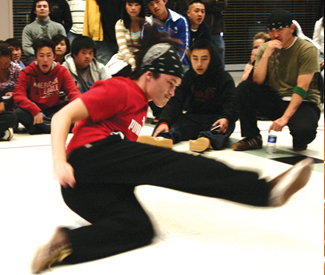
1

arts@sfbg.com

SFIAAFF As the mainstream movie industry undergoes a senior moment and tips toward grandfatherly nostalgia, this year’s San Francisco International Asian American Film Festival seems to be in the throes of a youth movement. You can trace the growth spurt from Eduardo W. Roy Jr.’s reproduction production line Baby Factory and the childhood Xmas fantasy of Kim Sung-Hoon’s Ryang-Kang-Do: Merry Christmas, North! to Wang Xiaoshuai’s coming-of-age snapshot 11 Flowers and the teen gang wars of Byron Q’s Bang Bang. A closer look at three — Christopher Woon’s Hmong hip-hopper doc Among B-Boys, Akira Boch’s girl-band indie The Crumbles, and Takashi Miike’s tot action farce Ninja Kids — finds the disparate troika taking aim at shared themes of bonding and identity.

Among B-Boys gives outsiders an hour-long, respectful immersion in the lives of Hmong breakdancers, here “getting lost” in their impressively athletic moves and speaking for themselves, away from the flinty-eyed filter of Gran Torino (2008). In his quest to follow the Velocity/Soul Rivals and Underground Flow crews, Woon takes his camera from Oklahoma to Left Coast exurbia where the kids are attempting to dream with acrobatic handstands, freezes, and crazy-fancy footwork — and finding their efforts rewarded with trophies.

Their triumphs in gritty gyms and community centers are made that much more poignant in the context of their parents’ memories of war, displacement, and poverty. The elders’ stealth contributions to the CIA’s shadowy adventures in Laos casts a pool of lingering darkness on these hip-hoppers, who are striving to carve out a life for themselves while coping with the unique challenges that the Hmong have encountered in the states. As Joua Xiong, the rare B-girl in the Soul Rivals Crew, explains, “Hmong mean ‘the Free,’ and that’s basically what we are: we don’t have a certain country, but we don’t really know our original customs because we’re so mixed up. We have a lot of Thai, Lao, Chinese in us, and we’ve been running away so much from people trying to destroy our customs and make us conform with them.”

Cast away in a semi-rural Merced, Fresno, and Sacto, these kids appear to be finding another kind of freedom. “It’s not just breaking,” says Soul Rivals’ Kyle Vong. “It’s the culture of hip-hop — it’s about teaching yourself to understand life in general and expressing yourself.”

The awkward slackers and damaged hipsters of The Crumbles seem to be worlds away from the humble, proud B-boys of the Central Valley: theirs is a sun-strafed, paved-over Los Angeles habitat of coffee shops, taco trucks, bookstores, budding filmmakers, and living room-bound band practice. Darla (Katie Hipol) is slouching nowhere fast when her zany, charismatic cool-girl chum Elisa (Teresa Michelle Lee) enters the picture, looking for a place to crash.

Elisa’s wacky, erratic, and unreliable, but she’s also capable of generating real excitement — and a mean little keytar hook — and the girls’ band, the Crumbles, gets off the couch and threatens to get all involved to bust out of their shells. Though director Boch never quite dips into the deep background of his characters’ various dysfunctions — the threatened readings of Darla and Elisa’s psychic friend never quite sheds light — the first-time feature filmmaker has a real feel for the drifting, up-for-anything quality of Cali 20-somethings and an appreciation for their highs and lows that makes this familiar, loving, lets-put-on-show-kids update compelling.

With kindred ultraviolence vet Martin Scorsese throwing himself into his own kiddie roller-coaster of a cinematic ride with last year’s Hugo, it makes some sense that Takashi Miike — whose 2010 13 Assassins might have bested both Ichi the Killer (2001) and 1999’s Audition for sheer bloodletting — would enter the children’s field with such gusto. Manga fans will appreciate Miike’s broadly farcical, spoofy élan with comic book touches — down to the freeze-frame mucus drips, the CGI hatched-background stills denoting way-ramped-up action, and fourth-wall-bust-outs/pop-up trivia interludes by your “friendly ninja trivia commentator.”

http://www.youtube.com/watch?v=HVjoh-jG36o

Rantaro — your archetypal geek toddler, complete with thick glasses and bad haircut — has left the family farm and been sent off to ninja nursery school to learn all about deadly boomeranging stars, big-headed villains with testicular chins, and ninja master-slash-hair stylists. Does Rantaro, er, find himself amid the rigors of class, attacks from dastardly ninja outfits, and a final challenge that has him literally biting the dust? And does it matter when Miike digs in with such glee to lampoon the samurai genre, and kick up dust with the ankle-nibblers in this insanely comical alternate universe of ninja mini-mes?

SAN FRANCISCO INTERNATIONAL ASIAN AMERICAN FILM FESTIVAL

March 8-18, various Bay Area venues, most shows $12

www.caamedia.org

DOCS AND SHOCKS: MORE FROM THE SF INTERNATIONAL ASIAN AMERICAN FILM FESTIVAL

SFIAAFF Documentary fans, prioritize Give Up Tomorrow, Michael Collins’ probing examination of a high-profile murder case in the Philippines. If the Paradise Lost films got your blood boiling, expect to rage even harder at the unbelievably shifty way the events detailed here unfolded.

As with the West Memphis Three, the crime at Tomorrow‘s heart is horrific: in 1997, two sisters in their early 20s were kidnapped, raped, and murdered. Or were they? Only one body was found, and it was never quite confirmed that the dead woman was actually one of the missing sisters. Of course, that didn’t stop authorities (almost all of whom had ties to a local drug lord, who was also connected to the victims’ family) from fingering a group of local teens, including Paco Larrañaga — who became the case’s main target, despite the fact that dozens of his culinary-school classmates swore he was with them, hundreds of miles from the crime scene, at the time of the alleged murders.

Give Up Tomorrow offers a searing study of a corrupt court system, and the heartbreak that happens when a cause célèbre falls victim to the short attention span of the international activist community. Without spoiling all of its twists and turns, know that this story is better than any fictionalized crime drama, and more powerfully wrenching for being true.

Other docs worth checking out include Mr. Cao Goes to Washington, an insightful look at the American political system via Joseph Cao, who was the first Vietnamese American elected to Congress. But that wasn’t the most unique thing about him: he was a Republican, elected amid post-Katrina disarray in one of New Orleans’ traditionally African American and staunchly Democratic districts. S. Leo Chiang’s film follows Cao as he makes hard choices in the year leading up to his battle for re-election, including voting first for, then against, President Obama’s health care reform bill. (Reason for the switch: he’s passionately anti-abortion.) Even if you don’t agree with his views, Cao puts a human (and surprisingly honest) face on the great divide between the political parties in this country.

More hopeful is No Look Pass, Melissa Johnson’s quite enjoyable documentary about first-generation Burmese American Emily Tay, a basketball superstar who turns pro after graduating Harvard (eat your heart out, Jeremy Lin), and, oh yeah — happens to be a lesbian. No Look Pass also screened at the San Francisco Independent Film Festival, and it’s not hard to see why it appeals to a wide range of audiences: Tay is an inspiring figure on the court, and endearingly awkward off it, especially when trying to relate to her deeply traditional parents.

Even more uplifting, and perfectly compressed at 39 minutes, is Lucy Walker’s Oscar-nominated The Tsunami and the Cherry Blossom, which examines the “beauty and terror” of nature, as perceived by Japanese survivors of the recent earthquake and tsunami — and the spiritual significance of the cherry blossom, which is shown to be a key element in the country’s healing process.

Genre fans! I Am a Ghost, the world-premiere latest from prolific local H.P. Mendoza (2006’s Colma: The Musical), starts slowly but — holy ghost! — stick with it, and you’ll be shriekingly rewarded. And another recent IndieFest selection, Marlon N. Rivera’s satirical The Woman in the Septic Tank, returns to delight another wave of crowds with its tale of three ambitious filmmakers (and a hell of a leading lady) determined to make the most popular Filipino movie of all time. Best line: “Fuck Cannes, bro! We’re talking Oscars!” (Cheryl Eddy)

Stage Listings

0

Performance times may change; call venues to confirm. Reviewers are Robert Avila, Rita Felciano, and Nicole Gluckstern. Submit items for the listings at listings@sfbg.com. For further information on how to submit items for the listings, see Picks.

THEATER

OPENING

“Celebration of Women’s History Month” Thick House, 1695 18th St, SF; www.3girlstheatre.org. $30. Opens Thurs/8, 7:30pm. Dates and showtimes vary. Through April 1. 3Girls Theatre Company launches its inaugural season with a celebration of new works (in both full-production and staged-reading form) by female Bay Area playwrights.

It’s All the Rage Studio Theater, Marsh San Francisco, 1062 Valencia, SF; (415) 282-3055, www.themarsh.org. $15-50. Opens Thurs/8, 8pm. Runs Thurs, 8pm; Sat, 8:30pm, Sun, 7pm. Through April 15. Longtime comedian and radio host Marilyn Pittman’s solo play wrestles with the legacy of her parents’ violent deaths in a 1997 murder-suicide initiated by her father. It’s disturbing material that Pittman, a stout middle-aged woman with a gregarious and bounding personality, approaches indirectly via a good deal of humor — including recounting the first time she did her growing-up-lesbian bit before her mother in a DC comedy club. But the pain and confusion trailing her for 13 years is never far behind, whether in accounts of her own battle with anger (and the broken relationships it has left in its wake) or in ominous memories of her too complaisant mother or her charming but domineering father, whose controlling behavior extended to casually announcing murderous dreams while policing the boundaries of his marriage against family interference. A fine mimic, Pittman deploys a Southern lilt in playing each parent, on a stage decorated with a hint of their Southwestern furnishings and a framed set of parental photographs. In not exactly knowing where to lay blame for, or find meaning in, such a horrifying act, the play itself mimics in subtler form the emotional tumult left behind. There’s a too brief but eerie scene in which her veteran father makes reference to a murder among fellow soldiers en route to war, but while PTSD is mentioned (including as an unwanted patrimony), the 60-minute narrative crafted by Pittman and director David Ford wisely eschews any pat explanation. If transitions are occasionally awkward and the pace a bit loose, the play leaves one with an uncomfortable sense of the darker aspects of love, mingled with vague concentric histories of trauma and dislocation in a weird, sad tale of destruction and staying power. Note: review from the show’s 2009 run at the Marsh. (Avila)

Julius Caesar Buriel Clay Theater, African American Art and Culture Complex, 762 Fulton, SF; 1-800-838-3006, www.african-americanshakes.org. $10-30. Opens Sat/10, 8pm. Runs Sat, 8pm; Sun, 4pm. Through April 1. African-American Shakespeare Company performs a version of the Bard’s classic set during the ongoing civil wars of West Africa.

BAY AREA

Now Circa Then Lucie Stern Theatre, 1305 Middlefield, Palo Alto; (650) 463-1960, www.theatreworks.org. $19-69. Previews Wed/7-Fri/9, 8pm. Opens Sat/10, 8pm. Runs Tues-Wed, 7:30pm; Thurs-Sat, 8pm (also Sat, 2pm); Sun, 2 and 7pm. Through April 1. TheatreWorks performs Carly Mensch’s comedy about a romance that blooms between two historical re-enactors.

ONGOING

*Blue/Orange Lorraine Hansberry Theatre, 450 Post, SF; (415) 474-8800, www.lhtsf.org. $43-53. Thurs-Sat, 8pm (also Sat, 2pm). Through March 18. Lorraine Hansberry Theater offers an uneven but worthwhile production of British playwright Joe Penhall’s sardonic comedy of ideas and institutional racism, an intriguingly frustrating three-hander about a young doctor (a bright Dan Clegg) at a psychiatric teaching hospital who begins a battle royal with his suave and pompous supervising physician (a comically nimble Julian Lopez-Morillas) over the release of a questionably-sane black patient. Originally brought in by police for creating a disturbance, Christopher (the excellent Carl Lumbly) still exhibits signs of psychosis and his ability to care for himself seems doubtful to the young doctor treating him. The older physician appeals to the patient’s general competence, hospital procedures, the shortage of beds, and the exigencies of career advancement in countering the younger doctor’s insistence on keeping the patient beyond the mandatory 28-day period required by law. For his part, Christopher, nervous and rather manic, is at first desperately eager to be released back to his poor London neighborhood. Competing interviews with the two doctors complicate his perspective and ours repeatedly, however, as a heated debate about medicine, institutionalization, cultural antecedents to mental “illness,” career arcs, and a “cure for black psychosis,” leave everyone’s sanity in doubt. Although our attention can be distracted by a too-pervading sound design and less than perfect British accents, Edris Cooper-Anifowoshe directs a strong and engaging cast in a politically resonant not to say increasingly maddening play. (Avila)

*Fool For Love Boxcar Studios, 125A Hyde, SF; www.boxcartheatre.org. $25. Showtimes vary. Through April 14. Another installment of Boxcar Theatre’s epic Sam Shepard repertory project, Fool for Love inaugurates their newest performance space within their Hyde Street Studios location. A depressingly realistic reproduction of a claustrophobic motel room, the tiny jewel-box theatre provides no refuge for the actors, and certainly not for the audience, each trapped beneath the pitiless gaze of the other. And if that too-close-for-comfort intimacy doesn’t get to you, the intentionally difficult subject matter — a “typical” Shepardian foray into alcohol-fueled ranting, violence, incest, and casual cruelty — probably will. Shepard’s strength in monologue shows itself off to meaty effect from May’s (Lauren Doucette) melancholy description of her mother’s love affair with the Old Man (Jeff Garrett) to Eddie’s (Brian Trybom) candid admittance to May’s timid suitor Martin (Geoffrey Nolan) that he and May are not cousins at all but half-siblings who have “fooled around” with each other. In addition to the reliably strong performances from each of the actors, Fool features a notably clever bit of staging involving the Old Man who appears not as a specter wandering the periphery of the stage, but as a recurring figure on the black-and-white television, interrupting the flow of cheesy Westerns with his garrulous trailer park wisdom and an omnipresent Styrofoam cup filled, one suspects, with something stronger than just coffee. (Gluckstern)

Geezer Marsh San Francisco, MainStage, 1062 Valencia, SF; (415) 282-3055, www.themarsh.org. $25-100. Thurs and Sat, 8pm; Sun, 5pm. Through March 18. Geoff Hoyle’s hit solo show returns.

Glengarry Glen Ross Actors Theatre of San Francisco, 855 Bush, SF; (415) 345-1287, www.brownpapertickets.com. $26-40. Fri-Sat, 8pm. Through March 24. David Mamet’s cutthroat comedy, courtesy of the Actors Theatre of San Francisco.

Maurice New Conservatory Theatre Center, 25 Van Ness, SF; (415) 861-8972, www.nctcsf.org. $25-45. Wed-Sat, 8pm; Sun, 2pm. Through March 25. New Conservatory Theatre Center presents a play about two young men who fall in love in pre-World War I England, adapted from E.M. Forster’s novel.

Merchants Exit Stage Left, 156 Eddy, SF; www.brownpapertickets.com. $10-25. Thurs-Sat, 8pm. Through March 24. No Nude Men Productions performs Susan Sobeloff’s tale of two sisters trying to balance financial stability and career satisfaction.

The Real Americans Marsh Studio Theater, 1062 Valencia, SF; (415) 282-3055, www.themarsh.org. $25-50. Fri, 8pm; Sat, 5pm; Sun, 2pm. Through March 18. Dan Hoyle revives his hit solo show about small-town America.

Scorched American Conservatory Theater, 415 Geary, SF; (415) 749-2228, www.act-sf.org. $10-85. Wed/7-Sat/10, 8pm; Wed/7, Sat/10-Sun/11, 2pm. Lebanese-Canadian playwright Wajdi Mouawad bites off a little more than he can chew, and ACT thus offers a less than satisfying three-hour feast with its stilted production of Mouawad’s 2008 epic about a brother and sister (Babak Tafti and Annie Purcell) sent by their estranged, recently deceased mother’s executor (David Strathairn) on a hunt for her past in her unnamed civil war-torn Middle Eastern homeland. At that point, the story of their mother, Nawal (Marjan Neshat), comes center stage — or rather crisscrosses it with that of her children in a mash-up that only undercuts the potential tension or interest in either plot strand. Director Carey Perloff’s cast also proves unevenly compelling. Strathairn’s Alphonse is a compassionate, slyly wise man who nervously rambles to make up for the extremely laconic and resentful mood of Nawal’s children. But he is of peripheral importance, and his malapropisms are laid on a little thicker than his endearing Quebecois accent, as if betraying the limits of his function onstage. The other characters meanwhile feel too thinly sketched to occupy the middle. As the sad and horrifying details of this Sophocles-inspired tale unfold, there is surprisingly little sense of authentic experience, and much more the feeling of over-indulgence it certain dramatic devices. Between the sententious and ponderous dialogue, strained characterization, and unwieldy storyline is a play flailing away at something beyond its ken or capacity. (Avila)

*Three’s Company Finn’s Funhouse, 814 Grove, SF; www.brownpapertickets.com. $20. Fri/9-Sat/10, 9pm (also Sat/10, 7pm). Some flashbacks are better than the original high. And more real. This time, you can literally “knock on their door” — a beautiful old Victorian in the Western Addition, whose dining room is made up to look like the Santa Monica apartment shared by Jack, Crissy, and Janet, the happy-go-lucky trio at the center of the iconic late ’70s, early ’80s sitcom. Giggly, ribald, and pleasingly stupid, to be sure, the evening also delivers first-class showmanship: Mike Finn (as good-natured goof Jack), D’Arcy Drollinger (as a buxom not to say brawny Chrissy), and former Go-Go’s guitarist Jane Wiedlin (in a spritely turn as Janet) couldn’t be more reminiscent or delightfully arch in their respective roles. Meanwhile, incarnating the Ropers with pitch-perfect inflections, timing, kaftans and sweater vests are the superb duo of Matthew Martin (channeling the frustrated deadpan wit of Mrs. Roper) and Sara Moore (excelling as subdued but occasionally very wacky Mr. Roper). A ticket gets you pilot episode “Man About the House” and “Roper’s Niece” (a suitably randy Laurie Bushman) — plus commercials. Cat Fight and Shoulder Pads’ homey hit, briskly directed by Cindy Goldfield and extended for one more weekend, is must-see reality TV. (Avila)

Tontlawald Exit on Taylor, 277 Taylor, SF; (415) 525-1205, www.cuttingball.com. $10-50. Thurs/8, 7:30pm; Fri/9-Sat/10, 8pm (also Sat/10, 2pm); Sun/11, 5pm. Entering the theater space thought the back door, squeezing alongside a giant fishing net motif, which wraps the entire stage in a fabric grid, almost imperceptibly skews one’s perspective in advance of the show, just a brief twist that sets the tone for this abbreviated epic of abuse, friendship, and revenge. The heroine, an earthy yet somehow fragile maid (Marilet Martinez), inadvertently manages to rile her evil stepmother (Madeline H. D. Brown) for what seems to be the umpteenth time before fleeing into the mysterious wooded Tontlawald, inhabited by joyously frolicking beasts (or boys) and a preternaturally beautiful princess (Rebecca Frank) who immediately adopts her as a friend. Told through snatches of repetitive text, solemnly-intoned and ecstatically sung, and moments of engagingly acrobatic, hyper-stylized movement, Cutting Ball’s Tontlawald meanders through an Estonian fairy tale-hero’s quest, as if told from the perspective of the child protagonist — light on detail, heavy on drama. Inspired by TeatrZAR, the resident company of Poland’s Grotowski Centre, co-directors Paige Rogers and Annie Paladino and choreographer Laura Arrington worked to emulate certain characteristics of its style, notably the emphasis on song. But while there are some gorgeously transcendent moments of musical direction courtesy of Rogers, and of choreography courtesy of Arrington, the work plays out mostly as a disjointed series of striking tableaux, which intrigue the intellect, but somehow fail to inflame the soul. (Gluckstern)

*True West Boxcar Studios, 125A Hyde, SF; (415) 967-2227, www.boxcartheatre.org. $25. Thurs-Sat, 8pm. Through April 7. The first installment of Boxcar Theatre’s four-play Sam Shepard repertory project, True West ushers in the ambitious run with a bang. This tale of two brothers who gradually assume the role of the other is one of Shepard’s most enduring plays, rich with humorous interludes, veering sharply into dangerous terrain at the drop of a toaster. In time-honored, True West tradition, the lead roles of Austin, the unassuming younger brother, and Lee, his violent older sibling, are being alternated between Nick A. Olivero and Brian Trybom, and in a new twist, the role of the mother is being played by two different actresses as well (Adrienne Krug and Katya Rivera). The evening I saw it, Olivero was playing Austin, a writer banging away at his first screenplay, and Trybom was Lee, a troubled, alcoholic drifter who usurps his brother’s Hollywood shot, and trashes their mother’s home while trying to honor his as yet unwritten “contract”. The chemistry between the two actors was a perfect blend of menace and fraternity, and the extreme wreckage they make of both the set (designed by both actors), and their ever-tenuous relationship, was truly inspired. (Gluckstern)

The Waiting Period MainStage, Marsh San Francisco, 1062 Valencia, SF; (415) 282-3055, www.themarsh.org. $15-50. Fri, 8pm; Sat, 5pm. Through March 24. Brian Copeland (comedian, TV and radio personality, and creator-performer of the long-running solo play Not a Genuine Black Man) returns to the Marsh with a new solo, this one based on more recent and messier events in Copeland’s life. The play concerns an episode of severe depression in which he considered suicide, going so far as to purchase a handgun — the title coming from the legally mandatory 10-day period between purchasing and picking up the weapon, which leaves time for reflections and circumstances that ultimately prevent Copeland from pulling the trigger. A grim subject, but Copeland (with co-developer and director David Ford) ensures there’s plenty of humor as well as frank sentiment along the way. The actor peoples the opening scene in the gun store with a comically if somewhat stereotypically rugged representative of the Second Amendment, for instance, as well as an equally familiar “doood” dude at the service counter. Afterward, we follow Copeland, a just barely coping dad, home to the house recently abandoned by his wife, and through the ordinary routines that become unbearable to the clinically depressed. Copeland also recreates interviews he’s made with other survivors of suicidal depression. Telling someone about such things is vital to preventing their worst outcomes, says Copeland, and telling his own story is meant to encourage others. It’s a worthy aim but only a fitfully engaging piece, since as drama it remains thin, standing at perhaps too respectful a distance from the convoluted torment and alienation at its center. (Avila)

BAY AREA

*Body Awareness Aurora Theatre, 2081 Addison, Berk; (510) 843-4822, www.auroratheatre.org. $30-48. Wed/7-Sat/10, 8pm; Sun/11, 2 and 7pm. In Annie Baker’s new comedy, receiving a top-notch Bay Area premiere at Aurora Theatre, peppy psychology prof Phyllis (Amy Resnick) hosts “Body Awareness Week” at her small Vermont college, while back home partner Joyce (Jeri Lynn Cohen) talks to her 21-year-old son Jared (Patrick Russell) about the porn pay-per-view bill he’s racked up. Phyllis contends that Joyce’s introverted, somewhat explosive virgin son (who in addition to bouts of violent anger soothes himself compulsively with an electric security toothbrush) has Asperger’s Syndrome — a diagnosis that Jared, a budding not too say obsessive lexicographer, hotly contests. That same week, the couple hosts a guest artist, Frank (Howard Swain), a breezy man’s man whose career stands squarely on a series of photographs of nude women and girls. The young man seeks sexual advice from the older one, much to Phyllis’s disgust and Joyce’s relief, while also tempting Joyce with the notion of posing for a nude portrait and “reclaiming her body image,” in a well-used phrase. An already delicate balance thus goes right off kilter as, between the poles of Phyllis and Frank, Joyce and Jared chase competing notions and definitions of themselves and the world. In the volatile tension between perspectives, power trips, and extreme personalities, playwright Baker initially pushes a comic form toward an unsettling edge, only to retreat in the end for safer ground and a family-friendly resolution. While that feels like a lost opportunity, Body Awareness is still a stimulating and solidly entertaining evening, brought to life by a warm and dexterous ensemble under fine, lively direction by Joy Carlin. (Avila)

Cabaret Larkspur Café Theater (American Legion Hall Post 313), 500 Magnolia, Larkspur; www.brownpapertickets.com. $25-45. Fri-Sat, 8pm; Sun, 7pm (no show April 8). Through April 15. Independent Cabaret Productions and Shakespeare at Stinson move their production of the Kander and Ebb classic from Fort Mason to the North Bay.

A Doctor in Spite of Himself Berkeley Repertory Theatre, Roda Theatre, 2015 Addison, Berk; (510) 647-2949, www.berkeleyrep.org. $14.50-73. Tues and Thurs-Sat, 8pm (no show March 23); Wed and Sun, 7pm (also Sun, 2pm). Through March 25. Berkeley Rep performs a contemporary update of the Molière comedy.

*The Kipling Hotel: True Misadventures of the Electric Pink ’80s New venue: Marsh Berkeley, 2120 Allston, Berk; (415) 282-3055, www.themarsh.org. $20-50. Sat, 8:30pm; Sun, 7pm. Extended through March 25. This new autobiographical solo show by Don Reed, writer-performer of the fine and long-running East 14th, is another slice of the artist’s journey from 1970s Oakland ghetto to comedy-circuit respectability — here via a partial debate-scholarship to UCLA. The titular Los Angeles residency hotel was where Reed lived and worked for a time in the 1980s while attending university. It’s also a rich mine of memory and material for this physically protean and charismatic comic actor, who sails through two acts of often hilarious, sometimes touching vignettes loosely structured around his time on the hotel’s young wait staff, which catered to the needs of elderly patrons who might need conversation as much as breakfast. On opening night, the episodic narrative seemed to pass through several endings before settling on one whose tidy moral was delivered with too heavy a hand, but if the piece runs a little long, it’s only the last 20 minutes that noticeably meanders. And even with some awkward bumps along the way, it’s never a dull thing watching Reed work. (Avila)

Mesmeric Revelation Berkeley City Club, 2315 Durant, Berk; (510) 558-1381, www.centralworks.org. Thurs-Sat, 8pm; Sun, 5pm. Through March 18. Central Works opens its season of world premieres with Aaron Henne’s Edgar Allen Poe-inspired drama.

The Pirates of Penzance Julia Morgan Center for the Arts, 2640 College, Berk; (510) 845-8542, www.juliamorgan.org. $17-35. Fri-Sat, 7pm (also Sat, 2pm); Sun, noon and 5pm. Through April 1. Berkeley Playhouse performs the Gilbert and Sullivan classic, with the setting shifted to a futuristic city.

Titus Andronicus La Val’s Subterranean, 1834 Euclid, Berk; www.impacttheatre.com. $10-20. Thurs-Sat, 8pm. Through March 31. Impact Theatre takes on the Bard’s bloodiest tragedy.

The World’s Funniest Bubble Show Marsh Berkeley, TheaterStage, 2120 Allston, Berk; (415) 826-5750, www.themarsh.org. $8-50. Extended run: Sun/11 and March 18, 11am. Louis “The Amazing Bubble Man” Pearl returns with this kid-friendly, bubble-tastic comedy.

PERFORMANCE/DANCE

“The Abduction from the Seraglio (Yanked from the Harem)” Marines Memorial Theater, 609 Sutter, SF; www.pocketopera.org. Sun/11, 2pm. Also March 18, 2pm, Berkeley Hillside Club, 2286 Cedar, Berk. $15-39. Pocket Opera performs artistic director Donald Pippin’s witty translation of Mozart’s classic work.

“Arthur in Underland” CounterPULSE, 1310 Mission, SF; www.counterpulse.org. Fri-Sun, 8pm. Through March 24. $15-24. Dandelion Dancetheater performs a new work about a young man whose life is changed when he becomes part of a rock group’s entourage.

“A Circus Celebration Honoring Peggy Ford” Z Space, 450 Florida, SF; www.brownpapertickets.com. Tues/13, 7pm. $20-100. Clowns and other circus performers honor the life and legacy of the late Peggy Ford, a 40-year veteran of the Bay Area and national circus communities.

“Elect to Laugh” Studio Theater, Marsh San Francisco, 1062 Valencia, SF; (415) 282-3055, www.themarsh.org. Tues, 8pm. Ongoing through Nov 6. $15-50. Will Durst and friends perform in this weekly political humor show that focuses on the upcoming presidential election.

“The Eric Show” Milk Bar, 1840 Haight, SF; www.milksf.com. Tues, 8pm (ongoing). $5. Local comedians perform with host Eric Barry.

“Finding the Michaels” Shotwell Studios, 3252-A 19th St, SF; www.brownpapertickets.com. Fri/9-Sat/10, 8pm. Footloose presents Cassie Angley’s solo play about her experiences in post-9/11 New York City.

“Funsch Solos: One on One” Z Space, 450 Florida, SF; www.zspace.org. Thurs/8-Sat/10, 8:30pm; Sun/11, 7:30pm. $15-20. Christy Funsch presents up-close glimpses of her solo dance works, featuring a variety of performers.

“Waters Rising” Dance Mission Theater, 3316 24th St, SF; (415) 273-4633, www.brownpapertickets.com. Fri/9-Sat/10, 8pm; Sun/11, 5pm. $15-18. Locals Zell Dance and dance ceres team up with Boston-based Weber Dance for a weekend showcasing new works.

“The Whole Megillah 2: Uncut” Kanbar Hall, Jewish Community Center of San Francisco, 3200 California, SF. Wed/7, 8pm. Also: Thurs/8-Fri/9, 8pm; Sat/10, 7 and 10pm. Jewish Theatre, 470 Florida, SF; www.jccsf.org. $15-20. The Hub and Killing My Lobster present this Purim-themed sketch comedy show.

BAY AREA

Alvin Ailey Dance Theater Zellerbach Hall, Bancroft at Telegraph, UC Berkeley, Berk; (510) 642-9988, www.calperformances.org. Program A: Tues/13 and March 16, 8pm; Program B: March 14, 8pm, March 17, 2pm, and March 18, 3pm; Program C: March 15 and 17, 8pm. $30-80. The veteran company makes its annual visit with three programs incorporating eight separate works, including the Bay Area premiere of Rennie Harris’ Home (2011).

“The Fortune Project Ch. 2: Atomic Intuition” Envision Academy, 1515 Webster, SF; www.raggedwing.org. Fri/9-Sat/10, 8pm; Sun/11, 5pm. $15-30. Ragged Wing Ensemble performs the second installment in its multidisciplinary, interactive performance series.

SF Chamber poll distorts the facts…again

61

The San Francisco Chamber of Commerce this week released its annual City Beat poll – promoting its results at the top of its website and feeding it to media outlets such as the San Francisco Examiner, which faithfully reported its finding, apparently without seeking underlying data – and once again the poll was marred by distortions and hidden agendas.

For example, the Chamber claims that 58 percent of the poll’s 500 respondents prefer runoff elections (up from 52 percent in 2011) and 31 percent prefer ranked-choice voting (down from 42 percent last year), with the balance refusing to answer or saying they don’t know. But what the Chamber doesn’t say is that voters were read a series of arguments for each system first, and the anti-RCV statement contained a flat-out inaccuracy.

“Critics of ranked choice voting say that it is a confusing system that results in lower voter turnout – as the last Mayoral election had the lowest overall voter turnout in more than 35 years. They say candidates are getting elected with extremely low number of votes which doesn’t represent the true will of the voters. Instead of ranked choice voting, they propose having run-off elections so that voters have a clear choice on something as important as Mayor,” the statement read.

Yet it’s simply not true that November’s 42.47 percent turnout was the lowest in 35 years (as you can see here). Off-year elections have far lower turnouts, as did the last mayoral election in 2007, which had a turnout of 35.6 percent. Even the hotly contested, pre-RCV November mayoral election of 2003 had a turnout of 45.67 percent, just a few percentage points higher that the low turnout that the question implies that RCV causes.

But Jim Lazarus, the Chamber’s vice president of public policy, won’t concede the error, telling the Guardian that respondents understand the statement to apply to only closely contested mayoral elections. “We believe the average voter realizes a competitive race is what we’re talking about,” Lazarus said, dismissing the 2007 mayor’s race as uncompetitive.

Yet Rob Richie, executive director of FairVote, which supports RCV, said the poll was deceptive and seems designed to achieve results that are consistent with public policy stands that the Chamber has taken. “I think they do a better job of making their arguments than the RCV arguments,” he said.

“Supporters of ranked choice voting say it gives voters more choices and does not force voters to vote twice in just five weeks on the same contest. They say it has resulted in more diverse representatives for the city. They also say that it encourages campaigns to find common ground and ways to work together because they must win supporters of other candidates,” reads the polling statement.

Richie concedes that supporters of RCV have made these statements, but he said they aren’t the strongest arguments or the ones they generally tend to lead with, such as how big spending by well-funded independent expenditure groups tend to dominate the low-turnout runoff elections, which more conservative candidates win every time in San Francisco.

But Lazarus claims the Chamber was trying to honestly gauge public opinion, not influence it in favor of Chamber positions. “We didn’t skew it, we’re trying to get honest answers,” he told us. “It doesn’t do us any good to fake the outcomes. We aren’t doing this for PR reasons or press releases.”

Yet many of the issues the poll dealt with are active campaigns in which the Chamber is trying to influence the decisions made at City Hall, such as its longstanding crusade to repeal the city’s payroll tax. In the poll results, 57 percent of respondents said the supported a “payroll tax decrease from 1.5 percent to 1 percent, making up the difference with other revenues.” In the Examiner story, the paper even deleted that last crucial clause.

Yet what neither the Chamber nor the Examiner told readers was that the question was set up with this statement: “It has also been suggested that reforming the city’s payroll tax system could spur job growth. I would like to read you some potential tax reforms that have been suggested to help spur job growth.”

But even with that repetition of “spur job growth” as a prompt, only 25 percent of respondents agree with the crusade of the Chamber and its allies in City Hall to “Eliminate the payroll tax all together, replacing lost revenue with higher license fees and taxes on businesses.”

On the half-dozen tax measures the poll asked about, none of which received majority support, the questions were set up with this statement, “Some members of the Board of Supervisors have suggested a vote on new taxes may be necessary to help solve this budget deficit,” referring to the oft-demonized legislative body that enjoyed 45 percent in this poll, rather than Mayor Ed Lee, who has made similar suggestions and enjoys 68 percent support.

The poll was conducted by David Binder Research, and Binder was out-of-town and unavailable to answer questions. Lazarus said the language in the questions was jointly developed by Binder and the Chamber.

Death penalty could go before California voters in November

12

It appears that California voters will get a chance to abolish the death penalty this November, and that supporters of the proposed ballot measure will use mostly fiscal and public safety arguments to pick away at the majority of state residents that polls have shown still support capital punishment.

The group SAFE (which stands for Savings, Accountability, Full Enforcement) California this morning held press conferences in San Francisco and three other cities to announce that it is turning in more than 800,000 voter signatures (504,764 are needed) to qualify a measure that would make life in prison without the possibility of parole the maxiumum sentence in California. It would also spare the 720 inmates now on death row in San Quentin Prison, converting their sentences to life in prison.

“We make history today. This is the first time that voters in California will have the opportunity to replace the death penalty with life in prison without the possibility of parole,” LaDoris Cordell, a retired Santa Clara County Superior Court judge, said at San Francisco City Hall.

She was flanked by Sups. Scott Wiener and Christina Olague and other supporters of the measure, as well to two visuals showing a county-by-county breakdown of the unsolved homicides and rapes in California. San Francisco ranks near the top in both categories, with 58 percent of murders (450) and 70 percent of reported rapes (1,236) going unsolved between 2000 and 2009.

“The money to catch these murderers and rapists is not there because it is on death row,” Cordell said, noting that the state wastes an estimated $184 million per year on capital punishment, a figure that represents the roughly $100,000 more per year it costs to house someone on death row versus in the normal prison population and the cost of lifetime legal representation and appeals to which condemned prisoners are entitled.

They argue that in a cash-strapped state, that money could be put to better use solving crimes and supplementing police budgets, with Wiener calling for state residents “to be rational in our approach to public safety and end the death penalty in California.”

Most studies on capital punishment have shown that it does not act as a crime deterrent and that it does not save money, so most arguments supporting it have been emotional ones offered by grieving families or law enforcement officials describing the heinous details of crimes. 

SAFE California seemed to be trying to preempt those appeals with speeches in San Francisco by three other supporters of the measure: Jeanne Woodford, the former San Quentin warden who now runs Death Penalty Focus; Obie Anthony, who was wrongfully accused of murder and exonerated last year after serving 17 years in prison; and Deldelp Medina, whose aunt was murdered by her cousin during a psychotic breakdown and faced capital punishment.

Woodford oversaw four executions at San Quentin and said she and other corrections workers were plagued by the questions of whether the person they were executing was innocent and whether state-sanctioned killing was really making the world safer: “No public employee should ever carry that burden, because I can tell you the system is flawed.”

Many studies have shown the criminal justice system is often biased against African Americans like Anthony. “At the age of 19, I was charged and faced with a murder I did not commit,” said Anthony, who was convicted based on eyewitness testimony of a pimp who later admitted that he was lying to get leniency in his own criminal charges, a deal with police that jurors never learned about.

“I’m living proof that terrible mistakes can happen and there is no perfect system,” Anthony said.

Medina told another story common to California’s flawed justice system, that of overzealous prosecutors seeking to appear tough, often for political reasons, being matched against overburdened public defenders who often lack the resources to properly defend poor people accused of serious crimes.

She noted how the death penalty gets “trotted out as a show pony in every election cycle” by politicians using the families of crime victims. But the reality is that vengeance isn’t a healthy emotion, and she said that capital punishment does little to heal a family’s pain: “The death penalty is an empty promise to the families of victims.”

Cordell said that capital punishment, which often takes 25 years to occur once all the appeals are exhausted, simply prolongs the survivors’ pain. “A quarter of a century is not justice for these families,” she said. And with the high cost of capital punishment exacerbating government funding shortfalls and inherent flaws in the court system, she said, “Justice in our criminal justice system is in grave peril.”   

Green Film Fest shorts: Blood in the Mobile

0

San Francisco is, famously, home to film festivals that wanna make a difference. The Transgender Film Festival, the Anti-Corporate Film Festival, the Bicycle Film Festival — the list and cameras roll on. There’s a reason for all these cinematic communes. The power of a film festival to make people sit down and hang out with open eyes and enough snacks to keep them in one place is formidable. It’s prime time to absorb information — or just catch that activist flame that the whipping winds of a presidential election year can threaten to extinguish. 

This week, the second annual Green Film Festival hits the big screen starting today, from Thu/1-Wed/7, taking over the must-see-if-you-haven’t-yet SF Film Society Cinema in the basement of Japantown’s New People mall. So thrilled were we by its enviro-conscious, better world-making fervor (and its capable, enjoyable program of films) that we will be running brief reviews of its offerings for the next four — business, c’mon now — days. Here’s the first of these, a Sun/4 screening that explains the connection between conflict and Africa and your cell phone. Blood in the Mobile‘s screening will be followed by a panel discussion on how consumer products can be made more sustainably, and built to last. 

Blood in the Mobile

Social consciousness rises to a whole new level in Danish director Frank Poulsen’s film about the minerals used in mobile phones. Poulsen goes deep into the mines of the Democratic Republic of the Congo in a first-person investigation that implicates the viewer along its dark and frightening course. The film manages to be both extremely informative, as well as thrilling in a way that is usually curtailed to the domain of Hollywood action films. Gorgeous camera work accentuates the intimacy of Poulson’s revealing interviews. One example: the Congo colonel who shows off his collection of combat uniforms with a childlike pride. Poulsen and his camera get to know his subjects in a three-dimensional way, capturing many real spontaneous moments of connection. The viewer comes away shocked by both how cell phones are made, and by how other people must live in order for such things to continue to be made. A beautiful, intense, and emotionally draining film, Blood in the Mobile literally takes you to hell and back. The inside of those mines are pitch-dark, and crammed with sweating bodies; children as young as 12 hammer away so that we can all text our friends.

Sun/4 3 p.m., $12. SF Film Society Cinema, 1746 Post, SF. www.sfgreenfilmfest.org

Is SF’s DA investigating Rose Pak?

18

Well, Ms. Pak thinks he is. At the Chinese New Year parade, where she wields the mic at the reviewing stand and typically makes nasty comments about local politicians, she was relatively muted this year –– except when D.A. George Gascon rode by. “I read in the blogs that you’re still investigating me,” she shouted. “What the hell did I do? I just elected the first Chinese American mayor. You will find nothing, except that I swear a lot.”

Gascon has for more than four months been investigating irregularities in the Ed Lee campaign, including charges of illegal campaign contributions and voter fraud. Gascon’s office issued a press release Feb. 14 announcing the indictments of Go Lorries and two of its senior employees. The airport shuttle outfit allegedly laundered campaign money by asking its employees each to donate the maxium $500 to Lee’s campaign and then paying them back from company funds. From the release:

The defendants are accused of making an unlawful $11,500 campaign contribution from GO Lorrie’s to the Ed Lee campaign by passing it through GO Lorrie’s drivers and staff. … “Campaign finance and disclosure laws help to ensure fairness and transparency in our elections,” said District Attorney George Gascón, “and my office takes the violation of these laws very seriously.  After a thorough investigation, we have found clear evidence to charge Go Lorrie’s and two of its employees with making illegal campaign contributions.”

Nobody from the Lee campaign has been charged with anything.

So what about the other apparent violations? Is that still under investigation? Is Rose Pak a target? I asked Stephanie Ong Stillman, Gascon’s spokesperson, and she told me that she can’t confirm or deny that there’s any further investigations under way or that any specific individual is under investigation.

So I’m glad to see the Go Lorries indictment, which marks a rare instance of somebody taking campaign laws seriously. But there’s a lot more here, and I hope Gascon doesn’t think that nailing one company that everyone will insist acted on its own with no support from or connection to a pretty darn sleazy campaign will end the controversy.


Would Sept. elections be better than RCV?

25

A proposal by Supervisors Sean Elsbernd and Mark Farrell to end San Francisco’s experiment with Ranked Choice Voting will come before the board Feb. 14, and RCV suporters are organizing to fight it. According to an email I just got from Steve Hill, one of the leaders in the RCV movement, “the vote is going to be close.”

The first version of the Elsbernd-Farrell legislation would have returned the city to the pre-RCV situation — the general election for city offices would take place in November, and runoffs in any race where nobody got a majority (almost every contested city race these days) would take place in December. 

The December turnout in Board of Supervisors races was always way lower that the turnout in the November election (although that hasn’t always been the case in mayoral races — more people voted in the Matt Gonzalez-Gavin Newsom runoff than voted in that year’s general election).

But the two conservative supervisors have backed off that plan and replaced it with another one: The first election (in effect, the primary) would be held in September, with the runoff in November.

Some years, that would be three elections in the city in five months — the normal June state election, a September city election, and a November general election.

I realize that a lot of people, including some of my friends on the left, aren’t thrilled with RCV. If the mayor’s race had a runoff, it would have been a head-to-head contest between Ed Lee and Dennis Herrera, and that would have been fun. (Where would David Chiu, who got stabbed in the back by Lee and who criticized him during the general election, have gone in the runoff? What about Leland Yee?)

But I have to say, a September election seems like a really terrible idea. When are the candidates going to campaign — during August, when about half of the city is out of town? Would the candidates all have to trek out to Burning Man? (You can’t send direct mail flyers to the playa.) Maybe you hold the election late in September — but then the absentee ballots would arrive when, over Labor Day weekend? Talk about low turnout.

The whole idea of RCV was to get more people involved in electing their representatives at City Hall. You can talk about whether it helps the left or the right or incumbents or whatever, but it’s really all about turnout. One election: More people vote. Two elections: Fewer people vote. September election: Very few people vote.

Then in November, when the turnout is highest, the choice will be lowest, because the candidates who did well in the low-turnout election (typically the more conservative candidates) will be the only ones on the ballot.

On balance, I’m sticking with RCV — but if you have to change it, why not make the primary election in June? There’s already a June election in even-numbered years, it’s no added expense — and there’s the additional value of forcing candidates for mayor and supervisor to declare their intentions and get in the race early on. No more Ed Lee August surprise.

I asked Elsbernd about it and he told me that New York City holds its primary in September, and that’s an effective model. And, he pointed out, there’s no June primary in the odd-numbered years, when the mayor, sheriff, city attorney, treasurer and public defender are on the ballot.

True — but if you’re going to have a special municipal election anyway, June makes more sense to me. People are used to voting in June. I worry about September.

A new district elections map

6

There’s only about a month left before the Redistricting Task Force starts to finalize a new map for supervisorial districts in San Francisco. You can look at the draft map the task force is working on here. The Guardian held a forum on the topic Jan 26 and that’s lead to an alternative community map, which is here. The group that worked on the draft community map is continuing to meet, and I’d love to hear more feedback on it. You can email comments to map@sfbg.com or just post them as comments here.

What are people?

4

Protesters from the Occupy movement and beyond gathered in front of the Ninth Circuit Court of Appeals in San Francisco on Jan. 20, calling for the adoption of a 28th amendment to the U.S. Constitution aimed at refuting the idea that corporations should have the same rights as people, a legal doctrine know as corporate personhood.

The event was part of a day of action at courthouses around the country, seeking to raise public awareness about the unfettered influence of corporate money in U.S. elections and draw attention to the second anniversary of the landmark corporate personhood decision by U.S. Supreme Court, Citizens United vs the Federal Elections Commission.

“We are here not to protest, not to petition, and not to plead, but to proclaim a truth that should be self evident, even to the Supreme Court: Corporations are not people; money is not speech,” said Abraham Entin, of North Bay Move To Amend, addressing a crowd gathered at the courthouse. “Corporations work very hard to convince us that we cannot do without them and the products they produce. They tell us they are too big to fail, and that our survival is dependent on their survival … Occupy has changed all that.”

In a contentious 5-4 ruling handed down on Jan. 21, 2010, the Citizens United case solidified the legal framework that bequeaths corporations the same rights under the Constitution as real, living, breathing, U.S. citizens, and by merit of their First Amendment rights as citizens bars any restrictions placed on a corporation’s ability to spend money to influence elections.

When Republican presidential candidate Mitt Romney famously said on the campaign trail that “corporations are people, my friend, because corporations have people inside them,” he is reflecting the logic of the majority opinion in the Citizens United case. The court’s majority asserted that corporations are essentially an association of people and thus enjoy the same rights as individuals.

The court also claimed that it is impossible to distinguish between the corporate media outlets and other corporate speech, so all corporations should enjoy the free speech rights saved for the press. Furthermore, because journalists often have to spend money to achieve speech, money spent on messaging by all corporations represents protected speech.

Corporations, a relatively modern invention, aren’t actually discussed in the Constitution. But the notion of corporation personhood began around 1886 in the case of Santa Clara County v. Southern Pacific Railroad. What Citizens United did was equate corporate money spent to influence elections with protected political speech, upending attempts at election reforms and gutting the McCain-Feingold Act of 2002 that regulated federal election campaigns.

That corporations act to corrupt our democratic systems for their own profit is not conspiracy, it’s simply a byproduct of what they are. Corporations are legally obligated to act to maximize their profits for the benefit of their shareholders, otherwise their board and corporate officers are considered negligent of their obligations to their shareholders’ financial interests. Unlike journalists, whose professional credo calls for fairness and acting in the public interest, corporations are designed to act in their own interests.

As Justice John Paul Stevens wrote for the dissenting judges in Citizens United, “Corporations have no consciences, no beliefs, no feelings, no thoughts, no desires. Corporations help structure and facilitate the activities of human beings, to be sure, and their ‘personhood’ often serves as a useful legal fiction. But they are not themselves members of ‘We the People’ by whom and for whom our Constitution was established.”

The resulting flood of corporate money into election campaigns since the court’s ruling is delivered through an aqueduct known as the Super PAC (political action committee). In the wake of Citizens United, election spending by Super PACs in the 2010 midterm elections exceeded $300 million dollars, more spending than the overall spending in the previous five midterm elections combined.

Unlike donations to campaigns, which so far remain regulated, Super PAC money is spent directly by the Super PAC, and can be spent attacking as well as supporting candidates, leading to fears that corporations can exert influence on incumbents before a re-election campaigns by threatening to spend money attacking them in the upcoming election cycle.

“Corporations are human creations, state creations, legal entities … There is no reason we cannot limit their spending,” said Carlos Villarreal, executive director of the National Lawyers Guild’s Bay Area chapter. “Nonprofit organizations are limited in their political spending. Churches and charitable organizations are also limited in their spending. So why not for-profit corporations?”

Perhaps no group knows more about government limits to free speech than participants of the Occupy movement. Elastic restrictions on individual free speech and freedom of association rights spelled out in the First Amendment, resting on alleged risks to health and public safety, have led to Occupy encampments across the nation being restricted and evicted, at times enforced by brutal police crackdowns.

The right of the government to restrict individual and group speech that officials believe represents a clear and present danger was established by the Supreme Court in the 1919 Schenck v United States case — the famous “don’t yell fire in a crowded theater” case. What is not widely known is that this case was a re-examination of the famous 1917 Espionage Act. The “crowded theater” was our nation’s entry into World War I, and those being jailed for “yelling fire” were labor organizers and pacifists expressing their opposition to our entry into the war.

Relying on Schenck, courts have consistently defended restrictions on individual free speech when there is a compelling interest to public safety, the so-called “clear and present danger” standard. Villarreal and the crowd gathered before the Ninth Circuit asserted that corporate influence in our democratic processes represents a clear and present danger to society. “There is no more compelling interest than protecting democracy,” said Villarreal.

Despite the apparent double standard, legal experts say the courts action in the Citizens United case leaves a constitutional amendment as the only avenue left for regulating corporate money in elections and ending corporate personhood, but the movement to take on that Herculean task has already begun.

U.S. Sen. Bernie Sanders (I-VT) and Rep. Ted Deutch (D-FL) have introduced legislation proposing a 28th Amendment to the Constitution. While the language differs from another amendment presented by the group Move to Amend, it also takes aim at ending corporate personhood.

“Two years ago, the United States Supreme Court betrayed our Constitution and those who fought to ensure that its protections are enjoyed equally by all persons regardless of religion, race or gender, by engaging in an unabashed power-grab on behalf of corporate America,” Sanders wrote in a Jan. 20 Guardian(UK) column.

In Sanders’ home state of Vermont, the state Senate is also considering a resolution calling for a constitutional amendment against corporate personhood. A similar resolution, authored by Alix Rosenthal, was adopted by the San Francisco Democratic County Central Committee during a special meeting on Jan. 21. There was just one dissenting vote, and DCCC members say they plan to push for the state party organization to also adopt the stance.

The hurdles set forth to amend the U.S. Constitution, outlined in Article V, are substantial. In order for an amendment to even be considered, a super majority of both houses of Congress must initiate the process, or two-thirds of states must call for the amendment. Proposed amendments passing this threshold are then adopted only after three-quarters of state legislatures ratify the proposed amendment. But that difficult road is one the protesters said they are ready to travel. “We are here on a rainy day with warm hearts and wet feet. We are the 100 percent, the humans. No corporation has every experienced the thrill of wet feet,” said Gangs of America author Ted Nace. “We are the fools who go out on a wet day to fix a broken world. Eighty percent of the public want to fix this. That means we are halfway to our goal. What remains is organization, mobilization.”

How should San Franciscans vote?

36

The Board of Supervisors Rules Committee will consider competing proposals for changing how elections are conducted in San Francisco tomorrow (Thu/26) at 2 p.m., taking public testimony and voting on which ideas should go before voters in June.

Sups. Sean Elsbernd and Mark Farrell propose to end the ranked-choice voting (RCV) system and go back to runoff elections, while Sups. David Campos and John Avalos propose modifying RCV to allow more than three candidates to be ranked and changing the public campaign financing system to make qualifying more difficult and thus thin the electoral herd a bit. They would also consolidate odd-year elections for citywide offices into a single year, a proposal that Sup. Scott Wiener is also offering as a stand-alone measure.

“We believe our current election system fundamentally works. However, we heard concerns from voters during our last election that it was difficult to discern the different ideas and ideologies of the numerous candidates in the race. We are introducing an ordinance today that is designed to address this concern,” Avalos said in a public statement on Jan. 10 when their measure was introduced.

That package came in reaction to the proposal to repeal the RCV system that voters approved in 2002, a campaign that has been strongly promoted for years by political moderates, downtown groups such as the San Francisco Chamber of Commerce, and the San Francisco Chronicle and other mainstream media outlets.

During a forum at the San Francisco Planning and Urban Research Association last week, Elsbernd debated Steven Hill – the author and activist who created the city’s RCV system – on the issue. Much of it came down to differences over how to gauge the will of voters and allow them to make good decisions.

Hill’s argues that runoff elections – which have traditionally been held in December, although the current proposal could create either June/November or September/November elections – tend to have very low turnout of voters (who tend to be more white, rich, and conservative than in general elections). And they are usually dominated by nasty, corporate-funded independent expenditures campaigns designed to sully the more progressive candidate.

“Let’s face it, December was just a terrible time of year for an election,” Hill said, adding that September would be just as bad, June is too early, and both options would also likely have low turnouts.

Hill said that while RCV may have flaws, so does every electoral system, but that RCV is an accurate gauge of voter preference. He displayed charts and statistics showed that the winning candidate in every election since RCV started has won a majority of the continuing ballots, which are those that remain after a voter’s first three choices have been eliminated.

But Elsbernd seized on that idea to say, “Continuing ballots, that’s what this issue is all about.” He made the distinction between continuing ballots and total ballots cast, saying the latter is what’s important and that few winners under RCV receive a majority of total ballots cast.

“Our elected officials should be elected by a majority of the votes cast,” Elsbernd said.

He said that runoff elections offer voters a clear distinction between different candidates and their ideologies, and he even dangled a proposition that might have appealed to progressives in the last mayor’s race: “Wouldn’t we have loved our month of Ed Lee debating John Avalos about the future of San Francisco?”

Elsbernd cited crowded field free-for-all races like the District 10 race of 2010, in which Malia Cohen came from behind to win using RCV, saying they muddy up the contests. “The benefit of the runoff is you get that true one on one,” Elsbernd said, calling for “real discussion, real debates, about what San Franciscans want.”

Yet Hill said the crowded fields of candidates in some recent races wasn’t caused by RCV, a system that promotes real democracy by giving voters more than one choice of candidates rather than being stuck with the lesser of two evils. And rather than showing the problems with RCV, Hill said Cohen’s election (an African-American woman elected to serve a largely African-American district) and that of Mayor Jean Quan in Oakland (who came from behind to beat Don Perata, who many perceived as a corrupt party boss) show how RCV can help elevate minority and outsider candidates.

All those arguments – and many, many more – will likely be made during what’s expected to be a long afternoon of public testimony.

Redistricting: A Guardian Forum

13

The new supervisorial districts could change the makeup of the board and have a lasting impact on local politics. There’s been a lot of discussion about individual districts — but not so much talk about how the new map will affect progressive politics citywide. We’re holding a Guardian forum Jan. 26 to look at that issue, discuss different scenarios and come up with some alternatives. Panelists include Calvin Welch (who helped draw the first district elections lines in 1976), Quintin Mecke (who was on the redistricting panel 10 years ago when the current lines were drawn), Norman Fong (who runs the Chinatown Community Development Center and Fernando Marti (a community architect and housing activist who has some proposals for new lines).


If you’re interested and want to join the discussion, the event starts at 6 p.m. at the Mission Campus of City College, 1125 Valencia. We’ll be done by 8 p.m., I promise.

Big changes to the DCCC?

14

Half the city probably doesn’t realize there is such a thing as the Democratic County Central Committee, and most of the other half doesn’t realize how powerful it is. The daily papers never cover the DCCC meetings and rarely write about the elections that choose the members of an organization that runs the local Democratic Party — and controls local party endorsements. But it’s a serious factor in local politics — the party slate in a Democratic town is one of the most influential endorsements around. And a lot of the city’s current elected leaders started off as members of the DCCC.


For the past few years, progressives have held a majority on the DCCC, but it’s always up in the air, particularly since every elected state and federal Democrat who lives in SF is automatically an ex-officio voting member. So Senator Dianne Feinstein, Rep. Nancy Pelosi both get to vote (actually, the never show up; they send proxies). Gavin Newsom had a vote until he moved to Marin. You get the picture.


And now, with reapportionment, the part has to change its rules. Under the current system, 12 members are elected from each of the city’s two Assembly districts — but under the new lines, Tom Ammiano’s Assembly district will expand beyond the eastern side of town and he’ll now represent 61 percent of the Democratic voters in the city. Fiona Ma’s district moves south into San Mateo, and she’ll only represent 39 percent of the Democrats.


So now the state has to reapportion the DCCC. Three LGBT members describe the process in a B.A.R. piece here. It seems to me that the easiest thing to do is to add five more members on the east side of town. Good for getting more San Franciscans involved in local politics. Good for the diversity of the DCCC. And good because the more directly elected members you have, the less the ex officios influence the committee.


Seems like a fair easy fix. 

Occupy Nation

15

news@sfbg.com

The Occupy movement that spread across the country last fall has already changed the national discussion: It’s brought attention to the serious, systemic problem of gross inequities of wealth and power and the mass hardships that have resulted from that imbalance.

Occupy put a new paradigm in the political debate — the 1 percent is exploiting the 99 percent — and it’s tapping the energy and imagination of a new generation of activists.

When Adbusters magazine first proposed the idea of occupying Wall Street last summer, kicking off on Sept. 17, it called for a focus on how money was corrupting the political system. “Democracy not Corporatocracy,” the magazine declared — but that focus quickly broadened to encompass related issues ranging from foreclosures and the housing crisis to self-dealing financiers and industrialists who take ever more profits but provide fewer jobs to the ways that poor and disenfranchised people suffer disproportionately in this economic system.

It was a primal scream, sounded most strongly by young people who decided it was time to fight for their future. The participants have used the prompt to create a movement that drew from all walks of life: recent college graduates and the homeless, labor leaders and anarchists, communities of colors and old hippies, returning soldiers and business people. They’re voicing a wide variety of concerns and issues, but they share a common interest in empowering the average person, challenging the status quo, and demanding economic justice.

We chronicled and actively supported the Occupy movement from its early days through its repeated expulsions from public plazas by police, particularly in San Francisco, Oakland, and Berkeley. We supported the right of the protesters to remain — even as we understood they couldn’t and shouldn’t simply stay forever. Occupy needed to evolve if it was to hold the public’s interest. The movement would ultimately morph into something else.

That time has come. This spring, Occupy is poised to return as a mass movement — and there’s no shortage of energy or ideas about what comes next. Countless activists have proposed occupying foreclosed homes, shutting down ports and blocking business in bank lobbies. Those all have merit. But if the movement is going to challenge the hegemony of the 1 percent, it will involve moving onto a larger stage and coming together around bold ideas — like a national convention in Washington, D.C. to write new rules for the nation’s political and economic systems.

Imagine thousands of Occupy activists spending the spring drafting Constitutional amendments — for example, to end corporate personhood and repeal the Citizens United decision that gave corporations unlimited ability to influence elections — and a broader platform for deep and lasting change in the United States.

Imagine a broad-based discussion — in meetings and on the web — to develop a platform for economic justice, a set of ideas that could range from self-sustaining community economics to profound changes in the way America is governed.

Imagine thousands of activists crossing the country in caravans, occupying public space in cities along the way, and winding up with a convention in Washington, D.C.

Imagine organizing a week of activities — not just political meetings but parties and cultural events — to make Occupy the center of the nation’s attention and an inspiring example for an international audience.

Imagine ending with a massive mobilization that brings hundreds of thousands of people to the nation’s capitol — and into the movement.

Occupy activists are already having discussions about some of these concepts (see sidebar). Thousands of activists are already converging on D.C. right now for the Occupy Congress, one of many projects that the movement can build on.


DEFINING MOMENTS

Mass social movements of the 20th Century often had defining moments — the S.F. General Strike of 1934; the Bonus Army’s occupation of Washington D.C.; the Freedom Rides, bus boycotts and Rev. Martin Luther King Jr.’s March on Washington; Earth Day 1970; the Vietnam War teach-ins and moratoriums. None of those movements were politically monolithic; all of them had internal conflicts over tactics and strategies.

But they came together in ways that made a political statement, created long-term organizing efforts, and led to significant reforms. Occupy can do the same — and more. At a time of historic inequities in wealth and power, when the rich and the right wing are stealing the future of generations of Americans, the potential for real change is enormous.

If something’s going to happen this spring and summer, the planning should get under way now.

A convention could begin in late June, in Washington D.C. — with the goal of ratifying on the Fourth of July a platform document that presents the movement’s positions, principles, and demands. Occupy groups from around the country would endorse the idea in their General Assemblies, according to procedures that they have already established and refined through the fall, and make it their own.

This winter and spring, activists would develop and hone the various proposals that would be considered at the convention and the procedures for adopting them. They could develop regional working groups or use online tools to broadly crowd-source solutions, like the people of Iceland did last year when they wrote a new constitution for that country. They would build support for ideas to meet the convention’s high-bar for its platform, probably the 90 percent threshold that many Occupy groups have adopted for taking action.

Whatever form that document takes, the exercise would unite the movement around a specific, achievable goal and give it something that it has lacked so far: an agenda and set of demands on the existing system — and a set of alternative approaches to politics.

While it might contain a multitude of issues and solutions to the complicated problems we face, it would represent the simple premise our nation was founded on: the people’s right to create a government of their choosing.

There’s already an Occupy group planning a convention in Philadelphia that weekend, and there’s a lot of symbolic value to the day. After all, on another July 4th long ago, a group of people met in Philly to draft a document called the Declaration of Independence that said, among other things, that “governments … deriv[e] their just powers from the consent of the governed … [and] whenever any Form of Government becomes destructive of these ends, it is the Right of the People to alter or to abolish it, and to institute new Government, laying its foundation on such principles and organizing its powers in such form, as to them shall seem most likely to effect their Safety and Happiness.”


ON THE ROAD

If the date is right and the organizing effort is effective, there’s no reason that Occupy couldn’t get close to a million people into the nation’s capital for an economic justice march and rally.

That, combined with teach-ins, events and days of action across the country, could kick off a new stage of a movement that has the greatest potential in a generation or more to change the direction of American politics.

Creating a platform for constitutional and political reform is perhaps even more important than the final product. In other words, the journey is even more important than the destination — and when we say journey, we mean that literally.

Occupy groups from around the country could travel together in zig-zagging paths to the Capitol, stopping and rallying in — indeed, Occupying! — every major city in the country along the way.

It could begin a week or more before the conference, along the coasts and the northern and southern borders: San Francisco and Savannah, Los Angeles and New York City, Seattle and Miami, Chicago and El Paso, Billings and New Orleans — Portland, Oregon and Portland, Maine.

At each stop, participants would gather in that city’s central plaza or another significant area with their tents and supplies, stage a rally and general assembly, and peacefully occupy for a night. Then they would break camp in the morning, travel to the next city, and do it all over again.

Along the way, the movement would attract international media attention and new participants. The caravans could also begin the work of writing the convention platform, dividing the many tasks up into regional working groups that could work on solutions and new structures in the encampments or on the road.

At each stop, the caravan would assert the right to assemble for the night at the place of its choosing, without seeking permits or submitting to any higher authorities. And at the end of that journey, the various caravans could converge on the National Mall in Washington D.C., set up a massive tent city with infrastructure needed to maintain it for a week or so, and assert the right to stay there until the job was done.

The final document would probably need to be hammered out in a convention hall with delegates from each of the participating cities, and those delegates could confer with their constituencies according to whatever procedures they prescribe. This and many of the details — from how to respond to police crackdowns to consulting of experts to the specific scope and procedures of this democratic exercise — would need to be developed over the spring.

But the Occupy movement has already started this conversation and developed the mechanisms for self-governance. It may be messy and contentious and probably even seem doomed at times, but that’s always the case with grassroots organizations that lack top-down structures.

Proposals will range from the eminently reasonable (asking Congress to end corporate personhood) to the seemingly crazy (rewriting the entire U.S. Constitution). But an Occupy platform will have value no matter what it says. We’re not fond of quoting Milton Friedman, the late right-wing economist, but he had a remarkable statement about the value of bold ideas:

“It is worth discussing radical changes, not in the expectation that they will be adopted promptly, but for two other reasons. One is to construct an ideal goal, so that incremental changes can be judged by whether they move the institutional structure toward or away from that ideal. The other reason is very different. It is so that if a crisis requiring or facilitating radical change does arrive, alternatives will be available that have been carefully developed and fully explored.”

After the delegates in the convention hall have approved the document, they could present it to the larger encampment — and use it as the basis for a massive rally on the final day. Then the occupiers can go back home — where the real work will begin.

Because Occupy will wind up spawning dozens, hundreds of local and national organizations — small and large, working on urban issues and state issues and national and international issues.


WASHINGTON’S BEEN OCCUPIED BEFORE

The history of social movements in this country offers some important lessons for Occupy.

The notion of direct action — of in-your-face demonstrations designed to force injustice onto the national stage, sometimes involving occupying public space — has long been a part of protest politics in this country. In fact, in the depth of the Great Depression, more than 40,000 former soldiers occupied a marsh on the edge of Washington D.C., created a self-sustaining campground, and demanded that bonus money promised at the end of World War I be paid out immediately.

The so-called Bonus Army attracted tremendous national attention before General Douglas Macarthur, assisted by Major George Patton and Major Dwight Eisenhower, used active-duty troops to roust the occupiers.

The Freedom Rides of the early 1960s showed the spirit of independence and democratic direct action. Raymond Arsenault, a professor at the University of South Florida, brilliantly outlines the story of the early civil rights actions in a 2007 Oxford University Press book (Freedom Rides: 1961 and the Struggle for Racial Justice) that became a national phenomenon when Oprah Winfrey devoted a show and a substantial online exhibition to it.

Arsenault notes that the rides were not popular with what was then the mainstream of the civil rights movement — no less a leader than Thurgood Marshall thought the idea of a mixed group of black and white people riding buses together through the deep south was dangerous and could lead to a political backlash. The riders were denounced as “agitators” and initially were isolated.

The first freedom ride, in May, 1961, left Washington D.C. but never reached its destination of New Orleans; the bus was surrounded by angry mobs in Birmingham, Alabama, and the drivers refused to continue.

But soon other rides rose up spontaneously, and in the end there were more than 60, with 430 riders. Writes Arsenault:

“Deliberately provoking a crisis of authority, the Riders challenged Federal officials to enforce the law and uphold the constitutional right to travel without being subjected to degrading and humiliating racial restrictions … None of the obstacles placed in their path—not widespread censure, not political and financial pressure, not arrest and imprisonment, not even the threat of death—seemed to weaken their commitment to nonviolent struggle. On the contrary, the hardships and suffering imposed upon them appeared to stiffen their resolve.”

The Occupy movement has already shown similar resolve — and the police batons, tear gas, pepper spray, and rubber bullets have only given the movement more energy and determination.

David S. Meyer, a professor at U.C. Irvine and an expert on the history of political movements, notes that the civil rights movement went in different directions after the freedom rides and the March on Washington. Some wanted to continue direct action; some wanted to continue the fight in the court system and push Congress to adopt civil rights laws; some thought the best tactic was to work to elect African Americans to local, state and federal office.

Actually, all of those things were necessary — and Occupy will need to work on a multitude of levels, too, and with a diversity of tactics.

Single-day events have had an impact, too. Earth Day, 1970, was probably the largest single demonstration of the era — in part because it was so decentralized. A national organization designed events in some cities — but hundreds of other environmentalists took the opportunity to do their own actions, some involving disrupting the operations of polluters. The outcome wasn’t a national platform but the birth of dozens of new organizations, some of which are still around today.

There’s an unavoidable dilemma here for this wonderfully anarchic movement: The larger it gets, the more it develops the ability to demand and win reforms, the more it will need structure and organization. And the more that happens, the further Occupy will move from its original leaderless experiment in true grassroots democracy.

But these are the problems a movement wants to have — dealing with growth and expanding influence is a lot more pleasant than realizing (as a lot of traditional progressive political groups have) that you aren’t getting anywhere.

All of the discussions around the next step for Occupy are taking place in the context of a presidential election that will also likely change the makeup of Congress. That’s an opportunity — and a challenge. As Meyer notes, “social movements often dissipate in election years, when money and energy goes into electoral campaigns.” At the same time, Occupy has already influenced the national debate — and that can continue through the election season, even if (as is likely) neither of the major party candidates is talking seriously about economic justice.

That’s why a formal platform could be so useful — candidates from President Obama to members or Congress can be presented with the proposals, and judged on their response.

Some of the Occupy groups are talking about creating a third political party — a daunting task, but certainly worth discussion.

But the important thing is to let this genie out of the bottle, to move Occupy into the next level of politics, to use a convention, rally, and national event to reassert the power of the people to control our political and economic institutions — and to change or abolish them as we see fit.

OCCUPY AMERICA IS ALREADY UNDERWAY

All across the country, Occupy organizers are developing and implementing creative ways to connect and come together, many of which we drew from for our proposal. We hope all of these people will build on each other’s ideas, work together, and harness their power.

From invading the halls of Congress to “occutripping” road trips to ballot initiatives, here is a list of groups already working on ways to Occupy America:


OCCUPY CONGRESS

Occupy Congress is an effort to bring people from around the country — and, in many cases, from around the world — to Washington DC on Jan. 17. The idea is to “bring the message of Occupy to the doorstep of the capital.” The day’s planned events include a “multi-occupation general assembly,” as well as teach-ins, idea sharing, open mics, and a protest in front of the Capitol building.

A huge network of transportation sharing was formed around Occupy Congress, with a busy Ridebuzz ridesharing online bulletin board, and several Occupy camps organizing buses all around the country, as well as in Montreal and Quebec.

There are still two Occupy tent cities in DC, the Occupy DC encampment at McPherson Square and an occupation called Freedom Plaza, just blocks from the White House. Both will be accepting hundreds of new occupiers for the event, although a poster on the Occupy Congress website warns that “the McPherson Square Park Service will be enforcing a 500 person limit.”

www.occupyyourcongress.info


OCCUPY BUS

The Occupy Bus service was set up for Occupy Congress, but organizers say if the idea works out, it can grow and repeat for other national Occupy calls to action. They have set up buses leaving from 60 cities in 28 U.S. states as well as Canada’s Quebec province. The buses are free to those who can’t afford to pay, and for those who pay, all profits will be donated to Occupy DC camps.

If all goes to plan, buses will be packed with passengers, their gear, and bigger donations for the event, as the “undercarriages of a bus are voluminous.” What gear do they expect each occupier to bring? “One large bag, one small bag, and a tent.”

congress.occupybus.com


DENVER OCCUTRIP

Many occupations have put together car and busloads of people to road trip to other occupations, hoping to learn, teach, network, and connect the movement across geographic barriers. One example is the Denver Occutrip, in which a handful of protesters toured West Coast occupations. The tenacious Occupy Denver recently made headlines when, rather than allow police to easily dismantle their encampment, a couple of occupiers set the camp on fire. It sent delegates to Occupations in Las Vegas, Los Angeles, Long Beach, Oakland, San Francisco, Berkeley, and Sacramento.

Sean Valdez, one of the participants, said the trip was important to “get the full story. What I’d been told by the media was that Occupy Oakland was pretty much dead, but we got there and saw there are still tons of dedicated, organized people working on it. It was important to see it with our own eyes, and gave a lot of hope for Occupy.”

Like lots of road-tripping Occupiers, they made it to Oakland for the Dec. 12 West Coast Port Shutdown action there. In fact, “occutrippers” from all around the country have flocked to Bay Area occupations in general, and especially the uniquely radical Occupy Oakland.

www.occupydenver.org/denver-occutrip-road-trip/


OCCUPY THE CONSTITUTION

An Occupy Wall Street offshoot — Constitution Working Group, Occupy the Constitution — argues that many of the Occupy movements concerns stem from violations of the constitution. They hope to address this with several petitions on issues such as corporate bailouts, war powers, public education, and the Federal Reserve bank. The group hopes to get signatures from 3-5 percent of the United States population before the list of petitions is “formally served to the appropriate elected officials.”

www.givemeliberty.org/occupy


THE 99% DECLARATION

This is a super-patriotic take on the Occupy movement, described on its website as an “effort run solely by the energy of volunteers who care about our great country and want to bring it back to its GLORY.” The group’s detailed plan includes holding nationwide elections on the weekend of March 30 to choose two delegates from “each of the 435 congressional districts plus Washington, D.C. and the U.S. Territories.”

These delegates would write up lists of grievances with the help of their Occupy constituents, then convene on July 4, 2012 in Philadelphia for a National General Assembly. They plan to present a unified list of grievances to Congress, the President, and the Supreme Court. If the grievances are not addressed, they would “reconvene to organize a new grassroots campaign for political candidates who publicly pledge to redress the grievances. These candidates will seek election for all open Congressional seats in the mid-term election of 2014 and in the elections of 2016 and 2018.”

www.the-99-declaration.org/


MOVE TO AMEND/OCCUPY THE COURTS

Move to Amend is a coalition focusing on one of the Occupy movement’s main concerns: corporate personhood. The group hopes to overturn the Citizens United vs. Federal Elections Commission ruling and “amend our Constitution to firmly establish that money is not speech, and that human beings, not corporations, are persons entitled to constitutional rights.”

The group has drafted a petition, signed so far by more than 150,000 people, and established chapters across the country. Its next big step is a national day of action called Occupy the Courts on Jan. 20. On the anniversary of the Citizens United ruling, the group plans to “Occupy the US Supreme Court” and hold solidarity occupations in federal courts around the country.

www.movetoamend.org/


THE OCCUPY CARAVAN

The Occupy Caravan idea originated at Occupy Wall Street, but the group has been coordinating with occupations across the country. If all goes according to plan, a caravan of RVs, cars, and buses will leave Los Angeles in April and take a trip through the South to 16 different Occupations before ending up in Washington DC.

Buddy, one of the organizers, tells us that the group already has “a commitment right now of 10 to 11 RVs, scores of vehicles, and a bio-diesel green machine bus. This caravan will visit cities, encircle city halls, and visit the local Occupy groups to assert their presence, and move on to the next, not stopping for long in each destination.”

This caravan is all about the journey, calling itself a “civil rights vacation with friends and family” and planning to gather “more RVs, more cars, more supporters…and more LOVE” along the way.

occupycaravan.webs.com

OCCUPY WALL STREET WEST

The Occupy movement in San Francisco has been relatively quiet for the past few weeks, but it’s planning to reemerge with a bang on Jan. 20, with an all-day, multi-event rally and march that aims to shut down the Financial District.

The protest is an effort to bring attention to banks’ complicity in the housing crisis plaguing the United States, and how that process manifests itself here in San Francisco.

At least 20 events are planned, centered in the Financial District. The plans range from teach-ins at banks to “occupy the Civic Center playground” for kids to a planned building takeover where hundreds are expected to risk arrest. A list of planned events can be found at www.occupywallstwest.org/wordpress/?page_id=74.

The day is presented by the Occupy SF Housing Coalition, which includes 10 housing rights and homeless advocacy groups. Dozens of other organizations will be involved in demonstrations throughout the day. “We’re asking the banks to start doing the right thing,” said Gene Doherty, a media spokesperson for the Occupy SF Housing Coalition. “No more foreclosures and evictions for profits. On the 20th, we will bring this message to the headquarters of those banks.”




How to celebrate MLK Jr. Day in the Bay

0

Use your national day of service wisely —  jump in one of of the day’s volunteering fairs, take in a black history flick, catch some awe-inspiring youth spoken word, learn about colleges 

“In the Name of Love” MLK musical tribute

Mavis Staples, the Oakland Interfaith Gospel Choir, Youth Speaks (that group’s going to be busy! See below), and Oakland’s Children’s Community Choir occupy the deco wonderland of the Paramount for this stirring tribute to the great man’s work. Hyped as the only non-denominational musical tribute to MLK Jr. in Oakland, the program also features the presentation of humanitarian awards. 

Sun/15 7 p.m., $18 

Paramount Theatre

2025 Broadway, Oakl.

www.livingjazz.org


Freedom Trains

Planning on spending your MLK Day in the city? Every year, the Martin Luther King Jr. Association of Santa Clara sponsors the Freedom Trains so that everyone can afford to make it to the celebrations. Instead of paying $17.50 for a round-trip ticket on Caltrain, today it’s just $10 – and you’ll be treated to in-route presentations on the importance of the civil rights movement in our lives. 

Mon/16, $10

Departs San Jose 9:30 a.m., arrives in San Francisco 10:55 a.m. (see website for stops in-between)

Rod Diridon train station

65 Cahill, San Jose

www.scvmlk.org


“Renewing the Dream” MLK Jr. birthday celebration

A health fair, a civil rights film festival, children’s reading celebration, interfaith commemoration, special presentations, and free entry to the Contemporary Jewish Museum, Museum of the African Diaspora, and Children’s Creativity Museum give you and yours plenty to do if you feel like spending your Monday in San Francisco’s (greener, sorry Union Square) living room. Down to attend? Check your local transportation agency for possible discounts to the event.

Mon/16 11 a.m.-5 p.m., free

Yerba Buena Gardens

Mission between Third and Fourth Sts., SF

www.norcalmlk.com


“What is Your Dream?” MLK Jr. day of service

Soak in the spirit of the day by spending it at MoAD. The regular museum offerings (currently featuring “Collected: Stories of Acquisition and Reclamation,” about the contributions of people of African descent to the American zeitgeist) will be free to the public, there will be screenings of MLK films and a documentary on a barber who turned into a civil rights leader during the 2008 elections, chalk drawings outside on the sidewalk, and vision boarding galore. But the day’s not just for remembering and dreaming – the Historically Black Colleges and Universities Fair will be providing concrete information on education for tomorrow’s march-leaders and soul-freers. 

Mon/16 11 a.m.-5 p.m., free

Museum of the African Diaspora

685 Mission, SF

(415) 358-7200

www.moadsf.org


Parks Conservancy’s MLK Jr. day of service

Let the Parks Conservancy plug you into a wildlife restoration project – you’re too late to sign up for restoring the gardens on Alcatraz, but there’s still time to help out at Crissy Field, Fort Baker, Muir Woods, Ocean Beach, and the Presidio. Contact volunteer@parksconservancy.org to reserve your spot. 

Mon/16 various times, free

Various locations, SF

(415) 561-3077

www.parksconservancy.org


MLK Jr. Day service fair

Spend your day off work (if you have it off work) with your family making a difference in the Bay Area. Organizers of this event have made it easy for you: choose from over 25 different projects from serving food at shelters, planting trees – even making toys and biscuits for homeless puppies and kitties. All ages welcome. 

Mon/16 7:30 a.m.-4 p.m., free

Oshman Family Jewish Community Center

3921 Fabian Way, Palo Alto

www.paloaltojcc.org


Piedmont’s annual MLK Jr. Day celebration

First: eating. All comers are invited to bring a dish that reflects their own cultural heritage to this lunchtime potluck at the Piedmont Community Center. Once those pressing matters have been tended: music. Oaktown Jazz will provide some lilting melodies, and Piedmont students will make presentations on the significance of the day. Capping off the festivities, the 1993 movie At the River I Stand, which revolves around the 1968 Memphis sanitation workers’ strike and concurrent assasination of King. 

Mon/16 noon-3 p.m.

Piedmont Community Center

777 Highland, Piedmont

(510) 420-1534

loiscorrin@gmail.com


“Bringing the Noise for Dr. Martin Luther King, Jr.” 

If you haven’t been to a Youth Speaks spoken word event, pack tissues and your future-seeing 3-D goggles – the young people that the organization gives an opportunity to perform are the truth. On no other day of the year should this be more evident, because these kids are all about having a dream. Today’s event brings performers to the stage who have worked up pieces on what they’d like the future to bring, imbued as ever with the fire of Youth Speaks performances. Could there be a more relevant forum to attend on today’s holiday?

Mon/16 7 p.m., $16

Herbst Theatre

401 Van Ness, SF

(415) 621-6600

www.youthspeaks.org


“Martin Luther King Jr. Day Double Feature”

“All of us have something to say, but some are never heard” — Richard Pryor, Wattstax (1973). MLK Jr. Day calls into question how we remember the past. The Wattstax concert is sometimes recalled derivatively as “the black Woodstock.” But while soul music may have been the response, the event was put on by Stax Records to commemorate and come to terms with the seventh anniversary of the Watts Riots in LA, which challenged the limits of MLK Jr.’s nonviolent philosophy. As a double feature the Wattstax documentary will be shown with The Black Power Mixtape 1967-1975 (2011), a revelatory look at a movement’s era that sadly took the distance of continent and a few decades to make. 

Wattstax 3, 7p.m.; The Black Power Mixtape 4:55, 8:55 p.m., $7.50–$10

Castro Theatre

429 Castro, SF

(415) 621-6120

www.castrotheatre.com


Martin Luther

It’s the second coming! Not really, no relation actually. But this R&B-funk crooner spins out tunes appropriately uplifting for this day of rememberance and looking forward. Bliss out, eyes closed, mind on the change you want to make, at this smoothed-out groovefest. 

Mon/16 8-9:30 p.m., $15

Yoshi’s

510 Embarcadero, Oakl.

(510) 238-9200

www.yoshis.com