Elections

Dick Meister: It’s do or die for the United Auto Workers

3

By Dick Meister

Dick Meister, former labor editor of the SF Chronicle and KQED-TV Newsroom, has covered labor and politics for more than a half-century. Contact him through his website, www.dickmeister.com, which includes more than 350 of his columns.

Historians invariably cite the sit-down strikes at the country’s auto plants in the 1930s as a key to the spread of unionization throughout the automobile industry and throughout American industry generally.

The strikes helped establish the United Auto Workers Union – the UAW – as one of the country’s most economically and politically powerful, progressive and influential organizations, and its president, Walter Reuther, as one of the country’s important leaders.

But that was then, when the American automobile industry was virtually unchallenged by foreign automakers. Now U.S. automakers face heavy competition from Asian and German firms, especially from the firms that have opened plants in the United States. The steady growth of the non-union plants has been accompanied by a steady weakening of the UAW. The union’s membership, once in the millions, has declined to 350,000.

There are 14 foreign-owned assembly plants and several dozen parts factories now operating in the American South and Midwest – “transplants,” as the UAW calls the foreign-owned facilities. The transplants have become a major part of the U.S. auto industry, accounting for the industry’s only growth in the past 30 years. They employ about 50,000 workers, and as Jane Slaughter of Labor Notes reports, the workers produced more than 40 percent of all vehicles made in the United States last year.

If the UAW is to regain its power and influence and standing as a cornerstone of the labor movement, it will have to organize the transplants, whose owners are generally as hostile to unions as their American predecessors were in the thirties.

Organizing the transplants could very well be as tough – or tougher – as organizing U.S. plants was eight decades ago. In the thirties, many auto workers were already organized and able to act as a strong unified body to demand union contracts – and get them. But today, the UAW is faced with having to first convince workers to join the union and then make a unified demand for contracts from their staunchly anti-union employers, most of them based in the heavily anti-union South.

As a recent report from Reuters News Service noted, workers in the transplants “have rebuffed the union repeatedly,” in large part because of heavy employer pressures on them, including not-so-veiled threats of moving their plants elsewhere.

The UAW is initially seeking union rights for workers at the facilities owned and operated by the German companies Volkswagen and Daimler. The union sees the German companies as relatively easier targets than the Japanese and South Korean manufacturers who also operate U.S. plants.

Reuters found that the UAW’s failure to organize workers at the foreign-owned facilities has put the union in a financial bind. It has forced the UAW to sell some of its assets and shift money from its fund for financing strikes in order to pay for its operations. That includes trying to organize workers in the foreign-owned plants at the same time that the decline in the union’s membership has greatly lessened its dues income.

Despite its financial problems, the union is planning a worldwide $60 million campaign aimed at pressuring the transplants into agreeing to elections in which their workers could freely vote for or against unionization. The UAW is hoping to get strong support for elections from other unions and its Democratic political allies.

The UAW will also need broad public support, and that may not be easy to get, given the widespread popular opinion that the automobile industry’s problems stem at least in part from the relatively high pay and benefits the union has won from auto makers. The union is trying to overcome that by promising that contracts resulting from the voting would commit the UAW to sharing responsibility with employers for “quality, innovation, flexibility and value.” But if the union concedes what workers perceive as too much, it may lose many potential new members.

The situation facing the United Auto Workers, long one of America’s most important institutions, is indeed drastic – so drastic, says UAW President Bob King, that if the union fails to effectively organize the foreign-owned plants, the union will have no future.

 King insists he is not exaggerating. “I have said that repeatedly,” he declared, “and I believe it.”

Dick Meister, former labor editor of the SF Chronicle and KQED-TV Newsroom, has covered labor and politics for more than a half-century. Contact him through his website, www.dickmeister.com, which includes more than 350 of his columns.

States push back on Citizens United ruling

44

With the upcoming anniversary of the Citizens United decision, the U.S. Supreme Court ruling that allowed corporations to make unlimited campaign contributions, California Assembly member Julia Brownley (D-Santa Monica) is pushing a bill to ensure that corporate entities making political donations are required to at least disclose those contributions.

The California Disclose Act, AB 1148, specifically addresses accountability in election campaign ads, forcing corporate sponsors to step out from behind cryptic political action committee (PAC) names when they fund political advertisements.

“Currently the top two donors must be disclosed on political ads, usually behind meaningless campaign committee ads,” said Michelle Romero, manager of the Our Democracy program at the Greenlining Institute, which is supporting the legislation. “We hope to really pierce through the committee names to the top three donors behind ballot measure expenditure campaigns.”

Romero’s ideal realization of this bill would be to require political ads to list donors by the name of the corporation, rather than just its made-up PAC name. “Instead of saying, ‘This ad was paid for by the Committee for Responsible California,’ the ad would list the logos and names of top donors,” said Romero. “For example: the donors are Chevron, Comcast, etc.”

Yet other states have taken even bolder steps to counteract the Citizens United decision. The Montana Supreme Court recently affirmed a ban on unlimited corporate spending on political campaigns, seemingly defying the U.S. Supreme Court. But the Montana judges said that due to the rural state’s low-budget elections and the ability of a few large corporations (particularly mining interests) to drown out everyone else, the Citizens United case did not apply to Montana’s Corrupt Practices Law, which bars corporations from using company resources to make political contributions.

“The government is supposed to represent the people,” Romero said, “not corporate interests.” said Romero.

Redrawing the map

43

tredmond@sfbg.com, steve@sfbg.com

The most important political change of 2012 may not be the appointment of a new District 5 supervisor or the inauguration of a new mayor and sheriff. A process moving slowly through a little-known city task force could wind up profoundly shifting the makeup, and balance of power, on the Board of Supervisors — and hardly anyone is paying attention, yet.

The Redistricting Task Force is in the process of drawing new lines for the supervisorial districts, as mandated every 10 years when new census data is available. The nine-member body is made up of three appointees each by the board, the mayor and the Elections Commission. While mandated to draw equal-sized districts that maintain “communities of interest,” the board has almost unchecked authority to decide which voters are in which districts.

While it’s difficult to draw 11 bad districts in San Francisco, it’s entirely possible to shift the lines to make it more difficult to elect progressives — something many groups out there are anxious to do.

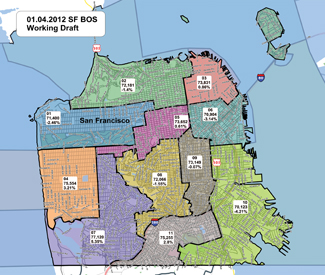
VIEW THE CURRENT WORKING DRAFT MAP HERE


CONSOLIDATING THE LEFT

Downtown and pro-landlord groups are circulating their own draft maps, attempting to influence the outcome. Their goal is hardly a secret: If progressive voters can be concentrated in a small number of districts — say, districts 5, 6, and 9 — it’s more likely that a majority of the board will be moderates and conservatives.

The task force has looked at 10 “visualizations” prepared by a consultant, and each of them had some alarming aspects. For example, the visualizations mostly pushed such conservative areas as Seacliff and Presidio Heights into District 1, which is represented by progressive Sup. Eric Mar.

On Jan. 4, those drafts were replaced by a single working draft map, which is now on the task force’s hard-to-find website (www.sfgov2.org/index.aspx?page=2622) — and it’s not as bad as the earlier versions. The working draft keeps Seacliff and Presidio Terrace in District 2 — which share similar demographics.

“The working families in the Richmond don’t belong in the same community of interest as the millionaires with homes overlooking the ocean,” Mar told us.

But there are other changes that some may find alarming. The more conservative Portola neighborhood, which is now in District 9, would be included in District 11, while D9 would pick up the more liberal north Mission. That would make D9 an even safer progressive district — but make D11 harder for a progressive like the incumbent, John Avalos, to win.

The task force has been holding hearings on each of the districts — but there’s been little discussion about how the new lines will affect the makeup of the board, and the politics and policy of the city, as a whole.


POPULATION CHANGES

The driving force behind the changes in the districts is the rather dramatic population shift on the east side of the city. Most of the districts, census data show, have been relatively stable. But since 2000, 24,591 more people have moved into D6 — a nearly 30 percent increase — while 5,465 have moved into D10 (a 7.5 percent increase) and 5,414 into D11 (8.7 percent). D9 saw the biggest population decrease, losing 7,530 voters or 10.3 percent.

The huge growth in D6 has been the result of a boom in new high-end condos in the Rincon Hill and SoMa neighborhoods, and it’s changed the demographics of that district and forced the city to rethink how all of the surrounding districts are drawn.

No matter what scenario you look at, D6 has to become geographically smaller. Most of the maps circulating around suggest that the north Mission be shifted into D9 and parts of the Tenderloin move into districts 3 and 5. But those moves will make D6 less progressive, and create a challenge: The residents of the Tenderloin don’t have a lot in common with the millionaires in their high-rise condos.

As progressive political consultant David Looman noted, “The question is, how do you accommodate both the interests and concerns of San Francisco’s oldest and poorest population and San Francisco’s youngest, hippest, and very prosperous population?”

The working map is far from final. By law, the population of every district has to be within 1 percent of the median district population, or up to 5 percent if needed to prevent dividing or diluting the voting power of minority groups and/or keeping established neighborhoods together.

Under the current draft, eight of the 11 districts are out of compliance with the 1 percent standard, and District 7 has 5.35 percent more residents than the mean, so it will need to change. But task force Chair Eric McDonnell told the Guardian that he expects the current map to be adopted with only slight modifications following a series of public meetings over the next couple months.

“The tweaks will be about how we satisfy the population equalization, while trying to satisfy communities of interest,” McDonnell said, noting that this balancing act won’t be easy. “I anticipate everyone will be disappointed at some level.”


OUTSIDE INFLUENCES?

Some progressives have been concerned that downtown groups have been trying to influence the final map, noting that the San Francisco Board of Realtors, downtown-oriented political consultants David Latterman and Chris Bowman, and others have all created and submitted their own maps to the task force.

McDonnell said the task force considered solutions proposed by the various maps, but he said, “We won’t adopt wholesale anyone’s maps, but we think about what problem they were trying to solve.”

For example, some progressive analysts told us that many of the proposals from downtown make D9 more progressive, even though it is already a solidly progressive seat, while making D8 more conservative, whereas now it is still a contestable district even though moderates have held it for the last decade.

“It would be nice to see the Mission in one district, but it makes D8 considerably more conservative, so it’s a balancing act,” said Tom Radulovich, a progressive activist who ran for D8 supervisor in 2002.

Latterman told us he has a hard time believing the final map will be substantially similar to the current draft. “Once that gets circulated to the neighborhoods, I find that hard to believe it won’t change,” he said. “A lot of the deviations are big and they will have to change.”

He said that he approached the process of making a map as a statistician trying to solve a puzzle, and that begins with figuring out what to do with D6. “I fall back on my technician skills more than the political,” Latterman, who teaches political science at the University of San Francisco, said. “It’s a big puzzle.”

Latterman also disputed concerns that he or others have tried to diminish progressive voting power, saying that’s difficult to do without a drastic remaking of the map, something that few people are advocating.

“It’s hard to make major political changes with the other constraints we have to meet,” he said. “Unless you’re willing to scrap everything we have, it’ll be hard to make major political changes.”

Once the task force approves a final map in April, there’s little that can be done to change it. The map will go to both the Elections Commission and the Board of Supervisors, but neither can alter the boundaries.

“We are the final say,” McDonnell said. That is, unless it is challenged with a lawsuit, which is entirely possible given the stakes.

How to celebrate Martin Luther King, Jr. Day in the Bay

0

Use your national day of service wisely —  jump in one of of the day’s volunteering fairs, take in a black history flick, catch some awe-inspiring youth spoken word, learn about colleges 

“In the Name of Love” MLK musical tribute

Mavis Staples, the Oakland Interfaith Gospel Choir, Youth Speaks (that group’s going to be busy! See below), and Oakland’s Children’s Community Choir occupy the deco wonderland of the Paramount for this stirring tribute to the great man’s work. Hyped as the only non-denominational musical tribute to MLK Jr. in Oakland, the program also features the presentation of humanitarian awards. 

Sun/15 7 p.m., $18 

Paramount Theatre

2025 Broadway, Oakl.

www.livingjazz.org


Freedom Trains

Planning on spending your MLK Day in the city? Every year, the Martin Luther King Jr. Association of Santa Clara sponsors the Freedom Trains so that everyone can afford to make it to the celebrations. Instead of paying $17.50 for a round-trip ticket on Caltrain, today it’s just $10 – and you’ll be treated to in-route presentations on the importance of the civil rights movement in our lives. 

Mon/16, $10

Departs San Jose 9:30 a.m., arrives in San Francisco 10:55 a.m. (see website for stops in-between)

Rod Diridon train station

65 Cahill, San Jose

www.scvmlk.org


“Renewing the Dream” MLK Jr. birthday celebration

A health fair, a civil rights film festival, children’s reading celebration, interfaith commemoration, special presentations, and free entry to the Contemporary Jewish Museum, Museum of the African Diaspora, and Children’s Creativity Museum give you and yours plenty to do if you feel like spending your Monday in San Francisco’s (greener, sorry Union Square) living room. Down to attend? Check your local transportation agency for possible discounts to the event.

Mon/16 11 a.m.-5 p.m., free

Yerba Buena Gardens

Mission between Third and Fourth Sts., SF

www.norcalmlk.com


“What is Your Dream?” MLK Jr. day of service

Soak in the spirit of the day by spending it at MoAD. The regular museum offerings (currently featuring “Collected: Stories of Acquisition and Reclamation,” about the contributions of people of African descent to the American zeitgeist) will be free to the public, there will be screenings of MLK films and a documentary on a barber who turned into a civil rights leader during the 2008 elections, chalk drawings outside on the sidewalk, and vision boarding galore. But the day’s not just for remembering and dreaming – the Historically Black Colleges and Universities Fair will be providing concrete information on education for tomorrow’s march-leaders and soul-freers. 

Mon/16 11 a.m.-5 p.m., free

Museum of the African Diaspora

685 Mission, SF

(415) 358-7200

www.moadsf.org


Parks Conservancy’s MLK Jr. day of service

Let the Parks Conservancy plug you into a wildlife restoration project – you’re too late to sign up for restoring the gardens on Alcatraz, but there’s still time to help out at Crissy Field, Fort Baker, Muir Woods, Ocean Beach, and the Presidio. Contact volunteer@parksconservancy.org to reserve your spot. 

Mon/16 various times, free

Various locations, SF

(415) 561-3077

www.parksconservancy.org


MLK Jr. Day service fair

Spend your day off work (if you have it off work) with your family making a difference in the Bay Area. Organizers of this event have made it easy for you: choose from over 25 different projects from serving food at shelters, planting trees – even making toys and biscuits for homeless puppies and kitties. All ages welcome. 

Mon/16 7:30 a.m.-4 p.m., free

Oshman Family Jewish Community Center

3921 Fabian Way, Palo Alto

www.paloaltojcc.org


Piedmont’s annual MLK Jr. Day celebration

First: eating. All comers are invited to bring a dish that reflects their own cultural heritage to this lunchtime potluck at the Piedmont Community Center. Once those pressing matters have been tended: music. Oaktown Jazz will provide some lilting melodies, and Piedmont students will make presentations on the significance of the day. Capping off the festivities, the 1993 movie At the River I Stand, which revolves around the 1968 Memphis sanitation workers’ strike and concurrent assasination of King. 

Mon/16 noon-3 p.m.

Piedmont Community Center

777 Highland, Piedmont

(510) 420-1534

loiscorrin@gmail.com


“Bringing the Noise for Dr. Martin Luther King, Jr.” 

If you haven’t been to a Youth Speaks spoken word event, pack tissues and your future-seeing 3-D goggles – the young people that the organization gives an opportunity to perform are the truth. On no other day of the year should this be more evident, because these kids are all about having a dream. Today’s event brings performers to the stage who have worked up pieces on what they’d like the future to bring, imbued as ever with the fire of Youth Speaks performances. Could there be a more relevant forum to attend on today’s holiday?

Mon/16 7 p.m., $16

Herbst Theatre

401 Van Ness, SF

(415) 621-6600

www.youthspeaks.org


“Martin Luther King Jr. Day Double Feature”

“All of us have something to say, but some are never heard” — Richard Pryor, Wattstax (1973). MLK Jr. Day calls into question how we remember the past. The Wattstax concert is sometimes recalled derivatively as “the black Woodstock.” But while soul music may have been the response, the event was put on by Stax Records to commemorate and come to terms with the seventh anniversary of the Watts Riots in LA, which challenged the limits of MLK Jr.’s nonviolent philosophy. As a double feature the Wattstax documentary will be shown with The Black Power Mixtape 1967-1975 (2011), a revelatory look at a movement’s era that sadly took the distance of continent and a few decades to make. 

Wattstax 3, 7p.m.; The Black Power Mixtape 4:55, 8:55 p.m., $7.50–$10

Castro Theatre

429 Castro, SF

(415) 621-6120

www.castrotheatre.com


Martin Luther

It’s the second coming! Not really, no relation actually. But this R&B-funk crooner spins out tunes appropriately uplifting for this day of rememberance and looking forward. Bliss out, eyes closed, mind on the change you want to make, at this smoothed-out groovefest. 

Mon/16 8-9:30 p.m., $15

Yoshi’s

510 Embarcadero, Oakl.

(510) 238-9200

www.yoshis.com

The redistricting furor

55

I opposed the measure that created California’s new Redistricting Commission. As we noted in our endorsements at the time:

The commission is hardly a fair body — it has the same number of Republicans as Democrats in a state where there are far more Democrats than Republicans. And most states still draw lines the old-fashioned way, so Prop. 20 could give the GOP an advantage in a Democratic state. States like Texas and Florida, notorious for pro-Republican gerrymandering, aren’t planning to change how they do their districts.

But Prop. 20 passed anyway, and control of the critically important task of drawing lines for state Legislature and Congressional districts fell to an unbalanced group of people with no political experience. They commission held hearings up and down the state, took reams of testimony — and wound up with a map that will probably add six or seven Democratic seats to the Congressional delegation.

That’s not a big surprise: Democratic Party registration is stable in a very blue state, and Republican registration is declining. Any fair redistricting would likely lead to more Democratic seats. And it’s clear that the likes of Phil Burton were not involved: In Los Angeles, two powerful veteran members of the House, Brad Sherman and Howard Berman, wound up in the same district. No matter what happens, the Democratic Party will lose one of its heaviest hitters.

But ProPublica, the national (and generally very solid) investigative reporting group, took on the process and concluded that the Democratic Party managed to wire the deal:

As part of a national look at redistricting, ProPublica reconstructed the Democrats’ stealth success in California, drawing on internal memos, emails, interviews with participants and map analysis. What emerges is a portrait of skilled political professionals armed with modern mapping software and detailed voter information who managed to replicate the results of the smoked-filled rooms of old.

(Memo to the folks at PP: There haven’t been “smoked filled rooms” in this state in quite a while. By the time the 1990 census was done, most of the state (including most public facilities) had strict limits on indoor smoking, and in 2000, nobody smoked in any rooms controlled by any governmental agency. But we get the point.)

The story has set off a furor. Robert Cruikshank, one of my favorite political bloggers, did a fairly brutal takedown on the report:

Of course, the core assumption that California Republicans deserved any new seats is challenged by their collapse in the November 2010 elections. While Republicans across the country were having a banner night, California Republicans lost every single statewide election (including losing the governor’s race by 13 points despite outspending the Democrats nearly 10 to 1). They also failed to pick up a single seat in either the legislature or Congress, losing one Assembly seat. California voters made explicitly clear in November 2010 that they do not like Republicans. That doesn’t appear to have actually influenced the commission’s deliberations, but it does mean the claim that Republicans had any reasonable expectation of gains is ridiculous.

Then Jerry Roberts and Phil Trounstine, two poltical reporters with at least 50 years of experience between them, did their own examination at CalBuzz, and asked PP’s Jeff Larson to explain himself. The result is scathing:

  Plainly put, their piece is the worst kind of ersatz “investigative” reporting: lots of heavy breathing and over-reaching conclusions drawn from selectively using, twisting or ignoring facts, relying on innuendo and suggestion, and mischaracterizing crucial elements of the story to inferentially allege an impropriety where none exists. Wink, wink, nudge, nudge, say no more. Moreover, ProPublica never even called the commission for a comment on its much-ballyhooed “findings.”

In failing the smell test, this clunker promises plenty, but simply doesn’t deliver the goods.

Wow. Harsh.

But the Roberts/Trounstine takedown holds up pretty well. The point they make is that everyone — the GOP, the Dems, city and state officials, groups like the Mexican American Legal Defense and Education Fund and more — tried to influence the process. In Northern California, the Dems were apparently a little better at it (and managed to create at least one fake front group to promote the interests of Rep. Jerry McNerney); in the southland, the big Democratic operation of Howard Berman and his brother, Michael, which, as CalBuzz points out, have played a key role in past redistricing efforts (those “smoke-filled rooms”), got totally fucked and Howard may lose his seat after 28 years.

I will say that PP dug up some new info and exposed how the Dems managed to create “communities of interest,” some of them bogus, to try to influence the final lines. But I’ve been watching this stuff for a long time, and I can tell you: Reapportionment is political. Always has been, always will be. There are better lines and worse lines, there are scandalous cases of gerrymandering and political payback and there are (relatively) honest attempts to create districts that are fairly compact and also comply with federal law and don’t dilute minority representation. But there’s no such thing as “clean” reapportionment — and if the Dems and Republicans weren’t trying their best to influence the outcome, they’d be guilty of partisan misconduct.

The CalBuz conclu:

The plain fact is that while Democratic registration has been essentially flat in recent years, Republican registration has fallen into the toilet, and the GOP now represents less than one-third of state voters.

This means that Democrats represent an increasing proportion of the electorate; add to that the fact that decline-to-state independents, the fastest growing bloc of registered voters, also tend to vote Democratic, as we’ve shown previously.

This makes Johnson’s claim that Republicans are entitled to at least their current number of seats, which is the money quote of the Pierce-Larson opus, not only laughable but also intellectually dishonest. Sort of like the whole piece.


Occupying the future

0

p { margin-bottom: 0.08in; }

It was a funny feeling, seeing so many faces from Occupy San Francisco and Occupy Oakland in the bright, clean “Gold Room” of San Francisco’s Commonwealth Club, particularly after spending so many nights camping with them and covering the movement.

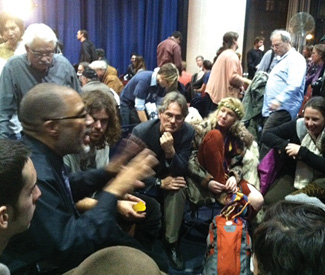
But they were there on Dec. 15, just up Market Street from their old campsites, along with a couple hundred supporters and interested community members, attending a forum on “Occupy: What now? What’s next?” Facilitator Caroline Moriarty Sacks announced that she “expected a civic conversation.” What she got was a very Occupy answer to the question of the evening which, in typical style, redefined the very concept of “civic” conversation.

The forum involved voices from many different parts of the left. Jean Quan, the Oakland mayor with a progressive activist past. George Lakoff, an outspoken liberal professor of linguistics at UC Berkeley. In the audience, dozens of people who support or are interested in Occupy, the mostly leftist San Francisco political milieu. And, of course, representing most of the panel and a good chunk of the audience were the active occupiers: anarchists, peace activists, labor organizers, and everything in between.

During the panels, their perspectives clashed. Yet Occupy strives to be a coalition of everyone, and all of these voices will be important as it progresses. Sacks had planned a 90-minute forum, featuring a panel to answer both moderator and audience questions, a break-out session, and summary reports back.

In their quest to practice participatory democracy, Occupy protesters have become used to long meetings that strive for non-hierarchical structure and a platform to hear the voice of anyone who would like to speak. If there’s one thing they can all agree upon, it’s that they’re a little tired of waiting patiently for their voices to be heard.

During the panel discussion, a few Occupiers started a Peoples Mic, interrupting Mayor Quan. They were escorted out. This fazed no one, and by the time she left the panel, chants demanding her recall rang in the hall. At each disruption, some Occupy-involved folks would object, “Listen to her! I want to hear all viewpoints!”

The tone was rowdy, but not aggressive. Minutes after disrupting the forum, protesters were back on schedule, sitting in small groups engaged in dialogue with other audience members. Even Quan was fine with it; she told the Oakland Tribune, “It was a chance to talk and have dialogue…We fostered a debate.”

This event was a microcosm of the thorny but crucial way that Occupy is uniting the left. The people in the room had something in common: belief in the visions and goals of Occupy. They just disagreed on how to get there.

Discussing, debating, and creatively bridging these differences has been one of the movement’s greatest struggles. But the more Occupy succeeds on the thorny path to unity, the more its strength builds.

Misrepresenting anarchism

Civil disobedience, peace, non-violence—all of these are critical concepts for the Occupy movement, and wrestling with them frankly has been part of the long road towards unification.

This has been done through the application of what’s originally an anarchist concept: embracing a diversity of tactics.

This is what the Occupy protesters did at the Commonwealth Club Forum. Some disapproved of disruptions, others thought them necessary. Individuals acted as they felt was right.

The Occupy supporters who turned their backs on Quan and interrupted her didn’t do it because they are inexplicably rude. They gave their reasons, including still being hurt and angry after Quan unleashed police using tear gas, rubber bullets, and aggression to break up their encampment on Oct. 25.

Quan also was displeased about that night’s events, saying that “No one is happy about what happened around the tear gas and mutual aid.”

The second reason for the reactions was what an Occupy Oakland protester who mic-checked Quan called her “misrepresentation of anarchism.” This has been dismissed and mocked by many press outlets, as if to say: What’s the point of bothering to understand anarchism?

Many people who identify with anarchist principles and tactics are involved with Occupy groups. This has contributed to the growth and development of autonomous communities at camps, as many anarchists have extensive knowledge and practice in building alternative communities based on horizontalism and collective management of resources. Occupy’s anarchist roots go deep.

This has also created controversy when tactics like property destruction and the black bloc, both associated with anarchism, become a part of Occupy. One example was the bank windows smashed and vacant building occupied during Occupy Oakland’s General Strike on Nov. 2, and riot police again responded with tear gas that night. The next day, 700 attended a General Assembly meeting to focus on discussing violence, its nature, and the ethics surrounding it.

Many have been quick to characterize this ongoing debate as a division in the movement. But if unity is to be achieved, these tough conversations are necessary.

Bringing it home

Occupy has been criticized for its lack of leaders, but that has left it open to exciting possibilities. To start a new Occupy project, you just have to convince some people to help you out—you must gain approval from no one. Some have described the organization as a “do-ocracy.” Don’t ask for permission, they say, just do it.

As such, the ideas for moving forward span from handfuls of people on street corners to millions converging on Washington.

Lakoff presented one of these concepts to the group at the Commonwealth Club, what he called “Occupy Elections.” Lakoff said, “Join Democratic clubs, and insist on supporting those people with your general moral principles. If you join Democratic clubs soon, you decide who gets to run. This is how the Tea Party took over.”

Like most ideas floating around in Occupy, there’s already something similar underway. Berkeley resident Joshua Green started the Occupy the Congress initiative, which hopes to organize and fund efforts for candidates “who support the declaration of the occupation of Wall Street.” Congressional candidates such as Elizabeth Warren in Massachusetts and Norman Solomon here in California have expressed support for and goals similar to the Occupy movement.

Occupy Washington DC has taken the message to Congress in other ways. In an open forum with supporters and renowned economists, they developed their Budget Proposal for the 99 Percent and are coordinating with Occupy groups throughout the country to call for a National Occupation of Washington DC starting March 30.

A call to action like that has a chance of being huge. With the West Coast Port Shutdown on Dec. 12, Occupy has demonstrated an ability to coordinate nationally. Those actions also showed Occupy’s growing unity with labor groups, as ILWU members worked closely with Occupy to plan those actions.

On Dec. 6, Occupy demonstrated its dedication to yet another new frontier—occupying foreclosed homes. That was a national day of action called by Occupy Our Homes and Occupy groups in over two dozen cities participated, defending homeowners threatened with eviction and moving the homeless into empty properties.

Hibernation

By the time moderator Melissa Griffin asked her final question to the panel, it was clear that the “civic conversation” had not gone as planned. Two Occupy protesters had been escorted out for interrupting Jean Quan. A handful of others had stood and turned their backs when she spoke. The crowd was restless for their own chance to grill the panelists, and there were only a few minutes left. With a faint look of dismay and hopelessness, Griffin asked the question that had no chance of being quickly answered: What’s next for occupy?

She quoted Kalle Lasn, co-founder of Adbusters, the “culture-jamming” organization credited with prompting Occupy Wall Street. In a recent interview with NPR, Lasn said: “I think that we should hibernate for the winter. We should brainstorm with each other. We should network with each other and then come out swinging next spring.” Griffin asked the panelists if they agreed with that statement.

Of course, some did and some didn’t. In fact, some form of “hibernation” is what many plan to do. In San Francisco, Occupy reading groups, workshops, and educational circles are on the rise. Small actions happen almost daily, ranging from workshops to meetings to marches to pop-up occupations.

Occupiers who were kicked out of camps are sleeping in networks of squats, safe-houses, and what one long-time camper described as “little homeless encampments around the city. We don’t put up an Occupy banner, and police don’t arrest us.”

The forum was a microcosm of the debates and plans brewing within Occupy, and it ended like most Occupy events. New connections had been made. Most people trickled out while several Occupy campers stayed to help stack chairs and clean up from the event. They all eventually exited the warm building, with its empty lobby that could have slept at least 50 people. OccupySF and Oakland activists chatted and advised each other on where to go.

Occupy is a resurgence in the spirit and power of protest and peoples movements, a recognition that the personal is political, that individuals losing their jobs and their homes can have more power in numbers. Organizing and protest has become a lifestyle.

As the Occupiers left the Commonwealth Club building, the future seemed thrilling, although many still needed a place to sleep for the night while those possibilities continue to percolate.

The unlikely sheriff

1

Michael Hennessey has served as San Francisco’s sheriff for half of his life, the longest such career in California history — and by all accounts the most progressive. Since taking office in 1980, Hennessey has been an island of liberal enlightenment in a political climate and law enforcement culture where tough-talking conservatism has been ascendant.

Yet in that era, Hennessey pioneered the creation of innovative programs to compassionately deal with drug abuse, violence, recidivism, and lack of education among jail inmates. He proactively brought unprecedented numbers of minorities, women, LGBT employees, and ex-convicts onto his staff. And he sometimes resisted carrying out evictions or honoring federal immigration hold orders, bold and risky social-justice stands.

His stances drew scorn from the local law enforcement community, which never endorsed him in contested elections, and criticism from political moderates and national media outlets. But San Francisco voters reelected him again and again, until he finally decided to retire as his current term ends next month.

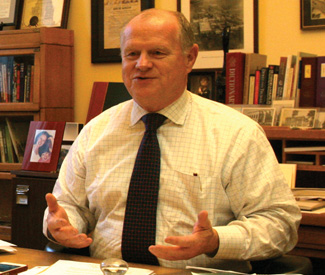
He credits his success and longevity to the people of San Francisco, who have also bucked the harsh national attitude toward criminals and the poor. “San Francisco is still largely a liberal voting town,” he told us in his well-worn office at City Hall, “and not many liberals run for sheriff.”

That logic held up in this year’s election when progressive Sup. Ross Mirkarimi — Hennessey’s hand-picked successor — was elected to the post. Mirkarimi, who led a tribute to Hennessey at the Dec. 13 Board of Supervisors meeting, said he’s honored to be able to continue the legacy of someone he called “the most innovative sheriff in the United States.”


LONG RECORD

Hennessey was a 32-year-old Prisoner Legal Services attorney for the Sheriff’s Department in 1979 as he watched then-Sheriff Eugene Brown letting go of reform-minded staffers and ending his predecessor Dick Hongisto’s early experiment with a school in the jail. So Hennessey quit his job and focused on running for the office.

“I said to myself that I’m not sure if I’ll be a good sheriff or not, but I know I’m better than anyone else running,” he told us, later adding, “I certainly never expected to be sheriff for 32 years.”

Rank-and-file deputies — with whom Hennessey has periodically clashed throughout his career — always preferred one of their own in the job. “As seen in this election, they would like to see someone coming from their ranks,” said Hennessey, even though he notes that at this point, he has hired all but three of the department’s nearly 1,000 employees.

But Hennessey’s outsider status allowed him to deal with the inmate population in a way that the average San Franciscan appreciated, even if the average cop didn’t. “When you’re in law enforcement, all you see are criminals, victims, and people in law enforcement. But I would talk to all kinds of people in the community,” Hennessey said, noting that his experience as a jailhouse attorney gave him a holistic view of his job. “I worked in the jail and I got to know prisoners as people.”

They were people who had certain needs and problems, such as substance abuse, a common problem among criminals. And they were people who would be returning to society at some point, as Hennessey constantly reminded those who expected prisoners to be treated harshly or simply warehoused.

So he broke down the wall between the jail and the community, bringing the city’s social service providers and educators to work programs in the jails, and developing anti-recidivism and vocational programs that allowed ex-offenders to re-engage with the local community.

“Take the bold step of inviting the public in, not all the public, but those who can provide services and help address people’s problems,” Hennessey said. “Then we took the same concept and applied it to violent offenders, which is a little riskier.”

But it was a risk that has paid off as recidivism rates among jail inmates has dropped, and it’s been without any serious cases of inmates harming outsiders. Hennessey is particularly proud of the high school he created in the jail, which will graduate its next class on Jan. 3.

He said the school can truly transform those who end up behind bars. “It gives them a leg up and it’s like a booster shot,” Hennessey said. “They’re at the lowest point in their lives when the come to jail, and then they’re given an opportunity to accomplish something they haven’t been able to on the outside.”

One of many controversial moves during Hennessey’s storied career was his decision to allow female inmates to leave the jails and perform in theaters around San Francisco with the Medea Project, which was created by Rhodessa Jones and the Culture Odyssey art collective to turn the stories of female inmates into plays.

“Rhodessa is a very persuasive person who talked me into letting these women out of jail to perform,” Hennessey said, smiling at the memory. “It was very controversial.”


HIRING REFORMERS

Hennessey’s mentor in the Sheriff’s Department — the man who hired him, ran his first campaign, and then became his longtime chief-of-staff — was the late Ray Towbis, a tough activist whose social justice stands on behalf of tenants, prisoners, and other marginalized members of society would sometimes put Hennessey into difficult positions.

“Ray caused me aggravation many times,” said Hennessey, who nonetheless kept a life-sized cutout photo of Towbis in his office long after he was gone, a reminder to fight for the values he believed in.

There was the time when Towbis angrily flipped over a table and cursed at a panel of parole commissioners after failing to win the release of a model inmate, triggering a demand from the presiding judge that Hennessey fire Towbis, which the sheriff ignored.

Later, Towbis adopted a compassionate approach to the evictions that sheriff’s deputies are forced to perform, allowing deputies to spare tenants who were disabled or elderly and personally calling journalists to help publicize cases in which the parties bringing the eviction action might back off. That sensitivity stays with Hennessey today.

“That’s one of the tough spots I’m in is doing these foreclosure evictions,” Hennessey said, clearly troubled by his duty but also aware that it is one that he is required to perform, despite pressure from progressive groups urging him to refuse to carry them out.

As a lawyer, Hennessey said he must respect court orders and avoid being held in contempt of court, as Hongisto was in the mid-1970s for refusing to carry out evictions against tenants in the International Hotel.

Hennessey and his staff have always been willing to help tenants resist eviction. His office has an eviction assistance program, and Towbis would sometimes tip off the media to publicize certain unjust evictions. One time, Hennessey said Towbis even called hotel magnate Leona Helmsley and talked her out of allowing her company to evict an elderly ParkMerced resident. Instead, Helmsley allowed the woman to live rent-free for the rest of her life, an unlikely gesture of kindness from the “queen of mean” that Towbis helped publicize.

Hennessey draws the line at outright refusal to carry out a judge’s eviction order. “The sheriff shouldn’t be a law-breaker,” he says. Yet Hennessey’s lawyerly approach to complex issues also resulted in his recent policy of not honoring federal detention holds on undocumented immigrants in the jail, after discovering that the holds are administrative — different than arrest warrants — so defying them isn’t a crime.

The policy Hennessey created last year was to ignore ICE requests for prisoners who aren’t charged with felonies or domestic violence charges, noting that the latter charges are often brought but eventually dropped against people who are the victims of domestic violence.

Hennessey tapped federal and foundation grant money to fund his new treatment and educational programs, hiring an ex-convict to write his grant proposals, something that particularly irked many of his deputies.

But Hennessey believed that ex-offenders had something to offer the department so he didn’t back down in hiring them, going so far as to elevate Michael Marcum, who had gone to prison for killing his own abusive father, to the top position of undersheriff in 1993.

Police groups were outraged, but Hennessey said he had known Marcum for many years and valued his counsel and perspective on the criminal justice system. “It wasn’t hard because I knew him and I know of his integrity and loyalty,” Hennessey said.

Hennessy also irked conservative cop culture for aggressive efforts to make the department more diverse. “We wanted more minorities, we wanted more women, and we wanted gay people,” said Hennessey, who initiated outreach efforts to each of those communities.

In 1984, when he approved of an outreach event in Chaps, a gay leather bar in the Castro — complete with flyers around the Castro publicizing the event — it generated a furor that made headlines not just locally in the San Francisco Chronicle, but the National Enquirer tabloid as well.

Yet Hennessey was able to ride out each of the controversies, many of which happened to fall years away from his next reelection campaign. “Those are good times to make dramatic changes,” Hennessey said.

And because he also saw to some neglected basics in the Sheriff’s Department — such as improving training and the jails’ physical structures to prevent escapes and instituting policies to reduce violence between inmates and guards — Hennessey endured and became a beloved sheriff.


VICTORY OF PERSISTENCE

“I’ve always felt somewhat isolated in these beliefs,” said Hennessey, who said that the biggest failure of his career was not proselytizing those beliefs to a statewide and national audience more aggressively. Instead, he has focused on San Francisco, quietly turning the city into a national model for a different kind of policing.

Despite his progressive record, Hennessey has won plaudits and respect from across the political spectrum. In the last election, even the cops who sought to replace him and to undermine his endorsement of Mirkarimi — Chris Cunnie, Paul Miyamoto, and David Wong — all praised Hennessey and promised to continue his programs.

During the Dec. 13 board meeting, Sup. Mark Farrell — consistently one of the most conservative votes on the board — said he has known Hennessey almost his entire life (the sheriff and Farrell’s dad were law school classmates). “I cannot think of anyone with more integrity, a more trustworthy and honest person, than I’ve ever know in my life,” Farrell said.

Sup. David Campos said the immigrant community owes Hennessey a tremendous debt of gratitude. “You have been a tremendous champion for civil rights,” Campos said. “For that, history will judge you very kindly.”

It is a history that Mirkarimi pledges to continue. “Who’s going to fill his shoes? It’s impossible,” Mirkarimi said at the board meeting. “But we certainly have an incredible standard to try to live up to.”

As for Hennessey, he has a fairly clear idea of what he plans to do now that his long and unlikely run as one of the city’s top cops is over: “I’m going to goof around.” *

Michael Goldstein, 1953-2011

7

news@sfbg.com

San Francisco lost a valued champion of progressive causes on Dec. 2 when Michael Goldstein lost his battle with stage 4 lymphoma after surviving nearly 20 years living with HIV, a disease that helped awaken his political activism.

Michael was born in 1953 in New Mexico, where he was raised. His grandparents had come to New Mexico after surviving the Holocaust, and Michael came to the San Francisco in the early 1980s. Like many gay men of his generation, Michael came here to find community, to create family, and to be welcomed when much of the country was still hostile to the LGBT community.

He worked at Neiman Marcus, dressing “the San Francisco A list,” as he used to say. He studied at City College towards a paralegal certificate and was heavily involved in student politics. He landed a job at AIDS Legal Research Panel, where he worked when he was diagnosed HIV-positive in the mid-’80s.

The news hit hard, and the treatment he began took its toll. The HIV drugs were harsh then and there were many horrible side-effects with these early drugs. At that time, there was very little information or education about HIV/AIDS and there was even less support, from families and from the public.

Our San Francisco political community became Michael’s family. He was also blessed with an amazing friend in Lorae Lauritch. They worked together at NM, became roommates, and lived together with some incredible cats that were dear to him, including Paloma, Huey, Cadeau, and Missy.

Michael was a proud feminist who valued the women in his life and community, leading him to endorse a pair of successive female candidates for the Castro’s District 8 seat on the Board of Supervisors: Eileen Hansen in 2002 and Alix Rosenthal in 2006.

Over the years, Michael served as an elected member of the Democratic County Central Committee (serving as vice president), served as President of the Harvey Milk LGBT Democratic Club, and was appointed to a San Francisco City College citizen oversight board, where his questioning helped bring attention to mishandling of funds at that institution.

Michael was determined, opinionated, persistent, intolerant of bullshit, prickly, always questioning. He challenged us all to move a common agenda, come together beyond our own personal ambitions, but to also never back down out of convenience or feigned civility. “Civility doesn’t make change,” he often said.

I came to know Michael as many came to know him. Michael always showed up in support of every one of our causes. He not only showed up, he advised, opined, debated, argued, protested, got arrested, drafted policy, and so much more. Campaign after campaign, issue after issue — our friendships grew around our passion for politics, our deep concerns about everything, and a strong and unwavering belief that anyone can help make change.

Michael believed that and Michael lived that.

In the past few years, many of us noticed that Michael wasn’t feeling well. We pushed him to go to the doctor. This is a man who spent hours fighting to push through HIV/AIDS policy and funding, healthcare reform, Healthy SF — and he did not have healthcare, had not seen a doctor in nearly 10 years, and was not treating his HIV.

As many know, Michael and I were like brother and sister…often bickering back and forth on whatever was going on. We “debated” like the dear friends we had become. His lack of healthcare was one of the more important issues I would bring up often. As a long term survivor of this condition, Michael knew the score.

As the symptoms of this disease ravaged his body, he retreated from us and attempted to make sense of the unimaginable alone.

Finally at the end of September, Michael was admitted to General Hospital. With the amazing care of Ward 5A, Diane Jones, and all the amazing General Hospital workers, as well as Laguna Honda Staff and at his final resting place UCSF — his care, though coming too late, was the best in the world and gave Michael a fighting chance. He was clearly comforted and supported by his community in his final days, support that mattered so much to him.

If you knew Michael, you know there is a “what comes out of this” part. We all got to really see the results of the hard work we all participated in to rebuild General Hospital, to rebuild Laguna Honda, and to provide healthcare access to everyone, even the poorest among us. Michael, personally, was able to experience the fruits of our collective labor over these years.

He also experienced some areas where there really is a need for some work. We need to remember that AIDS/HIV is still killing people every day. We must improve people’s access to healthcare. We need to protect patients’ access to medical cannabis, even in General Hospital. We need services and we need housing, particularly affordable housing for those who need it, people struggling through this bad economy.

These are our issues and this is our agenda on the left that we have been fighting for.

I will never forget Michael. One of the last real discussions we had about politics was around election time, with Michael remembering the 2010 elections. Michael was probably more upset about what has come out of that election — the beginning of a political shift to the right in San Francisco — than many.

He has been such an integral part of the work that brought our progressive community together and he was devastated by the events tearing it apart. More than anything, he wanted to bring us together, but he ran out of time.

Michael had an agenda. His agenda was to move forward our agenda. It is time to come together and do that.

Debra Walker is an artist, activist, DCCC member, and city commissioner who ran for the District 6 seat on the Board of Supervisors last year.

Stop downtown’s attack on RCV

52

OPINION The long-time foes of political reform at the Chamber of Commerce and San Francisco Chronicle have launched an effort to repeal ranked choice voting (RCV) and public financing of campaigns. Supervisors Sean Elsbernd and Mark Farrell have introduced a June 2012 charter amendment to repeal RCV, with public financing also in their crosshairs.

Many of us fought hard to pass these reforms, and I am reminded of when the downtown corporate interests repealed district elections in 1980. They blamed the assassinations of Harvey Milk and George Moscone on district elections and the election of Supervisor Dan White. San Francisco has a history of the anti-reformers waiting for their moment of opportunity. Now these same corporate interests think that moment has arrived again.

The Bay Guardian first reported about an anti-RCV campaign in 2009, when a meeting of downtown business leaders was hosted by Steve Falk, Chamber of Commerce CEO (and past publisher of the Chronicle) to discuss repealing RCV.

As part of that effort, polling also was done to see if they could repeal district elections and public financing. They also filed a bogus anti-RCV lawsuit which was unanimously rejected by two courts. Elsbernd’s repeal legislation is the culmination of their calculated efforts.

It’s clear what these special interests want: a return to the days when local races were decided in low-turnout December elections, and those who had the most money pounded their opponents into submission. An Ethics Commission report in 2003 found that independent expenditures increased by a factor of four during December runoffs, while another study found that voter turnout dropped by more than a third in 10 of the 14 December runoff races held from 2000-2003. Turnout in one city attorney runoff dropped to 16 percent.

Just as importantly, the December electorate did not represent the diversity of San Francisco’s population. Voters in the runoffs were overwhelmingly whiter, older and more conservative than the city as a whole, as voter turnout plummeted in December among racial minorities, the poor and young people. Simply put, a return to December runoffs will allow groups like the Chamber and its allies to dump huge amounts of money into negative campaigns aimed at the more conservative December electorate when most San Franciscans don’t vote.

In the era of unlimited independent expenditures by corporations (thanks the Supreme Court decision in Citizens United), political reforms like RCV are crucial for protecting our democracy. Both RCV and public financing have greatly improved local elections — since their inception San Francisco has doubled the number of racial minorities elected to the Board of Supervisors. Elections are now decided in higher turnout November contests, allowing more people to have a voice in choosing their local representatives. Winning candidates in RCV contests have won with an average of 30 percent more votes than winners in the old December runoffs.

San Francisco has saved $10 million in taxes by not holding second elections, money used for other public needs. Candidates also haven’t needed to raise money for a second election, which helps level the playing field. Progressive candidates have never done well in citywide elections, but this year in RCV contests Ross Mirkarimi was elected sheriff and John Avalos mobilized and finished a strong second. That bodes well for progressives’ future.

It’s no coincidence that Supervisor Elsbernd is trying to get his charter amendment on a low-turnout June ballot, when the electorate is more conservative. The downtown corporate interests are clear on what they must repeal in order to elect the candidates they want — RCV, public financing, and ultimately district elections. Progressives need to be just as clear on what reforms we must defend.

Assemblymember Tom Ammiano represents the 13th District.

Sup. Elsbernd ducks more Impertinent Questions

4

Well, I am sad to report that my neighborhood supervisor, Sean Elsbernd, has once again refused to answer my Impertinent Questions and to say if he voted for Ed Lee for mayor. Perhaps I will tell you, he says, perhaps not and he chose to perhaps not. He has thus refused to shed light on his role in one of the most fateful nominations in San Francisco history.

 Here’s the latest version of the almost famous Que Syrah correspondence between Elsbernd and me on these critical Impertinent Questions. (As attentive readers of this blog know, I have been trying for months to get Elsbernd to meet me to talk about these questions at Que Syrah, a nifty little wine bar in the West Portal area of Elsbernd’s district. I am still trying.)

 When Willie Brown, Rose Pak, and the downtown gang were plotting their move  to outfox the progressives in City Hall in January  and install Ed Lee as the interim mayor, they chose Sean Elsbernd to take the lead and nominate Lee for this crucial job.

 He intoned at the time and later in writing to me that he was nominating Lee only on condition that Lee would serve as an interim mayor to fulfill the vacancy created by then Mayor Newsom who was off to Sacramento as the newly elected lieutenant governor. Lee, Elsbernd emphasized, thumping the lectern, would not run for mayor.

 Well, the Guardian and many progressives and I said at the time that this was just the Willie and Rose play, to get Lee in as interim mayor and then roll him over to run for mayor in the fall with the major advantage of incumbency.

 And so when Lee as we expected changed his mind and ran for mayor, Elsbernd was left in the position of being a key player in the plot to put Lee into the mayor’s office under false pretenses. And of course in the process he would ace out two more qualified candidates, former Mayor Art Agnos, and retiring sheriff Mike Hennessey.. Both were ready to serve as interim mayor and both pledged they would not run for mayor and most important neither would operate as enablers for Willie, Rose, and their undisclosed clients. (Willie, for starters, is on a  $200,000 plus a year retainer for PG&E, according to PG&E filings with the California Public Utilities Commission.)

 When the tide of sleaze started rising in the mayor’s office and Willie, Rose, and the gang were pounding on Lee to run, I asked Elsbernd another Impertinent Question: Would he have nominated Lee if he knew Lee was going to reverse field and run for mayor?

Elsbernd replied that he had not endorsed anyone, but that “I have been most attracted to the candidacies of City Attorney Dennis Herrera and former Supervisors Alioto-Pier and Bevan Dufty.” He said that these three have the “right combination of qualifications, experience, intelligence, skills and integrity to serve as mayor. Should Mayor Lee run for election, I would only consider endorsing his effort under one circumstance—if, and only if, I was convinced that without his candidacy, Sen. Leland Yee would be elected. That is, if I see that no one else can beat Sen, Yee other than Mayor Lee, then I would support a Mayor Lee campaign. At this point, I’m not convinced of that—I still think any one of the three I mentioned above could beat Sen.Yee.”

Just before election day when Lee was running solidly ahead in the polls, I posed more Impertinent Questions to Elsbernd: who did he support for mayor and why? He replied that he had not yet voted and had not endorsed a candidate and then stated, “Talk to me on November 9 and perhaps I’ll tell you who I voted for. Rest assured, the Bay Guardian’s endorsements will certainly influence my decision-making process.”

And again,  after Lee won handily thanks in large part to the decisive advantage that Elsbernd helped give him, I took Elsbernd up on his promises and emailed him more Impertinent Questions: Who  did he vote for and why? He ducked again and asked me to read his “original email” and to note the significance of the word “perhaps.”

Perhaps he would tell me, perhaps he wouldn’t tell me. He chose not to tell me, and the rest of his constituents,  why he made the nomination as a “neighborhood” supervisor  that helped return Willie, Rose, and the downtown gang to power in City Hall.

His explanation was classic Elsberndese and I quote it in full in all of its elegance.

”Another e-mail?  Another entry in your blog? And now a deadline?  At what point am I going to start receiving a byline in the “Guardian?” I am not going to share with you and your readers for whom I voted.  I’ll keep that one between me and my ballot.  I voted for 3 candidates who I believed had integrity, intelligence , and some grasp of the daunting fiscal challenges facing the State and the City.

“Am I happy with the results?  Again, I’m going to deflect that question because I have learned in the short time I’ve been around here, that focussing on wins and losses of past elections can take you down a rabbit hole from which you’ll never recover.  Rather, the most pragmatic thing I can do for my constituents, which is, after all, what I am here to do, is to recognize the result, accept it, and move forward with it.  Ed Lee is now San Francisco’s Mayor-elect, and I am very excited about being able to work with him during my remaining 13 months in office.  He and I worked extremely well together in developing Proposition C, which the voters overwhelmingly endorsed (and, yes, thank you to the Guardian for your endorsement – you actually got a few right this year).

“We have had some policy disagreements (e.g.  Proposition B), but I have always found him to be open to dialogue, extremely deliberate and thoughtful, and, most importantly, honest.  When we have disagreed, he has explained why and has done so with a logical argument.  While that may sound simple, I can assure you, that is a rare characteristic in this building and it is one I very much appreciate. Have fun parsing this e-mail apart.”

Final Impertinent Questions: If Elsbernd really finds Lee “open to dialogue, extremely deliberate and thoughtful and most importantly honest” and Lee explains his disagreements with Elsbernd with “a logical argument,” how in the world does Elsbernd explain the months of lies and deceptions by Lee before he decided, gosh, golly, gee, that he changed his mind and  was running for mayor after all? How does Elsbernd explain how the sleaze continues to rise in Lee’s office?  How does Elsbernd explain why, as a “neighborhood” supervisor, that he has once again followed the Willie Brown/RosePak/downtown gang agenda by introducing a June 2012 charter amendment to repeal rank choice voting, with public financing and perhaps even district elections in his gun sights? Wasn’t this all part of the master plan to gut progressive measures to level the playing field on local  elections?

Sean? Sean? Let’s talk about all of this this over flights of the wondrous wines from small, locally owned wineries and the Barcelona -style tapas served up  at Que Syrah. To that end, I will keep sending you the notices of Que Syrah special events. B3


Dick Meister: The lessons of Ohio

0

By Dick Meister

Dick Meister, former labor editor of the SF Chronicle and KQED-TV Newsroom, has covered labor and politics for more than a half-century. Contact him through his website, www.dickmeister.com, which includes more than 350 of his columns.

AFL-CIO President Richard Trumka has drawn some important lessons from last week’s election in Ohio that repealed a state law severely limiting the collective bargaining rights of public employees. Worse, it threatened to inspire passage of similar anti-bargaining laws elsewhere.

Listen to Trumka, a man who obviously knows what he’s talking about. In an article he wrote for Reader Supported News, he cites post-election polls showing that more than half of Ohio’s voters correctly “perceived the law as a political maneuver by Gov. John Kasich and state Republicans to weaken labor unions, rather than a genuine effort to make state government more efficient.”

Another poll, done for the AFL-CIO, showed that more than half the voters also found that Kasich and his allies “are putting the interests of big corporations ahead of average working people.”<–break->

Voters everywhere in the mid-term elections clearly wanted change. But, as Trumpka says, they did not want “political maneuvers and overreach” like those of Kasich and Republican legislators. They want effective action to curb unemployment, create jobs and deal with the other severe economic problems facing the country.

As Trumka notes, public employees, union members, Democrats and liberals voted overwhelmingly to repeal the Ohio law, but so did a majority of voters “from households with no public employee, workers without union representation and independents – as well as 30 percent of Republicans and 36 percent of conservatives.”

One of the key lessons Trumka draws from Ohio’s election is that “the myth of the pampered public employee has been busted. Public employees didn’t cause the economic crisis and they’re not the enemy. Demonization of public employees is neither a strategy nor a solution and the heartland Americans who voted to restore rights for public employees understood that.”

The election also reinforced the continued need for working people, public and private employees alike, to join closely together. That’s what happened in Ohio. There, as Trumka notes, “firefighters, teachers and other public employees were joined by plumbers, pilots and all kinds of private sector employees to win. Worker to worker, neighbor to neighbor, the message spread, and what began as an attempt to divide workers flopped famously. In the end, working people’s solidarity was the message.”

Politicians could also learn important lessons – if they will. For the Ohio voters “showed that when fundamental rights and livelihoods are targeted, working people will not only defend themselves, but come back stronger.”

The outcome of the Ohio vote should show politicians seeking office that it would be wise for them to pay much more attention to the wishes of working and middle class voters than to those of the wealthy and privileged. Says Trumka:

“Cutting taxes for millionaires and billionaires, scapegoating working Americans and their unions and downsizing Social Security and Medicare may get you a standing ovation from the 1%, but the voters who decide elections will not be fooled – and you may just get more than you bargained for.”

Trumka’s correct. But despite the results in Ohio and the lessons they hold for the anti-labor political right, many undoubtedly will continue what the AFL-CIO sees as “part of Wall Street’s strategy to chip away at collective bargaining rights, piece by piece, law by law, until unions and collective bargaining rights are destroyed.”

Working people and their unions can be reasonably certain, at least, that they’ll have strong support in trying to withstand the attack – including support from the Occupy Wall Street movement, which Trumka credits with “redefining the political narrative.”

The next major test will come in the presidential and congressional elections in 2012. They’re especially looking for support from the swing voters who supported President Obama in the 2008 election and generally have the same political views as the majority of Ohio voters.

Trumka describes the swing voters as “working Americans with modest incomes, moderate views and little patience for polices that aren’t fair and don’t work.”

He says politicians seeking election or re-election next year must heed them and “support public policies for the 99 percent – policies that create jobs, invest in America’s future, safeguard Social Security, Medicare and Medicaid, and promote fiscal sanity by requiring millionaires and billionaires to pay their fair share.”

OK, that’s asking for much more than we’ve been getting. But the Ohio vote demonstrated that it is possible to garner the votes necessary to overcome the forces that would deny us vital economic and political rights.

Dick Meister, former labor editor of the SF Chronicle and KQED-TV Newsroom, has covered labor and politics for more than a half-century. Contact him through his website, www.dickmeister.com, which includes more than 350 of his columns.

Rank complaints

27

steve@sfbg.com

Even before all the votes had been cast on election day, the two most conservative members of the San Francisco Board of Supervisors proposed a ballot measure to repeal the city’s ranked-choice voting (RCV) system, prompting all the usual critics of this voter-approved electoral reform to denounce it as confusing and undemocratic.

Those same two supervisors, Sups. Sean Elsbernd and Mark Farrell, were also the ones who unsuccessfully pushed for a weakening of the public financing system last month, changes that will likely be wrapped into discussions in the coming weeks over how elections are conducted in the city. And progressive supporters of both systems warn that district supervisorial elections will probably be the next target of this concerted push to roll the clock back on electoral reforms in the city.

"The [San Francisco] Chronicle and the [San Francisco] Chamber [of Commerce] have been at it from day one," Steven Hill, who helped crafted both the RCV and public financing systems, told us. "They’re really clear about what they want to eliminate, so we should be clear about what we need to defend and we can’t get confused by this."

Indeed, the Chronicle ran an editorial Nov. 14 advocating the repeal of ranked-choice, calling it "a fundamentally flawed system that is fraught with unintended consequences." The paper, as well as its allies at the Chamber and other downtown institutions, has been equally vociferous in criticizing public financing and district elections.

Hill said that’s because moneyed interests prefer systems that they can manipulate using the millions of dollars in unregulated independent expenditures they can summon — an ability they demonstrated again in his election on behalf of Mayor Ed Lee — such as low-turnout runoff elections, citywide supervisorial races, and elections without the countervailing force of public financing. "They’ve been doing this steadily and looking for ways to chip away at it," Hill said.

But conservatives aren’t the only ones raising questions about RCV; some progressives say the system needs adjustment, too.

Although Farrell opposes all three of those electoral reforms, he insists that his concerns about RCV are about voter confusion and the perception that winners don’t have majority support and could be viewed as illegitimate. "There is just so much voter confusion out there," Farrell said, citing comments from voters who don’t understand how their votes are tabulated to produce a winner.

Hill counters that voters do have a clear understanding of how to rank their choices, downplaying the importance of whether they understand all the details of what happens next. But Farrell said that and the majority rule issue have undermined people’s faith in the elections.

"People get very upset when they realize someone didn’t get a majority of the vote," he told us, referring to how the majority threshold drops as voters’ top three candidates are eliminated. "To me, it’s just simpler to go back to the runoff system."

Many moderate politicians agree. "I don’t like ranked choice voting and I never have," City Attorney Dennis Herrera, who finished third in the mayor’s race, told us on election night. "I defended it all the way to the 9th Circuit [Court of Appeals in his role at City Attorney], but I think it’s bad policy."

Sup. Scott Wiener, a Herrera supporter we spoke to at the same election night party, also wants to see a change. "I supported ranked-choice voting and until recently I continued to support it, but this race changed by mind," Wiener said, attributing the large mayoral candidate field and free-for-all debates to RCV. "There is no way most voters will be able to distinguish among the candidates."

But Hill says it’s a mistake to attribute the large field to RCV, or even to the public financing system that some are also trying to blame, a problem he said can be addressed in other ways, such as changing when and how candidates qualify for public matching funds.

Wiener said he hasn’t made up his mind about repealing RCV, and he said that he absolutely opposes a return to the December runoff election. One alternative he suggested was a system like that in place in New York City, with the initial election in September and the runoff during the general election in November. But he does think some change is needed, and he’s glad Elsbernd and Farrell proposed an RCV repeal.

"They’re starting a conversation with the repeal, but that’s not where it’s going to end," Wiener said.

Indeed, the system still has the support of most progressives, even Sup. John Avalos, who finished second in the mayor’s race and would now be headed into a runoff election against Ed Lee under the old system. "I continue to support ranked choice voting," Avalos told us. It takes six supervisors to play the charter amendment repealing RCV on the ballot.

Sup. Ross Mirkarimi, who was narrowly elected sheriff in the ranked-choice runoff despite a 10-point lead in first place votes, said of the Farrell and Elsbernd proposal, "I do want to hear their criticisms."

"I understand the larger discussion, which was a bit of a misguided approach that some of our colleagues used to go after ranked choice voting on election day," Mirkarimi said. "But they are good politicians and they seized an opportunity."

Mirkarimi did say he was open to "maybe some tweaks. I do think ranked choice works better when you have many choices." Others, such as former Sup. Matt Gonzalez, have also recently advocated a ranked-choice system that allows more choices, which would address the majority-vote criticism because fewer ballots would be exhausted.

Hill said the legislation that voters approved back in 2002 already calls for more choices, but the technology used in the city’s current system only allows three choices. Yet he said the city’s vendor, Dominion Voting Systems, has developed a system allowing up to 11 choices, for which it is currently seeking federal certification.

Although he said various tweaks are possible, "I think the system worked well in this election," Hill said, noting that few San Franciscans would have wanted to drag this long campaign out by another month or to pay for another election.

Lessons from 2011 for 2012

4

With the release of precinct results for the 2011 election, we are able to actually see, for the first time, what San Francisco voters did, as opposed to hearing what various nabobs said they did.  There are a couple of key conclusions about the vote that should guide any left-liberal thinking of the key 2012 Supervisor races.

The first thing San Francisco voters did- about 40,000 of them-  was stay home.  Turnout – about 40% – was the lowest for a mayor’s race in 40 years. Moreover, counter to several “expert” narratives, turnout in neighborhoods with large numbers of Chinese voters — Chinatown, the Richmond, the Sunset, and Vis Valley — was lower (average 33%) than in neighborhoods with few Chinese voters — Diamond Heights, Noe Valley, the Castro and West of Twin Peaks — where turnout averaged 40%.

There seems to be four reasons for this curious outcome. A couple of them have lessons for us for the 2012 election that we ignore at our peril.
First, in a City that is clearly center-left, voters were presented with nine center-right candidates, seven of whom were declared by the Chronicle at one time or another to be “serious.” Only John Avalos was a clear center-left choice. This was shown in the huge number undecideds that appeared in poll after poll. Undecided voters are often unhappy at the lack of choice being offered by the field and simply don’t vote.

Second, professional campaign management of the supposedly serious candidates was terrible and actually counter-productive to their candidates’ best interests. The pros actually seemed to have suppressed turnout in key neighborhoods. Ace Smith and Bill Barnes, working for for Ed Lee, spent most of their time trying to distance their candidate from his base and key supporters, made rookie fund-raising mistakes time and again and gave their counterparts in the Yee and Herrera campaigns ample ammunition for a  series of negative ads and mailers.  John Whitehurst and Mark Mosher, working for Herrera, and Jim Sterns, working for Yee, took the opportunity and went negative on the least threatening figure in San Francisco politics in recent memory. 

As we all know negative campaigns generally suppress turnout — and that seems to be the case in this election. Avalos, who after September had no professional management, stayed positive and gained votes by doing so.

Third, organized labor, for the first time in living memory, did not endorse the winning candidate for mayor. Indeed, its official candidate, Yee, came in FIFTH. It’s as if labor decided to concentrate only on its issue — pension reform — and devote no energy, people or money to the myors race. Without labor’ support,effective GOTV in left-liberal neighborhoods is all the more difficult and was clearly beyond the ability of the Avalos campaign to carry by itself.

Labor knew who it wanted to vote on pension reform and narrowly focused only on those voters. That it still has the ability to do electoral politics can be seen in the fact that more total votes were cast on  Proposition C (186,336) — labor’s pension- reform measure –than were cast for all candidates in the mayors race (179,888).

Finally, there were 160 fewer polling places this election than last year, and to make matters worse the Department of  Elections mailed 115,000 voter handbooks with the wrong polling place address causing them to send postcards with the corrections. While this in no way was responsible for the 40,000 fewer votes cast, it was probably worth several hundreds of missed votes.

The lessons for next year? We need good candidates who actually align with political sensibility of the voters. This will be especially true in District Five after Mayor Lee appoints some center-right clone in the most left-liberal district in the city, and equally true in District Three with David Chiu, who has certainly turned to the right since his election. 

Supervisor David Campos in District 9 will be fine in this regard as will Supervisor Eric Mar in District 1 — where he will face a real fight.
Avalos’ showing in the mayors race should do him well in District 11 and offers a real chance for him to be board president in 2013.
Community-based left-liberals and labor must come together closer than in this election and perhaps closer than at any time since the Great depression. Labor’s support for the Occupy movement is a good indication that fruitful common ground can be found. We need each other more than ever in 2012.

We need to work to get good lines for the new districts and have a grand meeting of the minds on how we address the absentee voter issue.  Both labor and the Mirkarimi campaign did absentees well enough to win.  We need to apply their lessons to the Supervisors races.

Dare to struggle, dare to win.

Calvin Welch is a housing activist who has been watching San Francisco elections for more than 40 years.


Mirkarimi victory seems assured

49

The San Francisco Elections Department counted more than 25,000 ballots today and just posted new ranked choice voting tallies that continue to indicate Ross Mirkarimi has been elected sheriff, widening his margin of victory from yesterday’s count. Mayor Ed Lee and District Attorney George Gascon saw their margins shrink slightly, but they are also the clear winners.

With only about 7,000 provisional ballots still be counted, it’s unlikely that these results will change. Lee’s share of first place votes dipped by about a half percentage point to 31 percent, while second place John Avalos, third Dennis Herrera, fourth David Chiu, and fifth place Leland Yee each gained a bit of ground.

It took 12 rounds of reallocating votes, one more than yesterday’s tally, but the latest count shows Lee winning with 60 percent of the vote to Avalos’s 40 percent.

In the sheriff’s race, the only variable after yesterday’s count was whether Paul Miyamota might be eliminated before Chris Cunnie – raising the question of whether Mirkarimi would get a big enough chunk of Miyamoto’s votes to put him over to top. But with Mirkarimi gaining ground in first place votes to 38 percent, and with 1,117 votes separating Cunnie and Miyamoto in the second round, it would be almost impossible for the winner to change.

In the DA’s race, Gascon dropped and David Onek rose by about a half percentage point, but with more of Sharmin Bock’s votes going to Gascon, he wins in the third round with 63 percent of the vote.

Lee, Mirkarimi, and Gascon win first ranked choice tally

67

San Francisco’s first run of ranked choice voting tallies for yesterday’s election shows Ed Lee winning the mayor’s race (with progressive favorite John Avalos in second), George Gascon remaining district attorney, and Ross Mirkarimi becoming the new sheriff in town.
“Progressive victory, citywide, that’s huge,” Sup. David Campos told Mirkarimi this afternoon outside the Elections Department, where a scrum of journalists and politicos gathered to get the results. It would indeed be a rare citywide victory for progressives, which analyst David Latterman says constitute about 19 percent of the electorate, compared to 39 percent who identify as moderate and 36 percent who call themselves liberals.   
About 7,500 provisional and 24,000-25,000 absentee ballots remain to be counted over the next few days, said Elections Chief John Arntz, telling reporters, “I’m not saying these are the final results by any stretch.” But there is good reason to believe these winners will stick.
In the sheriff’s race, where Mirkarimi faced off against three candidates with long law enforcement backgrounds, David Wong was the first to be eliminated, and the lion’s share of his 9,487 votes went to fellow Sheriff’s Deputy Paul Miyamoto rather than Chris Cunnie, the former head of the San Francisco Police Officers Association, knocking Cunnie out of the race.
Of Wong’ votes, 3,828 went to Miyamoto, 2,637 were exhausted (meaning Wong voters had no second choice), 1,682 went to Mirkarimi, and just 1,325 went to Cunnie, who had been in second place. That gave Mirkarimi almost 40 percent of the vote, compared with 30.7 percent for Miyamoto and 29.8 percent for Cunnie.
On the next round, Cunnie’s 42,877 votes were redistributed as follows: 16,820 to Miyamoto, 14,675 exhausted, and 11,322 to Mirkarimi, giving him 53 percent of the vote. “I’m optimistic, but I’m not declaring victory,” Mirkarimi told reporters. He said that he hopeful that he’ll get the chance to continue the 30-year progressive legacy of retiring Sheriff Michael Hennessey, who endorsed Mirkarimi.
The only real variable in the sheriff’s race is how Cunnie’s second place votes break in the event that incoming ballots change who gets eliminated after Wong, but Mirkarimi said he was happy with how well progressive campaigns did in this election.  
“I want to say how proud I am of the Avalos campaign. It did a good job at getting people out who have felt disenfranchised,” Mirkarimi added.
Indeed, Avalos surprised much of the political establishment by finishing strongly in second place with 18.3 percent of the vote compared to Lee’s 31.5 percent and Dennis Herrera’s 11.3 percent. In the first ranked choice run, it took 11 rounds of eliminations for Lee to break the 50 percent threshold of victory. And when he did, he jumped all the way to 61 percent, mostly because voters who chose Herrera as their third choice exhausted their ballots.
When Herrera was eliminated in Round 10, 18,276 of his 29,717 votes were exhausted, and of the balance, 6,683 went to Avalos and 4,705 went to Lee, where they had been at 28 percent and 49 percent respectively. Avalos then finished second with 39 percent of the vote.
Other notable rounds in the mayoral runoff were when fourth place finisher David Chiu was eliminated and his nearly 20,000 votes broke most heavily in favor of Ed Lee and being exhausted, reinforcing the idea that he draws his support mostly from moderates and is no longer part of the progressive movement that helped elect him to the Board of Supervisors.
Avalos got just 2,376 of Chiu’s second place votes, compared to 5,894 for Lee and 3,832 for Herrera. By contrast, when Leland Yee was eliminated a round earlier, his votes were redistributed fairly evenly among Lee, Chiu, Herrera, and Avalos. Part of the reason that Avalos never gained ground on Lee was that the mayor got more second place votes than his progressive challenger on every elimination between Round 3 and the final round.
In the DA’s race, Gascon’s 42 percent total of first place votes is an insurmountable lead, particularly given that he also did well on the second place votes, showing that attacks on his secrecy and police connections didn’t do much to hurt him. When third place finisher Sharmin Bock was eliminated in the third round, Gascon got 13,301 of her votes, compared with 10,430 for David Onek, and 11,840 exhausted.
The Elections Department will run new totals every day at 4 pm

35,000 votes still out

33

The Department of Elections says there are about 34,500 ballots still to be counted — 27,000 election-day absentees and 7,500 provisionals. That would be about one sixth of the total votes. Not enough to make a huge difference, but if they break the way the election-day votes did, the mayor’s race will get tighter (although probably not enough to make a difference) and Ross Mirkarimi will pull further away in the sheriff’s race. The only other difference: Prop. H may wind up losing — not that it matters, since it’s only a policy statement anyway and the school board is not about to change a system it developed over two years of public hearings.

Analyzing the numbers

65

I keep looking at the election numbers, trying to make sense of it all, and the more I look and count and add, the more a couple of things become clear:

1. The absentee vote wasn’t just about Ed Lee. Clearly, the Lee forces got their troops out and did an absentee drive, but the total absentee votes for mayor (62,446) were about the same as the total votes for district attorney (63,354) and most of the propositions.So the people who voted early voted the entrie ballot.

2. The election-day votes were so dramatically different from the absentees that several factors had to be at work. One of them was the phenomenal campaign for John Avalos, which moblized thousands of people and demonstrated how much of a force progressives can be. Keep in mind — Avalos, who had no independent expenditure groups and less money than many of the other candidates — actually came in first on election day. His team worked hard and smart and pulled off a near miracle.

3. The drop-off in support for Lee between the absentees and election day suggests that his popularity was, indeed, declining fast in the past few weeks. The voter fraud scandals had something to do with it, but so did the attacks on Lee by the Herrera and Yee campaigns and by IE groups supporting those two candidates. If Lee hadn’t been so far out in front a month ago, he might not have won. As it is, if he holds on, it won’t be with the kind of mandate he would like to claim.

When the Department of Elections runs the first pass at ranked-choice voting, we’ll get a better idea of how much Lee’s support has fallen; RCV won’t be such a big deal with the absentees since Lee got so many of those first-place votes. The election-day votes will be more telling; when Adachi, Yee and Chiu are eliminated, where do those seconds go? How many will go to Lee — and how many will go anywhere but?

Ed Lee’s absentee coup

27

The most remarkable number in the election results was clear before a single election-day ballot was counted. The absentee ballots were released around 8:30 p.m., and they were stunning: Ed Lee has 26,621 votes. The nearest competitor, John Avalos, was at 7,080.

That’s right — Lee was almost 20,000 votes ahead before election day. And that turned out to be the margin of victory — Avalos actually got more votes than Lee from the people who voted Nov. 8.

The reason Lee is likely to be the next mayor is because — through a combination of traditonal hard work on identifying supporters and getting them to vote by mail and quite possibly some degree of illegal conduct — he had 26,000 votes in the bag long before the polls opened.

He was, of course, helped by the independent expenditure committees and by the fact that he had a natural base in Chinatown (and people on the ground there to get that base to vote). But none of the other campaigns managed to come close to that level of organizing. It’s something progressives have to keep in mind — elections in San Francisco are no longer won and lost on election day.

Numbers coming soon

4

Steve Jones tweets that the Department of Elections is planning to release the first (absentee) numbers at 8:45. Election-day numbers will come about 45 minutes later. Which means that by 10 p.m. we’ll have a good idea what’s happening.

It’s all about turnout

0

Turnout in my Bernal Heights precinct tonight was pretty light, and that’s consistent with what I’ve been hearing all over town — except in Chinatown, where absentee turnout is high and the Ed Lee folks have done a great job of getting out the vote. This election may be a referendum on Ed Lee, it may be about whether any of the challengers can make a case for a change, it may be about how ranked-choice-voting works — but more than anything else, it’s going to be about who votes.

The flood of mailers was so overwhelming in the final days that I’m not sure how many people actually read them; the campaigns that put real resources into GOTV operations will probably fare better than the ones that relied on mail to reach the voters. And, of course, it’s likely that half the votes cast will be absentees.

So one of the numbers to watch tonight is total turnout. The lower that number, the better for Mayor Lee, who got a lot of votes in the bank early.

Another number to watch, and I’ll be running this for you as soon as I have data, is how the election-day votes contrast with the typically more conservative absentees. The absentees will be out soon, shortly after 8 p.m.; that will give us a sneak preview. But once the election-day votes come in about half an hour later, we’ll know where the trends are going.

The Department of Elections says the vote count will go quickly, since it’s a short ballot (only two cards).

The Guardian–and the historic elections of 1966 and 2011

2

(Written on election day before the polls closed. Scroll down for our editorial positions of 1966 and 2011)

In the second edition of the Guardian, dated Nov. 7, 1966, we published our first set of editorial endorsements that were to become a trademark of our form of alternative journalism.  (Our 1966 editorial in pdf form.)

We strongly endorsed then Gov. Pat Brown, going for his third term as a progressive governor, over Ronald Reagan, making his first run at elective office as the voice of the new Republican conservatism, in what we called “our historic election.” In reading the editorial over on the eve of our current “historic election,” it was remarkably prescient.

“For the repudiation of Brown and the election of Reagan,” we noted gloomily,  “would mean that a generation of progressive legislation—in medicare, in education, in welfare, in conservation, in water resources, in bringing to account the dreadful problems of growth, population, and sprawl—would be in grave jeopardy.

“It isn’t difficult to imagine, for example, what will happen to the conservation movement at the hands of a man who talks loudly about selling off ‘unused park land.’ It is this sort of statement that shows Reagan’s naivete, his total lack of qualification for any responsible government job and his complete misunderstanding of what is happening in our state.”

We pointed out that Brown had continued the progressive policies of Govs.Warren and Knight but that this forward movement would end abruptly with Reagan as governor. Well, alas, we were right. Reaganomics was born and the Guardian and everybody else have ever since been fighting the doctrine of tax cuts, deregulation, privatization, and the economics of greed is good and greed is legal.

The result can be seen in today’s election in San Francisco and other California cities and counties.

The mayoral regimes of Brown, Newsom and Ed Lee have carried on the key elements of Reaganomics: endless budget cuts and a bushelbasket of  higher fees, no new revenue initiatives, no moves to tax the Warren Hellmans and the Gordon Gettys on the same basis as the middle class, no moves to tax the big realtors and banks and big downtown companies on the same basis as small businesses, maintaining and facilitating the galloping inequalities of income, keeping the corrupting PG&E/Raker scandal intact at City Hall and thus allowing PG&E to operate as an illegal private utility in San Francisco. On and on.

 The sad thing is that if Lee wins and the tide of sleaze keeps rising in his office, and the progressives lose even more power, things are likely  to get much worse and fast. If Avalos or Herrera win, things are likely to get better but slowly if at all. If Mirkarimi wins, he will make an excellent sheriff in the Mike Hennessey tradition and will immediately be a candidate in waiting to run for mayor as a progressive sheriff and keep PG&E and the Chamber of Commerce gang on edge. (Our position as  outlined by Executive Editor Tim Redmond in “The bad old days” in   our 45th anniversary issue of Oct. 19, 2011.) 

 In any event, the Guardian will be here to “print the news and raise hell for good causes,” to update our masthead motto of 45 years. B3


Will all those mailers really work?

19

Political consultants love direct mail. It’s a perfect way to target your message. You buy an ad in the Chronicle, you have to pay to reach all of the readers — the ones outside of San Francisco, the ones who will never vote for your candidate anyway — and the ones who almost certainly won’t vote. With the Department of Elections database and a good computer, you can limit your mailings to people who vote regularly. You can mail only to Democrats, or you can mail only to women, or only to people in certain neighborhoods. “You want gay Lithuanians who are betwen 30 and 50 years old, voted in 4 of the last 5 local elections and live on the East side of town? I can give you that list,” one consultant told me a few years ago.

Direct mail not only ensures that your message goes to the people who matter — the actual voters — but it allows you to tell any population or demographic exactly what it wants to hear. A candidate for mayor may want to talk about liberal positions to voters in the Haight and more moderate stands to people West of Twin Peaks.

And unlike door hangers and hand-delivered pieces, things that arrive in the mail tend to get read. At least, they usually do.

Over the past few days, I’ve received about 30 mailers. Some people got even more. The stack has piled up so quickly that even someone like me, who loves all fo this stuff and pays close attention to all the messages, couldn’t get to it all. Most of my neighbors just chucked it all in the recycling.

When you have this many candidates, with this much money, and all of the independent expenditure groups, the mailers all start to look and sound the same. Nothing jumped out at me; nothing made me pay attention. There was just too much of it, total overload. So I fear that a lot of the money spent on mail this year wasn’t terribly effective.