Election

Editor’s notes

3

tredmond@sfbg.com

When Cornel West blasted President Obama May 16 in an interview with the website Truthdig, it set off a pretty wild debate on the left. For the most part, it’s been more heat than light (imagine that happening on the left!), but it raises a crucial question about the role progressives play in the Democratic Party — particularly in the 2012 election season.

The best analysis so far comes from Robert Cruikshank, who writes for the blog Calitics. In a May 23 piece, he noted that the right keeps winning battles because the conservatives know how to play coalition politics:

“Conservative communication discipline is enabled only by the fact that everyone in the coalition knows they will get something for their participation…. Everyone knows they will get their turn. Why would someone who is primarily motivated by a desire to outlaw abortion support an oil company that wants to drill offshore? Because the anti-choicers know that in a few weeks, the rest of the coalition will unite to defund Planned Parenthood. And a few weeks after that, everyone will come together to appease Wall Street and the billionaires by fighting Elizabeth Warren. And then they’ll all appease the U.S. Chamber by fighting to break a union.”

Not so with the Democratic Party under Obama. The Wall Street Democrats (the neoliberals, the DLC types, and the power-at-any-price folks) get their way all the time. And those us of who consider ourselves part of the economic left (also known as progressives) not only get thrown under the bus — we see our existing gains rolled back, in exchange for nothing.

Sure, we all agree on a lot of social issues. The neolibs and the progressives support abortion rights and gays in the military and, for the most part, same-sex marriage. We agree that evolution is science and creation is religion.

But on basic economic issues — who pays the taxes, who gets the money, military spending vs. education spending, radical inequality, concentration of wealth, corporate power — we might as well be on different political planets. And while we’re the most active, hard-working members of the Democratic coalition, we get completely ignored on national policy.

Obama ought to be worried — not just by West’s criticism (any president ought to expect some allies to be pissed off) but by the fact that he has created an unsustainable coalition. And some of the San Francisco politicians who call themselves progressives ought to be paying attention too: When your political partners get nothing, they eventually walk. 


Stop the AT&T boxes!

15

By the League of Pissed Off Voters


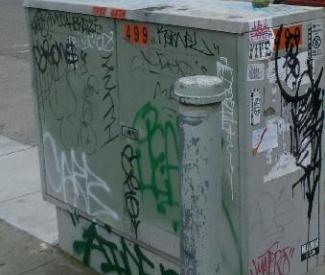
More than 60 people showed up on the steps of City Hall May 21 to demand that AT&T engage in the same old basic planning process that even small-scale businesses have to go through.  (Read: even little people without expensive corporate lobbyists.)


Neighborhood organizations, disabled and senior representatives and environmentalists all pushed the supervisors to make the sensible vote at tomorrow’s full board meeting: support a full Environmental Impact Review of the consequences of 726 giant metal lockboxes cluttering up our public sidewalks.  As Julian Davis, a longtime community activist put it: “Why would you plunk down 726 giant Buicks all over the city when you have a perfectly good underground high speed rail?”


True that.  San Francisco currently has miles of fiber optic cable pulsing beneath our city streets, and even that is already becoming outdated.  So now AT&T’s brilliant idea is to litter our sidewalks with what amounts to giant crusty supercomputers? And what happens when they’re obsolete?  Basically, taxpayers just got stuck with a bunch of metal junk on our sidewalks, while AT&T expanded its profit margins.


Why do small cafes have to pay hundreds of dollars in permit fees to put two piddly tables outside their shops, while AT&T gets a blanket “categorical exemption” for almost no money to nail down ugly boxes that will block the sidewalk and attract graffiti?  (Hmm, we can probably think of some choice graffiti actually…)


The last time we heard from the folks at AT&T, they were helping the NSA wiretap our private calls from a secret room in their headquarters, so excuse us if we’re a little hesitant about giving the company a free pass to put creepy lock boxes in front of our homes. 


According to the Department of Public Works at the last public hearing on this issue, DPW staffers are relying on AT&T’s “expert analysis” to guide them on whether or not AT&T should receive a categorical exemption – in other words, DPW is relying on AT&T to do its job, and the community just got cut out of the process.  An independent EIR is necessary to address these blatant conflicts of interest. 


Speaking of conflicted interests: The latest scuttlebutt inside City Hall has some progressive supervisors desperately looking to cut a deal to save face in the midst of election season.  And what would that deal look like?  Cutting the number of boxes and giving neighborhoods an opportunity to decide whether they want 4’x4’x7′ lock boxs on their blocks. 


So, basically, if your block doesn’t have a home owner association advocating on your behalf, guess what you’re going to be walking around everyday?  As Juan Monsanto of San Francisco Beautiful pointed out, most of these boxes will be installed in less affluent communities without strong representation at City Hall.   AT&T’s sweetheart deal gives the supervisors cover to punt their responsibility to administer public space safely and equitably. 


So, to recap: we are now officially a city that will arrest human beings for sitting or lying in the middle of the sidewalk, but the board is working overtime to try and figure out how to exempt AT&T from city oversight process so it can stick giant immovable metal boxes in our right of way?


Oh, it’s okay because they’re going in the Bayview. Or in a neighborhood that already has a bunch of blight, so what’s a little more?  Lame.  Call your supervisor today and tell him or her to get a backbone.  It’s tough being the swing vote, you know?  Help ’em out, let ’em know you’re watching – and voting.


The San Francisco League of Pissed-Off Voters is the local chapter of the League of Young Voters, a national organization that engages young people in the political process, organizes around progressive issues and takes it beyond just “get out the vote.” 


Big launch for Avalos, emphasizing unity and integrity

69

John Avalos launched his mayoral campaign yesterday with a spirited event in a sunny SoMa park that drew several hundred enthusiastic supporters, ranging from elected officials such as Assemblymember Tom Ammiano and Sups. Ross Mirkarimi and Eric Mar to representatives of a wide variety of progressive and community organizations.

There was also an unlikely supporter: Sen. Leland Yee, who is also running for mayor but spoke to reporters wearing an Avalos sticker and said he was pleased that Avalos is in the race. The two men were each endorsed by the SF Bay chapter of the Sierra Club over weekend, and Yee’s campaign appears to be trying to court the second place votes from supporters of Avalos, the only solid progressive in the race.

But political sideshows aside, this was a day for Avalos and his supporters to shine, and they demonstrated a larger and more energetic event than other mayoral candidates have managed to pull together so far. And the crowd took the opportunity to emphasize Avalos’ progressive values of integrity and collaboration, in the process taking subtle swipes at the ambitions and egocentrism of other mayoral candidates.

“We are for John Avalos because John Avalos is for all of us,” was the repeated refrain in a strong speech by “progressive Christian pastor” and blogger Bruce Reyes-Chow.

Ammiano noted that it was the birthday of Harvey Milk and said that Avalos is the heir to Milk’s legacy of promoting progressive change through community organizing. “Harvey Milk knew the secret and the secret was grassroots…Without that tethering together, we never move forward,” said Ammiano, whose endorsement of Avalos could be a significant factor in the race, particularly as Bay Area Reporter writers and other LGBT entities support other candidates.

Ammiano offered a few reasons for his endorsement, joking that, “He has the best hair of all the candidates.” But even more important was the issue of integrity and trustworthiness, where Ammiano said Avalos really shines. “Trust is a significant attribute and you don’t see a lot of that [in public life]. And John is honorable,” Ammiano said.

Other speakers from labor and progressive organizations emphasized how Avalos has been fighting for progressive causes his entire adult life. “John cares about the issues we care about and he listens,” said Andrea Buffa of Global Exchange, who also worked with Avalos on campaigns against corporate dominance when she worked for Media Alliance.

“I’m here to fight for John because John fights for all of us,” was the conclusion of the fifth-grade student from San Francisco Community School, who introduced Avalos.

During his speech, Avalos said he was touched by the huge turnout and display of enthusiasm. “It’s such a joy to see you here. My heart is swollen,” he said, before introducing his family and telling a story of his father’s lifetime of union activism on behalf of Los Angeles dock workers. “I learned from him the value of hard work and devotion to something much greater than yourself,” Avalos said.

And the main cause that Avalos has devoted himself to in San Francisco has been the progressive movement, with its commitment to workers rights and social and economic justice. “We see that wealth is accumulating into fewer and fewer hands,” Avalos said, one of several core problems that he said his candidacy is committed to addressing, later adding, “I’m running for mayor to even the playing field.”

While he advocated for creating safe streets for pedestrians and cyclists, stimulating job growth, and adopting a housing policy designed to promote diversity by creating more homes for low- and middle-income San Franciscans, he devoted much of his address to addressing the core problem of wealthy special interests getting their way at City Hall.

“We cannot have the same business as usual that greases the wheels with lobbyists,” Avalos said. “I’ll put the interests of the collective above the interests of the few, day in and day out.”

Avalos cast this year’s mayoral election as pivotal to San Francisco’s future. “As a city, we are at the crossroads and only we can turn the tide,” Avalos told a crowd from which almost 400 people signed up to volunteer on his campaign, closing with a line that echoed Milk’s refrain from almost 40 years ago: “I want to recruit you to this movement.”

Chronicle pushes fake campaign to “draft” Ed Lee

83

Downtown is clearly nervous about not having a reliable horse in the mayor’s race, so much so that a few power brokers are using the Chronicle to drum up a fake “campaign” to convince Mayor Ed Lee to break his word and run to keep the job. And the fact that these liars – those who just six months ago earnestly argued we need a caretaker mayor who won’t run for the office – are pushing this with a front-page, above-the-fold “news” story shows just how shameless they are.

Say what you will about this year’s field of mayoral candidates, but they do represent a broad range of constituencies and they include several seasoned politicians who are well-qualified to be mayor. Sen. Leland Yee has served in a variety of public offices for decades, Sup. John Avalos is a reliable progressive intimately familiar with the workings of City Hall, Dennis Herrera and Phil Ting each hold citywide offices to which the Mayor’s Office is the logical next step, Michela Alioto-Pier is a consistent supporter of ruling class interests, and David Chiu has proven his political skills by engineering his reelection as board president and installing Lee as mayor.

So why exactly do people want to convince Lee to go back on his word, as well as giving up the city administrator position that the board just cleared the way for him to return to with an ethics exemption? Well, the Chronicle article doesn’t really make that clear, all it makes clear is that’s what Willie Brown and Rose Pak – as well as their errand boys, former Sup. Michael Yaki and downtown consultant Jim Ross – want.

And why do they want Lee to remain in the Mayor’s Office? Because they’re the ones who put him there and he has done nothing to challenge the corrupt status quo at City Hall, where corporate desires trump people’s needs every time. Chief-of-staff Steve Kawa is still calling the shots, Brown’s clients and developer buddies are still getting what they want, and Pak still gets to be the de facto leader of Chinese-American interests in City Hall.

They desperately fear that Yee will win the mayor’s race and clean house, kicking out Kawa and all of the Brown and Pak cronies, greatly reducing their power in San Francisco. And the rest of the candidates are too independent and broad-based to guarantee the continued power of Brown and Pak and the downtown interests they represent. Their only hope is that they can cut some kind of deal with Chiu to maintain their influence in the next administration by applying pressure through this article and the others likely to follow in this fake draft-Lee campaign.

To his credit, Sup. Sean Elsbernd isn’t taking part in this shameless charade, instead sticking by the statements he made when he nominated Lee to be mayor, telling the Chronicle that in a year with tough political decisions on the budget, pension reform, and other pressing issues, “this city desperately needed someone who wasn’t going to play election-year politics,” and that, “if he files papers to run for mayor, all that goes away.”

That’s true, along with any illusions that Lee and those who back him have any integrity.

Igniting a union

5

news@sfbg.com

The most contentious and pivotal election ever for the union of academic student employees at the University of California concluded May 8 in a landslide victory for reformers who will now have the chance to deliver on their promise of a more militant and democratic union. In many ways, it was a microcosm for the larger struggle over how to respond to proposals for deep cuts and tuition hikes in the public university systems.

Local 2865 of the International Union, United Automobile, Aerospace and Agricultural Implement Workers of America (UAW), represents 12,000 teaching assistants, tutors, readers, and researchers, making it the largest UAW union on the West Coast. Higher education workers make up 40,000 of the 390,000 active UAW members, just over 10 percent.

The caucus of reformers, organized under the banner Academic Workers for a Democratic Union (AWDU), won all 10 executive board positions and 45 out 80 seats at the Joint Council, taking control from incumbent leaders from United for Economic and Social Justice (USEJ), which has presided over the union for most of its 11-year history.

Voter turnout spiked tenfold over the last triennial election with 3,400 ballots cast this election cycle. Union organizers said the hike reflects intensive campaigning by both sides and a political atmosphere that is threatening both higher education in California and public employees across the country.

“This was the first real contested election our union ever had,” said Mandy Cohen, a comparative literature graduate student at UC Berkeley and the AWDU recording secretary-elect. “There was a huge increase in participation, and it was very contentious. Our leadership never had to fight for their position.”

The intensive campaigning translated into an unusually bitter battle for votes with ensuing accusations of foul play. The allegations include intimidation, personal attacks on the character of candidates, and ballot tampering. But the height of controversy and drama came once all the ballots were cast, when the USEJ-dominated elections committee suspended the vote count midway and AWDU members responded with an office sit-in of the union’s headquarters.

Each side tells a different tale for these 1,500 disputed ballots from UC Berkeley and UCLA, the two largest campuses.

From USEJ’s perspective, the sheer number of challenged ballots and the heated environment in the counting room overwhelmed elections officials, who decided to refer the matter to the Joint Council, the governing body of the local.

“AWDU had 20-plus people in the [vote-counting] room. They were continuing the intimidation and aggression. The elections committee decided that it was too much to handle,” said Daraka Larimore-Hall, outgoing president of the local. He said that USEJ elections committee members have been so harangued since the incident that they are not granting requests for media interviews.

AWDU members, who consider UC Berkeley their stronghold, think the vote-counting freeze was the first step on the road to invalidating ballots from a campus with many AWDU supporters.

“Even though we knew they were really threatened by us, the very idea that we would try to disenfranchise 800 voters from the biggest campus — and that’s how they would try to win the election — was really shocking,” Cohen said.

She defended the AWDU decision to videotape the remaining ballots via webcam and take over union offices in protest. “We weren’t taking a partisan position; we just said we wanted the votes counted. I felt like we were clearly in the right. We just wanted to defend the election — and that position was so strong.”

Counting resumed when both sides finally settled on a third-party mediator, delivering 55 percent of the vote to AWDU.

However, on May 16, USEJ released a statement documenting a slew of alleged misconduct throughout the election and calling for a rerun. “It is critical that our members have confidence that the election process is fair and democratic,” reads the statement. “It seems that several categories of problems, with many more individual examples, occurred that are serious enough to justify setting this election aside.”

Whatever happens, reformers at least will have some opportunity to translate their political platform into action. They say they will focus on two areas: increasing the participation and power of the rank and file, and a more aggressive stance toward the university administration and the budget cuts.

“There is real institutional power in this union that should be better mobilized in those fights [for public education],” said president-elect Cheryl Deutsch. “We are hoping to bring into that debate a more mobilized membership … so that we can be a stronger coalition [with others in California].”

She added that the election was already a huge victory in the long-term plan to increase involvement. A history of member indifference and vacancies in the governing board hopefully will give way to a revival in the higher education labor movement, she said.

But Larimore-Hall expressed strong disagreement with the sentiment that the election was a victory for the labor movement. He said he heard AWDU people tell workers that USEJ represents “centrist sell-outs” and “out of touch union bureaucrats,” tactics he criticized. “Going around and telling people their union leaders are corrupt union bosses … in a culture that is steeped in anti-union rhetoric is an easy thing to sell people on,” he said.

Deutsch said she couldn’t take responsibility for the actions of a few amid hundreds of supporters and activists, but that AWDU as a whole did not engage in personal attacks. She said she is proud that her winning slate came from rank-and-file workers, not from traditional union leadership and staff.

It wasn’t the first time the two factions confronted each other. The origin of the tensions can be traced to the recent wave of budgets cuts at the university, and to the ensuing protests. In the summer of 2009, the UC Board of Regents announced a 33 percent tuition hike; the resulting discontent sparked a student movement with its own fair share of ups and downs. Among the protestors were many graduate students who would go on to become AWDU leaders.

Cohen recalls that in fall 2009, there was a “huge explosion of organizing and activism on our campus trying to organize resistance to the cuts — but not within our union.”

Cohen said that she and other graduate students approached the union to encourage action, but that union bureaucracy stifled their efforts. “It was too top-down and difficult to participate. We realized the local wasn’t structured in a way that could be powerful.”

Larimore-Hall said UAW already was “one of the unions that [the university administration] fears most.” He said that AWDU’s position overlooks the union’s accomplishments on the public education front, citing a petition to Sacramento legislators that USEJ organizers got thousands of members to sign.

Early this spring, the issue of labor properly and sufficiently flexing its muscles came center stage as the UAW and the university negotiated a contract. With no concessions to management and gains such as a 2 percent wage increase and more childcare subsidies, Larimore-Hall said the contract is a resounding success.

But Deutsch says that the contract is a perfect example of her disillusionment with traditional union organizing and the previous leadership. Union members ultimately voted to ratify it despite AWDU criticism that the union didn’t seek enough input from members or push for a better deal. AWDU gained traction and established a significant public presence for the first time with this opposition.

“It’s not that I think it’s the worst contract we could have gotten,” she said, explaining that her problem is with the process, not necessarily with the results. If more members had been consulted and included, she would have been content. She mentioned the dire need for affordable housing at the Irvine campus as an example of member concerns that were not prioritized.

Peter Chester, chief contract negotiator for the university, said that in the “current budgetary circumstances,” UAW did “very well” and expressed concern that the slate, which opposed the contract, did so well among academic workers.

But the victory by reformers probably signals a new militancy in the union, which is expected to resist proposals to privatize campus services and push for a stronger voice in the tough decisions facing the university system. Cohen said that making the case for taxing the rich to pay for public education is the wider goal and the reason she ran for a position at the union.

“It’s eye-opening to be a student and benefit from education here at the UC, but also to identify as a public employee,” she said. “When I got to the UC, I was so proud. And then this struggle came to my doorstep, and I didn’t have a choice in this moment.” 


Gascón’s essential conflict

0

The latest video of a police arrest in a Tenderloin hotel room — this one apparently showing police officers entering a room without a warrant, attacking an unarmed bystander, and stealing a resident’s duffle bag — has set off a wide range of investigations. But what’s really disturbing is that the video is all too typical of what seems to be business as usual among undercover narcotics detectives. In fact, a series of recent security videos show San Francisco cops doing one thing — and reporting something else.

“We’ve yet to run across a single video that matches up with what the police swear to in their report,” noted Chief Public Defender Attorney Matt Gonzalez.

We’re not talking about one police station, one crew, or one rogue cop. This is, to all available evidence, a pattern of rotten behavior in the department. It’s impossible to believe that these are just a few isolated incidents — or that the problems are concentrated in the lower ranks. If command-level officers didn’t know what was going on, then they’re incompetent. If they knew — which is far more likely — then they were covering up.

That’s nothing new in the old boy’s club that is the San Francisco Police Department. While the criminal cases against senior cops in the Fajitagate scandal went nowhere, the evidence strongly suggested that a cover-up had been ordered and executed at all levels.

In that case, Terence Hallinan, the district attorney, took the lead in trying to hold the cops accountable. But now the person running the D.A.’s Office — former Police Chief George Gascón — is politically paralyzed. Gascón can’t investigate systemic corruption in a department that until recently he was running. He can’t, at this point, even seem to figure out which cases he can take and which he can’t. He hasn’t adopted and made public a conflict of interest policy for himself and his office. And any honest policy would make it impossible for him to get involved in any action involving his former employees.

This is, to put it mildly, the exact reason why police chiefs don’t become district attorneys, why Gavin Newsom’s parting shot to the city has badly damaged the credibility of local law enforcement. It’s also the strongest argument possible for the election of a new district attorney.

David Onek, one of the candidates challenging Gascón, has called for a conflict of interest policy saying, “The people of San Francisco deserve and demand a district attorney who will avoid clear conflicts of interest as a matter of policy — rather than personal whim.” That’s a no-brainer. But the problem goes deeper. As Sharmin Bock, a veteran Alameda County prosecutor who is also running for Gascón’s job, noted, there’s no policy that can address this problem. If Gascón punts all investigations of the SFPD to the FBI or the state attorney general, he’s not only giving up local jurisdiction, he’s vastly increasingly the likelihood that nothing will ever happen. The FBI has limited jurisdiction; the Attorney General’s Office isn’t set up to do this kind of work.

“The only answer,” she said, “is a different D.A.”

Gascón needs to deal with this situation immediately, publicly, and credibly. Perhaps the city needs an independent special prosecutor, someone outside Gascón’s office but with full authority to seek indictments (paid for out of Gascón’s budget, since he created this mess.) Because if he can’t find a solution, he’s going to have a hard time convincing anyone he deserves to stay on the job. 


Editorial: Gascón’s essential conflict

0


The latest video of a police arrest in a Tenderloin hotel room — this one apparently showing police officers entering a room without a warrant, attacking an unarmed bystander, and stealing a resident’s duffle bag — has set off a wide range of investigations. But what’s really disturbing is that the video is all too typical of what seems to be business as usual among undercover narcotics detectives. In fact, a series of recent security videos show San Francisco cops doing one thing — and reporting something else.

“We’ve yet to run across a single video that matches up with what the police swear to in their report,” noted Chief Public Defender Attorney Matt Gonzalez.

We’re not talking about one police station, one crew, or one rogue cop. This is, to all available evidence, a pattern of rotten behavior in the department. It’s impossible to believe that these are just a few isolated incidents — or that the problems are concentrated in the lower ranks. If command-level officers didn’t know what was going on, then they’re incompetent. If they knew — which is far more likely — then they were covering up.

That’s nothing new in the old boy’s club that is the San Francisco Police Department. While the criminal cases against senior cops in the Fajitagate scandal went nowhere, the evidence strongly suggested that a cover-up had been ordered and executed at all levels.

In that case, Terence Hallinan, the district attorney, took the lead in trying to hold the cops accountable. But now the person running the D.A.’s Office — former Police Chief George Gascón — is politically paralyzed. Gascón can’t investigate systemic corruption in a department that until recently he was running. He can’t, at this point, even seem to figure out which cases he can take and which he can’t. He hasn’t adopted and made public a conflict of interest policy for himself and his office. And any honest policy would make it impossible for him to get involved in any action involving his former employees.

This is, to put it mildly, the exact reason why police chiefs don’t become district attorneys, why Gavin Newsom’s parting shot to the city has badly damaged the credibility of local law enforcement. It’s also the strongest argument possible for the election of a new district attorney.

David Onek, one of the candidates challenging Gascón, has called for a conflict of interest policy saying, “The people of San Francisco deserve and demand a district attorney who will avoid clear conflicts of interest as a matter of policy — rather than personal whim.” That’s a no-brainer. But the problem goes deeper. As Sharmin Bock, a veteran Alameda County prosecutor who is also running for Gascón’s job, noted, there’s no policy that can address this problem. If Gascón punts all investigations of the SFPD to the FBI or the state attorney general, he’s not only giving up local jurisdiction, he’s vastly increasingly the likelihood that nothing will ever happen. The FBI has limited jurisdiction; the Attorney General’s Office isn’t set up to do this kind of work.

“The only answer,” she said, “is a different D.A.”

Gascón needs to deal with this situation immediately, publicly, and credibly. Perhaps the city needs an independent special prosecutor, someone outside Gascón’s office but with full authority to seek indictments (paid for out of Gascón’s budget, since he created this mess.) Because if he can’t find a solution, he’s going to have a hard time convincing anyone he deserves to stay on the job.<0x00A0><cs:5>2<c


Kucinich v. Palin: Guess who wins?

5

Boy, wouldn’t this be fun?


 Trump is not the weakest Republican in the two hypothetical match ups we tested with Dennis Kucinich. Kucinich’s lead over Sarah Palin if they were to face off would be 43-36. In that scenario Kucinich gets 16% of Republicans to Palin’s 12% of Democrats and leads her by 10 points with independents at 42-32.


I think Rep. Kucinich has enough to worry about just keeping his own seat, but it shows how weak the GOP field is right now. (On the other hand: Two years before the 1992 election, Bush The First was considered unbeatable and no less an authority than the Almanac of American Politics said it was “ridiculous” that anyone would take the young governor of Arkansas seriously as a candidate for president.)


Still: Not good news for Sarah Palin. 

Bleak frames and guilt

0

arts@sfbg.com

LIT From the first page, an anonymous manifesto denouncing the pharmaceutical industry, to a bronze sculpture of a suppressed anti-Nazi headline from the Lippische Tages-Zeitung weighted down by a giant hammer and nails on the last, David Lester’s graphic novel The Listener (Arbeiter Ring Publishing, 304 pages, $19.95) explores how words often fail their intended purpose, precipitating actions with unforeseen consequences.

The unintended consequence of the manifesto: an amateur activist falls to his death while hanging a banner from a radio tower. The unintended consequence of the unpublished article: the rise of the Third Reich and the fall of a nation’s conscience. In Lester’s book, both events become entangled within the scope of Louise Shearing, a Canadian sculptor wracked with guilt over the death of the activist, who took the phrase “action speaks louder than words” to heart.

Although The Listener eventually makes reference to the fallen activist, Vann, being influenced by Louise’s sculpture of French anarchist Louis Michel, it’s not immediately clear to the reader why Louise, as opposed to the scribes behind the manifesto, must bear the brunt of the guilt over his death. Like many young people in a state of flux, Louise winds up backpacking across Europe, hanging out in art museums and hooking up with cute but pedantic European men. In one of those almost-magical chance encounters so common to the open road, she has a conversation with an elderly couple in a café, which culminates in an unexpected history lesson.

Rudolph and Marie are from the former German state of Lippe (now part of North Rhine-Westphalia), site of the last free election in Germany before Hitler took the chancellorship. As journalists and members of a smaller right-wing party (the DVNP), which balks at towing the Nazi Party line, they nonetheless go along with the suppression of an article exposing corrupt Nazi campaign tactics. The headline pulled at the last minute is preserved for posterity on a secret plate that Rudolph smuggles home. “Our failure to defeat the Nazis in Lippe is a regret we live with every day,” Marie says.

It’s tempting to draw a parallel between Lester’s The Listener and Jason Lutes’ Berlin, but to compare the two does The Listener a disservice. Where Berlin is a meticulously-rendered serial drama characterized by painstakingly clear lines and weighted text, The Listener is a shadowy morality play cloaked in the mantle of German Expressionism. The black guilt that weighs heavily within Louise and the German couple seeps across each page like a Rorschach blot. Each bleak frame is a single painting, rendered in messily urgent layers of gray, interspersed with replications of newspaper headlines trumpeting the rise of the Third Reich. Also unlike Berlin, most of the book’s action actually takes place in the present day, where the reverberations of the dead can be, and are, remarked on by the living.

The Listener flags during Louise’s unstructured attempts to ascertain what art means to her by discussing it at length. She swoons over Cézanne and deconstructs Picasso, but is so rarely shown in the act of creation that it’s easy to forget that her art has served as a catalyst for action. It’s possible to imagine Lester — painter, musician, activist — having these very conversations with himself, but they don’t have the same impact as the sculpture Louise finally creates in the last frame, a picture truly worth a thousand words. 


Ross for boss (of the sheriff’s department)

3

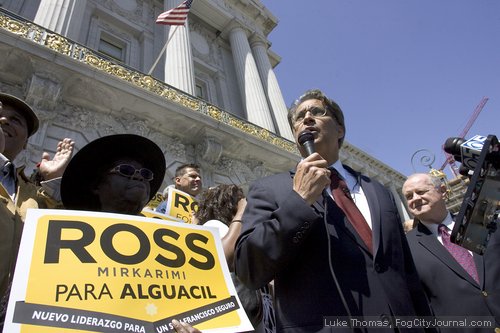
City Hall’s steps were awash in multi-lingual black and yellow “Ross Mirkarimi for Sherrif” signs at noon today, as Mirkarimi supporters watched Sheriff Mike Hennessey, who is stepping down after 31 years of service and eight elections, endorse Sup. Mirkarimi as the next sheriff.  “New Leadership for a Safe San Francisco” was printed on the English version of the signs that Mirkarimi’s supporters carried. They included former Mayor Art Agnos, Sups. David Campos and Eric Mar, Tim Paulson of the Labor Council, Debra Walker, Linda Richardson, Sharen Hewitt, Terry Anders, and Mirkarimi’s partner Eliana Lopez and their almost two-year old son Theo. And everyone had plenty of great things to say about outgoing sheriff Hennessey and sheriff candidate Mirkarimi. And Hennessey even pinned a shiny toy sheriff’s badge onto the T-shirt of Mirkarimi’s son Theo, making him the happiest kid in town. At least for the day.

Campos kicked off the event by honoring Hennessey as the “most progressive and most effective sheriff in the country.”
“Mike Hennessey is also my neighbor in District 9. I see him taking out the trash so I know he’s a good neighbor,” Campos joked, as he listed the many achievements in Hennessey’s long career as an elected official in San Francisco. These achievements included Hennessey’s pioneering innovations in criminal justice and culminated in his decision to blow the whistle in 2010 on the federal government’s plan to activate its controversial Secure Communities program in San Francisco—without telling the public.
“He’s not afraid to stand up for what’s right,” Campos said.

‘This is the time for me to move on,” Hennessey announced, as he laid out his reasons for endorsing Mirkarimi as Sheriff, over other candidates in the field.
Hennessey described the Sheriff’s Department as a “large enterprise” that has over 1,000 employees, a $150 million budget and whose jail houses an average population of 2,000 folks in custody, on a daily basis.
“It’s not something that can be handled lightly,” Hennessey said. “That’s why I’m here to endorse Ross Mirkarimi as the next sheriff.”

Hennessey listed the many endeavors that he and Mirkarimi have worked closely on, including a number of criminal justice issues, and he cited Mirkarimi’s extensive law enforcement background, his significant legislative accomplishments in the areas of criminal justice and public safety, and his ability to find innovative solutions and overcome obstacles to progress, as reasons to support Mirkarimi.

Hennessey observed that criminal justice is “one of the thornier issues” that members of the Board of Supervisors are often asked to get involved in, but often duck.”But Ross has not shied away from working on them,” Hennessey said, citing Mirkarimi’s involvement in shaping the “No Violence Alliance Project” and his leadership in creating the Safe Communities Re-entry Council.

Hennessey also noted that in face of AB 109, the Governor’s plan to transfer state inmates to county jails, “it’s vitally important to have person in charge of sheriff’s office that understands these alliances and can make them work more effectively.”

Hennessey concluded by observing that the Sherrif’s Department has to deal with a lot of bureaucracy, so it’s important to understand how the Board, the budget process and other city departments, including the District Attorney’s office and the police, work.
‘And that’s why I’m endorsing Ross as Sheriff,” Hennessey said

Then it was the turn of Mirkarimi, who graduated from the San Francisco Police Academy, did Naval Reserve training and worked for more than 8 years as an investigator for the District Attorney’s office, to speak.

“I have never been at a loss for words,” Mirkarimi acknowledged, as he launched into a speech that began by thanking everyone for showing up at short notice “for one of the most important occasions of my political career.”

Mirkarimi did a great job of giving Hennessey the praise he deserves.
“He is a living legend,” Mirkarimi said. “It’s completely impossible to fill his shoes.”
Citing Hennessey’s integrity and his ability to innovate, Mirkarimi warned that, “Maybe it’s come to the point where we have taken him for granted. He’s the longest serving elected official in the history of San Francisco, and he’s probably the most understated.”

“And the most important endorsement in this race is that of Mike Hennessey,” Mirkarimi added, as he gave Hennessey his commitment “to build upon your legacy as effectively as possible.”

Mirkarimi cited some of the most immediate and serious challenges that face the next sheriff. These include AB 109, which Gov. Jerry Brown just signed, which. Mirkarimi said, threatens to increase the reentry prisoner level by 30 percent in California. “It will take creative ingenuity and resources to make sure we are effective in taking care of this population,” he said.

Mirkarimi also touched on the rising number of veterans that are ending up in the prison system, talked more about the No Violence Alliance Project, and suggested that certified deputy sheriffs could help serve warrants, transfer prisoners, and patrol Muni, “when the police department finds itself understaffed” so as to ensure that San Francisco is safe.

“For every four people arrested and jailed in San Francisco, three out of four are repeat offenders in a three-year period,” Mirkarimi warned, by way of explaining why he wants to advance a more collaborative spirit between SPPD and the Sheriff’s department.

Mirkarimi also noted that one out of every 15 African American males are in jail, at any time in the year, compared to I out of 300 males who are not black or brown. “So, we must step up our game in dealing with poverty,” he said, as he recommended increased access to job training and good jobs, “so work doesn’t become a seasonal hope but a permanent job.” He also made the connections between a lack of good housing, childcare, and schools and a rise in poverty, crime and recidivism.

Mirkarimi concluded by crediting Hennessey for “walking that fine pirouette” between upholding the principles of public safety and understanding the power of redemption at the same time.

I asked Sheriff Mike Hennessey what he considers to be the biggest challenges of running for sheriff/
“Letting people know what you are going to do, and what your issues are,” Hennessey said, noting that San Francisco has an intelligent, issues-driven electorate.

And Mirkarimi’s supporters weren’t shy about letting folks know the issues that the current D5 Supervisor has helped them with, over the years.

“Ross, as a supervisor and me, as someone who comes from a community of color, we know the habits that ex-offenders can bring with them, if there are no safety nets,” said Terry Anders who sits with Mirkarimi on the Safe Communities Reentry Council. “And I believe in what Ross stands for and the integrity of his person. He’s one of the first people to show up when there are crimes and victims, and he attends basketball games and boxing matches.”

Paulette Brown, whose son Aubrey Abraska Jr, was murdered in August 2006, but whose killers have still not been brought to justice.
“We shouldn’t have to run and leave our families, we should be protected,” Brown said. “Ross is my district supervisor and if he can get in, and do something about crime and solve unsolved homicides, then I’m for him. Maybe if he gets in, he’ll have more pull to do something about these unresolved cases.”

And then it was back to work, which for Mirkarimi now includes the somewhat daunting task of trying to raise money in an election year that also includes a mayor’s race, but does not include the help of public financing, at least not for the sherrif’s race….

Editor’s notes

0

tredmond@sfbg.com

I heard a retired Army officer, a veteran of Iraq and Afghanistan, on the radio May 2 talking about the death of Osama bin Laden. Great news, he said, with all sincerity; now we can end the wars in Iraq and Afghanistan, stop wasting all this money, and bring the troops home.

That would nice, wouldn’t it?

But don’t start counting on an end to the wars, an end to the deaths of U.S. troops, or an end to an $881 billion defense budget (up from $300 billion in 1980 and $311 billion in 2000) or a significant change in our national priorities.

The truth is, Osama bin Laden wasn’t a factor in the invasion of Iraq. He wasn’t there; Saddam Hussein didn’t like him anyway. He was probably in Afghanistan for a while, but by the time we got mired in that quagmire, he’d moved on to Pakistan, which is supposedly our ally in the war on terror. That’s where he was running his operations, and that’s where he died.

The invasion of Iraq had nothing to do with terrorism. The war in Afghanistan might at some point have been related, but it’s not any more. The U.S. did the exact worst thing you can do in a military adventure: sent in troops with no way out.

Maybe Obama will now find the courage to say what he should have said the day he took office: we no longer have any strategic or national security interest in occupying Iraq and Afghanistan. Time to cut our losses, bring the troops home, put some of that money into the civilian economy, and deal with the real threat to American democracy — the horribly uneven distribution of wealth and power in this country.

Maybe the Democrats in Washington will show some backbone and start cutting the defense budget. Let the Republicans justify a continued war that their guy, Bush the Younger, insisted was about al Qaeda. Let them explain why we have to keep troops on the ground now that the head of al Qaeda’s gone. Let them explain why that’s more important than Medicare and Social Security.

But I’m not placing any bets.

I was a strong supporter of Obama. But when I saw hundreds of people partying and dancing in the middle of Valencia Street on election night, I had a bad feeling that this was going to end with an ugly hangover.

So I’m not dancing in the streets about the death of Osama bin Laden. I’ll save that for the day when the last American soldiers leave Iraq and Afghanistan and the military budget comes back to earth.

Puke and privatization in Dolores Park

44

Editors note: the vow by Chicken John Rinaldi to vomit in Dolores Park has gotten a lot of media attention — but there’s a real story behind it that the press has missed. Chicken sent us this opinion piece presenting his side of the story.

By Chicken John Rinaldi

It happened pretty quickly, when privatization came to Doritos Park. Sorry; Dolores Park. I keep forgetting they haven’t sold the name yet.

It didn’t come like a wraith with icy fingers or an immense monster with an army of lawyers. Privatization came to Dolores Park in the form of a nonprofit incubator for immigrant women entrepreneurs called La Coucina. For a progressive city like San Francisco, you can’t get much more cuddly than that.

I hear the Trojan horse was adorable, too. It had a cute mane and soft eyes and was made of really high quality lumber. You’d be a fool to criticize that kind of craftsmanship. But it was privatization of a park, even so. Selling space on public land without the public’s consent.

And there was resistance, of course. But the resistance was met with the oddest enemy. The resistance didn’t find itself fighting against people who believed that the park should be privatized. The resistance debated with people who did not know what privatization was. The resistance debated with people who did not know it was coming. The resistance debated with people who knew what it was, but refused to recognize it.

“Yummy tacos!” they chirped, as though that actually was an answer. Enron served tacos, too. Every Tuesday. The problem wasn’t the tacos: it was Enron.

“It’s just a food truck!” they said. “For immigrant ladies! No one who gives work to immigrant ladies could ever be involved in something bad!” This kind of thinking, that anything is okay as long as it also raises money for a good cause, is what will sink our own City of Art and Innovation: San Francisco.

The people who resisted asked questions: Why can’t they park the taco truck on the curb, where cars belong? Why drive a truck on the grass? Why not rent a parking space for the truck? Ummmmmm….. “Yummy tacos!!!” They said, looking around the room for approval.

The people who resisted pointed out that the public outreach that was supposed to be done before this kind of thing is authorized was never done. They told us at the first meeting that it was too late to stop. They did that thing where they create the illusion of inevitability.

Some things are almost impossible to undo once they’ve happened. Sacking the city of Troy, for instance. Or detonating a neutron bomb. Or kissing your best friend. Or doing all the cocaine in the cab before you get back to the party. Privatization is like that. Once a government starts getting easy revenue from a public trust, it doesn’t want to go back. Then it starts taking everything else with it: once one park has a food concession, every park that doesn’t have a food concession starts to look like a drain on the budget. Once one park gets a gift shop, every park needs a gift shop. Pretty soon you end up with a city full of park-themed malls. Well, in the rich neighborhoods anyway. The poor neighborhoods will have fences around the parks. Because they can’t carry their weight.

This is what a class war looks like. Straight up. RPD (mainly the general manager, Philip Ginsburg) has declared class war on San Francisco.

We’ve seen where this leads before: like in the news industry. Back in 1967, network news was almost … almost … a public trust. There was tight regulation. There was no consolidated corporate ownership. The people who owned the stations had zero influence on what was broadcast. Most importantly, no one expected network news to turn a profit. It was something the networks did, for the public good, as a condition of getting access to the public airwaves. It wasn’t perfect, but it tended to be solid news about factual issues that were relevant to the times.

That began to change in 1968, when CBS started a show called “60 Minutes,” and for the first time in network history a news show made a profit. Suddenly all news had to make a profit. And then it had to make a bigger profit, and then a bigger profit. It was a slippery slope. By the 2000 election we had FOX news.

As part of this trend, facts got replaced with opinions – because opinions are cheap and profitable. You want to make more money? Cut your foreign reporters, replace them with a pundit who once visited France. Need to make more money? Cut your congressional reporters and replace them with a couple of hacks arguing about congress.

As a result of the rush to make a profit, news coverage has become completely tabloidized … which is why some idiot with a cause needs to throw a “Puke-In” to get attention to a relevant issue like the privatization of parks. And it worked.

A cleverly worded publicity stunt that claimed I was going to “Fill Dolores park with vomit and watch the trailer of privatization float away on a river of puke” got attention. News organizations that never would have run a headline like “parks department fails to consult with residents” were tripping over themselves to be the first to run headlines like “Incensed man vows to puke on immigrants” and “park activist to puke on vendors.” All told, 57 stories appeared online and in the papers.

 Eventually, most of them mentioned that the park was going to get privatized. It was ugly, but it was a win – and with the media the way it is, everything’s ugly.

After it had been going on for two weeks, I had to explain to people that my cheap and obvious publicity stunt was a cheap and obvious publicity stunt. This lead to more headlines. But come on – “puke in?” That’s funny! But for the record, no, I’m not going to throw up on immigrants. I do have $750 worth of novelty vomit, but all I’m really doing is collecting signatures for my petition: Did anyone really think I could puke on another human being … someone who I didn’t know … just because we had different opinions on the location of a taco truck? After I ran for mayor for second place? After Porneokie? After a career in San Francisco spent producing benefits and rallies and meetings and art incubators and pot luck dinners and bus trips to amazing places?

Well, actually… yes. People thought I was going to go assault someone. Welcome to San Fransandiego. Whatever. The point is: the Recreation and Parks department is trying to rent out public parks to make money, and they’re not consulting the neighborhoods. And while they’ve found the nicest, sweetest, bestest cause they could find to rent the first plot of your land too, the next time it might be FOX news. It might be Exxon. It might be Goldman Sachs. They don’t care: they’re just in it for the money.

Privatization came to Doritos Park. Shit, I did it again. Sorry. Privatization came to Dolores Park. And the progressive left of the Mission showed up. We showed up and we showed that we have a gag reflex. We let Mr. Ginsburg know that privatization makes us nauseous. If they’ve got budget problems, close a few golf courses, they’re horrible for our ecology anyway. Endangered species; frogs and what have you. Lowering kids services 30% and then raising your payroll 670% is not gonna work. Duh. You can’t fire all the kids’ teachers that were making $35K a year, close the clubhouses and then hire thirteen $120K a year bureaucrats and not start a class war. There should be 50 neighborhood groups at your door with torches and pitchforks!

If the Recreation and Parks Department needs more money, they should show good faith and manage what they have better first, before selling our future with privatization. And if they need more money from the General Fund, then lets find it! Lets partner with them to seek solutions or restructure how the financial system works so they get the money they need without ruining our city.

As for us eating each other alive over this issue? I think it’s worth our time to talk this out, argue it out. Work it out. It’s definitely worth poking taco truck sized holes in this moral justification for selfishness. Which is what I think we have here. I think fighting that is worth signing a petition, and worth protesting. And it’s worth a cheap publicity stunt. I bet I can think of another one, too.

Chicken John is a San Francisco showman. Here is the petition:

And the next chief is…yes, Suhr!

3

Mayor Ed Lee appointed a deeply emotional Captain Greg Suhr as Chief of the San Francisco Police Department during a swearing-in ceremony where the majority of folks were either elected officials, running for election, running each other’s electoral campaigns—or wearing SFPD uniforms.

And in the end it seemed that the choice may have been influenced by pressure from the powerful San Francisco Police Officers Association, judging from the comment Lee jokingly directed at SFPOA leader Gary Delagnes, saying, “Gary, it’s time to get quiet and go to work.”

Lee told a standing-room only crowd that when he returned from Hong Kong to San Francisco four months ago finding a new police chief was his top priority. And that initially it was suggested (Lee did not say by whom) that he leave the SFPD situation alone and allow an elected mayor to appoint the next Chief.

‘While I am an interim mayor, this is not an interim decision,” Lee told the crowd, signaling that while he may be out of office in January, Suhr may be here to stay as the city’s top cop.

“Today, I’ve chosen the best candidate,” Lee continued, thanking Acting Chief Jeff Godown for his work leading the SFPD since former Mayor Gavin Newsom made the shocking decision to appoint former Chief George Gascón as District Attorney.

But while Newsom’s move may have upset the apple cart in the D.A.’s race, it sure seems to be working out well for Suhr.

Describing Suhr as “a police and people’s Chief: and “a reformer from the inside out,” Lee ran through a long list of the new Chief’s contributions to the SFPD. These included Suhr’s 30 years of service, his climb through the ranks to become Captain of the Mission station, his gig as Captain of the San Francisco Public Utilities Commission in a Homeland Security capacity, and, since 2009, as Captain of the Bayview station.

Suhr began by saying he was “speechless.” Donning glasses to read a speech that he had prepared the night before, Suhr choked up when he talked of being “fourth-generation, born and raised in San Francisco.” Recovering his composure, Suhr smoothly changed gears, as he joked how his appointment therefore makes him “a local hire,”—an insider reference to Sup. John Avalos’ recently approved local hire legislation that Mayor Lee is helping enact citywide.

Suhr recalled how he started out as a rookie on the midnight shift in the Tenderloin in 1981. He thanked his family, his friends and his girlfriend Wendy. And then he asked for a moment of silence “ to honor the memory of all the brave officers who have given their lives in the line of duty.”

Lee reclaimed the podium long enough to jokingly ask Suhr  “to investigate the whereabouts of my birth certificate” as his first assignment as the new chief.

Then it was Board President David Chiu’s turn. Chiu described Suhr as someone, ”who knows our streets, walked the walk, and knows the beats, someone who we all feel confident will be able to bring the SFPD the reform that former Chief Godown, Chief Gascón and Chief Heather Fong initiated. “

San Francisco Superior Court Judge Katherine Feinstein, who is the daughter of Sen. Dianne Feinstein and the presiding judge of the Superior Court, recalled how she has known Suhr since the mid 1980s. “I have watched him as each of our careers have moved forward,” Feinstein said, noting how there were some “steps forward and some steps backward” and how, “there were those who thought this day would never come.” (Feinstein’s words were the only reference to some of the less sunny moments in Suhr’s long and distinguished career. These included his 2003 indictment as part of Fajitagate, an incident that involved off-duty officers, a bag of take-out food, a beer bottle and injuries sustained by two local residents. Suhr was cleared of wrongdoing the next year, but was reassigned by then Chief Heather Fong to the PUC position after an incident in 2005, in which a police officer was seriously injured at an anarchist protest, and videographer Josh Wolf was held in federal prison for 226 days after he refused to release unedited footage of the protest.)

Next up was D.A Gascón and his rooster-like shock of silver hair. Gascón noted that when he first came to San Francisco, in the summer of 2009, he had no allegiances to, and no prior knowledge of, people inside the SFPD.

“I looked at Greg Suhr and one of the things that impressed me is how he worked with and related to people,” Gascón said, explaining why he appointed Suhr as Bayview Captain “Not only has he exceeded all expectations he did an incredible job,” he said.

 Police Commission President Thomas Mazzucco said that in the 100 days since the Commission announced it was looking for a new chief, it became clear that Suhr has the support of SFPD’s rank-and-file.

Mazzuco noted that he met Suhr in high school. “I knew he could hold a ball,” Mazzuco added, noting that he subsequently became Suhr’s football coach, even though he is younger than Suhr. “What the Police Commission has brought to us is not only a native son but also a cop’s cop. It’s an honor to have him as his chief.”

And after the swearing-in, the sentiment among officers in blue appeared to be strongly in Suhr’s favor. Lt. Ken Lee of Central Station recalled how he and Suhr went through the police academy together about 30 years ago.

“We went to different assignments but we’ve maintained a friendship,” Lee said. “The moment I met him I liked him. He was a very stand-up person, and as a native San Franciscan like myself, you could tell he had strong ties to the city. He’s a hard worker, he’s very dedicated to what he does.”

Lt. Mario Delgadillo, also of Central Station, said Suhr hasn’t lost his connection to the street. “That also means a lot, when you have a boss who’s walking with you,” Delgadillo said.

Suhr takes over the SFPD as it’s grappling with the fallout from a recent spate of scandals, including videos that Public Defender Jeff Adachi released that appear to show police misconduct at residential hotels and that forced DA Gascón to hand over his investigation of this alleged police misconduct to the FBI. Asked during a media roundtable what his appointment means for Acting Chief Godown, Suhr said Godown has returned to being Assistant Chief of Operations, which was the post he held before Gascón, who recruited Godown from LAPD, was appointed DA.

In response to a question about his top priorities as police chief, Suhr noted, “When I sit down with the mayor this afternoon, the mayor’s going to tell me what his priorities are. My first priority will be blocking the door open on the 5th floor so that if you wanna come see me you can, like it used to be. Then I have to meet with the command staff and captains and get their take on where they think we are, where they think we’re moving forward best, and match that up against how I’ve seen from a position of Bayview, how that matches up. And then see if I can’t meet with different community groups, the different police employee groups and the command staff.”

He didn’t mince words when it came to indicating that SFPD officers are going to be asked to give back during upcoming budget negotiations
“I’m sure that there’s going to have to be adjustments and I look forward to working with a collaborative effort with the mayor and the board and the unions and the rank and file,” Suhr said. “When the economy’s been good we’ve benefited by it, and now that the economy has … gone the other way, to some extent I think that the officers are willing to give back to do whatever needs to be done to keep the city safe.”

So, how does Suhr think he differs from former Chief Gascón? 

”He has a gorgeous head of hair,” Suhr joked. “To put it in a sports analogy, he’s a quarterback shortstop guy, and I’m more of a catcher, lineman, linebacker kind of guy. But I admire him, I think he moved a lot of issues forward for the police department, and I look forward to continuing those initiatives and giving a few of them a shot in the arm that I think were beginning to wane a bit.”

Suhr also talked about how he has always wanted to become a police officer (a comment that suggests he’s not planning to use the Chief’s post as a stepping stone to the District Attorney’s Office).

”When I went into the police department. on Silver Avenue which is now Willie Brown Academy — that was the police academy back in 1991 when I came in — man, we looked at just the regular uniformed police officers with just stars in our eyes, because they were just the sharpest, classiest folks that we were aspiring to be,” Suhr said.

And he indicated that as Chief, he won’t tolerate dishonesty in the face of ongoing investigations into alleged police misconduct. ”The character of a police officer must be above reproach,” Suhr said. “And I think that the investigation will show what it ends up showing, but I don’t think that there’s a police officer in San Francisco that would want to have a dishonest cop and I’d be at the top of that list. So I want all my officers to be of character that is above reproach.

Asked if he welcome clarification around the duties of SFPD officers assigned to the FBI’s Joint Terrorism Taskforce, Suhr said he believed an examination of the wording of the FBI’s most recent memorandum of understanding (MOU) with the department was already under way.

“I believe that the MOU is being revisited,” Suhr said. “I have not been a part of that, but again I think we have a real good policy with regard to our intelligence gathering and that does supercede any ask of any other agency. The officers are bound by policies and procedures. And that policy was well thought out with tremendous community and group input years and years ago, from situations that have not since repeated themselves. I think a lot of people back then couldn’t believe they happened in the first place, but I think measures were well thought out and put in place to make sure we don’t have a problem again.”

And at the end of the day, Suhr expressed the hope that his tenure as Chief would endure long after the interim mayor is replaced by an elected mayor.

”I’m a native San Franciscan, and this is a dream come true,” he said. “It’s my first day. However this story ends, with a little bit of luck (raps on the wood tabletop) it’s not going to end today.”

The failed experiment

27

news@sfbg.com

For three decades we have conducted a massive economic experiment, testing a theory known as supply-side economics. The theory goes like this: Lower tax rates will encourage more investment, which in turn will mean more jobs and greater prosperity — so much so that tax revenues will go up, despite lower rates.

The late Milton Friedman, the libertarian economist who wanted to shut down public parks because he considered them socialism, promoted this strategy. Ronald Reagan embraced Friedman’s ideas and made them into policy when he was elected president in 1980.

For the past decade, we have doubled down on this theory of supply-side economics with the tax cuts sponsored by President George W. Bush in 2001 and 2003, which President Barack Obama has agreed to continue for two years.

You would think that whether this grand experiment worked would be settled after three decades. You would think the practitioners of the dismal science of economics would look at their demand curves and the data on incomes and taxes and pronounce a verdict, the way Galileo and Copernicus did when they showed that geocentrism was a fantasy because the Earth revolves around the sun (known as heliocentrism). But economics is not like that. It is not like physics with its laws and arithmetic with its absolute values.

Tax policy is something the framers of the Constitution left to politics. And in politics, the facts often matter less then who has the biggest bullhorn.

The Mad Men who once ran campaigns featuring doctors extolling the health benefits of smoking are now busy marketing the dogma that tax cuts mean broad prosperity, no matter what the facts show.

As millions of Americans prepare to file their annual taxes, they do so in an environment of media-perpetuated tax myths. Here are a few points about taxes and the economy that you may not know, to consider as you prepare to file your taxes. (All figures are inflation adjusted.)

1. Poor Americans do pay taxes.

Gretchen Carlson, the Fox News host, said last year “47 percent of Americans don’t pay any taxes.” John McCain and Sarah Palin both said similar things during the 2008 campaign about the bottom half of Americans.

Ari Fleischer, the former Bush White House spokesman, once said “50 percent of the country gets benefits without paying for them.”

Actually, they pay lots of taxes — just not lots of federal income taxes.

Data from the Tax Foundation shows that in 2008, the average income for the bottom half of taxpayers was $15,300.

This year the first $9,350 of income is exempt from taxes for singles and $18,700 for married couples, just slightly more than in 2008. That means millions of the poor do not make enough to owe income taxes.

But they still pay plenty of other taxes, including federal payroll taxes. Between gas taxes, sales taxes, utility taxes and other taxes, no one lives tax free in America.

When it comes to state and local taxes, the poor bear a heavier burden than the rich in every state except Vermont, the Institute on Taxation and Economic Policy calculated from official data. In Alabama, for example, the burden on the poor is more than twice that of the top 1 percent. The one-fifth of Alabama families making less than $13,000 pay almost 11 percent of their income in state and local taxes, compared with less than 4 percent for those who make $229,000 or more.

2. The wealthiest Americans don’t carry the burden.

This is one of those oft-used canards. Senator Rand Paul, the tea party favorite from Kentucky, told David Letterman recently that “the wealthy do pay most of the taxes in this country.”

The Internet is awash with statements that the top 1 percent pays, depending on the year, 38 percent or more than 40 percent of taxes.

It’s true that the top 1 percent of wage earners paid 38 percent of the federal income taxes in 2008 (the most recent year for which data is available). But people forget that the income tax is less than half of federal taxes and only one-fifth of taxes at all levels of government.

Social Security, Medicare, and unemployment insurance taxes (known as payroll taxes) are paid mostly by the bottom 90 percent of wage earners. That’s because, once you reach $106,800 of income, you pay no more for Social Security, though the much smaller Medicare tax applies to all wages. Warren Buffett pays the exact same amount of Social Security taxes as someone who earns $106,800.

3. In fact, the wealthy are paying less taxes.

The Internal Revenue Service issues an annual report on the 400 highest income-tax payers. In 1961, there were 398 taxpayers who made $1 million or more, so I compared their income tax burdens from that year to 2007.

Despite skyrocketing incomes, the federal tax burden on the richest 400 has been slashed, thanks for a variety of loopholes, allowable deductions and other tools. The actual share of their income paid in taxes, according to the IRS, is 16.6 percent. Adding payroll taxes barely nudges that number.

Compare that to the vast majority of Americans, whose share of their income going to federal taxes increased from 13.1 percent in 1961 to 22.5 percent in 2007.

(By the way, during seven of the eight Bush years, the IRS report on the top 400 taxpayers was labeled a state secret, a policy that the Obama overturned almost instantly after his inauguration.)

4. Many of the very richest pay no current income taxes at all.

John Paulson, the most successful hedge fund manager of all, bet against the mortgage market one year and then bet with Glenn Beck in the gold market the next. Paulson made himself $9 billion in fees in just two years. His current tax bill on that $9 billion? Zero.

Congress lets hedge fund managers earn all they can now and pay their taxes years from now.

In 2007, Congress debated whether hedge fund managers should pay the top tax rate that applies to wages, bonuses and other compensation for their labors, which is 35 percent. That tax rate starts at about $300,000 of taxable income; not even pocket change to Paulson, but almost 12 years of gross pay to the median-wage worker.

The Republicans and a key Democrat, Sen. Charles Schumer of New York, fought to keep the tax rate on hedge fund managers at 15 percent, arguing that the profits from hedge funds should be considered capital gains, not ordinary income, which got a lot of attention in the news.

What the news media missed is that hedge fund managers don’t even pay 15 percent. At least, not currently. So long as they leave their money, known as “carried interest,” in the hedge fund, their taxes are deferred. They only pay taxes when they cash out, which could be decades from now for younger managers. How do these hedge fund managers get money in the meantime? By borrowing against the carried interest, often at absurdly low rates — currently about 2 percent.

Lots of other people live tax-free, too. I have Donald Trump’s tax records for four years early in his career. He paid no taxes for two of those years. Big real-estate investors enjoy tax-free living under a 1993 law President Clinton signed. It lets “professional” real-estate investors use paper losses like depreciation on their buildings against any cash income, even if they end up with negative incomes like Trump.

Frank and Jamie McCourt, who own the Los Angeles Dodgers, have not paid any income taxes since at least 2004, their divorce case revealed. Yet they spent $45 million one year alone. How? They just borrowed against Dodger ticket revenue and other assets. To the IRS, they look like paupers.

In Wisconsin, Terrence Wall, who unsuccessfully sought the Republican nomination for U.S. Senate in 2010, paid no income taxes on as much as $14 million of recent income, his disclosure forms showed. Asked about his living tax-free while working people pay taxes, he had a simple response: everyone should pay less.

5. And (surprise!) since Reagan , only the wealthy have gained significant income.

The Heritage Foundation, the Cato Institute, and similar conservative marketing organizations tell us relentlessly that lower tax rates will make us all better off.

“When tax rates are reduced, the economy’s growth rate improves and living standards increase,” according to Daniel J. Mitchell, an economist at Heritage until he joined Cato. He says that supply-side economics is “the simple notion that lower tax rates will boost work, saving, investment, and entrepreneurship.”

When Reagan was elected president, the marginal tax rate for income was 70 percent. He cut it to 50 percent and then 28 percent starting in 1987. It was raised by George H.W. Bush and Clinton and then cut by George W. Bush. The top rate is now 35 percent.

Since 1980, when President Reagan won election promising prosperity through tax cuts, the average income of the vast majority — the bottom 90 percent of Americans — has increased a meager $303, or 1 percent. Put another way, for each dollar people in the vast majority made in 1980, in 2008 their income was up to $1.01.

Those at the top did better. The top 1 percent’s average income more than doubled to $1.1 million, according to an analysis of tax data by economists Thomas Piketty and Emmanuel Saez. The really rich, the top 10th of 1 percent, each enjoyed almost $4 in 2008 for each dollar in 1980.

The top 300,000 Americans now enjoy almost as much income as the bottom 150 million, the data show.

6. When it comes to corporations, the story is much the same — less taxes.

Corporate profits in 2008, the latest year for which data is available, were $1.8 billion, up almost 12 percent from $1.6 billion in 2000. Yet even though corporate tax rates have not been cut, corporate income-tax revenues fell to $230 billion from $249 billion — an 8 percent decline, thanks to a number of loopholes. The official 2010 profit numbers are not added up and released by the government, but the amount paid in corporate taxes is: in 2010 they fell further, to $191 billion — a decline of more than 23 percent compared with 2000.

7. Some corporate tax breaks destroy jobs.

Despite all the noise that America has the world’s second highest corporate tax rate, the actual taxes paid by corporations are falling because of the growing number of loopholes and companies shifting profits to tax havens like the Cayman Islands.

And right now America’s corporations are sitting on close to $2 trillion in cash that is not being used to build factories, create jobs or anything else, but act as an insurance policy for managers unwilling to take the risk of actually building the businesses they are paid so well to run. That cash hoard, by the way, works out to nearly $13,000 per taxpaying household.

A corporate tax rate that is too low actually destroys jobs. That’s because a higher tax rate encourages businesses (who don’t want to pay taxes) to keep the profits in the business and reinvest, rather than pull them out as profits and have to pay high taxes.

The 2004 American Jobs Creation Act, which passed with bipartisan support, allowed more than 800 companies to bring profits that were untaxed but overseas back to the United States. Instead of paying the usual 35 percent tax, the companies paid just 5.25 percent.

The companies said bringing the money home — “repatriating” it, they called it — would mean lots of jobs. Sen. John Ensign, the Nevada Republican, put the figure at 660,000 new jobs.

Pfizer, the drug company, was the biggest beneficiary. It brought home $37 billion, saving $11 billion in taxes. Almost immediately it started firing people. Since the law took effect, it has let 40,000 workers go. In all, it appears that at least 100,000 jobs were destroyed.

Now Congressional Republicans and some Democrats are gearing up again to pass another tax holiday, promoting a new Jobs Creation Act. It would affect 10 times as much money as the 2004 law.

8. Republicans like taxes too.

President Reagan signed into law 11 tax increases, targeted at people down the income ladder. His administration and the Washington press corps called the increases “revenue enhancers.” Among other things, Reagan hiked Social Security taxes so high that by the end of 2008, the government had collected more than $2 trillion in surplus tax.

George W. Bush signed a tax increase, too, in 2006, despite his written ironclad pledge to never raise taxes on anyone. It raised taxes on teenagers by requiring kids up to age 17, who earned money, to pay taxes at their parents’ tax rate, which would almost always be higher than the rate they would otherwise pay. It was a story that ran buried inside The New York Times one Sunday, but nowhere else.

In fact, thanks to Republicans, one in three Americans will pay higher taxes this year than they did last year.

First, some history. In 2009, President Obama pushed his own tax cut—for the working class. He persuaded Congress to enact the Making Work Pay Tax Credit. Over the two years 2009 and 2010, it saved single workers up to $800 and married heterosexual couples up to $1,600, even if only one spouse worked. The top 5 percent or so of taxpayers were denied this tax break.

The Obama administration called it “the biggest middle-class tax cut” ever. Yet last December the Republicans, poised to regain control of the House of Representatives, killed Obama’s Making Work Pay Credit while extending the Bush tax cuts for two more years — a policy Obama agreed to.

By doing so, Congressional Republican leaders increased taxes on a third of Americans, virtually all of them the working poor, this year.

As a result, of the 155 million households in the tax system, 51 million will pay an average of $129 more this year. That is $6.6 billion in higher taxes for the working poor, the nonpartisan Tax Policy Center estimated.

In addition, the Republicans changed the rate of workers’ FICA contributions, which finances half of Social Security. The result:

If you are single and make less than $20,000, or married and less than $40,000, you lose under this plan.

But the top 5 percent, people who make more than $106,800, will save $2,136 ($4,272 for two-career couples).

9. Other countries do it better.

We measure our economic progress, and our elected leaders debate tax policy, in terms of a crude measure known as gross domestic product. The way the official statistics are put together, each dollar spent buying solar energy equipment counts the same as each dollar spent investigating murders.

We do not give any measure of value to time spent rearing children or growing our own vegetables or to time off for leisure and community service.

And we do not measure the economic damage done by shocks, such as losing a job, which means not only loss of income and depletion of savings, but loss of health insurance, which a Harvard Medical School study found results in 45,000 unnecessary deaths each year

Compare this to Germany, one of many countries with a smarter tax system and smarter spending policies.

Germans work less, make more per hour and get much better parental leave than Americans, many of whom get no fringe benefits such as health care, pensions or even a retirement savings plan. By many measures the vast majority live better in Germany than in America.

To achieve this, single German workers on average pay 52 percent of their income in taxes. Americans average 30 percent, according to the Organizations for Economic Cooperation and Development.

At first blush, the German tax burden seems horrendous. But in Germany (as well as Britain, France, Scandinavia, Canada, Australia, and Japan), tax-supported institutions provide many of the things Americans pay for with after-tax dollars. Buying wholesale rather than retail saves money.

A proper comparison would take the 30 percent average tax on American workers and add their out-of-pocket spending on health care, college tuition, and fees for services and compare that with taxes that the average German pays. Add it all up and the combination of tax and personal spending is roughly equal in both countries, but with a large risk of catastrophic loss in America, and a tiny risk in Germany.

Americans take on $85 billion of debt each year for higher education, while college is financed by taxes in Germany and tuition is cheap to free in other modern countries. While soaring medical costs are a key reason that since 1980 bankruptcy in America has increased 15 times faster than population growth, no one in Germany or the rest of the modern world goes broke because of accident or illness. And child poverty in America is the highest among modern countries — almost twice the rate in Germany, which is close to the average of modern countries.

On the corporate tax side, the Germans encourage reinvestment at home and the outsourcing of low-value work, like auto assembly, and German rules tightly control accounting so that profits earned at home cannot be made to appear as profits earned in tax havens.

Adopting the German system is not the answer for America. But crafting a tax system that benefits the vast majority, reduces risks, provides universal health care and focuses on diplomacy rather than militarism abroad (and at home) would be a lot smarter than what we have now.

Here is a question to ask yourself: We started down this road with Reagan’s election in 1980 and upped the ante in this century with George W. Bush.

How long does it take to conclude that a policy has failed to fulfill its promises? And as you think of that, keep in mind George Washington. When he fell ill his doctors followed the common wisdom of the era. They cut him and bled him to remove bad blood. As Washington’s condition grew worse, they bled him more. And like the mantra of tax cuts for the rich, they kept applying the same treatment until they killed him.

Luckily we don’t bleed the sick anymore, but we are bleeding our government to death.


ABOUT THE AUTHOR:

David Cay Johnston is a columnist for tax.com and teaches the tax, property, and regulatory law of the ancient world at Syracuse University College of Law and Whitman School of Management. He has also been called the “de facto chief tax enforcement officer of the United States” because his reporting in The New York Times shut down many tax dodges and schemes, just two of them valued by Congress at $260 billion.

Johnston received a 2001 Pulitzer Prize for exposing tax loopholes and inequities. He wrote two bestsellers on taxes, Perfectly Legal and Free Lunch. Later this year David Cay Johnston will be out with a new book, The Fine Print, revealing how big business, with help from politicians, abuses plain English to rob you blind.


 

Avalos for mayor? He’s talking about it

130

The San Francisco mayor’s race is taking a new twist: Sup. John Avalos — one of the best, most consistent and productive progressives on the board — is looking at running.


Avalos told me he wasn’t interested in the interim mayor job and “this was never on my mind when I ran for supervisor.” But the process of selecting an interim mayor and the politics of Sup. David Chiu’s re-election as board president left him deeply disturbed. “I was blown away by how the process was perverted into a backroom deal based on personal ambition,” he said. “The side of the progressive movement that’s about good government and transparency was lost.”


So he’s been meeting with potential supporters and discussing what an Avalos for Mayor campaign would look like.


Although he’s only been in office two years, Avaos has been Budget Committee chair and has a solid and impressive legislative record (the local hire law being his most recent accomplishment). He has as much experience as Matt Gonzalez did when he ran for mayor (and, obvioulsy, as much experience as Chiu, who is also running.)


He makes the case that the progressive movement is better off in the long term if there’s a strong progressive in the race: “If we don’t have someone running, we won’t do as well in district elections next time,” he said, noting that the progressive victories in 2000 and 2004 were helped by the energy generated by Tom Ammiano’s mayoral campaign in 1999 and the Gonzalez campaign in 2003.


Not everyone in progresive poltics agrees with that analysis; I’ve heard from a number of community leaders who question whether what everyone agrees would be a longshot mayoral campaign is the best use if prorogressive resources right now.
But Avalos, to his immense credit, isn’t going to do this on his own. “I don’t believe in just announcing one day,” he told me. “I’m going to talk to people, and if there’s enough support for me, fine, and if there isn’t, I won’t run.”


That’s a sharp contrast to Chris Daly, who has pretty much announced that if no other progressive runs, he will. And with all due respect to the former District 6 supervisor — who has done a tremendous amount of good for the city, and I mean that with all sincerity — Daly’s not the right person to carry the progressive standard in the November mayor’s race.

American Idol: The Pia shocker

0

When I first saw that Jacob was in the bottom three, I wondered: Did the hard-core Christian vote fail to turn out in a crucial election? Did his on-camera (much hyped) decision to make a moral statement about Marvin Gaye (he refused to sing “Let’s Get it On” because he couldn’t do a song about people “doing the nasty”) make enough of us want to puke that his incredible singing talent was eclipsed?


No: He made it through. Which is fine; the guy can sing. My kids love him. I just hope he’s not a finalist; there’s enough religion on the airwaves as it is.


Now to the real scandal: Pia.


A couple of weeks ago, I was the one complaining about her being boring, and she clearly needs a new stylist; if she’d worn the Thursday outfit (whoa!) for the Wednesday performance, instead of those silly bloomers, she’d have won about 10 million more votes.


But still — she has an amazing voice, and this week’s “River Deep Mountain High” was a breakout performance.
J-Lo was in tears when Ryan announced the last results: Stephano, in, Pia out. Stephano? One of the weakest competitors? One of the two (along wth Paul) who everyone knows is on borrowed time?


I have to feel a little sorry for the guy — the audience bitterly booed when he was left standing. But he didn’t deserve to continue on, and she did, and the judges knew it and the audience knew it and you know it too. And now he can’t possibly succeed — everyone pissed about Pia will vote against him next week.


Next week’s losers: Paul (who mangled “Folsom Prison Blues”), Stefano (see above) and Haley (you can’t sing Janis Joplin with a stupid shit-earting grin on your face.)


You read it here first. I haven’t been right yet.

From Wisconsin to San Francisco

101

Public Defender Jeff Adachi is scurrying all over town trying to explain how his version of pension reform is really “progressive.” It would be laughable if its implications weren’t so devastating for working people employed by the city and those living in and around San Francisco.

Adachi is rightfully worried that the events in Wisconsin and the national movement to defend union rights they have inspired will hurt his campaign. He is eager to say that he, unlike the Republicans in Wisconsin, supports unions’ rights to collective bargaining. But while Wisconsin Gov. Scott Walker and the Republican Legislature eliminated collective bargaining for their public employees to slash their wages, health care, and pensions, Adachi is slashing San Francisco’s workers pay and pensions through the ballot, effectively taking those items off the bargaining table. What’s the difference?

In both Wisconsin and San Francisco the deficit is the excuse to require cuts in public worker retirement and community services. Walker created Wisconsin’s deficit by granting huge tax cuts for corporations and the super-rich. In San Francisco, the deficit that cannot cover the city’s pension fund contributions was similarly brought on by three decades of tax cuts for corporations and the rich in California, compounded by former Mayor Gavin Newsom opposing nearly every revenue measure proposed throughout his seven-year reign — and by the city not contributing its share to the pension fund for all the years the stock market was doing well.

In determining how “progressive” Adachi’s measure is, we should, as always, follow the money. Here’s who’s is backing his proposal:

 Michael Moritz, the billionaire venture capitalist (and No. 308 last year on Forbes’ list of wealthiest Americans) who hosted fundraisers for Prop. B — Adachi’s first attempt last year at pension reform that was soundly defeated — and is a major financial backer of Republican Ohio Gov. John Kasich and the Ohio Republican Party Central Committee.

 Howard Leach, the billionaire financier who raised almost $400,000 for the George W. Bush campaign and was rewarded with the position of ambassador to France. He also contributes to the Republican Governors Association, whose major objective was the election of the new crop of conservative governors pushing anti-worker measures in Wisconsin, Ohio, Indiana, Florida, New Jersey, and other states.

 David Crane, who is a paltry multimillionaire former investment banker and close friend of and former top pension adviser to Republican former Gov. Arnold Schwarzenegger.

You have to wonder why these super-rich are suddenly so concerned about the parks and senior and youth programs, the mental health and drug abuse programs Adachi cites as being cut because of pension costs. If these billionaires were so moved, they could take the money they are sinking into Adachi’s measure and donate that to the programs. Or they could support some kind of progressive revenue measure that makes the wealthy downtown financiers and investors — who can afford to pay — ante up to protect the programs they claim to be concerned about.

No one is more concerned with the viability of the pension fund than those who plan to retire on it. That’s why the city’s unions are engaged in discussions with the city to develop real pension reform that is fact-based, principled, and compassionate to those trying to raise families in this economic climate.

So when Adachi’s high-priced signature gatherers (paid as much as $5 per signature to get Prop. B on the ballot) come to your neighborhood grocery store, just say “No!”

No, this is not what we call progressive policy. Not in Wisconsin, and not in San Francisco.

Roxanne Sanchez is president and Larry Bradshaw is San Francisco vice president of SEIU Local 1021.

Taxes — without the GOP

1

EDITORIAL Gov. Jerry Brown did everything he promised to do. He negotiated in good faith with the Republicans. He listened to their ideas. He made it clear he was willing to accept concepts (pension reform, for example) that his biggest campaign supporters wouldn’t like. And he got absolutely nowhere.

The Republicans in Sacramento have demonstrated over the past two months that they have no interest in solving the state’s budget crisis and that they’re nothing more than obstructionists. It’s time for the Democratic Party leadership to give up on all this talk of bipartisanship and craft a budget solution that works — without the GOP.

There are several possible alternatives, but they all require Brown and the Democratic leadership in the Legislature to acknowledge that there’s no way to keep the state solvent and functional without at least extending existing taxes — and no way to get two-thirds support in the Assembly or Senate for any tax measure.

There’s some talk among progressives in Sacramento of using a creative legal strategy to put the extension of temporary sales and car taxes on the ballot with a simple majority vote. In essence, the Legislature can amend any existing law with a simple majority vote — and amending the current tax code to extend the temporary taxes for a year might work. Republicans will howl and sue, and it’s possible that the courts will side with them — but it’s worth a try. At the very least, the Democrats will be highlighting the difference between the two parties, giving the public a clear choice — and putting the GOP legislators on notice that if they won’t help find a solution, they’re going to be irrelevant.

The other option is to start gathering signatures immediately for a ballot initiative, or series of initiatives, that not only extends the temporary taxes but increases taxes on big corporations and the very rich. It’s too bad Brown didn’t start that process months ago; it would have given him immense bargaining clout with the Republicans. As it is, any initiative would have to wait until November; there’s nowhere near enough time to qualify a measure for a special June election.

Still, a lot of the projected state cuts could be delayed until after the voters have a chance to weigh in — and the politics are clearly on the side of progressive taxes. In fact, a poll commissioned by the California Federation of Teachers shows that 78 percent of Californians support a 1 percent increase in income taxes for Californians earning more than $500,000 a year. Even Republicans back the notion by a 60 percent majority.

With Brown leading the charge, raising the money for a signature-gathering effort and a strong campaign shouldn’t be a problem. And if California can start clearing up its red ink with taxes on the very wealthy, it will send a profound message nationwide.

Brown, to his credit, is finally starting to travel around the state and preach his message. He’s hitting Republican districts and trying to get voters to pressure their representatives to work with him. It’s a nice idea, two months too late — and it’s unlikely to turn any legislators around at this point.

On the other hand, the governor, whose popularity is high, would do wonders for the politics of the state and the nation by resuming the old populist stance he took in the early 1990s when he campaigned for president as a foe of corporate power and concentrated wealth. The folks at Calbuzz, the Santa Barbara political blog, put it nicely, suggesting that Brown start channeling the legendary former Wisconsin governor, Bob La Follette.

“As a political matter, it’s time for Jerry Brown to reach for his inner La Follette and start sounding some good, old-fashioned, Wisconsin-style populism. Instead of going after the railroads, as La Follette did, however, Brown should aim at the ultrawealthy, the oil companies, and other greedy corporate interests that have a) allowed the California Republican Party to gridlock the budget process and b) fought to keep special corporate loopholes, including outrageously low property tax rates from Prop. 13.”

That’s how you turn California around.


Editorial: Taxes — without the GOP

0

Gov. Jerry Brown did everything he promised to do. He negotiated in good faith with the Republicans. He listened to their ideas. He made it clear he was willing to accept concepts (pension reform, for example) that his biggest campaign supporters wouldn’t like. And he got absolutely nowhere.

The Republicans in Sacramento have demonstrated over the past two months that they have no interest in solving the state’s budget crisis and that they’re nothing more than obstructionists. It’s time for the Democratic Party leadership to give up on all this talk of bipartisanship and craft a budget solution that works — without the GOP.

There are several possible alternatives, but they all require Brown and the Democratic leadership in the Legislature to acknowledge that there’s no way to keep the state solvent and functional without at least extending existing taxes — and no way to get two-thirds support in the Assembly or Senate for any tax measure.

There’s some talk among progressives in Sacramento of using a creative legal strategy to put the extension of temporary sales and car taxes on the ballot with a simple majority vote. In essence, the Legislature can amend any existing law with a simple majority vote — and amending the current tax code to extend the temporary taxes for a year might work. Republicans will howl and sue, and it’s possible that the courts will side with them — but it’s worth a try. At the very least, the Democrats will be highlighting the difference between the two parties, giving the public a clear choice — and putting the GOP legislators on notice that if they won’t help find a solution, they’re going to be irrelevant.

The other option is to start gathering signatures immediately for a ballot initiative, or series of initiatives, that not only extends the temporary taxes but increases taxes on big corporations and the very rich. It’s too bad Brown didn’t start that process months ago; it would have given him immense bargaining clout with the Republicans. As it is, any initiative would have to wait until November; there’s nowhere near enough time to qualify a measure for a special June election.

Still, a lot of the projected state cuts could be delayed until after the voters have a chance to weigh in — and the politics are clearly on the side of progressive taxes. In fact, a poll commissioned by the California Federation of Teachers shows that 78 percent of Californians support a 1 percent increase in income taxes for Californians earning more than $500,000 a year. Even Republicans back the notion by a 60 percent majority.

With Brown leading the charge, raising the money for a signature-gathering effort and a strong campaign shouldn’t be a problem. And if California can start clearing up its red ink with taxes on the very wealthy, it will send a profound message nationwide.

Brown, to his credit, is finally starting to travel around the state and preach his message. He’s hitting Republican districts and trying to get voters to pressure their representatives to work with him. It’s a nice idea, two months too late — and it’s unlikely to turn any legislators around at this point.

On the other hand, the governor, whose popularity is high, would do wonders for the politics of the state and the nation by resuming the old populist stance he took in the early 1990s when he campaigned for president as a foe of corporate power and concentrated wealth. The folks at Calbuzz, the Santa Barbara political blog, put it nicely, suggesting that Brown start channeling the legendary former Wisconsin governor, Bob La Follette.

“As a political matter, it’s time for Jerry Brown to reach for his inner La Follette and start sounding some good, old-fashioned, Wisconsin-style populism. Instead of going after the railroads, as La Follette did, however, Brown should aim at the ultrawealthy, the oil companies, and other greedy corporate interests that have a) allowed the California Republican Party to gridlock the budget process and b) fought to keep special corporate loopholes, including outrageously low property tax rates from Prop. 13.”

That’s how you turn California around.


The Guardian endorses: Jello Biafra for Mayor!

On every level, the San Francisco mayor’s race is critical. San Franciscans will decide whether a fiscally conservative candidate backed by downtown interests will continue Gavin Newsom’s legacy of gutting critical services while refusing to raise taxes, or if a progressive will lead the city into a new era.

San Francisco needs a mayor who is motivated not by campaign donations from corporate fat cats, but by true San Francisco values. The city needs some one who is ready to fight the war on fun, by boldly having more fun than the warmongers can possibly stand.

What San Francisco needs is Jello Biafra. In a rare early endorsement, the Guardian has thrown its support behind Biafra for mayor. Formerly the lead singer of legendary punk rock group the Dead Kennedys, he is now the front man of Jello Biafra and the Guantanamo School of Medicine. In 1979, Biafra ran for mayor against former Mayor Dianne Feinstein and former state Sen. Quentin Kopp. His campaign motto was There’s Always Room for Jello.

“I am honored,” Biafra said when he was notified that he had received the Guardian’s endorsement for mayor. “After all, how could I be any worse than the last elected mayor, who turned out to be a horrible Frankenstein of Dianne Feinstein, Gray Davis and Tom Cruise?”

Biafra went on to talk about his campaign platform. “I would immediately reverse all [Newsom’s] mean-spirited, bigoted, anti-homeless laws, and instead hire all the panhandlers to work for the city on a 50 percent commission to help balance the budget,” he said.

Biafra said San Francisco could take a cue from Austin, Texas for another revenue-generating measure. “I would … declare the outlying strip on 11th and Folsom to be a music district, like they did on Sixth Street in Austin Texas, instead of having the police harass them and shut them down. This has brought in a huge amount of tax revenue for Austin, by the way.”

As part of this plan, the city could “use the revenue to buy back KUSF for the people of the city,” he added.

Biafra has a refreshing approach to ending police misconduct and promoting reform within the San Francisco Police Department. “Police officers should be an elected position,” he told the Guardian. “Every four years, you run for election, voted on by the district you patrol. You couldn’t just run off and hide in Novato after beating and shooting people anymore.”

An honest mayoral candidate, Biafra doesn’t pull any punches – not even when it comes to criticizing the Guardian, which has been the only publication to endorse his campaign so far. “I think the Guardian blew it when they came out against the initiative to rename our sewage plant after George W. Bush,” he said. “I think that would be a great idea. I’ll bring that one back, too.”
Rather than minimum wage, Biafra would like to implement a maximum wage, which has been proposed by the California Green Party.

“What should the wage be? Let’s be generous: Two hundred grand, and then you’re done,” Biafra decided. “You can live really well on that kind of money. Everything else goes back to the public purse, and you’ve got schools, you’ve got health care for everybody, transportation for everybody, people can even go to law school on the public’s dime – and why not? I mean, what about just giving some of that money back to people who didn’t make the $200,000 and guarantee people income, instead of talking about welfare cheats?”

When he ran for mayor in 1979, Biafra generated a great deal of attention with his proposal to require businessmen to wear clown suits between the hours of nine and five. But he said this required some explanation: “This is only in downtown,” he noted, “because this is a response to Feinstein’s campaign to clean up Market Street. She meant the Tenderloin, I meant downtown where Chevron and Bechtel and Bank of America and the other looters hold court.”

http://www.youtube.com/watch?v=bPhfUOsT71c&feature=related

Biafra said he also planned to bring back another proposal from his first mayoral bid: “Create a board of bribery, to set fair standards and public rates for liquor licenses, building code exemptions, police protection, and most importantly, protection from the police,” he explained.

As for the re-naming of Candlestick Park, Biafra had a flash of inspiration during his endorsement interview. “Isn’t there those little bags of junk food under the brand Emperor Norton for, you know, dried bread chips and stuff? How about, if they’re going to sell off the name Candlestick Park — or for that matter, finally name our baseball stadium after something other than a phone company — how about Emperor Norton Park?” Biafra suggested.

Vote for Jello Biafra for Mayor of San Francisco. After all, as he told us, “I would definitely be better than the last elected mayor. Then again, so would a cockroach.”

Vote early, vote often, and vote like your city depended on it!

P.S.: If Jello Biafra doesn’t win, we’ll kill ourselves.

Jello Biafra and the Guantanamo School of Medicine will launch their latest album, Enhanced Methods of Questioning, at Slim’s on June 4.

April Fool’s. Kinda.

A creative way out of the state budget mess

36

With no Republicans willing at this point to go along with the governor’s June election plans, Jerry Brown has quite the problem on his hands. There never really was a Plan B. And now he’s got to find one, fast. He’s already made the cuts, and they’re awful. He’s not going to get his own party to go along with much more. But it’s legally dubious whether he can put taxes on a special election ballot without any Republican support, and he clearly doesn’t want to.


So what’s the best option? Well, the deep thinkers over at CalBuzz have a brilliant scheme. The idea: Pass an all-cuts budget, a devastating, ugly, puke-inducing thing — then


gather signatures to place that on the November ballot, with a provision that if the measure fails the cuts will not occur because the 2009 taxes and fees will be re-instated for five years. As a practical matter, cuts can be delayed to occur after November. And costs can be shifted to local government for local responsibilities whether the measure wins or loses.


Then let Grover Norquist, Jon Fleischman, radio heads John and Ken and the rest of their not-our-problem cadre be forced to argue for the budget ballot measure while Democrats and labor argue against it.


It’s much easier to get a vote against something in California — particularly when that something contains provisions that nobody wants. A No vote means Yes on taxes and No on cuts.


Man, why aren’t these guys running for office?