Election

An agenda as clear as 1, 2, 3

16

Downtown hates democracy. Entities like the San Francisco Chamber of Commerce and San Francisco Chronicle prefer elections with well-financed frontrunners willing to do their bidding. They don’t like messy democratic exercises like this year’s mayoral elections, in which the crowded field of solid, evenly matched candidates will be looking for support from progressives as part of their ranked-choice voting strategies and any of several candidates could win.

That’s why the Chamber/Chronicle are hyperventilating about the ranked-choice voting system, which resulted in a candidate from outside the acceptable establishment becoming mayor of Oakland, a result they fear might also happen here. The latest attacks come in a pair of misleading stories in today’s Chronicle, based on a loaded Chamber poll.

The main story ran front page above the fold, the big headline calling the seven-year-old voting system “a mystery” because the poll found many voters didn’t know precise details about how votes are tabulated. And even though the poll found “voters evenly split on whether they prefer the current system or a runoff,” according to the story, columnist CW Nevius writes that the poll shows voters “would prefer a two-candidate runoff.”

No, Chuck, you and your fearful downtown cronies prefer elections like that: costly, low-turnout elections in which the better financed and more conservative candidate wins every time. But most people are content with the current system, and they have a strong record of knowing how to use it and how it basically works, which why the paper reluctantly admits at the end of the story that voters preferred this system more than 2-1 in a 2009 poll.

Even without knowing how the Chamber asked the question (we’re still waiting for a response to our request to review the poll questions and data) in the current poll, and even in a newspaper with a consistent record of wanting to repeal this voting system along with other progressive reform like district election and public financing, as many respondents to this obviously leading poll said they preferred this system as did those who don’t like it.

But you better believe that the Chronicle/Chamber are going to do everything they can to scare and confuse voters into losing confidence in ranked-choice voting. Spotting these thinly veiled Chronicle/Chamber crusades is as easy as 1, 2, 3.

UPDATE: The Chamber did forward us its poll questions, including this one: “As far as you know, in an election that uses ranked choice voting, if your first choice, second choice and third choice candidates are all eliminated when the votes are tallied, what happens …. (ROTATE) is your vote counted or is your vote not counted … (READ LAST) or are you unsure?”

The results: 55 percent unsure, 29 percent “your vote is counted,” 15 percent “your vote is not counted.” And this confusing question is the basis for the Chron’s conclusion that “a majority of voters don’t know how the system works.” Actually, voters seem to understand just fine that they get three choices, that they ranks them in order of preference, and that there is a system for reassigning their votes as their top choices are eliminated. In this question, one might argue that the voters whose top three candidates were eliminated had their votes counted three times. Or you could say it wasn’t counted. It’s basically a philosophical question that was clearly intended to confuse respondents, and it worked. But they only way that would justify the screamer headline and high play for this story is if the Chron/Chamber was pushing an agenda.

The mayor’s race: beyond compromise

0

EDITORIAL The race for mayor is now fully underway, with eight candidates declared — and at least four are fighting for the progressive vote. It’s a remarkably open field — and the fact that there’s no clear frontrunner, no candidate whose money is dominating the election, no Willie Brown or Gavin Newsom, is the result of two critical progressive reforms: public financing and ranked-choice voting.

In fact, those two measures — promoted by the progressive, district-elected supervisors — have transformed the electoral process in San Francisco and undermined, if only somewhat, downtown’s control.

As Steven T. Jones points out in this week’s issue, the leading candidates are all sounding similar, vague themes. They all say the city can work better when we all work together. That’s a nice platitude, but it reminds us too much of President Obama’s promise to seek bipartisan consensus, and it’s likely to lead to the same result.

On the big issues, the Republicans don’t want to work with the president, and big downtown businesses, developers, and landlords don’t want to work with the progressives. In the end, on some key issues, there’s going to be a battle, and candidates for mayor need to let us know, soon, which side they’re going to be on.

Sup. David Chiu, who entered the race Feb. 28, may have the hardest job: he actually has to help balance the city budget. As board president, he’ll be involved in the negotiations with the Mayor’s Office and the final product will almost certainly carry his imprimatur. It’s unlikely the progressives on the board will agree with the mayor on cuts; it’s much more likely that some will seek revenue enhancements as an alternative. Whatever Chiu does, he’ll be on the record with a visible statement of his budget priorities.

We’d like to hear those priorities now, instead of waiting until June. But either way, the remaining candidates, particularly those who want progressive and neighborhood support, need to start taking positions, now. What in the city budget should be cut? What new revenue should be part of the solution? What, specifically, do you support in terms of pension reform? How would you, as mayor, deal with the budget crisis?

Every major candidate in the race has enough familiarity with city finance to answer those questions. None should be allowed to duck or resort to empty rhetoric about everyone working together.

The same goes for community choice aggregation and public power. There is no consensus here, and will never be. Either you’re for public power and against Pacific Gas and Electric Co., or you’re opposed, weak, or ducking — all of which put you in PG&E’s camp.

There are many more issues (condo conversions, tax breaks for big corporations, housing development, help for small business, etc.) on which there has never been, and likely never will be, agreement. The people who make money building new condos will never accept a law mandating that 50 percent of all new housing be affordable (although the city’s own Master Plan sets that as a goal). The landlords will never accept more limits on evictions and condo conversions.

We’re all for working together and seeking shared solutions, but the next mayor needs to be able to go beyond that. When the powerful interests refuse to bend, are you ready to fight them?

Editorial: The mayor’s race: beyond compromise

0


The litmus test issue: Either you’re for public power and against Pacific Gas and Electric Co., or you’re opposed, weak, or ducking — all of which put you in PG&E’s camp.

The race for mayor is now fully underway, with eight candidates declared — and at least four are fighting for the progressive vote. It’s a remarkably open field — and the fact that there’s no clear frontrunner, no candidate whose money is dominating the election, no Willie Brown or Gavin Newsom, is the result of two critical progressive reforms: public financing and ranked-choice voting.

In fact, those two measures — promoted by the progressive, district-elected supervisors — have transformed the electoral process in San Francisco and undermined, if only somewhat, downtown’s control.

As Steven T. Jones points out on page 11, the leading candidates are all sounding similar, vague themes. They all say the city can work better when we all work together. That’s a nice platitude, but it reminds us too much of President Obama’s promise to seek bipartisan consensus, and it’s likely to lead to the same result.

On the big issues, the Republicans don’t want to work with the president, and big downtown businesses, developers, and landlords don’t want to work with the progressives. In the end, on some key issues, there’s going to be a battle, and candidates for mayor need to let us know, soon, which side they’re going to be on.

Sup. David Chiu, who entered the race Feb. 28, may have the hardest job: he actually has to help balance the city budget. As board president, he’ll be involved in the negotiations with the Mayor’s Office and the final product will almost certainly carry his imprimatur. It’s unlikely the progressives on the board will agree with the mayor on cuts; it’s much more likely that some will seek revenue enhancements as an alternative. Whatever Chiu does, he’ll be on the record with a visible statement of his budget priorities.

We’d like to hear those priorities now, instead of waiting until June. But either way, the remaining candidates, particularly those who want progressive and neighborhood support, need to start taking positions, now. What in the city budget should be cut? What new revenue should be part of the solution? What, specifically, do you support in terms of pension reform? How would you, as mayor, deal with the budget crisis?

Every major candidate in the race has enough familiarity with city finance to answer those questions. None should be allowed to duck or resort to empty rhetoric about everyone working together.

The same goes for community choice aggregation and public power. There is no consensus here, and will never be. Either you’re for public power and against Pacific Gas and Electric Co., or you’re opposed, weak, or ducking — all of which put you in PG&E’s camp.

There are many more issues (condo conversions, tax breaks for big corporations, housing development, help for small business, etc.) on which there has never been, and likely never will be, agreement. The people who make money building new condos will never accept a law mandating that 50 percent of all new housing be affordable (although the city’s own Master Plan sets that as a goal). The landlords will never accept more limits on evictions and condo conversions.

We’re all for working together and seeking shared solutions, but the next mayor needs to be able to go beyond that. When the powerful interests refuse to bend, are you ready to fight them?


The Chronicle doesn’t like democracy

15

Remarkable editorial in the Chron today on the mayor’s race. The point seems to be that there are too many candidates:


If most of this herd stays in the race, no door knob, mail slot or voice-mail queue will be safe.


Too many people running for office. Too many choices for the voters. Imagine how awful that could be. And to what do we owe this tragic set of circumstances? Ranked-choice voting and public financing.


. Public financing and ranked-choice voting both won voter approval, though it’s fair to say that this season’s prospects were never imagined. Now comes the hard part of living with the results.


There’s nothing in the editorial that says why more democracy is bad, except that San Franciscans will get a lot of campaign fliers and voice mails. And I think the Chron is utterly wrong: this season’s prospects were exactly what supporters of those two progressive refroms had in mind.


Public financing means a wider range of candidates, with a wider range of perspectives, can enter the race. When it was all about who could raise the most money, nobody really had a prayer of getting elected without a million dollars — and there’s no way all eight of the current serious contenders could have raised that kind of money. So a candidate with less proven fundraising ability (say, David Chiu) would be pushed aside by someone like Leland Yee, who has been around longer, has statewide fundraising capability and brought in a huge war chest for his last Senate race. Without public financing, the race would come down to a small number of candidates; the voters would have fewer choices. The current system opens the election to a wider and more diverse group of candidates — that was the whole idea.


Same goes for RCV. Under the old system, some would be arguing that with three Asians in the race —  Yee, Chiu and Phil Ting — the Asian votes would be split and diluted and none of the three would win. With RCV, the opposite’s likely to happen — three Asian candidates means more Asian voter interest, and all three candidates benefit from that.


There may be more candidates; nothing wrong with that. Except that the San Francisco Chronicle doesn’t seem to like democracy.


Paul Henderson denies D.A. deal with Willie Brown

6

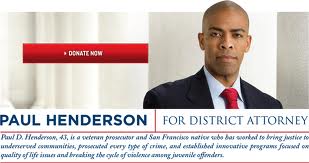
Paul Henderson doesn’t mince words when it comes to debunking the notion that Willie Brown helped him get his new job as Mayor Ed Lee’s public policy czar. Or that his decision to drop out of the D.A.’s race was in exchange for his new job.

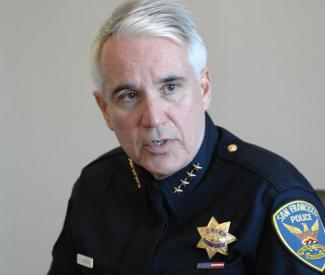
“There was no deal with Willie Brown. I called and said, so do I get a check in the mail, a basket of fruit?” Henderson said, recalling his furious reaction to Brown’s claim, made in the Chronicle in January, that Brown and then mayor Gavin Newsom conspired to make sure Henderson was “taken care of,” in the wake of Newsom’s shocking announcement that he had appointed San Francisco Police Chief George Gascón as D.A.

“If there was a set up for me somewhere, I still have not got it. I didn’t get shit,” Henderson, who joined the D.A.’s office in 1995 and was said to be former D.A. Kamala Harris’ preferred pick to fill the D.A. post, after she won the state Attorney General’s race, last fall.

Instead, Henderson, who filed papers to run in the D.A.’s race in November, saw his plans blown out of the water when Newsom, in his last act as mayor, appointed Gascón as Henderson’s new boss. And when Gascón filed papers in the D.A.’s race the very next day, Henderson found himself in the unenviable situation of holding an at-will position in the D.A.’s office, while running against his boss in the 2011 D.A. election.

“ If there was any deal, it was for me not to lose my job,” Henderson added.  “And it’s the best decision for me. I really do care about public service.”

During his 16 years in the D.A.’s office, Henderson established juvenile drug and community justice courts, set up domestic violence and hate crime programs, and focused on rehabilitative, reformative, treatment-oriented alternatives to imprisonment.

He said his decision to join the Mayor’s Office is based on a long relationship with Lee. “I want to have a voice in the criminal justice system, and I’ve known Ed Lee independent of all this political business,” Henderson said, recalling that he worked with Lee to develop language programs in the D.A.’s office, so employees could take lessons and better interact with community members, victims and witnesses in court.

“I’m a third generation San Francisco resident, and the first generation not to grow up in the projects, though we lived opposite them,” Henderson continued, recalling how his mother is a Public Defender, his grandmother was a community advocate, and he went to preschool in Sunnydale. Those experiences gave him a strong sense of being connected to and serving his community from an early age, Henderson said.

And he soon found himself holding the highest position, as a gay and black, in the D.A.’s office in the 1990s.‘I was the first African American the D.A.’s office had hired in five years,” Henderson said, recalling how the department looked in 1995. “And look at it now,” he added, noting that since he took over hiring at the D.A.’s office, more gays, lesbians, Asians, Latinos and other minorities have been employed.

“I’m very aware of who I am and what I represent in this office,” Henderson said. “For me, it’s about creating an open door and having a voice at the table. Ed Lee has asked if I would be the liaison between national, state and local agencies collectively in his office. And this expands my voice and creates opportunities for all in San Francisco in ways that are exciting to me.”

Henderson said his new post will have a very different focus from the role former US Attorney Kevin Ryan played, during his brief tenure in the Mayor’s Office, under Gavin Newsom.“This will be about policy development, advice and implementation, and it will be more reflective of marginalized communities,” Henderson said. “So, I don’t want these communities being misled into thinking, ‘oh, he got a hand out.’ This was not a hook-up. I earned my place here.”

“The truth is that you have access to me because I am in this position,” Henderson continued. “And I hope it’s transformative for the city and the community. Because I did not get shit. There is no Paul Henderson pay-off. I’d be happy to tell you if I’d sold out. But no. I knew Ed independently. He knows my heart, trusts my judgment and reputation. This has nothing to do with Willie, Gavin and Kamala. Unless it did, and they are all tricking me. In which case, they should at least tell me, so I can credit them. But the truth is, I’ve worked so hard, and if I’ve become ‘the Man,’ then I’m at the table for the community. I’m not the person who took a pay out, got a hook up, a cushy deal, so I will go away, to silence my voice.”

Henderson notes that he has not given up his political aspirations, despite all that went down recently. “If it’s not my time right now, I still have political credibility and a profile in the city that isn’t going away “ he said, noting that he raised $65,000 in 28 days, just before Christmas, with no staff, immediately after a statewide election. “That speaks to how much support I have. Obviously I was disappointed that I wasn’t appointed D.A. But I’m not dead, and I’m trying to move in a direction that expands my voice.”

Henderson says his new role won’t change him and he’ll remain accessible to gay, black, Chinese, Samoan, immigrant, low-income, Latino and other marginalized communities.“I have a lens that most city leaders don’t have,” he said, noting that he was homeless and slept in his car when he was going to law school. “Ad now I can affect policy. Many folks feel the criminal justice system happens to you, and over 80 percent of victims are people of color and poor people. But who speaks for and represents them?”

Back to the streets

2

Coronel knew an old man in Granada who said

(who often said):

“I wish I were a foreigner, so that I

Could go home

— Zero Hour, Ernesto Cardenal

I first came into contact with the work of poet Roberto Vargas a couple of years ago, when I saw his face, projected several stories tall, on a wall just off Valencia Street.

I was riding my bike to the Day of the Dead procession when I came across filmmaker Veronica Majano screening historical footage of the old Mission District on the wall of Dog Eared Books. The footage of Vargas was from a movie called Back to the Streets, and it showed a Latino hippie fest in Precita Park circa-1970. Long-haired Chicanos smoked weed and danced and played bongos on the grass while Vargas read from a stage. On today’s Valencia Street, Vargas was a ghost returned from a long-lost Mission, now standing twenty feet tall on the bookstore’s wall, reading a powerful poem that angrily denounced the SFPD for the mysterious death of a Mission Latino youth in police custody.

The film of Vargas was a beautiful snapshot of Latino youth culture in the neighborhood before gang violence and gentrification, like a Mission High School yearbook scene from an exhilarating era of Latino self-determination. In 1970, the Free Los Siete movement was feeding the community at a free breakfast program out of St. Peter’s Church on Alabama Street and had started free clinics and legal aid programs in the Mission. In the years to follow, the neighborhood would see the founding of the Mission Cultural Center and Galeria de la Raza and the inception of many of the neighborhood’s now world-famous mural projects.

Looking at the groovy scene in the park, it was hard to imagine that just a few short years later, Vargas and other kids from the Mission would be fighting alongside the Sandinistas in the jungles and mountains of Nicaragua. Yet the utopian promise of the era’s poetry, art, and youth culture in many ways culminated in the guerrilla war in which Vargas and other poets from San Francisco would fight and ultimately — in 1979 — help defeat the forces of Nicaraguan dictator Anastasio Somoza.

On Feb. 24, the day of his 70th birthday, Roberto Vargas makes a rare return to San Francisco to perform in a poetry event at the Mission Cultural Center in honor of that Nicaraguan solidarity movement of the 1970s. A video will be shown of footage from that struggle — classic scenes of Vargas and others taking over the Nicaraguan consulate in San Francisco; of the famed nightly candlelight vigils at 24th and Mission BART Plaza in support of the Sandinistas — and Vargas will be reunited on stage to read with old poet friends like Lawrence Ferlinghetti, Diane di Prima, Alejandro Murguía, and Vargas’ old compañero from San Francisco State University’s Third World Liberation Front, actor Danny Glover. The event is not open to the public. Invitations have been given out and the small MCC theater’s 150 seats have already been filled. Yet the event provides an opportunity to publicly honor Roberto Vargas’ contributions to the Mission, and to reflect on the hopes and dreams of Mission past.


POETRY AND REVOLUTIONARY VISION

Poetry was a part of Vargas’ world from the beginning. Vargas was born in Nicaragua, but came to the United States when he was a small child. In his 1980 collection of poems Nicaragua Te Canto Besos, Balas, y Sueños, he writes of “living in an offbeat alley called Natoma Street (where I always imagined a lost Mayan city existed beneath the factories).” By the late 1950s, Vargas may have been the first Mission District Latino Beat poet. “I graduated from Mission High School in 1958 and used to hang out in North Beach, going around to see all the poets,” he says. “I met Allen Ginsberg when I was just a 19-year-old kid running around in North Beach. Diane di Prima, Bob Kaufman, Ted Berrigan — all the major poets knew me when I was in my teens.”

After a stint in the U.S. Marine Corps and an attempt at a boxing career that ended with a detached retina (an injury that also helped him avoid the Vietnam-era draft), Vargas went to SF State, where he was heavily active in the student strike of 1968-69. Students walked out of campus and battled riot police while standing on picket lines for five months to demand an ethnic studies program at the university.

In the spirit of the times, Vargas and other poets — including a young Mission Chicano named Alejandro Murguía — joined the Pocho-Che Collective to publish poetry by local Latino poets. The poets went to cut sugar cane in the Venceremos Brigade in Cuba. They put out small poetry chapbooks in the Mission, full of poems that linked Che Guevara’s call for Third World revolution with the experience of the Chicano barrios of the United States in a new vision tropical. In the era after the SF State strike, the city started funding community arts projects in the ghettos. Like all classic zines, the first copies of Pocho-Che were scammed, in this case late at night at Vargas’ new job in the Mission’s Neighborhood Arts Program. In the years to come, the group would eventually publish hardbound books by Vargas, Nina Serrano, and others.

Today, Murguía is a professor in the ethnic studies program at SF State that the strikers fought to originate. He is the author of the American Book Award-winning short story collection This War Called Love (2002) and the memoir The Medicine of Memory (2002). He remembers, “The poetry scene was incipient, very young, and the readings weren’t always very formal. Sometimes they were at community events or protest rallies. But we had contact with Latin America. We knew people who had been in Chile, like Dr. Fernando Alegría.”

Alegría was a poet who had been the cultural attaché to the U.S. under Allende in Washington. Vargas recalls, “Alegría had myself and some other young poets come to Chile and spend a month or two studying with [Pablo] Neruda. But, of course, our plans were canceled by the coup in Chile.”

Murguia remembers the September 1973 coup in Chile that overthrew the popularly elected Socialist democracy of Salvador Allende caused the young poets to organize rare formal readings at Glide Memorial Church in protest. “We had several big ones there,” he says. “There was a broad range of poets — Michael McClure, Fernando Alegría, Jack Hirschman, Bob Kaufman, Janice Mirikitami all read. There was a line going down the block to get in.”

In addition to their mentor, Alegría, Vargas, and Murguía also knew one of their heroes, the Nicaraguan Marxist poet and priest, Ernesto Cardenal. Cardenal lived under the Somoza dictatorship in a sort-of internal exile in a religious artist commune called Solentiname. Vargas wanted to bring Cardenal to read in the United States, but Somoza would not allow the poet, who was critical of the Nicaraguan dictator, to travel outside the country. Vargas went to his old pal Ginsberg for help.

“Because Allen knew me when I was a kid, he helped me with my organizing for Nicaragua,” says Vargas. “Allen was part of PEN, and in 1973 or ’74 he went to the State Department with other writers to put pressure on [Anastasio] Somoza. Eventually Somoza relented and we brought Cardenal to New York for a reading.”

The poetry of Cardenal was a north star to the young Mission poets. Cardenal’s epic 1957-60 masterwork Zero Hour is perhaps the literary foundation of revolution in Nicaragua. Influenced formally by Ezra Pound, Zero Hour weaves a sprawling history of Somozan oppression and U.S. intervention in Nicaragua together with lyrical imagery of Nicaragua’s natural beauty and wildlife. The poem creates a poignant sense that Nicaraguans, unable to enjoy and own these natural riches, had under Somoza become exiles within their own country.

Of particular interest to the young Mission poets, though, was Cardenal’s Homage to the American Indians (1969), a book-length meditation on the glory of Mayan and North American native civilizations. “For us, the work of Cardenal was very important,” says Murguía. “Homage to the American Indians is a continental vision of Native Americans — everything from the San Blas Indians of Panama to the Indians of Omaha to the Indians of Mexico City and Peru.”

In Homage, Cardenal evokes a lost Indian Utopia “so democratic that archaeologists know nothing about their rulers,” where “their pyramids were built with no forced labor, the peak of their civilization did not lead to an empire, and the word wall does not exist in their language.” He writes:

But how to write anew the hieroglyph,

How to paint the jaguar anew,

How to overthrow the tyrants?

How to build our tropical acropolis anew

Cardenal’s poems of this lost glorious past were to Vargas more pointedly a vision of a Latin American utopia that can also be regained in the future. In Cardenal’s work, says Vargas, “There is a longing for the simplicity of that civilization — the creativity, the innocence, the tribalism. Can we get it back after all the dictatorships, after all that capitalism has done? Cardenal showed us what we were, what we had, what we lost.”

Under Cardenal’s influence, the Mission poets turned seeing lost Mayan cities beneath the city’s factories into a literary movement. By 1975, members of Pocho-Che had started a magazine called El Tin Tan with Murguia as editor and Vargas as contributor. El Tin Tan presented a sweeping utopian vision of a borderless invisible Latino republic united culturally and politically under the sign of the palm tree. The poets situated the capital of this world right here in the Mission District.

“To tropicalize the Mission — to see it as a tropical pueblo — was a political act of defiance and self-determination,” says Murguía. “We were saying that we put this particular neighborhood — our pueblo, in a way — not in a context of North American history but in the context of Latin American history. The history of the eastern U.S. doesn’t affect California until 1848 when the first illegal immigrants came to California — not from the South, but from the East.

El Tin Tan,” Murguía continues, “was probably the first magazine that was intercontinental in scope, a combination of politics and literature and art and different trends from the Mission to Mexico City to Argentina and everywhere in between.” He proudly recalls that it ran the first North American essays on Salvadoran poetry, and translated and printed a short story by Nelson Marra, a writer imprisoned by the Uruguayan dictatorship.

Yet for all its international perspective, El Tin Tan remained firmly rooted in the Mission. Columns by Nuyorican poet Victor Hernández Cruz and news of the assassination of Salvadoran guerrilla poet Roque Dalton ran side by side with the first comics by future Galeria de la Raza founder Rene Yáñez, all folded between wildly colorful cover art by neighborhood favorites like the famed Chicano artist Rupert Garcia and the muralist Mike Rios.

“The magazines were colorful — tropical — on the outside, but very political on the inside,” says Murguía. “That was a metaphor for our own work.”

By this time, Vargas had become an Associate Director at the SF Arts Commission. From within City Hall, he started to pump city arts money into the Mission, helping to fund projects like Mike Rios’ mural of the people holding BART on their backs at 24th and Mission BART Plaza and the Balmy Alley Mural Project — art that can still be seen in public today.

Once, Vargas commissioned a Chuy Campesano mural for the Bank of America building at 22nd and Mission. “I read a poem called “Boa” and had the crowd dancing and chanting, Es la Boa, Es la Boa,” says Vargas. “We were trying to say, ‘You made your millions off our farmers, but now you are on our turf in the Mission here in occupied Mexico. So we’ll put hieroglyphics on the walls of your bank like we used to do!’ Someone from the bank tried to take the mic from me and cops came and escorted us out.”

Vargas’s story of the mural’s dedication ceremony captures the bravado of the era. “It was a beautiful time, all of us young and thinking we were going to change the world. We wanted to change the world through culture.”

The poets organized the community to demand a neighborhood’s arts center, too. In 1977, the dream was realized when the City, with pressure from Vargas from within City Hall in the Arts Commission, purchased an old, five-floor furniture store at 24th and Mission to be made into the Mission Cultural Center. Murguia became the center’s first director.

The Mission utopia was becoming a reality for Vargas. In Nicaragua Te Canto, he wrote:

We used to drive

Our lowered down Plymouths and Chevys

On top of the breast of a mountain to

Make love and drink wine… Never

Knowing what was going to happen after

Mission High School

The Mission is now an expression of real culture, a many-faceted being … both plus and minus with the soul of a human rainbow…My people watching slides of Sandino and Nica history … White children wearing guarachas and afros trippin’ down the streets to party. Young Salvadoran poets discussing the assassination of Roque Dalton … The Mission is now an implosion/explosion of human color, of walls being painted by muralistas. There is a collective feeling of compassion for each other Nicas Blacks Chicanos Chilenos Oppressed Indios. The sense of collective survival, histories full of Somozas, Wounded Knees written on the walls.

In Zero Hour, Cardenal wrote of Nicaragua’s trees and birds and lakes, and their call to revolution, as seen from its mountains:

What’s that light way off there? Is it a star?

Its Sandino’s light shining in the black mountain


Vargas, the excited Mission kid, echoed in his work:


Tonight I am sitting on a mountain called Bernal Hill

Tonight I see the flames of America Latina spreading from here …


STRUGGLE AND VICTORY — AND STRUGGLE

Perhaps inevitably, the Latin American Utopia Vargas and company created in poetry would seem so tantalizingly close to actualization that they would be forced to pick up the gun and fight for its existence.

When the enormous earthquake of 1972 left Nicaragua’s capital, Managua, in ruins, Nicaraguan refugees flocked to SF’s Mission District. Soon, San Francisco was home to more Nicaraguans than any place on Earth outside of Nicaragua. The family of Anastasio Somoza had controlled Nicaragua with brutal repression for generations. Somoza’s embezzling of relief funds for earthquake victims led to increased revolutionary activity against his rule. Taking their name from Augusto Sandino, a Nicaraguan revolutionary who led resistance against U.S. occupation of Nicaragua in the 1930s, La Frente Sandinista de Liberacion Nacional (FSLN) — or the Sandinistas, as they were popularly known — began guerrilla activities in late 1974 by taking government officials and Somoza relatives hostage in a raid on the house of the minister of agriculture. They received a $2 million ransom and had their communiqué printed in the national newspaper. Thus was born the Sandinista revolution.

In the Mission, Vargas, Murguía, and others were in touch with La Frente, and began organizing Sandinista solidarity rallies to coordinate with La Frente’s actions in Nicaragua. Out of offices in the Mission Cultural Center, along with El Tin Tan, the poets published a newspaper called La Gaceta about the situation in Nicaragua. The paper had a circulation of 5000 copies and was available for free all over the district. The sight of pro-Sandinista rallies at 24th and BART Plaza became so common that the plaza was popularly nicknamed Plaza Sandino.

Vargas organized takeovers of the Nicaraguan consulate in San Francisco and traveled the US, speaking about Nicaragua. Yet, soon, this kind of support didn’t seem like enough. In Cardenal’s poetry, victory was inevitable. Cardenal had written that Indian time was circular, that “history became prophecy,” and that therefore the “empire will always fall.” He had also written, “The hero is reborn when he dies. And the green grass is reborn from the ashes.” In poetry, Vargas and Murguia found inspiration to go to war.

In 1976 and 1977, Mission District residents, in solidarity with the FSLN, began quietly leaving San Francisco to join up with La Frente and pick up the gun in the Sandinista Revolution. Among them were Roberto Vargas and Alejandro Murguía.

“It was very romantic,” says Murguía. “If you grew up in the time after Che’s death, when you had Che’s figure calling for “1,2,3, many Vietnams” and a lot of different armed struggles going on all over Latin America, then it would seem logical, I think, if you were kind of young and crazy, that you would want to participate in some of these situations besides just doing solidarity work or organizing rallies. Also, the coup in Chile crushed our generation’s hope for electoral change in Latin America.”

Today, Murguía tries to situate the poets’ embrace of armed struggle within the spirit of those long ago times, but one senses that Vargas would not hesitate to join a guerrilla war tomorrow morning. When I ask him how the young poets made the leap from verse to bullets, he is incredulous at the question.

“We had to fight! There was no other way!” Vargas says. “We had the historical perspective and as a people we were worthless if we let that situation stand. We had our own books out. But are we really revolutionary poets if we just sit back and collect our laurels?”

Murguía compares the Sandinista war with the Spanish Civil War, when there were many international brigades in which writers had been involved. He suggests the poets went to war because they were poets. “If you knew the situation intimately in Nicaragua and you were reading Cardenal’s poems,” he says, “it was easy to see the connection between poets and political necessity.”

Vargas began organizing small, tight-knit cadres for battle in Nicaragua, recruiting his Sandinista guerrillas right off of the streets of the Mission. “I was secretive and I found them one by one,” he explains. “We were very clandestine and very compartmentalized. We never had more than a dozen people in our committee at once.”

Men who were menial laborers in San Francisco would one day be among the most respected heroes of the Nicaraguan Revolution. “When I recruited Chombo [Walter Ferretti], he was a cook at the Hyatt Regency,” says Vargas. “Later, Chombo would become a head of national security in Nicaragua. Another recruit was a former pilot, so I went to talk to him where he pumped gas at 21st and South Van Ness. That was Commandante Raúl Venerio. After the triumph of 1979, he would become the Chief of the Nicaraguan Air Force.”

When in San Francisco, Venerio later served as the editor of La Gaceta. In Nicaragua, the former gas station attendant became a real hero. “They got an airplane and attacked the National Palace,” says Vargas, laughing. “They hit it and split, and got away — real Mission boys!”

Before heading off to join La Frente, Vargas’ recruits would undergo a regimen of training and political education, an informal boot camp largely hidden in plain sight in the Bay Area.

“It was primitive,” remembers Murguía. “We didn’t really have someone with a military background to train us. We got just guns at pawn shops on Mission Street and practiced shooting at the firing range in Sharp Park down in Pacifica. We worked out with a friend who was a black belt in karate.”

Murguía says the most difficult part of training was the daily pre-dawn run of five laps around Bernal Hill. “We would run up the hill counter-clockwise — because that way is more difficult,” he says, “and we would wear these combat boots we bought at Leed’s Shoes on Mission.”

Besides being a part of physical conditioning, the run was a litmus test of the recruits’ commitment. “Doing activity like that is almost impossible if you’re not really psychologically into it,” says Murguía. “Try running five times around Bernal Hill! You start wondering after your third lap, ‘Goddamn! Why am I doing this?‘ Especially when no one is forcing you to do it!”

When I ask if the daily jog of 10 or 12 Latino men in combat boots on the hill at sunrise did not attract any, uh, attention, Murguía shrugs. “There were less people on the hill in those days,” he says. He recalls that the Mission cadres trained in complete anonymity: “We got money to rent planes and we took turns learning to fly the planes around the Bay Area. Nobody suspected anything because nobody knew anything about Nicaragua then.”

When I try to imagine a phalanx of Sandinistas at dawn on today’s Bernal Hill, surrounded by a crowd of early morning dog walkers, I can’t help but laugh. But the cadre’s training was deadly serious, and Murguía says its value was far more than psychological. “What I discovered when I went to the Southern Front was that our San Francisco cadres were some of the most advanced in the war,” he explains. “We understood the political situation and the tactic of insurrection and we had a minimum of physical conditioning. But some of these other cats, man! They literally just walked in off the street!”

For a time, Murguía remained the director of the Mission Cultural Center, while making regular trips to fight in Nicaragua. In 1977, Vargas resigned from the Arts Commission and went to battle for six or seven months. He and Murguía would spend the next couple of years rotating back and forth from the war front in Nicaragua to their solidarity work in the Mission. Murguía describes his entry into Nicaragua, his stay in various guerrilla safe houses in Costa Rica, and his experiences in the war in his 1991 American Book Award-winning fictionalized memoir, Southern Front.

Though Murguía says the actual military war on the ground was largely a stalemate between the Sandinistas and the Somozas’ National Guard, the Sandinistas were at last able to triumph through international pressure, strategic military victories, and a general strike. Somoza fled in July of 1979, and the Sandinistas entered Managua victorious on July 19 of the same year. Cardenal’s poem “Lights” describes the city as seen from a plane that brought the elder poet into a Managua free from the Somoza family’s rule for the first time in 43 years. In Managua, street graffiti declared, El triunfo de la revolución el triunfo de la poesía.

Vargas and Murguía, however, did not enter Managua with the victorious army. The Southern Front did not go to Managua, and Vargas had recently been sent back to the U.S., to coordinate a simultaneous take over of the Nicaraguan consulates in major U.S. cities from coast to coast to coincide with the victory in Managua.

Vargas’ work for Nicaragua did not end with victory. The Mission High kid now found himself serving in the new revolutionary government as cultural attaché to the United States. “I was jailed in the takeover of the DC consulate,” Vargas says, laughing, “but then I came back several months later to serve there!”

The voluble poet grows uncharacteristically silent when I ask him what it felt like to actually win the war.

“To win?,” he asks, pronouncing the word as if he was hearing it for the very first time. “Well … it’s like taking off a huge load, man. Like taking mountains off your back.” He is silent for a bit and then adds, “But what do you win? You win the right to continue the struggle.”

“To win was to reach the objective of getting rid of the Somoza family once and for all,” Vargas says. “But it was not really a win/lose situation.” Indeed, the Sandinistas inherited a country in ruins and in debt, with an estimated 50,000 war dead, and 600,000 homeless. Nicaragua’s left-wing powers would become an obsession for the Reagan Administration, who for the next ten years offered heavy financial assistance and training to the Contras, a coalition of pro-Somoza and anti-Sandinista guerrillas who fought to overthrow the revolutionary government. The U.S. strangled Nicaragua’s economy with a trade embargo like it employed against Cuba. In reality, for the Sandinistas, the war literally never ended.

“Somoza bombed everything in Nicaragua before he left the country. Reagan was spending — what? — $100 million a year annually against us at that time?” says Vargas. “They spent so much for a decade to destroy our little country.”

Nonetheless, poetry remained in the forefront of the Nicaraguan revolution. Cardenal was named Ministry of Culture, and he instituted poetry workshops across Nicaragua as part of a highly successful literacy campaign that raised literacy from just 12 percent to over 50 percent in the first 6 months of the revolutionary government. Soon, poetry was being written and taught in the tiniest villages and in the fields.

“We tried,” Vargas says bluntly. “We were doing very important land reform, incredible stuff for the economy. But it was dangerous to be a good example. We had the potential, but we had to hold off this enormous power [of the U.S.] for decades. Ultimately, we had to step back so they would not destroy Nicaragua.”

In 1990, Nicaraguan voters, weary of war and economic misery, chose to elect FSLN President Daniel Ortega’s U.S.-backed opponent, Violetta Chamorro, in the presidential election. “We lost the elections,” says Vargas. “But we had to allow them to demonstrate that we were not like Cuba or other revolutions. We lost beautiful young men and women to get that liberty.”

I ask Vargas to consider the successes and failures of the Nicaraguan revolution. He pauses and then seemingly changes the subject, excitedly telling me of the time he brought Ginsberg to meet the Sandinista soldiers. “Ginsberg was fascinated by the Sandinistas,” says Vargas. “And he wanted to see what he had been supporting on my behalf all these years. So I took him to the fighting along the Honduras border in 1984, during the Contra war.”

When Ginsberg went to the war zone, he brought not a rifle but a concertina. “I took him to meet these young soldiers in a trench. They see Allen with the concertina and they were like, ‘Who the hell is this guy?’ I told them he was a very famous poet. At once, they all started taking bits of paper out of their pockets that they had written poems on and started reading them to Allen. So there we are, with these soldiers in the trench with their rifles reading poetry, and Allen just wailing away on this concertina!”

I think of the strange road from Cardenal’s vision of lost Mayan cities to Vargas’ dreams of a Bernal Hill utopia to Ginsberg listening to soldiers’ poetry in a Nicaraguan trench, and I see that Vargas has answered my question with his own, the question asked by revolutionary poetry.


LOST CITIES, AND NEW ONES

The lost moment with Ginsberg in the trenches is like a missing chapter out of Roberto Bolaño’s Savage Detectives. Indeed Vargas’ story in many ways embodies that of Bolaño’s exile poet generation, of which he wrote, “They dreamed of a Latin American paradise and died in a Latin American hell.” Except for one crucial difference: Vargas is very much alive and still fighting.

Today, Vargas still puts in a tireless 50-hour work week as a labor organizer for the American Federation of Teachers in San Antonio, TX. During our conversation, he excitedly tells me of an action he is organizing for next month, a march of teachers on the Texas capital to protest budget cuts to education. “I camp out in the teacher’s lounge and talk to them when they are on break,” he says. “I signed up 50 new members last week!”

As he nears 70, the poet shows no signs of slowing down. “I can’t afford to!” he says. “My youngest son is only 17. When I get finished putting him through college, then maybe I can take a break.”

But work seems like more than necessity to Vargas; political struggle is the central theme of his life’s work. “Work, work, work, Erick,” he tells me. “That is what we have to do. I could go back and forth about what went wrong in Nicaragua, but there is more work to do and I have to stay positive. It is all part of the process.”

When Vargas comes back to the Mission Cultural Center this week, he will literally return, full circle, to a building he helped build. “We had no money to hire laborers, so we’d be there with our kids every weekend, building the place,” he remembers.

One of those kids was Vargas’ son, Mission poet Ariel Vargas, who will read in public with his father for the first time this week. “Cardenal baptized him when Ernesto came to bless the new Mission Cultural Center in 1977,” Vargas says. “He had offered to baptize any children who also might be there. In the end, there was a line of families around the block on 24th Street who had brought their children for Ernesto Cardenal to baptize. Ariel had already been there every weekend on his hands and knees sanding those huge gymnasium-like floors with us. The Mission Cultural Center is still there and that is our monument.” As he discusses the Mission, Vargas forgets the problems of the Nicaraguan revolution and begins talking nonstop again at last. He comes back to the stories that started our conversation. “You know, I lived at 110 Mullen on Bernal Hill,” he says, his excitement gathering. “Mike Rios was my neighbor. Rene Yáñez lived on the block. So it was all happening right there! Carlos Santana lived down the block at around 180 Mullen or something. We used to hear him and his band jamming all the time. The Arts Commission had a stage truck and I’d take it out to Precita Park and put the stage down for Carlos to play on.” I think of Cardenal’s vision of the repeating cycle of time, the promise that the empire will always fall and the hero will always be reborn. Much in the Mission has changed. But Vargas, the old poet, still looks out from Bernal Hill today and sees lost cities beneath the surface.


Early indicators

13

Land use politics and the way development decisions are made at City Hall fed San Francisco’s ascendant progressive movement over the last decade. So in the wake of a still-unfolding political realignment, an early key vote is making some preservationists and developer foes nervous.

At the center of that concern is Sup. Jane Kim, who broke with her progressive colleagues Jan. 25 to be the swing vote in the board’s 6-5 approval of attorney Richard Johns to the historian’s seat on the Historic Preservation Commission. Progressives and preservationists opposed the nomination on the grounds that Johns isn’t a historian and that he has close ties to former Mayor Willie Brown, a friend of developers whose longtime chief of staff was Johns’ wife, Eleanor.

And they’re suspicious of Brown’s support – both overt and stealthy – for Kim’s supervisorial campaign (see “Willie Brown and the accusations of machine politics in D6,” 10/16/10, Guardian Politics blog).

Kim didn’t explain her vote at the full board meeting, and her comments at the Rules Committee (which she chairs) and to the Guardian that Johns “was qualified” and she could “see no reason not to support his nomination” irked many of her progressive supporters who consider development the big issue.

Feeding concerns about the potential blunting of historic preservation and other tools used to scrutinize development projects was the Jan. 25 announcement by Sup. Scott Wiener that he is calling for hearings into whether the commission is improperly hindering development and other policy priorities.

“The Historic Preservation Commission — and I supported the creation of the Historic Preservation Commission — has become an increasingly powerful commission reaching into a lot of different areas of policy in the city,” Wiener said during the discussion of Johns’ nomination, citing housing, parks, and libraries as areas the commission has affected. “It’s important to have a diversity of backgrounds and viewpoints on this commission, and if we’re going to have a committee made up exclusively of advocates for historic preservation, only advocates, that is a problem.”

Former board President Aaron Peskin, who led the effort to create the commission through the voter-approved Proposition J in 2008, disputes the allegation that the commission has become too powerful, as well as the claim that Johns is qualified to serve in the historian’s seat, one of six seats on the commission that now requires professional qualifications.

“The facts do not support Sup. Wiener’s allegations,” Peskin told us, noting that the Board of Supervisors and the mayor retain the authority to decide what is and isn’t historically significant. Yet Wiener said that even commission- and staff-level actions affect other city goals. “The conducting of a survey does have legal impact,” Wiener told us.

But Peskin said San Francisco has very few protected buildings compared with other major U.S. cities, something voters sought to change through Prop. J, and Peskin said he was disappointed that Kim didn’t support the law’s dictates. “This is the second time in 2011 when the slim alleged progressive majority has not stayed together,” he said, referring also to the election of David Chiu as board president.

Peskin and others who fight land-use battles say they don’t yet want to jump to the conclusion that developers might have an easier time with this board. “It’s my profound hope is that this is a learning experience,” Peskin said of Kim’s vote.

Veteran land use attorney Sue Hestor noted that neither Kim nor Wiener has a record on land use issues by which to judge them and she didn’t want to make a big deal of their Jan. 25 actions. Yet she said that development is a huge issue in the Tenderloin, SoMa, and Rincon Hill areas that Kim represents, so there are major tests of her progressive values coming soon.

“In District 6, it’s the defining issue because it’s the most explosive district in terms of growth,” Hestor said. “Land use is about who gets to live in the city.”


WHOSE CITY?

While most of the discussion about the Johns nomination focused on his qualifications as a historian — indeed, that was the basis of most of the opposition to his nomination, by both activists and progressive supervisors — there was some telling subtext focused on Hestor’s point that land use is the most fundamental progressive issue.

At the Jan. 20 Rules Committee meeting, Kim even asked Johns about his “vision for affordable housing as it related to preservation.” But the answer she received wasn’t terribly reassuring to those who see the lack of affordable housing for low-income city residents as a serious problem that the city is failing to address (see “Dollars or sense?” 9/29/10).

“San Francisco is made up of lots of different groups of people with lots of different backgrounds,” Johns said at the hearing, noting that it is important to “preserve the culture and the past that have brought us to where we are. But part of that past is the ability to grow.”

In an interview with the Guardian, Johns expanded on the point, sounding a more pro-growth point-of-view than many of his colleagues on the commission are likely to share. “Development and preservation can go hand-in-hand,” Johns said. “Maybe it’s the development that allows what might be a slowly deteriorating building to be fixed up properly.”

As an example, he cited his 20 years of work on preserving the Old Mint Building — his main claim to expertise as a historian — which was ultimately accomplished as part of the development project that included office and commercial development and the Mint Plaza public space.

“People of all income levels have a right to live in San Francisco,” Johns said, adding, “The real need some people would say is the need for middle class housing.” When we noted that it’s often the low-income residents who are ousted when old buildings get modernized, he said, “You have to think about the desirability of people to live in crummy housing.”

Chiu and Kim both downplayed the importance of the Johns vote. “People are trying to read too much into this,” Chiu said, explaining that he opposed the nomination because he simply felt Johns didn’t meet the criteria as a historian. “What was relevant is what city law says.”

Kim told us that it wasn’t until the full board meeting that she learned how her progressive colleagues felt about the matter, and that she didn’t want to change how she voted in committee. “It was not important enough for me to change my vote based on my verbal commitments,” Kim said later.

Yet on the evening of the vote, Kim told the Guardian that she felt “pressure” to support Johns, although she wouldn’t say from whom. “I was put in a bad position on this issue,” she said. Many progressives have speculated that pressure came from Brown, which Kim denies. “We didn’t talk about this, not once,” she said.

But in his Jan. 30 column in the San Francisco Chronicle, Brown crowed about the victory by “my friend Richard Johns” and called Chiu’s opposition to him “a mistake that could haunt him for some time,” saying Chiu has set up Sups. Malia Cohen and Kim “to be the swing votes on every issue where moderates and progressives split.”

Rebecca Bowe contributed to this report.

Ting’s “knee-jerk car populism”

31

By Asaf Shalev

Assessor-Recorder Phil Ting’s campaign for mayor is trying to rile up San Francisco’s car drivers with a new petition called “San Francisco Parking Ticket Overload,” but it seems to be misrepresenting the situation to score election season points.

In the recent email launching the petition, Ting provoked drivers to help “tear up the unfair ticket plan” in order to prevent “turning the whole city into a ‘parking trap.’” Ting said he opposes the MTA’s plan to jack up the enforcement of parking restriction by dolling out more tickets, which was reported in C.W. Nevius’s column. But Ting’s email also made it sound as if parking fines were going up and the MTA was launching a new initiative targeting drivers.

MTA spokesperson Kristin Holland told us that it isn’t true the agency has any intention to increase the cost of parking fines. In response, Ting spokesperson Eric Jaye (who ran Gavin Newsom’s two mayoral campaign) told us, “We are taking [the MTA] at their word and we are very happy to hear that,” insisting the campaign honestly thought that rates were going up.

Tom Radulovich, a transportation policy expert who founded Livable City, called Ting’s messaging and the stance behind it “knee-jerk car populism” and a “saber-rattling election stunt.” He said Ting’s campaign is playing to the fears of drivers who are the more privileged commuters of the city, with most studies showing motorists don’t pay the full costs of their impact to society.

“Even if [Ting’s claim] was true, the premise that motorists have an undue burden is untrue,” Radulovich said. Even with increased enforcement, drivers can still avoid fines by obeying the laws whereas all Muni passengers have had to bear the brunt of higher fares, which doubled under Newsom’s tenure. “I’d like to see someone saying how transit passengers have an unfair deal,” Radulovich said.

Jaye takes a different tone than some of the campaign missives. According to Jaye, what Ting opposes is that the increase in tickets is not the result of policy or enforcement considerations but specifically meant to increase revenue for the city. “We are just trying to pursue a revenue generating policy that is a little more progressive,” Jaye said. Guardian Executive Editor Tim Redmond also recently made the point that parking tickets were meant primarily to keep cars flowing in urban areas and not as a revenue source, but he also noted that motorists don’t pay for their impacts and should pay far higher car taxes.

But Radulovich’s question is left unanswered: “Are any of the candidates going to talk about the plight of transit passengers?”

SF’s new political era

31

news@sfbg.com

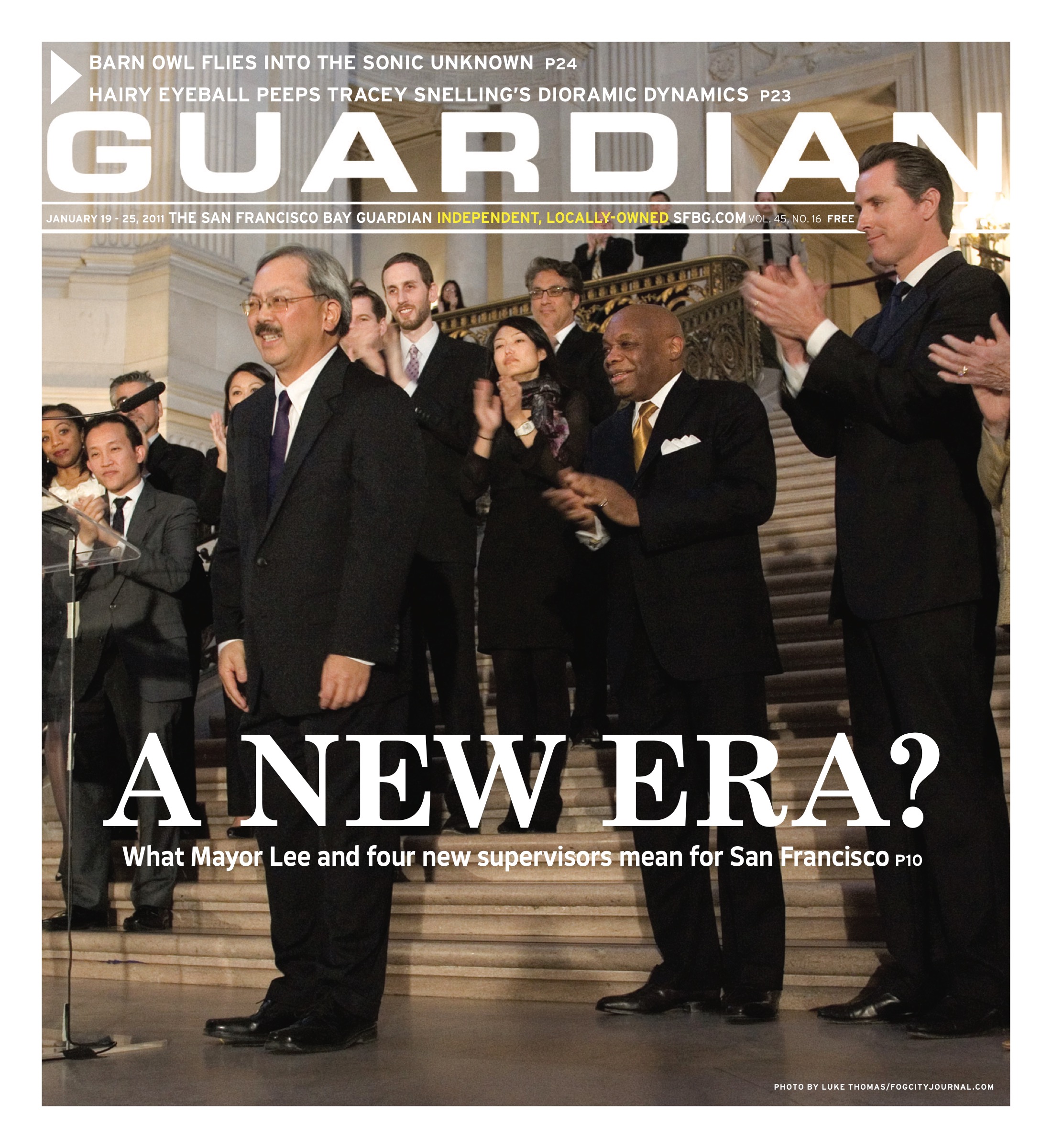
You can argue about what the word “progressive” means, and you can argue about the process and the politics that put Ed Lee in the Mayor’s Office. And you can talk forever about which group or faction has how much of a majority on the San Francisco Board of Supervisors, but you have to admit: this city has just undergone a significant political realignment.

Some of that was inevitable. The last members of the class of 2000, the supervisors who were elected in a rebellion against the sleaze, corruption, and runaway development policies of the Willie Brown administration, have left office. Gavin Newsom, the mayor who was often at war with the board and who encouraged a spirit of rancor and partisanship, is finally off to Sacramento. For the first time since 1978, the supervisors will be working with a mayor they chose themselves.

For much of the past 15 years, progressive politics was as much about stopping bad things — preventing Brown and then Newsom from wrecking the city — as it was about promoting good things. But the “politics of anti,” as San Francisco State political scientist Rich DeLeon describes is, wasn’t a central theme in the November elections, and this generation of supervisors comes into office with a different agenda.

Besides, one of the clear divisions on the board the past seven years was the Newsom allies against the progressives — something that dissipated instantly when Lee took over.

But the realignment goes deeper.

Until recently, the progressives on the board had a working majority — a caucus, so to speak — and they tended to vote together much of the time. The lines on the board were drawn almost entirely by what Newsom disparagingly calls ideology but could more accurately be described as a shared set of political values, a shared urban agenda.

There are still six supervisors who call themselves progressives, but the idea that they’ll stick together was shattered in the battle over a new mayor — and the notion that there’s anything like a progressive caucus died with Board President David Chiu’s election (his majority came in part from the conservative side, with three progressives opposing him) and with Chiu’s new committee assignments, which for the first time in a decade put control of key assignments in the hands of the fiscal conservatives.


A PROGRESSIVE MAJORITY?

The progressive bloc on the board was never monolithic. There were always disagreements and fractures. And, thanks to the Brown Act, the progressives don’t actually meet outside of the formal board sessions. But it was fair and accurate to say that, most of the time, the six members of the board majority functioned almost as a political party, working together on issues and counting on each other for key votes. There was, for example, a dispute two years ago over the board presidency — but in the end, Chiu was elected with exactly six votes, all from the progressive majority that came together in the end.

That all started to fall apart the minute the board was faced with the prospect of choosing a new mayor. For one thing, the progressives couldn’t agree on a strategy — should they look for someone who would seek reelection in November, or try to find an acceptable interim mayor? The rules that barred supervisors from voting for themselves made it more tricky; six votes were not enough to elect any of the existing members. And, not surprisingly, some of the progressives had mayoral ambitions themselves.

When state Assemblymember Tom Ammiano — who would have had six votes easily — took himself out of the running, there was no other obvious progressive candidate. And with no other obvious candidate, and little opportunity for open discussion, the progressives couldn’t come to an agreement.

But by the Jan. 4 board meeting, five of the six had coalesced around Sheriff Mike Hennessey. Chiu, however, was supporting Ed Lee, someone he had known and worked with in the Asian community and whom he considered a progressive candidate. And once it became clear that Lee was headed toward victory, Sup. Eric Mar announced that he, too, would be in Lee’s camp.

A few days later, when the new board convened to choose a president, the progressive solidarity was gone. Sups. David Campos, John Avalos, and Ross Mirkarimi, now the solid left wing of the board, voted for Avalos. Chiu won with the support of Mar, Sup. Jane Kim, and the moderate-to-conservative flank.

Now the Budget Committee — long controlled by a progressive chair and a progressive majority — will be led by Carmen Chu, who is among the most fiscally conservative board members. The Land Use and Development Committee will be chaired by Mar, but two of the three members are from the moderate side. Same goes for Rules, where Sup. Sean Elsbernd, for years the most conservative board member, will work with ideological ally Sup. Mark Farrell on confirming mayoral appointments, redrawing supervisorial districts, and promoting or blocking charter amendments as Kim, the chair, does her best to contain the damage.

You can argue that having independent-minded supervisors who don’t vote as a caucus is a good thing. You can also argue that a fractured left will never win against a united downtown. And both arguments have merit.

But you can’t argue any more that the board has the same sort of progressive majority it’s had for the past 10 years. That’s over. It’s a new — and different — political era.

What happens now? Will the progressives hold enough votes to have an influence on the city budget (and ensure that the deficit solutions include new revenue and not just cuts)? What legislative priorities will the supervisors be pushing in the next year? How will the votes shake out on difficult new proposals (and ongoing issues like community choice aggregation)?

Mayor Lee has pledged to work with the board and will show up for monthly questions. How will he respond to the sorts of progressive legislation — like tenant protections, transit-first policies, immigrant rights measures, and stronger affordable housing standards — that Newsom routinely vetoed?

How will this all play out in a year when the city will also be electing a new mayor?


IDENTITY POLITICS?

When Sups. Chiu, Mar, and Kim broke with their three progressive colleagues to support Chiu for board president — just as Chiu and Mar helped clear the path for Ed Lee to become mayor days earlier — it seemed to many political observers that identity had trumped ideology on the board. There’s some truth to that observation, but it’s too simple an explanation. There’s also the fact that Chiu strongly supported Kim, who is a personal friend and former roommate, in her election, so it’s no surprise she went with him for board president.

And the phrase itself is so laden with baggage and problems that it’s hard to talk about. It has come to signify a wide range of political activity and theorizing founded in the shared experiences of injustice of members of certain social groups. “Rather than organizing solely around belief systems, programmatic manifestoes, or party affiliation, identity political formations typically aim to secure the political freedom of a specific constituency marginalized within its larger context,” says the Stanford Encyclopedia of Philosophy, an ongoing research project by the students and faculty at Stanford University.

Although the notion of identity politics took hold during the social movements of the 1960s and ’70s — when liberation and organizing movements among women and various ethic and other identity groups fed a larger liberal democratic surge that targeted war, economic inequity, social injustice, and other issues — it’s also a political approach that has divided the populace.

“One of the central charges against identity politics by liberals, among others, has been its alleged reliance on notions of sameness to justify political mobilization,” says the Stanford Encyclopedia. “Looking for people who are like you rather than who share your political values as allies runs the risk of sidelining critical political analysis of complex social locations and ghettoizing members of social groups as the only persons capable of making or understanding claims to justice.”

Mar explains that the reality of identity politics and whether it’s a factor in the current politics at City Hall is far more complex.

“With me, David Chiu, and Jane Kim as a block of three progressive Asians — and I still define David Chiu as a progressive though I think some are questioning that — we all come out of what I would call a pro-housing justice, transit-first, and environmental sustainability [mindset],” Mar told us. “But I think because of our ethnic background and experiences, we may have different perspectives at times than other progressives.”

For example, Mar said, many working class families of color need to drive a car so they’ll differ from progressives who want to limit parking spaces to discourage driving. He also has reservations about the proposed congestion pricing fee and how it might affect low-income drivers.\

“I think often when progressive people of color come into office — Jane Kim might be one of the best examples — that sometimes there’s an assumption that her issues are going to be the same as a white progressive or a Latino progressive,” he said. “But I think kind of the different identities that we all have mean that we’re more complex.”

Campos, a Latino immigrant who is openly gay, noted that “as a progressive person of color, I have at times felt that the progressive movement didn’t recognize the importance of identity politics and what it means for me to have another person of color in power.”

But, he added, “I don’t think identity politics alone should guide what happens. A progressive agenda isn’t just about race but class, sexual orientation, and other things. It’s not enough to say that identity politics justifies everything.”

University of San Francisco political science professor Corey Cook told the Guardian that identity has always been a strong factor in San Francisco politics, even if it was overshadowed by the political realignment around progressive ideology that occurred in 2000, mostly as a reaction to an economic agenda based on rapid development and political cronyism.

“I’m not sure that identity wasn’t relevant, but it was swamped by ideology,” Cook told the Guardian. Now, he said, another political realignment seems to be occurring, one that downplays ideology compared to the position it has held for the last 10 years. “I’m not sure that ideology is dead. But the dynamics have definitely changed.”

Cook sees what may be a more important change reflected in Chiu’s decision to put the political moderates in control of key board committees. But he said that shift was probably inevitable given the difficulties of unifying the diverse progressive constituencies.

“It’s hard to hold a progressive coalition together, and it’s amazing that it has lasted this long,” he said.

There’s another kind of identity politics at play as well — that of native San Franciscans, who often express resentment at progressive newcomers talking about what kind of city this is, versus those who see San Francisco as a city of immigrants and ideas, a place being shaped by a wider constituency than the old-timers like to acknowledge.

“I’m honored to join Sups. Elsbernd and Cohen in representing the neighborhoods they grew up in,” Sup. Mark Farrell said during his opening remarks after being sworn in Jan. 8., sobbing when he thanked his parents for their support.

As he continued, he fed the criticism of the notion of ideology-based politics that has been a popular trope with Gavin Newsom and other fiscal conservatives in recent years, telling the crowd he wanted “to turn City Hall into a place based on issues and ideas, not ideology.”

Cohen also placed more importance on her birthright than on her political philosophy, telling stories about entering board chambers through the back door at age 16 when she was part of a youth program created by then-Mayor Frank Jordan, and with former Mayor Dianne Feinstein coming to speak at Cohen’s third-grade class. “I am a San Francisco native, and that is a responsibility I take seriously,” said Cohen, who graduated from the Emerge Program, which grooms women for political office,

“We will have another woman as president of the Board of Supervisors, and we will have a woman as mayor of San Francisco,” she added. And as the sole African American on the board, she also pledged, “I will be working to add more members of the African American community to the elected family of San Francisco.”

But what issues she plans to focus on and what values she’ll represent were unclear in her comments — as they were throughout her campaign, despite the efforts of journalists and activists to discern her political philosophy. In her public comments, her only stated goal was to build bridges between the community and City Hall and let decisions be guided by the people “not political ideologies.”

Oftentimes in recent San Francisco history, identity and ideology have worked in concert, as they did with former Sup. Harvey Milk, who broke barriers as the first openly gay elected official, but who also championed a broad progressive agenda that included tenants rights, protecting civil liberties, and creating more parks and public spaces.

Sup. Scott Wiener, shortly after being sworn into office, acknowledged the legacy of his district, which was once represented by Milk and fellow gay progressive leader Harry Britt, telling the crowd: “I’m keenly aware of the leadership that has come through this district and I have huge shoes to fill.”

Yet Wiener, a moderate, comes from a different ideological camp than Milk and Britt and he echoed the board’s new mantra of collaboration and compromise. “I will always try to find common ground. There is always common ground,” he said.


GETTING THINGS DONE?

Chiu is making a clear effort to break with the past, and has been critical of some progressive leaders. “I think it’s important that we do not have a small group of progressive leaders who are dictating to the rest of the progressive community what is progressive,” he said.

While he didn’t single out former Sup. Chris Daly by name, he does seem to be trying to repudiate Daly’s leadership style. “I think that while the progressive left and the progressive community leaders have had very significant accomplishments over the past 10 years, I do think that there are many times when our oppositional tactics have set us back.”

When Chiu was reelected board president, he told the crowd that “none of us were voted into office to take positions. We were voted into office to get things done.”

Some progressives were not at all happy with that comment. “I thought that was a terrible thing to say,” Avalos told the Guardian, arguing the positions that elected officials take shape the legislation that follows. As an example, he cited the positions that progressive members of Congress took in favor of the public option during the health care reform debate.

Talking about getting things done is “a sanctimonious talking point that fits well with what the Chronicle and big papers want to hear,” Avalos said. He said the Chronicle and other downtown interests are more interested in preserving the status quo and blocking progressive reforms. “It’s what they want to see not get done.”

Campos even challenged the comment publicly during the Jan. 11 board meeting when he said, “It’s important to get things done, but I don’t think getting things done is enough. We have to ask ourselves: what is it that we’re getting done? How is it that we’re getting things done? And for whom is it that we’re doing what we’re doing? Is it for the people, or the downtown corporate interests? I hope it’s not getting things done behind closed doors.”

Chiu said that, for him, getting things done is about expanding the progressive movement and consolidating its recent gains. “I think we all share a political goal. As progressives, we all share a political goal of getting things done and growing mainstream support for our shared progressive principles so that they really become the values of our entire city.”

To do that, he said, progressives are going to need to be more conciliatory and cooperative than they’ve been in the past. “I think it’s easy to slip into a more oppositional way of discussing progressive values, but I’m really pushing to move beyond that.”

The biggest single issue this spring will be the budget — and it’s hard to know exactly where the board president will draw his lines. “I have spoken to Mayor Lee about the need for open, transparent, and community-based budget processes and he’s open to that,” Chiu told us — and that alone would be a huge change. But the key progressive priority for the spring will be finding ways to avoid brutal budget cuts — and that means looking for new revenue.

When asked whether new general revenue will be a part of the budget solution, instead of Newsom’s Republican-style cuts-only approaches, Chiu was cautious. “I am open to considering revenues as part of the overall set of solutions to close the budget deficit,” he said. “I am willing to be one elected here that will try to make that argument.” But with his political clout and connections right now, he can do a lot more than be one person making an argument.

Chiu has always been open to new revenue solutions and even led the way in challenging the cuts-only approach to both the city budget and MTA budget two years in a row, only to back down in the end and cut a deal with Newsom. When asked whether things will be better this year given his closer relationship to Lee, Chiu replied, “I think things are going to be different in the coming months.”

During the board’s Jan. 7 deliberation on Lee, Sup. Eric Mar also said that based on his communications with Lee, Mar believed that the Mayor’s Office is open to supporting new revenue measures. He echoed the point later to us.

In addition to supporting the open, inclusive budget process, Mar called for “a humane budget that protects the safety net and services to the most vulnerable people in San Francisco is kind of the critical, top priority.

“I think it’s going to be difficult working with the different forces in the budget process,” he added. “That’s why I wish it could have been a progressive who was chairing the budget process.”

Mar said progressive activism on the budget process is needed now more than ever. “The Budget Justice Coalition from last year I think has to be reenergized so that so many groups are not competing for their own piece of the pie, but that it’s more of a for-all, share-the-pain budget with as many people communicating from outside as possible, putting the pressure on the mayor and the board to make sure that the critical safety net’s protected.”


CUTS WILL BE CENTER STAGE

But major cuts — and the issue of city employees pay and benefits — will also be center stage.

At the board’s Jan. 11 meeting, before the supervisors voted unanimously to nominate Lee as interim mayor, Sup. Elsbernd signaled that city workers’ retirement and health benefits will once again be at the center of the fight to balance the budget.

Elsbernd noted that in past years he was accused of exaggerating the negative impacts that city employees’ benefits have on the city’s budget. “But rather than being inflated, they were deflated,” Elsbernd said, noting that benefits will soon consume 18.14 percent of payroll and will account for 26 percent in three years.

“Does the budget deficit include this amount?” he asked.

And at the after-party that followed Lee’s swearing-in, Public Defender Jeff Adachi, who caused a furor last fall when he launched the ill-considered Measure B, which sought to reform workers’ benefits packages, told us he is not one to give up lightly.

“We learned a lot from that,” Adachi said. “This is still the huge elephant in City Hall. The city’s pension liability just went up another 1 percent, which is another $30 million”

Chu agreed that worker benefits would be a central part of the budget-balancing debate. “Any conversation about the long-term future of San Francisco’s budget has to look at the reality of where the bulk of our spending is,” she said.

Avalos noted that he plans to talk to labor and community based organizations about ways to increase city revenue. “I’m going to work behind the scene on the budget to make sure the communities are well-spoken for,” Avalos said, later adding, “But it’s hard, given that we need a two-thirds majority to pass stuff on the ballot.”

Last year, Avalos helped put two measures on the ballot to increase revenue: Prop. J, which sought to close loopholes in the city’s current hotel tax and asked visitors to pay a slightly higher hotel tax (about $3 a night) for three years, and Prop. N, the real property transfer tax that slightly increased the tax charged by the city on the sale of property worth more than $5 million.

Prop. N should raise $45 million, Avalos said. “I’ve always had my sights set on raising revenue, but making cuts is inevitable.”


THE IDEOLOGY ARGUMENT

Newsom and his allies loved to use “ideology” as a term of disparagement, a way to paint progressives as crazies driven by some sort of Commie-plot secret agenda. But there’s nothing wrong with ideology; Newsom’s fiscal conservative stance and his vow not to raise taxes were ideologies, too. The moderate positions some of the more centrist board members take stem from a basic ideology. Wiener, for example, told us that he thinks that in tough economic times, local government should do less but do it better. That’s a clear, consistent ideology.

For much of the past decade, the defining characteristic of the progressives on the board has been a loosely shared urban ideology supported by tenants, immigrant-rights groups, queer and labor activists, environmentalists, preservationists, supporters of public power and sunshine and foes of big corporate consolidation and economic power. Diversity and inclusiveness was part of that ideology, but it went beyond any one political interest or identity group.

It was often about fighting — against corruption and big-business hegemony and for economic and social equality. The progressive agenda started from the position that city government under Brown and Newsom had been going in the wrong direction and that substantive change was necessary. And sometimes, up against powerful mayors and their well-heeled backers, being polite and accommodating and seeking common ground didn’t work.

As outgoing Sup. Daly put it at his final meeting: “I’ve seen go-along to get along. If you want to do more than that, if you think there’s a fundamental problem with the way things are in this world, then go-along to get along doesn’t do it.” When Chiu announced that the new progressive politics is one of pragmatism, he was making a break from that ideology. He was signaling a different kind of politics. He has urged us to be optimistic about the new year — but we still don’t know what the new agenda will look like, how it will be defined, or at what point Chiu and his allies will say they’ve compromised and reached out enough and are ready to take a strong, even oppositional, stand. We do know the outcome will affect the lives of a lot of San Franciscans. And when the budget decisions start rolling down the pike, the political lines will be drawn fairly clearly. Because reaching across the aisle and working together sounds great in theory — but in practice, there is nothing even resembling a consensus on the board about how the city’s most serious problems should be resolved. And there are some ugly battles ahead.

They have issues: Members of the new Board speak

20

Board President David Chiu touched off a broad political discussion in recent weeks with his statement that officials were elected “not to take positions, but to get things done.” Delivered just before his reelection as Board President with the solid backing of the board’s moderate faction, Chiu’s comment has been viewed in light of City Hall’s shifting political dynamic, a subject the Guardian explores in a Jan. 19 cover story. Politics aside, Chiu’s statement also begs the question: Just what do members of the board hope to get done, and how do they propose to accomplish the items on their agenda?
Last week, Guardian reporters tracked down every member of the board to find out. We asked, what are your top priorities? And how do you plan to achieve them? Some spoke with us for 25 minutes, and others spoke for just 5 minutes, but the result offers some insight into what’s on their radar. Not surprisingly, getting the budget right was mentioned by virtually everyone as a top priority, but there are sharp differences in opinion in terms of how to do that. Several supervisors, particularly those in the moderate wing, mentioned ballooning pension and healthcare costs. Aiding small business also emerged as a priority shared by multiple board members.

Sup. Eric Mar
District 1

Issues:
*Budget
*Assisting small businesses
*Programs and services for seniors
*Food Security
*Issues surrounding Golden Gate Park

Elected in 2008 to represent D1, Sup. Eric Mar has been named chair of the powerful Land Use & Economic Development Committee and vice chair of the City Operations and Neighborhood Services Committee.

Asked to name his top priorities, Mar said, “A humane budget that protects the safety net and services to the must vulnerable people in San Francisco is kind of the critical, top priority.”

It’s bound to be difficult, he added. “That’s why I wish it could have been a progressive that was chairing the budget process. Now, we have to work with Carmen Chu to ensure that it’s a fair, transparent process.”

A second issue hovering near the top of Mar’s agenda is lending a helping hand to the small businesses of the Richmond District. “There’s a lot of anxiety about the economic climate for small business. We’re trying to work closely with some of the merchant associations and come up with ideas on how the city government can be more supportive,” he said. Mar also spoke about the need to respond to the threat of big box stores, such as PetCo, that could move in and harm neighborhood merchants. “I’m worried about too many of the big box stores trying to come in with an urban strategy and saying that they’re different — but they sure have an unfair advantage,” he noted.

Programs and services for the senior population ranked high on his list. Mar noted that he’d been working with senior groups on how to respond to a budget analyst’s report showing a ballooning need for housing – especially affordable housing – for seniors. “It’s moving from the Baby Boom generation to the Senior Boomers, and I think the population, if I’m not mistaken, by 2020 it’s going up 50 percent,” he said. “It’s a huge booming population that I don’t think we’re ready to address.”

Addressing food security issues through the Food Security Task Force also ranked high on Mar’s list, and he noted that he’s been working with a coalition that includes UCSF and the Department of Public Health to study the problem. “We’ve had a number of strategy meetings already, but we’re trying to launch different efforts to create healthier food access in many of our lowest income neighborhoods,” Mar said.

Finally, Mar talked about issues relating to the park. “I do represent the district that has Golden Gate Park, so I’m often busy with efforts to preserve the park, prevent privatization, and ensure enjoyment for the many residents not just in the Richmond but throughout the city that enjoy the park.” Although it’s not technically in his district, Mar noted that he is very supportive of HANC Recycling Center – and plans to advocate on their behalf to Mayor Lee.

Sup. Mark Farrell
District 2
Issues:
*Pension reform
*Long-term economic plan for city
*Job creation
*Quality-of-life issues

Elected to replace termed-out D2 Sup. Michela Alioto-Pier, Farrell has been named vice-chair of the Government Audits & Oversight Committee and a member of the Rules Committee. A native of D2, Farrell told the Guardian he believes his roots in the city and background as a venture capitalist would be an asset to the city’s legislative body. “I know at the last board, Carmen [Chu] was the only one who had any finance background,” he said. “To have someone come from the private sector with a business / finance background, I really do believe … adds to the dialogue and the discussion here at City Hall.”

Along those lines, Farrell said one of his top priorities is the budget. “I’m not on the budget and finance committee this time around, but given my background, I am going to play a role in that,” he said.

So what’s his plan for closing the budget deficit? In response, he alluded to slashing services. “In the past, there have been views that we as a city don’t provide enough services and we need to raise revenues to provide more, or the perspective that we first need to live within our means and then provide more services. Everyone’s going to disagree, but I’m in the latter camp,” he said. “I do believe we need to make some tough choices right now – whether it be head count, or whether it be looking at …pension reform. I do believe pension reform needs to be part of the dialogue. Unfortunately, it’s unsustainable.”

He also said he wanted to be part of “trying to create and focus on a framework for a long-term financial plan here in San Francisco.”

Secondly, Farrell discussed wanting to put together a “jobs bill.”

“Jobs is a big deal,” he said. “It’s something I want to focus on. There are only so many levers we can pull as a city. I think the biotech tax credits have spurred a lot of business down in Mission Bay.”

Next on Farrell’s agenda was quality-of-life issues, but rather than talk about enforcing San Francisco’s sit/lie ordinance – supported by political forces who organized under the banner of maintaining ‘quality-of-life’ – Farrell revealed that he is incensed about parking meter fines. “It is so strikingly unjust when you are 1 minute late to your parking meter and you have a $65 parking fine,” he said.

Farrell also mentioned development projects that would surely require time and attention. “CPMC is going to be a major dominant issue,” he said. He also mentioned Doyle Drive, and transitional age youth housing projects proposed in D2 – but as far as the housing project planned for the King Edward II Inn, which has generated some controversy among neighborhood groups, he didn’t take a strong position either way, saying he wanted to listen to all the stakeholders first.

Board President David Chiu
District 3
Issues:
*Budget
*Preserving neighborhood character
*Immigrant rights
*Preserving economic diversity
*Transit

Elected for a second two-year term as President of the Board, D3 Sup. David Chiu is rumored to be running in the mayor’s race, after he turned down former Mayor Gavin Newsom’s offer to appoint him as District Attorney. That offer was made after Kamala Harris won the state Attorney General’s race this fall. And when Chiu turned it down, former Mayor Gavin Newsom shocked just about everybody by appointing San Francisco Police Chief George Gascon, who is not opposed to the death penalty and was a longtime Republican before he recently registered as a Democrat, instead.

A temporary member of the Board’s Budget acommittee, Chiu is also a permanent member of the Board’s Government Audits & Oversight Committee.

Asked about his top priorities, Chiu spoke first and foremost about  “ensuring that we have a budget that works for all San Franciscans, particularly the most vulnerable.” He also said he wanted to see a different kind of budget process: “It is my hope that we do not engage in the typical, Kabuki-style budget process of years past under the last couple of mayors, where the mayor keeps under wraps for many months exactly what the thinking is on the budget, gives us something on June 1 for which we have only a couple of weeks to analyze, and then engage in the tired back-and-forth of debates in the past.” Chiu also spoke about tackling “looming pension and health care costs.”

Another priority, he said, was “Ensuring that our neighborhoods continue to remain the distinctive urban villages that they are, and protecting neighborhood character,” a goal that relates to “development, … historic preservation, [and] what we do around vacant commercial corridors.”

*Immigrant rights also made his top-five list. “I was very sad that last November we didn’t prevail in allowing all parents to have a right and a voice in school board elections,” he said, referencing ballot measure Proposition D which appeared on the November 2010 ballot. “I think we are going to reengage in discussion around Sanctuary City, another topic I have discussed twice already with Mayor Lee.”

Another issue for Chiu was  “ensuring again that hopefully San Francisco continues to remain an economically diverse city, and not just a city for the very wealthy.” He spoke about reforming city contracts: “In particular, dealing with the fact that in many areas, 70 to 80 percent of city contracts are awarded to non-San Francisco businesses. … I think there is more significant reform that needs to happen in our city contracting process.” Another economic-diversity measure, he said, was tax policy, “particularly around ensuring that our business tax is incenting the type of economic growth that we want.”

Finally, Chiu spoke about “Creating a transit-first city. This is not just about making sure MUNI is more reliable and has stable funding, but ensuring that we’re taking steps to reach a 2020 goal of 20 percent cycling in the city. Earlier this week I called for our transit agencies to look at pedestrian safety, because we are spending close to $300 million a year to deal with pedestrian deaths and injuries.”

Sup. Carmen Chu
District 4
*Budget
*Core Services
*Jobs
*Economy

Chiu has just named Sup. Carmen Chu as chair of the powerful Board and Finance Committee. And Chu, who worked as a budget analyst for Newsom’s administration, says the budget, core services, employment and the economy are her top priorities.

“My hope is that this year the budget is going to be a very collaborative and open process,” Chu said.

Chu believes workers benefits will be a central part of the budget-balancing debate.
“Any conversation about the long-term future of San Francisco’s budget has to look at the reality of where the bulk of our spending is,” she said.

Chu noted that the budget debate will have to take the state budget into account.
“At the end of the day, we need to take into account the context of the state budget, in terms of new cuts and taxes, because anything we do will be on top of the state level.

“We need to ask who do these measures really impact,” she added, noting that there were attempts to put revenue measures on the ballot last year.

Sup. Ross Mirkarimi
District 5
* Local Hire / First Source / Reentry programs
* Budget / generating revenue
* Infrastructure improvements
*Reversing MTA service cuts

With only two years left to serve on the Board, D5 Sup. Ross Mirkarimi has been named chair of the Board’s Public Safety Committee and vice-chair of the Budget and Finance Committee.

“One of my top priorities is building on and strengthening the work that I’ve already done and that Avalos is doing on mandatory local hire and First Source programs,” Mirkarimi said. He also spoke about “strengthening reentry programs for those coming out of the criminal justice system, because we still have an enormously high recidivism rate.”

The budget also ranked high on Mirkarimi’s list, and he stressed the need for “doing surgical operations on our budget to make sure that services for the vulnerable are retained, and looking for other ways to generate revenue beyond the debate of what’s going on the ballot.

“For instance, I helped lead the charge for the America’s Cup, and while the pay-off from that won’t be realized for years, the deal still needs to be massaged. What we have now is an embryonic deal that still needs to be watched.”

Mirkarimi mentioned safeguarding the city against privatization, saying one of his priorities was “retooling our budget priorities to stop the escalating practice of privatizing city services.”

 He spoke about “ongoing work citywide to make mixed-use commercial and residential infrastructure improvements, which coincide with bicycle and pedestrian improvements.”

Finally, Mirkarimi said he wanted to focus on transportation issues. “As Chair of the Transportation Authority, if I even continue to be chair, to take the lead on signature transit projects and work with the M.T.A. to reverse service cuts.”

Sup. Jane Kim
District 6
Issues:
*Jobs
*Economic Development
*Small Business
*Pedestrian Safety
*Legislation to control bedbug infestations

Elected to replace termed-out D6 Sup. Chris Daly, Kim has been named chair of the Rules Committee and a member of the Budget & Finance committee.

Kim believes that she will prove her progressive values through her work and she’s trying to take the current debate about her allegiances on the Board in her stride.

“The one thing I learned from serving on the School Board was to be really patient,” Kim told me, when our conversation turned to the issue of “progressive values.”

“I didn’t want to be President of the School Board for the first few years, because I loved pushing the envelope,” Kim added, noting that as Board President David Chiu is in the often-unenviable position of chief negotiator between the Board and the Mayor.

But with Ed Lee’s appointment as interim mayor, Kim is excited about the coming year.
“There are a lot of new opportunities, a different set of players, and it’s going to be very interesting to learn how to traverse this particular scene.”

Kim is kicking off her first term on the Board with two pieces of legislation. The first seeks to address bedbug infestations. “Particularly around enforcement, including private landlords,” Kim said, noting that there have also been bedbug problems in Housing Authority properties.

Her second immediate goal is to look at pedestrian safety, a big deal in D6, which is traversed by freeways with off-ramps leading into residential zones.
“Pedestrian safety is a unifying issue for my district, particularly for all the seniors,” Kim said, citing traffic calming, speed limit enforcement and increased pedestrian traffic, as possible approaches.

Beyond those immediate goals, Kim plans to focus on jobs, economic development and small businesses in the coming year. “What can we do to create jobs and help small businesses? That is my focus, not from a tax reduction point of view, but how can we consolidate the permitting and fees process, because small businesses are a source of local jobs.”

Kim plans to help the Mayor’s Office implement Sup. John Avalos’ local hire legislation, which interim Mayor Ed Lee supports, unlike his predecessor Mayor Gavin Newsom.

“Everyone has always liked the idea of local hire, but without any teeth, it can’t be enforced,” Kim observed. “It’s heartbreaking that young people graduate out of San Francisco Unified School District and there’s been not much more than retail jobs available.”

She noted that jobs, land use and the budget are the three overarching items on this year’s agenda. “I’m a big believer in revenue generation, but government has to come half-way by being able to articulate how it will benefit people and being able to show that it’s more than just altruistic. I think we have to figure out that balance in promoting new measures. That’s why it’s important to be strong on neighborhood and community issues, so that folks feel like government is listening and helping them. I don’t think it’s a huge ask to be responsive to that.”

Kim said she hoped the new mayor would put out a new revenue measure, enforce local hire, and implement Sup. David Campos’ legislation to ensure due process for immigrant youth.

“I think Ed can take a lot of the goodwill and unanimous support,” Kim said. “We’ve never had a mayor without an election, campaigns, and a track record. Usually mayors come in with a group of dissenters. But he is in a very unique position to do three things that are very challenging to do. I hope raising revenues is one of those three. As a big supporter of local hire, I think it helps having a mayor that is committed to implement it. And I’m hoping that Ed will implement due process for youth. For me, it’s a no brainer and Ed’s background as a former attorney  for Asian Law Caucus is a good match. Many members of my family came to the U.S. as undocumented youth, so this is very personal. Kids get picked up for no reason and misidentified. People confuse Campos and Avalos, so imagine what happens to immigrant youth.”

Sup. Sean Elsbernd
District 7
Issues:
*Parkmerced
*Enforcing Prop G
*Pension & healthcare costs
*CalTrain

With two years left to serve on the Board, D7 Sup. Sean Elsbernd has been named vice-chair of the Rules Committee and a member of the City Operations & Neighborhood Services Committee. He was congratulated by Chinatown powerbroker Rose Pak immediately after the Board voted 11-0 to nominated former City Administrator Ed Lee as interim mayor, and during Lee’s swearing-in, former Mayor Willie Brown praised Elsbernd for nominating Lee for the job.

And at the Board’s Jan. 11 meeting before the supervisors voted for Lee, Elsbernd signaled that city workers’ retirement and health benefits will be at the center of the fight to balance the budget in the coming year.

Elsbernd noted that in past years, he was accused of exaggerating the negative impacts that city employees’ benefits have on the city’s budget. “But rather than being inflated, they were deflated,” Elsbernd said, noting that benefits will soon consume 18.14 percent of payroll and will account for 26 percent in three years. “Does the budget deficit include this amount?” he asked.

And at the afterparty that followed Lee’s swearing in, Public Defender Jeff Adachi, who caused a furor last fall when he launched Measure B, which sought to reform workers’ benefits packages, told the Guardian he is not one to give up lightly. “We learned a lot from that,” Adachi said. “This is still the huge elephant in City Hall. The city’s pension liability just went up another 1 percent, which is another $30 million.”

As for priorities, Elsbernd broke it down into district, city, and regional issues. In D7, “Hands-down, without question the biggest issue … is Parkmerced,” he said, starting with understanding and managing the environmental approval process. If it gets approved, he said his top concerns was that “the tenant issue. And the overriding concern of if they sell, which I think we all think is going to happen in the near-term – do those guarantees go along with the land?”

Also related to Parkmerced was planning for the traffic conditions that the development could potentially create, which Elsbernd dubbed a “huge 19th Avenue issue.”

Citywide, Elsbernd’s top priorities included enforcing Proposition G – the voter-approved measure that requires MUNI drivers to engage in collective bargaining – and tackling pension and healthcare costs. He spoke about “making sure that MTA budget that comes to us this summer is responsive” to Prop G.

As for pension and healthcare, Elsbernd said, “I’ve already spent a good deal of time with labor talking about it, and will continue to do that.” But he declined to give further details. Asked if a revenue-generating measure could be part of the solution to that problem, Elsbernd said, “I’m not saying no to anything right now.”

On a regional level, Elsbernd’s priority was to help CalTrain deal with its crippling financial problem. He’s served on that board for the last four years. “The financial situation at CalTrain – it is without question the forgotten stepchild of Bay Area transit, and the budget is going to be hugely challenging,” he said. “I think they’ll survive, but I think they’re going to see massive reductions in services.”

Sup. Scott Wiener
District 8
Issues:
*Transportation
*Reasonable regulation of nightlife & entertainment industry
*Pension reform

Elected in November 2010 to replace termed-out D8 Sup. Bevan, Wiener has been named a temporary member of the Board’s Budget and Finance Committee and a permanent member of the Land Use and Economic Development Committee.

“Transportation is a top priority,” Wiener said. ‘That includes working with the M.T.A. to get more cabs on the street, and making sure that the M.T.A. collectively bargains effectively with its new powers, under Prop. G.”

“I’m also going to be focusing on public safety, including work around graffiti enforcement, though I’m not prepared to go public yet about what I’ll be thinking,” he said.

“Regulating nightlife and entertainment is another top priority,” Wiener continued. “I want to make sure that what we do is very thoughtful in terms of understanding the economic impacts, in terms of jobs and tax  revenues, that this segment has. With some of the unfortunate incidents that have happened, it’s really important before we jump to conclusions that we figure out what happened and why. Was it something the club did inappropriately, or was it just a fluke? That way, we can avoid making drastic changes across the board. I think we have been very reactive to some nightclub issues. I want us to be more thoughtful in taking all the factors into consideration.”

“Even if we put a revenue measure on the June or November ballot, we’d need a two-thirds majority, so realistically, it’s hard to envision successfully securing significant revenue measure before November 2012,” Wiener added. “And once you adopt a revenue measure, it takes time to implement it and revenue to come in, so it’s hard to see where we’ll get revenue that will impact the 2012 fiscal year. In the short term, for fiscal year 2011/2012, the horse is out of the barn”

“As for pension stuff, I’m going to be very engaged in that process and hopefully we will move to further rein in pension and retirement healthcare costs.”

Sup. David Campos
District 9
Issues:
*Good government
*Community policing
*Protecting immigrant youth
*Workers’ rights and healthcare

Elected in 2008, D9 Sup. David Campos has been named chair of the Board’s Government Audit & Oversight Committee and a member of the Public Safety Committee. And, ever since he declared that the progressive majority on the Board no longer exists, in the wake of the Board’s 11-0 vote for Mayor Ed Lee, Campos has found his words being used by the mainstream media as alleged evidence that the entire progressive movement is dead in San Francisco.

“They are trying to twist my words and make me into the bogey man,” Campos said, noting that his words were not a statement of defeat but a wake-up call.

“The progressive movement is very much alive,” Campos said. “The key here is that if you speak your truth, they’ll go after you, even if you do it in a respectful way. I didn’t lose my temper or go after anybody, but they are trying to make me into the next Chris Daly.”

Campos said his overarching goal this year is to keep advancing a good government agenda.

“This means not just making sure that good public policy is being pursued, but also that we do so with as much openness and transparency as possible,” he said.

As a member of the Board’s Public Safety Committee, Campos says he will focus on making sure that we have “as much community policing as possible.

He plans to focus on improving public transportation, noting that a lot of folks in his district use public transit.

And he’d like to see interim mayor Ed Lee implement the due process legislation that Campos sponsored and the former Board passed with a veto-proof majority in 2009, but Mayor Gavin Newsom refused to implement. Campos’ legislation sought to ensure that immigrant youth get their day in court before being referred to the federal immigration authorities for possible deportation, and Newsom’s refusal to implement it, left hundreds of youth at risk of being deported, without first having the opportunity to establish their innocence in a juvenile court.
‘We met with Mayor Lee today,” Campos told the Guardian Jan. 18. “And we asked him to move this forward as quickly as possible. He committed to do that and said he wants to get more informed, but I’m confident he will move this forward.”

Campos also said he’ll be focusing on issues around workers’ rights and health care.
“I want to make sure we keep making progress on those fronts,” Campos said.

“It’s been a rough couple of days,” Campos continued, circling back to the beating the press gave him for his “progressive” remarks.“But I got to keep moving, doing my work, calling it as a I see it, doing what’s right, and doing it in a respectful way. The truth is that if you talk about the progressive movement and what we have achieved, which includes universal healthcare and local hire in the last few years, you are likely to become a target.”

Sup. Malia Cohen
District 10
Issues:
*Public safety
*Jobs
*Preserving open space
*Creating Community Benefit Districts
*Ending illegal dumping
Elected to replace termed-out D10 Sup. Sophie Maxwell, Cohen has been named chair of the City & School District committee, vice chair of the Land Use and Economic Development Committee and vice chair of the Public Safety Committee.

Cohen says her top priorities are public safety, jobs, open space, which she campaigned on, as well as creating community benefits districts and putting an end to illegal dumping.

“I feel good about the votes I cast for Ed Lee as interim mayor and David Chiu as Board President. We need to partner on the implementation of local hire, and those alliances can help folks in my district, including Visitation Valley.”

“I was touched by Sup. David Campos words about the progressive majority on the Board,” she added. “I thought they were thoughtful.”

Much like Kim, Cohen believes her legislative actions will show where her values lie.
“I’d like to see a community benefits district on San Bruno and Third Street because those are two separate corridors that could use help,” Cohen said. 

She pointed to legislation that former D10 Sup. Sophie Maxwell introduced in November 2010, authorizing the Department of Public Works to expend a $350,000 grant from the Solid Waste Disposal Clean-Up Site trust fund to clean up 25 chronic illegal dumping sites.
“All the sites are on public property and are located in the southeast part of the city, in my district,” Cohen said, noting that the city receives over 16,000 reports of illegal dumping a year and spends over $2 million in cleaning them up.

Sup. John Avalos
District 11
*Implementing Local Hire
*Improving MUNI / Balboa Park BART
*Affordable housing
*Improving city and neighborhood services

Sup. John Avalos, who chaired the Budget committee last year and has just been named Chair of the Board’s City Operations and Neighborhood Services Committee, said his top priorities were implementing local hire, improving Muni and Balboa Park BART station, building affordable housing at Balboa, and improving city and neighborhood services.

“And despite not being budget chair, I’ll make sure we have the best budget we can,” Avalos added, noting that he plans to talk to labor and community based organizations about ways to increase city revenues. “But it’s hard, given that we need a two-thirds majority to pass stuff on the ballot,” he said.

Last year, Avalos helped put two measures on the ballot to increase revenues. Prop. J sought to close loopholes in the city’s current hotel tax, and asked visitors to pay a slightly higher hotel tax (about $3 a night) for three years. Prop. N, the real property transfer tax, h slightly increased the tax charged by the city on the sale of property worth more than $5 million.

Prop. J secured only 45.5 percent of the vote, thereby failing to win the necessary two-thirds majority. But it fared better than Prop. K, the competing hotel tax that Newsom put on the ballot at the behest of large hotel corporations and that only won 38.5 percent of the vote. Prop. K also sought to close loopholes in the hotel tax, but didn’t include a tax increase, meaning it would have contributed millions less than Prop. J.

But Prop. N did pass. “And that should raise $45 million,” Avalos said. “So, I’ve always had my sights set on raising revenue, but making cuts is inevitable.”


George Gascon, longtime Republican

51

One thing I didn’t know when I wrote about former police chief George Gascón’s shocking Jan. 9 appointment as San Francisco’s next district attorney is that he has Republican roots. But then I came across a January 10 Los Angeles Times article that revealed that in 2008, Gascón described himself to the L.A. Times “as a longtime Republican.”

Gascón is now registered as “decline-to-state” but his Republican leanings could become an issue in the D.A.’s race this November, depending on what happens between now and then, in terms of decisions Gascón makes, especially around cases the San Francisco Police Department refer to his new office.

Paul Henderson, who was D.A. Kamala Harris’ chief of staff before she won the Attorney General’s race, was rumored to be Harris’ preferred choice as her replacement. But he now finds himself in the awkward position of reporting to the man he will be running against this fall.

“I respect Gascón as a law enforcement officer and I appreciate that he called me personally to inform me of the mayor’s decision,” Henderson told me. “D.A. Gascón and I will be discussing next steps and I stand ready to help him address the pressing issues facing the office.”

Henderson said the atmosphere over at the D.A.’s office is “a little crazy these days.”

“Everyone is trying to figure out what is going to happen,” Henderson said.  “All of this happened out of the blue, out of left field.”

Or right field, if you consider Gascón’s former voter registration.

“I think a lot of people were expecting something and someone different,” Henderson observed. “That’s the reality and the truth. I know I have a lot of support, but I need a little time to weigh and evaluate things.”

Political consultant Jim Stearns told the Guardian that he believes Gascón and Newsom when they say Newsom’s offer of the post to Gascón was a spur-of-the-moment decision

“I know for a fact that [Board President] David Chiu was offered the D.A. position and that Chiu and Newsom were genuinely confused about whether Chiu was going to take it or not,” Stearns said. “Chiu had discussed it at length a long time ago and rejected the notion. But then, when the offer was actually made, he said ‘I don’t know’ for a few days. Then, when he turned it down, the Mayor’s Office was in a quandary. So, I think Newsom was trying to pull a rabbit out of the hat, but this is one of those appointments that you might not make, if you really thought about it.”

As Stearns notes, Gascón had only been SFPD Chief for 18 months, and before that he was chief in Mesa, Arizona, which as Stearns puts it, “is not what you’d call a big city.”

And while Gascón, who was former high-ranking official in the Los Angeles Police Department, has since scored high marks for reducing violent crime, there were a lot of issues between SFPD and the D.A.’s office during his tenure, leaving him at risk of being accused of conflict of interest in his new role.

Perhaps the biggest of these conflicts is the question of police misconduct, which became a political hot potato during the Attorney General’s race, when attention was brought to a law that’s been on the books since 1963, when the Supreme Court ruled in Brady vs. Maryland that the government has a duty to disclose material evidence to the defense which could tend to change the outcome of the trial.

In 1972, “Brady” was expanded to require District Attorneys to turn over any information that could impeach the credibility or veracity of a police officer’s testimony, or if an officer has a past record of falsifying reports or other conduct that could impact their truthfulness. But it turned out that San Francisco had never formalized a “Brady” policy. It’s true that Gascón as SFPD Chief requested that searches be done as far back as 1980 for any sustained discipline actions that could be interpreted as possible “Brady” issues, but his move to D.A. raises the issue afresh.

“What better way to keep a lid on it,” Stearns opined.

So far, the D.A.’s office has not released a statement on how Gascón intends to handle potential conflicts of interests, but I’ll update this post, if it does.

Stearns speculates that part of the decision to appoint Gascón was a result of the foot-dragging that went on as a result of Chiu’s indecision, allowing lots of competing camps to canvass for their preferred picks.

“The Gettys were pushing Bock,” Stearns said, referring to Alameda County Deputy District Attorney Sharmin Bock, an expert in human trafficking. “Others were pushing for [Assistant D.A.] Andy Clark, Paul Henderson, and [Deputy City Attorney] Sean Connelly [who represented the city in police excessive force cases].”

Other names floated were Chief Assistant District Attorney David Pfeifer, David Onek, senior fellow at the Berkeley Center for Criminal Justice; and San Francisco attorney John Keker.

“Newsom may have concluded that if he pushed for any of these folks, he’d be taking sides, and that if he went for Gascón, he wouldn’t be pissing anyone off,” Stearns said.

But now it seems the whole law enforcement world in San Francisco is in an uproar, as folks start to try and figure out how the appointment impacts the D.A.’s race in November.

‘The politics of a D.A.’s office is unique,” Stearns observed. “You can be thrown a curve ball at any moment. You never know what crime is going to be committed, and all of a sudden you have to make a decision that can impact the race.”

Stearns notes that Gascón has some positives going for him.
“He has fairly well-known name recognition, he had good grades, mostly, from the mainstream press for the work he has done as police chief, and it sounds like he is a pretty good manager and administrator.”

On the downside, there’s his statement that he’s “not philosophically opposed to the death penalty,” and the latest shocker that he’s been a longtime Republican.

And then there are the vagaries of running for elected office under San Francisco’s instant run-off voting (IRV) system.
“He could end up like Don Perata,” Stearns said, referring to Perata’s recent loss to Jean Quan in the race for Oakland mayor. “He could have the most money, the most endorsements and even the most votes, but no second and third place votes, and therefore he loses. But that depends on who else is going to run against him.”

Calls to David Onek, who filed in the D.A.’s race last summer and has already raised over $130,000 and collected a ton of endorsements, went unreturned, but if he gets back, I’ll be sure to post his comments here.

And as Henderson previously stated, he doesn’t plan to make any decisions until he has a substantive conversation with Gascón.

“Paul is pretty anti-death penalty, but like Gascón he came out in favor of sit-lie,” Stearns said, noting that Gascón may not feel he has to actively campaign to win in November.

“It’s a shock to the system what you have to go through to campaign in this city, especially if you believe in authority and hierarchy, and all of a sudden you have to go to every Democratic Club in town and listen to everyone’s questions and comments. But he sounds pretty serious about running, and I certainly believe that every election is competitive, so it remains to be seen what kind of candidate Gascón is and the deals he makes”.

Chiu stiffs progressives on key committee appointments

21

Belying his repeated claims to being part of the progressive movement, Board of Supervisors President David Chiu has ousted his progressive colleagues from key leadership positions on board committees, placing fiscal conservatives into the chairs and majorities on the three most important committees and giving downtown interests more control over city legislation and projects than they’ve had in a decade.

Most notably, the chair of the Budget & Finance Committee was taken away from Sup. John Avalos – who challenged Chiu for the board presidency on Saturday – and given to Sup. Carmen Chu. While Chu did work on budget issues as a staffer in the Mayor’s Office before being appointed supervisor, which Chiu cited in support of his decision, she has consistently voted with the three-member minority of fiscal conservatives throughout her tenure as supervisor, opposing even the most widely accepted revenue proposals and progressive initiatives.

Chiu also placed himself in the swing vote role on that committee, naming Sups. Ross Mirkarimi and Jane Kim as the permanent committee members and Scott Wiener and himself as the temporary members who serve on the committee from March 1 through budget season. Asked if that was intentional, Chiu told us, “Sure was.” With the city facing a budget deficit of almost $400 million after seven years of budget deficits that were closed almost entirely through service cuts and fee increases – rather than general revenue increases targeted at the city’s richest individuals and corporations – the committee will be a key battleground between progressives and fiscal conservatives this year.

“The makeup of the committee reflects a real need for collaboration at this time of transition,” Chiu said of the Budget Committee. But Sup. David Campos was among the many progressives calling the committee assignments a major political realignment, telling us, “I don’t see how you can look at the committee assignments and not see some kind of realignment. The progressives are no longer in control of the key committees.” Avalos called it, “the price of moderates voting for Chiu.”

Also disappointing to progressives were Chiu’s choices for the Rules and Land Use committees. On the Rules Committee, which confirms mayoral appointments, approves the placement of charter amendments on the ballot, and will play a big role this year in approving the redrawing of supervisorial districts in the wake of the 2010 Census, Chiu named Kim and Sups. Sean Elsbernd and Mark Farrell, the latter two childhood buddies who represent the city’s two most conservative districts.

The committee takes the lead role in proposing the board’s three appointees to a task force that will draw the new legislative lines, as well as reviewing the other six appointees (three each from the Mayor’s Office and Elections Commission) and approving the plan that the task force produces. Downtown groups are expected to use the opportunity to negate the gains progressives have made in electing supervisors, probably in collaboration with Elsbernd and Farrell, a venture capitalist new to politics.

“Sean and Mark understand that if they push things through Rules that are outside the mainstream of who the board is, I expect that the full board will stop them,” Chiu told us. He also emphasized that Kim is chairing the committee, a role that can influence what items the committee considers: “On Rules, Sup. Kim will set the agenda there.”

Chiu sounded a similar rationale in defending a makeup on the Land Use & Economic Development Committee, to which he named new Sups. Scott Wiener and Malia Cohen – who were backed by development interests and opposed by tenant groups in last year’s election – along with Sup. Eric Mar as chair.

“With Eric at the helm, he will do a very good job at fighting for neighborhoods, tenants, and other interests,” Chiu said. But Avalos noted that Mar will have his hands full trying to manage a high-stakes, high-profile agenda with little help from his colleagues. “There’s a lot on Eric Mar’s shoulders. It’s his coming of age moment and he’ll have to step up big time to run that committee,” Avalos said.

Avalos said he was disappointed to be removed from the Budget Committee after working on it for eight of the last 10 years, first as Sup. Chris Daly’s legislative aide and then as a supervisor. “But I’m going to work behind the scene on the budget to make sure the communities are well-spoken for,” he said.

Chiu said he has gotten assurances from both Chu and Mayor Ed Lee “about the need for an open, transparent, and community-based budget process.” Carmen Chu echoed the point, telling us, “My hope is that this year the budget is going to be a very collaborative and open process.”

But on the need for need for revenue solutions, which Avalos has said are vital, David Chiu only went this far: “I am open to considering revenues as part of the overall set of solutions to close the budget deficit.” And Carmen Chu wouldn’t even go that far.

“At the end of the day, we need to take into account the context of the state budget, in terms of new cuts and taxes, because anything we do will be on top of the state level,” she told us, adding this about the revenue measures that she opposed last year, “We need to ask who do these measures really impact.”

For progressives, the only bright spots in the committee appointments were Avalos chairing the City Operations & Neighborhood Services Committees, with Mar and Elsbernd also serving; and Sup. Ross Mirkarimi chairing the Public Safety Committee, with Cohen and Campos on it as well.

“I told people I was going to be fair in committee assignments and I have been,” Chiu said.

Sarah Phelan and Tim Redmond contributed to this report.

In the red

5

rebeccab@sfbg.com

CAREERS AND ED When the University of California Board of Regents met Nov. 17, 2010 to approve an 8 percent tuition hike, roughly 300 UC students who were furious about the decision converged outside the University of California, San Francisco (UCSF) campus at Mission Bay to rally in opposition, some traveling from as far away as Los Angeles.

“We had been organizing with all the campuses to get students to come up because we really wanted to be there to let them know that it’s not what we want, and it’s something they can’t just get away with doing year after year,” said UC Student Association President Claudia Magana. The protests were raucous, and police cracked down by discharging pepper spray and making 13 arrests.

Despite the palpable fury outside and impassioned student opposition delivered to the Regents inside, the 8 percent fee increase was approved. It came on the heels of a 32 percent tuition increase imposed the year before, and the price was ratcheted up by 9 percent and 7 percent in the years prior to that.

The tuition hikes were steep, but hardly new. Indeed, the cost of attending UC schools has been rising steadily for quite a while. According to a study by economist Peter Donohue, student tuition and fees increased 277 percent from 1990-91 to 2008-09, and that was prior to the 40 percent increase that followed. That trend is repeated in rising costs at the California State University and California Community College systems (See “Access Denied,” April 6, 2010).

Student protesters have sought to make it clear that their outrage isn’t rooted in selfish unwillingness to shell out more money, but instead is linked to a broader concern about privatization and the increasingly limited accessibility of public education.

Magana expressed concern that the climbing cost of instruction at UC, though still a relative bargain compared with private institutions, would ultimately start to affect who could and couldn’t attain higher education through the public university system. The question isn’t limited to UC — tuition is increasing at public and private colleges across the board, and as income inequality sharpens, more students seek higher education.

“Students will always pay to be here,” she noted. “The issue is going to be, which students are here? That’s really the big problem — the huge class issue that’s going to come up. Although there are some forms of support for low-income students, it’s not easy.”


DEEPER IN DEBT

Rising costs at UC mirror the upward trend at private nonprofit and for-profit postsecondary institutions nationwide, and those higher prices have triggered a dramatic increase in student borrowing. While students from low- or medium-income families can access higher education at any institution they’re admitted to as long as they’re willing to take out significant sums in student loans, many find themselves at a serious disadvantage once they have to start repaying their debt.

A study conducted by the Public Interest Research Group (PIRG) noted that hefty debt burdens often dissuade graduates from pursuing careers in teaching, social work, the nonprofit sector, or other low-paying occupations that foster social justice. PIRG found that 23 percent of public four-year college grads and 38 percent of private four-year college grads were saddled with too much debt to manage paying back student loans on a starting teacher’s salary.

For students pursuing careers as social workers, the economic bind looked even worse: 37 percent of public school grads and 55 percent of private school grads with student loans wouldn’t be able to manage repayment with starting salaries in that field, the study concluded.

“Because students with lower incomes are more dependent on student loans than higher income students, students who already face significant challenges to attending college will more strongly feel the effect of loan debt on career choice,” the report points out.

“It’s a serious problem for so many young people to be starting out their working life so deep in debt,” said Edie Irons, spokesperson for The Institute on College Access and Success (TICAS), an Oakland-based research organization. “It really does limit people’s ability to take advantage of the opportunities education is supposed to provide. In concrete terms, it can make it really hard to buy a house, or start a business, or start a family, or go back to grad school, or to save for retirement or your own children’s education. And that’s all assuming you can keep up with the payments.”

Student loan debt has intensified over the past two decades. In 1993, just one third of all four-year college students graduated with debt, owing on average slightly more than $9,000, according to PIRG.

Today, the majority of college students take out loans to finance their education. Around 62 percent of public university students graduate with student loans, as do 72 percent of students attending private nonprofit institutions, and 96 percent of students attending for-profit institutions such as the University of Phoenix or the Academy of Art University, according to TICAS. Nationally, students graduate owing an average of $24,000, not counting debt associated with advanced degrees.

While young people must invest more than ever before to obtain higher education, the return on investment isn’t showing signs of improvement. The expected median income for UC graduates has stayed the same over the last decade, even as the cost of tuition has ballooned.

What’s more, says Bob Meister, president of the Council of UC Faculty Associations and professor of Political and Social Thought at UC Santa Cruz, is that an estimated 40 percent of public university students entering the workforce will either be unable to find a job, or will land in a lower-paying job that doesn’t require a college degree.

“For college graduates under 25, the unemployment rate is nearly as high as the national unemployment rate,” around 10 percent, Meister notes. “Over the past decade, what’s happened is that the median hasn’t risen. The top has risen very fast, and the bottom has fallen.”


IN A DIFFERENT CLASS

There’s no doubt that diminished state funding is affecting California’s public universities.

“A lot of departments are being eliminated, and a lot of professors who are really amazing are leaving to other universities,” Magana says. “And the waiting lists for classes are just ridiculous.” Academic goals are being compromised — for example, students had to abandon their push for an ethnic studies program at UCSC, she added, because the American studies department that would have partially supported it was slashed.

While diminished public funding has been used to explain the need to raise tuition, Meister has published numerous essays suggesting that the root cause of rising tuition costs at UC goes deeper than that, and he has gone so far as to publicly encourage students not to accept higher tuition without first demanding financial information.

Meister previously served on the UC budget committee and has observed the institution’s evolving financial policies for years. He doesn’t seem surprised that tuition is going up, regardless of what condition the economy is in or what amount of public funding is available because, as he puts it, “the universities will cost as much as they can.” UC had long sought to boost revenue by raising tuition, he noted, yet its leaders feared a rollback in state funding in response. But that changed under Gov. Arnold Schwarzenegger, who agreed to increase state support only on condition of that UC in turn require students to contribute more.

Around the same time that Schwarzenegger provided this new incentive to raise tuition, UC pooled its various revenue streams into a consolidated general revenue fund, Meister said, a departure from the old way of keeping separate accounts. This new fund, which included all non-state revenue and funding that wasn’t legally required to be used for certain purposes, could be pledged entirely as collateral for bonds for new construction projects, greatly increasing the institution’s borrowing power and boosting its revenue with the addition of new facilities.

To maintain its stellar bond rating, UC had to ensure an increase in revenues, according to Meister’s explanation, and to do that, UC ratcheted up the one source of revenue it had full control over: tuition. Meister laid bare this financial play in a 2009 open letter to students, titled “They Pledged Your Tuition.” Since it was published, a small corps of student activists has become deeply engaged in studying campus finance documents and airing criticism of financial policies.

Just before the Nov. 17 protests at UCSF Mission Bay, Meister published another open letter, this one addressed to UC President Mark Yudof. This one contemplated, “Why they think they can increase revenues regardless of how fast the economy grows … and regardless of whether the income of graduates is stagnant.”

His answer is somewhat surprising: “Their ability to raise tuition is a function of the growth of income inequality,” he told the Guardian. In the letter, Meister charges, “In the 21st century, when almost all income growth has been in the top 1 to 2 percent of California’s population, UC is still marketing income inequality to students as its most important product. It now expects all students to pay more for an ever-shrinking chance of reaping the ever-growing rewards that our economy makes available to the few. Your plan to increase revenue through tuition growth is feasible, of course, only because the federal government still allows students to borrow more for education despite the greater likelihood that they will not be able to repay — student loans may be the last form of subprime credit available in our economy.”

His theory highlights a paradox. “Being in the have-not category is increasingly worse,” he explains, “and so they are willing to take on more debt, which actually dampens their prospects for income growth.”

The question now is what will happen under Gov. Jerry Brown, who is likely to take a different stance toward rising tuition than Schwarzenegger but nonetheless is expected to unveil harsh cuts to education as a way to address a $26 billion budget deficit.

In a recent interview with the San Francisco Chronicle, UC Regent Richard Blum indicated that it probably would not be feasible to raise tuition again, so the message was that students should brace for more cuts to education.

When Brown unveiled his proposed budget on Jan. 10, he announced further cuts to higher education in California to balance the state budget. Brown’s revised 2010-11 budget decreases the state funding for UC, CSU, the community college system, and other higher education programs by $1.7 billion for the 2011-12 budget. The UC system would take a 13.3 percent hit in general fund support; the proposed cut to the CSU system is 12.5 percent; and the community college system would be cut by 6.9 percent.

Brown, who also wants to hold a special election to ask voters to maintain the current level of tax rates for income, sales, and vehicle license taxes for five years rather than let them expire later this year, expressed regret about making cuts to higher education. But he emphasized the need to make tough decisions in the face of a bleak financial outlook, saying, “We need to face the music.”

Gascon shocker

0

Gavin Newsom’s appointment of his police chief, George Gascón, as district attorney wasn’t just a slap in the face to the D.A.’s office, it reversed a long tradition in which the city’s top prosecutors have pledged their opposition to the death penalty. It broke an unwritten rule that the district attorney should have some independence from the Police Department. And it suggests that Newsom’s decision was about his own future and not about San Francisco’s.

Gascón, who has a law degree from Western State University in Fullerton, has been a member of the state bar since 1996 and has handled labor and bankruptcy cases for a year and a half. But he’s never prosecuted a criminal case.

He still believes he has the necessary organizational skills. “Running a D.A.’s office is not the same as prosecuting cases on the floor,” he said at his Jan.9 swearing-in.

He sees the D.A. post as a way to build closer relationships between various law enforcement agencies, including the police department and the public defender’s office. “We have to find a way to bring law enforcement together,” Gascón said.

But so far the response to his appointment in those circles has been less than favorable, even though City Attorney Dennis Herrera issued a press release praising Gascón’s help in moving ahead with gang injunctions in Visitacion Valley.

Attorney Elliot Beckelman, who worked in the D.A.’s office until a few months ago, said people in the office were stunned because no one thought Gascón was a good candidate. “It’s like taking a lawyer who has been working for 20 years, and has done a stint as the D.A., and graduated from the police academy, and appointing them as police chief when they never worked as a police officer, arrested anyone, or saw a dead body,” he said.

Beckelman said he wonders if Gascón’s Jan. 9 comment that he is not “philosophically opposed to the death penalty” indicates that Newsom picked him to boost his own popularity with law enforcement groups and improve his chances at getting elected to higher office.

“It’s very cynical to make your final political move one that disassociates you from San Francisco, but it’s a big move nationally in terms of where Newsom hopes to land five moves from now,” Beckelman said. “It’s a politician appointing another politician.”

Former District Attorney Terence Hallinan said Gascón’s appointment was stupid. “Maybe it’s Gavin’s comeback after gay marriage to appoint someone who will say, ‘Okay, let’s kill people.’ But this is not a well-thought-out move,” he said. “OK, Gascón’s a lawyer, but he has never practiced law. The D.A. and the police work together, yes, but you have to try a lot of cases before you work out which are worth prosecuting and which deputies to assign.

‘It’s the responsibility of the D.A.’s office to supervise the police,” he added.

Public Defender Jeff Adachi notes that the choice of Gascon’ has energized this fall’s D.A.’s race , when Gascón will have to stand for election to keep his new job. “What was a sleepy race looks like it will take center stage” Adachi said. “Other candidates are now outsiders and will have to distinguish themselves.”

One such opportunity could arise if Gascón seeks the death penalty in the coming year. Matt Gonzalez, who was the first candidate to oppose the death penalty when he ran against then-D.A. Terence Hallinan, said he thinks Gascón’s views on the death penalty should have eliminated him. “That alone should have made him ineligible. This is a step backward.”

Gonzalez thinks Gascón’s appointment trivializes what the D.A.’s office does. “This was a real opportunity to pick a professional prosecutor who was familiar with the office and knew San Francisco,” he said. “Instead, this is like me thinking I should be police chief because I’ve seen a lot of fingerprints.”

Adachi worries that little is known about Gascón’s legal abilities. “He does not have a track record in terms of felony and homicide experience,” he said. “That’s not to say he wouldn’t run the office well, but it leaves us without an important knowledge base. He does bring many years of experience as a police officer, but the responsibilities are very different.”

Adachi observes that while police bring cases to the D.A. based on probable cause, the D.A. reviews those cases and only brings cases that are deemed justified. “But will Gascón file more cases for the sake of wanting to justify arrests by the police?” Adachi mused.

Chiu and pragmatism win over the new board

13

Despite the re-election of David Chiu as president of the Board of Supervisors today, there was a palpable shift in the political dynamics at City Hall. “Ideology” has been deemed a dirty word by a majority of the Board of Supervisors, while the politics of identity and “getting things done” is the new imperative.
That shift was most evident in the 8-3 vote for Chiu, with progressive Sups. John Avalos, David Campos, and Ross Mirkarimi supporting Avalos for the post through two rounds of voting. Chiu won it on the second round after fiscal conservative Sup. Sean Elsbernd withdrew his nomination, with he and his other three backers – Sups. Carmen Chu, Scott Wiener, and Mark Farrell – all supporting Chiu in the second round.
“This year represents a changing of the guard, a transition,” Chiu told us, noting the departure of both Mayor Gavin Newsom and supervisors that include Chris Daly. “We’re going to have to get past the oppositional politics of personality.”
In place of a progressive politics based on principled positions and aggressively challenging the influence that powerful downtown interests still exert on City Hall, Chiu is advocating for more pragmatic solutions to the considerable challenges facing the city, starting with a projected budget deficit of almost $400 million.
“None of us were voted into office to take positions, we were voted into office to get things done,” Chiu said.
His approach has occasionally earned him the scorn of progressives over the last two years, particularly in Chiu’s high-profile compromises with Newsom over cuts to Muni and city programs, business tax breaks, and other issues, as Avalos noted. But as Avalos told Chiu, “Clearly today, you have been validated in your hard work.”
Chiu was backed in both rounds of voting by progressive Asian-American Sups. Jane Kim and Eric Mar, both of whom also struck pragmatic notes in their comments. But they also noted that the board’s new civility and diversity are progressive values. “I think this new board represents the evolution of the progressive movement in San Francisco,” Mar said.
Newsom has been pointedly criticizing the notion of ideology for years – apparently unaware that his anti-tax, pro-business philosophy is an ideology – and it was echoed by several supervisors, including Farrell, who said he wants “to turn City Hall into a place based on issues and ideas and not ideology.”
Now, we’re all left to wait and see what kinds of issues and ideas take root. We’ll have much more on an extraordinary week at City Hall – with a new board and new incoming Mayor-select Ed Lee – in next week’s Guardian.

Elsbernd defends Lee (but ducks the Tapas)

4

Well, Sean didn’t stop by for tapas at Que Syrah last night, but he did take the time to send me a long letter answering my questions about why he “mysteriously”  nominated CAO Ed Lee for interim mayor in Tuesday’s Board of Supervisors meeting.

I appreciate the letter and it’s to Sean’s credit that this is his modus operandi with the Guardian (and others) in answering questions, even pesky ones.

I am printing his letter in full below and offering him the opportunity to continue this illuminating conversation since his letter raises even more questions about his nomination of Lee.

For example, the Bay Citizen section of today’s New York Times, on the morning of the followup supervisors’ meeting this afternoon, laid out a detailed story by Gerry Shih  of how former Mayor Willie Brown, Rose Pak, a powerful Chinatown political operative, and Mayor Newsom orchestrated the Lee nomination to keep the mayor’s office safe for PG&E, the downtown gang, and Willie/Pak’s clients and allies.

The headline: “Behind-the-Scenes Power Politics: The Making of a Mayor,” with  pictures of Newsom, Willie, and Pak. The motivation for the orchestration, according to the story, was that on Sunday afternoon “Word had  trickled out that the main contenders for the job were Sheriff Michael Hennessey, former Mayor Art Agnos and former board chairman Aaron Peskin” and the three were “deemed too liberal” by Pak, Brown and Newsom.

Then, the story said that over the next 48 hours, Pak, Brown and the Newsom administration “engaged in an extraordinary political power play, forging a consensus” on the board, “outflanking the board’s progressive wing” and persuading Lee at the last moment  shortly before he boarded  a plane to  Taiwan to agree “to become San Francisco’s first Asian-American mayor, even though he had told officials for months that he had no interest in the job.”

The story noted that Pak was “in a boastful mood the next day, several hours before she planned to have celebratory drinks with Brown at the Chinese Hilton,” (Willie, last time I checked, was on an annual PG&E retainer of $200,000 plus.) The story ended with a telling quote from Pak: “Now you know why they say I play politics like a blood sport.”

So the new questions I have for Sean (and other supervisors who voted for Lee) is what did they know and when did they know it? Or were they even informed about the deal and how it came down? Is this the West Portal supervisor’s idea of how to choose a mayor?

P.S. Sean and his fellow Lee supporters may not think it’s important for the Guardian (or other media or citizens) to be able to ask questions of Lee or other candidates  before making him mayor.

Well, I think  it’s important and I have some basic questions: What is Lee’s position on rent control? On progressive taxation to help solve the crushing budget crisis? On rubberstamping Newsom/Pak/Brown policies as mayor? And on community choice aggregation and public power and kicking PG&E out of the mayor’s office?  The last question on PG&E  is critical, because this is the key litmus test in political San Francisco.  Any politician, elected or appointed or emerging,  who supports PG&E and opposes public power/CCA is not to be trusted.  Did anybody get to ask Lee any of these questions or any others? Let’s lay out the questions and Lee’s answers before making him the reluctant mayor.

Here’s Elsbernds letter to me:

Bruce,

Good to hear from you.  As always, I enjoy the conversation, particularly
with those District 7 constituents who so often and consistently advocate
positions contrary to the vast majority of residents in District 7 (e.g.
the Guardian’s endorsement against Proposition G, which received over 70%
of the vote in District 7), but every now and then, present a fresh
perspective worth analysis.


I believe Ed Lee will make an outstanding Interim Mayor. You asked me the
following questions to justify this.  Let me give it my best shot.

Why did I nominate Ed Lee for Interim Mayor when he was out of town?  His
presence was immaterial to me.  I had the opportunity to discuss his
interest in the position with him prior to the vote, and I have worked with
him for nearly 10 years, and know where he stands on various positions.  I
did not need him in the room on Tuesday evening to answer questions as I
had done my homework before showing up to class.


Why did I nominate Ed Lee when he was not publicly “out there” or “in
public discussion” as a candidate or even known by the Supervisors to be a
legitimate candidate?  Whether or not Ed Lee’s name was known to you, your
readers, or other Supervisors, is not a fact to which I can speak.  After
all, I do not fit any one of those 3 criteria.  Ed was always a candidate
to me, and, most importantly, the qualities of an Interim Mayor were “in
public discussion.”  These qualities, which I heard from residents in
district 7 and throughout the City, were that the individual be someone not
wanting to run for re-election, someone, who had a demonstrated ability to
appeal to all cross sections of the political spectrum, someone who knows
the City (both how it functions as a government as well as its many
neighborhoods), and, someone with demonstrated experience in a variety of
areas of public policy.


Why did I nominate Ed Lee when he has not publicly stated his views on any
of the major issues coming before the Mayor?  Yes, it’s true he has not
filled out a Bay Guardian questionnaire, or been grilled by your editorial
Board.  However, an astute observer of Ed’s career can decipher well his
positions.  Moreover, Ed was most recently confirmed unanimously to serve
as CAO of the City and County, for the second time.  During that
confirmation process, I had the opportunity, as did every other member of
the Board and the public to present issues to Ed for his analysis.  The
tough issues facing the Mayor, are the same tough issues facing the CAO,
the Supervisors, and everyone else charged with the duty of serving the
public.


Why did I nominate Ed Lee when he was not available for questioning by the
Board when the discussion and vote came down?  Yes, Ed was not present.
However, as I stated earlier, Ed had always been available to talk prior to
his departure.  I was able to ask my questions before he left.


Why did I nominate Ed Lee when he is not as qualified for this tough post
in these tough times as the other public candidates?  Well, this question
implies a bit of a comparison to the other candidates.  I respect the other
candidates too much to say anything negative about them.  Simply put, I
believe Ed is the lone candidate with the sufficient breadth, most
relevant, and most timely experience across City government, and the one
who had the greatest ability to bring all sides of the political spectrum
together.


Why did I nominate Ed Lee when he was obviously part of a backroom deal
orchestrated by Mayor Newsom and his downtown allies?  I love questions
based on evidence and fact.  This question, however, is merely a question
based on your opinion.  I disagree with that opinion.  Ed Lee was elected
Interim Mayor because he is the most qualified candidate.


Finally, thanks for the invitation to Que Syrah this evening.
Unfortunately, as a working parent, my weeknight evenings do not belong to
me – they belong to my son.  I’ll be with him tonight.  I hope you’re still
able to enjoy yourself without me.


All the best,
Sean


P.S.  It’s the “Village Grill,” not the “Village Inn .”  Perhaps you need
to get out on West Portal a bit more and learn the name of the
establishments along the street.


Tapas with Sean: Some modest questions for a West Portal supervisor

9

Ever since the Brugmann family moved into the West Portal area in 1964 (with the help of local realtor John Barbagelata), I have been annoyed with the fact that many of our West of Twin Peaks supervisors prance around in their neighborhoods as “neighborhood supervisors,” then go to City Hall and vote to protect PG&E and vote the downtown/bigdeveloper/real estate line without blushing.

Barbagelata and  Quentin Kopp were notable exceptions. Barbagelata, when he was elected supervisor, even refused to go downtown to the election night parties and staged his own party in his West Portal real estate office and made the statement that there was a big difference between neighborhood and downtown issues.

Sean Elsbernd, my current supervisor, is good on some issues, shows some independence on occasion, and comes to the phone and answers emails and comes to the Guardian for interviews. In fact, I was emailing back and forth with him on Tuesday afternoon over my annual holiday card (and my note to “fear the beard in 2011″) shortly before the historic board meeting on the interim mayor. I asked him why he wasn’t more visible in West Portal and that I didn’t see him in the Manor coffee shop (he replied he was a Village Inn type of guy) and that I didn’t see him at Que Syrah, our local Best Of wine tasting gem. (He said he and his wife had gone to Que Syrah over the holidays but they were closed.) I explained that proprietors Stephanie and Keith McCardell had taken a week off.)

Anyway, a few hours later, Sean “mysteriously” nominated Ed Lee, the CAO traveling in Hong Kong, to take on the key city post of interim mayor. How in the world did this happen?

Was Sean once again demonstrating he was a neighborhood guy out in West Portal, but at City Hall the mayor’s go-to -guy in the smelly deal to preserve the mayor’s office and take control of the Board of Supervisors for PG@E and the mayor’s downtown allies?

So I sent him an email with my questions as his constituent. And I invited him to come as guests of my wife Jean and I for the Thursday night special at Que Syrah (230 West Portal Ave), with flights of small production wines and tapas by Val, styled in wondrous Barcelona fashion. I gave him a deadline (noon today) to answer my questions and I invited him to comment on my Bruce blog or send me a letter or email that I would be happy to publish on my blog. Stay alert for news on what my West Portal supervisor is really up to at City Hall.

To Sup. Sean Elsbernd:

You baffle me once again.

I am curious, as a constituent,  why you nominated Ed Lee for interim mayor when he was (a) out of town in Hong Kong, (b) not publicly “out there” or “in public discussion” as a candidate or even known by the supervisors to be a legitimate candidate, (c) has not publicly stated his views on any of the major tough issues coming before the mayor, (d) was not available for questioning by the board when the discussion and vote came down, (e) is not as qualified for t his tough post in these tough times as the other public candidates, and (f) was obviously part of a backroom deal orchestrated by Mayor Newsom and his downtown allies?

I wait patiently  for  your reply.  And I hope you drop by Que Syrah Thursday night,  for tapas and wine flights, so you can explain personally  to the West Portal throngs what you are really  up to at City Hall these days. Jean and I will be there to host you.

Respectfully, Bruce B. Brugmann, 2262 14th Ave, West Portal

Hennessey, Lee and change

8

I’m not surprised that Randy Shaw is defending Ed Lee and arguing that either Lee or Mike Hennessey would be fine as interim mayor:


Ed Lee is not Gavin Newsom. Lee has dedicated his life to public service, spent years as a poverty lawyer, and has proved an outstanding administrator over the past two decades.


Shaw worked with Lee way back in the 1980s, when they were both young, underpaid lawyers doing housing work for some of the poorest San Franciscans. Both of them were doing crucial work that nobody else would handle; both of them were making San Francisco a better place. While I sometimes disagree with Shaw (and he seems to be all about attacking the Guardian these days) we have been close allies over the years on almost all the issues that matter. And I’m not going to attack Ed Lee or suggest that he’s forgotten his roots in immigrant rights and poverty law.


Here’s what I will say: If Ed Lee is interim mayor, you can expect very little change in Room 200. There’s a reason that Newsom wants Lee in office, and it’s not that he was a great progressive lawyer once. Newsom (and Sean Elsbernd, who nominated Lee) don’t want to see the mayor’s staff infrastructure — the people really running the city — dismantled. They don’t want any real changes in how business is done — and how the budget is addressed — from the way things worked the past seven years.


Lee hasn’t survived (and thrived) under so many different mayors by rocking the boat. He would be a cautious administrator who, I suspect, would avoid anything controversial (like tax increases on the wealthy or big cuts in the bloated Fire Department). Ed Lee is not Gavin Newsom — but his staff will be Gavin Newsom’s staff and, through the inertia that is San Francisco bureaucracy, not much will change in the next 11 months.


That’s what the conservatives on the board want, and I understand that. I don’t think Hennessey would make dramatic changes, either — the whole idea of a caretaker mayor is that the person who fills out Newsom’s term won’t try to put his own stamp on city government. (And let’s remember, Hennessey sided with Newsom on privatizing jail health services) But I think Hennessey would bring some new blood into the office and would be more likely to consider an approach to the budget that differs significantly from what Newsom has offered.


Everyone agrees that Lee is a smart, competent manager; that’s why he won unanimous approval as the City Administrator, an office that doesn’t involve major policy initiatives. So if you think things are basically okay in San Francisco, and you don’t want any major policy shifts out of the Mayor’s Office until after the next election, Ed Lee will do a fine job for you. That’s not demonizing him; that’s just explaining the reality here.


Me, I don’t think things are okay in this city at all. I’m looking for dramatic, profound, radical change in the next mayor. I’m not going to get it from either of these interim candidates, but after talking to Hennessey, I think if the supervisors pushed for a better, more progressive budget, he’d go along. I’m not so sure about Lee. And the fact that Newsom and every member of the conservative wing of the board wants Lee over Hennessey says something to me. These people aren’t fools; they don’t want any surprises. That’s why they’re making this move.


I’ve been wrong before. Hope I’m wrong this time. Maybe Mayor Ed Lee will support $250 million worth of new revenue measures, like a city income tax and a business tax overhaul that makes the biggest companies pay more. But if that was part of his agenda, I suspect Elsbernd and Newsom would have a clue — and then he wouldn’t be their choice.


Is Chiu really set to roll into D.A.’s office?

15

Last month, when I wrote about the game of musical chairs in the D.A.’s office that Kamala Harris’ victory in the Attorney General’s race triggered, Board President David Chiu said he wanted to stay put, “for now.”

But is it possible that Chiu was referring to December 2010, or the first week of January 2011, when he said “now”.

Today, his chief of staff Judson True acknowledged that Chiu’s name “is in the mix” when it comes to the conversation about appointing someone to replace Harris. But True also noted that Chiu’s “focus is still on the Board.”

And if I were Chiu, I’d be biting my nails over the prospect of trading my seat as an elected official for an appointment that only lasts until year’s end. Especially since this trade-off would be happening against the backdrop of the November election in which Harris’ chief of staff Paul Henderson and criminal justice reform advocate David Onek have already filed paperwork.

Either way, True says not to expect any announcement about the D.A. appointment until an interim mayor has been selected, so stay tuned.

And Chiu just told Guardian city editor Steve Jones that the D.A.’s office isn’t where his head right now.

“Chiu told me he doesn’t think he wants it and wouldn’t take it without assurances that someone who didn’t share his values would be appointed to D3,” Jones just told me, as he prepared to head for Daly’s roast at the Independent tonight.


Chris Daly’s Final Say

18

As part of my effort to compile a list of most roastable moments of Sup. Chris Daly‘s decade-long career at City Hall, I asked the termed-out D6 supervisor if he would sit down for an exit interview. And shortly before Christmas, when there was still hope the Board would select a progressive interim mayor, and Daly had not yet vowed to politically haunt Board President David Chiu with shouts of, “It’s on like Donkey Kong” , we arranged to meet me at the Buck Tavern on Market Street, which Daly, who now holds the liquor license, is threatening to rename “Daly’s Dive.”

As it happens, the lion’s share of our conversation ended up taking place by cell, since Daly got stuck in late afternoon commuter traffic, as he drove to San Francisco from Fairfield, where his wife and children have lived since April 2009, making him a fitting symbol of the East-Bay-and-beyond migration pattern of couples who live in San Francisco, until they have more than one kid.

Except not all couples with two small kids get to move into one of two foreclosed properties that the in-laws bought with $545,000 cash in spring 2009. At the time, Daly’s critics accused him making such a mess of governing the city that he had decided against raising his own family here. Daly predictably disagreed. “There are few people who think about the future of San Francisco and the health of the city more than me,” Daly told reporters, explaining that his wife wanted family support raising their children, so she had moved to the same cul-de-sac as her parents, as Daly continued to live in a condo in San Francisco with roommates and to see his family on weekends.

Anyways, on the dark and stormy night that I interviewed Daly in mid-December, he acknowledged that he was going to be in for one helluva roast at the Independent on Jan. 5. in the worst possible sense of the tradition.
“Will there be controversial subjects, things that on the face of it, are not very nice? Yes,” Daly said.

And then he claimed he had agreed to this ordeal, because, under the roast’s traditional format , he would get to go last—and thus would get to have the last word.
“Why would I want to end my City Hall career like this? Because I get to go last, and can really say what’s on my mind,” Daly said. “Unless the D.J. wants to say something as he’s spinning.”

Daly’s comment suggests that folks who attend his roast at the Independent will witness a historically vicious verbal drubbing on all sides, since no one has ever accused Daly of holding back from saying what was on his mind. Even if it has led to seemingly counterproductive “We are shocked, SHOCKED!” responses. Like the time Sup. Michela Alioto Pier introduced an ultimately doomed etiquette ordinance, after Daly swore at a constituent during a City Hall meeting, in 2004.

Daly said at the time that he comes from a background as a housing-rights organizer on the streets of Philadelphia and San Francisco, where confrontation was an effective political tool. But he also claimed that he had learned an important lesson.
“In the future it’s going to be better for me personally and politically to focus my energy positively on the people I care about instead of negatively on the people I think are doing them harm,” Daly reportedly said.

Fast forward six years, and Daly is unrepentant about his record of fighting for low-income people, while openly defying City Hall’s unwritten rules of etiquette.
“Etiquette always seemed a little silly, something for the ‘other’ San Francisco, for the prim and the proper and that’s not what I am concerned about,” Daly said. “I’m aware of the turn-the-other-check philosophy, and, if I were religious, I’d be out of the Old Testament. I’d be, if someone pokes you in the eye, I’d poke back.”

Daly says he stopped caring about etiquette towards the end of his first year in office. “When those in power use that power to put down those who are less advantaged, when I see that, I respond quickly and with as much force as I can to prevent them from doing that kind of thing again,” he said. “ If you want to attack homeless people for political advantage, I’m going to attack you right back. That’s not ‘proper,’ but I think it’s just.”

Daly says he also soon realized tthat the truth wasn’t the driver.
“I already knew that money, power and significant forces would be pushing back against me but then I discovered that the actual truth wasn’t what played out there in the world of spin. It’s like when the Examiner’s Josh Sabatini asked me how I want to be remembered, and I said, “Not as the caricature the Examiner created of me.”

Daly, who moved to San Francisco in 1993 to work on homeless and affordable housing issues, was at the heart of the movement around Ammiano’s 1999 write-in campaign for mayor, and part of the progressive sweep onto the Board, in 2000.

“For me, it’s never been about being a ‘good’ vote. I breathe leftist progressive politics,” Daly said. “Where I can make more of a mark is in terms of setting the stage for those votes and holding the line in districts that are not progressive. I’m very proud of my attempts to hold the line on issues, but the work doesn’t make any friends.”

Daly noted that after he made comments about Newsom’s alleged cocaine use during the 2007 Mayor’s race, downtown interests threw everything they had left at him.
‘They got a lot of hits in, but no total blows,” he opines. “Last time I checked, I saved the city $150 million on the Americas Cup deal that they were going to ram rod through.”

And so, as he prepares to begin life as a bar owner, don’t expect Daly to pass up opportunities to launch verbal attacks, if he believes they are warranted, political consequences be damned.

“People want to have the power without any of the negativity they associate with all the shit we have to deal with to build this power,” Daly added. “So, it’s all, Daly and [former Board President Aaron] Peskin took control of the Democratic Party at midnight. Well, how did you want us to take over? “

Daly claims if you take away “negatives” attributed to him, you take away his wins. “People call me a lot of things, but I’m not a loser, I win a lot” Daly added, noting that Democrats being nice to Republicans has led to losses in D.C., not gains. “So, yes, I’ve got a lot of negatives, and they’ve clearly been made into a target, but if I can take the hits, and help people I care about, I’m happy to do it. That’s what I’ve done for ten years.”

Daly says he’s become “pretty desensitized to criticism,” even as he admits to being a sensitive person, deep inside. “I don’t think I’d have quite the visceral response to poverty and oppression, if I wasn’t sensitive,” he said. “I care deeply about people’s struggles. That’s why I’m here, but I also have a pretty solid critique of capitalism and I know how to follow the money, so when I get criticized by some downtown mouthpiece, I know what time it is.”

Daly says he started the Daly Blog several years ago, to push back against what he felt was unfair treatment in the media. And he says he endorsed outgoing mayor Newsom for Lt. Governor, despite their long and antagonistic history, so progressives could have a shot at installing a mayor in Room 200.

“My money now is on the selection of the mayor going to the new Board, and Avalos getting it in the 13th round of voting,” Daly said.

Daly made that prediction three weeks before the progressives on the Board seem poised to hand the keys to R.200 to City Administrator Ed Lee—thereby eliciting Daly’s ballistic “Donkey Kong” outburst.

With the outgoing Board set to meet Friday to make a selection, here’s another Daly roastable moment, this time from Peskin, related to the fall-out that ensued after Daly made two appointments to the SFPUC, while serving as acting mayor for one day, while then Mayor Willie Brown was out of the country, on a trip to Tibet.

“When Mayor Willie Brown left office, Charlotte Schultz had an unveiling ceremony of Brown’s picture. Newsom, who by then was mayor, was presiding. And Charlotte had a beautiful easel with a golden drape over it. When she pulled back the curtain there was a picture of Daly, who was listed as “41st and a half” mayor presiding from 9 a.m. to 2 p.m. on October 22,” Peskin recalled, noting that under Daly’s picture there was another curtain that contained Brown’s actual portrait.”

And while Daly’s controversial statements and outbursts always make headlines, there is no denying that he helped make the progressive agenda, including establishing mandatory paid sick days, universal healthcare, and forcing developers to contribute in affordable housing or services for poor, an integral part of city policy.
 “The Chronicle used him as the poster child to try and dissuade anyone from supporting a progressive agenda,” former Sup. Jake McGoldrick observed. “He was used to smear any of our good ideas. And Chris never seemed to understand that some of us needed to be a little more sensitive, since we needed to get re-elected and didn’t represent districts that were as progressive as his. Personal attacks make the whole situation smell bad.”

Sup. John Avalos, who served as Daly’s legislative aide until he was elected as D11 supervisor, acknowledged that a lot of folks have accused Daly of doing irreparable harm to the progressive movement and being a gift to Newsom and the moderates at City Hall.
“People try and make hay out of it,” he said. “But his antics have probably hurt him more than anyone,” Avalos added, noting that he ran in 2008 as Daly’s former legislative aide.
‘And it didn’t hurt me, and I made no bones about where I came from.”

And then there’s the fact Daly defeated the Chamber ’s Rob Black in the 2006 election. “We don’t do enough to have better relationships between ourselves,” Avalos added , reflecting on the divided progressive movement. “It’s more than just one person.”
 
Peskin for his part acknowledges that Daly will be missed on the Board.
 “He sucked the oxygen out of the room and made it all super lefty and caustic, and it certainly did not allow a better conversation to evolve,” Peskin said. “But it’s still going to be a pretty profound loss.”