Election

Reports, rally, and hearing call for more public benefits from nonprofit hospital chains

7

A rally and legislative hearing in Sacramento tomorrow (Wed/15) will highlight how little community benefits and charity care large nonprofit healthcare corporations offer despite their tax-exempt status. At the center of that critical spotlight is Sutter Health, the healthcare behemoth that owns California Pacific Medical Center and is locked in a high-stakes standoff with the city over whether to rebuild St. Luke’s Hospital in exchange for approval of a massive luxury hospital on Cathedral Hill.

Last year, we reported on a local study that found CPMC provided far less charity care and other community benefits than any other healthcare provider in the city, despite its tax-exempt status and extraction of $744 million in profits from San Francisco between 2006-2010. CPMC reported $189 million in profits for its San Francisco operations last year, and that’s expected increase sharply if Cathedral Hill Hospital is built.

Last week, the California State Auditor issued a scathing report – based on investigating four nonprofit California hospitals, including St. Luke’s – calling for stronger demands on these supposedly nonprofit corporations. Among its findings were “The amounts of community benefits the hospitals provide cannot be used to justify their tax-exempt status” and “Neither federal nor state law requires nonprofit hospitals to deliver specific amounts of community benefits for hospitals to quality for tax-exempt status.”

Tomorrow’s hearing by the California Senate Select Committee on Charity Care and Nonprofit Hospitals, and a rally afterward by the California Nurses Association, will spotlight those problems and call for tougher new standards. CNA’s research arm, the Institute for Health and Socio-Economic Policy, will also unveil a new report that defines the problem and reinforces the need for reform.

“These hospital chains are exploiting their nonprofit status to enjoy enormous tax benefits while returning very little to their communities,” CNA spokesperson Chuck Idelson told the Guardian.

He said the problem began with the “corporatization of health care” in the late-’80s, when deregulation and corporate-friendly legislative changes encouraged the consolidation of health providers and lowering of public accountability standards, coupled with a corporate culture that began providing excessive pay and benefits to executives.

“There used to be better standards, certainly at the federal level, with what they were required to do to maintain nonprofit status,” Idelson said. “But the distinctions of for-profit and not-for-profit has become blurred and the burden is falling of public hospitals like SF General Hospital.”

Nonetheless, Sutter/CPMC continues its aggressive tact with San Francisco city officials, refusing to offer firm guarantees that St. Luke’s – which serves much of the city’s low-income population, second only to General, which would be overwhelmed if St. Luke’s closes – will remain open for at least 20 years and promising only modest improvements in its charity care standards. Despite taunts from Sutter spokespersons that city officials are endangering public safety by stalling the rebuild of St. Luke’s, which isn’t seismically sound, the Board of Supervisors refused to approve the lucrative development agreement last month, delaying consideration until after the election in November in the hopes that CPMC will offer better guarantees and community benefits.

“It’s an extremely timely issue for San Francisco,” Idelson said tomorrow’s hearing (which is from 10am to noon in Room 3191 of the State Capitol) and rally (from 12:15-1pm on the Capitol’s North Steps).

Rafael Mandelman enters City College board race

6

After the really bad news that Community College Board member Milton Marks died, there’s some good news: Rafael Mandelman, an energetic, smart, progressive lawyer and member of the DCCC, has decided to run for that board.

City College badly needs the help. There’s a real chance that a state monitor could be placed over the district, robbing the board of much of its ability to set policy and spend money. And even if that doesn’t happen, the state — which disagrees with San Francisco on how community colleges should be run — is going to keep tyring to mess with CCSF.

So it would be nice to have someone like Mandelman, who has political experience but also works for a law firm that does a lot of public-sector work, around to help.

Marks’s untimely and tragic death leaves an open seat and he hadn’t filed to run for re-election. So the mayor has the ability to appoint someone to serve out Marks’s term — and if he does it before Aug. 15, that person can file and run as an incumbent. But for those of us who are getting sick of having so much of our government appointed for us, it would be nice if Mayor Lee would wait until after the filing deadline then name a real caretaker — Mandelman suggests former trustee Tim Wolford, who is now in the business of helping troubled nonprofits. The board will need help in the next four months, and someone qualified — and skilled in dealing with fiscal and political problems — would be an immense help.

But appointing a political hack who is pals with the mayor’s inner circle and sees a shot at running as an incumbent would be a big mistake.

Of course, Lee hasn’t done too well in the “caretaker” department. We’ll see what happens.

Dick Meister: Obama needs labor–again!

1

By Dick Meister

Dick Meister, former labor editor of the SF Chronicle and KQED-TV Newsroom, has covered labor and politics for more than a half-century. Contact him through his website, www.dickmeistersf.com, which includes more than 350 of his columns.

Organized labor, which played a major role in President Obama’s 2008 election campaign, thankfully has launched what seems certain to become an even greater and perhaps decisive effort in behalf of Obama’s re-election this year.

We should all be thankful for that, given the reactionary policies Mitt Romney and his Republican cohorts promise to put in place should they win, and the positive reforms Obama and the Democrats promise.

Four years ago, 250,000 AFL-CIO activists campaigned for Obama’s election. But the AFL-CIO says the number of union volunteers campaigning for Obama and his Democratic allies in Congress this year will reach at least 400,000, and be waged among union and non-union members alike.


That’s not an unrealistic expectation, considering what happened in 2008.  One-fifth of all voters that year were union members or in union households, and fully two-thirds of them supported Obama, and the ratio was even higher in so-called battleground states.

The AFL-CIO calculates that union volunteers knocked on some 10 million doors to make their pitch for Obama in 2008, handed out 27 million leaflets and mailed out 57 million more.  The number of union voters alone reached a record high of more than 3 million.

The AFL-CIO claims its campaign “made the difference in critical states.”  Maybe it did, maybe not. But it is clear that organized labor significantly influenced the vote everywhere – and undoubtedly will do so again.

The AFL-CIO is certainly not going to match the billions being spent on the campaigns of Romney and his big business allies. But labor has the ground troops that can and will spread the pro-Democratic and pro-labor message widely, however much unions are outspent.

It’s true enough that labor has been unhappy with Obama’s failure to deliver on many of the promises he made to unions during the 2008 campaign, primarily his failure to overcome Congressional opposition to pro-labor reforms he’s proposed or supported.

 But there’s no doubt Obama’s administration has been a pro-labor administration. Federal agencies dealing with collective bargaining, job safety and other labor matters have been labor-friendly, in sharp contrast to their clearly anti-labor positions under George Bush. What’s more, Obama has spoken out forcefully to the country in behalf of unions, their demands and their needs.

He’s urged passage of virtually every measure advocated by labor in Congress. That includes bills guaranteeing millions of Americans the right to unionization that has long been denied them, prohibiting employers from permanently replacing strikers, raising the minimum wage and indexing it to inflation so it would rise as the cost-of-living rises.  Bush rarely even uttered the word, “union, ” much less voiced any pro-union sentiments or support for such union-backed measures.

People on the political left continue to clamor for more from Obama, and they should. But they must realize he’s the best we can reasonably expect in today’s political and economic climate. Give him four more years and who knows?

Yes, Barack Obama is not Franklin Roosevelt.  But neither is he George Bush – nor Mitt Romney.

Dick Meister, former labor editor of the SF Chronicle and KQED-TV Newsroom, has covered labor and politics for more than a half-century. Contact him through his website, www.dickmeistersf.com, which includes more than 350 of his columns.

Olague faces her challengers during first D5 debate

58

Tonight’s inaugural District 5 supervisorial debate will be a key test for Sup. Christina Olague – who has fallen from favor with many progressives after a series of bad votes and prickly or evasive interactions with one-time allies – and a test for the rival candidates who are seeking to become the main progressive champion in one of the city’s most leftist districts.

The elected incumbents on the Board of Supervisors have ended up with surprisingly easy paths to reelection [8/9 UPDATE: with the exception of Eric Mar in D1], leaving D5 – as well as conservative District 7, where FX Crowley, Norman Yee, and Michael Garcia are part of a competitive field seeking to replace termed out Sup. Sean Elsbernd – as the race to watch this year.

Olague has been trying to execute a tough balancing act between the progressive community that she’s long identified with and the moderates she began courting last year with her early support for Mayor Ed Lee, who returned the favor and appointed her to serve the final year of Ross Mirkarimi’s D5 term. But by most accounts, she hasn’t executed the feat well, usually siding with Lee on key votes, but doing so in a waffling way that has frustrated both sides.

Progressive candidates such as Julian Davis and John Rizzo will have plenty of fodder with which to attack Olague as a turncoat, including her votes on the 8 Washington project and Michael Antonini, her strange antics on repealing ranked-choice voting, and her close ties to power brokers such as Rose Pak, who hosted a fundraiser that provided more than half of the $81,333 Olague has raised this year, much of it from developers and other interests outside of D5.

Matt Gonzalez – the former D5 supervisor, board president (from where he appointed Olague to the Planning Commission), and mayoral candidate – was so frustrated with Olague that he withdrew his endorsement of her last month, a decision that her other progressive endorsers are also said to be mulling.

With Mirkarimi tarnished by his ongoing official misconduct probe, the endorsement of Gonzalez could be the most significant in this race, and he told us that he plans to make a decision by Friday, the deadline for submission of ballot statements and a point at which we may hear about other changed or dual endorsements from prominent progressives. Other key nods in the race so far have been Aaron Peskin endorsing Davis and Tom Ammiano endorsing Rizzo, two candidates each vying to become the favorite of the left, with Thea Selby, Hope Johnson, and Andrew Resignato also courting support from the left.

Yet so far, the strongest challenge of Olague seems to be coming from her right, with moderate London Breed leading the fundraising battle with $85,461 as of late June 30, including the maximum $500 donation from venture capitalist Ron Conway – the main fundraiser behind Lee’s election last year – which may be a sign that Olague’s support among moderates is also soft.

Olague may be trying to get back in good with the progressives, last week introducing pro-tenant legislation sought by the San Francisco Tenants Union. But impressions have formed and the pressure is now on, and so far Olague – who didn’t answer our calls seeking comment, another troubling trend – hasn’t performed well in public appearances, mangling organizations’ names and generally not winning over her audiences.

Will Olague step up now that the campaign in entering its public phase? Will another candidate catch fire with progressives? Find out tonight from 6-7:30pm at the Park Branch Library, 1833 Page Street. It’s sponsored by the District 5 Democratic Club, the D5 Neighborhood Action Committee and the Wigg Party.

Or if you miss it, catch the next one on Tuesday, sponsored by the Harvey Milk Democratic Club, starting at 7pm in the Eric Quezada Center, 518 Valencia Street.

If you want my advice

0

CAREERS AND ED In July, the unemployment rate in California was 11 percent. Which got us thinking: what’s the smart way to job hunt these days? We’re not the only ones — this month, the Commonwealth Club is hosting a series of lectures and workshops called “The Future of Work.” We tapped two of the series’ experts for email interviews, asking Marty Nemko, author of Cool Careers For Dummies, and Joel Garfinkle, Oakland-based career coach, for their takes on the matter. They offered two points of view on today’s dreary job market. Upside? Nemko, who spoke on August 1, is positive that more workers will be needed to implement upcoming immigration reform. Of course, he also foresaw growth in “bio-chemical terrorism.” Oh, the future.

San Francisco Bay Guardian: Tell us about your Commonwealth Club event.

Marty Nemko: [My focus was] on which careers are likely to burgeon [in] the result of [an] Obama win — which ones polls and Intrade [a speculative, crowd-sourced website] betting suggest will occur. I’ll also talk about how to survive and even thrive during what may be America’s decline and fall.

Joel Garfinkle: Working hard and being good at what you do is not enough to attain the level of success you truly deserve. So what exactly makes one person more successful than another? The answer: leveraging and applying perception, visibility, and influence better than anyone else.

SFBG: What kinds of issues are older workers facing in terms of getting new jobs?

MN: It’s very tough to convince an employer that a 40-year old with no experience is better than a 25-year old with experience. In this job market, the employer doesn’t have to settle.

JG: Mid-life career transitions occur because after years of success, many of my clients find that they lack fulfillment. Success isn’t enough anymore to satisfy them. [But] it’s difficult to make a mid-life career transition due to the lack of financial stability that exists when making the change. Learning of new skills in a different profession can be a daunting and intimidating task.

SFBG: What are some place that are still proving fruitful for job searchers?

MN: Some of my predicted areas for growth are auditing for corporations, the US Treasury, and the IRS; immigration-related bureaucrats that will be needed after Obama gets comprehensive immigration reform after the election; health care advocates to help people get the health care they need as ObamaCare is implemented; and bio-chemical terrorism. Anything mandated will be the last sort of employment to get cut. Lastly, multicultural marketers to address the tastes of the fastest-growing ethnic groups.

JG: Information technology is still growing. About two-thirds of hiring manages have been adding staff this year and will continue to add headcount to the IT departments. Health care is still pretty in-demand due to rising ages in the US. And many employers have had difficulty finding and hiring enough engineers.

SFBG: Should people still be striving for their dream job? Is that idea still relevant?

MN: It’s in the Bay Area’s drinking water. If there was a motto on the San Francisco flag, it would be “Do what you love and who cares if the money follows. My parents will support me.”

JG: The increase in collective desire to love one’s job comes from something missing in a person’s life. Statistics over the years have stayed consistent in stating that over two-thirds of Americans are unhappy in their jobs. The task is to recognize that people are uniquely special, have something to give, have a talent no one else shares in quite the same way.

MARTY NEMKO: “KEYS TO BEATING THE ODDS IN STARTING A BUSINESS”

(next lecture) Thu/9 6pm, $20

Commonwealth Club 

595 Market, Second Floor, SF

JOEL GARFINKLE: “GETTING AHEAD AND TAKING YOUR CAREER TO THE NEXT LEVEL”

Aug. 30, 7pm, $15 

Silicon Valley Bank

3005 Tasman, Santa Clara

(415) 597-6700

www.commonwealthclub.org


Stage Listings

0

Stage listings are compiled by Guardian staff. Performance times may change; call venues to confirm. Reviewers are Robert Avila, Rita Felciano, and Nicole Gluckstern. Submit items for the listings at listings@sfbg.com. For further information on how to submit items for the listings, see Picks.

THEATER

OPENING

A Funny Thing Happened On the Way to the Forum Woodminster Amphitheater, Joaquin Miller Park, 3300 Joaquin Miller Rd, Oakl; www.woodminster.com. $12-56. Previews Thu/9, 8pm. Opens Fri/10, 8pm. Runs Thu-Sun, 8pm. Through Aug 19. Woodminster Summer Musicals presents the Sondheim comedy.

Henry V Sequoia High School, 1201 Brewster, Redwood City; www.redwoodcity.org. Free. Opens Sat/11, 7:30pm. Runs Sat, 7:30pm; Sun, 2pm. Through Aug 26. San Francisco Shakespeare Festival presents the Bard’s history play as part of its "Free Shakespeare in the Park" series.

ONGOING

Absolutely San Francisco Alcove Theater, 414 Mason, Ste 502, SF; www.thealcovetheater.com. $32-50. Thu-Sat, 8pm. Through Aug 18. A multi-character solo show about the unique residents of San Francisco.

Enron Exit Theatre, 156 Eddy, SF; www.enron2012.com. $25. Thu-Sat, 8pm. Through Aug 17. In OpenTab’s production of British playwright Lucy Prebble’s 2009 Enron, tragedy plus time equals comedy plus puppets (in imaginative designs by Miyaka Cochrane), as fast-paced satire delivers a timely reconsideration of yet another infamous financial scandal. Some fictional elements shape the plotline but simplifying strategies serve well to clarify the real-life actions and consequences of Ken Lay (GreyWolf) and Jeffry Skilling’s (Alex Plant) deceptive energy-trading juggernaut, the onetime darling of Wall Street and the financial pages. There’s also much verbatim information (echoing the book and documentary, Enron: The Smartest Guys in the Room) enlivening the quick dialogue and underscoring the reckless, hubristic malfeasance that famously preyed on California’s electricity grid and threw Enron’s own employees under the bus. Director Ben Euphrat gets spirited and engaging performances from his principals, with especially nice work from Plant as a cruelly superior Skilling, Laurie Burke as ambitious straight-shooter Claudia Roe (a fictionalized composite creation of the playwright), and Nathan Tucker as manic sycophant Andy Fastow, feeding poisonous Enron debt into three beloved "raptors" (the pet names for some animated shadow companies arising from Fastow’s fast work in "structured finance"). At the same time, the staging can prove rough between concept and execution, with scenic elements sometimes confusing as well as aesthetically ragged (a red fabric serving as a large profit graph, for instance, just looks like some droopy inexplicable drapery at first; and the first puppets to appear are too small to be very effective either). Despite this messiness in terms of mise-en-scène, however, the play is generally clear-eyed and good for more than easy laughs — since no single villain but rather a system and culture are the proper targets here. As Prebble notes, the strategies developed by Enron, far from remaining beyond the pale, are now standard practices throughout the financial and corporate world. That, in some circles, is known as progress. (Avila)

Humor Abuse American Conservatory Theater, 415 Geary, SF; www.act-sf.org. $25-95. Tue-Sat, 8pm (also Sat, 2pm); Sun, 2pm. Through Aug 19. "This is a show about clowning," advises Lorenzo Pisoni at the outset of his graceful solo performance, "and I’m the straight man." It’s a funny line, actually — funny because it’s true, and not true. In the deft routines that follow, as well as in the snapshots cast on the atmospherically dingy curtain hung center stage, the career of this Pickle Family Circus brat (already alone in the spotlight by age two) never veers far from the shadow of his father. That fact remains central to the winning comedy and wistful reflection in Humor Abuse. Reared in the commotion and commitment of the famed San Francisco circus founded by his parents Larry Pisoni and Peggy Snider, Lorenzo had a childhood both enviable and unusually challenging. The fact that he shares his name with both a grandfather and his dad’s famous clown persona is instructive. His trials and his triumphs are further conflated — along with his father’s — in such elegant catastrophes as falling down a long flight of stairs. And in his good-humored and honest reflections, the existential poignancy at the heart of such artful buffoonery begins to rise to the surface. The spoken narrative feels a little pinched or abbreviated, in truth, but there are no shortcuts to the skill or wider perspective inculcated by the charming Pisoni and (under direction of co-creator Erica Schmidt) set enthrallingly in motion. (Avila)

The Merchant of Venice Gough Street Playhouse, 1622 Gough, SF; www.custommade.org. $25-32. Thu-Sat, 8pm; Sun, 7pm. Extended through Aug 19. Custom Made Theater presents director Stuart Bousel’s generally sharp staging of Shakespeare’s perennially controversial but often-misunderstood play. The lively if uneven production ensures the involved storyline cannot be reduced to the problematical nature of its notorious Jewish villain, Shylock (played with a compellingly burdened intensity by a quick Catz Forsman), but rather has to be seen in a wider landscape of desire in which money, status, sex, gender, political and ethnic affiliations, and human bodies all mix, collide, and negotiate. To this end, this Merchant is set amid a contemporary financial district coterie (given plenty of scope in Sarah Phykitt’s thoughtfully pared-down scenic design), where titular melancholic businessman Antonio (Ryan Hayes) sticks his neck out (or anyway a pound of flesh) for his beloved friend Bassanio (Dashiell Hillman) — no doubt the unspoken source of Antonio’s brooding heart as staged here — as the latter seeks a loan with which to court the lovely and brilliant Portia (a winning Megan Briggs). While the subplot concerning the wooing and flight of Shylock’s daughter, Jessica (Kim Saunders), is less adeptly rendered, fluid pacing and a confident sense of the priorities of the drama overall offer a satisfying encounter with this fascinatingly subtle play. (Avila)

Les Misérables Orpheum Theatre, 1192 Market, SF; www.bestofbroadway-sf.com. $83-155. Tue-Sat, 8pm (also Wed and Sat, 2pm); Sun, 2pm. Through Aug 26. SHN’s Best of Broadway series brings to town the new 25th anniversary production of Cameron Mackintosh’s musical giant, based on the novel by Victor Hugo. The revival at the Orpheum does without the famous rotating stage but nevertheless spares no expense or artistry in rendering the show’s barrage of colorful Romantic scenes (with Matt Kinley’s scenic design drawing painterly inspiration from Hugo’s own oils) or its larger-than-life characters — first and foremost Jean Valjean (a slim but passionate Peter Lockyer), nemesis Javert (Andrew Varela), and rescued orphan beauty Cosette (Lauren Wiley). Chris Jahnke contributes new orchestrations to the rollicking original score by Claude-Michel Schönberg (music) and Herbert Kretzmer (lyrics) in this flagrantly sentimental, somewhat problematic but still-stirring meld of music and melodrama in dutiful overlapping service of box office treasure and powerful humanist aspirations. (Avila)

My Fair Lady SF Playhouse, 533 Sutter, SF; www.sfplayhouse.org. $30-70. Tue-Thu, 7pm; Fri-Sat, 8pm (also Sat, 3pm). Through Sept 29. SF Playhouse and artistic director Bill English (who helms) offer a swift, agreeable production of the Alan Jay Lerner and Frederick Loewe musical, based on George Bernard Shaw’s Pygmalion. The iconic class-conscious storyline revolves around a cocky linguist named Higgins (Johnny Moreno) who bets colleague Colonel Pickering (Richard Frederick) he can transform an irritable flower girl, Eliza Doolittle (Monique Hafen), into a "lady" and pass her off in high society. A battle of wills and wits ensues — interlarded with the "tragedy" of Alfred Doolittle (a shrewd and gleaming Charles Dean) and his reluctant upward fall into respectability — and love (at least in the musical version) triumphs. The songs ("Wouldn’t It Be Loverly," "I Could Have Danced All Night," "Get Me to the Church on Time," and the rest) remain evergreen in the cast’s spirited performances, supported by two offstage pianos (brought to life by David Dobrusky and musical director Greg Mason) and nimble choreography from Kimberly Richards. Hafen’s Eliza is especially admirable, projecting in dialogue and song a winning combination of childlike innocence and feminine potency. Moreno’s Higgins is also good, unusually virile yet heady too, a convincingly flawed if charming egotist. And Frederick, who adds a passing hint of homoerotic energy to his portrayal of the devoted Pickering, is gently funny and wholly sympathetic. (Avila)

The Princess Bride: Live! Dark Room Theater, 2263 Mission, SF; foulplaysf.com/princessbride. $20. Thu-Sat, 8pm. Through Aug 25. Dark Room Productions presents a live tribute to the cult fairy-tale movie.

Project: Lohan Costume Shop, 1117 Market, SF; www.projectlohan.com. $25. Thu-Sat, 8pm; Sun, 7pm. Through Aug 19. D’Arcy Drollinger pays tribute to the paparazzi target with this performance constructed solely from tabloids, magazines, court documents, and other pre-existing sources.

Sweeney Todd: The Demon Barber of Fleet Street Eureka Theatre, 215 Jackson, SF; www.rayoflighttheatre.com. $25-36. Thu/9-Sat/11, 8pm (also Sat/11, 2pm). Halloween comes early this year thanks to Ray of Light Theatre’s production of Sweeney Todd and all its attendant horrors. Set in bleakest, Industrial Revolution-era London, this Sondheim musical pushes the titular Todd to enact a brutal vengeance on a world he perceives as having stolen the best of life from him, namely his family and his freedom. No fey, gothic vampire, ROLT’s Sweeney Todd (played by Adam Scott Campbell) is both physically and psychically imposing, built like a blacksmith and twice as dark. Pushed over the line between misanthropic and murderous, Sweeney Todd methodically plots his revenge on the hated Judge Turpin (portrayed with surprising sympathy by Ken Brill) while the comfortably comical purveyor of pies, Mrs. Lovett (Miss Sheldra), dreams of a sunnier future. Mrs. Lovett’s no-nonsense, wisecracking ways aside, there are few laughs to be had in this slow-burning dirge to the worst in mankind, and as the body count rises, it is made abundantly clear that all hope of redemption is also but a fantasy. Contributing to the dark mood are Maya Linke’s imposing, industrial set, Cathie Anderson’s ghostly green and hellfire amber lighting, and a spare chamber ensemble of six able musicians conducted by Sean Forte. (Gluckstern)

"Un-Abridged: The Best of Ten Years of Un-Scripted" SF Playhouse, 533 Sutter, SF; www.un-scripted.com. $10-20. Thu-Sat, 8pm. Through Aug 18. The veteran Bay Area company celebrates its tenth anniversary season with a four-week retrospective of its favorite long- and short-form improv shows. Check website for schedule.

Vital Signs Marsh San Francisco, 1062 Valencia, SF; (415) 282-3055, www.themarsh.org. $15-50. Sat, 8:30pm. Extended through Aug 25. The Marsh San Francisco presents Alison Whittaker’s behind-the-scenes look at nursing in America.

War Horse Curran Theatre, 445 Geary, SF; www.shnsf.com. $31-300. Wed-Sat, 8pm (also Wed and Sat, 2pm); Sun, 2pm. Through Sept 9. The juggernaut from the National Theatre of Great Britain, via Broadway and the Tony Awards, has pulled into the Curran for its Bay Area bow. The life-sized puppets are indeed all they’re cracked up to be; and the story of a 16-year-old English farm boy (Andrew Veenstra) who searches for his beloved horse through the trenches of the Somme Valley during World War I, while peppered with much elementary humor too, is a good cry for those so inclined. The claim to being an antiwar play is only true to the extent that any war-is-hell backdrop and a plea for tolerance count a melodrama as "antiwar," but this is not Mother Courage and no serious attempt is made to investigate the subject. Closer to say it’s Lassie Come Home where Lassie is a horse — very ably brought to life by Handspring Puppet Company’s ingenious puppeteers and designers, and amid a transporting and generally riveting mise-en-scène (complete with pointedly stirring live and recorded music). But the simplistic storyline and its obvious, somewhat ham-fisted resolution (adapted by Nick Stafford from Michael Morpurgo’s novel) are too formulaic to be taken that seriously. And at two-and-a-half-hours, it’s a long time coming. A shorter war, the Falklands say, would have done just as well and gotten people out before the ride began to chafe. (Avila)

BAY AREA

Circle Mirror Transformation Marin Theatre Company, 397 Miller, Mill Valley; www.marintheatre.org. $20-57. Tue and Thu-Sat, 8pm (also Sat/11, Aug 16, and 25, 2pm); Wed, 7:30pm; Sun, 2 and 7pm. Though Aug 26. Marin Theatre Company and Encore Theatre Company co-present the regional premiere of Annie Baker’s comedy about a drama class.

A Doll’s House Willows Theatre, 1975 Diamond, Concord; www.willowstheatre.com. $20-29. Wed-Thu, 7:30pm (also Wed, 3:30pm); Fri-Sat, 8pm (also Sat, 2pm); Sun/12, 3pm. Through Aug 18. The large stage at Willows Theatre is a sunken living room with walls the color of butterscotch pudding, a long rumpled powder-blue sofa, scattered seasonal decorations, and a single translucent panel that brings to mind a Bob Barker-era game show set. It’s like a cross between a showroom and homeroom without meaning to be either, but that less than winsome amalgam hits the right note for Irish playwright Frank McGuiness’s modern adaptation of Henrik Ibsen’s 1879 play. Here, the Helmers are just a couple of upstate New Yorkers with slightly funny-sounding names circa Christmas 1959: Nora (a captivatingly buoyant yet subtly shaded Lena Hart) is a bubbly young mother of three, and Torvald (a credibly oblivious Mark Farrell) is a smug but affable bank executive on the rise. A secret intervention in Torvald’s career by a devoted Nora, his up-to-now happily caged "little songbird," once saved them from ruin (via a reckless loan borrowed on a forged signature), but now it invites a calamitous mixing of formerly separate spheres as the man who loaned Nora the money, once-disgraced Nils Krogstad (a fine, persuasively desperate yet smooth Aaron Murphy), blackmails her to insure his precarious position at her husband’s bank. A panicked Nora confides in old friend and reluctant single-lady Christine (an impressively stoic, subtly wounded Kendra Oberhauser). Meanwhile, terminally ill family friend Dr. Rank (an initially wooden, later warmer Dale Albright) watches Nora from a devoted but helpless vantage. If the plot feels at times like a mirthless episode of I Love Lucy, that again may speak to the aptness of McGuiness’s transposition as much as the sometimes forced way playwright Ibsen has of rearranging the dramatic furniture. But the generally strong cast under Eric Inman’s able direction offers enough vivid dramatic tension to keep us engaged, while suggesting the continuing relevance and limits of the play’s robust critique of marriage and patriarchy. (Avila)

Happy Hour with Kim Jong Il Cabaret at the Marsh Berkeley, 2120 Allston, Berk; (415) 826-5750,l www.themarsh.org. Free. Fri, 6pm. Through Aug 24. Comedy work-in-progress by Kenny Yun, with live music by cabaret singer Candace Roberts.

Keith Moon/The Real Me TheaterStage at the March Berkeley, 2120 Allston, Berk; www.themarsh.org. $15-50. Fri/10, Aug 17, Sept 13, 20, 27, 8pm. Mike Berry workshops his new musical, featuring ten classic Who songs performed with a live band.

The Kipling Hotel: True Misadventures of the Electric Pink ’80s Marsh Berkeley, 2120 Allston, Berk; (415) 282-3055, www.themarsh.org. $20-50. Sat, 8:30pm; Sun, 7pm. Extended through Aug 26. This new autobiographical solo show by Don Reed, writer-performer of the fine and long-running East 14th, is another slice of the artist’s journey from 1970s Oakland ghetto to comedy-circuit respectability — here via a partial debate-scholarship to UCLA. The titular Los Angeles residency hotel was where Reed lived and worked for a time in the 1980s while attending university. It’s also a rich mine of memory and material for this physically protean and charismatic comic actor, who sails through two acts of often hilarious, sometimes touching vignettes loosely structured around his time on the hotel’s young wait staff, which catered to the needs of elderly patrons who might need conversation as much as breakfast. On opening night, the episodic narrative seemed to pass through several endings before settling on one whose tidy moral was delivered with too heavy a hand, but if the piece runs a little long, it’s only the last 20 minutes that noticeably meanders. And even with some awkward bumps along the way, it’s never a dull thing watching Reed work. (Avila)

A Midsummer Night’s Dream Forest Meadows Amphitheater, 890 Belle, Dominican University of California, San Rafael; www.marinshakespeare.org. $20-35. Check website for schedule. Through Sept 30. Marin Shakespeare Company performs the Bard’s classic, transported to the shores of Hawaii.

Noises Off Live Oak Theatre, 1301 Shattuck, Berk; www.aeofberkeley.org. $15. Fri-Sat, 8pm; Sun/12, 2pm. Through Aug 18. Actors Ensemble of Berkeley performs Michael Frayn’s backstage comedy.

Roald Dahl’s Willy Wonka and the Chocolate Factory Julia Morgan Theatre, 2640 College, Berk; www.berkeleyplayhouse.org. $17-35. Thu and Sat, 7pm (also Sat, 2pm); Sun, noon and 5pm. Through Aug 19. Berkeley Playhouse performs a musical based on the candy-filled book, with songs from the 1971 movie adaptation.

"TheatreWorks 2012 New Works Festival" TheatreWorks at Lucie Stern Theatre, 1305 Middlefield, Palo Alto; www.theatreworks.org. $19-25 (fest pass, $65). Various times, through Aug 19. The 11th annual festival features a developmental production of The Trouble With Doug by Will Aronson and Daniel Maté and staged readings of Sleeping Rough by Kara Manning, The Loudest Man on Earth by Catherine Rush, Being Earnest by Paul Gordon and Jay Gruska, and Triangle by Curtis Moore and Thomas Mizer.

Upright Grand TheatreWorks at Lucie Stern Theatre, 1305 Middlefield, Palo Alto; www.theatreworks.org. $24-73. Wed/8, 7:30pm; Thu/9-Fri/10, 8pm. TheatreWorks launches its 43rd season with the world premiere of Laura Schellhardt’s play about a musical father and daughter.

PERFORMANCE/DANCE

BATS Improv Bayfront Theater, B350 Fort Mason Center, Marina at Laguna, SF; www.improv.org. Thu-Sat, 8pm. Through Sept 8. $10-25. This week: BATS School of Improv Theatresports Championship (Thu/9); Freestyle Improv (Fri/10); Elvis Beach Party Musical (Sat/11).

"Bawdy Storytelling" Verdi Club, 2424 Mariposa, SF; www.bawdystorytelling.com. Wed/8, 7pm. $20. The theme: "Go BIG or Go Home!"

"Comedy Returns to El Rio" El Rio, 3158 Mission, SF; www.elriosf.com. Mon/13, 8pm. $7-20. Comedy with Nathan Habib, Brendan Lynch, Andrea Carla Michaels, and more.

"Elect to Laugh" Studio Theater, Marsh San Francisco, 1062 Valencia, SF; (415) 282-3055, www.themarsh.org. Tue, 8pm. Through Nov 6. $15-50. Veteran political comedian Will Durst emphasizes he’s watching the news and keeping track of the presidential race "so you don’t have to." No kidding, it sounds like brutal work for anyone other than a professional comedian — for whom alone it must be Willy Wonka’s edible Eden of delicious material. Durst deserves thanks for ingesting this material and converting it into funny, but between the ingesting and out-jesting there’s the risk of turning too palatable what amounts to a deeply offensive excuse for a democratic process, as we once again hurtle and are herded toward another election-year November, with its attendant massive anticlimax and hangover already so close you can touch them. Durst knows his politics and comedy backwards and forwards, and the evolving show, which pops up at the Marsh every Tuesday in the run-up to election night, offers consistent laughs born on his breezy, infectious delivery. One just wishes there were some alternative political universe that also made itself known alongside the deft two-party sportscasting. (Avila)

"Electile Dysfunction: The Kinsey Sicks for President" Rrazz Room, 222 Mason, SF; www.therrazzroom.com. Wed/8-Sat/11 and Aug 14-18, 8pm; Sun/12 and Aug 19, 7pm. $35-40. The "dragapella beautyshop quartet" satirizes the upcoming election.

"Indulge! Benefit" ODC Theater, 3153 17th St, SF; www.odctheater.org. Tue/14, 8pm. $35-50. An evening of

desserts and dance to benefit ODC’s future programs.

"Ladies to the Rescue" CounterPulse, 1310 Mission, SF; www.counterpulse.org. Wed/8-Thu/9, 7pm. $7-20. Flyaway Productions and Oasis For Girls present an evening of youth performances, based on the question "Who is Tending the City?"

"Majestic Musical Review Featuring Her Rebel Highness" Harlot, 46 Minna, SF; www.herrebelhighness.com. Sun/12, 5pm. $25-65. A trio of 18th century princesses (the graceful, full-throated, international team of Velia Amarasingham, Linsay Rousseau Burnett, and Maria Mikheyenko), chafing under the patriarchal constraints of their otherwise exalted status, metamorphose into a defiant band of disco queens in this stylish, high-kitsch musical revue by writer-producer Amarasingham and composer–musical director Simon Amarasingham. The action begins in desultory fashion, bar-side in the Harlot lounge, amid scuttlebutt from a pair of chatty housemaids (Meira Perelstein and a tuneful Diana DiCostanzo) overseen by a giddy royal valet (a gregariously foppish Michael Sommers, also the show’s emcee and narrator). When the dallying princesses finally arrive (sumptuously attired in appealing period costumes by Noric Design), they ascend a small stage attended by Lady Lucinda Pilon (a Goth-inflected Amber Slemmer, alternating nights with director Danica Sena), and launch into a slick set of tightly choreographed ‘autobiographical’ numbers as the prerecorded music progresses stylistically from smooth, harpsichord-tinted dance-floor beats to all-out four-on-the-floor Donna Summer–style revelry. Despite a certain static, slightly stark ambiance in the site-specific surroundings, with the right crowd and a couple of drinks this 90-minute revue is easily a doubly retro girl-power party for all. (Avila)

"Measure for Measure" Café Royale, 800 Post, SF; sftheaterpub.wordpress.com. Tue/14, Aug 20-21, and 27, 8pm. Free ($5 suggested donation). SF Theater Pub performs the Shakespeare play.

"On Broadway" San Francisco Conservatory of Music, 50 Oak, SF; www.mandance.org. Fri/10-Sat/11, 8pm. $25-45. The Man Dance Company performs inventive, queer-themed takes on classic Broadway song and dance numbers.

"Soundwave ((5)) Humanities: Revelations: Myths + Meditations" Episcopal Church of St. John the Evangelist, 1661 15th St, SF; www.projectsoundwave.com. Sun/12, 8pm. $12-25. Performances and "experiences" by Michael Elrod, Voicehandler, and Xavier Leonard and Cassidy Rast.

"Summer Sampler" ODC Theater, 3153 17th St, SF; www.odcdance.org. Sat/11, 4 and 7pm. $30-40. ODC’s annual summer event — which doubles as veteran ODC dancer Daniel Santos’ farewell performances — includes KT Nelson’s Cut-Out Guy, Brenda Way’s Unintended Consequences, and Way’s Part of a Longer Story.

"Writers With Drinks" Make-Out Room, 3225 22nd St, SF; www.makeoutroom.com. Sat/11, 7:30pm. $5-10. Readings by Jane McGonigal, Saqib Mausoof, Rachel Swirsky, and Simon Sheppard.

BAY AREA

"Al-Stravaganza: A Burlesque Tribute to the Music of Weird Al" Uptown, 1928 Telegraph, Oakl; www.hubbahubbarevue.com. Mon/13, 9pm. $5. A burlesque journey through the music and comedy of Weird Al. Admit it, you’re curious.

"Magic Jester’s Summer Breeze Show" Temescal Arts Center, 511 48th St, Oakl; www.magicjestertheater.com. Sat/11, 8-10pm. $5-10. Improv comedy performance.

"Mrs. Pat’s House" La Peña Cultural Center, 3105 Shattuck, Berk; www.lapena.org. Fri/10-Sun/12, 8pm. $15. Jovelyn Richards performs her original play about a Great Depression-era brothel, accompanied by a live jazz and blues band. *


We need a hero

0

caitlin@sfbg.com

HERBWISE News coverage of the Olympics have successfully converted the world’s premier sporting event into a gossip fest befitting a British royal family divorce, and talk of record-setting Olympic swimmer Michael Phelps’ pot smoking have ignited the cannabis blogosphere. But not so fast: Phelps hasn’t owned up to smoking weed since 2009, when he was spotted ripping a bong during an extended break from training. He told CNN in an interview that aired just last week that the feeling of having the photo published was “the lowest of the low.” Perhaps the cannabis world should look elsewhere for celebrity endorsement…

THERE’S ALWAYS SNOOP

“Kids were walking around light-headed. The animals and everything.” Oakland radio DJ cum-MTV News executive producer Sway had the pleasure of introducing Snoop Dogg’s latest reincarnation at a recent press conference (still available online if this abbreviated sum-up doesn’t cut it for you.) But before he introduced Snoop Lion, he wanted us to know Dogg had smoked out Sway’s guest house on a recent visit — so badly, in fact that it took weeks to air out. Think of the children!

Snoop is. He just recorded Reincarnated, a roots album with Diplo. The first single “La La La” already available to buy. The rapper said the project is for his fans that can’t stomach his career’s gangsterisms. “I can’t just keep taking them to a dead end street and dropping them off,” he said. “I got to teach them how to fish, how to plant, how to grow.” Oh, and he’s bored. ” I’m a wise man in this music industry,” he said. Onto the next genre, where he at least has to hustle.

“I’ve always said I was Bob Marley reincarnated,” the Lion mused. The rebirth apparently took place on visit to a Jamaican temple. A priest informed Snoop “you are Brahimi, you are the light, you are the lion.” Said Snoop, “from that moment on, it was like I began to understand why I was there.” Helpfully, Vice cameras were on hand for the meeting, for Snoop getting dreadlocks, and for the creation of the album. A documentary named Reincarnated will be debuting at the Toronto International Film Festival, but surely the intrepids of Vice Media will be happy to bring it your way after that.

When Sway asked him straight up if he’d be converting to Rastafarianism, Snoop said that being a rasta was more about lifestyle than religion. “It’s the way you live, it’s the way you do what you do. I felt like I’ve always been Rastafari. I just didn’t have my third eye open. But it’s wide open right now.”

What his tri-eye see? Will Snoop Lion shake his mane at cannabis Prohibition in the United States? What would Bob Marley do?

WWBMD?

Tuff Gong would certainly not have been stoked had he been in the Bay on July 31, when SF dispensaries Vapor Room and HopeNet shut their doors for the last time after receiving prohibitory letters from US Attorney Melinda Haag. The next day, activists took to the streets in a mock funeral for medical cannabis, touting “Cannabis is Medicine: Let the States Decide” signs, a coffin, and a paper mache version of Haag to the US Federal Building, where she has an office.

BOOK BEAT

New release exploring the complications involved in ending Prohibition: Marijuana Legalization: What Everyone Needs to Know (Oxford University Press, 288pp, $16.95), co-authored by Oakland’s Beau Kilmer. Kilmer is the co-director of RAND’s Drug Policy Research Center, and appears to be recommending a cautious approach to making pot legal — a prospect being voted on in three states in the fall election.

Calvin Trillin: Deadline Poet: Ohio

0

Ohio

(A 2012 version of the Wonderful Town classic)

With the rest of the states either solidly red or solidly blue,

the election will be decided by nine or ten swing states.

                                                        –News reports

Why oh why oh why oh?

Why did I ever leave Ohio?

Why did I locate where, since it’s no swing state,

Pollsters don’t trouble to track?

Zero is my vote’s weight.

Reason to vote? That’s what I lack.

Oh why oh why oh did I leave Ohio?

Maybe I better go O-H-I-O,

Where I could have my vote back.

Calvin Trillin: Deadine Poet: (the Nation)


Antonini, quarterback for development interests, wins the game

20

If there was any doubt about the loyalty to developers of Planning Commissioner Michael Antonini, he put them to rest yesterday shortly after finally winning reappointment to a fourth, four-year on a 6-5 vote by the Board of Supervisors. Afterward, in comments to Examiner reporter Joshua Sabatini, Antonini likened his role on the commission to that of a successful football team’s quarterback.

“You want to knock out the quarterback for the other team,” Antonini said. “It’s a tribute in a way – backhanded.”

The five supervisors who opposed Antonini – Sups. David Chiu, John Avalos, David Campos, Eric Mar, and Jane Kim, the board’s most progressive members – seemed to understand that Antonini saw himself playing for the developers and big corporations that see San Francisco mostly as a place to make money, even at the expense of eastern neighborhoods and the city’s long-term interests.

The voting record of this Republican dentist – an elected member of the San Francisco Republican County Central Committee who advocates for right-wing causes (such as crackdowns on the homeless) and candidates – makes clear which team Antonini plays for, and it isn’t the same team as the vast majority of people in San Francisco, where Republicans constitute less than 10 percent of the electorate.

It says a great deal about the corporatist politics of Mayor Ed Lee for re-appointing him, as well as the politics and integrity of the swing votes, Sups. Malia Cohen and Christina Olague, the Lee appointee now running for election in District 5, one of the city’s most progressive districts.

Both supervisors mouthed meaningless platitudes and justifications for their votes, but in reinstating the developers’ quarterback just as the progressives were about to remove him from the game, one wonders what team they’re playing for – or whether they even understand the dimensions of the game they have unexpectedly found themselves playing.

But Antonini clearly understands. And despite the ridiculous statements that Cohen and Olague made about holding him “accountable,” Antonini now has four more years to continue leading a team that is rapidly gentrifying San Francisco, making it more inviting to the Google-busers and Twitterati and their landlords, but less so for the average teacher, clerk, and social worker.

Stage Listings

0

Stage listings are compiled by Guardian staff. Performance times may change; call venues to confirm. Reviewers are Robert Avila, Rita Felciano, and Nicole Gluckstern. Submit items for the listings at listings@sfbg.com. For further information on how to submit items for the listings, see Picks.

THEATER

OPENING

Humor Abuse American Conservatory Theater, 415 Geary, SF; www.act-sf.org. $25-95. Opens Fri/3, 8pm. Runs Tue-Sat, 8pm (also Sat, 2pm); Sun, 2pm. Through Aug 19. Lorenzo Pisoni performs his autobiographical show about growing up as the youngest member of San Francisco’s Pickle Family Circus.

The Princess Bride: Live! Dark Room Theater, 2263 Mission, SF; foulplaysf.com/princessbride. $20. Opens Thu/2, 8pm. Runs Thu-Sat, 8pm. Through Aug 25. Dark Room Productions presents a live tribute to the cult fairy-tale movie.

BAY AREA

Circle Mirror Transformation Marin Theatre Company, 397 Miller, Mill Valley; www.marintheatre.org. $20-57. Previews Thu/2-Sat/4, 8pm; Sun/5, 7pm. Opens Tue/7, 8pm. Runs Tue and Thu-Sat, 8pm (also Aug 11, 16, and 25, 2pm); Wed, 7:30pm; Sun, 2 and 7pm. Though Aug 26. Marin Theatre Company and Encore Theatre Company co-present the regional premiere of Annie Baker’s comedy about a drama class.

"TheatreWorks 2012 New Works Festival" TheatreWorks at Lucie Stern Theatre, 1305 Middlefield, Palo Alto; www.theatreworks.org. $19-25 (fest pass, $65). Aug 5-19, various times. The 11th annual festival features a developmental production of The Trouble With Doug by Will Aronson and Daniel Maté and staged readings of Sleeping Rough by Kara Manning, The Loudest Man on Earth by Catherine Rush, Being Earnest by Paul Gordon and Jay Gruska, and Triangle by Curtis Moore and Thomas Mizer.

ONGOING

Absolutely San Francisco Alcove Theater, 414 Mason, Ste 502, SF; www.thealcovetheater.com. $32-50. Thu-Sat, 8pm. Through Aug 18. A multi-character solo show about the characters of San Francisco.

Arctic Hysteria Bindlestiff Studio, 185 Sixth St, SF; www.brownpapertickets.com. $10-25. Thu/2-Sat/4, 8pm (also Sat/4, 2pm). SNAP (Some New Arts Project) presents this movement-based dark comedy by Abi Basch, performed by Berlin’s Kinderdeutsch Projekts.

Enron Exit Theatre, 156 Eddy, SF; www.enron2012.com. $25. Thu-Sat, 8pm. Through Aug 17. In OpenTab’s production of British playwright Lucy Prebble’s 2009 Enron, tragedy plus time equals comedy plus puppets (in imaginative designs by Miyaka Cochrane), as fast-paced satire delivers a timely reconsideration of yet another infamous financial scandal. Some fictional elements shape the plotline but simplifying strategies serve well to clarify the real-life actions and consequences of Ken Lay (GreyWolf) and Jeffry Skilling’s (Alex Plant) deceptive energy-trading juggernaut, the onetime darling of Wall Street and the financial pages. There’s also much verbatim information (echoing the book and documentary, Enron: The Smartest Guys in the Room) enlivening the quick dialogue and underscoring the reckless, hubristic malfeasance that famously preyed on California’s electricity grid and threw Enron’s own employees under the bus. Director Ben Euphrat gets spirited and engaging performances from his principals, with especially nice work from Plant as a cruelly superior Skilling, Laurie Burke as ambitious straight-shooter Claudia Roe (a fictionalized composite creation of the playwright), and Nathan Tucker as manic sycophant Andy Fastow, feeding poisonous Enron debt into three beloved "raptors" (the pet names for some animated shadow companies arising from Fastow’s fast work in "structured finance"). At the same time, the staging can prove rough between concept and execution, with scenic elements sometimes confusing as well as aesthetically ragged (a red fabric serving as a large profit graph, for instance, just looks like some droopy inexplicable drapery at first; and the first puppets to appear are too small to be very effective either). Despite this messiness in terms of mise-en-scène, however, the play is generally clear-eyed and good for more than easy laughs — since no single villain but rather a system and culture are the proper targets here. As Prebble notes, the strategies developed by Enron, far from remaining beyond the pale, are now standard practices throughout the financial and corporate world. That, in some circles, is known as progress. (Avila)

The Merchant of Venice Gough Street Playhouse, 1622 Gough, SF; www.custommade.org. $25-32. Thu-Sat, 8pm; Sun, 7pm. Extended through Aug 19. Custom Made Theater presents director Stuart Bousel’s generally sharp staging of Shakespeare’s perennially controversial but often-misunderstood play. The lively if uneven production ensures the involved storyline cannot be reduced to the problematical nature of its notorious Jewish villain, Shylock (played with a compellingly burdened intensity by a quick Catz Forsman), but rather has to be seen in a wider landscape of desire in which money, status, sex, gender, political and ethnic affiliations, and human bodies all mix, collide, and negotiate. To this end, this Merchant is set amid a contemporary financial district coterie (given plenty of scope in Sarah Phykitt’s thoughtfully pared-down scenic design), where titular melancholic businessman Antonio (Ryan Hayes) sticks his neck out (or anyway a pound of flesh) for his beloved friend Bassanio (Dashiell Hillman) — no doubt the unspoken source of Antonio’s brooding heart as staged here — as the latter seeks a loan with which to court the lovely and brilliant Portia (a winning Megan Briggs). While the subplot concerning the wooing and flight of Shylock’s daughter, Jessica (Kim Saunders), is less adeptly rendered, fluid pacing and a confident sense of the priorities of the drama overall offer a satisfying encounter with this fascinatingly subtle play. (Avila)

Les Misérables Orpheum Theatre, 1192 Market, SF; www.bestofbroadway-sf.com. $83-155. Tue-Sat, 8pm (also Wed and Sat, 2pm); Sun, 2pm. Through Aug 26. SHN’s Best of Broadway series brings to town the new 25th anniversary production of Cameron Mackintosh’s musical giant, based on the novel by Victor Hugo. The revival at the Orpheum does without the famous rotating stage but nevertheless spares no expense or artistry in rendering the show’s barrage of colorful Romantic scenes (with Matt Kinley’s scenic design drawing painterly inspiration from Hugo’s own oils) or its larger-than-life characters — first and foremost Jean Valjean (a slim but passionate Peter Lockyer), nemesis Javert (Andrew Varela), and rescued orphan beauty Cosette (Lauren Wiley). Chris Jahnke contributes new orchestrations to the rollicking original score by Claude-Michel Schönberg (music) and Herbert Kretzmer (lyrics) in this flagrantly sentimental, somewhat problematic but still-stirring meld of music and melodrama in dutiful overlapping service of box office treasure and powerful humanist aspirations. (Avila)

Project: Lohan Costume Shop, 1117 Market, SF; www.projectlohan.com. $25. Thu-Sat, 8pm; Sun, 7pm. Through Aug 19. D’Arcy Drollinger pays tribute to the paparazzi target with this performance constructed solely from tabloids, magazines, court documents, and other pre-existing sources.

Sweeney Todd: The Demon Barber of Fleet Street Eureka Theatre, 215 Jackson, SF; www.rayoflighttheatre.com. $25-36. Thu-Sat, 8pm (also Sat, 2pm); Sun, 2pm. Through Aug 11. Halloween comes early this year thanks to Ray of Light Theatre’s production of Sweeney Todd and all its attendant horrors. Set in bleakest, Industrial Revolution-era London, this Sondheim musical pushes the titular Todd to enact a brutal vengeance on a world he perceives as having stolen the best of life from him, namely his family and his freedom. No fey, gothic vampire, ROLT’s Sweeney Todd (played by Adam Scott Campbell) is both physically and psychically imposing, built like a blacksmith and twice as dark. Pushed over the line between misanthropic and murderous, Sweeney Todd methodically plots his revenge on the hated Judge Turpin (portrayed with surprising sympathy by Ken Brill) while the comfortably comical purveyor of pies, Mrs. Lovett (Miss Sheldra), dreams of a sunnier future. Mrs. Lovett’s no-nonsense, wisecracking ways aside, there are few laughs to be had in this slow-burning dirge to the worst in mankind, and as the body count rises, it is made abundantly clear that all hope of redemption is also but a fantasy. Contributing to the dark mood are Maya Linke’s imposing, industrial set, Cathie Anderson’s ghostly green and hellfire amber lighting, and a spare chamber ensemble of six able musicians conducted by Sean Forte. (Gluckstern)

"Un-Abridged: The Best of Ten Years of Un-Scripted" SF Playhouse, 533 Sutter, SF; www.un-scripted.com. $10-20. Thu-Sat, 8pm (also Fri/3, 10pm; no show Sat/4). Through Aug 18. The veteran Bay Area company celebrates its tenth anniversary season with a four-week retrospective of its favorite long- and short-form improv shows. Check website for schedule.

Vital Signs Marsh San Francisco, 1062 Valencia, SF; (415) 282-3055, www.themarsh.org. $15-50. Sat, 8:30pm. Extended through Aug 25. The Marsh San Francisco presents Alison Whittaker’s behind-the-scenes look at nursing in America.

Waiting… Larkspur Hotel Union Square, 525 Sutter, SF; www.brownpapertickets.com. $49-75. Thu/2-Sat/4, 8pm; Sun/5, 2pm. Comedy set behind the scenes at a San Francisco restaurant.

The Waiting Period MainStage, Marsh San Francisco, 1062 Valencia, SF; (415) 282-3055, www.themarsh.org. $15-50. Fri/3, 8pm; Sat/4, 5pm. Brian Copeland (comedian, TV and radio personality, and creator-performer of the long-running solo play Not a Genuine Black Man) returns to the Marsh with a new solo, this one based on more recent and messier events` in Copeland’s life. The play concerns an episode of severe depression in which he considered suicide, going so far as to purchase a handgun — the title coming from the legally mandatory 10-day period between purchasing and picking up the weapon, which leaves time for reflections and circumstances that ultimately prevent Copeland from pulling the trigger. A grim subject, but Copeland (with co-developer and director David Ford) ensures there’s plenty of humor as well as frank sentiment along the way. The actor peoples the opening scene in the gun store with a comically if somewhat stereotypically rugged representative of the Second Amendment, for instance, as well as an equally familiar "doood" dude at the service counter. Afterward, we follow Copeland, a just barely coping dad, home to the house recently abandoned by his wife, and through the ordinary routines that become unbearable to the clinically depressed. Copeland also recreates interviews he’s made with other survivors of suicidal depression. Telling someone about such things is vital to preventing their worst outcomes, says Copeland, and telling his own story is meant to encourage others. It’s a worthy aim but only a fitfully engaging piece, since as drama it remains thin, standing at perhaps too respectful a distance from the convoluted torment and alienation at its center. (Avila)

BAY AREA

For the Greater Good, Or The Last Election This week: Lakeside Park, 666 Bellevue, Oakl; www.sfmt.org. Free (donations accepted). Wed/1-Thu/2, 7pm. Live Oak Park, 1301 Shattuck, Berk; www.sfmt.org. Free (donations accepted). Sat/4-Sun/5, 2pm. Various venues through Sept. 8. "Don’t they understand that without us they don’t have anything?" asks Gideon Bloodgood (Ed Holmes), investment banker at the top of the San Francisco Mime Troupe’s vivisection of the "real" American Dream, For the Greater Good, Or the Last Election. But surely the hero of a Mime Troupe show cannot possibly be a billionaire? Well, sort of. Though Bloodgood enriches himself dishonestly with precarious investments and outright theft in this Occupy-era melodrama, he actually does occasionally spare a sentiment for Mom and apple pie, or anyway his daughter Alida (Lisa Hori-Garcia) and cookies baked by the unsuspecting victim of his ill-gotten gains, the Widow Fairweather (Keiko Shimosato Carreiro) — now living at the last Occupy encampment standing in the city. Alida, however, displays no compunction in throwing aside his affection and her prospective seat in Congress, running off to join the occupiers for reasons that truthfully appear about as politically motivated as her father’s parasitic avarice, leaving him to join forces instead with the most unlikely of allies — the impeccable, ingenuous Lucy Fairweather (Velina Brown), heiress to a stolen legacy, and staunch patriot. Based loosely on 19th century play The Poor of New York, The Last Election attempts to turn a presumptive ode to the free market into its swan song with good-humored, if predictable, results. (Gluckstern)

King John Forest Meadows Amphitheater, 890 Belle, Dominican University of California, San Rafael; www.marinshakespeare.org. $20-35. Sat/4, 10-12, 8pm; Sun/5, 4pm. Marin Shakespeare Company kicks off its 2012 outdoor summer festival season with this history play.

The Kipling Hotel: True Misadventures of the Electric Pink ’80s Marsh Berkeley, 2120 Allston, Berk; (415) 282-3055, www.themarsh.org. $20-50. Sat, 8:30pm; Sun, 7pm. Extended through Aug 26. This new autobiographical solo show by Don Reed, writer-performer of the fine and long-running East 14th, is another slice of the artist’s journey from 1970s Oakland ghetto to comedy-circuit respectability — here via a partial debate-scholarship to UCLA. The titular Los Angeles residency hotel was where Reed lived and worked for a time in the 1980s while attending university. It’s also a rich mine of memory and material for this physically protean and charismatic comic actor, who sails through two acts of often hilarious, sometimes touching vignettes loosely structured around his time on the hotel’s young wait staff, which catered to the needs of elderly patrons who might need conversation as much as breakfast. On opening night, the episodic narrative seemed to pass through several endings before settling on one whose tidy moral was delivered with too heavy a hand, but if the piece runs a little long, it’s only the last 20 minutes that noticeably meanders. And even with some awkward bumps along the way, it’s never a dull thing watching Reed work. (Avila)

A Midsummer Night’s Dream Forest Meadows Amphitheater, 890 Belle, Dominican University of California, San Rafael; www.marinshakespeare.org. $20-35. Fri/3, Sun/5, Aug 12, 18, 24, 26, Sept 7, 9, 15, 28-29, 8pm. Aug 12, Sept 2, 16, 23, and 30, 4pm. Through Sept 30. Marin Shakespeare Company performs the Bard’s classic, transported to the shores of Hawaii.

Noises Off Live Oak Theatre, 1301 Shattuck, Berk; www.aeofberkeley.org. $15. Fri-Sat, 8pm; Aug 12, 2pm. Through Aug 18. Actors Ensemble of Berkeley performs Michael Frayn’s backstage comedy.

Roald Dahl’s Willy Wonka and the Chocolate Factory Julia Morgan Theatre, 2640 College, Berk; www.berkeleyplayhouse.org. $17-35. Thu and Sat, 7pm (also Sat, 2pm); Sun, noon and 5pm. Through Aug 19. Berkeley Playhouse performs a musical based on the candy-filled book, with songs from the 1971 movie adaptation.

Upright Grand TheatreWorks at Lucie Stern Theatre, 1305 Middlefield, Palo Alto; www.theatreworks.org. $24-73. Tue-Wed, 7:30pm; Thu-Sat, 8pm (also Sat, 2pm); Sun, 7pm. Through Aug 10. TheatreWorks launches its 43rd season with the world premiere of Laura Schellhardt’s play about a musical father and daughter.

PERFORMANCE/DANCE

"Café con Comedy: Tales of Restaurant Work" Dolores Park Café, 501 Dolores, SF; www.koshercomedy.com. Fri/3, 8pm. $7-20. Behind-the-scenes restaurant humor with Bob McIntyre, Nick Leonard, Carla Clayy, and Lisa Geduldig.

"Elect to Laugh" Studio Theater, Marsh San Francisco, 1062 Valencia, SF; (415) 282-3055, www.themarsh.org. Tue, 8pm. Through Nov 6. $15-50. Veteran political comedian Will Durst emphasizes he’s watching the news and keeping track of the presidential race "so you don’t have to." No kidding, it sounds like brutal work for anyone other than a professional comedian — for whom alone it must be Willy Wonka’s edible Eden of delicious material. Durst deserves thanks for ingesting this material and converting it into funny, but between the ingesting and out-jesting there’s the risk of turning too palatable what amounts to a deeply offensive excuse for a democratic process, as we once again hurtle and are herded toward another election-year November, with its attendant massive anticlimax and hangover already so close you can touch them. Durst knows his politics and comedy backwards and forwards, and the evolving show, which pops up at the Marsh every Tuesday in the run-up to election night, offers consistent laughs born on his breezy, infectious delivery. One just wishes there were some alternative political universe that also made itself known alongside the deft two-party sportscasting. (Avila)

"Help is on the Way XVIII: That’s Entertainment" Herbst Theatre, 401 Van Ness, SF; www.richmondermet.org. Sun/5, 7pm. $50-150. The Richmond-Ermet AIDS Foundation benefits from this all-star concert, with performances from Helen Reddy, Sam Harris, Rex Smith, Tuck and Patti, Kimberly Locke, and more.

"Majestic Musical Review Featuring Her Rebel Highness" Harlot, 46 Minna, SF; www.herrebelhighness.com. Sun, 5pm. Through Aug 12. $25-65. A trio of 18th century princesses (the graceful, full-throated, international team of Velia Amarasingham, Linsay Rousseau Burnett, and Maria Mikheyenko), chafing under the patriarchal constraints of their otherwise exalted status, metamorphose into a defiant band of disco queens in this stylish, high-kitsch musical revue by writer-producer Amarasingham and composer–musical director Simon Amarasingham. The action begins in desultory fashion, bar-side in the Harlot lounge, amid scuttlebutt from a pair of chatty housemaids (Meira Perelstein and a tuneful Diana DiCostanzo) overseen by a giddy royal valet (a gregariously foppish Michael Sommers, also the show’s emcee and narrator). When the dallying princesses finally arrive (sumptuously attired in appealing period costumes by Noric Design), they ascend a small stage attended by Lady Lucinda Pilon (a Goth-inflected Amber Slemmer, alternating nights with director Danica Sena), and launch into a slick set of tightly choreographed ‘autobiographical’ numbers as the prerecorded music progresses stylistically from smooth, harpsichord-tinted dance-floor beats to all-out four-on-the-floor Donna Summer–style revelry. Despite a certain static, slightly stark ambiance in the site-specific surroundings, with the right crowd and a couple of drinks this 90-minute revue is easily a doubly retro girl-power party for all. (Avila)

Picklewater Clown Cabaret Stage Werx Theatre, 446 Valencia, SF; www.brownpapertickets.com. Mon/6, 7 and 9pm. $15. Circus cabaret benefitting Oakland’s Children’s Fairyland.

"Soundwave ((5)): The Unconscious World" Intersection for the Arts, 925 Mission, SF; www.projectsoundwave.com. Fri/3, 8pm. $12-25. A "lying-down event with audience participatory experiences" with performances by Stephen Hurrel, Andrea Williams, and Lee Pembleton and Jon Porras.

Corporations, people, money, and speech

4

tredmond@sfbg.com

On July 24, the San Francisco Board of Supervisors weighed in on a policy debate that’s become a powerful cause on the American left. By a unanimous vote, the supervisors placed on the November ballot a measure calling for a Constitutional amendment to end corporate personhood.

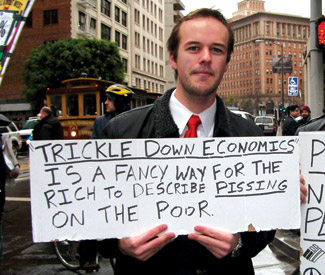
“We’re living in a time of trickle down economics and tax breaks for the rich,” Avalos said, later adding, “Big corporations [are] able to spend vast amounts of money” and have “the greatest influence on the outcome of elections.

“We need to look at our Constitution and have it amended so we aren’t looking at corporations as living, breathing people,” Avalos said.

That’s an immensely popular sentiment in this country, and it’s been stirred up by the US Supreme Court’s 2010 decision in Citizens United v. Federal Election Commission, a ruling that has come to represent all of the evils of big-money politics rolled into one two-word phrase.

More than 80 percent of Americans say they want the decision overturned. Six states, including California, have passed resolutions calling for a Constitutional amendment. Occupy protesters have made it a big issue. Marge Baker, policy vice president for People for the American Way, wrote a Huffington Post piece calling the campaign “A Movement Moment.”

But while Citizens United is a great rallying point, the challenge here goes way beyond one court decision. Citizens United didn’t create corporate personhood. Repealing the decision won’t end the flow of money in politics — and a lot of First Amendment experts are exceptionally nervous about anything that seeks to mess with this central part of the Bill of Rights.

And for all the denunciation of Citizens United, the solution — drafting the actual language of a new Constitutional amendment — turns out to be more than a little tricky.

MICHAEL MOORE AND HILARY CLINTON

Citizens United v. FEC has a complicated history. In 2002, Congress passed the McCain-Feingold Act, which barred corporations and unions from funding “electioneering” activities in the period right before an election.

The right-wing group Citizens United complained that Michael Moore’s documentary Fahrenheit 911 was an attack on George W. Bush and intended to influence the 2004 election, and the courts dismissed that complaint, saying that there was no evidence the independent documentary was an illegal campaign contribution.

Citizens United then started making its own “documentaries,” including one in 2008 that many saw as a campaign commercial against Hillary Clinton. The FEC found that the video was, in fact, “electioneering,” and the case wound up at the Supreme Court.

The legal decision was complicated, but among other things, the court ruled that a ban on independent corporate spending on election campaigns was a violation of the First Amendment rights of those business entities.

That was amplified when Republican presidential candidate Mitt Romney uttered his famous line, “corporations are people.”

But in reality, Citizens United alone hasn’t caused the tsunami of big money that’s poured into elections, including the 2012 campaigns. Much of the cash contaminating the presidential coffers this year comes not from corporations effected by the ruling but from individuals and private trusts that have been free to throw money around for decades.

“The flood of money is disgusting and corrupting,” Peter Scheer, director of the California First Amendment Coalition, told us. “But it isn’t coming from public corporations. It’s mostly wealthy people and private trusts, and they didn’t need Citizens United to do this.”

In fact, the groundwork for modern sleaze was set a long time ago, in 1976, when the Supreme Court ruled in Buckley v. Valeo that, in effect, money was speech — and that any rich individual could spend all he or she wanted running for office.

What the Supreme Court has done, though, is set the modern political tone for campaign finance — among other things, invalidating a Montana law that barred corporate contributions to campaigns. And in the majority ruling and the assenting opinions, the court made clear that it doesn’t think government has any role in leveling the campaign playing field — that it’s not the business of government to decide that the money and speech of rich people and big business is drowning out the opinions and speech of the rest of the populace.

SO NOW WHAT?

So now that every decent-thinking human being in the United States agrees that there’s too much sleazy money in politics and that it’s not a good thing for government to be for sale to the highest bidder, the really interesting — and difficult — question comes up: What do we do about it?

There are a lot of competing answers to that question. And frankly, none of them are perfect.

That may be one reason why the ACLU is mostly on the sidelines. When I contacted the national office to ask if anyone wanted to talk about the efforts to overturn Citizens United, spokesperson Molly Kaplan sent me an email saying “we actually don’t have anyone available for this.”

But on its website, the organization — in a nuanced statement on campaign reform — notes: “Any rule that requires the government to determine what political speech is legitimate and how much political speech is appropriate is difficult to reconcile with the First Amendment.”

In an ACLU blog post, Laura Murphy, director of the group’s Legislative Office in Washington DC, argues that “a Constitutional amendment—specifically an amendment limiting the right to political speech—would fundamentally ‘break’ the Constitution and endanger civil rights and civil liberties for generations.”

But David Cobb, one of the organizers of Move To Amend, which is pushing a Constitutional amendment, told me that “the idea that spending money is sacred is part of the problem, the reason that we don’t have a functioning democracy.”

There are two central parts to the problem: The notion that corporations have the same rights to free speech as people, and the notion that money is speech. Eliminate the first — which is immensely popular — and you still allow the Meg Whitmans and Koch brothers of the world to pour their personal fortunes into seeking political office or promoting other candidates.

Eliminate the second and you open a huge can of worms.

“It would be a disaster, in my view,” Scheer said. “As a general principle, I’m frightened by the concept of tampering with the Constitution.”

Money may not equal free speech, but it’s hard to exercise the right to free speech in a political campaign without money. And there are broader impacts that might be hard to predict.

But Peter Schurman, one of the founders of MoveOn.org and a leader in Free Speech for the People, told me that “it’s a false premise that money equals speech. The point is to get a level playing field.”

THE PROPOSALS

Move to Amend and Free Speech for People are promoting similar approaches, Constitutional amendments that, in fairly simple terms, would radically and forever alter American politics. Several members of Congress have offered Constitutional amendments that include similar language.

The Move to Amend proposal is the broadest and cleanest. It states: “The rights protected by the Constitution of the United States are the rights of natural persons only. Artificial entities, such as corporations, limited liability companies, and other entities, established by the laws of any State, the United States, or any foreign state shall have no rights under this Constitution and are subject to regulation by the People, through Federal, State, or local law.”

It goes on to say: “Federal, State and local government shall regulate, limit, or prohibit contributions and expenditures, including a candidate’s own contributions and expenditures, for the purpose of influencing in any way the election of any candidate for public office or any ballot measure.”

It also includes this statement: “Nothing contained in this amendment shall be construed to abridge the freedom of the press.”

Free Speech for the People is simpler. It only addresses the corporate speech issue: “People, person, or persons as used in this Constitution does not include corporations, limited liability companies or other corporate entities established by the laws of any state, the United States, or any foreign state, and such corporate entities are subject to such regulations as the people, through their elected state and federal representatives, deem reasonable and are otherwise consistent with the powers of Congress and the States under this Constitution.”

Cobb notes that the Move to Amend measure doesn’t say how political speech should be regulated; it just opens the door to that kind of lawmaking. “The question of how to protect the integrity of the electoral process is a political question, not a Constitutional question,” he said. In the end, there’s a huge issue here. The framers of the Constitution, their political consciousness forged in a battle against big and repressive government, feared as much as anything the notion of rulers controlling the rights of the people to speak, write, assemble, publish (oh, and carry firearms) freely. Corporate interests (with the possible exception of the British East India Company, which monopolized the tea trade) weren’t a major concern.

And First Amendment purists still recoil at the idea that government, at any level, could make decisions limiting or regulating political speech. I sympathize. It’s scary. But in 2012, it’s easy to argue that the power of big money and big business has far eclipsed the power of government, that for all practical purposes, the rich and their corporate creations are the government of the United States — and that the people, assembled and exercising the power envisioned under the Constitution, need to make rules to, yes, level the playing field. Not rashly, not in crazy ways, with full cognizance of the risks — but also with the recognition that the current situation is fundamentally unacceptable, and that the potential dangers of messing with the First Amendment have to be balanced with the very real dangers of doing nothing.

Chow withdraws from D11 race after residency questioned

15

Sup. John Avalos appears to be cruising to an uncontested reelection now that Leon Chow, an organizer and executive with SEIU-UHW, has been chased out of the District 11 supervisorial race by journalist Chris Roberts, the SF Appeal, and their reporting on what appears to be Chow’s false claims that he lived in the district.

Chow had been banking on support from his union and the district’s substantial Chinese immigrant population, which he had been helping rally against new medical cannabis dispensaries that the city had approved for the Outer Mission/Excelsior area, presenting Avalos with a challenge that needed to be taken seriously.

But Roberts dropped a journalistic bomb on Chow’s ambitions a couple weeks ago when he unearthed documents indicating that Chow actually lived in Walnut Creek and that he was registered to vote at Chinatown business address – both in violation of election law – doing the solid reporting that journalists failed to do when Ed Jew was elected to the District 4 seat without living there. It wasn’t until Jew was caught in an FBI bribery sting that journalists dug into the background of a politician who had flown into office largely under the press’s radar.

As the Appeal reported this afternoon, Chow sent this email to the Elections Department: “Since I have not filed for Candidacy, I am notifying your department simply with this email, please let me know if there is any other process I will need to do. Please kindly remove my names [sic] from the Potential Local Candidate List in the department web site.”

Although it made no mention of Roberts’ story – which hadn’t gotten much journalistic traction yet, although that was bound to happen as the campaign wore on – the connection seems obvious. So, congratulations to Roberts … and to Avalos.

Best of the Bay 2012: Local Heroes

9

2012 Local Heroes

Alex Tom and Shaw San Liu

Alex Tom and Shaw San Liu — the executive director and lead organizer for the Chinese Progressive Association, which celebrates its 40th anniversary on Aug. 4 — have laid the groundwork for a progressive resurgence in San Francisco by organizing Chinese immigrants and actively building close and mutually supportive relationships with working-class allies throughout the city.

The two have been involved in just about every recent effort to counter the pro-corporate neoliberalism that has come to dominate City Hall these days. They have seized space with Occupy San Francisco and they have supported labor unions and helped to create the Progressive Workers Alliance. They have fought foreclosures and pushed for affordable housing reforms, and they have protected vulnerable immigrant workers from wage theft by unscrupulous employers.

“Shaw San and Alex are incredibly talented organizers and movement builders who are managing to do the nearly impossible,” said N’Tanya Lee, who worked closely with the pair as the director of Coleman Advocates for Children and Youth. “They have built an authentic base of working-class Chinese immigrants who are interested in fighting for change in their community, and are creating a grassroots organization at the forefront of building multi-racial alliances to combat the divide-and-conquer strategies that are confronting us.”

Liu, who joined CPA six years ago, said she’s always inspired to see the old photographs on the walls of CPA’s office, and to read the history of CPA’s organizing and advocacy on behalf of working people. She said the organization has always understood the need to forge alliances with labor unions and other progressive interests.

“The organization itself has been, since its inception, playing a critical role in bridging the needs of Chinese interests with other communities,” Liu said. “I’ve always seen my role as bridge building.”

Today — with stagnant real wages, a deteriorating social safety net, and growing power by corporations that enjoy unprecedented political clout thanks to Citizens United and other court rulings — the need to organize people across cultural lines is more important than ever, even if that begins by addressing the individual needs of each community.

“Always at our core, it’s about empowering our folks to be able to voice their own struggles and visions,” Liu said.

Working to build that capacity within the Chinese immigrant community is hard and important work, Liu said, but it’s equally important to connect with the struggles of working class people from other communities, uniting to effectively counter the political dominance of employers and property owners.

Lui framed the struggle as: “How do we build unity and not have that be lip service?”

Tom and Liu have demonstrated that they know how to do just that, despite the diversity of sometimes-conflicting interests on the left and in a working class squeezed by recession and feelings of economic uncertainty.

“The issue that will unify people is good jobs that are accessible to everyone,” Liu said.

Yet she also said that working class organizing is needed to counter the simplistic “jobs” rhetoric coming from City Hall, which politicians are using to advocate for tax cuts to big corporations.

“More and more, it exposes itself as a total lie,” Liu said of the argument that the city should be facilitating private sector job creation with business tax cuts. “So much points to the fact that the US economic system doesn’t benefit everyone … When we talk about jobs, we talk about what kinds of jobs we want and for whom.”


2012 Local Heroes

Stardust and Ross Rhodes

Ross Rhodes and Stardust, like all of the people involved in Occupy Bernal, are neighbors. But until Stardust helped found the group — a local take on Occupy focused on stopping unjust foreclosures and evictions — they didn’t know each other.

Now they do, and if it wasn’t for Occupy Bernal, Rhodes is sure he would no longer have the house that his parents bought in 1964.

A former college football star, Rhodes injured his knees and back playing. He lives on disability payments, volunteering at the 100 Percent College Prep Club, and bringing home-cooked meals to seniors in his area. He also coached kids in the Junior 49ers program until it became too hard on his injuries.

Stardust, an ESL teacher and oboe player in the Bay Area Rainbow Symphony and the SF Lesbian/Gay Freedom Band, has been working for LGBT rights, women’s rights, and online civil rights for years. When Occupy took off, he gravitated toward the neighborhood fights against foreclosures.

Like people all over the US, Rhodes and his wife were fooled several years ago by a pick-a-payment loan plan. At the time, World Savings was peddling the deals through neighborhoods, promising potential borrowers that they could send their kids to college, buy a car, take vacations — and modify their loans after a year.

But when Rhodes started to apply for loan modifications, he was denied. He kept receiving letters asking for more information, often the same information he had already given — a common story that led to part of the Homeowners Bill of Rights that will guarantee a single point of contact from the bank. He was stumped when he was told he needed more income — the bank said it wouldn’t accept payments that were more than 30 percent of a borrower’s income, and Rhodes was getting a fixed disability check.

He found another income source as a homecare provider, but after all the time that the bank wouldn’t accept his payments, Rhodes was marked as someone who wasn’t making payments, and was tracked for foreclosure.

Meanwhile, Occupy Bernal was working on more than 100 similar cases in its neighborhood. The organizers hadn’t quite convinced Mayor Ed Lee to help at that point, but Rep. Pelosi’s staffers were on their side, getting banks to prioritize the cases of those working with Occupy Bernal. They worked with other community groups like Alliance of Californians for Community Empowerment (ACCE) to do physical occupations of homes. But for those who had received a notice of default and a notice of sale — two steps in the foreclosure process that precede the auction of a property — Stardust was there with another tactic.

He spearheaded Occupy the Auctions. He shows up at City Hall at 1:30 every day and tries to disrupt foreclosure auctions. He’s been there continuously since April 27, 2012, and has stopped dozens of home sales. When fighting the eviction of a neighbor, he is sometimes backed by more than 100 people. But many days it’s just Stardust.

Now, Rhodes is in a loan modification process. Rather than conflicting and confusing machine-generated paper work, he gets regular calls about the status of his modification from a point person in Wells Fargo’s executive complaint office. He testified in Sacramento in favor of the Homeowners Bill of Rights, which passed July 2. He’s also become an Occupy Bernal organizer on top of his other volunteer pursuits.

Stardust battles mega-banks and the city’s wealthiest in his work. But he says the biggest challenge is helping people to get over the shame they feel when they realize they are facing foreclosure. “It’s not their fault,” he says. “It’s the system.”

Friends of Ethics

In the summer of 2011, at the behest of the Ethics Commission, the Board of Supervisors put on the ballot a measure that would have loosened some of the rules for campaign consultant reporting, and would have allowed further changes in the city’s landmark ethics laws without a vote of the people. It had unanimous support on the board — and frankly, technical changes in campaign laws are not the kind of sexy stuff that gets the public angry.

But a small group, led in part by five former ethics commissioners, took on the task of defeating the measure. The activists also took on the challenge of defeating Prop. E, which would have allowed the supervisors to amend future measures passed by the voters.

Despite being outspent by tens of thousands of dollars, Friends of Ethics — a small grassroots operation — prevailed. Both measures were defeated (32 percent to 67 percent in the case of Prop. E, the worst loss of all the local measures on the ballot).

The group is great at forming coalitions: in the case of the No on E and F campaign, Friends of Ethics reached out to some 30 organizations that formally joined in opposing the measures after hearing presentations.

The members of FOE are a fractious group of organizers and shit-disturbers who don’t always get along or agree on other issues. But they’ve come together to do something nobody else does: make protecting and expanding political reform laws a front-line priority.

And the battle goes on. Not long after the November 2011 election, Supervisor Scott Wiener introduced legislation that would have led to less disclosure of political contributions before an election, and would have made it easier to conceal who was making contributions and paying for campaign mailers. The Wiener bill would weaken campaign contribution limit, giving the wealthiest donors greater power in elections.

When the amendments were heard at a well-attended Rules Committee in June (with plenty of public comment from Friends of Ethics), the supervisors sent the amendments back to the Ethics Commission to be rewritten.

The next step for the Friends of Ethics is to work with interested supervisors to push for changes to the city’s campaign laws that will actually benefit the public, such as increased transparency in election contributions and expanded campaign restrictions for those receiving contracts and other benefits from the city.

In an era defined by the US Supreme Court’s Citizens United case and a nationwide assault on fair elections, it’s critical work.

Friends of Ethics can be reached at sfethicsfriend@gmail.com

2012 Local Heroes

The Occupy movement

When Adbusters magazine called for people to show up on September 17, 2011, in New York City to protest the way Wall Street was holding the country hostage, no one could have predicted what would emerge.

It was the start of a movement, and San Francisco heeded the call. About 100 people gathered in the city’s Financial District. They started camping. And the effort exploded.

In the first few weeks, camps sprung up across the country. In Chicago and Los Angeles, in Bethel, Alaska and Tuscaloosa, Alabama, people were drawn together. But, unlike most protests, they stayed together. Night after night.

Along the way, a certain prevailing narrative from outside observers never quite got it right. First the camps were dismissed as nothing but bratty college students and hippies. Then they were called dirty and filled with homeless people. (Occupy challenged the whole idea of a monolithic homeless population. Once they had a home in the Occupy tent cities, homeless people were just — shocker — people.)

By December, when most of the campers had been kicked out, the narrative shifted. Occupy was resting, hibernating, many declared. Some snickered at the fair-weather activists who would only come out in the sunshine.

But in the Bay Area, at least, that hibernation story was simply false. On December 12, Occupy Oakland brought out thousands for its second port shutdown, in solidarity with port workers. On January 20, downtown banks were forced to close for the day and people in the streets celebrated Occupy San Francisco’s shutdown of the financial district. A week later, 400 were arrested when thousands tried to turn a vacant Oakland building into a community center. This was no hibernation.

Actions in some way inspired or fueled by Occupy have continued into the spring and summer. On March 1, Occupy, with a focus on student debt and accessible education, formed the 99 Mile March. Dozens marched from the Bay Area to Sacramento to join thousands of students and supporters in calling for an end to cuts to education; hundreds then occupied the Capitol building. On April 22, Occupy, with a focus on food justice, formed the Gill Tract Occupy the Farm action. Hundreds took a UC Berkeley-stewarded tract of land slated for a baseball diamond and a Whole Foods and planted it, turning it into a farm with rows of crops, a kids space, and a permaculture garden. On June 15, Occupy formed the Lakeview sit-in and Peoples School for Public Education, which taught day camp to children and refused to leave a beloved Oakland elementary school, one of five slated for closure.

Police eventually won the many-months battle with most Occupy groups in the Bay Area. The camps are mostly gone, though a tenacious group keeps its 24-hour protest in front of the Federal Reserve.

But because of Occupy — and its accompanying burst in resistance, creativity, and the belief that we really can, and must, come together to do something — dozens of Bay Area residents remain in homes that were facing foreclosure. Hundreds of people who felt forgotten and abandoned have found community. Thousands have been inspired to start their own projects and work with others.

When Adbusters called Occupy Wall Street to action, it was under the banner of “democracy not corporatocracy.” That ain’t an easy project. But it has already made the world a better and more hopeful place. 

Stage Listings

0

Stage listings are compiled by Guardian staff. Performance times may change; call venues to confirm. Reviewers are Robert Avila, Rita Felciano, and Nicole Gluckstern. Submit items for the listings at listings@sfbg.com. For further information on how to submit items for the listings, see Picks.

THEATER

OPENING

Arctic Hysteria Bindlestiff Studio, 185 Sixth St, SF; www.brownpapertickets.com. $10-25. Previews Thu/26, 8pm. Runs Thu-Sat, 8pm (also Aug 4, 2pm). Through Aug 4. SNAP (Some New Arts Project) presents this movement-based dark comedy by Abi Basch, performed by Berlin’s Kinderdeutsch Projekts.

Project: Lohan Costume Shop, 1117 Market, SF; www.projectlohan.com. $25. Previews Thu/26, 8pm. Opens Fri/27, 8pm. Runs Thu-Sat, 8pm; Sun, 7pm. Through Aug 19. D’Arcy Drollinger pays tribute to the paparazzi target with this performance constructed solely from tabloids, magazines, court documents, and other pre-existing sources.

"Un-Abridged: The Best of Ten Years of Un-Scripted" SF Playhouse, 533 Sutter, SF; www.un-scripted.com. $10-20. Opens Thu/26, 8pm. Runs Thu-Sat, 8pm (also Aug 3, 10pm; no show Aug 4). Through Aug 18. The veteran Bay Area company celebrates its tenth anniversary season with a four-week retrospective of its favorite long- and short-form improv shows. Check website for schedule.

ONGOING

Absolutely San Francisco Alcove Theater, 414 Mason, Ste 502, SF; www.thealcovetheater.com. $32-50. Thu-Sat, 8pm. Through Aug 18. A multi-character solo show about the characters of San Francisco.

"Bay Area Playwrights Festival" Thick House, 1695 18th St, SF; www.playwrightsfoundation.org. $15. Various showtimes and dates through Sun/29. The 35th annual festival presents six new plays: Grounded by George Brant; Ideation by Aaron Loeb; Brahmani by Aditi Brennan Kapli; Samsara by Lauren Yee; The Hundred Flowers Project by Christopher Chen; and Tea Party by Gordon Dahlquist.

Duck Lake The Jewish Theater, 470 Florida, SF; www.duck-lake.com. $17-35. Fri/27-Sat/28, 8pm. By terns gross and engrossing, PianoFight’s Duck Lake — written and produced by associated sketch comedy locals Mission Control — proves a gangling but irresistible flight, a ballet-horror-comedy-musical with fair helpings of each. By the shore of the eponymous watery resort with a mysterious past as an animal testing site, a perennially "up-and-coming" theater director named Barry Canteloupe (poised and sassy Raymond Hobbs) marshals a pair of prosthetic teats and other trust-building paraphernalia in a cultish effort to bring off yet another reimagining of Swan Lake. His cast and crew include a rebounding TV starlet (a sure and winsome Leah Shesky), a lazy leading man (delightfully dude-ish Duncan Wold), a supremely confident and just god-awful tragedian (a duly expansive Alex Boyd), and a gleeful misfit of a tech guy (an innocently inappropriate, very funny Joseph Scheppers). When the thespians come beak-to-beak with a handsome local gang leader (a nicely multifaceted Sean Conroy) and his rowdy band of sun-addled jet-skiers (the awesome posse of Daniel Burke, David Burke, and Meredith Terry), a star-crossed college reunion ensues between the tattooed tough and the hapless production’s white swan. Meanwhile, "scary fucked-up super ducks" go on a killing rampage under tutelage of some cave-bound weirdo (an imposing, web-footed Rob Ready), leading to love, mayhem, and shameless appropriation of timeless musical numbers. It’s all supported by four tutu’d mallards (the po-faced, limber ensemble of Christy Crowley, Caitlin Hafer, Anne Jones, and Emma Rose Shelton) and flocks of murderous fellow fowl (courtesy of Crowley’s fine puppet design). And don’t worry about the convoluted plot, all will be niftily explained by an old codger of a groundskeeper (a hilariously persuasive Evan Winchester). If the action gets attenuated at times across two-plus hours, a beguilingly agile cast and robust concept more than compensate for the loosey-goosey. (Avila)

Enron Exit Theatre, 156 Eddy, SF; www.enron2012.com. $25. Thu-Sat, 8pm. Through Aug 17. In OpenTab’s production of British playwright Lucy Prebble’s 2009 Enron, tragedy plus time equals comedy plus puppets (in imaginative designs by Miyaka Cochrane), as fast-paced satire delivers a timely reconsideration of yet another infamous financial scandal. Some fictional elements shape the plotline but simplifying strategies serve well to clarify the real-life actions and consequences of Ken Lay (GreyWolf) and Jeffry Skilling’s (Alex Plant) deceptive energy-trading juggernaut, the onetime darling of Wall Street and the financial pages. There’s also much verbatim information (echoing the book and documentary, Enron: The Smartest Guys in the Room) enlivening the quick dialogue and underscoring the reckless, hubristic malfeasance that famously preyed on California’s electricity grid and threw Enron’s own employees under the bus. Director Ben Euphrat gets spirited and engaging performances from his principals, with especially nice work from Plant as a cruelly superior Skilling, Laurie Burke as ambitious straight-shooter Claudia Roe (a fictionalized composite creation of the playwright), and Nathan Tucker as manic sycophant Andy Fastow, feeding poisonous Enron debt into three beloved "raptors" (the pet names for some animated shadow companies arising from Fastow’s fast work in "structured finance"). At the same time, the staging can prove rough between concept and execution, with scenic elements sometimes confusing as well as aesthetically ragged (a red fabric serving as a large profit graph, for instance, just looks like some droopy inexplicable drapery at first; and the first puppets to appear are too small to be very effective either). Despite this messiness in terms of mise-en-scène, however, the play is generally clear-eyed and good for more than easy laughs — since no single villain but rather a system and culture are the proper targets here. As Prebble notes, the strategies developed by Enron, far from remaining beyond the pale, are now standard practices throughout the financial and corporate world. That, in some circles, is known as progress. (Avila)

Marat/Sade Brava Theatre, 2781 24th St, SF; (415) 863-0611, www.ticketfly.com. $20-38. Wed/25-Sat/28, 8pm; Sun/29, 7pm. In what may be the year’s most felicitous blend of company, producer, and material, Thrillpeddlers and Marc Huestis offer an exuberant, exquisitely trashy, and note-perfect revival of Peter Weiss’s radical 1963 play, permeating the enormous Brava Theater with an infectious delirium perfectly in sync with restive times. (Avila)

The Merchant of Venice Gough Street Playhouse, 1622 Gough, SF; www.custommade.org. $25-32. Thu-Sat, 8pm; Sun, 7pm. Extended through Aug 19. Custom Made Theater presents director Stuart Bousel’s generally sharp staging of Shakespeare’s perennially controversial but often-misunderstood play. The lively if uneven production ensures the involved storyline cannot be reduced to the problematical nature of its notorious Jewish villain, Shylock (played with a compellingly burdened intensity by a quick Catz Forsman), but rather has to be seen in a wider landscape of desire in which money, status, sex, gender, political and ethnic affiliations, and human bodies all mix, collide, and negotiate. To this end, this Merchant is set amid a contemporary financial district coterie (given plenty of scope in Sarah Phykitt’s thoughtfully pared-down scenic design), where titular melancholic businessman Antonio (Ryan Hayes) sticks his neck out (or anyway a pound of flesh) for his beloved friend Bassanio (Dashiell Hillman) — no doubt the unspoken source of Antonio’s brooding heart as staged here — as the latter seeks a loan with which to court the lovely and brilliant Portia (a winning Megan Briggs). While the subplot concerning the wooing and flight of Shylock’s daughter, Jessica (Kim Saunders), is less adeptly rendered, fluid pacing and a confident sense of the priorities of the drama overall offer a satisfying encounter with this fascinatingly subtle play. (Avila)

Les Misérables Orpheum Theatre, 1192 Market, SF; www.bestofbroadway-sf.com. $83-155. Tue-Sat, 8pm (also Wed and Sat, 2pm); Sun, 2pm. Through Aug 26. SHN’s Best of Broadway series brings to town the new 25th anniversary production of Cameron Mackintosh’s musical giant, based on the novel by Victor Hugo. The revival at the Orpheum does without the famous rotating stage but nevertheless spares no expense or artistry in rendering the show’s barrage of colorful Romantic scenes (with Matt Kinley’s scenic design drawing painterly inspiration from Hugo’s own oils) or its larger-than-life characters — first and foremost Jean Valjean (a slim but passionate Peter Lockyer), nemesis Javert (Andrew Varela), and rescued orphan beauty Cosette (Lauren Wiley). Chris Jahnke contributes new orchestrations to the rollicking original score by Claude-Michel Schönberg (music) and Herbert Kretzmer (lyrics) in this flagrantly sentimental, somewhat problematic but still-stirring meld of music and melodrama in dutiful overlapping service of box office treasure and powerful humanist aspirations. (Avila)

Sweeney Todd: The Demon Barber of Fleet Street Eureka Theatre, 215 Jackson, SF; www.rayoflighttheatre.com. $25-36. Thu-Sat, 8pm (also Sat, 2pm); Sun, 2pm. Through Aug 11. Halloween comes early this year thanks to Ray of Light Theatre’s production of Sweeney Todd and all its attendant horrors. Set in bleakest, Industrial Revolution-era London, this Sondheim musical pushes the titular Todd to enact a brutal vengeance on a world he perceives as having stolen the best of life from him, namely his family and his freedom. No fey, gothic vampire, ROLT’s Sweeney Todd (played by Adam Scott Campbell) is both physically and psychically imposing, built like a blacksmith and twice as dark. Pushed over the line between misanthropic and murderous, Sweeney Todd methodically plots his revenge on the hated Judge Turpin (portrayed with surprising sympathy by Ken Brill) while the comfortably comical purveyor of pies, Mrs. Lovett (Miss Sheldra), dreams of a sunnier future. Mrs. Lovett’s no-nonsense, wisecracking ways aside, there are few laughs to be had in this slow-burning dirge to the worst in mankind, and as the body count rises, it is made abundantly clear that all hope of redemption is also but a fantasy. Contributing to the dark mood are Maya Linke’s imposing, industrial set, Cathie Anderson’s ghostly green and hellfire amber lighting, and a spare chamber ensemble of six able musicians conducted by Sean Forte. (Gluckstern)

Vital Signs Marsh San Francisco, 1062 Valencia, SF; (415) 282-3055, www.themarsh.org. $15-50. Sat, 8:30pm. Extended through Aug 25. The Marsh San Francisco presents Alison Whittaker’s behind-the-scenes look at nursing in America.

Waiting… Larkspur Hotel Union Square, 525 Sutter, SF; www.brownpapertickets.com. $49-75. Thu-Sat, 8pm; Sun, 2pm. Through Aug 5. Comedy set behind the scenes at a San Francisco restaurant.

The Waiting Period MainStage, Marsh San Francisco, 1062 Valencia, SF; (415) 282-3055, www.themarsh.org. $15-50. Fri, 8pm; Sat, 5pm. Extended through August 4. Brian Copeland (comedian, TV and radio personality, and creator-performer of the long-running solo play Not a Genuine Black Man) returns to the Marsh with a new solo, this one based on more recent and messier events in Copeland’s life. The play concerns an episode of severe depression in which he considered suicide, going so far as to purchase a handgun — the title coming from the legally mandatory 10-day period between purchasing and picking up the weapon, which leaves time for reflections and circumstances that ultimately prevent Copeland from pulling the trigger. A grim subject, but Copeland (with co-developer and director David Ford) ensures there’s plenty of humor as well as frank sentiment along the way. The actor peoples the opening scene in the gun store with a comically if somewhat stereotypically rugged representative of the Second Amendment, for instance, as well as an equally familiar "doood" dude at the service counter. Afterward, we follow Copeland, a just barely coping dad, home to the house recently abandoned by his wife, and through the ordinary routines that become unbearable to the clinically depressed. Copeland also recreates interviews he’s made with other survivors of suicidal depression. Telling someone about such things is vital to preventing their worst outcomes, says Copeland, and telling his own story is meant to encourage others. It’s a worthy aim but only a fitfully engaging piece, since as drama it remains thin, standing at perhaps too respectful a distance from the convoluted torment and alienation at its center. (Avila)

BAY AREA

Bloody Bloody Andrew Jackson The Stage, 490 S. First St, San Jose; www.thestage.org. $25-$50. Wed/25-Thu/26, 7:30pm; Fri/27-Sat/28, 8pm; Sun/29, 2pm. An overrated president and rock musical at once, the 2010 Broadway hit by Alex Timbers (book) and Michael Friedman (music, lyrics) takes its first Bay Area bow in San Jose Stage’s ho-hum production, directed by Rick Singleton. In this proudly irreverent but rarely very witty take on mob-democracy and the pack of jackals that are our illustrious political forefathers, a vicious and ambitious cornpone Jackson (David Colston Corris, subbing for Jonathan Rhys Williams) takes his Indian-hating ways to the top of the political establishment on a wave of backwoods resentments and Tea Party-style populism. Present-day parallels should run deep here, but the play is so shallow in its humor that it feels one-note for the most part, while its South Park-like insouciance has an unintentional way of making jokes about the Trail of Tears feel "too soon." This American Idiocy and the 13 accompanying musical numbers are gamely if not always smoothly essayed by cast and band alike (under musical direction by Allison F. Rich), but dumb satire lines up with a generally unappealing score, straining after saucy eloquence while sounding derivative of the emo fare served up by the likes of Spring Awakening and that lot. A tack away from sheer vulgarity and buffoonery toward moralizing history lesson comes late in the hour and its guilty pretention — along with earlier gratuitous, vaguely uncomprehending references to Susan Sontag and Michel Foucault — only makes matters worse. (Avila)

King John Forest Meadows Amphitheater, 890 Belle, Dominican University of California, San Rafael; www.marinshakespeare.org. $20-35. Fri/27, Sun/29, Aug 4, 10-12, 8pm; Aug 5, 4pm. Marin Shakespeare Company kicks off its 2012 outdoor summer festival season with this history play.

The Kipling Hotel: True Misadventures of the Electric Pink ’80s Marsh Berkeley, 2120 Allston, Berk; (415) 282-3055, www.themarsh.org. $20-50. Sat, 8:30pm; Sun, 7pm. Extended through Aug 26. This new autobiographical solo show by Don Reed, writer-performer of the fine and long-running East 14th, is another slice of the artist’s journey from 1970s Oakland ghetto to comedy-circuit respectability — here via a partial debate-scholarship to UCLA. The titular Los Angeles residency hotel was where Reed lived and worked for a time in the 1980s while attending university. It’s also a rich mine of memory and material for this physically protean and charismatic comic actor, who sails through two acts of often hilarious, sometimes touching vignettes loosely structured around his time on the hotel’s young wait staff, which catered to the needs of elderly patrons who might need conversation as much as breakfast. On opening night, the episodic narrative seemed to pass through several endings before settling on one whose tidy moral was delivered with too heavy a hand, but if the piece runs a little long, it’s only the last 20 minutes that noticeably meanders. And even with some awkward bumps along the way, it’s never a dull thing watching Reed work. (Avila)

The Marvelous Wonderettes Fox Theatre, 2215 Broadway, Redwood City; www.broadwaybythebay.org. $20-48. Thu/26-Sat/28, 8pm (also Sat/28, 2pm); Sun/29, 2pm. Broadway By the Bay performs Roger Bean’s retro musical, featuring classic tunes of the 1950s and ’60s.

A Midsummer Night’s Dream Forest Meadows Amphitheater, 890 Belle, Dominican University of California, San Rafael; www.marinshakespeare.org. $20-35. Aug 12, Sept 2, 16, 23, and 30, 4pm; Aug 3, 5, 12, 18, 24, 26, Sept 7, 9, 15, 28-29, 8pm. Through Sept 30. Marin Shakespeare Company performs the Bard’s classic, transported to the shores of Hawaii.

Noises Off Live Oak Theatre, 1301 Shattuck, Berk; www.aeofberkeley.org. $15. Fri-Sat, 8pm; Aug 12, 2pm. Through Aug 18. Actors Ensemble of Berkeley performs Michael Frayn’s backstage comedy.

Roald Dahl’s Willy Wonka and the Chocolate Factory Julia Morgan Theatre, 2640 College, Berk; www.berkeleyplayhouse.org. $17-35. Thu, Sat, and Wed/25, 7pm (also Sat, 2pm); Sun, noon and 5pm. Through Aug 19. Berkeley Playhouse performs a musical based on the candy-filled book, with songs from the 1971 movie adaptation.

Upright Grand TheatreWorks at Lucie Stern Theatre, 1305 Middlefield, Palo Alto; www.theatreworks.org. $24-73. Tue-Wed, 7:30pm; Thu-Sat, 8pm (also Sat, 2pm); Sun, 7pm. Through Aug 10. TheatreWorks launches its 43rd season with the world premiere of Laura Schellhardt’s play about a musical father and daughter.

PERFORMANCE/DANCE

"Ballroom With a Twist" Marines’ Memorial Theatre, 609 Sutter, Second Flr, SF; www.marinesmemorialtheatre.com. Thu/26-Sat/28, 8pm (also Sat/28, 2pm); Sun/29, 2 and 6pm. $49-79. Dancing With the Stars pros and contestants from American Idol and So You Think You Can Dance perform pumped-up ballroom dance and music.

BATS Improv Bayfront Theater, B350 Fort Mason Center, SF; www.improv.org. Fri/27, 8pm: "Naked" Theatresports, $17. Sat/28, 8pm: "Spontaneous Broadway," $20.

"Comedy Showdown" Tommy T’s Comedy Showroom, 1000 Van Ness, SF; sayitlikethatcomedypresents.blogspot.com. Thu/26, 8 and 10pm. $15-20. Tony Sparks hosts this stand-up performance with Marvellus Marv, Glamis Rory, Jabari Davis, and more.

"Elect to Laugh" Studio Theater, Marsh San Francisco, 1062 Valencia, SF; (415) 282-3055, www.themarsh.org. Tue, 8pm. Through Nov 6. $15-50. Veteran political comedian Will Durst emphasizes he’s watching the news and keeping track of the presidential race "so you don’t have to." No kidding, it sounds like brutal work for anyone other than a professional comedian — for whom alone it must be Willy Wonka’s edible Eden of delicious material. Durst deserves thanks for ingesting this material and converting it into funny, but between the ingesting and out-jesting there’s the risk of turning too palatable what amounts to a deeply offensive excuse for a democratic process, as we once again hurtle and are herded toward another election-year November, with its attendant massive anticlimax and hangover already so close you can touch them. Durst knows his politics and comedy backwards and forwards, and the evolving show, which pops up at the Marsh every Tuesday in the run-up to election night, offers consistent laughs born on his breezy, infectious delivery. One just wishes there were some alternative political universe that also made itself known alongside the deft two-party sportscasting. (Avila)

"Folded Into a Tempest" Noh Space, 2840 Mariposa, SF; www.shashahigby.com. Fri/27-Sat/28, 8pm. $18-25. Sha Sha Higby performs an exploration of life, death, and rebirth using her unique sculptural costumes and puppetry.

"Jillarious Tuesdays" Tommy T’s Showroom, 1000 Van Ness, SF; www.jillarious.com. Tue, 7:30. Ongoing. $20. Weekly comedy show with Jill Bourque, Kevin Camia, Justin Lucas, and special guests.

"Majestic Musical Review Featuring Her Rebel Highness" Harlot, 46 Minna, SF; www.herrebelhighness.com. Sun, 5pm. Through Aug 12. $25-65. A trio of 18th century princesses (the graceful, full-throated, international team of Velia Amarasingham, Linsay Rousseau Burnett, and Maria Mikheyenko), chafing under the patriarchal constraints of their otherwise exalted status, metamorphose into a defiant band of disco queens in this stylish, high-kitsch musical revue by writer-producer Amarasingham and composer–musical director Simon Amarasingham. The action begins in desultory fashion, bar-side in the Harlot lounge, amid scuttlebutt from a pair of chatty housemaids (Meira Perelstein and a tuneful Diana DiCostanzo) overseen by a giddy royal valet (a gregariously foppish Michael Sommers, also the show’s emcee and narrator). When the dallying princesses finally arrive (sumptuously attired in appealing period costumes by Noric Design), they ascend a small stage attended by Lady Lucinda Pilon (a Goth-inflected Amber Slemmer, alternating nights with director Danica Sena), and launch into a slick set of tightly choreographed ‘autobiographical’ numbers as the prerecorded music progresses stylistically from smooth, harpsichord-tinted dance-floor beats to all-out four-on-the-floor Donna Summer–style revelry. Despite a certain static, slightly stark ambiance in the site-specific surroundings, with the right crowd and a couple of drinks this 90-minute revue is easily a doubly retro girl-power party for all. (Avila)

"The Romane Event" Make-Out Room, 3225 22nd St, SF; www.pacoromane.com. Wed/25, 7:30pm, $10. Stand-up comedy with DJ Real, Ivan Hernandez, Paco Romane, Ronn Vigh, and Alex White, with music by DJ Specific.

San Francisco Ballet Sigmund Stern Grove, 19th Ave and Sloat, SF; www.sterngrove.org. Sun/29, 2pm. Free. The company performs works by Balanchine, Myles Thatcher, Hans van Manen, and Christopher Wheeldon.

"Waiting: A Love Story" Mojo Theatre, 2940 16th St, Ste 217, SF; www.brownpapertickets.com. Sat/28, 8pm; Sun/29, 3pm. $15. Sherri Rose performs her comedy about the messy world of relationships.

Guardian feminism panel calls for change, gang activity

31

In the interest of behaving badly, let us first say that we won’t apologize for the “roving feminist gangs” comment, nor the laughter that ensued at our July 11 “Bay Area Feminism Today” panel. In the light of the sexual attacks that have terrorized Mission District residents this year, Celeste Chan’s joke (actually a reference to comments made by Fox News in reference to the New Jersey Seven) has to be read as a self defense tactic — and source of comfort and strength to the women living in the neighborhood. Not a threat to men. Unless they’re commiting sexual assault, of course — but then, women commiting sexual assault will probably have the gang’s wrath to face as well. 

Seven women from all walks of Bay Area activism — arts, nightlife, immigrant advocacy, domestic violence organizations, and more — came together at City College’s Mission branch to discuss what our SF progressive community needs to work on, recent feminist victories, whether they even believe in the term “feminism,” and everything in between. Our “Faces of feminism” cover story announcing the event attracted a decent-sized crowd of around 120 (mainly young women, with zero male elected officials in attendance.) We laughed, we nearly cried, we came away with a lot to think about. Here’s some of the general topics that were discussed. And here’s to this being a spark for continued talks, however a Fourth Wave Bay feminism may take shape.

>>FOR THE FULL BIOS OF OUR PANELISTS, CHECK OUT THE EVENT ANNOUNCEMENT 

Reproductive justice

Reproductive justice has long been a feminist goal, but with the recent spate of attacks on birth control and abortion access it’s come up again. Are we here in the Bay Area isolated from the War On Women?Some panelists thought we can affect the country’s situation positively.

“Part of what we do here in the Bay Area is we send strong women to Washington,” the Drug Policy Alliance‘s Laura Thomas said. “We are responsible for a significant amount of women in Congress.” But California’s reproductive justice situation is more complicated than it may seem. St. James Infirmary‘s Stephany Ashley noted that reproductive health here is under attack with “criminalization of HIV-positive people,”  and that California “just cut all funding for HIV prevention for women.”

>>CHECK OUT REBECCA BOWE’S RECORDED LIVESTREAM OF THE EVENT HERE

Chan, founder of Queer Rebels Productions, added that California is cutting domestic violence services through slashing CalWORKS funding. Mujeres Unidas‘ Juana Flores noted that the Bay’s Latino communities can find it difficult to support aspects of reproductive health because of religion and tradition. But she said that people need to work together and realize that “it’s a real war. It’s a real war on us.” She warned that “politicians are not going to fix things just because they want to improve our lives. We need to fight back.”

Transgender activist and member of SF’s Youth Commission Mia Tu Mutch said that part of the war on women has been a wave of anti-trans legislation across the country, as well as a wave of hate crimes, especially against trans women of color. Some legislation in Tennessee is making it more difficult for trans people to go the bathroom, she said. “Reproductive justice is important, but we also need just the simple right to pee.”

But what about the word itself?

Does feminism have power as its own concept now, or has its work been rightly subsumed into the queer movement, the civil rights movement, and other forms of activism? “A lot of us can agree that there isn’t something you can point to and say, this is the feminist movement in San Francisco,” Ashley said. “But there are many important feminist projects happening.”
Alix Rosenthal, who created a controversial women’s slate in her bid for re-election on the SF Democratic County Central Committee recalled how “30 to 40 years ago, we all had to join together because there weren’t enough of us. Now people have splintered off.” Chan brought up the bicycle scene in 1983’s feminist sci-fi film Born in Flames, and quoted Audre Lourde: “for so long, we’ve been on the edge of each other’s battles.”

Tu Mutch said that she “would rather identify as fighting for LGBT rights, progressive rights” than as feminist. But, she continued that it is “under the system of patriarchy that we’re all getting screwed over.” She said that women are treated as second-class citizens, and trans and gender non-conforming people are treated as third class citizens in our society.  Edaj, longtime Bay Area DJ and director of the Women’s Stage at Pride for a decade, agreed that the word feminism “sparks a lot of emotion in people” and can create obstacles in growing support. Said Flores: “it’s a big word. People call me a feminist when I claim my rights. When I see another women who is suffering or being abused it’s unbearable to me,” Flores said. “When someone calls me a feminist, I feel proud.”

The inward gaze: how does the San Francisco progressive community do on feminist issues?

In a word: okay. But there’s work to be done even here, in “progressive” San Francisco. Thomas led the charge, talking about the state’s current legal ability to shackle women prisoners during childbirth. Tu Mutch expressed a need to stop “pitting groups against each other,” and to get rid of a City Hall attitude that says “my budget is more important than yours.” Tu Mutch said “there’s still rampant transphobia and gender essentialism,” that affects not just women, but the “countless people born with intersex conditions and who identify outside the binary.”

Ashley pointed out that “even some of our favorite male progressive politicians, you don’t see them cultivating leadership among women, queer people, trans people.” She talked about how that’s a traditional feminist organizing principle, “mentorship and meaningful participation, not just tokenizing participation.”

As a (not) side note, there wasn’t a single male politician in the audience that day. As Ashley put it, “patriarchy is really the problem.” Ashley and panel moderator, SFBG culture editor Caitlin Donohue shared the fact that they’ve felt diminished by remarks made by and in the company of the city’s so-called “progressive politicians.”

Recent feminist victories

But enough depressing stuff. How about recent feminist victories, asked an audience member.

This question was met with a disconcerting silence. Until Chan jumped in: “I’m really inspired by the place queer arts are at right now.” She told of the “lineage of resistance” of art that deals with questions like “how do people survive the unimaginable? How do people survive the truly horrific?” Disturbing incidents like that of transgender prisoner Cece McDonald beg the question, “is the perfect victim a dead victim? If you fight back, you’ll be criminalized? Now more than ever we need a movement. We really need to come together,” concluded Chan.

Rosenthal saw hope in surprising places. “Sarah Palin and Michelle Bachman,” she said. “These women are so incompetent. But they made it. They really made it.” She talked about how usually women have had to be five times better than the men they competed with, but “Sarah Palin and Michelle Bachman are not five times better than anyone. But they made it.”
Laura Thomas was inspired by Julia Bluhm, the 14-year old ballet dancer from Maine whose online petition led Seventeen to promise to stop using Photoshop to alter women’s body types. Ashley acknowledged Tu Mutch’s advocacy work, and said she was recently inspired by a “take back the plaza” event Tu Mutch had organized. Edaj was inspired by being named a Pride Grand Marshall, and the feeling that the Pride organization was acknowledging the importance of the space created at the Women’s Stage. She was also inspired by Morningstar Vancil, a Filipino vet who is a two-spirit drag king, and Vancil’s commitment to disabled veterans issues.

Action items

In response to a question that asked what the 2012 action plan for Bay Area feminists should involve, Ashley said “principles of intersectionality, anti-colonialism, anti-capitalism” had to be valued more than they have been in past feminist movements. They’re there in Third Wave feminism, Ashely said, only they are “wrapped up in theory and academia.” Those guiding principles should have “more on the ground” applicability. What needs to happen right now, speaking of on the ground? Back to 2012’s spate of sexual violence in the Mission, there’s a distinct necessity for “a perfect community response that doesn’t involve the police, so that we all of a sudden feel really comfortable taking a walk at 3 in the morning through our favorite neighborhood.”

Flores said that any new form of feminism would need to be about “mutual respect” and “against any form of injustice,” to which Thomas agreed, saying it needs to be “less theory, more practice.” It also, Thomas said “has to deal with gender in a different way. A new feminism needs to go beyond gender, or deal with gender differently” in the sense of respecting gender non-conforming identities. A tricky prospect, she admitted. “How you develop a gendered movement that doesn’t use gender as a defining construct, I don’t know.” More specifically, she underlined the importance of “progressive revenue measures,” and “an end to cuts to childcare and domestic violence programs.” “Our economy’s not coming back through more cuts. We need revenue, more taxes,” she said, to cheers from the crowd. Well this was a Guardian forum, after all. 

Edaj reiterated that “that word scares off a lot of people who might otherwise want to join.” Tu Mutch underlined that it would need to “take up the idea that men and women are opposites. That only serves to degrade women.” A new feminism, she said, would be about “turning away from that and realizing there’s lots of different genders.”

Tu Mutch said she would like to see success for her organization to fight for trans healthcare rights, FEATHER. “People have to spend ridiculous amounts of money to transition,” she said. “We need universal healthcare for all, including trans people.”

Chan pondered the question. In the end, she concluded, “roving feminist gangs,” inspiring at least one angry letter from a slighted middleaged white man in the crowd. Which wasn’t the only reason why we deemed the panel a success, but an important one.

Dick Meister: A sure path to economic health

0

By Dick Meister 

Guardian columnist Dick Meister is former labor editor of the SF Chronicle and KQED-TV Newsroom. He has covered labor and politics for more than a half-century. Contact him through his website, www.dickmeister.com, which includes more than 350 of his columns.

It’s way past time to raise the pitifully low federal minimum wage. That would provide badly needed help to the millions who are living in poverty or near-poverty at the current rate of $7.25 an hour, and would help all Americans by stimulating the sagging economy.

Democratic Sen. Tom Harkin of Iowa and Democratic Rep. Jesse Jackson Jr. of Illinois are carrying bills that would set a new minimum of $10 an hour. They’re pressing hard – as they very well should – to get the general public and their allies in Congress to fully appreciate the widespread good that would come from helping some of the country’s neediest workers.

“We’ve bailed out banks, we’ve bailed out corporations, we’ve bailed out Wall Street, we’ve tried to create sound fundamentals in the economy,” Jackson noted. “Now it’s time to bail out working people who work hard every day and still make only $7.25. The only way to do that is to raise the minimum wage.”

It’s been five years since the minimum was last raised, from $5.15 an hour to the current level. States, cities and counties are allowed to set their own minimums, as long as they at least equal the federal rate, and 18 states and several cities and counties have enacted minimums greater than the federal rate. But even their rates are below what’s needed for a decent living.

About four million workers are now paid at or below the federal minimum and obviously need help if they are to escape poverty. Even those paid at the full minimum earn a mere $15,000 a year before taxes and other deductions.  They are among some 28 million workers whose earnings – and spending  – would immediately increase under the proposed bills.

Legislation to raise the minimum has been called for repeatedly in the years since the last raise in 2007, but has gained only relatively minimal support in Congress and the White House. President Obama pledged during his election campaign to get the rate increased to $9.50 an hour by 2011, but has taken no public action. Mitt Romney, Obama’s Republican opponent in his re-election campaign this year, has wavered. He once voiced support for a raise, but later said he opposed an increase.

Polls have clearly shown strong public support for a raise. That support is likely to grow significantly if the economic benefits that a raise would undoubtedly bring to all Americans can be clearly shown – and it can.

It’s simple: Raise the pay of working people, and as the workers buy more goods and services with their new earnings, the businesses that sell them will hire more people to provide what they want to buy with the extra money they’ve earned at a higher minimum wage.

The National Employment Law Project estimates that the increased consumer spending generated by the proposed raise would create the equivalent of more than 100,000 full-time jobs. Other estimates indicate that every dollar increase in wages for workers at the minimum creates more than $3,000 in new spending after a year.

And so the cycle goes, round and round:  More pay, more spending on goods and services, more hiring of people to provide them, more important government services and the taxes to support them, a healthier and wealthier economy.

Guardian columnist Dick Meister is former labor editor of the SF Chronicle and KQED-TV Newsroom. He has covered labor and politics for more than a half-century. Contact him through his website, www.dickmeister.com, which includes more than 350 of his columns.


Eliana Lopez is a victim, but of whom?

237

It’s been an eventful visit to San Francisco this week for Venezuelan actress Eliana Lopez, who spent the last two evenings on the witness stand testifying before the Ethics Commission as it considers removing her husband, Sheriff Ross Mirkarimi, from office for official misconduct for grabbing her arm on Dec. 31. And then today in court, she helped persuade Judge Garrett Wong to lift the stay-away order that has barred the couple from having any contact with each other since January, allowing this battle-weary couple to finally share an much-needed embrace.

Lopez didn’t want any of this – not the police and prosecutors going after her husband and getting an order to keep her family apart, not Mayor Ed Lee suspending Mirkarimi and taking away the salary the family needed now more than ever (compounding his failure to ask Lopez what really happened by refusing to allow the city to pay for her plane fare back from Venezuela, where she’s been staying with family and looking for acting jobs, to testify in his proceedings), not the hypocritical statements of concern that she’s been victimized, made by people who she considers to be the real abusers of her and her family.

Her perspective on this whole sordid affair became crystal clear while spending more than three hours on the stand being grilled by Deputy City Attorney Peter Keith and the commissioners, where she said that she’s never been scared of Mirkarimi but that San Francisco has become a scary place to her after being betrayed and victimized by the people entrusted to help her.

“At this point, I think he’s safer in Venezuela than San Francisco,” Lopez said of her three-year-old son when Keith condescendingly asked about how he’s doing in her home country. Keith’s belittling tone toward this supposed crime victim prompted Mirkarimi attorney Shepherd Kopp to tell reporters, “The questioning of Ms. Lopez, so far, I think is just offensive.”

Clearly, some of Lopez’s decisions helped create this mess. She said on the stand that she regrets telling her neighbors Callie Williams and Ivory Madison what happened on Dec. 31, even if she believes they should have kept her confidence as they promised. And there are good legal reasons why domestic violence victims shouldn’t be able to stop the prosecutions of their abusers, who they may still be scared to offend.

But none of that excuses the complete disregard for Lopez, her perspective, and her interests that has been shown by San Francisco’s law enforcement, political, and domestic violence advocacy communities – a point that Mirkarimi supporters have repeatedly made throughout the proceedings, emphasizing that they believe and support Lopez.

“I didn’t expect that my lawyer could call the police on her own,” Lopez said of Madison, whom she said had represented herself as a legal adviser who was helping her create evidence for a child custody case if her marital problems ended in divorce. “I thought that was my decision.”

Once Madison took a more aggressive posture in urging Lopez to go the police, including “calling Ross’s political enemies” to help her bring him down, Lopez testified, “I realized that I couldn’t trust her.” But it was too late. As soon as Lopez clearly said that she didn’t want police involvement, that was when Madison called them.

“I told her, ‘you don’t have my permission to do this. I trusted you,’” Lopez said she told Madison after being told the police were on the way, sending Lopez into a panic. “When I left Ivory Madison’s house, I was so shaking I couldn’t find my car…I was feeling betrayed and I was so angry.”

Toward the end of her testimony, she said, “After Ivory Madison called the police, I felt betrayed, I felt like I had betrayed Ross.”

Anyone who knows Lopez or watched her on the stand understands that this is a strong woman who is used to taking care of herself, not a shattered domestic violence victim incapable of acting on her own behalf.

“I said we have to think, Ross, we have to do something,” Lopez testified, explaining her reaction to the police involvement and her text message to “use your power” to do something, which Mirkarimi replied to by saying there was nothing he could do at that point, despite unproven accusations that he tried to dissuade witnesses and thwart the investigation. “It was me who was pushing him.”

Even after the controversy went public and threatened his career, Lopez said it her who told him not to resign and to fight for his job. “I told him, ‘you won the election, stay strong, we can win this,” she testified.

Nobody wants to minimize domestic violence, but let’s keep some perspective on what happened here. Lee may or may not really believe that Mirkarimi “beats his wife,” as he told reporters in justifying his overreaction, but the evidence that has emerged doesn’t dispute the consistent contention by Mirkarimi and Lopez that he grabbed her arm one time, for one moment, and that was the full extend of the abuse.

“I bruise really easily,” Lopez testified. “Just Theo playing with me, I get bruised.”

Some people do. And while that doesn’t excuse what Mirkarimi did – getting physical with a partner is never okay, as he said on the stand, accepting his fate – it does indicate that perhaps Mirkarimi’s critics have lost their perspective, sense of proportion, and realization that domestic violence laws are supposed to be about helping and protecting the victim.

Does anyone even want to try to make an argument that’s what’s happened in this case?

8 Washington’s going on the ballot

63

San Franciscans are going to get a chance to vote on the most expensive condos in the city’s history and the future of development on the waterfront as soon as this November.

Opponents of the 8 Washington project turned in 31,721 signatures to the Department of Elections July 19, and since only about 19,000 have to be valid, it’s a safe bet the referendum will qualify.

That means no work can be done on the development until after the election — and since the deadlines are tight and it’s possible the DOE won’t get its counting and verifying done in time for November, 2012, the whole thing could be on hold until 2013.

It’s going to be a bitter and expensive campaign: Developer Simon Snellgrove tried to keep this off the ballot — and, since he has about $200 million riding on the outcome, he’s going to spend what it takes to win. The Stop the Wall on the Waterfront folks aren’t going to be able to match Snellgrove by any stretch, but they’ve raised some money and they’ll be able to run an effective campaign.

And we can have an important public debate: Should the city continue to build housing for the very rich when it can’t keep up with its existing affordable-housing requirements? And what will happen to San Francisco if the people who work here can’t afford to live here and the people who live here don’t work here (or in many cases, don’t work at all because they’re stinking rich)?

Is $11 million in affordable housing money enough for a project that will make a $200 million profit?

Gonna be a good one.

Guardian Voices: There’s something happening here

25

There are distinct signs of the rebirth of a grassroots  balanced-growth  movement in San Francisco, and some small indication that it’s even beginning to shift, ever so slightly,  the politics of the Board of Supervisors.  This is very good news for the vast majority of San Franciscans.

First, a little history.

Land use and the approval of major development projects lie at the very heart of San Francisco politics. Developers and their allies (the building trades, contractors, bankers, architects, land-use lawyers, consultants, and  permit expeditors) are the primary source of political money for candidates for local office. Since the freeway and urban renewal fights of the 1960s, the very definition of  progressive  politics in San Francisco has been the attempt to build a political base of  residents to resist that money.  So-called moderates are simply the political extension of the pro-development lobby using its money to consolidate developer control of the public approval process.

In most cities, land-use issues — zoning, permits, urban design — is left to elites. Not so in San Francisco. Here, land use is talked about at neighborhood meetings and on street corners. The heart the reason is our compact size: 46.7 square miles, and the prohibition of filling in any more of the Bay to create new land. There is no vacant land in San Francisco. Any new major development almost always displaces something already there.  Development is a zero sum game, with winner and losers.  And the losers  leave town.

Land-use politics is about staying here — and that creates real interest among San Francisco residents.

The funding for major development in San Francisco has dramatically changed in the 45 years since the freeway and anti-urban-renewal fights of the mid-1960s. Back then, it was public sector money that fueled development. Yet, with that money, due to the actions of  progressive politicians like Phil and John Burton and George Moscone, came its own remedy: votes to not accept the public money for freeways (Moscone) and votes creating either laws that either prohibited displacement or funded legal assistance to the poor, empowering  them to stop government agencies through litigation (the Burtons at both the state and federal level).

Since the money for freeways and urban renewal was from the government, the focus of the early balanced growth  forces was on government itself, through massive lobbying campaigns to affect officials’ votes (the freeway fight), or the use of government-funded lawyers  to protect poor people’s  interests ( the WACO and TOOR lawsuits against redevelopment).

All of that changed starting in the 1970s, when Richard Nixon and later Ronald Reagan deregulated oversight of urban development by creating a system of  block grants and ended funding for legal assistance for the poor.  Large-scale development was effectively privatized, moving it from being designed, funded, and approved at public meetings by government officials following regulations to being designed and funded in private — and having a Kabuki-play-like public approval process with little real oversight. With the passage of Prop 13 in 1978, which limited the main source of local government revenue — property taxes — local governments became even more reliant on private developer money to create new revenue.

The popular response to this change in the development process in San Francisco was the emergence of a politics that relied on the old progressive-era reforms of the initiative, referendum, and recall. Through a series of initiatives, the community sought to impose regulations on the development process, culminating in the 1986 Proposition M, which actually limited the amount of high-rise office space developers could build, completely imposing the popular will over a supine set of local officials and politicians. Indeed, ten years earlier, again through the initiative processes, the very nature of the Board of Supervisors was changed from a developer-friendly at-large system to a district-election system. Hotly opposed by real estate and development interests, district elections in its brief three years of existence (repealed in the wake of the Moscone-Milk assassinations, even though they were both strong supporters of the system and their assassin opposed it…ironies abound in San Francisco politics) saw limits placed on condo conversions and the passage of rent control.

In each of these multi-year efforts, a citywide coalition was formed, including an ever-expanding set of communities and neighborhoods.  Common interests were defined that cut across race, class, and geography and issues of community (neighborhood) control and funding for essential services like Muni, affordable housing, childcare, and employment training were placed on the table – and developers had to address them if they wanted projects approved.

The point is that balanced growth came from community-based political forces, not elected officials.  Broad movements were built — in the end, encompassing elements of labor. These were victories won not by elected officials but by a popular movement.

In 2000, in the wake of  the dot-com bust, another balanced-growth measure, Prop. L, aimed at cutting then-Mayor Willie Brown’s power over development, was paired with the new district election system — and a broad coalition of forces including labor, community and neighborhood organizations won a major progressive victory.

Every candidate for supervisor who supported the balanced-growth measure won. Every candidate who opposed it and supported Brown lost. While Prop L narrowly lost, its policies and objectives were passed as ordinances by the new Board of Supervisors (banning live-work lofts, closing loopholes in the planning code, requiring neighborhood-based plans for the Mission, SOMA, and Potrero Hill).

But as is so often the case, the victory of 2000 led to the slow dissolution of the coalition that created it. Folks had won. Our supervisors could handle all these issues; we no longer had to. By the end of the term of the supervisors elected as the class of 2000, very little of that citywide coalition existed any more.

With the Great Recession of 2008, advances were rolled back.  Fees on local developers for affordable housing, childcare and transit were deferred in order to stimulate development.  A new era of “moderation” was announced by elected officials, led by Mayor Gavin Newsom. Desires to “attract and retain”  business saw new tax concessions in the name of “jobs” and a new willingness to use open space and public facilities for “private/public partnerships” was announced.

By 2012 any concept of balanced growth had been replaced with a new era of “cooperation” between city officials and developers.

Until recently, that is.

It should be clear to all that for the last four years, City Hall has been eager to approve any scheme presented by private developers — from the America’s Cup nonsense to highrise luxury condos on the waterfront. The siren song of the developers — more revenue if you approve our project — has been proven false again and again, as the revenue never really matches the real costs of these projects. The city’s essential services continue to shrink. Transit fees are too low to pay for the actual new costs of Muni. The affordable housing  fees are too little to actually meet the affordable housing needs of the new, poorly-paid workers employed in the retail and service industry that is always a part of these projects.

More and more of our parks and public open spaces are made available to private users, while few if any new public parks or open spaces are being created.  Indeed, the Department of Parks and Recreation often opposes new public parks — because it can’t maintain what it has.

So it is with fondness that these old eyes see the stirring of what appears to be the awakening political  giant of a new controlled-growth movement.

Here’s how it’s happening: The formation of a multi-neighborhood coalition to oppose fee increases at the Arboretum leads to a bigger coalition to oppose artificial turf  fields in western Golden Gate Park, which leads to an even-bigger coalition placing a policy statement against the privatization of Coit Tower on the ballot and winning.

These are important indications of a broad dissatisfaction with the endless private-public-partnership ( in which all the costs are public and all the profits are private) babble from Rec and Park.

The submission by a broad based coalition of more than 30,000 signatures to place the 8 Washington on the ballot — the first land-use referendum in decades — is an incredibly important achievement, and shows the popular sentiment against much of the City Hall happy talk about development on the waterfront.

But it was the unanimous ( yes, unanimous) vote by the Board of Supervisors last Tuesday to hold California Pacific Medical Center accountable for its constant shape shifting  on its massive project at Geary and Van Ness that shows, perhaps, the outline of the potential future of the balanced-growth movement in San Francisco.

Six supervisors stated their willingness to turn down the environmental impact report on the project unless Sutter/CPMC committed to a project that addressed not only the promise to keep St. Luke’s open for at least 20 years but also hired more San Franciscans, corrected the traffic nightmare predicted for Geary and Van Ness, provided more affordable housing for its own low-income new workforce, and committed  to cap the city’s health care costs as a result of CPMC’s market control the new project would create.

There is always the possibility that the two-week delay will go nowhere, but this kind of talk from this Board of Supervisors to a huge private developer simply has not occurred in the recent past.  No one from Room 200 showed up to twist supervisors’ arms in favor of Sutter.  Sutter was on its own and got rolled.

The coalition that fought Sutter to a standstill at the board, that defined the inadequacies of  the project listed by the supervisors, was a multi-neighborhood, multi-issues organization composed of community, neighborhoods, and labor. Middle class “Baja” Pacific Heights residents and low income seniors from Bernal Heights, non-profit affordable housing advocates and trade unionists, tenant organizers from the Tenderloin and Sierra Club members from the Haight-Ashbury; single moms from the Bayview and Filipino youth from the South of Market.

It was a San Francisco coalition, one that has been working together for nearly three years, blending issues, making concessions to one another and staying together.  A group like this with a set of demands such as these has not prevailed at City Hall for nearly a decade.  It still may not, indeed the chances are slim that its full demands will be achieved.

But this group moved the Board of Supervisors in a way not seen in years.  If the folks mobilized about our parks and the folks mobilized about our waterfront and the folks mobilized about CPMC get together, we have something very big happening. And it might be just in time to make a real difference.
It reminds me of an old saying: “ The people alone are the makers of world history.”

Stage Listings

0

Stage listings are compiled by Guardian staff. Performance times may change; call venues to confirm. Reviewers are Robert Avila, Rita Felciano, and Nicole Gluckstern. Submit items for the listings at listings@sfbg.com. For further information on how to submit items for the listings, see Picks.

THEATER

OPENING

“Bay Area Playwrights Festival” Thick House, 1695 18th St, SF; www.playwrightsfoundation.org. $15. Opens Fri/20, 8pm. Various showtimes and dates. Through July 29. The 35th annual festival presents six new plays: Grounded by George Brant; Ideation by Aaron Loeb; Brahmani by Aditi Brennan Kapli; Samsara by Lauren Yee; The Hundred Flowers Project by Christopher Chen; and Tea Party by Gordon Dahlquist.

BAY AREA

A Midsummer Night’s Dream Forest Meadows Amphitheater, 890 Belle, Dominican University of California, San Rafael; www.marinshakespeare.org. $20-35. Previews Fri/20 and Sun/22, 8pm. Opens July 28, 8pm. Runs July 29, Aug 12, Sept 2, 16, 23, and 30, 4pm; Aug 3, 5, 12, 18, 24, 26, Sept 7, 9, 15, 28-29, 8pm. Through Sept 30. Marin Shakespeare Company performs the Bard’s classic, transported to the shores of Hawaii.

Noises Off Live Oak Theatre, 1301 Shattuck, Berk; www.aeofberkeley.org. $15. Opens Fri/20, 8pm. Runs Fri- Sat, 8pm; Aug 12, 2pm. Through Aug 18. Actors Ensemble of Berkeley performs Michael Frayn’s backstage comedy.

ONGOING

Absolutely San Francisco Alcove Theater, 414 Mason, Ste 502, SF; www.thealcovetheater.com. $32-50. Thu-Sat, 8pm. Through Aug 18. A multi-character solo show about the characters of San Francisco.

Duck Lake The Jewish Theater, 470 Florida, SF; www.duck-lake.com. $17-35. Fri-Sat, 8pm. Through July 28. By terns gross and engrossing, PianoFight’s Duck Lake — written and produced by associated sketch comedy locals Mission Control — proves a gangling but irresistible flight, a ballet-horror-comedy-musical with fair helpings of each. By the shore of the eponymous watery resort with a mysterious past as an animal testing site, a perennially “up-and-coming” theater director named Barry Canteloupe (poised and sassy Raymond Hobbs) marshals a pair of prosthetic teats and other trust-building paraphernalia in a cultish effort to bring off yet another reimagining of Swan Lake. His cast and crew include a rebounding TV starlet (a sure and winsome Leah Shesky), a lazy leading man (delightfully dude-ish Duncan Wold), a supremely confident and just god-awful tragedian (a duly expansive Alex Boyd), and a gleeful misfit of a tech guy (an innocently inappropriate, very funny Joseph Scheppers). When the thespians come beak-to-beak with a handsome local gang leader (a nicely multifaceted Sean Conroy) and his rowdy band of sun-addled jet-skiers (the awesome posse of Daniel Burke, David Burke, and Meredith Terry), a star-crossed college reunion ensues between the tattooed tough and the hapless production’s white swan. Meanwhile, “scary fucked-up super ducks” go on a killing rampage under tutelage of some cave-bound weirdo (an imposing, web-footed Rob Ready), leading to love, mayhem, and shameless appropriation of timeless musical numbers. It’s all supported by four tutu’d mallards (the po-faced, limber ensemble of Christy Crowley, Caitlin Hafer, Anne Jones, and Emma Rose Shelton) and flocks of murderous fellow fowl (courtesy of Crowley’s fine puppet design). And don’t worry about the convoluted plot, all will be niftily explained by an old codger of a groundskeeper (a hilariously persuasive Evan Winchester). If the action gets attenuated at times across two-plus hours, a beguilingly agile cast and robust concept more than compensate for the loosey-goosey. (Avila)

5 Lesbians Eating a Quiche Phoenix Theatre, 414 Mason, SF; www.tidestheatre.org. $20-38. Thu/19-Sat/21, 8pm (also Sat/21, 10pm). Tides Theatre performs Evan Linder and Andrew Hobgood’s comedy about five women forced into a bomb shelter during a mid-breakfast nuke attack.

Fwd: Life Gone Viral Marsh San Francisco, 1062 Valencia, SF; (415) 282-3055, www.themarsh.org. $20-50. Sat/21, 8:30pm; Sun/22, 7pm. The internet becomes comic fodder for creator-performers Charlie Varon and Jeri Lynn Cohen, and creator-director David Ford.

Marat/Sade Brava Theatre, 2781 24th St, SF; (415) 863-0611, www.ticketfly.com. $20-38. Wed-Sat, 8pm; Sun, 7pm (also Sun/22, 1:30pm). Through July 29. Marc Huestis and Thrillpeddlers present Peter Weiss’ macabre Tony-winner.

The Scottsboro Boys American Conservatory Theater, 415 Geary, SF; www.act-sf.org. $20-95. Wed/18-Sat/21, 8pm (also Wed/18 and Sat/21, 2pm); Sun/22, 2pm. American Conservatory Theater presents the Kander and Ebb musical about nine African American men falsely accused of a crime they didn’t commit in the pre-civil rights movement South.

Sweeney Todd: The Demon Barber of Fleet Street Eureka Theatre, 215 Jackson, SF; www.rayoflighttheatre.com. $25-36. Thu-Sat, 8pm (also Sat, 2pm); Sun, 2pm. Through Aug 11. Halloween comes early this year thanks to Ray of Light Theatre’s production of Sweeney Todd and all its attendant horrors. Set in bleakest, Industrial Revolution-era London, this Sondheim musical pushes the titular Todd to enact a brutal vengeance on a world he perceives as having stolen the best of life from him, namely his family and his freedom. No fey, gothic vampire, ROLT’s Sweeney Todd (played by Adam Scott Campbell) is both physically and psychically imposing, built like a blacksmith and twice as dark. Pushed over the line between misanthropic and murderous, Sweeney Todd methodically plots his revenge on the hated Judge Turpin (portrayed with surprising sympathy by Ken Brill) while the comfortably comical purveyor of pies, Mrs. Lovett (Miss Sheldra), dreams of a sunnier future. Mrs. Lovett’s no-nonsense, wisecracking ways aside, there are few laughs to be had in this slow-burning dirge to the worst in mankind, and as the body count rises, it is made abundantly clear that all hope of redemption is also but a fantasy. Contributing to the dark mood are Maya Linke’s imposing, industrial set, Cathie Anderson’s ghostly green and hellfire amber lighting, and a spare chamber ensemble of six able musicians conducted by Sean Forte. (Gluckstern)

Vital Signs Marsh San Francisco, 1062 Valencia, SF; (415) 282-3055, www.themarsh.org. $15-50. Sat, 8:30pm. Extended through Aug 25. The Marsh San Francisco presents Alison Whittaker’s behind-the-scenes look at nursing in America.

Waiting… Larkspur Hotel Union Square, 525 Sutter, SF; www.brownpapertickets.com. $49-75. Thu-Sat, 8pm; Sun, 2pm. Through Aug 5. Comedy set behind the scenes at a San Francisco restaurant.

The Waiting Period MainStage, Marsh San Francisco, 1062 Valencia, SF; (415) 282-3055, www.themarsh.org. $15-50. Fri, 8pm; Sat, 5pm. Extended through August 4. Brian Copeland (comedian, TV and radio personality, and creator-performer of the long-running solo play Not a Genuine Black Man) returns to the Marsh with a new solo, this one based on more recent and messier events in Copeland’s life. The play concerns an episode of severe depression in which he considered suicide, going so far as to purchase a handgun — the title coming from the legally mandatory 10-day period between purchasing and picking up the weapon, which leaves time for reflections and circumstances that ultimately prevent Copeland from pulling the trigger. A grim subject, but Copeland (with co-developer and director David Ford) ensures there’s plenty of humor as well as frank sentiment along the way. The actor peoples the opening scene in the gun store with a comically if somewhat stereotypically rugged representative of the Second Amendment, for instance, as well as an equally familiar “doood” dude at the service counter. Afterward, we follow Copeland, a just barely coping dad, home to the house recently abandoned by his wife, and through the ordinary routines that become unbearable to the clinically depressed. Copeland also recreates interviews he’s made with other survivors of suicidal depression. Telling someone about such things is vital to preventing their worst outcomes, says Copeland, and telling his own story is meant to encourage others. It’s a worthy aim but only a fitfully engaging piece, since as drama it remains thin, standing at perhaps too respectful a distance from the convoluted torment and alienation at its center. (Avila)

BAY AREA

Bloody Bloody Andrew Jackson The Stage, 490 S. First St, San Jose; www.thestage.org. $25-$50. Wed-Thu, 7:30pm; Fri-Sat, 8pm; Sun, 2pm. Through July 29. An overrated president and rock musical at once, the 2010 Broadway hit by Alex Timbers (book) and Michael Friedman (music, lyrics) takes its first Bay Area bow in San Jose Stage’s ho-hum production, directed by Rick Singleton. In this proudly irreverent but rarely very witty take on mob-democracy and the pack of jackals that are our illustrious political forefathers, a vicious and ambitious cornpone Jackson (David Colston Corris, subbing for Jonathan Rhys Williams) takes his Indian-hating ways to the top of the political establishment on a wave of backwoods resentments and Tea Party-style populism. Present-day parallels should run deep here, but the play is so shallow in its humor that it feels one-note for the most part, while its South Park-like insouciance has an unintentional way of making jokes about the Trail of Tears feel “too soon.” This American Idiocy and the 13 accompanying musical numbers are gamely if not always smoothly essayed by cast and band alike (under musical direction by Allison F. Rich), but dumb satire lines up with a generally unappealing score, straining after saucy eloquence while sounding derivative of the emo fare served up by the likes of Spring Awakening and that lot. A tack away from sheer vulgarity and buffoonery toward moralizing history lesson comes late in the hour and its guilty pretention — along with earlier gratuitous, vaguely uncomprehending references to Susan Sontag and Michel Foucault — only makes matters worse. (Avila)

For the Greater Good, Or The Last Election This week: Mosswood Park, MacArthur between Webster and Broadway, Oakl; www.sfmt.org. Free (donations accepted). Sat/21, 2pm. Various venues through Sept. 8. “Don’t they understand that without us they don’t have anything?” asks Gideon Bloodgood (Ed Holmes), investment banker at the top of the San Francisco Mime Troupe’s vivisection of the “real” American Dream, For the Greater Good, Or the Last Election. But surely the hero of a Mime Troupe show cannot possibly be a billionaire? Well, sort of. Though Bloodgood enriches himself dishonestly with precarious investments and outright theft in this Occupy-era melodrama, he actually does occasionally spare a sentiment for Mom and apple pie, or anyway his daughter Alida (Lisa Hori-Garcia) and cookies baked by the unsuspecting victim of his ill-gotten gains, the Widow Fairweather (Keiko Shimosato Carreiro) — now living at the last Occupy encampment standing in the city. Alida, however, displays no compunction in throwing aside his affection and her prospective seat in Congress, running off to join the occupiers for reasons that truthfully appear about as politically motivated as her father’s parasitic avarice, leaving him to join forces instead with the most unlikely of allies — the impeccable, ingenuous Lucy Fairweather (Velina Brown), heiress to a stolen legacy, and staunch patriot. Based loosely on 19th century play The Poor of New York, The Last Election attempts to turn a presumptive ode to the free market into its swan song with good-humored, if predictable, results. (Gluckstern)

King John Forest Meadows Amphitheater, 890 Belle, Dominican University of California, San Rafael; www.marinshakespeare.org. $20-35. Opens Fri/13, 8pm. Runs Sat/21, July 27, 29, Aug 4, 10-12, 8pm; Sun/22 and Aug 5, 4pm. Marin Shakespeare Company kicks off its 2012 outdoor summer festival season with this history play.

The Kipling Hotel: True Misadventures of the Electric Pink ’80s Marsh Berkeley, 2120 Allston, Berk; (415) 282-3055, www.themarsh.org. $20-50. Sat, 8:30pm; Sun, 7pm. Extended through Aug 26. This new autobiographical solo show by Don Reed, writer-performer of the fine and long-running East 14th, is another slice of the artist’s journey from 1970s Oakland ghetto to comedy-circuit respectability — here via a partial debate-scholarship to UCLA. The titular Los Angeles residency hotel was where Reed lived and worked for a time in the 1980s while attending university. It’s also a rich mine of memory and material for this physically protean and charismatic comic actor, who sails through two acts of often hilarious, sometimes touching vignettes loosely structured around his time on the hotel’s young wait staff, which catered to the needs of elderly patrons who might need conversation as much as breakfast. On opening night, the episodic narrative seemed to pass through several endings before settling on one whose tidy moral was delivered with too heavy a hand, but if the piece runs a little long, it’s only the last 20 minutes that noticeably meanders. And even with some awkward bumps along the way, it’s never a dull thing watching Reed work. (Avila)

Ma Rainey’s Black Bottom Sister Thea Bowman Memorial Theater, 920 Peralta, Oakl; www.lowerbottomplayaz.com. $10-25. Fri/20-Sat/21, 7pm; Sun/22, 2pm. Lower Bottom Playaz perform August Wilson’s music-industry expose.

The Marvelous Wonderettes Fox Theatre, 2215 Broadway, Redwood City; www.broadwaybythebay.org. $20-48. Thu-Sat, 8pm (also Sat, 2pm); Sun, 2pm. Through July 29. Broadway By the Bay performs Roger Bean’s retro musical, featuring classic tunes of the 1950s and ’60s.

Roald Dahl’s Willy Wonka and the Chocolate Factory Julia Morgan Theatre, 2640 College, Berk; www.berkeleyplayhouse.org. $17-35. Thu, Sat, and July 25, 7pm (also Sat, 2pm); Sun, noon and 5pm. Through Aug 19. Berkeley Playhouse performs a musical based on the candy-filled book, with songs from the 1971 movie adaptation.

Salomania Aurora Theatre, 2081 Addison, Berk; www.auroratheatre.org. $30-55. Wed/18-Sat/21, 8pm; Sun/22, 2 and 7pm. The libel trial of a politically opportunistic newspaper publisher (Mark Andrew Phillips) and the private life of a famous dancer of the London stage — San Franciscan Maud Allan (a striking Madeline H.D. Brown) — become the scandalous headline-grabber of the day, as World War I rages on in some forgotten external world. In Aurora’s impressive world premiere by playwright-director Mark Jackson, the real-life story of Allan, celebrated for her risqué interpretation of Oscar Wilde’s Salomé, soon gets conflated with the infamous trial (20 years earlier) of Wilde himself (a shrewdly understated Kevin Clarke). But is this case just a media-stoked distraction, or is there a deeper connection between the disciplining of “sexual deviance” and the ordered disorder of the nation state? Jackson’s sharp if sprawling ensemble-driven exploration brings up plenty of tantalizing suggestions, while reveling in the complexly intermingling themes of sex, nationalism, militarism, women’s rights, and the webs spun by media and politics. A group of trench-bound soldiers (the admirable ensemble of Clarke, Alex Moggridge, Anthony Nemirovsky, Phillips, Marilee Talkington, and Liam Vincent) provide one comedy-lined avenue into a system whose own excesses are manifest in the insane carnage of war — yet an insanity only possible in a world policed by illusions, distractions and the fear of unsettled and unsettling “deviants” of all kinds. In its cracked-mirror portraiture of an era, the play echoes a social and political turmoil that has never really subsided. (Avila)

Truffaldino Says No Ashby Stage, 1901 Ashby, Berk; www.shotgunplayers.org. $18-25. Wed/18-Thu/19, 7pm; Fri/20-Sat/21, 8pm; Sun/22, 5pm. For centuries, stock characters have insidiously demonstrated to the working classes the futility of striving against type or station with broadly comedic pratfalls, doomed to play out their already-written destinies with no hope for a change in script. Truffaldino (William Thomas Hodges) is one such pitiable character. Longing for his airheaded mistress, Isabella (Ally Johnson), playing second fiddle to his father, the iconic Commedia dell’Arte fool Arlecchino (Stephen Buescher), Truffaldino becomes increasingly dissatisfied with the monotony of the “old world” and strikes out for the new one — eventually washing up in Venice Beach. Despite their dayglo California veneer and sitcom-appropriate shenanigans, the new world characters he meets quickly come to resemble the stock commedia characters Truffaldino has left behind, and he finds himself similarly trapped in their incessantly recurring cycle — pining predictably for valley girl waitress, Debbie (Johnson again). What thankfully cannot be predicted is how Truffaldino manages to rewrite his destiny after all while reconciling his two worlds in a raucous comedy of errors anchored by the solid physical comedy of its stellar cast, particularly that of Stephen Buescher as both Arlecchino and Hal, who bounces, prances, tumbles, and falls down the stairs with the kind of rubber-jointed dexterity that should come with a “kids, don’t try this at home” warning label. (Gluckstern)

Upright Grand TheatreWorks at Lucie Stern Theatre, 1305 Middlefield, Palo Alto; www.theatreworks.org. $24-73. Tue-Wed, 7:30pm; Thu-Sat, 8pm (also Sat, 2pm); Sun, 7pm. Through Aug 10. TheatreWorks launches its 43rd season with the world premiere of Laura Schellhardt’s play about a musical father and daughter.

PERFORMANCE/DANCE

“Ballroom With a Twist” Marines’ Memorial Theatre, 609 Sutter, Second Flr, SF; www.marinesmemorialtheatre.com. $49-79. Thu-Sat, 8pm (also Sat, 2pm); Sun, 2 and 6pm. Through July 29. Dancing With the Stars pros and contestants from American Idol and So You Think You Can Dance perform pumped-up ballroom dance and music.

BATS Improv Bayfront Theater, B350 Fort Mason Center, SF; www.improv.org. Fri, 8pm, through July 27: “Naked” Theatresports, $17. Sat, 8pm, through July 28: “Spontaneous Broadway,” $20.

“Elect to Laugh” Studio Theater, Marsh San Francisco, 1062 Valencia, SF; (415) 282-3055, www.themarsh.org. Tue, 8pm. Through Nov 6. $15-50. Veteran political comedian Will Durst emphasizes he’s watching the news and keeping track of the presidential race “so you don’t have to.” No kidding, it sounds like brutal work for anyone other than a professional comedian — for whom alone it must be Willy Wonka’s edible Eden of delicious material. Durst deserves thanks for ingesting this material and converting it into funny, but between the ingesting and out-jesting there’s the risk of turning too palatable what amounts to a deeply offensive excuse for a democratic process, as we once again hurtle and are herded toward another election-year November, with its attendant massive anticlimax and hangover already so close you can touch them. Durst knows his politics and comedy backwards and forwards, and the evolving show, which pops up at the Marsh every Tuesday in the run-up to election night, offers consistent laughs born on his breezy, infectious delivery. One just wishes there were some alternative political universe that also made itself known alongside the deft two-party sportscasting. (Avila)

“Expiration Date: Still Good” Jewish Theater, 470 Florida, SF; www.pianofight.com. Thu/19, 8pm. $20. PianoFight’s female-driven comedy group ForePlays performs fan-fave sketches.

“Fauxgirls! San Francisco’s Favorite Drag Revue” Infusion Lounge, 124 Ellis, SF; www.fauxgirls.com. Thu/19, 7pm. Free. With Victoria Secret, Alexandria, Chanel, Maria Garzi, and more.

“Fishnet Follies” Rrazz Room, Hotel Nikko, 222 Mason, SF; www.fishnetfollies.com. Fri/20, 10:30pm. $20-45. Classic burlesque revue with Vienna La Rouge, Jessabelle Thunder, Cici Stiletto, and more.

“Folded Into a Tempest” Noh Space, 2840 Mariposa, SF; www.shashahigby.com. Fri-Sat, 8pm. Through July 28. $18-25. Sha Sha Higby performs an exploration of life, death, and rebirth using her unique sculptural costumes and puppetry.

Keith Lowell Jensen San Francisco Punch Line, 444 Battery, SF; www.punchlinecomedyclub.com. Wed/18, 8pm. $15. The comedian performs and tapes a new CD for Stand Up! Records.

“The Jersey Devil” SF Mime Troupe, 855 Treat, SF; www.acmfund.org. Thu/19-Fri/20, 8pm. Free (donations accepted). Berserker Residents present a sideshow-inspired performance exploring the myth of the Jersey Devil.

“Jillarious Tuesdays” Tommy T’s Showroom, 1000 Van Ness, SF; www.jillarious.com. Tue, 7:30. Ongoing. $20. Weekly comedy show with Jill Bourque, Kevin Camia, Justin Lucas, and special guests.

“Majestic Musical Review Featuring Her Rebel Highness” Harlot, 46 Minna, SF; www.herrebelhighness.com. Sun, 5pm. Through Aug 12. $25-65. Cocktails and hors d’oeuvres, performers in Baroque-chic gowns, music, and more.

“Mixed Relief” Lorraine Hansberry Theatre, 450 Post, SF; www.actorsequity.org. Mon/23, 7:30pm. $5-10. Part of LaborFest 2012, this staged reading of a play about women writers of the WPA is promoted by the Actors’ Equity Association and benefits the Actors Fund.

“Postcard from Morocco” Cowell Theatre, Fort Mason Center, Marina at Laguna, SF; www.sfopera.com. Thu/19, 8pm; Sun/21, 2pm. $40-60. Young-artist training group Merola Opera Program presents Dominick Argento’s dreamy masterpiece.

“Soundwave ((5)) Humanities: The Future Bionic” Lab, 2948 16th St, SF; www.projectsoundwave.com. Sat/21, 8pm. $12-25. Multimedia and interactive performances by Jay Kreimer, Diana Burgoyne, and the Cellar Ensemble. 


Feeling the heat, Olague kills RCV repeal for now

74

After reviving a controversial effort to repeal the city’s ranked-choice voting (RCV) system and paying a political price for her shifting stands on the issue, Sup. Christina Olague today made the motion to send all three competing reform proposals back to the Board of Supervisors Rules Committee, effectively killing efforts to place them on the November ballot.

“The public would benefit from more public discussion on the issue,” Olague said, adding that she doesn’t think the measures should be on the crowded fall ballot competing with other important priorities.

Olague had been torn between supporting the desires of Mayor Ed Lee (who appointed her to the seat) and downtown interests to repeal RCV and those of her longtime allies in the progressive community who sought to defend it from total repeal – and she hadn’t been returning calls or indicating where she now stood before today’s Board of Supervisors meeting.

But after hearing more than 30 minutes of impassioned public comments on both sides of the issue, she made the motion to end the controversy for now, which was unanimously approved by the board. Olague also addressed the heat she felt indirectly, saying RCV “should not be a litmus test for whether someone is progressive” and “sadly, the discussion had degenerated to be about personalities.”

Her colleagues seemed happy to be done with this fight for now as well. Sup. Mark Farrell, who sponsored the measure to repeal RCV for all citywide offices, said it would be a “huge mistake” to have competing voting system measures on the fall ballot. Olague had previously offered an alternative to repeal RCV for just the mayor’s race, like Farrell’s measure using a September primary election and November runoff. Board President David Chiu responded to the RCV repeal effort by proposing another alternative, that one using RCV in the November election but having a December runoff between the top two mayoral finishers.

Chiu said he was happy to delay his proposal, saying, “I have thought the system we have is working quite well.”

Callvin Trillin: Sheldon Adelson’s Free Speech

0

“Casino mogul Sheldon Adelson is on the brink of reaching $71 million in contributions thus far in this election cycle.”

–Roll Call

Yes, money is speech, so the court has decreed.

While Adelson thinks this is splendid,

The rest of us wonder, as cash calls the tune,

Is this what the Framers intended?

Calvin Trillin: Deadline Poet (The Nation, 7/23/2012)


Guest opinion: RCV is good for progressives

52

Since San Francisco began using ranked choice voting in 2004 and public financing of campaigns in 2002, the city has been a leader in the types of political reform badly needed at state and national levels. People of color today have an unprecedented degree of representation and progressives are a dominant presence in city government. Elections are being decided in November, when turnout usually is highest, and the combination of public financing and deciding races in one election minimizes the impact of independent expenditures and Super PACs .

Yet progressive stalwart Calvin Welch, whose work we have long admired, recently authored a Bay Guardian oped against RCV. His charges against RCV are as wrong today as they were when he first made them 10 years ago when he opposed RCV on the ballot. And given the horrible Supreme Court ruling known as Citizens United, which has opened the floodgates on corporate campaign spending and did not exist when San Francisco last used separate runoff elections, returning to two elections is a direct threat to the future of San Francisco progressivism. 

The most serious of his claims is that RCV favors “moderate to conservative candidates” because “left-liberals do very well in run-off elections” since “in low-turnout elections, left-liberals vote more heavily than do conservatives.” He cites the 2000 supervisorial races and 2001 city attorney race, in which “the more liberal candidate for City Attorney, Dennis Herrera” bested “Chamber of Commerce functionary Jim Lazarus.” He asserts “that’s a verifiable San Francisco political fact.”

But San Francisco State University professor Richard DeLeon, author of the acclaimed book of Left Coast City about San Francisco politics, debunked that claim with real election data in his 2002 paper, “Do December runoffs help or hurt progressives?”

He found that in the November 2001 city attorney election, for every 100 voters who turned out in progressive precincts, 107 turned out in conservative precincts. But in the December 2001 runoff, for every 100 voters who turned out in the progressive precincts, 126 turned out in the conservative precincts, an 18 percent increase. Wrote DeLeon, “This dramatic increase in the ratio of conservative to progressive voters occurred despite (or perhaps because of) the 44 percent drop in voter turnout citywide between November and December.”

He continued: “If San Francisco had used [ranked choice voting] in November, Herrera most likely would have won by an even greater margin. In November, the liberal/progressive candidates for city attorney won a combined 60 percent of the vote…In the December runoff, however, Herrera won with only 52 percent of the vote. Thus, due to the proportionally greater decline in progressive voter turnout, Herrera probably lost approximately 8 percent of his potential vote, making the election close.”

DeLeon also rebutted Welch’s citation of the supervisorial races in 2000 as ones that demonstrated a progressive advantage in low-turnout runoffs, writing:

 “Progressive success that year was NOT due solely to a one-time surge in turnout among progressive voters…Many powerful forces converged in that election, not least the anti-Willie Brown backlash, the cresting of the dot-com invasion, and the return to district elections, which forced despised incumbents to stand trial before angry neighborhood electorates.”

DeLeon concluded:  “Based on the evidence presented, I conclude that December runoffs have hurt progressive voters, candidates and causes in the past and (absent same-day runoffs) will continue to do so in the future, even under district elections.”The Bay Guardian cited Professor DeLeon’s study in March 2002 (see  and scroll down to “A is OK”), and Mr. Welch is ignoring these results today just as he did then.

Certainly progressives haven’t won 100% of RCV elections — should any political perspective? — but they have done well nonetheless, electing  Bay Guardian-endorsed candidates like John Avalos, David Campos, Eric Mar, David Chiu and Ross Mirkarimi, despite those candidates not being incumbents. Other progressive incumbents first elected before RCV elections, like Aaron Peskin, Chris Daly, and others, were re-elected under RCV. And Mirkarimi was elected citywide in the sheriff’s race. On  the flip side, progressive Eileen Hansen most certainly would have beaten moderate Bevan Dufty in a November RCV contest for D8 supervisor; instead she lost in December after finishing first in November.

What’s actually at stake here is how we define progressivism. Since we began using RCV in 2004, 8 of the eleven members of the Board of Supervisors come from communities of color, a DOUBLING from pre-RCV days. At the citywide level, all seven officials elected by RCV come from communities of color. So out of the 18 elected officials in San Francisco, a whopping 15 out of 18 come from communities of color, the highest percentage for a major city in the United States.

The proposed repeal amendment would launch low-turnout September elections in San Francisco. In fact, the December 2001 city attorney race in which Welch cites as exemplary had a turnout of 15 percent of registered voters, the lowest in San Francisco’s history. New York City’s last September mayoral primary had a turnout of 11.4 percent. In Charlotte NC (population 750,000, similar to San Francisco) its last mayoral primary had a turnout of only 4.3 percent. Cincinnati had a September turnout of 15 percent, and Boston and Baltimore had September mayoral primaries with turnout in the low 20s. Many cities in Minnesota have September primaries with extremely low turnout; the two largest cities, Minneapolis and St. Paul, have switched to RCV largely to eliminate September primaries.

Research has demonstrated that voters in low turnout elections are disproportionately more conservative, whiter, older, and more affluent; those who don’t participate are people of color, young people, poor people — and progressives. So having a mayoral race in a low turnout September election has real consequences not only on voter turnout but on the demographics of the electorate.

While we share the priorities of Welch’s progressive economics, we believe progressivism must be more inclusive, especially if it wants to enjoy the support of these burgeoning demographics. While disappointed by the lack of progressive achievements of President Barack Obama, we still view the election of the first African American as president as a major progressive achievement.

Finally, we would assert that the ranked ballots used in RCV have been important for San Francisco democracy. Just look at the recent “top two” primary on June 5, and you can see the defects of the methods proposed to replace RCV. In many races across the state – including in the Marin County congressional race where progressive Democrat Norman Solomon lost by 0.2 percent — too many spoiler candidates split the field and candidates got into the top two with extremely low vote percentages, some as low as 15 percent of the vote. In one race where there was a Latino majority and a solid Democratic district, the Democrats ran so many candidates that the Democratic vote split and two white Republicans made the runoff with low vote percentages.

San Francisco risks such elections if we get rid of RCV. Think of the last mayoral election, and the choice for Asian voters if we used single-shot plurality voting instead of RCV. Which Asian candidate would they vote for with their single-shot vote — Lee, Chiu, Yee, Ting, Adachi? What kind of vote split might have occurred? And to avoid that, what kind of backroom dealing would have occurred BEFORE the election to keep that many candidates out of the race to prevent that vote-splitting?  We saw such vote splitting in the 2003 mayoral election as well, with various progressive candidates running and splitting the progressive vote. Going back to plurality elections would be damaging for constituencies that often run multiple candidates, such as the Asian and progressive communities.

RCV has been good for San Francisco, and we should keep it. For those who would like to see a runoff in mayoral races, Board president David Chiu has proposed a compromise that, while increasing the costs of running for mayor, is far better than the repeal measure for September elections. Chiu’s proposal would keep RCV to elect the mayor, but with a December runoff if no mayoral candidate won a majority of first rankings in November. The 2011 mayoral election would have gone to a runoff, with John Avalos as Ed Lee’s opponent.

San Francisco progressives should embrace a view of progressivism that is inclusive, promotes higher turnout and is based on a politics that is looking forward instead of backward to some golden age that never existed. Ranked choice voting and public financing are two parts of the puzzle for ensuring a vibrant progressivism.

Steven Hill led the campaign for ranked choice voting in San Francisco, and Matt Gonzalez was President of the Board of Supervisors and legislative author of the RCV charter amendment. See www.SFBetterElections.org for more information


Gonzalez withdraws his endorsement of Olague

57

Matt Gonzalez – the attorney and former president of the Board of Supervisors whose 2003 run for mayor galvanized the city’s progressive movement – has withdrawn his endorsement of Sup. Christina Olague for his old District 5 supervisorial seat, citing her positions on the 8 Washington project and replacing ranked-choice (RCV) voting with a September mayoral primary election.

It is perhaps the biggest political blow that Olague has suffered since being appointed to her first elective office by Mayor Ed Lee in January, and a sign that she may be siding more solidly with Lee and his pro-development allies than with the progressive political community she has long identified with – and that could complicate her race in one of the city’s most progressive districts.

Gonzalez, who helped launch Olague’s political career by appointing her to the Planning Commission in 2004, confirmed his decision and the reasons for it, but he told the Guardian that he didn’t want to make a formal public statement yet. That could come later in the week, possibly coupled with a new endorsement in the race.

But he did say that he’s been frustrated with Olague’s actions on both 8 Washington – a housing project for the super-rich on the Embarcadero – and with her recent antics on RCV. In both cases, it wasn’t just the votes, but the way they were made that have raised doubts about Olague with Gonzalez and other progressives.

Olague and Sup. Jane Kim (another former Gonzalez protege who has disappointed many of her one-time progressive supporters on several high-profile issues) not only voted for the 8 Washington project, but also for a series of amendments that made the already lucrative project even more profitable for the developers and costly to the city.

On RCV, as I reported on Friday, Olague surprised progressives by giving new life to efforts by the most conservative supervisors to repeal the system, then has made a shifting series of statements and pledges on the issue, in the end supporting a system that will repeal RCV only for the mayor and create a September election.

The fear is that election would be extremely low turnout, and Lee could win it outright with at least 65 percent of the vote and avoid the normal November election, and Olague has been unwilling to fully explain her position or address concerns that she is simply doing Lee’s bidding. Olague hasn’t returned our calls on that issue or for her reaction to Gonzalez’s decision to withdraw his endorsement.