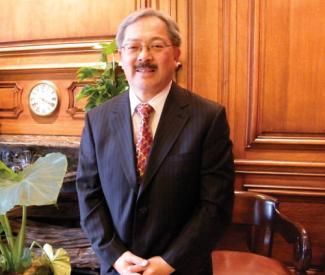
Ed Lee

Mayor’s race a tight pack, but Gascón lags in DA’s contest

25

Despite the hype and spin from various mayoral campaigns and newspapers, the big story in yesterday’s release of semi-annual campaign finance reports is that there isn’t much of a story: It’s pretty much what everyone has been expecting, a tight field of qualified mayoral candidates with comparable financial resources.

It was also no surprise that Progress for All, the deceptive committee behind the effort to draft Mayor Ed Lee into breaking his word and running to keep his job, was funded mostly by a narrow group of business interests connected to longtime power brokers Rose Pak and Willie Brown, mostly with $5,000 contributions, or 10 times the contribution limit for legitimate mayoral campaigns.

The real story in yesterday’s numbers was in the district attorney’s race where the conventional wisdom that incumbent George Gascón is the clear frontrunner (“wisdom” that we’ve always questioned given his lack of local roots) was cast into doubt by his lackluster fundraising, big spending for small results, and the fact that each of his two major challengers have twice as much money in the bank.

Alameda County prosecutor Sharmin Bock led the fundraising race this year with $240,337, about $6,000 more than Gascón. And after spending $156,916 in just six months, Gascón has just $77,570 in the bank. David Onek, who has been getting progressive support and retail campaigning up a storm, raised $126,386 this year, but his early start and frugal spending leaves him with $153,474 in the bank.

In the mayor’s race, while both the Chronicle and Examiner led with David Chiu’s impressive fundraising this year, leading the pack with almost $400,000, all that really did was put him into financial contention with the top-tier candidates who have been raising money since last year: Leland Yee, Dennis Herrera, Bevan Dufty, Joanna Rees, and Michela Alioto-Pier.

As of last month, their campaigns’ cash-on-hand was Herrera at $586,294, Dufty at $493,372, Yee at $444,820, Ress at $441,168, Alioto-Pier at $406,574, and Chiu at $396,754. On the next tier down, Phil Ting appears dead in the water, raising just $67,526 and having more debt than money in the bank, although his campaign consultant Eric Jaye said public funds are just starting to come in and the campaign is on track to meet its $300,000 fundraising goal.

Two other major candidates were also well behind the pack, but both are running with an outsiders’ appeal that should keep them in the running throughout the race. Tony Hall, a conservative with a strong independent appeal, raised $102,612, has $173,368, and will likely continue nipping at the heels of the mainstream pack.

And then there’s progressive favorite John Avalos, who has been running a visible, enthusiastic campaign with lots of volunteer support, although he raised just $86,882 this period and has about $100,000 in the bank (contrary the erroneous report in today’s Chronicle that he only had $500, apparently because the reporter looked at his supervisorial campaign report instead of his mayoral – whoops).

But Avalos supporter Chris Daly said the campaign has recently raised another $32,000 and is due to soon receive about $120,000 in matching funds, bringing them up to around $250,000. “That’s what [then-mayoral candidate Tom] Ammiano had in his entirety in ’99,” Daly said, noting that progressive mayoral favorites always get outspent and usually by margins greater than what Avalos now faces. “Our people don’t have as much money or city contracts.”

By contrast, Chiu has been raking in the dough this year, with lots of $500 contributions mostly from lawyers, bankers, developers, people with Chinese surnames, and employees of Google and other tech firms, with almost half of the contributions from out of town.

“We raised almost a hundred grand more than the closest competitor,” said Chiu campaign manager Nicole Derse. “We’re in a super strong position.”

In addition to the big money sources that usually gravitate to strong moderate candidates, Chiu also had some notable financial support from some progressive constituencies, including bicyclist activists (such as Gary Fisher, Dan Nguyen-Tan, Jason Henderson, architect David Baker, and MTA member Cheryl Brinkman), progressive activists Susan King and Amy Laitenen (Matt Gonzalez’s former board aide), and medical marijuana advocate Kevin Reed from Green Cross.

Jim Stearns, who is running the Yee and Bock campaigns, said the funding picture is about what he and others predicted would be the case given public financing (and its $1.475 million spending cap) and the large field of qualified candidates. “That’s the interesting thing about this race, it’s like the World Series of Poker with everyone getting the same stake,” he said. “This is unlike every other mayor’s race where there have been huge disparities in funding.”

Many political analysts privately fear that this dynamic, with nobody really pulling away from the pack of candidates, could encourage Lee to get into the race. But Stearns notes that Lee, despite the power of incumbency, will have a hard time catching up in fundraising and a huge target on his back because of breaking his word, the sleazy “Run Ed Run” campaign tactics, and just the fact that he would become the instant frontrunner.

“In the ranked choice voting scenario, if there’s someone who looks like he’s going to come in first, you don’t lose anything by attacking him because his second place votes aren’t going anywhere,” said Stearns, who said the current mayor’s race appears to be a game of inches. “It’s an infantry game rather than an air game, where the gains are slow and people are proceeding carefully.”




Ethics Commission to discuss Progress for All

San Francisco Chronicle reporter John Cote’s scoop highlighting how Recology executives were working behind the scenes under pressure from Chinatown power broker Rose Pak to encourage Mayor Ed Lee to seek a full term is just the latest development for a committee that’s raised eyebrows already, and it may be just the beginning.

Five mayoral candidates — board President David Chiu, City Attorney Dennis Herrera, state Sen. Leland Yee, former Supervisor Michela Alioto-Pier, and businesswoman Joanna Rees — have teamed up to encourage the San Francisco Ethics Commission to investigate whether Progress for All has run afoul of local election laws, rallying behind an effort spearheaded by Democratic County Central Committee Chair Aaron Peskin in a July 28 letter to commissioners.

At the heart of the issue is whether Lee or any of his representatives have been coordinating with agents of Progress for All. If they are, Progress for All would have to be considered Lee’s own, candidate-controlled committee, Peskin asserts in the letter.

“Given the close relationship between Ms. Pak, the Mayor, and Progress for All, it is very possible that the committee has ‘consulted’ or ‘coordinated’ with the Mayor, and therefore its expenditures should be deemed to be made ‘at his behest,'” Peskin’s letter to the Ethics Commission argues. A City Hall insider told the Guardian that Pak — a primary driver behind the Run, Ed, Run campaign — is regularly observed going to and from the mayor’s office.

“If Progress for All or any of these other committees has been acting on Mayor Lee’s behalf, those committees may have violated the $500 contribution limit and prohibitions against accepting corporate, union or city contractor money, restrictions that apply to all candidate committees,” the letter states.

Financial disclosure filings for committees fundraising for the Nov. 8 election are due Monday.

Aside from the question of whether there is coordination between Lee, who has not yet announced that he will run for mayor, and Progress for All, concerns have been raised about city contractors aiding in the efforts of the campaign. Under the city’s Campaign Finance Reform Ordinance, contractors doing business with the city are not allowed to make political contributions.

(Given the revelations that Recology executives’ signature gathering efforts were done in violation of company policy, it’s no wonder Recology executives become bashful when approached by reporters who ask tough questions.)

Meanwhile, Recology might not be the only city contractor that Pak has encouraged to support Run, Ed, Run. A column that former Mayor Willie Brown published recently in the San Francisco Chronicle suggests that this isn’t the first conversation of this kind.

“One thing you can say about Chinatown powerhouse Rose Pak, she is not shy,” Brown’s column begins. “Holding court at the party for the opening of the new airport terminal, Rose was seated at the table with interim Mayor Ed Lee and his wife, Anita, and a host of other local officials. ‘I want every one of you to call his office and tell him he should run for mayor,’ Rose told the table. ‘And do it right away so that there’s no misunderstanding.’ Then she turned to the architect David Gensler. ‘Didn’t you do this terminal?’ she asked. ‘Yes,’ he said. ‘Didn’t you remodel this terminal before?’ ‘Yes,’ he said. ‘Then your firm should raise a million dollars for his election campaign.'”

While Brown may not be a visible player in the Run, Ed, Run campaign, he’s certainly been at the table with a key driver behind it and Lee himself — and he’s using his platform in the Chronicle to get the word out about Lee’s potential mayoral campaign.

“The specific revelations of unethical and possibly illegal activity are very troubling and need to be fully investigated by the Ethics Commission as soon as possible,” Chiu told the Guardian.

Political consultant Jim Stearns, whose firm is managing Sen. Yee’s mayoral campaign, joined the chorus in calling for an investigation. “If you think about the fact that these guys still, according to press reports, are eating together once a week, and there’s not supposed to be any coordination … You have this committee that is essentially operating in complete disregard of the campaign law,” he said. “It’s sort of like there’s a crime being committed, and where’s the police?”

The San Francisco Ethics Commission will hold a policy discussion about how to treat Progress for All at its Aug. 8 meeting, Ethics director John St. Croix told the Guardian.

“We’ve told the committee that we believe they’re a primarily form committee, which is an independent expenditure committee on behalf of a candidate for office or a ballot measure,” St. Croix explained. “They’re claiming that there’s no candidate, so they can’t be that committee, even though they’re acting pretty much exactly like one would.”

As things stand, Progress for All has filed as a general purpose committee, he added. “A general purpose committee is what you would think of as a [political action committee]. They usually represent an organization or elected group of individuals, they tend to exist for a long period of time, and they contribute to multiple campaigns, whereas a primarily formed committee is created to support or oppose a single candidate or a single ballot measure in a single election,” he explained. Another key distinction: “Independent expenditure committees don’t have contribution limits the way that candidate committees do. Candidate committees have a $500-per-contributor contribution limit.”

Peskin, meanwhile, hinted that there may be more to come. “There’s a lot of it,” he said, “and I think there are many people who have stories to tell.”

Anger erupts over police shootings

11

rebeccab@sfbg.com

As the murky details of two recent police shootings emerge, a palpable anger surging through targeted communities points to a deeper issue than the particular circumstances surrounding each of these deaths. Simply put, many Bay Area communities are fed up with police violence.

For many activists who descended on transit stations to protest the fatal BART police shooting of Oscar Grant III, the 20-year-old unarmed Hayward man who was killed on New Year’s Day 2009, an upwelling of rage was rekindled after BART cops shot and killed a homeless man named Charles Blair Hill on July 3 in Civic Center Station.

Then, on July 16, San Francisco police officers in the Bayview shot 19-year-old Kenneth Wade Harding Jr. multiple times after he ran from the T-Third train platform because he’d been stopped for fare evasion, leaving him dead on the sidewalk.

The recent officer-involved shootings occurred under two different law enforcement bodies, and both incidents remain under police investigation with many questions still unanswered. BART police say Hill was brandishing a knife; the San Francisco Police Department (SFPD) said its response was justified because Harding fired at officers first. The investigation in Harding’s case took a bizarre twist July 21 when SFPD issued a press release based on a medical examiner’s report stating that Harding had died not from rounds fired by police, but a self-inflicted gunshot wound.

But among communities distrustful of the police, the particulars of each case seemed to matter less than the perception that officers are too quick to escalate conflicts into deadly standoffs. Both incidents provoked intense anger because they resulted in marginalized transit passengers suffering sudden, violent deaths following interactions that were initiated by police. The shootings sparked angry protests, prompting standoffs at Civic Center BART Station, along the T-Third line in the Bayview, on Valencia Street, in Dolores Park, inside the Castro Muni Station, and at the cable car turnaround on Powell Street.

A group of activists staged protests in the Mission following the Bayview police shooting, snaking through the streets as they disrupted traffic and public transit service. “The march began at Dolores Park where nearly 200 of us departed,” an anonymous post on the anticapitalist Bay of Rage website recounted, describing the events of a July 19 protest that resulted in 43 arrests. “Upon reaching the Castro Muni Station, all hell broke loose…. What had now become a mob moved effortlessly past the bewildered cops … Trash was set alight and thrown down onto the tracks below … ticket machines, the fare checkpoints, and the agent booth were all smashed with hammers and flags — totally ruined. Smoke bombs and fireworks were thrown throughout the station.”

This display occurred just eight days after protesters shut down BART stations in downtown San Francisco during rush hour to condemn the fatal shooting of Hill, the homeless BART passenger.

The message from outraged Bayview residents at a chaotic and emotionally charged community forum staged July 20 at the Bayview Opera House was not that people were upset that this had happened to Harding, a Washington state resident, in particular. Instead, people expressed outrage that police had gunned down yet another African American youth, and that unless some complicated and long-standing issues were addressed, it could happen again, to anyone. The forum was organized in partnership with the SFPD and clergy members from the Bayview. Police had prepared a PowerPoint presentation, but never managed to get that far.

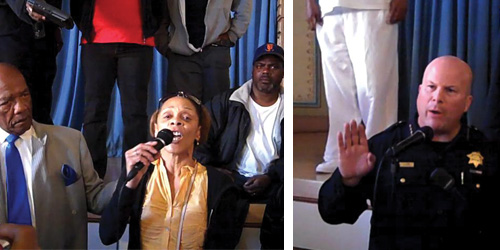
At the meeting, Police Chief Greg Suhr tried to provide an explanation for the July 16 shooting. “During this foot pursuit, at some point in time, the suspect … fired at the officers, and the officers returned fire. This is the account that we have so far,” he said. “I cannot tell you how badly that I feel … as captain of this station for two years,” Suhr continued, as an angry crowd shouted him down.

Police escorted Suhr out of the meeting before everyone who had signed up to speak had a chance to be heard. Once outside, the police chief told reporters that he planned to return.

After Suhr and other city officials departed from the meeting, District 10 Supervisor Malia Cohen stayed at the Bayview Opera House and addressed the crowd that remained, she later told the Guardian, and engaged in discussion with Bayview homeowners, merchants, and other community stakeholders.

“We had a very thoughtful conversation,” she said. “People had questions about [Municipal Transportation Agency] policy over the SFPD riding the bus. We talked about the importance of attending Board of Supervisors meetings, Police Commission meetings, and giving public comment. And there will be future conversations, without obstruction.”

Many who attended the meeting voiced concerns that went well beyond the July 16 incident. Several said they believed youth were unduly harassed by law enforcement over Muni fares on a regular basis. Elvira Pollard spoke about how her son was shot 36 times by police and killed seven years ago. Another woman complained that police had used abusive language when she was arrested in the Bayview four years ago.

Mayor Ed Lee told the Guardian that a bigger police presence at the Oakdale/Palou stop on the T-Third line was part of the city’s strategy to prevent violence in that area. “I actually asked the chief to pay more attention to areas that had a history of gun violence and shootings and other kinds of violence … and it just so happens that this particular area, Third and Palou, is a place where there’s a lot of violence,” Lee said. “So we had more uniformed officers on that specifically at not only my request, but with the understanding of the police chief, too.”

Responding to acts of violence by sending in more police sounds simple enough, yet it seems a toxic environment has arisen out of a heightened police presence in a community where tensions between police and residents already run high, fueled by anxiety and bad past experiences. Add to this dynamic a trend of youth who lack other transportation alternatives riding public transit even if they don’t have enough money to pay the fare, and the situation feeds ongoing strife, particularly when fare evaders are asked for identification and searched by police.

Lee, in partnership with Cohen, called a meeting in City Hall July 19 with leaders of the Bayview community. The press was not allowed to attend, but participants said later that officials gave a presentation about the shooting and played an audio of gunfire from the SFPD’s SpotShotter program to offer evidence that Harding had fired first. Later that day, the SFPD reported that gunshot residue had been detected on Harding’s hand, supporting the police account of what happened. Yet the July 21 press release, suggesting that Harding had shot himself because a .380-caliber bullet that police said could not have come from SFPD firearms had entered the right side of Harding’s neck, made it even less clear what really happened.

By July 22, confusion was still swirling over why a gun hadn’t immediately been recovered from the scene of the shooting, and there still wasn’t any clarity on whether an online video of a passerby removing a silvery object from the sidewalk showed a person who retrieved Harding’s firearm after the shooting, as police have claimed. Police recovered a gun that was initially believed to be Harding’s, but later reported that the gun could not have been the same weapon that discharged a .380 caliber round into the victim’s head.

Chris Jackson, a Bayview resident who sits on the board of City College of San Francisco and ran for District 10 supervisor in 2010, said after the City Hall meeting that he felt it had amounted to little more than a lecture from the city’s top officials. Jackson said he perceived a need for a policy shift in terms of how to deal with fare evasion and violence prevention. “We need a better approach,” he said. “We cannot address this with more cops on the T line.”

After Harding’s death, it came to light that the 19-year-old Washington state man had served time for attempting to promote prostitution, and had been named as a person of interest in connection with the fatal shooting of a 19-year-old Seattle woman. Yet a widely circulated online video showing him writhing on the sidewalk in a pool of blood after being shot, while a handful of officers continued to stand around with weapons drawn, sparked outrage. Once the forum at the Bayview Opera House had broken up, LaDonna Callaway condemned the police response, saying, “They didn’t have to shoot him as many times as they did.”

Angelique Mayhem, a Bayview resident who stood nearby, told the Guardian that she didn’t think the meeting had solved anything. “A boy gets gunned down. We don’t know if there was a gun there, but we do know that for 40 damn years, people have been getting gunned down in this community,” Mayhem said. “People are angrier now than when they were when they walked in the door. We’re a community that’s truly in pain, that’s truly frustrated, and really needs some respect.”

Kim removes homeless shelter reform measure from ballot

8

Under pressure from the Mayor’s Office, Sup. Jane Kim today removed her sponsorship of the Fair Shelters Initiatives, effectively killing the measure that was set to appear on the November ballot, according to activists working on the issue. Sup. Eric Mar reportedly followed Kim’s lead and also removed his sponsorship, telling activists he was deferring to Kim’s decision.

“We hardly expected the supervisors would put a measure forward and then cave in before the campaign had even started,” said Bob Offer-Westort of the Coalition on Homelessness, which had asked Kim to be the lead sponsor of a measure that he said is the homeless community’s highest priority.

The measure would have removed shelter beds from the definition of housing under the city’s voter-approved Care Not Cash program, thus freeing up beds for the larger homeless population that is often denied space in shelters even as beds reserved for CNC recipients – who give up most of their welfare support in return for housing and services – often remain vacant.

The measure — which was sponsored by Sups. Ross Mirkarimi, David Campos, and John Avalos, in addition to Kim and Mar, giving it one more than the four votes it needed to make the ballot – had been harshly criticized by the San Francisco Chamber of Commerce and other downtown groups, as well as Mayor Ed Lee and other moderate politicians, who said it would somehow destroy CNC and attract more homeless people to the city.

In a recent email blast, Chamber head Steve Falk called the measure “alarming” and was “effectively dismantling the nationally-recognized program.” He tried to use the 100 nightly vacant shelter beds as a rationale against the measure (despite the fact that was the very problem the measure tried to correct), and wrote, “This measure is nothing more than pure politics to turn out progressive voters in a crowded mayoral race.”

Kim and her staffers haven’t returned Guardian calls for comments, and neither Mar nor Mirkarimi could be reached. But Offer-Westort said the arm-twisting by the Mayor’s Office shows just how little things have really changed at City Hall.

“It sets a really bad precedent when once again a mayor bullies members of the Board of Supervisors to get his way,” he said, noting that Kim still claimed to support the reform in her conversations with COH members. “It certainly wasn’t because she changed her mind about whether this was right or wrong. It had more to do with her concerns over the board’s relationship with Room 200.”

Will Esbernd support Lee?

24

As the tom toms grew louder at the Chronicle and in the Willie Brown/Rose Pak community for Interim Mayor Ed Lee to run for the full term as mayor, I emailed two impertinent questions to my district supervisor Sean Elsbernd:


1. Would you have nominated Ed Lee for interim mayor had you known he would consider running for the job?


2. Will you endorse him if he does decide to run for mayor?


As a longtime West Portal resident, I’ve always gotten annoyed at how Elsbernd (and other supervisors) love to play the neighborhood game back in their district — but when the chips are down on a power structure issue, they go down to City Hall and vote with Willie Brown and the downtown gang. Which is what happened in January on the critical vote for mayor when the Willie Brown/Rose Pak forces worked a quiet play to knock out the progressive candidates (Sheriff Mike Hennessey and former Mayor Art Agnos) and put in City Administrator  Ed Lee, a Willie Brown ally.


Elsbernd was happy to nominate Lee and told us at the time that he had done so because he wanted an interim mayor who would not run in November.


In his email answer to me, Elsbernd wrote, “I believe the benefits of that strategy have proven correct (e.g. the overall budget process and its unanimous approval, and the unanimous approval of the consensus and comprehensive pension/health care charter amendment.“


So what about today when Lee seems more and more poised to run?


Elsburn noted that he has not endorsed anyone, but that “I have been most attracted to the candidacies of City Attorney Dennis Herrera and former Supervisors Alioto-Pier and Bevan Dufty.” He said that these three have the “right combination of qualifications, experience, intelligence, skills and integrity to serve as mayor.”


So what’s his out? “Should Mayor Lee run for election, I would only consider endorsing his effort under one circumstance—if, and only if, I was convinced that without his candidacy, Sen. Leland Yee would be elected. That is, if I see that no one else can beat Sen, Yee other than Mayor Lee, then I would support a Mayor Lee campaign. At this point, I’m not convinced of that—I still think any one of the three I mentioned above could beat Sen. Yee.”


Well, that’s Elsbernd back in his district doing his neighborhood routine at the Village Grill, a favorite Elsbernd breakfast place. Elsbernd has still left himself a way to do what he said he was dead set against doing: going along with Willie Brown and  Rose Pak and  helping Lee become the fulltime mayor. Bring back Quentin Kopp and John Barbagelata. B3


Ed Lee is going to run

79

We might as well get used to it: Mayor Ed Lee is going to run in November.


It’s not just about getting his old job back. It’s about the fact that he’s starting to really like being mayor — and that his closest allies have made it clear to him that the choice is either him or State Sen. Leland Yee, and that they find Yee unacceptable.


Lee has been talking to all the people you would expect him to talk to over the past few days, my sources tell me, letting them know that he’s seriously considering it and looking for support. It’s a little late to be lining up big endorsements; a lot of people have already signed on with one of the other candidates. But he’ll be happy with co-endorsements and second-place endorsements — and given his connections, he’ll be able to raise substantial amounts of money quickly.


Oddly enough, if he gets in, the big loser won’t be Yee, who will go out and try to run a campaign as an independent outsider against the old machine (and who doens’t have to worry about offending Lee’s supporters, who dislike him anyway). And John Avalos will be running to the left of both of them. 

Will Kopp’s competitive bidding initiative derail Recology’s train to Yuba?

1

Sponsors of an initiative to require competitive bidding on all aspects of the city’s multi-million-dollar garbage services say they plan to deliver their initiative petitions to the Department of Elections this afternoon. The petitions contain 12,000 signatures, far more than the 7,000-8,000 required, effectively signalling that, even after the city weeds out non-valid signatures, the initiative will qualify for the June 2012 election.

The move threatens to give the Board a political migraine, since the Board is set to vote July 26 on a Department of Environment resolution to expand Recology (formerly Norcal Waste System, Inc)’s monopoly on San Francisco’s garbage and recycling services.

In fact, the DoE resolution contains two separate agreements: a $112 million long-term landfill disposal agreement that was competitively bid, and a facilitation agreement that governs how waste is transported to the landfill and that was not competitively bid. As such, the city’s facilitation agreement is already the subject of a lawsuit that Waste Management Inc. filed in San Francisco Superior Court last week.

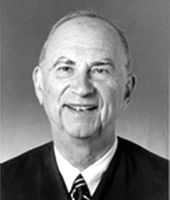
Sponsors of the competitive bidding ordinance, which include retired judge Quentin Kopp, community activist Tony Kelly and Waste Solutions CEO David Gavrich,believe the Board should delay voting on the landfill disposal and facilititation agreements until next summer, after voters have had a chance to weigh in on the bigger question of whether folks want competitive bidding on all the city’s garbage-related services, which are worth a quarter of a billion, each year. “

“It would be disrespectful to voters to accept a resolution while an initiative is pending,” Kopp stated.

“It would make sense if they severe the landfill disposal and facilitation agreements into two files,” Kelly added, referring to how the two separate agreements are currently lumped into one item on the Board’s July 26 agenda, under the section titled “recommendations of the Budget and Finance sub-committee.”

How the deal got filed in the B&F sub-committee’s recommended section is another story unto itself: Last Wednesday, after Sups. Ross Mirkarimi and Jane Kim, who sit on the Board’s Budget and Finance sub-committee, voted to send the deal to the Board with no recommendation, (a vote that suggested that they had some concerns with the deal) and after members of the public who came to testify about the item had left,  Mirkarimi asked to rescind the landfill vote.

“I think there was some misunderstanding a little bit in wrapping up the landfill agreements with Recology, “ Mirkarimi said, as he asked for the vote to be rescinded, “so we can accurately reflect some of the sentiments being articulated here.”
“I think we just learned some things on the fly,” Mirkarimi stated, as he and Kim joined committee chair Sup. Carmen Chu, one of the Board’s more conservative members, in sending the deal to the full Board “with recommendation.”

The Guardian learned of the vote switcheroo, after the DoE, which is apparently anxious to see the Recology agreements move forward, contacted us to say that our blog post about the Budget and Finance sub-committee, incorrectly stated that Mirkarimi and Kim had not given the deal their unmitigated thumbs-up. (The Guardian has since amended its blog post to accurately reflect what happened at the meeting, after this reporter and most members of the public, except the Chamber of Commerce’s Jim Lazarus, who supports the Recology agreements, had left the Board’s Chambers.)

Asked about the last-minute move to amend the vote Kelly said, “It was Ross at his Rossest.”

And in many ways, Mirkarimi’s move to rescind made sense: neither he nor Kim had registered any problems with the landfill disposal and facilitation agreements during the committee hearing, though a number of seemingly valid concerns were raised, including the observation by Yuba County supervisor Roger Abe that Yuba County is considering raising its host fees at Recology’’s Ostrom Road landfill in Wheatland from $4.40 a ton to $20- $30 a ton. If Yuba County does raise itsw fees, the move could wipe out the estimated $100 million in savings that DoE claims Recology’s proposal represents for San Francisco ratepayers. According to Abe, Yuba’s fees have not been raised for 14 years, and his county, which is one of the poorest in California, could use the additional income, especially if it is going to see its local landfill fill up faster than anticipated, thanks to San Francisco sending up to 5 million tons of trash over a 10-year period.

To be fair, Mirkarimi did warn that it would be unwise to dismiss Yuba County’s concerns , but he countered that any county can raise its fees. And DoE suggested that it was unlikely that Yuba County can raise its fees excessively, because those same fees would have to be paid by the other municipalities that use the Ostrom ROad dump, most of which are small towns that can’t afford to pay as much as relatively prosperous Bay Area cities like San Francicso.

Instead, Mirkarimi and Kim reserved most of their concerns for the bigger question of whether San Francisco ratepayers are best served by the city’s continuing lack of competitive bidding and franchise fee requirements on San Francisco’s remaining $225-million-a-year garbage collection related services–concerns that seem to bring us back full circle to Kopp and Kelly’s competitive bidding ordinance, which they had hoped to qualifty for

Asked how many supervisors he thought will stand up tomorrow and dig into the details of the DoE agreements and how they contradict with the requirements of the Kopp-Kelly-Gavrich competing bidding initiative, Kelly said, “Two.”

If so, that’s not likely to derail Recology’s train to Yuba, especially given that Mayor Ed Lee, who holds veto power over any item that less than eight supervisors support or oppose, told the Guardian in February that he believes Recology had earned its privilege.

But so far the City Attorney’s Office is remaining mum about the potential impact of WM’s lawsuit on Recology’s train to Yuba County, a silence that will give the Board the political cover they apparently so desperately need, if they vote tomorrow to haul San Francisco’s trash to Yuba County by rail, an arrangement that won’t start until after the city’s current contract at Waste Management’s Altamont landfill expires, something that is not anticipated to happen until 2015, based on the city’s current diversion rates.


Mayoral candidates scurry for signatures

33

San Francisco mayoral candidates and their volunteers have been scrambling to gather the signatures of registered voters needed to reduce their filing fees and demonstrate popular support, over the weekend hitting popular gathering spots such as Dolores Park with a combination of earnest appeals and election-year gimmicks.

Volunteers for candidate John Avalos were the first to hit a crowded Dolores Park on Saturday, canvassing throughout the day, but they may have been upstaged by the campaign of David Chiu, which featured both the candidate himself and his Star Wars-inspired alter ego Chiu-bacca – a campaign volunteer dressed up as Chewbacca. The campaign even carried the motif through at the table it set up, which was staffed by someone in a space helmet that was reminiscent of a stormtrooper. No other mayoral or district attorney candidates seemed to have a visible presence there.

A Clonetrooper for David Chiu

Candidates have until this Thursday, July 28, to turn in the signatures of registered voters, each of which reduces that candidate’s filing fees by 50 cents. So mayoral candidates can eliminate their $5,048 filing fee (which represents 2 percent of the mayor’s $252,397 annual salary) by turning in 10,096 signatures. For district attorney candidates, the goal is 8,704 sigs, while sheriff candidates need 7,990 to get the freebie.

An Avalos volunteer gathers signatures (and possibly PBRs)

The other important upcoming election-related dates are Aug. 1, when the semi-annual campaign finance statements are due and we find out who’s been raising the most money, and Aug. 12, the deadline for candidates to file their intent to run for office. That’s when we find out whether Mayor Ed Lee breaks his pledge not to run, and whether there are any other surprise late entrants into the race, which is always a possibility.

More questions in Bayview shooting

After receiving a San Francisco Police Department (SFPD) press release issued July 21 stating that the man who died July 16 following an officer-involved shooting in the Bayview had been killed by a self-inflicted gunshot wound, I phoned the city’s Chief Medical Examiner, Dr. Amy Hart.
 
I asked Hart to walk me through how the conclusion that the gunshot wound was self-inflicted had been reached. But Hart responded that the Medical Examiner has not reached any conclusion so far about the cause of Harding’s death.

“That’s not a component of the press release that we issued,” Hart said. “Maybe it’s a question that would be best addressed to the San Francisco Police Department, probably their homicide division. For us, the cause and manner of death are pending. So, we are going to complete our investigation before we discuss the manner of death. The question that you’re asking is something that came from the police press release, so you have to ask them the nature of why they said that.”

I called the SFPD and left a message, and I’ll be sure to provide an update once they call back.

The SFPD release stated that the Medical Examiner had detected two gunshot wounds in the body of Kenneth Wade Harding, Jr., the 19-year-old from Washington state who died after being shot on a crowded sidewalk in San Francisco’s Bayview neighborhood. One gunshot wound entered and exited Harding’s left leg, the statement said. A second gunshot wound entered the right side of Harding’s neck, and the bullet remained in his head. The round that was lodged in his head was of .380 caliber, police said, so it could not have come from a .40 caliber SFPD-issued firearm.

A .380 caliber round was discovered in the pocket of the jacket Harding was wearing, the press release added. “Based upon evidence known at this time including: officer and witness statements that Harding shot at the police officers, Shot Spotter data, video tape evidence that depicts a firearm at the scene that was subsequently taken and the location of gunshot residue on Harding’s right hand, it appears that Mr. Harding’s head wound was self inflicted,” the press release stated.

The Medical Examiner’s office hasn’t issued a death certificate yet, Hart said, and it generally takes several weeks to determine the cause of death.

I asked Hart if the Medical Examiner’s office had any way to determine which bullet had entered Harding’s body first.

“I wouldn’t say there’s a good way, except for eyewitness accounts,” she responded, adding that the Medical Examiner’s Office doesn’t have information to determine which bullet entered the body first.

While the Medical Examiner determined that the .380 caliber bullet entered through the right side of the neck, it is the ballistics section of SFPD’s crime lab that determines the caliber of the rounds, Hart explained.

When I asked Hart what process the Medical Examiner’s office would follow to determine the cause of death, she said, “It’s a completion of our investigation that will need to happen here at the Medical Examiner’s office. We’re going to make a final determination, and what goes into an investigation depends on a case, there’s no set thing that has to happen.” Eventually, she said, the various components of the investigation, such as witness accounts, the ballistics analysis, and the examination of the body will be merged.

Meanwhile, Mayor Ed Lee offered brief comments to the media today in response to the most recent findings released by the SFPD. The mayor attended a groundbreaking ceremony for the new Bayview Branch Library at Third and Revere streets, which is expected to open in December of 2012. Here’s a video of Lee’s response to the latest evidence released by SFPD:

http://www.youtube.com/watch?v=-YSz1l4mOHQ

Video by Rebecca Bowe

Lee was joined by District 10 Supervisor Malia Cohen as well as Sen. Mark Leno, Sen. Leland Yee, Sup. Scott Weiner, newly installed Municipal Transportation Agency Director Ed Reiskin, City Librarian Luis Herrera, and other prominent San Franciscans. City officials emphasized the positive at the press conference, stressing that the new library would be a center for learning that could serve the youth of the Bayview and offered hope for the future of a neighborhood in transition. “It’s not all doom and gloom here,” Cohen told reporters.

I asked Cohen if she had a comment about the police deparment’s latest findings, but she declined to say anything about it.

At this point, there are still a lot of unanswered questions surrounding Harding’s death. So far, the gun that discharged the .380 caliber bullet into Harding’s head has not been recovered by police. Police believe an unidentified man in a hooded sweatshirt who can be seen in a YouTube video picking up a silvery object off the sidewalk removed Harding’s weapon from the scene, and they say they are searching for the man and the gun. But if the object shown in the video is a gun, and it was Harding’s gun, it’s still not clear how it wound up some 10 yards away from the body after he shot himself.

Carfree crowd praises SFMTA’s choice of Reiskin

4

Today’s announcement of Ed Reiskin as the new executive director of the San Francisco Municipal Transportation Agency is being warmly welcomed by bicyclists, transit riders, and other advocates for alternatives to the automobile – and not just because Reiskin doesn’t own a car and gets around by bike and Muni.

As the head of the Department of Public Works, Reiskin transformed the agency into one that facilitated the creation of more vibrant public spaces and safer, multi-use streets, overseeing some of the Newsom Administration’s most significant progressive accomplishments.

“He really began the process of turning DPW into a complete streets agency,” says Tom Radulovich, executive director of Livable City and an elected member of BART’s Board of Directors. He noted that Reiskin is widely respected by city staff, department heads, and a variety of community groups.

San Francisco Bicycle Coalition director Leah Shahum said she was “really pleased” with the choice – saying Reiskin has been “lights years ahead” of previous DPW administrators – and said it bodes well for an agency that faces some difficult challenges.

“I think Ed Reiskin has proven himself as a leader and someone who is really involved with San Francisco,” she said. “He will be the MTA director who most understands the real needs that San Franciscans have in terms of mobility.”

For example, she said Reiskin prioritized repaving and filling in potholes on streets that have bike lanes, where bad pavement can cause serious crashes or conflicts with drivers. “The fact is he understands that is a safety issue,” she said.

Radulovich offered two cautionary notes in his praise of the choice. The first was his hope that Reiskin will be allowed to take the bold action the MTA needs to reform Muni and create truly mulit-modal, safe streets, rather than being micromanaged and having the agency turned into a piggybank for other departments, as Mayor Newsom did with former MTA director Nat Ford.

“Is the mayor finally going to allow the MTA director to do what he needs to do to fix the agency?” Radulovich asked.

Secondly, he fears that DPW might backslide to the days before Reiskin took over, when the agency was removing public benches all over the city and making public spaces less inviting, rather than taking the lead on creating new, more inviting public spaces – from parklets to Sunday Streets – as Reiskin did.

“The worst case is you don’t gain anything at the MTA and you lose something at Public Works,” Radulovich said.

For his part, Mayor Ed Lee sounded a note of optimism that Reiskin will transform the agency. “I thank the SFMTA Board of Directors for their thoughtful, deliberative and unanimous support of Ed Reiskin as the new leader of the SFMTA,” Lee in a prepared statement. “Now is the time to focus on the future of the SFMTA and continue to make good on our promise to San Francisco transit riders and taxpayers by creating greater efficiency in our transit system, improving on-time performance, and honoring our City’s Transit First Policy.”

Decide, Ed, Decide

23

So Ed Lee maybe, sorta is thinking he might want to consider running for mayor. He tells folks in the Mission that “I’ve made no decision yet.” He leaves the Chron with some pretty strong hints:


Asked if he would categorically rule out running in November, Lee sidestepped the question, saying he is proud of his achievements so far, including unanimous votes at the board this week on his budget and his pension reform plan, and has more goals to accomplish, like increasing the city’s workforce and affordable housing stock.


When a reporter noted to the mayor that his answer didn’t rule out running, Lee smiled and hopped into his car.


That alone is a clear and dramatic shift in his position. He told us back in February that running in November was out of the question:


Although rumors had been circulating that Lee might seek a full term, he told the Guardian he’s serious about serving as a caretaker mayor. “If I’m going to thrust all my energy into this, I don’t need to have to deal with … a campaign to run for mayor.”


So now he’s being coy — and that’s not an appealing position for a mayor who has made it his trademark to be honest and straightforward with people.


I know what’s happening: Some of his best friends and allies are terrified of the prospect of Mayor Leland Yee, and Yee appears to be the frontrunner — and so some powerful people are putting immense pressure on him to put aside his own desires and do what they think is best for the city (which means blocking Yee).


If Lee wants to run, that’s his choice. I know he said he wouldn’t, but times change and the situation changes and that’s why I was against the whole “caretaker” mayor thing in the first place. When you define someone as a caretaker who can’t run again, you deprive San Franciscans of the right to choose the next mayor. (I don’t like legislative term limits, either — same argument.)


But this dancing around and playing games is a bad thing. Run, Ed, Run, or Don’t, Ed, Don’t — but please: Decide, Ed, Decide. Now. Then you can start telling everyone the truth and we can believe it.


Wage theft prevention ordinance moves forward

Supervisors expressed strong support July 20 for an ordinance that a San Francisco coalition of labor advocates is pushing for to prevent wage theft and shore up protections for low-income workers. Spearheaded by Sups. Eric Mar and David Campos with Sups. Ross Mirkarimi, Jane Kim, John Avalos, and David Chiu as co-sponsors, the legislation would enhance the power of the city’s Office of Labor Standards and Enforcement (OLSE) and double fines for employers who retaliate against workers.

Dozens of low-wage restaurant workers, caregivers, and day laborers turned out for a July 20 Budget & Finance Committee meeting to speak in support of the Wage Theft Prevention Ordinance, which was drafted in partnership with the Progressive Workers Alliance. The umbrella organization includes grassroots advocacy groups such as the Chinese Progressive Association, the Filipino Community Center, Pride at Work, Young Workers United, and others.

A restaurant worker who gave his name as Edwin said during the hearing that he’d been granted no work breaks, no time off, and had his tips stolen by his employer during a two-and-a-half year stint in a San Francisco establishment, only to be fired for trying to take a paid sick day. “When I was let go, I did not receive payment for my last days there,” he said.

His experience is not uncommon. An in-depth study of labor conditions in Chinatown restaurants conducted by the Chinese Progressive Association found that some 76 percent of employees did not receive overtime pay when they worked more than 40 hours in a week, and roughly half were not being paid San Francisco’s minumum wage of $9.92 an hour.

“People who need a job and can’t afford to lose it are vulnerable to exploitation,” Shaw San Liu, an organizer with the Chinese Progressive Association who has been instrumental in advancing the campaign to end wage theft, told the Guardian.

The ordinance would increase fines against employers from $500 to $1,000 for retaliating against workers who stand up for their rights under local labor laws. It would establish $500 penalties for employers who don’t bother to post notice of the minimum wage, don’t provide contact information, neglect to notify employees when OLSE is conducting a workplace investigation, or fail to comply with settlement agreements in the wake of a dispute. It would also establish a timeline in which worker complaints must be addressed.

“The fact is that even though we have minimum wage laws in place, those laws are still being violated not only throughout the country but here in San Francisco,” Campos told the Guardian. “Wage theft is a crime, and we need to make sure that there is adequate enforcement — and that requires a change in the law so that we provide the Office of Labor Standards and Enforcement more tools and more power to make sure that the rights of workers are protected. Not only does it protect workers, but it also protects businesses, because the vast majority of businesses in San Francisco are actually … complying with the law, and it’s not fair for them to let a small minority that are not doing that get away with it.”

So far, the ordinance is moving through the board approval process with little resistance. Mayor Ed Lee has voiced support, and Budget Committee Chair Carmen Chu, who is often at odds with board progressives, said she supported the goal of preventing wage theft and thanked advocates for their efforts during the hearing. The item was continued to the following week due to several last-minute changes, and will go before the full board on Aug. 2.

Mayor Lee meets with Bayview community leaders about officer-involved shooting

Mayor Ed Lee and officials from the San Francisco Police Department met with Bayview community leaders in City Hall July 19 to discuss the police investigation surrounding a July 16 officer-involved shooting that has prompted intense community anger and protests. While city officials indicated that the meeting was called to provide information and updates for the community, frustrated community members emerging from the City Hall conference room dismissed it as “more of a lecture,” saying city officials weren’t open to hearing broader community concerns that have intensified in the wake of this tragic event.

Reporters were not allowed in the room while the meeting was held because “it’s more of a community meeting,” according to mayoral communications staff member Francis Tsang. Attendees included Bayview community leaders Chris Jackson, Geoffrea Morris, Mike Brown, Charlie Walker, Ed Donaldson, and the Rev. Amos Brown. District 10 Sup. Malia Cohen also issued invitations to the meeting, which was scheduled at the same time as the full Board of Supervisors meeting, and sent a representative.


The shooting victim was Kenneth Harding Jr., 19, from Washington. Police say he fired one round at officers before police fired nine rounds, killing him. However, some witnesses initially reported that they did not see Harding fire a gun, and a firearm wasn’t immediately recovered from the scene. Police initially tried to detain Harding on the station platform of the Oakdale / Palou stop on the T-Third line on suspected fare evasion. After Harding was killed, it came to light that he had a criminal history and had been named as a person of interest in the fatal shooting of a 19-year-old pregnant woman from Washington. The incident, which occurred in broad daylight and was captured on film and witnessed by people who were out on the street, proved to be a traumatizing event for a low-income, predominantly African American community where tensions already run high between police and residents.

Lee indicated to the Guardian that the July 19 meeting had been called primarily to clear up misinformation. “There have been a lot of stories spreading about what did and didn’t occur, and we felt it was necessary to get the community updated as quickly as possible,” Lee said. “Any time there is a death in any community we’re very concerned … this one in particular has been represented in many different ways, and a lot of it has been very inflammatory in terms of what people have said occurred. We’ve heard points like there was no gun, when in fact now we’ve found a gun through police investigation. That there was no shot made at officers when … the officers have at least some evidence through the ShotSpotter program that there was an initial shot made by the suspect.”

Lee added that MUNI staff had reported people relaying “all kinds of stories” while riding the buses. “These are very hard, hard feelings,” he said. “So I felt it necessary that we confront this head on with community leaders. We met with some yesterday, we’re meeting with some today, [Police Chief Greg Suhr] is hosting a town-hall meeting in the Bayview tomorrow to yet again find every opportunity to fully explain what they have uncovered as the evidence, and to make sure people base their views on the facts.” A larger community meeting is scheduled for July 20 at 6 p.m. at the Bayview Opera House.

Meanwhile, Bayview community leaders Chris Jackson and Geoffrea Morris were not pleased when they emerged from the conference room. “The mayor left without hearing one public comment,” Morris said. “It was just a lecture. It wasn’t addressing the police, and how they deal with fare evasion, and harass people along the T train. It was not that. It was just, the mayor said his little thing, did not say goodbye, and ran out.”

Morris went on, “We don’t have grief counselors out there. We don’t have the police saying that they’ll stay off the T-Train platform until the investigation is done. We thought this meeting was going to be for them to go, ‘where do we go from here?’ And the thing that people are missing … whatever demon that boy had, that was a human life.” Concerns are still swirling about how long it took for an ambulance to arrive after the shooting, Morris said, and about how police arrived at the scene with high-powered weapons which they kept drawn even as Harding writhed in a pool of blood on the sidewalk.

Morris and Jackson said that during the meeting, officials showed a Channel 7 TV news broadcast clip and played an audio of gunshots being fired to demonstrate that the suspect had fired an initial shot before police opened fire. “We all have Internet, smart phones, and all the footage as well,” Morris said. “I was there on the site.”

Shortly after the meeting, the San Francisco Police Department issued a statement to announce that gunshot residue had been detected on Harding’s right hand during an investigation. “The presence of gunshot residue on Harding’s right hand supports statements from witnesses that Harding held the gun in his right hand as he fired at the police officers,” the press release stated. It went on to note that the presence of gunshot residue on an individual’s hand could indicate that the individual fired a gun, or was in close proximity to a gun when it was fired, or touched something that was coated with gunshot residue.

Morris and Jackson also voiced concerns that went beyond the details of this particular case. “The response really needs to be a policy shift,” Jackson said. “We need a better approach in terms of violence prevention. We cannot address this with more cops on the T line.”

Jackson, who ran for District 10 supervisor in 2010, also questioned why police officers had been tasked with fare evasion enforcement on the T-Third line in the first place. MUNI also employs fare inspectors, he pointed out, and the city has a specialized program, called the ambassadors program, which was created last year in the wake of violence along the T-Third line directed at members of the Asian community. “Where was the public conversation about putting cops on MUNI trains?” Jackson wanted to know. “Who came up with that idea?”

Asked about this, Lee told the Guardian that he had specifically requested a higher police presence in areas where higher levels of crime were anticipated – and the July 16 shooting occurred in just such an area.

“I actually asked the chief to pay more attention to areas that had a history of gun violence and shootings and other kinds of violence … and it just so happens that this particular area, Third and Palou, is a place where there’s a lot of violence,” Lee said. “So we had more uniformed officers on that specifically at not only my request, but with the understanding of the police chief, too. He’s trying to do his best to keep everybody safe. And that in the summer, with all of the evidence that we have about where the shootings are and where they’re occurring, we naturally focus on areas where we think there’s going to be more violence to have more presence. So circumstances occurred where an individual was stopped because of a fare evasion, and I believe police were there to begin to detain him, and ask him to provide some evidence of who he is and why he did what he did, and that turned out to be a chase. A chase is one thing, but a chase with an opening of a firearm is a completely different thing.”

Meanwhile, Bayview community residents who ride the T-Third line experienced delays in recent days because MUNI operations staff decided to stop running light rail trains into the Bayview, instead dropping people off partway through the route and then directing them to wait for shuttle buses.

On July 18, a little before dark, a T-Third driver stopped at the Marin Street stop and announced that all passengers would have to wait for a shuttle bus. When passengers demanded to know why, she responded, “They’re acting up on Third Street, and our bosses don’t want us in the middle of it.”

According to SFMTA spokesperson Kristen Holland, operations staff began receiving reports around 6:30 or 7 p.m. July 18 that “there were upwards of 50 people walking on the right-of-way for the trains. As a safety precaution, our operations folks deployed buses for that portion of the line. We were told that they started at the southern terminus, and were walking north.”

This Guardian reporter hopped onto a shuttle bus with a notebook in hand after hearing that people were “acting up,” but by the time the bus made its way into the heart of the Bayview, the streets were calm. A MUNI employee who asked not to be named said he’d heard that someone had kicked in a window on one of the T-Third cars, and that was why the trains weren’t going through.

Meanwhile, the unexpected transfer left passengers weary, since for many waiting for the shuttle marked a second or third transfer on public transportation to get home. “People’s kind of frustrated. You go a few blocks, and they say it’s the end of the line. You go a couple blocks and they tell you the same thing,” said Darwin Green.

Another passenger, a youth who was with a friend and seemed concerned about the unfamiliar route the shuttle bus was taking, said, “I think it’s bullshit that they’re issuing citations. And there’s no need to shoot somebody because they didn’t have change for the bus fare.”
 
Another passenger was also disgruntled about the delays. Asked what he thought about everything that had been going on in recent days, he said, “It seems like they spend an awful lot of money in wages chasing down $2 fares.”

The long wait for sleep

7

rebeccab@sfbg.com

Rodney Palmer is 52, and he uses a cane because he has a bad hip. Walking is painful for the homeless native San Franciscan, but to reserve a bed at a shelter, he’s got to get up early and cover a lot of ground. “I get up at 4 a.m. and go to Glide” in hopes of getting a long-term shelter bed, he told the Guardian. “By the time I get there, there’s people sleeping on the ground.”

People arrive at the homeless assistance center so early because the shelter beds that can be reserved for 90 days free up at 7 a.m. on a first-come, first-served basis — and they’re quickly snapped up.

Palmer reached into his sock and pulled out a small plastic bag full of painkillers to demonstrate how he copes. Lately he hasn’t had any luck getting a long-term bed, so he’s devoting many hours a day to getting on wait lists for overnight beds. That means heading to drop-in centers in SoMa and the Mission, where at least there are chairs he can rest in. “It’s an all-day job,” he said. When it comes to waiting outside, “I feel vulnerable. People can die like that when the winter comes.”


BEYOND SHELTER

A coalition of homeless advocates is trying to change the way shelter beds are allocated in San Francisco, and District 6 Supervisor Jane Kim has taken up their cause, spearheading an initiative for the Nov. 8 ballot. The Fair Shelter Initiative would eliminate “shelter” from the definition of housing under Care Not Cash, the signature homeless policy created under former Mayor Gavin Newsom.

Since about 41 percent of shelter beds are set aside as housing for Care Not Cash recipients — who represent an estimated 7 percent of the city’s homeless population — advocates say the move would effectively free up long-term shelter space for veterans, disabled people, seniors, and others who don’t qualify for Care Not Cash. It would, they say, give everyone an equal shot at getting a bed.

At the same time, proponents say, it would solve a recurring problem of beds going unfilled even as shelter seekers wait for hours on end only to be turned away or to finally give up, discouraged by the system.

Cyn Bivens, a peer advocate at Mission Neighborhood Resource Center, says roughly 60 people sign up for shelter beds on a given day at his facility. People who are trying for the 90-day beds show up before 7 a.m.

“They may drop between one and five beds, but we may have 50 people in line,” Bivens explains. “Usually, by 7:15, I’m saying sorry, they’ve only dropped two beds.” People then continue to sign up all day in hopes of reserving overnight beds, which are released later in the day. Bivens estimates that about half the people who start out seeking a bed don’t wind up getting one.

While Kim and supporters of the Fair Shelter Initiative view the proposed change as a simple adjustment that would improve a dysfunctional system, they face opposition from Mayor Ed Lee and Human Services Agency Director Trent Rohrer, who have described it as a bid to dismantle Care Not Cash.


$59 A MONTH

As things stand, several hundred indigent adults in San Francisco benefit from County Adult Assistance Programs (CAAP), an umbrella encompassing General Assistance and several other programs intended for people who are waiting to receive Social Security Income (SSI) or seeking employment.

Each month, CAAP beneficiaries are allocated a maximum of $422, or $342 in the case of General Assistance recipients, but they never actually see that money. Instead, under Care Not Cash, they receive $65 and $59, respectively, since the rest is deducted for housing. Some CAAP recipients have actual housing in single-room occupancy (SRO) hotels, but roughly two-thirds are guaranteed shelter beds to meet their housing needs, according to an estimate from the Coalition on Homelessness.

The upshot of this system is that most CAAP recipients are effectively made to pay up to $357 a month from their benefits to sleep on a cot in a shelter, provided they make it there by curfew. For one frustrated homeless man on General Assistance who spoke at a July 14 hearing about the proposed initiative, living on less than $2 a day rather than closer to $11 a day was making it very difficult for him to improve his situation.

“I’m trying to look for work,” he said, adding that he’d seen job postings in other cities. “How am I going to subsidize my trip to Emeryville or San Jose? I’m stuck, and there are things that I cannot do.”

Mark Leach, another homeless CAAP beneficiary, said the low cash grant posed a vexing problem for him too: “I can’t afford to pay my phone bill.” Living on nothing more than $65 a month can mean living in isolation, with no way to receive calls in case work becomes available.

Another issue arising from the current system, according to Bob Offer-Westort of the Coalition on Homelessness, is that a disproportionately high number of beds are reserved for the relatively small number of CAAP recipients citywide, and those program beneficiaries don’t always use their beds. Some don’t make it to the shelter in time for curfew, others couch surf, and still others may prefer to sleep outside, far from the confines and crowds of the shelters. If they don’t show up to claim the bed, it will eventually become available to someone else for the night — but that can take hours. So people who either aren’t enrolled in CAAP or don’t already have long-term beds are reduced to waiting, day after day, for space to free up overnight.

If the Fair Shelter Initiative were in place, CAAP recipients “won’t be guaranteed a shelter bed” as part of Care Not Cash, says Offer-Westort. “But they’ll be competing for more beds,” he added, which “should reduce the wait time.”

In the meantime, CAAP recipients who aren’t being housed in SROs or some other transitional housing would receive the full amount of their benefits. Rohrer, the HSA director, seized on this point as problematic, saying that doling out the full cash grants would draw people to San Francisco from other counties where benefits are lower. “If we start to get folks from other counties and states … the result will be more homeless people in San Francisco and less access for folks,” Rohrer said.

Jennifer Friedenbach of the Coalition on Homelessness countered this, saying, “they have never been able to prove that people will come from out of town.” She addressed the notion that the Fair Shelter Initiative would dismantle Care Not Cash by saying, “It’s news to me — big news — that shelter is the entirety of Care Not Cash.”

Opponents of the measure who spoke at the hearing argued that $422 a month was too much to give to a homeless person because it could feed addiction. While it’s true that many homeless people in San Francisco have substance-abuse issues, many others are disabled or have just fallen on hard times. Advocates say they’ve noted a surge in newly homeless people accessing services, particularly women.


HUNDREDS OF BEDS CUT

Compounding the overall problem is that more than 300 shelter beds have been lost since 2004. During the hearing, L.J. Cirilo ticked off a long list of homeless service programs and facilities that had vanished in recent years due to budget cuts, going on for several minutes.

Palmer falls into the category of people who might benefit from a shorter wait time if Kim’s initiative were in place. He was just one of many who turned up at the Mission Neighborhood Resource Center — a homeless drop-in center that offers a clinic, shower, and laundry facilities — to watch a movie and eat supper. Two of the others there said they had experienced traumatic brain injuries and had been victims of identity theft. A construction worker explained that he was seeking odd jobs with little luck. Another man shuffled impatiently back and forth as he spoke, scratching incessantly, while he condemned the entire homeless services system as corrupt.

The measure has drawn opposition from Mayor Lee, who is “concerned that changes to Care Not Cash may begin a process that would unravel the program,” according to Christine Falvey, Lee’s spokesperson. “He wants to make sure we don’t do anything to prevent our department from providing the program.”

Falvey also noted that Lee was interested in meeting with advocates to find an administrative fix, rather than a ballot initiative, that could address concerns about the shortcomings of the shelter system. Kim expressed some openness to that idea at a hearing, but seemed committed to moving forward with changing the system that’s in place. “We do want to address inequity,” she said. “There absolutely should be no vacant beds.”

Digging into the juicy details of Recology’s proposed landfill disposal and facilitation agreements

1

Last weekend, I tried to review online the details of the landfill disposal and facilitation agreements with Recology that the Board’s Budget & Finance committee votes on Wednesday, July 20, (assuming Waste Management’s petition for a writ of mandate doesn’t throw a monkey wrench into the committee’s scheduled vote on those agreements. And when I finally got to view the agreements in person, they raised a number of questions.

(WM has asked the Superior Court to issue a temporary, preliminary and permanent injunction, immediately enjoining the City and Recology from conducting any further action in connection with those agreements, including finally awarding them to Recology, and requiring the City to set aside and vacate the agreements, based on the grounds that they were not procured in accordance with the City’s competitive procurement laws. But as of press time, the City Attorney’s office had not issued any statement leading me to conclude that the hearing will proceed as planned.)

As it happens, my online research was thwarted by the fact that not all of the details in the proposed agreement with Recology are available electronically. So, on Monday I headed to City Hall. And I spent most of the day in the Clerk of the Board’s office, where I reviewed a) the contract language, b) the history of how the Recology was tentatively awarded the 10-year landfill disposal contract by the Department of the Environment, c) how Waste Management has been complaining ever since about what it perceives to be the unfair process whereby Recology was also awarded the city’s facilitation agreement, which governs how San Francisco’s waste would be hauled to the landfill, and d) why the Budget and Legislative Analyst recommended that the Board consider submitting a proposition to the voters to repeal the city’s 1932 refuse ordinance so future refuse collection and transportation services would be awarded under the city’s normal competitive bidding process, and require that refuse collection rates for residential and commercial services be henceforth subject to Board approval.

Heading into tomorrow’s hearing at 10 a.m, the Board has still not submitted any such ordinance (So, here are some of the questions that came up as a result of my research that I would like to learn more about before the committee takes its vote.

1. Why pay $10 million to build a rail spur in Yuba County if San Francisco’s goal is to have zero waste by 2020?

The landfill disposal agreement grants the city the right to deposit at Recology’s Ostrom Road landfill in Wheatland, Yuba County, all solid waste collected in San Francisco until Dec. 31, 2025, or until 5 million tons has been deposited. But according to the landfill disposal agreement’s Appendix B, which cites the city’s landfill disposal targets, San Francisco is projected to produce 2.4 million tons of trash between now and 2019, with zero waste projected for 2020. That got me wondering why get San Francisco ratepayers paying $10 million for the construction of a rail spur in Yuba County that would only get a few years heavy use, if these estimates are indeed accurate?

2. Just how green is my city?

According to the landfill agreement, the commencement date, when all or substantially all of the city’s solid waste is first accepted, may not be later than January 1, 2019. But according to the agreement’s Appendix B, San Francisco has an annual disposal target of 36, 614 tons in 2019, and zero waste in 2020. So are those figures just pie in the sky? And if so, is San Francisco’s claim to be the “greenest city in the U.S.” a tad overblown? Or is an independent agency like Cal ReCycle auditing these claims?

3. Oops. Are we about to authorize a $10-million annual slush fund?

Last year, the city held a hearing to consider plans to reallocate 1.3 percent of its ratepayers’ overall refuse rates that previously went to a special reserve fund that then contained $28 million, and that was initially created as a result of the city’s 1987 facilitation agreement to cover extraordinary costs associated with WM’s Altamont landfill and hazardous waste control and disposal.

There are still several years to go at Altamont (see number 1), but last fall, the Rate Board, which consisted of then City Administrator (and now mayor) Ed Lee, Deputy City Controller Monique Zmuda and SFPUC director Ed Harrington, voted 3-0 to authorize the Director of Public Works to reallocate the 1.3 percent billing surcharge to an impound account to offset DPW’s recycling and waste management costs for the period of July 1, 2010 to September 30, 2011.

“The change will not affect the monthly rate charged for residential collection service and the reallocation will be reviewed as part of the public process to review and update refuse rates, expected to take place in 2011 or 2012,” DPW’s website stated. “The city is proposing these changes to help meet San Francisco’s goal of diverting 75 percent of its waste from landfills by 2010 and to achieve zero waste by 2020.” (See number 2 in my list.)

The city also noted the need for a public hearing to discuss the special reserve fund and its uses, before September 30, 2011 (which is 10 weeks away). But to date, there appears not to have been any such hearing. Meanwhile, the city’s proposed amended facilitation agreement with Recology mentions establishing another special reserve fund, for no less than $10 million, this time funded from a one percent surcharge on all waste delivered to Recology’s transfer station, landfill and back-up landfill.

And the agreement stipulates that Recology may draw upon the reserve fund “from time to time” to reimburse costs that have or will be incurred by Recology, but have not yet been fully reimbursed, (“e.g. because a corresponding adjustment in rates has not yet taken effect, or has taken effect but has not yet been fully reimbursed.”) Such costs include all fees and penalties, including the $10 million cost of constructing a new rail spur and facility in Yuba County that Recology could become liable for if the city breaches the landfill disposal contract, or there is a delay in the contract’s commencement date.

So, does this mean that Recology will potentially have access to an additional $10 million a year for a decade, in addition to its guaranteed $200 million-a-year from the rest of the city’s collection, consolidation, transfer and composting non-biddable agreements? And does that inflate the worth of Recology’s landfill disposal and facilitation agreements by an additional $100 million?

4. Why isn’t the business related to San Francisco’s mandatory composting ordinance put out to bid, since our organics appear to be processed in Vacaville?

In the city’s master file on the disposal and facilitation agreements, I came across the following figures related to the carbon footprint of the city’s proposed rail tranportation plan: in 2008, an estimated 471, 551 tons of San Francisco material were trucked to Waste Management’s Altamont landfill. And 140,213 tons were hauled to the Hay Road landfill in Vacaville of which 105,704 tons were composted, and the remaining 34,509 tons were used as alternative daily cover.

Moving forward, the proposed plan is to rail transport the city’s annual tonnage to Recology’s Ostrom Road landfill for disposal, organics processing and alternative daily cover, and transport some of the organics for digestion by the East Bay Municipal Utility District. What’s less clear is the value of the city’s mandatory composting ordinance from a business perspective, how it came to fall under Recology’s monopoly, given that it’s being processed outside city limits, and whether the organics hauling was factored into DoE’s “green” equation, when evaluating landfill disposal proposals, and Recology’s facilitation agreement?

5. Has WM actually acquired a temporary writ and if so, what does this mean for any vote that the Board subcommittee takes on the proposed agreements? Neither the City Attorney’s Office nor WM’s attorneys got back to me with an answer to this question, as of press time, but it would be good to clear this question up before the voting begins tomorrow.

I have more questions which I hope Sups. Carmen Chu, Jane Kim and Ross Mirkarimi, who sit on the Board’s Budget & Finance sub-Committee, will drill into tomorrow, but either way, stay tuned as we approach what promises to be an educational vote tomorrow, one way or another….

The Chron says “Ed, Don’t Run”

8

Interesting, the politics of the media and the mayor’s race. While the Chron is typically the downtown/conservative paper, and some of those same folks are pushing Mayor Ed Lee to run for another term, the Chron’s big editorial July 17th made the case against Run Ed Run. Why? Well, mostly because the mayor promised:


But there is an even more important reason Ed Lee should not run: He said he would not. … He also said he took the job with a “clear, basic understanding” that he would run the city for the final year of Gavin Newsom’s term with “no distractions.”


The Chron clearly likes Ed Lee, and projects that as a candidate, he would lose the good will he’s created as mayor:


One of the reasons the atmosphere at City Hall this year has been so calm – and the results so impressive – it that the self-effacing occupant of Room 200 has gone out of his way to be collaborative, and the good feeling has been reciprocated.


That dynamic would change in an instant if Lee joined nine very ambitious politicians in the race for mayor. He would be widely regarded as the front-runner and thus would become the No. 1 target of the other nine.


His opponents would include two key members of the Board of Supervisors: President David Chiu and progressive stalwart John Avalos. The chances of anything meaningful emerging out of City Hall for the remainder of the year would plummet.


I’m not sure that’s true, not with ranked-choice voting. Nobody would want to anger Lee or his supporters; they’d all be going for the Number Two votes. (All except Leland Yee. Lee’s biggest backers in Chinatown despise Yee; it would be hard to keep that one civil.) And I don’t think Lee’s personality would suddenly change the minute he entered the race.


It would mean that David Chiu and Dennis Herrera would start to drop in the polls, since at least some of their core supporters would move to Lee. The race would be defined (with some reason) at Yee v. Lee.


But I don’t think it’s going to happen. As long as the mayoral candidates agree to let Lee have his job back (and Yee would be crazy not to make that promise — the thought of Mayor Yee AND Lee having no job might be the kicker that would push Lee into the race), I think the caretaker mayor would be just as happy to bow out. And the more times he says he won’t do it, and the more times players like the Chron urge him not to (and make it about civility and honoring his word) the harder it will be to jump in at the last minute.


(Before all the trolls attack me: I’m not telling Lee not to run. I’ve said all along: I hated the idea of a “caretaker” mayor, and I think Lee has been a great improvement over Gavin Newsom. I just think if he wants to run, he shouldn’t wait until the last minute. And the last minute is getting closer all the time.)


Waste Management sues SF over garbage contract

2

The already intense fight between Recology (formerly NorCal Waste) and Waste Management over SF’s next landfill contract just got more intense: today Waste Management of Alameda County announced that it is filing a lawsuit in San Francisco Superior Court to prevent the final award of a new long-term solid waste transportation agreement and landfill disposal contract to Recology on the grounds that awarding the contract would violate SF’s “competitive bidding ordinances.”

Now, Recology boosters will likely seek to frame this legal challenge as sour grapes over the city’s $11 million-a-year landfill contract. But WMAC’s suit represents a fundamental challenge to how SF’s $225-million-a-year solid waste stream is controlled: the suit requests a judicial declaration regarding the scope of the city’s 1932 Refuse Collection and Disposal Ordinance as it pertains to the transportation of residual wastes to a designated landfill outside city limits.


“The Department of the Environment [DoE] inappropriately and unlawfully expanded the scope of its 2009 ‘Request for Proposal for Landfill Disposal Capacity’ and, therefore, violated the City’s competitive procurement laws,” WMAC alleges.

WMAC has long held that DoE inappropriately issued a tentative contract award for both the transportation and disposal of solid waste to Recology on September 10, 2009, without soliciting any other transportation bids and in violation of longstanding City ordinances. Thanks to the 1932 ordinance, Recology has ended up with a monopoly over collecting and transporting waste through the streets of San Francisco. But that ordinance clearly does not apply to waste transported outside city limits, so folks have been asking if it would be greener to barge the city’s waste to nearby landfills. And they have been questioning whether ratepayers would benefit from lower rates if all of San Francisco’s garbage services, and not just the landfill contract, were put out to competitive bid.


Meanwhile, DoE, which sees $7 million of its own annual operating expenses for recycling, green building, and environmental justice programs and long-term planning for waste disposal incorporated into the garbage rates that Recology’s residential and business customers pay, ruled last year that WMAC’s objections were “without merit.”

So, now WMAC is taking its concerns to the Superior Court, asking that the court require DoE to scrap its tentative contract award to Recology for both waste disposal and waste transportation, and issue a new request for proposal to comply with existing competitive bidding requirements.

“WMAC is resolute in its commitment to providing the City and County of San Francisco with superior disposal services and responding to a Request for Proposal that is fairly administered,” WMAC’s Area President Barry Skolnick stated in a July 18 letter to the SF Board of Supervisors.

The move comes two days before the Board’s Budget and Finance subcommittee was scheduled to vote on approving a 10-year landfill disposal and facilitation agreement with Recology.

 The Board scheduled the vote last week, after it became clear that an initiative to require competitive bidding and franchise fees from waste management companies that seek to collect garbage in San Francisco, would not qualify in time for the November ballot. (Proponents of that initiative say they have enough signatures to qualify it for the June 2012 ballot. And they believe the question of whether candidates support competitive bidding on the city’s lucrative municipal solid waste collection, recycling, and disposal business continue to be a defining issue during the 2011 election.)


The landfill disposal and facilitation vote had already been delayed several months this year, following a Budget and Legislative analyst report that threw a curveball at the DoE’s plan by recommending that the Board consider submitting a proposition to the voters to a) repeal the city’s existing 1932 refuse ordinance such that future collection and transportation services be put to bid, and b) that future residential and commercial refuse collection rates be subject to Board approval. But so far, no supervisors have placed such a charter amendment on the November election.


The landfill disposal contract that the Budget and Finance sub-committee was to consider July 20 authorizes 5 million tons of solid waste disposal, or ten years, at Recology’s Ostrom Road landfill in Yuba County. It is worth in excess of $120 million, if the maximum of 5 million tons is reached, with all associated fees and costs to be passed onto, and  paid for by, refuse rate payers, not city funds. It allows for the Hays Road landfill in Vacaville to be used as a “back-up landfill.” And would allow Recology to pass on up to $10 million in rail hauler penalties, should the Ostrom Road landfill rail spur not be completed on time.


The facilitation agreement that the Board was also set to consider July 20, which governs how San Francisco’s waste is transported to its designated landfill, includes an additional rail transportation fee of $563 per rail container in future residential rate application increases that the Director of the Department of Public Works approves. (Unless there is an appeal, in which case it goes to the Rate Board, which is composed of the City Administrator (the post Ed Lee held before he was named mayor, and to which he wants to return,) the SF Public Utilities Commission director, and the Controller. And. in the event the cit

CCSF paid Recology $6.2 million to dispose of solid waste from city-owned facilities in FY 2010-11, and those costs are expected to increase by three percent to $6.4 million, according to the language of the ordinance that the Board’s budget and finance committee was set to consider this week.

As of press time, the Guardian was unable to reach anyone at City Hall to see if the city is seeking injunctive relief from WMAC’s filing, which provides a summary of San Francisco’s existing ordinances, a chronology of the events leading up to the DoE’s tentative award of the transportation and disposal contract to Recology and the subsequent bid protest filed by WMAC. {We’ll be sure to provide an update as the city’s response to the suit becomes available.)

“WMAC has exhausted all available and/or required administrative remedies,” WMAC states, noting that its filing also documents conflicting positions by DoE regarding the scope of the city’s Refuse Collection and Disposal Ordinance that San Francisco voters approved almost 80 years ago.

According to WMAC, DoE’s May 8 2008 Request for Qualifications stated that “the 1932 Refuse Collection and Disposal Ordinance …. does not address consolidating materials, processing for material recovery or transporting them to other facilities.”

According to WMAC, DoE re-stated this position in its Feb. 9, 2009 Request for Proposals.

“Yet in response to WMAC’s bid protest on (date) the Department stated there was no need to competitively bid transportation services outside the City limits since Recology was the only entity permitted under the 1932 ordinance to transport wastes from the in-city transfer station to an out-of-city landfill. “

As a result, WMAC is requesting the Court to rule on the scope of the 1932 Ordinance.

WMAC also notes that the Board of Supervisors designated the Altamont Landfill as the disposal site for all refuse collected within the City from November 1, 1998 through October 31, 2053, or until the City deposits 15 million tons. And that the 15 million ton has yet to be reached.

“There is ample time for the Department to issue a new RFP,” WMAC claims.

Repulsed by Recology’s tactics, Kopp strikes name from Adachi initiative

36

Who knew that a bunch of garbage could get a taxpayer watchdog like former supe/state senator/judge Quentin Kopp threatening not to endorse Public Defender Jeff Adachi’s pension reform initiative? But that’s what happened according to Kopp, who adds that he was “personally insulted’ by a signature gatherer outside the West Portal post office last week, after he struck his name from a petition he had signed in support of Public Defender Jeff Adachi’s pension reform measure.

Adachi, who has reportedly been paying up to $5 per signature, also came under fire this week from opponents of his measure, who are threatening legal action after an undercover video showed four signature gatherers for Adachi’s measure soliciting signatures while making misleading statements about the proposal.

But this misbehavior had not been made public when Kopp encountered a signature gatherer last Friday, who asked if he would sign the Adachi petition. “I wrote my name and has just started to print it, when he said, how do you feel about Recology?” recalled Kopp, who is backing a ballot initiative that would require competitive bidding and hundreds of millions of dollars in franchise fees from firms who seek to win San Francisco’s garbage collection and recycling contract.

As such, Kopp’s initiative threatens to up-end the terms of an 80-year old charter amendment that resulted in Recology (formerly Norcal Waste Systems) gaining a contractless monopoly on San Francisco’s $226 million-a-year garbage and recycling stream. 

When Kopp asked the signature gatherer, who identified himself as Tim McArdle, why he was asking about Recology, McArdle said he had another petition on hand, which referred to the allegedly satisfactory service that Recology is providing.

At which point, Kopp began to strike his name from Adachi’s $5-a pop petition. McArdle allegedly interrupted, saying, “No, that’s not the same petition as Recology’s.” And when Kopp kept scratching out his name, McArdle allegedly began swearing at him, even allegedly employing the time-honored F-word. “A woman walked by and was shocked,” Kopp said.(So far the Guardian has been unable to locate McArdle, but when we do, we’ll be sure to update this post.)


When McArdle grabbed back his clipboard, Kopp said he was able to see that on its backside was what Kopp describes as ‘Recology’s phony petition.”

So, why is Kopp so repulsed by Recology? According to Kopp. Recology recently signed up the city’s top signature-gathering firms to work on their petition thereby preventing Kopp and his associates from hiring these firms to collect signatures for his competitive bidding initiative. “And they are doing so from our rates, the money we pay, its legalized misappropriation of our money,” Kopp claimed

So far, it seems as if Recology’s strategy is paying off, at least in the short term. This week, sponsors of the competitive bidding initiative announced that they will turn in their signatures by December 11 to qualify their measure for the June 2012 ballot—and not their original target of November 2011.

Their decision followed less than three weeks of signature-gathering, a tight squeeze that occured, in part, because the City Attorney’s Office  took the full 15 days allowed by law to review the language of the Kopp initiative, which was first submitted June 3.

Even so, and despite an extensive Recology-financed media campaign that included push polls and network and cable TV ads against competitive bidding,  proponents and volunteers with Kopp’s campaign managed to gather the 7,168 signatures they needed to qualify his initiative by the city’s July 11 deadline for submitting petitions for the November election. But some signatures could prove invalid, hence the decision to delay the competitive bidding initiative until June.

And the Guardian learned today that the Board’s Budget and Finance Committee has scheduled a July 20 hearing on whether to award Recology the city’s $11 million-a-year landfill disposal contract, with the full Board set to vote on the issue on July 26 and August 2. In other words, the Board is rushing to make a decision on the landfill, which would further consolidate Recology’s monopoly on the city’s waste stream, before the Board’s summer recess.

The Guardian has also learned that the Budget and Finance Committee will hear a resolution July 20 concerning Recology’s existing agreement with the city over garbage. Rumors are swirling that this hearing will allow Sup. Ross Mirkarimi, who sits on the committee, is running for sheriff and has allegedly been meeting with Mayor Ed Lee and Recology president and CEO Mike Sangiacomo behind closed doors, to insert a clause to allow for the payment of a $4 million franchise fee. But insiders assure the Guardian that Mirkarimi has no such plans, although Mirkarimi himself could not be reached.


Either way, as Kopp points out, the alleged proposed $4 million fee would only amount to 2 percent of Recology’s annual revenue from San Francisco ratepayers. ‘That’s almost an insult,” Kopp said, noting that Oakland, whose population is 340,000, (42 percent of San Francisco’s daytime population) gets a franchise fee of $30 million.

Now, in a recent report to the Board’s LAFCO committee, Recology claimed it provides $18 million annually in “free services” to the city. But the report did not include an independent analysis of Recology’s estimates, and therefore these claims raised the hackles of Kopp, Kelly and other competitive bidding proponents.

Kopp predicts a $4 million franchise fee would allow city leaders who oppose his measure to claim that one of the two objectives of his proposed initiative have been addressed.

In an interview with the Guardian earlier this year, Mayor Ed Lee said he felt that Recology “has justified its privilege to be the permit holder in San Francisco because of the things that it has been willing to do with us.”

Kopp said Lee repeated this position in June, and that Board President David Chiu recently said that he is opposed to monopolies in concept, but felt that any effort to allow competitive bidding on garbage services would tear the city apart.

“Chiu spoke in such draconian terms I thought I was in Iraq or Afghanistan,” Kopp said.

But these latest developments have strengthened Kopp and Kelly’s resolve to push ahead with their effort to give local residents a chance to decide whether competitive bidding would be better for San Francisco rate payers. As they point out, such a vote doesn’t mean Recology would be ousted from the city because they stand an excellent chance of winning any competitive bid. But it could mean that Recology is ousted from its current cost-plus arrangement with the city that allows them to make an estimated 10-20 percent profit.

And whatever happens, the upcoming battle threatens to shed light on Recology’s business model, which is based on vertical expansion into other counties and states, and the knowledge that, unlike the competitive bids it submits everywhere else in California, it has a guaranteed annual revenue of $225 million in San Francisco. In its 1996 filings with the Securities Exchange Commission, NorCal Waste and its 45 subsidiaries (now known as Recology) reported that San Francisco accounts for 50 percent of its annual revenue. And while those public filings are 15 years old, it’s clear Recology continues to rely on San Francisco for a large and guaranteed chunk of its income.

Or as one insider put it, “When you have a cost-plus contract, you can start buying things—like the Pier 96 development, and the recycling facility. And you can move profits to a different part of the company. You’re not competitively bidding the composting. And you can shift your profits out of San Francisco. And with a cost-plus contract, you put everything in the rates. For instance, the city says it wants composting. Ok, here’s the cost, here’s the bill. But you take the profit from the composting and invest it in San Jose, or San Bernardino, and use it to advance your other objectives, like buying two large landfills in Nevada and financing political campaigns.”

Meanwhile, Kopp says he plans to take Adachi to task for hiring the same signature gathering firm that is trying to undermine his petition.


“And I’m not planning to sign his petition now, and I might not endorse it,” Kopp said.


Daly blasts HuffPo SF’s choice of bloggers

30

In an open letter to Huffington Post former Sup. Chris Daly lays out why he thinks former Sup. Michela Alioto-Pier, mayoral candidate Joanna Rees and (perhaps not so interim) Mayor Ed Lee aren’t the best of choices to blog about San Francisco politics.

“Thank you for asking me to write for Huffington Post San Francisco,” Daly wrote. “However, I feel as if I must register a significant level of disappointment in who you rolled out today as your featured bloggers from the world of SF politics. It seems as if am the only one from San Francisco’s significant progressive elected political community.”

“Featuring Michela Alioto-Pier on the pages of Huffington Post only gives additional ammunition to those on the left who have become increasingly critical of Huffington Post since AOL’s acquisition,” Daly continued. “Alioto-Pier may seem kind of ‘liberal’ by skewed national standards, but she is decidedly conservative in San Francisco– opposing just about every progressive initiative in the last decade, from protecting rent control to checking reckless development to mitigating the negative influence of special interest money in elections. As an unabashed progressive, I was embarrassed to serve on the same Board as her and am now embarrassed to appear on the same web page with her bashing progressive homeless policy. Simply put, San Francisco’s very own Michele Bachmann now writes for the Huffington Post!”

Next, Daly laid into mayoral candidate Joanna Rees, Sup. Malia Cohen and Mayor Lee. “Rees, Cohen, and Lee may not have quite the same conservative credentials, but Lee and Cohen just green-lighted the largest demolition of rent controlled housing in SF history,” Daly observed. “So it probably shouldn’t surprise anyone that Ed Lee’s initial HuffPo blog is generally based on the Scott Walker political philosophy of blaming unions for current economic/budget woes, when the rest of us know that large corporations, financial institutions, and government deregulators are really to blame. While trying to make public sector workers pay to balance our budget, Lee has left Corporate San Francisco off the hook, with no progressive taxation proposal even on the table for consideration. Meanwhile, Rees can hardly veil her neo-liberal agenda for San Francisco government.”

Daly concluded by suggesting that HuffPo needs to  work harder to incorporate more truly progressive political voices. “If not, you’ll just become a rehash of SFGate, without their more significant rooting in our City,” he warns.

But he didn’t overtly mention HuffPo’s failure to pay its bloggers—a sore point that got a bunch of unpaid bloggers slapping HuffPo and aol.com with a $105 million class action suit earlier this year, after Arianna Huffington sold her website to aol.com for $315 million.

Asked if HuffPo was paying him for his posts, Daly replied, “Nope, I can’t recall ever getting paid for my writing.”

He also noted that Board President David Chiu, mayoral candidate and Sup. John Avalos and Rep. Nancy Pelosi have been invited to write for the online publication, though they don’t have any blog posts up yet. So stay tuned. 

In an emailed reply to Daly, HuffPo SF editor Carly Schwartz claimed that she “completely understands” the former bad-boy-on-the-Board’s concerns.

“But Huffington Post’s mission is to go ‘beyond left and right,’ and as such, we wanted to reflect a wide array of political philosophies in our blogger lineup. (As someone who identifies as a progressive personally, I was quite pleased to feature you second from the top!),” Schwartz wrote. “You’ll notice our national bloggers come from across the spectrum as well — we have everyone from Howard Dean to Andrew Breitbart. Our goal is to bring the voices of the city to life, whether they be progressive, conservative, controversial, or just middle of the road — we want to get our residents talking. Which we have successfully done, given your response!”

“You’ll also notice we have more featured bloggers to roll out from the political community in the coming days, from Dennis Herrera to John Avalos to David Chiu to Nancy Pelosi…we simply didn’t have room for everyone on our launch day,” Schwartz continued (potentially upsetting the mayoral candidate applecart with her decision to feature Daly before folks who are currently in office AND running for office this fall).

“As someone who very much identifies with the progressive community, I would be so thrilled if you could suggest some more progressive political personalities for our page,” Schwartz concluded. Oh, and she suggested that Daly fold his concerns into his next blog post…

Parks Inc.

6

steve@sfbg.com

Should the city be trying to make money off of its parks, recreation centers, and other facilities operated by the Recreation and Park Department? That’s the question at the center of several big controversies in recent years, as well as a fall ballot measure and an effort to elevate revenue generation into an official long-term strategy for the department.

So far, the revenue-generating initiatives by RPD General Manager Phil Ginsburg and former Mayor Gavin Newsom have been done on an ad hoc basis — such as permitting vendors in Dolores Park, charging visitors to Strybing Arboretum, and leasing out recreation centers — but an update of the Recreation and Open Space Element (ROSE) of the General Plan seeks to make it official city policy.

The last of six objectives in the plan, which will be heard by the Planning Commission Aug. 4, is “secure long-term resources and management for open space acquisition, operations, and maintenance,” a goal that includes three policies: develop long-term funding mechanisms (mostly through new fees and taxes); partner with other public agencies and nonprofits to manage resources; and, most controversially, “pursue public-private partnerships to generate new operating revenues for open spaces.”

The plan likens that last policy to the city’s deal with Clear Channel to maintain Muni bus stops with funding from advertising revenue, saying that “similar strategies could apply to parks.” It cites the Portland Parks Foundation as a model for letting Nike and Columbia Sportswear maintain facilities and mark them with their corporate logos, and said businesses such as bike rental shops, cafes, and coffee kiosks can “serve to activate an open space,” a phrase it uses repeatedly.

“The city should seek out new opportunities, including corporate sponsorships where appropriate, and where such sponsorship is in keeping with the mission of the open space itself,” the document says.

Yet that approach is anathema to how many San Franciscans see their parks and open spaces — as vital public assets that should be maintained with general tax revenue rather than being dependent on volunteers and wealthy donors, subject to entry fees, or leased to private organizations.

That basic philosophical divide over how the city’s parks and recreational facilities are managed has animated a series of conflicts in recent years that have soured many people on the RPD. They include the mass firing of rec directors and leasing out of rec centers, the scandal-tinged process of selecting a new Stow Lake Boathouse vendor, new vending contracts for Dolores Park, the eviction of the Haight Ashbury Neighborhood Center recycling facility, plans to develop western Golden Gate Park and other spots, the conversion by the private City Fields Foundation of many soccer fields to artificial turf, and the imposition of entry fees at the arboretum.

Activists involved in those seemingly unrelated battles united into a group called Take Back Our Parks, recognizing that “it’s all the same problem: the monetization of the park system,” says member John Rizzo, a Sierra Club activist and elected City College trustee. “It’s this Republican idea that the parks should pay for themselves.”

And now, with the help of the four most progressive members of the Board of Supervisors, the group is putting the issue before voters and trying to stop what it calls the auctioning off of the city’s most valuable public assets to the highest bidders.

The Parks for the Public initiative — which was written by the group and placed on the ballot by Sups. John Avalos, David Campos, Eric Mar, and Ross Mirkarimi — is intended to “ensure equal public access to parks and recreation facilities and prevent privatization of our public parks and facilities,” as the measure states. It would prevent the department from entering into any new leases or creating new entry fees for parks and other facilities.

Even its promoters call it a small first step that doesn’t get into controversies such as permitting more vending in the parks, including placing a taco truck in Dolores Park and the aborted attempt to allow a Blue Bottle Coffee concession there. But it does address the central strategy Newsom and his former chief of staff, Ginsburg, have been using to address the dwindling RPD budget, which was slashed by 7 percent last year.

“What a lot of us think the Recreation and Parks Department is actually doing is relinquishing the maintenance of park facilities to private entities,” says Denis Mosgofian, who founded the group following his battles with RPD over the closures and leases rec centers. “They’re actually dismantling much of what the public has created.”

He notes that San Francisco voters have approved $371 million in bonds over the last 20 years to improve parks and recreation centers, only to have their operations defunded and control of many of them simply turned over to private organizations that often limit the public’s ability to use them.

By Mosgofian’s calculation, at least 14 of the city’s 47 clubhouses and recreation centers have been leased out and another 11 have been made available for leases, often for $90 per hour, which is more than most community groups can afford. And he says 166 recreation directors and support staffers have been laid off in the last two years, offset by the hiring of at least nine property management positions to handle the leases.

Often, he said, the leases don’t even make fiscal sense, with some facilities being leased for less money than the city is spending to service the debt used to refurbish them. Other lease arrangements raised economic justice concerns, such as when RPD evicted a 38-year-old City College preschool program from the Laurel Hill Clubhouse to lease it to Language in Action, a company that does language immersion programs for preschoolers.

“Without telling anyone, they arranged to have a private, high-end preschool go in,” Rizzo said, noting that its annual tuition of around $12,000 is too expensive for most city residents and that the program even fenced off part of the playground for its private use, all for a monthly lease of less than $1,500. “They don’t talk to the neighbors who are affected or the users of the park … We’re paying for it and then we don’t have access to it.”

They also refused to answer our questions. Neither Ginsburg nor Recreation and Park Commission President Mark Buell responded to Guardian messages. Department spokesperson Connie Chan responded by e-mail and asked us to submit a list of questions, which department officials still hadn’t answered at Guardian press time. But it does appear that the approach has at least the tacit backing of Mayor Ed Lee.

“In order to increase its financial sustainability in the face of ongoing General Fund reductions, the Recreation and Parks Department continues to focus on maximizing its earned revenue. Its efforts include capitalizing on the value of the department’s property and concessions by entering into new leases and developing new park amenities, pursuing philanthropy, and searching for sponsorships and development opportunities,” reads Mayor Lee’s proposed budget for RPD, which includes a chart entitled “Department Generated Revenue” that shows it steadily increasing from about $35 million in 2005-06 to about $45 million in 2011-12.

And that policy approach would get a big boost if it gets written into the city’s General Plan, which could happen later this year.

Land use attorney Sue Hestor has been fighting projects that have disproportionately favored the wealthy for decades, often using the city’s General Plan, a state-mandated document that lays out official city goals and policies. She also is concerned that the ROSE is quietly being developed to “run interference for Rec-Park to do anything they want to.”

“By getting policies into the General Plan that are a rationalization of privatization, it backs up what Rec-Park is doing,” Hestor said, noting how much influence Ginsburg and his allies have clearly exerted over the Planning Department document. “It’s effectively a Rec-Park plan.”

Sue Exeline, the lead planner on ROSE, said the process was launched in November 2007 by an Open Space Task Force created by Newsom, and that the Planning Department, Neighborhood Parks Council, and speakers at community meetings have all influenced its development. Yet she conceded that RPD was “a big part of the process.”

When we asked about the revenue-generating policies, where they came from, and why they were presented in such laudatory fashion without noting the controversy that underlies them, Exeline said simply: “It will continue to be vetted.” And when we continued to push for answers, she tried to say the conversation was off-the-record, referred us to RPD or Planning Director John Rahaim, and hung up the phone.

The rationale for bringing in private sources of revenue: it’s the only way to maintain RPD resources during these tight budget times. A July 5 San Francisco Examiner editorial that praised these “revenue-generating business partnerships” and lambasted the ballot measure and its proponents was titled “Purists want Rec and Park to pull cash off trees.”

But critics say the department could be putting more energy into a tax measure, impact fees, or other general revenue sources rather than simply turning toward privatization options.

“We need to see revenue, but we also need to stop the knee-jerk acceptance of every corporate hand that offers anything,” Mosgofian said. “Our political leadership believes you need to genuflect before wealth.”

And they say that their supporters cover the entire ideological spectrum.

“We’re getting wide support, everywhere from conservative neighborhoods to progressive neighborhoods. It’s not a left-right issue, it’s about fairness and equity,” Rizzo said.

In sponsoring the Parks for the People initiative and unsuccessfully trying to end the arboretum fees (it failed on a 5-6 vote at the Board of Supervisors, with President David Chiu the swing vote), John Avalos is the one major mayoral candidate that is raising concerns about the RPD schemes.

“Our parks are our public commons. They are public assets that should be paid for with tax dollars,” Avalos told us. He called the idea of allowing advertising and corporate sponsorships into the parks, “a real breach from what the public expects from parks and open space.”

When asked whether, if he’s elected mayor, he would continue the policies and let Ginsburg continue to run RPD, Avalos said, “Probably not. I think we need to make a lot of changes in the department. They should be given better support in the General Fund so we don’t have to make these kinds of choices.”

ROSE will be the subject of informational hearings before the Planning Commission on Aug. 4 and Sept. 15, with an adoption hearing scheduled for Oct. 13. Each hearing begins at noon in Room 400, City Hall, 1 Dr. Carlton B. Goodlett Dr., San Francisco.


Competing claims mark the final pension reform ballot push

43

Public Defender Jeff Adachi held a press conference on the steps of City Hall this afternoon, talking about how his pension reform measure is on track to qualify for the November ballot, calling for the Board of Supervisors to strengthen a rival measure so he can drop his, and wielding a series of colorful charts showing how his measure would save the city far more money.

But those involved with crafting the measure that has come out of City Hall – including Mayor Ed Lee and Sup. Sean Elsbernd – tell the Guardian that Adachi is misrepresenting the numbers in a way that amounts to lying, and that he’s employing a legally risky strategy that could either sink pension reform for the year or set a troubling legal precedent that diminishes the vested rights of all public employees.

The conflict – with its complex claims and counter-claims and dizzying array of big numbers derived from speculative actuarial tables and predictions of future economic realities – offers a preview of what is likely to be a bruising yet bewildering battle if both measures make the ballot.

“We have to have real reform,” Adachi told assembled journalists and activists. “If we had real reform coming from this building, City Hall, I wouldn’t be standing here right now.”

But Elsbernd and Lee each told us that the event had more to do with grabbing headlines with sensational yet misleading claims during the final six days of signature-gathering than it did with Adachi’s claim that his measure will save $138 million annually by 2014-15 compared to a $84 million in the city’s plan.

“It is critical people understand the difference in these costs,” Adachi said.

Lee called the event “weak antics in trying to get a headline,” and said, “His claims are false.” Elsbernd said he spoke with Adachi on the phone for an hour yesterday trying to convince him that his fiscal claims were wrong, but to no avail. “Facts don’t seem to matter to him anymore,” Elsbernd said. “He’s not playing straight with the facts.”

Two issues are central to Adachi’s claims of a big cost savings: his plan’s requirement that employees pay more into their pensions without the city’ plan’s promise of lessening that burden during good years – which city officials say is legally dubious because it simply takes away something to which current employees are entitled to under their contracts – and the deal that the city cut last week with public safety unions to give them the 4 percent raise they were scheduled to receive this year but to increase their pension contributions by a similar amount.

“It’ll cost taxpayers even more than the amount of the raise,” Adachi argued, wielding charts and figures to show that the higher pension payouts due to the increased salaries of cops and firefighters will cost the city $45 million over the next 10 years, and as much as $381 million by 2042.

But Elsbernd said that the raises were part of a contract approved back in 2007 and can’t be just unilaterally taken away. “The raises have been incorporated into pension projections,” Elsbernd said, accusing Adachi of essentially double-counting them in his calculations. “He’s saying this action increases the costs, and that’s just wrong. This deal lowers those costs.”

When we asked Adachi about that point during the press conference, he argued that in these dire fiscal times, all public employee contracts should be renegotiated from scratch and therefore his fiscal claims were correct. “Why should we be talking about a 4 percent raise for anyone when we’re cutting basic services?” Adachi asked.

But simply invalidating approved contracts puts Adachi’s measure on shaky legal ground, Elsbernd said. But it’s ground that the wealthy funders of Adachi’s measure are anxious to plow because if the measure survives a legal challenge, it will weaken the ability of current employees to get the benefits they were promised.

“He wants to challenge the issue of vested rights, and in the end, that’s what this is about,” Elsbernd said, noting that if Adachi’s measure gets more votes and is invalidated, as he thinks it will be by the courts, than the city’s pension problem gets worse as the solution gets pushed back a year.

Adachi claimed during the press conference that he has privately been offered support by some union leaders who are attracted to the big cost savings and what it would mean to the city’s future fiscal health, but he wouldn’t name them or indicate whether they will go public at some point. But Lee said Adachi is just desperately looking for allies.

“He’s looking for someone to support his view of this, but we’re very confident that our proposal is better,” Lee told us, noting how important it was to develop the measure with input and help from the unions. “We’ve done it the right way. You do it with people, not to people.”

But Elsbernd also said Adachi’s pushing of pension reform last year and again this year is a big factor in the union givebacks that the city has received: “We would not be in the place we are with labor if not for Jeff Adachi.”

The board is set to consider the city plan next week, while Adachi says he has 60,000 signatures and plans to gather 5,000 more by the deadline of Monday at 5 pm, which should be enough meet the threshold of about 47,000 valid signatures.

CPMC to City: Drop Dead

21

The astonishing cluelessness of the folks at California Pacific Medical Center continues.

In our last episode, CPMC’s chief, Dr. Warren Browner, announced to the City Planning Commission that the hospital had no interest in following the normal rules that apply to every developer planning a massive $2.5 billion project. Developers have to pay fees for transit and affordable housing. Nonprofits like CPMC are supposed to spend money on charity care. Nobody — not even the more moderate members of what is by no means an anti-development commission — was ready to accept Browner’s line.

And now the hospital chain has officially told San Francisco to go fuck itself. 

Sorry, Doc — this isn’t going to work.

IF Ed Lee has any integrity at all (and I hope and believe that he does) he’ll stick to his original position and demand a reasonable community benefits agreement that includes housing money, transit money, increased charity care and a commitment to keep St. Luke’s Hospital open in the Mission for the forseeable future. And he’ll tell the white coats and suits at CPMC that if they don’t want to do that, then San Francisco isn’t interested in their project.

CPMC can’t exactly pull up stakes and move: The Sutter affiliate makes its money by serving San Francisco residents (and working with San Francisco doctors who send insurance money into the hospital system). Go ahead, Dr. Browner — try to build in Brisbane. You’ll lose all your San Francisco patients — and all that Brown and Toland insurance money.

The activists at every level have made it pretty clear that they’re willing to work with CPMC and accept a gigantic project on the edge of the Tenderloin, on a street that already has terrible traffic and transit problems — but not without a solid, acceptable community benefits agreement. So the hospital crew is going to have to learn to work with San Francisco. 


Mayor Lee’s budget deal

0

The way the daily newspapers are presenting it, the budget that Mayor Ed Lee and the Board of Supervisors Budget and Finance Committee negotiated represents a new era of civility and cooperation at City Hall. The committee, after marathon negotiations, approved the $6.8 billion deal unanimously. Both sides called it a good process and a good result.

And indeed, by any standard, the way Lee worked with community groups was a huge breakthrough. After 16 years of essentially being cut out of the process under mayors Willie Brown and Gavin Newsom, the stakeholders — the people who provide the essential city services — were actually at the table. And the final blueprint isn’t as bad as it could be.

But it’s still a budget that does nothing to restore the roughly $1 billion of General Fund cuts over the past five years, that seeks no new taxes from big business or the wealthy, and that includes spending on a new Police Academy class that even the mayor doesn’t think the city needs.

And from the start, the mayor and his staff were absolutely determined to privatize security at the city’s two big public hospitals — even when it makes no political or fiscal sense.

The privatization plan was the centerpiece of what became a 13-hour shuttle diplomacy session, as staffers and supervisors sought to reach a deal they could all accept. The Mayor’s Office — particularly Steve Kawa, the chief of staff — put immense pressure on the committee members to accept a plan to replace deputy sheriffs with private security guards at San Francisco General and Laguna Honda hospitals. In the grand scheme of things, the $3 million in projected savings wasn’t a huge deal — but the politics was unnecessarily bloody. It’s as if Lee and Kawa were determined to privatize something, whatever the cost.

In the end, Sup. Jane Kim deserves considerable credit for holding firm and refusing to accept the proposal — and since Sup. David Chiu went along with her, they joined Sup. Ross Mirkarimi as a three-vote majority on the five-member panel and shot it down.

Police Chief Greg Suhr pushed for funding for a new police academy class to train 35 officers at a cost of $3.5 million (that’s $100,000 a cop). “I don’t think the department has looked hard enough at how we deploy the existing officers,” Sup. John Avalos told us.

And some key issues are still up in the air — for example, whether the mayor will adequately fund public financing of the November campaigns. With at least eight serious candidates running for mayor (not counting Lee), and most of them looking for the public financing that will help level the playing field, the city’s going to have to come up with at least several million dollars. That’s critical to the fairness of the election.

The bottom line remains: This city has been deeply damaged by years of cuts. And the next budget needs to start with a plan to repair that.