Democrats

Alerts

0

alert@sfbg.com

WEDNESDAY 16

Confront the UC Regents

Editor’s Note: The UC canceled this meeting as we were going to press, citing public safety concerns, and protest organizers were figuring out how to respond. Check our Politics blog or www.makebankspaycalifornia.com for the latest.

The UC Board of Regents will be meeting at the UCSF Mission Bay Campus at 10 am, and students have been organizing for months to make their voices heard. The message: stop tuition hikes, budget cuts, and privatization of public schools; tax the 1 percent.

ReFund California and the Northern California Convergence will join up with OccupySF and Occupy encampments being set up on various college campuses this week to “Shut down the UC Regents meeting and take control of our education and our future.” ReFund California is also threatening to march on the Financial District to shut down banks if the Regents don’t support their five-point pledge of action (see “The growing 99 percent,” 11/9).

OccupySF will be marching from their encampment at Justin Herman Plaza (Market and Embarcadero) to the Mission Bay Campus starting at 7 am. UC Berkeley students can board a ReFund California bus at 7 am at Bancroft and Telegraph in Berkeley.

10 a.m., free

UCSF Mission Bay Campus

1675 Owens, SF

(650) 238-4821

www.occupyed.org

makebankspaycalifornia.com

occupyoureducation@gmail.com

rose.goldman@gmail.com


THURSDAY 17

Changing Congress

San Francisco Progressive Democrats of America hosts a discussion with Norman Solomon, a prolific progressive political writer who is running for Congress to replace retiring Rep. Lynn Woolsey (D-Marin), a member and former chair of the Congressional Progressive Caucus. The event opens the floor for questions and concerns regarding future legislation.

7-9 p.m., free

Harry R. Bridges Memorial Building, ILWU, 4th Floor

1188 Franklin, SF

sig4re@comcast.net

www.pdamerica.org


SATURDAY 19

Addiction & Society

Our capitalist society may be to blame for our addictive tendencies and obsessive consumerism. Dr. Gabor Mate, an author and physician who focuses on mental illness, explains how our market economy drives us crazy and leads us down a path toward dependency. Speak Out Now’s colloquium event will help listeners connect the dots between two of our country’s most prevalent concerns.

5-7 p.m., $2 suggested donation

South Berkeley Senior Center 2939 Ellis, Berk.

contactspeakout@gmail.com

www.speakout-now.org


MONDAY 21

“Gay Politics in Africa”

Beyond our own shores, homophobia persists to infiltrate government and subjugate people with leaders who use religion and law as instruments to thwart the freedom of sexual expression. Dr. Sylvia Tamale, renowned African feminist, analyzes the Ugandan Anti-Homosexuality Bill and opines on the roots of homosexual suppression in Africa and Western societies.

6- 7:30 p.m., free

Berman Hall in the Fromm Building, USF Golden Gate and Parker, SF

510-663-2255

priorityafrica@priorityafrica.org

www.priorityafrica.org

San Francisco’s political spectrum: a primer

120

During yesterday’s post-election wrap-up at the San Francisco Planning and Urban Research Association, political consultant and analyst David Latterman cited the ideological breakdown of San Francisco voters: 19 percent are progressive, 36 percent are liberal, 39 percent are “moderate,” and 6 percent are conservative. I cited those figures in a post I wrote yesterday on the latest election results, and some people responded by asking me to explain those terms, so let me take a crack at that because I think it’s important to understanding the city’s political dynamics.

I even discussed the matter with Latterman – who self-identifies as moderate, whereas I and the Guardian have a progressive worldview. “That’s a fantastic question and I don’t think any of us can give suitable answers,” Latterman said. “These aren’t hard lines. It’s like: I don’t know how to define pornography, but I know it when I see it.” Nonetheless, we agreed on the basic outlines and borders between the labels, even though we might frame them and value them a little differently.

In San Francisco, there is general agreement on most social issues among the moderates, liberals, and progressives, although we may disagree on political tactics. We all basically support gay rights, reproductive freedom, the value of diversity, environmentalism, and freedom of expression. That’s why most people consider San Francisco to be a famously liberal city, because of our tolerance on social issues, which only that 6 percent who are conservatives don’t share.

Yet San Francisco is still a deeply divided city on economic issues, including land use and the role of government. This is where most of the political conflicts and divisions occur, and it is here where our political spectrum is as wide as anywhere – perhaps even wider given the extreme wealth and poverty here, as well as the long history of political activism and the setting of national political trends. And it is in this realm that our labels come from.

A “moderate” in San Francisco – which is a real misnomer despite its widespread usage – is a fiscal conservative: anti-tax, anti-regulation, an almost religious faith in the free market, and a resentment of the poor (particularly the homeless and the jobless) and those who advocate for them. They want bare minimal government and see the role of government as primarily to facilitate economic activity in the private sector and to provide the basic infrastructure that the private sector needs to operate efficiently. They even believe social services should be provided by the private sector, such as nonprofits, rather than by government. On economic issues, they’re almost indistinguishable from conservatives, with whom they disagree on social issues.

On the other end of the spectrum are the progressives, who don’t trust capitalists and large corporations and believe they need to be heavily regulated and taxed to provide for the common good. We believe in progressive taxation and a redistribution of wealth, particularly from the richest 1 percent, and that government has an important role to play in leveling the economic playing field and playing referee. Progressives generally believe this country has been drifting to the right for at least the last 31 years and that this is a dangerous trend that needs to be addressed with fundamental, systemic reforms. And at this point, we’re willing to adopt radical strategies for triggering that change, such as Occupy Wall Street or other forms of civil disobedience.

The liberals of San Francisco are somewhere in the middle. They’re Democrats (or DTS) who don’t believe in radical change or anything that might disrupt the existing order, preferring incremental reforms over long period of time. They accept the legitimacy of the two-party political system and an economic system governed by Wall Street and powerful corporations, and they believe we need to do what we can within that framework. They use neoliberal economic policies like business tax cuts and incentives to encourage private sector job creation and housing development, and they accept a shrinking public sector, which they expect to operate more like the private sector, and a waning labor movement.

The reactions to the OccupySF movement is an interesting illustration of the dividing lines. Moderates have voiced tepid support for the movement’s critique of the growing gap between rich and poor, but they’re appalled at the tactic of occupation, believing curfew and anti-camping laws are more important. Progressives have been the most enthusiastic supporters of a movement that echoes their core values and physically challenges the status quo. Liberals basically support the movement, but they’ve been very uneasy with the tactic of occupation and have been vacillating on how to deal with it.

Latterman and the moderates – as well as many liberals – see ideology as a dirty word, and he was happy that in this election “it was the least ideological race we’ve seen in a long time.” Mayor Ed Lee and Board President David Chiu – both of whom hover in the liberal to moderate range, depending on the issue – also treat the notion of ideology with disdain, claiming to support practical, pragmatic, or common sense solutions to problems.

But progressives see ideology as the essence of politics. They understand the world in terms of class struggle, and believe that the very rich have been aggressively exploiting the people and the planet for too long, and that the only real way to make progress is to fight them and win. They believe in the Occupy paradigm that the 1 percent – the greedy rich who have corrupted our political and economic systems – are actively hostile to the interests of the 99 percent. We know that’s an unsustainable system and we’re hopeful that this is the moment when progress – the core of our belief system, that it’s possible to devise better economic and political systems than the ones we’ve inherited – could finally be attainable if we continue to organize and challenge the system.

That’s my general analysis of San Francisco’s political dynamics. What’s yours?

Period Piece: Duels to death on the shores of Lake Merced

0

Leaving aside the wanton killing, there was something charming about olden-style justice. Back in the day, a political figure could draft a nasty note that ended with  “your obedient servant,” pass it off to some friends to deliver to a sworn enemy, and wait for his duel to the death to be scheduled. 

It’s probably good those days are over. Bay Area pacifists have two men to thank for the cessation of formalized murder: Senator David Broderick and Judge David Terry – who were probably not the original frenemies, but certainly early bearers of the standard. The two ensured the end of legal dueling with their fatal 1859 clash on the banks of Lake Merced.

San Franciscans of the 19th century already knew both Broderick and Terry to be firebrands. “Dave” Broderick worked as a barkeeper before making his way into a California Senate seat, a vocal working-class Democrat. In his first-ever speech to colleagues, Broderick stood up and criticized President Buchanan on the issue of slavery to a room of aghast murmurs.

(A) is for Assasination. Site of the 1859 Broderick-Terry duel.

Terry, a Democrat from the South and California Supreme Court judge, had stabbed an opponent in the neck a few years before the Lake Merced incident came to fruition. His victim survived, and Terry narrowly escaped hanging. 

The Lecompton Constitution, attempting to install slavery in the new state of Kansas, met turmoil within the Democratic Party. Broderick took a cutting abolitionist stance and Terry a bloated pro-slavery one.

“A miserable remnant of a faction, sailing under false colors, trying to obtain votes under false pretenses,” Terry said of Broderick’s supporters in a speech that later compared Broderick (unfavorably) to Frederick Douglass. 

Broderick perturbedly read the speech at breakfast a few days later. A friend of Terry’s sat nearby.

“I have said I considered him the only honest man on the Supreme bench, but now I take it all back,” remarked Broderick.

Letters were delivered between the two. Honors began to be questioned. 

“I…require of you a retraction of those remarks,” wrote Terry, angrily.

“I have to desire you to state what were the remarks that you designate…as offensive,” Broderick obliquely replied.

Terry, frustrated, quoted his opponent, ending the note with an invocation of his honor as “an officer or a gentleman.” But Broderick seemed determined to cause Terry irritation.

“You are the best judge as to whether this language affords good ground of offence,” he wrote back, retraction not included.

Poked into a fury, Terry demanded a duel at “Laguna Merced,” and Broderick accepted. 

Those present at the duel later pegged Terry as the more practiced marksman. Broderick, it was said, seemed unprepared and awkward from the get-go. He carelessly chose an unfamiliar hairtrigger pistol, which fired early and off-mark. Terry took careful aim an instant later and struck Broderick in the breast. 

Broderick was to die within a few days. Anti-dueling legislation was enacted shortly afterwards. But Terry escaped legal retribution and joined up with Confederate forces at the start of the Civil War. For all the talk of glory and honor, he was shot and killed after slapping a U.S. Supreme Court judge in the face (an old friend of Broderick’s, the judge had jailed Terry for contempt during a hearing relating to Mrs. Terry).

“Slavery is old, decrepit and consumptive; freedom is young, strong and vigorous,” spoke Broderick early in his senatorial career. After his galvanizing death, much of California agreed, pushing pro-slavery Democrats out of office in favor of Republican ones. 

Today, the shady spot hosts two stone markers that indicate where the duelers faced off. 

Will all those mailers really work?

19

Political consultants love direct mail. It’s a perfect way to target your message. You buy an ad in the Chronicle, you have to pay to reach all of the readers — the ones outside of San Francisco, the ones who will never vote for your candidate anyway — and the ones who almost certainly won’t vote. With the Department of Elections database and a good computer, you can limit your mailings to people who vote regularly. You can mail only to Democrats, or you can mail only to women, or only to people in certain neighborhoods. “You want gay Lithuanians who are betwen 30 and 50 years old, voted in 4 of the last 5 local elections and live on the East side of town? I can give you that list,” one consultant told me a few years ago.

Direct mail not only ensures that your message goes to the people who matter — the actual voters — but it allows you to tell any population or demographic exactly what it wants to hear. A candidate for mayor may want to talk about liberal positions to voters in the Haight and more moderate stands to people West of Twin Peaks.

And unlike door hangers and hand-delivered pieces, things that arrive in the mail tend to get read. At least, they usually do.

Over the past few days, I’ve received about 30 mailers. Some people got even more. The stack has piled up so quickly that even someone like me, who loves all fo this stuff and pays close attention to all the messages, couldn’t get to it all. Most of my neighbors just chucked it all in the recycling.

When you have this many candidates, with this much money, and all of the independent expenditure groups, the mailers all start to look and sound the same. Nothing jumped out at me; nothing made me pay attention. There was just too much of it, total overload. So I fear that a lot of the money spent on mail this year wasn’t terribly effective.


The Black Bloc is always with us

23

I learned about how a handful of people could screw up a major demonstration back in 1984, when the Democratic National Convention was in San Francisco and a fairly large number of peace activists had arranged a protest called the “War Chest Tour.” The idea was to draw attention to the fact that Democrats as well as Republicans got big campaign donations from defense contractors whose business was making war. Back then, a bunch of the biggest war profiteers had offices in San Francisco, and the demonstration — which attracted hundreds of people — wound through the financial district with signs and banners. It was, generally, a great success — except in the national press.

The thing is, the protest (like occupy Oakland) was prety anarchic, which a small “a” — peaceful, but leaderless. There was no organization with an office and a phone that the press could call for comment, no easy way to identify the coalition that had put it together.

Oh, but there was one very organized group present: The Revolutionary Communist Party had maybe a dozen members marching (which may have been the entire local membership of that particular group, which has been on the margins of the American left for many years). The RCP members had T-Shirts, newspapers, people designated to speak to the media, handouts with an office phone number — all the stuff that made lazy reporters’ lives easier. So when the story broke, both locally and nationally, the first paragraph read:

“Revolutionary Communists protestested yesterday in San Francisco ….” And the whole point of the War Chest Tour, which my friends had worked on for months, was lost.

Those of us who have been around awhile knew, and know, that the RCP is always with us. There may only be a handful of them still around, but they show up for everything — and don’t seem to care if they undermine the message that event organizers are trying to put out.

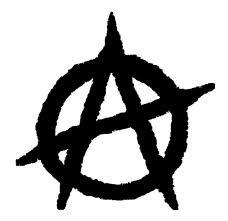
The Black Bloc — the “big A” Anarchists who broke windows in Oakland —  are becoming part of the same tradition. It’s a relatively small group, but it’s always around. The marches against the War in Iraq were huge, with tens of thousands of people, and entirely peaceful — except for a few Black Bloc-ers who broke windows and set fires.

Now: I’m not here to blast the Anarchists, or even the RCP. The Maoist/Bob Avakian types have become almost a parody of themselves in recent years, but if that’s what you’re into, go for it. I’m not even going to get into the argument over whether property damage counts as violence; been there, done that, got the circle-A T-shirt. Destroying stuff and causing mayhem can be a powerful political statement, and there have certainly been times when it was appropriate, effective and considered more than acceptable.

But it’s not always the right strategy, and in Oakland in 2011, I think it wasn’t. I recognize that this is an emergency situation, that the class warfare has already begun, and that extreme tactics are necessary to fight back. And hell, I don’t think smashing a bank window is so awful; smash enough of them and you put a lot of unemployed glaziers back to work. But in downtown Oakland, that tactic can too quickly backfire and lead to stuff like this. (Here’s an idea — how about a Shop Local day at Occupy Oakland, where everyone agrees to patronize small local businesses downtown? It fits right into the plan to withdraw your money from the big banks and put it in local credit unions.)

The problem with the Black Bloc (which isn’t really a bloc at all, it’s just a loose group of people who (a) think their tactics are appropriate and (b) love this shit) is that it’s acting in direct conflict with the many, many people who worked really, really hard to organize what was supposed to be a peaceful event. Like the RCP, they’re too quick to piss in the well.

You want to get violent? You want to break stuff? Show up for the general assembly, make your case, and see if you can convince the rest of the group that this is a good idea, right now, one that sends the right message and promotes the cause. Maybe you can do that; maybe everyone agrees. But if the majority of the group says no — that respect for property (much as we may hate private property, particularly bank property, and all that) is a better way to go right now, today, in this situation — then back off, dudes, and get with the program.

Alerts

0

alert@sfbg.com

Editor’s Note: Protests and other events connected to the Occupy Wall Street movement, include OccupySF and Occupy Oakland, have been developing quickly. To take part, follow our Politics blog or check with the websites associated with this important economic justice movement: occupysf.com, occupyoakland.org, or occupytogether.org. And you can send tips about what’s happening to news@sfbg.com.

WEDNESDAY 26

San Francisco’s budget crisis

Youth from the Bay Area Urban Debate League opine on solving the budget crisis in San Francisco. These electrifying young orators seek to engage the community in conversation and share their research about the current economic atmosphere.

6 p.m., free

SFUSD Board Room

555 Franklin St, 1st Floor

www.baudl.org


THURSDAY 27

Progressive prospects in fall election

Bay Guardian Executive Editor Tim Redmond holds a talk on how the upcoming election will effect the progressive community. Join in discussion, sponsored by Progressive Democrats of America, and ask questions regarding mayoral candidates and city politics.

7-9pm, free

Unitarian Universalist Center, Martin Luther King Room

1187 Franklin, SF

TGTGTGTGTG@aol.com

www.pdamerica.org


FRIDAY 28

White Picket Fences Reception

This multi-media visual and performance art exhibit highlights queer perspectives on the family unit and reflections of contemporary marriage and relationships. Artists like Midori, Monica Canilao, Harrison Bartlett, Mev Luna, Amelia Reiff Hill and Madison Young conjure dialogue in and out of the LGBT community on the dynamics of progressive life. This family oriented event is open to all ages and will be catered with food, wine and performances of featured artists.

7:30-10 p.m.

Michelle O’Connor Gallery

2111 Mission, SF

www.feminapotens.org


SUNDAY 30

Organize and fight back

The Party for Socialism and Revolution is holding its NorCal Regional Conference, with discussions on how big corporations avoid taxes, endless U.S. Wars, the cost of higher education, the prospects for capitalism and socialism, and other topics.

10 a.m.-5 p.m., $7-10

2969 Mission, SF

(415) 821-6171

sf@pwlweb.org


Making Democracy Work

Celebrate 17 years of social justice service with keynote speakers Rep. Andre Carson (D-IN) and Imam Siraj Wahhaj, religious director of At-Taqwa Mosque in NY, at a dinner banquet. This fundraiser supports the Council on American-Islamic Relations, the largest Islamic grassroots civil rights and advocacy group in the country.

5-10 p.m.

Santa Clara Marriott

2700 Mission College, Santa Clara

(408) 986-9874

www.ca.cair.com/sfba/event/17thannualbanquet


Mail items for Alerts to the Guardian Building, 135 Mississippi St., SF, CA 94107; fax to (415) 437-3658; or e-mail alert@sfbg.com. Please include a contact telephone number. Items must be received at least one week prior to the publication date.

Mormons and Republicans

12

CalBuzz, one of my favorite political sites, has an interesting essay on what the anti-Mormon sentiment in America means for Mitt Romney. Among the central points:

Gallup found that Democrats (27%) were more unlikely to support a Mormon than were Republicans (18%) – suggesting that in a general election, a Mormon’s hard-right views on gays, marriage, abortion and women’s rights might have more to do with resistance to an LDS candidate than religion itself.

Actually, not all politically active Mormons share that “hard right” approach — Stew Udall, the Arizona environmentalist, Congressmember and interior secretary under Kennedy and Johnson was a Mormon. So was his brother Mo, a liberal member of Congress who ran for president in 1976 as a left alternative to Jimmy Carter. But like evangelical Christians, Mormons in general tend to be conservative, especially on social issues.

The CalBuzzers are puzzled by the distrust of this particular religion:

It’s hard to determine what, exactly, drives anti-Mormon sentiments – whether it’s what people know, what they don’t know or what they think they know.

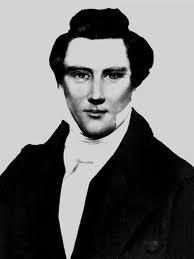
Are they familiar with Joseph Smith, Jr., the treasure digger from Palmyra, New York, who said he was visited by the angel Moroni in 1827 and guided to a box of golden plates which he said contained what is now known as the Book of Mormon, after he transcribed them from “reformed Egyptian”?

Are they thinking about the breakaway Mormons in HBO’s late great “Big Love” with Bill Paxton, Jeanne Tripplethorn, Chloe Sevigny, Ginnifer Goodwin, Bruce Dern, Mary Kay Place and Amanda Seyfried? Maybe they think Mormons are all like Roman Grant, the evil self-proclaimed prophet and leader of the Juniper Creek Compound played by Harry Dean Stanton.

Or are they like one wag we know who argues that the only difference between Mormonism and Scientology is the choir?

If you want to pounce on logical improbabilities in religions, you’ve got your parting of the Red Sea and the burning bush, the immaculate conception and the resurrection and that passel of virgins waiting for you in Heaven. Pick your myth.

The point, of course, is that the stuff Mormons believe is no odder than the teachings of most major religions. But there’s a big difference, and I find it fascinating.

The thing is, if you believe in Jesus or Abraham or Mohammed, you’re talking about people who lived a really long time ago, before there were accurate written records. Despite former Guardian writer Burton Wolfe’s best efforts, you can’t really prove that Jesus lived or didn’t live, or did or didn’t turn water into wine or cure lepers. The Bible has been translated so many times (and by many accounts, rewritten so many times) that it’s hard to know exactly what the original stories even were.

On the other hand, there are people alive today whose grandparents might have known Joseph Smith. Mormonism came to life in a time of newspapers and nearly-modern record keeping. Upstate New York in 1827 wasn’t exactly Manhattan today, but it wasn’t the Middle East in 44 B.C. either. There are still accounts of newspapers of the day denouncing Smith as a charlatan and fraud. Nobody can argue about whether he was into polygamy or not.

In the context of the 1800s, although there was plenty of strange religious stuff going on, the notion of a failed treasure hunter finding golden plates left by an angel (who then took the plates back after Smith made the one and only translation) seems pretty bizarre. That’s in part because the traditional religions all teach that the weird shit took place a really long time ago, which somehow makes it easier to justify.

If the son of a carpenter announced in 1827 that he was really the son of God, and that his mother was a virgin who had been impregnated by something called the Holy Spirit, who was also sorta, kinda part of God, isn’t it likely he might be called a nutjob? Ya think?

And the way the Mormon Church operates, with all of its official secrecy, just encourages people to think of it as a cult. But you ever tried really looking into the Vatican?

My point is that poor Mitt is going to face an uphill battle over his religion largely because the stuff that’s really, really hard to believe supposedly happened a couple millenia after stuff that’s really, really hard to believe was supposed to happen.

Not defending the Mormons here. (Although, if you stipulate that women have equal opportunity and gay people can get married, too, what IS wrong with polygamy?)

Just saying.


Medical marijuana protesters gather at City Hall in wake of federal raids

9

Protesters met in front of the San Francisco Federal Building this afternoon to challenge the recent federal crackdown on California’s medical marijuana industry. The rally formed on the heels of yesterday (October 13)’s raid by federal agents on Northstone Organics, a Ukiah medical marijuana cooperative.  

“Our state, our medicine,” protesters chanted. Among those present — about 30 individuals, per Guardian estimates — were medical marijuana patients, patient advocates, dispensary employees, and a representative of the Medical Cannabis Association

“When you’re a part of the medical cannabis movement, you feel personally affected by these raids,” said Shantanae Todd, an advocate and patient herself. Todd suffers from seizures and says she has found relief through her medical cannabis presciption for two years.

“What’s the difference between Democrats and Republicans? I’m not seeing much of a difference here,” cried Shona Gochenaur, executive director of low income medicinal cannabis center Axis of Love and member of the city’s Medical Cannabis Task Force. Gochenaur urged Kamala Harris, California’s Attorney General — who has resisted taking a stand on the federal government’s persecution of medicinal cannabis producers — to lend more vocal support. 

“We need to give everyone a clear message today that patients are not willing to go underground,” said Gochenaur. The protesters plan to meet and rally at noon the day after each and any future large-scale federal raids on California marijuana producers.

Rick Perry’s nutcase preacher

32

Did anyone else catch Terry Gross’s brilliant interview with C. Peter Wagner, the leader of the New Apostolic Reformation? He’s one of Rick Perry’s peeps, and his crew was involved in Perry’s big prayer meeting a few months back.

Lord, the guy is off his tree. I mean, full-on wackamole batso crazy.

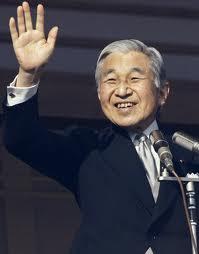
Japan, for example, is in deep economic decline because it’s controlled by demons who were allowed to take over the country when the emperor had sex with the Sun Goddess. (She’s not a nice girl, the Sun Goddess.) Wagner isn’t sure how that happened, physically, but he’s certain that it did (since humans have been known to have sex with the incubus and succubus).

Must have been hot.

And, of course, there are a lot of demons in Congress — and not only Democrats. There might be some demonic Republicans, too. They have to be diagnosed with a five-page questionnaire so the demons can be cast out.

Oh, and some whole cities are controlled by demons. (I wonder which ones those might be?)

When you talk about demons over cities, we’re talking about what — sometimes what we refer to as territorial spirits, and they’re more high-ranking spirits in the hierarchy of darkness and they’re more powerful and they require different approaches, and it’s not as easy as commanding them to leave in the name of Jesus. So sometimes there has to be repentance, sometimes there has to be — there has been bloodshed in that city that needs to be repented of, there has been idolatry in the city that has ruined the land. There’s been immorality that needs to be repented of, and there are several social things that people really need to acknowledge that they’re bad and repent of them and ask forgiveness.

Mercy.

So this is the kind of dude who will be hanging around the White House in the Perry Administration. Talk about demons overhead.

Editor’s notes

0

tredmond@sfbg.com

So the people who advise President Obama have finally figured out that he was on the road to becoming a one-term president — and the United States was on the road to ruin under President Perry. Whatever combination of self-preservation and fear was at work, it worked, at least for the moment.

Obama is now on record as refusing to accept any cuts in entitlements for poor people unless the rich people give a little, too. It’s a pretty good political statement — in every single major poll taken in the past year, an overwhelming majority of Americans agreed that higher taxes on the wealthy should be part of any deficit-reduction package. And it’s a no-brainer economic statement — the fundamental problem with the U.S. economy is a lack of consumer demand, which is tied directly to the fact that all of the wealth over the past 20 years has gone to the top and the middle class doesn’t have enough money to spend.

But what’s it’s really done is kicked the proverbial tax can — and thus, unfortunately, economic recovery — down the proverbial road another 13 months. Because the Republicans won’t accept higher taxes, and if Obama keeps his newfound spine, he won’t accept any cuts in Medicare and Medicaid, and nobody is talking about cutting the military, so nothing is going to happen.

Instead, this is the launch of Campaign 2012. Obama’s got a tough sell — the number on issue for most voters is jobs, and while I personally believe that the first stimulus plan kept the recession from getting worse, that’s not enough. Things are supposed to get better, and when they don’t, the guy at the top gets the blame.

So Obama has a problem: It’s all his fault, but he can’t do anything about it, and that’s what the Republicans are counting on. His only choice is to come roaring out like Harry Truman, and blame the “do-nothing” Republican Congress for blocking economic growth (and, if he has any sense, will say that the GOP is holding a jobs program hostage to protect the interests of the millionaires), and the Democrats will try to use that message to take back the House — and if it works, we might just possibly get things back on track in 2013. If it doesn’t, it’s going to be a very ugly decade.

An American blindness

8

After the first jetliner crashed into the Twin Towers on that September 11 morning, a friend of mine and his 11-year old daughter climbed up to the roof of their Manhattan home to look around. Just then the second plane struck, the young girl fell backward, and went blind from shock.

It took more than a year of examinations and therapies before this girl came out of her blindness to look around.

That’s what happened to America itself ten years ago this Sunday on 9/11, though it might be claimed many of us were blinded by privilege and hubris long before. But 9/11 produced a spasm of blind rage, arising from a pre-existing blindness as to the way much of the world sees us. That in turn led to the invasions of Afghanistan, Iraq, Afghanistan again, Pakistan, Yemen, Somalia and, in all, a dozen “shadow wars” according to The New York Times.

Bob Woodward’s crucial book, Obama’s Wars, points out that there were already secret and lethal counterterrorism operations active in more than 60 countries as of 2009. From Pentagon think tanks came a new military doctrine of the “Long War,” a counter-insurgency vision arising from the failed Phoenix program of the Vietnam era, projecting U.S. open combat and secret wars over a span of 50 to 80 years, or 20 future presidential terms. The taxpayer costs of this Long War, also shadowy, would be in the many trillions of dollars — and paid for not from current budgets, but by generations born after the 2000 election of George W. Bush. The deficit spending on the Long War would invisibly force the budgetary crisis now squeezing our states, cities and most Americans.

Besides the future being mortgaged, civil liberties were thought to require a shrinking proper to a state of permanent and secretive war, so the Patriot Act was promulgated. All this happened after 9/11 through Democratic default and denial. Who knows what future might have followed if Al Gore, with a half-million popular vote margin over George Bush, had prevailed in the U.S. Supreme Court instead of losing by the vote of a single justice? In any event, only a single member of Congress, Barbara Lee of Berkeley-Oakland, voted against the war authorization, and only a single senator, Russ Feingold, voted against the Patriot Act.

Were we not blinded by what happened on 9/11? Are we still? Let’s look at the numbers we almost never see.


CASUALTIES OF WAR

As to American casualties, the figure now is beyond twice those who died in New York, Pennsylvania and Washington D.C. on 9/11. The casualties are rarely totaled, but are broken down into three categories by the Pentagon and Congressional Research Service. There is Operation Enduring Freedom, which includes Afghanistan and Pakistan but, in keeping with the Long War definition, also covers Kazakhstan, Kyrgyzstan, Pakistan, Tajikistan, Turkmenistan, and Uzbekistan. Second, there is Operation Iraqi Freedom and its successor Operation New Dawn, the name adopted after September 2010 for the 47,000 US advisers, trainers and counterterrorism units still in Iraq. The scope of these latter operations includes Bahrain, Jordan, Kuwait, Oman, Qatar, Saudi Arabia, Turkey and the United Arab Emirates. These territories include not only Muslim majorities but, according to former Centcom commander Tommy Franks, 68 percent of the world’s proven oil reserves and the passageway for 43 percent of petroleum exports, another American geo-interest which was heavily denied in official explanations.

A combined 6,197 Americans were killed in these wars as of August 16, 2011, in the name of avenging 9/11, a day when 2, 996 Americans died. The total number of American wounded has been 45,338, and rising at a rapid rate. The total number rushed by military Medivac out of these violent zones was 56, 432. That’s a total of 107,996 Americans. And the active-duty military suicide rate for the decade is at a record high of 2, 276, not counting veterans or those who have tried unsuccessfully to take their own lives. In fact, the suicide rate for last year was greater than the American death toll in either Iraq or Afghanistan.

The Pentagon has long played a numbers game with these body counts. In addition to being painfully difficult and extremely complicated to access, there was a time when the Pentagon refused to count as Iraq war casualties any soldier who died from their wounds outside of Iraq’s airspace. Similar controversies have surrounded examples such as soldiers killed in non-combat accidents.

The fog around Iraq or Afghanistan civilian casualties will be seen in the future as one of the great scandals of the era. Briefly, the United States and its allies in Baghdad and Kabul have relied on eyewitness, media or hospital numbers instead of the more common cluster-sampling interview techniques used in conflict zones like the first Gulf War, Kosovo or the Congo. The United Nations has a conflict of interest as a party to the military conflict, and acknowledged in a July 2009 U.N. human rights report footnote that “there is a significant possibility that UNAMA is underreporting civilian casualties.”

In August, even the mainstream media derided a claim by the White House counter-terrorism adviser that there hasn’t been a single “collateral,” or innocent, death during an entire year of CIA drone strikes in Pakistan, a period in which 600 people were killed, all of them alleged “militants.” As an a specific explanation for the blindness, the Los Angeles Times reported April 9 that “Special Forces account for a disproportionate share of civilian casualties caused by western troops, military officials and human rights groups say, though there are no precise figures because many of their missions are deemed secret.”


STICKER SHOCK OF WAR

Among the most bizarre symptoms of the blindness is the tendency of most deficit hawks to become big spenders on Iraq and Afghanistan, at least until lately. The direct costs of the war, which is to say those unfunded costs in each year’s budget, now come to $1.23 trillion, or $444.6 billion for Afghanistan and $791.4 billion for Iraq, according to the National Priorities Project.

But that’s another sleight-of-hand, when one considers the so-called indirect costs like long-term veteran care. Leading economists Joseph Stiglitz and Linda Bilmes recently testified to Congress that their previous estimate of $4 to $6 trillion in ultimate costs was conservative. Nancy Youssef of McClatchy Newspapers in D.C. — in my opinion, the best war reporter of the decade — wrote recently that “it’s almost impossible to pin down just what the United States spends on war.” The president himself expressed “sticker shock,” according to Woodward’s book, when presented cost projections during his internal review of 2009.

The Long War casts a shadow not only over our economy and future budgets but our innocent and unborn children’s future as well. This is no accident, but the result of deliberate lies, obfuscations and scandalous accounting techniques. We are victims of an information warfare strategy waged deliberately by the Pentagon. As Gen. Stanley McChrystal said much too candidly in a February 2010, “This is not a physical war of how many people you kill or how much ground you capture, how many bridges you blow up. This is all in the minds of the participants.” David Kilcullen, once the top counterinsurgency adviser to Gen. David Petraeus, defines “international information operations as part of counterinsurgency.” Quoted in Counterinsurgency in 2010, Kilcullen said this military officer’s goal is to achieve a “unity of perception management measures targeting the increasingly influential spectators’ gallery of the international community.”

This new war of perceptions, relying on naked media manipulation such as the treatment of media commentators as “message amplifiers” but also high-technology information warfare, only highlights the vast importance of the ongoing WikiLeaks whistle-blowing campaign against the global secrecy establishment. Consider just what we have learned about Iraq and Afghanistan because of WikiLeaks: Tens of thousands of civilian casualties in Iraq, never before disclosed; instructions to U.S. troops to not investigate torture when conducted by U.S. allies; the existence of Task Force 373, carrying out night raids in Afghanistan; the CIA’s secret army of 3,000 mercenaries; private parties by DynCorp featuring trafficked boys as entertainment, and an Afghan vice president carrying $52 million in a suitcase.

The efforts of the White House to prosecute Julian Assange and persecute Pfc. Bradley Manning in military prison should be of deep concern to anyone believing in the public’s right to know.

The news that this is not a physical war but mainly one of perceptions will not be received well among American military families or Afghan children, which is why a responsible citizen must rebel first and foremost against The Official Story. That simple act of resistance necessarily leads to study as part of critical practice, which is as essential to the recovery of a democratic self and democratic society. Read, for example, this early martial line of Rudyard Kipling, the poet of the white man’s burden: “When you’re left wounded on Afghanistan’s plains/ And the women come out to cut up what remains/ Just roll to your rifle and blow out your brains/And go to your God like a soldier.” Years later, after Kipling’s beloved son was killed in World War I and his remains never recovered, the poet wrote: “If any question why we died / Tell them because our fathers lied.”


A HOPE FOR PEACE

An important part of the story of the peace movement, and the hope for peace itself, is the process by which hawks come to see their own mistakes. A brilliant history/autobiography in this regard is Dan Ellsberg’s Secrets, about his evolution from defense hawk to historic whistleblower during the Vietnam War. Ellsberg writes movingly about how he was influenced on his journey by meeting contact with young men on their way to prison for draft resistance.

The military occupation of our minds will continue until many more Americans become familiar with the strategies and doctrines in play during the Long War. Not enough Americans in the peace movement are literate about counterinsurgency, counterterrorism and the debates about the “clash of civilizations”, the West versus the Muslim world.

The more we know about the Long War doctrine, the more we understand the need for a long peace movement. The pillars of the peace movement, in my experience and reading, are the networks of local progressives in hundreds of communities across the United States. Most of them are voluntary, citizen volunteers, always and immersed in the crises of the moment, nowadays the economic recession and unemployment.

This peace bloc deserves more. It won’t happen overnight, but gradually we are wearing down the pillars of the war. It’s painfully slow, because the president is threatened by Pentagon officials, private military contractors and an entire Republican Party (except the Ron Paul contingent) who benefit from the politics and economics of the Long War.

But consider the progress, however slow. In February of this year, Rep. Barbara Lee passed a unanimous resolution at the Democratic National Committee calling for a rapid withdrawal from Afghanistan and transfer of funds to job creation. The White House approved of the resolution. Then 205 House members, including a majority of Democrats, voted for a resolution that almost passed, calling for the same rapid withdrawal. Even the AFL-CIO executive board, despite a long history of militarism, adopted a policy opposing Afghanistan. The president himself is quoted in Obama’s Wars as opposing his military advisors, demanding an exit strategy and musing that he “can’t lose the whole Democratic Party.” At every step of the way, it must be emphasized, public opinion in Congressional districts was a key factor in changing establishment behavior.

As for Al Qaeda, there is always the threat of another attack, like those attempted by militants aiming at Detroit during Christmas 2009 or Times Square in May 2010. In the event of another such terrorist assault originating from Pakistan, all bets are off: According to Woodward, the U.S. has a “retribution” plan to bomb 150 separate sites in that country alone there, and no apparent plan for The Day After. Assuming that nightmare doesn’t happen, today’s al Qaeda is not the al Qaeda of a decade ago. Osama bin Laden is dead, its organization is damaged, and its strategy of conspiratorial terrorism has been displaced significantly by the people-power democratic uprisings across the Arab world.

It is clear that shadow wars lie ahead, but not expanding ground wars involving greater numbers of American troops. The emerging argument will be over the question of whether special operations and drone attacks are effective, moral and consistent with the standards of a constitutional democracy. And it is clear that the economic crisis finally is enabling more politicians to question the trillion dollar war spending.

Meanwhile, the 2012 national elections present an historic opportunity to awaken from the blindness inflicted by 9/11.

After more than 50 years of activism, politics and writing, Tom Hayden is a leading voice for ending the wars in Afghanistan, Iraq, and Pakistan and reforming politics through a more participatory democracy.

Dick Meister: Busting the union busters, a labor day lament

2

By Dick Meister

This is not a very happy Labor Day for labor, considering the continued heavy attacks on public employee unions, which have become the vanguard of organized labor. More than one-third of public employees are now in unions, while only about 7 percent of private sector workers are unionized.

Probably nothing could be more damaging to the labor movement in general than the attempts by anti-union forces to weaken unions at all levels of government by trying to limit– if not withdraw – their collective bargaining rights and right to strike, in addition to unilaterally cutting the pay and pensions, health care and other benefits their unions have won in bargaining.

Although that’s all been done in the name of budget balancing, it’s more accurately described as union busting, spurred on by the steady increase in public employee union members, even as the number of private sector unionists has been declining.

It hasn’t helped unions, either, that President Obama has turned out to be far less friendly to labor than he’d promised while securing lots of union money and lots of union supporters to help him win the presidency. Ironically, the key role unions played in Obama’s election has led to moves by anti-union forces to try to also weaken unions’ political rights.

The best example of the heavy pressures public employees and their unions are feeling is in Wisconsin, where the movement to strip public employees of their union rights began, under notoriously anti-labor Gov. Scott Walker.

Republican Walker is not only seeking to deny unionization to most state, county and municipal employees. He’s also been pushing measures that would increase the employees’ contributions to pension and health care funds by up to 50 percent, require their contracts to be re-negotiated yearly, and no longer allow unions to deduct dues from employee paychecks. It’s hard to imagine a union surviving under such restraints. Certainly Gov. Walker and his political friends don’t imagine it.

Wisconsin is but one of at least 18 states, including several once considered union friendly, where public employees are under heavy attack. On the federal level, supposedly labor-friendly Obama has imposed a federal pay freeze.

Ohio’s Republican governor, John Kasich, is trying to outdo Walker. He’s proposing, among other anti-union measures, to eliminate the bargaining rights of more than 35,000 of Ohio’s public employees, to outlaw teacher strikes, prevent child care and home care workers from unionizing and repeal a rule that requires paying union wages to non-union workers on public construction projects.

Gov. Walker, however, remains the poster boy for anti-labor stalwarts. His most outrageous act has been to back a new state law that requires about two-thirds of Wisconsin’s school districts to use employee handbooks to replace collective bargaining agreements that for decades outlined the teachers’ pay and duties.

Substituting the handbooks for negotiated contracts gives school administrators the authority to dictate broad changes in the teachers’ working conditions without so much as consulting the teachers. In some school districts, even the administrators were not consulted before the handbooks with their stringent new conditions were issued.

Teachers are probably our most important public employees. Yet despite their great importance – or maybe because of it – Gov. Walker is eagerly supporting, not only a withdrawal of teachers’ collective bargaining rights, but also an end to teacher tenure, which protects them from unwarranted attacks by union foes such as Walker.

Walker also wants a substantial increase in the already high contributions to their health insurance by teachers and teacher retirees and changes that curtail the teachers’ basic rights and security by allowing them to be hired on a year-to-year basis. The new rules also mandate that in times of financial constraint, seniority can no longer be a basis for deciding which teachers to lay off.

Some Wisconsin school districts are even trying to reduce the number of sick days allowed teachers, however unwise it may seem to have teachers with possible communicative illnesses remain in the classroom because they can’t afford to take days off.

Other districts are doing away with at least some paid holidays or changing extra days used for professional development into workdays and cutting paid lesson preparation periods in half. The Wisconsin Journal Sentinel’s Erin Richards quotes one of Wisconsin’s major teacher union leaders as noting that teachers across the state have been most concerned with losing prep time, which can have a direct effect on the quality of lessons and student performance.

Gov. Walker and other leading Republicans don’t seem to be much concerned about that. What’s more important to them is cutting Wisconsin’s education budget, the influence of teachers on education policy and, of course, all but eliminating the union rights of teachers and all other public employees.

But Walker may very well have gone too far. The negative reaction has been strong and growing in Wisconsin and elsewhere. It’s widely realized that if the public employee union busters are successful, private sector unions throughout the country will feel even stronger opposition. And it’s clear that if anti-union forces can weaken the public employee unions that are the strongest segments of today’s labor movement, it’s more than likely that private sector unions will be the next target.

The good news is that recently, Wisconsin voters easily turned back a GOP attempt to recall two strong pro-worker state senators who had helped lead the fight against Walker’s anti-worker legislation. The fight began in the spring when Republicans targeted eight Democratic senators for recall – and lost. There have been nine recall elections since then and labor has won five of them.

Labor and the Democrats had hoped to wrest control of the State Senate from the GOP. But though failing to do so, they did narrow the Republicans Senate majority to a razor-thin 17-16.

Democrats and union leaders are rightly celebrating the pro-labor election victories as a possible opening shot against anti-labor extremism nationwide, which could in turn lead to an attempt to recall Gov. Walker or at least force him to back off.

Actually, Walker has done his labor enemies a great favor by provoking public outrage that has brought important new strength and solidarity to the cause of working people and their unions everywhere.

So it may be a happy Labor Day after all, thanks to a labor opponent.

Dick Meister, former labor editor of the SF Chronicle and KQED-TV Newsroom, has covered labor and politics for more than a half-century. Contact him through his website, www.dickmeister.com, which includes more than 350 of his columns.

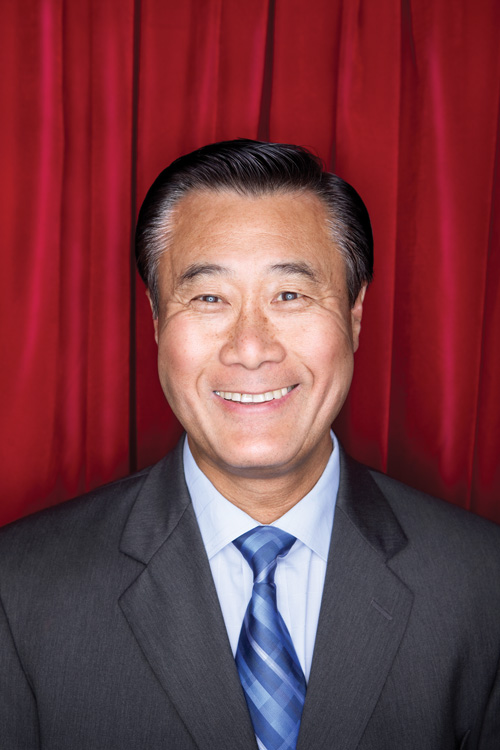
The real Leland Yee

53

tredmond@sfbg.com

It’s early January 2011, and the Four Seas restaurant at Grant and Clay is packed. Everyone who is anyone in Chinatown is there — and for good reason. In a few days, the Board of Supervisors is expected to appoint the city’s first Asian mayor.

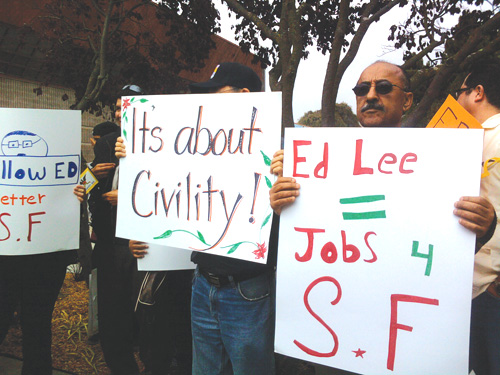
The rally is billed as a statement of support for Ed Lee, the mild-mannered bureaucrat and reluctant mayoral hopeful. But that’s not the entire — or even, perhaps, the central — agenda.

Rose Pak, who describes herself as a consultant to the Chinese Chamber of Commerce but who is more widely known as a Chinatown powerbroker, is the host of the event. She stands in front of the room, takes the microphone, and, in Cantonese, delivers a remarkable political speech.

According to people in the audience, she says, in essence, that the community has come out to celebrate and support Ed Lee — but that’s just the start. She also urges them not just to promote their candidate — but to do everything possible to prevent Leland Yee from becoming mayor.

She continues on for several minutes, lambasting Yee, the state Senator who lived in Chinatown as a child, accusing him of about every possible political sin — and turning the Lee rally into an anti-Yee crusade. And nobody in the crowd seems terribly surprised.

Across Chinatown, from the liberal nonprofits to the conservative Chamber of Commerce, there’s a palpable fear and distrust of the man who for years has been among San Francisco’s most prominent Asian politicians — and who, had Lee not changed his mind and decided to run for a full term this fall, was the odds-on favorite to become the city’s first elected Chinese mayor.

The reasons for that fear are complex and say a lot about the changing politics of Asian San Francisco, the power structure of a city where an old political machine is making a bold bid to recover its lucrative clout — and about the career of Yee himself.

Senator Leland Yee is a political puzzle. He’s a Chinese immigrant who has built a political base almost entirely outside of the traditional Chinatown community. He’s a politician who once represented a deeply conservative district, opposed tenant protections, voted against transgender health benefits and sided with Pacific Gas and Electric Co. on key environmental issues — and now has the support of some of the most progressive organizations in the city. He’s taken large sums of campaign money from some of the worst polluters in California, but gets high marks from the Sierra Club.

His roots are as a fiscal conservative — yet he’s been the only Democrat in Sacramento to reject budget compromises on the grounds that they required too many spending cuts.

He’s grown, changed, and developed his positions over time. Or he’s become an expert at political pandering, telling every group exactly what it wants to hear. He’s the best chance progressives have of keeping the corrupt old political machine out of City Hall — or he’s a chameleon who will be a nightmare for progressive San Francisco.

Or maybe he’s a little bit of all of that.


Leland Yin Yee was born in Taishan, a city in China’s Guangdong province on the South China Sea. The year was 1948; Mao Zedong’s Communist Party of China had taken control of much of the countryside and was moving rapidly to take the major cities. The nationalist army of General Chiang Kai-Shek was falling apart, and Yee’s father, who owned a store, decided it was time for the family to leave.

The Yees made it to Hong Kong, and since Mee G. Yee had previously lived in the United States and served in the U.S. Army during World War II, he was ultimately able to move the family to San Francisco. In 1951, the three-year-old Leland Yee arrived in Chinatown.

For four years, Yee lived with his sister and mother in a one-room apartment with a shared bathroom while his father worked as a sailor in the merchant marine. It was, Yee recalled in a recent interview, a tight, closed, and largely self-sufficient community.

“The movie theater, the shoe store, the barber shop, food — everything you needed you could get in Chinatown,” Yee said. “You never had to leave.”

Of course, after a while, Yee and his mom started to venture out, down Stockton Street to Market, where they’d shop at the Emporium, the venerable department store. “It was like walking into a different country,” he said. “If you didn’t know English, they didn’t have time for you.”

Yee, like a lot of young Chinese immigrants of his era, put much of his time into his studies — in the San Francisco public schools and in a local Chinese school. “My mom spoke a village dialect, and we had to learn Cantonese,” he said. “Every little kid had to go to Chinese school. We hated it.”

When Yee was eight, his parents managed to buy a four-unit building on Dolores Street, and the family moved to the Mission, where he would spend not only the rest of his childhood but much of his early adult life. He graduated from Mission High School, enrolled in City College, studied psychology and after two years won admission to UC Berkeley.

Berkeley in 1968 was a very different world from Chinatown and even the relatively controlled environment he’d experienced at home in the Mission. “You didn’t protest in school. You’d have been sent home, and your mother would kill you,” he said.

At Berekely, all hell was breaking loose, with the antiwar protests, the People’s Park demonstrations, the campaign to create a Third World College (which led to the first Ethnic Studies Department), and a general attitude of mistrust for authority. “I developed a sense of activism,” Yee said. “I realized I could speak out.”

That spirit quickly vanished when Yee lost faith in some of his fellow activists. “People would work with us, then get into positions of power and use that against you,” he recalled. “A lot of my friends said ‘forget it.’ I left the scene.”

Yee once again devoted his energy to school, earning a masters at San Francisco State University and a Ph.D in child psychology from the University of Hawaii. Along the way, he met his wife, Maxine.

With his new degree, the Yees moved back to San Francisco — and back in with his parents at the Dolores property, where he, Maxine and a family that would grow to four kids would live for more than a decade.


Yee worked as a child psychologist for the San Francisco Department of Public Health, starting the city’s first high school mental-health clinic. He went on to become a child psychologist at the Oakland Unified School District, then joined a nonprofit mental health program in San Jose.

In 1986, Yee decided to get active in politics for the first time since college, and ran for the San Francisco School Board. He lost — and that would be the only election he would ever lose. In 1988, he won a seat, and established himself as an advocate for students of color, fighting school closures in minority neighborhoods. He also tried to get the district to modify its harsh disciplinary rules, arguing against mandatory expulsions.

On fiscal issues, though, Yee was a conservative. For his first term, despite the brutal cutbacks of the recession of the late 1980s and early 1990s, he insisted that the district make do with the money it had. His solution to the red ink: Cut waste. Only in 1992, when he was up for re-election, did he acknowledge that the district needed more cash; at that point, he supported a statewide initiative to tax the rich to bring money to the schools.

The sense of fiscal conservatism — of holding the line on taxes, but mandating open and fair contracting procedures and tight financial controls — was a hallmark of much of his political career. When the Guardian endorsed him for re-election to the board in 1992, we wrote that “there’s real value in his continuing vigilance against administrative fat and favoritism in contracts.”

Over the next four years, Yee worked with then-Superintendent Waldemar “Bill” Rojas, a deeply polarizing figure who pushed his own personal theory of “reconstitution” — firing all the staff at low-performing schools — and later was enmeshed in a scandal that led to prison time for a contractor he’d hired. Yee told me he was the only board member to vote against hiring Rojas, but people who were watching the board closely back then say he didn’t always stand up to the superintendent.

He also became what some say was a bit too close with Tim Tronson, a consultant hired by the district as a $1,000-a-day facilities consultant. Tronson wound up getting indicted on 22 counts of grand theft, embezzlement, and conspiracy in a scheme to steal $850,000 from the schools, and was sentenced to four years in state prison.

In 1998, when some school board members wanted to build housing for teachers on property that the district owned in the Sunset, Yee led the opposition — with Tronson’s help. At one meeting at Sunset Elementary School, Yee went so far as to say, according to people present, that “Tim Tronson is my man, and I rely on him for advice.”

Yee acknowledged that he worked closely with Tronson to defeat that housing project. “He was the facilities manager,” Yee explained, “and I said that I trusted his judgment.”


Yee has either a great sense of political timing or exceptional luck. He ran for the Board of Supervisors in 1996, facing one of the weakest fields in modern San Francisco history. He was the only Chinese candidate and one of just two Asians (the other, appointed incumbent Michael Yaki, barely squeaked to re-election). In an at at-large election with the top five winning seats, Yee came in third, with 103,000 votes.

He was never a progressive supervisor. In 2000, the Guardian ranked the good votes of what we referred to as Willie Brown’s Board, and Yee scored only 43 percent. He was against campaign finance reform. He supported the brutal gentrification and community displacement represented by the Bryant Square development. He voted to kill a public-power feasibility study and opposed the Municipal Utility District initiative. He opposed a moratorium on uncontrolled live-work development.

In 2002, Yee was one of only three supervisors to oppose Proposition D, a crucial public-power measure that would have broken up PG&E’s monopoly in the city. He stood with PG&E (and then-Sups. Tony Hall and Gavin Newsom) in opposition to the measure, then signed a pro-PG&E ballot argument packed with PG&E lies.

When I asked him about that stand, Yee at first didn’t recall opposing Prop. D, but then said he “stood with labor” on the issue. In fact, the progressive unions didn’t oppose Prop. D at all; the opposition was led by PG&E’s house union, IBEW Local 1245.

Yee was particularly bad on tenant issues. He not only voted to deny city funding for the Eviction Defense Collaborative, which helped low-income tenants fight evictions; he actually tried to get the city to put up money for a free legal fund to help landlords evict their tenants. He opposed a ballot measure limiting condo conversions. He opposed a measure to limit the ability of landlords to pass improvement costs on to their tenants.

In 2001, Yee voted to uphold a Willie Brown veto of legislation to limit tenancies in common, a backdoor way to get around the city’s condo conversion ordinance. Only Hall and Newsom, then the most conservative supervisors on the board, joined Yee. At one point, he started asking whether the city should consider repealing rent control.

He opposed an affordable housing bond in 2002, joining the big landlord groups in arguing that it would raise property taxes. Every tenant group in town supported the measure, Proposition B; every landlord group opposed it.

I asked Yee about his tenant record, and he told me that he now supports rent control. But he said that he was always on the side of homeowners and small landlords, and that property ownership was central to Chinese culture. “I was responding to the Chinese community and the West Side,” he said.

He wasn’t much of an environmentalist, either — at least not in today’s terms. He was one of the only city officials to support a “Critical Car” rally in 1999, aimed at promoting the rights of vehicle drivers (and by implication, criticizing Critical Mass and the bicycle movement).

His record on LGBT issues was mixed. While he supported a counseling program for queer youth when he was on the school board, he also supported JROTC, angering queer leaders who didn’t want a program in the public schools run by, and used as a recruiting tool for, the military, which at that point open discriminated against gay and lesbian people.


Yee was also one of only two supervisors who voted in 2001 against extending city health benefits to transgender employees.

That was a dramatic moment in local politics. Nine votes were needed to pass the measure, and while eight of the supervisors were in favor, Yee and Hall balked. At one point, Board President Tom Ammiano had to direct the Sheriff’s Office to go roust Sup. Gerardo Sandoval, who was ducking the issue in his office, to provide the crucial ninth vote.

Yee didn’t just vote against the bill. According to one reliable source who was there at the time, Yee spoke to a community meeting out on Ulloa Street in the Sunset and berated his colleagues, quipping that the city should have better things to do than “spend taxpayer money on sex-change operations.”

It was a bit shocking to trans people — Yee had, over the years, befriended some of the most marginalized members of what was already a marginalized community. “There was one person at the rail crying, saying ‘Leland, how could you do this to us,'” Ammiano recalled.

The LGBT community was furious with Yee. “I didn’t speak to him for at least a year,” Gabriel Haaland, one of the city’s most prominent transgender activists, told me.

Yee now says the vote was a mistake — but at the time, he told me, he was under immense pressure. When he voted for the queer youth program, he said, “the elders of the Chinese community ripped me apart. They called my mother’s friends back in the village [where he was born] and said her son was embarrassing the Chinese community.”

That must have been difficult — and he said that “if I had known the pain I had caused, I wouldn’t have voted that way.” But it was hard to miss that pain his vote caused.

On the other hand, people learn from their experiences, attitudes evolve, we all grow up and get smarter, and the way Yee describes it, that’s what happened to him.

In 2006, when he was running for state Senate, Yee met with a group of trans leaders and formally — many now say sincerely — apologized. It was an important gesture that made a lot of his critics feel better about him.

“He didn’t have to do that,” Haaland said. “People change, and he paid for his crime, and that’s genuine enough for me.”

As a former school board member, Yee kept an interest in the schools — but not always a healthy one. At one point, he actually proposed splitting SFUSD into two districts, one on the (poorer) east side of town and one on the (richer) west. “We strongly opposed that,” recalled Margaret Brodkin, who at the time ran Coleman Advocates for Children and Youth. “Eventually he dropped the idea.”

For all the problems, in his time on the Board of Supervisors, Yee developed a reputation for independence from the Brown Machine, which utterly dominated much of city politics in the late 1990s. His weak 43 percent rating on the Guardian scorecard was actually third-best among the supervisors, after Ammiano and the late Sue Bierman.

In 1998, he was one of the leaders in a battle to prevent the owners of Sutro Tower from defying the city’s zoning administrator and placing hundreds of new antennas on Sutro Tower. He, Bierman, and Ammiano were the only supervisors opposing Brown’s crackdown on homeless people in Union Square.

When he ran in the first district elections, in 2000, against two opponents who had Brown’s support and big downtown money, the Guardian endorsed him, noting that while he “can’t be counted on to support worthy legislation … He’s one of only two board members who regularly buck the mayor on the big issues.”

(He never liked district elections, and used to take any opportunity to denounce the system, at times forcing Ammiano to use his position as president to tell Yee to quit dissing the electoral process and get to the point of his speech.)


In 2002, the westside state Assembly district seat opened up, and both Yee and his former school board colleague Dan Kelly ran in the Democratic primary. Yee won, and went on to win the general election with only token opposition.

His legislative record in the Assembly wasn’t terribly distinguished. Yee never chaired a policy committee — although he did win a leadership post as speaker pro tem. And he cast some surprisingly bad votes.

In 2003, for example, then-Assemblymember Mark Leno introduced a bill that would have exempted single-room occupancy hotels from the Ellis Act, which allows landlords to evict tenants for no reason. Yee refused to vote for the bill. Leno was furious — he was one vote short of a majority and Yee’s position would have doomed the bill. At the last minute, a conservative Republican who had grown up in an SRO hotel voted in favor.

When he ran for re-election in 2004, we noted: “What’s Leland Yee doing up in Sacramento? We can’t figure it out — and neither, as far as we can tell, can his colleagues or constituents. He’s introduced almost no significant bills — compared, for example, to Assemblymember Mark Leno’s record, Yee’s is an embarrassment. The only high-profile thing he’s done in the past several years is introduce a bill to urge state and local governments to allow feng shui principles in building codes.”

In 2006, Yee decided to move up to the state Senate, and he won handily, beating a weak opponent (San Mateo County Supervisor and former San Francisco cop Mike Nevin) by almost 2-1. His productivity increased significantly in the upper chamber — and in some ways, he moved to the left. He’s begun to support taxes — particularly, an oil severance tax — and when I’ve questioned him, he somewhat grudgingly admits that Prop. 13 deserves review.

He’s done some awful stuff, like trying to sell off the Cow Palace land to private developers. But he has consistently been one of the best voices in the Legislature on open government, and that’s brought him some national attention.

Yee has been a harsh critic of spending practices and secrecy at the University of California, and when UC Stanislaus refused in 2010 to release the documents that would show how much the school was paying Sarah Palin to speak at a fundraiser, Leland flew into action. He not only blasted the university and introduced legislation to force university foundations to abide by sunshine laws; he worked with two Stanislaus students who had found the contract in a dumpster and made headlines all over the country.

He’s fought for student free speech rights and this year pushed a bill mandating that corporations that get tax breaks for job creation prove that they’ve actually created jobs — or pay the tax money back. He’s also won immense plaudits from youth advocates and criminal justice reformers for his bill that would end life-without-parole sentences for offenders under 18.

Along the way, he compiled a 100 percent voting record from the major labor unions, including the California Nurses Association and SEIU, and with the Sierra Club. All three organizations have endorsed him for mayor.

Yee told me that he thinks he’s become more progressive over the years. “My philosophy has shifted,” he said.

Yet when you talk to his colleagues in Sacramento, including Democrats, they aren’t always happy with him. Yee has a tendency to be a bit of a loner — he’s never chaired a policy committee and in some of the most bitter budget fights, he’s refused to go along with the Democratic majority. Yee insists that he’s taken principled stands, declining to vote for budget bills that include deep service cuts. But the reality in Sacramento is that budget bills have until this year required a two-thirds vote, meaning two or three Republicans have had to accept the deal — and losing a Democratic vote has its cost.

“You have to give up all sorts of things, make terrible compromises, to get even two Republicans,” one legislative insider told me. “When a Democrat goes south, you have to find another Republican, and give up even more.”

In other words: It’s easy to take a principled stand, and make a lot of liberal constituencies happy, when you aren’t really trying to make the state budget work.


I met Rose Pak on a July afternoon at the Chinatown Hilton. She brought along her own loose tea, in a paper package; the waitress, who clearly knew the drill, took it back to the kitchen to brew. Pak and I have not been on the greatest of terms; she’s called the Guardian all kinds of names, and I’ve had my share of critical things to say about her. But on this day, she was polite and even at times charming.

After we got the niceties out of the way (she told me I was unfair to her, and I told her I didn’t like the way she and Willie Brown played politics), we started talking about Yee. And Pak (unlike some people I interviewed for this story) was happy to speak on the record.

She told me Yee had “no moral character.” She told me she couldn’t trust him. She told me a lot of stories and made a lot of allegations that we both knew neither she nor I could ever prove.

Then we got to talking about the politics of Chinatown and Asians in San Francisco, and a lot of the animosity toward Yee became more clear.

For decades, Chinatown and the institutions and people who live and work there have been the political center of the Chinese community. Nonprofits like the Chinatown Community Development Center have trained several generations of community organizers and leaders. The Chinese Chamber of Commerce, the Six Companies, and other business groups have represented the interests of Chinese merchants. And while the various players don’t always get along, there’s a sense of shared political culture.

“In Chinatown,” Gordon Chin, CCDC’s director, likes to say, “it’s all about personal connections.”

There’s a lively infrastructure of community-service programs, some of which get city money. There’s also a sense that any mayor or supervisor who wants to work with the Chinese community needs to at least touch base with the Chinatown establishment.

Yee doesn’t do that. “He doesn’t give a shit about them,” David Looman, a political consultant who has worked with many Chinese candidates over the years, told me.

Yee’s Asian political base is outside of Chinatown; he told me he sees himself representing more of the Chinese population of the Sunset and Richmond and the growing Asian community in Visitacion Valley and Bayview.

Pak is connected closely to Brown, who Yee often clashed with. For Pak, Brown, and their allies, strong connections to City Hall mean lucrative lobbying deals and public attention to the needs of Chinatown businesses. Then there’s the nonprofit sector.

CCDC and other nonprofits do important, sometimes crucial work, building and maintaining affordable housing, taking care of seniors, fighting for workers rights, and protecting the community safety net. Yee, Pak said, “has never shown any interest in our local nonprofits. We all work together here, and he doesn’t seem to care what we do.” Yee told me he has no desire to see funding cut for any critical social services in any part of town. But he has also made no secret of the fact that he questions the current model of delivering city services through a large network of nonprofits, some of which get millions of taxpayer dollars. And the way Pak sees it, all of that — the nonprofits, the business benefits, the contracts — are all at risk. “If Leland Yee is elected mayor,” she told me, “we are all dead.”

I ran into an old San Francisco political figure the other day, a man who has been around since the 1970s, inside and outside of City Hall, who remains an astute observer of the players and the power relationships in the local scene. At the time we talked, he wasn’t supporting any of the mayoral candidates, but he had a thought for me. “This town,” he said, “is being taken over by a syndicate. Willie Brown is the CEO, and Rose Pak is the COO, and it’s all about money and influence.”

That’s not a pleasant thought — I’ve lived through the era of political machine dominance in this town, and it was awful. In the days when Brown ran San Francisco, politics was a tightly controlled operation; only a small number of people managed to get elected to office without the support of the machine. Developers made land-use policy; gentrification and displacement were rampant; corruption at City Hall turned a lot of San Franciscans off, not only to the political process but to the whole notion that government could be a positive force in society.

A few years ago, I thought those days were over — and to a certain extent, district elections will always make machine politics more difficult. But when I see signs of the syndicate popping up — and I see a candidate like Ed Lee, who’s close friends with Brown, leading the Mayor’s Race — it makes me nervous. And for all his obvious flaws, at least Leland Yee isn’t part of that particular operation. If there’s a better reason to vote for him, I don’t know what it is.

YEE HOME PURCHASE RAISES SUSPICIONS

Rose Pak has a question about Leland Yee. “How,” she asked me, “did the guy manage to buy a million-dollar house on a $30,000 City Hall salary?”

Pak isn’t the only one asking — numerous media reports over the years have examined how Yee raised a family of four and bought a house in the Sunset on very little visible income. And while I’m not usually that interested in the personal finances of political candidates, I decided that it was worth a look.

Here’s what I found: Public records show that in July 1999, Yee and his wife, Maxine, purchased a house on 24th Avenue for $875,000 (it’s now assessed at slightly more than $1 million). At the time, Yee was a San Francisco supervisor, earning a little more than $30,000 a year. (The salary of the supervisors was raised dramatically shortly after Yee left the board and went to the state Assembly.) His wife wasn’t working. And his economic interest statements for that period show no other outside earnings. So the disposable, after-tax income of the entire Yee family couldn’t have been much more than $25,000.

That, by any normal standard, shouldn’t have been enough to float a mortgage that, records show, totaled $516,000. In fact, the interest payments alone on that mortgage alone would total $3,600 a month — more than Yee’s gross income.

Documents in the Assessor’s Office show another paper trail, too. In 1989, Jung H. Lee, Yee’s mother, transferred the deed on a four-unit Dolores St. building where the family had been living to Maxine and Leland Yee — for no money. And a few months before the Yees bought the Sunset house, they took out a $320,000 home-equity loan on that property. That was the down payment on the Sunset property.

Still: At that point, the Yees would have been paying off two mortgages, with a total nut of about $5,000 a month — and supporting four kids, in San Francisco. In 2002, Yee’s economic interest statement’s show some modest income from teaching at Lincoln University — but nowhere near enough to pay that level of expenses.

What happened? Yee explains it this way: “For more than 10 years, we were living rent-free in my parents’ property,” he told me I an interview. “We were a close Chinese family, and my parents provided the food and helped pay for the children’s clothing. So we had almost no expenses and we lived very frugally.”

During that period, Yee was working for the San Francisco Department of Public Health, the Oakland Unified School District, and a San Jose nonprofit, earning, he said, between $50,000 and $90,000 a year. If he saved almost all of that money, he would have had more than a half-million dollars in the bank when he bought the Sunset house.

There’s nothing on any of his economic disclosure forms showing any ownership of stocks or other reportable financial interests during that period, so he wasn’t investing the money. In fact, he says, it was, and is, all in simple savings accounts. A bit unusual for that large a sum of money.

How did he get a mortgage? “Back then,” he said, “banks were willing to lend a lot more freely than they do today.”

Starting in 2003, Yee was in the state Assembly, making a higher salary — but still not much in excess of $100,000 a year. After taxes, he was probably taking home about $75,000 — and $60,000 was going to the two mortgages.

How did he do it? “We have been supplementing our income with our savings,” he said. “We don’t take vacations, we are very careful with our money.” And they clearly aren’t desperate for cash — Yee’s daughter occupies two of the four units in the Dolores St. building they own, but the other two units are vacant.

It’s possible. It’s plausible. But I don’t blame people for wondering how he managed to pull it off. (Tim Redmond, with research assistance by Oona Robertson) 


BIG CORPORATIONS HAVE BACKED YEE

Yee became a prodigious fundraiser in Sacramento — and a lot of the money came from big corporations that had business in the Legislature. And while he has perfect scores from the Sierra Club and the big labor unions, he’s taken tens of thousands of dollars from some of the biggest corporations, agribusiness interests, and polluters in the state. And at times, he’s voted their way.

Since 1993, for example, campaign finance records show Yee has taken more than $20,000 from Chevron, ExxonMobil, Valero, Conoco Phillips, and BP. He’s received another $22,450 from the chemical industry (and industry employees). Most of it came from Clorox, Dow Chemical, and Dupont.

And while the Sierra Club may not have considered it a priority, Sen. Mark Leno has worked hard to pass a bill limiting chemical fire retardants in furniture. In 2008, Yee voted against Leno’s AB 706.

That year he also refused to support a bill that would prohibit the use of the chemical diacetyl in workplaces. The industries that opposed AB 514 (including Bayer, Abbott Laboratories, Pfizer, and Johnson & Johnson) have given Yee a total of more than $60,000.

In 2003, Yee voted against a crucial tenant bill, one that would have prevented the owners of single room occupancy hotels from using the Ellis Act to evict tenants. He received a campaign check for $2,500 from the San Francisco Apartment Association the next day. Landlords in general have given Yee close to $40,000.

Then there’s agribusiness. Yee gets a lot of money from the farming industry, despite the fact that there obviously aren’t many farms in his district. Why, for example, would the California Poultry Association, the California Cattlemen’s Association, and the California Farm Bureau give him money? The Poultry Association’s Bill Mattos told us that Yee “has taken a keen interest in California’s poultry industry.”

Yee also took immense flak from the San Francisco Chronicle and other papers over a 2003 vote against a bill to limit emissions from farm vehicles. In an editorial, the paper wrote that he was “doing dirty work for the lobbyists.” In the end, under immense public pressure, he switched positions and voted for the bill. I asked Yee about all that money from all those bad operators, and he told me — as most politicians will — that campaign cash has never influenced any of his votes.

So why do all these groups give him money? “It’s about whether you will sit down and listen,” Yee said. “I will talk to all sides and at least consider the arguments as a thoughtful human being. Then I vote my conscience.” (Tim Redmond, with research by Oona Robertson) 

So much for civility

0

rebeccab@sfbg.com

The San Francisco mayor’s race went from a lackluster affair to a dynamic match as the Aug. 12 filing deadline drew near and two prominent city officials who had previously said they wouldn’t run tossed their hats into the ring.

Mayor Ed Lee’s Aug. 8 announcement that he’d seek a full term prompted several of his opponents to use their time onstage at candidate forums to decry his reversal and question his ties to the moneyed, influential backers who openly urged him to run. Several days later, Public Defender Jeff Adachi’s last-minute decision to run for mayor signaled more tension yet to come in the debates.

At this point, eight current city officials are running campaigns for higher office, and the dialogue is beginning to take on a tone that is distinctly more biting than civil. Adachi, who had not yet debated onstage with his opponents by press time, told reporters he was running because he wanted “to make sure there’s a voice in there that’s talking about the fiscal realities of the city.”

Adachi authored a pension reform ballot measure that rivals the package crafted by Lee, labor unions, and business interests (see “Awaiting consensus,” May 31, 2011). At an Aug. 11 candidate forum hosted by the Alice B. Toklas Democratic Club, the San Francisco Young Democrats, and the City Democratic Club, all of the top-tier candidates who were present indicated that they would support Lee’s pension reform measure and not Adachi’s.

“The reforms that I have championed are reforms that are absolutely needed, along with action,” Adachi told reporters moments after making his candidacy official. He added that after watching the mayoral debates, “I became convinced that either the candidates don’t get it, or they don’t want to get it.”

Those fighting words will likely spur heated exchanges in the months to come, but until Adachi’s entrance into the race, it was Lee who took the most lumps from opponents. Even Board President David Chiu, a mayoral candidate whose campaign platform is centered on the idea that he’s helped restore civility to local government, had some harsh words for Lee during an Aug. 11 mayoral debate.

“I do regret my decision to take Ed Lee at his word when he said he would not run,” Chiu said in response to a question about whether he regretted any of his votes. He also said his first interaction with Lee after the mayor had announced his candidacy was “a little like meeting an ex-girlfriend after a breakup.”

Lee, whose pitch on the campaign trail features a remarkably similar narrative about transcending political squabbling in City Hall, became the target of boos, hisses, and noisemaker blasts when a boisterous crowd packed the Castro Theater for an Aug. 8 candidate forum. He received one of the most forceful rebukes from Sen. Leland Yee, an opponent whom Lee supporters are especially focused on defeating.

“Had the mayor said that he would in fact run, he may not have gotten the votes for interim mayor,” Yee said. “Will you resign from your post,” he asked, challenging Lee, “in order to then run for mayor?” Days later, Yee had developed a new mantra about throwing power brokers out of City Hall instead of “wining and dining with them.”

Yet Lee said his decision to enter the race wasn’t because of the push from his backers, but because of how well things have gone during his brief tenure in Room 200. “Things have changed at City Hall, particularly in the last seven months,” he told reporters Aug. 8. “And because of that change, I changed my mind.”

In yet another twist, former Mayor Art Agnos — whom progressives had looked to as a potential appointee to the vacant mayor’s seat back in December, before Lee was voted in to replace former mayor and Lieutenant Governor Gavin Newsom — delivered a surprise endorsement of City Attorney Dennis Herrera shortly after Lee declared. The decision was particularly significant since Agnos first hired Lee to serve in city government, and has a long history of working with him.

“[Herrera] is an independent person who will empower neighborhoods … and won’t be beholden to power brokers,” Agnos said. He also told the Guardian he wasn’t surprised that Lee had opted to run, given the role former Mayor Willie Brown and influential business consultant Rose Pak had played in orchestrating Lee’s appointment.

“Anybody who is an astute political observer saw the signs from the very beginning,” Agnos said. In response to a comment about his unique vantage point as a would-be caretaker mayor, he said, “I would’ve kept my word and not run for reelection.”

Intense focus on Lee’s flip-flop, and on the Progress for All-backed “Run, Ed, Run” effort that was the subject of an Ethics Commission discussion that same week, stemmed at least in part from the threat the incumbent mayor represents to other candidates. A CBS 5-SurveyUSA poll suggested he became an instant front-runner.

Yet questions about “Run, Ed, Run” — some raised by observers unaffiliated with any campaigns — also served to spotlight the candidate’s longstanding ties with backers closely connected to powerful business interests that stand to lose big if their links to city government aren’t preserved.

Retired Judge Quentin Kopp issued an open letter to District Attorney George Gascón Aug. 1 urging him to convene a criminal grand jury to investigate whether illegal and corrupt influencing had occurred when Pak — a close friend of Lee’s and a key driver behind the “Run, Ed, Run” effort — reportedly recruited executives of Recology to gather signatures urging Lee to run.

Recology, which handles the city’s waste, was recently awarded a $112 million city contract, and Lee’s scoring of the company and recommendation to raise rates in his previous capacity as city administrator benefited the company. Brown received substantial campaign donations from Recology in previous bids for mayor. Kopp is the coauthor of a ballot initiative asking San Francisco voters if the company’s monopoly on city garbage contracts should be put out to bid.

“A criminal grand jury is vital in order to put people under oath and interrogate them,” Kopp said. “They would put Willie Brown under oath, put Pak under oath, put [Recology President Mike Sangiacomo] under oath, put [Recology spokesperson Sam Singer] under oath … That’s the course of action that should be pursued by this.”

Although Kopp told the Guardian that he hadn’t yet received a response from Gascón, DA candidates Sharmin Bock, Bill Fazio, and David Onek nevertheless seized the opportunity to publicly and jointly call for Gascón to recuse himself from any investigation into Progress for All. Gascón has a conflict of interest, they argued, since he reportedly sought Pak’s advice when deciding whether to accept Newsom’s offer to switch from his previous post as police chief to his current job as top prosecutor.

The Ethics Commission determined unanimously Aug. 8 that the activities of Progress for All, the committee that was formed to encourage Lee to run, had not run afoul of election laws despite director John St. Croix’s opinion that it had filed improperly as a general purpose committee when it ought to have been a candidate committee, which would have placed caps on contribution limits.

“The Ethics Commission has spoken, and they’ve supported our position,” Progress for All consultant Enrique Pearce of Left Coast Communications told the Guardian.

St. Croix did not return Guardian calls seeking comment, but an Ethics Commission press release included a caveat: “Should facts surface that coordination occurred between Mayor Lee and [Progress for All], such allegations will be investigated under the Commission’s enforcement regulations.”

At a Lee support rally organized by his official campaign team on Aug. 11, volunteers who arrived with “Run, Ed, Run” materials produced by Progress for All were told they could not display those signs and T-shirts; the same people were on a first-name basis with one of Lee’s campaign team members.

Pressed on the question of whether there was any coordination between agents of Progress for All and Lee, Pearce said the Ethics Commission discussion had focused on whether Lee had been a candidate. “Whether or not he’s a candidate has nothing to do with whether or not he has dinner with Rose [Pak],” Pearce noted. He insisted that there had not been coordination, and that the efforts to encourage Lee to run and to support Lee as a candidate were totally separate.

Sup. John Avalos, who is running for mayor on a progressive platform, recalled at an Aug. 8 candidate forum how things unfolded when Lee’s name first came up as an appointee for interim mayor.

Avalos reminded people that he had called for postponing the vote back in December because he hadn’t even had a chance to sit down and meet with Lee, who was in Hong Kong at the time. With behind-the-scenes deals orchestrating his appointment, Avalos said, “We saw City Hall turning into one big back room.”

Alerts

0

alerts@sfbg.com

WEDNESDAY 10

Protesting another police shooting

Raheim Brown Jr., 20, was killed on Jan. 22 by an Oakland school district police officer, after a fellow police officer was allegedly attacked with a screwdriver. This rally protests the latest in a series of killings by police, and supports Brown’s family, who will be confronting the Oakland School Board for its part in the death. After the rally, protestors will march to the Oakland School District headquarters where the family members will be making their address.

3:30 p.m., free

Lake Merritt Bart Station

Oak & 9th St., Oakland


THURSDAY 11

Mayoral debate

Watch the mayor mayoral candidates face off in a debate. The forum will be hosted by the San Francisco Young Democrats, Alice B. Toklas LGBT Democratic Club and the City Democratic Club, who have partnered with the Huffington Post and YouTube to broadcast and discuss the event. Melissa Griffin will be the evening’s moderator, with commenting by Beth Spotswood and Pollo de Mar.

6 p.m., free

African American Art & Cultural Complex

762 Fulton St., SF

www.sfyd.org


SATURDAY 13

Climate change and the EcoHouse

Learn how to reduce your carbon footprint on a tour of Berkeley’s EcoHouse, a toolshed built with straw bale, rammed earth, clay, and cob. The center has a living roof, laundry greywater system, 1100-gallon rainwater cistern, a native rain garden and three kinds of compost. The tour features tips on the best ways to save energy and reduce climate impact, with the EcoHouse as its prime example.

10 a.m.-noon, free

Ecohouse

1305 Hopkins St., Berkeley

(510) 548-2220 x239

www.ecologycenter.org


SUNDAY 14

Iraq War Veterans Speak Out

This event organized by March Forward!, an organization of veterans and soldiers on active duty, gives Iraq War Veterans a chance to speak out about their experiences, and against war. A former Marin Corps infantryman, former Army infantryman and former Army intelligence operative will share eyewitness accounts of their time in Iraq. They will explain how their Iraq war experiences turned them into anti-war activists, the current situation for veterans and veteran care, and how they are building an anti-war resistance among active duty troops within the military.

5-7 p.m., $5-10 donation, no one turned away

2969 Mission St., SF

www.answersf.org


Mail items for Alerts to the Guardian Building, 135 Mississippi St., SF, CA 94107; fax to (415) 437-3658; or e-mail alert@sfbg.com. Please include a contact telephone number. Items must be received at least one week prior to the publication date.

Stop the right-wing revolutionaries

59

The revolution has begun, but we aren’t the revolutionaries. That was the disturbing thought that occurred to me this morning as I listened to Fresh Air on KALW and its interview with Robert Draper, the New York Times Magazine journalist who is writing a book about the House of Representatives, where Tea Party backed members almost just succeeded in bringing down government as we know it.

That wasn’t how Draper cast the situation, although he did paint a vivid picture of the right-wing true believers who manufactured this debt ceiling “crisis” and their monomaniacal goals of slashing government to the bone, no matter what the consequences to the U.S. economy and way of life. Instead, the discussion triggered a memory of the powerful and prescient premise from economist Paul Krugman’s 2003 book The Great Unraveling.

In its opening pages, under the heading of “A Revolutionary Power,” Krugman cites an unlikely source for how to identify and oppose those bent on destroying a country’s institutions: Henry Kissinger. In 1957, as he was completing his doctorate at Harvard University, Kissinger wrote his dissertation, “A World Restored,” on Napoleon and the French reconstruction period after Waterloo, with some obvious parallels to the rise of fascism in Europe in the 1930s.

Kissinger argued for the importance of understanding the nature of a revolutionary force, and Krugman saw the inflexible right-wing movement in the U.S. as another example of that. “That is, it is a movement whose leaders do not accept the legitimacy of our current political system,” Krugman wrote, citing the oft-stated belief of modern Republicans that “long-established American political and social institutions should not, in principle, exist – and [they] do not accept the rules that the rest of us have taken for granted.”

At the time, Krugman cited the efforts of right-wing politicians and institutions to undo such New Deal era programs as Social Security, unemployment insurance, and Medicare, as well as their rejection of international treaties and cooperation in favor of empire and unilateralism. But since then, the right-wing has gone even further, willing to force the government into default in order to accomplish its ideological goal of destroying the federal government’s ability to ask anything of capital.

Kissinger made clear that such forces can’t be reasoned or compromised with, all you can do it try to defeat them before they destroy the country. The longer everyone delays arriving at that conclusion, the more difficult that task becomes, and that’s an important lesson for President Obama and the Democrats to learn right now.

“Lulled by a period of stability, which had seemed permanent, they find it nearly impossible to take at face value the assertion of the revolutionary power that it means to smash the existing framework. The defenders of the status quo therefore tend to begin by treating the revolutionary power as if protestation were merely tactical; as if it really accepted the existing legitimacy but overstated the case for bargaining purposes; as if it were motivated by specific grievances to be assuaged by limited concession. Those who warn against the danger in time are considered alarmists; those who counsel adaptation to circumstances are considered balanced and sane…But it is the essence of a revolutionary power that it possesses the courage of its convictions, that it is willing, indeed eager, to push its principles to their ultimate conclusion,” Kissinger wrote.

The Tea Party may have a fundamental misunderstanding of the principles and events surrounding the American Revolution, but make no mistakes that they do see themselves as revolutionaries, people who want to turn back the clock on the gains made in workers’ rights, environmental protection, tax equity, the creation of social safety net, and all the other hallmarks of civil society.

They’ve already taken over one of our two political parties, and succeeding in forcing the other one to do their bidding. Call me an “alarmist,” but if we don’t challenge the notion that Obama is “balanced and sane” and convince them that the American way of life is at stake, then we just might end up with another revolutionary war on our soil.

The crucial question: why didn’t Obama invoke the 14th amendment and seize the day?

7

For me, the crucial question for President Obama is why he didn’t take the advice of former President Bill Clinton, Rep. John Garamendi, and others who urged him to invoke  the 14th Amendment and its “validity of the public debt” point and then unilaterally raise the debt ceiling.

The Tea Party Republicans had manufactured a phony crisis with the debt ceiling, linked it to their wrongway issue of tax reduction, and then held the nation hostage to their  maniacal demands for trillions of  cuts to domestic programs.
Armageddon was nigh.

Yet Obama, after caving on single payer health care, the public option,  restoring the Bush tax cuts, on and on, and after negotiating  the debt crisis on Republican turf with many of their arguments and much of their language, refused to take the one crucial  step that could have saved the day for him  and the country that will suffer further under Teapartyism.
 
Sure, Republicans would have screamed bloody murder. Tough.  They  forced Obama to the brink,  and public opinion would have supported him fighting it out for once and  taking this understandable position of executive authority under these draconian circumstances.

The legal experts I read and heard on television said that they didn’t think that Congress could have  been able to subvert this decision.  And consider the campaign issue: Obama took on the Teaparty Republicans and beat them at their own game. Instead, he allowed them to win the battle and allowed Speaker of the House John Boehner to claim that he had gotten 98 per cent of what he wanted.

And what did Obama and the Democrats get?  The prospect of  a Republican tax-cutting disaster moving in agonizing stages that will most likely deepen the recession, stunt job growth even further,  keep unemployment rising, and give the Republicans an armory full of ammunition to knock him out.

Shakespeare has a phrase for this in his sonnet 73:  Obama and his adminstration were  “consumed by that with which it was nourished by.”  B3

P.S. Paul Krugman was right. The MSNBC lineup has done a wonderful job of covering the crisis and laying out the issues with passion and not Beltway “objectivity.”  Cbris Matthews, Ed Schultz, Rachel Maddow, Lawrence O’Donnell and the guy who started it all, Keith Olberman now on Current TV on Channel 170 in San Francisco. Thomm Hartmann and Randi Rhodes did good work on Green 960.

Editor’s notes

16

tredmond@sfbg.com

I’m not prone to agreeing with right-wing nuts from Riverside County, but there’s a county supervisor down there named Jeff Stone who has a dandy idea. He wants to secede.

According to the Los Angeles Times, Stone is proposing that 13 counties in the southland and inland empire split off and become their own state, which would be called South California. We’re talking everything south of Madera, with the coastal counties (and Los Angeles) left behind. A real conservative haven of low taxes and limited regulation.

And I say: Go for it, pal. I’m completely with you.

Imagine what would happen if Supervisor Stone got his way. There would be no more budget paralysis in the California Legislature. Democrats would control two-thirds of both houses and could pass a budget that included higher taxes on the rich and big corporations. Candidates for governor wouldn’t have to worry about getting votes from the conservative parts of the state, so they could talk more honestly about the major issues. Same-sex marriage would pass the first week. Pot would be legal. The death penalty would be gone in a year or two.

It might take a while longer to amend Prop. 13, but with the ability to raise revenue instead of just cutting, California could begin to fund the schools adequately, rebuild the state university system, and move forward with projects like high-speed rail.

And let’s remember: those counties that want to leave? They elect representatives who won’t vote for taxes — but they are the biggest beneficiaries of state revenues. The northern and coastal counties, the more liberal ones, pay more in taxes than we get in services. Our taxpayers are subsidizing their tax haters.

So go on — leave. We’ll keep our money here.

Now, just to our south and east would be a train wreck of a state with few public services — but South California would still be part of America, so people could move north without worrying about immigration papers. I’d propose that we set up a state fund to resettle refugees from Republicanland.

And maybe, after a while, the people who have to live with crappy schools and crumbling roads will look across the border and say, Why do they have it so good? And maybe they’ll start to think differently about the role of government.

SoCal secede? Why is this bad?

48

I’ve been talking for years now about how Californians would be better off if we split up the state. Why should those of us who want to live in a civilized society be held hostage to a small cadre of right-wing nuts who have paralyzed the Legislature and are interested only in destroying the public sector?


And now, one of those wingnuts seems to agree with me. A Riverside County supervisor named Jeff Stone wants to take 13 conservative counties from the south and the inland empire and create a new state of South California. I say: Why not?


Those counties vote for Republicans who vow to cut taxes and spending — and, of course, those counties also get more in state money than they contribute in taxes. That is, San Franciscans and people in Los Angeles are subsidizing with our tax dollars counties that elect people who don’t want taxes.


Fine. Leave us. Without those counties, California would have a two-thirds Democratic majority in both houses, easy. The state would be able to raise taxes to balance the budget. California’s credit rating would improve and the cost of bonds would drop. A Democrat could run for governor without pandering to the conservatives. Maybe we could even get rid of the death penalty.


South California would be an economic basket case — but it would still be part of America, so the Democrats and sane people who are stuck living there would be able to move north without worrying about ICE. I’d even propose setting aside a state fund (maybe equal to some percentage of what California now spends subsidizing the tax haters) to help pay relocation expenses for low-income liberal refugees.


Seriously: They want to leave, we don’t want them here … why not make everybody happy and let South California go?  

Campaign for the Woolsey legacy

0

Rep. Lynn Woolsey (D-Marin, Sonoma counties) is a rarity on Capitol Hill. She’s a lawmaker with guts who speaks from the heart.

Whether focusing on children and seniors at home or the victims of war far away, Woolsey insists on advocating for humane priorities. Several hundred times, she has gone to the House floor to speak out against war. She stands for peace, social justice, human rights, a green future, and so much more.

Last week, after more than 18 years in the U.S. House of Representatives, Woolsey announced that she will not run for reelection next year.

She has set a high bar for representing the region in Congress. It’s a high bar that I intend to clear.

Back in January, I wrote in the Guardian that “if Rep. Woolsey doesn’t run in 2012, I will” (“Why I may run for Congress,” 1/25/2011).

At the time I noted that “alarm is rising as corporate power escalates at the intersection of Wall Street and Pennsylvania Avenue.” I cited such realities as “endless war, massive giveaways to Wall Street, widening gaps between the rich and the rest of us, erosion of civil liberties, outrageous inaction on global warming … “

Six months later — with war even more endless, giveaways to Wall Street even more massive, and overall conditions even worse — my grassroots campaign for Congress is well underway.

Redistricting lines are in flux this month, but the political lines are clear as corporate Democrats salivate for this congressional seat. They want it bad.

This is a grassroots vs. Astroturf campaign. I’m facing opposition with a long history of big corporate funding. But we have something much better going for us: a genuine progressive campaign that’s growing from the ground up.

Already, more than 750 people have made donations to my campaign (we topped $100,000 weeks ago) and nearly 300 have signed up as volunteers. You’re invited to join in at www.SolomonForCongress.com.

We have to hold the North Bay congressional seat for the values that Lynn Woolsey has represented. That means directly challenging the undue corporate power that stands in the way of real change.

As a member of Congress, I want to work on building coalitions to fight for a wide-ranging progressive agenda — including guaranteed health care, full employment, workers’ rights, green sustainability, full funding for public education, fundamental changes in federal spending priorities, and an end to perennial war.

On Capitol Hill, I will insist that we need to bring our troops and tax dollars home — and that caving in to Wall Street and polluters and enemies of civil liberties is unacceptable.

Every day, the ideals we cherish are up against what Martin Luther King Jr. called “the madness of militarism,” running amok in tandem with corporate greed.

Nuclear power is emerging as one of the big issues in this campaign. I reject the claim that we need to wait for more “studies” from nuclear-friendly federal agencies before closing down the likes of California’s Diablo Canyon and San Onofre reactors. We need to fight for serious public investment in renewable energy, conservation, and a nuclear-free future.

Overall, the obstacles to gaining electoral power for progressives may seem daunting. But the narrow definition of politics as “the art of the possible” has led to disaster. What we need is the art of the imperative. 

Norman Solomon is national co-chair of the Healthcare Not Warfare campaign, launched by Progressive Democrats of America. His books include War Made Easy: How Presidents and Pundits Keep Spinning Us to Death. For more information go to www.SolomonForCongress.com.


Politicians have a limited time offer for you

0

As politicians push to maximize their campaign contributions before the semi-annual reporting deadline of tonight (Thu/30) at midnight – a big measure of the strength of their campaigns and sure-fire way to keep the money flowing in – our e-mail in-boxes at the Guardian have been flooded with urgent pleas for cash.

There’s a real art to these appeals, which generally rely on some combination of fear, humor, “we’re so close” appeals to “put us over the top,” and earnest calls for support in order to get people to open their wallets. We won’t find out how the campaigns really did for another month when the forms are due, but we thought we’d offer a sampling of our favorite pitches of the season.

President Barack Obama is offering to join you for dinner if you give his presidential campaign even a few bucks: “ I wanted to say thank you before the midnight deadline passes. And I’m looking forward to thanking four of you in person over dinner sometime soon. If you haven’t thrown your name in the hat yet, make a donation of $5 or more before midnight tonight — you’ll be automatically entered for a chance to be one of our guests.”

Democratic Party consultant James Carville sent out a funny one entitled “Backwards tattoo” on behalf of the Democratic Senatorial Campaign Committee: “FEC deadline is midnight, and here’s a number to ponder: 90%. It’s so important, you should tattoo it backwards on your forehead so you read it every time you brush your teeth:

  • 90% of donations to Karl Rove’s American Crossroads this year came from 3 billionaire donors bent on destroying President Obama.

  • 90% of donations to the DSCC come from grassroots supporters.”

Comedian and U.S. Sen. Al Franken always writes great appeals. I liked his previous one, “Oatmeal,” better than his current one, “Cake,” but it’s still pretty good: “Remember Election Night 2010? Remember watching Democrats you admired—progressive champions—giving concession speeches?  Remember shaking your head as radical right-wingers were declared winners?  Remember the first moment you realized that John Boehner was going to become Speaker of the House? Not fun memories.  But here’s the thing: In a lot of states, the cake was baked a long time before the polls closed—not in 2010, but in 2009. Every cycle, races are won and lost—months before anyone votes—because one side builds an early advantage that proves to be insurmountable.”

On the other side other aisle, the National Republican Senatorial Committee is offering signed lithographs of the U.S. Capitol (huh?) for donations of $125 or more, or you can give just $4 to help elect four more GOP senators because, “Even with the support of all 47 Republican Senators for a Balanced Budget Amendment, Harry Reid blocking its progress every step of the way will be nearly impossible to overcome.”

GOP presidential candidate Mitt Romney writes that, “Your donation will build the campaign needed to defeat the Obama juggernaut in 2012.”

Rep. Dennis Kucinich (D-Ohio) issued a national appeal for his efforts to stand “up to leaders of both parties” and the scheming capitalist forces: “Across the country, corporate forces have been pushing for draconian cuts to the social safety net, making it harder for all Americans to have a better quality of life.”

SF District Attorney candidate David Onek used his wife – Kara Dukakis, daughter of former Democratic presidential nominee Michael Dukakis – to make his fundraising plea today: “I’m writing today to ask for your help. As you already know, my husband, David Onek, is running to be San Francisco’s next District Attorney to reform our broken criminal justice system. The deadline for our fundraising period is midnight tonight and it is crucial that we make a strong showing.”

U.S. Sen. Barbara Boxer even acknowledged the barrage of funding appeals as she sought money for her PAC for Change: “I know you may be getting a flurry of these June 30 fundraising emails today, so let me get right to the point: We’ve already raised more than $44,000 toward our $50,000 end-of-quarter grassroots goal — but if we’re going to make it, and fight back against the millions that Karl Rove and our opponents are already spending against us, I need your support before midnight tonight.”

SF Mayoral candidate Leland Yee sent out an appeal this morning with the subject line, “An amazing couple months…14 hours to go before the deadline,” in which he touted his campaign’s endorsements and accomplishments but asked people to dig deeper: “Even if you have donated to the campaign already, a contribution before midnight tonight will make a huge difference. Every dollar counts and no amount is too small.”

Mayoral candidate Dennis Herrera exclaimed: “Wow! It’s been just seven hours since I sent an email to each of you asking for your support in sponsoring my field team’s 10,000 signatures by matching them with a fundraising goal of $10,000 – and we have made some serious progress. “

And then tomorrow, after a likely round of “thank you, we did it!” self-congratulatory messages, it’s back to summer as usual.

Jerry’s bad budget

19

The Democrats in the Legislature did what they had to do, and passed the only budget that the governor would agree to. But Jerry’s Budget — and this will always be Jerry’s budget, since he’s the one who insisted on the terms — is pretty bad news.


I could have told the governor six months ago that he’d never, ever get Republican support for tax extensions. I could have told him that things are very different from the 1970s, when he was last governor. Back then, Republicans were actually interested in governing and would work with Democrats. Now they’re only interested in obstructing — and in sticking to a “no taxes” pledge that has severely damaged the state.


But no: Jerry had to be Jerry, and veto the budget the Democrats passed the first time, because he still thought he’d get his way.


Now he has a budget that (a) won’t work unless the economy continues to pick up and (b) protects prisons at the expense of education.


Imagine: The Democratic governor of California saying that he is willing to cut a week out of the school year — but isn’t willing to make comparable cuts in the state prison system.


Oh, and guess what? It gives Republicans the ability to crow about how California didn’t need those tax extensions in the first place.


Way to go, Guv.

Alerts

0

ALERTS

 By Jackie Andrews


THURSDAY, JUNE 23


Radical Women meeting

Attend this round-up of radical women and LGBTQ organizers who work hard to improve their communities to fight against racism, sexism, homophobia, and labor exploitation. Tonight there will be a light summer supper followed by a discussion and brainstorming session inspired by the “It Gets Better” campaign — a national group that provides hope for queer youth around the country. Collaborate with like-minded people who want to make change happen at home and help hammer out a plan to translate the mission of the “It Gets Better” campaign to our local queer community’s needs.

6:15 p.m., $7.50

New Valencia Hall

625 Larkin, SF

(415) 864-1278

www.radicalwomen.org


Medicare for all

Many progressives around the country are less than enthusiastic with the current administration’s reform on health care, which they see as a sellout to corporate interests. The San Francisco chapter of the Progressive Democrats of America presents this public forum on the topic, where Don Bechler, a tireless organizer for single-payer healthcare since 1994, and clinical psychologist Stephen Berman will discuss just how close we are to having a truly universal healthcare.

7 p.m., free

Unitarian Universalist Center

Martin Luther King Room

1187 Franklin, SF

(415) 776-4580

www.pdaamerica.org


SATURDAY, JUNE 25


People’s Movement assembly

Attend this community forum and planning session for next year’s East Bay Social Forum — inspired by the U.S. Social Forum in Detroit last June where more than 20,000 diverse people came together to build strong progressive movements for housing, health, justice, education, immigration, ecology, and peace.

9:30 a.m.–4:30 p.m., free

Lutheran Church of the Cross

1744 University, Berk.

(510) 848-1424

www.eastbaysocialforum.org


TUESDAY, JUNE 28


Clean Air Act

Find out how the Clean Air Act, signed into law by President Nixon in 1970, is the U.S.’s most important and successful law for controlling air pollution and why it is our best hope in curbing climate change. If used effectively, it could significantly reduce greenhouse gases to a level deemed safe by climatologists. Learn how the Clean Air Act works, what kinds of threats it faces from Congress, and how it can be used to protect the planet and our future.

7–10 p.m., free

Unitarian Universalists’ Hall

1744 University, Berk.

(510) 841-4824

www.bfuu.org 


Mail items for Alerts to the Guardian Building, 135 Mississippi St., SF, CA 94107; fax to (415) 437-3658; or e-mail alert@sfbg.com. Please include a contact telephone number. Items must be received at least one week prior to the publication date.

Feinstein gets box of toy soldiers, as Obama prepares to announce troop draw down

1

As Obama prepares to announce a troop drawdown this week, Peace Action West’s political director Rebecca Griffin delivered a box of thousands of toy soldiers, each attached to a petition for a swift withdrawal of U.S troops from Afghanistan, to Sen. Dianne Feinstein’s San Francisco office on Monday afternoon. Unlike many Democratic senators, Feinstein has not publicly demanded a rapid drawdown.

Griffin said the goal of collecting the messages, attaching them to toy soldiers and delivering them to Feinstein was to draw attention to the organizing that is happening to end the war, which reportedly is costing $2 billion a week. Many of the messages attached to the soldiers came from folks with family in the military.

A representative from Feinstein’s office accepted the delivery in the foyer of the Post Street building where Feinstein’s office is located. But Feinstein continues to support deferring draw down timetables to Gen. David Petraeus, based on comments she made on MSNBC that her press secretary Tom Mentzer referred the Guardian to on Monday, when we asked if Feinstein supports a rapid withdrawal from Afghanistan.

Asked by MSNBC’s Andrea Mitchell, what Obama should do, perhaps this week, when he makes a decision as to how quickly to draw down, Feinstein said Monday that she had had a brief discussion with Petraeus. [Obama nominated Petraeus last June to succeed General Stanley McChrystal, after McChrystal was fired for comments he made to Rolling Stone magazine, which included dismissing the counter terrorism strategy that Vice President Joe Biden was advocating as “shortsighted,” saying it would lead to a state of “Chaos-istan” and showing a lack of respect for civilian leadership. Petraeus intends to retire in September, and Obama plans to nominate him as the next CIA director.]

“What General Petraeus said is, ‘Look, I will give him several options. I may make a recommendation. And then the President will decide,’” Feinstein told MSNBC. “My own view is that this right now is a primarily—should be a military decision.”

Feinstein noted that she is bothered by Afghan President Hamid Karzai’s reaction. [Presumably, Feinstein was referring to comments Karzai made on the weekend, when he stated that the Nato-led coalition forces are “here for their own purposes, for their own goals, and they’re using our soil for that.” Last month, Karzai threatened to denounce the coalition as occupiers if they did not stop attacks on Afghan homes, after an airstrike killed civilians, many of them children.]

“I’m really very bothered by President Karzai’s reaction to it,” Feinstein told MSNBC. “That is negative to our troops over there. You know, our people have died essentially so that his country might be secure. I think this is a real problem: to have a President of a country that you are trying to help to stabilize, to get rid of al Qaeda, to see the Taliban doesn’t take over the country, and to receive a comment like that from the President of the country. But I think the President will make a decision—we can all guess, but none of us really know—to begin removing the troops. How big, I can’t say.”

Feinstein’s comments came shortly after Obama’s Sec of Defense Robert Gates acknowledged that the U.S is negotiating with the Taliban—an acknowledgement that only came after President Karzai publicly said that the US is in talks with the Taliban.

Asked if she’d like to see a more rapid withdrawal than the 5,000 troops originally suggested, and if she thought with Osama bin Laden’s recent death, and with al Qaeda diminished in Afghanistan, there’s a justification to begin drawing down more rapidly, Feinstein said, “There is a justification,” but she left viewers with a question.

“I don’t want to see what has been a turnaround, in the words of Petraeus, ‘still fragile’ destroyed,” Feinstein said. “I think there have been major inroads made in Afghanistan. Particularly in the south and now the plan is to go east. So that to me is the crux of the decision. How do you begin a significant rollback of troops without destroying the forward momentum that has been made by the surge?”

It’s been 18 months since Obama first ordered a surge of 30,000 troops into Afghanistan. And even if he withdraws the surge, there would still be about 70,000 American troops on the ground. And according to the Department of Defense’s website, there are currently 1.425 million active service members in the U.S. military.

Those statistics brings us back to Peace Action West’s Rebecca Grifffin, who noted during Monday’s action that because there is no draft, there is more of a disconnect from and less of an outcry about the wars in Afghanistan and Iraq, then there was about Vietnam. “Because there is no longer a draft, the public is not as touched, as they were by Vietnam,” she said.

As of Dec. 2010, there were 103,700 coalition soldiers in Afghanistan, according to DoD numbers. This means Obama has sent an additional 72,300 soldiers to Afghanistan since Dec. 2008, when Bush left office. Obama has significantly reduced troop levels in Iraq—drawing down their numbers from 178,300 in Dec. 2008 to 85,600 in Dec. 2010—but though there is a large military presence still in place, folks are fretting about the safety of those remaining troops as they try to pack up and leave Iraq in the coming years.

So far, there have been 4,408 military deaths in Operation Iraqi Freedom, which began March 19, 2003, 36 military deaths in Iraq’s Operation New Dawn, which began Sept. 1, 2010, and 1,590 deaths in Afghanistan’s Operation Enduring Freedom, which began Oct. 7, 2001.

That’s 6.034 deaths in total–a huge loss in terms of the families and communities that have been impacted by these soldiers’ deaths.

And then there are the 11,722 soldiers who were wounded in Afghanistan, the 31, 928, wounded in Operation Iraqi Freedom and the 172 wounded in Iraq’s Operation New Dawn, And that’s not factoring in the impact and cost of dealing—and not dealing–with post-traumatic stress disorder. According to the Department of Veterans Affairs, 50,000 veterans of the Iraq and Afghanistan wars received a new PTSD diagnosis between 2002 and 2008, but fewer than 10-30 percent, particularly under 25-year-old males, completed a course of treatment sessions.

So, members of Congress are increasingly hearing from their constituents about the impacts of soldiers who were killed, maimed and/or are suffering from PTSD, especially as the recession threatens to translates into cuts to benefits and programs for veterans. And following the May 1 U.S. raid that led to Osama bin Laden being killed in Pakistan, there has been a big uptick in congressional support for a withdrawal, according to Griffin who spends a fair amount of time in Washington, D.C.

“A lot of people are using the raid as their starting point,’ Griffin said, pointing to the House of Representatives May 26 vote, where a measure which would have required Obama to develop an exit strategy for the war in Afghanistan with a clear end date and report back to Congress, only narrowly failed, winning 42 more votes than a similar amendment last year, and with a score of Republicans siding with the Democrats.

And in mid- June 16, a bipartisan group of senators wrote Obama, urging him to use his self-imposed July troop draw down deadline as an opportunity to begin a “sizable and sustained” draw down of troops that puts the U.S. on a path toward removing all regular combat troops from the country. But while a third of the Senate spoke out in that letter, and its signatories included Dem leaders Chuck Schumer, Dick Durbin, and Barbara Boxer, and a host of moderate Democrats and Republicans, it did not include Feinstein.

U.S. military officials have voiced concern that a rapid withdrawal of troops could undercut gains in southern Afghanistan, a traditional Taliban stronghold. And Feinstein certainly seems to share those worries. “It took 10 years and for the first time we now have a turnaround,” Feinstein, who is the Chair of the Senate’s Intelligence Committee, told reporters earlier this month. “I would like to not telescope what we are going to do; wait and see a little bit more about what happens. I think it’s important candidly to keep all our options open.”

In face of comments like this, Griffin and Peace Action West’s field organizers have spent the last two months collecting toy soldiers and messages to attach to them, with the help of an online outreach effort that they launched in May.“Part of it is to create a physical reminder of the public’s opposition to war. People talk about wanting their family members to come home, Griffin said, pointing to the handwritten messages that are attached to each toy soldiers. “Some politicians are saying, ‘Give them a little more time.’ But the casualties are going up each month, and last month was the deadliest for Afghan civilians on record. So, while Defense Secretary Gates, who is very invested in his counter insurgent strategy, is doing his farewell tour, the troops are asking, do we get to come home sooner because Osama bin Laden is dead?”

Griffin observed that DoD statistics show that double and triple amputations due to IEDs (improvised explosive devices) have increased, and that PTSD levels continue to rise as veterans return, yet it’s not clear that at-risk veterans are getting the help they need.

“There’s been a perception shift about Afghanistan,” Griffin continued, noting that it’s been going on for almost a decade, and that pressure from the public and Congress will make it more difficult for Obama to not follow suit.

But while Griffin is clearly against the war in Afghanistan, she believes there are alternative ways for the U.S. to be productively engaged. These include playing a role in regional diplomacy with Iran, Russia and Iraq, helping facilitate political negotiations with Afghan, and partnering with the Afghan people on development projects that help.

“But that does not include giving money to the military to build stuff because then it becomes a Taliban target,” Griffin explained.

Noting that Sen. Boxer has suggested drawing down the troops by 30,000 and Congressmember Barbara Lee has advocated reducing the troops by 50,000, Griffin believes that Obama’s July decision is very important in terms of setting the debate about when we are going to get out of Afghanistan entirely.

‘Will it be 2014, or much longer?” Griffin asked.

She believes the coming election season will help tip the balance, especially since recent polls show the American public supports a troop withdrawal, especially in the wake of the Osama raid. “But if there aren’t strong actions, it will fester and will risk getting bogged down,” she said, warning folks that they also focus on making sure that reduced military budgets don’t translate into cuts to veterans benefits and pay. “

A lot of people who are uncomfortable with what’s going on, don’t know what to do,” Griffin said, explaining that she is looking for people who want to end the war, and is urging them to visit Peace Action West’s website to learn about things that they can do,that they feel comfortable with. “We want people to know that even though it might seem hopeless, there’s a lot they can do.”

And with that Griffin shared with me a list of some of the reasons Californians gave when asked why they want to end the war:

“My nephew wants to come home.”

“I want my friend to be able to raise his son.”

“My ex-boyfriend never came back alive from Iraq. He was even against the war. And America is generally unhappy (to be mild) about our ‘fight’ still going on.”

“I want my legs back.”

“I have a good friend who is just back from Afghanistan and is suffering from PTSD. He is 22 years old. Stop doing this to young people.”

“If we can’t afford Medicare, then we can’t afford bombs.”

“Because my brother has been deployed several times and he has a family at home.”

“Stop because my son is in there for six years.”

“My brother has been to Iraq three times. The first time he was in the army for six months. We train football players longer than that.”

“My 21-year-old grandson was just sent with his army unit to the front lines in Afghanistan. Every day we wonder if he will come home alive and uninjured. And for what? Why does the U.S. have to police the entire world?”

All good questions and reasons as Obama prepares to tell the nation how many soldiers he plans to withdraw in July–and when the rest of them and their families can expect to see them come home….