Democrats

Candidates land punches in first D.A. debate

5

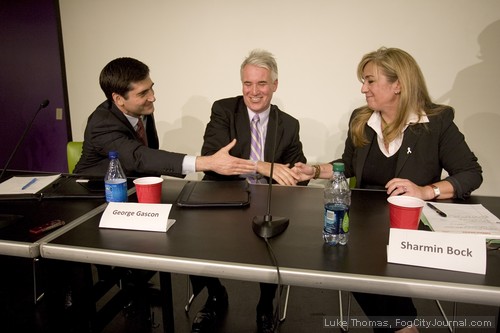
District Attorney and former SFPD Chief George Gascón, Alameda County Deputy District Attorney Sharmin Bock, and former San Francisco Police Commissioner David Onek all landed solid punches during a three-way District Attorney debate that was co-hosted by the San Francisco Young Democrats and the Alice B. Toklas LGBT Democratic Club, and moderated by Recorder editor Scott Graham. The primary sponsor of the debate was the City Democratic Club, according to CDC President Jim Reilly. So, thanks CDC for helping to pull off a great event.

The debate was framed as a choice between Bock, a veteran prosecutor with leadership experience, Gascón, a career cop with managerial experience, and Onek, a former San Francisco Police Commissioner and criminal justice reform expert. And above all it proved that if you lock three attorneys in the same room and pit them in a three-way fight, you’ll be rewarded with a blood sport spectacle.

Bock kicked off by noting that there are many similarities between the three candidates—except when it comes to independence and experience “Experience matters,” Bock said, throwing a one-two punch at Gascón and Onek. “The job of the District Attorney is not a management job, a police job or a job for someone with just a law degree. It needs a veteran prosecutor,” she said—remarks that resonated well with the crowd, judging from the applause.

But after a few niceties, Gascón shot right back at Bock and Onek. “I am the only one who has led large organizations and pushed public policy forward in an effective manner,” he said.

And Gascón struck a home run when he revealed that when he took the job of Chief of Police in Mesa, Arizona, he was “facing one of the most toxic environments” in terms of hatred towards people of color and the LGBT community–and that he did something about it, by standing up to anti-immigrant Sheriff Joe Arpaio of Maricopa County, and protecting the local LGBT community’s right to protest.

When it was his turn to speak, Onek fired off his own rounds at Bock and Gascón, noting that the state’s criminal justice system is broken—and claiming that it will take an outsider to fix it.
“This is a once-in-a-lifetime opportunity to reform the criminal justice system,” Onek said, laying out his reform-minded track record.

And then he stuck it to both Bock and Gascón by stating that the death penalty does not work. “I will never seek it in San Francisco under any circumstances,” Onek said, earning excited applause, as he noted that he’ll look at all policy question through the prism of three questions: ‘Does it make us safer, is it cost effective and is it fair and equitable?”

Onek also noted that neither the Supreme Court’s ruling that California must reduce its prison population by 30,000, nor Gov. Jerry Brown’s call for prisoner realignment, come with any money.
‘That’s a disaster,” observed Onek, as he stressed the need to demand resources to help deal with the upcoming load of prisoners that about to return to San Francisco.

Gascón fielded questions about whether they are enough people of color and LGBT background in management in the D.A.’s Office. “Well, I think there’s definitely always room for improvement in any organization,” he said, noting that he has a history in the Los Angeles Police Department, the Mesa, Arizona Police Department and the SFPD, “of pushing very aggressively to have diversity within the office.”
But he started a bit of a buzz when he said it was “really a surprise to me that I promoted the first male, black, police captain to the San Francisco Police Department.”
“You would think that there have been, you know, male African-Americans in that department for many years. It was hard for me to believe that actually in 2009 we had not had one,”  Gascón continued, a remark that got some debate observers asking afterwards, if this meant that Gascón really did not know that former SFPD Chief Earl Sanders was a black male.

Meanwhile, Bock was happily trampling all over the sit-lie legislation that then SFPD Chief Gascón and Mayor Newsom backed last fall, as she noted that more foot patrols and community policy are what’s actually needed. “Political hot-button measures don’t work,” Bock said. “Both sides agree it hasn’t worked. It’s the wrong response to the real problem.

Asked if he had a conflict of interest, when it comes to investigating allegations of police misconduct, Gascón claimed the problem is limited to a small number of officers, adding, “if the allegations are true.”

“In reality the majority of the SFPD are hard-working people doing the right thing,” he said. “And there has been only one challenge—and our office has prevailed,” Gascón said. “However, there have been a finite number of cases where I personally adjudicated the bad conduct—and those will be handled by the Attorney General’s office.”

Bock stressed that she was not in favor of sending drug offenders to prison and would focus on restorative justice, instead. Asked if she would have a panel on her staff review potential death penalty cases, Bock confirmed that she is committed to having a Special Circumstances Committee, as D.A. Kamala Harris did, to get input around the facts and from lawyers involved in such cases.“The ultimate decision is mine, and I oppose the death penalty,” Bock said, noting that she does not believe that 12 jurors will return a unanimous death penalty verdict. “But I do think as prosecutor you need to go case by case.”

Asked if he would have sought the death penalty in a case like the L.A. Night Stalker, who murdered 13 people, many of them elderly, Gascón said, “Probably not. All of us agree that the death penalty is not a good tool. But it is part of our system, and I continue to have the system Kamala Harris had in place. At the end of the day, it’s my decision, and I’m the only one in the room, who can say I’ve already turned down the death penalty.”

Agreeing with Bock that a jury is unlikely to go for the death penalty, Gascón maintained that the death penalty is “an illusory issue,” and that the real question is, “How do we rewrite the State Constitution [so the death penalty is not on the books]?”

Asked how he felt about marijuana, Gascón said he doesn’t believe folks should be incarcerated for use—and that folks are already being diverted to community courts in those instances.

But when Onek tried to wrap up by positioning himself as a the reformist-minded outsider, Gascón pounced, reminding folks that Onek was a Police Commissioner, when the Police Commission recommended Gascón to Mayor Newsom as the next SFPD Chief. “While David is someone I respect—and one of those who hired me, David has painted himself as an outsider, when the Police Commission is the policy-making body for the SFPD. There are no outsiders here. The question is, what have you done? There’s a difference between calling yourself a reformer and having other people call you a reformer.”

Bock for her part used her closing remarks to remind folks that there has been a crime lab scandal, alleged police misconduct, a DNA backlog, and about 100 cases dismissed as a result of these scandals, and a bunch of prisoners are about to be sent back to the community because of realignment. “We’re in challenging times, at a critical crossroads, with stormy weather ahead,” she said. “I’m not going to be trying things out at your expense. As a veteran progressive prosecutor, I’m fully prepared.”

The guv’s veto — WTF Jerry?

17

Nobody — least of of the Democrats in the state Legislature — quite knows why Gov. Jerry Brown vetoed the state budget. In fact, he didn’t even tell Legislative leaders what he was about to do. “There was no heads up, and that’s the most annoying part of it,” Assemblymember Tom Ammiano told me.


Brown knew exactly what the Democrats were doing. He also knew (or ought to know) that getting any Republicans ever to vote for his tax extensions was, and is, a pipe dream. If he didn’t like the Dems proposal, he could have asked for changes. But no: Jerry is Jerry, and he did his own thing. (Just like Arnold, he complained about the “can being kicked down the road.”) His veto message talks about how “strong medicine must be taken” to solve the deep fiscal crisis; without taxes (which the GOP won’t allow) I guess he’s talking about more cuts. I guess he’s talking about Californians really feeling the deep pain of another $10 billion cuts to services, so maybe they’ll wake up and demand more revenue and oust the Republicans.


But in the meantime, the governor won’t miss any meals.


Brian at Calitics looks at the bright side — at least that sale/leaseback idea is gone. And yes, the budget that the Democrats put forward was ugly and far from perfect. But I don’t see where we go from here. The Democrats in the Legislature aren’t going to vote for another $10 billion in cuts; no way. And the Republicans aren’t going to vote for tax extensions. And the existing taxes expire at the end of the month.


If there’s a good alternative out there, I don’t see it.


Ten good bills for 2011

2

The news in Sacramento is mostly bad — Jerry Brown still can’t find the Republicans he needs to pass a budget, although maybe the redistricting process will help him. But it’s not all bad. Some important bills passed their houses of origin in the past week, and with Democrats controlling both the Senate and the Assembly and a Democratic governor, there’s actually a chance they could become law.


At the top of my list is the measure by Darrel Steinberg that could allow counties and school districts to raise a wide range of taxes. It is, as Sen. Mark Leno notes, a “game changer.” And it only requires a simple majority of both houses. (I wonder: Could the San Francisco supervisors put a tax measure on the ballot in November on the assumption that the Steinberg bill will be in effect by then?) If the GOP won’t budge on the budget, the Dems need to at least give local government the chance to find the resources to keep essential services running.


Assemblymember Tom Ammiano got AB 9, also known as Seth’s Law, approved on the Assembly floor. The measure, named in memory of Seth Walsh, a 13-year-old gay student from Tehachipi who suffered years of harassment and abuse, gives school districts the tools (and the mandate) to address bullying.


The Assembly also approved Ammiano’s AB 889, the Domestic Workers Bill of Rights, which gives domestic workers the same basic labor-law protections as other California workers, and AB 1081, the TRUST Act, which would allow California counties to opt out of S-Comm, the awful federal law that seeks to force local cops to become ICE agents.


Over at the state Senate, Mark Leno won approval for 11 bills, including SB 914, which would mandate that police get a warrant before searching the data on a person’s cell phone. It’s crazy that SB 914 is even necessary, but the state Supreme Court has ruled that, while you need a warrant to search a personal computer, you don’t need one to search a cell phone. SB 790 makes it easier for local agencies to form Community Choice Aggregation systems. SB 819 would give the state more authority to take firearms away from people who have committed felonies or have been institutionalized for mental illness. (The NRA’s going to hate this bill — felons have the right to guns, too …) SB 233 — another one I really like — gives local government the right to impose vehicle license fees.


Sen. Leland Yee won overwhelming support for SB 8, which mandates that foundations affiliated with the University of California, Cal State or community college campuses abide by the same public records laws as the schools themselves. (The Sarah Palin speaking fees bill.) SB 364, which requires corporations that get tax breaks for job creation to prove they’ve actually created jobs. SB 9 — another one that ought to be a no-brainer — ends the practice of giving juvenile offenders sentences of life without parole.


Seems likely all of these will emerge from the remaining house — and then we’ll see whether Brown is willing to sign progressive legislation.


The Sacramento nightmare

2

The best-case scenario, Brian at Calitics says, is still very dicey:


Somehow, Jerry manages to find the few votes that he needs for the so-called “tax bridge” and then we head to the ballot in September.  Yes, September.  What is certain to be a pretty low turnout election, we somehow have to make people understand just how important this revenue really is. And that isn’t going to be easy.


The good news is that the Democrats in the state Senate and Assembly are much more in agreement on blocking some of the worst cuts. The bad news, my sources tell me, is that Brown will not back down from his insistence that any new taxes go to a vote of the people.


It’s going to be tricky to get a single GOP vote for even short-term tax extensions (or even for putting tax extensions on the ballot). But if he manages to do that, somehow, the Gov still has to figure out where he’s going to get the millions of dollars it will take to win a low-turnout September election that will favor the conservative side. Who’s going to pay for this?


Not looking good, Jerry.


SFBG Radio: The politics of sex scandals

0

Does the Edwards scandal hurt the Democrats? No. Does the Schwarzenegger scandal hurt the Republicans? No. It’s old history. But what about Rep. Anthony Weiner? Why does anybody care what he did on his own time? Johnny and Tim discuss after the break.

sfbgradio662011 by endorsements2010

Shaking the city

0

arts@sfbg.com

LIT Activist, writer, and fast-talking leftist public intellectual Chris Carlsson, cofounder of the monthly bike happening Critical Mass, spearheads the online local history repository Shaping San Francisco. I recently spoke with Carlsson about Shaping SF and his associated projects, including three collections of cultural and political essays published by City Lights Books, the most recent of which, Ten Years that Shook the City: San Francisco 1968-1978, will be released June 15.

Carlsson began work on Shaping SF — a multimedia digital history project — in 1994 with co-conspirators from his often hilarious dissident magazine Processed World.

Reclaiming San Francisco: History , Politics, Culture, edited by James Brook, Carlsson, and Nancy Peters, was published in conjunction with the first CD and kiosk release of Shaping SF in early 1998. The collection of essays sets the tone for what would become, in Carlsson’s words, “an ongoing series of contrarian history anthologies about San Francisco.”

The second book in the series, The Political Edge (2004), examines cultural and political dynamics behind the popular mobilization to elect Green Party candidate Matt Gonzalez, a surprisingly close mayoral race that Gavin Newsom won in part with massive support from the San Francisco Chronicle and the national Democratic Party.

Carlsson says Ten Years that Shook the City continues his work “to counter our amnesiac culture.” More specifically, the book takes on the argument that the 1960s were filled with experiments that didn’t work out. Carlsson told me that evidence to the contrary “has systematically been flushed down the toilet” by mainstream commentators.

The book begins with a remembrance of the 1968 San Francisco State College strike, but in his introduction Carlsson writes: “From today’s organic food and community gardening movements to environmental justice, gay rights, and other social identity movements, neighborhood anti-gentrification efforts, and much more, the 1970s are the years when transformative social values burrowed deeply into society.”

In more than 30 years of activism, he also has crossed paths with many who became contributors to the series. Carlsson recalls when he attended an anti-nuclear rally in 1979 and was handed a flyer from a group called the “Union of Concerned Commies.” The leaflet featured a drawing of the White House with nuclear cooling towers on either wing, done by veteran underground cartoonist Jay Kinney. Kinney contributed one of the most entertaining pieces in Ten Years, a short history of underground comix (in a move below mainstream radar, “comics” became “comix”).

Former Guardian staffer Rachel Brahinsky contributed a heart-wrenching look at the (ongoing) African American exodus from the City by the Bay in the wake of the neighborhood-destroying process officially called “urban renewal.” In the chapter that follows Brahinsky’s, veteran organizer Calvin Welch describes further tenant victories in the creation of what he refers to as “the community housing movement.”

Carlsson’s chapter, “Ecology Emerges,” parallels a series of green history talks of the same name held this year at Counterpulse, Shaping SF’s home base at 1310 Mission St. Carlsson links the 1990s emergence of the environmental justice movement to David Brower, especially the more radical work Brower began when he left the Sierra Club and cofounded Friends of the Earth in 1969. Brower felt Greens should be antiwar, and was keen on making connections between movements. The ecologically-minded individuals and groupings Carlsson highlights also shared a disinterest in becoming a permanent cheering section for Democrats, working instead to keep pressure building from below.

I asked Carlsson for his take on the Obama administration’s announced plans to allow the mining of millions, possibly billions, of tons of coal on public lands.

“Obama was supported from the beginning by Big Finance an Big Coal,” Carlsson responded. He has never shown any indication he is anything but their front man. His lack of imagination on the energy crisis, the economic crisis, the military-empire crisis, and the social crisis is nothing less than remarkable.”

CHRIS CARLSSON

Thurs/2, 7 p.m., free

City Lights Bookstore

261 Columbus, SF

(415) 362-8193

www.citylights.com


Editor’s notes

3

tredmond@sfbg.com

When Cornel West blasted President Obama May 16 in an interview with the website Truthdig, it set off a pretty wild debate on the left. For the most part, it’s been more heat than light (imagine that happening on the left!), but it raises a crucial question about the role progressives play in the Democratic Party — particularly in the 2012 election season.

The best analysis so far comes from Robert Cruikshank, who writes for the blog Calitics. In a May 23 piece, he noted that the right keeps winning battles because the conservatives know how to play coalition politics:

“Conservative communication discipline is enabled only by the fact that everyone in the coalition knows they will get something for their participation…. Everyone knows they will get their turn. Why would someone who is primarily motivated by a desire to outlaw abortion support an oil company that wants to drill offshore? Because the anti-choicers know that in a few weeks, the rest of the coalition will unite to defund Planned Parenthood. And a few weeks after that, everyone will come together to appease Wall Street and the billionaires by fighting Elizabeth Warren. And then they’ll all appease the U.S. Chamber by fighting to break a union.”

Not so with the Democratic Party under Obama. The Wall Street Democrats (the neoliberals, the DLC types, and the power-at-any-price folks) get their way all the time. And those us of who consider ourselves part of the economic left (also known as progressives) not only get thrown under the bus — we see our existing gains rolled back, in exchange for nothing.

Sure, we all agree on a lot of social issues. The neolibs and the progressives support abortion rights and gays in the military and, for the most part, same-sex marriage. We agree that evolution is science and creation is religion.

But on basic economic issues — who pays the taxes, who gets the money, military spending vs. education spending, radical inequality, concentration of wealth, corporate power — we might as well be on different political planets. And while we’re the most active, hard-working members of the Democratic coalition, we get completely ignored on national policy.

Obama ought to be worried — not just by West’s criticism (any president ought to expect some allies to be pissed off) but by the fact that he has created an unsustainable coalition. And some of the San Francisco politicians who call themselves progressives ought to be paying attention too: When your political partners get nothing, they eventually walk. 


Why the right keeps winning

6

Robert Cruikshank, who is one of the best political bloggers around, has a fascinating piece today on Calitics about Cornel West’s attack on Obama, the politics of coalitions, and the fate of the Democratic Party. His thesis: The Republicans know how to make a coalition work, and the Democrats don’t.


Conservative communication discipline is enabled only by the fact that everyone in the coalition knows they will get something for their participation. A right-winger will repeat the same talking points even on an issue he or she doesn’t care about or even agree with because he or she knows that their turn will come soon, when the rest of the movement will do the same thing for them.


Progressives do not operate this way. We spend way too much time selling each other out, and way too little time having each other’s back. This is especially true within the Democratic Party, where progressives share a political party with another group of people – the corporate neoliberals – who we disagree with on almost every single issue of substance. But within our own movement, there is nothing stopping us from exhibiting the same kind of effective messaging – if we understood the value of coalitions.


More:


 If one part of the coalition gets everything and the other parts get nothing, then the coalition will break down as those who got nothing will get unhappy, restive, and will eventually leave. Good coalitions understand that everyone has to get their issue taken care of, their goals met – in one way or another – for the thing to hold together.


He points out, correctly, that the Democratic Party these days is actually two parties, and the only thing that holds them together is social issues. The neoliberals generally support same-sex marriage and abortion rights and can’t join the religious nuts who have taken over the GOP. But on economic issues, they might as well be two entirely distinct parties with very different messages.


It’s worth thinking about in the context of San Francisco politics, where a lot of people — including Board President David Chiu — talk about being part of a progressive coalition. And on a lot of issues, six of seven members of the board — and most people who call themselves progressives — agree. There ought to be a progressive coalition tha controls the political agenda in San Francisco, and there’s no reason that can’t happen.


But those of us who are part of what we can only call the economic left — the people who believe that the rich don’t pay enough taxes and the poor don’t get enough services and the public sector (yes, Government) is part of the solution — aren’t getting much of anything out of the coalition right now. Our issues (new revenue that matches or exceeds any cuts and a vigorous campaign by our elected leaders to make that happen) always disappear when the final deals are cut.


We’re always there on the non-economic issues — there was some grumbling, but in the end the progressives on the board all voted for Chiu’s yellow pages ban — but when it comes to budget time, we get thrown under the bus. And in the long term, that’s not going to hold a progressive coalition together.

Held underwater

1

sarah@sfbg.com

Since the recession began four years ago, 2,000 homes have been lost to foreclosure in San Francisco. These numbers sound insignificant compared to other counties in the Bay Area, but they primarily have hit communities of color already struggling to remain in this expensive city.

As panelists at a recent seminar on foreclosures noted, the first wave hit the Bayview and the Excelsior, while the second hit the Richmond and the Sunset. And as the recession drags on and more borrowers go underwater, another 2,000 foreclosures are on the local horizon.

Although foreclosures continue to destabilize communities and drain resources from local governments, the banking lobby continues to oppose legislative reforms that would allow more people to remain in their homes. And this deep-pocketed resistance has labor, religious, and educational organizations forming the New Bottom Line coalition in an effort to find grassroots solutions to the crisis.

“Foreclosures are the new f-word,” said Regina Davis, CEO of Bayview’s San Francisco Housing Development Corporation, at SFHDC’s April 29 foreclosure seminar.

Sups. John Avalos and Malia Cohen illustrated that there is no shortage of horror stories about predatory lending and dual tracking, in which borrowers apply for loan modifications while the bank continues to pursue foreclosure. Representatives for Sup. Ross Mirkarimi and Assessor-Recorder Phil Ting noted that the banking lobby has blocked even the most modest reforms, even as uncertainty continues to devastate the housing market.

Avalos said his family underwent a housing crisis in 2009, when his wife left her job to home school their special-needs daughter. “We tried to get a loan modification and were told we could only get it by going into default,” he said, recalling how Mission Economic Development Agency (MEDA) helped them navigate the process. “If this could happen to an elected official, it could happen to anyone.”

Cohen, who lost her condo in the Bayview to foreclosure earlier this year, described foreclosure as “an incredible beast that has ravaged and wrecked the finances of many Latino, African American, and Asian communities who were sold the American dream of homeownership but then had the rug pulled away.”

Mirkarimi aide Robert Selna, a former San Francisco Chronicle reporter, said the banking industry spent $70 million last year to kill legislation by state Sen. Mark Leno (D-SF) and Senate President Darrell Steinberg (D-Sacramento) to end dual tracking. This year, the industry has been opposing SB729, Leno and Steinberg’s latest attempt to require banks to give people a definitive answer on loan modification, identify who owns the loan, and give borrowers legal recourse if banks don’t take these steps.

“SB729 gets to the heart of helping to keep people in their homes, but it’s difficult to combat the spending power of the banking industry,” Selna said.

Ben Weber, an analyst in the Assessor-Recorder’s Office, said approximately 277,000 homes in California are going through the foreclosure process; an estimated 1.8 million California residents are underwater on their mortgage; and California is sixth in “negative equity” nationwide. “Negative equity is one of the best indicators of foreclosures — so can we expect another 1.5 million to 1.6 million foreclosures statewide?” he asked.

Weber noted that Ting is supporting AB 1321 by Assemblymember Bob Wieckowski (D-Fremont), which would require that all mortgage assignments be recorded within 30 days of their execution; prevent notices of default from being recorded until 45 days after any deed of trust has been recorded; and provide consumers with better transparency about who owns their debt. Yet Ting’s office reports that the banking industry has lobbied against this and other foreclosure-related legislation

Weber said the legislation is a response to problems with the industry’s Mortgage Electronic Registration System (MERS), which was introduced 15 years ago. “The mortgage industry wanted to expedite the transfer of mortgages between entities so that they could be sold and resold on Wall Street,” Weber said, noting that the system also allowed the industry to avoid paying recording fees to counties.

MERS records an average of 6,700 deeds of trust annually in San Francisco, and MERS deeds of trust are usually transferred two to four times, Weber observed. “So MERS members avoided — conservatively — $134,000 per year in fees.”

Grace Martinez of Alliance of Californians for Community Empowerment noted that the banking lobby already killed AB935 by Assemblymember Bob Blumenfield (D-Northridge), which sought to charge a $20,000 fee to compensate for the estimated cost of a foreclosure to local government. “That money would have gone back to the city,” she said.

In an April 14 letter, the banking lobby claimed Blumenfield’s bill was a tax that increases the costs of homeownership for new borrowers. “It also serves to discourage the importation of capital into California at a time when the federal government is winding down their involvement in mortgage finance and protracts and complicates California’s economic recovery,” stated the letter, which the California Bankers Association, the California Chamber of Commerce, and other business groups signed.

But Dan Byrd, research director at Berkeley’s Greenlining Institute, reminded the mostly black and brown crowd at SFHDC’s foreclosure seminar that declining property values due to foreclosures have drained $193 billion from African American and $180 billion from Latino communities nationwide. “Folks from these communities who had credit good enough to qualify for a prime loan were given subprime loans with adjustable mortgage rates,” he said

Byrd stressed that homeowners facing foreclosures need to be more financially literate. “A lot of loan documents are written in language that people can’t understand, and they don’t have the money to hire a lawyer,” Byrd said, as he urged politicians to fund organizations that provide financial counseling and education. “Our elected federal officials just cut the budget that supports SFHDC and similar groups.”

SFHDC housing counselor Ed Donaldson said appraisal values make it hard to sell the below-market-rate units that are coming online. “So if we don’t do something about the foreclosure problem, the housing market will continue to unwind,” he said, urging people to protests banks and show up at City Hall and in Sacramento to support reform.

The Rev. Arnold Townsend, vice president of the local branch of the National Association for the Advancement of Colored People, said San Francisco likes to pretend that the foreclosure crisis didn’t really affect the city. “But it did,” he said. “It badly hit people of color that the city, by its policies, doesn’t seem to care if they leave.”

Attorney Henri Norris noted that bankruptcy can be an alternative to foreclosure. “A bankruptcy can stop a foreclosure, at least temporarily,” Norris said. He recommends that people make their loans current and try to get a loan modification approved. “But it’s going to take running a marathon.”

Avalos, who is running for mayor, noted that the city does not fund enough affordable housing and he proposed an affordable housing bond that would include assistance for mortgage assistance, ownership downpayment, seismic retrofitting, and energy efficiency. “I understand that voters see no personal benefit, but it would raise wealth in property values,” he said.

Cohen observed that the federal Homeowners Affordable Modification Program (HAMP), which President Obama unveiled in March 2009, “hasn’t worked” and that most of the important reform proposals are “happening at the state level.” She encouraged people to show support for SB729, but wasn’t ready to declare support for Avalos’ housing bond.

“I want to make sure the climate is ripe, that Sups. Carmen Chu and Eric Mar are included, because their districts will be impacted by foreclosures, and that the support is broad-based,” she said. “But folks can divest from banks that have not treated us right.”

Noting that divestment was the most effective way to end apartheid in South Africa, SFHDC’s Davis invited seminar participants to a free screening of Charles Ferguson’s documentary Inside Job, which shows how subprime loans, dual tracking, and mortgage bundling triggered the 2008 financial meltdown — and how many of the main players are still calling the shots.

But despite SFHDC’s informative seminar and the New Bottom Line campaign’s May 3 protest at Wells Fargo’s annual shareholder meetings in San Francisco, SB729 failed to make it out of committee May 4, when Sen. Alex Padilla (D-Van Nuys) announced he would introduce an alternative dual tracking bill. In addition, Wieckowski turned his MERS reform into a two-year bill, suggesting the votes weren’t there to approve it.

Paul Leonard, California director of the Center for Responsible Lending, observed that SB729 supporters include a broad array of consumer, civil rights, labor, faith-based groups, and homeowners, but the only groups in opposition were the California Bankers Association, the Mortgage Bankers Association, and the Chamber of Commerce.

“I find it remarkable that after the exposure of deep-seeded scandals about robo-signing and the systematic shortcomings of mortgage loan service operators, none of the bills intended to address these issues got out of their first committee hearing,” Leonard said.

In an April 20 letter, the banking lobby claimed that SB729 was “unnecessarily complex,” could overlap and contradict actions by federal regulators and state attorneys general, and promote strategic defaults that would negatively affect communities and cloud title for a year following a foreclosure, leaving properties vacant.

Dustin Hobbs of the California Mortgage Bankers Association claims the average time for a foreclosure is more than 300 days. “This would have dragged it out further, and the last thing we need is more vacant homes and more homes in foreclosure,” he said.

Ting noted that Wieckowski made the call to turn AB1321 into a two-year bill. “But you would have thought we were offering the end of home ownership,” Ting said, noting that the banking industry was shocked when advocates produced a MERS memo that encourages banks to record documents and pay fees. “It basically recommended our legislation,” Ting observed.

“Assignments out of MERS name should be recorded in the county land records, even if the state law does not require such a recording,” a Feb. 16 MERS memo said.

Ting describes MERS as “a Wall Street set-up, the ultimate in smoke and mirrors.”

“We did a little poking around in MERS and found that it would help if the name of the loan owner was recorded,” Ting said, noting that the confusion MERS created is bad for consumers, the real estate industry, and homeowners.

“Part of the problem is computer systems doing what banks used to do,” Ting said. “It ended up with robo-signing and foreclosures being sent to the wrong people. I thought AB1321 was a no-brainer, but we had to take it to five or six legislators before anyone would pick it up. This is a prime example of how a particular industry has made a huge amount of money and is unwilling to bend any rules to give consumers any recourse.”

But CMBA’s Hobbs described AB1321 as “part of a broader attack on MERS.” And an April 21 opposition letter from the banking industry describes it as “creating impediments for attracting capital to California’s mortgage marketplace and imposing significant new workloads on county recorders and clerks.”

Ting says he has heard lobbyists make that argument. “But my assessor recorders organization supported it — and they are mostly not elected officials,” he said, noting the group usually doesn’t get involved in promoting legislation.

Ting admits that it’s hard to get the national reforms that are needed. “San Francisco still has a big part to play. And our legislators are still very powerful, so we have no excuse not to be fighting in Sacramento where the Democrats have a supermajority. I mean, how could these bills not get out of committee? It’s not like we didn’t take amendments, but no level of amendments would have made anything happen.”

“Foreclosures typify this financial and political era,” he continued. “They are about all the things we should have seen coming — and some of us did. But even then, and now, there is political amnesia. For all the families that lost their homes, shouldn’t we do something to make sure this doesn’t happen again? Wall Street was bailed out two years ago, but Main Street is still waiting.”

Editor’s notes

0

tredmond@sfbg.com

When California Senate President Darrel Steinberg introduced a bill this spring that would allow local government agencies to impose a wide range of new taxes, I didn’t think anyone would take it seriously (including the author). It seemed, unfortunately, to be a piece of political theater and possibly some high-stakes poker. With a simple majority vote, the Democrats could infuriate Republicans by finding a back-door way to raise taxes. Maybe that would bring the recalcitrant, obstructionist GOP to the budget table.

Instead, an amazing thing has happened: SB653 is moving forward, and community groups, politicians, and the news media are all getting involved in a critical debate: how should a state with almost 40 million people whose representatives can’t even agree on a basic vision for anything be managed and governed?

Gov. Jerry Brown, in one of his populist streaks, says he wants government to be closer to the people — that is, let local agencies run things. That runs counter to the liberal agenda of the past half-century or so, a time when the federal government stepped in to ensure civil rights in the South, the state government stepped in to mandate educational equality, and all of us wanted to be sure that poor areas got their share of the social wealth. Segregationists wanted “states rights.” Rich conservatives wanted local control over school funding.

But the world goes around and around, and the reality on the ground and in the political air changes, and these days the crucial issue, the defining issue, in the United States is wealth inequality and taxation — and the hard-right GOP has a stranglehold on both Washington and Sacramento. Meanwhile, cities are leading the way on civil rights issues — San Francisco, for example, defied both state and federal law to allow same-sex marriage and continues to fight for a saner immigration policy, even if that means opting out of a federal law-enforcement program.

The San Francisco Chronicle ran an editorial May 15 opposing SB653, arguing that it will benefit wealthier counties (which, oddly enough these days, elect pro-tax Democrats) at the expense of poorer counties (which elect conservative Republicans). That may be true, but there’s another way to look at it.

I’m not suggesting that the state cut spending in rural and low-income areas, and neither is Steinberg. The idea is that the state’s support for local government should be a floor — a solid floor — but not a ceiling. I’m fine with some of my tax money going to areas with a lower tax base and serious economic problems, even if the people who live there elect Neanderthals to the state Legislature. But if those of us in more liberal communities want to pay more for better services, why shouldn’t we have that option?

And if some of us think this state is too big to govern anymore and ought to be split up anyway, this seems an excellent way to start having that discussion. 


Kucinich v. Palin: Guess who wins?

5

Boy, wouldn’t this be fun?


 Trump is not the weakest Republican in the two hypothetical match ups we tested with Dennis Kucinich. Kucinich’s lead over Sarah Palin if they were to face off would be 43-36. In that scenario Kucinich gets 16% of Republicans to Palin’s 12% of Democrats and leads her by 10 points with independents at 42-32.


I think Rep. Kucinich has enough to worry about just keeping his own seat, but it shows how weak the GOP field is right now. (On the other hand: Two years before the 1992 election, Bush The First was considered unbeatable and no less an authority than the Almanac of American Politics said it was “ridiculous” that anyone would take the young governor of Arkansas seriously as a candidate for president.)


Still: Not good news for Sarah Palin. 

The case for local taxes

8

When state Sen. Darrell Steinberg introduced SB 653, a bill that would allow cities to impose an income tax, a car tax and excise taxes, I called his press office and asked if the senator was serious. Me, I thought this was one of the best ideas I’d ever heard of out of Sacramento, but I couldn’t believe Steinberg was actually going to push it.


After all, Steinberg has been in heated discussions with the Republicans over the state budget, and they’ve been refusing to bend, even an inch, on new revenue. And the Democrats can’t pass a budget alone; the two-thirds requirement for new taxes means at least four members of the recalictrant GOP have to go along.


But if Steinberg could threaten the jerks with a bill that requires only a majority vote but would open the door to all kinds of new taxes up and down the state, maybe they’d start to come around. That seemed like the theory.


But his staff told me that he was entirely serious — and to my astonishment (and perhaps his) the bill is moving forward. We did an editorial endorsing it two weeks ago, and all of a sudden, it’s getting a lot of attention. And it’s exposed a fascinating political debate in the state and raised a lot of questions that ought to be part of the political conversation.


Jerry Brown’s been talking for months about “realignment” — sending more state services back to local government. It’s part of the populist side of the guv, and it flies in the face of 50 years of liberal thought. The federal government used to be our friend — the feds enforced civil rights laws in the racist South. The feds put money into inner cities. The state of California enforced equality, too — the famous Serrano v. Priest decision, in state court, guaranteed that public schools in all areas, not just rich ones, had the resources to provide a quality education to all. “State’s rights” was the cry of segregationists; rich people in conservative communities wanted school funding to be a local decision.


But things are different now, and the political stars are realigned. The most important civil rights moves are coming from cities (see: San Francisco, same-sex marriage) and progressive communities are defying the feds on issues from immigration to medical pot. (The flip side is also happening, see: Arizona and SB 1070).


Right now, today, the single most important issue in the United States (with the possible exception of stupid foreign wars) is the wealth gap and taxation. So much flows from that — the collapse of social services, the cost of health care, unemployment, the crisis in state budgets, the decline in public education … name an issue, and it has at least some roots in the way the nation handles money. And two things have happened in the last 15 years or so, at least at the national level:


1. The Republican Party has been taken over by the far right.


2. The Democratic Party has been taken over by Wall Street.


So nothing good’s going to happen in Washington. And in California, thanks to our two-thirds rule, nothing good’s going to happen in Sacramento as long as a tiny minority of really bad Republicans can hold the state hostage.


Which means that the only hope for progressive economic policy is going to come from local government — and the best thing the Democrats can do in the state Legislature is to stand back and allow it to happen. Which is exactly what the Steinberg bill would do.


Now, the San Francisco Chronicle has come out against the Steinberg bill, saying it would


mark a regrettable retreat from the notion that Californians of many lifestyles and cultures – city dwellers, beach-goers, farmers, ranchers, techies, loggers, entrepreneurs – share a common bond. The delegation of a greater tax burden and government duties to 58 counties and hundreds of cities would only compound the disparities that make this state nirvana for some and Appalachia for others.


The problem is, that notion — that romantic vision of One California — is already gone. California isn’t one state any more; it’s too big to be a state, and it ought to be at least three states. The Democrats control both houses of the Legislature and the governor’s office — and it’s almost impossible even to pass a state budget. There’s nothing resembling a political consensus in California, and we might as well admit it.

I understand the problem of economic disparity — but you can’t address it under the current system. There are, indeed, a few counties that have very little tax base, and that will need substantial state aid; I’m good with that. I’m happy to have my tax money go to the poorest counties. But I’m not seeing the Steinberg bill as a reason to cut state spending; I think we ought to increase state spending. I just think that what comes out of Sacramento should be a floor, not a ceiling. If people in San Francisco want to spend more on their public schools — and do it in a progressive way — what’s wrong with that?

The problem with local taxes is that the most progressive, fair revenue solutions aren’t available to cities. Income taxes are far better than sales taxes; ad valorem property taxes are better than parcel taxes. But cities can’t impose traditional income taxes, and are hobbled by Prop. 13 on property taxes. So when cities DO try to impose their own taxes, the results aren’t fair — the poor pay more than the rich.

Interestingly, Dan Walters of the SacBee, who is by no means considered a liberal, likes the Steinberg bill:

California’s experiment in centralized budgeting, the unintended consequence of Propostition 13’s approval in 1978, has been an abject failure. California is simply too diverse for one-size-fits-all decision making from Sacramento, especially when the Capitol can’t even decide what that size should be.

And City Attorney Dennis Herrera, who is running for mayor, likes the idea, too:


California communities that view government as a needless intrusion into people’s lives are morally entitled to limit their local government, and to pay less for fewer services.   Conversely, California communities that see government’s potential to improve the lives of their residents deserve to fully realize the benefits of the public services they’re paying for.


But the notion that we must bind the fate of 37 million Californians to the governance of lowest common denominator is absurd. 


Steinberg’s bill isn’t perfect — it doesn’t include corporate income taxes. But it’s a lot better than what we have now.

I realize that we’re in tricky territory here — should counties where 80 percent of the voters want mandatory prayer in schools and a curriculum that says God doesn’t like homosexuality have the right to overrule state and federal law and ignore the Constitution in the name of local control? Of course not.

But I think you can argue that local government, after meeting the basic federal and state requirements, has the right to go a step further in the pursuit of civil and Constitutional rights. Just as cities, after receiving their minimum allotment of stae money, have the right to raise more. And do it in a fair way.

At the very least, the bill creates a discussion that we all ought to be having. Cuz the way we’re running the state right now isn’t working.

How bad are Sacto Republicans?

5

Pretty darn bad. They’ve gone so far over the edge that they don’t even listen to the people who they claim they want to support — business leaders who are worried about keeping California competitive.


That’s right — the big business types are practically begging the GOP legislators to get off their asses and pass a budget that includes temporary tax extensions. They’re also in favor of pension reform and a bunch of other things that Democrats don’t love — but Jerry Brown and the Dems have already agreed to put all those things on the table. The sticking point is this no-tax pledge — and for once, the big business community thinks that’s ridiculous.


Does it even matter? Do the Republicans even listen to the Chamber of Commerce any more? Or do they only care about the Grover Norquist types and a couple of L.A. talk show hosts?


Editorial: Let counties raise taxes

3

The president of the state Senate, Darrell Steinberg (D-Sacramento), has a bill that could profoundly change that way California pays for government. At lot of insiders think it’s just a ploy, a way to force Republicans to come to the table and accept some tax measures, but Steinberg appears serious. He’s presenting the bill to the Governance and Finance Committee May 4, and a simple party-line majority vote could get it to the governor’s desk.

The bill, SB653, would allow counties and school districts to approve taxes — a wide range of taxes, the type that are now entirely under the control of the state. Local governments could impose an income tax, a transactions and use tax, an oil severance tax, a vehicle license fee, or a tax on alcohol, cigarettes, or marijuana. It’s part of what Gov. Jerry Brown calls “realignment” — returning more authority to local government, which is complicated and has advantages and disadvantages. But on its own, the tax measure makes perfect sense: if the residents of San Francisco want to pay a higher car tax, or income tax, or tax on booze, and use the money for better schools and public services, why shouldn’t they be allowed to do it?

San Franciscans pay far more in state taxes than the city gets in state money. That’s one of the great ironies of California finance: the more liberal counties, where the voters support adequate public services, wind up subsidizing the more conservative areas that demand tax cuts. A certain amount of that is inevitable, and even laudable: richer areas should be helping pay for schools, police, and roads in poorer areas. It’s certainly true in the arena of public education, where the courts have, properly, ruled that that state has to make sure every school district gets adequate funding so that kids in Marin County don’t get better educational opportunities than the kids in Tulare County.

And there’s always the risk that realignment will push the state back to the days when geographic inequality was even more dramatic, that California will wind up being, as Sen. Mark Leno (D-SF) once put it: “Hollywood next to Mississippi.”

But Steinberg’s bill doesn’t cut state funding at all; in fact, he’s among the Democrats working to avoid more budget cuts. SB653, properly administered, wouldn’t mean less money for any local agency. It would just remove the ceiling.

California is becoming too big to govern effectively with the current rules — and under the state Constitution, written in a very different era with a smaller, more homogeneous population, even a tiny number of Republicans can hold the budget process hostage. That means, for better or worse, that cities like San Francisco, where residents want decent services and a credible social safety net, are on their own. And if Brown’s proposals to put more of the service burden on the counties (for example, by shifting thousands of state prisoners into county jails) move forward, local governments are going to need the ability to raise their own resources.

Unfortunately, many of the taxes that state law currently allows local government to impose (sales taxes, for example) are regressive. Taxes on income and motor vehicles are far more fair and progressive, and ought to at least be available to cities and counties.

The Democrats in Sacramento need to take this seriously and work for its passage. It’s not the entire solution to the budget crisis and to economic inequality — but it’s an excellent start.

Let counties raise taxes

2

EDITORIAL The president of the state Senate, Darrell Steinberg (D-Sacramento), has a bill that could profoundly change that way California pays for government. At lot of insiders think it’s just a ploy, a way to force Republicans to come to the table and accept some tax measures, but Steinberg appears serious. He’s presenting the bill to the Governance and Finance Committee May 4, and a simple party-line majority vote could get it to the governor’s desk.

The bill, SB653, would allow counties and school districts to approve taxes — a wide range of taxes, the type that are now entirely under the control of the state. Local governments could impose an income tax, a transactions and use tax, an oil severance tax, a vehicle license fee, or a tax on alcohol, cigarettes, or marijuana. It’s part of what Gov. Jerry Brown calls “realignment” — returning more authority to local government, which is complicated and has advantages and disadvantages. But on its own, the tax measure makes perfect sense: if the residents of San Francisco want to pay a higher car tax, or income tax, or tax on booze, and use the money for better schools and public services, why shouldn’t they be allowed to do it?

San Franciscans pay far more in state taxes than the city gets in state money. That’s one of the great ironies of California finance: the more liberal counties, where the voters support adequate public services, wind up subsidizing the more conservative areas that demand tax cuts. A certain amount of that is inevitable, and even laudable: richer areas should be helping pay for schools, police, and roads in poorer areas. It’s certainly true in the arena of public education, where the courts have, properly, ruled that that state has to make sure every school district gets adequate funding so that kids in Marin County don’t get better educational opportunities than the kids in Tulare County.

And there’s always the risk that realignment will push the state back to the days when geographic inequality was even more dramatic, that California will wind up being, as Sen. Mark Leno (D-SF) once put it: “Hollywood next to Mississippi.”

But Steinberg’s bill doesn’t cut state funding at all; in fact, he’s among the Democrats working to avoid more budget cuts. SB653, properly administered, wouldn’t mean less money for any local agency. It would just remove the ceiling.

California is becoming too big to govern effectively with the current rules — and under the state Constitution, written in a very different era with a smaller, more homogeneous population, even a tiny number of Republicans can hold the budget process hostage. That means, for better or worse, that cities like San Francisco, where residents want decent services and a credible social safety net, are on their own. And if Brown’s proposals to put more of the service burden on the counties (for example, by shifting thousands of state prisoners into county jails) move forward, local governments are going to need the ability to raise their own resources.

Unfortunately, many of the taxes that state law currently allows local government to impose (sales taxes, for example) are regressive. Taxes on income and motor vehicles are far more fair and progressive, and ought to at least be available to cities and counties.

The Democrats in Sacramento need to take this seriously and work for its passage. It’s not the entire solution to the budget crisis and to economic inequality — but it’s an excellent start.


Editor’s notes

0

tredmond@sfbg.com

I heard a retired Army officer, a veteran of Iraq and Afghanistan, on the radio May 2 talking about the death of Osama bin Laden. Great news, he said, with all sincerity; now we can end the wars in Iraq and Afghanistan, stop wasting all this money, and bring the troops home.

That would nice, wouldn’t it?

But don’t start counting on an end to the wars, an end to the deaths of U.S. troops, or an end to an $881 billion defense budget (up from $300 billion in 1980 and $311 billion in 2000) or a significant change in our national priorities.

The truth is, Osama bin Laden wasn’t a factor in the invasion of Iraq. He wasn’t there; Saddam Hussein didn’t like him anyway. He was probably in Afghanistan for a while, but by the time we got mired in that quagmire, he’d moved on to Pakistan, which is supposedly our ally in the war on terror. That’s where he was running his operations, and that’s where he died.

The invasion of Iraq had nothing to do with terrorism. The war in Afghanistan might at some point have been related, but it’s not any more. The U.S. did the exact worst thing you can do in a military adventure: sent in troops with no way out.

Maybe Obama will now find the courage to say what he should have said the day he took office: we no longer have any strategic or national security interest in occupying Iraq and Afghanistan. Time to cut our losses, bring the troops home, put some of that money into the civilian economy, and deal with the real threat to American democracy — the horribly uneven distribution of wealth and power in this country.

Maybe the Democrats in Washington will show some backbone and start cutting the defense budget. Let the Republicans justify a continued war that their guy, Bush the Younger, insisted was about al Qaeda. Let them explain why we have to keep troops on the ground now that the head of al Qaeda’s gone. Let them explain why that’s more important than Medicare and Social Security.

But I’m not placing any bets.

I was a strong supporter of Obama. But when I saw hundreds of people partying and dancing in the middle of Valencia Street on election night, I had a bad feeling that this was going to end with an ugly hangover.

So I’m not dancing in the streets about the death of Osama bin Laden. I’ll save that for the day when the last American soldiers leave Iraq and Afghanistan and the military budget comes back to earth.

Let cities raise taxes

44

There’s a move in the California legislature to allow local government much broader authority to raise taxes — and the GOP types have their panties in a major bunch.


Dan Morain at the Sacramento Bee says it’s all a tactical move: The Republicans won’t allow any tax hikes at the state level, but the Democrats, by simple majority vote, can authorize cities and counties to do all kinds of things that the no-tax crowd hates. Maybe, Morain suggests, this is just a way to bring the recalcitrant Reps back to the budget table. But I don’t know about that: Senate President Darrel Steinberg may be playing games, but his legislative partner, Budget Chair Mark Leno, has been pushing for years to allow cities to raise their own vehicle license fees.


Leno’s brought that bill back this year, and it’s going to commitee next week. And I have to say, tactical or not, the Steinberg bill (PDF) is one of the best things I’ve seen out of Sacramento in years. It would allow local government agencies to impose an income tax, a car tax, an oil severance tax, and a series of excise taxes. It could make the budget deficit in San Francisco vanish.


I agree with Brian at Calitics: There are problems here.


What we’ll end up with is Bay Area counties with more stable revenue streams, while the Central Valley faces ever deepening cuts.  The inequality would be both troubling, and possibly violate some laws.   


And if the state Legislature weren’t paralyzed by a ridiculous two-thrids rule and a handful of die-hard no-tax Republicans, we might not need to go in this direction. But even so, it’s fair to ask: Why can’t the San Francisco voters decide they’d rather pay higher taxes than see the schools collapse?


It’s the same reason I’ve argued in favor of splitting California into three states. Those of us who live in the Bay Area have a very different vision of government than those who live in the no-tax districts. Why should they be able to hold us hostage?


Yes, there will be inequities. But there are only a few parts of the state that so utterly lack economic activity and wealth that there simply is nothing to tax (and the state would have to help them out). Much of Ag Land (and much of no-tax burbland) has plenty of wealthy people and businesses. The poverty is as much a result of inequality as it is a bum economy. In other words: those places can raise taxes, too.


And maybe over time the people in those crumbling tax-free towns will look over at San Francisco, with good schools, healthy, well-educated kids, clean, well-maintained streets, professional fire and police services and the like and say: Why can’t we have that?


And the answer will be: You can.

1964 all over again?

16

Outstanding piece on Calbuzz about the new Belva Davis book, “Never in My Wildest Dreams: A Black Woman’s Life in Journalism.” The Calbuzzers recount the vicious racist attacks Davis endured during the 1964 Republican convention in San Francisco, when the Goldwater forces were in control:


As we began our descent down the ramps of the Cow Palace, a self-appointed posse dangled over the railings, taunting. “Niggers!” “Get out of here, boy!” “You too, nigger bitch!” “Go on, get out!” “I’m gonna kill your ass!”


I stared straight ahead, putting one foot in front of the other like a soldier who would not be deterred from a mission. The throng began tossing garbage at us: wadded up convention programs, mustard-soaked hot dogs, half-eaten Snickers bars. My goal was to appear deceptively serene, mastering the mask of dispassion I had perfected since childhood to steel myself against any insults the outside world hurled my way.


Then a glass soda bottle whizzed within inches of my skull. I heard it whack against the concrete and shatter. I didn’t look back, but I glanced sideways at Louis and felt my lower lip began to quiver. He was determined we would give our tormentors no satisfaction.


“If you start to cry,” he muttered, “I’ll break your leg.”


Davis, of course, survived and when on to a storied career locally. The scary thing: There are a lot of parallels between the 1964 Goldwaterites and the tea partiers of today. Calbuzz:


Nearly 50 years later [the Goldwater platform] might serve as a manifesto for today’s Tea Party Republicans.


Attacking Democrats as “Federal extremists,” who have “enslaved” and “seek to master” ordinary Americans, the platform vowed , among other things, that Republicans would make deficit reduction their highest economic priority, oppose the “compulsory Democratic scheme” of Medicare and roll back actions of the Kennedy-Johnson Administration that “violently thrust Federal power into the free market.”


And race is still very much a part of what’s going on:


As evidence of the role that race still plays in conservative politics, Davis cited the Tea Party’s embrace of “birthers,” the slurs and spittle hurled by activists at Representatives and civil rights leaders John Lewis and James Clyburn at health care bill protests, and the recent email depicting Obama as a chimpanzee that was sent out by Tea Partier and Orange County Republican Central Committee member Marilyn Davenport.


 Back to the future. And it isn’t pretty.


The failed experiment

27

news@sfbg.com

For three decades we have conducted a massive economic experiment, testing a theory known as supply-side economics. The theory goes like this: Lower tax rates will encourage more investment, which in turn will mean more jobs and greater prosperity — so much so that tax revenues will go up, despite lower rates.

The late Milton Friedman, the libertarian economist who wanted to shut down public parks because he considered them socialism, promoted this strategy. Ronald Reagan embraced Friedman’s ideas and made them into policy when he was elected president in 1980.

For the past decade, we have doubled down on this theory of supply-side economics with the tax cuts sponsored by President George W. Bush in 2001 and 2003, which President Barack Obama has agreed to continue for two years.

You would think that whether this grand experiment worked would be settled after three decades. You would think the practitioners of the dismal science of economics would look at their demand curves and the data on incomes and taxes and pronounce a verdict, the way Galileo and Copernicus did when they showed that geocentrism was a fantasy because the Earth revolves around the sun (known as heliocentrism). But economics is not like that. It is not like physics with its laws and arithmetic with its absolute values.

Tax policy is something the framers of the Constitution left to politics. And in politics, the facts often matter less then who has the biggest bullhorn.

The Mad Men who once ran campaigns featuring doctors extolling the health benefits of smoking are now busy marketing the dogma that tax cuts mean broad prosperity, no matter what the facts show.

As millions of Americans prepare to file their annual taxes, they do so in an environment of media-perpetuated tax myths. Here are a few points about taxes and the economy that you may not know, to consider as you prepare to file your taxes. (All figures are inflation adjusted.)

1. Poor Americans do pay taxes.

Gretchen Carlson, the Fox News host, said last year “47 percent of Americans don’t pay any taxes.” John McCain and Sarah Palin both said similar things during the 2008 campaign about the bottom half of Americans.

Ari Fleischer, the former Bush White House spokesman, once said “50 percent of the country gets benefits without paying for them.”

Actually, they pay lots of taxes — just not lots of federal income taxes.

Data from the Tax Foundation shows that in 2008, the average income for the bottom half of taxpayers was $15,300.

This year the first $9,350 of income is exempt from taxes for singles and $18,700 for married couples, just slightly more than in 2008. That means millions of the poor do not make enough to owe income taxes.

But they still pay plenty of other taxes, including federal payroll taxes. Between gas taxes, sales taxes, utility taxes and other taxes, no one lives tax free in America.

When it comes to state and local taxes, the poor bear a heavier burden than the rich in every state except Vermont, the Institute on Taxation and Economic Policy calculated from official data. In Alabama, for example, the burden on the poor is more than twice that of the top 1 percent. The one-fifth of Alabama families making less than $13,000 pay almost 11 percent of their income in state and local taxes, compared with less than 4 percent for those who make $229,000 or more.

2. The wealthiest Americans don’t carry the burden.

This is one of those oft-used canards. Senator Rand Paul, the tea party favorite from Kentucky, told David Letterman recently that “the wealthy do pay most of the taxes in this country.”

The Internet is awash with statements that the top 1 percent pays, depending on the year, 38 percent or more than 40 percent of taxes.

It’s true that the top 1 percent of wage earners paid 38 percent of the federal income taxes in 2008 (the most recent year for which data is available). But people forget that the income tax is less than half of federal taxes and only one-fifth of taxes at all levels of government.

Social Security, Medicare, and unemployment insurance taxes (known as payroll taxes) are paid mostly by the bottom 90 percent of wage earners. That’s because, once you reach $106,800 of income, you pay no more for Social Security, though the much smaller Medicare tax applies to all wages. Warren Buffett pays the exact same amount of Social Security taxes as someone who earns $106,800.

3. In fact, the wealthy are paying less taxes.

The Internal Revenue Service issues an annual report on the 400 highest income-tax payers. In 1961, there were 398 taxpayers who made $1 million or more, so I compared their income tax burdens from that year to 2007.

Despite skyrocketing incomes, the federal tax burden on the richest 400 has been slashed, thanks for a variety of loopholes, allowable deductions and other tools. The actual share of their income paid in taxes, according to the IRS, is 16.6 percent. Adding payroll taxes barely nudges that number.

Compare that to the vast majority of Americans, whose share of their income going to federal taxes increased from 13.1 percent in 1961 to 22.5 percent in 2007.

(By the way, during seven of the eight Bush years, the IRS report on the top 400 taxpayers was labeled a state secret, a policy that the Obama overturned almost instantly after his inauguration.)

4. Many of the very richest pay no current income taxes at all.

John Paulson, the most successful hedge fund manager of all, bet against the mortgage market one year and then bet with Glenn Beck in the gold market the next. Paulson made himself $9 billion in fees in just two years. His current tax bill on that $9 billion? Zero.

Congress lets hedge fund managers earn all they can now and pay their taxes years from now.

In 2007, Congress debated whether hedge fund managers should pay the top tax rate that applies to wages, bonuses and other compensation for their labors, which is 35 percent. That tax rate starts at about $300,000 of taxable income; not even pocket change to Paulson, but almost 12 years of gross pay to the median-wage worker.

The Republicans and a key Democrat, Sen. Charles Schumer of New York, fought to keep the tax rate on hedge fund managers at 15 percent, arguing that the profits from hedge funds should be considered capital gains, not ordinary income, which got a lot of attention in the news.

What the news media missed is that hedge fund managers don’t even pay 15 percent. At least, not currently. So long as they leave their money, known as “carried interest,” in the hedge fund, their taxes are deferred. They only pay taxes when they cash out, which could be decades from now for younger managers. How do these hedge fund managers get money in the meantime? By borrowing against the carried interest, often at absurdly low rates — currently about 2 percent.

Lots of other people live tax-free, too. I have Donald Trump’s tax records for four years early in his career. He paid no taxes for two of those years. Big real-estate investors enjoy tax-free living under a 1993 law President Clinton signed. It lets “professional” real-estate investors use paper losses like depreciation on their buildings against any cash income, even if they end up with negative incomes like Trump.

Frank and Jamie McCourt, who own the Los Angeles Dodgers, have not paid any income taxes since at least 2004, their divorce case revealed. Yet they spent $45 million one year alone. How? They just borrowed against Dodger ticket revenue and other assets. To the IRS, they look like paupers.

In Wisconsin, Terrence Wall, who unsuccessfully sought the Republican nomination for U.S. Senate in 2010, paid no income taxes on as much as $14 million of recent income, his disclosure forms showed. Asked about his living tax-free while working people pay taxes, he had a simple response: everyone should pay less.

5. And (surprise!) since Reagan , only the wealthy have gained significant income.

The Heritage Foundation, the Cato Institute, and similar conservative marketing organizations tell us relentlessly that lower tax rates will make us all better off.

“When tax rates are reduced, the economy’s growth rate improves and living standards increase,” according to Daniel J. Mitchell, an economist at Heritage until he joined Cato. He says that supply-side economics is “the simple notion that lower tax rates will boost work, saving, investment, and entrepreneurship.”

When Reagan was elected president, the marginal tax rate for income was 70 percent. He cut it to 50 percent and then 28 percent starting in 1987. It was raised by George H.W. Bush and Clinton and then cut by George W. Bush. The top rate is now 35 percent.

Since 1980, when President Reagan won election promising prosperity through tax cuts, the average income of the vast majority — the bottom 90 percent of Americans — has increased a meager $303, or 1 percent. Put another way, for each dollar people in the vast majority made in 1980, in 2008 their income was up to $1.01.

Those at the top did better. The top 1 percent’s average income more than doubled to $1.1 million, according to an analysis of tax data by economists Thomas Piketty and Emmanuel Saez. The really rich, the top 10th of 1 percent, each enjoyed almost $4 in 2008 for each dollar in 1980.

The top 300,000 Americans now enjoy almost as much income as the bottom 150 million, the data show.

6. When it comes to corporations, the story is much the same — less taxes.

Corporate profits in 2008, the latest year for which data is available, were $1.8 billion, up almost 12 percent from $1.6 billion in 2000. Yet even though corporate tax rates have not been cut, corporate income-tax revenues fell to $230 billion from $249 billion — an 8 percent decline, thanks to a number of loopholes. The official 2010 profit numbers are not added up and released by the government, but the amount paid in corporate taxes is: in 2010 they fell further, to $191 billion — a decline of more than 23 percent compared with 2000.

7. Some corporate tax breaks destroy jobs.

Despite all the noise that America has the world’s second highest corporate tax rate, the actual taxes paid by corporations are falling because of the growing number of loopholes and companies shifting profits to tax havens like the Cayman Islands.

And right now America’s corporations are sitting on close to $2 trillion in cash that is not being used to build factories, create jobs or anything else, but act as an insurance policy for managers unwilling to take the risk of actually building the businesses they are paid so well to run. That cash hoard, by the way, works out to nearly $13,000 per taxpaying household.

A corporate tax rate that is too low actually destroys jobs. That’s because a higher tax rate encourages businesses (who don’t want to pay taxes) to keep the profits in the business and reinvest, rather than pull them out as profits and have to pay high taxes.

The 2004 American Jobs Creation Act, which passed with bipartisan support, allowed more than 800 companies to bring profits that were untaxed but overseas back to the United States. Instead of paying the usual 35 percent tax, the companies paid just 5.25 percent.

The companies said bringing the money home — “repatriating” it, they called it — would mean lots of jobs. Sen. John Ensign, the Nevada Republican, put the figure at 660,000 new jobs.

Pfizer, the drug company, was the biggest beneficiary. It brought home $37 billion, saving $11 billion in taxes. Almost immediately it started firing people. Since the law took effect, it has let 40,000 workers go. In all, it appears that at least 100,000 jobs were destroyed.

Now Congressional Republicans and some Democrats are gearing up again to pass another tax holiday, promoting a new Jobs Creation Act. It would affect 10 times as much money as the 2004 law.

8. Republicans like taxes too.

President Reagan signed into law 11 tax increases, targeted at people down the income ladder. His administration and the Washington press corps called the increases “revenue enhancers.” Among other things, Reagan hiked Social Security taxes so high that by the end of 2008, the government had collected more than $2 trillion in surplus tax.

George W. Bush signed a tax increase, too, in 2006, despite his written ironclad pledge to never raise taxes on anyone. It raised taxes on teenagers by requiring kids up to age 17, who earned money, to pay taxes at their parents’ tax rate, which would almost always be higher than the rate they would otherwise pay. It was a story that ran buried inside The New York Times one Sunday, but nowhere else.

In fact, thanks to Republicans, one in three Americans will pay higher taxes this year than they did last year.

First, some history. In 2009, President Obama pushed his own tax cut—for the working class. He persuaded Congress to enact the Making Work Pay Tax Credit. Over the two years 2009 and 2010, it saved single workers up to $800 and married heterosexual couples up to $1,600, even if only one spouse worked. The top 5 percent or so of taxpayers were denied this tax break.

The Obama administration called it “the biggest middle-class tax cut” ever. Yet last December the Republicans, poised to regain control of the House of Representatives, killed Obama’s Making Work Pay Credit while extending the Bush tax cuts for two more years — a policy Obama agreed to.

By doing so, Congressional Republican leaders increased taxes on a third of Americans, virtually all of them the working poor, this year.

As a result, of the 155 million households in the tax system, 51 million will pay an average of $129 more this year. That is $6.6 billion in higher taxes for the working poor, the nonpartisan Tax Policy Center estimated.

In addition, the Republicans changed the rate of workers’ FICA contributions, which finances half of Social Security. The result:

If you are single and make less than $20,000, or married and less than $40,000, you lose under this plan.

But the top 5 percent, people who make more than $106,800, will save $2,136 ($4,272 for two-career couples).

9. Other countries do it better.

We measure our economic progress, and our elected leaders debate tax policy, in terms of a crude measure known as gross domestic product. The way the official statistics are put together, each dollar spent buying solar energy equipment counts the same as each dollar spent investigating murders.

We do not give any measure of value to time spent rearing children or growing our own vegetables or to time off for leisure and community service.

And we do not measure the economic damage done by shocks, such as losing a job, which means not only loss of income and depletion of savings, but loss of health insurance, which a Harvard Medical School study found results in 45,000 unnecessary deaths each year

Compare this to Germany, one of many countries with a smarter tax system and smarter spending policies.

Germans work less, make more per hour and get much better parental leave than Americans, many of whom get no fringe benefits such as health care, pensions or even a retirement savings plan. By many measures the vast majority live better in Germany than in America.

To achieve this, single German workers on average pay 52 percent of their income in taxes. Americans average 30 percent, according to the Organizations for Economic Cooperation and Development.

At first blush, the German tax burden seems horrendous. But in Germany (as well as Britain, France, Scandinavia, Canada, Australia, and Japan), tax-supported institutions provide many of the things Americans pay for with after-tax dollars. Buying wholesale rather than retail saves money.

A proper comparison would take the 30 percent average tax on American workers and add their out-of-pocket spending on health care, college tuition, and fees for services and compare that with taxes that the average German pays. Add it all up and the combination of tax and personal spending is roughly equal in both countries, but with a large risk of catastrophic loss in America, and a tiny risk in Germany.

Americans take on $85 billion of debt each year for higher education, while college is financed by taxes in Germany and tuition is cheap to free in other modern countries. While soaring medical costs are a key reason that since 1980 bankruptcy in America has increased 15 times faster than population growth, no one in Germany or the rest of the modern world goes broke because of accident or illness. And child poverty in America is the highest among modern countries — almost twice the rate in Germany, which is close to the average of modern countries.

On the corporate tax side, the Germans encourage reinvestment at home and the outsourcing of low-value work, like auto assembly, and German rules tightly control accounting so that profits earned at home cannot be made to appear as profits earned in tax havens.

Adopting the German system is not the answer for America. But crafting a tax system that benefits the vast majority, reduces risks, provides universal health care and focuses on diplomacy rather than militarism abroad (and at home) would be a lot smarter than what we have now.

Here is a question to ask yourself: We started down this road with Reagan’s election in 1980 and upped the ante in this century with George W. Bush.

How long does it take to conclude that a policy has failed to fulfill its promises? And as you think of that, keep in mind George Washington. When he fell ill his doctors followed the common wisdom of the era. They cut him and bled him to remove bad blood. As Washington’s condition grew worse, they bled him more. And like the mantra of tax cuts for the rich, they kept applying the same treatment until they killed him.

Luckily we don’t bleed the sick anymore, but we are bleeding our government to death.


ABOUT THE AUTHOR:

David Cay Johnston is a columnist for tax.com and teaches the tax, property, and regulatory law of the ancient world at Syracuse University College of Law and Whitman School of Management. He has also been called the “de facto chief tax enforcement officer of the United States” because his reporting in The New York Times shut down many tax dodges and schemes, just two of them valued by Congress at $260 billion.

Johnston received a 2001 Pulitzer Prize for exposing tax loopholes and inequities. He wrote two bestsellers on taxes, Perfectly Legal and Free Lunch. Later this year David Cay Johnston will be out with a new book, The Fine Print, revealing how big business, with help from politicians, abuses plain English to rob you blind.


 

No cuts-only pension deal

5

EDITORIAL Mayor Ed Lee has released a draft set of proposals for pension reform, and union leaders continue to meet with financier Warren Hellman to try to craft an alternative. Meanwhile, Public Defender Jeff Adachi is narrowing his options and appears ready to move forward to put his own plan on the ballot.

Everyone involved claims to be interested in a compromise, in some proposal that would reduce the city’s burden of paying $350 million this year (and potentially as much as $790 million in five years) into the employee pension fund. We support that idea, too — there are plenty of necessary, progressive moves to fix the city’s pension system and free up more cash for local programs.

But so far, none of the proposals on the table include any new revenue sources — which means, in effect, that the mayor, Hellman, and Adachi all want city workers to bear the entire brunt of the impact of a Wall Street-driven recession. The message: only city employees should share the pain; the wealthiest San Franciscans and biggest, richest businesses don’t have to contribute at all.

It’s a dangerous part of the tax mythology that Pulitzer Prize-winning reporter David Cay Johnston discusses in his article in the Guardian this week. He notes that the argument in favor of tax cuts for the rich — that lower taxes will lead to more investment and thus more jobs — has been tested in this country for 30 years. And it hasn’t worked.

Most San Franciscans probably realize that. Most city officials vote for Democrats, opposed the Bush-era tax cuts on the rich, and argue for more federal aid to cities. This is a progressive town.

But when it comes to something as fundamental as local economic policy — who pays for city services and who gets the benefits — the story becomes completely different.

The mayor and eight of the 11 supervisors are celebrating a broad-based tax cut as a way to create jobs in the Tenderloin and mid-Market (although the evidence that tax cuts don’t create jobs is overwhelming). The mayor is looking at the equivalent of a cuts-only budget (although everyone at City Hall opposes the notion of a cuts-only budget in Sacramento). And while it’s almost certain that some sort of pension reform will be on the November ballot, none of the players involved in the negotiations have openly taken what seems to us to be the only logical position:

Pension reform has to be linked to tax reform — a commercial rent tax, a progressive gross receipts tax, a city income tax, an increase in the Pacific Gas and Electric Co. franchise fee or something else that hits those who can afford to pay. Otherwise, we can’t support it.

Even the city employee unions are being awfully quiet about the need for a deal that includes new taxes. They ought to be leading the charge here, telling everyone that a cuts-only pension deal isn’t going to be acceptable. (The tax measures could hold until the November 2012 budget, when they’ll be easier to pass — if there’s a firm assurance that the mayor, Hellman, Adachi, the supervisors, and all the other players will support them.)

City employees are being asked to take what amount to pay cuts — which will reduce their purchasing power and have a depressing impact on the local economy. Taxing the wealthy (who spend a much smaller percentage of their income) has no such depressing impact. Those are hard, cold facts. They need to be part of the discussion.

Robert Reich, the former labor secretary who now teaches at the University of California, Berkeley, has an interesting essay on his blog April 9 that discusses Obama’s budget capitulations. The president, he notes, “is losing the war of ideas because he won’t tell the American public the truth: that we need more government spending now — not less — in order to get out of the gravitational pull of the Great Recession. That we got into the Great Recession because Wall Street went bonkers and government failed to do its job at regulating financial markets … That the only ways to deal with the long-term budget problem is to demand that the rich pay their fair share of taxes.

“And that, at a deeper level, the increasingly lopsided distribution of income and wealth has robbed the vast working middle class of the purchasing power they need to keep the economy going at full capacity.”

That’s as true here as it is in Washington. And if city officials want progressive support for pension reform, they need to acknowledge it.


Editorial: Link pension reform to tax reform (Second in a series on pension reform)

14

Mayor Ed Lee has released a draft set of proposals for pension reform, and union leaders continue to meet with financier Warren Hellman to try to craft an alternative. Meanwhile, Public Defender Jeff Adachi is narrowing his options and appears ready to move forward to put his own plan on the ballot.

Everyone involved claims to be interested in a compromise, in some proposal that would reduce the city’s burden of paying $350 million this year (and potentially as much as $790 million in five years) into the employee pension fund. We support that idea, too — there are plenty of necessary, progressive moves to fix the city’s pension system and free up more cash for local programs.

But so far, none of the proposals on the table include any new revenue sources — which means, in effect, that the mayor, Hellman, and Adachi all want city workers to bear the entire brunt of the impact of a Wall Street-driven recession. The message: only city employees should share the pain; the wealthiest San Franciscans and biggest, richest businesses don’t have to contribute at all.

It’s a dangerous part of the tax mythology that Pulitzer Prize-winning reporter David Cay Johnston discusses on page 10. He notes that the argument in favor of tax cuts for the rich — that lower taxes will lead to more investment and thus more jobs — has been tested in this country for 30 years. And it hasn’t worked.

Most San Franciscans probably realize that. Most city officials vote for Democrats, opposed the Bush-era tax cuts on the rich, and argue for more federal aid to cities. This is a progressive town.

But when it comes to something as fundamental as local economic policy — who pays for city services and who gets the benefits — the story becomes completely different.

The mayor and eight of the 11 supervisors are celebrating a broad-based tax cut as a way to create jobs in the Tenderloin and mid-Market (although the evidence that tax cuts don’t create jobs is overwhelming). The mayor is looking at the equivalent of a cuts-only budget (although everyone at City Hall opposes the notion of a cuts-only budget in Sacramento). And while it’s almost certain that some sort of pension reform will be on the November ballot, none of the players involved in the negotiations have openly taken what seems to us to be the only logical position:

Pension reform has to be linked to tax reform — a commercial rent tax, a progressive gross receipts tax, a city income tax, an increase in the Pacific Gas and Electric Co. franchise fee or something else that hits those who can afford to pay. Otherwise, we can’t support it.

Even the city employee unions are being awfully quiet about the need for a deal that includes new taxes. They ought to be leading the charge here, telling everyone that a cuts-only pension deal isn’t going to be acceptable. (The tax measures could hold until the November 2012 budget, when they’ll be easier to pass — if there’s a firm assurance that the mayor, Hellman, Adachi, the supervisors, and all the other players will support them.)

City employees are being asked to take what amount to pay cuts — which will reduce their purchasing power and have a depressing impact on the local economy. Taxing the wealthy (who spend a much smaller percentage of their income) has no such depressing impact. Those are hard, cold facts. They need to be part of the discussion.

Robert Reich, the former labor secretary who now teaches at the University of California, Berkeley, has an interesting essay on his blog April 9 that discusses Obama’s budget capitulations. The president, he notes, “is losing the war of ideas because he won’t tell the American public the truth: that we need more government spending now — not less — in order to get out of the gravitational pull of the Great Recession. That we got into the Great Recession because Wall Street went bonkers and government failed to do its job at regulating financial markets … That the only ways to deal with the long-term budget problem is to demand that the rich pay their fair share of taxes.

“And that, at a deeper level, the increasingly lopsided distribution of income and wealth has robbed the vast working middle class of the purchasing power they need to keep the economy going at full capacity.”

That’s as true here as it is in Washington. And if city officials want progressive support for pension reform, they need to acknowledge it.

Where’s Jerry Brown’s leverage?

17

Jerry Brown’s travelling around the state, trying to get Republican voters to urge their legislators to go along with his budget plans. And he’s telling the harsh truth: If he’s forced to do an all-cuts budget, not just the poor but the middle class will get hammered. One of the most dramatic changes will be in higher education.


Brown says that if he has to make another $15 billion in cuts, the price of a year at UC will go up to $20,000. That’s going to price a lot of kids out of the college market and undermine one of the pillars of California society — the provison of affordable higher education for all. It will have another insidious impact: More kids will graduate deeper in debt — and will be unable to pursue public-interest occupations that don’t pay well.


Think about it: You graduate with $80,000 in debt, it’s much harder to work at a community-based nonprofit, or even as a teacher. God forbid you decide to go to law school or medical school; by the time you’re out, there’s no way you’re doing public interest law or working in a community clinic.


That, of course, is part of the hidden agenda here: The people who want tax cuts and small government also want to get rid of those pesky social change organizations and povery lawyers.


Here’s the odd thing, though, about Brown’s barnstorning tour:


He’s going into Republican districts — and threatening to do exactly what the Republicans in Sacramento want. They want an all-cuts budget, and they want a Democrat to have to take responsibility. So Brown what Brown is saying to the GOP legislators is: Do what I ask — or I’ll give you everything you want. Not exactly an offer they can’t refuse.


His big mistake was assuming that the Republicans would ever work with him. He should have started back in January with a signature drive to put an all-taxes (or mostly taxes) solution on the ballot. You want to block my half-cuts, half-taxes budget? Fine — I’ll give you a budget with no cuts at all. That’s how you deal with assholes.


And that’s why the Democrats need to be pushing their own ballot initiative(s) — now.

Taxes — without the GOP

1

EDITORIAL Gov. Jerry Brown did everything he promised to do. He negotiated in good faith with the Republicans. He listened to their ideas. He made it clear he was willing to accept concepts (pension reform, for example) that his biggest campaign supporters wouldn’t like. And he got absolutely nowhere.

The Republicans in Sacramento have demonstrated over the past two months that they have no interest in solving the state’s budget crisis and that they’re nothing more than obstructionists. It’s time for the Democratic Party leadership to give up on all this talk of bipartisanship and craft a budget solution that works — without the GOP.

There are several possible alternatives, but they all require Brown and the Democratic leadership in the Legislature to acknowledge that there’s no way to keep the state solvent and functional without at least extending existing taxes — and no way to get two-thirds support in the Assembly or Senate for any tax measure.

There’s some talk among progressives in Sacramento of using a creative legal strategy to put the extension of temporary sales and car taxes on the ballot with a simple majority vote. In essence, the Legislature can amend any existing law with a simple majority vote — and amending the current tax code to extend the temporary taxes for a year might work. Republicans will howl and sue, and it’s possible that the courts will side with them — but it’s worth a try. At the very least, the Democrats will be highlighting the difference between the two parties, giving the public a clear choice — and putting the GOP legislators on notice that if they won’t help find a solution, they’re going to be irrelevant.

The other option is to start gathering signatures immediately for a ballot initiative, or series of initiatives, that not only extends the temporary taxes but increases taxes on big corporations and the very rich. It’s too bad Brown didn’t start that process months ago; it would have given him immense bargaining clout with the Republicans. As it is, any initiative would have to wait until November; there’s nowhere near enough time to qualify a measure for a special June election.

Still, a lot of the projected state cuts could be delayed until after the voters have a chance to weigh in — and the politics are clearly on the side of progressive taxes. In fact, a poll commissioned by the California Federation of Teachers shows that 78 percent of Californians support a 1 percent increase in income taxes for Californians earning more than $500,000 a year. Even Republicans back the notion by a 60 percent majority.

With Brown leading the charge, raising the money for a signature-gathering effort and a strong campaign shouldn’t be a problem. And if California can start clearing up its red ink with taxes on the very wealthy, it will send a profound message nationwide.

Brown, to his credit, is finally starting to travel around the state and preach his message. He’s hitting Republican districts and trying to get voters to pressure their representatives to work with him. It’s a nice idea, two months too late — and it’s unlikely to turn any legislators around at this point.

On the other hand, the governor, whose popularity is high, would do wonders for the politics of the state and the nation by resuming the old populist stance he took in the early 1990s when he campaigned for president as a foe of corporate power and concentrated wealth. The folks at Calbuzz, the Santa Barbara political blog, put it nicely, suggesting that Brown start channeling the legendary former Wisconsin governor, Bob La Follette.

“As a political matter, it’s time for Jerry Brown to reach for his inner La Follette and start sounding some good, old-fashioned, Wisconsin-style populism. Instead of going after the railroads, as La Follette did, however, Brown should aim at the ultrawealthy, the oil companies, and other greedy corporate interests that have a) allowed the California Republican Party to gridlock the budget process and b) fought to keep special corporate loopholes, including outrageously low property tax rates from Prop. 13.”

That’s how you turn California around.


Editorial: Taxes — without the GOP

0

Gov. Jerry Brown did everything he promised to do. He negotiated in good faith with the Republicans. He listened to their ideas. He made it clear he was willing to accept concepts (pension reform, for example) that his biggest campaign supporters wouldn’t like. And he got absolutely nowhere.

The Republicans in Sacramento have demonstrated over the past two months that they have no interest in solving the state’s budget crisis and that they’re nothing more than obstructionists. It’s time for the Democratic Party leadership to give up on all this talk of bipartisanship and craft a budget solution that works — without the GOP.

There are several possible alternatives, but they all require Brown and the Democratic leadership in the Legislature to acknowledge that there’s no way to keep the state solvent and functional without at least extending existing taxes — and no way to get two-thirds support in the Assembly or Senate for any tax measure.

There’s some talk among progressives in Sacramento of using a creative legal strategy to put the extension of temporary sales and car taxes on the ballot with a simple majority vote. In essence, the Legislature can amend any existing law with a simple majority vote — and amending the current tax code to extend the temporary taxes for a year might work. Republicans will howl and sue, and it’s possible that the courts will side with them — but it’s worth a try. At the very least, the Democrats will be highlighting the difference between the two parties, giving the public a clear choice — and putting the GOP legislators on notice that if they won’t help find a solution, they’re going to be irrelevant.

The other option is to start gathering signatures immediately for a ballot initiative, or series of initiatives, that not only extends the temporary taxes but increases taxes on big corporations and the very rich. It’s too bad Brown didn’t start that process months ago; it would have given him immense bargaining clout with the Republicans. As it is, any initiative would have to wait until November; there’s nowhere near enough time to qualify a measure for a special June election.

Still, a lot of the projected state cuts could be delayed until after the voters have a chance to weigh in — and the politics are clearly on the side of progressive taxes. In fact, a poll commissioned by the California Federation of Teachers shows that 78 percent of Californians support a 1 percent increase in income taxes for Californians earning more than $500,000 a year. Even Republicans back the notion by a 60 percent majority.

With Brown leading the charge, raising the money for a signature-gathering effort and a strong campaign shouldn’t be a problem. And if California can start clearing up its red ink with taxes on the very wealthy, it will send a profound message nationwide.

Brown, to his credit, is finally starting to travel around the state and preach his message. He’s hitting Republican districts and trying to get voters to pressure their representatives to work with him. It’s a nice idea, two months too late — and it’s unlikely to turn any legislators around at this point.

On the other hand, the governor, whose popularity is high, would do wonders for the politics of the state and the nation by resuming the old populist stance he took in the early 1990s when he campaigned for president as a foe of corporate power and concentrated wealth. The folks at Calbuzz, the Santa Barbara political blog, put it nicely, suggesting that Brown start channeling the legendary former Wisconsin governor, Bob La Follette.

“As a political matter, it’s time for Jerry Brown to reach for his inner La Follette and start sounding some good, old-fashioned, Wisconsin-style populism. Instead of going after the railroads, as La Follette did, however, Brown should aim at the ultrawealthy, the oil companies, and other greedy corporate interests that have a) allowed the California Republican Party to gridlock the budget process and b) fought to keep special corporate loopholes, including outrageously low property tax rates from Prop. 13.”

That’s how you turn California around.