Democrats

Editor’s Notes

0

tredmond@sfbg.com

California politics starts early. The campaigns in this state were underway long before the traditional Labor Day launch of the fall campaign season. Except for Jerry Brown, who only in the past week has started acting like a candidate for governor of the most populous state in the nation.

And that’s not a mistake.

Here’s how I’m seeing things shape up at what is more accurately described as a midpoint in the campaign season:

Jerry Brown’s starting to hit back. The once and maybe future governor has much of the state’s political class mystified; with Meg Whitman blanketing the airwaves, promoting herself and whacking away at him, why has he waited so long to fight back? Actually, it’s a calculated strategy, Jerry’s version of the old Muhammed Ali rope-a-dope. He knew he couldn’t match Whitman blow for blow — and he also suspected that at a certain point, she’d start to punch herself out. It’s been working: after spending more than $100 million, Whitman hasn’t cracked 45 percent in the polls. And some polls now show that the more people view her ads, the less they like her.

So now Jerry Brown appears — a 72-year-old career politician who’s going to look like a fresh face. And all he has to do is knock her back a little and the race is his.

Barbara Boxer’s nailed Carly Fiorina where she’s most vulnerable. Boxer’s got incumbency trouble — that is, everyone’s sick of incumbents. But she has an opponent who has something even worse — a record of sending jobs offshore while collecting $100 million for herself. Boxer hammered that point home in the first and only Senate debate — and I can see that clip appearing in TV ads all fall.

And I hate to say it, but those two campaigns are going to eat up all the statewide campaign oxygen between now and November. Between those four candidates, we’ll see upwards of $120 million in TV spending — and the rest of the campaigns probably won’t even be able to buy much time in major markets.

That could be good for Gavin Newsom and Kamala Harris. They’re Democrats in a state where Democrats way outnumber Republicans, and Republicans only win when they make a strong case that the Democrat sucks. Whitman can try to do that, and so can Fiorina, but even if they had the money, I don’t see Abel Maldonado or Steve Cooley, the GOP candidates for lieutenant governor and attorney general, getting their messages heard in the cacophony that will be the top of the ticket.

So maybe Whitman is not only hurting herself with her excessive spending. Maybe she’s hurting the rest of the party, too. Not that she cares.

SFBG Radio: Johnny’s had it with Obama

5

The economy’s not getting any better, we still have 50,000 troops in Iraq, and the Democrats are in serious trouble this fall — because they refuse to act like Democrats. That’s why Johnny’s had it with Barack Obama (though Tim says the Dems are still better than the alternative ….) Listen to the ranting and raving after the jump.


sfbgradio932010 by endorsements2010

Hands off social security!

2

Dick Meister, former labor editor of the SF Chronicle and KQED-TV Newsroom, has covered labor and politics for a half-century. Contact him through his website, www.dickmeister.com, which includes more than 250 of his recent columns.

Republican leaders in Congress would have us believe that most Americans support cutting Social Security and Medicare payments as a way to cut the federal budget deficit. But don’t you believe it.

As the AFL-CIO and other labor sources have discovered, that’s at best a figment of the Republican imagination. Or, as is most likely, it’s a bald-faced political lie.

The proof came in a poll marking the 75th anniversary of Social Security this year. It was conducted by a prominent research organization, Greenberg Quilan Rosner, and commissioned by the nation’s leading public employee unions, the Service Employees International and American Federation of State, County and Municipal Employees, joined by MoveOn.org and the Campaign for America’s Future.

The poll was in response to Republican House leader John Boehner’s call for reducing the federal budget deficit by raising the Social Security retirement age to 70, while continuing President Bush’s massive tax breaks for multi-billion-dollar corporations and wealthy individuals.

Boehner, that is, wants to lower the Republicans’ rich friends’ taxes at the expense of Americans who must rely on Social Security payments, averaging less than $14,000 a year, to meet their basic living expenses.

It would make much more sense, of course, to reduce the deficit by increasing taxes on the wealthy at least to the level they were before Bush’s tax cuts, rather than do it by raising the retirement age and making other financial cutbacks that hurt low and middle income Americans.

So, what did the poll show?

Most Democrats and independents responding wanted to end the Bush tax cuts that, if not repealed, will increase the deficit by an estimated $3.1 trillion over the next decade and reduce government revenue by more than $650 billion. That obviously would greatly curtail Social Security and other government programs for poor and middle class Americans.

It shouldn’t surprise anyone that most of the Republicans polled did not want to repeal the tax cuts and thus help government provide more services to those who need them, often badly need them.

Nevertheless, nearly 70 percent of the probable voters polled, whatever their political party, opposed cutting Social Security and Medicare to reduce the deficit.
What’s more, two-thirds of the Republicans also opposed raising the retirement age, despite their general dislike of the Social Security system. Raising the retirement age from 67 to 70 obviously would greatly curtail Social Security and other government programs designed to help poor and middle class Americans. But that apparently didn’t disturb many of the Republicans polled. Most of them did not want to repeal the tax cuts under any circumstance.

The AFL-CIO concluded – and quite accurately, I think – that “those conservative politicians who want to use concern about deficits as an opening to go after Social Security or Medicare risk a backlash” from voters.

The poll made clear that relatively few people are buying the Republican claims that Social Security and Medicare outlays are a major cause of the continuing federal budget deficit. Too many people have too much sense to believe that.

But what did sensible voters see as the main causes of the deficit?

Nearly half of those polled blamed the costs of the wars in Iraq and Afghanistan.
About a third blamed the bailouts of big banks and the auto industry.

Nearly a third blamed lobbyists and special interests for getting unnecessary spending put into the budget.

Almost as many placed the major blame on President Obama’s economic recovery or stimulus plan.

About one-fourth blamed the Bush tax cuts.  A relative few blamed the economic recession that reduced tax revenue and required costly government support for the unemployed. A relatively few others blamed the deficit on the cost of Medicare prescription drug benefits.

What it boils down to is this, as the AFL-CIO’s James Parks said in a bit of public advice to GOP Congressman Boehner:  “The public doesn’t like your plan to cut their Social Security so your rich friends can get another tax break.”

Anyone doubting the popularity and importance of Social Security need only consider a recent AARP survey that showed  “exceedingly high” support for the program.

” Clearly,” said AARP researcher Colette Thayer, ” most Americans rely on Social Security and expect it to be a source of income in their retirement. In fact, it is the most commonly cited source of retirement income.”

    Whatever their ages, whether over 30 or under, the poll – just as others like taken on the program’s anniversary dates five, 15 and 25 years ago – shows that Social Security is one of the government’s most important programs in that it provides essential retirement income to millions of Americans who would otherwise have little or no income.

The Campaign for America’s Future and MoveOn.org, will be jointly campaigning for candidates in the coming midterm elections who’ll pledge to block cuts in Social Security and Medicare and otherwise back the organizations’ liberal agendas. The unions that helped them sponsor the poll will also be waging major campaigns, as will other AFL-CIO affiliates.

They’re backing the kind of political candidates we should all back – and as strongly as we can. Our social security depends on it.

Dick Meister, former labor editor of the SF Chronicle and KQED-TV Newsroom, has covered labor and politics for a half-century. Contact him through his website, www.dickmeister.com, which includes more than 250 of his recent columns.

Legislators behaving badly

15

There’s only one country in the world that allows children to be sentenced to life without parole. Only one place on Earth where a 16-year-old can be sent to prison for life, without any chance at redemption. Only one place that doesn’t recognize that brain development, including judgment, isn’t complete until a person reaches his or her 20s.


And that’s the United States.


State Sen. Leland Yee, a child psychologist, had a very moderate bill in the Legislature this year that would have given juveniles sentenced to LWOP a chance after 15 years to be reconsidered for parole. That would put California somewhere close to the rest of the civilized world.


“SB 399 is not a get-out-of-jail-free card; it is an incredibly modest proposal that respects victims, international law, and the fact that children have a greater capacity for rehabilitation than adults,” Yee noted.


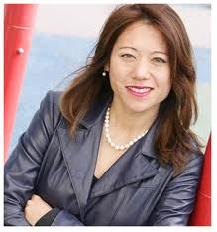
It cleared the state Senate, and should have cleared the Assembly Aug 24. But even with the Democrats firmly in control of that body, Yee failed to get enough votes for SB 399. And one of the people who refused to vote for it was San Francisco Assembly member Fiona Ma.


You expect this sort of shit from Republicans and from some conservative law-ond-order Democrats. But it’s inconceivable that a San Francisco Democrat would be against a bill like this. 


What on Earth was Ma thinking? I couldn’t get her on the phone, but her communications aide, Cataline Hayes-Bautista, sent the following Ma statement:


 “I did not come to my decision on SB 399 easily – it’s legislation that I have carefully reviewed and considered for months. While I acknowledge that some juveniles in the correctional system may have the capacity to be rehabilitated after decades of being incarcerated, I feel that we cannot reset a defendant’s clock 25 years later expecting a victim’s family will reset their hearts.


I know our District Attorneys do not take life sentences lightly. These crimes are limited to first and second degree murder offenses with a special circumstance which include the most troublesome crimes: murdering a peace officer, murdering to achieve a hate crime, committing a murder that’s especially heinous, murdering for financial gain, and murdering while escaping lawful custody.


All of these sentences were handed down after murder victims’ families had the chance to speak out and address the court on the impact of these murders. To re-open these closed cases to new sentencing hearings would re-open the wounds already suffered by murder victims’ families, forcing these victims to re-visit and re-live cases they were told had been closed forever. I think it would be unfair to these victims’ families to have to re-live these horrific crimes and for that reason I felt compelled to oppose this legislation.


There are already deliberative checks in place throughout the system where prosecutors, defense attorneys, jurors, and particularly our judges, have the ultimate discretion to choose a lesser juvenile sentence when sentencing a juvenile murderer. In addition, the Governor has the power to grant pardons and commute sentences. This already provides an avenue for juveniles to seek extraordinary relief if justice calls for it.


 While I appreciate Senator Yee’s intent to create opportunities to rehabilitate juvenile criminals, these particular crimes rise to a standard in which we need to hold those responsible accountable for their actions.”


Sorry, but that’s just terrible. To say that the victims’ families are better off if juveniles — people who were too young to be fully responsible for what they did, and who in some cases didn’t even kill anyone (just being present when someone kills someone can be a life sentence) are locked up until they die is just kind of sick. I don’t know what else to say. Except to give an example of who is serving life without parole (from Yee’s press release):


One such case involves Anthony C., who was 16 and had never before been in trouble with the law. Anthony belonged to a “tagging crew” that paints graffiti.  One day Anthony and his friend James went down to a wash (a cement-sided stream bed) to graffiti.  James revealed to Anthony that he had a gun in his backpack and when another group of kids came down to the wash, James decided to rob them. James pulled out the gun, and the victim told him, “If you don’t kill me, I’ll kill you.” At that point, Anthony thought the bluff had been called, and turned to pick up his bike. James shot the other kid.


 The police told Anthony’s parents that he did not need a lawyer. He was interviewed by the police and released, but later re-arrested on robbery and murder charges. Anthony was offered a 16-to-life sentence before trial if he pled, but he refused, believing he was innocent. Anthony was found guilty of first degree murder and sentenced to life in prison without parole. Charged with aiding and abetting, he was held responsible for the actions of James.


 Okay, this kid doesn’t belong in prison for life, without any chance of parole. Thanks, Fiona.


Meanwhile, without the support of Yee, Assemblymember Tom Ammiano’s bill that would allow a traffic camera at Market and Octavis narrowly squeaked by the state Senate Aug. 24 and will now head for the governor’s desk. The bill has generated a lot of commentary on this blog; bicyclists and pedestrians think it will save lives in a crazy intersection, and privacy types worry about the creeping police state.


Adam Keigwin, Yee’s chief of staff, insists that Yee didn’t do anything to block the bill:


FYI: Senator Yee did not block the bill.  In fact, he told his colleagues who were looking for his input on a San Francisco specific bill that it was ok for them to vote for it, even though he voted no.  The bill passed today.  Again, the Senator has opposed all camera enforcement bills for several reasons: such cameras create a police state; law enforcement could use the film to enforce other laws; we should use actual officers, have better traffic improvements – like we have done on 19th avenue where we have gone from several deaths a year to zero; open government problem – film (government document) is allowed to be destroyed without the public ever gaining access to it; and finally other privacy concerns.


Still, he didn’t vote for it, forcing Ammiano and Sen. Mark Leno to scramble around trying to find another vote to put it over the top.

Historic election for labor

0

Labor and Democratic Party leaders are concerned – and rightly so – that labor’s rank-and-file may not turn out in November to support labor-friendly Democrats in the massive numbers that played a major role in the election of President Obama and Democratic congressional majorities in 2008.

AFL-CIO officials are hoping to turn the anger and frustration that so many working people feel into votes, financial support and campaigning in behalf of pro-labor Democrats.  But the officials worry about an “enthusiasm gap” among unionists and their supporters stemming from the relatively slow pace of the progressive economic and political changes that they had very much expected from Obama and the congressional Democrats.

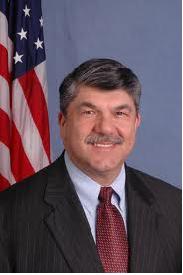
Many unionists are frustrated as usual by the lack of a viable progressive alternative to the Democratic Party. But they’d best beware, as AFL-CIO President Richard Trumka says, of the serious consequences of   being less than enthusiastic supporters of Democratic candidates in November’s elections.

“The Republican Party of NO doesn’t want our vote,” says Trumka. “All they want is for us to stay home. They want us to feel hopeless and disgusted so they can come back by default.”

 Trumka acknowledges that many union members, and many of their supporters and other progressives, are frustrated with the slow pace of economic change, the continuing high unemployment rate, continuing wars and other serious, unsettled problems.

But Trumka points out that in just a year and a half, Obama has had to dig out of a huge economic hole and “face extremist opposition on every point.” Yet, Trumka notes, “We’ve halted taxpayer bailouts … no longer are losing 700,000 jobs a month but are gaining a few… And by the end of this year we will have created or saved 3 1/2 million jobs and have fulfilled the dream of every president since Harry Truman and started to move down the road to health care for all. “

Organized labor has particularly good reason to be pleased with the performance of Obama and the congressional Democrats – particularly good reason to once again deploy millions of campaign dollars and millions of campaign workers in their behalf as labor did in the 2008 elections.

The Labor Department and National Labor Relations Board, virtually tools of the anti-labor right wing under President Bush, are under Obama returning to their job of enforcing the laws that guarantee workers the right to unionize without employer interference.

 And federal agencies are once again strictly enforcing the minimum wage and hour laws and other vital pro-worker laws that had been seriously neglected under Bush’s distinctly anti-labor administration. What’s more, the Occupational Safety and Health Administration is actually attempting to clamp down on the widespread violation of the job safety laws that has led to the needless deaths and serious injury of millions of American workers.

“We know you are angry,” Trumka told a recent gathering of labor leaders, “but we have made progress. No one said this was going to be easy. Ask African Americans how long they have fought and continue to fight. If they had given up after a year and a half they would still be in chains.”

 November’s election, says Richard Trumka, is  “the most crucial election in 75 years.” It will in any case be of unusually high importance to America’s working people and their unions and of exceptional importance to the rest of us as well.

Dick Meister, former labor editor of the SF Chronicle and KQED-TV Newsroom, has covered labor and politics for a half-century. Contact him through his website, www. dickmeister.com, which includes more than 250 of his recent columns.

Democrats divided

25

Update:This online article contains a correction concerning the DCCC’s vote on Sup. Sean Elsbernd’s Muni pay guarantees (Prop. G). In the print version of this article, the Guardian reported that the DCCC had voted “to recommend a no vote” on Prop. G. This is incorrect. The DCCC voted “not to endorse” Prop. G. As Elsbernd points out, “This is a key distinction.”

Sarah@sfbg.com

With fewer than 10 weeks to go until a pivotal November election, the San Francisco Democratic County Central Committee (DCCC) approved a package of endorsements at its Aug. 11 meeting, giving the nod to mostly progressive candidates and rejecting Mayor Gavin Newsom’s most divisive ballot measures.

This crucial election could alter the balance of power on a Board of Supervisors that is currently dominated by progressives, and that new board would be seated just as it potentially gets the chance to appoint an interim mayor.

That’s what will happen if Newsom wins his race for lieutenant governor. The latest campaign finance reports show that Newsom has raised twice as much money as the Republican incumbent, former state Sen. Abel Maldonado. But the two candidates are still neck-and-neck in the polls.

Although the DCCC supports Newsom in the race, it is resisting his agenda for San Francisco, voting to oppose his polarizing sit-lie legislation (Prop. L), a hotel tax loophole closure (Prop. K) that would invalidate the hotel tax increase that labor unions placed on the ballot, and his hypocritical ban on local elected officials serving on the DCCC (Prop. H).

Shortly after the vote, the San Francisco Chronicle reported that Newsom called an emergency closed-door meeting with some of his downtown allies to discuss the upcoming election. “We just wanted to get on the same page on what’s going on locally, what’s going with the ballot initiatives, where people are on the candidates for supervisor,” Newsom told the newspaper.

DCCC Chair Aaron Peskin, who regularly battled with Newsom during his tenure as president of the Board of Supervisors, voted with the progressive bloc against Newsom’s three controversial measures. But he told us that he was glad to see the mayor finally engage in the local political process.

Sup. David Campos kicked off the DCCC meeting by rebuffing newly elected DCCC member Carole Migden’s unsuccessful attempt to rescind the body’s endorsement of Michael Nava for Superior Court Judge, part of a push by the legal community to rally behind Richard Ulmer and other sitting judges.

Things got even messier when the DCCC endorsed the candidates for supervisor. In District 2, the DCCC gave the nod to Janet Reilly, snubbing incumbent Sup. Michela Alioto-Pier, who is running now that Superior Court Judge Peter Busch has ruled that she is not termed out (a ruling on City Attorney Dennis Herrera’s appeal of Busch’s ruling is expected soon).

In District 6, where candidates include DCCC member Debra Walker, School Board President Jane Kim, Human Rights Commission Executive Director Theresa Sparks, neighborhood activist Jim Meko, and drag queen Glendon Hyde (a.k.a. Anna Conda), the club endorsed only Walker, denying Kim the second-place endorsement she was lobbying for.

But in District 8, where candidates include progressive DCCC member Rafael Mandelman, moderate DCCC member Scott Wiener, and moderate Rebecca Prozan, the politics got really squirrelly. As expected, Mandelman got the first-place nod with 18 votes: the progressive’s bare 17-vote majority on the 33-member body plus Assembly Member Leland Yee.

Yet because Yee supports Prozan and David Chiu, the Board of Supervisors president who was also part of the DCCC progressive slate, had offered less than his full support for Mandelman, a deal was cut to give Prozan a second-place endorsement.

That move caused some public and private grumbling from Jane Kim’s supporters, who noted that Kim is way more progressive than Prozan and said she should have been given the second-place slot in D6.

A proxy for John Avalos even tried to get the DCCC to give Walker and Kim a dual first-place endorsement, but Peskin ruled that such a move was not permitted by the group’s bylaws. Then DCCC members Eric Mar and Eric Quezada argued that Kim should get the club’s second-choice endorsement.

But Walker’s supporters argued that Kim only recently moved into the district and changed her party affiliation from the Green Party to the Democratic Party, and Kim’s supporters failed to find the 17 votes they needed.

“District 6 has an amazing wealth of candidates and I look forward to supporting many of them in future races,” Gabriel Haaland told his DCCC colleagues. “I will just not be supporting them tonight.”

Wiener told the group he would not seek its endorsement for anything below the top slot. “I’m running for first place and I intend to win,” Wiener said, shortly before Prozan secured the club’s second-choice endorsement.

In District 4, the DCCC endorsed incumbent Carmen Chu, who is running virtually unopposed. The DCCC also endorsed Bert Hill’s run for the BART Board of Directors, where he hopes to unseat James Fang, San Francisco’s only elected Republican.

The body had already decided to delay its school board endorsements until September and ended up pushing its District 10 supervisorial endorsement back until then as well because nobody had secured majority support.

“I think it’s because they want to give members of the DCCC a chance to learn more about some of the candidates,” District 10 candidate Dewitt Lacy told the Guardian. “I don’t think folks have spent enough time to make an informed decision.”

D10 candidate Chris Jackson agreed, adding, “The progressives in this race have brought our issues to the forefront.”

“I think it’s appropriate,” concurred D10 candidate Isaac Bowers. “D10 is a complicated district. It’s wise to wait and see how it settles out.”

The main thing that needs to be resolved is which candidate in the crowded field will emerge as the progressive alternative to Lynette Sweet, who has the support of downtown groups and mega-developer Lennar Corp.

After the meeting, Walker said different races require different political strategies. “I think it’s hard in the progressive community, where so many of us know each other and even our supporters know the other candidates and are their supporters in other scenarios,” Walker said.

“But the Democratic Party makes decisions not just based on politics,” she continued. “So the endorsement is about being viable and successfully involved in Democratic issues. And even though I want to encourage everyone to run, and we have that ability with ranked choice voting and public financing, when it comes to straight-on politics, the goal is winning.”

Walker said the vote on D8 reflected the reality that Mandelman was having trouble getting the necessary number of votes. “I know Rebecca and I know Rafael, and Rafael was my clear first choice,” Walker said.” Rafael asked me to consider voting for Rebecca—and I voted for her as my second choice.”

Walker predicts she’ll have union support behind her campaign, while Kim, who leads in fundraising, will have independent expenditure committees that will support her campaign.

“My consultant says it’s a $250,000 race, and unfortunately the viability is based on that reality, the funds, the money,” Walker observed.

On the fall ballot measures, the DCCC voted to recommend a no vote on Public Defender Jeff Adachi’s measure to make city employees pay more for the pension and healthcare costs (Prop. B), Sup. Sean Elsbernd’s Health Service Board Elections (Prop. F,) and Newsom’s three controversial measures. And they voted “no endorsement” on Elsbernd’s measure to remove from the charter Muni pay guarantees (Prop. G). 

But the DCCC did vote to endorse a local vehicle registration fee surcharge (Prop. AA), Newsom’s earthquake retrofit bond (Prop. A), Sup. Chris Daly’s proposed legislation to require mayoral appearances at board meetings (Prop. C), Chiu’s measure to allow noncitizen voting in school board elections (Prop. D), Sup. Ross Mirkarimi’s Election Day voter registration (Prop. E), former Newsom campaign manager Alex Tourk’s Saturday voting proposal (Prop. I) Labor’s hotel tax (Prop. J ), Mirkarimi’s foot patrols measure (Prop. M) and Avalos’ real estate transfer tax (Prop. N).

With just about everybody opposed to Adachi’s measure going after public employee unions, Walker observed that Adachi probably wishes he had done it differently now. But looking into the future, Walker sees opportunities for the party to come back together.

“There’s an opportunity to start a dialogue because everyone is hurting,” Walker said. “The more we don’t have a proactive solution, the more we get caught at the bottom.”

And in a feel-good vote for the frequently divided body, the DCCC also voted overwhelmingly to endorse the statewide initiative to legalize and tax marijuana (Prop. 19). Normally local party committees don’t take a position on state initiatives, but because the California Democratic Party took no position on Prop. 19, the DCCC had permission to weigh in.

As Peskin put it before the enthusiastic marijuana vote, “Raise your hands — high.”

The real reason GOP is obssessing on the Ground Zero mosque

4

Daily Kos contributing editor Jed Lewison suggests that it’s because the Republican Party has nothing else to contribute to the conversation, as the election nears.

It’s an interesting theory.

As Lewison writes, “Despite polling that shows most Americans — including Democrats and even many liberals — oppose building a mosque two blocks from Ground Zero, Republicans are making a big mistake in building their fall campaign around the issue, in the process handing Democrats a big opportunity.

“GOPers obviously believe that the symbolism of the mosque issue makes it ripe of exploitation,” Lewison continues. “And it might be true that the mosque is the best issue they’ve got going for them, even if the public debate about it has been fueled by bigotry and false characterizations of the proposal. Nonetheless, their decision to exploit it says more about the fundamental weakness of GOP than it does about their political prowess.”

“Here’s why: the mosque issue is far less important than the economy, and every moment that the GOP spends focusing its message on the mosque provides Democrats with the chance to point out that Republicans are fundamentally unserious about doing what it takes to get the economy going again,” Lewison concludes. “Every poll shows the economy is priority #1, #2, and #3, yet Republicans haven’t offered a single economic plan other than to do nothing.”

DCCC endorsements will test progressive unity

2

When the San Francisco Democratic County Central Committee convenes tomorrow (Aug. 11) evening to vote on its endorsements for the November races and ballot measures, the clout and unity of its slim progressive majority will be tested in a few high profile contests where the outcome isn’t entirely clear.

As I reported last week, progressives occupy only about 17 of the 33 seats, so any defectors from the slate that won in June could create some squirrely politics or backroom deals. Progressive supervisorial candidates Rafael Mandelman from District 8 and Debra Walker from District 6 are widely expected to get the top endorsements in their races, but Rebecca Prozan in D8 and Jane Kim (and possibly Jim Meko) in D6 each have some progressive supporters on the committee and could make a play for the second slot in the ranked-choice voting election. D8 candidate Scott Wiener, the former DCCC chair, will probably also try to get some kind of spot on the slate but is likely to be met with fairly unified progressive opposition.

The District 10 endorsement will be a free-for-all with no clear progressive consensus alternative to downtown-backed candidate Lynette Sweet yet emerging from the crowded field. Party chair Aaron Peskin has endorsed Malia Cohen and Tony Kelly in that race, but Chris Jackson, Dewitt Lacy, Kristine Enea, and other candidates also have progressive backing, so it could be tough for any of them to get to 17 votes at this point. But in District 2, Janet Reilly appears to have the endorsement locked down, despite a judge allowing incumbent Sup. Michela Alioto-Pier to run for a third term.

On the local ballot measures, the progressive majority is likely to endorse the revenue measures (a hotel tax increase pushed by labor, a transfer tax on properties worth over $5 million, and a small local vehicle license fee surcharge) and reject Public Defender Jeff Adachi’s measure to increase how much city employees pay for health care and into their pensions and Sup. Sean Elsbernd’s measure to end pay guarantees for Muni drivers (although not even progressives are feeling much love for the recalcitrant Transportation Workers Union these days).

The aggressive effort by the legal community to overturn the DCCC endorsement of Michael Nava for judge – waged on behalf of Judge Richard Ulmer, a recent appointee of Gov. Arnold Schwarzenegger, ostensibly over judicial independence but also as a way of sucking up to judges that lawyers want to curry favor with – is expected to fail, mostly because it requires a two-thirds vote. An ordinance to ban sitting or lying on sidewalks that is being pushed by Mayor Gavin Newsom, Police Chief George Gascon, and San Francisco Chronicle columnist CW Nevius is also likely to be soundly rejected by the party.

DCCC endorsements usually carry quite a bit of weight in heavily Democratic San Francisco, getting the candidates on party slate cards and entitling them to other party resources. Any races that don’t yield a majority endorsement this week would get pushed back to the September meeting, when the DCCC will consider school board endorsements.

The fun starts at 6 p.m. at the Unite-Here Local 2 office at 209 Golden Gate Avenue.

Finally, some logic on same-sex marriage

0

EDITORIAL Judge Vaughn Walker’s historic decision overturning Proposition 8 was remarkable not so much for its conclusion, but because it has taken so long for a federal court to conclude that same-sex marriage does no conceivable harm to anyone.

The legal scholars can debate whether this particular civil rights issue deserves strict scrutiny or must meet only a rational-basis test. And everyone knows the case will eventually wind up in the U.S. Supreme Court, where nine justices will decide whether official discrimination can be legal in the United States of America.

But what Walker did was crucial — he devoted the vast majority of his 138-page decision to discussing the facts of the case. As Bob Egelko notes in a nice San Francisco Chronicle piece Aug. 8, Walker provided a forum for the public debate that should have happened around the ballot measure but never did. Prop. 8 was decided after political consultants used carefully honed messages designed to play on people’s emotions; the real facts of the matter were hardly ever discussed on a statewide level.

The facts of the matter, as the record clearly shows and Walker eloquently related, are simple: there’s nothing wrong with same-sex marriage. The ability of same-sex couples to marry has no impact on the rights of opposite-sex couples. There is also no legal reason to believe that something rooted in an old tradition — from a time when gender roles were rigidly prescribed — has, in and of itself, any validity. "Tradition alone," Walker noted, citing a 1970 U.S. Supreme Court case, "cannot form a rational basis for a law." Furthermore, studies show that children brought up by same-sex couples fare just as well (and in some studies, better) than children raised in traditional households.

In fact, the judge concluded, the only real reason Prop. 8 supporters put the measure on the ballot is that they don’t like gay and lesbian people: "Proposition 8 was premised on the belief that same-sex couples simply are not as good as opposite-sex couples. Whether that belief is based on moral disapproval of homosexuality, animus toward gays and lesbians, or simply a belief that a relationship between a man and a woman is inherently better than a relationship between two men or two women, this belief is not a proper basis on which to legislate."

That record of factual evidence will make it harder for the Ninth Circuit Court of Appeals or Supreme Court to overturn Walker’s ruling. And the very essence of his decision — that no harm comes to anyone in society when same-sex couples are allowed to wed — is ample reason for him to deny any stay while the case is on appeal. A stay, which would leave Prop. 8 in effect for several more years while the case works its way through the system, would make sense only if some irreparable harm would come to some party. There’s no such harm — real or potential or imaginable — to anyone or anything except institutional and personal bigotry.

The decision demonstrates another crucial factor, one that politicians of both parties should pay attention to this fall. Courts tend to (slowly) reflect changing attitudes in society. And while the polls are still inconclusive, the demographics are not: Almost nobody under 30 opposes same-sex marriage, and every year that passes, California and the country come closer to the day when Prop. 8 will seem as silly as anti-miscegenation laws.

Both Attorney General Jerry Brown and Gov. Arnold Schwarzenegger have asked Walker not to stay his ruling. Sen. Barbara Boxer has hailed the decision. But Republican gubernatorial candidate Meg Whitman and Senate contender Carly Fiorina remain adamantly opposed to same-sex marriage. Brown and Boxer shouldn’t be afraid to make this part of their campaigns. There’s not a whole lot to bring young people to the ballot this fall, and making Prop. 8 an issue can only help the Democrats.

It’s also worth remembering that nearly every Democratic leader in the nation blanched when San Francisco, under Mayor Gavin Newsom did the right thing and legalized same-sex marriage in 2004. We warned then that Sens. Boxer and Dianne Feinstein, Speaker Nancy Pelosi, and the rest of the Washington crew would wind up on the wrong side of history. And now that a judge who has never been known as a leftist (or even a liberal) has made the case that marriage is a civil right and discrimination is never legally acceptable, they ought to admit they were wrong.

Finally, some logic on same-sex marriage

11

Same-sex marriage does no conceivable harm to anyone

EDITORIAL Judge Vaughn Walker’s historic decision overturning Proposition 8 was remarkable not so much for its conclusion, but because it has taken so long for a federal court to conclude that same-sex marriage does no conceivable harm to anyone.

The legal scholars can debate whether this particular civil rights issue deserves strict scrutiny or must meet only a rational-basis test. And everyone knows the case will eventually wind up in the U.S. Supreme Court, where nine justices will decide whether official discrimination can be legal in the United States of America.

But what Walker did was crucial — he devoted the vast majority of his 138-page decision to discussing the facts of the case. As Bob Egelko notes in a nice San Francisco Chronicle piece Aug. 8, Walker provided a forum for the public debate that should have happened around the ballot measure but never did. Prop. 8 was decided after political consultants used carefully honed messages designed to play on people’s emotions; the real facts of the matter were hardly ever discussed on a statewide level.

The facts of the matter, as the record clearly shows and Walker eloquently related, are simple: there’s nothing wrong with same-sex marriage. The ability of same-sex couples to marry has no impact on the rights of opposite-sex couples. There is also no legal reason to believe that something rooted in an old tradition — from a time when gender roles were rigidly prescribed — has, in and of itself, any validity. “Tradition alone,” Walker noted, citing a 1970 U.S. Supreme Court case, “cannot form a rational basis for a law.” Furthermore, studies show that children brought up by same-sex couples fare just as well (and in some studies, better) than children raised in traditional households.

In fact, the judge concluded, the only real reason Prop. 8 supporters put the measure on the ballot is that they don’t like gay and lesbian people: “Proposition 8 was premised on the belief that same-sex couples simply are not as good as opposite-sex couples. Whether that belief is based on moral disapproval of homosexuality, animus toward gays and lesbians, or simply a belief that a relationship between a man and a woman is inherently better than a relationship between two men or two women, this belief is not a proper basis on which to legislate.”

That record of factual evidence will make it harder for the Ninth Circuit Court of Appeals or Supreme Court to overturn Walker’s ruling. And the very essence of his decision — that no harm comes to anyone in society when same-sex couples are allowed to wed — is ample reason for him to deny any stay while the case is on appeal. A stay, which would leave Prop. 8 in effect for several more years while the case works its way through the system, would make sense only if some irreparable harm would come to some party. There’s no such harm — real or potential or imaginable — to anyone or anything except institutional and personal bigotry.

The decision demonstrates another crucial factor, one that politicians of both parties should pay attention to this fall. Courts tend to (slowly) reflect changing attitudes in society. And while the polls are still inconclusive, the demographics are not: Almost nobody under 30 opposes same-sex marriage, and every year that passes, California and the country come closer to the day when Prop. 8 will seem as silly as anti-miscegenation laws.

Both Attorney General Jerry Brown and Gov. Arnold Schwarzenegger have asked Walker not to stay his ruling. Sen. Barbara Boxer has hailed the decision. But Republican gubernatorial candidate Meg Whitman and Senate contender Carly Fiorina remain adamantly opposed to same-sex marriage. Brown and Boxer shouldn’t be afraid to make this part of their campaigns. There’s not a whole lot to bring young people to the ballot this fall, and making Prop. 8 an issue can only help the Democrats.

It’s also worth remembering that nearly every Democratic leader in the nation blanched when San Francisco, under Mayor Gavin Newsom did the right thing and legalized same-sex marriage in 2004. We warned then that Sens. Boxer and Dianne Feinstein, Speaker Nancy Pelosi, and the rest of the Washington crew would wind up on the wrong side of history. And now that a judge who has never been known as a leftist (or even a liberal) has made the case that marriage is a civil right and discrimination is never legally acceptable, they ought to admit they were wrong.

The politics of unity and division

7

steve@sfbg.com

These are strange days for the San Francisco Democratic Party, which is seeking to overcome bitter divisions on the local level and come together around candidates for statewide office that include Mayor Gavin Newsom, whose fiscal conservatism and petulant political style are the main sources of that local division.

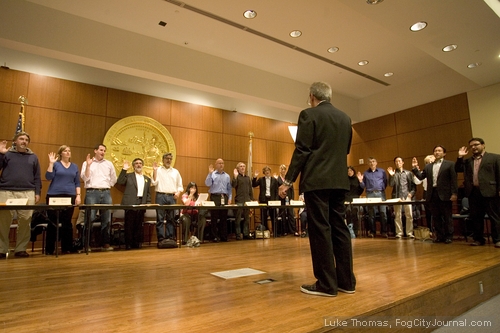
The tension has played out recently around the Board of Supervisors deliberations on the new city budget and November ballot measures and in dramas surrounding the newly elected Democratic County Central Committee, where the battles during its July 28 inaugural meeting previewed a more significant fight over local endorsements coming up Aug. 11.

Almost every elected official in San Francisco is a Democrat. Newsom, the Democratic nominee for lieutenant governor, has been the main obstacle to new taxes that progressives and labor leaders say are desperately needed to preserve public services, deal with massive projected deficits in the next two years, and quit balancing budgets on the backs of workers.

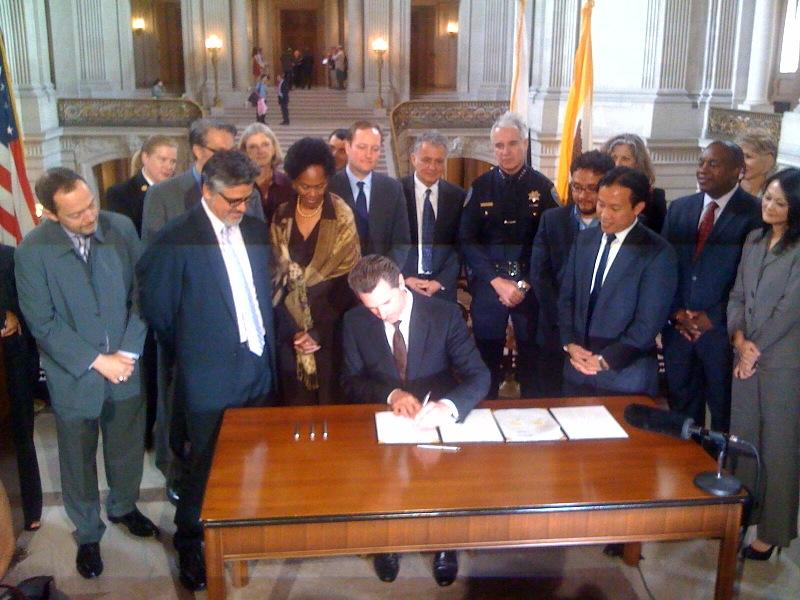
“We balanced the budget without raising taxes. I don’t believe in raising taxes. We don’t need to raise taxes,” Newsom said proudly at his July 29 budget signing ceremony, during which he also effusively praised the labor unions whose support he needs this fall: “Labor has been under attack in this state and country. They’ve become a convenient excuse for our lack of leadership in Sacramento and around the country.”

That hypocritical brand of politics has been frustrating to his fellow Democrats, particularly progressive supervisors and DCCC members. At the July 27 board meeting, Sup. Ross Mirkarimi and Board President David Chiu reluctantly dropped their pair of revenue measures that would have raised $50 million, bowing to opposition by Newsom and the business community.

The San Francisco Chamber of Commerce has become such a vehicle for antitax and antigovernment vitriol that the DCCC on July 29 approved a resolution calling for the organization — which hosted a speech by Republican National Chair Michael Steele in June — to renounce the platform of the Republican National Committee.

“The Chamber is not a knee-jerk right-wing organization,” Chamber President Steve Falk felt compelled to clarify in a July 28 letter to DCCC Chair Aaron Peskin, closing with, “Anything you can do to avoid painting the Chamber as a pawn of the GOP would be greatly appreciated — because it just isn’t true.”

Yet Rafael Mandelman, who sponsored the resolution and is a progressive supervisorial candidate in District 8, told us the Chamber’s fiscal policies are indistinguishable from those pushed by Republicans. “They’re the leading force pushing the Republican agenda in San Francisco,” Mandelman said, calling the stance short-sighted. “It’s not in the long-term interests of the business community for our public sector to fall apart.”

Chiu’s business tax reform measure is a good example of how conservative ideology seems to be trumping progressive policy, even among Democrats. Only 10 percent of businesses in the city pay any local business tax, and the measure would increase taxes on large corporations, lower them on small businesses, create private sector jobs, bring $25 million per year into the city, and expand the tax burden to 25 percent of businesses, including the large banks, insurance companies, and financial institutions that are now exempt. But even the Small Business Commission refused to support the plan, prompting Chiu to drop the proposal and tell his colleagues, “There is still not consensus about whether this should move forward.”

Sup. Chris Daly, the lone vote against the budget compromise with Newsom and the removal of revenue measures from the November ballot, noted at the July 27 board meeting how the business community has sabotaged city finances, citing its 2002 lawsuit challenging the gross receipt taxes, which the board settled on a controversial 8-3 vote. “This is a large part of our structural budget deficit,” Daly said.

But antitax sentiment has only gotten worse with the current recession and political dysfunction, causing Democrats like Newsom to parrot Republicans’ no-new-taxes mantra, much to the chagrin of progressives.

“A lot of this is being driven by statewide politics. [Newsom] needs to not have taxes go up but he also needs the support of the labor unions, so we get weird stuff happening in San Francisco,” Mandelman said.

The situation has also fed Newsom’s animus toward progressives, who have enjoyed more local electoral success than the mayor. Newsom responded in June to the progressive slate winning a majority on the DCCC by placing a measure on the November ballot that would ban local elected officeholders from serving on that body, which includes four progressive supervisors and three supervisorial candidates.

Nonetheless, Newsom then unexpectedly sought a seat on the DCCC, arguing that his lieutenant governor nomination entitled him to an ex officio seat (those held by state and federal elected Democrats) even though the DCCC’s legal counsel disagreed. While noting the hypocrisy of the request, Party Chair Aaron Peskin took the high road and proposed to change the bylaws to seat Newsom.

Some progressives privately groused about giving a seat to someone who, as DCCC member Carole Migden said at the meeting, was “picking a fight” with progressives by pushing a measure she called “disrespectful and unconstitutional.” But in practice, the episode seems to have hurt Newsom’s relations with progressives without really strengthening his political hand.

Newsom ally Scott Wiener — a DCCC member and District 8 supervisorial candidate (who told us he opposes the mayor’s DCCC ballot measure) — proposed to amend Peskin’s motion to change the bylaws in order to seat Newsom with language that would allow Newsom to continue serving even if he loses his race in November.

That amendment was defeated on a 17-13 vote that illustrated a clear dividing line between the progressive majority and the minority faction of moderates and ex officio members. Even with Newsom and District Attorney Kamala Harris (who was seated as the Democratic nominee for attorney general) being seated — and counting the one absent vote, Sen. Leland Yee, who is expected to sometimes vote with progressives and sometimes with moderates — progressives still hold the majority going into the process of endorsing local candidates and allocating party resources for the fall campaign.

“Presuming that 17 people of that 33-member body all agree on something, then the presence of Mayor Newsom doesn’t change anything,” Peskin said. He also noted that even if Newsom’s measure passed and the progressive supervisors were removed, “the irony is that the chair of the party [Peskin] would appoint their successors.”

Also ironic is the political reality that it is Newsom who most needs his party’s support right now, while it is progressives who are adopting the most conciliatory tone.

“We should all be working to turn out the vote and help Democrats win,” Peskin told us. “I implore our mayor and lieutenant gubernatorial candidate to work with us and get that done.”

Yet after Newsom gave a budget-signing speech that included the line, “At the end of the day, it comes down to leadership, stewardship, collaboration, partnership,” he told the Guardian that he has no intention of removing or explaining his DCCC ballot measure, saying only, “If the voters support it, then it would be the right thing to do.”

Chiu responded to the news by telling us, “I hope the mayor can move beyond the politics of personality and build a party vehicle that is about unity.”

Legal Brahmins organize against Nava

19

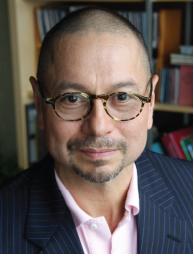
Some of the most prominent lawyers in San Francisco, including two high-ranking judges, have launched a full-scale political campaign to protect Judge Richard Ulmer, a straight white former Republican and Schwarzenegger appointee, against a challenge by a gay Latino Democrat.


Among the Ulmer supporters, who have vowed to raise a substantial amount of money for the fall judicial election, are J. Anthony Kline, presiding justice of the state Court of Appeal in San Francisco and James McBride, presiding judge of the San Francisco Superior Court. They’re joined by a surprising number of leading liberal lawyers, including James Brosnahan, senior partner at Morrison and Foerster, Joe Cotchett, the widely known trial lawyer, and Sid Wolinsky, a founder of Disability Rights Advocates and a lifelong public interest attorney.


And John Burton, the chair of the California Democratic Party, is contacting members of the San Francisco County Central Committee to try to get that panel to rescind its endorsement of Ulmer’s opponent, Michael Nava.


It is, by any standard, an astonishing amount of political firepower for a local judicial race – and it’s all being done in the name of avoiding politicizing the judiciary.


Nava, a former prosecutor who now works as a staff attorney for state Supreme Court Justice Carlos Moreno, finished first among three candidates in the June primary election, and will face Ulmer in a November runoff. Nava finished with 45 percent of the vote, Ulmer with 42. Dan Deal, also a gay man, won 11 percent of the vote, and most observers agree that if he hadn’t been in the race, Nava would have exceeded 50 percent of the vote and won the seat outright.


So Ulmer heads into the fall with a significant disadvantage — Nava needs only another five percent to put him over the top, and has the endorsement of the local Democratic Party, a major factor in a race that typically doesn’t attract much public attention.


That, by all accounts, has given the local judiciary a bit of a scare. Judges by law serve six-year terms, and can face a challenge when they come up for election, but it doesn’t happen often. And there aren’t many elections for open seats. That’s because the vast majority of Superior Court judges retire or step down in mid-term, giving the governor the opportunity to appoint somenone to the post.


And judges typically don’t like running for re-election; it forces them to raise money from people who might appear in their courtroom and makes them get out and about and glad hand in the community — something that isn’t a normal part of a judge’s life.


Ulmer’s only been on the bench a little more than a year, and hasn’t done anything unprofessional or inappropriate; most attorneys who’ve appeared before him consider him an honest, competent judge. But he was appointed by a Republican governor to a bench that critics say is not reflective of the diversity of San Francisco, and if a local Democrat can unseat him, a lot of other judges could be vulnerable.


That’s what drove McBride, who told me he normally avoids politics, into the fray. Early in July, McBride sent an email to every past president of the Bar Association of San Francisco, inviting (some would say summoning) them to a July 7th meeting at the law office of Pillsbury, Madison and Sutro. The tagline talked about the “independence of the judiciary,” but the event turned out to be something of a pep talk and rally for Ulmer.


According to several accounts, Kline made the main pitch: He called this a “game-changing judicial election,” and made the arguments he would publish two days later in an opinion piece in the Recorder, a legal newspaper.


“The unseating of Judge Ulmer, widely considered an outstanding judge, would have a far greater politicizing effect than many realize,” his piece stated.


He added:


“If challenges to sitting judges without regard to their competence and character become acceptable in California, the consequences for our judiciary will be transformative. Exceptionally able but politically inexperienced lawyers will be less likely to seek judicial appointment. Lawyers who do seek appointment might feel it necessary to seek and obtain the political support of well-financed or influential groups, which may want to know where they stand on issues courts decide. Governors will favor judicial candidates possessing the political skills and financial resources necessary to defend themselves. Some judges may think twice about ruling against politically influential parties, lawyers, or interest groups. Judges may establish campaign funds to discourage potential challengers, and lawyers who appear before such judges may feel compelled to contribute.”


And in a move that disturbed some of those present, Kline argued, in essence, that the local court already has considerable diversity, and that the fact that Ulmer is a straight white male shouldn’t be an overriding factor in the race.


“With the election of Linda Colfax,” his Recorder article states, “25 of the court’s 51 members will be women, 10 gay men or lesbians, 9 Asian-Americans; 3 Latinos; and 3 African-Americans. The court must already be the most diverse in the United States.”


McBride told the group that Ulmer would need money — substantial sums of money — to compete against Nava, and made it clear that he needed help raising it. According to some accounts, there was discussion of seeking a war chest of $350,000. The presiding judge also asked the former bar presidents to sign a letter asserting that the election of Nava would be an attack on the judiciary.


Peter Keane, dean emeritus of the Golden Gate University Law School, was among those invited, and the meeting left him deeply disturbed. “It was something disgraceful, the tone of opposition from people like Kline,” he told me. “It felt like a Dick Cheney weapons of mass destruction speech, this fear about the independence of the judiciary. I raised my hand and said I disagree.”


Keane said that “to frame this as an independence of the judicary question cheapens that argument.” Nava, he said, has every legal right to run and make the case that he’d be a better judge than Ulmer. “Ulmer’s been endorsed by the Republicans,” Keane said. “So what’s wrong if Nava is endorsed by the Democrats?”


Keane said he’d voted for Ulmer in June, but was switching to supporting Nava this fall, in part because he sees a powerful attack coming down against the challenger. “A lot of Brahmins in the legal society have gotten stampeded into the lynch mob against Michael,” he said.


In the end, the bar presidents agreed to what Keane called a mild statement saying that party affiliation shouldn’t be the sole basis for making judicial election decisions.


Kline, a former judicial appointments secretary for Gov. Jerry Brown who is widely considered one of the most liberal judges in the state, told me that he barely knows Ulmer, but knows of his pro bono work cleaning up the California Youth Authority. But he said he will continue to speak out for the incumbent because he fears the election of Nava would open the floodgates to challenges against judges on purely political grounds.


McBride confirmed that he called the July 7th meeting and was happy to discuss what happened and his perspective. He told me that it’s difficult and often inappropriate for judges to raise money for campaigns, since the people most likely to be interested in those races — lawyers — often have business before the courts. And he argued that the fear of a challenge could make judges hesitant to rule against powerful interest groups.


“One of the things that came up at the meeting,” he said, “is that judges are the only public officials who are required by the Constitution and their oath of office to act against their constituents.”


But Nava points out that state law provides for judges to face the voters — and potential opponents — once every six years. “This is simply the judges trying to establish standards for the voters to decide when and under what circumstances a judge can be challenged,” he told me. “They want to decide what qualifies someone to be a judge and what doesn’t.”


He said that the argument that the court is already diverse is “offensive.” The court’s own statistics, he noted, show that 70 percent of the judges are white and “most have been appointed by governors of a particular partisan and ideological bent.”


That, of course, is one reason Nava is running against an incumbent: He thinks (probably correctly) that Gov. Schwarzenegger would never appoint him to the bench, and unless Jerry Brown wins this fall, he’ll be essentially unable to become a local judge for years. Of course, if more judges retired at the end of their terms, and create more openings, there’d be less of a problem; lawyers who want to ascend to the bench would have a fair shot at running without taking on any incumbents.


Nava agreed that it was unpleasant and unseemly for judges, or judicial candidates, to go around raising money — but he thinks there’s another solution. “Why don’t they work to make all judicial campaigns fully publicly financed?” he asked. “If Justice Kline wants to do that, I’ll be happy to join him.”


Although McBride said he hopes the Ulmer campaign will be able to raise enough money to reach the voters directly this fall, the focus right now is on the DCCC. “Since the Democratic Party is so dominant in this town, having the endorsement of the party shifts the balance way towards Nava,” McBride told me. Everybody knows the party won’t endorse Ulmer, who was a Republican until he was appointed to the bench, at which point he switched his registration to decline to state. But McBride hopes enough DCCC members will agree to reverse the Nava endorsement to leave the local party neutral in the race.


That’s going to be difficult – it takes a two-thirds vote to change an endorsement. But Ulmer supporters are pulling out all the stops – Burton has written a letter, prominent local lawyers who support Ulmer are calling DCCC members,  and in some cases, cornering them in person.


“I was at an event the other day, and Joe Cotchett comes up and tells me he needs to talk to me,” DCCC member Alix Rosenthal told me. “He corners me and starts talking about how I need to reverse the endorsement of Nava.”


And the power of the Brahmins seems to be having at least some impact – a few of the members who supported Nava in the spring appear to be wavering, and some newly elected progressives are still undecided.


Reversing an endorsement would be highly unusual. “I’ve never seen anything like this done in my eight years on the committee,” member Gabriel Haaland told me.


But no matter what happens at the DCCC in August, when the issue will come up, the relatively low-profile race for Superior Court judge is going to get heated this fall – and Nava will be in the crosshairs.

Newsom’s budget and DCCC hypocrisy

9

Hypocrisy hung thickly in the air at City Hall today as Mayor Gavin Newsom refused to responsively address glaring contradictions on a pair of high-profile policy stances, pursuing naked self interest while cloaking himself in deceptive but high-minded rhetoric. Newsom used the city budget-signing ceremony to effusively praise the labor unions that he publicly shamed into giving back $250 million over two years to balance the budget without tax increases, a budget that cut services and increased various fees and fines.

“Labor has been under attack in this state and country. They’ve become a convenient excuse for our lack of leadership in Sacramento and around the country,” Newsom said without blushing, defending unions against pension reform measures such as Public Defender Jeff Adachi’s SF Smart Reform, which he opposes while continuing to support the need for pension reform.

But Newsom seemed unaware that the layoffs, forced furloughs, and voluntary pay cuts accepted by the unions that he publicly demonized just a couple months ago and now praises – whose support he needs for his current run for lieutenant governor – is connected to his steadfast opposition to new taxes, which he reiterated today: “We balanced the budget without raising taxes. I don’t believe in raising taxes, we don’t need to raise taxes.”

Despite the fact that just 10 percent of San Francisco businesses pay any business taxes to the city, Newsom opposed and this week helped kill a measure by Board President David Chiu to reform the business tax system in a way that would increase taxes on large corporations, lower them on small businesses, create private sector jobs, bring $25 million per year into the city, and expand the tax burden to 25 percent of businesses, including the large banks, insurance companies, and financial institutions that are now exempt. Instead, labor took a deep hit and the city still faces projected $500 million budget deficits each of the next two fiscal years.

But Newsom’s hypocrisy isn’t confined fiscal issues. After the ceremony, he told reporters that he was sticking by his November ballot measure to ban local elected officials from serving on the Democratic County Central Committee, even after last night insisting that body give him a seat, which they had to change the bylaws to accommodate.

At last night’s DCCC meeting, members of an elected committee that includes four progressive supervisors and three current supervisorial candidates called for Newsom or his proxy John Shanley to explain why he is pushing a policy to ban locally elected officials from serving on the DCCC, a body in which elected state and federal officials automatically get seats.

“This mayor is on record as saying local officials should not serve on the committee,” Sup. David Campos said at the meeting, calling for Newsom to clarify this policy contradiction and offer his reasoning for the policy: “We don’t want to do anything that is inconsistent with what the mayor has said so far.”

Chair Aaron Peskin translated Campos’s comments as indicating “some level of irony or hypocrisy,” but Campos objected, insisting “it’s not a personal attack” but a genuine desire to know why Newsom sought to ban local elected officials after progressives won a majority of the DCCC seats in June.

Both Shanley last night and Newsom today gave the same legalistic answers, noting that he’s not serving in his capacity as the mayor, but as an ex officio member who automatically gets a seat for being the Democratic nominee for a statewide office (although the DCCC legal counsel said Newsom wasn’t entitled to a seat because the bylaws only award a seat when the current holder of the office being sought is a Democrat).

But DCCC member Carole Migden objected to Shanley’s answer, saying of Newsom’s effort to unseat duly elected members, “That’s picking a fight, if we want to be clear…That effects my vote, I have to say. It’s disrespectful and unconstitutional.”

DCCC member David Chiu noted that Newsom’s ballot measure would explicitly ban supervisors and the mayor from serving on the DCCC and said that the mayor still had a few days before the deadline for him to withdraw the measure, which he single-handedly placed on the ballot using his authority as mayor.

But today, when asked by the Guardian, Newsom said he had no intention of either withdrawing the measure or explaining it to the DCCC. When we asked about the contradiction in his positions, Newsom said only, “If the voters support it then it would be the right thing to do.”

He was similarly dismissive when other reporters continued to ask about the controversy, gesturing toward me with a dismissive wave of his hand as he said, “Certain people with certain newspapers major in the minor.”

After being told that Newsom is sticking by his DCCC ballot measure, Chiu told us, “I hope the mayor can move beyond the politics of personality and build a party vehicle that is about unity.”


DCCC seats are fine for Newsom, just not supervisors

3

Mayor Gavin Newsom is seeking to be seated on the San Francisco Democratic County Central Committee when it swears in newly elected members tonight, even though the body’s legal counsel says he’s not entitled to a seat and Newsom has put a measure of the November ballot that would prohibit local officials from serving on that body.

Newsom and his supporters, most prominently DCCC member and District 8 supervisorial candidate Scott Wiener – who fears the progressive-dominated body will endorse and support his more progressive opponent, Rafael Mandelman – argue that being the Democratic nominee for lieutenant governor should give him a seat on the DCCC.

But the longtime legal counsel for DCCC, Lance Olson, doesn’t agree, citing bylaws that indicate that only nominees for statewide offices currently held by Democrats get seats on the body. So District Attorney Kamala Harris, the Democratic nominee to succeed Attorney General Jerry Brown, gets an ex officio seat (those held by state and federal elected officials and regional party leaders) but Newsom doesn’t because he’s running against incumbent Lieutenant Governor Abel Maldonado, a Republican.

DCCC chair Aaron Peskin, a political opponent of Newsom, told us the rules are the rules and that if Newsom thinks that it’s in the interests of the Democratic Party for him to have a seat, “He’s going to need to make an argument why we should amend the rules.” Peskin even offered to introduce a rule change for discussion if Newsom does so.

While Wiener wrote (in a letter quoted by the Chronicle) that seating Newsom would be about party unity, Peskin notes that Newsom has actually been a practitioner of the “politics of spite and division,” particularly after he responded to the success of the progressive DCCC slate in the June election by trying to ban local officeholders from the body (several progressive members of the Board of Supervisors successfully ran for the DCCC), claiming the body should be like a farm team for building the party.

“It really begs the question: why is he seeking to do himself what he doesn’t want others to do?” Peskin asked.

Newsom’s office didn’t respond to our inquires about the matter. BTW, in his letter to Peskin, Newsom proposed that attorney John Shanley be his proxy and journalist and political gadfly Warren Hinckle be his alternate. The meeting begins at 7 p.m. in the state building at 455 Golden Gate.

Quezada says don’t let “perfect” stand in way of immigration reform

9

The SF Bay Area Coalition for Immigration Reform is organizing a rally, Wednesday July 28 at 4 p.m., at the new federal building in San Francisco, at 90 7th Street at Mission to ask Speaker of the House Nancy Pelosi to help fix the nation’s broken immigration system.

The rally occurs hours before Arizona’s harsh new law, SB 1070, is set to go into effect. Members of the local clergy will be on hand to bless local immigrant families that are facing deportation. The protest kicks off an action-packed 24 hours, with activities planned in San Francisco, Oakland, and beyond.

“Arizona’s unworkable law threatens both our safety and our ideals. And it’s a symptom of a tragically broken immigration system at the national level,” said Eric Quezada of Dolores Street Community Services in a press release that notes that thanks to federal inaction on reform, “1,100 deportations happen every day.”

“Wednesday’s rally is not a protest of Speaker Pelosi, but we want to make sure she hears from her constituents who are suffering as a result of this broken system,” Quezada said. “And we’re calling on her to exercise leadership so we can work towards real solutions that reflect our values of fairness and community.”
 
With confirmed speakers including Board President David Chiu, I asked Quezada, who heads Dolores Street Community Services, how ICE’s new Secure Communities, or SecureComm, program is impacting deportation rates locally and what he hopes will happen on the immigration front this year.

“There has definitely been an increase,” Quezada said, referring to a recent SecureComm audit that was presented to the San Francisco Police Commission a month after the federal-state-local database hook-up got switched on, linking previously separate records.
“Part of our ask with this action is that Pelosi take a more active role,” Quezada continued, noting that Congressmember Zoe Lofgren has done much of the research.

Arizona’s SB 1070 is set to go into effect on Thursday, July 29. But it faces seven lawsuits, including a challenge from the US Department of Justice (DOJ). Several of the suits call for an injunction against the law. A federal judge in Phoenix heard arguments last week, but has not released any decision to date.

“We welcome the lawsuit that DOJ put in,” Quezada said. “At the same time, the Obama administration is rolling out SecureComm across the nation and we still have 287(g) programs in place. So, if the Arizona law gets implemented, it will be a really tragic day in U.S. history.”

To fix the current immigration system, rally organizers are advocating measures that would halt dangerous police-ICE collaboration programs, and would serve as a first step toward comprehensive reform. These include the DREAM Act, which offers a pathway to legal status for immigrant students, and a just and humane immigration reform that brings immigrant community members out of the shadows.

Quezada feels that Obama currently appears to be resisting bringing administrative relief forward, but he’s not exactly sure why the President is holding his cards back, or when he plans to lay them out on the table.
“But we know that pressure is building on a couple of fronts, prior to the November elections,” Quezada added. “Folks are going to see a lot of immigrant rights groups calling on members to register to vote. And we are going to support those who support us, oppose those who oppose us, and those sitting on the fence will get nothing. That’s a message that a lot of swing Democrats need to hear.”

With the 2012 presidential election approaching (in terms of campaigning and fund raising), Quezada observes that the Latino vote played a significant role in electing Obama in 2008.
“So, every day that there is no movement on this front in D.C., Obama loses strong support from the immigrant community. But we also know that pressure from the right sometimes holds more sway than ours.”

Quezada says the immigrant community is frustrated because it’s almost two years since Obama got elected, in part because of his promise to bring millions of undocumented immigrants out of the shadows. But to date, the Obama administration has not created a mechanism to even allow people to start getting in line to legalize their status.

‘There is no line to wait in,” Quezada said. “All these folks would be willing to wait in line, but there isn’t one for these 11 million people. We need legislative fixes.”

Quezada acknowledges that many Republicans will try to stop or amend any such fixes in unacceptable ways.

“We are worried that if the Dream Act goes ahead as a stand-alone bill, the right will try and put harsh enforcement measures into the bill,” Quezada said. “So, we have to ask, are we willing to live with that, if it helps 11 million people? How about, if it only helps 2 million? These are the questions the Hispanic Caucus is conflicted about. But what if we end up with amendments that would really hurt and the bill only helps 2 million people?”

With immigrant advocates arguing that comprehensive immigration reform would translate into $1.5 trillion in cumulative U.S. gross domestic product, the fireworks over the Arizona law and similar efforts in other states, aren’t about to stop soon.

But Quezada warns folks against insisting on an ideologically pure approach if they want to win this particular war.

‘If our position is open borders and legalization for everyone, then it won’t be obtainable, and we’d be leaving a lot of people in the lurch,” Quezada said We need 270 votes in the Senate and Congress, and we want relief for our people. We can no longer count on our sanctuary city to protect us. And the second we stop paying attention to this issue, they’ll eliminate some other piece of [existing protections and services for immigrants]. A lot of groups don’t want to engage in legislation that isn’t perfect. But only from a unified front will anything get done.”

With that aim in mind, Quezada says that immigrant advocates must work with evangelical churches and Republicans who are willing to support a reform package.
“Evangelical churches may sound like an unlikely ally, but we have to work with them, it’s the responsible thing to do. And we need to win and gain some Republican support, at least enough votes to get to the 60-vote threshold.”


                                                                              .
 

Congress is acting stupidly

1

Dick Meister, former labor editor of the SF Chronicle and KQED-TV Newsroom, has covered labor and politics for a half-century. Contact him through his website, www.dickmeister.com, which includes more than 250 of his recent columns.

AFL-CIO President Rich Trumka has it right. It’s not the heat in Washington, D.C., that’s bothering him and many other advocates of working people. It’s the stupidity – the economic stupidity of Congress refusing to give financial aid to states that badly need help in order t o save the jobs of some 300,000 teachers, nurses, firefighters, police and other public service workers who are facing layoffs because of budget deficits.

The possible remedy is at hand – a pending $100 billion jobs bill.  Most of the money would go to states for quickly creating or saving up to one million jobs in public and private employment, restoring government services that have been cut, and averting other planned cuts, mostly in education, public safety and job training.

Republican opposition has kept the jobs bill from passage. The GOP also opposes a companion bill that deals with another bit of economic stupidity in Washington – the stupidity of Congress’ refusal to extend the unemployment insurance benefits of the 1.4 million Americans who will run out of benefits by the end of July, and the 325,000 who already have run out of benefits.

By year’s end, more than eight million workers will have exhausted their benefits. Their regular benefits, averaging $300 a week, ran out after 26 weeks and have not been extended as they usually have been during periods of heavy unemployment. The House voted for extension, and President Obama urged extension. But the Senate has refused to act.

The AFL-CIO’s Trumka calls the situation tragic, as well he should. He notes that almost 15 million Americans are currently unemployed, a number that’s been growing by about 250,000 workers per week.

So, 15 million people who need jobs – many who desperately need jobs – are unable to find them. About one million have been jobless for more than a year.

Overall, the jobless make up about 10 percent of the workforce. They’ve been out of work an average of 35 weeks. Another 11 million Americans are underemployed, including temporary and part-time workers and others who are underutilized and underpaid.

Nearly half of all the jobless have been out of work for more than six months.  As Trumka says, “Families are stretched to the limit and state budgets are under incredible strain, putting hundreds of thousands more jobs in danger. Yet the Republicans in Congress repeatedly have blocked efforts to take action, create jobs and rebuild our battered economy.” Although it’s mainly Republicans who’ve opposed extension of benefits, some conservative Democrats have also opposed extension.

Trumka, noting that many politicians, including every member of the House, will be on the ballot in the coming mid-term elections, urges union members to demand that the office seekers take concrete action to “rebuild our economy and create jobs now.” If they don’t take action, Trumka warns, “they may not be elected officials anymore.”

New York Times’ columnist Paul Krugman blames Congress’ failure to provide relief to the jobless on “a coalition of the heartless, the clueless and the confused.”

Krugman defines the heartless as “Republicans who have made the cynical calculation that blocking anything President Obama tries to do – especially anything that  might ease the country’s economic problems – improves their chances in the midterm elections.

And the clueless? Try Sharron Angle, the Republican candidate for senator from Nevada. She’s repeatedly claimed that the unemployed are deliberately choosing to stay jobless so they can keep collecting the benefits of a few hundred dollars a week.

The confused include politicians and others who apparently are too confused to understand the obvious – that the unemployed need money, and will quickly spend whatever they get in the way of extended benefits, thus boosting consumer spending, helping create jobs quickly and otherwise expanding the economy.

Except to the heartless, clueless and confused, saving money at the expense of the unemployed by denying them benefits is, as Paul Krugman says, “cruel as well as misguided.”

Dick Meister, former labor editor of the SF Chronicle and KQED-TV Newsroom, has covered labor and politics for a half-century. Contact him through his website, www.dickmeister.com, which includes more than 250 of his recent columns.

The good news for Jerry Brown

4

The press is all over the latest Field Poll, which shows Jerry Brown and Meg Whitman in a dead heat.  And it’s no surprise that, thanks to a campaign that thus far has been almost entirely negative, voters aren’t particularly thrilled with either candidate.


But I think there’s some good news for Jerry Brown here. Whitman has spent more than $90 million so far, and the voters like her less than they did six months ago. After all that money, some of which has gone for blistering attacks on Brown, Whitman is still not ahead. And it’s hard to see what she can do now to move the needle.


CallBuzz:


Moreover, it looks like the attack ads on Whitman by Brown’s labor allies — including California Working Families 2010 — have had their intended effect: to increase Whitman’s negatives and keep her from pulling away from Brown during the summer, before he can afford to put his own ads on TV.


Meanwhile, Brown’s favorability is only marginally changed from March. It’s 42-40% favorable today, compared to 41-37% favorable before. (Of course, Brown’s favorable was 50-25% back in March of 2009, but that was when he was just the new Attorney General and not a candidate for governor with rivals.)


At some point, Jerry’s got to start seriously campaigning, and he’s got a lot of work to do. He has to define himself to younger voters, who know a lot more about Ebay than about Brown’s tenure as governor, which was generally pretty good. He has to remind Latinos of how awful Whitman is on immigration. He’s got to spend some money.


But at this point, there’s hardly a voter in California (at least, not one with a TV set) who hasn’t seen multiple Whitman ads, defining her as a successful business person and attacking Brown as a failed politician. Those are powerful messages. The ads have been well produced, well targeted and should have been effective. And they haven’t gotten her over the halfway point yet — even against an opponent who is vulnerable to attack and hasn’t campaigned much at all.


Both candidates seem to be holding the party loyalists — the vast majority of the Republicans like Meg, the vast majority of the Democrats like Jerry. And there are more Democrats than Republicans. The independents aren’t breaking Meg’s way, either — she’s only slightly ahead, not enough to make up the difference.


Now if Brown can just get his people to care enough to go to the polls. …

Sorting out the Adachi initiative

37

Lots of press on the Adachi pension-reform measure, a proposal that would amount to cutting the pay of city workers during a recession. It turns out even Gavin Newsom doesn’t like the plan:


The mayor also attacked Adachi’s pension plan, arguing that the public defender never discussed it with the employee unions, city officials or others affected by the measure and that it could have “unintended consequences” for the city.


And while I think it’s a bit of a stretch to say that the Adachi measure “could reshape national politics,” Randy Shaw makes a good point:


Adachi’s measure would join with Sean Elsbernd MUNI charter amendment to create a one-two punch against public employees on San Francisco’s November ballot. The national media will have a field day with the prospect of “liberal” San Francisco, and Nancy Pelosi’s home turf, voting to cut public employee compensation.

While this is not the message Adachi wants to send, it will likely be the one that is heard. It emerges at a time when the entire Republican Party and corporate Democrats are in a full-fledged media campaign to redirect public anger over the fiscal crisis toward excessively compensated public employees, and away from banks, oil companies, hedge fund managers, and an under taxed and poorly regulated private sector.


Shaw also says that the campaign will “bitterly divide progressives,” and I’m not sure it has to turn out that way. There’s always the danger that liberal voters who work in the private sector, and are struggling to keep their jobs and health insurance, will be seduced by the notion that public-sector employees are too well paid already. And the donwtown folks, who will soon be fully on board with the Adachi measure, will seek to divide the nonprofit sector and labor by arguing that nonprofit workers don’t get the same benefits as city employees — and city funding for nonprofits is threatened by the budget deficit. Both those things are true, but it’s also true that there’s a growing movement to challenge that approach. This battle will be a test for the city’s progressive movement, but I think the overwhleming majority of progressive leaders, activists and nonprofits will stick together and oppose Adachi.


The more important political impact will be felt in the tightly contested district-election contests, where city-employee pensions could join the sit-lie measure as wedge issues that the moderates will use against progressives. When Adachi came down to see us, I asked him if he was worried about that; he didn’t really seem to think it was important.


But there’s a reason we talk about a “progressive movement” (and don’t start on the “machine” stuff again, we had that debate over here). We all ought to be concerned about how one campaign affects the larger goal of building a better and more sustainable city. And while I hate to say it, I have to agree with Gavin Newsom: This thing could have “unintended consequences.”


Sparks reveals her conservativism in exchange with Walker

26

During the District 6 supervisorial candidate debate that San Francisco Young Democrats held last week, a two-question exchange between two of the leading candidates – progressive Debra Walker and downtown-backed Theresa Sparks – offered a revealing look at their starkly different worldviews and priorities, which is more important in this race than people’s machine politics conspiracy theories.

During the second portion of the event, candidates were allowed to ask a question of another candidate, and Walker and Sparks focused on one another with pointed questions (this occurred at around the 30-minute mark, although the video doesn’t seem to allow users to forward to that point, forcing you to endure the often insipid commentary).

Walker went first, asking Sparks why, during her more than four-year tenure on the Police Commission – a body in charge of disciplining police officers accused of serious misconduct after citizen complaints are investigated and found valid by the Office of Citizen Complaints, with each case assigned to a particular commissioner – Sparks didn’t hold any hearings or act to punish any officers.

Sparks said the accusation wasn’t true, and that she did hold one hearing during that time, and then said that the Police Commission is prohibited by the city charter from intervening in the internal workings of the Police Department, implying that the body isn’t actually in charge of disciplining officers. Walker said Sparks was wrong and tried to ask a follow-up question and was cut off by moderator Melissa Griffin.

So this week, I called both candidates to try to get to the bottom of the dispute. “She indicated it’s not the commission’s job to focus on these things, and that’s absolutely not the case,” Walker said. “She was incorrect saying it wasn’t the job of commissioners to do this.”

And when I talked to Sparks, she didn’t dispute that fact, but conveyed how complicated the process was when officers are accused of serious misconduct (minor misconduct just goes to the chief), with lawyers seeking stipulated settlements and whatnot, and repeatedly emphasizing “it’s a bad system.” One reason it’s so bad is her own lack of qualifications: “You can’t have people like me, whose only legal background is watching Law and Order, trying to handle these cases.”

Sparks was appointed by Mayor Gavin Newsom, who is backing her supervisorial bid, which is also expected to have strong support from the San Francisco Police Officers Association. She wouldn’t say how many cases she was assigned during her tenure, but OCC records show more than 300 cases assigned to the commission during her tenure and the long backlog left in her wake has been the subject of criticism by everyone from Police Chief George Gascon to new Police Commission Jim Hammer.

Rather than supporting this civilian oversight of problem officers, Sparks wants to turn those duties over to Gascon’s office, telling us, “We need to give this chief more authority to fire officers rather than going through this ridiculous process.”

At the debate, after seeming stung by a question she jokingly called a “softball,” Sparks fired back by asking Walker whether she supported the proposed tax measures now being considered by the Board of Supervisors to help close the city’s large budget deficit, framing the question by saying they would hurt small business.

Walker answered by voicing her support for small business, but noting how essential city services such as public health programs were being deeply cut and that the city needed new revenue to deal with its structural budget deficit, although she said that she had yet to decide which of the tax measures she supported considering none have been approved for the ballot yet.

This week, Moody’s Investor Services lowered the citys’ credit rating precisely because Newsom’s budgets have not addressed that structural budget deficit, and even the Controller’s Office has ordered more than a $100 million placed on reserve because of doubts about the mayor’s revenue assumptions.

So for Sparks to characterize the need for new revenue as an unfair attack on small business indicates a short-sighted, right-wing approach to municipal finances, an approach Walker rejects, telling us, “I think we need to be responsible and do the right thing in dealing with the city’s needs…It’s going to cost us and the people who come after us more and more because of these cuts.”

When I spoke with Sparks, noting the Moody’s report, she seemed to back away from how she was trying the characterize the revenue measures at the debate. “I do think the city needs new revenue, but I don’t think that taxing small business is the way to go,” she said, referring to a proposal by Sup. David Chiu to tax commercial rents, which would be paid by the landlords.

So I asked Sparks whether she supported any of the proposals or if she was advocating any other revenues measures, and she said, “Quite honestly, I need to think about that because I do think we need more revenue.”

Which is pretty much the same answer Walker gave in a far more honest and direct way in that debate, without trying to pander to the fears of small businesspeople. The bottom line is that the downtown corporations who are backing Sparks have done nothing to help the city during this prolonged recession, while demanding even greater police responses to deal with poor people sitting on sidewalks and other perceived problems, and that hypocrisy should be front and center in this election.

Powder keg

5

news@sfbg.com

Ask any pollster, political consultant, or academic who studies the American electorate about the mood of the voters this year and you’ll get the same one-word answer: Angry.

Everyone’s pissed — the liberals, the conservatives, the moderates, the people who don’t even know where they fit in. It’s an unsettled time and, potentially, very bad news for a progressive agenda that seeks to address issues ranging from poverty and war to the long-term health of the public and the planet.

The Democrats, who swept into power with an enormously popular president just 18 months ago, may lose control of Congress. The tea partiers have driven the Republicans so far to the right that some candidates for Senate are openly talking about eliminating Social Security. The unemployment rate — the single most important factor in the politics of the economy — remains high and doesn’t show any signs of improving.

And the progressive left seems frustrated and demoralized, particularly in California. The Golden State, which once led the nation in innovation and enlightened social policy, now seems to be leading the politically dysfunctional race to the bottom.

The nation could be headed for a dangerous era, rife with the potential for right-wing demagoguery and other nasty political schisms. The state of the economy could easily fuel a more powerful movement to shrink the scope of government and a continuing backlash against the public sector — and the financial backers of the antitax and antiregulation movement are drooling at the prospect.

But there’s also a chance for progressives to seize a populist narrative and shift the discussion away from traditional disagreements and toward those areas, particularly the destructive influence on government by powerful corporations, where the grassroots right and grassroots left might actually agree.

The anger that voters feel toward a government that isn’t meeting their needs is starting to find other outlets. People are as mad about the abuses of big business — the Wall Street meltdown, the bailouts, the BP oil spill, the political manipulation — as they are about the failures of Congress and the president. If you ask Americans of every political stripe who they least trust — big government or big business — even conservatives aren’t so sure anymore.

For 30 years, the central narrative of American politics has revolved around the size and effectiveness of government. Now there’s a chance to shift that entire debate in American politics toward the largely unchecked power of corporations. It is, populist writer Jim Hightower told us, “an enormous opportunity handed to us by the bastards.”

But so far, none of the Democratic leaders in California are taking advantage of it to start dispelling damaging myths and crafting political narratives that might begin to create some popular consensus around how to deal with society’s most pressing problems.


THE PEOPLE WANT TAXES

There have been many polls gauging voter anger, but one of the most comprehensive and interesting recent ones was “Californians and Their Government,” a collaborative study by the Public Policy Institute of California and the James Irvine Foundation that was released in May.

It shows that Californians are mad about the state’s fiscal problems, disgusted with their political leaders, divided by ideology, and deeply conflicted over the best way forward. An astounding 77 percent of respondents say California is headed in the wrong direction and 81 percent say the state budget situation is a “a big problem.”

But the anti-incumbent message isn’t necessarily an anti-government message. Most Californians are willing to put more of their cash into public-sector programs, even during this deep recession. When asked to name the most important issues facing the state, 53 percent mentioned jobs and the economy . The state budget, deficit, and taxes only got the top billing of 15 percent.

And contrary to the conventional wisdom espoused by moderate politicians and political consultants, most voters say they are willing to pay higher taxes to save vital services. “Californians tell us they continue to place a high value on education and want education to be protected from cuts. And they’re willing to commit their money to help fund that,” PPIC director Mark Baldassare told the Guardian.

The survey found that 69 percent of respondents say they would pay higher taxes to protect K-12 education from future cuts, while 54 percent each say they would pay higher taxes to prevent cuts to higher education and to health and human services programs. In other words, voters seem to recognize where we’ve cut too deeply — and where we haven’t cut enough: only 18 percent of respondents would be willing to pay higher taxes to prevent cuts to prisons and corrections.

Baldassare said the June primary results also showed that people are willing to pay more in taxes for the services they value. “Around the state, there was a lot of evidence that people responded favorably to requests by their local governments for money, particularly for schools,” he said.

Both the California Legislature and Gov. Arnold Schwarzenegger are held in very low esteem with voters, according to the PPIC study, and Schwarzenegger’s 23 percent rating is the lowest in the poll’s history.

Barbara O’Connor, political communications professor who heads the Institute for the Study of Politics and the Media at Sacramento State University, told us that voter unhappiness with elected leaders is no surprise. Right now, most people are afraid that their basic needs won’t be met over the long run.

“The common narrative is fear, and fear channels into anger,” O’Conner said.

And that fear is being tapped into strongly this year by the Republican candidates, who are trying to scare voters into embracing their promises to gut government and keep taxes as low as possible.

“If there’s any lesson to be learned from Meg and Carly’s early ads, it’s fear-mongering, fear-mongering all the time — and that doesn’t create a very positive narrative,” O’Connor said of gubernatorial candidate Meg Whitman and U.S. Senate candidate Carly Fiorina.

O’Connor noted that Barack Obama’s campaign had great success in using a positive, hopeful message and said she believes the right leader can also do so in California. “I talked to Jerry [Brown]’s people about it and said you can’t just run a negative campaign because that’s what Meg is doing.”

Despite the tenor of the times, O’Connor said she’s feeling hopeful about hope. She also believes Californians would respond well to a leader like Obama who tried to give them that hope — if only someone like Brown can pick up that mantle. “I think the environment is right for a positive message. But the question is: do we have people capable of delivering it?”

She said the no-new-taxes, dismantle-government rhetoric has started to wear thin with voters. “The real fiscal conservatives are badly outnumbered in Californian,” O’Connor said. As for the corporate sales jobs, O’Connor said voters have really started to wise up. “They aren’t going to be scammed.”

The results of the June primary election showed that voters across the spectrum were also disturbed by big special-interest money. Proposition 16, backed by $46 million from Pacific Gas and Electric Co., went down to defeat — even in counties that tend to vote Republican.

And this fall, with two rich former CEOs spending their personal wealth to win two of California’s top elected offices and energy companies pushing a measure to roll back California’s efforts to combat global warming, there could be great opportunity in a narrative targeting those at the top of our economic system.


THE TOP AND THE BOTTOM

Some observers say that whatever their shared feelings about corporate scams, conservatives and liberals in the state are just too far apart, and that there’s little hope for any substantive agreement. “People are becoming more polarized,” said consultant David Latterman, who often works for downtown candidates and interests. “I think we’re beyond compromise.”

Allen Hoffenblum, a Los Angeles-based Republican strategist, agreed. “The voter are all mad, but they’re mad at different things. I just don’t see where they come together.”

But Hightower, who has spent a lifetime in politics as a journalist, elected official, author, and commentator, has a different analysis.

“As I’ve rambled through life,” he wrote in a recent essay, “I’ve observed that the true political spectrum in our society does not range from right to left, but from top to bottom. This is how America’s economic and political systems really shake out, with each of us located somewhere up or down that spectrum, mostly down.

“Right to left is political theory; top to bottom is the reality we actually experience in our lives every day — and the vast majority of Americans know that they’re not even within shouting distance of the moneyed powers that rule from the top of both systems, whether those elites call themselves conservatives or liberals.”

In an interview, he told us he sees a lot of hope in the fractured and potentially explosive political ethos. “There’s all this anger,” he said. “People don’t know what to do. And I think the one focus that makes sense is the arrogance and abuse of corporate executives.”

In fact, Hightower pointed out, the teabaggers didn’t start out as part of the Republican machinery. “Wall Street and the bailouts sparked the tea bag explosion,” he said. It wasn’t until big right-wing outfits like the Koch brothers, who own oil and timber interests and fund conservative think tanks, started quietly funding tea party rallies that the anti-corporate, anti-imperial edge came off that particular populist uprising.

“At first, the teabaggers didn’t even know where the money was coming from,” Hightower said. “You can’t be mad at the teabaggers; we should have been out there organizing them first.”

There’s plenty of evidence that anger at big business is growing rapidly — and rivals the distrust of big government that has defined so much of American politics in the past 30 years. The bailouts were “the first time in a long time that people have been slapped in the face by collusion between big business and its Washington puppets,” Hightower noted.

Then there’s the Supreme Court decision in Citizens United v. Federal Elections Commission. In January, a sharply divided court ruled 5-4 that corporations had the right to spend unlimited amounts of money supporting or opposing political candidates. Progressives were, of course, outraged — but conservatives were, too.

Polls show that more than 80 percent of Democrats think the decision should be overturned. So do 76 percent of Republicans. “This is a winner for our side,” Hightower noted. “But our side’s not doing anything about it.”

Sure, President Obama denounced the ruling in his State of the Union speech and promised reform. But the bill the Democrats have offered in response does nothing to stop the flow of money; it would only increase disclosure requirements. And in response to furor from the National Rifle Association, it’s been amended and is now so full of holes that it doesn’t do much of anything.

Political consultants advising Whitman are clearly looking for ways to direct the voter unhappiness into a demand for lower taxes and smaller budgets. She’s already vowed to fire 40,000 state workers, and her most recent campaign ad attacks Brown for expanding public programs and raising the state deficit.

So far Brown hasn’t challenged that narrative — and some Democrats say he shouldn’t. It would be safer, they say, for Brown to get out front and demand his own cuts in Sacramento. “Going after public-sector pensions is a winner,” one Democratic campaign consultant, who asked not to be named, told us. “If Whitman beats Brown on those issues, she wins.”

But that approach is never going to be effective for Democrats. If the argument is over who can better cut government spending, the GOP candidates will always win. The better approach is to see if progressives can’t shift the debate — and the anger — toward the private sector.

As Hightower put it: “You can yell yourself red-faced at Congress critters you don’t like and demand a government so small that it’d fit in the backroom of Billy Bob’s Bait Shop and Sushi Stand, but you won’t be touching the corporate and financial powers behind the throne.”

That’s where the discussion has to start. And there’s no better place than California.

The Golden State is a great example of what happens when the tax- cutters win. In 1978, the liberals in Sacramento, operating with a huge state budget surplus, couldn’t figure out how to derail the populist anger of property tax hikes. So Proposition 13, the beginning of the great tax revolt, passed overwhelmingly. Over the next decade, more antitax initiatives went before the voters, and all were approved.

Now the state is heading toward fiscal disaster. The schools are among the worst-funded in the nation. The world-famous University of California system is on the brink of collapse. Community colleges are turning away students. The credit rating on California bonds have fallen so far that it’s hard for the state to borrow money. And there’s still a huge budget gap.

The tax-cut mentality that led to the so-called Reagan revolution started in California; a political movement that shifts the blame for many of the state’s problems away from government and onto big business ought to be able to start here as well. And it’s potentially a movement that could bring together people who normally find themselves on opposite sides of the fence.

A case in point: the measure the oil companies have put on the November ballot to repeal the state’s greenhouse gas limits. The corporations backing the initiative, led by Valero, argue that California’s attempts to slow climate change will cost jobs. That’s a line we’ve heard for decades. Every tax cut, every move toward deregulation, is defended as helping spur job growth.

But the past four presidents have done nothing but cut taxes and reduce regulations — and the result is facing Americans on the streets every day. There is also growing evidence that even Republican voters don’t believe everything big businesses tell them anymore. And they’re starting to grasp that sometimes deregulation leads to outcomes like larcenous CEOs and unstoppable oil leaks.

So the potential for a successful progressive populist movement is out there. But it’s not going to happen by spontaneous combustion.


SF SHOWS THE WAY

On the national level, one of the factors creating this gloomy electorate is the failure of President Obama to keep the coalition that elected him active and engaged. The intense partisanship in Washinton has turned off many independent Obama voters, while his progressive supporters have been disappointed by issues ranging from his escalation in Afghanistan to tepid reforms on health care and Wall Street.

“One of the narratives now is where are the Obama voters and will they participate?” Jim Stearns, a San Francisco political consultant who works mostly on progressive campaigns, told us. “They still love Obama but they’re not moved by him anymore.”

Perhaps more important, they have lost the sense of hope that he once instilled. The Republican Party’s descent into right-wing extremism and the strong anticorporate narratives that have emerged in the last year — from BP’s oil spill to PG&E’s political manipulation to Goldman Sachs’ self-dealing to the prospect of unrestricted corporate campaign propaganda unleashed by the Citizens United ruling — have created the possibility that the negative narratives by the left may crowd out the positive ones.

“Meg Whitman is someone you can hate. She’s the rich Republican CEO trying to buy her way into office,” Stearns said. “But it’s a depressing message.”

But Stearns said there is another, most hopeful political narrative that is emerging in San Francisco, one that might eventually grow into a model that could be used at the state and federal levels. “We’re lucky in San Francisco. Progressive voters are engaged.”

He noted that San Francisco’s voter turnout was higher than expected in the June primary, and far higher than the record low state number, even though there really weren’t any exciting propositions or closely contested races on the local ballot — except for the Democratic County Central Committee, where progressives maintained their newfound control. And it’s because of the organizing and coalition-building that the left has done.

“What you’ve seen over the last few years is a coalition of labor, neighborhood groups, environmentalists, and the progressives now operating through the Democratic Party. That’s a great coalition with a lot for people to trust,” Stearns said.

Meanwhile, downtown has all but collapsed as a unified political force. “They don’t really have a political infrastructure,” Stearns said of downtown. “Normally it would be the mayor who gets everyone in line and working together.”

Even Latterman, the downtown-oriented consultant, agrees that the business community is no longer setting San Francisco’s agenda because it’s become fractured and unable to push a consistent political narrative: “There’s certainly been a lack of coordination.”

He also agrees that progressives have become more organized and effective. “Clearly, the Democratic Party of San Francisco has become a conduit for progressive politics and politicians, but not issues,” Latterman said. “What a lot of people get wrong in the city is the difference between politics and policy.”

Part of the reason is economic. With scarce resources, a high threshold for approving new revenue sources, and a fiscally conservative mayor unwilling to talk taxes, it’s been difficult to move a progressive agenda for San Francisco. And in Sacramento, it’s barely part of the discussions.

“The people of California have been held hostage by a handful of Republicans who are making us cut everything we care about,” while in San Francisco “Newsom is taking an entirely Republican approach to the budget,” Stearns said.

Looking toward the fall races, Stearns said the progressive coalition and majority on the Board of Supervisors will be tested on issues such as Muni reform, and the question will be whether fiscal conservatives like Sup. Sean Elsbernd can blame Muni’s problems on drivers, or whether progressives can create and sell a broader package that includes new revenue and governance reforms.

“The drivers are going to get their guarantee taken out of the charter, that’s going to happen. But people know that isn’t all that’s wrong with Muni,” Stearns said.

But to craft a more comprehensive solution, he said the progressives are going to need to use their growing coalition to connect the dots for voters. “We need to run a citywide campaign around a whole constellation of issues,” Stearns said, citing Muni, schools, taxes, resistance to mean-spirited measures like sit-lie, and the larger issues raised by the Brown and Barbara Boxer campaigns. “We need to figure out a way to put all that in the same coalition and run one campaign around it. And we can do that because progressives retained control of the DCCC.”


THE STRUGGLE AHEAD

Although they’ve made great strides, San Francisco progressives are still struggling with a mayor who sees the solution to every budget crisis as cuts — and with a growing number of efforts to blame public employees for the city’s fiscal problems. Even Jeff Adachi, the public defender once considered a standard-bearer for progressive causes, is pushing a ballot measure that would require city workers to pay more for their pensions.

Gabriel Haaland, who works with Service Employees International Union Local 1021, made the right point in the pension debate. “Big financial institutions crashed the stock market,” he said recently, “and now they want to blame city workers.”

In a blog post on the political website Calitics, Robert Cruickshank put it clearly: “The notion that ‘everyone needs to give back’ just doesn’t make sense given our economic distress. We’ve already given back too much. We gave back our wages. We gave back our ability to afford health care and housing and transportation. We gave back the robust public- sector services that created widespread prosperity in the 1950s and 1960s. We gave back affordable, quality education. And too many of us have given back our future.

“No, it’s time for someone else to give back. It’s time for the wealthiest Californians and the large corporations to give back. For 30 years now they have benefited from economic policy designed to take money and benefits from the rest of us and give it to those who already have wealth and power.”

That’s a message that ought to appeal to anyone who’s hurting from this recession. It ought to cross red and blue lines. It ought to be the mantra of a new progressive populism that can channel voter anger toward the proper target: the big corporations that created the problems that are making us all miserable.

If Jerry Brown could adopt that narrative, he could change the state of California — and the state of the nation.

Stage listings

0

Stage listings are compiled by Guardian staff. Performance times may change; call venues to confirm. Reviewers are Robert Avila, Rita Felciano, and Nicole Gluckstern. Submit items for the listings at listings@sfbg.com.

THEATER

OPENING

*Blackbird: Honoring a Century of Pansy Divas Mama Calizo’s Voice Factory, 1519 Mission; 786-9325, www.evezen.org. Opens Thurs/24, 8pm. Runs Thurs-Sat, 8pm (also Sun/17, 8pm). Through July 10. The intimate Blackbird Funeral Parlour Speakeasy is somber-toned and deceptively hushed, complete with period furnishings, a see-through dressing room, softly flickering altar, and obligatory piano. Only a few moments into Seth Eisen’s exceptional one-man cabaret, however, and the place is alive and kicking: doleful aspects of the décor making ample room for a sly, vigorous, soulful performer and a completely unexpected journey through some vibrant underground queer history (backed by fellow Circo Zero alum Sean Feit’s sharp musical direction and breezy accompaniment, and Alanna Simone’s gently humorous and haunting video pieces). Your guide is 100-year-old Jean Marlin, author of the notorious 1930s Pansy Craze, 75 years dead and looking fabulous in tails, bold green cravat, dapper purple hankie and a topping of regal black plumage (costumer Jack Davis demonstrates a genius throughout for turning a shoestring budget into a G-string–supported extravaganza). A multifaceted performer with quick tongue, nimble steps, and hearty voice (giving life to an assortment of extraordinary songs), Eisen uses drag, dance, puppetry, and performance art techniques to give flight to worthy exotic blackbirds known and forgotten—drag queen Zen priest Tommy Issan Dorsey; sexually ambiguous Danny Kaye; Brazil’s inimitable Ney Matogrosso; the definitely outré Klaus Nomi; and disco treasure Sylvester, whose live rendition of the Beatles’ "Blackbird" at SF’s War Memorial Opera House is one of several standout moments in this rollicking and poignant act of resurrection, insurrection, and homage. (Avila)

Much Ado About Lebowski Cell Space, 2050 Bryant; www.primitivescrewheads.com. $20. Opens Thurs/24, 8 p.m. Runs Fri/25-Sun/27, July 24, 7pm (also July 9, 10, 16, 17 at Off Market Theater). Through July 24. SF IndieFest and the Primitive Screwheads present a live staged parody fusion of Shakespearean and Coen Brothers comedy, with White Russians served an hour before showtime.

Reading My Dad’s Porn and French Kissing the Dog The Marsh Studio Theater, 1074 Valencia; (800) 838-3006, www.themarsh.org. Opens Thurs/24, 8pm. Runs Thurs-Sat, 8pm. Through July 17. The Marsh presents Cherry Zonkowski’s tour of suburban living rooms, crowded dungeons, and sex and artist party scenes.

BAY AREA

Shaker Chair Pear Avenue Theatre, 1220 Pear Avenue, Mtn View; (800) 838-3006, www.brownpapertickets.com. $15-30. Opens Fri/25, 8pm. Runs Thurs-Sat, 8pm; Sun, 2pm (also July 10, 2pm; no perfomance July 4). Through July 11. Pear Avenue Theatre presents Adam Bock’s play about a middle-aged widow who applies Shaker philosophy to her lifestyle.

ONGOING

Abigail: The Salem Witch Trials Temple SF, 540 Howard; www.templesf.com. $10. July 8, 29, Aug 5, 12, 19, 26, 9pm. Through Aug 26. Buzz Productions, with Skycastle Music and Lunar Eclipse Records, presents an original rock opera based on the Salem witch trials.

All My Sons Actors Theatre of San Francisco, 855 Bush; 345-1287, www.ticketweb.com. $26-38. Wed-Sat, 8pm. Through Sat/26. Actors Theatre performs Arthur Miller’s masterwork.

Boys Will Be Boys New Conservatory Theatre Center, 25 Van Ness; 861-8972, www.nctcsf.org. $22-40. Wed-Sat, 8pm. Through Sat/26. What happens when you realize you have Gay Attention Deficit Disorder? This comedic musical aims to find out.

Die Walküre War Memorial Opera House, 301 Van Ness, SF; www.sfopera.com. $15-360. Fri/25, June 30, 7pm. Through June 30. San Francisco Opera presents the second installment of Wagner’s Ring cycle, directed by Francesca Zambello.

"Durang Me!" Next Stage, 1620 Gough; 1-800-838-3006, www.custommade.org. $10-28. Thurs-Sat, 8pm; Sun, 7pm (no show July 4). Through July 10. Christopher Durang’s The Actor’s Nightmare could just as easily be called The Accountant’s Nightmare, as befuddled Everyman and presumed non-actor George Spelvin (Eric O’ Kelly) attempts to navigate his way out of a confused rendition of Noel Coward’s "Private Lives" dressed as Prince Hamlet and menaced by a trashcan-bearing Beckett-arian (AJ Davenport). This traditional companion piece to Durang’s Catholic School send-up Sister Mary Ignatius Explains It All for You references a Catholic boyhood several times, but it is the anxiety of the present moment that prevails, as the stage clears, and Spelvin is chased into a corner by an unforgiving spotlight to deliver his frantic last-ditch attempt at a soliloquy: his ABC’s. The titular Sister Mary Ignatius (AJ Davenport), by turns arctic and expansive, attempts to explain all, while periodically trotting out her star pupil Thomas (Cole Cloud) to recite catechism and spell eck-u-men-ickle for cookies. Davenport plays the pedantic side of Sister Mary with humorous vigor, but when a group of her former students drop by "to embarrass her" she doesn’t quite pull off embodying the ogress of their now-adult nightmares. Of her former students, it is probably Aloysius Benheim (Eric O’Kelly) who comes across as the most damaged by her tyranny, and not coincidentally, suffers the piece’s greatest humiliation. (Nicole Gluckstern)

La Fanciulla Del West War Memorial Opera House, 301 Van Ness, SF; www.sfopera.com. $15-360. Thurs/24, Tues/29, 7:30pm; Sun/27, 2pm; July 2, 8pm. Through July 2. San Francisco Opera presents Puccini’s opera, with Deborah Voigt as Minnie.

Forever Never Comes Boxcar Playhouse, 505 Natoma; www.crowdedfire.org. $10-25. Wed-Sat, 8pm. Through Sat/26. Crowded Fire performs Enrique Urueta’s world premiere "psycho-Southern queer country dance tragedy."

Gutenberg! The Musical! Exit Stage Left, 156 Eddy, SF; www.beardsbeardsbeards.com. $20. Thurs-Sat, 8pm. Through Sat/26. Beards Beards Beards: A Theatre Company presents a musical about two writers who scheme to create a Broadway musical about Johann Gutenberg.

*Hot Greeks Hypnodrome Theatre, 575 Tenth St; 1-800-838-3006, www.thrillpeddlers.com. $30-69. Thurs, 8pm; Sun, 7pm. Through Sun/27. On the principle that when you’ve got it you should really flaunt it, San Francisco’s Thrillpeddlers essay their second revival of a musical by the storied Cockettes. Hot Greeks, which premiered in midnight performances at the old Palace Theater in 1972, was the gleefully crazed cross-dressing troupe’s only other fully scripted musical besides, of course, Pearls Over Shanghai.

While not the Oresteia or anything, Hot Greeks is more than an excuse for a lot of louche, libidinous hilarity. Okay, not much more. But it is a knowing little romp — supported by some infectious songs courtesy of Martin Worman and Richard "Scrumbly" Koldewyn — wedding trashy high school romance with the trashy ancient Greece of Aristophanes and the Peloponnesian War. (Avila)

*How I Learned to Stop Worrying and Lost My Virginity SF Playhouse, 533 Sutter; www.sfplayhouse.org. $20. Sun, 7pm. Through Sun/27. A natural born charmer and a comedic actor with hard-won training behind her, Aileen Clark wins over an audience within about ten seconds. But her stories (co-scripted by John Caldon and ably directed by Claire Rice) turn out to be just as solid: all of them loving, irreverent, and unfailingly hilarious autobiographical accounts of coming of age across three cultures. Born to a Nicaraguan mother and a Scottish father and raised principally in Brazil, Managua and San Francisco, Clark’s perfectly-pitched monologue comes liberally spiced with Spanish and Portuguese, sweetened by an affecting but never maudlin honesty, and stirred with a feisty humor clearly a lifetime in the making. As well paced and energetic as this Guerilla Rep and Ann Marie co-production is, it could probably be tightened further by shaving some 10 minutes off the 90-minute run time. Nonetheless, you are not likely to regret a minute of this frank and funny, wise and sassy visit to Aileen’s world. (Avila)

KML Goes Undercover Zeum Theater, 221 4th St, SF; www.killingmylobster.com. $10-20. Thurs-Fri, 8pm; Sat, 7pm, 10pm; Sun, 7pm. Through Sun/27. Killing My Lobster returns with a series of comedic vignettes based on the theme of espionage.

Krapp’s Last Tape Exit on Taylor, 277 Taylor; 1-800-838-3006, www.cuttingball.com. $15-30. Thurs-Sat, 8pm; Sun, 5pm. Through July 3. Cutting Ball Theater remounts its strong recent production of Samuel Beckett’s hour-long solo play, featuring a full-fledged and satisfying turn by a hearty, slyly comic Paul Gerrior as the titular Krapp, reflecting on the fleeting sense of self recorded on reel-to-reel tapes over the course of a long life. Artistic director Rob Melrose approaches the material with supreme assurance and passionate but never stifling fidelity. David Sinaiko provides the recorded voice of the younger Krapp, expertly balancing a passion and unselfconscious pomposity that has Gerrior’s Krapp alternately bemused, euphoric, and wincing through one of Beckett’s most autobiographical and surprisingly affirming pieces. Melrose’s choice use of scenic elements, meanwhile, including the palpably solid 1950s-era tape machine, places Gerrior (suitably odd and natty in costumer Maggie Whitaker’s dapper vest, high-water trousers and white shoes) in a kind of communion with the reel and the real—an affecting and quietly unsettling relationship, pitched against an infinite blackness all around, that has Krapp at one point resting his head gently on the machine as he and the insubstantial voice of his younger self relive a moment of intimacy with a long-gone lover. (Avila)

Marga Gomez is Proud and Bothered New Conservatory Theater Center, 25 Van Ness; 861-8972, www.nctcsf.org. $18-40. Thurs-Sat, 8pm (no show Fri/25); Sun, 2pm. Through Sat/26. Gomez performs her GLAAD Media award-winning comedy.

The New Century New Conservatory Theatre Center, 25 Van Ness, SF; 861-8972, www.nctcsf.org. $22-40. Wed-Sat, 8pm; July 11, 2pm. Through July 11. New Conservatory Theatre Center performs Paul Rudnick’s bill of short comedies.

*Pearls Over Shanghai Hypnodrome, 575 Tenth St.; 1-800-838-3006, www.thrillpeddlers.com. $30-69. Fri-Sat, 8pm. Through Sat/26. Starting July 10, runs Sat, 8pm and Sun, 7pm. Through August 1. Thrillpeddlers presents this revival of the legendary Cockettes’ 1970 musical extravaganza.

Peter Pan Threesixty Theater, Ferry Park (on Embarcadero across from the Ferry Bldg); www.peterpantheshow.com. $30-125. Tues and Thurs, 7pm; Fri-Sat, 7:30pm (also Sat, 2pm); Wed, 2pm; Sun, 1 and 5pm. Through August 29. JM Barrie’s tale is performed in a specially-built 360-degree CGI theater.

Sandy Hackett’s Rat Pack Show Marines’ Memorial Theater, 609 Sutter; 771-6900. $30-89. Fri-Sat, 8pm (also Sat, 2pm); Sun, 2pm. Through Sun/27. From somewhere before the Beatles and after Broadway "Beatlemania" comes this big band cigarettes-and-high-ball nightclub act, recreating the storied Vegas stage shenanigans of iconic actor-crooners Frank Sinatra (David DeCosta), Dean Martin (Tony Basile), and Sammy Davis Jr. (Doug Starks), and sidekick comedian Joey Bishop (Sandy Hackett). The band is all-pro and the songs sound great — DeCosta’s singing as Sinatra is uncanny, but all do very presentable renditions of signature songs and standards. Meanwhile, a lot of mincing about the stage and the drink cart meets with more mixed success, and I don’t just mean scotch and soda. The Rat Pack is pre-PC, of course, but the off-color humor, while no doubt historically sound, can be dully moronic. (Avila)

"Something C.O.O.L.: The Summer Cabaret Festival" Eureka Theatre, 215 Jackson; www.brownpapertickets.com. Free-$10. Mon-Tues, 7:30pm; Wed, 8pm. Through Sat/27. Cabaret singer Carly Ozard presents six diverse showcases (Mon-Tues nights) and hosts open mics (Wed nights) with professional performers.

*The Tosca Project American Conservatory Theater, 415 Geary; 749-2ACT, www.act-sf.org. $15-87. Wed-Sat, 8pm; Wed, Sun, 2pm. Through Sat/27. Four years in the making, this ACT–SF Ballet collaboration unfurls a lushly romantic, whimsical pageant of San Francisco history through movement, character, mise en scène, and an irresistible cultural lens: the famed North Beach bar lending the project its setting and name. Co-created by ACT’s Carey Perloff and SFB choreographer Val Caniparoli, the storyline traipses over every iconic period since Prohibition—sometimes too cursorily but generally with vigor and a quietly gathering intoxication—meanwhile centering on three characters: the tragically lovelorn Italian bartender-owner (Jack Willis); a Russian émigrée and regular (Rachel Ticotin) who eventually inherits the establishment; and an African American musician (Gregory Wallace) arriving on the lamb, who becomes another permanent fixture of the place. Never far away either is the incarnation of the Bartender’s lost love, played by SFB’s enchanting Lorena Feijoo. Although the story is conveyed without dialogue, there are moments when words take the stage too—how could they not in Beat-era SF, especially with a neighbor in poet-publisher Lawrence Ferlinghetti (played here by the consistently winning Peter Anderson). The truly rare treat, of course, is watching the dancers of SF Ballet—not least the radiant and commanding Sabina Allemann (who retired from SFB in 1999), with added power and charisma in key scenes from Pascal Molat—relatively up-close and personal, mingling persuasively with their formidable actor colleagues, enveloped in an exquisite stage design (courtesy of Douglas W. Schmidt, gorgeously lit by Robert Wierzel) and a moody soundscape (by Darron L West) featuring choice period songs. (Avila)

What Mama Said About Down There Our Little Theater, 287 Ellis; 820-3250, www.theatrebayarea.org. $15-25. Thurs-Sun, 8pm. Through August 28. Writer-performer-activist Sia Amma presents this largely political, a bit clinical, inherently sexual, and utterly unforgettable performance piece.

BAY AREA

The Drawer Boy Marion E. Greene Black Box Theatre, 531 19th St, Oakl. www.brownpapertickets.com. $10. Thurs-Sat, 8pm; Sun, 2pm. Through July 4. TheatreFIRST presents Michael Healey’s comedy about two aging farmers with a family secret.

*East 14th: True Tales of a Reluctant Player Marsh Berkeley, 2120 Allston, Berk; www.themarsh.org. $20-50. Sat/26, July 3, 24, 31, 8pm; Sun/27, July 18, 25, Aug 1, 7pm; July 2, 9, 16, 9pm. Through August 1. Don Reed’s solo play, making its Oakland debut after an acclaimed New York run, is truly a welcome homecoming twice over. (Avila)

"Fireworks Festival" Berkeley Repertory Theatre, Thrust Stage, 2025 Addison, Berk; (510) 647-2949, www.berkeleyrep.org. $25-35. Through July 3, showtimes vary. This performance festival includes work by John Leguizamo, David Sedaris (whose show is already sold out), Dan Hoyle, and Wes "Scoop" Nisker.

*In the Wake Berkeley Repertory Theatre, Roda Theatre, 2015 Addison, Berk; (510) 647-2949, www.berkeleyrep.org. $13.50-71. Tues and Thurs-Sat, 8pm (also Thurs and Sat, 2pm; no show Fri/25); Wed and Sun, 7pm (also Sun, 2pm). Through Sun/27. Brilliantly weaving the political and the personal, New York playwright Lisa Kron takes on the myth and mayhem of American exceptionalism through the prism of a compelling lefty smarty-pants named Ellen (Heidi Schreck) and her "alternative" family circle, as it slowly unravels during the first decade of the 21st century. From her modest Manhattan perch — shared with adoring, wise-cracking longtime boyfriend Danny (Carson Elrod) — Ellen rails against the ineptitude of the Democrats in the face of the rising Right and its season of havoc. But she’s already told the audience she has a problem with "blind spots," much like the country. Projections of headlines and sound bites, intermittently splayed across the fortified proscenium arch, locate the action at precise moments in the dreary political timeline of the last decade, beginning with the 2000 election coup that has put a damper on Thanksgiving festivities (despite inclusion of Pilgrim smocks). Her sister (Andrea Frankle) and sister’s wife (Danielle Skraastad) are there too, along with Ellen’s older friend Judy (Deidre O’Connell), a cranky, deceptively oblivious relief worker just back from a refugee camp in Africa. As time goes by, and Ellen turns to an open relationship with a woman filmmaker (Emily Donahoe), our protagonist’s bedrock assumptions about the natural order of things get sorely tested. Leigh Silverman directs a top-notch cast in a remarkably engaging mix of political dialogue and personal entanglements, written for the most part with stirring intelligence and incisive humor. If the play loses focus and momentum by the second act — despite a wonderfully charged scene between Ellen and Judy that is the play’s most memorable — its wit, real anger and constructive irreverence still make it too good to miss. (Avila)

Les Liasons Dangereuses Redwood Ampitheatre, 30 Sir Francis Drake, Ross; (415) 251-1027, www.porchlight.net. $15-30. Thurs-Sun, 7:30pm; also Mon/28, July 7, 7:30pm. Through July 10. Porchlight Theatre Company presents a production of Christopher Hampton’s adaptation of the 1782 novel.

John Steinbeck’s The Pastures of Heaven Bruns Amphitheater, 100 California Shakespeare Theater Wy, Orinda; (510) 548-9666, www.calshakes.org. $34-70. Tues-Thurs, 7:30pm; Fri-Sat, 8pm (also Sat/26, 2pm); Sun, 4pm. Through Sun/27. Cal Shakes leads off its season with an original staging of John Steinbeck’s early story cycle, a collaboration with Word for Word theater company gracefully adapted by acclaimed San Francisco playwright Octavio Solis (Lydia, Ghosts of the River). Artistic director Jonathan Moscone directs a fine 11-actor cast in lively performances across a smoothly intertwining set of ten tales, all revolving around two specific households—one, the Munroe family, settled upon a notoriously "cursed" patch of land—in the central California valley that a Spanish explorer once dubbed "the pastures of heaven." Irony anyone? Steinbeck went for broke in the themes and taboos he touches upon here, from incest, madness, infanticide—he misses one or two, but not many. It’s sometimes somber yet rarely heavy going, however, with many lighter stories and situations in the mix, and director Moscone’s staging missing few opportunities for added humor along the way. At the same time, the stories are not equally compelling—the overly crowd-pleasing "song" story of two Mexican American sisters (Catherine Castellanos and Joanne Winter) who segue almost unconsciously from a failed restaurant venture into prostitution, for instance, is cute but surprisingly ho-hum. But if you lie back and let the play’s frontier landscape unfurl (as you do literally anyway in the hill-saddled Bruns Amphitheater), the evening has a dependable charm and several dramatic highlights—not the least of which features the powerful Rod Gnapp in the role of a man desperate to appear prosperous before his family and neighbors. (Avila)

Loveland The Marsh Berkeley, 2120 Allston, Berk; (800) 838-3006, www.themarsh.org. $25-50. Fri/25, July 2, 9, 7pm; July 3, 5pm; July 11, 2pm. Through July 11. Ann Randolph’s comic solo show about an irreverent woman’s trip back to her childhood home in Ohio.

Opus Mountain View Center for the Performing Arts, 500 Castro, Mtn View; (650) 463-1960, www.theatreworks.org. $27-62. Tues-Wed, 7:30pm; Thurs-Sat, 8pm (also Sat, 2pm); Sun, 2 and 7pm. Through Sun/27. TheatreWorks performs Michael Hollinger’s drama, set in the world of chamber music.

Speech & Debate Aurora Theatre, 2081 Addison, Berk; www.auroratheatre.org. $34-55. Wed-Sat, 8pm; Sun, 2pm, 7pm; Tues, 7pm. Through July 18. Aurora Theatre closes its 18th season with Stephen Karam’s comedy about three teen misfits connected to a small town sex scandal.

*Woody Guthrie’s American Song Marin Theatre Company, 397 Miller, Mill Valley; (415) 388-5208, www.marintheatre.org. $34-54. Tues, Thurs-Sat, 8pm; Wed, 7:30pm; Sun, 2 and 7pm. Through Sun/27. Marin Theater Company presents director-adapter Peter Glazer’s graceful, dynamic staging of the life and times of Woody Guthrie using the famed folk singer’s own enduring words and music (impressively, rousingly orchestrated and arranged by Jeff Waxman). Traveling alternately hard, light, and stirringly through the 1930s and 1940s before leaping ahead to alight briefly on the present (which is never far, in fact, from any of the concerns of the much abused but resilient working people channeled so brilliantly in Guthrie’s social poetry), five charismatic cast members (Lisa Asher, Berwick Haynes, Sam Misner, Matt Mueller, Megan Pearl Smith) sing, act, and play their own instruments beautifully, backed by a smooth and irresistible band under multi-instrumentalist and musical director Tony Marcus. You don’t have to know a lick of Guthrie’s material to immediately understand its relevance and beauty in these cleverly staged set pieces, which are as humorous and crowd-pleasing as they are unapologetically damning and defiant of the rule of capital. For Guthrie fans, of course, this is a must. (Avila)

The World’s Funniest Bubble Show Marsh Berkeley, 2120 Allston, Berk; (415) 826-5750, www.themarsh.org. $10-50. Sun, 11am. Through June 27. The Amazing Bubble Man, a.k.a. Louis Pearl, performs his family-friendly show.

PERFORMANCE/DANCE

"Bathala Na! Stories of Mothers Moving Forward From the Philippines to Africa" Stage Werx Theater, 533 Sutter; 734-7903, www.brownpapertickets.com. Fri/25-Sat/26, 8pm. $10-15. Meldy Hernandez performs a one-woman show about the body, cancer, grief, and the life-giving beat of ancestral drums.

"Dark Horse Cabaret" Cafe Du Nord, 2170 Market; 861-5016, www.cafedunord.com. Sun/24, 8pm. A homoerotic and homoneurotic cabaret show, with Planet Booty, the Ethel Merman Experience, Erika Von Volkyrie, DJ Steve Fabus and others..

"The Dresses/Objects Project" Z Space at Theater Artaud, 450 Florida; 626-0453, www.zspace.org. Fri/25-Sat/26, 7:30pm. Free (donations accepted) Erin Mei-Ling Stuart and EmSpace Dance perform in conjunction with an interdisciplinary art installation by Katrina Rodabaugh.

Will Franken Purple Onion, 140 Columbus; 956-1563, www.caffemacaroni.com. Thurs/24, 8pm. $10. The comedian performs at the famous comic’s venue.

Happy Forever: Life and Death of an Italian Cat Dark Room Theater, 2263 Mission; 401-7987, www.spygirlfriday.com. Sat/26, 7, 8, and 9pm. $6 Spy Emerson presents a dark comedy about human exploration.

Oni Dance CounterPULSE, 1310 Mission; 626-6060, www.onidance.org. Fri/25-Sat/26, 8pm. $16-20. The ten-member Los Angeles dance company led by Maria Gillespie presents Exquisite.Corpse and Wasteland (arrival).

"Sound of Fabulous" Mission High School, 3750 18th St; (800) 838-3006, www.sfprideconcert.org. Thurs/24-Fri/25, 8pm. $15-30. A performance by the Lesbian/Gay Chorus of San Francisco and the San Francisco Lesbian/Gay Freedom Band.

Thai Rivera and Marga Gomez LGBT Center, Rainbow Room, 1800 Market; (800) 838-3006, www.brownpapertickets.com. Fri/25, 8pm. $15. The comedians perform with special guests Casey Lee and Ricky Luna.

"San Francisco Ethnic Dance Festival" Palace of Fine Arts, 3301 Lyon; 474-3914, www.worldartswest.org. Sat-Sun, 2pm (also Sat, 8pm). Through June 27. $22-44. Nearly 600 Bay Area performers representing 20 cultures participate in this 32nd annual festival.

"WHORE! Magazine Launches at the Cat’s Pajamas" Make-Out Room, 3225 22nd St; 647-2888, www.whoremagazine.com. Mon/28, 8pm. Free. The first issue of the women’s quarterly publication is celelbrated with performances by Le Cancan Bijou, Monique Jenkinson, Cameron McHenry, kamp Camille, Dusty Horn, Mick Mize, Gabrielle Ekedal and Agnes Martin, and Baruch Porras-Hernandez.

BAY AREA

"An Evening with the Groundlings" The Marsh Berkeley, 2120 Alston Way, Berk; (800) 838-3006, www.themarsh.org. Wed/23, 7:30pm. $15-35. The Marsh presents four short performance pieces addressing some pressing social issues, including work by Rebecca Fisher, Wayne Harris, Mark McGoldrick and Paul Sussman.


Voters are pissed

0

By Guardian News Staff

news@sfbg.com

After spending more than $70 million, two big corporations failed to convince Californians to vote their way. After spending nearly $70 million, the former head of a big corporation easily convinced Californians to vote her way. And that outcome is not as schizophrenic as it sounds.

On one level, the outcome of the June 8 election was a sign of the anti-corporate anger seething through the California electorate. “BP, Goldman Sachs, PG&E — anything that seems connected to a big corporation is in serious trouble right now,” one political insider, who asked not to be named, told us.

Yet two candidates who were very much corporate icons — Meg Whitman and Carly Fiorina — won handily in the Republican primaries and now have a real chance to become the state’s next governor and junior senator. What’s happening? It’s fascinating. The voters in the nation’s most populous state are pissed off — at big business, at government, at the oil spill, at 10 percent unemployment, at Washington, at Sacramento, at Wall Street. It’s an unsettled electorate, uncertain about its future and looking for something new, and definitely despising power.

There’s a populist fervor out there, and it’s going to define this fall’s expensive, dirty, and high-stakes battle for California’s future.


THE MAYOR GOES STATEWIDE

Addressing a crowd of supporters gathered at Yoshi’s San Francisco on election night, San Francisco Mayor Gavin Newsom — who easily beat opponent Janice Hahn to claim the Democratic nomination for lieutenant governor — said he was excited to be part of a crucial political year for the Golden State.

“We’re very proud to be in a position to be the Democratic nominee and to work with the other Democratic nominees,” Newsom told supporters. He lavished praise on the Democratic nominee for governor, Jerry Brown — the man who just last year he was trying to beat in a primary — telling stories about his father’s long relationship with the former governor and expressing his admiration. “I couldn’t be more proud to quasi- be on a ticket with Jerry Brown,” he said.

The race for lieutenant governor may prove one of the most interesting this election season — and not just because a victory for Newsom would transform San Francisco politics. Newsom’s opponent is Abel Maldonado, a moderate Republican who enjoys popularity among the growing, influential Latino community, and who Newsom’s team said will be a formidable challenge.

The campaign could revolve around an intriguing question. At a time when the Republican Party has been taken over by virulent anti-immigrant politicians — Whitman and Fiorina have both made harsh statements about illegal immigrants and vowed never to support “amnesty” (that is, immigration reform) — will Latino voters go for a white Democrat over a Latino Republican?

“You talk to them about all the same issues you talk to all voters about: jobs, education, and health care,” Newsom political strategist Dan Newman said when asked whether Newsom could win over Latino voters. “Latinos, like all voters, will appreciate someone with a proven record of success.”

Pollster Ben Tulchin also downplayed the trouble Newsom could encounter in winning the Latino vote. “With what’s going on in Arizona, they are very wary of Republicans,” Tulchin said, but then added: “We don’t want to underestimate the challenge we have. There’s never been a moderate Latino on the statewide ballot.”

Newsom sounded another alarm. If Whitman decides to help Maldonado, the race will get even tougher. “We’re running against Meg Whitman’s checkbook,” the mayor said.

“Expect to see Meg and Abel together a whole lot in the next few months,” one consultant predicted.

If Newsom wins, San Francisco will get a new mayor a year early — and the district-elected Board of Supervisors will choose the person to fill out the last year of Newsom’s term. Technically, the current board will still be in office then, but the task may well fall to the next board — which makes the local November elections even more important.

“Everyone is gaming this out and trying to figure out what happens,” political consultant Alex Clemens said during a post-election wrap-up at the San Francisco Planning and Urban Research Association office. “There will be a lot of dominoes to fall and deals to be cut.”

Meanwhile, Newsom’s nomination for lieutenant governor places many San Franciscans in an uncomfortable position, one that was illustrated well by Newsom’s victory speech, in which he proudly rejected taxes. Although most San Francisco progressives are disenchanted with their fiscally conservative mayor, few would rather vote for Maldonado.

Tim Paulson, the SF Labor Council president, was at the Newsom event gritting his teeth as he talked about the opportunity progressives now have to work with “a mayor of San Francisco we have issues with.” Now, he noted, “There is going to be a real campaign around this man. It could establish a narrative for what California is about.”


POWERFUL WOMEN

At Delancey Street on election night, San Francisco District Attorney Kamala Harris talked about getting “tough and smart on crime,” addressing gang-related criminal activity but also focusing on corporate criminals. She talked about cracking down on predatory lenders, supporting health care reform, and protecting California’s environment. And she made a point of dragging in BP.

“It must be the work of the next attorney general to ensure that the disaster and tragedy that happened in the Gulf of Mexico never happens in California,” she said, warning of attacks on AB 32, which set California’s 2020 greenhouse gas emissions reduction goal into law in 2006.

Of course, Harris now has to take on her southern counterpart, Los Angeles DA Steve Cooley, who is a moderate but comes in with much stronger law enforcement support. If Harris wins, it will go a long way to prove that opposition to the death penalty isn’t fatal in California politics, and that voters are finally ready for a women of color as the top law enforcement official — a first in state history.

But she and Newsom will both have to overcome likely attacks for the San Francisco’s crime lab scandal, one of many hits to be magnified by the size of Whitman’s war chest.

Whitman, who trounced opponent Steve Poizner in the primary, is riding the crest of a new wave of Republican-style “feminism,” starring her, Fiorina, and Fox news pundit Sarah Palin as female champions of the right-wing agenda. A few short months ago, it looked as if Brown was in serious trouble. But that was before Whitman and Insurance Commissioner Steve Poizner got into an $85 million bloodbath that left the winner of the GOP primary badly wounded. Whitman wants to play off the populist uprising by portraying herself as an outsider running against a career politician; Poizner gave her a huge scare by hammering her ties to Goldman Sachs.

That Wall Street narrative is one Democrats will push against Whitman and Fiorina. “I think it is stunningly politically tone deaf to nominate two Wall Street CEOs to the top of the ticket,” Newman said. Voters will decide whether they are fresh voices with new ideas or corporate hacks who laid off Californians and made fortunes with dubious stock market deals.

Brown leads in the polls — narrowly — but he’s vulnerable. He’s taken so many stands over so many years and Whitman’s fortune will hammer any openings they see. Brown is only slowly getting into campaign mode, but it’s no secret what he has to do. If the campaign is about Jerry Brown, unconventional politician, against Meg Whitman, Wall Street darling, then he wins.

But to take advantage of that, Brown has to offer some concrete solutions to the state’s problems — and he has to start acting like the progressive he once was. “If I were him, I’d run hard to the left,” a consultant who isn’t involved in any of the gubernatorial campaigns said.

The conventional wisdom had Barbara Boxer in trouble, too — but she’s a savvy campaigner who has beaten the odds before. And while the senator appears ripe for attack — almost 30 years in Washington, a voting record perhaps a bit more liberal than the state as a whole — her opponent, Fiorina, has baggage too.

For starters, Fiorina’s entire pitch is that she — like Whitman — would bring business-world savvy to politics. But as CEO of HP, “she was about perks and pink slips,” Newman said. “She laid off Californians and shipped those jobs overseas while enriching herself.”

Her own primary pushed her far to the right (at one point, in an embarrassing sop to the National Rifle Association, she actually argued that suspected terrorists on the federal no-fly list should be able to buy handguns). And speaking of feminist values, her anti-abortion positions won’t help her in a decidedly pro-choice state.


PROP. 16 GOES DOWN

The defeat of Proposition 16 will go down in history as one of the most remarkable campaigns ever. It was, Sup. Ross Mirkarimi noted, “a righteous win:” The No on 16 campaign spent less than $100,000 and still captured 52 percent of the vote. Another narrow corporate-interest measure, Mercury Insurance’s Prop. 17, faced a similar fate.

One reason: PG&E’s $50 million campaign backfired, making voters suspicious of the company’s propaganda. Another: it lost overwhelmingly in its own service area, the company rejected by those who know it best.

Now PG&E CEO Peter Darbee, who pushed to mount the expensive campaign, must return to his shareholders empty-handed — and that’s going to cause problems. “I assume the leadership of PG&E will be called to task,” Clemens said. “They truly rolled the dice.”

The day after the election, PG&E shares dropped 2.2 percent, a possible sign of shaken investor confidence. Mindy Spatt of the Utility Reform Network (TURN), a nonprofit that worked on the No on 16 effort, described the situation succinctly. “Peter Darbee’s got egg on his face,” she said. “Big-time.”

Mirkarimi has witnessed other battles with PG&E, and said this probably wouldn’t be the last. “PG&E, every time we want to have a seat at the table, tries to take us out, like assassins,” he said. “If they were smart, they would take us up on what we asked many years ago, and that is to abide by peaceful coexistence.”

On the statewide level, the bold and expensive deceptions pushed by PG&E and Mercury Insurance were countered by only a handful of super-committed activists and a broad cross-section of newspaper editorials, a reminder that newspapers — battered by the economy and technological changes — are neither dead nor irrelevant.

One of the wild cards of the election was Prop. 14, which will eliminate party primaries for state offices — and potentially shake up the state’s entire political structure. “This is a big deal even if we don’t know how it’s going to play out,” consultant David Latterman said at the SPUR event.

Interestingly, the only two counties that voted No on 14 were the most progressive — San Francisco — and the most conservative, Orange.

Progressives did well in San Francisco, expanding their majority on the Democratic County Central Committee. “In an environment where it was about hundreds of millions of dollars from PG&E and Meg Whitman and Chris Kelly outspending us, we showed that San Francisco is San Francisco and we support San Francisco values,” DCCC chair Aaron Peskin told us.

Money used to define the debates in San Francisco, but the dominant narratives are now being written by the coalition of tenants, environmentalists, workers, social justice advocates, and others who backed a progressive slate of DCCC candidates, which took 18 of the 24 seats on a body that makes policy and funding decisions for the local Democratic Party.

“This time it was the coalition that really made the difference,” DCCC winner Michael Bornstein said on election night. “Frankly, our people worked harder.”

Board of Supervisors President David Chiu agreed, telling us, “For the Central Committee, the message is people power wins.”

The lesson from this election is that people are starting to get wise to corporate deceptions. And they’re realizing that with hard work and smart coalition-building, the people can still prevail.

Steven T. Jones, Rebecca Bowe, Sarah Phelan, and Tim Redmond contributed to this report.


Stage listings

0

Stage listings are compiled by Guardian staff. Performance times may change; call venues to confirm. Reviewers are Robert Avila, Rita Felciano, and Nicole Gluckstern. Submit items for the listings at listings@sfbg.com.

THEATER

OPENING

BAY AREA

Les Liasons Dangereuses Redwood Ampitheatre, 30 Sir Francis Drake, Ross; (415) 251-1027, www.porchlight.net. $15-30. Previews Thurs/17-Fri/18, 7pm. Opens Sat/19, 7:30pm. Runs Thurs-Sun, 7:30pm; also June 28, July 7, 7:30pm. Through July 10. Porchlight Theatre Company presents a production of Christopher Hampton’s adaptation of the 1782 novel.

ONGOING

Abigail: The Salem Witch Trials Temple SF, 540 Howard; www.templesf.com. $10. July 8, 29, Aug 5, 12, 19, 26, 9pm. Through Aug 26. Buzz Productions, with Skycastle Music and Lunar Eclipse Records, presents an original rock opera based on the Salem witch trials.

All My Sons Actors Theatre of San Francisco, 855 Bush; 345-1287, www.ticketweb.com. $26-38. Wed-Sat, 8pm. Through June 26. Actors Theatre performs Arthur Miller’s masterwork.

Andy Warhol: Good For the Jews? Jewish Theatre, 470 Florida; 292-1233, www.tjt-sf.org. $15-45. Thurs-Sat, 8pm; Sun, 2 and 7pm. Through Sun/20. Renowned monologist Josh Kornbluth is ready to admit his niche is a narrow one: he talks about himself, and more than that, he talks about his relationship to his beloved late father, the larger-than-life old-guard communist of Kornbluth’s breakthrough Red Diaper Baby. So it will not be surprising that in his current (and still evolving) work, created with director David Dower, the performer-playwright’s attempt to “enter” Warhol’s controversial ten portraits of famous 20th-century Jews (neatly illuminated at the back of the stage) stirs up memories of his father, along with a close family friend — an erudite bachelor and closeted homosexual who impressed the boyhood Josh with bedtime stories culled from his dissertation. The scenes in which Kornbluth recreates these childhood memories are among the show’s most effective, although throughout the narrative Kornbluth, never more confident in his capacities, remains a knowing charmer. (Avila)

Bone to Pick and Diadem Cutting Ball Theater, Exit on Taylor, 277 Taylor; 1-800-838-3006, www.cuttingball.com. $15-30. Thurs-Sat, 8pm; Sun, 5pm. Through Sun/20. Cutting Ball Theater closes its tenth season with a pair of plays by Eugenie Chan.

Boys Will Be Boys New Conservatory Theatre Center, 25 Van Ness; 861-8972, www.nctcsf.org. $22-40. Wed-Sat, 8pm; Sun, 2pm. Through June 26. What happens when you realize you have Gay Attention Deficit Disorder? This comedic musical aims to find out.

Die Walküre War Memorial Opera House, 301 Van Ness, SF; www.sfopera.com. $15-360. Sat/19, Tues/22, June 25, 30, 7pm. Through June 30. San Francisco Opera presents the second installment of Wagner’s Ring cycle, directed by Francesca Zambello.

“Durang Me!” Next Stage, 1620 Gough; 1-800-838-3006, www.custommade.org. $10-28. Thurs-Sat, 8pm; Sun, 7pm (no show July 4). Through July 10. Custom Made performs two comedies by Christopher Durang: Sister Mary Ignatius Explains It All For You, and The Actor’s Nightmare.

La Fanciulla Del West War Memorial Opera House, 301 Van Ness, SF; www.sfopera.com. $15-360. Opens Wed/9, 7:30pm. Fri/18, July 2, 8pm; June 24, June 29, 7:30pm; June 27, 2pm. Through June 17. San Francisco Opera presents Puccini’s opera, with Deborah Voigt as Minnie.

Forever Never Comes Boxcar Playhouse, 505 Natoma; www.crowdedfire.org. $10-25. Wed-Sat, 8pm. Through June 26. Crowded Fire performs Enrique Urueta’s world premiere “psycho-Southern queer country dance tragedy.”

Giant Bones Exit Theatre, 156 Eddy; (650) 728-8098, www.brownpapertickets.com. $15-50. Thurs-Sat, 8pm. Through Sat/19. Cobbled from the stories of Peter S. Beagle, author of The Last Unicorn, this frolic into the fantasy genre is a multi-corn misstep from writer-director Stuart Bousel. The only good thing about the convoluted plot—which, in addition to the requisite assortment of wizards, dragons, and whatnot has a play-within-a-play dimension featuring a band of caviling actors—is that it is so convoluted you can safely stop paying attention to it almost immediately. For the rest, you will have to endure two hefty acts’ worth of amateurish theatrics, whose look and tone suggest an Interstate mishap between giddy vanloads of Renaissance Fairegoers and Star Trek conventioneers. (Avila)

Gutenberg! The Musical! Exit Stage Left, 156 Eddy, SF; www.beardsbeardsbeards.com. $20. Thurs-Sat, 8pm. Through June 26. A Theatre Company presents a musical about two writers who scheme to create a Broadway musical about Johann Gutenberg.

*Hot Greeks Hypnodrome Theatre, 575 Tenth St; 1-800-838-3006, www.thrillpeddlers.com. $30-69. Thurs, 8pm; Sun, 7pm. Through June 27. On the principle that when you’ve got it you should really flaunt it, San Francisco’s Thrillpeddlers essay their second revival of a musical by the storied Cockettes. Hot Greeks, which premiered in midnight performances at the old Palace Theater in 1972, was the gleefully crazed cross-dressing troupe’s only other fully scripted musical besides, of course, Pearls Over Shanghai.

While not the Oresteia or anything, Hot Greeks is more than an excuse for a lot of louche, libidinous hilarity. Okay, not much more. But it is a knowing little romp — supported by some infectious songs courtesy of Martin Worman and Richard “Scrumbly” Koldewyn — wedding trashy high school romance with the trashy ancient Greece of Aristophanes and the Peloponnesian War. (Avila)

*How I Learned to Stop Worrying and Lost My Virginity SF Playhouse, 533 Sutter; www.sfplayhouse.org. $20. Sun, 7pm. Through June 27. A natural born charmer and a comedic actor with hard-won training behind her, Aileen Clark wins over an audience within about ten seconds. But her stories (co-scripted by John Caldon and ably directed by Claire Rice) turn out to be just as solid: all of them loving, irreverent, and unfailingly hilarious autobiographical accounts of coming of age across three cultures. Born to a Nicaraguan mother and a Scottish father and raised principally in Brazil, Managua and San Francisco, Clark’s perfectly pitched monologue comes liberally spiced with Spanish and Portuguese, sweetened by an affecting but never maudlin honesty, and stirred with a feisty humor clearly a lifetime in the making. As well paced and energetic as this Guerilla Rep and Ann Marie co-production is, it could probably be tightened further by shaving some 10 minutes off the 90-minute run time. Nonetheless, you are not likely to regret a minute of this frank and funny, wise and sassy visit to Aileen’s world. (Avila)

KML Goes Undercover Zeum Theater, 221 4th St, SF; www.killingmylobster.com. $10-20. Thurs-Fri, 8pm; Sat, 7pm, 10pm; Sun, 7pm. Through June 27. Killing My Lobster returns with a series of comedic vignettes based on the theme of espionage.

Krapp’s Last Tape Exit on Taylor, 277 Taylor; 1-800-838-3006, www.cuttingball.com. $15-30. Thurs-Sat, 8pm; Sun, 5pm. Through July 3. Cutting Ball Theater remounts its strong recent production of Samuel Beckett’s hour-long solo play, featuring a full-fledged and satisfying turn by a hearty, slyly comic Paul Gerrior as the titular Krapp, reflecting on the fleeting sense of self recorded on reel-to-reel tapes over the course of a long life. Artistic director Rob Melrose approaches the material with supreme assurance and passionate but never stifling fidelity. David Sinaiko provides the recorded voice of the younger Krapp, expertly balancing a passion and unselfconscious pomposity that has Gerrior’s Krapp alternately bemused, euphoric, and wincing through one of Beckett’s most autobiographical and surprisingly affirming pieces. Melrose’s choice use of scenic elements, meanwhile, including the palpably solid 1950s-era tape machine, places Gerrior (suitably odd and natty in costumer Maggie Whitaker’s dapper vest, high-water trousers and white shoes) in a kind of communion with the reel and the real—an affecting and quietly unsettling relationship, pitched against an infinite blackness all around, that has Krapp at one point resting his head gently on the machine as he and the insubstantial voice of his younger self relive a moment of intimacy with a long-gone lover. (Avila)

Marga Gomez is Proud and Bothered New Conservatory Theater Center, 25 Van Ness; 861-8972, www.nctcsf.org. $18-40. Thurs-Sat, 8pm (no show June 25); Sun, 2pm. Through June 26. Gomez performs her GLAAD Media award-winning comedy.

The New Century New Conservatory Theatre Center, 25 Van Ness, SF; 861-8972, www.nctcsf.org. $22-40. Wed-Sat, 8pm; Sun/20, July 11, 2pm. Through July 11. New Conservatory Theatre Center performs Paul Rudnick’s bill of short comedies.

*Pearls Over Shanghai Hypnodrome, 575 Tenth St.; 1-800-838-3006, www.thrillpeddlers.com. $30-69. Fri-Sat, 8pm. Through June 26. Starting July 10, runs Sat, 8pm and Sun, 7pm. Through August 1. Thrillpeddlers presents this revival of the legendary Cockettes’ 1970 musical extravaganza.

Peter Pan Threesixty Theater, Ferry Park (on Embarcadero across from the Ferry Bldg); www.peterpantheshow.com. $30-125. Tues and Thurs, 7pm; Fri-Sat, 7:30pm (also Sat, 2pm); Wed, 2pm; Sun, 1 and 5pm. Through August 29. JM Barrie’s tale is performed in a specially-built 360-degree CGI theater.

Sandy Hackett’s Rat Pack Show Marines’ Memorial Theater, 609 Sutter; 771-6900. $30-89. Fri-Sat, 8pm (also Sat, 2pm); Sun, 2pm. Through June 27. From somewhere before the Beatles and after Broadway “Beatlemania” comes this big band cigarettes-and-high-ball nightclub act, recreating the storied Vegas stage shenanigans of iconic actor-crooners Frank Sinatra (David DeCosta), Dean Martin (Tony Basile), and Sammy Davis Jr. (Doug Starks), and sidekick comedian Joey Bishop (Sandy Hackett). The band is all-pro and the songs sound great — DeCosta’s singing as Sinatra is uncanny, but all do very presentable renditions of signature songs and standards. Meanwhile, a lot of mincing about the stage and the drink cart meets with more mixed success, and I don’t just mean scotch and soda. The Rat Pack is pre-PC, of course, but the off-color humor, while no doubt historically sound, can be dully moronic. (Avila)

“Something C.O.O.L.: The Summer Cabaret Festival” Eureka Theatre, 215 Jackson; www.brownpapertickets.com. Free-$10. Mon-Tues, 7:30pm; Wed, 8pm. Through June 27. Cabaret singer Carly Ozard presents six diverse showcases (Mon-Tues nights) and hosts open mics (Wed nights) with professional performers.

Speed the Plow Royce Gallery, 2910 Mariposa; 1-866-811-4111, www.speedtheplowsf.com. $28. Thurs-Sat, 8pm. Through Sat/19. Expression Productions performs David Mamet’s black comedy.

*The Tosca Project American Conservatory Theater, 415 Geary; 749-2ACT, www.act-sf.org. $15-87. Wed-Sat, 8pm; Wed, Sun, 2pm. Through June 27. Four years in the making, this ACT–SF Ballet collaboration unfurls a lushly romantic, whimsical pageant of San Francisco history through movement, character, mise en scène, and an irresistible cultural lens: the famed North Beach bar lending the project its setting and name. Co-created by ACT’s Carey Perloff and SFB choreographer Val Caniparoli, the storyline traipses over every iconic period since Prohibition—sometimes too cursorily but generally with vigor and a quietly gathering intoxication—meanwhile centering on three characters: the tragically lovelorn Italian bartender-owner (Jack Willis); a Russian émigrée and regular (Rachel Ticotin) who eventually inherits the establishment; and an African American musician (Gregory Wallace) arriving on the lamb, who becomes another permanent fixture of the place. Never far away either is the incarnation of the Bartender’s lost love, played by SFB’s enchanting Sabina Allemann. Although the story is conveyed without dialogue, there are moments when words take the stage too—how could they not in Beat-era SF, especially with a neighbor in poet-publisher Lawrence Ferlinghetti (played here by the consistently winning Peter Anderson). The truly rare treat, of course, is watching the dancers of SF Ballet—not least the radiant and commanding Allemann (who retired from SFB in 1999), with added power and charisma in key scenes from Pascal Molat—relatively up-close and personal, mingling persuasively with their formidable actor colleagues, enveloped in an exquisite stage design (courtesy of Douglas W. Schmidt, gorgeously lit by Robert Wierzel) and a moody soundscape (by Darron L West) featuring choice period songs. (Avila)

What Mama Said About Down There Our Little Theater, 287 Ellis; 820-3250, www.theatrebayarea.org. $15-25. Thurs-Sun, 8pm. Through July 30. Writer-performer-activist Sia Amma presents this largely political, a bit clinical, inherently sexual, and utterly unforgettable performance piece.

BAY AREA

The Drawer Boy Marion E. Greene Black Box Theatre, 531 19th St, Oakl. www.brownpapertickets.com. $10. Thurs-Sat, 8pm; Sun, 2pm. Through July 4. TheatreFIRST presents Michael Healey’s comedy about two aging farmers with a family secret.

*East 14th: True Tales of a Reluctant Player Marsh Berkeley, 2120 Allston, Berk; www.themarsh.org. $20-50. Fri/18, 9pm; Sun/20, 7pm. Through June 20. Don Reed’s solo play, making its Oakland debut after an acclaimed New York run, is truly a welcome homecoming twice over. (Avila)

“Fireworks Festival” Berkeley Repertory Theatre, Thrust Stage, 2025 Addison, Berk; (510) 647-2949, www.berkeleyrep.org. $25-35. Through July 3, showtimes vary. This performance festival includes work by John Leguizamo, David Sedaris (whose show is already sold out), Dan Hoyle, and Wes “Scoop” Nisker.

God’s Ear Ashby Stage, 1901 Ashby, Berk; www.shotgunplayers.org. $15-28. Wed, 7pm; Thurs-Sat, 8pm; and Sun, 5pm. Through Sat/20. Against a frozen, deceptively empty-looking landscape of perpetual winter, an anguished married couple stagnates in grief over the accidental death of their young son. Estranged by the sorrow and guilt they feel, they spend most of the time apart but not alone: Mel (Beth Wilmurt) stays at home, where she loses herself in obsessive domestic projects while fielding questions from their surviving daughter — the equally traumatized but far more resilient Lanie (Nika Ezell Pappas) — with assists from the Tooth Fairy (Melinda Meeng) and G.I. Joe (Keith Pinto); meanwhile, Ted (Ryan O’Donnell) wanders in his business suit through a string of airports and airport bars commiserating with other lost souls (Joe Estlack and Zehra Berkman). New York-based playwright Jenny Schwartz’s whimsical meditation on the process of grieving is something like The Rabbit Hole as written by Ionesco, fueled by dialogue that makes an overly showy and eventually tedious hysterical poetry of the banalities, clichés, and platitudes spoken by her stricken characters as a kind of prefab linguistic armor — everything and anything to avoid saying something. Director-choreographer Erika Chong Shuch stages the action in this Shotgun Players production with warm energy and imagination, however — and a handful of tuneful, clever songs from composer Daveen Digiacomo — compensating somewhat for the motionless plot. Moreover, Shuch undercuts the play’s maudlin tendencies by moving her able actors and even the stage properties around in swift, comical, aptly dreamlike fashion, as the stunned couple continue their largely separate meanderings, meaningfully spouting “meaningless” lines about bucking up, or settling in, or riding off, etc. The problem is there is not much beneath this frozen surface of clichés beyond more cliché. (Avila)

*In the Wake Berkeley Repertory Theatre, Roda Theatre, 2015 Addison, Berk; (510) 647-2949, www.berkeleyrep.org. $13.50-71. Tues and Thurs-Sat, 8pm (also Thurs and Sat, 2pm; no matinee Thurs/17; no show June 25); Wed and Sun, 7pm (also Sun, 2pm). Through June 27. Brilliantly weaving the political and the personal, New York playwright Lisa Kron takes on the myth and mayhem of American exceptionalism through the prism of a compelling lefty smarty-pants named Ellen (Heidi Schreck) and her “alternative” family circle, as it slowly unravels during the first decade of the 21st century. From her modest Manhattan perch — shared with adoring, wise-cracking longtime boyfriend Danny (Carson Elrod) — Ellen rails against the ineptitude of the Democrats in the face of the rising Right and its season of havoc. But she’s already told the audience she has a problem with “blind spots,” much like the country. Projections of headlines and sound bites, intermittently splayed across the fortified proscenium arch, locate the action at precise moments in the dreary political timeline of the last decade, beginning with the 2000 election coup that has put a damper on Thanksgiving festivities (despite inclusion of Pilgrim smocks). Her sister (Andrea Frankle) and sister’s wife (Danielle Skraastad) are there too, along with Ellen’s older friend Judy (Deidre O’Connell), a cranky, deceptively oblivious relief worker just back from a refugee camp in Africa. As time goes by, and Ellen turns to an open relationship with a woman filmmaker (Emily Donahoe), our protagonist’s bedrock assumptions about the natural order of things get sorely tested. Leigh Silverman directs a top-notch cast in a remarkably engaging mix of political dialogue and personal entanglements, written for the most part with stirring intelligence and incisive humor. If the play loses focus and momentum by the second act — despite a wonderfully charged scene between Ellen and Judy that is the play’s most memorable — its wit, real anger and constructive irreverence still make it too good to miss. (Avila)

John Steinbeck’s The Pastures of Heaven Bruns Amphitheater, 100 California Shakespeare Theater Wy, Orinda; (510) 548-9666, www.calshakes.org. $34-70. Tues-Thurs, 7:30pm; Fri-Sat, 8pm (also June 26, 2pm); Sun, 4pm. Through June 27. Cal Shakes leads off its season with an original staging of John Steinbeck’s early story cycle, a collaboration with Word for Word theater company gracefully adapted by acclaimed San Francisco playwright Octavio Solis (Lydia, Ghosts of the River). Artistic director Jonathan Moscone directs a fine 11-actor cast in lively performances across a smoothly intertwining set of ten tales, all revolving around two specific households—one, the Munroe family, settled upon a notoriously “cursed” patch of land—in the central California valley that a Spanish explorer once dubbed “the pastures of heaven.” Irony anyone? Steinbeck went for broke in the themes and taboos he touches upon here, from incest, madness, infanticide—he misses one or two, but not many. It’s sometimes somber yet rarely heavy going, however, with many lighter stories and situations in the mix, and director Moscone’s staging missing few opportunities for added humor along the way. At the same time, the stories are not equally compelling—the overly crowd-pleasing “song” story of two Mexican American sisters (Catherine Castellanos and Joanne Winter) who segue almost unconsciously from a failed restaurant venture into prostitution, for instance, is cute but surprisingly ho-hum. But if you lie back and let the play’s frontier landscape unfurl (as you do literally anyway in the hill-saddled Bruns Amphitheater), the evening has a dependable charm and several dramatic highlights—not the least of which features the powerful Rod Gnapp in the role of a man desperate to appear prosperous before his family and neighbors. (Avila)

Loveland The Marsh Berkeley, 2120 Allston, Berk; (800) 838-3006, www.themarsh.org. $25-50. Fri/18, June 25, July 2, 9, 7pm; July 3, 5pm; Sun/20, July 11, 2pm. Ann Randolph’s comic solo show about an irreverent woman’s trip back to her childhood home in Ohio.

1001 Berkeley City Club, 2315 Durant, Berk; (510) 488-4116, www.justtheater.org. $15-30. Thurs-Sat, 8pm; Sun, 5pm. Through Sun/20. Just Theater performs Jason Groete’s Arabian Nights-inspired tale of post-9/11 life.

Opus Mountain View Center for the Performing Arts, 500 Castro, Mtn View; (650) 463-1960, www.theatreworks.org. $27-62. Tues-Wed, 7:30pm; Thurs-Sat, 8pm (also Sat, 2pm); Sun, 2 and 7pm. Through June 27. TheatreWorks performs Michael Hollinger’s drama, set in the world of chamber music.

Speech & Debate Aurora Theatre, 2081 Addison, Berk; www.auroratheatre.org. $34-55. Wed-Sat, 8pm; Sun, 2pm, 7pm; Tues, 7pm. Through July 18. Aurora Theatre closes its 18th season with Stephen Karam’s comedy about three teen misfits connected to a small town sex scandal.

*Woody Guthrie’s American Song Marin Theatre Company, 397 Miller, Mill Valley; (415) 388-5208, www.marintheatre.org. $34-54. Tues, Thurs-Sat, 8pm; Wed, 7:30pm; Sun, 2 and 7pm. Through June 27. Marin Theater Company presents director-adapter Peter Glazer’s graceful, dynamic staging of the life and times of Woody Guthrie using the famed folk singer’s own enduring words and music (impressively, rousingly orchestrated and arranged by Jeff Waxman). Traveling alternately hard, light, and stirringly through the 1930s and 1940s before leaping ahead to alight briefly on the present (which is never far, in fact, from any of the concerns of the much abused but resilient working people channeled so brilliantly in Guthrie’s social poetry), five charismatic cast members (Lisa Asher, Berwick Haynes, Sam Misner, Matt Mueller, Megan Pearl Smith) sing, act, and play their own instruments beautifully, backed by a smooth and irresistible band under multi-instrumentalist and musical director Tony Marcus. You don’t have to know a lick of Guthrie’s material to immediately understand its relevance and beauty in these cleverly staged set pieces, which are as humorous and crowd-pleasing as they are unapologetically damming and defiant of the rule of capital. For Guthrie fans, of course, this is a must. (Avila)

The World’s Funniest Bubble Show Marsh Berkeley, 2120 Allston, Berk; (415) 826-5750, www.themarsh.org. $10-50. Sun, 11am. Through June 27. The Amazing Bubble Man, a.k.a. Louis Pearl, performs his family-friendly show.

PERFORMANCE/DANCE

Ball-ist-ic CounterPULSE, 1310 Mission; 626-2060, www.counterpulse.org. Fri/18-Sat/19, 8pm and 9:30pm. $18-22. Scott Wells & Dancers present a performance with seven dancers and a lot of balls.

Fauxgirls! Kimo’s Penthouse Lounge, 1351 Polk; 885-4535, www.fauxgirls.com. Sat/19, 10pm. Free. The female impersonation revue’s ninth anniversary show.

Liss Fain Dance Novellus Theater, Yerba Buena Center for the Arts, 701 Mission; 978-2787, www.ybca.org. Thurs/17-Sat/19, 8pm. $15-30. The company presents its home season, with two premieres, How It Ends and Speak of Familiar Things.

Marsh’s 20th Anniversary Performance Marathon The Marsh, 1062 Valencia; (800) 838-3006, www.themarsh.org. Sat/19, noon-midnight. A full-day of performances, including appearances by Charlie Varon and David Ford, and a late-night party.

Mortified SF Make-Out Room, 3225 22nd St; 647-2888, www.makeoutroom.com. Fri/18-Sat/19, 8pm. $12-15. Share the shame with firsthand stories of embarrassment.

“San Francisco Ethnic Dance Festival” Palace of Fine Arts, 3301 Lyon; 474-3914, www.worldartswest.org. Sat-Sun, 2pm (also Sat, 8pm). Through June 27. $22-44. Nearly 600 Bay Area performers representing 20 cultures participate in this 32nd annual festival.

Sherri aka Cherchez La Femme Club Six, 60 6th St; 863-1221, www.cherchezlafemme.eventbrite.com. Fri/18, 9pm. $10-15. Performing along with Ariellah and Deshret Dance Company, Freyja, Auberon, Calamity Sam, Mirtara, blackhoodygrrrl and Superkate.


Reading the June election tea leaves

0

Everyone’s reading the tea leaves after the local election. The November supes races will be a huge deal, and it’s really tempting to try to figure out what the DCCC results mean for the fall. Paul Hogarth at BeyondChron takes it on here. Chris Daly (no surprise) disagrees.


Let me see if I can sort some of this out.


Hogarth’s basic argument is that the progressives didn’t really do so well in the election:


“In District 8, moderate Scott Wiener finished 1,400 votes ahead of progressive Rafael Mandelman – as the two face the same electorate in November. The renters’ financial hardship measure, Proposition F, lost badly citywide – and finished far worse in neighborhoods that are usually pro-tenant. Debra Walker fared well in her run for DCCC, but most of her votes were not in District 6 – and results there suggest that another candidate for Supervisor could make such a race highly competitive.”


Hogarth is completely upfront and honest about disclosing that he’s a supporter of one of Walker’s opponents, Jane Kim — a former Green who is now a Democrat (and is very much a progressive), but wasn’t in the DCCC race. Theresa Sparks wasn’t in the DCCC race either. Nor was Jim Meko. There are several strong candidates in that race, and they don’t break down along easy political lines. So looking at how many votes Walker got in D6 seems a little off point; there’s nobody to compare her to.


Back to D8. Hogarth:


“Now we know [the D8 breakdown], and the numbers are even worse for Mandelman. Scott Wiener finished approximately 1,400 votes ahead in District 8 (my vote count shows him at 5,954 to Mandelman’s 4,561.) As a comparison, in December 2002 – the last time District 8 saw a hotly contested race on “moderate v. progressive” lines – Bevan Dufty got 11,000 votes, Eileen Hansen 10,000.”


That would seem to make Wiener the much stronger candidate going into the fall.


But there’s another key factor here: turnout. Low-turnout races are mostly (not always, but mostly) better for the more conservative candidate, and in this case, the turnout was really low. Just 32 percent of the voters went to the polls.


Let’s take a look at the 2002 election, the last time we had an open seat in D 8 with a progressive and a moderate running. In the general election in November, progressive Eileen Hansen came in first, with 9,820 votes to Bevan Dufty’s 8,795. But another progressive, Tom Radulovich was also in the race, and this was before ranked-choice voting. Radulovich got 5,221 votes, the majority of which probably would have gone to Hansen.


Turnout was a little over 50 percent.


In the runoff, in December, turnout dropped to 38.8 percent. Dufty got 11,096 votes, and Hansen 9,995. You could argue that most of the Radulovich votes went to Dufty — possible — but more likely, in the runoff, the more liberal voters who had come out in November to vote for Gray Davis for governor and also voted for Hansen just stayed home in December.


And this fall, Wiener will be more in the position that Hansen was in: There’s a third candidate in the race, Rebecca Prozan, and she’s more likely to take votes from Wiener than from Mandelman. And, of course, there’s RCV this time around — and with two gay men and a lesbian in the race, nobody really knows how the second-choice votes will play out.


Daly plays with the turnout numbers:


For the sake of argument, let’s concede that Mandelman starts out 1000-1400 votes behind Wiener among the 11,000 or so District 8 Democrats who voted for DCCC last week. Given that over 31,000 District 8 residents voted in the 2006 Supervisor race (in a contest that was not the most competitive,) we can assume that at least 20,000 additional people will vote this November. In a 2-person contest, Mandelman would need to win 53.5% of these votes in order to win. Given that less frequent voters trend significantly more progressive, and with the addition of Democratic Party branding and the weight of its mail program, 53.5% is almost assured.


Well, I dunno — in 2002, with a contested governor’s race and a contested D8 race, only 26,600 people voted, but it’s safe to say the numbers will be well above 11,000. And it’s not a two-person contest. But I think it’s also safe to say that those higher-turnout voters are the votes most likely to swing toward Mandelman.  


Jim Stearns, a political consultant with long experience in San Francisco (and no candidate in the D8 race), has another interesting analysis he sent over to me:


“Mandelman’s strategy was to spend his limited resources as part of a team effort to maintain progressive leadership on the DCCC. In so doing, he focused more heavily on slate cards that went district-wide than on mailers in District 8 promoting his own candidacy.


 Wiener, on the other hand, abandoned his fellow moderates and spent his money mostly on his own candidacy. This shortsighted strategic blunder will be extremely costly for Wiener in November.


 The result? Wiener got more votes in District 8, but lost his bid to regain his position as chair of the DCCC. Mandelman got fewer votes, but has significantly increased his chances of winning the Democratic Party endorsement this November. That endorsement is worth far more than the mere 1,000 vote difference between Wiener and Mandelman today.”


None of this means Walker will beat Kim and Sparks in November, or that Mandelman will beat Wiener and Prozan. It just means that I suspect the DCCC results don’t really say much about the relative strengths of any of the candidates when it comes to a focused, district-centered race in a high-turnout fall election.


I emailed Hogarth and ran the turnout argument by him. His response:


I tried to caution in my piece that there’s only so much you can see in the numbers — and that you’re right; voter turnout in November will be a lot higher.  Maybe I should have made this a bigger point.  But progressives are deluding themselves if they think turnout will be as high as it was in November 2008.  And if I were Rafael, I would have reason to worry that Scott did so much better than me in D8.  Also keep in mind that, despite the drop-off of DCCC voters, 48% of people in D8 who participated in this election cast a ballot for Scott Wiener.


Correct — turnout won’t be as high as it was in the presidential race. But it might very well be as high as it was in 2002, when there was a contested race for governor, as there will be this fall. Lots of Democratic candidates — particularly Gavin Newsom and Kamala Harris — will be doing GOTV operations in the city, and while Newsom and Harris won’t be supporting Mandelman, I don’t think either of them will limit their turnout efforts to precincts that run toward Wiener. The more liberal dems who vote in November, the better Harris and Newsom do against Republicans; that’s what they care about.


There’s no question that Scott Wiener will be a formidable contender in November. He’s got money, he’s got Mark Leno, and he’s running in a district that has elected moderate gay men since the return of district elections. But it’s remarkable how well the progressives have done in swing districts of late (see: Eric Mar, John Avalos), and Mandelman will, as Daly says, be the consensus candidate of every progressive group in town. He’ll almost certainly have the Democratic Party — which matters even more when Democrats at the top of the ticket are driving turnout. And he’ll have the same sort of boots on the ground that gave Mar a victory in a very tight race.


At this point, I think Mandelman and Wiener both have a shot at finishing first; it will probably be very close. And Rebecca Prozan runs third.


Oh, and the tenant measure? It lost because there wasn’t an effective campaign behind it. Tenant measures don’t automatically win in tenant-heavy San Francisco; time and again over the years we’ve seen that when there’s a measure that pushes the edge (and face it, I strongly supported Prop. F, but it was pushing the edge) and there’s landlord money against it, you need a full-scale concerted campaign for it. Progressives were paying a lot of attention to the DCCC, and to defeating Props. 16 and 17. Prop. F got lost. I’m not happy about that, but I’m not terribly surprised, either — and I don’t think it means much in the long run.


Chris Daly went a bit too far attacking Hogarth for his connections to Mark Leno, who is a Wiener supporter, and suggesting that the folks at BeyondChron — who are, after all, first and foremost tenant lawyers — are going to be backing Scott Wiener in the fall. I don’t see that happening; I can’t imagine it happening. I just think they read a little too much into the DCCC results.