Democrats

How to fight the GOP

0

OPINION Now what?

Now we need to build a grassroots progressive movement — wide, deep, and strong enough to fight the right and challenge the corporate center of the Democratic Party.

The stakes are too high and crises too extreme to accept “moderate” accommodation to unending war, regressive taxation, massive unemployment, routine foreclosures, and environmental destruction.

A common formula to avoid is what the Rev. Martin Luther King Jr. called “the paralysis of analysis.” Profuse theory + scant practice = immobilization.

It’s not enough to denounce what’s wrong or to share visionary blueprints. Day in and out, we’ve got to organize for effective and drastic social change, in all walks of life and with a vast array of activism.

Yes, electioneering is just one kind of vital political activity. But government power is extremely important. By now we should have learned too much to succumb to the despairing claim that elections aren’t worth the bother.

Such a claim is false. For instance, consider the many hundreds of on-the-ground volunteers who rejected the paralysis of analysis by walking precincts and making phone calls to help reelect progressive Rep. Raul Grijalva (D-Arizona). Grijalva won a tight race in the state’s southwestern district and will return to Congress next year — much to the disappointment of the corporate flacks and xenophobes who tried to defeat him because of his strong stance against the state’s new racial-profiling immigration law.

The mass-media echo chamber now insists that Republicans have triumphed because President Obama was guilty of overreach. But since its first days, the administration has undermined itself — and the country — with tragic under-reach.

It’s all about priorities. The Obama presidency has given low priority to reducing unemployment, stopping home foreclosures, or following through with lofty pledges to make sure that Main Street recovers along with Wall Street.

Far from constraining the power of the Republican Party, the administration’s approach has fundamentally empowered it. The ostensibly shrewd political strategists in the White House have provided explosive fuel for right-wing “populism” while doing their best to tamp down progressive populism. Tweaks aside, the Obama presidency has aligned itself with the status quo — a formula for further social disintegration and political catastrophe.

The election of 2010 is now grim history. It’s time for progressives to go back to the grassroots and organize with renewed, deepened commitment to changing the direction of this country. If we believe that state power is crucial — and if we believe in government of, by, and for the people — it’s not too soon to begin planning and working for change that can make progressive victories possible in future elections. 

Norman Solomon is co-chair of the Healthcare Not Warfare campaign, launched by Progressive Democrats of America. His books include War Made Easy: How Presidents and Pundits Keep Spinning Us To Death.

The next mayor

108

tredmond@sfbg.com

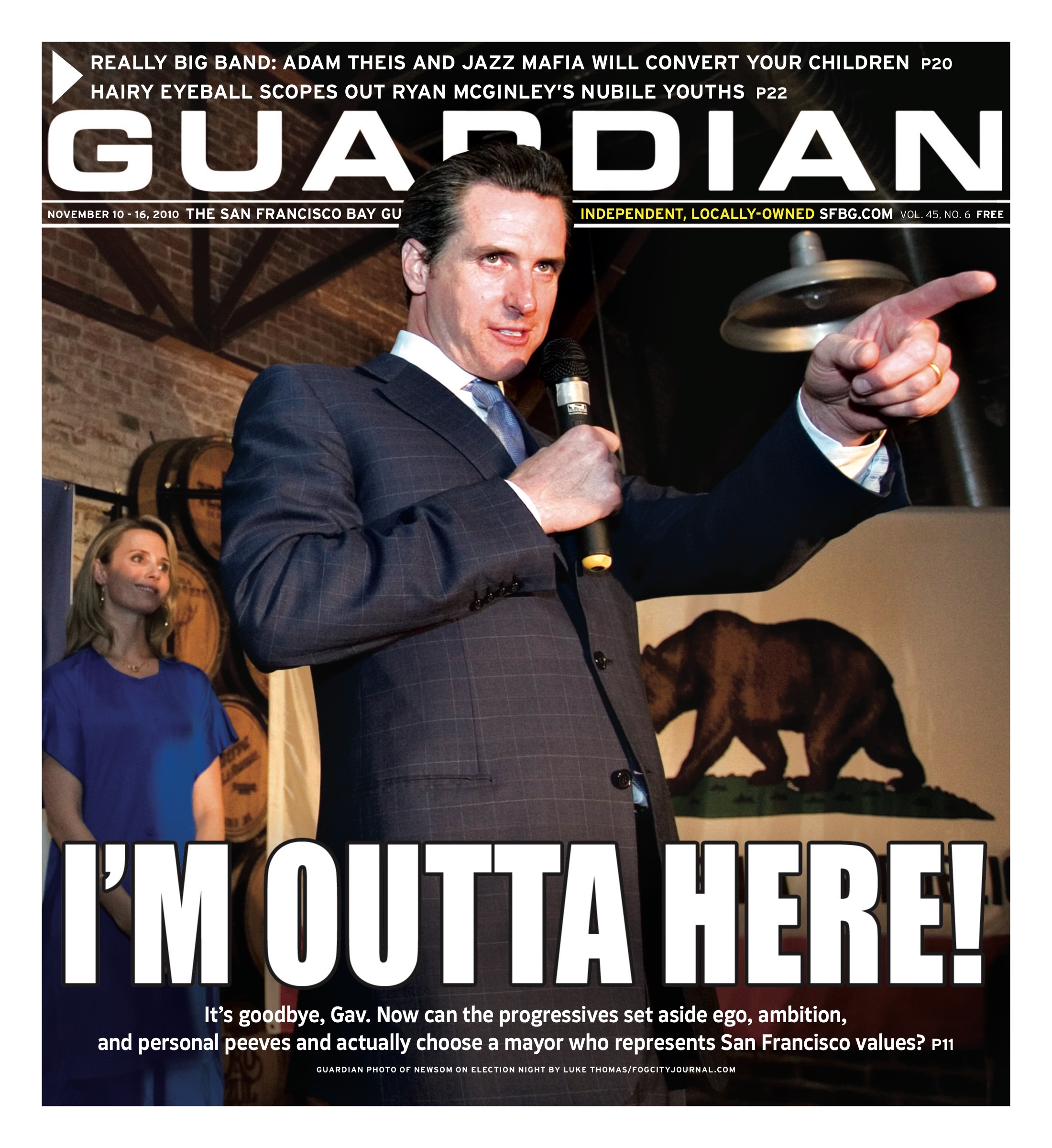
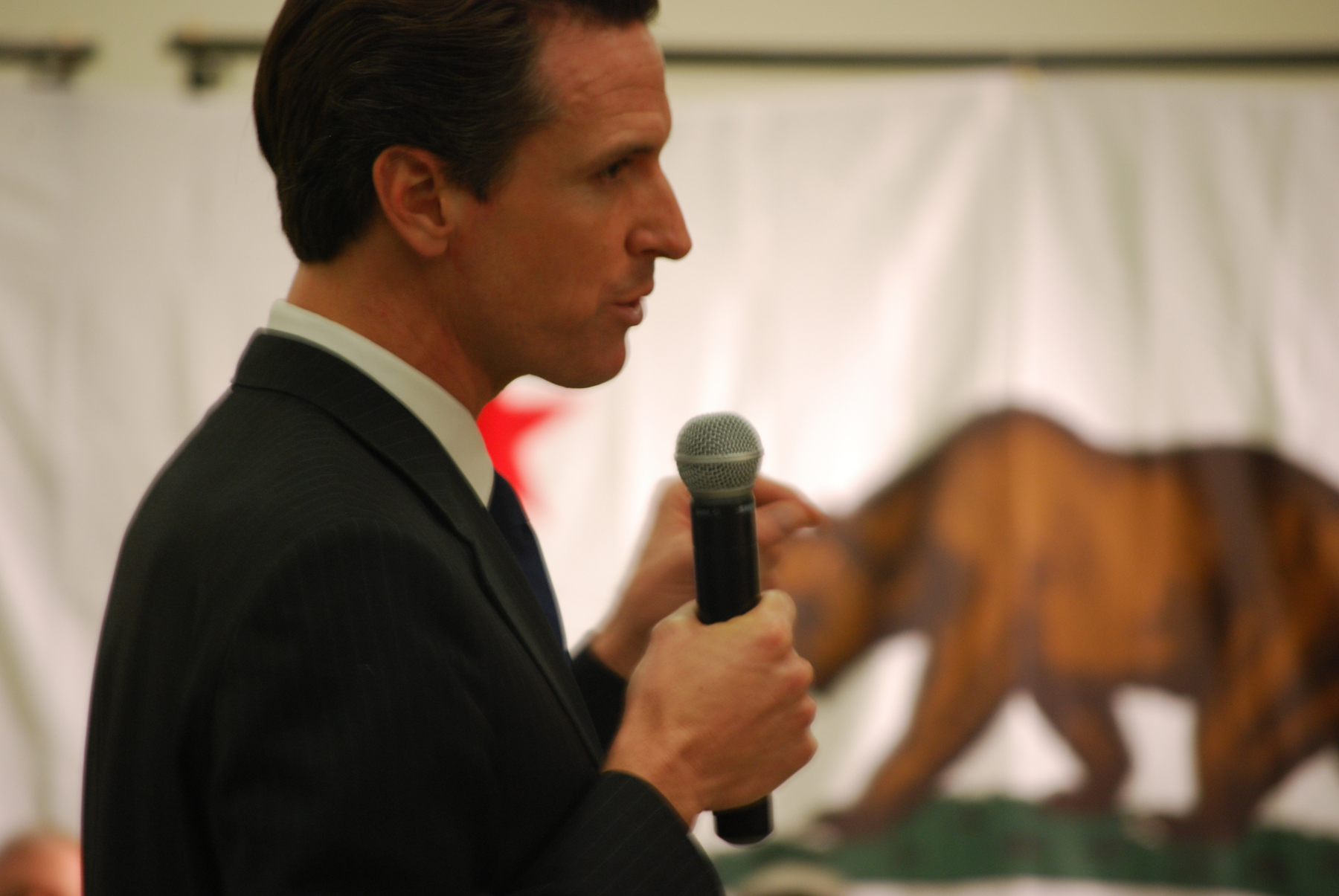
By the time a beaming Mayor Gavin Newsom took the stage at Tres Agaves, the chic SoMa restaurant, on election night, enough results were in to leave no doubt: the top two places on the California ballot would go to the Democrats. Jerry Brown would defeat Meg Whitman in the most expensive gubernatorial race in American history — and Newsom, who once challenged Brown in the primary and dismissed the office of lieutenant governor, would be Brown’s No. 2.

It might not be a powerful job, but Newsom wasn’t taking it lightly anymore. “We can’t afford to continue to play in the margins,” he proclaimed proudly, advancing a vague but ambitious agenda. “There is absolutely nothing wrong with California that can’t be fixed with what’s right with California.”

But around the city, as results trickled in for the local races, the talk wasn’t about Newsom’s role in the Brown administration, or the change the Democrats might bring to Sacramento. It was about the profound change that could take place in his hometown as he vacates the office of mayor a year early — and opens the door for the progressives who control the Board of Supervisors to appoint a chief executive who agrees with, and is willing to work with, the majority of the district-elected board.

At a time when the Republican takeover of Congress threatens to create gridlock in Washington, there’s a real chance that San Francisco’s government — often paralyzed by friction between Newsom and the board — could take on an entirely new direction. It’s possible that the progressives, long denied the top spot at City Hall, could put a mayor in office who shares their agenda.

This could be a turning point in San Francisco, a chance to put the interests of the neighborhoods, the working class, small businesses, the environmental movement, and economic justice ahead of the demands of downtown and the rich. All the pieces are in place — except one.

To make a progressive vision happen, the fractious (and in some cases, overly ambitious) elected leaders of the progressive movement will have to recognize, just for a little while, that it’s not about any individual. It’s not about David Chiu, or Ross Mirkarimi, or Chris Daly, or John Avalos, or Eric Mar, or David Campos, or Jane Kim, or Aaron Peskin. It’s not about any one person’s career or personal power.

It’s about a progressive movement and the issues and causes that movement represents. And if the folks with the egos and personal gripes and career designs can’t set them aside and do what’s best for the movement as a whole, then the opportunity of a generation will be wasted.

Folks: this is a hard thing for politicians to recognize. But right now it’s not about you. It’s about all of us.

It’s an odd time in San Francisco, fraught with political hazards. And it’s so confusing that no one — not the elected officials, not the pundits, not the lobbyists, not the insiders — has any clear idea who will occupy Room 200 in January.

Here’s the basic scenario, as described by past opinions of the city attorney’s office:

Under the state Constitution, Newsom will take office as lieutenant governor Jan. 3, 2011. The City Charter provides that a vacancy in the Mayor’s Office is filled by the president of the Board of Supervisors until the board can choose someone to fill the job until the end of the term — in this case, for 11 more months.

So if all goes according to the rules (and Newsom doesn’t try to play some legal game and delay his swearing-in), David Chiu will become acting mayor on Jan.3. He’ll also retain his job as board president.

On Jan. 4, the current members of the Board of Supervisors will hold a regularly scheduled Tuesday meeting — and the election of a new mayor will be on the agenda. If six of the current supervisors can agree on a name (and sitting supervisors can’t vote for themselves) then that person will immediately take office and finish Newsom’s term.

If nobody gets six votes — that is, if the board is gridlocked — Chiu remains in both offices until the next regular meeting of the board — a week later, when the newly elected supervisors are sworn in.

The new board will then elect a board president — who will also instantly become acting mayor — and then go about trying to find someone who can get six votes to take the top job. If that doesn’t work — that is, if the new board is also gridlocked — then the new board president remains acting mayor until January 2012.

There are at least three basic approaches being bandied about. Some people, including Newsom and some of the more conservative members of the board, want to see a “caretaker” mayor, someone with no personal ambition for the job, fill out Newsom’s term, allowing the voters to choose the next mayor in November, 2011. That has problems. As Campos told us, “The city has serious budget and policy issues and it’s unlikely a caretaker could handle them effectively.” In other words, a short-termer will have no real power and will just punt hard decisions for another year.

Then there’s the concept of putting in a sacrificial progressive — someone who will push through the tax increases and service cuts necessary to close a $400 million budget gap, approve a series of bills that stalled under Newsom, take the hits from the San Francisco Chronicle, and step out of the way to let someone else run in November.

The downside of that approach? It’s almost impossible for a true progressive to raise the money needed to beat a downtown candidate in a citywide mayor’s race. And it seems foolish to give up the opportunity to someone in the mayor’s office who can run for reelection as an incumbent.

Which is, of course, the third — and most intriguing — scenario.

The press, the pundits, and the mayor have for the past few months been pushing former Sup. Peskin as the foil, trying to spin the situation to suggest that the current chair of the local Democratic Party is angling for a job he wouldn’t win in a normal election. But right now, Peskin is no more a front-runner than anyone else. And although he’s made no secret in the past of wanting the job, he’s been talking of late more about the need for a progressive than about his own ambitions.

“If the board chose [state Assemblymember] Tom Ammiano, I would be thrilled to play a role, however small, in that administration,” Peskin told us.

In fact, Peskin said, the supervisors need to stop thinking about personalities and start looking at the larger picture. “If we as a movement can’t pull this off, then shame on us.”

Or as Sup. Campos put it: “We have to come together here and do what’s right for the progressive movement.”

Two years ago, the San Francisco left was — to the extent that it’s possible — a united electoral movement. In June, an undisputed left slate won a majority on the Democratic County Central Committee. In November 2008, Districts 1, 3, 5, and 11 saw consensus left candidates running against downtown-backed opponents — and won. In D9, three progressives ran a remarkably civil campaign with little or no intramural attacks.

The results were impressive. As labor activist Gabriel Haaland put it, “we ran the table.”

But that unity fell apart quickly, as a faction led by Daly sought to ensure that Sup. Ross Mirkarimi couldn’t get elected board president. Instead that job went to Chiu — the least experienced of the supervisors elected in that class, and a politician who is, by his own account, the most centrist member of the liberal majority.

This fall, the campaign to replace Daly in D6 turned nasty as both Debra Walker and Jane Kim openly attacked each other. Walker sent out anti-Kim mailers, and Kim’s supporters charged that Walker was part of a political machine — a damaging (if silly) allegation that created a completely unnecessary rift on the left.

And let’s face it: those fights were all about personality and ego, not issues or progressive strategy. Mirkarimi and Daly have never had any substantive policy disagreements, and neither did Walker and Kim.

In the wake of that, progressives need to come together if they want to take advantage of the opportunity to change the direction of the city. It’s not going to be easy.

“We’re good at losing,” Daly said. “I’m afraid we’re doing everything we can to blow it.”

The cold political calculus is that none of the current board members can count on six votes, and neither can Peskin or any of the other commonly mentioned candidates. The only person who would almost certainly get six votes today is Ammiano — and so far, he’s not interested.

“I know you never say never in politics, but I’m happy here in Sacramento. Eighty-six percent of the voters sent me back for another term, and I think that says something,” he told us.

It’s hardly surprising that someone like Ammiano, who has a secure job he likes and soaring approval ratings, would demur on taking on what by any account will be a short-term nightmare. The city is still effectively broke, and next year’s budget shortfall is projected at roughly $400 million. There’s no easy way to raise revenue, and after four years of brutal cuts, there’s not much left to pare. The next mayor will be delivering bad news to the voters, making unpleasant and unpopular decisions, infuriating powerful interest groups of one sort or another — and then, should he or she want the job any longer, asking for a vote of confidence in November.

Yet he power of incumbency in San Francisco is significant. The past two mayors, Newsom and Willie Brown, were reelected easily, despite some serious problems. And an incumbent has the ability to raise money that most progressives won’t have on their own.

Chiu thus far is being cautious. He told us his main concern right now is ensuring that the process for choosing the next mayor is open, honest, and legally sound. He won’t even say if he’s officially interested in the job (although board observers say he’s already making the rounds and counting potential votes).

And no matter what happens, he will be acting mayor for at least a day, which gives him an advantage over anyone else in the contest.

But some of the board progressives are unhappy about how Chiu negotiated the last two budget deals with Newsom and don’t see him as a strong leader on the left.

Ross Mirkarimi is the longest-serving progressive (other than Daly, who isn’t remotely a candidate), and he’s made no secret of his political ambitions. Then there’s Campos, an effective and even-tempered supervisor who has friendly relationships with the board’s left flank and with centrists like Bevan Dufty. But even if Dufty (who I suspect would love to be part of electing the first openly gay mayor of San Francisco) does support Campos, he’d still need every other progressive supervisor. Campos also would need Chiu’s vote to go over the top. Which means Chiu — who needs progressive support for whatever his political future holds — would have to set aside his own designs on the job to put a progressive in office.

In other words, some people who want to be mayor are going to have to give that up and support the strongest progressive. “If there’s someone other than me who can get six votes, then I’m going to support that person,” Campos noted.

Then there are the outsiders. City Attorney Dennis Herrera has already announced he plans to run in the fall. If the board’s looking for a respected candidate who can appeal to moderates as well as progressives, his name will come up. So will state Sen. Mark Leno, who has the political gravitas and experience and would be formidable in a re-election campaign in November. Leno doesn’t always side with the left on local races; he supported Supervisor-elect Scott Wiener, and losing D6 candidate Theresa Sparks. But he has always sought to remain on good terms with progressives.

All that assumes that the current board will make the choice — and even that is a matter of strategic and political dispute. If the lame duck supervisors choose a mayor — particularly a strong progressive — you can count on the San Francisco Chronicle, Newsom, and the downtown establishment to call it a “power grab” and cast doubt on the legitimacy of the winner.

“But choosing a mayor is the legal responsibility of this board and they ought to do their jobs,” Peskin said.

The exact makeup of the next board was still unclear at press time. Jane Kim is the likely winner in D6 and has always been a progressive on the School Board. She’s also close to Chiu, who strongly supported her. If Malia Cohen or Lynette Sweet wins D10, it’s unlikely either of them will vote for a progressive mayor.

Newsom also might try to screw things up with a last-minute power play. He could, for example, simply refuse to take the oath of office as lieutenant governor until after the new board is seated.

Chiu’s allies say it makes sense for the progressives to choose a mayor who’s not identified so closely with the left wing of the board, who can appeal to the more moderate voters. That’s a powerful argument, and Herrera and Leno can also make the case. The progressive agenda — and the city — would be far better off with a more moderate mayor who is willing to work with the board than it has been with the arrogant, recalcitrant, and distant Newsom. And if the progressives got 75 percent of what they wanted from the mayor (as opposed to about 10 percent under Newsom), that would be cause to celebrate.

But to accept that as a political approach requires a gigantic assumption. It requires San Franciscans to give up on the idea that this is still, at heart, a progressive city, that the majority of the people who live here still believe in economic and social justice. It means giving up the dream that San Francisco can be a very different place, a city that’s not afraid to defy national trends and conventional wisdom, a place where socioeconomic diversity is a primary goal and the residents are more important than the big companies that try to make money off them. It means accepting that even here, in San Francisco, politics have to be driven by an ever-more conservative “center.”

It may be that a progressive can’t line up six votes, that a more moderate candidate winds up in the Mayor’s Office. But a lot of us aren’t ready yet to give up hope.

Additional reporting by Noah Arroyo.

Election over, what next?

0

Dick Meister is a San Francisco-based columnist who has covered political and labor issues for a half-century as a reporter, editor , author and commentator. Visit him at his website, www.dickmeister.com.

OK, the election is over and labor, Democrats and the other good guys came up a bit short. But what now? What next for the good guys?

 Well, for starters, organized labor and its Democratic Party allies must be ready to block Republican plans to try to enact legislation that would cut taxes for the very wealthy, slash Medicare funding, and possibly even privatize Social Security. I know that may sound alarmist and far-fetched. But that’s what Republican leaders are actually talking about.

After all, the GOP’s anti-labor corporate allies spent nearly a billion dollars on the election and they damn well want their money’s worth.  Larry Cohen, president of the communications workers union, thinks it’s getting like the way elections were 100 years ago when the big trusts and robber barons made sure their voices were the only ones heard during election campaigns.

Not yet, Larry. Not quite. Unions were able to make a lot of highly effective noise that helped elect some important pro-labor Democrats and defeat several Tea Party candidates and other anti-labor wackos who argued, as the AFL-CIO’s Mike Hall notes, “that government should do nothing to improve the economy or protect working families during the worst economic crisis since the Great Depression.”

Let’s me take a little closer look at how the election went for organized labor and its political friends in two of the country’s most important states politically, numbers one and two in population, California and Texas.

In California, as the AFL-CIO says, unions were a key factor propelling notably pro-labor Democrat Jerry Brown to the governorship and pro-labor Democrat Barbara Boxer to a third term in the Senate. Those victories were especially sweet, since the opponents of Governor-elect Brown and Senator Boxer were former business executives with tons of money, including their own, to spend on their campaigns.

Former eBay CEO Meg Whitman spent more than $141 million of her own money on her losing campaign against Jerry Brown for governor. And though Carly Fiorina, former Hewlett-Packard CEO, spent several million of her own money on her campaign, the total was nowhere near the obscene amount that Whitman pulled from her own pocket for her campaign.

Anyway, Meg Whitman lost, and good for Californians for making that happen.  Labor couldn’t imagine a worse anti-labor governor than Meg Whitman, or more labor-friendly governor than Jerry Brown, a worse anti-labor senator than Carly Fiorini, or more labor-friendly senator than Barbara Boxer.

It was a bit different in most other states. As Executive Director Rose Ann DeMoro of the California Nurses Association notes, the election of Democratic, pro-labor candidates in California “provided a national alternative to the conservative, corporate-oriented economic program that won so many other races nationwide.”

DeMoro praised California’s voters “for seeing through the fool’s gold promises that the path to economic recovery and job creation is through corporate tax breaks and shifting more wealth and resources to those who need it the least.”

The news isn’t so good out of Texas, where, as Jim Lane of the People’s World  says, “the second largest delegation to the U.S. House of  Representatives, already heavily leaning to the right, tilted drastically further on November 2 – plus, many of the most popular Texas Democratic leaders were defeated.

The re-election of Gov. Rick Perry was more bad news for labor and its allies, given what the People’s World’s Lane notes as Perry’s “far-right, anti-worker vision.” Reporter Lane says “progressive Texans are not looking forward to extending the years of being shamed about their home state, as we have been since GW Bush took the national stage.”

But at least the Texas labor movement was able to run what Lane calls “a strong and largely independent political campaign.”  Unions even dared to run “one of their own,” former national AFL-CIO official Linda Chavez-Thompson, for lieutenant governor. But, as Lane notes, “Like all other statewide Democratic candidates, Chavez-Thompson’s campaign was buried by big money.”

So, what next for Texas, California – the whole country?

What’s next should be in large part to carry out what AFL-CIO and Democratic Party leaders have been advocating for many years – rebuilding of our long crumbling infrastructure

 President Obama has a plan that calls for rebuilding 150,000 miles of roads, laying and maintaining 4,000 miles of railway tracks, restoring 150 miles of airport runways and , in doing so, providing badly needed jobs for many of the country’s millions of unemployed workers.
 
That’s how labor and political leaders can – and must – begin to deliver on their election campaign promises to, above all, do what it takes to create “jobs, jobs, jobs.”

Dick Meister is a San Francisco-based columnist who has covered political and labor issues for a half-century as a reporter, editor , author and commentator. Visit him at his website, www.dickmeister.com.

Pelosi seeks to remain her party’s leader

3

Nancy Pelosi has announced that she is running for House minority leader, citing the need to defend health care and Wall Street reforms and Social Security and Medicare. And my friend Donnie Fowler, a top national Democratic Party consultant, thinks that’s a very good thing, even if I have a few doubts.

“She is a fighter and can bring the majority back in 2012 and no one more progressive would beat her,” Fowler said as he shared the news of Pelosi’s announcement, responding to my skeptical initial reaction. He said that having Pelosi remain in a leadership position was the best hope for pushing San Francisco values in a tumultuous country that has moved the House far to the right.

The Bay Guardian and other leading San Francisco progressive voices have criticized Pelosi for allowing the wars in Iraq and Afghanistan to drag on, for not taking stronger stands on gay rights (from same-sex marriage to the military’s “don’t ask, don’t tell” policy), and for pushing flawed reforms of Wall Street and the health care system that left big corporations with too much power.

Fowler said Pelosi is “better in term of ideology and she’s a strong fighter,” but he conceded that she’s also a pragmatist, so she’ll often fight for outcomes that are not nearly as progressive as she would prefer, as she’s done recently. “She fights hard for what she can get today,” said Fowler, who has played leading roles in Democratic presidential and other campaigns and came in second in the race to chair the national party a few years ago. “Over the last two years, she has felt throttled by other parts of the Democratic Party and other leaders in Washington.”

But many of the moderate to conservative Democrats who have made Pelosi’s life so difficult were voted out of office on Tuesday, leaving a far more liberal caucus. “The biggest hit was to moderates and Blue Dogs, just because of where they live,” Fowler said, citing people such as Rep. Chet Edwards, who represented George W. Bush’s Crawford, Texas district, which now went Republican. “The caucus is going to be more liberal.”

Does that mean that Pelosi could sound a more full-throated defense of progressive values as minority leader? Yes, Fowler said, she could and should, but he’s still not sure whether she will. “The Democrats have got to say what they believe, they have to stand up for progressive values, and they have to be unashamed about it,” he said, noting that the centrist waffling was a factor in the party’s defeat this week, moreso than a genuine desire of the electorate to bring back the Republicans. “If you won’t stand up for yourself, people won’t believe that you’ll stand up for them.”

Right now, moderate Democrats are already starting to make the case that the party needs to be more economically conservative. Rep. Heath Shuler, a Blue Dog Democrat from North Carolina, has announced his intention to run for minority leader on a pro-business platform. It’s also possible progressives could mount a challenge from Pelosi’s left, such as Reps. Barbara Lee (who was the only vote against invading Afghanistan in 2001), Dennis Kucinich, or Raul Grijalva (the Arizona Democrat who co-chairs the Progressive Caucus with Rep. Lynn Woolsey).

Yet Fowler continues to believe that Pelosi is the best person to lead the party back through what’s expected to be a difficult couple years. But does it play into Republican hands to stick with their greatest foil, someone whose liberal politics and connection to a famously liberal city made her the focus in GOP attack ads?

Fowler dismissed that notion, saying that Republicans are going to demonize whoever leads the party. He said the Democrats could elect the most conservative good ole boy with a thick Southern accent “and they’ll still call him a liberal socialist.”

So then why not nominate an actual liberal socialist, someone who can bring a stronger critique of this country’s economic and political systems and set the country up for a more fundamental shift in 2012, someone like Lee, Kucinich, Grijalva, or Woolsey? To Fowler, that’s a bridge too far. Even with a more progressive caucus, he doesn’t think they could win, and he doesn’t think the party ought to move that far to the left anyway.

But what do you think, Guardian readers? Is this a time for Democrats to stay the course, or is this perhaps a moment for progressives to step up – unafraid of the Tea Party rhetoric – and start pushing everyone from President Obama on down to finally address inherent flaws in this country’s unsustainable economic and political systems?

Election 2010: Debra Walker holds out

1

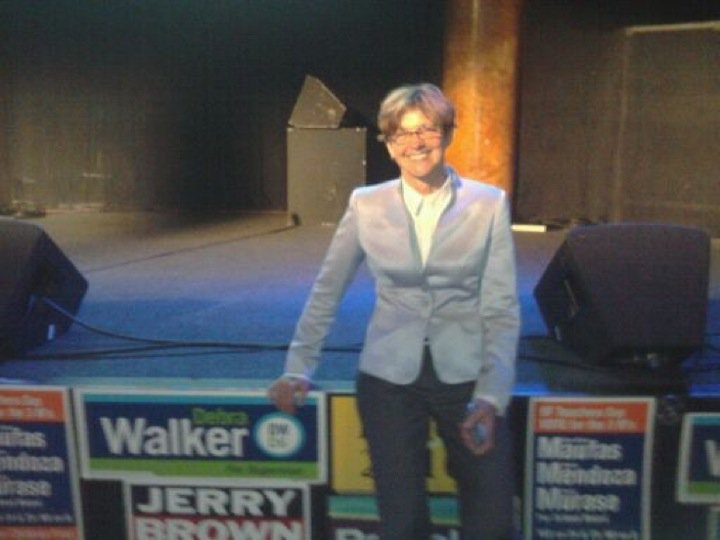
San Francisco Democrats milled about the Great American Music Hall, where a screen displaying election results was the centerpiece of the room. D6 candidate Debra Walker was thanking campaign volunteers and hugging supporters when we caught up with her.

But with Jane Kim ahead in the race, the celebration was somewhat subdued in her corner of the room.

Still, Walker was hopeful. “Now I think it’s going to be about the distribution of second choice votes,” she told us. “It’s going to be a nailbiter. In fact, I’m pretty confident about it. I’m really hopeful that we’ll gain the votes we need.”


Editor’s Notes

1

tredmond@sfbg.com

Here’s what really scares me about Republicans in Washington: they don’t want the economy to get better.

I’m not just saying that they’re wrong on the issues, or that their prescriptions — tax cuts for the rich, fewer regulations for big business, privatization of health care and Social Security — will only make things worse. I’m saying that, right now, in November 2010, the GOP leaders want continued high unemployment. They want Americans to suffer. They want conditions to get worse and worse — because all they really care about right now is defeating Barack Obama in 2012. And they know and I know and everyone else knows that if the economy improves, he’ll be a two-term president.

I’m not the only one who sees this open conspiracy. Former Secretary of Labor Robert Reich has been Twittering about it, and bloggers have been floating it out, but the mainstream news media doesn’t’ seem to want to take the risk of saying what’s right in front of everyone’s face: Republicans are lying, outright. They’ve campaigned on the promise that their ideas and agenda will put America back to work — but they know that’s not true. What the agenda is going to be is obstruction.

The Democrats have never done that, at least not in recent history. Oh, they fought W. on all sorts of policy issues, but they never tried to make sure that the country collapsed. That’s a big difference between the two parties, and it comes down to a basic question: How many people are you willing to hurt, how much suffering are you willing to promote, just to get back in power??

I’ve been talking to a lot of political activists, elected officials, and outside agitators of late about the next president of the Board of Supervisors (with all that implies) and I keep hearing the same name: David Campos.

Campos has been one of the great success stories of the class of 2008, an effective legislator who can work with just about everyone. He’s a solid progressive, but with a gentle personality — someone who sticks to his principles but doesn’t pick personal fights. I don’t know how he puts together six votes, but he might surprise us.

I’m writing this the day before the election and it comes out the day after, by which time Jerry brown will be the governor-elect, Barbara Boxer will have won another Senate term, and the Giants will be holding their World Series victory parade. You read it here last.

It’s a beautiful day

0

It was mayhem out at 30th and Mission last night, people pouring into the streets, shouting and shooting off fireworks and cars cruising along, slowly throught the crowd, big “Gigantes” banners hanging out the doors and windows. A beautiful night in San Francisco, people coming together to celebrate, G.W. Bush and Nolan Ryan looking dejected and rejected, that rare sense of victory in the air … and it’s a beautiful morning, good weather across most of the state, turnout heavy in my precinct, anyway, and that’s very bad news for Meg Whitman, whose only real hope is that Democrats don’t show up at the polls.


So maybe we’ll have more to celebrate tonight.


It’s hard to predict the outcome of the state and local elections based on the latest polls, since at least a third of the voters have already cast their ballots. If Whitman and Brown were tied a month ago, when absentee voting started, and Brown is up 5-10 points today, which poll reflects how the voting actually went over the past four weeks? If Prop. 19 was ahead three weeks ago and is behind now, did supporters lready vote for it?


But I think I can safely predict that one the statewide level, big money isn’t going to take the day: Whitman’s going to lose, Carly Fiorina’s going to lose and Prop.23 is going to lose. If the left turns out to vote. Polls are open until 8.

SFBG Radio: Will the Democrats get the message?

5

In today’s episode, Johnny talks about his frustration with the Democrats and asks: Are they getting the message? And Tim  argues that we need to vote Democratic anyway … Listen after the jump.

sfbgradio11/1/2010 by endorsements2010

SF vote-by-mail provides early political snapshot

6

San Francisco’s Department of Elections had received 41,620 vote-by-mail returns so far That’s a fifth of the 210,993 vote-by-mail forms that were requested this year.
And while we don’t know which districts these folks voted in, we do know how they were registered: Over half were Democrats (24,153 votes), a quarter were decline-to-state (10,563 votes), and a fifth were Republican (5,565 votes).

I was surprised to learn that there are more vote-by-mail requests from folks registered with the American Independent Party (573) than with the Green Party, but not surprised to see that 200 folks were registered as Libertarians and 81 as Peace and Freedom Party.

Unfortunately, we can’t compare SF’s vote-by-mail snapshot with the statewide picture.
According to folks at the California Secretary of State’s office, votes won’t be broken down into vote-by-mail categories until after the election is certified…

Editor’s notes

0

Tredmond@sfbg.com

At a certain point, you have to stop trying to project what’s going to happen and just wait for the election results. Because what matters now isn’t the $140 million Meg Whitman has spent or Carly Fiorina’s record at Hewlett-Packard or which aide to Jerry Brown called Whitman a whore. It’s who shows up to vote.

If I were Meg Whitman’s campaign manager, I’d stop spending money. Go into hiding. Pretend there’s nothing going on here, no big deal next Tuesday morning — and then pray for rain. Because the way Whitman wins — possibly the only way she wins — is if huge numbers of Californians don’t bother to vote.

If the turnout is reasonable — that is, if enough Democrats realize the danger posed by of the GOP candidate and go to the polls — then Jerry Brown is in. And if that happens, chances are good that the rest of the Democratic ticket — including Gavin Newsom and Kamala Harris — squeaks in, too. And then we can all start to have fun figuring out the future of San Francisco politics.

That, of course, depends on the same factor: Who’s going to show up to vote? Will all the tenants in District 8 — many of them unexcited about Jerry Brown — take the time to vote for Rafael Mandelman for supervisor? Will the progressive voters who have lived in District 6 for a while get to the polls in greater numbers than the conservative newcomers in the pricey condos? Will the next Board of Supervisors — which could be choosing the next mayor — be as progressive as the current board (which also might wind up choosing the next mayor?)

And who’s even on the mayoral short list?

At the Haight Ashbury Neighborhood Council forum Oct. 14, former Supervisor (and potential mayoral contender) Aaron Peskin noted that the person in Room 200 year “is going to have to take out the garbage.” The city’s going to face another awful budget deficit and a progressive interim mayor will have to make a lot of enemies. Who wants to face the voters in November 2011 after making more cuts and raising taxes?

Well, somebody needs to — because the “caretaker” mayor some people are pushing for won’t have the clout to make tough decisions. And frankly, a progressive with the power of incumbency might actually be able to win a full term, even up against a huge downtown war chest.

Fun stuff. Go out and vote.


Newsom could be headed for victory

11

Gavin Newsom seems poised to win his race for lieutenant governor, at least as indicated by his opponent Abel Maldonado’s increasingly desperate campaign tactics and Newsom’s string of newspaper endorsements, including the Spanish language La Opinion, which chose to pass over a moderate Latino that it has endorsed in the past. The only question now is voter turnout, and whether Newsom’s negatives would be enough to drag him down if the Democratic base stays home in this lackluster election.

In its endorsement in Sunday’s paper, La Opinion wrote, “We are deeply disappointed that in this election [Maldonado] has opted for an opportunistic strategy of using images of undocumented criminals to earn political points. This is unacceptable and his charges against Newsom on this issue are inaccurate.” The reference was to Maldonado’s wild charges in an Oct. 15 debate that Newsom created San Francisco’s sanctuary city policies and was responsible for the fatal shootings of Bologna family members, allegedly by an undocumented immigrant who had once been in city custody. The reality was that Newsom inherited the sanctuary city policy and unilaterally weakened it after the Bologna shooting, even refusing to implement legislation approved by the Board of Supervisors (which Newsom vetoed but the board overrode) to require due process before those arrested are turned over to the feds for possible deportation.

While the paper didn’t seem to understand that Newsom has snubbed his nose at San Francisco progressives and petulantly fed a particularly divisive style of politics here, they do rightfully give him credit for running a complicated city, unlike the conservative city of Santa Maria where Maldonado was mayor and always did the bidding of the Chamber of Commerce, something I observed while working at the Santa Maria Times at the time. “The Democratic candidate has implemented solid, progressive management while leading a diverse city during a deep budget crisis. Newsom has proven to be creative, resourceful, and sensitive while forging alliances that improve the quality of life for his city’s residents,” La Opinion wrote. 

Then yesterday, as the Los Angeles Times reports on its blog, when Newsom held a campaign event trumpeting his support by Latino leaders such as Los Angeles Mayor Antonio Villaraigosa and labor leader Dolores Huerta, Maldonado showed up and sat in the back with his advisers during the event. Now that’s just strange.

A California Democratic Party e-mail blast this afternoon used a series of rhetorical questions to describe the campaign’s episodes: “So was Maldonado’s bizarre behavior an egotistical attempt to intimidate other Latinos who came to the event to support Newsom? Does he feel entitled to the appointed position now that he actually has to compete for voters in a real election? Is he desperate for media attention? Or does he just enjoy being a spectator, watching his opponent secure key Latino endorsements while his own campaign falls apart?”

But the real question is whether Democrats can mobilize enough voters to overcome Newsom’s negatives, from his arrogance to his personal foibles. When I did a search for Gavin Newsom’s name on Yahoo, which automatically guesses what you’re asking for based on past queries, the first three that listed were “Gavin Newsom girlfriend,” “Gavin Newsom divorce,” and “Gavin Newsom affair,” an apparent reference to his admitted affair with Ruby Rippey Tourk, who worked for him and was married to his reelection campaign manager.

So, if you support Newsom for this office — or even if you’re just anxious for him to leave San Francisco a year before his mayoral term expires — don’t forget to get out there and vote.

Get angry and make ’em do it!

9

After crashing the country’s economy and turning the world against us, Republicans are clawing their way back into power by stoking voter anger at political and economic systems that are stacked against the common citizen, a tactic that progressives need to adopt if we ever hope to move our agenda forward.

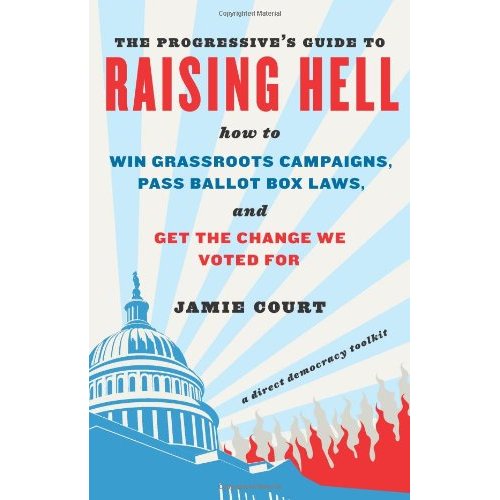
“Anger, not hope, is the fuel of political and economic change,” Jamie Court, head of Consumer Watchdog, writes in his new book, The Progressive’s Guide to Raising Hell: How to win grassroots campaigns, pass ballot box laws, and get the change we voted for (Chelsea Green Publishing, 2010).

Court writes that progressives are rightfully disappointed and disillusioned that after helping to elect President Barack Obama, he and Congressional Democrats turned around and gave Wall Street, the military-industrial complex, and the health insurance companies everything they wanted, with Obama even caving in on requiring all Americans to purchase health insurance, something he opposed as a candidate.


Yet Court said politicians never do the right thing and push progressive political change unless they’re forced to do so. He opened the book with a scene in which President Franklin Delano Roosevelt met with progressive political leaders, listened to their proposals, and then told them, “I agree. I am all for your plan. Now make me do it.”

It’s a concept that the conservative Tea Party movement understands well, and even though they may be crazy and wrongheaded in their utterly unsustainable and destabilizing policy agenda, they have effectively used anger as a political tool, and as a result, the NY Times reports they are poised to wield a disproportionate amount of political power after this election.

It’s the same story on the local level, where the only real anger in this election cycle is coming from those mad at public employee unions and their pension deals, and vagrants who sit uncivilly on sidewalks. These people will keep pushing for what they expect, but many progressives act as if it’s enough to prevent truly heinous Republicans like Meg Whitman from taking power, rather than trying to push Jerry Brown or Board of Supervisors’ progressives from day one to start empowering people over corporations.

“After the vote, power vacuums fill with familiar values, if not faces. Promises give way to fiscal realities, hope succumbs to pragmatism, and ambition concedes to inertia. The old tricks of interest group – confuse, diffuse, scare – prevail over the better angels of American nature,” Court writes, relaying a familiar electoral pattern.

Yet in this election, when the best outcome seems to be simply dodging a bullet, is there any hope for progressive political change? Isn’t the system just too broken? I asked Court these questions when he stopped by the Guardian office for a chat recently, and he retains a belief that with the right kind of tactics and agenda, progressives can still seize the political initiative and power.

http://www.youtube.com/watch?v=J3RD0YObHok

“I wrote it to reengage progressives because they are so despondent,” Court told me. “It’s about how to use anger and focus anger…Politicians don’t answer polite mobs, they only answer angry mobs and the Tea Party is the only angry mob in the room.”

Progressive have understandable doubts about the responsiveness of the current political system, but Court said, “I know if we don’t try to make it work, we’re never going to get there.”

And his book lays out the path to get there, step by step, based on some of the legislative and political successes that Consumer Watchdog and other progressives have had in recent years, such as rejecting the well-funded corporate con jobs in Propositions 16 and 17 earlier this year. Yet it involves an approach based on principle and not parties, and with being relentless in pursuing the kind of world we need.

“If you want to fight corporate power, you have to fight Democrats and Republicans,” Court said.

Specifically, Court is calling for progressives to push a California ballot measure that would establish a public health care option here, the very thing that Obama and the Democrats failed to include in their health reform package, and which will dash any hopes of it working if the people are forced to rely on unregulated insurance company products.

“The biggest thing is mandatory health insurance, which is a ticking time bomb,” Court said, one set to go off in 2014 when that aspect of Obama’s health care reform kicks in.

Corporate and political power working together seem to be a force too strong to overcome, but as Court writes, “Public opinion is the most powerful force in the world. While it can be muted, distracted, and co-opted, it cannot be controlled, except by the public.”

Talking with Pelosi’s GOP opponent

28

I had a fascinating discussion this morning with John Dennis, the Repubican candidate running against Nancy Pelosi. He’s not going to win, of course, but he’s gotten some national press, including a nice piece by John Nichols, the veteran liberal editor at the Madison-based Capitol Times and a plug from the Huffington Post. Matt Gonzales has endorsed him.

Dennis is a libertarian Republican, but not a nut job or a conspiracy wacko. He’s intelligent, articulate and makes some very good points. He is, for example, totally against the wars in Iraq and Afghanistan, and calls for an immediate pullout of both quagmires. He supports same-sex marriage (it took me a while to get that out of him, but he does), supports Prop. 19, opposes DADT, and wants the feds to stop cracking down on undocumented immigrants in California. He’s against warrantless wiretaps and torture, and wants to repeal the worst parts of the PATRIOT Act. He thinks we should review all of our military bases abroad — just as we have with domestic bases — and close the ones we don’t really need anymore.

In other words, on Iraq, Afghanistan, the Pentagon budget, social issues, the drug war and civil liberties, he’s way out of synch with his party — and a lot better than Pelosi, the good liberal Democrat. And Arthur Bruzzone, my old pal and the former chair of the Republican Party, came down with Dennis and told me that the Guardian really ought to endorse him.

We’ve said some bad things about Pelosi; after all, she privatized the Presidio. She’s been weak on the wars, weak on same-sex marriage, weak on taxes and corporate welfare — and a lot more interested in raising money for Democrats than in representing her district. She won’t even debate Dennis, which is typical of her arrogance.

On the other hand: Dennis has a problem. He’s a member of a party that’s run by barbarians, and if he got elected, and was part of a GOP majority, some very bad people would be in charge. He knows that, and says he wants to change the GOP from within; good luck with that.

And since I spent much of my time these days talking about the gap between the rich and the poor and how utterly unsustainable a nation is when 5,000 families at the top control more wealth than 160 million at the bottom, I have a hard time with libertarians who don’t believe in income taxes.

And that’s Dennis. He told me that he thinks the income tax should be replaced with a consumption tax (that is, a sales tax), which is about the most regressive idea you can imaging. He said he thinks the Bush tax cuts should continue. He thinks government is too big and ought to be dramatically cut back.

I don’t think Pelosi much supports a radical redistribution of wealth in this country, but the Democrats at least are going to let the insane tax cuts for the rich expire. And that’s something.

So I understand Matt Gonzalez, and I had a wonderful talk with Dennis, and I hope you all listen to it (below). And I get the “beyond left and right” thing that the HuffPo talks about. But on the basic economic issues — like wealth redistribution through progressive taxation — the good libertarians and I will never agree. And that’s kind of a deal-breaker.


john dennis by endorsements2010

Big Oil’s false choice

0

rebeccab@sfbg.com

Tapping into voters’ economic insecurities at a time of record high unemployment rates, out-of-state oil interests say addressing global warming will cost California more jobs. But a broad coalition that includes environmentalists and top business groups argue that just the opposite is true, saying the economy will suffer if we suddenly kill the incentives now driving the clean energy industry, one business sector that actually grew during the recession.

Proposition 23 would indefinitely suspend Assembly Bill 32, California’s Global Warming Solutions Act. Texas oil companies are bankrolling the initiative, spending millions of dollars to convince voters that they must choose between saving jobs and saving the environment. Since jobs are more important right now, they argue, the environment will have to wait.

But the other side — which includes groups such as the Chamber of Commerce, whose top priority is always job creation — is promoting the compelling idea that the path to economic recovery lies in rising to the challenge of climate change. They argue that addressing global warming now isn’t just about avoiding more out-of-control wildfires, diminishing crop yields, prolonged intense droughts, coastal flooding, and other calamities that climate scientists say global warming will bring to California. It’s also about creating jobs now and trying to lower California’s 12.4 percent unemployment rate, the third highest nationwide.

The push to defeat Prop. 23 has brought together prominent business people, public-health advocates like the American Lung Association, big green organizations such as the Sierra Club, and environmental-justice advocates who are pushing for green jobs as a way to fend off poverty and tackle air quality problems in disadvantaged neighborhoods. If the coalition of unlikely allies is successful, Big Oil’s comfortable lock on the energy market could be thrown off balance by California’s emerging green economy.

“Ultimately, we think it’s going to be a David vs. Goliath battle, because they have very deep pockets,” said No on 23 campaign spokesperson Steve Maviglio. “The proponents are playing to the fears of those most affected by the economy.”

When voters decide on this one, it will signify a choice to proceed down one of two paths at an important crossroads. A global climate summit in Copenhagen late last year failed to produce an effective response to climate change. A push for a federal cap-and-trade system to combat global warming yielded similarly disappointing results. AB32 presents a third chance to set a new standard, and a precedent, for curbing greenhouse gas emissions. But if Prop. 23 passes, environmentalists will have struck out.

A report issued in July by the National Academy of Sciences lays bare the far-reaching implications of policy decisions around climate change. “Emissions reductions choices made today matter in determining impacts experienced not just over the next few decades,” the report notes, “but in coming centuries and millennia.”


CLOSE RACE

In 2006, Gov. Arnold Schwarzenegger signed AB32, mandating a statewide reduction of greenhouse gases to 1990 levels by the year 2020. The law is slated to go into full effect in January 2012, when a cap-and-trade system will make it more costly and burdensome for major polluters to continue burning high quantities of fossil fuels, among other strategies.

The law helps alternative energy companies and creates incentives for large and small businesses to green their operations. Prop. 23, deceptively titled the “California Jobs Initiative,” would suspend AB32 until the state’s unemployment rate drops to 5.5 percent for four consecutive quarters. A decade could pass before such a market condition is in place — in the past 40 years, it’s occurred just three times.

Speaking at the Commonwealth Club in Santa Clara in September, Schwarzenegger blasted Texas-based oil companies Tesoro Corporation and Valero Energy Corporation, which have contributed a combined $5.6 million to the Prop. 23 campaign, for trying to deceive California voters. “They are creating a shell argument that this is about saving jobs,” Schwarzenegger said. “Does anybody really believe that these companies, out of the goodness of their black oil hearts, are spending millions and millions of dollars to protect jobs? It’s not about jobs at all, ladies and gentlemen. It is about their ability to pollute and thus protect their profits.”

Prop. 23 has been unpopular even among many traditional right-wing and business interests. Oil giants Chevron and BP have remained neutral on it. Republican gubernatorial candidate Meg Whitman also renounced it, but straddled the fence by vowing to suspend AB32 for a year anyway.

According to a breakdown of campaign spending issued by opponents, oil interests contributed 97 percent of the funding for Prop. 23, while out-of-state interests were responsible for 89 percent. Kansas-based Koch Industries, run by billionaire siblings David and Charles Koch, dropped $1 million into the effort. The Koch brothers have been singled out as the financial backbone of the Tea Party.

Yet despite bipartisan opposition in Sacramento, polls suggest Prop. 23 could be a close race. A recent Los Angeles Times poll showed a dead heat among California voters, with 40 percent in favor, 38 percent opposed, and about one-fifth of likely voters undecided. The television commercials advocating Yes on 23 drive home a simple yet misleading message: “Save jobs. Stop the energy tax.” A spokesperson from the Yes on 23 campaign did not return the Guardian’s calls seeking comment.

Ironically, jobs are also the cornerstone of the No on 23 campaign’s arguments. “We have very heavy hitters who see this as a job killer,” Maviglio said. The campaign is highlighting the fact that the only economic area that has experienced growth amid the recession is green tech.

Democratic gubernatorial candidate Jerry Brown referenced green jobs as a bright hope for economic recovery in a televised debate against Whitman, and the prospect of green job creation as a way to alleviate poverty is clearly articulated in The Green Collar Economy, a widely influential book by Green for All founder Van Jones. Green for All has joined the Greenlining Institute and a host of 80 organizations statewide in a united front against Prop. 23, called Communities United Against Prop. 23, which is part of the larger opposition campaign dubbed Communities United Against the Dirty Energy Prop.

Low-income communities and communities of color will be disproportionately affected if Prop. 23 wins, said Orson Aguilar, executive director of the Greenlining Institute. “The communities we represent are feeling a double impact,” Aguilar noted. “They’re suffering from pollution,” since power plants and polluting industries tend to be sited in low-income communities, “and they’re suffering from unemployment and the economic crisis. There definitely is a double-whammy.”


LOCAL MOMENTUM

At a recent green business symposium hosted by Urban Solutions, a nonprofit that aids small businesses and seeks to create job opportunities in low-income communities, a Castro District merchant explained her decision to enter green-business certification process. “I’m dedicated to going green because, No. 1, it’s the right thing to do,” said Elaine Jennings, who runs Small Potatoes Catering & Events. “No. 2, it’s the right thing to do. And No. 3, it’s the right thing to do.”

But the moderator of the panel, a business reporter, wasn’t as interested in the moral rationale — instead, she followed up by asking whether going green was a wise financial move. Anthony Tsai, green business program manager at Urban Solutions, made the case that it is. Water bills have gone up 40 percent since 2000, Tsai said. Electricity costs have gone up 60 percent and waste disposal fees have increased 250 percent. By conserving energy and water and reducing waste, small businesses can save money during tough economic times.

Aguilar sees energy-efficiency building retrofits as an opportunity to create jobs for disadvantaged populations. In order to comply with the climate regulations under AB32, energy-efficiency retrofits would have to be completed to hit conservation targets. “We have thousands, if not millions, of buildings in California that need to be retrofitted,” he said. “A lot of people who are out of work are in the construction industry. Latinos and African Americans were hit hard when construction fell.” With energy retrofits and solar-panel installations on the agenda, AB32 could be good news for electricians, too, Aguilar said.

There are signs that AB32 is already giving green business a lift. A manufacturer of electric delivery trucks, for example, relocated from Mexico to California’s Central Valley late last year. A wind-energy company recently relocated to San Diego from Spain. The solar industry is growing faster in California, particularly in the Bay Area, than anywhere else nationwide. And in the past five years, roughly $9 billion in venture capital investment has gone into clean tech industries, with more going to California than any other state.

“Prop. 23 would essentially pull the rug out from under this explosive growth, which we’re experiencing during a recession,” Maviglio noted.

Jeanine Cotter, CEO of Luminalt, an independently owned San Francisco solar and installation company, is active in the campaign to defeat Prop. 23. “There is an entire ecosystem that feeds off of good policy,” Cotter said. If Prop. 23 passes, “we will lose the spark that we have and we will go backward.”

Despite the economic downturn, Luminalt experienced its best year in 2009 in the six-year history of the company, and if AB32 goes into effect in 2012 as planned, the demand for new solar installations will only grow. But with less than a month to go before the election, Cotter said she was alarmed by the lack of awareness about Prop. 23, even among environmentalists.

“We were at West Coast Green with No on 23 literature,” she said, referencing a widely attended green-business conference, “and I was shocked at how many people didn’t know what it is.”


RISKING IT

Small business owners and conscience-driven activists aren’t the only ones touting this theory of a new energy economy. The San Francisco Chamber of Commerce, a fiscally conservative business association that is often at odds with environmentalists and progressives, is actively campaigning against Prop. 23 — and it’s not out of any sense of moral duty.

If Prop. 23 succeeds, explained Chamber spokesperson Rob Black, it will scare off the venture capitalists. “For them, water’s like money,” he explained. “It will flow to the easiest place to invest.” Regulation like AB32 guarantees a return on investment for climate-friendly technology, he added. But if that regulatory structure is thrown into question, investors may flee overseas because investing would be too risky. “If we walk away from clean tech, the next Microsoft will be a Chinese company,” Black said.

Donnie Fowler, a political consultant who has worked for Al Gore and other top Democrats, is a senior adviser to the Clean Economy Network and a leader in the effort to defeat Prop. 23. Oil companies “went to Washington and spent hundreds of millions” lobbying against climate change regulations, Fowler pointed out. “Now they’ve opened up a second front. If California goes backward, all of those senators and Congressional representatives will say, ‘No way … I’m surely not taking a political risk. If they went backward, there’s no reason we should go forward.'”

Fowler said that for environmentalists, voting No on 23 could be seen as an affirmation of statewide efforts to address climate change in a meaningful way. “This is a real opportunity,” he said, “for Californians to stand up and say we’ve had enough. We are going to take a stand — right now.”

www.stopdirtyenergyprop.com

www.communitiesagainstprop23.com

DADT ruling gives Obama an opportunity to lead

2

Now that a federal judge has ruled the U.S. military’s “don’t ask don’t tell” policy unconstitutional, President Barack Obama and the Democrats have an opportunity to demonstrate their stated commitment to equal rights for gays and lesbians – and, more generally, their willingness to boldly lead the country. And all they have to do is…nothing.

Actually, if Obama really wants to show some courage on the issue, he would announce that he’s doing nothing – that is, choosing not to appeal the ruling and to simply let it stand – now, before the mid-term elections next month. Sure, that might involve some political risk in conservative districts, but it would also demonstrate to voters on the left that this administration is actually willing to take a stand on an issue that is important to progressives and other believers in social justice.

Part of the problem that Democrats are facing in this election is that the Republican base, all those crazy teabaggers and ill-informed believers that Obama is a dangerous socialist, are fired up, but those in the Democratic Party base – workers, liberals, anti-war activists, and representatives of marginalized communities – don’t have much to cling to these days.

They’ve watched Obama escalate the so-called “war on terror,” do little to challenge Wall Street’s casino capitalism, prop up health insurance companies and call it “reform,” and let conservatives set the agenda while the Democrats dither on issues ranging from raising taxes on the rich to rebuilding the country’s infrastructure and social safety net.

Obama opposes same-sex marriage, and when the Democrat’s made a showy legislative move last month to end DADT, they quickly caved in the face of a Republican filibuster, making the whole gesture seem like a meaningless election year gimmick rather than an honest effort to end a policy that has always been unconstitutional, as this judge has now ruled.

So now, it’s gut check time. Obama needs to show what kind of president he wants to be. Will he do the right thing and finally provide the bold progressive leadership this country needs right now, or will he follow Bill Clinton’s lead and cave in to his conservative critics, maintaining his popularity and winning a second term by triangulating between the left and right, but leaving the country dangerously adrift in treacherous waters.

OFA opens SF office, hosts debate watch party

12


President Obama’s political operation, Organizing For America, is opening its first San Francisco office today (Tues/12), just in time to hold a watch party for this evening’s final California gubernatorial debate between Jerry Brown and Meg Whitman. So stop by 1406 Valencia at 6:30 for the debate, or stop by at 4 pm to watch Obama greet the crowd via video hookup.

Emily Dulcan, OFA’s California communications director, said the office will be focused on get-out-the-vote efforts for the Nov. 2 election, including phone banking and precinct walking for races that include Brown for Governor, U.S. Sen. Barbara Boxer’s reelection effort, Congressional races, and even some local measures.

“A lot of our volunteers hover between local races and the big races,” said Dulcan, who said she was starting to feel good about the chances of Democrats doing well at the polls. “People are really starting to see what’s at stake in this election. We can go back to the failed policies of the Republicans and President George W. Bush, or we can move forward under President Obama.”

While history and many pundits predict the Democrats will lose seats in Congress this fall – mostly because of the stubbornly bad economy and the fact that the party in power usually loses ground in the midterm elections – recent computer modeling by the New York Times showed there’s an almost unprecedented amount of uncertainty in forecasting how this election will really go. And that it could largely depend on which party can get out the vote in a fairly lackluster election season.

A tax break for the billionaire Fisher family

1

The L.A. Times reported Oct. 6 that the Fisher family — the heirs to right-wing power-broker Don Fisher’s GAP fortune — is set to get a $20 million tax break in the new state budget. It’s astonishing, and an example of how the backroom budget process is utterly corrupt.


From what I hear in Sacramento, the proposal came from the Republicans, although so far, nobody outside the small circle of budget dealmakers knows exactly which legislator or lobbyist pushed the issue. And it now appears, I’m told, that the tax break won’t be in the main budget; it will be addressed later in the week, as part of another bill.


But it’s not going to be easy to defeat — there are plenty of Democrats who support the deal, in part because the Fisher family is saving some old-growth redwoods.


But please: This is one of the richest families in America. These folks don’t need a $20 million handout from the state of California. 

Endorsements 2010: State ballot measures

25

PROP. 19

LEGALIZE MARIJUANA

YES, YES, YES

The most surprising thing about Prop. 19 is how it has divided those who say they support the legalization of marijuana. Critics within the cannabis community say decriminalization should occur at the federal level or with uniform statewide standards rather that letting cities and counties set their own regulations, as the measure does. Sure, fully legalizing marijuana on a large scale and regulating its use like tobacco and alcohol would be better — but that’s just not going to happen anytime soon. As we learned with the legalization of marijuana for medical uses through Prop. 215 in 1996, there are still regional differences in the acceptance of marijuana, so cities and counties should be allowed to treat its use differently based on local values. Maybe San Francisco wants full-blown Amsterdam-style hash bars while Fresno would prefer far more limited distribution options — and that’s fine.

Other opponents from within marijuana movement are simply worried about losing market share or triggering federal scrutiny of a system that seems to be working well for many. But those are selfish reasons to oppose the long-overdue next step in legalizing adult use of cannabis, a step we need to take even if there is some uncertainty about what comes next. By continuing with prohibition Californians and their demand for pot are empowering the Mexican drug cartels and their violence and political corruption; perpetuating a drug war mentality that is ruining lives, wasting resources, and corrupting police agencies that share in the take from drug-related property seizures; and depriving state and local governments of tax revenue from the California’s number one cash crop.

Bottom line: if there are small problems with this measure, they can be corrected with state legislation that Assemblymember Tom Ammiano has already pledged to carry and that Prop. 19 explicitly allows. But this is the moment and the measure we need to seize to continue making progress in our approach to marijuana in California. Vote yes on Prop. 19.


PROP. 20

CONGRESSIONAL DISTRICT REAPPORTIONMENT

NO

Prop. 20 seeks to transfer the power to draw congressional districts from elected officials to the 14-member California Citizens Redistricting Commission, the state agency created in 2008 to draw boundary lines for California state legislative districts and Board of Equalization districts.

Supporters argue that Prop. 20, (which is backed by Charles Munger Jr., the heir to an investment fortune) would create more competitive elections and holds politicians accountable. And indeed, there’s been some funky gerrymandering going on the the state for decades.

But the commission is hardly a fair body — it has the same number of Republicans as Democrats in a state where there are far more Democrats than Republicans. And most states still draw lines the old-fashioned way, so Prop. 20 could give the GOP an advantage in a Democratic state. States like Texas and Florida, notorious for pro-Republican gerrymandering, aren’t planning to change how they do their districts.

That’s why former state Assemblymember John Laird (D-Santa Cruz), who lost his recent bid for the State Senate thanks to gerrymandering and an August special election, calls Prop. 20 “the unilateral disarmament of California.”

It could also create a political mess in San Francisco, Laird said. “An independent commission could end up dividing the city north/south, not east/west. Or it could throw Sen. Mark Leno and Leland Yee into the same district.” Vote no.


PROP. 21

VEHICLE LICENSE FEE FOR PARKS

YES

Part of the reason California is in the fiscal crisis it is now facing — underfunding schools, slashing services, and considering selling off state parks — is because Gov. Arnold Schwarzenegger ran for office on a pandering pledge to deeply cut the vehicle license fee, costing the state tens of billions of dollars since then. It was the opposite of what this state should have been doing if it was serious about addressing global warming and other environmental imperatives, not to mention encouraging car drivers to come closer to paying for their full societal impacts, which study after study shows they don’t now do. This measure doesn’t fully correct that mistake, but it’s a start.

Prop. 21 would charge an $18 annual fee on vehicle license registrations and reserve at least half of the $500 million it would generate for state park maintenance and wildlife conservation programs. As an added incentive, the measure would also give cars free entrance to the state parks, a $50 million perk. Of the remaining $450 million, $200 million could be used to back-fill state general fund revenue now going to these functions, which means most of this money would go to parks and wildlife.

We’d rather see funds derived from private car use go to mass transit and other alternatives to the automobile, but we’re not going to quibble with the details on this one. California desperately needs the money, and it’s time for drivers to start giving back some of the money they shouldn’t have been given in the first place.


PROP. 22

LOCAL REDEVELOPMENT FUNDS

NO

This one sounds good, on the surface: Prop. 22 would prevent the state from taking money from city redevelopment agencies to balance the budget in Sacramento. But it’s not so simple: Sometimes it actually makes sense to use redevelopment money to fund, say, education — and only the state can do that. Besides, this particular bill only protects cities, not counties — so San Francisco will take even more of a hit in tough times. Vote no.


PROP. 23

SUSPENDING AIR POLLUTION CONTROL LAWS

NO, NO, NO

Think of Prop. 23 as a band of right-wing extremists orchestrating a sneak attack on the one hope this country has for removing its head from the tarball-sticky sand and actually doing something, for real this time, about global warming. Assembly Bill 32, California’s Global Warming Solutions Act, imposes enforceable limits on greenhouse gas emissions by 2012 — and now, Big Oil is drilling deep into its pockets in an effort to blow up those limits.

Funded by Texas oil companies Tesoro Corporation and Valero Energy Corporation in conjunction with the Koch brothers, billionaires who have been called the financial backbone of the Tea Party, Prop. 23 would reverse a hard-fought victory by suspending AB32 until unemployment drops to 5.5 percent for four consecutive quarters — not likely to happen anytime soon. In truly sleazy fashion, proponents have dubbed Prop. 23 the “California jobs initiative.”

The environmental arguments for rejecting Prop. 23 are obvious, but this time there’s a twist — even the business community doesn’t like it. Take it from Rob Black of the San Francisco Chamber of Commerce, which is actively opposing Prop. 23. “There is a fear that clean energy policy is a communist plot,” Black explained. “We actually think it’s a good capitalist strategy.” To most business leaders, AB32 is like the goose that laid the golden egg — it encourages investment in green technology, which is probably California’s best future economic hope. Vote no on 23.


PROP. 24

BUSINESS TAXES

YES

Prop. 24 repeals some special-interest tax breaks that the Legislature had to accept as part of the latest budget deal. In essence, it restores about $1.7 billion worth of taxes on corporations, particularly larger ones that hide income among various affiliates. Vote yes.


PROP. 25

SIMPLE MAJORITY BUDGET PASSAGE

YES, YES, YES

Prop. 25 would be a step toward ending the budget madness that defines California politics every year. It would allow the state Legislature to pass a budget and budget-related legislation can be passed with a simple majority vote.

It’s not a full solution — a two-thirds vote would still be required to pass taxes. But at least it would allow the majority party to approve a blueprint for state spending and help end the gridlock caused by a small number of Republicans. Vote yes.


PROP. 26

TWO-THIRDS VOTE FOR FEES

NO, NO, NO.

Prop. 26 would require a two-thirds supermajority vote in the Legislature and at the ballot box in local communities to pass fees, levies, charges and tax revenue allocations that under existing rules can be enacted by a simple majority vote

It’s supported by the Chamber of Commerce, Chevron, Occidental Petroleum, the Wine Institute, and Aera Energy.

Opponents argue that Prop. 26 should be called the “Polluter Protection Act” because it would make it harder to impose fees on corporations that cause environmental or public health problems. For example, it would be harder to impose so-called “pollution fees” on corporations that discharge toxics into the air or water. It would also make it nearly impossible for San Francisco to impose revenue measures like the Alcohol Fee sponsored by Sup. John Avalos. It’s another in a long line of attempts at the state level to block local government from raising money. Vote no.


PROP. 27

ELIMINATING REDISTRICTING COMMISSION

YES

We opposed the 2008 ballot measure creating the redistricting commission, arguing that, while allowing the state Legislature to draw its own seats is a problem, the solution would make things worse. The panel isn’t at all representative of the state (it has an equal number of Republicans and Democrats) and could be insensitive to the political demographics of California cities (it makes sense, for example, to have Senate and Assembly lines in San Francisco divide the city into east and west sides because that’s how the politics of the city tend to break).

This measure abolishes that panel and would allow the Legislature to draw new lines for both state and federal offices after the 2010 census. We don’t love having the Legislature handle that task — but we like the existing, unaccountable, unrepresentative agency even less. Vote yes.


>>BACK TO ENDORSEMENTS 2010

Endorsements 2010: State races

24

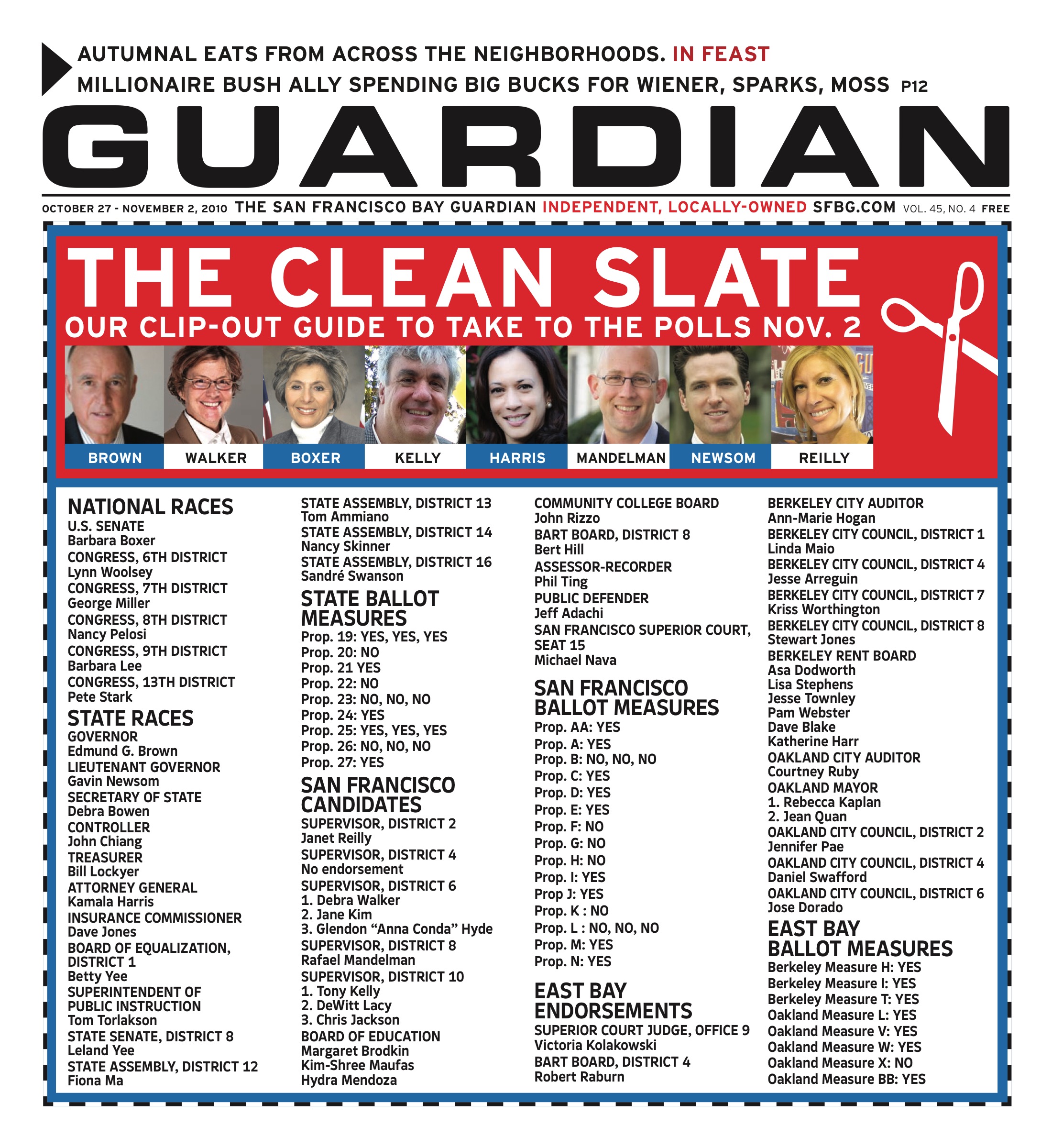
GOVERNOR

EDMUND G. BROWN

We have issues with Jerry Brown. The one-time environmental leader who left an admirable progressive legacy his first time in the governor’s office (including the Agricultural Labor Relations Board, the California Conservation Corps, and the liberal Rose Bird Supreme Court) and who is willing to stand up and oppose the Diablo Canyon nuclear power plant has become a centrist, tough-on-crime, no-new-taxes candidate. And his only solution to the state budget problems is to bring all the players together early and start talking.

But at least since he’s started to debate Republican Meg Whitman face to face, he’s showing some signs of life — and flashes of the old Jerry. He’s strongly denouncing Whitman’s proposal to wipe out capital gains taxes, reminding voters of the huge hole that would blow in the state budget — and the $5 billion windfall it would give to the rich. He’s talking about suing Wall Street financial firms that cheated Californians. He’s promoting green jobs and standing firm in support of the state’s greenhouse-gas emissions limits.

For all his drawbacks (his insistence, for example, that the Legislature shouldn’t raise any taxes without a statewide vote of the people), Brown is at least part of the reality-based community. He understands that further tax cuts for the rich won’t solve California’s problems. He knows that climate change is real. He’s not great on immigration issues, but at least he’s cognizant that 2 million undocumented immigrants live in California — and the state can’t just arrest and deport them all.

Whitman is more than a conservative Republican. She’s scary. The centerpiece of her economic platform calls for laying off 40,000 state employees — thereby greatly increasing the state’s unemployment rate. Her tax plan would increase the state’s deficit by another $5 billion just so that a tiny number of the richest taxpayers (including her) can keep more of their money. She’s part of the nativist movement that wants to close the borders.

She’s also one of the growing number of candidates who think personal wealth and private-sector business success translate to an ability to run a complex state government. That’s a dangerous trend — Whitman has no political experience or background (until recently she didn’t even vote) and will be overcome by the lobbyists in Sacramento.

This is a critically important election for California. Vote for Jerry Brown.


LIEUTENANT GOVERNOR


GAVIN NEWSOM

Why is the mayor of San Francisco running for a job he once dismissed as worthless? Simple: he couldn’t get elected governor, and he wants a place to perch for a while until he figures out what higher office he can seek. It’s almost embarrassing in its cold political calculus, but that’s something we’ve come to expect from Newsom.

We endorsed Newsom’s opponent, Janice Hahn, in the Democratic primary. It was hard to make a case for advancing the political career of someone who has taken what amounts to a Republican approach to running the city’s finances — he’s addressed every budget problem entirely with cuts, pushed a “no-new-taxes” line, and given the wealthy everything they wanted. His immigration policies have broken up families and promoted deporting kids. He’s done Pacific Gas and Electric Co. a nice favor by doing nothing to help the community choice aggregation program move forward.

Nevertheless, we’re endorsing Newsom over his Republican opponent, Abel Maldonado, because there really isn’t any choice. Maldonado is a big supporter of the death penalty (which Newsom opposes). He’s pledged never to raise taxes (and Newsom is at least open to discussion on the issue). He used budget blackmail to force the awful open-primaries law onto the ballot. He’s a supporter of big water projects like the peripheral canal. In the Legislature, he earned a 100 percent rating from the California Chamber of Commerce.

Newsom’s a supporter of more funding for higher education (and the lieutenant governor sits on the University of California Board of Regents). He’d be at least a moderate environmentalist on the state Lands Commission. And he, like Brown, is devoting a lot of attention to improving the state’s economy with green jobs.

We could do much worse than Newsom in the lieutenant governor’s office. We could have Maldonado. Vote for Newsom.


SECRETARY OF STATE


DEBRA BOWEN

California has had some problems with the office that runs elections and keeps corporate filings. Kevin Shelley had to resign from the job in 2005 in the face of allegations that a state grant of $125,000 was illegally diverted into his campaign account. But Bowen, by all accounts, has run a clean office. Her Republican opponent, Damon Dunn, a former professional football player and real estate agent, doesn’t even have much support within his own party and is calling for mandatory ID checks at the ballot. This one’s easy; vote for Bowen.


CONTROLLER


JOHN CHIANG

Chiang’s been a perfectly decent controller, and at times has shown some political courage: When Gov. Arnold Schwarzenegger tried to cut the pay of state employees to minimum-wage level, Chiang refused to go along — and forced the governor to back down. His opponent, state Sen. Tony Strickland (R-Los Angeles), wants to use to office to promote cuts in government spending. Vote for Chiang.


TREASURER


BILL LOCKYER

Lockyer’s almost certain to win reelection as treasurer against a weak Republican, Mimi Walters. He’s done an adequate job and pushed a few progressive things like using state bonds to promote alternative energy. Mostly, though, he seems to be waiting for his chance to run for governor — and if Jerry Brown loses, or wins and decides not to seek a second term, look for Lockyer to step up.


ATTORNEY GENERAL


KAMALA HARRIS

This is going to be close, and it’s another clear choice. We’ve had our differences with Harris — she’s trying too hard to be a tough-on-crime type, pushing some really dumb bills in Sacramento (like a measure that would bar sex offenders from ever using social networking sites on the Internet). And while she shouldn’t take all the blame for the problems in the San Francisco crime lab, she should have known about the situation earlier and made more of a fuss. She’s also been slow to respond to serious problem of prosecutors and the cops hiding information about police misconduct from defense lawyers that could be relevant to a case.

But her opponent, Los Angeles D.A. Steve Cooley, is bad news. He’s a big proponent of the death penalty, and the ACLU last year described L.A. as the leading “killer county in the country.” Cooley has proudly sent 50 people to death row since he became district attorney in 2001, and he vows to make it easier and more efficient for the state to kill people.

He’s also a friend of big business who has vowed, even as attorney general, to make the state more friendly to employers — presumably by slowing prosecutions of corporate wrongdoing.

Harris, to her credit, has refused to seek the death penalty in San Francisco, and would bring the perspective of a woman of color to the AG’s office. For all her flaws, she would be far better in the AG’s office than Cooley. Vote for Harris.


INSURANCE COMMISSIONER


DAVE JONES

Jones, currently a state Assemblymember from Sacramento, won a contested primary against his Los Angeles colleague Hector de la Torre and is now fighting Republican Mike Villines of Fresno, also a member of the Assembly. Jones is widely known as a consumer advocate and was a foe of Prop. 17, the insurance industry scam on the June ballot. A former Legal Aid lawyer, he has extensive experience in health-care reform, supports single-payer health coverage, and would make an excellent insurance commissioner.

Villines pretty much follows right-wing orthodoxy down the line. He wants to replace employer-based insurance with health savings accounts. He argues that the solution to the cost of health insurance is to limit malpractice lawsuits. He wants to limit workers compensation claims. And he supports “alternatives to litigation,” which means eliminating the rights of consumers to sue insurance companies.

Not much question here. Vote for Jones.


BOARD OF EQUALIZATION, DISTRICT 1


BETTY YEE

The Board of Equalization isn’t well known, but it plays a sizable role in setting and enforcing California tax policy. Yee’s a strong progressive who has done well in the office, supporting progressive financial measures. She’s spoken out — as a top tax official — in favor of legalizing and taxing marijuana. We’re happy to endorse her for another term.


SUPERINTENDENT OF PUBLIC INSTRUCTION


TOM TORLAKSON

We fully expected a November runoff between Torlakson and state Sen. Gloria Romero. Both Democrats had strong fundraising and political bases — and very different philosophies. Romero’s a big charter school and privatization fan; Torlakson has the support of the teachers unions. But to the surprise of nearly everyone, a wild-card candidate, retired Los Angeles educator Larry Aceves, came in first, with Torlakson second and Romero third. Now Aceves and Torlakson are in the runoff for this nonpartisan post.

Aceves is an interesting candidate, a former principal and school superintendent who has the endorsement of the San Francisco Chronicle and the San Francisco Green Party. But he’s too quick to take the easy line that the teachers’ unions are the biggest problem in public education, and he wants the unilateral right to suspend labor contracts.

Torlakson wants more charter-school accountability and more funding for primary education. He’s the far better candidate.


STATE SENATE


DISTRICT 8

Leland Yee

Yee’s got no opposition to speak of, and will easily be re-elected. So why is he spending money on a series of slick television ads that have been airing all over San Francisco, talking about education and sending people to his website? It’s pretty obvious: The Yee for state Senate campaign is the opening act of the Yee for San Francisco mayor campaign, which should kick into high gear sometime next spring. In other words, if Yee has his way, he’ll serve only a year of his next four-year term.

Yee infuriates his colleagues at times, particularly when he refuses to vote for a budget that nobody likes but everyone knows is necessary to keep the state afloat. He’s done some ridiculous things, like pushing to sell the Cow Palace as surplus state property and turn the land over to private real estate developers. But he’s always good on open-government issues, is pushing for greater accountability for companies that take tax breaks and then send jobs out of state, has pushed for accountability at the University of California, and made great progress in opening the records at semiprivate university foundations when he busted Stanislaus State University for its secret speaking-fees deal with Sarah Palin.

With a few strong reservations, we’ll endorse Yee for another term.


STATE ASSEMBLY, DISTRICT 12


FIONA MA

A clear hold-your-nose endorsement. Ma has done some truly bad things in Sacramento, like pushing a bill that would force the San Francisco Unified School District to allow military recruiters in the high schools and fronting for landlords on a bill to limit rent control in trailer parks. But she’s good on public power and highly critical of PG&E, and she has no opposition to speak of.


STATE ASSEMBLY, DISTRICT 13


TOM AMMIANO

Ammiano’s a part of San Francisco history, and without his leadership as a supervisor, we might not have a progressive majority on the Board of Supervisors. Ammiano was one of the architects of the return to district elections, and his 1999 mayoral campaign (against Willie Brown) marked a turning point in the organization, sophistication, and ultimate success of the city’s left. He was the author of the rainy day fund (which has kept the public schools from massive layoffs over the past couple of years) and the Healthy San Francisco plan.

In Sacramento, he’s been a leader in the effort to legalize (and tax) marijuana and to demand accountability for the BART Police. He’s taken on the unpleasant but critical task of chairing the Public Safety Committee and killing the worst of the right-wing crime bills before they get to the floor. He has four more years in Sacramento, and we expect to see a lot more solid progressive legislation coming out of his office. We enthusiastically endorse him for reelection.


STATE ASSEMBLY, DISTRICT 14


NANCY SKINNER

Skinner’s a good progressive, a good ally for Ammiano on the Public Safety Committee, and a friend of small business and fair taxation. Her efforts to make out-of-state companies that sell products in California pay state sales tax would not only bring millions into the state coffers but protect local merchants from the likes of Amazon. We don’t get why she’s joined with Berkeley Mayor Tom Bates to try to get rid of Kriss Worthington, the most progressive member of the Berkeley City Council, but we’ll endorse her for re-election.


STATE ASSEMBLY, DISTRICT 16


SANDRE SWANSON

Swanson’s a good vote most of the time in Sacramento, but he’s not yet the leader he could be — particularly on police accountability. The BART Police murdered Oscar Grant in Swanson’s district, yet it fell to a San Franciscan, Tom Ammiano, to introduce strong state legislation to force BART to have civilian oversight of the transit cops. Still, he’s done some positive things (like protecting state workers who blow the whistle on fraud) and deserves another term.


>>BACK TO ENDORSEMENTS 2010

Endorsements 2010: National races

10

 U.S. SENATE

BARBARA BOXER

The San Francisco Chronicle made a stunning — and utterly irresponsible — statement when it refused to endorse either candidate in this race, saying that neither Boxer, the three-term incumbent, nor challenger Carly Fiornia, was qualified for the job. That’s insane — this one’s as clear and obvious a choice as you could ask for in American politics.

Boxer’s one of the leading voices for the progressives in the U.S. Senate. She was an early and stalwart foe of the war in Iraq; she’s been good on immigration (even when other Democrats have been ducking); and she’s a leading voice for accountability in financial companies. She’s finally come around on same-sex marriage and has a perfect record on reproductive rights and labor issues.

Fiornia’s chief claim to fame is that she ran one of the nation’s top companies, screwed up its history of excellent labor relations, outsourced 30,000 jobs, orchestrated a train wreck of a merger, and was fired. She left with enough of a golden parachute to help finance her campaign for Senate.

Fiorina’s anti-choice. She strongly supported Prop. 8 and opposes marriage equality. She’s so rabidly seeking the support of the gun nuts that she actually said that people on the federal “no-fly” list should be able to buy handguns. She supports the Arizona anti-immigration law. She’s for tax cuts for the rich and can’t even figure out if she’s supporting or opposing Prop. 23.

This one is a no-brainer. Vote for Boxer.


CONGRESS, 6TH DISTRICT

LYNN WOOLSEY

Woolsey was against the war when her colleague to the south, Nancy Pelosi, was still waffling. She’s a consistent voice against cuts in the safety net (and has the distinction of being the only member of Congress who was once on welfare). We’re happy to endorse her for another term.


CONGRESS, 7TH DISTRICT

GEORGE MILLER

Miller’s an East Bay institution, now seeking his 18th term. He’s been good and bad on issues — weak at first on the war, bad on education (he supported No Child Left Behind), but generally sound on environmental issues. And this spring, he was willing to publicly challenge Sen. Dianne Feinstein (D-Calif.) on a terrible water bill.


CONGRESS, 8TH DISTRICT

NANCY PELOSI

It’s odd that Pelosi’s become such a symbol of liberal Democrats and fodder for the right-wing attack machine. When you look at her record, she’s hardly a San Francisco liberal and certainly no progressive. She’s not even a strong supporter of same-sex marriage. She was bad on the war for too long and seems far more interested in raising money than representing her constituents. But she did salvage the health care bill, and she’s held up as Obama’s chief Capitol Hill ally under enormous pressure, and if the Democrats survive with control of the House, she’ll stay speaker. If not, she should think about retiring.


CONGRESS, 9TH DISTRICT

BARBARA LEE

Lee became a hero to the peace movement worldwide when she refused after 9/11 to vote to authorize then-President Bush to go to war. She was the only member of either house willing to stand up against what would become the costly and bloody invasions of Iraq and Afghanistan. But she’s also been a strong supporter of HIV funding, is one of the few members of Congress to show much leadership on poverty issues, and has been elected to chair the Progressive Caucus. We’re happy to endorse her for another term.


CONGRESS, 13TH DISTRICT

PETE STARK

Stark is the Sup. Chris Daly of Congress, a fearless progressive who’s not afraid to ruffle feathers — or even insult the president — when he thinks it’s necessary. At 78, he’s an outspoken atheist (the only one in Congress), a staunch foe of the wars in Iraq and Afghanistan, and a progressive on all the major issues. He’s not terribly popular among his colleagues, who allowed him to serve for only one day as chair of the Ways and Means Committee before dethroning him for his inflammatory statements. But on balance, we’re glad he’s around.


>>BACK TO ENDORSEMENTS 2010

Opinion: For Democratic unity

6

We ran out of space in today’s print edition and couldn’t publish either of the two opeds I wanted to run, so I’m posting them here. The first one is by the chairman of the SF Democratic Party.

By  Aaron Peskin

As one of the most Democratic cities in California, San Francisco has a special responsibility to make sure we help elect a Democratic ticket on November 2nd.  We always take that responsibility seriously – but this year we will have the pleasure of helping elect our own to statewide office: Gavin Newsom as Lt. Governor, Kamala Harris as Attorney General and even native son Jerry Brown as California’s next Governor.

Because so many of our nominees are from San Francisco – and because San Francisco is so Democratic – and because so many of the statewide elections are so, so close – what we do to turn out the vote here in San Francisco could very well be the difference between victory and defeat for many statewide candidates. 

A quick look at the numbers shows just how important San Francisco could be in this year’s statewide races. In November of 2008, a total of 388,112 San Franciscans cast ballots. In November of 2006, the last gubernatorial contest, just 253,719 San Franciscans voted. That is a difference of 134,393 votes.

Local Democratic Party leaders agree a coordinated campaign could turn out at least 20% of these “occasional” voters and probably many more.  That means we could add a minimum of more than 25,000 votes from this Democratic base to the statewide total.

In a year in which the polls show razor-thin margins separating the winners from the losers, a 25,000 vote margin could make the difference between Democratic policies like support for schools, investing in green jobs and protecting a woman’s right to choose and the Republican reaction supported by Meg Whitman, Carly Fiorina, Steve Cooley and Able Maldonado.
Considering how important Democratic unity is to our city and our state – we need to pay it more than lip service. And that’s what our local party is trying to do.

It is certainly true that there are important local issues upon which we disagree. For example, I certainly take issue with some of Mayor Newsom’s positions – such as his so-called Sit/Lie ordinance. I know that he takes issue with many of my positions.

There are many in our party unhappy with Newsom for putting an attack on the ballot on the elected members of the local party in this crucial election.  Again, I know Mayor Newsom has expressed his displeasure with the local party for not supporting some of his candidates and positions.

But these local disagreements are small in comparison to what is at stake for Californians. They are actually small compared to what is at stake for San Franciscans – a city that relies on state aid to support our schools and colleges, much of our local health services and many other important programs.

That’s why unity is the only sensible policy in this crucial 4-weeks of voting until the November 2nd election. And that’s why I have a simple and genuine invitation to Mayor Newsom and the other statewide candidates.

Come help us help you.

We are gathering every day at our headquarters at 1261 Howard Street to knock on doors, register voters and make phone calls to get out the vote.  Come show with your presence that turning out the vote is so important that we will turn aside both petty differences and legitimate policy disagreements on local concerns.

Across California our opponents are attacking “San Francisco” Values. Come show that a core value of San Francisco Democrats is uniting to support the greater good.

SFBG Radio: The GOP and fear of the “other”

15

Today Johnny and Tim talk about the bill that the Democrats are using to fight back against Republican nonsense — and why the GOP is all about scaring white people. You can listen after the break.


sfbgradio9272010 by endorsements2010

Redevelopment throws Arc Ecology under the bus

3

No one was really surprised when the Redevelopment Commission voted 4-0 not to renew Arc Ecology’s contract to provide environmental information services regarding remediation plans at Hunters Point Shipyard and award it to Circle Point.

Sad and disgusted, yes. But surprised, no. That’s because everyone expected that Commissioners Leroy King, Darshan Singh, Rick Swig and Francee Covington, who are all appointees of Mayor Gavin Newsom, would throw Arc under the bus as payback for Arc’s decision to comment on the EIR for Lennar’s Candlestick Point/shipyard redevelopment plan and oppose the giving away of state parklands so Lennar could build luxury condos.

“The message was that we shouldn’t have commented ” Arc’s executive director Saul Bloom told the Guardian after the Commission vote went down. “But this you’re-either-on-our-side-or-out-of-a- contract attitude is completely bogus. It’s tactics that Republicans use against Democrats.”

And with the exception of Al Norman (who had the bad manners to burst out laughing when Arc got voted out) and Circle Point staffers, who obviously wanted the contract, those who attended the Commission’s September 21 meeting agreed that the outcome symbolized everything that’s wrong with Redevelopment’s current model of governance, in which political appointees, not elected officials, make decisions that majorly impact the city’s land use.

Thor Kaslofsky, Redevelopment’s shipyard project manager, kicked off the Commission’s contract discussions by explaining why Redevelopment Agency staff were recommending that the Commission award the contract to Arc Ecology.
As Kaslofsky explained, Circle Point received 0.2 points more than Arc from the Agency’s scoring panel, “making it difficult for the panel to determine who is the most qualified.”

Kaslofsky noted that there had been “concerns about Arc Ecology’s multiple roles in the community.”
This was a reference to the fact that, besides, providing independent assessments on the Navy’s clean-up plans, Arc produced “Alternatives For Study,” a report that studied alternatives to a plan that Lennar and the city refused to change–a public-private stubbornness that most recently resulted in a lawsuit from the Sierra Club and the Golden Gate Audubon Society.

“But the panel voted for Arc as the most qualified firm,” Kaslofsky concluded, noting that there were “concerns about Circle Point’s ability to ramp up”—a reference to the fact that though Circle Point has offices in Sacramento and downtown San Francisco, it doesn’t have a presence in the Bayview and little-to-no experience of the military base clean-up process.

Bloom then talked about how Arc has been active in the Bayview for decades.

“We’ve been in the Bayview for 25 years,” Bloom told the Commission. “We’ve read every environmental document that’s been produced. And our office is on Third Street,”
Bloom noted that after Arc scored the highest for Redevelopment’s environmental services contract in 2009, the Agency withdrew its request for proposals (RFP) leaving the community without Arc’s services—and without the services of the Navy’s community-based Restoration Advisory Board—at a time when the Navy was pushing clean-up plans that favor capping the shipyard’s heavily polluted Parcel E-2, rather than digging and hauling out the contamination.

As Bloom noted, the Agency’s contract RFP switcheroo, “caused significant costs to the community because we were unable to provide services at the same time the Navy’s RAB was closed down.”

After Bloom spoke, a stream of Bayview advocates testified in support of Arc.

“Arc is more knowledgeable about clean-up issues than most government regulators,” said Scott Madison, a member of the shipyard’s citizen advisory committee.
“The community asked for—and you granted—an independent contractor, a watch dog, not a lap dog,” Madison continued. “Circle Point may be technically qualified, but they are strangers to the Bayview. The Commission should have the courage to hire a watchdog, even at the risk of a nip at the heels.”

Michael Lynes, conservation director with the Golden Gate Audubon Society, which recently joined the Sierra Club in suing to block the city’s EIR on Lennar’s Candlestick/ shipyard plans, told the Commission that he found “the value provided by Arc to be absolutely essential.”

D10 candidate Eric Smith, a member of the Navy’s now defunct RAB, praised Arc for, “being fantastic in sharing the information.”
“There is no other organization that has their history, has done the work they’ve done, and has the relationship with the community,” Smith said, “With the loss of the RAB, Arc was the only place to go.”

Jackie Phillips of ACCE (Alliance of Californians for Community Empowerment) noted that how a lot of organizations come to the Bayview, but unlike Arc, few stay the course.
“I’ve gone to their workshops,” Phillips said. “They sat us down, they’ve taken us on tours, they’ve taken us to the toxic sites, they have shown us what these changes will mean.”

Phillips also expounded on the difficulty of winning the trust of the Bayview community.
“In the Bayview, we don’t know who to trust, because there have been a lot of broken promises,” Phillips said. “Arc did not try to hide things from us. They have a relationship with the community.”

Next up was Claude Eberhart, who said ordinarily he’d be happy to see Circle Point get the contract, because he likes their staff.
“But by rights, I can’t recommend that,” Eberhart said. “The issue is trust.”
Noting that he has worked with Arc since 1987 when he and Bloom fought plans to homeport the USS Missouri at the shipyard, Eberhart said that in terms of getting “clear, concise and correct information,” Arc is “one environmental organization we can rely on.”

Eberhart also noted that last year, when there was pressure to take a large chunk out of the Candlestick Point State Recreation Area so that the city/Lennar could build luxury condos on state parklands, “Arc stepped forward and provided the information we needed to achieve a community consensus and have the Sierra Club come up with the final deal that allowed for an exchange [of state parklands].”

John Eller, an organizer with ACCE, which co-signed the community benefits agreement that the Labor Council negotiated with Lennar to secure living wages and higher levels of affordable housing, noted that Commission President Rick Swig had spoken earlier in the meeting about how Cohen, Newsom’s former economic advisor, was a consensus builder.

“And that’s exactly what Arc has done over the years,” Eller said.

Kate Kelley, director of the Sierra Club’s San Francisco Bay Chapter, praised Arc’s integrity.
“The information it provided was balanced, responsive and certainly technically competent,” she said.

“This is not a baseball game,” Kelley continued, referring to Circle Point’s understandable claim that it rightfully won the contract based on the Agency’s scoring process. “This is about relationships and trust—and I trust Arc Ecology to do the right thing.”

Al Norman, who heads the Bayview Merchants Association, was the sole dissenter among Bayview residents who spoke at the meeting.
Norman claimed that Arc’s critique of the city’s EIR was somehow “a conflict of interest.”

But instead of providing evidence to support his claims, Norman launched into a personal attack.
“[Bloom] went against this agency and the community, concerning his alternative plan, when we already had a plan in place,” Norman said. “I think Circle Point deserves a chance.”

The son of the late Jesse Mason, who worked for Arc until he died this summer, spoke in support of Arc and Bloom.
“My father believed in Arc, he trusted Arc,” Mason said.

And Christine Johnson, secretary of the shipyard’s Citizen Advisory Committee, spoke of the pressing need in the Bayview for independent review of technical environmental documents.
“We feel it’s imperative to get immediate advice and expert opinion and to properly assimilate information,” Johnson said, referring to the Navy’s shipyard clean-up plans.
‘We’ve been without that advice for nearly a year.”

Terry Ander, whose organization is a member of the Southeast Jobs Coalition, which includes Brightline, Inner City Youth, Visitacion Valley Community Development Coalition and Young Community Developers, spoke highly of Arc.
“Arc Ecology deserves this contract,” Anders said, noting that the Bayview community has been part of “enough neglect and B.S. to last for ten life times.”

And D10 candidate Kristine Enea, a former member of the Navy’s RaB, urged the Commission to “support Arc and focus on the community’s need for information.”

Bayview community advocate Espanola Jackson stressed the need for accurate information from a trusted source, as opposed to politically comfortable lip service.
“We need the correct information and not the lies and the politics that have been played upon my community,” Jackson said.

After 17 folks spoke in favor of Arc, many of them registering surprise that there was talk of taking the contract away from a small Bayview-based non-profit, Bloom sought to correct any misinformation that had been spread about his organization.
Noting that Arc’s Alternative for Studies “was an attempt to do some problem solving,” Bloom observed how, “Instead, we got painted as an opponent to a bridge. We are a strong supporter of the development and we have put 300 people to work in the Bayview.”

But all this support and clarification was not enough to save Arc from being thrown under the bus.

Commissioners Leroy King, Francee Covington and Darshan Singh joined Commission President Rick Swig in calling for Arc’s ouster. And along the way, they variously accused Bloom of disloyalty, dishonesty and expectations of winning the contract. (The latter accusation was a tad ironic given that there are currently no term limits for Redevelopment commissioners, as evidenced by King who has sat on the commission for decades and has just been renominated by Mayor Gavin Newsom to serve yet another term.)

“I’m opposed to giving the contract to Arc,” Commissioner King said. “Each time, [Bloom] spoke opposed to Redevelopment,” King continued, without proffering any details to support his claims, but giving a disturbing insight into how he thinks organizations that contract with Redevelopment for $282,000 a year (the amount Circle Point will be paid for four years for the environmental services contract) should position themselves on all Agency-related issues.

“[Lennar’s] Kofi Bonner called me and said. ‘Will you chance your vote? We need him’” King said, acknowledging that he didn’t want to award the contract to Arc, when it first applied, four years ago.  “But every time [Bloom] was opposed to basic things to fill that shipyard. He talks against Lennar.”

Commissioner Covington confused the audience by pulling out a copy of the city’s response to comments on its EIR for Lennar’s redevelopment plans, even though the Redevelopment contract in question concerns assessing the environmental issues related to the Navy’s shipyard clean-up plans.

Covington then pointed to, but did not identify, letters that she claimed were from individuals who alleged their names were falsely included in a letter supporting Arc’s EIR comments.

Covington then told the audience that the Agency’s 50 percent small business enterprise standard in contract awards “ is a goal but does not apply to non-profits”.

And Commission President Swig, a hotel and tourism industry consultant, sought to frame Arc, which is respected as an independent non-profit, as an ungrateful consultant.
“As a consultant myself, I don’t agree with all my customers, but I don’t bite the hand that feeds me,” Swig said.

And then the Commission voted 4-0 to reject Arc—and award the contract to Circle Point.

Outside the meeting, a black mood reigned.
“It was political payback,” Scott Madison said. “I think the Commission made a bad choice.”

Mike McGowan. Arc’s senior scientist, noted that public support was 17-3 in favor of Arc.
“But I guess only four votes counted,” he observed. “It seemed that Redevelopment’s staff was in favor of Arc, as was the community except for a few voices, but the Commission kept harping on incidental issues. The truth is that there are no holes in our qualifications.”

McGowan noted that the environmental services contract relates primarily to Navy clean-up.
“Arc never got in the way of the development,” McGowan said. “What it did was participate more fully in the EIR process, and, as I understand, Lennar incorporated some of Arc’s suggestions into their design. But by Arc not having its contract for the last 18 months, a lot of misinformation floated to the top.”

McGowan noted that the spirit of the Agency’s policy on small business enterprises is to foster the development of small firms that are disadvantaged and local.
“And Arc definitely is smaller, less advantaged and based in the Bayview, but it seemed like a lot of personal animosity came up,” he said.

Bloom acknowledged that the loss of this contract is a serious economic blow for Arc.
“They screwed a local small non-profit in the face of a multi-million dollar organization that swathed itself in a couple of small Bayview businesses,” Bloom continued, referring to Circle Point’s inclusion of three local SBEs as sub-contractors in its contract proposal.

Others, speaking off the record for fear of political reprisal, told the Guardian that the Commission’s treatment of Arc—and its refusal to listen to community members and community-based organizations that represent many thousands of local residents—calls into question the need for Redevelopment to exist in its present configuration, if the Commission believes its priority is to fire contractors that disagree with its plans in other arenas.

“The Board can eliminate the Redevelopment Agency and/or change its governance,” a Bayview resident said. “The Bayview is the last frontier of the eastern side of San Francisco. It’s a historically neglected neighborhood that many folks in City Hall now see as the next potential gold mine.”


Editor’s Notes

0

Tredmond@sfbg.com

On Sept. 16, supporters of Proposition B, the pension reform measure that would also reduce health care benefits for the children of city workers, held a fundraiser at Le Méridien Hotel — which is one of the hotels on the union boycott list. That was a bad idea, and it put Public Defender Jeff Adachi, the sponsor of Prop. B, in a difficult bind. His proposition, his fundraiser — and he had to cross a picket line to get in the door. So did former mayor Willie Brown, who was one of the fundraiser’s feature guests.

Labor people were furious about the two Democrats crossing the line. Labor Council Executive Director Tim Paulson told Guardian City Editor Steven T. Jones that the move was "outrageous." At the very least, it’s highly unusual in this labor town.

And I thought of something else unusual: Brown, who among other things is a San Francisco Chronicle columnist, was helping host a political fundraiser. That’s interesting because just a few weeks earlier, the conservative San Francisco Coalition for Responsible Growth invited the Chron’s C.W. Nevius to speak at a fundraising event — and when the SF Appeal reported on it, Chron management told Nevius that wasn’t allowed.

What’s the difference? One columnist can do fundraisers and one can’t? When I asked Chron Editor Ward Bushee, he referred me to a Matier and Ross column, which included a quote on the matter from Managing Editor Steve Proctor:

"When we gave him a column, we never had any illusion he would cease to be involved in politics. I think the readers of the Chronicle understand that."
So it’s one standard for Willie, another for everyone else. Just like old times.