Corporations

PG&E’s tragically misplaced priorities challenged

0

Throughout the spring political season, we at the Guardian argued there were more important things on which Pacific Gas & Electric could be spending $45 million – the amount it spent on Prop. 16, its losing effort to kill public power programs in California – such as infrastructure maintenance, lowering its high rates, or adding more renewable projects to its dirty energy portfolio.


Now that the deadly gas explosion in San Bruno has been linked to internal company warnings that PG&E’s 52-year-old line was dangerously in need of replacement and that it failed to heed customer complaints about smelling gas in the air for weeks before the explosion, it appears that the company could finally be called to account for its misplaced priorities.


State Sen. Mark Leno is calling a joint hearing into the matter before the Public Safety Committee, which he chairs, and the Utilities Committee. “The current leadership at PG&E has lost its way. Nobody is minding the ship,” Leno told the Guardian. He said that he’s furious about the explosion and PG&E’s shoddy safety record.
“Enough with the self-initiated, self-serving, self-funded political campaigns,” he told us. “Enough with the illegal attempts to interfere with community choice aggregation in Marin. Enough with the mad rush to smart meters. How about focusing on the current mission — to provide gas and electricity safely reliably and affordably, without death and destruction?”


Ironically, it’s possible that PG&E’s efforts to prevent a greater public role into how energy is provided to Californians could end up resulting in far more public oversight over a utility that has put more energy into regular political campaigns – from this year’s statewide campaign to similarly over-the-top spending to kill public power proposals recently in San Francisco, Yolo, and Sacramento counties – than the energy business. Leno told us the model of the private regulated utility no longer works. “This hybrid creation of sort of public, kind of private, state regulated but not really is a creation that no longer functions.”


Meanwhile, while the PG&E-friendly San Francisco Chronicle has yet to really connect the dots on this disaster, other mainstream San Francisco voices are. For example, Christine Pelosi – daughter of Speaker of the House Nancy Pelosi – yesterday penned a piece for the Huffington Post that explicitly connects the Prop. 16 campaign to the deadly explosion, entitled. “Deadly Priorities: Why Did PG&E Spend Millions on Politics, Instead of Pipelines?”


She closes the piece with an apt question, one that Leno’s committee will hopefully answer: “The San Bruno tragedy is a clarion call to rebuild America and insist on ratepayer say on utility pay. I think most taxpayers would reject deadly priorities that put politics over pipelines and choose repairs to the ground literally crumbling beneath our feet, and most ratepayers would choose crumbling infrastructure repairs over political campaigns. Wouldn’t you?”


Yes, we would.

American politics is a circus that never leaves town

0

 American politics is a circus, no doubt of that. The trouble is, it’s a circus that never leaves town.

That’s bad for the country, but good for observers who are interested in becoming more intimately acquainted with the talent on display. Having watched several recent performances, I’d like to offer my opinion of some of the leading players in what is surely the greatest show on earth, Ringling Brothers, Barnum and Bailey, and Buffalo Bill Cody himself notwithstanding.

(One caveat: Because the show never stops, there’s a regular turnover in personnel. I can’t guarantee that the same performers will be on hand when you next visit the big tent. But don’t worry about being short-changed on entertainment. The supply of people who want to be in this circus is limitless.)

Aerialists:

The principal high flyer of the moment is Rep. Paul Ryan, Republican of Wisconsin, who when he’s not soaring high above reality represents, with no particular distinction, a district just down the road from where I live. Brightly costumed in Austrian economic theory and unencumbered by data or any knowledge of the behavior of actual human beings, he swings on his trapeze while waving the banner of his Plan for America’s Future. In the future this daring young man envisions, taxes will be cut, the budget will be pared down to next to nothing, the deficit will be erased, Medicare will be replaced by vouchers and Social Security with private accounts, all insurance companies will be scrupulously honest and all businessmen incorruptible and everyone will invest wisely and there will never be another depression or even recession and wishes will be horses and beggars will ride to El Dorado, which will turn out to be situated at the base of the Big Rock Candy Mountain . Remember, though, that while Rep. Ryan is working with a net, if he gets his way you won’t have one.

Jugglers:

Right now it’s the Tea Partiers doing the bulk of the juggling. They’re mostly old enough to be covered by Medicare and on the receiving end of Social Security and no way in hell are they giving up those benefits. Still, they are committed to reducing government spending as long as there’s a black guy running the government. So to keep those balls in the air they have to believe both things at least until 2012 when they can put a white person back in the White House (and why else would they call it that?) and the deficit won’t matter anymore.

Clowns:

Those oddly-dressed and -painted little men you see emerging from the tiny car, whom you first take to be syphilitic dwarfs, are in reality congressman of both parties fleeing responsibility for anything congress itself may have done. Good or bad doesn’t matter; if the public is anti-Washington, so are they. With their antics – hurling invective and flailing at one another with slap-sticks – they hope to distract you from examining their records; regrettably, they are no more amusing than ordinary clowns.

Lion Tamers:

No lions are being tamed at present. The erstwhile lion tamers – the members of the Supreme Court – have been called away to protect corporations from the depredations of the public interest.

Contortionists:

Before your very eyes, the Anti-Defamation League will twist its principles (in order to suck up the American right-wing) by opposing the so-called Ground Zero mosque. Pretzel-making is a straightforward business in comparison. Don’t miss this one.

Ringmaster:

There is no ringmaster, but candidates for the position are coming from all directions. There are so many of them Halloween party-goers can’t find costumes and BDSM parlors are facing a shortage of whips. First there’s Sarah Palin, all spiffed up and ready to take charge. But no, here comes Glenn Beck and he’s got God on his side. Now Bill O’Reilly is sputtering with anger at his losing his lead. Sean Hannity wants the world to know that if anger is what it takes nobody can get than him. And Rupert Murdoch may just decide to let his underlings sulk and take the job himself.

Nobody can predict the outcome. All we know, alas, is that the show must go on.

Save the bees, save the planet

0

Native bee advocate Celeste Ets-Hokin didn’t just spend time this summer helping me find squash bees. She also spent months putting together a 2011 native bee calendar, and days writing letters to the US Food and Drug Administration (FDA) about upcoming food safety regulations that will affect all U.S. food growers.

“The FDA sets regulations on how they grow food,” Ets-Hokin explained. “And that could have a negative impact on organic and sustainable growers if the FDA creates regulations that conflict with conservation.”

Farmers are stewards of the majority of the world’s arable areas, Ets-Hokin observes.

“And as stewards of 90 percent of the planet’s arable land, it’s important that growers understand the need for bee habitat and conservation,” she said. “This can be done by restoring habitat, putting in insectary plantings and hedgerows, and other measures.”

Ets-Hokin rejects the notion that bee conservation efforts are elitist.
“If it were so elitist, you wouldn’t have all these preexisting federal programs like the National Resources Conservation Service,” Ets-Hokin said.

But most agriculture operations are run by huge corporations that are not physically present on the land they control, she observes.
“So, when the growers plough under thousands of acres of field, leaving only a patch of dirt, they don’t have to see how it looks,” Ets-Hokin said. “But when farmers put hedgerows and insectaries around farms, they see flowers that bloom all year. That’s refreshing to the spirit. It provides ecosystem services like pollination and beneficial pest control. But it also provides a spiritual uplifting. And I think that is under valued.”

Ets-Hokin worries about the negative impacts on native bees and other beneficial pollinators if the FDA develops a one-size-fits-all approach to food safety.

“If they develop a model that’s tailored to industrial operations, and force it on smaller operations that don’t pose the same risks as bigger operations, with lots of middle men and plastic packaging processes, you incur another risk,” she said, referring to outbreaks of E. coli (Escherichia coli) food poisoning, which are caused by the ingestion of E. coli bacteria.

“When you bring organics to the farmer’s market, there is not one recorded case of E.coli,” Ets-Hokin continued. “But if you impose the same testing protocols and fees on small growers, you disincentivize conservation. And that’s too bad. We need the mosaic.”

In an effort to spread awareness about the importance of bee habitat, Ets-Hokin focussed her newly published  2011 bee calendar on the central role that bees, including native bees, play in ensuring the safety of our food supply and the health of our ecosystem.

“Without native bees, many of the plants that anchor our terrestrial ecosystems would eventually disappear,” Ets-Hokin wrote in the introduction to her calendar.

“So, it’s not enough to say that we’ll put aside a little area for conservation on farms,” she told me, as we hung out in her bee-friendly yard. “It must be done in a regenerative cycle, in which we reuse waste on farms as input for the next round of crops.”

Ets-Hokin also told me how she got into the bee calendar business.

“Originally, I was going to try and produce flash cards, but it turned out that a someone had already done that,” she recalled. “So, then I thought, why not do something more visible and affordable to a broader audience. And so I stole Rollin for the project.”

Ets-Hokin is referring to entomologist and insect photographer Rollin Coville. His kick-ass images helped make Ets-Hokin’s 2010 native bee calendar an instant classic. 

“With insects, it’s important to focus on their eyes,” Coville told me in July, as we hunted for sthe elusive squash bee. And I think you’ll agree he’s right about bees’ eyes, when you check out the amazing images of these furry little vegetarians that illustrate Ets-Hokin’s 2011 bee calendar. Here’s hoping that her calendar will inspire growers and gardeners to include and conserve bee-friendly plants and habitat wherever they can. Save the bees, save the planet!

Our Weekly Picks: September 1-7, 2010

0

WEDNESDAY 1

FILM

“Oskar Fischinger Classics”

That one of cinema’s greatest modernists should have worked in animation is perhaps not so surprising — it’s the mode of film production most easily bent by a singular vision, in which aesthetic achievement is inextricable from mechanical innovation. Still, there’s no accounting for a genius like Oskar Fischinger, who channeled his knowledge of engineering, architectural design, and organ-building into his dense visual symphonies. Like many intellectual émigrés who fled Nazi Germany for Southern California, Fischinger found L.A.’s bottom-line culture inhospitable to his working methods. But a career-spanning program at the Pacific Film Archive reveals a master artisan who devised countless fresh ways to impress the rigor of form with sheer delight. (Max Goldberg)

7:30 p.m., $5.50–$9.50

Pacific Film Archive

2575 Bancroft, Berk.

(510) 642-1412

www.bampfa.berkeley.edu


EVENT

Ending Mountaintop Removal: Appalachian Activists in San Francisco

Another talk on humankind’s crusade to beat our planet to a bloody pulp is coming to town. But be forewarned: this ain’t no Sierra Club meeting. To save the last remaining mountaintop in their home from removal by coal mining corporations, the Appalachian community in Coal River Valley, W.V., (the name alone implies environmental havoc) has gone rogue — tree sittings, road blockades, and protests, leading to more than 150 arrests and exorbitant bail fees. Key activists from their group Climate Ground Zero have taken to the road to share the underreported story of their struggle. Raise a nonviolent fist in solidarity. (Caitlin Donohue)

7–9 p.m., $5–$10 donation suggested

Station 40

3030B 16th St., SF

(415) 235-0596

www.indybay.org

www.climategroundzero.org


THURSDAY 2

MUSIC

“On Land Festival”

Noise-waffle diehards, aural experimentalists, and, yes, Mills College students, have a world of ear-tugging wonder in store when Jefre Cantu-Ledesma’s and Maxwell Croy’s Root Strata label throws its second annual On Land music festival. “What I felt most happy about was the fact that the musicians thought it was really great,” Cantu-Ledesma said. “Not ‘blah, blah, blah,’ but a good response that really made it worth doing it another year.” This time they unearth a veritable treasure trove of juicy, internationally recognized undergroundlings, including some past residents of the Bay like Charalambides’ Tom Carter, Grouper’s Liz Harris, and Yellow Swans’ Pete Swanson. Top it off with the first West Coast appearance by New York’ Citys Oneohtrix Point Never (which put out the stirring Returnal not long ago and performs with live video by local artist Nate Boyce) and Zelienople, and you have something you might dub “must-see sounds” for the serious follower of well-grounded, out-there sounds. (Kimberly Chun)

Through Sun/5

7:30 p.m. (Sun/5 show at 6:30 p.m.), $10–$20 (four-show pass, $45)

Café du Nord and Swedish American Hall

2170 Market, SF

(415) 861-5016

www.cafedunord.com


EVENT

Arts Market SF

The Tenderloin-Civic Center neighborhood takes its knocks, but its rough exterior belies an urban work of art. Even historically speaking: Miles Davis blew his horn at the Blackhawk nightclub at the corner of Turk and Hyde streets and the Grateful Dead recorded American Beauty here. Today it’s one of the last remaining places in the city a real boho can afford to hunker down and throw paint at a canvas. So it makes perfect sense the hood hosts the city’s newest arts bazaar. Participating locals include T-shirt company the loin (which screens its wares in a nearby basement), plus jewelry artists, painters, and printers. Go to grow the artist network in our city’s hard knocks hub. (Donohue) Noon–8 p.m., free

U.N. Plaza

Market and Seventh, SF

www.artsmarketsf.org


FRIDAY 3

MUSIC

Terry Riley

At 75, “In C” composer Terry Riley is still capable of guiding several thousand souls in devotional listening. His caterwauling piano figures are anything but immobile, so it’s a dream to be able to move around during one of his concerts. Circling the Berkeley Art Museum during his last performance there, I came upon several unexpected pockets of resonance; for his part, Riley seemed perfectly calm, as if playing in his own private den (or geodesic dome, as the case may be). He returns for an encore performance tonight, again accompanied by his son Gyan on guitar, and once again for a bargain price. (Goldberg)

8 p.m., $7

Berkeley Art Museum

2626 Bancroft, Berk.

(510) 642-0808

www.bampfa.berkeley.edu


MUSIC

Miami Horror

Australian producer Benjamin Plant started out just a few short years ago as a remix artist and DJ in Melbourne, Australia, creating dance music inspired by ’70s disco and electronic soundtracks. The name said it all, really — Miami Horror. Since then, his quickly rising profile has sent Plant branching out (natch) into pop and making the inspired decision to tour with a live band. Having added the pizzazz of on-stage guitar and drums to the shimmery synths, Miami Horror isn’t just referencing the past any longer, it’s challenging contemporary dance acts to pick up the pace. (Peter Galvin)

With Parallels, Pance Party, and Eli Glad

9 p.m., $15

Mezzanine

444 Jessie, SF

(415) 625-8880

www.mezzaninesf.com


SATURDAY 4

DANCE

RAWDance

Lots of people, apparently, like watching dance in an almost-hidden space spawned from a ballroom hooking up with a bowling alley. RAWdance’s biannual Concept series has been smash hit ever since the first one in 2007. The idea is to informally present in-progress or excerpts from recent works on a pay-as-you-can, free-popcorn-and-coffee-and-snacks basis. Unfortunately, the current lineup — Holly Johnston, Lisa Townsend, Kelly Kemp, RAWdance, Catherine Galasso, and Laura Bernasconi/Carlos Ventura — may be one of the last. The James Howell Studio is on the market. Any suggestions for a new home for this nicely curated, always intriguing, and ever-so-welcoming dance series? (Rita Felciano)

Through Sun/5

8 p.m. (also Sun/5, 3 p.m.), pay what you can

James Howell Studio

66 Sanchez, SF

(415) 686-0728

www.rawdance.org


SUNDAY 5

MUSIC

Abe Vigoda

Once you get over the initial disappointment that this is not the actor Abe Vigoda opening for Cold Cave, I think you’ll be pleased to find an L.A. punk crew that plays a distinctly Caribbean style of punk — a lot of steel drums and reverbed guitars — and sounds like fellow Smell bands No Age and HEALTH while maintaining a personality very much their own. Abe Vigoda also exhibits something slightly unusual in the punk industry: a willingness to grow. Each subsequent record release has introduced new ideas into the band’s sound, from changes in tempo to exploring electronic textures. With a seemingly bright future, it’s possible that someday the band might even overtake the actor in popularity. Tell Abe it was only business; I always liked him. (Galvin)

With Cold Cave

9 p.m., $16

Great American Music Hall

859 O’Farrell, SF

(415) 885-0750

www.gamh.com


MONDAY 6

MUSIC

Panda Bear

One of the many mysteries of the intentionally mysterious Animal Collective is how the group’s later albums manage to make indie music so danceable. The man behind that particular mystery is Panda Bear (a.k.a. Noah Lennox), co-singer and sampling man, who seems to draw as much inspiration from electronic music as the ’70s psychedelia that is the Collective’s bread and butter. In his solo incarnation, Lennox tones down the grandiosity of his day job, drawing inspiration from the Beach Boys, R&B, and the widely eulogized hip-hop producer extraordinaire J Dilla to create a slower and more laid back atmosphere. Currently residing in Lisbon, which Lennox calls “the European California,” Panda Bear’s music is a clear reflection of a sunnier, sweeter lifestyle than we normally see here in Fogland. (Galvin)

With Nite Jewel

8 p.m., $25

Fox Theatre

1807 Telegraph, Oakl.

1-800-745-3000

www.thefoxoakland.com


MUSIC

“Cowgirl Palooza”

Saddle up, buttercup. It’s Labor Day weekend, all your pals are on the Playa, and you don’t know what to do with your dog day afternoon but head out for some honky-tonkin’. And sugar, El Rio’s got you covered. At the eighth annual Cowgirl Palooza, you can drown your sorrows with one of its signature margaritas, eat your fill of free BBQ (while supplies last), and scoot your boots to the cheekily country-fried tunage of one of San Francisco’s finest, most underrated bar bands, 77 El Deora. When Jenn Courtney dominates the mic, demanding a bad boy to do her good, poison for her heartbreak, and someone to please change the record, which sucks because it reminds her of “you,” you’ll be glad you skipped that silly little party in the desert after all. What’s it called again? (Nicole Gluckstern)

With Wicked Mercies, Bootcuts, Evangenitals, and Los Train Wrecks

3 p.m., $10

El Rio

3158 Mission, SF

(415) 282-3325

www.elriosf.com


TUESDAY 7

MUSIC

Extreme Animals

The Extreme Animals are difficult to pin down. The band’s website describes its sound as “No Doubt + Linkin Park + New Red Hot Chili Peppers,” and Jacob Ciocci, TEA’s spasmodic, pepperoni-pizza-eating leader, tries to pinpoint it further with this recent tweet: “If anyone ever asks, ‘What is Extreme Animals the band?’ say ‘it’s like Lady Gaga — it’s music AND art!'” Far from some self-effacing ironic gesture, these descriptors are entirely genuine and accurate. If anything, they leave out a smorgasbord of equally embarrassing acts and kitsch culture destined to be forgotten if not for zealous karaoke bars and garage sales. In other words, TEA doesn’t shy from absorbing and acknowledging its influences; it binges on anything and everything the pop entertainment world dishes out, then it shits and pukes it out on stage in phantasmagoric pixelated form. (Spencer Young)

9 p.m., free

Southern Exposure

3030 20th St., SF

(415) 863-2141

www.soex.org


MUSIC

Hope Sandoval and the Warm Inventions

Hope Sandoval’s voice remains a seductive study in contrast, sounding at once near and far, with a hollowed core and warm edges, always lingering. The darks shadows of that voice flicker over a whole generation of younger singers — male and female — woozy bedroom-pop types, and psych-folk melancholy cases. Mazzy Star’s “Fade Into You” is still a classic slow-burn ballad, but she’s recorded several fine, less remarked-upon albums since. In any case, you don’t forget a voice like hers. Sandoval doesn’t play out much. Jim Jarmusch talked her into his All Tomorrow’s Parties dream bill in New York City, but that’s her only other show in the States on this “tour” — so expect the Great American to be packed to sway. (Goldberg)

8 p.m., $26

Great American Music Hall

859 O’Farrell, SF

(415) 885-0750

www.gamh.com 


The Guardian listings deadline is two weeks prior to our Wednesday publication date. To submit an item for consideration, please include the title of the event, a brief description of the event, date and time, venue name, street address (listing cross streets only isn’t sufficient), city, telephone number readers can call for more information, telephone number for media, and admission costs. Send information to Listings, the Guardian Building, 135 Mississippi St., SF, CA 94107; fax to (415) 487-2506; or e-mail (paste press release into e-mail body — no text attachments, please) to listings@sfbg.com. We cannot guarantee the return of photos, but enclosing an SASE helps. Digital photos may be submitted in jpeg format; the image must be at least 240 dpi and four inches by six inches in size. We regret we cannot accept listings over the phone.


Hands off social security!

2

Dick Meister, former labor editor of the SF Chronicle and KQED-TV Newsroom, has covered labor and politics for a half-century. Contact him through his website, www.dickmeister.com, which includes more than 250 of his recent columns.

Republican leaders in Congress would have us believe that most Americans support cutting Social Security and Medicare payments as a way to cut the federal budget deficit. But don’t you believe it.

As the AFL-CIO and other labor sources have discovered, that’s at best a figment of the Republican imagination. Or, as is most likely, it’s a bald-faced political lie.

The proof came in a poll marking the 75th anniversary of Social Security this year. It was conducted by a prominent research organization, Greenberg Quilan Rosner, and commissioned by the nation’s leading public employee unions, the Service Employees International and American Federation of State, County and Municipal Employees, joined by MoveOn.org and the Campaign for America’s Future.

The poll was in response to Republican House leader John Boehner’s call for reducing the federal budget deficit by raising the Social Security retirement age to 70, while continuing President Bush’s massive tax breaks for multi-billion-dollar corporations and wealthy individuals.

Boehner, that is, wants to lower the Republicans’ rich friends’ taxes at the expense of Americans who must rely on Social Security payments, averaging less than $14,000 a year, to meet their basic living expenses.

It would make much more sense, of course, to reduce the deficit by increasing taxes on the wealthy at least to the level they were before Bush’s tax cuts, rather than do it by raising the retirement age and making other financial cutbacks that hurt low and middle income Americans.

So, what did the poll show?

Most Democrats and independents responding wanted to end the Bush tax cuts that, if not repealed, will increase the deficit by an estimated $3.1 trillion over the next decade and reduce government revenue by more than $650 billion. That obviously would greatly curtail Social Security and other government programs for poor and middle class Americans.

It shouldn’t surprise anyone that most of the Republicans polled did not want to repeal the tax cuts and thus help government provide more services to those who need them, often badly need them.

Nevertheless, nearly 70 percent of the probable voters polled, whatever their political party, opposed cutting Social Security and Medicare to reduce the deficit.
What’s more, two-thirds of the Republicans also opposed raising the retirement age, despite their general dislike of the Social Security system. Raising the retirement age from 67 to 70 obviously would greatly curtail Social Security and other government programs designed to help poor and middle class Americans. But that apparently didn’t disturb many of the Republicans polled. Most of them did not want to repeal the tax cuts under any circumstance.

The AFL-CIO concluded – and quite accurately, I think – that “those conservative politicians who want to use concern about deficits as an opening to go after Social Security or Medicare risk a backlash” from voters.

The poll made clear that relatively few people are buying the Republican claims that Social Security and Medicare outlays are a major cause of the continuing federal budget deficit. Too many people have too much sense to believe that.

But what did sensible voters see as the main causes of the deficit?

Nearly half of those polled blamed the costs of the wars in Iraq and Afghanistan.
About a third blamed the bailouts of big banks and the auto industry.

Nearly a third blamed lobbyists and special interests for getting unnecessary spending put into the budget.

Almost as many placed the major blame on President Obama’s economic recovery or stimulus plan.

About one-fourth blamed the Bush tax cuts.  A relative few blamed the economic recession that reduced tax revenue and required costly government support for the unemployed. A relatively few others blamed the deficit on the cost of Medicare prescription drug benefits.

What it boils down to is this, as the AFL-CIO’s James Parks said in a bit of public advice to GOP Congressman Boehner:  “The public doesn’t like your plan to cut their Social Security so your rich friends can get another tax break.”

Anyone doubting the popularity and importance of Social Security need only consider a recent AARP survey that showed  “exceedingly high” support for the program.

” Clearly,” said AARP researcher Colette Thayer, ” most Americans rely on Social Security and expect it to be a source of income in their retirement. In fact, it is the most commonly cited source of retirement income.”

    Whatever their ages, whether over 30 or under, the poll – just as others like taken on the program’s anniversary dates five, 15 and 25 years ago – shows that Social Security is one of the government’s most important programs in that it provides essential retirement income to millions of Americans who would otherwise have little or no income.

The Campaign for America’s Future and MoveOn.org, will be jointly campaigning for candidates in the coming midterm elections who’ll pledge to block cuts in Social Security and Medicare and otherwise back the organizations’ liberal agendas. The unions that helped them sponsor the poll will also be waging major campaigns, as will other AFL-CIO affiliates.

They’re backing the kind of political candidates we should all back – and as strongly as we can. Our social security depends on it.

Dick Meister, former labor editor of the SF Chronicle and KQED-TV Newsroom, has covered labor and politics for a half-century. Contact him through his website, www.dickmeister.com, which includes more than 250 of his recent columns.

Behind Whitman’s attack on nurses

0

OPINION Meg Whitman’s increasingly high-profile war with California’s nurses poses important questions about a potential Whitman term as governor and the implications for California.

California’s nurses began pressing Whitman during the primary, when she was spending up to $21,000 an hour — more than many California families earn in a year — in a frenzy well on its way to smashing all previous campaign finance records.

Whitman’s pledge to spend up to $180 million out of her billionaire pocket by November to drown out all competition was accompanied by other disturbing trends. She refused to engage regular Californians in public events and avoided the public’s watchdog, the press. And she demonstrated a haughty temperament symbolized by her now-famous altercation with a subordinate employee to whom she paid a $200,000 settlement.

In short, Whitman was acting as if she was entitled to be crowned governor because of her wealth and privilege, a hubris also indicated by her failure to vote for much of her adult life but assumption that her billions and social rank alone qualify her to be governor.

Thus, the parody of Queen Meg was born, in which the California Nurses Association trailed Whitman to campaign events with a mock Queen Meg; her court, including chaperones Mr. Goldman and Mr. Sachs (in honor of her checkered career on the Goldman Sachs board); and nurses waving “Rich Enough to Rule” signs.

Whitman, who appears not to handle stress well, reacted with a full-scale assault on CNA and nurses. She demanded the home addresses of CNA members but refused CNA’s offer to meet with nurses in unscripted forums instead.

It turned out she just wanted to bully nurses, not actually talk to them. So Whitman began to bombard registered nurses in the state with multiple attack mailings and phone calls from a purchased outside list (is there anything she can’t or won’t buy?), and created a union-busting “nurse” website. What next, an enemies list?

In addition to reservations about Whitman’s temperament, attitude toward her opponents, and her royal pretensions, nurses have significant concerns about her policies as well, including her plans to:

Slash 40,000 state jobs, creating hardship for thousands of additional California families in the midst of our ongoing recession, just as she sent 40 percent of company jobs overseas as the chief executive of eBay.

Freeze regulations opposed by her CEO friends, presumably including many that will impair workplace safety rules, clean air and water requirements, and protections against food toxins.

Suspend California’s new law to reduce greenhouse gases and the impact of climate change.

Expand tax breaks for corporations and multimillionaires while pushing even deeper cuts in critical safety-net programs that will punish the most vulnerable Californians.

Make new budget cuts that will likely reduce education funding by some $7 billion.

Roll back public pensions, even for those who have sacrificed pay or other benefits for a more secure retirement.

End workplace standards such as guaranteed meal and rest breaks and overtime pay.

All these programs have a common theme: they’re the wish list of the corporate CEOs who for the past seven years have taken residency in the governor’s office under Arnold Schwarzenegger. And they want more.

With Whitman, they would get it. Her pledges to “streamline” regulations, slash corporate taxes, and curtail workplace economic and safety standards, reflect the corporate agenda Whitman embodies and an escalation of the policies that have plagued our state under Schwarzenegger.

The troubling combination of Whitman’s sense of entitlement, intolerance of critics, and corporate to-do list are an ominous mix for California. She may be rich enough to rule, but her character and values say we should all be wary. *

Zenei Cortez is a registered nurse and co-president of the California Nurses Association.


PayPal freezes out other groups, who turn to WePay (UPDATED)

11

PayPal has lost customers and credibility after freezing the accounts of Burning Man’s Temple Flux – a story we broke this week that triggered an overwhelming response that caused the company to back down – with many of them flocking to the more community-based alternative WePay.com. But the publicity has also unearthed even more stories of nonprofit groups getting their assets frozen by PayPal.

Groups ranging from the National Association of Injured Workers to Burning Man camps Comfort and Joy and Black Rock Diner tell the Guardian they’ve recently had their assets frozen without warning by PayPal, a multinational company owned by eBay that reported $2.2 billion in revenue last year and makes its profits mostly from interest and other returns from the money it holds for others.

“There was never a time they said this was going to affect our ability to access our funds,” Temple of Flux treasurer Colinne Hemrich said of the group’s fairly impersonal dealings with PayPal, which froze the group’s funds just as it was leaving for the playa to build the project. Under public pressure, the company freed the funds, letting Temple members know “they were doing us a big favor,” project manager Catie Magee told us, yet the delay soured these burners and others on PayPal.

But smaller groups haven’t been so lucky. “It’s not on the same scale as the Temple, but proportionately and to us, it’s still a really big deal,” Michael Williams said of his Black Rock Diner camp, which is in final preparations for heading to Burning Man and said PayPal recently froze their account, also because they weren’t able to prove their nonprofit status.

“It’s just people in our camp who have been using PayPal to send us dues, so this is very frustrating,” he said. “I’m never going to use PayPal ever again.”

Sam Gold, founder of the National Association of Injured Workers, a nonprofit that helps workers navigate the complex system for filing nonprofit claims, has been fighting PayPal for months since it froze the group’s account, in the meantime learning more about their business practices and preparing to file a lawsuit.

“There are all sorts of people they’re doing this to, thousands and thousands of people…And it’s all about collecting interest of their money,” Gold said, citing stories on websites such as PayPalSucks.com about how the company falls through the cracks of serious regulation by any government agency and routinely settles legal claims before they grow into larger problems for the company.

“PayPal is taking small charitable nonprofits and making them jump through all kinds of hoops and face long delays to get their money. They can get away with it because nobody knows who’s supposed to be regulating these guys,” Gold said. “I want to see their dirty wash on the public clothesline because only then will [Attorney General] Jerry Brown and the district attorneys take note of this scam.”

PayPal spokesperson Anuj Nayar, who spoke to the Guardian earlier this week as the company decided to release the Temple funds, couldn’t be reached for comment on the latest allegations and told us he couldn’t go into detail on why they freeze accounts, saying only “we are under certain regulations.”

But he did note that the company has 87 million accounts and moves about $2,600 per second. “When there are issues that come up, we do our best to address them as quickly as possible,” he said. That volume of transactions and the difficulty in getting any kind of personal attention from the company (which does not list telephone numbers on its website) is part of the criticism from small groups, and why Rich Aberman (who we reached quickly and easily) says he started WePay (ironically, with funding from PayPal founder Max Lezchin, who Aberman said was concerned that PayPal became too big and impersonal after it was acquired by eBay in 2002).

“At this point, PayPal’s main business is setting up purchase accounts for online businesses. So they treat all their customers as if they’re businesses,” Aberman said. “Our ideal customer is a normal person who is collecting money for some project.”

While Aberman said he understand PayPal trying to protect its interests by making sure its nonprofit clients have filed all the necessary paperwork, the scale of the company makes it difficult to work with groups doing good things and taking in money from people who clearly want to support those groups.

“Since our customers are different, we handle them differently,” Aberman said, noting how they simply ask for the Social Security number of a project principal in case any tax issues arise later, rather than freezing a group’s assets. “At the end of the day, we’re just trying to get people set up as quickly as possible so they can do their thing.”

UPDATE: PayPal spokesperson Anuj Nayar just responded to my latest inquiry and said, “There are a number of reasons why we may put a hold on an account, particularly concerning 501c3 [nonprofits].” Yet when I asked for specific regulations and agencies that would require all a customer’s assets to be frozen — rather than holding a smaller deposit or simply reporting the information — he said that he would need to check on that and get back to me. As to whether the company’s practices slip through the regulatory cracks, he said the company operates in 36 states and 190 markets and faces regulations in each one.

PG&E CEO paints a rosy picture for CPUC

2

Pacific Gas & Electric CEO Peter Darbee’s address to the California Public Utilities Commission yesterday focused on his company’s national reputation as a corporate advocate for addressing climate change, largely ignoring PG&E’s $46 million waste of ratepayer money supporting June’s failed Proposition 16, which was designed to expand the utility’s monopoly in California and thwart local renewable power projects.

CPUC President Michael Peevey warmly introduced Darbee to the crowd, calling the CEO an upfront thought leader on climate change — a very different message from the same man who harshly criticized PG&E’s spearheading of Proposition 16 before its defeat in June.

“There is something fundamentally wrong with the idea that one company, spending $35 million can, by majority vote of the electorate, seek and obtain a two-thirds vote protection in our State Constitution,” Peevey wrote in an opinion published in the San Jose Mercury News in May. “The purpose of the Constitution is to protect our sacred rights as citizens. It is not to protect the narrow private interests of a particular utility company.”

Darbee’s only comment on Proposition 16 came near the end of his speech, when he attempted to justify PG&E’s spending on failed campaign that some have said should have cost Darbee his job. Referring to the company’s regular opposition to public power campaigns, he said, “$45 million versus $15 million a year – financially it made sense.” But it wasn’t news to anyone that PG&E had an economic interest in essentially killing public power start-ups.

Instead, the CEO chose to focus PG&E efforts in Washington D.C. to nationally address climate change and his company’s support of AB 32, a 2006 law that requires California to reduce its greenhouse gas emissions to 1990 levels by 2020, and PG&E’s opposition to Proposition 23, a November ballot initiative that would freeze AB 32 until California’s unemployment levels drop below 5.5 percent and stay there for at least one year – a rare occurrence in modern economies.

Local environmental activists call PG&E’s purported concern over climate change greenwashing and hypocrisy. “That’s complete crap,” San Francisco Green Party Sustainability Chair Eric Brooks told the Guardian. “For them to claim that they’re a green company is a joke. They do the same thing that tobacco companies used to do; they spread a little money around supporting renewables that aren’t even part of their energy portfolio.”

Brooks said that AB 32’s mandates were flexible enough not to really harm PG&E’s profit margins, so the company can oppose Proposition 23 without impacting its bottom line. Steven Maviglio, spokesman for No on 23 — Stop the Dirty Energy Proposition told the Guardian PG&E had reported no contributions opposing Proposition 23, a far cry from the more than $46 million the company spent championing Proposition 16 in June.

“Thing about Prop. 23 is [that] AB 32 doesn’t really box them in,” Brooks told us. “If we switch to localized, renewable energy, that puts PG&E out of business. Prop 16 would have been much more effective at eliminating green energy in California than anything else like Prop 23.”

Yet the main controversy aired at the CPUC meeting wasn’t about greenwashing or Prop. 16, but smart meters. About a dozen protesters gathered at the steps of the California Public Utilities Commission before Darbee started speaking. The group is concerned about PG&E’s construction of a “smart grid” of wirelessly transmitting electronic meters critics say can cause cancer due to electromagnetic radiation as well as immediate discomfort for those who are electrically sensitive.

Joshua Hart of Scotts Valley Neighbors Against Smart Meters interrupted Darbee near the beginning of his speech. “Mr. Darbee, your smart meter program is a false solution to climate change,” Hart shouted as he presented Darbee with a “dumb meter,” a cardboard box with photos of smart meters pasted to it in which the word “smart” was replaced with the word “dumb,” Hart told the Guardian.

Hart was escorted out by a CHP officer, but he was not arrested or cited. Darbee finished his opening remarks before addressing first concerns about false billing information that had been transmitted by a small percentage of the more than 6 million smart meters already installed in California, then radiation generated by the devices.

Darbee said residents of Bakersfield were confused about rate tiers in July 2009, which had more days with temperatures exceeding 100 degrees than the year before, but he insisted the meters were not to blame for high energy bills.

However, PG&E has acknowledged that some of its new smart meters malfunctioned and were broadcasting energy usage reports that resulted in higher bills for consumers. But the company insists that less than 1 percent of installed smart meters have malfunctioned.

San Francisco City Attorney Dennis Herrera petitioned the CPUC in June to immediately halt installation of smart meters until state regulators conclude an investigation into whether the meters are accurate. The CPUC has not stopped PG&E from installing the devices.

“This is Peevey’s legacy,” Hart told the Guardian referring to CPUC President Michael Peevey, “a ‘smart grid’ in California.”

Darbee next addressed the electromagnetic radiation generated by the smart meters’ wireless transmissions by describing a comparison PG&E did between the new meters and cell phones.

“Let’s be conservative,” he told the crowd. “Let’s assume the smart meter is 10 feet away, and there are no walls between you and the smart meter, which of course there are. And let’s assume the person is only on the cell phone 10 minutes per day … If you live in a home with a smart meter, you have to live in that home for 13,000 years before it compares to your use of a cell phone for one year.”

But Hart rejected PG&E’s study and said he didn’t believe the Federal Communication Commission’s limits on electromagnetic radiation were actually safe. “The FCC regulations on EMF [electromagnetic field] safety were written by the telecommunications industry,” Hart told the Guardian. “If the smart meters were being installed in Russia, they would be illegal.”

Sebastopol resident Janhavi Hubert attended the protest and speech as a representative of people who are “electronically sensitive.” “When they put a smart meter on my neighbor’s house 25 feet away, I didn’t expect to feel anything,” Hubert told the Guardian. “I had heart palpitations, which I’ve never had before, heart arrhythmia, and headaches, and when I go away from the house, it goes away.”

Rebecca Bowe contributed to this report.

PayPal releases Burning Man Temple funds

32

After Guardian readers posted dozens of comments expressing outrage that PayPal froze the account of Burning Man’s Temple of Flux crew, the company today agreed to release the funds, according to PayPal spokesperson Anuj Nayar, who just responded to a Guardian inquiry from yesterday.

“It seems the power of the Interwebs still works,” Catie Magee, one of the Temple project managers, told us, saying the company contacted the crew this morning. “They agreed to release our funds and said they were doing us a big favor.”

“I’m happy we were able to get this addressed,” Nayar told us, although he says he can’t explain why the Flux Foundation’s funds were frozen or released: “Because of PayPal’s privacy policies, we can’t go into more detail on that.” But speaking generally about their policies toward groups with pending nonprofit status, he said, “We encourage nonprofits to get 501c3 certification because we are under certain regulations and we have to report that back, but I can’t go into more details than that.”

Magee said the group submitted nonprofit paperwork to the necessary state and federal agencies back in April and heard back from state officials on July 22 asking for revisions to their articles of incorporation, which they promptly returned. The Internal Revenue Service won’t grant 501c3 status until the state approves those articles, and even then it can take months longer, according sources in the nonprofit world.

Despite releasing the funds, Magee said PayPal won’t let the group continue using the account, so the Temple crew has set up alternative ways to donate to the project, which has so far fallen short of its ambitious fundraising goals. Details for donating are on the Temple’s website.

I’ve been journalistically embedded with the Temple project since its inception for a Guardian cover story that comes out Sept. 1, as well as for my upcoming book: “The Tribes of Burning Man: How an Experimental City in the Desert is Shaping the New American Counterculture,” due out in December from CCC Publishing.

PayPal freezes the finances of Burning Man’s Temple crew (UPDATED)

117

PayPal has frozen the account of the Flux Foundation – a large crew of Bay Area artists and burners that is headed to the Black Rock Desert this week to build the most ambitious Temple in Burning Man‘s 25-year history – claiming the right to profit from the money until the group formally attains its nonprofit status from a backlogged federal government.

“All that money is just sitting there and we can’t touch it,” says artist Jess Hobbs, referring to the tens of thousands of dollars that the crew has raised this summer through events and other fundraising drives to supplement an art grant from Black Rock City LLC that didn’t come close to meeting the project’s $180,000 budget.

PayPal — which has been criticized for its secrecy, financial manipulation, and other corporate misbehavior — was founded in San Jose in 1998 to facilitate online financial transactions and in 2002 was taken over by eBay, the company from which billionaire California gubernatorial candidate Meg Whitman acquired her wealth.

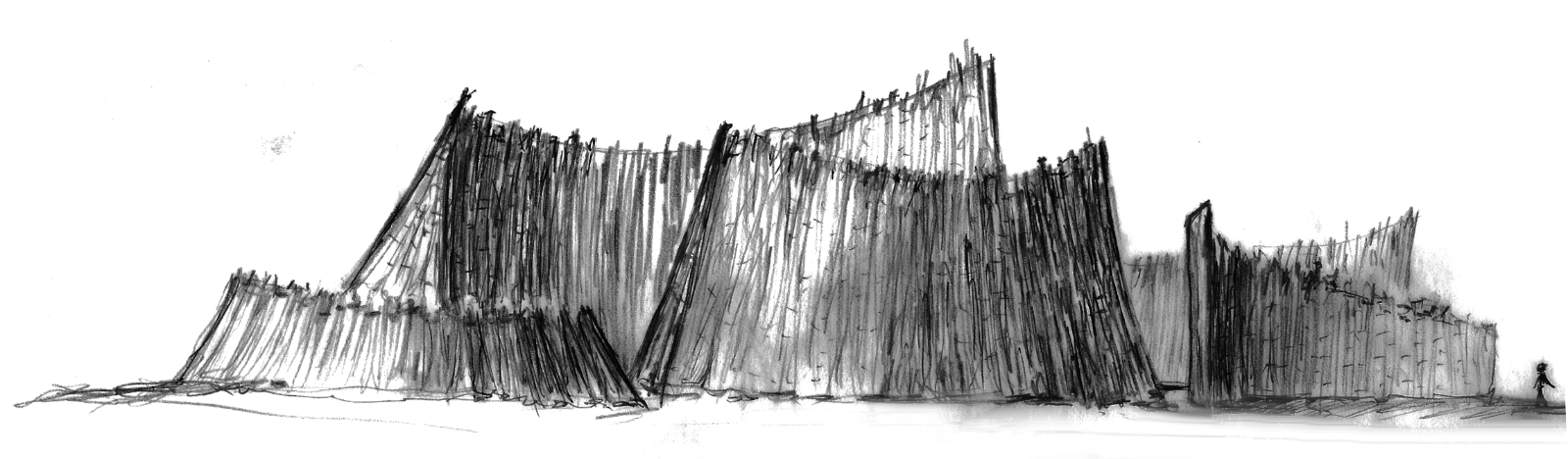
The company has not returned inquires from the Guardian made this morning. Hobbs and a crew that includes more than 200 other artists and burners have voluntarily worked almost every day this summer to build the Temple of Flux, a series of massive dunes that replicate peaks, canyons, caves, and other natural land forms – a project that I’ve been embedded with for a Guardian cover story that comes out Sept. 1.

“They will take the donations and their fees, but they won’t give us our money until we get our nonprofit status,” Hobbs told a meeting of the crew last night at the American Steel warehouse in West Oakland, where they’ve been working on the project since early June, before she and other principle artists PK Kimelman and Rebecca Anders left for the playa today. “And the IRS is so backed up they’re taking at least six months to give out nonprofit status.”

Hobbs and other Temple crew members are now scrambling for ways to support a difficult on-site build that will take more than two weeks to complete, including asking crew members for loans and encouraging everyone to put the word out to the community, hoping to find generous benefactors who can at least extend a bridge loan.

Burning Man crews and camps are traditionally informal groups, but given the scale of this project, the Temple of Flux crew this year tried to create a new model for fundraising and sustaining the organization beyond this year’s Burning Man event by filing the voluminous paperwork required to create the nonprofit Flux Foundation.

But now, PayPal has thrown the effort into a real state of financial flux, taking its cut of nearly 3 percent but refusing to even explain why the corporation has deemed it necessary to freeze the group’s finances.

UPDATE: PayPal has released the fund due to reader outcry. Read more here.

The politics of unity and division

7

steve@sfbg.com

These are strange days for the San Francisco Democratic Party, which is seeking to overcome bitter divisions on the local level and come together around candidates for statewide office that include Mayor Gavin Newsom, whose fiscal conservatism and petulant political style are the main sources of that local division.

The tension has played out recently around the Board of Supervisors deliberations on the new city budget and November ballot measures and in dramas surrounding the newly elected Democratic County Central Committee, where the battles during its July 28 inaugural meeting previewed a more significant fight over local endorsements coming up Aug. 11.

Almost every elected official in San Francisco is a Democrat. Newsom, the Democratic nominee for lieutenant governor, has been the main obstacle to new taxes that progressives and labor leaders say are desperately needed to preserve public services, deal with massive projected deficits in the next two years, and quit balancing budgets on the backs of workers.

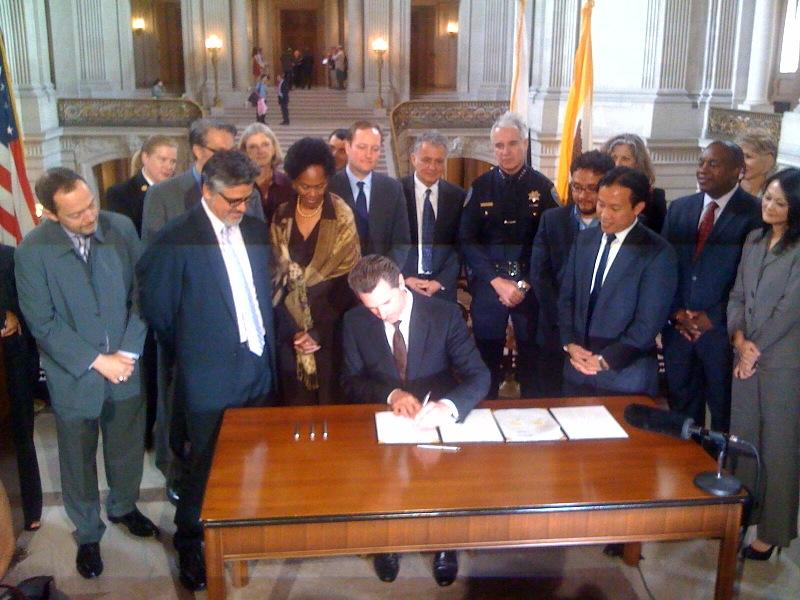
“We balanced the budget without raising taxes. I don’t believe in raising taxes. We don’t need to raise taxes,” Newsom said proudly at his July 29 budget signing ceremony, during which he also effusively praised the labor unions whose support he needs this fall: “Labor has been under attack in this state and country. They’ve become a convenient excuse for our lack of leadership in Sacramento and around the country.”

That hypocritical brand of politics has been frustrating to his fellow Democrats, particularly progressive supervisors and DCCC members. At the July 27 board meeting, Sup. Ross Mirkarimi and Board President David Chiu reluctantly dropped their pair of revenue measures that would have raised $50 million, bowing to opposition by Newsom and the business community.

The San Francisco Chamber of Commerce has become such a vehicle for antitax and antigovernment vitriol that the DCCC on July 29 approved a resolution calling for the organization — which hosted a speech by Republican National Chair Michael Steele in June — to renounce the platform of the Republican National Committee.

“The Chamber is not a knee-jerk right-wing organization,” Chamber President Steve Falk felt compelled to clarify in a July 28 letter to DCCC Chair Aaron Peskin, closing with, “Anything you can do to avoid painting the Chamber as a pawn of the GOP would be greatly appreciated — because it just isn’t true.”

Yet Rafael Mandelman, who sponsored the resolution and is a progressive supervisorial candidate in District 8, told us the Chamber’s fiscal policies are indistinguishable from those pushed by Republicans. “They’re the leading force pushing the Republican agenda in San Francisco,” Mandelman said, calling the stance short-sighted. “It’s not in the long-term interests of the business community for our public sector to fall apart.”

Chiu’s business tax reform measure is a good example of how conservative ideology seems to be trumping progressive policy, even among Democrats. Only 10 percent of businesses in the city pay any local business tax, and the measure would increase taxes on large corporations, lower them on small businesses, create private sector jobs, bring $25 million per year into the city, and expand the tax burden to 25 percent of businesses, including the large banks, insurance companies, and financial institutions that are now exempt. But even the Small Business Commission refused to support the plan, prompting Chiu to drop the proposal and tell his colleagues, “There is still not consensus about whether this should move forward.”

Sup. Chris Daly, the lone vote against the budget compromise with Newsom and the removal of revenue measures from the November ballot, noted at the July 27 board meeting how the business community has sabotaged city finances, citing its 2002 lawsuit challenging the gross receipt taxes, which the board settled on a controversial 8-3 vote. “This is a large part of our structural budget deficit,” Daly said.

But antitax sentiment has only gotten worse with the current recession and political dysfunction, causing Democrats like Newsom to parrot Republicans’ no-new-taxes mantra, much to the chagrin of progressives.

“A lot of this is being driven by statewide politics. [Newsom] needs to not have taxes go up but he also needs the support of the labor unions, so we get weird stuff happening in San Francisco,” Mandelman said.

The situation has also fed Newsom’s animus toward progressives, who have enjoyed more local electoral success than the mayor. Newsom responded in June to the progressive slate winning a majority on the DCCC by placing a measure on the November ballot that would ban local elected officeholders from serving on that body, which includes four progressive supervisors and three supervisorial candidates.

Nonetheless, Newsom then unexpectedly sought a seat on the DCCC, arguing that his lieutenant governor nomination entitled him to an ex officio seat (those held by state and federal elected Democrats) even though the DCCC’s legal counsel disagreed. While noting the hypocrisy of the request, Party Chair Aaron Peskin took the high road and proposed to change the bylaws to seat Newsom.

Some progressives privately groused about giving a seat to someone who, as DCCC member Carole Migden said at the meeting, was “picking a fight” with progressives by pushing a measure she called “disrespectful and unconstitutional.” But in practice, the episode seems to have hurt Newsom’s relations with progressives without really strengthening his political hand.

Newsom ally Scott Wiener — a DCCC member and District 8 supervisorial candidate (who told us he opposes the mayor’s DCCC ballot measure) — proposed to amend Peskin’s motion to change the bylaws in order to seat Newsom with language that would allow Newsom to continue serving even if he loses his race in November.

That amendment was defeated on a 17-13 vote that illustrated a clear dividing line between the progressive majority and the minority faction of moderates and ex officio members. Even with Newsom and District Attorney Kamala Harris (who was seated as the Democratic nominee for attorney general) being seated — and counting the one absent vote, Sen. Leland Yee, who is expected to sometimes vote with progressives and sometimes with moderates — progressives still hold the majority going into the process of endorsing local candidates and allocating party resources for the fall campaign.

“Presuming that 17 people of that 33-member body all agree on something, then the presence of Mayor Newsom doesn’t change anything,” Peskin said. He also noted that even if Newsom’s measure passed and the progressive supervisors were removed, “the irony is that the chair of the party [Peskin] would appoint their successors.”

Also ironic is the political reality that it is Newsom who most needs his party’s support right now, while it is progressives who are adopting the most conciliatory tone.

“We should all be working to turn out the vote and help Democrats win,” Peskin told us. “I implore our mayor and lieutenant gubernatorial candidate to work with us and get that done.”

Yet after Newsom gave a budget-signing speech that included the line, “At the end of the day, it comes down to leadership, stewardship, collaboration, partnership,” he told the Guardian that he has no intention of removing or explaining his DCCC ballot measure, saying only, “If the voters support it, then it would be the right thing to do.”

Chiu responded to the news by telling us, “I hope the mayor can move beyond the politics of personality and build a party vehicle that is about unity.”

A new community congress

0

EDITORIAL The first time a group of activists from across San Francisco met in a Community Congress, it was 1975 and the city was in trouble. Runaway downtown development was creating massive displacement and threatening the quality of life. Rents were rising and tenants were facing eviction. An energy crisis had left residents and businesses with soaring power bills. The manifesto of the Congress laid out the problem:

"Every poor and working class community in San Francisco has learned the hard way that its interests are at the bottom of the list as far as City Hall is concerned. At the top of the list are the banks, real estate interests, and large corporations, who view San Francisco not as a place for people to live and work and raise families, but as a corporate headquarters city and playground for corporate executives. By using their vast financial resources, they have been able to persuade local government officials that office buildings, hotels, and luxury apartments are more important than blue-collar industry, low-cost housing and decent public services and facilities."

The Community Congress hammered out a platform — a 40-page document that pretty much defined what progressive San Francisco believed in and wanted for the city. It included district elections of supervisors, rent control, public power, a requirement that developers build affordable housing, and a sunshine ordinance — in fact, much of what the left has accomplished in this town in the past 35 years was first outlined in that document.

Beyond the details, what the platform said was profound: it suggested that the people of San Francisco could reimagine their city, that local government could become a force for social and economic change on the local level, even when politics in Washington and Sacramento were lagging behind. It called for a new relationship between San Franciscans and their city government and looked not just at what was wrong, but what was possible.

That’s something that too often gets lost in political debate today. With urban finances in total collapse, the progressives are on defense much of the time, trying to save the basic safety net and preserve essential programs and services. It seems as if there’s little opportunity to talk about a comprehensive alternative vision for San Francisco.

But bad times are great times to try new ideas — and when the second Community Congress convenes Aug. 14 and 15 at the University of San Francisco, that’s exactly what they’ll be trying to do. It’s not going to be easy — the left in San Francisco has always been fractious, and there’s no consensus on a lot of central issues. But if the Community Congress attracts a broad enough constituency and develops a coherent platform that can guide future political organizing efforts, it will have made a huge contribution to the city.

The event also offers the potential for the creation of a permanent progressive organization that can serve as a forum for discussion, debate, and action on a wide range of issues. That’s something the San Francisco left has never had. Sup. Chris Daly tried to create that sort of organization but it never really worked out. The city’s full of activist groups — the Tenants Union, the Harvey Milk LGBT Club, the Sierra Club, and many others — that work on important issues and generally agree on things, but there’s no umbrella group that can knit all those causes together. It may be an impossible dream, but it’s worth discussing.

The organizers of the Community Congress discuss some of their agenda in the accompanying piece on this page. It should be based on a vision of what a city like San Francisco can be. Think about it:

This can be a city where economic development is about encouraging small businesses and start-ups, where public money goes to finance neighborhood enterprises instead of subsidizing massive projects.

This can be a city where planning is driven by what the people who live here want for their community, not by what big developers can make a profit doing.

This can be a city where housing is a right, not a privilege, where new residential construction is designed to be affordable for the people who work here.

This can be a city where renewable energy powers nearly all the needs of residents and businesses and where the public controls the electricity grid.

This can be a city where the wealthy pay the same level of taxes that rich people paid in this country before the Reagan era, where the individuals and corporations that have gotten filthy rich off Republican tax cuts give back a little bit to a city that is proud of its liberal Democratic values.

This can be a city where it’s safe to walk and bike on the streets and where clean, reliable buses and trains have priority over cars.

This can be a city where all kids get a good education in public schools.

Despite all the economic woes, this is one of the richest cities in one of the richest countries in the history of human civilization. There are no economic or physical or scientific or structural constraints to reimagining the city. The only obstacles are political.

In the next two years, control of City Hall will change dramatically. Five seats on the Board of Supervisors are up in November, and the mayor’s office is open the year after that. The progressives have made great progress in the past few years — but downtown is gearing up to try to reverse those advances. The community congress needs to address not just the battle ahead, but describe the outcome and explain why San Francisco’s future is worth fighting for.

A new community congress

2

Bad times are great times to try new ideas – the second Community Congress convenes Aug. 14 and 15 at the University of San Francisco

EDITORIAL The first time a group of activists from across San Francisco met in a Community Congress, it was 1975 and the city was in trouble. Runaway downtown development was creating massive displacement and threatening the quality of life. Rents were rising and tenants were facing eviction. An energy crisis had left residents and businesses with soaring power bills. The manifesto of the Congress laid out the problem:

“Every poor and working class community in San Francisco has learned the hard way that its interests are at the bottom of the list as far as City Hall is concerned. At the top of the list are the banks, real estate interests, and large corporations, who view San Francisco not as a place for people to live and work and raise families, but as a corporate headquarters city and playground for corporate executives. By using their vast financial resources, they have been able to persuade local government officials that office buildings, hotels, and luxury apartments are more important than blue-collar industry, low-cost housing and decent public services and facilities.”

The Community Congress hammered out a platform — a 40-page document that pretty much defined what progressive San Francisco believed in and wanted for the city. It included district elections of supervisors, rent control, public power, a requirement that developers build affordable housing, and a sunshine ordinance — in fact, much of what the left has accomplished in this town in the past 35 years was first outlined in that document.

Beyond the details, what the platform said was profound: it suggested that the people of San Francisco could reimagine their city, that local government could become a force for social and economic change on the local level, even when politics in Washington and Sacramento were lagging behind. It called for a new relationship between San Franciscans and their city government and looked not just at what was wrong, but what was possible.

That’s something that too often gets lost in political debate today. With urban finances in total collapse, the progressives are on defense much of the time, trying to save the basic safety net and preserve essential programs and services. It seems as if there’s little opportunity to talk about a comprehensive alternative vision for San Francisco.

But bad times are great times to try new ideas — and when the second Community Congress convenes Aug. 14 and 15 at the University of San Francisco, that’s exactly what they’ll be trying to do. It’s not going to be easy — the left in San Francisco has always been fractious, and there’s no consensus on a lot of central issues. But if the Community Congress attracts a broad enough constituency and develops a coherent platform that can guide future political organizing efforts, it will have made a huge contribution to the city.

The event also offers the potential for the creation of a permanent progressive organization that can serve as a forum for discussion, debate, and action on a wide range of issues. That’s something the San Francisco left has never had. Sup. Chris Daly tried to create that sort of organization but it never really worked out. The city’s full of activist groups — the Tenants Union, the Harvey Milk LGBT Club, the Sierra Club, and many others — that work on important issues and generally agree on things, but there’s no umbrella group that can knit all those causes together. It may be an impossible dream, but it’s worth discussing.

The organizers of the Community Congress discuss some of their agenda in the accompanying piece on this page. It should be based on a vision of what a city like San Francisco can be. Think about it:

This can be a city where economic development is about encouraging small businesses and start-ups, where public money goes to finance neighborhood enterprises instead of subsidizing massive projects.

This can be a city where planning is driven by what the people who live here want for their community, not by what big developers can make a profit doing.

This can be a city where housing is a right, not a privilege, where new residential construction is designed to be affordable for the people who work here.

This can be a city where renewable energy powers nearly all the needs of residents and businesses and where the public controls the electricity grid.

This can be a city where the wealthy pay the same level of taxes that rich people paid in this country before the Reagan era, where the individuals and corporations that have gotten filthy rich off Republican tax cuts give back a little bit to a city that is proud of its liberal Democratic values.

This can be a city where it’s safe to walk and bike on the streets and where clean, reliable buses and trains have priority over cars.

This can be a city where all kids get a good education in public schools.

Despite all the economic woes, this is one of the richest cities in one of the richest countries in the history of human civilization. There are no economic or physical or scientific or structural constraints to reimagining the city. The only obstacles are political.

In the next two years, control of City Hall will change dramatically. Five seats on the Board of Supervisors are up in November, and the mayor’s office is open the year after that. The progressives have made great progress in the past few years — but downtown is gearing up to try to reverse those advances. The community congress needs to address not just the battle ahead, but describe the outcome and explain why San Francisco’s future is worth fighting for.

Newsom’s budget and DCCC hypocrisy

9

Hypocrisy hung thickly in the air at City Hall today as Mayor Gavin Newsom refused to responsively address glaring contradictions on a pair of high-profile policy stances, pursuing naked self interest while cloaking himself in deceptive but high-minded rhetoric. Newsom used the city budget-signing ceremony to effusively praise the labor unions that he publicly shamed into giving back $250 million over two years to balance the budget without tax increases, a budget that cut services and increased various fees and fines.

“Labor has been under attack in this state and country. They’ve become a convenient excuse for our lack of leadership in Sacramento and around the country,” Newsom said without blushing, defending unions against pension reform measures such as Public Defender Jeff Adachi’s SF Smart Reform, which he opposes while continuing to support the need for pension reform.

But Newsom seemed unaware that the layoffs, forced furloughs, and voluntary pay cuts accepted by the unions that he publicly demonized just a couple months ago and now praises – whose support he needs for his current run for lieutenant governor – is connected to his steadfast opposition to new taxes, which he reiterated today: “We balanced the budget without raising taxes. I don’t believe in raising taxes, we don’t need to raise taxes.”

Despite the fact that just 10 percent of San Francisco businesses pay any business taxes to the city, Newsom opposed and this week helped kill a measure by Board President David Chiu to reform the business tax system in a way that would increase taxes on large corporations, lower them on small businesses, create private sector jobs, bring $25 million per year into the city, and expand the tax burden to 25 percent of businesses, including the large banks, insurance companies, and financial institutions that are now exempt. Instead, labor took a deep hit and the city still faces projected $500 million budget deficits each of the next two fiscal years.

But Newsom’s hypocrisy isn’t confined fiscal issues. After the ceremony, he told reporters that he was sticking by his November ballot measure to ban local elected officials from serving on the Democratic County Central Committee, even after last night insisting that body give him a seat, which they had to change the bylaws to accommodate.

At last night’s DCCC meeting, members of an elected committee that includes four progressive supervisors and three current supervisorial candidates called for Newsom or his proxy John Shanley to explain why he is pushing a policy to ban locally elected officials from serving on the DCCC, a body in which elected state and federal officials automatically get seats.

“This mayor is on record as saying local officials should not serve on the committee,” Sup. David Campos said at the meeting, calling for Newsom to clarify this policy contradiction and offer his reasoning for the policy: “We don’t want to do anything that is inconsistent with what the mayor has said so far.”

Chair Aaron Peskin translated Campos’s comments as indicating “some level of irony or hypocrisy,” but Campos objected, insisting “it’s not a personal attack” but a genuine desire to know why Newsom sought to ban local elected officials after progressives won a majority of the DCCC seats in June.

Both Shanley last night and Newsom today gave the same legalistic answers, noting that he’s not serving in his capacity as the mayor, but as an ex officio member who automatically gets a seat for being the Democratic nominee for a statewide office (although the DCCC legal counsel said Newsom wasn’t entitled to a seat because the bylaws only award a seat when the current holder of the office being sought is a Democrat).

But DCCC member Carole Migden objected to Shanley’s answer, saying of Newsom’s effort to unseat duly elected members, “That’s picking a fight, if we want to be clear…That effects my vote, I have to say. It’s disrespectful and unconstitutional.”

DCCC member David Chiu noted that Newsom’s ballot measure would explicitly ban supervisors and the mayor from serving on the DCCC and said that the mayor still had a few days before the deadline for him to withdraw the measure, which he single-handedly placed on the ballot using his authority as mayor.

But today, when asked by the Guardian, Newsom said he had no intention of either withdrawing the measure or explaining it to the DCCC. When we asked about the contradiction in his positions, Newsom said only, “If the voters support it then it would be the right thing to do.”

He was similarly dismissive when other reporters continued to ask about the controversy, gesturing toward me with a dismissive wave of his hand as he said, “Certain people with certain newspapers major in the minor.”

After being told that Newsom is sticking by his DCCC ballot measure, Chiu told us, “I hope the mayor can move beyond the politics of personality and build a party vehicle that is about unity.”


Board progressives ditch their own tax measures

5

After failing to win support from the small business community for a measure that would have helped it and fearing a well-funded attack from large corporations, Board of Supervisors President David Chiu today made the motion to reject his business tax reform ballot measure.
Labor leaders have also raised concerns about not having enough resources to fight for several revenue measures on the November ballot, mostly because they are focused on approving a hotel tax increase, supporting progressive supervisorial candidates, and defeating Jeff Adachi’s measure to increase how much city employees pay for health care and into their pensions.
“There is still not consensus about whether this should move forward,” Chiu said of his measure, which also suffered from being complicated and not easy to explain in an election campaign. It would have created a more progressive payroll tax structure – increasing taxes on large corporations and lowering them on small businesses – and a commercial rent tax that also would have exempted small businesses, raising about $25 million for the city and creating hundreds of private sector jobs, according to the city’s Office of Economic Analysis.
But the fear among some progressives is that too many revenue proposals would hurt their individual chances, given that the ballot will now include a hotel tax increase, a real estate transfer tax on properties worth more than $5 million (which the board approved today on an 8-3 vote), a $10 local surcharge on vehicle license fees, and a parcel tax from the Community College District.
So Sup. Ross Mirkarimi today also abandoned his proposal to increase the city’s parking tax from 25 percent to 35 percent, which would have raised about $25 million per year. Both Chiu and Mirkarimi said their measures were good policy and would have raised desperately needed revenue, but they were bowing to political reality.
“We’re challenged by the practicality of mounting a fall campaign around these revenue measures,” Mirkarimi said at the meeting.
The board voted 10-1 to table both measures, with a dissenting vote by Sup. Chris Daly, who said, “I just disagree with that political analysis.” He said voters would consider the measures individually and “I don’t think disappearing a progressive payroll tax and progressive parking tax are going to help the real estate transfer tax.”

Arrests made as hotel workers and their supporters target Hyatt

5

Images by Ramsey El-Qare, who contributed to this report.

An ongoing labor conflict between the hospitality workers union Unite-Here Local 2 and the Hyatt Corporation boiled over into the streets yesterday (7/22) with a union-organized protest and civil disobedience outside the Grand Hyatt San Francisco hotel. Union leaders see the action as another step in the fight for their members’ workplace rights. Hotel management called the action a staged spectacle and a waste of energy that would be better spent at the bargaining table.
San Francisco hospitality workers have been without a contract for nearly a year as Local 2 and hotel management of several corporations have reached an impasse over securing health care benefits, pension improvement, wage increases, and the right to organize without intimidation from employers. San Francisco Police Department Sgt. Tadao Yamaguchi confirmed that 150 demonstrators were arrested after blocking Stockton Street outside the Grand Hyatt San Francisco hotel. All were cited and released.

“The Hyatt Corporation has repeatedly said they want workers to pay hundreds of dollars per month for family medical,” Local 2 spokeswoman Riddhi Mehta told the Guardian. “Workers have sacrificed wages for decades to keep health care, to the point that their average income is $30,000 to $35,000 per year.”

Hyatt spokesman Peter Hillman told the Guardian that management wants to renegotiate the health care portion of the contract, but that negotiations hadn’t reached the point to make specific demands for worker contributions to the plan.

“They are sitting on top of $35 million that could be used to help address the overall health care plan that hasn’t been addressed in 30 years,” Hillman told us. “If there is finger pointing on profits and all that, I would ask them why they haven’t opened up that?”

Mehta told the Guardian that $35 million is in an health and welfare trust fund specifically for emergencies, like earthquakes or lockouts in which union members aren’t working enough hours to get health benefits. Local 2 President Mike Casey told the Guardian that the union does not control the trust fund. It’s managed by trustees from both employers and the union. “Bringing this up is it’s a delay tactic on their part,” Mehta said.

Casey, who was arrested during the demonstration, said it was a success. “We’re going to win,” he said. “It’s going to take some time. It’s a question of who’s going to last one day longer than the other side.”

“The game Unite Here is playing is to generate more union membership, to some extent at the expense of the current membership,” Hillman said. “These are staged spectacles. The energy would be better spent at the bargaining table and we encourage Local 2 to come back to that.”

To watch video of the action taken by the Guardian, click here, here, here, here, and here.


Small biz should support Chiu tax plan

0

EDITORIAL It’s rare to see a fairly conservative city agency, created in part to make it harder for progressives to push measures that might affect business, come down in favor of a new business tax. But the San Francisco Office of Economic Analysis has concluded that the proposal by Board of Supervisors President David Chiu to change the local payroll tax and impose a new tax on commercial rents would actually help local businesses, particularly small businesses. The proposal presents a crucial opportunity for progressives to make the case that the Chamber of Commerce and big downtown corporations are not advancing the interests of small businesses — and local merchant groups need to pay attention.

Chiu has taken on a problem that has lingered in San Francisco for decades. The city’s business tax is terribly regressive: Only 10 percent of the companies in town even pay the payroll tax, in part because banks, insurance companies, and financial services firms are exempt under state law. That means the burden falls the heaviest on small and medium-sized companies — the ones that provide most of the net job growth in the city.

The new proposal would make the flat payroll tax more progressive and would exempt more small businesses. It would also raise $28 million more a year for the cash-strapped municipal coffers by taxing commercial rents of more than $60,000 a year.

The commercial rent levy would force the big outfits that now pay no city taxes whatsoever to take on at least some of the burden of financing San Francisco government. Smaller companies with modest leases, and small commercial landlords, wouldn’t pay the new tax at all.

Chiu originally had proposed an even broader tax, which would have raised more than $35 million. But after the Small Business Commission expressed concerns, he changed the measure, reducing the burden on small business even further. And at this point, Ted Egan, the city’s chief economist at the Office of Economic Analysis, reports that the tax would lead to greater job creation in the private sector (because of the reduction in the payroll tax) as well as greater job creation in the public sector (because of the additional revenue to the city).

It’s the kind of idea that ought to have broad-based support — progressives looking to fund crucial services see it as a way to bring in money, and small businesses ought to see it as a way to cut taxes and create jobs in the sector of the city that most needs economic stimulus.

Unfortunately, the response from small business leaders hasn’t been encouraging. The commission hasn’t taken a stand on the measure; on July 12th, the panel deadlocked 2-2, with one member absent and two slots still vacant (the mayor hasn’t filled them). That lets the big downtown players — the Chamber, the Building Owners and Managers Association, the Committee on JOBS, etc. — in a position to claim that the Chiu proposal is anti-business.

We’ve seen this pattern far to often. Small business groups allow big corporations, which have no interest in the real issues that impact local merchants, stick the little folks out front on political issues. We’ve seen it over the years with public power, commercial rent control, downtown development, and taxes — and it needs to stop.

The Small Business Commission, the Council of District Merchants, all the local community merchant groups, and anyone else who really cares about the interests of small business in San Francisco should support the Chiu measure. It’s a tax plan that’s good for small business. And if the advocates don’t realize that, they’re hurting themselves, the customers, and the city.

Small biz should support Chiu tax plan

2

A new proposal to make the flat payroll tax more progressive and exempt more small businesses

EDITORIAL It’s rare to see a fairly conservative city agency, created in part to make it harder for progressives to push measures that might affect business, come down in favor of a new business tax. But the San Francisco Office of Economic Analysis has concluded that the proposal by Board of Supervisors President David Chiu to change the local payroll tax and impose a new tax on commercial rents would actually help local businesses, particularly small businesses. The proposal presents a crucial opportunity for progressives to make the case that the Chamber of Commerce and big downtown corporations are not advancing the interests of small businesses — and local merchant groups need to pay attention.

Chiu has taken on a problem that has lingered in San Francisco for decades. The city’s business tax is terribly regressive: Only 10 percent of the companies in town even pay the payroll tax, in part because banks, insurance companies, and financial services firms are exempt under state law. That means the burden falls the heaviest on small and medium-sized companies — the ones that provide most of the net job growth in the city.

The new proposal would make the flat payroll tax more progressive and would exempt more small businesses. It would also raise $28 million more a year for the cash-strapped municipal coffers by taxing commercial rents of more than $60,000 a year.

The commercial rent levy would force the big outfits that now pay no city taxes whatsoever to take on at least some of the burden of financing San Francisco government. Smaller companies with modest leases, and small commercial landlords, wouldn’t pay the new tax at all.

Chiu originally had proposed an even broader tax, which would have raised more than $35 million. But after the Small Business Commission expressed concerns, he changed the measure, reducing the burden on small business even further. And at this point, Ted Egan, the city’s chief economist at the Office of Economic Analysis, reports that the tax would lead to greater job creation in the private sector (because of the reduction in the payroll tax) as well as greater job creation in the public sector (because of the additional revenue to the city).

It’s the kind of idea that ought to have broad-based support — progressives looking to fund crucial services see it as a way to bring in money, and small businesses ought to see it as a way to cut taxes and create jobs in the sector of the city that most needs economic stimulus.

Unfortunately, the response from small business leaders hasn’t been encouraging. The commission hasn’t taken a stand on the measure; on July 12th, the panel deadlocked 2-2, with one member absent and two slots still vacant (the mayor hasn’t filled them). That lets the big downtown players — the Chamber, the Building Owners and Managers Association, the Committee on JOBS, etc. — in a position to claim that the Chiu proposal is anti-business.

We’ve seen this pattern far too often. Small business groups allow big corporations, which have no interest in the real issues that impact local merchants, stick the little folks out front on political issues. We’ve seen it over the years with public power, commercial rent control, downtown development, and taxes — and it needs to stop.

The Small Business Commission, the Council of District Merchants, all the local community merchant groups, and anyone else who really cares about the interests of small business in San Francisco should support the Chiu measure. It’s a tax plan that’s good for small business. And if the advocates don’t realize that, they’re hurting themselves, the customers, and the city.

Bad faith

3

steve@sfbg.com

Mayor Gavin Newsom and his business allies are actively trying to sabotage the various revenue measures that have been put forth by the labor movement and progressive members of the Board of Supervisors, employing deceptive rhetoric, sneaky tactics, and a refusal to bargain in good faith.

In fact, Newsom — the Democratic nominee for lieutenant governor — is so averse to supporting anything that could be called a “tax” that he rejected a hard-won compromise measure created by powerful developers, affordable housing advocates, a pro-business think tank, the building trades, and his own directors of housing and economic development.

Just as that story was breaking in the New York Times (produced by Bay Citizen) on July 9, members of the Board of Supervisors Budget and Finance Committee discovered that Newsom’s proposed ballot measure to close loopholes in the city’s hotel tax that favored airline employees and online travel companies — a widely supported change, but one worth just $6 million per year — contains language that would nullify any increases in the hotel tax. Earlier in the week, labor unions turned in signatures on an initiative to increase the hotel tax by 2 percent, which would bring in more than $30 million per year.

“This poison pill is an intentionally deceptive, underhanded move,” Gabriel Haaland, an organizer with Service Employees International Union Local 1021, which sponsored the hotel tax, told us. “It’s so frustrating. It’s not even a good faith fight. He’s trying to create confusion and fool the voters. If our measure passes fair and square, it should be implemented.”

Meanwhile, Newsom and business groups have been attacking a reform measure by Board President David Chiu that would make the currently flat payroll tax more progressive, exempt more small businesses from paying it, and create a commercial rent tax to spread the tax burden more widely than the 10 percent of businesses who now pay tax to the city.

Critics complained that the measure would hurt local businesses — but that’s just not true. The city’s Office of Economic Analysis concluded that Chiu’s original proposal would have no effect on private sector jobs and would generate $34 million annually for the city, preserving some government jobs and spending.

Then Chiu amended the measure to spare even more small businesses. Now the OEA says that the measure would actually create private sector jobs — and still bring $28 million in to the city. Yet Newsom and the business community are still withholding their support.

This trio of Machiavellian moves comes just a week after Newsom pulled out of budget negotiations with board progressives concerning about $40 million in board add-backs to programs that Newsom proposed to cut after they wouldn’t agree to his precondition that they withdraw unrelated measures proposed for the November ballot, such as splitting appointments to the Rent, Recreation and Park, and Municipal Transportation Agency boards and requiring police officers to do foot patrols.

The series of events has led many progressives to say that conservative ideological blinders — a knee-jerk opposition to anything that saves government jobs and services or that Republicans might criticize — is the only logical explanation for the intransigent stance adopted downtown and by Newsom.

“It’s ideological. It’s not economic, and it’s not even political,” said Calvin Welch, the affordable housing activist who helped negotiate the transfer tax compromise with developer Oz Erickson, San Francisco Planning Urban Research Association director Gabriel Metcalf, Mayor’s Office of Housing Director Doug Shoemaker, and others.

That measure would have created a transfer tax on sales of properties over $875,000 and generated approximately $50 million annually for affordable housing (funds that were drastically reduced in Newsom’s proposed 2010-11 budget) while cutting in half the current requirements and fees on market-rate developers to create below-market-rate units. The plan would have stimulated both types of housing and created desperately needed construction work — an approach those involved called an elegant solution to several problems.

“To me, this was a win-win, solving two problems that are each a big deal,” Metcalf told us. “I don’t know what his reasons were for not supporting it. I was surprised.”

But Welch said, “It collapsed straight up because the mayor didn’t want to support a tax.” Although Newsom told the Times it was because there wasn’t broad enough consensus yet, “the mayor’s reason is whole-cloth bullshit,” Welch said, noting the role of the Mayor’s Office in brokering the deal. “The mayor walks away from it because everyone wasn’t in the room? Well, it’s your room, motherfucker. Show some leadership.”

Newsom Press Secretary Tony Winnicker refused to discuss these issues by phone, responding to our written inquires by noting that Newsom opposes taxes and thinks the best way to address budget deficits are privatizing city services and pension reform (although he opposes Public Defender Jeff Adachi’s initiative, the only pension reform measure on the fall ballot).

“The mayor is opposed to the Board of Supervisors’ proposals to increase taxes because they’re not needed to balance the budget and they will strangle our still young economic recovery,” Winnicker wrote, refusing to answer follow-up questions or support a statement about Chiu’s measure that the OEA concludes is not accurate.

Like many political observers of all stripes, those from downtown and progressive circles, Welch criticized Newsom for his lack of engagement with city business and its long-term fiscal outlook, contrasting him with former Mayor Willie Brown, who met regularly with former Board of Supervisors President Tom Ammiano even as the two ran a bitter campaign for mayor against one another in 1999. “They dealt with the city’s business like two adults who cared about the city,” he said.

Welch acknowledged that there was still work to be done building political support for the transfer tax measure. He and other progressives would have had to win over city employee unions who wouldn’t like the budget set-aside aspect, and Erickson and Metcalf would need to placate some of their downtown allies who oppose taxes on ideological grounds. But given how downtown groups are behaving right now, that might not have been an easy sell.

“There are members of the small business community that are averse to any taxes,” said Regina Dick-Endrizzi, director of the city’s Office of Small Business and staffer to the Small Business Commission, which was withholding a recommendation on the Chiu measure but planned to meet again to consider it July 12 (look for an update on the sfbg.com Politics blog). She said the small business community is having tough times and “they are just not sensitive to keeping city workers employed.”

Larger commercial interests are being even more forceful in opposing the revenue measures. While a parade of workers, social service providers, and progressive activists testifying at the July 9 Budget Committee hearing implored supervisors to place all the proposed revenue measures on the ballot, representatives from the Building Owners and Managers Association (BOMA) and San Francisco Chamber of Commerce were the only two speakers urging supervisors to drop the measures and focus instead on creating private sector jobs.

“You’re trying to create a little revenue here and it’s not going to work,” said Ken Cleaveland, director of BOMA SF, arguing that big banks and financial services companies — entities exempt from the payroll tax that Chiu is hoping to target with the commercial rent tax — will buy their buildings to avoid paying the tax. “They aren’t going to create more jobs and they really aren’t going to create more revenue.”

Yet Chiu noted that it was the business community and fiscal conservatives who pushed to create the Office of Economic Analysis, whose work they have regularly used to attack progressive legislation. Now that the office has concluded that a piece of progressive legislation is good for the local economy, Chiu told Cleaveland and the Chamber spokesperson Rob Black at the hearing, “I ask you to respect the work this office has done.”

Black said the Chamber board will consider Chiu’s amended legislation, but said businesses are in no mood to help the city. “How many times have you gone to your neighborhood merchant and had them say, ‘Gee, my rent’s too cheap’?<0x2009>” he said during his testimony.

Yet Chiu said landlords of small tenants (those paying less than $65,000 in rent per year) are exempt from the rent tax and only 26 percent of SF businesses would pay any city business tax under his plan. “I hope the mayor will support this proposal and the business community will give it a good look,” Chiu said as the hearing ended.

At the beginning of the hearing, Chiu framed the dire situation facing San Francisco, citing Controller’s Office figures showing this year’s $500 million budget deficit (out of a $6 billion total budget) will be followed by a $700 million deficit next year and a $800 million gap the following budget cycle as a result of a deep structural budget imbalance.

“We have budget deficits as far as the eye can see,” Chiu said at the hearing. “We have to consider measures that will provide more stable sources of revenue.”

He also noted that city employee unions have agreed to give back about $250 million in salary and had their ranks reduced by about 2,000 workers in the last two years. So he and the other progressive supervisors say it’s time for the rest of San Francisco to help address the problem.

“We, as a city, should not be trying to balance this budget simply through cutting,” Sup. David Campos said.

Sup. John Avalos, the committee chair, amended his transfer tax measure in the wake of Newsom’s rejection of the deal by making it a simple 2 percent tax on properties that sell for more than $5 million, and 2.5 percent tax on properties over $10 million. He estimates it will bring in about $25 million per year from the city’s wealthiest corporations and landlords.

“That’s who we’re socking it to,” Avalos told us, saying he was disappointed the compromise fell through. “The amendment is going to be more progressive than what was originally planned.”

Even Sup. Sean Elsbernd, a strong fiscal conservative who announced early in the hearing, “You want to do that [balance future budgets] by adding taxes, but I want to do it through ongoing service cuts,” later told the Guardian that he was intrigued by the amendments Avalos and Chiu made to their measures and has not yet taken a position on them.

Sup. Ross Mirkarimi is also sponsoring a measure to increase the city’s tax on parking lot operators from 25 percent to 35 percent, the first change to that tax in 30 years, and will include valet parking for the first time. The measure would bring in up to $24 million per year, and OEA analysis shows it would decrease the number of cars trips by 1.3 percent, another benefit.

SFMTA supports the measure, with board member Cameron Beach testifying that the money will be used to subsidize Muni and “it links the use of private automobiles and is consistent with the city’s transit-first policy.” Mirkarimi, who chairs the Transportation Authority, also has proposed a $10 local vehicle license fee surcharge that would bring in another $5 million per year for Muni.

All the revenue measures require six votes by the full Board of Supervisors, which is scheduled to consider them July 20, after which they would need a simple majority approval by voters in November to take effect.

The mayor has the authority to directly place measures on the ballot, so the committee hearing on his hotel tax loophole measure and a $39 million general obligation bond that he’s proposing to create a revolving loan fund for private sector seismic improvements were mere formalities, so supervisors criticized aspects of each but were unable to make changes.

Avalos even grudgingly acknowledged the hotel tax poison pill was an effective way to kill that revenue source, saying at the hearing, “This is very smart. I don’t agree with it, but it’s very smart.”

Haaland was less charitable, criticizing a provision designed to confuse voters. “This kind of move means both measures won’t pass because now we have to oppose [Newsom’s measure],” he said, criticizing the mayor for running away from the hard decisions facing the city. “He won’t be around next year, when we have an even bigger structural budget deficit, to clean up this mess. Absent new revenue sources, this city starts to fall apart.”


Taming finance in an age of austerity

1

By Joseph E. Stiglitz

NEW YORK – It was not long ago that we could say, “We are all Keynesians now.” The financial sector and its free-market ideology had brought the world to the brink of ruin. Markets clearly were not self-correcting. Deregulation had proven to be a dismal failure.

The “innovations” unleashed by modern finance did not lead to higher long-term efficiency, faster growth, or more prosperity for all. Instead, they were designed to circumvent accounting standards and to evade and avoid taxes that are required to finance the public investments in infrastructure and technology – like the Internet – that underlie real growth, not the phantom growth promoted by the financial sector.

The financial sector pontificated not only about how to create a dynamic economy, but also about what to do in the event of a recession (which, according to their ideology, could be caused only by a failure of government, not of markets). Whenever an economy enters recession, revenues fall, and expenditures – say, for unemployment benefits – increase. So deficits grow.

Financial-sector deficit hawks said that governments should focus on eliminating deficits, preferably by cutting back on expenditures. The reduced deficits would restore confidence, which would restore investment – and thus growth. But, as plausible as this line of reasoning may sound, the historical evidence repeatedly refutes it.

When US President Herbert Hoover tried that recipe, it helped transform the 1929 stock-market crash into the Great Depression. When the International Monetary Fund tried the same formula in East Asia in 1997, downturns became recessions, and recessions became depressions.

The reasoning behind such episodes is based on a flawed analogy. A household that owes more money than it can easily repay needs to cut back on spending. But when a government does that, output and incomes decline, unemployment increases, and the ability to repay may actually decrease. What is true for a family is not true for a country.

More sophisticated advocates warn that government spending will drive up interest rates, thus “crowding out” private investment. When the economy is at full employment, this is a legitimate concern. But not now: given extraordinarily low long-term interest rates, no serious economist raises the “crowding out” issue nowadays.

In Europe, especially Germany, and in some quarters in the US, as government deficits and debt grow, so, too, do calls for increased austerity. If heeded, as appears to be the case in many countries, the results will be disastrous, especially given the fragility of the recovery. Growth will slow, with Europe and/or America possibly even slipping back into recession.

Stimulus spending, the deficit hawks’ favorite bogeyman, did not cause most of the increased deficits and debt, which are the result of “automatic stabilizers” – the tax cuts and spending increases that automatically accompany economic fluctuations. So, as austerity undermines growth, debt reduction will be marginal at best.

Keynesian economics worked: if not for stimulus measures and automatic stabilizers, the recession would have been far deeper and longer, and unemployment much higher. This does not mean that we should ignore the level of debt. But what matters is long-term debt.

There is a simple Keynesian recipe: First, shift spending away from unproductive uses – such as wars in Afghanistan and Iraq, or unconditional bank bailouts that do not revive lending – toward high-return investments. Second, encourage spending and promote equity and efficiency by raising taxes on corporations that don’t reinvest, for example, and lowering them on those that do, or by raising taxes on speculative capital gains (say, in real estate) and on carbon- and pollution-intensive energy, while cutting taxes for lower-income payers.

There are other measures that might help. For example, governments should help banks that lend to small- and medium-size enterprises, which are the main source of job creation – or establish new financial institutions that would do so – rather than supporting big banks that make their money from derivatives and abusive credit card practices.

Financial markets have worked hard to create a system that enforces their views: with free and open capital markets, a small country can be flooded with funds one moment, only to be charged high interest rates – or cut off completely – soon thereafter. In such circumstances, small countries seemingly have no choice: financial markets’ diktat on austerity, lest they be punished by withdrawal of financing.

But financial markets are a harsh and fickle taskmaster. The day after Spain announced its austerity package, its bonds were downgraded. The problem was not a lack of confidence that the Spanish government would fulfill its promises, but too much confidence that it would, and that this would reduce growth and increase unemployment from its already intolerable level of 20%. In short, having gotten the world into its current economic mess, financial markets are now saying to countries like Greece and Spain: damned if you don’t cut back on spending, but damned if you do as well.

Finance is a means to an end, not an end in itself. It is supposed to serve the interests of the rest of society, not the other way around. Taming financial markets will not be easy, but it can and must be done, through a combination of taxation and regulation – and, if necessary, government stepping in to fill some of the breaches (as it already does in the case of lending to small- and medium-size enterprises.)

Unsurprisingly, financial markets do not want to be tamed. They like the way things have been working, and why shouldn’t they? In countries with corrupt and imperfect democracies, they have the wherewithal to resist change. Fortunately, citizens in Europe and America have lost patience. The process of tempering and taming has begun. But there is far more yet to do.

Joseph E. Stiglitz is University Professor at Columbia University and a Nobel laureate in Economics. His latest book, Freefall: Free Markets and the Sinking of the Global Economy, is now available in French, German, Japanese, and Spanish.

Copyright: Project Syndicate, 2010.
www.project-syndicate.org
For a podcast of this commentary in English, please use this link:
http://media.blubrry.com/ps/media.libsyn.com/media/ps/stiglitz127.mp3

SF business community just opposes government

21

Mayor Gavin Newsom and his business community allies often accuse progressive members of the Board of Supervisors of being too “ideological” in their proposals, particularly when they involve revenue or regulations. But a looming battle over reforming the city’s business tax – one of three new revenues set for a special Budget & Finance Committee meeting tomorrow (7/9) at 11:30 am – shows that an ideological aversion to taxes of any kind drive Newsom and the business community more than their stated concern for “jobs” and the “economy.”

Board of Supervisors President David Chiu crafted his measure – which creates a progressive structure for the currently flat payroll taxes and uses small commercial rent tax to spread the tax burden among more businesses (only 10 percent of which now pay the payroll tax) — specifically to decrease the business tax burden on small businesses and protect private sector jobs while also bringing in about $35 million more into the city, which will save some city jobs and thus help the local economy.

City Economist Ted Egan and the Office of Economic Analysis confirmed that Chiu’s carefully crafted measure does just that, noting that it was based on recommendations made last month in a report by his office and two private accounting firms that was jointly commissioned by both Chiu and Newsom.

“The proposed legislation modifies the Progressive Payroll option in the Controller’s report, to achieve greater revenue growth while minimizing private sector job growth,” concludes Egan’s analysis. And that’s the idea of this legislation, to save some city jobs and services without hurting the private sector. Egan found this tax reform would on balance have no impact on private sector jobs.

But the Small Business Commission, driven by anti-government zealots in their community, wants even greater concessions and to minimize government revenues, demands that Chiu is now considering giving in to, with sources close to the negotiations saying they will amend the plan to exempt more small businesses and lower the revenue projection to more like $28 million.

“There are members of the small business community that are averse to any taxes,” Regina Dick-Endrizzi, director of the city’s Office of Small Business (which staffs the commission), told us.

She said the commission isn’t opposing or supporting the measure, and while she said the business community isn’t ideologically opposed to government, she did admit that “they are just not sensitive to keeping city workers employed.”

And that’s a terribly selfish and self-defeating attitude that hurts the local economy and the services we all depend on. The problem is the small business community — which is supported by the Bay Guardian and beloved by all as a key job creator — is being used by conservative ideologues and large corporations and lured into joining their anti-government crusade. This has to change, and this legislation is a good opportunity to talk about the real ideological barriers that are hindering common sense solutions to this city’s problems.

Ungodly deeds

0

news@sfbg.com

The Catholic Church claims to value charity and justice, but recent local conflicts over cutting off child care for low-income families and refusing to pay millions of dollars in taxes to cash-strapped San Francisco city government — as well as the ongoing priest pedophilia cover-up cases — cast doubt over the church’s commitment to those in need.

The San Francisco Catholic Archdiocese has said it will close the Children’s Village Development Center in August, displacing 110 children enrolled in the program and leaving 100 families — a third of them low-income — scrambling for hard-to-find childcare providers.

The Archdiocese also sold other surrounding properties because it could not afford to retrofit its buildings for earthquakes, selling them to developers Chris Harney and Tom Murphy. Both the church and the developers rejected efforts by Children’s Village parents, who formed the nonprofit Supporting Early Experience and Development (SEED), to temporarily lease the building.

Dan Dillon, a representative for Harney and Murphy, told the Guardian that they decided to reject SEED’s leasing offer because they had already made a deal with a tenant who was willing to offer more money. Dillon wouldn’t identify the tenant, but he said the new tenant would use the building without major modifications, which might have triggered a need for city permits and a public hearing.

Catholic Charities CYO, an agency of the Archdiocese that oversees programs such as the Children’s Village program, closed the center because it wasn’t making money. The city gave about $1.5 million in grants and loans to support childcare for poor families at Children’s Village, with most of the money coming from the Low Income Investment Fund.

According to Catholic Charities’ official statement on the dispute, it tried to maintain the program by cutting slots for low income families in an effort to subsidize the program. There was still not enough money to fund the program. Catholic Charities representative Gabrielle Slanina told us that the tough economy and internal budget cuts hurt their ability to continue providing childcare at the site.

“The program hasn’t been financially sustainable over the years,” Slanina told us. “Sustainability just wasn’t turning around. But we tried to keep it going for as long as we could.”

Catholic Charities still plans to later build a new $1 million children development center three blocks away on the corner of 10th and Mission streets. But SEED members are left in the lurch for now, causing them to question the validity of Catholic Charities’ mission to “support, stabilize, and strengthen families.”

Dee Dee Workman, a consultant helping SEED, was disappointed with the Archdiocese’s bottom-line approach to helping local families. “They have not attempted to secure slots with these families,” Workman told us. “They don’t care about these kids. It’s just about the money, and it’s immoral.”

SEED member Sabrina Qutb, who has a three-year-old son enrolled in Children’s Village, said she sees the new center as a waste of money. “I do not believe the city should continue to fund Catholic Charities child care programs,” Qutb told us. “Who’s to say they won’t drop 10th and Mission in a few years and waste even more of the city’s money?”

Many child care programs have waiting lists up to two years in a city where there are more than twice as many children under 13 with working parents as there are licensed child care slots, according to a study prepared for the city by the California Child Care Resources and Referral Network. Child care slots for infants are among the fewest, making up only 6 percent of the 17,894 child care center slots in the city. Preschool children ages two to five years old occupy 63 percent of the child care slots.

SEED member Kathryn Shantz put her two-year-old daughter on a waiting list for another child care facility immediately after the announcement of Children’s Village closure. “I’m 104 on the waiting list for the Yerba Buena Child Development Center,” Shantz said. “I’ve been on the wait-list for a year, and they basically told me that there’s no way I’m getting in.”

Meanwhile, while the city supported the church’s child care program, the church is still stiffing the city on its tax bill. On April 16, the Archdiocese filed a suit in the San Francisco Superior Court against Assessor-Recorder Phil Ting. The suit challenges a Transfer Tax Review Board ruling last November which held that the Archdiocese owed the city $14.4 million after transferring 232 parcels of property among three Archdiocese corporations in 2008 without paying the required transfer taxes attached to those vacant lots, parking lots, apartments, commercial buildings, parishes, and schools. This is the second-largest transfer tax bill in San Francisco history.

Repeated calls to the Archdiocese of San Francisco were not returned. In a press release, the Archdiocese said that it “maintains that to impose transfer taxes, penalties, and interest on a religious organization in connection with an internal restructuring involving no exchange or receipt of money from which to pay any tax is inequitable and threatens to confiscate substantial church assets that are devoted to religious purposes.”

The next court date for this case is scheduled for Sept. 17. This recent lawsuit and the sale of Archdiocese properties come at a time when the church is facing the possibility of paying out big settlements in cases involving sexual abuse by priests.

Survivor Network of Those Abused by Priests (SNAP) Northern California Regional Office representative Joey Piscitelli said that if victims weren’t so afraid to report their abuse, the Archdiocese would owe its victims even more money. “Ninety-eight percent of victims never report the abuse, and the average person reports the abuse 25 years after the incident,” Piscitelli said. “The church brags that the clergy didn’t do it because they were never convicted, yet they’re paying billions of dollars in lawsuits.”

With the Catholic Church now facing scrutiny on so many fronts, it seems that a day of reckoning could be in its future. On June 29, the Supreme Court decided not to hear an appeal by the Vatican for immunity in a highly publicized pedophilia suit, clearing the way for the 2002 lawsuit to advance.

The plaintiff, under the name of John V. Doe, alleged that he was abused in 1965 by Father Andrew Ronan in Portland, Ore. Ronan died in 1992. The Vatican tried to kill the lawsuit by stating that it was protected under the Foreign Sovereign Immunities Act of 1976, a federal law that prevents foreign states from lawsuits.

The appeals court determined that there was an exception to the law, stating that Ronan was an employee of the Vatican and he was working under Oregon law. No one has ever won a lawsuit against the Vatican for sexual abuse allegations made by the clergy. This Supreme Court decision opens the door for future lawsuits against the Holy See.

Editor’s Notes

15

Tredmond@sfbg.com

I’m a pension-reform advocate. I think the current system is not only bad public policy, but that it’s not sustainable in the long run. But I’m not convinced that the plan proposed by Public Defender Jeff Adachi is good public policy, either — and I’m not convinced that it works in the long run.

Adachi wants to mandate that city employees pay between 9 percent and 10 percent of their salaries into the city pension fund. He also wants to make employees pay more for dependent health care. He points out that the changes would save the city around $170 million a year.

But what he’s proposing is an across-the-board pay cut for city employees — on top of the cuts they’ve already taken in the past several budget cycles — and that’s a dangerous thing to do in a recession.

Think about it. That $170 million is money that city workers won’t be spending buying food, clothes, movie tickets, restaurant meals, or any of the thousands of other things that can help get the economy going again. It won’t be a fair pay cut, either. The clerk who makes $40,000 a year will get a $4,000 cut, leaving him or her with just $36,000, while the senior manager who makes $150,000 a year will get hit with the same 10 percent cut, leaving him or her with $135,000 a year. In one case, it’s the difference between making rent and not; in the other, it’s cutting out some discretionary spending. Even the Internal Revenue Service doesn’t operate on that principle.

There’s a larger point here, too. I hear from Adachi, and from many others, that when the city is broke, when the pension system can’t meet its obligations, then everyone has to give back. Everyone has to take a haircut. Everyone has to share the pain.

But as Robert Cruickshank pointed out on the Calitics blog recently, public employees, and poor people, and middle-class private sector workers, and people who need public services, and kids who go to public schools, and college students … they’ve been giving back for years. The rich, the big corporations, the people and institutions that have fared so well under the Bush-era tax cuts … they haven’t given back a dime.

It’s true that there’s pension abuse, the vast majority of it in the management and public safety areas. There are cops who make too much money anyway, get pay bumps right before they retire, and walk away with 90 percent of their artificially inflated salaries — for life. I could see capping pensions for each pay grade, and I could see requiring people who make more than $100,000 a year to contribute more to their pension funds.

But I think it has to be done in combination with new revenue. It has to be done in combination with an acknowledgment that in this budget crisis, some parts of our city, some parts of our society, aren’t hurting at all, and are refusing to help out with anyone else’s pain. We simply are not sharing the burden equally. And until we can start to change that, I’m not so thrilled with blaming the middle-class city workers for the local budget problem.

Sparks reveals her conservativism in exchange with Walker

26

During the District 6 supervisorial candidate debate that San Francisco Young Democrats held last week, a two-question exchange between two of the leading candidates – progressive Debra Walker and downtown-backed Theresa Sparks – offered a revealing look at their starkly different worldviews and priorities, which is more important in this race than people’s machine politics conspiracy theories.

During the second portion of the event, candidates were allowed to ask a question of another candidate, and Walker and Sparks focused on one another with pointed questions (this occurred at around the 30-minute mark, although the video doesn’t seem to allow users to forward to that point, forcing you to endure the often insipid commentary).

Walker went first, asking Sparks why, during her more than four-year tenure on the Police Commission – a body in charge of disciplining police officers accused of serious misconduct after citizen complaints are investigated and found valid by the Office of Citizen Complaints, with each case assigned to a particular commissioner – Sparks didn’t hold any hearings or act to punish any officers.

Sparks said the accusation wasn’t true, and that she did hold one hearing during that time, and then said that the Police Commission is prohibited by the city charter from intervening in the internal workings of the Police Department, implying that the body isn’t actually in charge of disciplining officers. Walker said Sparks was wrong and tried to ask a follow-up question and was cut off by moderator Melissa Griffin.

So this week, I called both candidates to try to get to the bottom of the dispute. “She indicated it’s not the commission’s job to focus on these things, and that’s absolutely not the case,” Walker said. “She was incorrect saying it wasn’t the job of commissioners to do this.”

And when I talked to Sparks, she didn’t dispute that fact, but conveyed how complicated the process was when officers are accused of serious misconduct (minor misconduct just goes to the chief), with lawyers seeking stipulated settlements and whatnot, and repeatedly emphasizing “it’s a bad system.” One reason it’s so bad is her own lack of qualifications: “You can’t have people like me, whose only legal background is watching Law and Order, trying to handle these cases.”

Sparks was appointed by Mayor Gavin Newsom, who is backing her supervisorial bid, which is also expected to have strong support from the San Francisco Police Officers Association. She wouldn’t say how many cases she was assigned during her tenure, but OCC records show more than 300 cases assigned to the commission during her tenure and the long backlog left in her wake has been the subject of criticism by everyone from Police Chief George Gascon to new Police Commission Jim Hammer.

Rather than supporting this civilian oversight of problem officers, Sparks wants to turn those duties over to Gascon’s office, telling us, “We need to give this chief more authority to fire officers rather than going through this ridiculous process.”

At the debate, after seeming stung by a question she jokingly called a “softball,” Sparks fired back by asking Walker whether she supported the proposed tax measures now being considered by the Board of Supervisors to help close the city’s large budget deficit, framing the question by saying they would hurt small business.

Walker answered by voicing her support for small business, but noting how essential city services such as public health programs were being deeply cut and that the city needed new revenue to deal with its structural budget deficit, although she said that she had yet to decide which of the tax measures she supported considering none have been approved for the ballot yet.

This week, Moody’s Investor Services lowered the citys’ credit rating precisely because Newsom’s budgets have not addressed that structural budget deficit, and even the Controller’s Office has ordered more than a $100 million placed on reserve because of doubts about the mayor’s revenue assumptions.

So for Sparks to characterize the need for new revenue as an unfair attack on small business indicates a short-sighted, right-wing approach to municipal finances, an approach Walker rejects, telling us, “I think we need to be responsible and do the right thing in dealing with the city’s needs…It’s going to cost us and the people who come after us more and more because of these cuts.”

When I spoke with Sparks, noting the Moody’s report, she seemed to back away from how she was trying the characterize the revenue measures at the debate. “I do think the city needs new revenue, but I don’t think that taxing small business is the way to go,” she said, referring to a proposal by Sup. David Chiu to tax commercial rents, which would be paid by the landlords.

So I asked Sparks whether she supported any of the proposals or if she was advocating any other revenues measures, and she said, “Quite honestly, I need to think about that because I do think we need more revenue.”

Which is pretty much the same answer Walker gave in a far more honest and direct way in that debate, without trying to pander to the fears of small businesspeople. The bottom line is that the downtown corporations who are backing Sparks have done nothing to help the city during this prolonged recession, while demanding even greater police responses to deal with poor people sitting on sidewalks and other perceived problems, and that hypocrisy should be front and center in this election.