Corporations

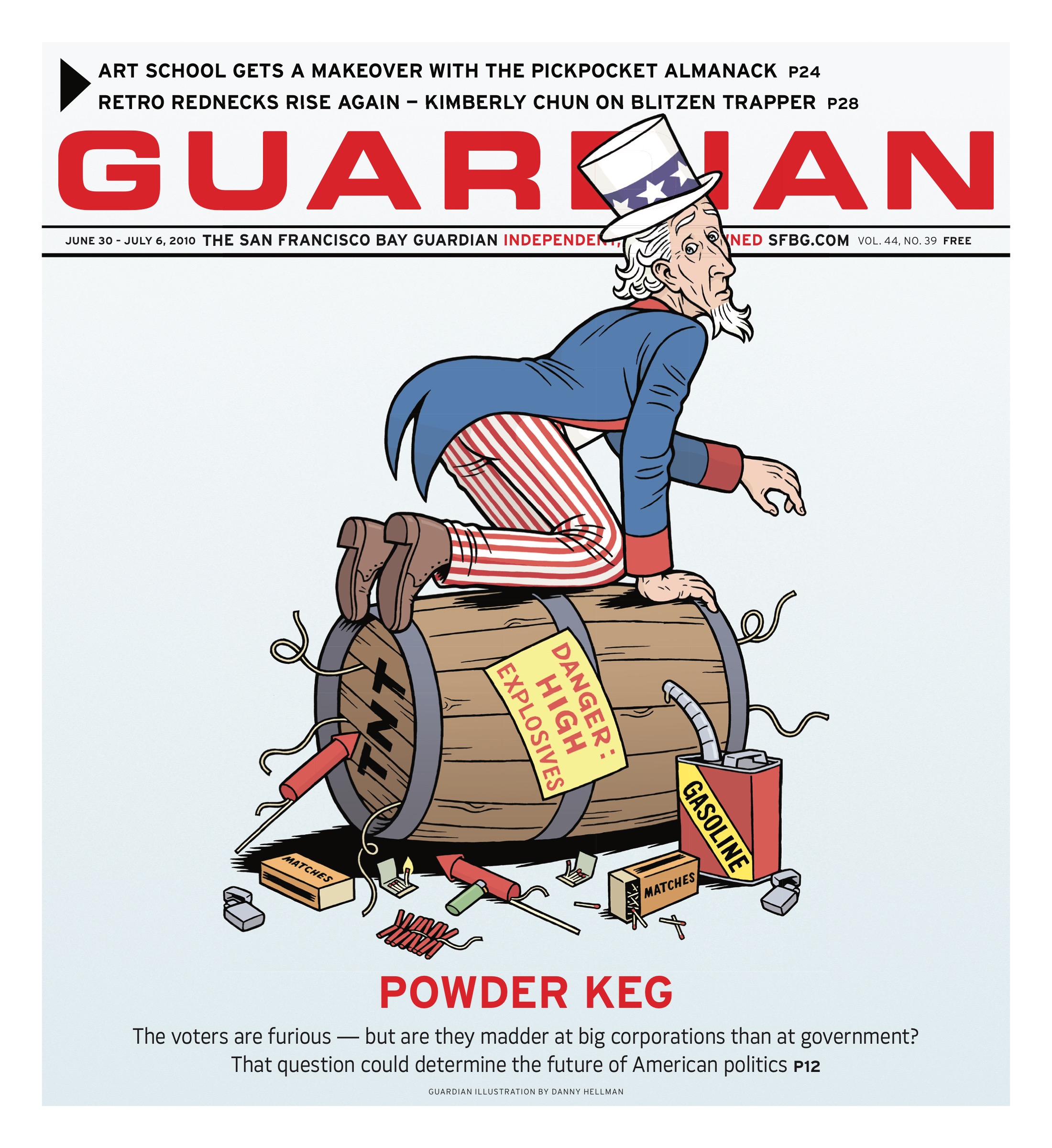
Powder keg

5

news@sfbg.com

Ask any pollster, political consultant, or academic who studies the American electorate about the mood of the voters this year and you’ll get the same one-word answer: Angry.

Everyone’s pissed — the liberals, the conservatives, the moderates, the people who don’t even know where they fit in. It’s an unsettled time and, potentially, very bad news for a progressive agenda that seeks to address issues ranging from poverty and war to the long-term health of the public and the planet.

The Democrats, who swept into power with an enormously popular president just 18 months ago, may lose control of Congress. The tea partiers have driven the Republicans so far to the right that some candidates for Senate are openly talking about eliminating Social Security. The unemployment rate — the single most important factor in the politics of the economy — remains high and doesn’t show any signs of improving.

And the progressive left seems frustrated and demoralized, particularly in California. The Golden State, which once led the nation in innovation and enlightened social policy, now seems to be leading the politically dysfunctional race to the bottom.

The nation could be headed for a dangerous era, rife with the potential for right-wing demagoguery and other nasty political schisms. The state of the economy could easily fuel a more powerful movement to shrink the scope of government and a continuing backlash against the public sector — and the financial backers of the antitax and antiregulation movement are drooling at the prospect.

But there’s also a chance for progressives to seize a populist narrative and shift the discussion away from traditional disagreements and toward those areas, particularly the destructive influence on government by powerful corporations, where the grassroots right and grassroots left might actually agree.

The anger that voters feel toward a government that isn’t meeting their needs is starting to find other outlets. People are as mad about the abuses of big business — the Wall Street meltdown, the bailouts, the BP oil spill, the political manipulation — as they are about the failures of Congress and the president. If you ask Americans of every political stripe who they least trust — big government or big business — even conservatives aren’t so sure anymore.

For 30 years, the central narrative of American politics has revolved around the size and effectiveness of government. Now there’s a chance to shift that entire debate in American politics toward the largely unchecked power of corporations. It is, populist writer Jim Hightower told us, “an enormous opportunity handed to us by the bastards.”

But so far, none of the Democratic leaders in California are taking advantage of it to start dispelling damaging myths and crafting political narratives that might begin to create some popular consensus around how to deal with society’s most pressing problems.


THE PEOPLE WANT TAXES

There have been many polls gauging voter anger, but one of the most comprehensive and interesting recent ones was “Californians and Their Government,” a collaborative study by the Public Policy Institute of California and the James Irvine Foundation that was released in May.

It shows that Californians are mad about the state’s fiscal problems, disgusted with their political leaders, divided by ideology, and deeply conflicted over the best way forward. An astounding 77 percent of respondents say California is headed in the wrong direction and 81 percent say the state budget situation is a “a big problem.”

But the anti-incumbent message isn’t necessarily an anti-government message. Most Californians are willing to put more of their cash into public-sector programs, even during this deep recession. When asked to name the most important issues facing the state, 53 percent mentioned jobs and the economy . The state budget, deficit, and taxes only got the top billing of 15 percent.

And contrary to the conventional wisdom espoused by moderate politicians and political consultants, most voters say they are willing to pay higher taxes to save vital services. “Californians tell us they continue to place a high value on education and want education to be protected from cuts. And they’re willing to commit their money to help fund that,” PPIC director Mark Baldassare told the Guardian.

The survey found that 69 percent of respondents say they would pay higher taxes to protect K-12 education from future cuts, while 54 percent each say they would pay higher taxes to prevent cuts to higher education and to health and human services programs. In other words, voters seem to recognize where we’ve cut too deeply — and where we haven’t cut enough: only 18 percent of respondents would be willing to pay higher taxes to prevent cuts to prisons and corrections.

Baldassare said the June primary results also showed that people are willing to pay more in taxes for the services they value. “Around the state, there was a lot of evidence that people responded favorably to requests by their local governments for money, particularly for schools,” he said.

Both the California Legislature and Gov. Arnold Schwarzenegger are held in very low esteem with voters, according to the PPIC study, and Schwarzenegger’s 23 percent rating is the lowest in the poll’s history.

Barbara O’Connor, political communications professor who heads the Institute for the Study of Politics and the Media at Sacramento State University, told us that voter unhappiness with elected leaders is no surprise. Right now, most people are afraid that their basic needs won’t be met over the long run.

“The common narrative is fear, and fear channels into anger,” O’Conner said.

And that fear is being tapped into strongly this year by the Republican candidates, who are trying to scare voters into embracing their promises to gut government and keep taxes as low as possible.

“If there’s any lesson to be learned from Meg and Carly’s early ads, it’s fear-mongering, fear-mongering all the time — and that doesn’t create a very positive narrative,” O’Connor said of gubernatorial candidate Meg Whitman and U.S. Senate candidate Carly Fiorina.

O’Connor noted that Barack Obama’s campaign had great success in using a positive, hopeful message and said she believes the right leader can also do so in California. “I talked to Jerry [Brown]’s people about it and said you can’t just run a negative campaign because that’s what Meg is doing.”

Despite the tenor of the times, O’Connor said she’s feeling hopeful about hope. She also believes Californians would respond well to a leader like Obama who tried to give them that hope — if only someone like Brown can pick up that mantle. “I think the environment is right for a positive message. But the question is: do we have people capable of delivering it?”

She said the no-new-taxes, dismantle-government rhetoric has started to wear thin with voters. “The real fiscal conservatives are badly outnumbered in Californian,” O’Connor said. As for the corporate sales jobs, O’Connor said voters have really started to wise up. “They aren’t going to be scammed.”

The results of the June primary election showed that voters across the spectrum were also disturbed by big special-interest money. Proposition 16, backed by $46 million from Pacific Gas and Electric Co., went down to defeat — even in counties that tend to vote Republican.

And this fall, with two rich former CEOs spending their personal wealth to win two of California’s top elected offices and energy companies pushing a measure to roll back California’s efforts to combat global warming, there could be great opportunity in a narrative targeting those at the top of our economic system.


THE TOP AND THE BOTTOM

Some observers say that whatever their shared feelings about corporate scams, conservatives and liberals in the state are just too far apart, and that there’s little hope for any substantive agreement. “People are becoming more polarized,” said consultant David Latterman, who often works for downtown candidates and interests. “I think we’re beyond compromise.”

Allen Hoffenblum, a Los Angeles-based Republican strategist, agreed. “The voter are all mad, but they’re mad at different things. I just don’t see where they come together.”

But Hightower, who has spent a lifetime in politics as a journalist, elected official, author, and commentator, has a different analysis.

“As I’ve rambled through life,” he wrote in a recent essay, “I’ve observed that the true political spectrum in our society does not range from right to left, but from top to bottom. This is how America’s economic and political systems really shake out, with each of us located somewhere up or down that spectrum, mostly down.

“Right to left is political theory; top to bottom is the reality we actually experience in our lives every day — and the vast majority of Americans know that they’re not even within shouting distance of the moneyed powers that rule from the top of both systems, whether those elites call themselves conservatives or liberals.”

In an interview, he told us he sees a lot of hope in the fractured and potentially explosive political ethos. “There’s all this anger,” he said. “People don’t know what to do. And I think the one focus that makes sense is the arrogance and abuse of corporate executives.”

In fact, Hightower pointed out, the teabaggers didn’t start out as part of the Republican machinery. “Wall Street and the bailouts sparked the tea bag explosion,” he said. It wasn’t until big right-wing outfits like the Koch brothers, who own oil and timber interests and fund conservative think tanks, started quietly funding tea party rallies that the anti-corporate, anti-imperial edge came off that particular populist uprising.

“At first, the teabaggers didn’t even know where the money was coming from,” Hightower said. “You can’t be mad at the teabaggers; we should have been out there organizing them first.”

There’s plenty of evidence that anger at big business is growing rapidly — and rivals the distrust of big government that has defined so much of American politics in the past 30 years. The bailouts were “the first time in a long time that people have been slapped in the face by collusion between big business and its Washington puppets,” Hightower noted.

Then there’s the Supreme Court decision in Citizens United v. Federal Elections Commission. In January, a sharply divided court ruled 5-4 that corporations had the right to spend unlimited amounts of money supporting or opposing political candidates. Progressives were, of course, outraged — but conservatives were, too.

Polls show that more than 80 percent of Democrats think the decision should be overturned. So do 76 percent of Republicans. “This is a winner for our side,” Hightower noted. “But our side’s not doing anything about it.”

Sure, President Obama denounced the ruling in his State of the Union speech and promised reform. But the bill the Democrats have offered in response does nothing to stop the flow of money; it would only increase disclosure requirements. And in response to furor from the National Rifle Association, it’s been amended and is now so full of holes that it doesn’t do much of anything.

Political consultants advising Whitman are clearly looking for ways to direct the voter unhappiness into a demand for lower taxes and smaller budgets. She’s already vowed to fire 40,000 state workers, and her most recent campaign ad attacks Brown for expanding public programs and raising the state deficit.

So far Brown hasn’t challenged that narrative — and some Democrats say he shouldn’t. It would be safer, they say, for Brown to get out front and demand his own cuts in Sacramento. “Going after public-sector pensions is a winner,” one Democratic campaign consultant, who asked not to be named, told us. “If Whitman beats Brown on those issues, she wins.”

But that approach is never going to be effective for Democrats. If the argument is over who can better cut government spending, the GOP candidates will always win. The better approach is to see if progressives can’t shift the debate — and the anger — toward the private sector.

As Hightower put it: “You can yell yourself red-faced at Congress critters you don’t like and demand a government so small that it’d fit in the backroom of Billy Bob’s Bait Shop and Sushi Stand, but you won’t be touching the corporate and financial powers behind the throne.”

That’s where the discussion has to start. And there’s no better place than California.

The Golden State is a great example of what happens when the tax- cutters win. In 1978, the liberals in Sacramento, operating with a huge state budget surplus, couldn’t figure out how to derail the populist anger of property tax hikes. So Proposition 13, the beginning of the great tax revolt, passed overwhelmingly. Over the next decade, more antitax initiatives went before the voters, and all were approved.

Now the state is heading toward fiscal disaster. The schools are among the worst-funded in the nation. The world-famous University of California system is on the brink of collapse. Community colleges are turning away students. The credit rating on California bonds have fallen so far that it’s hard for the state to borrow money. And there’s still a huge budget gap.

The tax-cut mentality that led to the so-called Reagan revolution started in California; a political movement that shifts the blame for many of the state’s problems away from government and onto big business ought to be able to start here as well. And it’s potentially a movement that could bring together people who normally find themselves on opposite sides of the fence.

A case in point: the measure the oil companies have put on the November ballot to repeal the state’s greenhouse gas limits. The corporations backing the initiative, led by Valero, argue that California’s attempts to slow climate change will cost jobs. That’s a line we’ve heard for decades. Every tax cut, every move toward deregulation, is defended as helping spur job growth.

But the past four presidents have done nothing but cut taxes and reduce regulations — and the result is facing Americans on the streets every day. There is also growing evidence that even Republican voters don’t believe everything big businesses tell them anymore. And they’re starting to grasp that sometimes deregulation leads to outcomes like larcenous CEOs and unstoppable oil leaks.

So the potential for a successful progressive populist movement is out there. But it’s not going to happen by spontaneous combustion.


SF SHOWS THE WAY

On the national level, one of the factors creating this gloomy electorate is the failure of President Obama to keep the coalition that elected him active and engaged. The intense partisanship in Washinton has turned off many independent Obama voters, while his progressive supporters have been disappointed by issues ranging from his escalation in Afghanistan to tepid reforms on health care and Wall Street.

“One of the narratives now is where are the Obama voters and will they participate?” Jim Stearns, a San Francisco political consultant who works mostly on progressive campaigns, told us. “They still love Obama but they’re not moved by him anymore.”

Perhaps more important, they have lost the sense of hope that he once instilled. The Republican Party’s descent into right-wing extremism and the strong anticorporate narratives that have emerged in the last year — from BP’s oil spill to PG&E’s political manipulation to Goldman Sachs’ self-dealing to the prospect of unrestricted corporate campaign propaganda unleashed by the Citizens United ruling — have created the possibility that the negative narratives by the left may crowd out the positive ones.

“Meg Whitman is someone you can hate. She’s the rich Republican CEO trying to buy her way into office,” Stearns said. “But it’s a depressing message.”

But Stearns said there is another, most hopeful political narrative that is emerging in San Francisco, one that might eventually grow into a model that could be used at the state and federal levels. “We’re lucky in San Francisco. Progressive voters are engaged.”

He noted that San Francisco’s voter turnout was higher than expected in the June primary, and far higher than the record low state number, even though there really weren’t any exciting propositions or closely contested races on the local ballot — except for the Democratic County Central Committee, where progressives maintained their newfound control. And it’s because of the organizing and coalition-building that the left has done.

“What you’ve seen over the last few years is a coalition of labor, neighborhood groups, environmentalists, and the progressives now operating through the Democratic Party. That’s a great coalition with a lot for people to trust,” Stearns said.

Meanwhile, downtown has all but collapsed as a unified political force. “They don’t really have a political infrastructure,” Stearns said of downtown. “Normally it would be the mayor who gets everyone in line and working together.”

Even Latterman, the downtown-oriented consultant, agrees that the business community is no longer setting San Francisco’s agenda because it’s become fractured and unable to push a consistent political narrative: “There’s certainly been a lack of coordination.”

He also agrees that progressives have become more organized and effective. “Clearly, the Democratic Party of San Francisco has become a conduit for progressive politics and politicians, but not issues,” Latterman said. “What a lot of people get wrong in the city is the difference between politics and policy.”

Part of the reason is economic. With scarce resources, a high threshold for approving new revenue sources, and a fiscally conservative mayor unwilling to talk taxes, it’s been difficult to move a progressive agenda for San Francisco. And in Sacramento, it’s barely part of the discussions.

“The people of California have been held hostage by a handful of Republicans who are making us cut everything we care about,” while in San Francisco “Newsom is taking an entirely Republican approach to the budget,” Stearns said.

Looking toward the fall races, Stearns said the progressive coalition and majority on the Board of Supervisors will be tested on issues such as Muni reform, and the question will be whether fiscal conservatives like Sup. Sean Elsbernd can blame Muni’s problems on drivers, or whether progressives can create and sell a broader package that includes new revenue and governance reforms.

“The drivers are going to get their guarantee taken out of the charter, that’s going to happen. But people know that isn’t all that’s wrong with Muni,” Stearns said.

But to craft a more comprehensive solution, he said the progressives are going to need to use their growing coalition to connect the dots for voters. “We need to run a citywide campaign around a whole constellation of issues,” Stearns said, citing Muni, schools, taxes, resistance to mean-spirited measures like sit-lie, and the larger issues raised by the Brown and Barbara Boxer campaigns. “We need to figure out a way to put all that in the same coalition and run one campaign around it. And we can do that because progressives retained control of the DCCC.”


THE STRUGGLE AHEAD

Although they’ve made great strides, San Francisco progressives are still struggling with a mayor who sees the solution to every budget crisis as cuts — and with a growing number of efforts to blame public employees for the city’s fiscal problems. Even Jeff Adachi, the public defender once considered a standard-bearer for progressive causes, is pushing a ballot measure that would require city workers to pay more for their pensions.

Gabriel Haaland, who works with Service Employees International Union Local 1021, made the right point in the pension debate. “Big financial institutions crashed the stock market,” he said recently, “and now they want to blame city workers.”

In a blog post on the political website Calitics, Robert Cruickshank put it clearly: “The notion that ‘everyone needs to give back’ just doesn’t make sense given our economic distress. We’ve already given back too much. We gave back our wages. We gave back our ability to afford health care and housing and transportation. We gave back the robust public- sector services that created widespread prosperity in the 1950s and 1960s. We gave back affordable, quality education. And too many of us have given back our future.

“No, it’s time for someone else to give back. It’s time for the wealthiest Californians and the large corporations to give back. For 30 years now they have benefited from economic policy designed to take money and benefits from the rest of us and give it to those who already have wealth and power.”

That’s a message that ought to appeal to anyone who’s hurting from this recession. It ought to cross red and blue lines. It ought to be the mantra of a new progressive populism that can channel voter anger toward the proper target: the big corporations that created the problems that are making us all miserable.

If Jerry Brown could adopt that narrative, he could change the state of California — and the state of the nation.


Calvin Trillin, Deadline Poet

0

As Elena Kagan’s Confirmation Hearing Approaches, We’re Reminded of John Robert’s Promise to Be an Umpire Calling Balls and Strikes

By Calvin Trillin

Regardless of which laws he likes,

He’s only calling balls and strikes.

Of balls and strikes that he has eyed,

The union pitches all look wide.

When criminal defendants try

To throw a strike, it’s always high.

Consumers make for easy calls:

Their pitches simply all are balls.

By chance, the pitches that are great-

The ones that nick or split the plate;

The ones deserving of ovations-

Are pitched by cops or corporations.

A left-wing lawyer sharp as Darrow

Will find the strike zone much too narrow.

Behind it, crouching, is the Chief,

Quite confident in his belief:

Regardless of which laws he likes,

He’s only calling balls and strikes.

From the Nation’s June 7, 2010 issue.

What the “Defund ACORN Act” is really about

13

Last September, the US Congress approved the Defund ACORN Act without investigating the charges leveled against ACORN.

Bertha Lewis, ACORN’s CEO, claims that these charges were nothing more than a massive “propaganda campaign” and that ACORN was targeted because it was successful at organizing low-income communities–the very folks that rich corporate interests don’t want to see voting and otherwise standing up for their rights.

Now with a hearing scheduled for June 24, Lewis is asking folks to stand up and fight what she describes as an assault on the Constitution itself.

“Congress’ move, singling out one organization for sanctions without investigation, is called a “bill of attainder” and it is expressly prohibited by the Constitution of the United States,” Lewis stated in a press release issued today.

” If this attack is allowed to stand, then any other organization that displeases those with power in the United States can be similarly attacked and, potentially, destroyed,” Lewis said.

As she notes, ACORN has been investigated by four separate and independent, sources – former Massachusetts Attorney General Scott Harshbarger; the Brooklyn District Attorney’s office; the California Attorney General; and the Government Accountability Office (GAO).

“Each of them has cleared ACORN of any wrongdoing,” Lewis observed. “ Three investigations reviewing the videos used to attack ACORN determined that they were “splice jobs” in which “the truth is on the cutting room floor”. The fourth, from the GAO, concluded that ACORN had not misused any of the Federal funds it had received. In other words, the entire set of attacks was a witch hunt driven using modern propaganda techniques and with millions of dollars in dedicated air time on a “news” channel and talk radio.”

Lewis thinks she knows why these attacks happened.

” We were simply too good at what we did – engaging low- and moderate-income families and families of color in America’s democratic system,” she said. “ If we hadn’t helped 860,000 new voters get on the voter rolls since 2004 (we believe this is the largest non-partisan voter registration effort ever carried out by a single non-profit organization), if we hadn’t helped raise the minimum wage in seven states, if we hadn’t blown the whistle about predatory lending in the sub-prime market back in 1999, and if we hadn’t brought in over $15 billion in direct benefits to America’s low- and moderate-income neighborhoods from 1994 – 2004, then we wouldn’t have been the targets of smears and attacks going back to the 2004 election. Smears that were exposed during the height of the scandal surrounding the firing of US Attorneys like David Iglesias in New Mexico, who refused to trump up phony voter fraud charges against ACORN.”

Lewis comments that if the attacks leveled against ACORN had really been about misusing taxpayer dollars, then defense contractors like Xe (formerly Blackwater), Halliburton, and Kaman Dayron, all of whom have been found guilty of either committing actual crimes or of collectively defrauding the American people of hundreds of millions of dollars, would have been the subject of their own Defund Corporate Criminals Act.

”But, of course, they aren’t,” Lewis concluded.  Because, unlike ACORN’s low- and moderate-income membership, these corporations can buy influence in the highest levels of political power in the United States. So, our lawsuit against the unconstitutional Defund ACORN Act is not about ACORN and its past federal funding. It is about justice for all organizations that fight for the interests of regular folks against the most powerful interests in America.”

The insanity of cutting pensions

15


The New York Times has picked up the pension-reform banner, promoting the issue to the lead story on the front page of the June 20th issue.


If, as the Times reports, some of the reformers want to cap pensions – that is, go for the folks at the very top of the pile – it’s worth discussing. But most of the “reform” ideas involve either cutting the take-home pay of existing employees, cutting the take-home pay of pensioners or making sure that future workers don’t get as much of a pension.
The problem with that is simple: We’re in a deep recession. And the last thing we need to do is cut paychecks and encourage people not to spend money.


Let me quote from a brilliant blog post on Calitics.com from the always insightful Robert Cruickshank:


Cutting pensions would be like taking a shotgun, aiming it at our feet, and pulling the trigger. It would cause a cascade of economic problems that would dramatically worsen our economic crisis…


And yet the solution being proposed – slashing benefits – will do absolutely nothing to make state government fiscally solvent. It will mean there’s less money available to spend, meaning less sales tax revenue. Less consumer activity means there’ll be less jobs available, meaning less income tax revenue. With fewer jobs available, and wage stagnation, and now the added financial burden of paying the costs of retired family members that used to be borne by the pensions and other state services that have been cut, younger folks won’t be able to sustain the economy. Retirees and baby boomers will have to sell their homes for the cash, and in a recessionary environment where the young aren’t able to afford the present market value, home values will spiral downward, causing further economic ripple effects as well as reducing property tax revenues.
 
… The notion that ‘everyone needs to give back’ just doesn’t make sense given our economic distress. We’ve already given back too much. We gave back our wages. We gave back our ability to afford health care and housing and transportation. We gave back the robust public sector services that created widespread prosperity in the 1950s and 1960s. We gave back affordable, quality education. And too many of us have given back our future.
No, it’s time for someone else to give back. It’s time for the wealthiest Californians, and the large corporations, to give back. For 30 years now they have benefited from economic policy designed to take money and benefits from the rest of us and give it to those who already have wealth and power.
We are now experiencing the predictable outcome of such policies – the worst recession in 60 years, an intractable downturn. The way out isn’t to worsen the crisis by slashing pensions. The way out is to return to the sensible tax rates of the 1950s and 1960s and make the rich pay.


That’s what I’m talking about.

Voters are pissed

0

By Guardian News Staff

news@sfbg.com

After spending more than $70 million, two big corporations failed to convince Californians to vote their way. After spending nearly $70 million, the former head of a big corporation easily convinced Californians to vote her way. And that outcome is not as schizophrenic as it sounds.

On one level, the outcome of the June 8 election was a sign of the anti-corporate anger seething through the California electorate. “BP, Goldman Sachs, PG&E — anything that seems connected to a big corporation is in serious trouble right now,” one political insider, who asked not to be named, told us.

Yet two candidates who were very much corporate icons — Meg Whitman and Carly Fiorina — won handily in the Republican primaries and now have a real chance to become the state’s next governor and junior senator. What’s happening? It’s fascinating. The voters in the nation’s most populous state are pissed off — at big business, at government, at the oil spill, at 10 percent unemployment, at Washington, at Sacramento, at Wall Street. It’s an unsettled electorate, uncertain about its future and looking for something new, and definitely despising power.

There’s a populist fervor out there, and it’s going to define this fall’s expensive, dirty, and high-stakes battle for California’s future.


THE MAYOR GOES STATEWIDE

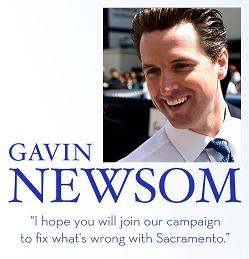
Addressing a crowd of supporters gathered at Yoshi’s San Francisco on election night, San Francisco Mayor Gavin Newsom — who easily beat opponent Janice Hahn to claim the Democratic nomination for lieutenant governor — said he was excited to be part of a crucial political year for the Golden State.

“We’re very proud to be in a position to be the Democratic nominee and to work with the other Democratic nominees,” Newsom told supporters. He lavished praise on the Democratic nominee for governor, Jerry Brown — the man who just last year he was trying to beat in a primary — telling stories about his father’s long relationship with the former governor and expressing his admiration. “I couldn’t be more proud to quasi- be on a ticket with Jerry Brown,” he said.

The race for lieutenant governor may prove one of the most interesting this election season — and not just because a victory for Newsom would transform San Francisco politics. Newsom’s opponent is Abel Maldonado, a moderate Republican who enjoys popularity among the growing, influential Latino community, and who Newsom’s team said will be a formidable challenge.

The campaign could revolve around an intriguing question. At a time when the Republican Party has been taken over by virulent anti-immigrant politicians — Whitman and Fiorina have both made harsh statements about illegal immigrants and vowed never to support “amnesty” (that is, immigration reform) — will Latino voters go for a white Democrat over a Latino Republican?

“You talk to them about all the same issues you talk to all voters about: jobs, education, and health care,” Newsom political strategist Dan Newman said when asked whether Newsom could win over Latino voters. “Latinos, like all voters, will appreciate someone with a proven record of success.”

Pollster Ben Tulchin also downplayed the trouble Newsom could encounter in winning the Latino vote. “With what’s going on in Arizona, they are very wary of Republicans,” Tulchin said, but then added: “We don’t want to underestimate the challenge we have. There’s never been a moderate Latino on the statewide ballot.”

Newsom sounded another alarm. If Whitman decides to help Maldonado, the race will get even tougher. “We’re running against Meg Whitman’s checkbook,” the mayor said.

“Expect to see Meg and Abel together a whole lot in the next few months,” one consultant predicted.

If Newsom wins, San Francisco will get a new mayor a year early — and the district-elected Board of Supervisors will choose the person to fill out the last year of Newsom’s term. Technically, the current board will still be in office then, but the task may well fall to the next board — which makes the local November elections even more important.

“Everyone is gaming this out and trying to figure out what happens,” political consultant Alex Clemens said during a post-election wrap-up at the San Francisco Planning and Urban Research Association office. “There will be a lot of dominoes to fall and deals to be cut.”

Meanwhile, Newsom’s nomination for lieutenant governor places many San Franciscans in an uncomfortable position, one that was illustrated well by Newsom’s victory speech, in which he proudly rejected taxes. Although most San Francisco progressives are disenchanted with their fiscally conservative mayor, few would rather vote for Maldonado.

Tim Paulson, the SF Labor Council president, was at the Newsom event gritting his teeth as he talked about the opportunity progressives now have to work with “a mayor of San Francisco we have issues with.” Now, he noted, “There is going to be a real campaign around this man. It could establish a narrative for what California is about.”


POWERFUL WOMEN

At Delancey Street on election night, San Francisco District Attorney Kamala Harris talked about getting “tough and smart on crime,” addressing gang-related criminal activity but also focusing on corporate criminals. She talked about cracking down on predatory lenders, supporting health care reform, and protecting California’s environment. And she made a point of dragging in BP.

“It must be the work of the next attorney general to ensure that the disaster and tragedy that happened in the Gulf of Mexico never happens in California,” she said, warning of attacks on AB 32, which set California’s 2020 greenhouse gas emissions reduction goal into law in 2006.

Of course, Harris now has to take on her southern counterpart, Los Angeles DA Steve Cooley, who is a moderate but comes in with much stronger law enforcement support. If Harris wins, it will go a long way to prove that opposition to the death penalty isn’t fatal in California politics, and that voters are finally ready for a women of color as the top law enforcement official — a first in state history.

But she and Newsom will both have to overcome likely attacks for the San Francisco’s crime lab scandal, one of many hits to be magnified by the size of Whitman’s war chest.

Whitman, who trounced opponent Steve Poizner in the primary, is riding the crest of a new wave of Republican-style “feminism,” starring her, Fiorina, and Fox news pundit Sarah Palin as female champions of the right-wing agenda. A few short months ago, it looked as if Brown was in serious trouble. But that was before Whitman and Insurance Commissioner Steve Poizner got into an $85 million bloodbath that left the winner of the GOP primary badly wounded. Whitman wants to play off the populist uprising by portraying herself as an outsider running against a career politician; Poizner gave her a huge scare by hammering her ties to Goldman Sachs.

That Wall Street narrative is one Democrats will push against Whitman and Fiorina. “I think it is stunningly politically tone deaf to nominate two Wall Street CEOs to the top of the ticket,” Newman said. Voters will decide whether they are fresh voices with new ideas or corporate hacks who laid off Californians and made fortunes with dubious stock market deals.

Brown leads in the polls — narrowly — but he’s vulnerable. He’s taken so many stands over so many years and Whitman’s fortune will hammer any openings they see. Brown is only slowly getting into campaign mode, but it’s no secret what he has to do. If the campaign is about Jerry Brown, unconventional politician, against Meg Whitman, Wall Street darling, then he wins.

But to take advantage of that, Brown has to offer some concrete solutions to the state’s problems — and he has to start acting like the progressive he once was. “If I were him, I’d run hard to the left,” a consultant who isn’t involved in any of the gubernatorial campaigns said.

The conventional wisdom had Barbara Boxer in trouble, too — but she’s a savvy campaigner who has beaten the odds before. And while the senator appears ripe for attack — almost 30 years in Washington, a voting record perhaps a bit more liberal than the state as a whole — her opponent, Fiorina, has baggage too.

For starters, Fiorina’s entire pitch is that she — like Whitman — would bring business-world savvy to politics. But as CEO of HP, “she was about perks and pink slips,” Newman said. “She laid off Californians and shipped those jobs overseas while enriching herself.”

Her own primary pushed her far to the right (at one point, in an embarrassing sop to the National Rifle Association, she actually argued that suspected terrorists on the federal no-fly list should be able to buy handguns). And speaking of feminist values, her anti-abortion positions won’t help her in a decidedly pro-choice state.


PROP. 16 GOES DOWN

The defeat of Proposition 16 will go down in history as one of the most remarkable campaigns ever. It was, Sup. Ross Mirkarimi noted, “a righteous win:” The No on 16 campaign spent less than $100,000 and still captured 52 percent of the vote. Another narrow corporate-interest measure, Mercury Insurance’s Prop. 17, faced a similar fate.

One reason: PG&E’s $50 million campaign backfired, making voters suspicious of the company’s propaganda. Another: it lost overwhelmingly in its own service area, the company rejected by those who know it best.

Now PG&E CEO Peter Darbee, who pushed to mount the expensive campaign, must return to his shareholders empty-handed — and that’s going to cause problems. “I assume the leadership of PG&E will be called to task,” Clemens said. “They truly rolled the dice.”

The day after the election, PG&E shares dropped 2.2 percent, a possible sign of shaken investor confidence. Mindy Spatt of the Utility Reform Network (TURN), a nonprofit that worked on the No on 16 effort, described the situation succinctly. “Peter Darbee’s got egg on his face,” she said. “Big-time.”

Mirkarimi has witnessed other battles with PG&E, and said this probably wouldn’t be the last. “PG&E, every time we want to have a seat at the table, tries to take us out, like assassins,” he said. “If they were smart, they would take us up on what we asked many years ago, and that is to abide by peaceful coexistence.”

On the statewide level, the bold and expensive deceptions pushed by PG&E and Mercury Insurance were countered by only a handful of super-committed activists and a broad cross-section of newspaper editorials, a reminder that newspapers — battered by the economy and technological changes — are neither dead nor irrelevant.

One of the wild cards of the election was Prop. 14, which will eliminate party primaries for state offices — and potentially shake up the state’s entire political structure. “This is a big deal even if we don’t know how it’s going to play out,” consultant David Latterman said at the SPUR event.

Interestingly, the only two counties that voted No on 14 were the most progressive — San Francisco — and the most conservative, Orange.

Progressives did well in San Francisco, expanding their majority on the Democratic County Central Committee. “In an environment where it was about hundreds of millions of dollars from PG&E and Meg Whitman and Chris Kelly outspending us, we showed that San Francisco is San Francisco and we support San Francisco values,” DCCC chair Aaron Peskin told us.

Money used to define the debates in San Francisco, but the dominant narratives are now being written by the coalition of tenants, environmentalists, workers, social justice advocates, and others who backed a progressive slate of DCCC candidates, which took 18 of the 24 seats on a body that makes policy and funding decisions for the local Democratic Party.

“This time it was the coalition that really made the difference,” DCCC winner Michael Bornstein said on election night. “Frankly, our people worked harder.”

Board of Supervisors President David Chiu agreed, telling us, “For the Central Committee, the message is people power wins.”

The lesson from this election is that people are starting to get wise to corporate deceptions. And they’re realizing that with hard work and smart coalition-building, the people can still prevail.

Steven T. Jones, Rebecca Bowe, Sarah Phelan, and Tim Redmond contributed to this report.


Editorial: PG&E’s greed backfires

1

The defeat of Prop. 16 showed that unlimited corporate spending on a ballot initiative doesn’t guarantee victory.

EDITORIAL The single most important number to come out of San Francisco on election night was this: 67.49 percent. That’s how many people in this city voted against Pacific Gas and Electric Co.’s monopoly measure, Proposition 16. It’s a statistic that ought to be posted somewhere on a wall at City Hall to remind everyone in local government that the voters sided overwhelmingly against PG&E and in favor of a public option for local electricity.

It’s a landmark victory. On the state level, the defeat of Prop. 16 showed that unlimited corporate spending on a ballot initiative doesn’t guarantee victory, that an underfunded coalition can defeat a giant utility — and that a majority of those in PG&E’s own service area are unhappy with their electricity provider. Public power activists all over the state should take this as a signal that PG&E, and its once-formidable political clout, are on the wane.

In San Francisco — the only city in the nation with a legal mandate for public power — the vote was the most lopsided of any California county. It was the strongest local mandate for public power since the passage of the Raker Act in 1913.

That should be a huge boost for the city’s community choice aggregation (CCA) program. Sup. Ross Mirkarimi, who has been leading the fight for CCA, was pushing hard to get a contract signed before the June 8 vote; like a lot of observers, he feared that PG&E’s vast war chest would overwhelm the opposition. But now that Prop. 16 is dead — and nothing like it will be back in the near future, if at all — the city has a bit of a breather.

That doesn’t mean all work on the contract should slow down. The San Francisco PUC has been mucking around with this deal for more than a year, and needs to bring it to a close. And the city needs to start preparing to answer PG&E’s propaganda campaign with a concerted effort — from the mayor’s office on down — to remind San Franciscans that CCA power will be greener, safer, and in the long run, cheaper than the energy we’re now forced to buy from PG&E.

Any San Francisco politician who stands with PG&E and opposes CCA will do so at his or her peril.

And while San Francisco is moving to implement a modest public power program, state Sen. Mark Leno is moving in Sacramento to limit PG&E’s ability to try another Prop. 16 move — or to spend tens of millions of dollars trying to block local power initiatives. Leno has introduced a bill that would limit the utility’s ability to use ratepayer money on political or public relations campaigns.

The measure doesn’t have a number yet, but the language is brilliant. It directs the California Public Utilities Commission to disallow any political spending that PG&E tries to add into its regulated rates. And since the company has no source of income other that the money it gets from ratepayers, the impact would be to deny PG&E the ability to spend money working against the interests of ratepayers and the public.

"Over the past 10 years, PG&E has probably spent $150 million on political campaigns — and that’s money that came from the ratepayers," Leno said. "This bill is to protect ratepayers."

PG&E will howl about its First Amendment rights — and, indeed, the Supreme Court has of late given corporations who want to influence political campaigns and legislative issues a good bit of leeway. But the fact remains that PG&E is a regulated utility in California, and the state has every right to determine how much the company can charge its customers and to limit how that money is used.

Leno’s bill, of course, could radically change local politics. If PG&E couldn’t spend millions to defeat public power measures, the city would have far more options — and activists should be thinking about how a future campaign to take over the company’s infrastructure might work.

The Board of Supervisors should pass a resolution endorsing Leno’s bill, and the coalition that worked to defeat Prop. 16 should be working to get other cities and counties around the state to sign on.

PG&E’s greed in putting Prop. 16 on the ballot is starting to backfire — and it can’t happen too soon.

PG&E’s greed backfires

0

EDITORIAL The single most important number to come out of San Francisco on election night was this: 67.49 percent. That’s how many people in this city voted against Pacific Gas and Electric Co.’s monopoly measure, Proposition 16. It’s a statistic that ought to be posted somewhere on a wall at City Hall to remind everyone in local government that the voters sided overwhelmingly against PG&E and in favor of a public option for local electricity.

It’s a landmark victory. On the state level, the defeat of Prop. 16 showed that unlimited corporate spending on a ballot initiative doesn’t guarantee victory, that an underfunded coalition can defeat a giant utility — and that a majority of those in PG&E’s own service area are unhappy with their electricity provider. Public power activists all over the state should take this as a signal that PG&E, and its once-formidable political clout, are on the wane.

In San Francisco — the only city in the nation with a legal mandate for public power — the vote was the most lopsided of any California county. It was the strongest local mandate for public power since the passage of the Raker Act in 1913.

That should be a huge boost for the city’s community choice aggregation (CCA) program. Sup. Ross Mirkarimi, who has been leading the fight for CCA, was pushing hard to get a contract signed before the June 8 vote; like a lot of observers, he feared that PG&E’s vast war chest would overwhelm the opposition. But now that Prop. 16 is dead — and nothing like it will be back in the near future, if at all — the city has a bit of a breather.

That doesn’t mean all work on the contract should slow down. The San Francisco PUC has been mucking around with this deal for more than a year, and needs to bring it to a close. And the city needs to start preparing to answer PG&E’s propaganda campaign with a concerted effort — from the mayor’s office on down — to remind San Franciscans that CCA power will be greener, safer, and in the long run, cheaper than the energy we’re now forced to buy from PG&E.

Any San Francisco politician who stands with PG&E and opposes CCA will do so at his or her peril.

And while San Francisco is moving to implement a modest public power program, state Sen. Mark Leno is moving in Sacramento to limit PG&E’s ability to try another Prop. 16 move — or to spend tens of millions of dollars trying to block local power initiatives. Leno has introduced a bill that would limit the utility’s ability to use ratepayer money on political or public relations campaigns.

The measure doesn’t have a number yet, but the language is brilliant. It directs the California Public Utilities Commission to disallow any political spending that PG&E tries to add into its regulated rates. And since the company has no source of income other that the money it gets from ratepayers, the impact would be to deny PG&E the ability to spend money working against the interests of ratepayers and the public.

"Over the past 10 years, PG&E has probably spent $150 million on political campaigns — and that’s money that came from the ratepayers," Leno said. "This bill is to protect ratepayers."

PG&E will howl about its First Amendment rights — and, indeed, the Supreme Court has of late given corporations who want to influence political campaigns and legislative issues a good bit of leeway. But the fact remains that PG&E is a regulated utility in California, and the state has every right to determine how much the company can charge its customers and to limit how that money is used.

Leno’s bill, of course, could radically change local politics. If PG&E couldn’t spend millions to defeat public power measures, the city would have far more options — and activists should be thinking about how a future campaign to take over the company’s infrastructure might work.

The Board of Supervisors should pass a resolution endorsing Leno’s bill, and the coalition that worked to defeat Prop. 16 should be working to get other cities and counties around the state to sign on.

PG&E’s greed in putting Prop. 16 on the ballot is starting to backfire — and it can’t happen too soon.

Leno bill would limit PG&E political spending

5

State Senator Mark Leno is introducing a bill that could stop Pacific Gas and Electric Company from spending ratepayer money on political campaigns.


The bill, which doesn’t yet have a number, would put a serious crimp in the private utility’s ability to launch another effort like Prop. 16 — the $50 million campaign to block public power in California.


The bill wouldn’t stop PG&E from spending money on politics — that might fly in the face of the Supreme Court’s rulings on corporations and campaign finance. It just says that no ratepayer money can be spent — and since PG&E gets the vast majority of its money from ratepayers, the measure would at the very least significantly limit the company’s political efforts.


And since PG&E is a regulated utility, the state of California has every right to control how much money PG&E collects from its customers — and where that money goes.


Not only would the bill ban PG&E from running its own Prop. 16-style statewide campaign, it could block the company from spending tens of millions of dollars to oppose public-power efforts. The bill states that any gas and electric utility with more than three million customers in California (and there’s only one such company)


“shall not spend funds received from ratepayers as authorized revenues on political and public affairs related to state or local governments. For purposes of this section, political and public affairs spending includes any activities involving, directly or indirectly, advocacy of the election or defeat of political candidates and of the adoption or defeat of ballot measures, through the actions of the corporation or through a third party.”


A few years ago, a bill like this would have had little chance in the state Legislature, where PG&E spent lavishly and was relatively popular. But under CEO Peter Darbee, the company has done nothing but piss off legislators. Not one state lawmaker endorsed Prop. 16. It’s safe to say that today, PG&E doesn’t have many friends.


More details to come as I get them.


UPDATE: Here’s Leno’s comment, from a press release I just got:


“PG&E launched a dangerous and misleading political campaign – with ratepayer funds – that had only one goal, to preserve the corporation’s monopoly. The state’s largest electrical and gas company should not be able to use ratepayer-generated profits to write special rules into the state constitution protecting it from competition. This measure ensures that local communities across the state have the ability to launch their own municipal power agencies, which will in turn encourage competition and help keep our rates low.”


UPDATE TWO: I just spoke with Leno, and he noted that the bill has a decent chance, since PG&E at this point “would be hard pressed” to find any friends in Sacramento. “The bill is to protect ratepayers,” Leno said. “It requires the California Public Utilities Commission, when it hears PG&E’s rate cases, to disallow any spending on political campaigns.”


Passionate progressive people prevail

3

At risk of being overly alliterative, this primary election was about the power of progressive principles pushed by passionate people, as several politicos told me last night. That was evident in the success of the progressive slate for the Democratic County Central Committee and in the defeat of Propositions 16 and 17 despite about $70 million in corporate spending.

Money used to define the debates in San Francisco and throughout California, but the dominant narratives are now being written by the coalition of tenants, environmentalists, workers, social justice advocates, and others who backed the Bay Guardian’s slate of DCCC candidates, which took 18 of the 24 seats on a body that makes policy and funding decisions for the local Democratic Party.

“This time, it was the coalition that really made the difference,” DCCC winner Michael Bornstein told me last night. “Frankly, our people worked harder.”

Board of Supervisor President David Chiu agreed, telling me, “For the Central Committee, the message is people power wins.”

Despite the post-election punditry by the Chron’s CW Nevius that “moderates” just didn’t rise up like he had hoped, the most obvious reality is this election demonstrated the power of progressives who embrace San Francisco values – from valuing diversity and the environment to believing in economic justice – and the potential for success when we really stand up for them. One reason why even our would-be exports, Gavin Newsom and Kamala Harris, prevailed last night could be that liberal San Francisco just isn’t widely viewed with the same scorn felt by Nevius and the so-called “moderates,” who want to “take back” the city from progressives.

“In an environment where it was about hundreds of millions of dollars from PG&E and Meg Whitman and Chris Kelly outspending us, we showed that San Francisco is San Francisco and we support San Francisco values,” DCCC chair Aaron Peskin told me last night.

On the statewide level, the bold and expensive deceptions pushed by PG&E and Mercury Insurance were countered only by a handful of super committed activists and a broad cross-section of newspaper editorials, yet because the basically progressive message was so consistent – don’t let powerful corporations fool you into giving up your rights and protections – the Proposition 16 and 17 campaigns turned into epic failures that will feed distrust of corporations.

“California voters proved once again that they can’t be fooled by tens of millions of dollars in deceptive advertising by insurance companies,” Harvey Rosenfield of Consumer Watchdog said today of Prop. 17.

And that failure could feed and empower an ascendant progressive movement. The local Sierra Club’s John Rizzo told me at the DCCC slate party last night that PG&E will be hurt by its overreaching: “The $50 million they spent on this is totally backfiring. Whatever environmental reputation they had has now been totally trashed.”

As it should be. The lesson from last night is that people are starting to get wise to corporate deceptions, and they’re realizing that with hard work and smart coalition-building, the people can still prevail.

When the rich can sit on the sidewalks

77

By Tiny


OPINION Steel gates, steeds with silver spurs, lush red carpet lining the streets, uniformed officers guarding velvet-roped grand entrances to fancy costume balls while commoners are arrested if they so much as stop to rest on a nearby sidewalk. Sounds like the days of feudal England, or Marie Antoinette’s Paris. Guess again — its San Francisco, circa 2010.

In the wake of the proposed sit-lie law, which would make it illegal for poor people to sit or lie on any public sidewalk or street, the San Francisco is increasingly giving public streets and sidewalks away to large corporate festivals where rich, mostly white people stumble around with open containers, drunk and disorderly.

Since last month’s expanding Bay to Breakers "race," at which drunk, oddly dressed white people sat on curbs, stumbled into doorways, toppled onto the streets, and partied with entitled impunity as only people with race and class privilege can in this country, I have felt uneasy. This so-called run, supported by large corporations, has increased its land grab of several blocks of city streets, causing increased traffic, pollution, and blocked arteries for pedestrians, cyclists, and cars — all so that white people can party in undisturbed inebriation all across the city.

And if you think it was just a benign day of public drunkenness, think again. Several of my friends of color who made the mistake of being outside on race day were subjected to an onslaught of hate speech from some very threatening gang members (from the INGCHARLESSCHWABSTANFORD Gang. "You think this is Arizona?" "Are you here to be a valet?" "Go Back to Mexico."

I was riding my bicycle a week later only to be stopped on my route up Van Ness Street because of the two-day preparation, and then almost 24-hour exclusive usage of McAllister and Van Ness streets for the Black and White Ball. Again: a state-sanctioned, corporate-and-private-philanthro-pimped event for rich white people to get drunk and party on city streets.

Why is it that white people in a corporate-sanctioned party are seen as more safe or civilized than the rest of us — and how do houseless people, poor people, and people of color get criminalized in our own communities for the sole act of convening, standing, talking, or being?

It’s important to note that the rhetoric and propaganda in support of sit-lie has gone so far as to cite the struggle of disabled people to get by sidewalks "cluttered" with houseless people or businesses having their customers scared away by houseless folks convening. Yet the plethora of drunk people lying on sidewalks after Bay to Breakers are not seen as an obstacle to safety.

Tiny, a.k.a Lisa Gray-Garcia, is editor of POOR Magazine.

Ethics boss finally ousts Luby, a crusading public advocate

13

Oliver Luby has long been the most public-spirited employee of the San Francisco Ethics Commission, the one person in that office who repeatedly exposed powerful violators of campaign finance rules and blew the whistle on schemes to make the system less transparent and effective, drawing the ire of Director John St. Croix and Deputy Director Mabel Ng in the process.

St. Croix repeatedly tied to silence and punish Luby, who fell back on civil service and whistle-blower protections to save his job as a fines collection officer and continue doing it properly. But it appears St. Croix has finally succeeded in ousting Luby, who this week was notified that his last day will be June 11.

During budget season last year, at a time when St. Croix was trying to punish Luby for sounding the alarm about a new campaign finance database would effectively delete important data (something St. Croix defended but the vendor, NetFile, later corrected), St. Croix quietly removed a special condition for Luby’s job that required at least 12 months campaign finance experience.

So when Mayor Gavin Newsom ordered more than 400 layoffs of city employees to balance the budget, Luby’s job was just another 1840 level position, subjected to being taken by someone from another department with more seniority, which is what happened when Ernestine Braxton, a junior management assistant with the Department of Public Works, took the job.

When I asked St. Croix about why he removed the special condition from Luby’s job and whether it was retaliation for his battles with Luby, St. Croix told me, “You want me to talk about a personnel matter and I’m not going to talk about it.”

Yet Luby says its clear the St. Croix targeted him for removal. “Once that condition was removed, it was only a matter of time before I was bumped by someone in the same civil service job class but with greater seniority,” Luby wrote in a message to supporters, adding that he’s still figuring out what his options are.

Luby first got on the wrong side of Ethics Commission management back in early 2004 when he and fellow employee Kevin DeLiban accidentally were sent a memo from the office of campaign attorney Jim Sutton, treasurer for the Newsom for Mayor campaign, detailing a scheme to illegally pay off campaign debts with money laundered through Newsom’s inauguration committee.

Ng and then-director Ginny Vida ordered them to destroy the document, but they saved a copy and exposed the scheme, which Sutton then backed away from implementing (the pair was publicly honored for their efforts). But Luby continued to have professional differences with Vida’s replacement, St. Croix, often over the favorable treatment given the clients of Sutton, who runs the most expensive and deceptive campaigns on behalf of powerful downtown corporations and organizations (and whose hiding of a late PG&E contribution to defeat a 2002 public power measure resulted in a largest fine Ethics ever ordered).

For example, in 2007, Luby wrote a memo showing how enforcement actions by Ethics disproportionately targeted small campaigns (often by progressive candidates) and ignored serious violations by the most powerful interests in the city (which, if pursued, would have resulted in big fines, money the city desperately needs). We at the Guardian obtained the memo and wrote a story, causing St. Croix to order Luby to not longer write memos recommending way to improve operations at Ethics. And in November 2008, Luby wrote an op-ed in the Chronicle showing how St. Croix had ignored and covered up campaign finance law violations at City College of San Francisco that later led to the criminal indictment of former Chancellor Phil Day (whose trial is expected to begin later this year).

With each of these battles, Luby was threatened by St. Croix and had to seek support from his union, SEIU Local 1021, and the protection of civil service and whistleblower laws. But now, it appears that San Franciscans are losing the only person in the Ethics Commission that could be trusted to act in the interests of the city and the public.

Newsom’s lousy economics

0

EDITORIAL Every major newspaper in California should have plastered the May 2010 report from the UC Berkeley Center for Labor Research across the front page. The headline: “Governor’s budget will destroy 331,000 jobs.”

It’s a stunning analysis. Ken Jacobs, who heads the center, and two associates used a sophisticated computer program to track exactly how the cuts would play out in the current California economy. If the governor’s proposals are adopted, the job losses would greatly exceed any new job creation, causing the unemployment rate in the state to rise by 1.8 percent.

On the other hand, the study shows, raising taxes on rich people and oil companies would save 244,000 jobs.

So if, as nearly every politician of every party in the state insists, the biggest policy goal in California today is job creation, Gov. Arnold Schwarzenegger is going about it entirely the wrong way.

The good news is that the Democrats in the state Legislature are finally talking seriously about an alternative budget plan that includes about $5 billion in new revenue. The plans by the Assembly and Senate leadership aren’t perfect and will still require significant cuts to cover the budget gap. But after years of cuts-only budgets and a pervasive fear of tax increases in Sacramento, the Democratic proposals are encouraging. (Jerry Brown, the Democratic candidate for governor, shouldn’t worry about associating himself with the plans: two-thirds of Californians favor increased taxes on wealthy people to pay for better public education, according to the most recent Public Policy Institute of California poll.)

So at the very least, the state Capitol — a place not known as a bastion of progressive thought — is going to have an intelligent debate over how to address the budget deficit without further damaging the economy. Yet in San Francisco, Mayor Gavin Newsom continues to cling to a no-new-taxes budget that will devastate community services — and add to the city’s unemployment rate.

That’s just disgraceful.

Every city-employee union has stepped up to the plate and offered concessions. City workers are taking furloughs (actually, pay cuts) and layoffs. They’re giving back scheduled raises. They’re making a good faith effort to be part of the solution — in fact, labor is now pushing for an increase in the hotel tax to help cover the costs of public services.

Newsom isn’t asking any of the wealthy businesses or individuals in town to give anything.

That’s not just bad politics, it’s bad economics.

The Berkeley study acknowledges that raising taxes on the rich and big corporations has an economic impact — an oil severance tax, for example, would raise $1.4 billion a year for the state, reduce economic output by $128 million, and lead to the loss of 400 jobs. A 1.5 percent increase in the top income tax rate for individuals who earn more than $250,000 would bring the state $2.1 billion, and lead to the loss of 13,000 jobs.

But on balance, both of those are a good deal for the state — because cutting that $3.5 billion from the budget would cost the state far, far more than 13,400 jobs. That’s because when you eliminate public sector jobs, particularly lower-paid jobs, there’s a direct, immediate impact on consumer spending. Although a rich person may spend slightly less if he or she has to pay slightly higher taxes, a middle-income worker who gets laid off stops spending much of anything — and the local merchants who relied on that person’s spending see the impact.

In fact, the Berkeley study points out, more than half the jobs that would be lost under Schwarzenegger’s plan would be in the private sector. The same goes for San Francisco: saving jobs requires new revenue solutions. And if Newsom’s budget doesn’t address that, the San Francisco supervisors must.

Newsom’s lousy economics

0

EDITORIAL Every major newspaper in California should have plastered the May 2010 report from the UC Berkeley Center for Labor Research across the front page. The headline: “Governor’s budget will destroy 331,000 jobs.”

It’s a stunning analysis. Ken Jacobs, who heads the center, and two associates used a sophisticated computer program to track exactly how the cuts would play out in the current California economy. If the governor’s proposals are adopted, the job losses would greatly exceed any new job creation, causing the unemployment rate in the state to rise by 1.8 percent.

On the other hand, the study shows, raising taxes on rich people and oil companies would save 244,000 jobs.

So if, as nearly every politician of every party in the state insists, the biggest policy goal in California today is job creation, Gov. Arnold Schwarzenegger is going about it entirely the wrong way.

The good news is that the Democrats in the state Legislature are finally talking seriously about an alternative budget plan that includes about $5 billion in new revenue. The plans by the Assembly and Senate leadership aren’t perfect and will still require significant cuts to cover the budget gap. But after years of cuts-only budgets and a pervasive fear of tax increases in Sacramento, the Democratic proposals are encouraging. (Jerry Brown, the Democratic candidate for governor, shouldn’t worry about associating himself with the plans: two-thirds of Californians favor increased taxes on wealthy people to pay for better public education, according to the most recent Public Policy Institute of California poll.)

So at the very least, the state Capitol — a place not known as a bastion of progressive thought — is going to have an intelligent debate over how to address the budget deficit without further damaging the economy. Yet in San Francisco, Mayor Gavin Newsom continues to cling to a no-new-taxes budget that will devastate community services — and add to the city’s unemployment rate.

That’s just disgraceful.

Every city-employee union has stepped up to the plate and offered concessions. City workers are taking furloughs (actually, pay cuts) and layoffs. They’re giving back scheduled raises. They’re making a good faith effort to be part of the solution — in fact, labor is now pushing for an increase in the hotel tax to help cover the costs of public services.

Newsom isn’t asking any of the wealthy businesses or individuals in town to give anything.

That’s not just bad politics, it’s bad economics.

The Berkeley study acknowledges that raising taxes on the rich and big corporations has an economic impact — an oil severance tax, for example, would raise $1.4 billion a year for the state, reduce economic output by $128 million, and lead to the loss of 400 jobs. A 1.5 percent increase in the top income tax rate for individuals who earn more than $250,000 would bring the state $2.1 billion, and lead to the loss of 13,000 jobs.

But on balance, both of those are a good deal for the state — because cutting that $3.5 billion from the budget would cost the state far, far more than 13,400 jobs. That’s because when you eliminate public sector jobs, particularly lower-paid jobs, there’s a direct, immediate impact on consumer spending. Although a rich person may spend slightly less if he or she has to pay slightly higher taxes, a middle-income worker who gets laid off stops spending much of anything — and the local merchants who relied on that person’s spending see the impact.

In fact, the Berkeley study points out, more than half the jobs that would be lost under Schwarzenegger’s plan would be in the private sector. The same goes for San Francisco: saving jobs requires new revenue solutions. And if Newsom’s budget doesn’t address that, the San Francisco supervisors must.


Public employees step up; when will Newsom and downtown?

7

With news that Muni union leaders are backing salary givebacks to help close San Francisco’s $483 million budget deficit, all city employees are now making sacrifices to preserve city services that we all rely on. But as we eagerly await the release of the mayor’s budget on June 1 – in which some city departments have been asked to make cuts of up to 30 percent – the question is whether Mayor Gavin Newsom will find the courage to ask other San Francisco entities to help.

For example, will he support the 2 percent increase in the hotel tax that labor is pushing (and which polls show would probably pass muster with voters if Newsom backed it), a real estate transfer tax that would hit the comfortably rich, or a downtown transit assessment district that would make corporations finally help pay for the transit services their employees rely on?

So far, it’s doesn’t look like it (and his Communications Office won’t respond to the question). Instead, Newsom has cynically engaged in deceptive blame games that scapegoat public employees for a problem he created (for example, by approving bloated police and fire contracts to win political support and then blocking efforts to seek new revenue sources), while still pushing gimmicky new spending programs designed to burnish his political image as he runs for state office.

This could be Newsom’s last chance to finally show some leadership, and now is the time when it’s needed most. After offering cuts-only city budgets his entire tenure in office, most city departments are unable to go any further without sacrificing needed services.

The situation has become dire, as workers said Wednesday during a budget rally outside City Hall. Guardian news intern Kaitlyn Paris was there covering the action and offers this report:

Community groups from around San Francisco rallied in front of City Hall on Wednesday to protest the drastic reductions that health and human services face in the Governor’s proposed state budget and Mayor Newsom’s impending city budget.

A graveyard of tombstones representing each of the organizations stuck out of the sand next to the grassy square where participants gathered. Identifiable by their maroon sweatshirts, the largest faction present was the Community Housing Partnership. The proposed budget would cut over $100,000 from the agency and its programs that provide help with employment, substance abuse, and habitation development.

“Supervisors need to be constantly reminded of the merits of these services,” CHP employee Gabriel Haywood told us.

The partnership runs a jobs retention program that Haywood says has exceeded its city-mandated job retention rate by 25 percent, keeping 75 percent of the people it serves employed for longer than three months. Still, Cameron McHenry told the Guardian the city thinks the groups services are duplicative. [Editor’s Note: information in this paragraph has been corrected since his article was posted].

The city’s OneStop employment service is suited to workers displaced by the recession, not the multiple-burdened clients helped by CHP, said McHenry: “We can’t take a 30 percent cut and still do the work we do.”

After speakers from various groups addressed the crowd from a flatbed truck, District 5 Sup. Ross Mirkarimi took to the stage to demand alternative ways of generating revenue. The progressive revenue tactics championed mainly involved increased hotel tax to reduce the budget burden felt by community service groups. Mirkarimi and members of the crowd also criticized the city for its continued funding of Sharp golf course in Pacifica.

“We’re trying to force the Mayor to have a fair budget,” Coalition on Homelessness Director Jennifer Fredenbach told us. “We believe he can do it through alternative revenue like the hotel tax, a more progressive tax base, and a property transfer tax on high end real estate. It has real consequences for poor San Franciscans, not only in quality of life, but in the ability to live.”

FCC seeks input on new media ownership rules

0

By Kaitlyn Paris

The Federal Communications Commission filed a Notice of Inquiry on May 25 asking for public input on its changing media ownership rules. Citizens concerned about proposals to expand corporate control of local television, radio, and print should submit their views within 30 days via the FCC website. The list of 107 topics can be found here, along with Commissioner’s statements outlining the intent and scope of the rules and comments.

The request for public opinion is aimed at gaining information on almost every aspect of media for the purpose of shaping laws that encourage competition, localism, and diversity. In the last two reviews, however, the FCC decided to relax ownership rules across media platforms, giving corporations more leeway in acquiring multiple outlets and triggering an overwhelming backlash from the public.

“I have many times expressed my displeasure with the way this review was handled in its previous two incarnations,” wrote Commissioner Michael Copps in his inquiry statement. “Hopefully, the third time is the charm.”

The deregulation initiatives proposed in 2003 and 2007 were blocked by lawsuits, but with this Notice of Inquiry the process has officially begun anew even as the 2007 decisions are contested in court. “We want to finish this proceeding by the end of the year, but from my experience, it is a very hot button political issue,” FCC Media Bureau staffer Krista Witanowski told the Guardian. “It could take a year to two. The goal is to finish it within the year.”

After the time for comments has lapsed, the Commissioners will review them and issue a Notice of Proposed Rulemaking. “We’re trying to get more concrete information,” Witanowski said. “But that doesn’t mean that when this gets going people won’t make a push for all intensive meetings with Commissioners.”

In preparation for its mandatory four year review, the FCC hosted the last of three cross-country “workshops” at Stanford on May 21. Since 1975 the FCC has banned a single entity from owning both television, newspaper, or radio in one local market. The possibility of increased corporate conglomeration of various media outlets brought together concerned citizens and a mix of panelists for discussion and public comment.

The Internet, big business interests argued, provides sufficient alternative news to avoid monopolization of editorial views and broadcasting resources. Ruth Robertson, a member of the Raging Grannies who protested with signs and cookies outside the workshop, is concerned about the digital divide and its effects on already marginalized groups. “It’s easier for someone younger than me to say the Internet is a whole new world,” said Robertson, citing the ease with which her children learned to use computers and the high proportion of seniors who don’t use the web. “Big media tries to make the case that ‘oh well there’s the Internet so there’s this great variety.’ In actuality you can search a certain topic but you’ll see the same quote over and over again.”

Ravi Kapur, panel member and vice president of KAXT-CA Channel One, contends that current news practices ignore the needs and concerns of Bay Area communities. If deregulation occurs, Kapur is worried that smaller frequencies like his will be quieted. “We’ll be wiped out and the corporations will do the same stuff. You’re not going to get Vietnamese newscasts or newscasts in Tagalog and that’s what we’re doing. Other broadcasters could easily do it but they choose not to, that’s why they complain and say they need to streamline their costs. Why don’t they innovate? I don’t want to encourage competition, but they have more resources than us.”

No Commissioners were present at the conference, though it was moderated by staffers from the Media Bureau. Public opinion weighed heavily on the side of upholding regulations. Tracy Rosenberg, a member of Media Alliance (a group involved in the lawsuit blocking the previous FCC decisions) described the concerns she and other attendees voiced: “As members of the public I think mostly their concerns were previous media consolidations. People anecdotally have seen more wire coverage, more repetitive stories, less independent investigative reporting in their neighborhoods.”

If you didn’t hear about the workshop, you’re not alone. Only one network, KGO 7, turned up to cover it. In the weeks leading to the meeting little was done to draw attention and public participation. Tiffiniy Ying Cheng, panelist and co-founder of the Participatory Culture Foundation, thought the FCC could have reached out to the Palo Alto community. “There were very few students and very few people in general, especially for public comments,” she wrote.

With the Notice of Inquiry the public now has a short chance to submit their opinions online without taking the time to attend a workshop. Even without wading through the 35 page inquiry, most Bay Area community members have some input on the current state of local news, issues surrounding consolidation, big media mergers, or net neutrality. Now is the chance to give the FCC a piece of your mind.

East Oakland’s peaceful Youth Uprising

4

Six months ago, Javae Reed could hardly have pictured himself as part of the solution to the problems that plague the East Oakland community where he grew up. Fresh off an incarceration in Reno (Reed had relocated temporarily to be with his mom) on charges of robbery, the 19 year old didn’t have a history of positive association with the system. But thanks to Youth Uprising, a youth advocacy non-profit — which celebrates its fifth anniversary with a gala fundraiser Tues/25 — Javae has landed a job, and got his driver’s license. Not to mention the fact that he’s performing policy work that will make a real difference for other young people like himself.

“I always had this potential in me,” Reed told me over the phone as he sat alongside YU director of strategy and investment director Maya Dillard-Smith. “I just needed that guidance to find it.” After hearing of  Youth Uprising through a friend upon his return to Oakland, Reed went to check out the program. The next day, he found himself heading out for a Youth Uprising LeaderShift retreat with 29 other young men, a trip which focuses on teaching individuals who are already leaders among their peers how to use their charisma and intelligence in a constructive direction.

Reed, a naturally outgoing guy, immediately found his niche. “By the second day, everybody was social, I got comfortable, the staff showed me support, we had fun. I became a part of the YU family,” he recalls. 

It’s indicative of the community-driven nature of YU that Reed was able to connect so readily. The organization celebrates a multi-pronged approach to youth empowerment, focusing both on physical (they operate the most used health clinic in Alameda County) and interior needs (a full purpose media lab gives participants a chance to use their voices artistically, and YU sponsors dance, theater and fine arts programs).

Reed was chosen to become a workshop facilitator, and the organization got to work helping him overcome the obstacles to employment for a young black man in Oakland. Through the Mayor’s Summer Jobs Program, they placed him as a janitor, enrolled him in a computing class to further develop his potential.

And then he was tapped to play a larger role. East Oakland is one of the 14 neighborhoods Building Health and Communities, California’s largest health care foundation, has chosen as a major aide recipient through 2020. Research was needed, however, to identify just how that money was to be allocated.

Who better than the area’s youth themselves to figure that out? Youth Uprising, the lead agency on the project, put Reed and a team of his peers in charge. They were tapped to draw up a survey for their neighborhood that touched on health and safety issues, then gathered responses, and presented their findings to BHC stakeholders (perhaps not surprisingly, national health care reform topped the list of concerns they uncovered). Their conclusions would drive $10 million in social investments.

It was an empowering experience. “You know these things are right, but you’ve never walked in my shoes,” Reed tells me. Although he’d never located himself in politics before, he can now say confidently “I speak for myself — and my generation.”

Reed’s lightening quick transition from disenfranchised youth to community leader is just the kind of change that Youth Uprising wants to keep on the country’s to-do list. “Some people believe the investment should be on the back end with incarceration,” says Dillard-Smith. “But we’re building up social enterprises.”

Which hasn’t been easy in an era of social service mass murder — but YU is pulling through. “We’ve got to have a diversified funding strategy, because the needs of this community are not going away when the funding does,” Dillard-Smith says.

YU’s developing ways to get businesses involved in a way that touches more than just the youth they served. They’ve teamed up with Silicon Valley corporations to keep their data entry programs from being outsourced overseas. “The young people we work with are incredibly computer literate, even when they can‘t read and write,” says Dillard-Smith. They’ve set up their own youth run Corners Café, which gives chosen program participants a chance to develop job skills in a real life environment, and is set to cater your next event.

With all this self made empowerment, it should be no surprise that YU was lauded by US attorney general Eric Holder as a “perfect example” of how change can happen in our beleaguered country. Check out their anniversary on Tues/25, featuring civil rights activist Lateefah Simon  — you’ll join the Uprising, too.

Youth Uprising 5th Anniversary Event
Tues/25 6:30-8:30 p.m., $50 donation
8711 MacArthur, Oakland
(510) 777-9099
www.youthuprising.org

Who’s afraid of taxes?

1

Well, the candidates for governor are, but apparently the people of California are not. The latest Public Policy Institute poll makes it pretty clear:


Of the four main spending categories of the state budget, Californians are the most willing to consider a tax increase to spare K–12 education from budget cuts (69%), while just over half would pay higher taxes to maintain current funding levels for higher education (54%) or for health and human services (54%). A large majority (79%) opposes paying higher taxes to spare prisons and corrections from budget cuts.


Californians would consider some other ways to raise revenues: 67 percent favor raising the top rate of the state income tax paid by the wealthiest Californians and 58 percent would favor raising state taxes paid by California corporations. Residents are much less likely to support extending the state sales tax to services that are not currently taxed (35%) or increasing the vehicle license fee (28%).


More than two-thirds of the voters want to raise the top tax rate for the rich. Almost 60 percent want to raise corporate taxes. Why is this not part of anyone’s platform?


BP still claiming exploded oil rig was safe and reliable

0

The corporate communications industry has gotten so ridiculous, so disconnected from reason and a sense of shame, or an obligation to provide some semblance of truth or credibility, that it’s amazing we still listen to these people at all anymore. And the best example of that right now is BP, the oil giant that is well on its way being responsible for the worst oil spill in history.

Beyond the sheer magnitude of this Gulf of Mexico spill, there have been well-sourced media reports that political appointees in the regulator agencies ignored the warnings of Minerals Management Services scientists that a devastating spill was a real possibility and that even BP employees warned that a spill could happen and that internal documents were a mess.

But rather than simply accepting responsibility and their newfound infamy and humbly trying to make amends, BP’s flaks have instead been sending out regular press releases attacking the media reports and making claims that this rig was safe, well-operated, and aggressively regulated – all evidence to the contrary.

“As CEO Tony Hayward constantly makes clear, safe and reliable operations are his number 1 priority for BP and the company has a very strong record of safe and reliable operations in the Gulf of Mexico,” the company wrote. “It is completely erroneous to suggest that the minor internal process issue we identified and immediately amended last year on the Atlantis platform suggests anything different.”

Sure, our rig blew up and created an oil gusher that we have no idea how to stop, but that doesn’t mean we aren’t “safe and reliable,” right? Um, actually it does, otherwise this wouldn’t have happened. BP even tries to claim credit for the fact that this spill didn’t happen even earlier.

“The Atlantis field has been in service since October 2007 and has safely produced many million barrels of oil. The platform was successfully maintained through the course of two major hurricanes in 2008. Its safety, operations and performance record is excellent,” they wrote.

Sure, right up until it was terrible. But even now, with the irreparable devastation this company has caused, they are also trying to sound like good guys for generously offering to pay for some of the ancillary damage they caused. Here’s what the company sent out under the cheery heading, “BP Announces Tourism Grants to Four Gulf States”:

“BP is today announcing grants to each of the states of Florida, Alabama, Mississippi and Louisiana to help their Governors promote tourism around the shores of the Gulf of Mexico over the coming months. This is part of our ongoing commitment to help mitigate the economic impact of the oil spill.

BP is providing $25 million to Florida and $15 million each to Alabama, Mississippi and Louisiana. “The Gulf Coast is our home too. We are doing everything we can to plug the leak, contain the spill offshore and protect the shoreline.  With the deployment of the riser insertion tool yesterday, we made important progress in containing the spill, and that will further strengthen our ability to keep oil off the shore,” said Tony Hayward, BP’s Group Chief Executive.

Sure, BP and their allies in the oil industry and the conservative movement put a cap of $75 million on how much the U.S. government can make oil companies pay to clean up their messes, but they’re happy to promote the area they marinaded in crude oil as a tourist destination. This is a weird world we live in.

UC, CSU chiefs need to quit the Chamber of Commerce board

1

The California Chamber of Commerce is one of the most consistently right-wing organizations in the state, particularly on economic issues. The Chamber’s against pretty much all taxes and supports pretty much all cuts in government spending.

So why are the heads of the three largest public educational institutions in California, the University of California, California State University, and the California Community Colleges, members of the Chamber board?

It’s a tradition at the Chamber to put the UC president and the CSU and CCC chancellors on the board, which has about 100 members. But the three educators came under fire recently when the Chamber put out a blatantly partisan ad attacking Jerry Brown

And in fact, UC President Mark Yudof told the Chamber’s fundraising chair last year that he couldn’t donate to the CalChamberPAC because that group was trying to make sure that Democrats don’t win enough seats in the Legislature to hold a two-thirds majority. “As president of a public institution that is both in practice and in policy nonpartisan, I must decline your request for a contribution,” Yudof wrote in an Oct. 9, 2009 letter, a copy of which I obtained under the state’s Public Records Act.

But Yudof also stated: “As a member of the Board of Directors, I appreciate the Chamber’s engagement in the political process and its advocacy for a strong and vibrant California economy.”

The truth is, the Chamber’s “engagement in the political process” is almost always adversarial to the interests of the state’s public education system. The fundraising letter Yudof was responding to specifically sought money to block Democrats from holding enough seats to raise taxes — and the refusal of the governor and his GOP colleagues to seek any new revenue sources has been the major reason the state’s budget is so horribly messed up. And that’s the main reason the University of California and CSU have faced such alarming budget cuts.

Why are the people in charge of promoting public higher education willingly putting their names, and their credibility, behind what’s really a Neanderthal institution? Because that’s what’s going on here — Yudof, CSU Chancellor Charles Reed and CCC Chancellor Jack Scott aren’t on the Chamber board to offer advice. They’re on the board to give the Chamber more credibility. They help make the organization seem more friendly, more concerned with the public interest.

They help make an organization devoted to reducing the role of the public sector in this state seem supportive of public education. They help propagate a political lie.

I asked Yudof, Reed and Scott why they’re still on the board, and got pretty weak responses. Here’s Yudof’s spokesperson, Peter King:

[President Yudof] considers the California business community to be one of several key constituency groups that are important to the University, which is why traditionally higher education leaders in California have held seats on the Chamber board. In general, President Yudof has found the Chamber to be highly supportive of higher education in California. He cannot recall in his tenure as President a single Chamber proposal to reduce funding for higher education.

Um, actually that’s not true at all. The Chamber just released its 2010 “job killer” list — a roster of bills that the organization will oppose on the grounds that they’re bad for business. Among them: Assemblymember Tom Ammiano’s bill to fix a loophole in Prop. 13 (and provide more money for public education), and a bill by Sen. Leland Yee that would allow the state to recapture tax-credit money if the company that got the credits (for increasing employment in the state, for example) winds up leaving California or shipping jobs elsewhere. That money would be available for higher education.

 Passage of those bills would allow the state to stop cutting UC and CSU. The Chamber wants to kill them.

King did say, however, that after the Brown ad aired, he “has informed the Chamber that he will continue to serve on the board only if his status is changed to that of an ex officio member.” But that doesn’t mean anything; it’s his name on the letterhead that matters.

Reed’s press person, Erik Fallis, was even more vague. He would only refer me to a statement Reed and Yudof issued after the Brown ad controversy, which said, in part:

We value our inclusion on the Chamber board, which provides an opportunity to interact with business leaders on issues that are of vital importance to the future of California. This is a dialogue that has been of great benefit to higher education, the business community and the state as a whole.

Actually, the inclusion of top state education officials  is detrimental to the public interest, detrimental to public education and really bad form. Particularly now, when the Chamber is going out of its way to make sure that the state budget crisis is solved with nothing but cuts.

Scott has been openly complaining about budget cuts (PDF) but his office hasn’t responded to my questions.

Yee, a frequent critic of UC management, responded, though, and he didn’t mince words:

It would be one thing if President Yudof and Chancellor Reed used their positions on the California Chamber of Commerce board to support more revenue for our beleaguered public universities.  Unfortunately, the CalChamber is categorical in its opposition to new revenues and has become nothing short of a mouthpiece for the Republican Party.  The Chamber benefits from the prestige that Yudof and Reed bring to the table, and uses it to advance a right-wing agenda that includes questioning the validity of global warming (AB 32, 2006) and the need to protect workers from discrimination (AB 793, Jones, 2009), blocking universal health care (SB 810, Leno, 2010), and holding corporations accountable to their promises to create jobs (SB 1391, Yee, 2010).  It is outrageous that Yudof and Reed would serve as accomplices to killing bills that would increase revenue for higher education.

The top education executives need to resign from the Chamber board, now.

Never mind the budget, Gavin’s worried about himself

2

So this afternoon, the governor released a truly horrifying mid-year budget revise, a bloody proposal that would eliminate CALWORKS, the state’s major welfare program, and cut billions out of other essential services. Calitics puts it nicely:


At today’s press conference unveiling the May Revise of the 2010-11 budget, Arnold Schwarzenegger said “the budget should be a reflection of California’s values.” If that’s the case, then California’s values are protecting the wealthy and the large corporations from having to contribute anything to this society while making old people and children suffer. Arnold’s California is a place where if you aren’t wealthy, you don’t deserve to have health, food, or any other form of economic security.


And about an hour later, the mayor of San Francisco sends a text to Assemblymember Tom Ammiano, who represents the city. Was he asking for Ammiano’s help in fighting the budget cuts? Was he suggesting they work together on strategy to save the city’s most needy from the governor’s axe? No. Here’s what the text from Newsom, who is running for Lt. Governor, said:


I hear you voted for Hahn at the convention.


That’s right — a month after the state Democratic Convention, Newsom is complaining that Ammiano voted for his opponent in the endorsement derby. That’s what he cares about? More than the worse budget in state history?


Ammiano’s response:


And what???


Good question.


Consumer Watchdog launches air strike against Prop. 17

0

For decades, respected consumer advocate Harvey Rosenfield has been battling Mercury Insurance and other corporations that have sought to undermine Proposition 103, the landmark car insurance regulatory measure that he wrote and California voters approved in 1988. But he’s never felt the need to advertise on television, until now.

Today in San Francisco, Rosenfield and the organization he founded, Consumer Watchdog, unveiled a 15-second commercial urging voters to reject Proposition 17, an effort by Mercury Insurance to overturn part of Prop. 103 to allow big surcharges on new drivers or those who have let their coverage lapse for even one day.

Mercury has spent more than $10 million and counting to blanket the media with its messaging, while Rosenfield has scraped together just $250,000 for a one-week Bay Area ad buy.

“We’ve never done this before, but given that Mercury Insurance is carpet bombing the airwaves with 30-second lies all over the state, we thought we’d do the equivalent of David’s slingshot,” Rosenfield told the Guardian.

Most newspapers, consumer groups, and other public interest entities have come out strongly against both Prop. 17 and Prop. 16, an effort by Pacific Gas & Electric to consolidate its monopoly and stop local governments from doing clean energy projects. But these two corporations are expected to spend about $35 million to fool Californians into voting against their interests and to increase corporate profits.

For more, read “Buying Power,” our recent investigation into these companies and their deceptive tactics.

Democratizing the streets

steve@sbg.com

It’s hard to keep up with all the changes occurring on the streets of San Francisco, where an evolving view of who and what roadways are for cuts across ideological lines. The car is no longer king, dethroned by buses, bikes, pedestrians, and a movement to reclaim the streets as essential public spaces.

Sure, there are still divisive battles now underway over street space and funding, many centered around the San Francisco Municipal Transportation Agency, which has more control over the streets than any other local agency, particularly after the passage of Proposition A in 2007 placed all transportation modes under its purview.

Transit riders, environmentalists, and progressive members of the Board of Supervisors are frustrated that Mayor Gavin Newsom and his appointed SFMTA board members have raised Muni fares and slashed service rather than tapping downtown corporations, property owners, and/or car drivers for more revenue.

Board President David Chiu is leading the effort to reject the latest SFMTA budget and its 10 percent Muni service cut, and he and fellow progressive Sups. David Campos, Eric Mar, and Ross Mirkarimi have been working on SFMTA reform measures for the fall ballot, which need to be introduced by May 18.

But as nasty as those fights might get in the coming weeks, they mask a surprising amount of consensus around a new view of streets. “The mayor has made democratizing the streets one of his major initiatives,” Newsom Press Secretary Tony Winnicker told the Guardian.

And it’s true. Newsom has promoted removing cars from the streets for a few hours at a time through Sunday Streets and his “parklets” in parking spaces, for a few weeks or months at a time through Pavement to Parks, and permanently through Market Street traffic diversions and many projects in the city’s Bicycle Plan, which could finally be removed from a four-year court injunction after a hearing next month.

Even after this long ban on new bike projects, San Francisco has seen the number of regular bicycle commuters double in recent years. Bike to Work Day, this year held on May 13, has become like a civic holiday as almost every elected official pedals to work and traffic surveys from the last two years show bikes outnumbering cars on Market Street during the morning commute.

If it wasn’t for the fiscal crisis gripping this and other California cities, this could be a real kumbaya moment for the streets of San Francisco. Instead, it’s something closer to a moment of truth — when we’ll have to decide whether to put our money and political will into “democratizing the streets.”


RECONSIDERING ROADWAYS

After some early clashes between Newsom and progressives on the Board of Supervisors and in the alternative transportation community over a proposal to ban cars from a portion of John F. Kennedy Drive in Golden Gate Park — a polarizing debate that ended in compromise after almost two acrimonious years — there’s been a remarkable harmony over once-controversial changes to the streets.

In fact, the changes have come so fast and furious in the last couple of years that it’s tough to keep track of all the parking spaces turned into miniparks or extended sidewalks, replacement of once-banished benches on Market and other streets, car-free street closures and festivals, and healthy competition with other U.S. cities to offer bike-sharing or other green innovations.

So much is happening in the streets that SF Streetsblog has quickly become a popular, go-to clearinghouse for stories about and discussions of our evolving streets, a role that the San Francisco Bicycle Coalition — itself the largest grassroots group in the city, with more than 11,000 paid members — recently recognized with its Golden Wheel award.

“I think we are at a tipping point. All these little things have been percolating,” said San Francisco Planning Urban Research Association director Gabriel Metcalf, listing examples such as the creative reuse of San Francisco street space by Rebar and other groups (see “Seizing space,” 11/18/09), experiments in New York and other cities to convert traffic lanes to bicycle and pedestrian spaces, a new generation of more forward-thinking traffic engineers and planning professionals working in government, and more aggressive advocacy work by the SFBC, SPUR, and other groups.

“I think it’s all starting to coalesce,” Metcalf said. “Go to 17th and Valencia [streets] and feel what it’s like to have a sidewalk that’s wide enough to be comfortable. Or go ride in the physically separated bike lane on Market Street. Or take your kids to the playground at Hayes Green that used to be a freeway ramp.”

Politically, this is a rare area of almost universal agreement. “This is an issue where this mayor and this board have been very aligned,” Metcalf said. Winnicker, Newsom’s spokesperson, agreed: “The mayor and the board do see this issue very similarly.”

Mirkarimi, a progressive who chairs the Transportation Authority, also agreed that this new way of looking at the streets has been a bright spot in board-mayoral relations. “It is evolving and developing, and that’s a very good thing,” Mirkarimi said.

Both Winnicker and Mirkarimi separately singled out the improvements on Divisidero Street — where the median and sidewalks have been planted with trees and vegetation and some street parking spaces have been turned into designated bicycle parking and outdoor seating — as an example of the new approach.

“It really is a microcosm of an evolving consciousness,” Mirkarimi said of the strip.

Sunday Streets, a series of events when the streets are closed to cars and blossom with life, is an initiative proposed by SFBC and Livable City that has been championed by Newsom and supported by the board as it overcame initial opposition from the business community and some car drivers.

“There is a growing synergy toward connecting the movements that deal with repurposing space that has been used primarily for automobiles,” Sunday Streets coordinator Susan King told us.

Newsom has cast the greening initiatives as simply common sense uses of space and low-cost ways of improving the city. “A lot of what the mayor and the board have disagreements on, some of that is ideological,” Winnicker said. “But streets, parks, medians, and green spaces, they are not ideological.”

Maybe not, but where the rubber is starting to meet the road is on how to fund this shift, particularly when it comes to transit services that aren’t cheap — and to Newsom’s seemingly ideological aversion to new taxes or charges on motorists.

“We’re completely aligned when it comes to the Bike Plan and testing different things as far as our streets, but that all changes with the MTA budget,” said board President David Chiu, who is leading the charge to reject the budget because of its deep Muni service cuts. “Progressives are focused on the plight of everyday people who can’t afford to drive and park a car and have to rely on Muni. So it’s a question of on whose back will you balance the MTA budget.”


WHOSE STREETS?

The MTA governs San Francisco’s streets, from deciding how their space is allocated to who pays for their upkeep. The agency runs Muni, sets and administers parking policies, regulates taxis, approves bicycle-related improvements, and tries to protect pedestrians.

So when the mayoral-appointed MTA Board of Directors last month approved a budget that cuts Muni service by 10 percent without sharing the pain with motorists or pursuing significant new revenue sources — in defiance of pleas by the public and progressive supervisors over the last 18 months — it triggered a real street fight.

The Budget and Finance Committee will begin taking up the MTA budget May 12. And progressive supervisors, frustrated at having to replay this fight for a second year in a row, are pursuing a variety of MTA reforms for the November ballot, which must be submitted by May 18.

“We’re going to have a very serious discussion about MTA reform,” Chiu said, adding, “I expect there to be a very robust discussion about the MTA and balancing that budget on the backs of transit riders.”

Among the reforms being discussed are shared appointments between the mayor and board, greater ability for the board to reject individual initiatives rather than just the whole budget, changes to Muni work rules and compensation, and revenue measures like a local surcharge on vehicle license fees or a downtown transit assessment district.

Last week Chiu met with Newsom on the MTA budget issue and didn’t come away hopeful that there will be a collaborative solution such as last year’s compromise. But Chiu said he and other supervisors were committed to holding the line on Muni service cuts.

“I think the MTA needs to get more creative. We have to make sure the MTA isn’t being used as an ATM with these work orders,” Chiu said, referring to the $65 million the MTA pays to the Police Department and other agencies every year, a figure that steeply increased after 2007. “My hope is that the MTA board does the right thing and rolls back some of these service reductions.”

Transit riders have been universal in condemning the MTA budget. “The budget is irresponsible and dishonest,” said San Francisco Transit Riders Union project director Dave Snyder. “It reveals the hypocrisy in the mayor’s stated environmental commitments. This action will cut public transit permanently and that’s irresponsible.”

But the Mayor’s Office blames declining state funding and says the MTA had no choice. “It’s an economic reality. None of us want service reductions, but show us the money,” Winnicker said.

That’s precisely what the progressive supervisors are trying to do by exploring several revenue measures for the November ballot. But they say Newsom’s lack of leadership on the issue has made that difficult, particularly given the two-third vote requirement.

“There’s been a real failure of leadership by Gavin Newsom,” Mirkarimi said.

Newsom addressed the issue in December as he, Mirkarimi, and other city officials and bicycle advocates helped create the city’s first green “bike box” and honor the partial lifting of the bike injunction, sounding a message of unity on the issue.

“I can say this is the best relationship we’ve had for years with the advocacy community, with the Bicycle Coalition. We’ve begun to strike a nice balance where this is not about cars versus bikes. This is about cars and bikes and pedestrians cohabitating in a different mindset,” Newsom said.

Yet afterward, during an impromptu press conference, Newsom spoke with disdain about those who argued that improving the streets and maintaining Muni service during hard economic times requires money, and Newsom has been the biggest impediment to finding new revenue sources.

“Everyone is just so aggressive on trying to raise revenue. We’ve been increasing the cost of going on Muni the last few years. I think people need to consider that,” Newsom said. “We’ve increased the cost of parking tickets, increased the cost of using a parking meter, and we’ve raised the fares. It’s important to remind people of that. The first answer to every question shouldn’t be, OK, we’re going to tax people more or increase their costs.

“You have to be careful about that,” he continued. “So my answer to your question is two-fold. We’re going to look at revenue, but not necessarily tax increases. We’re going to look at revenue, but not necessarily fine increases. We’re going to look at revenue, but not necessarily parking meter increases. We’re going to look at new strategies.”

Yet that was six months ago, and with the exception of grudgingly agreeing to allow a small pilot program in a few commercial corridors to eliminate free parking in metered spots on Sunday, Newsom still hasn’t proposed any new revenue options.

“The voters aren’t receptive to new taxes now,” Winnicker said last week. Mirkarimi doesn’t necessarily agree, citing polling data showing that voters in San Francisco may be open to the VLF surcharge, if we can muster the same kind of political will we’re applying to other street questions.

“It polls well, even in a climate when taxation scares people,” Mirkarimi said.


BIKING IS BACK

It was almost four years ago that a judge stuck down the San Francisco Bicycle Plan, ruling that it should have been subjected to a full-blown environmental impact report (EIR) and ordering an injunction against any projects in the plan.

That EIR was completed and certified by the city last year, but the same anti-bike duo who originally sued to stop the plan again challenged it as inadequate. The case will finally be heard June 22, with a ruling on lifting the injunction expected within a month.

“The San Francisco Bicycle Plan project eliminates 56 traffic lanes and more than 2,000 parking spaces on city streets,” attorney Mary Miles wrote in her April 23 brief challenging the plan. “According to City’s EIR, the project will cause ‘significant unavoidable impacts’ on traffic, transit, and loading; degrade level of service to unacceptable levels at many major intersections; and cause delays of more than six minutes per street segment to many bus lines. The EIR admits that the “near-term” parts of the project alone will have 89 significant impacts of traffic, transit, and loading but fails to mitigate or offer feasible alternatives to each of these impacts.”

Yet for all that, elected officials in San Francisco are nearly unanimous in their support for the plan, signaling how far San Francisco has come in viewing the streets as more than just conduits for cars.

City officials deny that the bike plan is legally inadequate and they may quibble with a few of the details Miles cites, but they basically agree with her main point. The plan will take away parking spaces and it will slow traffic in some areas. But they also say those are acceptable trade-offs for facilitating safe urban bicycling.

The city’s main overriding consideration is that we must do more to get people out of their cars, for reasons ranging from traffic congestion to global warming. City Attorney’s Office spokesperson Matt Dorsey said that it’s absurd that the state’s main environmental law has been used to hinder progress toward the most environmentally beneficial and efficient transportation option.

“We have to stop solving for cars, and that’s an objective shared by the Board of Supervisors, and other cities, and the mayor as well,” Dorsey said.

Even anti-bike activist Rob Anderson, who brought the lawsuit challenging the bike plan, admits the City Hall has united around this plan to facilitate bicycling even if it means taking space from automobiles, although he believes that it’s a misguided effort.

“It’s a leap of faith they’re making here that this will be good for the city,” Anderson told us. “This is a complicated legal argument, and I don’t think the city has made the case.”

A judge will decide that question following the June 22 hearing. But whatever way that legal case is decided, it’s clear that San Francisco has already changed its view of its streets and other once-marginalized transportation choices like the bicycle.

Even the local business community has benefited from this new sensibility, with bicycle shops thriving around San Francisco and local bike messenger bag companies Timbuk2 and Rickshaw Bags experiencing rapid growth thanks to a doubling of the number of regular bicyclists in recent years.

“That’s who we’re aiming at, people who bike every day and make bikes a central part of their lives,” said Mike Waffenfels, CEO of Timbuk2, which in February moved into a larger location to handle it’s growth. “It’s about a lifestyle.”

For urban planners and advocates, it’s about making the streets of San Francisco work for everyone. As Metcalf said, “People need to be able to get where they’re going without a car.”

Alerts

0

alert@sfbg.com

FRIDAY, MAY 7

Sacco and Vanzetti


In the wake of May Day, the international working class holiday, watch a screening of this documentary about two Italian immigrant anarchists who were executed in 1927 during a federal crackdown on political dissent. Featuring interviews with Howard Zinn, Studs Terkel, and Arlo Guthrie. Discussion to follow.

7:30 p.m., $2 donation

New Valencia Hall

625 Larkin, Suite 202, SF

(415) 864-1278

SATURDAY, MAY 8

Remember the WPA


Join the Bail Out the People Movement in remembering the Work Projects Administration (WPA), created in the 1930s as part of the New Deal to employ millions of people to carry out public works projects. Demand a real jobs program now, when joblessness levels are the highest they’ve been since the Great Depression.

Noon, free

New Federal Building

Seventh St. at Mission, SF

(415) 738-4739

Tear Down the Walls


Attend this fundraiser for the Prison Activist Resource Center, an all-volunteer, grassroots prison abolitionist collective. Featuring live music, dance performances, spoken word, a silent auction of art by Death Row artists Kevin Cooper and James Anderson, and more.

7 p.m., $10+ suggested donation

Uptown Body and Fender Shop

401 26th St., Oakl.

(510) 893-4648

SUNDAY, MAY 9

Reclaim Mother’s Day


Join other mothers for this march across the Golden Gate Bridge to answer the call Julia Ward made 140 years ago "to feel tender towards women of other nations and not allow our sons to injure their sons." Mother’s Day is not just a day to take your mother to brunch!

11:45 a.m., free

Golden Gate Bridge

Gather in either north or south parking lots along Highway 101, SF

(510) 540-7007

MONDAY, MAY 10

No Drones Bus Caravan


Hop on the bus for two days of action against war profiteers. The bus goes from the Bay Area to Indian Springs, Nev., stopping along the way at the headquarters of at least seven major corporations that profit from war by making mass-killing devices.

7 a.m., $100

Call for meet up location

(510) 540-7007

bayareacodepink.org

Spring clothing drive


Clean your closet for a good cause — donate to St. Anthony’s Free Clothing Program and help provide dignity and essentials to low-income families. St. Anthony’s offers free clothing in a store-like environment to help those in need move toward self-sufficiency.

Mon.–Fri., 8 a.m.–4:15 p.m.; free

St. Anthony’s Foundation

1179 Mission, SF

(415) 241-2600

www.stanthonysf.org

TUESDAY, MAY 11

"A Right to Home"


Find out how people in the Bay Area and in Africa, Asia, and Latin America are organizing to confront the injustice, inequality, and discrimination that create conditions for homelessness, forced migration, and displacement. Featuring panelists from Priority Africa Network, National Network on Immigrant and Refugee Rights, International Accountability Project, and Just Cause.

5:30 p.m., $10 suggested donation

World Affairs Council

312 Sutter, SF

(415) 824-8384

Mail items for Alerts to the Guardian Building, 135 Mississippi St., SF, CA 94107; fax to (415) 255-8762; or e-mail alert@sfbg.com. Please include a contact telephone number. Items must be received at least one week prior to the publication date.