Climate Change

Space jam: 5 talks you must catch at this weekend’s UFO convention

0

If someone is willing to put in the time, effort, and money into putting on a convention, common sense would hold that this someone believes strongly in said cause. I mean, if the adage wasn’t true, Comic-Con wouldn’t exist, or maybe it would, but it’d be a neutered, unrecognizable version of its current self.

But such presuppositions don’t apply to the creator of this weekend’s UFO Con at the Santa Clara Marriott, Brian William Hall. Hall “does not believe in UFOs and aliens,” as he remarked in a recent phone interview with the Guardian.

In fact, Hall (who, not surprisingly, is also the lead organizer of Santa Clara’s yearly Conspiracy Con) doesn’t even believe in the word “believe.” According to him, “what we believe has absolutely nothing to do with the truth”. He and co-producer Lorien Fenton, – whose first name sounds like a constellation – aren’t staging the convention to speculate over Area 51 and blurry photos of circular objects.

http://www.youtube.com/watch?v=VxbtQDUBiMs

Rather, they are utilizing UFO Con as a means in exploring and investigating the questions that have dogged humankind since the time of the first cave paintings. Why are we here? Where have we been? Where are we going? Perhaps you can uncover the answers via the convention’s packed schedule of speakers expounding on such topics as cosmic mythology, abductions, and ufology. Below, we presented to you five mind-bending talks aim to place your consciousness on a higher level, though there is the possibility they will leave you with more questions than answers.

Andrew D. Basiago: “Jump Room”

Basiago’s speech will mainly touch on the CIA’s secret Mars project that supposedly had agents “jumping” through the space-time continuum. CIA conspiracy check.

Sat/15, 5:15-6:30pm

Michael Schratt: “UFO Magical Mystery Tour”

Colorful in name and in content, the UFO Magical Mystery Tour will take you on an stirring ride through the subject of ufology. Case by case, Schratt will debunk the misinformation surrounding such events as the flying pyramid, the army helicopter incident, and the Hudson Valley boomerang.

Sat/15, 10:15-11:30am

Les Velez: “OPUS: The Organization For Paranormal Understanding and Support”

It’s hard out here for UFO conspiracists ain’t it? If you’ve had any “extraordinary states of consciousness, fortean, spiritual, or parapsychological phenomenon, close encounters with non-human entities, and/or UFO activity” and are feeling pretty shook about it then OPUS is there for you. 

Sat/15, 9:00am-10:00am

Kim Carlsberg: “My Secret Life: One Woman’s Account of Eight Years of Alien Abduction”

Hey it wouldn’t be UFO Con if there wasn’t someone talking about being abducted by aliens. Carlsberg, a heavy hitter in the literary genre of “contact literature” will be enlightening the audience about her encounters of the third kind which first started in 1988 on a beach in Malibu.

Sun/16, noon-1:15pm

Richard Dolan: “UFO’s For The 21st Century Mind”

Richard Dolan could be considered one of the headliners of UFOSpaceCon seeing how he is one the most prominent and respected researchers when it comes to UFOs and the like.  Dolan will dutifully explain that despite all the peril our modern world faces, UFOs are just as relevant today as they were last century because when faced with climate change and economic depression people lose sight of the bigger cosmic picture. Highly recommended for forward-thinking types.

Sun/16, 10:30-11:45am

UFO Con

Sat/15-Sun/16, $89-$159 

Santa Clara Marriott

2700 Mission College, Santa Clara

www.ufocon2012.com

Committee approves CleanPowerSF over downtown opposition

51

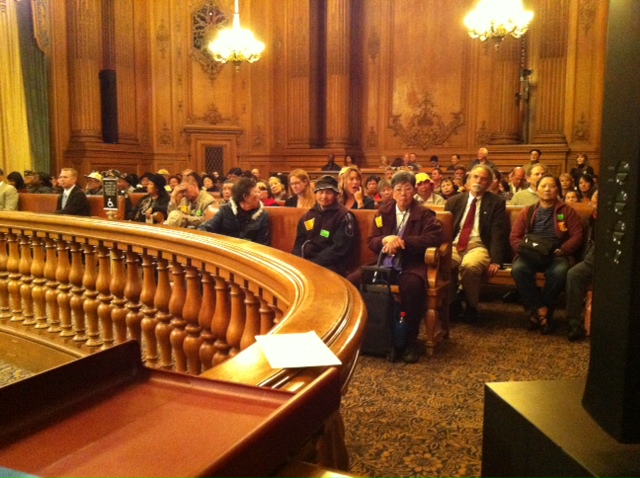
The question of whether San Francisco creates a renewable energy program that offers an alternative to Pacific Gas & Electric got its first major hearing at City Hall today, with the business community claiming it’s too expensive and supporters arguing that the time has come for the city to address climate change and the long-term energy needs of city residents and businesses.

The Board of Supervisors Budget & Finance Committee voted 2-1 in favor creating CleanPowerSF, entering into a contract with Shell Energy Northern California to administer the program, and devoting $19.5 million from the San Francisco Public Utility Commission’s water fund to help launch it and buy clean power for city residents.

Sups. John Avalos and Jane Kim supported the project, while Sup. Carmen Chu was opposed. It now goes to the full Board of Supervisors next week, where it is expected to have progressive support and be opposed by the fiscal conservatives.

“I do think we will have the necessary majority to get this through,” the measure’s sponsor, Sup. David Campos, told us. But one open question is whether Mayor Ed Lee will veto a measure that his SFPUC appointees developed but his downtown allies are trying to kill, and if so, whether there are eight supervisors willing to override a veto.

But Campos noted that SFPUC officials testified today that CleanPowerSF is the only way they’ve identified to meet the city’s ambitious official goals for reducing greenhouse gas emissions, which call for a reduction of 20 percent below 1990 levels by the end of this year and an 80 percent reduction by 2050.

Supporters who testified today included environmentalists, progressive groups, and young people who cast addressing climate change as the defining struggle of their generation. “This, not to go overboard, is the most important vote you’ll ever do,” said the Sierra Club’s Arthur Feinstein.

Those who spoke against the program included the usual array of downtown groups that have traditionally defended PG&E’s interests – including the Committee on Jobs, Golden Gate Restaurant Association, and Plan C – and they were joined by an unusually large number of elderly Asian individuals wearing stickers opposing the project.

“It’s a bad program that doesn’t meet even the basic elements of its original promise,” said Chris Wright, executive director of the Committee on Jobs, which PG&E has helped fund since its inception. Like most CleanPowerSF opponents, they have long opposed even the concept of community choice aggregation (CCA), the state law that allowed the city to create CleanPowerSF.

PG&E’s longtime support by local politicians has eroded in recent years because of its overkill campaigns against public power initiatives and supporters and its negligence in the deadly San Bruno pipeline explosion.

Even GGRA Executive Director Rob Black told the committee, “PG&E, a local company, candidly has its problems.” But he and other project opponents – and even a few supporters of the project – centered much of their opposition on the involvement of Shell, which has a bad reputation and environmental record, like almost every other multinational energy company.

“I have the same qualms about Shell that everyone else does,” said Katherine Roberts, who said that she nonetheless supports the project, calling it the only way for most San Franciscans to directly support the development of renewable energy sources. Shell was the sole bidder on a project that requires enormous financial wherewithal.

Campos calls the focus on Shell a diversionary tactic: “PG&E already buys energy from Shell. To the extent people don’t want Shell in the picture, Shell is already in the picture.”

Both the supervisors and the mayor will be under intense pressure to derail CleanPowerSF, with that campaign led by downtown groups and IBEW Local 1245, the union that represents PG&E workers. Sup. Scott Wiener, who says he’s still undecided, told us that his office was flooded with phone calls today, mostly in opposition to the project.

Dick Meister: Green is good for us all

3

By Dick Meister

Dick Meister, former labor editor of the SF Chronicle and KQED-TV Newsroom, has covered labor and politics for more than a half-century. Contact him through his website, www.dickmeister.com, which includes more than 350 of his columns.

Millions of American workers badly need jobs, and the owners of many thousands of commercial buildings badly need “green retrofitting” to improve their energy efficiency and thus cut operational costs while simultaneously helping clean up the environment.

The conclusion should be obvious: Let the retrofitting begin, for the benefit of everyone – those who need the work, the employers who want it done, and the rest of us , who would benefit greatly from it.

Details of what could and should be done – and why and by whom – are laid out in a new briefing paper from the well-regarded National Employment Law Project, otherwise known as NELP.

Perhaps what’s most important about green retrofitting is that it’s what NELP calls “a powerful job creation tool.”

It can indeed be that. As NELP reported, “Estimates show that a mix of tax credits, new building code requirements and loans for commercial energy efficiency upgrades would create upwards of 160,000 new jobs,” possibly hundreds of thousands more, over the next year.  That certainly would significantly lower the high unemployment rate that has plagued the country for far too long, encourage investment and otherwise jolt the lagging economy.

Construction workers have been hit particularly hard by unemployment, and it is they who have the skills and knowledge “that could be put to work cutting greenhouse gas omissions and making our cities cleaner and more efficient places to live,” notes Christine Owens, NELP’s executive director.

She says many construction workers, as well as other workers, also are needed to improve existing commercial buildings “in a common-sense way while also meeting the challenges of climate change.” NELP says more than three-fourths of all the electricity produced in the United States is used to operate the buildings, “making improved energy efficiency an increasingly recognized part of reducing the nation’s greenhouse gases.”

Simply providing jobs would not be enough.  NELP argues that government policy makers supporting green retrofitting and the jobs it creates should make certain they are “good jobs with strong workplace standards and fair pay and job security.” That’s an absolute necessity if jobs in the retrofit industry are to be truly sustainable. At a minimum, that would call for providing workers increased pay and better chances of being promoted to higher-paying jobs.

NELP cites three cities – Los Angeles, Seattle and Milwaukee – that have developed programs which have won the support of workers, environmentalists and commercial building owners, in large part by backing retrofitting projects that, while creating jobs, also help owners cut their costs and increase their income.

Los Angeles has adopted a city ordinance that calls for retrofits of city-owned buildings, a process for settling labor conflicts that arise during the work, and an effort to ensure that Los Angeles residents have access to training for retrofitting work.

In Seattle, the city has an agreement with retrofit contractors on setting pay and providing job training for their employees.

Milwaukee has a new energy-efficiency program that offers building owners the chance to qualify for financial aid in exchange for using contractors committed to hiring local workers and “adhering to quality workplace standards.”

It’s now time for other cities nationwide to take action. There’s no legitimate reason for inaction. We have a great need to modernize and expand our infrastructure, diminish environmental pollution and provide work for the jobless. We have shown it can be done.  So let’s do it!

Dick Meister, former labor editor of the SF Chronicle and KQED-TV Newsroom, has covered labor and politics for more than a half-century. Contact him through his website, www.dickmeister.com, which includes more than 350 of his columns.


Restore Hetch Hetchy conjures corporate boogiemen

75

The campaign for a ballot measure that seeks to create a plan for tearing down the O’Shaughnessy Dam – San Francisco’s main source of clean water and power – and turning the Hetch Hetchy Valley into a tourist destination must be having a hard time collecting the 9,702 signatures it needs by July 9 because it is resorting to conjuring up unlikely boogiemen to win public sympathy.

Restore Hetch Hetchy just sent out a press release accusing opponents of the measure of preparing a “tobacco industry-style negative ad blitz” funded by venture capitalist Ron Conway and other corporate evildoers.

“Just like the tobacco industry’s big money confused so many people into opposing the Prop. 29 tobacco tax they initially supported, now we’re seeing corporate money flowing like a dirty river right into the coffers of what promises to be yet another nasty negative campaign,” said Mike Marshall, campaign director for the Yosemite Restoration Campaign, which his Restore Hetch Hetchy group is sponsoring.

It cites a statement made by the Bay Area Council – which they helpfully remind us includes “PG&E, Chevron, and Mitt Romney’s former company Bain & Co.” – that Conway has pledged $25,000 to the opposition campaign.

Where do I even begin to unravel this ridiculously hyperbolic and misleading appeal? Let’s start with the fact this has nothing to do with Big Tobacco, Big Oil, Big Capitalists, or Big Utilities. It isn’t corporations that are standing in the way of spending billions of dollars to tear down the dam and replace the lost power and water – it is just about every elected official in the region, from across the political spectrum, and any San Franciscan who has at least as much reason and sentimentality. As for PG&E, I’m sure the utility would just love to see San Francisco’s main source of electricity torn down, which would only expand its monopolistic control of our energy system.

Frankly, the misleading release reeks of desperation, and when I asked campaign consultant Jon Golinger whether the campaign is in trouble, he responded, “We are certainly quite clear this is a David versus Goliath situation, or whatever analogy you want to make.”

Okay, how about a Fantasy versus Reality situation? Or a Past versus Present situation? Or San Franciscans versus Dan Lungren, the right wing member of Congress who has been pushing to remove the dam supposedly because he loves Yosemite Valley so much and wants to create another one (or, more likely, because he wants to tweak the San Francisco liberals and get us fighting among ourselves over something pointless and distracting).

I’m sorry, but I just can’t get my head around the appeal of this idea, which the Sacramento Bee editorial writers actually won a Pulitzer Prize for conjuring up in 2004, certainly another sign of the modern decline in journalism standards. I get that legendary conservationist John Muir was right and this dam probably shouldn’t have been built, and that it might be kinda cool to have another beautiful valley to hike in once the sludge dries up over a few decades.

But when we can’t even find adequate funding for public transit, renewable energy sources, and the multitude of other things that really would help the environment – not to mention while we’re heading into an era when water supplies in the Sierras could be depleted by climate change – do we really want to spend billions of dollars to fetishize one valley and destroy the engineering marvel that is one of the best and most energy-efficient sources of urban water in the country?

Or am I just shilling for Big Tobacco and Mitt Romney because that’s how I see it?

Green presidential candidate seeks to energize the disenfranchised

6

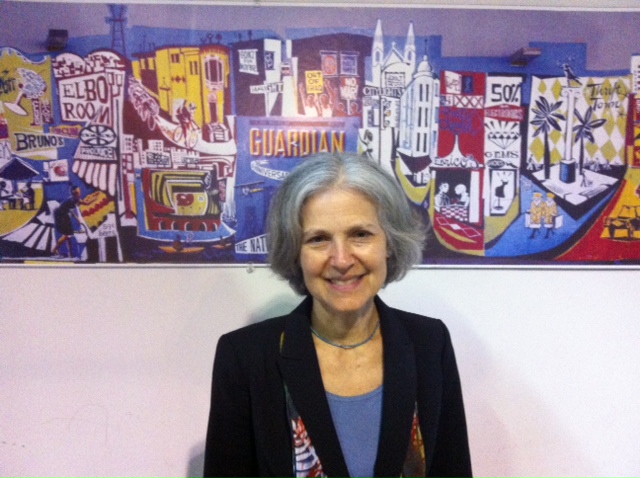
After participating in last weekend’s Green Party presidential debate against Roseanne Barr in San Francisco, which we cover in this week’s paper, frontrunner candidate Jill Stein stopped by the Bay Guardian office to chat about her hopes for progressive change in this tumultuous political year.

“The political-corporate establishment should not be given a pass in the voting booth,” the Massachusetts physician told us. “Four more years of Wall Street rule is what we get if you give them your vote.”

She ticked off a litany of bipartisan failures from the Democratic and Republican parties, from reforming Wall Street and narrowing the wealth gap to seriously addressing climate change and this country’s wasteful wars, and said people are fed up and want fundamental reforms.

“The rebellion is in full swing, you just don’t hear about it from the press,” she said. “With the exception of the Bay Guardian, we don’t have a press. We have an o-press and a re-press.”

This is Stein’s first run for national office, but she already faced off against presumptive Republican nominee Mitt Romney in the 2002 Massachusetts governor’s race, garnering just 3.5 percent of the vote but winning praise in the Boston Globe for her debate performance. She thinks both Romney and Obama are vulnerable this year, although she said, “I’m not holding my breath that we’re going to win, but I’m not running to lose.”

Her plan is to wage an aggressive grassroots and social media campaign to capitalize on the discontent most Americans feel with both major political parties, and to hopefully catch enough fire to reach 15 percent support in national polls, the threshold for getting into the presidential debates. “If we can get into the debates, we can really change things.”

To get there, Stein plans to reach out to a wide variety of groups on the left and across the spectrum, including supporters of the Occupy Wall Street movement, which she toured last year, visiting 25 encampments across the country, most of them populated by people wary of modern electoral politics.

“When I go to Occupy, I go to support them and not ask for their support,” Stein said, saying that she understood their belief that the electoral system is broken, but that it’s important to participate in it as part of a multi-pronged movement for social change that includes presidential politics. “Can we beat back the predator without have an organization? No, we need a party.”

She thinks the Green Party best represents the values of disenfranchised Americans and has the best vision for where this county needs to go, and she said, “We’re finding all kinds of networks are really getting energized and promoting us.”

Stage Listings May 2-8, 2012

0

Stage listings are compiled by Guardian staff. Performance times may change; call venues to confirm. Reviewers are Robert Avila, Rita Felciano, and Nicole Gluckstern. Submit items for the listings at listings@sfbg.com. For further information on how to submit items for the listings, see Picks.

THEATER

OPENING

Down to This Exit Stage Left, 156 Eddy, SF; www.sleepwalkerstheatre.com. $12-20. Opens Thu/3, 8pm. Runs Thu-Sat, 8pm. Through May 26. Sleepwalkers Theatre performs a pulpy thriller with two possible endings.

“San Francisco International Arts Festival” Various venues, SF; www.sfiaf.org. Free-$70. May 2-20. Performance festival featuring theater and dance from Cuba, Iran, Russia, the U.S., China, Japan, Estonia, and more.

The Wrong Dick Dark Room Theater, 2263 Mission, SF; www.darkroomsf.com. $20. Opens Thu/3, 8pm. Runs Thu-Sat, 8pm. Through May 26. Ham Pants Productions presents a noir-inspired comedy set in San Francisco.

Zorba Eureka Theater, 215 Jackson, SF; (415) 255-8207, www.42ndstmoon.org. $20-50. Previews Wed/2, 8pm; Thu/3-Fri/4, 8pm. Opens Sat/5, 6pm. Runs Wed, 7pm; Thu-Fri, 8pm; Sat, 6pm; Sun, 3pm. Through May 20. 42nd Street Moon performs Kander and Ebb’s musical salute to Greece.

BAY AREA

Crevice La Val’s Subterranean, 1834 Euclid, Berk; www.impacttheatre.com. $10-20. Previews Thu/3-Fri/4, 8pm. Opens Sat/5, 8pm. Runs Thu-Sat, 8pm. Through June 9. Impact Theatre and PlayGround present Lauren Yee’s world premiere play about 20-something siblings whose couch-potato lives are uprooted when a chasm opens up in their living room.

ONGOING

Act One, Scene Two Phoenix Arts Association Theatre, 414 Mason, Ste 601, SF; www.un-scripted.com. $10-20. Thu-Sat, 8pm. Through May 12. Un-Scripted Theater Company performs the beginning of a new, unfinished play by a local author — and creates an ending on the spot once the script runs out.

*The Aliens SF Playhouse, 533 Sutter, SF; (415) 677-9596, www.sfplayhouse.org. $20-70. Wed/2-Thu/3, 7pm; Fri/4-Sat/5, 8pm. On the heels of Aurora Theatre’s production of Body Awareness, SF Playhouse introduces local audiences to another of contemporary American playwright Annie Baker’s acclaimed plays, in a finely tailored West Coast premiere directed by Lila Neugebauer. The Aliens unfolds in the days just around July 4, at slacker pace, in the backyard of a Vermont café (lovingly realized to palpable perfection by scenic designer Bill English), daily haunt of scruffy, post-Beat dropouts and sometime band mates Jasper (a secretly brooding but determined Peter O’Connor) and KJ (a charmingly ingenuous yet mischievous Haynes Thigpen). New employee and high school student Evan (a winningly eager and reticent Brian Miskell) is at first desperate to get the interlopers out of the “staff only” backyard but is just lonely enough to be seduced into friendship and wary idolatry by the older males. What unfolds is a small, sweet and unexpected tale of connection and influence, amid today’s alienated dream-sucking American landscape — same as it ever was, if you ask Charles Bukowski or Henry Miller, both points of reference to Jasper and KJ, who borrow Bukowski’s poem The Aliens for one of their many band names. An appropriate name for the alienated, sure, but part of the charm of these characters is just how easy they are to recognize, or how much we can recognize ourselves in them. Delusions of grandeur reside in every coffee house across this wistful, restless land. It’s not just Jasper and KJ who may be going nowhere. A final gesture to the young and awkward but clearly capable Evan suggests, a little ambiguously to be sure, that there’s promise out there yet for some. But more than that: the transaction makes clear by then that there are no fuck-ups, really; not among people with generous and open hearts — never mind how fucked up the country at large. (Avila)

“Bay One Acts Festival” Boxcar Theatre, 505 Natoma, SF; www.bayoneacts.org. $25-45. Wed-Sat, 8pm (also Sat/5 and May 12, 3pm); Sun, 3 and 7pm. Through May 12. Ten bold and adventurous short plays by local playwrights, performed two full programs running in repertory.

Fwd: Life Gone Viral Marsh San Francisco, 1062 Valencia, SF; (415) 282-3055, www.themarsh.org. $20-50. Thu, 8pm; Sat, 8:30pm; Sun, 7pm (no show Sun/6). Through June 10. The internet becomes comic fodder for creator-performers Charlie Varon and Jeri Lynn Cohen, and creator-director David Ford.

*Hot Greeks Hypnodrome Theatre, 575 10th St, SF; www.brownpapertickets.com. $30-35. Thu-Sat, 8pm. Extended through May 19. Cheap thrills don’t come much cheaper or more thrilling than at a Thrillpeddlers musical extravaganza, and their newly remounted run of Hot Greeks affords all the glitter-dusted eye-candy and labyrinthian plot points we’ve come to expect from their gleefully exhibitionist ranks. Structured as loosely as possible on Aristophanes’ Lysistrata, Greeks appropriately enough follows the trials and tribulations of a college sorority tired of “losing” their boyfriends to the big football match every year (Athens U vs. Sparta Tech). Pledging to withhold sex from the men unless they call off the game results in frustration for all, only partially alleviated by the discovery that sexual needs can be satisfied by “playing the other team,” as it were. But like other Cockettes’ revivals presented by the Thrillpeddlers, the momentum of the show is carried forward not by the rather thinly-sketched narrative, but by the group song-and-dance numbers, extravagant costuming (and lack thereof), ribald wordplay, and overt gender-fuckery. In addition to many TP regulars, including a hot trio of Greek columns topped with “capital” headdresses who serve as the obligatory chorus (Steven Satyricon, Ste Fishell, Bobby Singer), exciting new additions to the Hypnodrome stage include a bewigged Rik Lopes as stalwart sister Lysistrata, angelically-voiced Maggie Tenenbaum as the not-so-angelic Sodoma, and multi-faceted cabaret talent Tom Orr as heartthrob hunk Pendulum Pulaski. (Gluckstern)

It’s All the Rage Studio Theater, Marsh San Francisco, 1062 Valencia, SF; (415) 282-3055, www.themarsh.org. $15-50. Thu, 8pm; Sat, 8:30pm, Sun, 7pm. Extended through May 27. Longtime comedian and radio host Marilyn Pittman’s solo play wrestles with the legacy of her parents’ violent deaths in a 1997 murder-suicide initiated by her father. It’s disturbing material that Pittman, a stout middle-aged woman with a gregarious and bounding personality, approaches indirectly via a good deal of humor — including recounting the first time she did her growing-up-lesbian bit before her mother in a DC comedy club. But the pain and confusion trailing her for 13 years is never far behind, whether in accounts of her own battle with anger (and the broken relationships it has left in its wake) or in ominous memories of her too complacent mother or her charming but domineering father, whose controlling behavior extended to casually announcing murderous dreams while policing the boundaries of his marriage against family interference. A fine mimic, Pittman deploys a Southern lilt in playing each parent, on a stage decorated with a hint of their Southwestern furnishings and a framed set of parental photographs. In not exactly knowing where to lay blame for, or find meaning in, such a horrifying act, the play itself mimics in subtler form the emotional tumult left behind. There’s a too brief but eerie scene in which her veteran father makes reference to a murder among fellow soldiers en route to war, but while PTSD is mentioned (including as an unwanted patrimony), the 60-minute narrative crafted by Pittman and director David Ford wisely eschews any pat explanation. If transitions are occasionally awkward and the pace a bit loose, the play leaves one with an uncomfortable sense of the darker aspects of love, mingled with vague concentric histories of trauma and dislocation in a weird, sad tale of destruction and staying power. Note: review from the show’s 2009 run at the Marsh San Francisco. (Avila)

Killing My Lobster Chops Down the Family Tree TJT, 470 Florida, SF; www.killingmylobster.com. $10-22. Thu-Sat, 8pm (May 12, shows at 7 and 10pm); Sun, 7pm. Through May 13. The sketch comedy troupe performs a new show inspired by contemporary families.

Tenderloin Exit on Taylor, 277 Taylor, SF; (415) 525-1205, www.cuttingball.com. $10-50. Opens Thu/3, 7:30pm. Runs Thu, 7:30pm; Fri-Sat, 8pm (also Sat, 2pm); Sun, 5pm. Through May 27. Annie Elias and Cutting Ball Theater artists present a world premiere “documentary theater” piece looking at the people and places in the Cutting Ball Theater’s own ‘hood.

Thunder Above, Deeps Below Bindlestiff Studio, 185 Sixth St, SF; www.brownpapertickets.com. $20-25. Thu/3-Sat/5, 8pm. Bindlestiff presents A. Rey Pamatmat’s dramatic comedy about three homeless young adults.

The Waiting Period MainStage, Marsh San Francisco, 1062 Valencia, SF; (415) 282-3055, www.themarsh.org. $15-50. Fri, 8pm; Sat, 5pm. Extended through May 26. Brian Copeland (comedian, TV and radio personality, and creator-performer of the long-running solo play Not a Genuine Black Man) returns to the Marsh with a new solo, this one based on more recent and messier events in Copeland’s life. The play concerns an episode of severe depression in which he considered suicide, going so far as to purchase a handgun — the title coming from the legally mandatory 10-day period between purchasing and picking up the weapon, which leaves time for reflections and circumstances that ultimately prevent Copeland from pulling the trigger. A grim subject, but Copeland (with co-developer and director David Ford) ensures there’s plenty of humor as well as frank sentiment along the way. The actor peoples the opening scene in the gun store with a comically if somewhat stereotypically rugged representative of the Second Amendment, for instance, as well as an equally familiar “doood” dude at the service counter. Afterward, we follow Copeland, a just barely coping dad, home to the house recently abandoned by his wife, and through the ordinary routines that become unbearable to the clinically depressed. Copeland also recreates interviews he’s made with other survivors of suicidal depression. Telling someone about such things is vital to preventing their worst outcomes, says Copeland, and telling his own story is meant to encourage others. It’s a worthy aim but only a fitfully engaging piece, since as drama it remains thin, standing at perhaps too respectful a distance from the convoluted torment and alienation at its center. (Avila)

BAY AREA

Anatol Aurora Theatre, 2081 Addison, Berk; www.auroratheatre.org. $30-55. Tue and Sun, 7pm (also Sun, 2pm); Wed-Sat, 8pm. Through May 13. Aurora Theatre Company performs a world premiere translation of Arthur Schnitzler’s drama about the love life of an Viennese philanderer.

A Hot Day in Ephesus Live Oak Theatre, 1301 Shattuck, Berk; info@aeofberkeley.org. $12-15. Fri-Sat, 8pm; May 13, 2pm. Through May 19. Actors Ensemble performs the world premiere of a musical based on Shakespeare’s Comedy of Errors.

In Paris Berkeley Repertory Theatre, Roda Theatre, 2015 Addison, Berk; (510) 647-2949, www.berkeleyrep.org. $22.50-125. Tue and Thu-Sat, 8pm (also Sat, 2pm); Wed, 7pm; Sun, 2pm. Through May 13. Mikhail Baryshnikov stars in Dmitry Krymov’s romantic new play.

*The Kipling Hotel: True Misadventures of the Electric Pink ’80s New venue: Marsh Berkeley, 2120 Allston, Berk; (415) 282-3055, www.themarsh.org. $20-50. Sat/5, 8:30pm; Sun/6, 7pm. This new autobiographical solo show by Don Reed, writer-performer of the fine and long-running East 14th, is another slice of the artist’s journey from 1970s Oakland ghetto to comedy-circuit respectability — here via a partial debate-scholarship to UCLA. The titular Los Angeles residency hotel was where Reed lived and worked for a time in the 1980s while attending university. It’s also a rich mine of memory and material for this physically protean and charismatic comic actor, who sails through two acts of often hilarious, sometimes touching vignettes loosely structured around his time on the hotel’s young wait staff, which catered to the needs of elderly patrons who might need conversation as much as breakfast. On opening night, the episodic narrative seemed to pass through several endings before settling on one whose tidy moral was delivered with too heavy a hand, but if the piece runs a little long, it’s only the last 20 minutes that noticeably meanders. And even with some awkward bumps along the way, it’s never a dull thing watching Reed work. (Avila)

Lucky Duck Julia Morgan Theatre, 2640 College, Berk; www.berkeleyplayhouse.org. $17-35. Thu and Sat, 7pm (also Sat, 2pm); Sun, noon and 5pm (additional performance May 11, 7pm). Through May 13. Berkeley Playhouse performs a musical inspired by the “Ugly Duckling” tale.

Not Getting Any Younger Marsh Berkeley, 2120 Allston, Berk; (415) 282-3055, www.themarsh.org. $15-50. Fri, 8pm; Sat, 5pm. Through May 19. Marga Gomez is back at the Marsh, a couple of too-brief decades after inaugurating the theater’s new stage with her first solo show — an apt setting, in other words, for the writer-performer’s latest monologue, a reflection on the inevitable process of aging for a Latina lesbian comedian and artist who still hangs at Starbucks and can’t be trusted with the details of her own Wikipedia entry. If the thought of someone as perennially irreverent, insouciant, and appealingly immature as Gomez makes you depressed, the show is, strangely enough, the best antidote. Note: review from the show’s 2011 run at the Marsh San Francisco. (Avila)

Oleanna Berkeley City Club, 2315 Durant, Berk; www.theatrefirst.com. $15-30. Thu-Sat, 8pm; Sun, 5pm. Through May 13. TheatreFIRST performs David Mamet’s tense two-charater drama.

Red Berkeley Repertory Theatre, Thrust Stage, 2025 Addison, Berk; (510) 647-2949, www.berkeleyrep.org. $14.50-83. Tue and Thu-Fri, 8pm; Wed, 7pm; Sat-Sun, 2pm (also Sat, 8pm; no 8pm show May 12; Sun, 7pm). Extended through May 12. Mark Rothko (David Chandler) isn’t the only one painting with a broad brush in this labored and ultimately superficial two-hander by John Logan, enjoying a competent but underwhelming production by outgoing Berkeley Rep associate artistic director Les Waters. Set inside the late-1950s New York studio of the legendary abstract expressionist at the height of his fame, the play introduces a blunt and brash young painter named Ken (John Brummer) as Rothko’s new hired hand, less a character than a crude dramatic device, there first as a sounding board for the pompous philosophizing that apparently comprises a good chunk of the artist’s process and finally as a kind of mirror held up to the old iconoclast in challenging proximity to a new generation that must ultimately transcend Rothko’s canvases in turn. The dialogue holds up signs announcing intellectual and aesthetic depths but these remain surface effects, reflecting only platitudes, while the posturing tends to reduce Rothko to caricature. Much of the self-consciously reluctant filial interaction here smacks of biographical sound bites or heavy-handed underscoring of theme, and tends toward the outright hokey when touching on the credulity-bending subject of Ken’s murdered parents — with the attendant shades this adds to Rothko’s and the play’s chosen color palette. (Avila)

The World’s Funniest Bubble Show Marsh Berkeley, TheaterStage, 2120 Allston, Berk; (415) 826-5750, www.themarsh.org. $8-50. Extended run: May 5-27 (Sat-Sun, 11am); June 3-July 15 (Sun, 11am). Louis “The Amazing Bubble Man” Pearl returns with this kid-friendly, bubble-tastic comedy.

PERFORMANCE/DANCE

“Comedy SuperPAC: Promoting Good Comedy and Great Causes Since 2012!” Hemlock Tavern, 1131 Polk, SF; www.hemlocktavern.com. Mon/7, 7pm. $5. Nate Green and W. Kamau Bell present this ongoing comedy showcase; this week’s performers are Chris Garcia, Brendan McGowan, Jeff Kreisler, and Brandie Posey.

“Cutting Ball Theater Hidden Classics Reading Series” Exit on Taylor, 277 Taylor, SF; www.cuttingball.com. Sun/6, 1pm. Free. Readings of three one-act August Strindberg plays.

“Elect to Laugh” Studio Theater, Marsh San Francisco, 1062 Valencia, SF; (415) 282-3055, www.themarsh.org. Tue, 8pm. Ongoing through Nov 6. $15-50. Will Durst and friends perform in this weekly political humor show that focuses on the upcoming presidential election.

“Gaia Grrrls” Dance Mission Theater, 3316 24th St, SF; www.brownpapertickets.com. Fri/4-Sat/5, 8pm (also Sat/5, 4pm); Sun/6, 4pm. $17. Dance Brigade’s Grrrl Brigade performs a contemporary dance-drama that takes on war and climate change.

“May Day: CounterPULSE’s Performance Festival-Fundraiser” CounterPULSE, 1310 Mission, SF; www.counterpulse.org. Thurs/3-Sat/5, 8pm. $30-150. Local dancers and performers come together to raise funds for the venue, a haven for experimental and risk-taking work.

“Picklewater Clown Cabaret: Cabaret of Sexy Sex!” Stage Werx Theatre, 446 Valencia, SF; www.brownpapertickets.com. Mon/7, 7 and 9pm. $15. Physical comedy, music, and mayhem.

“Radar Spectacle” Verdi Club, 2424 Mariposa, SF; www.radarproductions.org. Fri/4, 8pm. $15. Radar Lab benefits from this performance featuring music from Mirah, a reading by Armistead Maupin, a live art auction, and more.

“See Mom, I Didn’t Forget!” Shelton Theater, 533 Sutter, SF; www.brownpapertickets.com. Sun/6, 2 and 7pm. $30. “Familial craziness” is the theme of this solo performance showcase in honor of Mother’s Day.

Smuin Ballet Yerba Buena Center for the Arts, 701 Mission, SF; www.smuinballet.org. Wed/2-Sat/5, 8pm (also Sat/5, 2pm); Sun/6, 2pm. $25-62. Program includes the West Coast premiere of Val Caniparoli’s Swipe and the world premiere of Ma Cong’s Through. *


Our Weekly Picks May 2-8, 2012

0

WEDNESDAY 2

Loom of Ruin reading

Sam McPheeters has a way with language that has translated from lyrics to journalism and now: his first official solo novel, The Loom of Ruin. The former frontperson of a trilogy of punk and experimental acts (Born Against, Men’s Recovery Project, Wrangler Brutes) has long written columns for the likes of Vice, and put out his own fanzines. But his first published output came at age 12 — a local legends book assembled with a pal. Now he comes full circle, back to book publishing, though this time it’s a bit different. He’s rather grown, and writing exquisitely detailed dark Los Angeles fiction about the angriest man in the world. Far from grumpy himself — the facetious gent was once known to recite Patrick Henry’s famous speech — McPheeters brings his words to the Bay this week on a book tour, including a spoken word stop at the Secret Alley tonight at 7pm after Needles+Pens. (Emily Savage)

5-7pm, free

Needles+Pens

3253 16th St., SF

(415) 255-1534

www.needlesandpens.com


Thu/3, 7:30pm, free

1234Go Records

420 40 St., Oakl.

(510) 985-0325

www.1234gorecords.com


Edward Sharpe & the Magnetic Zeros

If Alex Ebert were the best version of himself (a selfless hero akin to Superman or Jesus) he’d be Edward Sharpe. Ebert, Edward Sharpe & the Magnetic Zero’s crazy-haired front man/only guy I’ve seen successfully pull off the shirtless blazer look, dreamt up this alternate identity after getting over a serious drug addiction and shirking his reverence to the punkish concept of rebellion. On stage this ten-piece folky, psychedelic rock tribe looks like a ragtag flurry of ecstasy. There’s a lot going on when these guys perform, but somehow it’s always hard to take your eyes off Jade Castrinos, whose sultry voice and free form movements lull you into a blissful, calming trance. (Mia Sullivan)

With Aaron Embry

8pm, $32.50

Fox Theater

1807 Telegraph, Oakl.

(510) 302-2250

www.thefoxoakland.com


El Clásico: More Than a Game

Spain may have won the last World Cup, but as a new documentary by Kelly Candaele and students from Chico State University shows, there’s no love lost between passionate fans of the country’s two biggest club teams. When Real Madrid and FC Barcelona clash (in a game so monumental it is referred to as “El Clásico”), they bring to the field some of the world’s greatest players (Messi! Ronaldo!) — and decades of history that go way beyond fútbol and into weighty areas of national identity and politics. Even Barça fans still reeling from certain late-April results will enjoy this 55-minute exploration of one of Europe’s greatest sports rivalries. (Cheryl Eddy)

7pm, $5–$10

Mission Cultural Center

2868 Mission, SF

www.missionculturalcenter.org


THURSDAY 3

Electric Shepherd & OUTLAW

When Bay Area psychedelic rock groups Electric Shepherd & OUTLAW get together, their sound is something like the Doors meeting up with Jimi Hendrix on a tribalistic march and then starting to jam with a death metal version of Phish. If you carry deep-seated nostalgia for the epic rock shows you missed during the ’60s — or listen to the Velvet Underground’s Bootleg series on repeat — you should probably check these guys out. Expect luscious guitar riffs, sexy bass lines, compulsory dancing, and a wonderfully spaced out experience. (Sullivan)

With Blues for Carl Sagan, and Douglas

9pm, $6

Hemlock Tavern

1131 Polk, SF

(415) 923-0923

www.hemlocktavern.com


FRIDAY 4

Predator and The Thing

Though it may be hard to believe for those of us who grew up watching them, two classic sci-fi flicks from the 1980s have come upon major milestones anniversaries. To celebrate, Jesse Hawthorne Ficks’ Midnites For Maniacs series is hosting a night not to be missed, with a 25th anniversary screening of Predator and a 30th anniversary screening of John Carpenter’s The Thing. Featuring some of the best creature designs and special effects of the era thanks to visionaries Stan Winston and Rob Bottin, both films re-defined the genre, and have continued to stand the test of time. A Boy & His Dog (1975) also screens.(Sean McCourt)

7:30pm, $13

Castro Theatre

429 Castro St., SF

(415) 621-6120

www.midnitesformaniacs.com


JackHammer Disco with Tiga, Damian Lazarus, & Light Year

Let’s indulge in some squelchiness, shall we? Montreal-based Tiga and UK-born, Los Angeles resident Damian Lazarus share an affinity for acid-y, electro house. In the early 2000s, Lazarus played a prominent role at the UK label City Rockers, where he oversaw the release of Tiga & Zyntherius’ cover of Corey Hart’s “Sunglasses at Night.” Since gaining fame from that release, Tiga has been a busy producer and remixer, keeping a Euro-glam tone reminiscent of the synth-y works Giorgio Moroder pushed in the ’70s. Recent Lazarus works have a more stripped-down, minimal feel that sometimes wander into leftfield, like in his 2009 album Smoke the Monster Out. (Kevin Lee)

With Light Year 10pm, $15–<\d>$20 Public Works 161 Erie, SF (415) 932-0955 www.publicsf.com


FRIDAY 4

It’s Casual

Here in the Bay Area, we like to complain about public transportation. There are BART horror stories and Muni diaries tossed around like old war stories, used as social currency. But really, when you compare our rapid transit systems with the snarled mess of cars elsewhere in California, we come out on top. That’s why LA-based hardcore group It’s Casual got so much traction with an ode to its own local bus line, “The Red Line.” The song, and sentiment, struck a nerve: “The freeways/are not so nice.” The band itself is growly loud, with classic Southern California punk hooks. Tonight it opens for beloved shit-stirrers Early Man (note: the two bands will release a split seven-inch come May 22). Take the 22 Fillmore to the show and write a song about it. (Savage)

With Early Man, Shock Diamond, Satya Sena

9pm, $8

Thee Parkside

1600 17th St., SF

(415) 252-1330

www.theeparkside.com


SATURDAY 5

CreaturesCon

Seemingly rising from the grave like so many of the monsters and ghouls that it showcased over a 14-year run on local television, the beloved Bay Area show Creature Features is being resurrected once again to satiate fans’ undying thirst for the creepy, kooky, and campy. John Stanley, who hosted the KTVU program from 1979-’84, will be on hand for CreaturesCon One, a day of special screenings, Q&As, and more, along with archivist and documentary filmmaker Tom Wyrsch and Ernie Fosselius of Hardware Wars fame. For all you monster kids out there, this will be a nightmare, er, dream come true. (McCourt)

3-10pm, $10

Historic Bal Theater

14808 East 14th St., San Leandro

www.creaturescon.com


Father John Misty

I always wonder about the drummer. They’re usually the life of the party but, at the same time, are often concealed behind a wall of instruments, and you rarely hear them sing, or say, anything. Ex-Fleet Foxes drummer Joshua Tillman has said that drumming for his former superstar band began to bore him. So he exited, took up the moniker “Father John Misty,” and started creating lush, lyrically based Americana folk ballads laden with lucid imagery and social commentary. He played SXSW this year, made a surprise appearance at Café Du Nord in April, and his debut, Fear Fun, came out Tuesday. (Sullivan)

With Har Mar Superstar, Worth Taking

10pm, $12

Bottom of the Hill

1233 17th St., SF

(415) 621-4455

www.bottomofthehill.com


SUNDAY 6

Omar Sosa Afreecanos Quartet

Talk about versatility. Cuban pianist and composer Omar Sosa splits his time between Oakland and Spain and incorporates musical influences from just about everywhere in between. On last year’s Calma: Solo Piano &… Sosa displayed his introspective and meditative side with floating piano melodies flanked by the occasional electronic accent or sampled sound. Contrast the solo effort on Calma with Sosa’s performance as lead of the Afreecanos Quartet, where technical dynamism becomes the name of the game. At live shows, Sosa becomes a grinning whirlwind, playing classical piano on one hand and electronic piano on another, trading looks and body language with his fellow musicians, and fostering a joyful, collective, improvisational spirit. (Lee)

With Marque Gilmore, Childo Tomas and Peter Apfelbaum

1pm, free

Yerba Buena Gardens

760 Howard, SF

(415) 543-1718

www.ybgfestival.org


MONDAY 7

“La Bamba: Latinos in Vintage Rock, Pop, and Soul”

Local rock music historian and author Richie Unterberger, whose books include White Light/White Heat: The Velvet Underground Day by Day and Music USA: The Rough Guide, will once again share his extensive knowledge with music fans at his presentation “La Bamba: Latinos in Vintage Rock, Pop, and Soul.” Featuring film clips of performers such as Ritchie Valens, Santana, Linda Ronstadt, and Los Lobos, the evening promises to be a unique look at the contributions of Latinos in rock from the earliest days of the 1950s up through the ’80s. (McCourt)

6:30-8:30pm, free

SF Public Library, Mission Branch

300 Bartlett, SF

www.sfpl.org


TUESDAY 8

Steve Coll

Longtime journalist Steve Coll won a Pulitzer Prize and widespread acclaim for his 2004 account on the CIA and the agency’s history in Afghanistan leading up to 9/11. In his latest investigative effort, Private Empire: ExxonMobil and American Power, Coll explores the global influence of the Texas-based oil corporation. According to Coll, big-money donations and a sophisticated DC lobbying machine have allowed ExxonMobil to shift the debate on climate change. At the same time, the oil corporation continues to expand its foothold in developing countries. A two-time Pulitzer Prize winner, Coll currently serves as president of the New American Foundation, a nonprofit, nonpartisan think tank that maintains a significant presence in California. (Lee)

In conversation with Greg Dalton

6pm, $7–$20

Commonwealth Club

595 Market, SF

(415) 597-6700

www.commonwealthclub.org


The Guardian listings deadline is two weeks prior to our Wednesday publication date. To submit an item for consideration, please include the title of the event, a brief description of the event, date and time, venue name, street address (listing cross streets only isn’t sufficient), city, telephone number readers can call for more information, telephone number for media, and admission costs. Send information to Listings, the Guardian Building, 135 Mississippi St., SF, CA 94107; fax to (415) 487-2506; or e-mail (paste press release into e-mail body — no text attachments, please) to listings@sfbg.com. Digital photos may be submitted in jpeg format; the image must be at least 240 dpi and four inches by six inches in size. We regret we cannot accept listings over the phone.

Jeffrey Sachs: A world adrift

0


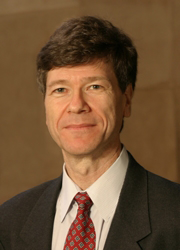
By Jeffrey D. Sachs


Jeffrey D. Sachs is Professor of Economics and Director of the Earth Institute at Columbia University. He is also Special Adviser to United Nations Secretary-General on the Millennium Development Goals

NEW YORK – The annual spring meetings of the International Monetary Fund and the World Bank have provided a window onto two fundamental trends driving global politics and the world economy. Geopolitics is moving decisively away from a world dominated by Europe and the United States to one with many regional powers but no global leader. And a new era of economic instability is at hand, owing as much to physical limits to growth as to financial turmoil.

Europe’s economic crisis dominated this year’s IMF/World Bank meetings. The Fund is seeking to create an emergency rescue mechanism in case the weak European economies need another financial bailout, and has turned to major emerging economies – Brazil, China, India, the Gulf oil exporters, and others – to help provide the necessary resources. Their answer is clear: yes, but only in exchange for more power and votes at the IMF. As Europe wants an international financial backstop, it will have to agree.  

Of course, the emerging economies’ demand for more power is a well-known story. In 2010, when the IMF last increased its financial resources, the emerging economies agreed to the deal only if their voting share within the IMF was increased by around 6%, with Europe losing around 4%. Now emerging markets are demanding an even greater share of power.

The underlying reason is not difficult to see. According to the IMF’s own data, the European Union’s current members accounted for 31% of the world economy in 1980 (measured by each country’s GDP, adjusted for purchasing power). By 2011, the EU share slid to 20%, and the Fund projects that it will decline further, to 17%, by 2017.

This decline reflects Europe’s slow growth in terms of both population and output per person. On the other side of the ledger, the global GDP share of the Asian developing countries, including China and India, has soared, from around 8% in 1980 to 25% in 2011, and is expected to reach 31% by 2017.

The US, characteristically these days, insists that it will not join any new IMF bailout fund. The US Congress has increasingly embraced isolationist economic policies, especially regarding financial help for others. This, too, reflects the long-term wane of US power. The US share of global GDP, around 25% in 1980, declined to 19% in 2011, and is expected to slip to 18% in 2017, by which point the IMF expects that China will have overtaken the US economy in absolute size (adjusted for purchasing power).

But the shift of global power is more complicated than the decline of the North Atlantic (EU and US) and the rise of the emerging economies, especially the BRICS (Brazil, Russia, India, China, and South Africa). We are also shifting from a unipolar world, led mainly by the US, to a truly multipolar world, in which the US, the EU, the BRICS, and smaller powers (such as Nigeria and Turkey) carry regional weight but are reticent to assume global leadership, especially its financial burdens. The issue is not just that there are five or six major powers now; it is also that all of them want a free ride at the others’ expense.

The shift to such a multipolar world has the advantage that no single country or small bloc can dominate the others. Each region can end up with room for maneuver and some space to find its own path. Yet a multipolar world also carries great risks, notably that major global challenges will go unmet, because no single country or region is able or willing to coordinate a global response, or even to participate in one.

The US has shifted rapidly from global leadership to that kind of free riding, seeming to bypass the stage of global cooperation. Thus, the US currently excuses itself from global cooperation on climate change, IMF financial-bailout packages, global development-assistance targets, and other aspects of international collaboration in the provision of global public goods.

The weaknesses of global policy cooperation are especially worrisome in view of the gravity of the challenges that must be met. Of course, the ongoing global financial turmoil comes to mind immediately, but other challenges are even more significant.

Indeed, the IMF/World Bank meetings also grappled with a second fundamental change in the world economy: high and volatile primary commodity prices are now a major threat to global economic stability and growth.

Since around 2005, the prices of most major commodities have soared. Prices for oil, coal, copper, gold, wheat, maize, iron ore, and many other commodities have doubled, tripled, or risen even more. Fuels, food grains, and minerals have all been affected.  Some have attributed the rise to bubbles in commodities prices, owing to low interest rates and easy access to credit for commodity speculation. Yet the most compelling explanation is almost certainly more fundamental.

Growing world demand for primary commodities, especially in China, is pushing hard against the physical supplies of global resources. Yes, more oil or copper can be produced, but only at much higher marginal production costs.

But the problem goes beyond supply constraints. Global economic growth is also causing a burgeoning environmental crisis. Food prices are high today partly because food-growing regions around the world are experiencing the adverse effects of human-induced climate change (such as more droughts and extreme storms), and of water scarcity caused by excessive use of freshwater from rivers and aquifers.

In short, the global economy is experiencing a sustainability crisis, in which resource constraints and environmental pressures are causing large price shocks and ecological instability. Economic development rapidly needs to become sustainable development, by adopting technologies and lifestyles that reduce the dangerous pressures on the Earth’s ecosystems. This, too, will require a level of global cooperation that remains nowhere to be seen.

The IMF/World Bank meetings remind us of an overarching truth: our highly interconnected and crowded world has become a highly complicated vessel. If we are to move forward, we must start pulling in the same direction, even without a single captain at the helm.

Jeffrey D. Sachs is Professor of Economics and Director of the Earth Institute at Columbia University. He is also Special Adviser to United Nations Secretary-General on the Millennium Development Goals
.

Copyright: Project Syndicate, 2012.
www.project-syndicate.org

Alerts

0

yael@sfbg.com


WEDNESDAY 4

Occupy the Dream

The SF Interfaith Allies of Occupy call for a rally to end racism, stop foreclosures, protect jobs, and hold corporations and financial institutions accountable. “At a time when Jews and Christians celebrate the ancient stories of liberation let us name the Caesars and Pharaohs of today,” say organizers of this latest event as part of Occupy the Dream. The event also commemorates the assassination of Martin Luther King, Jr on April 4, 1968.

11:30am, free

City Hall

1 Dr. Carlton B. Goodlett Place, SF


SATURDAY 7

Bill McKibben speaks

Bill McKibben is a leading figure in the fight against global warming. He started in 1989 with his book The End of Nature and went on to found 350.org, which has coordinated 15,000 rallies against climate change since 2009. He will speak about where to go next in the climate change crisis as well as discussing the current struggle against the Keystone XL pipeline.

10am, $15 in advance and $18 at the door

First Unitarian Universalist Church

1187 Franklin, SF

www.postcarbon.org/event/776185-progressive-perspectives-presents-bill-mckibben-in


SUNDAY 8

Birding by bike

The SF Bike Coalition hosts this tour of the birds of Lake Merced and Golden Gate Park. San Francisco could always have more bike routes, but the ones it does have provide an excellent pathway for this birding trip, in which participants don’t need to leave the city to observe both resident and migrating species. David and Annie Armstrong host birding by bike; David is an amateur ornithologist who has been birding and leading bike trips in San Francisco for 12 years. Bring your bike and binoculars.

8:45am, free

Vélo Rouge Café

798 Arguello, SF

www.sfbike.org/?chain#4876


TUESDAY 10

Remembering Bataan

On April 9, 1942, Filipino and American soldiers surrendered to Japanese forces after more than four months of holding their ground in the forest of Bataan, a large Philippine province; 15,000 then died en route to prisoner of war camps in what became known as the Bataan Death March. Students and faculty at Cal State University-East Bay will commemorate its 70th anniversary with a night of voices and perspectives from the battle. The event will feature a screening of the documentary Forgotten Soldiers, as well as speakers from the Philippine Scouts Heritage Society, Battling Bastards of Bataan, Bay Area Civilian Ex-Prisoners of War and the U.S. Armed Forces of the Far East, the the Philipine-American Student Alliance, who will present research on American film depictions of Filipino soldiers at the time and the stories of Bataan Death March survivors.

4pm, free

Cal State University- East Bay Theater

25800 Carlos Bee Blvd, Hayward

(510) 885-3000


“Your Money, and How Wells Fargo Gets Away With It”

To prepare for the April 24 Wells Fargo shareholders’ meeting in San Francisco, the International Forum on Globalization’s plutonomy program is sponsoring this teach-in and training. David Solnit from the Occupy SF direct action work group will be leading a workshop on nonviolent action, and people from across the social spectrum will be speaking on how irresponsible corporate banking has adversely affected their lives — from janitors to students, families to immigrant rights advocates. 

6pm-9pm, free

San Francisco State University

Humanities Building, Room 587

1600 Holloway, SF

www.moveon.org

We and Mr. Jones

1

caitlin@sfbg.com

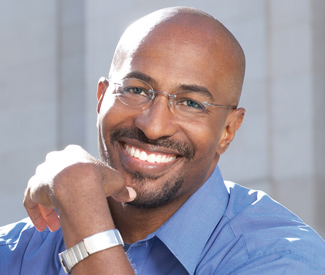
THE GREEN ISSUE No one can accuse Van Jones of being a one trick pony. In the early days of his activist career he monitored police violence in the Bay Area, and from there gradually widened the frame of his activist efforts. Jones formed the Ella Baker Center for Human Rights in Oakland in 1996, then became a green jobs pioneer, promoting environmentally-friendly work in low income communities — a revolutionary tactic that eventually landed him a short-lived adviser position within President Obama’s Council on Environmental Quality.

In his new book Rebuild the Dream (Nation Books, 278pp, $25.99) Jones has expanded his talking points to include the ways in which the financial sector has let us down, how Obama only did what we forced him to do (we gotta yell louder, Jones says), and how we can help fix the economy by focusing on “collaborative consumption.” Call it holistic activism. He’s launched a national junket to talk Rebuild that will bring him to the Commonwealth Club on April 16.

It is perhaps this kind of nuanced approach that scared the bejeezus out of the conservative demagogues whose smear campaign convinced Jones to resign from his White House post in 2009. Leave it to Glenn Beck to shame someone for saying he wanted “a whole new system” (as Jones proclaimed in a speech at a youth climate change conference.) The conservative media accused Jones of a communist past — which was accurate enough — and of signing a 9/11 truther petition that said that George Bush had prior knowledge of the World Trade Center attacks. He was innocent of this last point, the organization in question admitted months later, to a deafening media silence.

But Jones hasn’t retracted his call for a new system. In fact, in the pages of Rebuild the Dream he seems to step into a post-resignation hybrid role, in which he is no longer an outsider activist, but still has no formal role in Washington, D.C. Accordingly, he seems less fired up by the actions of national politicians as the agenda-pushing energy of the Tea Party and Occupy movements, which his new book spends entire chapters analyzing and critiquing. Even certain innovative businesses get a shout-out.

“You have Kiva, Kickstarter, Airbnb, and Zip Car already beginning to point to a future economy where more people are sharing fewer things,” Jones told the Guardian in a phone interview last week. “That’s good for people and the planet. You are also are saving money and you’re relying on people and relationships rather than dollars, you’re refinancing your social capital.”

He calls this economic ethos “collaborative consumption,” and it’s a heady idea for proponents of self-sustaining communities. Building a new economy on this business model, however, will take some tweaking that’s not covered in Rebuild — the city-level debate on whether SF Airbnb users should be subject to the city’s 14 percent hotel tax is one current-day example of how things can get complicated.

Rebuild offers a fairly honest critique of Obama’s successes and failures during the president’s first year in office. Nonetheless, the timing of the book, with it’s underlying message that we need to stay engaged in the political system to achieve real change, seems somewhat cagily timed. Is Rebuild the Dream part of Obama’s re-election campaign?

“The answer is no,” Jones is quick to reply. “We’re a non-partisan organization, we don’t endorse political candidates.”

But the election year publication is no coincidence: he wants all candidates to start talking about fixing the institutional reasons behind inequality.

“The two factors once used to pull people out of poverty were home ownership and education,” he says. “Those have now become the two factors by which people are being pulled into poverty because of the underwater mortgage problem and the fact that kids are coming away from college with massive debt and no ability to get a job. We think that these are issues that the politicians need to be forced to respond to and rethink.”

VAN JONES

April 17, 7pm, $20

Commonwealth Club

595 Market, second floor, SF.

(415) 597-6700

www.commonwealthclub.org


Alerts

0

THURSDAY 22

The longest war: Afghanistan beyond the Taliban

Two veteran journalists who have covered Afghanistan talk about the war that has surpassed Vietnam as the longest in US history. Masood Farivar, a former fighter in the Afghan anti-Soviet resistance before becoming a newswire in New York, then returning to Afghanistan in his capacity as journalist, and Tim McGirk a former Time magazine bureau chief in the region who has reported from Afghanistan since 1990, will have a conversation hosted by Jason Motlagh, a freelance journalist/filmmaker and former Time magazine correspondent in Kabul. A short documentary, Million Dollar Militia , will also be screened. What does a continued US presence—or, potentially, troops preparing to leave—mean for the country’s future? What political environment exists there?  Oakland-based production company Blackbeard Films launches a series that will highlight reporting on underreported stories with this event. 

7 p.m., free

Arbor Café

4210 Telegraph, Oakl.

www.blackbeardfilms.com 


SATURDAY 24

Wilderness first aid for the streets

In the saga of Occupy Oakland clashes with police, perhaps none are more unsung than the medics. These volunteers do everything from flushing eyes of tear gas to being first responders to protesters with broken limbs and gushing wounds. The medics team up for a training to others who want to do what they do. “Developed for wilderness situations, this course is adapted for urban uprisings, and will include care for chemical weapons exposure, herbal first aid, and public health considerations for long-term occupations,” according to the Occupy Oakland medics committee. This course is serious, covering two full days- March 24 and 25, 10am to 8pm. Red Cross certification and Continuing Education Units credits are available for $20, and scholarships are available.

10 a.m., donation suggested

The Holdout

2313 San Pablo, Oakl.

www.occupyoakland.org

WFAforthestreets@gmail.com 


St. Patricks Day Ceili

Did you make it through that special day without participating in a ceili, a traditional Irish social dance that is a hallmark of St. Patricks Day? If so, you’re in luck — you will be given a second chance. This dance is easily accessible for newbies and much more fun than cheap plastic green stuff and day-drinking. 

7 p.m., $10 (free for children)

United Irish Cultural Center 

2700 45th Ave., SF

www.irishcentersf.org  


MONDAY 26

Speaking youth to power

When it comes to climate change, young people know what’s up. Specifically such acclaimed young people as project coordinator for the urban farming non-profit Urban Tilth and Green For All Fellow Tania Pulido, Adarsha Shivakumar, founder of Project Jathropa, and Abigail Boroh, the student best known for interrupting the Durban, South Africa Climate Conference in December to bring urgency to the less than promising conference proceedings. Join them for a discussion on civic engagement within the climate justice movement. 

Doors 5:30, program 6pm, $20 (free for members and students)

Commonwealth Club

595 Market, SF

www.commonwealthclub.org


Green Film Fest shorts: Just Do It

0

Activist ire need a jump start? The Green Film Festival takes over Japantown’s San Francisco Film Society Cinema now through Wed/7. Go for tidings on the fight for our planet around the world — documentaries, expert panel presentations, and short films will be taking place. Check out Ali Lane’s previous reviews from the festival here.

Just Do It

In this intimate peek inside the world of “Environmental Direct Action,” viewers will marvel at the organization and cooperation displayed by the film’s English subjects. Occupy Oakland could really learn a thing or two from these self-proclaimed “domestic extremists,” champions against climate change, who the filmmakers followed for a year. The film starts off in the lead-up to “Climate Camp,” a literal camp-out of protesters in a secret location on a hill above London. From here, the protesters plan an “action.” Their actions seem pretty harmless and whimsical: gluing their hands together and invading the trade floor of RBS to sing songs; putting up posters at the entrance of a bank that says “Undergoing Ethical Renovation”; handcuffing themselves to the front gate of an MP’s home in order to publicly berate his policies. But these protests work. They get the news media to cover topics that were previously ignored.

The subjects of this film are mainly photogenic young people, with a few seasoned veterans as well, like . Some are Cambridge educated. All are uniformly anti-capitalist, as they believe capitalism inevitably leads to exploitation of the environment. They designate spokespeople, meticulously map out their “actions,” and memorize the legal consequences and potential charges faced, making sure to minimize any criminal property damage along the way. Before going out on an action, they write the phone number of their organization’s legal counsel on their forearms. What they’re doing is certainly risky, disobedient, and outside the margins of normal behavior, but the viewer gets the sense that these people have their act together and aren’t much of a threat to civil society.

This is a very sympathetic portrait of a movement, and it’s clear where director Emily James’s heart is. Her subjects’ enthusiasm for the cause, and for activism in general, is infectious. By the end it’s hard not to feel like a lazy bum as one subject intones, “Anyone out there thinking, ‘I wanna do more,’ just do it!” Indeed, this film doesn’t just give an impetus, but also a blueprint for how such things can be done.

The lingering question I had while watching the film, however, remained unanswered: where did these people get their money, for camp tents, and massive amounts of food, and buses, and superglue, and d-locks, and ladders: everything that it takes to protest, and live full-time as a protestor. Where do those funds come from? Perhaps this is a question to ask the filmmakers at the closing night party.

Green Film Festival closing night film and party

Wed/7 7:30 p.m., $12 for film, $15 for film and party

SF Film Society Cinema

1746 Post, SF

(415) 742-1394

www.sfgreenfilmfest.org


The ‘ruination’ of Peter Gleick

27

Oooh, sfgate has dropped climate scientist Peter Gleick’s column on the City Brights section of the site. Harsh, man; I guess that’s enough to “damage, if not ruin” the reputation of one of the world’s leading authorities on climate change. Fired by City Brights; I bet he feels as if he’s been unfriended by Garrison Keillor.

I continue to be amazed at the ethics of the San Francisco Chronicle, which can’t tolerate Gleick but still allows Willie Brown to write a column in the news section of the paper.

And I’m amazed at all the handwringing over this incident. I means, what, exactly did Gleick do that is going to destory his scientific reputation after years of unimpeachable work? Here’s what he did: He contacted the nuts at the Heartland Institute and asked them to send him some material. Oh, and he didn’t give his real name.

It doesn’t appear that he broke into the Heartland office, or hacked into the Heartland server, or went in under false pretenses and made a bogus video. In fact, I’d argue that, whatever the Chron’s legal sources say, it’s pretty hard to call this “stealing.”

Look, if my phone rang and the person on the line said his name was Warren Buffet and he asked me to send him confidential Guardian business information because he was thinking about investing $1 billion in the alternative press, I’d make a coupla phone calls first — wouldn’t you? If I ran a right-wing nonprofit and somebody called and said she was a board member and could you please send a package of sensitive internal documents to an address in Oakland, California, I’d call back at the number I had for her and ask if she’d move to crazyland — wouldn’t you? Who on Earth sends that kind of material out without making sure it’s going where it’s supposed to go — unless the vast majority of what Heartland sent Gleick was in fact the same sort of stuff that the loonies there regularly ship out to other loonies who they think might agree that Al Gore was born a thetan and is secretly plotting the United Nations takeover of the planet so that nobody can have round light bulbs any more.

I’m not condoning this sort of behavior — although the history of journalism (sometimes excellent, important journalism) is filled with examples of reporters using what some would call dubious methods to get through what Robert Scheer used to call “the palace guard.” But compared to shit the right wing pulls routinely, as a matter of practice, this is hardly a major crime. And you have to put some of the blame on whatever fool at the Heartland Institute mailed the company secrets off without checking where they were going.

And isn’t it good that we now know how the oil industry is trying to create a K-12 curriculum that denies climate change?


Mayor Lee’s vanishing bike lanes

77

By Morgan Fitzgibbons

OPINION When Mayor Ed Lee announced in February 2011 that he understood both the critical importance and the severe dangers inherent in the current bicycle infrastructure along the dual three-block stretches of Fell and Oak between Scott and Baker, a shot went through the community of people who had worked for so long to bring awareness to this troubled path.

Finally, it seemed, we had a mayor who understood that if San Francisco was serious about living up to its own nearly 40-year-old pledge to be a transit-first city, a narrow bike lane sandwiched between parked cars and fast-moving traffic on Fell Street and a complete absence of any bicycle infrastructure on Oak simply wouldn’t do.

Finally, we had a mayor who wouldn’t be satisfied with mere words on a page, who had the courage to carve out one single safe bike route from the east side of town to the west, to create a viable alternative to automobile transportation, to prepare our city for the inevitable challenges presented by climate change, peak oil, and economic collapse, and to do it in the face of the predictable objections from a few small-picture citizens who couldn’t look at the 60 square feet of a parking spot and imagine anything other than a privately owned two-ton pile of steel taking up precious public space.

The community of people who had waited nearly 40 years for the city to live up to its own word kept on waiting throughout 2011, patiently allowing the Municipal Transportation Agency to perform its due diligence, attending multiple public meetings in the hundreds, and delivering a resounding verdict: bring us our separated bike lanes. Make this neighborhood a better place to live. Begin the long work of preparing our city for a way of living that doesn’t center around the automobile.

With the public process complete and the calendar turning to nearly one year since Lee called for the MTA to “move quickly” to create separated bike lanes on Fell and Oak, the MTA handed down a jarring announcement. The Fell and Oak Bikeways were being delayed because the agency needed to take extra time to do all that could be done to find nearby replacements for the 80 parking spots set to be removed for the bike lanes.

That’s right — in a city that has for 40 years had an explicit policy of giving preference to transit options that weren’t the automobile, in a city that, nevertheless, has over 440,000 public parking spots and zero safe, accessible bike routes from the east side of town to the west, the creation of a separated bikeway that the vast majority of the community wants, and that the mayor’s own newly appointed District Supervisor, Christina Olague, is in support of, was being delayed by nearly a year so that the loss of private automobile parking would be as small as possible.

How does this happen? In a word: fear. The mayor and MTA are afraid of ruffling a few feathers to do what they know is right.

Cities like New York, Portland, and Minneapolis are leapfrogging us in building the cities of tomorrow. Chicago is creating 100 miles of separated bike lanes in the next four years. Don’t call us America’s Greenest City — you’re thinking of the San Francisco of 40 years ago.

Morgan Fitzgibbons is co-founder of the Wigg Party, a Western Addition neighborhood sustainability group

Two clean energy tracks for SF

1

OPINION CleanPowerSF, San Francisco’s green electricity alternative to Pacific Gas and Electric Co., is set to launch this year. The program is following two parallel paths — one to build renewable energy in San Francisco and create thousands of local jobs, the other to purchase clean power from remote sources from Shell Energy.

While both tracks bring advantages, this bifurcated approach could end up serving only 30 percent of city residents. Fortunately, the city can easily improve the launch of CleanPowerSF by merging the two tracks.

Enacted by the Board of Supervisors and Mayor Gavin Newsom in 2004 and in 2007, CleanPowerSF is not a public-power program like Santa Clara’s Silicon Valley Power or Alameda Municipal Power. CleanPowerSF is a public-private partnership, much like the successful Marin Clean Energy, which can buy power in bulk from outside companies — and also generate its own renewable energy. PG&E still owns the transmission grid and will deliver electricity to customers, who then have the option of choosing between CleanPowerSF and PG&E.

The San Francisco Public Utilities Commission has embarked on a detailed analysis of PG&E electricity data to find out how much electricity is used in different parts of the city at different times of the day and how much it costs. That will pinpoint exactly where in San Francisco renewable energy should be built for the highest efficiency and lowest costs to ratepayers.

While this analysis is being conducted, the SFPUC plans to initiate the second track, offering ratepayers 100% renewable electricity purchased from Shell Energy North America. That will get CleanPowerSF up and running quickly — but would cost ratepayers between $6.70 and $54.50 more a month more than PG&E. As a result, the SFPUC estimates that as many as 70% of ratepayers could leave CleanPowerSF and go back to PG&E.

The SF PUC plans to offer CleanPowerSF to two-thirds of San Francisco customers — 230,000 residences — with as many as 155,000 opting out. Once these people opt out, they won’t be customers of the cheaper, locally produced, job-creating, green energy that will come later.

By comparison, only 20 percent of Marin Clean Energy customers opted out at initial rollout. That’s because Marin Clean Energy offers a 27 percent renewable energy option in addition to a higher-cost 100 percent green option. The “light-green” option is cheaper because it mixes in lower-cost, non-renewable electricity.

The PUC could keep more San Franciscans in CleanPowerSF by integrating the local generation and data analysis and purchasing tracks. First, it could include a cheaper light-green option like Marin’s. To determine what mix of renewable and non-renewable electricity would be cost-competitive with PG&E, the PUC would use the results from the first track, the analysis of electricity usage data, expected this spring. The Board of Supervisors could make these changes when it takes up the Shell contract this month or next.

In the past few months, CleanPowerSF has made much progress thanks to San Francisco Supervisor David Campos and Ed Harrington, general manager of the San Francisco Public Utilities Commission. The addition of a cost-competitive light-green option would enable CleanPowerSF to better compete with PG&E and keep more San Franciscans in the program — for the long term. That would significantly increase the number of new local jobs created and have a greater effect in fighting global climate change. It worked in Marin, and it can work in San Francisco as well..

John Rizzo is former chair of the Sierra Club Bay Area Chapter and current president of the San Francisco Community College Board


All backed up

0

news@sfbg.com

In February 2004, San Francisco saw an usually strong winter storm. More than an inch and a half of rain fell within 30 minutes, too much to handle for the wastewater system, which in parts of the city is more than 100 years old. In the Mission and Bayview, some homes were flooded with rainwater and raw sewage.

Before adjourning for the year, the Board of Supervisors on Dec. 13 approved payments settling a lawsuit filed in January 2005 by some of the residents affected by the storm. The main plaintiffs in the case were Jane Martin and David Baker, whose home in the Mission district were flooded.

More than 40 individuals and businesses joined the lawsuit as plaintiffs, with San Francisco and its San Francisco Public Utilities Commission (PUC) as the sole defendant in the case. The plaintiffs sued for dangerous conditions of public property, failure to maintain public property, negligence, nuisance, and the trespass of water and sewage onto the plaintiff’s properties.

The settlement totaled $624,930 in compensation for property damage, including $50,000 for Martin and Baker, and many of the other plaintiffs getting around $25,000 each.

“Simply put, the city wasn’t doing proactive maintenance,” Baker told us.

Representatives of the SFPUC are trying to change that. There are currently several projects in the works to address issues with the city’s sewers, including flooding. These include Model Block improvement programs, such as green streetscaping meant to soak up rainfall, and a Sewer System Improvement Program that is in its early stages.

According to SFPUC spokesperson Jean Walsh, the SSIP is meant to tackle a number of issues with the sewer system, including flooding. She listed “seismic reliability issues” and a projected increase in major storms due to climate change as pressing reasons for the plan.

Besides the ancient pipes, the city’s network of storage transport boxes is routinely overloaded. These boxes are underground containers that catch water and hold it until it can be processed through the system and through to water treatment plants. Walsh says that they “surround the city like a moat… When those boxes fill up and all our capacity is full, the system overflows.”

This can cause flooding, especially in low-lying areas of the city and natural creek beds. Precita Creek, which once flowed freely along what is now Cesar Chavez Street, has been a site of overflows and flooding since it was first incorporated into the city’s sewer system in 1878. Nearby Islais Creek has also been diverted into sewers in the flooding-prone area.

The SSIP will have a particular focus on green technology. “One way that we’re going to address the flooding issue is by using low-impact design,” Walsh said. “We’re looking at permeable paving, bio-retention swales, and rainwater harvesting as ways to reuse the rainwater.”

Walsh says that the Model Block program has been a pilot for the SSIP. In May, the city and the Environmental Protective Agency unveiled a new green “streetscape,” part of the Model Block program, on the 1700 block of Newcomb Avenue. Areas of the sidewalk were replaced with permeable pavement, trees and gardens, meant to improve beauty and calm traffic as well as soak up rainwater so that it does not flow directly into the sewer system. In 2010, a similar project was completed on Leland Avenue between Bayshore Boulevard and Cora Street.

Neighborhoods in San Francisco’s southeast, particularly the Mission and Bayview, have been disproportionately affected by problems with the sewer system. Olin Webb, a lifelong Bayview resident and member of the group Bayview Hunters Point Community Advocates, says that sewer improvements are long overdue.

“Whenever it storms, there’s an overflow here,” Webb said. “Every time it rains, you can smell the raw sewage.”

Bayview community organizations have been campaigning for improvement to the sewer system for decades. Webb said some progress has been made in the past few years, including the installation of a pathway at Yosemite Slough Park, part of an effort to restore the wetlands in the area and turn it into a pleasant community space.

Webb was ambivalent about recent improvements. Bayview Hunters Point, like most of San Francisco, has lost much of its African American population during a recent surge in out-migration. According to a 2010 census, San Francisco’s black population has declined by 22.6 percent in the last decade.

“This took too long,” Webb said of the sewer improvement. “I’ve been here 60-something years, my mother worked on this before me. It’s like a joke to me that now everything’s getting fixed up and most of the people can’t enjoy it.”

Residents may still have a to wait for SSIP projects to begin construction. The program will likely span 15-20 years, and is currently in its early stages. “The project is still in design and planning stages,” Walsh said. “It needs to be validated and budgeted. We know it’s going to cost multiple billions of dollars”

Yet Walsh is optimistic that the project will make real change in a sewer system that’s been inadequate for decades. “It’s going to be an impactful project,” she said. “People are going to notice it happening.”

Are we green yet?

2

rebeccab@sfbg.com

A contract agreement for San Francisco’s innovative clean energy program, CleanPowerSF, could be approved by the San Francisco Board of Supervisors as soon as January, representing a major milestone for efforts to put the city in the retail electricity business.

CleanPowerSF, which stands out as one of California’s most ambitious community choice aggregation (CCA) municipal energy programs, would offer San Francisco customers the option of powering their homes with 100 percent renewable energy instead of the standard mix of predominantly gas and nuclear-generated power supplied by PG&E.

According to a draft contract introduced at the board, energy would be purchased on the open market by Shell Energy North America and delivered to residential customers, who would pay a modest premium for the service. The first phase would target a narrow customer base, with plans for expansion.

In the long run, the San Francisco Public Utilities Commission (SFPUC) has committed to constructing city-owned wind farms, solar arrays, and combined-heat-and-power systems to generate green power locally, which would ultimately lock in lower electricity rates — but this remains in an early assessment phase. Energy consultant Paul Fenn of Local Power Inc. is conducting the study.


HURRY UP AND WAIT?

The fact that a draft contract agreement is under consideration signifies a breakthrough for a program that for years crept along at a snail’s pace, as tension simmered between SFPUC officials and members of the Local Agency Formation Commission (LAFCo), the body overseeing CleanPowerSF implementation.

“We have been waiting for this for so many years,” remarked Sup. David Campos, who chairs LAFCo. “We pushed the [SFPUC] really hard.”

Yet longtime advocates of San Francisco’s CCA, like Eric Brooks and other environmentalists affiliated with the Local Clean Energy Alliance, worry that CleanPowerSF will never hit its stride because it won’t be accessible to customers who want to go green but can’t afford the higher price tag. In an ironic twist, he and others who previously excoriated the SFPUC for its sluggish progress are now urging the lead agency to pause instead of steamrolling ahead.

“We did not want things to go the way they did,” Brooks said. “We’re saying, you should not finalize the contract with Shell until we have the build-out information. It enables us to get better rates,” he added. With detailed, shovel-ready plans in place, Brooks said, arrangements with Shell could hinge on plans for city-owned generation.

Early plans for city-generated power call for enough projects and retrofits to account for 360 megawatts of efficient and renewable energy capacity, including 31 MW of solar panels and 150 MW from a wind farm, plus a combination of weatherization and other efficiency measures. The Local Clean Energy Alliance estimates that more than 1,000 jobs associated with these projects could be created within the first three years.

SFPUC officials and Campos remain unconvinced that it’s a good idea to hold off on finalizing the Shell contract.

“We’re all kind of moving toward the same goal,” SFPUC spokesperson Charles Sheehan said. “If we wait a year or two years, you don’t know what’s going to happen in the future. We have to seize the moment.”

Campos and Sheehan both said advocates’ concerns would be addressed by a contract provision allowing the city to swap green power purchased by Shell with green power produced locally, once the electricity becomes available. The SFPUC also agreed to a provision committing to the build-out program, on a separate track from the Shell contract.

“We’re not going to be able to [start building] unless we have the customer base to begin with,” Campos pointed out. “I have a different perspective in terms of why it’s important to move forward,” he acknowledged, but said he was looking forward to a “healthy debate” at the board.

For all its complications, CleanPowerSF is a quintessential example of that progressive adage “think globally, act locally.” In early November, the International Energy Agency issued a warning calling for dramatic changes in power generation. With so many coal-fired power plants under construction worldwide, the agency noted, the opportunity to avert the worst impacts of global climate change will have passed completely by 2017.


ULTRA GREEN, FOR A FEE

San Franciscans will be able to reduce personal energy usage and perhaps shed some consumer guilt by participating in the CCA program. Under the plan, Shell will purchase electricity from carbon-free sources and sell it to the SFPUC for distribution to CleanPowerSF customers. The shift will green the power mix on the grid while sending market signals that the demand for renewable power is on the rise.

At the start of the program, which the SFPUC pegs as July or August of 2012, up to 270,000 residential customers will be automatically enrolled. Targeted customers will also receive notices asking them to choose whether to stay with the program, or opt out and continue receiving power from PG&E.

Exact rates won’t be hammered down until February or March of 2012, but preliminary estimates suggest most customers will pay roughly $7 a month more for the green power, though a few (those who use a lot of electricity) could wind up paying as much as $50 more.

The price tag could prove to be a tough sell, even in affluent San Francisco. “We’ve done extensive market research,” explained Sheehan. “And we have taken into account PG&E’s opposition campaign,” an all-but-guaranteed response to the program which the utility giant unleashed in full force when neighboring Marin County undertook its own CCA.

Based on the research, “We are forecasting a two-thirds opt-out rate,” Sheehan explained. Initially, this means only around 10 percent of San Francisco residents — a population likely limited to those in higher income brackets — are expected to enroll. From there, new rounds of enrollment and opt-out noticing would follow.

The draft contract includes a $19.5 million appropriation, which includes operating reserves plus a $15 million escrow account. That’s the maximum payout Shell could receive if the city terminated the contract before the agreed-upon date and left the company stuck with unused power.

“It’s one way of showing we have some skin in the game,” Sheehan explained. Shell would only be eligible for $15 million at the start of the 4.5 year contract, he added, and even then it would only take effect if Shell was forced to sell the excess power at a lower price than it paid.

The Shell contract cannot go into effect until several steps have been accomplished. First, the board must give its stamp of approval for the contract and the $19.5 million appropriation. The SFPUC must then finalize program rates.

The SFPUC is also awaiting a ruling from the California Public Utilities Commission (CPUC) determining a bond amount required for all CCA programs. The bond is “kind of a mechanism to make PG&E whole, if in the very unlikely circumstance, this program would cease,” and PG&E had to absorb all CCA customers immediately, Sheehan explained. He said a ruling is expected in February.

The plan to offer ultra green power at a higher price is a departure from the original program goals, which were to offer greener-than-average power at or below PG&E electricity rates. That concept was jettisoned after SFPUC staff determined the objective wouldn’t pencil out in the short term.

Whether or not the supervisors will sign off on the contract as it stands remains to be seen, though Sheehan was optimistic. Campos said it would be important to educate members of the board of supervisors and the public about the program. “It’s going to be investment that’s going to pay for itself,” he said, “many years down the road.”

Get read!

0


ROCK AND ROLL ALWAYS FORGETS

By Chuck Eddy

Duke University Press

352 pp., paper, $24.95

Chuck Eddy glides through music criticism like a grumpy fanatic. Each article included in Rock and Roll Always Forgets — culled from Eddy’s vast back catalogue of music journalism articles, beginning with the early 1980s — is packed with cultural references, touchstones, facts, witty asides, a dash of snark, and acknowledgments of once-obscure acts. Yet, he approaches each band like he’s the first to have discovered it. He’s a musical anthropologist, but also, archeologist, digging up the remains of musicians past, lest we forget. Take a piece on a Marilyn Manson show, written in 1996. More than simply describing the stage and the crowd (which he does, expertly: “[they] wore too much black makeup, but they didn’t scare me — most seemed to be upper-middle-class Catholic school teens from the burbs…”). He wanders near profundity, dissecting Manson’s overall persona, his ticks, his own cultural references, and those who came before him, namely Alice Cooper, but a great many more. Most importantly, Eddy alludes to why that all matters in the least. (Emily Savage)


TROPIC OF CHAOS

By Christian Parenti

Nation Books

295 pp., hardcover, $25.99

Through historical research and on-the-ground reporting in Kenya, war-torn areas of Afghanistan, and other regions marked by intense conflict, Christian Parenti offers an unusual and compelling analysis of violence through the lens of the environment. Tropic of Chaos: Climate Change and the New Geography of Violence teases out the idea that increasingly unstable weather patterns stemming from climate change have fueled conflict throughout impoverished areas of the Global South. In the savannahs of northwest Kenya, for instance, deadly cattle raids have intensified as intertribal warfare heats up in the face of water scarcity. Recurring droughts and floods in Afghanistan have made it exceedingly difficult for farmers raise traditional crops, making them increasingly reliant drought-resistant poppy — the raw ingredient for heroin — for economic survival. Parenti also turns a sharp eye upon the repression, surveillance, and counterinsurgency that first-world nations have employed to combat growing violence in water-scarce, conflict-ridden regions, and calls for a more enlightened approach. (Rebecca Bowe)


CAFE LIFE SAN FRANCISCO

by Joe Wolff

Interlink Books

224 pp., paperback $20

Small quirks in this guide to the city’s cafes and coffeehouses — the sixth in a series that includes Sydney, New York, and Venice — will let you know its not strictly, strictly for locals. Java Beach is lumped in with more gearhead-oriented Mojo Bicycle Cafe and Ninth Avenue’s Arizmendi Bakery is filed under the catchall “Sunset District and vicinity.” The introduction’s discussion of “San Fran” versus “Frisco” versus “the City” is one that became boring long ago. But those things matter little. In-depth histories of some of your favorite cafes, from Java Beach to Philz’ to Caffé Baonecci are lucid looks at the facts and rewards of small entrepreneurship in the city. And Roger Paperno’s loving photography of velvet crema and foccacia sheets combines with words to create an ode to the city’s third spaces that any caffeine-laptop addict will appreciate in their stocking. (Caitlin Donohue)


LIONS OF THE WEST: HEROES AND VILLAINS OF THE WESTWARD EXPANSION

By Robert Morgan

Algonquin Books

497 pp., hardcover, $29.95

Biography can be the best history; stories of the people who changed the world (for better, and often for worse) are more compelling than turgid texts of dates and places. Lions of the West recounts the development of the American frontier from the end of the Revolutionary War to the Civil War era through the lives of 10 men. Yeah, all men. In fact, Morgan (by choice or by the longtime bias of American historians) makes it appear as if all of the great and evil deeds done as the nation moved Westward Ho were the province of the male of the species. At times, the profiles are a bit over the top (I don’t really care that much about Kit Carson’s personal life.) Overall, though, it’s a detailed, lively, and informative book that minces no words, especially when discussing the theft of much of the southwest from Mexico. San Franciscans will enjoy learning who Stockton, Sloat, Castro, Winfield, and a few other streets were named after. (Tim Redmond)


VHS: ABSURD, ODD, AND RIDICULOUS RELICS FROM THE VIDEOTAPE ERA

By Joe Pickett and Nick Prueher

Running Press

272 pp., paper, $14

Found Footage Festival founders and comedy writers Joe Pickett and Nick Prueher are apparently the Indiana Joneses of VHS, unearthing remarkable video package cover art that would otherwise be relegated to hoarder basements, bonfires, and anywhere else the worst (a.k.a., the best) videotapes go to die. I salute these dudes, even though the captions they tag each page with aren’t always funny or necessary. Truly, the covers (soft-focus and garish, tacky and baffling) speak for themselves, direct dispatches from ye olden days, long before YouTube brought WTF-ness to anyone with an Internet connection. You see, children, back in the 1980s or 90s, home viewers had to seek this shit out: instruction in squirrel-calling, chair-dancing, seduction, hairstyling (“What the Heck Am I Going to Do With My Hair?”), baby-proofing, spotting counterfeit Beanie Babies, etc. Straight-to-video masterpieces (F.A.R.T.: The Movie). Horrible exercise fads (“Bunnetics: The Buttocks Workout”). Well-meaning but also ghoulish-looking self-improvement vids (“Face Aerobics”). Every page is magical. Your mind will be blown. (Cheryl Eddy)


BI-RITE MARKET’S EAT GOOD FOOD

By Sam Mogannam and Dabney Gough

Ten Speed Press

297 pp., hardcover, $32.50

Bi-Rite Market is the ultimate neighborhood grocery. Shockingly small (with ambition to expand), it’s jam-packed with the best in organic produce, meats, cheeses, and artisan food products, much of it local. Now, Bi-Rite founder Mogannam has a new book loaded with recipes for such inviting delectables as white bean puree with prosciutto crespelle and strawberry rhubarb pie. But don’t relegate it to the cookbook category. Hewing to Bi-Rite’s mantra of creating community through food, the authors share extensive tips on shopping seasonally and locally for the healthiest and best-tasting products, no matter where you may live. You’ll learn what to look for at the grocery, storage and usage tips, and more. Well-illustrated sections feature produce (broken down by season), wine, beer, cheese, deli meats, butchery, baked goods, and even farmer profiles. Bonus: stay tuned for Sweet Cream and Sugar Cones, Bi-Rite’s ice cream and frozen treats recipe book from its renowned creamery, out this April. (No word yet on whether it’ll tell us how to beat the ever-present line outside.) (Virginia Miller)


DAMNED

By Chuck Palahniuk

Doubleday

247 pp., hardcover, $25

Welcome to Hell, as seen through the eyes of 13-year-old Madison Spencer, the daughter of a jet-setting yet eco-hyperconscious movie starlet and philanthropist. This is Dante’s Inferno meets The Breakfast Club, a film that overtly informs the plot and its main characters. As in Palahniuk’s breakout novel Fight Club, it’s hard distinguish between reality and perception as Maddy leads readers past the Vomit Pond, across Dandruff Desert, and right into Satan’s black Town Car. As she recalls her final weeks on earth, you’re pretty sure that she didn’t really die from a marijuana overdose. Clearly, things are not what they seem as the novel looses an American teenager’s perspective on modern life in both the underworld and earthly realm, with wry commentary on everything from pop culture and capitalist excess to the defeated religions whose fallen gods roam Hades. The gags alone — like the telemarketing and chatroom porn the damned deliver to Earth, and Hell’s endless loop of The English Patient — make this a tough book to put down, all the way to its slightly unsatisfying conclusion. (Steven T. Jones)


BEST AMERICAN COMICS 2011

edited by Alison Bechdel

Houghton Mifflin Harcourt,

352 pp., paperback $25

Chris Ware’s textbooky flowcharts; Angie Wang’s Technicolor, spiraling pistil-armed super-flower-heroine; Peter and Maria Hoy’s intricately plotted cause-and-effect grid art — the sixth year of this hardcover assemblage of the year in superlative strip art soars as a holiday gift for your fave comic nerd. Visual trickery and innovative page staging aside, many of the graphic narratives in this book hold up on plot alone. An excerpt from Kevin Mutch’s Fantastic Life effectively mines zombie philosophy, dating paranoia, and begging drinks off your service industry friends for comic gold. Many of the best pieces, perhaps indicative of the graphic novel mood these days, explore the darker side of the human psyche. But what graphic novel fan is unfamiliar with complicated? (Caitlin Donohue)


THE TIPSY VEGAN

By John Schlimm

Lifelong Books/Da Capo

164 pp., paper, $17

Every time I think we’re past the stereotype of the sullen, uptight vegan, I get another comment like, “Wait, don’t you only eat vegetables?” Why yes, I do eat plenty of veggies, but I also eat decadent dishes such as The Tipsy Vegan‘s Party Monster Pancakes, loaded with the sweet nectar of amaretto and drenched in syrup. This book is a carnivorous teetotaler’s nightmare, boasting 75 boozy recipes stuffed with everything from “beer to brandy” for the liquor-loving vegan cooks among us. It’s not, as I initially imagined, a book on vegan cocktails — that would be far too easy. Written by John Schlimm (Ultimate Beer Lover’s Cookbook), a member of “one of the oldest brewing families in the United States,” the book includes booze-infused treats for parties, brunch, and supper: fried avocados, slur-baaaaked peaches with Cointreau, “Bruschetta on a Bender” — all of which kind of sound like stoner food to me. An nice touch: glossy food porn shots on every page. (Emily Savage)


PROJECT DOG

By Kira Stackhouse

self-published

352 pp., hardcover, $34.99

Local photographer Kira Stackhouse experienced an inspiration so intense that she ditched her high-profile marketing job to pursue it: she would photograph specimens of the 50 most popular canine breeds officially registered with the American Kennel Club (“purebred dogs”) that had been purchased from professional breeders — and pair them with photos of the exact same kinds of dogs found in local dog rescues and shelters. The purpose was to start a dialogue about the effects of professional breeding and highlight the many kinds of dogs available for adoption (and also to change peoples’ perceptions about rescue dogs). But a major part of the story — and what makes this book so fantastic — is the wonderful doggy photography and sumptuous layout. Dogs are posed, or pose themselves, against iconic Bay Area backdrops, accompanied by often hilarious, always revealing, biographies and profiles. Project Dog became an online sensation: this book cements its reputation. Available at www.projectdog.net. (Marke B.)


LISTEN TO THIS

By Alex Ross

Picador

384 pp., paper, $18

In the expanded paperback edition of his absorbing and erudite collection of essays, Alex Ross of the New Yorker writes what could be called his mantra as critic: “I have always wanted to talk about classical music as if it were popular music, and popular music as if it were classical.” Ross listened exclusively to classical until he was 20, something he admits may sound “freakish.” But whether he’s describing Björk in her recording studio in Iceland, or composer John Luther Adams’ sound and light installation in Alaska, Ross draws from an immeasurable well of knowledge and plunges into his subject with gusto. He can find commonalities between Radiohead’s “Pyramid Song” and Stravinsky’s Firebird Suite, clear away the myths that have clouded both Franz Shubert and Bob Dylan, and thoroughly explain why OK Computer and John Cage’s 4’33” are equally astonishing. Informative, eye opening, Ross is every lover of music thrown harmoniously into one. (James H. Miller)


MY FAMILY TABLE

By John Besh

Andrews McMeel Publishing

272 pp., hardcover, $35

To know anything about New Orleans’ dining scene is to know John Besh. As one of Nola’s great chefs, he has a number of restaurants, including the acclaimed August, elevating local cuisine in forward-thinking ways. His original book My New Orleans is a striking post-Katrina tome to one of the greatest cities in the world and its vibrant culinary history. It’s a gorgeous coffee table volume packed with photos of the region’s people, places, and foods — more than 200 recipes from Mardi Gras specialties to gumbo, many with a contemporary twist. Besh just released, My Family Table, with welcoming, everyday recipes he cooks with his family that are healthy, fresh, simple, and heartwarming. Besh’s star power (Iron Chef champion and James Beard award-winner that he is) never dominates. Like New Orleans, it’s a visually beautiful book, but this time themed by “School Nights,” “Breakfast with my Boys,” and recipes like “Curried Anything” or “Creamy Any Vegetable Soup.” Closing with the key element of cooking, the communal, he writes: “If asked what my last meal would be, I’d reply, ‘Any Sunday supper at home, cooked with love, for people I love.'” (Virginia Miller)


FOUR SEASONS OF YOSEMITE: A PHOTOGRAPHER’S JOURNEY

By Mark Boster

Time Capsule Press

128 pages, hardcover, $34.95

John Muir would have loved this book, the spectacular result of a passionate love affair with Yosemite National Park involving all of the principals in this impressive project. Muir helped glorify and preserve Yosemite with his voice and pen. Robert Redford, who fell in love with Yosemite as an 11-year-old boy recovering from a mild case of polio, wrote an eloquent introduction to the book. Photojournalist, Mark Boster was smitten by the beauty and grandeur of the Yosemite when he first visited the park as a child with his family. He spent a year in the park detailing its seasonal changes in more than 100 magnificent pictures. “I felt the breezes, analyzed the light, listened to the sound of the rivers and falls, and tried to capture the images that moved me,” he writes in his introduction. Catherine Hamm’s delicate haiku add a poetic touch to many scenes. (The two principals who brought this project to life with loving care are Narda Zacchino, a former editor of LA Times and the Chronicle, and Dickson Louie, a former executive at both those papers. Zacchino serves as publisher and editor and Louie as president and CEO of Time Capsule Press, which specializes in creating books by using the archival content of newspapers and magazines.) Available at www.fourseasonsofyosemite.com (Bruce B. Brugmann)


THE PDT COCKTAIL BOOK

By Jim Meehan

Sterling Epicure

368 pp., hardcover, $24.95

Few bars have made as much impact on the New York cocktail (and thus the international) scene than PDT. Known as an early mover in the speakeasy trend, PDT revives classic recipes and invents new ones in the classic spirit. Bartender Jim Meehan put PDT on the map, and he’s since gone on to write about drink and educate bar managers and tenders everywhere. In the PDT Cocktail Book, he shares more than 300 cocktail recipes in a comprehensive collection inspired by classic tomes like The Savoy Cocktail Book. There are recipes from generations of hard-working bartenders, tips on glassware, bar tools, equipment, garnishes, techniques, a listing of seasonal ingredients, even a spirits primer. In keeping with PDT’s connection to neighboring Crif Dogs who serve creative dogs in the bar, there’s a section of hot dog recipes from big-name chefs who are regulars at the bar, including David Chang (Momofuku), Wylie Dufresne (WD-50), and Daniel Humm (Eleven Madison Park). From the comfort of home, cook up a Mason Dog fried in cornmeal and huitlacoche (corn smut/fungus, a Mexican specialty) to go with the Little Bit of Country cocktail, which mixes bourbon, maple, and jalapeño. (Virginia Miller)


EVERYTHING IS ITS OWN REWARD: AN ALL OVER COFFEE COLLECTION

By Paul Madonna

City Lights

240 pp., hardcover, $27.95

Like Ben Katchor’s classic “Julius Knipl, Real Estate Photographer,” local artist Paul Madonna’s “All Over Coffee” — published every Sunday in the Chronicle and on essential Web zine The Rumpus (www.therumpus.net) — draws me into a psychic space that is at once serene and troubled, surreal and hyperreal. The effect comes as much from the drawing style as the dreamlike non-narrative: both are direct descendants of Winsor McKay’s “Little Nemo.” Madonna gets an extra chills-up-the-spine boost from his illustrations of semi-familiar San Francisco architecture and intersections, lucid as etchings of bleached Kodachrome shots. For this second collection of the strip, he broadens his nib to include not only the City by the Bay, but Paris, Rome, Buenos Aires, and Tokyo. Overheard quotes, snatches of philosophical discourse, interior monologue snippets, existential doubts, random observations, and short stories are floated over the images to capture a peculiarly lovely eddies in the zeitgeist.


I DON’T WANT TO KILL YOU

By Dan Wells

Tor

320 pp., paperback, $11.95

Some of this is sick shit. You need a warped sense of humor and a love for random violence to enjoy the tale of a young man who lives with his mom in a mortuary and fights a demon made of black goo who takes over the minds and bodies of humans. But it’s a different type of thriller — complete with its own kinda sweet moments of teenage love and angst — and it’s packed with great detail. (Did you know that undertakers use Vaseline to fill up bullet holes? Cool.) John Wayne Cleaver, perfect name for a demon hunter, is a sociopath who is beastly to his mother and can’t get along with the other kids . Except for a super-hot chick who he thinks must be a demon, otherwise why would she like such a loser geek? The demon is nasty and gouges out eyes, cuts off tongues, sticks bodies on poles … you gotta check it out. (Tim Redmond)


RICE AND CURRY: SRI LANKAN HOME COOKING

S.H. Fernando, Jr.

Hippocrene Books

224 pp., paperback, $19.95

After a tongue-inflaming visit to the East Village’s fantastic Sigiri restaurant in NYC a couple weeks back, my interest in — and lust for — spicy Sri Lankan treats like kiri hodhi (coconut milk gravy), rossam (coriander-tamarind broth), kool (seafood soup), Jaffna goat curry, and ulundu vai (savory donuts) was, er, inflamed. Fortunately for me, author “Skiz” Fernando recently spent a year on the island rediscovering his roots and delving into the varied cuisine (later serving as a guide for that cheeky culinary colonist Anthony Bourdain). The punchy, informative Rice and Curry is the result, and includes nice introductions to Sri Lankan geography and history, as well as tips on what to stock in your cupboard to achieve the certain Sri Lankan “oomph” that sets the cuisine apart from Indian. A particular passage that profiles Leela, Fernando’s aunt’s ancient maid, offers some real insight into the island’s food tradition and customs — and yields a marvelous, corruscating crab curry from her hometown of Chilaw, just in time for Dungeness season. (Marke B.)


HEDY’S FOLLY: THE LIFE AND BREAKTHROUGH INVENTIONS OF HEDY LAMARR

By Richard Rhodes

Doubleday

261 pp., hardcover, $26.95

An author best-known for his 1986 Pulitzer-winning The Making of the Atomic Bomb, Richard Rhodes might seem like an unlikely biographer for movie stunner Hedy Lamarr, who lit up Golden Age films like Cecil B. DeMille’s 1949 epic Samson and Delilah. But her above-average qualities (she was called “the most beautiful woman in the world”) extended beyond the superficial. After escaping her gilded-cage marriage to an Austrian munitions magnate, Lamarr found success — and five more husbands — in Hollywood; between roles, she started inventing “to challenge and amuse herself.” During World War II, she got serious about her hobby. Showbiz circles led her to avant-garde musician George Antheil, renowned for his groundbreaking composition for 1924 short Ballet Mécanique. As Rhodes writes, “[Lamarr] began thinking about how to invent a remote-control torpedo to attack submarines just at the time she met Antheil, who knew quite a lot about how to synchronize player pianos.” Together, the “charming Austrian girl” and “the bad boy of music” worked on that torpedo, as well as “spread-spectrum radio,” an innovation that paved the way for contemporary wireless technology. Unlikely? Yes. Fascinating? Indeed. Never underestimate a beautiful woman — or a skilled writer’s ability to humanize complicated characters and bring drama to a tale loaded with tech-speak. (Cheryl Eddy)


COME, THIEF

By Jane Hirschfield

Knopf

98 pp., hardcover, $25

As it happens, one of Bay Area poet Jane Hirschfield’s passages currently adorns the famous Kahn and Keville auto repair shop’s marquee in the Tenderloin: “What some could not have escaped/ others will find by decision/ each we call fate.” Well, you could never blame her for not thinking big. As a well-known and approachable poet, she sports a blurb from O, The Oprah Magazine on this, her ninth collection, the first in six years since releasing her arresting After. And while her slightly witchy, be-scarved, grandiloquent persona screams marketable poetess, there’s some understated magic in her latest poems. These ones are full of plums and glass and vague Zen spells that give off, in their overall effect, an rueful, anticipatory sigh. Some childlike wonder seeps in: “Another year ends./ This one, I ate Kyoto pickles,” says “Washing Doorknobs,” my favorite from the collection. “But one thing you’ll never hear from a cat/ is Excuse me” goes “A Small-Sized Mystery.” Sometimes you can almost Hirschfield her straining for ambiguity, the poems’ heavy life lessons tearing through her delicate webs of observation. Still, each poem here showcases Hirschfield’s incisive power. (Marke B.)


PLENTY

By Yotam Ottolenghi

Chronicle Books

287 pp., hardcover, $35

Recently I returned to London, eating my way extensively through the city. One of my gustatory highlights was Yotam Ottolenghi’s beloved bakery and restaurant, Ottolenghi (with four locations). Not only were his baked goods otherworldly delights, his straightforward but elegant dishes using pristine ingredients were among the freshest and satisfying of my London travels. Plenty, his new cookbook, is a cleanly designed book with vivid photos of recipes like broccoli gorgonzola pie and mushroom herb polenta. Most impressive? Ottolenghi’s recipes are 100% vegetarian. The meat-free aspect is barely emphasized, and one feels no lack in the diverse range of flavors (with Middle Eastern influences) presented. Since 2006, Ottolenghi has penned the UK Guardian’s vegetarian column — and he’s not even a vegetarian! This speaks to how respected he’s become as a chef in his use of veggies and grains. Plenty shows this talent off, but most importantly delivers approachable, easy-to-replicate recipes to tickle our palates. (Virginia Miller)


HILLBILLY NATIONALISTS, URBAN RACE REBELS, AND BLACK POWER

By Amy Sonnie and James Tracy

Melville House

201 pp., paper, $16.95

Gazing back in time to the era when the Black Panthers were serving up free breakfast to low income youth and coming into the crosshairs of COINTELPRO, few may be aware that an interracial coalition of radical organizers included a contingent of poor white southerners bent on fighting capitalism in solidarity with communities of color. Written by a cofounder of the Center for Media Justice and a longtime San Francisco housing activist, this detailed bit of radical history spotlights the organizing efforts of poor whites, transplanted from rural Appalachia to the low-income Uptown neighborhood of Chicago, to build coalitions of poor people in solidarity with civil rights leaders. Groups like Jobs or Income Now (JOIN), the Young Patriots, and Rising Up Angry launched campaigns against neglectful landlords and cops who brutalized their youth. They represented the white arc of the multiracial Rainbow Coalition, initiated by the Black Panthers in Chicago as “a code word for class struggle.” Bizarre as it may seem, “It became common to see [Panther] Fred Hampton ‘give a typically awe-inspiring speech on revolutionary struggle, while white men wearing berets, sunglasses, and Confederate rebel flags sewn into their jackets helped provide security for him.'”

(Rebecca Bowe)


MR. KILL

By Martin Limon

Soho Press

376 pp., hardcover, $24

Korea in the 1970s. The United States has 50,000 troops in country, mostly near the Demilitarized Zone, and they don’t always behave. In general, the Korean authorities allow the military to police its own — but when a young Korean woman is brutally raped on a train to Seoul, and the assailant appears to be an American, all hell breaks loose. Martin Limon lived in Korea for ten years, and he does a (fairly) good job of presenting a portrait of the Cold War tensions between the two supposed allies. There’s a little bit of American bias — the author is former military himself — and his potrayal of Korean society isn’t as sensitive or oddly loving as John Burdett’s descriptions of Thailand in the Bankok 8 series. Limon’s great storytelling and his lively and compelling protagonists, Sergeants George Sureno and Ernie Bascom, pull readers past those issues. Perfect gift for someone who likes international crime thrillers. (Tim Redmond)


THE RECIPE PROJECT

By One Ring Zero

Black Balloon Publishing

116 pp., hardcover, $24.95

It’s part cookbook, part music journalism, part rock opus, and hell, part coffee table book. The Recipe Project (subhead “A Delectable Extravaganza of Food and Music”) is a concept spearheaded by New York-based gypsy-klezmer act One Ring Zero. The band’s co-founders, Michael Hearst and Joshua Camp, created songs using the recipes of well-known chefs (Mario Batali, Isa Chandra Moskowitz, Chris Cosentino) as the word-for-word lyrics. The meals themselves served as musical influence; each recipe inspired a different sound. While the songs are not likely ones you’d listen to say, on a long lonesome drive, they do have a glint of childlike glee. It’s conceptual. The true genius of this project is its overall cohesiveness. It’s an all-in-one package. Follow the recipe, listen to the song, get some interesting background factoids. The Recipe Project also includes full recipe playlists, articles by rock journalists, and some pretty interesting interviews with chefs. (Emily Savage)


CARY GRANT: DARK ANGEL

By Geoffrey Wansell

Arcade Publishing

192 pp., hardcover, $24.95

Back in print (it was originally released in 1996), this paen to the dapper star of North By Northwest (1959), An Affair to Remember (1957), Notorious (1946), His Girl Friday (1940), and approximately 10 zillion other classic films is somewhere between a biography and a coffee-table book. It’s worth picking up for the lavish black-and-white photos alone, illustrating the span of Cary Grant’s career with film stills, behind-the-scenes shots, and the occasional almost-candid image (did he ever take a bad picture)? The accompanying text is straightforward, but — as its title suggests — doesn’t shy away from Grant’s well-documented countercultural experiments. (“Grant became so enthusiastic about the value of LSD that he extolled its virtues during the shooting of his next picture.”) Nor does it gloss over Grant’s vices (he smoked 30 to 40 cigarettes a day) and sometimes troubled personal life (he was married five times). But the book’s chief focus is Grant’s brilliant career. As Stanley Donen, who directed him three times, remarks to author Geoffrey Wansell, “He’s thought of as a man who achieved a certain elegance and savoir faire. But in truth he was a fantastic actor.” (Cheryl Eddy)


NATURAL HISTORY OF SAN FRANCISCO BAY

By Ariel Rubissow Okamoto and Kathleen M. Wong

University of California Press

352 pp., paperback, $24.95

Drag queens, beat poets, burlesque dancers, hyphy rappers, dot com techies — the human species of the Bay Area have been well-documented, but information on the non-human dwellers of the bay itself has been left to scattered guidebooks, obscure blogs, and academic sources. Authors Rubissow Okamoto and Wong have collected a wealth of biological and environmental information in their book, published this November. The cross-country saga of the striped bass, the hidden beauty of eelgrass, the varied contentions of the California water wars are presented in highly readable, easily digestible sections. The emphasis here is on environmental impact and recent conservation developments — I did not know that it’s officially dangerous to eat more than one pound a month of fish from the bay! — and the history of decades of restoration triumphs and setbacks is related sleekly and straightforwardly. Absorbing all the information in this illuminating primer helped me appreciate the seething loveliness and churning forces that make up the place I call home. (Marke B.)




Editor’s Notes

2

tredmond@sfbg.com

I want to take a few Republicans on a road trip.

A few days after the GOP-led Congress cut off funding for high-speed rail in California, I drove to Los Angeles for Thanksgiving. I wish the critics of the project were with me in the car, with two kids fighting in the back seat, constant traffic delays, and about as unpleasant an automobile excursion as you can imagine.

I hate driving. When I was 16, in the New York suburbs, all I wanted to do was drive; now I can’t stand it. But when you’re invited to a friend’s house 380 miles away and flying is too expensive and the one rail line that lumbers along the north-south corridor takes 14 hours and is always three or four hours late, there’s not much of an option.

And even by my standards, I-5 is a miserable experience. It’s crowded, it stinks like the piss of 5,000 doomed cows, and it goes on forever. On and on and on, through fields where big agricultural corporations using heavily subsidized water grow cotton in the desert, up the grapevine, down the grapevine, fighting trucks and too many cars, no place to stop and stretch your legs … I-5 isn’t a working road like 101, where people commute to work and go shopping and get on and off after a few miles. Most of the way from Sacramento to L.A., there’s nowhere to go — 40 miles or more between exits. Everybody on the road — all 10,000 or 20,000 or 50,000 or however many gasoline-powered steel boxes were crammed onto the concrete ribbon Thanksgiving week — were in it for the long haul. People drive I-5 to get from one end of the state to the other; that’s why the thing exists.

And that’s why it’s about the best place in the country to run a high-speed rail line.

Seriously: I bet 90 percent of the people on that wretched roadway Thanksgiving week would have been thrilled to take a train directly from downtown San Francisco (or Sacramento) to Union Station in L.A. — particularly if the ride took half the time of the drive and cost about the same.

I can talk forever about fossil fuels and climate change and air pollution and all the reasons people should get out of their cars. But all you have to do to convince any reasonable person that driving from S.F. to L.A. is a bad idea is to do it.

Fighting displacement in Fiji, San Antonio’s community gardens

3

Last Saturday, the website 350.org encouraged people met up to protest dependence on fossil fuels and celebrate community-based activism. The result was 2,000 events across the world for a day of action called Moving Planet Day, a dispersed mix that illustrated how climate change is affecting and being worked on in different parts of the world. We checked in with organizers in San Francisco and Buenos Aires last week (check shots from the celebration in San Francisco’s Civic Center Plaza here) and will round out the series with news from activists in San Antonio, Tex. and Suva, Fiji. Their answers spoke to the breadth of the day’s significance.

Mobi Warren, founder of 350SanAntonio.org and Moving Planet volunteer coordinator, helped organize two events in her city — one at a community garden and one at a repurposed brewery, at the same time as a farmers market. 

SFBG: What was the goal of Moving Planet Day in your town?

MW: Increased awareness among citizens; expanded partnerships and new alliances between environmental, civic, non-profit, and local governmental organizations who engage with the issue of climate change from different perspectives; momentum and inspiration for all the hard work that lies ahead.  


SFBG: How did people mark the day? What was going on in San Antonio?

MW: We had [Moving Planet Day] events at two venues. One was sponsored by the Health Collaborative, a non-profit that works in local schools and that has a beautiful community garden (next door to the school where I am a fifth grade math teacher — the Roots and Shoots Environmental Club I sponsor at my school partners with the garden) — they offered several family-friendly, hands-on activities that explored community gardens and local food as one of the solutions to climate change. They also had two huge pinatas in the shape of Hummers filled with green surprises that children broke open as a symbolic way of breaking an addiction to fossil fuel.

The second event was a larger awareness fair that took place at a popular San Antonio gathering place — the historical Pearl Brewery — a completely solar-powered space that has been repurposed and that holds a popular farmer’s market every Saturday that draws a good crowd. Twenty groups set up tables with hands-on activities and info related to climate change solutions: green building, alternative transportation, recycling, community gardening, etc. Sierra Club members took on the task of inviting an impressive slate of speakers for the Pearl event. We had state representative Mike Villareal, two Texas  Climate Scientists, Gunnar Schade and Gerald North who gave terrific and informative presentations, and Congressman Lloyd Doggett, a strong advocate of 350.org. There was even a poetry reading as part of Moving Planet in the local bookstore at the Pearl, The Twig. Poets read poems on the theme of climate change and environmental issues.


SFBG: Your favorite part of the day?

MW: The entire event was pretty amazing. We estimate 800 to 1000 people passed through the awareness fair and there was a lot of engagement and conversation going on the whole time. Seeing citizens stay after the speakers’ presentations to ask questions and discuss with them how we can better work together on the urgent issue of climate change made me feel that awareness and momentum is growing here in the heart of Texas. But maybe the most inspiring moment was seeing the face of one of my students who came to both venues with her mom and siblings (and this is a low income family that gets everywhere by bus or foot) — explaining to her family what 350.org means.   


Ewan Cameron celebrated two Moving Planet Days — roughly the first and last ones in the world. The coordinator for the Pacific chapter of Moving Planet Day and part of the organizing committee for Moving Planet Samoa, he participated in a Suva, Fiji walk-bike-canoe-run event. We caught up with him via email before he flew the 719 miles — and 22 hour time difference — to Samoa to participate in festivities there. 

SFBG: What is your role in your city’s Moving Planet Day events?

Ewan Cameron: I am the Pacific coordinator for Moving Planet as well as a part of the Samoa Moving Planet organizing committee.


SFBG: What inspired you to get involved?

EC: The problems that small islands face, the interactiveness of 350.org, the friendship and inspiration of others, and the passion.


SFBG: What did Suva get up to on Saturday?

EC: We paddled a six-person canoe, sailed, walked, ran, and cycled from Suva Point to Suva’s grammar school and back.


SFBG: What, for you, was the most inspiring moment?

EC: Sharing this moment with fellow Pacific Islanders, and with the rest of the entire world, in addition the fact that the Pacific officially began the campaign with in Tonga, and we in Samoa will be the last country to close the campaign. I am fortunate at this moment to be in Fiji participating in the Moving Planet event in Suva, I was here attending a 2 week training, and then I fly out tonight back to Samoa where I live to celebrate our event in Samoa which is the last event on the planet. So I will be in two different time zone.


SFBG: How many people attended the event?

EC: Over 50 people participated.


SFBG: Why was this such a big deal?

EC: Because the climatic impacts are already being felt, people, and communities within the Pacific are being forced to relocate and are being displaced. These problems are not being exaggerated, Coastal areas are eroding, saltwater from king tides are damaging staple foods that people rely on, climate change is a real issue. The science is there, it can be proven, and on top of that major emitters are violating people rights!


SFBG: What do you hope that Saturday’s activities achieve?

EC: Major public pressure on governments to commit to a emissions reduction target that will bring the planet down below the safety level of 350ppm, and a serious, rapid display of movement towards the use of cleaner energy sources.  


SFBG: How did you transport yourself to the festivities?

EC: I walked.


SFBG: Complete this sentence: We can reverse the causes of man-made climate change if we… 

EC: … stop burning coal, and not allow the burning of tar sands.