Classes

Alioto-Pier plays the school card

8

Former Supervisor Michela Alioto-Pier is barely registering in the mayoral polls and at this point has about zero chance of getting elected. So she’s thrown out a desperation pitch, trying to get votes from people who think kids should all go to neighborhood schools.

A mailer that I got yesterday shows two sad looking children in front of a Muni bus with the line: “Our ride to school is longer than our parents’ ride to work. Who will stand up and fight for us?”

There are shades of the old (sometimes racist) anti-busing stuff here — why should kids have to ride buses – buses — to go to a school that isn’t right in the neighborhood? There’s also very much a class issue — the public schools in rich neighborhoods have resources (that is, rich parents) that schools in poor neighborhoods don’t. So kids who grow up in (still segregated) poor neighborhoods won’t get a chance to have the same quality education as kids who had the skill and drive that it took to be born to wealthy parents.

Sure, we could “make every school a great school,” as the neighborhood schools crew likes to say — but that would take money. Tax money. Lots more tax money.  And I don’t hear Alioto-Pier talking about repealing Prop. 13.

Here’s the reality: In most public schools, parents have to raise money to supplement what the district can offer. You want smaller classes, or language options? Fine — come up with $50,000. Hold fundraisers, write grants, beg and plead — and some school communities are very good at it. Clarendon routinely raises $200,000 or more a year. My daughter’s school, McKinley, holds a car was and Dog Fest, and we got a corporate grant to rebuild the playground. Those things take (a) parents who have time and (b) parents with the skills to write grants and (c) parents who have money to contribute on their own.

You segregate school attendance by neighborhood and you’ll get some schools that have a lot of a, b, and c — and some that have almost none. Now, you could “tax” the good fundraisers — force, say, the Clarendon and McKinley parents to give 25 percent of everything they raise to other schools that don’t have the same parent resources. I’m not actually against that. But it’s almost impossible to administer and unlikely to happen.

Or you could say that parents all over town have the right to choose a school anywhere, including one of the ones in the wealthier parts of town. Then the parents who have resources wind up helping out kids who come from poorer families, because the schools are more socio-economically diverse.

There’s also the fact that San Francisco is a pretty small city; taking a bus from my neighborhood, Bernal Heights, to my son’s middle school, Aptos — in a different neighborhood in another part of town — isn’t that big a deal.

And there’s the indisputable fact that most parents don’t want to be limited to their neighborhood schools. They want choice. There are different types of programs for different kids — and you can’t have Mandarin, Spanish and Japanese immersion all offered at every single elementary school. 

And by the way: Most parents who want to send their kids to the nearby schools get their way already. The new assignment policy gives priorioty to neighborhood residents. And 80 percent of the parents who enter the lottery get one of their seven choices. (Enter the lottery and chose your neighborhood school and the odds are pretty good that you’ll get it. But a lot of people don’t do that — they want a different program or opportunity somewhere else. San Francisco very rarely forces kids to take long bus rides; those kids mostly go to schools that their parents chose for them.) It’s not a perfect system, but as a parent who’s been through it (twice), I can tell you it’s really not that bad.

Then there’s the fact that the mayor doesn’t actually get to decide any of this. The school assigment policy is set by the School Board. So even if Alioto-Pier got elected, there’s no way she could implement the “neighborhood school plan” that she’s talking about.

This is just outright pandering to a West Side crowd. And it’s probably a waste of paper and ink — Alioto-Pier’s not going back to City Hall.

Hot sexy events: September 28-October 4

0

In her soon-to-be-released look at the Bay Area BDSM scene, Techniques of Pleasure: BDSM and the Circuits of Sexuality (2012, Duke University) Margot Weiss raises some tough questions for those that would tout the pansexual “new guard” scene – the techie, mostly white, mostly hetero clique in the Bay’s BDSM panoply – as subverting societal norms. 

In its reliance on expensive classes and even more expensive gadgetry as condition for entry, she sees silent class division. When familiar societal situations are re-enacted on the kink stage, Weiss sees not a refutation of incest, slave auctions, and male dominance over females, but instead a neoliberal refusal by the practioners involved to accept their position in society.

Weiss would probably be down, then, with this week’s Arse Elektronika tech-sex syposium (Thu/29-Sun/2). The event raises tough issues like whether having the lifestyle that allows one to enjoy kink is a luxury, class struggle among perverts, and the fossil footprint of a technologically-assisted orgasm. There will be talks and workshops, inventions and performance – go to question the meanings of desire. 


The League

A hint of Barbary Coast class, please: this is Mission Control’s cigar club night. Regardless of the gender you walked in with, tonight’s an opportunity to go dapper dandy (ascots and pinstripes), or va-va-voom (backseams and lace straps). 

Thu/29 8 p.m.-midnight, $20 free membership required

Mission Control

www.missioncontrolsf.org


Arse Elektronika

This symposium on issues surrounding the politics and point of alt sex takes place from the Center of Sex and Culture to Chicken John Rinaldi’s Chez Poulet. Check here for a full schedule of events. 

Thu/29-Sun/2 $10-50

Various locations, SF

www.monochrom.at


“An Afternooon Delight with Reid Mihalko and Susie Bright”

What don’t you know about sex activist Susie Bright’s work? The woman’s done more than most for sex-positive feminism — even writing woman-friendly erotica reviews for Penthouse in the 1980s. Today, she sits down with sex educator Reid Mihalko (who, by the way, submitted a rambunctious threesome story to our call for Bawdy Storytelling’s greatest hits). 

Sun/2 1-3 p.m., $10-40 sliding scale

Center for Sex and Culture

1349 Mission, SF

www.sexandculture.org


Rites of Love and Math

Last time we wrote about Berkeley math professor Edward Frenkel and the erotic movie he made and starred in, the film played to a packed house. “We had to turn away more than 100 people,” Frenkel wrote to us in an email announcing his next Berkeley screening, which is coming up on Sun/2. Inspired by Yukio Mishima’s samauri movie Yukoku, this skin-heavy film has scared up its fair share of controversy in radical-prude Berkeley.

Sun/2 7:05 p.m., $15

Landmark Shattuck Cinemas

2230 Shattuck, Berk.

(510) 843-3699

www.berkeleyvideofilmfest.org


Counting calories

2

caitlin@sfbg.com

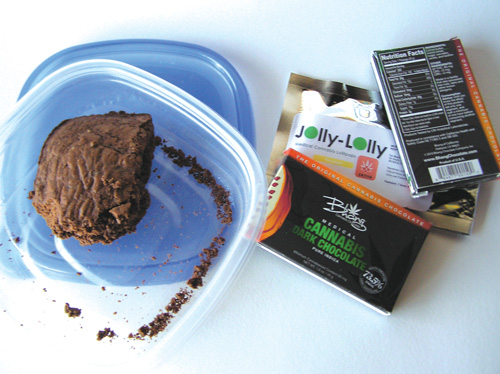
HERBWISE An old factory sits in the outskirts of Oakland. In decades past, this building produced name brand snacks, but the smell of baking still permeates the factory air.

And weed. It smells like weed too. Bhang Chocolate churns out medicinal marijuana sweets here, bars that are smartly packaged in Bhang’s sleek black, orange, and green boxes that are a far cry from the plain wax envelopes and saran wrap that most marijuana edibles used to be sold in. The company is part of the current expansion in edible products — these days, patients can buy medicated cheesecakes, and even savory trail mix.

Adjacent to Bhang’s factory floor, about ten marijuana edibles producers are listening to a man talk about quality control for weed food. Robert Martin, Ph.D., worked for years in corporate food product development and quality assurance. He tells the class his specialty was frozen foods.

Martin is the co-founder of C.W. Analytical, a business that consults marijuana producers and has cannabis testing facilities. A patient himself, he says that marijuana-medicated foods are technically subject to all the same guidelines for commercially-produced non-pot products, although actual enforcement is sparse. C.W. offers these classes for free to interested entrepreneurs. They teach professional skills and serve as an introduction to the for-sale services the business provides.

The students are being treated to quality assurance fail stories from Martin’s career in the corporate world. A sherbet producer he once knew bought a wildly expensive machine to make fudge bars, but when he failed to make the proper tests on his treats, they caused a nasty spate of diarrhea in consumers and he ended up losing his shirt.

“That’s the kind of crap that can happen to you guys,” cautions Martin, and starts reading from a tongue-in-cheek guide to how you can tell food has gone bad. “Flour is spoiled when it wiggles,” he reads. This is quality assurance humor. “I love this stuff!”

One of the day’s students Lacey (not her real name) says she learned a lot from the class that she’ll be able to implement in her own business, Laced Cakes Bakery. She’s been making prettily iced cannabis cookies and brownies since 2007 and has seen the industry requirements shift dramatically.

“Years ago, you could just bring down a tray [to a dispensary] and drop it off,” she says. Nowadays, to sell in San Francisco she has to package the sweets in opaque material and make sure that the design can’t be interpreted as too appealing to kids. “The laws keep changing.”

She had heard about C.W. Analytical at some of the cannabis expos she’s been a vendor at — the firm will have a booth at next weekend’s West Coast Cannabis Expo as well — and was happy that the class was offered for free. She hadn’t finalized her opinion, however, on Martin’s suggestion that producers get their foods analyzed by the company so that they can put nutrition labels on their packaging. “It seems like they might just be trying to make money off of us,” she mused. 

WEST COAST CANNABIS EXPO

Oct. 7-9. Fri/7, 3-9 p.m.; Sat/8, 11 a.m.-9 p.m.; Sun/9 11 a.m.-7 p.m., $18 one day/$45 weekend pass

Cow Palace

Geneva and Santos, Daly City

(650) 591-0420

www.westcoastcannabisexpo.com


The America’s cup confusion

19

If the sponsors (and city officials) are right, the America’s Cup is going to be a huge event, attracting hundreds of thousands of spectators, many of whom will want to be on the San Francisco waterfront to watch. But it’s never been clear to me exactly how that’s going to work — how are all those (rich) people who are used to getting around in limos going to travel from their downtown hotels to the viewing areas? If the city wanted to do this right, we should close down the Embarcadero and some of the feeder streets to all vehicles (except ambulances — always needed when rich old people get excited) and force everyone to travel by pedicab. Buy up a fleet of several hundred of the human-powered vehicles and let all the unemployed teenagers get a shot at driving them. Job creation for youth; environmentally sound transportation; potentially fun bumper-car action with well-heeled patrons screaming in fear.


Remember: The f-line, even with improvements, can’t possibly handle the necessary traffic. And the AC types aren’t going to ride the train anyway. No way private cars can all fit without massive gridlock.


So: Pedicabs. My suggestion.


In the meantime, there’s this little problem of 8 Washington.


See, the developer of what would be the city’s most expensive condos ever is planning on excavating 110,000 cubic yards of soil for a massive underground parking garage — right along the Embarcadero, and right during the America’s Cup events. The Draft Environmental Impact Report for 8 Washington indicates that the dump trucks (about 20 big trucks per day, and possibly a lot more) would be using that roadway to get to 101 or 280.


Actually, if activist Brad Paul is correct, there’s no way the developer can excavate that much dirt in the time frame that it’s supposed to happen unless the number of trucks is closer to 300 a day. Imagine all of that happening while 100,000 people are trying to get to the waterfront to watch the show. Oh, and according to the DEIR for the America’s Cup, the Embarcadero will be CLOSED during that period.


The fact is, the 8 Washington project is not only a terrible idea (just what the city needs — more condos for mega-millionaires) but would directly screw up the whole America’s Cup effort. And the amazing thing is that the AC people and the Mayor’s Office don’t seem to be paying attention.


Paul has put together a lengthy critique of the whole mess that makes great reading if you’re into this sort of thing. So I thought I’d just post it all here. Warning: It’s long. Enjoy.


August 15, 2011                                                                                                         


Bill Wycko
Environmental Review Officer
San Francisco Planning Department
1650 Mission Street, Suite 400
San Francisco, CA  94103


Re: COMMENTS ON DRAFT EIR FOR 8 WASHINGTON STREET/
SEAWALL LOT 351 PROJECT    
Case No. 2007.0030E


Dear Mr. Wycko:


I am writing to my provide my comments on the Draft Environmental Impact Report (“DEIR”) for this project, a document that is incomplete, inadequate and in places quite misleading. I’ve organized my comments in sections beginning with a detailed discussion of how the project’s construction schedule has been greatly underestimated. This is followed by discussions of the DEIR’s failure to address key Housing and Population issues, misstatements regarding historic obligations related to Golden Gateway, comments on recreation issues, and more.  In general, I believe the DEIR fails to present objective information and analysis, it omits a number of relevant issues that are critical to the ability of public officials to make objective and informed decisions about the project and it is filled with judgments and assertions that are not supported by facts.


The DEIR is incomplete and inadequate in the following areas:


I. THE DEIR CONSTRUCTION SCHEDULE FOR 8 WASHINGTON IS BOTH INACCURATE AND MISLEADING.


The DEIR construction schedule is based on overly optimistic assumptions that are totally unrealistic; the ramifications of these erroneous assumptions need to be carefully considered as they will cascade throughout the project requiring major revisions to the DEIR before it can be considered accurate and complete.


At the bottom of page II.19 it states:
 
      Project construction, including demolitions, site and foundation work,
      construction of the parking garage, and construction of the buildings,
      would take 27-29 months. Assuming that construction would begin in 2012,   
      the buildings would be ready for occupancy in 2014. The first phase of the
      construction would take about 16 months and would include demolition       
     (2 months), excavation and shoring (7 months), and foundation and below
      grade construction work (7 months).


While the DEIR unequivocally states the project will take 27-29 months to construct, from 2012 to 2014, facts provided elsewhere in the DEIR together with current city policies,  the City’s America’s Cup Host and Venue Agreement and basic math indicate that this schedule is not tenable. The remainder of this section provides the data and analysis that lead to the conclusion that construction of 8 Washington will take much longer than 27-29 months, almost TWICE AS LONG, with excavation taking 2.5 to 3 TIMES longer.  


Table 1: Requested Changes to the overall DEIR construction schedule


          ACTIVITY             MINIMUM           MAXIMUM


    DEIR’s construction schedule: 27 months    to    29 months  


    Actual excavation schedule:  18 months           22 months
    — DEIR estimate for excavation – 7 months            – 7 months
    + Increased excavation time  11 months      to       15 months 
    + Archeology delays                .5 months      to         2 months
    +  America’s Cup delays                  2.5 months       to         5 months
    +  Weather delays                        .25 months      to         1 months


   ACTUAL CONSTRUCTION TIME 41 months       to      52 months


To refute the numbers in Table 1, project sponsors must present additional, verifiable data supporting their unrealistic assumptions, beginning with the claim that the first phase of construction takes 16 months with a mere seven months allocated for excavation/shoring.


A. The DEIR fails to accurately ascertain and analyze the excavation/shoring schedule.


The DEIR states on page II.20 that “approximately 110,000 cubic yards of soil” will be excavated from the site for an underground garage (approximately 90,000 cubic yards) and other foundation work during the seven (7) month “excavation” portion of the projected timeline. It later states excavation will take place 6.5 hours per day with an average of 20 truck trips per day (pg.IV.D.31). Assuming the average dump truck holds 12 cubic yards of dirt (typical payload for a dump truck), that would mean:


      · 110,000 cu. yards/12 cubic yards per truck = 9,166 truck trips


      · 20 trucks/day X 12 cubic yards/trip = an average of 240 cu. yards/day


      · 110,000 cu. yards/240 cu. yards per day = 458 working days for this task


Could this task be completed in seven (7) months as claimed in the DEIR?  NO.


     ·5 working days per week X 52 weeks = 260 working days per year
             – 11 holidays per year
                   249  total working days/year


     ·458 days to finish task/249 working days per year = 22 months  (not 7)
     
For this to take 7 months as the DEIR asserts, the following would have to be true:


   · 20 trucks/day X 7 months (145 working days ) = 2,900 total truck trips


   · 110,000 cu. yards/2,900 trucks = each truck must average 38 cubic yards/trip
Empirical evidence exists, however, proving the DEIR’s claim that the excavation portion of the schedule will take seven months is inaccurate and misleading:


        CASE STUDY #1: San Francisco General Hospital Rebuild Project


A recent SF General Hospital (SFGH) Newsletter reports the hospital’s contractor just finished hauling 120,000 cu. yards of dirt from the 45’ deep hole that was dug to build two basement levels and the foundation for a new hospital building. This is as close as anyone is likely to get to replicating what 8 Washington proposes, a three level 40’ deep underground garage accounting for most of the 110,000 cubic yards of dirt that must be removed from the site. 


A call to the SFGH Rebuild office revealed their excavation process took seven (7) months with an average truck load of 13 cu. yards per trip. How was that possible?


“The average truck load was 13 cubic yards. Some days we had
over 300 truck loads hauled in one day. This volume was possible
through use of a paved drive that allowed trucks to enter the side, be
loaded up then tires washed to prevent dirt on road causing storm-            
water pollution and dust.”


The SF General site is just a few blocks from U.S. 101 with direct access via Potrero Ave., thus minimizing potential traffic conflicts. The 8 Washington site will require driving long distances on city streets including “The Embarcadero, Harrison Street, and King Street… likely the primary haul and access routes to and from I-80, U.S. 101, and I-280 (pg. IV.D.31).” Imagine 300 trips a day on one of these streets.


               CASE STUDY #2: SF PUC’s New Hetch Hetchy Reservoir Tunnel


A recent Oakland Tribune story (4/8/11) describes construction of a new 3.5-mile tunnel designed to protect the water supply from SF’s Hetch Hetchy reservoir from major earthquakes by boring a 2nd, state-of-the-art tunnel from Sunol to Fremont alongside the existing 81-year-old Irvington Tunnel. The article states:


      “By the time the New Irvington Tunnel is completed in 2014, crews will have
        excavated about 734,000 cubic yards of material—the equivalent of 61,000
        dump-truck trips, said officials with the SF Public Utilities Commission.”


Dividing 734,000 cubic yards of soil by the 61,000 dump truck trips that the PUC says are necessary equals 12 cubic yards per truck trip. Given this job’s overall size and $227 million budget, it would seem to confirm the fact that the most efficient excavation equipment for the 8 Washington site will be 12 cubic yard dump trucks.


In light of these facts and the analysis provided above, the only way 8 Washington could meet its proposed seven (7) month excavation schedule would be to:


a) schedule up to 300 TRUCK TRIPS A DAY, over 10 TIMES the average number of trips per day (20) stated in the DEIR and 3 TIMES the absolute maximum of 100 truck trips per day (pg. IV.D.31)  along the Northeast Embarcadero during a period of time that directly overlaps with the major America’s Cup events and activities, something specifically prohibited by the City’s America’s Cup Host and Venue Agreement ,        


         OR


b) average 38 cubic yards of dirt per truck trip, 3 TIMES the average truck payload of both the PUC’s Irvington Tunnel project and SF General Hospital’s 120,000 cubic yard excavation project—assuming that 38 cubic yard trucks:  a) exist in sufficient quantity in   the Bay Area, b) would be available during that period of time described and c) would be allowed on The Embarcadero, Harrison St., King St., Washington St. and Drumm St. by     the City. [see photo comparison of 12 cubic yard vs. 30 cubic yard trucks below]


Unless the project sponsor can demonstrate that one of these two highly unlikely scenarios is possible, then the EIR must reanalyze a number of impacts (e.g. Land Use, Air Quality, Greenhouse Gases) based on a revised excavation schedule, one that takes 2.5 to 3 TIMES as long as the one described in DEIR to complete excavation work, and this 22 month timeline assumes NO archeological remains are found on site and the City imposes NO stop work orders related to America’s Cup (see below).


This 15-month difference between the excavation period analyzed in the DEIR and the ACTUAL time it will take to complete the excavation (22 months vs. 7 months) is a major deficiency in the DEIR with profound impacts.  For instance, some of the most significant unavoidable negative impacts described in the DEIR involve degraded air quality both during and after construction. Adjusting the environmental analysis to reflect how long excavation will actually take means significant air quality impacts related to excavation (with the greatest detrimental effect on seniors, children and people exercising) will persist for 2.5 to 3 TIMES LONGER than described in the DEIR.  This flaw also requires significant revisions to other sections of the DEIR.


In light of this new information, the next draft of the EIR must contain an analysis of    this longer overall construction period—two months for demolition; a range of 18 to 22 months for excavation (not seven months); a built-in range of time for the shutting down of the site when archeological artifacts are uncovered, documented and extracted (something the DEIR’s archeology consultant states is “likely” ); and the building construction period. Finally, given these overly aggressive excavation schedule estimates, all other estimates for later construction phases must now to be cross checked for accuracy by independent contractors (e.g. not working for 8 Washington developer    or the source of the prior DEIR excavation estimate).


B. The actual construction timeline for 8 Washington will be 41-52 MONTHS. 
If the project sponsors disagree with this assessment, they must provide the Planning Department with much more detailed information on how they expect to achieve a shorter construction period given the restrictions described in the DEIR itself as well as mathematical analysis described above. For instance,


– Did the developers err when they reported that the average number of truck
   trips per day would be 20 as analyzed in the DEIR?  If so, what number do they 
   choose to use now and how does that impact various aspects of the DEIR analysis
   such as air quality, conflicts with pedestrians, MUNI and America’s Cup, etc.. 


– Does the developer plan to raise the limit of truck trips per day from 100 (as
   per the DEIR) to 300 truck trips per day? If so, how often will this happen and 
   how will these changes impact various aspects of the previous EIR analysis (e.g. air
   quality, traffic/transit/pedestrian conflicts, America’s Cup)?


– Does the developer plan to lengthen the average workday or work six days a
   week? If so, how often and how would this impact the previous DEIR analysis?
   NOTE: The DEIR construction schedule (27-29 months) was not predicated on the
   trucks operating 6 days a week EVERY WEEK. But even if the developer ran dump  
   trucks 6 days a week for the ENTIRE excavation period it would still take TWICE AS
   LONG as the DEIR states to remove 110,000 cubic yards of dirt .


– Where is the project sponsor planning to route 100 to 300 trucks a day as they
   leave the site, particularly during the various America’s Cup trials (2012) and
   finals (2013) when vehicular traffic will be severely limited or prohibited?
   Washington Street? The Embarcadero? Drumm Street? Clay Street?, where exactly?


– Have the developers located a source of 30+ cubic yard trucks and secured
   city permission to use them on the specific streets described in the DEIR?
   It seems fair to assume the SF General Hospital’s excavation contractor would have
   done this if it were possible (and the SF PUC’s Irvington Tunnel contractor). See the  
   three photos below to get a sense of the size difference between a typical 12 cubic yard
   dump truck and the type of tractor-trailer rig required to carry 30 cubic yards or more.


As the questions and examples (SF General Hospital) above demonstrate, the DEIR’s claim that 110,000 cubic yards can be excavated in seven months defies the laws of physics and math, not to mention the America’s Cup Host & Venue Agreement between the City and Larry Ellison’s Oracle BMW Racing Team 


 A thorough reading of the DEIR’s Archeology section and the America’s Cup Host and Venue Agreement indicate that additional time must be built into the construction schedule for predictable work stoppages related to both issues.


KNOWN ARCHEOLOGICAL RESOURCES IDENTIFIED ON THIS SITE IN THE DEIR


On page IV.C.12, the DEIR’s archeology consultant, Archeo-Tec, identifies the Gold Rush ship Bethel as located under a portion of the site and states that “If discovered, the Bethel would be the oldest known (and perhaps most intact) archeological example of an early Canadian built ship (Pg. IV.C.3)”. On page IV.C.11, the archeology consultant states “Significant archeological resources are likely to exist at this site”.  The DEIR, goes on to state the proposed project will destroy a portion of city’s original Seawall causing “the largest disturbance of the Old Seawall to date”.


As a result of these DEIR findings, the archeology consultant should now be asked for an estimate of the time required to mitigate the discovery of the Bethel and other likely finds (e.g. original Seawall, other Gold Rush ships, original Chinatown). This “likely” work delay should be built into the construction schedule and stated as a range. For purposes of the matrix below (Table 1) we chose a time of two weeks to two months based on anecdotal information from other similar sites. Archeo-Tec, the archeology consultant, should be able to come up with a more precise estimate.


KNOWN AMERICA’S CUP SCHEDULING CONFLICTS


Based on recent MTA staff presentations on protocols for the America’s Cup, it seems clear that traffic, particularly construction dump trucks, will be banned from Washington Street, Drumm Street and The Embarcadero during major America’s Cup events that include, at a minimum, the America’s Cup World Series warm-up races (July/Sept. 2012), the penultimate Louis Vuitton Cup Series (July/August 2013) and the America’s Cup finals (Sept. 2013).  


This represents a minimum of 2.5 months that must be added to the construction schedule, something the DEIR authors should have included if they had read the America’s Cup DEIR which states there are 9+ weeks of races associated with this event in 2012/2013. The extra few weeks added to the low end range in Table 1 (below) are there to accommodate last minute weather delays and various large non-racing events held along the waterfront that will require closure of The Embarcadero, Washington Street, Drumm Street, etc.


Table 1 below lays out a more credible and realistic construction schedule based on the factors described at length above, taken directly from the DEIR or readily available from the city (e.g. America’s Cup DEIR) and the America’s Cup Host and Venue Agreement.


Table 1: Requested Changes to the overall DEIR construction schedule


          ACTIVITY             MINIMUM           MAXIMUM 


    DEIR’s construction schedule: 27 months    to    29 months  


    Actual excavation schedule:  18 months           22 months
    — DEIR estimate for excavation – 7 months            – 7 months
    + Increased excavation time  11 months      to       15 months 
    + Archeology delays                .5 months      to         2 months
    + America’s Cup delays                   2.5 months        to         5 months
    + Weather delays                        .25 months      to         1 months


   ACTUAL CONSTRUCTION TIME 41 months       to      52 months


To refute these numbers, the project sponsors must not only present a verifiable and detailed plan to remove 110,000 cubic yards (9,167 truck trips) in seven months that the City has signed off on but also produce a letter from the City and Oracle BMW Racing granting a waiver from Section 10.4 of the America’s Cup Host and Venue Agreement that would allow 20 to 300 trucks a day to drive along The Embarcadero, Washington Street   or Drumm Street during major America’s Cup events in 2012 and 2013.


D. Significant Transportation and Energy issues that were not addressed in DEIR.


More specific information related to the construction process needs to be provided and analyzed in the EIR, particularly regarding the far reaching impacts of those 9,166 dump truck trips, impacts that go beyond the immediate Northeast Waterfront.


The DEIR states “While the exact routes that construction trucks would use would depend on the location of the available disposal sites, The Embarcadero, Harrison Street, and King Street would likely be the primary haul and access routes to and from I-80, U.S. 101, and I-280”. At a minimum, The EIR needs to include information on where the two or three most likely disposal sites are located, based on recent experience (SF General Hospital excavation) so that one can analyze the extent of potential conflicts on the Bay Bridge or 101 South where other trucks will be transporting dirt to and/or from the Transbay Terminal project, Hunters Point Shipyard, Mission Bay, Treasure Island, etc. Without this information, the City could find itself creating significant traffic conflicts on the Bay Bridge or highway 101 that greatly increase air quality, traffic and transit problems without having analyzed these potential impacts in a flawed EIR.


Simply saying “While the exact routes that construction trucks would use would depend on the location of the available disposal sites” isn’t adequate or acceptable. Assumptions must be made regarding most likely disposal sites and routes to those sites and what additional cumulative impacts these routes (and 9,166 trucks) will create. The EIR must provide a MAP of the route to be used for hauling soil, all the way from the departure point at 8 Washington to the final destination(s) with an explanation of where trucks will drive and what restrictions there are on hours, size of payload, safety, etc. for the various streets, highways and bridges they will travel on. If the options include trucking the soil to San Francisco’s southern waterfront to transfer it to barges, then this needs to be disclosed and analyzed, including the potential routes and destinations of those barges.
In addition, to accurately compare the environmental impacts of the project sponsor’s ‘Preferred Project’ to the “No Project” alternative (energy consumption, traffic impacts, air quality degradation, etc.), one needs to know not only the destination of the approximately 9,166 dump truck trips but also the average miles per gallon of a typical dump truck. For instance, if the final destination for the soil was 100 miles away and a typical dump truck averages 8 miles per gallon of diesel fuel, then:


      9,166 truck trips X 200 miles per round trip = 1,833,200 miles for all dump trucks;


      1,833,200 gallons/8 MPG = 229,150 gallons of diesel fuel that would be burned. 


In other words, the city’s choices would be:


     229,150 gallons of diesel fuel used to transfer 110,000 cubic yards 1,833,200 miles


VS.


    ZERO (O) gallons of diesel fuel used if the NO PROJECT alternative were approved.


E. Importance of accurate, detailed information re: the construction process.


Given the above discussion, it is clear that the construction schedule set forth in the DEIR is inaccurate at best and has led, in many cases, to the significant understating of major negative impacts associated with this project. The lack of a detailed discussion of some of the key aspects of the construction process, e.g. the route and destination of 9,166 dump trucks, is also highly problematic.


Without a complete and thorough analysis of the impacts of a of an overall construction schedule that is TWICE AS LONG as the one analyzed in this DEIR, city officials will be missing much of the critical information they need to determine whether or not the developer’s ‘Preferred Project’ is necessary, desirable or feasible. A complete and factual analysis of this issue must be included in the next draft of the EIR which, given this and  other major inaccuracies and omissions (see below), should be recirculated in draft form.


II. THE DEIR FAILS TO DISCUSS OR ANALYZE ANY CRITICAL HOUSING ISSUES RELEVANT TO 8 WASHINGTON OR UNIQUE ENVIRONMENTAL AND ENERGY IMPACTS THOSE HOUSING ISSUES CREATE. 


A. Impacts of the project on the City’s Housing Needs were Not Analyzed in DEIR.  The DEIR states that potentially significant impacts to Population and Housing will not be discussed because the 2007 NOP/Initial Study found that the proposed project would not adversely affect them. Unfortunately the DEIR lacks the basic information needed to reach such a conclusion and, as we will demonstrate, an objective review of relevant 2008-2011 housing data contradicts this conclusion.


The world, particularly regarding housing, has changed radically since 2007. Relying   on housing and population information from 2007 ignores the financial and housing meltdown of 2008 and is simply indefensible. In addition, back in 2007, the EIR consultants were relying on stale, seven-year-old census data while today they have access to a multitude of fresh 2010 census data. No one can dispute that the housing environment today could not be more unlike the housing environment in 2007.
By relying solely on pre-2008 housing data from the 2007 NOP/Initial Study, this DEIR    lacks any of the basic information needed to conclude that this project would not have adverse effects on Population and Housing and must now revisit and thoroughly analyze these issues.


B. The DEIR fails to analyze how the type and price of housing proposed for
8 Washington determines whether or not it meets the city’s housing needs.


One of the project objectives (Pg II.14) is to “help meet projected City housing
needs.” How is that possible, given the fact that the developer has publicly stated
that these will be “the most expensive condominiums in the history of SF” ? With a
$345,000,000 project cost , 8 Washington’s 165 units will cost $2.0 million a unit
just to build . To secure financing and a ‘reasonable’ profit, each unit will have to
sell for $2.5-$5 million with penthouses selling for $8-$10 million.


Nowhere in the DEIR is ANY of this discussed. There is no analysis of how these
very high sales prices will determine who lives at 8 Washington (e.g. how many San
Francisco families could afford these prices?) and how the incomes of these new
residents ($250,000 to over $1 million/year) will dramatically change a number of
the environmental impacts of the project, with major implications for sustainability
and energy use, among other things.


The final EIR must state the average cost to build each unit and the range of
sales prices expected so that public officials can assess for themselves whether
the proposed condos will or will not  “help meet projected City housing needs.” 


The 2009 Housing Element, signed into law by Mayor Ed Lee on June 29, 2011, states that 61% of the housing need in San Francisco is for below-market-rate housing—serving families making 30-120% of Area Median Income (AMI), and only 39% of the city’s housing need is for market rate housing (120% to 500+% AMI).


As Planning staff and Commissioners know from their Housing Element discussions, the luxury condos proposed for this project are so expensive they will not help the city meet its current unmet housing needs. If this project objective (Pg II.14) is left in the final EIR, it should include a note explaining that the project, as proposed, is unlikely to meet this objective for the following reasons:


Condominiums selling for $2.5 million and more fall into the one segment of the city’s housing market that is currently overbuilt and has historically been over represented in relation to the state’s Regional Housing Needs Allocation (RHNA) goals that underpin the updated 2009 Housing Element of the city’s General Plan. An ABAG report on housing needs vs. housing production in SF (1999-2006) that came out in 2007—a report that should have informed the 2007 NOP/Initial Study for 8 Washington—states RHNA Allocations (Goal), Permits Issued (Permitted) and % of Allocation Permitted (% of RHNA Goal) by income category as follows:


Table 2: SF Housing Production (1999-2006)*


Housing Type  Very Low    Low              Moderate       Market Rate 
by Income    Income Income  Income           Housing
____________________________________________________________________________________________________________
  % of AMI:    21-50%  51-80%  81-120%         120-500+%
  Annual income: [21-50K] [57-81K] [85-123K]   [123K-$1million+]
———————————————————————————————————-
·RHNA Goal (units)   5,244       2,126   5,639                7,363


·Permitted    4,203       1,101      661                        11,474


·% of RHNA Goal     80%      52%       12%             156%


        * from a 2007 ABAG report entitled: A Place to Call Home


A chart like this, showing housing goals by income group (based on RHNA numbers from the State Office of Housing and Community Development), must be included in the DEIR so public officials can analyze what portion of the city’s unmet affordable and middle income housing needs, if any, the proposed project would meet. It illustrates something local housing experts have long known, that the city consistently comes in well above its RHNA goals for market rate condos, and has historically fallen short of its goals in all other categories for affordable housing, the housing that serves the 61% of San Franciscans that cannot afford ‘market rate’ housing.
C. Dramatic changes to the San Francisco housing market since the 2007 NOP/ Initial Study were not acknowledged and analyzed in the DEIR. All the traditional (pre-2007) sources of funding for the city’s affordable housing programs have dried up since the 2008 housing crash. Redevelopment tax increment funds will either be significantly reduced to pay the state to avoid closure of the SF Redevelopment Agency, or they will be eliminated altogether. Proceeds from the state’s $2.8 billion Affordable Housing Bond (Prop. 1C) are all spent. The federal Low Income Housing Tax Credit, a major source of funding for affordable housing, is under attack by House and Senate Republicans and may not survive.


This indicates that San Francisco won’t come close to meeting its pre-2007 affordable housing production levels  until we find a new permanent local source of funding for affordable housing. How long will that take? The DEIR must address this issue.


Another chart that must be included in the DEIR shows the city’s RHNA goals by income category combined with a summary of a recent SF Business Times (6/24/2011) chart showing all San Francisco residential projects under construction, permitted or  in the planning pipeline . Such a chart would look something like Table 3 below:


Table 3: Where does the city need help in meeting its RHNA goals?


          Extremely Low       Very Low            Low             Moderate          Market Rate   
                 Income          Income           Income            Income               Housing
         Below 30% AMI          31-50%            51-80%           81-120%              120-500+% 
      [21K-30K]         [35K-50]        [57K-81K]      [85K-120K]        [120K-$1M+]
____________________________________________________________________________________________________________


RHNA      439/yr.                   439/yr.           738/yr.            901/yr.                    1,632/yr.
Goals:      10.5%        +          10.5%      +      18%        +     22%  =  61%           39%
# of units                    of total        of total
% of goal
                             All Affordable Categories Combined            Market Rate_


Underway:          470 units                 1,557 units


Approved:                  8,751 units             30,878 units


In Pipeline:                   780 units                     4,184 units 
________________________________________________________________________
                          10,000 units             36,619 units 
            or                     or
          21.5% of all units                 78.5% of all units


                        56% of RHNA goals                                300% of RHNA goal
                in all affordable categories                        in market rate category
Some version of Table 3 must be included in the revised DEIR to help public officials determine whether the significant negative environmental impacts this project creates are outweighed by the ‘need’ for the type of housing that 8 Washington provides given the priorities set forth in the Housing Element of the General Plan and what the above-mentioned SF Business Times chart tells us about likely housing production for each segment of the city’s housing needs (from 2011-2014). 


Table 3 demonstrates that in a few years, if nothing changes, the city will have approved and built out 300% of its RHNA goal for Market Rate projects (such as 8 Washington) but only 56% of its RHNA goals for all other housing that serves San Franciscans making 30% AMI to 120% AMI. But given what we now know about the current lack of funding for affordable housing, the exact opposite of what was true in 2007 (when the city had significant amounts of Redevelopment tax increment and other affordable housing funds), many of the affordable housing projects listed by the Business Times are now on hold and unlikely to come on line by 2014. This means the mismatch between market rate (39% of need but 300% of production) and all categories of affordable will be even greater than Table 3 indicates.


To be fair, one could argue that some of the market rate housing on the Business Times chart may not be built soon either given that banks have been reluctant to lend money lately. However, a recent article in the SF Chronicle (8/11/11) entitled “Rents Go Through Roof” indicates that the city’s housing market is roaring back; Dennis Robal, property manager with Chandler Properties, reports “Noe Valley apartments that were $2,000 a month a year ago are now going for $2,400”. These kinds of increases, driven by new renters from the tech sector, are prompting major increases in investments by financial institutions in new rental housing.


Regarding the condo market, the one group of potential condominium buyers that
have not suffered financially from the economic meltdown are the very people who
caused it, the Wall Street investors, derivatives specialists, hedge fund managers,
etc. who are now making record salaries and bonuses. These are some of the people
8 Washington will be marketing to because they have the cash to spend $2.5-$10
million on a second, third or fourth home in San Francisco.


NONE of this housing analysis appears in the DEIR yet including it in the DEIR is
critical to the ability of public officials to make informed, rational decisions on this
project, particularly claims by the developer that this project will “help meet
projected City housing needs”. The information and analysis described above is
necessary to allow city officials and all readers to determine accurately and
objectively what portion of San Francisco’s unmet affordable and middle income
housing needs, if any, 8 Washington would meet.


Each year, as the City assesses how well it is meeting its RHNA (state) housing goals, the one area that has consistently over produced is high-end market rate housing affordable to people making $250,000 to $1 million+ a year.
How does building second, third and fourth homes for this demographic “help the city meet its housing needs?”


The unmet housing needs in San Francisco are for people making from 30%-50% of median income all the way up to 100-120%, not people making $250,000 to $1,000,000+ a year (200-500% or more of area median income). The DEIR needs to discuss the following questions to be considered complete, adequate and accurate, questions such as:


How does this project relate to the objectives, policies and goals of San Francisco’s recently enacted 2009 Housing Element of the General Plan?


What portion of San Francisco’s affordable and middle-income housing needs will this proposed project actually meet?


How many other projects under construction, approved or in the pipeline (see June 24,
2011 SF Business Times chart) will meet the needs of San Franciscans who can afford market rate housing vs. those that meet the needs of  the 61% of SF residents needing below market housing?


What percentage of “residents” of these condos will be using this housing as their primary residence vs. as second, third and fourth vacation homes?


Given that numerous studies show transit use goes down as income goes up,
how likely is it that these new owners will use public transit?


Again, the answer to each of these questions provides critical information that public
officials need to assess for themselves whether the proposed condos will or will
not “help meet the projected City housing needs.” 


Everything that’s happened since the 2008 economic/housing meltdown has made our housing problems worse, something the DEIR doesn’t attempt to analyze, arguing instead that a 2007 NOP/Initial Study—competed a year before the housing bubble burst—absolves it of all such responsibility, an argument that is factually absurd.


D. The DEIR fails to acknowledge, measure or analyze the unique environmental impacts generated by owners who can pay $2.5 to $10 million for luxury condos.


Building housing for this demographic has measurable impacts on transit and energy use that were not included in the DEIR. We know from national studies that low-and middle- income residents are far greater consumers of public transit than people with higher incomes. Imagine how much different public transit use will be when this inverse relationship includes people who can afford $2.5-10 million condos that come with             1-for-1 parking (costing almost $100,000 a space to build).


But a far greater environmental impact than driving private cars was not addressed in this DEIR, an impact resulting from lifestyle differences one can anticipate with some members of this highest of high-end demographics: owning and/or using private jets.


It’s reasonable to assume that five of the 165 condo buyers at 8 Washington (just 3% of   all buyers) are Wall Street hedge fund managers, derivatives traders or venture capitalists using these condos as second, third or fourth homes. It’s also reasonable to assume that these five buyers will use their condos 1.5 times a month on average and commute to and from SF aboard private business jets, a perfectly rational assumption for Wall Street executives making tens of millions in salary and bonuses each year. Why would they fly private jets rather than take Southwest…because they can. The fact that a handful of  people that are this wealthy will buy units at 8 Washington must be factored into any environmental analysis of a project that will explicitly market to this high-end demographic. That analysis must include, among others, the following:


                           Table 4: The Jet Fuel Burn Rate for Luxury Condominiums
___________________________________________________________________________
Mid to large size business jets used to fly cross country (e.g. Hawker 800XP, Gulfstream G2/G3, Bombardier Global Express) average 400 gallons of jet fuel per hour and take six hours to fly New York to SF and five hours to fly back for an 11 hour round trip  :


     · 11 hours X 400 gallons per hour = 4,400 gallons of jet fuel per trip
          a typical family car burns 1,200 gallons of gas per year so one flight from
          NYC to SF equals almost four years of driving a typical family car.
               ————————————————————————————————————————————————————————————————————-
       
        ·  1.5 trips/mo. = 6,600 gallons/mo. X 12 mo. = 79,200 gallons of jet fuel/year


        ————————————————————————————————————————————————————————————————————-
Using our example of 5 residents, the numbers over one year and 20 years are:


        ·  5 X 79,200 gallons/per year = 396,000 GALLONS OF JET FUEL A YEAR or
         equivalent to driving a family car 330 years, A THIRD OF A MILENNIUM, per year.


        ·  396,000 gallons/year X 20 years = 7,920,000 GALLONS of jet fuel in 20 years
         equivalent to driving family car 6,600 years, OVER 6 MILLENIUM, in 20 years.


Given these condos cost $2+ million to build and will sell for $2.5 to $8 million or more,    it seems quite reasonable to assume a mere 3% of these buyers—just five (5) buyers out of 165 —will be part-time residents wealthy enough to commute to San Francisco by business jet. If this is a reasonable assumption , then the DEIR must include the mathematical calculations above to show the true energy costs of this project. In fact, it would also be reasonable to assume a few other buyers will use private business jets to commute from LA, San Diego, Denver, etc. The only way to prevent this, forbidding buyers to own or use corporate jets, is of course impossible.
This is just one example of how housing prices—and who lives in that housing—greatly changes environmental impacts and why this analysis must be included in the DEIR for    8 Washington. As condo prices reach $2.5-10 million, it’s reasonable to assume a number of buyers will use them as a second, third or fourth homes and that some of those buyers will travel here by jet, not car or public transit. On the other hand, if units at 8 Washington were affordable or market rate rental or affordable-by-design condos (80%-150% AMI), it’s very unlikely any of its residents would own or use business jets. Price does matter with regard to energy consumption and transit use.


Given these facts, the 8 Washington DEIR must analyze such questions as:


How many solar panels do you need to make up for 396,000 gallons of jet fuel per year?


How many low flow toilets make up for 396,000 gallons of jet fuel per year?


How many double pane windows make up for 396,000 gallons of jet fuel per year?


How many on-demand hot water heaters make up for 396,000 gallons of jet fuel per year?


Looking at the longer term impacts of this excessive consumption of energy resources:


How many solar panels compensate for 7,920,000  gallons of jet fuel over 20 years?


How many low flow toilets make up for 7,920,000 gallons of jet fuel over 20 years?


How many double pane windows make up for 7,920,000 gallons of jet fuel over 20 years?


How many on demand water heaters make up for 7,920,000 gallons of jet fuel over 20 years?


Having this information in the DEIR is necessary for the Planning Commissioners or Board of Supervisors to make informed decisions about 8 Washington, especially when the project sponsor keeps touting it as state-of-the-art, sustainable, LEED certified (at Gold or Platinum level), etc. When added to the project sponsor’s insistence on building a 420-car underground (below sea level) garage, one has to question how one can call this a model of sustainable development or let the DEIR include sustainability as a project objective.


Unless the DEIR seriously and objectively addresses questions of how the price of housing and who lives in that housing impacts environmental sustainability, we risk creating a backlash against things like LEED certification and terms like “sustainability”. They could easily become just another example of slick marketing and “greenwashing”. Everyone agrees that building 10,000 s.f. McMansions in the Sierra Foothills on 2-acre lots—even if they’re LEED certified at the highest level—is NOT sustainable development. Why is it any less absurd to use “green” and “sustainable” to describe $2.5-$10 million condos built as second and third homes for extremely wealthy part-time residents, some of whom commute from their primary residence by private jet?


The DEIR must provide public officials with the data and information they need to analyze all the significant impacts that units this expensive have on the environment. With this information, decision makers might choose to require a much smaller garage or no garage at all (insisting on more efficient use of nearby existing garages). They might also choose to support a much smaller project or no project at all, based on the lack of demonstrable need for this housing type and all the other negative impacts described above. But they cannot make any of these decisions in a rational and objective manner without all the facts, many of which are missing from this DEIR.


E. The DEIR confuses project “objectives” with city mandated requirements with regard to Inclusionary Housing, then fails to discuss any of the relevant issues around this city policy.


The project objective (Pg II.14) that talks about the project’s ability “to help meet
projected City housing needs” reads in full:


 “To develop a high-quality, sustainable and economically feasible
   high-density, primarily residential, project within the existing
   density designation for the site, in order to help meet projected
   City housing needs and satisfy the City’s inclusionary affordable
         housing requirement;” 


Satisfying the city’s inclusionary affordable housing requirement, for this or any market  rate housing development, IS NOT an Objective, and stating it as such is misleading. It is,  in fact, legally mandated by city ordinance. The developer doesn’t have a choice in the matter and it should be stricken from this Objective. However, this reference to inclusionary housing leads one to ask several questions that are never addressed in the DEIR but should be. An Inclusionary Housing section must be added that answers questions such as:


What are the specific requirements for including permanent below market rate (BMR) units in all market rate projects and how many would be required on-site for this one?


Did the developer ever consider building on-site BMR units and if not, why not?


If the developer did consider and reject on-site BMR units, why?


If the developer has decided to pay the in-lieu affordable housing fee, what would it be and how and where (e.g. within a 1-mile radius of the project) would it be spent?


Given that the in-lieu fee charged developers to buy out of providing BMR units on-site is based on construction costs and sales prices for “average” condos, how will the extraordinarily high construction costs and sales prices for these condos impact the in-lieu fee? If it doesn’t impact the fee, would an appropriate mitigation measure be amending the Inclusionary Housing policy so that it does?


Mentioning the inclusionary requirement as part of an objective stating that the project seeks to “help meet projected City housing needs” is misleading and inaccurate. It tries to infer that the funding for 30 affordable units provided by the developer’s inclusionary requirement is helping to meet this objective when, in fact, relying on inclusionary payments to advance the city’s affordable housing goals will only drive the city further   out of compliance with its state mandated RHNA goals. The following example clearly demonstrates the validity of this claim:


TNDC’s proposed affordable family apartment project at Eddy and Taylor Streets is typical of the projects now stalled in the city’s affordable housing pipeline due to the lack of affordable housing funding from traditional sources. But the Eddy and Taylor project is a 150 unit development, not 30 units. For it to go forward, you would need the inclusionary housing funds from FIVE market rate projects like 8 Washington. What would that do to San Francisco’s RHNA goals:


         If:  165 market rate units are needed to fund 30 affordable units,
  Then:   825 market units (5X) are needed to fund 150 affordable units (975 total units).
      
         If:  out of a every 975 new housing units, 825 are market rate & 150 are affordable,
   Then:  for each new 975 units built in SF: 85% are market rate, 15% affordable.


But the 2009 Housing Element of San Francisco’s General Plan (based on the state RHNA goals) calls for 39% OF NEW HOUSING TO BE MARKET RATE (NOT 85%). Relying on Inclusionary Housing off-site payments to fund affordable housing clearly runs counter to the housing production goals set forth in the 2009 Housing Element in the General Plan as well as the RHNA goals for San Francisco established by the state of California. Furthermore, as SB375 Sustainable Development funding criteria begins influencing state funding decisions, by driving our RHNA numbers toward 85% market rate, projects like 8 Washington could jeopardize San Francisco’s ability to apply for and receive state and federal infrastructure and transit funding.


The only way to bring San Francisco’s housing production numbers back into line with the goals in the Housing Element (and RHNA numbers) is to create a new local permanent and dedicated source of funding for affordable housing. These relevant facts regarding the impacts of inclusionary housing must be included in the DEIR.


III. THE DEIR IGNORES THE GENTRIFICATION/DISPLACEMENT IMPACTS OF THIS PROJECT THAT WILL RESULT IN THE LOSS OF HUNDREDS OF RENT CONTROLLED UNITS IN THE GOLDEN GATEWAY BY ENCOURAGING THE FURTHER HOTELIZATION OF ITS 1,200 RENTAL APARTMENTS


The other ‘partner’ in this project is Timothy Foo, who bought Golden Gateway from Perini Corp. about 20 years ago. Only 20% of the 8 Washington site is on Port land, while 80% of the site is on land owned by Mr. Foo and currently occupied by Golden Gateway’s community recreation center. However, Mr. Foo’s only mention in the DEIR is in a footnote to the first sentence of the Introduction which states: “On January 3, 2007, an environmental evaluation application (EE application) was filed by San Francisco Waterfront Partners II (the “project sponsor”) on behalf of the Golden Gateway Center*”. That footnote says “*Golden Gateway Center, Authorization Letter from Timothy Foo, December 27, 2006”).


In addition to violating the original Golden Gateway development agreement that required Perini (and future owners) to preserve the recreation center in exchange for deep discounts in land prices charged by Redevelopment, for some time now Mr. Foo has also been converting rent controlled apartments in the Golden Gateway to short term rental use (e.g. on one floor of a high-rise tower, a third of the units are rented this way). These conversions have been documented by the Golden Gateway Tenants Association, the Affordable Housing Alliance and the San Francisco Tenants Union. While such conversions are not unique to the Golden Gateway Center (see attached Bay Citizen article), they are illegal and violate city zoning, rent control and apartment conversion ordinances.


The DEIR must address this issue by posing the following questions to Mr. Foo and incorporating his answers into the DEIR. He must provide this information because as the owner of 80% of the underlying land that comprises the 8 Washington site, he has had and continues to have a direct financial stake in this project. He must be asked the following questions:


How many of Golden Gateway’s 1,200 rental apartments are currently being used as hotel rooms and/or short-term rentals and/or rented to persons other than those using them as primary residences or directly related to the person residing there (e.g. corporations, business organizations, apartment brokers).


Has Mr. Foo consulted with either the Rent Board or the Planning Department as to the legality of his use of apartments in Golden Gateway as hotel rooms or short-term rentals under applicable city zoning codes, the San Francisco Rent Control ordinance or the city’s Apartment Conversion Ordinance?


Upon receiving and analyzing this information from Mr. Foo, the DEIR must then answer the following questions:


Is the ‘hotelization’ of Golden Gateway and other large apartment complexes likely to increase with the approval of 8 Washington, a development that:


a) builds 165 high-end luxury condos ($2.5 – $10 million each)
 on Mr. Foo’s property—creating a much more upscale
environment adjacent to his Golden Gateway apartments;


b) provides Mr. Foo with $10-15 million (what he’s likely to
be paid for his 80% of the site) that can be used to upgrade
his rent controlled apartments at Golden Gateway in order                             to attract even more higher paying hotel users; and


c) if no mention of these conversions is made in the DEIR, after                     these written comments have been submitted, will send a clear
message to Mr. Foo and others that the City has no intention of
enforcing its own zoning, rent control and apartment conversion
ordinances, thereby encouraging even more conversions.


If conversions like those at Golden Gateway are not stopped soon, the city is at risk of losing thousands of residential apartments in its downtown neighborhoods.


What kind of mitigations would prevent the further hotelization of the Golden Gateway’s 1,200 rent controlled apartments?


With larger apartment complexes such as Golden Gateway, Parkmerced and Fox Plaza, owners get around the current prohibition on renting residential apartments for less than 30 days as hotel rooms (an action that is legally prohibited by the San Francisco Apartment Conversion Ordinance) by leasing them for more than 30 days to third parties (e.g. corporations, apartment brokers). These intermediaries then rent the apartments for anywhere from a day or two to a few weeks to a month or two.


A simple amendment to the Apartment Conversion Ordinance that changes “you cannot rent an apartment for less than 30 days” to “you cannot rent or occupy an apartment for less than 30 days” would prevent Golden Gateway and others from renting apartments for anywhere from a few days to up to four weeks. Preventing 30-60 day rentals would be a more complicated matter.


The DEIR must address how constructing 8 Washington could encourage, help fund and accelerate Mr. Foo’s conversion of the 1,200 units at Golden Gateway from rent controlled apartments to hotel use as well as the impacts this would have on the city’s housing goals as set forth in the San Francisco’s 2009 Housing Element and its RHNA goals. For instance, if we’re converting housing to non-housing (hotel) uses as fast or faster than we are creating new housing units, we will never dig ourselves out of our current housing crisis and that outcome would have catastrophic impacts on the environmental and economic sustainability of San Francisco as a city.


The DEIR must also describe, in detail, the kind of mitigations (see above) that, if enacted, could mitigate the potential impact of losing more that 165 rent controlled apartments at the Golden Gateway, erasing the gain, on paper, of 165 luxury condos.


IV. FREQUENT USE OF THE WORD “PRIVATE” AS A MODIFIER OF THE GOLDEN GATEWAY RECREATION FACILITIES THROUGHOUT THE DEIR  IS BOTH MISLEADING AND INNACCURATE IN LIGHT OF THE RECENT PRIVITIZATION AND FEE STRUCTURES IMPOSED ON THE CITY’S “PUBLIC’ RECREATION FACILITIES AND SWIMMING POOLS.


The current fee structure for public recreation facilities in San Francisco results in situations where the cost of attending ‘public’ pools can often exceed fees charged by    the “private” Golden Gate Tennis & Swim Center (GGTSC).


The use of the term “private” in this context throughout the DEIR appears to be an attempt to justify the loss of GGTSC facilities for the 3-4 years that it would be shut down if the “preferred project” were approved (see section I.A for actual construction schedule) as well as the permanent loss of five of nine tennis courts, the basketball court and the current, family-friendly ground level swimming pools, Jacuzzi and open space.


In the past, the city’s public recreation facilities, including its swimming pools, were  “public” in every sense of the word—open long-hours, open 6-7 days a week and “free” to residents. In recent years, however, the San Francisco Recreation & Parks Department has increased resident user fees, reduced hours and increased the privatization of its facilities in response to ongoing budget deficits. Today, both the ‘private’ Golden Gateway facility and ‘public’ pools are open to anyone, anyone who is willing to pay   the fees that they charge. Neither is free.


A. The DEIR fails to discuss the privatization of the City’s  recreation centers: According to a 7/9/11 SF Chronicle article, the city is now leasing 23 of its 47 recreation centers to outside interests (e.g. nursery schools, private classes) with the city staffing only a dozen (12) of the 47 former “public” recreation centers. Seven (7) of the remaining recreation centers are under renovation and five (5) are vacant, unavailable for any kind of use “because no one has leased them and there is no money for city workers to run them”. Out of a total of 47 city recreation centers, only 12 are staffed by city workers who run programs for residents, many of them for a fee, during reduced days and hours.


The City also runs nine “public” swimming pools in neighborhoods such as North Beach, the Mission, Bayview, Visitacion Valley, etc. These pools used to be open five or six days a week and were free for residents. Today, residents pay $5 for each swim and $7 for adult swim lessons/water exercise. Children under 17 pay $1 per swim and $2 for swim lessons/water exercise ($3 for a swim & a class together).


Active Recreation Facilities: Public vs. Private… is there a difference anymore?


Each time a family of two adults goes to a city pool it costs $10 per visit to swim and up to $14 per visit if they participate in swim lessons or water exercise. If that family went three times a week, it would cost them $120-$168 per month depending upon how many times they took a swim vs. participated in swim lessons/water exercise. That comes to at least $1,440 dollars per year. Additional swim lessons/water exercise classes drive costs of using a “public” pool even higher.


Now imagine a family of two adults living at the Golden Gateway who currently       swim every day at the Golden Gate Tennis and Swim Center. At the city’s North Beach (public) pool, it would cost them $200 a month ($10/swim X 20 days) to swim Tuesday through Saturday (the pool is closed Sunday/Monday) and their schedules would have to match specific windows each day when the pool is available for adult lap swimming. Compare that to the two pools at the Golden Gateway Tennis and Swim Center—one just for swimming laps; one for kids, families and seniors that are open seven days a week for longer hours.


B. Comparative Costs. Because our hypothetical couple live at the Golden Gateway Apartments they automatically receive a discounted membership of about $170  per month ($85 each) to use the two pools, full gym across the street and have the ability to reserve tennis courts at $20 per use. Since the Golden Gateway was built (1960’s), residents have always received discounted membership at this facility, one of two community benefits Redevelopment required, along with Sidney Walton Square, in exchange for entitlements to build both the Golden Gateway (1,150 rental units) and the adjacent Gateway Commons (condominiums). Redevelopment felt both amenities were needed to meet the open space and active recreation needs of what was to become one of the densest residential communities in San Francisco and discounted the land for the GGTSC and Gateway Commons in exchange for the owner maintaining an active recreation facility at the GGTSC in perpetuity.


Even for those who don’t get the Golden Gateway resident discount, memberships to the Tennis and Swim Center that don’t include automatic access to the tennis courts cost about $220 a month to swim 30 days a month, the same price two adults would pay to swim only 20 days a month at the North Beach pool, a facility with no gym and only   one pool and therefore greater restrictions on when they could swim laps. It should also be noted that over 300 “guests” are admitted free to the Golden Gateway recreation facility each month, a total of 3,000 to 4,000 guests each year. We are not familiar with   a similar policy for free guests at the North Beach pool (or any other city pools).


Clearly, the recent privatization and escalating fee structures at the city’s “public” recreation centers/swimming pools have erased any real distinctions between public facilities and private facilities as viewed by local families and residents. But one of          8 Washington’s main justifications for closing the Golden Gateway Tennis and Swim Center for 3-4 years during construction—and downsizing the replacement facility—
is that it is a “private” club maintained for the selfish interests of the few.


Putting aside the fact that 8 Washington’s condos will cost $2 million each to build  and will sell for $2.5 to $5 million each and up (for upper floors), making them unaffordable to 97% of all San Franciscans (talk about catering to “the few”), the issue of who uses the current recreation facilities on this site is an important one that the DEIR must address. The similarities outlined above between today’s Golden Gateway recreation facilities and the City’s current “public” recreation centers/swimming pools contradicts the impression created by the DEIR in its current form with so many derogatory references to GGTSC as a ‘private’ club.


It is imperative that public officials have the information outlined above regarding the current costs of “public” recreation in front of them so they can decide for themselves what distinctions, if any, exist in today’s world between this ‘private’ club and so called “public” alternatives. This information is precisely what an EIR is suppose to provide to officials charged with making these kinds of decisions.


For these reasons, we must insist that you provide—in the Comments and Responses document—a clear, complete explanation of this issue, with a chart (see attached for potential template) that compares the facilities, hours, programs and costs to San Francisco residents of the city’s nine (9) “public” swimming pools with the current Golden Gateway recreation facility fee structure. Without such an analysis critical information will be lacking, information that Planning Commissioners, Park and Recreation Commissioners, Port Commissioners and the Board of Supervisors will clearly need as they assess the validity of the developer’s claims about who is served by the current facilities (and what environmental impacts they have) versus those who’ll be served by the proposed project (and its environmental impacts).


Without this information, it will be difficult for these public bodies to make informed decisions as to whether to grant or not grant the conditional use authorizations, upzonings and dozens of separate approvals and permits needed for this complicated and controversial project to proceed.


V. THE DEIR FAILS TO ADDRESS OR ANALYZE ANY OF THE MAJOR ECONOMIC ISSUES RELATED TO THIS PROJECT, ISSUES THAT HAVE SIGNIFICANT ENVIRONMENTAL AND FINANCIAL IMPACTS ON THE NEIGHBORHOOD AND THE CITY.


Several of the project sponsor’s and the Port’s objectives for this project speak to the “economic” benefits of the project for the developers, the Port and the City. The DEIR and other Port documents talk about the need to develop SWL 351 in order to generate revenue for badly needed Port infrastructure work. But the Port’s financial term sheet for this project is unrealistic, misleading and relies on depriving the city of $32 million in general fund dollars as part of a proposed Infrastructure Financing District.


This section addresses the DEIR’s lack of analysis or scrutiny regarding the ‘alleged’ financial benefits of the project as described in the Port’s Term Sheet for Seawall Lot 351 with San Francisco Waterfront Partners (“Term Sheet”) and how that Term Sheet, if executed, would have very real environmental impacts with regard to transit, open space, recreation, housing and population.  An examination of the Term Sheet demonstrates that the stream of income on which the term sheet’s finances rely cannot be achieved.  An objective analysis of “payments” described in this Term Sheet leads one to a much more pessimistic set of income projections than those presented in the September 23, 2010 Director’s Recommendation to the Port Commission. That report describes three payment sources as follows:


(1)  a land lease with annual payments of $120,000 per year;
(2)  future payments triggered by resale of condos created by the Project;
(3)  a to-be-established Infrastructure Financing District (IFD) that allows
              a portion of growth in property taxes to be reinvested in public facilities;  
 
That third source of funding is particularly troubling since it requires a sizeable appropriation of City General Fund revenues ($32 million) by the Port for its own purposes. We will now examine each of these proposed “payment” schemes to determine how realistic they are as well as the potential environmental and economic consequences they create for San Francisco’s residents and taxpayers:
1.  Lease Payments. It is easy to refute the likelihood of the $120,000/year lease payment for parcels to be used as open space with related facilities.  The second paragraph of Director’s Recommendation (page 5) states: “If engineering and cost analyses deem additional funding is needed to finance agreed upon public improve- ments, the Port agrees to designate some or all of the $120,000 per year park rent to augment financing of these public improvements.”  If the developer produces “engineering and cost analyses” showing “additional funding is needed to finance agreed upon public improvements,” the Port will “designate some or all of the $120,000/year in park rent to finance public improvements,” improvements that the developer is responsible for.  Suddenly this $120,000 of alleged “rent” could become no rent. Is that likely to happen? You be the judge:


A Little Recent History


The developer of 8 Washington is San Francisco Waterfront Partners, a partnership between Pacific Waterfront Partners and CALSTRS, the same partnership that  developed Piers 1½, 3 and 5 across the street. According to the Port’s rent rolls, San Francisco Waterfront Partners makes rent payments for Piers 1½, 3  and 5 of  $41,666.67 per month or $500,000 annually. But 90% of this is wiped out by a rent credit of a $450,000 annual rent credit ($37,500.00 per month). This means that the actual rent for Piers 1½, 3 and 5 paid by San Francisco Waterfront Partners isn’t $500,000/year, but $50,000/year or 1/10 of the original rent. Knowing this, it seems highly likely that the Port will grant a similar rent credit to 8 Washington, a credit that it has already offered in the Term Sheet approved last year.


The DEIR needs to discuss this and ask the following questions to help establish for public officials whether or not 8 Washington has the possibility of generating resources to fix up the Port’s historic infrastructure.


Was the $450,000 rent rebate given Piers 1½, 3 and 5 given for “public improvements” in the same way the 8 Washington Term Sheet proposes to give      8 Washington an up-to-$120,000/year (100%) rebate for “public improvements?


How much of this $120,000/year lease payment to the Port is guaranteed?


Based on recent history with this developer (see above box), it would appear that claiming a $120,000 per year lease payment is, at best, a gross overestimate.


2.  Future payments triggered by resale of condos (aka increased transfer tax). The second source of payments (around $25 MILLION over life of the lease) involves the developer recording covenants “committing all owners to transfer payments to the Port of ½ percent of sale value for all sales of the residential condominiums and all re-sales of commercial condominiums” (from Director’s Report, Page 4), in other words, a ‘voluntary’ increase in the transfer tax.  


This idea of obligating future owners to a special transfer “fee” was already tried, unsuccessfully, several years ago by then Mayor Gavin Newsom’s office as a way to provide ‘stimulus’ for large condo developers with approved projects who were trying to get financing. In exchange for agreeing to binding future condo owners to ‘voluntarily’ pay a 1% increase in the real estate transfer tax (but not calling it a “tax”), the Mayor’s Office proposed relieving the developers of 1/3 of their affordable housing requirement. That idea failed to get off the ground for both legal and political reasons. Regarding this proposal:


How does the Port plan to argue this increase in the real estate transfer TAX is not really a tax and do so in a way that convinces the Pacific Legal Foundation, Howard Jarvis Taxpayers Association and SF Board of Realtors not to sue?
Mayor Newsom’s failed proposal did trigger an multi-stakeholder discussion of a broader, legally defensible strategy, going to the voters for a permanent, across the board increase in the transfer tax on ALL real estate transactions (above the median home price) generating tens of millions of dollars a year for affordable housing. A portion of this new money would fund traditional affordable housing built by non- profit housing development corporations, but a portion would also be available to for-profit housing developers to buy down their affordable housing obligations. All sides agreed to this compromise and to place it on the November 2010 ballot, because it HAD to go to the voters, just as the ½% transfer tax increase proposed     in this Term Sheet would need voter approval.


NOTE: The reason that this proposal was not on the ballot that November, as reported in the New York Times, was because Mayor Newsom refused to support it or ANY tax increase, no matter how much support it had, for fear of giving his Republican opponent in the Lt. Governor’s race an issue to use against him in the 2010 election.


If the best legal and political minds in the city couldn’t figure out a way to “voluntarily” increase the real estate transfer tax without going to the voters then, how does the Port propose to do the same thing for 8 Washington now?


3.  New IFD Funding Mechanism. The third weak link in this financing plan is the as yet “to-be-established Infrastructure Financing District (IFD) that will allow a portion of growth in property taxes to be reinvested in public facilities.”  Port Director’s Recommendation, page 2.   While the concept is an interesting one, it is in its infancy in San Francisco. The Board of Supervisors is in the process of setting up a pilot IFD with seven or eight property owners on Rincon Hill to test this model.


To date, citywide discussions about the use of tax increment financing tools, such as the IFD, have linked their use to funding a larger set of neighborhood infrastructure needs and public benefits previously identified through adopted Area Plans such as Eastern Neighborhoods, Market Octavia and Rincon Hill and not for the specific needs of individual projects or developers (e.g. 8 Washington).


Looking ahead, it isn’t hard to imagine the kind of criteria the Board of Supervisors might adopt to determine what developments could avail themselves of IFDs. Those with significant legal, political and financial challenges, such as 8 Washington, would not score well.  Nor would projects that dramatically reduce and eliminate active recreation facilities serving middle-income families and seniors for over 45 years.  Finally, projects that undo decades old community benefits agreements, provided as part of a Redevelopment plan (e.g. Golden Gateway’s permanent active recreation center), probably wouldn’t pass muster .


Assuming the city eventually creates IFDs in certain circumstances, how does the Port make the case for THIS project, given the growing political and legal opposition to it, the long standing community resource that it destroys and the fact that the Board of Supervisors won’t give up $32 million for it (see below).


 4. Diversion of property taxes from the General Fund to the Port. The majority of the 8 Washington/SWL 351 site is NOT Port property, but under the jurisdiction of the City and County of San Francisco. Exhibit A of the Term Sheet shows the boundary of the 0.64 acre under Port control (SWL 351) and the 2.51 acres portion currently privately owned by Golden Gateway on AB168, 171, 291 (80% of the site). SWL 351 (the Port land) is only 20% of the total development site.


While these blocks were under the jurisdiction of the Redevelopment Agency, the property tax increment was diverted from the City’s General Fund to that Agency.  Following termination of the Redevelopment project area several years ago, however, ALL property tax revenue from this land flows to the General Fund.  The Port now proposes to divert the property tax increment from the portion of this site NOT UNDER PORT JURISDICTION away from the General Fund and to the Port.


The Port Director’s Term Sheet Recommendation on page 6 proposes “a new Port IFD” covering both SWL 351 and the Golden Gate Tennis and Swim Club (WHICH IS NOW ENTIRELY UNDER THE CITY’S JURISDICTION AND TAXING AUTHORITY).  Under the “new Port IFD” all the property tax increment from development on non-Port property would be diverted FROM the General Fund TO the Port.  Toward the end of the Term Sheet recommendation the Port Director does state that the Board of Supervisors would have to agree to this arrangement, which prompts several questions that should have been asked and answered in the DEIR:


Who from the city, not the Port, agreed to including these IFD financial terms in the Term Sheet?


Which members of the Board of Supervisors were consulted regarding this planned appropriation of property tax revenue from the city’s general fund?


What would lead the Port to think ANY current or future Board of Supervisors would  ‘voluntarily’ turn over $32 million in General Fund dollars to the Port, providing a $32 MILLION CITY SUBSIDY FOR LUXURY CONDOS when the Board is struggling with massive budget deficits, layoffs and cuts to vital city programs?


The DEIR must address whether or not this project is financially viable because if it is not, then the public facilities and infrastructure the project has promised to provide cannot be built. The DEIR must also assess the likelihood of the Board of Supervisors turning over $32 million in General Fund monies as a subsidy to the Port for this and other Port projects and analyze what environmental impacts this loss of $32 million to the city would create over time: what parks wouldn’t be maintained, which parks and recreation centers closed, what transit lines discontinued or run less frequently, etc.; actions that would not have been necessary had the city kept that $32 million. Specifically, the DEIR must answer the following questions:


Can 8 Washington’s public facilities (e. g. Jackson Commons, other open space) ever  be built with IFD funding, given that:


a) the IFD is predicated on the Port capturing 100% of the tax increment generated by 8 Washington even though the Port only owns 20% of the site, and


b) according to recent testimony before the Planning Commission by Michael Yarne (OEWD), under state law IFD’s are prohibited on land that “is currently,  or was previously part of a redevelopment area”?
 
Under what circumstances does the Port anticipate that the current (or a future) 
Board of Supervisors would voluntarily give up its 80% of this tax increment
($32 million out of $40 projected by the Port) to fund public improvements for   
LUXURY CONDOS at 8 Washington or other Port projects?


Has the Port had any discussions with the Board of Supervisors regarding this?


If so, what was the Board’s reaction?
    
Has the Port or project sponsor had state legislation passed (or introduced) that
provides the necessary waivers from the current state prohibition against
setting up IFD’s in former redevelopment areas?


Again, this is information that public officials must have to make informed, objective
decisions about the impacts of this project.


VI. THE DEIR FAILS TO DISCLOSE THAT 8 WASHINGTON IS THE FOURTH ATTEMPT TO CONVERT THE GOLDEN GATEWAY TENNIS & SWIM CLUB FROM CITY MANDATED ACTIVE RECREATION USE TO CONDOMINIUMS. IT PRESENTS VERY BRIEF AND MISLEADING INFORMATION REGARDING THE HISTORIC RECORD SUPPORTING THE REQUIREMENT TO PRESERVE THE CURRENT ACTIVE RECREATION FACILITIES ON SITE IN PERPETUITY.


The DEIR addresses this issue very briefly in a footnote on page II.3 that states:


2 The original development agreement governing the Golden Gateway Center Lots required the developer to provide non-profit community facilities as part of the overall development with the Golden Gateway Center. In Section 4 (a) of the Agreement for Disposition of Land for Private Development (“Agreement”) between Perini-San Francisco Associates (the “Developer’) and the Redevelopment Agency, dated August 27, 1962, the Developer agreed to maintain “community facilities of  a permanent nature… designed primarily for use on a nonprofit basis” (page 25 of the Agreement). Subsequent to the Agreement, the Agency and Golden Gateway Center (the successor to the Developer) entered into a Second Supplement and Amendment to the Agreement (“Second Supplement”) on March 14, 1976. Section 1(d) of the Second Supplement deleted Section 4(a) of the agreement (page 12 of Second Supplement) and thereby removed the requirement to maintain community facilities on the property in exchange for the dedication of Sydney Walton Park for perpetual use as a public park.


This interpretation of those documents contradicts evidence previously by individuals with intimate, first hand knowledge of those Golden Gateway redevelopment agreements. Those comments are attached as:


Exhibit A: A May 9, 1984 letter from then Mayor Dianne Feinstein that begins:“As a supervisor and as mayor, I have a long history with the redevelopment plan and agree with those who maintain that this site has always been considered set aside for recreation and open space.”


Exhibit B: An August 8, 1990 letter from Robert Rumsey to then redevelopment director Ed Helfeld that states:


  “I happened to be Deputy Director of Redevelopment in the late 1950’s and early  
    1960’s when the Golden Gateway redevelopment plan was adopted by the city and
    when Perini Corp. was subsequently selected as the developer of the Golden Gateway
    over eight other competitors… I feel it is important to place on the record the view of  
    the staff and commissioners of the agency at the time of selection: The provision of that
    open space and recreational space was a significant factor in the selection of the
    Perini proposal. And clearly, the space was presumed to be kept that way in
    perpetuity” (underlining Mr. Rumsey’s).


Exhibit C: A January 24, 2003 letter from Senator Dianne Feinstein reiterating that: 
  
   “I have a long history with the redevelopment area at Washington and Drumm Streets     
    and concur with those who believe this space was intended for recreation and open
    space. Please oppose further development of the Golden Gateway Tennis & Swim Club.”


These letters came in reaction to THREE previous unsuccessful attempts to develop the Golden Gateway Recreation Center as condominiums. Those attempts included:


1. Perini Corp. (early 80’s). The original developer of the Golden Gateway project proposed replacing the Golden Gate Tennis & Swim Club (GGT&SC) with a 9-story condominium project, in violation of its original approvals for the larger project that called for the GGTSC to serve as one of two major community benefits (along with Sidney Walton Sq.) in perpetuity. NOTE: This took place after the Second Supplement and Amendment to the Agreement referenced in Footnote 2 (above) was executed. Clearly, then Mayor Feinstein, had a very different interpretation of the Second Supplement than that of the author of Footnote 2 when she says in her letter that  “I agree with those who maintain that this site has always been considered set aside for recreation and open space.”


2. Perini Corp. (early 90’s). Again the owners of the Golden Gateway proposed replacing the project’s active recreation center with a condo project. This time, a letter from former Redevelopment Director Robert Rumsey date 8/8/90 provides extensive evidence that the interpretation of events contained in Footnote 2 is neither complete nor accurate. His detailed first hand description of that transaction which took place in the 1970’s is quite instructive. In addition to his comment that:


     “I feel it is important to place on the record the view of the staff and commissioners  
      of the agency at the time of selection: The provision of that open space and
      recreational space was a significant factor in the selection of the Perini proposal.
      And clearly, the space was presumed to be kept that way in perpetuity”


his letter states that “if it is now proposed that there is a loophole permitting that space to be invaded by condominiums, I would consider that to be most unfortunate for the city” and describes the land use negotiations that allowed Perini to substitute 155 low-rise condos for the four remaining high-rise rental towers that were suppose to be built as Phase III of the redevelopment plan. According to Rumsey, the agency finally, “albeit reluctantly” agreed to let Perini make this change “because some seven years had elapsed since completion of Phase II and there was otherwise no prospect for building on those long-barren blocks”.


Rumsey then states that the Agency’s October 28, 1975 minutes show the debate over what the Agency should charge Perini for the land that made up Phase III (now Gateway Commons condominiums) focused on “whether it should be $8.45 a square foot, the price established 15 years earlier, or a more realistic 1975 price of $15-$20 a square foot”. He then states:


      “My new successor, Arthur F. Evans, said he might agree with the higher number if
      the land was offered without restrictions, such as requirements of open space. And
      he added: Amenities such as Sidney Walton Square and the Golden Gateway tennis
      courts were on land that was not income producing, and since no one could build
      highrise buildings on this area, its value could be considered zero.”


As a result of this discussion, according to Rumsey, “Evans and the commission agreed to hold the land sales price to the original $8.45 a square foot, as the agency continued to view the open and recreation space to be in perpetuity.”


Based on Rumsey’s letter and substantial community opposition, this second attempt to replace the GGT&SC was defeated.


3. John Hamilton, developer (2003-04). In the mid-90’s Perini sold Golden Gateway to Timothy Foo and a group of investors. In 2003, developer John Hamilton proposed another condo tower on the site. Senator Feinstein’s January 24, 2003 letter was responding to that proposal. After reiterating her conclusion that “this space was intended for recreation and open space”,  she goes on to say, “increasing the height of the Club would drastically change the picturesque panorama of the Bay and would create shadow effects on the newly constructed Embarcadero. Further, development of more residential units would increase traffic noise and pollution, and disregard the original understanding between City officials and area residents that open space and recreational amenities should be preserved.”


4. Current 8 Washington Street/SWL 351 proposal is the 4th Attempt (2006-present) to develop condos on this site and demolish the Golden Gateway’s active recreation center, a facility that’s successfully fulfilled its intended purpose for almost 50 years.


In his written comments on 8 Washington’s DEIR dated August 11, 2010, Mr. Edward Helfeld, Director of the Redevelopment during the second attempt to demolish the Golden Gateway Tennis and Swim Club speaks to the original purpose of the facility, how it has successfully served San Francisco’s recreation needs for over four decades and how relatively inexpensive it is compared to other tennis facilities in the city. He also writes that “As Executive Director (1987-1994) I was in total support of retaining Golden Gateway Tennis and Swim Club”.


Any public official or member of the general public reading the current DEIR would have no knowledge of these three previous attempts to build on this site, their outcome and the role former city officials have played in confirming that the Golden Gateway active recreation center was meant to be preserved as an active recreation center in perpetuity. The Comments and Responses to the 8 Washington Street/SWL 351 DEIR must include this historic information in order to be considered accurate, complete and objective.


VII. ADDITIONAL COMMENTS ON THE 8 WASHINGTON DEIR


A.  The DEIR’s Introduction presents confusing and conflicting information regarding how, when and by whom environmental review for this project was initiated. The first two paragraphs of the DEIR’s Introduction (pg. Intro.1) raise some troubling questions about how environmental review for 8 Washington was carried out that need to be addressed more completely and forthrightly. The timeline for environmental review is described as follows (quoting from the DEIR):


1. “On January 3, 2007, an environmental evaluation application (EE application) was filed by San Francisco Waterfront Partners II (the “project sponsor”) on behalf of the Golden Gateway Center for a project at 8 Washington Street and the adjacent Seawall Lot 351, which is owned by the Port….(the Port is not a co-sponsor of the proposed project, but has authorized San Francisco Waterfront Partners II to submit an EE application that includes Seawall Lot 351).”


2. “On August 15, 2008, the Port issued a Request for Proposals (RFP) for the development of Seawall Lot 351. Two parties submitted timely proposals: SF Waterfront Partners II and a development group led by Dhaval Panchal (which later withdrew its proposal).”


3. “On November 10, 2008, the Port reissued the RFP for this project.”


4. “On February 24, 2009, the Port Commission authorized Port staff to enter into an exclusive negotiating agreement with SF Waterfront Partners II, finding that the proposal submitted by SF Waterfront Partners II meets the requirements of the RFP and meets the Port’s objectives for Seawall Lot 351.”


It appears from this timeline that the ‘project sponsor’, SF Waterfront Partners, was selected to carry out the 8 Washington project on January 3, 2007 when they were “authorized” (by the Port) to submit an Environmental Evaluation (EE) application officially beginning environmental review. However, there’s no explanation in the DEIR as to why, 18 months later (August 2008), the Port decided to issue an official RFP to select a developer for Seawall Lot 351.


This makes no sense given that Seawall Lot 351 was included in the January 3rd EE application submitted by SF Waterfront Partners (if not as designated developer, then in what capacity?). Then three months later (November 2008), we’re told the Port reissued the RFP with no explanation as to why. Finally, on Feb. 24, 2009, twenty five months after SF Waterfront Partners filed the EE application and began the environmental review process, the Port Commission authorizes staff to enter into an exclusive negotiating agreement with SF Waterfront Partners (SFWP) to develop  SWL 351. This raises troubling questions that need to be addressed in the DEIR to give public officials (and the general public) a clearer sense of the appropriateness, completeness and legality of the current environmental review process.


The DEIR must explain:


1. Is this how environmental review is normally sequenced? Is it routine for a developer that has not yet been selected by the Port to undertake a specific project, let alone negotiated an Exclusive Negotiating Agreement (ENA) with the Port for said project, to submit an EE application to Planning for this project that they haven’t yet been selected to develop and then for the Port, eighteen months later, to issue the first RFP to select a developer for the project and have a developer other than the one who submitted the EE respond to the RFP—then drop out (with     no explanation why in the DEIR), then have the RFP reissued six months later and then finally,
25 months after the current developer of 8 Washington submitted the EE, the Port finally selects said developer (SFWP) as the official developer of 8 Washington and begins negotiating an ENA? Is this NORMAL procedure?


2. How could the Port authorize SFWP’s EE application without a written agreement designating SFWP as the approved developer of SWL351? Is this standard procedure in these matters?


3. If this EE process was, in fact, legal prior to August 2008, why did the Port reverse course on August 15, 2008 and issue an RFP for SWL 351 (a site already included in the EE application filed 18 months earlier)? Doesn’t the initial applicant in the EE process have to be either the property owner or his designated developer and be able to demonstrate site control? How would that have been possible back in January 3, 2007 for SWL 351?


4. What role did SFWP play in drafting the RFP (and Port’s objectives for SWL351)?


5. What reasons did the second respondent to RFP give for “withdrawing his proposal?”


6. Why was the RFP reissued on November 10, 2008?


7. When on January 3, 2007, the Planning Department accepted an environmental evaluation application (EE) “filed by San Francisco Waterfront Partners II (the “project sponsor”) on behalf of Golden Gateway Center for a project at 8 Washington Street and the adjacent Seawall Lot 351”, was Planning aware that San Francisco Waterfront Partners had not been and could not be legally designated as “project sponsor” for SWL 351 at that time?


8. Why didn’t the fact that SFWP had no legal basis to claim that it was the “project sponsor” for SWL 351 invalidate the EE application? The DEIR states that the Port “authorized San Francisco Waterfront Partners II to submit an EE application that includes Seawall Lot 351” but wouldn’t that imply SFWP would eventually be selected as the developer and discourage other developers from submitting responses to the Port’s August 15, 2008 RFP given that SFWP had been working with Planning staff on the environmental evaluation for 18 months already?


9. Is what happened in January 2007 legal? If not, when did the Planning Department become aware of this problem and what did it do about it?


10. Having now publicly described this chronology in the DEIR, what legal impact does this have today on the environmental and project review process?


11. Would any other developer be allowed to begin the environmental review process on a project for which they had neither been designated developer nor had site control?


These questions MUST be answered in the DEIR given the bizarre and confusing chronology that now appears in it regarding how environmental review was initiated for this project.


B. In other Port documents related to 8 Washington, San Francisco Waterfront Partners II is described as a partnership between Pacific Waterfront Partners (PWP) and California State Teachers Retirement System (CalSTRS). However, the involvement of CalSTRS in this project appears nowhere in the DEIR. Given that CalSTRS has already spent over $23 million dollars in predevelopment funds for 8 Washington, the DEIR must contain some mention of CalSTRS as a member of this partnership and the fact that the same partnership (PWP and CalSTRS) developed Piers 1½, 3 and 5 across The Embarcadero from this site.


Finally, the first sentence of the Introduction to the DEIR refers to the fact that “on January 3, 2007 an environmental evaluation application (EE) was filed by SF Waterfront Partners on behalf of the Golden Gateway Center   for a project at 8 Washington”. That footnote references “Golden Gateway Center, Authorization Letter from Timothy Foo dated Dec. 27, 2006.”


For this DEIR to be complete and accurate it must address several key questions including:


1. Who is developing this project? Pacific Waterfront Partners?  CalSTRS? Golden Gateway Center (Timothy Foo)? What are their relationships to each other and the proposed project?


2. What precisely is the relationship between these three entities and the Port?


3. What was the understanding between SFWP, Timothy Foo and the Port when SFWP submitted its EE application on behalf of Golden Gateway Center? All three are mentioned in the relevant discussion in the DEIR.


C. The DEIR is inadequate and incomplete due to its failure to include A Community Vision for San Francisco’s Northeast Waterfront. The DEIR is inadequate and biased in discussing the Planning Department’s Northeast Embarcadero Study (NES), while failing to include an equally detailed discussion of the background and recommendations of the study prepared by Asian Neighborhood Design entitled A Community Vision for San Francisco’s Northeast Waterfront, dated February 2011, which was presented to the Planning Commission on July 7, 2011. 


The second sentence in the third paragraph of the Introduction states that the purpose of the Northeast Embarcadero Study (NES) was “to foster consensus on the future of Seawall Lot 351 and at other seawall lot properties on the northern waterfront” and leaves the reader with the impression that it succeeded in this goal by stating how many public workshops were held (five) and “on July 8, 2010, the San Francisco Planning Commission adopted a resolution that it ‘recognizes the design principles and recommendations of the Study’ and urges the Port of San Francisco to consider the recommendations of the NES when considering proposals for new development in this area”.


To be accurate and truthful, the DEIR should mention the level of anger and frustration expressed by the majority of the public that attended these five workshops who felt the Port, who was paying for the NES, was dictating its conclusions in order to facilitate the approval of the
8 Washington. For example, when 30-40 people at a workshop opposed the notion advanced by Planning staff that The Embarcadero needed a “hard edge” and that “higher heights” were appropriate for the 8 Washington site and only 6-8 people expressed support for these ideas, the notes from that meeting would later say that opinion was divided on these matters. To its credit, the Planning Department states clearly in the final draft of the NES that they failed in their goal   of achieving consensus on the future of SWL 351.


The DEIR needs to include this information to provide a more accurate representation of the outcome of the NES process.


People were so upset by what they perceived as a transparent attempt to ‘justify’ 8 Washington, that they began their own community-based planning process to address the larger issues of reconnecting Chinatown, North Beach, Russian Hill and Telegraph Hill to the Waterfront; healing the wounds left by the ramps to the Embarcadero Freeway by making Broadway, Washington and Clay Streets more pedestrian, bicycle and transit friendly; and fostering consensus on the future of Seawall Lot 351 and at other seawall lot properties on the northern waterfront.


Four major community organizations representing thousands of local residents, small businesses        and property owners became the primary sponsors/organizers of this “Community Vision for the Northeast Waterfront” and hired Asian Neighborhood Design to assist them in developing it.    These organizations included: Friends of Golden Gateway; Golden Gateway Tenants Association; Telegraph Hill Dwellers and Barbary Coast Neighborhood Association. Stakeholders from Chinatown, Russian Hill, Nob Hill, Fisherman’s Wharf and other neighborhoods also participated.


On July 7, 2010, when the Planning Department staff presented the NES to the Planning Commission, AND and the four sponsors of the “Community Vision for the Northeast Waterfront” were invited to present a summary of their planning work to date.


The DEIR fails to make any mention of the alternative plan created by these four community groups with AND’s help. It needs to describe this study, how it differs from Planning’s NES and include it in the final EIR so public officials can evaluate the merits of both studies for themselves.
 
The DEIR must describe the reasons why this alternative community planning process was undertaken and include a detailed discussion how the proposed project would or would not conform to each of the recommendations contained in A Community Vision for San Francisco’s Northeast Waterfront?


I am attaching a copy of the AND Study: A Community Vision for San Francisco’s Northeast Waterfront to these comments and ask that it be included in the EIR so that readers and public officials can gauge for themselves if it was more successful in “fostering consensus on the future of Seawall Lot 351 and at other seawall lot properties on the northern waterfront” than the Planning Department’s Northeast Embarcadero Study (NES).


D. The DEIR tries, unsuccessfully, to minimize the loss of iconic views of Coit Tower and Telegraph Hill from in front of the Ferry Building with its argument about ‘episodic’ views and a new claim that “trees” already obscure the views of Coit Tower from in front of the Ferry Building, views enjoyed by millions of tourists, residents and office workers each year.  As demonstrated in Figure IV.B-3: View B (page IV.B.7), the height and mass of the proposed project would completely obstruct views of Coit Tower and Telegraph Hill currently seen from the Embarcadero Promenade at the northern end of the Ferry Building. This significant adverse effect on the visual quality and scenic vistas enjoyed by the public puts the project in direct conflict with a number of city and Port planning policies. The DEIR’s conclusion that this would not create a substantial adverse effect on a scenic vista because “Coit Tower and Telegraph Hill would continue to be visible from numerous vantage pointes in the vicinity of the Project site and the City” is a biased and subjective judgment that is not based on fact. This ‘episodic’ argument could be used to claim that NO building ever blocks an important view because if you walk far enough past the offending structure, you might get the view back.
The comment about trees blocking the view of Coit Tower from in front of the Ferry Building must be stricken from the document. I just came from standing at the main entrance of the Ferry Building and I could clearly see Coit Tower and most of Telegraph Hill. While several trees in front of the F-line stop across the street did impede the view around the edges, these trees could easily be pruned to eliminate the problem.


E. The DEIR’s Traffic and Transit Data is Seriously Out of Date.


The traffic data relied upon by the DEIR in reaching its conclusions is incredibly stale, having been based on surveys done in 2006-2007 and with 2000 census data (page IV.D.5 of the DEIR).  These studies must be updated.  For example, the assumptions made in the DEIR that the existing conditions at the Embarcadero/Broadway and Embarcadero/Washington intersections are “satisfactory” (at LOS D) defy logic.  Anyone familiar with the real time conditions at these intersections knows that this assessment could not be based on a factual analysis of current conditions at peak periods which, by the way, often occur on weekends (not studied in DEIR).


Also out of date is the transit information relied upon by the DEIR in reaching its conclusion that the project would not result in significant transportation impacts to transit systems (Impact TR-2), having been based upon data on capacity and utilization of individual MUNI lines from 2007 (page IV.D.9 of the DEIR).  This data should also be updated. For example, whoever was responsible for the assumption in the DEIR that the F-Line is not at capacity during peak periods has never ridden the F-line at peak periods. The America’s Cup will only make this worse.


F. The DIER belittles Pedestrian Safety Issues. The DEIR states that: “Conflicts between pedestrians and vehicles could occur at the project garage driveway, which could cause the potential inbound vehicles to queue onto Washington Street. Outbound vehicles would queue inside the garage and would not affect street traffic. Conflicts between outbound vehicles and pedestrians could still occur, but their effect on pedestrians would be reduced because pedestrians on the sidewalk have the right-of-way.” (page IV.D.25). I’m sure the fact that pedestrians have the right-of-way is of great comfort to families of children and seniors who’ve been struck and killed by cars. This statement is insulting and MUST be stricken from the DEIR. It’s also not true.


In the very next paragraph the DEIR makes the following statement about these potential vehicular and pedestrian conflicts at the garage driveway:


“The number of vehicles and pedestrians per minute are relatively small (about one vehicle and three pedestrians every 30 seconds on average) and it is therefore not anticipated that the proposed project would cause any major conflict or interfere with pedestrian movements in the area.” (page IV.D.25)


These numbers translate to 2 cars and 6 pedestrians every minute or 120 cars and 360 pedestrians an hour (or approximately 1,440 cars and 4,320 pedestrians coming into potential conflict in any given 7 am to 7 pm period).  The DEIR’s conclusion that such conflict between vehicles and pedestrian movement would be “less than significant” makes no logical sense and is simply not supported by the facts presented in the DEIR. 


G. The DEIR must include a new fence around the Golden Gateway Tennis and Swim Club in its NO PROJECT Alternative. Finally, the comments often heard about the “ugly green fence” around the GGTSC reminds us that the DEIR must let the reader know that it is the owner of the property, Mr. Timothy Foo, who is responsible for the ugly “green fence”. First, he has put the GGTSC operator on a month-to-month lease making it difficult for them to make a substantial investment in a nicer fence. Second, Mr. Foo himself stands to gain financially if 8 Washington is approved, so he has no incentive to fix the fence since its unsightliness is being used as an argument for demolishing the current facility. This simplest way to correct this bias would be to:


Include a rendering of the site with a new, attractive fence in the NO PROJECT alternative .


For the reasons stated in this letter, I believe this DEIR is seriously incomplete and inadequate to address the potentially significant impacts of this project.  I urge you to revise the document and re-circulate it in draft form.


Sincerely,


Brad Paul



Sweet streets: Gelatin dessert art at this weekend’s Street Food Festival

0

As the foodie masses descend on the Mission for Sat/20’s Street Food Festival, they’ll be met with a diverse representation of what San Francisco eats. In this corner, fancy brick and mortar spots: Slanted Door, 15 Romolo, and Rye are but a few representatives of the eateries that are taking grills and spatulas into the fresh air this weekend. But for sheer culinary comeliness, the big guys have a serious contender when it comes to Sweets Collection arty gelatin creations. 

Graduates of the La Cocina street food incubator program will total a solid 50 percent of the 60 vendors in attendance at the festival. The varying styles of food preparation are meant to express the breadth of eats in San Francisco, but also to reinforce the fact that the huarache you buy at your local farmer’s market has the culinary chops to stand up against many places that take Visa.

According to the website, in a perfect world the festival would “get rid of all the white tents, and just do it block party style, but that’s not so cool with the Health Department, so you will have to imagine it with us.”

Rosa Rodriguez would surely be invited if the fest turned into a block party. She lives in the Mission, and has been creating her Sweets Collection intricate gelatin creations, in which graceful flowers bloom in edible gel, for a year now. We mentioned certain circumstances under which her treats might prove particularly awesome in the paper today, and here’s more on Rodriguez from an email interview we conducted with her last week. (You can also check out food writer Virginia Miller’s adventuresome picks for the fest here.) 
Sweets Collection got its name when Rodriguez realized her treats wouldn’t look amiss in an art gallery

SFBG: Tell us a little about yourself. How did you start Sweets Collection?

RR: My name is Rosa Rodriguez, I have two children, one is 15 years old and named Dayra, and Hasam is eight years old, we are from Durango, Mexico. I’m a single mother. When we are not doing artistic desserts, my children go to school and I take English classes and work on my business. I became unemployed in 2009, and in 2010 I had the idea of starting my own business to cover household expenses and share the art of my greatest passions.


SFBG: Can you tell us a little about gelatin art?

RR: Arte floral en gelatina has become a centerpiece of Mexican culture. Evening parties in Cancun often have intricate gelatin dessert flowers served in glass, personalized gelatin desserts are in demand at corporate events in Mexico, and no birthday is complete without fun gelatin designs on the cake.  


SFBG: Most of your work I’ve seen is of flowers. Do you do any other kinds of designs?

RR: I am fascinated by flowers, but do figures, characters or any design. You can get your favorite hobby, movie, or fantasy adventure in a gelatin dessert.


SFBG: What are you bringing to the Street Food Festival this weekend?

RR: Sweets Collection will participate by offering fanciful jello shots at two bars that will be located on Folsom and 23rd streets. But we also have a booth on that intersection, selling designs that the entire family can enjoy. Last year was my first year, like me, many people were impressed by the art to gelatin and I hope that this year more people came by our Booth , to know and taste the art you can eat.


SFBG: What does it taste like?

RR: This artistic dessert is made with passion. They’re handcrafted and they taste how they look… delicious.


San Francisco Street Food Festival

Sat/20 11 a.m.- 7 p.m., free

Folsom between 22nd and 26th sts. and surrounding area, SF

www.sfstreetfoodfest.com

So classy

0

caitlin@sfbg.com

Reward the long-term relationships in your life by taking your game up a notch. Brain fitness? Bar-stocking skills? Bicyclist rights? It’ll all make for more scintillating dinner conversations, so take the pupil plunge. Most of the following classes will charge for your mental charge, but always remember that the Free University of San Francisco (www.freeuniversitysf.org) and the East Bay Free Skool (eastbayfreeskool.wikia.com) have incredible learning opportunities available gratis.

URBAN BICYCLING WORKSHOP

The streets can be a scary place for poor little meat puppets, particularly when one doesn’t know the rules of the road. Lucky for us, the SF Bike Coalition hosts regular crash courses on how not to crash on course. Its biking workshops cover everything from choosing the right bicycle for you, to traffic safety on two wheels, to getting your bike on BART, to your rights as a bicyclist. Did we mention it’s free? More power to the pedal.

Aug. 20, 10 a.m.-2 p.m., free. St. Anne’s Church, 1320 14th Ave., SF. www.sfbike.org


DIY LIQUEURS AND INFUSIONS

With one four-to-eight-ounce jar (err on the larger size, trust) you can take your party game up a notch. That’s because Sean Timberlake of Punk Domestics — a local site promoting fermentation and other home cooking processes — will be guiding you through the steps of creating a fantastically flavored liquor at community-food space 18 Reasons. Pluots? Cucumbers? Bananas and brandy? The world is alive and flavorful!

Aug. 23, 7-9 p.m., $40-50. 18 Reasons, 593 Guerrero, SF. www.18reasons.org


RIGID HEDDLE WEAVING

It’s not going to be summer forever, Gidget. Time to jump on a rigid heddle loom, which in addition to being a beach party of a phrase to say out loud is one of the easiest ways to learn how to weave a top-notch scarf for a cold season cover-up. This class requires you to bring some supplies with you, so make sure you check the website (and yarn store A Verb For Keeping Warm’s selection of chill-chasing threads) before heading over.

First class: Aug. 27, 2:30-5:30 p.m. Second class: Sept. 3, 3:30-4:30 p.m., $54-64. A Verb For Keeping Warm, 6328 San Pablo, Oakl. (510) 595-8372, www.averbforkeepingwarm.com


IAPP DESIGN

Those that control the iPhone applications, control the world. Seriously, we don’t care what market you’re in, your boss probably wants you to design an app for your company. On second thought, this class will definitely not improve your dinnertime banter, but if you can make your way through the course (and it does require a wee bit of prior computer knowledge), at least your talent will be popular!

Oct. 8, 10 a.m.-5 p.m., $155. San Francisco State Downtown Campus, 835 Market, SF. www.cel.sfsu.edu


MIND-BODY HEALTH

Okay this one for sure your friends will love. T’ai chi sessions included, this class will bestow upon you methodologies for getting physically healthier by getting mentally healthier. Clean out those mental cobwebs and untoward cognitive ruts, why don’tcha. The class is available in multiple locations — at the Mission branch of City College as well as a senior citizen home near Fort Mason.

Various City College of San Francisco class times and locations. www.ccsf.edu


SKILLSHARE

Once upon a time, a nationwide website took it upon itself to teach local communities how to teach themselves things. Recently, the site opened its e-doors to San Francisco, kind of. Classes haven’t started yet, but many potential listings are already up and you can sign up to be a “watcher” — someone who is interested in one of the course descriptions. Many of the courses are under $20, and will be taught by people who’ve got local cred in the topics at hand — which so far include fantasy football strategies, underground dinners, social media skills, and whiskey 101.

www.skillshare.com

Scribe’s Guide to Playa Prep

32

steve@sfbg.com

PLAYA PREP This is a crazy time of year for burners, when they begin to realize just how overly ambitious their art projects actually are, when the August calendar seems to shrink as to-do lists grow, and when procrastination morphs into panic — all of it laced with a giddy, distracting excitement about the dusty adventures to come.

Don’t worry, fellow burners, Scribe is here to help. I’m way too busy right now to actually come help weld your art car or hot glue your costume (unless you’ve got stuff or skills that I may need, in which case we can maybe work something out) but after years of deep immersion in this culture, I do have a few tips and resources for you.


ATTITUDE

The most important thing to bring to the playa with you is the right attitude. It’s right up there with your ticket at the very top of the list. As I worked on this guide, I posed the question “What’s the most important thing you bring to the playa?” to online burner hives, and most of the answers I got back had something to do with attitude.

Whether you’re a nervous newbie or salty veteran, it’s important to leave your expectations at home and just be open to whatever experiences await you. Intention is everything out there, and if you try to always maintain an open mind, a loving heart, and a sense of humor, everything you need will just flow your way.

It isn’t always easy. When your project breaks, or the dust won’t stop blowing, or your lover squashes your heart, or some yahoo behaves in a way that strikes you as somehow un-Burning Man, it’s natural to let your anxieties creep up. But you’ve got to let it go, because it’s all going to be OK, it really is. When all else fails, just breathe.

It is the breaking through those difficult moments and coming out the other side — enduring through things that feel like they may break you — that makes Burning Man feel so transformative. It is a cauldron, and you may not come out in the same form you went it, but that’s part of why you go.


GETTING AROUND

You’ll need a motorized vehicle to get to Burning Man — and art cars can be a fun way to get around when you’re there, a sort of surreal public transit system — but if you don’t have a good bicycle then you’re at a decided disadvantage in fully experiencing Black Rock City, the most bike-friendly city on the planet while it exists. And that’s never been more true than this year, when early reports indicate that the wet winter has left the playa packed solid and perfect for pedaling.

Form and function are equally important when it comes to your bike. It needs to be in good mechanical condition (and with enough tools and patch kits to keep it that way) and correctly sized to your body, ideally with a comfortable, upright position and basket for your stuff. And you also need to decorate it and make it unique, both because making art is the essence of Burning Man and so you can easily find it amid a sea of bikes. Form and function, they’re like two wheels rolling together.

Although the Borg, a.k.a. Black Rock City LLC, recommends that you bring a bike lock, I’ve personally never used one and never had a problem. Sure, bike thefts happen, but I believe they’re almost always crimes of opportunity or drunken mistakes involving nondescript bikes, not unique rides like mine that I could spot 100 yards away.

I’m convinced that half the people who think their bikes got stolen actually just lost them. The playa can be a very disorienting place, with art cars and other visible markers moving around — and even one’s own brain conspiring against locating one’s bike. So illuminate your bike well, ideally with something that sticks up high the air, and leave your lights on as you explore on foot.

Speaking of which: wear good, comfy shoes. Most costumes should stop at the ankle at Burning Man, particularly if you’re prowling the playa


SNEAKING IN

In honor of the mad scramble for tickets after Burning Man sold out more than a month before the event for the first time in its 25-year history, I’m offering some thoughts on sneaking into the event. Given how many people could find themselves stuck with counterfeit tickets or otherwise unable to get in this year, it seems like something that any thorough guide should cover.

Now, before everyone jumps all over me, telling me that I’m endangering lives and undermining the spirit and the stability of the event, let me make clear the spirit in which I’m offering this advice. Just think of it like a hacker publicizing the security vulnerabilities of a beloved institution — hopefully the Borg will read this too and do what it can to either plug the holes or somehow take pity on the desperate souls stuck outside the city’s gates.

First of all, you gotta know what you’re getting yourself into. Gate crew takes this shit very seriously, thoroughly searching every car and trailer, and looking into hiding spots that you probably haven’t even thought of. Many of them take real pride in this, some thoroughly stomping on rolls of carpet that might contain a stowaway, potentially adding injury to your insult.

Here’s the worst part: It is official Burning Man policy that when stowaways are found, everyone in that vehicle gets his or her tickets torn up. And burner brass says it will beef up security this year, including more people at the gate and more people scanning the open playa with night-vision goggles and fast interceptor cars.

Every year, they catch about 30 people trying to sneak it. “We’re very confident that we catch all the stowaways,” Borg member Marian Goodell tells us. But we all know that can’t possibly be true, right? There are playa legends of a contortionist who puts herself in a packing bin and gets in every year, and I’ve met people who claim to have snuck in both at the gate and over the open playa.

So, if you gotta do it, my best advice is to find a confederate on the inside, such as someone on Gate crew who owes you or will take pity on you or a bribe from you. That’s how many coyotes do it at the US-Mexico border, and it could work here too. There aren’t any wristbands at Burning Man, so once you can weasel your way in amid the confusion at the gate, you’re in.

Skydivers also have a pretty good shot at getting in, even though they’re likely to be greeted on the ground by someone asking for their tickets. But, it’s a big city, and if you’ve got some skydiving expertise and you’re able to rapidly change directions during the final phase of your descent, you might just make it.

There are also ways to take advantage of human oversights, particularly during the early arrival period before the event begins. There are often openings in the gate briefly left unguarded in the early days, as we discovered last year after a trip to the reservoir. Or sometimes, after thoroughly searching the car, the person at the gate will forget to tear your ticket. And believe it or not, sometimes people on the inside end up with spare tickets for friends who couldn’t make it. Any untorn tickets can be spirited out by people making runs into nearby Gerlach for supplies.

But in closing, let me just reiterate that buying a ticket is part of the “radical self-reliance” principle that is central to the burner ethos, so do yourself and your community a favor and find a ticket, or accept that you may just have to sit this year out. Don’t worry, we’ll make more.


FOOD AND SHELTER

In preparing for Burning Man, it’s always helpful to remember Maslow’s Hierarchy of Needs, which instructs us that we need to see to our basic needs at the bottom of the pyramid before we can even think about approaching the enlightenment at its pinnacle. And that begins with food and shelter.

Contrary to common misconceptions, you don’t need an RV or trailer on the playa — and it’s too late to get one at this point anyway. Frankly, you’ll be fine in a cheap pup tent as long as you place it under a sturdy shade structure, such as the 10-by-20-foot steel carports that are ubiquitous on the playa, or a cheaper shade structure with poles reinforced by PVC or something to help it from being flattened.

You may need to make adjustments during the course of the week, but jerry-rigging your shit is just part of the fun. Or if that’s not your cup of tea, more and more burners in recent years have been building their own yurts or turning to custom-made designs like the Playa Dome Shelters from Shelter Systems (www.shelter-systems.com/playadomes.html).

For food, just try to keep it simple, nutritious, and free of unnecessary waste. That means lots of simple snacks and easy meals, such as those you make ahead of time and reheat. There are also some good entrepreneurs out there that have perfected this approach, such as Gastronaut SF (www.gastronautsf.com/playa-provisions), which makes meals that you boil in the bag, which even allows you to reuse that water.

And don’t forget to take your vitamins because playa life can really take it out of you. Dr. Cory’s Playa Packs (www.drcory.com) are one of many good companies that understand what nutrients you’ll need and try to provide them.


SHOPPING

Let’s face it, for all the talk about decommodification and intentional communities and all that hippie crap, you’re going to need stuff at Burning Man. Lots and lots of stuff. Luckily, San Francisco is a great place to get it, and here are some of my personal favorite spots to shop for my playa gear.

Mendels This art supply store has everything you need for your costumes and other Burning Man projects, and many things you didn’t know you needed. For example, when I was looking for a cool covering for my bike years ago, I found tubes of thick acrylic paint that dries hard (now known as 3-D Paint), which has lasted for years and drawn compliments the whole time.

1556 Haight, SF. (415) 621-1287, www.mendels.com

Fabric Outlet Fake fun fur has become a staple item for Burning Man costumes and art projects, particularly as the styles and varieties of it have gotten better. And this place has the coolest fake furs in town, as well as a huge selection of other fabrics, patterns, and sewing kits.

2109 Mission, SF. (415) 552-4525, www.fabricoutletsf.com

Multikulti This is the best place in town to find a great selection of groovy sunglasses for just $6 each — and you’ll want a good selection of shades out there to go with your costumes — as well as a variety of other accessories and costumey geegaws to accent your Burning Man ensemble.

539 Valencia, SF. (415) 437-1718

Five and Diamond If there is a store that grew directly out of the feather-and-leather fashion aesthetic that has come to take center stage on the playa, this is it. From groovy utility belts (important when your costumes lack pockets) to elaborate leather outer wear to some of the coolest custom goggles that I’ve found (mine has a built-in light and both clear and shaded lenses), this place has great — if slightly pricey — stuff.

510 Valencia, SF. (415) 255-9747, www.fiveanddiamond.com

Held Over My favorite second-hand clothing store creates special racks of Burning Man clothes this time of year, but I always prefer to assemble my own outfits from their great selection of unique vintage and specialty clothes, including an entire room of tuxedos and other retro formal wear.

1543 Haight, SF. (415) 864-0818

Distractions The oldest walk-up Burning Man ticket outlet, Distractions knows just what burners need, offering a wide variety of playa-oriented clothing and accessories that you’ll need, from goggles to EL wire strips to pipes and other smoking paraphernalia.

1552 Haight, SF. (415) 252-8751

Cool Neon This Oakland-based company specializes in electro luminescent wire, the staple item for illumination on the playa (and whether you’re walking or on a bike, you will need to be lit-up out there). Cool Neon makes the rounds at many of the fairs and trunk shows, but you can also place orders for shipment or arrange pickups at its office at 1433 Mandela Parkway in Oakland.

www.coolneon.com

Discount Builders Supply Rather than spending your hard-earned money at Home Depot or some other chain store in the burbs, this locally owned business has everything you need to construct and decorate your project, or see to your sundry personal needs. They’re also used to burners with strange requests, so they give good advice.

1695 Mission, SF. (415) 621-8511, www.discoutbuilderssupplysf.com


WORKSPACES

The project. It is the essence of Burning Man, whether it’s the fun fur and EL wire you’re putting on your bike, the bar or showers your camp is building, or some ridiculously ambitious artwork that you’re creating with a crew of hundreds. Black Rock City is a series of thousands of these individual projects, all of which are coming together right now. And if you’re looking for some help finishing (or starting) yours, here are some resources you can tap.

The Crucible The Crucible is a venerable nonprofit institution that offers a wide variety of arts and crafts classes and resources in a state-of-the-art facility in West Oakland, with many burners among its staff and clients. As the longtime host of the Fire Arts Festival, this place knows its stuff.

1270 17th St., Oakl. www.thecrucible.org

CELLspace The Flaming Lotus Girls and many other key burner art collectives were born here, and his facility continues to provide the expertise and tools to bring Burning Man to life, year after year.

2050 Bryant, SF. www.cellspace.org

Techshop The new kid on the block, but one of the most technologically advanced, Techshop is a DIY workshop with amazing tools and experts on staff. Join its Aug. 15 EL wire workshop or other upcoming classes catering to burners.

926 Howard, SF. www.techshop.ws

American Steel Also known as Big Art Studios, this massive warehouse houses many of these biggest projects now bound for Burning Man. It may not have the structural support of places like the Crucible, but if you’re looking for knowledgeable burners to work through some problem, American Steel is brimming over with them.

1960 Mandela Parkway, Oakl. www.americansteelstudios.com

Burning Man costume creations If it’s sewing or other costuming help that you need, there are lots of local designers who might lend a hand (see “What not to M.O.O.P.” in this guide). Or you can stop by these Aug. 11 or Aug. 25 sewing circle meetups listed at www.meetup.com/Burning-Man-Costume-Creations


ART

Here are a few of the major installation artworks with Bay Area connections that I’m excited to see on the playa this year:

Charon by Peter Hudson Peter Hudson and his large volunteer crews have created some of the most dynamic art pieces in Burning Man history, zoetropes that use motion and strobe lights to animate the characters they create: the swimmers of Sisyphish, the divers of Deeper, the snake and monkeys of Homouroboros, and the man reaching for the golden apple of Tantalus. This year, Charon the boatman crosses the river Styx into Hades and, well, you just really gotta see what could be his best piece yet. As the artist says, “Charon asks them to reflect on their own mortality and ponder how to give and get the most from their brief time here on earth.”

Tympani Lambada by the Flaming Lotus Girls Combining fire, steel, light, and sound on the massive scale that we’ve come to expect from the Flaming Lotus Girls, Tympani Lambada simulates the structure of our inner ears, which control not just hearing but balance and perception. As always with this crew, this project promises to be space as occupy and interact with (usually with an unbelievable sense of awe) rather just a structure to see. And as they’ve been doing for many years (see “Angels of the Apocalypse,” 8/20/05), the dynamic crew built this creation right out at the Box Shop on Hunters Point (with an assist for American Steel, where some of its longest sections are being built).

Truth and Beauty by Marco Cochrane Following up last year’s amazing Blissdance, which is now on display on Treasure Island, this crew hoped to make an even larger female nude sculpture of the same model (55 feet this time), but their fundraising fell a little short so they couldn’t complete it. But even in the abbreviated form they’re bringing to the playa this year — just the torso from knee to shoulder, but well-anchored that it’s climbable — it should still be something to see.

Temple of Transition, by International Art Megacrew The Temple is always a special place at Burning Man (see “Burners in flux,” 8/31/10), and this year promises to be as spectacular as it is spiritual. The project is headed by a pair of builders known by their nationalities, Kiwi and Irish, and built mostly in Reno by a crew of committed volunteers from more than 20 countries. It’s centerpiece tower, Gratitude, is a towering 120-feet tall, surrounded by and connected to five smaller towers: Birth, Growth, Union, Death, and Decay.

Otic Oasis Lightning (Burning Man’s attorney) and friends (including named artists Gregg Fleishman and Melissa Barron) wanted the quietest spot on the playa for this 35-foot wooden pyramid of comfy lounging compartments, a remote spot where even the music from art cars couldn’t reach. Their answer: at the very back of the walk-in camping area, a spot only reachable on foot by people intending to go there. Finally, a quiet spot to chill out.


PLAYA EVENTS

OK, I know that many of these events are music-related, and there are an untold number of quirky, weird things to do on the playa besides just rocking out to a DJ. But exploring what the hundreds of theme camps offer each year is part of the fun, and it’s too Herculean a task to sort through the voluminous information and offer you sound predictions.

But every year the music lovers among us compile their recommendations of the stops to hit that will be going off and filled with dancing fools, so I know those lists are valuable. And mine does include some other stuff as well, so just deal with it.

The future of Burning Man The 17 board members of The Burning Man Project, the new nonprofit entity being created to take over operations of Burning Man in coming years (see “State of the burn” in this guide), will be available to discuss the future of this culture. This is your chance to weigh in on what’s important to you and how the event should be governed into the future.

Everyday, 1 p.m.-2:30 p.m. at Everywhere Lane (near Center Camp)

Lee Coombs This British-born DJ has long been a great supporter of Burning Man art projects — and he always plays fun sets — so come check him as the playa’s best daytime dance party camp starts to work it out.

Tuesday, 5 p.m.-6 p.m., Distrikt (9&F)

Unicorn Stampede

The perverts from Kinky Salon love getting horny on the playa, and this time they’re getting literal as they dress as unicorns and stampede across the playa, spreading their joy and juices onto unsuspecting burners and ending up at the Walkout Woods art piece. What does all that mean? Bring a horn, leave your inhibitions, and come find out.

Wednesday, 7-9:30 p.m., gather at The Man

Shpongle OT’s regular Wednesday night White Party — which has included many epic performances over the years, and this year include big draws EOTO, Infected Mushroom (both doing live sets on two stages OT is setting up for live music this year) and Christopher Lawrence, at midnight, 1:30 am and 3 am respectively — welcomes the dawn with pysbient music innovators Shpongle, which is already generating lots of excitement.

Thursday, 5:45 am (sunrise set), Opulent Temple (10&B)

Deep End reunion It’s like family day at Distrikt as the core San Francisco-based DJs that helped launch the original Deep End day parties play successive one-hour sets, with Syd Gris followed by Tamo, Kramer, and then Clarkie. Buckle up, everyone, because this could get ugly.

Thursday, 2-6 p.m., Distrikt (9&F)

Cuddle Ocean Upping the ante on the stereotype of ravers heaped into cuddle puddles at Burning Man, some instigators from last year’s Temple of Flux crew are seeking to create a Cuddle Ocean of thousands of burners heaped all over each other in the deep playa. Come feel the love.

Thursday, 6-8 p.m., between the Man and the Temple

Bootie BRC Adrian, Mysterious D, and the rest of the popular Bootie SF music mashup crew will be throwing a dance party specially mixed for your on-playa pleasure — with actual words!

Thusday, 8 pm-???, Fandango (Esplanade&4)

Circle of Regional Effigies burn Regional events have become an important part of the Burning Man culture, and this year 23 of them will build wooden effigies in circle around The Man. And then, as tends to happen to our effigies, they will all burn — simultaneously!

Thursday, 9 p.m., around The Man

Critical Tits This women-only topless bike ride has been a playa tradition for many years, so cruise by to cheer them on and offer your encouragement for what is a very freeing experience for many of the participants. Besides, who doesn’t like tits?

Friday, 4-5 p.m., The Man

Space Cowboys Hoedown Legendary SF-based sound collective the Space Cowboys has a tradition of driving its mobile music vehicle the Unimog out to the “biggest, baddest art piece” on the playa for a big dance party every year, which art cars with speakers and radio receivers can also relay, create a fun circle of sound. And this year, the winner is…The Flaming Lotus Girls’ Tympani Lambada.

Friday night at Tympani Lambada

Distrikt Come ride the daytime dance party train to the end of the line with DJ Kramer spinning until someone drags him off the stage to get ready for the burn.

Saturday, 4-??? at Distrikt Camp (9&F)

Scumfrog Dutch-born DJ Scumfrog has been rocking the playa every year since he first camped with us at Opulent Temple in 2004, and as readers of my book know, he’s a Burning Man true believer who just loves this culture, so he always brings his A-game. This is the place to be as the sun rises on final full day of Black Rock City.

Sunday, 4 am-sunrise, Disorient (2&Esplanade)

Tribes of Burning Man signing Yours truly, Scribe, will be on stage leading a discussion of issues raised in my book, The Tribes of Burning Man: How an Experimental City in the Desert is Shaping the New American Counterculture. Study up by ordering a signed copy now from www.steventjones.com and join in the debate, or just come heckle me for this shameless plug.

Sunday 4 p.m., Center Camp Stage

Steven T. Jones, a.k.a. Scribe, is the Guardian’s city editor and the author of The Tribes of Burning Man: How an Experimental City in the Desert is Shaping the New American Counterculture, which grew out of a series of stories in the Guardian that ran from 2004 through 2010.


The foodie crackdown

3

news@sfbg.com

Yet another blow was dealt to the San Francisco’s free-thinking food scene on June 11 when the final Underground Market was staged by ForageSF, at least for the time being. The market was shut down by the San Francisco Department of Public Health (SFDPH) in a clash between small-time food businesses and city officials over permitting and regulatory issues.

“I was ready for this for a while,” ForageSF founder Iso Rabins told us. “I thought someone would show up eventually to say something about this, and now they have.”

Rabins began the Underground Market in 2009 as a monthly venue for food entrepreneurs to share their goods without financial and bureaucratic red tape. It’s basically a farmers market without the permits, fees, and commercial kitchen requirements that add thousands of dollars to the cost of staging an event. Throw in live music, drinks, a little subversive thrill, and you’ve got a gathering that has proven enormously popular.

Until now, the market has operated as a private event. It is held in a private space and attendees are required to sign a membership form and pay a $5 entrance fee. It’s become a huge draw for foodies, with 1,500 to 3,200 patrons per event, according to Rabins, so the state government got wind of its largely unregulated operations.

Alicia Saam, the temporary events coordinator with SFDPH, says her department was asked by state officials to observe the market. It’s now too big to be considered private, she says, so it must adhere to health code and public safety regulations just like any other public event.

“One of the things that differentiate private versus public events is how much advertisement goes out there,” Saam said. “Something that is advertised and has grown big enough to have a following, that becomes a concern for us as a public event.”

Without official oversight, rules are bound to be broken. As with any novice venture, mistakes are made. When officials came to the Underground Market, they saw some vendors acting more like friends at a house party than professional food vendors, which is the complicated line that the market tries to toe.

“We observed operators and vendors eating and then handling the food, and that’s a huge contamination hazard for us,” Saam said. “They weren’t washing their hands before continuing food service, nor did they have a hand-washing set-up right there at their booth. There looked to be temperature issues as far as some of the food that was being stored, such as protein foods, sausages, and dairy. Some foods were not protected but were displayed on the table uncovered. People come up and they’re excited and curious, there’s a lot of creativity there, so they’re hovering over the food and possibly contaminating it with all sorts of things. The source of food, such as the kitchen where the food is coming from, needs to be an approved space where there are no animals, or cats like in some homes. It needs to be a commercial space that is properly cleaned and sanitized.”

According to the U.S. Center for Disease Control, one in six Americans get sick each year from eating contaminated food. Salmonella infection is of particular concern because food can be contaminated anywhere from the fields to kitchen surfaces.

The SFDPH has already allowed the Underground Market to operate unregulated for more than a year without any reported food illnesses, but Rabins is quick to agree that these health concerns are real.

“I do believe that these issues of health are important, and although I feel that all the vendors at the market are very careful about what they make, we do want to institute some Serve-Safe classes, basic food safety,” Rabins says.

He says that on the whole, people cooking small batches pay much more attention to their ingredients and processes than industrial food companies do. Rabin said that while the country’s food safety system works pretty well, it doesn’t allow for much locally based innovation in new models for making and sharing food.

“The Health Department’s position makes sense because this is the system that has existed, this is the system that they know and that their jobs support, and it’s a system that works in a lot of ways. But it’s also a system that was really created for industrial processes,” Rabins says. “Unfortunately the way regulations work, top-down is one-size-fits-all, but that’s just not the way it is.”

That gets to the meat of the issue: whether and how much the city should get involved in people’s food habits. Where is the line between public restaurants and private homes — and are there ways of creating hybrids of the two? It’s an ongoing battle in San Francisco between regulating restaurants (and netting taxes) while still promoting an innovative food industry that attracts locals and tourists alike.

In the past few years, the mobile food truck craze has hit San Francisco with little bits of foodie culture from all over the world. Entrepreneurs say it’s too difficult and expensive to start a successful restaurant in SF, so they’re trying small-time pop-ups instead.

At first they went unregulated, but now laws define what they can sell, the permits they need, and limit their mobility. Permits are expensive too, starting at $1660 for initial basic coverage, which is why Rabins says the Underground Market provides an additional support for motivated locals. As city officials have closed big budget deficits year after year without any substantial increases in general tax revenue, fees and permit costs have risen substantially in recent years.

According to Rabins, getting the Underground Market up to code means, “getting all the vendors commercial kitchen space, making them get catering licenses, which is around $600, making them pay for vendor event permits, which is $140 per event, and then I would have to buy a sponsor permit which is another $1200 per event plus event insurance plus, plus, plus all these things that would essentially destroy the spirit of the event. It would make the bar way too high.”

Tightening the membership rules is another option, such as making people sign up weeks in advance or requiring member cards. Richard Lee, the director of environmental health regulatory programs at SFPHD, says that regardless of the vendor’s complaints, the regulations must be met.

“We think that these are reasonable options,” Lee said. “Anyone who is going to sell to the public needs to meet certain requirements, and unfortunately some of those requirements are going to be costly. They have to pay for permits and whatever those permits cost they’re going to have to pay.”

Until some agreement can be reached, the Underground Market won’t be operating, and San Franciscans will have to find their fix at the numerous above ground markets and restaurants. Lee says that he hopes that the market meets city demands, and soon, as this kind of entrepreneurial innovation is essential to a thriving food economy.

“We do encourage the micro-enterprises, and there are possible ways to have that started in San Francisco,” Lee said. “It is possible that there may be legislation in the future that might be supported by the Board [of Supervisors] to make it easier for them to get permitted, so there are things that can be done. For us, though, it is food safety and public health that are the most important things.”

But Rabins is already looking far beyond just the small market model.

“They just want to make it another farmers market,” Rabins said. “I’m not interested in running another farmers market. There are plenty of farmers markets around and people who have been doing them for years and know how to do them.”

He also isn’t interested in conforming to the pre-set expectations and sees the motivation behind the market taking it to new heights. In addition to reopening, he says that ForageSF has secured a kitchen space for helping entrepreneurs launch their small businesses and host public classes.

“We are going to hopefully have a rooftop garden with a movie screen, a retail space in front that sells products being made in the kitchen by vendors, and possibly a small-scale brewery in back,” Rabins said.

He is also reaching out to other similar market organizers, such as some in Los Angeles, to brainstorm ways to make this business model more acceptable across the country. He says they are in the initial phases of creating a model that is reproducible for others who want to start their own markets.

Once again, in the place where the organic food movement first bloomed, people are coming together to create new interactions between producers, consumers, and their food.

The Performant: Serf’s Up!

0

The Weill Project and Will Kaufman’s Woody Guthrie sing out.

“A pamphlet, no matter how good, is never read more than once, but a song is learned by heart and repeated over and over.” –Joe Hill

As this year’s annual LaborFest draws to an end, and the organized labor movement is facing an uncertain future as exemplified by the recent Republican victory in Wisconsin regarding collective bargaining, and the disappointing conclusion to the Mott’s strike of 2010, it does the socialist spirit good to soothe the savage breast with music created with an ulterior motive. Political convictions as entertainment have had their misses, but it’s the hits we remember more, whether “learned by heart,” or not.

Though probably best known for the unrepentantly dark murder ballad “Mack the Knife,” Bertolt Brecht collaborator Kurt Weill was a staunch socialist firmly on the side of the underdog. The two pioneered theatrical works about and for the working class, and critical of “business as usual,” in life as well as in theatre. Under the direction of Allan Crossman and Harriet Page-March, the Weill Project, explored a set of seafaring songs from familiar Brecht/Weill musicals like “The Threepenny Opera” to more obscure tunes such as “Youkali: Tango Habanera,” which made an orchestral appearance in a mostly forgotten Weill side-project called “Marie Galante.”

“Marie,” sung in French by soprano Sibel Demirmen, was one of the evening’s most striking offerings. Another was mezzo-soprano Meghan Dibble’s rendition of “Pirate Jenny,” a song which exemplifies the divide between the working classes and their careless capitalist oppressors. Two other vocalists, Harriet March Page and Justin March rounded out the vocal mix, ably accompanied by Martha Cooper on piano and John Bilotta on accordion. Presented as part of Stage Werx Theatre’s <www.stagewerx.org> new music series, Underground Sound, the Weill Project set the bar high for shows to come, and is an ensemble to watch out for.

A staunch socialist closer to home, one Woody Guthrie, came to life in the hands of Will Kaufman whose solo performance “Woody Guthrie: Hard Times and Hard Travellin’” (as well as his book, Woody Guthrie: American Radical) followed the dusty road of Guthrie’s political awakening through music.

A mean finger-picker, Kaufman played not just Guthrie tunes such as “I Ain’t Got No Home” and “So Long, It’s Been Good to Know You” as he described Woody’s visits to the migrant camps and the extra-legal liberties taken by the LAPD and a slew of union-busting vigilantes, but also songs that inspired him towards reaction. Songs like Joe Hill’s “The Preacher and the Slave,” Agnes Cunningham’s “How Can You Keep Movin’ (Unless You Migrate Too),” and Irving Berlin’s “God Bless America” — a song that galled Guthrie so much he wrote an angry counterpoint “God Blessed America,” which became his best known song, sans the political verses, as “This Land is Your Land.”

Kaufman, an American living in England, was inspired to tackle Woody Guthrie as a subject back in 2006 during a time when “George Bush and Dick Cheney were speaking for America,” in an attempt to connect with and portray an all-American voice closer to his own point of view. I can’t speak to whether or not he’s got the British convinced, but in San Francisco, his sentiments were welcome.

Appetite: Plans of attack for SF Chefs

0

SF Chefs year three starts this Monday, an event that has become San Francisco’s biggest food and drink showcase – our “food and wine classic”, if you will — utilizing much of the Bay Area’s best talent. (You can check out my coverage of the event from last year here).  

The event takes over Union Square for a week with events, classes, grand tastings, and nightly parties. There’s something magical about a tented Union Square, especially with the cable cars gliding by and tourists casually wondering what kind of fun is going on. After hours of tastings and music, one can walk to afterparties atop the Westin or other nearby locales, taking in the city lights until the wee hours with dancing and yes, more impeccable food and drink.

But with a week full of events, how does one begin to choose what to attend? I have covered a lot of ground every year I’ve attended and have some specific advice on what to make sure you don’t miss, depending on your preferences. Oh, and don’t forget to allow your stomach some recovery time.

If you’re a cocktail hound or celebrity chef follower

Don’t miss Friday night’s opening celebration and grand tasting (6:30-10 p.m.). Sure, the chef line-up is impressive. Everyone from Michael Mina to Tyler Florence will be there serving creative tastes of their food. There will be more food than you’ll ever be able to fit in one stomach, especially if you attempt to sample from the over 35 chefs who’ll be there.

On the cocktail front, you’ll work double-time to keep up with the amazing bartenders and bars represented as they shake up special event cocktails. There’s fine bartenders at many SF Chefs events, but Friday night particularly showcases a larger number of our city’s best bars in one place.

There’s also plenty of wine, beer, and spirits. You won’t suffer from choices. Chef Joey Altman and the Soul Peppers provide the live blues backdrop. Oh, did I mention that all tastes are unlimited with price of admission? That way you can keep going back for your favorites, if you do happen to pack stomach No. 2. 


If you want all this — and dancing too

Saturday night is another big shindig in “Union Square: Decadence After Dark” (7-10:30pm), again with over 35 chefs plus spirits, wine, beer, cocktails. Again, all unlimited. There will be dancing (if you’re still mobile) along with eats from chefs like David Bazirgan of Fifth Floor and Thomas McNaughton of flour + water.

Save room for the after parties. Friday night’s mayhem happens 10 p.m.-1 a.m. in private rooms at the City Club. With sponsors like Cigar Aficionado and Wente Vineyards, there’s cigars given out and Wente wines flowing along with cocktails, beer, chocolates, coffee, caviar, oysters, and desserts from Pastry Chef Leena Hung (The Restaurant at Wente Vineyards). Best of all, Hubert Keller will be stationed at the turntable. That man does everything.  

Saturday night offers a second afterparty option, this one hosted by Top Chef All-Stars winner Richard Blais and SF-based Skyy Spirits, the latter of whose portfolio includes beloved classics Campari and Wild Turkey, as well as the delightful Espolon Tequila. Chef Blais heads up a team of former Top Chef contestants (Fabio Viviani, Jen Biesty, Marisa Churchill, Mattin Noblia, Ryan Scott) for bites to go with cocktail creations by the Bon Vivants. There’s even more food from Dennis Lee (Namu) and Ryan Farr (4505 Meats) and music from Hot Pocket – a quintet comprised of members of the Best of the Bay winning group Bayonics – and DJ Dojah so you can dance it all off.


If you want demos, classes, and unlimited tastings 

There’s individual classes during the week, but for a full feast included, hit up the grand tasting tent all afternoon Saturday or Sunday. Both days feature food from over 30 big-name chefs like Hubert Keller and Elizabeth Faulkner. But there’s also ongoing demos from chefs like Martin Yan, NY’s Cesare Casella, Fabio Viviani, and Gary Danko, while cocktail experts such as H. Joseph Ehrmann and Charlotte Voisey school you on spirits and cocktails. Watch for a Negroni cart where top bartenders will mix you a classic negroni, a sbagliato (basically a sparkling negroni… with prosecco), or a negroni variation of your choice (even better, Campari is donating $200 per hour the cart is in operation to support USBG’s Bartenders Relief Fund).


If you want to get up close and personal

Choose from an array of classes, demos and meals taking place in the Westin for a more intimate focus than you’ll get in bustling Union Square during the Grand Tasting Tent and evening parties. You could watch Chris Cosentino (Incanto) and Elizabeth Falkner (Citizen Cake & Orson) take on Dominique Crenn (Atelier Crenn) and Russell Jackson (Lafitte) in a chef’s challenge. Maybe you want to attend a demo with Tyler Florence, a bartender’s cocktail breakfast, a Wine Spectator pinot noir panel, “Secrets of the Sommeliers” with Rajat Parr and Jordan Mackay, or a family cooking demo led by chefs Michael Mina, Craig Stoll (Delfina), Gerald Hirigoyen (Piperade), and their kids.

Another winning night last year was Thursday’s ‘Sugar and Spice” party. Smaller than Union Square events, tastes cover palate extremes, while cocktails from key bartenders and local wineries are featured. The line-up is strong (including Hoss Zaré of Zaré at Flytrap and Mourad Lahlou of Aziza), but it’s manageable and memorable in the stunning mezzanine ballroom of the Westin.


SF Chefs

Mon/1-Sun/7, $25-150

Various SF venues

www.sfchefs2011.com


— Subscribe to Virgina’s twice monthly newsletter, The Perfect Spot


Best of the Bay 2011: BEST PLACE TO MEET YOUR MAKER

0

If you ever need reminding that nerd is still the new black, TechShop is at the ready. Inside this SoMa “open access public workshop” you’ll find a veritable wonderland of high-tech tools for metal- and wood-working, machining, fabric crafts, electronics, and robotics — with classes on how to use it all. Offerings range from entry-level courses on basic skills like soldering, laser-cutting, silk-screening, milling, and injection-molding, to pro-pushing seminars on the latest precision machining tools and high-tech design software. Individual memberships are a pricey, $100–$125 per month (less for students), but hey — at least you won’t have to buy your own 3-D scanner! Whether you have a skill you’re itching to hone, an invention you’d like to prototype, or a project you’re hoping to finalize, this shop’s capable crew will help you see it through.

926 Howard, SF. (415) 263-9161, www.techshop.ws/tssf

Best of the Bay 2011: BEST SHOP FOR THE SOCIALLY CONSCIOUS STITCH

0

A sobering fact: your clothes were probably made in a sweatshop (sorry). Most of our industrially produced togs — you are probably aware — are made by people making far from decent wages, working with toxic, health-shattering dyes. Small wonder then that local fiber movements are beginning to stitch. Visit Oakland yarn shop A Verb For Keeping Warm to be indoctrinated. Owner Kristine Vejar sells an in-house line of local fibers and natural dyes, and stocks other brands as well. Plus she gives classes on the skills you need to clothe yourself sustainably and hosts free sewing nights to develop community among people who purl — responsibly.

6328 San Pablo, Oakl. (510) 595-8372, www.averbforkeepingwarm.com

Best of the Bay 2011: BEST BACKYARD BLISS-OUT

0

We were sartorially spoiling ourselves among P-Kok’s clothing racks of fripperies when we heard that the garden-sauna space behind the store had been converted into a self-care community. Tall Tree Tambo is a gym of sorts — members pay either a monthly or more affordable yearly fee depending on how much they want to utilize the space, and drop-in rates are available — but there are no StairMasters here. Instead, the tranquil backyard zone is used for meditation, reiki, yoga, sitting in the sauna, and reconnecting to self. Everyone’s encouraged to bring their own expertise to amplify the space’s curative effects, and intimate classes in healing are held regularly.

776 Haight, SF. (415) 430-8285, www.talltreetambo.org

Best of the Bay 2011: BEST BACKYARD BLISS-OUT

0

We were sartorially spoiling ourselves among P-Kok’s clothing racks of fripperies when we heard that the garden-sauna space behind the store had been converted into a self-care community. Tall Tree Tambo is a gym of sorts — members pay either a monthly or more affordable yearly fee depending on how much they want to utilize the space, and drop-in rates are available — but there are no StairMasters here. Instead, the tranquil backyard zone is used for meditation, reiki, yoga, sitting in the sauna, and reconnecting to self. Everyone’s encouraged to bring their own expertise to amplify the space’s curative effects, and intimate classes in healing are held regularly.

776 Haight, SF. (415) 430-8285, www.talltreetambo.org

Best of the Bay 2011 Editors Picks: Shopping

0

Best of the Bay 2011 Editors Picks

Shopping


BEST VINYL FLIPPERS

Tweekin Records in the Lower Haight was one of the centers of Bay Area dance music culture for the better part of two decades. But besides the basic insanity of operating a specialty record store in these e-times, the Tweekin brand had gotten a bit ragged over the years. So it was a charge for vinyl lovers when Manny Alferez and crew stepped up for a reinvigoration, unveiling Black Pancake Records. Pretty much the same concept reigns: great funk, soul, house, techno, jazz, and even (gasp!) rock records, plus a friendly staff with some primo recommendations. Perhaps best of all, there are a couple of those rarest of beasts — listening stations. Yep, you can put the actual circular whatsit on the doohickey that spins around and hear it make the music, little Johnny. All without clickety-clicking on the wee mouse-thingy.

593 Haight, SF. (415) 626-6995, www.blackpancakerecords.com


BEST EVERYDAY KAN DO

Peruse the labels of say, a kitty-shaped exfoliating washcloth or exquisitely lacquered bento box at Ichiban Kan, and you’re likely to see a Good Housekeeping seal of approval-style label trumpeting that the item won a design award in Japan. At times it seems like everything wins a design award in Japan, then the realization sets in that no other country seems to have dedicated itself so fervently to assuring that the everyday things of life — from paper clips to cooking utensils — be attractive, eminently functional, durable, and well-designed. When we want to load up on the best of the quotidian (we’re particular fans of the rolls of plastic wrap for $1), we come here.

Various locations, www.ichibankanusa.com


BEST GEEKDOM: THE GATHERING

It’s a constant nerd alert — not that that’s a bad thing — at Cards and Comics Central, a Richmond District shop where employees know the difference between vine whips and seed bombs and can explain why destroy effects don’t harm a cattank. Kids into Yu-Gi-Oh, Pokémon, or Magic will be overwhelmed by the shop’s vast selection. Parents will be overwhelmed at the price tag — you can spend more than $100 on a single card, though assorted decks (available for under $10) might keep the average young collector sated. Check out the back room for the real action — pale adults playing Magic with an intensity you won’t find at most Vegas poker tables.

5424 Geary, SF. (415) 668-3544, www.candccentral.com


BEST REFILL, NOT LANDFILL

What does it take to win a gazillion green business awards? It certainly starts with a great concept, a seriously vetted supply chain, and a commitment to spreading the eco-word. It also helps to have a pleasing storefront in Noe Valley, cute and eager staff, luscious products, and bulk-store prices without the forklifts and doublewide shopping carts. Green 11, launched by married couple Marco Pietschmann and Bettina Limaco and inspired by a Rachel Carson observation (“For the first time in history, every human being is being subjected to contact with dangerous chemicals, from the moment of conception to death.”), offers soaps, cleaning supplies, pet food, shampoo, conditioners, and lotions, all ready for your refillable, affordable use. Bring your own containers or put for up a starter container at the store.

3980 24th St., SF. (415) 425-5195. www.shopgreen11.com


BEST FAIR FEATHERS

You think your head hurts from the plumage parade that alit on Dolo Park this year? Think of the feather-farm roosters and other avian amigos that have lost their lives to appease the current mania for quill jewelry and hair extensions. Happily, two gentle crafters have taken the torture out of the trend: Erykah Prentice and Martha Hudson started their accessories label Divine Dandelions for peace, not plucking. The two create their cascading earrings and fanciful headdresses from foraged feathers, selling them from a sweet little gazebo at festivals up and down the West Coast. If you find yourself Bay-bound during next month’s Gaia Festival (up in the hills of Laytonville), you can always check out their Kahlil Gibran-quoting website for custom-made creations.

www.divinedandelions.com


BEST MEMORY TRANSFERENCE

Are your childhood camcorder memories gathering worrisome mildew by the minute? Entrust your VHS-ed precious moments to the Mission’s Video Transfer Center run by Jennifer Miko, a 2008 graduate of the L. Jeffrey Selznick School of Film Preservation and a collaborator with the Image Permanence Institute. Miko, along with husband Buck Bito, boasts some of the best equipment in the biz — including a fancy-pants transfer system for 8mm and Super-8 that the center says is California’s first and only. For a small fee, the team will inspect, repair, and transfer your film memories to a digital format that will last forever … or at least until we figure out brain-to-brain info-beaming.

395 South Van Ness, SF. (415) 558-8815, www.videotransfercenter.com


BEST BUGS BUNNY B-BOY FLASHBACKS

Mission vintage stores tend to cater to your typical high-waisted jean-clad, chain-smoking-in-front-of-Four-Barrel kind of girl. (We love her!) But New Jack City is a breath of fresh hype air. This “throwback goods” outpost at 15th and Guerrero streets specializes in sports gear and B-boy stylings straight from your favorite scene in Houseparty 2. Vintage Giants jackets, old school stripes, Bugs Bunny tees of various ages, priceless Afro-centric relics, and breezy caps repping teams or just plain reppin’ … . Actual 1980s and ’90s B-boys (and newer admirers) will feel they never left their Cold Crush Brothers and KRS-One cassettes in their cousin’s janky hoopty’s deck once they step inside.

299 Guerrero, SF. (415) 624-3751, newjackcitysf.blogspot.com


BEST REASON TO NOT GET OUT OF BED

You know those girls who flounce down 24th Street, vintage pastel print sundresses fluttering over their kicky cork wedge sandals, carrying a perfect sexy grandma purse? We know their style secret. Oakland’s Field Day Wearables’ bedding dresses are handmade by a crunchy-awesome label that wants to take the disposable out of fashion. They’ve got pockets and detachable straps that double as a matchy-match headband, and you can find them in patterns from striped to pansied to Batman (yes, they’re made from actual sheets). Score ’em at myriad brick-and-mortar distributing boutiques — or even better, by trying them on over your jeans at one of the craft fairs and street walks where FDW sets up a pretty post.

Available at various Bay Area locations. www.fielddaywearables.com


BEST SMALL WORLDS AFTER ALL

Apparently all the people who came of age in the late 1960s and early ’70s are either dead or too busy filling out Social Security forms to notice that at least one of their cherished craft projects is making a comeback. (No, not candle-splattered Mateus wine bottles or macramé hanging plant slings.) We’re talking about terrariums, the terrestrial equivalent of a ship in a bottle. So what if many G4-era terrarium enthusiasts call them “terraniums”? Their variation on vivarium nomenclature does nothing to diminish the charm of these glassed-in mini-worlds. And particularly high on the charm assessment scale are the creations of the good women of Studio Choo, part of Prairie Collective, whose arrangements of tiny ferns, succulents, and other floral inspire full minutes of unbroken, smart phone-free contemplation.

Available at Prairie Collective 262 Divisadero. (415) 701-8701, www.studiochoo.com, www.prairiecollective.com


BEST BET FOR BAROQUE BEAUTY

You’ve redecorated your living room, but still something is missing. Could it be? Yes it is — a fuchsia-toned chaise lounge. Do not despair, for we have your marching orders: SF Antiques and Design Mall. The 13-year-old Bayview behemoth is something akin to an indoor flea market, and is home to 200 experts in the art of antique, all of whom have booths filled to the brim with fanciful paperweights, glittering heaps of costume jewelry, and ever-so-whimsical seating options. Seriously, if your interior design is hankering for a touch of the over-embellished, a whiff of kitsch, or perhaps a splash of hanging basket chair, you will find it here.

701 Bayshore, SF. (415) 656-3530, www.sfantique.com


BEST FASHION SHRINE

Natural wooden tables, colorful blankets spread here and there, a goat’s head staring placidly down on wonder-covered shelves — Hayes Valley’s Reliquary could be a gaucho explorer’s treasure room. And — minus the gaucho part — that’s pretty much what boutique owner Leah Bershad has created it to be. Bershad stocks the year-old space with crafts and vintage finds from all around the country, plus Europe and — in the case of some elaborate bead-and-quilt satchels stacked near the counter — Afghanistan. The store’s racks of secondhand embroidered dresses and its smattering of designer wear like high-waisted Court denim mean that, as far as fashion church goes, Reliquary lives up to its name: a container for sacred relics.

537 Octavia, SF. (415) 431-4000, reliquarysf.tumblr.com


BEST PLACE TO BUY 300 PAIRS OF PANTS, 250 TELEPHONES, OR 7,651 RUBBER GASKETS

If you’ve ever spent an afternoon wistfully clicking your way through the Craigslist “free” section — pondering all you could do with an extra this or that — you’ve sampled a certain seductive sweet taste. Beware: the California Materials Exchange is crack to Craigslist’s cocaine. It’s eBay on steroids, Urban Ore for colossi. A state-sponsored recycling program, CalMAX facilitates the transfer of bulk, odd, and industrially useful products for wholesale and discount rates, and sometimes for free. So, looking for extra cubicles? How ’bout a free 1000-gallon asphalt-emulsion tank? Or 7,500 pounds of apparel, including 300 women’s black twill pants missing only the waist button? That’ll cost you a paltry 10 grand, but for someone with a plan — and a lot of storage — it could be just the thing.

www.calrecycle.ca.gov/CalMAX


BEST SHOP FOR THE SOCIALLY CONSCIOUS STITCH

A sobering fact: your clothes were probably made in a sweatshop (sorry). Most of our industrially produced togs — you are probably aware — are made by people making far from decent wages, working with toxic, health-shattering dyes. Small wonder then that local fiber movements are beginning to stitch. Visit Oakland yarn shop A Verb For Keeping Warm to be indoctrinated. Owner Kristine Vejar sells an in-house line of local fibers and natural dyes, and stocks other brands as well. Plus she gives classes on the skills you need to clothe yourself sustainably and hosts free sewing nights to develop community among people who purl — responsibly.

6328 San Pablo, Oakl. (510) 595-8372, www.averbforkeepingwarm.com


BEST WAY TO SIGN UP

Beautify the street and bolster your curb appeal in classic style with some legit hand-lettering from New Bohemia Signs. Using traditional enamels and gold leaf, New Bohemia practices its old-school art with pride — snazzing up placards with over-the-top fonts, providing elegant window signage for boutiques and restaurants, crafting appetizing menu boards, even revamping your Victorian with a gilded transom. Founder Damon Styer and crew have also branched out into the gallery scene: a recent art show at Guerrero Gallery featured work by present and past New Bohemia staff. The vintage feel, handmade aesthetic, and design-addict cache — New Bohemia’s products have even been salivated over in The New York Times — seem a perfect sign of our local, small-batch, skill-appreciative times.

281 Ninth St., SF. (415) 864-7057, www.newbohemiasigns.com


BEST PROTOTYPES (PRIMATE OR OTHERWISE)

The website of the Foam Monkeys concept modeling studio has an “awards” section that admits, “While we can’t honestly recall Foam Monkeys ever actually being mentioned for an award, the company has certainly been a part of many award-winning product development teams.” But we’re giving the company itself a real, bona fide Best of the Bay to boast about. Why? Because! Here you can not only construct a polyurethane primate, but also all sorts of useful stuff — like prototypes for everything from MacBooks to microchips. Sure, the company is geared toward creating serious conceptual models for industrial design and product development, but that doesn’t make the idea of an accessible foam-based 3-D modeling studio any less awesome.

32 Shotwell, SF. (415) 552-5577, www.foammonkeys.com


BEST SONIC SAFARI

Deep in the thick of the taquerias, bodegas, butcher shops , and joyerias of 24th Street dwells this exotic little shopping outpost for fearless cultural adventurers. Explorist International captain Chris Dixon (known on assorted music bills as Phengren Oswald) lets his collector come out to play here, sharing new and used recordings of global party riddims, heady jazz, weird old folk and country blues, and various unclassifiables — as well as art books, micro-run zines, and McSweeney’s volumes. The record bins are where the real action is, though: Moondog vinyl canoodles with Sperm Walls rarities, and Charlie Nothing crashes with the Indonesian prog and funk of Those Shocking, Shaking Days. Would we like to snag that vinyl copy of Luk Thung: Classic and Obscure 78s from the Thai Countryside? Yes, Dr. Livingstone, we would indeed.

3174 24th St., SF. (415) 400-5850, www.exploristinternational.com


BEST CHEAP PLACE TO SCORE A CUP AND A CONRAD

Literature and coffee: such sweet, sweet dependencies. Enable both on the cheap at Reader’s Café . Inconspicuous to those on a casual Fort Mason stroll, this used book treasure trove on the bay is infinite and grand once found. With $20, it’s possible to take home a few written works (some only $1!) and still have change for indulging in a custom-brewed cup of Blue Bottle. Reader’s is a production of the San Francisco Friends of the Library, so not only does each purchase soothe the DTs, it’s for a good cause.

Building C, Room 165, Fort Mason Center, SF. (415) 771-1076, www.readerscafe.org


BEST PARTNER IN PREUSED PURCHASE

In a perfect world, each visit to the Apartment would be a leisurely half-day treasure hunt. The Mission District store is packed with vintage furnishings, boxes of old family photos and 1960s magazines, even a $1 tray for affordable finds. No plywood or cheap IKEA stuff here — everything on offer is well maintained and crafted. Of course, that quality comes with some heft, but if you’ve fallen in love with a cedar armoire when you were supposed to be on the hunt for a throw rug, the Apartment will pay for its delivery: $65 plus $10 for every flight of stairs it must ascend to your door. So accommodating!

3469 18th St., SF. (415) 255-1100


BEST ANTI-GOLIATH GAME FACE

After a five-year effort by chain-wary neighborhood activists to keep it off the grand hippie boulevard, megachain Whole Foods opened at Haight and Stanyan streets early this year. It furthered the neighborhood’s fitful transmogrification into Fancy Town (or Ashbury Valley, the ‘hood’s new NoPa-like real estate agency-created moniker), but Haight Street Market is rising to this market-share challenge. With shifts starting before the crack of dawn, the 30-year-old family-owned shop has stepped it up, adding a high-quality butcher counter, a deli, the least pricey and most diverse beer selection in the Upper Haight, and a buffed-up coffee selection. If only all small businesses could up their game in the face of corporate claims.

1530 Haight, SF. (415) 255-0644, www.haightstreetmarket.com


BEST LEATHER-SCENTED TIME WARP

Stepping into cobbler Suzanne George’s shop is like entering a hide-covered time warp. George crafts her clodhoppers in much the same way that shoes were made several hundred years ago. She works the leather by hand, stitching the pieces with thread and hammering it all together with actual nails. Not only are the shoes custom-made to fit every tootsie they encase, they are also unique pieces of art, nearly too lovely to take tramping on the dirty pavement. George shares her high-quality, low-technology workshop with Peter, a shoemaker originally from Italy who used to make sandals for Mother Teresa. Together they make some damn fine throwback sling-backs.

1787 Church, SF. (415) 775-1775, www.suzannegeorgeshoes.com


BEST COUCH-BOUND — BUT COMMUNITY-MINDED — STONER’S DREAM COME TRUE

While a marijuana home delivery business may sound like nothing more than a couch-bound stoner’s dream come true, the Green Cross actually offers a valuable service to many of the city’s neediest residents who are less mobile as a result of illness, disability, or age. And this is no slapdash selection, either. Brick-and-mortar dispensaries can’t beat its impressive array of hard-to-find THC-infused specialty items like olive oil and agave nectar. Plus it boasts vegan, gluten-free, and nut-free goodies, all made in-house. So toke it all in — a portion of the proceeds are reinvested in the community, supporting social service agencies like the SF AIDS Foundation and the YMCA.

(415) 648-4420, www.thegreencross.org


BEST GOAL-GETTERS

Toby and Libby Rappolt hardly leave the balls behind when they exit their 20-year business, Sunset Soccer Supply, for the day. The Rappolts are players, coaches, and fans too. If they’re not holding up the counter at their shop, chatting with regulars about the most recent match or the best way to teach a kid to dribble or selling a team-sized box of scrimmage vests, there’s a good chance they’re out supporting the SF soccer community. The business is especially into rooting for women’s teams: it was present at the Civic Center showing of the World Cup final, it sponsors tournaments, and it has even invited players to in-store signings.

3401 Irving, SF. (415) 753-2666, www.sunsetsoccer.com


BEST PLACE TO PUT A CORD ON IT

Where to trundle if you want to wear that pretty pierced stone you found on your first anniversary hike up Mount Diablo? The Bead Store has a vast assortment of necklace-ready cords, and the Castro shop’s friendly staff can point you toward a nice clasp, or even tie a slip-knot for you if you’re not fancy. It’s the city’s smallest and oldest bead store — it has been in the same spot since 1964 — and stocks centuries-old beads and rare stones you won’t find anywhere else, as well as the standard tools you need to take your diamonds from the rough.

417 Castro, SF. (415) 861-7332, www.thebeadstoresf.com


BEST RING OF SUCCESS

Jewelry — it can be scary! We don’t mean the fun ornamental kind of jewelry, like Celtic nipple rings or jade idol earrings or purple pentagram pendants (although those can be scary too). No, we’re referring to real jewelry — like the fancy traditional kind you’d better get right or Bridezilla/o is gonna ‘splode and slap you silly with a rolled-up copy of Country Weddings magazine. How will you know how to score the perfect engagement ring, or wedding band, or anniversary bracelet, or birthday watch? Don’t fret. The enormously helpful and nice folks of Just Bands will help you with everything, from sizing and color to design and polish. Their showroom in the labyrinthine San Francisco Gift Center sparkles not just with diamonds and silver, but with the smiles of satisfied lovers whose romance wasn’t tarnished by stressful transactions.

888 Brannan, Suite 151, SF. (415) 626-2318


BEST THROUGH THE RABBIT HOLE

The N-Judah thunders by it dozens of times a day, but because it’s tucked well back in a garden courtyard, you’d never know this spirited, magickal little “multitraditional world mysticism” shop existed. Unless you capital-K Know. Look into your third eye: do you Know? Randy, the genial owner of the Sword and the Rose — a man who is part Keith Richards, part Baba Yaga — definitely Knows. And he’ll graciously tell you, spinning tales of about gods and goddesses from esoteric cultures past and present, or reading your tarot cards in a cozy nook warmed by an amber fire, or selling you his house-produced incense, or offering lessons in spellcraft, all while bestowing friendly (if a bit confusing to the uninitiated) guidance to more transcendent realms. First stop: Cole and Carl streets. Next stop: the Divine.

85 Carl, SF. (415) 681-5434


BEST BARREL FULL OF MONKEY SUITS

Let’s face it, if you’re a happenin’ gentleman or a trouser-trusting lady in this fancy-pants city, you’re going to need to bust out the occasional tuxedo. But who wants to spend a few hundred bucks on a new tux? Screw that noise, get over to Held Over, and check out the selection of $20 used tux shirts and wide variety of full monkey suits — from the 1970s-style mariachi look to something a bit more classic. Hell, why don’t you mix-and-match it up? They’ve already got you in a suit, so you might as well have some fun with it.

1542 Haight, SF. (415) 864-0818


BEST GRAND POOBAH OF THE PAST

A visit to the cavernous Potrero Hill digs of Big Daddy’s Antiques ushers you into a wondrous, uncannily postmodern version of the past. There’s definitely a little vintage-meets-steampunk aesthetic going on — Big Daddy grand poobah Shane Brown and his magic elves have collected enough old-school film lights, globes, wooden angel wings, horse-drawn buggies, large animal heads, giant pillars, and studio cameras with bellows to kit out the dreams of antique queens and cyber-fanboys alike. (Tech guys, please get your decor here.) And the large collection of Depression-era Americana like shoe shop signs and flag bunting adds to the pleasantly discombobulating Twilight Zone feel. Don’t worry though; the amiable Big Daddy’s staff will guide you though it all.

1550 17th St., SF. (415) 621-6800, www.bdantiques.com


BEST SHOT OF PANACHE

We just have one question for you, Revolver: can we move in? We would fit so well in your charming, roomy, homey, comfy store-and-gallery. On warm summer days, we could don one of your light summer frocks and Illesteva sunglasses, like contemporary post-ironic preppies but not that heavy; seal in our dewy look with one of your delicious moisturizers; and have coffee while pondering the art on display in your back room. Evenings, we could venture out in a pair of Tretorn rubber boots or suede Volta high tops and Creep khaki chinos, then settle in for the night on one of your durable cotton Japanese Workers pillow covers. In short, Revolver, we like everything about your small, beautifully curated store. Just one more thing: Is that a pistol in your pocket, or are you glad to see us?

136 Fillmore, SF. (415) 578-3363, www.revolversf.com


BEST HOLGA ROLLS

You know what’s tired? Using your iPhone to take a picture of yourself in the mirror for your Google+ profile. You know what’s not tired? Using a low-fi medium format 120 film Chinese toy camera from the 1980s to snap that same pic. Sure, you could just download Hipstamatic, but the hardcore among us prefer to use the delightful original mechanism — an actual Holga camera — which, thanks to a mini-craze in the past few years, has become readily available in the U.S. But you’ll need the right roll of film, and the awesome Photoworks is here to provide. Photoworks stocks hard-to-find film from all over the world, offers excellent print production services, and will even stretch your Holga hotness on a canvas to hang in your hallway.

2077-A Market, SF. (415) 626-6800, www.photoworkssf.com


BEST NATURE NOOKIE NAPSACKS

Backpacks, tents, and BPA-free utensils designed with an eye for classic retro outdoors-y accouterments (think 1980s L.L. Bean and 1970s RV campers), Mission District-based camping company Alite Designs‘ gear is innovative, body conscious, and oh-so-considerate of our decadent ways. Take for example its Sexy Hotness sleeping bag — at first glance, just a pretty sack for camp-crashing, but unzip the center fastener and it becomes a thermo-Snuggie with built-in feet, its center zipper freeing your nether regions for trips to the john or even a little nature nookie. Plus, the bags connect endlessly, so if you roll deep ‘n’ dirty, your camp orgies will be well served.

2505 Mariposa, SF. (415) 626-1526, www.alitedesigns.com

OneTaste opens orgasm pop-up shop

4

Yes, you read that correctly. And no, they’re not providing customers with afternoon delights. OneTaste‘s “orgasm store” has academic goals: instructing the masses on how to please a woman based on Slow Sexa book by OneTaste’s founder Nicole Daedone. It’s kind of like that ancient proverb: Give a man (or woman) a fish and he eats for a day. Teach ’em to fish and she’ll cum again, and again, and again. 

The heart of Daedone’s goal is simple: spreading the should-be obvious notion that every woman deserves super-amazing orgasms. Unfortunately a lot of ladies and their partners don’t know how to make this happen. Daedone’s attentive approach is simple: combat ADD, settle the mind, and get all parties focused on the task at hand so the explosive ending happens organically. 

If you have yet to read Daedone’s book or if you’ve poured thousands into an orgasmic meditation retreat with her OneTaste empire, the pop-up shop is a great, free alternative. The former Loehmann’s on the corner of Sutter and Kearny will be home to the Orgasm shop for one month and besides glorifying the book, the space invites everyone inside for a daily to-do list of interactive options. 

orgasmis3

From the “Orgasm Genius Bar” to the opportunity to record a 30 second confession about what your vagina wants in the “Desire Booth,” this shop insists you contemplate your sexual fulfillment and then chat about it. Even the walls beg for input. Covered in the scribble-in-the-blank statement “Orgasm Is …,” from ceiling to floor, guests can chalk-in their personalized definition.

orgasmis2

The space also offers yoga classes, lunch hour discussions, happy hours and workshops like “Orgasm Is…Not Just for Younguns! Tips and Tools for Savvy Seniors” and “Behind the Scenes of the 15 minute Orgasm: A Meet Up for 4-Hour Body Fans.” Of course Daedone also pops into the store once a day for the promotional stuff, like readings and book signings, offering a motivational glimpse into her Turned-On Woman movement, probably similar to her TED talk.

orgasmis

Even if you have your “regular sex” climax on lock, walking into an orgasm pop-up on your lunch hour could be inspiration for some after-work activities and it makes for a great Four Square check-in. Plus, free TCHO chocolate.


Project “Orgasm Is…,” 

June 22- July 18

Open daily 11 a.m. to 7 p.m (until 9 p.m. on Wednesdays and Thursdays)

211 Sutter, SF

www.onetaste.us

One Hundred Days of Spring: As Mid-Market talks, two organizers do

1

All photos by Stephen Heraldo

Just beyond the scope of the perpetual debate of revitalizing Mid-Market — defined as the stretch from Fifth Street to Van Ness Avenue — an extraordinary project is quietly closing its doors on an oblique, no-man’s-land corner of Market near Franklin. There, for one hundred days and nights, an empty glass storefront opened up to spill a swath of light and music onto the cigarette-studded sidewalk — without funding, a business model, or (as founders Will Greene and Sam Haynor are the first to say) much of anything else.

“Ask us our mission statement,” One Hundred Days of Spring organizer Haynor challenges.

“We don’t have one,” Greene, his creative partner, cuts in.

“Well, yes we do,” says Haynor.

“Yeah, that not doing it seemed like a cop-out,” the pair concludes.

“It” was creating more than three months of free and donation-based events, classes, and recorded stories representing a variegated slice of the local population: hipster kids in art collectives, professionals on their Market Street commutes, and low income neighborhood residents, including many who bed down each night on the block.

As part of Central Market Partnership’s ongoing efforts to inject arts and culture into revitalization plans for mid-Market, the San Francisco Office of Economic and Workforce Development is joining with the Arts Commission to hold a series of focus groups exploring ways to engage artists, small businesses and cultural organizations in the making of a thriving creative district.

Five focus groups have already met, according to OEWD’s Jordan Klein, and over the coming weeks, more gatherings — of community residents, transportation advocates, historical preservation advocates, and nonprofit leaders — will provide insight for the Central Market Economic Strategy, to be released in the late summer or early fall.

One Hundred Days of Spring wasn’t on the agenda of any of these meetings. A former boutique clothing store sandwiched between SROs and auto body shops on a strip shadowed by the sheer, block-long face of a Honda dealership, the space’s previous tenants didn’t last long. But transformed into a gypsy-tent-circus-wagon-theater-gallery-cum-classroom, the storefront, reborn as the Schoolhouse, rooted itself in the neighborhood in just a few months.

The hundred days are now over. But if the packed closing ceremony was any indication, Haynor and Greene’s model is one that the community is keen to reproduce. Mark Singer, a research librarian and freelance writer who found the project in what the two founders call the “analog way” — by stumbling across the threshold — told supporters, “I challenge everyone in this room to replicate what we’ve seen here, seen in the last hundred days.”

“The ultimate goal,” Haynor said, “is not only to share and to educate, but at the end of one hundred days, to have created one hundred new ideas for people to carry out into the world.”


Nothing to it

One Hundred Days of Spring was an experiment in community-supported programming. Rather than relying on or waiting for grant money, Haynor and Greene hoped to show that a community space can be self-sustaining — for the benefit of those who can contribute more and those who must contribute less.

“San Francisco is grant rich,” Haynor explains, “but it’s also full of people waiting for grants. They have a bunch of awesome ideas, but by the time the grant cycle comes around, the initial spark is gone. For us, going after a grant would just eat up time, and we wouldn’t end up doing what we wanted.”

Instead, the two 25-year-olds pooled their savings and paid $2,000 a month for rent from March to June, $200 for utilities, plus a few hundred extra for renovations and insurance. Within three weeks of the initial idea, they had moved into the space and populated a calendar of events through friends, friends of friends, and tools like SF Chalkboard. They were running full tilt by day six. 

In just over three months, the team offered more than 250 classes, shows, and tutorials — sometimes five in a day — covering everything from truffle-making and fermentation to bike repairs, aerial silks, and open mics. By collecting donations on a pay-what-you-can basis, Haynor and Greene were able to recover a large portion of their initial output, and also garner an extra $4,000 to reinvest into the project.

Greene on the value of 100 days of events: “If you try to put a value on what we have now, that we didn’t have then, you couldn’t buy it for $4,000.”

Though the Schoolhouse founders ended up $4,000 short, Greene says they “could have broken even” if they had focused more on the project’s revenue-generating components, like filming videos for musicians who performed in the space.

Even so, for Greene the worth of One Hundred Days of Spring was indisputable. “If you try to put a value on what we have now, that we didn’t have then, you couldn’t buy it for $4,000,” he says.

When Judy Nemzoff, community arts and education program director for the Arts Commission, stopped by the Schoolhouse and asked how Haynor and Greene did what they did, the two replied, “Well, we just signed a lease.”


It takes two

Inside the Schoolhouse, the laid-back attitude seemed to likewise shrug “nothing to it but to do it.” But the warm, easy atmosphere belied the late nights and hard work it took to get ‘er done.

Understanding how One Hundred Days of Spring came to be — and why it worked so well — means understanding a bit about its creators

Greene and Haynor, hanging at the Schoolhouse

Haynor and Greene have the kind of friendship people make movies about. Besides the sort-of charming things like finishing each other’s sentences and bragging about accomplishments each knows the other would never mention for himself, there’s the sense that somehow, these two unassuming fellows are going to change the world.

“We’re a good balance,” Greene says. With the air of someone showing how two-plus-two equals four, he explains, “Sam’s a bit spastic, and I can plunge a toilet.”

“We have different skill sets, but we share goals,” he continues. “We keep each other in check. We’re both very often wrong, but we’re rarely both wrong at the same time.”

Coco Spencer, who joined One Hundred Days of Spring as an intern partway through and become an indispensible team member, says she was willing to dedicate so many hours to the Schoolhouse because, “Basically, Sam and Will are the most inspiring people I’ve ever met.”

Haynor and Greene were campers and later counselors together at the Bar 717 Ranch in Trinity County. There, they found each other, and also a passion for teaching — or, as they put it, “helping people to be good versions of themselves.”

Though each has traveled and embarked on sundry individual projects — Greene as a musician and videographer, Haynor as a chess champion and conflict-area journalist — they continue to connect over their drive to educate in unique new ways.


Bathroom, beats, and big ideas

At the Schoolhouse, that meant engaging community members through a service-based approach. “Our main goal is to provide resources to people who need resources,” Greene says. “We’re not interested in providing resources to people who have resources.”

Given the diversity of The Schoolhouse’s participants, “resources” could mean different things.

Haynor explains, “For some people, we’re a bathroom. For some we’re a place to stop in and say ‘hi.’ For some, we’re a place to do events.”

“We’re successful because we’re always doing something fun, and everyone feels invited,” Greene says. “It’s the loose nature of our project. There’s no doorman, no guy with a cash box.”

There were challenges (“Sam’s been trying to put together homeless poetry readings, but he’s scheduled them for the first of the month. That’s when everyone gets their checks, so everyone gets drunk,” Greene says at one point), but there were also many moments — like when a woman from the block walked up and started giving Haynor a massage, or when Greene calmly negotiated with a rowdy, intoxicated visitor, encouraging her to pipe down and eventually leave — that pointed to a deft interface with the surrounding community.

“They respect our storefront more than they do the others,” Greene says. Some locals worked shifts at the Schoolhouse in return for resources. Others stopped in for music, for food and nutrition classes, or to look at the art. Some simply came by to talk about living in the area.

During an “Un-Talent Show”, a performer named SofT humorously described a street-dweller’s perpetual problem: carrying belongings. He showed an in-stitches audience how to bundle objects in an old sweater — a wholly relatable rap on wrapping. Another visit came from Benny, one of SF’s famous itinerant tamale sellers, who lives in an SRO across the street and makes what partakers described as “possibly the world’s best tamales” across town in his girlfriend’s kitchen.

Haynor describes a woman who walked into a sewing workshop — run by SF Social Fabric, a volunteer-staffed bike maintenance and sewing skills collective — with “some trepidation.”

“She was in a room with a bunch of people who were nothing like her,” he says, “but we got to know each other over the fact that we all wear clothes. And they all fall apart.”

Neighborhood connections at the Schoolhouse

“There’s a duality to this corner,” Haynor says. “From doctors to the people who live on the block to all the people in the middle who travel Market Street. Before us, some wouldn’t even cross the street.”

“At our best,” he continues, “we’re a place people from another demographic can discover the old-fashioned way — with their eyes and their feet. They cross the threshold, ask what we’re doing, decide to stay, and learn something. Now, I can’t go five minutes without seeing someone I know, or someone who I recognize, or someone who just popped in.”

Singer, a perfect example of the phenomenon, started stopping by between two and five times a week after his initial discovery. He framed the project’s importance in simpler terms: “This is where we need these things to happen. Where it smells like urine on a hot day.”


Let’s put on a show!

Singer believes that projects like the Schoolhouse can “transform parts of San Francisco” by providing services that are more than “just artists and gallery-talk.” The Schoolhouse, he says, “was something visceral.”

“One Hundred Days of Spring created an infinite possibility for community that can’t be replicated on a screen or keyboard. We’re not talking Internet cafés with white earbuds, but humans breathing in the same space — collaborating, communicating in one room, and that room changing every darn day.”

Indeed, the walls of the Schoolhouse were repainted so many times over the course of the hundred days — with layers of murals, street art, installations, white space for projecting films — that Spencer, who took charge of many of the events’ logistics, joked she was hoping to reduce the interior square footage, and thus, the rent.

The zealous energy required to transform the space again and again was reminiscent — Singer pointed out — of Babes-in-Arms-era Mickey Rooney and Judy Garland exclaiming Hey, kids! Let’s put on a show in this old barn! That down-home, DIY energy may be just what efforts like the Mid-Market revitalization require.

Greene, who attended one of the Central Market Partnership’s focus groups, says the consensus was that knowledge about and access to space were the biggest obstacles to creating and executing programs of any kind.

“People are looking for answers,” he says, “looking for some larger entity to hand them space, or looking tax breaks. There’s the feeling that you can’t just do what you want to do.”

“Rather than saying ‘if you give us space, we’ll fill it with beautiful things,’ you can say ‘I’m just going to do it.’ If you’re willing to make it happen, if you work really hard, if you work with the people you’re trying to reach, then you don’t have to worry about anything else.”

Despite the waiting, wanting, hoping attitudes Greene says he encountered, he points out that plenty of others are “just doing it.” The Schoolhouse helped along a few such visionaries by sponsoring two “Grant Prix Dinners.” During the informal roundtables, entrepreneurs presented project ideas between courses. Participants paid a fee for dinner and a ballot on which to elect their favorite projects – to whom the entry frees were turned over as seed money at the end of the night. 


Bringing together the neighborhood

At times, especially in San Francisco and other urban areas where real estate is costly, amping up a neighborhood’s arts and cultural amenities has acted as a roundabout measure to invite the type of gentrification that sweeps streets clean. That kind of programming is not intended to serve current residents so much as to usher in new ones. 

By contrast, the Schoolhouse made a conscious decision to serve the neighborhood’s existing population — with safer-feeling streets resulting, and much more quickly, at that. 

One Hundred Days of Spring was a bold, direct move to engage the local community. As such, it was highly effective not only at providing needed resources, but at tempering the less-desirable qualities of the neighborhood by creating a sense of community and responsibility among residents and passers-through.

“Coming out of Muni, walking home on Market Street,” Singer had said, “can frankly be pretty scary. There’s substance abuse, drug deals, and people who may or may not be harmless.” The Schoolhouse, he said, helped diffuse that lack of ownership and feeling of “anything goes.” For Singer – and Schoolhouse denizens of all backgrounds — the space managed to help tie a few new knots. 

“The Schoolhouse brought me closer to a world that’s very marginal,” Singer said. “the homeless world.”

Whether or not Mid-Market planners will look to the Schoolhouse for a lesson in effective community building, the project’s two masterminds have undoubtedly developed a model they can draw on in the future.

Haynor and Greene plan to continue working together on community education projects. With One Hundred Days of Spring under their belts, they will be able to approach supporters “not just with an idea, but with a proven concept.”

“We are both in this together to see what we’re both capable of,” Haynor said. “To see if we’re any good at this thing.”

In the style of banter so typical of the pair, Greene added, “So we can figure out the rest of what we’re going to do with our whole darn lives.”


Hard at work: YNOT Summit addresses the business behind web porn

1

A man dressed in suit and tie walks into a conference room. A woman stands up to shake to his hand, followed by another man who unbuttons his jacket and outstretches his hand. You anxiously await the stereotypical bow-chika-wow-wow music to signal a wild menage a trios but instead, actual business is conducted. As easy as it is to imagine the inter-workings of the online adult entertainment industry as a porn itself, the reality involves a lot more clothing and a lot of legit, business-type activities. This week’s 15th annual YNOT Summit 2011 is the proof that will eventually become your pudding.

The YNOT Summit began in 1997 as the Cybernet Expo and has since become the longest-running adult industry gathering for professionals to hang-out, swap ideas, teach, and learn about running successful erotic web companies. The event is the physical representation of YNOT, an adult webmaster resource site that provides industry news and directories, basically a Better Business Bureau for online sex. About 400 adult industry professionals from around the country have registered for this year’s three consecutive days of 10 a.m. to 6 p.m. classes. It’s a full-on school day covering all the general subjects, business models, legalities and international market basics, with a couple recess-like networking opportunities, including a game of Two Truths and a Lie and an interactive photo-shoot. 

This year’s hottest session will no doubt be the “Pros and Cons of .XXX Domain Names”; an industry-wide debate over the new voluntary option for sex sites to take on the .xxx domain, which officially premiered this spring. Jay Kopita, the Summit’s director of operations, expects things could get a little hostile, as most industry folks disagree with the system and think it’s simply a disguised measure for governing bodies to collect some cash and increase censorship. Supporters of .xxx claim it’s all about protecting the children– no surprise there. A member of the ICM Registry, the Florida based company who runs all .xxx operations, will be on the discussion panel to answer questions and to tackle the loads of criticism. 

ynot

Not just any conference– check those banners!

The rest of the conference should be pretty predictable and Kopita says the event aims to keep things as professional as possible during the day.

“It’s not about going out and partying all the time. I mean, that happens anyway when you bring together a bunch of adult industry professionals, but the daily actives of the Summit are for people who are looking for a return on their investments,” he says. “These are people who want to learn how to make money from the adult business.”

The group is encouraged to get it all out after hours: each night the Summit throws an exclusive party for attendees. Saturday night’s play time is “Kink at the Castle”–  a sure to-be exciting evening running around the Armory with Kink.com. Work hard, play hard. 


YNOT SUMMIT 2011

Thurs/23- Sat/25, 10 a.m. to 6 p.m. daily

Web registration closes Wed/22– ask for SFBG discount at the door

Holiday Inn Golden Gateway Hotel

1500 Van Ness, SF

www.YNOTSummit.com

Kinetic changes

0

arts@sfbg.com

In 1810, according to the U.S. Census Bureau, Americans were divided between white and black (free and slave). In 1910 “mulatto” and “other” were added. Last year’s respondents had the choice among 15 racial categories, in addition to a space for ones not listed. Assigning people to predetermined slots is becoming so complicated — and controversial — that it’s hard not to wonder what the census form will look like in 2050 when more than 50 percent of the population will be “mixed.”

It’s a question that Raissa Simpson grapples with in her new dance installation piece Mixed Messages, running at San Francisco’s Museum of the African Diaspora (May 21-28). Choreographed for the six dancers of her Push Dance Company and youngsters from the 3rd Street Youth Center and Clinic and beyond, the work uses a sound score by El Kool Kyle that includes comments from multiracial people who face the perennial question, from others and from within themselves, “What are you?”

Simpson is comfortable with multiple identities: ballet, jazz, hip-hop, modern. “For a while, I was greedy — I wanted it all,” she says. At home she grew up eating Filipino food but once she went to college, she took “a lot of African American history and identity classes.” Among her friends, “mixed” is what she calls a form of “friendly street-slang’ in the sense of “Oh, you are mixed. I am a … ” Part of the inspiration for Messages came from a comedy act in which the performers talked about their multiracial heritage. “It was hilarious and absurd,” she remembers. “Everyone started with, ‘Guess what I am?’ “

Yet when she began to explore the subject, she found a lot of resistance from people who didn’t want to talk about it. It simply was too painful. For many, the word “mixed” still resonates with violence, pain, and something forced on them and their ancestors. Being defined — often by what is still the dominant culture — simply by the way they look, infuriates others. Some also consider multiple backgrounds a loss of cultural identity and pressure to choose one over the other. Simpson insists that “it doesn’t have to be that way.”

As a choreographer, Simpson developed her voice locally by dancing with Robert Moses’ Kin and Joanna Haigood’s Zaccho Dance Theatre, two companies that couldn’t be more different from each other. Her five years with Moses, she says, taught her a strong work ethic as well as “the possibilities of movement and how to build a work.” From Haigood, with whom she still performs, she learned “to go deep into a subject matter. Diving into something helped me edit myself as an artist.”

But she has not finished learning from others. During her 2010 Chime fellowship — the Margaret Jenkins mentorship program that pairs younger dancers with more experienced choreographers — she worked with choreographer and cofounder of the WestWave Dance Festival Cathleen McCarthy, also a graduate of the SUNY Purchase dance department. Choreographing her hip-hop opera, Black Swordsman Saga, Simpson credits McCarthy with “knowing how to tell a story” and “how to bring out hidden mysteries and emotions.”

As a dancer, Simpson is still fearless and fierce, the kind of performer who is unstoppable. Her 2008 whirlwind solo, the appropriately named Judgment in Milliseconds, performed in a straight-hair and Afro wig, thrives on split-second emotional and kinetic changes. Most recently, Simpson danced in Haigood’s The Monkey and the Devil, as painful a work about the soul-destroying effect of racism that I have seen. “In order to perform hate, you first have to be friends,” Simpson explains about the difficulties of performing such unremittingly antagonistic choreography.

Watching this dynamo in rehearsal is a surprise. Soft-spoken, calm, and focused, at times she seems almost reticent, perhaps thinking aloud. As she demonstrates an across-the-stage sequence, she tells the dancers exactly what she wants even as she encourages them to find their own way through the phrasing. At one point, she asks for more articulated details that have to run current-like through the whole body. “I am a quiet person,” she tells them, “but I like loud dancers.” 


PUSH DANCE COMPANY: MIXED MESSAGES

Sat., 2 and 4 p.m.; Sun., 1 and 3 p.m.,

Through May 29

Museum of the African Diaspora

685 Mission, SF

www.moadsf.org