Classes

Let ’em know, Vieux Farka Touré

0

Sunny, fresh spring days like these make me want to grab my Nishiki and ride out to — screw work — dappled country roads. For this kind of idyllic impetuousity, one could ask for no better soundtrack than the thoroughly African, thoroughly rock ‘n’ roll riffs of Vieux Farka Touré, heir apparent to the dad Ali Farka Touré’s indigo Malian blues throne.

To mark the release of The Secret, a recent relase featuring traditional African instruments like the n’goni and vocal stylings by — Dave Matthews? (He is — South — African, after all, and Touré calls his voice “diabolical,” which we hope is a good thing.) Touré is making a much-anticipated voyage to the Bay Area that will kick off this weekend with a concert at the Independent (Sun/15). But perhaps most exciting of all, he’ll be teaching an African blues guitar master class the next day at St. Cyprian’s Church. Crib some of his skills and you can be on the guest list for my next backroads cruise (does your six string fit in your pannier?). 

We caught him via electronic mail for a chat about teaching, and having a kickass dad. 

San Francisco Bay Guardian: I’m interested in this guitar class you’re giving next week. What can you really teach someone in a single day about playing an instrument?  

Vieux Farka Touré: Of course I can’t teach more than the basic idioms of playing Malian blues. But I can show some basic styles and methods that open up the guitar to African style improvisation. There are several differences, technical and mental, between playing African music and Western music. So we’ll explore those difference and I’ll offer a few “secrets.”   


SFBG: Have you taught many other classes? Why do you spend time teaching?  

VFT: I have students in Mali a lot, including Americans. In life, one must always be a student and a teacher. It does good for humanity.   


SFBG: Was your dad your teacher growing up? What was that like learning from a musical legend? 

VFT: I was not aware of my father’s international fame until I traveled with him to France when I was a teenager. Of course, I knew how he was respected in Mali. But anyways, I didnt really learn guitar from him (though I learned so many other lessons about life from him). It was my uncle Afel Bocoum who brought me into music in niafunke when I was young, and then I studied at the Arts Institute in Bamako. Then both Toumani Diabate and my father began teaching me things. I am very lucky to have had these mentors. They hold wisdom of hundreds of years in their fingers.   


SFBG: At this point in your career, what are you still learning about on the guitar? 

VFT: I am always learning. I’m learning different styles, different scales and modes, and above all control. You can never have 100 percent control of your instrument, but you can also get closer to 100 percent.   


SFBG: You’re getting the chance to share your music all over the world — and learn from the rest of the world in return. How is that opportunity affecting your music? 

VFT: I think you can hear that in my albums and in my live show. There is a consistent base, like the base of a soup, but thrown in are rock, funk, reggae, Arabic styles, even hip-hop sometimes. All together they make my personal sound and make me a new branch on the tree of Malian music.


Guitar master class with Vieux Farka Touré

Mon/16 7 p.m., $40

St. Cyprian’s Church

2097 Turk, SF

(415) 259-1658

www.brownpapertickets.com/event/171012


Upcoming concerts:  

Sun/15 8 p.m., $15

The Independent

628 Divisadero, SF

(415) 771-1421

www.theindependentsf.com


Tues/17 8 p.m., $21

Mystic Theatre

23 Petaluma Blvd. North, Petaluma

(707) 765-9211

www.mystictheatre.com

The rise of bike culture

6

steve@sfbg.com

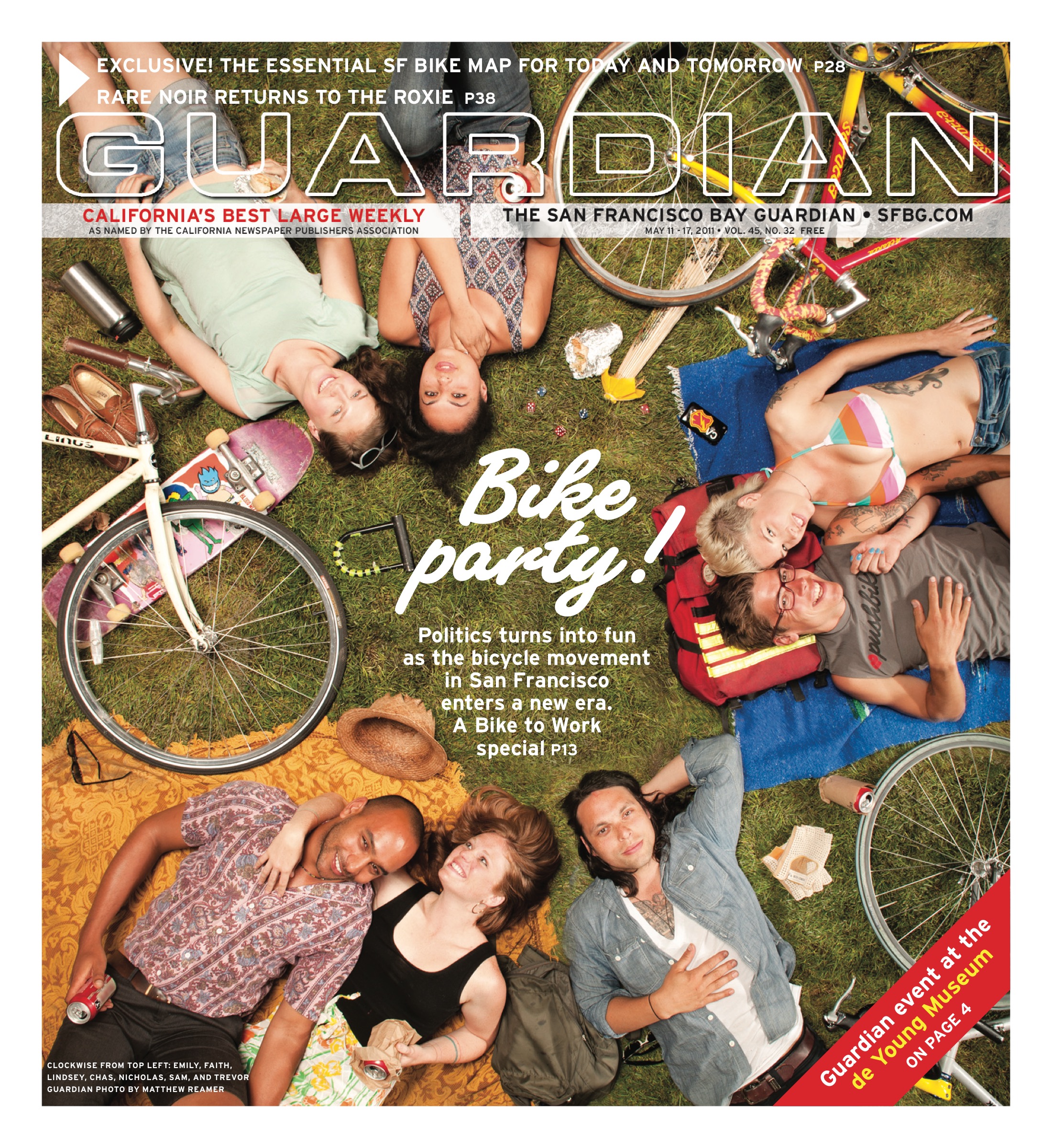
San Francisco has quickly peddled back into the front of the pack among bicycle-friendly U.S. cities, regaining the ground it lost during a four-year court injunction against new bike projects that was partially lifted in November 2009 and completely ended last June.

Since then, the streets of San Francisco have been transformed as the city completed 19 long overdue bike projects, including 11 miles of new bike lanes, 40 miles of “sharrow” shared lane markings, and hundreds of new bike racks. The city’s first physically separated green bike lanes on Market Street are now being extended, and new ones are being added on Alemany and Laguna Honda boulevards.

“The crews are out on Market Street right now filling in the new green bikeway,” San Francisco Bicycle Coalition Director Leah Shahum told us on May 6. “Far and away the No. 1 encouragement to getting people to bike is to make sure they feel safe.”

But it isn’t just bike lanes and other infrastructure that are causing bicycling to blossom in San Francisco. Bike culture is also exploding in myriad ways, including events such as the San Francisco Bike Party and Rock the Bike shows we profile in this issue, as well as the popularity of the monthly neighborhood street closures of Sunday Streets.

At the most recent Sunday Streets in the Mission District on May 8, Valencia and 24th streets were packed with thousands of people riding bikes, skating, and walking, or engaged with activities — in streets usually dominated by cars — such as yoga, art projects, shopping, and dancing.

“It’s a celebration. It’s not about confrontation anymore, it’s about bringing people along with a more expanded idea of how we can use public space,” Sunday Streets Coordinator Susan King told us at the event.

She said Sunday Streets has helped bridge the gap between families and the bicycling and skating communities, as well as cutting across classes, cultures, and communities. The response to the event has been phenomenal, she noted, and she hopes to see a similar momentum leading up to the next Sunday Streets event on June 12 in the Bayview.

“The Bayview event is really important to us because we have extraordinary support from the Bayview merchants and they want to get more involved with the bicycling community,” King said.

The earnest work of SFBC, SFMTA, and other entities that have helped expand the bicycling infrastructure in San Francisco, bringing safe cycling opportunities into every neighborhood, has in turn allowed organic expressions of bike culture to flourish.

From hipsters on their colorful fixies to anarchists riding tall bikes, from old-school Schwinns to cargo-laden Xtracycles, from elaborate art bikes to simple bike trailers with amazing sounds systems, from old white guys in Spandex to the young black kids on custom scraper bikes, from the hardcore bike messengers to the tourists on rental bikes, from Critical Mass defiance to Bike Party celebration, the streets of San Francisco are brimming with bike culture diversity. And the only commonality, the only one that’s really needed, is a simple appreciation for pedal power.

“We need to get the message out that biking is fun — and that’s happening,” Smith said. “We need a paradigm shift, and I think we’re really on the cusp of that.”

BIKE TO WORK DAY

Energizer commute stations open:

Thurs/12 7:30–9:30 a.m. and 5–7 p.m., free

Check map on page 28 for locations

Bike From Work party and fashion show

Thurs/12 6–10 p.m., $5 SFBC members/$10 nonmembers (or join at the door and get in free)

DNA Lounge, 375 11th St., SF

www.sfbike.org

Northwest passage: Kelly Reichardt on “Meek’s Cutoff”

0

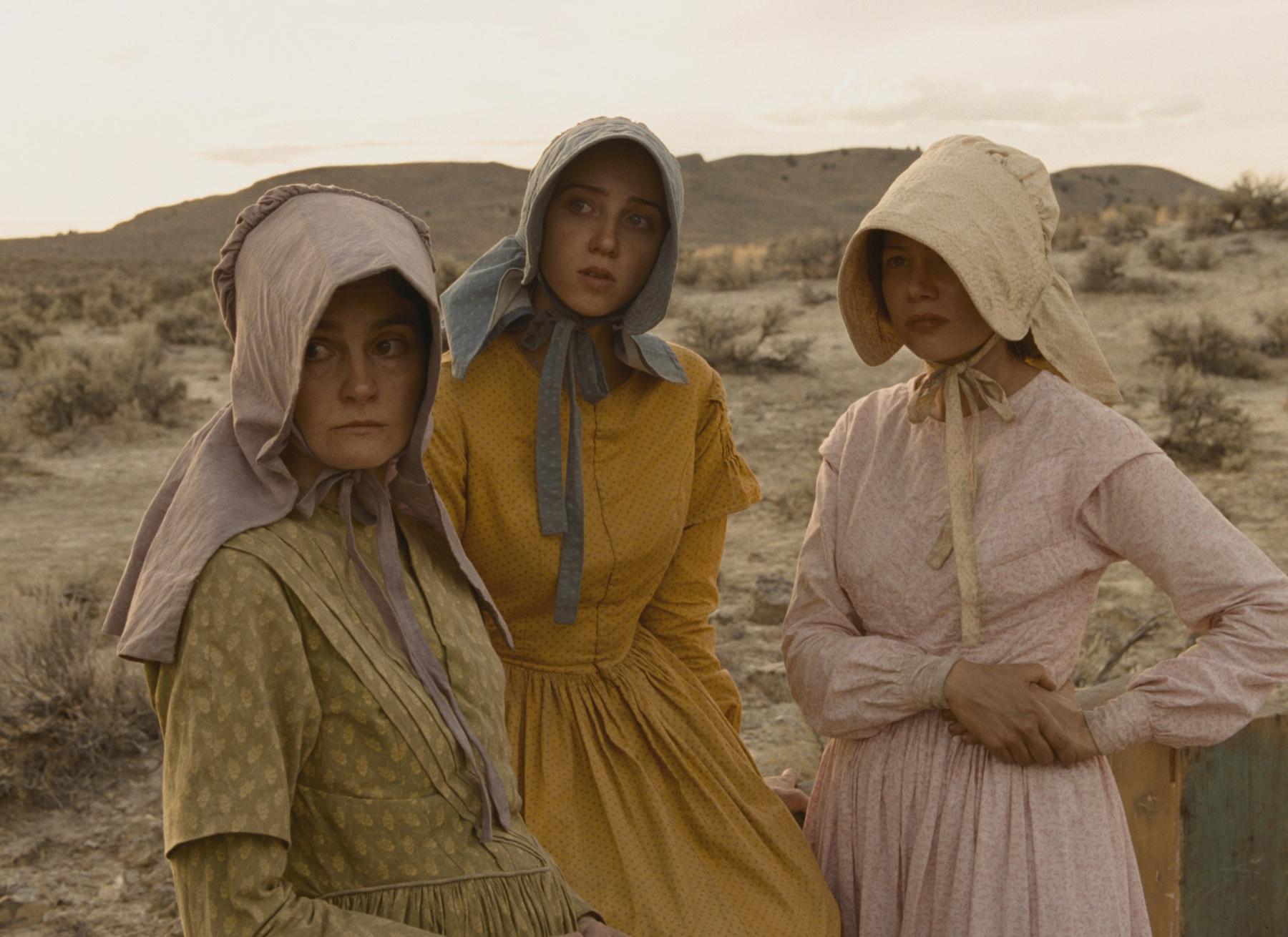
Over the past decade, Kelly Reichardt has consistently created an alternative cinema that is in opposition to modern Hollywood blockbusters. Her films, which emphasize minimalist and highly visual storytelling, transcend even the industry’s edgiest darlings (think Darren Aronofsky and Quentin Tarantino). Her films Ode (1999), Old Joy (2006), Wendy and Lucy (2008), and now Meek’s Cutoff (2010) cannot be categorized in the decade’s overhated mumblecore movement of Andrew Bujalski or the Duplass Brothers. Neither are they part of the world of extreme experimental artists, a la James Benning or Sharon Lockhart.

Somehow Reichardt has found a cinematic middle ground, balancing quiet and poetic allegories with accessible and emotional journeys — an achievement that present and future audiences will be hypnotized by for generations to come. After interviewing her for Wendy and Lucy, I spoke with her after Meek’s Cutoff played the 2011 Sundance Film Festival; it recently had its local debut at the San Francisco International Festival, and opens theatrically Fri/6.

San Francisco Bay Guardian: I recently saw your earliest films at the Pacific Film Archive retrospective and your adaptation of the Robby Benson-starring Ode to Billy Joe (1976), Ode (1999), was amazing! You shot the whole thing on Super 8, right? Do you like your earlier films?

Kelly Reichardt: Ode is very near and dear to my heart. It set me on my own way of making films. I don’t think I’m naturally a non-narrative person. And definitely not as much as I revere those kind of filmmakers like my colleagues: Peggy Ahwesh, Peter Hutton. I love seeing how their films unfold and really make the viewer be interactive in deciding what they’re about and what they mean to them. That’s what I’d like to do as a filmmaker. But I can see myself learning in all of my films, which is painful. A couple of students walked out of that screening of my earliest short films and I wanted to run out after them and say, “I totally understand!”

SFBG: You and [screenwriter] Jon Raymond seem to be consciously aware of just that! I know I have told you this before but I find your films so inspired. Your films are like the kind of classes I always wanted to have in college. You’re never telling me what to think, yet you are very precisely leading me towards something extremely imminent. And along the way, I get to experience my own journey with these characters and situations. Do you run into problems getting your films made and released because of this structure?

KR: That part of it, the endings, is [an element] coming from the world of non-narrative filmmaking. It doesn’t hand things over to the audience. It’s like a series of questions unfolding which is like a dream, which is something I want to bring into a more narrative form. It opens up the traditional genre a little which you already know how its’ suppose to go. Meek’s Cutoff and Wendy and Lucy were both released through Oscilloscope, while Old Joy was distributed by Kino. These are all small independent distributors and the things that they are looking for are not for everyone.

The hard part with filmmaking is getting the money to make the film. Everybody has a camera now. You can shoot a video. But if you’re not into naturalism and you’re trying to make things that are more extravagant, that vision is going to be much harder to just do on your own. If I were a student right now, my biggest fear would be how to rise up out of such a huge sea of voices. When I submitted my first feature, River of Grass, to Sundance in 1994, they had 600 entries that year which seemed overwhelming and huge. Six hundred and they were only gonna pick 16. And what was it this year? Didn’t they have something like 6,000 entries?

Getting your film out … worry about that later. Get your film made first. Plus there’s always the fear of even having something to say at the age of 20! Before you’ve lived on your own and been connected to the big black hole of employment, and public transportation and all those things. That could be good “big” fear to have as a young filmmaker.

SFBG: In your Q&A after the screening of Meek’s Cutoff at the Egyptian Theatre [in Park City, Utah], I was very excited about your bringing up forgotten and unavailable older films like Nicholas Ray’s The Lusty Men (1952).

KR: Me too! I was trying to make that point and I became so distracted by the woman sitting behind you filming. It’s just such a weird thing to look out and see 15 people videotaping you and you realize that no experience can ever just be with the people in the room again. Everything has to be some bigger purpose and I completely quit thinking about the film and the interaction. I think it’s a bizarre that people feel completely free about videotaping you and posting it on the Internet without asking me.

SFBG: Not only is it exciting that your films feel influenced by older cinema but you do it in a way that’s very much like Peter Bogdanovich, where it feels as if you truly understand the film’s themes and goals and you’re not just making a mixtape of your favorite scenes. Wendy and Lucy feels like a Vittorio De Sica neo-realist film, while Meek’s Cutoff feels like an existential William Wellman Western by way of Robert Flaherty’s Nanook of the North (1922). I mean, you even used the old Hollywood aspect ratio of 1.33:1 on Meek’s Cutoff! And it doesn’t come off kitschy; in fact, it feels even futuristic.

KR: It’s funny that you mention the aspect ratio. If anything is kitschy, and when you read back about the period, widescreen was what was kitschy. It was a gimmick! It’s what 3D or IMAX is to us today. What did Fritz Lang say, “Widescreens are for funerals and snakes.”

It’s funny now that this memory of widescreen is so embraced but it’s such a diminished landscape in a way. That question is always being asked to me in some tone of like, “When you accidentally picked the wrong aspect ratio did you have to just keep going with it?” (laughs) Though I knew going into it that it would limit the amount of theatres we can play Meek’s at. Sadly, very few theaters have the capabilities. 

SFBG: I’ve been watching a lot of Westerns this year and your horizons in every single shot of Meek’s Cutoff are truly spectacular. Your multi-layered colors! Your floating cowboys! The lined-up pioneers! I could just go on. All of it is so particular. How did you design this film? Did you do it on the landscape or storyboard it first?

KR: I storyboard but I can’t draw. (laughs) I have many different notebooks. Color is an early thing. But everything comes first from relentless scouting.  Scouting, scouting, scouting, scouting. I get familiar with the light and the colors of the day. The places you’re gonna be shooting in at certain times of the day. These locations were really remote and very hard to get to. And we ended up spending such a huge amount of time in that desert.

SFBG: Did you have to sleep out on the plains?

KR: We stayed in this town, Burns, Oregon. It’s a good two-street town and we’d drive off-road for two hours into the desert each day. This is where the actual wagon train got lost. There was nothing out there. We were actually finding pieces of wagon from the 1840s! So it would eat up a huge amount of our shooting day, which is already short because when you’re shooting in the mountains, the sun is gonna go behind them. So that’s four hours already out of your day.

My shooting schedule was so restricted that other producers would have said “You are sinking your ship by shooting out on these locations.” Fortunately my producers backed me and off we went, for better or worse. So you have to be on top of it when you’re there, knowing that there will be unexpected things to occur especially when you are dealing with oxen and mules and donkeys. All of that is to be embraced.

I also have to have a plan because we move so quickly. My DP [Chris Blauvelt] and I are talking, talking, talking. I have some books that are references, that I’ll steal frames from. Some that are location photos, people standing in the locations, some from old films. And some are just really crappy drawings I’ve done because I cannot draw, which I consider a huge handicap as a filmmaker. People always ask “Are you improvising?” We don’t have time for improv! Of course because of the weather, and the terrain, and rattlesnakes and the animals there’s certainly a certain amount of adjustment because when I storyboarded this, it wasn’t snowing. But you can’t go out there without a plan. The camera for me is the storyteller.

SFBG: Now you edit your own movies. Is that because you are a tyrant and you have to have it your own way or have you tried working with others? And by “tyrant,” I mean it in the nicest way possible.

KR: (laughs) You go through different stages: I have my writing partner [Jon Raymond] and that’s one stage and then it becomes very public and you’re working with a bunch of people when filming. Then editing is where you get your film back and it’s when I get to find my film. It’s a great moment when I’m in the editing room an I can say, “Oh yeah, that’s what Jon was originally talking about!” or “I felt that in Jon’s short story!”

But when you’re in production, there’s just so much going on! And editing is where you learn where you fucked up and should have put the camera. It’s the big payoff for me and I don’t want to hand it over to anyone else. It’s the interesting part of filmmaking. It’s where you can manipulate space and completely change the dynamic of a conversation or situation just by adding or taking away time. It’s not fun to edit with me, so I stopped using editors (laughs).

http://www.youtube.com/watch?v=AEmL9at6JT0

Meek’s Cutoff opens Fri/6 in Bay Area theaters.

Jesse Hawthorne Ficks is the Film History Coordinator at the Academy of Art University and programs the film series Midnites for Maniacs.

Our Weekly Picks: May 4-11, 2011

0

WEDNESDAY

MAY 4


MUSIC

Wanda Jackson

Over her 50-plus years in show business, she’s been called “the Queen of Rockabilly” and “the Sweet Lady with the Nasty Voice” — and now fans can rightly call Wanda Jackson a true musical icon, with her recent induction into the Rock and Roll Hall of Fame. Don’t let that enshrinement fool you into thinking she’s retired, though. She can still belt out tunes like nobody’s business, and proved that yet again with the release of The Party Ain’t Over, her Jack White-produced album that came out earlier this year. Forget about the recent big fuss over in England; come to tonight’s show if you want to see some real royalty. (Sean McCourt)

With Red Meat and DJ Britt Govea

8 p.m., $21

Great American Music Hall

859 O’Farrell, SF

(415) 885-0750

www.gamh.com


MUSIC

J Mascis

It has been a good couple of years to be a Dinosaur Jr. fan. In 2005, lead singer J Mascis and bandmate Lou Barlow put aside their grievances enough to play shows as the original lineup, along with drummer Murph. In an era of live record performances from bands well past their prime, that would have been enough, but the band released new albums that were as good as ever. (In the case of 2009’s Farm, maybe better.) So now, almost just to show that he can, between Dinosaur Jr. tours and recording sessions, Mascis releases the solo album, Several Shades of Why. Exchanging shredded electric guitars for (still a little fuzzy) acoustics, it’s another surprise, but in the best way. (Ryan Prendiville)

With Black Heart Procession

8 p.m., $20

Independent

628 Divisadero, SF

(415) 771-1421

www.theindependentsf.com


THURSDAY

MAY 5


MUSIC

Frank Fairfield

Frank Fairfield’s adaptations of blistering American ballads are proudly faithful, but his ability to coax the rightness from battered banjos and fiddles (and to squeeze his voice as if onto fresh shellac) goes way beyond technique. “I don’t even know if [this music] has that much to do with tradition,” Fairfield told one interviewer. “I think it’s just people doing whatever they feel like doing. A lot of this stuff just gets mished and mashed, and that’s the beautiful thing about America.” The fact that he’s a young Angeleno who dresses the old-timey part may raise eyebrows — but trust your ears. He makes an intriguing opener for Cass McCombs, a troubadour cut from a different cloth. (Max Goldberg)

With Cass McCombs

8 p.m., $15

Swedish American Music Hall

2170 Market, SF

(415) 861-5016

www.cafedunord.com


FRIDAY

MAY 6


DANCE

Ahdanco/Abigail Hosein Dance Company

While dance can be described as poetry in motion, Ahdanco’s 2011 home season offers both poetry and motion in a dynamic dialogue. For one of the two new works on the program, the dancers share the stage with spoken word artists from the Bay Area Poetry Slam Circuit, weaving Abigail Hosein’s choreography with powerful narrative stories. The other dance is a trio set to an original score composed of four loop stations, trumpet, cello, upright bass, guitar, and female vocals performed live by ambient band, Entamoeba. Hosein’s strong female dancers (many of whom are Mills College alumni) skillfully balance the physical and theatrical. (Julie Potter)

Thurs/6–Fri/7, 8 p.m.; Sun/8, 6 p.m., $20

Ashby Stage

1901 Ashby, Berk.

(510) 837-0776

www.ahdanco.org


EVENT

“Bikes and Beats”

In response to SF’s burgeoning biking scene — and that empty moment on the first Fridays of the month when you realize that the SF Bike Party is over and the rest of your evening is TBA — comes this night club-bike club. Organizers’ goal for this fundraiser for Sunday Streets and the Wigg Party is to make bike culture as un-scary and fun as possible — even to those without handlebar calluses. Bike crafts and fashion will be on display, as well as a dope, divergent musical lineup featuring the Polish Ambassador, Non-Stop Bhangra, Madrone’s Motown on Mondays crew, and that party on two wheels well known to SF cruisers, DJ Deep. (Caitlin Donohue)

10 p.m.–3 a.m., $6–$10

Public Works

161 Erie, SF

(415) 932-0955

Facebook: Bikes & Beats


DANCE

“SCUBA 2011”

A terrific idea, SCUBA, a small presenters consortium, has been pooling resources for close to a decade to offer gigs to hot young choreographers, whether homegrown or invited from participating venues. So far, ODC Theater director Rob Bailis’ choices have always been worthwhile. The mix has been rich and varied. On this program, SF’s own Katie Faulkner, who will premiere Sawtooth, will be joined by Amelia Reeber from Seattle and Chris Yon from Minneapolis. Reeber is bringing this is a forgery, a multimedia work that examines choices and transformation. Yon draws on husband-wife vaudeville acts for his duet, The Very Unlikeliness (I’m Going to Kill You), with partner with Taryn Griggs. (Rita Felciano)

Fri/6–Sat/7, 8 p.m.; Sun/8, 7 p.m., $15–$18

ODC Theater

3153 17th St. SF

(415) 863-9834

www.odctheater.org


SATURDAY

MAY 7


MUSIC

“Walk Like An Egyptian”

What’s Zambaleta, you say? In Egypt, Zambaleta is a spontaneous chaotic street party that happens when everyone is participating, through music or dance. In the Mission, Zambaleta is a world music and dance school with an inclusive environment and celebratory spirit. This weekend’s “Walk Like An Egyptian” festival captures that spirit, featuring Bay Area music from blues and folk to jug bands and indie. The lineup of 18 bands includes an appearance by Annie Bacon’s Folk Opera — plus, proceeds from the festival support community programs at the world music and dance center. Come walk — and party — like an Egyptian. (Potter)

Sat/7, 1 p.m.–midnight;

Also Sun/8, noon–8 p.m., $5–$20

Restoration Workshop

630 Treat, SF

(415) 341-1333

www.zambaleta.org


EVENT

CELLspace Birthday Benefit Funkathon

Celebrate the 15th birthday of CELLspace, San Francisco’s original hub for artistic work and gatherings, by partying down at a Funkathon featuring Action Jackson and other funky music and dance acts. And this is just one event among many, including an art auction May 5, a swap meet and dance party May 6, and a party May 8 that coincides with the Sunday Streets closure of Mission District streets to automobile traffic. CELLspace, a venerable institution that offers classes on everything from welding to breakdancing, is going through ambitious fundraising efforts as it seeks the permits and resources to expand its nightlife offerings, so come have a funky time while supporting a great cause. (Steven T. Jones) 9 p.m., $10–$20

CELLspace

2050 Bryant, SF

(415) 410-7597

www.cellspace.org


FILM/PERFORMANCE

“Ultimate Mommie Dearest

Oh, I know you’ve already seen 1981’s Mommie Dearest. And I know you can quote all the famous lines (personal favorite: “Tina! Bring me the ax!”) But you’ve never experienced the ultimate Mommie Dearest — because it’s never been attempted until this once-in-a-lifetime event. Marking the cult classic’s 30th anniversary is a dame who surely has never touched a wire hanger in her life, Peaches Christ, and celebrated Peaches cohorts Heklina, Martiny, and (in honor of Mother’s Day), Mrs. Christ herself! A restored print of the film caps a night that also includes the musical stage spectacular Trannie Dearest, a drag tribute to Joan Crawford’s unfailingly dramatic life. Do I even have to add that costumes are encouraged? (Cheryl Eddy)

8 p.m., $25–$40

Castro Theatre

429 Castro, SF

www.peacheschrist.com


EVENT

Urban Cycling Workshop

If I had a nickel for every car devotee or exasperated Muni rider who’s lamented, “Oh, I would totally ride a bike if there weren’t so many scary cars!” I’d be, well, not rich but could certainly buy some fresh handlebar tape ($16 per roll). How awesome, then, that the hardworking bike advocates at the San Francisco Bicycle Coalition are offering a four-hour, in-classroom, free introductory course geared toward newbies and cyclists who want to feel more comfortable riding our tiny but intense peninsula. The class covers all the basics, from choosing the best bike to pulling emergency maneuvers, to knowing your legal rights. Ding, ding! (Kat Renz)

2 p.m., free (preregistration required; ages 14 and up)

Fort Mason Center, Bldg. C, Rm. 362

Laguna at Marina, SF

(415) 431-2453 x312

www.sfbike.org/edu


MONDAY

MAY 9


MUSIC

Mogwai

Much like the mythical creatures from Gremlins (1984) that they are named after, Mogwai’s sound can be soft and serene at one moment, then morph into an entirely different dynamic, with blistering guitars and noisy effects multiplying around you. The Glasgow-bred rockers returned in February with its seventh record, and its first Sub Pop release, Hardcore Will Never Die, But You Will, which continues the band’s mostly instrumental and highly successful approach to making music. Creating lush sonic soundscapes richly textured with a wide array of different riffs and tones, the five-piece group is definitely one to catch live if you can. (McCourt)

With Errors

8 p.m., $23.50–$26

Regency Ballroom

1290 Sutter, SF

1-800-745-3000

www.theregencyballroom.com


TUESDAY

MAY 10


DANCE

Project.B.

If you have seen Tanya Bello dance — Shift Physical Theater, Robert Moses’ Kin, and Janice Garrett + Dancers come to mind — you won’t have forgotten her. She probably was the shortest (but also the fastest and fiercest) tearing across the stage. Bello is small but she dances big. Lately she has taken advantage of the Garage’s RAW (Resident Artist Workshop) program to hone her choreographic skills. Moveable Feast, her first full-evening work, is plugging into her experience working with choreographers both here and on the East Coast. The idea is to show three versions of one piece in which components — lights, dancers, sets, music — get shuffled around. In the end the audience decides which one worked best. (Felciano)

May 10-11, 8 p.m., $15

Garage

975 Howard, SF

(415) 518 1517 www.brownpapertickets.com 


The Guardian listings deadline is two weeks prior to our Wednesday publication date. To submit an item for consideration, please include the title of the event, a brief description of the event, date and time, venue name, street address (listing cross streets only isn’t sufficient), city, telephone number readers can call for more information, telephone number for media, and admission costs. Send information to Listings, the Guardian Building, 135 Mississippi St., SF, CA 94107; fax to (415) 487-2506; or e-mail (paste press release into e-mail body — no text attachments, please) to listings@sfbg.com. Digital photos may be submitted in jpeg format; the image must be at least 240 dpi and four inches by six inches in size. We regret we cannot accept listings over the phone.

Our Weekly Picks: April 4-10, 2011

0

WEDNESDAY

APRIL 27


EVENT

The Right to Be Lazy

You know you want to fight zombies. But how? Perhaps answers are still alive in the reissued book, The Right to Be Lazy, by Paul LaFargue, the Cuban-born son-in-law of Karl Marx. Featuring its editor, Bernard Marszalek, and others, this Shaping San Francisco panel will discuss this book that, according to Marszalek, has been reproduced and distributed more widely than any other Marxist text save LaFargue’s papa-in-law’s commie manifesto. The author is sarcastic, sardonic, and satirical, a necessary combo when considering post-capitalistic visions of abundance and cooperation trumping standard issue toil and sacrifice. Because as anyone who’s walked through the Financial District will tell you, zombies are freakin’ hard to kill. (Kat Renz)

7:30 p.m., free

CounterPULSE

1310 Mission, SF

(415) 626-2060

www.counterpulse.org


MUSIC

“Steve Ignorant presents CRASS songs 1977-82, Last Supper”

Is this really Crass? Well, Penny Rimbaud isn’t involved, and originally opposed cofounder Steve Ignorant performing the band’s music. But when you’re talking about anarcho-punks, everyone is their own leader and does what they want. So this is the final Crass run for Ignorant, backed by Gizz Butt, Bob Butler, Spike T. Smith, and reportedly a female vocalist (to handle feminist material from classic album Penis Envy.) Despite being influential, politically-minded figures in 1970s English punk rock, Crass never really toured in the U.S., which means this may be the best opportunity that fans have had to hear the material live, as well as the last. (Ryan Prendiville) With Goldblade

9 p.m., $21

Slim’s

333 11th St., SF

(415) 255-0333

www.slims-sf.com


THURSDAY

APRIL 28


MUSIC

Accept

For those of us who learned to throw horns in the early 1990s with the help of Headbangers Ball, we got a healthy dose of contemporary clips along with the classics of the metal genre. This was how I first came across Accept’s “Fast As A Shark” and “Balls To The Wall,” two awesomely shredding tunes — indeed, “Balls” was the German band’s signature song, and its accompanying video was also a favorite on Beavis and Butthead. Get ready for some serious head-banging and sing-along anthems tonight as the band returns to the states supporting its new release, Blood Of The Nations. (Sean McCourt)

With Sabaton

8 p.m., $30

Regency Ballroom

1300 Van Ness, SF

(415) 673-5716

www.theregencyballroom.com


EVENT

“Beatles and Beetles”

Would you bet more people can name the fab four members of the Beatles — or four kinds of beetles, those six-legged insects making up a quarter of the earth’s animal species? But really, why the burden of mutual exclusivity when both are celebrated at this week’s NightLife at California Academy of Sciences? It’s a fortunate homonymity, pairing the museum’s beetle expert David Kavanaugh with live music from Beatles experts in the form of tribute band the Sun Kings. Plus, it’s the U.S. debut of “The Beatles Hidden Gallery,” photos documenting the boys mere months before Beatlemania invaded the land like a blight of beetles. (Renz)

With DJs Aaron Axelsen and Omar

6 p.m., $12

California Academy of Sciences

55 Music Concourse, Golden Gate Park, SF

(415) 379-8000

www.calacademy.org


MUSIC

Sean Smith

Since 2005, virtuoso Sean Smith has recorded numerous albums of solo guitar and collaborations. Taking after the iconic John Fahey, the finger-style guitarist wows audiences with immense technical skill and songwriting — crafting a new American Primitive. Having toured the U.S. extensively, Smith has shared the bill with Will Oldham (Bonnie “Prince” Billy), Six Organs of Admittance, and Bob Lind, among others. In March 2008, he joined the ranks of Citay as one of the two lead guitarists. Smith leads his electric power trio featuring Spencer Owen and Marc Dantona in selections from his upcoming full length, Huge Fluid Freedom(Jen Verzosa)

With the Singleman Affair and Mitchell and Manley

9 p.m., $6

Hemlock Tavern

1131 Polk, SF

(415) 923-0923

www.hemlocktavern.com


FRIDAY

APRIL 29


MUSIC

Mudhoney

Although it never quite attained the levels of fame and fortune of some of their hometown contemporaries, Mudhoney was one of the first (and best) bands to come out of Seattle during the late 1980s and early 1990s alternative rock explosion. With fuzzed-out guitars, heavy riffs, and songs like “Touch Me I’m Sick,” “Sweet Young Thing Ain’t Sweet No More,” and “Suck You Dry,” the band was the embodiment of what became the “grunge” movement — and it’s one of the only original groups around today, still kicking out the jams to loyal fans on new album The Lucky Ones. (Sean McCourt)

9:30 p.m., $20

New Parish

579 18th St., Oakl.

www.thenewparish.com


DANCE

Sean Dorsey Dance

Sean Dorsey Dance has been working on The Secret History of Love (Part 1) for the last two years, and the project itself looks back much further, exploring the ways in which transgender and queer people have forged bonds through the decades. Drawing from extensive research at the GLBT Historical Society and interviews with community members, Dorsey continues to place direct elements of storytelling at the forefront of modern dance. With this show, he focuses on courageous acts of love and protest dating back to Stonewall. (Johnny Ray Huston)

Fri/29–Sun/1, 8 p.m.; $15-$20

Z Space at Theater Artaud

450 Florida, SF

(800) 838-3006

www.freshmeatproductions.org


DANCE

Kate Weare Company

Ukuleles, banjos, and fiddles, oh my. Performed to live, onstage music by bluegrass band the Crooked Jades, the Kate Weare Company’s Bright Land addresses American ideals, weaving threads of music, stories, and history represented by transatlantic folk music. With the Crooked Jades’ musical arrangements of traditional Celtic, English, and American songs, Weare’s ferocious artists and passionate choreography reinvent old-world music for the modern age in a layered collaborative form. Performer and composer Jeff Kazor blurs genres with haunting ballads and upbeat dance tunes and Weare’s dancers reveal powerful relationships enacting capsules of history and narrative. The Bay Area is a second home for the dance company — catch them while they visit this coast. (Julie Potter)

Fri/29–Sat/30, 8 p.m.;

Sun/1, 7 p.m., $15–$18

ODC Theater

3153 17th St., SF

(415) 863-9834

www.odctheater.org


SATURDAY

APRIL 30


MUSIC

Debbie Neigher

Art program counselor, member of the San Francisco indie-rock outfit Phantom Kicks, singer-songwriter, and pianist: Debbie Neigher can do it all. While she was DIY-ing her upcoming self-titled full length album, pop-folk icon and owner of Tiny Telephone recording studio John Vanderslice came out of retirement from producing records “in the luckiest freak accident” to work with her. In Neigher’s upcoming album, her silky soprano showcases her versatility in the effervescent “Frames” and the painfully courageous “Pink Chalk.” Neigher was the winner of West Coast Songwriters Best Song competition for the track “What Say You Now”; she was also nominated for SF Deli Magazine’s Emerging Artist Award of 2010. (Verzosa)

With tidelands

7:30 p.m., $7

Make-Out Room

3225 22nd St., SF

(415) 647-2888

www.makeoutroom.com


FILM

Jaws

When I was a little kid, just thinking of the two-note intro to John Williams’ theme from Jaws was enough to make me want to jump out of the bathtub, let alone the murky waves of the Pacific I frolicked in down at the beach in Santa Cruz. Modern teenage movie-goers may flock to the latest Saw rip-off in search of some cinematic terror, but as the rest of us know, it’s what you don’t see that really scares the shit out of you — and Steven Spielberg made the most of that with his 1975 masterpiece. Just in time for when you would wish all those damn spring breakers would be eaten alive, tonight’s screening (presented as a double-feature with Spielberg’s 1977 Close Encounters of the Third Kind) will undoubtedly make someone new afraid to go into the water. (McCourt)

2 and 7 p.m., $7.50–$10

Castro Theatre

429 Castro, SF

(415) 621-6120

www.castrotheatre.com


EVENT

Red Vic fundraiser

Listen up, San Francisco, cause this shit’s serious. The rep house movie theater is on the verge of extinction, and perhaps none are as precariously situated as the Red Vic (also the only collectively-owned movie theater in California). We owe it to our artistic sprits to not let these beloved institutions die out, but that takes more than just a fond thought. It takes patronage. Lucky for us, the Red Vic is making it easy to go and spend a whole day and drop a reasonable wad on “donations” — from a movie poster auction from 1-6 p.m., followed by a triple-header curated by Mr. “Midnites for Maniacs” Jesse Hawthorne Ficks from 7 p.m. on, and concluding with a midnight screening of San Francisco’s favorite cult film The Room (2003), all for way less than you’d spend on some crap IMAX travesty at the Metreon. (Nicole Gluckstern)

1 p.m., $10–$20 suggested donation

Red Vic Movie House

1727 Haight, SF

(415) 668-3994

www.redvicmoviehouse.com


MUSIC

Blondes

One video has Blondes playing in a laser-filled garage that could be anywhere. Another account has it DJing at the top of the Standard in New York. One listener describes the music as ecstatic, but it’s also been branded “snoozetronica.” Blondes is not another emerging duo in full electro-attack mode. Not “the next” Daft Punk or even the Twelves. It’s two Oberlin-educated guys who see themselves entering a musical landscape where everything may have been done. If the beats they build piece-by-piece seem inclusive — heavy but melodic, driving but not to the point of driving your body down — it’s because they’re looking for leftover limits. (Prendiville)

With Wav Dwgs and DJ Pickpocket

9:30 p.m., $5–$10

Public Works

161 Erie, SF

(415) 932-0955

www.publicsf.com


DANCE

“Dancing in the Park”

The Bay Area celebrates National Dance Week (through Sunday, May 1) in myriad ways, but few are as inviting and comprehensive as the Mark Foehringer Dance Project/SF’s “Dancing in the Park.” The extravaganza takes over the venerable Bandshell in Golden Gate Park for the fifth year in a row. The fun starts with a one-hour young choreographers’ showcase. Sample classes in modern, salsa, improv, and hip-hop will then share the space with more than two dozen professional (including Axis Dance Company, Robert Moses’ Kin, and Amy Seiwert/im’i-jre) and community groups (like Zoha, Sambamora, and SoulForce). At 2:30 p.m., Foehringer’s own dancers offer excerpts from their repertoire celebrating having survived and thrived for 15 years. (Rita Felciano)

11 a.m.–4:30 p.m., free

Music Concourse Bandshell

55 Hagiwara Tea Garden, Golden Gate Park, SF

www.mfdpsf.org 


The Guardian listings deadline is two weeks prior to our Wednesday publication date. To submit an item for consideration, please include the title of the event, a brief description of the event, date and time, venue name, street address (listing cross streets only isn’t sufficient), city, telephone number readers can call for more information, telephone number for media, and admission costs. Send information to Listings, the Guardian Building, 135 Mississippi St., SF, CA 94107; fax to (415) 487-2506; or e-mail (paste press release into e-mail body — no text attachments, please) to listings@sfbg.com. Digital photos may be submitted in jpeg format; the image must be at least 240 dpi and four inches by six inches in size. We regret we cannot accept listings over the phone.

Our Weekly Picks: April 20-26

0

WEDNESDAY 20

DANCE

“MOVE(MEN)T4”

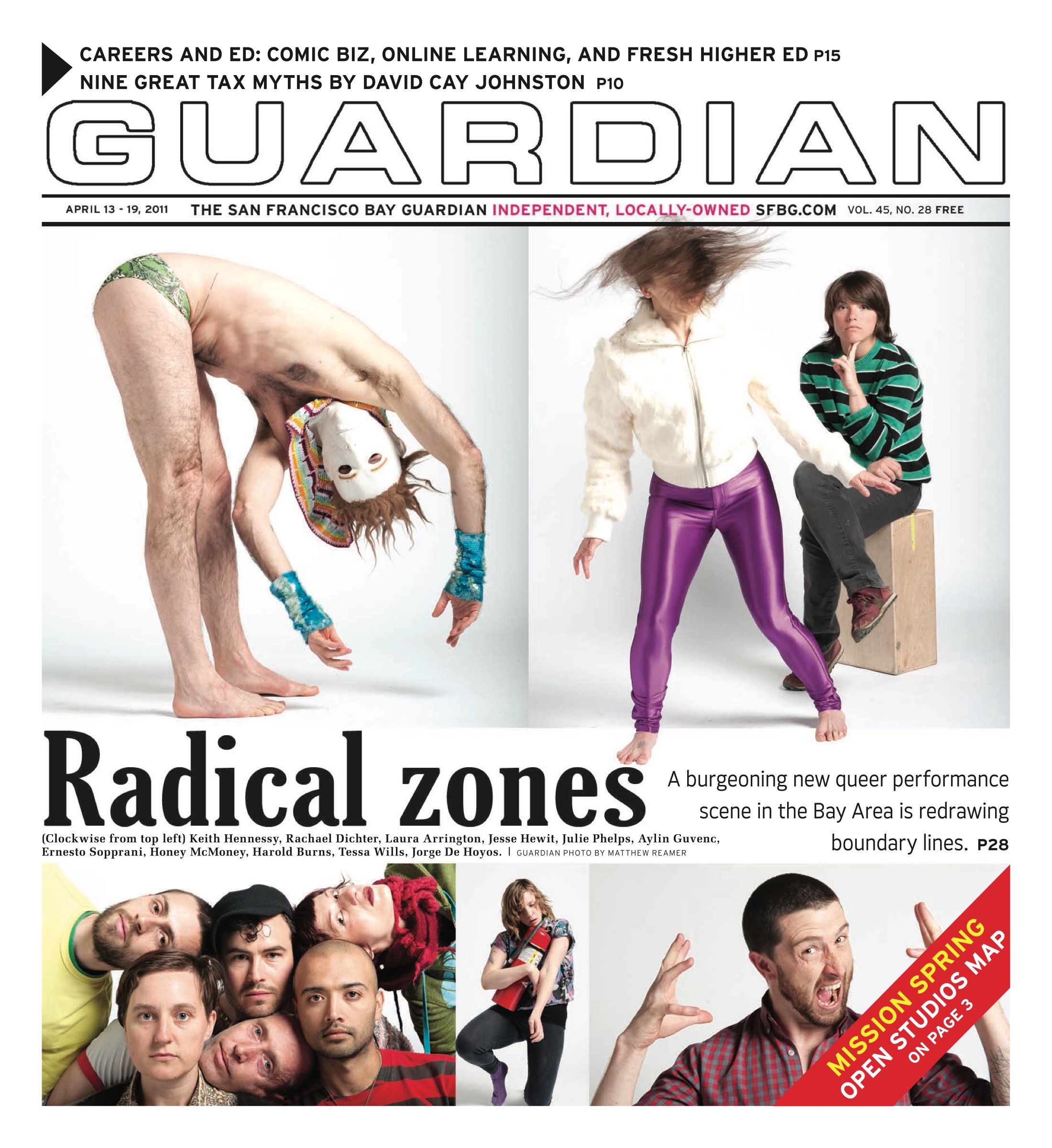
The “MOVE(MEN)T” concerts plug into a men-only choreography tradition from the 1980s (although women do perform in them. Joe Landini revived the idea four years ago because the guys so clearly enjoyed the camaraderie that comes from working together. The artists for the second week’s program include Tim Rubel, who creates text-heavy pieces notable for their humor, and Honey McMoney and Kowal in what Landini calls “very queer” work. Jesse Bie has been dancing with and choreographing for Steamroller for more than 10 years while Michael Velez, a stunningly beautiful dancer, is a still-young choreographer. Todd McQuade is creating an installation in the basement; he will later perform it with Sasha Waltz and Guests in Berlin. (Rita Feliciano)

Wed/20-Thurs/21 8 p.m., $10-20

Garage

957 Howard, SF

(415) 518-1517

www.brownpapertickets.com


MUSIC

Dengue Fever

In trying to deal with the challenge Dengue Fever poses — singer Chhom Nimol belting out 1960s-style Cambodian pop played by L.A.-based musicians — critics have appealed to a unifying element: funk. Whether you’re Sharon Jones and the Dap-Kings, Antibalas Afrobeat Orchestra, or Dengue Fever, anachronism doesn’t matter, if you make the beat move. On its newest album, Cannibal Courtship, Dengue Fever twists the cultural novelty out of their lyrics, turning songs unexpectedly strange. (In the first track, Nimol shakes up the bored, hand-clapping back-up singers, transitioning from “you wouldn’t understand” to “be my sacrificial lamb.”) Funk is universal, and makes for a hell of a party. Just like LSD. (Ryan Prendiville)

With Maus Haus and DJ Felina

8 p.m., $22.50

Fillmore 

1850 Geary, SF

(415) 346-6000

www.livenation.com


THURSDAY 21

EVENT

“Salmon in the Trees”

What are fish doing up in the leafy branches of trees? The punch line (spoiler alert!) requires thinking web-of-life style. Salmon swim upstream from the ocean to spawn and then die, having successfully laid the next generation. In the process, some are hunted by hungry bears — among 50 other salmon-eating animals, including us — who consequently spread carcasses and salmon-fortified poop far and wide on the forest floor. Nutrients are absorbed, reaching the tops of even the oldest-growth trees. Learn about this phenomenon and more with award-winning conservation photographer and author Amy Gulick, who talks about her adventures documenting this wild interconnectivity in Alaska’s Tongass National Forest, one of the rarest ecosystems on the planet. (Kat Renz)

5:30 p.m., $20

Commonwealth Club

595 Market, SF

(415) 597-6700

www.commonwealthclub.org


PERFORMANCE

The Lily’s Revenge

What happens when a flower goes on a quest to become a man in order to wed his beloved bride? Or rather, what doesn’t happen, during this five-hour theater extravaganza in which playwright and burlesque performer Taylor Mac — along with dozens of local Bay Area artists — tackles love, marriage, and Prop. 8 using vaudeville, haiku, drag queens, ukuleles, feminist theories, dream ballets, and public dressing rooms, culminating in an interactive town hall. You heard right. Five hours. The first of three intermissions serves as a communal dinner, and wine and snacks are available for the long journey. Get ready for a spectacular adventure. (Julie Potter)

Through May 22

Tues-Sat 7 p.m.; Sun 2:30 p.m., $20-150

Magic Theatre

Fort Mason Center, SF

(415) 441-8822

www.magictheatre.org


FRIDAY 22

FILM

“John Waters’ Birthday Weekend”

John Samuel Waters was born April 22, 1946, which means he’s 65 today — but let’s hope one of America’s most daringly creative, bitingly hilarious, boundary-pushing filmmakers (not to mention authors, visual artists, and stand-up performers) has no intention of retiring anytime soon. The Castro pays tribute to “the Pope of Trash” with a quartet of essential early films (1972’s Pink Flamingos, 1974’s Female Trouble, 1981’s Polyester, and 1977’s Desperate Living), plus the (slightly) more mainstream 1994 Serial Mom and the movie that spawned the musical that spawned the movie musical, 1988’s Hairspray. True fiends will want to rush home post-weekend to watch all the movies not contained here, plus the DVD edition of 1981’s Mommie Dearest that contains Waters’ brilliant commentary, “Filth is my life!” (Cheryl Eddy)

Fri/22-Sun/24 $7.50-$10 

Castro Theatre

429 Castro, SF

(415) 621-6120

www.castrotheatre.com


MUSIC

Amon Amarth

Though they’ve been a band since 1992, the five burly Vikings in Sweden’s Amon Amarth didn’t really hit their stride for a decade. While headlining a U.S. tour in 2002, the quintet introduced stateside death metal maniacs to its untrammeled beards, overflowing, belt-mounted drinking horns, and soaring, harmonized riffs. With Oden on Our Side (2006) cemented the band’s status as standard bearers for the now-burgeoning Viking metal subgenre, partially on the strength of two hair-whipping music videos. New release Surtur Rising marks a historic chapter in the band’s career — one without headliners. This year’s “An Evening with Amon Amarth” tour features the band playing the new platter in its entirety, before launching into another set’s worth of old favorites. (Ben Richardson)

9 p.m., $22.50

Regency Ballroom

1300 Van Ness, SF

(415) 673-5716

www.theregencyballroom.com


DANCE

Bay Area National Dance Week

Free. Dance. Everywhere. Kicking off with the participatory “One Dance” in Union Square Plaza at noon today, Bay Area National Dance Week, presented by Dancers’ Group, encourages everyone to bust a move with classes, workshops, performances, and events across the region. Head to ODC Dance Commons for free classes from bhangra and ballet to the Rhythm and Motion dance workout. Impress your friends with new fire dancing skills learned at Temple of Poi. Or get close to your favorite performers during an open rehearsal. Whatever your style, be sure to enjoy some of the more than 400 events taking place as part of this dance celebration. (Potter)

Through May 1, free

Various Bay Area locations

(415) 920-9181

www.bayareandw.org


MUSIC

Questlove

From busking on the streets of Philadelphia in the late 1980s to a nightly gig on Late Night With Jimmy Fallon (with more than 12 albums in between), the Roots have never slowed down. It’s no blind guess that Ahmir Thompson, a.k.a. Questlove (a.k.a. ?uestlove), is a driving force behind its success (particularly if you’ve ever seen the look on his face when someone dropped the beat). A talented drummer with few peers, Questlove is the major reason the band is credited with not using recorded samples; he keeps them in his head and plays them with his hands. His deep knowledge of music, hip-hop, and beyond will be on display in an extensive four-hour DJ set. (Prendiville)

9 p.m., $20

Mezzanine

444 Jessie, SF

(415) 625-8880

www.mezzaninesf.com


SATURDAY 23

EVENT

“Cycles of History: Ecological Tour”

Feel the shape of San Francisco imprinted on your ass during a four-hour bike tour pedaling through the ecological past and present of the city’s northern neighborhoods. Sponsored by Shaping San Francisco, a living archive of lost local history, the two-wheeled trip explores the nature currently occupied by the towers of downtown, the landfilled waterfront, and the Presidio’s culturally-constructed forest, among other buried treasures. The tour is one of several offered throughout the year on everything from dissent to cemeteries, organized and led by the excessively knowledgeable and accessible Chris Carlsson, one of San Francisco’s premier activists and visionaries. An afternoon that’s good for the brain and the butt. (Renz)

Noon, $15-$50 sliding scale

Meet at CounterPULSE

1310 Mission, SF

(415) 608-9035

www.shapingsf.org


TUESDAY 26

MUSIC

tUnE-YarDs

It should be clear by now, given that name, its punctuation, the previous album (BiRd-BrAiNs) and the new one (w h o k i l l), plus the cover art, that Merrill Garbus has a thing for collage. Without hearing the music, you see it’s going to be a strange assembly. Sure as hell isn’t going to fit set styles in any easy way. But. Oh, she put that there? Kind of works. And those clippings on top of that image? It’s actually a little inspired (the glitter in particular.) Is she one of these crazy bedroom producers? Would explain the uncanny intimacy. The live show should explain how she puts it all together. (Prendiville)

With Buke and Gass, Man/Miracle

8 p.m., $15

Great American Music Hall

859 O’Farrell, SF

(415) 885-0750

www.gamh.com


FILM

Valley Girl

OK, so Nicolas Cage’s career of late has taken a strange turn. Bad Lieutenant: Port of Call New Orleans (2009) showed that under the right conditions, he can still contain his spiraling zaniness, but films like Season of the Witch, The Sorcerer’s Apprentice (2010), Knowing (2009), and Next (2007) — not to mention 2006’s remake of The Wicker Man — show that often he’d simply prefer not to. With Drive Angry 3-D and, Lord help us, an upcoming Ghost Rider (2007) sequel hinting that won’t be changing soon, take the time to revisit 1983’s Valley Girl, featuring a teenage Cage as a Hollywood demi-punk wooing adorable, mall-fixated Valley gal Deborah Foreman. The “I Melt With You” sequence is the gold standard for teen-dream falling-in-love montages; the dialogue, as always, remains totally tripendicular. (Eddy)

Tues/26-Weds/27 7:15 p.m., 9:25 p.m. (also April 27, 2 p.m.), $6-$10

Red Vic Movie House

1727 Haight, SF

(415) 668-3994

www.redvicmoviehouse.com


The Guardian listings deadline is two weeks prior to our Wednesday publication date. To submit an item for consideration, please include the title of the event, a brief description of the event, date and time, venue name, street address (listing cross streets only isn’t sufficient), city, telephone number readers can call for more information, telephone number for media, and admission costs. Send information to Listings, the Guardian Building, 135 Mississippi St., SF, CA 94107; fax to (415) 487-2506; or e-mail (paste press release into e-mail body — no text attachments, please) to listings@sfbg.com. Digital photos may be submitted in jpeg format; the image must be at least 240 dpi and four inches by six inches in size. We regret we cannot accept listings over the phone.

Obstructions abound

0

Dear Andrea:

My wife and I are both about 41 and have been married 10 years. Our marriage has been satisfying except in one big area: intercourse has become impossible, owing (I suspect)to my wife’s multiple abdominal surgeries. The problem is that initially I can achieve nearly full penetration, but as the action continues, a strange foreshortening seems to occur in her vaginal canal so that eventually I am only able to get in about half as far as when we started, and it is somewhat painful, as if there is something actually obstructing me. Do you have any idea what might be the problem, and could you suggest anything that may help? We are both quite depressed about this.

Love,

 Kicked Out


Dear Out:

I don’ know what procedures your wife has undergone, or what conditions caused her to undergo them, but any abdominal procedure, most certainly including hysterectomy and childbirth vaginal or caesarian, not to mention pregnancy itself, can cause nerve or muscle damage, scar tissue, and unhelpful structural changes. Something, a muscle or suspensory ligament, has been weakened. Something is pushing on something or falling into something — I’d assume uterine prolapse (although I’m not a doctor) and needs to be coaxed back into place. No matter which structure has wandered off where (uterine prolapse does make me think a bit of “hysteria,” the “wandering womb” of yore), something, needs to be done, whether more surgery (one hopes not), physical therapy (exercises or dilators), or the acquisition of an odd little item called a “pessary,” which is worn in the vagina.

These problems can be tricky and even intractable, so I don’t want to promise you that it can be all fixed up in a jiffy, but any progress would be better than where you are now. And I hope you two have good insurance, the kind that allows you to see a specialist when you think you need one, not just when your PCP thinks so, because this is going to require one. Assessments like “Nope, looks normal,” aren’t a diagnosis — they are a dismissal.

This is all putting me much in mind of vulvodynia and vestibulitis, the long-dismissed “all in your head” pelvic pain conditions that, due to the efforts of the National Vulvodynia Association and some recent breakthroughs in diagnosis and treatment, have received quite a lot of press lately. I’d never given persistent pelvic pain enough thought myself until I started teaching classes in keeping your relationship and sex life going after you have kids. After the third class in which one woman raised a hand at the end and asked, reasonably, “But what if it still hurts?” I realized we are dealing with something of a silent epidemic here, the “silent” element of which can still induce feminist rages in “mostly too lazy/busy for feminist rages these day” me.

We must be honest — if men’s balls fell out on a regular basis, or if becoming a father often caused lifelong painful intercourse, you’d better believe we would hear quite a lot about it.

Love,

 Andrea


New school

1

CAREERS AND ED You don’t need a degree, or even the patience to sift through US Census Bureau reports on educational attainment, to know that each year this nation graduates more students from institutions of higher ed — public and private universities, colleges, junior colleges, and professional schools — than it did the year before. San Francisco is second only to Seattle in the number of papered persons running around, and statistics say that they, in turn, are more likely to raise little educational overachievers of their own. With this glut of matriculation on the horizon, it’s hard not to ponder the degree programs of the future: an associate’s in astrotourism? A bachelor’s of biosynthetic anatomy? A PhD of P4TA? (That’s “preparing for the apocalypse” for the cyber-stupid.) Hard to say. But before we get carried away, here’s a sampling of programs fit for a brave new world that can be found in the here and now.


SOLAR PHOTOVOLTAIC DESIGN AND INSTALLATION

California South Bay University sits smack-dab in the center of Silicon Valley, so it’s no surprise that the offerings are high-tech. The larger California zeitgeist seems to be rolling in on the San Francisco fog, though, and interesting patterns — like a master’s of science in green energy technology — have emerged. But the university really takes advantage of the Santa Clara Valley sunshine (and billowing demand for sustainable energy) with its Interstate Renewable Energy Council-accredited certificate program in solar photovoltaics, the science of connecting the two. If a full-fledged degree isn’t in your forecast, the school offers two 40-hour courses that might be a perfect fit.

California South Bay University, 1107 North Fair Oaks, Sunnyvale. (408) 400-9008, www.csbu.us


INTERACTION DESIGN

Degrees in video-game design and Web programming are old hat, but California College of the Arts takes the idea of the user interface beyond the screen, and plugs it back into real life. The school’s focus on design that users can interact with includes classes on platforms from cell phone to sculpture, game console to gallery, preparing students to “create meaningful and innovative designed experiences in the realms of work, lifestyle, and play.” Vague? Yes. Useful? Possibly. That three-dimensional holographic surround-sound computer interface that Tom Cruise uses in Minority Report? Get your virtual-reality gloves out ’cause it’s on its way …

California College of the Arts, 1111 Eighth St., SF. 1-800-477-1278, www.cca.edu


LANDSCAPE HORTICULTURE

Horticulture goes high-tech at Merritt College. The school claims to have all the most up-to-date equipment in the field, and with 5,000 square feet of computerized greenhouses, a 5,000-square-foot lath house, a floral and drafting lab, and disciplines such as “turf management,” we doubt anyone would argue. And to think, we were still relying on dirt, sun, and water to do our growing.

Merritt College, 12500 Campus Drive, Oakl. (510) 531-4911, www.merritt.edu


BOOK ART AND CREATIVE WRITING

This master’s program allows students to develop as writers and visual artists simultaneously, and encourages a “deep exploration of the book form in both content and materiality.” The interplay of form and content is not a new academic trope, but given that physical codices may soon be obsolete, taking a moment to ponder the book as object might not be a bad idea — lest future generations wonder why we wrote all over our toilet paper. Literary artifacts? Worth checking out!

Mills College, 5000 MacArthur Blvd., Oakl. (510) 430-2255, www.mills.edu


GREEN AND SUSTAINABLE TRAVEL

Tourists looking for a tequila sunrise and a tan may not realize that the pool they’re baking beside used to be a jungle. Each year, sensitive wildlife areas the world over are steamrolled under hotel strips. At the same time, environmentally-conscious tourism has become a booming industry. Given the facts, a student could do worse than this City College Business School program. The quickie certificate takes just a year — not a bad thing, considering ecotourism’s popularity and the rapidly decreasing availability of stuff left to tour.

City College of San Francisco, Ocean Campus, 50 Phelan, SF. (415) 239-300, www.ccsf.edu


HIV/STI PREVENTION

With a focus on risk reduction counseling, data collection, and outreach strategies, this one-year certificate in HIV/STI prevention studies from City College’s health education department just seems like a really good plan to bring a brighter future to all.

City College of San Francisco, Ocean Campus, 50 Phelan, SF. (415) 239-3000, www.ccsf.edu


FOLKLORE

Preparing for the future is all about remembering the past … or so might say a folklorist with a master’s or doctorate from UC Berkeley. An interdisciplinary degree from the department of anthropology, folkloristics (that’s the term) provide a new spin on the studies of ethnicity, nationality, gender, and sexuality, as well as the chance to revive vernacular tales, customs, beliefs, and plain ol’ stories from days gone by.

UC Berkeley, 318 Sproul Hall No. 5900, Berk. (510) 642-7405, www.berkeley.edu


RAZA STUDIES

That “melting pot” we all learned about in grade school is on the boil — bubbling with a range of issues both sweet and spicy, and some we haven’t even tasted yet. As our country continues to diversify, equity, social justice, and community empowerment will only become more important. San Francisco State University’s B.A. in raza studies seeks to offer future leaders the knowledge, skills, and social consciousness necessary to navigate an increasingly complex social landscape.

San Francisco State University, 1600 Holloway Ave., SF. (415) 338-1111, www.sfsu.edu


TAXATION

If everything else on this list is just a bit too futuristic and far out, Golden Gate University offers one of the country’s oldest and best-respected graduate programs in taxation. Looking for the ultimate in job security? This is your best bet since the San Francisco College of Mortuary Sciences closed in 2002. Death … and taxes. Golden Gate University School of Taxation, 536 Mission, SF. (415) 442-7880, www.ggu.edu

Heady

0

culture@sfbg.com

CAREERS AND ED “Just to let you know, this class is different than other yoga classes,” warns the receptionist at the San Francisco Integral Yoga Institute. It’s Monday night and I’ve just shown up at the institute to try my first restorative yoga class. “You roll around on pillows …” he continues.

I get it — restorative yoga is not your typical barrage of sun salutations and yogic pretzel bends — so I nod reassuringly and head up the flights of stairs to the top floor of the institute’s Victorian-style mansion-cum-yoga-palace, emerging in the dark, candle-lit room where the class will be held. There are high wood ceilings and plenty of space on the carpeted floor, where a pile of pillows wait for each student.

Our instructor will be Divya Nanda, a guest teacher who has been affiliated with the institute for more than 40 years. Wearing silky orange garments from head to toe, she radiates a calming, peaceful presence.

Here we go. Let’s just get it out there. I’m not a yoga person. If I happen to take a break from Internet-beer time long enough to exercise, I prefer to do it alone with my iPod rather than in a room full of strangers.

But I’m a stressed-out soul, generally speaking, and restorative yoga’s smooth, centering movements sound appealing. This form of yoga is geared toward relaxation and uses slow-moving techniques to give students a sense of peacefulness, spiritual fulfillment, and mind-body connection — all things yours truly is 100 percent lacking. Most yoga studios in the city offer some form of restorative class, which can be perfect for those suffering from injuries or just in need of a little slow-paced nurturing.

“Restorative yoga is based in the philosophy of the whole yoga practice, which is to be peaceful,” Nanda says. “Peace is within you, so we go within.”

Within we go, starting with “oms,” “hari oms,” and simple warm-ups — downward dog pose interspersed with concentrated breathing exercises and stretches. All the while, Nanda circulates throughout the room, adjusting our positions and making sure that we’re completely relaxed and comfortable.

During one warm-up that involved sitting with our knees tucked under us, Nanda looked over at me and said, “Hannah, you might want to do this one in the cross-legged position, I don’t want you to hurt your ankles.” I was shocked. How did she know my ankles were aching — x-ray yogi vision?

After the deep breathing, we move on to poses that entailed lying in super-comfortable, unconventional asanas. They make me feel like a sleepy baby. Designed to place minimal pressure on joints, they include splaying out our legs and arms, every part of our bodies supported by soft pillows.

Along the way, Nanda shares soothing thoughts: “The future is a mystery. The past is history. What we have is now, the golden present.” “Beyond the thinking mind there is a great peacefulness,” and so on. We end the class with guided meditation and this Sanskrit chant: “From the unreal to the real, from the darkness to the light, from our fears to the knowledge of our immortal natures.”

Leaving Nanda’s world was bittersweet: I’m sad to go, realizing I’ve never given myself a sanctioned stretch of time to nurture my reflective side. But emerging from the institute, walking back out into the gentle buzz of Dolores Street, I feel so centered that I can almost hear my body whispering to me. Was that an “om shanti,” relaxed core of mine? I can’t be sure — but I know it won’t be my last time in restorative yoga. Below, a brief list of ways to learn to nurture yourself in the Bay.

Restorative yoga

Mondays 7:30 p.m. –9 p.m., $9 for first class, $12 for subsequent classes, Integral Yoga Institute, 770 Dolores, SF. www.integralyogasf.org


INTERPRETING DREAMS WITH HORARY ASTROLOGY

You may not have heard of the San Francisco Astrological Society, but as far as Bay Area star sign enthusiasts are concerned, it’s a big deal. This year it will be hosting astrology-focused lectures on topics like “The Cycle of Saturn,” “2012 and Beyond.” If you’re interested in what your dreams can tell you about the future, you’ll have to check out this upcoming talk. It promises to teach about the basic techniques needed to unlock your dreams for clues on what’s to come using ancient Greek dream interpretation methods and horary astrology, a sect of astrology based on creating a horoscope for the exact moment in which a question is asked.

May 26, 7:30 p.m., $7 for members, $12 for nonmembers. Building C, Fort Mason Center, SF., www.sfastrologicalsociety.com


SENSUAL TOUCH AND DEEPER CONNECTION (IN AND OUT OF THE BEDROOM)

If you’re not big on touching people, then this class is probably not for you — although it might have the power to change your mind on the subject. This one-time workshop with somatic therapist and intimacy coach Shara Ogin teaches you how to take physical contact to the next level. From intimacy to sex to sensual massage, Ogin plans to show students how to make each experience more intimate and cosmically close.

April 19, 6–8 p.m., $40/pair advance, $45 at door. Good Vibrations, 1620 Polk, SF. www.goodvibes.com


EVOLVING WESTERN HERBAL TRADITIONS

Medical herbalist, new age crusader, and self-proclaimed member of the herbal renaissance, David Hoffman teaches this class focusing on the history of herbalism in the United States and the world. The workshop ranges from discussions about herbs in science and medicine to ways herbs are used in the our country and the changing role of botanical medicine in a modern global context. Rolling papers not included.

Aug. 23, 10 a.m.–5 p.m., $100. Charlotte Maxwell Complimentary Clinic, 2601 Mission, SF. www.ohlonecenter.org


Our Weekly Picks: April 13-19, 2011

0

THURSDAY

APRIL 14

MUSIC


Two Door Cinema Club

Featured as a “You Oughta Know” artist on VH1, Northern Ireland’s Two Door Cinema Club is an indie electropop trio comprised of Alex Trimble (lead vocals/guitar), Sam Halliday (vocals/guitar), and Kevin Baird (bass/vocals). (What of the drummer, you ask? Sometimes human, sometimes a computer.) The band’s Tourist History recently picked up the 2010 Choice Music Prize for Irish album of the year, suggesting its making good on the promise shown by opening for indie rock greats like Foals, Phoenix, and Delphic. If you’re one of the working schmucks who can’t take the time off for Coachella, catch Two Door Cinema Club before it goes to Indio. (Jen Verzosa)

With Globes and Work Drugs

8 p.m., $20

Fillmore

1850 Geary, SF

(415) 346-6000

www.livenation.com

EVENT


“Charles Phoenix Retro Slide Show”

Oddball Americana guru Charles Phoenix has explored and celebrated the best in kitschy, cool, kooky artifacts and history for many years now, having written several books on mid-20th century deep-fried pop culture, fashion, lifestyles, and more. The author of tomes such as Southern California In The ’50s and Americana The Beautiful brings his hilarious slide show and talk to the city, set to roast the imagery found in some of the thousands of vintage Kodachrome slides has collected at flea markets over the years. Be sure to keep an eye out for some familiar places and things — Phoenix has promised to include a bevy of vintage San Francisco slides for this entertaining ode to the odd and unique. (Sean McCourt)

8 p.m., $25

Roxie Theater

3117 16th St., SF

(415) 863-1087

www.roxie.com

PERFORMANCE


Our Daily Bread

Carb load on this: in a collaboration between Amara Tabor-Smith’s Deep Waters Dance Theater, director Ellen Sebastian Chang, and visual artist Lauren Elder, Our Daily Bread delves into the folklore and stories surrounding food traditions. The socially conscious hybrid theater experience draws from a family gumbo tradition, examining how industrialized agriculture, fast food culture, and our global food crisis affect current food practices. In addition, CounterPulse resident artist Tabor-Smith also considers who is missing from the sustainable food movement. With red beans and rice on the mind, expect to fill your plate with individual food legacies and questions regarding your own relationship to food. You are what you eat. (Julie Potter)

Thurs/14–Sun/17, 8 p.m., $18–$22

CounterPulse

1310 Mission, SF

(415) 626-2060

www.counterpulse.org

EVENT


Nikki Sixx

Known not only for his fiery stage presence and key songwriting contributions as bassist for Mötley Crüe, Nikki Sixx also gained a notorious reputation for his off-stage antics, particularly his legendary appetite for drugs and debauchery. Sober now for several years, Sixx detailed many of these early escapades and horrors in his 2007 book The Heroin Diaries. He returns — just before a major summer tour, which includes a June stop in SF — with the follow-up, This Is Gonna Hurt: Music, Photography, and Life through the Distorted Lens of Nikki Sixx, a look at his post-addiction life that finds him a successful author, radio host, and of course, still rocking the stage with the Crüe. (McCourt)

6 p.m., $29.99 (includes book)

Book Passage

One Ferry Building, SF

(415) 835-1020

www.bookpassage.com

FRIDAY

APRIL 15

DANCE


Alonzo King’s Lines Ballet

The longer I watch Alonzo King’s Lines Ballet, the more this choreographer manages to surprise me. What intrigues is not so much his language — intricate, idiosyncratic, and demanding — or even the way he uses it on his dancers. But there is a vision, a philosophy behind his work, that we get glimpses of in every new piece. That’s what good dance is supposed to do. King also goes out of his way to find collaborators who can envelop his choreography in the mantle of new contexts. Of course, it helps that these other-than-dance contributions, in particular, are often spectacular on their own. But to get Mickey Hart, who actually is philosophically pretty close to King, create a score for Lines Ballet is a coup even for a choreographer with a growing international reputation. Architect Christopher Haas, who worked on the de Young Museum, created the set. (Rita Felciano)

Through April 24

Fri.–Sat., 8 p.m.; April 20–21, 7:30 p.m.;

April 24, 5 p.m., $25–$65

Yerba Buena Center for the Arts

Novellus Theater

700 Howard, SF

(415) 978-2787

www.linesballet.org

MUSIC


The Residents

Hang on to your eyeballs, San Francisco’s most enigmatic art-rock collective the Residents will storm the stage at Bimbo’s in support of its for-no-particular-reason, ghost-story themed “Traveling Light” tour. The calculatedly anonymous group (currently a trio), as well known for its elaborately costumed stage personae and mixed-media presentations as for its deconstructed lyrics and dystopian musical baditude, is fast approaching its fourth decade. But don’t expect a set stuffed merely with humdrum nostalgia. Actually, don’t expecting any particular thing, because defying expectations is what the Residents do best. Word is the group will be recording the proceedings in three (possibly four ) dimensions, so wearing your very best top hat to the show might not be a bad idea. (Nicole Gluckstern)

Fri/15–Sat/16, 9 p.m., $30

Bimbo’s

1025 Columbus, SF

(415) 474-0365

www.bimbos365club.com

PERFORMANCE


Zaccho Dance Theatre

With a title — The Monkey and the Devil — taken from racial slurs, Joanna Haigood’s dance theater performance installation, performed by Zaccho Dance Theatre, addresses lingering contemporary racism, rooted in the lasting effects of America’s slave trade. Even in the age of Obama, the performance acknowledges how Americans grapple with the residue of slavery and reunite a split house. Surrounded by two massive, rotating set pieces designed by visual artist Charles Trapolin, audience members are free to navigate the continuously running performance installation in the Yerba Buena Center for the Arts Forum. A post-performance discussion follows Friday’s installment. Don’t miss this immersive, compelling work. (Potter)

Fri/15, 8–10 p.m.;

Sat/16-Sun/17, 12-2 p.m. and 3–5 p.m., free

Yerba Buena Center for the Arts Forum

701 Mission, SF

(415) 978-5210

www.ybca.org

SATURDAY

APRIL 16

EVENT


“How-to Homestead: 11 in 11 Tour”

You can go on tour without ever leaving your city. That’s the idealistic message of How-to Homestead’s “11 in 11 Tour,” a yearlong barnstorming series with dates planned for each of San Francisco’s districts. Spearheaded by Melinda Stone, a University of San Francisco professor equally knowledgeable in matters of celluloid and soil, How-to Homestead’s homebrew of entertainment and education draws on alternative cinema, practical workshops, and live music to create a distinctly flavorful commons. The fourth “11 in 11” program takes place at the historic Bayview Opera House and features a “Chickens in the City” workshop and contra dance call, in addition to the usual potluck dinner and film treats. With spring in the air, it should be an especially lively installment. (Max Goldberg)

4–10:30 p.m., $5 suggested donation

Bayview Opera House

4705 Third St., SF

www.howtohomestead.org

DANCE


ODC Dance Jam

At first the ODC Dance Jam consisted of half a dozen cute kids showing their prowess on an ODC/Dance opening night. Today ODC’s youth program is much too big for such capers, and the tables have been turned. This year the professional company will make an appearance — with Brenda Way’s John Somebody — at ODC Dance Jam’s own concert, “Make the Road by Walking.” Taking classes five times in addition to rehearsing, the 14-member troupe, ages 13-18, may not call itself pre-professional, but its dancers surely are on the way. KT Nelson, Kimi Okada, Bliss Kohlmeyer-Dowman, Greg Dawson, and Kim Epifano, about as professional a group as any, created choreography for them. (Felciano)

Sat/16, 8 p.m.; Sun/17, 4 and 7 p.m., $12

ODC Dance Commons

351 Shotwell, SF

(415) 863-9830

www.brownpapertickets.com/event/166923

SUNDAY

APRIL 17

MUSIC


Foxtails Brigade

(((folkYeah!))) and Antenna Farm Records host a release party in honor of San Francisco duo Foxtails Brigade’s full-length debut, The Bread and the Bait. On its surface, The Bread and the Bait is as delicate as lace — the album art depicts a ladylike tea party in progress. But look closer (why are two of the women blindfolded? And why is one clutching a knife?) and listen closely: there’s an underlying darkness cloaked in those ethereal vocals set against simple cello and violin melodies. Join in the celebration with musical performances by ‘Tails and Rachel Fannan of Sleepy Sun, plus comedy by Brent Weinbach and Moeshe Kasher, and a fashion show featuring designs by Verriers and Sako, Lecon de Vetement, and Zoe Hong. (Verzosa)

With Rachel Fannan

8 p.m., $15

Swedish American Music Hall

2174 Market, SF

(415) 861-5016

www.swedishamericanhall.com MUSIC


Wire

On a recent trip to New York City, I won tickets to watch Wire from the “Band Bench” on Late Night with Jimmy Fallon. Arriving at 30 Rock, I found a few other awkward music nerds who refused to take off their jackets looking forward to the performance. In a bit of TV magic, they filled out the 30 or so “hardcore fans” with tourists eager for a glimpse of Fallon guest Keanu Reeves. It could just be the standard practice, but it’s also typical of the U.K. band’s U.S. reception, remaining relatively unknown despite being perpetual critical darlings and inspiring alternative rock bands throughout a career spanning from the release of 1977’s influential punk album, Pink Flag, to their most recent, Red Barked Tree. (Ryan Prendiville) With Lumerians and DJ Callum McGowan

8 p.m., $21

Slim’s

333 11th St., SF

(415) 255-0333

www.slims-sf.com 

The Guardian listings deadline is two weeks prior to our Wednesday publication date. To submit an item for consideration, please include the title of the event, a brief description of the event, date and time, venue name, street address (listing cross streets only isn’t sufficient), city, telephone number readers can call for more information, telephone number for media, and admission costs. Send information to Listings, the Guardian Building, 135 Mississippi St., SF, CA 94107; fax to (415) 487-2506; or e-mail (paste press release into e-mail body — no text attachments, please) to listings@sfbg.com. Digital photos may be submitted in jpeg format; the image must be at least 240 dpi and four inches by six inches in size. We regret we cannot accept listings over the phone.

Free online learning

0

Some of the nation’s — and the world’s — top universities now make classes available free on the web. You won’t get credit or a degree — but you can, in effect, audit classes on a wide range of subjects.

UC Berkeley has an official YouTube channel. Catch up with students taking classes this semester on astrophysics, computer science, or the “Dynamics of Romantic Core Values in East Asian Premodern Literature.” One of the top rated and most viewed videos is a class on gravity and satellites. One viewer frankly commented, “Thank you for making me less dumb.”

It’s easy enough to hop over to other coast if you are curious about what Ivy League classes look like — and Yale’s online access offers more than just video. You even have the syllabus as well as the actual homework assignments.

Popular among Yale undergraduates is a philosophy class titled “Death.” You can also check out an advanced Literary Theory class with on lecture focusing on Queer Theory and Gender Performativity.

Universities all over the world are plugging in to the open education movement. At the University of Southern Queensland in Australia, the selection is slimmer, but who can pass up the opportunity to take “Object Oriented Programming in C++.” Seriously, though, how about “Creating Interactive Media”?


The online-learning challenge

7

culture@sfbg.com

CAREERS AND ED Mixing, mashing, chatting, tweeting: This is how the University of California envisions the future of learning for what it calls a new breed of students. Also on the syllabus? Podcasting, vodcasting, blogging, and Skype.

Last week, UC was awarded a $750,000 Next Generation Learning Challenges grant, moving it one step closer to a curriculum composed of words that barely existed a decade ago. But some fear — with good reason — that online education will become a low-cost, high-return alternative to traditional instruction. And the students will be the losers.

UC’s Online Instruction Pilot Program grew out of recommendations to explore online learning discussed by the UC Commission on the Future over the past two years. This spring, a subcommittee of faculty and administrators selected 29 courses to be developed over the next two years.

The pilot program is a long-term initiative to evaluate and ultimately increase the role of online education as a regular part of the UC curriculum — a chance to respond, according to the program’s website, to a “transformation” in the way students learn.

The commission promotes online learning as a boon without trade-offs, a way of answering questions of accessibility, efficiency, and, ultimately, costs — and is not shy about outlining the relationship between the three. Chartered to help wiggle UC out of a “vise of rising costs and drastically reduced resources,” the commission is proposing sweeping changes to California’s public university system.


ALL BUT THE KEG PARTY

UC envisions a greater number of students served and increased diversity, “from Kentucky to Kuala Lampur,” according to Law School Dean Chris Edley, cochair of the commission’s Education and Curriculum Working Group.

Edley, one of the most enthusiastic proponents of digital learning, initially referred to online education as an 11th UC campus, promising it would offer an equivalent college experience — minus only the “keg party.”

Critics were quick to condemn the plan as overblown excitement. Concerned undergraduates and skeptical faculty raised questions about the quality of online learning. Angry graduate student instructors (understandably) balked at Edley’s grandiose vision of a cybercampus where “squadrons of GSIs” will serve on the “frontline of online contact” with undergraduates.

Political science professor Wendy Brown is one of the leading critics. “Personal engagement with students is crucial,” she told us in a phone interview. “Real teachers don’t just teach subject matter. You have to know students and where their experience and level of engagement is. I don’t want them just to come out with content — I want them to come out as thinkers … have a new way to analyze the world.”

Brown said she believes that acclimating to the intellectual culture of a university — especially important in the first year — can’t be achieved online. Yet first-year courses are exactly where administrators are looking to channel online efforts.

Administrators hope to relieve pressure on overcrowded gateway math and science courses, as well as freshman reading and composition. As many as 40 percent of first-year students test out of their first semester of reading and composition, indicating that the students remaining are those most in need of attention. Even so, a generous smattering of general chemistry, intro calculus, and reading and composition classes like Humanities 1A are among the pilot courses moving forward.

Craig Evans, professor of mathematics and chair of the course committee for calculus, echoes Brown’s concerns. “I don’t think it’s impossible to make this work, but I think it would be very, very difficult,” he said. “Part of what we do as teachers is applied psychology, things like checking in with students and keeping up morale, in addition to teaching classical mathematics. It’s hard to see how to convey that in an online course.”

Robert Anderson, faculty representative to the Board of Regents and professor of economics and mathematics, agreed that there is “something important about being on campus for four years, rubbing shoulders with students and faculty.”

And when short-term goals — taking pressure off overcrowded introductory courses — are met, what comes next?

The academic senate approved the pilot program on the condition that the necessary funding — as much as $7 million — come from outside sources. With the exception of the $750,000 NGLF grant, that money hasn’t materialized. The university has borrowed money from internal sources; half of that will be directed toward infrastructure development, according to Anderson.

With money-saving rhetoric underlining every stage of the program’s development and millions to be invested in online infrastructure, how will UC officials avoid the temptation to simply use online learning as a revenue source — regardless of what academic benefits pilot program researchers find?


CASH COWS

The answer is: they won’t.

In a post on the Berkeley Blog last summer, Edley attempted to allay fears that an online program would eliminate campus learning by assuring that future online pupils would be “new, tuition-paying, UC-eligible students we otherwise wouldn’t have the room or resources to serve. And any net revenue would be plowed back into supporting the on-campus program.” In this model, off-campus students would be cash cows milked for the additional revenue they could produce.

Though the committee has delayed visions of an entirely online degree since then, crucial questions regarding a long-term trajectory remain: Would online students pay the same price? Would they be accepted exclusively for online matriculation? Would their degrees be identical?

Nobody knows, but already the pilot program is relying on projected revenue from off-campus students to help recoup some of the borrowed $7 million, according to Anderson.

Keith Williams, Edley’s cochair on the commission’s education and curriculum working group, confirmed that UC is planning to offer newly developed classes on a per-credit basis to students enrolled at UC and others.

According to Williams, these new courses will offer full course credit — and the full price tag. Pricing was made consistent with brick-and-mortar courses, Williams explained, to avoid causing UC students to make a tough decision: either pay full price for an on campus course or save money by taking a less desirable online course.

And yes, conveniently, offering the courses at full price does generate revenue to be reinvested. (Williams balked at the phrase “skimmed off the top.”)

Now that the pilot program is underway, administrators are treading more lightly around its money-making intentions. But for a reminder of the project’s origins, one need only look at the commission’s recommendation to up enrollment quotas for nonresident students — a recommendation slated to be met next year.

The commission’s final report explicitly calculates the amount of money ($12,000) that can be generated for each Californian replaced with a nonresident student, stating “each 1 percent increase in nonresident students would generate almost $1 million” — a dubious maneuver at a time when the university claims it must expand online education to meet the shortages of space for its own residents.

The culture betrayed by this vision of UC education is clear — one in which educational models are constructed according to business practices.

Despite the pilot program’s rhetoric of innovation and breakthrough, it’s not the first to fuse Internet with education. Brown is quick to note that despite her criticism of the pilot program “[she] is not a Luddite.” She described to us how the faculty is increasingly making use of online educational aids.

Many professors choose to broadcast their lectures online, allowing students — and anyone else for that matter — to virtually peek in on a lecture, either live or with a delay of hours or days.

Currently, more than 40 UC Berkeley lecture halls are fitted for video and/or audio recording. Thousands of transmissions, from biology to history, have been uploaded to iTunes and YouTube (see sidebar).

Although webcasts are highly popular with students — and students are undoubtedly the main priority for the program — people are tuning in from all continents, according to Benjamin Hubbard, who runs the webcast program.

For Hubbard, webcasts “[broaden] the window of access to all the scholarly activity on campus. We are fortunate in that we are public university, so first and foremost we have a mission of community service and making this content freely and publicly available matches this mission.”


THE PUBLIC OPTION

Recognizing the enormous challenges of decreased accessibility and increasing cost, a growing consortium of educators and researchers are building momentum and developing a vision for a truly public online educational program.

Lisa Petrides, president and founder of the Institute for the Study of Knowledge Management in Education, calls herself a “public education fanatic.” She told us that the instead of using online teaching as a money-maker, schools can adopt a principled, egalitarian approach.

Petrides is a signatory of the Capetown Declaration, a manifesto for the open education movement. The declaration calls for collaboration that cuts across institutional lines; for the use and promotion of free educational resources; and for policy support for open education.

“You start to have this pedagogical collaborative community that can use resources in this way, changing how we teach and how we learn,” she said. To take analogy for computer software, Petrides says her movement is akin to the open source movement.

Now there’s an innovative approach to online education — with its eyes on the future, not its pocket.


WonderCon: Local legends

1

All photos by Luis Allen

Sure, the glitz and glamour of the big labels, with their video game consoles and upcoming movie tie-ins, were enticing at WonderCon (check out yesterday’s post for more costume awesomeness and our sociology nerd analysis of the convention). But of course, this being San Francisco and this being the Guardian, we found the “small press” aisles of the convention a little more enticing. Below, three of our favorite independent comic projects from around California.

Age Scott

When he was but a young thing in the East Bay, Age Scott’s teacher assigned him his final in comic book form, trying his best to get Scott interested in schoolwork. “I asked him what it had to be about, and he said ‘whatever you want.’” He wound up making a seven page book about a hip-hop mouse, his classmates started asking him for copies, and Scott realized that this whole comic book thing could work for him. 

Fast forward twenty years, Scott is still making it work. A self-dubbed “raptoonist,” at WonderCon he was hawking a series of titles about his characters Won and Phil, “hip-hop heroes.” I checked out Won and Phil: Dedicated to the Rap Generation, which turned out to be a choose your own adventure story, wherein the reader gets to decide the duo’s journey throughout the game. Sign with Death Row, Wu Tang, or Rocafella? Follow Old Dirty Bastard when the cops bust into the studio or hang back? Have beef with other emcees, wind up in the mental hospital, side with Jay-Z or Damon Dash? It’s all in there. 

Emily C. Martin

She had me at “fish people,” the hoodie-wearing gang of squat fish-men that show up halfway through Emily C. Martin’s SF-based graphic novel adventure, Otherkinds. “They’re in an antagonist role in this story,” Martin tells us. “But eventually I want them to be protagonists.” The fish men steal a nautilus from Steinhart Aquarium, and “imply a connection with a huge under-Atlantis beast,” says the Sonoma County comic artist, who includes an illustrated guide at the back of the book that talks about each of the fishmen’s real-life aquatic counterparts. I love the fishmen so much that their good-evil status doesn’t concern me, and briefly consider buying one of the buttons with the characters that Martin was displaying on her table. 

Chula Vista High Tech High Graphic Novel Project

Tucked away in the Moscone Center’s labyrinth network of halls and conference rooms, we stumbled across a panel of young men and women who were using comics to connect with their community. Students from a charter school in the San Diego area had started making comics and holding classes in the art for younger kids. The group produces full-length graphic novels with names like La Sombra de America and Wings of Freedom that benefit youth programs and organizations that help build community across the border. The Chula Vista kids were all wearing black buttondowns, they had the funniest PowerPoint presentation of the conference (as far as I’m concerned) and most importantly, these wonderkids are using their powers for good.


Working on it

4

caitlin@sfbg.com

GREEN ISSUE With the recession fast seeping into the everyday fabric of American life (or at least Monday through Friday’s fabric), the enthusiasm that the term “green jobs” generates can be well understood. But can we really call a $10 hourly pay rate for installing solar panels sustainable? And what would be the bigger of the two triumphs: creating a carbon-free country or a more equitable nation? With partnerships springing up across the country like the Blue Green Alliance, created by the United Steelworkers and the Sierra Club, maybe the two goals aren’t so separate after all. Here are some West Coast organizations fighting to make sure that the environmentally-friendly jobs that do exist — and have yet to be created — pay a decent wage.


OAKLAND GREEN JOBS CORPS

Created by the long-time civil rights champions at the Ella Baker Center and other community partners, this program recruits poor young adults to a 38-week course of study that recognizes what it takes to break the cycle of unemployment. Participants begin with classes in basic job skills, literacy, and substance abuse counseling, then continue on to classes at Laney College in basic construction skills, eco-literacy, and specialized green building practices. At graduation, participants are hooked up with well-paying jobs in the green construction sector or traditional building trade union apprenticeships — where their newfound environment-saving skills will make them leaders in the years to come.

www.ellabakercenter.org


CALIFORNIA INTERFAITH POWER AND LIGHT

Pray for change — or change the way you pray? Created 10 years ago in SF, CIPL, whose work has since spread to 38 state affiliates, aides faith communities of all denominations in greening their place of worship. Greatest hits include installing a geothermal heating system in a Berkeley synagogue, work on First Chinese Baptist Church in San Francisco, and tricking out a Bayview-Hunters Point church with solar panels on the congregation’s extremely limited budget. Workers hired to make the holy places sing a song of sustainability are usually sourced from organizations like Richmond Build, which provides training to many people living in public housing and with criminal records.

www.interfaithpower.org


APOLLO ALLIANCE

Apollo Alliance, another nationwide coalition-building organization that got its start in SF, is making green jobs happen in Los Angeles — with or without federal dollars. The group sponsored the city’s Green Retrofit and Workforce ordinance, which required that municipal buildings achieve LEED certification at the silver level or higher, prioritizing updates on the buildings that were near areas with low income and high unemployment rates. Linked directly to workforce training programs, the ordinance is already under attack in Washington by H.R.1, a bill that would strip its funding. But L.A. is making the first move on the threat — the city is hoping to fund the successful program through energy conservation bonds.

www.apolloalliance.org


GREEN FOR ALL

Erstwhile Obama appointee, environmental rock star, and Ella Baker Center founder Van Jones started this organization in 2008 to place the war on poverty at the heart of the sustainability movement. Sure, with offices around the country, it’s not exactly local. But the group plays an important role supporting nationwide policies that will make green jobs fair and just for workers. Plus, it led the charge against last year’s Prop. 23 challenge to the growth of green technologies, taking to the road in a bus that interviewed community members and green energy experts in 10 Californian cities. Plus, it kicked ass with a media campaign smart enough to best the bummers at PG&E and other public utilities.

www.greenforall.org


On the Cheap Listings

0

On the Cheap listings are compiled by Jackie Andrews. Submit items for the listings at listings@sfbg.com. For further information on how to submit items for the listings, see Picks.

WEDNESDAY 6

Fantomas by the Bay City Lights Books, 261 Columbus, SF; (415) 362-8193 , www.citylightsf.com. 7pm, free. Help kick off a four day celebration of Pierre Souvestre and Marcel Allain’s literary pulp arch-villain, Fantomas, with a reception and absinthe-tasting featuring readings, lectures, film screenings, art exhibitions, and performances by Robin Walz, Daniel Handler, Mel Gordon, Howard Rodman, Jill Tracy, and more.

Japan relief fundraiser Project One Gallery & Lounge, 251 Rhode Island, SF; (415) 938-7173, www.p1sf.com. 7pm-2am, $10. Join forces with the American Red Cross to raise money for those who have been affected by the earthquake and tsunami in Japan with DJs, drinks, and dancing. All proceeds from the bar – including tips! – as well as the door price will go directly to the cause. While you’re here, check out the gallery’s current exhibition, “Warhol Reimagined: The New Factory”.

THURSDAY 7

Iconic gay paper celebrates 40th anniversary GLBT History Museum, 4127 18th St., SF; (415) 621-1107, www.glbthistory.org. 7pm, $5. Tonight, the Bay Area Reporter, the country’s oldest continuously published newspaper, celebrates its 40th anniversary and will launch their first ever Best of the Gays reader’s poll with an awards ceremony – be sure to vote online beforehand. Plus, a new special exhibit chronicling B.A.R.’s struggle to secure justice and equality for the entire gay-munity.

FRIDAY 8

West Portal Avenue sidewalk sale West Portal between Ulloa and 15th St., SF; www.pacificfinearts.com. 10am-5pm, free. Today, the West Portal neighborhood — bustling with quaint stores, restaurants, and coffeehouses — will line it’s main thoroughfare with an arts and crafts exhibition. Come admire the work of over 60 artists, including Mendy Marks and Locke Heemstra. Expect to find everything from jewelry and photography to handcrafted leather bags, sheepskin slippers, and more.

Community Wellness Fair Glide Memorial Church, 330 Ellis, SF; www.glide.org. 10am-2pm, free. While the rest of the country debates health care reform, we in San Francisco enjoy plenty of health care options for the under-insured. Today, everyone can celebrate health and wellness as Glide Health Services launches their new Wellness Center – which will build upon their holistic healthcare approach by adding nutrition and cooking classes, stress reduction services, and even relationship help. There will be games, prizes, healthy vendors, and free health screenings for the whole family.

SATURDAY 9

Cesar Chavez Day celebration Dolores Park, Dolores and 19th St., SF; www.cesarchavezday.org. 10am-6pm, free. Celebrate the legacy of Caesar Chavez, the American farm worker and activist who helped found the National Farm Workers Association, at this day-long celebration featuring a parade and street fair. Assemble at Dolores park at 10 am and march toward the 24th Street fair where festival booths, speakers, and other entertainment await.

Obscura Day festivities Peralta Hacienda Historical Park, 2465 34th Ave., Oakl.; www.peraltahacienda.org. 2:30-5:30pm, free. Peek behind the scenes at Peralta Hacienda on Obscura Day, an international day of expeditions, back-room tours, and hidden treasures in cities and towns around the world. Here, step back in time and experience a Victorian farmhouse by candlelight while enjoying tamales in the kitchen. Or, if you’re brave enough, try to catch a glimpse of the ghost of Maria Peralta!

SUNDAY 10

Sunday Streets Great Highway, SF; www.sundaystreetssf.com. 11am-4pm, free. The second “Streets” of the season will begin at the SF Zoo and follow the Great Highway down to Golden Gate Park and continue down JFK Drive, ending at Sloat. Bring your roller skates, unicycle, skateboard, or just a plain pair of walking shoes and enjoy the activities and vendors that line the nearly six miles of car-free roads.

MONDAY 11

“How to coexist with coyotes” San Francisco Public Library Sunset Branch, 1305 18th Ave., SF.; (415) 355-2808, www.sfpl.org. 7-8:30pm, free. Coyotes are making a comeback here in San Francisco, and the resident expert on the topic, filmmaker Melissa Peabody, will show and discuss her film San Francisco: Still Wild at Heart and tell you how our new furry friends add richness and surprise to our already kooky town.

TUESDAY 12

Lit & Lunch with Yiyun Li Minna Street gallery, 111 Minna, SF.; www.catranslation.org. 12:30-1:30pm, free. Fans of Yiyun Lee the novelist may not be aware of her lesser known translations of the works of the late Chinese writer Shen Congwen. Tonight, Li will discuss Congwen’s modernist style and how he challenged the political sensors in China.


Hot diggity, old school dog training

6

Under the towering eucalyptus trees of Temescal Creek Park, a sturdy wood-planked fence frames a curve in the pavement. Every day, joggers and dog-walkers shuffle alongside, crossing the border of North Oakland and Emeryville. But the ones who turn their heads at just the right moment catch a scene flickering through the slits between boards – as if from an old-fashioned zoetrope – that transports them to another world entirely.

Here, there the dogs and people form a different scene: smoke roils from the chimney of a squat plastered building with ornate round windows. A rooster crows. A bark echoes. A man proportioned like Popeye’s archnemesis Bluto stumbles around kicking a barrel. Suddenly, a streak of muscle and fur launches toward the figure and sinks its teeth into his calf, shaking him from head to toe.

This is St. Roch’s, named for the Christian patron of pestilential illness, the falsely imprisoned, and dog trainers. The real Rocco was born in Montpellier, contracted plague in Rome, retreated to a sylvan cave where a dog licked his wounds and brought him bread, and finally died in a French prison in 1327. But the man who lives here, Francis Metcalf, is alive and well and has a 65-pound Belgian Malinois attached to the leg of his padded Bluto suit.

Metcalf, along with his wife, Norma, created Friends of the Family – a dog club modeled after traditional French and Belgian dog training guilds. They fashioned St. Roch’s as their headquarters, built from one part antique canine memorabilia, one part Westminster-Dog-Show-style paraphernalia, and three parts European pub.

“In the United States, dog trainers follow a doctor’s office model,” Metcalf says. St. Roch’s – which includes gardens, dog runs, an agility course, a chicken coop, sculptures, and a small fountain – is his remedy the problem-focused and service-based approach.

“I wanted to created a community center, a resource hub,” Metcalf says of the property. “In France, there are no professional dog trainers. It’s just part of the culture.”

Indeed, France is where Metcalf learned many of his tricks. He is steeped in the art of French and Belgian ring sport, or mondioring, which grew from training techniques of the 19th century – a time when dogs were still widely used for work and protection. Mondioring tests a dog’s obedience and agility. At the highest level, it involves protection and attack drills, where handlers teach dogs to guard, bite, and release on verbal command.

Though Metcalf is a pioneering competitor and has won several international titles, he believes in the value of mondioring as a foundation for a broader relationship with dogs  – one that seamlessly blends work, sport, and simply good company. 

After working with French ring-sport greats like Dan Maison (a ‘68er who told him “Americans know nothing. They think dog training is like Vietman), Metcalf dreamt of emulating European clubs he says grew “organically.” Where playgrounds for children and women cooking dinner accompany the “young bucks running around with the dogs,” Metcalf explains, competition and expertise yield to a sense of camaraderie.

“With dog sports in America, it’s intense and hard and you have to be completely dedicated.  I wanted to change that – to take care of myself and other people, and the dogs, too.” And for that, Metcalf says he needed to build himself “a temple, a castle.”

Castle Roch

Some of St. Roch’s guests are less than polite about the building’s fine furnishings.  Logan, a 155-pound giant Alaskan malamute, can’t stop slobbering on the bearskin rug. But that’s all right with Metcalf, because he and Logan’s owners, Angie and Maggie Kim, are schooling him for the AKC’s Canine Good Citizen test, and – luckily – drooling is allowed.

In a private training session, Metcalf runs Logan through a battery of exercises, from rolling over to wearing a muzzle to staying put while his owners disappear.  Most of the exercises involve repetitive drills followed by treats doled out from the hotdog holster Metcalf keeps buckled around his waist.

Metcalf is serious, but that doesn’t mean his methods have to be. He alternates balancing a muzzle on Logan’s snout with offering him a big red Dubé juggling ball –with which Metcalf has some skills of his own. Logan is learning to balance the ball at the same time as the muzzle, which associates muzzling (an activity that can cause dogs the feeling of extreme helplessness) with a fun game – and provides his owners an opportunity to show him off.

Whether it’s training dogs for the Alameda police department’s K-9 unit or teaching a blind Akita to play the piano, Metcalf believes training and tricks are all part-and-parcel of a dog’s public relations strategy. For some dogs, PR management is a necessity (“It’s because he’s so big, and we’re so small,” says petite Maggie Kim), but it can enrich any animal relationship.

“People would never believe what their dogs are capable of,” Metcalf says. “But it’s worth finding out.”

Love bites

Clients like Bill Smoot agree.  He and his shepherd-mix, Athena, have been training in mondioring with Metcalf for nearly a year, though Smoot doesn’t intend to ever compete. 

“She’s just really smart,” he says of Athena, “so we thought we should educate her. It was either this or ballet lessons.”  

Metcalf, dressed in the $1,500 silk and linen costume d’attaque that bulks him up to super hero-sized proportions, plays the part of the decoy – the “bad guy” whom dogs are trained to attack. On Smoot’s command, Athena lunges at Metcalf, growling as Metcalf goads her on.   

Though the display is a fearsome one, Metcalf points out that, to Athena, it’s all in good fun.

“Decoying is all about losing to the dog, making the dog feel confident. When you’re playing the decoy, you’re like a walking tennis ball. Protection work taps into the core of who a dog is as a creature. I’m interested in honoring that,” Metcalf says. 

He adds that “ring sport is called ring sport for the same reason you refer to a circus ring: it’s a place to show your skills.”

To that end, Metcalf plays his part well. With muttonchops, rosy cheeks, and a handlebar mustache, he’s the very image of a clown. Barrels, chairs, extra people and even pet chickens become all the props he needs to put dogs through their paces. He says his impromptu style is guided by a sense of the animals need in each moment and – more importantly – a love for what he does.

Metcalf is in the process of opening St. Roch’s to more easily foster that love and understanding in others. By creating additional classes and group sessions in everything from mondioring to circus arts, he hopes to make his pad a place where anyone, from amateurs to professionals, can have a (preferably Belgian) beer and see the dogs.

“The root of the word ‘amateur,’” he notes, “isn’t based on money or status. It’s based on love.”

For Metcalf, training is not just about good behavior. Whether it’s a dog, a chicken, or a fish (and Francis has trained them all), the goal is to reawaken people’s ability to dream, and to imagine what animals may be capable of.

For more information, please visit the Metcalfs’ dog-training website


The Performant: The Empire has no clothes

0

Adventures in Naked Empire’s bouffonery

An evening spent in the presence of the Naked Empire Bouffon Company is always an unsettling experience. It can be difficult sometimes to assess who is actually performing for whom, as bouffons are wickedly adept at reading individuals and pulling them however briefly into the spotlight not as props, but as human beings with something to hide.

Unlike clowns, who often devise situations during which the oddience may laugh at them, bouffons laugh at the oddience from a position of almost comically aggressive power. It can be as simple as an offhand observation (“recently dyed,” one bouffon sniffed at a blonde streak) or a direct poke at a cultural or time-sensitive taboo (“surely it’s still too early to be referencing radiation in Japan”), but once they’ve got you in the crosshairs of their uniquely confrontational form of physical theatre, a bouffon shoots straight from the hip.

“As a citizen I am consistently impressed by how much of the “unsayable” the bouffon is allowed to say and by how well people hear it,” writes Naked Empire artistic director Nathaniel Justiniano. Justiniano first experienced the art form at the Dell’Arte International School of Physical Theatre and was immediately attracted to its audacious commitment to the truth.

“(It’s) a corkscrew type of energy…boring into the audience and sniffing out the muck we try to hide.” But despite the element of improv, Bouffon performance is also tightly scripted, allowing the performers a tightly structured framework to work within, and break out from when it becomes relevant to do so.

Performing as part of the Home Theatre festival in an artist’s warehouse dubbed the Main Street Theatre, Justiniano and company member Ross Travis performed two solo shows starring their Bouffon alter egos: Zooka Splat and Cousin Cruelty. 

Nathanial Justiniano’s Cousin Cruelty addresses his audience. Photo by Ross Travis 

Ross as Zooka burst into the room, screaming a war cry and dressed in tattered camouflage. He circled the crowd knowingly, leaping on the backs of the sofas they sat in, leering at their shock. Like a one-man Mad Max, he ably deconstructed the post-apocalypse genre of action films and doomsayer surrender in a series of vignettes that mapped out the bizarre terrains of alien abduction, zombie uprisings, nuclear holocaust, and macho bullshit. 

Justiniano’s Cousin Cruelty, a lewd giggling juggernaut of murderous impulse and fart jokes bounded out, shopping bag in hand, looking for trouble. Trouble came in the form of an orgy of mimed bloodshed — until from the shopping bag, a querulous puppet demanded to be released. 

Between the puppet’s script – a passionate, twelve-minute long speech denouncing the death penalty, delivered by Orson Welles in the 1959 film “Compulsion”— and Cousin Cruelty’s gleefully chaotic depictions of the origins and implications of violence, the oddience would have been pushed out of their “theatre-going” comfort zone even without the addition of the personal attentions bestowed on them by puppet and puppet-master alike. 

The laughter these twisted creatures provoked was genuine, but with an edge of unease, which is exactly the effect Justiniano is looking for.

“This laughter is uncomfortable….(It’s) the laughter that humans tend to find comforting when the silence or truth is too heavy.”

Intrigued by buffoonery? Check Naked Empire’s website for upcoming classes in this uncomfortable art


Paw bump

0

For the past couple of years, Pawesome.net has been the Gawker of fuzzy cuddliness, collecting all the coolest, most relevant pet news onto one — yes — awesome blog. From in depth stories about Dogs of the Ninth Ward and Japanese disaster animal rescue help to peeps at intriguing and sometimes scandalous pet trends and products, Pawesome covers it all with fine feathered flair. Local BFF founders Sonia Zjawinski and Sarah Han (formerly of the Guardian) chatted with us over e-mail. 

SFBG Pawesome is very active about animal welfare — what are some of the issues you’ve covered that have meant the most to you?

Sonia Zjawinski It’s the awful stories of abuse and neglect that often go viral, but for every horrible person out there we believe there are thousands of kind, selfless people who truly care about animals. For example, last year we posted about a group of Brooklyn bartenders who got together to save an abused and sick stray puppy. A lot of people walk past animals in need and think there’s nothing they can do, but this generous group proved that it doesn’t take much to help and the reward is priceless.

Sarah Han I’m a huge advocate for getting people to adopt from shelters and rescue groups. I find it really sad that there are so many perfectly adoptable animals in shelters that are at risk of being put down because people are still buying pets from breeders and pet stores. I’m all for the ban of selling animals in pet stores in San Francisco, and everywhere else in the country. I’m also a fan of rescue groups that focus on older pet adoptions, like Muttville in San Francisco. I love senior cats and dogs because they’re usually pretty chill dudes.

SFBG Which Pawesome post is your favorite?

SZ Last year’s April Fool’s joke — we wrote that Stephen Colbert bought Cat Fancy and was rebranding the magazine as Colbert’s Cat Nation. No calls from Colbert’s people asking us to come on the show yet, though.

SFBG What are some interesting trends or story lines happening now on the pet scene?

SZ One of the most exciting areas in the pet industry is the influx of goods on Etsy. The world of toys and accessories used to be very limited, and you were stuck with ones made out of eco-unfriendly materials produced in even more eco-unfriendly countries. With Etsy, there’s an amazing collection of handmade gear crafted out of organic or sustainable materials, and made right here in the States. And it’s stuff you won’t gag at when you see it in your home.

SH I’ve noticed that people are paying more attention to what their pets are eating these days. The pet food recalls definitely got people thinking about all the crap that big commercial companies (and even some pet “health food” companies) get away with. People are also concerned with pet obesity. As our lives get busier, we get fatter and so do our pets. There’s a pet-people gym in Bernal Heights (Fit Bernal Fit) and doggy yoga classes for folks to get in shape while exercising their dogs, too.

I think we’ll be hearing about more of those kinds of services in the future, and maybe because of the off-leash dog issue that’s been raging in SF. Dog owners are feeling very threatened by the GGNRA possibly ending their off-leash privileges in outdoor spaces. I’m torn on the issue because I think dogs need and love outdoor time, but I also believe in protecting what wildlife we have left in the city. Hopefully we can come to an agreement that allows for everyone, including dogs, to enjoy the outdoors.

Understanding radiation

41

The Bradbury Science Museum in Los Alamos, New Mexico contains a bunch of exhibits about the history of Los Alamos National Laboratory and its science and research work. And with alarm bells continuing to sound around the world in light of Japan’s troubled efforts to contain a nuclear contamination crisis at its Fukushima Daiichi plant, (and folks on the West Coast and beyond stockpiling potassium iodide for fear of exposure to drift) I found myself drawn to the “Understanding Radiation” display during a recent visit to the museum, which includes a chart to help folks calculate their annual radiation dose (scroll down to the end of this post to figure out your own personal annual dose.)

The display notes that the three main sources of radiation for folks in the United States are from outer space, fallout from past nuclear testing and nuclear power plants.

“Exposure doesn’t make you radioactive but can cause biological harm measured in units called rems,” the display stated, noting that our exposure to ionizing radiation is measured by a unit called a rem.
“On average, each of us receives a total dose of about one-third of a rem (362 millirem) per year, from all sources,” the display notes.

The average American receives about 360 millirems in one year, according to the Bradbury Science Museum, and the display includes a pie chart that shows that the biggest slice of our annual dose comes from natural sources, starting with radon gas, which is present in most rocks and soil and building materials, is produced in small amounts in buildings, and can build up indoors, especially in basements and tightly sealed buildings.

The second highest source is a combination of natural cosmic radiation (the dose you receive from the sun and outer space) and terrestrial radiation (the dose you receive from the ground).

The third largest dose comes from medical and dental procedures, including X-rays.

That’s followed by internal radiation (what comes from our bodies), consumer products, other sources, and lastly, an average annual but very small dose from Los Alamos National laboratory activities.

UPDATE: A spokesperson for the Los Alamos National Laboratory clarified that the small dose from the lab’s activities opnly applies to folks living in the immediate area. “Our exhibit notes that Laboratory activities contribute about 1/10 millirem to the public – to a person who lives in Los Alamos year-round,” they clarified. “ It doesn’t apply to someone living in say, the Bay Area, let alone a person who lives in the Bay Area and doesn’t visit Los Alamos (or the nearby Lawrence Livermore National Laboratory for that matter).” [So, my apologies for my misinterpretation, and thanks for the clarification!]

Now, maybe, like me, you did not pay attention/or did not retain the information from your chemistry classes on nuclear fission, fusion and fallout. If so, what follows could be of interest to you.

And if you did pay attention, rest assured that I’m trying to figure out if folks will need to start factoring in a new annual dose level related to leaks from the Fukushima Daiichi plant. (Today’s news is all about how marine life faces a threat from the runoff: high levels of radioactive cesium have been detected in seawater near the damaged nuclear reactors, and this is raising the disturbing prospect that radiation could enter the food chain. Cesium 137 levels have been detected at 20 times the normal level at 1,000 ft from the effluent at the plant. These levels are far less than the iodine 131, which has been found spilling from the plant at concentrations of more than 1,150 times the maximum allowable levels. But the problem is that unlike iodine 131 which degrades relatively quickly, (it becomes half as potent every 8 days), cesium 137 has a half life of 30 years and is absorbed by marine plants, which are eaten by fish, and tends to bioaccumulate (become more concentrated) as it moves up the food chain (as big fish eat smaller fish).

Anyways, I’ll update this post, when we get more information about the size and nature of the leaks, which are thought to have occurred when seawater was dumped on the overheating reactors. (The idea is that the seawater picked up the radiation before it washed back out to sea, but other sources are also thought to be possible).

In the meantime, read on if you want to brush up your understanding of radiation/or better understand the sources of your annual personal radiation dose:

“Radiation is energy in the form of waves or particles,” the BSM display observes. “Radiation is energy traveling at the speed of light. It makes up familiar parts of our world, such as visible light, ultraviolet light and infrared light, radio and television waves, X-rays and microwaves.”

That said, the display goes on to explain that the problem is with ionizing radiation.

“Is radiation harmful?” the display asks. “Most radiation is not, but some radiation carries enough energy to separate molecules or remove electrons from atoms and this can damage living tissue. This type of radiation is called ionizing radiation. It includes particles and energy emitted from radioactive elements and the X-rays used in medicine or at airports. A less energetic form of radiation, ultraviolet rays from the sun, can burn our skin.”

So, how can we protect ourselves from ionizing radiation?
“We can protect ourselves from the effect of ionizing radiation by applying three principles: time, distance and shielding,” the display states.

“We use time to allow a radioactive material to decay and thus decrease its radioactivity. Or we limit the amount of time we are exposed to the source of radiation.”

“We use distance between us and the source to decrease the likelihood it will reach us.”

“We use shielding between us and the source of radiation to absorb or stop radiation before it reaches us.”

“We can protect ourselves from the effects of ionizing radiation from internal hazards (inhaling or ingesting radioactive material) through the use of engineered controls (like containment and ventilation) and personal protective equipment (like anti-contamination clothing and respirators).

Ionizing radiation comes in two forms: a) Waves or rays and b) particles.

One type is similar to visible light and occurs as waves or rays, e.g. gamma rays, X-rays. And, as the museum explains, gamma radiation and X-rays can easily penetrate our bodies and so are external hazards. They can be stopped by dense material such as lead, concrete and steel. Examples of gamma-emitting radionuclides are cesium-137 and cobalt-60, uranium-235 and plutonium-239, in addition to being alpha-emitters, also emit gamma radiation.

The other type of ionizing radiation is known as alpha, beta and neutron radiation and is produced by energetically charged particles.

Alpha radiation
Alpha particles (two protons and two neutrons) can be stopped by a single sheet of paper and cannot penetrate clothing or the outer layer of skin. So externally, alpha radiation is not a hazard. But if alpha particles enter your body by breathing and eating, then they can be an internal hazard. [Examples of alpha-emitting radionuclides are Uranium-235 and plutonium-239. And as recent reports from Japan have explained, plutonium has been found at the Fukushima Daiichi plant. While the source is currently not clear, the reactors could be a source, as could tests of tests of nuclear weapons in the atmosphere, because even though these ended in 1980, they left trace amounts of plutonium around the world. This is worrying because Plutonium-239 has a half-life of 24,000 years and can cause healthy tissue to turn cancerous if it gets deep inside the body.)

Beta radiation:
Most beta particles are negatively charged and have a short range in air and cannot penetrate other substances very deeply. But if beta radiation has enough energy, it can penetrate your skin, so it’s considered an external hazard. It can be stopped by plastic, aluminum, wood, and clothing. Examples are phosphorous-32 and hydrogen-3 (tritium) which is deemed to be a very low hazard.

Neutron radiation
Neutrons are neutrally charged, subatomic particles emitted during a nuclear reaction in radiation-generating devices like accelerators and nuclear power plants.
They are also emitted by special radionuclides like californium-252 or by ionization of materials like plutonium plus berrylium. Highly penetrating, water, concrete and hydrogen-rich materials make effective shields.”

How to measure your exposure
Our exposure to ionizing radiation is measured by a unit called a rem.
“On average, each of us receives a total dose of about one-third of a rem (362 millirem) per year, from all sources,” the museum display notes.

How to calculate your personal annual radiation dose.

1.    Calculate your Cosmic radiation level
The level of cosmic radiation depends on your altitude:
If you live at sea level, you receive 26 millirem, a year.
If you live at 0-1,000 ft above sea level, it’s 28 millirem.
If you live at 1,001-2,000 ft, it’s 31 millirem.
If you live at 2,001-3000 ft,  it’s 35 millirem.
If you live at 3,001-4,000 ft, it’s 41 millirem.
If you live at 4,001-5,000 ft, it’s 47 millirem.
If you live at 5,001-6,000 ft, it’s 52 millirem.
If you live at 6,001-7,000 ft, it’s 66 millirem.
If you live at 7,001-8.000 ft, it’s 79 millirem.
If you live at 8,001 ft and plus, it’s 96 millirem.

2.    Now add the terrestrial radiation, the dose you receive from the ground:
If you live closest to the Atlantic Coast, add 23 mrem.
If you live closest to the Gulf of Mexico, add 23 mrem.
If you live closest to Colorado Plateau (AZ, Utah, Colorado, New Mexico) add 90 mrem.
If you live closest to the MidWest, add 46 mrem.
If you live closest to the Pacific Coast, add 46 mrem.
If you live closest to Alaska, add 46 mrem.
If you live closest to Hawaii, add 46 mrem.

3.    Add your radon gas dose
Add 200 mrem (the U.S. Average) for radon gas we breathe.

4.    Add natural radiation dose for food and water
Add 40 mrem for average natural radiation from food we eat and water we drink.

5.    Fallout from past atmospheric testing of nuclear devices
Add 0.5 mrem for fallout from past atmospheric testing of nuclear devices.

6.    Occupational exposure
Add 44 mrem if you work at the Los Alamos National Laboratory as a radiation worker, or your occupational dose from your job.

7.    Radiation from different medical treatments
If you have X-rays of the arm, hand, foot, or leg, add 1 mrem.
If you have Xrays of the chest, add 6 mrem.
If you have X-rays of the pelvis/hip, add 65 mrem.
If you have X-rays of the skull/neck, add 20 mrem.
If you have barium enemas, add 405 mrem.
If you have upper gastrointestinal tract radiography,    add 245 mrem.
If you have dental X-rays, add 2 mrem.
If you have CT (computed tomography) scans, add 110 mrem.
If you have a plutonium-powered pacemaker, add 100 mrem.
If you have a thyroid scan, add 14 mrem.
If you have porcelain crowns or false teeth, add 0.07 mrem.

8.    Depending on your lifestyle, place of residence, here are more factors to add:

If you travel by air plane, add 0.5 mrem per hour in air.
If your luggage is inspected, add 0.002 mrem.
If you live within 50 miles of a coal-fired electric utility plant, add 0.03 mrem.
If you live within 50 miles of a nuclear reactor, add 0.01 mrem (not counting Japan).
If you smoke 1/2 pack of cigarettes per day, add 500 mrem.
If you smoke 1 pack of cigarettes per day, add 1,000 mrem.
If you smoke 11/2 packs per day, add 1,500 mrem.
If you smoke 2 packs per day, add 2,000 mrem.
If you have a smoke detector, add 0.008 mrem.
If you live in a stone, adobe, brick, or concrete building, add 7 mrem.
If you wear a luminous wristwatch, add 0.06 mrem.
If you use a gas compression lantern, add 6.2 mrem.

9.    Average annual dose from the Los Alamos National Laboratory, add O.1 mrem.
 
The museum notes that this dose is, “a small fraction of the amount the public receives from some consumer products and our natural environment.” And it clarifies that a mrem, or millirem, is one thousandth of a rem.

So, you’ve added up your annual dose, but what does this mean in terms of health?

“Radioactive materials give off ionizing radiation that can alter the chemical makeup of human tissue,” the museum display notes. ‘The amount of damage depends  on the amount of radioactivity.” (And the time, distance and shielding involved, see above).

‘It’s clear that very high exposures such as those experienced at Chernobyl can be fatal,” the display continues, noting that 31 people died within the first few weeks at Chernobyl after receiving radiation doses in excess of 1,000 rems, and that many others, who were exposed to doses of 100 rems, have a 1 in 100 chance of developing cancer.

“It’s very difficult to determine at exactly what level exposure to radioactivity becomes dangerous,” the display states, noting that worldwide the number of fatalities over the next 50 years were estimated to be as high as 17,000. (Again, this was before the March 2011 triple disaster in Japan.)

The display observes that a 1991 study by the International Atomic Energy Agency measured no increase in any radiation-related illnesses in villages near the site.
“But the study did not look at the highest-risk populations closest to the site,” the display added, noting that there were no fatalities in 1979 at Three Mile Island, when reactor failure allowed “small amounts of radioactive water and steam to be released from the containment structure.”

“Exposure levels to folks nearby were less than 100 millirem per year, which is about one third of the normal background yearly dose,” the display observed.

It also noted that strontium and radium are biologically active, which means they can migrate to bone tissue and stay there a long time. And that radioactive iodine can replace the stable iodine which is very important to human health. “Radioactive iodine is taken up by the thyroid and can pose a significant health risk.” (Hence the rush on potassium iodine, even though radioactive iodine degrades fairly fast, and the radioactive risk can be combated by banning fishing and the consumption of seafood for a period of time as Japan is already doing.)

The display clarifies that exposure doesn’t make you radioactive, but it can cause biological harm, and that medical X-rays are by far the largest artificial source of radiation for the average American.

For more information, you can also check this chart from the Public Domain here

Appetite: 3 reasons 2011 Whiskies of the World worked

0

There’s always fine pours to be had at the (12th) annual Whiskies of the World, a.k.a. WoW, particularly from smaller distilleries. Bourbon, rye, scotch, Japanese and Irish whiskies all flow freely. As I said in my coverage last year when it was held at Hotel Nikko, the downside was tight, body-to-body crowds. This year, that was remedied in the still packed but ample space of the SF Belle. 

Classes and panels are a highlight at WoW, though this year there was some confusion about where they were held since most were actually on a neighboring boat. But the riverboat setting with cigar pairings, smoking deck, Bushmills rousing pipe and drum band, and convivial spirit set it apart among whisky events. 

1. Whiskies on a boat

A little bit Reno and a whole lot of Mississippi, Hornblower’s SF Belle evokes a classic riverboat with pleasingly dated kitsch in casino-reminiscent carpeting and gold brass. As our docked home for the 5-10:30pm event, climbing aboard for dinner and whiskies was transporting. The dispersion of buffet dinner on the bottom floor, spirits on second and third levels, and cigar bar on the top deck, allowed for proper flow and plenty of diversions. Though walking up and down steep steps on a gently rocking boat while whisk(e)y tasting could be hazardous (and was for some), it certainly was great exercise. 

2. Small, craft distiller

Whiskyfest may have more whiskies and all those special pours (like 30 and 40 year old scotches during VIP hour), but WoW showcases (alongside bigger names) smaller distillers that may not be able to afford a booth at Whiskyfest, like Corsair out of Nashville, or Bend Distillery in Bend, OR. This year I noticed newer Northern California distillers making white whisky or rye, like Petaluma-based Wylie Howell Spirits or Fog’s End near Salinas. Award-winners like Copper Fox from Virginia had unaged versions of their rye and single malt alongside the aged product. Distillers showcased latest releases of established product. As ever, I take pleasure in sipping the latest from local treasures like Old World Spirits (try their rye or brandy!), or returning to Prichard’s for delightful rum or double barrel bourbon. 

There were a few fine cocktails on hand during the event from the likes of the Bon Vivants and Rye on the Road. Jon Gasparini of Rye served his frothy, bright Royal Warrant with a peaty punch from Laphroaig 10yr scotch, balanced by Earl Grey syrup, lemon, egg whites, kumquat bitters and bergamot zest.  

3. Cigars on the top deck

Here’s the magic you can’t get at any indoor drinking event in California: on the riverboat’s top deck was an open air cigar bar replete with stunning views of the water, Bay Bridge and city skyline. Sure, cigars ran out early (complimentary, thanks to Rocky Patel — though I fear some attendees did not play fair, as I saw guys walking by with six in their coat pocket). But some of us shared, reveling in the crisp night air and twinkling lights before heading back for more whisk(e)y tasting. 

–Subscribe to Virgina’s twice monthly newsletter, The Perfect Spot


Black tassels for Eddie

0

culture@sfbg.com

BURLY Q A pink bunny suit. The forbidding mustache of a Latin American militarist. A skulking spy, a washed-up punk rocker, a burly lumberjack. This was SF’s burgeoning neo-burlesque scene, but Eddie Dane’s outfits stayed firmly in place on stage. Shouldn’t the women shuffling off their lacy purple push-ups — not this giant carnival barker! — be the ones in grabbing the spotlight with their tongue-in-cheek costumes?

But it was always apparent that Dane, cofounder of SF’s notorious troupe Hubba Hubba Revue who died March 10 of heart problems and kidney failure, knew burlesque was about more than just the boobies.

“He offered burlesque in its true form: a variety show. With Dane’s Dames it wasn’t just about the strippers — we had skits, comedy, we had Gorilla X!” Nicollete Daly, a.k.a. Desire d’Amour, says it was Dane who inspired her burlesque career — indeed, his original group’s show at Bruno’s in the late 1990s was the first time her eyes were opened to that curvy road to glory that the art form offered.

Dane started the “bevy of beguiling ecdysiasts” (so-called by that aforementioned Hubba Hubba perennial, Gorilla X, a.k.a. performer Mig Ponce) dubbed Dane’s Dames in 1999, a mix of skin-baring sexiness and the baggy pants comedy of 1940s and ’50s. The group performed at the 2001 Tease-O-Rama convention in New Orleans that many credit with providing the meeting space-crucible that tipped the old vaudeville form into its current renaissance. Nowadays, your neighborhood dive bar gives Burly Q classes and the Pussycat Dolls have made a marabou-sequin-satin splash all over the faces of MTV and Cher — but back then it was up to the performers and troupe leaders to dictate the sentiment of the new movement.

“Eddie showed everyone that a male troupe leader could be respectful of the women and not just trying to make a buck off a woman’s body. He used to be like a mother hen, making sure we were all ready and set for the stage,” Daly says.

“Eddie was always looking for new and different acts to evolve the genre rather than give continual homage to what it was at its inception,” chimes in Fritz Striker, Dane’s closest compadre for 15 years who shared a flat with him for the last three before his untimely death. That hunt for the new and unusual led to the Hubba Hubba Revue, which Dane started with friend and dedicated heckler Jim “Kingfish” Sweeney in 2005. The two managed one of the city’s best burlesque teams and provided comedic relief while dresses and bra tops were swept off the stage.

“We were doing a show a couple years ago where I was dressed as a dictator of a tiny country and he was my military strongman,” recalls Sweeney. “We’re both in these fake mustaches. As we’re barreling along through the dialogue, Eddie’s mustache comes off little by little, until one whole side of it is flapping around every time he talks. We’re starting to laugh and forget our lines. Eddie stops in the middle of the scene in front of 500 people and says, in character, ‘I think my mustache is making a break for it!’ I laughed nonstop for about a minute.”

The community will be out in force April 14 for Hubba Hubba’s planned memorial show for Dane at the DNA Lounge. Just don’t expect it to be a stoic affair, especially considering what those close to him say Dane will be remembered for. Says Sweeney: “Mostly he’ll be remembered for the fact that nobody — absolutely nobody — loved a gross joke more than Eddie.”

Hip-hop heroes

3

I’m rolling with the big timers: the executive director and founder of a community circus arts program, an after-school program b-boy teacher, the most beautiful family in Bay Area hip-hop, and my boyfriend, who is snapping photos on his Nikon of the rest of us. We’re standing under the high ceiling of Acrosports, in a room filled with trapezes, a balancing beam, an over-sized trampoline, and the contorting, jack-knifing bodies of young, aspiring circus professionals. The people assembled (minus me and my man) are using the power of hip-hop to bring a cultural skill swap to underprivileged youth in Zanzibar.

It’s a feel good moment, particularly because it comes during a week that hosted some of the darkest days in the past century of the labor movement, the start of unimaginable hardship in Japan, and disheartening scenes from our nation’s leaders’ announced Muslim witch hunt. But enough of that for now, Zumbi’s talking:

“This is the first time we’ve done a tour that benefited charities, which is cool… but it’s like, why has this taken so long to do? Why don’t more people do this?”

The emcee from Zion I is makes uplifting Bay Area hip-hop without major label representation, and now it’s been announced that his, DJ Amp Live, and the Grouch’s upcoming tour will be benefiting local community organizations at each of its 36 gigs on its “Healing of the Nation” tour — which is named after the artists’ second collaboration album, Heroes in the Healing of the Nation.

In the Acrosport’s basement, breakdancing students get their new skills battle-ready. Photo by Erik Anderson

“This album, it’s more focused, it’s about communities, families, self. It’s needed! These days, you’ve got Charlie Sheen occupying more time onscreen than the Middle East. Everybody’s all caught up on tiger blood,” Zumbi tells me. It’s positive music, much like the first Zion I-grouch collab, 2006’s Heroes in the City of Dope, but it’s far from Public Enemy-style protest rap. 

Track eight on the new album is entitled “Be A Father To Your Child,” in the chorus of track two the Grouch asserts “I’m a leader/I don’t want to be a follower,” pledging allegiance to self-motivation. There’s a song called “I Used to Be Vegan” on the album that I find particularly resonant given my own struggles with evading cheese. The message is: be a positive force, don’t get swept up in the forces that try to disempower you and make you sad. It’s conscious music, but conscious music meant to have a good time to.

Today we also meet Zumbi’s beautiful partner Tiffany and their three-month old prince, Kodi Shaddai. They pose prettily by the catapulting acrobats behind them and Zumbi tells me that Kodi may well make a cameo appearance in the album’s upcoming music video. He tells me he used to do capoeira himself and jokes about his bad knees with B-Boy Black, a.k.a. Ed Johnson, Acrosports’ outreach director and breakdance teacher who will be one of the leaders on the Zanzibar trip.

Acrosports’ professional track performers practice across the street from Kezar Stadium. Photo by Erik Anderson

Is Zion I’s hip-hop philanthropy new? Certainly not, but what is novel is the group’s maturing image. Zumbi says that Heroes in the City of Dope was “more commentary, more getting fresh.” Heroes in the Healing of the Nation focuses more on creating positive space — reflective of the three men’s new roles as fathers and, gulp, role models. Looking into the future (though he’s far from hanging up his touring hat), Zion I’s emcee tells me that he sees his role in hip-hop as that of mentor to youngsters coming up in the ranks. 

My star-struckedness aside, I should probably be spending more of this article talking about Acrosports and its planned trip to Africa. You wanna see bringing uplift to the people? The place is pretty incredible, offering classes in breakdancing, capoeira, tumbling, and parkour to community members from 10 months of age and up. They run after-school programs in over 20 school, YMCAs, and Boys & Girls Clubs whose philosophy is to empower kids through positive motivation and access to non-traditional sports. 

Community activist Dorrie Huntington founded the place 20 years ago when she realized the building she lived next door to was sitting empty after years as a high school, and then a homeless shelter. Some unemployed members of the Moscow Circus proposed that they start teaching tumbling classes. Soon the team was repurposing sleeping mats from the homeless shelter and donated paint to create the center, all with very little resources. “It took a lot of sweat equity,” Huntington smiles. But that was 20 years ago and the perspiration paid off – now the city has a place where people of all ages and levels of fitness can come to learn how to move their bodies in joyous, creative ways. 

In 2009, Huntington went to Africa to volunteer in a Tanzanian orphanage, and on a vacation ran into some kids flipping out on a beach in Zanzibar. “Their skills were so amazing. They had this truck tire wedged in the sand and they were doing flips off of it.” She struck up a friendship with the amateur acrobats and vowed to return with teachers that could help the kids develop their performance skills. 

It’s a mission that resonates with her staff. “Growing up in a black community,” says Johnson, “going to Africa was seen as learning about your roots. I want to go out there and meet these amazing artists.” I ask him how he felt when he learned that Zion I and the Grouch were dipping into ticket sales to help him and his team realize the dream and he gets a little bashful. “I had to keep my composure,” he tells the group, and turns to Zumbi. “I have the vinyl record of The Bay! I don’t even have a record player, I was just like, I got to have that album!”

Inspiring people creating space for each other to make great things happen. Like a little feedback loop of positivity, it was. And a real good break from the heartache of the news channels.


Zion I and the Grouch

Sat/19 9 p.m., $25

The Fillmore 

1805 Geary, SF

www.zioniandthegrouch.com