City College

Is your food fair?

0

caitlin@sfbg.com

FAIR FOOD We’ve all worked in a restaurant, haven’t we? I know I have — many — and gosh if they aren’t tricky little employment situations. Overtime, what? Breaks, really? And health care — well who the hell gets health care at a restaurant?

But this being San Francisco, restaurant workers are entitled to all these things courtesy of our hard-won labor laws. Which of course doesn’t mean that workers get them all the time, but that they should. And the bars and eateries that provide these benies — along with job safety, respect, and other luxuries — should be the ones that get the business of the conscientious diner.

Until recently the identity of these decent restaurants was only obtainable by sneaking back into the kitchen to chat. But the advocacy group Young Workers United (www.youngworkersunited.org) is changing that. Its guide to SF restaurants, Dining With Justice, is now in its second year of publication, teaching those who want to know where they can get a nice meal served by someone who is happy and secure in their job.

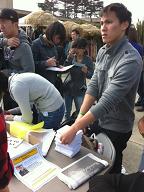
“It’s kind of a counter to Zagat and Yelp,” YWU organizer Edwin Escobar tells me. Escobar just got done talking about his group’s campaign to a room full of City College of San Francisco students at the school’s “Turn the Tables” teach-in last week. The event was sponsored by CCSF’s labor and community studies program and featured presentations from community groups and SF’s Office of Labor Standards Enforcement.

To research the guide, YWU members interviewed 250 employees at 32 restaurants. The 58-question survey ranked businesses in five fields: compliance with wage and working hours laws, job mobility, job satisfaction, health and safety, and job security. Only nine businesses received stars in three or more the categories; none received five out of five.

“People think, oh, it’s San Francisco, all the workers get treated well. But that’s not the case. Restaurants and retail businesses get away with murder,” Escobar says. His organization provides labor law education and advocacy for low-wage workers around the city in an attempt to stem workplace violations.

Recently, YWU shed some light on some of the troubles faced by workers in a struggle with one of the city’s most beloved type of snack stop: the taqueria. The group helped the Latino staff of the Taqueria Azteca chain (which has locations in the Castro and Noe Valley) recoup more than $2 million in back pay from owners who had cheated them of overtime compensation and even minimal control over their schedules. Escobar says one mother involved in the legal proceedings had been given a choice by management: return to work one week after giving birth or lose her job.

“The workers who get cheated the most in San Francisco are Asian immigrants,” says Shaw San Liu, another speaker at “Turn the Tables.” Liu is a lead organizer with the Chinese Progressive Association (www.cpasf.org), which since 1970 has worked to empower the Chinatown community to deal head on with social inequities. Earlier this year, the association released a report on the state of employment in Chinatown restaurants based on one-on-one interviews with 435 workers. The results were disheartening: 50 percent had worked under-minimum wage jobs; 80 percent had been cheated out of overtime; 64 percent had received no on-the-job training; a majority had been injured on the job; and more than half were paying all medical costs out of pocket.

That’s just not cool in a town that nominally protects workers against all these things by law. Liu says CPA would like to publish a guide similar to Dining With Justice to reward responsible restaurants but has run into cultural stumbling blocks. Law-abiding businesses didn’t want to be singled out as such because, owners said, it would make their neighbors look bad. “Everyone knows minimum wage in Chinatown is $1,000 a month,” says Liu. “They didn’t want to be known as the goody two-shoes.”

There are clear challenges to improving the lot of the person serving you your brunch, burritos, and dim sum. But everyone has a part to play in making it happen. “At this point, we’re just asking consumers to be aware,” Liu says.

Efforts like Dining With Justice are a real step in the right direction. YWU plans to expand its scope next year into other city neighborhoods. “Surely there are more than just nine restaurants treating their workers right in this city. We want to know about them,” YWU organizer Tiffany Crain tells the room of students assembled before her. Crain added that if anyone in attendance works for a good employer, they should call her — just as they should call her if they are getting cheated out of wages or a healthy working environment.

“You want to make money?” Liu asked SF restaurant owners. “You’re going to make money if people think you’re a good employer.” In San Francisco, diners like to think they’re eating sustainably: organic, local, and fair to workers. Also, a chef who is happy in his or her job makes for a better dining experience.

Here are restaurants that scored four stars in Dining With Justice.

Arizmendi Bakery

1331 Ninth Ave.; (415) 566-3117, www.arizmendibakery.com

Arlequin

384 Hayes; (415) 626-1211

The Corner

2199 Mission; (415) 875-9258, www.thecornersf.com

Frjtz

590 Valencia; (415) 863-8272 and 581 Hayes; (415) 864-7654, www.frjtzfries.com

Mission Pie

2901 Mission; (415) 282-1500, www.missionpie.com

Poesia

4072 18th St.; (415) 252-9325, www.poesiasf.com

Zazie

941 Cole; (415) 564-5332, www.zaziesf.com

DREAM on

2

sarah@sfbg.com

Spurred by congressional Democratic leaders’ promises to hold a vote on the DREAM (Development, Relief, and Education for Alien Minors) Act before the end of Congress’ lame-duck session this month, immigrant and civil rights advocates are pushing for the passage of bipartisan legislation that would give undocumented youth a shot at citizenship if they go to college or serve in the military for two years.

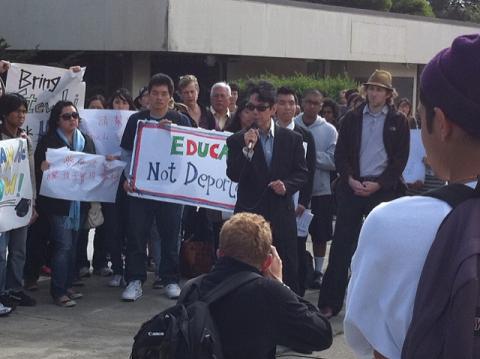
On Nov. 29 in San Francisco, several undocumented young people joined members of the Bay Area Coalition for Immigration Reform outside Mission High School — where as much as 20 percent of the student population may be undocumented, according to principal Eric Guthertz — to explain why it makes sense to give youth who grew up in the United States a shot at legal status.

“We are not asking you to give us a green card,” Anna, a student from Guatemala, said at the event. “All we want is a chance to succeed and give back to this country. We live here, we pay taxes, we’re smart, we go to college, but afterward we can’t work and give back.”

Mario, a 22-year-old gay student who was born in Peru to a Chinese father and Peruvian mother, graduated from UC Berkeley with a civil engineering degree. He explained that because of his lack of documentation, he can’t get a job to pay his bills or save up to pursue a master’s degree, and fears being deported to a homophobic country.

“It would be a waste of talent because I’ve learned California-specific engineering rules and the U.S. building code,” Mario said. “Sometimes I wake up from a nightmare about being detained. I came out here, but in Peru, I’d probably be back in the closet.

Joining Anna and Mario was Shing Ma “Steve” Li, a nursing student at City College, who was released Nov. 19 after two months in federal detention, shortly before he was to be deported to Peru. San Francisco Democrat Sen. Dianne Feinstein introduced legislation to halt his removal, saying it would be “unjust” to deport Li before a DREAM Act vote takes place.

Li, who speaks Cantonese, English, French, and Spanish, grew up reciting the Pledge of Allegiance and dreams of opening a clinic to serve low-income San Franciscans. But recently, federal immigration authorities flew him 800 miles to a jail in Arizona, all because his parents brought him here when he was 12 and he lacks documentation.

“We were handcuffed and shackled to our seats, and I wondered what would happen if the plane went down,” Li recalled.

Li believes the main barriers to the legislation’s passage is lack of accurate information. “People need to know the facts, see the people, and hear their stories,” Li said. “Then they’ll know it is a human rights issue.”

Guthertz said that as principal of Mission High, every year he sees undocumented youth who have great grades and lots of advanced placement classes “hit the wall” of their status. “Over and over, I’ve seen the heartbreaking effect of their situation,” Guthertz said. “The DREAM Act is yet another avenue to help these students.”

Eric Quezada, executive director of Dolores Street Community Services, noted that congressional leaders did not agree to the DREAM Act vote “out of the goodness of their heart — it’s because of the hard work of immigrant advocates.”

Quezada said the push to force a DREAM Act vote in Congress this year began when undocumented youth staged a sit-in in Sen. John McCain’s (R-Ariz.) office in May. “And the vote of Latinos saved the Senate from a Republican takeover on Nov. 2,” he said.

“But we understand this window is closing,” Quezada added, referring to the reality that Republicans will take control of the House in January. “So we’re not taking one vote for granted. And this is the first step. If we are able to pass the DREAM Act, it will be a downpayment for comprehensive immigration reform.”

Sup. John Avalos says the DREAM Act recognizes the contribution immigrants make to the community, and to the creation of economic opportunities for everybody. “Immigrants here support themselves and their families across the water, so it makes sense that we make proper investments and support,” Avalos said. “Education is one way to make the world a more stable place.”

Sup. David Campos, who came to the U.S. from Guatemala as an undocumented teenager, sees the DREAM Act as a piece of commonsense legislation.

“It’s so modest,” Campos said. “Even those who are against comprehensive immigration reform should be for something that recognizes that young people, who came here not by choice but because of their parents’ issues, should be given a chance to give back.”

Campos said his father was able to gain legal status for his whole family because of his employment, but that many undocumented youth aren’t so lucky.

“We open the doors to our public schools, we invest in their education, and then, when they are ready to give back to us, we say, ‘No, we don’t want you here,'” Campos said. “The best and brightest, the risk-takers, come here. As a country, we cannot go forward unless we realize that this influx of creativity and entrepreneurship made this country what it is.”

SF local artist’s purpose within reach

0

“I wanted to teach people, tell them how to do it. I always dream about taking back the city through art.” Reynaldo Cayetano Jr. is showing me his photographic prints in a Lower Haight coffee shop. He’s explaining to me how a guy who grew up in San Francisco came to be on the brink of his third art show in San Francisco (Purpose: Beyond Reach, coming up on Sat/20 at Rancho Parnassus).

Is it weird that this trajectory needs explaining? Common sense says that growing up in a world-class art city would give you a leg up on an career amidst darkrooms and gallery openings. But that’s not the case in cities, really. Local kids get the boot for all kinds of reasons in today’s 21st century – especially creative types who aren’t ready to divest their days to the rat race necessary to stay and live in our great urban spaces.

Maybe to look for real, SF-grown artists you have to see beyond the standard downtown gallery scene. Cayetano’s art shows take place at non-traditional venues – the most recent of which was Bayanihan Community Center on Sixth Street, in the neighborhood that Cayetano grew up. The 23 year old populates the shows half with friends he grew up with and half simpatico souls he meets around the city (full disclosure: my boyfriend falls into this category for the upcoming Sat/20 show). 

Cayetano (Rey to friends) says he’s always been “a spectator of art.” He began sketching as a teen, copying his older brothers who liked to draw. “But soon I was getting better than they were,” he tells me, smiling over coffee and a pastry at the round table we’re sitting at with fellow Inks of Truth artist, photographer Chris Beale (whose shots illustrate this article). 

We’re passing around the portfolio of the two men, who met in a City College photojournalism class and bonded over being the only ones working with film in a digital world (“making it, like, twice as hard on ourselves,” they tell me, clearly relishing the challenge). Cayetano’s folder of prints shows street scenes from his recent trip to the Phillipines — a journey he’s made only twice since his father, mother, two brother, and he moved to California in 1993. 

Real talk: Reynaldo Cayetano and a new friend downtown. Photo by Chris Beale

I turn the page and there is a black and white closeup of his uncle’s knotted hands, then photos from his life in SF: friends, protesters at immigration rallies, corners and streets he’s walked for years. Beale, a long time SF resident originally hailing from Baltimore, has crisply developed shots of Rey in his own book, a dissenter giving the finger to City Hall’s golden cupola, an image of the two’s friend – and emcee who’ll be playing his new album at Saturday’s event – Patience the Virtuous, gazing into the MUNI bus yards. 

Rey started curating his group shows — which display the work of a loosely bound collective called Inks of Truth — to fight ignorance in the SF community. Ignorance of pedestrians, that is. Spurred by a good friend’s death on the Alemany and San Jose S-curve (the young woman for whose 21st birthday present the camera he shoots with was intended), he brought together creative acquaintances for an event that “was supposed to be an art show, but leaned towards awareness.”

Photos from that show and Rey’s second depict a crowd of young people enjoying themselves amidst the physical evidence of their collective creativity, at one point clearing the floor for some b-boys to get in on the show and tell. It’s hardly the scene you see at many wine and cheese receptions that mark the debut of an artist’s work at other places around the city.

The events’ orchestration were big moves for a guy that has trouble seeing himself as a professional artist. “As soon as I call myself that, it comes with… I don’t want to say baggage, but it implies a lot of knowledge,” Rey tells me. “At first I thought that I shouldn’t have a show because I’m not a photographer, but then I thought no – that’s why I should do it.” When I ask him whether he sees a lot of the peers he grew up with in the Sixth Street neighborhood getting in on the SF art scene, he’s hesitant to make sweeping statements. “I feel like it’s lagging, but it’s not to the point where it’s hopeless.”

Perhaps this lag is what gives Cayetano the motivation for his inclusive shows. Saturday’s will feature works by sixteen artists in a variety of mediums. Cayetano is hungry to give others the adrenaline rush and fufillment that comes from finally, seeing one’s work on the wall. 

But it’s not always easy. In the midst of his own worry over producing events without professional guidance, Rey’s dealing with the varying levels of commitment of artists showing their beloved creative mindsprings for the first time. But overall, the process is one he seems to take inspiration in. “It’s great to give them that kind of anxiety, it’s a good stress. If you’re not stressing in the process, it’s not explosive,” he reasons.

In addition to bringing a taste of artistic involvement to the talented around him, the upcoming Purpose: Beyond Reach show at the Sixth Street cafe has another, even more salient community connection. It’s a food drive for Martin de Porres House of Hospitality, a place that Beale says is the soup kitchen of choice for many of the homeless people he’s spoken with. 

Cayetano elected Martin de Porres as the beneficee for its relatively small capacity. After speaking with representatives from larger shelters like Glide, he discovered “even if you raise a lot of cans, for a big shelter it will be gone within a meal.” Art show attendees are expected to load down their backpacks for entrance: those over the age of 21 are expected to donate at least five cans of food. 

For Cayetano, it was important that his third show reflect the entirety of the community where he was raised.  “It’s a testament of growing up on Sixth Street. The people out on the street now are the same ones that were there when I was growing up.” All the better to reflect the real community of San Francisco — if not that, then what are we painting for?


“Purpose: Beyond Reach”

Sat/20 4-10:30 p.m., free with can donation (21 and up, five to seven; 20 and younger three to five) 

Rancho Parnassus

132 Sixth St., SF

(415) 503-0700

www.wix.com/purposebeyondreach/inksoftruth


Only a miracle can save Steve Li now

41

Supporters of Shing Ma “Steve” Li, a 20-year-old nursing student, gathered outside the offices of Sen. Barbara Boxer today to urge her to sponsor a private bill in a last ditch effort to halt Li’s deportation to Peru, which is scheduled to take place Monday, November 15—two months after ICE (Immigration and Customs Enforcement) agents arrested Li in San Francisco.

“While we do not introduce private bills, our staff is happy to meet with Mr. Li’s family and his attorneys to discuss his case,” Boxer spokesperson Zachary Coile emailed the Guardian, as protesters delivered stack of letters to Boxer’s office, asking that she intervene in Li’s case.

Unlike Sen. Dianne Feinstein who has sponsored private bills in the past, Boxer has no record of intervening in this way. But advocates were hopeful that now that she has survived the November 2010 election, Boxer will pull off a miracle before Monday.

This afternoon, Li’s attorney Sin Yen Ling texted the Guardian that her request for deferred action had been denied, meaning that Li will be on a plane to Peru on Monday, baring some last minute miracle.

“Our office has been in touch with ICE and is exploring the options,” Gil Duran, media spokesperson for Sen. Dianne Feinstein told the Guardian, half an hour after Li’s request for deferred action was denied.

And Boxer spokesperson Zachary Coile said the senator’s staff met with Li’s mother, his attorney, his City College professor and others, this afternoon.

“While we do not introduce private bills, our staff was happy to meet with Steve Li’s family and his attorney to discuss his case,” Coile stated. “We reiterated Senator Boxer’s strong support for the DREAM Act, which would provide a path to citizenship for tens of thousands of undocumented students who go to college or serve in the military. Senator Boxer will keep working in the Senate until it becomes law.”

And tonight, Drew Hammill, press secretary to Speaker Nancy Pelosi emailed the following statement to the Guardian:

“Speaker Pelosi believes that Steve Li’s case is a textbook example of the pressing need for comprehensive immigration reform and passage of the DREAM Act. Speaker Pelosi is working with other Members to recommend that ICE grant deferred action in this case.”

Boxer, Feinstein and Pelosi, who have both been strong supporters of the DREAM Act, have vowed to keep working until it is passed.

Earlier this fall, on Sept. 14—the day before ICE arrested Li– Senate Majority Leader Harry Reid announced plans to add the DREAM Act as an amendment to the Department of Defense authorization bill.

But that effort was blocked by Senate Republicans. And after the bloodbath that congressional Democrats endured this November, it’s unclear if the DREAM Act has a prayer, though Nancy Pelosi vowed to move it forward during Congress’ upcoming lame-duck session, and it has continued to attract bi-partisan support since it was first introduced in 2001 by Senators Richard Durbin (D-Il) and Richard Lugar (R-IN).

At today’s protest, Li’s legal counsel, Sin Yen Ling, decried the federal government’s decision to deport her client.

“A 20-year-old City College student is not a threat to our national security,” Ling said. “We need to bring Steve Li home as soon as possible.”

According to Ling, Li has not seen his mother Maria, who divorced Li’s dad for years and lives with Li in San Francisco, since his Sept. 15 arrest, when  ICE picked up Li and his mother in Ingleside on Sept. 15 and placed them in separate cars. The car carrying Li then picked up Li’s  father in the Richmond, and all three family members were processed at ICE’s Sansome Street office in downtown San Francisco, before being transferred to Sacramento County Jail. But Li was then involuntarily transferred to an ICE detention facility in Arizona. Meanwhile, Li’s parents were released from detention when ICE determined that China does not want them back because they left China seeking political asylum. But they are now required to wear cumbersome electronic monitoring anklets, because they are deemed a flight risk, and are not allowed to leave San Francisco.

As a result, Li’s parents have been unable to visit their son in Arizona. And should he be deported to Peru, it’s not clear if they will be permitted to follow. And should if they decide to travel to Peru, they will not be allowed to reenter the U.S. for at least ten years, further complicating a complex situation.

At today’s rally, Li’s mother Maria spoke in public for the first time,  breaking down into tears, as she begged Sen. Boxer and the U.S. government to help.

“He has no money, no clean clothes, how will he get by?” she asked, referring to ICE’s plan to put her son on a plane to Lima, Peru, where he reportedly knows no one.  “Sen. Boxer, will you just watch and pretend you didn’t see anything? Today, when you see all of us standing here begging you, will you respond to us? I hope you can understand it from a mother’s perspective and meet with me to discuss how we can help Steve.”

Ling said Li’s mother decided to speak because of the direness of her son’s situation, even though she was wearing a federally-mandated monitoring anklet.
“She felt it was now or never,” Ling said.

Li’s teacher Sang Chi also spoke, praising Li as a model student and a prime example of the kind of person that should be eligible for the DREAM Act. And then the Rev. Norman Fang led Li’s supporters in a prayer.

‘We ask that a miracle take place and that Steve’s mom and San Francisco can be happy again, that the heart and soul of what is morally right can overcome regulations,” Fang said, noting that 100 years, his family members were detained at Angel Island “for no other reason than they were Chinese. ‘There is only one border in our world—the one that separates Heaven and Earth.”

Li’s attorney Sin Yen Ling clarified that she doesn’t believe that ICE singled Li out.
“He’s just been swept up as part of a larger program,” Ling said, noting that actions that split families apart and target folks who came to this country as undocumented children have inspired a movement of DREAMers—folks who support the DREAM Act.

Every year, about 65,000 U.S. raised students, who would qualify for the DREAM Act’s proposed benefits, graduate from high school, according to the National Immigration Law Center (NILC).

“These include honor roll students, star athletes, talented artists, homecoming queens, and aspiring teachers, doctors and U.S. soldiers,” states a NILC press release. “They are young people who have lived in the U.S. for most of their lives and desire only to call this country their home. Even though they were brought to the U.S. years ago as children, they face unique barriers to higher education, are unable to work legally in the U.S. and often live in constant fear of detection by immigration authorities.”

Asked how ICE caught up with Li, who does not have a criminal record, Ling pointed to modern technology
“In this day and age, you can track anyone down,” Ling said.” And it’s a priority for ICE to identify people with final deportation orders,” she continued. Ling was referring to the fact that Li’s parents were denied their request for political asylum from China and issued a removal order, unbeknownst to their son Steve, who was born in Peru, came to the U.S. when he was 12 and was 14, when his parents’ asylum request was denied.

But Ling did not blame President Barack Obama, who promised to bring millions of undocumented residents out of the shadows, when he was running for president in 2008.
“It’s tough to criticize the president when he had five different priorities coming into office, including healthcare. His administration probably miscalculated how long it would take to pass healthcare. And part of the problem is partisan politics around immigration.”

Ling estimates that there are two million young people currently in the U.S. who would benefit from the passage of the DREAM Act, but blamed partisan politics for why the legislation failed to pass by only 3 votes in the Senate in September.

Sup. David Campos showed up at the rally and told Li’s supporters that the Board of Supervisors unanimously approved a resolution Nov. 9 calling for ICE to defer Li’s deportation.

“The Board is not always on the same page, but on this issue we were unanimous,” Campos said. “We get it, we understand the tragedy that this deportation would result in. And we remain hopeful that something will happen. There are millions of young people in the same predicament, and the solution is not deportation. The solution is passing comprehensive immigration reform. Until then, we need an intervention.”

Meanwhile, somewhere in Arizona, Steve Li sits in a jail cell, hoping, praying and dreaming…

Steve Li to be deported to Peru on Monday

12

Immigrant advocates report that the deportation of Steve Li, an honors student who was studying at City College until  ICE (immigration and Customs Enforcement) picked him up in September, has been scheduled for Monday, November 15.

Advocates have argued that Li, who has lived here since he was 12 and apparently knows no one in Peru, where ICE plans to deport him, is eligible for the DREAM Act. So, they were especially upset when news of Li’s scheduled deportation hit the same day that Nancy Pelosi announced that she wants to move the DREAM Act during the lame duck session

In response, Li’s supporters are planning an all-day action at Sen. Barbara Boxer’s office at 1700 Montgomery Street on Friday November 12.

“People will be dressing in caps and gowns or nursing scrubs (Steve is a nursing student)” states a press release from Li’s supporters, who promise to phonebank ICE/Boxer/Feinstein and deliver letters to Boxer’s office tomorrow.

“Time is of the essence, we need Boxer or Feinstein to sponsor a private bill, or for John Morton at ICE to grant the deferred action before Steve is scheduled to aboard the plane on Monday,” the statement, which lists the phone numbers of Feinstein, Boxer and ICE’s John Morton, concludes.


Advocates say Steve Li is DREAM Act eligible

4

The Board of Supervisors plans to introduce a resolution at their Nov. 9 meeting denouncing the deportation of Shing Ma “Steve” Li, a  20-year-old DREAM Act student at City College of San Francisco, calling for Immigration and Customs Enforcement to grant him deferred action status, and urging Congress to pass the DREAM (Development, Relief and Education for Alien Minors) Act.

The move comes the same day San Francisco Unified School District Board President Jane Kim (leading in the as yet unresolved race to replace termed-out D6 Sup.Chris Daly) plans to introduce a similar resolution at the SFUSD Board meeting, and a week after City College Board Trustee Lawrence Wong introduced a resolution supporting Li, who has lived in California since 2002 and is studying to be a nurse , but is now in an immigration detention center in Arizona.

“It’s unreal how fast things change”, Li said in a statement made from Arizona, just seven weeks after ICE raided his home and arrested him.

Li, who is ethnically Chinese, was born in Peru as his parents fled political persecution in China. And  ICE is allegedly preparing to deport him to Peru, which he left when he was 12. (Calls to ICE had not been returned as of blog post time, but I’ll update this blog, when I get a reply.)

“He knows no one in Peru,” said Li’s lawyer, Sin Yen Ling, senior staff attorney at the Asian Law Caucus, as she described how Li’s grandma returned to China, when his grandfather died.

Five years ago, the U.S. denied Li’s parents political asylum from China and issued a removal order. But Li says he was unaware of his immigration situation until his home was raided, and advocates and community members believe his case illustrates how the U.S.’s immigration system tears up families and targets contributing members of society.

Li’s Sept. 15 arrest occurred one week before Congress failed to vote on the DREAM Act, which would provide a pathway to legalization to undocumented students who’ve grown up in the US and atten two years of college or served two years of the military.

“It’s critical to pass the DREAM Act before the new Congressional session, but Steve literally cannot wait and is set for deportation any day now, that’s why we need our Senators’ leadership today,”  Li’s attorney Sin Yen Ling told me, noting that so far their has been no response from Sen. Dianne Feinstein, and that advocates are planning to target Sen. Barbara Boxer, now that the election is over.

In their resolution, Board President David Chiu and Sups. Eric Mar, John Avalos, David Campos and Ross Mirkarimi note that the DREAM Act is “bipartisan legislation that addresses the situation faced by young people who were brought to the United States years ago as undocumented immigrant children, and who have since grown up here, stayed in school, and kept out of trouble.”

These five supervisors note that each year, 65,000 U.S.-raised students who qualify from the DREAM Act’s benefits graduate. They also note that Democratic Sen. Dick Durbin and Republican Sen. Richard Lugar asked Department of Homeland Security Secretary Janet Napolitano on April 21, 2010 to halt the deportation of immigrant students who could earn legal status under the DREAM Act, which has the support of the House and Senate leadership, all of the relevant committee chairs, the nation’s military leaders, and President Barack Obama.

“I will do whatever it takes to support efforts to pass this bill so I can sign it into law on behalf of students seeking a college education and those who wish to serve in our country’s uniform. It’s the right thing to do,” Obama told the Congressional Hispanic Caucus on September 15, 2010—the same day that Li was arrested in San Francisco.

Update: Since writing this blog, I got a call back from ICE’s Lori Haley, who said she was limited in how much information she could share, but sent me this statement concerning Li:

“Shing Ma Li was taken into custody by ICE Fugitive Operations team officers on September 15, 2010, based upon a final order of removal issued by an immigration judge in 2004.  In 2005, the Board of Immigration Appeals (BIA) reviewed his case and upheld the immigration judge’s decision.  Shing Ma Li currently remains in ICE custody while the agency seeks to make arrangements for his removal.”


Election 2010: Labor and progressives dodge a bullet

22

Bucking a national conservative, anti-government political trend, San Franciscans stayed with some fairly progressive politics on election night, rejecting a measure to demonize public employees (Prop. B), giving progressive John Rizzo far more votes than his City College of San Francisco board rivals, and taking far more liberal positions in state ballot measures and candidates than California voters, who were already far to the left of national voters.
“We are really happy that Prop. B is going down because it was such a misguided measure. It was not well thought through,” San Francisco Labor Council President Tim Paulson told the Guardian at the party labor threw with the San Francisco Democratic Party at Great American Music Hall. “San Francisco voters are the smartest in America.”
Paulson was also happy to see those voters approve Prop. N, taxing the transfer of properties worth more than $5 million, “because San Franciscans know that everyone has to pay their fair share.”
Another labor priority, Prop. J, the temporary hotel tax increase, lost by a narrow margin after Mayor Gavin Newsom and his downtown allies opposed it, and the online travel company spent millions of dollars to bury Prop. K – a Newsom-created rival measure that would have closed a loophole that lets the company avoid paying the hotel tax.
Rizzo said he was happy to far outpoll Lawrence Wong and Anita Grier as the three incumbents ran uncontested for their City College board seats, which should put him in a leadership position in the troubled district. “There is a tradition at City College that the highest vote getter gets the presidency, so I’m pretty happy,” Rizzo told us on election night.
There were some conservative victories in San Francisco, including approval of Prop. L, which criminalizes sitting or lying on sidewalks, and Prop. G, which will reduce Muni operator wages and change work rules after getting the approval of about 63 percent of voters.
“Ultimately, downtown did well,” progressive political consultant Jim Stearns said, noting how aggressive spending by downtown business and real estate interests ended a string of progressive victories in the last several election cycles, including the likely election of Scott Wiener in D8 and the strong challenge in D2 by Mark Farrell to perceived frontrunner Janet Reilly, who had progressive endorsements.
Stearns said national polls have shown that people are more afraid of big government than big corporations, whereas progressives tend to hold the opposite view. “That national atmosphere definitely had an impact on even races locally,” Stearns said.
But in San Francisco, the progressives retain a strong position in the political debates to come.

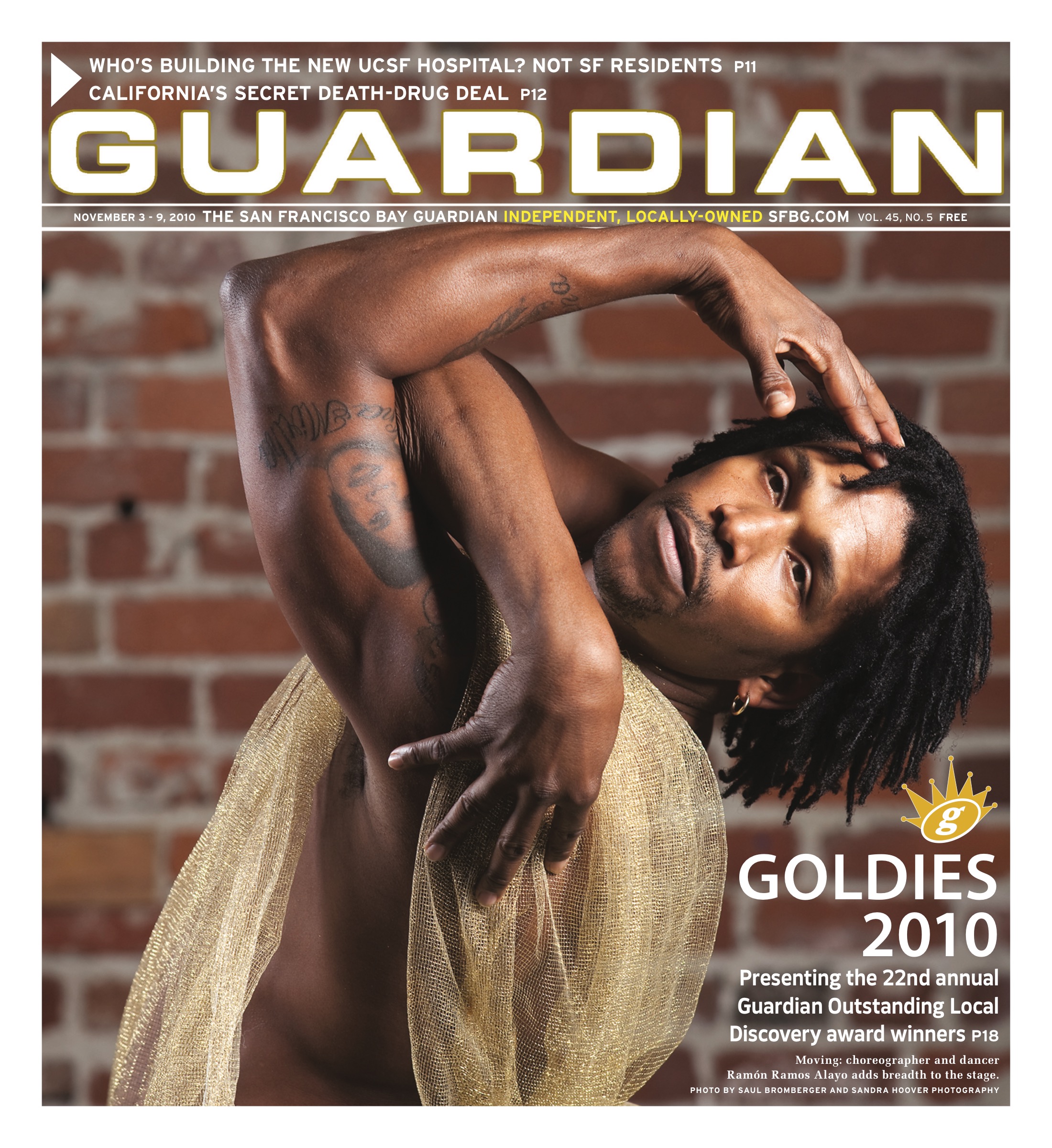
GOLDIES 2010: Christopher Kuckenbaker

0

In September, the San Francisco Fringe Festival offered patrons an off-Beat gem, The Burroughs and Kookie Show. A deftly performed blend of homage and intimate psychic excavation, the play imagines William S. Burroughs (actor-playwright Christopher Kuckenbaker) as talk show host, opposite a deadpan, laconic musician named Loubis the Pubis (Louis Libert), and a missing cohost, “Kookie,” symbolized in absentia by a small, empty chair. Tonight’s guest? An unsuspecting actor named Chris Baker (Christopher Kuckenbaker again). At once mood-alteringly dreamy and piquant, shrewdly funny and unexpectedly poignant, the show deservedly scampered off with “Best of Fringe” honors.

Kuckenbaker is a sharp, versatile actor who’s plied the more vibrant fringes of Bay Area theater since the 1990s. He and his now ex-wife moved away in 2001 to pursue professional careers as actors in Chicago and Boulder, but Kuckenbaker returned in 2007. The timing was auspicious. A month later, he was memorably cast as real mama’s monster Grendel in Banana Bag & Bodice’s bicoastal hit, Beowulf: A Thousand Years of Baggage. Next up, Kuckenbaker appears at Z Space opposite 2009 Goldie winner Beth Wilmurt in The Companion Piece, directed by Mark Jackson.

Kuckenbacker came to acting while at Santa Barbara City College. This followed a scattered upbringing in California towns like Hollister and Salinas, and far-flung lands like Australia. He credits all the moving around with seeding his actor’s outgoing personality. “It maybe forced me to be a little more gregarious than other people,” he suggests.

Arriving in San Francisco in 1993, Kuckenbaker received a degree from San Francisco State’s prolific theater department in 1997. Since then, his graceful work and alternately intense and quirky looks have made him a unique presence onstage. He’s also an astute and generous ensemble player who’s worked repeatedly with leading smaller companies like Art Street and the Shotgun Players; been part of a now defunct sketch comedy troupe called Old Man McGinty; and appeared repeatedly in Playground’s popular stagings of contest-generated short plays.

His own shift to playwriting, meanwhile, is more than a lark. He and Burroughs go way back. They first met in the Interzone of the imagination around the time Kuckenbaker left Santa Barbara with some Beat-obsessed cohorts for Bellingham, Wash., in the early 1990s. He stayed only a year in the Pacific Northwest rain, but something had happened to him up there, some inter-era nod, some afflatus. A mind-meld with old Bill.

“When I first moved to Bellingham, I’d go to the grocery store and pick up CDs of him reading his own works. That turned me on. There was something about his voice that triggered something in my brain, released some kind of new chemical in my head, and it just made sense.”

After gestating for nearly two decades, that initial inspiration has become a Möbius strip seamlessly joining in one actor two complex identities: Burroughs and the actor alter ego called on to process the painful end of a marriage. In giving a compelling dramatic shape to the voices in his head, Kuckenbaker says he’s found new definition in a still-unfolding career.

“When I look back, it seems to me I was just going from one show to the next, never really seeing myself any further along than the next show. Now, after giving birth to something in a very personal way, I want with all my power for it to grow and be seen, to spread itself out across the world. I have some big ideas about where I want to take the next iteration of The Burroughs and Kookie Show, making it a much larger and richer piece.” 

www.kuckenbakery.com

>>MORE GOLDIES 2010

On the margins

3

Sarah@sfbg.com

Franklin is a 20-something computer programmer who shares an apartment with 10 other people around his age, an arrangement that helps him and his housemates come up with $3,500 each month for rent in the Mission, a rapidly gentrifying part of town.

“Everyone is pretty much working, but they are in and out at different times so the house isn’t ever really empty. But there’s usually only three or four of us at a time, ” Franklin told the Guardian, speaking on his cell phone as he rode his bike to work.

But how does an apartment that officially has only one bedroom sleep 10 people? Franklin said there are other rooms in the house — including a dining room and a double parlor that splits into two with sliding doors — and that each of these spaces has a couple sleeping in it. “And there is one person sleeping in a closet and another sleeping in a space atop the bathroom.”

While overcrowding has been a problem in immigrant communities in San Francisco, it’s reaching a new area: young people who have for generations flocked to the city to escape uncomfortable home lives, find a supportive community, and make a new start in life.

Ted Gullicksen, director of the San Francisco Tenants Union, said at least 1,250 housing units annually were lost to condominium and tenancy-in-common conversions in the dot.com and housing bubble years, a loss rate that has slowed only slightly since then.

“Right now, it’s about 1,000 units a year,” he said.

It’s become more common for young people to struggle to pay rent in a town where well-paying jobs are scarce and educational programs have been cut — a triple whammy that means youth with additional challenges are at risk of becoming homeless and getting trapped in vicious cycle of abuse and incarceration.

COMPOUNDING THE PROBLEM

Sherilyn Adams, executive director of Larkin Street Youth Services, which provides housing, medical, social, and educational services to at-risk homeless and runaway youth, says all young people in San Francisco face the same basic challenges.

“And if, in addition, these youth are part of a group like LGBTQ youth, or are youth of color, or immigrant youth, documented or not, then the circumstances and barriers are much more exacerbated,” she said.

Adams said San Francisco has done a lot to add resources for transitional age youth, a group that traditionally has been defined as ages 12 to 24. “But there is still a significant gap in resources, especially for the more disenfranchised groups, because the longer you’ve been on the street, the more complex your issues in terms of substance abuse and mental health.”

Civic leaders, including California Assembly member Tom Ammiano, recently held a rally and candlelight march to raise awareness of the tragic rise in homelessness and suicides among LGBTQ youth. Shortly after, Adams told us, “Youth who came here escaping homophobia in their family or city then face the harsh reality of San Francisco.”

Adams understands that some people see Proposition L, legislation on the November ballot to criminalize sitting or lying on city sidewalks, as a way to address disruptive and aggressive behavior on the streets. “But it becomes part of the larger divide, because youth who come here and are on the street are mostly there because they have no other place. So penalizing them in the absence of services, housing, and education is ineffective at best and really harmful at worst,” Adams said.

Many young people on the brink of homelessness are “somewhat invisible,” and therefore at high risk, she said. “Youth will double, triple up. They will couch surf as a way to be off the streets. And we hear the stories where youth are faced with a Sophie’s choice: Do you sleep on the street, or do you barter with what you have available so as to get shelter? And LGBTQ youth are at particular risk because the more disenfranchised and disconnected you are, the more you have to make impossible choices to survive.”

Jodi Schwartz, executive director at Lyric, an SF nonprofit that focuses on building community and inspiring change in LGBTQ youth, said the group serves 500 youth and reaches out to 800 to 1,000 more each year. “We go into classrooms and talk about hate speech, putting it in the context of racism and other forms of oppression,” she said.

“There’s a misconception that because we live in San Francisco and have a lot more dialogue and interaction with the LGBTQ community, that young people’s experience here is so much better. It may be different, but I wouldn’t say it’s better,” Schwartz said, noting that harassment levels, especially for transgendered youth in local schools, are very high.

HELPING THOSE IN NEED

Young women are another at-risk group, especially if they are pregnant, have kids, or are in the foster or juvenile justice system.

As executive director of the Center for Young Women’s Development in San Francisco’s gritty SoMa district, Marlene Sanchez tries to stabilize at-risk young women, then engage them in policy work so they can advocate for other young people they know.

“We work with young women who are involved in the underground street economies, doing prostitution, drug sales, and selling stolen goods like clothes,” Sanchez said. “We try to reach them on the streets and inside Juvenile Hall, so we take an inside-outside approach.”

Leajay Harper, who coordinates CYWD’s Young Mothers United program, works with young pregnant women inside Juvenile Hall.

“We have all experienced poverty, parents on drugs, and having to take care of younger siblings,” Harper said. “When young moms get incarcerated, they are at risk of having their children taken away at much higher rates. So we started parenting classes that are age and culturally relevant.”

City records show that while only about 12 percent of Juvenile Hall detainees are female, they are twice as likely as their male counterparts to land back in custody for probation violations.

“There are lots of young women with felonies struggling to pay their bills and feed their kids who look out the window and see they can sell drugs. And that often seems like the only option,” Sanchez explained.

City statistics also show that of the overwhelmingly male population at Juvenile Hall, almost half is African American, and that many are inside for what appear to be gang-related offenses.

Easop Winston, a 35-year-old local musician, church pastor, and member of the Visitacion Valley Peacekeepers, regularly visits young men inside Juvenile Hall, where gangs are a topic of discussion every week.

“The same guys that they have been fighting with, they are now incarcerated with,” Winston observed. “So one of the approaches I try to take is rehabilitating how they think about their neighbor. You are killing/fighting with someone who lives one block over. It’s plain genocide”

He credits the juvenile justice system for doing its best, but worries that it fails to rehabilitate youthful offenders with jobs skills, education, and counseling before sending them back into society.

He blames the churches for not doing a better job of making youth feel welcome. “Churches are part of the fabric of our community,” he said. “They need to do more outreach and not have so many rules. They need to accept youth as they are, with their tattoos, piercings, and styles of clothing.”

Winston believes politicians need to do a better job of making sure community-based organizations deliver on their promises to help working class communities of color. At the same time, as he acknowledges, “We can’t cure the world in one day.”

“Over the last five to 10 years, the African American population in SF has shrunk,” he observed. “Everybody is moving to Antioch and Fairfield because people can’t afford to live here. People are losing their jobs. And San Francisco has almost become impossible to live in unless you have a college degree. A lot of what I hear from youth is about economics. They want jobs. They want to be trained.”

PUSHING THEM OUT

Political disputes over the city’s sanctuary city policies on undocumented immigrants — which have left in limbo the question of whether arrested immigrants will get their days in court before being turned over to the federal government for possible deportation — have also been a source of instability for immigrant teens, many of whom are homeless and/or LGBTQ.

Police Commissioner Angela Chan, a staff attorney with the Asian Law Caucus, decried Mayor Gavin Newsom for refusing to implement Sup. David Campos’ due process legislation, which the board approved in November 2009.

“It’s been a little bit upsetting for the many groups that took the democratic process seriously. But these groups are still very committed to these kids,” Chan said. “We are hoping to work with the new U.S. Attorney Melinda Haag to clarify this issue and explain that the top priority of the Obama administration is not to deport undocumented youth.”

Other so-called tough-on-crime initiatives also threaten local at-risk young people. In September, City Attorney Dennis Herrera secured an injunction against 41 alleged gang members in Visitacion Valley, a strategy that progressives fear will accelerate the ongoing displacement of the African American community.

Court documents show that 66 percent of the men named in the injunction are 18 to 25 years old and that many have children in public housing, where lease holders are predominantly women of color.

San Francisco City College Trustee Chris Jackson, 27, is running for the District 10 seat on the Board of Supervisors. Noting that the southeast SF district has some of the highest numbers of poor people and children citywide, Jackson said that youth issues are similar to challenges that other voters face.

“But the context is different,” said Jackson, who previously served on the San Francisco Youth Commission. “Young people care about safe streets because it’s us or our friends who are on them. We care about schools because we are in them and want to go to college. And we are concerned about the future of employment because how do you tell folks to go to school if there are no jobs?”

Jackson notes that in the Bayview-Hunters Point, home to the city’s largest remaining African American community, kids don’t come back if they leave for college. “We see a brain drain. It’s really difficult to retain young people, so it’s important to first make sure that youth’s housing needs are met. And they also need access to careers so that when they graduate, they know there is a job in the city. But right now, youth can’t even find a summer job because of the recession.”

He called for city policies that are based on the needs of current city residents rather than developers’ profits or the desires of well-off outsiders to move here.

“San Francisco is more of an opportunity for Silicon Valley residents than for youth who were born and raised here. And part of the problem is city policies, ineffective programs, and a failure to provide job opportunities for youth,” he said. “Everything for youth has been gutted.”

And those evaporating opportunities are compounded by punitive policies like Prop. L, Jackson said, further alienating young people. “It comes down to how much money you have,” Jackson observes. “If you are rich, you can enjoy the parks, the clubs, the transit. But if you are low-income, especially low-income youth of color, it’s very hard to take advantage of everything the city has to offer.”

Noting that both City College and the San Francisco Unified School District canceled their summer school program, Jackson said, “it doesn’t look like youth are prioritized.”

Jackson was recently at Double Rock (a.k.a. the Alice Griffith Public Housing Project) and he saw four kids under 10 who were at home while their parents were at work. “Why aren’t they in school or in child care? And don’t give me the line that these are hard to serve communities. We have to serve them.”

N’tanya Lee, executive director of Coleman Advocates, agrees that while all young people are struggling in the city, African American children and youth are having one of the worst times.

“We don’t need 5,000 different strategies and initiatives when 90 percent of these kids live in extreme poverty, mostly concentrated in public housing, and you could fit the city’s entire black high school student population into one auditorium,” Lee said.

She wants the city to create a database of these youth and develop specific strategies to help this population before it’s too late.

“No one in city government feels accountable for the outcomes for black children and youth,” she said. “Instead you have one group who are about young people and another who are about economic development — and they have nothing to do with each other. Meanwhile, we’ve lost half of all black families with children in this city in the past 20 years.”

Our 44th Anniversary Issue also includes stories by Rebecca Bowe on ageing out of the foster care system, Caitlin Donohue’s account of the Haight street kids, and Tim Redmond’s editorial on the issues facing our rising generation

Maxwell disappoints by endorsing Sweet

10

To be honest, I wasn’t surprised that termed-out Sup. Sophie Maxwell endorsed D10 candidate Lynette Sweet yesterday. Just disappointed. And it’s not just because Sweet refused to come into the Guardian this fall for an endorsement interview (a stance that suggests that Sweet would be depressingly inaccessible to reporters that haven’t drunk her Kool-Aid—a stance that, unfortunately, reminds me of Mayor Gavin Newsom’s attitude towards the media).

I’d been hearing rumors that Maxwell was going to endorse Sweet since February, when Sweet, who’d already racked up Mayor Gavin Newsom’s D10 blessing at that point, showed up alongside Maxwell at the city’s kickoff event for Black history month.

Then there was the fact that during an interview in February for the Guardian’s kickoff article about the D10 race, Sweet spouted phrases that sounded eerily similar to Maxwell’s words.
“D10 is a pretty diverse district, but there is only one common thread: the need for economic development,” Sweet told me.

But a few days earlier when I interviewed Maxwell about a third, and ultimately unsuccessful, attempt to recall her , Maxwell talked of common threads:

 “I’m waiting for people to have a better understanding of what this community is, what the common thread running through it is, and how to use rank choice voting,” Maxwell said, by way of explaining why she wasn’t willing to endorse anyone that early in the race.

Now, it’s understandable that Maxwell would be looking for a candidate to carry on her legacy. But it she was looking for a moderate black female candidate  then why not endorse Malia Cohen, who isn’t hampered by all of Sweet’s dirty laundry—and has raised the most money in the race, so far?

Could it be that Cohen wouldn’t be down for the kind of dirty deal making that was par for the course back in the days when Willie Brown was still mayor and Sweet was the swing vote that crowned Lennar as master developer at the shipyard/Candlestick Point?

Rumor has it that Maxwell is upset at all the corporate money that’s flooding into this race in support of Steve Moss—and that she asked the other candidates to hold a press conference in which they decry this practice. Rumor also has it that Sweet signaled her willingness to join Tony Kelly, Dewitt Lacy, Chris Jackson and Eric Smith–to name a few–in making such a statement. But it hasn’t happened, yet. And the corporate money keeps rolling in for Moss.

Meanwhile, with three weeks until the election, D10 forums are beginning to sound like a parody of a “Lost” episode featuring a 22-member cast that all claim to represent the city’s polluted and economically depressed southeast sector:

“One of us is a BART director, one of us worked at City Hall, one of us is a community advocate, one of us is a City College Board member, one of us is a civil rights attorney, one of us is an affordable housing development director, one of us is a bio-diesel advocate, one of us is a public safety advocate, one of us was raised in the Bayview, one of us served on the Navy’s Restoration Advisory Board,” and so on.

I’m not saying this is wrong. Hell, I love all this diversity of choices. but I am concerned that, come election night, the progressive vote will get split into a million pieces, while deep-pocketed conservative forces like the Chamber of Commerce and Golden Gate Restaurant line up behind one candidate in an attempt to crush candidates that would stand up to their powerful influence at City Hall and truly represent the D10 community

Yes, there is ranked choice voting, and it’s unlikely that one candidate will win a majority of the vote in the first round. But it’s critical at this venture that progressives develop a winning strategy. D10 candidate Ed Donaldson told me recently that if a candidate who doesn’t represent the community’s concerns gets elected, then the community would respond just as they did around Maxwell—and organize a recall.

But wouldn’t it be better if the community can come together behind three truly progressive candidates and help them win the November election?

One of the key challenges in this race will be to win votes in Visitacion Valley, as well as in the Bayview and/or Potrero Hill.

In his latest column in the Chron, former mayor and Sweet supporter Willie Brown alluded to the importance of this in a city with ranked-choice voting:”It’s not getting much attention, but someone has finally figured out how to get the Asian vote out,” Brown observed.”You do it by mail. You get ballots and ballot books into every household, then have the whole family sit down together. The kids help with the translation, everyone talks things over and everyone votes.”

Meanwhile, D10 candidate Tony Kelly told me that Marlene Tran, who is tri-lingual (English, Cantonese, Vietnamese) and has a good handle on community issues in Viz Valley, has confirmed that Kelly is her second-ranked choice (presuming that she votes for herself in first place. of course).

Not a bad strategy–and one that other progressives need to consider, given ranked choice voting–and the brutal reality that they are going to be massively outspent in the next three weeks.


Quick Lit: Oct. 6-Oct. 12

0

Literary readings, book tours, and talks this week

Litquake 2010 goes out with a bang featuring novelists, scientists, poets, comedians, sexy storytellers, and more, culminating in this year’s not-to-be-missed Lit Crawl.


Wednesday, Oct. 6

“The Art of Narrative Nonfiction”
Much is said about how to write fiction, but what about non-fiction? This panel moderated by best-selling author David Ewing Duncan will discuss the techniques for turning a biography into a National Book Award Winner. Featuring Tamim Ansary, Frances Dinkelspiel, Richard Rhodes, and T.J. Stiles.
6 p.m., free
San Francisco Main Library
100 Larkin, SF
www.litquake.org

Bawdy Storytelling
Hear real people sharing their bona fide sexual exploits in ten minutes or less. Storytellers are an eclectic mix of authors, poets, comedians, actors, and regular people, including Tim Barsky, Stephen Elliot, Johnny Funcheap, Jow Klocek, Joe Kukura, and Morgan.
7 p.m., $10
Blue Macaw
2565 Mission, SF
www.litquake.org

“The Complex Societies of Ants and Honeybees”
Join Litquake and the California Academy of Sciences for a discussion led by two leading experts, Mark W. Moffett and Dr. Thomas D. Seeley, on our planet’s smallest and most complex social organizations. Co-sponsored by KQED, and moderated by KQED’s QUEST TV series producer Amy Miller.
7 p.m., $15
Morrison Planetarium
California Academy of Sciences
55 Music Concourse
Golden Gate Park, SF
www.litquake.org


“Dance, Intergenerational Trauma, and the Diaspora”
Learn about the Katherine Dunham Technique at this lecture featuring Eyla Moore, teacher at ODC, Dance Commons, Hip Line, and Dance Fitness Studio, and Aliyah Dunn Salahuddin, dancer and tutor in City College of San Francisco’s African American Scholastic Program.
3 p.m., free
City College of San Francisco
Ocean Campus
Rosenberg Library, Room 305
50 Phelan, SF
(415) 239-3854

Flight of Poets
Internationally renowned sommelier Christopher Sawyer pairs six talented local poets with six great wines carefully selected to illuminate their work. Featuring Camille T. Dungy, Robin Ekiss, Paul Hoover, Ada Limón, Zachary Mason, Christopher Sawyer, and Matthew Siegel.
7 p.m., $15 includes wine flight 
Hotel Rex
562 Sutter, SF
www.litquake.org

The Funny Side of Sex
Join Daily Show correspondent Kristen Schaal as she celebrates her first book, The Sexy Book of Sexy Sex, along with Scott Jacobson, co-author of the new book Sex: Our Bodies Our Junk, illustrator Michael Kupperman, and actor and writer Ted Travelstead. This evening of live and uncensored sex-humor unfolds at San Francisco’s legendary Cobb’s Comedy Club. Co-sponsored by Chronicle Books.
8 p.m., $15
Cobbs Comedy Club
915 Columbus, SF
www.litquake.org

Lit on the Lake
Celebrate East Bay writers at this litquake event featuring acclaimed novelists including Melanie Abrams, Elaine Beale Lucy Jane Bledsoe, Jacqueline Luckett, Lisa Braver Moss, and Kristin McCloy.
6 p.m., $5-$10 donation
Gondola Room
Lake Chalet
1520 Lakeside, Oakl.
www.litquake.org

100th Literary Death Match
Celebrate the kickoff of a worldwide Literary Death Match tour where judges, W. Kamau Bell, Mark Fiore, and Jane Smiley, will pass centurial judgment on a must-see lineup featuring readers Jason Bayani, David Corbett, Kari Kiernan, and Joel Selvin. Hosted by Todd Zuniga, Elissa Bassist, Alia Volz, and M.G. Martin.
7 p.m., $15
Elbo Room
647 Valencia, SF
www.litquake.org

Radar Reading Series: Litquake Edition
This monthly literary series brings in first-time novelists, playwrights, shoplifting poets, and riot girl historians for readings, followed by a Q&A session hosted by Michelle Tea. Featuring Chinaka Hodge, Tao Lin, Sara Marcus, and Beth Pickens.
6 p.m., free
Latino Reading Room
San Francisco Main Library
100 Larkin, SF
www.litquake.org

Thursday, Oct. 7

Booksmith Bookswap
Bring a book you passionately love but can part with and learn about dozens of new, fantastic books. Ticket price includes two drinks, appetizers, and a 20% discount card to purchase books after the event.
6:30 p.m., $25
Booksmith
1644 Haight, SF
www.litquake.org

Feminine Wiles
Hear witty women read from their most recent books, featuring Elif Batuman, Marisa Crawford, Katie Crouch, Thaisa Frank, Joyce Maynard, Kaya Oakes, and Shawna Yang Ryan.
7 p.m., free
Noe Valley Recreational Center
295 Day, SF
www.litquake.org

The International Homosexual Conspiracy
Author Larry-bob Roberts offers humorous insights into the absurdities of modern life and queer culture, from contemporary topics like mistaken first impressions, to sustainable yet unaffordable pants, and critiques of bourgeois mindsets.
7 p.m., free
Modern Times Bookstore
888 Valencia, SF
www.mtbs.com

Litquake Bites
Local food and books, two of San Francisco’s favorite pastimes, converge at this delicious and informative lunchtime event featuring presentations and tastings by four innovative food purveyors and authors including Sarah Billingsley, Gordon Edgar, Steve Sando, and Amy Treadwell.
Noon, free
Book Passage
1 Ferry Building, SF
www.litquake.org


Stories on the Stage
Hear short fiction stories about love lost, love never found, and love perpetually out of touch with authors Daniel Handler, Daniel Alarcón, and Yiyun Li. Directed by Sean San José, co-founder of Campo Santo, the award-winning resident theater company of San Francisco’s Intersection for the Arts.
7:30 p.m., $25
Roda Theater
Berkeley Repertory Theatre
2025 Addison, Berk.
www.litquake.org

Friday, Oct. 8

All-Memoir Women’s Night
From finding love in foreign lands to struggling with poverty, from being in the sandwich generation to making the perfect brownie, women are fearless when it comes to exploring life and its myriad joys and challenges. Hear authors Zoe Fitzgerald Carter, Katherine Ellison, Laura Fraser, Frances Lefkowitz, Meredith Maran, Kate Moses, Janice Cooke Newman turn inward to provide us with stories that delight, dismay, and entertain. Emceed by Litquake co-director Jane Ganahl.
6:30 p.m., $5-$10 donation
Paris Ballroom
501 Geary, SF
www.litquake.org


“How to Write and Sell Erotica”

Join a panel of editors, anthologists, and published authors as they offer practical tips and personal insights about how to write and sell all forms of erotica. Find out what magazines, websites, anthologies, and book publishers you can sell your work to, as well as  tips on how to write more marketable erotica.
7:30 p.m., $5-$15 donation
Center for Sex and Culture
1519 Mission, SF
www.sexandculture.org

“It’s All Over But the Crying”
Enjoy a night of author talks on the world of sports, from the infinite variations of major-league baseball to the international phenomenon of the World Cup, with Alan Black, Howard Bryant, Dan Epstein, Dan Fost, David Henry Sterry, Jason Turbow, and Michael Zagaris. Special multimedia presentation by Bay Area sports photographer Michael “Z Man” Zagaris. Emceed by Litquake co-director Jack Boulware.
7 p.m., $10
Hemlock Tavern
1131 Polk, SF
www.litquake.org

Jonathan Lethem
Novelist, essayist, and short story writer Jonathan Lethem will discuss his latest novel, Chronic City. Co-presented by Litquake and San Francisco’s Jewish Community Center.
11 a.m., $20
Jewish Community Center of San Francisco
3200 California, SF
www.litquake.org


Litquake at the Bikestore

In the late 19th century, an accountant named Frank Lenz quit his job to cycle around the world. Two years later he mysteriously disappeared during the final leg of the journey. Hear author David V. Herlihy discuss this mystery and his new book The Lost Cyclist. In conjunction with Green Apple Books.
7 p.m., free
Public Bikes
123 South Park, SF
www.litquake.org

Saturday, Oct. 9

Lit Crawl
Get your fill of literary entertainment at galleries and bars across the Mission, where each phase offers crawlers a choice of attending readings happening simultaneously at over a dozen venues. With best-selling authors, poets, professors, bawdy story-tellers, amateurs, and professionals, it’ll be tough to choose three.
Phase I 6pm-7pm, Phase II 7:15pm-8:15pm, Phase III 8:30pm-9:30pm; free
Various venues along the Valencia Street Corridor
Mission District, SF
www.litquake.org

Sunday, Oct. 10

Social Justice with Claudette Colvin
Attend this social justice event featuring a conversation between Enid Lee and Civil Rights legend Claudette Colvin, who refused to give up her seat to a white person on a Montgomery bus in 1955 and was the star witness in the federal case Browder v. Gayle, which desegregated the Montgomery buses. Also featuring a performance piece by Awele Makeba and a performance by poet, activist, and spoken word artist Bryonn Bain.
1:30 p.m., free
San Francisco Main Library
100 Larkin, SF
www.litquake.org

Tuesday, Oct. 12

Bill Bryson
Hear the author of At Home in conversation with Roy Eisenhardt.
8 p.m., $20
Herbst Theater
401 Van Ness, SF
www.cityboxoffice.com

Left in the Dark
Authors R.A. McBride and Julie Lindow celebrate twentieth century movie theatres and movie going in this book titled, Left in the Dark: Portraits of San Francisco Movie Theatres, a collection of personal essays and fine art photographs that casts the theatres as characters within the city’s cultural landscape.
7 p.m., free
City Lights Bookstore
261 Columbus, SF
www.litquake.org

Joseph O’ Neill
The award-winning novelist of Netherland will be discussing his new family memoir, Blood-Dark Track.
7 p.m., $20
Jewish Community Center of San Francisco
3200 California, SF
(415) 292-1200

The test of the Tenderloin

16

caitlin@sfbg.com

This is a story about love and money. Or a story about love, money, and location. — Rebecca Solnit, Hollow City (Verso 2000)

It’s a sunny day in the most maligned neighborhood in San Francisco. I’m walking down a busy sidewalk with an excited Randy Shaw, long-time housing advocate. He’s giving me a tour of his Tenderloin.

“There’s history everywhere you look here,” he notes as we rush about the dingy blocks of one of the city’s most densely populated, economically bereft communities. In a half-untucked navy button-down and square-frame glasses, Shaw reels off evidence of this legacy faster than I can write it down and still maintain our walking pace.

To our left, Hyde Street Studios, where the Grateful Dead recorded its 1970 album American Beauty. Across the street, a ramshackle building that once housed Guido Caccienti’s Black Hawk nightclub, where the sounds of jam-fests by the likes of Billie Holiday and John Coltrane would echo out onto the streets during its heyday in the 1950s. Throughout its history, the Tenderloin has been renowned for its nightlife: music, theater, sex work — and the social space that occurs between them.

Shaw came to the Tenderloin 30 years ago as a young law student and founded and built the Tenderloin Housing Clinic, a nonprofit agency that is now one of the largest property owners in the neighborhood and employs more than 250 full-time workers. Shaw has spent the last few decades fighting to improve conditions in the single-room occupancy hotels, or SROs, once notorious for malfunctioning heating systems and mail rooms that would dump the letters for their hundreds of low-income residents into a pile on the floor rather than fit them into personal lock boxes (which now line the walls of THC’s lobbies).

But that activism isn’t the reason for this tour. No, today Shaw is showing me why tourism can work in the Tenderloin. The heavy iron gate of an SRO is quickly buzzed open as the doorman recognizes him. Inside, working-class seniors mill about aided by walkers — this particular property is an old folks’ home — but over our heads, affixed to a majestically high ceiling, looms a triple-tiered glass and metal chandelier, evidence of the area’s architecturally important past.

“When I show people this,” Shaw smiles at my amazement at this bling in a nonprofit apartment building, “they’re amazed at the quality of the housing.” Further down the road, we peep in at a vividly Moorish geometric vaulted ceiling and a lobby that once housed a boxing gym where Miles Davis and Muhammad Ali liked to spar. Both are now home to the inner city’s poorest residents.

Of course, it’s not just tours that we’re talking when it comes to Shaw’s plans for the future. Shaw has acquired a 6,400-square-foot storefront in the Cadillac Hotel on the corner of Eddy and Leavenworth streets, where he plans to open the Uptown Tenderloin Museum in 2012. He says it will showcase the hood’s historical legacy as well as house a nighttime music venue in the basement. The increased foot traffic, he says, will do good things for public safety (a problem that has been identified as a high priority by the resident-run Tenderloin Neighborhood Association) and bring business to the neighborhood’s impressive collection of small ethnic restaurants.

An increased focus on the Tenderloin’s heritage and public image, Shaw says, will translate to more jobs and a better quality of life for the people who live here. “My goal is to have this be the first area in an American city where low income people have a high quality of life,” he says.

If Shaw is correct, it will indeed be a first. Many cities have attempted to transform low income areas with arts districts — and the end result has typically been the displacement of the poorer residents. Coalition on Homelessness director Jennifer Friedenbach described the process: “Gentrification follows a very specific path. First come police sweeps, then the arts, then the displacement. That’s the path that we’re seeing. Hopefully we’ll be able to avoid the displacement part,” she says.

It’d be great if the Tenderloin took the road less traveled — but will it?

Shaw’s best-case scenario seems unlikely, according to Chester Hartman, a renowned urban planning scholar and author of the numerous studies of San Francisco history and the activist handbook Displacement: How to Fight It (National Housing Law Project 1982). Hartman doubts the Tenderloin will remain a housing option for the city’s poor, given its central location and market trends. “The question is, what proportion will move and what will stay?” he said in a phone interview.

Earlier this summer, the National Endowment of the Arts awarded the SF Arts Commission $250,000 toward an arts-based “revitalization of the mid-Market neighborhood.” The area, which is adjacent to the Tenderloin, is considered by many to be the more outwardly visible face of the TL. In truth, the two neighborhoods share many of the same issues and public characteristics, including high density living and prominent issues with drugs.

Amy Cohen, Mayor Gavin Newsom’s director of neighborhood business development, said the Newsom administration is using the money “to implement arts programming that would have an immediate impact on the street. These activities would then build momentum for the longer-term projects.” At this point, plans for that “immediate impact” have started with the installation of lights on Market Street between Sixth and Eighth streets. Two other projects are also in effect: a city-sponsored weekly arts market on United Nations Plaza and an al fresco public concert series.

It’s hard to distinguish these moves from a general trend toward rebranding the image of the Tenderloin. These streets have already seen Newsom announce a historic preservation initiative that put $15,000 worth of commemorative plaques on buildings; it was also announced they would be added to the National Register of Historic Places, a move that allows property owners deep tax cuts for building renovations.

Cohen said her office has spent time trying to attract a supermarket (something the neighborhood, although flush with corner stores, currently lacks), but efforts seem to be faltering. “Grocery store operators and other retailers perceive that the area is unsafe and have expressed concerns about the safety of their employees and customers,” Cohen said. “The arts strategy makes sense because it builds on the assets that are there. Cultivating the performing and visual arts uses that are already succeeding will ultimately enhance the neighborhood’s ability to attract restaurants, retail, and needed services like grocery stores.”

These days, many of the small businesses in the area have window signs hyping “Uptown Tenderloin: Walk, Dine, Enjoy” over graphics of jazzy, people-free high-rises. Looking skyward, one observes the recent deployment of tidy street banners funded by the North of Market/Tenderloin Community Benefit District that pay homage to the number of untouched historic buildings in the neighborhood. The banners read “409 historic buildings in 33 blocks. Yeah, we’re proud.”

Figuring out who benefits from these new bells and whistles can seem baffling at times. Even the museum plan, which Shaw says will draw inspiration in part from New York’s Tenement Museum, has drawn criticism. A July San Francisco Magazine blog post was subtitled “An indecent proposal that puzzled even the San Francisco Visitors Bureau” and likened Shaw’s attempts to the “reality tourism movement” that takes travelers through gang zones in L.A. and poverty-stricken townships in South Africa.

This seems to be a misconstruction of what he’s attempting. “You know what no one ever calls out? The Mission mural tours, the Chinatown tours,” Shaw says.

And Shaw scoffs when I bring up that PR bane of the urban renewer: gentrification. He takes me through a brief rundown of the strict zoning laws in the Tenderloin, adding that many people don’t believe that poor people have the right to live in a high-quality neighborhood: “I haven’t been down here for 30 years to create a neighborhood no one wants to live in.”

Indeed, thanks to the efforts of Shaw and others, it would be hard for even the most determined developers to get rid of the SRO housing in the Tenderloin.

In the 1980s, community activists struggled to change the zoning designation of the neighborhood, which lacked even a name on many city maps. The area was zoned for high-rise buildings and was being encroached on by the more expensive building projects of tourist-filled Union Square, Civic Center, and the wealthier Nob Hill neighborhood. Their success came in the form of 1990s Residential Hotel Anti-Conversion Ordinance, which placed strict limits on landlords flipping their SROs into more expensive housing.

Hartman remains unconvinced of the efficacy of the protective measures activists have won in years past; indeed, even SRO rental prices have soared. According to the Central City SRO Collaborative, in the decade after the Anti-Conversion Ordinance, rental prices increased by 150 percent, not only pricing residents out of the Tenderloin but out of the city. “Where do they move?” Hartman asked. “It’s probably the last bastion of low-income housing in the city. That changes the class composition of the city.”

“The neighborhood has been changing slowly but steadily,” says District Six Sup. Chris Daly when reached by e-mail for comment on the Tenderloin’s future. He writes that rents in the neighborhood have been consistently rising and that several condo development proposals have crossed his desk. Daly has been involved in negotiating “community benefits” and quotas for low income housing in past mid-Market housing projects, but has been disappointed by subsequent affordable housing levels in projects like Trinity Plaza on the corner of Sixth and Market streets. In terms of the Tenderloin, he said, “it is untrue to say that the neighborhood is immune from gentrifying forces. It is shielded, but not immune.”

But some see the influx of art-based attention to the area as a possible boon to residents. Debra Walker, a San Franciscan artist who is running for the District 6 supervisor post, said she believes arts can be used “organically to resolve some of the chronic problems in the Tenderloin, street safety being the primary one in my mind.”

Though most of her fellow candidates expressed similar views when contacted for this story, western SoMa neighborhood activist Jim Meko said he thinks artists in the area are being used to line the pockets of the real estate industry. “The idea of creating an arts district is an amenity that the real estate dealers want to see because it makes the neighborhood less scary for their upper class audience” he says.

The area clearly has a rich legacy of nightlife, arts, and theater. The Warfield is here, as is American Conservatory Theater, the Orpheum, and the Golden Gate. So is the unofficial center of SF’s “off-off Broadway district,” which includes Cutting Ball Theater and Exit Theater. The Exit has been located in the TL since its first performance in 1983, held in the lobby of the Cadillac Hotel, and sponsors the neighborhood’s yearly Fringe Festival. There are art galleries and soup kitchens, youth and age, and more shouted greetings on the streets than you’ll hear anywhere else in the city.

No one is more aware of this diversity of character than Machiko Saito, program director of Roaddawgz, a TL creative drop-in center and resource referral service for homeless youth. I met Saito in the Roaddawgz studio, which occupies a basement below Hospitality House, a homeless community center that also houses a drop-in self-help center, an employment program, men’s shelter and art studio for adults in transition.

Despite its being empty in the morning before the open hours that bring waves of youth to its stacks of paints and silk-screens, Roaddawgz is in a glorious state of bohemian dishevelment that implies a well-loved space. It could be a messy group studio if not for the load-bearing post in the center of the room covered with flyers for homelessness resource centers and a “missing” poster signed “your Mom loves you.”

We talk about how important it is that the kids Saito works with have a place like this, a spot where they can create “when all you want to do is your art and if you can’t you’ll die.” A career artist herself, she cuts a dramatic figure in black, safety pins, and deep red lipstick painted into a striking cupid’s bow. Her long fingernails tap the cluttered desk in front of her as she tells me stories from the high-risk lives that Roaddawgz youth come to escape: eviction, cop harassment, theft, rape.

The conversation moves to some of the recent developments in the area. Saito and I recently attended an arts advisory meeting convened by the Tenderloin Economic Development Corporation’s executive director, Elvin Padilla, who has received praise from many of the TL types I spoke with regarding his efforts to connect different factions of the community. Attendees ranged from a polished representative from ACT, which is considering building another theater, for students, in a space on Market and Mason streets, to heralded neighborhood newbies Grey Area Foundation, to Saito and longtime community art hub Luggage Store’s cofounder Darryl Smith. Talk centered on sweeping projects that could develop a more cohesive “identity” for the neighborhood.

I ask Saito how it felt for her to be involved with a group whose vision of the neighborhood might be focused on slightly different happenings than what she lives through Roaddawgz. She says she’s been to gatherings in the past where negative things about the Tenderloin were highlighted. Of Padilla’s arts advisory meeting, she says, “I think that one of the reasons I wanted to go was that it’s important [for attendees] to remember that there’s a community out there. Things can get really complicated. It’s hard to come up with decisions that affect everyone positively. If we’re going to say, ‘The homeless are bad; the drug addicts are bad; the business owners that don’t beautify their storefronts…” She trails off for a moment. “I don’t want to lose the heart of the Tenderloin.”

In yet another Tenderloin basement — this one housing the North of Market-Tenderloin CBD, an organization that is known for its work employing ex-addicts and adults in transition — Rick Darnell has created the Tenderloin Art Lending Library. The library accepts donated works from painters and makes them available for use by Tenderloin residents, many of whom have recently moved into their SRO housing and are in need of a homey touch.

Darnell is rightfully ecstatic at the inclusive nature of his library, but has been hurt over its reception at an arts advisory meeting he attended to publicize its creation. “Someone whispered under their breath ‘I would never lend anything to anyone in the Tenderloin,’ ” he tells me. The exclusion that Saito and Darnell sometimes feel highlights the reality that the definition of the Tenderloin might well vary, even among those who are set on making it “a better place.” The arts community appears to suffer from fractures that appear along the lines of where people live, their organizational affiliation, their housing status, and how they think art should play a role in community building.

Sammy Soun is one Tenderloin resident who would welcome an increased focus on art in the Tenderloin. Soun was born in a Thailand refugee camp to Cambodian parents fleeing the civil wars in their country. He grew up in the Tenderloin, where his family lived packed into small studios and apartments.

But he was part of a community, with plenty of support, and lives in the neighborhood to this day, as do one of his four siblings and his daughter. Soun paints, does graffiti, draws — he’s considering transferring from City College to the San Francisco Art Institute. He has worked at the Tenderloin Boys and Girls Club for nine years, giving back to the kids he says “are the future. They’re going to be the ones that promote this place or keep it going — if they want to.” His sister, cousins, and uncles still live in the neighborhood. You might say he has a vested interest in the area’s future.

He finds the incoming resources for the Tenderloin arts scene to be a mixed bag. Soun has never been to the Luggage Store, although it’s one of the longtime community art hubs in the area. He can’t relate to the kinds of art done at the neighborhood’s recent digital arts center, Grey Area Foundation for the Arts, though he says the space has contacted him and friends to visit. His disconnect from the arts scene implies that future arts projects need to work harder on their community outreach — or even better, planning — with artists who call the Tenderloin home.

But Soun loves the new Mona Caron mural the CBD sponsored on the corner of Jones Street and Golden Gate Avenue. Well-known for her panoramic bike path mural behind the Church Street Safeway, Caron painted “Windows into the Tenderloin” after dozens of interviews and tours of the neighborhood with community members. Its “before and after” panels are a dummies’ guide for anyone seeking input on ways to strengthen the Tenderloin community — though the “after” does show structural changes like roads converted into greenways and roof gardens sending tendrils down the sides of buildings, the focal point is the visibility of families. Where children were ushered through empty parking lots single-file in the “before” section, the second panel shows families strolling, children running, a space that belongs to them.

Our interview is probably the first time somebody has asked Soun where he thinks arts funding in the Tenderloin should go. “For projects by the kids in the community,he said.

Truth be told, more art of any kind can only make the Tenderloin a better place — but if you’re trying to improve quality life, focus needs to be on plans that positively affect residents of all ages — art can be a vital part of that, but it should be one part of a plan that ensures rent control, safe conditions, and access to services. After all, if you’re going to rebrand the Tenderloin, you might want to look at the painting on the wall.

Life and death in Sunnydale

7

Photographs by Sarah Phelan

On the first Friday afternoon in September, as most folks were trying to get an early start on their Labor Day weekend, C.L.A.E.R. director Sharen Hewitt and her advisory board member Carrie Manuel welcomed friends, family, neighbors—and a handful of D10 candidates—to a basketball hoop dedication ceremony outside C.L.A.E.R.’s office on Brookdale Ave at the heart of the  violence-racked Sunnydale housing project in Visitacion Valley.

By afternoon”s end, Hewitt had managed to get D 10 candidates Malia Cohen, Kristine Enea, Chris Jackson, Tony Kelly and Marlene Tran shooting hoops with a dozen African American youngsters who live in Sunnydale, the city’s largest public housing project, and talking about what they have learned about life and death in this deceptively pleasant-looking sun-and-fog bathed spot that overlooks the Bay, backs onto McLaren Park and the neighboring Gleneagles Golf course–little knowing that within two hours, yet another young black man would be fatally shot one block away from C.L.A.E.R.’s office.

Sunnydale’s appealing geographical location has made it the target of redevelopment plans that seek to rebuild 785 low income unit and add 925 market rate units into the mix—plans that have Hewitt concerned that Sunnydale’s current residents could end up being displaced through a combination of factors, including the San Francisco Housing Authority’s  announcement that many of these residents owe thousands in back rent, and City Attorney Dennis Herrera’s announcement that he is seeking a gang injunction against 41 alleged members of the Down Below Gangsters and the Towerside Gang, who have been engaged in a violent turf war in the Suinnydale for the past three years.

Many of these alleged gang members don’t actually live in Sunnydale, but their friends, families and their own children still do. Currently, seventy-five percent of lease holders in Sunnydale are single female heads of household. And while African Americansaccount for only six percent of San Francisco’s population citywide, black males represent 60 percent of the county jail’s population and feature in disproportionately high numbers in the city’s homicide statistics.

An unfortunate case in point occurred just hours after C.L.A.E.R.’s basketball hoop dedication, when 38 year old Asa Roberts was fatally shot on the first block of Brookdale Avenue, which is a stone’s throw from Hewitt’s office. Found after police responded to a report of gunshots at 8:20 p.m. at the Sunnydale projects, Roberts was pronounced dead at San Francisco General Hospital on what was his 38th birthday, making him the city’s 35th homicide this year.

And at the C.L.A.E.R. ceremony, held at 5:30 p.m. that day, the majority of kids in attendance raised their hands when asked if they knew someone who had been murdered—a shocking illustration of the traumatic stress that these children live with, even as they reside in one of the richest cities in the world

“This is more than just a basketball dedication ceremony and this is hardly just any basketball hoop, this hoop represents a small step toward safety and security for the residents of Sunnydale public housing,” Hewitt told the crowd, just hours before she would find herself rushing around the projects, trying to determine if families and kids in Sunnydale were safe, in the wake of Roberts’ shooting.

“In remembrance of Labor Day, one mother’s labor of love will unite a community under siege,” Hewitt said at C.L.A.E.R.’s 5:30 p.m. hoop dedication, recalling how she had seen Carrie Manuel’s four boys playing basketball against the wall of a public housing unit that was home to an old gas line with pipes that were in dire need of repair. Shocked, Hewitt called upon city partners and C.L.A.E.R. donors in an effort to get these boys a real hoop and thus minimize safety concerns.

“Because the little things change a community, “ Hewitt said.

Hewitt recalled how Sup. Bevan Dufty put her in touch with the Department of Recreation and Parks and the San Francisco Parks Trust, when he heard about the basketball hoop situation, and that these departments helped heed her call to action.

Hewitt also tipped her hat to the five D 10 candidates who attended the hoop dedication: Kristine Enea for being the first to respond to this particular crisis, Malia Cohen for her ongoing support of CLAER’s Brookdale Center, Tony Kelly for his general support of the community, Chris Jackson for connecting Sunnydale residents, including four named in Herrera’s gang injunction, to the Gateway to College program, and Marlene Tran for her work on public safety.

After the dedication, Hewitt paired each D10 candidate with one of the bright-eyed small boys that were eagerly waiting to play ball, as Manuel looked on.

“She’s a woman under siege,” Hewitt said of Manuel, recalling how this woman and her kids witnessed a homicide outside their window, and how Manuel’s 16-year-old son was murdered before his child—her first grandson—was born. “This family has been besieged by no less than three murders, but they don’t even have space to run up and down,” Hewitt observed.

“Look at what we do with nothing,” Hewitt said, pointing to the basketball hoop outside C.L.A.E.R.’s office. “We are not a service provider in a box.”

“Look at this beautiful property,” Hewitt said, pointing to the Bay that sparkled in the distance below and the fingers of  fog that tumbled across the sun-baked hills behind Viz Valley. “But this has not been such a beautiful place. This has been a forgotten district, a forgotten neighborhood, but not in our name.”

“This mother,” Hewitt continued, pointing to Manuel, “must be embraced by all of you. And we must give these boys more options than a cage or a coffin.”

Hewitt was referring to the disproportionately high number of young black males that end up jailed or dead in San Francisco, with many of those arrests and fatalities occurring in and around Sunnydale. But while the City Attorney’s office has responded to this pattern of crime and violence by issuing gang injunctions, Hewitt believes this strategy is a waste of money and resources, given that local non-profits which seek to provide education and restorative justice, have just had their budgets decimated.

Last month, City Attorney Dennis Herrera filed an injunction naming 41 alleged members of the Down Below Gangsters and the Towerside Gang, claiming that the two groups were engaged in turf wars that had terrorized the residents of the Sunnydale housing projects for the last three years. And on Thursday, September 30, Herrera will go to court to try to get a judge to support his injunction request.

But Hewitt fears that Herrera’s injunction will further stress an already fragile community.

“Gang injunctions are plaguing this neighborhood and their families, but we don’t have gangs, we have families,” Hewitt said, as local residents Larry C. Jones of TURF and the Marsha Kyer Foundation, and Robert Cowan, watched the kids and candidates play ball.

After the basket ball game, Hewitt asked the five D10 candidates what they had learned from the C.L.A.E.R-sponsored event

“I’m struck by how strong the entrepreneurial spirit is,” Marlene Tran said, surveying a greeting card business that Sunnydale youth Tyree Vaughan started, under the auspices of C.L.A.E.R. “For 35 years, I was with kids every day,” Tran continued, referring to her career as a teacher. “And when I was 9 years old in Hong Kong, I helped my mother with work, and at 16, I had my own import/export business. So, we should recognize youth, all the positive things they do.”


Kristine Enea also praised the entrepreneurial spirit that was evident on the ground in Sunnydale.”Entrepreneurship is a powerful drug,” Enea observed. “Every child should know the joy of holding in your hands a product that started as an idea in your head,”


“This neighborhood is getting ready to be demolished,” Hewitt interjected. “What do we have to do with Project Hope?”

Tony Kelly admitted that he had never been to C.L.A.E.R.’s office before.
“But I’ve been involved with Hope SF on Potrero Hill,” Kelly said. “With Hope SF, there’s this weird thing of competition between public housing sites, this, ‘Oh, we can only get one project taken care of,’ and ‘Oh, we can’t get services’  attitude. But this is the largest public housing project in the city. We need complete neighborhoods where we live.”

Chris Jackson complimented C.L.A.E.R. on doing so much with so little.
“When I look at how many millions we spend on community services, but not something as simple as a basketball hoop, which gives a dozen black youth access to exercise, team work and figuring out how to work together, I see that you are doing with $300 what Goodwill and JHS failed to do with millions,” Jackson said.” You have brought the community together.”

Hewitt, who likes to call herself Mini Mouse and isn’t afraid to challenge her biggest supporters, responded by urging the candidates to get more hands on.

“The rhetoric doesn’t bode well for the community,” Hewitt said. “You can’t only come here every six months.”

Malia Cohen, who is on C.L.A.E.R.’s board, expressed her belief that the community needs to do more in terms of giving back.
“This is a partnership, I brought resources here, but people who live here ought to respect the resources, and say, this is our home and we are going to sweep up,” Cohen said, pointing to untended pathways and a couple of wilted potted plants that had died for lack of watering outside C.L.A.E.R.’s office.

“You did this because you are a board member,” Hewitt retorted, giving Cohen, who she supports politically, a predictably hard time.“But where are we collectively in terms of challenging ourselves to respond?”

 “I see great opportunities here, but because of budget cuts, you haven’t had resources,” Cohen continued. “The Department of Children, Youth and Families has been funneling funds to mega-organizations, and not the grassroots.”

“One opportunity is with City College,” Jackson, who counts Hewitt as a mentor, interjected. “And we can give deeper. I believe 20 percent of our participants are from Viz Valley, and we can do a better job of reaching out to the 41 young men listed on gang injunction. It’s something the City Attorney should have talked about before he put in for the gang injunction. A week later, he declares he’s running for mayor, while those of us on the ground are left to clean up.”

“785 units will come back as low-income and there is a zero vacancy rate here, so the one-to-one replacement of the units is not so much the issue as the replacement of the people,” Hewitt told me, as she locked up her office and the rest of the city prepared to enjoy a Labor Day weekend in a world that is not scarred by memories of fblack and brown brothers dying in a hail of bullets in the street.

And as I drove away, towards the bonfire of vanities that is downtown San Francisco, I couldn’t shake the twin images of those young black boys raising their hands when asked if they knew someone who has been murdered, and of Hewitt, fearlessly grilling the D10 candidates, even as she tries to hold together this fragile community of color on a prayer and an increasingly frayed shoelace budget.

Selective electives

0

caitlin@sfbg.com

CAREERS AND ED Heed we now Mark Twain: “I never let my schooling interfere with my education.” Holler, MT — that degree on your wall don’t mean a thing if it ain’t got that swing. Why not finish out your coldest winter with an unexpected course in a new — and maybe even marketable — skill?


INTRODUCTION TO FIELD ORNITHOLOGY

“Isn’t that a magnificent sulfur-bellied flycatcher!” Joe Morlan has been teaching this City College course for more than 30 years, and his weekend field trips are sure to increase your feathered friend-spotting wingspan.

Sept 14–Oct 26, 7–9:30 p.m., $130–$140. Marina Middle School, 3500 Fillmore, SF. (415) 561-1860, www.ccsf.edu


INTRODUCTION TO ANIMATION

What kid doesn’t live in her own cartoon strip? Sirron Norris (painter of sardonic blue bears and “Victorion,” the gentrification bot) empowers young people to give birth to their illustrated worlds at his Mission District studio and gallery.

Aug 26–Sept. 16, 4–5 p.m. $100. Sirron Norris Studio and Gallery, 1406 Valencia, SF. (415) 648-4191, www.sirronnorris.com


VIDEO ACTION SKILLSHARE

Calling all activists: up the evocation of your iPhone captures, share production tips with camerapeople-in-arms, even make your footage into an episode of Berkeley’s BeTV at this East Bay Free Skool offering.

Third Thursdays, 7–8:30 p.m., free. Berkeley Community Media, 2238 Martin Luther King, Berk. eastbayfreeskool.wikia.com


BELLY DANCE FUNDAMENTALS

Grab your zils (scientific name: handheld clicky-clackers) and turn your paunch to power in this six-week course, which starts at hand floreos and undulates up to the shimmy step.

Tues and Fri 6:30–-7:30 p.m., Sat 11 a.m.–12 p.m., $10 drop-in, $48 for six classes. Fat Chance Belly Dance, 670 South Van Ness, SF. (415) 431-4322, www.fcbd.com


YOUTH SUPER SCULPTURE

The perfect class for young’uns to get started on their fire arts career — eight to eleven-year-olds can enjoy this Crucible primer on the joy of creative building.

Sept 20- Oct 26, 4–6 p.m. $240. The Crucible, 1260 Seventh St., Oakl. (510) 444-0919, www.thecrucible.org


HONEYBEE BASICS

Their hives were recently the victims of a distressing insecticide attack — but the urban agriculturists at Hayes Valley Farm soldier on in their mission to educate peeps on the beauty of urban beekeeping.

Sept 20, 10 a.m.- 12 p.m. $20–$40 sliding scale. Hayes Valley Farm, 450 Laguna, SF. www.hayesvalleyfarm.com


EXTREME STRETCHING

It’s the fast track to that contortionist career you’ve always dreamed about! A crash course in control, stability, and limber limbs at SF’s premier spot for circus learnin’.

Sept.8–Dec 8, 5:30–7:30 p.m., $480. Circus Center, 755 Frederick, SF. (415) 759-8123, www.circuscenter.org

Hidden health care costs of Adachi’s pension reform measure

New information about the health care costs associated with a pension reform measure backed by Public Defender Jeff Adachi suggests that the highest cost burden would fall to parents at the lowest end of the pay scale.

An analysis of the Adachi measure estimates that city employees with two or more dependents could face monthly healthcare cost increases of $220 a month, which would bring their total monthly contributions to $448, $765, or $1,630, depending on the health care plan. Dental care would bring those costs up an additional $82 per month.


Rael & Letson, an actuary firm hired to calculate premium contributions, completed the analysis on behalf of the Public Employees Committee of the San Francisco Labor Council. The city has not done a formal analysis of employee contribution increases to date.

Rael & Letson’s report estimates that for employees with a single dependent, the monthly employee contribution would go up an additional $240 under Kaiser, $352 under Blue Shield, and $419 under the city plan — bringing the total monthly contributions to $249, $473, and $1,098, respectively. Dental benefits would bring each of those costs up another $50 per month. That’s compared with current contribution levels of $8.84, $120, and $679 for employees in that category.

The analysis found that if approved, the policy change would result in “a relatively modest monthly out-of-pocket increase for Kaiser participants without dependents, but a significant shift in … costs paid by employees enrolled in other plans … especially those with employee + 1 dependent coverage. These increases could make covering dependents unaffordable for lower income employees.”
According to StateHealthFacts.org, a website run by the Kaiser Family Foundation, the average employee contribution to a family health insurance premium in the state of California amounted to about $290 per month in 2009.

Whether or not these proposed increases are manageable depends of course on an employee’s salary, whether or not they have assistance from a spouse or family members, and other personal circumstances. In the case of a single mother with two or more children at the lower end of the pay scale, the spike in health care costs could force some very difficult choices.

Meanwhile, an analysis of the pension reform measure written by the director of San Francisco’s Health Service System (HSS) at the request of the city’s Department of Elections suggests that the measure could jeopardize an estimated $23 million in federal funding that is expected to be awarded annually for the next four years under the new federal healthcare reform bill. HSS administers healthcare benefits to city employees.

A new program created under federal healthcare reform — the Early Retiree Reinsurance Program (ERRP) — is designed to ease employers’ financial burden of healthcare costs for retirees not eligible for Medicare. ERRP funds can be used reimburse 80 percent of claims between $15,000 and $90,000 for each retiree over 55 who isn’t eligible for Medicare. In San Francisco, this new federal subsidy amounts to an estimated $23 million annually over the next four years, which would be deposited into the city’s HSS trust fund and used to lower premium requirements.

The HSS memo warns that since Adachi’s measure proposes increasing employee healthcare contributions, “This proposed Charter amendment will therefore eliminate this anticipated subsidy of premium contributions not only for the City and County but also for City College and the Unified School District who are also employers within the San Francisco Health Service System.”

The memo also points out that just $53 million out of the $83 million in savings that the Adachi measure is expected to generate will go into the city’s General Fund, because more than a third of employees work for non-General Fund supported departments.

“If this Charter amendment becomes law, the balance of the contributions required to fully fund the HSS benefits will ultimately have to shift to the employees,” according to the HSS memo. “This Charter amendment does not address the underlying factors that will continue to drive increases in the cost of providing healthcare benefits.”

The recession has brought a recent spate of finger pointing at public-sector workers, and some might consider sharp healthcare cost increases to be a worthwhile tradeoff when it comes to the anticipated savings. Yet the decision to take more money out of the pockets of working people comes with its own set of consequences, which might be felt most acutely at the individual level but will also have a ripple effect on a broader economic scale.

Gabriel Haaland, an organizer with SEIU Local 1021, told the Guardian he believes that Adachi’s measure has been misrepresented as a pension-reform measure and ought to be discussed in the context of health care. “It’s a wolf in sheep’s clothing,” he said. Haaland added that he thought the sharp contribution increases would lead to more people opting out of healthcare benefits altogether, which could in turn place more of a strain on the city’s public healthcare system.

We contacted Adachi for comments, and we’ll be sure to post his response if and when we receive it.

New debate surrounds New Mission Theater

The New Mission Theater, a dilapidated landmark that sits on the 2500 block of Mission Street, has been vacant for years, but controversy surrounding its fate is alive as ever and will be discussed at this afternoon’s July 29 City College of San Francisco Board of Trustees meeting.

In 2004, the city designated the theater as historically significant for its ties to the Mission’s early 20th century “vaudeville and movie house district.” Once upon a time, patrons regularly circulated through its palacial interior, which features Art Deco-syle ornamental metalwork at the ballustrades, plaster moldings imprinted with Greek key motifs, etched Art Deco glass panel doors, ceiling ornaments with floral motifs, and a balcony adorned with a frieze of garlands and urns, according to a landmark designation file.

Plans to restore and reopen the theater have been in the works for several years, and a 100-percent affordable housing development adjacent to the theater could move forward if everything falls into place. That’s turning out to be a big ‘if.’

In 2005, CCSF sold the theater, along with an adjacent shuttered Giant Value store, to Gus Murad — Medjool restaurant owner and a former small business commissioner appointed by Mayor Gavin Newsom — for $4.35 million, according to CCSF counsel Greg Stubbs. Now, CCSF is considering initiating foreclosure proceedings against Murad due to nonpayment. He owes more than $2 million on the property, according to notice of default issued June 21. During open and closed sessions at the July 29 Board of Trustees meeting, trustees will decide whether to proceed with taking back the property from Murad or grant him a 120-day extension. Murad is expected to offer his pitch for an extension at the meeting.

CCSF board member John Rizzo told the Guardian he was fed up with the missed payments. “Gus Murad keeps assuring us, oh yes, it’s going to happen, we’re on the verge,” Rizzo said. “But the affordable housing is not being built,” he said. If CCSF took the property back, “we wouldn’t sell it for market-rate housing,” he added. “We would want to see affordable housing.”

P.J. Johnston, a spokesperson for Gus Murad, declined to answer questions about possible foreclosure but told the Guardian that the central goal is to create 85 to 100 affordable units in the heart of the Mission. “We’ve been working with Mission Housing and hopefully are very close to a reaching an agreement with Mission Housing and the Mayor’s Office of Housing, which would obviously be a chief funder of the project,” he said.

Securing financing and reaching a deal with Mission Housing and the Mayor’s Office of Housing would allow Murad to square things away with CCSF, get the ball rolling on the development, and get something out of his investment.

Murad initially planned to develop market-rate housing on the lot curently occupied by the Giant Value storefront, but switched to an affordable housing project 1.5 years ago, Johnston said. Plans have always included rehabbing the theater. Negotiations with Bernal Housing came close to a deal, but ultimately fell through, he said. Now, Murad is hopeful that CCSF will grant a 120-day extension and a deal with Mission Housing can be secured in time.

“It has been a challenging time for the economy as it relates to land use,” Johnston said. “And it’s been a very difficult couple of years for restaurants.”

Mayor’s Office on Housing Director Doug Shoemaker declined to comment for this story.

Chris Jackson, a trustee, said he worried that if CCSF were to move ahead with foreclosure, “it’ll probably scuttle the affordable housing project. I’d rather wait an extra four months to bring affordable housing than just put the screws to the guy,” Jackson said. “If it was a market-rate project, I’d be like no, give us the money.” Jackson said under state law, any funds generated by a sale of the property — which was originally purchased with bond money — would have to go back into the capital project fund, and couldn’t go into college’s operations budget. “It won’t go to save one class at City College,” he explained. “It just goes into capital project reserves.”

Rizzo noted that certain “political forces” aligned with Newsom had been contacting board members in advance of the meeting to try and persuade trustees to grant an extension for Murad, who will clearly benefit if he is allowed to hold onto the property. Murad has hosted campaign fundraisers for Newsom in the past and has contributed to campaigns of the mayor’s political allies. It isn’t the first time the New Mission Theater development has generated political buzz.

When an earlier incarnation of Murad’s plans for the New Mission Theater and adjacent lot came before the Board of Supervisors in Feburary of 2009, it generated some controversy. Murad had won approval from planning staff for a 20-foot height extension that would have brought his housing project to 85 feet, but that was rejected by the Board of Supervisors. In an odd twist, a typo kept the 85-foot limit intact, so the Board was required to vote again to bring it down to the 65 feet they approved. When Mayor Newsom vetoed the board’s second vote, Sup. Chris Daly lambasted Newsom for engaging in “pay-to-play politics.”

Best of the Bay 2010 Editors Picks: Shopping

0


Best of the Bay 2010 Editors Picks: Shopping


BEST SUBJUGATION TO A QUEEN

Well before colony collapse disorder became a phrase of terror, Bay Area bee geeks were eyeing their neglected backyard anise and eucalyptus plants as potential ambrosial fill-up stations for honeybees. In 2008, Her Majesty’s Secret Beekeeper entered the scene, giving the city’s swelling ranks of colonial wannabees the ultimate sweet spot: a one-stop source for everything Apoidea. The clean, light-filled store — which has the distinction of being the only urban beekeeping store in the country — stocks backyard starter kits and supplies, those fabulous white hazmat-style suits (and really, haven’t you always wanted one for demonstrations or Halloween?) beeswax candles, books, bee DIY products (i.e., honey and honeycombs), and, yes, bees. Let’s face it, you haven’t really tasted SF or embraced its hive mentality until you’ve drizzled some Gold Fine Crystal over your locally baked artisanal bread.

3520 20th St., SF. (415) 744-1465. www.hmsbeekeeper.com


BEST STEAMY SHOPPING

Shopping at P-Kok can be exhausting. You have to the cross the street, sometimes several times, just to take in all the cute clothes, bags, jewelry, scarves, etc. (and all at affordable prices) at P-Kok’s two Haight Street locations. It’s enough to make you want to find a tranquil garden, flop down on a chaise lounge with a beverage, and soothe your weary self with a sauna. At the P-Kok on the even side of the street (the one at 776 Haight), you can. Formerly the site of a day spa, P-Kok has preserved and replanted the inherited backyard garden sauna — renamed Eden — and rents it for $15 an hour. The best part: it accommodates up to 10. Packed like sardines or solo, it’s the perfect antidote to bustling Haight Street— and the perfect refreshment before going back out into P-Kok(s) and loading up on more cute stuff.

776 Haight, SF. (415) 503-1280, www.pkoksf.com


BEST PLACE TO PLAY FOOTSIE

Distraction is the enemy of sock shopping — you came for ultrathin running socks, but omigod, the store has lilac suede Fluevogs with four-inch heels! Before you know it, you’re out $250 and you still have no socks. That cannot happen at SockShop Haight Street. The small, newish, locally-owned store has nothing but socks and sock-related habiliment, including high socks, low socks, toe socks, boot socks, jock socks, kids socks, dad socks, tights, slipper-socks, and sock monkeys. And within those categories, SockShop goes way deep with wool socks, striped socks, plain socks, dot socks, cotton socks, argyle socks, cashmere socks, skull socks, floral socks, flag socks, food socks, animal socks, music socks, holiday socks, fox socks, blocks socks, and rocks socks … Really, need we say more?

1780 Haight, SF. (415) 396-5400, www.sockshoponhaight.com


BEST MAJOLICA RUSH

OK, not all of us can afford to buy some ancient heap of stones fixer-upper villa in Siena where, caressed by sun and Italian hunks, we blossom into writers (bite us, Under the Tuscan Sun and Bella Tuscany). No, we must make do in our fog-shrouded garrets, scrounging for dropped change for a $2 cappuccino. But at some point, we can all afford to splurge on at least one small piece of authentic Italian splendor to add luster to our hardscrabble lives. That’s when we head to Biordi Art Imports in North Beach, a floor-to-ceiling treasure trove of hand-painted Majolica ceramics. And once you start sipping your coffee from a gorgeous De Simone mug or spooning your gruel from a colorful Eurgenio Ricciarelli bowl, the virtual sunlight comes rushing in. You won’t miss that stinkin’ villa at all. Maybe the hunks.

412 Columbus, SF. (415) 392-8096, www.biordi.com


BEST CACHE OF GRACE NOTES

Be it ever so humble or token, city dwellers always seem to crave some connection to the natural world: the single bathroom orchid, the three desktop seashells, the rock and glass arrangement lining the windowsill. When it comes to finding these small grace notes (outside of illicitly pocketing them from Glass Beach or Muir Woods), our vote goes to Xapno. The small one-woman shop in the Lower Haight offers a beautiful and fragrant cornucopia of the best that nature and humanity create: fresh and dried flowers, plants, vases, candles, jewelry, cards, shells, branches, cacti, books, paper, paintings, and sometimes clothes and shoes. Furthermore, about half the artists are local, including a ceramics student at City College who has been baking baskets-full of delicate ceramic roses in varying shades of ivory, peach, and pink.

678 Haight, SF. (415) 863-8199, www.xapno.com


BEST GIRLY GIFTERIA

Ombre feather earrings, Hollywood Regency lamps, and two-headed chicks by way of the taxidermist — that’s what BellJar is made of. Less evocative of Sylvia Plath’s total collapse than a delicate glass chamber filled with oodles of fascinating objects, the Mission boutique has made a name for itself as the discriminating gothette or vintage girl’s go-to for unique tchotchkes and gifts for loved ones — or, better yet, one’s own bad, sweet self. Here, and on the store’s recently revamped website, you’ll find delightfully retro-esque and oh-so-womanly clothing, witty trinkets that draw inspiration from nature’s bounty, exquisite earrings and necklaces, and founder Sasha Darling’s dark-femme ‘n’ fabulous eye for the Francophile, the girly, and the gorgeously Grimm.

3187 16th St., SF. (415) 626-1749, www.shopbelljarsf.com


BEST HANDCRAFTED NIP-HUGGERS

Seductively snug latex over a perfectly pert nipple — yes, please! Skip the tassels, beads and sequins, and go for a super-sexy set of pasties that show off your breasts and hint at the budding shape beneath. The Heartbreaker pasties by Madame S are individually fashioned by hand in the SoMa fetish wear and sex shop’s very own latex production lab by Madame’s devilishly talented crafters. Hidden in the back behind kinky-costumed mannequins and closed doors, your breast’s friend is taking on a cute, heart-shaped form right now and you should be anticipating ways to fit them into your daily wardrobe. Traditional black- and red-rimmed, these pasties are coquettish, classy, and come-hither all at once. Guaranteed to make jaws drop and temperatures rise with appreciation.

385 Eighth St., SF. (415) 863-9447, www.madame-s.com


BEST GOLD-GILDED GUIGNOL

Nothing celebrates life more than death — or at least, nothing is more invigoratingly creepy than opening a beautifully wrapped gift to find a life-size crown of thorns made with an assortment of deceased birds’ legs. Haight boutique Loved to Death is stocked with goose-bump inflicting fancies, many of which are gold-encrusted and way more thought-provoking than a living bouquet. Say “I love you” with a 24-karat badger-claw brooch, surprise him with a scorpion in a vial, or show her you care by putting an antique baby doll head under her pillow. Taxidermy (no animals were killed in the making — they were dead already), resurrected art, antiques, and goth-hip jewelry are way more fun when they test your lover’s limits. And if your delicate beloved can’t handle your purchase, you’ll get to keep the muskrat mandible gold-gilded earrings yourself.

1681 Haight, SF. (415) 551-0136, www.lovedtodeath.net


BEST HOMEGROWN DISNEY ALTERNATIVE

“We want to make things that have joy and humor, but that people aren’t embarrassed to have lying around their house,” says Gama-Go cofounder Greg Long. When Long and Chris Edmundson quit their day jobs at an East Bay toy company 10 years ago, they were following a dream to make well-designed, cartoon-inspired clothing and products that played off the enormously popular, collectible-crazy pop surrealism movement happening in L.A. at the time. It was a vision that launched a thousand T-shirts. Today, some of Gama’s cute-with-bite stock characters like Tigerlily, DeathBot, and that cuddly ice-bluish fave, Yeti, are common sights on city streets, clubbers’ chests, and shopaholics’ totes. And now there’s Go for your pad too. Guitar-shaped spatulas and “pot” holders that resemble big old Mary Jane leaves make perfect gifts for that urban class clown.

335 Eighth St., SF. (415) 626-1213, www.gama-go.com


BEST SMELL OF AEROSOL IN THE MORNING

Photo by Ben Hopfer

Screw a monument and urban planning: we live in City Beautiful. Walk down nearly any street in SF and there on the pavement and buildings you will find the stencils, murals, super burners, tags, and — how do you say? — art that makes this town rich in color, rich in mind. So where does the discerning street artist go for the tools and gear she needs to make these blocks pop? It’s gotta be 1:AM gallery, where prices on paint pens and aerosol spray trump the art supply and hardware stores every time. (1:AM as in “First Amendment” — and a tagger’s preferred rise and shine.) Not to mention the whole gallery side of the space, which hosts some of the most original sometimes-street artists around — who often tag the outside of the store’s Sixth Street walls in kaleidoscopic temporary letterings and designs.

1000 Howard, SF. (415) 861-5089, www.1amsf.com


BEST MAKEUP AS DRAMATIC AS YOU ARE

Word to the aspiring pageant queens: (apparently) it’s not all about the Vaseline on the teeth and duct-taped boobs. You want that crown, you need a face full of grade-A goos and glosses — and we know just the place to get them, girl. Kryolan Professional Makeup has been in the primp game since 1942, plumping and perking a passel of pretties, including the 2010 Miss USA contestants. But maybe you’re a DIY kind of queen? All good — Kryolan’s got a kaleidoscopic showroom full of the glitz and glamour for them bright lights, including glitter in animal, vegetable, and mineral form (the company produces more than 16,000 products in 750 colors — over the top, just like you!). If you need help slopping it on in style, or just some tips on how to blend with a little subtlety, then strut, mamma, strut to application classes in the same building.

132 Ninth St., SF. (415) 863-9684, www.kryolan.com


BEST RUN TO FREEDOM

Better circulation, cardiovascular health, time to reflect: running makes you free. (Especially if it’s away from an out-of-shape cop.) But pounding these city streets can be tough on the joints and bones. You’d like a little freedom from aching discomfort as well. So jog over to On the Run, an Inner Sunset shoe store that specializes in helping peeps in pain — seriously, half the store’s first-time customers arrive with a doctor’s referral. Its trained staff will send you for a walk on an electronic pad that measures foot pressure, plus pronation and supination (both refer to the angle at which your foot hits the block). They use a fancy device to measure your feet accurately, then hook you up with some sweet kicks that have you feeling fit, fast, and fab. You pay a bit more for all this podiatric prognostication, but hey, all runners know there’s gotta be some pain in the gain.

1310 Ninth Ave., SF. (415) 665-5311, www.ontherunshoes.com


BEST SUCCOR FOR SUCCULENTS

The fog makes a great excuse for those with black thumbs. Usually we can blame our houseplants’ premature striptease of this mortal coil on the clouded vagaries of our mini-ecosystem. However, even fact-based finger-pointing fails when it comes to the death of a beloved succulent. One simply should not be able to kill a cactus. And yet one does. Sigh. Should your astrophytum be stymied or your once-verdant aloe shade into an unbecoming red, Succulence is there. This secret garden store is hidden away on a Bernal Heights video store’s back patio, packed with many a bulbous, spiny, or just plain prickly new friend for you to take home in an inventive recycled planter. But don’t ditch that sickly chum languishing in your window box! Succulence also mixes a special soil blend that can resuscitate even the saddest looking ball o’ spikes.

402 Cortland, SF. (415) 282-2212


BEST TEMPLE OF LIFE

In some lovely, distant universe, all we buy are magnificent orchids, and all the money goes to AIDS prevention and relief organizations. This impractically gorgeous fantasy becomes reality at nonprofit Orchid Mania’s beautifully named Orchid Temple, based in an unassuming house in the Excelsior District that contains a three-climate greenhouse. OM has packed its temple with orchids that resemble dancing ladies, some smelling of blood (all the better to woo their insect pollinators), that will stop your housemates in their tracks with their glory on your kitchen table. Call ahead to alert the temple guards — or show up during the all-volunteer operation’s open orchard hours, 11 a.m.-2 p.m. Sundays — and take your time browsing for a worthy cause. The temple also functions as a bulb foster home to keep rare species from extinction. Let’s just say they’re into the preservation of beautiful lives all around.

717 Geneva, SF. (415) 841-1678, www.orchids.org


BEST ONE-STOP SKULL SHOP

You can’t walk by Martin’s 16th Street Emporium without ogling the ghoulish delights displayed in the windows. Casual strollers might be forgiven for thinking the place is called “The Skull Store” — an apt description, anyway, considering that the store is stuffed floor-to-ceiling with skulls galore. Though it’s not open very often (try Thurs.-Sat. afternoons — look for the pirate flag out front), it’s well worth a special visit to pick up a gift for your favorite skull collector. Sterling silver jewelry is the main attraction, with everything from dangerous-looking knuckle-duster rings (scary skull!) to delicate pendants and earrings (fashion skull!). It also carries skull figurines and other knickknacks, not all of them skull-related, but many of them vintage. Imagine stumbling upon an uber-cool, slightly spooky estate sale. If the estate was owned by Cap’n Blood, that is.

3248 16th St., SF. (415) 552-4631, www.skullsinsf.com


BEST STASH OF CULTURED BOOTIE

Do you need a dashiki-looking starter jacket, a grafted Italian fresco, an antique colored glass chandelier — like, yesterday? Friend, welcome to the power of collection. And welcome to Cottage Industry, the domain of a one Claudio Barone. The Italian-born Barone has spent the last 22 years traipsing about the globe, purchasing goods from indigenous craftspeople (at prices reasonable to all parties involved), and then retreating to Fillmore, treasure secured and ready to be squeezed into his darling shop — waiting for the day when you must, absolutely, positively, have that carved ebony figurine from the Congo, right away! Even if your mission lacks a hysterical level of urgency, do drop by. The piled shelves of goods ranging in price from 10 cents to $30,000 will either heighten or assuage the most pressing case of wanderlust.

2326 Fillmore, SF. (415) 885-0326


BEST FOLDING FANATICS

A gorilla sits in Japantown’s classic origami store. She’s squat and a little wrinkly, but say what you want about her lumps and rolls, she’s fantastically multidimensional — and even carries a little baby on her back. You can expect that kind of artistic wonder from Paper Tree, opened by the Mihara family in 1978 and run to this day by sisters Vicky and Linda, who constructed the primate in question. Not only can their shop meet your most fantastical origami needs (and those for quirky Japanese “office supplies” like sushi-shaped erasers and beribboned money envelopes), but the Miharas are serious about taking a role in their neighborhood community. Their lively origami classes and art, a staple for the last 43 years at the Cherry Blossom Festival, are testament to their desire to share the love of a good fold.

1743 Buchanan, SF. (415) 921-7100, www.paper-tree.com


BEST BEACHY DREAMS

There are those who blow and bluster about the lack of true beach weather in our city of rolling fog. And then there are those that smile and manifest sunbeams. Of the latter faction is Meggie White, whose Marina boutique, .meggie., imparts the same hope for rays as its fetching blonde owner. A breezy interior of hardwood and weathered white fixtures plays snazzy backdrop to .meggie.’s wonderland: fly floral sundresses share racks with the thinnest of sherbet-colored tees and cardigans. So stock up — what if that freak summer sunburst pokes through, and you without your pastels! .meggie. stocks several local designers, and White herself makes a supremely sand-worthy line of hand-forged silver, stone, and shell jewelry. So much more fun than that panicked schlep to J.Crew.

2277 Union, SF. (415) 525-3586, www.meggiejewelry.com


BEST SOLUTION TO THE OMNIVORE’S DILEMMA

Stymied on the menu for tonight’s dinner? Try this: start with a solid base of local, independent business, add two cups of foodie focus, stir in equal parts retro chic and current craze, bake with a product no one can get enough of, and never allow to cool (serve each slice with a celebrity sighting.) Problem solved! Such is the taste of your new culinary North Star, Omnivore Books, which happens to be the hawtest cookbook-only lit shop in Noe Valley. Owner Celia Sack has stocked her shelves with yummy tomes both new and old, and the small space packs in hungry audiences for its stellar author events. Recent speakers have included New York Times food writer Frank Bruni and local cheesemonger Gordon Edgar. It’s enough food inspiration to sate the least decisive dining divas among us.

3885 Cesar Chavez, SF. (415) 282-4712, www.omnivorebooks.com


BEST TL ROUGHNECKS

So you’re headed to psych class at City College one day when, on a dime, you say forget it — I’m going to follow my love and start a mini-skateboard empire in the Tenderloin instead. Welcome to the life of Johnny Roughneck. The boarder opened tee shirt treasure trove Dwntwn Skate Supply to hawk his Roughneck line of skate hardware and give a hand to new designers, like those of TL-repping clothing line The Loin, all while establishing a let’s-have-fun attitude in a neighborhood that often has its odds stacked against it. Occasional barbeques out on the Hyde Street pavement have given the shop some presence on the block, and Dwntwn has even played jump-off to some wildly legit skating events. Check out the video of the Roughneck crew’s 2010 Caltrain tour for Bay skating inspiration.

644 Hyde, SF. (415) 913-7422, www.dwntwnsf.com


BEST PRINTER WITH A PURPOSE

Raising your fist is all well and good, but if your arm gets tired, you’ll want that rebel yell printed on your T-shirt for good measure. After helping to found the Mission’s community screen-printing shop, Mission Gráfica, radical artist Jos Sanches opened Alliance Graphics in 1988. He needed a place where he could continue to churn out his poster print protests against the world’s various sources of evil (capitalism, neoimperialism, commercialism, and a busted justice system, to name some of his faves) — and still be a resource for the progressive causes that to this day need a voice on the street. Does your war cry scream out to be monogrammed on a bumper sticker, backpack, or umbrella? Alliance can get the job done right, with union labor and made in the USA products to boot.

1101 Eighth St., Berk. (510) 845-8835, www.unionbug.com


BEST FAST TRACK TO THRIFT BLISS

Lord, these used clothing stores. The racks of oversized leggings, the bins of kitty-appliquéd sweatshirts, the puff paint visors. (Wait, are those hip now?) Who has the time for such excavations? There are times when you just want to throw your hands in the air like you just don’t care and head to the local Anthropologie. But back down off that ledge! Delisa Sage’s Collage on Potrero Hill can be your one-stop cool kid shop when you haven’t the time to rifle through Grandma’s old church dresses. Skone-Rees has stocked her boutique with well-edited used clothing at prices not too far above Goodwill price gouges. (Her nifty store of scavenged home décor is next door.) And you’ll never find her array of locally-made jewelry and well-preserved boots and slippers at any Salvation Army. But be forewarned: Collage’s collection of late 1990s failed tech startup mascot hats is a bit lacking.

1345 18th St., SF. (415) 282-4401, www.collage-gallery.com


BEST BOUTIQUE STARR

Is there anything that Bianca Starr owner Bianca Kaplan can’t do? After moving on from her and hubby’s bangin’ DJ spot, 222 Hyde, Kaplan turned her eyes from beats to threads — secondhand designer label threads, which her Mission boutique sells to all the fly ladies looking for a clubby, classy, strappy looks (with just a hint of “Dynasty” decadence and chola sass) in which to creature up the night. Dresses, separates, handbags, belts, jewelry, and footwear: no detail is overlooked. Always collaborative, Kaplan picks chic up-and-coming designers to feature at her packed monthly stylist boutique events, and hands them the reigns to her racks for the night. And if you happen to stroll past Bianca Starr (so-called for her childhood friend’s coolest name ever) on a sunny day, you might just catch Kaplan and her girlfriends lounging streetside with a bottle of champagne. Wearing the cutest frocks you’ve ever seen, natch.

3552 20th St., SF. (415) 341-1020, www.biancastarr.com


BEST FANTASY FABRICATORS

Photo by Ben Hopfer

The mother-in-law’s birthday approaches, and all we know is that she likes to knit socks. Maybe we can help out with her frosty feet at the ImagiKnit store we always pass in the Castro? Probably great for some yarn — maybe a little bit fusty, too, though, and maybe somewhat intimidating to those who’ve never pearled. Imagine our surprise as we enter a rainbow wonderland busting with spectacular spun materials — spiky mohair, luminous silk, titillating cashmere, speckled cotton — and staffed by immediately accommodating people who don’t want to stick needles in our naïve newbie eyes. More shock: we run into several of our hippest friends leafing through vintage pattern books and holding court at the DIY wool winders. ImagiKnit’s community vibe and vibrant stock draw us in for hours. In the end we make the momentous decision to knit those socks ourselves. Sorry about the six toes, Mom.

3897 18th Street, SF. (415) 621-6642, www.imagiknit.com


BEST NIBSTER

Fountain pen lovers are a strange bunch. We spend hundreds of dollars on something that’s part status symbol, part jewelry, part objet d’art and, oh, yes, part writing instrument. Sometimes these works of exquisite craftsmanship write beautifully; sometimes they leak, skip, spurt ink all over the paper (and our hands), and don’t write at all. That’s why Stephanie Boyette, the fountain pen expert at Flax, is our favorite nibster. She can help you pick the right pen and ink, tell you how to use acrylic flow enhancers, give you tips on maintenance, and often tell you with a quick glance why your precious pen is malfunctioning. In fact, she’s so devoted that she’s been chosen to work as an apprentice to John Mottishaw, the Los Angeles nib-repair expert who is widely regarded as the best fountain pen surgeon in America.

1699 Market, SF. (415) 552-2355, www.flaxart.com


BEST PLACE TO FLIP YOUR WIG

What’s that on your head? If it ain’t a wig, get thee to the Wig Factory, pronto, because every man, woman, boy, girl, dog, cat, bird, and goldfish needs at least one follicular embellishment to send their look into another, more fabulous dimension. The Wig Factory’s capital selection includes everything from utter realness to costume frivolity — it’s got you covered like Andre Agassi’s cranium after half a can of Ron Popeil’s spray-on hair. Devotees know that Wig Factory is subject to some controversy because of its rules limiting the number of hairpieces you can try on in a single visit, which some people complain about. Such folks conflate whining with Yelping — ignore them. Do you want to try on a wig that’s already been tested by a hundred finicky entitled shoppers who think their scalps don’t stink? We don’t think so. Queens and princesses, beauty is here, on a mannequin head. Kings and princes, you can look like Adam Lambert or a Brylcreemed silver fox in a single fitting.

3020 Mission, SF. (415) 282-4939


BEST MINTY FRESH FASHIONS

It’s easy to show your California love when it’s directed at Mint Mall, a SF-based online clothing shop that mixes fine originals with vintage finds. An appreciation for natural fabrics, an eye for vibrant eras of well-known and obscure labels, and the type of tough dedication required to make the best thrifting finds are three of the special ingredients that make up Mint Mall. But the two main factors are co-owners Corina Biliandzija and Genevieve Dodge, who teamed up over half-a-decade ago and have refined their own designs and vintage visions with each passing day. Mint Mall items are fun to wear and born from the pair’s love and enthusiasm for fashion and everyday style. Native fringe, Aztec or cartoon prints, bell-sleeved tunic tops, Grecian gold thread minis, Bergdorf Goodman floral maxis, Diane von Furstenberg silk wraps, Givenchy platforms, original hoodies — the dynamic duo behind Mint Mall work hard for your closet, so you better treat them right.

www.stores.ebay.com/the-mint-mall


BEST SWEET SHOP TO MAKE A SUPERSTAR PROUD

Even before it opened, Candy Darling had a reputation, thanks to its fabulous name and kicky red plastic sign. Passersby were left to wonder — would it be a candy shop, or a drag queen fashion emporium? Those with a sweet tooth were the ones who received the happy answer, though, to be honest, there’s something wonderfully Grey Gardens about the store’s vintage 1960s or ’70s feel. Candy Darling the Warhol superstar was utterly unique, the essence of feminine glamour, and as soft and lovely as a lilac-scented breeze. Candy Darling the corner shop is a little paradise of sea-salt caramels, milk chocolate turtles, rocky road clusters, English toffee bars, and dark chocolate-dipped candied ginger. It does its namesake proud, which is no small feat. Visit Candy Darling just once and you might never see Mrs. See again.

798 Sutter, SF. (415) 346-1500


BEST BOOK HAVEN FOR ART LOVERS

A great bookstore is almost like an inspiring place of worship, except more fun and more grounded in palpable truth. Some of San Francisco’s best bookstores are nestled into nooks, like the esoteric Bolerium, or ready to move, like 871 Fine Arts. The numbers in this tome emporium and gallery’s name are enigmatic: for years, it brought some historical heart and heft to the art biz maze that is 49 Geary, and now it’s at 20 Hawthorne, another half-hidden location. (So the name’s obviously not address-oriented; perhaps it refers to the year Viking king Bagsecg died?) Owner Adrienne Fish has developed a selection of art books that is simply second to none in SF — 871 mixes old and new titles, is well-organized, and brings a sense of depth and breadth to any movement or era. The layout and lighting are attractive and efficient, and browsers and buyers can also enjoy an art show during a visit, since Fish’s curatorial acumen regarding California art is extra-sharp.

20 Hawthorne, SF. (415) 543-5155


BEST KANDI WHEN YOU’RE RANDY

Great reasons to use a glass dildo: they last longer, they’re less likely to harbor harmful bacteria, they retain temperature well — and on first glance, they more resemble works of fine art than hump handles. It was this urge toward aesthetic excellence that compelled Samantha Liu to open Glass Kandi, the display shop for her online catalog Glass Dildo Me. Liu provides expert guidance to the adventurous singles and curious couples who grace her door, smoothly introducing them to the exact masterpiece of whorled glass and embedded metals that will rev their engines. And don’t worry if you have a lady who likes to accessorize — Glass Kandi’s arsenal of whips, wigs, jewelry, and more is tinglingly top notch.

569 Geary, SF. (415) 931-2256, www.glasskandi.com


BEST SQUEAKY-SHARP WHEELS

It’s a bad cliché. The snooty bike repair dude, sniffing down his (lensless) thick-frame glasses at your beloved, if somewhat mind-boggling, bicycle. Will he overquote you? Will he really fix the problem with due diligence? Will you regret asking him the question in the first place? Blow by those stereotypical scaries and enter the world of Roaring Mouse Cycles. Racks and racks of high-quality road, track, and mountain bikes await to be sized expertly to your frame. (Should your size not be in stock, they’ll order it for you with a perfect-fit guarantee). Plus, the racing enthusiast staff is pro enough to know exactly what your two-wheeled buddy needs to get rolling again. They pride themselves on a steel frame code of service, and definitely won’t hurt your bike — or your ego. You’ll never feel velo-vapid again!

1352 Irving, SF. (415) 753-6272, www.roaringmousecycles.com


BEST REFINED RUGGEDNESS

Photo by Ben Hopfer

Way out west, where Midwestern dreams take form, there’s a Victorian that predates the great 1906 quake. There, you’ll find men’s workwear goods refined to something like an art form. They’re well-arranged in a shop known to sport an American flag or two, not in any jingoistic way, but as a reflection of its “finest quality dry goods”: jeans, shirts, bags, boots, and other masculine items, all selected by Todd Barket, whose design eye has influenced some of the more popular mass-market clothing brands on Market Street. The attire in Unionmade is considerably pricier for the most part, but with a sharpness, durability, and practical ingenuity (they’ve carried Chester Wallace canvas bags built to fit two six-packs) you won’t find for a lower tag. While a different nearby store has Japanese denim for those whose wallets can indulge in jean dreams, Barket stocks Levi’s from the ’40s, ’50s, and ’60s, a tack that taps into the brand’s SF past and relates to it newer brands such as Woolrich and Gitman Tanner. Look for the Unionmade label, or rather, for the stamp on your bag when you’ve made a purchase.

493 Sanchez, SF. (415) 861-3373, www.unionmadegoods.com


BEST FRILLS OF A LIFETIME

If you can’t find something to geek out on in Japantown’s five-story New People Tokyo fashion mall, you’re not doing it right. But not many of the pop culture palace’s multitudinous corners have spawned their very own local subcultures — which brings us to Baby, the Stars Shine Bright, a Harajuku ministore mecca, and one of the original brands responsible for the “Sweet Lolita” dress up movement in Japan. Lady-like Lolita adherents flounce around in intensely festooned outfits otherwise seen only on the most precious of collectible baby dolls. And since this is the BSSB brand’s only U.S. retail source, pretty-pretty princesses come from far and wide to partake in the store’s frillfest of matching dresses, bonnets, Mary Janes, and parasols. For extra credit, the Lolitas can play at BSSB-organized tea parties, held at pinkies-up swank spots all over the city.

1746 Post, SF. (415) 525-8630, www.newpeopleworld.com

 

RecPark boots child care program to make money

4

San Francisco’s Recreation and Park Commission voted July 15 to let an expensive private preschool displace a free, 38-year-old City College parenting class that included guided activities for children. College officials and neighborhood groups understand the desire to make money from rent at the Laurel Hills Playground clubhouse, but they’re upset about how little notice and community input was involved in the decision.

“On the face of it, they wanted to lease this property and they didn’t really care what the public thought,” City College Trustee John Rizzo told the Guardian. “They cared so little about the public that it was too late once they were notified.”

The commission approved a two-year lease for Language in Action, a preschool offering nine-month terms immersing two to five year olds in Spanish and Mandarin. Tuition ranges from $1,000 — for two hours per day, two days per week — to $14,000 for full day, five day per week instruction, according to the company’s website.

“People want to call it privatization. I think that’s an offensive word. I would rather call it revenue generating for site appropriate uses and recreation,” Recreation and Park Commission President Mark Buell said at the July 15 meeting. “It’s a reality.”

City College Child Development and Family Studies Department Chair Kathleen White told the Guardian that she feels torn by the position of having to compete with other child care services. “I never want to stand in the way of child care, this is my department,” she said. “We all want the same thing. We want parenting classes and we want child care. There should be plenty of places in the Park and Rec [Department] to do both.”

Freelance San Francisco writer Ellen Lee, who used to attend City College’s child observation class with her toddler, told the Guardian there were attributes of the program that she would miss, although she hopes to enroll her child in the Language in Action preschool.

“It’s the little things,” she said. “I learned new songs that I could sing to her at home. They gave out handouts every week on different child development issues — how to deal with temper tantrums and that kind of thing. The teacher was always available to talk with us.” Lee wrote an article on the termination of the class at Laurel Hill here.

The Recreation and Park commission elected to evict the City College class in favor of a tenant that could pay $1,500 per month for use of the clubhouse. Laurel Heights neighborhood groups expressed some interest in fundraising to save the class and help City College pay the rent, but the process happened too quickly to mobilize during a term when the school has cancelled summer classes and almost no faculty are on campus, White said. The community college is prohibited by state law from charging tuition for non-credit courses like the parenting class and is facing a $12 million deficit.

“We’re in as dire straights as Park and Rec is,” White told the Guardian.


City College Trustee Chris Jackson, who is running for the District 10 seat on the Board of Supervisors, told us the college combated its dire budget deficit by cutting salaries at the top, a tactic he recommended for both the Recreation and Park Department and San Francisco as a whole. He suggested bringing middle and upper management positions to the level they were 10 years ago, saving jobs for entry-level workers and free public programs like the City College class.


“When you start charging and raising fees for some of these public programs, especially in working class neighborhoods like District 10, people start dropping out of them, and you create a recipe for disaster,” he said.

Rizzo spoke to what he called a disturbing trend of privatization and fees the Recreation and Parks Department has adopted while attempting to close its own budget deficit.  The Board of Supervisors voted in May to allow the department to charge a $7 admission to non-resident visitors at the Golden Gate Park Botanical Gardens. Threesixty theater’s production of Peter Pan in Ferry Park has turned the once free park into a fenced-in, fee-charging venue.

“The public is kicked out and private interest comes in,” Rizzo said.

Ethics boss finally ousts Luby, a crusading public advocate

13

Oliver Luby has long been the most public-spirited employee of the San Francisco Ethics Commission, the one person in that office who repeatedly exposed powerful violators of campaign finance rules and blew the whistle on schemes to make the system less transparent and effective, drawing the ire of Director John St. Croix and Deputy Director Mabel Ng in the process.

St. Croix repeatedly tied to silence and punish Luby, who fell back on civil service and whistle-blower protections to save his job as a fines collection officer and continue doing it properly. But it appears St. Croix has finally succeeded in ousting Luby, who this week was notified that his last day will be June 11.

During budget season last year, at a time when St. Croix was trying to punish Luby for sounding the alarm about a new campaign finance database would effectively delete important data (something St. Croix defended but the vendor, NetFile, later corrected), St. Croix quietly removed a special condition for Luby’s job that required at least 12 months campaign finance experience.

So when Mayor Gavin Newsom ordered more than 400 layoffs of city employees to balance the budget, Luby’s job was just another 1840 level position, subjected to being taken by someone from another department with more seniority, which is what happened when Ernestine Braxton, a junior management assistant with the Department of Public Works, took the job.

When I asked St. Croix about why he removed the special condition from Luby’s job and whether it was retaliation for his battles with Luby, St. Croix told me, “You want me to talk about a personnel matter and I’m not going to talk about it.”

Yet Luby says its clear the St. Croix targeted him for removal. “Once that condition was removed, it was only a matter of time before I was bumped by someone in the same civil service job class but with greater seniority,” Luby wrote in a message to supporters, adding that he’s still figuring out what his options are.

Luby first got on the wrong side of Ethics Commission management back in early 2004 when he and fellow employee Kevin DeLiban accidentally were sent a memo from the office of campaign attorney Jim Sutton, treasurer for the Newsom for Mayor campaign, detailing a scheme to illegally pay off campaign debts with money laundered through Newsom’s inauguration committee.

Ng and then-director Ginny Vida ordered them to destroy the document, but they saved a copy and exposed the scheme, which Sutton then backed away from implementing (the pair was publicly honored for their efforts). But Luby continued to have professional differences with Vida’s replacement, St. Croix, often over the favorable treatment given the clients of Sutton, who runs the most expensive and deceptive campaigns on behalf of powerful downtown corporations and organizations (and whose hiding of a late PG&E contribution to defeat a 2002 public power measure resulted in a largest fine Ethics ever ordered).

For example, in 2007, Luby wrote a memo showing how enforcement actions by Ethics disproportionately targeted small campaigns (often by progressive candidates) and ignored serious violations by the most powerful interests in the city (which, if pursued, would have resulted in big fines, money the city desperately needs). We at the Guardian obtained the memo and wrote a story, causing St. Croix to order Luby to not longer write memos recommending way to improve operations at Ethics. And in November 2008, Luby wrote an op-ed in the Chronicle showing how St. Croix had ignored and covered up campaign finance law violations at City College of San Francisco that later led to the criminal indictment of former Chancellor Phil Day (whose trial is expected to begin later this year).

With each of these battles, Luby was threatened by St. Croix and had to seek support from his union, SEIU Local 1021, and the protection of civil service and whistleblower laws. But now, it appears that San Franciscans are losing the only person in the Ethics Commission that could be trusted to act in the interests of the city and the public.

Live Shots: SF Bay Area Labor Heritage Rockin’ Solidarity Chorus, City College, 5/27/2010

0

My auntie Yam is the ultimate SF activist, along with my mom, a.k.a. Snorkel Mom. The two of them are always out together, advocating for single-payer health care, participating in anti-war rallies, sharing new organic gardening techniques with each other, and attending all day lectures on Earth Day. I’ve learned so much from both of them, and I’m always awed by their commitment to change and their strong visions for a better world. So when auntie Yam invited me to go see her Labor Chorus perform at City College, I knew I was in for an uplifting and exciting show.

The SF Bay Area Labor Heritage Rockin’ Solidarity Chorus is no ordinary chorus. Their songs are dynamic and at times even hilarious, crying our for peace and justice for every worker. Labor songs go back over a hundred years and are the perfect combination of melody and spunkiness to get union workers riled up and excited as they unite for their cause.

The performance at City College was no different. Some of my favorite sing-alongs were “Bring Back My Factory to Me,” based of the traditional Scottish folk song “My Bonnie Lies over the Ocean” and an adapted version of Ted Warmbrand’s “Who’s the Criminal Here” that included lines about the Arizona police and questions like “And you, now, were you native born?” It’s true that this chorus sings some classic, almost antiquey songs, and yet they are all so relevant and necessary to our world today.

Thank you auntie Yam and Snorkel Mom for teaching me how to be a strong and conscientious citizen!

And now, just as the performance ended last night, let’s all join together and sing solidarity forever!

http://www.youtube.com/watch?v=kYiKdJoSsb8

Rep Clock

0

Schedules are for Wed/28–Tues/4 except where noted. Director and year are given when available. Double features are marked with a •. All times are p.m. unless otherwise specified.

ARTISTS’ TELEVISION ACCESS 992 Valencia, SF; www.atasite.org. $6-8. “Anxiety and Apple Seeds:” B (Cardenas, 2010), Fri, 8. Hosted by the film’s star, comedian Mary Van Note. “Other Cinema:” The Juche Idea (Finn, 2008), Sat, 8:30.

BALBOA 3630 Balboa, SF; www.balboamovies.com. $10. Wild at Heart (Lynch, 1990), Wed, 7. Presented by City Lights Bookstore and featuring readings by Barry Gifford, Robert Mailer Anderson, Eddie Muller, and more.

BERKELEY FELLOWSHIP OF UNITARIAN UNIVERSALISTS Fellowship Hall, 1924 Cedar, Berk; www.bfuu.org. Donations accepted. “Palestine: Occupied Lives, Non-Violence, and Steadfastness:” Bil’in My Love (Carmeli-Pollack, 2006), Fri, 7.

CAFÉ OF THE DEAD 3208 Grand, Oakl; (510) 931-7945. Free. “Independent Filmmakers Screening Nite,” Wed, 6:30.

CASTRO 429 Castro, SF; (415) 621-6120, www.castrotheatre.com. $7.50-10. “Kubrick:” •Lolita (1962), Wed, 2:15, 8, and Eyes Wide Shut (1999), Wed, 5; •2001: A Space Odyssey (1968), Thurs, 2:30, 8, and A.I. Artificial Intelligence (Spielberg, 2001), Thurs, 5:05. San Francisco International Film Festival, Fri-Tues. See film listings.

CHRISTOPHER B. SMITH RAFAEL FILM CENTER 1118 Fourth St, San Rafael; (415) 454-1222, www.cafilm.org. $6.50-10. Exit Through the Gift Shop (Banksy, 2010), call for dates and times. The Girl With the Dragon Tattoo (Oplev, 2009), call for dates and times. The Greatest (Feste, 2009), call for dates and times. Vincere (Bellocchio, 2009), call for dates and times. “Red Riding Trilogy:” Red Riding 1980 (Marsh, 2009), Wed, 6:30; Red Riding 1983 (Tucker, 2009), Thurs, 6:30. Touching Home (Miller and Miller, 2009), April 30-May 6, call for times.

CITY COLLEGE OF SAN FRANCISCO Ocean Campus, 50 Phelan, Cloud Hall, Rm 246, SF; (415) 239-3580. Free. City of Borders (Suh, 2009), Wed, 7. HUMANIST HALL 390 27th St, Oakl; www.humanisthall.org. $5. A Story From the Deep North (Browne, 2008), Wed, 7:30. JACK LONDON SQUARE PAVILION THEATER 98 Broadway, Oakl; www.oakuff.org. Free. “Oakland Underground Film Festival: Major Music:” Sonic Youth: Sleeping Nights Awake (Project Moonshine, 2006), Fri, 8; Kurt Cobain: About a Son (Schnack, 2006), Fri, 9:30. MECHANICS’ INSTITUTE 57 Post, SF; (415) 393-0100, rsvp@milibrary.org. $10. “CinemaLit Film Series: Day and Noir:” Act of Violence (Zinneman, 1948), Fri, 6. PACIFIC FILM ARCHIVE 2575 Bancroft, Berk; (510) 642-5249, www.bampfa.berkeley.edu. $5.50-9.50. San Francisco International Film Festival, April 23-May 6. See film listings. PIEDMONT 4186 Piedmont, Oakl; (510) 464-5980. $5-8. “Cult Classics Attack 5:” Indiana Jones and the Temple of Doom (Spielberg, 1984), Fri-Sat, midnight; Sun, 10am. PIEDMONT VETERANS’ MEMORIAL BUILDING 401 Highland, Piedmont; www.works-exercise.com. $25-75. I Know a Woman Like That (Madsen, 2009), Thurs, 7. Benefit for the Works Cooperative dance and exercise studio with special guests including Rita Moreno and Maxine Hong Kingston. Advance tickets only. RED VIC 1727 Haight, SF; (415) 668-3994. $6-10. Police, Adjective (Porumboiu, 2009), Wed-Thurs, 7, 9:20 (also Wed, 2). The Wolfman (Johnston, 2010), Fri-Sat, 7:15, 9:25 (also Sat, 2, 4:15). The White Ribbon (Haneke, 2009), Sun-Mon, 5, 8 (also Sun, 2). Food, Inc. (Kenner, 2008), Tues, 5:30. Special benefit for Pie Ranch includes a reception, presentation about Pie Ranch, and movie screening. Tickets are $25; advance purchase at www.pieranch.org. ROXIE 3117 and 3125 16th St, SF; (415) 863-1087, www.roxie.com. $5-9.75. Birdemic: Shock and Terror (Nguyen, 2008), Fri-Sat, 11. SAN FRANCISCO MUSEUM OF CRAFT AND FOLK ART 51 Yerba Buena Lane, SF; www.mocfa.org. $40. Bamako Chic (Gosling and Downs, work in progress), Thurs, 7. Benefit screening with live Malian food and music. SAN FRANCISCO PUBLIC LIBRARY Koret Auditorium, 100 Larkin, SF; www.sfpl.org. Free. “Canines on Camera:” Best in Show (Guest, 2001), Thurs, noon. SOUTHERN EXPOSURE 3030 20th St, SF; www.soex.org. $10. “How-To Homestead Hootenanny,” homesteading movie shorts, food tastings, and live music and dancing, Thurs, 7. STONESTOWN TWIN 501 Buckingham, SF; (415) 221-8182. $7.50-10.25. The Harimaya Bridge (Woolfolk, 2009), Wed-Thurs, call for times.

Herrera to San Francisco: boycott Arizona

25

I almost visited Arizona once.
I was in Nevada, visiting the Hoover Dam which crosses the border between Nevada and Arizona and took a photo next to the Arizona state sign.

But I didn’t cross the line. I already suspected that Arizona was groundzero for wingnuts, thanks to the decision of Arizona U.S. senator, Republican John McCain, to choose then Alaska governor Sarah Palin as his running mate in the 2008 presidential election.


At least, Democrat Janet Napolitano was still governor of Arizona at the time, and so was able to veto similar attempts to pass racist immigration laws in the state of


But now Republican Jan Brewer, a former Maricopa County supervisor, is governor of Arizona and has signed Arizona’s SB  1070, I think I’ll follow San Francisco city Attorney Dennis Herrera’s advice and implement a sweeping boycott of all things Arizona.


Citing San Francisco’s “moral leadership against such past injustices as South African apartheid, the exploitation of migrant farm workers, the economic oppression of Catholics in Northern Ireland, and discrimination against the LGBT community,” Herrera offered the services of his office’s contracts, government litigation and investigations teams to work closely with city departments and commissions to identify applicable contracts and to aggressively pursue termination wherever legally tenable.


“Arizona’s controversial new law makes it a state-level crime for someone to be in the country illegally, and even criminalizes the failure to carry immigration documents at all times by lawful foreign residents,” Herrera’s April 26 press release observed. “It additionally imposes a requirement for police officers to question those they suspect may be in the United States illegally. Civil libertarians have sharply criticized the law for being an open invitation for harassment and discrimination against all Latinos, regardless of their citizenship. It has also been rebuked by the nation’s law enforcement community, with the president of the Major Cities Chiefs Association, San Jose Police Chief Robert Davis, reiterating his organization’s 2006 policy statement that requiring local police to enforce immigration laws “would likely negatively effect and undermine the level of trust and cooperation between local police and immigrant communities.”


“Arizona has charted an ominous legal course that puts extremist politics before public safety, and betrays our most deeply-held American values,” said Herrera, who is the son of an immigrant from Latin America. “Just as it did two decades ago when it refused to observe Martin Luther King Jr. Day, Arizona has again chosen to isolate itself from the rest of the nation. Our most appropriate response is to assure that their isolation is tangible rather than merely symbolic. San Francisco should lead the way in adopting and aggressively pursuing a sweeping boycott of Arizona and Arizona-based businesses until this unjust law is repealed or invalidated. My office is fully committed to work with San Francisco city departments and commissions to identify all applicable contracts, and to pursue termination wherever possible.  And my office stands ready to assist in any legal challenges in whatever way it can.”


Meanwhile, Napolitano, who is serving as Obama’s Department of Homeland Security Secretary, joined Obama in calling Arizona’s new immigration law “misguided.”


Appearing on ABC News, Napolitano said of the bill: “That one is a misguided law. It’s not a good law enforcement law. It’s not a good law in any number of reasons.”
She also warned that Arizona’s law could get other states trying to pass similar legislation, which could create a patchwork of immigration rules, instead of an an overall federal immigration system.


“This affects everybody, and I actually view it now as a security issue,” Napolitano said. “We need to know who’s in the country. And we need to know, for those who are in the country illegally, there needs to be a period under which they are given the opportunity to register so we get their biometrics, we get their criminal history and we know who they are. They pay a fine. They learn English. They get right with the law.”


Here on the streets of San Francisco, immigrant advocates are asking folks to march on May Day in solidarity with the immigrant communities of Arizona.


“In 2006, the immigrant community took to the streets in huge numbers,” a press release from the May 1st coalition stated. “Millions of undocumented working people and their families sought a pathway to legalization and to a life without fear of work-place raids or middle-of-the night deportations that tear families apart. In 2010, conditions have only worsened as hate crimes have increased exponentially; intolerance has been legitimized by the rhetoric of the Tea Party; and governments (like Arizona) have instituted harsh policing and employment practices that terrorize our communities. The federal government has failed to solve the crisis of undocumented workers in this country. In San Francisco, thousands of workers face losing their jobs because of a flawed employment verification process. Our children are deported without due process and now we must fear the codification of racial bigotry in Arizona.  State and federal governments have ineffectively solved the budget crisis on the backs of the lowest paid workers.  We march in solidarity with Arizona’s immigrants; immigrants everywhere; and the hard-working people of San Francisco who’ve unfairly endured the burden of this economic crisis.


The May 1st Coalition invites the community to join them for an April 28 poster-making party at 10 a.m, City College Mission Campus at 1125 Valencia Street in preparation for a May Day march at which Olga Miranda, President of SEIU Local 87, Jane Kim, SFUSD school board president, and Pablo Rodriguez, city college faculty, will speak.


My favorite comment on this unfunny situation comes from Daily Kos contributing editor and Las Vegas resident Jed Lewison.


“What do you call a bunch of people who not only don’t see anything wrong with Arizona’s new hate law, but blame federal inaction on immigration reform for “forcing” Arizona to enact the law while simultaneously trying to block federal immigration reform legislation?” Lewison asks. “You call them conservatives.”


Events listings

0

Event Listings are compiled by Paula Connelly. Submit items for the listings at listings@sfbg.com.

WEDNESDAY 21

"Out in Israel" Various locations, visit www.outinisraelsf.org for more details. It’s not too late to catch some of the events taking place across the Bay Area in celebration of queer Israeli culture. On Wed/20 folk singer Yael Deckelbaum will be performing at Muse Gallery (614 Alabama, SF; (415) 279-6281) at 8:30pm, free. On Thurs/21 Israeli chef and TV personality Gil Hovav will takeover Regalito’s Restaurant (3481 18th St., SF; (415) 503-0650) for a 6pm and 8pm seating wherehe will entertain guests while making traditional Israeli cuisine with a Mexican influence available at two pre fix price points of $25 or $40. For more free events, talks, and performances, visit www.outinisraelsf.org.

"Water Dilemma – Bottled or Tap?" San Francisco Main Library, Latino Hispanic Room, 100 Larkin, SF; (415) 557-4400. 6pm, free. Consumers are provided with yearly test results on contaminant levels in tap water, but the bottled water industry is not required to disclose any testing results. Hear the Director of the California Office of the Environmental Working Group (EWG) Renee Sharp discuss this disparity and the EWG’s recent discovery of array of chemical contaminants found in every bottled water brand.

THURSDAY 22

Book Arts and Environmental Awareness San Francisco Center for the Book, 300 DeHaro, SF; (415) 565-0545. 1pm, free. Celebrate Earth Day by taking part in free activities like free printmaking, green typography, making "Save – Don’t Pave – the Bay" postcards that can be mailed to elected representatives, and more.

FRIDAY 23

Academy of Sciences Neighborhood Days California Academy of Sciences, 55 Music Concourse, Golden Gate Park, SF; www.calacademy.org. Through June 13. Look up which weekend your zip code gets you a free pass into the Academy of Science, grab your housemates and photo ID with proof of residency, and get your science on. The Parkside and Sunset (94116, 94122) neighborhoods are up first.

Earth Day at City College City College of San Francisco, 50 Phelan, SF; (415) 239-3580. 11am, free. Attend this environmental fair featuring live music, instructions on how to compost including information about the new city ordinance, how to fix your bike, how to recycle, and more.

Free Dance Classes ODC Dance Commons, 351 Shotwell, SF; (415) 863-6606. Various times through May 2, free. In honor of National Dance Week, ODC is offering free dance classes in many different styles, like Afro-Cuban modern, tango, hip hop, ballet, contemporary, flamenco, belly dancing, and more.

SATURDAY 24

Swan Day Hanuman Center, 4450 18th St., SF; www.womenarts.org. 10am; $35 all day pass, individual event passes available for less. Show your support for women in the arts at this all day festival featuring a multicultural blessing, a Haitian dance workshop, an open mic, screenings of short films, and more.

Twin Peaks Bioregion Meet in Golden Gate Park, SF; call (415) 564-4107 or email iris@natureinthecity.org to RSVP and for exact meeting location. 4pm, $10-20 donation to support nature in the city. Explore the wilderness of the live oak woodlands of Golden Gate Park, Mt. Sutro, Twin Peaks, and Glen Canyon and learn about species and habitats, issues and controversies.

BAY AREA

Salute to the Women of Congo Fotovision, 5515 Doyle, Emeryville; (415) 725-1636. 1pm, $1-35 suggested donation. Make creative cards to show your support and recognition of the courageous women in the Democratic Republic of Congo. Postcards will be distributed to women on the Congo as an act of solidarity and compassion. Materials are provided, but you are welcome to bring your own photographs.

SUNDAY 25

Hot.Fat.Femmes Good Vibrations, 603 Valencia, SF; (415) 522-5460. 7pm, free. Enjoy a fiercely intellectual panel of voluptuous vixens, fattiesexuals, and fat activists at this evening of body positive, sex positive and size affirming fat girl love hosted by Virgie Tovar. Tovar will read from her most recent work and there will be a photo exhibit featuring hot fatties.

People’s Earth Day Women’s Building, 3543 18th St., SF; www.greenaction.org. 2pm, $10-$50 suggested donation. Join Greenaction and youth and women community leaders from Kettleman City and Bayview Hunters Point for an afternoon of live theater, local foods, and solidarity with these polluted communities that are fighting for health and justice.

Poem for Mother Earth Galeria de la Raza, 2857 24th St., SF; (415) 826-8009. 4pm, $5. Take part in this indigenous healing day for Earth Day featuring poets, artists, musicians, and story-tellers of all ages presenting an afternoon of Bi-lingual performance and action. In conjunction with POOR magazine, a poor and indigenous people led, non-profit grassroots arts organization.

BAY AREA

People’s Park Anniversary Concert People’s Park, Telegraph at Dwight, Berk.; www.peoplespark.org. Noon, free. Enjoy music from Antioquia, Funky Nixons, Phoenix, Wingnut Breakfast, and many more as well as activities, a circus workshop, drum circle and more to celebrate the 41st anniversary of People’s Park.

MONDAY 26

"Leaders at the Lab" Margaret Jenkins Dance Lab, suite 200, 301 8th St., SF; (415) 861-3940. 7pm, free. Choreographers, dancers, dance-makers, and enthusiasts are invited to attend this talk with choreographer Alonzo King, who will discuss the career choices he made in order to succeed in the ever-changing climate of dance-making art.

TUESDAY 27

Underground Market San Francisco Art Institute, 800 Chestnut Street, SF; foragesf.com. 4pm, free. Taste and purchase food that is being produced in backyards and home kitchens in the Bay Area at this underground market presented by Forage SF. The market will feature live music, homemade baked goods, raw chocolate, raw honey, jams, jellies, pickles, kombucha, and more.