City College

Anger erupts over police shootings

11

rebeccab@sfbg.com

As the murky details of two recent police shootings emerge, a palpable anger surging through targeted communities points to a deeper issue than the particular circumstances surrounding each of these deaths. Simply put, many Bay Area communities are fed up with police violence.

For many activists who descended on transit stations to protest the fatal BART police shooting of Oscar Grant III, the 20-year-old unarmed Hayward man who was killed on New Year’s Day 2009, an upwelling of rage was rekindled after BART cops shot and killed a homeless man named Charles Blair Hill on July 3 in Civic Center Station.

Then, on July 16, San Francisco police officers in the Bayview shot 19-year-old Kenneth Wade Harding Jr. multiple times after he ran from the T-Third train platform because he’d been stopped for fare evasion, leaving him dead on the sidewalk.

The recent officer-involved shootings occurred under two different law enforcement bodies, and both incidents remain under police investigation with many questions still unanswered. BART police say Hill was brandishing a knife; the San Francisco Police Department (SFPD) said its response was justified because Harding fired at officers first. The investigation in Harding’s case took a bizarre twist July 21 when SFPD issued a press release based on a medical examiner’s report stating that Harding had died not from rounds fired by police, but a self-inflicted gunshot wound.

But among communities distrustful of the police, the particulars of each case seemed to matter less than the perception that officers are too quick to escalate conflicts into deadly standoffs. Both incidents provoked intense anger because they resulted in marginalized transit passengers suffering sudden, violent deaths following interactions that were initiated by police. The shootings sparked angry protests, prompting standoffs at Civic Center BART Station, along the T-Third line in the Bayview, on Valencia Street, in Dolores Park, inside the Castro Muni Station, and at the cable car turnaround on Powell Street.

A group of activists staged protests in the Mission following the Bayview police shooting, snaking through the streets as they disrupted traffic and public transit service. “The march began at Dolores Park where nearly 200 of us departed,” an anonymous post on the anticapitalist Bay of Rage website recounted, describing the events of a July 19 protest that resulted in 43 arrests. “Upon reaching the Castro Muni Station, all hell broke loose…. What had now become a mob moved effortlessly past the bewildered cops … Trash was set alight and thrown down onto the tracks below … ticket machines, the fare checkpoints, and the agent booth were all smashed with hammers and flags — totally ruined. Smoke bombs and fireworks were thrown throughout the station.”

This display occurred just eight days after protesters shut down BART stations in downtown San Francisco during rush hour to condemn the fatal shooting of Hill, the homeless BART passenger.

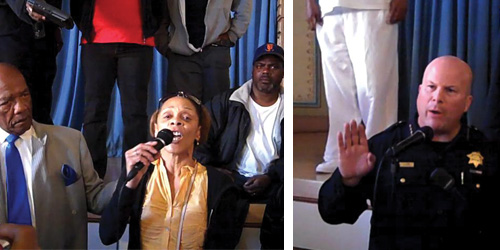
The message from outraged Bayview residents at a chaotic and emotionally charged community forum staged July 20 at the Bayview Opera House was not that people were upset that this had happened to Harding, a Washington state resident, in particular. Instead, people expressed outrage that police had gunned down yet another African American youth, and that unless some complicated and long-standing issues were addressed, it could happen again, to anyone. The forum was organized in partnership with the SFPD and clergy members from the Bayview. Police had prepared a PowerPoint presentation, but never managed to get that far.

At the meeting, Police Chief Greg Suhr tried to provide an explanation for the July 16 shooting. “During this foot pursuit, at some point in time, the suspect … fired at the officers, and the officers returned fire. This is the account that we have so far,” he said. “I cannot tell you how badly that I feel … as captain of this station for two years,” Suhr continued, as an angry crowd shouted him down.

Police escorted Suhr out of the meeting before everyone who had signed up to speak had a chance to be heard. Once outside, the police chief told reporters that he planned to return.

After Suhr and other city officials departed from the meeting, District 10 Supervisor Malia Cohen stayed at the Bayview Opera House and addressed the crowd that remained, she later told the Guardian, and engaged in discussion with Bayview homeowners, merchants, and other community stakeholders.

“We had a very thoughtful conversation,” she said. “People had questions about [Municipal Transportation Agency] policy over the SFPD riding the bus. We talked about the importance of attending Board of Supervisors meetings, Police Commission meetings, and giving public comment. And there will be future conversations, without obstruction.”

Many who attended the meeting voiced concerns that went well beyond the July 16 incident. Several said they believed youth were unduly harassed by law enforcement over Muni fares on a regular basis. Elvira Pollard spoke about how her son was shot 36 times by police and killed seven years ago. Another woman complained that police had used abusive language when she was arrested in the Bayview four years ago.

Mayor Ed Lee told the Guardian that a bigger police presence at the Oakdale/Palou stop on the T-Third line was part of the city’s strategy to prevent violence in that area. “I actually asked the chief to pay more attention to areas that had a history of gun violence and shootings and other kinds of violence … and it just so happens that this particular area, Third and Palou, is a place where there’s a lot of violence,” Lee said. “So we had more uniformed officers on that specifically at not only my request, but with the understanding of the police chief, too.”

Responding to acts of violence by sending in more police sounds simple enough, yet it seems a toxic environment has arisen out of a heightened police presence in a community where tensions between police and residents already run high, fueled by anxiety and bad past experiences. Add to this dynamic a trend of youth who lack other transportation alternatives riding public transit even if they don’t have enough money to pay the fare, and the situation feeds ongoing strife, particularly when fare evaders are asked for identification and searched by police.

Lee, in partnership with Cohen, called a meeting in City Hall July 19 with leaders of the Bayview community. The press was not allowed to attend, but participants said later that officials gave a presentation about the shooting and played an audio of gunfire from the SFPD’s SpotShotter program to offer evidence that Harding had fired first. Later that day, the SFPD reported that gunshot residue had been detected on Harding’s hand, supporting the police account of what happened. Yet the July 21 press release, suggesting that Harding had shot himself because a .380-caliber bullet that police said could not have come from SFPD firearms had entered the right side of Harding’s neck, made it even less clear what really happened.

By July 22, confusion was still swirling over why a gun hadn’t immediately been recovered from the scene of the shooting, and there still wasn’t any clarity on whether an online video of a passerby removing a silvery object from the sidewalk showed a person who retrieved Harding’s firearm after the shooting, as police have claimed. Police recovered a gun that was initially believed to be Harding’s, but later reported that the gun could not have been the same weapon that discharged a .380 caliber round into the victim’s head.

Chris Jackson, a Bayview resident who sits on the board of City College of San Francisco and ran for District 10 supervisor in 2010, said after the City Hall meeting that he felt it had amounted to little more than a lecture from the city’s top officials. Jackson said he perceived a need for a policy shift in terms of how to deal with fare evasion and violence prevention. “We need a better approach,” he said. “We cannot address this with more cops on the T line.”

After Harding’s death, it came to light that the 19-year-old Washington state man had served time for attempting to promote prostitution, and had been named as a person of interest in connection with the fatal shooting of a 19-year-old Seattle woman. Yet a widely circulated online video showing him writhing on the sidewalk in a pool of blood after being shot, while a handful of officers continued to stand around with weapons drawn, sparked outrage. Once the forum at the Bayview Opera House had broken up, LaDonna Callaway condemned the police response, saying, “They didn’t have to shoot him as many times as they did.”

Angelique Mayhem, a Bayview resident who stood nearby, told the Guardian that she didn’t think the meeting had solved anything. “A boy gets gunned down. We don’t know if there was a gun there, but we do know that for 40 damn years, people have been getting gunned down in this community,” Mayhem said. “People are angrier now than when they were when they walked in the door. We’re a community that’s truly in pain, that’s truly frustrated, and really needs some respect.”

Best of the Bay 2011: BEST SIXTH STREET SENSE

1

Does growing up in San Francisco make you an insider in its art scene? Definitely not — but it can be fertile ground for creating a scene of one’s own. Sixth Street resident and Filipino immigrant Reynaldo Cayetano Jr.’s passion for film photography led him to convene Inks of Truth, an art collective of young City College students and SF natives. The group has thrown packed multimedia art openings with live local hip-hop soundtracks all along Sixth Street — Rancho Parnassus, the House Kombucha factory, and Bayanihan Community Center. This year, group members got the keys to DA Arts, the one-time SF district attorney’s office, whose walls they have lined with stunning black and white photography of life on Sixth Street.

DA Arts, 135 Sixth St., SF. www.wix.com/purposebeyondreach/inksoftruth

Best of the Bay 2011: BEST HOMEBOY SCRIBE

0

Awash as it is in traffic-stopping murals and radical neighborhood galleries, the Mission hasn’t produced a lot of novels recently from its native sons and daughters. So when born-and-bred Missionite and City College literature professor Benjamin Bac Sierra‘s debut effort Barrio Bushido turned out to be a magical realistic, drug-and-violence-driven, sophisticated lyrical achievement, the ‘hood rejoiced in its son. Bac Sierra’s readings at Mission Cultural Center for Latino Arts turned out a capacity crowd, and a retinue of candy-painted, hydraulic-powered low-riders lined the curb outside. With Bac Sierra as a role model, maybe the barrio won’t have to wait long for another of its own to follow suit and publish something great.

todobododown.wordpress.com

Guardian forum: Tenants, housing and land use

18

Should be a great forum July 14. We’ve got a panel on tenants, housing and land-use issues, some of the key stuff for the future of the city. Great group of speakers — and, as always, we’ll be looking for ideas and input from the audience. This isn’t a mayoral debate (that comes later); it’s a chance for progressives to talk about the issues that the next mayor needs to address and come up with a platform.

Speakers:

FEATURING:
Sara Shortt, Housing Rights Committee
Ted Gullickson, SF Tenants Union
Nick Pagoulatos, Dolores St Community Services
Sue Hestor, Land Use Attorney

We may have some more suprise guests, too.

Lots of time for discussion afterward.

It’s at 6 pm (until 8 pm) at the City College Mission Campus, 1125 Valencia. More details here. See you there.


Parks Inc.

6

steve@sfbg.com

Should the city be trying to make money off of its parks, recreation centers, and other facilities operated by the Recreation and Park Department? That’s the question at the center of several big controversies in recent years, as well as a fall ballot measure and an effort to elevate revenue generation into an official long-term strategy for the department.

So far, the revenue-generating initiatives by RPD General Manager Phil Ginsburg and former Mayor Gavin Newsom have been done on an ad hoc basis — such as permitting vendors in Dolores Park, charging visitors to Strybing Arboretum, and leasing out recreation centers — but an update of the Recreation and Open Space Element (ROSE) of the General Plan seeks to make it official city policy.

The last of six objectives in the plan, which will be heard by the Planning Commission Aug. 4, is “secure long-term resources and management for open space acquisition, operations, and maintenance,” a goal that includes three policies: develop long-term funding mechanisms (mostly through new fees and taxes); partner with other public agencies and nonprofits to manage resources; and, most controversially, “pursue public-private partnerships to generate new operating revenues for open spaces.”

The plan likens that last policy to the city’s deal with Clear Channel to maintain Muni bus stops with funding from advertising revenue, saying that “similar strategies could apply to parks.” It cites the Portland Parks Foundation as a model for letting Nike and Columbia Sportswear maintain facilities and mark them with their corporate logos, and said businesses such as bike rental shops, cafes, and coffee kiosks can “serve to activate an open space,” a phrase it uses repeatedly.

“The city should seek out new opportunities, including corporate sponsorships where appropriate, and where such sponsorship is in keeping with the mission of the open space itself,” the document says.

Yet that approach is anathema to how many San Franciscans see their parks and open spaces — as vital public assets that should be maintained with general tax revenue rather than being dependent on volunteers and wealthy donors, subject to entry fees, or leased to private organizations.

That basic philosophical divide over how the city’s parks and recreational facilities are managed has animated a series of conflicts in recent years that have soured many people on the RPD. They include the mass firing of rec directors and leasing out of rec centers, the scandal-tinged process of selecting a new Stow Lake Boathouse vendor, new vending contracts for Dolores Park, the eviction of the Haight Ashbury Neighborhood Center recycling facility, plans to develop western Golden Gate Park and other spots, the conversion by the private City Fields Foundation of many soccer fields to artificial turf, and the imposition of entry fees at the arboretum.

Activists involved in those seemingly unrelated battles united into a group called Take Back Our Parks, recognizing that “it’s all the same problem: the monetization of the park system,” says member John Rizzo, a Sierra Club activist and elected City College trustee. “It’s this Republican idea that the parks should pay for themselves.”

And now, with the help of the four most progressive members of the Board of Supervisors, the group is putting the issue before voters and trying to stop what it calls the auctioning off of the city’s most valuable public assets to the highest bidders.

The Parks for the Public initiative — which was written by the group and placed on the ballot by Sups. John Avalos, David Campos, Eric Mar, and Ross Mirkarimi — is intended to “ensure equal public access to parks and recreation facilities and prevent privatization of our public parks and facilities,” as the measure states. It would prevent the department from entering into any new leases or creating new entry fees for parks and other facilities.

Even its promoters call it a small first step that doesn’t get into controversies such as permitting more vending in the parks, including placing a taco truck in Dolores Park and the aborted attempt to allow a Blue Bottle Coffee concession there. But it does address the central strategy Newsom and his former chief of staff, Ginsburg, have been using to address the dwindling RPD budget, which was slashed by 7 percent last year.

“What a lot of us think the Recreation and Parks Department is actually doing is relinquishing the maintenance of park facilities to private entities,” says Denis Mosgofian, who founded the group following his battles with RPD over the closures and leases rec centers. “They’re actually dismantling much of what the public has created.”

He notes that San Francisco voters have approved $371 million in bonds over the last 20 years to improve parks and recreation centers, only to have their operations defunded and control of many of them simply turned over to private organizations that often limit the public’s ability to use them.

By Mosgofian’s calculation, at least 14 of the city’s 47 clubhouses and recreation centers have been leased out and another 11 have been made available for leases, often for $90 per hour, which is more than most community groups can afford. And he says 166 recreation directors and support staffers have been laid off in the last two years, offset by the hiring of at least nine property management positions to handle the leases.

Often, he said, the leases don’t even make fiscal sense, with some facilities being leased for less money than the city is spending to service the debt used to refurbish them. Other lease arrangements raised economic justice concerns, such as when RPD evicted a 38-year-old City College preschool program from the Laurel Hill Clubhouse to lease it to Language in Action, a company that does language immersion programs for preschoolers.

“Without telling anyone, they arranged to have a private, high-end preschool go in,” Rizzo said, noting that its annual tuition of around $12,000 is too expensive for most city residents and that the program even fenced off part of the playground for its private use, all for a monthly lease of less than $1,500. “They don’t talk to the neighbors who are affected or the users of the park … We’re paying for it and then we don’t have access to it.”

They also refused to answer our questions. Neither Ginsburg nor Recreation and Park Commission President Mark Buell responded to Guardian messages. Department spokesperson Connie Chan responded by e-mail and asked us to submit a list of questions, which department officials still hadn’t answered at Guardian press time. But it does appear that the approach has at least the tacit backing of Mayor Ed Lee.

“In order to increase its financial sustainability in the face of ongoing General Fund reductions, the Recreation and Parks Department continues to focus on maximizing its earned revenue. Its efforts include capitalizing on the value of the department’s property and concessions by entering into new leases and developing new park amenities, pursuing philanthropy, and searching for sponsorships and development opportunities,” reads Mayor Lee’s proposed budget for RPD, which includes a chart entitled “Department Generated Revenue” that shows it steadily increasing from about $35 million in 2005-06 to about $45 million in 2011-12.

And that policy approach would get a big boost if it gets written into the city’s General Plan, which could happen later this year.

Land use attorney Sue Hestor has been fighting projects that have disproportionately favored the wealthy for decades, often using the city’s General Plan, a state-mandated document that lays out official city goals and policies. She also is concerned that the ROSE is quietly being developed to “run interference for Rec-Park to do anything they want to.”

“By getting policies into the General Plan that are a rationalization of privatization, it backs up what Rec-Park is doing,” Hestor said, noting how much influence Ginsburg and his allies have clearly exerted over the Planning Department document. “It’s effectively a Rec-Park plan.”

Sue Exeline, the lead planner on ROSE, said the process was launched in November 2007 by an Open Space Task Force created by Newsom, and that the Planning Department, Neighborhood Parks Council, and speakers at community meetings have all influenced its development. Yet she conceded that RPD was “a big part of the process.”

When we asked about the revenue-generating policies, where they came from, and why they were presented in such laudatory fashion without noting the controversy that underlies them, Exeline said simply: “It will continue to be vetted.” And when we continued to push for answers, she tried to say the conversation was off-the-record, referred us to RPD or Planning Director John Rahaim, and hung up the phone.

The rationale for bringing in private sources of revenue: it’s the only way to maintain RPD resources during these tight budget times. A July 5 San Francisco Examiner editorial that praised these “revenue-generating business partnerships” and lambasted the ballot measure and its proponents was titled “Purists want Rec and Park to pull cash off trees.”

But critics say the department could be putting more energy into a tax measure, impact fees, or other general revenue sources rather than simply turning toward privatization options.

“We need to see revenue, but we also need to stop the knee-jerk acceptance of every corporate hand that offers anything,” Mosgofian said. “Our political leadership believes you need to genuflect before wealth.”

And they say that their supporters cover the entire ideological spectrum.

“We’re getting wide support, everywhere from conservative neighborhoods to progressive neighborhoods. It’s not a left-right issue, it’s about fairness and equity,” Rizzo said.

In sponsoring the Parks for the People initiative and unsuccessfully trying to end the arboretum fees (it failed on a 5-6 vote at the Board of Supervisors, with President David Chiu the swing vote), John Avalos is the one major mayoral candidate that is raising concerns about the RPD schemes.

“Our parks are our public commons. They are public assets that should be paid for with tax dollars,” Avalos told us. He called the idea of allowing advertising and corporate sponsorships into the parks, “a real breach from what the public expects from parks and open space.”

When asked whether, if he’s elected mayor, he would continue the policies and let Ginsburg continue to run RPD, Avalos said, “Probably not. I think we need to make a lot of changes in the department. They should be given better support in the General Fund so we don’t have to make these kinds of choices.”

ROSE will be the subject of informational hearings before the Planning Commission on Aug. 4 and Sept. 15, with an adoption hearing scheduled for Oct. 13. Each hearing begins at noon in Room 400, City Hall, 1 Dr. Carlton B. Goodlett Dr., San Francisco.


The Fillmore’s clip, cut, and snip: Reggie Pettus of New Chicago Barbershop No. 3 speaks

0

35 years ago, if you were to step through the doors of New Chicago Barbershop No. 3 you’d probably find Reginald “Reggie” Pettus standing behind his classic barber’s chair. Today, Pettus can still be found in the shop on Fillmore Street, an area that has seen seismic changes in its community. Pettus and the shop are a part of the Fillmore’s African American past, but he wants people to know that the shop is part of the present, too.

Born in Mobile, Alabama, the now seventy-one year old Pettus came to the Fillmore District in 1958, when he enrolled at City College of San Francisco. “Half of my family was in Mobile, Alabama, the other half was in San Francisco, so when I graduated from high school I wanted to come out here to go to school, so that’s what I did,” said Pettus in a Guardian interview one summer afternoon at his shop.

Known for its doo-wop beginnings and its present day rhythmic hot spots, the Fillmore District is the place to be when it comes to absorbing San Francisco’s jazz culture. Home to the historic Fillmore theater, and popular jazz club Yoshi’s San Francisco, the Fillmore District brings in people of all ages and colors to enjoy its good times. But if you’re looking to get a handle on some parts of Fillmore history, you won’t find it in the clubs. 

1551 Fillmore: The place to be for a beard trim, haircut, and some neighborhood history

Pettus has been working in The New Chicago Barbershop No. 3, a business originally opened on Ellis Street by his uncle James “Mack” McMillan in 1968, for thirty five years. Another branch (Chicago Barbershop No. 2), is located on Divisadero Street.

Pettus said that he’s been a professional barber for thirty seven years, but has been cutting hair since he was a young adult, including the time when he served in the Air Force from 1960 to 1964. “I’ve always been [a barber]. When I was in high school I cut hair, when I was in the service I cut hair. So when I got out of the service and came to California, my uncle, he had a barbershop so I went to school and became a barber, a legal barber that is.”

This year marks the forty-forth year of business for the barbershop, a success that Pettus credits to the staff’s welcoming customer service. “We open on time; we treat all the customers the same way, whether they’re Willie Brown or somebody that has come off the street. The way we treat people. That’s why we’re still here.”

Nevertheless, the barbershop has faced tougher times as the years have progressed. Pettus described the current business flow to be “fair”. “It’s holding on, put it that way.” He was adamant about the reasons for the ongoing decrease in clientele for the shop. He said that during the mid ‘70s, redevelopment came in and tore down most of the buildings around the Fillmore (the neighborhood had been slated for redevelopment since 1948 by the San Francisco Redevelopment Agency and by 1956, 60 blocks were included in this designated blighted area). As a result, most of the middle-class African American population had moved out of the Fillmore by the ’70s, resulting in a drop in business for the barbershop. “When they moved down, our business moved down,” said Pettus.

After the redevelopment, Pettus said that the makeup of the neighborhood had shifted. “Way back in the day it used to be mostly Afro Americans, Italians, and Asians. Now, after they tore all the buildings, then brought everything back, you got quite a few Koreans and Caucasians in comparison to Afro Americans.” 

“We’re the only Afro Americans on this block,” Pettus said. He takes pride in the fact that the shop has stuck around, but at the same time Pettus knows that it’s evidence of the lack of representation of African American businesses in the Fillmore District.

When asked what he’d change if he could tackle one aspect of the Fillmore’s future, Pettus responded “I would put more emphasis on having more Afro American people come back into the area, and let them know that we are still here too.”

Through the hardships that the New Chicago Barbershop No. 3 has faced, it has always been able to fall back on what it does best — cut hair. One of Pettus’s fonder memories was when Willie Brown came to the shop during his time as mayor. Over the years the shop has served as barbers to local stars, visiting celebrities – and the everyday residents of the Fillmore.

As many of the shop’s neighbors come and go, the New Chicago Barbershop No. 3 carries on as the Fillmore District’s spot for a cut, clip, or snip. But its owner is humble about its importance in the neighborhood. When asked about what separates the barbershop from other businesses on Fillmore Street, Pettus jokingly answered, “We’ve been here the longest.” 

Now retired, Pettus, who continues to live in the Fillmore,  and still makes frequent stops to the shop on 1551 Fillmore Street. 

Said Pettus, “I still do the same thing; I still deal with mostly the same people, and I enjoy it, I enjoy it.”


New Chicago Barbershop No. 3

1551 Fillmore, SF

(415) 563-9793

www.newchicagobarbershop.net


Alerts

0

alert@sfbg.com

THURSDAY, JULY 7


Two years after the coup

Andrés Thomas Conteris, founder of Democracy Now! En Español, along with Adrienne Aron and Theresa Carmeranesi, will share observations from their recent trips to Honduras, specifically the well-organized resistance movement against the repressive coup that ousted their democratically-elected president in 2009.

7–9 p.m., free

First Unitarian Universalist Church

Thomas Starr King Room

1187 Franklin, SF

www.soaw.org


Saving labor murals

All over the country, many of the murals created during the WPA-era that depict the history and struggles of the U.S. labor movement are threatened of permanent removal, like the hidden labor history mural in the Maine Labor Department Building. At this event, noted New Deal historians Gray Brechin and Harvey Smith will speak about the unremitting war on labor art and history occurring closer to home.

7–9 p.m., free

Berkeley City College Auditorium

2050 Center, Berk.

www.laborfest.net

SATURDAY, JULY 9


Stop the Libya bombing!

NATO intervention in Libya: a massive outpouring of humanity or a blatant display of U.S. imperialism? If you agree with the second viewpoint, stand up against the bombings in Libya, where civilians have been caught in the crossfire. The bombings also cost the U.S. $10 million a day, outrageous at a time when workers in the public and nonprofit sectors are being fired due to a nationwide budget crisis. There will also be a joint action the same day in Washington, D.C. in front of the White House.

12–2 p.m., free

Meet at Powell and Market, SF

(415) 821-6545

www.answersf.org

TUESDAY, JUNE 12


Who built San Francisco?

Learn about San Francisco history and 120 years of its architecture from the perspective of the people — the union workers who built these massive artifacts — not from the architectural firms that usually get all the credit. In two hours, you will see 30 buildings, from famous skyscrapers and little-known treasures, that tell a story about the rich labor and political history of the city, as well as the design trends that helped change the concrete face of America.

10 a.m.–12 p.m., free

Meet at Stockton and Maiden lane, SF

www.laborfest.net 2

Mail items for Alerts to the Guardian Building, 135 Mississippi St., SF, CA 94107; fax to (415) 437-3658; or e-mail alert@sfbg.com. Please include a contact telephone number. Items must be received at least one week prior to the publication date.

Rep Clock

0

Schedules are for Wed/25–Tues/31 except where noted. Director and year are given when available. Double features are marked with a •. All times are p.m. unless otherwise specified.

ARTISTS’ TELEVISION ACCESS 992 Valencia, SF; www.atasite.org. $3-6. “Retelling Stories,” films by Matt Wolf, Mike Kuchar, and Chris Vargas, Thurs, 7. New work by film students at the City College of San Francisco, Fri, 7. “Other Cinema:” “New Experimental Works,” Sat, 8:30. Saicomania (Chávez, 2011), Sun, 7:30.

BALBOA 3620 Balboa, SF; www.balboamovies.com. $20. “Opera, Ballet, and Shakespeare in Cinema:” Aida, Sat-Sun, 10am; June 1, 7:30. Performed by Maggio Musicale Fiorentino.

CASTRO 429 Castro, SF; (415) 621-6120, www.castrotheatre.com. Regular programming $7.50-10. Pirates of the Caribbean: On Stranger Tides (Marshall, 2011), Wed-Thurs, call for times. This film, $10-12. “The Castro Remembers Elizabeth Taylor (1932-2011):” •Cat on a Hot Tin Roof (Brooks, 1958), Fri, 2, 7, and Suddenly, Last Summer (Mankiewicz, 1959), Fri, 4, 9:30; •A Place in the Sun (Stevens, 1951), Sat, 2:30, 8, and Raintree County (Dmytryk, 1957), Sat, 4:50; Giant (Stevens, 1956), Sun, 2, 7; •Father of the Bride (Minnelli, 1950), Mon, 1, 5:05, 9:20, and National Velvet (Brown, 1944), Mon, 2:50, 7; •Secret Ceremony (Losey, 1968), Tues, 7, and X Y & Zee (Hutton, 1971), Tues, 9:05. Fri/27 evening-show double feature ($25) benefits Project Inform.

CHRISTOPHER B. SMITH RAFAEL FILM CENTER 1118 Fourth St, San Rafael; (415) 454-1222, www.cafilm.org. $10.25. The Double Hour (Capotondi, 2010), call for dates and times. The Princess of Montpensier (Tavernier, 2010), call for dates and times. Queen to Play (Bottaro, 2009), call for dates and times. 13 Assassins (Miike, 2010), call for dates and times. Nostalgia for the Light (Guzmán, 2010), Wed, 7. With Isabel Allende in person; this event, $12. As You Like It, Thurs, 7; Sun, 1. Performed at the Globe Theater, London. The First Grader (Chadwick, 2010), May 27-June 2, call for times.

PACIFIC FILM ARCHIVE 2575 Bancroft, Berk; (510) 642-5249, www.bampfa.berkeley.edu. $5.50-9.50. Programming resumes June 10.

RED VIC 1727 Haight, SF; (415) 668-3994; www.redvicmoviehouse.com. $6-10. Rubber (Dupieux, 2011), Wed-Thurs, 7:15, 9:15 (also Wed, 2). The Room (Wiseau, 2003), Fri-Sat, 7:15, 9:15 (also Sat, 2, 4, midnight). The Fall (Singh, 2006), Sun-Mon, 7, 9:25 (also Sun, 2, 4:25). Kill the Irishman (Hensleigh, 2011), May 31-June 1, 7:15, 9:30 (also June 1, 2).

ROXIE 3117 and 3125 16th St, SF; (415) 863-1087, www.roxie.com. $5-9.75. “I Wake Up Dreaming 2011: Legendary and Lost Film Noir:” •The 49th Man (Sears, 1953), Wed, 6:30, 9:40, and World for Ransom (Aldrich, 1954), Wed, 8; •Witness to Murder (Rowland, 1954), Thurs, 6:15, 10, and Kiss Me Deadly (Aldrich, 1955), Thurs, 8. Meek’s Cutoff (Reichardt, 2010), Wed-Thurs, 7:15, 9:30. “San Francisco Sex Worker Film and Arts Festival: Sex Worker Movies at the Roxie,” Sat, 2. For schedule, visit www.sexworkerfest.com. VORTEX ROOM 1082 Howard, SF; www.myspace.com/thevortexroom. $5 donation. •Dorian Gray (Dallamano, 1970), Thurs, 9, and De Sade (Endfield, 1969), Thurs, 11.

Rep Clock

0

Schedules are for Wed/18–Tues/24 except where noted. Director and year are given when available. Double features are marked with a •. All times are p.m. unless otherwise specified.

ARTISTS’ TELEVISION ACCESS 992 Valencia, SF; www.atasite.org. $6-7. “Other Cinema:” “Graham Connah Combo’s Travelogue Tone Poems,” Sat, 8:30.

BALBOA 3620 Balboa, SF; www.balboamovies.com. $20. “Opera, Ballet, and Shakespeare in Cinema:” Don Quixote, Wed, 7:30. Performed by the Bolshoi Ballet.

CASTRO 429 Castro, SF; (415) 621-6120, www.castrotheatre.com. Regular programming $7.50-10. The Women (Cukor, 1939), Wed, 2:30, 5:15, 8. •Raising Arizona (Coen, 1987), Thurs, 7, and The Big Lebowski (Coen, 1998), Thurs, 8:50. Pirates of the Caribbean: On Stranger Tides (Marshall, 2011), May 20-26. This film, $10-12.

CHRISTOPHER B. SMITH RAFAEL FILM CENTER 1118 Fourth St, San Rafael; (415) 454-1222, www.cafilm.org. $6.50-15. Potiche (Ozon, 2010), call for dates and times. The Princess of Montpensier (Tavernier, 2010), call for dates and times. Queen to Play (Bottaro, 2009), call for dates and times. The Double Hour (Capotondi, 2010), call for dates and times. 13 Assassins (Miike, 2010), May 20-26, call for times. My Brother Mike (Sheridan), Thurs, 7:15. This event, $15; benefit for Bukelew Programs. “Shorts in Brief: A Family Film Festival,” Sun, 2. The Power of the Powerless (Taylor, 2009), Sun, 7.

CITY COLLEGE OF SAN FRANCISCO Diego Rivera Theater, 50 Phelan, SF; www.cityshorts.tumblr.com. Free. “City College of San Francisco’s Cinema Department Presents: City Shorts Film Festival,” Thurs, 7.

FOUR STAR 2200 Clement, SF; www.lntsf.com. $10. “Asian Movie Madness:” •Tempation Summary (Ho, 1990), and Dirty Doll, Thurs, call for times.

MECHANICS’ INSTITUTE 57 Post, SF; (415) 393-0100, rsvp@milibrary.org. $10. “CinemaLit Film Series: Elizabeth Taylor, Tribute to a Star:” Who’s Afraid of Virginia Woolf? (Nichols, 1966), Fri, 6.

111 MINNA 111 Minna, SF; www.sfcinema.org. $25-45. “SF Cinematheque: Cinematheque at 50,” screening and benefit party, Thurs, 8.

PACIFIC FILM ARCHIVE 2575 Bancroft, Berk; (510) 642-5249, www.bampfa.berkeley.edu. $5.50-9.50. Programming resumes June 10.

PARAMOUNT 2025 Broadway, Oakl; 1-800-745-3000, www.ticketmaster.com. $5. A Streetcar Named Desire (Kazan, 1951), Fri, 8.

RED VIC 1727 Haight, SF; (415) 668-3994; www.redvicmoviehouse.com. $6-10. Dead Man (Jarmusch, 1996), Wed, 2, 7, 9:25. Big in Bollywood (Meehan and Bowles, 2011), Thurs, 7:15, 9:15. Paul (Mottola, 2011), Fri-Sat, 7:15, 9:30 (also Sat, 2, 4:15). Corner Store (Bruens, 2010), Sun-Tues, 9:15 (also Sun, 2, 4:15; Mon, 7:15). The Annual (Gillane, 2011), Tues, 7:15. Tuesday screenings benefit the Red Vic.

ROXIE 3117 and 3125 16th St, SF; (415) 863-1087, www.roxie.com. $5-9.75. “I Wake Up Dreaming 2011: The Legendary and the Lost!:” •Whispering City (Otsep, 1947), Wed, 6:10, 9:55, and Ruthless (Ulmer, 1948), Wed, 8; •Smooth as Silk (Barton, 1947), Thurs, 6:40, 9:30, and Customs Agent (Friedman, 1950), Thurs, 8; •Café Hostess (Salkow, 1940), Fri, 6:40, 9:40, and Dangerous Blondes (Jason, 1943), Fri, 8; •I Love Trouble (Simon, 1948), Sat, 2, 5:45, 9:30, and Ride the Pink Horse (Montgomery, 1947), Sat, 3:45, 7:30; •The Web (Gordon, 1947), Sun, 2, 5:45, 9:30, and 711 Ocean Drive (Newman, 1950), Sun, 3:45, 7:30; •Dance Hall Racket (Tucker, 1953), Mon, 6:40, 9:20, and The Violent Years (Morgan, 1956), Mon, 8; •Chain Gang (Friedman, 1950), Tues, 6:30, 9:30, and Cell 2455, Death Row (Sears, 1955), Tues, 8. “Sex Worker Movies,” Sat, 2-midnight. This event, $8-10; for programming info, visit www.sexworkerfest.com.

VICTORIA 2961 16th St, SF; www.countercorp.org. Visit website for ticket info. “Tipping Man 6: Anti-Corporate Film Festival,” Thurs-Sat.

VIZ CINEMA New People, 1746 Post, SF; www.newpeopleworld.com. $10-25. Eatrip (Nomura, 2009), Sat, 3, 5, 7.

VORTEX ROOM 1082 Howard, SF; www.myspace.com/thevortexroom. $5 donation. •Blow-Up (Antonioni, 1966), Thurs, 9, and Baba Yaga (Farina, 1973), Thurs, 11. YERBA BUENA CENTER FOR THE ARTS 701 Mission, SF; (415) 978-2787, www.ybca.org. $6-8. “Three-Way: A Trilogy of Vintage Erotica:” Camille 2000 (Metzger, 1969), Thurs and Sat, 7:30; A Labor of Love (Flaxman and Goldman, 1976), Fri, 7:30 and Sun, 2; The Wild Pussycat (Dadiras, 1969), May 26, 7:30.

Music Listings

0

Music listings are compiled by Cheryl Eddy. Since club life is unpredictable, it’s a good idea to call ahead to confirm bookings and hours. Prices are listed when provided to us. Submit items for the listings at listings@sfbg.com. For further information on how to submit items for the listings, see Picks.

WEDNESDAY 27

ROCK/BLUES/HIP-HOP

Chen Santa Maria, This Invitation, Pink Canoes Hemlock Tavern. 9pm, $6.

Dominant Legs, Superhumanoids, Dirty Ghosts Rickshaw Stop. 8pm, $12.

Head and the Heart, Devil Whale, Laura Jansen Bottom of the Hill. 9pm, $14.

Brandon Lee Revolution Café, 3248 22nd St, SF; (415) 642-0474. 8:30pm, free.

Brian McPherson, Jason White, James Leste Hotel Utah. 8pm, $7.

Paul Simon Fillmore. 8pm, $52.50.

Mindy Smith, Sunny War Independent. 8pm, $18.

“Steve Ignorant presents Crass songs 1977-82, Last Supper” Slim’s. 9pm, $21. With Goldblade.

Undertaker and His Pals, Orgres, Angel and Robot Knockout. 10pm, $6.

Whiskerman, Dum Spiro Spero, American Nomad El Rio. 8pm, $5-10.

JAZZ/NEW MUSIC

Cosmo Alleycats Le Colonial, 20 Cosmo, SF; www.lecolonialsf.com. 7pm.

Dink Dink Dink, Gaucho, Michael Abraham Amnesia. 7pm, free.

Ben Marcato and the Mondo Combo Top of the Mark. 7:30pm, $10.

Tom Shaw Trio Martuni’s, 4 Valencia, SF; www.dragatmartunis.com. 7pm, $5.

FOLK/WORLD/COUNTRY

Beauty Operators 50 Mason Social House, 50 Mason, SF; www.50masonsocialhouse.com. 9pm, free.

DANCE CLUBS

Booty Call Q-Bar, 456 Castro, SF; www.bootycallwednesdays.com. 9pm. Juanita Moore hosts this dance party, featuring DJ Robot Hustle.

Cannonball Beauty Bar. 10pm, free. Rock, indie, and nu-disco with DJ White Mike.

Club Shutter Elbo Room. 10pm, $5. Goth with DJs Nako, Omar, and Justin.

Full-Step! Tunnel Top. 10pm, free. Hip-hop, reggae, soul, and funk with DJs Kung Fu Chris and Bizzi Wonda.

Jam Fresh Wednesdays Vessel, 85 Campton, SF; (415) 433-8585. 9:30pm, free. With DJs Slick D, Chris Clouse, Rich Era, Don Lynch, and more spinning top40, mashups, hip hop, and remixes.

Mary-Go-Round Lookout, 3600 16th St, SF; (415) 431-0306. 10pm, $5. A weekly drag show with hosts Cookie Dough, Pollo Del Mar, and Suppositori Spelling.

No Room For Squares Som., 2925 16th St, SF; (415) 558-8521. 6-10pm, free. DJ Afrodite Shake spins jazz for happy hour.

Respect Wednesdays End Up. 10pm, $5. Rotating DJs Daddy Rolo, Young Fyah, Irie Dole, I-Vier, Sake One, Serg, and more spinning reggae, dancehall, roots, lovers rock, and mash ups.

Synchronize Il Pirata, 2007 16th St, SF; (415) 626-2626. 10pm, free. Psychedelic dance music with DJs Helios, Gatto Matto, Psy Lotus, Intergalactoid, and guests.

THURSDAY 28

ROCK/BLUES/HIP-HOP

Accept, Sabaton Regency Ballroom. 8pm, $32-65.

City Tribe, Maheetah, Subtle Trace, Reggie Ginn Kimo’s. 8pm, $6.

Devil Makes Three, Brown Bird Slim’s. 9pm, $18.

Felice Brothers, You Are Plural Great American Music Hall. 9pm, $21.

Fox and Women, Sioux City Kid and the Revolutionary Ramblers Amnesia. 9pm, $7.

Donald Glover + Childish Gambino Fillmore. 9pm, $20.

Lunarchy, Animal Prufrock, DJ Durt El Rio. 8pm, $5-10.

Oxbow, Hellenes, Liar Script Eagle Tavern. 9pm.

Phosphorescent, Little Wings, Family Band, DJ Britt Govea Independent. 8pm, $15.

Red Light Mind 50 Mason Social House, 50 Mason, SF; www.50masonsocialhouse.com. 9pm, free.

Sekta Core, La Plebe, DJ Chaos Bottom of the Hill. 9pm, $15.

Sean Smith, Singleman Affair Hemlock Tavern. 9pm, $5.

Thee Oh Sees, Charlie Tweddle, George Cloud, Miles Rizotti Café Du Nord. 9pm, $12.

JAZZ/NEW MUSIC

Organsm featuring Jim Gunderson and “Tender” Tim Shea Bollyhood Café. 6:30-9pm, free.

Swing With Stan Rite Spot, 2099 Folsom, SF; www.ritespotcafe.net. 9pm, free.

Stompy Jones Top of the Mark. 7:30pm, $10.

FOLK/WORLD/COUNTRY

Pato Banton and the Now Generation Band Rock-it Room. 9:30pm, $20.

Bluegrass and old-time jam Atlas Café. 8-10pm, free.

Creatures Revolution Café, 3248 22nd St, SF; (415) 642-0474. 8:30pm, free.

Mischka Hard Rock Café, Pier 39, SF; www.hardrock.com. 9:30pm.

“Twang! Honky Tonk” Fiddler’s Green, 1330 Columbus, SF; www.twanghonkytonk.com. 5pm.

DANCE CLUBS

Afrolicious Four-Year Anniversary Elbo Room. 9:30pm, $10. DJs Pleasuremaker and Señor Oz spin Afrobeat, tropicália, electro, samba, and funk with guests DJ Smash, Nappy G, and more.

Caribbean Connection Little Baobab, 3388 19th St, SF; (415) 643-3558. 10pm, $3. DJ Stevie B and guests spin reggae, soca, zouk, reggaetón, and more.

Culture Corner Koko Cocktails, 1060 Geary, SF; www.kokococktails.com. 10pm, free. Roots reggae, dub, rocksteady, and classic dancehall with DJ Tomas, Yusuke, Vinnie Esparza, and Basshaka and ILWF.

Drop the Pressure Underground SF. 6-10pm, free. Electro, house, and datafunk highlight this weekly happy hour.

80s Night Cat Club. 9pm, $6 (free before 9:30pm). Two dance floors bumpin’ with the best of 80s mainstream and underground with Dangerous Dan, Skip, Low Life, and guests. This week is “Monsters of Rock Nite.”

Gigantic Beauty Bar. 9pm, free. With DJs Eli Glad, Greg J, and White Mike spinning indie, rock, disco, and soul.

Guilty Pleasures Gestalt, 3159 16th St, SF; (415) 560-0137. 9:30pm, free. DJ TophZilla, Rob Metal, DJ Stef, and Disco-D spin punk, metal, electro-funk, and 80s.

Jivin’ Dirty Disco Butter, 354 11th St., SF; (415) 863-5964. 8pm, free. With DJs spinning disco, funk, and classics.

Lacquer Beauty Bar. 10pm-2am, free. DJs Mario Muse and Miss Margo bring the electro.

Mestiza Bollywood Café, 3376 19th St, SF; (415) 970-0362. 10pm, free. Showcasing progressive Latin and global beats with DJ Juan Data.

1984 Mighty. 9pm, $2. The long-running New Wave and 80s party has a new venue, featuring video DJs Mark Andrus, Don Lynch, and celebrity guests.

Peaches Skylark, 10pm, free. With an all female DJ line up featuring Deeandroid, Lady Fingaz, That Girl, and Umami spinning hip hop.

Thursday Special Tralala Revolution Café, 3248 22nd St, SF; (415) 642-0474. 5pm, free. Downtempo, hip-hop, and freestyle beats by Dr. Musco and Unbroken Circle MCs.

FRIDAY 29

ROCK/BLUES/HIP-HOP

A B and the Sea, Soft White Sixties, She’s Rickshaw Stop. 8:30pm, $10.

Beehavers, FpodBpod Amnesia. 9pm, $7.

Blame Sally, Ellis Great American Music Hall. 8:30pm, $36.

Boxer Rebellion, We Are Augustines, Polaris at Noon Slim’s. 9pm, $16.

Jenny Hoyston, Lovers, Kaia Wilson El Rio. 9pm, $6.

Kowloon Walled City, Fight Amp, Tigon Thee Parkside. 9pm, $7.

“M.O.M.’s Two-Year Anniversary: A Motown Revue” Café Du Nord. 9pm, $15. With Martin Luther, Sarah Jane, Bleached Palms, M.O.M. DJs, and more.

Pikachu-Makoto, Mugu Guymen, Tone Volt Hemlock Tavern. 9:30pm, $10.

Mike Watt, Electric Chair Repair Co., Liquid Indian Bottom of the Hill. 10pm, $12.

JAZZ/NEW MUSIC

Black Market Jazz Orchestra Top of the Mark. 9pm, $10.

“Cartoon Jazz Swing Dance” Wellness Center Performance Space, City College of San Francisco, Ocean Campus, 50 Phelan, SF; (415) 239-3580. 7pm, free.

Patrick Cress, Tbird Tallflame Luv Kaleidoscope, 3109 24th St, SF; www.kaleidoscopefreespeechzone.com. 9pm, $7.

Doug Martin Avatar Ensemble Red Poppy Art House. 8pm, $12-15.

John Scofield Grace Cathedral, 1100 California, SF; www.sfjazz.org. 8pm, $30-50.

Soraya Trio Rite Spot, 2099 Folsom, SF; www.ritespotcafe.net. 9pm, free.

Swing Goth 50 Mason Social House, 50 Mason, SF; www.50masonsocialhouse.com. 9pm, free.

FOLK/WORLD/COUNTRY

Radio Istanbul Revolution Café, 3248 22nd St, SF; (415) 642-0474. 9pm, free.

DANCE CLUBS

Afro Bao Little Baobab, 3388 19th St, SF; (415) 643-3558. 10pm, $5. Afro and world music with rotating DJs including Stepwise, Steve, Claude, Santero, and Elembe.

Afrolicious Four-Year Anniversary Elbo Room. 9:30pm, $10. DJs Pleasuremaker and Señor Oz spin Afrobeat, tropicália, electro, samba, and funk with guests DJ Smash, Nappy G, Jeremy Sole, and more.

DJ Chaos, DJ Dion Riptide Tavern. 9pm, free. Punk rock on vinyl.

DJ Duserock Medjool, 2522 Mission, SF; www.medjoolsf.com. 10:30pm, free.

Exhale, Fridays Project One Gallery, 251 Rhode Island, SF; (415) 465-2129. 5pm, $5. Happy hour with art, fine food, and music with Vin Sol, King Most, DJ Centipede, and Shane King.

Fubar Fridays Butter, 354 11th St., SF; (415) 863-5964. 6pm, $5. With DJs spinning retro mashup remixes.

Good Life Fridays Apartment 24, 440 Broadway, SF; (415) 989-3434. 10pm, $10. With DJ Brian spinning hip hop, mashups, and top 40.

Hot Chocolate Milk. 9pm, $5. With DJs Big Fat Frog, Chardmo, DuseRock, and more spinning old and new school funk.

It’s Not Easy Being Green Mighty. 8:30pm, $15. Dubstep, hio-hop, house, and more with DJ Swamp, Shotgun Radio, Forest Green, and Syd Gris.

Rockabilly Fridays Jay N Bee Club, 2736 20th St, SF; (415) 824-4190. 9pm, free. With DJs Rockin’ Raul, Oakie Oran, Sergio Iglesias, and Tanoa “Samoa Boy” spinning 50s and 60s Doo Wop, Rockabilly, Bop, Jive, and more.

Some Thing Stud. 10pm, $7. VivvyAnne Forevermore, Glamamore, and DJ Down-E give you fierce drag shows and afterhours dancing.

Trannyshack: Ladies of the 80s DNA Lounge. 9:30pm, $20. With Heklina, Rusty Hips, Syphillis Diller, and more.

Vintage Orson, 508 Fourth St, SF; (415) 777-1508. 5:30-11pm, free. DJ TophOne and guest spin jazzy beats for cocktalians.

SATURDAY 30

ROCK/BLUES/HIP-HOP

Blame Sally Great American Music Hall. 8:30pm, $36.

Cavalera Conspiracy Fillmore. 9pm, $25.

Discontinued Models, Lighter Thieves Thee Parkside. 3pm, free.

Jean Marie, Magic Leaves, Kapowski Amnesia. 9pm, $7.

Jessica Lea Mayfield, Nathaniel Rateliff, Echo Twin Bottom of the Hill. 9:30pm, $12.

Meat Sluts, Thee Headliners, Bugs Hemlock Tavern. 9:30pm, $7.

Midnight Bombers, Dirty Power, Texas Thieves, Sassy Thee Parkside. 9:30pm, $7.

Andre Nickatina, Ali AKA Smoove-E, Roach Gigz, Mumbls Slim’s. 9pm, $29.

Solwave, Resurrection Men, Goodness Gracious Me El Rio. 9pm, $5.

Weapons of the Future, MedievalKnieval, Johnny Manal and the Depressives Café Du Nord. 9:30pm, $12.

Viddy V and the Aquababes 50 Mason Social House, 50 Mason, SF; www.50masonsocialhouse.com. 9pm, free.

JAZZ/NEW MUSIC

Philip Glass Yerba Buena Center for the Arts, 701 Mission, SF; www.sfperformances.org. 3pm, $30-50.

Nick McFarling Revolution Café, 3248 22nd St, SF; (415) 642-0474. 8:30pm, free.

Mills Brothers Rrazz Room. 3pm, $40.

FOLK/WORLD/COUNTRY

Fito Reinoso Quartet Red Poppy Art House. 8pm, $10-15.

Robbie Fitzsimmons, Annie Lynch, Katherine Day Hotel Utah. 8pm, $8.

Toshio Hirano Rite Spot, 2099 Folsom, SF; www.ritespotcafe.net. 9pm, free.

“Lavay Smith’s Patsy Cline Tribute” Yerba Buena Center for the Arts, 701 Mission, SF; www.sfjazz.org. 8pm, $20-35.

Chico Mann, Toy Selectah, DJ Shawn Reynaldo Rickshaw Stop. 9pm, $12.

Craig Ventresco and Meredith Axelrod Atlas Café. 4pm, free.

DANCE CLUBS

Afro Bao Little Baobab, 3388 19th St, SF; (415) 643-3558. 10pm, $5. Afro and world music with rotating DJs including Stepwise, Steve, Claude, Santero, and Elembe.

Blondes, Wav Dwgs, Ghosts on Tape Public Works, 161 Erie, SF; www.publicsf.com. 9:30pm, $5-10.

DJ Chris Nguyen Medjool, 2522 Mission, SF; www.medjoolsf.com. 10:30pm, free.

Family Vibes Elbo Room. 10pm, $10. DJs from Non Stop Bhangra, J Boogie’s Dubtronic Science, and DJ Wisdom.

Full House Gravity, 3505 Scott, SF; (415) 776-1928. 9pm, $10. With DJs Roost Uno and Pony P spinning dirty hip hop.

HYP Club Eight, 1151 Folsom, SF; www.eightsf.com. 10pm, free. Gay and lesbian hip-hop party, featuring DJs spinning the newest in the top 40s hip hop and hyphy.

LoveTech Il Pirata, 2007 16th St, SF; www.lovetechsf.com. 9pm, $8. With Evolution Control Committee, Janaka Selekta, Edison, and more.

Pearson Sound, Maddslinky Public Works, 161 Erie, SF; www.publicsf.com. 10pm, $12.

Rock City Butter, 354 11th St., SF; (415) 863-5964. 6pm, $5 after 10pm. With DJs spinning party rock.

Spirit Fingers Sessions 330 Ritch. 9pm, free. With DJ Morse Code and live guest performances.

SUNDAY 1

ROCK/BLUES/HIP-HOP

Builders and the Butchers, Damion Suomi and the Minor Prophets, T.V. Mike and the Scarecrowes Bottom of the Hill. 9pm, $10.

Lloyd Gregory Biscuits and Blues. 8 and 10pm, $15.

Hollywood Undead, 10 Years, Drive A, New Medicine Fillmore. 7pm, $25.

Jugtown Pirates, Sioux City Kid, Mark Matos Café Du Nord. 8:30pm, $10.

Necrite, Aseethe, Sutekh Hexen Hemlock Tavern. 9pm, $6.

JAZZ/NEW MUSIC

Kally Price Old Blues and Jazz Band, Emperor Norton’s Jazz Band Amnesia. 9pm, $5.

Mills Brothers Rrazz Room. 3 and 7pm, $40.

Gabriela Montero Florence Gould Theatre, Legion of Honor, 100 Legion of Honor Dr., SF; www.sfjazz.org. 2pm, $25-40.

Tom Lander Duo Medjool, 2522 Mission, SF; www.medjoolsf.com. 6-9pm, free.

FOLK/WORLD/COUNTRY

Coburns, Judea Eden Band Thee Parkside. 4pm, free.

DANCE CLUBS

Batcave Cat Club. 10pm, $5. Death rock, goth, and post-punk with Steeplerot Necromos and c_death.

Dub Mission Elbo Room. 9pm, $6. Dub, roots, and classic dancehall with DJ Sep, Vinnie Esparza, and guest Maneesh the Twister.

Gloss Sundays Trigger, 2344 Market, SF; (415) 551-CLUB. 7pm. With DJ Hawthorne spinning house, funk, soul, retro, and disco.

Honey Soundsystem Paradise Lounge. 8pm-2am. “Dance floor for dancers – sound system for lovers.” Got that?

La Pachanga Blue Macaw, 2565 Mission, SF; www.thebluemacawsf.com. 6pm, $10. Salsa dance party with live Afro-Cuban salsa bands.

MONDAY 2

ROCK/BLUES/HIP-HOP

Here We Go Magic, AroarA Rickshaw Stop. 8pm, $12-14.

DANCE CLUBS

Death Guild DNA Lounge. 9:30pm, $3-5. Gothic, industrial, and synthpop with Joe Radio, Decay, and Melting Girl.

Krazy Mondays Beauty Bar. 10pm, free. With DJs Ant-1, $ir-Tipp, Ruby Red I, Lo, and Gelo spinning hip hop.

M.O.M. Madrone Art Bar. 6pm, free. With DJ Gordo Cabeza and guests playing all Motown every Monday.

Network Mondays Azul Lounge, One Tillman Pl, SF; www.inhousetalent.com. 9pm, $5. Hip-hop, R&B, and spoken word open mic, plus featured performers.

Sausage Party Rosamunde Sausage Grill, 2832 Mission, SF; (415) 970-9015. 6:30-9:30pm, free. DJ Dandy Dixon spins vintage rock, R&B, global beats, funk, and disco at this happy hour sausage-shack gig.

Skylarking Skylark. 10pm, free. With resident DJs I & I Vibration, Beatnok, and Mr. Lucky and weekly guest DJs.

TUESDAY 3

ROCK/BLUES/HIP-HOP

Battles Bottom of the Hill. 9pm, $15.

Chris Brokaw, Mark McGuire, Allen Karpinski, Matthew Mullane, Joshua Blatchely Hemlock Tavern. 8pm, $7.

Cannons and Clouds, Silian Rail, Lambs Café Du Nord. 9pm, $10.

Chris Cornell, William Elliott Whitmore Fillmore. 8pm, $39.50.

Johnny Clegg Band Great American Music Hall. 8pm, $25.

Pipettes, Agent Ribbons, Bitter Honeys Rickshaw Stop. 8pm, $12.

Joe Purdy, Milk Carton Kids Independent. 8pm, $15.

Psychedelic Furs Slim’s. 8pm, $31.

Xavier Rudd, Honey Honey Regency Ballroom. 8pm, $25.

FOLK/WORLD/COUNTRY

Mucho Axe, Palavra Elbo Room. 9pm, $7.

DANCE CLUBS

Eclectic Company Skylark, 9pm, free. DJs Tones and Jaybee spin old school hip hop, bass, dub, glitch, and electro.

Share the Love Trigger, 2344 Market, SF; (415) 551-CLUB. 5pm, free. With DJ Pam Hubbuck spinning house.


5 Things: April 22, 2011

1


>>BLACK WHEELS Three reasons why African-Americans should ride bicycles, brought to you courtesy of community two-wheeler group Red Bike and Green. One, health: the exercise can counter obesity and chronic disease. Two, economics: why drop all your cash into a car pit when you can put it to brightening your present and future? Three, environment: environmental racism — including pollution in low-income communities — has gone on too long, and you can do you part to change it. Now that we have that out of the way, check out Red Bike and Green’s first “black Critical Mass” of the year in Oakland on Sat/23. Bikes: too many good reasons to ride them.

>>LOCAL BOY DONE GOOD Reynaldo Cayentano Jr. grew up on Sixth Street, and he’s not going anywhere. The City College student and photographer recently opened up gallery space with cohort Chris Beale in the old District Attorney’s office, but the two will be throwing their Sat/23 “Native Taste” party at the House Kombucha factory, where they’ll showcase the work of 13 local artists and the hip-hop stylings of Patience. Speaking of local boys, have you heard the new SF anthem by Equipto and Mike Marshall?

Equipto ft. Mike Marshall, “Heart and Soul”:

http://www.youtube.com/watch?v=F3Fh0dXpuco&feature=player_embedded

>>GOOD & PLENTY CHEAP There’s nothing we like better than good, cheap stuff. Not the cheap, cheap stuff of a Walmart or Kmart, or the good, pricey stuff of a Neiman Marcus or Bloomingdale’s. Good. Cheap. Stuff. And in pursuit of said stuff, we know that many of our fellow city dwellers have checked out a City Car Share car for the express purpose of driving to Serramonte Shopping Center in Daly City and hitting the Daiso store. Put away that gas tank: now we have our own Daiso store, newly opened in Japantown. Since most of the items cost $1.50, a $20 bill will get you a Santa Claus-size bagful of beautiful origami paper, clever lunch boxes, kitchenware, or whatever strikes your fancy from Daiso’s — no jive — selection of 70,000 good, cheap goods.

>>THEY WALK AMONG US It isn’t often that we indulge in a little unabashed fandom when a celebrity comes to our city/ashram. After all, we have our standards (smart, funny, left-leaning, maybe a pot bust or two), which rules out your Biebers, your Gagas, your Cruises ‘n’ Holmeses. We also believe that a man with a three-day stubble muttering to himself as he walks down the street has a right to his private musings. But when that man is Alec Baldwin, well, we have to stop, give him a deep Zen bow, tell him he’s welcome here, and report back. We have no idea why Baldwin is here – a Giants game? No, they’re on the road. SFIFF? No, we would have heard. Filming an episode of 30 Rock, Alcatraz Edition? Possibly –- and truthfully, we don’t care. We will take this no further. No tweets, no nothing. Because we want him to come back -– with Tina Fey.

>>THE GOOD BOOKS
A few minutes spent reading a good, cheap book can add some insight and perspective to anyone’s day, and this weekend presents a reason to look for said books. The San Francisco Public Library’s 50th Anniversary Book Sale is going on at the Fort Mason Center Festival Pavilion until Sun/24, with everything on sale for three dollars or less. Books, DVDs, CDs, tapes, and other media are available, and on the sale’s final day, nothing will cost more than a dollar.

Rep Clock

0

Schedules are for Wed/20–Tues/26 except where noted. Director and year are given when available. Double and quadruple features are marked with a •. All times are p.m. unless otherwise specified.

ARTISTS’ TELEVISION ACCESS 992 Valencia, SF; www.atasite.org. $5-6. “George Chen’s Show,” talk show, comedy, music, and more, Wed, 8. “OpenScreening,” Thurs, 8. For participation info, contact ataopenscreening@atasite.org. “Other Cinema:” “Bill Daniel’s Tumbleweed Crossroads,” Sat, 8:30.

CASTRO 429 Castro, SF; (415) 621-6120, www.castrotheatre.com. $7.50-10. Elmer Gantry (Brooks, 1960), Wed, 7:30. With TCM host Ben Mankiewicz and star Shirley Jones in person; visit www.tcm.com/roadtohollywood for free tickets. “San Francisco International Film Festival:” Beginners (Mills, 2010), Thurs, 7. For tickets and info visit www.sffs.org. “John Waters’ Birthday Weekend:” •Pink Flamingos (1972), Fri, 7:30, and Female Trouble (1974), Fri, 9:35; •Polyester (1981), Sat, 2, 5:30, 9, and Desperate Living (1977), Sat, 3:45, 7:15; •Serial Mom (1994), Sun, 1:25, 5:05, 8:45, and Hairspray (1988), Sun, 3:20, 7.

CHRISTOPHER B. SMITH RAFAEL FILM CENTER 1118 Fourth St, San Rafael; (415) 454-1222, www.cafilm.org. $6.50-15. Certified Copy (Kiarostami, 2010), call for dates and times. Poetry (Yun, 2010), call for dates and times. Potiche (Ozon, 2010), call for dates and times. Paul Jacobs and the Nuclear Gang (Landau, 1980), Mon, 7:15. With filmmaker Saul Landau and journalist Norman Solomon in person.

CITY COLLEGE OF SAN FRANCISCO Ocean Campus, 50 Phelan, SF; (415) 239-3580. Free. A Fierce Green Fire (Kitchell, 2011), Wed, 7.

MECHANICS’ INSTITUTE 57 Post, SF; (415) 393-0100, rsvp@milibrary.org. $10. “CinemaLit Film Series: French Twist:” Man on the Train (Leconte, 2002), Fri, 6.

PACIFIC FILM ARCHIVE 2575 Bancroft, Berk; (510) 642-5249, www.bampfa.berkeley.edu. $5.50-9.50. “Film 50: History of Cinema: Fantasy Films and Realms of Enchantment:” Wings of Desire (Wenders, 1988), Wed, 3:10. “Alternative Visions:” The Saddest Music in the World (Maddin, 2003), Wed, 7:30. “San Francisco International Film Festival,” April 22-May 5. For schedule, see film listings; for tickets and additional info, visit www.sffs.org.

RED VIC 1727 Haight, SF; (415) 668-3994; www.redvicmoviehouse.com. $6-10. The Big Lebowski (Coen, 1998), Wed-Thurs, 7, 9:30 (also Thurs, 2, 4:20). Reservoir Dogs (Tarantino, 1992), Fri-Sat, 7:15, 9:25 (also Sat, 2, 4:15). Baraka (Fricke, 1992), Sun-Mon, 7:15, 9:20 (also Sun, 2, 4:15). Valley Girl (Coolidge, 1983), April 26-27, 7:15, 9:25 (also April 27, 2).

ROXIE 3117 and 3125 16th St, SF; (415) 863-1087, www.roxie.com. $5-9.75. Carancho (Trapero, 2010), Wed-Thurs, 9. Even the Rain (Bollaín, 2010), Wed-Thurs, 7. Some Days Are Better Than Others (McCormick, 2010), Wed-Thurs, 7 and 9. Red, White and Blue (Rumley, 2010), April 22-28, 7:15, 9:15 (also Sat-Sun, 2:55, 5).

WOMEN’S BUILDING 3543 18th St, SF; www.coathangerproject.com. Free. The Coat Hanger Project (Young), Wed, 7. With director Angie Young in person for a post-screening discussion about reproductive rights in America. YERBA BUENA CENTER FOR THE ARTS 701 Mission, SF; (415) 978-2787, www.ybca.org. $6-8. “Fearless: Chinese Independent Documentaries:” Disorder (Huang, 2009), Thurs, 7:30. 

New school

1

CAREERS AND ED You don’t need a degree, or even the patience to sift through US Census Bureau reports on educational attainment, to know that each year this nation graduates more students from institutions of higher ed — public and private universities, colleges, junior colleges, and professional schools — than it did the year before. San Francisco is second only to Seattle in the number of papered persons running around, and statistics say that they, in turn, are more likely to raise little educational overachievers of their own. With this glut of matriculation on the horizon, it’s hard not to ponder the degree programs of the future: an associate’s in astrotourism? A bachelor’s of biosynthetic anatomy? A PhD of P4TA? (That’s “preparing for the apocalypse” for the cyber-stupid.) Hard to say. But before we get carried away, here’s a sampling of programs fit for a brave new world that can be found in the here and now.


SOLAR PHOTOVOLTAIC DESIGN AND INSTALLATION

California South Bay University sits smack-dab in the center of Silicon Valley, so it’s no surprise that the offerings are high-tech. The larger California zeitgeist seems to be rolling in on the San Francisco fog, though, and interesting patterns — like a master’s of science in green energy technology — have emerged. But the university really takes advantage of the Santa Clara Valley sunshine (and billowing demand for sustainable energy) with its Interstate Renewable Energy Council-accredited certificate program in solar photovoltaics, the science of connecting the two. If a full-fledged degree isn’t in your forecast, the school offers two 40-hour courses that might be a perfect fit.

California South Bay University, 1107 North Fair Oaks, Sunnyvale. (408) 400-9008, www.csbu.us


INTERACTION DESIGN

Degrees in video-game design and Web programming are old hat, but California College of the Arts takes the idea of the user interface beyond the screen, and plugs it back into real life. The school’s focus on design that users can interact with includes classes on platforms from cell phone to sculpture, game console to gallery, preparing students to “create meaningful and innovative designed experiences in the realms of work, lifestyle, and play.” Vague? Yes. Useful? Possibly. That three-dimensional holographic surround-sound computer interface that Tom Cruise uses in Minority Report? Get your virtual-reality gloves out ’cause it’s on its way …

California College of the Arts, 1111 Eighth St., SF. 1-800-477-1278, www.cca.edu


LANDSCAPE HORTICULTURE

Horticulture goes high-tech at Merritt College. The school claims to have all the most up-to-date equipment in the field, and with 5,000 square feet of computerized greenhouses, a 5,000-square-foot lath house, a floral and drafting lab, and disciplines such as “turf management,” we doubt anyone would argue. And to think, we were still relying on dirt, sun, and water to do our growing.

Merritt College, 12500 Campus Drive, Oakl. (510) 531-4911, www.merritt.edu


BOOK ART AND CREATIVE WRITING

This master’s program allows students to develop as writers and visual artists simultaneously, and encourages a “deep exploration of the book form in both content and materiality.” The interplay of form and content is not a new academic trope, but given that physical codices may soon be obsolete, taking a moment to ponder the book as object might not be a bad idea — lest future generations wonder why we wrote all over our toilet paper. Literary artifacts? Worth checking out!

Mills College, 5000 MacArthur Blvd., Oakl. (510) 430-2255, www.mills.edu


GREEN AND SUSTAINABLE TRAVEL

Tourists looking for a tequila sunrise and a tan may not realize that the pool they’re baking beside used to be a jungle. Each year, sensitive wildlife areas the world over are steamrolled under hotel strips. At the same time, environmentally-conscious tourism has become a booming industry. Given the facts, a student could do worse than this City College Business School program. The quickie certificate takes just a year — not a bad thing, considering ecotourism’s popularity and the rapidly decreasing availability of stuff left to tour.

City College of San Francisco, Ocean Campus, 50 Phelan, SF. (415) 239-300, www.ccsf.edu


HIV/STI PREVENTION

With a focus on risk reduction counseling, data collection, and outreach strategies, this one-year certificate in HIV/STI prevention studies from City College’s health education department just seems like a really good plan to bring a brighter future to all.

City College of San Francisco, Ocean Campus, 50 Phelan, SF. (415) 239-3000, www.ccsf.edu


FOLKLORE

Preparing for the future is all about remembering the past … or so might say a folklorist with a master’s or doctorate from UC Berkeley. An interdisciplinary degree from the department of anthropology, folkloristics (that’s the term) provide a new spin on the studies of ethnicity, nationality, gender, and sexuality, as well as the chance to revive vernacular tales, customs, beliefs, and plain ol’ stories from days gone by.

UC Berkeley, 318 Sproul Hall No. 5900, Berk. (510) 642-7405, www.berkeley.edu


RAZA STUDIES

That “melting pot” we all learned about in grade school is on the boil — bubbling with a range of issues both sweet and spicy, and some we haven’t even tasted yet. As our country continues to diversify, equity, social justice, and community empowerment will only become more important. San Francisco State University’s B.A. in raza studies seeks to offer future leaders the knowledge, skills, and social consciousness necessary to navigate an increasingly complex social landscape.

San Francisco State University, 1600 Holloway Ave., SF. (415) 338-1111, www.sfsu.edu


TAXATION

If everything else on this list is just a bit too futuristic and far out, Golden Gate University offers one of the country’s oldest and best-respected graduate programs in taxation. Looking for the ultimate in job security? This is your best bet since the San Francisco College of Mortuary Sciences closed in 2002. Death … and taxes. Golden Gate University School of Taxation, 536 Mission, SF. (415) 442-7880, www.ggu.edu

Rep Clock

0

Schedules are for Wed/6–Tues/12 except where noted. Director and year are given when available. Double features are marked with a •. All times are p.m. unless otherwise specified.

ARTISTS’ TELEVISION ACCESS 992 Valencia, SF; www.atasite.org. $6. Amreeka (Dabis, 2009), Thurs, 7:30. Woven (Vargas), Fri, 8. With live music by Ever Isles and Honeycomb. “Other Cinema:” “All-16mm, All Retro Music-on-Film Party,” Sat, 8:30.

BERKELEY FELLOWSHIP OF UNITARIAN UNIVERSALISTS 1924 Cedar, Berk; www.bfuu.org. $5-15. “A Quarter Century of Chernobyl:” Chernobyl4Ever, Sun, 4. With panel discussion featuring anti-nuclear activists.

CASTRO 429 Castro, SF; (415) 621-6120, www.castrotheatre.com. $7.50-10. The Fighter (Russell, 2010), Wed, 3, 5:30, 8. “Orson Welles Double Feature:” •The Lady From Shanghai (1947), Thurs, 3, 7, and Touch of Evil (1958/1998), Thurs, 4:45, 8:45. “Jane Russell Double Feature:” •The Outlaw (Hughes, 1943), Fri, 1, 5, 9, and Gentlemen Prefer Blondes (Hawks, 1953), Fri, 3:15, 7:15. “Justin Vivian Bond in Concert,” Sat, 8. This performance, $27-75; call (415) 863-0611 or visit www.ticketfly.com. Seven Samurai (Kurosawa, 1954), Sun, 2:30, 7.

CHRISTOPHER B. SMITH RAFAEL FILM CENTER 1118 Fourth St, San Rafael; (415) 454-1222, www.cafilm.org. $6.50-15. Certified Copy (Kiarostami, 2010), call for dates and times. Trophy Wife (Ozon, 2010), call for dates and times. Winter in Wartime (Koolhoven, 2009), call for dates and times. Fat, Sick & Nearly Dead (Cross, 2010), Wed, 7. Filmmaker Joe Cross in person. Poetry (Yun, 2010), April 8-14, call for times.

CITY COLLEGE OF SAN FRANCISCO Cloud Hall, Room 246, 50 Phelan, SF; (415) 23903580. Free. The Wild Parrots of Telegraph Hill (Irving, 2003), Wed, 7. With filmmaker Judy Irving in person.

HUMANIST HALL 390 27th St, Oakl; www.humanisthall.org. $5. Crude: The Real Price of Oil (Berlinger, 2009) Wed, 7.

MECHANICS’ INSTITUTE 57 Post, SF; (415) 393-0100, rsvp@milibrary.org. $10. “CinemaLit Film Series: French Twist:” Irma Vep (Assayas, 1996), Fri, 6.

PACIFIC FILM ARCHIVE 2575 Bancroft, Berk; (510) 642-5249, www.bampfa.berkeley.edu. $5.50-9.50. “Film 50: History of Cinema: Fantasy Films and Realms of Enchantment:” Dreamchild (Millar, 1985), Wed, 3:10. “Alternative Visions:” “The Chicago Survey Trilogy” (Cornerford, 2002-2010), Wed, 7:30. “Patricio Guzmán:” The Southern Cross (1992), Thurs, 7; The Battle of Chile (1975-1978), Sun, 1 (part one), 3 (part two), 5:30 (part three). “Under the Skin: The Films of Claire Denis:” The Intruder (2004), Fri, 6:30 and Sat, 8:30; •U.S. Go Home (Denis and Kahn, 1994) with Claire Denis: The Wanderer (Lifshitz, 1996), Fri, 9. “First Person Rural: The New Nonfiction:” Alamar (González-Rubio, 2009), Sat, 6:30.

RED VIC 1727 Haight, SF; (415) 668-3994; www.redvicmoviehouse.com. $6-10. The Housemaid (Im, 2010), Wed, 2, 7:15, 9:20. “An Evening with Les Blank,” Thurs, 7:30. Enter the Void (Noé, 2009), Fri-Sun, 8:30 (also Sat-Sun, 2, 5:15). Blue Valentine (Cianfrance, 2010), Mon-Tues, 7, 9:20.

ROXIE 3117 and 3125 16th St, SF; (415) 863-1087, www.roxie.com. $5-9.75. Orgasm, Inc. (Canner, 2009), Wed-Thurs, 6:45, 8:30, 10. “San Francisco International Women’s Film Festival,” Wed-Sun. Visit www.sfwfi.com for program info. “It’s the Paul Meinberg! Show:” All-American Co-Ed (Prinz, 1941), Tues, 7 and 9:45; Big Town Girl (Werker, 1937), Tues, 8.

SEBASTANI THEATER 476 First St East, Sonoma; www.sonomafilmfest.org. $15. “14th Annual Sonoma International Film Festival,” documentaries, world cinema, and more, including a Susan Sarandon tribute, Wed-Sun. YERBA BUENA CENTER FOR THE ARTS 701 Mission, SF; (415) 978-2787, www.ybca.org. $6-8. “Fearless: Chinese Independent Documentaries:” Tape (Li, 2010), Thurs, 7; Ghost Town (Zhao, 2008), Sun, 2.

5 Things: March 22, 2011

0

>>SUPERMOON SUPERSOUND Miss the GIANT SUPERMOON this weekend? Hell, we all did – it  was storming cats and dogs (interestingly enough, Polish soulful techno DJ duo Catz ‘n Dogz were here this weekend as well, and they were magnificent, as always.) In any case, in memoriam and fantasy, here’s a special electronic “Supermoon Mix” by DJ Deevice, voted Best Radio DJ in our 2010 Best of the Bay Readers Poll:

DJ Deevice “Super Moon” mix by DJ Deevice

>>IN OTHER NATURE NEWS Octopi are storming the Embaracadero – and ready your barbed wire trucks, because they’re here to stop you from skateboarding. We don’t know how long these lovingly crafted, yet grind-deterring metal starfish, sea tortises, and eight-legged have been adorning the lips of concrete benches over by Waterbar and the Raygun Gothic Spaceship, but the fun police has arrived, and it is packing tentacles.

This week on octopus fun police… 

>>CAUTION: ANOTHER THING TO WASTE YOUR TIME ON THE INTERNET In a city that knows how to toe the line between fun and just plain foolish, it’s good to know that we have resources available to help keep safety, if not at the forefront, then at least in the marginalized auxilIary regions of everyone’s mind. So whether you’re planning on unleashing live bison at your next warehouse rager, upgrading your upcoming Critical Mass ride to include a contingent of flame-throwing robotic rhinoceroses, or setting up a road-side stand for DIY weld-on chastity belts, just remember: there’s a sign for that.

>>WHITE LINES FOR YOU AND FOR ME Two wags of our handlebars for the new Potrero Hill 17th street bike lanes! The Bike Coalition explains this was all part of their nefarious plan for 30 miles of (relatively) worry-free bike glory.

>>SADDLE UP YOUR BAY MARE … and ride out for an upcoming exploration of our outer neighborhood’s high-steppin’ pony days — the adorably monikered Woody LaBounty of the Western Neighborhood’s Association, purveyor of amazing snippets from San Franciscos past like the book about the Sunset’s boho gypsy street car roots, will be sharing the story of the neighborhood that’s the midway point between City College and SF State. His yarn takes place Tuesday, March 28 and will involve horsies, a turf rivalry with Bayview, and what it all said about the country’s developement at the time… go here for info. 

Beats the K-Ingleside any day


Redevelopment debate full of bum choices

3

At the Potrero Hill Democratic Club’s debate about Gov. Jerry Brown’s proposal to ax local redevelopment agencies to balance the state’s $26 billion deficit, folks attempted to evaluate if redevelopment agencies are essential for job creation and community revitalization, if reform, not total destruction, is possible, and if bum choices are all we have to look forward to.

The Chronicle’s Marisa Lagos, who moderated the debate, noted that redevelopment agencies were created over 60 years ago to create economic development opportunities by borrowing against future tax increases that agencies think they can create.

 “That’s a fancy way to say ‘borrow against future taxes,’” Lagos joked, pointing to the Candlestick Point/Hunters Point Shipyard project as an example of an ongoing project, and the Yerba Buena project as an example of a completed success.

 “The Governor is arguing that when the state is cutting schools and other essential services, this is not the best use of tax dollars,” Lagos stated.

 Panelist Olson Lee, deputy executive director of San Francisco’s Redevelopment Agency, pointed to affordable housing as evidence of the agency’s positive impact.

 “I think Redevelopment is important because of the good things it has done,” Lee said, pointing to 11,000 units of affordable housing that the agency helped build in the city.

 Panelist Carroll Wills, the communications director for the California Professional Firefighters, said “many wonderful projects” have occurred under Redevelopment. But he pointed to what he called “a decade of tricks and games,” on the part of Redevelopment agencies as one reason why the state is in a fiscal crisis that threatens firefighters’ jobs.

 “Concrete does not trump core services,” Wills said, arguing that it’s not clear that many affordable housing projects would not have been built without redevelopment aid

Arc Ecology’s Saul Bloom accused Gov. Brown of “short-circuiting” what could have been an important statewide discussion about redevelopment reform, with his bombshell suggestion in January to eliminate redevelopment agencies entirely

 “I’m sympathetic to the argument that Redevelopment takes money away from core services,” Bloom said. “But what do we do to replace it? And is economic development versus core services a false choice?”

Lee pointed to Mission Bay as further evidence of Redevelopment’s success.

“It was considered a brown field, and through development, it’s much different,” Lee said, noting that 20 percent of tax increment financing goes to the General Fund to pay for redevelopment infrastructure. “Clearly the university would not have been there. It was an opportunity to place UC there and generate economic opportunities.”

 Wills argued that Redevelopment Agencies are a luxury we can no longer afford, even as he acknowledged being unfamiliar with local redevelopment projects.

“At best, redevelopment moves around the pieces,” Wills said. “It doesn’t increase economic development and it doesn’t necessarily pay for itself.”

Bloom noted that developments like Mission Bay are dependent on large institutions, like the University of California, which can’t be forced to implement city laws like local hire.

And he said he found it “disappointing” that there wasn’t much more of a dialogue around the plans to redevelop Candlestick Point and the Shipyard, despite the fact that the city held hundreds of meetings over the past decade.

“It was more a case of, Here’s our idea, tell us what you think of it,’” Bloom said. “Perhaps if we had invited the nation’s largest industrial developer, instead of the nation’s second largest home developer, we would have had a different dialogue.”

 Lee replied that the Shipyard has been under discussion for 15 years.

“It’s a very large project, the largest in the Western United States,” Lee said. “It’s a brownfield, though I know Espanola will say it’s a Superfund site,” he continued, as Bayview elder Espanola Jackson bristled under her hat, and the audience wondered if Lee meant that the US E.P.A. somehow got it all wrong.

Lee further shocked audience members by saying Treasure Island was not a redevelopment project (leading Bloom to clarify that Treasure Island is under the jurisdiction of the local Treasure Island Development Authority, if not the SF Agency).

“People felt they wanted economic development at the shipyard,” Lee continued, noting that the neighborhood suffered after the Navy withdrew from the shipyard in the 1970s. But he did not mention that major bones of contention around the redevelopment proposal, centered on plans to build 10,000 mostly market-rate condos, a bridge over an environmentally sensitive slough, the taking of a chunk of the community’s only major park, and no proof that thousands of promised jobs will materialize.

Wills noted that most local redevelopment commissions are peopled by the members of each municipality’s city council, a situation he believes leads to a lack of accountability. But members of the audience, including this reporter, noted that San Francisco’s Redevelopment Agency consists entirely of mayoral appointees, who, unlike elected officials, can’t easily be voted off the proverbial island.

It was at this point that panelist Calvin Welch, a longtime housing activist, showed up at the debate, apologizing for being late, but blaming his tardiness on being on a phone call with Sen. Mark Leno to discuss Brown’s redevelopment proposal.

And from there, the conversation veered towards discussions of what could happen to existing redevelopment projects if Brown goes through with his elimination threat.

 Lee noted that if projects simply had a disposition and development Aagreement (DDA), but Redevelopment was no longer there, there would be no project financing. “The devil’s in the details,” Lee said. “Because if you don’t have bonds, what’s the point of having an agreement.”

 Wills opined that Gov. Brown’s proposal has “a vehicle to roll back the bum’s rush” of projects that local municipalities have been trying to push across the finish line, ever since Brown dropped his Redevelopment elimination bomb in January.

 Welch went off on a historical riff about how the San Francisco Redevelopment Agency (SFRA) was met with controversy and outrage until 1988, when Art Agnos was elected mayor, and brokered a deal under which SFRA could do tax increment financing, provided the majority of funds were used for affordable housing.

“It became a finance agency to build infrastructure and affordable housing,” Welch said, noting that attempts to build out Mission Bay around commercial offices and high rises failed, until the Agency used tif to redevelop the site.

 “But mark my words, Lennar is going to come out of this just fine,” Welch added, reminding me of a recent comment that former Lennar executive Emile Haddad reportedly made that suggests Haddad believes the California housing market is poised for a rebound.

(The article outlined how Haddad sold 12,000 acres in California for a $277 million profit at the housing market’s peak four years ago, reacquired it at half the price in 2009, and is now saying it’s time to build in his new role as CEO of FivePoint Communities Inc., which is developing four new master-planned communities with a combined 45,000 residences at Newhall Ranch north of L.A., the El Toro Marine Corps Air Station in Orange County, the Candlestick Point/Hunters Point shipyard and Treasure Island  in San Francisco, with investors including Lennar, Michael S. Dell’s MSD Capital LP, Ross Perot Jr.’s Hillwood Development Co. and Rockpoint Group LLC. “I don’t want the party to show up and I’m not dressed,” Haddad, 52, reportedly said in a recent interview. “When the market says ‘I’m here,’ we’ll be one of the few that can deliver inventory.” 

(The Haddad article, which appears to be a non-bylined reprint from Bloomberg News, also claimed that Hunters Point sales are set to begin by late 2012 with prices starting at $525,000, as the Navy continues its cleanup of the 700-acre site. And that the plan now calls for as many as 12,000 homes, 3 million square feet (of commercial space and a new stadium for the 49ers. And that 7,000 homes may eventually be built on Treasure Island and adjoining Yerba Buena Island, under terms of a final development agreement that may go before the San Francisco Board of Supervisors for approval in May, with units averaging  $800,000 and reaching up to $2 million, according to Lennar V.P Kofi Bonner.)

And during the Potrero Hill Dems debate, Bloom noted that the Treasure Island plan is being “sped up” and that the Board is expected to vote on the plan as soon as possible. “But since these plans were not bonded before January [when Gov. Brown took office], what’s the point of speeding up the process?” Bloom asked.

“We’re basically seeing a brick wall,” Welch interjected. “There are virtually no funds for permanent affordable housing in San Francisco.But Jerry Brown is not going to commit financial hari kari. Every major developer of market rate housing will come out just fine, because of state actions, not because of a local vote. Deals are going to be made. It’s the question of affordable housing that’s our challenge. You’re gonna be stuck with public housing, as it is, unless there’s affordable housing financing.”

 Wills claimed that Prop. 22, which voters approved last November, “created a mechanism so rigid,” that the state’s only option was to eliminate redevelopment. “Basic services are dying on the vine,” he said. “We can’t afford to give developers subsidies.”

 Lee noted that SFRA built thousands of affordable units over the years that saved the city thousands in terms of core services it would otherwise have to provide. “Affordable housing is so basic, you can’t do things we take for granted if you are living under a freeway,” he said.

 Bloom suggested Redevelopment could do a better job of economic development, including the creation of permanent and sustainable jobs, like his proposal to create maritime uses at the Shipyard—something not entertained under the city’s Shipyard plan.

 Welch connected the dots between the taxpayer revolt that led to Prop. 13’s passage and the current fiscal woes of municipalities unable to raise taxes on commercial development. “That’s a killer,” he said, noting that housing costs more to build and maintain than it generates property taxes, especially if it’s family housing. ‘It’s those damn kids,” he joked.

Welch noted that Gov. Brown used redevelopment money to enable market rate development in downtown Oakland when he was mayor of Oakland—and claimed that Brown equated affordable housing with crime, at the time.

“We love Brown better than Meg Whitman, but it’s 2011 and we face bum choices.”

Community advocate Sharen Hewitt, who heads the C.L.A.E.R. project, asked if the panel thought San Francisco could be a “demonstration model” for using Redevelopment funds to build 50 percent affordable housing.

Welch said conversations have “already happened” between Mayor Ed Lee and Gov. Jerry Brown that have led him to believe that, “all of San Francisco’s redevelopment projects will be made whole, affordable housing will be protected and Brown will be committed to a San Francisco model.”

“It’s like the film Casablanca, when people are shocked to find out that gambling is going on in a casino,” Welch said. “People are shocked to find out that capital talks in a capitalist system.”

 Espanola Jackson asked Welch what will happen to the shipyard development, in face of a lawsuit that POWER brought that’s due to be heard March 24.

“The shipyard plan has a political function,” Welch said, noting that it was the result of a citywide vote in 2008. ‘We opposed it, but we lost. The structure of that deal flows from the vote.”

 City College Board member Chris Jackson expressed frustration that the Redevelopment conversation had devolved into a housing conversation.

“Mission Bay is all about biotech, but who works at UCSF?” Jackson said, noting that Redevelopment, as a state-funded agency, does not have to agree to the city’s newly approved local hire law.

Welch acknowledged that there has never been a study to determine the tipping point required to lift the Bayview out of poverty.

Lee admitted that Redevelopment’s focus has been housing, “because San Francisco is such an unaffordable city.” But he claimed that SFRA had a “much more aggressive program on local hire than the city, for many years.” Noting that SFRA has tried to attract restaurants and food establishments to Third Street, over the years, Lee said, “It hasn’t been something we’ve been particularly successful at.”

Welch opined that the “skills and abilities of the San Francisco community are far greater at stopping projects and protecting neighborhood character, but we can’t figure out how community-based organizations can employ their own people.”

 And then it was time to go back out into the cold March wind and try to wrap our minds about the true meaning of “bum choices” in 2011.

Crazy like a Mission homeboy

1

caitlin@sfbg.com

LIT Benjamin Bac Sierra, San Francisco City College English composition and literature professor and author of Barrio Bushido, an ode to Mission District vato locos, picks me up in his cherry red-and-black 1972 Chevy Monte Carlo low rider. As an academic who started selling weed in the Army Street projects when he was 10, Bac Sierra is well aware that he has an attention-getting car. As it turns out, it nicely represents his world view.

“I’m not supposed to be driving a Monte Carlo. I’m not supposed to be talking to you like this,” he tells me, his conversation inflected with casual swear words and a rhythm like that of an evangelist preacher, or maybe just a man who feels what comes out of his mouth. “A lot of people go into education and think they have to choose: am I going to be square or am I going to be how I used to be? But you can be intellectual and homeboy-homegirl at the same time.”

Barrio Bushido, Bac Sierra’s first novel, follows the story of three young men who ricochet from romance to brutal gang beatings, PCP leños, larceny, and neglect. Lobo, Santo, and Toro’s world has made them wild gangsters. Author Maxine Hong Kingston has compared Bac Sierra’s prose to that other chronicler of the underground man in uncertain times, Dostoyevsky. Although it hardly glorifies the protagonists, an honor and a beautiful-crazy logic to their deeds does emerge. Bac Sierra holds that the impulsiveness, that locura, needn’t be forgotten when someone leaves the street hustling lifestyle.

“I want to make a line between being a homeboy and the negativity. Craziness is a power — you can’t learn that in a book,” he reflects. We drive by his brother’s old house on Treat and 21st streets — Bac Sierra hears that a PayPal executive lives there now. After Bac Sierra’s father died, his brother, charismatic and clever, brought him up — until his brother wound up in jail and died young.

When Bac Sierra was 17, years after he had dropped out high school and begun dealing angel dust, he had a choice. He could continue his lifestyle, possibly ending up dead or in jail, or “retreat” into the Marines, which represented an honorable discharge, as it were, from the barrio.

Bac Sierra’s experience in the Marines followed the same lines as Toro’s, his headstrong and loyal Barrio Bushido character — to a point. Both of them cleaned up and were promoted to squad leader because of their sheer “craziness.” And both saw serious front line action during the Gulf War. Bac Sierra manned a machine gun as part of the first wave of Marines to land in Kuwait City in 1991. He also began writing in the military, letters home that he would revise “maybe 10 times — I wanted to be heard.” Although he doesn’t specifically recommend military service to young people, he recognizes the value of the discipline learned in the armed forces. “A lot of homeboys don’t do shit,” he says flatly.

After serving, he retained his strong ties to the Mission and his family there. Before his brother died, he was the one who motivated Bac Sierra to get his college degree, not to stop at his master’s in creative writing from UC Berkeley, but to continue on to law school. “Hood logic,” Bac Sierra calls it, the idea that a degree in a concrete field was far better than one writing. Although he hated every day of law school, he can now appreciate the experience and the knowledge it brought him.

He pulls the Monte Carlo over to speak with an older man on the corner across the street from his brother’s old house. “Yo escribí un libro, señor, en honor de mi hermano,” he calls out the window, inviting the man to his upcoming book release party at Mission Cultural Center. Many of his friends from the old neighborhood (he now lives in Richmond, where he is raising two of his four children, Margarita, nine, and Benny, six) are Barrio Bushido‘s biggest supporters. I ask him if it makes him sad, how much the neighborhood has changed since when he grew up. “This is the world. Economics knows no friends.”

I recognize the last line from Barrio Bushido. Its characters speak with an urgent poetry, moving through scenes influenced by Dostoyevsky and Miguel Ángel Asturias, with Gabriel Garcia Márquez-like magical realism. Bac Sierra wants the book to be taught in schools and has set a goal of having it adopted into 50 class sections by next semester.

Other things he hopes for: first, that readers be taken on a journey. “It doesn’t have to be stuffy. I want them to be amazed with the language.” Second, he wants the book to show that life is full of choices. “Start living here in this world,” as he puts it.

His last hope is for a “homeboy resurgence” in the Mission, the neighborhood that was once the center of Latino culture in Northern California. Thursday’s party at the Mission Cultural Center is a start. Bac Sierra is planning a low-rider show, Aztec dancers, a reading, and live music for the event — the positive parts of homeboy culture, like Bac Sierra himself. “I’m fucking straight homeboy,” he says. “I am very efficient. I am always inventing things.” 

BARRIO BUSHIDO BOOK PARTY

Thurs/17 7 p.m., free

Mission Cultural Center for Latino Arts

2868 Mission, SF

(415) 643-5001

www.missionculturalcenter.org

Green Bay Packers’ Desmond Bishop drops in on Lee

3

So, there I was sitting in the Mayor’s Office with fellow Guardian reporter Rebecca Bowe waiting to see Mayor Ed Lee when in walks Green Bay Packers linebacker and D10 native Desmond Lamont Bishop, who helped win the Super Bowl XLV, this month.

Turns out Bishop was there to see Lee, shortly before D10 Sup. Malia Cohen honored Bishop during the Board’s Black History month commendations’ ceremony.

We didn’t get a chance to interview Bishop (he was whisked into Lee’s office super quick), but Bowe and I surfed the web while waiting for our appointment with Lee and soon learned that Bishop was born in San Francisco on July 24, 1984, is 6 feet 2 inches tall, weighs 238 pounds, and was at Cal in 2005/06, before being drafted by the Packers in 2007, where he wears jersey number 55.
 
Cohen later confirmed that Bishop was born in Hunters Point and went to Visitacion Valley Junior High, before going to high school in Fairfield, and then returned to San Francisco to attend City College before heading to the University of California.

“Desmond is also deeply involved in his community,” Cohen said in a press release, which notes that Bishop started the Desmond Bishop Football Camp and participates in programs to help kids to be healthy and learn to read, including the Boys and Girls Club.“The Bishop family moved to San Francisco over 50 years ago, and Desmond’s grandfather still lives in Bayview Hunters Point.”

Too bad we didn’t have a chance to get Bishop’s autograph, but hopefully next time…

DREAMer Steve Li asks Obama for a moratorium

0

Steve Li is a nursing student at San Francisco’s City College who narrowly avoided deportation to Peru last November, after a massive outpouring of community support and Sen. Dianne Feinstein’s decision to introduce a private bill to delay his removal from the United States. Now,  Li has issued a short video in anticipation of the President’s State of the Union address, in which he asks Obama  if he can commit to a moratorium on deportations of DREAM Act-eligible youth.

Watch Li’s video:

then watch the President’s address to see what happens.

Local bounty

0

caitlin@sfbg.com

CAREERS AND ED “People are very confused about what’s safe to eat as far as mollusks go.” Champion monkeyface eel angler Kirk Lombard offhandedly throws the remark out at his “find your own marine sustenance” primer offered by DIY food cabal ForageSF. For a moment I panic. My mercury levels! But then I remember: I’m on his San Francisco fishing tour because I have never, not once, even thought to harvest the bay’s bounty on my own.

Isn’t life in the city just like that? You never get out to Alcatraz, you never hit up Muir Woods — they sit there trying to catch your eye and you shuffle past, going about your routine. It’s easy to duck the pressure of actually making the most of what the Bay Area has to offer.

But it’s 2011 (only one year left till the end of the world!) and you need to get out there. Back to Kirk Lombard, who is gesturing to the rocky edge of the Marina Green, where on a good day you can find limpets and turban snails adhering to, and rockfish darting amid, the boulders. “You have to pound the shit out of them to make them tender enough to eat,” he counsels. This referring to chitons, shellfish resembling centipedes that are plentiful in the Bay Area and can be popped off rocks to be enjoyed.

Lombard’s class is an example of the utility of local expertise. At the tail end of many years with the Department of Fish and Game surveying the catch of Bay Area fishermen, he is also the creator of a blog (monkeyfacenews.typepad.com) that makes me wish I fished, which I must say has never happened before.

Other things that can be caught and eaten around these parts include the tiny, perfect-as-salad-topping limpet, the hideously ugly but reportedly nutritious cabazon fish, monkeyface eels (thrilling to hear Lombard discuss his record-holding pursuit of them) and California and blue mussels. Of these last two you are only allowed to harvest 10 pounds per day, an astonishing rule that seems well beyond my capabilities past, present, or future.

Lombard’s walks take participants out on the windy, disconcertingly cold spit of land near the wave organ on the Marina Green. Our group of 12 meanders after him as he enthusiastically answers questions about feeding oneself on the seaweed and fishies of the bay. Lombard himself hasn’t bought fish in years and tends to focus on smaller, quicker to mature species that are difficult to overfish. “I’ve found myself really embracing the smelt family,” he reflects.

Having graduated from his one-time course, do I now stuff my rod in my Chrome bag every day before I leave the house? Are we munching monkeyface all the live-long day? Well no. But the beauty of Lombard’s tours, and the following SF classes, isn’t that they will revamp your life in one fell curricular swoop. It’s that they just might open your eyes to a little more atmosphere, from mussels to mushrooms, architecture to enlightenment.

WILD SEAFOOD: SAN FRANCISCO FISHING TOUR

Next walk: Sun/16 2–4 p.m., $30

Register at www.foragesf.com


MUSHROOM FORAYS

All hail the Mycological Society of San Francisco! Now more than 60 years old, the mushroom lovers club focuses on expanding the community’s knowledge of our fungal friends — from the tastes and nutrition they provide to their scientific and aesthetic qualities. You can drop in on one of its potluck gatherings or beyond-informative Fungus Fairs, but why not start from the beginning? The society regularly conducts forays into nature to teach wannabe mycologists how and what to look for when they’re tracking toadstools in the moist corners of the Bay Area — which, due to its temperate climate, happens to be a superlative spot to find them.

Next foray: Sat/15 10 a.m.–3 p.m., $25. Register at www.mssf.org for start location


“SEASONAL EATING, HEALTHY LIVING, DIGESTIVE BLISS”

What is even more soothing than taking a class amid the community-building rows of plants at Hayes Valley Farm? Try taking a class on how to use those very fruits and veggies (or seasonal varietals like them) toward more robust bodily health. It’s part of a four-class series, but you can attend individual sessions — this upcoming one focuses on lower intestinal health, where 70 percent of your immune system lives.

Sat/19 10–11:30 a.m., $25–$50. Hayes Valley Farm, 450 Laguna, SF. www.hayesvalleyfarm.com


INTRODUCTION TO BUDDHISM AND ZEN

Of course, all this seeking and searching — it’s the new year and all, but don’tcha know that desire is the root of all ignorant, pig-headed maleficence? You’d know that if you were Zen, see. But grasp no further. The SF Zen Center has been in the practice of expanding minds — often for cheap or free — for years. Take one of their friendly entry-level courses in meditation and all that new ksanti (patience) is sure to lead to some prajna (wisdom). Guest student courses offer amazing rates for meditation, lodging, and meals.

Jan. 29– March 19, 9–10 a.m., $96-$120. San Francisco Zen Center, 300 Page, SF. (415) 863-3136, www.sfzc.org


SAN FRANCISCO INTERIORS

You gotta suppose that after drawing your city in intimate detail, you’d see a little more of it. A gable, a funky load-bearing pole. Maybe we just don’t hang and stare at walls enough. Or maybe not, but anyway this no-credit City College class taught by artist Jacqueline Ruben explores some of SF’s more artistically fertile nooks and crannies, teaching you drawing style to boot.

Feb. 26–March 19 9 a.m.–noon, $100–$110. Fort Mason, SF. (415) 561-1860.

www.ccsf.edu 


Mirkarimi and mayoral hopefuls launch D5 Dem Club

4

Democratic Party clubs are one of the most basic political building blocks in this basically one-party town, so it’s odd that politically active District 5 (the Haight and Western Addition) didn’t have one. But that changed last night with the launch of the District 5 Democratic Club, with fuel provided by current D5 Sup. Ross Mirkarimi and mayoral contenders Leland Yee and Dennis Herrera and with several potential Mirkarimi successors on-board.

“We saw it was a huge opportunity this year to get people engaged and involved,” newly elected D5DC president Jen Longley, a progressive activist who calls herself a “campaign gypsy,” told a gathering of about three dozen people at Cafe Divis. And she thanked Mirkarimi, who switched from the Green to Democratic parties about a year ago, for supporting the club’s creation. “This party would not have happened if not for the help of Ross Mirkarimi.”

And it wouldn’t have met its $1,000 fundraising goal if Yee and Herrera didn’t kick in big as they court D5 voters as part of their mayoral campaigns. Mirkarimi gave the keynote speech, calling D5 the “hippest district in the city” and one of its most progressive, something he wants to see the club help project onto the rest of the city. “I’m delighted to be a part of it,” he said, urging attendees to contribute financially.

In addition to being active in next year’s mayor’s race, the club will also play a role in determining who will succeed Mirkarimi in 2012, and there were some likely contenders for that slot on hand, including City College of San Francisco Trustee John Rizzo, progressive activist Julian Davis, and club owner Michael O’Connor, with labor activist Gabriel Haaland also supporting the club’s creation.

Longley noted that D5 has lots of very active neighborhood association, but few political organizations, and she said that she feel honored to be leading one at such a pivotal political moment.

Rep Clock

0

Schedules are for Wed/15–Tues/21 except where noted. Director and year are given when available. Double and triple features are marked with a •. All times are p.m. unless otherwise specified.

ARTISTS’ TELEVISION ACCESS 992 Valencia, SF; www.atasite.org. $3-6. “Videocracy,” works from the film department at City College, Thurs, 7. La Vendedora de Rosas (Gaviria, 1998), Fri, 8. “Other Cinema: New Experimental Works,” Sat, 8:30. “Altered Statehood,” shorts program, Sun, 8.

CASTRO 429 Castro, SF; (415) 621-6120, www.castrotheatre.com. $7.50-12. “Noir City Xmas:” •Remember the Night (Leisen, 1940), Wed, 7:15, and Mr. Soft Touch (Douglas and Levin, 1949), Wed, 9:15. “San Francisco Gay Men’s Chorus 21st Annual Home for the Holidays Concert,” Thurs, 8 (this event, $20; tickets at www.sfgmc.org). Tron: Legacy (Kosinski, 2010), Dec 17-23, 1, 4, 7, 9:45 (also Fri/17, 12:01am).

CHRISTOPHER B. SMITH RAFAEL FILM CENTER 1118 Fourth St, San Rafael; (415) 454-1222, www.cafilm.org. $6.50-10.25. The Girl Who Kicked the Hornet’s Nest (Alfredson, 2009), call for dates and times. Inside Job (Ferguson, 2010), call for dates and times. Today’s Special (Kaplan, 2009), call for dates and times. “San Francisco Grand Opera Cinema Series:” La Bohème, Thurs, 7 and Sat, 10am. “Buddhist Film Festival Showcase 2010,” Wed-Thurs. These shows, $12. Remembering Playland (Wyrsch, 2010), Sun, 4:15. Director Tom Wyrsch in person. Ghost Bird (Crocker, 2010), Sun, 6:30.

HUMANIST HALL 390 27th St, Oakl; www.humanisthall.org. $5. The Mind is a Liar and a Whore (Alli, 2003), Wed, 7:30.

OAKS 1875 Solano, Berk; (510) 526-1836. $7. Power Trip: Theatrically Berkeley (Tomeoni), Sat, noon.

PACIFIC FILM ARCHIVE 2575 Bancroft, Berk; (510) 642-5249, www.bampfa.berkeley.edu. $5.50-9.50. Closed until Jan. 13.

PIEDMONT 4186 Piedmont, Oakl; www.landmarktheatres.coom. $8. The Room (Wiseau, 2003), Sat, midnight.

RED VIC 1727 Haight, SF; (415) 668-3994. $6-10. The Triplets of Belleville (Chomet, 2003), Dec 14-15, 7:15, 9:15 (also Dec 15, 2). Vincent: A Life in Color (Burns, 2010), Thurs, 7:15, 9:30. Howl (Epstein and Friedman, 2010), Fri-Sat, 7:15, 9:30 (also Sat, 2, 4). The Room (Wiseau, 2003), Sat, midnight. Seven Samurai (Kurosawa, 1954), Sun-Mon, 7:30 (also Sun, 2). The Nightmare Before Christmas (Selick, 1993), Dec 21-22, 7:15, 9:15 (also Wed, 2).

ROXIE 3117 and 3125 16th St, SF; (415) 863-1087, www.roxie.com. $5-9.75. No Tomorrow (Weisberg and Roth, 2010), Wed, 7, 9:15. Ghost Bird (Crocker, 2010), Thurs, 7, 9. Modus Operandi (Latina, 2010), Fri-Sat, 11.

SAN FRANCISCO MUSEUM OF MODERN ART 151 Third St, SF; www.sfcinema.org. $10. “Nathaniel Dorsky: Winter Light,” Thurs, 7. YERBA BUENA CENTER FOR THE ARTS 701 Mission, SF; (415) 978-2787, www.ybca.org. $6-8. “International Buddhist Film Festival Showcase 2010:” Lucia Rijker: Boxer, Buddhist (Schouten, 2005), Thurs, 7:30; Seeing Searching Being (Burns, 1992-99), Sun, 2. “Go to Hell for the Holidays:” •Night Train to Terror (Schlossberg-Cohen, 1985), Fri, 7, and A Night to Dismember (Wishman, 1983), Fri, 9; Life and Death of a Porno Gang (Djordjevic, 2009), Sat, 7:30.

Pass the DREAM Act, now

11

by Eric Mar and Eric Quezada

news@sfbg.com

OPINION Imagine for a moment that you are 14 years old. Your parents, stuck in perpetual poverty and unemployment (or perhaps worse), move your family to a foreign country to begin a new life.

You work hard, struggle to fit in, study constantly, and fill your spare time with school activities. Maybe you even work a little on the side to chip in. You are a parent’s dream, and a model of young citizenship.

Except that you’re not a citizen. And one day, even as you’ve mastered English and flourished in school and in the community, you are stopped like a criminal by federal authorities.

This is what happened to Steve Li, an engaging and industrious 20-year-old student at City College of San Francisco and a graduate from George Washington High School. He always thought he was an average San Franciscan until the morning of Sept. 15, when Immigration and Customs Enforcement agents suddenly raided his home and arrested him and his parents. Steve was incarcerated in Arizona for more than 60 days, far from his friends and family. Through a full-court legal and legislative press, and a groundswell of immigrant community organizing leading to a private emergency bill by Sen. Dianne Feinstein, Li has temporarily staved off deportation. But Li and thousands of other hard-working young immigrant Americans could soon be summarily tossed out of the country if Congress doesn’t act now to pass the Development, Relief, and Education for Alien Minors (DREAM) Act.

The DREAM Act is a common-sense, bipartisan measure that is urgently needed to avoid countless other Steve Li cases. Despite congressional wavering on comprehensive immigration reform (which a consistent majority of Americans support), everyone should be able to agree on the basic right of undocumented immigrant minors, who are moved here by their parents, to gain steps toward obtaining citizenship.

In brief, the DREAM Act would enable some immigrant students who have grown up in the U.S. to apply for temporary legal status and to eventually obtain permanent status and become eligible for U.S. citizenship if they go to college or serve in the U.S. military.

According to the National Immigration Law Center (NILC), about 65,000 U.S.-raised high school students could qualify for the DREAM Act’s benefits each year. As NICL puts it, “These include honor roll students, star athletes, talented artists, homecoming queens, and aspiring teachers, doctors, and U.S. soldiers. They are young people who have lived in the U.S. for most of their lives and desire only to call this country their home … they face unique barriers to higher education, are unable to work legally in the U.S., and often live in constant fear of detection by immigration authorities.”

It makes no moral, economic, or social good sense to continue tearing apart families and communities and disrupting young people’s lives — all at great expense to the American public and taxpayers.

The time to act is now: please call your congressional representatives today and urge them to vote yes on the DREAM Act — without any amendments that might undermine its effectiveness. Although Nancy Pelosi and most Bay Area Democrats support the bill, Rep. Jerry McNerney (D-Stockton) and the Republicans are either on the fence or opposed. There’s no time to waste in giving hard-working young immigrant students this most American ideal — the opportunity to make their dreams a reality.

Eric Mar is a member of the San Francisco Board of Supervisors. Eric Quezada is executive director of Dolores Street Community Services in San Francisco.