cell phones

New Zealand’s Cup

7

news@sfbg.com

A few weeks ago I was walking down the dock in the marina where I live, in Wellington, New Zealand, when I passed a woman and a young boy. I’d never seen them before, which is uncommon here in this municipal marina — about 100 boats — in a small suburb of the country’s capital.

The boy was walking from berth to berth pointing out certain rig and hull features and expounding on them as only a future aficionado can. “Lots of different boats, huh?” I asked as I passed.

“Different than America,” he confirmed in an accent the same as mine.

The kid is sharp, I thought, or maybe it’s just obvious, even to an eight-year-old from Chicago. The New Zealand sailing scene is vastly different than its American counterpart, which is not to say there’s no comparing — they’re not exactly navigating carved logs with gunnysack sails down here.

But the boats in my marina are, in fact, mostly homebuilt from steel, cement, aluminum, and wood. They appear a motley crew compared to the cookie-cutter production fiberglass Beneteaus, Catalinas, and Hunters, with their identical pacific blue sail covers lined up in San Francisco’s South Beach Marina.

In New Zealand, a boat is rarely a status symbol — it’s part of the middle-class way of life, the home base for holidays and weekend fishing trips and lots and lots of competitive racing. If I’ve noticed one thing since I arrived in this country (aboard a sailboat, after leaving San Francisco and my job as a Bay Guardian staff writer), it’s that every little harbor town has a yacht club and an awful lot of Kiwis own boats — and they sail the shit out of them.

Which is part of the reason why the New Zealand government is willing to invest NZ$36 million (US$27 million) to compete in the 34th America’s Cup against some of the richest men in the world in a race that has become so elite there’s barely any competition.

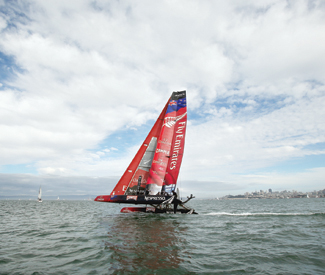
Small as the field is, Emirates Team New Zealand (ETNZ) is quickly shaping up to be the team to beat if you’re on a high-speed, air-catching AC72 catamaran. If they succeed, it will show that developing an America’s Cup team doesn’t have to come from having deep pockets in your Nantucket Red pants — it comes from having the sport ingrained in your culture, filtered through affordable local boat clubs, city-run facilities, volunteer programs, publicly accessible shorefronts, and an innovative marine industry.

In fact, without New Zealand’s maritime way of life, Larry Ellison wouldn’t have much of a team: of the 27 sailors and management crew aboard Oracle, a third are Kiwis. Another third are Australians. If you count Ellison, there are only three Americans aboard. Just one of them — tactician and grinder John Kostecki — grew up sailing on San Francisco Bay.

Ellison’s boat is mostly a Kiwi production, too — the fixed-wing sails and structural components for Oracle’s two AC72s were made in New Zealand, as were the boats, sails, and rigs for ETNZ and Luna Rossa. The only other syndicate competing, Sweden’s Artemis, in the wind since the death of crewmember Andrew Simpson, is the outlier, but they still have eight New Zealanders on board.

America’s Cup is looking more and more like it owes a lot to New Zealand. Is the Cup doing as much for San Francisco as it is for this little island nation, with a population just a tenth of California’s?

“If it wasn’t called Team New Zealand, we wouldn’t get a lot out of it,” says Sven Pannell, a competitive dinghy racer and employee of the economic development agency Grow Wellington. “The numbers of boat builders, carbon fabricators, sail makers, yacht designers coming out of New Zealand are the reason we’re still at the top of the global game. If we can bring the Cup home that means a lot for our country.”

It may also save America’s Cup from becoming even more out of touch with reality.


IT’S THE CULTURE, STUPID

It’s June 8, summer in San Francisco but winter in Wellington. The first race of the 2013 Winter Series at Evans Bay Boat Club hits hypothermic seas beneath steely overcast skies and 20-30 knots of wind — “perfect conditions,” one sailor enthuses. Tame, actually, for Wellington. A week ago, wind blew out the fifth story windows of a building downtown.

Sven Pannell has just finished racing a 12-foot skiff, a super lightweight, often homebuilt boat that probably originated in Australia and is almost exclusively raced in the Southern Hemisphere, though an 18-foot version will be showcased in San Francisco this September alongside the America’s Cup finals. Weighing about 100 pounds, with no class restrictions on sail area, they rooster-tail around Wellington harbor, bow high, barely in the water. They seem to require a similar caliber of nerve as the AC72s.

Which Pannell, who won today, evidently has. He grew up sailing as a kid, as did his crew, Craig Anderson. Neither of them can think of anyone who didn’t get into sailing as a child.

“A lot of people around the world think yachting is a well-heeled sport, but not in New Zealand,” he says. “There’s a reason that half those [America’s Cup] boats are full of Kiwis and Aussies. Go out and see the number of eight-year-olds in Optis in all kinds of weather here. A high number of people sailing at that age creates a deep pool of sailors in demand.”

“America’s Cup is about stretching the limits, but it starts here, when you’re eight years old,” he adds.

Eager to get out of the icy Antarctic wind, I enter the boat club where about 35 people are gathered at the bar, buzzing from adrenalin, barefoot and wet from spray or capsizes, gripping ginger beers and green bottles of Steinlager, the Budweiser of New Zealand. It’s a humble looking crowd — no flash gear or cashmere.

I’m introduced to Mike Rhodes, 26, wearing a blue sweatshirt and camo pants. He’d love to race an America’s Cup boat, but he also satisfies himself with a 12-foot skiff, which he stripped and rebuilt, fashioning the stainless steel fittings himself — he’s a sheet metal worker.

“New Zealand sailing is all about learning and moving forward,” he says. “The boats we’re sailing are always changing. We have set rules for weight, width, and length. After that it’s wide open. You can put up as much rig as you can handle. We went out in 50 knots last weekend. It was insane. We probably had boat speeds of 30 knots.”

The speed and innovations are what appeal to Rhodes and also connect to the America’s Cup, which has been an historic proving ground for leaps forward in boat design. “Who thought New Zealand could make the boat fly first?” he says of ETNZ’s proficiency at foiling the AC72 — going so fast the hull actually lifts off the water.

We’re soon joined by Laura Hutton, a 30-year-old from Cape Cod. She’s raced dinghies, coached and taught sailing for years. Now a speech therapist, she moved to New Zealand three months ago and immediately hooked into the local yachting scene. It’s palpably different than what she’s used to in the States. Here, she says, “It’s a lot more laid back. It’s more inclusive than exclusive. I used to go to events at New York Yacht Club in Newport and I felt so uncomfortable there. It’s the most elite, snobby place.”

“You can’t get coaching in the US unless you’re part of a yacht club or go to a school with a racing team,” she adds, and there’s often a huge cost to enter the sport. “Here, I can join the local yacht club for $35 a month,” she deadpans.

I spend more money riding the bus, I tell her, but I wouldn’t in San Francisco, where it’s cheap to catch a bus but where most people rarely board boats.

The American yacht club tradition has a certain “if you have to ask how much it costs, you can’t afford it” attitude. Ellison is one of 300 members of Golden Gate Yacht Club, official host for the Cup. Its neighbor, St. Francis Yacht Club, 2,300 strong, also has a role in the festivities. Both are exclusive, members-only clubs and neither would tell me what their members pay for the club’s privileges.

However, they’re officially nonprofit organizations and filings with the IRS show St. Francis made nearly $13 million in 2011. Golden Gate Yacht Club took home $660,000 the same year. Ironically, both clubs are on public lands, leased from San Francisco’s Recreation and Parks Department for $231,125 and $64,000 annually respectively.

Both clubs run learn-to-sail programs for kids — $350 for St. Francis and $200 for GGYC — which seem affordable, but what’s the next step? Joining the club, but apparently it’s too rude to query the price.

By contrast, Wellington’s Evans Bay Boat Club charges NZ$281 (US$210) to join and Royal Port Nicholson Yacht Club, which is a sister club to St. Francis, costs NZ$160 (US $120). The Bay Area is lucky — Berkeley and Treasure Island both have affordable clubs, however one could argue that if St. Francis and GGYC are on public lands, they should be paying more in dues to the city.

If there’s a posh club in Auckland, it’s ETNZ’s home — the Royal New Zealand Yacht Squadron. “But it’s a Kiwi version of posh, nothing like some of the yacht clubs I have been to in places like England, where women aren’t allowed to order drinks at the bar,” says Ben Gladwell, a journalist for Boating New Zealand who will be racing an 18 foot skiff in San Francisco in a regatta concurrent with the Cup finals. “At the Squaddy, there are obviously rules, like no cell phones, and dress codes and such like, but the fees are still only a few hundred dollars per year and it is much more inclusive than other yacht clubs around the world.”

Gladwell explored the health of New Zealand’s sailing culture in a story called “State of the Racing Nation” for Boating New Zealand. He found that although there is a drop-off in interest during university years, many yacht clubs have created partnerships to keep kids in the sport, there are mobile learn-to-sail units roaming the country, and lots of accessible city-run programs for kids. Couple that with low lifetime fees to stay in the sport and you see healthy clubs like Evans Bay, where people of all ages are out racing every weekend, all year round.

“Having so many people involved in sailing is a major reason we are successful,” he says. “Children are introduced to it at such a young age…by the time they come to competing at youth international regattas, they are hugely experienced and winning becomes a habit.”


“AMERICA’S CUP IS NOW NEW ZEALAND’S CUP”

In 1995, when Black Magic smoked Dennis Connor’s Stars and Stripes in a five-race shut-out, commentator Peter Montgomery famously quipped “America’s Cup is now New Zealand’s cup,” a line that’s gone down in Kiwi history like the “I have a dream” speech.

For the first time, the Auld Mug would be defended in New Zealand. Back then, Auckland’s Viaduct Harbor probably looked a lot like parts of San Francisco’s waterfront does today — dilapidated piers and old industrial buildings crumbling on their pilings. It would cost of NZ$58 million (US$29 million at the time) to dredge the harbor and spruce up the waterfront for the Cup.

The city made its money back. Hosting for two years, in 2000 and 2003, brought NZ$1 billion (US$500 million, at the time) in economic benefits to the country, about 85 percent of that going to Auckland’s local businesses, mostly from visiting megayachts and the services required for the nine syndicates that competed — twice as many as are in San Francisco today.

And Auckland made a lot less than the US$900 million predicted for San Francisco, already trimmed from the US$1.4 billion initially estimated. What the city actually gains from the $22.5 million investment they’ve been forced to make remains to be seen. Meanwhile, Auckland continues to benefit from the race.

It’s been estimated that the four Cup contenders have collectively spent half a billion on their campaigns and a decent chunk of that has been in Auckland, particularly during the AC72 design, build, and testing phases. Already, taxes paid by ETNZ employees amount to NZ$22.4 million (US$16.5 million). That doesn’t include the employee payroll taxes of all the businesses doing Cup-related activity, like the boat builders, riggers, and sailmakers.

ETNZ CEO Grant Dalton has netted sponsorships from more than 100 companies and argues that the Cup efforts have kept many marine businesses afloat that would have otherwise shuttered. Kiwis have not been immune to the world financial situation: the high New Zealand dollar hurting exports and the NZ$30 billion (US$22.5 billion) price tag for the February 2011 Christchurch earthquake have stressed the country’s coffers.

Because of that, funding ETNZ has been as contentious here as hosting Ellison’s party has been to San Franciscans. The agreement was signed in 2007 by a Labour Party-led government and when National Party’s John Key won the Prime Minister’s seat in 2008, he looked into breaking the contract, a move supported by other parties. “Funding the America’s Cup is surely a ‘nice to have’, rather than essential spending, in the current economic climate,” said Green Party co-leader Metiria Turei at the time.

The government was advised they’d still be legally on the hook for the money if they broke the contract, so ETNZ proceeded, but proof of economic return was a contingency and Dalton has taken pains to keep the public good in the conversation, a sharp contrast to Ellison’s attitude toward San Francisco. Dalton has said if New Zealand wins, the world should expect a sharp scaling back of costs. “We stand for nationality rule and we stand for real budget numbers that real people can raise,” he has said.

There’s definitely a sense that this could be New Zealand’s last chance to bring the Auld Mug home. If they don’t, the America’s Cup also loses. Who else will save it from American-style exclusiveness?
Björk plays the part of stunning mad scientist at the Craneway Pavilion

19

With purple lightning bolts of electricity jagging toward one another in a steel cage center-stage, powerful pipes that reverberated through the pavilion and rippled out onto the sea, and a fuzzy Snow Cone wig of every color — cherry red, orange, lime green — Björk seemed like the mad scientist of the natural world last night at the relatively intimate Craneway in Richmond, Calif.

She also thanked the audience often, ‘t-ank you, Bay Area, gggrrrratitude!” (she rolls her Rs beautifully) and offered up a 16-piece coven of sequined and hooded Icelandic choir princesses, so you can assume she’s the benevolent type of creator.

The vibe was weird to start, with most of the audience confused as to where to go, do we sit or stand, what is this place, will she come out before dark even though the whole place is encased by floor-to-ceiling windows? Will I cry when she appears? There were a few poofy pink or orange wigs dotting the crowd, and at least one swan costumed fella, who, also benevolent, took time to pose for photos with fans after the show.

The Craneway only holds 4,000 people, which still seems like a lot until you realize that when Björk’s Volta tour came through, it went to the Shoreline Amphitheatre in Mountain View, which holds 22,500. And with the stage in the dead center and the aforementioned ripply waters just outside the windows, it did feel like the smallest possible way to view Björk. “Did she just look directly at me?” It must have been thought dozens of times throughout the night during this Biophilia stop.

The show itself began auspiciously enough, with a young woman stepping out onto the stage to patiently ask the crowd to put away its cell phones and cameras, to live in the moment for the night. People cheered, as concert-goers are sick of the constant interruption at shows (or maybe I’m projecting). Most got the point — hello, we were about to be in the presence of a legendary elf and sonic genius, live in the now — but plenty decided to shirk the suggestion, just too giddy with social media attention. (Full disclosure: I posted a photo of the empty stage long before the show started, but still, I admit to that tugging need to let people know I was there, near her.)

At 9pm, a National Geographic documentary-style voice (actually British broadcaster David Attenborough, narrating Biophilia‘s intro) came over the loudspeaker and explained the night would be about “NATURE, MUSIC, AND TECHNOLOGY.” It also asked us to expand our minds, and a few other ideas that I missed due to excitement. Just listen to the album introduction, it’s all there.

http://www.youtube.com/watch?v=MvaEmPQnbWk

The cloaked Icelandic choir — all blonde, Viking-esque, and vaguely Kirsten Dunst-looking, wearing oversized smocks of glittery green or velvety amber-brown with large hoods — marched out and stood in a hunched and humble circle on the already circular stage and began chanting. A sea of impressive vocals rose with immediacy.

And then Björk rose up like a bewigged phoenix from the ashes, and lightly shuffled near the Tesla coils as they crackled with purple electricity inside a human-sized bird cage (technically, a Faraday shield). She later called the Tesla coils her “fun new toy.” The set began with “Oskasteinar,” then electrifying “Thunderbolt,” which teetered between grinding techno thanks to arpeggios timed to the coils and passionate love song, given Björk’s leaping vocals. This was followed by “Moon” (large moons floating and shifting on the circle of TV screens surrounding the stage) and “Chrystalline” (crystal gems dance across said screens). Most songs had a visual component on those screens, a natural element growing and twisting like a video game or early web screen-saver. The image of the earth’s mantle cracking open looked straight out of a biology book.

Björk and the hooded Kirsten Dunsts sang their way through most of Biophilia — the main star of this tour — but also revisited old favorites like “Hidden Place,” which was matched to a neat video of colorful starfish frolicking underwater, and incredibly sexy Vespertine hit “Pagan Poetry,” which burst out of Bjork’s mouth like fire, filling the room with warmth. That powerful “I love him/I love him/I love him/I love him” breakdown felt almost too personal in such a small place. But then the choir piped up with that tender backup “She loves him,” and it brought us all back to the present.

While she sang, Björk one-two shuffled around in platform glitter shoes and a glittery beige haute couture dress that looked like it was covered in 3-D alien breasts. She pushed her body forward and back. She shot her hands out and spread her fingers like she was casting spells to the beats. She pulled out the iPad to play during a handful of songs, and was also backed by a live drummer, a musician on “computers and shit,” and a truly epic harpist, also wearing a glittery oversized smock. Large pendulums swung to and fro just off the stage.

http://www.youtube.com/watch?v=oZmMTonROmU

Björk and the Dunsts left the stage after an hour, returning a few short minutes later with “Possibly Maybe” off 1995’s Post“Nattura,” and finally, closing with Volta’s “Declare Independence.” For that last song, she asked that everyone stand (VIP area was seated) and sing-along, “Declare independence/Don’t let them do that to you” and everyone obliged, hoping to please their mad scientist master with repeated declarations of independence. Make your own flag, raise your flag higher, higher. 

Set list:
1. “Oskasteinar”
2. “Thunderbolt”
3. “Moon”
4. “Crystalline”
5. “Hollow”
6. “Dark Matter”
7. “Hidden Place”
8. “Heirloom”
9. “Virus”
10. “Sacrifice”
11. “Generous Palmstroke”
12. “Pagan Poetry”
13. “Mutual Core”
14. “Cosmogony”
15. “Solstice”
Encore
16. “Possibly Maybe”
17. “Nattura”
18. “Declare Independence”

Faux cabs: A tourism industry perspective

21

I got a fascinating letter from a person who’s worked in the tourism business in San Francisco for many years, and he’s very worried about the impact of the faux cabs on the city’s biggest industry. Here’s his note:

I’m a concerned representative of the tourism industry who read your article, “The cost of fake cabs,” with great alarm.  In fact, I think you should have mentioned more on how it could affect tourism beyond that just “inexperienced drivers aren’t good for the city’s reputation.”  I’ve been the Chief Concierge of a major Union Square-area hotel for the last 11 years, and if even half of what you say is true, then I fear there could be even greater damage than what your article portends.

According to the last statistic I read from the SFCVB, San Francisco welcomed 16.5 million visitors to the city in 2012, and although many of them may be “tech savvy,”  they often do not bring their smart and cell phones with them because it cost to much to use outside their own countries.  Therefore, they are just as dependent on our taxis as those seniors and disabled San Franciscans you wrote would be disenfranchised.  if, as your article infers, companies like Lyft and Sidecar (Et Al) continue their dominating trajectory over our traditional taxi industry, I worry how the millions of visitors who come to the city will be affected.

Unlike the aforementioned vulnerable San Franciscans who at least are somewhat familiar with the city, many of these visitors often have never been here before, so they have no knowledge of alternative ways of getting around and know only a taxi as a means of transportation.

Again if, as your article infers, this trend means a “race to the bottom” of qualified drivers, I fear the detrimental affect would greatly damage our city’s number on industry – tourism.  I know first had how sites like TripAdvisor can enhance or diminish a hotel’s reputation, imagine what would happen if that were expanded tenfold and millions of visitors who could have negative taxi experiences damage the image of the city on line.  It’s not beyond the realm of reason to imagine if one of these under-regulated and under-taxed companies didn’t like tourist A or tourist B for some reason, and then disseminates that information to the other companies; essentially blackballing said tourist completely.

As much concern as I have for those of our most vulnerable citizens who are already suffering the deleterious effects as these companies proliferate, I fear that our city’s greatest industry would be harmed in ways not yet imagined.  We really have no idea yet what the future is, and I fear those who can can do something about it are doubling down on an untested concept with possible disastrous effects.

Thank you for this opportunity to share my observations.

Peter Nasatir

Silent sting

12

rebecca@sfbg.com

If the FBI is trying to track down a suspect in your neighborhood, investigators could sweep up information from your mobile device just because you happen to be nearby.

It’s been going on for years with little public notice or attention.

Records obtained through the Freedom of Information Act request shed new light on a surveillance device known as a Stingray that allows law enforcement to automatically collect cell phone data from potentially hundreds of subscribers in a given area — even when the vast majority of those affected have nothing to do with the criminal investigation at hand.

The documents came in response to an FOIA request from the Bay Guardian and the Northern California Chapter of the American Civil Liberties Union.

Stingray is a brand name; the devices might also be known as a Triggerfish, a digital analyzer, a cell site emulator, or an IMSI catcher, the latter being a technical term describing the gadget’s ability to detect International Mobile Subscriber Identities. It essentially behaves like cell phone tower, putting out a strong signal that tricks mobile devices into connecting automatically.

If there are 200 cell phone customers in an area where it’s being deployed, all of their phones will automatically connect to the device.

Once cell phones are talking to the Stingray, the device scoops up digital information and uses it to help agents ferret out their target. Some Stingrays have the capability to capture actual content — texts or telephone conversations — while others act like eyes and ears that can guide police to the precise geographic location of a targeted suspect, even within a couple meters.

And it doesn’t even require a warrant.

“You can operate it without having to involve the cell phone providers at all,” Peter Scheer, executive director of the California First Amendment Coalition, told us. His organization helped a journalist obtain records about the Los Angeles Police Department’s use of Stingrays.

“The service providers, while they don’t stand as a major barrier, tend to insist on police having some kind of judicial authorization,” Scheer said. “It has been an important check on police use of these technologies.”

MANY AGENTS USING IT

The FBI initially refused to provide the documents, but after the ACLU filed suit, the U.S. Attorney for the Northern District of California finally released some information, including a particularly juicy set of internal emails documenting federal agents’ use of these devices.

In one of the emails, Criminal Division Chief Miranda Kane wrote: “Our office has been working closely with the magistrate judges in an effort to address their collective concerns regarding whether a pen register is sufficient to authorize the use of law enforcement’s WIT technology … to locate an individual.”

(“WIT technology” is described as a box that simulates a cell tower and can be placed inside a van to help pinpoint an individual’s location with some specificity.”)

Kane added: “Many agents are still using [this] technology in the field although the pen register application does not make that explicit.” In a clarifying email sent later on the same thread, Assistant U.S. Attorney Kyle Waldinger noted: “Just to be super clear, the agents may not use the term ‘WIT’ but rather may be using the term … ‘Stingray.'”

Kane’s reference to a “pen register application” describes a request for court approval to use an investigative tactic that can trace the outgoing numbers dialed from a particular phone. While Stingrays can potentially sweep in hundreds of cell phone customers’ information, pen-register wiretaps focus narrowly on the digits being punched in by one individual.

The US Supreme Court ruled in 1979 that the use of a pen register is “not a search under the Fourth Amendment,” Susan Freiwald, a law professor at the University of San Francisco, told us. That means law-enforcement agents don’t need a full-scale search warrant. And court orders permitting pen-register wiretaps are “really easy to get,” Friewald explained.

To secure a judge’s blessing, law enforcement agents need only to submit complete applications and show that the phone numbers dialed are “relevant” to an investigation.

Kane’s email, dated in 2011, is significant because it suggests that “many agents” were using Stingrays for investigations after clearing only the low hurdle of court approval for a pen register. “The federal government was routinely using Stingray technology in the field, but failing to make that explicit in its applications to the court to engage in electronic surveillance,” ACLU Staff Attorney Linda Lye wrote in a recent blog post. “When the magistrate judges in the Northern District of California finally found out what was happening, they expressed ‘collective concerns,’ according to the emails.”

The revelation is closely tied to an electronic surveillance case that’s currently making its way through court, most recently prompting the ACLU and the Electronic Frontier Foundation to file an amicus brief challenging the constitutionality of a Stingray use.

TRACKING A HACKER

It all began back in 2008, when FBI agents used the technology to track down a hacker and alleged fraudster named Daniel David Rigmaiden — a guy who sometimes goes by an alias, represented himself in court, and seems to possess enough technical savvy and disposable income to challenge his prosecutors at every turn.

Through discovery proceedings, Rigmaiden “managed to get the government to admit that it has used this location tracking technology to find him,” Lye noted. “That is quite extraordinary, because there have been suspicions that that this device has been around and in use for quite a long time, but there are really very few cases where we talk about it, and this is the only criminal case where the government has plainly admitted to using it to locate a suspect.”

Because FBI agents used a Stingray to locate Rigmaiden, they not only figured out that he was inside a Santa Clara apartment building, but successfully sniffed down to the level of his exact unit.

But the request for court orders that authorized this investigation made only a fleeting mention of a mobile tracking device, without conveying just how powerful the surveillance tool actually is. “When we read the orders, we were very, very surprised and troubled,” Lye said. “Because the government was arguing in the criminal proceeding in Rigmaiden, yes, we acknowledge that we’ve used this cell site emulator, and we’re even … acknowledging that the device is intrusive enough in the way it operates to constitute a search — which is a significant concession.”

In this case, the FBI agents obtained a court order to use a pen register, and separately obtained court approval to solicit Verizon’s help in locating Rigmaiden, which the government claims constituted a warrant (though this is a point of contention). But nowhere did agents make it clear to the judge that in order to work, this surveillance device vacuums up vast amounts of third-party data. The search potentially affected hundreds of subscribers in Rigmaiden’s apartment complex, none of whom were suspected of any involvement in wrongdoing. The government noted in court filings that it purged the third-party data after the fact, presumably as a way to deflect privacy concerns.

“It did not explain that the device broadcasts signals to all devices in the area, receives information about other devices in the possession of third parties, potentially disrupts the connections of third-party devices, and penetrates the walls of every private residence in the vicinity, not solely that of the target,” the ACLU-EFF brief argues.

At the end of March, Lye argued in an Arizona federal court hearing that evidence gathered using a Stingray should be suppressed in the Rigmaiden case, because the government used the tracking tool but failed to tell the federal magistrate judge that it was doing so. But in the course of that hearing, “the government stated … that ‘use of these devices is a very common practice,'” Lye note in an update following the hearing. “It also stated that there were many parts of the country in which the FBI successfully obtains authorization to use this device through a trap and trace [pen register] order.”

Nor is it just federal agencies that use these surveillance tools. The results of a FOIA request filed by a Los Angeles journalist with the assistance of the First Amendment Coalition revealed that LAPD used this technology in 21 out of 155 cell phone investigation cases — from June to September of last year alone. The devices were used to investigate five homicide cases and a roster of other offenses, including a burglary, a narcotics investigation, two suicides, a robbery and three kidnappings.

For civil liberties advocates, the aim is to require stronger judicial oversight and a warrant before this kind of surveillance practice can be used. “The argument here is about, well this technology is so powerful and so intrusive — it really needs to be under extensive oversight by members of the judiciary,” notes Friewald, the law professor. “And in order for that to happen, the judge needs to have that technology described to them.”

White House supports cell-phone petition

5

A petition calling for legislation to legalize unlocking cell phones has passed the magic 100,000 mark, mandating a White House response — and guess what? The Obama administration says it agrees that consumers should have the right to reprogram their phones to work on any carrier’s network.

Sina Khanifar, a San Francisco entrepreneur, started this whole movement, and it’s picked up steam quickly. Now, with the Obama administration on board, he just needs a member of Congress to introduce a bill overruling the Library of Congress and freeing the cell phones.

Rep. Pelosi, who represents San Francisco, would be an excellent choice to carry the legislation, no?

Watching models eat: On and off-runway shots at NY Fashion Week

1

New York inspires me to be more ambitious and to push my work to higher levels,” reflected Academy of Art University shutterbug Aldo Carrera on his recent trip to document his school’s Fashion Week runway collections.

“I also love watching models eat.”

Truly, that most elusive of NYFW moments.

As it turns out, AAU sends one of its own each year to document the proceedings on its NYFW. (Coincidentally, ur intern Jessica Wolfrom who was in NYC reporting for the Guardian on a few shows is a AAU student as well.) We checked in with Carrera upon his return to San Francisco to hear about what it was like to student-snap the shows. He told us he’s big into fashion photogs who push the limits of documenting lewks — Helmut Newton and Nick Knight among them. 

SFBG: Tell us about your degree program. How does school prepare you for fashion photojournalism?

Aldo Carrera: At the Academy of Art my focus is fine art and fashion photography. Mixing the two actually is what I enjoy most. As far as photojournalism, I would say it is something that comes as more of an instinct, I don’t think any school can teach a photographer how to be at the right place and right time with your camera. Especially now with our cell phones, anyone can be a great photojournalist. Although, being in school I have learned how to tell a story with my camera.

SFBG: What do you think fashion photojournalism is lacking these days?

AC: Sometimes it seems as though photographers these days care more about constantly clicking their shutter rather than reading into their subject.

SFBG: What was your favorite part of New York Fashion Week? Least favorite? How long were you out there?

AC: This was actually my first time being able to attend a show for NYFW, being around the amazing work of emerging artists and designers have their work recognized with such honor. It was truly inspiring to be around (and be able to photograph) that type of creative energy. The only negative moment I can think of the experience is how cold New York can get! Following the show, I stayed in the city for another week to do some of my own editorial shoots.

SFBG: How did it come about that you came to be shooting your school’s NYFW show?

AC: The PR department at the Academy invited me to shoot backstage. It was also an incredible experience to see some of my friends in the knitwear department throughout their processes and then able to see it go down the runway in a Mercedes-Benz NYFW show. 


Cell phone petition gets 100K signatures

2

A San Francisco entrepreneur’s petition to allow consumers to unlock their cell phones has gathered more than 100,000 signatures, and now the White House will have to offer an official response.

Sina Khanifar, who runs opensignal, has been pushing to overturn a recent ruling allowing cell phone companies to prevent people who want to switch carriers from changing the firmware that controls the device.

The campaign to convince the Obama administration and Congress to overturn the ridiculous ruling continues here.

Free the cell phones! Sign the petition

2

A San Francisco entrepreneur is trying to get the Obama administration to overturn a stupid anticonsumer law that protects cell phone makers and phone companies.

Sina Khanifar, co-founder of opensignal, has collected more than 80,000 signatures on a White House petition calling for a restoration of the right to “unlock” a cell phone — that is, to alter its programming so it can be used on a different carrier’s network.

It is, Khanifar told me, a fairly simple issue: If I buy a cell phone, it ought to be mine to use as I wish — and if that includes taking it apart, rewiring it, or changing the programming, that’s my business.

As he notes:

Intuitively we understand that once we’ve purchased a product it’s up to us how we use or modify it. Replacing the hard drive on a Macbook may invalidate our warranty, but it isn’t, and shouldn’t be, illegal.

But under a recent ruling by the Library of Congress, which oversees parts of the Digital Millenium Copyright Act, cell phone companies have the right to demand exclusive use of the devices.

That means when you buy a phone from, say, Sprint, it comes with a code that ensures it will work only on Sprint’s network. You can’t take that same phone and move your account to, say, Verizon or AT&T; you’d have to buy a new phone.

Khanifar has made something of a business out of resetting phones to work on other networks, which is particularly useful for people who are moving or travelling out of the country, where it often costs a fortune to use a US cell phone. Several years ago, Motorola tried to sue him — but with the help of a pro bono lawyer, he was able to beat the giant company back.

But the new rules mean someone who tries to change the code on a device he or she legally owns can be subject to as much as five years in prison and a $500,000 fine.

Cell phone companies say the law is needed to protect their interests; after all, that smart phone you bought for $99 when you signed a contract with your carrier actually retails for about $700. You get the discount by signing a contract to use the company’s network for a period of time, typically two years.

But Khanifar says — correctly — that those contracts already include hefty cancellation fees that more than cover the investment the company made in giving you a discounted phone.

In other words, he says, this is a corporate giveaway that undermines consumer rights. Ultimately, it will take an act of Congress to change the rules, and so far, only one member, Rep. Peter DeFazio (D-Oregon) has shown any interest. “But right now, we’re just trying to get this on the administration’s radar,” Khanifar said.

He needs 100,000 signatures to get an official White House response, and the deadline is Feb. 23. Sign up.


The end of landlines?

11

news@sfbg.com

The market for smart phones has reached the saturation point in the United States; it’s hard to find anyone who doesn’t have a mobile device. Hard, maybe — but not impossible. There are still thousands of people, many of them seniors, who rely on that old-fashioned, low-tech landline for their inexpensive connection to the world — and they’re about to lose out.

The deregulation of the telecommunications industry has reached the point where phone companies in California and elsewhere are getting ready to pull out and disconnect the copper wires that support traditional landlines — which, by law, have to be made available at dirt-cheap rates to low-income people.

And while so-called Lifeline rates for cell phones are coming, they aren’t available yet.

“It’s extremely important,” Nick Pasquariello, a senior and low-income resident of San Francisco who uses a landline with a Lifeline rate, told us. Like many seniors, Pasquariello says his old phone is cheaper, more reliable and simpler than a wireless plan.

“The technology and rates are changing all the time. It’s confusing,” he says, adding that the end of landlines would be detrimental to many people. “I haven’t heard of Lifeline for cell phones.”

So over the next year or two, seniors could find themselves disconnected. “It’s clear to us that companies like AT&T and Verizon are planning to get rid of their copper networks,” said Paul Goodman of the Greenlining Institute in Berkeley, which conducts public policy research and advocacy. Telecom companies have spent years lobbying to retire those lines, arguing that they’re expensive to maintain, which explains why they’ve been remiss when it comes to their upkeep.

“The phone companies are not repairing or maintaining old copper networks. They don’t want the responsibility,” Goodman explained.

Basic utilities like phone service have long been considered necessities and legislators have ensured that every household has access to them.

But replacing copper with newer technology makes better business sense. “It’s more lucrative to operate the VoIP and wireless networks,” Mark Toney, Executive Director of The Utility Reform Network, or TURN, told us. “They’re able to charge more per month and the profits are greater.”

The deregulation of phone service is nothing new; it started back in 1984 with the break up of AT&T. But it’s reaching the point where there’s little oversight at all.

In 2011, lawmakers in Wisconsin passed the Telecommunications Modernization Act and last year, virtually eliminating state regulation of phone companies. In New Hampshire, Governor John Lynch signed a similar bill into law. In California, SB 1161 went into effect a few months ago, lifting the California Public Utilities Commission’s regulatory power over internet-based phone services like VoIP and IP, among other things.

The bill’s passage caused consumer advocates to argue that deregulation would lead to price gouging and unfair business practices like cramming (or unauthorized third party charges found on a customer’s bill).

“We’re concerned with making sure consumers and seniors still have their protections which we think should apply regardless of the technology,” said Michael Richard, associate state director of advocacy for AARP.

Right now, Lifeline service is only offered through landlines. Retiring copper wire networks, and thus traditional landline service, could eliminate Lifeline altogether.

As the telecommunications industry has upgraded its products and services to accommodate newer technology, the CPUC has been forced to rethink its idea of what basic service looks like. Bill Johnston, Telecommunications Advisor to CPUC Commissioner Catherine Sandoval, told us the commission is working to make improvements.

“The earlier definition of basic service was from 1996 so there was a need to update that definition to include wireless service,” said Johnston, adding that the commission approved redefinition of “basic service” in December. That redefinition included offering Lifeline to “wireless and non traditional providers.” The definition reads: “Any basic service provider offering basic service must offer Lifeline rates on a non-discriminatory basis to eligible customers within the region where the provider offers basic service.”

But the service isn’t yet available for wireless or VoIP — and some fear that the current program will eclipse before a new one is in place. Johnston said a meeting is set for January 29 to discuss the scope of rules for Lifeline, and public hearings will be held around the state later this year to address this and other issues related to telecom deregulation.

The argument that landline phones are dying out may have some validity, but their benefits and practicality are evident — take for instance weather emergencies. After Hurricane Sandy struck the Northeast a few months ago, many towers providing service to cell phones went down. Landline users, however, were unaffected and still able to get in touch with family and emergency services.

According to Johnston, the commission is well aware of the benefits. “They want to make sure the wire line remains available because it has traditionally been the more reliable service.”

The notion that landlines phones are becoming obsolete has some consumer advocates rolling their eyes. “Most people in California have both cell phones and landlines,” said Toney.

East Bay Endorsements 2012

22

The East Bay ballot is crowded, with races for mayor, city council and school board in Berkeley and Oakland, plus a long list of ballot measures. We’re weighing in on what we see as the most important races.


OAKLAND CITY ATTORNEY


BARBARA PARKER

This one’s simple: Progressives on the council like Parker, who’s a pretty unbiased attorney. Her challenger, Jane Brunner, is a supporter of Ignacio De La Fuente. Vote for Parker.


OAKLAND CITY COUNCIL


AT-LARGE


REBECCA KAPLAN

In some ways, this is a replay of the 2010 mayor’s race, where Rebecca Kaplan and Jean Quan, running as allies in a ranked-choice voting system, took on and beat Don Perata, the longtime powerbroker who left town soon after his defeat. This time around, it’s Kaplan, the popular incumbent, facing Ignacio De La Fuente, a Perata ally, for the one at-large council seat.

De La Fuente, who currently represents District 3, would have easily won re-election if he stuck to home. But for reasons he’s never clearly articulated, he decided to go after Kaplan. The general consensus among observers: De La Fuente wants to be mayor (he’s tried twice and failed), thinks Quan is vulnerable, and figures winning the at-large seat would give him a citywide base.

It’s a clear choice: Kaplan is one of the best elected officials in the Bay Area, a bright, progressive, practical, and hardworking council member who is full of creative ideas. De La Fuente is an old Perata Machine hack who wanted to kick out Occupy Oakland the first day, wants curfews for youth, and can’t even get his story straight on cutting the size of the Oakland Police Department.

De La Fuente is all about law and order, and he blasts Kaplan for — literally — “coddling criminals.” But actually, as the East Bay Express has reported in detail, De La Fuente, in a fit of anger at the police union, led the movement to lay off 80 cops. And the crime rate in Oakland spiked shortly afterward. Kaplan opposed that motion, and tried later to rehire many of those cops — but De La Fuente objected.

Public safety is one of the top local issues, and Kaplan not only supports community policing (and more cops) but is working on root causes, including the lack of services for people released into Oakland from state prison and county jail. She’s also a strong transit advocate who’s working on new bike lanes and a free shuttle on Broadway. She helped write the county transportation measure, B1. She richly deserves another term — and De La Fuente deserves retirement.


BERKELEY MAYOR


KRISS WORTHINGTON

It would be nice to have a Berkeley person as mayor of Berkeley again.

The city’s still among the most progressive outposts in the country — and Mayor Tom Bates, for all his history as one of the leading progressive voices in the state Legislature and a key part of the city’s left-liberal political operation, has taken the city in a decidedly centrist direction. Bates these days is all about development. He’s a big supporter of the sit-lie law (hard to imagine the old Tom Bates ever supporting an anti-homeless measure). He didn’t even seek the mayoral endorsement of Berkeley Citizens Action, which he helped build, and instead hypes the Berkeley Democratic Club, which he used to fight. After ten years, we’re ready for a new Berkeley mayor.

Worthington is the voice of the left on the City Council. He’s an aggressive legislator who is never short of ideas. He’s talking about the basics (holding separate council meetings on major issues so people who want to speak don’t have to wait until midnight), to the visionary (a 21-point plan for revitalizing Telegraph Avenue). He’s against sit-lie and wants developers to offer credible community benefits agreements before they build. We’re with Worthington.

Alameda County ballot measures


MEASURE A1


ZOO TAX


YES

The Oakland Zoo does wonders with rescue animals; instead of bringing in creatures from the wild or from other zoos, the folks in Oakland often find ways to take in animals that have been abused or mistreated elsewhere. Measure A1 would impose a tiny ($12 a year) parcel tax to support the public zoo. Critics say the money could go for zoo expansion, but the expansion’s happening anyway. Vote yes.


MEASURE B1


TRANSPORTATION PROGRAMS


YES

Quite possibly the most important thing on the East Bay ballot, Measure B1 creates the funding for a long-term transportation plan. Almost half of the money goes for public transit and only 30 percent goes for streets and road. There’s more bicycle money than in any previous transportation plan. Every city in Alameda County supports it. Vote yes.

Berkeley ballot measures


PROPOSITION M


STREET IMPROVEMENTS BOND


YES

Not our first choice for a street improvement bond, it’s a bit of a hodgepodge that squeaked through a divided council. But the city’s deferred street maintenance is a major problem and this $30 million bond would be a modest step forward.


MEASURE N


POOLS BOND


YES

Berkeley has lost half its public pools in the past two years; the facilities are unusable, and it’s going to take about $20 million to refurbish and rebuild them. This bond measure would allow the city to re-open the Willard Pool and build a new Warm Water Pool — critical for seniors and people rehabbing from injuries. Vote Yes.


MEASURE O


POOL TAX


YES

Berkeley often does things right, and this is a perfect example: Instead of building new facilities that it can’t afford to operate (hell, SF Recreation and Parks Department), Berkeley is asking for two things from the voters: Bond money to rebuild the municipal pools, and a special tax to provide $600,000 a year for operations. We support both.


MEASURE P


REAUTHORIZING SPECIAL TAXES


YES

Measure P doesn’t raise anyone’s taxes. It’s just a housekeeping measure, mandated by state law, allowing the city to keep spending taxes that were approved years ago for parks, libraries, medical services, services for the disabled, and fire services. Vote yes.


MEASURE Q


UTILITY TAX


YES

Berkeley’s been collecting utility taxes on cell phones for some time now, but the law that allows it is based on federal language that has changed. So the city needs to make this modest change to continue collecting its existing tax.


MEASURE R


DISTRICT LINES


YES

The council districts in Berkeley were set when the city adopted district elections in 1986, with a charter amendment saying all future redistricting should conform as closely as possible to the 1986 lines. Nice idea, but the population has changed and it makes sense for the council to have more flexibility with redistricting.


MEASURE S


SIT-LIE LAW


NO, NO, NO

It’s hard to believe that progressive Berkeley, which has spent hundreds of thousands of dollars defending similar laws in court, wants to criminalize sitting on the sidewalk. It hasn’t worked in San Francisco, it won’t work in Berkeley. Vote no.


MEASURE T


AMENDMENTS TO THE WEST BERKELEY PLAN


NO

Council Members Kriss Worthington, Jesse Arreguin, and Max Anderson all oppose this plan, which would open up West Berkeley to more office development — with no guarantee of community benefits. Everyone agrees the area needs updated zoning, but this is too loose.


MEASURE U


SUNSHINE COMMISSION


YES

Berkeley has needed a strong sunshine law for years; this one isn’t the greatest, but it’s not the worst, either; it would mandate better agendas (and allow citizens to petition for items to be put on the agenda) for city boards and commissions, would create a new sunshine commission with the ability to sue the city to enforce the law, and would require elected and appointed officials to make public their appointments calendars.


MEASURE V


CERTIFIED FINANCIAL REPORTS


NO

This sounds like a great idea — mandate that the city present certified financial audits of its obligations before issuing any more debt. In practice, it’s a way to make it harder for Berkeley to raise taxes or issue bonds. Vote no.

Oakland ballot measures


MEASURE J


SCHOOL BONDS


YES

Measure J would authorize $475 million in bonds for upgrading school facilities. This one’s a no-brainer; vote yes.


Evil genius

2

arts@sfbg.com

MUSIC Mark Mothersbaugh wants to devolve. “I would love to be 20 right now. Kids now have cell phones that have more power than the Beatles had when they recorded their first album. You don’t have to go through the whole gauntlet of getting on a record company.” We’re looking back since Mothersbaugh’s band Devo is currently touring again with Blondie. The two bands haven’t played shows together since 1977, when Devo — on the East Coast for the first time, at Max’s Kansas City and CBGB’s — was an unsigned, pop avant-garde band fresh out of Akron, Ohio.

“As a kid, I’d wondered, how do you get on the other side of the moat? How do you get to be on the side with the castle that has the recording studio? It seemed so impossible when i was a kid and now it’s a non issue.” Mothersbaugh is speaking from his own “castle,” his Mutato Muzika production company on the Sunset Strip.

A multimedia artist, Mothersbaugh has made a solo career in soundtracks. Pee-wee’s Playhouse started the trajectory, and his work on Rugrats and most Wes Anderson films cemented a reputation as a go-to-guy for quirky, slightly off-center scores. (Rivaled only by Danny Elfman.) It’s a different lifestyle, being in the studio, chasing a lot of deadlines for film companies. His recent work includes 21 Jump Street, Safe, and Hotel Transylvania. Evaluating the success of a project, he seems to look to the box office. “What to Expect When You’re Expecting,” he says, “was Lionsgate’s follow-up to The Hunger Games, so it wasn’t as big as their other one.”

If Mothersbaugh looks at the industry shrewdly, it’s for good reason. For much of the last two decades — while still performing at cherry picked festivals and events — Devo was on a recording hiatus. “Dealing with record companies, quite honestly, just became a burn out and made it not fun to be an artist,” Mothersbaugh says.

“At the time cassettes came out, I went to Wexler, the President of Warner Brothers and said, ‘I read something in Variety, it costs you guys more to make an audio cassette than to make an LP, but you deduct 35 percent of my royalties when you make a cassette instead of an LP, instead of letting me share the profit. Why is that?’ He just smiled and said ‘Because that’s the way it is.'”

It’s fairly telling about how labels treated musicians that this is coming from Mothersbaugh. Formed in the aftermath of the Kent State shooting — where the idealism of the ’60s suddenly devolved — Devo took a decidedly anti-punk approach, trying to change the system from within. Mothersbaugh recalls seeing Pachelbel’s Canon turned into a Burger King jingle and being inspired. “I just remember thinking that was evil genius at work. Rebellion isn’t how you change things. It’s through subversion in this country. And who did it best? Madison Avenue.” (Devo would in turn appropriate the BK jingle as lyrics to “Too Much Paranoia.”)

A band that wanted to be a brand, part of Devo’s strategy has been embracing commercialism and infecting it. “For us every time one of our songs got in a commercial we thought there was a chance that some kid would hear the song later on somewhere else and think, what is that song actually about?” An early plan (taking cues from Andy Warhol’s factory) was to send out groups of kids to perform. It actually came about in 2006, as Devo 2.0 on Walt Disney Records, but in the pre-MTV era, it just puzzled execs. “It was hard enough to talk them into letting us make our short films,” Mothersbaugh says.

Today Devo is re-energized. In addition to finding time to tour, it picked up where it left off with 2010’s return to formula, Something for Everybody, a candy-coated pop album with a cynical filling. The timing was right and everybody — the two sets of brothers that make up the band — wanted to make another record. “And probably more than anything, it was Alzheimer’s,” Mothersbaugh says. “We forgot what it was that made us stop.”

DEVO

With Blondie

Mon/10, 8pm, $39.50–$92.50

Warfield

982 Market, SF

(415) 345-0900

www.thewarfieldtheatre.com

The good, the bad, and the delicious at Outside Lands

5

Recovered yet? We’re almost there. It was a frenzied, foggy, dusty and memorable weekend at Outside Lands in Golden Gate Park. There were sonic high points that brought us to tears, and bathroom lines that did the same. Here are our favorite moments, a photo slideshow of awesome performances — and the niggling things that got under our skin.

THE GOOD

The powerful, still-relevant punch of a perfectly orchestrated Metallica performance; the band still slays in 2012. It was everything a show of that magnitude should be, with legendary metal sing-alongs, wailing guitars, James Hetfield’s signature growl, bass solos, and fan favorites “Master of Puppets,” “One,” and “Blackened,” along with a barrage of even more headbanging hits, pyrotechnics (shooting fireballs on cranes that actually seemed to warm the freezing crowd below), and timed lasers, colorfully slicing through the fog.

Whimsical Father John Misty‘s sexy, subdued tummy-revealing dance moves on the Panhandle Stage; also his opening song “Funtimes in Babylon” (which has him drawling “Look out Hollywood, here I come”) along with the moment when the crowd thought that song had ended, so it applauded, and he replied “shut up!” and finished out the tune.

Neil Young switching to acoustic guitar to play heartbreaking classic “The Needle and the Damage Done,” after 10 minutes of slow, harsh guitar-beating noise (as one fan eloquently put it, “masterbating with his guitar”).

Following his comedy set, David Cross (in Tobias Funke facial hair, as he’s thankfully currently back shooting the revived Arrested Development) and fiance/Joan of Arcadia actress Amber Tamblyn in a traditional festival floppy hat, taking in Neil Young together.

Neil Young & Crazy Horse playing  “Hey Hey, My My.”  Specifically the line: “It’s better to burn out than to fade away and stuttering the “f-f-f-f-f-fade” dramatically.

The spicy, peanut-sauced vegan Malaysian nachos with braised tofu and pickled vegetables from the Azalina’s booth paired with a Hobo Wine Co. Pinot from Wine Lands, eaten cross-legged in the wet grass among thousand of hungry revelers.

The Nerdist (a.k.a Chris Hardwick) curated comedy lineup in the beautiful circular red Barbary tent, including gut-bustingly awesome comedienne-podcast host Michelle Buteau; in particular, Buteau’s subtle knock on the white dude with dreads, and her impressions of her new Dutch husband.

Stevie Wonder, telling the crowd that he loved all his seven children – and all of their mothers – the same. Especially since one of his daughters was there as a backup singer.

The moment when it seemed like every red-blooded ticket-holder was there to see the great Alabama Shakes, filling in the the grassy bowl of the Sutro Stage more so than any other act on that stage. Pure mayhem.

Charming British soul singer Michael Kiwanuka (a one-time tour opener for Adele) answering fan questions in the All Access tent (full disclosure: SFBG’s Caitlin Donohue hosted the interviews).

Pacific Brewing Laboratory’s subtly fruity hibiscus saison at Beer Lands – a standout among a wide variety of unique Beer Lands offerings.

Ninja from Die Antwoord’s bouncy pelvic thrusts – wearing nothing but Pink Floyd Dark Side of the Moon boxers – singing about “rubbing his dick” on “XP€N$IV $H1T.” (The bass-thumping point basically being: screw fancy stuff.) Followed by tiny bleached firecracker Yo-Landi popping back out on stage in gold lame tights and a huge gold jacket to shake her ass singing that she’s a “Rich Bitch.”

Santigold thanking the bananas in goggles.

Portugal.The Man‘s reverberating rendition of “Ain’t No Sunshine.”

Sincere and personable singer-songwriter Sharon Van Etten telling the crowd a heartfelt story about making mistakes and how they influenced her to write the next song, then supposedly messing up a guitar part during said song (“All I Can” with lyrics “we all mistakes”). But no one caring, because she was so endearing.

Chocolate Lands, with strawberry and apple skulls covered in chocolate hanging from the trees. And the moment when when the Inspector Gadje brass orchestra and red sequined cheerleaders performed among a thoroughfare crowd munching those sweet chocolatey treats sold below the skulls.

Jack White and Tom Morello performing seemingly impromptu concerts in that same wooded area.

Beck giving the antsy masses what they wanted early: “Devils Haircut” the second song in, followed immediately by “Loser.” Letting those who overbooked start making their way to the next act. 

Andrew Bird‘s rotating phonograph-ish stage-craft (edit: we now know it was a Janus Horn) and his soaring whistle, cutting through the rolling fog.

The mathy, intricate instrumental bliss and swelling peaks, tension and release, of Explosions in the Sky on the main stage, as hippies slowly hula-hooped along.

All the offerings from San Francisco’s Pica Pica Maize Kitchen: the gluten-free maize’wich, fried plantains, and crispy yuca fries  –  the best handheld foods for proper band-watching stance.

All the bands and comedians – every single one, regardless of age, gender, background, or genre distinctions  – commenting on the chilly San Francisco weather, seeing as how it’s summertime, people! Not getting sunburned.

THE BAD

Crowds seemed epic this year, though there might not be any getting around that. The park felt stuffed, almost (but not quite) suffocating, with swarms of people funneling out every wooded orifice.

That girl whose wine we accidentally knocked over during Metallica’s set; it’s Metallica, put down the wine, or at least get over it and quit with the non-verbal shaming, Ms. Stink Eye.

So much corporate sponsorship, ads and booths for cell phones and cars and all kinds of technology one needn’t think about during a music festival.

There just has got to be a way around the Porta-Potty, right? Isn’t there a company out there that can make a more suitable moveable toilet, something with a smidge more dignity? That’s corporate sponsorship we could um, get behind. 

Best of the Bay 2012: BEST DECEPTIVELY EPHEMERAL FILM FEST

0

Really though, Disposable Film Festival is a misnomer. Founded in 2007, with an inaugural event at Artists’ Television Access in early 2008, DFF has since evolved into a traveling-fest juggernaut with screenings in Paris, Beijing, Brazil, Macedonia, Argentina — basically, anywhere with open-minded audiences hungering for unique short films. Here’s where the “disposable” part comes in: the films are made DIY-style, using technology of the hand-held, pocket-sized, and easily-accessible-to-everyone variety, like cell phones and webcams. And though its festival screenings are a global phenomenon, DFF also hosts workshops, panel discussions, and other events (bike-in movies!) aimed at inspiring artists — especially young folks who are just discovering the wide world of creative filmmaking beyond those 3D superheroes at the multiplex.

www.disposablefilmfest.com

Best of the Bay 2012: BEST CHARGE AHEAD

0

Though electric bikes far outnumber cars in communities from Chinas crowded cities to mountainous towns in the Swiss Alps, they have yet to catch on here in the States. Regardless of the reason, and despite SF’s hilly terrain — quite possibly the perfect venue for the bikes’ charms — the owners of New Wheel make this list for sheer entrepreneurial derring-do. Karen and Brett Thurber went ahead and opened the city’s first e-bike-focused store, where they also do repair, hawk sleek Euro-designed accessories, and host the neighborhood’s first e-bike charging station. The station, designed as a gas pump from that not-so-distant era when we needed to drive cars to work (we are writing you from the future), also charges cell phones, digital cameras, and more — quite the charge for the Bernal Heights community.

420 Cortland, SF. (415) 524-7362, www.thenewwheel.net

Best of the Bay 2012 Editors Picks: Shopping

0

Best of the Bay 2011 Editors Picks: Shopping

BEST CHARGE AHEAD

Though electric bikes far outnumber cars in communities from Chinas crowded cities to mountainous towns in the Swiss Alps, they have yet to catch on here in the States. Regardless of the reason, and despite SF’s hilly terrain — quite possibly the perfect venue for the bikes’ charms — the owners of New Wheel make this list for sheer entrepreneurial derring-do. Karen and Brett Thurber went ahead and opened the city’s first e-bike-focused store, where they also do repair, hawk sleek Euro-designed accessories, and host the neighborhood’s first e-bike charging station. The station, designed as a gas pump from that not-so-distant era when we needed to drive cars to work (we are writing you from the future), also charges cell phones, digital cameras, and more — quite the charge for the Bernal Heights community.

420 Cortland, SF. (415) 524-7362, www.newwheel.net


BEST FRESH PREP

Guardian photo by Brittany M. Powell

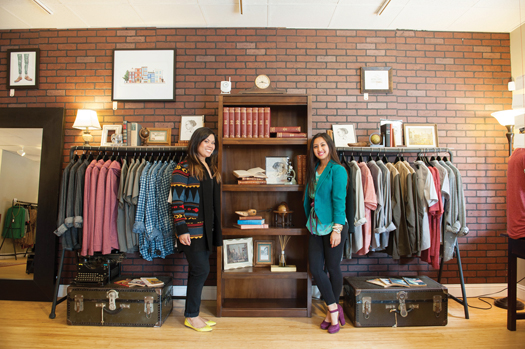
Holy Vampire Weekend, Kanye — no need to waste your time drooling over the archives of Street Etiquette, the sharpest neo-preppy style blog of our time. Fulfill your up-to-the-minute Ivy League-ish yearnings (with a dash of street-level snazz) at Asmbly Hall, the Fillmore men’s and women’s clothing shop for the sophisticated prepster. The natty clothes aren’t priced too outrageously (button-down shirts are around $80), and familiar classics are tweaked with unique elements like scalloped collars and stripy inseams. Husband-wife owners Ron and Tricia Benitez have reworked an old mattress store into an absolutely lovely space with brick walls and blond wood floors. Here’s where you’ll score that funky two-tone cardigan, irreplaceable Macarthur shirt, or dreamy summer beach dress. You’ll have to supply your own air of undergrad gravitas.

1850 Fillmore, SF. (415) 567-5953, www.asmblyhall.com


BEST SHUTTERBUG SECRET

Hidden in a corner of the beloved Rooky Ricardo’s Records store is the domain of Glass Key Photo owner and photography enthusiast Matt Osborne. From a funky wedge of floor space, Osborne offers a top-notch, well-edited, and cheap selection of cameras, film, and darkroom gear. Much of his treasure is stored in an old-school refrigerator case, making for an appealingly bizarre shopping experience. Customers thirsty for hard-to-find photographic gear should check out Glass Key before the bigger-name stores — even if the refrigerator doesn’t hold the key to your photographic fantasies, Osborne is happy to special order what he doesn’t have. He also earns rave reviews for his camera repair skills, and sells root beer to thirsty shutterbugs.

448 Haight, SF. (415) 829-9946, www.glasskeyphoto.com


BEST VINTAGE MEGAVAULT

It is no secret that San Francisco has thrifting issues. Due to the admirable commitment to cheaply bought fashion (and high incidence of broke, under-employed drag queens), most of our used clothing stores are heavily picked over — or well-curated, with ghastly price tags to match. Those sick of fighting could do worse than steer their Zipcars north. In Sebastopol sits Aubergine, a high-ceilinged mega-vault stuffed with vintage slips, half-bustiers — clearly geared toward the Burning Man strumpet — menswear, and the occasional accessibly priced Insane Clown Posse T-shirt. Racks on racks on racks on racks — and if you need a break from bargain browsing, you’re in luck. The shop has its own cafe and full bar, where many nights you’ll find live music from gypsy dance to jazz drumming.

755 Petaluma, Sebastopol. (707) 827-3460, www.aubergineafterdark.com


BEST BLEMISH-VANISHING BOTANICS

The charming, chatty cashiers at the Benedetta Skin Care kiosk in the Ferry Building have clear, shiny skin, but it’s not due to the local produce from the farmers market outside. Based in the Petaluma, Benedetta offers organic, botanics-based, sustainably packaged products that actually work. Take a tip from your freshly scrubbed lotion sellers: rather than loofah-ing your skin to a pulp with packaged peroxides that — let’s face it — sound kind of scary when you actually read the fine print, refresh with the line’s perfectly moist Crème Cleanser that leaves skin smelling like a mixture of rosemary and geranium. From anti-aging creams to deodorants and moisturizing mist sprays, this small company offers treats for all skin types — perfect for popping in next to your small-producer cheese wheels and grass-fed charcuterie.

1 Ferry Building, SF. (415) 263-8910, www.benedetta.com


BEST TOME TRADE

Interested in perpetuating a bibliophilic mythos among your houseguests? Turned on by the image of sitting quietly by a roaring fireplace, sipping a brandy, and reading Kafka amid towers of dusty tomes? Well, the Bay Area Free Book Exchange has those tomes for you to own. Since its opening in 2009, the Exchange has given away more than 245,000 free books for the sole joy of making knowledge accessible in book form. The nonprofit is run by a collection of book-lovers in El Cerrito who sell some of the donated volumes on eBay in order to pay rent, electricity, and other expenses. The rest of the stories, however, make their way to the Exchange’s storefront, where every weekend customers are invited to take up to 200 titles at once. Stock your bathroom with freaky medical guides? Actually read the books you snap up? We’ll let you work out the ethics on your own.

10520 San Pablo, El Cerrito. (510) 705-1200, www.bayareafreebookexchange.com


BEST INDIE KITCHEN MENAGERIE

Guardian photo by Godofredo Vasquez/SF Newspaper Co.

It can be hard to beat the sheer variety offered by your Ikeas and Bed Bath & Beyonds when it comes to fresh new flatware or an upgrade on your trusty college-era rice cooker. Lucky for local business fans (which we assume you are if you’re this deep into our Best of the Bay issue), there’s a little-guy alternative: Clement Street’s Kamei Restaurant Supply. Kamei has dishes for every occasion: light blue earthenware plates with fetching designs of cherry blossom trees, coffee mugs shaped like barn owls and kitty cats, tea sets, sake sets, and every cooking utensil a chef could desire — plus paper umbrellas with koi fish prints and flip-flops. Maybe ‘cuz with all the savings you’ll spot in Kamei, you’ll be able to afford more beach trips.

525 Clement, SF. (415) 666-3699


BEST CUMMUNITY CENTER

Guardian photo by Amber Schadewald

Nenna Joiner’s done a number on us. In a Bay Area full of superlative sex shops, her Feelmore510 — which opened a year and a half ago — has run away with our sex-positive souls. What makes her business stand out? It could be her rainbow of pornos (Joiner herself makes skin flicks that have an emphasis on racial, sexual, and body-type diversity) or, it could be the pretty store design, with erotic art displayed in the shop’s plate-glass windows. You’ll often find Joiner at her store as late as 1:30am: besides outfitting her customers with stimulating gear, she hosts in-store sex ed lectures and movie screenings. “Sex is a basic need for survival,” she told the Guardian in an interview earlier this year. We agree, and that’s why Feelmore510’s a new East Bay necessity.

1703 Telegraph, Oakl. (510) 891-0199, www.feelmore510.com


BEST AU NATUREL FOR OENOPHILES

Much of the wine we drink is stuffed full of chemical preservatives. Purists like wine critic Alice Feiring have raised a hue and cry over the industry’s reluctance to force producers to label these ingredients. We have to give it up to a little shop off of Polk Street for supporting the so-called “natural wine” movement which encourages additive-free imbibement. Biondivino is charming enough in its own right: library-style shelves full of luscious Italian pours, among which proprietor Ceri Smith has made sure to include many natural wines. And because these bottles tend to be produced by small scale vineyards, Biodivino helps support the little guys, too. Sure, sometimes all you can spring for is a bottle of three-buck Chuck (natural wines can be pricey) — but props to Smith for giving consumers the choice.

1415 Green, SF. (415) 673-2320, www.biondivino.com


BEST DIY PANDA BAIT

“If just owning a bamboo bike was the end goal, we’d just build them for you,” said Justin Aguinaldo in a Guardian interview back in February. “For us, it’s about empowering more people and providing them with the value of creating your own thing.” Aguinaldo’s Tenderloin DIY cycling hub Bamboo Bike Studio doesn’t just produce two-wheeled steeds whose frames are made of easily-regenerated natural materials — it teaches you useful bike-making skills so that you can be the master of your own self-powered transportation destiny. Buy your bike parts (kits start at $459), and then get yourself to tinkering. After a weekend-long session with Bamboo Bike Studio’s expert bike makers, you’ll have a ride that’s ready for the hurly-burly city streets.

982 Post, SF. www.bamboobikestudio.com


BEST LITERARY VALHALLA

For lovers of esoteric literature, 2141 Mission is a dream come true. The unassuming storefront (the building’s ground floor is occupied by the standard hodgepodge of Mission District discount stores) belies a cluster of alternative bookstores on its upper levels. Valhalla Books is flush with titles in their debut printing; Libros Latinos holds exactly that; lovers of law history will find their joy in the aisles of Meyer Boswell; and the building’s largest shop, Bolerium Books, holds records of radical history — volumes and magazines that together form a fascinating look at the gay rights, civil rights, labor, and feminist movements (and more!). Most visitors make the pilgrimage with something specific in mind, but walk-ins are welcome as long as they have a love of the printed page.

Bolerium Books, No. 300. (415) 863-6353, www.bolerium.com; Libros Latinos, No. 301. (415) 793-8423, www.libroslatinos.com; Meyer Boswell, No. 302. (415) 255-6400, www.meyerbos.com; Valhalla Books, No. 202. (415) 863-9250


BEST EXQUISITE ADZES

Some chefs drool over the copper pots at posh cooking stores. Artists lovingly caress the sable brushes in painting shops. But what aspirational retail options exist for the you, the craftsman? Home Despot? Perish the thought! Luckily, your days of retail resentment are over. At the Japan Woodworker, you can fondle high-end power tools to deplete your paycheck, plus tools hand-made in traditional Japanese style — like pull saws, chisels, and adzes — which are not only beautiful, but quite affordable. If you’re the type of person who savors doing things the slow way, the tools found here will do much to imbue your projects with love and care. And if you’re not, perhaps it’s time you paid a little more attention to detail — a very Japanese value, indeed.

1731 Clement, Alameda. (510) 521-1810, www.japanwoodworker.com


BEST BUSHELS OF BUDS

Ever rolled your eyes at the endless articles on flower arranging found in home magazines — as if you had the money or the time? Then you might be due for a visit to the San Francisco Flower Mart. The SoMa gem sells cut flowers of every description at wholesale prices, making it the perfect playground for those looking to get plenty of practice, per-penny, poking stems into vases. And if your Martha Stewart moment doesn’t seem imminent, there are plenty of other fixin’s — giant glass balls, decorative podiums, fish tanks, driftwood, grosgrain ribbons, flamingo-themed party supplies — to rifle through. It’s the perfect place to while away your lunch break: it smells great, and it even has a perky little cafe to caffeinate your midday visit.

640 Brannan, SF. (415) 392-7944, www.sfflmart.com


BEST NEIGHBORHOOD FIXTURES

Photo by Godofredo Vasquez/SF Newspaper Co.

Hey, you with the dreams of a better bathroom! There’s no need to put up any longer with that cracked toilet bowl, that faulty faucet, that perma-grody bathtub, or that shower head that suddenly switches into “destroy” mode at the worst possible moment (i.e. right in the middle of herbal-rinsing your long, lustrous hair). Head down — or direct your responsible landlord down — to the cluster of independent home supply stores at the intersection of Bayshore Avenue and Industrial Street in Bayview-Hunter’s Point. There you’ll find K H Plumbing Supplies, a huge family-owned and operated bathroom and kitchen store with everything you need to fulfill your new fixture fantasies. The staff is extra-friendly and can gently guide you toward affordable options in better-known name brands. Even if you have only a vague idea as to which of the thousand bath spouts will reflect your unique personality, they’ll find something for you to gush over.

2272 Shafter, SF. (415) 970-9718


BEST GET LIT

Back in college, you probably had that friend who dressed up as a Christmas tree on Halloween and had to dance near a wall outlet all night so he could stay plugged in. Or … maybe you didn’t. Either way, costumes that light up are no longer just for burner freaks and shortsighted frat bays. With a little help from Cool Neon, anyone can get lit in an affordable el-wire wrapped masterpiece of their own creation. Wanna cover your car with LEDs? This place can do it. Creative signage for your business? No problem for these neon gods. And even if you’re just missing the sparkly, lit-up streets of the holiday season, Cool Neon can oblige: its Mandela Parkway façade is a light show in itself.

1433 Mandela, Oakl. (510) 547-5878, www.coolneon.com


BEST ART SQUAWK

Sure, on any given Sunday the Rare Bird is flush with vintage duds for guys and gals, antique cameras, birdhouses, jewelry, and trinkets. But for all you birds looking to truly find your flock, fly in to this fresh store on third Thursdays during the Piedmont Avenue Art Walk. Rare Bird proprietress Erica Skone-Reese hatched the event a year ago, and has chaired the art walk committee ever since, giving all those art-walk lovers who Murmur, Stroll, and Hop (all names of Bay Area art walks, for the uninitiated) a place to home in between first Fridays. Can’t make it when the Ave.’s abuzz? No worries. Rare Bird curates an always-changing list of featured artisans — like Featherluxe, who’ll fulfill your vegan feather-extension needs should you have them — and recently began offering classes in all art forms trendy and hipster, from terrarium making to silhouette portraiture.

3883 Piedmont, Oakl. (510) 653-2473, www.therarebird.com


BEST PLACE TO STASH YOUR NERDS

Got nerdy friends you just can’t understand? Feel bad asking them to explain, for the tenth time, the difference between RPG, GMT, MMP, and D&D? WOW them with a trip to Endgame. Not only will they find others who speak their language, but — because they can spend hours browsing board games, card games, toys, and trinkets — you’ll have them out of your hair … at least until you can look up what the heck they’re talking about on Urban Dictionary. Add an always-open game room, plus swapmeets, mini-cons, and an online forum, to equal more nerd-free hours than you can shake a pack of Magic Cards at. Just be careful you don’t find yourself lonely, having lost your dweeby mates to Endgame’s undeniable charms. Or worse: venture in to drag them out and risk being won over, yourself.

921 Washington, Oakl. (510) 465-3637, www.endgameoakland.com


BEST KNOBS OF GLAMOUR

In addition to being part of a string of friendly neighborhood hardware stores, Belmont Hardware‘s Potrero Hill showroom brims unexpectedly with rooms of fancy doorknobs, created by the companies who design modern-day fittings for the likes of the White House and the Smithsonian. A gold-plated door handle with an engraving of the Sun King? A faucet set featuring two crystal birds with out-stretched wings, vigilantly regulating your hot and cold streams of water? It’s all at Belmont Hardware. With a broad range of prices (you can still go to them for $10 quick-fix drawer knobs and locks, don’t worry) and an even broader scope of products, Belmont represents a world where hardware can inspire — check out the local chain’s four other locations for more ways to bring the glory home.

Various Bay Area locations. www.belmonthardware.com


BEST ONE-UP ON INSTAGRAM

The square aspect ratio and grainy filters of everyone’s favorite $1 billion photography app turn perfectly good shots crappy-cool with the swipe of a finger, allowing smart phone users everywhere to take photos way back. But to take photos way, way back, you have to be in the Mission for a tintype portrait at Photobooth. These old-timey sheet-steel images were once popular at carnivals and fairs; even after wet plate photography became obsolete, tintypes were deemed charmingly nostalgic — a sort of prescient irony that pre-dated hipsterism yet neatly anticipated it. Perhaps that same appreciative irony applied to the tintype’s tendency — due to long exposure time — to make subjects look vaguely, yet somehow quaintly, sociopathic. Or, as the Photobooth website delicately puts it, “Traditionally, tintypes recorded the intensity of the individual personality.”

1193 Valencia, SF. (415) 824-1248, www.photoboothsf.com


BEST REALITY TV-STYLE SCORES

Gold Rush Alaska? Deadliest Roads? Swamp Life? Though you love ’em, it’s hard to apply what you’ve learned during those late-night trashy-television-and-junk-food binges. But fans of Storage Wars and American Pickers, rejoice! At the Santa Cruz Flea Market, you’ll meet folks who locker for a living and travel hours to sell their scores — everything from fur coats to antique fuel tanks. Pick through yourself to see what invaluable treasures turn up: belt-driven two-seater motorcycle? Check. Handmade blown glass, Civil War memorabilia, bootlegger’s copper still? Check, check, check. Come for the farm-fresh produce, aisles of leather boots, plastic whosee-whatsits and electronics of dubious provenance, or, if Man Versus Food is more your style, challenge a massive stuffed baked potato or shrimp ceviche tostada.

Fridays, 7am; Saturdays, 6am; Sundays, 5:30am; $1-$2.50. 2260 Soquel, Santa Cruz. (831) 462-4442, www.scgoodwill.org


BEST HOGWARTS GREENHOUSE FOR MUGGLES

They may not scream when you uproot them or ensnare you with insidious vineage, but the exceptional succulents, epiphytes, and bromeliads at Crimson Horticultural Rarities will certainly tickle your fancy — in a perfectly harmless way. Find everything necessary to cook up an enchanted garden or adorn your dorm room (four-poster bed not included) in singular style. Proprietresses Leigh Oakies and Allison Futeral indulge your desires with oddities ranging from the elegant to the spectacular to the slightly creepy, and will even apply their botanical wherewithal to help you create a whimsical wedding. Or, if your potions kit needs restocking, Crimson can supply sufficient dried butterflies and taxidermied bird wings to oblige you. (Collected, cruelty-free, from California Academy of Sciences.)

470 49th St., Oakl. (510) 992-3519, www.crimsonhort.com


BEST POLKA PURVEYOR

Though Skylar Fell fell in love with the squeezebox via a happy exposure to the punks of the East Bay’s Accordion Plague back in the 1990s, she knows to pay homage to the masters. Fell apprenticed with master repairman Vincent J. Cirelli at his workshop in Brisbane (in business since 1946!) and at Berkeley’s now-defunct Boaz Accordions before opening Accordion Apocalypse in SoMa. The shop, which both sells and repairs, also stocks new and antique instruments in well-known brands (to accordionists, that is) Scandalli, Horner, Roland, and Gabanelli. Fell will fix you up if you bust a button on your beloved accordion, and she has made her store into a hub for lovers of the bellows — check out the website for accordion events coming up in or out of the city.

255 10th St., SF. (415) 596-5952, www.accordianapocalypse.com


BEST ILLUMINATI

Situation: You’ve just moved into a new place, only to look up and discover that the previous owner somehow Frankensteined three different desk lamps from the more aesthetically challenged end of the 1990s into a living room light fixture. It must die. Worse: Your aunt just gifted you the most generic Walmart wall sconces ever for your housewarming present, and she is coming to stay next month. Perhaps worst of all: You’ve just discovered a gorgeous 1930s pendant lamp in the basement, but it’s banged up terribly and who the heck knows if it works? Solution to everything: the wizards at Dogfork Lamp Arts, headed by owner Michael Donnelly. Services include restoring and rewiring antique lamps and light fixtures, and even reinventing ugly ones — making glowing swans of your awkward mass-market ducklings. (We discovered Dogfork’s magic at the new Local’s Corner restaurant in the Mission, where a pair of Pottery Barn lamps were transformed into wonderfully intriguing, post-steampunk sconces.) Rip out that gross track lighting and put up something unique.

199 Potrero, SF. (415) 431-6727, www.dogfork.com


BEST STYLE FOR APOCALYPSE SURVIVAL

Triple Aught Designs fills a post-North Face niche almost too-perfectly: the outdoor apparel company is locally based (it’s headquartered in the Dogpatch) and personable (the recently opened outlet in Hayes Valley offers a friendly, intimate shopping experience). It is also light-years ahead in terms of tech and design: hyper-strong micro-thin jackets and hoodies in futuristic battleground colors so styley we’d seriously consider sporting them on the dance floor, plus elbow armor and space pens that zip right past wilderness campouts and into Prometheus territory. We’re particularly enamored of the Triple Aught backpacks — these strappy beauts could have been nabbed from a boutique on Tatooine, a perfect look for riding out the coming apocalypse.

660 22nd St.; 551 Hayes, SF (415) 318-8252, www.tripleaughtdesign.com


BEST SPLASH OF GREEN

Guardian photo by Godofredo Vasquez/SF Newspaper Co. 

Need a bit of gentle encouragement before you open your home to an exquisite orchid? Will it take a little nudge before carnivorous pitcher plants share space with your beloved ironic porcelain figurines? Maybe a delicate hand is called for when it comes to developing a chic terrarium habit. Michelle Reed, the owner of indoor plant paradise Roots, has no problem with all that — her gorgeous little boutique is there to help green up your apartment and let the sunshine in. Besides delectable, mood-brightening plants for your inner sanctum, the store also stocks a healthy selection of local art to elevate your interior design aesthetic, as well as a neat array of planters and supplies (we’re in love with the heart-shaped wall planters that look like little light sconces). Let your tight, high-rent space breathe a little easier with help from Roots’ little friends.

425 S. Van Ness, SF. (415) 817-1592

Rep Clock

0

Schedules are for Wed/25-Tue/31 except where noted. Director and year are given when available. Double and triple features marked with a •. All times pm unless otherwise specified.

ARTISTS’ TELEVISION ACCESS 992 Valencia, SF; www.atasite.org. $6. Reconnect: A Film on Cell Phones and Health Effects (Kunze, 2012), Sat, 8.

CASTRO 429 Castro, SF; (415) 621-6120, www.castrotheatre.com. $8.50-11. San Francisco Jewish Film Festival, Wed-Thu. For tickets and more information, visit www.sfjff.org. •Spaceballs (Brooks, 1987), Fri, 7:30, and Blazing Saddles (Brooks, 1974), Fri, 9:25. “The Silence of the Trans:” The Silence of the Lambs (Demme, 1991), with pre-show starring Sharon Needles, Peaches Christ, and the Midnight Mass Players, Sat, 3, 8. Tickets for this event, $25-45; visit www.peacheschrist.com for info. Bearcity 2: The Proposal (Langway, 2012), Sun, 11:30am, 2:00, 4:30, 7:00, 9:25. This event, $10-12; visit bearcity2theproposal.ticketbud.com for info. •Purple Rain (Magnoli, 1984), Tue, 7:30, and Pink Floyd the Wall (Parker, 1982), Tue, 9:40.

CHRISTOPHER B. SMITH RAFAEL FILM CENTER 1118 Fourth St, San Rafael; (415) 454-1222, www.cafilm.org. $6.75-$10.25. Beasts of the Southern Wild (Zeitlin, 2012), call for dates and times. Bernie (Linklater, 2012), call for dates and times. Dark Horse (Solondz, 2011), call for dates and times. Take This Waltz (Polley, 2011), call for dates and times. The Queen of Versailles (Greenfield, 2012), July 27-Aug 2, call for times. Bill W. (Carracino and Hanlon, 2011), Sun, 7.

DAVIES SYMPHONY HALL 201 Van Ness, SF; www.sfsymphony.org. $25-75. The Wizard of Oz (Fleming, 1939), Thu-Fri, 7:30. Screening with live orchestral accompaniment. “Pixar in Concert,” Sat, 7:30; Sun, 2. Songs from Pixar films, with accompanying movie clips.

JACK LONDON SQUARE First Street at Broadway, Oakl; www.jacklondonsquare.com. Free. Ghostbusters (Reitman, 1984), Thu, sundown.

MECHANICS’ INSTITUTE 57 Post, SF; (415) 393-0100, rsvp@milibrary.org. $10. “CinemaLit Film Series: Fairytale Endings:” Excalibur (Boorman, 1981), Fri, 6.

PACIFIC FILM ARCHIVE 2575 Bancroft, Berk; (510) 642-5249, bampfa.berkeley.edu. $5.50-9.50. “Bellissima: Leading Ladies of the Italian Screen:” Open City (Rossellini, 1945), Wed, 7; Bellissima (Visconti, 1953), Sat, 5:30. “The Eternal Poet: Raj Kapoor and the Golden Age of Indian Cinema:” Boot Polish (Arora and Kapoor, 1954), Thu, 7; Awaara (Kapoor, 1951), Sat, 7:45. “Cool World:” Heathers (Lehmann, 1989), Fri, 7; Thunderbolt and Lightfoot (Cimino, 1974), Fri, 9:05. “Russian Inferno: The Films of Alexei Guerman:” The Seventh Companion (Guerman and Aronov, 1967), Sun, 5. “Always for Pleasure: The Films of Les Blank:” •ry cooder group ’88 santa cruz (1988) and Sworn to the Drum: A Tribute to Francisco Aguabella (1995), Sun, 7.

ROXIE 3117 and 3125 16th St, SF; (415) 863-1087, www.roxie.com. $6.50-10. Romantics Anonymous (Ameries, 2011), Wed-Thu, 7, 9. KQED presents: •A Brush With the Tenderloin (Bierma, 2011), and Stage Left: A Story of Theater in San Francisco (Forbord, 2010), Wed, free. Free screening, but RSVP recommended; visit trulyca.eventbrite.com. Kids of Today (De Missolz, 2011), Thu, 7. •Not a Memory (Burdenski, 2012), and Something Personal (Elsaesser, 2012), Thu, 9:15. This event, $5. “This Must Be the Place: Post-Punk Tribes 1978-1982:” La Brune et moi (Puicouyoul, 1979), Fri, 7:30; Rough Cut and Ready Dubbed (Shah and Shaw, 1982), Fri, 8:40; “special secret movie,” Fri, 9:40; The Slog Movie (Markey, 1982), Sat, 7:30; “I Can See It and I’m Part of It: San Francisco Punk Portraits 1978-82” (shorts program), Sat, 9; “Buzz or Howl Under the Influence” (live footage), Sat, 10:20; Debt Begins at 20 (Beroes, 1980), Sun, 7; Downtown 81 (Bertoglio, 1981), Sun, 8:15. Shit Year (Archer, 2010), July 27-Aug 2, 7. “Johnny Legend presents:” The Big TNT Show (Peerce, 1966), Mon, 8; Mondo Teeno: Teenage Rebellion (Herman and Visconti, 1967), Mon, 6:10, 9:45; Teenage Cruisers (Legend, 1977), Tue, 6, 9:45; One Million Years AC/DC (De Prieset, 1969), Tue, 8.

SF FILM SOCIETY CINEMA 1746 Post, SF. $10-11. A Burning Hot Summer (Garrel, 2011), Wed-Thu, 3, 5, 7, 9. Sacrifice (Chen, 2010), July 27-Aug 2, 1, 3:30, 6, 8:30.

TOP OF THE MARK InterContinental Mark Hopkins, One Nob Hill, SF; www.topofthemark.com. Free. “Summer Movie Nights:” It Happened One Night (Capra, 1934), Tue, 7:30. Wine tasting at 5:30.

YERBA BUENA CENTER FOR THE ARTS 701 Mission, SF; (415) 978-2787, www.ybca.org. $6-8. “Documentaries By Ai Weiwei:” One Recluse (2010), Sun, 2.

Our Weekly Picks: July 18-24

0

WEDNESDAY 18

Waters

Former Port O’Brien band leader Van Pierzalowski founded Waters on the shores of Norway, New York, California, and Alaska. He’s now touring with his new Norwegian bandmates, for their album Out in the Light, and will open for Nada Surf in cities across US this summer, with a final stop in Oslo, Norway. Port O’Brien’s ragged edges and nautically inspired lyrics can still be found in this new project, but its debut album is receiving critical acclaim for its grungier sound, and for Pierzalowski’s decision to stretch out his vocals, reaching new heights. Check out standout track “Take Us Out to the Coast” and get ready to rock. (Shauna C. Keddy)

With Tijuana Panthers, Chasms, Churches

7:30pm, $12

Brick and Mortar Music Hall

1710 Mission, SF

(415) 800-8782

www.brickandmortarmusic.com


The Bouncing Souls

These New Jersey punks have been inciting fist pumping and circle pits for over 20 years, and they celebrated this milestone by self-releasing their ninth studio album Comet this week. The Bouncing Souls have been important players in the punk scene for years, pioneering the lighter side of the genre and hitting the road for seven Warped Tours. Their relentless touring has earned the Souls a dedicated, cross-generational following, from ’90s diehards to the teens who discovered them last summer. There’s nothing complex, nuanced, or hip about a Bouncing Souls song, but that’s what makes these party-punk anthems so accessible. Leave your thinking caps at home and get ready to rage. (Haley Zaremba)

With the Menzingers, Luther

8pm, $21

Slim’s

333 11th St, SF

(415) 255-0333

www.slimspresents.com


THURSDAY 19

Roy Davies

As founder, key songwriter, singer and guitarist for legendary British Invasion innovators the Kinks, Ray Davies penned classics such as “You Really Got Me,” “All Day and All of The Night,” “Lola,” and many more. His latest release, last year’s See My Friends featured a who’s who of legendary musical guests including Metallica, Bruce Springsteen, Lucinda Williams, Alex Chilton, and Billy Corgan, all performing with the icon on re-interpretations of his most famous tunes. Fans won’t want to miss the Rock and Roll Hall of Famer when he plays a relatively intimate show at the equally historic Fillmore here in San Francisco. (Sean McCourt)

With The 88

8pm, $50

Fillmore

1805 Geary, SF

(415) 371-5500

www.thefillmore.com


Beachwood Sparks

Many may recognize the warm and fuzzy sounds of Beachwood Sparks’ cover of Sade’s “By Your Side” from the indie-hit film Scott Pilgrim Vs. the World. Fans who have checked out their music beyond the popular cover will know that country and indie-rock sounds more so define this band. Its new album, The Tarnished Gold, finds the group over a decade into its career delivering just the kind of LA-influenced summer jams that have made it such a beloved California act. The album achieves a sound of great ease, and is receiving praise from the likes of NPR, which applauded the band for its ability to create a seemingly effortless sound that transports listeners. Beachwood Sparks’ Americana and ’70 pop sounds may induce listeners into making daisy chains in grassy fields. (Keddy)

With Allah-Las, Sweet Chariot, DJ Britt Govea

7:30pm, $18

Independent

628 Divisadero, SF

(415) 771-1421

www.theindependentsf.com


Fountains of Wayne

After a 16-year career, Fountains of Wayne is still tragically unknown. Even the Grammy it nabbed in 2003 was a nod to its obscurity — the band, which had been together for seven years at that point, was given the award for Best New Artist. After the band’s five minutes of fame with the Grammy moment and its cheesetastic international chart-topping single “Stacey’s Mom,” it faded again into the background. Years later, these guys can still write some wickedly funny pop songs and they’ll leave you wondering why they never fully broke through. (Zaremba)

With Mike Viola

8pm, $26

Great American Music Hall

859 O’Farrell, SF

(415) 885-0750

www.slimspresents.com


FRIDAY 20

Friday Nights at the de Young: African Diaspora

This week’s installment of Friday Nights at the de Young treats us to traditional African Manding music in both song and dance, along with an art demonstration by artist-in-residence alum Ramekon O’Arwisters. Attendees can bring their own pieces of fabric to the event and should be ready to share a life story: the goal of O’Arwisters’ demonstration is to examine weaving through storytelling and crocheting, giving a taste of the African-American folk art and textile tradition. The packed Friday night lineup also includes “Love Letters,” a lecture by C. Derrick Jones, nephew of Harlem Renaissance pioneer Aaron Douglas. Jones’ aerial dance group Catch Me Bird is currently putting together a project called Off the Walls, based on the work of his uncle. (Keddy)

6pm, free

De Young Museum

15 Hagiwara Tea Garden, SF

(415) 750-3600

deyoung.famsf.org


“Steve Prefontaine Film Festival”

Local distance runners who’re about to start tapering for the San Francisco Marathon (July 29!) — and have already planned their Olympics viewing parties (go Shalane!) — will not want to miss Film Night in the Park’s “Steve Prefontaine Film Festival,” highlighting the awesome achievements of the Oregon legend. The record-breaking athlete, who helped popularize running in the 1970s (the fact that he was a babe, mustache and all, didn’t hurt), died at age 24 in a single-car accident — giving rise to the nickname “the James Dean of running” — but remains an inspiration for his intense dedication to the sport. The Pre double-feature includes Robert Towne’s 1998 Without Limits, starring Billy Crudup (not to be confused with 1997’s competing biopic Prefontaine, starring Jared Leto), and the 1995 documentary Fire on the Track: The Steve Prefontaine Story. (Cheryl Eddy)

8pm, donations accepted

Creek Park

451 Sir Francis Drake Blvd., San Anselmo

www.filmnight.org


“PERSIAN LOOKING”

Maryam Rostami’s theatrical exploration of her Persian heritage has extended from deeply moving solo theater (last summer’s play-in-progress preview “Persepolis, Texas”) to hilariously relevant drag — not many performers can bring down the house with a number performed in a deconstructed burqa, using only eyebrows to “lip-sync.” Her latest ensemble piece, “PERSIAN LOOKING” is “specifically about the way that Middle Eastern women living in the West process the news that we hear about our sisters living in warzones back ‘home.” It’s paired with another cool-sounding examination of women in the contemporary world: Cara Rose DeFabio’s “She Was a Computer,” which uses language from obsolete computer manuals and the audience’s own cell phones, among other things, to look at how gadgetry and its social currency are passed down through female generations. (Marke B.)

8pm, $20

Also Sat/21, 8pm; Sun/22, 2pm and 8pm

CounterPulse

1310 Mission, SF

(415) 626-2060

www.counterpulse.org


Sam Bush

Multi-instrumentalist Sam Bush has been highly influential in the bluegrass and “newgrass” genres of Americana music, performing with artists such as Lyle Lovett, Bela Fleck, Emmylou Harris, and more, all while inspiring a world of fans with his excellent mandolin, fiddle, banjo, and guitar playing skills. Recently honored with the Americana Music Association Lifetime Achievement Award — quite a feat considering he only just turned 60 — Bush released his latest album Circles Around Me in 2009, and continues to thrive on stage, where he switches off instruments and energetically blends a host of sounds all into a joyous mix. (McCourt)

9pm, $26

Great American Music Hall

859 O’Farrell St., SF

(415) 885-0750

www.slimspresents.com


SATURDAY 21

Phono Del Sol Music and Food Festival

Out of the darkened beer-soaked clubs and into the dewy green park with you. The Phono Del Sol Music and Food Festival returns this weekend, and the price is still right. It’s just $7 to $10 max (unless you go VIP) for the pleasure of chilling in the grass with pals while rollicking locals Fresh & Onlys, sincere globe-trotters Unknown Mortal Orchestra, and Santa Barbara synth-and-flute freaks Gardens & Villa fill the park with sweet music. Produced by the Bay Bridged blog, this year’s curated lineup also includes Vivian Girl Katy Goodman’s shimmery solo effort La Sera, along with Northern California bred acts such as Dominant Legs, Sea of Bees, and Mwahaha. Its bears mention that the food lineup also rocks, and nearly a dozen local food trucks will come roaring over the hill: munch on the spicy fusion of Kung Fu Tacos, Doc’s of the Bay, Kasa Indian, Voodoo Van, Frozen Kuhsterd, and more. (Emily Savage)

Noon-6pm. $7–$10.

Potrero Del Sol Park

25th Street at Utah, SF

www.phonodelsol.com


My Best Fiend

One of a handful of of rock bands on the esteemed Warp Records’ largely electronic roster, My Best Fiend cranks out pastoral ballads of human frailty that mutate slyly into psychedelic, space-bound epics. The Brooklyn outfit’s debut full-length, In Ghostlike Fading, emanates a distinctly ’70s vibe, recalling the heady propulsion of Pink Floyd’s looser, slower jams; the stoned disillusionment of David Crosby’s If I Could Only Remember My Name; the sun-drenched melancholy of Neil Young’s Harvest. Not to be mistaken for a group of twentysomethings halfassedly replicating their parents’ record collections, My Best Fiend sets its tunnel vision on a specific time and place in rock music, channeling it poignantly, respectfully, ecstatically. (Taylor Kaplan)

With White Cloud

9pm, $10

Brick & Mortar Music Hall

1710 Mission, SF

(415) 800-8782

www.brickandmortarmusic.com


Sonny and the Sunsets

San Francisco native Sonny Smith likes to keep himself busy. This summer saw the release of his band’s third album in as many years. Before that he was was occupied with his “100 Albums” project, in which Smith collaborated with visual artists to invent 100 different album covers by 100 fake bands as well as a single off each of the faux records, which he wrote and recorded with the help of other Bay Area artists such as Ty Segall and Thee Oh Sees’ John Dwyer. Longtime Companion, his latest (real) effort, is not as grandiose or harebrained as some of Smith’s other creations, but its simple Americana charm is just as stunning. (Zaremba)

With Wet Illustrated, Pink Films, Cool Ghouls

9pm, $15

Independent

628 Divisadero, SF

(415) 771-1421

www.theindependentsf.com


TUESDAY 24

Ava Luna

Reminiscent of TV On the Radio in its thorny, postmodernist treatment of soul, punk, and R&B, and the Dirty Projectors, with their anything-goes vocal dynamics, Ava Luna’s sound is in a constant state of flux, too busy searching and experimenting to settle into a comfortable groove. Remarkably dense, brimming with tension, and jumping wildly between musical languages, the Brooklyn band’s newly released debut LP, Ice Level, bears the audacity of a group with a much longer resume. In an age of too many laptop shows, and rock bands resorting to predictable schtick, this dynamic seven-piece ought to deliver a richly stimulating, thrillingly unstable performance. (Kaplan)

With That Ghost, Youngman Grand

9pm, $10

Bottom of the Hill

1233 17th St., SF

(415) 621-4455

www.bottomofthehill.com

The Guardian listings deadline is two weeks prior to our Wednesday publication date. To submit an item for consideration, please include the title of the event, a brief description of the event, date and time, venue name, street address (listing cross streets only isn’t sufficient), city, telephone number readers can call for more information, telephone number for media, and admission costs. Send information to Listings, the Guardian Building, 135 Mississippi St., SF, CA 94107; fax to (415) 487-2506; or e-mail (paste press release into e-mail body — no text attachments, please) to listings@sfbg.com. Digital photos may be submitted in jpeg format; the image must be at least 240 dpi and four inches by six inches in size. We regret we cannot accept listings over the phone.

The Feds are watching — badly

9

yael@sfbg.com

So, you’re a law enforcement officer in training for participation on a local Joint Terrorism Task Force. Or a student at the United States Military Academy at West Point, involved in the counterterrorism training program developed in partnership with the FBI. Or you’re an FBI agent training up to deal with terrorist threats.

Get ready for FBI training in dealing with Arab and Muslim populations.

Take note that “Western cultural values” include “rational, straight line thinking” and a tendency to “identify problems and solve them through logical decision-making process” — while “Arab cultural values” are “emotional based” and “facts are colored by emotion and subjectivity.”

Be advised that Arabs have “no concept of privacy” and “no concept of ‘constructive criticism'” and that in Arab culture it is “acceptable to interrupt conversations to convey information or make requests.”

“Westerners think, act, then feel,” an FBI powerpoint briefing notes, while “Arabs feel, act, then think.”

Those are some of the most dramatic examples of racial profiling and outright racist stereotyping revealed in thousands of pages of documents obtained under the Freedom of Information Act by the Bay Guardian, the ACLU of Northern California and the Asian Law Caucus.

The documents show a pattern of cultural insensitivity, sometimes bordering on the ridiculous, not only tolerated by promoted as official instructions by the FBI. The records also show a broad pattern of surveillance of people who have engaged in no criminal activity and aren’t even suspected of crimes, but have been targeted because of their race or religion.

Pieces of this story have come out over the past year as the ACLU has charged the FBI with racial profiling and Attorney General Eric Holder has insisted it’s not happening. And some of the documents — which are not always properly dated — may be a few years old.

But none of it is ancient history: All of the material has been used by the FBI in the past few years, under the Obama administration.

This is the first complete report with the full details on a pattern of behavior that is, at the very least, disturbing — and in some parts, reminiscent of the notorious (and widely discredited) COINTELPRO program that sought to undermine and disrupt political groups in the 1960s.

The information suggests that the federal government is using methods that are not only imprecise and xenophobic but utterly ineffective in protecting the American public.

“This is the worst way to pursue security,” Hatem Bazian, professor of Near East Studies at UC Berkeley, told us.

CULTURAL STEREOTYPES

Dozens of documents attempt to describe “Arabs and Muslims” but other groups aren’t left out of the sweeping stereotyping and blatant racism and xenophobia that the FBI has used in its training guides. One training presentation is titled “The Chinese.” The materials give such tips as “informality is perceived as disrespectful.” The presentation warns “expect your gift (money) to be refused” but advises to give “a simple gift with significant meaning- tangerines or oranges (with stems/leaves.)” But “never give a clock as a gift! (death!)”

And if those in the training on “The Chinese” find themselves in “interactions with the opposite sex,” then “touching, too many compliments, may imply a romantic liaison is desired — be careful!”

The vast majority of the “cultural awareness” training materials imply that the authors believe that the law enforcement personnel receiving the training will never be female or interact with female members of the groups they describe. Some warn repeatedly to never ask Arabs how “females in their family” are doing in polite conversation.

A presentation on “Arab and Muslim culture” compares the western thought process with that of all Arabs. According to the FBI, westerners are “rational” thinkers; Arabs, on the other hand, are “emotion based.” A slideshow on cross-cultural interrogation techniques says, “It is characteristic of the Arabic mind to be swayed more by words than ideas and more by ideas than facts.”

Bazian said the FBI’s generalizations about the Arab intellect are “ideological constructs reflective of the orientalist discourse.”

“Many of these individuals have not done any primary sociological, psychological, or historical work in the Arab/Muslim world,” said Bazian, who works on UC Berkeley’s Islamophobia Research & Documentation Project. “What they basically do is take a text from a particular historical period and pick these points and put it as reflective of contemporary Muslim society. Most of these statements have no basis in any critical analysis. They’re not rooted in any type of research.”

Included in the FBI’s recommended reading list for counterterrorism agents-in-training is the “Politically Incorrect Guide to Islam,” in which “Islam expert Robert Spencer reveals Islam’s ongoing, unshakeable quest for global conquest and why the West today faces the same threat as the Crusaders did.”

It’s not exactly an academically sound piece of work, Bazian told us. Spencer and his cohorts are “political hacks,” the professor said. “They come from neo-con backgrounds. Even saying ‘extreme right wing’ is giving them credit; they’re way down below the cliff. They create this contrast between western society and the rest of the world based on a nostalgic idea of western society.”

Arab culture is often the target these days, but the rhetoric recalls that used during the Chinese Exclusionary Act era, and toward Latinos in the United States today, Bazian said.

“They pick on the weakest, most vulnerable people in western society at a particular time and lay blame on them,” he said.

The FBI’s xenophobic approach to interrogation training—which involves warning new agents that “If an Arab is scared, he will often lie to try to avoid trouble”—is not even productive, Bazian said.

“If you go to people with professional training in interrogation and investigation, they’ll say none of this gives them access to security. If anything, it creates a greater global misunderstanding.”

RACIAL MAPPING

And the creation of misunderstanding doesn’t stop there. The FBI is also involved in an intelligence-gathering method known as racial mapping. Racial mapping involves local FBI offices tracking groups in their “domains” based on race and ethnicity.

In blog post, the ACLU writes, “Empirical data show that terrorists and criminals do not fit neat racial, ethnic, nation-origin or religious stereotypes, and using such flawed profiles is a recipe for failure.” In the Counterterrorism Textbook read by all trainees the FBI seems to agree, warning multiple times that there is no such thing as a typical terrorist and that making assumptions based on stereotypes is dangerous and unproductive.

Yet the FBI files we’ve acquired reveal that the bureau consistently does just that. Though the Department of Justice prohibited race from being “used to any degree” in law enforcement investigations in 2003, a convenient and potentially unconstitutional exception allows racial profiling in national security matters.

When the FBI created its Domestic Investigation and Operations Guide in 2008, it used that loophole to permit the mapping of racial and ethnic demographic information and to keep tabs on “behavioral characteristics reasonably associated with a particular criminal or terrorist element of an ethnic community,” the ACLU reported.

Communities in San Francisco have been the victims of this prejudicial loophole more than once. In 2009, the ACLU reported that the FBI justified mapping and investigating the Chinese American population in the city because “within this community there has been organized crime for generations.” Likewise, the bureau collected demographic data on the Russian population because of the “Russian criminal enterprises” known to exist in San Francisco.

The loophole, however, may not even apply to these investigations in the first place.

According to Michael German, a 16-year veteran of the FBI and senior analyst with the ACLU, these investigations don’t fit the national security description. “In intelligence notes on Chinese and Russian organized crime, those are not national security issues,” German told us. “Those are all clearly criminal investigations.”

German has brought attention to another troubling use of racial mapping — documents revealing that the FBI’s Atlanta bureau tracks Georgia’s African American population.

The stated reason is a threat of black separatist groups; the documents name the New Black Panther Party and the Black Hebrew Israelites as the black separatist groups that pose a threat.

German wrote about this problematic practice in a May 29 article on the website Firedoglake.

“The problem with these documents,” German told us, “is that it’s not black separatists or alleged black separatists who are being tracked — it’s the entire black community in Georgia.”

“Those individuals and those communities are being targeted only for their race,” German said. “Were it not for their race they wouldn’t be part of that assessment. There is no reason to do that, accept to treat that community differently than the way it treats other communities. It’s problematic from a constitutional standpoint.”

The New Black Panther Party was founded in Dallas and has mostly East Coast chapters. According to the Southern Poverty Law Center, which tracks hate United States hate groups, “The group portrays itself as a militant, modern-day expression of the black power movement (it frequently engages in armed protests of alleged police brutality and the like), but principals of the original Black Panther Party of the 1960s and 1970s— a militant, but non-racist, left-wing organization — have rejected the new Panthers as a ‘black racist hate group’ and contested their hijacking of the Panther name and symbol.” The Black Hebrew Israelites is another fringe group, an apocalyptic group whose ideology holds that black Americans are God’s chosen people.

Both groups have written and spoken record of racist and violent rhetoric, but record of violent or criminal acts are hard to find.

“I’d say they’re a fairly small part of the radical right, and generally quite small. As far as we know, there is virtually no connection between these groups and criminal activity,” Mark Potok, a senior fellow with the SPLC, told the Guardian.

According to Potok, the center’s list of hate groups in operation in 2011 includes four organizations classified as black separatist, which, between them, have 140 chapters. Those chapters are counted as 140 of the list’s 1,018 groups.

“Most of the rest of the list are white supremacist groups,” Potok notes. “There are some exceptions — anti-gay groups and anti-Muslim groups.” After a quick count, Potok found 688 groups to be “straight-up white supremacist.”

The majority of these hate groups may be white supremacist — but the FBI is not involved in tracking white populations.

Last October, the FBI’s press office responded to the ACLU’s concerns with racial mapping. “These efforts are intended to address specific threats, not particular communities,” the agency’s statement reads.

“These domain management efforts seek to use existing, available government data to locate and better understand the communities that are potential victims of the threats. There must be an understanding of the communities we protect in order to focus our limited human and financial resources in the areas where those resources are most needed.”

With that defense, resources continue to pour into racial mapping efforts.

Black separatist organizations are not the only groups to be targeted for political beliefs. Groups such as “anarchist extremists” and “animal rights/environmental extremists” are also, according to the FBI, groups to watch out for.

A training presentation for the Bay Area’s Joint Terrorism Task Force includes a list of those groups: “animal rights/eco terrorism, anarchists, white separatists, black separatists, militia/sovereign citizens, and ‘lone offender’.”

How do you spot a potential “animal rights extremist”? According to the documents, “ideology and concepts” found among this group includes a “complete vegan lifestyle,” and activities include the promotion of “anti-capitalist literature.” In other words, your roommate is probably a terrorist.

SPYING ON MUSLIMS

Racial mapping is not the only FBI practice that targets people just for being members of groups “associated with crimes.” The FBI routinely gathers information on Muslims through deceptive “community outreach” programs.

Memoranda we’ve obtained reveal that FBI agents, operating under the guise of community outreach, attended various events hosted by local Muslim organizations in order to gather intelligence between 2007 and 2009.

When agents attended Ramadan Iftar dinners in San Francisco, they wrote down participants’ contact information and documented their conversations and opinions. At an alleged outreach event at CSU Chico, they recorded a conversation with a student about the Saudi Student Association’s activities and even took the student’s picture. That information was sent to the FBI in Washington, DC, the ACLU reported.

Writing down information on individuals’ First Amendment activities—in this case without any evidence that they were notified or asked—violates the federal Privacy Act, the ACLU says. Using access to community events to gather personal information undermines the FBI’s stated effort to form relationships with Muslim leaders and community members.

And covert surveillance can also have an immediate and hazardous impact on the unwitting subjects.

“It’s becoming more of a public discourse that these FBI background checks are affecting immigration status, the ability to send money back home, and generally creating an environment of fear,” said Miriam Zouvounis, membership coordinator with San Francisco’s Arab Resource and Organizing Center.

The organization has helped clients who have been detained for months because their names were mistakenly placed on a no-fly list, and others whose immigration processes have taken up to ten years because they were erroneously perceived as threatening, Zouvounis said.

“The process of information collecting on covert and overt levels is accelerating, and definitely a present reality in San Francisco. People don’t want to be civically engaged if that material’s being used against them,” she said.

ONLINE SPYING

“Extremism online is the most serious international terrorist threat in the world.” Or so says FBI training materials in a presentation entitled “Extremism online,” meant for those training to be online covert employees. The documents teach OCEs to scan through comment threads and enter chat rooms, searching for people whose speech may be “operational.”

This surveillance has led to investigations.

Some of the documents are individual files and summaries of individual files, and many note that the person (often someone who was convicted, so the name isn’t redacted in the documents) was “detected via the Internet.” Some examples: “Mohamad Osman Mohamud, detected via the Internet, discussing Jihad plans” and “Hosam Smadi, detected via the Internet: online chats.” Both men were 19 when they were convicted of crimes.

These men — and the many more who have not been accused of any criminal activity but are likely under surveillance or investigation by OCEs — could have been “detected via the Internet” in a variety of ways, according to German.

“It could be that the chats were open source, or that an informant was in the chat room, or a person participating simply turned them over to the FBI, none of which would require any legal process,” German explained.

“It could also be monitored under FISA [ the Foreign Intelligence Surveillance Act] or traditional criminal wiretaps, which would require court warrants (secret ones under FISA). Finally, the stored chat logs retained on third party servers could have been obtained with Patriot Act Section 215 orders, or what’s called a “D” order under the Stored Communications Act (if held for over 180 days),” German detailed in an email.

So what kind of speech are OCEs looking out for to peg potential terrorist threats? The Extremism Online presentation has a list of “major themes and language used in online extremist writings,” which includes Islam-related terms such as “Caliphate, Al-Ansar, Al-Rafidah, Mushrik, and Munafiq” as well as the Arabic words “Akhi, Uhkti, Ameen, Du’aa, Shari’ah, and Iman” (brother, sister, amen, prayer, Islamic law, and faith.) Other words the agents are told to look out for: “crusaders, hypocrites, dogs and pigs,” and any discussion of “occupation of Muslim lands.”

The FBI can really get into your business if agents confiscate your possessions. Personal computers, cell phones, and other electronic devices, according to the documents, are routinely checked out at Regional Computer Forensics Labs.

The nearest one to San Francisco is in Menlo Park, where employees brag of having investigated thousands of pieces of data.

Law enforcement routinely confiscates property after arrests, and if local cops are involved with the FBI through the Joint Terrorism Task Forces or other partnerships, they may very well send the belongings of those arrested to be checked out at a local RCFL. But there are other ways the FBI can obtain your electronics.

“Certainly the FBI has the authority to obtain computers and other devices with search warrants, either traditional search warrants where the individual is given notice or expedited warrants where the person isn’t aware,” German told the Guardian, noting that the second type of warrant is the preferred method, for obvious reasons, when the Feds plan to search a confiscated computer.

“The FBI also works with immigrations and customs enforcement, so laptops and other devices seized at the border the FBI can gain access to. There are myriad ways they can get them.”

“DISRUPTION”

A 2009 FBI memorandum on investigating suspected terrorists reveals that the Bureau encourages its agents to implement a “disruption strategy” that German wrote is “eerily reminiscent” of the COINTELPRO tactics used to stop political organizers in the1960s. “If the risk to public safety is too great, or if all significant intelligence has been collected, and/or the threat is otherwise resolved, investigators may, with substantive desk coordination and concurrence, implement a disruption strategy,” one memo reads. Investigators can conduct interviews, make arrests, or use any number of other undefined “tools” to “effectively disrupt subject’s [sic] activities.” Such disruption strategies have been used in the past to investigate and shut down First Amendment-protected activity, German said. The reintroduction of such tactics could open the door for a major breach of the subjects’ constitutional rights.

A MATTER OF PRIORITIES 

“After September 11th, 2001, the FBI realigned its mission and purpose to reflect the global and domestic threats that face the US,” begins an orientation packet for members of Joint Terrorism Task Forces. “FBI director Robert M. Meuller III defined the following as the top ten priorities (in order of importance) that confront the Bureau today,” Number one on the list: Protect the United States from terrorist attack.

Indeed, after 9/11, the FBI prioritized terrorism investigations, a shift from the previous focus on criminal investigations. Classified as national security threats, these investigations are not subject to the same type of privacy and anti-racial discrimination protections that other criminal investigations might be.

Terrorist threats, apparently, are to be found in mosques, in online conversations that involve criticism of US foreign policy, in entire populations of African Americans or Chinese Americans in given areas. In recent years, simply speaking Arabic online or being black makes a person a suspect and potential target of surveillance.

Look out America, especially members of that celebrated “melting pot.” The feds are watching.

Fly Benzo sentenced to three years probation

16

Debray Carpenter, aka Fly Benzo, was sentenced in court April 27. He received three years of probation with a long list of conditions.

Benzo, student at City College, was arrested at an Oct. 18 rally in Mendell Plaza. During that incident, police officers John Norment and Joshua Fry of the Bayview precinct apparently unplugged a boombox that they said was not authorized in a street outlet. Then, when officers began videotaping Benzo, he took out his camera phone and began videotaping them as well. He was convicted of misdemeanor assault of a police officer and misdemeanor resisting arrest by Judge Jerome Benson on Feb 22.

April 27, in a courtroom with dozens of supporters, the judge announced that Benzo would serve six months each in county jail for three counts of which we was convicted, but as the six-month sentences for counts one and three could be served concurrently, the jail time would add up to a year total.

However, these sentences were suspended, and barring a change, Benzo will not serve that jail time.

The conditions include a ban on the possession of weapons, a requirement to submit to any search and seizure by police officers with or without a warrant, an order to complete anger management classes, a stay-away order from Third St. between Oakdale and Quesada, a requirement that he be enrolled full time in school and/or work, a requirement to obey all lawful orders by a police officer as well as remain arms-length away from all police officers, and about $1,000 in fees for expenses like booking and court assessment.  

The judge also ordered 30 days in country jail, although 11 days already served brought the sentence to 19. However, Benzo will likely serve those days through the sheriff’s work alternative program (SWAP)—that means 19 days sweeping up the sidewalks in an orange vest. 

Benzo served the 11 days before he was released on $95,000 bail.

Judge Benson also ordered that Benzo apologize to SFPD officers Norment and Fry, although the apology is not a condition of probation.

“A true apology comes from within, and it would not be a true apology if I order it,” said the judge, who came out of retirement to preside over Benzo’s case.

Benzo’s lawyer Severa Keith stated objections to two of the conditions: the requirement to submit to searches and the stay-away order. Keith objected to the search requirement on the grounds that neither contraband nor weapons plays no part in his case, and Benzo was not in the possession of either at the time of his arrest.

The area of the stay-away order includes Mendell Plaza.  An important public square in Bayview, the plaza’s meaning was given new weight when it was the site of the killing of Kenneth Harding, Jr

Harding, 19, was killed in August 2011. Harding was leaving a T train when police asked to see his transfer. Harding presumably panicked and ran away from the police. Officers shot at him as he ran, then, in a video that has circulated widely, stood around him as he bled to death.

Mendell Plaza is directly across the street from the Joseph P. Lee recreation center and the Bayview Opera House, some of the main neighborhood venues for entertainment and community gatherings. This street that divides the plaza from the opera house and rec center- Oakdale- is the cut-off for the stay-away order, so both Keith and Benzo asked Judge Benson to specify whether these locations were included in the stay-away. 

After studying a map of the area, Judge Benson concluded that the opera house and rec center are outside the bounds of the stay-away order. 

“We just did an event a few weekends ago where we fed over 100 people at that location,” said Benzo to the judge. “This order will prevent me from serving the community in the way that I do, as well as providing entertainment and education for the community.”

According to Benson, there’s a chance that the stay-away condition will revoked or altered when it is brought up again at Benzo’s SWAP hearing, scheduled for June 8. 

Keith said of the sentence, “It’s not bad. I was working for probation, not jail time.”

However, she still plans to appeal, in large part due to what she sees as crucial evidence that was excluded from the trial surrounding Benzo’s history with the officers Fry and Norment. 

According to Keith, the jury didn’t hear evidence about “racist and unprofessional things” that the officers said to Benzo on occasions leading up to the incident.

“They deliberated for a long time- four days. And what I heard from the jury was that they though police were baiting him, and didn’t condone the police behavior, but they thought Debray’s reaction was too much under the circumstances,” said Keith.

But Keith said those circumstances include a long history of police harassing Benzo.

“It wasn’t a one-time thing,” she said. “And we have witnesses ready to testify to that.”

As for Benzo, he’s relieved not to be serving jail time, but wary of many of the conditions. 

“They gave me a stay-away order, which they usually don’t give unless you’re caught dealing drugs,” Benzo told the Guardian.

“It will drastically affect my life. Now I can’t even organize in the community.”