California

Campaign to regulate health insurance premiums launched in SF

68

Representatives from Consumer Watchdog and other groups today launched a ballot measure campaign to regulate health insurance rates in California with an event outside the San Francisco headquarters of Blue Shield of California, which is in the process of substantially increasing health premiums for a second consecutive year despite sitting on billions of dollars in cash reserves.

Consumer Watchdog President Jamie Court told us the measure and the campaign to gather the 505,000 valid signatures needed to qualify it for the November ballot would be similar to the group’s landmark 1988 campaign to pass Prop. 103, which regulated car insurance rates. That will include an extensive effort to mail petitions directly to voters and seek donations for the efforts, supplemented this time by an e-mail campaign.

“On 103, they got all but 100,000 signatures that way,” Court said, adding, “This is Prop. 103 for health insurance.”

The 800-word measure would require health insurance companies to publicly justify their rate increase requests, make the company CEOs affirm that financial data under penalty of perjury, and make the rate increases subject to approval by California’s Insurance Commissioner.

Significantly, the first person to sign the petition was U.S. Sen. Dianne Feinstein, who Court told us is co-chairing the campaign. “She has a real passion for the issue,” he said, describing how she was so outraged by a Blue Shield executive’s testimony to Congress over its double-digit proposed rate hike last year that she sponsored legislation to regulate health insurance premiums, which was defeated.

Blue Shield is officially a nonprofit company, and Court said its public filings show it has $3.4 billion in reserves, with is about 1400 percent more than the state requires. He also said many Blue Shield customers will be hit with a 15 percent rate hike on March 1, and he cited California Healthcare Foundation figures showing health insurance premiums have increased 153 percent in the last decade, while inflation increased by just 29 percent.

Calls to Blue Shield’s press office have not been returned, but I’ll update this post if/when they call.

Catholic hospitals and birth control

7

I’m glad Sen. Barbara Boxer, along with Sens. Patty Murray and Jeanne Shaheen, are supporting the Obama administration’s decision to mandate contraceptive coverage at Catholic hospitals. I read the Wall Street Journal editorial denouncing it as an assault on religious freedom, and I think there’s something that is too easily overlooked here.

Religious institutions like the Catholic Church are not just churches these days; they’re major employers and the operators of major health-care facilities that are intertwined with insurance companies. And for a lot of employees and patients, there isn’t any choice.

People who work for the hundreds of nonprofit social-service agencies run by the Catholic Church aren’t necessarily Catholics, or even religious. They might be receptionists, or janitors, or computer systems operators, or counselors who needed a job and happened to get hired by an agency that needed their (secular) skills. Jobs are hard to come by these days; a person who works in an administrative job at a Catholic nonprofit and is trying to pay the rent and support a family may not have the option of simply leaving because she doesn’t agreed with the Church’s position on birth control. She’s got a health plan paid for by her employer, just like most of the rest of us, and if that plan doesn’t cover contraception, she’s SOL. It’s not fair.

My health-insurance plan recently decided not to do business any more with Brown and Toland medical group and instead contract with Hill Physicians. I had nothing to do with that decision, which was based on some financial negotiations around reimbursement rates that were entirely out of my control, part of an ongoing fight between major hospital groups, physician groups and insurance companies that leave patients entirely out of the loop.

So I had to leave the doctor I’d been seeing for many years (who was a member of Brown and Toland and affiliated with the Sutter-owned California Pacific Medical Center) and I was reassigned to a new doctor, who is a member of Hill — and because of economic issues that have nothing to do with religion, my Hill doc is affiliated with Catholic Healthcare West. So now any major medical treatment I need is at St. Mary’s, or St. Francis, or Seton — all excellent hospitals, and I have no complaints. My new doctor is great, and frankly, the medical staff who are part of what happens to be a Catholic Church affiliated hospital chain aren’t a whole lot different from the medical staff at the secular CPMC — skillful, devoted, caring, and so far as I can tell, entirely free of any type of evangelism. I have no idea what, if any, religious affiliation the doctor who patched my broken hand back together last year had; it wasn’t an issue. Who cares?

But still: It’s a Catholic hospital chain. With all the issues that creates. And it’s part of the city’s public-health infrastructure. A lot of us didn’t choose a religious-based medical center; our insurance company did that for us.

Catholic Healthcare West just changed its name to Dignity Health, apparently for marketing reasons (interesting that they chose the name of a longtime group of gay Catholics) but according to the group’s website:

All of our Catholic hospitals, as well as those that may join the system at a later date, will continue to be Catholic and follow the Ethical and Religious Directives for Catholic Health Care Services (ERDs).

Among the rules that guide those ERDs:

First, Catholic health care ministry is rooted in a commitment to promote and defend human dignity; this is the foundation of its concern to respect the sacredness of every human life from the moment of conception until death. … Catholic health care does not offend the rights of individual conscience by refusing to provide or permit medical procedures that are judged morally wrong by the teaching authority of the Church.

I’m all for religious freedom. But under our current healthcare system, a lot of people have no choice as to their employer or their health-care system. And as long as that’s the case, I don’t see why the Church (which has to pay payroll tax on its employees and abide by the state’s employment laws) shouldn’t fall under the same health-insurance rules as everyone else.


Local control of cops

1

news@sfbg.com

Sup. Jane Kim has introduced legislation to the Board of Supervisors calling for a re-examination of the San Francisco Police Department’s participation in some aspects of the Joint Terrorism Task Force, which was created by the Federal Bureau of Investigations to do domestic surveillance.

The proposed ordinance would prohibit the SFPD from working with the JTTF to collect intelligence on individuals in the absence of criminal wrongdoing, which has been a concern of civil libertarians since last year when a secret memo revealed that local officers were under FBI command and not bound by local and state restrictions on such surveillance (see “Spies in blue,” 4/26/11).

Kim said the ordinance was necessary to ensure the “requirement of reasonable suspicion before we do any type of investigation of criminal activity. And we don’t base it on ethnic identification or religious practice as some of the members of the community have been experiencing the last couple of years.

“Our office is sponsoring this because many members of the Arab, Asian and the Muslim community worship in the district and own many small businesses,” she said.

Critics of the relationship between local and federal law enforcement agencies, facilitated through participation in the JTTF, have long raised concerns about racial profiling and unnecessary spying ordered at the federal level, and carried out by SFPD inspectors assigned full time to the task force.

Federal regulations governing FBI intelligence gathering are weaker than standards set by San Francisco and California’s Constitution. In 1990, the San Francisco Police Commission established rules requiring that intelligence-gathering involving any First Amendment activity be based on reasonable suspicion of significant criminal activity. Those rules reflect the California Constitutional requirement of an “articulable criminal predicate” before law enforcement agencies engage in intelligence-gathering activity.

However, because the SFPD inspectors assigned to the JTTF work under the direction of the FBI, the local regulation and control of law enforcement is effectively limited in JTTF investigations.

“It’s important that a clear prohibition against policing based on race, ethnicity, national origin, or religion applies to all of our officers, all of the time,” said John Crew, police practices expert for the Northern California chapter of the American Civil Liberties Union. The ACLU is one of more than 30 civil rights and community organizations participating in the Coalition for Safe SF, which helped develop the proposed ordinance.

According to the coalition, current rules prevent the SFPD from barring its inspectors assigned to the JTTF from joining FBI agents in collecting intelligence on San Franciscans without any “particular factual predication.”

“The purpose of this legislation is to restore local control, civilian oversight, and transparency over the SFPD’s participation in FBI intelligence-gathering,” stated attorney Nasrina Bargzie of the Asian Law Caucus, which is part of the coalition.

The coalition was a major participant in the San Francisco Human Rights Commission hearing in 2010 on the issue of baseless spying and racial profiling in JTTF investigations. The result was a comprehensive report, endorsed by the Board of Supervisors last spring.

But in 2011, the ACLU and Asian Law Caucus learned that key protections for civil liberties — including civilian oversight of intelligence activity and safeguards to limit intrusive tactics — were thrown out the window and replaced by a secret Memorandum of Understanding with federal law enforcement in 2007.

Under the MOU, SFPD paid officers work out of the local FBI office. The secure nature of their work means they must seek federal permission to even talk to their superiors in the SFPD about their work, effectively removing them from the local chain of command. Despite mandated requirements on local law enforcement, the MOU does not allow for any civilian oversight of the work of officers assigned to the JTTF.

San Francisco Chief of Police Greg Suhr said he believes that the concerns have already been addressed. In his first days in office, Chief Suhr issued a binding Bureau Order #2011-07 setting forth the requirement that officers comply with local standards.

An excerpt of the order reads, “SFPD officers shall work with the JTTF only on investigations of suspected terrorism that have a criminal nexus. In situations where the statutory law of California is more restrictive of law enforcement than comparable federal law, the investigative methods employed by SFPD officers working on JTTF investigations shall conform to the requirements of such California statutes.”

“With this Bureau Order, the language of the 2007 Memorandum of Understanding no longer applies and SFPD personnel are bound by the provisions of the 2011 Order,” SFPD Public Information Officer Albie Esparza told the Guardian.

But Crew said that as long as the MOU between the SFPD and federal law enforcement remains in place, Suhr’s order at best creates contradictory policy. “The Memorandum of Understanding is a binding legal contact with the federal government. Which do you think will take legal precedence when it comes up against a local police chief’s departmental order?” said Crew, who urged the department to clarify the matter by withdrawing from the MOU, a step the SFPD has thus far been unwilling to take.

A letter from Sept. 28 of last year to Coalition for Safe SF from FBI Special Agent Stephanie Douglas regarding the contradiction clarifies the matter. “I do retain the right to assign FBI JTTF cases,” states Douglas, who goes on to assert it is she who makes the confidential judgment of which cases fall afoul of the state and city rules and which do not.

After years of intelligence-gathering authorized under a secret memorandum, public mistrust in the SFPD’s relationship to federal law enforcement persists. Kim says she believes the proposed ordinance will still help make San Francisco safer. “It increases the trust of the community members that are working with public safety in reporting, and in cooperating around many of the actual criminal activities that might be going on in the city,” she said.

The proposed legislative approach of regulating the scope of local participation in federal JTTF work is not unprecedented. The city has the option of terminating the MOU with 30 days notice, a step that the city of Portland, Oregon has taken to prevent its police force from spying on citizens in violation of local and state law.

In December, the city of Berkeley suspended its agreement with the Northern California Regional Intelligence Center (an arm of the Joint Terrorism Task Force) as part of a broad review of that city’s relationship to other local and federal law enforcement agencies (see “Policing the police,” 12/13/11).

“What this is about is maintaining local control of law enforcement and ensuring the civil liberties of the people of San Francisco,” Crew said. “Don’t San Franciscans deserve the same protection of their civil liberties as the people of Portland?”

Kim was joined by Sups. David Compos and John Avalos in sponsoring the ordinance. Supervisors are expected to vote on the whether to adopt the ordinance this spring after the measure is heard by the city’s Public Safety Committee following the normal 30-day hold. The measure seems to have the support it needs to pass the Board of Supervisors, but it remains unclear whether Mayor Ed Lee, who did not answer our inquiries, will sign it.

The sex worker struggle

3

yael@sfbg.com

Google has come under fire in the past year for everything from privacy policies to censorship. But in December, some Bay Area residents were protesting the tech giant for a very different reason. The group that marched in front of the company’s San Francisco office was angry over the company’s donation to organizations fighting human trafficking.

The flyers declared, “Google: Please fund non-judgmental services for sex workers, NOT the morality crusaders that dehumanize us!”

Google had donated a whopping $11.5 million to organizations that “fight slavery” last December, including the anti-sex trafficking groups International Justice Mission, Polaris Project, and Not For Sale.

But the activists said that these are religious organizations that ignored the rights of consensual sex workers.

According to a press release from Sex Worker Activists, Allies, and You (SWAAY), “As frontline sex-worker support services struggle for funding to serve their communities, it is offensive to watch Google shower money upon a wealthy faith-based group like the International Justice Mission, which took in nearly $22 million in 2009 alone.”

“I appreciate what they’re trying to do, but I wish that they had done more research,” Kitty Stryker, a local performer, sex worker and activist, of Google’s choice to fund the organizations.

In a society where the term “sex worker” — coined to describe those who consensually engage in commercial sex and consider it legitimate labor — is still new to most people, this sex workers rights struggle can be an uphill battle. But it rages on, and San Francisco remains one of its most important front lines.


FREE SEX FOR HIRE

The heart of the struggle is, and or years has been, fighting the prohibition of prostitution, and the ultimate goal of the sex workers movement is the repeal of the laws that criminalize sex for hire. Decriminalization would be a vital safety measure for escorts, people working on the street, phone-sex operators, exotic dancers, porn actors, and other occupations that fall under the umbrella category of sex work.

Sex workers held worldwide conferences in the 1980s, meeting in Amsterdam and Brussels. Sex work was legalized and decriminalized in several countries around the world, including New Zealand, the Netherlands and Germany. The Sex Workers Outreach Project (SWOP) became one of the most important organizations fighting for the cause, with chapters around the world.

Here in San Francisco, the city remains a hub for sex-workers rights advocates, who raise awareness about issues ranging from STD prevention to consent in BDSM contexts. The Saint James Infirmary supports and treats sex workers when they need medical assistance, and the Center for Sex and Culture is a resource and community center that embraces all San Franciscan’s with their minds in the gutter, sex industry workers included.

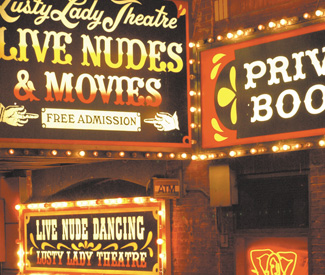
San Francisco’s sex workers rights history includes two unions. Workers at the North Beach strip club the Lusty Lady formed the Exotic Dancers Union in 1997. The union became part of the Service Employees International Union, and the Lusty Lady remains the only collectively run, sex-worker-owned strip club in the United States.

Maxine Doogan founded the Erotic Service Providers Union (ESPU) in 2004 as an umbrella organization for sex workers in various industries. The ESPU has been active in opposing regulations of the massage industry and sponsoring Proposition K, a 2008 ballot measure that would have decriminalized sex work in San Francisco.

I spoke to a handful of Bay Area sex-workers rights activists to get a sense of the major issues and priorities for the next year.

NO VISAS

Activists are currently planning for the July, 2012 International AIDS Conference in Washington, D.C.

Many international sex workers rights advocates have been denied visas to get to the conference. The U.S. typically bars convicted felons — but there’s a special exception for people guilty of misdemeanor prostitution charges.

“SWOP has an idea of getting in touch with some of the people denied entrance and asking them what they were going to present on and to try and present their papers in their place, to make sure these organizers voices are heard,” said SWOP-Bay Area spokesperson Shannon Williams.

But that’s not where the government’s weird exclusion of sex workers from its efforts to fight AIDS ends.

The Presidents Emergency Plan for AIDS Relief (PEPFAR) fund allocates $48 billion to organizations around the world engaged in AIDS treatment and prevention. But thanks to the religious right, the law, approved in 2003, includes a stipulation that all recipient groups must make a pledge decrying prostitution. It’s known as the “anti-prostitution loyalty oath.”

A court ruling July 6, 2011 declared the oath a violation of the free-speech rights of organizations in the United States, but the U.S. still blocks PEPFAR funding for international organizations based on the “loyalty oath.”

“Sex worker activists are going to converge in D.C. for the AIDS conference and talk about the loyalty oath. The US is exporting its ideology through this funding requirement” said Carol Leigh, a longtime activist who curates the annual San Francisco Sex Worker Film and Art Festival.


EMPHASIZING CONSENT

Sex workers rights activists continue to be engaged in their complex, decades-long struggle with anti-sex trafficking organizations.

People who want safer working conditions say that decriminalization would make it easier for police to distinguish between coerced and consensual prostitution and encourage those with knowledge of crimes perpetuated against sex workers to come forward without risking prosecution for their own illegal work.

But many anti-trafficking advocates dismiss the distinction between forced and consensual prostitution in their efforts. According to a document called “Ten reasons for not legalizing prostitution,” on the website of the Coalition Against Trafficking in Women, “There is no doubt that a small number of women say they choose to be in prostitution, especially in public contexts orchestrated by the sex industry… In this situation, it is harm to the person, not the consent of the person that is the governing standard (emphasis theirs).”

It’s this refusal to acknowledge the importance of consent that really pisses off advocates —and has a powerful effect on the policy that governs them.

The federal definition of sex trafficking includes consensual prostitution, and defines coerced prostitution as “severe sex trafficking.” “Law enforcement agencies can use anti-trafficking funds to arrest sex workers in prostitution, on the grounds that the feds define all prostitution as trafficking, even though the government distinguishes between trafficking and severe trafficking,” said one sex workers rights activist.

According to Leigh, anti-trafficking organizations are not all bad; she named the Global Alliance Against Traffic in Women as an organization that “has been allied with sex workers rights movement and takes rights-based approach.”

But organizations that conflate consensual and coerced commercial sex are often big-time recipients of public and private funding.

Doogan is wary of any attempt to further regulate or criminalize sex work. She says that often, laws meant to deter prostitution trap people who may want to change occupations.  “Women have to continue working in the industry because no one else will take them for work when they have those convictions on their record,” said Doogan.

That may be the case with Lola, an occasional Erotic Service Providers Union volunteer who was arrested on prostitution-related charges outside California earlier this year. She moved to the Bay Area and is looking for a job, but after a promising interview last week, she’s nervous that a background check will reveal her arrest.

“I’m waiting to hear whether that’s going to be an issue or not. They could tell my landlord, and then I could lose my house too…all I’m trying to do is get a job,” Lola told the Guardian.


THE WORK GOES ON

For most sex-workers rights activists, the long-term goal remains decriminalization. For now education, creative projects, and protest in service of that goal continue.

Members of SWOP-Bay Area have a program called Whorespeak that does outreach at colleges, and “we’ve also been speaking in classes for therapists about how to work with current and former sex workers and not pathologize them,” said Williams.

According to Stryker, one of the most exciting projects happening now is Karma Pervs. The website, run by local queer porn star Jiz Lee, sells unique sex-positive porn and donates the proceeds to organizations like the Saint James Infirmary.

Then, of course, there’s the International Day to End Violence Against Sex Workers, when sex workers and allies gather to commemorate sex workers who have been assaulted and killed.

Sex workers often can’t go to police to report crimes for fear of being locked up themselves, society retains a huge stigma surrounding sex work, and there is an insidious cultural myth that “you can’t rape a prostitute.” These all add up to put sex workers at high risk for assault and murder; serial killers, such as the Green River Killer in Seattle and a murdered in Long Island-area this past summer, are disproportionately likely to target prostitutes.

That’s why, for Williams, “Our long-term goal is to decriminalize prostitution. But the real goal is to end violence against sex workers.”

Plastic bags banned from all SF stores

12

The Board of Supervisors voted to expand a 2007 ban on plastic checkout bags to cover all retail and food establishments.

The law bans all businesses from providing plastic bags to customers. It also requires a ten cent fee for paper bags, to be pocketed by the store. With the ban, only paper bags, compostable bags, and reusable bags will be permitted at checkout. The city hopes to encourage shoppers to carry reusable bags.

Supervisors acknowledged that this ordinance could create confusion and inconvenience for business owners.

Many supervisors, notably Chiu and Weiner, emphasized that in the past few months they had done outreach in their districts, explaining the bill at open forums and neighborhood association meetings, and getting community feedback.

Two amendments– an exemption of certain items, such as fresh flowers, bulk candy and loose nails, and a cap of the paper bag cost at ten cents- -were the were results of community feedback.

With the amendments, the ban passed unanimously, with ten votes (Supervisor David Campos was ill and not in attendane.)

Melanie Nutter, Director of the city’s Department of the Environment, helped lead the outreach efforts.

“I am pleased. The legislation being considered today will encourage customers to reuse their bags. This will dramatically reduce the impact of hundreds of millions of disposable bags currently in use in our city. These bags end up on our streets, in our bay and oceans, and in landfills,” said Nutter.

The most notorious effect of plastic pollution on the Pacific Coast is the “Great Pacific Garbage Patch,” a floating conglomeration of trash that has been known to kill marine life and has been a target of environmental concern.

The ban will take effect Oct. 1.

Nutter said that the city is looking into a bag giveaway program to ease access to reusable and compostable bags for consumers and businesses. She added that, for businesses that are not able to use up their inventory of plastic bags by Oct. 1, some exemptions to the implementation date may be made.

Original legislation to ban plastic bags from grocery stores and chain pharmacies passed in 2007.  Since, several California cities have followed suit, including Malibu, Palo Alto, Los Angeles, San Jose and Long Beach.

“Now, it’s time for San Francisco to catch up and continue to show environmental leadership,” said Supervisor Christina Olague.

On the Cheap Listings

0

WEDNESDAY 8

Aphrodesia Afterhours Valentine’s Day Conservatory of Flowers, Golden Gate Park, 100 John F. Kennedy, SF. (415) 831-2090, www.conservatoryofflowers.org. 6 p.m.-10 p.m., $10.

Chocolate is hands down the best part of Valentine’s Day. Join local chocolatier TCHO’s chief chocolate guru, Brad Kintzer, for his demonstration on how to transform beans into bliss. Afterwards, grab a love potion from the Cocktail Lab, frolic amongst the orchids, and enjoy a live performance by Le Quartet de Jazz. Remember to take a picture in the photobooth — a night dedicated to chocolate is a night to remember.

Love on Wheels dating game Public Works, 161 Erie, SF. (415) 932-0955, www.sfbike.org. 6 p.m., $5 for SF Bicycle Coalition members; $10 for non-members. The cutest people always seem to be railing past each other on their bikes. The SF Bicycle Coalition is going to sit all you guys down so you can date already. Lovebirds will quiz three potential dates (hidden from view) and go on a date provided by one of the sponsors. This annual tradition is a cute hoot.

THURSDAY 9

“Animal Attraction” NightLife aquarium gallery and sex talk California Academy of Sciences, 55 Music Concourse, SF. (415) 379-8000, www.calacademy.org. 6 p.m.-10 p.m., $12. Cal Academy’s weekly Thursday evening party, NightLife, is launching a new gallery for fish-lovers (and friends!) with a series of reproduction-themed talks. Various experts will be talking about mating strategies in the animal kingdom, penis bones of different species, and the sex life of Zodiac signs. Dr. Carol Queen from Good Vibrations will be sharing her knowledge about the science of orgasms. So let’s do like they do on the Discovery Channel.

“Cupid’s Back” sixth annual Valentine’s Day party Supperclub, 657 Harrison, SF. (415) 348-0900, cupidsback.kintera.org. 8 p.m.-midnight, $30-35. Gay charity impressario Mark Rhoades is back — like Cupid, you might say — with this popular shindig that brings together oodles of hot men. DJ Juanita More will fluff the crowd, and it all goes to help out our invaluable GLBT Historical Society. Shoot your arrow and it goes real high …

“Go Deep” lube wrestling for the boys El Rio, 3158 Mission, SF. (415) 379-8000, www.calacademy.org/events/nightlife. 8 p.m.-11:30 p.m., $10–<\d>$15. What says romance more than watching half-naked queer boys with fantastical monikers like Yogzar and Red Dragon wrestling in a vat of lube? Slide your way into V-Day at this monthly grip ‘n slip put on by neo-Vaudevillian troupe SF Boylesque, with DJ Drama Bin Laden, a performance by the Bohemian Brethren, and Cajon food from Family Meal available on the back patio.

FRIDAY 10

Bardot A Go Go Pre-Valentine’s Dance Rickshaw Stop, 155 Fell, SF. (415) 861-2011, www.bardotagogo.com. 9 p.m., $10. “Music by French people for everybody” is the motto of the neato longtime roving Bardot A Go Go — and that includes a bubbly beretful of cute folks who revel in 1960s pop glamour filtered through contemporary va-va-voom. Live band Nous Non Plus is très adorable, and DJs Pink Frankenstein, Brother Grimm, and Cali Kid bring French kisses galore. Plus: free hairstyling by Peter Thomas Hair Design, d’accord.

I Heart Some Thing The Stud, 399 9th St., SF. (415) 863-6623, www.studsf.com. 10 p.m.-late, $8. “We love love! We just love it!” scream the awesome queens of Some Thing, the mind-altering weekly friday drag show and party at the Stud. You may detect a hint of the sardonic in there, but the smart Some Thingers always cover their bases with a healthy dose of sincerity to go with the staged pop culture send-ups. heart-shaped performers include Glamamore, Manicure Versace, Cricket Bardot, and Nikki Sixx Mile. Afterhours dancing, too.

Mortified’s Annual Doomed Valentine’s Show DNA Lounge, 375 11th St., SF. (415) 626-1409, www.getmortified.com. 7:30 p.m., $14 adv; $21 at door. Do you remember your first kiss when you went in for the gold, missed completely, and your lips puckered mid-air? Well, the folks at Mortified sure do. They have sorted through the oldest and nerdiest notebooks, letters, photos, and shoeboxes so that they can share with you their most humiliating romantic encounters. Reinvigorate your disdain for this holiday by taking comedic comfort in the mishaps of these thick-skinned Valentine’s veterans.

Ninth Annual Food from the Heart Festival Ferry Building Marketplace, 1 Ferry Building, SF. (415) 983-8000, www.ferrybuildingmarketplace.com. Through Saturday. 5:30-8 p.m., free entrance. Nothing says “I love you” like food. Give the gift of a happy stomach to your lover this Valentine’s in the candlelit Grand Nave of the Ferry Building, with a night of dancing and eating. Revel in the magic of the waterfront, sip on wine poured by local Napa Vinters, and taste a scrumptious hors-d’oeuvre or five.

“On The Edge 2” erotic photography exhibition Gallery 4N5, 863 Mission, SF. (415) 522-2400, www.gallery4n5.com. Through Sunday. Gallery hours Fri., 4 p.m.-9 p.m.; Sat., 11 p.m.-9 p.m.; Sun., noon-5 p.m., free. Valentine’s Day may be about romance for some people, but for us it’s about getting naked. (And eating, but mostly getting naked.) This group exhibition features 400 pictures of artful sexiness taken by 25 erotic photographers who bring on the nudes.

SATURDAY 11

“Drunk with Love” with Carol Peters The Emerald Tablet, 80 Fresno, SF. (415) 500-2323, www.carolpeters.net. 8 p.m., $10. Carol Peters, a.k.a. “Velvet Voice,” is known for her passionate and amorous renderings. For one steamy night in light of Valentine’s Day, Peters will grace the stage to croon sensual tunes that capture the many dimensions of love.

Valentine’s Surprise SF Lindy Ball Womens Building, 3543 18th St., SF. sfswingjam.eventbee.com. 7:30 p.m.-12:30 a.m., $22 This Lindy Hop and Swing ball is actually the centerpiece of a three-day swing summit in celebration of romance (check the website for full line-up) — because what says, “I love you” more than artfully mopping the floor with your partner? We sure don’t know. Hoppin’ workshops and technique tune-up sessions complement the ball, which consists of a Lindy contest, live swing music, and a surprise 91st birthday celebration for classic movie star Ray Hirsch.

Watson’s “Naked at the Art Museum Scavenger Hunt” Legion of Honor, 34th Ave, SF. (415) 750-3600, legionofhonor.famsf.org. Through Sunday. 2 p.m.-4:30 p.m., $20. Who said museums had to be tame? Bring a lover or friend this weekend to the Legion of Honor for a sexy scavenger hunt. You will scope the halls for studly sculptures, titillating paintings, bathing beauties, and many sexy inanimate objects more. Museums will never be the same again.

SUNDAY 12

SF Mixtape Society’s “Under The Covers” music exchange and contest The Make-Out Room, 3225 22nd St, SF. (415) 440-4177, www.sfmixtapesociety.com. 6 p.m., free with mix. Don’t have someone to make a mixtape for this year? It’s OK. Your ex’s music taste was awful anyways! Put that playlist you love on a CD, cassette, or USB drive and have it land right in the ears of a random yet lucky someone. You’ll end the night with someone else’s coveted mix, and everyone will get to vote for the playlist with the best track listings and artwork.

MONDAY 13

Litquake Literary Festival presents: Love Hurts readings of grief-stricken passages of love and lust The Make-Out Room, 3225 22nd St, SF. (415) 440-4177, www.litquake.org. 7 p.m., $10. Ten Bay Area writers will give their own cynical (and mostly hilarious) twists on the forlorn words of some of the most melancholic and/or melodramatic novels ever written. Come sort out the parallels between drug dependency and romance in Valley of the Dolls, the masochistic plotline of The Story of O, and many more classics that well forewarned of broken hearts.

TUESDAY 14

Club Neon’s Eighth Annual Vaslentine’s Day Underwear Party The Knockout, 3223 Mission, SF. (415) 550-6884, www.theknockoutsf.com. This is THE event for fresh and nubile indie heartbreakers, stripping down to make you all “damn!” and stuff. One of our favorite annual pantsless throwdowns, with steamy rock DJs Jamie Jams and EmDee making you want to take it all off.

The Fifth Annual Poetry and Music Battle of ALL of the Sexes Uncle Al and Mama Dee’s Cafe at POOR Magazine, 2940 16th St, SF. (415) 865-1932, www.poormagazine.org. 7 p.m., $5-$20 suggested donation for dinner and show. Instead of scribbling your words in to a Hallmark card, show off your love this Valentine’s in rhyme and verse. All proceeds will support POOR magazine, a local arts organization that advocates education and media access for struggling communities. The theme is 1950s, but the beats will be timeless.

Love Story film showing and gala with Justin MX Bond Castro Theatre, 429 Casto, SF. (415) 621-6120, www.castrotheatre.com. 8 p.m., $10 film only; $25 for gala tickets. Relive the drama, the tragic heartaches, and the swooning love story of the 1970 film classic. Ali MacGraw will be at the Castro mezzanine in person, “Theme from Love Story” will be sung by Katya Smirnoff-Skyy, and special guest Mx Justin Vivian bond will be doing a “sorry” medley.

Passion Punch Valentine’s day kickboxing class UFC Gym, 1975 Diamond, Concord. (925) 265-8130, www.ufcgyms.com. 6:30 p.m., free. Valentine’s got you foaming at the mouth? Let it out. This 60-minute class will incorporate dynamic boxing moves so that you can punch away all the annoyances you will be feeling by the end of this day.

The Crackpot Crones present “I Hate Valentine’s Day” sketch comedy and improv show The Dark Room, 2263 Mission, SF. (415) 648-5244, www.crackpotcrones.com. 8 p.m., $20. Outrageous duo Terry Baum and Carolyn Myers are providing a public service for the romantically challenged. They will be making fun of everything Valentine’s related — especially silly little concepts like true love and soul mates. Belt along to the song, “The Twelve Days of Being Dumped,” and give your best evil cackle at this sketch comedy show.

Valentine’s Day Party with T.I.T.S and Uzi Rash Hemlock, 1131 Polk, SF. (415) 923-0923, www.hemlocktavern.com. 9 p.m., free. There is no need for all the fuss, the fancy gifts, the cutesy ribbons, or the overpriced dinner. If you’re sick of the pink, come dance your anti-heart out at this doom punk show. Flowers wilt anyways.

Rep Clock

0

Schedules are for Wed/8-Tues/14 except where noted. Director and year are given when available. Double and triple features are marked with a •. All times p.m. unless otherwise specified.

ARTISTS’ TELEVISION ACCESS 992 Valencia, SF; www.atasite.org. $6-10. Dirty Looks presents: City of Lost Souls, Fri, 8. “Mindscapes,” short films, Sat, 8.

CALIFORNIA COLLEGE OF THE ARTS 1118 Eighth St, SF; www.dirtylooksnyc.org. Free. Dirty Looks presents: “Queer Conversations on Culture in the Arts,” with selections from the “Female Trouble” experimental shorts program and a conversation with Margaret Tedesco, Thurs, 7.

CASTRO 429 Castro, SF; (415) 621-6120, www.castrotheatre.com. $7.50-10. •Pickpocket (Bresson, 1959), Wed, 3:30, 7:15, and American Gigolo (Schrader, 1979), Wed, 4:55, 8:45. •Beauty and the Beast (Cocteau, 1946), Thurs, 3:05, 7, and No Such Thing (Hartley, 2001), Thurs, 4:55, 8:50. “Midnites for Maniacs: I’m Black and I’m Proud:” •I’m Gonna Git You Sucka (Wayans, 1988), Fri, 7:30; Pootie Tang (Louis CK, 2001), Fri, 9:30; CB4 (Davis, 1993), Fri, 11:30. French American International School presents: “I-Speak: Celebrating 50 Years of International Education,” Sat, 6:30. This event, $5-10; tickets at www.internationalsf.org. •Do The Right Thing (Lee, 1989), Sun, 2, 8, and Malcolm X (Lee, 1992), Sun, 4:15. “Love: Ali MacGraw:” Love Story (Hiller, 1970), Tues, 8. With pre-show gala performance and MacGraw in person; for tickets ($25-45), visit www.ticketfly.com.

ELMWOOD 10070 San Pablo, El Cerrito; www.rialtocinemas.com. Free. “Community Cinema:” More Than a Month: One Man’s Journey to End Black History Month (Tilghman, 2012), Wed, 7.

CHRISTOPHER B. SMITH RAFAEL FILM CENTER 1118 Fourth St, San Rafael; (415) 454-1222, www.cafilm.org. $6.75-10.25. “Rafael Film Club:” “Jan Wahl,” Thurs, 1. Pina (Wenders, 2011), call for dates and times. “Mostly British Film Festival:” Route Irish (Loach, 2010), Wed, 7; Albatross (MacCormick, 2011), Thurs, 7. “2012 Oscar Nominated Short Films,” narrative and documentary (separate admission), Feb 3-9, call for times.

LAMORINDA THEATRES Four Orinda Theatre Square, Orinda; www.caiff.org. $12-15. “California Independent Film Festival,” 11 features, plus docs, shorts, and educational seminars, Feb 10-16.

MECHANICS’ INSTITUTE 57 Post, SF; (415) 393-0100, rsvp@milibrary.org. $10. “CinemaLit Film Series: Hollywood Dames: Beauty and Brains:” Intermezzo (Ratoff, 1939), Fri, 6.

PACIFIC FILM ARCHIVE 2575 Bancroft, Berk; (510) 642-5249, bampfa.berkeley.edu. $5.50-9.50. “Documentary Voices:” The Green Wave (Ahadi, 2010), Wed, 7. “Seconds of Eternity: The Films of Gregory J. Markopoulos:” “Markopoulos: The Early Films (1940-49)” Thurs, 7; “Eros and Myth (1950-63),” Sat, 6:30. “Austere Perfectionism: The Films of Robert Bresson:” The Trial of Joan of Arc (1962), Fri, 7; Les dames du Bois du Boulogne (1945), Fri, 8:25; Lancelot of the Lake (1974), Sat, 8:30. “Screenagers: 14th Annual Bay Area High School Film and Video Festival,” Sat, 3. “Howard Hawks: The Measure of Man:” The Criminal Code (1931), Sun, 4:30; Bringing Up Baby (1938), Tues, 7. “African Film Festival 2012:” Viva Riva! (Munga, 2010), Sun, 6:30.

ROXIE 3117 and 3125 16th St, SF; (415) 863-1087, www.roxie.com. $6.50-10. Come Back, Africa (Rogosin, 1959/2012), Wed-Thurs, 6:45, 8:30. Drive (Winding Refn, 2011), Wed, 8:45. Into the Abyss (Herzog, 2011), Wed, 6:45. SF IndieFest, Feb 9-23. Visit www.sfindie.com for complete schedule.

SFFS | NEW PEOPLE CINEMA 1746 Post, SF; www.sffs.org. $10-11. Domain (Chiha, 2010), Wed-Thurs, 2, 4:30, 7, 9:30. Once Upon a Time in Anatolia (Ceylan, 2011), Feb 10-16, 2, 5:30, 8:30.

TWINSPACE CONTINUUM 2111 Mission, Third Flr, Ste 3, SF; www.blockreportradio.com. $15. “Human Rights and Hip-Hop Film Festival,” documentaries and shorts, Fri, 5; Sat, 6:30.

VOGUE 3290 Sacramento, SF; www.mostlybritish.org. $12.50. “Mostly British Film Festival:” Black Butterflies (van der Oest, 2011), Wed, 5; London Boulevard (Monahan, 2010), Wed, 7:15; The Great White Silence (Ponting, 1924), Wed, 9:30; A Passionate Woman (2010), Thurs, 5; Route Irish (Loach, 2010), Thurs, 7:30.

VORTEX ROOM 1082 Howard, SF; www.myspace.com/thevortexroom. $7 donation. “The Second Coming of the Vortex Room:” The Second Coming of Suzanne (Barry, 1974), and Marjoe (Kernochan and Smith, 1972), Thurs, 8.

YERBA BUENA CENTER FOR THE ARTS 701 Mission, SF; (415) 978-2787, www.ybca.org. $6-8. “Bros Before Hos:” The Killing of a Chinese Bookie (Cassavetes, 1976), Thurs, 7:30; “Female Trouble,” experimental shorts program presented by Dirty Looks curator Bradford Nordeen, Sun, 2.

Film Listings

0

Film listings are edited by Cheryl Eddy. Reviewers are Kimberly Chun, Max Goldberg, Dennis Harvey, Lynn Rapoport, and Matt Sussman. For rep house showtimes, see Rep Clock. For complete listings, including more Ongoing films, see www.sfbg.com.

INDIEFEST

The 14th San Francisco Independent Film Festival runs Feb 9-23 at the Roxie Theater, 3117 16th St, SF. For tickets (most films $11) and schedule info, visit www.sfindie.com. For commentary, see “Twisted Misters.”

OPENING

*Elite Squad: The Enemy Within A huge hit in its native Brazil, this drama from director José Padilha (2002’s Bus 174) uses insane amounts of bullets to spin a twisted tale of police and government corruption. It’s a sequel of sorts to 2007’s The Elite Squad, though having missed that film isn’t a barrier to enjoying part two. Special ops cop Roberto Nascimento (Wagner Moura) returns; he’s higher up the bureaucratic food chain, but finds himself locked in a constant battle with bad guys both criminal and co-worker. (“I created the monster that would eat me up,” he realizes after an elaborate scheme to eliminate drug dealers and dirty cops goes horribly awry.) Meanwhile, his wife is now his ex-wife, and she’s remarried a lefty politician (Irandhir Santos) who’s particularly interested in exposing the same villains making Nascimento’s life hell, while also making Nascimento’s life hell himself. Fans of The Wire and particularly City of God — Enemy co-writer Bráulio Mantovani was an Oscar nominee for that 2002 film — will have particular interest in Enemy, though it never quite achieves those works’ memorable heights. One possible reason: too much Nascimento voice-over. How do you say “show me, don’t tell me” in Portuguese? (1:55) Four Star. (Eddy)

*I Am Bruce Lee Not to be confused with Bruce Lee: A Warrior’s Journey (2000), this Spike TV co-production is nonetheless a similarly praise-filled portrait of the groundbreaking, charismatic action star. Warrior’s Journey‘s main coup was revealing long-thought-lost footage from 1978’s The Game of Death, one of only five feature films starring Lee (two of which were posthumous, including 1973 smash Enter the Dragon). I Am Bruce Lee tilts more toward exploring Lee’s lasting legacy — an extended debate over whether or not he invented what we now call “mixed martial arts” definitely plays to the doc’s Spike TV interests — but also contains the expected biography, with an emphasis on Lee’s unique approaches to martial arts and philosophy, as well as input from suspects usual (Lee’s widow and daughter, top Lee student Dan Inosanto, etc.), understandable (boxer Manny Pacquiao, martial arts champ Cung Lee), and fanboy (Mickey Rourke, Ed O’Neill). Screening in a very limited run, I Am Bruce Lee is a flashy, entertaining primer for beginning students of Lee (lesson one: he was basically the coolest guy who ever lived); longtime fans may not learn anything new, but will no doubt find much to enjoy anyway. (1:34) Four Star, Metreon. (Eddy)

Journey 2: The Mysterious Island Dwayne Johnson and Vanessa Hudgens play a father-daughter team of explorers in this sequel to 2008’s Journey to the Center of the Earth. (1:34)

Once Upon a Time in Anatolia Turkish director Nuri Bilge Ceylan’s deconstructed Turkish police procedural offers little action but plenty of atmosphere. The search for a corpse by a group of men — a prosecutor, a commissar, a doctor, and their two main suspects— through the desolate, wind-scoured hills of rural Anatolia, is in fact something of a Hitchcockian MacGuffin. Ceylan’s real investigation is philosophical, zeroing in on the way in which each of these men constructs his own truth out of the re-telling and mis-telling of past events. And the drudgery of this protracted investigation, much of it depicted in real-time, provides plenty of opportunities for all of the players to tell their stories or to simply ruminate, often bitterly, about their own lives. There is palpable loneliness that courses through all the chatter, formally mirrored by Ceylan’s penchant long-takes of isolated figures swallowed by the countryside or the darkness of night. But despite the endless landscape that surrounds them, there is no exit for these small men. (2:37) SF Film Society Cinema. (Sussman)

Safe House Denzel Washington is a rogue CIA agent who goes on the run with a rookie (Ryan Reynolds) when mercenaries attack. (2:00) Presidio.

Star Wars: Episode 1: The Phantom Menace 3D Spoiler alert: no matter how rad the special effects look in 3D, this movie will still contain Jar Jar Binks. (2:16)

This Means War Another flick about battlin’ CIA agents — this time, though, it’s Chris Pine and Tom Hardy fighting over Reese Witherspoon. (2:00)

“2011 Oscar-Nominated Short Films, Live Action and Animated” See the shorts tipped to compete for Oscar gold in two separate programs, divided into live-action and animated films. Lumiere, Opera Plaza, Shattuck, Smith Rafael.

The Vow Sorry Rachel McAdams and Channing Tatum, but 1987’s Overboard is the best amnesia-themed romance of all time. (1:44) Marina.

W.E. Madonna’s having a big week, no? (1:59) Bridge.

ONGOING

Big Miracle Three gray whales trapped beneath the Beaufort Sea ice near the tiny town of Barrow, Alaska become an international cause célèbre through the uneasily combined efforts of an Anchorage reporter (John Krasinski), a Greenpeace activist (Drew Barrymore), a group of chainsaw-toting Inupiaq fishermen, a Greenpeace-hating oilman (Ted Danson), a Reagan-administration aide (Vinessa Shaw), a U.S. Army colonel (Dermot Mulroney), a pair of Minnesotan entrepreneurs (James LeGros and Rob Riggle) with a homemade deicing machine, and the crew of a Soviet icebreaking ship. The magical pixie dust of Hollywood has been sprinkled liberally over events that did indeed take place in 1988, but the media frenzy that blossoms out of one little local newscast is entirely believable. Everyone loves a good whale story, and this one is a tearjerker — though the kind that parents can bring their kids to without worrying overly much about subsequent weeks of deep-sea-set nightmares and having to explain terms like “critically endangered Western North Pacific gray whale” if they don’t want to. The film makes clear that the weak-on-the-environment Reagan administration and Danson’s oilman stand to gain some powerfully good PR from this feat, with potentially devastating ecological results down the line, and Barrymore’s character gets to recite a quick litany of impending oceanic catastrophes. But this kind of talk is characterized as less useful than a nice, quick, visceral pull on the heartstrings, and while offering us the pleasurable sight of whales breaching in open water, the film avoids panning out too much farther, which may be why the miracle looks so big. (2:03) 1000 Van Ness. (Rapoport)

*Chronicle A misfit (Dane DeHaan) with an abusive father and an ever-present video camera, his affable cousin (Matt Garretty), and a popular jock (Michael B. Jordan) discover a strange, glowing object in the woods; before long, the boys realize they are newly telekinetic. At first, it’s all a lark, pulling pranks and — in the movie’s most exhilarating scene — learning to fly, but the fun ends when the one with the anger problem (guess which) starts abusing the ol’ with-great-power-comes-great-responsibilities creed. Chronicle is a pleasant surprise in a time when it’s better not to expect much from films aimed at teens; it grounds the superhero story in a (mostly) believable high-school setting, gently intellectualizes the boys’ dilemma (“hubris” is discussed), and also understands how satisfying it is to see superpowers used in the service of pure silliness — like, say, pretending you just happen to be really, really, really, good at magic tricks. First-time feature director Josh Trank and screenwriter Max “son of John” Landis also find creative ways, some more successful than others, to work with the film’s “self-shot” structure. The technique (curse you, Blair Witch) is long past feeling innovative, but Chronicle amply justifies its use in telling its story. (1:23) 1000 Van Ness. (Eddy)

*Come Back, Africa Opposition to apartheid didn’t really pick up steam as a popular cause in the U.S. until the early 1980s. Which makes it all the more remarkable that New York City-based documentarian Lionel Rogosin made Come Back, Africa (1959) about a quarter-century earlier — though less surprisingly, the film itself was barely seen here at the time. Now finally playing American theaters outside his home town in a restored print, it’s a time capsule whose background is as intriguing as the history it captures onscreen. The horrors of World War II and some subsequent global travel had stirred a profound awareness of social injustices in Rogosin, who began planning a feature about South Africa while still working at his father’s textile business. He had very little filmmaking experience, however, so he took $30,000 of his earnings and as “practice” made On the Bowery (1956), a semi staged portrait of Manhattan’s skid row area that won considerable praise, if also some shocked and appalled responses from Eisenhower-era keepers of America’s wholesome, prosperous self-image. Armed with the confidence bestowed by that successful effort and several international awards, Bogosin traveled to South Africa — not for the first time, but now with the earnest intent of making his expose. In the mid- to late ’50s, however, that was hardly a simple task. The film, which mixes a loose, acted narrative with completely nonfiction elements, follows the luckless wanderings of an agreeable protagonist played by a first-time actor — Zacharia Mgabi, a 30-ish bearded worker “discovered” on a bus queue. His character, Zachariah, is caught in one catch-22 of apartheid life: he can’t get a job without the appropriate permits, and can’t get the permits without a job. And so on. All show and almost no “tell,” Come Back, Africa wasn’t shown in South Africa until the late 1980s; it nonetheless proved a great influence on development of the whole continent’s indigenous cinematic voices. (1:24) Roxie. (Harvey)

*Coriolanus For his film directing debut, Ralph Fiennes has chosen some pretty strong material: a military drama that is among Shakespeare’s least popular works, not that adapting the Bard to the screen has ever been easy. (Look how many times Kenneth Branagh, an even more fabled Shakespearean Brit on stage than Ralph, has managed to fumble that task.) The titular war hero, raised to glory in battle and little else, is undone by political backstabbers and his own contempt for the “common people” when appointed to a governmental role requiring some diplomatic finesse. This turn of events puts him right back in the role he was born for: that of ruthless, furious avenger, no matter that now he aims to conquer the Rome he’d hitherto pledged to defend. The setting of a modern city in crisis (threadbare protesting masses vs. oppressive police state) works just fine, Elizabethan language and all, as does Fiennes’ choice of a gritty contemporary action feel (using cinematographer Barry Ackroyd of 2006’s United 93 and 2008’s The Hurt Locker). He’s got a strong supporting cast — particularly Vanessa Redgrave as Coriolanus’ hawkish mother Volumnia — and an excellent lead in one Ralph Fiennes, who here becomes so warped by bloodthirst he seems to mutate into Lord Voldemort before our eyes, without need of any prosthetics. His crazy eyes under a razored bald pate are a special effect quite alarmingly inhuman enough. (2:03) Embarcadero. (Harvey)

*Haywire Female empowerment gets its kung-fu-grip thighs around the beet-red throat of all the old action-heroes. Despite a deflated second half — and director Steven Soderbergh’s determinedly cool-headed yet ultimately exciting-quelling approach to Bourne-free action scenes — Haywire is fully capable of seizing and demanding everyone’s attention, particularly that of the feminists in the darkened theater who have given up looking for an action star that might best Angelina Jolie’s Lara Croft. Former pro mixed martial arts fighter Gina Carano, who plays it as studiedly intense and charismatic as crossover grapplers Lee, Norris, and Seagal before her, is that woman, with convincingly formidable neck and shoulder muscles to distract from her curves. Her Mallory Kane is one of the few women in Haywire‘s pared-down, stylized mise-en-scene — the lone female in a world of men out to get her, starting with the opening diner scene of a watchful Mallory confronted by a man (Channing Tatum) playing at being her boyfriend, fed up with her shit, and preparing to pack her into the car — a scenario that doubtless many rebel girls can relate to until it explodes into an ultraviolent, floor-thrashing fight scene. Turns out Mallory is an ex-Marine and Blackwater-style mercenary, ready to get out of the firm and out of a relationship with her boss, Kenneth (Ewan McGregor), when she learns, the bruising way, that she’s been set up. The diner scene sets the tone for rest of Haywire, an otherwise straightforward (albeit flashback-loaded) feminist whodunit of sorts, limned with subtextual currents of sexualized violence and unfolding over a series of encounters with men who could be suitors — or killers. (1:45) California, 1000 Van Ness. (Chun)

*Pariah A teenage girl stands stock-still in a dark nightclub, gazing with desire and fear at the half-naked female dancers on the stage. Later, riding home on the bus, she slowly removes the layers of butch that held her together in the club, stripping down to some version of the person her parents need to see when she walks in the door. Nearly wordlessly, the opening scenes of Dee Rees’s Pariah poignantly depict the embattled internal life of Alike (Adepero Oduye), a 17-year-old African American girl living in Brooklyn with her family and struggling both to be seen as she is and to determine what that might look like. The battles are being waged externally, too, between Alike’s adoring father (Charles Parnell), living in willful ignorance, and angry, rigid mother (Kim Wayans), desperately enforcing a feminine dress code and steering Alike away from openly butch friend Laura (Pernell Walker). Rees’ script beautifully conveys a household of landmines and chasms, which widen as husband and wife and daughter struggle and fail to communicate, asking the wrong questions, fearfully skirting the truth about Alike’s sexuality and her parents’ crumbling marriage. And the world outside proves full of romantic pitfalls and the tensions of longtime friendship and peer pressure. The poems in which the talented Alike takes solace and makes her way toward a more truthful existence are beautiful, but at a certain point the lyricism overtakes the film, forcing an ending that is tidy but less than satisfying. (1:26) Lumiere, SF Center. (Rapoport)

The Woman in Black Daniel Radcliffe (a.k.a. Harry Potter) plays a grieving young widower in an old-fashioned ghost story, set in the era of spirit hands and other visitations from beyond the veil. But while Victorian séances were generally aimed at the dearly departed, the titular visitant (Liz White), who haunts the isolated estate of Eel Marsh House and its environs, is a vindictive, mean-spirited creature, avenging the long-ago loss of her child by wreaking havoc and heartbreak among the families of the nearby village, among them a local landowner (Ciarán Hinds) and his wife (Janet McTeer). Radcliffe’s character, a lawyer named Arthur Kipps, has been tasked with settling the affairs of the mansion’s recently deceased owner, an assignment that requires sifting through mounds of dusty, crumpled ephemera in one of the creakiest, squeakiest buildings ever constructed. Set at the end of a narrow spit of land that disappears into the surrounding wetlands when the tide is high, Eel Marsh House is a charming place to be marooned after dark. But no amount of horrified screams from the audience will keep Kipps from his duties, though it’s hard to make much headway amid the unrelenting creepiness. Nearly every moment brings a fresh inexplicable thumping noise from an upper floor; a new room full of dead-eyed dolls that Kipps has no business wandering into; another freakishly screaming face next to his as he gazes out the window. The house is a richly textured set piece; the horror is of the sort that makes you jump and then laugh, both at the filmmakers, for springing the same tricks on you over and over, and at yourself, for falling prey to them every time. (1:36) 1000 Van Ness, Shattuck. (Rapoport)

Hippies do it better

0

caitlin@sfbg.com

HERBWISE I am not given overmuch to squealing over technology, particularly weed technology. Over the past few months I have sampled candy cane-flavored rolling papers, a cannabis aphrodisiac shot, the Ziggy Marley-endorsed Marijuana Man comic book.

Mind you, I’m not complaining. But –- minus perhaps Humboldt Hemp Wicks –- none of those products have found their way into my everyday retinue. Until, that is, the subject of last week’s Herbwise, Randy Thompson of the vaporizer website Puff it Up, introduced me to a singular machine.

The Magic-Flight Launch Box is a thing of beauty. A clean maple wood box barely larger than a matchbox, it makes the black plastic tabletop models I once associated with vaporizing look clunky, wasteful. Vaporizing, university studies show, cuts down on the lung-coating tar that results from pipes and joints. Plus, it imparts a much cleaner marijuana taste –- perfect for the scores of cannabis connoisseurs who are popping up across the Bay Area.

Operating the Launch Box is simple. Insert the glass mouthpiece into the small round hole, a battery (two lithium batt’s and a recharger come with the starter kit) into the large round hole, press down for about five seconds, and inhale. No wall jack, no noise, no black plastic. The back of the box is engraved with a manifesto on what love is.

Obviously, hippies made it. Namely, a one Forrest Landry, who in a recent phone interview with the Guardian explained that the Launch Box’s ingenious design is a reflection of a New Age philosophy he’s cultivated over decades.

“Understanding the nature of communication allows us to understand the nature of community,” Landry says. “The vaporizer as a device is a communication event. We’re helping people breathe easier because of what we do.” The Launch Box’s backside is engraved with Landry’s personal philosophy on love (precious!)

He says the internationality of the product extends to the mindset of the company’s staff, who convene in a workshop located just outside San Diego. “Working with these tools is a kind of meditation. Doing this kind of work allows for an expanded awareness. You’re not aware just of how the tool is cutting the wood.”

Once an East Coast software developer, Landry changed careers upon his migration to California (to follow a lady love, he tells me). “I was thinking about what community of folks I want in my life.”

The answer was cannabis folks –- or more accurately, herbal folks, since the Launch Box can be used to ingest other plants like St. John’s wort (a useful tool for fighting seasonal affective disorder) and tobacco. Magic-Flight plans to start selling its own herbal blends in the next few months that can be vaporized solo or with cannabis.

The last thing that Landry wants is for Magic-Flight to be considered an activist company –- but that’s not to say that there’s nothing the federal government can learn from his philosophy.

“We’re not trying to shift the laws or policies per se, but we’re promoting the idea that love is enabling choice. We’re hoping the government realizes that enabling choice is a good thing.”

Cheap dates!

0

VALENTINE’S Whether you’re hopelessly in love, completely philophobic, or somewhere in between, here’s a sweet slew of events on the horizon that won’t tap you dry. We’ve chosen our favorites that are all less than $20 (except for a couple worthwhile charity fundraisers). Now go out and get starry-eyed, you kid.  


——-

WEDNESDAY 8

Aphrodesia Afterhours Valentine’s Day Conservatory of Flowers, Golden Gate Park, 100 John F. Kennedy, SF. (415) 831-2090, www.conservatoryofflowers.org. 6 p.m.-10 p.m., $10. Chocolate is hands down the best part of Valentine’s Day. Join local chocolatier TCHO’s chief chocolate guru, Brad Kintzer, for his demonstration on how to transform beans into bliss. Afterwards, grab a love potion from the Cocktail Lab, frolic amongst the orchids, and enjoy a live performance by Le Quartet de Jazz. Remember to take a picture in the photobooth — a night dedicated to chocolate is a night to remember.

Love on Wheels dating game Public Works, 161 Erie, SF. (415) 932-0955, www.sfbike.org. 6 p.m., $5 for SF Bicycle Coalition members; $10 for non-members. The cutest people always seem to be railing past each other on their bikes. The SF Bicycle Coalition is going to sit all you guys down so you can date already. Lovebirds will quiz three potential dates (hidden from view) and go on a date provided by one of the sponsors. This annual tradition is a cute hoot.


——-

THURSDAY 9

“Animal Attraction” NightLife aquarium gallery and sex talk California Academy of Sciences, 55 Music Concourse, SF. (415) 379-8000, www.calacademy.org. 6 p.m.-10 p.m., $12. Cal Academy’s weekly Thursday evening party, NightLife, is launching a new gallery for fish-lovers (and friends!) with a series of reproduction-themed talks. Various experts will be talking about mating strategies in the animal kingdom, penis bones of different species, and the sex life of Zodiac signs. Dr. Carol Queen from Good Vibrations will be sharing her knowledge about the science of orgasms. So let’s do like they do on the Discovery Channel.

“Cupid’s Back” sixth annual Valentine’s Day party Supperclub, 657 Harrison, SF. (415) 348-0900, cupidsback.kintera.org. 8 p.m.-midnight, $30-35. Gay charity impressario Mark Rhoades is back — like Cupid, you might say — with this popular shindig that brings together oodles of hot men. DJ Juanita More will fluff the crowd, and it all goes to help out our invaluable GLBT Historical Society. Shoot your arrow and it goes real high …

“Go Deep” lube wrestling for the boys El Rio, 3158 Mission, SF. (415) 379-8000, www.calacademy.org/events/nightlife. 8 p.m.-11:30 p.m., $10–$15. What says romance more than watching half-naked queer boys with fantastical monikers like Yogzar and Red Dragon wrestling in a vat of lube? Slide your way into V-Day at this monthly (second Thursdays) grip ‘n slip put on by neo-Vaudevillian troupe SF Boylesque, with DJ Drama Bin Laden, a performance by the Bohemian Brethren, and Cajon food from Family Meal available on the back patio.


——–

FRIDAY 10

 ——–

FRIDAY 10

Bardot A Go Go Pre-Valentine’s Dance Rickshaw Stop, 155 Fell, SF. (415) 861-2011, www.bardotagogo.com. 9 p.m., $10. “Music by French people for everybody” is the motto of the neato longtime roving Bardot A Go Go — and that includes a bubbly beretful of cute folks who revel in 1960s pop glamour filtered through contemporary va-va-voom. Live band Nous Non Plus is très adorable, and DJs Pink Frankenstein, Brother Grimm, and Cali Kid bring French kisses galore. Plus: free hairstyling by Peter Thomas Hair Design, d’accord.

I Heart Some Thing The Stud, 399 9th St., SF. (415) 863-6623, www.studsf.com. 10 p.m.-late, $8. “We love love! We just love it!” scream the awesome queens of Some Thing, the mind-altering weekly friday drag show and party at the Stud. You may detect a hint of the sardonic in there, but the smart Some Thingers always cover their bases with a healthy dose of sincerity to go with the staged pop culture send-ups. heart-shaped performers include Glamamore, Manicure Versace, Cricket Bardot, and Nikki Sixx Mile. Afterhours dancing, too.

Mortified’s Annual Doomed Valentine’s Show DNA Lounge, 375 11th St., SF. (415) 626-1409, www.getmortified.com. 7:30 p.m., $14 adv; $21 at door. Do you remember your first kiss when you went in for the gold, missed completely, and your lips puckered mid-air? Well, the folks at Mortified sure do. They have sorted through the oldest and nerdiest notebooks, letters, photos, and shoeboxes so that they can share with you their most humiliating romantic encounters. Reinvigorate your disdain for this holiday by taking comedic comfort in the mishaps of these thick-skinned Valentine’s veterans.

Ninth Annual Food from the Heart Festival Ferry Building Marketplace, 1 Ferry Building, SF. (415) 983-8000, www.ferrybuildingmarketplace.com. Through Saturday. 5:30-8 p.m., free entrance. Nothing says “I love you” like food. Give the gift of a happy stomach to your lover this Valentine’s in the candlelit Grand Nave of the Ferry Building, with a night of dancing and eating. Revel in the magic of the waterfront, sip on wine poured by local Napa Vinters, and taste a scrumptious hors-d’oeuvre or five.

“On The Edge 2” erotic photography exhibition Gallery 4N5, 863 Mission, SF. (415) 522-2400, www.gallery4n5.com. Through Sunday. Gallery hours Fri., 4 p.m.-9 p.m.; Sat., 11 p.m.-9 p.m.; Sun., noon-5 p.m., free. Valentine’s Day may be about romance for some people, but for us it’s about getting naked. (And eating, but mostly getting naked.) This group exhibition features 400 pictures of artful sexiness taken by 25 erotic photographers who bring on the nudes.


——–

SATURDAY 11

“Drunk with Love” with Carol Peters The Emerald Tablet, 80 Fresno, SF. (415) 500-2323, www.carolpeters.net. 8 p.m., $10. Carol Peters, a.k.a. “Velvet Voice,” is known for her passionate and amorous renderings. For one steamy night in light of Valentine’s Day, Peters will grace the stage to croon sensual tunes that capture the many dimensions of love.

Valentine’s Surprise SF Lindy Ball Womens Building, 3543 18th St., SF. sfswingjam.eventbee.com. 7:30 p.m.-12:30 a.m., $22 This Lindy Hop and Swing ball is actually the centerpiece of a three-day swing summit in celebration of romance (check the website for full line-up) — because what says, “I love you” more than artfully mopping the floor with your partner? We sure don’t know. Hoppin’ workshops and technique tune-up sessions complement the ball, which consists of a Lindy contest, live swing music, and a surprise 91st birthday celebration for classic movie star Ray Hirsch. Lessons offered!

Watson’s “Naked at the Art Museum Scavenger Hunt” Legion of Honor, 34th Ave, SF. (415) 750-3600, legionofhonor.famsf.org. Through Sunday. 2 p.m.-4:30 p.m., $20. Who said museums had to be tame? Bring a lover or friend this weekend to the Legion of Honor for a sexy scavenger hunt. You will scope the halls for studly sculptures, titillating paintings, bathing beauties, and many sexy inanimate objects more. Museums will never be the same again.


———-

SUNDAY 12

SF Mixtape Society’s “Under The Covers” music exchange and contest The Make-Out Room, 3225 22nd St, SF. (415) 440-4177, www.sfmixtapesociety.com. 6 p.m., free with mix. Don’t have someone to make a mixtape for this year? It’s OK. Your ex’s music taste was awful anyways! Put that playlist you love on a CD, cassette, or USB drive and have it land right in the ears of a random yet lucky someone. You’ll end the night with someone else’s coveted mix, and everyone will get to vote for the playlist with the best track listings and artwork.


———

MONDAY 13

Litquake Literary Festival presents: Love Hurts readings of grief-stricken passages of love and lust The Make-Out Room, 3225 22nd St, SF. (415) 440-4177, www.litquake.org. 7 p.m., $10. Ten Bay Area writers will give their own cynical (and mostly hilarious) twists on the forlorn words of some of the most melancholic and/or melodramatic novels ever written. Come sort out the parallels between drug dependency and romance in Valley of the Dolls, the masochistic plotline of The Story of O, and many more classics that well forewarned of broken hearts.


———

TUESDAY 14

Club Neon’s Eighth Annual Valentine’s Day Underwear Party The Knockout, 3223 Mission, SF. (415) 550-6884, www.theknockoutsf.com. 10 p.m.-2 a.m., $5, free with no pants before 11 p.m.! This is THE event for fresh and nubile indie heartbreakers, stripping down to make you all “damn!” and stuff. One of our favorite annual pantsless throwdowns, with steamy rock DJs Jamie Jams and EmDee making you want to take it all off.

The Fifth Annual Poetry and Music Battle of ALL of the Sexes Uncle Al and Mama Dee’s Cafe at POOR Magazine, 2940 16th St, SF. (415) 865-1932, www.poormagazine.org. 7 p.m., $5-$20 suggested donation for dinner and show. Instead of scribbling your words in to a Hallmark card, show off your love this Valentine’s in rhyme and verse. All proceeds will support POOR magazine, a local arts organization that advocates education and media access for struggling communities. The theme is 1950s, but the beats will be timeless.

Love Story film showing and gala with Justin MX Bond Castro Theatre, 429 Casto, SF. (415) 621-6120, www.castrotheatre.com. 8 p.m., $10 film only; $25 for gala tickets. Relive the drama, the tragic heartaches, and the swooning love story of the 1970 film classic. Ali MacGraw will be at the Castro mezzanine in person, “Theme from Love Story” will be sung by Katya Smirnoff-Skyy, and special guest Mx Justin Vivian bond will be doing a “sorry” medley.

http://www.youtube.com/watch?v=oMjsuYytrkg

Passion Punch Valentine’s day kickboxing class UFC Gym, 1975 Diamond, Concord. (925) 265-8130, www.ufcgyms.com. 6:30 p.m., free. Valentine’s got you foaming at the mouth? Let it out. This 60-minute class will incorporate dynamic boxing moves so that you can punch away all the annoyances you will be feeling by the end of this day.

The Crackpot Crones present “I Hate Valentine’s Day” sketch comedy and improv show The Dark Room, 2263 Mission, SF. (415) 648-5244, www.crackpotcrones.com. 8 p.m., $20. Outrageous duo Terry Baum and Carolyn Myers are providing a public service for the romantically challenged. They will be making fun of everything Valentine’s related — especially silly little concepts like true love and soul mates. Belt along to the song, “The Twelve Days of Being Dumped,” and give your best evil cackle at this sketch comedy show.

Valentine’s Day Party with T.I.T.S and Uzi Rash Hemlock, 1131 Polk, SF. (415) 923-0923, www.hemlocktavern.com. 9 p.m., free. There is no need for all the fuss, the fancy gifts, the cutesy ribbons, or the overpriced dinner. If you’re sick of the pink, come dance your anti-heart out at this doom punk show. Flowers wilt anyways.

The marriage decision, for better and for worse

7

The Ninth Circuit Court of Appeals judges cited both Groucho Marx (“marriage is a great institution, but who wants to live in an institution?”) and Marilyn Monroe (what if the movie was called “Who Wants to Enter Into a Domestic Partnership With a Millionaire?”) in discussing the importance of the word “marriage.” Justice Stephen Reinhardt’s ruling made clear that the only purpose of Proposition 8 was to “lessen the status and dignity of gays and lesbians in California.” The decision makes clear that the law against same-sex marriage is by its nature discriminatory.

But in the end, the ruling was very narrow. If you read the entire decision, it’s not a sweeping affirmation of the legal rights of Americans to marry the person of their choice. The court basically concluded that California voters had no legal right to take away marriage rights that had previously existed. Since the state Supreme Court had granted marriage equality, and 18,000 people got married before Prop. 8 passed, the ballot measure was in fact a reduction in rights, which, the court said, requires a different level of scrutiny and analysis.

The Chronicle calls it a “wise decision,” but in political terms, it’s a bit wimpy: It stops far short of where Judge Vaughn Walker went in his original ruling on this case, which essentially said that marriage is a fundamental right for all.

The good news: If the ruling stands up, same-sex marraige will be legal in the state of California. The bad news: If the ruling stands up, it’s likely that it will apply only to California.

But that could be good news in a sense, too. Here’s why.

The proponents of Prop. 8 are going to appeal to the U.S. Supreme Court. Everyone knows that. And if the 9th Circuit had come out with a sweeping ruling stating that the right of gays and lesbians to marry is fundamental and can’t be abridged under any circumstances, it’s almost certain the the Supreme Court would hear the case. That might be wonderful; the Supremes could come down with a decision like Brown v. Board of Education  that forever changes the civil rights landscape and ensures full equality for the LGBT community in every aspect of society.

On the other hand, I worry that if this current Supreme Court heard Brown, five members might have sided with the Board of Education.

In other words, there are four very conservative justices who could easily proclaim the sanctity of heterosexual marriage in a ruling that would set us back years — and depending on how Justice Anthony Kennedy was feeling that day, he could go either way. So giving the current Supreme Court a chance to rule on the larger issue was, and is, risky. Now, Justice Reinhardt’s decision repeatedly cited a case that Kennedy had personally written, the 1996 Romer v. Evans, which would have made it harder for the swing judge to reverse the 9th Circuit — but you never know.

As it is, there’s a good chance now that the High Court will just take a duck. That would mean that same-sex marriage was restored to legal status in California (and there’s no way that another Prop. 8 will ever pass in this state, ain’t happening, don’t waste your money, bigots — this train is only going in one direction, and the population has already changed enough that same-sex marriage would easily win at the polls). And it will be legal in eight other states and D.C., and the movement will continue and in a few years, it will be legal everywhere, without the U.S. Supreme Court making the final call. (Or Kennedy will retire and Obama will be re-elected and it won’t matter because the Supreme Court will no longer have a troglodyte majority.)

And even if the court takes the case, it’s possible that Kennedy would go along with the narrow ruling (Reinhardt has been around a long time and he’s no fool — he knows who his audience is on a final appeal, and it’s one Supreme Court justice). It’s possible Kennedy might agree that you can’t take away existing rights, which would be good news for California and not terrible news for the rest of the country.

That’s the cautious approach. I’m the sort who usually wants to push issues as far as we can (wouldn’t a showdown over the defining LGBT issue of the day at the Supreme Court be exciting? Wouldn’t it be amazing to see Justice Scalia try to argue, in 2012, that it’s okay to deny marriage rights to lesbians and gay people?) And I believe that both the legal and political ground is shifting fast on this issue and we might get a grounbreaking Supreme Court decision the way we did in Lawrence v. Texas. But the downside is potentially huge.

So while I was disappointed in the rather limited scope of the decision, I suspect a lot of the lawyers who support marriage equality are quietly pleased. This is a big victory, and it might actually last.


Live Shots: Golden Glass 2012 slow food and wine festival

0

Wine was flowing freely at 11 a.m. on Sat/4 for the pre-show press tasting. We had prepped ourselves by carb-loading on whole wheat oatmeal pancakes before heading to Fort Mason for the Eighth Annual Golden Glass festival (which raised awareness and funds for slow food programs) preparing ourselves to indulge in a smorgasbord of carefully vetted, sustainably produced wines.

(Oddly, I liked the first wine we sampled, a moscato d’asti by La Caliera, all sweet and bubbly, the best. Maybe it had something to do with the fact that it was the first wine to hit our tongues that morning, but I really believe it was just that great. You should try it.)

The wines came from all over Italy and California, along with a sampling of delectable edibles, including hot-from-the-oven bread by Danny Gabriner of Sour Flour and a large, golden roasted pig from the Butcher Brothers. Also at the Slow Food “Ark of Taste” table were some quirky culinary finds, like the Bodega Red potato. Once the staple tater of the gold miners, over time, it disappeared and was thought to have been completely lost until it was recently found. It is now being grown in Marin County, in hopes of reviving this long-lost tuber.

We skedaddled before the show opened to the public, since the event was totally sold out and we had a feeling that wine aficionados were going to take the place by storm, or rather, sips and gulps. But we felt lucky to have tasted such a wide and delicious variety of libations, before we teetered off to find some lunch.

Downtown action: Sex shop Feelmore510 celebrates one year of community pleasure

2

The sex shop Feelmore510 is located on the corner of Oakland’s Telegraph and 17th streets, across from an Obama campaign office, in between a pawn shop and the oldest African-American owned shoe store in town. The neighborhood is in transition, a place with old roots and a lot of new blooms – most businesses on this stretch of Telegraph opened within the last five years. Feelmore510 will celebrate its one-year anniversary Sun/12 when owner Nenna Joiner helps host Town Love, a new party at Hibiscus’ Rock Steady.

But those businesses aren’t the shop’s only neighbors. This fall, Feelmore510 also lived alongside Occupy Oakland’s City Hall encampment. Though many local business owners have expressed anxiety about the effect that protests were having on their sales, Joiner is in full support of the movement. She sometimes walked over to visit friends who were “occupying,” and was happy to donate safe sex supplies to the camp. “Sex is a basic need for survival,” she said in a recent in-store interview with the Guardian. Joiner allows protestors to chill in the store and talk politics — as long as they aren’t running from the cops.

Joiner envisions her store as more than just a place to shop – it’s also a community center. On a recent afternoon, Joiner shook each customer’s hand and asked them their name. Her goal is that all comers can shop for augmentations to their love life in comfort. 

A cross-section of Oakland’s entire population converges in this particular area of downtown. Joiner sees everyone from rich vintage porn collectors — drawn to her extensive selection of old magazines and videos — to people who ask to pay with California welfare benefit cards. 

Her best-selling items, which are taken home by customers who are male, female, straight, bi, and trans, are the queer porn films that Joiner herself directed, edited, and produced. 2010’s Tight Places features diverse actors and she made Hella Brown with a cast of all African American women. Hella Brown is made in a semi-documentary style – Joiner shot interviews with over 50 queer and trans subjects about their sexual proclivities while making the movie. 

Artfully-displayed contraptions at downtown Oakland’s favorite sex shop. 

Joiner’s films are unique in the way that they showcase different sexual practices and different body types from mainstream porn, which is often geared towards a heterosexual male audience. Her films show women of all shapes, having queer sex — fellating strap-ons and other acts you might not catch in other kinds of porn. While the films are not shot with the straight male audience in mind, that group does seem to enjoy them, often buying the first film and then returning for more. Joiner sees her films as educational tools, especially for what she calls the “brown community,” where things like transitioning from one gender to another are often socially stigmatized and restricted by financial limitations. 

“Queer women of color possess a whole different intelligence and mentality,” she says, adding that many women have a certain shyness about “packing,” (wearing a flaccid prosthetic penis underneath clothing) and getting cosmetic gender modification surgery. Joiner fully embraces her role as an educator in the Oakland queer community. 

Joiner refers to dildos as “prosthetics,” – she says that this language is less alienating to those unfamiliar with their usage. She keeps a packer on prominent display, in order to provoke people into asking questions, which can open up a dialogue about passing as a man, transitioning, or simply stuffing one’s jock with something more substantial than a tube sock. She says customer preference in prosthetics can vary. Many want a life-like phallus, while others request dildos that don’t look like penises, going for glass, sculptural, or abstract designs.

Joiner feels that she is at the intersection of several different communities in Oakland. Joiner goes to two church services every Sunday. She buys passing school kids lunch at Ms. Tina’s, the little sandwich shop next door. She’s active in the queer scene, and she’s also a small business owner who encourages other vendors to promote their own businesses by using her store as a launchpad. 

“Having a space allows other people to identify with a vision of opening their own space.” When she first opened her store, naysayers questioned her brick-and-mortar approach over the Internet. But she says a website cannot replace the tactile satisfaction of a place to gather, to talk, to share. She uses her store to hold classes on topics rarely discussed other places, like sex industry work.

Joiner wants the toys she sells to be safe and fun for anyone, and to open up a conversation about sex, gender, and pleasure with Feelmore510. It works – her space encourages one to think of sex in a different, more open way. Joiner’s toys are all just tools for lovers to transfer feeling, power, and energy between each other. There is no single way to have sex, just endless different first-time experiences. It’s a new kind of space in an old part of Oakland, open for all comers to explore their most innovative sexual selves.


Feelmore510 one-year anniversary party at Town Love

Sun/12 5-11 p.m., $5

Rocksteady at Hibiscus

1745 San Pablo, Oakl.

(888) 477-9288

Facebook: Feelmore510 anniversary party at Town Love


San Francisco celebrates same-sex marriage ruling

30

While the usual procession of heterosexual couples beamed as they said their wedding vows on City Hall’s Grand Staircase this morning, a historic celebration took place in the South Light Court: hundreds applauded the announcement that same-sex couples are a big step closer to achieving equality in the basic right to marry.

The Ninth Circuit Court of Appeals held today that Proposition 8, which eliminated same sex marriage rights for couples in California, violates the Equal Protection Clause of the U.S. Constitution.

The court ruled that Prop. 8 served no purpose but to discriminate against one class of people, and the Constitution does not allow for “laws of this sort.”

The ruling specifically addressed the arguments advanced by proponents of Prop 8 that gay marriage would interfere with childrearing and religious freedom in the state.

“All parties agree that Proposition 8 had one effect only. It stripped same-sex couples…of the right to obtain and use the designation ‘marriage’ to describe their relationships. Nothing more, nothing less,” the judges wrote.

The ruling does not mean that marriage licenses will immediately be issued to same sex couples. A stay on the ruling has not been lifted. But the stay could be lifted in as early as 21 days from now. But more probably, it will take months or even years; the case is likely to go to the U.S. Supreme Court.

Chief Deputy City Attorney Terry Stewart – the lead attorney that defended San Francisco’s 2004 decision to issue marriage licenses to same-sex couples, which later triggered the Prop. 8 campaign – said the city is eager to see marriage equality, and that “city mechanisms and machinery stand ready to do whatever we can to expedite the process.”

The decision was based partly on logic that, since LGBTQ Californians already have parental rights and the right to domestic partnerships, denying them the right to marry could not be rationalized. City Attorney Dennis Herrera said that this is a “narrow decision,” meaning that if the Supreme Court upholds the ruling, it would apply only to California.

There remains a possibility that the Supreme Court will reject the case, and in that situation the Ninth Circuit decision striking down Prop. 8 would take immediate affect.

Members of the Bay Area coalition of Welcoming Congregations were present at the announcement.

“I’m jubilant,” said Rev. Roland Stringfellow of the Pacific School of Theology in Berkeley. “When it comes to equality, this is something we preach.”

He adding that his church had been performing same-sex marriages since the 1970s, and that he eagerly awaits legal recognition of his own union with his partner.

Sup. Scott Wiener acknowledged, “the fight is not over yet.”

But he said, “Every so often we get a court ruling that reaffirms our faith in the judicial system…this is a time for us to come together and celebrate.”

California political leaders issued several statements praised the court’s decision.

“The court has rendered a powerful affirmation of the right of same-sex couples to marry. I applaud the wisdom and courage of this decision,” said Gov. Jerry Brown.

Mayor Ed Lee issued a statement saying:
“I celebrate the decision by the Ninth Circuit Court today. This is a great day for marriage equality and a great day for California families. The Court affirmed today that there is nothing in the Constitution that allows discrimination and we are on our way to protecting the fundamental rights of everyone in our State. And, we will continue the fight until everyone is treated equally.  

“San Francisco stands ready to begin marrying same sex couples, and we remain as deeply committed to the fight for marriage equality today as we did nearly eight years ago when then Mayor Gavin Newsom started one of the most important civil rights issues of our generation to ensure equality for all.

“I would also like to acknowledge the tireless work of our City Attorney Dennis Herrera and his team in defense of marriage equality and the California Constitution these last eight years. Together, we will take this fight all the way to the nation’s highest court, if necessary.”

Maximum Consumption: Bay Area bands choose their favorite eateries

0

I know, it’s so close to the weekend that you can taste it. But before you sign off for the day, your peepers sore and fingers trembling, here’s a comprehensive list – sure to get your tummy rumbling – of Bay Area bands’ favorite local restaurants, food trucks, and eateries. I compiled these answers from our On the Rise questionnaire (results of which are in this week’s issue) and my ongoing Localized Appreesh column. Enjoy.

San Francisco Bay Guardian: So local Bay Area musicians, what’s your favorite local eatery and dish?

DJ Theory: Cubano sandwich and sangria from Parada 22 in Upper Haight.

Dirty Ghosts: I don’t wanna be boring and say the super burrito at Cancún which is my real answer, so the margarita pizza at Una Pizza Napoletana

Metal Mother: Tacubaya in Berkeley, all the vegetarian dishes are amazing. My favorite is probably the ‘seasonal vegetable’ tamales.

Main Attrakionz: Buffet Fortuna in Downtown Oakland; chow fun noodles

Seventeen Evergreen: So many options here but let’s nominate the Chilaquiles at the farmer’s market in the Ferry Building or a number of places in the Mission for the same.

Jhameel: Cheeseboard Pizza in Berkeley. Perfect vegetarian pizzas.

http://www.youtube.com/watch?v=dPLYLsVDG8w

Future Twin: Secret Spot has delicious bagels, fresh squeezed juice, and homegrown greens.

Terry Malts: The #6 at Turtle Tower, best for hangovers.

Tycho: Thai Time — Red Chicken Curry (or anything else there).

Black Cobra: 1. Cathead’s Barbecue. Cornmeal crusted tofu is killer!
2. The Submarine Shop on West Portal. Italiano center sub with a Coke.

Silver Swans: El Metate Mexican Veggie burrito, the vegetables are roasted and always fresh. Everything there is delicious and on the cheap, right down to their alfajore cookies, I fully endorse the entire menu.

Le Vice: Broken Record — fresh organic soul food in a grimy-ass dive bar. Tasty as fuck. Hipster bling.

Ash Reiter: House of Curries – chicken tikka masala with potato nan.

Magic Touch: Ken Ken Ramen – Japanese ramen + veggie up.

The Fucking Buckaroos:
Mission’s Kitchen – Breakfast Burrito.

Prize: Millenium for overall vegetarian dining experience, and the garlic spread from Stinking Rose for the best actual thing to put in my mouth.

Swiftumz: Fresh Dungeness crabs!

Buffalo Tooth:
Morty’s in the TL, Chicken BLT.

Cosmo  Alleycats: Steve: Le Colonial’s brussels sprouts; Mike: Cordon Blue, California @ Hyde, menu #5; Emily: Where to begin? The food trucks at Off the Grid are ridiculous. I’m addicted to Curry Up Now’s chicken tikka masala burrito. Also, the veggie burger at the Plant Organic is to die for. And I love my Thursday night ‘liquid dinners’ with the band at Blondie’s Bar & No Grill.

Mental 99: Joe: Iwashi (sardine) at Tataki South (Church and 29th). Dawn: It’s hard to go wrong in SF – so many good places to eat. But the veggie burrito at Taqueria Cancún is pretty tasty – and close by, especially if you just played El Rio.

Uni & Her Ukelele:
Green Chili Kitchen.

Symbolick Jews:
The Philly cheese steak at Mission Kitchen is forged in the fires of gastro-intestinal hell, and I stand by its superiority over any other cheese steak in the city.

G-Eazy: Gordo’s on College Ave in Berkeley, without a doubt.

The Spyrals: That’s a tough one. Probably Los Compadres. It’s a family owned Taqueria in South City, near where we rehearse. Damn good carnitas.

TurbonegrA: Esperpento. It’s cheap and fast – like us!

The Sandwitches: Chevys and fried chicken.

http://www.youtube.com/watch?v=1871NoR6IMQ

Debbie Neigher: Plantain black bean burrito at Little Chihuahua.

Violet Hour: Sausages at Rosamunde’s on Haight

Waterstrider:
We frequent Taqueria La Familia. It is the best Mexican food in Berkeley. Their veggie burritos or chile rellenos do the trick for me.

Dreams: Shakin’ Jesse at Rudy’s Can’t Fail Cafe. Guinness, espresso, and ice cream – can’t go wrong with that.

The 21st Century: Al Pastor at El Metate–dynamite.And the Cold House Noodles at Yamo.

Rank/Xerox: Golden Gate Indian Cuisine and Pizza on Judah. Best restaurant in the city, eat everything but the Italian dishes.

The Jauntying Martyrs: Lucca Foods on Irving and 20th.  Best deli in SF, baby. Get the Billy Filly. (You can only get it when Billy’s working).

Religious Girls: Bake Sale Betty’s fried chicken sandwich

Transfer of power

4

yael@sfbg.com

Feb. 1 marks the first day that San Francisco and other California cities no longer have redevelopment as a tool for building affordable housing or dealing with urban blight, but questions remain about how the power and functions of the San Francisco Redevelopment Agency (SFRA) will now be used.

On Dec. 29, the California Supreme Court upheld the validity of Assembly Bill 26, which dissolved all redevelopment agencies throughout the state and redirected the property tax revenue they accumulated to prevent deep cuts to public schools.

Redevelopment agencies, established in California in 1948, were charged with revitalizing “blighted” areas of cities. There were 400 such agencies throughout California, funded by incremental increases in property taxes within a redevelopment zone. Agencies could borrow against that revenue source to subsidize development projects.

AB 26 mandated that all cities dissolve their redevelopment agencies by Feb. 1 and transfer assets to successor agencies meant to “expeditiously wind down the affairs of the dissolved redevelopment agencies,” according the bill’s text.

A resolution passed by the Board of Supervisors on Jan. 24 authorized the transfer of SFRA affordable housing assets to the Mayor’s Office of Housing (MOH) and its non-housing assets to the city’s Department of Administrative Services. It also created a board to oversee the implementation of the SFRA’s ongoing projects.

Now, San Francisco is faced with the task of continuing to fund affordable housing projects and other development without the SFRA, and the board’s resolution laid out some of the terms for how the city will do that, although much remains to be determined.

Mayor Ed Lee appointed all members of the oversight board, which includes Planning Director John Rahaim; MOH Director Olson Lee; Nadia Sesay, director of the Mayor’s Office of Public Finance; and Bob Muscat, director of International Federation of Professional and Technical Engineers, Local 21.

In recent weeks, some groups have raised concerns that these appointees are not representative of the communities impacted by the ongoing redevelopment projects that they will be entrusted with overseeing, and that too much power is concentrated in the Mayor’s Office.

“One of our biggest concerns is that the oversight body could be made much more accountable and democratic,” said Jeron Browne of People Organized to Win Employment Rights (POWER)-Bayview. Much of Bayview-Hunters Point is no longer under the authority of the Planning Commission or any regular zoning laws since it was declared a redevelopment project site in 2000.

Sup. Malia Cohen, who represents the area, added an amendment to the board’s resolution that would impose term limits on oversight board positions. “I understand that there are a number of concerns that have been raised about the composition of the board. However, given the short time frame and the technical nature of the board and its obligations, I’m very comfortable with these appointees that they will be able to make decisions necessary to make the projects move forward. Additionally, with the inclusion of staggering terms we will be able to ensure that there is ample opportunity to include representation from affected communities,” Cohen said at the meeting.

The board also passed an amendment to “clarify that the land use controls granted by the oversight board are consistent with previous land use authority granted by the Board of Supervisors and the redevelopment commission,” as a response to concerns that the oversight board will have too much power over land use in project areas.

Tiffany Bohee, interim director of the SFRA, said that the court’s ruling was the “least desirable possible outcome.” Bohee said the SFRA has spent recent weeks analyzing all enforceable obligations outlined by the ruling to make sure that the transition complies with the law and is as fair as possible to SFRA employees.

The positions that these 101 workers filled at the SFRA will no longer exist as of Feb. 1, and layoffs are underway. However, most will remain employed throughout a transition period that ends March 31, and Bohee said that many will find work in city agencies that will be charged with continuing the work of the SFRA, such as MOH and the Planning Department.

MOH was historically responsible for allocating federal housing grants to city agencies. In past decades, federal budget cuts have severely limited the grants to build affordable housing. Now, although MOH has some power over city housing policy and allocation of funds to build housing, many of those responsibilities had been transferred to the Planning Department — or, until recently, the Redevelopment Agency.

The Planning Department is governed by the Planning Commission with four mayor-appointed members and three members appointed by the Board of Supervisors. The Planning Department implements planning standards and signs off on structural changes to the city, ranging from homeowner requests to alter houses to developer requests to build high-rises.

In many ways, the Redevelopment Agency was redundant, shadowing work done by the Planning Department. When an area was designated an SFRA project area, the planning code and zoning restrictions no longer applied, and developers working in partnership with the city had the power to define new land-use regulations.

Many critics of the SFRA said that private developers were able to use this lack of regulation to take advantage of the significant amount of money reserved for the agency. Deepening this concern was the fact that the Redevelopment Commission, which oversaw the SFRA, was composed entirely of mayoral appointees, which some felt were less accountable to the public interest than the Planning Commission.

Some feel that the oversight board, composed entirely of mayoral appointees, will repeat the same lack of accountability to neighborhoods.

“The city is setting up a planning commission for the 1 percent. And the Planning Commission that we have is the for the 99 percent,” said Tom Radulovich, executive director of Livable City, which works on land use issues. He said that with the dissolution of the SFRA, the city has an opportunity to facilitate the construction of affordable housing in a more democratic fashion. His organization expressed concerns to the Board of Supervisors, cautioning that the Oversight Board should not have undue power over land-use in development project areas and that the new structure in city government for facilitating development projects should be created with the input of communities. The Board of Supervisors made clear Jan. 24 that the Oversight Board and its appointees are a temporary measure to comply with AB26 by the Feb. 1 deadline. As Sup. Christina Olague said, “I just want to assure the public that this isn’t the end-all, be-all of this discussion, that it will be ongoing, and we welcome any of your concerns at any time.”

After the tear gas clears

3

yael@sfbg.com

After a chaotic day of marches and confrontations between police and protesters Jan 28, I was arrested along with about 400 others who were trapped by police in front of the downtown Oakland YMCA. Seven of us were journalists.

The goal of the march was to take over an abandoned building — an the vacant Kaiser Convention Center, a city-owned building that’s been closed since 2005, was a prime target.

I have not yet been able to retrieve my property, including my recorder and notebook, which is being held by the Oakland Police Department. What follows is a pieced-together account and a perspective on what the events of Jan. 28.

I spend 20 hours behind bars, and missed the later parts of the action. But I was able to observe what happened in jail and make some sense of what happened.

Occupy people are constantly debating tactics and goals, and for many, the idea of occupying a vacant building made sense. When Occupy Oakland had a camp in Frank Ogawa Plaza, also known as Oscar Grant Plaza, and commonly shortened to OGP, it created a strong community. That community bridged divides between the homeless and the housed, between students and labor organizers, and between Oakland residents of different races, genders and levels of ability in an unprecedented fashion.

The camp had a kitchen that fed hundreds of people everyday and a network of shared tents and blankets which welcomed in hundreds who otherwise would have slept on the streets, often feeling isolated from other residents of their city and made to feel inferior.

The camp was repeatedly raided, Occupiers were tear gassed and shot with rubber bullets, and when OGP was cleared out, the community no longer had a home. And the police started that violence.

That was the practical reason for wanting to occupy a vacant building: to have a social center for Occupy Oakland.

Of course, there are other reasons. There’s the question that many squatters and homeless advocacy groups have been making for decades: why let buildings lie vacant while people freeze on the street?

Remember: The building that Occupy wanted to occupy is public property, and right now nobody is using if for anything.

In one exchange in jail, a guard asked a protester why the activists thought they had the right to take over a vacant building. “I mean, it’s not yours,” he insisted. The protester replied that many vacant buildings are government-owned and therefore public.

“So it’s the government’s,” the cop said.

“But I pay taxes,” the protester responded.

“Me too!” replied the cop. “It’s mine!”

“It’s both of ours,” smiled the protester. “It’s all of ours.”

That’s what made the convention center action such a clear and easy political decision.

A lot of people in Occupy would go further, saying that at a time of a severe housing crisis, it’s perfectly legitimate to take over privately owned buildings that are sitting there vacant. It’s part of the central argument of Occupy — that corporations and the rich unfairly own and continue to acquire much more wealth than the majority of people. For many people, owning a vacant building and doing nothing with it, while hundreds freeze on the streets, is a crime itself.


UP AGAINST THE COPS

Then there’s the question of the police — and violence.

The word “nonviolent” has a specific meaning in the history of political movements. Martin Luther King Jr. defined it in his essay “The Meaning of Non-Violence”: “If you are hit you must not hit back; you must rise to the heights of being able to accept blows without retaliating … But it also means that you are constantly moving to the point where you refuse to hate your enemy. You are constantly moving to the point where you love your enemy.”

It’s a philosophy but also, in political terms, a tactic.

Many of the people who make up Occupy Oakland get their start as activists organizing against police brutality in a city that has longstanding problems with violent and undisciplined officers.

Police Chief Howard Jordan said in a press release that “It became clear that the objective of this crowd was not to peacefully assemble and march, but to seek opportunity to further criminal acts, confront police, and repeatedly attempt to illegally occupy buildings.”

It was certainly clear that the intent of the crowd was to illegally occupy a building. And any honest assessment of Occupy Oakland would have to acknowledge that some members are not wedded to King-style nonviolent civil disobedience. (Neither, by the way, were a lot of the protest movements of the 1960s.) Many protesters wore masks and bandanas to disguise their identities and protect them from tear gas and pepper spray, and the march was led by protesters with makeshift shields, which suggests that they expected to be attacked. You could certainly argue that what those people were doing wasn’t confrontation; it was self-defense.

Frankly, it made sense to be prepared: In other Occupy Oakland actions, police have attacked with batons, tear gas, pepper spray, flash-bang grenades, and smoke bombs. And for quite a few Oakland residents, the police have always been seen as an outside force that can’t be trusted.

In fact, violence did break out. Many, including myself, have eyes still stinging from tear gas. I saw several wounds caused by rubber bullets shot at protesters. I spoke individually to at least a dozen people — one of them a pregnant woman — who were struck with police batons.

And protesters did not remain peaceful while this violence was being used against them.

Some picked up tear gas canisters and threw them back towards police; that much I saw. I also saw protesters throw empty plastic bottles at police.

According to the police, they also threw metal pipes, rocks and bricks. According to the protesters, they threw mainly empty plastic bottles and fruit at police. But as protesters often say of the police, “They’re the ones who showed up with the guns.” If the cops didn’t want violence, why unleash such an arsenal of weapons?

People got hurt, protesters and police alike. Several bystanders who had nothing to do with the situation were swept up in the mass arrest.

The city of Oakland, already in dire financial straits, likely spent hundreds of thousands of dollars reacting to the protests. Police claim that they were unable to sufficiently respond to violent crimes over the weekend, including five murders, because they were overwhelmed with Occupy troublemakers.

Of course, city officials were the ones who decided to arrest 400 people — with all the expense that involves.

There are, at this point, no reports of serious injuries to any police officers. However, at least a dozen protesters had welts on their faces or bodies from being beaten by clubs or shot with rubber bullets. One woman was shot in both arms with rubber bullet; one man was shot in the face with rubber bullets while holding a video camera to document the events. Several protesters were shoved to the ground and received wounds on their faces while being arrested. Police raised their rubber-bullet rifles to the faces of protesters throughout the day, threatening attacks. A rubber bullet to the face can cause brain damage and blindness.


DID IT HAVE TO HAPPEN?

How could this have been prevented?

Police say that “while peaceful forms of expression and free speech rights will be facilitated, acts of violence, trespassing, property destruction and overnight lodging will not be tolerated.” But 40 people were arrested during an ongoing Occupy Oakland vigil in the first weeks of January for having “illegal property” at OGP in what many saw as clearly a peaceful expression of First Amendment rights.

On KGO radio Jan. 29, Chief Jordan said that he has allowed Occupy Oakland to protest without a permit and would continue to do so, but those early January raids were ostensibly due to permit violations — violations of the terms of a permit that Occupy Oakland did in fact have.

There’s no question: The police response to Occupy Oakland over the past few months has caused some people in the movement to get more radical.

Many Occupy Oakland-affiliated medics condemned those who threw objects at police, saying that they provoked a backlash that caused more injuries. Many Oakland residents who might be in line with the socio-economic critique presented by the Occupy movement feel endangered and confused by marches that result in the massive use of police weapons in broad daylight. A lot of people would rather protest in a lot of ways that less resemble urban warfare.

On the other hand, there are also ways that Oakland officials could have prevented the consequences of weapons deployed and 400 arrested Jan. 28. They could, for example, have allowed protesters to occupy the vacant building.

When protesters seized a building Jan. 20 in San Francisco, police first attempted to prevent them. They lined up in front of the targeted building. They deployed pepper spray and struck several protesters with batons. When they were unsuccessful, and protesters entered the building from the back, they opted to block the surrounding streets and wait until the time seemed right to enter the situation and make arrests. Police spokesperson Carlos Manfredi told me that the cops were not going to rush into the situation and were trying to prevent injury and violence.

The Kaiser Convention Center has been vacant for years. The city of Oakland recently made plans to sell it to its Redevelopment Agency, but that plan fell into legal limbo when Gov. Jerry Brown signed AB26, a bill that dissolved all California redevelopment agencies.

At this point, nobody at Oakland City Hall has any plans whatsoever for the big, empty structure.

Why not allow Occupy to use the convention center? It’s not downtown, where Mayor Quan says businesses have been adversely affected by Occupy Oakland’s presence. It would give the movement a chance to stop focusing on trying to occupy spaces and start focusing on benefiting the community with food, shelter, and community programs that they provided when they had a camp. It would give the building tenants who could be held responsible for maintaining it. It might even help get Occupy Oakland and the Oakland Police Department out of the cycle of violence that they have been spiraling into for months.

Each time arrests occur, each time violence occurs, both sides blame the other. Both sides are correct that they were provoked. Both sides are correct that something that they think is worth defending was violated — for the cops, it’s the law. For the protesters, it’s the right of the people to assemble.

In fact, many Oakland residents have experienced violence at the hands of the Oakland Police Department for years before Occupy began. There was already a mass movement formed around the murder of Oscar Grant, and thousands of people fed up with police murders of unarmed, often black, suspects.

In recent decades, other radical groups, notably the Black Panthers, insisted that their community lacked basic needs because the city of Oakland refused to prioritize them. The Black Panther free breakfast program served food in a strikingly similar way to Occupy Oakland. Black Panthers were also notorious for carrying guns to defend themselves against police violence.

Occupy Oakland protesters (unlike Tea Party members) certainly don’t carry guns. But, more and more, they cry “fuck the pigs” as much as any Panther.

For much of the Occupy movement’s 99 percent, unjust actions by banks, corporations, and the government officials that they have often bought and paid for are the worst problems facing the United States today. For others, particularly the poor and people of color, these problems are magnified and exacerbated by the fact that they feel the threat of police harassment every day. For years, they’ve understood that police disproportionately do not investigate or solve crimes that happen to them and their families.


THE RADICALS AND THE BROADER MOVEMENT

The Oakland General Assembly Jan. 29 was the biggest it’s been in weeks. While there were still over 300 people in jail, 300 more came out to get involved with the meeting. That happened at the same time that many who felt that inexcusable violence and property destruction occurred Jan. 28 and concluded they could no longer have anything to do with Occupy Oakland.

It’s a challenge for the movement nationally, too: How do you accept and encourage the people whose legitimate anger at economic injustice and police abuse turns them toward more radical responses — and at the same time make room for a people who want nothing to do with the black bloc Fs, vandalism, and confrontation with the police?

There are tactical issues with the way the building occupation was planned. Many who were completely in line with the concept felt unsafe and uncomfortable with the secretive nature of the organizers who planned it. The location of the building targeted for occupation was kept secret for practical reasons; police could easily prevent a successful takeover. Supporters must often be led to the locations of planned takeovers without knowing where the action is and how they’ll get there. But how do you reconcile this with the transparency required when organizers are leading more than 1,000 people who want to use tactics they feel comfortable with and make their own choices?

Occupy Oakland is asking the people to imagine a world where property rights wouldn’t prevent them from doing all the good that they could do with a building like the Kaiser Convention Center. They must also ask themselves to imagine a world in which goals like a building occupation can be achieved in a way that everyone involved is able to consent to their involvement.

These debates continue to occur at Occupy Oakland. Some will leave the movement, some will join. Some will take the ideas and try to manifest them in new and different ways. Participants in Occupy Oakland desperately want basic needs of food and shelter met for their community members, and for the system that governs the city to do so in a way that allows people to thrive when it comes to health, education, and opportunities for creativity and growth. They think that they have the beginnings of a community and a process that can achieve those visions, better than the city government ever has, and they care more about achieving it than respecting the property rights of the owners of abandoned buildings.

Baumé

0

virginia@sfbg.com

APPETITE There are meals that live on in memory: dioramas of conversation, heartwarming food, and that misty glow from a fine bottle of wine. Then there are those that are game-changers, the food an elaborate tapestry, weaving complex threads of creativity into an unexpected whole as impacting on the taste buds as to the eye. It borders on art.

Baumé (pronounced “bo-meh”) in Palo Alto vies for the latter category at a level not seen enough in the Bay Area. Foams may be long over, but for an adventurous food lover, to sit down for three hours with merely a list of ingredients and almost 20 bites and courses, is an exciting event. I’d call Baumé one of our best fine dining restaurants. It is artful, employing molecular processes alongside classic French technique. A list of menu ingredients like vadouvan, Calvados, kabocha, caviar, and the like tease, but essentially give little intimation as to what lies ahead.

Naming Baumé one of 2010’s best new restaurant openings in both the Guardian and my Perfect Spot newsletter, I found chef Bruno Chemel’s vision inspiring, even as the restaurant was still discovering itself. Returning at the end of 2011, it is coming into its own. Prices reflect this “sense of self.” Formerly just over $100 per person, it’s now a whopping $168 without drink. Add on wine pairings and it’s $288 (or $368 if you desire the premium wine pairing). It’s one mighty expensive night out. But there are more courses than there were before, more intermezzos, bites, and delights at every turn. If you’re going to splurge, Baumé is one of the more experimentally satisfying options.

The setting is understated, modern, but still a little staid, even museum-like. Thankfully, intimacy and bright orange and brown tones keep it from being cold, with one small room of four or five tables and additional individual tables behind curtains. Service is seamless — although with this many courses, expect to see waitstaff often throughout the meal. I am always impressed when I can ask even a server filling my water about ingredients and all are well-versed on each dish. This level of care is crucial in a place like Baumé.

Even a menu of expensive aperitifs (four, ranging from $15-28) has been elevated since my last visit. A Baumétini ($18) is dramatically presented with sparkling sake poured over liquid nitrogen lilikoi and passion fruit “ice,” a frosty haze erupting from the glass. The taste is tart, intense, palate-cleansing.

On a white, indented ceramic block sits a round roll of fig pistachio “focaccia” — the bread course. Looking more akin to mochi, the warm, green roll perks up in yuzu glaze with salt flecks. This was followed by juicy beets and onions in panko crumbs with a potent shot of celery beet juice. In 2010, Chef Chemel’s most memorable dish was a 62-degree egg. This is the only dish I recognize from the year before, silky as ever, though its presentation is different over lentils in a vermouth sabayon, topped with tiny sage leaves and toasted garlic bread crumbs.

Chemel shines at produce: a delicate autumn salad is one of the most beautiful and finest tasting dishes. It combines bits of apple, pear, squash, and vivid red leaves with acorn wafers. The dish blossoms with a gorgeous pairing of 2005 Domaine des Baumard Clos du Papillion Savennieres from the Loire, a 100 percent Chenin Blanc that surprises with orchard fruit contrasted by mineral earthiness.

Other stand-out moments included the add-on course (yes, for even more money) of Alba white truffles from Piemonte, Italy, in season and available for a matter of days. The staff generously shaved a luxurious truffle over cauliflower tapioca risotto, pairing it with 2006 Morey-Coffinet Morgeot Chassagne-Montrachet 1er Cru from Burgundy.

Fatty suckling pig in crispy skin is a winning main with braised endive and ginger foam. Apple plays prominently in both freeze-dried green apple slices and a sauce of balsamic Calvados (French apple brandy). A bright, acidic 1999 Heitz Cellars Trailside Vineyard Cabernet from Napa alternately displays a raisin richness reminiscent of port, making it an ideal apple-pork companion.

Dessert comes in four parts, but it’s a liquid shot that leaves an impression: fizzy young coconut water soda with a creamy lychee float. After dessert, I was served house eggnog with nutmeg foam in an egg shell. Perfect for December, it was a playfully refined statement to end a nearly three-hour feast. 

BAUMÉ

201 S. California Ave., Palo Alto

(650) 328-8899

www.baumerestaurant.com

Subscribe to Virgina’s twice-monthly newsletter, The Perfect Spot, www.theperfectspotsf.com


Rep Clock

0

Schedules are for Wed/8-Tues/14 except where noted. Director and year are given when available. Double and triple features are marked with a •. All times p.m. unless otherwise specified.

ARTISTS’ TELEVISION ACCESS 992 Valencia, SF; www.atasite.org. $6-10. Dirty Looks presents: City of Lost Souls, Fri, 8. “Mindscapes,” short films, Sat, 8.

CALIFORNIA COLLEGE OF THE ARTS 1118 Eighth St, SF; www.dirtylooksnyc.org. Free. Dirty Looks presents: “Queer Conversations on Culture in the Arts,” with selections from the “Female Trouble” experimental shorts program and a conversation with Margaret Tedesco, Thurs, 7.

CASTRO 429 Castro, SF; (415) 621-6120, www.castrotheatre.com. $7.50-10. •Pickpocket (Bresson, 1959), Wed, 3:30, 7:15, and American Gigolo (Schrader, 1979), Wed, 4:55, 8:45. •Beauty and the Beast (Cocteau, 1946), Thurs, 3:05, 7, and No Such Thing (Hartley, 2001), Thurs, 4:55, 8:50. “Midnites for Maniacs: I’m Black and I’m Proud:” •I’m Gonna Git You Sucka (Wayans, 1988), Fri, 7:30; Pootie Tang (Louis CK, 2001), Fri, 9:30; CB4 (Davis, 1993), Fri, 11:30. French American International School presents: “I-Speak: Celebrating 50 Years of International Education,” Sat, 6:30. This event, $5-10; tickets at www.internationalsf.org. •Do The Right Thing (Lee, 1989), Sun, 2, 8, and Malcolm X (Lee, 1992), Sun, 4:15. “Love: Ali MacGraw:” Love Story (Hiller, 1970), Tues, 8. With pre-show gala performance and MacGraw in person; for tickets ($25-45), visit www.ticketfly.com.

ELMWOOD 10070 San Pablo, El Cerrito; www.rialtocinemas.com. Free. “Community Cinema:” More Than a Month: One Man’s Journey to End Black History Month (Tilghman, 2012), Wed, 7.

CHRISTOPHER B. SMITH RAFAEL FILM CENTER 1118 Fourth St, San Rafael; (415) 454-1222, www.cafilm.org. $6.75-10.25. “Rafael Film Club:” “Jan Wahl,” Thurs, 1. Pina (Wenders, 2011), call for dates and times. “Mostly British Film Festival:” Route Irish (Loach, 2010), Wed, 7; Albatross (MacCormick, 2011), Thurs, 7. “2012 Oscar Nominated Short Films,” narrative and documentary (separate admission), Feb 3-9, call for times.

LAMORINDA THEATRES Four Orinda Theatre Square, Orinda; www.caiff.org. $12-15. “California Independent Film Festival,” 11 features, plus docs, shorts, and educational seminars, Feb 10-16.

MECHANICS’ INSTITUTE 57 Post, SF; (415) 393-0100, rsvp@milibrary.org. $10. “CinemaLit Film Series: Hollywood Dames: Beauty and Brains:” Intermezzo (Ratoff, 1939), Fri, 6.

PACIFIC FILM ARCHIVE 2575 Bancroft, Berk; (510) 642-5249, bampfa.berkeley.edu. $5.50-9.50. “Documentary Voices:” The Green Wave (Ahadi, 2010), Wed, 7. “Seconds of Eternity: The Films of Gregory J. Markopoulos:” “Markopoulos: The Early Films (1940-49)” Thurs, 7; “Eros and Myth (1950-63),” Sat, 6:30. “Austere Perfectionism: The Films of Robert Bresson:” The Trial of Joan of Arc (1962), Fri, 7; Les dames du Bois du Boulogne (1945), Fri, 8:25; Lancelot of the Lake (1974), Sat, 8:30. “Screenagers: 14th Annual Bay Area High School Film and Video Festival,” Sat, 3. “Howard Hawks: The Measure of Man:” The Criminal Code (1931), Sun, 4:30; Bringing Up Baby (1938), Tues, 7. “African Film Festival 2012:” Viva Riva! (Munga, 2010), Sun, 6:30.

ROXIE 3117 and 3125 16th St, SF; (415) 863-1087, www.roxie.com. $6.50-10. Come Back, Africa (Rogosin, 1959/2012), Wed-Thurs, 6:45, 8:30. Drive (Winding Refn, 2011), Wed, 8:45. Into the Abyss (Herzog, 2011), Wed, 6:45. SF IndieFest, Feb 9-23. Visit www.sfindie.com for complete schedule.

SFFS | NEW PEOPLE CINEMA 1746 Post, SF; www.sffs.org. $10-11. Domain (Chiha, 2010), Wed-Thurs, 2, 4:30, 7, 9:30. Once Upon a Time in Anatolia (Ceylan, 2011), Feb 10-16, 2, 5:30, 8:30.

VOGUE 3290 Sacramento, SF; www.mostlybritish.org. $12.50. “Mostly British Film Festival:” Black Butterflies (van der Oest, 2011), Wed, 5; London Boulevard (Monahan, 2010), Wed, 7:15; The Great White Silence (Ponting, 1924), Wed, 9:30; A Passionate Woman (2010), Thurs, 5; Route Irish (Loach, 2010), Thurs, 7:30.

VORTEX ROOM 1082 Howard, SF; www.myspace.com/thevortexroom. $7 donation. “The Second Coming of the Vortex Room:” The Second Coming of Suzanne (Barry, 1974), and Marjoe (Kernochan and Smith, 1972), Thurs, 8.

YERBA BUENA CENTER FOR THE ARTS 701 Mission, SF; (415) 978-2787, www.ybca.org. $6-8. “Bros Before Hos:” The Killing of a Chinese Bookie (Cassavetes, 1976), Thurs, 7:30; “Female Trouble,” experimental shorts program presented by Dirty Looks curator Bradford Nordeen, Sun, 2.

Our Weekly Picks: February 1-7

0

WEDNESDAY 1

Kapowski

Oakland-based indie pop quartet Kapowski is celebrating the release of its debut album, Boy Detective, with a party at Rickshaw Stop. With influences including George Gershwin, the Velvet Underground, and David Bowie, it’s no wonder Kapowski’s sound seems very much its own unique creation — sort of a dreamy, eerie, dissonant electric piano-driven march. While Thursday marks the release of the band’s debut album, Kapowski’s vibe has been slow cooking since front man and group visionary Jesse Rimler began collaborating with bassist Jon Gondo during middle school. (Mia Sullivan)

With Mwahaha and Bells

8 p.m., $10

Rickshaw Stop

155 Fell, SF

(415) 861-2011

www.rickshawstop.com


THURSDAY 2

Mostly British Film Festival

February is traditionally an uber-boring month for cinemaniacs — but fret not, local film fans: you need not resort to queuing up at the megaplex to weep at Channing Tatum’s romantic troubles. Not only is IndieFest looming (opening night is Feb. 9), but the Mostly British Film Festival — co-presented by the San Francisco Neighborhood Theater Foundation and the California Film Institute — kicks off tonight, with 28 new and vintage films from the U.K. (duh), Ireland, Australia, and South Africa. Highlights include Ken Loach’s latest, political thriller Route Irish; a complete screening of Michael Apted’s “Up” documentary series; and swinging London time capsule Performance (1970). (Cheryl Eddy)

Through Feb. 9, $12.50

Vogue Theatre

3290 Sacramento, SF

Christopher B. Smith Rafael Film Center

1118 Fourth St., San Rafael

www.mostlybritish.org


moe.

There’s nothing quite like seeing a jam show. They tend to involve hours of emphatic lyric shouting, sensual hip swinging, and persistent head nodding. The air smells more like pot than oxygen, lulling you into a stupor that causes you to forget you’ve been expressively swaying to the same song for thirty minutes. While lesser known than Phish and its omnipotent predecessor, the Grateful Dead, moe. has developed a similarly fanatical fan base by producing fun, danceable jams, perfecting the art of improvisation, and consistently engaging audiences at live venues. moe.’s been at it since 1989 and shows no signs of subsiding into irrelevance. Not to be missed. (Sullivan)

Thurs/2-Fri/3, 9 p.m., $30

Independent

628 Divisadero, SF

(415) 771-1421

www.theindependentsf.com


“Elegy”

A beatific child, arms outstretched, rides a polar bear through a snowy landscape. A baby rhinoceros ascends through a pink cloudscape, glowing halo floating above its wrinkly gray ears. A brown-robed Saint Francis gazes upon a bleeding fawn — but, wait a second, what’s that falling space junk in the background? And how’d that toy robot get in there? Menlo Park native David Michael Smith’s drawings and paintings “hearken back in style to elegant Renaissance Madonnas and saints, while simultaneously borrowing images from contemporary pop culture,” according to Dana DeKalb’s essay in the catalogue for “Elegy,” his new solo exhibition. The drawings and paintings, many situated in elaborate frames constructed by the artist, have an effect that’s as calming as it is unsettling. (Eddy)

Through March 17

Reception tonight, 5:30 p.m.-7:30 p.m., free

Scott Richards Contemporary Art

251 Post, Ste. 425, SF

(415) 788-5588

www.srcart.com


Dengue Fever

During a trip to Cambodia in the 1990s, Zac Holtzman became enamored with ’60s Cambodian pop and set out to create a sound that integrated the genre’s powerful female vocals with the psychedelic surf sound of the American ’60s. Enter Dengue Fever — a six-piece rock band whose Cambodian female vocalist, Chhom Nimol, sings in Khmer and English (sometimes in the same song, often wearing something sparkly), while Holtzman puts down a dazed, surf riff reminiscent of “Wipe Out” with his double-necked guitar chapei. Dengue Fever is set to shake the Great American Music Hall on Thursday and Slim’s Friday, to the delight of Bay Area indie pop fusion enthusiasts. (Sullivan)

With Secret Chiefs 3

8:30 p.m., $20–<\d>$44.95

Great American Music Hall

859 O’Farrell, SF

(415) 885-0750

www.gamh.com


FRIDAY 3

“WTF with Marc Maron”

Part comedy discussion and part no holds barred interview program, Marc Maron’s WTF podcast has emerged as can’t miss listening for anyone curious about the thought processes of modern comedians and performers. The stripped-down feel and anything goes attitude of the show has led to some incredibly personal moments — Todd Glass coming out on a recent episode immediately comes to mind — that are respectfully ushered along by Maron’s neurotic but attentive and no bullshit personality. In a special live taping of the show, he’ll be chatting with a handful of eclectic guests that includes political satirist Will Durst, Arden Myrin (Chelsea Lately), and original Saturday Night Live cast member, Laraine Newman. (Landon Moblad)

10:30 p.m., $25

Cobb’s Comedy Club

915 Columbus, SF

(415) 928-4320

www.cobbscomedyclub.com


SATURDAY 4

“Between Me and the Other World”

Dissecting wounds in under-reported aspects of American history has allowed Joanna Haigood to create some of the Bay Area’s most remarkable dance theater works. So there is every reason to look forward to her newest endeavor, “Between Me and the Other World,” which examines W.E.B. Du Bois’ concept of “double-consciousness,” as analyzed in his The Souls of Black Folk. Using the “veil” as a metaphor, Du Bois eloquently explained the fractured state of being imposed on people who are not allowed to be themselves. Written in 1903, his observations have stood the test of time. For “Between” Haigood, in addition to her own dancers, has enlisted first-rate collaborators in Antony Brown for the music and David Slzasa for the design. This is a work in progress showing and includes a post-performance discussion. (Rita Felciano)

2 p.m., free

ODC Theater

3153 17th St., SF

(415) 822-6744

www.zaccho.org


Bob Odenkirk with The Birthday Boys in “Seven-Man Sweater”

Bob Odenkirk (Mr. Show) joins up-and-coming Upright Citizens Brigade troupe The Birthday Boys for two Saturday night performances of “Seven-Man Sweater.” Gaining steam over the past couple years with videos for Funny or Die and writing jobs for the MTV Movie Awards, The Birthday Boys create comedy that successfully blends smart satire and pop culture send-ups. The Los Angeles-based troupe’s style should mesh well with Odenkirk — a legend of the sketch form — in this sure to be hilarious mix of live performance and video shorts. (Moblad)

8 p.m. and 10:30 p.m., $20

Eureka Theatre

215 Jackson, SF

(415) 788-7469

www.sfsketchfest.com


Exodus

In the 1980s, thrash reaffirmed the faster-is-better trajectory of heavy metal that was already developing in the mechanistic speed and rhythm of acts like Judas Priest, replacing the big, rounded tones and psychedelic aftertaste of the ’70s with piston-like riffs and angular dual-guitar leads. Thrash, the supremely-aggro next step in this sequence, exists today as something of a brief and punctual link in the great, forbidding chain of heavy metal, but one whose dogged endurance (see: Slayer) guarantees it a permanent appeal. The show brings together fellow Bay Area thrash legends Possessed, Heathen and Forbidden in a memorial for Paul Baloff, the late vocalist of Exodus, who died 10 years ago. (Tony Papnikolas)

With Mad at Sam, Angerhead, Mudface, Hysteria, Hell Fire, and the Venting Machine

6 p.m., $30

Oakland Metro

630 Third St., Oakl.

(510) 763-1146

www.oaklandmetro.org


SUNDAY 5

Apocalypse Cakes Reading + Eating”

The world is ending soon. Why not eat as much dessert as possible before the inevitable? And why not get into the end-times spirit by whipping up one of Shannon O’Malley’s concoctions from Apocalypse Cakes: Recipes for the End? O’Malley’s book (an offshoot of her tasty and notorious blog) has all the recipes you’ll need to celebrate doomsday, as long as you have a sense of humor: Black Deforestation Cake, Impending Meteorite Rock Candy Cake, Whore of Babylon Fruit Tart, Shifting Poles Pineapple Upside-Down Cake, and, yes, 2012 Mayan Chocolate Cupcakes. Swing by Omnivore Books for a reading and tasting — the countdown is on, so calories totally don’t count. Right? (Eddy)

3 p.m., free

Omnivore Books

3885a Cesar Chavez, SF

www.apocalypsecakes.com


MONDAY 6

Thee Silver Mt Zion

You know how the creation of epic classical music appears to be on the edge of madness, at least, the way it’s depicted in Amadeus (1984)? All ferocious scribblings, and sore hands from tearing furiously into instruments with the passion of a particular set of notes pumping through the veins for hours, days, months. Bloody hands arise, ‘I’ve got it!’ This is how I picture Thee Silver Mt. Zion working. A modern, Canadian, post-punk version of that. Perhaps it’s because of the frequent title reworkings that suggests hyper attention to detail: A Silver Mt. Zion, The Silver Mt. Zion Memorial Orchestra & Tra-La-La Band, Thee Silver Mt. Zion Memorial Orchestra and Tra-La-La Band with Choir and Thee Silver Mountain Reveries. As part of the Godspeed You! Black Emperor collective, the Montreal-based band gained notoriety for its likewise stunning arrangements, droning movements, improvisational jazz style, and punk ethos. With name changes, lineup shifts, and sound tweaks over the past decade, it’s a wonder they’ve yet to collapse. (Emily Savage)

With Matina Roberts

Great American Music Hall

859 O’Farrell, SF

(415) 885-0750

www.gamh.com


TUESDAY 7

Leni Stern and the Masters of African Percussion

When German-born guitarist Leni Stern traveled to Mali in 2005, she met master musician Bassekou Kouyate, and became entranced with the local percussion instruments and style — later releasing albums such as 2007’s Africa and 2010’s Sa Belle Belle Ba, incorporating the West African sound. A lifelong musician (she won Gibson’s Female Jazz Guitarist of the Year award for five consecutive years) and traveler, she was inspired, to the say the least. At Yoshi’s, she’ll play guitar, n’goni ba, and jeli n’goni, alongside Kofo on talking drum, Alioune Faye on djembe, and Mamadou on bass and additional percussion. (Savage)

8pm, $16.

Yoshi’s

1330 Fillmore, SF

(415) 655-5600

www.yoshis.com


The Guardian listings deadline is two weeks prior to our Wednesday publication date. To submit an item for consideration, please include the title of the event, a brief description of the event, date and time, venue name, street address (listing cross streets only isn’t sufficient), city, telephone number readers can call for more information, telephone number for media, and admission costs. Send information to Listings, the Guardian Building, 135 Mississippi St., SF, CA 94107; fax to (415) 487-2506; or e-mail (paste press release into e-mail body — no text attachments, please) to listings@sfbg.com. Digital photos may be submitted in jpeg format; the image must be at least 240 dpi and four inches by six inches in size. We regret we cannot accept listings over the phone.

Film Listings

0

Film listings are edited by Cheryl Eddy. Reviewers are Kimberly Chun, Max Goldberg, Dennis Harvey, Lynn Rapoport, and Matt Sussman. For rep house showtimes, see Rep Clock.

OPENING

Big Miracle Three gray whales trapped beneath the Beaufort Sea ice near the tiny town of Barrow, Alaska become an international cause célèbre through the uneasily combined efforts of an Anchorage reporter (John Krasinski), a Greenpeace activist (Drew Barrymore), a group of chainsaw-toting Inupiaq fishermen, a Greenpeace-hating oilman (Ted Danson), a Reagan-administration aide (Vinessa Shaw), a U.S. Army colonel (Dermot Mulroney), a pair of Minnesotan entrepreneurs (James LeGros and Rob Riggle) with a homemade deicing machine, and the crew of a Soviet icebreaking ship. The magical pixie dust of Hollywood has been sprinkled liberally over events that did indeed take place in 1988, but the media frenzy that blossoms out of one little local newscast is entirely believable. Everyone loves a good whale story, and this one is a tearjerker — though the kind that parents can bring their kids to without worrying overly much about subsequent weeks of deep-sea-set nightmares and having to explain terms like “critically endangered Western North Pacific gray whale” if they don’t want to. The film makes clear that the weak-on-the-environment Reagan administration and Danson’s oilman stand to gain some powerfully good PR from this feat, with potentially devastating ecological results down the line, and Barrymore’s character gets to recite a quick litany of impending oceanic catastrophes. But this kind of talk is characterized as less useful than a nice, quick, visceral pull on the heartstrings, and while offering us the pleasurable sight of whales breaching in open water, the film avoids panning out too much farther, which may be why the miracle looks so big. (2:03) (Rapoport)

*Carol Channing: Larger Than Life See “Hello, Carol!” (1:27) Opera Plaza, Shattuck.

Chronicle A group of teens develop superpowers — fun times, until one of them turns to the dark side — in this sci-fi film shot in the ever-popular “found footage” style. (1:23)

*Come Back, Africa See “On the Township.” (1:24) Roxie.

*Coriolanus For his film directing debut, Ralph Fiennes has chosen some pretty strong material: a military drama that is among Shakespeare’s least popular works, not that adapting the Bard to the screen has ever been easy. (Look how many times Kenneth Branagh, an even more fabled Shakespearean Brit on stage than Ralph, has managed to fumble that task.) The titular war hero, raised to glory in battle and little else, is undone by political backstabbers and his own contempt for the “common people” when appointed to a governmental role requiring some diplomatic finesse. This turn of events puts him right back in the role he was born for: that of ruthless, furious avenger, no matter that now he aims to conquer the Rome he’d hitherto pledged to defend. The setting of a modern city in crisis (threadbare protesting masses vs. oppressive police state) works just fine, Elizabethan language and all, as does Fiennes’ choice of a gritty contemporary action feel (using cinematographer Barry Ackroyd of 2006’s United 93 and 2008’s The Hurt Locker). He’s got a strong supporting cast — particularly Vanessa Redgrave as Coriolanus’ hawkish mother Volumnia — and an excellent lead in one Ralph Fiennes, who here becomes so warped by bloodthirst he seems to mutate into Lord Voldemort before our eyes, without need of any prosthetics. His crazy eyes under a razored bald pate are a special effect quite alarmingly inhuman enough. (2:03) Embarcadero. (Harvey)

Domain This moody French drama about the co-dependent relationship between a middle-aged-yet-still-glamorous alcoholic (Béatrice Dalle) and her just-coming-out teenage nephew, Pierre (Isaïe Sultan), had the distinction of topping John Waters’ list of favorite movies in 2010 (Enter the Void was number two; Jackass 3D was number six). It’s unclear if the Bordeaux-set Domain (released in 2009) would be hitting theaters now without Waters as its champion, but first-time feature director Patric Chiha — who wrote the screenplay especially for Dalle, a cult favorite for her role as a mentally disturbed beauty in 1986’s Betty Blue — keeps the melodrama to a minimum, instead relying on subtle hints that cool, sophisticated Aunt Nadia’s life is slowly disappearing into a bottle of white wine. Sultan is a little one-note, but Dalle proves heartbreaking as a good-time gal who doesn’t quite have the strength to face her illness. (1:48) SF Film Society Cinema. (Eddy)

*The Innkeepers Horror fans who haven’t yet discovered writer-director Ti West (2009’s The House of the Devil) best get on it — this is a guy with an offbeat sense of humor who recognizes that formulaic stories and crappy CG are not necessary scary-movie ingredients. His latest concerns a rambling, Victorian-relic hotel about to shut its doors after one last weekend in business. Staffers Claire (Sara Paxton) and Luke (Pat Healy) are soon to be jobless, but they’re more concerned with compiling evidence that the inn is haunted — as suggested by local legend and Luke’s paranormal-themed website. Though there are some familiar tropes here (why is there always a creepy basement, and why won’t scary-movie characters stay the hell out of it?), The Innkeepers does deliver a handful of genuine frights. Its main pleasure, though, is its tone, which is neither too jokey nor trying to take itself too seriously. Alongside the slacker duo played by Paxton and Healy are Kelly McGillis (last seen fighting zombies in 2010’s Stake Land), who lends gravitas as a cranky psychic; and indie darling Lena Dunham (2010’s Tiny Furniture), who has a brief but funny cameo as a neurotic barista. (1:42) Lumiere. (Eddy)

The New Metropolis Andrea Torrice’s pair of half-hour docs explore an important yet oft-overlooked topic: America’s “first suburbs,” communities that sprang up just outside large cities in response to the post-war baby boom. Now that these towns are aging, and in need of infrastructure repair, they’re finding that states would rather fund brand-new “inner rim suburbs” — where homebuyers reap the tax benefits of government-subsidized roads, for example, while enjoying their pre-fab McMansions. Both parts of the made-for-PBS doc offer hopeful solutions, particularly part two, The New Neighbors, which studies a multi-racial New Jersey community that is working together to insure “stable integration” in its neighborhoods. The results are remarkable, and inspiring. Both docs screen as part of a free event, “The New Metropolis: Building a Sustainable and Healthy Bay Area in the Age of Global Warming,” featuring a post-film dialogue that frames issues raised by the films in a local context. Panelists include filmmaker Torrice; El Cerrito Councilmember Janet Aelson, a transit policy expert; regional design specialist Carl Anthony; and other community leaders. For more info and to register, visit el-cerrito.org/eqc/newmetropolis. (:54) Cerrito. (Eddy)

Norwegian Wood Haruki Murakami’s global best-seller — a melancholic, late-1960s love story — hits the big screen thanks to Tran Anh Hung (1993’s The Scent of the Green Papaya). Kenichi Matsuyama (2011’s Gantz, 2005’s Linda Linda Linda) and Rinko Kikuchi (2006’s Babel) play Watanabe and Naoko, a young couple who reconnect in Tokyo after the suicide of his best friend, who was also her childhood sweetheart. There’s love between them, but Naoko is mentally fragile; she flees town suddenly after they sleep together for the first time. Meanwhile, Watanabe meets the vivacious Midori (Kiko Mizuhara) — who is also already involved, though not quite so deeply as he — and they spark, though he’s devoted to Naoko, and visits her at the rural hospital where she’s (sort of) working through her emotional issues. Tran is an elegant filmmaker, and Radiohead’s Jonny Greenwood contributes an appropriately moody score. But amid all the breathless encounters, the uber-emo Norwegian Wood drags a bit at over two hours, and the film never quite crystallizes what it was about Murakami’s book that inspired such international rapture. (2:13) Sundance Kabuki. (Eddy)

The Right to Love: An American Family This earnest doc springboards off the YouTube fame of the adorable, Star Wars-obsessed Leffew family, who started beaming videos from their Santa Rosa home (channel name: “Gay Family Values”) as a response to attacks on marriage equality. Director Cassie Jaye wisely uses quite a bit of Bryan and Jay’s own footage, which depicts a loving family going about their business under normal (family dinners) and special-occasion (excitedly plotting to leave tooth fairy loot under their young daughter’s pillow) circumstances. But it’s not all sunshine and rainbows, with the ugly reality of Prop 8 and, most troublingly, Bryan’s own family members, staunchly set in their disapproval of same-sex marriage despite the highly functional example in their midst. This world-premiere Castro screening features in-person appearances by The Right to Love‘s director and subjects; visit www.R2Lmovie.com for additional information on the event. (1:30) Castro. (Eddy)

The Woman in Black Daniel Radcliffe plays a lawyer turned ghost buster in this Hammer Films thriller, adapted from Susan Hill’s best-selling (and previously-adapted for stage and screen) novel. (1:36) Shattuck.

ONGOING

Albert Nobbs The titular character in Rodrigo Garcia’s film is a butler of ideal bone-stiff propriety and subservience in a Dublin hotel whose well-to-do clients expect no less from the hired help. Even his fellow workers know almost nothing about middle aged Albert, and he’s so dully harmless they don’t even notice that lack. Yet Albert has a big secret: he is a she, played by Glenn Close, having decided this cross dressing disguise was the only way out of a Victorian pauper’s life many years ago. Chance crosses Albert’s path with housepainter Hubert (Janet McTeer), who turns out to be harboring precisely the same secret, albeit more merrily — “he” has even found happy domesticity with an understanding wife. Albert dreams of finding the same with a comely young housemaid (Mia Wasikowska), though she’s already lost her silly head over a loutish but handsome handyman (Aaron Johnson) much closer to her age. This period piece is more interesting in concept rather than in execution, as the characters stay all too true to mostly one-dimensional types, and the story of minor intrigues and muffled tragedies springs very few surprises. It’s an honorable but not especially rewarding affair that clearly exists mostly as a setting for Close’s impeccable performance — and she knows it, having written the screenplay and produced; she’s also played this part on stage before. Yet even that accomplishment has an airless feel; you never forget you’re watching an actor “transform,” and for all his luckless pathos, Albert is actually a pretty tedious fellow. (1:53) Shattuck. (Harvey)

*The Artist With the charisma-oozing agility of Douglas Fairbanks swashbuckling his way past opponents and the supreme confidence of Rudolph Valentino leaning, mid-swoon, into a maiden, French director-writer Michel Hazanavicius hits a sweet spot, or beauty mark of sorts, with his radiant new film The Artist. In a feat worthy of Fairbanks or Errol Flynn, Hazanavicius juggles a marvelously layered love story between a man and a woman, tensions between the silents and the talkies, and a movie buff’s appreciation of the power of film — embodied in particular by early Hollywood’s union of European artistry and American commerce. Dashing silent film star George Valentin (Jean Dujardin, who channels Fairbanks, Flynn, and William Powell — and won this year’s Cannes best actor prize) is at the height of his career, adorable Jack Russell by his side, until the talkies threaten to relegate him to yesterday’s news. The talent nurtured in the thick of the studio system yearns for real power, telling the newspapers, “I’m not a puppet anymore — I’m an artist,” and finances and directs his own melodrama, while his youthful protégé Peppy Miller (Bérénice Béjo) becomes a yakky flapper age’s new It Girl. Both a crowd-pleasing entertainment and a loving précis on early film history, The Artist never checks its brains at the door, remaining self-aware of its own conceit and its forebears, yet unashamed to touch the audience, without an ounce of cynicism. (1:40) California, Marina, 1000 Van Ness, Piedmont, Sundance Kabuki. (Chun)

Beauty and the Beast 3D (1:24) 1000 Van Ness..

Carnage Nancy (Kate Winslet) and Alan (Christoph Waltz) have arrived in the apartment of Penelope (Jodie Foster) and Michael (John C. Reilly) to discuss proper follow-up to a playground incident in which one of their children went ballistic on another. But this grownup discussion about conduct between children quickly degenerates into a four-way living room sandbox melee, as the couples reveal snobbish disdain toward one another’s presumed values and the cracks in each marriage are duly bared. Roman Polanski’s unnecessary screen translation of Yasmina Reza’s play remains awkwardly rooted to the stage, where its contrivances would have seemed less obvious, or at least apt for the medium. There’s some fun to be had watching these actors play variously self-involved, accusatory Manhattanites who enact a very lite Who’s Afraid of Virginia Woolf? amid way too much single-malt Scotch ingestion. But the text gets crudely farcical after a while, and its critiques of the characters’ shallow materialism, bad parenting, knee-jerk liberal empathy, privileged class indifference, etc. would resonate more if those faults weren’t so cartoonishly drawn. In the end, Carnage‘s high-profile talent obliterates rather than illuminates the material — it’s like aiming a bazooka at a napkin. (1:20) Shattuck. (Harvey)

Contraband A relative gem among the dross of January film releases, Contraband works best when it doesn’t take itself too seriously, and flounders when it does. Directed by Baltasar Kormákur, the man behind much of Iceland’s popular filmography (2006’s Jar City, 2002’s The Sea, 2000’s 101 Reykjavik), this no-frills genre picture stars Mark Wahlberg as Chris Farraday, an ex-smuggler-turned-family-man who must give the life of crime another go-round when his wife (Kate Beckinsale) and brother-in-law (Caleb Landry Jones) find themselves in thrall to a nasty, drug-addicted criminal (an especially methy-looking Giovanni Ribisi). If you’ve seen any of these One Last Heist movies, you won’t be surprised that Chris’ operation goes completely awry — in Panama, on a cargo captained by J.K. Simmons, no less. Ribisi is as simpering and gleefully evil a caricature as they come, and as Chris’ best friend, brooding Ben Foster’s unexpected about-face in the film’s last third is pretty watchable. I’m not exactly saying you should go and see it, but I’m not stopping you, either. (1:49) 1000 Van Ness, SF Center. (Ryan Lattanzio)

A Dangerous Method Cool and chatty (unsurprisingly, given its subject matter and the fact that it’s based on a play and a novel), David Cronenberg’s latest begins in 1904 Zurich as a shrieking patient (Keira Knightley) is escorted into the care of psychiatrist Carl Jung (Michael Fassbender). Dr. Jung, an admirer of Sigmund Freud, tests the “talking cure” on the woman, who turns out to be the fiercely intelligent and conveniently beautiful Sabina Spielrein. An attraction, both intellectual and sexual, soon develops, no matter that Jung is Sabina’s doctor, or that he happens to be married to a prim wife whose family wealth keeps him in boats and lake houses. Meanwhile, Jung and Freud (an excellent Viggo Mortensen) begin corresponding, eventually meeting and forming a friendship that’s tested first when Sabina comes between them, and later when Jung expresses a growing interest in fringe pursuits like parapsychology. The scenes between Freud and Jung are A Dangerous Method‘s most intriguing — save those brief few involving Vincent Cassel as a doctor-turned-patient who advises Jung to “never repress anything” — but the film is mostly concerned with Jung’s various Sabina-related dramas. Pity that this is a tightly-wound Fassbender’s least dynamic performance of the year, and that Knightley, way over the top in Sabina’s hysterical scenes, telegraphs “casting mistake” from the get-go. (1:39) Albany, Shattuck. (Eddy)

*The Descendants Like all of Alexander Payne’s films save 1996 debut Citizen Ruth, The Descendants is an adaptation, this time from Kaui Hart Hemmings’ excellent 2007 novel. Matt King (George Clooney) is a Honolulu lawyer burdened by various things, mostly a) being a haole (i.e. white) person nonetheless descended from Hawaiian royalty, rich in real estate most natives figure his kind stole from them; and b) being father to two children by a wife who’s been in a coma since a boating accident three weeks ago. Already having a hard time transitioning from workaholic to hands-on dad, Matt soon finds out this new role is permanent, like it or not — spouse Elizabeth (Patricia Hastie, just briefly seen animate) will not wake up. The Descendants covers the few days in which Matt has to share this news with Elizabeth’s loved ones, mostly notably Shailene Woodley and Amara Miller as disparately rebellious teen and 10-year-old daughters. Plus there’s the unpleasant discovery that the glam, sporty, demanding wife he’d increasingly seemed “not enough” for had indeed been looking elsewhere. When has George Clooney suggested insecurity enough to play a man afraid he’s too small in character for a larger-than-life spouse? But dressed here in oversized shorts and Hawaiian shirts, the usually suave performer looks shrunken and paunchy; his hooded eyes convey the stung joke’s-on-me viewpoint of someone who figures acknowledging depression would be an undeserved indulgence. Payne’s film can’t translate all the book’s rueful hilarity, fit in much marital backstory, or quite get across the evolving weirdness of Miller’s Scottie — though the young actors are all fine — but the film’s reined-in observations of odd yet relatable adult and family lives are all the more satisfying for lack of grandiose ambition. (1:55) Balboa, California, Piedmont, Presidio, SF Center, Sundance Kabuki. (Harvey)

*Everyday Sunshine: The Story of Fishbone This doc offers a lively, revealing look at SoCal ska-punk rockers Fishbone, a band that formed circa 1979 in a San Fernando Valley junior high newly filled with bussed-in South Central kids. In its heyday, Fishbone enjoyed cult success with hits like “Party at Ground Zero” and the tune that gives the film its title; Everyday Sunshine speaks to Fishbone’s broad appeal, as famous faces chime in to reminisce (and longtime fan Laurence Fishburne narrates), but it also illuminates some of the reasons its members never became megastars. Codirectors Chris Metzler (a San Francisco resident best-known for 2004’s Plagues and Pleasures on the Salton Sea) and Lev Anderson spent months on the road with the band, capturing the infectious energy of its live shows in addition to behind-the-scenes tension. Past members add their voices, but the main protagonists are bassist-vocalist Norwood Fisher and lead vocalist-saxophone player Angelo Moore. Their intertwining stories offer a poignant portrait of creative soulmates who’ve weathered many storms (personality conflicts, legal and money troubles, an industry that didn’t know how to categorize them) without once giving up on their music. In addition to its compelling story, the film’s quirkier stylistic choices, including animation, lift Everyday Sunshine above the crowded field of traditional music docs. (1:47) Smith Rafael. (Eddy)

Extremely Loud and Incredibly Close Director Stephen Daldry is no stranger to guiding actors to Oscars; his previous two films, 2008’s The Reader and 2002’s The Hours, both earned Best Actress statuettes for their stars. So it’s no surprise that Sandra Bullock’s performance is the best thing about this big-screen take on Jonathan Safran Foer’s 2005 novel, which is otherwise hamstrung by twee, melodramatic elements that (presumably) translated poorly from page to screen. One year after 9/11, a Manhattan mother (Bullock) and her nine-year-old son Oskar (newcomer Thomas Horn, a youth Jeopardy! champ) are, unsurprisingly, still mourning their beloved husband and father (Tom Hanks), who was killed on “the worst day.” But therapy be damned — Oskar takes to the streets, knocking on the doors of strangers, searching for the lock that will fit a mysterious key his dad left behind. Carrying a tambourine. Later befriending an elderly man (Max von Sydow) whose true identity is immediately obvious, despite the fact that he writes pithy notes instead of speaking. In its attempts to explore grief through the eyes of a borderline-autistic kid (“tests were inconclusive,” according to Oskar), Extremely Loud and Incredibly Close is so forced-quirky it makes the works of Wes Anderson look like minimalist manifestos; that it bounces its maudlin, cliché-baiting plot off the biggest tragedy in recent American history is borderline offensive. Actually offensive, however, is the fact that Daldry — who also knows from young thespians, having helmed 2000’s Billy Elliot — positions the green Horn (ahem) in such a complex role. The character of Oskar is, as written, nauseatingly precocious; adding shrill and stridently unsympathetic to the mix renders the entire shebang nigh-unwatchable, despite the best efforts of supporting players like Viola Davis and Jeffrey Wright. (2:09) 1000 Van Ness, Presidio, SF Center, Shattuck, Sundance Kabuki. (Eddy)

The Flowers of War Based on the novel The 13 Women of Nanjing by Geling Yan (Xiu Xiu: The Sent Down Girl), Flowers of War sees director Zhang Yimou probing the still-painful wounds of the Nanjing Massacre. Here, he gets to pull out his customary sensuous fascinations — jewel-tone colors that pop unexpectedly amid gray wartime rubble, reams of floating textiles, and girls, girls, girls — to intriguing if patchy effect. The touch-and-go quality of the production is understandable considering the clash of acting styles generated by our players: crass good-old-boy American-in-China mortician John (Method-ically played by Christian Bale), and the clutch of look-alike Catholic school girls and cadre of call girls, the latter headed up by slyly Veronica Lake-ish vamp Yu Mo (Ni Ni). John has been called to bury a priest at the Nanjing cathedral, smack in the middle of the Japanese invasion, and despite the corpses littering the street, all he seems to care about is getting paid and running off. Somehow the sweet little helpless schoolgirls convert him into a believer, enough to make him don the priest’s garb and try to protect them from crazed Japanese soldiers intent on literally carrying out the Rape of Nanjing. Meanwhile the ladies of the evening, hiding out in the basement against everyone’s wishes, work their wiles to get him to help them escape. Armed with a budget that makes this the most expensive film in Chinese history, Zhang embraces this collision of soldiers, cultures, contemporary Western war movies, and popular Chinese entertainments in the stylized mode of a archetypal Chinese melodrama. Though it’s far from his best work, Flowers still draws you in while imparting the horrors of an ugly war that pulled the most innocent — and beautifully decadent — civilians into its wake. (2:21) Four Star. (Chun)

*The Girl With the Dragon Tattoo The meeting of Stieg Larsson’s first “Millennium” book and David Fincher promised fireworks, as he’s a director who can be equally vivid and exacting with just the elements key to the series: procedural detail, obsession, violence, tweaked genre conventions, mind games, haunted protagonists, and expansive story arcs. But perhaps because this possible franchise launch had to be rushed into production to ride the Larsson wave, what should have been a terrific matchup turns out to be just a good one — superior in some stylistic departments (notably Trent Reznor and Atticus Ross’ pulsing score), but overall neither an improvement nor a disappointment in comparison to the uninspired but effective 2009 Swedish film version. Daniel Craig plays Mikael Blomkvist, the muckraking Stockholm journalist whose public disgrace after a failed expose of a suspect corporate tycoon makes him the perfect candidate for an unexpected assignment: staying sequestered in the wealthy, warring Vanger clan’s island home to secretly investigate a teenage girl’s disappearance and presumed murder 40 years ago. His testy helpmate is the singular Lisbeth Salander (Rooney Mara), antisocial hacker, researcher, and ex-mental patient par excellence. Nearly three hours long, the compressed, slightly altered (get over it) storyline nonetheless feels rushed at times; Fincher manages the rare feat of making mostly internet research exciting in filmic terms, yet oddly the book’s more shocking episodes of sex and/or mayhem don’t have the memorable impact one might expect from him. The leads are fine, as is the big support cast of recognizable faces (Christopher Plummer, Stellan Skarsgård, Robin Wright, etc.) But the knockout suspense, atmosphere, and urgency one hoped for isn’t present in this intelligent, not entirely satisfying treatment. On the other hand, maybe those who’ve already read the books and seen the prior films have already had so much exposure to this material that a revelatory experience is no longer possible. (2:38) Marina, 1000 Van Ness, SF Center, Sundance Kabuki. (Harvey)

The Grey Suicidally depressed after losing his spouse, Ottway (Liam Neeson) has to get pro-active about living in a hurry when his plane crashes en route to a oil company site in remotest Alaska. One of a handful of survivors, Ottway is the only one with an idea of the survival skills needed to survive in this subzero wilderness, including knowledge of wolf behavior — which is fortunate, given that the (rapidly dwindling) group of eight men has landed smack in the middle of a pack’s den. Less fortunate is that these hairy, humongous predators are pretty fearless about attacking perceived intruders on their chosen terrain. Director and co-writer Joe Carnahan (2010’s The A-Team, 2006’s Smokin’ Aces) labors to give this thriller some depth via quiet character-based scenes for Neeson and the other actors (including Frank Grillo, Dallas Roberts and Dermot Mulroney) in addition to the expected bloodshed. The intended gravitas doesn’t quite take, leaving The Grey and its imposing widescreen scenery (actually British Columbia) in a competent but unmemorable middle ground between serious, primal, life-or-death drama and a monster movie in wolf’s clothing. (1:57) 1000 Van Ness, Sundance Kabuki. (Harvey)

*Haywire Female empowerment gets its kung-fu-grip thighs around the beet-red throat of all the old action-heroes. Despite a deflated second half — and director Steven Soderbergh’s determinedly cool-headed yet ultimately exciting-quelling approach to Bourne-free action scenes — Haywire is fully capable of seizing and demanding everyone’s attention, particularly that of the feminists in the darkened theater who have given up looking for an action star that might best Angelina Jolie’s Lara Croft. Former pro mixed martial arts fighter Gina Carano, who plays it as studiedly intense and charismatic as crossover grapplers Lee, Norris, and Seagal before her, is that woman, with convincingly formidable neck and shoulder muscles to distract from her curves. Her Mallory Kane is one of the few women in Haywire‘s pared-down, stylized mise-en-scene — the lone female in a world of men out to get her, starting with the opening diner scene of a watchful Mallory confronted by a man (Channing Tatum) playing at being her boyfriend, fed up with her shit, and preparing to pack her into the car — a scenario that doubtless many rebel girls can relate to until it explodes into an ultraviolent, floor-thrashing fight scene. Turns out Mallory is an ex-Marine and Blackwater-style mercenary, ready to get out of the firm and out of a relationship with her boss, Kenneth (Ewan McGregor), when she learns, the bruising way, that she’s been set up. The diner scene sets the tone for rest of Haywire, an otherwise straightforward (albeit flashback-loaded) feminist whodunit of sorts, limned with subtextual currents of sexualized violence and unfolding over a series of encounters with men who could be suitors — or killers. (1:45) California, 1000 Van Ness. (Chun)

Hugo Hugo turns on an obviously genius conceit: Martin Scorsese, working with 3D, CGI, and a host of other gimmicky effects, creates a children’s fable that ultimately concerns one of early film’s pioneering special-effects fantasists. That enthusiasm for moviemaking magic, transferred across more than a century of film history, was catching, judging from Scorsese’s fizzy, exhilarating, almost-nauseating vault through an oh-so-faux Parisian train station and his carefully layered vortex of picture planes as Hugo Cabret (Asa Butterfield), an intrepid engineering genius of an urchin, scrambles across catwalk above a buzzing station and a hotheaded station inspector (Sacha Baron Cohen). Despite the special effects fireworks going off all around him, Hugo has it rough: after the passing of his beloved father (Jude Law), he has been stuck with an nasty drunk of a caretaker uncle (Ray Winstone), who leaves his duties of clock upkeep at a Paris train station to his charge. Hugo must steal croissants to survive and mechanical toy parts to work on the elaborate, enigmatic automaton he was repairing with his father, until he’s caught by the fierce toy seller (Ben Kingsley) with a mysterious lousy mood and a cute, bright ward, Isabelle (Chloe Grace Moretz). Although the surprisingly dark-ish Hugo gives Scorsese a chance to dabble a new technological toolbox — and the chance to wax pedantically, if passionately, about the importance of film archival studies — the effort never quite despite transcends its self-conscious dazzle, lagging pacing, diffuse narrative, and simplistic screenplay by John Logan, based on Brian Selznick’s book. Even the actorly heavy lifting provided by assets like Kingsley and Moretz and the backloaded love for the fantastic proponents at the dawn of filmmaking fail to help matters. Scorsese attempts to steal a little of the latters’ zeal, but one can only imagine what those wizards would do with motion-capture animation or a blockbuster-sized server farm. (2:07) Shattuck. (Chun)

The Iron Lady Curiously like Clint Eastwood’s 2011 J. Edgar, this biopic from director Phyllida Lloyd and scenarist Abi Morgan takes on a political life of length, breadth and controversy — yet it mostly skims over the politics in favor of a generally admiring take on a famous narrow-minded megalomaniac’s “gumption” as an underdog who drove herself to the top. Looking back on her career from a senile old age spent in the illusory company of dead spouse Denis (Jim Broadbent), Meryl Streep’s ex-British Prime Minister Margaret Thatcher steamrolls past hurdles of class and gender while ironically re-enforcing the fustiest Tory values. She’s essentially a spluttering Lord in skirts, absolutist in her belief that money and power rule because they ought to, and any protesting rabble don’t represent the “real England.” That’s a mindset that might well have been explored more fruitfully via less flatly literal-minded portraiture, though Lloyd does make a few late, lame efforts at sub-Ken Russell hallucinatory style. Likely to satisfy no one — anywhere on the ideological scale — seriously interested in the motivations and consequences of a major political life, this skin-deep Lady will mostly appeal to those who just want to see another bravura impersonation added to La Streep’s gallery. Yes, it’s a technically impressive performance, but unlikely to be remembered as one of her more depthed ones, let alone among her better vehicles. (1:45) Albany, 1000 Van Ness, Presidio, SF Center, Sundance Kabuki. (Harvey)

Man on a Ledge Sam Worthington plays escaped convict Nick Cassidy, a former cop wrongly accused of stealing a very big diamond from a ruthless real estate mogul (Ed Harris) against the backdrop of 2008’s financial disasters. Having cleared the penitentiary walls, many a man might have headed for the nearest border, but Nick’s fervent desire to prove his innocence leads him to climb out the window of a 21st-floor Manhattan hotel room and spend most of the rest of the movie pacing a tiny strip of concrete and chatting with hung over NYPD crisis negotiator Lydia Mercer (Elizabeth Banks), who’s also nursing some PTSD after a suicide negotiation gone bad. After a while, the establishing shots panning up 21 floors or across the city grid to Nick’s exterior perch begin to feel extraneous — we know there’s a man on a ledge; it says so on our ticket stub. More involving is the balancing act Nick performs while he’s up there — keeping the eyes of the city glued on him while guiding the suspensefully amateur efforts of his brother (Jamie Bell) and his brother’s girlfriend (Genesis Rodriguez) to pull off an unidentified caper in a nearby high-rise. Ed Burns, Anthony Mackie, and Kyra Sedgwick costar. (1:42) Balboa, 1000 Van Ness. (Rapoport)

Miss Bala You want to look away, but aided and abetted by director-cowriter Gerardo Naranjo’s sober, elegant perspective on the ugly way that innocents get pulled into the Mexican drug wars, you must see it through. That’s the case with Laura Guerrero (Stephanie Sigman), a naive Tijuana beauty contestant who signs up for the Miss Baja pageant with a friend, who almost immediately decides to game the system by partying with the police and DEA agents who could possibly help their chances of winning. Laura instantly falls into the hands of Lino (Noe Hernandez), a mafia boss in the process of crashing the party, and with his gang, killing all assembled. Desperately trying to find her friend, Laura takes a wrong turn that lands her back in the arms of Lino, who vows to help the would-be beauty queen and entangles her in his increasingly closed-in criminal world. Naranjo’s cool-headed, almost stately compositions come as almost blessed relief as he pans slowly from the shadows, where you really don’t want to know what’s going on, to a girl, almost completely out of the frame, desperately wedging herself out a second floor window. His detachment undercuts the horror, while angel-faced, perpetually anguished-looking lead actress Sigman simultaneously compels and frustrates with her fatal errors in judgement as she grows more complicit and is literally caught in the crossfire between the rough gangsters who terrorize her and the government soldiers unafraid mete out punishment. The toughest part is watching Sigman’s infuriatingly passive protagonist be used like a sexual puppet, but this raw and refined film — loosely based on the story of 2008’s Miss Sinaloa, Laura Zuniga — doesn’t pull many punches in indicting the pageant machine and the corrupt system that supports it. (1:53) Sundance Kabuki. (Chun)

Mission Impossible: Ghost Protocol No world landmark (the Kremlin, the Burj Khalifia) is too iconic and/or freaking tall for uber-adrenalized Impossible Missions Force agent Ethan Hunt (Tom Cruise) and his team (Jeremy Renner, Paula Patton, Simon “Comic Relief” Pegg) to infiltrate, climb, assume false identities in, use as a home base for unleashing futuristic spy technology that seems almost plausible (with the help of lots of iPads), race a BMW through, etc. One kind of gets the sense that Cruise and company sat down with a piece of paper and were like, “What stunts haven’t we done before, and how many of them can I do with my shirt off?” Celebrated animation director Brad Bird (2004’s The Incredibles) is right at home with Ghost Protocol as his first live-action effort — the film’s plot (set in the present day, it involves a positively vintage blend of Russians and nukes) and even its unmemorable villain take a back seat to Cruise’s secret-agent shenanigans, most of which take the form of a crazy plan that must be altered at the last minute, resulting in an even crazier plan, which must be implemented despite the sudden appearance of yet another ludicrously daunting obstacle, like, say, a howling sandstorm. For maximum big dumb fun, make sure you catch the IMAX version. A warning, though: any time the movie screeches to a halt to explore emotions or attempt characterization … zzz. (2:13) 1000 Van Ness. (Eddy)

My Week With Marilyn Statuette-clutching odds are high for Michelle Williams, as her impersonation of a famous dead celebrity is “well-rounded” in the sense that we get to see her drunk, disorderly, depressed, and so forth. Her Marilyn Monroe is a conscientious performance. But when the movie isn’t rolling in the expected pathos, it’s having other characters point out how instinctive and “magical” Monroe is onscreen — and Williams doesn’t have that in her. Who could? Williams is remarkable playing figures so ordinary you might look right through them on the street, in Wendy and Lucy (2008), Blue Valentine (2010), etc. But as Monroe, all she can do is play the little-lost girl behind the sizzle. Without the sizzle. Which is, admittedly, exactly what My Week — based on a dubious true story — asks of her. It is true that in 1956 the Hollywood icon traveled to England to co-star with director Sir Laurence Olivier (Kenneth Branagh) in a fluff romance, The Prince and the Showgirl; and that she drove him crazy with her tardiness, mood swings, and crises. It’s debatable whether she really got so chummy with young production gofer Colin Clark, our wistful guide down memory lane. He’s played with simpering wide-eyed adoration by Eddie Redmayne, and his suitably same-aged secondary romantic interest (Emma Watson) is even duller. This conceit could have made for a sly semi-factual comedy of egos, neurosis, and miscommunication. But in a rare big-screen foray, U.K. TV staples director Simon Curtis and scenarist Adrian Hodges play it all with formulaic earnestness — Marilyn is the wounded angel who turns a starstruck boy into a brokenhearted but wiser man as the inevitable atrocious score orders our eyes to mist over. (1:36) Presidio, Shattuck. (Harvey)

One for the Money (1:46) 1000 Van Ness.

*Pina Watching Pina Bausch’s choreography on film should not have been as absorbing and deeply affecting of an experience as it was. Dance on film tends to disappoint — the camera flattens the body and distorts perspective, and you either see too many or not enough details. However, improved 3D technology gave Wim Wenders (1999’s Buena Vista Social Club; 1987’s Wings of Desire) the additional tools he needed to accomplish what he and fellow German Bausch had talked about for 20 years: collaborating on a documentary about her work. Instead of making a film about the rebel dance maker, Wenders made it for Bausch, who died in June 2009, two days before the start of filming. Pina is an eloquent tribute to a tiny, soft-spoken, mousy-looking artist who turned the conventions of theatrical dance upside down. She was a great artist and true innovator. Wenders’ biggest accomplishment in this beautifully paced and edited document is its ability to elucidate Bausch’s work in a way that words probably cannot. While it’s good to see dance’s physicality and its multi dimensionality on screen, it’s even better that the camera goes inside the dances to touch tiny details and essential qualities in the performers’ every gesture. No proscenium theater can offer that kind of intimacy. Appropriately, intimacy (the eternal desire for it) and loneliness (an existential state of being) were the two contradictory forces that Bausch kept exploring over and over. And by taking fragments of the dances into the environment — both natural and artificial — of Wuppertal, Germany, Wenders places them inside the emotional lives of ordinary people, subjects of all of Bausch’s work. (1:43) Shattuck, Smith Rafael, Sundance Kabuki. (Rita Felciano)

Red Tails History (and the highly-acclaimed 1995 TV film, The Tuskeegee Airmen) tells us that during World War II, African American fighter pilots skillfully dispatched Nazi foes — while battling discrimination within the U.S. military every step of the way. From this inspiring true tale springs Red Tails, an overly earnest and awkwardly broad film which matches lavish special effects (thank you, producer George Lucas) with a flawed script stuffed with trite dialogue (thank you, “story by” George Lucas?), an overabundance of characters, and too many subplots (including a romance and a detour into Hogan’s Heroes). The movie would’ve been much stronger had it streamlined to focus on the friendship between the brash Lightning (David Oyelowo) and the not-as-perfect-as-he-seems Easy (Nate Parker); the head-butting between these two supplies the film’s only genuine moments of tension. Otherwise, there’s not much depth, just surface-to-air heroics. (2:00) 1000 Van Ness. (Eddy)

*Shame It’s been a big 2011 for Michael Fassbender, with Jane Eyre, X-Men: First Class, Shame, and A Dangerous Method raising his profile from art-house standout to legit movie star (of the “movie stars who can also act” variety). Shame may only reach one-zillionth of X-Men‘s audience due to its NC-17 rating, but this re-teaming with Hunger (2008) director Steve McQueen is Fassbender’s highest achievement to date. He plays Brandon, a New Yorker whose life is tightly calibrated to enable a raging sex addiction within an otherwise sterile existence, including an undefined corporate job and a spartan (yet expensive-looking) apartment. When brash, needy, messy younger sister Cissy (Carey Mulligan, speaking of actors having banner years) shows up, yakking her life all over his, chaos results. Shame is a movie that unfolds in subtle details and oversized actions, with artful direction despite its oft-salacious content. If scattered moments seem forced (loopy Cissy’s sudden transformation, for one scene, into a classy jazz singer), the emotions — particularly the titular one — never feel less than real and raw. (1:39) Four Star, Shattuck. (Eddy)

Sherlock Holmes: A Game of Shadows Maybe Guy Ritchie should’ve quit while he was ahead. Thanks to strong performances from Robert Downey Jr. and Jude Law, the British director’s first Holmes flick proved surprisingly fun. Two years later, it’s clear that Ritchie’s well of creatitivity has run dry. Sherlock Holmes: A Game of Shadows is cliched and overlong, burying a few good ideas under an avalanche of tired action movie stalwarts gone steampunk. To be fair, the set design and art direction are still sumptuous, creating a hyperbolic, detailed vision of Victorian Europe. New cast additions Jared Harris (as Moriarty, maliciously polite) and Stephen Fry (as Mycroft, eccentric and nude) do well with limited material. Noomi Rapace, playing a helpful gypsy, is superfluous. Downey Jr. and Law are still game for some amusing PG-13 homoeroticism, but it’s the former’s disinterested performance that ensures the movie’s downfall. Forced to make do without witty quips or interesting deductions, the Holmes of A Game of Shadows is part bruiser, part buffoon. The game’s a flop, Watson. (2:09) SF Center. (Ben Richardson)

Sing Your Song It’s easy to be cynical about do-gooding celebrities. Like, does superstar X really care about that charity or cause, or is he or she merely doing a public-image polish? This is not a concern with Harry Belafonte, who — when not charming audiences with tunes like “The Banana Boat Song” — has spent most of his 84 years personally battling injustice. If he wasn’t such an American treasure (World War II veteran, courageous challenger of Hollywood racism, vocally pro-labor union amid anti-Commie hysteria, etc.), Sing Your Song might feel as if it were progressing in an almost comedically heroic manner: Harry befriends Martin Luther King, Jr; Harry teaches JFK and RFK about civil rights; Harry champions Nelson Mandela; Harry protests the Vietnam War; Harry devotes himself to Africa (cue “We Are the World”). But it all really happened (with historical footage and photographs to prove it), and most of it at a time when his views were seen as radical by mainstream America. Belafonte’s accomplishments are undeniable, and Sing Your Song is, perhaps unavoidably, a textbook hagiography — even as his children from multiple marriages, one of whom co-produced the film, make vague yet forgiving references to Belafonte’s frequent absentee-dad status. Otherwise, Sing Your Song is solely concerned with singing Belafonte’s praises — admirable, but kinda one-note. (1:44) Roxie. (Eddy)

Sleeping Beauty Australian novelist turned director Julia Leigh’s first feature arrives affixed with a stamp of approval from no less than Jane Campion; though Sleeping Beauty treads in Campion-style edgy feminism, its ideas are not quite fully formed, rendering a film that’s not entirely satisfying. It is gorgeously shot, however, with long (occasionally overly so) shots that coolly observe the life of Lucy (pillow-lipped Emily Browning, star of 2011’s Sucker Punch), a college student struggling to make ends meet with an array of minimum-wage gigs. Her housemates hate her; the only friend she has is a shut-in drug addict. She gets her kicks picking up random men at yuppie bars — until she’s offered a gig working for an exclusive purveyor of kink to elderly clients, first as a lingerie-clad serving girl, and later as a “sleeping beauty:” she’s given knockout drugs and handed over to customers (“no penetration” is the only rule, but yes, it’s still creepy). Sleeping Beauty is too chilly to be titillating, and while Browning is lovely, Lucy is affectless to the point of being, well, pretty boring, even with her clothes off. I read one review that suggested watching the film as if it were intended to be a comedy; lines like “Match your lipstick to the color of your labia” certainly support this thesis. (1:44) SF Film Society Cinema. (Eddy)

*Tinker Tailor Soldier Spy Tomas Alfredson (2008’s Let the Right One In) directs from Bridget O’Connor and Peter Straughan’s sterling adaptation of John le Carré’s classic spy vs. spy tale, with Gary Oldman making the role of George Smiley (famously embodied by Alec Guinness in the 1979 miniseries) completely his own. Your complete attention is demanded, and deserved, by this tale of a Cold War-era, recently retired MI6 agent (Oldman) pressed back into service at “the Circus” to ferret out a Soviet mole. Building off Oldman’s masterful, understated performance, Alfredson layers intrigue and an attention to weird details (a fly buzzing around a car, the sound of toast being scraped with butter) that heighten the film’s deceptively beige 1970s palette. With espionage-movie trappings galore (safe houses, code machines), a returned-to flashback to a surreal office Christmas party, and bang-on supporting performances by John Hurt, Mark Strong, Colin Firth, Toby Jones, and the suddenly ubiquitous Benedict Cumberbatch, Tinker Tailor epitomizes rule one of filmmaking: show me, don’t tell me. A movie that assumes its audience isn’t completely brain-dead is cause for celebration and multiple viewings — not to mention a place among the year’s best. (2:07) Four Star, Piedmont, SF Center, Shattuck, Sundance Kabuki. (Eddy)

Underworld Awakening (1:30) 1000 Van Ness.

*War Horse If the idea of watching heroic horses getting slaughtered amid the brutal trench warfare of World War I fills your heart with disgust, then you might want to applaud Steven Spielberg and his relatively sensitive touch with that material in the heartrending War Horse. The PG-13 rating also gives you some idea that the director will be hewing to the movie’s origins as a children’s book. Spielberg paints this tale about loss of innocence, be it in the fields of the farm or the battle, in broad strokes, but here, you might feel a bit less manipulated by his prowess as a crowd-pleasing storyteller, less conscious about the legacy he draws on, and more immersed in a story that stays as close as it can to its animal protagonist’s point of view, short of pulling a Mr. Ed. War Horse opens with Joey’s birth and follows him as he’s sold to a struggling English farm run by traumatized war veteran Ted (Peter Mullan), his spunky wife Rose (Emily Watson), and his animal-loving son Albert (Jeremy Irvine). Circumstance — and an unyielding landlord (David Thewlis) — sends Joey off to the so-called Great War, first into the care of an honorable captain (Tom Hiddleston), later a French girl (Celine Buckens), and worst, into the arms of the German enemy, where he toils as a disposable beast of burden charged with hauling the literal machines of war uphill. Spielberg shields viewers both young and old from the more explicit horrors, though gracefully imparts war’s terrors, sending fresh chills through a viewer when, for instance, a child riding a horse disappears over a ridge and fails to return. No one’s immune from tears, and you have to wonder how much healing is actually possible at War Horse‘s conclusion, despite its stylized, symbolism-laden beauty. Nonetheless cinephiles will glean a certain pleasure from images that clearly nod to the blood-red skies of Gone With the Wind (1939), the ominous deep focus of Orson Wells, and the too-bright Technicolor clarity-slash-artifice of National Velvet (1944). (2:26) 1000 Van Ness, Shattuck. (Chun)