California

Pop love

0

emilysavage@sfbg.com

MUSIC There was a time, not so long ago, when the fanzine was a glittering portal. It was the best avenue for learning about new, underground, innovative music across the country, before the all-powerful grip of the Internet forced us to idly click our way through back catalogs. The ink and paper projects were passed to friends in the same manner one traded handmade mixtapes.

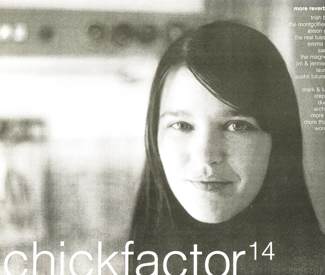
High among those infamous fanzines and punk mags was a pioneering indie pop-centric zine called chickfactor — put out by then-New York based editor-writer-photographer Gail O’Hara and Black Tambourine singer Pam Berry (who moved to London in 1995). Perhaps you’ve heard Belle and Sebastian’s song “Chickfactor” about it?

The publication’s print heyday lasted from 1992 through ’02, and is now present mostly as an online museum, but with some hints of movement in the near future. For one, its first paper issue in 10 years will be released next month, October 2012. And two, to celebrate her zine’s 20th anniversary, O’Hara has put together a series of shows around the country — and in London — featuring bands and musicians that came of age on the pages of the publication.

Just last week I saw something about an EDM blog that’s now putting on club nights up and down the coast. That’s not really what this is. This is a more DIY reunion, of bands, of fans, of readers, and of early twee pop enthusiasts (though the bands and the zine’s founders would probably disagree with the twee part).

“It was just an excuse to have a party with great live music,” says O’Hara, now based in Portland, Oreg. “I am pretty good at setting up shows, and it used to be something I did all the time when I lived in New York and London. One reason I’m good at it is that I ask people who never play, and sometimes they say yes. I really missed doing it, and the 20th anniversary seemed a good excuse to plan something in advance.”

“Many of these bands take a lot of prodding, and I was up for the task,” adds O’Hara.

All of the lineups are slightly different, but share in a common thread of the early twee and indie pop scenes in the ’90s Pacific Northwest. One of the headliners in San Francisco, the Softies, are only doing four shows this year, and the one in SF will be the last one.

The Softies, a beloved guitar-and-vocals duo formed in 1994, was one of those bands that hadn’t played in some time. The Pacific Northwest duo was made up of Rose Melberg and Jen Sbragia, both musicians who were in other bands prior to, during, and after their stint as the Softies (Melberg in Tiger Trap and Go Sailor; Sbragia of the All Girl Summer Fun Band). The Softies’ last show was in 2000 on a brief tour for their last LP, Holiday in Rhode Island.

“We had not even thought about the possibility of playing any shows until [O’Hara] asked us,” says Melberg, “and it never even crossed my mind that we could do it. When [Sbragia] said yes, I was amazed and totally excited. It was a lovely, unexpected surprise.”

Both have young kids and there’s a geographic distance between them now — Melberg in Vancouver BC, and Sbragia in Portland — but they made it work for the chickfactor shows.

Plus, they were never really out of touch, says Sbragia. The Softies first began as an intimate friendship between the two, so it came “as an extension of our friendship” says Melberg.

That closeness was apparent in the music of the Softies, a endearing, melodic blend of influences with tender-hearted vocals that inspire a still-dedicated fan base. It also inspired a somewhat dirty word to those involved: twee.

“[The ‘twee’ label] used to really bother me, because we were writing sad love songs with a lot of meaning packed in. We weren’t singing about daisies and ice cream,” Sbragia says. “But we got lumped in with that. Maybe if you weren’t singing about political ’90s issues then you were twee by default. It doesn’t really bother me anymore.”

chickfactor itself was often mentioned in the same breath as twee, but in truth, it was simply intertwined with indie music and indie pop from the start. “I worked at Spin and took full advantage of advance tapes, free concert tickets, and everything else music related in the early ’90s,” O’Hara explains. “Most of my friends were music intensive nerds too. I had a big Manhattan studio so I put a lot of bands up over the years and set up many concerts at Fez, Under Acme, Tonic, and Mercury Lounge…and I hired musicians to work as writers and/or copy editors at Spin and Time Out New York when I was there.”

She also asked musicians to contribute to chickfactor, including Carrie Brownstein and Stephin Merritt — an aside, O’Hara later co-directed and co-produced the documentary Strange Powers: Stephin Merritt and the Magnetic Fields. And many of the interviews in the zine were casual riffs with soon-to-be-famous indie artists (Stephen Malkmus, Superchunk, Neko Case, Cat Power).

So what’s up for the 30th anniversary, next decade? Who’s left for O’Hara to pester for live shows?

“Well, since you asked. I plan to head into the woods in Northern California and find Kendra Smith and ask her to play. That would be my number one dream. I recently read an entry in a journal from 1995: ‘Kendra Smith called and left a message. She is still working on the chickfactor interview I gave her two years ago.'”

We’re still waiting on that interview, Kendra.

CHICKFACTOR 2012: FOR THE LOVE OF POP

With Stevie Jackon (Belle and Sebastian), the Softies, Lilys, Kim Baxter, Allen Clap, and MC Daniel Handler

Sat/22, 7:30pm, $20–$25

Rickshaw Stop

155 Fell, SF (415) 861-2011

www.rickshawstop.com

Cup-of-tea diplomacy

6

In the spring of 2008, I was invited to give a briefing on human rights to a Bush-appointed US ambassador scheduled to be posted to the Middle East. But the ambassador had little interest in talking about human rights.

“What I want to know is this,” he said. “Is Islam the problem here? Is Islam retarding progress—economically, socially, politically?”

I tried to steer the meeting back to human rights but the ambassador kept persisting. “I mean you’re a Muslim…so do you think Islam is standing in the way?”

I had participated in enough of these discussions to know that in agreeing to meet, both us were checking off boxes: He could say he was listening to the concerns of a human rights advocate; I was able to say I relayed the concerns of my employer, Amnesty International, to a US ambassador.

Most of the ambassadors I met were like this: They thought it neither important nor virtuous to understand—let alone to love—the people of the Middle East. The role of the ambassador, they reminded me, was not to listen to people’s ideals and hopes but rather to convey to people America’s ideals and hopes for them.

When I learned of the killing of the US Ambassador to Libya Christopher Stevens last week, I mourned the sad irony that a US diplomat who wore his love for the Middle East and North Africa on his sleeve would be killed serving the very people who inspired him.

In a YouTube video posted soon after his murder, Ambassador Stevens is seen standing in front of the Lincoln Memorial in Washington DC, the cherry blossoms in full bloom behind him, introducing himself to the Libyan people.

“As-salaam alaikum,” he begins using the traditional Islamic greeting that means “Peace be upon you.” He looks happy, giddy almost.

“Growing up in California, I didn’t know much about the Arab world,” he says. “Then after graduating from the University of California at Berkeley, I traveled to North Africa as a Peace Corps Volunteer.” He taught for two years in the mountains of Morocco and “grew to love this part of the world.”

Colleagues and friends who knew him spoke about his passion for listening. French writer Bernard-Henri Levy admired his “great capacity to listen and his strategy to speak last.” Elizabeth Dibble, his colleague at the State Department, spoke about Stevens’ unique diplomatic style.

“It takes a lot of tea,” she said. “You don’t rush into talking points, you develop a relationship and a personal connection, and a series of connections becomes a network.”

In a moving tribute published on CNN’s website, his friend Judith Drotar spoke about Steven’s remarkable judicious restraint. “What really made Chris exceptional to me, however, was his ability to distance himself,” she writes. “Not the aloof kind of distancing that you might expect from someone in his position, but the kind where one puts emotion and ego aside in order to truly listen, to understand, and then to find a way to build bridges.”

But in the aftermath of Stevens’ death, we are tearing down those very bridges that he worked so hard to build.

The cover of this week’s Newsweek features a close up photo of two bearded, turban clad Muslim men, clutching an Egyptian flag, shouting to the camera under a headline that reads, “Muslim Rage: How I survived it and how we can end it.”

In the article, Ayaan Hirsi Ali writes, “In the age of globalization and mass immigration, such intolerance has crossed borders and become the defining characteristic of Islam.”

Stevens would be ashamed. He worked his whole life to add nuance to our understanding of the Middle East and North Africa. To suggest that one film—or the religion of Islam—alone caused the violence that swept across 16 countries is as incomplete as suggesting that the LA riots of 1992 were sparked only by the Rodney King verdict.

But it’s easy to blame the protests that erupted in 16 Muslim majority countries as a reaction to a film. It is more difficult to examine the policies of our government that have sparked this resentment.

A week before Stevens died, the US fired two drone strikes 80 miles southeast of Sanaa, Yemen. One hit an Al Qaeda operative; the other missed its target, hitting a commuter mini-bus. Fourteen were killed, including three women and a child.

Mansoor al-Maweri was nearby when the attack happened.  “You want us to stay quiet while our wives and brothers are being killed for no reason,” he said. “This attack is the real terrorism.” Hundreds of angry people took to the street. Few cameras were there to beam these protests to television sets in America.

It is attacks like this, as well as the film, that sparked the current outcry. The tragedy is that Stevens would have understood this perhaps more than any other diplomat. Sometimes the explanations are painful; sometimes we do not know what is happening; and sometimes the best course of action for the United States is to pour a cup of tea and listen.

Zahir Janmohamed recently completed a fellowship at the San Francisco Writers’ Grotto and is writing a book about Juhapura, the largest ghetto of Muslims in India

City College has too many teachers. Damn.

12

So the state auditors have determined that City College is in serious financial trouble, which we knew, and has ascertained the reason: There are too many teachers, and they get paid too well.

Damn. That sounds like a terrible situation. Too many teachers! Horrors! Let’s fire some of them today!

Seriously: I know the district has problems, and I know that a lot of people inside the district feel that department heads have too much power, and there’s an awful lot of political patronage going around. It’s been a nightmare for more than a decade, with too many incompetent and corrupt people controlling the College Board, protecting their allies in administration, and treating the place as a personal fiefdom.

I think things have gotten a little better since the ascension of a more progressive majority on the board and the departure of Chancellor Phil Day and his crooked crew, but it’s still a mess.

But isn’t it a sad statement on San Francisco, and California, and the United States today that an auditor could look at a college that serves working-class and poor kids, immigrants, people who need jobs skills, and a broad, diverse community and say: You  have too many teachers? Isn’t is sad that the auditors, in a city that has about the highest cost of living in the Western United States, think teachers — teachers — are getting paid too much money?

Makes you want to throw up.

Yeah, let’s get the City College house in order, and recognize that expenses have to meet revenues, and make the tough decisions. But along the way, let’s ask ourselves: Is this what we really want?


Getting into it: ‘Vagina’ is still a book about vagina

4

If there is one thing that some feminists like to do, it is tell each other that they are not really feminist — or, judging from the Internet over the past weeks, that’s what newsmedia enjoys paying them to write about. Imagine that two competing “waves” at an NFL game crash into each other and their wavers begin hurling epithets involving biological primacy (“the wave’s appeal lies in the rolling motion of the womb experience!”) and unacknowledged privilege (“our wave does not rely on fancy running shoes for buoyancy, or expensive snack bar items for flourish!”) 

Naomi Wolf wrote a book called Vagina: A Biography, and is now being torn apart, bit by bit, by representatives of various feminist waves in nearly every vaunted publication in the land. I’m saying: she did write a book called Vagina, though.

Bongwater: Power of Pussy from DANGEROUS MINDS on Vimeo.

Recently, I did an email interview with Wolf about the merits of her book. I sent her the questions before most of the more scathing reviews of Vagina hit the Internet presses, so most of them revolved around which pieces of her research she found the most compelling. When asked to summarize the shortcomings of research publicized heretofore on vags, she wrote to me: 

It is stuck in the 1970s, when Masters and Johnson concluded that men’s and women’s sexual responses were basically the same proces (arousal, plateaue, climax, resolution) and when Shere Hite (admirably for the time) concluded that the vagina and clitoris were unrelated, and everyone thought the vagina has little innervation. 

New data show that women and men are very different in what arouses them and brings them to orgasm and that even their pelvic wiring is very different.

Men’s nerves in the pelvis and penis and fairly simple and regular — but women’s ‘pelvis innervations’ is like lace, compared to the male “grid.” There are neural terminio [sic] for women in the clitoris, as we know, but also in the walls of the vagina, the mouth of the cervix, the G-spot, the anus, the perineum — and every woman’s wiring is different! So the takeaway is that if you want to make a woman happy, whether you are male or female, you need to learn each woman’s patterns and responses anew and pay careful attention and engage is very attentive exploration. And listen to what she likes.

Read Wolf’s book and you’ll get an amazing lesson on female biology, and perhaps even more interestingly, the social history of the pussy. From ancient worship of goddess-whores up to references to the cunt in 20th century jazz in the US, this is stuff that really helps to contextualize our current struggles with those who would penalize us for having anatomy. 

Wolf visits 1900s dance routines choreographed by Lois Fuller in her exploration of the history of vaginal representation

But, as other reviewers have mentioned, she does founder a little when she starts hypothesizing. 

From a passage asserting that eye contact is important for sexual satisfaction: 

Page 299: “Might it be that some new mothers – starved of deep gazing from their husbands – are more at risk of being drawn into a charmed circle of mutual gazing with their babies, which leaves out the man?”

And on the loss of self-awareness during climax:

Page 284: “The findings could be read as hinting – not by any means confirming – that the ages-old fear that sex makes women into something like witches, or into maenads who have no moral boundaries at the moment of orgasm, may have a bit of truth to it.” 

No snap moral judgments made at the height of your climax, witches! You can imagine now, why people have been reacting poorly to some of Wolf’s “findings.” (I would love to see the owner of a penis make any kind of decision at all while climaxing. No really, send videos.)

Other charges leveled at Vagina have involved heterocentricity, although Wolf admittedly trys to explain why the book is focused on penis-loving women in her introduction. She says she thinks women of all sexualities deserve books focused on their vaginas. And next time she’ll do more, she said in the email: “in the next edition I will expand the info that there is for lesbian, bisexual, and transwomen, even given its scarcity, because of the extreme interest from my readers across the spectrum.”

I’m not denying the book’s got issues. But then, this weekend, as I lolled on Dolo’s Gay Beach shelf above that brave new Disneyland of a playground, I read my copy of Vagina. Muttering middle-aged men shot death glares at the spliff dangling from my fingers (I moved downwind as requested.)

And all of a sudden, I got weirded out. I think it had something to do with the big red “vagina” written in red cursive letters on the book I was reading. In Dolores Park, really! It felt like I was engaged in something untoward, and not to be dramatic but in that moment I realized that no matter the woman-stealing babies and witch-producing orgasms contained in the pages of Vagina, it is still: a feminist book. And a heavily-researched book about vagina, with history lessons on vagina, and a frank discussion of the importance of the female genitals.

Perhaps sadly, that’s still a big something. Not to get all maenad, but at Wolf’s upcoming SF dates I’d like to shake her hand and say thanks for putting it out there. 

Naomi Wolf

Wed/19, 7pm, free

51 Tamal Vista Blvd, Corte Madera

www.bookpassage.com


Thu/20, 7pm, $25-30

Jewish Community Center

3200 California, SF

www.jccsf.org

Historic, veto-proof vote launches CleanPowerSF

24

The San Francisco Board of Supervisors today cast an historic vote that was more than a decade in the making, approving the CleanPowerSF program – which challenges PG&E’s monopoly by offering 100 percent renewable energy directly to city residents – on an 8-3 vote that would be enough to override an implied veto threat by Mayor Ed Lee.

The outcome was far from certain throughout the two-hour hearing as conservative Sups. Mark Farrell and Carmen Chu led efforts to undermine the program, which was the final work product of retiring San Francisco Public Utilities Commission Executive Director Ed Harrington, who previously served as the city’s controller for 17 years.

The pair of supervisors offered a series of amendments challenging the state requirement that city residents must proactively opt-out of such community choice aggregation (CCA) programs if they want to remain with PG&E, offering convoluted language that would have required people to opt-in to the program before its launch, and requiring that the $13 million in reserve funds from the SFPUC be covered entirely by CleanPowerSF customers, which could increase its rates.

“It looks like the amendments would be harmful to the success of the program,” Sup. Eric Mar observed, prompting Farrell and Chu to flash broad conspiratorial smiles at one another.

Sup. Scott Wiener, who was undecided and considered a key swing vote in reaching a veto-proof majority, said he also had concerns about the opt-out requirement and wanted to better understand how the amendments would work and whether they were legal. “For me, I’m not interested in putting any poison pills in here,” he said.

Wiener posed questions about the amendments to Farrell and to Harrington, who said it was possible for the SFPUC to have CleanPowerSF customers repay the initial allocation of reserve funds over time but that he wasn’t sure how the opt-in change would work without sabotaging the program.

“It harms the ability to have an intelligent conversation with people,” Harrington said, noting that rates are based on the number of customers in the program, so it would be nearly impossible to survey everyone’s potential interest without being able to tell them how their bills would be affected.

As it is, the SFPUC has already done extensive surveys of which neighborhoods and demographics are likely to be interested in taking part in CleanPowerSF, initially paying about $10 more per month for 100 percent renewable energy (PG&E’s portfolio includes less than 30 percent renewable). “We’ve done extensive surveys already,” Harrington said. Based on that research, the city is initially rolling out the program to less than a third of city residents, who will be repeatedly notified about how to opt-out, anticipating about 90,000 customers remain in the initial program. 

The program has been repeatedly tweaked over the last eight years that it’s been in development, during which time Marin County launched a successful version of the CCA concept that was developed in San Francisco by legislators Tom Ammiano, Carole Migden, and Mark Leno.

“I feel pretty comfortable trusting Ed Harrington on whether the numbers add up,” said the measure’s chief sponsor, Sup. David Campos, arguing against the Farrell/Chu amendments, later adding, “With Ed Harrington leading this charge, this is as good as it gets. If you don’t like CCA under Ed Harrington, you’re not going to like CCA.”

Farrell claimed to support CCA in concept, but he strenuously objected to the opt-out requirements that Migden included in the enabling state legislation, which she had argued was the only way to make CCAs viable against PG&E’s proven willingness to spend tens of millions of dollars to sabotage would-be competitors.

“It’s the wrong way to legislate, the opt-out. It smells of coercion,” Farrell said. Campos countered that, “The best thing we can give the consumers in San Francisco is a choice, a meaningful choice.”

Wiener ultimately made a motion to delay the item by a week, something Mayor Lee yesterday told the Chronicle he wanted, in order to further study the opt-out issue, telling Farrell that his amendment “feels a little seat of the pants to me.”

Campos and other progressive supervisors who were supporting CleanPowerSF argued against the continuance, noting that it has been years in development and sitting in board committees since January, while the Farrell/Chu amendments weren’t offered until this meeting had already begun.    

“This is not going to change because we wait a week to make a decision,” Campos said. “The terms of this deal are not going to change.”

The motion for a continuance failed on a 4-7 vote, with Wiener joined by Farrell, Chu, and Sup. Sean Elsbernd (who offered no comments throughout the hearing).

Then, as the vote on the Farrell/Chu opt-in amendment came up for vote, Wiener said, “I don’t feel comfortable voting for amendments that I don’t know what they’ll do,” and it failed on a 3-8 vote.

Sup. Malia Cohen had earlier indicated a willingness to support the other Farrell/Chu amendment: saddling CleanPowerSF customers with paying the SFPUC back for reserve fund costs – which Harrington indicated could be dragged out over many years to minimize the impact on rates, and which might not be necessary at all if the initial program exceeds expectations.

That amendment was then approved on an 8-3 vote, with Sups. Jane Kim, Christina Olague, and John Avalos opposed. Another set of amendments that would keep low-income city residents out of the initial rollout and take other steps to reduce their rates if they opted in – which was developed by Kim, Cohen, and Sup. Eric Mar – was unanimously approved by the board.

Then it was time for the big vote on creating the CleanPowerSF program, approving the contract with Shell Energy Northern California to administer it, and authorizing the initial $19.5 million expenditure. Would there be eight votes to override a veto by Mayor Lee, who has been under pressure by PG&E and their downtown allies to kill the program?

“To be perfectly candid, I struggled mightily with this contract,” Wiener said, reiterating his concern about its opt-in requirement, noting that the measure wasn’t perfect, even though it was significantly improved from earlier versions. It sounded as if he were about to vote against it.

“What we have the opportunity to do is move forward with clean power,” Wiener said, noting that even Marin County supervisors who initially opposed its CCA have come around to supporting it. “This is something I believe we should try.”

And with that, the board voted 8-3 to launch the program in mid-2013, with Chu, Farrell, and Elsbernd opposed.

Campos said he was “pleasantly surprised” by the vote, while key supporters say they are cautiously hopeful it will stand up during next week’s final supervisorial approval on second reading and in a veto override vote, if that becomes necessary. Campos said he was thankful for the work of Harrington, who got a standing ovation after the vote as the board recognized him for his long service to the city.

Earlier in the meeting, Harrington told supervisors that while the program isn’t perfect, and it contains some risks that he considers reasonable, there is no other way the city has identified to meet ambitious greenhouse gas reduction goals it has set for itself over the last decade. It is city policy to reduce emissions by 25 percent below 1990 levels by 2017 and 80 percent below those levels by 2050.

“This program before you has the only chance of reaching those goals. There’s nothing else,” Harrington said. He also said “it’s an incredibly efficient way to spend money,” noting that the city has spent $90 million on solar and other renewable energy projects that power fewer than 7,000 homes, whereas this $19.5 million will power 90,000 households, possibly without ever tapping into that $13 million reserve fund set aside to cover any losses by Shell, which will buy renewable energy, a role the city hopes to eliminate as it develops its own projects.

Harrington said the ultimate goal of CleanPowerSF is to develop a large enough customer base that the city could use revenue bonds to finance a wide variety of renewable energy projects – many using solar arrays along city-owned property connected to its water system stretching all the way to Hetch Hetchy Valley – that would pay for themselves.

“The real issue is can you build a facility that will have this rate structure support it?” Harrington said.

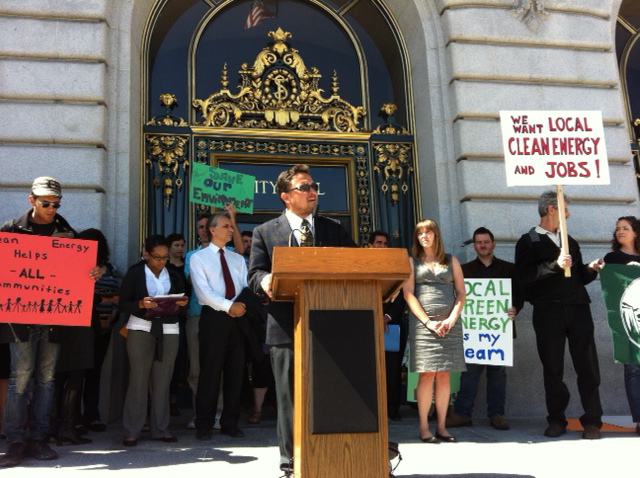
That’s the real power and potential of CleanPowerSF – finally taking action to address global warming, which will have a huge impact on San Francisco and future generations – as supporters noted in a rally outside City Hall before the meeting. Sen. Mark Leno said that he doesn’t usually weigh in on proposals before the board, but that, “This is an exceptional time and this is an exceptional vote. This is the time that we need to address our inconvenient truth.”

Our Weekly Picks: September 19-25

0

WEDNESDAY 9/19

The Birds


As part of a series of ongoing celebrations marking the 100th anniversary of Universal Pictures, Fathom Events and Turner Classic Movies are presenting a special one day only screening of The Birds, Alfred Hitchcock’s classic 1963 horror flick about rampaging flocks of fearsome feathered fiends that invade a sleepy coastal community and wreak havoc on its citizens. Filmed in San Francisco and just to the north in Bodega Bay, the film has been newly restored, and will be preceded by an introduction from TCM host Robert Osborne, along with revealing interviews that he conducted with star Tippi Hedren earlier this year. See website for participating theaters. (Sean McCourt)

2 and 7pm, $10.50–$12.50

Various Bay Area Theaters

www.fathomevents.com

THURSDAY 9/20

Azure Ray


Orenda Fink and Maria Taylor are Alabama natives, childhood friends, and progenitors of dream pop duo Azure Ray. Throughout most of their Azure work, the pair grounded their tracks in vocal harmonization and added in some folksy acoustic guitar and/or piano melodies, such as in 2010’s Drawing Down the Moon. But in the latest LP released this month, As Above So Below, Fink and Taylor immerse their warm vocals in electronic atmospherics, vocal delay effects, and a smattering of bass. Azure have said for As Above that they drew on the minimalist and electronic aspects of artists such as James Blake, Nicholas Jaar and Apparat. As Above’s tight and intricate feel can be partially credited to co-producer and Orenda’s husband, Todd Fink of The Faint. (Kevin Lee)

With Soko, Haroula Rose 8pm, $15 Swedish American Music Hall 2174 Market, SF (415) 431-7578 www.cafedunord.com

FRIDAY 9/21

Eat Real Festival


Sure, the snacks and sips for sale at Eat Real are superlative, but not all of Oakland’s three-day fest dedicated to fresh, local edibles revolves around pure functionality. Take for example, the Thai fruit carving demonstration manned by staff from mobile Bay Area catering outfit House of Siam. You can learn how to turn a watermelon into a rose, petals fading from pink meat to white rind. It’s just one of a passel of tutorials that will be taking place throughout the fest, which will also feature a beer garden of local brews curated by Eat Real neighbor, Linden Street Brewery, live music, and vendors hawking treats, all for under $5. (Caitlin Donohue) Fri/21 1-9pm; Sat/22 10:30am-9pm; 10:30am-5pm Jack London Square, Oakl. www.eatrealfest.com

FRIDAY 9/21

Pacific Pinball Expo


"Free play!" For lifelong pinball wizards in training — and those, like me, who just enjoy playing Addams Family for hours at the local gay bar — there are few better phrases in the English language. To show off its extensive (and quite historically fascinating) collection of games with balls, and to help promote its intended move to the Palace of Fine Arts from Alameda, the great Pacific Pinball Museum is hosting the supposedly largest pinball expo in the world at the Marin Civic Center. 400 games set on free play! X-Men! Ms. Pacman! Vintage Bally games like Starjet! "Woodrails" from the 1950s! Sorry, there will be no splints provided for those who, in their excitement of such flashing and dinging riches, suffer a case of "flipper wrist." (Marke B.)

Through Sun/16, 10am-midnight, $15–$60

Marin Civic Center Exhibition Hall

10 Avenue of the Flags, San Rafael

(510) 205-6959

www.pacificpinball.org

FRIDAY 9/21

Wilco


As recent sold-out performances at the Fox attest, Chicago’s Wilco is an easy sell. Eight albums in with 2011’s The Whole Love, Jeff Tweedy continues to catalog tender hearts at the edge of maddening fights, backgrounded arguably the most expansive band in rock. (While other groups may struggle to create a sound big enough for the Greek, drummer Glenn Kotche could do it on his own.) But the added draw this time are the openers; Friday is a second chance for anyone who missed Cibo Matto’s reunion show at Bimbo’s last year, while Saturday features beloved raconteur Jonathan Richman, with extra of room for him to let loose his signature dance moves. (Ryan Prendiville)

Fri/21 with Cibo Matto; Sat/22 with Jonathan Richman 7:30pm, $49.50 Greek Theatre 2001 Gayley Road, Berk. (510) 548-3010 www.apeconcerts.com

FRIDAY 9/21

Yob


Eugene, Oreg.’s Yob has been producing sprawling doom metal landscapes since 1996, but it’s taken until 2012 for it to get noticed. Though the mainstream press has finally picked up on the band — Spin Magazine placed its sixth album, Atma, in its top 50 records of 2011 — Yob’s masterful songwriting and awesomely sinister energy hasn’t lost any of its edge. Atma is a megalith of slow, chugging riffs and discordant melodies, the shortest song clocking in at seven minutes and 33 seconds. Vocalist (and Krav Maga instructor) Mike Scheidt shrieks and growls over the sludge like a demon that has finally been unleashed. (Haley Zaremba)

With Acid King, Norska

9pm, $12

Brick and Mortar Music Hall

1710 Mission, SF

(415) 800-8782

www.brickandmortarmusic.com

SATURDAY 9/22

California Wines Road Trip


Love a variety of California wines, but don’t have the time to travel all over the state to visit all the wineries? Then head over the "California Wines Road Trip" event, where more than 90 wines from 14 different regions of the state will be available to sample, along with artisanal cheeses and other scrumptious food offerings. The party is part of California Wine Month, which will be hosting other events all throughout the state, so drink up for a good cause — part of the proceeds from the event will go to the Center for Urban Education about Sustainable Agriculture and the California Sustainable Winegrowing Alliance. (McCourt)

2-5pm, $35.

Ferry Building, Grand Hall

One Ferry Building, SF

discovercaliforniawines.com/roadtrip

SATURDAY 9/22

7 Seconds


They say that Reno is so close to hell you can see sparks. It makes sense that this environment would create one of the most enduring hardcore punk bands in music history. 7 Seconds have been active for three decades. In this time span they’ve gone through lineup changes, genre changes, into the straight edge movement and back out of it. Since its inception in 1980, the Marvelli brothers Kevin Seconds and Steve Youth have remained the backbone of the band, tirelessly touring and releasing 15 albums and numerous EPs and compilations. You’ve seen the logo for years, on T-shirts and patched onto jean jackets, but 7 Seconds have endured based on a lot more than great branding. They’re living, breathing, shredding pioneers of American punk. (Zaremba)

With Heartsounds, Bastards of Young, City of Vain

7pm, $12

924 Gilman, Berkeley

(510) 524-8180

www.924gilman.org

SATURDAY 9/22

Cut Hands


Like an enrapturing free-jazz gig, or a moshtastic punk show, Cut Hands’ brand of crushing experimentalism must be seen live to be fully appreciated. The one-man project, commanded by British fringe-artist and Whitehouse bandleader William Bennett, fuses traditional Central African percussion with synthetic drums, laying them atop ambient drones and shrill electronics, with an industrial production sound worthy of Throbbing Gristle at their most unforgiving. Pushing his singular vision to new extremes, Bennett’s forthcoming LP, Black Mamba (the follow-up to his Wire-approved Afro Noise series) is the project’s most relentlessly pulverizing statement to date. Gluttons for avant-punishment shouldn’t pass up the opportunity to experience Bennett’s viscerally draining, yet transcendent, explorations in sound. (Taylor Kaplan)

With Burmese, Bestial Mouths, DJ Crackwhore 9:30pm, $12

Elbo Room 647 Valencia, SF (415) 552-7788 www.elbo.com

MONDAY 9/24

Wyclef Jean


Member of a supernatural hip-hop crew, singer of "Gone ‘Til November" — maybe you even got a bead on his brief, but glorious run at being the president of Haiti, in the face of Sean Penn’s wet-blanket naysaying. But unless you have read his new book Purpose: An Immigrant’s Story (if you have, back pat, the thing was released on Tuesday) you probably did not know that Jean’s pastor father relocated his family into a fire-damaged funeral home in Newark when the sensitive rapper was wee. Face it, many things about this ex-Fugee remain a mystery. Attend tonight’s event and let them be revealed, with insightful prodding by MTV2’s Hip Hop Squares host Peter Rosenberg. (Donohue)

7:30, $25–$30 Palace of Fine Arts 3301 Lyon, SF

(415) 567-6642 www.palaceoffinearts.org

MONDAY 9/24

Serj Tankian


Serj Tankian started writing his third solo album when he read about the mass disappearance of different species of animals around the world. The result is Harakiri, a self-produced record named for the Japanese idea of ritual suicide. As the frontman for System of a Down, Armenian-born Tankian has a long history of activism and influence in the music community, and now he’s taking on the uncomfortable future of environmental (un)sustainability. In response, Tankian has kicked into overdrive, touring with System, publishing his third book of poetry, collaborating with nonprofits, collaborating with other musicians, and releasing a rock opera all within the last year. With this momentum, Tankian may just take over the world. I don’t know about you, but I trust him with it. (Zaremba)

With Viza

8pm, $35

Fillmore

1805 Geary, SF

(415) 346-3000

www.thefillmore.com

TUESDAY 9/25

Django Django


"Spins the phrases together ’til something starts to make sense" is generally a pretty apt description of what frequently parades as "psychedelic" songwriting, a veil of random weirdness that often obscures an underlying mediocrity and lack of musical talent. On its self-titled, Mercury Prize-nominated debut — which includes those lyrics on the track "Hail Bop" — Britain’s Django Django takes a different approach, combining the the straightforward structure of ’60s vocal pop with a nearly cribbed catalog of inward looking psych imagery, layered over surprisingly shiny production that includes influences from tribal rhythms and metronomic, driving electronica. The result is an album that’s paradoxically bold as it is bare. (Prendiville)

With Vinyl Williams 8pm, $15 Independent 628 Divisadero, SF (415) 771-1421 www.theindependentsf.com

The Guardian listings deadline is two weeks prior to our Wednesday publication date. To submit an item for consideration, please include the title of the event, a brief description of the event, date and time, venue name, street address (listing cross streets only isn’t sufficient), city, telephone number readers can call for more information, telephone number for media, and admission costs. Send information to Listings, the Guardian, 225 Bush, 17th Flr., SF, CA 94105; or e-mail (paste press release into e-mail body — no attachments, please) to listings@sfbg.com. Digital photos may be submitted in jpeg format; the image must be at least 240 dpi and four inches by six inches in size. We regret we cannot accept listings over the phone.

Stage Listings

0

Stage listings are compiled by Guardian staff. Performance times may change; call venues to confirm. Reviewers are Robert Avila, Rita Felciano, and Nicole Gluckstern. Submit items for the listings at listings@sfbg.com. For further information on how to submit items for the listings, see Picks.

THEATER

OPENING

Family Programming: An Evening of Short Comedic Plays Shelton Theater, 533 Sutter, SF; www.brownpapertickets.com. $20. Opens Fri/21, 8pm. Runs Thu-Sat, 8pm. Through Oct 13. Left Coast Theatre Company performs short plays about gay and alternative families.

ONGOING

Asteroids: Live! Dark Room Theater, 2263 Mission, SF; (415) 401-7987. $20. Fri-Sat, 8pm. Through Sept 29. Interstellar comedy “based very, very loosely on the arcade game.”

Henry V Presidio of San Francisco, Main Post Parade Ground Lawn, SF; www.sfshakes.org. Free. Sat/22-Sun/23, 2pm. The San Francisco Shakespeare Festival celebrates the 30th anniversary of Free Shakespeare in the Park with this history play.

Invasion! Boxcar Playhouse, 505 Natoma, SF; crowdedfire.dreamhosters.com. $20-35. Wed-Sat, 8pm. Through Sept 29. Crowded Fire mounts the West Coast premiere of Swedish-born playwright Jonas Hassen Khemiri’s postmodern dark comedy, a deconstruction of language and power in an American culture of perpetual war, which made a well-received New York debut last year. Translated from the Swedish by Rachel Willson-Broyles, and directed by Evren Odcikin, the play immediately subverts the usual multi-culti narrative of otherness and tolerance with a po-faced feint (featuring ensemble members Lawrence Radecker and Olivia Rosaldo-Pratt) that ends with a boisterous disruption of the proceedings from unexpected quarters (courtesy of ensemble members George Psarras and Wiley Naman Strasser). From there, we get a series of interrelated largely comical scenes, wherein — in shades of Martin Crimp’s Attempts on Her Life — a certain figure by the name of Abulkasem dissolves into the ultimate cipher, tied to everything from terror to pick-up lines in bars, and meaning absolutely anything and nothing. Nevertheless, in the interstices of language lurks real power — as the play implies most overly in a scene of intentional mistranslation, which twists a hapless and bemused immigrant’s tale into line with the war-on-terror mythos. In the end, the complexity the play adds does not completely dissolve that liberal narrative skewered at the outset, and its efforts remain only half-convincing. The problem may lie partly in the production’s inconsistent, often sluggish pace, as well as a tendency toward didacticism in director Odcikin’s staging. The material of this sardonic play doesn’t support too literal or even empathetic a reading, but rather seems best translated as a raucous premonition, dream, or intimation of our own guilty seduction by the sadistic, totalizing power of such stories. (Avila)

Kiss of the Spider Woman Phoenix Theatre, 414 Mason, SF; secondwind.8m.com. $15-35. Thu-Sat, 8pm; Sun, 2pm. Through Sept 29. Second Wind presents Manuel Puig’s acclaimed drama about cellmates in a Buenos Aires jail.

My Fair Lady SF Playhouse, 533 Sutter, SF; www.sfplayhouse.org. $30-70. Tue-Thu, 7pm; Fri-Sat, 8pm (also Sat, 3pm). Through Sept 29. SF Playhouse and artistic director Bill English (who helms) offer a swift, agreeable production of the Alan Jay Lerner and Frederick Loewe musical, based on George Bernard Shaw’s Pygmalion. The iconic class-conscious storyline revolves around a cocky linguist named Higgins (Johnny Moreno) who bets colleague Colonel Pickering (Richard Frederick) he can transform an irritable flower girl, Eliza Doolittle (Monique Hafen), into a “lady” and pass her off in high society. A battle of wills and wits ensues — interlarded with the “tragedy” of Alfred Doolittle (a shrewd and gleaming Charles Dean) and his reluctant upward fall into respectability — and love (at least in the musical version) triumphs. The songs (“Wouldn’t It Be Loverly,” “I Could Have Danced All Night,” “Get Me to the Church on Time,” and the rest) remain evergreen in the cast’s spirited performances, supported by two offstage pianos (brought to life by David Dobrusky and musical director Greg Mason) and nimble choreography from Kimberly Richards. Hafen’s Eliza is especially admirable, projecting in dialogue and song a winning combination of childlike innocence and feminine potency. Moreno’s Higgins is also good, unusually virile yet heady too, a convincingly flawed if charming egotist. And Frederick, who adds a passing hint of homoerotic energy to his portrayal of the devoted Pickering, is gently funny and wholly sympathetic. (Avila)

The Normal Heart American Conservatory Theater, 415 Geary, SF; www.act-sf.org. $25-95. Tue, 7pm; Wed-Sun, 8pm (also Sat, 2pm); Sun, 2pm (also Sept 23, 8pm). Through Oct 7. Larry Kramer’s groundbreaking 1985 drama about the AIDS epidemic — winner of a 2011 Tony for Best Revival of a Play — has a limited run at ACT.

The Other Place Magic Theatre, Fort Mason Center, Bldg D, Third Flr, SF; www.magictheatre.org. $22-62. Previews Wed/19, 8pm. Opens Thu/20, 8pm. Runs Tue, 7pm; Wed-Sat, 8pm (also Sat/22 and Oct 3, 2:30pm); Sun, 2:30 (Oct 7 show at 7pm instead). Through Oct 7. Sharr White’s plot-twisty thriller has its West Coast premiere at Magic Theatre.

Port Out, Starboard Home Z Space, 450 Florida, SF; www.foolsfury.org. $12-35. Wed/19-Sat/22, 8pm; Sun/23, 2pm. foolsFURY performs the world premiere of Sheila Callaghan’s black comedy.

The Real Americans Marsh Studio Theater, 1062 Valencia, SF; www.themarsh.org. $25-50. Fri, 8pm; Sat, 8:30pm. Through Sept 29. Dan Hoyle’s hit show about his trip across America returns.

Rigoletto War Memorial Opera House, 301 Van Ness, SF; www.sfopera.com. $10-340. Wed/19 and Sept 25, 7:30; Fri/21, 8pm; Sun, 2pm. Through Sept 30. “Fidelity is for weaklings!” Despite this rousing cry from its philandering villain, SF Opera opens its 90th season with a faithful and winsome double-cast production of Giuseppe Verdi’s immortal Rigoletto. Based on a play by Victor Hugo, the story concerns the titular court jester and hunchback (played opening night by the imposing Serbian baritone Zeljko Lucic, who alternates nights with Italian Marco Vratogna) whose attempt to revenge himself on the goatish Duke of Mantua (Sardinian tenor Francesco Demuro, alternating with Mexican tenor Arturo Chacón-Cruz) for seducing his beautiful daughter, Gilda (the thoroughly enchanting Polish soprano Aleksandra Kurzak, alternating with Russian coloratura soprano Albina Shagimuratova), backfires with tragic consequences. The production includes free simulcast presentations at AT&T Ballpark on consecutive weekends for those more inclined to recline, especially in the fresh free air, but either way the show’s a little staid but charming and the music, under SF Opera’s Nicola Luisotti, utterly transporting. (Avila)

Strange Travel Suggestions MainStage, Marsh San Francisco, 1062 Valencia, SF; www.themarsh.org. $20-50. Sat, 8:30pm. Through Sept 29. Author and Ethical Traveler founder Jeff Greenwald (Shopping for Buddhas, Snake Lake) has done his solo show Strange Travel Suggestions dozens if not hundreds of times and still has no idea where it’s going. No wonder he and his audience keep coming back for more. The unknown, an aphrodisiac to the traveler, also makes great catnip for the storyteller. Still, there are consistent elements. There is no need to reinvent the wheel — or the impressive Wheel of Fortune that sits just off center stage, painted with a map of the globe and ringed with symbols abstract and evocative enough to conjure up myriad adventures, peak experiences, and humbling encounters from the vivid grab-bag memory of an accomplished travel writer and inveterate globetrotter. There’s also a real grab bag, just in case, and an oversize tarot card, a sort of visual aid cum talisman sporting a classic image of the Fool, patron saint of the traveler’s heedless leaps of faith. Greenwald’s stories possess a fine sense of humor and a knack for the shrewd detail and telling observation. They also contain a Zen-inflected homespun wisdom no doubt born of leaving home on a regular basis. If slightly self-conscious at times, these tales are always genuine and appealing. In the end, Greenwald’s show, as reliable as it is unpredictable, mimics a genie-from-a-bottle experience: What you get is three spins, three stories, and a lot of unexpected truth. Note: capsule condensed from 2008 feature review of this production. (Avila)

Tripping on the Tipping Point Stagewerx, 446 Valencia, SF; (707) 322-5731. $15-20. Thu-Sat, 8pm. Through Sept 29. Human Nature performs a new comedy about global warming.

Twelfth Night San Francisco Maritime National Historic Park, Hyde Street Pier, 2905 Hyde, SF; www.weplayers.org. $30-80. Fri-Sun, 5:30pm (also Sat-Sun, noon; matinee only Sat/22; no performances Sept 29; evening performances only Oct 6-7). Through Oct 7. We Players board the Balclutha and the Eureka for this jazzy take on Shakespeare’s romance.

The Waiting Period MainStage, Marsh San Francisco, 1062 Valencia, SF; (415) 282-3055, www.themarsh.org. $15-50. Thu-Fri, 8pm; Sat, 5pm. Extended through Sept 29. Brian Copeland (comedian, TV and radio personality, and creator-performer of the long-running solo play Not a Genuine Black Man) returns to the Marsh with a new solo, this one based on more recent and messier events` in Copeland’s life. The play concerns an episode of severe depression in which he considered suicide, going so far as to purchase a handgun — the title coming from the legally mandatory 10-day period between purchasing and picking up the weapon, which leaves time for reflections and circumstances that ultimately prevent Copeland from pulling the trigger. A grim subject, but Copeland (with co-developer and director David Ford) ensures there’s plenty of humor as well as frank sentiment along the way. The actor peoples the opening scene in the gun store with a comically if somewhat stereotypically rugged representative of the Second Amendment, for instance, as well as an equally familiar “doood” dude at the service counter. Afterward, we follow Copeland, a just barely coping dad, home to the house recently abandoned by his wife, and through the ordinary routines that become unbearable to the clinically depressed. Copeland also recreates interviews he’s made with other survivors of suicidal depression. Telling someone about such things is vital to preventing their worst outcomes, says Copeland, and telling his own story is meant to encourage others. It’s a worthy aim but only a fitfully engaging piece, since as drama it remains thin, standing at perhaps too respectful a distance from the convoluted torment and alienation at its center. (Avila)

BAY AREA

Chinglish Berkeley Repertory Theatre, Roda Theatre, 2015 Addison, Berk; www.berkeleyrep.org. $14.50-99. Tue and Thu-Sat, 8pm (also Sat, 2pm; no show Oct 5; additional 2pm show Oct 4); Wed and Sun, 7pm (also Sun, 2pm). Through Oct 7. Tony Award-winning playwright David Henry Hwang (M. Butterfly) delivers this inconsistent but generally lively and fascinatingly au courant comedy about a down-on-his-luck American businessman (Alex Moggridge) who visits China hoping to win a contract for English-language signage. Hiring a British expat (Brian Nishii) to smooth the way for him, he enters negotiations with a local official (Larry Lei Zhang). Although things seem to be going well (across some hilarious scenes of half-assed simultaneous translation), he finds the deal running inexplicably aground, then finds unexpected help from a hard-nosed, initially hostile, and beautiful Party official (a standout Michelle Krusiec), with whom he soon begins an extramarital affair. But the American (who has a past of his own that eventually comes to light with surprising consequences) has no idea of the machinations taking place behind the formal business meetings and other confused cross-cultural encounters. What unfolds is a sometimes stretched but generally shrewd and laugh-out-loud funny assessment of has-been American delusions through the prism of rising Chinese ambitions and clout, cultural and otherwise. If the central dynamic between the lovers is not always convincing on the individual or metaphorical level, Leigh Silverman directs for Berkeley Rep a super slick production, complete with rotating sets and precisely timed entrances, featuring an enjoyable cast rounded out by Vivian Chiu, Celeste Den, and Austin Ku. (Avila)

The Death of the Novel San Jose Rep, 101 Paseo de San Antonio, San Jose; www.sjrep.com. $23-69. Wed/19, 7:30pm; Thu/20-Sat/22, 8pm (also Sat/22, 3pm). Vincent Kartheiser (a.k.a. Pete Campbell from Mad Men) stars in Jonathan Marc Feldman’s drama about creativity in post-9/11 America at San Jose Rep.

The Elaborate Entrance of Chad Deity Aurora Theatre, 2081 Addison, Berk; (510) 843-4822, www.auroratheatre.org. $32-60. Tue and Sun, 7pm (also Sun, 2pm); Wed-Sat, 8pm. Through Sept 30. Playwright Kristoffer Diaz, a self-professed fan of the aggressively-theatrical spectacle that is professional wrestling, delivers much more than a “wrestling 101” primer for the uninitiated with The Elaborate Entrance of Chad Deity. Beneath the razzle-dazzle of the arena lighting (Kurt Landisman), the gaudy costuming (Maggie Whitaker) and the giant televised image of a hot bikini babe (Elizabeth Cadd, video by Jim Gross) lies the trampled luster of an American Dream. The dreamer, Macedonio “The Mace” Guerra (Tony Sancho), a wiry fall guy for THE Wrestling, wrestles not for money or glory (he is rarely privy to either), but for his love of the strange ballet that occurs in the ring. Guerra’s job is to make his opponents look good, including the pec-flexing, bling-booted Chad Deity (Beethovan Oden), leaving him to wrestle alone with the identity politics of being a marginalized but fully capable warrior battling perennially stacked odds. Willing suspension of disbelief does get stretched pretty thin when the character Vigneshwar Paduar, a smooth-talking hustler chance-met on the basketball courts of Brooklyn, rises to championship levels in record-breaking time as the truly cringe-worthy persona known as “The Fundamentalist,” but Nasser Khan’s skillfully self-possessed performance as Paduar makes it impossible not to root for him all the way. Rod Gnapp as foul-mouthed bossman “EKO” and fight director Dave Maier as a whole squadron of hapless B-list wrestlers round out the excellent cast. (Gluckstern)

The Fisherman’s Wife La Val’s Subterranean, 1834 Euclid, Berk; www.impacttheatre.com. $10-20. Thu-Sat, 8pm. Through Sept 29. The latest from playwright Steve Yockey (Bellwether, Skin) is an exercise in pure pleasure, not least for the devious sea creatures preying lustily and unashamedly on the hapless human flesh of a small coastal town. There, in cracked fairytale fashion, an unsuccessful fisherman named Cooper Minnow (an endearingly nerdy but passionate Maro Guevara) is preparing to set out to sea, leaving at home frustrated wife Vanessa (a wonderfully, volcanically bitchy yet complex Eliza Leoni) and their sinking marriage, when he meets an oddly brazen pair of sexy, sassy bathers in old-fashioned beach attire (the swimmingly synchronized duo of Sarah Coykendall and Roy Landaverde). At more or less the same moment, a devilishly dashing yet prim traveling salesman (poised, nicely offbeat Adrian Anchondo) is offering a clearly aroused Vanessa an erotic woodcut featuring monstrous tentacles groping human victims at a very familiar-looking dock. Will she take the woodcut? Will she ever! And later she’ll defend her husband’s honor and swap places with him too, much to the commercial advantage of the ever-accommodating salesman who — like Yockey’s smart and sure sex farce — has a little something for everyone. Directed with smooth precision by Ben Randle for Berkeley’s Impact Theatre, The Fisherman’s Wife again finds Yockey playing productively with the fine fuzzy line separating human nature from nature at large (as in Large Animal Games, the winning 2009 co-production from Impact and Dad’s Garage). The animals come through for playwright and company once more, with a thoroughly enjoyable comedy whose borrowed maritime mythos has just enough metaphorical pull to lead those so inclined out beyond the shallow waters. (Avila)

Keith Moon/The Real Me TheaterStage at the March Berkeley, 2120 Allston, Berk; www.themarsh.org. $15-50. Thu, 8pm. Through Sept 27. Mike Berry workshops his new musical, featuring ten classic Who songs performed with a live band.

The Kipling Hotel: True Misadventures of the Electric Pink ’80s Marsh Berkeley, 2120 Allston, Berk; (415) 282-3055, www.themarsh.org. $20-50. Sat, 8:30pm; Sun, 7pm. Extended through Oct 14. This new autobiographical solo show by Don Reed, writer-performer of the fine and long-running East 14th, is another slice of the artist’s journey from 1970s Oakland ghetto to comedy-circuit respectability — here via a partial debate-scholarship to UCLA. The titular Los Angeles residency hotel was where Reed lived and worked for a time in the 1980s while attending university. It’s also a rich mine of memory and material for this physically protean and charismatic comic actor, who sails through two acts of often hilarious, sometimes touching vignettes loosely structured around his time on the hotel’s young wait staff, which catered to the needs of elderly patrons who might need conversation as much as breakfast. On opening night, the episodic narrative seemed to pass through several endings before settling on one whose tidy moral was delivered with too heavy a hand, but if the piece runs a little long, it’s only the last 20 minutes that noticeably meanders. And even with some awkward bumps along the way, it’s never a dull thing watching Reed work. (Avila)

A Midsummer Night’s Dream Forest Meadows Amphitheater, 890 Belle, Dominican University of California, San Rafael; www.marinshakespeare.org. $20-35. Check website for schedule. Through Sept 30. Marin Shakespeare Company performs the Bard’s classic, transported to the shores of Hawaii.

PERFORMANCE/DANCE

“Comikaze Lounge” Café Royale, 800 Post, SF; www.comikazelounge.com. Wed/19, 8pm. Free. Comedy with Kevin Camia, Mike Drucker, Paco Romane, Lydia Papovich, and more.

“Dogsbody” Intersection for the Arts, 925 Mission, SF; dogsbody.eventbrite.com. Fri/21-Sun/23, 8pm. $10. Erik Ehn’s play about child soldiers features choreography by Erika Chong Shuch.

“Elect to Laugh” Studio Theater, Marsh San Francisco, 1062 Valencia, SF; (415) 282-3055, www.themarsh.org. Tue, 8pm. Through Nov 6. $15-50. Veteran political comedian Will Durst emphasizes he’s watching the news and keeping track of the presidential race “so you don’t have to.” No kidding, it sounds like brutal work for anyone other than a professional comedian — for whom alone it must be Willy Wonka’s edible Eden of delicious material. Durst deserves thanks for ingesting this material and converting it into funny, but between the ingesting and out-jesting there’s the risk of turning too palatable what amounts to a deeply offensive excuse for a democratic process, as we once again hurtle and are herded toward another election-year November, with its attendant massive anticlimax and hangover already so close you can touch them. Durst knows his politics and comedy backwards and forwards, and the evolving show, which pops up at the Marsh every Tuesday in the run-up to election night, offers consistent laughs born on his breezy, infectious delivery. One just wishes there were some alternative political universe that also made itself known alongside the deft two-party sportscasting. (Avila)

“The Ella Effect” Shotwell Studios, 3252-A 19th St, SF; www.ftloose.org. Fri/21, 8 and 9:30pm. $15. Josh Klipp and the Klipptones join with a crew of local dancers to honor the music of Ella Fitzgerald.

“Fauxgirls! San Francisco’s Favorite Drag Revue” Infusion Lounge, 124 Ellis, SF; www.fauxgirls.com. Thu/20, 8pm. Free. With Victoria Secret, Alexandria, Chanel, Maria Garza, and more.

“Hella Gay Comedy Show: Bear Comedy Night” Deco Lounge, 510 Larkin, SF; www.decosf.com. Sun/23, 8pm. $10. Comedy with host Charlie Ballard and performers Kurt Weitzmann, David Gborie, Nick Leonard, Antwan Johnson, and more.

Kathy Mata Ballet San Francisco Conservatory of Music, 50 Oak, SF; www.kathymataballet.com. Fri/21, 8pm. Free-$30. The company performs a variety of dance styles, including ballet, jazz, modern, and belly dance, plus guest performers the Gnosis Dance Collective and live musical accompaniment.

Napoles Ballet Cowell Theater, Fort Mason Center, Marina at Buchanan, SF; www.napolesballet.org. Sat/22, 8pm; Sun/23, 7pm. $18-25. The new company presents Carlos Molina in the world premiere of Fausto.

“Open” Garage, 715 Bryant, SF; www.brownpapertickets.com. Fri/21-Mon/24, 8pm. $20. When a couple decides to try an open marriage, hilarity (and jealousy) ensues in Jeff Bedillion’s play, performed by Back Alley Theater Productions.

“Second City for President” Palace of Fine Arts Theatre, 3301 Lyon, SF; www.captivatearts.com. Sun/23, 3pm. $30-55. Political comedy revue by the renowned Second City troupe.

Gina Yashere Brava Theater Center, 2781 24th St, SF; www.brownpapertickets.com. Sat/22, 8pm. $18-20. The British Nigerian comedian performs.

BAY AREA

“Freedom House” Eastside Cultural Center, 2277 International, Oakl; (510) 420-0920. Fri/21-Sat/22, 8pm; Sun/23, 2pm. $10-25. dNaga, Eastside Arts Alliance, and the Asian Pacific Islander Center present this “dance art experience” inspired by the experiences of people of color who live in Oakland.

“Risk for Deep Love” Temescal Art Center, 511 48th St, Oakl; www.eroplay.com. Fri/21, 8pm. Free. Frank Moore leads this “ritual audience participation experience experiment.”


On the Cheap Listings

0

Submit items for the listings at listings@sfbg.com. For further information on how to submit items for the listings, see Picks.

WEDNESDAY 19

Meet the artist: “Photographs From Lebanon” SF Main Library, 100 Larkin, SF. www.sfpl.org. 6pm, free. Najib Joe Hakim went back to his hometown Beirut to capture the culture that survived after Israel bombed the country. Coffee, candles, fishermen repairing nets — the resulting photo exhibit is a testament to resiliency, check it out today with the artist as your guide.

Elizabeth Rosner reads Grace Paley Pegasus Books, 1885 Solano, Berk. (510) 525-6888, www.pegasusbookstore.com. 7:30pm, free. The award-winning bookstore and Berkeley establishment Pegasus Books is starting up a brand-new reading series showcasing local writers opining on and dissecting the works of other writers. The first writer’s words to be in the spotlight will be activist Grace Paley, whose three feminist short stories will be interpreted by novelist Elizabeth Rosner.

24th Street Listening Project Brava Theater, 2781 24th St., SF. (415) 641-7657, www.brava.org. 5pm-9pm, free. In this project, artists Lynn Marie Kirby and Alexis Petty double as your tour guides as they take you on a vibrant five-block excursion complete with colorful meditation and reverberating echoes and concludes with the creation of a collective pigment poem. After the walk there will be a presentation at the Brava that will include mapping videos, local music, and story-telling.

THURSDAY 20

California history third Thursdays Society of California Pioneers, 300 Fourth St., SF. (415) 957-1849, www.californiapioneers.org. 4-7pm, free. Full of California pride, but uninformed on California history? The Society of California Pioneers will gladly school you on the history of our great state with their “Third Thursday” bargain book sale. Visitors and amateur California historians will also have the chance to check out the current exhibit “Singing the Golden State,” which showcases a collection of late 18th and early 19th century songs that pay homage to our fair state.

“Art Making in the 21st Century: Social and Subversive Practices” Yerba Buena Community Benefit District, UC Berkeley Extension, 95 Third St., (415) 644-0728, www.artsindialogue.org. 7pm, free. Reactionary artists Anthony Discenza, Dawn Weleski, and Ray Beldner will convene to tackle issues surrounding community-based art-making on a panel sponsored by the Yerba Buena Community Benefit District. These artists whose work involves re-appropriating common items of normal will be discussing interactive media, guerrilla interventions, and more.

SATURDAY 22

LOTR roundtable discussion Books Inc., 601 Van Ness, SF. www.booksinc.net. 7pm, free. In honor of the 75th anniversary of The Hobbit, this bookstore hosts an open panel discussion on the books. Guinness for the grown-ups will be provided, plus birthday cake for all ages.

Tour de Fat Lindley Meadow, Golden Gate Park, SF. www.newbelgium.com. 11am-5pm, parade registration 10am, free admission, $5 parade admission. A bike-beer carnival par excellence, featuring live bands, a costumed bike parade, and an elaborate ritual in which a lucky automobilist trades in their car for a fly new cycle.

North Beach Art Walk North Beach neighborhood, SF. www.artwalk.thd.org. Also Sun/23, 11am-6pm, free. The fifth annual NB art walk visits a plethora of cafes, galleries, and studios. Snag a map from Live Worms Gallery (1345 Grant, SF), and discover the northern neighborhood’s founts of creativity.

Roadworks: A Steamroller Printing Festival Rhode Island between 16th and 17th Sts., SF. www.sfcb.org. Noon-5pm, free. San Francisco Center for the Book celebrates the art of printed matter with this street fair, which features a three-ton construction steamroller that will put the finishing touches on 3-foot square linoleum block prints.

Superhero Street Fair Cesar Chavez and Indiana, SF. www.superherosf.com. 2pm-midnight, $10 in costume, $20 otherwise. Flip those undies outside your tights and soar down to Bayview for this open-air weirdo-fest in honor of caped crusaders. Climbing walls, jousts, floating pontoon boats — plenty of trouble to get into, while sound camps like Pink Mammoth, Opel, and Dancetronauts provide beats.

Precita Eyes 35th anniversary gala Meridien Gallery, 535 Powell, SF. www.precitaeyes.org. 5:30pm, VIP cocktail reception; 7pm, gala, $35-100. Is there a single arts organization that has done more to beautify the city of San Francisco? Debatable. Tonight, the transcendent community arts program that sponsors murals by established artists and schoolchildren alike takes a moment to reflect on its achievements. Bay graff cornerstone Estria Miyashiro will be honored for his epic contributions to the culture, and Susan Cervantes gets her due for 45 years of wall painting.

SUNDAY 23

Teacher supplies swap Fontana Room, 1050 North Point, SF. www.educycle.com/party. 3-6pm, free. Maestros, bring your old classroom accoutrements and trade up with your peers. There will be wine, snacks, chances to share back to school war stories.

Yerba Buena family day Yerba Buena Gardens, Mission and Fourth St., SF. www.ybfamilyday.org. 11am-4pm, free. Grab the fam for cost-free entry at the SFMOMA, Children’s Creativity Museum, Contemporary Jewish Museum, and Museum of the African Diaspora. When the troops tire of the museum track, head to the YB Gardens for free performances by Latin jazz great Eddie Palmieri, Red Panda Acrobats, Afro-Puerto Rican group Los Pleneros de la 21, and much more.

MONDAY 24

“20 Years of Critical Mass Art” 518 Valencia, SF. www.sfcriticalmass.org. Opening reception: 6pm, free. The 20th anniversary of SF’s world-famous monthly bike parade-protest kicks off its celebrations with this show of posters, t-shirts, graphics, and more from the last two decades.


Locking down reforms

0

steve@sfbg.com

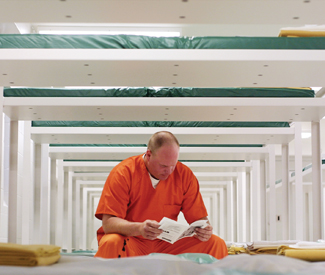
Realignment, California’s year-old program of diverting more inmates and parolees from state prison to county jails and probation offices, was borne of necessity: The state faced a severe budget crisis and had been ordered by the federal courts to reduce the population in its overcrowded prisons. But Realignment is proving to be a real opportunity to address inmates’ needs and reduce recidivism, particularly in San Francisco, where progressive notions of rehabilitation and redemption have deep roots.

“Realignment is the most significant criminal justice reform in decades,” says Assembly member Tom Ammiano, the San Francisco Democrat who chairs the Assembly Public Safety Committee and has helped oversee the process. “The motivation of many of us came from things that were thwarted, like sentencing and parole reform, in Sacramento for many years.”

San Francisco was uniquely positioned to thrive under the new system and to be a model for other counties that seek to improve on the 70 percent recidivism rate among state prison inmates, and the myriad problems and costs that spawns. Former Sheriff Michael Hennessey brought a variety of innovative educational and support services into the jail during his 32-year reign that ended last year (see “The unlikely sheriff,” 12/20/11).

“It’s more than an opportunity. It’s in line with the Michael Hennessey doctrine of enhancing public safety while elevating the idea of redemption, and I subscribe to that,” said suspended Sheriff Ross Mirkarimi, who successfully ran as Hennessey’s endorsed heir before Mayor Ed Lee ousted him over domestic violence allegations. “Michael Hennessey made famous the rehabilitation programs inside the jail and outside the jail.”

San Francisco was also in a good position as both a manageably sized city and county, and one that had room for the influx of inmates. It was ordered by the courts in the 1980s to reduce its crowded jail population – the peak jail population of 2,300 is now down to about 1,550 – and gained even more capacity last year when the SFPD’s crime lab scandal resulted in hundreds of drug cases being thrown out by the courts.

“It’s something that makes sense for San Francisco,” Acting Sheriff Vicky Hennessy told us. “We’re doing better than most other counties because we had the bed space and we had community programs. Michael Hennessey is a visionary…and he got these community programs out there.”

Undersheriff Ellen Brin, who oversees the jail, said the main difference among inmates that San Francisco is dealing with under Realignment – a total of 2,258 in the jail over the last year, staying an average of 60 days each, and another 306 convicts under post-release supervision – is that they’re in local custody longer than before.

“It’s sort of the same population we’ve always dealt with, but maybe we’re dealing with them on a longer term,” she said.

That creates some challenges – Brin said there are more inmates who are a little more hardened and “more sophisticated” – but it also gives local programs more of a chance to help the inmates. That was one of the arguments for Assembly Bill 109, the main legislation that created Realignment, along with five other related bills.

“That was the whole plan about AB 109 is the counties do it better,” Brin said. “For us, we’ve been doing these programs for so long, with reentry and other community programs, so it’s easy for us to manage this population because they’re here longer.”

Realignment has also prompted more collaboration among the affected local agencies – particularly the Sheriff’s Department, Adult Probation Services, and the District Attorney’s Office – and their counterparts on the state level.

“We haven’t had an overarching initiative that we’ve all been required to sit around a table and work on. This has kind of brought us together, and we’ve discovered other areas where we need to work together as well,” Hennessy said.

That has sparked new programs. For example, San Francisco just started to bring those about to be paroled from state prison into the local jail before their release in order to integrate them into the San Francisco rehabilitation system. “We’re creating a reentry cycle for them so they aren’t just getting off the bus and landing here and going directly to Probation for an interview,” Hennessy said. “Now, we’re going to try to bring them here 60 days early and provide them with wrap-around services, so that we can get them established, get them housing, give them the best opportunity we can for a successful reentry.”

With counties now responsible for the people local judges send to jail, there’s more interest in reforming sentencing laws and exploring more progressive and community-based alternatives to incarceration, which is the focus of the new San Francisco Sentencing Commission that held its first meeting last month.

“District Attorney [George] Gascon is very supportive of Realignment, DA’s Office spokesperson Stephanie Ong Stillman told us. “He has said it could have the greatest impact on justice reform in decades. San Francisco is on its way to being a model for the state.”

But the flip-side of San Francisco’s advantages has been a growing backlash against Realignment in conservative counties with disproportionately high incarceration rates and a lack of capacity in their jails – which is often a byproduct of combining tough-on-crimes policies with anti-tax attitudes, something Ammiano is now dealing with in Sacramento.

“There is a lot of push-back from the Republican Party and alarmism over Realignment,” Ammiano said, noting that he’s just waiting to be hit with anecdotal stories about a transferred inmate committing some horrific crime, even though Realignment only involves low-level convicts who committed non-violent and non-sexual crimes.

Ammiano will work with a newly constituted Board of State and Community Corrections that will distribute funds to counties that need to beef up each their jail capacities or their treatment programs. That mix hasn’t been set yet, but Ammiano said he won’t support counties that simply seek more state resources to maintain high incarceration rates.

“In one way, it’s perturbing and the other way, it’s exciting,” Ammiano said. “For me, the more the county has programs, the more sympathetic I’ll be.”

Yet in this era of chronically underfunded government entities, even San Francisco is strained. Hennessy and Brin say Realignment has brought more inmates with serious mental health issues into the jails for longer periods of time — and that has stretched their resources.

“That’s where we lack, even before AB 109, and I’d like to get more people in there who are experts in the mental health field,” Brin said.

Hennessy agreed, but added, “The mental health program we have is extremely good, it’s just overtaxed because we’re seeing many more people, and this is across the state.” Mental health isn’t the only issue. “The other thing that is a concern is housing for people,” Hennessy said, explaining that the city needs both supervised housing and regular low-income housing for former inmates returning to the community. Maintaining the Sheriff’s Department progressive legacy in the face of new challenges is one reason why Mirkarimi sees danger in Lee’s decision to overturn that election and consolidate more power in the Mayor’s Office. “It’s important that the independence of the Sheriff’s Department be preserved,” Mirkarimi said. “Programs can easily be changed by successive mayoral administration if there isn’t that check on power.” But for now, Brin said San Francisco’s various law enforcement officials have been working well to realize the potential of Realignment: “The collaboration between the criminal justice partners has just been really, really great. Everybody is working together to try to accomplish the same thing.”

Convict clinicians

1

news@sfbg.com

Editor’s Note: Dey is an inmate at Soledad State Correctional Facility serving 25 years-to-life for his third strike.

Recidivism is like a circular river of criminality. After picking up toxic momentum in my neighborhood, deviance carves a path of destruction through yours. Being a participant in this tragic affair while defined indefinitely by a rap sheet from hell — it’s a feeling worse than death.

Someone has to put their foot down and say enough is enough. If I only had one wish — I’m almost embarrassed to say — prisons and jails would become factories that turn lawbreakers into advocates for change. Sound crazy? Welcome to my world, where sanity is a luxury. But I’m willing to put up or shut up.

In 2007, the Legislature approved Assembly Bill 900 to bring the smart-on-crime movement to the California Department of Corrections and Rehabilitation (CDCR). An expert panel designed the California Logic Model to evaluate and measure evidence-based methods, which are supposed to combine education, lifeskills, and cognitive restructuring. In theory, it makes perfect sense.

Then the recession hit, and the labor-intensive smart-on-crime movement never got moving. Budget cuts brutalized rehabilitation. About the only austerity measure left to impose, according to conventional wisdom, is to remove the word “rehabilitation” from the agency’s masthead. As the state struggles with a federally imposed prison population cap and counties scramble with Realignment’s influx of prisoners, I’m through waiting. Seventy percent of incarcerated people who still suffer from untreated substance abuse will continue to recidivate 70 percent of the time. It’s not a puzzle. People need help, and lives are at stake — including my own.

OPPORTUNITIES INSIDE

In late 2009, I found myself part of a mass transfer of long-term offenders being sent to the Correctional Training Facility (CTF) in Soledad. Attempts to think outside the box in higher security prisons always fell on deaf ears. However, the abundance of rehabilitative programs being offered in CTF presented a rare opportunity.

Inmate-run groups grew roots in CTF in the mid-’00s, and programming cuts didn’t impact CTF to the same degree as other prisons. In the self-help method, volunteers from the community or correctional employees in their off-hours team up with prisoners to deliver services. Soledad is unique. Seven days a week, seminars and workshops facilitated by inmates for inmates cover 12-steps, anger management, and victim awareness, to name just a few.

One shining example is a self-funded college program that serves almost 300 students a semester. In 2010, a small cohort of determined individuals established an arrangement with Palo Verde College to become specialists in their Alcohol and Drug Studies (ADS) program. Since I’m “struck-out” for a three-strikes drug offense, I have a vested interest in this concept. Thirteen years of bearing witness to political and governmental indifference to public safety has turned me into a fanatic on a mission. We need training and treatment — and we need it now. The CDCR does have a substance abuse certification program in Solano State Prison, but it is too exclusive and expensive, not to mention a logistical nightmare.

Palo Verde College offers ADS to some CDCR prisoners via distance education, but obtaining state credentials requires a larger investment. We found an investor. With the help of a generous nonprofit organization, we intend to use the ADS program to develop an inclusive and mobile method of cost-effective licensing.

As the spring 2011 semester comes to an end, we have almost 20 students ready to begin the final phase of state certification. Twenty guys might not be able to change the world, but if given the chance, we can lay a solid foundation to make an impact on the underworld. I’m excited.

In-custody substance abuse treatment followed by aftercare is most effective when total exposure lasts two to three years. It’s also very expensive. Post-secondary training tied to long-term treatment is fiscally and socially responsible — cutting right to the heart of criminal thinking, anger, and addiction. Our specialized studies empower us to develop promising methods that can be delivered for next to nothing.

We follow the evidence. A rehabilitative oversight committee identified adult education and addiction as the two greatest criminogenic needs not being met. In response, a handful of us formed Inside Solutions, an evidence-based think-tank, and designed a program that addresses these unmet needs.

Starting in the summer of 2011, college-educated tutors began helping illiterate offenders raise their test scores while the ADS students began facilitating cognitive-lifeskills workshops. By establishing a voluntary program that doesn’t impact the budget, we are delivering group-oriented treatment to those who need it the most. One prisoner helping another is power without equal. Delivering programs doesn’t take a lot of money — it takes ingenuity, passion, and tenacity. We do things for pennies on the dollar, and we wouldn’t even know what to do with the type of funds it takes to mismanage a fully-staffed program. Rather than some bunk program ran by a bunch of timecard punching half-assers, we remain true to our cost-effective roots by making something out of nothing. More bang for the buck is the motto of our method. For years, I felt like I was buried alive on the banks of the Recidivism River. Not anymore. Now I’m on a collective sojourn of systemic self-actualization. Accumulating multiple ADS certifications, college degrees and delivering treatment is a life-changing convergence of therapeutic alchemy. I have been transformed by the process of turning convict lead into clinical gold — social justice of the highest order. If we had a budget to match our enthusiasm, I can only imagine. In the here and now, not bad for a bunch of criminals.

Heads Up: 8 must-see concerts this week

0

Legends of doom, of ska, and of Latin jazz all make SF appearances this week: Yob, the Uptones, and Eddie Palmieri. And then there’s the indie rock wizard crew, Wilco, which is bringing out fellow legends Cibo Matto and the irreverent Jonathan Richman for its one-two punch of Bay Area shows.

Of course, there are other kinds of icons, there are future-greats in the making (Ringo Deathstarr and Holograms) and events bound to create lasting memories (Bay for the Bayou Benefit) glittered up with even more prestige via Allen Toussaint.

Here are your must-see Bay Area concerts this week/end:

Ringo Deathstarr
Ringo Deathstarr has it all: the rampant My Bloody Valentine comparisons, the supercute girl with bangs, the supercute boys in tight pants, the best band name ever (psh, Pitchfork incorrectly dubbed them “absurdly named fuzz-rockers”), and the musical chops to back it all up. The Austin, Texas trio also seems like fun to hang out with; invite them for a beer after the show to celebrate their newest release, Mauve (which drops Sept. 24 on Sonic Unyon Records).
With Permanent Collection, Chasms
Wed/19, 9pm, $7
Milk Bar
1840 Haight, SF
(415) 387-6455
www.milksf.com
https://www.youtube.com/watch?v=LxyYPlv4RVs

Azure Ray
“Orenda Fink and Maria Taylor are Alabama natives, childhood friends, and progenitors of dream pop duo Azure Ray. Throughout most of their Azure work, the pair grounded their tracks in vocal harmonization and added in some folksy acoustic guitar and/or piano melodies, such as in 2010’s Drawing Down the Moon. But in the latest LP released this month, As Above So Below, Fink and Taylor immerse their warm vocals in electronic atmospherics, vocal delay effects, and a smattering of bass.” — Kevin Lee
With Soko, Haroula Rose
Thu/20, 8pm, $15
Swedish American Music Hall
2174 Market, SF
(415) 431-7578
www.cafedunord.com
https://www.youtube.com/watch?v=G939RSPIfIU

Bay for the Bayou Benefit
This event, featuring New Orleans R&B artist/iconic singer-songwriter-pianist Allen Toussaint and his band, and soulful locals the California Honeydrops and the Shots, would be a must-see without the added bonus of it being a fundraiser, though it does get a bit pricey thanks to that important benefit aspect. The concert (and live auction) will raise funds to help save the Louisiana coastal wetlands – which are rapidly disappearing.
Bimbo’s
Fri/21, 8pm, $75-$100
1025 Columbus, SF
(415) 474-0365
www.bimbos365club.com
https://www.youtube.com/watch?v=oGAFOz5GA8I

Wilco (and Cibo Matto and Jonathan Richman)
“As recent sold-out performances at the Fox attest, Chicago’s Wilco is an easy sell. Eight albums in with 2011’s The Whole Love, Jeff Tweedy continues to catalog tender hearts at the edge of maddening fights, backgrounded arguably the most expansive band in rock. But the added draw this time are the openers; Friday is a second chance for anyone who missed Cibo Matto’s reunion show at Bimbo’s last year, while Saturday features beloved raconteur Jonathan Richman, with extra of room for him to let loose his signature dance moves.” — Ryan Prendiville)
Fri/21 with Cibo Matto; Sat/22 with Jonathan Richman
7:30pm, $49.50
Greek Theatre
2001 Gayley Road, Berk.
(510) 548-3010
www.apeconcerts.com
https://www.youtube.com/watch?v=wp1AIh2DkI0

Holograms
Stockholm’s Holograms boasts the anxious panic of synthy ’80s new wave backed by hard-hitting punk beats, riffs,and hollers. Something like slapping Sham 69 on an illuminated dancefloor, neon lasers darting over their snarling faces. You’ll pogo if you know what’s good for you.
With Maus Haus, Group Rhoda, DJ Omar
Fri/21, 9pm, $10-$12
Rickshaw Stop
155 Fell, SF
(415) 861-2011
www.rickshawstop.com
https://www.youtube.com/watch?v=KOrRmH4azlk

Yob
“Eugene, Oreg.’s Yob has been producing sprawling doom metal landscapes since 1996, but it’s taken until 2012 for it to get noticed. Though the mainstream press has finally picked up on the band — Spin Magazine placed its sixth album, Atma, in its top 50 records of 2011 — Yob’s masterful songwriting and awesomely sinister energy hasn’t lost any of its edge. Atma is a megalith of slow, chugging riffs and discordant melodies, the shortest song clocking in at seven minutes and 33 seconds. Vocalist (and Krav Maga instructor) Mike Scheidt shrieks and growls over the sludge like a demon that has finally been unleashed.” — Haley Zaremba
With Acid King, Norska
Fri/21, 9pm, $12
Brick and Mortar Music Hall
1710 Mission, SF
(415) 800-8782
www.brickandmortarmusic.com
https://www.youtube.com/watch?v=AaSkJMH3-Pw

The Uptones
You know that checkerboard brand of 2tone ska, when it moved from its first wave in Jamaica to its second in the UK and US? Bands like the Toasters, the Specials, the English Beat, and yes, the Uptones, were all a part of that bubbling new scene. In fact, the Uptones have oft been breathlessly noted for having the specific distinction as “one of the first bands devoted to playing ska on the West Coast.” Three decades and some change later, the brass-heavy Berkeley ska band is still doing it, for your reverential skanking pleasure.
With Nino Zombie
Sat/22, 9pm, $10
RKRL
52 Sixth St., SF
www.RKRLsf.com
https://www.youtube.com/watch?v=MYG-LTM_byU

Eddie Palmieri
Nicknamed the “Latin Thelonious Monk,” Eddie Palmieri has been bringing Latin dance music – with a twist – to the States since ’60s. The colorful jazz pianist and bandleader has inspired generations of performers with unconventional style and an exciting fusion of sounds. This weekend, he plays a free show in the Yerba Buena Gardens.
Sun/23, 1-3pm, free
Yerba Buena Gardens
745 Mission, SF
www.ybgf.org
https://www.youtube.com/watch?v=ftQDhQ2UXo8

How Jerry Brown got us here

46

Jerry Roberts, who has long been among the best political reporters in California, has a nice, detailed piece on CalBuzz about Jerry Brown’s history and legacy — and how California got into the mess that the Guv is trying to get us out of. (It’s a nice complement to this Chron interview, in which Ol’ Jer takes us back to his seminary days and tells us how much he loves austerity: “I took vows of poverty, chastity and obedience. I am ready, OK?”

Jesus, Guv — we all know you’re cheap, but “obedience” really isn’t part of your personality. And chastity? For real?

But let’s get back to austerity. Brown is clearly hanging his governorship on Prop. 30, his tax measure, and is happily warning us all that things will really, really suck if it doesn’t pass. Roberts does a good job explaining how Prop. 13 — which a much-younger Jerry opposed before he supported it — laid the groundwork for the state’s endless budget mess be capping local property taxes and giving the state Legislature control over how much money flows to cities and counties.

The one missing element: Arnold Schwarzenegger.

The state budget was never simple, and California schools in particular never recovered from Prop. 13, but Schwarzenegger instantly made things much worse the day he took office in 2003 when he terminated much of the Vehicle License Fee, costing state and local government about $4 billion a year. Schwarzenegger derided the fee as a “car tax,” but it’s actually a fee that keeps counties from assessing cars as personal property. Either way, that’s a huge chunk of money, and while it was popular, it played into the idea that we can have something for nothing — similar to the Bush tax cuts.

So I guess all we can do is quote Jerry:

There is a lot of magical thinking in Washington and in Sacramento and, maybe, I might even say, Western civilization,” he said. “We had it easy and now the moment of truth is upon us. … We’ve got to pay for what we want. And if we don’t want to pay, then we have to deprive ourselves of that which we would like, and it’s very hard to get people to make that choice.”

Opinion: Let reporters into prisons

23

As a young public defender, I represented an innocent man who was convicted of
murder.

John Tennison was serving a sentence of 25 years to life when, in 1997, I
contacted a 20/20 news producer, who agreed to feature the case.

Tennison had already lost seven years of his freedom. A national broadcast
exposing concealed evidence, perjury and misconduct by police and prosecutors in
the case could reverse his fate and reunite him with his family.

But when prison officials denied the television crew an interview with my
client, producers were forced to withdraw. No interview meant no story.
 
Tennison was eventually exonerated, but it took 14 years. Fortunately, a
reporter from the SF Bay Guardian named Adam Clay Thompson accompanied me during
a prison interview as my paralegal and was able to meet and interview Tennison.
He wrote a cover story that exposed the injustice of Tennison’s case and
started the ball rolling towards his eventual exoneration. I am convinced that
if media access were granted in this case, it would have restored his freedom
years earlier.
 
For the past 15 years, California’s prisons have operated in a virtual media
blackout. With the flick of his pen, Governor Jerry Brown has the opportunity to
turn on the light.
 
Now on his desk is AB 1270, also known as the Prison Media Access Bill. The
bill, authored by Assemblyman Tom Ammiano, would restore the press’ ability to
conduct pre-arranged, face-to-face interviews with specific prison inmates.
 
Currently, reporters may interview inmates who are hand-picked by prison
officials. They are not allowed follow-up contact, making it impossible to know
whether a prisoner has suffered retaliation as a result of the interview.
 
It wasn’t always this way. During Brown’s first stint as governor, the press was
free to fulfill its watchdog role in California prisons.
 
In 1996, prison officials clamped down on press access under the guise of
discouraging tabloid media from making celebrities of notorious killers. In the
process, it also made it far harder to expose systematic abuse, fiscal
mismanagement and unsafe conditions for guards and inmates alike.
 
It was under this information shut-out that inhumane conditions were allowed to
fester to the point that the Supreme Court intervened in 2011, ordering the
release of 46,000 inmates.
 
It was nearly a century ago that US Supreme Court Justice Louis Brandeis wrote
that sunlight is the best disinfectant. It remains no less true today.

Government accountability is impossible without media access. The 2011-2012

state budget allocates $9.2 billion in taxpayer money to the CaliforniaDepartment of Corrections and
Rehabilitation, yet public information is limited by CDCR’s current restrictive
media policies.

Taxpayers deserve to know where their money is going. Like John Tennison,
innocent men and women languishing in California’s prisons deserve to tell their
stories.

Jeff Adachi is San Francisco’s public defender.

Happy Birthday Occupy

20

Occupy celebrates its one-year anniversary Monday, and many of the groups who have gotten involved over the past year will be going all out. These groups’ goals–  including ending unjust foreclosures,  fighting displacement of queer people and homeless people, and taking back power from banks and the one percent– are a lot to achieve in one year. But they’ve made great stride. They’ll celebrate, and commit to another year of action, on Monday. 

Occupy Bernal, Occupy Noe and Alliance of Californians for Community Empowerment will put the pressure on banks that continue to foreclose on San Franciscans despite widespread evidence of fraud and a city resolution calling for a moratorium on foreclosures. At noon, they will hold a rally highlighting the ways that the foreclosure crisis disproportionately affects seniors, veterans and disabled people- find them at 401 Van Ness. At 3pm they will rally One Market Plaza, the officers of Fortress Investment Group board co-chair Peter Briger, infamous amongst the “foreclosure fighters” for his role in selling off distressed home mortgage debt.  

In the Castro, Community Not Commodity, the coalition that formed around an Occupride march protesting the corporate takeover of the Gay Pride Parade and continues to fight “increased rent, foreclosures and evictions, and the displacement of queer and homeless youth.”  They will meet up at 2pm at 18th and Castro for a speak-out, followed by a march on the banks at 3 and a sit-in protesting sit-lie at Harvey Milk Plaza. 

Also at 2pm, Occupy Oakland is throwing a street party. They’ll converge at Embarcadero and Market at Justin Herman Plaza (renamed Bradley Manning Plaza by the people from Occupy San Francisco, whose encampment stood there for three months last fall.) Organizers advise: stay tuned for Oct. 10, the one-year anniversary of Occupy Oakland. 

But Occupy San Francisco didn’t start at Justin Herman Plaza. It started Sept. 17, 2011 at 555 California, outside the building that houses the Bank of America west coast headquarters along with Goldman Sachs offices. It’s there that everyone will converge at 5pm for a raucous casserole-style march with the Brass Liberation Orchestra, followed by guerilla movie screenings, food to share, and a debt burning: “bring dept papers (BYOD) to burn symbolically,” say organizers.

Can’t wait for tomorrow? Occupy SF hosts a day of poetry and speakers at Justin Herman Plaza today. The Human Be In, the unpermitted music and skillshare festival that brought hundreds to play music, teach workshops, and “transform space” in a dusty spot near Ocean Beach yesterday continues through tonight.  Occupy Bay Area United is also throwing a rally and teach–in focused on corporate greed starting outside 555 California at 7pm. 

Occupy is dead! Long live Occupy!

Appetite: What not to miss at SF Cocktail Week

0

SF Cocktail Week is here once again, drawing out cocktail geeks, spirits aficionados, and those seeking a memorable event or a fine drink.

For those of you who attended last year’s San Francisco Cocktail Week, you know it was jam-packed with some downright magical events, celebrating our city’s rich cocktail heritage and talent that has influenced the cocktail renaissance globally. There’s another strong line-up this year, in keeping with the memorable highlights from last year and the year prior.


To name a few, the annual party at St. George’s WWII hangar and distillery is always one of the highlights of Cocktail Week. This year the theme is cops and robbers with bartenders serving drinks behind bars, squirt gun target practice, live music from funky-fun Hot Pocket, and food from Tacolicious, Breads of India and Five Ten Burger.

The second annual Legends Awards http://sfcocktailweek.com/legends-awards.html honors legends in the drink world, including a lifetime achievement award for Miles Karakasevic, 13th-generation master distiller at Charbay. Best of the West assembles top bartending talent from cities of the West Coast, and for the first time this year, food carts and cocktails gather at Spirited Food Trucks in the new SoMa StrEat Food Park, heated patio and all. Another new event this year? Jupiter Olympus’ California Altered State Fair, a raucous event of games, fried food, contests in a state fair theme with drinks like a Salt-Water Taffy Old Fashioned or a Manhattan Sno-Cone.

There are dinners, after parties, and nightly events… a little something for everyone in a city that has long known how to craft a fine cocktail. Tickets and schedule here.

— Subscribe to Virgina’s twice monthly newsletter, The Perfect Spot

Committee approves CleanPowerSF over downtown opposition

51

The question of whether San Francisco creates a renewable energy program that offers an alternative to Pacific Gas & Electric got its first major hearing at City Hall today, with the business community claiming it’s too expensive and supporters arguing that the time has come for the city to address climate change and the long-term energy needs of city residents and businesses.

The Board of Supervisors Budget & Finance Committee voted 2-1 in favor creating CleanPowerSF, entering into a contract with Shell Energy Northern California to administer the program, and devoting $19.5 million from the San Francisco Public Utility Commission’s water fund to help launch it and buy clean power for city residents.

Sups. John Avalos and Jane Kim supported the project, while Sup. Carmen Chu was opposed. It now goes to the full Board of Supervisors next week, where it is expected to have progressive support and be opposed by the fiscal conservatives.

“I do think we will have the necessary majority to get this through,” the measure’s sponsor, Sup. David Campos, told us. But one open question is whether Mayor Ed Lee will veto a measure that his SFPUC appointees developed but his downtown allies are trying to kill, and if so, whether there are eight supervisors willing to override a veto.

But Campos noted that SFPUC officials testified today that CleanPowerSF is the only way they’ve identified to meet the city’s ambitious official goals for reducing greenhouse gas emissions, which call for a reduction of 20 percent below 1990 levels by the end of this year and an 80 percent reduction by 2050.

Supporters who testified today included environmentalists, progressive groups, and young people who cast addressing climate change as the defining struggle of their generation. “This, not to go overboard, is the most important vote you’ll ever do,” said the Sierra Club’s Arthur Feinstein.

Those who spoke against the program included the usual array of downtown groups that have traditionally defended PG&E’s interests – including the Committee on Jobs, Golden Gate Restaurant Association, and Plan C – and they were joined by an unusually large number of elderly Asian individuals wearing stickers opposing the project.

“It’s a bad program that doesn’t meet even the basic elements of its original promise,” said Chris Wright, executive director of the Committee on Jobs, which PG&E has helped fund since its inception. Like most CleanPowerSF opponents, they have long opposed even the concept of community choice aggregation (CCA), the state law that allowed the city to create CleanPowerSF.

PG&E’s longtime support by local politicians has eroded in recent years because of its overkill campaigns against public power initiatives and supporters and its negligence in the deadly San Bruno pipeline explosion.

Even GGRA Executive Director Rob Black told the committee, “PG&E, a local company, candidly has its problems.” But he and other project opponents – and even a few supporters of the project – centered much of their opposition on the involvement of Shell, which has a bad reputation and environmental record, like almost every other multinational energy company.

“I have the same qualms about Shell that everyone else does,” said Katherine Roberts, who said that she nonetheless supports the project, calling it the only way for most San Franciscans to directly support the development of renewable energy sources. Shell was the sole bidder on a project that requires enormous financial wherewithal.

Campos calls the focus on Shell a diversionary tactic: “PG&E already buys energy from Shell. To the extent people don’t want Shell in the picture, Shell is already in the picture.”

Both the supervisors and the mayor will be under intense pressure to derail CleanPowerSF, with that campaign led by downtown groups and IBEW Local 1245, the union that represents PG&E workers. Sup. Scott Wiener, who says he’s still undecided, told us that his office was flooded with phone calls today, mostly in opposition to the project.

Localized Appreesh: Permanent Collection

0

Localized Appreesh is our thank-you column to the musicians that make the Bay. To be considered, contact emilysavage@sfbg.com.

What began life as the solo side project of Young Prisms’ Jason Hendardy is now a fully functioning local shoegaze operation. Permanent Collection, just last month released debut full-length Newly Wed Nearly Dead on San Francisco’s Loglady Records (another entity Hendardy is a part of).

Swathed in hazy guitars with on-point murmuring vocals, Newly Wed Nearly Dead is a package that should be presented to angsty teens upon puberty. Here, listen to this and then go back to study its influences from the late 1980s for a map of underground pop and the origins of shoegaze.

Also, doesn’t the below video for “It’s Alright” kind of weirdly remind you of a modern San Francisco version of Smashing Pumpkin’s video for “1979?” Just me? Either way, it’s a fun shoot, the band cruising through the rain-slick city, drinking 40s and stopping by local diners (It’s Tops?) for fried food and condiment slurping.

http://www.youtube.com/watch?v=mnTJ3U_hdeo

Clearly, the band’s off to a good start. Now go see it live. Permanent Collection plays the daytime street party, Rock Make this weekend and Milk Bar with Ringo Deathstarr next Wednesday, Sept. 19. But first, it gave us the rundown on a few favorites (MTV in ’93, California girls, free sunday barbecue at Molotovs) and the things it could live without (the San Francisco garage rock bubble).

Year and location of origin:
Late 2010 as a single person band, 2011 as a full band.

Band name origin: A name to make songs under.

Band motto: No one likes it when bands play more than 25 minutes.

Instrumentation: Jason – Guitar/vocals, Megan – Bass, Brenden – Guitar, Mike – Drums.

Description of sound in 10 words or less: 
Jason – some kind of pop songs.
Brenden – MTV in ’93.
Megan – drowning in the ocean.
Mike – Loud.

Most recent release: Newly Wed, Nearly Dead.

Best part about life as a Bay Area band:
Jason – Everyone is an artist.
Brenden – California girls.
Megan – Weather.
Mike – Learning about the awesome Bay Area bands that came before us.

Worst part about life as a Bay Area band:
Jason – Everyone is an artist
Brenden – The San Francisco garage rock bubble
Megan – Tourist
Mike – It’s getting hard to set up house shows in SF

First album ever purchased:
Jason – Please Hammer Don’t Hurt Em by MC Hammer on cassette from Tower Records.
Brenden – Nevermind by Nirvana.
Megan – Crazy Sexy Cool by TLC.
Mike – I think it was Green by REM.

Most recent album purchased/downloaded:

Jason – Beyond Living by Milk Music.
Brenden – Love Tara by Eric’s Trip.
Mike – S/T by Happy Noose.

Favorite local eatery and dish:
Jason – Tacos from La Taqueria on Mission.
Brenden – California Burrito and a Budweiser from Los Coyotes Taqueria.
Megan – Free sunday BBQ at Molotovs.
Mike – Pizza from Serrano’s.

http://www.youtube.com/watch?v=mnTJ3U_hdeo

Rock Make Street Festival with Permanent Collection, John Vanderslice, Exray’s, Burnt Ones, Metal Mother, and more
Sat/15, noon-7pm, $3-$5 donation
Treat and 18th Street, SF
www.rockmake.com

Dream of the ’90s

5

emilysavage@sfbg.com

MUSIC By now, Antwon’s mug has probably nestled somewhere in your brain. It’s hard to take your eyes off him in the Brandon Tauszik-directed video for Antwon’s song “Helicopter,” slowly spitting rhymes over a screaming alarm of a beat, wandering Oakland, drinking on porches, pouring hot sauce on breakfast in between scenes from the classic film, Bullit (1968). Or as one media outlet breathlessly noted, “Malt liquor, Steve McQueen, and Sriracha!”

There he is in the Mission District, in the flesh, taking time out to chat with me; the San Jose-based rapper (who’s more often found in Oakland) travels to the city twice a week to work at vintage clothing shop New Jack City, an eye-popping gem of a store, stuffed with letterman’s jackets, button-downs, and gently worn Mickey Mouse sweatshirts, mostly plucked from the 1980s and ’90s.

Now here’s his sturdy frame — which, along with his voice, has inspired not-inaccurate comparisons to Biggie — in a warped movie clip run through a VHS player in yet another music video, this time looking straight out of a ’90s positive hip-hop video for his song “Living Every Dream.”

The track, produced by witch house term-coiner Pictureplane, is on Antwon’s newest mixtape, End of Earth. It’s his third since last September’s Fantasy Beds, which produced “Helicopter.”

“Living Every Dream,” the wobbly reworking of Suzanne Vega’s a capella cinematic earworm, “Tom’s Diner” (Christian Slater with the baboon heart!) is doubtless one of the standout tracks on End of Earth, an album frankly full of surprising turns.

“I had been wanting to sample that song to make a hip-hop song for really as long as I can remember, [since] high school maybe,” says Travis Egady a.k.a Pictureplane. “It is just a great tempo and loop. I wanted to hear Antwon’s voice on it.”

“He is really relatable… no bullshit artist,” Pictureplane says of Antwon. “[He’s] a rapper you want to be friends with. He is a hip-hop everyman.”

Another side of the everyman comes out on End of Earth‘s more playful “Diamond and Pearls,” produced by his longtime DJ Sex Play (formerly Bad Slorp), who produced all of Antwon’s December 2011 release, My Westside Horizon.

Other tracks on End of Earth such as “Laugh Now,” produced by Wounderaser, and Rpldghsts-produced “Cold Sweat” more recall the hardcore scene Antwon grew up in. A scene he credits with teaching him how to perform. “I learned how to play shows by going to hardcore shows,” he says from his post in New Jack City. There are indeed mosh pits and sweaty dogpiles at his shows, which is unexpected at traditional hip-hop club nights, though those lines seem to be blurring across the board.

In particular “Laugh Now” blurs genre and scene, with themes of isolation, anxiety, and personal demons, tethered by actual howls and dragged out vocals growling “La-a-a-gh now,” and lyrics like “This for the people that talk shit about you/But when they see you they walk around you.”

Antown grew up in Sunnyvale — his mom’s from the Philippines and his dad is from Fresno. In middle school he recorded mixtapes with a friend through a karaoke machine, and sold them at school.

He later performed as his own one-man noise act, warping sound on a SP-303 and running his vocals through distortion pedals. In 2009 he traveled to Philadelphia to join the punk band Leather, but he then returned to his roots. He had rapped before, but really got started again when he came back to California. “It really kind of like, took on a life of its own.”

While for now he’s still based in San Jose, he’s most often found in Oakland, where he hangs out with Trill Team 6 (a loose crew of Oakland DJs, producers, and musicians, including figurehead Mike Melero) who rifle through jackets at New Jack City as we talk. He points to the shoppers and says he’s a part of the East Bay scene, “because of those dudes.”

“I played shows in San Jose, but it was really boring,” he adds, eyes widening. “I like the energy more in Oakland. It feels like when I was younger and just threw parties and it was about having fun and shit. It seems like that same energy is in Oakland now.”

While he’s clearly more connected to the East Bay, some of his biggest and most memorable shows yet have been in San Francisco — he opened last month for Theophilus London at the Mezzanine (flashiest) and played in the sandy Sutro Baths caves earlier this summer (unforgettable) as part of the Ormolycka Cave Series.

“That was my favorite,” he says of the beach cave show. “It was real crazy.”

Up next is his first ever show with Pictureplane — the two will play a Future | Perfect and #Y3K-presented show at Public Works. (The first time they met in person was at a massive EDM fest in the Bay Area, says Pictureplane: “We walked around and took pictures of all the teenage ravers. We watched David Guetta along with like, 50 thousand people together”).

After that Public Works date, a Mission Creek show at the Uptown in Oakland with Cities Aviv, Friendzone, and Chippy Nonstop. But then he may go back underground, or at least, play less frequently in the Bay Area for a bit. His mug might be less on your radar for a hot minute, while he gathers tracks for another full-length, just him and DJ Sexplay this time around.

ANTWON

With Pictureplane, Chippy Nonstop

Fri/14, 9pm, $15-$20

Public Works

161 Erie, SF (415) 932-0955

www.publicsf.com


A studied approach

2

caitlin@sfbg.com

HERBWISE In 1992, Donald Abrams was in an Amsterdam hotel room watching the arrest of a volunteer at his hospital, SF General, on TV. 73-year old Mary Jane “Brownie Mary” Rathburn was being taken to jail for providing AIDS patients with THC-infused pastries.

The fact that Abrams, an oncologist who had turned his attention to HIV/AIDS in the midst of the virus’ attack on San Francisco, learned of Rathburn’s plight via international news was particularly biting, given the circumstances. He was in the Netherlands attending the International AIDS Conference, which was originally slated to be held in Boston. The conference had to be moved when it became apparent that many of its most important participants would be unable to attend — in 1987, the US Senate unanimously passed a ban that prevented HIV-positive people from getting into the country. (Kudos to the government, by the way, for lifting that ban. Ahem, last year.)

One can imagine the questions that arose for Abrams regarding his country’s commitment to fighting the disease.

So later, when Rick Doblin of the Multidisciplinary Association for Psychedelic Studies (MAPS) wrote to General’s AIDS program suggesting that “Brownie Mary’s institution” take the lead in researching the effect of cannabis on AIDS wasting syndrome, Abrams swung into action.

He was watching his community waste away from the disease. And he wasn’t happy with existing treatments. The data supporting AZT’s efficacy was faulty, he thought, a quick fix by a government under pressure to come up with a solution to an epidemic.

In the pre-Proposition 215 era, large numbers of AIDS patients were getting pot from illegal cannabis clubs to combat the nausea and vomiting caused by AIDS wasting syndrome. The substance had to be studied, reasoned Abrams.

But organizing investigations into a federally-controlled substance is no easy matter. Since marijuana is a Schedule I drug with no officially-acknowledged medicinal use, research facilities have to get the go-ahead from several different government agencies (which focus on preventing drug abuse, not finding ways to use them to medical advantage) to be able to run experiments that use the stuff.

The process was interminable, though finally Abrams managed to complete important experiments with the drug which suggest marijuana is a useful tool in counteracting painful nerve damage, and that vaporization is just as effective a way to consume THC as smoking, among other findings.

After taking a break from researching pot for years, Abrams has once again submitted grant proposals for a few cannabis-related studies. He’s one half of a pot power couple — his husband, cannabis activist Clint Werner, is the author of 2011’s Marijuana: Gateway to Health and suggested at a June Commonwealth Club lecture that cannabis be as prevalent as ice packs in NFL locker rooms, so useful is the drug in ameliorating brain damage.

Of course, regardless of whether Abrams — who has since stepped down from AIDS research to focus on oncology — secures funding and permission for these new studies, and regardless of his findings thereafter, he hardly thinks his work will convince the government to legalize marijuana. He’s been a little disappointed with our elected officials lack of “backbone” in standing up to federal agencies that are making it harder for his older patients to access dispensaries.

Because see, the War on Drugs isn’t about the drugs at all, but politics. The man who has been researching the power of pot for decades is, sadly, resigned to the fact. Says Abrams one Thursday afternoon, sitting in his office in the SF General oncology ward: “It’s clear to me after doing this for 15 years that science is not driving the train.”

Even if the general public is of the 215-supporting sort — after all, he quips, “more people [in California] voted for marijuana than Meg Whitman.”

CEQA: We Need It

0

OPINION Big business interests in California are waging a full-scale assault on the California Environmental Quality Act, known as CEQA, which has been loudly blamed for the slowdown in new construction in recent years.

But sluggish construction has been problematic nationwide and is far beyond CEQA’s reach. The exaggerated attacks on CEQA parallel extreme Tea Party politics, where facts don’t seem to matter and well-funded voices drown out reason. Attackers unfairly scapegoat a law that instead deserves great credit for far-reaching good.

The truth is that while environmental review takes time and costs money, the CEQA process usually moves quickly. In terms of litigation, a recent report recounted 11 CEQA lawsuits filed against San Francisco last year, while many hundreds of projects were approved in the city without CEQA challenges. A Natural Resources Defense Council study in Los Angeles similarly found 18 cases filed after 1182 approvals. A more in-depth analysis by the Public Policy Institute of California found that only one CEQA lawsuit is filed per 354 projects, a fraction of a percent.

So — what good does CEQA do? It assures citizens that they can participate in identifying and solving environmental problems alongside self–interested project applicants and City Hall insiders. The concept is simple and results in tangible benefits to California’s environment via better, smarter projects. The Planning and Conservation League, in a publication aptly entitled “Everyday Heroes,” assembled more than 70 examples of CEQA success. If space permitted I could describe scores of happy endings attributable to CEQA review that I have personally seen and celebrated.

CEQA assures environmental quality for present and future generations. Californians count on being informed about projects with environmental impacts — before their approval. In every California community, citizens organize and volunteer their time to offer comments and problem-solving suggestions. Applicants in turn know that their projects’ environmental impacts must be both disclosed and mitigated.

Attempts to weaken CEQA have also been around for decades. They always fail as Californians continue to champion their unique neighborhoods, cities, farmland, beaches, and wilderness areas. Most developers, even if preferring that their own projects not be subjected to CEQA review, do not want the law waived for all other projects.

Still, the national economic slowdown has given new life to the overblown claims of CEQA critics. A few weeks ago in Sacramento, a last-minute “gut and amend” bill would have taken away key protections. The public responded and the effort, again, failed. But the push to gut CEQA continues in cynical barrage.

What should happen? While well-orchestrated attacks on CEQA in the press and in Sacramento are largely opportunistic and misdirected, there is room for improvement. Over the past five years CEQA has been revised to prevent alleged abuses — including a $10,000 penalty for anyone filing a frivolous suit — and to streamline environmental review. Other positive changes are now being discussed among experts — without sacrificing citizen participation or substantial environmental protections.

Any CEQA amendments should occur only after a broad-based public process with full review by the Senate and Assembly Committees on Natural Resources.

Surely we do not want to regress to back-room planning and development without accountability. Benefiting all Californians in the long run, this profound law must itself be protected. As we continue to welcome millions to our beautiful state, we need CEQA’s protections more than ever.

Attorney Susan Brandt-Hawley represents public-interest environmental preservation groups statewide. In the last 15 years her work has been recognized with state and national awards and her cases have contributed to CEQA precedent in all six districts of the California Court of Appeal and in the Supreme Court.