Beauty

Guardian Intelligence: August 13 – 19, 2014

0

CALLING ALL BEATLEMANIACS

As Beatles lovers and Candlestick fans gear up for Sir Paul McCartney’s show there Thu/14 — a performance that will serve as a farewell to the stadium, and a callback to the Beatles’ last-ever concert, which took place at the park Aug. 29, 1966 — a group of filmmakers led by Ron Howard is asking for help with a new documentary that charts the rise, world domination, and eventual combustion of the Fab Four. The film, which reportedly has secured McCartney, Yoko Ono, Ringo Starr, and Olivia Harrison as producers, is looking for stories from fans who attended that last Beatles show — bonus points if you’re there on Thursday as well. Drop ’em a line at BeatlesLive@whitehorsepics.com.

SQUISHY SUPERSTARS

Certain animals have spiked in popularity thanks to the magic that happens when their cuteness combines with the power of the internet, including sloths, cats that play musical instruments, and pugs. The Pugs for Mutts Summer Carnival (Sun/17 at the perfectly named Dogpatch WineWorks) offers a chance to see Minnie and Max — “YouTube famous head-tilt pugs” — in panting, grunting real life, plus a costume contest, a “Wiggliest Pug” contest, a pug kissing booth, and more. Pugs (and friendly dogs of other breeds) are welcome to join the festivities at this benefit for a very worthy cause: Muttville Senior Dog Rescue. PugsForMuttville.Eventbrite.com

LIT A-QUAKIN’

The lineup for this year’s LitQuake Festival (October 10-18) has been announced, and it’s a real potboiler. Headliners of the 15th annual free literary extravaganza include Chinelo Okparanta, Emma Donoghue, Nicholson Baker, Paolo Giordano, Marc Maron — and dozens of other local and international scribes. Of course, there’s also the raucous Litcrawl, 10/18, which turns everything from Laundromats to your favorite bars and bookstores into 99 buzzing reading spaces — the Guardian will be presenting its annual Celebrity Twitterature event (during which the city’s best known drag queens, led by D’Arcy Drollinger, hilariously break down infamous social media blunders), 7:15-8:15 at the Mission’s Beauty Bar. www.litquake.com

FAREWELL, ROBIN WILLIAMS

It seems like everyone in San Francisco had a Robin Williams sighting at some point. He was an Oscar-winning A-lister who excelled in both dramatic and (especially) comedic roles, but he was also a regular dude who happened to live in and love the Bay Area. He’d be spotted riding his bike, shopping in local stores, attending Giants games, and popping up at comedy shows — his unannounced appearances were legendary, and never failed to delight audiences who were lucky enough to catch him in the act. As we all mourn his passing, we can take comfort in the fact that the performances he left behind will never diminish. Our personal favorites follow:

Steven T. Jones: Good Morning, Vietnam (1987) — a nice early combo of his manic comedy and dramatic acting abilities. And his first comedy album, Reality … What a Concept (1979)

Rebecca Bowe: Mrs. Doubtfire: It’s so much easier to laugh about divorce when there’s a fake boob costume involved.

Joe Fitzgerald Rodriguez: Hook (1991). “Bangarang!”

Cheryl Eddy: Mrs. Doubtfire (“It was a run-by fruiting!”); Aladdin (1992); Dead Poets Society (1989)

Brooke Ginnard: Dead Poets Society: A couple of months ago, my friend woke up to find me enraptured by it, and sobbing into her cat’s fur. Also Jumanji (1995), even though I’m still terrified of spiders.

Emma Silvers: Dead Poets Society (1989), The Birdcage (1996), Aladdin (1992). I knew every single word to his songs in Aladdin, including lots of jokes that went way over my head until five or six years later.

Marke B: Mrs. Doubtfire (1993), but recut via the magic of YouTube into a stunning horror movie trailer

PRINCIPAL PUMPS UP THE VOLUME

Ever been sent to the principal’s office? What if you got there and the principal started playing hip-hop? It’s happening. Academy of Arts and Sciences Assistant Principal Joe Truss joined with two friends to form a rap group, Some of All Parts. When kids who get kicked out of class are sent his way, he said, “We’ll talk for 15 or 20 minutes about rap, and then I’ll be like, ‘So. Why did you get kicked out of class? How can we get you back in?'” Truss’ creative approach to reaching kids — even producing a music video for the track “Rappers Ain’t Sayin Nothin'” — follows recent outcry over the number of students facing suspensions at SF Unified School District. “There’s too many African American students failing and getting pushed out of schools,” he said. Now that more educators are seeking to address it, “We’re much more understanding of where kids come from and where they want to go.”

MEMORIAL VANDALIZED

Alejandro Nieto was killed after a hotly debated, horrifying confrontation with the SFPD nearly five months ago. Since his death, his family and loved ones often gather at a memorial on Bernal Hill to remember him. Now, however, Nieto’s memorial has been repeatedly vandalized, and one suspect (who was seen kicking down part of the memorial) was caught on video by a bystander. For more, see the Politics blog at SFBG.com.

TECH BLOWS UP BRIDGE

It isn’t enough for the tech folks to blow up our nightlife and real estate, now they’re blowing up our damn landmarks — again! Gun-happy gamers are frothily anticipating the newest shoot-em-up, Call of Duty: Advanced Warfare. But the latest iteration of the game franchise that-wouldn’t-go-away (there are almost as many COD games as there are Bond films) is exploring new territory by blowing up the Golden Gate Bridge in its newest trailer. Thanks, Foster City-based developers Sledgehammer Games, we really more symbolism for tech’s destruction of the city like a (digital) hole in the head.


This Week’s Picks: August 6 – 12, 2014

0

sockhop in a sheet-metal factory

THURSDAY 7


Post:Ballet’s Five High

Most choreographers start small, slowly developing skills — and an audience for their work. In 2010 Robert Dekkers’ Post:Ballet burst onto the local scene like a comet. Dekkers hasn’t stopped since. His choreography can flow like warmed honey; he works with excellent collaborators and, above all, being a very fine dancer himself, he choreographs with the ballet trained body in mind. He doesn’t — yet — have a permanent ensemble, but he gets exceptional dancers who seem to thrive in his contemporary choreography. This year they include four from Smuin Ballet, and two LINES Ballet alumni. The new ourevolution (with a score by Matthew Pierce) will be joined by field the present shifts (2013) — with Robert Gilson and Catherine Caldwell’s spectacular set — and the 2012 quartet Mine is Yours. (Rita Felciano)

Through Sat/9, 8pm, $30+

YBCA Theater

700 Howard, SF

(415) 978-ARTS (2787)

www.tickets.ybca.org


Mikal Cronin

Mikal Cronin is one of the San Francisco garage-rock scene’s most omnipresent figures. Though he was once best-known for his frequent collaborations with Ty Segall (they played together in Epsilons and Ty Segall Band, and they’ve got a collab album awesomely titled Reverse Shark Attack), he’s got two very good solo albums of muscular yet shamelessly catchy power pop that have established him as a formidable presence on the scene in his own right. Unlike most of the scene he’s associated with, Cronin actually moved to San Francisco from Los Angeles, and as such, he’s showing no signs of abandoning his hometown fans. If you can’t catch him at Outside Lands this year, this night show at The Independent might be slightly more intimate. (Daniel Bromfield)

9pm, $20

The Independent

628 Divisadero, SF

(415) 771-1421

www.theindependentsf.com


“Mythological Bird”

Birds in San Francisco are usually nothing special. Pigeons? Please. But when it comes to the parrots of Telegraph Hill, you admittedly revere them. Extinct birds, for the most part, are cast in the same mould. Under the careful eye of some local artists, they’ve majestically flown back to life. The exhibition is a multimedia experience characterized by digital projection — which creates an alternate world for the birds that viewers can step into and thoroughly engage with the art — and more conventional art mediums. The last time the birds were alive may’ve been in the distant past, but the exhibition is a proper modern tribute to their beauty, spirit, and memory. (Amy Char)

Through Sept. 7

6pm, free

Incline Gallery

766 Valencia, SF

(415) 879-6118

www.inclinegallerysf.com


Beardyman

Beardyman isn’t just a beatboxer. While the London-based performer can lay down rhythmically astonishing beats and juxtapose his lines with melodic or bizarre vocal elements, his ability to use live loops is what makes him such an exhilarating live act. Often, Beardyman will start with a simple pattern that, after some fooling with his one-of-a-kind live rig, the Beardytron 5000 mkll, will grow into a layered and almost impossibly complex musical collage. He still is working on transferring his live chops to recording — uploads of his performances have garnered far more attention than his one album to date — but his new project, the long-awaited Directions, may very well change that. After being forced to cancel his last Mezzanine show because of illness, Beardyman looks to pull out all the stops this time; don’t be surprised if costumes, political invective, and incisive cultural commentary make their way into the act. (David Kurlander)

8pm, $18

Mezzanine

444 Jessie, SF

(415) 625-8880

www.mezzaninesf.com


FRIDAY 8


Crocodiles

One of the key figures in the noisy San Diego rock scene, Crocodiles have come a long way from their Jesus and Mary Chain-aping early days, with four albums and a feud with notorious Arizona sheriff Joe Arpaio under their belt. The band has released an album every year since 2009 (except 2011, but they put out an extra EP in 2010 to make up for it) and are showing no signs of slowing down, gigging relentlessly with a variety of bands. A live Crocodiles show tends to sound like a sockhop in a sheet-metal factory, with rock ‘n’ roll riffs and yelps bouncing around a nightmarish industrial landscape. Their upcoming show on August 8 with Tweens is their second time at the Chapel. (Bromfield)

$15, 9pm

The Chapel

777 Valencia, SF

(415) 551-5157

www.thechapelsf.com


Youth for Asian Theater’s Perfect Pairs

Following what must be an age-old tradition, adults often don’t take teens seriously. However, this theater company, completely comprised of local youth from a range of ethnic backgrounds, explores different cultures and the experience of growing up Asian-American through writing, directing, and performing original plays — these youth have already accomplished so much more than some adults have! In the midst of a productive summer, the company’s 14th annual production includes promising plays, such as one described as “Austen-tatious” that follows “prideful, sometimes prejudiced” characters. The theater scene is in good hands with these talented — and well-read — teens. (Amy Char)

6:30pm, free

San Francisco LGBT Center

1800 Market, SF

(415) 865-5555

www.yfat.org


SATURDAY 9


Woods

Mix Best Coast with mid-’70s Eno and you’re left with Woods, the lo-fi Brooklyn outfit that has released a prolific seven albums over seven years. The band’s most recent, With Light and With Love, is their most melodic work yet — generally known for their rampant experimentation and unpredictability, the group isn’t entirely eschewing their eccentricity, but are making their work more accessible. Lead singer Jeremy Earl, whose nasal vocals don’t exactly scream pop, is surprisingly adept at more smooth and singable melodies. The group will likely still be high from their annual Woodsist Festival in Big Sur, which features their friends and occasional collaborators Foxygen and Real Estate. Steve Gunn, the former guitarist in Kurt Vile’s The Violators, will open with cuts off of his acoustic and meditative 2013 release Time Off. (Kurlander)

10pm, $15

Brick & Mortar Music Hall

1710 Mission, SF

(415) 800-8782

www.brickandmortarmusic.com


Gold Panda

Gold Panda hit post-Dilla paydirt five years ago with “Quitter’s Raga,” a brief, volatile single that remains one of the most fascinating works of 21st-century producer music. Since then, he’s established himself as one of the most singular and intriguing producers in the electronic world, merging pristine minimal techno with loping hip-hop rhythms and influences from South and East Asian music. His debut, Lucky Shiner, remains a high-water mark of the last half-decade of electronic music, featuring the absolutely devastating lead single “You” and a host of other speaker-ready songs. Though last year’s Half Of Where You Live found him taking a more Spartan approach to his craft, it’s still comfort-food music, accessible across a wide spectrum of genres, demographics, and consumed substances. (Daniel Bromfield)

10pm, $20

Mezzanine

444 Jessie, SF

(415) 625-8880

www.mezzaninesf.com


SUNDAY 10


Darlene Love

Just in case you weren’t already in love with the unsung ’60s girl group singer — who repeatedly got the shaft from producer Phil Spector when she tried to launch a solo career as opposed to singing backup for very little money and even less glory (Spector actually released her work under a different girl group’s name) — last year’s award-winning documentary 20 Feet From Stardom likely did the trick. Her voice sounds strong and joyful as ever, and the warmth and effusiveness that pour from her live performances are undeniable. If the masses at Outside Lands aren’t quite your thing, this free show should bring out a different kind of mass, indeed. (Emma Silvers)

With the Monophonics

2pm, free

Stern Grove

19th Ave. and Sloat, SF

www.sterngrove.org


MONDAY 11


The NBA’s Jason Collins

At the end of the 2013 basketball season, after becoming a free agent, with one of the most-discussed Sports Illustrated cover stories of all time (that wasn’t a swimsuit issue), 35-year-old NBA center Jason Collins became the first publicly gay pro athlete in any of the four major American sports leagues. Lauded for his honesty and bravery, Collins signed with the Nets in February, but we’re guessing that little in his life has returned to “normal.” This event, hosted by the Commonwealth Club as part of the 2014 Platforum series The LGBT Journey, will see Collins in conversation with Jose Antonio Vargas, producer-director of the documentary Documented, who has been open about his status as a gay, undocumented Filipino American, for a discussion of American identity that doesn’t fit neatly into any one box. (Silvers)

6:30pm, $10-$20

Castro Theatre

429 Castro, SF

(415) 621-6350

www.castrotheatre.com


TUESDAY 12


The Coathangers

Joking ideas can be surprisingly fruitful. Rather than forming a band to appeal to their musical dreams, these four Atlanta-based women just wanted to have a good time while playing shows (conveniently ignoring how none of them knew how to play a musical instrument), which helps explain why their live energy is just as raw eight years later. The Coathangers eventually warmed up to the musical intricacies behind writing songs. Their efforts culminated in Suck My Shirt, the band’s fourth album, which reflects the newfound, thoughtful spirit while retaining their well-honed DIY garage-punk sound. They’re still as flippant as ever with their song titles: “Love Em and Leave Em.” (Amy Char)

With White Fang, Twin Steps

8pm, $12

Rickshaw Stop

155 Fell, SF

(415) 861-2011

www.rickshawstop.com

Ye of little faith

0

arts@sfbg.com

FILM While I’m sure they don’t enjoy being lumped together — one imagines them ornery, if not just bratty — the brothers McDonagh share an extremely like-minded sensibility. Not least among numerous overlaps is possessing the kind of talent that is undeniable and suspect. Just because they’re frequently as clever as they think they are, need they be quite such show-offs about it?

Martin McDonagh first got attention with a series of plays (including The Beauty Queen of Leenane, The Cripple of Inishmaan, and The Pillowman) that startlingly dragged traditional Irish drama toward Grand Guignol. Were they gratuitously or brilliantly cruel? Either or both, perhaps depending on the quality of the production you saw. He made his feature debut as writer-director with the insanely self-conscious yet delightful comedy-caper bloodbath In Bruges (2008). His 2012 exercise in auto-arse-kissing smartypantsery, Seven Psychopaths, might’ve struck you as insufferable (my vote), or the funniest hired-gun movie since Boondock Saints (1999). Notable trivia: Mickey Rourke dropped out of that movie, getting replaced by Woody Harrelson, because he thought McDonagh was a “jerk-off.” When Mickey Rourke thinks you’re a dick … well, you’re definitely something of a world-class nature.

By the time John Michael McDonagh emerged, his brother was already ensconced in slightly infamous fame. Discounting his adaptive screenplay for disappointing 2003 Aussie-Robin-Hood biopic Ned Kelly, John Michael made a splashy entree both writing and directing The Guard eight years later.

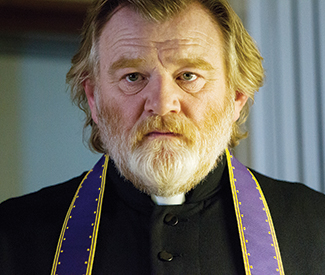
It starred Brendan Gleeson — a significant Irish national resource both McDonagh siblings have made regular use of, as a willfully perverse small town cop who takes infinite pleasure flummoxing the tightly wound FBI agent (Don Cheadle) he’s forced to investigate an international drug-smuggling ring with. Endlessly acerbic, spectacularly scenic, The Guard is so pleased-as-punch with itself you might occasionally wish to punch it. But Preston Sturges was also conspicuously delighted by his prancing-prize-pony of a mind, which didn’t make its cavorting any less delightful to others.

Gleeson and John Michael are back with Calvary, a film just as good, if yea more suspect for crimes of excess facility — especially because this time he’s being serious, at least sorta kinda. This McDonaugh’s flippancy is of the kind that makes you wonder whether he’s even capable of really giving a shit about anything, in part because he occasionally fakes it so well.

Father James (Gleeson) is the discreetly gruff moral center of a coastal Irish hamlet that surely would have none otherwise. His parishioners, living in some glossy tourist advertisement whose quaint authenticity looks polished beyond belief (or an actual native’s budget), are all skeptics, heretics, nonbelievers, and blatant sinners. They take particular pleasure in ridiculing the uprightness of this one man no one has a legitimate gripe against, save resentment.

There’s self-assigned upscale town slut Veronica (Orla O’Rourke), having a possibly kinky affair (among many) with handsome Ivory Coast émigré Simon (Jim Jarmusch regular Isaach de Bankole), while husband Jack (Chris O’Dowd) claims bored indifference. Cynical Dr. Frank (Aidan Gillen) is seemingly hardened to suffering by all he’s witnessed in the hospital operating room. Michael Fitzgerald (Dylan Moran) is the new lord of the local manor, a disgraced but as-yet-unjailed predatory financier who toys with holy forgiveness as he might any other asset his filthy millions could acquire.

Lower on the totem pole, troubled youth Milo (Killian Scott) wonders whether to kill himself, somebody else, or both — a dilemma shared at least partially by nearly everyone here — just to feel something. A life-sentenced serial murderer once in his flock (Domhnall Gleeson, son of Brendan), a glib superior (David McSavage’s Bishop), a hopelessly shallow apparent successor (David Wilmot’s Father Leary), and others all seem to enjoy a little too much making Father James writhe on the skewer of his historically very guilty institution’s making. Rare exceptions are a French tourist (Marie-Josée Croze) widowed by a needless traffic pileup, and his own daughter Fiona (Kelly Reilly), a perpetual train wreck come home to the daddy she says abandoned her for God just as his wife/her mother abandoned them both for terminal cancer.

As if all this weren’t enough already: At Calvary‘s start, an unseen confessor tells James he was abused for years by a (now-dead) Catholic priest, and as recompense will kill his current, admittedly blameless confessor in a week’s time. Just for, y’know, catharsis or whatever.

That’s a setup narrative, to say the least. It would appear entirely, absurdly skewed if not for the gravitational center Gleeson provides. He single-handedly provides the sincere if faint hope of redemption in a scenario that otherwise provides every possible indication of damnation for all. It’s hard to imagine another actor doing as much so well, with so little apparent effort, under circumstances of such manipulative high contrivance. Basically every scene here is a beautifully staged theatrical dialogue angled toward a shocking revelation. Calvary centrally addresses the question of faith while ultimately dodging the answer. I’d appreciate McDonagh’s ambivalence more if he weren’t quite so pleased about it. He’s got extraordinary taste, no doubt — from its editorial pace to its costume and soundtrack choices, this movie is curated within an inch of too-much-ness. Beyond his understandable disillusionment with the Catholic Church’s crimes, does he truly care about morality, or is it just an authorial chew-toy?

Calvary is so cannily crafted and acted, many will shrug off such quibbles, deciding the film’s brilliant surface actually means something, or at least deliberately implies myriad meanings. But this McDonagh, like the other, feels like a genius attention-seeker whose impersonation of depth cannot be trusted. I doubt him — as many characters here do God — right down to the last fate-intervening inspiration of an ending that won’t leave a dry eye in the house. Nor should it, dammit. *


CALVARY opens Fri/8 in Bay Area theaters.

What she sees

1

cheryl@sfbg.com

SFJFF The San Francisco Jewish Film Festival opens July 24 with The Green Prince, a documentary based on the memoir of Mosab Hassan Yousef. The son of a founding member of Hamas, he worked as an undercover agent for the Israeli secret service for 10 years, sharing a profound trust with his Shin Bet handler. The closing night film is also a documentary about a conflicted childhood that paves the way for tough choices later in life — but if Little White Lie is also a personal story, it’s a far less political one.

It’s a thoroughly American story, telling the tale of filmmaker Lacey Schwartz, who was raised by her parents — both products of “a long line of New York Jews” — in the decidedly homogeneous town of Woodstock. All of Schwartz’s grade-school friends had light skin and straight hair, while Schwartz was dark, with coarse curls. Lovingly recorded snapshots and home movies of her Bat Mitzvah and other occasions suggest a happy young life, but the “600-pound gorilla in the room,” as one relative puts it, was that Schwartz did not look white, despite ostensibly having white parents. Once she reached her teenage years — and particularly after she enrolled in a high school that had African American kids among its population — she began to realize the go-to family explanation (yeah … that one Sicilian way back in the family tree …) was nothing but a flimsy excuse holding back a mountain of denial.

Now in her 30s, Schwartz has overcome years of identity confusion and is self-confidently assertive in a manner that suggests years of therapy (and indeed, we see footage of sessions she filmed for a student project at Georgetown, where she found a supportive community among the Black Student Alliance). Her parents, however, are not quite as psychologically evolved, although her mother — a pleasant woman who has nonetheless been content to spend her life surfing the waves of passive-aggression — eventually opens up about the Schwartz family’s worst-kept secret. The aptly-titled Little White Lie clocks in at just over an hour, but it packs in a miniseries’ worth of emotional complexity and honesty. Schwartz will be on hand at the film’s San Francisco and Berkeley screenings — the Q&As are sure to be lively.

Another, rather different tale of women using cameras in pursuit of the truth surfaces in Judith Montell and Emily Scharlatt’s In the Image, a doc about Palestinian women who work with Israeli human-rights NGO B’Tselem. Group members, who include high school girls and middle-aged mothers, are given small video cameras to keep an eye on protests, harassment, and anti-Palestinian violence perpetrated by Israeli soldiers and settlers. (In one disturbing clip, we see a small child launch a giant spitball at the lens.) Able to capture footage in areas deemed off-limits to mainstream journalists, In the Image shows how B’Tselem brings investigative reporting to the front lines, and then to the world (thanks, YouTube). It’s also an empowering outlet for the camerawomen-activists, for whom career opportunities are otherwise as rare as are opportunities for artistic expression.

Women are also front and center in a number of SFJFF’s stronger narrative entries. Writer-director Talya Lavie won Best Narrative Feature and the Nora Ephron Prize at Tribeca for Zero Motivation, a pitch-black comedy about female frenemies jammed into close quarters while doin’ time in the Israeli Defense Forces. Most movies prefer to show soldiers in combat, and Zero Motivation does just that — if “combat” means fighting to avoid boring admin work, to achieve the highest score at Minesweeper, to fuck up the most extravagantly, or with staple guns. “There’s a war going on — get a grip!” a superior officer reminds self-centered slacker Daffi (Nelly Tager), and that’s more or less the only current-affairs statement uttered in a film that’s mostly concerned with the agonizing task of achieving responsible young adulthood.

Another coming-of-age tale unfolds in Hanna’s Journey, director and co-writer Julia von Heinz’s drama about a Berlin business-school student (Karoline Schuch) whose résumé is lacking in the sort of warm-fuzzy community service that’ll elevate her in the cutthroat job market. Her estranged mother, who works with a German group placing volunteers in Israel, proves unexpectedly helpful, and Hanna is soon winging her way to work with developmentally disabled adults in Tel Aviv, leaving her sleek wardrobe and yuppie boyfriend behind.

Hanna’s Journey has all the potential to be a pat story about a German woman coming to terms not just with her own life choices, but with complicated family history (hint: it involves World War II) only a trip to Israel can unearth. There’s also a conveniently hunky Israeli (Doron Amit) in the mix. But! Schuch, who resembles Jessica Chastain, brings authenticity to a character who morphs from superficial to soulful in what might otherwise seem like too-rapid time. She also benefits from a subtle, nicely detailed script, which avoids stereotypes and oversimplification, and is not without moments of wicked humor (“German girls are easy — it’s the guilt complex!”)

Less successful at achieving subtelty is For a Woman, writer-director Diane Kurys’ latest autobiographical drama. Here, she explores her parents’ troubled marriage, inspired by a photograph of an uncle nobody in the family wanted to discuss. The fictionalized version begins as Kurys stand-in Anne (Sylvie Testud) and older sister Tania (Julie Ferrier) have just buried their mother, who was long-divorced from the girls’ ailing father.

For a Woman takes place mostly in flashbacks to post-war Lyon, where young Jewish couple Léna (Mélanie Thierry) and Michel (Benoit Magimel) settle and have Tania soon after. Russia-born Michel is a devoted Communist, and he’s overjoyed — yet understandably suspicious — when long-lost brother Jean (Nicolas Duvauchelle) suddenly appears in France, having somehow escaped the USSR. Michel’s political paranoia blinds him to the fact that Léna — who married him to escape a death camp (he didn’t know her, but couldn’t resist her icy blond beauty) — is bored with her stay-at-home-mom life, and has taken an unwholesome interest in his mysterious little bro.

There’s more to the story than that, of course, but For a Woman never goes much deeper than a made-for-TV melodrama: entertaining in the moment, but ultimately forgettable. And even gorgeous period details (Michel’s car is to die for) can’t make up for a frame story that feels rather wan next to the film’s cloak-and-dagger main plotline. 2

SAN FRANCISCO JEWISH FILM FESTIVAL

July 24-Aug. 10, most shows $10-$14

Various Bay Area venues

www.sfjff.org


What she sees

3

cheryl@sfbg.com

SFJFF The San Francisco Jewish Film Festival opens July 24 with The Green Prince, a documentary based on the memoir of Mosab Hassan Yousef. The son of a founding member of Hamas, he worked as an undercover agent for the Israeli secret service for 10 years, sharing a profound trust with his Shin Bet handler. The closing night film is also a documentary about a conflicted childhood that paves the way for tough choices later in life — but if Little White Lie is also a personal story, it’s a far less political one.

It’s a thoroughly American story, telling the tale of filmmaker Lacey Schwartz, who was raised by her parents — both products of “a long line of New York Jews” — in the decidedly homogeneous town of Woodstock. All of Schwartz’s grade-school friends had light skin and straight hair, while Schwartz was dark, with coarse curls. Lovingly recorded snapshots and home movies of her Bat Mitzvah and other occasions suggest a happy young life, but the “600-pound gorilla in the room,” as one relative puts it, was that Schwartz did not look white, despite ostensibly having white parents. Once she reached her teenage years — and particularly after she enrolled in a high school that had African American kids among its population — she began to realize the go-to family explanation (yeah … that one Sicilian way back in the family tree …) was nothing but a flimsy excuse holding back a mountain of denial.

Now in her 30s, Schwartz has overcome years of identity confusion and is self-confidently assertive in a manner that suggests years of therapy (and indeed, we see footage of sessions she filmed for a student project at Georgetown, where she found a supportive community among the Black Student Alliance). Her parents, however, are not quite as psychologically evolved, although her mother — a pleasant woman who has nonetheless been content to spend her life surfing the waves of passive-aggression — eventually opens up about the Schwartz family’s worst-kept secret. The aptly-titled Little White Lie clocks in at just over an hour, but it packs in a miniseries’ worth of emotional complexity and honesty. Schwartz will be on hand at the film’s San Francisco and Berkeley screenings — the Q&As are sure to be lively.

Another, rather different tale of women using cameras in pursuit of the truth surfaces in Judith Montell and Emmy Scharlatt’s In the Image, a doc about Palestinian women who work with Israeli human-rights NGO B’Tselem. Group members, who include high school girls and middle-aged mothers, are given small video cameras to keep an eye on protests, harassment, and anti-Palestinian violence perpetrated by Israeli soldiers and settlers. (In one disturbing clip, we see a small child launch a giant spitball at the lens.) Able to capture footage in areas deemed off-limits to mainstream journalists, In the Image shows how B’Tselem brings investigative reporting to the front lines, and then to the world (thanks, YouTube). It’s also an empowering outlet for the camerawomen-activists, for whom career opportunities are otherwise as rare as are opportunities for artistic expression.

Women are also front and center in a number of SFJFF’s stronger narrative entries. Writer-director Talya Lavie won Best Narrative Feature and the Nora Ephron Prize at Tribeca for Zero Motivation, a pitch-black comedy about female frenemies jammed into close quarters while doin’ time in the Israeli Defense Forces. Most movies prefer to show soldiers in combat, and Zero Motivation does just that — if “combat” means fighting to avoid boring admin work, to achieve the highest score at Minesweeper, to fuck up the most extravagantly, or with staple guns. “There’s a war going on — get a grip!” a superior officer reminds self-centered slacker Daffi (Nelly Tager), and that’s more or less the only current-affairs statement uttered in a film that’s mostly concerned with the agonizing task of achieving responsible young adulthood.

Another coming-of-age tale unfolds in Hanna’s Journey, director and co-writer Julia von Heinz’s drama about a Berlin business-school student (Karoline Schuch) whose résumé is lacking in the sort of warm-fuzzy community service that’ll elevate her in the cutthroat job market. Her estranged mother, who works with a German group placing volunteers in Israel, proves unexpectedly helpful, and Hanna is soon winging her way to work with developmentally disabled adults in Tel Aviv, leaving her sleek wardrobe and yuppie boyfriend behind.

Hanna’s Journey has all the potential to be a pat story about a German woman coming to terms not just with her own life choices, but with complicated family history (hint: it involves World War II) only a trip to Israel can unearth. There’s also a conveniently hunky Israeli (Doron Amit) in the mix. But! Schuch, who resembles Jessica Chastain, brings authenticity to a character who morphs from superficial to soulful in what might otherwise seem like too-rapid time. She also benefits from a subtle, nicely detailed script, which avoids stereotypes and oversimplification, and is not without moments of wicked humor (“German girls are easy — it’s the guilt complex!”)

Less successful at achieving subtelty is For a Woman, writer-director Diane Kurys’ latest autobiographical drama. Here, she explores her parents’ troubled marriage, inspired by a photograph of an uncle nobody in the family wanted to discuss. The fictionalized version begins as Kurys stand-in Anne (Sylvie Testud) and older sister Tania (Julie Ferrier) have just buried their mother, who was long-divorced from the girls’ ailing father.

For a Woman takes place mostly in flashbacks to post-war Lyon, where young Jewish couple Léna (Mélanie Thierry) and Michel (Benoit Magimel) settle and have Tania soon after. Russia-born Michel is a devoted Communist, and he’s overjoyed — yet understandably suspicious — when long-lost brother Jean (Nicolas Duvauchelle) suddenly appears in France, having somehow escaped the USSR. Michel’s political paranoia blinds him to the fact that Léna — who married him to escape a death camp (he didn’t know her, but couldn’t resist her icy blond beauty) — is bored with her stay-at-home-mom life, and has taken an unwholesome interest in his mysterious little bro.

There’s more to the story than that, of course, but For a Woman never goes much deeper than a made-for-TV melodrama: entertaining in the moment, but ultimately forgettable. And even gorgeous period details (Michel’s car is to die for) can’t make up for a frame story that feels rather wan next to the film’s cloak-and-dagger main plotline. 2

SAN FRANCISCO JEWISH FILM FESTIVAL

July 24-Aug. 10, most shows $10-$14

Various Bay Area venues

www.sfjff.org


Scare and scare alike: zombies, maggots, and more at ‘BAASICS.5: Monsters’

0

“We stopped checking for monsters under our beds when we realized they were inside us,” reads a quote often misattributed to the Joker in 2008’s The Dark Knight. The presenters at July 14’s “BAASICS.5: Monsters” event at ODC Theater capitalized on this concept, examining both modern monsters (though not “cars and corn syrup,” as one emcee mentioned at the beginning of the event) and monsters of yore. 

In past years, the organization has explored provocative topics such as the future (more weighted toward a possible uprising of robots rather than the nagging question “What am I going to do with my life?”) and psychiatric and neurologic disorders by juxtaposing science and art. It’s easy to find the right balance between the two for these past themes, but I wasn’t quite sure what to expect from this year’s event. 

It ended up being a lot less grisly than I’d imagined — with the exception of a video clip depicting maggots violating a honeybee. (I can never unsee that.) I felt as though I were in a college lecture hall, viewing PowerPoints — which were much more aesthetically pleasing than the Papyrus-laden slides my freshman year history professor used — and listening to professors, each with an exceptionally dry sense of humor. 

Presenters, ranging from shark conservationists to artists, shared their definitions of a monster, often turning the tables on common misconceptions. David McGuire revealed that more people die from vending machines than from shark attacks, emphasizing how it’s truly a man-eat-shark world out there today. (Ahem, shark fin soup…) Closing presenter Brynda Glazier tackled societal expectations of beauty and normalness, drawing inspiration from her personal life as her brother is disabled, expressing this through seemingly ugly and monstrous sculptures. 

BAASICS’ associate content producer Georgeann Sack — described in the program as a “neuroscientist by day and science communicator by night” — also performed low-key acoustic songs as a segue between presentations. In fact, her music was so low-key that I often had trouble hearing and understanding her, although I’m sure the lyrics to her song “Vampire Love Song” were clever. Sack’s standout performance was her rendition of the Creepshow’s “Zombies Ate Her Brain,” which sounded a little like a singer-songwriter’s DIY GarageBand-recorded music. 

However, the biggest letdown of the event were the short videos. With topics such as malaria research and glowing plants, the videos had potential but ultimately came off as too sterile. The two video shorts seemed as though they were filmed with a cheap digital camera — that highlighted distracting background noise while researchers spoke — and edited in iMovie. Other audience members were just as unimpressed as my friend and I were — I heard some people in the row behind us begin a slow clap after the second video. 

Art and science weren’t exactly joined in holy matrimony at this event. To me, BAASICS.5 was more like an evening well spent in your friend’s apartment — you know, the friend with a great appreciation for art who’s basically a living, breathing encyclopedia of weird shit — and can talk endlessly about it. Bring up Bigfoot and they’ll mention how the highest number of reported Bigfoot sightings originate from Humboldt County and slyly attribute this to the inhabitants’ altered perceptions. And did they mention how there’s a pseudo-porno titled Bigfoot’s Wild Weekend? (Here’s looking at you, Jill Miller!) Maybe zombies are more up your friend’s alley and they created an amazingly detailed zombie survey for people to fill out. (Your hard work definitely paid off, George Pfau.)

As for me, I checked off “Zombies are Vaudeville performers,” “The apocalypse is ‘the big one,’” and “After death, you take harp lessons” as my answers to Pfau’s zombie survey, which I picked up in the lobby afterwards. The real highlight of the event was being exposed to modern takes on tales as old as time, if the outside of the survey brochure, a Where’s Waldo-inspired scene even featuring Michael Jackson from his “Thriller” days, is anything to go by. 

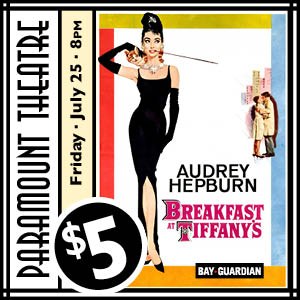
PROMO: Breakfast at Tiffany’s at Paramount Theatre July 25

0

BREAKFAST AT TIFFANY’S (1961) – Based on the novel by Truman Capote and directed by Blake Edwards, this unforgettable gem of a romantic comedy stars the incomparable Audrey Hepburn at the height of her beauty and talent. Hepburn is mesmerizing as Holly Golightly, a Manhattan party girl who doesn’t quite grasp when parties end and reality begins. Sharing Holly’s lifestyle is handsome young writer Paul Varjack (George Peppard). No matter what scrape Holly manages to get into, Paul is always there to pick up the pieces. But Paul is trying to make something of himself and Holly is trying to create something of herself. Will Holly realize that there’s more to life than being kept in a style to which she’s become accustomed? Will Paul ever convince Holly that he deserves more from her than “brotherly” love? Micky Rooney as Holly’s Japanese landlord, O.J. Berman as Holly’s Hollywood agent, Patricia Neal as Paul’s patron, and Buddy Epsen as Holly’s ex-husband round out a perfect cast delivering peak performances. Henri Mancini’s musical score and the song “Moon River” sung by Audrey Hepburn earned Oscars.

Movie classics feature 35mm film prints, a newsreel, cartoon, previews, Dec-O-Win raffle, and a live Wurlitzer organ serenade. Purchase advance tickets here or enter to win a pair of tickets by emailing RSVP@sfmediaco.com with “Breakfast at Tiffany’s” in the subject line. Tickets available at the Paramount Box Office on movie night.

Friday, July 25, 8pm at the Paramount Theatre, 2025 Broadway, Oakland. |  $5

Events: July 9 – 15, 2014

0

Listings are compiled by Guardian staff. Submit items for the listings at listings@sfbg.com. For further information on how to submit items for the listings, see Selector.

WEDNESDAY 9

LaborFest 2014 Meet at SW corner of Geary and Laguna, SF; www.laborfest.net. 3-4:30pm, free. “Union Sponsored Affordable Housing in San Francisco: St. Francis Square Cooperative” walking tour.

Kim Stolz Book Passage, 1 Ferry Bldg, SF; www.bookpassage.com. 12:30pm, free. The author and media personality discusses Unfriending My Ex: And Other Things I’ll Never Do.

THURSDAY 10

Kjerstin Gruys Books Inc, 601 Van Ness, SF; www.booksinc.net. 7pm, free. The sociologist discusses her memoir Mirror, Mirror Off the Wall: How I Learned to Love My Body By Not Looking at It For a Year.

LaborFest 2014 518 Valencia, SF; www.laborfest.net. 7pm, donations accepted. “FilmWorks United: International Working Class Film and Video Festival:” Black and White and Dead All Over (Foster, 2013), followed by a discussion on the newspaper industry. Also: Berkeley City College Auditorium, 2050 Center, Berk; www.laborfest.net. 7pm, free. “FilmWorks United:” Coming for a Visit (Tourette, 2013).

Jervey Tervalon Book Passage, 1 Ferry Bldg, SF; www.bookpassage.com. 6pm, free. The author discusses his new thriller, Monster’s Chef.

FRIDAY 11

LaborFest 2014 First Unitarian Universalist Church, 1187 Franklin, SF; www.laborfest.net. 7pm, donations accepted. “FilmWorks United: International Working Class Film and Video Festival:” ASOTRECOL, The Struggle Against Transnationals in Colombia (2013).

“Off Shore: A Live Drawing Event and Fundraiser” Verdi Club, 2424 Mariposa, SF; www.soex.org. 6pm, $15-20. Southern Exposure’s annual “Monster Drawing Rally” fundraiser presents 120 artists drawing in shifts in front of a live audience.

“Punk: Convulsive Beauty” iHeartNorthBeach Art Gallery and Gifts, 641 Green, SF; www.pmpress.org. 5-11pm, free. PM press presents its new book, Dead Kennedys: Fresh Fruit for Rotting Vegetables, The Early Years, by Alex Ogg, featuring photographs by Ruby Ray and art by Winston Smith. Ray and Smith will also be exhibiting their artwork capturing the punk scene, circa 1977-1981.

SATURDAY 12

Tony Gilbert Green Apple Books, 506 Clement, SF; www.greenapplebooks.com. Noon, free. The author reads from Hannah and the Secret Mermaids of San Francisco Bay, alongside a display of original art from the story painted by Gail Weissman.

LaborFest 2014 Meet at 75 Folsom, SF; www.laborfest.net. 10am, free. “San Francisco Waterfront Labor History Walk,” with Lawrence Shoup and Peter O’Driscoll. Also: meet in front of Bill Graham Auditorium, 99 Grove, SF; www.laborfest.net. 10am, $20. “WPA Bus Tour.” Also: Fellowship of Unitarian Universalists, 1924 Cedar, Berk; www.laborfest.net. 7pm, free. Class War CD release party with Redd Welsh. Also: First Unitarian Universalist Church, 1187 Franklin, SF; www.laborfest.net. 7pm, donations accepted. “People’s Voices for a World of Harmony, Peace, and Justice.”

“Writers With Drinks: An Evening of Oversharing About Money” Make-Out Room, 3225 22nd St, SF; www.writerswithdrinks.com. 7:30pm, $5-20. With J. Bradford DeLong, Carol Queen, Farhad Manjoo, Frances Lefkowitz, and Charlie Jane Anders.

SUNDAY 13

“Bookish Beasts” Center for Sex and Culture, 1349 Mission, SF; www.sexandculture.org. Noon-6pm, free. Zine fest featuring authors whose work takes on sexuality, gender, and erotica.

MP Johnson Borderlands Books, 866 Valencia, SF; www.borderlands-books.com. 3pm, free. The author reads from Dungeons and Drag Queens. Attending in drag encouraged!

LaborFest 2014 ILWU 34 Hall, 801 Second St, SF; www.laborfest.net. 10am, free. “Staples, Our Public Post Office, Privativation, and Trust” panel discussion. Also: Manilatown Center, 868 Kearny, SF; www.laborfest.net. 4-7pm, donations accepted. “Revisiting the History of California Agricultural Workers and Filipino Labor” with a variety of speakers.

TUESDAY 15

Anoop Judge Booksmith, 1644 Haight, SF; www.booksmith.com. 7:30pm, free. The author discusses her Bay Area-set novel, The Rummy Club.

LaborFest 2014 Potrero Hill Neighborhood House, Southern Heights at De Haro, SF; www.laborfest.net. 10am, free. Potrero Hill history walk. Also: Modern Times Bookstore, 2919 24th St, SF; www.laborfest.net. 7pm, free. LaborFest Writers read their work. Also: San Jose Improv, 62 Second St, San Jose; www.sjimprov.com. 8pm, donations requested (make free reservations online). “LaborFest Comedy Night” with Will Durst and others. *


A great week for (indie) sci-fi and docs: new movies!

0

This week, Frameline continues (our coverage here!), plus offbeat sci-fi winners Coherence and Snowpiercer are well worth seeking out … especially if you’re not in the mood for more giant robot smash-ups from the Michael Bay factory. Plus: new docs and more! Read on.

Breathing Earth: Susumu Shingu’s Dream Japanese artist Susumu Shingu has built his career through his concerted engagement with the natural world. The wise and eternally smiling 75-year-old creates angular and often gargantuan mobiles that harness the power of wind and water to gyrate in ever-changing directions. In Breathing Earth, German director Thomas Riedelsheimer crafts a deliberately paced rumination on Shingu’s life philosophy that, while devoid of the frenetic facts, figures, and trite biographical rehashes that punctuate hyper-informative pop-docs, uses a beautifully simplistic narrative arc to illuminates Shingu’s attempt to create a hilly, open-air collection of windmills. The sculptor’s impassioned narration and charming conversations with potential landlords and investors (who usually entirely miss the point of his mission to raise environmental consciousness through aesthetic beauty) make Shingu impossible not to fall in love with — he is laid-back, funny, and astonishingly youthful. Riedelsheimer’s camera is similarly relaxed, gliding sumptuously over the green and wild landscapes on which Shingu installs his works. Despite his meditative tempo, Riedelsheimer manages to explore a remarkably wide scope; Shingu’s late-life marriage to a fellow sculptor, his appeals to both Japanese and German schoolchildren to care for the earth and help to avoid environmental disasters, and his intricate technical processes all receive intimate and inspiring sections. (1:37) (David Kurlander)

Citizen Koch After quietly influencing conservative ideology, legislation, and elections for decades, the billionaire industrialist Koch brothers have found themselves becoming high-profile figures — much to their dismay, no doubt. The relative invisibility they hitherto enjoyed greatly abetted their impact in myriad arenas of public policy and “popular” conservative movements. Look behind any number of recent red-vs.-blue flashpoint issues and you can find their fingerprints: Notably state-level union busting; “smaller government” (i.e. incredible shrinking social services); seeding allegedly grassroots organizations like the Tea Party; furthering the Corporations = People thing (see: Citizens United); and generally helping the rich like themselves get richer while fostering working-class outrage at everybody else. This documentary by Trouble the Water (2008) co-directors Carl Deal and Tia Lessen touches on all those matters, while also focusing on Wisconsin as a test laboratory for the brothers’ Machiavellian think-tank maneuvers, following a Lousiana GOP candidate on the campaign trail (one he’s marginalized on for opposing corporate influence peddling), and more. Any one of these topics could support a feature of their own (and most already have). Citizen Koch’s problem is that it tries to encompass too much of its subjects’ long reach, while (despite the title) leaving those subjects themselves underexplored. (It also suffers from being a movie completed at least 18 months ago, a lifetime in current US political terms.) For the reasonably well-informed this documentary will cover a lot of familiar ground—which is not to say that ground isn’t still interesting, or that the added human interest elements don’t compel. But the film covers so much ground it ends up feeling overstuffed and unfocused. (1:26) (Dennis Harvey) 

Coherence See “Vortex Room.” (1:29)

Korengal This companion piece to 2010’s Oscar-nominated Restrepo — one of the best docs about modern-day warfare to date, offering unfiltered access to an Army platoon stationed in Afghanistan’s Korengal Valley — uses previously unseen footage shot during the year filmmakers Sebastian Junger and Tim Hetherington spent shadowing their subjects. Korengal is structured as a more introspective work, with musings on what it feels like to be a soldier in the Korengal, surrounded by rough (yet strikingly beautiful) terrain populated by farmers who may or may not be Taliban sympathizers, not to mention unpredictable, heavily armed opponents referred to simply as “the enemy.” Interviews reveal sadness, boredom, a deep sense of brotherhood, and the frustrating feeling of going from “100 miles an hour to a dead halt” after the surreal exhilaration of a firefight. Korengal also functions as a tribute to Hetherington, who was killed in 2011 while on assignment in Libya. Not only does his death add a layer of poignant subtext, it also suggests why Junger felt moved to revisit this story. That said, though Korengal‘s footage is several years old, its themes remain distressingly timely. (1:24) (Cheryl Eddy)

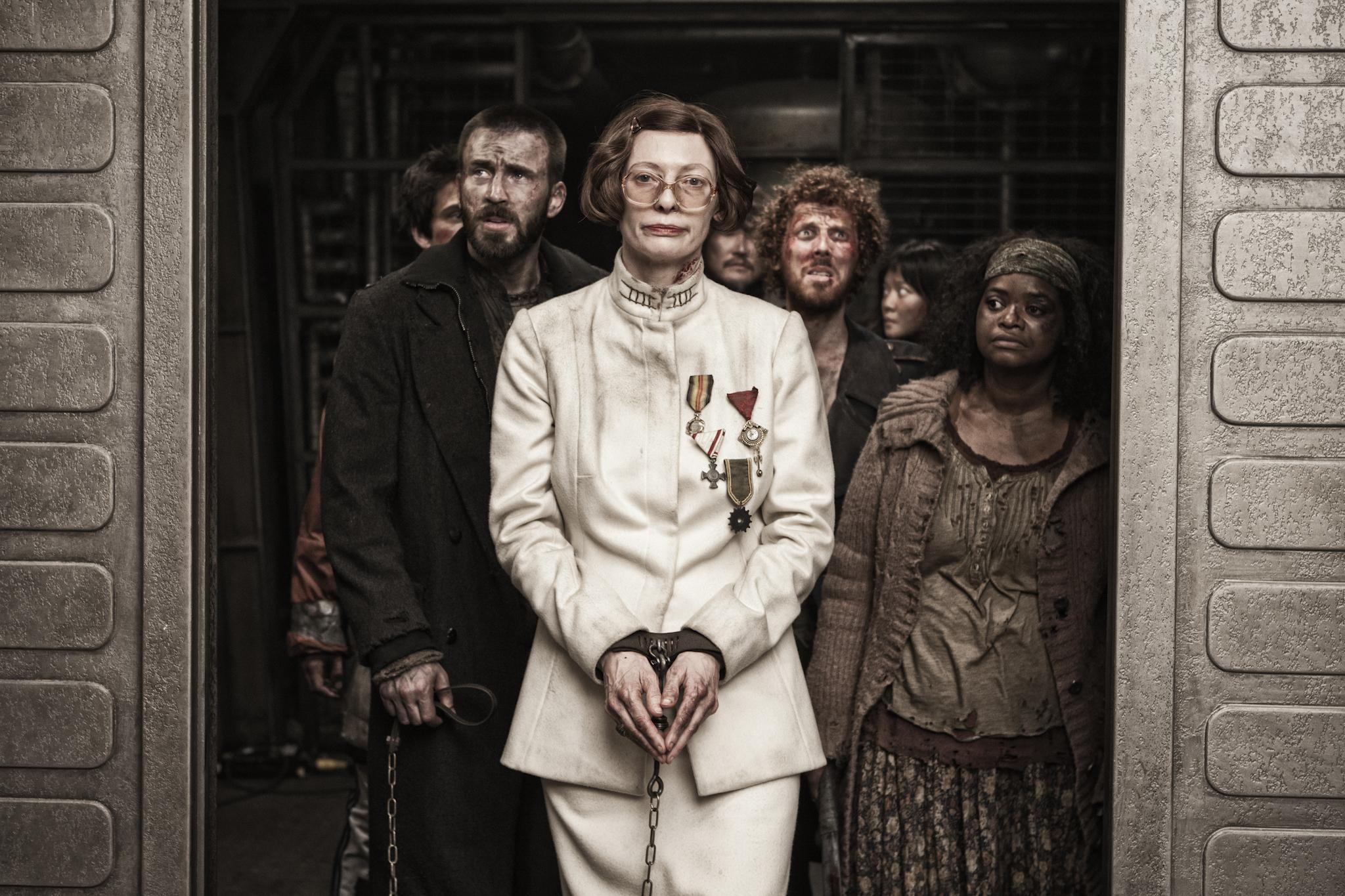
Snowpiercer Eighteen years after an attempt to reverse global warming has gone wildly awry — freezing all life into extinction — the only known survivors are on a one-of-a-kind perpetual-motion train that circles the Earth annually, has its own self-contained ecosystem, and can smash through whatever ice buildup has blocked its tracks since the last go-round. It’s also a microcosm of civilization’s worst class-economic-racial patterns over history, with the much-abused “tail” passengers living in squalor under the thumb of brutal military police. Unseen at the train’s front is its mysterious inventor, Wilford, whose minions enforce “Eternal Order Prescribed by the Sacred Engine.” Curtis (Chris Evans) is default leader of the proletariat’s latest revolt, in which they attempt to force their way forward though the prison section (where they free Song Kang-ho and Go Ah-sung as the train’s original lock designer and his psychic daughter) on to the wonders of the first class compartments, and beyond. This first (mostly) English-language feature by South Korean Bong Joon-ho (2006’s The Host, 2009’s Mother), based on a 1982 French graphic novel, starts out as a sort of locomotive, claustrophobic Mad Max (1979) variation. But it gets wilder and more satirical as it goes along, goosed by Tilda Swinton’s grotesquely comic Minister Mason, and Alison Pill as a teacher propagandist in a particularly hilarious setpiece. In case the metaphor hasn’t already hit you on the head, one character explains “The train is the world, we the humanity.” But Snowpiercer’s sociopolitical critique is as effective as it is blunt, because Bong handles everything here — visceral action, absurdist humor, narrative left-turns, neatly etched character archetypes, et al. — with style, confidence, and wit. Some of the FX may not be quite as seamless as it would have been in a $200 million Hollywood studio production, and fanboys will no doubt nitpick like nitwits at various “credibility gaps.” (As if this movie ever asks to be taken literally.) But by current, or any, sci-fi action blockbuster standards, this is a giddily unpredictable, risk-taking joy. (2:07) (Dennis Harvey)

Third Person A screenwriter, Paul Haggis, pens a script in which a novelist (Liam Neeson) sits alone in a smoke-filled hotel room in Paris struggling over a manuscript about a novelist who can only feel emotions through his characters. What that psychic state would actually look like remains unclear — when the woman (Olivia Wilde) he’s left his wife (Kim Basinger) for shows up, their playful, painful, fraught interactions reveal a man with above-average emotional reserves. Meanwhile, in another hotel in another city, Rome, a sleazy fashion industry spy (Adrien Brody) finds his life turned sideways by a seemingly chance encounter in a bar with a beautiful Romanian woman (Moran Atias) in dire need of money. And in a third hotel, in Manhattan, a young woman (Mila Kunis) cleans up the suites she used to stay in when she was married to a renowned painter (James Franco), with whom she has a son she may or may not have harmed in some terrible way. The film broadly hints at connections between these three sets of lives — in each, the loss or endangerment of a child produces an unrelenting ripple effect; speaking of which, objects unnaturally submerged in water present an ominous visual motif. If the movie poster doesn’t give the game away as you’re walking into the theater, the signposts erected by Haggis ensure that you won’t be in the dark for long. Learning how these characters relate to one another, however, puts considerable drag on the fabric of the plot, exposing the threadbare places, and where Haggis offers his tortured characters redemption, it comes at the cost of good storytelling. (2:17) (Lynn Rapoport)

Transformers: Age of Extinction In Michael Bay’s fourth Transformers installment a villainous Black Ops leader (Kelsey Grammer) allies with a snarky Steve-Jobs-alike (Stanley Tucci) to build Transformers de coeur: designer impostor robot-cars they hope will reinvent the face of war. In IMAX 3D, “TransFOURmers” is packed with relentless rock-‘em-sock-‘em action, spectacular property destruction, and about as much sense as a bucket of worms. After 60 minutes, you think you’re getting more than your money’s worth. At 90 minutes, you’re tired. At two hours, confusion sets in: If Autobots get stronger together how could Optimus be in so much trouble? Who is the bounty hunting Terminator lookalike? HOW MUCH MORE COULD THERE BE? And then … the action shifts to China, Optimus rides a Dinobot, and chaos reigns. I’ve always liked the working-class poetry of the Transformers themselves — the leader is a trucker and the cast is stacked with ambulances, tanks, and the metal workforce that preserves American lives. If that’s not traditional hero worship, I don’t know what is. But Age of Extinction is the soulless designer imposter it lampoons — the whole sequel-snarking ordeal makes you long for Buzz Lightyear, who saw a thousand Buzz Lightyears on a store shelf and survived that existential crisis heroically — while also riding a dinosaur and fighting Frasier. This Transformers movie (sadly, it won’t be the final one) starts with a thesis: Mark Wahlberg walks through an abandoned movie theater and a Wilford Brimley twin (Ron Shedd) bellows: “Movies today! Sequels! Remakes! Crap!” Age of Extinction follows that moment with nearly three hours of evidence that the cause of extinction is redundancy. (2:30) (Sara Maria Vizcarrondo)

Under the Electric Sky Hey, raver! This 3D concert film enables you to experience the Electric Daisy Carnival without punching any holes in your brain. Or, y’know, dying. (1:25)

Violette Taking on another “difficult” woman artist after the excellent 2008 Séraphine (about the folk-art painter), Martin Provost here portrays the unhappy life of Violette Leduc (Emmanuelle Devos), whose fiction and autobiographical writings eventually made her a significant figure in postwar French literature. We first meet her waiting out the war with gay author Maurice Sachs (Olivier Py), one of many unrequited loves, then surviving via the black market trade before she’s “discovered” by such groundbreaking, already-established talents as Jean Genet (Jacques Bonnaffé) and Simone de Beauvoir (Sandrine Kiberlain). It is the latter, a loyal supporter who nonetheless retains a chilly emotional distance, who becomes bisexual Violette’s principal obsession over the coming 20 years or so. Devos does her best to portray “a neurotic crazy washed-up old bag” with an “ugly mug” — hardly! — who is perpetually broke, depressed, and awkward, thanks no doubt in part to her mean witch of a mother (Catherine Hiegel). “Screaming and sobbing won’t get you anywhere,” Simone at one point tells her, and indeed Leduc is a bit of a pill. For the most part lacking the visual splendors of Séraphine (this character’s environs weren’t so pastoral), Violette is finely acted and crafted but, like its heroine, hard to love. (2:18) (Dennis Harvey)

Film Listings: June 25 – July 1, 2014

0

Film listings are edited by Cheryl Eddy. Reviewers are Kimberly Chun, Dennis Harvey, Lynn Rapoport, and Sara Maria Vizcarrondo. For rep house showtimes, see Rep Clock. For complete film listings, see www.sfbg.com.

FRAMELINE

Frameline 38, the San Francisco International LGBT Film Festival, runs through June 29 at the Castro Theatre, 429 Castro, SF; Roxie Theater, 3117 16th St, SF; Victoria Theatre, 2961 16th St, SF; and Rialto Cinemas Elmwood, 2966 College, Berk. For tickets (most shows $10-15) and schedule, visit www.frameline.org.

OPENING

Breathing Earth: Susumu Shingu’s Dream Japanese artist Susumu Shingu has built his career through his concerted engagement with the natural world. The wise and eternally smiling 75-year-old creates angular and often gargantuan mobiles that harness the power of wind and water to gyrate in ever-changing directions. In Breathing Earth, German director Thomas Riedelsheimer crafts a deliberately paced rumination on Shingu’s life philosophy that, while devoid of the frenetic facts, figures, and trite biographical rehashes that punctuate hyper-informative pop-docs, uses a beautifully simplistic narrative arc to illuminates Shingu’s attempt to create a hilly, open-air collection of windmills. The sculptor’s impassioned narration and charming conversations with potential landlords and investors (who usually entirely miss the point of his mission to raise environmental consciousness through aesthetic beauty) make Shingu impossible not to fall in love with — he is laid-back, funny, and astonishingly youthful. Riedelsheimer’s camera is similarly relaxed, gliding sumptuously over the green and wild landscapes on which Shingu installs his works. Despite his meditative tempo, Riedelsheimer manages to explore a remarkably wide scope; Shingu’s late-life marriage to a fellow sculptor, his appeals to both Japanese and German schoolchildren to care for the earth and help to avoid environmental disasters, and his intricate technical processes all receive intimate and inspiring sections. (1:37) Roxie, Smith Rafael. (David Kurlander)

Citizen Koch After quietly influencing conservative ideology, legislation, and elections for decades, the billionaire industrialist Koch brothers have found themselves becoming high-profile figures — much to their dismay, no doubt. The relative invisibility they hitherto enjoyed greatly abetted their impact in myriad arenas of public policy and “popular” conservative movements. Look behind any number of recent red-vs.-blue flashpoint issues and you can find their fingerprints: Notably state-level union busting; “smaller government” (i.e. incredible shrinking social services); seeding allegedly grassroots organizations like the Tea Party; furthering the Corporations = People thing (see: Citizens United); and generally helping the rich like themselves get richer while fostering working-class outrage at everybody else. This documentary by Trouble the Water (2008) co-directors Carl Deal and Tia Lessen touches on all those matters, while also focusing on Wisconsin as a test laboratory for the brothers’ Machiavellian think-tank maneuvers, following a Louisiana GOP candidate on the campaign trail (one he’s marginalized on for opposing corporate influence peddling), and more. Any one of these topics could support a feature of their own (and most already have). Citizen Koch‘s problem is that it tries to encompass too much of its subjects’ long reach, while (despite the title) leaving those subjects themselves underexplored. (It also suffers from being a movie completed at least 18 months ago, a lifetime in current US political terms.) For the reasonably well-informed this documentary will cover a lot of familiar ground—which is not to say that ground isn’t still interesting, or that the added human interest elements don’t compel. But the film covers so much ground it ends up feeling overstuffed and unfocused. (1:26) Opera Plaza, Shattuck. (Harvey)

Coherence See “Vortex Room.” (1:29) Presidio.

Korengal This companion piece to 2010’s Oscar-nominated Restrepo — one of the best docs about modern-day warfare to date, offering unfiltered access to an Army platoon stationed in Afghanistan’s Korengal Valley — uses previously unseen footage shot during the year filmmakers Sebastian Junger and Tim Hetherington spent shadowing their subjects. Korengal is structured as a more introspective work, with musings on what it feels like to be a soldier in the Korengal, surrounded by rough (yet strikingly beautiful) terrain populated by farmers who may or may not be Taliban sympathizers, not to mention unpredictable, heavily armed opponents referred to simply as “the enemy.” Interviews reveal sadness, boredom, a deep sense of brotherhood, and the frustrating feeling of going from “100 miles an hour to a dead halt” after the surreal exhilaration of a firefight. Korengal also functions as a tribute to Hetherington, who was killed in 2011 while on assignment in Libya. Not only does his death add a layer of poignant subtext, it also suggests why Junger felt moved to revisit this story. That said, though Korengal‘s footage is several years old, its themes remain distressingly timely. (1:24) Opera Plaza, Shattuck. (Eddy)

Snowpiercer Eighteen years after an attempt to reverse global warming has gone wildly awry — freezing all life into extinction — the only known survivors are on a one-of-a-kind perpetual-motion train that circles the Earth annually, has its own self-contained ecosystem, and can smash through whatever ice buildup has blocked its tracks since the last go-round. It’s also a microcosm of civilization’s worst class-economic-racial patterns over history, with the much-abused “tail” passengers living in squalor under the thumb of brutal military police. Unseen at the train’s front is its mysterious inventor, Wilford, whose minions enforce “Eternal Order Prescribed by the Sacred Engine.” Curtis (Chris Evans) is default leader of the proletariat’s latest revolt, in which they attempt to force their way forward though the prison section (where they free Song Kang-ho and Go Ah-sung as the train’s original lock designer and his psychic daughter) on to the wonders of the first class compartments, and beyond. This first (mostly) English-language feature by South Korean Bong Joon-ho (2006’s The Host, 2009’s Mother), based on a 1982 French graphic novel, starts out as a sort of locomotive, claustrophobic Mad Max (1979) variation. But it gets wilder and more satirical as it goes along, goosed by Tilda Swinton’s grotesquely comic Minister Mason, and Alison Pill as a teacher propagandist in a particularly hilarious set piece. In case the metaphor hasn’t already hit you on the head, one character explains “The train is the world, we the humanity.” But Snowpiercer‘s sociopolitical critique is as effective as it is blunt, because Bong handles everything here — visceral action, absurdist humor, narrative left-turns, neatly etched character archetypes, et al. — with style, confidence, and wit. Some of the FX may not be quite as seamless as it would have been in a $200 million Hollywood studio production, and fanboys will no doubt nitpick like nitwits at various “credibility gaps.” (As if this movie ever asks to be taken literally.) But by current, or any, sci-fi action blockbuster standards, this is a giddily unpredictable, risk-taking joy. (2:07) (Harvey)

Third Person A screenwriter, Paul Haggis, pens a script in which a novelist (Liam Neeson) sits alone in a smoke-filled hotel room in Paris struggling over a manuscript about a novelist who can only feel emotions through his characters. What that psychic state would actually look like remains unclear — when the woman (Olivia Wilde) he’s left his wife (Kim Basinger) for shows up, their playful, painful, fraught interactions reveal a man with above-average emotional reserves. Meanwhile, in another hotel in another city, Rome, a sleazy fashion industry spy (Adrien Brody) finds his life turned sideways by a seemingly chance encounter in a bar with a beautiful Romanian woman (Moran Atias) in dire need of money. And in a third hotel, in Manhattan, a young woman (Mila Kunis) cleans up the suites she used to stay in when she was married to a renowned painter (James Franco), with whom she has a son she may or may not have harmed in some terrible way. The film broadly hints at connections between these three sets of lives — in each, the loss or endangerment of a child produces an unrelenting ripple effect; speaking of which, objects unnaturally submerged in water present an ominous visual motif. If the movie poster doesn’t give the game away as you’re walking into the theater, the signposts erected by Haggis ensure that you won’t be in the dark for long. Learning how these characters relate to one another, however, puts considerable drag on the fabric of the plot, exposing the threadbare places, and where Haggis offers his tortured characters redemption, it comes at the cost of good storytelling. (2:17) Shattuck. (Rapoport)

Transformers: Age of Extinction Mark Wahlberg and the Dinobots star in the latest installment of Michael Bay’s action sci-fi series. (2:30) Presidio.

Under the Electric Sky Hey, raver! This 3D concert film enables you to experience the Electric Daisy Carnival without punching any holes in your brain. (1:25)

Violette Taking on another “difficult” woman artist after the excellent 2008 Séraphine (about the folk-art painter), Martin Provost here portrays the unhappy life of Violette Leduc (Emmanuelle Devos), whose fiction and autobiographical writings eventually made her a significant figure in postwar French literature. We first meet her waiting out the war with gay author Maurice Sachs (Olivier Py), one of many unrequited loves, then surviving via the black market trade before she’s “discovered” by such groundbreaking, already-established talents as Jean Genet (Jacques Bonnaffé) and Simone de Beauvoir (Sandrine Kiberlain). It is the latter, a loyal supporter who nonetheless retains a chilly emotional distance, who becomes bisexual Violette’s principal obsession over the coming 20 years or so. Devos does her best to portray “a neurotic crazy washed-up old bag” with an “ugly mug” — hardly! — who is perpetually broke, depressed, and awkward, thanks no doubt in part to her mean witch of a mother (Catherine Hiegel). “Screaming and sobbing won’t get you anywhere,” Simone at one point tells her, and indeed Leduc is a bit of a pill. For the most part lacking the visual splendors of Séraphine (this character’s environs weren’t so pastoral), Violette is finely acted and crafted but, like its heroine, hard to love. (2:18) Albany, Embarcadero. (Harvey)

ONGOING

Belle The child of a British naval officer and a Caribbean slave, Belle (Gugu Mbatha-Raw) is deposited on the doorstep — well, the estate grounds — of her father’s relatives in 1769 England after her mother dies. Soon she’s entirely orphaned, which makes her a wealthy heiress and aristocratic title holder at the same time that she is something less than human in the eyes of her adopted society. For Belle is black (or more properly, mixed-race), and thus a useless curiosity at best as a well-bred noblewoman of the “wrong” racial makeup. Based on a murky actual historical chapter, Amma Asante’s film is that rare sumptuous costume drama which actually has something on its mind beyond romance and royalty. Not least among its pleasures are a fine supporting cast including Tom Wilkinson, Miranda Richardson, Penelope Wilton, and Emily Watson. (1:45) Embarcadero, Piedmont, Shattuck. (Harvey)

A Coffee in Berlin How do you say “mumblecore” in German? Jan Ole Gerster’s debut feature has certain arty pretensions — it’s shot in black-and-white, and scored with peppy jazz — but it’s more or less a rambling day in the life of law school dropout Niko (Tom Schilling). It happens to be the very day Niko’s golf-loving father decides to stop funding his shiftless son’s slacker lifestyle, though that crisis (which, you know, Lena Dunham built an entire HBO comedy around) receives nearly equal heft as a cutesy ongoing gimmick that sees Niko incapable of getting a cup of coffee anywhere in Berlin. Hipster ennui can be compelling if it has some underlying energy and purpose (see: 2013’s Frances Ha, to which this film has been compared), but A Coffee in Berlin comes up short on both. That said, it does offer an intriguing portrayal of Berlin — a city whose modern-chic façade barely contains the history that haunts it — and some of its supporting characters, particularly Friederike Kempter as a former schoolmate of Niko’s who has outgrown him emotionally by about one thousand percent, provide pleasant enough distractions. (1:28) Opera Plaza, Shattuck. (Eddy)

The Fault in Our Stars I confess: I’m no card-carrying, vlog-flogging Nerdfighter in author John Green’s teen-geek army. But one can admire the passion — and teary romanticism — of the writer, readers, and the breakthrough novel that started it all. Much has been made over the cinematic tweaks to the best-selling YA book, but those seem like small beefs: OK, male romantic lead Gus’s (Ansel Elgort) perhaps-understandable brattiness seems to have been toned down a touch, but we’ll all get the somewhat-subversive push and pull of Green’s love story centered on two cancer-stricken innocents. Sixteen-year-old Hazel (a radiant Shailene Woodley) has been battling cancer almost all her life, fighting back from the brink, and now making her way every day with an oxygen tank and her devoted parents (Laura Dern, Sam Trammel) by her side. Her mordant wit, skeptical attitude, and smarts attract Gus, a handsome teen with a prosthetic leg, at a cancer support group, and the two embark on what seems like the most normal thing in the world — sweet, sweet love — albeit cut with the poignancy of almost-certain doom. Would the girl who calls herself a grenade dare to care for someone she will likely hurt? That’s the real question on her mind when the two reach out to the solitary author (Willem Dafoe) of their favorite book, An Imperial Affliction. The journey the two make leaves them both open to more hurt than either ever imagined, and though a good part of Fault‘s denouement boils down to a major puddle cuddle — with solid performances by all, but particularly Dern and Woodley — even a cynic is likely to get a bit misty as the kids endure all the stages of loss. And learning. (2:05) Balboa, 1000 Van Ness, Presidio, SF Center. (Chun)

Gore Vidal: The United States of Amnesia Nicholas Wrathall’s highly entertaining documentary pays tribute to one of the 20th century’s most brilliant, original, and cranky thinkers, with extensive input from the man himself before his death in 2012 at age 86. The emphasis here is less on Vidal’s life as a literary lion and often glittering celebrity social life than on his parallel career as a harsh scold of US social injustices and political corruption. (Needless to say, recent history only sharpened his tongue in that department, with George W. Bush dismissed as “a goddamn fool,” and earlier statements such as “This is a country of the rich, for the rich and by the rich” seeming more apt than ever.) He’s a wellspring of wisdoms both blunt and witty, sometimes surprising, as in his hindsight doubts about the virtues of JFK (a personal friend) as a president. We get plenty of colorful archival clips in which he’s seen verbally jousting with such famous foes as William F. Buckley and Norman Mailer, invariably reducing them to stammering fury while remaining exasperatingly unruffled. His “out” homosexuality and outré views on sexuality in general (at odds with an increasingly assimilationist gay community) kept him controversial even among many liberals, while conservatives were further irked by his rock-solid family connections to the ruling elite. In our era of scripted political rhetoric and pandering anti-intellectualism, it’s a joy merely to spend an hour and half in the company of someone so brilliantly articulate on seemingly any topic — but particularly on the perpetually self-mythologizing, money-worshipping state of our Union. (1:29) Opera Plaza. (Harvey)

The Grand Seduction Canadian actor-director Don McKellar (1998’s Last Night) remakes 2003 Quebecois comedy Seducing Doctor Lewis, about a depressed community searching for the town doctor they’ll need before a factory will agree to set up shop and bring much-needed jobs to the area. Canada is still the setting here, with the harbor’s name — Tickle Head — telegraphing with zero subtlety that whimsy lies ahead. A series of events involving a Tickle Head-based TSA agent, a bag of cocaine, and a harried young doctor (Taylor Kitsch) trying to avoid jail time signals hope for the hamlet, and de facto town leader Murray (Brendan Gleeson) snaps into action. The seduction of “Dr. Paul,” who agrees to one month of service not knowing the town is desperate to keep him, is part Northern Exposure culture clash, part Jenga-like stack of lies, as the townspeople pretend to love cricket (Paul’s a fanatic) and act like his favorite lamb dish is the specialty at the local café. The wonderfully wry Gleeson is the best thing about this deeply predictable tale, which errs too often on the side of cute (little old ladies at the switchboard listening in on Paul’s phone-sex with his girlfriend!) rather than clever, as when an unsightly structure in the center of town is explained away with a fake “World Heritage House” plaque. Still, the scenery is lovely, and “cute” doesn’t necessarily mean “not entertaining.” (1:52) Albany, Embarcadero. (Eddy)

Ida The bomb drops within the first ten minutes: after being gently forced to reconnect with her only living relative before taking her vows, novice nun Anna (Agata Trzebuchowska) learns that her name is actually Ida, and that she’s Jewish. Her mother’s sister, Wanda (Agneta Kulesza) — a Communist Party judge haunted by a turbulent past she copes with via heavy drinking, among other vices — also crisply relays that Ida’s parents were killed during the Nazi occupation, and after some hesitation agrees to accompany the sheltered young woman to find out how they died, and where their bodies were buried. Drawing great depth from understated storytelling and gorgeous, black-and-white cinematography, Pawel Pawilowski’s well-crafted drama offers a bleak if realistic (and never melodramatic) look at 1960s Poland, with two polar-opposite characters coming to form a bond as their layers of painful loss rise to the surface. (1:20) Albany, Clay, Piedmont. (Eddy)

Ivory Tower The latest “issue doc” to come down the pipeline is this very timely and incisive look at the cost of higher education from director Andrew Rossi (2011’s Page One: Inside the New York Times). Rossi is a Yale and Harvard Law grad, and he begins his film in the hallowed halls of the latter to frame the question: In the era of skyrocketing tuition, and with the student loan debt hovering at a trillion bucks, is college still worth it? The answer is left open-ended, though with the very strong suggestion that nontraditional education (including community colleges, online learning, and the Silicon Valley-spawned “uncollege” movement) is certainly something worth exploring, particularly for the non-wealthy. Along the way, we do see some positive tales (a kid from the mean streets of Cleveland gets a full-ride scholarship to Harvard; students at rural Deep Springs College follow philosophy discussions with farm work; African American women at Spelman College thrive in an empowering environment), but there’s a fair amount of cynicism here, too, with a hard look at how certain state schools are wooing deep-pocketed out-of-staters with fancy athletic stadiums, luxurious amenities, and a willingness to embrace, however unofficially, their hard-partying reputations. Segments following a student protest at New York’s Cooper Union, a formerly free school forced to consider collecting tuition after a string of financial troubles, echo Frederick Wiseman’s epic At Berkeley (2013), a thematically similar if stylistically very different work. (1:37) California. (Eddy)

Jersey Boys The musical that turned the back story of Frankie Valli and the Four Seasons — the 1960s hit making machines behind upbeat doo-wop ditties like “Sherry,” “Big Girls Don’t Cry,” “Walk Like a Man,” and a zillion more; you will recognize all of them — into Broadway gold ascends to the big screen thanks to director Clint Eastwood, a seemingly odd choice until you consider Eastwood’s own well-documented love of music. Jersey Boys weaves a predictable tale of show biz dreams realized and then nearly dashed, with a gangster element that allows for some Goodfellas-lite action (a pre-fame Joe Pesci is a character here; he was actually from the same ‘hood, and was instrumental in the group’s formation). With songs recorded live on-set, à la 2012’s Les Misérables, there’s some spark to the musical numbers, but Eastwood’s direction is more solid than spontaneous, with zero surprises (even the big finale, clearly an attempt at a fizzy, feel-good farewell, seems familiar). Still, the cast — including Tony winner John Lloyd Young as Valli, and Christopher Walken as a sympathetic mobster — is likable, with Young in particular turning in a textured performance that speaks to his years of experience with the role. For an interview with cast members Young, Michael Lomenda (who plays original Four Season Nick Massi), and Erich Bergen (as Bob Gaudio, the member who wrote most of the group’s hits), visit www.sfbg.com/pixel_vision. (2:14) Four Star, Marina, 1000 Van Ness, SF Center, Shattuck, Sundance Kabuki, Vogue. (Eddy)

Obvious Child We first encounter the protagonist of writer-director Gillian Robespierre’s funny, original film — a Brooklyn-dwelling twentysomething named Donna (Jenny Slate), who works at a lefty secondhand bookstore and makes regular (if unpaid) appearances at a local comedy night — onstage mining such underdiscussed topics as the effects of vaginal discharge on your garden-variety pair of underwear. This proves a natural segue to other hefty nuggets of embarrassment gold concerning her love life, to the dismay of boyfriend Ryan (Paul Briganti), auditing from the back of the club. He pretty much deserves it, however, for what he’s about to do, which is break up with her in a nasty, well-populated unisex bathroom, taking time to repeatedly glance at the texts coming through on his phone from Donna’s good friend, with whom he’s sleeping. So when Donna, mid-drowning of sorrows, meets a nice-looking fellow named Max (Jake Lacy) at the bar, his post-fraternity-presidency aesthetic seems unlikely to deter her from a one-night stand. The ensuing trashed make-out dance-off in Max’s apartment to the Paul Simon song of the title is both comic and adorable. The fractured recap of the evening’s condom-free horizontal events that occurs inside Donna’s brain three weeks later, as she hunkers down with her best friend, Nellie (Gaby Hoffmann), in the bookstore’s bathroom after peeing on a stick, is equally hilarious — and unwanted-pregnancy jokes aren’t that easy to pull off. Robespierre’s treatment of this extended windup and of Donna’s decision to have an abortion is a witty, warmhearted retort to 2007’s Knocked Up, a couple generations’ worth of Hollywood rom-com writers, and an entertainment industry that continues to perform its sweaty contortions of storytelling in the gutless cause of avoiding the A-word. (1:15) California, Embarcadero, Piedmont, Sundance Kabuki. (Rapoport)

Ping Pong Summer Eighties teen flicks of the My Bodyguard (1980), smart-dweebs-beat-the-bullies ilk are paid homage in Michael Tully’s deadpan satire, which is closer in spirit to the Comedy of Lameness school whose patron saint is Napoleon Dynamite. Radley (Marcello Conte) is an average teen so excited to be spending the summer of 1985 in Ocean City, Md. with his family that he renames himself “Rad Miracle.” He acquires a new best friend in Teddy (Myles Massey), who as the whitest black kid imaginable might make even Rad look cool by comparison. However, they are both dismayed to discover the local center for video gaming and everything else they like is ruled by bigger, older, cuter, and snottier douchebag Lyle Ace (Joseph McCaughtry) and his sidekick. Only kicking Lyle’s ass at ping pong — with some help from a local weirdo (a miscast Susan Sarandon, apparently here because she’s an off screen ping pong enthusiast) — can save Rad’s wounded dignity, and the summer in general. A big step up from Tully’s odd but pointless prior Septien (2011), this has all the right stuff (including a soundtrack packed with the likes of the Fat Boys, Mary Jane Girls, New Edition, Whodini, and Night Ranger) to hilariously parody the era’s inanities. But it’s just mildly amusing — a droll attitude with lots of period detail but not much bite. (1:32) Roxie. (Harvey)

The Rover Future days have never seemed quite so bleak as they are depicted in the wild, wild Aussie west of The Rover — rendered by Animal Kingdom (2010) director David Michod, who co-wrote The Rover with Joel Edgerton. Let’s just say we’re probably not going to see any primo Burner ensembles inspired by this post-apocalyptic yarn: Michod ventures to a plausible future only a decade out, after a global economic collapse, and breaks down the brooding road trip to its hard-boiled bones, setting it in a beauteous, lawless, and unceasingly violent outback. A heist gone wrong leads a small gang of robbers to steal the car belonging to monosyllabic, ruthless mystery man Eric (Guy Pearce). The latter wants his boxy little sedan back, badly, and, in the cat and mouse game that ensues, seems willing to die for the trouble. Meanwhile, one of the gang of thieves — the slow, dreamy Rey (Robert Pattinson), who has been left to die of a gunshot wound in the dirt — turns out to be more of a survivor than anyone imagined when he tracks down the tracker hunting for his brother and cohorts. Michod seems most interested in examining and turning over the ties that bind, in a mean time, an eminently absurdist moment, when everything else has fallen away in the face of sheer survival. Cineastes, however, will appreciate the elemental, existential pleasures of this dog-eat-dog Down Under out-Western, not the least of which include the performances. Pearce’s rework of the Man With No Name exudes intention in the very forward thrust of his stance, and Pattinson breaks his cool — and the confines of typecasting — as a blubbering, babbling, thin-skinned man-child. Clad in the mystic expanses of the South Australia desert, which tip a hat to John Ford Westerns as well as scorched-earth-of-the-mind movies such as El Topo (1970) and Paris, Texas (1984), The Rover is taken to the level of tone poem by the shuddering, moaning cellos of Antony Partos’s impressive, atonal electroacoustic score. (1:42) Metreon, Shattuck. (Chun)

The Signal Sharing its title with a 2007 film — also a thriller about a mysterious transmission that wreaks havoc in the lives of its protagonists — this offbeat feature from co-writer and director William Eubank belies its creator’s deep affection for, and knowledge of, the sci-fi genre. Number one thing The Signal is not is predictable, but its twists feel organic even as the story takes one hairpin turn after another. MIT buddies Nic (Brenton Thwaites) and Jonah (Beau Knapp) are driving Nic’s girlfriend, Haley (Olivia Cooke), cross-country to California. Complicating the drama of the young couple’s imminent separation is Nic’s deteriorating physical condition (it’s never explained, but the former runner apparently has MS or some other neurological disease). The road trip turns dark when the trio (who also happen to be hackers) realize an Internet troll they’ve tangled with in the past is stalking them. After a brief detour into found-footage horror — fooled ya, Eubank seems to be saying; this ain’t that kind of movie at all! — the kids find themselves embroiled in ever-more-terrifying realities. To give away more would ruin the fun of being shocked for yourself, but think Twilight Zone meets Area 51 meets a certain futuristic trilogy starring Laurence Fishburne, who turns up here to play a very important role in Nic and company’s waking nightmare. (1:37) Metreon. (Eddy) *


Doo-wop (that thing): talking with the cast of ‘Jersey Boys’

0

The backstage musical that turned the story of Frankie Valli and the Four Seasons — known for 1960s doo-wop ditties like “Sherry,” “Big Girls Don’t Cry,” “Walk Like a Man,” and a zillion more; you will recognize all of them — into Broadway gold ascends to the big screen Fri/20 thanks to director Clint Eastwood, a seemingly odd choice until you consider Eastwood’s own well-documented love of music. 

Jersey Boys weaves a predictable tale of show biz dreams realized and then nearly dashed, with a gangster element that allows for some Goodfellas-lite action (a pre-fame Joe Pesci is a character here; he was actually from the same ‘hood, and was instrumental in the group’s formation). With songs recorded live on-set, à la 2012’s Les Misérables, there’s some spark to the musical numbers, but Eastwood’s direction is more solid than spontaneous, with zero surprises (even the big finale, clearly an attempt at a fizzy, feel-good farewell, seems familiar). 

Still, the cast — including 2006 Tony winner John Lloyd Young as Valli, and Christopher Walken as a sympathetic mobster — is likable, with Young in particular turning in a textured performance that speaks to his years of experience with the role. I spoke with Young, Michael Lomenda (who plays original Four Season Nick Massi), and Erich Bergen (as Bob Gaudio, the member who wrote most of the group’s hits) when the trio made a recent visit to San Francisco to promote the movie.

https://www.youtube.com/watch?v=6tC1yOUvvMo

SF Bay Guardian This must be a crazy time for you guys.

John Lloyd Young It’s a very exciting time for all three of us, and including our fourth colleague Vincent Piazza [who plays Four Season co-founder Tommy DeVito]. This is our first major studio feature film, and we got to be directed by Clint Eastwood. 

SFBG Did he ever break into song on the set?

Michael Lomenda [Laughs.] It was very interesting, actually, to see him between takes trying to capture that Frankie Valli falsetto. I think it was an ongoing challenge for him the whole 38 days that we shot, to try and figure out how to manipulate his voice in that way.

JLY It was a tongue-in-cheek challenge, because it was all playful. He knew he wasn’t gonna sing like Frankie!

SFBG Few can! Though, you’ve been able to do it for several years. How do you keep your voice in shape to hit those notes?

JLY Well, you either have a falsetto or you don’t. If you have it, you just keep it in shape the same way any singer does. Obviously, singers, there’s certain things we can’t do. We can’t go out and yell all night in a bar. We shouldn’t smoke, we shouldn’t drink. The voice is very delicate. Those are very delicate muscles. Anything you do that’s not good for your body in general won’t be good for your voice. But, basically, just living a clean life. And Frankie Valli himself will tell you the same thing.

SFBG It’s interesting that you bring up clean living. I hadn’t seen the stage show, and I didn’t know much about the group before I saw the movie. But in every show-biz biopic, there’s always some kind of vice (usually drugs or booze, as in Walk the Line) that threatens to ruin the performer’s success. Here, it’s the mobster subplot — mobsters are not the typical vice.

Erich Bergen I think that’s one of the things that’s very interesting is that Frankie didn’t get into [drugs or alcohol]. That’s sort of the reason why he’s still around and he’s still on the road, because he’s been able to preserve not only his gift, but his life. Of course, he went through some harsh things in life. He went through a couple of marriages and divorces, and obviously he lost a daughter. Actually, and we don’t go into this in the movie, but he’s lost two daughters. He’s lived a very hard life. He didn’t need drugs or alcohol; that hard life came to him naturally. 

I think that’s what makes this story so interesting: we’re watching someone whose life is hitting him in the face. And we sort of identify with that. I don’t know about you, but for me personally, when I watch a lot of biopics and they start to get into the drugs and all that type of stuff — that’s where I sort of lose them a little bit, because that’s just sort of the generic story at this point. What makes Jersey Boys work is that we really connect with these guys because we identify with them. It’s written in a way that even when they’re not at their highest point, when they’re doing things that aren’t so great — especially the character of Tommy DeVito — we still root for them, and we still want them to succeed. 

SFBG The movie really shows how hard they had to work to be successful. It’s a stark contrast to the music business of today, where someone can become famous overnight thanks to a YouTube video.

EB That’s exactly what we talk about when we’re asked the question, “What makes this story so interesting?” If you look at the groups of today, whether it’s a One Direction or a Justin Bieber, before we actually know their songs, we know what they had for breakfast. But [the Four Seasons] really came at a time when you were trying to hide your real story and project out a shiny, clean image, because that’s what everyone wanted. That’s why Jersey Boys can exist today, because the story was never known. 

JLY I have a thought about that, too, which is that nowadays — without naming anyone by name — a lot of successful music acts are created as an idea in a marketing boardroom first, and then they find someone to fit that image. You know what I’m saying? It seems like the marketers are the stars nowadays. The more you can get an audience to feel there’s something really exciting there, and then get them there, then you’ve won. But when they get there and they don’t have a great experience, well, you already got their money, so who cares?

But I think at the time of Jersey Boys, to succeed you had to work really hard. There were only three networks, and there were very few print outlets. If you actually got on the cover of a magazine, or you got on a network, you made it. But you had to have something to show for it. You had to have talent, and especially that generation of Baby Boomers — the biggest generation we’ve ever had in American history. That’s a lot of people competing for which of the talented ones among them would become known. And the Four Seasons had the talent, but they also had that special, very distinctly East Coast, riveting-to-an-audience kind of thing, with that Mob connection that makes their story unique among that era of bands.

SFBG The movie makes it clear that they had to succeed, because they didn’t have anything to go back to.

ML It’s true. These guys are from the wrong side of the tracks. You have some choices. You can go in the army, you can get mobbed up, or you can become famous, as they say in the film. We also sort of say that they did two out of the three. But I think their music spoke for itself. They broke when their music had to speak for them, and that’s what made them successful.

EB The proof of that is that everyone knows these songs, but not the band. There are so many songs we don’t even get to in this movie, because we’d run out of time! That tells you how much talent they really had as performers, writers, producers — all of those things. Their catalog is endless, and yet nobody knew they were all by the same group.

JL I just saw Clint Eastwood on the Today show, and when they introduced him, they said the Four Seasons had 71 chart-topping hits. 71! I think that’s incredible for that band, coming out of that decade.

SFBG They were also commercially savvy. The songs were so catchy. No wonder people liked them.

ML I think that’s they key to why their music has stood the test of time. Maybe it’s commercially viable, and it is good pop music. But if you did a little deeper into some of the lyrics — for example, “Dawn” is one of my favorite songs, and they’re singing, “Dawn, go away, I’m no good for you, think about what the future would be with a poor guy like me…” It’s that kind of lyric that brings depth so what initially could be perceived as just pop, bubblegum music. It spoke to an audience that I think was sort of the fabric of America.

JLY Their early attempts at marketing are sort of outlined in the movie. You got [producer] Bob Crewe giving them advice on how to get their songs out there. You have Bob Gaudio figuring out how to get his songs out there. I know, and am friends with, the real Bob Gaudio, and it’s funny, he’s a hugely successful songwriter, but he almost seems more proud of his business successes than he does of his songwriting. He gets pumped by being smart in business as he gets pumped by writing a good song.

SFBG As actors, does it present a particular challenge to play a real person, a famous person, particularly if that person is still living? Or were you able to put your own stamp on the characters?

EB I think John had the most pressure out of all of us, because he’s playing someone that’s so well-known, and John can tell you about that experience. But for the rest of us, we really did invent these characters. Even though they were real people, and while we wanted to pay respect to these people, and their families, we did have the luxury of not having to play John Lennon and Paul McCartney. They’re not well-known to the public. So we did get to use our skills as actors and create characters from the ground up.

JLY One of the benefits as an actor approaching the role of Frankie, even in the beginning in the original cast, is that he is known. People know what he looks like and they know what he sounds like. He did some talk show stuff, so they kind of know how he moves. So I knew that I needed to get his physical attributes down. I needed to evoke his sound, look like him, talk like him. But outside of those physical things, the internal life of Frankie Valli, we don’t really know. We didn’t know. 

When I was researching the original Broadway show, all I could find were maybe 12 minutes of footage of him at the Museum of Television and Radio. That was, like, the year before YouTube broke, so now there’s footage of him everywhere, but I didn’t have the benefit of that. But now I have seen a lot of YouTube and everything. So I thought, as long as I get those physical characteristics down, the story of the Four Seasons, the story of Frankie Valli, is still largely unknown to audiences. So I had free reign to kind of build the psychological reality of the character using my own imagination, and the cues that I had from the script. And knowing Bob Gaudio, Frankie Valli’s real-life best friend, and the things he told me about Frankie, and knowing, of course, the man himself. 

But I didn’t feel pressure so much. The pressure I felt was to honor the people who put this movie together, which was Frankie and Bob, and to portray the character in a way that was compelling and riveting to an audience so that we’d have as successful a show as we could have. And now, I think that I feel very proud of what we’ve accomplished with this movie, and I think it’s an enhancement, actually, of what has been out there all these years, with the successful stage musical across the world. 

SFBG How true is the movie to the stage production?

ML It’s actually very similar. We were lucky to work with [screenwriters and musical authors] Marshall [Brickman] and Rick [Elice] on the film, which I think we were all very grateful for, because it meant that we didn’t have to learn too many new lines. [Laughs.] But it was great. I think when I first found out that the movie was being done, I was really concerned that the final product would be true to the stage, because the script is so fantastic. But beauty of film is that you get to flesh out certain relationships, and certain storylines. I think fans of Jersey Boys are going to love a lot of the scenes that they loved from the stage version, but they’re also going to go crazy over the other stuff, the extra stuff that is put into the film.

The stage production is directed in a very slick fashion, but logistics dictate that you have to move from scene to scene very quickly to keep up the energy going in the two-and-a-half hour show. But what Mr. Eastwood does so beautifully with this movie, and with all of his movies, is create a real environment that’s rich and tangible, that you can really sense in the theater. I think Jersey Boys fans are going to love that as well.

JYL If people love the stage show of Jersey Boys, the movie is going to give then a much deeper, more thorough, and much more detailed experience.

SFBG I did not realize, until I was reading up on the movie, that there were Jersey Boys superfans who have seen the show hundreds of times.

EB Michael and I opened the national tour of Jersey Boys in San Francisco, and six years later Michael closed that tour in the same theater. This was my first discovery with anything remotely like that. I remember seeing these fans come in over and over again. At first I thought, “What are they doing?” and “Where are they getting the money that they’re buying such great seats three times a week?” I remember I got a letter one time, we all got these letters, from a fan who said, “I know you probably think it’s crazy that I’m here all the time, but this is the first time I’ve felt happy in 10 years.”

When we get things like that, we don’t really know what to make of that. But we are so thrilled that it’s had an impact. I don’t know if it can be explained. People often ask us, “What is it about Jersey Boys that keeps people coming back?” I don’t know if I know. I don’t know if anyone knows. I know that when people come to see the show, they’re affected by it for whatever reason. It moves them, it changes them. They are really passionate about it, and we’re just sort of lucky that we got to be a part of that somehow. I don’t really know what else to say about it!

JYL I have something else to say about it, and that is: if a person has seen the stage play of Jersey Boys 100 times, let them know, please, on our behalf, that for the price of one Broadway ticket, they can see this movie 10 times! [All three laugh.] So we hope that they decide to make their investment in 10 tickets for the movie. 

SFBG What’s up next for you guys? More musicals?

ML I think we’ve all been bitten by the movie bug. To start on a Clint Eastwood set, we’ve been a bit blessed and totally spoiled. So, I think certainly, we would all like to dive further into this genre and explore it.

EB I agree. My album comes out next week, some new music that I just recorded down in Nashville, and I’m in a new series on CBS this fall called Madame Secretary. I will also be hosting lots of Jersey Boys viewing parties once the DVD comes out. [Laughs.]

JLY I have a new album that I just released, My Turn — it’s R&B hits from the 60s in my voice, not Frankie’s, and it’s on iTunes and Amazon. I’m also a recent appointee by Barack Obama to the President’s Committee on the Arts and Humanities. So I’ll be working with kids in the lowest-performing schools, re-inserting arts into their curriculum to increase their school performance and their school culture. The actor Kal Penn and I will be sharing a school district in Des Moines, Iowa. I’m really looking forward to it.

JERSEY BOYS opens Fri/20 in Bay Area theaters.

This Week’s Picks: June 18 – 24, 2014

0

raucous as it is tender

WEDNESDAY 18


Zara McFarlane

You’ve got to be plenty ballsy to venture a cover of “Police and Thieves,” the immortal 1976 reggae track by Junior Murvin (produced by Lee “Scratch” Perry, no less) and transformed into a rock classic by the Clash on their debut 1977 album. But this fascinating Jamaican-British singer’s version, a hypnotic cabaret-jazz version floated by a voice clear as a bell, earns the praise heaped upon it. Included on McFarlane’s new album, If You Knew Her, “a tribute to women, from the alpha female to the housewife,” puts a feminist spin on the spooky lyrics that decry “scaring the nation with their guns and ammunition, from Genesis to Revelation.” With her classic poise and lucid style (Roberta Flack springs to mind), it’s easy to see why global soul guru Gilles Peterson snagged McFarlane quick for his Brownswood label. (marke B.)

8pm, $18 advance

Yoshi’s SF

1330 Fillmore, SF

(415) 655-5600

www.yoshis.com


THURSDAY 19


Mugwumpin 10

Mugwumpin, San Francisco’s ensemble-driven experimental theater company, celebrates its 10th anniversary season this month with a host of performances by itself and others (including A Host of People, from Detroit) as well as a series of symposia, workshops, and “occurrences.” It’s a big deal for a small company devoted exclusively to devised work and should be full of good things, including two revivals and a work-in-progress production of the company’s latest, Blockbuster Season — a duet of disaster featuring co-founders Joe Estlack and Christopher W. White. Beginning this week, you can whet your appetites and explore them too, as Mugwumpin remounts its 2010 hit, This Is All I Need. (Robert Avila)

‘This Is All I Need’

8pm, $25, $40 Two-show pass

June 19-22, July 2-3, 5-6

ACT Costume Shop Theater

1117 Market, SF

www.mugwumpin.org


mewithoutYou

Ten years ago Philadelphia’s experimental post-hardcore outfit mewithoutYou released their sophomore album, Catch For Us the Foxes. Now, a decade and three albums later, Foxes is still a beloved fan favorite and the defining album of mewithoutYou’s lyrically rich and musically unique career. The album, which borrows its name directly from the Song of Songs, tackles the band’s usual themes of spirituality, nature, and literature in their trademarked spoken (well, shouted)-word vocals over beautifully melancholy, churning instrumentals. In honor of the record’s 10th birthday, mewithoutYou will be playing the entire record start to finish, followed by a set taken from the rest of their catalog. (Haley Zaremba)

With The World is a Beautiful Place & I Am No Longer Afraid to Die, Dark Rooms

8pm, $16

Slim’s

333 11th St, SF

(415) 255-0333

www.slimspresents.com


Fresh Meat Festival

There are probably other LGBT festivals in the county. But — call me a chauvinist if you must — there is none like the gay-friendly Fresh Meat Festival, which focuses on transgender-based performance, the way this homegrown three-day event does. Now in its 13th incarnation, it is as raucous as it is tender, and as political as it is personal. Above all, its artists are impressively professional, with the know-how to present one heck of a show, whether they perform ballroom, hip-hop, Taiko, voguing, disco, circus, or music. Whatever their chosen discipline, they make quality work about who they are — comfortably, honestly, joyously. For many of them, and their audiences, it is a gathering of the tribes. Sean Dorsey, the brain and heart behind the festival, is showing excerpts of his yet to-be-born next piece. (Rita Felciano)

Through Sat/21, 8pm, $15-25

Z Space

450 Florida, SF

www.freshmeatproductions.org


FRIDAY 20


Animate Your Night: Choose Your Own Adventureland

For more than 50 years now, a collection of fine, feathered friends have been greeting and entertaining visitors at Disneyland’s Enchanted Tiki Room, singing up a storm of tropical-themed tunes in a show that was the very first to showcase audio-animatronics. Fans can pretend they’re at the theme park tonight at the Animate Your Night: Choose Your Own Adventureland party, and celebrate the arrival of a “barker bird” addition to the The Walt Disney Family Museum’s collection with a tiki-themed party to welcome it, complete with live music and dancing, cocktails from Smuggler’s Cove, presentations, and a host of other activities. (Sean McCourt)

7-10pm, $12-$30

The Walt Disney Family Museum

104 Montgomery, SF

(415) 345-6800

www.waltdisney.org


Dean Wareham

While his sharp tenor has gotten a bit lower and his hair is noticeably grayer than it was during his days fronting Galaxie 500, Dean Wareham has remained astonishingly consistent since his burst onto the burgeoning indie rock scene almost 30 years ago. His eclectic and minimalist guitar work and profoundly detached lyrics are on display once again on his eponymous first solo album, which came out in March. To celebrate the occasion, Wareham has embarked on a tour of intimate venues along with his stellar four-piece band. Wareham’s wife and frequent collaborator Britta Phillips, who was an instrumental creative force in Wareham’s post-Galaxie 500 group Luna and on several duet albums since, will also perform with the group. The Chapel, with a capacity of a few hundred, provides the perfect venue to examine Wareham’s instrumental and emotional subtlety, a set that he has promised will include tracks from throughout his career. (David Kurlander)

9pm, $20

The Chapel

777 Valencia, SF

(415) 551-5157

www.thechapelsf.com


SATURDAY 21


Nightmares on Wax

With a career that now spans two and a half decades, producer George Evelyn (aka DJ E.A.S.E., aka Nightmares on Wax) is credited with being among the first to merge early New York hip-hop

With the British B-boy and graffiti scenes of the ’80s, forming what would come to be known as trip-hop. Work with greats like De La Soul followed, but Evelyn has evolved with the times — he’s still considered a go-to inspiration and dream collaborator for today’s up-and-coming hip-hop, dub, and funk hopefuls. He also just released a two-disc “best of,” N.O.W. Is the Time, so this show should be a good time to time-travel a bit — while dancing your ass off, of course. (Emma Silvers)

With Ren the Vinyl Archaeologist

9pm, $22-$25

Regency Ballroom

1300 Van Ness, SF

www.theregencyballroom.com


Summer Solstice Celebration in the Redwoods

What better way to mark the longest day of the year than by savoring the fruits of summer while strolling among 100-year-old redwoods? And by fruit we mean wine, of course, which is complimentary at this annual celebration thrown by the SF Botanical Garden. Local cheeses will also be available for tasting as you stop to savor natural beauty, exploring the trails of lush wilderness that are at our fingertips right here in the city, in what’s likely to be the prettiest twilight you’ll see all year. No togas or complicated flower headdresses required. (Silvers)

6-8pm, $20-$30

San Francisco Botanical Garden

1199 Ninth Ave, SF

www.sfbotanicalgardensociety.org


SUNDAY 22


North Beach Bacchanalia

The local record label Name Drop Swamp Records is hosting an all-day music and poetry festival at the Emerald Tablet gallery, a self-described “creativity salon.” Bands include electric chamber folk-rock group Muralismo, the ambient and existential Devotionals, and several more groups with remarkably alluring names — Edwin Valero, named after the legendary Venezuelan boxer who killed his wife and himself in 2010, is sure to be compelling. Poets include Collaborate Arts Insurgency co-founder Charlie Getter and prolific writer and labor activist Paul Corman-Roberts. The Lagunitas Brewing Company sponsorship suggests that the ale will be flowing, while the Beat Museum support ensures snaps aplenty. (Kurlander)

12pm, free

Emerald Tablet

80 Fresno, SF

(415) 500-2323

www.emtab.org


Waka Flocka Flame

Born in Queens and raised in Atlanta in a musical family, Waka Flocka Flame has been surrounded by hip-hop his entire life. But he never wanted to be an MC. It wasn’t until he was 18 and his mother started managing rapper Gucci Mane (with whom he has been infamously feuding since 2013) that Waka Flocka began experimenting with the mic himself. Now, with three albums, 18 mix tapes, and 111 guest appearances under his belt, Waka Flocka is going hard in da motherfuckin paint and has made a huge mark on the southern trap scene. Aggressive, crisp, and catchy, Waka Flocka’s distinctive beats and rhymes will make for a high-energy show not to be missed. (Haley Zaremba)

With Chanel West Coast, DJ Sean G

9pm, $35

Mezzanine

444 Jessie, SF

(415) 625-8880

www.mezzaninesf.com


TUESDAY 24


Withered Hand

Jack Kirby aside, I wouldn’t expect to like anything titled New Gods, but the latest album by that name by Slumberland artist Dan Wilson, aka Withered Hand, seems to have a purely grounded worldview. Beauty on the album is of the here-in-the-moment variety; if an afterlife did exist, Wilson seems to wryly propose on the album opener “Horseshoe,” “we could kill our friends, we could sing a song that never ends.” And on “King of Hollywood” there’s a searing bit of self-righteous egotism in the lyric “Some of you guys should get with my God / He hates about everything / Well everything except me / I’m the anomaly.” Now that’s theology anyone can get behind. (Ryan Prendiville)

Opening for Owl John

9pm, $15

The Chapel

777 Valencia, SF

(415) 551-5157

www.thechapelsf.com

The Guardian listings deadline is two weeks prior to our Wednesday publication date. To submit an item for consideration, please include the title of the event, a brief description of the event, date and time, venue name, street address (listing cross streets only isn’t sufficient), city, telephone number readers can call for more information, telephone number for media, and admission costs. Send information to Listings, the Guardian, 225 Bush, 17th Flr., SF, CA 94105; or e-mail (paste press release into e-mail body — no attachments, please) to listings@sfbg.com. Digital photos may be submitted in jpeg format; the image must be at least 240 dpi and four inches by six inches in size. We regret we cannot accept listings over the phone.

Get up

0

marke@sfbg.com

SUPER EGO Fellow freakazoids, I’m disturbed. There’s an alarming new microtrend in nightlife: daylife. More specifically: morninglife. Halp!

First NYC’s Daybreaker party hit our shores a couple weeks ago, enticing hundreds of people to line up outside Audio at 8am for two hours of pre-work dancing ($15-$20) that apparently involved giant jellyfish costumes, a brass band (just to make sure you were awake?), and Four Barrel coffee — no alcohol here. I didn’t make it, because fuck that. But I was intrigued! Daybreaker’s AM disc jockey DJ Bradley P is a quality cutie, and the after-vids were rad. I’m waiting to hear if more are in the works.

Now comes Morning Gloryville from London (Wednesday, June 25, 6:30am-10:30am, $20. Heron Arts, 7 Heron, SF. www.morninggloryville.com), which places itself at the nexus of Burning Man, Ministry of Sound, and 24-Hour Fitness. Kind of a spiritual neon-flashmob throwdown, with wigs, massages, and smoothies. “Rave your way into the day!” It looks real cute. And exhausting.

I should have seen this coming the moment fluorescent Fitbits and post-ironic ’80s “Get Physical” dance routines started hitting the dance floors. Of course, SF has a long, glorious, deranged history of morning parties, from 6am Sunday Church at the End Up in the ’70s to recent blasts at North Beach’s Monroe and our own occasional Morning Glory party. I’ve loved dancing in the wee hours ever since I hung out in West Berlin in the ’80s and discovered high school kids hit the clubs before going to school.

But this new wave is just so darn wholesome — complete with slick marketing campaigns, relentless cheerfulness, and franchise ambitions. Despite my liver’s squeaky pleas, I’m not quite ready to come over to the “nightlife as workout routine” side, let alone sans cocktails. At least not yet. Yes, this fantastic ass came from tripping the light fantastic four-six nights a week. But these massive biceps? Grasping my vodkas, dear. Perhaps one day I’ll see the light.


BAIKAL

Sound Department continues to delve monthly into the more thought-provoking side of electronic music. This 11th installment features Berlin multi-layerist Baikal, who’s been building a body of impeccable (yet quite danceable) tech-work.

https://www.youtube.com/watch?v=roAxi8EQ6dk

Fri/20, 9pm-3am, $10. Monarch, 101 Sixth St., SF. www.monarchsf.com


GRIT & GLAMOUR

New show “Gorgeous” at the Asian Art Museum challenges and redefines the notion of beauty in “Eastern” art: Fantastic-sounding opening party makes it all come to life, with deep techno tunes from Dr. Sleep and Robot Hustle, bounce jams from DavO and Natalie Nuxx, vogue extravaganza from House of Nu Benetton, milky tea, fresh nail designs, full bar, and an afterparty at the Stud.

Fri/20, 7pm-11pm, $20–$25. Asian Art Museum, 200 Larkin, SF. www.asianart.org


LEE BANNON

Based-goth monthly funhole 120 Minutes presents this brilliant, trip-hoppy Ninja Tuner, drifting on gorgeous, post-glitch waves to the darker side.

Fri/20, 10pm, $8–$10. Elbo Room, 647 Valencia, SF. www.elbo.com


LOCO DICE

Maestro of that muscular quasi-minimal Ibiza sound — and not bad to look at, either — Mr. Dice blew me away last time he touched down, a couple years back. He’ll be on the 1015 system this time: All aboard the silver spaceship.

Fri/20, 9pm-4am, $20–$25. 1015 Folsom, SF. www.1015.com


LOUIE VEGA

Here’s a “flashback” night for ya: Master at Work and Latin house legend. He’ll be stretching back into his roots with some Afrobeat, samba, disco, and soul at Mighty. With old school heroes David Harness and Jayvi Velasco.

Fri/20, 10pm-4am, $20 advance. Mighty, 119 Utah, SF. www.mighty119.com


KAFANA BALKAN

“Join us for wild brass, abandon, and reverberating floors” — you can say that again, as this whirling, stomping Balkan delight returns to its Rickshaw Stop home. DJ Zeljko, Fanfare Zambaleta live band, Elizabeth Strong, and the Foxglove Sweethearts belly dancers bring gypsy joy to an adoring crowd.

Sat/21, 9pm, $15. Rickshaw Stop, 155 Fell, SF. www.rickshawstop.com


MAYA JANE COLES

The superfly UK whiz kid with a knack for connecting dance music history dots continues to thrill in the spotlight. She’s headlining a powerhouse night featuring NYC early-’90s fantasist Kim Ann Foxman, Alex Arnout, Young Marco, Bells & Whistles, and more at the As You Like It party.

https://www.youtube.com/watch?v=eV4ZiUSFvIQ

Sat/21, 9pm-5am, $20–$25 advance. Public Works, 161 Erie, SF. www.ayli-sf.com


WERD.

The classic Sunday weekly ran at now-closed Otis Lounge for more than seven years — now it’s at Monarch and sweeter than ever. This week’s ace tech-house guest Peter Blick helps break things in.

Sun/22, 9pm, $5. Monarch, 101 Sixth St., SF. www.monarchsf.com


Tropical impressions

0

cheryl@sfbg.com

FILM We’re neck-deep in local film festival season right now — which, yeah, is kind of 12 months out of the year around here, but the SF Silent Film and Green Film festivals just ended, DocFest is underway, and Frameline starts June 19 — but there are plenty of reasons to carve out time for Yerba Buena Center for the Arts’ outstanding New Filipino Cinema mini-fest this weekend.

A big one is opening-night selection How to Disappear Completely; director Raya Martin, a bright light in the Philippines’ burgeoning indie film scene, will appear in person at the screening. This is a good thing, since Disappear is a bit of a head-scratcher, but in a commendable way — part coming-of-age drama, part dreamy puzzle, part old-school exploitation flick (I can’t be the only viewer who sees Martin’s shot of someone pawing through a pot full of intestines and immediately thinks of Herschell Gordon Lewis). Martin told the Philippine Star that Disappear was partially inspired by 1980s American horror filmmakers like Wes Craven, and there are fragments of 1984’s Nightmare on Elm Street lurking in this tale of a troubled tomboy (Ness Roque) whose vibrations of high-tension fear conjure a sinister spirit only she can see. This, on top of threats both natural — her island home is dark and lush, with nature’s stormy menace permeating every frame — and domestic: “You think the road home is safe? No one will hear you when you scream,” snarls her mother, who has a bit of Carrie White’s Bible-thumping mama in her.

Mom’s not even the biggest issue, though — that’d be the girl’s drunk, leering father (Noni Buencamino, one of the country’s most acclaimed actors — along with his wife, Shamaine Buencamino, who plays his wife in Disappear), who lurches around with a loaded shotgun and spends all his money betting on cockfights. Aside from its more experimental sequences, which are set to a buzzing electronic soundtrack (and thankfully, no Radiohead), Disappear‘s deliberately loose narrative pivots around strained dinner-table conversations among this dangerously dysfunctional family. Most of the longer passages of dialogue take the form of recitations: Bible stories (Lot and his daughters get a thematically appropriate shout out); folklore (a surprisingly funny tale involving a royal chicken); and a school recital on Filipino history, in which the young heroine plays a gun and her classmates, portraying vengeful villagers, warn the parent-filled audience: “We are going to hunt you down!”

Disappear‘s title card appears a full hour in, or nearly at the end of this 79-minute tale; it’s a blazing beacon in a film otherwise dominated by water imagery. Things only get bleaker, more surreal, and more shockingly violent from there. “If you’re wondering why we’re making such a fuss about new Filipino cinema, this is a great place to start,” explain series co-programmers Joel Shepard and Philbert Ortiz Dy in their program notes.

A far sunnier view of youth in the Philippines emerges in Sigrid Andrea P. Bernardo’s Anita’s Last Cha-Cha, also about a tomboy, whose coming-of-age through first love begs the question why this film isn’t called Anita’s First Cha-Cha instead. Anita is 12 and not ready to embrace puberty, despite her widowed mother’s best efforts to dress her up like a princess for the community’s annual fertility festival. This all changes when she catches sight of long-limbed lovely Pilar, the former town beauty who’s returned after a stint studying physical therapy abroad. As Pilar sets up a massage practice in her house (not surprisingly, the local men line up for appointments), Anita begins spending all of her time daydreaming about the older woman.

Of course, her fantasy girlfriend — who has a tortured romantic past with Anita’s age-appropriate male cousin — is just that, and the two become allies as the story takes a melodramatic turn. Writer-director Bernardo will attend the screening in person to discuss her feature debut.

Probably the most high-profile entry in the YBCA series is Sean Ellis’ urban thriller Metro Manila, which won an Audience Award at the 2013 Sundance Film Festival, as well as the top prize at that year’s British Independent Film Awards. Ellis is a Brit, but Metro Manila is acted (splendidly) by an all-Filipino cast. After a meager harvest, naïve farmer Oscar (Jake Macapagal) convinces his wife, Mai (Althea Vega), to move with their small children to the big city in search of work. But the grimy metropolis proves a dangerous place, and what’s essentially a predictable tale of country-bumpkin-learns-a-hard-lesson-on-the-mean-streets is elevated by a ruthlessly desperate tone and a killer performance by John Arcilla (as Oscar’s shifty new co-worker). Even better: a couple of clever last-act twists that shake up the story’s seemingly inevitable arc.

These three films are just a surface glimpse of what New Filipino Cinema has in store. Closing night’s screening of Brillante Mendoza’s Thy Womb, starring veteran superstar Nora Aunor, is already sold out, but fret not: The film, the much-praised latest from the director of 2009’s controversial Kinatay, returns to the YBCA for its own engagement June 26-29. Also screening post-fest is Lav Diaz’s acclaimed Norte, The End of History (June 19-20), a 250-minute epic inspired by Crime and Punishment. *

NEW FILIPINO CINEMA

Wed/11-Sun/15, $8-$10

Yerba Buena Center for the Arts

701 Mission, SF

Film Listings: June 4 – 10, 2014

0

Film listings are edited by Cheryl Eddy. Reviewers are Kimberly Chun, Dennis Harvey, Lynn Rapoport, and Sara Maria Vizcarrondo. For rep house showtimes, see Rep Clock.

DOCFEST

The 13th San Francisco Documentary Film Festival runs June 5-19 at the Brava Theater, 2781 York, SF; Roxie Theater, 3117 16th St, SF; and Oakland School of the Arts Theater, 530 19th St, Oakl. For tickets (most shows $12) and complete schedule, visit www.sfindie.com. For commentary, see “Peculiar Thrills.”

OPENING

Edge of Tomorrow Tom Cruise and Emily Blunt star in this sci-fi thriller about an alien war being fought by soldiers caught in a seemingly endless time loop. (1:53) Four Star, Presidio.

The Fault in Our Stars Shailene Woodley stars in this based-on-a-best-seller romance about two teens who meet at a cancer support group. (2:05) Marina.

Night Moves Not to be confused with Arthur Penn’s same-named 1975 Gene Hackman thriller, Kelly Reichardt’s latest film nonetheless is also a memorably quiet, unsettling tale of conspiracy and paranoia. It takes us some time to understand what makes temporary allies of jittery Josh (Jesse Eisenberg), Portland, Ore.-style alterna-chick Dena (Dakota Fanning) and genial rural recluse Harmon (Peter Sarsgaard), beyond it being a mission of considerable danger and secrecy. When things don’t go exactly as planned, however, the three react very differently to the resulting fallout, becoming possibly greater threats to one another than the police or FBI personnel pursuing them. While still spare by mainstream standard, this is easily Reichardt’s most accessible work, carrying the observational strengths of 2010’s Meek’s Cutoff, 2008’s Wendy and Lucy, and 2006’s Old Joy over to a genuinely tense story that actually goes somewhere. (1:52) Metreon. (Harvey)

Rigor Mortis Spooky Chinese folklore (hopping vampires) meets J-horror (female ghouls with long black hair) in this film — directed by Juno Mak, and produced by Grudge series helmer Takashi Shimizu — inspired by Hong Kong’s long-running Mr. Vampire comedy-horror movie series. Homage takes the form of casting, with several of Vampire‘s key players in attendance, rather than tone, since the supernatural goings-on in Rigor Mortis are more somber than slapstick. Washed-up film star Chin Siu-ho (playing an exaggerated version of himself) moves into a gloomy apartment building stuffed with both living and undead tenants; his own living room was the scene of a horrific crime, and anguished spirits still linger. Neighbors include a frustrated former vampire hunter; a traumatized woman and her white-haired imp of a son; a kindly seamstress who goes full-tilt ruthless in her quest to bring her deceased husband back to life; and an ailing shaman whose spell-casting causes more harm than good. Shot in tones so monochromatic the film sometimes appears black-and-white (with splashes of blood red, natch), Rigor Mortis unfortunately favors CG theatrics over genuine scares. That said, its deadpan, world-weary tone can be amusing, as when one old ghost-chaser exclaims to another, “You’re still messing around with that black magic shit?” (1:45) Metreon. (Eddy)

Test Writer-director Chris Mason Johnson sets his film at a particular moment in the early years of the AIDS epidemic — when the first HIV blood test became publicly available, in 1985 — within a milieu, the world of professional modern dance, that rarely makes an appearance in narrative films. Test‘s protagonist, Frankie (Scott Marlowe), is a young understudy in a prestigious San Francisco company, and the camera follows him on daily rounds from a rodent-infested Castro apartment, where he lives with his closeted roommate, to the dance studio, where he marks the steps of the other performers and waits anxiously for an opportunity to get onstage. Larger anxieties are hovering, moving in. We get a rehearsal scene in which a female dancer recoils from her male partner’s embrace, lest his sweat contaminate her; conversations about the virus in changing rooms and at parties; a sexual encounter between Frankie and a stranger, after which he stares at the man as if he might be a mortal enemy; a later, aborted encounter in which the man sits up in bed, appalled and depressed, after Frankie hesitantly proffers a condom, remarking, “They say we should use these&ldots;” A neighbor watches Frankie examine himself for skin lesions. Rock Hudson dies. Frankie warily embarks on a friendship with a brash, handsome fellow dancer (Matthew Risch) who offers a counterpoint to his cerebral, watchful reserve. And throughout, the company rehearses and performs, in scenes that beautifully evoke the themes of the film, a quiet, thoughtful study of a person, and a community, trying to reorient and find footing amid a cataclysm. (1:29) Elmwood (director in person Sat/7, 7:15pm show), Presidio (director in person Fri/6, 8:30pm; Sat/7, 3:50pm; and Sun/8, 6:15pm shows). (Rapoport)

We Are the Best! Fifteen years after Show Me Love, Lukas Moodysson’s sweet tale of two girls in love in small-town Sweden, the writer-director returns to the subject of adorably poignant teen angst. Set in Stockholm in 1982, and adapted from a graphic novel by Moodysson’s wife, Coco Moodysson, We Are the Best! focuses on an even younger cohort: a trio of 13-year-old girls who form a punk band in the interest of fighting the power and irritating the crap out of their enemies. Best friends Bobo (Mira Barkhammar) and Klara (Mira Grosin) spend their time enduring the agonies of parental embarrassment and battling with schoolmates over personal aesthetics (blond and perky versus chopped and spiked), nukes, and whether punk’s dead or not. Wreaking vengeance on a group of churlish older boys by snaking their time slot in the local rec center’s practice space, they find themselves equipped with a wealth of fan enthusiasm, but no instruments of their own and scant functional knowledge of the ones available at the rec center. Undaunted, they recruit a reserved Christian classmate named Hedvig (Liv LeMoyne), whose objectionable belief system — which they vow to subvert for her own good — is offset by her prodigious musical talents. Anyone who was tormented by the indignities of high school PE class will appreciate the subject matter of the group’s first number (“Hate the Sport”). And while the film has a slightness to it and an unfinished quality, Moodysson’s heartfelt interest in the three girls’ triumphs and trials as both a band and a posse of friends suffuses the story with warmth and humor. (1:42) Embarcadero, Shattuck, Smith Rafael. (Rapoport)

ONGOING

Cold in July Though he’s best-known for his cut-above indie horror flicks (2010’s Stake Land; 2013’s We Are What We Are), Jim Mickle’s most accomplished film to date explores new turf for the writer-director: small-town noir. Cold in July, a thriller ranging across East Texas, circa 1989, is adapted from the novel by Joe R. Lansdale, who — buckle up, cultists — also penned the short story which spawned 2002’s Bubba Ho-Tep. That said, there are no supernatural elements afoot here; all darkness springs entirely from the coal-black hearts beating in its characters. Well, some of its characters, anyway; though Cold in July begins with a killing, the trigger hand is attached to mild-mannered Richard Dane (Dexter‘s Michael C. Hall, rocking a splendid mullet). The masked man he shot was breaking into his home; Richard was just protecting his family, and the crime is breezed over by the police. Unlike Viggo Mortensen’s secret gangster in 2005’s A History of Violence, a film which begins with a similar premise, Richard has zero past aggression to draw on; dude’s got a history of mildness — with a heretoforth untapped curiosity about the wilder side of life awakened by a sudden bloody act. The good guy/bad guy dynamic is twisted, tested, and taken to extremes as the story progresses; it’s the sort of film best viewed without much knowledge of its plot twists, which are numerous and cleverly plotted. Throughout, the film expertly works its 1980s setting as both homage to and embodiment of the era’s gritty thrillers; its synth-heavy score and the casting of Wyatt Russell (son of Kurt) add to the feeling that Cold in July was crafted after much time spent in the church of St. John Carpenter. Amen to that. (1:49) Opera Plaza. (Eddy)

The Dance of Reality His unique vision recently re-introduced to audiences by unmaking-of documentary Jodorowsky’s Dune, cinematic fabulist Alejandro Jodorowsky is back with his first film in a quarter-century. This autobiographical fantasia shows all initial signs of being a welcome yet somewhat redundant retread of his cult-famed early work (1970’s El Topo, 1973’s The Holy Mountain), as Santa Sangre was in 1989. It starts with the filmmaker himself fulminating wisdoms about the spiritual emptiness of a money-centric world, then appearing as guardian angel to his child self (Jeremias Herskovits). Little Alejandro is raised by a bullying, hyper macho father (Brontis Jodorowsky) and warm, indulgent mother (soprano Pamela Flores, singing every line of dialogue) who naturally clash at every turn. Jodorowsky’s stunning eye for bizarre imagery (abetted by DP Jean-Marie Dreujou’s handsome compositions) hasn’t faded, so there are delights to be had even in what fans might consider an over-familiar parade of dwarfs, amputees, anti clerical burlesques (like a dress-up dog beauty contest at church), Chaplinesque circus sentimentality, and other simple if surreal illustrations of society’s eternal victims and overlords. At a certain point, however, the misdeeds of father Jaime force his self-exile. The film’s consequent picaresque allegory of epic suffering toward redemption becomes cheerfully goofy, its symbol-strewn path increasingly funny and sweet rather than burdened by import. A large part of that appeal is due to junior Jodorowsky Brontis, who demonstrates considerable farcical esprit while flashing more full-frontal nudity than Michael Fassbender and Ewan McGregor combined ever dreamed of obliging. Shot in the family’s native Chile on a purported crowd funded budget of $3 million — could Hollywood provide so much original spectacle for 30 times that amount?—The Dance of Reality finds its 84-year-old maker as frisky as a pony, one that provides an endearingly unpredictable ride. (2:10) Opera Plaza, Shattuck. (Harvey)

The Grand Seduction Canadian actor-director Don McKellar (1998’s Last Night) remakes 2003 Quebecois comedy Seducing Doctor Lewis, about a depressed community searching for the town doctor they’ll need before a factory will agree to set up shop and bring much-needed jobs to the area. Canada is still the setting here, with the harbor’s name — Tickle Head — telegraphing with zero subtlety that whimsy lies ahead. A series of events involving a Tickle Head-based TSA agent, a bag of cocaine, and a harried young doctor (Taylor Kitsch) trying to avoid jail time signals hope for the hamlet, and de facto town leader Murray (Brendan Gleeson) snaps into action. The seduction of “Dr. Paul,” who agrees to one month of service not knowing the town is desperate to keep him, is part Northern Exposure culture clash, part Jenga-like stack of lies, as the townspeople pretend to love cricket (Paul’s a fanatic) and act like his favorite lamb dish is the specialty at the local café. The wonderfully wry Gleeson is the best thing about this deeply predictable tale, which errs too often on the side of cute (little old ladies at the switchboard listening in on Paul’s phone-sex with his girlfriend!) rather than clever, as when an unsightly structure in the center of town is explained away with a fake “World Heritage House” plaque. Still, the scenery is lovely, and “cute” doesn’t necessarily mean “not entertaining.” (1:52) Embarcadero. (Eddy)

Ida The bomb drops within the first ten minutes: after being gently forced to reconnect with her only living relative before taking her vows, novice nun Anna (Agata Trzebuchowska) learns that her name is actually Ida, and that she’s Jewish. Her mother’s sister, Wanda (Agneta Kulesza) — a Communist Party judge haunted by a turbulent past she copes with via heavy drinking, among other vices — also crisply relays that Ida’s parents were killed during the Nazi occupation, and after some hesitation agrees to accompany the sheltered young woman to find out how they died, and where their bodies were buried. Drawing great depth from understated storytelling and gorgeous, black-and-white cinematography, Pawel Pawilowski’s well-crafted drama offers a bleak if realistic (and never melodramatic) look at 1960s Poland, with two polar-opposite characters coming to form a bond as their layers of painful loss rise to the surface. (1:20) Clay. (Eddy)

The Immigrant Ewa (Marion Cotilliard) is an orphaned Polish émigré who’s separated from her sickly sister at Ellis Island in 1921, and scheduled for deportation as an alleged “woman of low morals.” She’s rescued from that by Bruno (Joaquin Phoenix), though he’s not quite the agent of charity he seems — in fact, Ewa doesn’t realize she’s actually been recruited for a prostitution racket he thinly veils as a theatrical troupe. Still, she stays, believing she has no other viable path to freeing her sister from quarantine, she allows her own degradation for money’s sake. This latest collaboration between Phoenix and director-coscenarist James Gray is a handsome period piece that’s done skillfully and tastefully enough to downplay — but not quite hide — the fact that its moral melodrama might as well have been written (as well as set) nearly a century ago. Cotilliard is fine in her best English-language role to date, and Phoenix is compelling as usual; Jeremy Renner is somewhat miscast as a distant-third lead. But whether you find The Immigrant poignant or forced will depend on your tolerance for a script whose every turn is all too predictable. (2:00) Metreon. (Harvey)

Maleficent Fairytale revisionism is all the rage these days, what with the unending power of Disney princesses to latch into little girls everywhere and bring parental units (and their wallets) to their knees. Yet princesses almost seem beside the point in this villain’s-side-of-the-story tale — Maleficent (Angelina Jolie), the queen of the fairies in the magical moors, wronged by Stefan (Sharlto Copley), who saws off her wings in order to win a crown. Accompanied by her shape-shifting minion, crow Diaval (Sam Riley), Maleficent attends the christening of King Stefan’s first-born daughter, Aurora, hot on the heels of three clownish good fairies (Lesley Manville, Imelda Staunton, Juno Temple), and delivers a curse that will have this future Sleeping Beauty (Elle Fanning) prick her finger on a spindle and sink into a deathlike coma until her true love’s kiss. Will that critical smooch be delivered  by Prince Bieber, er, Phillip (Brenton Thwaites)? Considering the potential for Disney’s trademark, heart-tugging enchantment to get magically tangled up in girl power, it’s tough to suck up the disappointment in the ooey-gooey, gummy-faced troll-doll aesthetics of the art direction and animation, as well as first-time director Robert Stromberg’s choppy, dashed-through storytelling. Part of the problem is that there’s almost zero threat here, despite its antihero’s devilish presence — is there ever any doubt that a healthy resolution will win out, even at the expense of blood ties? Best to find dangerous pleasures where one can — namely in the vivid Jolie, cheekbones honed to a razor edge, who spits biting remarks at her accursed charge, beneath Joan Crawford-esque eyebrows and horns crying out for club-kid Halloween treatments. (1:37) Marina, Metreon, 1000 Van Ness, Shattuck, Sundance Kabuki, Vogue. (Chun) *