Affordable Housing

Serial evictors named in mapping project

The San Francisco Anti-Eviction Mapping Project – the same tenant advocates who produced this time-lapse of Ellis Act evictions – have published a new interactive data visualization, displaying locations of properties where seniors and disabled tenants were ousted by no fault of their own.

Showing data over the last three years, the map plots locations of where tenants were evicted under the Ellis Act, and displays the identities of the responsible landlords for each affected unit.

“Waiting lists for public senior housing take years. Often senior and/or disabled tenants are forced to leave San Francisco altogether, or end up on the street homeless,” Anti-Eviction Mapping Project organizers wrote in a statement accompanying the interactive map. “If dispossessed from the city, they often lose access to vital city-subsidized healthcare and community support that they had been reliant upon.”

At today’s (Tue/26) Board of Supervisor’s Meeting, legislation seeking to assist seniors affected by Ellis Act evictions won preliminary approval by the full board. Called the Ellis Act Displaced Emergency Assistance Ordinance, it prioritizes evicted seniors when they seek to access affordable housing programs administered by the city.

“We need this measure to keep residents who have no other means of permanent housing from becoming homeless,” said Board President David Chiu, who cosponsored the legislation along with Sups. David Campos, Jane Kim, Eric Mar and London Breed.

The Anti-Eviction Mapping Project also released a time-lapse plotting the total number of no-fault evictions from 1997 to 2013. A counter that starts when you hit the play button breaks down the number of units where evictions were carried out under the Ellis Act, via owner move-in evictions, and through demolition.

The grand total for that timeframe is 11,766 no-fault evictions. That’s counting units, not individual tenants. Owner move-in evictions made up the lion’s share, with 6,952 units affected. Watch the visualization here.

Meanwhile, tenant advocates who are developing these data-driven presentations are also conducting a survey to gather information for another mapping project in the works.

More than a memorial

16

When Mayor George Moscone and Sup. Harvey Milk were assassinated in their City Hall offices on Nov. 27, 1978, San Francisco changed in innumerable ways. Among those ways is the city lost two of the leading progressive advocates for renters and affordable housing ever elected here.

Today, as San Franciscans mark this tragedy with their annual memorial march, organizers and activists have broadened and elevated the event by enlisting the support of 20 community organizations now doing work to combat the eviction, gentrification, and affordable housing crises that are gripping the city.

“We wanted to make this even more than just a candlelight vigil,” David Waggoner, one of the organizers of the event, told the Guardian. “We want to use this time to remember Harvey and George’s legacy in really fighting for the underdog.”

He noted that attendance at the march has waxed and waned from year to year, but the coalition putting this one together promises to have a strong turnout this year because of the surging progressive activism around housing issues and the need to organize the community to save the soul of the city.

“There is very little to stop what’s happening with the rapid gentrification,” Waggoner said, but he also noted, “By building coalitions, the same way Harvey and George did, we can fight.”

“We’re not only honoring the history of Harvey Milk and George Moscone, but we’re honoring their legacy by making them relevant today,” Brian Basinger, head of the AIDS Housing Alliance/SF, told us. “The Milk March is going to be very exciting. We have over 20 community groups invited and helping us put it together.”

Basinger said the progressive activism will continue through the 25th annual World AIDS Day on Dec. 1, and that participants in both events will be asked to present their demands to the city for dealing with the AIDS and housing crises. That list will be presented at City Hall during a noon rally on Dec. 2.

He said that affordable housing issues are LGBT issues given that nearly 30 percent of the city’s homeless population identifies as LGBT, while that identification makes up just 15 percent of the overall city population.

“Those of us who are lucky enough to talk to the folks who knew Harvey remind us that it’s about coalition-building,” Basinger said, noting that many of Milk’s contemporaries are now being forced to leave the city by evictions or economic displacement.

One voice from that era who is still around and active is gay activist Cleve Jones, who was an intern in Milk’s office at the time of the assassination and wrote a poignant guest editorial in the Nov. 21 issue of the Bay Area Reporter about what Milk and Moscone advocated.

“They fought for renters, honored labor, and built coalitions to connect, not divide, us from each other,” Jones wrote. “They would, I’m sure, be pleased by the progress that has been achieved on some of the issues they cared about. But they would be alarmed by the growing chasm between rich and poor, they would be angered by the evictions of the elderly, disabled, and people with AIDS. They would be fighting to keep City College open and they would be outraged by the violence and despair experienced by so many in our city’s neighborhoods.”

Organizers of the event say they think this is just the kind of memorial that Milk and Moscone would have wanted.

“We want the housing crisis to be front and center,” Waggoner said. “We want this to be a time for people to connect with the legacy of Milk and Moscone in a very direct way.”

The march begins at 7pm in Milk Plaza, Castro and Market streets, and continues with a rally outside City Hall.


Activists organize, and some journalists chronicle, a progressive resurgence in SF

131

While Mayor Ed Lee jets around the world, still too focused on fueling the economic fire that is gentrifying San Francisco and displacing its diverse population — and as the San Francisco Chronicle and other downtown boosters niggle on the margins of the city’s biggest issue — local activists and some media outlets are paying attention and pushing back.

The New York Times ran an excellent Sunday piece about the growing populist backlash here against Mayor Lee’s economic policies and his friends and benefactors in the tech industry, a story that the Santa Rosa Press Democrat also put on its front page, but which the Chronicle only briefly mentioned today on its business page in a short story wrapping all the high-end housing now coming online. Instead, on Sunday the Chron ran this pro-landlord garbage

Meanwhile, as we report in tomorrow’s edition of the Guardian, more than 20 local organizations have combined forces this year to organize and promote tomorrow’s (Wed/27) annual memorial march marking the 1978 assassinations of Mayor George Moscone and Sup. Harvey Milk in City Hall, which will this year focus on their legacy of advocating for renters and keeping this city affordable by and welcoming of the working class and outsiders of all types.

We’ve said it before and we’ll say it again: this is a struggle for the very soul of San Francisco, and it’s a struggle that we at the Guardian renew our commitment to with every issue we print. See you all on the streets tomorrow night starting at 7pm in Milk Plaza and Castro and Market.    

Parents under pressure

1

 In recent weeks, the San Francisco Unified School District held a series of community forums to ask parents what they think kids need in order to thrive in school. The meetings were held as part of a policymaking process leading up to next year’s renewal of two important funds — the Children’s Fund and the Public Education Enrichment Fund, which account for some $100 million in funding combined.

There were huge turnouts — a Chinatown forum, where Mayor Ed Lee was reportedly in attendance, attracted more than 180 participants, while a Nov. 14 meeting at Cesar Chavez Elementary in the Mission District drew a crowd of between 80 and 90.

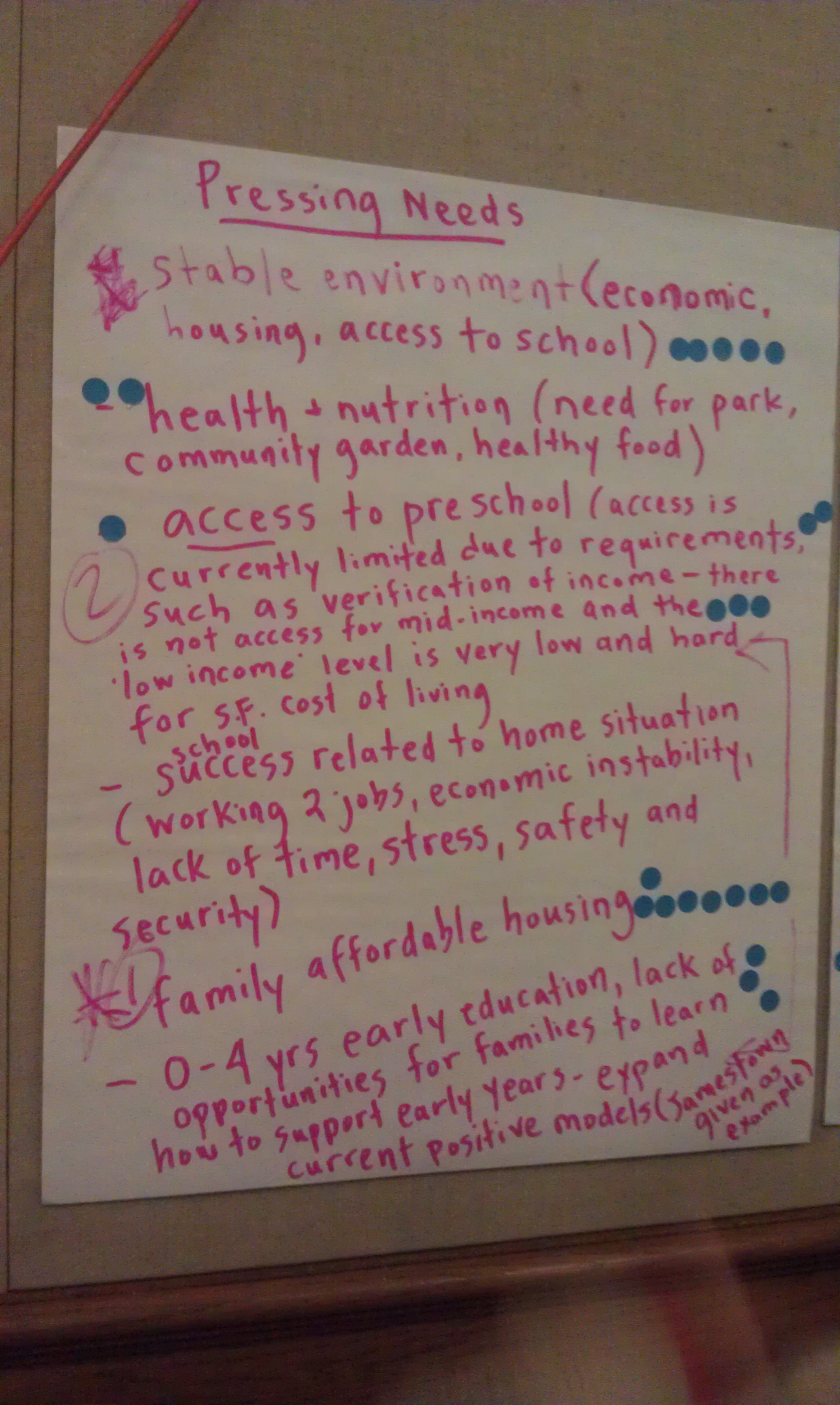
The parents weren’t exactly asking for more museum field trips for their kids. During breakout sessions where facilitators wrote group members’ concerns on flip pads, a few recurring themes emerged. “Job security for parents,” one read. “Affordable housing,” another stated. “It’s a shame to have to talk about lack of funds given wealth and corporations in SF,” more parent feedback stated.

Maria Su, director of the San Francisco Department of Children, Youth and their Families, thanked parents for coming and told them, “We know how hard it is and how challenging it is to survive in the city. But that doesn’t mean we should give up.”

The whole exercise provided a glimpse into just how tough it is for families to get by in a city where a hefty cost of living amounts to serious pressure. “The sacrifices they make is, their children will have access to resources you can’t get anywhere else,” said Mario Paz with the Good Samaritan Family Resource Center, who works with a lot of Latino immigrant families.

A report digesting the findings of stakeholder focus groups boiled it down. “Many participants commented on … the extraordinarily high cost of living in San Francisco,” it noted, which “contributes to both financial and emotional strain on the part of our many working class and lower income residents.” 


Parents under pressure

In recent weeks, the San Francisco Unified School District has held a series of community forums to ask parents what they think kids need in order to thrive in school. The meetings were held as part of a policymaking process leading up to next year’s renewal of two important funds – the Children’s Fund and the Public Education Enrichment Fund, which account for some $100 million in funding combined.

There were huge turnouts – a Chinatown forum, where Mayor Ed Lee was reportedly in attendance, attracted more than 180 participants, while a Nov. 14 meeting at Cesar Chavez Elementary in the Mission District drew a crowd of between 80 and 90.

The parents weren’t exactly asking for more museum field trips for their kids. During breakout sessions where facilitators wrote group members’ concerns on flip pads, a few recurring themes emerged. “Job security for parents,” one read. “Affordable housing,” another stated. “It’s a shame to have to talk about lack of funds given wealth and corporations in SF,” more parent feedback stated.

Maria Su, director of the San Francisco Department of Children, Youth and their Families, thanked parents for coming and told them, “We know how hard it is and how challenging it is to survive in the city. But that doesn’t mean we should give up.”

The event provided a glimpse into just how tough it is for families to get by in a city where a hefty cost of living amounts to serious pressure. “The sacrifices they make is, their children will have access to resources you can’t get anywhere else,” said Mario Paz with the Good Samaritan Family Resource Center, who works with a lot of Latino immigrant families.

A report digesting the findings of stakeholder focus groups distilled the pressures facing families. “Many participants commented on … the extraordinarily high cost of living in San Francisco,” it noted, which “contributes to both financial and emotional strain on the part of our many working class and lower income residents.”

Hundreds attend hearing to call for action on evictions

Tenants, organizers and residents impacted by Ellis Act evictions packed the Board of Supervisors Chambers at San Francisco City Hall today, Thu/14, for a hearing called by Sup. David Campos on eviction and displacement in San Francisco.

“It seems to me that we have a tale of two cities,” Campos said at the outset of the hearing, which was held by the Board of Supervisors Neighborhood Services and Safety Committee. “The vast majority of individuals are struggling to stay in San Francisco. We must act urgently to address this crisis, which I believe is a crisis.” He added, “We are fighting, I think, for the soul of San Francisco.”

Tony Robles of Senior and Disability Action, who showed up at the hearing wearing a black hooded sweatshirt with pobre (the Spanish word for “poor”) printed across the front, expressed his frustration with the surge of evictions taking place in the booming economic climate. “We have been overlooked – the workers, communities of color … it’s almost as if we are an afterthought,” he said.

Fred Brousseau of the San Francisco Budget and Legislative Analyst’s office delivered a report on his recent analysis of eviction and displacement trends across the city.

Overall evictions in San Francisco rose from 1,242 in 2010 to 1,716 in 2013, reflecting an increase of 38.2 percent, according to San Francisco Rent Board Data highlighted in Brousseau’s report. 

Ellis Act evictions in particular increased by 169.8 percent in that same time frame, he said, with the most recent data showing a total of 162 Ellis Act evictions over the twelve months ending in September 2013. That number reflects units evicted, not how many tenants were impacted.

Ted Gullicksen of the San Francisco Tenants Union emphasized that tenant buyouts, frequently offered in lieu of an eviction, are also driving displacement even though these transactions aren’t reflected in city records.

“We need to get in control of these buyouts,” he said. “There are about three of them for every Ellis Act eviction. When you consider them in combination with Ellis, the numbers are very dramatic.”

Brousseau also showed a slide profiling the people who’ve been impacted by evictions citywide. Almost 42 percent had some form of disability, the data revealed, while 49 percent had incomes at or below the federal poverty level.

On the whole, Brousseau said, a total of nearly 43 percent of San Francisco households are “rent-burdened,” a term that officially means devoting more than 30 percent of household income to monthly rental payments.

Throughout the afternoon, tenants shared their stories and fears about getting frozen out of San Francisco by eviction. “I’m looking at shopping carts, and I’m terrified,” one woman told supervisors during public comment. “You have to do something. It might not be enough for me right now, but you can’t do this to any more people.”

Hene Kelly noted that elderly tenants are being disproportionately impacted by Ellis Act evictions. “They don’t have the reserves, they don’t have the jobs, and they don’t have the money to be able to move if they are evicted,” she said. Referencing landlords and speculators who are driving displacement, she added, “It makes me think of cabaret. Money, money, money, money, money makes the world go round.”

Campos noted that he is working with Assembly Member Tom Ammiano on a proposal to grant San Francisco the authority to place a moratorium on Ellis Act evictions.

He’s also working toward legislation that would create a mechanism at the San Francisco Rent Board allowing tenants to register complaints of harassment or other forms of pressure from landlords seeking to drive them out.

His proposal also envisions doubling the amount of relocation assistance that landlords would have to provide to tenants, in the case of no-fault evictions. He also mentioned the possibility of regulating buyouts, by requiring landlords to record these transactions with the rent board, and possibly prohibiting property owners from charging market-rate rent directly after completing a tenant buyout.

Meanwhile, Mayor Ed Lee recently announced that he is working with Sen. Mark Leno on legislation that is meant to reduce Ellis Act evictions. That proposal would require additional permits or hearings before an Ellis Act eviction could go forward, and place more stringent regulations on the sale and resale of properties where tenants have been evicted under the state law.

Just a couple weeks ago, a coalition of housing advocates proposed a sweeping package to turn the tide on evictions.

At the end of the day, it’s clear that housing advocates are gaining momentum as the spike in tenant ousters continues in pricey San Francisco, where rents are the highest in the nation.

“We’ve never been late on our rent,” noted Beverly Upton, executive director of the San Francisco Domestic Violence Consortium, who is battling an Ellis Act eviction. “We’ve paid for every improvement ever done in 25 years. And now we have to leave.” She appealed for legislators to take action for the sake of the city’s future, asking, “Once the advocates and the organizers and the people who care are gone, who will be left in our city?”

Driving us crazy

209

STREET FIGHT Parking reform is one of the most radically important elements of making San Francisco a more livable and equitable city.

In this geographically constrained city, parking consumes millions of square feet of space that could be used for housing, especially affordable housing in secondary units. Curbside parking in the public right of way impedes plans to make Muni more reliable for hundreds of thousands of transit riders. Parking in new housing and commercial developments generates more car trips on our already congested and polluted streets, slowing Muni further while bullying bicyclists and menacing pedestrians.

Fundamentally, parking is a privatization of the commons, whereby driveway curb cuts and on-street parking hog the public right-of-way in the name of private car storage. The greater public good — such as reducing greenhouse gas emissions and enhancing public safety through bike lanes, wider sidewalks, public green spaces, and transit-first policies — is subsumed to narrow private interests. These are among the many reasons why, for over a decade, parking reform has been a key part of progressive transportation policy.

Yet lately, it has been disappointing to watch progressives, especially on the Board of Supervisors, retreat from that stance. In Potrero Hill and North Mission, a vitriolic reaction has slowed rollout of nationally acclaimed SF Park, which raises revenue for Muni and is a proven sustainable transportation tool. Yet there are murmurings that some progressive supervisors might seek an intervention and placate motorists who believe the public right-of-way is theirs.

On Polk Street, some loud merchants and residents went ballistic when the city and bicycle advocates proposed removing curbside parking to accommodate bicycles. The city, weary of Tea Party-like mobs, ran the other way, tail-between-legs. Progressive supervisors seem to have gone along with the cave-in.

Along Geary, planning for a desperately needed bus rapid transit project drags on. And on. And on. And on. The lollygagging includes bending over backward to placate some drivers who might be slightly inconvenienced by improvements for 50,000 daily bus riders.

One thing that is remarkably disturbing about this backpedaling is that, in an ostensibly progressive city by many measures (civil rights, tolerance, environmentalism), the counterattack is steeped in conservative ideology. That is, conservatives believe that government should require ample and cheap parking, whether in new housing or on the street. This conservative ideology, shared by many car drivers and merchants — and even by some self-professed progressives — is steeped in the idea people still need cars. This despite the evidence that cars are extremely destructive to our environment, socially inequitable, and only seem essential because of poor planning decisions, not human nature.

Progressive backpedaling has become more confusing with the recent debate over 8 Washington, defeated at the polls Nov. 5, and on the same day of a convoluted Board of Supervisors hearing on a proposed car-free housing development at 1050 Valencia. Both of these projects highlight the muddled inconsistency emerging among progressive supervisors.

Enough has been written about how 8 Washington was a symbolic battle for the soul of San Francisco. But during the campaigns, the lack of attention to parking was curious. Notably, progressive-leaning transportation organizations like the San Francisco Bicycle Coalition, Walk SF, and Transform sat out the election despite the project’s excessive 327 underground parking spaces, which violated hard-fought progressive planning efforts to make the waterfront livable. The Council of Community Housing Organizations also sat it out, despite benefitting from the progressive parking policies that 8 Washington violated. It appears that despite their transit-first rhetoric, progressives made a tactical calculation to keep parking out of the campaign.

The progressive victory came with a Faustian bargain which involved ignoring parking. To ensure 8 Washington was defeated, conservative voters were folded into the opposition. Groups like Eastern Neighborhoods United Front (ENUF), the Coalition for San Francisco Neighborhoods, and the Republican Party came out against 8 Washington and yet, ironically, all are opponents of progressive parking reform.

Moving forward, whatever happens at the 8 Washington site must include progressive parking policies. Don’t expect this from the unimaginative leadership at the Port, which speciously demanded the excessive parking. Don’t expect it from the developer, who steadfastly insists that the rich must have parking. And don’t expect conservatives to latch on to a waterfront scheme that is both publicly accessible and genuinely transit-oriented. It is progressives who will need to muster political will for a zero-parking project at the waterfront and set the tone for consensus among the other factions in the waterfront debate.

Meanwhile on the same day 8 Washington went down, 1050 Valencia barely made it out of a tortuous Board of Supervisors hearing in which progressives seemed to be the antagonists. As the first car-free market-rate housing proposal on Valencia under progressive parking reforms, this 12-unit mixed use building seemed an obvious win for progressives. It would be a walkable, bicycle-friendly urban infill mixed-use project with on-site affordable housing, all of which the city needs more of.

Yet since 2010, when the project first went to the Planning Commission, conservative rhetoric has been deployed to stop the project. Significantly, the Liberty Hill Neighborhood Association objected to the transit-oriented characterization of the project. It claimed that the 14 Mission and 49 Mission/Van Ness are filthy, crime-ridden, and unreliable and so 1050 Valencia must have parking.

Unlike progressives, who also decry shortfalls with Muni but propose solutions, the Liberty Hill opponents offered only secession from public transit, insisting on driving in secure armored cocoons instead of addressing Muni reliability, and they also expect free or cheap parking in the public right of way.

You would think that progressives at the Board of Supervisors would see through this thinly veiled bigotry against the 14 and 49 buses. But instead, four self-professed progressive supervisors — John Avalos, David Campos, Jane Kim, and Eric Mar — voted against 1050 Valencia.

They may argue that they were more concerned about the neighboring Marsh Theater, which has concerns about construction noise (and also parking). The noise issue can be worked out, and why the progressive supervisors did not work this out in advance is a mystery. But if you watch the hearing closely, the Marsh basically opposed the development — period — and thus a modest car-free development that included affordable housing at an appropriate location. And so did four progressive supervisors. It’s baffling.

At the end of the day, 1050 Valencia moved forward, barely. But it can still be stopped at the upcoming Board of Appeals hearing. Meanwhile, it’s time for progressives to make a frontal response to the Muni-bashing coming out of Liberty Hill.

The SFMTA is offering a bold and ambitious proposal for these buses on Mission between 13th and Cesar Chavez. This includes a transit-only lane, restricting automobile traffic, rearranging loading zones, and removing curbside parking so that 46,000 daily 14 and 49 passengers have better reliability and less crowding.

This plan will make life easier for San Franciscans who rely on these buses, but will require progressive supervisors to openly and sincerely advocate for removal of on-street parking, to support SF Park, and push for car-free housing development in the Mission, rather than knee-jerk posturing for a few political points in future elections. Progressives, stop screwing around.

Street Fight is a monthly column by Jason Henderson, an urban geography professor at San Francisco State University.

Filipino group snubs mayor over evictions

4

The board members of a local Filipino heritage organization, with ties to a high-profile eviction defense battle at San Francisco’s International Hotel in the late 1970s, have declined to an accept an award that San Francisco Mayor Ed Lee had planned to extend to them as part of a Filipino American History celebration because they are angry about a growing trend of senior evictions.

In a written statement sent to the media by board member Tony Robles, the Manilatown Heritage Foundation explained that it couldn’t accept the award as long as “elders are being preyed upon, evicted and given a de facto death sentence thereof.”

The Manilatown Heritage Foundation board members were informed by Board of Supervisors President David Chiu that Lee had planned to recognize the I-Hotel as part of an annual cultural history celebration at City Hall, the statement noted.

“Part of the occasion was to honor the I-Hotel and its many tenants and activists for its contribution to Filipino American history,” board members explained.

In 1976, the I-Hotel was targeted for demolition, prompting a historic eviction defense battle led by housing activists who rallied to the defense of the impacted tenants. As a young attorney who worked with the Asian Law Caucus, Ed Lee was involved in that fight — as an activist defending tenants’ rights to stay. He frequently referred to this chapter of his personal history while running for mayor in 2011, to demonstrate his sensitivity to concerns about affordable housing.

But now that Lee is well into his mayoral term, a surge of evictions of low-income seniors is worsening on his watch. Tenant defense organizations such as Eviction Free San Francisco are showing up outside landlords’ homes and offices to protest eviction notices that threaten to push low-income seniors with few options out of the city.

“The I-Hotel fight was for dignity and it lived by the premise that housing is a human right,” the group’s statement explained. “The fight for the I-Hotel galvanized the community around the fight for affordable housing, particularly for seniors who sacrificed much and on whose shoulders we stand. The fight included tenants, elders, activists, artists and students who recognized that the real estate developers and financial interests were out of control—power unchecked.” 

Making it fit

300

joe@sfbg.com

San Francisco’s overheating housing market has polarized the city. While progressive activists push to protect rent-controlled apartments and encourage construction of new below-market-rate housing, moderates, Realtors, and developers say any new housing helps keep prices in check, calling on the city to build 5,000 units per year.

But there is a hidden side to the housing issue in San Francisco, one that offers both complex challenges and enormous potential as a source of housing for low-income city residents, and it’s getting a fresh look with desperate eyes.

Secondary units — also known as granny flats or in-law housing — dot the city by the thousands, and are for the most part illegal. They’re tucked behind garages, in basements, or in backyards, most of them single serving sized and largely ignored.

Such units are legal under California law, and the reasons they’re quasi-legal in San Francisco are complex. It mostly boils down to the fact that often these units aren’t up to Building or Planning codes, but there have also been decisions to deliberately limit density in some neighborhoods, sometimes driven by concerns about more competition for street parking spaces.

Tenants in such units can be reluctant to report housing code violations for fear of losing cheap apartments in this rapidly gentrifying city, even if that means living in substandard housing. And the owners of those units often can’t afford to bring them up to code or pay the fines. It remains an underground industry with few watchdogs.

Caught between conflicting realities of housing shortages, poverty, and safety, the city has largely turned a blind eye to in-law units, adopting what housing advocates call a “don’t ask, don’t tell” policy around inspecting in-law units. Now that may change.

Board of Supervisors President David Chiu and Sup. Scott Wiener have plans in the works that could spur development of secondary units in the city. San Francisco has been there and done that though, and the bodies of failed past granny flat campaigns litter the political wasteland.

“In-law legalization has been for a lot of housing advocates the holy grail, but for a lot of politicians, it’s been a third rail,” said Tom Radulovich, executive director of Livable City, a nonprofit group that advocates for a more walkable, livable San Francisco.

Despite the many failed jump starts over the years, Radulovich sees hope in the prospects of legalizing more secondary units because “it’s a good, cheap, and green way to add housing.”


BUILD SMALL

So what’s different now? First off, unlike past efforts, the politicians involved are taking some small but significant steps.

Wiener’s plan could directly spur the creation of new secondary units, but it’s limited to only the Castro District. It basically lifts caps on the number of units that can be built in a single residence, waiving some density and other Planning Code requirements.

Wiener views his plan as a pilot program. “I decided to try a more limited geographic area to show that it can work,” he told us, saying that the past failed campaigns tried to force the issue citywide.

The Castro is a prime candidate for more affordable housing. The neighborhood has many tenants who are single, Wiener said. And as gentrification slammed the Castro, the vulnerable were hurt as well. Jeremy Mykaels, a 17-year Castro tenant living with AIDS, recently fought back an Ellis Act eviction that would have cost him his home.

“I am not looking for pity,” Mykaels wrote on his website, addressing his eviction. “I just want to shed a light on a growing problem in this city for many senior and disabled tenants like myself.”

Wiener’s office declined to say how many secondary units could be built. But as he introduced the legislation to the Board of Supervisors on Oct. 22, he said that many longtime residents in the Castro, in terms of housing, “are living on the edge.”

Castro residents like Mykaels have lived under rent control for years, and once folks like him are pushed out, they often can’t afford to stay in the city.

Fair market rent in the Castro for a two-bedroom apartment is $3,295 a month, according to the Department of Public Health. According to its rental affordability map, a tenant would need 6.2 full-time minimum wage jobs to afford to live there.

“It’s a neighborhood in desperate need of additional housing options,” Wiener said.

Enter in-law units, which are often more affordable. Though there have been no citywide studies of their affordability, a study this year by the Asian Law Caucus, “Our Hidden Communities,” said the average cost of those units in the Excelsior neighborhood is between $1,000–$1,249 a month, way below average rents.

Wiener’s legislation was turned over to the Land Use and Economic Development Committee, where it will be evaluated for impacts to the neighborhood. The supervisors will hear it again in 30 days.


GO BIG

One housing advocate thinks Wiener is thinking too small and needs to expand his vision.

“I think Wiener’s proposal is creating a patchwork of regulation, but this will create a mess, which the board is accomplished at doing,” Saul Bloom, head of Arc Ecology, told the Guardian. He thinks a citywide proposal to legalize in-law units is the only way go to — because the city is in a housing crisis right now, he said, and we don’t have time for just a pilot.

One big advantage is the units are far cheaper to construct than traditional houses or condominiums. Bloom notes the Lennar Urban will be spending about $400,000 for each of the thousands of homes it will build at Hunters Point Shipyard and surrounding areas, but that small secondary units can be built in existing neighborhoods for $75,000 to $200,000 each.

“We’re not expanding units in affordable housing through existing strategies,” Bloom said, and he’s right.

San Francisco has mostly built about 1,500 new housing units a year, which is much less than needed to keep up with demand, according to San Francisco Planning and Urban Research Association (SPUR) and the Housing Action Coalition.

To keep up with the frantic demand, San Francisco would need to build 5,000 new units a year, the groups argue. If the city could keep up with demand for housing, the price of housing itself could go down — meaning lower rents for everyone.

“If we want to actually make the city affordable for most people — a place where a young person or an immigrant can move to pursue their dreams, a place a parent can raise kids and not have to spend every minute at work — we have to fix the supply problem,” SPUR Executive Director Gabriel Metcalf wrote in a recent article for The Atlantic (“The San Francisco Exodus,” Oct. 14).

Yet progressive housing activists have long said that the city can’t build its way to affordability, arguing that demand for market rate units is essentially insatiable, and that what the city needs to do is build housing specifically for low-income residents.

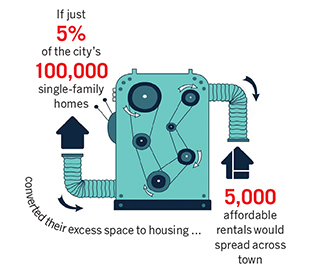
Bloom put out a study from Arc Ecology, suggesting that if just 5 percent of the city’s 100,000 single family homes converted their excess space into in-law units, an additional 5,000 affordable rentals would spread across town.

Wiener’s proposal looks at making new units in just a slice of the city, but another proposal will look at the issue citywide. Chiu’s legislation seeks to take that sea of hidden and unlawful granny flats and bring them up to code, but it wouldn’t look to build new ones.

“The big picture is that we’re exploring legalizing existing [in-law] units that are illegal, to make sure they become safe and protect residents there,” said Amy Chan, an aide in Chiu’s office.


UP TO CODE

Safety isn’t the only consideration, as this could also help the housing supply in the city, those involved told the Guardian. Often these in-law units are rented out to friends and family, and once up to code they’d open up to the market.

But safety is important because these units also often lack city permits because they’re dangerously constructed. Sometimes that can lead to death.

“A lot of time (the units) may not have proper egress for an emergency,” said Dan Lowrey, deputy director of inspection services at the Department of Building Inspection. “We just had a fire last month where three people died because of that.”

Lowrey is part of Chiu’s workgroup that’s navigating the complexities of his new legislation. Just how do you make these units legal? There’s a number of challenges, he said.

When looking at a unit, housing inspectors have a checklist to look through, and some of it is real garden variety stuff. Smoke detectors? Check. Proper floor covering? Check. Those are easy. The real challenge is when there are ceilings that are too low, hallways not wide enough to navigate in an emergency, or the unit has no windows from which to escape in a fire.

That’s when you have an in-law apartment that requires total reconstruction to be brought up to code, a straight up illegal unit. As the law stands now, the only recourse for the city in that case is to evict the people living there.

“That’s the challenge, what do we do with the [in-law apartments] that can’t be legalized?” said Bill Strawn, a spokesperson for DBI. Those are some of the questions that Chiu’s workgroup is tackling now.

The good news, he said, is that there are a good number of units that are up to the Building Code, but not the Planning Code — that’s a much easier hurdle to clear.

The Planning Code basically separates neighborhoods of the city into zones for one, two, or three families in a housing unit. This looks at the amount of available free space, sunlight, air, and parking. With those lifted, many units could be more easily converted to living use.

But finding the units that aren’t up to code is important, said Omar Calimbas, a senior staff attorney at the Asian Law Caucus.

He led the “Our Hidden Communities” study that revealed 33 percent of homes in the Excelsior district contained in-law units, far above the city’s estimates.

His team went door to door and found out for itself. What Calimbas saw was that those living in unregulated units often lived in substandard conditions with nowhere to go for help.

There are some units with no heating, he said. Other times the in-law unit is in a basement barely renovated for use as a living space. Sometimes the bathrooms and shower are really tiny cubes. There are mold and dampness problems.

“You’re living in a space that doesn’t make you feel protected from the elements,” he said. And when the units are made without permits, tenants feel they can’t go to the city for help.

To put it in a nutshell, they are in dire need of regulation. Calimbas is also working with Chiu on his legislation to do just that. But ultimately, each of the two ordinances around secondary units takes small bites out of the housing pie.

Bloom is calling for the city to move aggressively on this issue. “We’re rapidly becoming a more expensive city to live in, more and more so every year.” As more and more San Franciscans are priced out of their homes, time may soon run out.

Angered by senior evictions, Filipino American activists decline award

The board members of a local Filipino heritage organization, with ties to a high-profile eviction defense battle at San Francisco’s International Hotel in the late 1970s, have declined to an accept an award that San Francisco Mayor Ed Lee had planned to extend to them as part of a Filipino American History celebration because they are angry about a growing trend of senior evictions.

In a written statement sent to media by board member Tony Robles, the Manilatown Heritage Foundation explained that it couldn’t accept the award as long as “elders are being preyed upon, evicted and given a de facto death sentence thereof.”

The Manilatown Heritage Foundation board members were informed by Board of Supervisors President David Chiu that Lee had planned to recognize the I-Hotel as part of an annual cultural history celebration at City Hall, the statement noted. “Part of the occasion was to honor the I-Hotel and its many tenants and activists for its contribution to Filipino American history,” board members explained.

In 1976, the I-Hotel was targeted for demolition, prompting an historic eviction defense battle led by housing activists who rallied to the defense of the impacted tenants. A significant fixture in what was once a predominantly Filipino neighborhood known as Manilatown, the I-Hotel housed 196 tenants, predominantly low-income Filipino immigrants. 

“The I-Hotel fight was for dignity and it lived by the premise that housing is a human right,” Manilatown Heritage Foundation members explained in the written statement. “The fight for the I-Hotel galvanized the community around the fight for affordable housing, particularly for seniors—who sacrificed much and on whose shoulders we stand. The fight included tenants, elders, activists, artists and students who recognized that the real estate developers and financial interests were out of control—power unchecked.” 

The fight dragged on, at one point more than two thousand people surrounded the building to blockade the doors in an effort to prevent an eviction from going forward. The battle over the I-Hotel also brought on a famous San Francisco episode in which then-Sheriff Richard Hongisto served five days in his own jail for refusing to carry out the eviction order. In the end, the tenants were finally ousted. But the epic battle ultimately helped to produce a different outcome, many years later: The property became the site of low-cost senior housing, complete with a commemorative display in the interior documenting the dramatic I-Hotel fight.

As a young attorney who worked with the Asian Law Caucus, San Francisco Mayor Ed Lee was involved in that fight – as an activist defending tenants’ rights to stay. He frequently referred to this chapter of his personal history while running for mayor in 2011, to demonstrate his sensitivity to concerns about affordable housing.

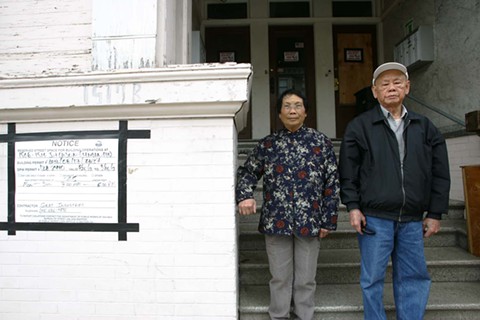
But now that Lee is well into his mayoral term, a surge of evictions of low-income seniors is worsening on his watch. Tenant defense organizations such as Eviction Free San Francisco are showing up outside landlords’ homes and offices to protest eviction notices that threaten to push low-income seniors with few options out of the city. Some evictions have caught the attention of mainstream media, such as the ouster of elderly Chinatown couple Gum Gee Lee and Poor Heung Lee and their disabled daughter, Shiuman Lee.

Some advocates have proposed legislative solutions; meanwhile, the situation has evidently become so criticial that even city’s Human Services Agency is seeking outside assistance to provide eviction prevention services for elderly and disabled tenants facing Ellis Act evictions.

And today, the board of the Manilatown Heritage Foundation drew a line in the sand to send Lee a clear message by refusing to accept the honor of recognition in the current housing climate. So far, mayoral spokesperson Christine Falvey has not responded to the Bay Guardian’s request for comment in response to the Manilatown Heritage Foundation’s statement.

“Given the current state of San Francisco housing by forces out to make a killing by killing our communities, we as the torch bearers of the I-Hotel struggle and in the memory of its displaced elders and advocates Al Robles, Bill Sorro, Felix Ayson, Wahat Tampao and others, cannot, in good consciousness, accept any honor or award while elders are being preyed upon, evicted and given a de facto death sentence thereof. And it doesn’t matter if the honor is bestowed by Mayor Lee, President Obama or the pope. We have to say no.”

Here’s the full statement from the Manilatown Heritage Foundation. Here’s an historical essay about the I-Hotel from Shaping San Francisco’s digital archive at FoundSF.org.

Shit happened (Oct. 23-29)

6

Tenant proposals and Guardian forum address eviction crisis

Tenant advocates have proposed a sweeping set of legislative proposals to address what they’re calling the “eviction epidemic” that has hit San Francisco, seeking to slow the rapid displacement of tenants by real estate speculators with changes to land use, building, rent control, and other city codes.

“In essence, it’s a comprehensive agenda to restrict the speculation on rental units,” Chinatown Community Development Center Policy Director Gen Fujioka told the Guardian. “We can’t directly regulate the Ellis Act [the state law allowing property owners to evict tenants and take their apartments off the rental market], but we’re asking the city to do everything but that.”

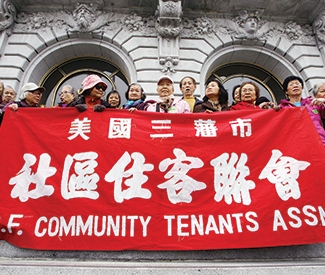
The package was announced Oct. 24 on the steps of City Hall by representatives of CCDC, San Francisco Tenants Union, Housing Rights Committee of SF, Causa Justa-Just Cause, Tenderloin Housing Clinic, UNITE HERE Local 2, Community Tenants Association, and Asian Americans Advancing Justice.

“San Francisco is falling into one of the deepest and most severe eviction crises in 40 years,” SFTU Director Ted Gullicksen said. “It is bad now and is going to get worse unless the city acts.”

The announcement came a day after the Lee family — an elderly couple on Social Security who care for their disabled daughter — was finally Ellis Act evicted from its longtime Chinatown home after headline-grabbing activism by CCDC and other groups had twice turned away deputies and persuaded the Mayor’s Office to intervene with the landlord.

But Mayor Ed Lee has been mum — his office ignored our repeated requests for comment — on the worsening eviction crisis, the tenant groups’ proposals, and the still-unresolved fate of the Lees, who are temporarily holed up in a hotel and still hoping to find permanent housing they can afford.

The package proposed by tenant advocates includes: require those converting rental units into tenancies-in-common to get a conditional use permit and bring the building into compliance with current codes (to discourage speculation and flipping buildings); regulate TIC agreements to discourage Ellis Act abuse; increase required payments to evicted tenants and improve city assistance to those displaced by eviction; require more reporting on the status of units cleared with the Ellis Act by their owners; investigate and prosecute Ellis Act fraud (units are often secretly re-rented at market rates after supposedly being removed from the market); increase inspections of construction on buildings with tenants (to prevent landlords from pressuring them to move); prohibit the demolition, mergers, or conversions of rental units that have been cleared of tenants using no-fault evictions in the last 10 years (Sup. John Avalos has already introduced this legislation).

“The evidence is clear. We are facing not only an eviction crisis but also a crisis associated with the loss of affordable rental housing across the city. Speculative investments in housing has resulted in the loss of thousands affordable apartments through conversions and demolitions. And the trend points to the situation becoming much worse,” the coalition wrote in a public statement proposing the reforms.

Evictions have reached their highest level since the height of the last dot-com boom in 1999-2000, with 1,934 evictions filed in San Francisco in fiscal year 2012-13, and the rate has picked up since then. The Sheriff’s Department sometimes does three evictions per day, last year carrying out 998 court-ordered evictions, Sheriff Ross Mirkarimi told us, arguing for an expansion of city services to the displaced.

At “Housing for Whom?” a community forum the Guardian hosted Oct. 23 in the LGBT Center, panelists and audience members talked about the urgent need to protect and expand affordable housing in the city. They say the current eviction epidemic is being compounded by buyouts, demolitions, and the failure of developers to build below-market-rate units.

“We’re bleeding affordable housing units now,” Fred Sherburn-Zimmer of Housing Right Committee said last night, noting the steadily declining percentage of housing in the city that is affordable to current city residents since rent control was approved by voters in 1979. “We took out more housing than we’ve built since then.”

Peter Cohen of the Council of Community Housing Organizations actually quantified the problem, citing studies showing that only 15 percent of San Franciscans can afford the rents and home prices of new housing units coming online. He said the housing isn’t being built for current city residents: “It’s a demand derived from a market calculation.”

Cohen said the city’s inclusionary housing laws that he helped write more than a decade ago were intended to encourage developers to actually build below-market-rate units in their projects, but almost all of them choose to pay the in-lieu fee instead, letting the city find ways to build the affordable housing and thereby delaying construction by years.

“It was not about writing checks,” Cohen said. “It was about building affordable units.”

Discussion at the forum began with a debate about the waterfront luxury condo project proposed for 8 Washington St., which either Props. B or C would allow the developer to build. Project opponent Jon Golinger squared off against proponent Tim Colen, who argued that the $11 million that the developer is contributing to the city’s affordable housing fund is an acceptable tradeoff.

But Sherburn-Zimmer said the developer should be held to a far higher standard given the obscene profits that he’ll be making from waterfront property that includes a city-owned seawall lot. “Public land needs to be used for the public good.”

Longtime progressive activist Ernestine Weiss sat in the front row during the forum, blasting Colen and his Prop. B as a deceptive land grab and arguing that San Francisco’s much ballyhooed rent control law was a loophole-ridden compromise that should be strengthened to prevent rents from jumping to market rate when a master tenant moves out, and to limit rent increases that exceed wage increases (rent can now rise 1.9 percent annually on rent controlled apartment).

“That’s baloney that it’s rent control!” she told the crowd. (Steven T. Jones)

Students fight suspensions targeting young people of color

Sagging pants, hats worn indoors, or having a really bad day — the list of infractions that can get a student suspended from a San Francisco Unified School District school sounds like the daily life of a teenager. The technical term for it is “willful defiance,” and there are so many suspensions made in its name that a student movement has risen up against it.

The punishment is the first step to derailing a child’s education, opponents said.

Student activists recognize the familiar path from suspensions to the streets to prisons, and they took to the streets Oct. 22 to push the SFUSD to change its ways. Around 20 or so students and their mentors marched up to City Hall and into the Board of Education to demand a stop of suspensions over willful defiance.

A quarter of all suspensions in SFUSD for the 2011-12 school year were made for “disruption or defiance,” according to the California Department of Education. Half of all suspensions in the state were for defiance.

When a student is willfully defiant and suspended, it’s seen as a downward spiral as students are pushed out of school and onto the streets, edging that much closer to a life of crime.

“What do we want? COLLEGE! What are we gonna do? WORK HARD!” the students shouted as they marched to the Board of Education’s meeting room, on Franklin Street.

They were dressed in graduation gowns of many colors, signs raised high. They smiled and danced and the mood was infectious. One driver drove by, honked and said “Yes, alright!” Assorted passersby of all ethnicities cheered on the group. The students were from 100% College Prep Institute, a Bayview tutoring and mentoring group founded in 1999 aiming to educate students of color in San Francisco. Their battle is a tough one. Though African American students make up only 10 percent of SFUSD students, they accounted for 46 percent of suspensions in 2012, according to SFUSD data. Latinos made up the next largest group, at 30 percent. (Joe Fitzgerald Rodriguez)

Techies to NSA: Stop spying on us!

Thousands of privacy and civil liberties activists, including many from the Bay Area, headed to Washington DC for an Oct. 26 rally calling for surveillance legislation reform, in response to National Security Agency spying programs. It was organized by more than 100 groups that have joined together as part of the Stop Watching Us coalition. The group has launched an online petition opposing NSA spying, and planned to deliver about 500,000 signatures to Congress. Many of the key drivers behind Stop Watching Us, from the Electronic Frontier Foundation to Mozilla, are based in San Francisco. (Rebecca Bowe)

Tenant groups propose sweeping package to ease the “eviction epidemic”

317

Tenant advocates today proposed a sweeping set of legislative proposals to address what they’re calling the “eviction epidemic” that has hit San Francisco, seeking to slow the rapid displacement of tenants by real estate speculators with changes to land use, building, rent control, and other city codes.

“In essence, it’s a comprehensive agenda to restrict the speculation on rental units,” Chinatown Community Development Center Policy Director Gen Fujioka told the Guardian. “We can’t directly regulate the Ellis Act [the state law allowing property owners to evict tenants and take their apartments off the rental market], but we’re asking the city to do everything but that.”

The package was announced this morning on the steps of City Hall by representatives of CCDC, San Francisco Tenants Union, Housing Rights Committee of SF, Causa Justa-Just Cause, Tenderloin Housing Clinic, UNITE HERE Local 2, Community Tenants Association, and Asian Americans Advancing Justice.

“San Francisco is falling into one of the deepest and most severe eviction crises in 40 years,” SFTU Director Ted Gullicksen said. “It is bad now and is going to get worse unless the city acts.”

The package includes: require those converting rental units into tenancies-in-common to get a conditional use permit and bring the building into compliance with current codes (to discourage speculation and flipping buildings); regulate TIC agreements to discourage Ellis Act abuse; increase required payments to evicted tenants and improve city assistance to those displaced by eviction; require more reporting on the status of units cleared with the Ellis Act by their owners; investigate and prosecute Ellis Act fraud (units are often secretly re-rented at market rates after supposedly being removed from the market); increase inspections of construction on buildings with tenants (to prevent landlords from pressuring them to move); prohibit the demolition, mergers, or conversions of rental units that have been cleared of tenants using no-fault evictions in the last 10 years (Sup. John Avalos has already introduced this legislation).

“The evidence is clear. We are facing not only an eviction crisis but also a crisis associated with the loss of affordable rental housing across the city. Speculative investments in housing has resulted in the loss of thousands affordable apartments through conversions and demolitions. And the trend points to the situation becoming much worse,” the coalition wrote in a public statement proposing the reforms.

Evictions have reached their high level since the height of the last dot-com boom in 1999-2000, with 1,934 evictions filed in San Francisco in fiscal year 2012-13, and the rate has picked up since then. The Sheriff’s Department sometimes does three evictions per day, last year carrying out 998 court-ordered evictions, Sheriff Ross Mirkarimi told us, arguing for an expansion of city services to the displaced.

At “Housing for Whom?” a community forum the Guardian hosted last night in the LGBT Center, panelists and audience member talked about the urgent need to protect and expand affordable housing in the city. They say the current eviction epidemic is being compounded by buyouts, demolitions, and the failure of developers to build below-market-rate units.  

“We’re bleeding affordable housing units now,” Fred Sherburn-Zimmer of Housing Right Committee said last night, noting the steadily declining percentage of housing in the city that is affordable to current city residents since rent control was approved by voters in 1979. “We took out more housing than we’ve built since then.”

Peter Cohen of the Council of Community Housing Organizations actually quantified the problem, citing studies showing that only 15 percent of San Franciscans can afford the rents and home prices of new housing units coming online. He said the housing isn’t being built for current city residents: “It’s a demand derived from a market calculation.”

Cohen said the city’s inclusionary housing laws that he helped write more than a decade ago were intended to encourage developers to actually build below-market-rate units in their projects, but almost all of them choose to pay the in-lieu fee instead, letting the city find ways to build the housing and thereby delaying construction by years.

“It was not about writing checks,” Cohen said. “It was about building affordable units.”

Last night’s discussion began with a debate about the waterfront luxury condo project proposed for 8 Washington Street, which either Props. B or C would allow the developer to build. Project opponent Jon Golinger squared off against proponent Tim Colen, who argued that the $11 million that the developer is contributing to the city’s afforable housing fund is an acceptable tradeoff.

But Sherburn-Zimmer said the developer should be held to a far higher standard given the obscence profits that he’ll be making from waterfront property that includes a city-owned seawall lot. “Public land needs to be used for the public good.”

Longtime progressive activist Ernestine Weiss sat in the front row during the forum, blasting Colen and his Prop. B as a deceptive land grab and arguing that San Francisco’s much ballyhooed rent control law was a loophole-ridden compromise that should be strengthened to prevent rents from jumping to market rate when a master tenant moves out, and to limit rent increases that exceed wage increases (rent can now rise 1.9 percent annually on rent controlled apartment.

“That’s baloney that it’s rent control!” she told the crowd.


Lee family quietly leaves home as activists pledge to push reforms

210

Members of Lee family quietly moved out of their longtime home in Chinatown last night, a day before their latest scheduled Ellis Act eviction, which had been postponed twice before thanks to headline-grabbing progressive activism that turned away deputies and persuaded the Mayor’s Office to intervene with the landlord.

But this time, the Mayor’s Office has been mum about the case (officials haven’t responded to our requests for comment) after failing to find a solution to the Lees – an elderly couple using Social Security to care their disabled 48-year-old daughter – still unresolved situation. With help from the Asian Law Caucus and Chinatown Community Development Center, the Lees moved their belongings into storage while they are staying in a hotel.

“The family is staying at a hotel in the city for the next few days as they try to finalize on a couple of potential rental units here. They’ll be paying over twice the amount that they had been paying for their rent-controlled unit. Their SSI won’t be enough to make ends meet, and so they will be spending down their relocation compensation, which may be depleted in the next several months,” Asian Law Caucus attorney Omar Calimbas told us. “Hopefully, the family will be able to find subsidized housing by then, or they will be in a precarious state of affairs again.”

Sheriff Ross Mirkarimi told us yesterday that he’s been waiting for word from the Mayor’s Office and hoping to avoid this evicting the family. “We’re duty bound. It’s a court order,” Mirkarimi said of his eviction obligation. “The eviction is on the books, but we’ve been expecting an alternative plan by the Mayor’s Office after he intervened in this case.”

The San Francisco Examiner, which had earlier given splashy credit to Mayor Ed Lee for stalling the Lee family’s eviction – to the irritation of some activists that probably deserve more credit than anyone in the Mayor’s Office – had the only journalist on the scene with the Lees last night, but the paper didn’t have any comments or updates from the Mayor’s Office.

Weeks before Mayor’s Lee’s headline-grabbing Sept. 25 intervention in the Lee case, Mirkarimi had his Eviction Assistance Unit contact the Lees and try to help them avoid being turned out with no place to go. But in a city where his office performs around 1,000 evictions per year – it executed 998 court-ordered evictions last year — the single full-time staffer in that office is overwhelmed.

“We need more staff to assist when it gets to this point,” Mirkarimi told us. But his budget request last year to add another position to the unit was denied by the Mayor’s Office and Board of Supervisors, a request that Mirkarimi renewed in a Sept. 30 letter to Mayor Lee.

“When there is a determination, our EAU attempts to support individuals and families facing eviction, not just Ellis Act evictions, but all evictions. This unit is comprised of one full time deputy sheriff and the partial time of another deputy.  Based on [the current eviction] trend, our EAU staffing is insufficient and ill-equipped to assist qualified individuals and families who may be at risk of becoming homeless,” Mirkarimi wrote. “With renewed focus on the consequences of evictions in San Francisco, I return to our FY 2013-2014 budget request to enhance our EAU with one full time clinical outreach worker.”

Meanwhile, the activists say they won’t wait for the next budget cycle or rely on the Sheriff’s Department for help with imminent evictions. They say that they plan to propose a package of reforms for dealing with the eviction crisis as soon as this week.

“Overall, the several weeks of reprieve from the eviction that were won after an incredible display of community solidarity with the Lees were very important in giving them time to find a temporary fix,” Calimbas told us. “Stay tuned in the next day or so for the next move by a growing coalition of community organizations, housing advocates and labor in pushing for a comprehensive package of legislative reform to curb the outbreak of displacement-based speculation.”

Guardian Staff Writer Joe Fitzgerald Rodriguez contributed to this report.


Commodifying urban real estate hurts the culture of big cities

98

When urban real estate is turned into merely a commodity — or just another safe place for the wealthy to park their cash in uncertain economic times, while also providing pied-a-terres in which to crash a few times a year — it tears at the social fabric of big cities such as San Francisco, New York City, and London.

That’s been the message in some excellent, widely circulated articles in the last week or so — including David Byrne’s Guardian article about New York City and “London’s Great Exodus” in Sunday’s NY Times — and it’s one that San Franciscans should be thinking about as we work through current eviction and gentrification battles and vote on the 8 Washington project through Props. B&C in a few weeks.

It’s also something that we’ll be discussing at Housing for Whom?, a free community forum that the Guardian is sponsoring on Oct. 23 from 6-8pm at the LGBT Center, 1800 Market Street, featuring opponents and proponents of those measures along with other activists and experts.

While both London and New York City may be ahead of the curve in letting capitalists and the real estate market drive away creative types and destroy what once made those cities great, San Francisco isn’t far behind, particularly given its current housing and economic development policies.

Another striking article on the issue comes from San Francisco Urban Research Association Executive Director Gabriel Metcalf, who wrote an article published in The Atlantic on Monday. It repeats his previous calls for San Francisco to build 5,000 new housing units per year and opens with a line many of us have uttered: “My friends keep moving to Oakland.”

But Metcalf (who hasn’t yet returned my calls for comment) also takes this familiar observation and his promotion of market rate housing a step further, basically calling for San Francisco and Oakland to start acting as one city: Rich people in SF, cool people and workers in Oakland, ala Brooklyn and Manhattan.

“If we were one city, San Francisco could spend some of its incredible wealth on the things Oakland needs, like hiring more cops and teachers, not to mention more transit connections between the two cities,” Metcalf writes. “This is not an argument for annexation but a call to think about the answers to our problems from a regional perspective. We can’t solve affordable housing or transit access within the limits of any one city.”

Actually, I’d argue that we can and should solve these problems within our borders rather than just ceding San Francisco to the wealthy. Yes, regional planning is good, and yes, there are things that San Francisco can do for Oakland (perhaps starting with not poaching it professional basketball team).

But regionalism isn’t the same thing as plutocracy — and San Francisco is still worth fighting for rather than just letting it go to the highest bidders.


BEST OF THE BAY 2013: LOCAL HEROES

0

Bruce Brugmann, Jean Dibble, and Tim Redmond

The San Francisco Bay Guardian — which has had a significant impact on the Bay Area’s cultural and political dynamics and dialogue over the last 47 years — was largely the creation of three people with complementary skills and perspectives, an amalgam that gave the Guardian its voice and longevity.

Although they are no longer involved with running the paper, we’re honoring their contribution and legacy with a form of recognition they created: a Local Hero Award in our Best of the Bay issue, an annual edition that has been adopted by almost every alt-weekly in the country.

Bruce Brugmann and Jean Dibble launched the Guardian in October 1966 after years of planning by the married couple, and they ran it as co-publishers until the paper’s sale to the San Francisco Newspaper Co. last year, with Dibble running the business side and Brugmann in charge of editorial and serving as its most public face.

“We were one of the few husband and wife newspaper teams, a real mom and pop operation,” Brugmann told us. “We couldn’t have done it without the two of us, we needed both of our skill sets.”

They met in 1956 at the University of Nebraska, where Brugmann studied journalism and served as editor of the Daily Nebraskan, starting his long career as journalistic rabble-rouser. Dibble studied business, which she would continue in graduate school at Harvard University’s Radcliffe College while Brugmann got a master’s in journalism at Columbia University.

As graduation neared, they started talking about forming a newspaper together, an idea that percolated while Brugmann served in the US Army, where he wrote for Stars and Stripes, and Dibble moved to San Francisco with their two kids to work in personnel and administrative positions.

After the Army, they settled in Wisconsin, where Brugmann worked as a reporter for the Milwaukee Journal before moving to the Bay Area to work on launching the Guardian while Brugmann supported the family working for the Redwood City Tribune.

“We came out here with the idea of doing it and we immediately started planning. Jean did the prospectus, a damn good prospectus,” Brugmann said.

The Guardian published sporadically in the beginning, but it tapped into a vibrant counterculture that was clashing with the establishment and began publishing important articles highlighting inequities in the Vietnam War draft and exposing local political scandals, including how Pacific Gas & Electric illegally acquired its energy monopoly.

“A lot of it was just keep your head down and keep going,” Dibble said. “We never talked about alternatives, it was just what we were going to do.” The Guardian covered the successful revolts against new freeways in the city and plans to build Manhattan-style skyscrapers, publishing the book The Ultimate Highrise in 1971. In the mid-’70s, the Guardian won a successful unfair competition lawsuit against the Chronicle and the Examiner over their joint operating agreement, allowing the paper to become a free newsweekly. “Eventually, things got better, and we got some large advertisers in the ’80s and they really helped kick us off,” Dibble said. That was also when Tim Redmond, a journalist and activist steeped in radical politics, started writing for the Guardian, going on to serve as the paper’s executive editor and guiding voice for more than 30 years. “Tim was always more radical than I was,” Brugmann said, giving Redmond credit for the Guardian’s groundbreaking coverage of tenant, environmental, and economic justice issues. “Every publisher needs an editor who was more radical than they are to push them.” The two journalists had a prolific partnership, mentoring a string of journalists who would go on to national acclaim, turning the Guardian into a model for alt-weeklies across the country, exposing myriad scandals and emerging arts and cultural trends, and helping to write and pass the nation’s strongest local Sunshine Ordinance. “We always wanted to make things better,” Brugmann said of what drove the Guardian. “Even the battles that we lost, we got major concessions. Yerba Buena is much better because of the stories we did at the time, same thing with Mission Bay…San Francisco is much better that we were here. And we’re really proud and we appreciate the work of the current Guardian staff in keeping the Guardian flame alive.”


LOCAL HEROES: Kate Kendell

The night Proposition 8 passed was one of the hardest of Kate Kendell’s life. She remembers it with startling detail — and she should, because she was one of the most prominent opponents of the measure to overturn marriage equality in California.

“I was hopeful right up until the end that Prop. 8 would be defeated,” she said, speaking slowly as she pulled her thoughts from what sounded like a dark place. “Our initial polling numbers said we’d probably lose, but I really hoped in the deepest heart of my heart that when people got in there that they’d punch their vote in favor of the person they knew.”

But as the voters of California showed in that 2008 election, sometimes the good guys lose.

Kendell, executive director of the National Center for Lesbian Rights, fought the good fight since she started there in 1994. The NCLR litigates, creates policy, and performs outreach for LGBT civil rights on a national level, with headquarters in San Francisco. After years of anticipation, she poured herself into the campaign against the proposition that would make her marriage illegal, and then the measure passed.

That night she hung her head in disbelief. She felt physically ill, and her mind roiled in grief equaled only by the death of one of her parents. “It felt like that,” she said.

Kendell and her wife, Sandy, went home without speaking a word, and when she got in the door she tried to pull it together. Steeling herself to face her family, Kendell walked out of the bathroom and burst into tears. Her son said simply “this just means we have to fight more.”

So she did, and we all won.

That led to the moment for which Kendell may be remembered for a long time to come. When Prop. 8 was overturned by the US Supreme Court this year, a flock of San Francisco politicians descended the steps inside the rotunda at City Hall. Kendell took to the podium and spoke to the nation.

“My name is Kate Kendell with the National Center for Lesbian Rights,” she said, “and fuck you, Prop. 8!” The crowd erupted into cheers.

She regrets saying it now, but history will likely forgive her for being human. For someone whose own marriage’s validity was threatened and who spent two decades fighting for equality, she earned a moment of embarrassing honesty.

Kendell’s infamous declaration may be how she’s known, but one of her key decisions behind the scenes shaped the LGBT equality movement as well. When then-Mayor Gavin Newsom’s administration wanted a couple to be the first in his round of renegade gay marriages in 2004, it was Kendell who suggested Del Martin and Phyllis Lyon.

The two were in a relationship since 1953, pioneers of LGBT activism in San Francisco. Kendell said it was only right that they were first to read their vows in the city they helped shape. “Were it not for their contributions, visibility, and courage in the ’50s and ’60s, we wouldn’t be in that room with Newsom contemplating marriage licenses,” she said. “I’m just happy they said yes. It was absolutely appropriate.” And it’s with that sense of history that she herself pioneers forward, pushing in states across the US what Harvey Milk fought for in California — workplace protections for the LGBT community. “In 38 states, you can be fired from your job or being lesbian, gay, bisexual, or transgender. That has to change,” she said. “When the next chapter of history is written, it will be about a nation that treats the LGBT community as equals.”


Theo Ellington

Last year, when San Francisco Mayor Ed Lee floated the idea of implementing stop-and-frisk, a practice that many civil rights advocates say amounts to racial profiling, Theo Ellington stepped up to create a Change.org petition to oppose the idea — and won.

The policy would have given San Francisco police officers the authority to stop and search any individual who “looks suspicious,” in an effort to get guns off the streets.

“I found it was basically a predatory policing practice that didn’t belong in a city like San Francisco,” Ellington told us. His petition garnered a little more than 2,300 signatures, “enough to show policymakers we were paying attention,” he guesses. Faced with mounting pressure and a community outcry, Lee ultimately abandoned the idea.

“That was a win, I think, for everyone fighting for what’s really a civil right,” the 25-year-old, native San Franciscan told us in a recent phone interview. “It’s not a black issue or a white issue,” but it did strike a nerve and provide Ellington with some momentum for coalition building.

Ellington was born and raised in San Francisco’s Bayview Hunters Point neighborhood, home to a significant portion of the city’s dwindling black population. The campaign against stop-and-frisk helped catalyze his still-evolving political organization, the Black Young Democrats of San Francisco, of which he is president.

Go to BYDSF’s website and you’re confronted with some startling statistics about the experience of black San Franciscans: In the last 20 years, the African American community has dwindled to only 6 percent of the city’s population; meanwhile, the high school dropout rate stands at 38 percent, the unemployment rate is 18 percent, and the level of poverty stands at a disheartening 20 percent.

To tackle these looming challenges, BYDSF now faces the hurdle of getting local elected officials to care. “Since then, we have been trying to build our membership and figure out where we fit in the political climate of SF,” Ellington says.

His group’s chief concerns include closing the achievement gap in San Francisco public schools, doing something about the escalating cost of housing, and finding better solutions for public transit. “There’s the housing need, obviously. It’s a need that working class folks in general are facing,” he said.

He’s pursing a master’s degree in urban affairs at the University of San Francisco, and says he’s taken it upon himself to learn everything he can about how cities operate. To that end, he often ponders vexing questions: “How do you figure out a way to give those same opportunities to everyone? How do you provide opportunities for all income levels?”

His successful opposition campaign to stop-and-frisk didn’t stop Mayor Lee from appointing him to the Commission on Community Investment and Infrastructure, which oversees the successor to the San Francisco Redevelopment Agency. A major project under that body’s purview is the Hunters Point Shipyard development, a massive undertaking led by construction firm Lennar Urban, practically in Ellington’s backyard. Having grown up in the neighborhood, he sees himself as being in a unique position to ensure that the developers are providing jobs for local residents as required under the agreement. “It allows me to speak to both sides — on the community level, and in City Hall,” he said. “There are certain social dynamics you won’t understand unless you have lived in the community.” Ultimately, Ellington says, his goal is to push local politicians to find ways of making San Francisco a place where people of all income levels can find their way. “There’s a lot more work to do,” he said. “I think San Francisco is at a real pivotal point, where we can choose to go in the right direction … or we can choose the opposite.”


LOCAL HEROES: Shanell Williams

Shanell Williams is a chameleon activist, spearheading the effort to save City College of San Francisco from many fronts.

When City College fought off a statewide initiative to save money by stigmatizing struggling students, she defended the school as an Occupy activist. With a banner raised high, she faced down the California Community College Board of Governors, shouting their wrongs aloud at a meeting attended by hundreds. The board was stunned but her fellow activists were not, because that’s who Williams is: an uncompromising defender of San Francisco.

Now, as City College faces a fight for its existence, Williams is defending it again, this time as a duly elected CCSF student trustee.

Williams is at the forefront of Save CCSF, an Occupy-inspired group publicly protesting the Accrediting Commission of Community and Junior Colleges, the body trying to shut down City College. San Francisco is holding its breath until next July to hear if the accrediting commission will close the city’s only community college — and Williams was one of the key organizers helping students’ voices rise up to decry the decision to close the school.

She has reason to fight hard, growing up watching her community ravaged by those in power who purported to do good. She is a black woman and San Francisco native raised in the Fillmore and the long history of redevelopment and its role in the flight of The City’s African American population shaped her ethos. To Williams, there are forces that care about money at the expense of communities and those forces need to be fought.

“How are we supporting people to have a decent quality of life?” she said, and that’s the way she’s approached saving her community since a young age.

In 2003, while in high school, Williams got a taste of politicking as a member of San Francisco’s Youth Commission, appointed by then-Mayor Willie Brown. “I think he’s a very interesting character with a lot of influence over the city,” she said, with just an edge of steel to her voice.

As a teenaged politician, she discovered the work of the Human Rights Commission and was inspired. While a student of Washington High School and then Wallenberg High, she had a tough home life and entered the foster care system, getting a firsthand look at how the state takes care of its youth.

It galvanized her, honed her, and made her yearn for change. “I just innately had a sense of wanting to see justice and fairness,” she said.

Energized, she joined the Center for Young Women’s Development, the Youth Treatment Education Court, Urban Services YMCA, the Youth Leadership Institute, and more. She joined so many organizations and taught so many youth and government officials that even she can’t remember all of them off the top of her head.

At one point, she even taught judges across the country about cultural competency. “We had this whole spoken word performance thing we did,” she said, laughing.

In 2010, as Williams took classes at City College, she waved the banner defending San Francisco’s community college students. She pushed for city-level minimum wage requirements for City College workers, who earned dollars less. She also pushed back against state requirements to cut off priority registrations to those who took too long in the community college system — because she’s been there herself.

“They need a few chances to get it right and become a good student,” she said. When the struggle to save City College is done, win or lose, Williams sees herself remaining an advocate for students for years to come. At 29 years old, she’s still a student herself, and she eagerly awaits the day she’ll transfer to Cal or Stanford as an Urban Studies major. It all comes back to defending her city. “We have to broaden the movement,” she said. “The enemy is not about color, it’s about wealth inequality. It’s not just about City College either. It’s about the austerity regime that doesn’t care about working class people and poor folks.”


San Franciscans for Healthcare, Jobs, and Justice

When the San Francisco Mayor’s Office cut a deal with Sutter Health and its California Pacific Medical Center affiliate for an ambitious rebuild of hospital facilities — which would shape healthcare services in San Francisco for years to come — community activists began to find serious flaws in the proposal.

So they organized and banded together into a coalition to challenge the powerful players pushing the plan, eventually helping to hash out a better agreement that would benefit all San Franciscans. Representing an alliance between labor and community advocates, the coalition was called San Franciscans for Healthcare, Jobs, and Justice.

When the whole affair began, it seemed as if the CPMC rebuild would incorporate a host of community benefits — but those promises evaporated after the healthcare provider walked away from the negotiating table, unhappy with the terms.

Then a second agreement, with much weaker public benefits, came out of a second round of talks between CPMC and the Mayor’s Office. But by then, so much had been given up that “we were stunned,” said Calvin Welch, who joined the coalition on behalf of the Council of Community Housing Organizations. “We met with [Mayor Ed Lee] and told him, this is absolutely unacceptable.”

But the mayor wasn’t willing to address their concerns at that time. When the deal failed to win approval after a series of hearings at the Board of Supervisors, however, “the unacceptable deal that the mayor created melted in the sun of full disclosure,” Welch said.

That plan would have allowed St. Luke’s Hospital, a critically important facility for low-income patients, to shrink to just 80 beds with no guarantee that it would stay open in the long run. CPMC’s commitment to providing charitable care to the uninsured was disappointingly low. And while the project was expected to create 1,500 permanent jobs in San Francisco, the deal only guaranteed that 5 percent of those positions would go to existing San Francisco residents.

Enter the movers and shakers with San Franciscans for Healthcare, Housing, Jobs, and Justice. The coalition took its place at the negotiating table, along with CPMC, a mediator, and an unlikely trio of supervisors that included Board President David Chiu and Sups. David Campos and Mark Farrell. Over several months, the coalition put in some serious time and energy to push for a more equitable outcome.

“We pushed so hard for a smaller Cathedral Hill [Hospital] and a larger St. Luke’s,” Welch said, describing their strategy to safeguard against the closure of St. Luke’s. They also pushed for CPMC to make a better funding contribution toward affordable housing, a stronger guarantee for hiring San Franciscans at the new medical center, and improvements to transit and pedestrian safety measures as conditions of the deal.

Under the terms that were ultimately approved, St. Luke’s will remain a full-service hospital, and CPMC will commit to providing services to 30,000 “charity care” patients and 5,400 Medi-Cal patients per year.

CPMC also agreed to contribute $36.5 million to the city’s affordable housing fund, and promised to pay $4.1 million to replace homes it displaces on Cathedral Hill. Under the revised deal, 30 percent of construction jobs and 40 percent of permanent entry-level positions in the new facilities would be promised to San Francisco residents.

One of the greatest victories of all, Welch said, was how well coalition members worked together. “This was the most straight-up equal collaboration with labor and community people, equally supporting one another, that I’ve ever been involved with,” Welch said. Even though they were motivated to participate by different sets of concerns, the two sides remained mutually supportive, Welch said. During the long, grueling hearings, “The nurses never left,” he noted in amazement. “The nurses stuck around for all the community stuff.”


Photos by Evan Ducharme

Airbnb says its hosts should pay taxes

7

Under pressure in San Francisco and New York City for violating local tenant and land use laws and refusing to pay local taxes, Airbnb has finally acknowledged that transient occupancy taxes apply to the room rentals it facilitates. But the company still hasn’t taken any steps to collect the tax or admitted that it shares this tax debt with its hosts.

“Our hosts are not hotels, but we believe that it makes sense for our community to pay occupancy tax, with limited exemptions for those who earn under certain thresholds,” CEO Brian Chesky wrote on the Airbnb blog on Oct. 3, addressing the post to New York City and not San Francisco, where it is headquartered and where we have shown the company is shirking an annual tax debt of nearly $2 million.

Contacted by the Guardian, a company spokesperson extended the pledge to San Francisco, writing, “Yesterday, our CEO Brian Chesky announced that we believe it makes sense for our community of hosts to pay occupancy tax to the cities in which they live, with exceptions under certain thresholds, and we are eager to discuss how this might be made possible. We have been in substantive discussions with Board President David Chiu on these issues for some time, and we’d like to thank him for the open dialogue that helped lead to today’s announcement. We look forward to continuing our work with him and others in San Francisco to set forth clear, fair laws that allow regular people to rent out their own homes, while giving back to the city that makes it possible.”

As the Guardian has repeatedly reported, most recently in our Aug. 6 cover story “Into Thin Air,” the San Francisco Treasurer/Tax Collectors Office has ruled that the city’s TOT of about 15 percent applies to Airbnb guests, and that Airbnb shares that joint tax liability with its hosts.

The ability of individual hosts to receive business licenses for renting out rooms and to collect and remit the TOT is complicated by the fact that such rentals violate land use, tenant, and other city laws — and Chiu has been developing legislation that would legalize and regulate the stays.

Airbnb could easily collect the TOT on each San Francisco transaction, as some of its online competitors have already been doing, but it has so far refused to do so. And when the Guardian asked Airbnb whether it now plans to include the tax in its transactions, the company ignored the question.

In fact, Airbnb’s public statements and private communications indicate its intention to pass the buck to its hosts rather that paying the tax liability itself, and several hosts who commented on Chesky’s blog post expressed hopes they would get more support from the company.

Nonetheless, Chiu took the Airbnb’s statement yesterday as a positive sign, telling us, “I am pleased to hear that Airbnb has acknowledged the need for their users to pay the occupancy tax. This policy was developed as a result of discussions that I’ve led in the past year to regulate and tax shareable housing activity in San Francisco. While we continue to negotiate with shareable housing companies, housing advocates, and the Mayor’s Office to find sensible solutions, I am confident that we will be able to move forward on a regulatory framework that provides flexibility to residents, protects our affordable housing stock, and collects the fair share of taxes for the City. I look forward to introducing legislation in the coming months.”

Airbnb makes small admission on tax issue, saying its hosts should pay

105

Under pressure in San Francisco and New York City for violating local tenant and land use laws and refusing to pay local taxes, Airbnb has finally acknowledged that transient occupany taxes apply to the room rentals it facilitates. But the company still hasn’t taken any public steps to collect the tax, nor has it admitted that it shares this tax debt with its hosts.

“Our hosts are not hotels, but we believe that it makes sense for our community to pay occupancy tax, with limited exemptions for those who earn under certain thresholds,” CEO Brian Chesky wrote on the Airbnb blog yesterday, addressing the post to New York City and not San Francisco, where it is headquartered and where we have shown the company is shirking an annual tax debt of nearly $2 million.

Contacted by the Guardian, a company spokesperson extended the pledge to San Francisco, writing, “Yesterday, our CEO Brian Chesky announced that we believe it makes sense for our community of hosts to pay occupancy tax to the cities in which they live, with exceptions under certain thresholds, and we are eager to discuss how this might be made possible. We have been in substantive discussions with Board President David Chiu on these issues for some time, and we’d like to thank him for the open dialogue that helped lead to today’s announcement. We look forward to continuing our work with him and others in San Francisco to set forth clear, fair laws that allow regular people to rent out their own homes, while giving back to the city that makes it possible.”

As the Guardian has repeatedly reported, most recently in our Aug. 6 cover story “Into Thin Air,” the San Francisco Treasurer/Tax Collectors Office has ruled that the city’s TOT of about 15 percent applies to Airbnb guests, and that Airbnb shares that joint tax liability with its hosts.

The ability of individual hosts to receive business licenses for renting out rooms and to collect and remit the TOT is complicated by the fact that such rentals violate land use, tenant, and other city laws — and Chiu has been developing legislation that would legalize and regulate the stays.

Airbnb could easily collect the TOT on each San Francisco transaction, as some of its online competitors have already been doing, but it has so far refused to do so. And when the Guardian asked Airbnb whether it now plans to do so, the company ignored the question.

In fact, Airbnb’s public statements and private communications indicate its intention to pass the buck to its hosts rather than collect and pay the taxes itself, and several hosts who commented on Chesky’s blog post expressed hopes they would get more support from the company on the myriad issues that complicate its simplistic business model.

Nonetheless, Chiu took the Airbnb’s statement yesterday as a positive sign, telling us, “I am pleased to hear that Airbnb has acknowledged the need for their users to pay the occupancy tax. This policy was developed as a result of discussions that I’ve led in the past year to regulate and tax shareable housing activity in San Francisco. While we continue to negotiate with shareable housing companies, housing advocates, and the Mayor’s Office to find sensible solutions, I am confident that we will be able to move forward on a regulatory framework that provides flexibility to residents, protects our affordable housing stock and collects the fair share of taxes for the City. I look forward to introducing legislation in the coming months.”


Endorsements 2013

125

We’re heading into a lackluster election on Nov. 5. The four incumbents on the ballot have no serious challengers and voter turnout could hit an all-time low. That’s all the more reason to read up on the issues, show up at the polls, and exert an outsized influence on important questions concerning development standards and the fate of the city’s waterfront, the cost of prescription drugs, and the long-term fiscal health of the city.


PROP. A — RETIREE HEALTH CARE TRUST FUND

YES

Note: This article has been corrected from an earlier version, which incorrectly stated that Prop A increases employee contributions to health benefits.

Throughout the United States, the long-term employee pension and health care obligations of government agencies have been used as wedge issues for anti-government activists to attack public employee unions, even in San Francisco. The fiscal concerns are real, but they’re often exaggerated or manipulated for political reasons.

That’s one reason why the consensus-based approach to the issue that San Francisco has undertaken in recent years has been so important, and why we endorse Prop. A, which safeguards the city’s Retiree Health Care Trust Fund and helps solve this vexing problem.

Following up on the consensus pension reform measure Prop. B, which increased how much new city employees paid for lifetime health benefits, this year’s Prop. A puts the fund into a lock-box to ensure it is there to fund the city’s long-term retiree health care obligations, which are projected at $4.4 billion over the next 30 years.

“The core of it says you can’t touch the assets until it’s fully funded,” Sup. Mark Farrell, who has taken a lead role on addressing the issue, told us. “The notion of playing political football with employee health care will be gone.”

The measure has the support of the entire Board of Supervisors and the San Francisco Labor Council. Progressive Sup. David Campos strongly supports the measure and he told us, “I think it makes sense and is something that goes beyond political divides.”

There are provisions that would allow the city to tap the fund in emergencies, but only after it is fully funded or if the mayor, controller, the Trust Board, and two-thirds of the Board of Supervisors signs off, a very high bar. So vote yes and let’s put this distracting issue behind us.


PROP. B — 8 WASHINGTON SPECIAL USE DISTRICT

NO, NO, NO!

Well-meaning people can arrive at different conclusions on the 8 Washington project, the waterfront luxury condo development that was approved by the Board of Supervisors last year and challenged with a referendum that became Prop. C. But Prop. B is simply the developer writing his own rules and exempting them from normal city review.

We oppose the 8 Washington project, as we explain in our next endorsement, but we can understand how even some progressive-minded people might think the developers’ $11 million affordable housing and $4.8 million transit impact payments to the city are worth letting this project slide through.

But Prop. B is a different story, and it’s something that those who believe in honesty, accountability, and good planning should oppose on principle, even if they support the underlying project. Contrary to the well-funded deceptions its backers are circulating, claiming this measure is about parks, Prop. B is nothing more than a developer and his attorneys preventing meaningful review and enforcement by the city of their vague and deceptive promises.

It’s hard to know where to begin to refute the wall of mendacity its backers have erected to fool voters into supporting this measure, but we can start with their claim that it will “open the way for new public parks, increased access to the Embarcadero Waterfront, hundreds of construction jobs, new sustainable residential housing and funding for new affordable housing.”

There’s nothing the public will get from Prop. B that it won’t get from Prop. C or the already approved 8 Washington project. Nothing. Same parks, same jobs, same housing, same funding formulas. But the developer would get an unprecedented free pass, with the measure barring discretionary review by the Planning Department — which involves planners using their professional judgment to decide if the developer is really delivering what he’s promising — forcing them to rubber-stamp the myriad details still being developed rather than acting as advocates for the general public.

“This measure would also create a new ‘administrative clearance’ process that would limit the Planning Director’s time and discretion to review a proposed plan for the Site,” is how the official ballot summary describes that provision to voters.

Proponents of the measure also claim “it empowers voters with the decision on how to best utilize our waterfront,” which is another deception. Will you be able to tweak details of the project to make it better, as the Board of Supervisors was able to do, making a long list of changes to the deal’s terms? No. You’re simply being given the opportunity to approve a 34-page initiative, written by crafty attorneys for a developer who stands to make millions of dollars in profits, the fine details of which most people will never read nor fully understand.

Ballot box budgeting is bad, but ballot box regulation of complex development deals is even worse. And if it works here, we can all expect to see more ballot measures by developers who want to write their own “special use district” rules to tie the hands of planning professionals.

When we ask proponents of this measure why they needed Prop. B, they claimed that Prop. C limited them to just talking about the project’s building height increases, a ridiculous claim for a well-funded campaign now filling mailers and broadcast ads with all kinds of misleading propaganda.

With more than $1 million and counting being funneled into this measure by the developer and his allies, this measure amounts to an outrageous, shameless lie being told to voters, which Mayors Ed Lee and Gavin Newsom have shamefully chosen to align themselves with over the city they were elected to serve.

As we said, people can differ on how they see certain development deals. But we should all agree that it’s recipe for disaster when developers can write every last detail of their own deals and limit the ability of professional planners to act in the public interest. Don’t just vote no, vote hell no, or NO, No, no!


PROPOSITION C — 8 WASHINGTON REFERENDUM

NO

San Francisco’s northeastern waterfront is a special place, particularly since the old Embarcadero Freeway was removed, opening up views and public access to the Ferry Building and other recently renovated buildings, piers, and walkways along the Embarcadero.

The postcard-perfect stretch is a major draw for visiting tourists, and the waterfront is protected by state law as a public trust and overseen by multiple government agencies, all of whom have prevented development of residential or hotel high-rises along the Embarcadero.

Then along came developer Simon Snellgrove, who took advantage of the Port of San Francisco’s desperate financial situation, offered to buy its Seawall Lot 351 and adjacent property from the Bay Club at 8 Washington St., and won approval to build 134 luxury condos up to 12 stories high, exceeding the city’s height limit at the site by 62 percent.

So opponents challenged the project with a referendum, a rarely used but important tool for standing up to deep-pocketed developers who can exert an outsized influence on politicians. San Franciscans now have the chance to demand a project more in scale with its surroundings.

The waterfront is supposed to be for everyone, not just those who can afford the most expensive condominiums in the city, costing an average of $5 million each. The high-end project also violates city standards by creating a parking space for every unit and an additional 200 spots for the Port, on a property with the best public transit access and options in the city.

This would set a terrible precedent, encouraging other developers of properties on or near the waterfront to also seek taller high-rises and parking for more cars, changes that defy decades of good planning work done for the sensitive, high-stakes waterfront.

The developers would have you believe this is a battle between rival groups of rich people (noting that many opponents come from the million-dollar condos adjacent to the site), or that it’s a choice between parks and the surface parking lot and ugly green fence that now surrounds the Bay Club (the owner of which, who will profit from this project, has resisted petitions to open up the site).

But there’s a reason why the 8 Washington project has stirred more emotion and widespread opposition that any development project in recent years, which former City Attorney Louise Renne summed up when she told us, “I personally feel rich people shouldn’t monopolize the waterfront.”

A poll commissioned by project opponents recently found that 63 percent of respondents think the city is building too much luxury housing, which it certainly is. But it’s even more outrageous when that luxury housing uses valuable public land along our precious waterfront, and it can’t even play by the rules in doing so.

Vote no and send the 8 Washington project back to the drawing board.


PROP. D — PRESCRIPTION DRUG PURCHASING

YES

San Francisco is looking to rectify a problem consumers face every day in their local pharmacy: How can we save money on our prescription drugs?

Prop. D doesn’t solve that problem outright, but it mandates our politicians start the conversation on reducing the $23 million a year the city spends on pharmaceuticals, and to urge state and federal governments to negotiate for better drug prices as well.

San Francisco spends $3.5 million annually on HIV treatment alone, so it makes sense that the AIDS Healthcare Foundation is the main proponent of Prop. D, and funder of the Committee on Fair Drug Pricing. Being diagnosed as HIV positive can be life changing, not only for the health effects, but for the $2,000-5,000 monthly drug cost.

Drug prices have gotten so out-of-control that many consumers take the less than legal route of buying their drugs from Canada, because our neighbors up north put limits on what pharmaceutical companies can charge, resulting in prices at least half those of the United States.

The high price of pharmaceuticals affects our most vulnerable, the elderly and the infirm. Proponents of Prop. D are hopeful that a push from San Francisco could be the beginning of a social justice movement in cities to hold pharmaceutical companies to task, a place where the federal government has abundantly failed.

Even though Obamacare would aid some consumers, notably paying 100 percent of prescription drug purchases for some Medicare patients, the cost to government is still astronomically high. Turning that around could start here in San Francisco. Vote yes on D.


ASSESSOR-RECORDER

CARMEN CHU

With residential and commercial property in San Francisco assessed at around $177 billion, property taxes bring in enough revenue to make up roughly 40 percent of the city’s General Fund. That money can be allocated for anything from after-school programs and homeless services to maintaining vital civic infrastructure.

Former District 4 Sup. Carmen Chu was appointed by Mayor Ed Lee to serve as Assessor-Recorder when her predecessor, Phil Ting, was elected to the California Assembly. Six months later, she’s running an office responsible for property valuation and the recording of official documents like property deeds and marriage licenses (about 55 percent of marriage licenses since the Supreme Court decision on Prop. 8 have been issued to same-sex couples).

San Francisco property values rose nearly 5 percent in the past year, reflecting a $7.8 billion increase. Meanwhile, appeals have tripled from taxpayers disputing their assessments, challenging Chu’s staff and her resolve. As a district supervisor, Chu was a staunch fiscal conservative whose votes aligned with downtown and the mayor, so our endorsement isn’t without some serious reservations.

That said, she struck a few notes that resonated with the Guardian during our endorsement interview. She wants to create a system to automatically notify homeowners when banks begin the foreclosure process, to warn them and connect them with helpful resources before it’s too late. Why hasn’t this happened before?

She’s also interested in improving system to capture lost revenue in cases where property transfers are never officially recorded, continuing work that Ting began. We support the idea of giving this office the tools it needs to go out there and haul in the millions of potentially lost revenue that property owners may owe the city, and Chu has our support for that effort.


CITY ATTORNEY

DENNIS HERRERA

Dennis Herrera doesn’t claim to be a progressive, describing himself as a good liberal Democrat, but he’s been doing some of the most progressive deeds in City Hall these days: Challenging landlords, bad employers, rogue restaurants, PG&E, the healthcare industry, opponents of City College of San Francisco, and those who fought to keep same-sex marriage illegal.

The legal realm can be more decisive than the political, and it’s especially effective when they work together. Herrera has recently used his office to compel restaurants to meet their health care obligations to employees, enforcing an earlier legislative gain. And his long court battle to defend marriage equality in California validated an act by the executive branch.

But Herrera has also shown a willingness and skill to blaze new ground and carry on important regulation of corporate players that the political world seemed powerless to touch, from his near-constant legal battles with PG&E over various issues to defending tenants from illegal harassment and evictions to his recent lawsuit challenging the Accreditation Commission of Community and Junior Colleges over its threats to CCSF.

We have issues with some of the tactics his office used in its aggressive and unsuccessful effort to remove Sheriff Ross Mirkarimi from office. But we understand that is was his obligation to act on behalf of Mayor Ed Lee, and we admire Herrera’s professionalism, which he also exhibited by opposing the Central Subway as a mayoral candidate yet defending it as city attorney.

“How do you use the power of the law to make a difference in people’s lives every single day?” was the question that Herrera posed to us during his endorsement interview, one that he says is always on his mind.

We at the Guardian have been happy to watch how he’s answered that question for nearly 11 years, and we offer him our strong endorsement.


TREASURER/TAX COLLECTOR

JOSE CISNEROS

It’s hard not to like Treasurer/Tax Collector Jose Cisneros. He’s charming, smart, compassionate, and has run this important office well for nine years, just the person that we need there to implement the complicated, voter-approved transition to a new form of business tax, a truly gargantuan undertaking.

Even our recent conflicts with Cisneros — stemming from frustrations that he won’t assure the public that he’s doing something about hotel tax scofflaw Airbnb (see “Into thin air,” Aug. 6) — are dwarfed by our understanding of taxpayer privacy laws and admiration that Cisneros ruled against Airbnb and its ilk in the first place, defying political pressure to drop the rare tax interpretation.

So Cisneros has the Guardian’s enthusiastic endorsement. He also has our sympathies for having to create a new system for taxing local businesses based on their gross receipts rather than their payroll costs, more than doubling the number of affected businesses, placing them into one of eight different categories, and applying complex formulas assessing how much of their revenues comes from in the city.

“This is going to be the biggest change to taxes in a generation,” Cisneros told us of the system that he will start to implement next year, calling the new regime “a million times more complicated than the payroll tax.”

Yet Cisneros has still found time to delve into the controversial realm of short-term apartment sublets. Although he’s barred from saying precisely what he’s doing to make Airbnb pay the $1.8 million in Transient Occupancy Taxes that we have shown the company is dodging, he told us, “We are here to enforce the law and collect the taxes.”

And Cisneros has continued to expand his department’s financial empowerment programs such as Bank on San Francisco, which help low-income city residents establish bank accounts and avoid being gouged by the high interest rates of check cashing outlets. That and similar programs are now spreading to other cities, and we’re encouraged to see Cisneros enthusiastically exporting San Francisco values, which will be helped by his recent election as president of the League of California Cities.


SUPERVISOR, DIST. 4

KATY TANG

With just six months on the job after being appointed by Mayor Ed Lee, Sup. Katy Tang faces only token opposition in this race. She’s got a single opponent, accountant Ivan Seredni, who’s lived in San Francisco for three years and decided to run for office because his wife told him to “stop complaining and do something,” according to his ballot statement.

Tang worked in City Hall as a legislative aide to her predecessor, Carmen Chu, for six years. She told us she works well with Sups. Mark Farrell and Scott Wiener, who help make up the board’s conservative flank. In a predominantly Chinese district, where voters tend to be more conservative, Tang is a consistently moderate vote who grew up in the district and speaks Mandarin.

Representing the Sunset District, Tang, who is not yet 30 years old, faces some new challenges. Illegal “in-law” units are sprouting up in basements and backyards throughout the area. This presents the thorny dilemma of whether to crack down on unpermitted construction — thus hindering a source of housing stock that is at least within reach for lower-income residents — look the other way, or “legalize” the units in an effort to mitigate potential fire hazards or health risks. Tang told us one of the greatest concerns named by Sunset residents is the increasing cost of living in San Francisco; she’s even open to accepting a little more housing density in her district to deal with the issue.

Needless to say, the Guardian hasn’t exactly seen eye-to-eye with the board’s fiscally conservative supervisors, including Tang and her predecessor, Chu. We’re granting Tang an endorsement nevertheless, because she strikes us as dedicated to serving the Sunset over the long haul, and in touch with the concerns of young people who are finding it increasingly difficult to gain a foothold in San Francisco.